WO2004000347A1 - Stabilised solid compositions of factor vii polypeptides - Google Patents
Stabilised solid compositions of factor vii polypeptides Download PDFInfo
- Publication number
- WO2004000347A1 WO2004000347A1 PCT/DK2003/000419 DK0300419W WO2004000347A1 WO 2004000347 A1 WO2004000347 A1 WO 2004000347A1 DK 0300419 W DK0300419 W DK 0300419W WO 2004000347 A1 WO2004000347 A1 WO 2004000347A1
- Authority
- WO
- WIPO (PCT)
- Prior art keywords
- composition
- fvii
- factor vii
- combination
- composition according
- Prior art date
- Legal status (The legal status is an assumption and is not a legal conclusion. Google has not performed a legal analysis and makes no representation as to the accuracy of the status listed.)
- Ceased
Links
Classifications
-
- A—HUMAN NECESSITIES
- A61—MEDICAL OR VETERINARY SCIENCE; HYGIENE
- A61K—PREPARATIONS FOR MEDICAL, DENTAL OR TOILETRY PURPOSES
- A61K38/00—Medicinal preparations containing peptides
- A61K38/16—Peptides having more than 20 amino acids; Gastrins; Somatostatins; Melanotropins; Derivatives thereof
- A61K38/43—Enzymes; Proenzymes; Derivatives thereof
- A61K38/46—Hydrolases (3)
- A61K38/48—Hydrolases (3) acting on peptide bonds (3.4)
- A61K38/482—Serine endopeptidases (3.4.21)
- A61K38/4846—Factor VII (3.4.21.21); Factor IX (3.4.21.22); Factor Xa (3.4.21.6); Factor XI (3.4.21.27); Factor XII (3.4.21.38)
-
- A—HUMAN NECESSITIES
- A61—MEDICAL OR VETERINARY SCIENCE; HYGIENE
- A61K—PREPARATIONS FOR MEDICAL, DENTAL OR TOILETRY PURPOSES
- A61K38/00—Medicinal preparations containing peptides
- A61K38/16—Peptides having more than 20 amino acids; Gastrins; Somatostatins; Melanotropins; Derivatives thereof
- A61K38/17—Peptides having more than 20 amino acids; Gastrins; Somatostatins; Melanotropins; Derivatives thereof from animals; from humans
- A61K38/36—Blood coagulation or fibrinolysis factors
-
- A—HUMAN NECESSITIES
- A61—MEDICAL OR VETERINARY SCIENCE; HYGIENE
- A61K—PREPARATIONS FOR MEDICAL, DENTAL OR TOILETRY PURPOSES
- A61K47/00—Medicinal preparations characterised by the non-active ingredients used, e.g. carriers or inert additives; Targeting or modifying agents chemically bound to the active ingredient
- A61K47/02—Inorganic compounds
-
- A—HUMAN NECESSITIES
- A61—MEDICAL OR VETERINARY SCIENCE; HYGIENE
- A61K—PREPARATIONS FOR MEDICAL, DENTAL OR TOILETRY PURPOSES
- A61K47/00—Medicinal preparations characterised by the non-active ingredients used, e.g. carriers or inert additives; Targeting or modifying agents chemically bound to the active ingredient
- A61K47/06—Organic compounds, e.g. natural or synthetic hydrocarbons, polyolefins, mineral oil, petrolatum or ozokerite
- A61K47/08—Organic compounds, e.g. natural or synthetic hydrocarbons, polyolefins, mineral oil, petrolatum or ozokerite containing oxygen, e.g. ethers, acetals, ketones, quinones, aldehydes, peroxides
- A61K47/10—Alcohols; Phenols; Salts thereof, e.g. glycerol; Polyethylene glycols [PEG]; Poloxamers; PEG/POE alkyl ethers
-
- A—HUMAN NECESSITIES
- A61—MEDICAL OR VETERINARY SCIENCE; HYGIENE
- A61K—PREPARATIONS FOR MEDICAL, DENTAL OR TOILETRY PURPOSES
- A61K47/00—Medicinal preparations characterised by the non-active ingredients used, e.g. carriers or inert additives; Targeting or modifying agents chemically bound to the active ingredient
- A61K47/06—Organic compounds, e.g. natural or synthetic hydrocarbons, polyolefins, mineral oil, petrolatum or ozokerite
- A61K47/16—Organic compounds, e.g. natural or synthetic hydrocarbons, polyolefins, mineral oil, petrolatum or ozokerite containing nitrogen, e.g. nitro-, nitroso-, azo-compounds, nitriles, cyanates
- A61K47/18—Amines; Amides; Ureas; Quaternary ammonium compounds; Amino acids; Oligopeptides having up to five amino acids
- A61K47/183—Amino acids, e.g. glycine, EDTA or aspartame
-
- A—HUMAN NECESSITIES
- A61—MEDICAL OR VETERINARY SCIENCE; HYGIENE
- A61K—PREPARATIONS FOR MEDICAL, DENTAL OR TOILETRY PURPOSES
- A61K47/00—Medicinal preparations characterised by the non-active ingredients used, e.g. carriers or inert additives; Targeting or modifying agents chemically bound to the active ingredient
- A61K47/06—Organic compounds, e.g. natural or synthetic hydrocarbons, polyolefins, mineral oil, petrolatum or ozokerite
- A61K47/20—Organic compounds, e.g. natural or synthetic hydrocarbons, polyolefins, mineral oil, petrolatum or ozokerite containing sulfur, e.g. dimethyl sulfoxide [DMSO], docusate, sodium lauryl sulfate or aminosulfonic acids
-
- A—HUMAN NECESSITIES
- A61—MEDICAL OR VETERINARY SCIENCE; HYGIENE
- A61K—PREPARATIONS FOR MEDICAL, DENTAL OR TOILETRY PURPOSES
- A61K47/00—Medicinal preparations characterised by the non-active ingredients used, e.g. carriers or inert additives; Targeting or modifying agents chemically bound to the active ingredient
- A61K47/06—Organic compounds, e.g. natural or synthetic hydrocarbons, polyolefins, mineral oil, petrolatum or ozokerite
- A61K47/22—Heterocyclic compounds, e.g. ascorbic acid, tocopherol or pyrrolidones
-
- A—HUMAN NECESSITIES
- A61—MEDICAL OR VETERINARY SCIENCE; HYGIENE
- A61K—PREPARATIONS FOR MEDICAL, DENTAL OR TOILETRY PURPOSES
- A61K47/00—Medicinal preparations characterised by the non-active ingredients used, e.g. carriers or inert additives; Targeting or modifying agents chemically bound to the active ingredient
- A61K47/06—Organic compounds, e.g. natural or synthetic hydrocarbons, polyolefins, mineral oil, petrolatum or ozokerite
- A61K47/26—Carbohydrates, e.g. sugar alcohols, amino sugars, nucleic acids, mono-, di- or oligo-saccharides; Derivatives thereof, e.g. polysorbates, sorbitan fatty acid esters or glycyrrhizin
-
- A—HUMAN NECESSITIES
- A61—MEDICAL OR VETERINARY SCIENCE; HYGIENE
- A61K—PREPARATIONS FOR MEDICAL, DENTAL OR TOILETRY PURPOSES
- A61K47/00—Medicinal preparations characterised by the non-active ingredients used, e.g. carriers or inert additives; Targeting or modifying agents chemically bound to the active ingredient
- A61K47/30—Macromolecular organic or inorganic compounds, e.g. inorganic polyphosphates
- A61K47/34—Macromolecular compounds obtained otherwise than by reactions only involving carbon-to-carbon unsaturated bonds, e.g. polyesters, polyamino acids, polysiloxanes, polyphosphazines, copolymers of polyalkylene glycol or poloxamers
-
- A—HUMAN NECESSITIES
- A61—MEDICAL OR VETERINARY SCIENCE; HYGIENE
- A61K—PREPARATIONS FOR MEDICAL, DENTAL OR TOILETRY PURPOSES
- A61K9/00—Medicinal preparations characterised by special physical form
- A61K9/0012—Galenical forms characterised by the site of application
- A61K9/0019—Injectable compositions; Intramuscular, intravenous, arterial, subcutaneous administration; Compositions to be administered through the skin in an invasive manner
-
- A—HUMAN NECESSITIES
- A61—MEDICAL OR VETERINARY SCIENCE; HYGIENE
- A61K—PREPARATIONS FOR MEDICAL, DENTAL OR TOILETRY PURPOSES
- A61K9/00—Medicinal preparations characterised by special physical form
- A61K9/14—Particulate form, e.g. powders, Processes for size reducing of pure drugs or the resulting products, Pure drug nanoparticles
- A61K9/19—Particulate form, e.g. powders, Processes for size reducing of pure drugs or the resulting products, Pure drug nanoparticles lyophilised, i.e. freeze-dried, solutions or dispersions
-
- A—HUMAN NECESSITIES
- A61—MEDICAL OR VETERINARY SCIENCE; HYGIENE
- A61P—SPECIFIC THERAPEUTIC ACTIVITY OF CHEMICAL COMPOUNDS OR MEDICINAL PREPARATIONS
- A61P7/00—Drugs for disorders of the blood or the extracellular fluid
-
- A—HUMAN NECESSITIES
- A61—MEDICAL OR VETERINARY SCIENCE; HYGIENE
- A61P—SPECIFIC THERAPEUTIC ACTIVITY OF CHEMICAL COMPOUNDS OR MEDICINAL PREPARATIONS
- A61P7/00—Drugs for disorders of the blood or the extracellular fluid
- A61P7/02—Antithrombotic agents; Anticoagulants; Platelet aggregation inhibitors
-
- A—HUMAN NECESSITIES
- A61—MEDICAL OR VETERINARY SCIENCE; HYGIENE
- A61P—SPECIFIC THERAPEUTIC ACTIVITY OF CHEMICAL COMPOUNDS OR MEDICINAL PREPARATIONS
- A61P7/00—Drugs for disorders of the blood or the extracellular fluid
- A61P7/04—Antihaemorrhagics; Procoagulants; Haemostatic agents; Antifibrinolytic agents
-
- C—CHEMISTRY; METALLURGY
- C12—BIOCHEMISTRY; BEER; SPIRITS; WINE; VINEGAR; MICROBIOLOGY; ENZYMOLOGY; MUTATION OR GENETIC ENGINEERING
- C12Y—ENZYMES
- C12Y304/00—Hydrolases acting on peptide bonds, i.e. peptidases (3.4)
- C12Y304/21—Serine endopeptidases (3.4.21)
- C12Y304/21021—Coagulation factor VIIa (3.4.21.21)
Definitions
- the present invention relates to chemically as well as physically stable compositions comprising Factor VII or a Factor Vll-related polypeptide such that these compositions can be stored, handled and used at room temperature.
- Factor VII is a polypeptide involved in the blood clotting process.
- Factor Vila can be made by recombinant techniques (rFVIIa) and is widely used as a pro-haemostatic agent.
- Factor VII human wild-type
- rFVIIa offers today a rapid and highly effective pro-haemostatic response in haemophilic individuals experiencing bleeding.
- rFVIIa can be used for treating haemophilic individuals that cannot be treated with other coagulation factor products due to antibody formation.
- individuals suffering from Factor VII deficiency or individuals having a normal coagulation system but still experiencing excessive bleeding can be treated successfully with rFVIIa.
- the medicament needs to be effective, safe and lead to good patient compliance.
- the medicament may be formulated for parenteral administration using pharmaceutically acceptable excipients, which will have to meet with the approval of various world-wide medical regulatory agencies.
- parenteral administration it is highly desirable that the formulation is approximately isotonic and that the pH of the formulation is in a physiologically suitable range upon injection/infusion, otherwise it may result in pain and discomfort for the patient.
- the safety may directly be related to the physical and chemical stability of the polypeptide.
- Factor VII or a Factor Vll- related polypeptide is susceptible to physical degradation, including denaturation and aggregation such as the formation of soluble or insoluble aggregates in the form of dimers, oligomers and polymers, or to chemical degradation, including for example, hydrolysis, deamidation and oxidation.
- the said physical and chemical instability may lead to loss of activity of the Factor VII polypeptide, formation of toxic and immunogenic degradation products, serious risk of introducing thrombosis upon injection of the degraded Factor VII polypeptides, clogging of needles used for injections and risk of non-homogeneity, to name just a few.
- compositions comprising Factor VII polypeptides that is stabilised against physical and chemical degradation.
- FVII polypeptide Today, recombinantly-made FVII polypeptide is provided as freeze-dried product that is meant to be stored at temperatures between about 2 and about 8 °C. The requirement of cooled conditions causes a burden to and is inconvenient for the manufacturer or provider as well as the end user (the patient).
- the actual recombinantly-made FVII product is NovoSeven® (Novo Nordisk A S, Denmark) that consists of 1.2 mg recombinant human Factor Vila, 5.84 mg NaCI, 2.94 mg CaCl 2 , 2 H 2 0, 2.64 mg Glycylglycine, 0.14 mg polysorbate 80 and 60.0 mg mannitol.
- NovoSeven® NovoSeven® (Novo Nordisk A S, Denmark) that consists of 1.2 mg recombinant human Factor Vila, 5.84 mg NaCI, 2.94 mg CaCl 2 , 2 H 2 0, 2.64 mg Glycylglycine, 0.14 mg polysorbate 80 and 60.0 mg mannitol.
- WFI water for injection
- compositions comprising Factor VII polypeptides need to be stabilised so as allowing storage and handling at ambient temperatures.
- instability of polypeptides relates to several parameters and it is impossible to predict the proper manner of stabilising a Factor Vila or a Factor Vll-related polypeptide.
- One approach of stabilising a protein relates to removal of water from the protein, e.g. such as providing the protein in the form of a lyophilised cake, the final matter obtained in a freeze- drying process.
- the freeze-drying process itself is also harmful to proteins; during freeze-drying, the protein solution is first cooled until adequately frozen and bulk water in the protein solution will form ice at this stage. The protein is hereby prone to freeze-induced stress resulting in deformation and precipitation.
- the so-called primary drying stage the ice sublimes and in the secondary drying stage, adsorbed or bound water is removed under elevated temperatures. During this water removal, the proteins may loose their proper conformation that is provided mainly through hydrogen bonding.
- the polypeptide solution needs to be supplemented with sufficient amounts of proper excipients with cryoprotectant and/or lyoprotectant properties so as to protect the protein from freeze- induced stress and/or stress during removal of water, respectively.
- an essential feature relates to the properties of the lyophilised cake. It needs to have good properties as to its form and structure, i.e. it should not collapse in that such collapsed cakes can be hard or even impossible to dissolve (reconstitute) before use. Conversely, the physical structure of the lyophilised cake may not be too loosen and soft. Therefore, one or more so-called bulking agents are added to the protein solution before freeze-drying.
- WO 97/26909 (Genetics Institute) concerns lyophilised preparations of Factor IX suitable for storage and administration.
- the preparations may comprise sucrose or mannitol as a cryoprotectant.
- WO 95/28954 (Genetics Institute) concerns preparations of Factor IX suitable for storage and administration.
- the preparations may comprise sucrose as a cryoprotectant.
- Factor VII polypeptides can be provided in a composition that is sufficient stable so as to allow for storage at room temperature for about at least 8 months.
- the investigators have found that the stabilisation relates to the proper combining of some pharmaceutically acceptable excipients.
- the present invention relates in a first aspect to stabilised compositions that have a moisture content of not more than about 3% and comprises a Factor VII polypeptide and at least one stability agent selected from the group consisting of a) to e): a) a combination of an antioxidant and mannitol; b) a combination of methionine and a polyol; c) a combination of a saccharide and mannitol; d) a combination of sucrose and a polyol; and e) methionine.
- the invention relates to a method of preparing a stable Factor VII polypeptide comprising the steps of: i) Providing said Factor VII polypeptide in a solution comprising at least one stability agent selected from the group consisting of a) to e): a) a combination of an antioxidant and mannitol; b) a combination of methionine and a polyol; c) a combination of a saccharide and mannitol; d) a combination of sucrose and a polyol; and e) methionine; ii) Processing said solution so as to obtain a solid composition with a moisture content of not more than about 3 % w/w.
- a stability agent selected from the group consisting of a) to e): a) a combination of an antioxidant and mannitol; b) a combination of methionine and a polyol; c) a combination of a saccharide and mannitol; d) a
- a still further aspect of the invention relates to the use of Factor VII polypeptide for the preparation of a medicament for treating a Factor Vll-responsive syndrome, said medicament comprising a composition comprising; a Factor VII polypeptide and a at least one stability agent selected from the group consisting of a) a combination of an antioxidant and mannitol; b) a combination of methionine and a polyol; c) a combination of a saccharide and mannitol; d) a combination of sucrose and a polyol; and e) methionine, said composition having a moisture content of not more than about 3%.
- the invention relates to administering said Factor VII polypeptides for treating a Factor Vll-responsive syndrome comprising administering to a subject in need thereof an effective amount of a composition comprising a Factor VII polypeptide and at least one stability agent selected from the group consisting of a) a combination of an antioxidant and mannitol; b) a combination of methionine and a polyol; c) a combination of a saccharide and mannitol; d) a combination of sucrose and a polyol; and e) methionine; said composition having a moisture content of not more than about 3%.
- a composition comprising a Factor VII polypeptide and at least one stability agent selected from the group consisting of a) a combination of an antioxidant and mannitol; b) a combination of methionine and a polyol; c) a combination of a saccharide and mannitol; d) a combination of sucrose and a poly
- the present invention relates to storage-stable compositions comprising Factor VII polypeptides.
- the compositions can be stored at room temperature for an extended period of time without causing substantial degradation of the Factor VII polypeptide.
- room temperature is meant the ambient temperature inside a room; it normally ranges from about 5°C to about 40°C, such as from about 10°C to 30°C, or 15°C to 25°C.
- the present investigators have provided stabilised compositions comprising Factor VII polypeptides, thus allowing the compositions to be stored at room temperature for an extended period of time such as at least about 8 months.
- the stabilised compositions need not to be stored at cooled conditions, such as between 2 and 8 °C.
- the present invention also concerns storage-stable compositions that are stable for at least about 8 months upon storage at about 30 °C.
- the composition is preferably stored in the dark.
- the present invention makes it possible to store such compositions at room temperature without increasing the risk of adverse events to the patient administering such compositions.
- the improved storage-stability will also result in reduced cost in that no special cooled conditions are required upon storage, further resulting in more convenient handling of the composition by the user.
- Factor VII polypeptide is denoted to mean any Factor VII polypeptide that is effective in preventing or treating bleeding. This includes Factor VII polypeptides derived from blood or plasma, or produced by recombinant means.
- Fractor VII polypeptide encompasses, without limitation, Factor VII, as well as Factor Vll-related polypeptides.
- the term “Factor VII” is intended to encompass, without limitation, polypeptides having the amino acid sequence 1-406 of wild-type human Factor VII (as disclosed in U.S. Patent No. 4,784,950), as well as wild-type Factor VII derived from other species, such as, e.g., bovine, porcine, canine, murine, and salmon, said Factor VII derived from blood or plasma, or produced by recombinant means. It further encompasses natural allelic variations of Factor VII that may exist and occur from one individual to another.
- Factor VII is also intended to encompass Factor VII polypeptides in their uncleaved (zymogen) form, as well as those that have 5 been proteolytically processed to yield their respective bioactive forms, which may be designated Factor Vila. Typically, Factor VII is cleaved between residues 152 and 153 to yield Factor Vila.
- Factor VII polypeptides is also denoted to mean “Factor Vll-related polypeptides”.
- the term “Factor Vll-related polypeptides” are intended to encompass such
- Vector Vll-related polypeptides encompass, without limitation, polypeptides exhibiting substantially the same or improved biological activity relative to wild-type human Factor VII. These polypeptides include, without limitation, Factor VII or Factor Vila that has been chemically modified and Factor VII
- Factor Vll-related polypeptides including variants of Factor VII exhibiting substantially the same or better biological activity than wild-type Factor VII, include without limitation 20 polypeptides having an amino acid sequence that differs from the sequence of wild-type Factor VII by insertion, deletion, or substitution of one or more amino acids.
- Factor Vll-related polypeptides including variants, having substantially the same or improved biological activity relative to wild-type Factor Vila encompass those that exhibit at least about
- 25 25% preferably at least about 50%, more preferably at least about 75%, more preferably at least about 100%, more preferably at least about 110%, more preferably at least about 120%, and most preferably at least about 130% of the specific activity of wild-type Factor Vila that has been produced in the same cell type, when tested in one or more of a clotting assay, proteolysis assay, or TF binding assay as described in the present specification.
- the Factor VII polypeptides are Factor Vll-related polypeptides, in particular variants, wherein the ratio between the activity of said Factor VII polypeptide and the activity of native human Factor Vila (wild-type FVIIa) is at least about 1.25 when tested in the "In Vitro Hydrolysis Assay” (see Example 9, below); in other embodiments, the ratio is at least about
- the ratio is at least about 4.0.
- the Factor VII polypeptides are Factor Vll-related polypeptides, in particular variants, wherein the ratio between the activity of said Factor VII polypeptide and the activity of native human Factor Vila (wild-type FVIIa) is at least about 1.25 when tested in the "In Vitro Proteolysis Assay" (see Example 9, below); in other embodiments, the ratio is at least about 2.0; in further embodiments, the ratio is at least about 4.0; in further embodiments, the ratio is at least about 8.0.
- Non-limiting examples of Factor VII variants having substantially the same or improved biological activity as wild-type Factor VII include S52A-FVII, S60A-FVII (Lino et al., Arch. Biochem. Biophys. 352: 182-192, 1998); L305V-FVII, L305V/M306D/D309S-FVII, L305I-FVII, L305T-FVII, F374P-FVII, V158T/M298Q-FVII, V158D/E296V/M298Q-FVII, K337A-FVII, M298Q-FVII, V158D/M298Q-FVII, L305V/K337A-FVII, V158D/E296V/M298Q/L305V-FVII, V158D/E296V/M298Q/K337A-FVII, V158D/E296V/M298Q/
- Patent No. 5,580,560 Factor Vila that has been proteolytically cleaved between residues 290 and 291 or between residues 315 and 316 (Mollerup et al., Biotechnol. Bioeng. 48:501-505, 1995); oxidized forms of Factor Vila (Kornfelt et al., Arch. Biochem. Biophys.
- FVII variants as disclosed in PCT/DK02/00189; FVII variants exhibiting increased proteolytic stability as disclosed in WO 02/38162 (Scripps Research Institute); FVII variants having a modified Gla-domain and exhibiting an enhanced membrane binding as disclosed in WO 99/20767 (University of Minnesota); FVII variants as disclosed in WO 01/58935 (Maxygen ApS); FVII variants having increased biological activity compared to wild-type FVIIa as disclosed in WO 01/83725, WO 02/22776, WO 02/077218, PCT/DK02/00635, Danish patent application PA 2002 01423, Danish patent application PA 2001 01627; WO 02/38162 (Scripps Research Institute); and FVIIa variants with enhanced activity as disclosed in JP 2001061479 (Chemo-Sero-Therapeutic Res Inst.).
- factor VII or factor Vll-related polypeptides include, without limitation, wild-type Factor VII, L305V-FVII, L305V/M306D/D309S-FVII, L305I-FVM, L305T-FVII, F374P-FVII,
- Factor VII biological activity may be quantified by measuring the ability of a preparation to promote blood clotting using Factor Vll-deficient plasma and thromboplastin, as described, e.g., in U.S. Patent No. 5,997,864.
- biological activity is expressed as the reduction in clotting time relative to a control sample and is converted to "Factor VII units” by comparison with a pooled human serum standard containing 1 unit/ml Factor VII activity.
- Factor Vila biological activity may be quantified by (i) Measuring the ability of Factor Vila or a Factor Vila -related polypeptide to produce activated Factor X (Factor Xa) in a system comprising TF embedded in a lipid membrane and Factor X. (Persson et al., J. Biol. Chem. 272:19919-19924, 1997);
- Fractor VII biological activity or “Factor VII activity” is intended to include the ability to generate thrombin; the term also includes the ability to generate thrombin on the surface of activated platelets in the absence of tissue Factor.
- Example 12 of the present specification describes in detail assays useful for assaying FVII biological activity.
- stabilising is intended to encompass minimising the formation of aggregates (insoluble and/or soluble) and/or chemical degradation as well as providing maintenance of pH and proper conformation of the protein during storage or production of the compositions so that substantial retention of biological activity and protein stability is maintained. Moreover, stabilising is also denoted to mean lyoprotection and cryoprotection of the protein during production of the compositions at freeze-drying conditions.
- structural stabilisation or "structural stability” is intended to encompass the ability to form a lyophilised plug or cake with good properties and looks, e.g. such that it does not collapse and is readily dissolved before use.
- storage-stable is intended to define a product that is stabilised upon storage at temperatures between 5°C - 40°C and remains within pre-selected product specifications for a suitable time period - often several months.
- the term "physical stability" of Factor VII polypeptides relates to the formation of insoluble and/or soluble aggregates in the form of dimeric, oligomeric and polymeric forms of Factor VII polypeptides as well as any structural deformation and denaturation of the molecule.
- the term “chemical stability” is intended to relate to the formation of any chemical change in the Factor VII polypeptides upon storage in dissolved or solid state at accelerated conditions. By example are hydrolysis, deamidation and oxidation. In particular, the sulphur-containing amino acids are prone to oxidation with the formation of the corresponding sulphoxides.
- cryoprotectants generally include agents, which provide stability to the protein from freezing-induced stresses.
- cryoprotectants include polyols such as, for example, mannitol, and include saccharides such as, for example, sucrose, as well as including surfactants such as, for example, polysorbate, poloxamer or polyethylene glycol, and the like. Cryoprotectants also contribute to the tonicity of the formulations.
- lyoprotectant includes agents that provide stability to the protein during water removal upon the drying process of the lyophilisation process. For example by maintaining the proper conformation of the protein.
- lyoprotectants include saccharides, in particular di- or trisaccharides. Cryoprotectants may also have lyoprotectant effects.
- agent suitable for keeping the pH in the range of 3 to 9 encompasses those agents that maintain the solution pH in an acceptable range between 3.0 and 9.0.
- agents capable of keeping the pH within a range of 3 to 9 are the acid form or salts of citric acid, acetic acid, histidine, malic acid, phosphoric acid, tartaric acid, succinic acid, MES, HEPES, PIPES, imidazole, TRIS, lactic acid, glutaric acid and glycylglycine. It is to be understood that a combination of agents, wherein the combination of agents is suitable for maintaining the pH in the above-described range, may also be used in the present invention.
- lyophilised cake as used herein is denoted to encompass the solid composition obtained upon processing a dissolved or at least a partly dissolved composition under conditions involving at least one step of cooling said dissolved/partly dissolved composition to ice followed by at least one step of vacuum drying.
- lyophilization and “freeze-drying” encompasses a process during which liquid is removed from a dissolved or at least partly dissolved composition under conditions involving at least one step of cooling the dissolved or partly dissolved solution to ice followed by vacuum drying.
- Lyophilization or freeze-drying, is the most common process for making solid protein pharmaceuticals. The process consists of two major steps: freezing of a protein solution, and drying of the frozen solid under vacuum. The drying step is further divided into two phases: primary and secondary drying. The primary drying removes the frozen water (sublimation of ice) and the secondary drying removes the non-frozen "bound" water (desorption of water). More detailed analysis of each lyophilization step is provided in, e.g., Wang et al, International Journal of Pharmaceutics 203 (2000): 1-60 (see section 4, page 16 ff.).
- a composition is freeze-dried by filling into vials, freezing on the shelves of the freeze- dryer, after which a vacuum is established and the shelves heated to implement primary drying (or sublimation of ice). Thereafter, secondary drying (or desorption of sorbed water) takes place at a higher temperature until the completion of the process, i.e., where the composition contains a sufficiently low content of moisture (water).
- Methods for freeze-drying are generally known in the art, see, for example, Wang et al, International Journal of Pharmaceutics 203 (2000): 1-60. It is within the ordinary skill of the practitioner to optimize the freeze-drying conditions in regard of temperature(s), time(s) at each temperature, and also pressure that is to be used during the process for a specific composition.
- moisture content is meant to encompass water associated with the product, including, without limitation, water in adsorbed form, such as unfrozen water entrapped in or adsorbed to the frozen solute phase and/or associated with the amorphous phase or adsorbed to the crystalline solid.
- water content is used interchangeably with “moisture content”.
- the desired residual moisture level is a function of the duration and the temperature of the secondary drying step.
- Moisture contents of freeze-dried formulations can be determined by several methods known in the art, such as, for example, loss- on-drying, Karl Fischer titration, thermal gravimetric analysis (TGA), gas chromatography (GC), or near IR (see, e.g. Wang et al, International Journal of Pharmaceutics 203 (2000): 1-60). Methods for determining water contents (moisture contents) are also described in both the European and U.S. Pharmacopoeias. For example, determination of water content can be performed by Karl Fischer coulometric titration as described in the U.S. Pharmacopoeia (USP ⁇ 921, lc>) or the European Phamacopoeia (EP ⁇ 2.5.32>).
- the method is as follows: Determination of water content by coulometric titration: The Karl Fischer reaction is used in the coulometric determination of water based upon the quantitative reaction of water with sulphur dioxide and iodine in an anhydrous medium. Iodine is produced electrochemically in the reaction cell by oxidation of iodide. The iodine produced at the anode reacts immediately with the water and the sulphur dioxide contained in the reaction cell. The amount of water in the substance is directly proportional to the quantity of electricity up until the titration end-point. When all of the water in the cell has been consumed, the end-point is reached and thus an excess of iodine appears which is detected electrometrically thus indicating the end-point.
- Moisture content may be defined in terms of the weight of the sample in the vial at the time of analysis (i.e. solids plus the water present- called wet weight basis) or it may be defined in terms where it is corrected for the measured water in the sample (i.e. dry weight basis). In case of freeze-dried products with low moisture contents the two measurements (wet weight basis vs. 5 dry weight basis) yield very similar results. As used herein, moisture contents are defined in terms of the solids plus the water present (i.e., wet weight basis).
- bulking agent generally includes agents, which provide good lyophilised cake properties, which form a pharmaceutically elegant product, which help the protein overcome 10 various stresses, shear/freezing for example, associated with lyophilisation processes, and which help to maintain protein activity levels during the freeze-drying process and subsequent storage.
- Typical examples of bulking agents include mannitol, glycine, sucrose, lactose. These agents may also contribute to the tonicity of the formulations.
- tonicity modifier is denoted to mean any agent capable of adjusting the tonicity of the composition such that upon dissolving the composition at the time of use, the composition has a tonicity within the physiological range of the blood, peritoneal fluid or other relevant body fluids. Obviously, the tonicity may also depend on whether the reconstitution solution comprises tonicity-modifying agents.
- surfactants generally include those agents, which protect the protein from air/solution interface-induced stresses and solution/surface induced-stresses.
- surfactants may protect the protein from aggregation.
- Suitable surfactants may include e.g. polysorbates, polyoxyethylene alkyl ethers such as Brij 35®, or poloxamer such as Tween 20, Tween
- Preferred detergents are poloxamers, e.g. Poloxamer 188, Poloxamer 407; polyoxyethylene alkyl ethers, e.g. Brij 35®, Cremophor A25, Sympatens ALM/230; and polysorbates/Tweens, e.g. Polysorbate 20, Polysorbate 80. More preferred are Poloxamers, e.g. Poloxamer 188, and Tweens, e.g. Tween 20 and Tween 80.
- the term "initial content” relates to the amount of Factor VII polypeptides added to a composition at the time of preparation.
- concentration given herein refer to either the concentration in the solution of Factor VII polypeptide before removing the moisture (e.g. before freeze-drying) or in the reconstituted composition, or is referred as % w/w, which then relates to the concentration in the solid composition, e.g. the lyophilised cake.
- a proper stability agent includes the combination of at least two groups of pharmaceutically acceptable excipients selected from the group consisting of antioxidants, saccharides and polyols.
- the saccharides and polyols have lyoprotectant and/or cryoprotectant properties that may be important, at least in part, in the event where the composition is freeze- dried.
- improved stability may be achieved, in part, by the proper combination of at least two of these groups of excipients.
- said combination comprises a saccharide (sucrose) or an antioxidant (methionine)
- the stabilising effect may be even more significant.
- methionine prevents oxidative degradation of the Factor VII polypeptides.
- the invention relates to a composition
- a composition comprising a Factor VII polypeptide and at least one stability agent selected from the group consisting of a) a combination of an antioxidant and mannitol; b) a combination of methionine and a polyol; c) a combination of a saccharide and mannitol; d) a combination of sucrose and a polyol; and e) methionine, said composition having a moisture content of not more than about 3%.
- one embodiment of the invention comprises a combination of an antioxidant and mannitol; a second embodiment comprises a combination of methionine and a polyol; another embodiment comprises a combination of a saccharide and mannitol; in still another embodiment, the composition comprises a combination of sucrose and a polyol; and finally in another suitable embodiment, the composition comprises methionine.
- the stabilising agent according to the invention includes combining at least two groups of pharmaceutically acceptable excipients.
- the stabilising agent further comprises a third group of excipients.
- the combination of an antioxidant and mannitol further comprises a saccharide.
- the combination of methionine and a polyol further comp ⁇ ses a saccharide.
- the combination of a saccharide and mannitol further comprises an antioxidant and the combination of sucrose and a polyol further comprises an antioxidant.
- the composition of the invention comprises mannitol and sucrose; in another embodiment, the composition comprises mannitol, sucrose and methionine; in another embodiment, the composition comprises mannitol and trehalose; in another embodiment, the composition comprises mannitol, trehalose and methionine
- the Factor VII polypeptide is meant to encompass the polypeptides as described above.
- the Factor VII polypeptide is selected from the group consisting of Human Factor Vila, Recombinant Human Factor Vila and a Factor VII Sequence Variant.
- the Factor VII Polypeptide is Human Factor Vila or Recombinant Human Factor Vila or a Factor Vll-related polypeptide wherein the ratio between the activity of said Factor Vll-related polypeptide and wild-type Factor VII is at least 1.25 when tested in one or more of the "In Vitro Proteolysis Assay” and the "in Vitro Hydrolysis Assay” as described in the present specification.
- the moisture content should be limited.
- the Factor VII polypeptides when provided in bulk, may be provided in solid or liquid form.
- further processing of the bulk proteins for the manufacturing of compositions requires the steps of adding suitable excipients and removing the liquid from the bulk, said addition of excipients may be carried out before or after removing the liquid.
- One such mean for removing liquid from a protein relates to freeze-drying. Therefore, in a preferred embodiment of the present invention, the composition is in the form of a lyophilised cake.
- the present invention does not preclude other processes that are suitable for removing the liquid from the bulk polypeptide so as to achieve a solid composition with moisture content of not more than about 3% w/w.
- the moisture content is preferably not more than about 2.5% w/w, preferably not more than about 2% w/w, most preferably not more than about 1.5% w/w.
- the invention relates, in part, to limiting the degradation of Factor VII polypeptides during preparation, e.g. during admixing of excipients and removing of liquid so as to achieve a solid composition with moisture content of the most 3% w/w, and to limiting said degradation from the time of manufacturing the solid composition until the time of use, e.g. until the time when the composition is to be administered by a patient.
- the pH should be kept in the pH range within 3 to 9 when dissolved in aqueous solvent, such as, e.g., pure water or aqueous buffer. That is to say that the pH in the polypeptide solution at the time before removing the moisture content, e.g. before freeze-drying, should be kept within a pH of about 3 to about 9.
- this pH range is also within the desired physiological range, thereby causing no harm to the user upon administering the composition by 5 parenteral means.
- the pH of the solution is from about 4.0 to about 9.0, such as 4.0 to 8.0, 4.0 to 7.5, 4.0 to 7.0, 4.5 to 7.0, 4.5 to 6.8, 4.5 to 6.5, 5.0 to 7.0, 5.0 to 6.5, 5.0 to 6.0, 5.5 to 6.5, or about 5.5 to about 6.0 such as about 5.5, 5.6, 5.7, 5.8, 5.9, or 6.0.
- interesting embodiments of the invention further comprises an agent suitable for 10 keeping the pH of said composition in the range of 3 to 9 when dissolved in aqueous solution (e.g. water).
- the agent suitable for keeping the pH in the range of 3 to 9 is selected from the group consisting of acid or salts of citric acid, acetic acid, histidine, malic acid, phosphoric acid, tartaric acid, succinic acid, MES, HEPES, imidazole, TRIS, lactic acid, glutaric acid, PIPES and glycylglycine. 15
- the suitable agent for keeping the pH in the range of 3 to 9 may also be a mixture of at least two such listed agents, wherein the mixture is able to provide a pH value in the specified range.
- the concentration of the suitable agents is in the range of from about 0.1 mM to 100 mM; from about 0.2 mM to 50 mM; from about 0.5 mM to 25 mM; from about 1 mM to 20 20 mM; or from about 1 mM to 10 mM.
- compositions with low contents of oxidised forms and aggregates upon termination of the manufacturing process i.e. upon termination of the freeze-drying process, by combining proper amounts of mannitol (a 25 polyol), sucrose (a saccharide) and an antioxidant (methionine).
- mannitol a 25 polyol
- sucrose a saccharide
- antioxidant methionine
- Degradation of the Factor VII polypeptide by the oxidative pathway as well as by the 30 aggregation pathway are sensitive parameters of stability.
- the compositions are stabilised upon termination of the freeze-drying such that less than 5% w/w, such as less than 4, 3 or 2% w/w of the initial content of Factor VII polypeptide is converted into its oxidised forms.
- the initial content of said Factor VII polypeptide being the 35 amount added to the composition upon preparation of the composition before the freeze- drying step.
- less than 5% w/w, such as less than 4.0%, 3.0%, 2.5%, 2%, 1.5%, or less than 1 % w/w of the initial content of Factor VII polypeptide is recovered as aggregate forms, as determined by conventional analytical methods (such as, for example, as described in the Examples of the present application).
- suitable compositions have a limited increase in the content of oxidised forms upon storage for at least 8 months at ambient conditions. That is to say that in still more interesting embodiments, the composition is stable such that no more than about 6% w/w of the initial content of Factor VII polypeptide is additionally degraded into oxidised forms upon storage of the composition for 8 months at 30 °C after termination of the manufacturing process, e.g. freeze-drying process. In further suitable embodiments thereof, not more than about 5, 4, 3, 2, or 1.5 % w/w or of the Factor VII polypeptide is additionally converted into oxidised forms, as calculated from the time of termination of the manufacturing process until 8 months of storage at 30 °C.
- compositions are stable such that not more than about 5% (4, 3, 2, or 1.5 %) w/w of the initial content of Factor VII polypeptide is converted to oxidised forms upon storage of said composition at 30 °C for 8 months.
- the initial content relates to the amount of Factor VII polypeptide added to the composition upon preparation of the composition before the freeze-drying step.
- the degradation of Factor VII polypeptides by the aggregation pathway may also be regarded as an essential stability indicating parameter.
- compositions that are stable such that not more than about 5% w/w of the initial content of Factor VII polypeptide is converted to aggregates upon storage of said composition at 30 °C for 8 months.
- the initial content of said Factor VII polypeptide being the amount added to the composition upon preparation of the composition before the freeze-drying step.
- the composition is stable such that not more than about 4.0%, 3.0% w/w, such as 2.5, 2.0, 1.5, or 1.0% w/w, of the initial content of Factor VII polypeptide is converted to aggregates upon storage of said composition at 30 °C for 8 months.
- compositions of the invention have low contents of oxidised forms and aggregates upon termination of the manufacturing process, i.e. upon termination of the freeze-drying process, and thus the compositions according to the invention are characterised by having a low initial content of oxidised forms and aggregates before being subjected to storage, e.g.
- compositions of the invention are storage-stable, e.g. less than 10% w/w, such as 6%, 5%, 4%, 3%, 2%, or 1.5% w/w of the initial contents of Factor VII polypeptide is converted into an oxidised form, and less than 5% w/w, such as 4%, 3%, 2.5%, 2%, 1.5%, or 1 % w/w is converted into a dimeric or higher-order polymeric form upon storage at 30 °C for at least 8 months in the dark.
- the excipients should be selected from the group of saccharides, polyols and antioxidants in that the saccharides and polyols exhibit lyoprotectant and/or cryoprotectant properties.
- the saccharides of interest are di- and tri-saccharides and polysaccharides such that the saccharides may be selected from the group consisting of sucrose, dextrose, lactose, maltose, trehalose, cyclodextrins, maltodextrins and dextrans.
- the polyol is selected from the group consisting of mannitol, sorbitol and xylitol.
- the antioxidant is selected from the group consisting of homocysteine, cysteine, cystathionine, methionine, gluthatione, and peptides containing any one of homocysteine, cysteine, cystathionine, methionine and gluthatione.
- the saccharide and polyol excipients may also be a mixture of at least two such listed agents.
- the saccharide excipient used is a combination of at least two di-, tri- and/or polysaccharides, such as, for example, sucrose in combination with cyclodextrin, trehalose in combination with cyclodextrin, sucrose in combination with dextran, or sucrose in combination with lactose.
- the polyol excipient used is a combination of at least two polyols, such as, for example, mannitol in combination with sorbitol, mannitol in combination with xylitol, or sorbitol in combination with xylitol.
- the antioxidant excipient used is a combination of at least two antioxidants, such as, for example, methionine in combination with one or more of homocysteine, cysteine, cystathionine, gluthatione, and peptides containing any one of homocysteine, cysteine, cystathionine, methionine and gluthatione.
- the present investigators have recognised the proper combination of the polyols and the saccharides as well as their content so as, at least in part, to achieve favourable stability.
- the polyols are to be present in an amount ranging from about 5% w/w to about 90% w/w.
- the amount of the polyol is to be present in a range from about 18% w/w to about 88% w/w, such as from about 18% w/w to about 83% w/w, 25% to 80%, 30% to 65%, 30% to 80%, 40% to 80%, 50% to 80%, 30% to 75%, 40% to 75%, 50% to 75%, or from about 50% to about 70% w/w.
- the polyol are to be present in an amount ranging from about 0.5 to 75 mg/ml, such as from about 2 to 60 mg/ml, 5 mg/ml to 55 mg/ml, 8 to 45 mg/ml, 10 to 40 mg/ml, 10 to 30 mg/ml, or from about 2 to 45 mg/ml, 5 mg/ml to 45 mg/ml, 5 to 35 mg/ml, 5 to 25 mg/ml, 5 to 20 mg/ml, 20 to 40 mg/ml, or such as from about 20 to 30 mg/ml,
- the saccharide is to be present in the composition in an amount ranging from about 0 to about 85% w/w. In further interesting embodiments thereof, the amount ranges from about 3% w/w to about 80% w/w, such as from about 7% w/w to about 75% w/w, 10% to 70%, 10% to 50%, 20% to 50%, 10% to 40%, or from about 10% w/w to about 35% w/w.
- the saccharide should be in an amount ranging from about 0.5 to 75 mg/ml, such as from about 2 to 60 mg/ml, from about 5 mg/ml to 55 mg/ml, from about 8 to 45 mg/ml, from about 10 to 40 mg/ml, from about 10 to 30 mg/ml, or from about 2 to 45 mg/ml, from about 5 mg/ml to 45 mg/ml, from about 5 to 35 mg/ml, from about 5 to 25 mg/ml, such as from about 5 to 20 mg/ml.
- antioxidants should range between from about 0.05 to 10 mg/ml, such as from about 0.1 to 5 mg/ml, 0.1 mg/ml to 2.5 mg/ml, 0.1 to 2 mg/ml, or from about 0.1 to 1 mg/ml.
- the ratio between the polyol and the saccharide needs to be proper adjusted.
- said polyol is in a weight ratio relative to said saccharide ranging from about 100:1 to 1:50.
- said weight ratio is from about 50:1 to 1 :10, more preferably from about 20:1 to 1:5.
- the weight ratio relates to ranges from about 10:1 to 1 :2, and from about 6:1 to 1 :2.
- very suitable embodiments relate to those wherein said sugar alcohol is in a weight ratio relative to said saccharide ranging from about 4:1 to 1 :1, such as from about 4:1 to 3:2 or from about 1:1 to 3:2.
- the polyol is mannitol and in still further embodiments the saccharide is sucrose. Moreover, in still further embodiments the antioxidant is methionine.
- compositions may further be suitable formulated by incorporating other pharmaceutically acceptable excipients so as to achieve compositions acceptable for parenteral administration, in particular to intravenous administration.
- excipients includes pharmaceutical acceptable reagents to provide good lyophilised cake properties (bulking agents) as well as provide lyoprotection and cryoprotection of the protein, maintenance of pH, maintenance of acceptable tonicity as well as proper conformation of the protein during storage so that substantial retention of biological activity and protein stability is maintained.
- the compositions further comprise a tonicity modifier.
- the tonicity modifier may be selected from the group consisting of sodium acetate, sodium lactate, sodium chloride, potassium chloride and calcium chloride.
- suitable tonicity modifiers are not precluded.
- compositions may comprise much higher concentrations of the tonicity-modifying agent as long as the composition is made isotonic or close to isotonic prior to use (e.g., slightly hypertonic or hypotonic), for example bulk compositions need not to be isotonic with the physiological range.
- compositions comprising a Factor VII polypeptide can be obtained by the addition of surfactants.
- a surfactant being selected from the group consisting of polysorbates, e.g. Tween®, such as polysorbate 20 or 80; polyoxyethylene alkyl ethers, e.g., polyoxyl 23 lauryl ether (Brij 35®) or poloxamers, such as poloxamer 188 (e.g.
- the composition further comprises other pharmaceutical excipients acting as bulking agent. That is to say that bulking agents other than mannitol are included in the compositions. In particular, bulking agents are included in compositions prepared by freeze-drying.
- Initial contents of Factor VII polypeptide in the composition is preferably from about 0.6 mg/ml to about 10.0 mg/ml, such as from about 0.6 mg/ml to about 6.0 mg/ml, from about 0.6 mg/ml to about 5 mg/ml, or from about 0.6 mg/ml to about 4 mg/ml.
- the composition comprises: Factor VII polypeptide, Mannitol, Sucrose, and Tween 80, has a moisture content of not more than about 3%, and has a pH in the range of 5.0 to 7.0 when the composition is dissolved in water.
- the composition further comprises one or more components selected from the list of: CaCl2, NaCI, and Glycylglycine.
- the Factor VII polypeptide is human Factor Vila.
- the composition comprises: Factor VII polypeptide, Mannitol, Sucrose, methionine, and Tween 80, has a moisture content of not more than about 3%, and has a pH in the range of 5.0 to 7.0 when the composition is dissolved in water.
- the composition further comprises one or more components selected from the list of: CaCI2, NaCI, and Glycylglycine.
- the Factor VII polypeptide is human Factor Vila.
- the composition comprises Factor VII polypeptide, Mannitol, Sucrose, Histidine, and Tween 80, has a moisture content of not more than about 3%, and has a pH in the range of 5.0 to 7.0 when the composition is dissolved in water.
- the composition further comprises one or more components selected from the list of: CaCI2, NaCI, and Glycylglycine.
- the Factor VII polypeptide is human Factor Vila.
- the composition comprises: Factor VII polypeptide, Mannitol, Sucrose, methionine, Histidine, and Tween 80, has a moisture content of not more than about 3%, and has a pH in the range of 5.0 to 7.0 when the composition is dissolved in water.
- the composition further comprises one or more components selected from the list of: CaCI2, NaCI, and Glycylglycine.
- the Factor VII polypeptide is human Factor Vila.
- the composition comprises Factor VII polypeptide, Mannitol, Sucrose, and Poloxamer 188, has a moisture content of not more than about 3%, and has a pH in the range of 5.0 to 7.0 when the composition is dissolved in water.
- the composition further comprises one or more components selected from the list of: CaCl2, NaCI, and Glycylglycine.
- the Factor VII polypeptide is human Factor Vila.
- the composition comprises Factor VII polypeptide, Mannitol, Sucrose, methionine, and Poloxamer 188, has a moisture content of not more than about 3%, and has a pH in the range of 5.0 to 7.0 when the composition is dissolved in water.
- the composition further comprises one or more components selected from the list of: CaCI2, NaCI, and Glycylglycine.
- the Factor VII polypeptide is human Factor Vila.
- the composition comprises Factor VII polypeptide, Mannitol, Sucrose, Histidine, and Poloxamer 188, has a moisture content of not more than about 3%, and has a pH in the range of 5.0 to 7.0 when the composition is dissolved in water.
- the composition further comprises one or more components selected from the list of: CaCI2, NaCI, and Glycylglycine.
- the Factor VII polypeptide is human Factor Vila.
- the composition comprises Factor VII polypeptide, Mannitol, Sucrose, Histidine, methionine, and Poloxamer 188, has a moisture content of not more than about 3%, and has a pH in the range of 5.0 to 7.0 when the composition is dissolved in water.
- the composition further comprises one or more components selected from the list of: CaCI2, NaCI, and Glycylglycine.
- the Factor VII polypeptide is human Factor Vila.
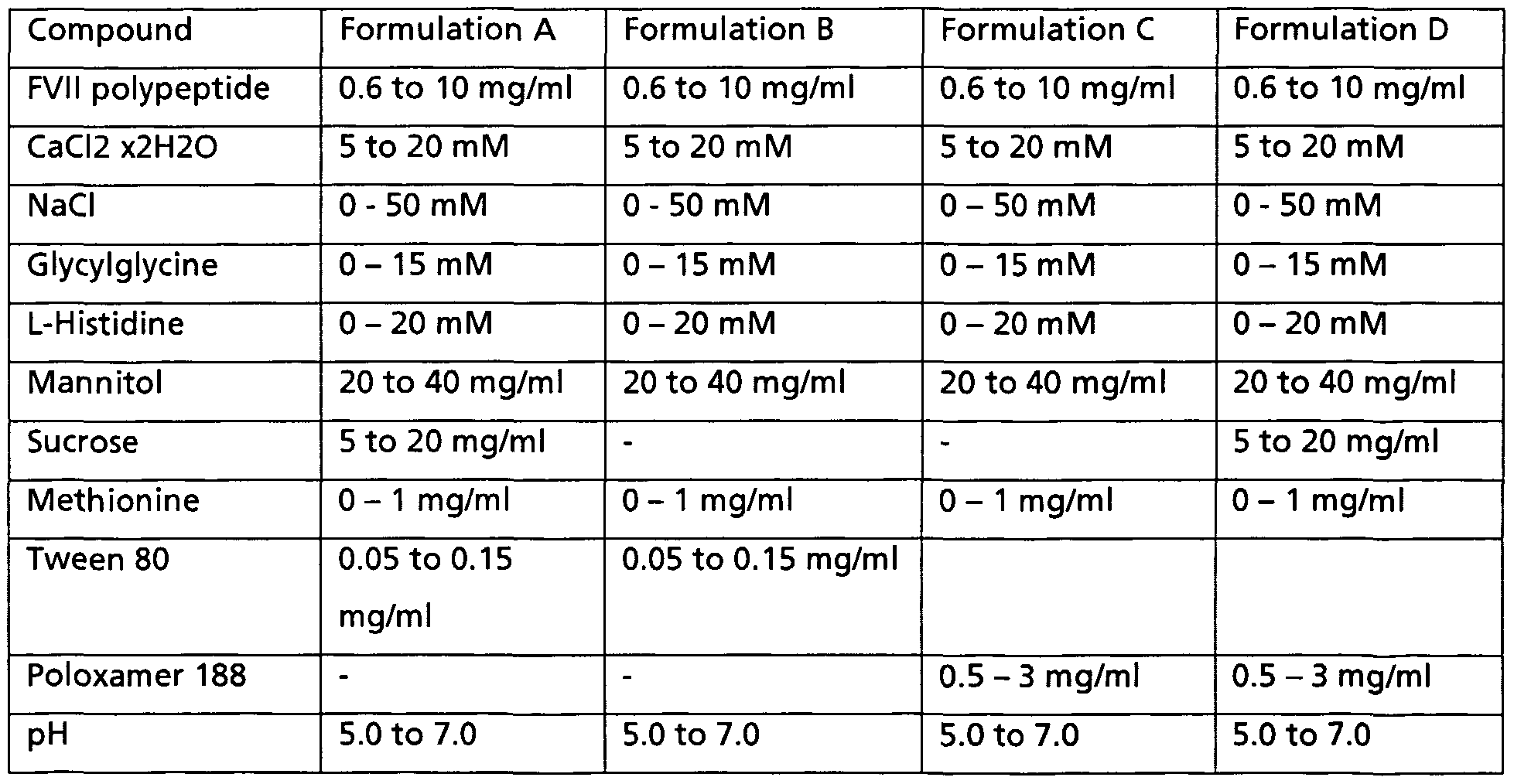
- compositions are as shown in Table A below. Table A
- compositions are as shown in Table B below Table B
- the compositions contains the excipients, and amounts thereof, listed in Table B above, but are formulated at pH 5.9.
- the compositions contains excipients, and amounts thereof, as listed in Table B above, but are formulated at pH 5.8.
- the compositions contains excipients, and amounts thereof, as listed in Table B above, but are formulated at pH 5 7.
- the compositions contains excipients, and amounts thereof, as listed in Table B above, but are formulated at pH 5 6.
- the compositions contains excipients, and amounts thereof, as listed in Table B above, but are formulated at pH 5.5.
- the present investigators have provided a method for stabilising Factor VII polypeptides by providing the proteins in solid compositions comprising selected pharmaceutically acceptable excipients, of which it is important to include a stabilising agent.
- a stabilising agent is composed of a combination of at least two groups of excipients selected from excipients being saccharides, polyols or antioxidants.
- saccharides saccharides
- antioxidants methionine
- a further aspect of the invention relates to a method of preparing a stable Factor VII polypeptide.
- the method comprises the steps of: i) Providing said Factor VII polypeptide in a solution comprising at least one stability agent selected from the group consisting of a) a combination of an antioxidant and mannitol; b) a combination of methionine and a polyol; c) a combination of a saccharide and mannitol; d) a combination of sucrose and a polyol; and e) methionine ii) Processing said solution so as to obtain a solid composition with a moisture content of not more than about 3 % w/w.
- the method comprises that said antioxidant is selected from the group consisting of homocysteine, cysteine, cystathionine, methionine, gluthatione, and peptides containing any one of homocysteine, cysteine, cystathionine, methionine and gluthatione.
- the antioxidant is methionine.
- said saccharide is selected from the group consisting of sucrose, dextrose, lactose, maltose, trehalose, cyclodextrins, maltodextrins and dextrans.
- the polyol is mannitol and the saccharide is sucrose.
- the antioxidant is methionine.
- the content of the saccharide and optionally the content of the antioxidant in said solution i) should be adjusted so as to achieve superior stabilised Factor VII polypeptides.
- the saccharide should be in an amount ranging from about 0.5 to 75 mg/ml, such as from about 2 to 60 mg/ml, from about 5 mg/ml to 55 mg/ml, from about 8 to 45 mg/ml, from about 10 to 40 mg/ml, from about 10 to 30 mg/ml, or from about 2 to 45 mg/ml, from about 5 mg/ml to 45 mg/ml, from about 5 to 35 mg/ml, from about 5 to 25 mg/ml, such as from about 5 to 20 mg/ml.
- the polyol should be in an amount ranging from about 0.5 to 75 mg/ml, such as from about 2 to 60 mg/ml, from about 5 mg/ml to 55 mg/ml, from about 8 to 45 mg/ml, from about 10 to 40 mg/ml, from about 10 to 30 mg/ml, or from about 2 to 45 mg/ml, from about 5 mg/ml to 45 mg/ml, from about 5 to 35 mg/ml, from about 5 to 25 mg/ml, such as from about 5 to 20 mg/ml.
- the antioxidant should be provided in an amount ranging from about 0.05 to 10 mg/ml, preferably from about 0.1 to 5 mg/ml, more preferably from about 0.1 mg/ml to 2.5 mg/ml, even more preferably from about 0.1 to 2 mg/ml, most preferably from about 0.1 to 1 mg/ml.
- the method for preparing a stable Factor VII polypeptide comprises freeze-drying.
- the freeze-drying relates to a process, wherein the solution comprising said Factor VII polypeptide is filled into lyophilisation vials or the like.
- Said Factor VII polypeptide may optionally be subjected to sterile filtration before start of freeze-drying. Cooling is applied to the shelves of the freeze-drier in order to freeze the vials and the solution below critical product temperatures. Water is removed by introducing vacuum and condensation of water vapour on the ice-condenser of the freeze-drier.
- the vials are closed and capped. Manufacturing is finalised and the composition is now in a form of a lyophilised cake.
- compositions when administered to a patient by injectable means, need to be reconstituted in a suitable liquid before use. They may also be reconstituted for other purposes, e.g. for reformulation into other pharmaceutical compositions. However, the present invention does not preclude that the compositions may be administered to a patient in their solid form.
- compositions are reconstituted using an acceptable, preferably sterile, diluent or carrier, preferably an aqueous carrier.
- aqueous carriers may be used, e.g., water (e.g. Water for Injection ⁇ /FI), buffered water, saline (e.g. 0.4% saline), glycine (e.g. 0.3% glycine), histidine, and the like.
- the reconstitution diluent may also contain one or more salts, such as a calcium salt (e.g. CaCI2) or a combination of a sodium salt and a calcium salt (e.g. NaCI and CaCI2).
- compositions are intended for parenteral administration for prophylactic and/or therapeutic treatment.
- the pharmaceutical compositions are administered parenterally, i.e., intravenously, subcutanously, or intramuscularly, or they are administered by way of continuous or pulsative infusion.
- a still further aspect of the invention relates to the use of the solid stabilised composition for the preparation of a medicament for treating a Factor Vll-responsive syndrome. That is to say that one aspect of the invention relates to the use of Factor VII polypeptide for the preparation of a medicament for treating a Factor Vll-responsive syndrome, said medicament comprising a composition comprising; a Factor VII polypeptide and a at least one stability agent selected from the group consisting of a) a combination of an antioxidant and mannitol; b) a combination of methionine and a polyol; c) a combination of a saccharide and mannitol; d) a combination of sucrose and a polyol;and e) methionine, said composition having a moisture content of not more than about 3%.
- the invention relates to administering said stabilised Factor VII polypeptide to a patient for treating a Factor Vll-responsive syndrome.
- the invention relates to a method of treating a Factor Vll-responsive syndrome comprising administering to a subject in need thereof an effective amount of a composition comprising a Factor VII polypeptide, and at least one stability agent selected from the group consisting of a) a combination of an antioxidant and mannitol; b) a combination of methionine and a polyol; c) a combination of a saccharide and mannitol; d) a combination of sucrose and a polyol; and e) methionine; said composition having a moisture content of not more than about 3%.
- said Factor Vll-responsive syndrome is haemophilia A, haemophilia B, Factor XI deficiency, Factor VII deficiency, thrombocytopenia, von Willebrand's disease, presence of a clotting Factor inhibitor, surgery or trauma. Additionally, Factor Vll-responsive syndrome may be associated with anticoagulant therapy.
- composition is in solid form. Accordingly, in a suitable embodiment the medicament should be suitable for being dissolved, which allows for parenteral administration of the medicament.
- administering the compositions to a patient it comprises the step of dissolving the composition in a suitable liquid prior to the administering step.
- FVIIa Coagulation Factor VII in its cleaved, activated two-chain form rFVII (rFVIIa) Recombinant Factor VII (recombinant Factor Vila)
- compositions comprising Factor VII polypeptides and prepared according to Example 2 are shown. Typical excipients and their typical amounts are shown.
- Table 1 shows the concentration of active ingredients and excipients in the event where the composition is in liquid form, that is, in the composition before finalising the manufacturing (e.g. finalising the freeze-drying), or in the reconstituted solution.
- Table 2 shows the concentration of active ingredient and excipients in the event where the composition is in solid form, i.e. in freeze-dried form.
- Table 2 Compositions, content of excipients in freeze-dried form.
- compositions were prepared from a purified bulk solution. Excipients were added, and the solution was diluted to the desired concentration of rFVIIa. The resulting solution was sterile filtered using a sterilised membrane filter (0.2 micron pore size or equivalent) and filled into sterile glass vials. The vials were freeze-dried, stoppered and sealed with aluminium flip-off type caps.
- compositions 1-19 comprising various amounts of sodium chloride, mannitol, sucrose and methionine and with various pH values were prepared according to the process described in Example 2.
- the compositions comprised fixed concentrations of Factor VII (1.0 mg/ml), Calcium Chloride, 2H 2 0 (1.47 mg/ml), Glycylglycine (1.32 mg/ml) and Polysorbate 80 (1.0 mg/ml).
- the oxidised forms are methionine sulfoxides of Factor VII Polypeptides.
- the two main derivatives of FVII are Met(0)298 FVII and Met(O)306 FVII.
- the content of oxidised forms is expressed as the percentage of the initial amount of Factor VII in the composition upon preparation that is recovered as oxidised forms of Factor VII.
- GP-HPLC was run on a Waters Protein Pak 300 SW column. 7.5x300 mm. using 0.2 M ammoniumsulfat pH 7.0 containing 5% isopropanol as the mobile phase. Flow rate: 0.5 ml/min and detection: 215 nm.
- the content of aggregates is expressed as the percentage of the initial amount of Factor VII in the composition upon preparation that is recovered as dimeric, oligomeric and polymeric forms of Factor VII.
- compositions 1-19 of Example 3 were analysed by method A (Example 4) for content of oxidised forms upon termination of the freeze-drying and upon 2 and 8 months of storage at 30°C.
- compositions comprising methionine are more stable towards oxidative degradation.
- compositions 1-19 of Example 3 were analysed by method B (Example 4) for content of aggregates upon termination of the freeze-drying and upon 2 and 8 months of storage at 30°C.
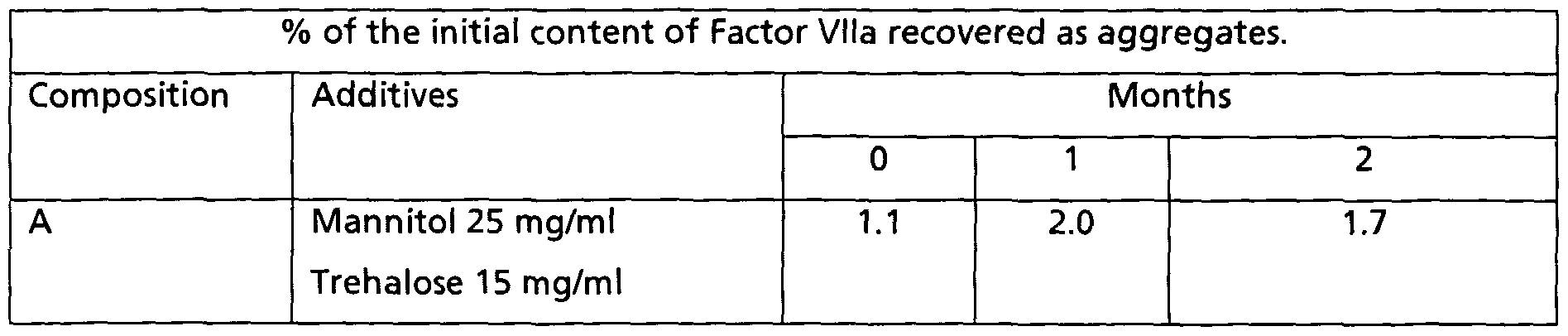
- Composition A comprising polyol and saccharide as listed in the table below was prepared according to the process described in Example 2.
- the composition further comprised Factor Vila (1.0 mg/ml), calcium chloride 2 H20 (1.47 mg/ml), glycylglycine (1.32 mg/ml) and polysorbate 80 (0.7 mg/ml). pH was 5.0.
- Composition A was analysed by method B (Example 4) for content of aggregates upon termination of the freeze-drying and upon 1 and 2 months of storage at 30°C.
- the table lists the % of the initial content of Factor Vila recovered as aggregates:
- Example 8 Structural stability of the freeze-dried cake is shown for various compositions, 1-19, see Example 3. The ratio of mannitol to sucrose is reported of each composition.
- the stability of the formulations was investigated at 25°C, 30°C, and 40°C and the following results were obtained.
- the vials were reconstituted in water before analysis.
- dimer and oligomer forms were measured by GP-HPLC as described in example 4. All results are stated in %.
- the activity was measured by one stage clotting assay as described in example 12 for formulations, which had been stored at 30°C for 3 months.
- the specific activity was calculated based on the content of rFVIIa in the formulations and the following results were obtained:
- formulations B and C which contain mannitol, sucrose, and methionine are more stable - i.e. shows a slower increase in contents of dimer and oligomer forms and oxidised forms.
- the activities of these formulations are higher as measured after 3 months' storage at 30°C.
- the vials were reconstituted in water and subjected to shaking for 19 hours in order to test the physical stability of the formulations.
- Formulation A pH 5.0 Formulation B: pH 5.5 Formulation C: pH 6.0 Formulation D: pH 6.5 Formulation E: pH 7.0 Formulation F: pH 7.5
- Test for Factor Vila activity 5 A suitable assay for testing for Factor Vila activity and thereby selecting suitable Factor Vila variants can be performed as a simple preliminary in vitro test: (the "In Vitro Hydrolysis Assay").
- Factor Vila Native (wild-type) Factor Vila and Factor Vila variant (both hereafter referred to as "Factor Vila")
- 10 may be assayed for specific activities. They may also be assayed in parallel to directly compare their specific activities.
- the assay is carried out in a microtiter plate (MaxiSorp, Nunc, Denmark).
- Ratio (A 405 nm Factor Vila variant)/(A 405 nm Factor Vila wild-type).
- Factor Vila variants with an activity comparable to or higher than native Factor Vila may be identified, such as, for example, variants where the ratio between the activity of the variant and the activity of native Factor VII (wild-type FVII) is around, versus above 1.0.
- the activity of Factor Vila or Factor Vila variants may also be measured using a physiological substrate such as Factor X, suitably at a concentration of 100-1000 nM, where the Factor Xa generated is measured after the addition of a suitable chromogenic substrate (eg. S-2765) ("the In Vitro Proteolysis Assay").
- a physiological substrate such as Factor X
- a suitable chromogenic substrate eg. S-2765
- the activity assay may be run at physiological temperature. 0
- Factor Vila Native (wild-type) Factor Vila and Factor Vila variant (both hereafter referred to as "Factor Vila") are assayed in parallel to directly compare their specific activities.
- the assay is carried out in a microtiter plate (MaxiSorp, Nunc, Denmark).
- Factor X cleavage is then stopped by the addition of 50 microL 50 mM Hepes, pH 7.4, containing 0.1 M NaCI, 20 mM EDTA and 1 mg/ml bovine serum albumin.
- the amount of Factor Xa generated is measured by addition of the chromogenic substrate Z-D-Arg-Gly- Arg-p-nitroanilide (S-2765, Chromogenix, Sweden), final concentration 0.5 mM.
- the absorbance at 405 nm is measured continuously in a SpectraMaxTM 340 plate reader (Molecular Devices, USA). The absorbance developed during 10 minutes, after subtraction of the absorbance in a blank well containing no FVIIa, is used to calculate the ratio between the proteolytic activities of variant and wild-type Factor Vila:
- Ratio (A405 nm Factor Vila variant)/(A405 nm Factor Vila wild-type).
- Factor Vila variants with an activity comparable to or higher than native Factor Vila may be identified, such as, for example, variants where the ratio between the activity of the variant and the activity of native Factor VII (wild-type FVII) is around, versus above 1.0.
- Factor VII or Factor Vll-related polypeptides or Factor VIII or Factor Vlll-related polypeptides e.g., variants
- thrombin The ability of Factor VII or Factor Vll-related polypeptides or Factor VIII or Factor Vlll-related polypeptides (e.g., variants) to generate thrombin can be measured in an assay comprising all relevant coagulation Factors and inhibitors at physiological concentrations and activated platelets (as described on p. 543 in Monroe et al. (1997) Brit. J. Haematol. 99, 542-547 which is hereby incorporated as reference).
- Clot assay 4 The activity of the Factor VII polypeptides may also be measured using a one-stage clot assay (assay 4) essentially as described in WO 92/15686 or US 5,997,864. Briefly, the sample to be tested is diluted in 50 mM Tris (pH 7.5), 0.1 % BSA and 100 ⁇ L is incubated with 100 ⁇ L of Factor VII deficient plasma and 200 ⁇ L of thromboplastin C containing 10 mM Ca 2+ . Clotting times are measured and compared to a standard curve using a reference standard or a pool of citrated normal human plasma in serial dilution.
- assay 4 The activity of the Factor VII polypeptides may also be measured using a one-stage clot assay (assay 4) essentially as described in WO 92/15686 or US 5,997,864. Briefly, the sample to be tested is diluted in 50 mM Tris (pH 7.5), 0.1 % BSA and
Landscapes
- Health & Medical Sciences (AREA)
- Chemical & Material Sciences (AREA)
- Life Sciences & Earth Sciences (AREA)
- General Health & Medical Sciences (AREA)
- Veterinary Medicine (AREA)
- Medicinal Chemistry (AREA)
- Pharmacology & Pharmacy (AREA)
- Public Health (AREA)
- Animal Behavior & Ethology (AREA)
- Epidemiology (AREA)
- Engineering & Computer Science (AREA)
- Chemical Kinetics & Catalysis (AREA)
- General Chemical & Material Sciences (AREA)
- Bioinformatics & Cheminformatics (AREA)
- Oil, Petroleum & Natural Gas (AREA)
- Organic Chemistry (AREA)
- Proteomics, Peptides & Aminoacids (AREA)
- Biochemistry (AREA)
- Hematology (AREA)
- Inorganic Chemistry (AREA)
- Gastroenterology & Hepatology (AREA)
- Immunology (AREA)
- Zoology (AREA)
- Diabetes (AREA)
- Nuclear Medicine, Radiotherapy & Molecular Imaging (AREA)
- Molecular Biology (AREA)
- General Engineering & Computer Science (AREA)
- Genetics & Genomics (AREA)
- Wood Science & Technology (AREA)
- Dermatology (AREA)
- Medicines That Contain Protein Lipid Enzymes And Other Medicines (AREA)
- Medicinal Preparation (AREA)
- Peptides Or Proteins (AREA)
Abstract
Description




Claims


Priority Applications (22)
| Application Number | Priority Date | Filing Date | Title |
|---|---|---|---|
| EP03729911.2A EP1517698B2 (en) | 2002-06-21 | 2003-06-20 | STABILISED SOLID COMPOSITIONS OF FACTOR VIIa POLYPEPTIDES |
| JP2004530893A JP4648002B2 (en) | 2002-06-21 | 2003-06-20 | Stabilized solid composition of factor VII polypeptide |
| KR10-2004-7020858A KR20050013148A (en) | 2002-06-21 | 2003-06-20 | Stabilised solid compositions of factor ⅶ polypeptides |
| ES03729911.2T ES2523655T5 (en) | 2002-06-21 | 2003-06-20 | Solid stabilized compositions of Factor VIIa polypeptides |
| DK03729911.2T DK1517698T4 (en) | 2002-06-21 | 2003-06-20 | Stabilized solid compositions of Factor VIIa polypeptides |
| BRPI0311959A BRPI0311959B8 (en) | 2002-06-21 | 2003-06-20 | composition, methods to prepare a stable factor vii polypeptide, and to treat a factor vii responsive syndrome, and, use of the factor vii polypeptide |
| CN038173735A CN1671410B (en) | 2002-06-21 | 2003-06-20 | Stabilized solid compositions of factor VII polypeptides |
| AU2003240438A AU2003240438A1 (en) | 2002-06-21 | 2003-06-20 | Stabilised solid compositions of factor vii polypeptides |
| CA2490342A CA2490342C (en) | 2002-06-21 | 2003-06-20 | Stabilised solid compositions of factor vii polypeptides |
| KR1020117007292A KR101212025B1 (en) | 2002-06-21 | 2003-06-20 | Stabilised solid compositions of factor ⅶ polypeptides |
| US10/609,780 US20040248793A1 (en) | 2002-06-21 | 2003-06-30 | Stabilised solid compositions of factor VII polypeptides |
| IL165608A IL165608A (en) | 2002-06-21 | 2004-12-07 | Stabilised solid compositions of factor vii polypeptides, methods of their preparation and uses thereof for the manufacture of medicaments |
| US11/526,503 US8299029B2 (en) | 2002-06-21 | 2006-09-25 | Stabilised solid compositions of factor VII polypeptides |
| US13/573,310 US8729022B2 (en) | 2002-06-21 | 2012-09-10 | Stabilised solid compositions of factor VII polypeptides |
| US14/186,145 US20140178356A1 (en) | 2002-06-21 | 2014-02-21 | Stabilised Solid Compositions of Factor VII Polypeptides |
| US14/823,573 US20150343064A1 (en) | 2002-06-21 | 2015-08-11 | Stabilised Solid Compositions of Factor VII Polypeptides |
| US15/133,654 US20160228553A1 (en) | 2002-06-21 | 2016-04-20 | Stabilised Solid Compositions of Factor VII Polypeptides |
| US15/410,342 US20170128550A1 (en) | 2002-06-21 | 2017-01-19 | Stabilised Solid Compositions of Factor VII Polypeptides |
| US15/819,639 US20180085439A1 (en) | 2002-06-21 | 2017-11-21 | Stabilised Solid Compositions of Factor VII Polypeptides |
| US16/164,585 US20190111118A1 (en) | 2002-06-21 | 2018-10-18 | Stabilised Solid Compositions of Factor VII Polypeptides |
| US16/507,115 US20190328851A1 (en) | 2002-06-21 | 2019-07-10 | Stabilised Solid Compositions of Factor VII Polypeptides |
| US16/862,623 US20200254072A1 (en) | 2002-06-21 | 2020-04-30 | Stabilised Solid Compositions of Factor VII Polypeptides |
Applications Claiming Priority (4)
| Application Number | Priority Date | Filing Date | Title |
|---|---|---|---|
| DKPA200200963 | 2002-06-21 | ||
| DKPA200200963 | 2002-06-21 | ||
| US39415302P | 2002-07-03 | 2002-07-03 | |
| US60/394,153 | 2002-07-03 |
Related Child Applications (1)
| Application Number | Title | Priority Date | Filing Date |
|---|---|---|---|
| US10/609,780 Continuation US20040248793A1 (en) | 2002-06-21 | 2003-06-30 | Stabilised solid compositions of factor VII polypeptides |
Publications (1)
| Publication Number | Publication Date |
|---|---|
| WO2004000347A1 true WO2004000347A1 (en) | 2003-12-31 |
Family
ID=34178323
Family Applications (1)
| Application Number | Title | Priority Date | Filing Date |
|---|---|---|---|
| PCT/DK2003/000419 Ceased WO2004000347A1 (en) | 2002-06-21 | 2003-06-20 | Stabilised solid compositions of factor vii polypeptides |
Country Status (16)
| Country | Link |
|---|---|
| US (11) | US20040248793A1 (en) |
| EP (2) | EP2283856B1 (en) |
| JP (1) | JP4648002B2 (en) |
| KR (2) | KR101212025B1 (en) |
| CN (2) | CN101912601B (en) |
| AU (1) | AU2003240438A1 (en) |
| BR (1) | BRPI0311959B8 (en) |
| CA (1) | CA2490342C (en) |
| DK (2) | DK1517698T4 (en) |
| ES (2) | ES2653555T3 (en) |
| HU (1) | HUE037603T2 (en) |
| IL (1) | IL165608A (en) |
| PL (1) | PL207018B1 (en) |
| PT (2) | PT1517698E (en) |
| RU (1) | RU2366451C2 (en) |
| WO (1) | WO2004000347A1 (en) |
Cited By (21)
| Publication number | Priority date | Publication date | Assignee | Title |
|---|---|---|---|---|
| WO2005058283A3 (en) * | 2003-12-19 | 2006-05-18 | Novo Nordisk Healthcare Ag | Stabilised compositions of factor vii polypeptides |
| WO2006089952A1 (en) * | 2005-02-24 | 2006-08-31 | Novo Nordisk Health Care Ag | Amidino-compounds por stabilizing factor vii polypeptide formulations |
| WO2006114448A3 (en) * | 2005-04-28 | 2007-04-19 | Novo Nordisk Healthcare Ag | A closed container comprising an activated factor vii polypeptide, processes for the preparation of the same, and a kit and a method for use of the kit |
| WO2008135500A1 (en) * | 2007-05-02 | 2008-11-13 | Novo Nordisk Health Care Ag | High concentration factor vii polypeptide formulations comprising an aromatic preservative and an antioxidant |
| CN100486641C (en) * | 2006-08-11 | 2009-05-13 | 南京师范大学 | Compound bone peptide medicine composition oral preparation and preparation method therefor |
| EP2134338A1 (en) * | 2007-04-12 | 2009-12-23 | Infinity Discovery, Inc. | Hydroquinone ansamycin formulations |
| US7790852B2 (en) | 2003-06-25 | 2010-09-07 | Novo Nordisk Health Care A/G | Liquid composition of factor VII polypeptides |
| WO2010149907A1 (en) | 2009-06-26 | 2010-12-29 | Lfb-Biotechnologies | Factor vii composition |
| US7951368B2 (en) | 2007-06-25 | 2011-05-31 | Amgen Inc. | Compositions of specific binding agents to hepatocyte growth factor |
| US8022031B2 (en) | 2001-12-21 | 2011-09-20 | Novo Nordisk Health Care A/G | Liquid composition of factor VII polypeptides |
| US8299029B2 (en) | 2002-06-21 | 2012-10-30 | Novo Nordisk Health Care Ag | Stabilised solid compositions of factor VII polypeptides |
| US8703755B2 (en) | 2003-12-23 | 2014-04-22 | Infinity Pharmaceuticals, Inc. | Analogs of benzoquinone-containing ansamycins and methods of use thereof |
| US8778921B2 (en) | 2008-10-15 | 2014-07-15 | Infinity Pharmaceuticals, Inc. | Ansamycin hydroquinone compositions |
| AU2012213951B2 (en) * | 2005-04-28 | 2014-10-16 | Novo Nordisk Health Care Ag | A closed container comprising an activated factor VII polypeptide, processes for the preparation of the same, and a kit and a method for use of the kit |
| US8883979B2 (en) | 2012-08-31 | 2014-11-11 | Bayer Healthcare Llc | Anti-prolactin receptor antibody formulations |
| US9205130B2 (en) | 2010-02-12 | 2015-12-08 | Centro De Ingenieria Genetica Y Biotecnologia | Orally administrable pharmaceutical pellet of epidermal growth factor |
| AU2014250714B2 (en) * | 2003-12-19 | 2016-09-08 | Novo Nordisk Health Care Ag | Stabilised compositions of factor VII polypeptides |
| JP2017088611A (en) * | 2005-10-06 | 2017-05-25 | アラーガン、インコーポレイテッドAllergan,Incorporated | Non-protein stabilized clostridial toxin pharmaceutical composition |
| EP1745141B2 (en) † | 2004-05-04 | 2019-09-25 | Novo Nordisk Health Care AG | O-linked glycoforms of faktor vii and method to manufacture them |
| WO2023246680A1 (en) * | 2022-06-20 | 2023-12-28 | Staidson (Beijing) Biopharmaceuticals Co., Ltd. | Activators of coagulation factor x and formulations thereof for treating bleeding disorders |
| EP3328416B1 (en) | 2015-07-30 | 2024-03-13 | BioMarin Pharmaceutical Inc. | Use of c-type natriuretic peptide variants to treat skeletal dysplasia |
Families Citing this family (17)
| Publication number | Priority date | Publication date | Assignee | Title |
|---|---|---|---|---|
| US20040247607A1 (en) * | 1999-11-08 | 2004-12-09 | Novus International, Inc. | Use of surfactants to stabilize oocysts |
| JP5306597B2 (en) * | 2003-07-01 | 2013-10-02 | ノボ ノルディスク ヘルス ケア アクチェンゲゼルシャフト | Liquid aqueous pharmaceutical composition of factor VII polypeptide |
| ES2257225B1 (en) * | 2006-02-17 | 2007-03-16 | Grifols, S.A | THERAPEUTIC PREPARATION OF FVIIA OF VERY HIGH PURITY AND METHOD FOR OBTAINING IT. |
| TW200806317A (en) * | 2006-03-20 | 2008-02-01 | Wyeth Corp | Methods for reducing protein aggregation |
| WO2008078189A2 (en) * | 2006-12-20 | 2008-07-03 | Bayer Healthcare Llc | Factor vii and viia compositions |
| EP2150264A4 (en) | 2007-04-26 | 2014-09-24 | Bayer Healthcare Llc | Stabilization of liquid solutions of recombinant protein for frozen storage |
| UA104572C2 (en) * | 2008-04-24 | 2014-02-25 | Имматикс Байотекнолоджиз Гмбх | Novel formulations of tumour-associated peptides binding to human leukocyte antigen (hla) class i or ii molecules for vaccines |
| EP2113253B1 (en) | 2008-04-30 | 2010-03-31 | Immatics Biotechnologies GmbH | Novel formulations of tumour-associated peptides binding to human leukocyte antigen (HLA) class I or II molecules for vaccines |
| CN102441172B (en) * | 2011-12-06 | 2014-05-07 | 中国医学科学院输血研究所 | High-purity prothrombin complex product freeze-drying stabilizer |
| KR102434024B1 (en) * | 2013-12-24 | 2022-08-22 | 아레스 트레이딩 에스.아. | Fgf-18 formulation in alginate/collagen hydrogels |
| CN104826117B (en) * | 2015-05-05 | 2017-11-14 | 广东卫伦生物制药有限公司 | Storage stabilizing agent for human serum immunoglobulin solution preparation |
| CN104991079B (en) * | 2015-07-16 | 2016-04-06 | 青岛古高生物科技有限公司 | Antioxidant for blood coagulation reagent |
| CN106139127B (en) * | 2016-08-05 | 2020-04-07 | 无锡药明生物技术股份有限公司 | Recombinant blood coagulation factor VIII freeze-dried preparation |
| AR109621A1 (en) * | 2016-10-24 | 2018-12-26 | Janssen Pharmaceuticals Inc | FORMULATIONS OF VACCINES AGAINST GLUCOCONJUGADOS OF EXPEC |
| CN112138149A (en) * | 2019-06-28 | 2020-12-29 | 北京基科晟斯医药科技有限公司 | Recombinant factor VIII formulations |
| EP3833381B1 (en) | 2019-08-15 | 2022-08-03 | Catalyst Biosciences, Inc. | Modified factor vii polypeptides for subcutaneous administration |
| CN117860874B (en) * | 2024-03-12 | 2024-07-02 | 正大天晴药业集团南京顺欣制药有限公司 | Pharmaceutical composition of recombinant human coagulation factor VIIa |
Citations (3)
| Publication number | Priority date | Publication date | Assignee | Title |
|---|---|---|---|---|
| WO1993000807A1 (en) | 1991-07-03 | 1993-01-21 | Cryolife, Inc. | Method for stabilization of biomaterials |
| WO1994026286A1 (en) | 1993-05-07 | 1994-11-24 | Pharmacia Ab | Oxygen-reduced aqueous solution of factor viii |
| WO2000048635A1 (en) | 1999-02-22 | 2000-08-24 | Baxter International Inc. | Novel albumin-free factor viii formulations |
Family Cites Families (109)
| Publication number | Priority date | Publication date | Assignee | Title |
|---|---|---|---|---|
| US115590A (en) | 1871-06-06 | Lfxlproxeixie | ||
| DE2916711A1 (en) | 1979-04-25 | 1980-11-06 | Behringwerke Ag | Blood coagulation factors and process for their manufacture |
| US4956386A (en) * | 1980-04-25 | 1990-09-11 | Gist-Brocades N.V. | Pharmaceutical compositions and process for their preparation |
| US4404132A (en) | 1980-05-27 | 1983-09-13 | Cutter Laboratories, Inc. | Blood coagulation promoting product |
| CA1182748A (en) | 1980-11-21 | 1985-02-19 | Gerard Marx | Method for synthesizing procoagulant factor viii activity |
| US4495278A (en) * | 1981-04-27 | 1985-01-22 | Baxter Travenol Laboratories, Inc. | Process for making novel blood clotting enzyme compositions |
| US4382083A (en) | 1981-06-25 | 1983-05-03 | Baxter Travenol Laboratories, Inc. | Therapeutic method for treating blood-clotting defects with factor VIIa |
| GR860984B (en) | 1985-04-17 | 1986-08-18 | Zymogenetics Inc | Expression of factor vii and ix activities in mammalian cells |
| ATE66374T1 (en) | 1985-11-26 | 1991-09-15 | Novo Nordisk As | PREPARATIONS AND METHODS FOR TREATMENT OF BLOOD DISORDERS. |
| US5180583A (en) | 1985-11-26 | 1993-01-19 | Hedner Ulla K E | Method for the treatment of bleeding disorders |
| US5595886A (en) | 1986-01-27 | 1997-01-21 | Chiron Corporation | Protein complexes having Factor VIII:C activity and production thereof |
| JP2593500B2 (en) | 1986-06-24 | 1997-03-26 | ノルデイスク ゲントフテ エー/エス | (VIII) Method for producing coagulation-active complex of factor fragment |
| ES2045167T5 (en) | 1987-10-23 | 1996-07-01 | Centre Regional De Transfusion | PREPARATION OF HUMAN FACTOR IX CONCENTRATE OF HIGH PURITY AND OTHER PLASMA PROTEINS. |
| CA1329760C (en) | 1987-10-29 | 1994-05-24 | Ted C. K. Lee | Plasma and recombinant protein formulations in high ionic strength media |
| US5472850A (en) | 1991-04-10 | 1995-12-05 | Oklahoma Medical Research Foundation | Quantitative clotting assay for activated factor VII |
| JP2824430B2 (en) | 1989-08-02 | 1998-11-11 | 財団法人化学及血清療法研究所 | Method for preparing blood coagulation factor VII or activated blood coagulation factor VII |
| US5580560A (en) | 1989-11-13 | 1996-12-03 | Novo Nordisk A/S | Modified factor VII/VIIa |
| DE3939346A1 (en) | 1989-11-29 | 1991-06-06 | Behringwerke Ag | MEDICINES FOR SUBCUTANEOUS OR INTRAMUSCULAR APPLICATION CONTAINING POLYPEPTIDES |
| DE4001451A1 (en) | 1990-01-19 | 1991-08-01 | Octapharma Ag | STABLE INJECTABLE SOLUTIONS OF FACTOR VIII AND FACTOR IX |
| ATE180834T1 (en) | 1990-01-29 | 1999-06-15 | Zymogenetics Inc | ANTICOAGULANT PROTEINS |
| EP1479395A1 (en) | 1991-02-28 | 2004-11-24 | Novo Nordisk A/S | Modified factor VII |
| US5788965A (en) | 1991-02-28 | 1998-08-04 | Novo Nordisk A/S | Modified factor VII |
| US5817788A (en) | 1991-02-28 | 1998-10-06 | Zymogenetics, Inc. | Modified factor VII |
| US5997864A (en) | 1995-06-07 | 1999-12-07 | Novo Nordisk A/S | Modified factor VII |
| US5833982A (en) | 1991-02-28 | 1998-11-10 | Zymogenetics, Inc. | Modified factor VII |
| FR2684999A1 (en) | 1991-12-16 | 1993-06-18 | Aquitaine Dev Transf Sanguine | PROCESS FOR MANUFACTURING HIGH-PURITY ACTIVE FACTOR VII CONCENTRATE ESSENTIALLY HAVING DEPENDENT VITAMIN K FACTORS AND VIIICAG FACTORS |
| JP3155797B2 (en) | 1991-12-26 | 2001-04-16 | 株式会社日立製作所 | Overvoltage self-protection semiconductor device and semiconductor circuit using the same |
| WO1993022336A1 (en) | 1992-04-30 | 1993-11-11 | Alpha Therapeutic Corporation | Improved solubilization and stabilization of factor viii complex |
| DK0658168T3 (en) | 1992-08-27 | 2001-01-22 | Sanquin Bloedvoorziening | Antibodies specific for a hemostatic protein, its use for the isolation of intact protein, hemostatic proteins |
| DK38293D0 (en) | 1993-03-31 | 1993-03-31 | Novo Nordisk As | PREPARATION OF PROTEINS |
| AU703110B2 (en) | 1993-05-21 | 1999-03-18 | Novo Nordisk A/S | Modified factor VII |
| WO1995003332A1 (en) | 1993-07-23 | 1995-02-02 | Baxter International Inc. | Activated human factor viii and method of preparation |
| US6277828B1 (en) | 1993-08-20 | 2001-08-21 | Syntex (U.S.A.) Inc. | Pharmaceutical formulations of nerve growth factor |
| US5576291A (en) | 1993-09-13 | 1996-11-19 | Baxter International Inc. | Activated factor VIII as a therapeutic agent and method of treating factor VIII deficiency |
| IL113010A0 (en) | 1994-03-31 | 1995-10-31 | Pharmacia Ab | Pharmaceutical formulation comprising factor VIII or factor ix with an activity of at least 200 IU/ml and an enhancer for improved subcutaneous intramuscular or intradermal administration |
| US6372716B1 (en) | 1994-04-26 | 2002-04-16 | Genetics Institute, Inc. | Formulations for factor IX |
| US5580856A (en) | 1994-07-15 | 1996-12-03 | Prestrelski; Steven J. | Formulation of a reconstituted protein, and method and kit for the production thereof |
| DE4435520A1 (en) | 1994-10-04 | 1996-04-11 | Immuno Ag | Process for the separation of recombinant pro-factor IX from recombinant factor IX |
| SE9403915D0 (en) | 1994-11-14 | 1994-11-14 | Annelie Almstedt | Process A |
| US5649959A (en) | 1995-02-10 | 1997-07-22 | Sherwood Medical Company | Assembly for sealing a puncture in a vessel |
| US6255091B1 (en) | 1995-04-28 | 2001-07-03 | Axys Pharmaceuticals, Inc. | Potentiating metal mediated serine protease inhibitors with cobalt or zinc ions |
| DE19531637A1 (en) | 1995-08-28 | 1997-03-06 | Immuno Ag | Pharmaceutical composition for the treatment of blood coagulation disorders, method for the production thereof and their use |
| DE19538715A1 (en) | 1995-10-18 | 1997-04-30 | Behringwerke Ag | Process for cleaning factor VII and activated factor VII |
| SE9503679D0 (en) | 1995-10-20 | 1995-10-20 | Pharmacia Ab | antioxidants |
| US5993795A (en) | 1995-11-09 | 1999-11-30 | Takemoto Yushi Kabushiki Kaisha | Protein composition derived from sesame seed and use thereof |
| US5925738A (en) | 1995-12-01 | 1999-07-20 | The American National Red Cross | Methods of production and use of liquid formulations of plasma proteins |
| US6320029B1 (en) | 1996-11-29 | 2001-11-20 | The American National Red Cross | Methods of production and use of liquid formulations of plasma proteins |
| US5830852A (en) | 1995-12-19 | 1998-11-03 | Cobra Therapeutics, Ltd. | Compositions for insulin-receptor mediated nucleic acid delivery |
| US5770700A (en) | 1996-01-25 | 1998-06-23 | Genetics Institute, Inc. | Liquid factor IX formulations |
| DE19903693A1 (en) | 1998-04-24 | 1999-10-28 | Centeon Pharma Gmbh | Protease for activation of coagulation factor VII |
| TW518219B (en) | 1996-04-26 | 2003-01-21 | Chugai Pharmaceutical Co Ltd | Erythropoietin solution preparation |
| US5763401A (en) * | 1996-07-12 | 1998-06-09 | Bayer Corporation | Stabilized albumin-free recombinant factor VIII preparation having a low sugar content |
| DE69729880T3 (en) | 1996-12-24 | 2012-05-10 | Biogen Idec Ma Inc. | STABLE LIQUID INTERFERON PREPARATIONS |
| US5804420A (en) | 1997-04-18 | 1998-09-08 | Bayer Corporation | Preparation of recombinant Factor VIII in a protein free medium |
| ZA983497B (en) | 1997-04-28 | 1999-10-25 | Lilly Co Eli | Activated protein c formulations. |
| US6461610B1 (en) | 1997-07-18 | 2002-10-08 | Novo Nordisk A/S | Methods for modifying cell motility using factor VIIa or inactivated factor VIIa |
| US6310183B1 (en) | 1997-09-10 | 2001-10-30 | Novo Nordisk A/S | Coagulation factor VIIa composition |
| AT409334B (en) | 1997-09-19 | 2002-07-25 | Immuno Ag | PHARMACEUTICAL PREPARATION CONTAINING VITAMIN K-DEPENDENT INDIVIDUAL FACTORS |
| US6017882A (en) | 1997-10-23 | 2000-01-25 | Regents Of The University Of Minnesota | Modified vitamin K-dependent polypeptides |
| RU2142278C1 (en) * | 1997-10-31 | 1999-12-10 | Чухаджян Ара Гарникович | Hemostatic agent showing topical effect |
| AT408613B (en) | 1998-06-17 | 2002-01-25 | Immuno Ag | PHARMACEUTICAL FACTOR VII PREPARATION |
| US6391609B1 (en) | 1998-10-07 | 2002-05-21 | Sigma-Aldrich Co. | Thromboplastin reagents and methods for preparing and using such reagents |
| DE19853033A1 (en) | 1998-11-18 | 2000-05-25 | Centeon Pharma Gmbh | Stabilized factor XIII and fibrinogen preparations useful as tissue adhesive components |
| JP2000247903A (en) | 1999-03-01 | 2000-09-12 | Chugai Pharmaceut Co Ltd | Long-term stabilized preparation |
| US20010031721A1 (en) | 1999-05-05 | 2001-10-18 | Chandra Webb | Highly concentrated, lyophilized, and liquid factor IX formulations |
| EP1194161B1 (en) | 1999-07-13 | 2005-11-23 | Biovitrum Ab | Stable factor viii compositions |
| DE19937218A1 (en) | 1999-08-06 | 2001-02-08 | Aventis Behring Gmbh | Process for the pure presentation of the protease activating the blood coagulation factor VII, its proenzyme or a mixture of both proteins by means of affinity chromatography |
| US6586574B1 (en) | 1999-08-17 | 2003-07-01 | Nn A/S | Stabilization of freeze-dried cake |
| ATE264340T1 (en) * | 1999-08-17 | 2004-04-15 | Novo Nordisk Healthcare Ag | STABILIZATION OF FREEZE-DRIED CAKE |
| JP4451514B2 (en) | 1999-08-24 | 2010-04-14 | 財団法人化学及血清療法研究所 | Blood coagulation factor VII variant |
| TWI245645B (en) | 1999-09-08 | 2005-12-21 | Chugai Pharmaceutical Co Ltd | Protein solution formulations and stabilization methods thereof |
| US6750053B1 (en) | 1999-11-15 | 2004-06-15 | I-Stat Corporation | Apparatus and method for assaying coagulation in fluid samples |
| WO2001058935A2 (en) | 2000-02-11 | 2001-08-16 | Maxygen Aps | FACTOR VII OR VIIa-LIKE MOLECULES |
| JP5090605B2 (en) | 2000-05-03 | 2012-12-05 | ノボ ノルディスク ヘルス ケア アクチェンゲゼルシャフト | Subcutaneous administration of coagulation factor VII |
| WO2001083725A1 (en) | 2000-05-03 | 2001-11-08 | Novo Nordisk A/S | Human coagulation factor vii variants |
| US7015194B2 (en) | 2000-05-10 | 2006-03-21 | Novo Nordisk A/S | Pharmaceutical composition comprising factor VIIa and anti-TFPI |
| DK1282438T3 (en) | 2000-05-10 | 2005-11-14 | Novo Nordisk Healthcare Ag | Pharmaceutical composition comprising a factor VIIa and a factor XIII |
| EP2226385B1 (en) | 2000-09-13 | 2013-07-10 | Novo Nordisk Health Care AG | Human Coagulation Factor VII Variants |
| AU2001291653A1 (en) | 2000-10-02 | 2002-04-15 | Novo-Nordisk A/S | Industrial-scale serum-free production of recombinant factor vii in mammalian cells |
| RU2325181C2 (en) * | 2000-10-02 | 2008-05-27 | Ново Нордиск Хелт Кэр Аг | Glycoforms of vii factor |
| WO2002038162A1 (en) | 2000-11-09 | 2002-05-16 | The Scripps Research Institute | MODIFIED FACTOR VIIa |
| DE50114021D1 (en) | 2001-01-08 | 2008-07-24 | Csl Behring Gmbh | Stabilized liquid preparation of the coagulation factor VII-activating protease or its proenzyme |
| US6825323B2 (en) | 2001-01-10 | 2004-11-30 | The United States Of America As Represented By The Secretary Of The Army | Compositions for treatment of hemorrhaging with activated factor VIIa in combination with fibrinogen and methods of using same |
| ES2432967T3 (en) | 2001-03-22 | 2013-12-05 | Novo Nordisk Health Care Ag | Coagulation Factor VII derivatives |
| KR101067400B1 (en) | 2001-07-10 | 2011-09-27 | 잇판자이단호진 가가쿠오요비겟세이료호겐쿠쇼 | Pharmaceutically Stable Hemostatic Compositions |
| GB0117879D0 (en) | 2001-07-21 | 2001-09-12 | Common Services Agency | Storage of liquid compositions |
| US6858587B2 (en) | 2001-11-02 | 2005-02-22 | Novo Nordisk Pharmaceuticals, Inc. | Use of tissue factor agonist or tissue factor antagonist for treatment of conditions related to apoptosis |
| US7078479B2 (en) | 2001-11-09 | 2006-07-18 | Novo Nordisk Healthcare A/G | Pharmaceutical composition comprising factor VII polypeptides and alpha2-antiplasmin polypeptides |
| US7125846B2 (en) | 2001-11-09 | 2006-10-24 | Novo Nordisk Healthcare A/G | Pharmaceutical composition comprising factor VII polypeptides and factor V polypeptides |
| WO2003039585A1 (en) | 2001-11-09 | 2003-05-15 | Novo Nordisk Health Care Ag | Pharmaceutical composition comprising factor vii polypeptides and protein c inhibitors |
| US20030119743A1 (en) | 2001-11-09 | 2003-06-26 | Rasmus Rojkjaer | Pharmaceutical composition comprising factor VII polypeptides and tissue plasminogen inhibitors |
| KR20040065278A (en) | 2001-12-21 | 2004-07-21 | 노보 노르디스크 에이/에스 | Liquid composition of modified factor vii polypeptides |
| JP2005530683A (en) | 2001-12-21 | 2005-10-13 | ノボ ノルディスク ヘルス ケア アクチェンゲゼルシャフト | Liquid composition of factor VII polypeptide |
| PL370656A1 (en) | 2001-12-21 | 2005-05-30 | Novo Nordisk A/S | Liquid composition of modified factor vii polypeptides |
| US20040009981A1 (en) | 2002-03-15 | 2004-01-15 | David Bebbington | Compositions useful as inhibitors of protein kinases |
| US20040009918A1 (en) | 2002-05-03 | 2004-01-15 | Hanne Nedergaard | Stabilised solid compositions of modified factor VII |
| JP5184738B2 (en) † | 2002-05-03 | 2013-04-17 | ノボ ノルディスク ヘルス ケア アクチェンゲゼルシャフト | Stabilized solid composition of modified factor VII |
| CN101912601B (en) | 2002-06-21 | 2012-08-29 | 诺和诺德医疗保健公司 | Stabilised solid compositions of factor VII polypeptides |
| US6933808B2 (en) | 2002-07-17 | 2005-08-23 | Qing Ma | Microelectromechanical apparatus and methods for surface acoustic wave switching |
| EP1422309A1 (en) | 2002-11-22 | 2004-05-26 | Siemens Aktiengesellschaft | Use of an apparatus for spray compacting for the production of a layer and layer system |
| AT501088A2 (en) | 2002-12-18 | 2006-06-15 | Bio Prod & Bio Eng Ag | STABLE THERAPEUTIC PROTEINS |
| CA2518327A1 (en) | 2003-03-18 | 2004-09-30 | Novo Nordisk Health Care Ag | Liquid, aqueous, pharmaceutical compositions of factor vii polypeptides |
| US7897734B2 (en) | 2003-03-26 | 2011-03-01 | Novo Nordisk Healthcare Ag | Method for the production of proteins |
| KR20060015574A (en) | 2003-05-23 | 2006-02-17 | 노보 노르디스크 헬스 케어 악티엔게젤샤프트 | Protein Stabilization in Solution |
| EP1646398A2 (en) | 2003-06-13 | 2006-04-19 | Novo Nordisk Health Care AG | Formulations comprising factor viia and a factor vii related polypeptide |
| JP5306597B2 (en) | 2003-07-01 | 2013-10-02 | ノボ ノルディスク ヘルス ケア アクチェンゲゼルシャフト | Liquid aqueous pharmaceutical composition of factor VII polypeptide |
| EP1656158B1 (en) | 2003-08-14 | 2016-03-09 | Novo Nordisk Health Care AG | Liquid, aqueous pharmaceutical composition of factor vii polypeptides |
| EP2311437A1 (en) | 2003-12-19 | 2011-04-20 | Novo Nordisk Health Care AG | Stabilised compositions of factor VII polypeptides |
| JP2008539208A (en) | 2005-04-28 | 2008-11-13 | ノボ ノルディスク ヘルス ケア アクチェンゲゼルシャフト | Closed container containing activated factor VII polypeptide, method of preparation, and kit and method of using the kit |
-
2003
- 2003-06-20 CN CN2010101566899A patent/CN101912601B/en not_active Expired - Lifetime
- 2003-06-20 JP JP2004530893A patent/JP4648002B2/en not_active Expired - Lifetime
- 2003-06-20 CA CA2490342A patent/CA2490342C/en not_active Expired - Fee Related
- 2003-06-20 HU HUE10181033A patent/HUE037603T2/en unknown
- 2003-06-20 ES ES10181033.1T patent/ES2653555T3/en not_active Expired - Lifetime
- 2003-06-20 PT PT37299112T patent/PT1517698E/en unknown
- 2003-06-20 DK DK03729911.2T patent/DK1517698T4/en active
- 2003-06-20 EP EP10181033.1A patent/EP2283856B1/en not_active Expired - Lifetime
- 2003-06-20 RU RU2005101340/15A patent/RU2366451C2/en active
- 2003-06-20 WO PCT/DK2003/000419 patent/WO2004000347A1/en not_active Ceased
- 2003-06-20 CN CN038173735A patent/CN1671410B/en not_active Expired - Lifetime
- 2003-06-20 PT PT101810331T patent/PT2283856T/en unknown
- 2003-06-20 PL PL373904A patent/PL207018B1/en unknown
- 2003-06-20 DK DK10181033.1T patent/DK2283856T3/en active
- 2003-06-20 BR BRPI0311959A patent/BRPI0311959B8/en not_active IP Right Cessation
- 2003-06-20 KR KR1020117007292A patent/KR101212025B1/en not_active Expired - Lifetime
- 2003-06-20 EP EP03729911.2A patent/EP1517698B2/en not_active Expired - Lifetime
- 2003-06-20 KR KR10-2004-7020858A patent/KR20050013148A/en not_active Ceased
- 2003-06-20 ES ES03729911.2T patent/ES2523655T5/en not_active Expired - Lifetime
- 2003-06-20 AU AU2003240438A patent/AU2003240438A1/en not_active Abandoned
- 2003-06-30 US US10/609,780 patent/US20040248793A1/en not_active Abandoned
-
2004
- 2004-12-07 IL IL165608A patent/IL165608A/en active IP Right Grant
-
2006
- 2006-09-25 US US11/526,503 patent/US8299029B2/en not_active Expired - Lifetime
-
2012
- 2012-09-10 US US13/573,310 patent/US8729022B2/en not_active Expired - Fee Related
-
2014
- 2014-02-21 US US14/186,145 patent/US20140178356A1/en not_active Abandoned
-
2015
- 2015-08-11 US US14/823,573 patent/US20150343064A1/en not_active Abandoned
-
2016
- 2016-04-20 US US15/133,654 patent/US20160228553A1/en not_active Abandoned
-
2017
- 2017-01-19 US US15/410,342 patent/US20170128550A1/en not_active Abandoned
- 2017-11-21 US US15/819,639 patent/US20180085439A1/en not_active Abandoned
-
2018
- 2018-10-18 US US16/164,585 patent/US20190111118A1/en not_active Abandoned
-
2019
- 2019-07-10 US US16/507,115 patent/US20190328851A1/en not_active Abandoned
-
2020
- 2020-04-30 US US16/862,623 patent/US20200254072A1/en not_active Abandoned
Patent Citations (3)
| Publication number | Priority date | Publication date | Assignee | Title |
|---|---|---|---|---|
| WO1993000807A1 (en) | 1991-07-03 | 1993-01-21 | Cryolife, Inc. | Method for stabilization of biomaterials |
| WO1994026286A1 (en) | 1993-05-07 | 1994-11-24 | Pharmacia Ab | Oxygen-reduced aqueous solution of factor viii |
| WO2000048635A1 (en) | 1999-02-22 | 2000-08-24 | Baxter International Inc. | Novel albumin-free factor viii formulations |
Non-Patent Citations (1)
| Title |
|---|
| W. WANG: "Lyophilization and development of solid protein pharmaceuticals", INTERNATIONAL JOURNAL OF PHARMACEUTICS, vol. 203, 2000, pages 1 - 60, XP002428586, DOI: doi:10.1016/S0378-5173(00)00423-3 |
Cited By (34)
| Publication number | Priority date | Publication date | Assignee | Title |
|---|---|---|---|---|
| US8022031B2 (en) | 2001-12-21 | 2011-09-20 | Novo Nordisk Health Care A/G | Liquid composition of factor VII polypeptides |
| US8461116B2 (en) | 2001-12-21 | 2013-06-11 | Novo Nordisk Healthcare Ag | Liquid composition of factor VII polypeptides |
| US8729022B2 (en) | 2002-06-21 | 2014-05-20 | Novo Nordisk Healthcare Ag | Stabilised solid compositions of factor VII polypeptides |
| US8299029B2 (en) | 2002-06-21 | 2012-10-30 | Novo Nordisk Health Care Ag | Stabilised solid compositions of factor VII polypeptides |
| US7790852B2 (en) | 2003-06-25 | 2010-09-07 | Novo Nordisk Health Care A/G | Liquid composition of factor VII polypeptides |
| EP3378470A1 (en) * | 2003-12-19 | 2018-09-26 | Novo Nordisk Health Care AG | Stabilised compositions of factor vii polypeptides |
| WO2005058283A3 (en) * | 2003-12-19 | 2006-05-18 | Novo Nordisk Healthcare Ag | Stabilised compositions of factor vii polypeptides |
| AU2014250714B2 (en) * | 2003-12-19 | 2016-09-08 | Novo Nordisk Health Care Ag | Stabilised compositions of factor VII polypeptides |
| EP2298287A3 (en) * | 2003-12-19 | 2011-04-13 | Novo Nordisk Health Care AG | Stabilised compositions of factor VII polypeptides |
| US8703755B2 (en) | 2003-12-23 | 2014-04-22 | Infinity Pharmaceuticals, Inc. | Analogs of benzoquinone-containing ansamycins and methods of use thereof |
| EP1745141B2 (en) † | 2004-05-04 | 2019-09-25 | Novo Nordisk Health Care AG | O-linked glycoforms of faktor vii and method to manufacture them |
| WO2006089952A1 (en) * | 2005-02-24 | 2006-08-31 | Novo Nordisk Health Care Ag | Amidino-compounds por stabilizing factor vii polypeptide formulations |
| JP2008539208A (en) * | 2005-04-28 | 2008-11-13 | ノボ ノルディスク ヘルス ケア アクチェンゲゼルシャフト | Closed container containing activated factor VII polypeptide, method of preparation, and kit and method of using the kit |
| AU2012213951B2 (en) * | 2005-04-28 | 2014-10-16 | Novo Nordisk Health Care Ag | A closed container comprising an activated factor VII polypeptide, processes for the preparation of the same, and a kit and a method for use of the kit |
| CN101184474A (en) * | 2005-04-28 | 2008-05-21 | 诺和诺德医疗保健公司 | Sealed container comprising an activated factor VII polypeptide, method for preparing such a container, and kit and method for using such a kit |
| CN101184474B (en) * | 2005-04-28 | 2013-05-29 | 诺和诺德医疗保健公司 | Sealed container containing activated blood coagulation factor VII polypeptide, method for preparing such container, and kit and method of use of the kit |
| WO2006114448A3 (en) * | 2005-04-28 | 2007-04-19 | Novo Nordisk Healthcare Ag | A closed container comprising an activated factor vii polypeptide, processes for the preparation of the same, and a kit and a method for use of the kit |
| JP2013151494A (en) * | 2005-04-28 | 2013-08-08 | Novo Nordisk Health Care Ag | Closed container comprising activated factor vii polypeptide, process for preparation of the same, and kit and method for use of the kit |
| US8703706B2 (en) | 2005-04-28 | 2014-04-22 | Novo Nordisk Healthcare Ag | Closed container comprising an activated factor VII polypeptide, processes for the preparation of the same, and a kit and a method for use of the kit |
| RU2440810C2 (en) * | 2005-04-28 | 2012-01-27 | Ново Нордиск Хелс Кеа Аг | Closed container, containing activated factor vii polypeptide methods of obtaining it and set and method of set application |
| JP2017088611A (en) * | 2005-10-06 | 2017-05-25 | アラーガン、インコーポレイテッドAllergan,Incorporated | Non-protein stabilized clostridial toxin pharmaceutical composition |
| CN100486641C (en) * | 2006-08-11 | 2009-05-13 | 南京师范大学 | Compound bone peptide medicine composition oral preparation and preparation method therefor |
| EP2134338A1 (en) * | 2007-04-12 | 2009-12-23 | Infinity Discovery, Inc. | Hydroquinone ansamycin formulations |
| US9186323B2 (en) | 2007-05-02 | 2015-11-17 | Novo Nordisk Healthcare Ag | High concentration factor VII polypeptide formulations comprising an aromatic preservative and an antioxidant |
| WO2008135500A1 (en) * | 2007-05-02 | 2008-11-13 | Novo Nordisk Health Care Ag | High concentration factor vii polypeptide formulations comprising an aromatic preservative and an antioxidant |
| US7951368B2 (en) | 2007-06-25 | 2011-05-31 | Amgen Inc. | Compositions of specific binding agents to hepatocyte growth factor |
| US8778921B2 (en) | 2008-10-15 | 2014-07-15 | Infinity Pharmaceuticals, Inc. | Ansamycin hydroquinone compositions |
| EP2985033A1 (en) | 2009-06-26 | 2016-02-17 | Laboratoire Français du Fractionnement et des Biotechnologies | Factor vii composition |
| WO2010149907A1 (en) | 2009-06-26 | 2010-12-29 | Lfb-Biotechnologies | Factor vii composition |
| US9205130B2 (en) | 2010-02-12 | 2015-12-08 | Centro De Ingenieria Genetica Y Biotecnologia | Orally administrable pharmaceutical pellet of epidermal growth factor |
| US8883979B2 (en) | 2012-08-31 | 2014-11-11 | Bayer Healthcare Llc | Anti-prolactin receptor antibody formulations |
| EP3328416B1 (en) | 2015-07-30 | 2024-03-13 | BioMarin Pharmaceutical Inc. | Use of c-type natriuretic peptide variants to treat skeletal dysplasia |
| WO2023246680A1 (en) * | 2022-06-20 | 2023-12-28 | Staidson (Beijing) Biopharmaceuticals Co., Ltd. | Activators of coagulation factor x and formulations thereof for treating bleeding disorders |
| EP4539885A4 (en) * | 2022-06-20 | 2026-07-15 | Jiangsu Biojetay Biotechnology Co Ltd | Coagulation factor X activators and formulations thereof for the treatment of bleeding disorders |
Also Published As
Similar Documents
| Publication | Publication Date | Title |
|---|---|---|
| US20200254072A1 (en) | Stabilised Solid Compositions of Factor VII Polypeptides | |
| EP2298287B1 (en) | Stabilised compositions of factor VII polypeptides | |
| AU2011203354B2 (en) | Stabilised compositions of factor VII polypeptides |
Legal Events
| Date | Code | Title | Description |
|---|---|---|---|
| AK | Designated states |
Kind code of ref document: A1 Designated state(s): AE AG AL AM AT AU AZ BA BB BG BR BY BZ CA CH CN CO CR CU CZ DE DK DM DZ EC EE ES FI GB GD GE GH GM HR HU ID IL IN IS JP KE KG KP KR KZ LC LK LR LS LT LU LV MA MD MG MK MN MW MX MZ NI NO NZ OM PG PH PL PT RO RU SC SD SE SG SK SL TJ TM TN TR TT TZ UA UG US UZ VC VN YU ZA ZM ZW |
|
| AL | Designated countries for regional patents |
Kind code of ref document: A1 Designated state(s): GH GM KE LS MW MZ SD SL SZ TZ UG ZM ZW AM AZ BY KG KZ MD RU TJ TM AT BE BG CH CY CZ DE DK EE ES FI FR GB GR HU IE IT LU MC NL PT RO SE SI SK TR BF BJ CF CG CI CM GA GN GQ GW ML MR NE SN TD TG |
|
| 121 | Ep: the epo has been informed by wipo that ep was designated in this application | ||
| DFPE | Request for preliminary examination filed prior to expiration of 19th month from priority date (pct application filed before 20040101) | ||
| WWE | Wipo information: entry into national phase |
Ref document number: 2003729911 Country of ref document: EP |
|
| WWE | Wipo information: entry into national phase |
Ref document number: 373904 Country of ref document: PL |
|
| WWE | Wipo information: entry into national phase |
Ref document number: 2490342 Country of ref document: CA Ref document number: 1020047020858 Country of ref document: KR Ref document number: 2004530893 Country of ref document: JP Ref document number: 4081/DELNP/2004 Country of ref document: IN |
|
| ENP | Entry into the national phase |
Ref document number: 2005101340 Country of ref document: RU Kind code of ref document: A |
|
| WWE | Wipo information: entry into national phase |
Ref document number: 20038173735 Country of ref document: CN |
|
| WWP | Wipo information: published in national office |
Ref document number: 1020047020858 Country of ref document: KR |
|
| WWP | Wipo information: published in national office |
Ref document number: 2003729911 Country of ref document: EP |