WO2004005308A2 - Processes for the production of aminoalkyl glucosaminide phosphate and disaccharide immunoeffectors, and intermediates therefor - Google Patents
Processes for the production of aminoalkyl glucosaminide phosphate and disaccharide immunoeffectors, and intermediates therefor Download PDFInfo
- Publication number
- WO2004005308A2 WO2004005308A2 PCT/US2003/021504 US0321504W WO2004005308A2 WO 2004005308 A2 WO2004005308 A2 WO 2004005308A2 US 0321504 W US0321504 W US 0321504W WO 2004005308 A2 WO2004005308 A2 WO 2004005308A2
- Authority
- WO
- WIPO (PCT)
- Prior art keywords
- group
- formula
- disaccharide
- groups
- alkanoyloxyacyl
- Prior art date
- Legal status (The legal status is an assumption and is not a legal conclusion. Google has not performed a legal analysis and makes no representation as to the accuracy of the status listed.)
- Ceased
Links
- 0 *CC(C(C12)(C1O)*=O)O[C@](**)C2N Chemical compound *CC(C(C12)(C1O)*=O)O[C@](**)C2N 0.000 description 8
Classifications
-
- C—CHEMISTRY; METALLURGY
- C07—ORGANIC CHEMISTRY
- C07H—SUGARS; DERIVATIVES THEREOF; NUCLEOSIDES; NUCLEOTIDES; NUCLEIC ACIDS
- C07H1/00—Processes for the preparation of sugar derivatives
-
- C—CHEMISTRY; METALLURGY
- C07—ORGANIC CHEMISTRY
- C07H—SUGARS; DERIVATIVES THEREOF; NUCLEOSIDES; NUCLEOTIDES; NUCLEIC ACIDS
- C07H15/00—Compounds containing hydrocarbon or substituted hydrocarbon radicals directly attached to hetero atoms of saccharide radicals
- C07H15/02—Acyclic radicals, not substituted by cyclic structures
- C07H15/04—Acyclic radicals, not substituted by cyclic structures attached to an oxygen atom of the saccharide radical
-
- C—CHEMISTRY; METALLURGY
- C07—ORGANIC CHEMISTRY
- C07H—SUGARS; DERIVATIVES THEREOF; NUCLEOSIDES; NUCLEOTIDES; NUCLEIC ACIDS
- C07H11/00—Compounds containing saccharide radicals esterified by inorganic acids; Metal salts thereof
- C07H11/04—Phosphates; Phosphites; Polyphosphates
-
- C—CHEMISTRY; METALLURGY
- C07—ORGANIC CHEMISTRY
- C07H—SUGARS; DERIVATIVES THEREOF; NUCLEOSIDES; NUCLEOTIDES; NUCLEIC ACIDS
- C07H13/00—Compounds containing saccharide radicals esterified by carbonic acid or derivatives thereof, or by organic acids, e.g. phosphonic acids
- C07H13/02—Compounds containing saccharide radicals esterified by carbonic acid or derivatives thereof, or by organic acids, e.g. phosphonic acids by carboxylic acids
- C07H13/04—Compounds containing saccharide radicals esterified by carbonic acid or derivatives thereof, or by organic acids, e.g. phosphonic acids by carboxylic acids having the esterifying carboxyl radicals attached to acyclic carbon atoms
-
- C—CHEMISTRY; METALLURGY
- C07—ORGANIC CHEMISTRY
- C07H—SUGARS; DERIVATIVES THEREOF; NUCLEOSIDES; NUCLEOTIDES; NUCLEIC ACIDS
- C07H3/00—Compounds containing only hydrogen atoms and saccharide radicals having only carbon, hydrogen, and oxygen atoms
- C07H3/04—Disaccharides
-
- C—CHEMISTRY; METALLURGY
- C07—ORGANIC CHEMISTRY
- C07H—SUGARS; DERIVATIVES THEREOF; NUCLEOSIDES; NUCLEOTIDES; NUCLEIC ACIDS
- C07H5/00—Compounds containing saccharide radicals in which the hetero bonds to oxygen have been replaced by the same number of hetero bonds to halogen, nitrogen, sulfur, selenium, or tellurium
- C07H5/02—Compounds containing saccharide radicals in which the hetero bonds to oxygen have been replaced by the same number of hetero bonds to halogen, nitrogen, sulfur, selenium, or tellurium to halogen
-
- C—CHEMISTRY; METALLURGY
- C07—ORGANIC CHEMISTRY
- C07H—SUGARS; DERIVATIVES THEREOF; NUCLEOSIDES; NUCLEOTIDES; NUCLEIC ACIDS
- C07H5/00—Compounds containing saccharide radicals in which the hetero bonds to oxygen have been replaced by the same number of hetero bonds to halogen, nitrogen, sulfur, selenium, or tellurium
- C07H5/04—Compounds containing saccharide radicals in which the hetero bonds to oxygen have been replaced by the same number of hetero bonds to halogen, nitrogen, sulfur, selenium, or tellurium to nitrogen
- C07H5/06—Aminosugars
-
- Y—GENERAL TAGGING OF NEW TECHNOLOGICAL DEVELOPMENTS; GENERAL TAGGING OF CROSS-SECTIONAL TECHNOLOGIES SPANNING OVER SEVERAL SECTIONS OF THE IPC; TECHNICAL SUBJECTS COVERED BY FORMER USPC CROSS-REFERENCE ART COLLECTIONS [XRACs] AND DIGESTS
- Y02—TECHNOLOGIES OR APPLICATIONS FOR MITIGATION OR ADAPTATION AGAINST CLIMATE CHANGE
- Y02P—CLIMATE CHANGE MITIGATION TECHNOLOGIES IN THE PRODUCTION OR PROCESSING OF GOODS
- Y02P20/00—Technologies relating to chemical industry
- Y02P20/50—Improvements relating to the production of bulk chemicals
- Y02P20/55—Design of synthesis routes, e.g. reducing the use of auxiliary or protecting groups
Definitions
- Patent 6,113,918 This application is also related to U.S. patent application 09/074,720 filed May 7, 1998, now U.S. patent 6,355,257, which is also a continuation-in- part of U.S. application No. 853,826. This application also claims priority of U.S. provisional application 60/438,585 filed January 6,
- This invention relates to processes for the production of aminoalkyl glucosaminide phosphate (AGP) and of disaccharide compounds. Such compounds have been found to be immunoeffectors, adjuvants for vaccines and the like, and in addition, can possess therapeutic and/or prophylactic properties of their own. In addition, this invention relates to processes for the production of glycosyl halides, which can serve as intermediates in the synthesis of AGP compounds, disaccharides, and structurally related molecules.
- AGP aminoalkyl glucosaminide phosphate
- Aminoalkyl glucosaminide phosphates are described in a number of patents, published patent applications, and journal articles. Such compounds in general have five or six acyl groups in the molecular structure, together with an "aglycon" (nitrogen-containing portion), which may be cyclical or acyclical.
- AGPs having acyclical aglycon groups are disclosed, for instance, in U.S. patents 6,113,918; 6,303,347 and 6,355,257.
- AGPs having cyclical aglycon groups are disclosed, for instance, in WO 02/012258.
- Disaccharides that may be produced by the processes described herein include components of the well known immunostimulant monophosphoryl lipid A (contained, for example in MPL® immunostimulant (Corixa Corp.)
- Other disaccharides that may be produced are disclosed in, for instance, PCT application WO 01/90129 and U.S. patents 6,013,640; 4,987,237; 4,912,094; 4,436,727; and 4,436,728.
- U.S. patent 6,103,640 the disaccharide was prepared by coupling an N-acyloxyacylated or N-protected glycosyl acceptor unit with a protected and/or 3-O-acyloxyacylated glycosyl donor unit.
- the protecting groups were variously benzyl (Bn) and 2,2,2-trichloroethoxycarbonyl (Troc) groups.
- the glycosyl acceptor and donor units were constructed separately using a series of substituent protection and deprotection steps, beginning with the known starting materials benzyl- and 2-(trimethylsilyl)ethyl-2-amino-2-deoxy-4,6-O-isopropylidene-/3-D- glucopyranoside, respectively.
- Glycosyl halides are used in many processes to introduce a glycoside moiety into a molecule, typically as part of a multistep synthesis in the field of saccharide chemistry. They are useful intermediates for incorporating a wide variety of groups, typically by reaction with nucleophiles, especially oxygen, sulfur, and nitrogen nucleophiles. It would be advantageous to provide a process for producing the AGP and disaccharide compounds using a glycosyl halide as a starting material.
- glycosyl halides [0007] Various ways of producing glycosyl halides have been described. Generally, they involve halogenation of an existing glycoside (which may contain typical protecting groups on reactive moieties such as amino or hydroxyl). [0008] In U.S. patent 6,299,897, for example, an ethyl ester of the glycoside in question (in this instance, N-acetyl neuramimc acid) is reacted with acetyl chloride to produce the corresponding glycosyl chloride. In U.S.
- a glycosyl chloride is produced by reacting the glycoside in question (3-O-allyl-5-O-benzyl-l,2-O-methoxybenzylidene- alpha-D-ribofuranose) with trimethylsilyl chloride. The reaction is conducted by mixing the two reactants or by dissolving the glycoside in the trimethylsilyl chloride.
- U.S. patent 4,613, 590 discloses a process for preparation of glycosyl chloride by treatment of the glycoside with titanium tetrachloride.
- glycosyl chlorides were prepared by reaction of thioglycosides with chlorosulfoniun chloride.
- This invention relates to a group of related novel processes for the production of aminoalkyl glucosaminide phosphates and of disaccharides, together with intermediate processes and compounds.
- the invention comprises processes for the production of aminoalkyl glucosaminide (AGP) compounds.
- AGP aminoalkyl glucosaminide
- the invention in a second aspect relates to a process for producing glycosyl halides that comprises reacting a silyl glycoside with a dihalomethyl alkyl ether in the presence of zinc chloride, zinc bromide, boron trifluoride, or a similar Lewis acid.
- This step also comprises the first of a two-step process for removing an anomeric silyl protecting group from the silyl glycoside by first reacting it to produce a glycosyl halide, which is then reacted it with a silver salt in the presence of water to produce a hemiacetal.
- this invention comprises a process comprising first producing the glycosyl halide as above, followed by reaction of the glycosyl halide with a monosaccharide in the presence of a silver salt to form a disaccharide.
- Another aspect of this invention comprises a process for producing a disaccharide comprising reacting a monosaccharide with a silyl glycoside.
- Yet another aspect of this invention comprises a process for silylation of a disaccharide and optionally for subsequently adding a phosphono side chain to the disaccharide.
- a still fiirther aspect of this invention comprises a process for producing a triacylated disaccharide from a disaccharide.
- Yet another aspect of the invention is a process for removing an acetyl protecting group from a disaccharide.
- Yet a further aspect of this invention comprises a process for production of a phosphorylated disaccharide by (a) selectively protecting the ⁇ '-hydroxyl substituent of a disaccharide; and b) adding a phosphono side chain to the disaccharide at the 5 '-position.
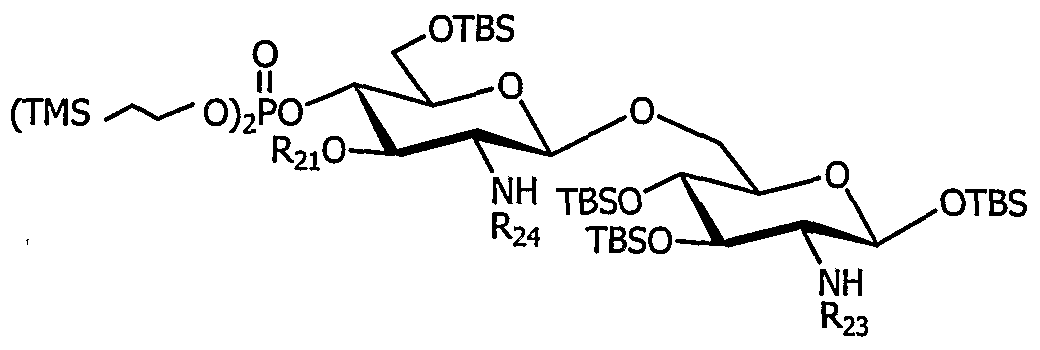
- a still further aspect of this invention comprises a process for simultaneously removing all silyl-based protecting groups from a disaccharide having a plurality of silyl- based protecting groups.
- Glycoside refers to a tetrahydropyran ring bearing a substituent at the 1 -position (i.e., at one of the carbon atoms adjacent to the oxygen atom in the ring) that is a hydroxy, optionally substituted alkoxy, or trisubstituted silyloxy group. Glycosides may also contain substituents at other positions, typically protected or unprotected hydroxy or amino groups.
- silyl glycoside refers to a glycoside wherein the group attached at the 1 -position is a trisubstituted silyloxy group such as a trimethylsilyloxy, tert-butyldimethylsilyloxy, or tert-butyldiphenylsilyloxy group.
- the silyl component of this group has the formula RaRbRcSi, wherein Ra, R , and Rc are independently selected from the group consisting of C ⁇ - C 6 alkyl, C 3 - C 6 cycloalkyl, and optionally substituted phenyl.
- one of the R a , Rb, and Rc groups is larger than methyl; relatively hindered groups such as t-butyl, phenyl, and isopropyl are preferred.
- silyl components include aryldialkylsilyl, diarylalkylsilyl, and triarylsilyl groups. Typical examples include triisopropylsilyl, tiiphenylsilyl, t-butyldimethysilyl (TBS), and t-butyldiphenylsilyl (TBDPS) groups.
- the silyl component of the silyl glycoside is most preferably a TBS or TBDPS group.
- the silyl glycoside can generally be represented by the formula (II)
- R 20 is a trisubstituted silyl group, preferably TBS or TBDPS, and W, X, Y, and Z independently represent H, optionally protected hydroxy, optionally protected amino, or optionally substituted alkyl groups. Typically, Z represents an optionally protected hydroxymethyl group.
- "Dihalomethyl alkyl ether” refers to a compound bearing an alkoxv group and two halogen atoms on a single carbon atom. Typical examples include dichloromethyl methyl ether (CHCl 2 OCH 3 ), dichloromethyl ethyl ether (CHCl 2 OC 2 H 5 ), dibromomethyl methyl ether
- glycosyl halide refers to a 2-halotefrahydropyran compound, for example, 2- chlorotetrahydropyran or 2-bromotetrahydropyran.
- the preferred halogens are fluoride, chloride, and bromide, with chloride being most preferred.
- glycosyl halides used in the processes of this invention will have other substituents analogous to those in formula (II) above.
- Glycosyl halides are generally represented by formula (LIT):
- A is CI, Br, or F.
- Aliphatic means a straight or branched chain, or non-aromatic cyclical, hydrocarbon radical, or combination thereof, which may be fully saturated, or mono- or polyunsaturated and can include di- and multivalent radicals, having the number of carbon atoms designated (i.e. -Cto means one to ten carbon atoms).
- saturated acyclic aliphatic groups include, but are not limited to, groups such as methyl, ethyl, n-propyl, isopropyl, n-butyl, t-butyl, isobutyl, sec-butyl, homologs and isomers of, for example, n-pentyl, n-hexyl, n-heptyl, n-octyl, and the like.
- An unsaturated aliphatic group is one having one or more double bonds or triple bonds.
- Examples of unsaturated acyclic aliphatic groups include, but are not limited to, vinyl, 2-propenyl, isopropenyl, crotyl, 2-isopentenyl, 2-(butadienyl), 2,4-pentadienyl, 3-(l,4-pentadienyl), ethynyl, 1- and 3- propynyl, 3-butynyl, and the higher homologs and isomers.
- Examples of cyclical aliphatic groups include cyclopropyl, cyclobutyl, cyclopentyl, cyclohexyl, cyclopentenyl, cyclohexenyl, cyclohexadienyl, and the like.
- Divalent aliphatic groups include saturated and unsaturated groups similar to those mentioned above, for example methylene, -CH 2 -; ethylene, -CH 2 CH 2 -; n-butylene,
- oxyaliphatic refers to aliphatic groups attached to the remainder of the molecule via an oxygen atom, an amino group, or a sulfur atom, respectively.
- Alkoxy refers to such groups containing saturated acyclic aliphatic moieties.
- heteroaliphatic by itself or in combination with another term, means, unless otherwise stated, a group analogous to an aliphatic group, i.e. a saturated or unsaturated straight or branched chain, or cyclic, radical, or combinations thereof, consisting of the stated number of carbon atoms and further comprising at least one heteroatom selected from the group consisting of O, N, Si and S, and wherein the nitrogen and sulfur atoms may optionally be oxidized and the nitrogen heteroatom may optionally be quaternized.
- the heteroatom(s) O, N and S and Si may be placed at any interior position of the heteroaliphatic group or at the position at which that group is attached to the remainder of the molecule.
- Aliphatic groups may be substituted or unsubstituted.
- R', R" and R'" each independently may be hydrogen, optionally substituted alkyl, aryl optionally substituted with 1-3 halogens, optionally substituted alkoxy, optionally substituted thioalkoxy or optionally substituted aryl-(C 1 -C )alkyl groups.
- each of the R groups is independently selected as are each R', R" and R'" groups when more than one of these groups is present.
- R' and R" are attached to the same nitrogen atom, they can be combined with the nitrogen atom to form a 5-, 6-, or 7-membered ring.
- -NR'R is meant to include 1-pyrrolidinyl and 4- morpholinyl.
- Aromatic or aryl refers to the typical substituted or unsubstituted non-aliphatic hydrocarbyl groups of this class, i.e., a polyunsaturated, typically aromatic, hydrocarbon substituent, which can be a single ring or multiple rings (up to three rings) which are fused together or linked covalently, such as phenyl, naphthyl, and the like.
- Arylalkyl refers to alkyl groups subsisted by one or more aryl groups; for instance, benzyl, phenethyl, triphenylmethyl, and the like.
- Acyl refers to a group derived from an organic acid by removal of the hydroxy group.
- Acyl compounds may in general be aliphatic, aromatic or heterocyclic in nature.
- Aliphatic acyl refers to such groups derived from saturated or unsaturated aliphatic acids, and includes groups such as acetyl, propionyl, butyryl, hexanoyl, decanoyl, dodecanoyl, tetradecanoyl, and the like.
- acetyl is a C 2 acyl group
- propionyl is a C 3 acyl group
- tetradecanoyl is a C 14 acyl group, etc.
- Alkanoyloxycarbonyl refers to groups having a saturated or unsaturated aliphatic group, or an arylalkyl group such as benzyl, linked through an oxygen atom to a carbonyl group, i.e. a group having the general formula Alk.-OC(O)- in which Alk. stands for an aliphatic or arylalkyl group as defined above.
- Alkanoyloxyacyl refers to a saturated or unsaturated acyl group substituted at the indicated position by an aliphatic group Al.C(O)O- in which Al. stands for an acyclic saturated or unsaturated aliphatic group.
- the overall alkanoyloxy group preferably has from 2 to 24 carbon atoms, most preferably from 6 to 14 carbon atoms.
- the acyl portion of the alkanoyloxyacyl group contains from 6 to 14 carbon atoms.
- a typical group of this type is the 3-(n-alkanoyloxy)acyl group, where the acyl group is tetradecanoyl and the alkanoyloxy group contains from 2 to 20, preferably from 6 to 14, carbon atoms, inclusive.
- alkanoyl refers to a group Al.C(O)- wherein Al. is as defined above.
- Protecting group refers to any of a large number of groups used to replace one or both hydrogens of a reactive group such as a hydroxy, amino or thiol group, so as to block, prevent, or red ⁇ ce reactivity of the group.
- a reactive group such as a hydroxy, amino or thiol group
- Examples of protecting groups can be found in T. W. Greene and P. G. Futs, “Protective Groups in Organic Chemistry” (Wiley), Beaucage and Iyer, Tetrahedron 48:2223 (1992) and Harrison et al., Compendium of Synthetic Organic Methods, vols. 1-8 (Wiley).
- Representative amino protecting groups include those that form a carbamate or amide with the nitrogen atom, as well as those groups collectively referred to in the Greene and Futs text as "special -NH protective groups".
- Representative examples of amino protecting groups include acetyl (Ac), trifluoroacetyl, benzyloxycarbonyl (Cbz), tert- butoxycarbonyl (Boc), allyloxycarbonyl (Aoc), 9-fluorenylmethyloxy-carbonyl (Fmoc), nitro-versatryloxycarbonyl (Nvoc), optionally substituted phthaloyl and the like.
- Representative hydroxy protecting groups include those where the hydroxy group is either acylated or alkylated, such as by the formation of ethers or esters using, for instance, acetyl, benzyl, trityl, alkyl, tetrahydropyranyl, allyl and trisubstituted silyl groups.
- protecting group for a given compound, purpose or set of conditions is within the skill of those in the art, and is done so as to protect, generally or selectively, the reactive group in question under the prevailing conditions (presence of other reactive compounds, pH, temperature, etc.)
- Protecting groups that may be used in this invention and are mentioned herein include phthaloyl, acetyl (Ac), benzyl (Bn), 2,2,2- tiichloroethoxycarbonyl (Troc), t-butyldimethylsilyl (TBS), t-butyldiphenylsilyl (TBDPS), and 2,2,2-trichloro-l,l-dimethylethyl chloroformyl (TCBOC) groups.
- a certain protecting group or type of group may be more suitable than others for use with a particular compound or in a given situation, and advantage is taken of these suitabilities in developing processes that involve compounds with reactive groups such as hydroxy and/or amino.
- a reaction scheme can be developed for producing or reacting certain compounds in which general or selective protection or deprotection (removal of protecting groups) is carried out at certain points.
- the group whose reaction is not desired at this point can be blocked with a protecting group that is not removed under conditions of the reaction (for example, is not base-hydrolyzable if the reaction is to be conducted under basic conditions, while the group to be reacted can be protected by a group that is base-hydrolyzable, so that said group becomes unblocked, and thus reactive, at that time.
- a protecting group for example, is not base-hydrolyzable if the reaction is to be conducted under basic conditions
- the group to be reacted can be protected by a group that is base-hydrolyzable, so that said group becomes unblocked, and thus reactive, at that time.
- a group e.g., a hydroxyl group, located at one position in the molecule, it may be protected with a different protecting group than other hydroxyls in the molecule.
- PG refers to protecting groups that form esters, ethers or carbonates with hydroxy groups (i.e., with the oxygen atom of a hydroxy group] or that form amides or carbamates with amino groups [i.e. with the nitrogen atom of an amino group.
- the designation " PG' " is used herein to refer to optionally substituted phthaloyl groups, for example phthaloyl or tetrachlorophthaloyl, and which may be used to protect an amino group, as shown.
- phthaloyl or tetrachlorophthaloyl optionally substituted phthaloyl groups, for example phthaloyl or tetrachlorophthaloyl, and which may be used to protect an amino group, as shown.
- the selection of particular protecting groups used or illustrated in the processes described herein is not in any way intended to limit the invention.
- the major products produced using the processes and intermediates of this invention comprise a group of compounds that include both AGP compounds, which are mono-saccharides, and disaccharides of somewhat analogous structure, hi general, the products can be depicted by the formulas (I ) and (I a -c):
- R 1 and R are each independently selected from saturated and unsaturated (C 2 -C 24 ) aliphatic acyl groups;
- R is -H or -PO 3 R R , wherein R and R are each independently -H or (C ⁇ C 4 ) aliphatic groups;
- R 9 is -H, -CH3 or -PO 3 R 13 R 14 , wherein R 13 and R 14 are each independently selected from -H and ( -C 4 ) aliphatic groups; and wherein at least one of R and R 9 is a phosphorus-containing group, but R 8 and R 9 are not both phosphorus-contaming groups; and
- X is a group selected from the formulae:
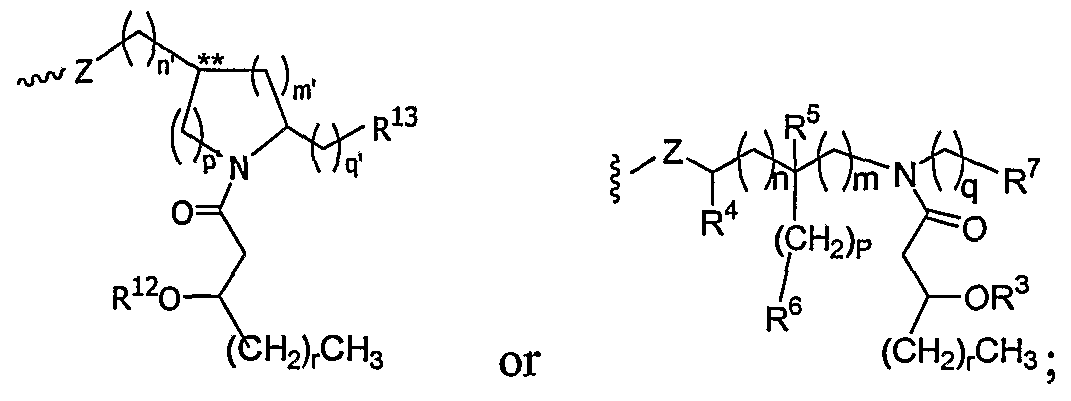
- R 3 , R 11 , and R 12 are independently saturated or unsaturated aliphatic (C 2 -C 24 ) acyl groups; and when X is formula (la) or (Ic) one of R 1 , R 2 , R 3 , R 11 and R 12 is optionally hydrogen; R 4 and R 5 are independently selected from H and methyl; R 6 and R 7 are independently selected from H, OH, (C1-C4) oxyaliphatic groups, -PO 3 H 2 , -OPO 3 H 2 , -SO 3 H, -OSO 3 H, -NR 15 R 16 , -SR 15 , -CN, -NO
- One process of this invention comprises the production of glycosyl halides that comprises reacting an O-silyl glycoside with a dihalomethyl alkyl ether in the presence of zinc chloride, zinc bromide, boron trifluoride, or a similar Lewis acid. More specifically, in this process, a glycosyl halide is formed by reacting a silyl glycoside having the formula (H):
- R 20 is a trisubstituted silyl group having the formula R a R R c Si in which R a , R and
- Rc are independently selected from the group consisting of -Cs alkyl, C 3 -C 6 cycloalkyl and optionally substituted phenyl, preferably TBS or TBDPS, and W, X, Y, and Z independently represent H, optionally protected hydroxy, optionally protected amino, and optionally substituted alkyl groups, with a dihalomethyl alkyl ether, preferably dichloromethyl methyl ether, in the presence of zinc chloride, zinc bromide, boron trifluoride, or a similarly suitable Lewis acid.
- the Lewis acid is used in about a stoichiometric amount with respect to the silyl glycoside.
- the reaction to produce the glycosyl halide is conducted at a temperature of from about -30 °C to about 50 °C, preferably from about 0 °C to about 30 °C, and in the presence of a solvent such as chloroform, dichloromethane, dichloroethane, or similar solvents that are inert to the conditions required for the reaction.
- the temperature of the reaction is selected to allow the reactants to substantially dissolve and to prevent the dihalomethyl alkyl ether from boiling away.
- Yields of the desired product glycosyl halide are generally from about 50 to about 95%. Selection of such solvents is within the knowledge of those of ordinary skill in the art.
- silyl glycosides are produced conventionally, typically in a protected form, as is known in the art.
- certain silyl glycosides such as certain triacetylated silyl glycosides and derivatives thereof, may be produced via novel intermediates described below, which form an aspect of the invention.
- glycosyl halides may exist as isomers if other substituents are present on the glycosyl halide ring.
- the invention includes production of the separate isomers as well as mixtures of both isomers. Conditions for reactions of many nucleophiles with glycosyl halides are well known to persons of ordinary skill in the art.
- the resulting glycosyl halides thus typically have the formula (III) wherein A is CI, Br, or F and W, X, Y and Z are as defined above.
- the silyl glycoside and resulting products are substituted at the 3- position (substituent X) by an aliphatic acyl group, preferably an alkanoyloxyacyl group, more preferably a 3- «-alkanoyloxyacyl group, and most preferably a 3-alkanoyloxytetradecanoyl group, in which the aliphatic or alkanoyl group contains from 2 to 24, preferably from 2 to 18, and most preferably from 6 to 14, carbon atoms, and the protecting groups in the compound in question are preferably Troc groups or similar alkanoyloxycarbonyl groups.
- the compounds have the general formula (IN) or (V):
- A is CI, Br, or F; R 0 is a trisubstituted silyl group and R 1 is an aliphatic acyl group, preferably a 3-n-alkanoyloxytetradecanoyl group.
- protecting groups have been specifically identified for purposes of illustration and/or clarity. However, as known in the art, other protecting groups as defined generally above for "PG" may be used, as suitable. Thus, for instance, more generally these compounds can be represented by the formula
- the silyl glycoside has a hydroxyl group at the 4- position substituted with a phosphate ester group such as a dialkylphosphonyl or diarylphosphonyl group
- R 21 is an alkanoyloxyacyl group, preferably a 3-n- alkanoyloxytetradecanoyl group
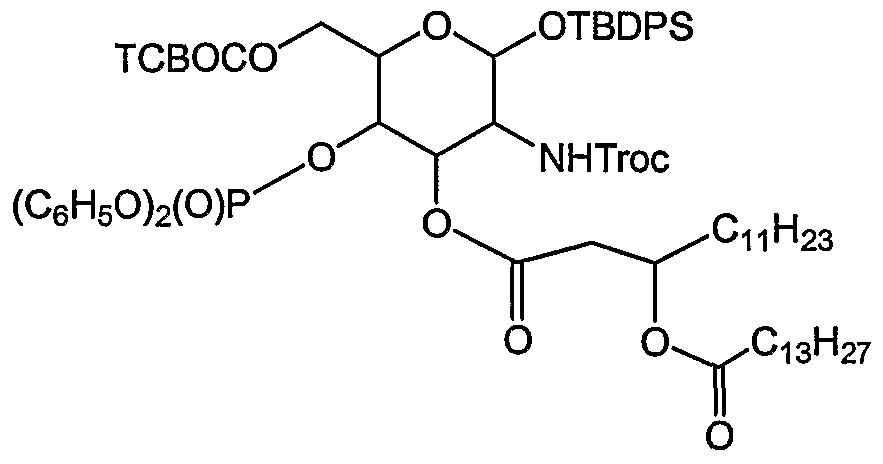
- the protecting groups are preferably "TCBOC" groups, obtained from 2,2,2-trichloro- 1 , 1 -dimethylethyl chloroformate, or similar alkanoyloxycarbonyl protecting groups such as Troc; i.e., the silyl glycoside may have the specific formula (VI):
- R 20 is a trisubstituted silyl group, preferably TBS or TBDPS;
- R 21 is an aliphatic acyl, preferably an alkanoyloxyacyl, group; and
- R 22 is alkyl, aryl, or arylalkyl, or may have a more general formula which allows for the use of other suitable protecting groups,
- glycosyl halide correspondingly has the more specific formula (VII):
- R 21 and R 22 are as defined above and A is CI, Br, or F.
- the glycosyl chlorides thus produced are reacted with a monosaccharide, preferably in the presence of a silver salt, to produce a disaccharide by this two-step process.
- Monosaccharides that may be used as reactants in this process include, for example, those having the formulas (i)-(iii):
- R 23 is an aliphatic acyl group, preferably a 3-n- alkanoyloxytetradecanoyl group, as described above.
- Disaccharides that can be produced by such processes include those having the formulas (iA)-(ivA):
- R 21j R 22 and R 23 are as defined above, and the indicated protecting groups are exemplary of those that may be used.
- Reactions to produce products (iA) -(ivA) according to this invention are generally conducted at a temperature of from about -30 °C to about 30 °C, in a chlorinated or other solvent in the presence of a silver catalyst such as silver trifluoromethanesulfonate (triflate) and under anhydrous conditions, with or without other additives such as molecular sieves or buffering agents such as tetramethylurea.
- the silyl glycosides of Formula (II) are coupled with a monosaccharide directly, without proceeding through formation of a glycosyl halide.
- the resulting product is again a disaccharide having substituents according to the starting materials.
- Such a process is generally conducted at a temperature of from about -78 °C to about 50 °C in the presence of a suitable Lewis acid catalyst such as trimethylsilyl triflate of boron trifluoride etherate with or without the addition of drying or buffering agents.
- protecting groups can in effect be removed from a silyl glycoside having such groups by reacting it with a dihaloalkyl ether to produce the glycosyl halide, and then reacting the glycosyl halide with a silver salt such as silver oxide or silver carbonate in the presence of water to produce the corresponding hemiacetal.
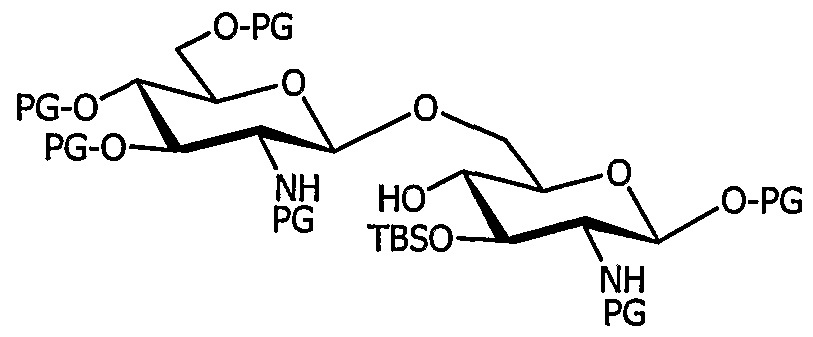
- the disaccharides produced by either process may be further reacted by silylating the hydroxyl group at the 4-position of the reducing sugar with a silylating group such as TBS in the presence of imidazole and N,N-dimethylformamide to produce a 3,4- bis-silylated compound.
- a silylating group such as TBS in the presence of imidazole and N,N-dimethylformamide
- Addition of a phosphate group in the 4-position of the non-reducing sugar is then achieved by a sequence of steps involving (1) deprotection of the 4,6 protecting groups (typically acetate or Troc), (2) N-deprotection/acylation, (3) selective protection of the primary 6-position with a group such as TCBOC, and (4) by reacting the 6-protected disaccharide with a phosphonylating agent such as a phosphoramidite reagent, e.g., dibenzyl diisopropylphosphoramidite [providing a dibenzylphosphono side chain], or a chlorophosphate such as bis(2,2,2-trichloroethyl)chlorophosphate [providing a bis(2,2,2- trichloroethyl)phosphono side chain] or diphenyl chlorophosphate [providing a diphenylphosphono side chain].
- a phosphonylating agent such as a phosphorami
- the invention also, analogously, includes processes for the production of triacylated disaccharides such as those having the formula (VILI):
- R 21 ⁇ R 23 and R 4 are aliphatic acyl, preferably alkanoyloxyacyl, groups, and R 22 is an optionally substituted alkyl, aryl, or arylalkyl group, by selectively protecting the C-6 hydroxyl group of a corresponding disaccharide with 2,2,2-trichloro-l,l- dimethylethyl chloroformate in the presence of a tertiary amine such as pyridine.
- R 21 , R 23 and R 4 are (i?)-3-hexadecanoyloxytetradecanoyl, (R)-3- octadecanoyloxytetradecanoyl, and (i2)-3-tetradecanoyloxytetradecanoyl, respectively, but they can be the same or different depending on the desired substitutions and nature of the monosaccharide donor used in the glycosylation step.
- This invention also relates to processes for producing aminoalkyl and cyclic aminoalkyl glucosaminide (AGP) compounds, that is compounds of formula (I) in which X is (la) or (Ic), in which both the fatty acid and the phosphate groups are introduced onto the AGP backbone after the initial glycosylation (coupling) step.
- AGP aminoalkyl and cyclic aminoalkyl glucosaminide
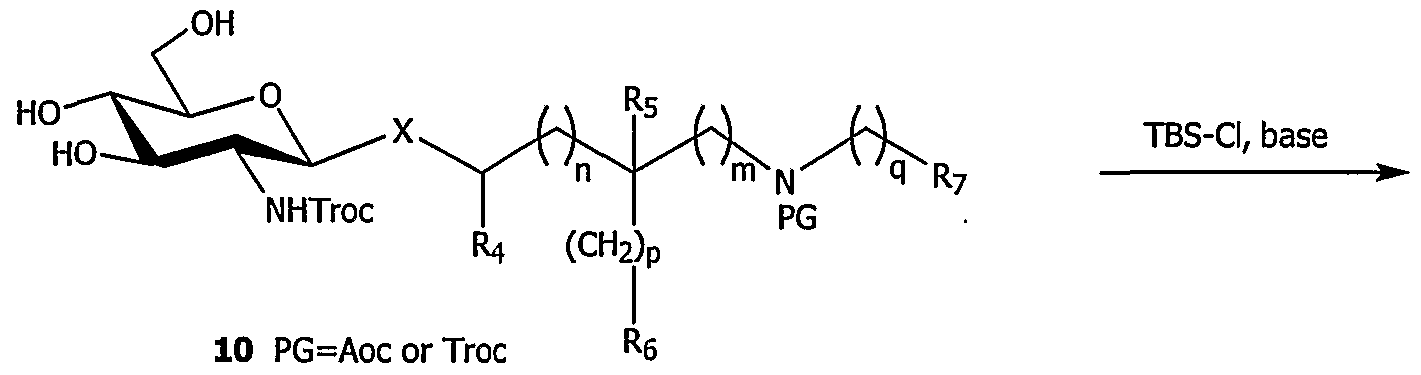
- Scheme 1 depicts the production of specific compounds of Formula (la) but is intended to serve only as an example of this aspect of the invention, as the same or a similar process could be used to produce other compounds of the type of Formula (la) as well as compounds of Formula (Ic).
- introduction of the aliphatic acyl e.g.
- (R)-3-n-alkanoyloxy- tetradecanoyl, and phosphate groups into the glucosamine and aglycon units is also performed subsequent to the coupling reaction but, in contrast to the method shown in the prior art patents, the 3 -hydroxyl group is selectively esterified with an alkanoic acid substituted by an aliphatic acyl group, preferably an (R)-3-n-alkanoyloxyalkanoic acid, in the presence of an unprotected/unphosphorylated 4-hydroxyl group with the 6-position blocked. This is achieved by protecting the 6-hydroxyl group of the sugar unit with a persistent protecting group in lieu of temporary protection of the 4,6-hydroxyl positions with an acetonide.
- -glycoside 8 or the corresponding bis-Troc derivative 9 is de-O- acetylated with a suitable base to give a triol intermediate 10, which is selectively protected on the 6-position with a hindered silyl group such as t-butyldimethylsilyl (TBS) under standard conditions known in the art to give silyl-protected intermediate 12.
- TBS t-butyldimethylsilyl
- Pentaacylated compounds i.e.
- one of the acyl groups R 1 , R 2 , R 3 , R 11 or R 12 is hydrogen
- Phosphorylation of the 4-hydroxyl group is carried out by methods known in the art using preferably either a dibenzyl or di-t-butyl protected chlorophosphate or phosphoramidite reagent to give the phosphotriester 14.
- the phosphate, silyl and any remaining protecting groups in 14 are then cleaved under mildly acidic conditions or by other appropriate means to give compounds of Formula (la). It is important to note that the order in which the phosphate and N-linked (R)-3-n-alkanoyloxytetradecanoyl groups in 14 are introduced can be reversed by the appropriate selection of orthogonal phosphate and amine protecting groups.
- a variant of the method shown in Scheme 1 is shown in Scheme 2 and involves the use of a commercially available glycosyl donor such as 15 possessing either acetyl or phthalimide nitrogen-protecting groups and either an anomeric acetoxy or halide group.
- this Scheme is representative of processes of the invention for producing compounds of Formula (la) or (Ic).
- glycosyl donor 15 is coupled with a similarly N-protected acceptor unit 16 in the presence of a suitable catalyst to give /3-glycoside 17.
- N-acetyl and phthalimide groups typically require strongly basic conditions for deprotection, the use of a base-stable ether-linked protecting group such as triphenylmethyl (trityl, Tr) on the 6-position is generally required. Accordingly, de-O-acetylation of 17 under standard conditions followed preferably by selective tritylation of the 6-position gives diol 18.
- Base-induced cleavage of the N-acetyl or phthalimide groups followed by simultaneous or sequential N- and O-acylation of the resulting diamino diol intermediate with an (R)-3-n- alkanoyloxytetradecanoic acid in the presence of suitable coupling reagent(s) affords the hexaacylated derivative 19.
- the diamino diol intermediate formed by treating compound 18 with base has the formula:
- Example 1 Production of 2-Deoxy-4-O-diphenylphosphono-3-O-[(R)-3- tetradecanoyloxytetradecanoyll-6-O-(2,2,2-trichloro-l,l-dimethylethoxycarbonyl)-2- (2,2,2-trichIoroethoxycarbonyla ⁇ nnoVtt-D-glucopyranosvI Chloride
- the ether layer is washed with water (IL), dried (Na SO 4 ), and concentrated to give a bronze-colored oil which is crystallized from EtOAc-hexanes (-1:2 v/v) in three crops to provide 474 g (85%, 71% from v) of the t-butyldiphenylsilyl glycoside iv as a white solid (MW 719.08; TLC (50% EtOAc hexanes) Rf 0.44).
- the crude product obtained is dissolved in dichloromethane (1.2 L), divided into two equal portions, and placed on silica gel (1 kg, pre-wetted with 30% EtOAc/hexanes) in two separate 3 L fritted glass funnels, and eluted with 30% EtOAc/hexanes (10 L) and 50% EtOAc/hexanes (8 L). Fractions containing purified product are combined and concentrated to give compound vi as an amorphous solid. The product can be further purified by crystallization from hexanes, if necessary.
- the EtOAc layer is washed with water (2 L), dried (Na 2 SO 4 ), and concentrated.
- the residue obtained is dissolved in 10% EtOAc/hexanes (500 mL) and purified by gradient elution on a Biotage 150 Hi system (150L column) with 10% EtOAc/hexanes (50 L), collecting 950 mL fractions. The fractions containing compound vii are combined and concentrated.
Landscapes
- Chemical & Material Sciences (AREA)
- Organic Chemistry (AREA)
- Biotechnology (AREA)
- Life Sciences & Earth Sciences (AREA)
- Engineering & Computer Science (AREA)
- Biochemistry (AREA)
- Health & Medical Sciences (AREA)
- General Health & Medical Sciences (AREA)
- Genetics & Genomics (AREA)
- Molecular Biology (AREA)
- Crystallography & Structural Chemistry (AREA)
- Saccharide Compounds (AREA)
- Pharmaceuticals Containing Other Organic And Inorganic Compounds (AREA)
- Low-Molecular Organic Synthesis Reactions Using Catalysts (AREA)
Abstract
Description




Claims







Priority Applications (13)
| Application Number | Priority Date | Filing Date | Title |
|---|---|---|---|
| ES03763418.5T ES2456066T3 (en) | 2002-07-08 | 2003-07-08 | Processes for the production of aminoalkyl glucosaminide phosphate and disaccharide immunoefectors, and intermediates for it |
| EP03763418.5A EP1521762B1 (en) | 2002-07-08 | 2003-07-08 | Processes for the production of aminoalkyl glucosaminide phosphate and disaccharide immunoeffectors, and intermediates therefor |
| AU2003251824A AU2003251824B8 (en) | 2002-07-08 | 2003-07-08 | Processes for the production of aminoalkyl glucosaminide phosphate and disaccharide immunoeffectors, and intermediates therefor |
| JP2004520086A JP2005536493A (en) | 2002-07-08 | 2003-07-08 | Process for producing immune effector aminoalkyl glucosaminide phosphate and disaccharide, and intermediates thereof |
| BR0312656-0A BR0312656A (en) | 2002-07-08 | 2003-07-08 | Processes for the production of aminoalkyl and disaccharide glycosaminide phosphate immunoefectors and their intermediates |
| IL16617803A IL166178A0 (en) | 2002-07-08 | 2003-07-08 | Processes for the production of aminoalkyl glucosaminide phosphate and disaccharide immunoeffectors and intermediates therefor |
| CA002492446A CA2492446A1 (en) | 2002-07-08 | 2003-07-08 | Processes for the production of aminoalkyl glucosaminide phosphate and disaccharide immunoeffectors, and intermediates therefor |
| US10/472,991 US7232900B2 (en) | 2002-07-08 | 2003-07-08 | Processes for the production of aminoalkyl glucosaminide phosphate and disaccharide immunoeffectors and intermediates therefor |
| MXPA05000407A MXPA05000407A (en) | 2002-07-08 | 2003-07-08 | Processes for the production of aminoalkyl glucosaminide phosphate and disaccharide immunoeffectors, and intermediates therefor. |
| NZ537655A NZ537655A (en) | 2002-07-08 | 2003-07-08 | Processes for the production of aminoalkyl glucosaminide phosphate and disaccharide immunoeffectors, and intermediates therefor |
| US10/897,194 US7288640B2 (en) | 2002-07-08 | 2004-07-21 | Processes for the production of aminoalkyl glucosaminide phosphate and disaccharide immunoeffectors, and intermediates therefor |
| IL166178A IL166178A (en) | 2002-07-08 | 2005-01-06 | Process for the production of aminoalkyl glucosaminide 4- phosphate and some new intermediates for such process |
| US11/867,605 US7960523B2 (en) | 2002-07-08 | 2007-10-04 | Processes for the production of aminoalkyl glucosaminide phosphate and disaccharide immunoeffectors, and intermediates therefor |
Applications Claiming Priority (4)
| Application Number | Priority Date | Filing Date | Title |
|---|---|---|---|
| US39448702P | 2002-07-08 | 2002-07-08 | |
| US60/394,487 | 2002-07-08 | ||
| US43858503P | 2003-01-06 | 2003-01-06 | |
| US60/438,585 | 2003-01-06 |
Related Child Applications (2)
| Application Number | Title | Priority Date | Filing Date |
|---|---|---|---|
| US10472991 A-371-Of-International | 2003-07-08 | ||
| US10/897,194 Continuation-In-Part US7288640B2 (en) | 2002-07-08 | 2004-07-21 | Processes for the production of aminoalkyl glucosaminide phosphate and disaccharide immunoeffectors, and intermediates therefor |
Publications (2)
| Publication Number | Publication Date |
|---|---|
| WO2004005308A2 true WO2004005308A2 (en) | 2004-01-15 |
| WO2004005308A3 WO2004005308A3 (en) | 2004-04-22 |
Family
ID=30118421
Family Applications (1)
| Application Number | Title | Priority Date | Filing Date |
|---|---|---|---|
| PCT/US2003/021504 Ceased WO2004005308A2 (en) | 2002-07-08 | 2003-07-08 | Processes for the production of aminoalkyl glucosaminide phosphate and disaccharide immunoeffectors, and intermediates therefor |
Country Status (15)
| Country | Link |
|---|---|
| US (1) | US7232900B2 (en) |
| EP (1) | EP1521762B1 (en) |
| JP (2) | JP2005536493A (en) |
| KR (2) | KR20050037460A (en) |
| CN (1) | CN100497364C (en) |
| AU (1) | AU2003251824B8 (en) |
| BR (1) | BR0312656A (en) |
| CA (1) | CA2492446A1 (en) |
| ES (1) | ES2456066T3 (en) |
| IL (2) | IL166178A0 (en) |
| MX (1) | MXPA05000407A (en) |
| NZ (1) | NZ537655A (en) |
| PL (1) | PL220778B1 (en) |
| RU (1) | RU2340621C2 (en) |
| WO (1) | WO2004005308A2 (en) |
Cited By (6)
| Publication number | Priority date | Publication date | Assignee | Title |
|---|---|---|---|---|
| WO2006012425A3 (en) * | 2004-07-21 | 2006-10-05 | Corixa Corp | Processes for the production of aminoalkyl glucosaminide phosphate and disaccharide immunoeffectors, and intermediates therefor |
| WO2006016997A3 (en) * | 2004-07-08 | 2006-12-07 | Corixa Corp | Certain aminoalkyl glucosaminide phosphate compounds and their use |
| US7232900B2 (en) | 2002-07-08 | 2007-06-19 | Corixa Corporation | Processes for the production of aminoalkyl glucosaminide phosphate and disaccharide immunoeffectors and intermediates therefor |
| WO2011055899A2 (en) | 2009-11-06 | 2011-05-12 | 연세대학교 산학협력단 | Efficient and universal method for inducing the differentiation of nerve cells from pluripotent stem cells |
| US9827260B2 (en) | 2013-03-15 | 2017-11-28 | Glaxosmithkline Biologicals Sa | Composition for buffered aminoalkyl glucosaminide phosphate compounds and its use for enhancing an immune response |
| US10100074B2 (en) | 2013-06-19 | 2018-10-16 | The Regents Of The University Of California | Regioselective silyl exchange of per-silylated oligosaccharides |
Families Citing this family (6)
| Publication number | Priority date | Publication date | Assignee | Title |
|---|---|---|---|---|
| AU2002950657A0 (en) * | 2002-08-08 | 2002-09-12 | Alchemia Limited | Derivatives of monosaccharides for drug discovery |
| AU2002951995A0 (en) * | 2002-10-11 | 2002-10-31 | Alchemia Limited | Classes of compounds that interact with gpcrs |
| CN101863930A (en) * | 2003-01-06 | 2010-10-20 | 科里克萨有限公司 | Certain aminoalkyl glucosaminide phosphate compounds and their purposes |
| JP6326825B2 (en) * | 2013-02-18 | 2018-05-23 | 住友化学株式会社 | Salt, resist composition and method for producing resist pattern |
| JP7362667B2 (en) | 2018-02-12 | 2023-10-17 | イニミューン・コーポレーション | Toll-like receptor ligand |
| CN114685277A (en) * | 2020-12-31 | 2022-07-01 | 苏州瑞博生物技术股份有限公司 | Compound and method for purifying hydroxypropionate compound |
Citations (14)
| Publication number | Priority date | Publication date | Assignee | Title |
|---|---|---|---|---|
| US4436727A (en) | 1982-05-26 | 1984-03-13 | Ribi Immunochem Research, Inc. | Refined detoxified endotoxin product |
| US4436728A (en) | 1982-05-26 | 1984-03-13 | Ribi Immunochem Research, Inc. | Refined detoxified endotoxin product |
| US4613590A (en) | 1985-08-19 | 1986-09-23 | Abbott Laboratories | Amino D-manno-2-octulopyranosidonate containing compounds, pharmaceutical compositions and method of use |
| US4912094A (en) | 1988-06-29 | 1990-03-27 | Ribi Immunochem Research, Inc. | Modified lipopolysaccharides and process of preparation |
| US4987237A (en) | 1983-08-26 | 1991-01-22 | Ribi Immunochem Research, Inc. | Derivatives of monophosphoryl lipid A |
| US5843463A (en) | 1990-12-21 | 1998-12-01 | Antexbiologics, Inc. | Adhesin-oligosaccharide conjugate vaccine for Haemophilus influenzae |
| US6013640A (en) | 1998-08-21 | 2000-01-11 | Ribi Immunochem Research, Inc. | Phosphoglycolipid and methods for its use |
| US6103640A (en) | 1997-09-12 | 2000-08-15 | Bridgestone Corporation | Electromagnetic-wave shielding and light transmitting plate |
| US6113918A (en) | 1997-05-08 | 2000-09-05 | Ribi Immunochem Research, Inc. | Aminoalkyl glucosamine phosphate compounds and their use as adjuvants and immunoeffectors |
| US6299897B1 (en) | 1996-03-01 | 2001-10-09 | The Regents Of The University Of California | Inhibition of selectin binding |
| US6303347B1 (en) | 1997-05-08 | 2001-10-16 | Corixa Corporation | Aminoalkyl glucosaminide phosphate compounds and their use as adjuvants and immunoeffectors |
| WO2001090129A2 (en) | 2000-05-19 | 2001-11-29 | Corixa Corporation | Prophylactic and therapeutic treatment of infectious, autoimmune and allergic diseases with mono and disaccharide-base compounds |
| WO2002012258A1 (en) | 2000-08-04 | 2002-02-14 | Corixa Corporation | New immunoeffector compounds |
| US6355257B1 (en) | 1997-05-08 | 2002-03-12 | Corixa Corporation | Aminoalkyl glucosamine phosphate compounds and their use as adjuvants and immunoeffectors |
Family Cites Families (14)
| Publication number | Priority date | Publication date | Assignee | Title |
|---|---|---|---|---|
| JPS6153295A (en) | 1984-08-24 | 1986-03-17 | Dai Ichi Seiyaku Co Ltd | Disaccharide derivative |
| US4746742A (en) * | 1985-11-28 | 1988-05-24 | Toho Yakuhin Kogyo Kabushiki Kaisha | Analogs of nonreducing monosaccharide moiety of lipid A |
| JPH0757762B2 (en) * | 1987-09-10 | 1995-06-21 | 理化学研究所 | Oligogalacturonic acid and method for producing the same |
| US5597573A (en) * | 1989-05-04 | 1997-01-28 | Igen, Inc. | Lipid-A analogs: new monosaccharide and disaccharide intermediates for eliciting therapeutic antibodies and for antitumor and antiviral activities |
| JP2933359B2 (en) * | 1990-07-18 | 1999-08-09 | 理化学研究所 | Method for synthesizing oligopeptides containing NeuAcα2 → 6Ga1NAcα1 → 3Ser structure |
| JPH06293790A (en) * | 1993-04-08 | 1994-10-21 | Kyowa Hakko Kogyo Co Ltd | Physiologically active substance, inositol glucan |
| PL181241B1 (en) * | 1993-11-17 | 2001-06-29 | Deutsche Om Arzneimittel Gmbh | Glucosoamine disaccharides, method of obtaining them and pharmaceutical composition containing them as well as their application |
| JPH0851998A (en) * | 1994-08-10 | 1996-02-27 | Otsuka Pharmaceut Co Ltd | Measurement of activity of glucosyltransferase |
| JPH08245681A (en) * | 1995-03-03 | 1996-09-24 | Sumitomo Pharmaceut Co Ltd | Glucosamine derivative and its production |
| US6107492A (en) * | 1998-05-08 | 2000-08-22 | Ucb, S.A. | Process for the preparation of levetiracetam |
| JP4913272B2 (en) * | 1999-01-07 | 2012-04-11 | 生化学工業株式会社 | Method for producing oligosaccharide, novel oligosaccharide and pharmaceutical composition containing the same |
| JP2001151790A (en) * | 1999-11-25 | 2001-06-05 | Sankyo Co Ltd | New gla-60 analog having ceramide lipid site |
| US6525028B1 (en) * | 2002-02-04 | 2003-02-25 | Corixa Corporation | Immunoeffector compounds |
| ES2456066T3 (en) | 2002-07-08 | 2014-04-21 | Corixa Corporation | Processes for the production of aminoalkyl glucosaminide phosphate and disaccharide immunoefectors, and intermediates for it |
-
2003
- 2003-07-08 ES ES03763418.5T patent/ES2456066T3/en not_active Expired - Lifetime
- 2003-07-08 RU RU2005102938/04A patent/RU2340621C2/en active
- 2003-07-08 JP JP2004520086A patent/JP2005536493A/en active Pending
- 2003-07-08 EP EP03763418.5A patent/EP1521762B1/en not_active Expired - Lifetime
- 2003-07-08 CN CNB038198002A patent/CN100497364C/en not_active Expired - Lifetime
- 2003-07-08 BR BR0312656-0A patent/BR0312656A/en not_active Application Discontinuation
- 2003-07-08 CA CA002492446A patent/CA2492446A1/en not_active Abandoned
- 2003-07-08 IL IL16617803A patent/IL166178A0/en active IP Right Grant
- 2003-07-08 MX MXPA05000407A patent/MXPA05000407A/en active IP Right Grant
- 2003-07-08 US US10/472,991 patent/US7232900B2/en not_active Expired - Lifetime
- 2003-07-08 NZ NZ537655A patent/NZ537655A/en not_active IP Right Cessation
- 2003-07-08 WO PCT/US2003/021504 patent/WO2004005308A2/en not_active Ceased
- 2003-07-08 KR KR1020057000298A patent/KR20050037460A/en not_active Ceased
- 2003-07-08 AU AU2003251824A patent/AU2003251824B8/en not_active Expired
- 2003-07-08 PL PL374484A patent/PL220778B1/en unknown
- 2003-07-08 KR KR1020117019614A patent/KR20110099808A/en not_active Ceased
-
2005
- 2005-01-06 IL IL166178A patent/IL166178A/en unknown
-
2010
- 2010-08-02 JP JP2010173257A patent/JP2010285446A/en active Pending
Patent Citations (15)
| Publication number | Priority date | Publication date | Assignee | Title |
|---|---|---|---|---|
| US4436727A (en) | 1982-05-26 | 1984-03-13 | Ribi Immunochem Research, Inc. | Refined detoxified endotoxin product |
| US4436728A (en) | 1982-05-26 | 1984-03-13 | Ribi Immunochem Research, Inc. | Refined detoxified endotoxin product |
| US4987237A (en) | 1983-08-26 | 1991-01-22 | Ribi Immunochem Research, Inc. | Derivatives of monophosphoryl lipid A |
| US4613590A (en) | 1985-08-19 | 1986-09-23 | Abbott Laboratories | Amino D-manno-2-octulopyranosidonate containing compounds, pharmaceutical compositions and method of use |
| US4912094A (en) | 1988-06-29 | 1990-03-27 | Ribi Immunochem Research, Inc. | Modified lipopolysaccharides and process of preparation |
| US4912094B1 (en) | 1988-06-29 | 1994-02-15 | Ribi Immunochem Research Inc. | Modified lipopolysaccharides and process of preparation |
| US5843463A (en) | 1990-12-21 | 1998-12-01 | Antexbiologics, Inc. | Adhesin-oligosaccharide conjugate vaccine for Haemophilus influenzae |
| US6299897B1 (en) | 1996-03-01 | 2001-10-09 | The Regents Of The University Of California | Inhibition of selectin binding |
| US6113918A (en) | 1997-05-08 | 2000-09-05 | Ribi Immunochem Research, Inc. | Aminoalkyl glucosamine phosphate compounds and their use as adjuvants and immunoeffectors |
| US6303347B1 (en) | 1997-05-08 | 2001-10-16 | Corixa Corporation | Aminoalkyl glucosaminide phosphate compounds and their use as adjuvants and immunoeffectors |
| US6355257B1 (en) | 1997-05-08 | 2002-03-12 | Corixa Corporation | Aminoalkyl glucosamine phosphate compounds and their use as adjuvants and immunoeffectors |
| US6103640A (en) | 1997-09-12 | 2000-08-15 | Bridgestone Corporation | Electromagnetic-wave shielding and light transmitting plate |
| US6013640A (en) | 1998-08-21 | 2000-01-11 | Ribi Immunochem Research, Inc. | Phosphoglycolipid and methods for its use |
| WO2001090129A2 (en) | 2000-05-19 | 2001-11-29 | Corixa Corporation | Prophylactic and therapeutic treatment of infectious, autoimmune and allergic diseases with mono and disaccharide-base compounds |
| WO2002012258A1 (en) | 2000-08-04 | 2002-02-14 | Corixa Corporation | New immunoeffector compounds |
Non-Patent Citations (8)
| Title |
|---|
| BEAUCAGE; IYER, TETRAHEDRON, vol. 48, 1992, pages 2223 |
| HARRISON ET AL.: "Compendium of Synthetic Organic Methods", vol. 1-8, WILEY |
| JOHNSON ET AL., BIOORG. MED. CHEM. LETT., vol. 9, 1999, pages 2273 |
| KOVAC, CARBOHYDR. RES., vol. 245, 1993, pages 219 |
| MAGNUSSON ET AL., J. ORG. CHEM., vol. 55, 1990, pages 3181 |
| SUGIYAMA ET AL., ORG. LETT., vol. 2, 2000, pages 2713 |
| T. W. GREENE; P. G. FUTS: "Protective Groups in Organic Chemistry", WILEY |
| TAKEO ET AL., CARBOHYDR. RES., vol. 245, 1993, pages 81 |
Cited By (13)
| Publication number | Priority date | Publication date | Assignee | Title |
|---|---|---|---|---|
| US7288640B2 (en) | 2002-07-08 | 2007-10-30 | Corixa Corporation | Processes for the production of aminoalkyl glucosaminide phosphate and disaccharide immunoeffectors, and intermediates therefor |
| US7960523B2 (en) | 2002-07-08 | 2011-06-14 | Corixa Corporation | Processes for the production of aminoalkyl glucosaminide phosphate and disaccharide immunoeffectors, and intermediates therefor |
| US7232900B2 (en) | 2002-07-08 | 2007-06-19 | Corixa Corporation | Processes for the production of aminoalkyl glucosaminide phosphate and disaccharide immunoeffectors and intermediates therefor |
| US7960522B2 (en) | 2003-01-06 | 2011-06-14 | Corixa Corporation | Certain aminoalkyl glucosaminide phosphate compounds and their use |
| AU2005272076B2 (en) * | 2003-01-06 | 2011-09-22 | Corixa Corporation | Certain aminoalkyl glucosaminide phosphate compounds and their use |
| JP2008505897A (en) * | 2004-07-08 | 2008-02-28 | コリクサ コーポレイション | Certain aminoalkyl glucosaminidophosphate compounds and their use |
| WO2006016997A3 (en) * | 2004-07-08 | 2006-12-07 | Corixa Corp | Certain aminoalkyl glucosaminide phosphate compounds and their use |
| EP2940027A1 (en) * | 2004-07-08 | 2015-11-04 | Corixa Corporation | Certain aminoalkyl glucosaminide phosphate compounds and their use |
| WO2006012425A3 (en) * | 2004-07-21 | 2006-10-05 | Corixa Corp | Processes for the production of aminoalkyl glucosaminide phosphate and disaccharide immunoeffectors, and intermediates therefor |
| WO2011055899A2 (en) | 2009-11-06 | 2011-05-12 | 연세대학교 산학협력단 | Efficient and universal method for inducing the differentiation of nerve cells from pluripotent stem cells |
| US9827260B2 (en) | 2013-03-15 | 2017-11-28 | Glaxosmithkline Biologicals Sa | Composition for buffered aminoalkyl glucosaminide phosphate compounds and its use for enhancing an immune response |
| US10100074B2 (en) | 2013-06-19 | 2018-10-16 | The Regents Of The University Of California | Regioselective silyl exchange of per-silylated oligosaccharides |
| US10759823B2 (en) | 2013-06-19 | 2020-09-01 | The Regents Of The University Of California | Regioselective silyl exchange of per-silylated oligosaccharides |
Also Published As
| Publication number | Publication date |
|---|---|
| EP1521762A2 (en) | 2005-04-13 |
| PL220778B1 (en) | 2016-01-29 |
| WO2004005308A3 (en) | 2004-04-22 |
| AU2003251824A1 (en) | 2004-01-23 |
| AU2003251824B8 (en) | 2010-08-05 |
| CA2492446A1 (en) | 2004-01-15 |
| US20040267007A1 (en) | 2004-12-30 |
| RU2340621C2 (en) | 2008-12-10 |
| EP1521762B1 (en) | 2014-03-12 |
| AU2003251824A2 (en) | 2004-01-23 |
| CN100497364C (en) | 2009-06-10 |
| KR20050037460A (en) | 2005-04-21 |
| CN1675231A (en) | 2005-09-28 |
| BR0312656A (en) | 2005-06-07 |
| PL374484A1 (en) | 2005-10-31 |
| IL166178A (en) | 2011-01-31 |
| MXPA05000407A (en) | 2005-04-19 |
| IL166178A0 (en) | 2006-01-15 |
| ES2456066T3 (en) | 2014-04-21 |
| US7232900B2 (en) | 2007-06-19 |
| JP2005536493A (en) | 2005-12-02 |
| KR20110099808A (en) | 2011-09-08 |
| AU2003251824B2 (en) | 2010-07-15 |
| JP2010285446A (en) | 2010-12-24 |
| NZ537655A (en) | 2006-12-22 |
| RU2005102938A (en) | 2005-08-10 |
Similar Documents
| Publication | Publication Date | Title |
|---|---|---|
| US7960523B2 (en) | Processes for the production of aminoalkyl glucosaminide phosphate and disaccharide immunoeffectors, and intermediates therefor | |
| JP2010285446A (en) | Processes for producing aminoalkyl glucosaminide phosphate and disaccharide as immunoeffectors and intermediates therefor | |
| Murase et al. | Synthetic Studies on Sialoglycoconjugates. 5: A Facile, Regio and Stereoselective Synthesis of Ganglioside GM4 and Its Position Isomer1 | |
| EP2382226B1 (en) | Process for the synthesis of l-fucosyl di- or oligosaccharides and novel 2,3,4 tribenzyl-fucosyl derivatives intermediates thereof | |
| IE872509L (en) | Sucrose derivatives | |
| WO2021054474A1 (en) | Repeating disaccharide for oligosaccharide synthesis and method for producing oligomer thereof | |
| Ivanova et al. | Parasite glycoconjugates. Part 9. 1 Synthesis of dec-9-enyl β-D-galactopyranosyl-(1→ 4)-α-D-mannopyranosyl phosphate and its epimers at the D-galactose moiety, substrate analogues for the elongating α-D-mannopyranosylphosphate transferase in the Leishmania | |
| Knapp et al. | An ezomycin model glycosylation | |
| Terada et al. | Synthetic Studies on Sialoglycoconjugates 44: Synthesis of KDN-Gangliosides Gm4 and GM3 | |
| US10759823B2 (en) | Regioselective silyl exchange of per-silylated oligosaccharides | |
| CA2738235C (en) | Processes for the production of aminoalkyl glucosaminide phosphate and disaccharide immunoeffectors, and intermediates therefor | |
| JPH02256697A (en) | Lipid a monosaccharide analog | |
| JPH0680702A (en) | Acidic sugar derivative | |
| JP2004075670A (en) | Carboxymethyl analog at glucosyl lipid a1 position | |
| US20090062214A1 (en) | Left-Side Glucose Lipid a Analogue | |
| MXPA06007822A (en) | Levulose glucoselipid a analogue | |
| JP2005220130A (en) | L-saccharide glucose lipid a analogue |
Legal Events
| Date | Code | Title | Description |
|---|---|---|---|
| AK | Designated states |
Kind code of ref document: A2 Designated state(s): AE AG AL AM AT AU AZ BA BB BG BR BY BZ CA CH CN CO CR CU CZ DE DK DM DZ EC EE ES FI GB GD GE GH GM HR HU ID IL IN IS JP KE KG KP KR KZ LC LK LR LS LT LU LV MA MD MG MK MN MW MX MZ NI NO NZ OM PG PH PL PT RO RU SC SD SE SG SK SL SY TJ TM TN TR TT TZ UA UG US UZ VC VN YU ZA ZM ZW |
|
| AL | Designated countries for regional patents |
Kind code of ref document: A2 Designated state(s): GH GM KE LS MW MZ SD SL SZ TZ UG ZM ZW AM AZ BY KG KZ MD RU TJ TM AT BE BG CH CY CZ DE DK EE ES FI FR GB GR HU IE IT LU MC NL PT RO SE SI SK TR BF BJ CF CG CI CM GA GN GQ GW ML MR NE SN TD TG |
|
| 121 | Ep: the epo has been informed by wipo that ep was designated in this application | ||
| WWE | Wipo information: entry into national phase |
Ref document number: 10472991 Country of ref document: US |
|
| WWE | Wipo information: entry into national phase |
Ref document number: 2492446 Country of ref document: CA |
|
| WWE | Wipo information: entry into national phase |
Ref document number: 166178 Country of ref document: IL |
|
| WWE | Wipo information: entry into national phase |
Ref document number: PA/a/2005/000407 Country of ref document: MX Ref document number: 374484 Country of ref document: PL Ref document number: 1020057000298 Country of ref document: KR |
|
| WWE | Wipo information: entry into national phase |
Ref document number: 2003251824 Country of ref document: AU Ref document number: 2004520086 Country of ref document: JP |
|
| WWE | Wipo information: entry into national phase |
Ref document number: 537655 Country of ref document: NZ |
|
| WWE | Wipo information: entry into national phase |
Ref document number: 2005/00689 Country of ref document: ZA Ref document number: 200500689 Country of ref document: ZA |
|
| WWE | Wipo information: entry into national phase |
Ref document number: 2003763418 Country of ref document: EP |
|
| WWE | Wipo information: entry into national phase |
Ref document number: 143/CHENP/2005 Country of ref document: IN |
|
| ENP | Entry into the national phase |
Ref document number: 2005102938 Country of ref document: RU Kind code of ref document: A |
|
| WWE | Wipo information: entry into national phase |
Ref document number: 20038198002 Country of ref document: CN |
|
| WWP | Wipo information: published in national office |
Ref document number: 2003763418 Country of ref document: EP |
|
| WWP | Wipo information: published in national office |
Ref document number: 1020057000298 Country of ref document: KR |