WO2004011451A1 - 光学活性1,4−ベンゾジオキサン誘導体の工業的製法 - Google Patents
光学活性1,4−ベンゾジオキサン誘導体の工業的製法 Download PDFInfo
- Publication number
- WO2004011451A1 WO2004011451A1 PCT/JP2003/009125 JP0309125W WO2004011451A1 WO 2004011451 A1 WO2004011451 A1 WO 2004011451A1 JP 0309125 W JP0309125 W JP 0309125W WO 2004011451 A1 WO2004011451 A1 WO 2004011451A1
- Authority
- WO
- WIPO (PCT)
- Prior art keywords
- optically active
- solvent
- producing
- carbon atoms
- base
- Prior art date
- Legal status (The legal status is an assumption and is not a legal conclusion. Google has not performed a legal analysis and makes no representation as to the accuracy of the status listed.)
- Ceased
Links
Classifications
-
- C—CHEMISTRY; METALLURGY
- C07—ORGANIC CHEMISTRY
- C07D—HETEROCYCLIC COMPOUNDS
- C07D319/00—Heterocyclic compounds containing six-membered rings having two oxygen atoms as the only ring hetero atoms
- C07D319/10—1,4-Dioxanes; Hydrogenated 1,4-dioxanes
- C07D319/14—1,4-Dioxanes; Hydrogenated 1,4-dioxanes condensed with carbocyclic rings or ring systems
- C07D319/16—1,4-Dioxanes; Hydrogenated 1,4-dioxanes condensed with carbocyclic rings or ring systems condensed with one six-membered ring
- C07D319/20—1,4-Dioxanes; Hydrogenated 1,4-dioxanes condensed with carbocyclic rings or ring systems condensed with one six-membered ring with substituents attached to the hetero ring
Definitions
- the present invention relates to a method for producing an optically active 1,4-benzodioxane derivative useful as an intermediate for pharmaceuticals such as a hy-adrenergic antagonist and dopamine agonist.
- relatively simple manufacturing methods include, for example,
- the method 1) is an optical resolution method, the yield is low and the enantio excess of the obtained compound is not high.
- the method 2) also has a low yield and racemization proceeds.
- the target product can be obtained with high yield and high selectivity in the method 4
- expensive glycidyl nisylate and shim fluoride must be used, and there is still a problem in disposing of the fluorine-containing solution. .
- Method 5 uses a hydrogenation reaction as a deprotection method, and requires the use of an expensive palladium catalyst.
- this hydrogenation reaction involves explosive and flammable high-pressure hydrogen gas, so there are still problems in equipment and safety. These methods have many industrial problems, and the development of better methods is required.
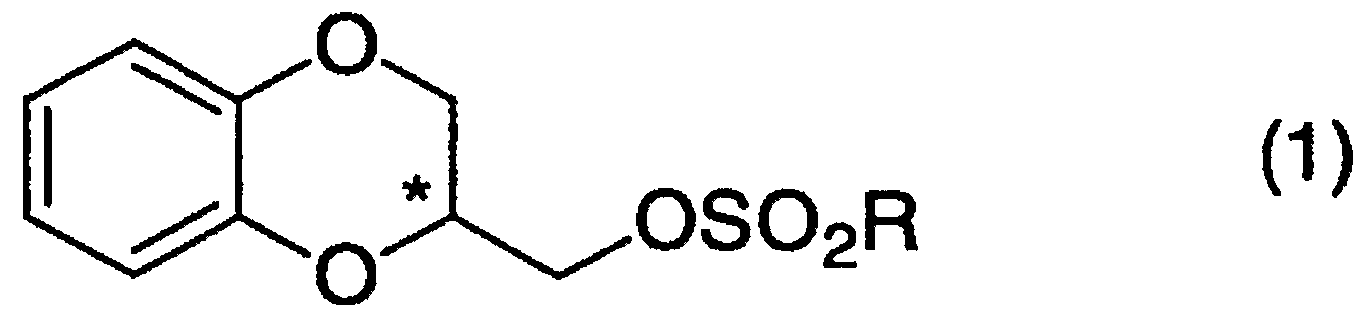
- An object of the present invention is to produce an optically active 1,4-benzodioxane derivative represented by the following formula from an easily available raw material in a safe, efficient, and industrially advantageous manner.
- R is an alkyl group having 1 to 12 carbon atoms or unsubstituted or 1 to 12 carbon atoms. Represents a phenyl group substituted with * Is the same as above.
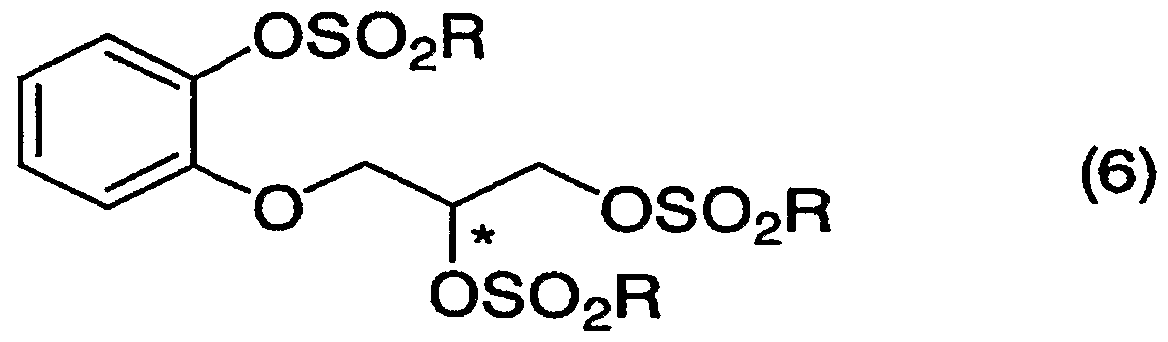
- R is an alkyl group having 1 to 12 carbon atoms or unsubstituted or 1 to 12 carbon atoms. Represents a phenyl group substituted with * Is the same as above. ) Is a process for producing an optically active trisulfonate compound.
- optically active trisulfonate compound represented by is treated with a base in a protonic solvent or a mixed solvent of a protic solvent and an aprotic solvent to effect ring closure. Equation (1)
- R represents an alkyl group having 1 to 12 carbon atoms or a phenyl group which is unsubstituted or substituted with 1 to 12 carbon atoms.
- X represents a halogen atom
- R represents an alkyl group having 1 to 12 carbon atoms or a phenyl group which is unsubstituted or substituted with 1 to 12 carbon atoms
- * represents an asymmetric carbon center.
- X represents a halogen atom.
- Specific examples include a chlorine atom, a bromine atom, and an iodine atom. From the viewpoint of availability of raw materials, a chlorine atom and a bromine atom are preferable, and a chlorine atom is more preferable.
- Catechol (2) is used in an amount of 1 to 10 molar equivalents, more preferably 2 to 3 molar equivalents, based on optically active 3-halogeno 1,2-propanediol (3) or optically active glycidol (4). It is. If the amount of catechol (1) used is too small, glycidol self-polymerization proceeds in the system, leading to a decrease in yield.
- optically active glycidol (4) is more unstable than optically active 3-halogeno 1,3-propanediol (3)
- optically active 3-halogeno is considered from the viewpoint of handling of compounds and reaction yield. It is preferred to use 1,3-propanediol (3).
- the base to be used is not particularly limited, and lithium amide, sodium amide, lithium diisopropylamide, magnesium isopropylamide, metal bromide metal amide compound; methyllithium, n-butyllithium, methylmagnesium bromide, i-chloride Alkali metal compounds such as propylmagnesium and t-butylmagnesium chloride; gold such as sodium hydride, lithium hydride, calcium hydride
- Metal alkoxides such as sodium methoxide, sodium ethoxide, magnesium ethoxide, potassium t-butoxide
- metal hydroxides such as sodium hydroxide, potassium hydroxide, lithium hydroxide, magnesium hydroxide, calcium hydroxide
- Carbonates such as sodium bicarbonate, sodium carbonate, potassium carbonate, carbonated calcium, magnesium carbonate and the like.
- metal hydroxides such as sodium hydride-sodium hydroxide, potassium hydroxide, and lithium hydroxide
- metal alkoxides such as sodium methoxide, sodium ethoxide, magnesium ethoxide, and potassium t-butoxide are inexpensive. Yes, preferred as a base in this step.
- the amount of such a base to be used is 1 to 10 molar equivalents, more preferably 3 to 5 equivalents, relative to catechol (2).
- the solvent used in this step is not particularly limited, but when a metal amide, an alkali metal, or an alkali metal hydride is used as a base, it is preferable to use an aprotic organic solvent, and a metal alkoxide, a metal hydroxide, When a carbonate is used, either an aprotic solvent or a protic solvent may be used.
- aprotic organic solvents include aprotic polar solvents such as N, N-dimethylformamide (DMF), dimethylsulfoxide, and hexamethylphosphoric triamide; getyl ether, tetrahydrofuran (THF), 1,4-dioxane, methyl t Ether solvents such as monobutyl ether, dimethoxyethane, ethylene glycol and dimethyl ether; aromatic hydrocarbon solvents such as benzene, toluene and xylene; hydrocarbon solvents such as n-pentane and n-hexane; Examples include nitrile solvents such as acetonitrile and ptyronitrile; ester solvents such as ethyl acetate and butyl acetate; ketone solvents such as acetone.
- the protic solvent include alcohol solvents such as methanol, ethanol, isopropanol, and butanol; and water. These may be
- reaction temperature is 0 ° ( ⁇ 100, preferably 20 to 40 ° C. If the temperature is too low, the reaction rate becomes extremely slow and inefficient. If the temperature is too high, by-products are formed. It is not preferable because it leads to
- a general post-treatment may be performed to obtain a product from the reaction solution.
- a base is neutralized with a common inorganic salt such as hydrochloric acid or sulfuric acid
- an extraction operation is performed using a common extraction solvent, for example, ethyl acetate, dimethyl ether, methylene chloride, toluene, hexane, etc. .
- a common extraction solvent for example, ethyl acetate, dimethyl ether, methylene chloride, toluene, hexane, etc.
- the target compound is obtained.
- the same operation may be performed after distilling off the reaction solvent by an operation such as heating under reduced pressure.
- the target product thus obtained is almost pure, but may be further purified by a general method such as crystallization purification, fractional distillation, or column chromatography to further increase the purity.
- This step is an optically active triol compound (5)
- Consists of getting As a method for converting a hydroxyl group to a sulfonate a known method (for example, Green Co., Ltd., Rotary Grownup Organic Synthesis, 2nd edition, John Wiley & Sons, inc. , Etc.) should be applied.
- the sulfonylating agent examples include benzenesulfonyl chloride, p-toluenesulfonyl chloride, m-nitrobenzenesulfonyl chloride, trifluoromethanesulfonyl chloride and alkylsulfonyl chloride having 1 to 12 carbon atoms, such as methanesulfonyl chloride, dodecanesulfonyl Sulfonyl halide compounds such as chloride; acid anhydrides such as benzenesulfonic anhydride, p-toluenesulfonic anhydride, trifluoromethanesulfonic anhydride, and methanesulfonic anhydride; and the like.
- the amount of the sulfonylating agent to be used is 3 to 10 molar equivalents, more preferably 3 to 5 molar equivalents, relative to the optically active triol compound (5).
- tertiary amines examples include trialkylamines having 1 to 12 carbon atoms, such as trimethylamine, triethylamine, and ethylpyramine, pyramine, N, N-dimethylaniline, N, N-getylaniline, and N.N-dimethylaminopyridine.
- a tertiary amine comprising an alkyl group having 1 to 4 carbon atoms and a phenyl group; a nitrogen-containing organic base such as pyridine, picolin and lutidine; N, N, N, N-tetramethyl-1,2-ethylenediamine; N, N, N, N— having 1 to 10 carbon atoms, such as N, N, N, N-tetramethyl-1,3-propanediamine, N, N, N, N-tetramethyl-1,6-hexanediamine Examples thereof include tetramethyl ⁇ , ⁇ -alkyldiamine, and these amines may be used alone or in combination. In particular, it is preferable to use a mixed base of triethylamine and ⁇ , ⁇ , ⁇ , ⁇ -tetramethyl-1,6-hexanediamine because the yield is increased.
- the amount of the amine to be used is 0.1 to 10 equivalents, more preferably 0.1 to 5 equivalents, to the optically active triol compound (5).
- the reaction temperature is from -20 ° C to 150 ° C, preferably from 0 ° C to 50 ° C.
- organic solvent used examples include, for example, getyl ether, tetrahydrofuran ( THF), 1,4-dioxane, methyl t-butyl ether, dimethoxyethane, ethylene glycol, dimethyl ether, etc .; ether solvents; benzene, toluene, xylene, etc., aromatic hydrocarbon solvents; n-pentane, n —Hydrocarbon solvents such as hexane; nitrile solvents such as acetonitrile and ptyronitrile; ester solvents such as ethyl acetate and butyl acetate; dichloromethane, 1,2-dichloroethane, 1,1,1-trichloroethane, Aprotic polar solvents such as dimethylformamide, N-methylpyrrolidone and hexamethylphosphoric triamide; alcoholic solvents such as methanol, ethanol, isopropanol and
- a general post-treatment may be performed to obtain a product from the reaction solution.
- water is added to the reaction solution after the completion of the reaction, and extraction is performed using a common extraction solvent such as ethyl acetate, dimethyl ether, methylene chloride, toluene, and hexane.
- a common extraction solvent such as ethyl acetate, dimethyl ether, methylene chloride, toluene, and hexane.
- the reaction solvent and the extraction solvent are distilled off from the obtained extract by an operation such as heating under reduced pressure, the target compound is obtained.
- the same operation may be performed after distilling off the reaction solvent by an operation such as heating under reduced pressure.
- the target product thus obtained is almost pure, but may be further purified by a general method such as crystallization purification, fractional distillation, or column chromatography to further increase the purity. 3.
- the base to be used is not particularly limited.
- metal hydroxides such as sodium hydroxide, potassium hydroxide, lithium hydroxide, magnesium hydroxide, barium hydroxide; sodium carbonate, potassium carbonate, sodium hydrogen carbonate, etc.
- Metal amide compounds such as lithium amide, sodium amide, lithium diisopropylamide, magnesium diisopropylamide, magnesium isopropylamide, magnesium dicyclohexylamide chloride; methyllithium, n-butyllithium, methyl bromide
- Alkali metal compounds such as magnesium, i-propylmagnesium chloride, and t-butylmagnesium chloride
- metal salts such as sodium methoxide, sodium ethoxide, magnesium ethoxide, and potassium t-butoxide Cooxide
- metal hydrides such as lithium hydride, sodium hydride, potassium hydride, and hydrogen hydride
- amines such as triethylamine, diisopropyleth
- Metal hydroxides such as sodium hydride, sodium hydroxide, potassium hydroxide and lithium hydroxide, or metal alkoxides such as sodium methoxide, sodium ethoxide, magnesium ethoxide and potassium t-butoxide are inexpensive. Preferred as a base in this step.
- the amount of the base used is 2 to 30 molar equivalents, preferably 3 to 12 molar equivalents, based on the optically active trisulfonate compound (6).
- the reaction temperature is 0 to 100, preferably 20 to 40 ° C.
- the reaction solvent that can be used in this step is a protic solvent or a protic solvent It is a mixed solvent containing as. Examples of the protic solvent include water; alcohol solvents such as methanol, ethanol, isopropanol, and n-butanol. Water or methanol is inexpensive and is preferred as the solvent in this step. An aprotic solvent may be used as a part of the mixed solvent.
- aprotic solvents examples include hydrocarbon solvents such as benzene, toluene, n-hexane, and cyclohexane; getyl ether, tetrahydrofuran (THF), 1,4-dioxane, methyl t-butyl ether, and dimethoxy ether.
- Ether solvents such as tan, ethylene glycol, and dimethyl ether; halogen solvents such as methylene chloride, chloroform, 1,1,1-trichloroethane and 1,2-dichloroethane; dimethylformamide, N-methylpyrrolidone
- non-protonic polar solvents such as hexamethylphosphoric triamide.
- a general post-treatment may be performed to obtain a product from the reaction solution.
- water is added to the reaction solution after the completion of the reaction, and extraction is performed using a common extraction solvent such as ethyl acetate, dimethyl ether, methylene chloride, toluene, and hexane.
- a common extraction solvent such as ethyl acetate, dimethyl ether, methylene chloride, toluene, and hexane.
- the reaction solvent and the extraction solvent are distilled off from the obtained extract by an operation such as heating under reduced pressure
- the target compound is obtained.
- the same operation may be performed after distilling off the reaction solvent by an operation such as heating under reduced pressure.
- the target product thus obtained is almost pure, but may be further purified by a general method such as crystallization purification, fractional distillation, or column chromatography to further increase the purity.
- optically active trisulfonate compound is an optically active triol compound which can be efficiently produced by the first step of the present invention (5)
- the hydroxyl group is prepared by a known method (for example, the method described in Green, Inc., Practical Group Synthetic Synthesis, 2nd edition, John Wiley & Sons, Inc., etc.). Can be easily derived by sulfonylation of The optically active trisulfonate compound (6) was the first compound produced by the above production method as a result of the study by the present inventors, and its use as a pharmaceutical intermediate was developed.
- R represents an alkyl group having 1 to 12 carbon atoms or a phenyl group which is unsubstituted or substituted with 1 to 12 carbon atoms, specifically, a methyl group, a phenyl group, a p-tolyl group, a nitrile phenyl group, a methoxyphenyl group. And a p-tolyl group, preferably a p-tolyl group. * Represents an asymmetric carbon center.
- the (R) -isomer has It is good.
- the present invention provides a method for safely and efficiently producing an optically active 1,4-benzodioxane derivative in a process comprising inexpensive raw materials.
- the optically active trisulfonate compound (6) is the first compound produced by the above production method, and its use as a pharmaceutical intermediate has been developed.
Landscapes
- Chemical & Material Sciences (AREA)
- Organic Chemistry (AREA)
- Organic Low-Molecular-Weight Compounds And Preparation Thereof (AREA)
Abstract
Description




Claims




Priority Applications (4)
| Application Number | Priority Date | Filing Date | Title |
|---|---|---|---|
| JP2004524116A JPWO2004011451A1 (ja) | 2002-07-29 | 2003-07-17 | 光学活性1,4−ベンゾジオキサン誘導体の工業的製法 |
| US10/522,734 US20060167282A1 (en) | 2002-07-29 | 2003-07-17 | Process for industrially producing optically active 1,4- benzodioxane derivative |
| AU2003252221A AU2003252221A1 (en) | 2002-07-29 | 2003-07-17 | Process for industrially producing optically active 1,4-benzodioxane derivative |
| EP03771273A EP1553095A1 (en) | 2002-07-29 | 2003-07-17 | Process for industrially producing optically active 1,4-benzodioxane derivative |
Applications Claiming Priority (2)
| Application Number | Priority Date | Filing Date | Title |
|---|---|---|---|
| JP2002220152 | 2002-07-29 | ||
| JP2002-220152 | 2002-07-29 |
Publications (1)
| Publication Number | Publication Date |
|---|---|
| WO2004011451A1 true WO2004011451A1 (ja) | 2004-02-05 |
Family
ID=31184756
Family Applications (1)
| Application Number | Title | Priority Date | Filing Date |
|---|---|---|---|
| PCT/JP2003/009125 Ceased WO2004011451A1 (ja) | 2002-07-29 | 2003-07-17 | 光学活性1,4−ベンゾジオキサン誘導体の工業的製法 |
Country Status (5)
| Country | Link |
|---|---|
| US (1) | US20060167282A1 (ja) |
| EP (1) | EP1553095A1 (ja) |
| JP (1) | JPWO2004011451A1 (ja) |
| AU (1) | AU2003252221A1 (ja) |
| WO (1) | WO2004011451A1 (ja) |
Cited By (1)
| Publication number | Priority date | Publication date | Assignee | Title |
|---|---|---|---|---|
| WO2006049038A1 (ja) * | 2004-11-04 | 2006-05-11 | Kaneka Corporation | 光学活性3-(ヒドロキシメチル)モルホリン誘導体の製造方法 |
Families Citing this family (2)
| Publication number | Priority date | Publication date | Assignee | Title |
|---|---|---|---|---|
| US7569791B2 (en) * | 2005-09-30 | 2009-08-04 | Energetiq Technology, Inc. | Inductively-driven plasma light source |
| KR100780538B1 (ko) * | 2006-08-02 | 2007-11-30 | 안국약품 주식회사 | 키랄 2-히드록시메틸-1,4-벤조디옥산 화합물의 제조방법 |
Citations (5)
| Publication number | Priority date | Publication date | Assignee | Title |
|---|---|---|---|---|
| DE4040186A1 (de) * | 1989-12-20 | 1991-06-27 | Hoechst Ag | Hypoglykaemisch aktive propandiolaminderivate mit insulin-aehnlicher wirkung und deren verwendung, neue propandiolaminderivate, diese substanzen enthaltende pharmazeutische zubereitungen und ihre verwendung zur behandlung von krankheiten |
| US5780650A (en) * | 1995-03-24 | 1998-07-14 | Daiso Co., Ltd. | Process for preparation of 1,4-benzodioxane derivative |
| EP0928791A1 (en) * | 1997-05-12 | 1999-07-14 | Daiso Co., Ltd. | Process for producing 1,4-benzodioxane derivatives |
| JP2001081086A (ja) * | 1999-09-10 | 2001-03-27 | Daiso Co Ltd | 1,4−ベンゾジオキサン類の製法 |
| JP2001316385A (ja) * | 2000-03-03 | 2001-11-13 | Daiso Co Ltd | 1,4−ベンゾジオキサン誘導体の製造法 |
-
2003
- 2003-07-17 US US10/522,734 patent/US20060167282A1/en not_active Abandoned
- 2003-07-17 JP JP2004524116A patent/JPWO2004011451A1/ja active Pending
- 2003-07-17 EP EP03771273A patent/EP1553095A1/en not_active Withdrawn
- 2003-07-17 AU AU2003252221A patent/AU2003252221A1/en not_active Abandoned
- 2003-07-17 WO PCT/JP2003/009125 patent/WO2004011451A1/ja not_active Ceased
Patent Citations (5)
| Publication number | Priority date | Publication date | Assignee | Title |
|---|---|---|---|---|
| DE4040186A1 (de) * | 1989-12-20 | 1991-06-27 | Hoechst Ag | Hypoglykaemisch aktive propandiolaminderivate mit insulin-aehnlicher wirkung und deren verwendung, neue propandiolaminderivate, diese substanzen enthaltende pharmazeutische zubereitungen und ihre verwendung zur behandlung von krankheiten |
| US5780650A (en) * | 1995-03-24 | 1998-07-14 | Daiso Co., Ltd. | Process for preparation of 1,4-benzodioxane derivative |
| EP0928791A1 (en) * | 1997-05-12 | 1999-07-14 | Daiso Co., Ltd. | Process for producing 1,4-benzodioxane derivatives |
| JP2001081086A (ja) * | 1999-09-10 | 2001-03-27 | Daiso Co Ltd | 1,4−ベンゾジオキサン類の製法 |
| JP2001316385A (ja) * | 2000-03-03 | 2001-11-13 | Daiso Co Ltd | 1,4−ベンゾジオキサン誘導体の製造法 |
Non-Patent Citations (3)
| Title |
|---|
| CHEN JIAN ET AL.: "A practical synthetic route to enantiopure 2-aryloxy-1,2-propanediols from chiral glycidol", TETRAHEDRON LETTERS, vol. 36, no. 14, 1995, pages 2379 - 2380, XP004028288 * |
| DELGADO ANTONIO ET AL.: "Short and enantioselective syntheses of (R)- and (S)-2-hydroxymethyl-1,4-benzodioxan", TETRAHEDRON LETTERS, vol. 29, no. 30, 1988, pages 3671 - 3674, XP002005147 * |
| NELSON WENDEL L. ET AL.: "Absolute configuration of glycerol derivatives. 4. Synthesis and pharmacological activity of chiral 2-alkylaminomethyl benzodioxans, competitive alpha-adrenergic antagonists", JOURNAL OF MEDICINAL CHEMISTRY, vol. 20, no. 7, 1977, pages 880 - 885, XP002005148 * |
Cited By (1)
| Publication number | Priority date | Publication date | Assignee | Title |
|---|---|---|---|---|
| WO2006049038A1 (ja) * | 2004-11-04 | 2006-05-11 | Kaneka Corporation | 光学活性3-(ヒドロキシメチル)モルホリン誘導体の製造方法 |
Also Published As
| Publication number | Publication date |
|---|---|
| JPWO2004011451A1 (ja) | 2005-11-24 |
| AU2003252221A1 (en) | 2004-02-16 |
| US20060167282A1 (en) | 2006-07-27 |
| EP1553095A1 (en) | 2005-07-13 |
Similar Documents
| Publication | Publication Date | Title |
|---|---|---|
| JPH08325260A (ja) | 1,4−ベンゾジオキサン誘導体の製法 | |
| JP2002533430A (ja) | アリールエーテルの調製方法 | |
| Li et al. | An efficient enantioselective synthesis of florfenicol via a vanadium-catalyzed asymmetric epoxidation | |
| JP3646651B2 (ja) | ブタントリオール誘導体の製造法 | |
| US20060167282A1 (en) | Process for industrially producing optically active 1,4- benzodioxane derivative | |
| JP3960801B2 (ja) | アセタールスルホネート誘導体およびその製造方法ならびにスチレンオキサイド誘導体の製造方法 | |
| JPWO1999038828A1 (ja) | ブタントリオール誘導体の製造法 | |
| KR102756069B1 (ko) | 네비볼롤 합성방법 및 그의 중간 화합물 | |
| JP3348860B2 (ja) | グリシジルエーテルの製造法 | |
| US9328066B2 (en) | Chiral synthesis of N-{3,4-difluoro-2-[(2-fluoro-4-iodophenyl)amino]-6-methoxyphenyl}-1-[2,3-dihydroxy-propyl]cyclopropanesulfonamides | |
| WO1998012171A1 (en) | Process for the preparation of 3-amino-2-hydroxy-1-propyl ethers | |
| JPWO1998012186A1 (ja) | グリシジルエーテルの製造法 | |
| JP4572475B2 (ja) | 1,4−ベンゾジオキサン誘導体の製造法 | |
| JP4148202B2 (ja) | ブタントリオール誘導体の製造法 | |
| WO2007132990A1 (en) | Process for the preparation of chiral glycidylphthalimide in highly optical purity | |
| CN101501016B (zh) | 手性2-羟甲基-1,4-苯并二噁烷化合物的制备方法 | |
| JP2001505562A (ja) | オキサゾリン誘導体の製造のための方法および中間体 | |
| US20060089503A1 (en) | Processes for producing optically active 2-thiomethyl-3-phenylpropionic acid derivative and for producing intermediate therefor | |
| JP4864328B2 (ja) | α−ケトエステル化合物の製造方法 | |
| JP2007297330A (ja) | 2−メチルグリシジル誘導体の製造法 | |
| US20060041149A1 (en) | Preparation of fluorinated 1,3-benzodiozanes | |
| WO2004037815A1 (ja) | 光学活性n−(2,3−エポキシプロパンー1−イル)フタルイミドの製造法 | |
| JP4001388B2 (ja) | 3―アミノ―2―ヒドロキシ―1―プロピルエーテルの製造法 | |
| CN113461659A (zh) | 一种c-螺环列净类似物中间体及其制备方法 | |
| JP3573357B2 (ja) | 3−アミノ−2−ヒドロキシ−酪酸エステル誘導体を出発原料とする光学活性3−アミノ−2−ブタノール誘導体の製造法及びその中間体 |
Legal Events
| Date | Code | Title | Description |
|---|---|---|---|
| AK | Designated states |
Kind code of ref document: A1 Designated state(s): AE AG AL AM AT AU AZ BA BB BG BR BY BZ CA CH CN CO CR CU CZ DE DK DM DZ EC EE ES FI GB GD GE GH GM HR HU ID IL IN IS JP KE KG KP KR KZ LC LK LR LS LT LU LV MA MD MG MK MN MW MX MZ NI NO NZ OM PG PH PL PT RO RU SC SD SE SG SK SL SY TJ TM TN TR TT TZ UA UG US UZ VC VN YU ZA ZM ZW |
|
| AL | Designated countries for regional patents |
Kind code of ref document: A1 Designated state(s): GH GM KE LS MW MZ SD SL SZ TZ UG ZM ZW AM AZ BY KG KZ MD RU TJ TM AT BE BG CH CY CZ DE DK EE ES FI FR GB GR HU IE IT LU MC NL PT RO SE SI SK TR BF BJ CF CG CI CM GA GN GQ GW ML MR NE SN TD TG |
|
| 121 | Ep: the epo has been informed by wipo that ep was designated in this application | ||
| WWE | Wipo information: entry into national phase |
Ref document number: 2004524116 Country of ref document: JP |
|
| ENP | Entry into the national phase |
Ref document number: 2006167282 Country of ref document: US Kind code of ref document: A1 |
|
| WWE | Wipo information: entry into national phase |
Ref document number: 10522734 Country of ref document: US |
|
| WWE | Wipo information: entry into national phase |
Ref document number: 2003771273 Country of ref document: EP |
|
| WWP | Wipo information: published in national office |
Ref document number: 2003771273 Country of ref document: EP |
|
| WWW | Wipo information: withdrawn in national office |
Ref document number: 2003771273 Country of ref document: EP |
|
| WWP | Wipo information: published in national office |
Ref document number: 10522734 Country of ref document: US |