WO2004013071A2 - Method for refining 2,6-naphthalene dicarboxylic acid - Google Patents

Method for refining 2,6-naphthalene dicarboxylic acid Download PDF

Info

Publication number
WO2004013071A2
WO2004013071A2 PCT/KR2003/000917 KR0300917W WO2004013071A2 WO 2004013071 A2 WO2004013071 A2 WO 2004013071A2 KR 0300917 W KR0300917 W KR 0300917W WO 2004013071 A2 WO2004013071 A2 WO 2004013071A2
Authority
WO
WIPO (PCT)
Prior art keywords
dicarboxylic acid
naphthalene dicarboxylic
amine salt
refining
acetate
Prior art date
Legal status (The legal status is an assumption and is not a legal conclusion. Google has not performed a legal analysis and makes no representation as to the accuracy of the status listed.)
Ceased
Application number
PCT/KR2003/000917
Other languages
French (fr)
Other versions
WO2004013071A3 (en
Inventor
Jong-In Lee
Hyun-Sup Shim
Yong-Jun Shin
Hang-Duk Roh
Current Assignee (The listed assignees may be inaccurate. Google has not performed a legal analysis and makes no representation or warranty as to the accuracy of the list.)
SK Chemicals Co Ltd
Original Assignee
SK Chemicals Co Ltd
Priority date (The priority date is an assumption and is not a legal conclusion. Google has not performed a legal analysis and makes no representation as to the accuracy of the date listed.)
Filing date
Publication date
Application filed by SK Chemicals Co Ltd filed Critical SK Chemicals Co Ltd
Priority to JP2004525852A priority Critical patent/JP4238214B2/en
Priority to US10/523,265 priority patent/US7153998B2/en
Priority to EP03723428A priority patent/EP1539671A2/en
Publication of WO2004013071A2 publication Critical patent/WO2004013071A2/en
Publication of WO2004013071A3 publication Critical patent/WO2004013071A3/en
Anticipated expiration legal-status Critical
Ceased legal-status Critical Current

Links

Classifications

    • CCHEMISTRY; METALLURGY
    • C07ORGANIC CHEMISTRY
    • C07CACYCLIC OR CARBOCYCLIC COMPOUNDS
    • C07C51/00Preparation of carboxylic acids or their salts, halides or anhydrides
    • C07C51/42Separation; Purification; Stabilisation; Use of additives
    • CCHEMISTRY; METALLURGY
    • C07ORGANIC CHEMISTRY
    • C07CACYCLIC OR CARBOCYCLIC COMPOUNDS
    • C07C51/00Preparation of carboxylic acids or their salts, halides or anhydrides
    • C07C51/42Separation; Purification; Stabilisation; Use of additives
    • C07C51/43Separation; Purification; Stabilisation; Use of additives by change of the physical state, e.g. crystallisation

Definitions

  • the present invention relates to a method for refining
  • dicarboxylic acid and diol have been known to be excellent in several
  • PEN polyethylene naphthalate
  • ethylene glycol is expected to replace polyethylene terephthalate (PET).
  • 2,6-Naphthalene dicarboxylic acid is obtained by oxidizing
  • crude 2,6-naphthalene dicarboxylic acid contains numerous impurities including acids having one functional group such as formyl naphthoic acid,
  • polyesters are classified as low
  • the first method is to dissolve
  • the second method is to convert 2,6-naphthalene
  • dicarboxylic acid into its alkali salt and then dissolve and recrystallize it.
  • the third method is to convert 2,6-naphthalene dicarboxylic acid into its
  • dimethyl 2,6-naphthalene dicarboxylate is produced by reacting
  • polyesters acids are superior to esters in processing and economics, and
  • No. 5,256,817 discloses a method for refining 2,6-naphthalene
  • dicarboxylic acid by dissolving it in water or acetic acid and then
  • Japanese Patent Publication No. 62-230747 A discloses a method
  • the solvents may be hydrogenated, and the formyl naphthoic
  • Patent Publication No. 5-32586 A discloses a method for refining
  • Japanese Patent Publication No. 48-68544 B disclose a method for refining 2,6-naphthalene dicarboxylic acid by dissolving it in a KOH or
  • Patent Publication No. 48-68555 B disclose a method for refining
  • Publication No. 2-243652 A discloses a method of dissolving
  • dicarboxylic acid into the form of its amine salt and then recrystallizing it.
  • Patent Publication No. 50-142542 A discloses a method of dissolving
  • Publication No. 50-135062 A discloses a method of dissolving
  • Patent Publication No. 5-294892 A discloses a method of obtaining pure
  • 2,6-naphthalene dicarboxylic acid by mixing 2,6-naphthalene dicarboxylic acid with an amine, dissolving it in a mixed solution of water, a ketone, or
  • dicarboxylic acid capable of obtaining 2,6-naphthalene dicarboxylic acid
  • dicarboxylic acid having excellent purity and color.
  • dicarboxylic acid in an easy and convenient manner, as well as one that is
  • the present invention provides a method for refining 2,6-naphthalene dicarboxylic acid
  • the crude 2,6-naphthalene dicarboxylic acid obtained from the oxidation reaction of 2,6-dimethyl naphthalene contains impurities
  • monoacids such as formyl naphthoic acid, naphthoic acid, etc., and other
  • the present invention enables
  • a protic polar solvent selected from the group consisting of:
  • the refinement of 2,6-naphthalene dicarboxylic acid is carried out by the
  • the amine used in the invention is to be used to form a diamine
  • ammonia trimethyl amine, triethyl amine, diethyl amine, dimethyl amine, methyl amine, or ethyl
  • the amine is required in an amount of more than one equivalent
  • 2,6-naphthalene dicarboxylic acid and forms a salt can be recovered by
  • the solvent used in the invention comprises a protic polar solvent
  • water are preferably used in a ratio of 1 :1 to 100:1 by weight, and the
  • solvent comprising the protic polar solvent and acetate preferably uses a
  • the protic polar solvent selected from the group consisting of an
  • 2,6-naphthalene dicarboxylic acid can be refined with a high yield of not
  • MA methyl acetate
  • EA ethyl acetate
  • n-PA normal propyl acetate
  • i-PA isopropyl acetate
  • methyl acetate is generated as a
  • the dissolution is preferably carried out at a temperature within
  • 2,6-naphthalene dicarboxylic acid is preferably carried out at a
  • the invention enables the
  • Example 2 except that the mixed solution wherein methanol:water:acetate were mixed in a mixing ratio of 2:0:8 to be used
  • Example 2 As a solvent in Example 2 was replaced by those having the contents
  • dicarboxylic acid was filtrated and deaminized at 90 ° C to yield a refined

Landscapes

  • Chemical & Material Sciences (AREA)
  • Organic Chemistry (AREA)
  • Engineering & Computer Science (AREA)
  • Oil, Petroleum & Natural Gas (AREA)
  • Crystallography & Structural Chemistry (AREA)
  • Organic Low-Molecular-Weight Compounds And Preparation Thereof (AREA)

Abstract

The present invention relates to a method for refining 2,6-naphthalene dicarboxylic acid, and particularly to a method for refining 2,6-naphthalene dicarboxylic acid comprising recrystallizing crude 2,6-naphthalene dicarboxylic acid in the form of an amine salt using a solvent comprising a protic polar solvent selected from the group consisting of an alcohol, water, and a mixture thereof, and an acetate. In accordance with the invention, 2,6-naphthalene dicarboxylic acid can be obtained with excellent purity and color, and at the same time, it can be obtained in an economical and environmentally friendly way because the acetate, which is a byproduct of the oxidation process, is used as a solvent.

Description

TITLE OF THE INVENTION
METHOD FOR REFINING 2,6-NAPHTHALENE DICARBOXYLIC ACID
BACKGROUND OF THE INVENTION
(a) Field of the Invention
The present invention relates to a method for refining
2,6-naphthalene dicarboxylic acid, and more particularly, to a method for
refining 2,6-naphthalene dicarboxylic acid capable of obtaining a product
having excellent purity and color in an economical and environmentally
friendly manner.
(b) Description of the Related Art
Polyesters produced by the polymerization of 2,6-naphthalene
dicarboxylic acid and diol have been known to be excellent in several
properties such as thermal stability, tensile strength, gas permeability, etc.,
and they are expected to be used as good materials for films, fibers,
storage containers, etc. In particular, polyethylene naphthalate (PEN)
produced by the polymerization of 2,6-naphthalene dicarboxylic acid and
ethylene glycol is expected to replace polyethylene terephthalate (PET).
2,6-Naphthalene dicarboxylic acid is obtained by oxidizing
2,6-dimethyl naphthalene with oxygen gas in the presence of the catalysts
of cobalt, manganese, and bromine compounds. The thus-obtained
crude 2,6-naphthalene dicarboxylic acid contains numerous impurities including acids having one functional group such as formyl naphthoic acid,
methyl naphthoic acid, etc. that are generated by incomplete oxidation of
2,6-dimethyl naphthalene; trimellitic acid that is obtained from the collapse
of naphthalene structure; and brominated naphthalene dicarboxylic acid,
naphthoic acid, naphthalene tricarboxylic acid, colored organic impurities
whose structures are not identified, and metal impurities such as cobalt
complex, manganese complex, etc.
Polyesters obtained by the polymerization of ethylene glycol and
crude 2,6-naphthalene dicarboxylic acid containing many impurities as
mentioned above show poor physical properties, heat stability, structural
stability, and so on. Moreover, such polyesters are classified as low
quality because they are tinged with color.
Of the impurities, mono carboxylic acids such as methyl naphthoic
acid, naphthoic acid, etc. are especially problematic. If these mono
carboxylic acids exceed a certain amount, the polymerization rate is
decreased during the production of polyesters, and gelation and coloring
occur. In particular, formyl naphthoic acid has a serious effect on such
problems. Accordingly, so as to obtain polyesters having high quality, it
is important to reduce these impurities.
2,6-Naphthalene dicarboxylic acid cannot be refined by distillation
because it is degraded at high temperature, and it is not easy to refine it by re-crystallization because it is not dissolved well in general solvents.
Until now, several refinement methods of 2,6-naphthalene
dicarboxylic acid have been known. The first method is to dissolve
2,6-naphthalene dicarboxylic acid in general solvents and then
recrystallize it. The second method is to convert 2,6-naphthalene
dicarboxylic acid into its alkali salt and then dissolve and recrystallize it.
The third method is to convert 2,6-naphthalene dicarboxylic acid into its
amine salt and then dissolve and recrystallize it. Also, industrially, pure
dimethyl 2,6-naphthalene dicarboxylate is produced by reacting
2,6-naphthalene dicarboxylic acid with methanol to prepare dimethyl
2,6-naphthalene dicarboxylate (2,6-NDC), and then refining it through
distillation to be sold. However, as can be seen in the preparation of
polyethylene terephthalate resins, as raw materials for the synthesis of
polyesters, acids are superior to esters in processing and economics, and
therefore studies on methods capable of directly refining 2,6-naphthalene
dicarboxylic acid in a convenient and economical manner are required.
As a known method for refining 2,6-naphthalene dicarboxylic acid
by dissolving it in general solvents and then recrystallizing it, US Patent
No. 5,256,817 discloses a method for refining 2,6-naphthalene
dicarboxylic acid by dissolving it in water or acetic acid and then
hydrogenating and crystallizing it. However, as this method requires heating to a high temperature in order to dissolve the 2,6-naphthalene
dicarboxylic acid, the production of naphthoic acid is increased and it also
requires expensive metal catalysts for hydrogenation, and is thus
problematic.
Japanese Patent Publication No. 62-230747 A discloses a method
of dissolving 2,6-naphthalene dicarboxylic acid in polar solvents such as
dimethylsulfoxide, dimethylformamide, dimethylacetamide, etc., adsorbing
it to activated carbons, hydrogenating it, and then crystallizing it.
However, such method requires a quantity of solvents and activated
carbons, the solvents may be hydrogenated, and the formyl naphthoic
acid is not eliminated and thus the yield of the products is low. Japanese
Patent Publication No. 5-32586 A discloses a method for refining
2,6-naphthalene dicarboxylic acid by dissolving it using pyridine or
pyridine derivatives as a solvent and then crystallizing it, but this method
is also problematic because the solubility of 2,6-naphthalene dicarboxylic
acid in the solvents is not sensitive to temperature and its yield is thus
low.
As another method for refining 2,6-naphthalene dicarboxylic acid,
there is a method of converting it into its metal salt and then dissolving
and recrystallizing it. Japanese Patent Publication No. 52-20993 A and
Japanese Patent Publication No. 48-68544 B disclose a method for refining 2,6-naphthalene dicarboxylic acid by dissolving it in a KOH or
NaOH aqueous solution to thereby prepare its alkali metal salt, then
adsorbing it with a solid adsorbent and crystallizing it. Disproportionation
of the thus-produced mono alkali salt with water generates a refined
2,6-naphthalene dicarboxylic acid. However, this method requires a
quantity of solid adsorbents and solvents, and as all mono alkali salts are
crystallized, salts generated by impurities such as naphthoic acid or
formyl naphthoic acid, etc. are also crystallized and it is difficult to
separate them.
Japanese Patent Publication No. 52-20994 B and Japanese
Patent Publication No. 48-68555 B disclose a method for refining
2,6-naphthalene dicarboxylic acid using a diacid salt. This method is
carried out by dissolving 2,6-naphthalene dicarboxylic acid in a KOH or
NaOH aqueous solution, then adsorbing it to an adsorbent and
crystallizing the produced diacid salt. However, this method also
requires a large amount of adsorbents, it is difficult to eliminate a small
amount of alkali salt impurities, and it has a low yield. Japanese Patent
Publication No. 2-243652 A discloses a method of dissolving
2,6-naphthalene dicarboxylic acid in an alkali aqueous solution and then
precipitating an alkali salt by adding a polar organic solvent that is well
mixed with water thereto, but when 2,6-naphthalene dicarboxylic acid having high purity is obtained, it has the problem that its yield is low.
There are proposed methods of dissolving 2,6-naphthalene
dicarboxylic acid into the form of its amine salt and then recrystallizing it.
The produced 2,6-naphthalene dicarboxylic acid in the form of an amine
salt is heated to a temperature above the boiling point of the amine to
thereby generate pure 2,6-naphthalene dicarboxylic acid. Japanese
Patent Publication No. 50-142542 A discloses a method of dissolving
2,6-naphthalene dicarboxylic acid in an amine aqueous solution and then
precipitating 2,6-naphthalene dicarboxylic acid in the form of an amine
salt by distilling and concentrating the solvent. Japanese Patent
Publication No. 50-135062 A discloses a method of dissolving
2,6-naphthalene dicarboxylic acid in an amine aqueous solution and then
precipitating it by cooling or condensing the solution, and Japanese
Patent Publication No. 5-294892 A discloses a method of obtaining pure
2,6-naphthalene dicarboxylic acid by dissolving 2,6-naphthalene
dicarboxylic acid in a mixed solution of an alcohol and an amine, then
precipitating it with an amine salt and heating it. However, these
methods have the problem that when 2,6-naphthalene dicarboxylic acid
having a high purity is obtained, its yield is low.
US Patent No. 5,859,294 discloses a method of obtaining pure
2,6-naphthalene dicarboxylic acid by mixing 2,6-naphthalene dicarboxylic acid with an amine, dissolving it in a mixed solution of water, a ketone, or
acetonitrile, cooling it to thereby precipitate the diamine salt of
2,6-naphthalene dicarboxylic acid, and then distilling it. However, this
method has the problem of requiring a high temperature and high
pressure to obtain 2,6-naphthalene dicarboxylic acid with a high yield.
Therefore, study on methods for refining 2,6-naphthalene
dicarboxylic acid capable of obtaining 2,6-naphthalene dicarboxylic acid
having excellent purity and color in a convenient and economical manner
are urgently required.
SUMMARY OF THE INVENTION
This invention has been made to solve the problems as addressed
above, and it is an object of the invention to provide a method for refining
2,6-naphthalene dicarboxylic acid capable of obtaining 2,6-naphthalene
dicarboxylic acid having excellent purity and color.
It is another object of the invention to provide a method for refining
2,6-naphthalene dicarboxylic acid capable of refining 2,6-naphthalene
dicarboxylic acid in an easy and convenient manner, as well as one that is
capable of saving energy and being environmentally friendly by re-using a
solvent that is used during the refinement process and by using a
byproduct of the reaction process as a solvent.
To achieve the aforementioned objects, the present invention provides a method for refining 2,6-naphthalene dicarboxylic acid
comprising recrystallizing crude 2,6-naphthalene dicarboxylic acid in the
form of an amine salt using a solvent comprising a protic polar solvent
selected from the group consisting of an alcohol, water, and a mixture
thereof, and an acetate.
DETAILED DESCRIPTION OF THE PREFERRED EMBODIMENTS
This invention will hereafter be described in detail.
The inventors found that during the study on a refinement method
capable of obtaining 2,6-naphthalene dicarboxylic acid having high purity,
as a result of the recrystallization of crude 2,6-naphthalene dicarboxylic
acid in the form of an amine salt using a protic polar solvent selected from
the group consisting of an alcohol, water, and a mixture thereof together
with an acetate, 2,6-naphthalene dicarboxylic acid having a high purity
could be obtained with a high yield, and hence, based on such findings,
they completed the subject invention.
The refinement method of the invention is characterized in that
crude 2,6-naphthalene dicarboxylic acid in the form of an amine salt is
refined by recrystallizing it using a mixed solution of a protic polar solvent
selected from the group consisting of an alcohol, water, and a mixture
thereof, and an acetate.
The crude 2,6-naphthalene dicarboxylic acid obtained from the oxidation reaction of 2,6-dimethyl naphthalene contains impurities
including metal complexes of cobalt and manganese, bromine
compounds generated by the bromination of naphthalene structure, etc,
monoacids such as formyl naphthoic acid, naphthoic acid, etc., and other
colored organic compounds. The bromine compounds corrode the
reactor, monoacids inhibit the polymerization reaction, and the colored
organic compounds deteriorate the color of the products and thus have an
adverse effect on their quality. The present invention enables
2,6-naphthalene dicarboxylic acid having excellent purity and color to be
obtained in an environmentally friendly and economical manner by
refining it using a protic polar solvent selected from the group consisting
of an alcohol, water, and a mixture thereof together with an acetate after
converting the crude 2,6-naphthalene dicarboxylic acid containing such
compounds into its amine salt.
According to the first preferred embodiment of the invention, the
refinement of 2,6-naphthalene dicarboxylic acid is carried out by the
following procedures, comprising
(a) adding an amine to crude 2,6-naphthalene dicarboxylic acid to
mix them;
(b) dissolving the mixture of (a) in a protic polar solvent selected
from the group consisting of an alcohol, water, and a mixture thereof to obtain an amine salt solution of 2,6-naphthalene dicarboxylic acid;
(c) filtrating the amine salt solution of (b) at a high temperature,
adding an acetate to the filtrate, and cooling it to obtain an amine salt
crystal of 2,6-naphthalene dicarboxylic acid; and
(d) filtrating and heating the amine salt crystal of 2,6-naphthalene
dicarboxylic acid of (c) to deaminize it.
According to the second preferred embodiment of the invention,
the refinement of 2,6-naphthalene dicarboxylic acid is carried out by the
following procedures, comprising
(a) adding an amine to crude 2,6-naphthalene dicarboxylic acid to
mix them;
(b) adding a mixed solvent comprising a protic polar solvent
selected from the group consisting of an alcohol, water, and a mixture
thereof, and an acetate to the mixture of (a) and then dissolving it by
heating to obtain an amine salt solution of 2,6-naphthalene dicarboxylic
acid;
(c) cooling the amine salt solution of (b) to room temperature to
obtain an amine salt crystal of 2,6-naphthalene dicarboxylic acid; and
(d) filtrating, heating, and drying the amine salt crystal of
2,6-naphthalene dicarboxylic acid of (c) to deaminize it.
According to the third preferred embodiment of the invention, the refinement of 2,6-naphthalene dicarboxylic acid is carried out by the
following procedures, comprising
(a) adding an amine to crude 2,6-naphthalene dicarboxylic acid to
mix them;
(b) adding a mixed solvent comprising a protic polar solvent
selected from the group consisting of an alcohol, water, and a mixture
thereof, and an acetate to the mixture of (a) and then dissolving it by
heating to obtain an amine salt solution of 2,6-naphthalene dicarboxylic
acid;
(c) filtrating the amine salt solution of (b) at a high temperature
and then cooling the filtrate to room temperature to obtain an amine salt
crystal of 2,6-naphthalene dicarboxylic acid; and
(d) filtrating, heating, and drying the amine salt crystal of
2,6-naphthalene dicarboxylic acid of (c) to deaminize it.
In the preferred first to third embodiments of the invention, the
process of adding an amine to crude 2,6-naphthalene dicarboxylic acid is
preferably carried out under the conditions of room temperature and room
pressure.
The amine used in the invention is to be used to form a diamine
salt with no special restrictions on its type, but in consideration of cost,
specific heat, and so on, it is preferable to use ammonia, trimethyl amine, triethyl amine, diethyl amine, dimethyl amine, methyl amine, or ethyl
amine.
The amine is required in an amount of more than one equivalent,
preferably 10 to 1.2 equivalents with regard to each functional group of
2,6-naphthalene dicarboxylic acid. The amine that reacts to
2,6-naphthalene dicarboxylic acid and forms a salt can be recovered by
cooling when the salt is deaminized by heating.
The solvent used in the invention comprises a protic polar solvent
selected from the group consisting of an alcohol, water, and a mixture
thereof, and an acetate. Of the protic polar solvent, the alcohol and
water are preferably used in a ratio of 1 :1 to 100:1 by weight, and the
solvent comprising the protic polar solvent and acetate preferably uses a
1 :1 to 1 :20 ratio of protic polar solvent to acetate by weight.
The protic polar solvent selected from the group consisting of an
alcohol, water, and a mixture thereof well dissolves the amine salt of
2,6-naphthalene dicarboxylic acid, whereas it is difficult for the acetate to
dissolve the amine salt of 2,6-naphthalene dicarboxylic acid. However,
the mixed solution containing these two kinds of solvents has high
solubility at a high temperature, as the solubility constant of the amine salt
of 2,6-naphthalene dicarboxylic acid therein is high at a high temperature
but it has low solubility at a low temperature, and accordingly it is desirable for recrystallization. Also, in the case that such solvent is used,
2,6-naphthalene dicarboxylic acid can be refined with a high yield of not
less than 90%. The longer the length of alkyl chains at both ends of the
ester becomes, the more solvents are needed. This is because the
solubility of the amine salt of 2,6-naphthalene dicarboxylic acid becomes
reduced as the length of alkyl chains becomes longer.
There are no special restrictions on the type of the acetate, but
particular examples include methyl acetate (MA), ethyl acetate (EA),
normal propyl acetate (n-PA), and isopropyl acetate (i-PA).
Of the exemplified acetates, methyl acetate is generated as a
byproduct in oxidation reaction when acetic acid is used as a solvent, like
the process for preparing terephthalic acids by oxidizing paraxylene.
Likewise, it is generated during the preparation of the starting material of
the invention, crude 2,6-naphthalene dicarboxylic acid, and accordingly, in
the case that it is used as a solvent, it has economical and
environmentally friendly advantages because the costs required for
treating acetate and purchasing other solvents are saved. In addition,
the invention also has energy-saving effects in that acetate with a specific
heat that is not relatively high is used, and methyl alcohol with a specific
heat that is lower than that of water is used as a solvent to dissolve
2,6-naphthalene dicarboxylic acid. Of the refinement method of the invention, when 2,6-naphthalene
dicarboxylic acid in the form of amine salt is dissolved in the above
solvent, the dissolution is preferably carried out at a temperature within
the range of 25~150°C, and the cooling for crystallizing the amine salt of
2,6-naphthalene dicarboxylic acid is preferably carried out at a
temperature within the range of -10 ~ 50 °C .
In accordance with the refinement method of the invention as
described above, 2,6-naphthalene dicarboxylic acid having excellent
purity and color can be obtained. Also, the invention enables the
refinement of 2,6-naphthalene dicarboxylic acid in an easy and
convenient manner as well as in an environmentally friendly and
energy-saving way, by re-using solvents that are used during the
refinement process and by using a byproduct of the reaction process as a
solvent. In addition, the invention has industrially applicable advantages
by decreasing the amounts of naphthoic acid, formyl naphthoic acid, and
the remaining catalyst compounds in impure 2,6-naphthalene dicarboxylic
acid.
To facilitate the understanding of the invention, preferred
examples thereof are provided. However, these examples are provided
solely to illustrate the invention; the scope of the invention should not be
construed to be limited thereto. EXAMPLES
Example 1
To a 1 -neck Erlenmeyer flask having a Pyrex-type lid, 30.0 g of
crude 2,6-naphthalene dicarboxylic acid and 33.4 g of triethyl amine were
added at room temperature and room pressure. At 50 °C, 60 g of
methanol were added to the above mixture, which was then stirred for 30
minutes to obtain a solution of the amine salt of 2,6-naphthalene
dicarboxylic acid. After the amine salt solution was filtrated using a filter
with a 7-jczm pore size, 240 g of methyl acetate was added to the filtrate to
mix them, and the resultant was then cooled at 0°C for 12 hours. The
amine salt crystal of 2,6-naphthalene dicarboxylic acid obtained after
cooling was filtrated and deaminized at 90 °C to yield a- purified
2,6-naphthalene dicarboxylic acid.
The contents of bromine compounds, cobalt, and manganese
remaining in the obtained 2,6-naphthalene dicarboxylic acid were
determined, and the yield, purity, and color of 2,6-naphthalene
dicarboxylic acid were determined, and the results are shown in Table 1
below. The purity was determined using G.C. Table 1
Figure imgf000017_0001
Example 2
After 30.0 g of crude 2,6-naphthalene dicarboxylic acid and 33.4 g
of triethyl amine were added to a 4-neck Erlenmeyer flask having a
Pyrex-type lid at room temperature and room pressure, 315 g of a mixed
solution containing methanol and methyl acetate in a mixing ratio of 2:8
were added thereto and the mixture was heated to 55 °C while stirring for
30 minutes to obtain a solution of the amine salt of 2,6-naphthalene
dicarboxylic acid. The amine salt solution was placed at room
temperature for 12 hours to thereby crystallize it, and the thus-produced diamine salt crystal of 2,6-naphthalene dicarboxylic acid was then filtrated
and deaminized at 90 °C to yield a refined 2,6-naphthalene dicarboxylic
acid powder.
The contents of bromine compounds, cobalt, and manganese
remaining in the obtained 2,6-naphthalene dicarboxylic acid, and the yield,
purity, and color of 2,6-naphthalene dicarboxylic acid were determined in
the same manner as in Example 1 above, and they are shown in Table 2
below.
Table 2
Figure imgf000018_0001
Examples 3 ~4
The procedures were carried out in the same manner as used in
Example 2 above, except that the mixed solution wherein
methanol:water:acetate were mixed in a mixing ratio of 2:0:8 to be used as a solvent in Example 2 was replaced by those having the contents
shown in Table 3 below. In addition, the type of acetate varied by each
example.
The contents of bromine compounds, cobalt, and manganese
remaining in the 2,6-naphthalene dicarboxylic acid obtained in Examples
3 to 4 above, and the yield, purity, and color of 2,6-naphthalene
dicarboxylic acid were determined in the same manner as in Example 1
above, and they are shown in Table 3 below.
Table 3
Figure imgf000019_0001
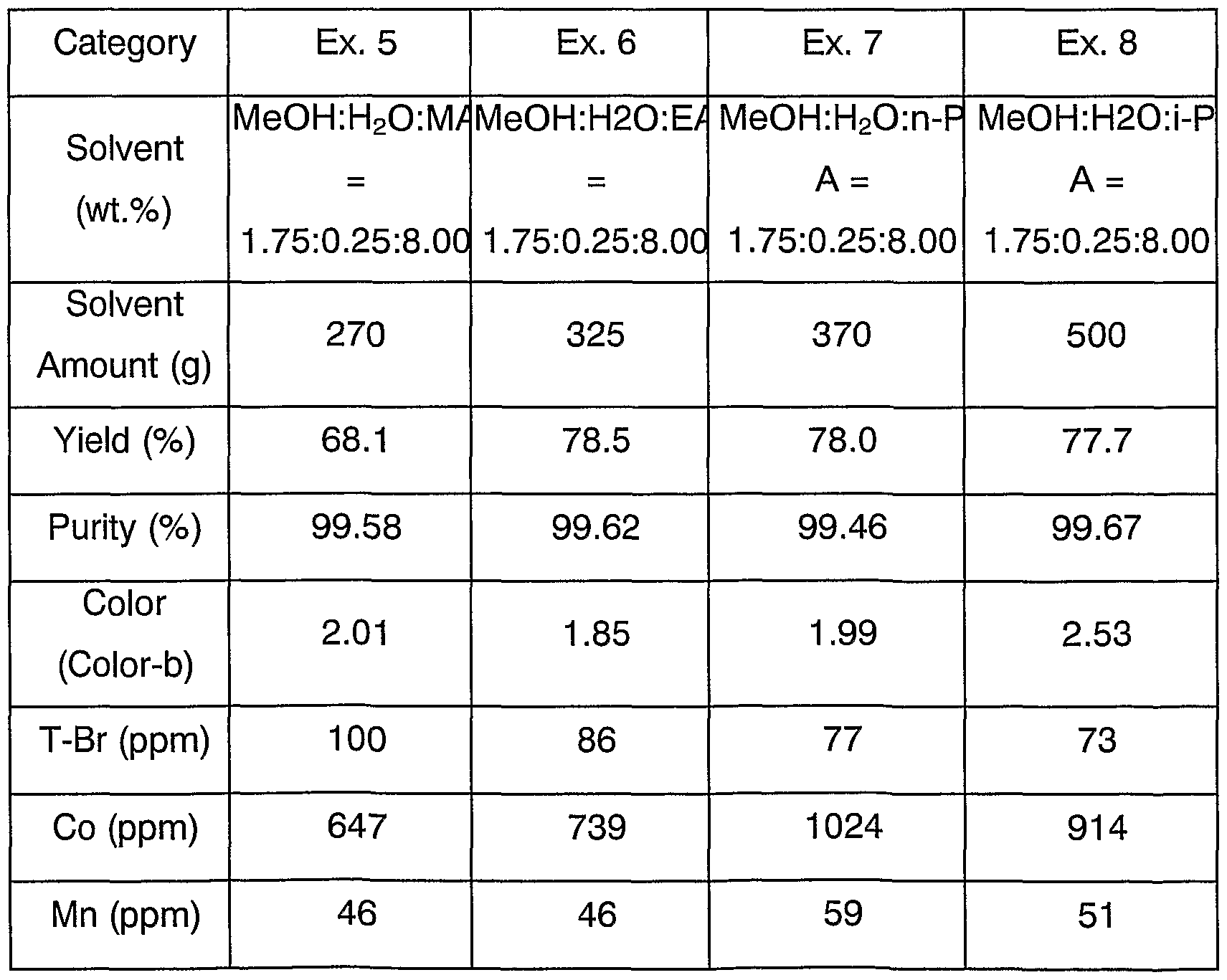
Examples 5~8
The procedures were carried out in the same manner as used in
Example 2 above, except that the mixed solution wherein methanol:water:acetate were mixed in a mixing ratio of 2:0:8 to be used
as a solvent in Example 2 was replaced by those having the contents
shown in Table 4 below. In addition, the type of acetate varied by each
example.
The contents of bromine compounds, cobalt, and manganese
remaining in the 2,6-naphthalene dicarboxylic acid obtained in Examples
5 to 8 above, and the yield, purity, and color of 2,6-naphthalene
dicarboxylic acid were determined in the same manner as in Example 1
above, and they are shown in Table 4 below.
Table 4
Figure imgf000020_0001
Example 9
After 50.0 g of crude 2,6-naphthalene dicarboxylic acid and 56.5 g
of triethyl amine were added to a 4-neck Erlenmeyer flask having a
Pyrex-type lid at room temperature and room pressure, 315 g of a mixed
solution containing methanol:water:methyl acetate in a mixing ratio of
1.75:0.25:8.00 were added thereto and the mixture was then heated to
55 °C while stirring for 1 hour to obtain a solution of the amine salt of
2,6-naphthalene dicarboxylic acid. The amine salt solution was filtrated
using a filter with a 7 μ pore size at 60 °C under a reduced pressure, the
thus-obtained filtrate was heated to 55 °C for 30 minutes to convert it into
its solution form, and then it was placed for 12 hours to thereby crystallize
it. The thus-produced diamine salt crystal of 2,6-naphthalene
dicarboxylic acid was filtrated and deaminized at 90 °C to yield a refined
2,6-naphthalene dicarboxylic acid powder.
Examples 10 — 11
The procedures were carried out in the same manner as used in
Example 9 above, except that ethyl acetate and n-PA were respectively
used, instead of methyl acetate.
The contents of bromine compounds, cobalt, and manganese
remaining in the 2,6-naphthalene dicarboxylic acid obtained in Examples
9 to 11 above, and the yield, purity, and color of 2,6-naphthalene dicarboxylic acid were determined in the same manner as in Example 1
above, and they are shown in Table 5 below.
Table 5
Figure imgf000022_0001
In accordance with the invention, 2,6-naphthalene dicarboxylic
acid can be obtained with excellent purity and color. In addition, as the
solvent used in the refinement process is re-used and the byproduct of
the reaction process is used as a solvent, this invention is environmentally
friendly and has energy-saving effects. Further, it enables the
refinement of pure 2,6-naphthalene dicarboxylic acid in an easy and
economical way by eliminating the naphthoic acid, formyl naphthoic acid,
catalyst compounds, etc. remaining in impure 2,6-naphthalene
dicarboxylic acid.

Claims

WHAT IS CLAIMED IS:
1. A method for refining 2,6-naphthalene dicarboxylic acid
comprising recrystallizing the 2,6-naphthalene dicarboxylic acid using a
solvent comprising a protic polar solvent selected from the group
consisting of an alcohol, water, and a mixture thereof, and an acetate.
2. The method for refining 2,6-naphthalene dicarboxylic acid of
claim 1 , comprising
(a) adding an amine to crude 2,6-naphthalene dicarboxylic acid to
mix them;
(b) dissolving the mixture of (a) in a protic polar solvent selected
from the group consisting of an alcohol, water, and a mixture thereof to
obtain an amine salt solution of 2,6-naphthalene dicarboxylic acid;
(c) filtrating the amine salt solution of (b), adding an acetate to the
filtrate, and cooling it to obtain an amine salt crystal of 2,6-naphthalene
dicarboxylic acid; and
(d) filtrating and heating the amine salt crystal of 2,6-naphthalene
dicarboxylic acid of (c) to deaminize it.
3. The method for refining 2,6-naphthalene dicarboxylic acid of
claim 1 , comprising
(a) adding an amine to crude 2,6-naphthalene dicarboxylic acid to
mix them; (b) adding a mixed solvent comprising a protic polar solvent
selected from the group consisting of an alcohol, water, and a mixture
thereof, and an acetate to the mixture of (a) and then dissolving it by
heating to obtain an amine salt solution of 2,6-naphthalene dicarboxylic
acid;
(c) cooling the amine salt solution of (b) to room temperature to
obtain an amine salt crystal of 2,6-naphthalene dicarboxylic acid; and
(d) filtrating, heating, and drying the amine salt crystal of
2,6-naphthalene dicarboxylic acid of (c) to deaminize it.
4. The method for refining 2,6-naphthalene dicarboxylic acid of
claim 1. comprising
(a) adding an amine to crude 2,6-naphthalene dicarboxylic acid to
mix them;
(b) adding a mixed solvent comprising a protic polar solvent
selected from the group consisting of an alcohol, water, and a mixture
thereof, and an acetate to the mixture of (a) and then dissolving it by
heating to obtain an amine salt solution of 2,6-naphthalene dicarboxylic
acid;
(c) filtrating the amine salt solution of (b) at a high temperature
and then cooling the filtrate to room temperature to obtain an amine salt
crystal of 2,6-naphthalene dicarboxylic acid; and (d) filtrating, heating, and drying the amine salt crystal of
2,6-naphthalene dicarboxylic acid of (c) to deaminize it.
5. The method for refining 2,6-naphthalene dicarboxylic acid of
claim 1 , wherein in said protic polar solvent, an alcohol and water are
used in a ratio of 1 :1 to 100:1 by weight.
6. The method for refining 2,6-naphthalene dicarboxylic acid of
claim 1 , wherein said protic polar solvent and acetate are used in a ratio
of 1 :1 to 1 :20 by weight.
7. The method for refining 2,6-naphthalene dicarboxylic acid of
any one of claims 2 to 4, wherein said dissolution is carried out at a
temperature within the range of 25 — 150°C, and the cooling is carried out
at a temperature within the range of -10~50°C.
PCT/KR2003/000917 2002-08-01 2003-05-09 Method for refining 2,6-naphthalene dicarboxylic acid Ceased WO2004013071A2 (en)

Priority Applications (3)

Application Number Priority Date Filing Date Title
JP2004525852A JP4238214B2 (en) 2002-08-01 2003-05-09 Method for purifying 2,6-naphthalenedicarboxylic acid
US10/523,265 US7153998B2 (en) 2002-08-01 2003-05-09 Method for refining 2,6-naphthalene dicarboxylic acid
EP03723428A EP1539671A2 (en) 2002-08-01 2003-05-09 Method for refining 2,6-naphthalene dicarboxylic acid

Applications Claiming Priority (2)

Application Number Priority Date Filing Date Title
KR1020020045525A KR100544954B1 (en) 2002-08-01 2002-08-01 Method for Purifying 2,6-naphthalene Dicarboxylic Acid
KR10-2002-0045525 2002-08-01

Publications (2)

Publication Number Publication Date
WO2004013071A2 true WO2004013071A2 (en) 2004-02-12
WO2004013071A3 WO2004013071A3 (en) 2004-09-10

Family

ID=31492786

Family Applications (1)

Application Number Title Priority Date Filing Date
PCT/KR2003/000917 Ceased WO2004013071A2 (en) 2002-08-01 2003-05-09 Method for refining 2,6-naphthalene dicarboxylic acid

Country Status (5)

Country Link
US (1) US7153998B2 (en)
EP (1) EP1539671A2 (en)
JP (1) JP4238214B2 (en)
KR (1) KR100544954B1 (en)
WO (1) WO2004013071A2 (en)

Cited By (1)

* Cited by examiner, † Cited by third party
Publication number Priority date Publication date Assignee Title
WO2006071025A1 (en) * 2004-12-31 2006-07-06 Sk Chemicals Co., Ltd. Process for refining of 2,6-naphthalene dicarboxylic acid

Families Citing this family (1)

* Cited by examiner, † Cited by third party
Publication number Priority date Publication date Assignee Title
KR100870344B1 (en) * 2006-12-29 2008-11-25 주식회사 효성 Method and apparatus for purifying high purity 2,6-naphthalenedicarboxylic acid

Family Cites Families (11)

* Cited by examiner, † Cited by third party
Publication number Priority date Publication date Assignee Title
US5095135A (en) * 1990-04-05 1992-03-10 Sumikin Chemical Co., Ltd. Process for the preparation of high-purity naphthalenecarboxylic acid esters
JPH05294892A (en) * 1992-04-22 1993-11-09 Mitsubishi Petrochem Co Ltd Method for producing naphthalenedicarboxylic acid
DE69210790T2 (en) 1991-12-03 1996-10-10 Mitsubishi Chem Corp Process for the preparation of naphthalenedicarboxylic acid
US5256817A (en) * 1992-06-18 1993-10-26 Amoco Corporation Method for purifying a naphthalenedicarboxylic acid
JPH06279355A (en) * 1993-03-26 1994-10-04 Sekiyu Sangyo Kasseika Center Production of 2,6-naphthalene-dicarboxylic acid
JPH07118200A (en) 1993-10-19 1995-05-09 Mitsubishi Chem Corp Method for producing naphthalenedicarboxylic acid
JPH07118201A (en) * 1993-10-22 1995-05-09 Mitsubishi Chem Corp Method for purifying 2,6-naphthalenedicarboxylic acid
US5859294A (en) * 1996-02-05 1999-01-12 Mitsubishi Gas Chemical Corporation, Inc. Process for the production of high-purity naphthalenedicarboxylic acid
US6133476A (en) 1996-09-17 2000-10-17 Lin; Tsong-Dar Vincent Process for purification of aromatic polycarboxylic acids
US6291707B1 (en) * 1999-03-12 2001-09-18 Tsong-Dar Vincent Lin Process of purifying and producing high purity aromatic polycarboxylic acids and derivatives thereof
DE60002782T2 (en) 1999-05-26 2004-03-25 Mitsubishi Gas Chemical Co., Inc. Process for the production of a high-purity aromatic polycarboxylic acid

Cited By (1)

* Cited by examiner, † Cited by third party
Publication number Priority date Publication date Assignee Title
WO2006071025A1 (en) * 2004-12-31 2006-07-06 Sk Chemicals Co., Ltd. Process for refining of 2,6-naphthalene dicarboxylic acid

Also Published As

Publication number Publication date
WO2004013071A3 (en) 2004-09-10
JP2005534694A (en) 2005-11-17
KR100544954B1 (en) 2006-01-24
EP1539671A2 (en) 2005-06-15
KR20040012134A (en) 2004-02-11
US20050261518A1 (en) 2005-11-24
US7153998B2 (en) 2006-12-26
JP4238214B2 (en) 2009-03-18

Similar Documents

Publication Publication Date Title
CN112876359B (en) Preparation method of dimethyl 2, 6-naphthalene dicarboxylate
KR100934163B1 (en) Separation and Purification Method of High Purity Naphthalenedicarboxylic Acid Using Crystallization Process
WO1998011047A1 (en) Method for purifying crude naphthalenedicarboxylic acid and process for preparing polyethylene naphthalate
US7153998B2 (en) Method for refining 2,6-naphthalene dicarboxylic acid
KR101073068B1 (en) Process for refining of 2,6-naphthalene dicarboxylic acid
KR20030033958A (en) Method for making high-purity naphthalenedicarboxylic acid
JPS6050775B2 (en) Continuous production method of terephthalic acid
JPH07238051A (en) Method for producing high-purity naphthalenedicarboxylic acid
JP2924104B2 (en) Method for producing high-purity isophthalic acid
JP4839501B2 (en) Method for producing high purity aromatic polycarboxylic acid
KR100603886B1 (en) Purification method of 2,6-naphthalenedicarboxylic acid
JPH05294892A (en) Method for producing naphthalenedicarboxylic acid
CN112851560A (en) Preparation method of cis-D-hydroxyproline
JP3659747B2 (en) Method for purifying crude naphthalenedicarboxylic acid
KR20040061555A (en) Purification Method of 2,6-Naphthalenedicarboxylic Acid
JP3757989B2 (en) Method for purifying naphthalenedicarboxylic acid
US3215734A (en) Process for purification of terephthalic acid
KR100605052B1 (en) Purification method of 2,6-naphthalenedicarboxylic acid
US3819695A (en) Process for preparation of methylterephthalic acid and 4-methylisophthalic acid
JP2000143583A (en) Method for producing naphthalenedicarboxylic acid
US4317924A (en) Process for producing purified terephthalic acid
KR100790206B1 (en) Method for producing 2,6-naphthalenedicarboxylic acid
JPH0971553A (en) Method for purifying naphthalenedicarboxylic acid
KR100841151B1 (en) Process for producing high purity naphthalenedicarboxylic acid
JP3288743B2 (en) Catalyst recovery method

Legal Events

Date Code Title Description
AK Designated states

Kind code of ref document: A2

Designated state(s): JP US

AL Designated countries for regional patents

Kind code of ref document: A2

Designated state(s): AT BE BG CH CY CZ DE DK EE ES FI FR GB GR HU IE IT LU MC NL PT RO SE SI SK TR

121 Ep: the epo has been informed by wipo that ep was designated in this application
WWE Wipo information: entry into national phase

Ref document number: 2004525852

Country of ref document: JP

Ref document number: 10523265

Country of ref document: US

WWE Wipo information: entry into national phase

Ref document number: 2003723428

Country of ref document: EP

WWP Wipo information: published in national office

Ref document number: 2003723428

Country of ref document: EP