WO2004013112A1 - Pesticidal fluoroalkene derivatives - Google Patents

Pesticidal fluoroalkene derivatives Download PDF

Info

Publication number
WO2004013112A1
WO2004013112A1 PCT/EP2003/008397 EP0308397W WO2004013112A1 WO 2004013112 A1 WO2004013112 A1 WO 2004013112A1 EP 0308397 W EP0308397 W EP 0308397W WO 2004013112 A1 WO2004013112 A1 WO 2004013112A1
Authority
WO
WIPO (PCT)
Prior art keywords
hydrogen
formula
compounds
row
case
Prior art date
Legal status (The legal status is an assumption and is not a legal conclusion. Google has not performed a legal analysis and makes no representation as to the accuracy of the status listed.)
Ceased
Application number
PCT/EP2003/008397
Other languages
French (fr)
Inventor
Markus Kordes
Wolfgang Von Deyn
Thomas Schmidt
Gerd Steiner
David G. Kuhn
Yulin Hu
Henry Van Tuyl Cotter
Deborah L. Culbertson
Current Assignee (The listed assignees may be inaccurate. Google has not performed a legal analysis and makes no representation or warranty as to the accuracy of the list.)
BASF SE
Original Assignee
BASF SE
Priority date (The priority date is an assumption and is not a legal conclusion. Google has not performed a legal analysis and makes no representation as to the accuracy of the date listed.)
Filing date
Publication date
Application filed by BASF SE filed Critical BASF SE
Priority to JP2004525376A priority Critical patent/JP2006504664A/en
Priority to AU2003252536A priority patent/AU2003252536A1/en
Priority to US10/523,325 priority patent/US20060014805A1/en
Publication of WO2004013112A1 publication Critical patent/WO2004013112A1/en
Anticipated expiration legal-status Critical
Ceased legal-status Critical Current

Links

Classifications

    • AHUMAN NECESSITIES
    • A01AGRICULTURE; FORESTRY; ANIMAL HUSBANDRY; HUNTING; TRAPPING; FISHING
    • A01NPRESERVATION OF BODIES OF HUMANS OR ANIMALS OR PLANTS OR PARTS THEREOF; BIOCIDES, e.g. AS DISINFECTANTS, AS PESTICIDES OR AS HERBICIDES; PEST REPELLANTS OR ATTRACTANTS; PLANT GROWTH REGULATORS
    • A01N43/00Biocides, pest repellants or attractants, or plant growth regulators containing heterocyclic compounds
    • A01N43/90Biocides, pest repellants or attractants, or plant growth regulators containing heterocyclic compounds having two or more relevant hetero rings, condensed among themselves or with a common carbocyclic ring system
    • AHUMAN NECESSITIES
    • A01AGRICULTURE; FORESTRY; ANIMAL HUSBANDRY; HUNTING; TRAPPING; FISHING
    • A01NPRESERVATION OF BODIES OF HUMANS OR ANIMALS OR PLANTS OR PARTS THEREOF; BIOCIDES, e.g. AS DISINFECTANTS, AS PESTICIDES OR AS HERBICIDES; PEST REPELLANTS OR ATTRACTANTS; PLANT GROWTH REGULATORS
    • A01N43/00Biocides, pest repellants or attractants, or plant growth regulators containing heterocyclic compounds
    • A01N43/72Biocides, pest repellants or attractants, or plant growth regulators containing heterocyclic compounds having rings with nitrogen atoms and oxygen or sulfur atoms as ring hetero atoms
    • A01N43/74Biocides, pest repellants or attractants, or plant growth regulators containing heterocyclic compounds having rings with nitrogen atoms and oxygen or sulfur atoms as ring hetero atoms five-membered rings with one nitrogen atom and either one oxygen atom or one sulfur atom in positions 1,3
    • AHUMAN NECESSITIES
    • A61MEDICAL OR VETERINARY SCIENCE; HYGIENE
    • A61PSPECIFIC THERAPEUTIC ACTIVITY OF CHEMICAL COMPOUNDS OR MEDICINAL PREPARATIONS
    • A61P33/00Antiparasitic agents
    • CCHEMISTRY; METALLURGY
    • C07ORGANIC CHEMISTRY
    • C07DHETEROCYCLIC COMPOUNDS
    • C07D277/00Heterocyclic compounds containing 1,3-thiazole or hydrogenated 1,3-thiazole rings
    • C07D277/02Heterocyclic compounds containing 1,3-thiazole or hydrogenated 1,3-thiazole rings not condensed with other rings
    • C07D277/20Heterocyclic compounds containing 1,3-thiazole or hydrogenated 1,3-thiazole rings not condensed with other rings having two or three double bonds between ring members or between ring members and non-ring members
    • C07D277/32Heterocyclic compounds containing 1,3-thiazole or hydrogenated 1,3-thiazole rings not condensed with other rings having two or three double bonds between ring members or between ring members and non-ring members with hetero atoms or with carbon atoms having three bonds to hetero atoms with at the most one bond to halogen, e.g. ester or nitrile radicals, directly attached to ring carbon atoms
    • C07D277/36Sulfur atoms
    • CCHEMISTRY; METALLURGY
    • C07ORGANIC CHEMISTRY
    • C07DHETEROCYCLIC COMPOUNDS
    • C07D277/00Heterocyclic compounds containing 1,3-thiazole or hydrogenated 1,3-thiazole rings
    • C07D277/60Heterocyclic compounds containing 1,3-thiazole or hydrogenated 1,3-thiazole rings condensed with carbocyclic rings or ring systems
    • C07D277/62Benzothiazoles
    • C07D277/68Benzothiazoles with hetero atoms or with carbon atoms having three bonds to hetero atoms with at the most one bond to halogen, e.g. ester or nitrile radicals, directly attached in position 2
    • C07D277/70Sulfur atoms
    • C07D277/74Sulfur atoms substituted by carbon atoms

Definitions

  • the present invention relates to pesticidal fluoroalkene derivatives of formula I
  • a oxygen or NR a A oxygen or NR a ;
  • R a hydrogen; C ⁇ -C 6 -alkyl, C 2 -C 5 -alkenyl, C 2 -C 6 -alkynyl, wherein the carbon atoms may be partially or fully halo- genated;
  • X hydrogen, halogen; C ⁇ -C 6 -alkyl or phenyl wherein the alkyl and phenyl groups may be partially or fully halogenated;
  • R X ,R 2 each independently hydrogen, halogen, hydroxyl, cyano, nitro, mercapto, amino; Ci-Cg-alkyl, C 2 -C 6 -alkenyl , C -C 6 -alky- nyl, C ⁇ -C 6 -alkoxy, C-C 6 -alkenyloxy, Ci-Cg-alkylthio, Ci-C ⁇ -al- kylamino, di-C ⁇ -C 6 -alkylamino, Ci-Cg-alkoxycarbonyl , Ci-C ⁇ - l- kylcarbonyloxy, wherein the aliphatic moieties in these 10 substituents are unsubstituted, partially or fully. halogenated or substituted by 1 to 3 substituents, each independently selected from R b :
  • R cyano, nitro, halogen, hydroxy, mercapto, fpfriino, carbo- xyl, aminocarbonyl , aminothiocarbonyl, alkyl, haloalkyl, alkenyl, alkenyloxy, alkynyl, alkoxy, haloalkoxy, alkylthio, alkylamino, dialkylamino, formyl, alkylcarbonyl, alkylsulfonyl, alkoxysulfonyl, alkylsulfonyloxy, alkoxycarbonyl, alkylcarbonyloxy, alkylaminocarbonyl , dialkylami- nocarbonyl, alkylamino ' thiocarbonyl, dialkylaminothiocar- bonyl, alkylenedioxy or cycloalkyl, wherein the alkyl groups in these radicals contain 1 to 6 carbon atoms and the abovementioned alkenyl
  • R c R C ⁇ -C 6 -alkoxy-C ⁇ -C 6 -alkyl , C ⁇ -C 5 -alkylsulfinyl,
  • hetaryl hetaryloxy, hetarylthio, wherein the mono- or bicyclic ring systems contain 5 to 10 ring members wherein 1 to 3 carbon atoms may be substituted by heteroatoms selected from nitrogen, sulfur and oxygen,
  • cyclic, aromatic and heteroaromatic systems may be partially or fully halogenated or may be substituted by from 1 to 3 groups selected from halogen, cyano, nitro, hydroxy; Ci-Cg-alkyl, Ci-C ⁇ -alkoxy, Ci-C ⁇ -alkylthio, Ci-Cg-alkylamino, Ci-C ⁇ -alkylcarbonyl ,
  • Ci-Cg-alkoxycarbonyl di-C ⁇ -C 6 -alkylamino, C-C 6 -alkenyl , C 2 _ C6-alkenyloxy and C 2 -C 6 -alkynyl, wherein the carbon atoms of these substituents may be partially or fully halogenated;
  • the present invention relates to processes for the preparation of compounds of formula I, compositions containing them and their use for the control of pests such as nematodes, insects, arachnids, harmful fungi and unwanted plants, and the protection of plants from those pests as well as their use for treating, controlling, preventing and protecting warm-blooded animals, fish and humans against infestation and infection by hel- minths, arachnids and arthropod endo- and ectoparasites.
  • pests such as nematodes, insects, arachnids, harmful fungi and unwanted plants
  • protection of plants from those pests as well as their use for treating, controlling, preventing and protecting warm-blooded animals, fish and humans against infestation and infection by hel- minths, arachnids and arthropod endo- and ectoparasites.
  • nematicidal halosubstituted alkene derivatives are disclosed, some of which are substituted by a carbonyloxy group substituted by dihydrothiazolylthiomethylene.
  • the compounds of formula I differ from the compounds known from WO-A 86/07590 in that they are substituted by aromatic heterocyclic substituents .
  • EP-A 1000946 teachers 2- (substituted thio) thiazolo- [4, 5-b]pyridine compounds which may bear a haloal- kenyl-oxycarbonyl-alkylthio radical as the substituting thio group .
  • R 1 , R 2 and n are as defined for formula I and is a nu- cleophilic exchangeable leaving group, preferably halogen such as bromine, and R 1 is hydrogen, Ci-Cg-alkyl or aryl-Ci-Cg-alkyl , such as benzyl, in the presence of a base to give sulfide compounds of formula IV.
  • the reaction to sulfides IV is usually carried out at temperatures of from 0°C to 150°C, preferably from 15°C to 80°C, in an inert organic solvent in the presence of a base.
  • Suitable solvents are halogenated hydrocarbons, such as methylene chloride and chlorobenzene, ethers, such as dimethylether, digylme, dioxane and tetrahydrofuran, nitriles, such as acetonitrile, ketones, such as acetone, and also dimethyl sulfoxide, dimethyl formamide and dimethyl acetamide.
  • Preferred solvents are acetone and dimethyl formamide. It is also possible to use mixtures of the solvents mentioned.
  • Suitable bases are, inorganic compounds, such as alkali metal and alkaline earth metal carbonates, such as lithium carbonate, potassium carbonate and calcium carbonate, alkali metal bicarbonates , such as sodium bicarbonate, and also organic bases, such as tertiary amines, such as trimethyl amine, triethyl amine, tri-isopropyl ethyl amine und N-methyl- piperidine, and pyridine. Particular preference is given to alkaline earth metal carbonates, especially potassium carbonate.
  • the base is employed in equimolar amounts or in excess .
  • the starting materials are generally reacted with one another in 5 equimolar amounts .
  • Heterocyclic thiols of formula II are known, or are commercially 10 available, or they can be prepared by known methods [see e.g. Synthesis 3, 358-360 (2001)].
  • X and p are as defined for formula I and Y is (a) a nu- cleophilically exchangeable group, such as halogen or hydroxy, to yield compounds I wherein A is oxygen, or (b) an amino group NHR a , wherein R a is as defined for formula I, preferably hydrogen, to yield compounds I wherein A is R a .
  • reaction is carried out by common coupling methods such as in the presence of a base, optionally under activating conditions, such as by converting carboxylic acids of formula V into their corresponding carboxylic acid halides or by means of dehydrating
  • the reaction is usually carried out at temperatures of from 0°C to 40 150°C, preferably from 20°C to 60°C, in an inert organic solvent in the presence of a base.
  • Suitable solvents are nitriles, such as acetonitrile and propionitrile, and also dimethyl sulfoxide, dimethyl formamide 45 and dimethyl acetamide.
  • Preferred solvents are dimethylether and acetonitrile. It is also possible to use mixtures of the solvents mentioned.
  • the starting materials are generally reacted with one another in equimolar amounts. In terms of yield, it may be advantageous to use an excess of compounds V, based on acids IV.
  • Sulfinyl and sulfonyl compounds of formula I wherein m is 1 or 2 may be prepared by oxidizing compounds of formula la.
  • the oxidation is usually carried out at temperatures of from -10°C to 150°C, preferably from 0°C to 60°C, in an inert organic solvent or water.
  • Suitable oxidizing agents are, for example m-chloroperben- zoic acid, peracetic acid, H 2 0 x BF 3 , K 2 S 2 0 7 /HS0 , peroxytrifluo- roacetic acid, or hydrogen peroxide, optionally in combination with catalytic amounts of sodium tungsten dihydrate.
  • Suitable solvents are halogenated hydrocarbons, such as methylene chloride and chloroform alcohols, such as methanol and tert. -butanol, carboxylic acids such as acetic acid and trifluoroacetic acid, and also dimethyl sulfoxide, dimethyl formamide and dimethyl acetamide.
  • Preferred solvents are methylene chloride and acetic acid. It is also possible to use mixtures of the solvents mentioned.
  • reaction mixtures are worked up in a customary manner, for example by mixing with water, phase separation and, if appropriate, chromatographic purification of the crude products.
  • the intermediates and end products are obtained in the form of colorless or pale brown viscous oils, which are purified or freed from volatile components under reduced pressure and at moderately elevated temperature. If the intermediates and end products are obtained as solids, they can also be purified by recrystallization or digestion.
  • Halogen fluorine, chlorine, bromine and iodine
  • Alkyl saturated, straight-chain or branched hydrocarbon radicals having 1 to 4 or 6 carbon atoms, such as methyl, ethyl, propyl, 1-methylethyl, butyl, 1-methylpropyl, 2-methylpropyl, 1 , 1-dimethylethyl , pentyl , 1-methylbutyl, 2-methylbutyl , 3-methylbutyl, 2, 2-dimethylpropyl, 1-ethylpropyl, hexyl, 1, 1-dimethylpropyl, 1, 2-dimethylpropyl, 1-methylpentyl, 2-me hylpentyl , 3-methylpentyl , 4-methylpentyl , 1, 1-dimethylbutyl, 1 , 2-dimethylbutyl , 1, 3-dimethylbutyl, 2 , 2-dimethylbutyl, 2,3-dimethylbutyl, 3,3-di
  • Haloalkyl straight-chain or branched alkyl groups having 1 to 4 or 6 carbon atoms (as mentioned above) , where some or all of the hydrogen atoms in these groups may be replaced by halogen atoms, as mentioned above, for example C ⁇ -C-haloalkyl, such as chloromethyl, bromomethyl, dichloromethyl, trichloromethyl, fluoromethyl , difluoromethyl, trifluoromethyl, chlorofluoromethyl, dichlorofluoromethyl , chlorodifluoromethyl, 1-chloroethyl, 1-bromoethyl, 1-fluoroethyl, 2-fluoroethyl, 2 , 2-difluoroethyl, 2,2, 2-trifluoroethyl, 2-chloro-2-fluoroethyl, 2-chloro-2 , 2-difluoroethyl , 2 , 2-dichloro-2-fluoroethyl,
  • Alkenyl unsaturated, straight-chain or branched hydrocarbon radicals having 2 to 6 carbon atoms and a double bond in any position such as ethenyl, 1-propenyl, 2-propenyl, 1-methyl- ethenyl, 1-butenyl, 2-butenyl, 3-butenyl, 1-methyl-l-propenyl, 2-methyl-l-propenyl, l-methyl-2-propenyl, 2-methyl-2-propenyl; 1-pentenyl, 2-pentenyl, 3-pentenyl, 4-pentenyl, 1-methyl- 1-butenyl, 2-methyl-l-butenyl, 3-methyl-l-butenyl, 1-methyl- 2-butenyl, 2-methyl-2-butenyl, 3-methyl-2-bu enyl, 1-methyl- 3-butenyl, 2-methyl-3-butenyl, 3-methyl-3-butenyl, 1, 1-dimethyl- 2-propenyl, 1, 2-dimethyl-l-propen
  • Haloalk ⁇ nyl unsaturated, straight-chain or branched hydrocarbon radicals having 2 to 6 carbon atoms and a double bond in any position (as mentioned above) , where some or all of the hydrogen atoms in these groups may be replaced by halogen atoms as mentioned above, in particular by fluorine, chlorine and bromine;
  • Alkynyl straight-chain or branched hydrocarbon groups having 2 to 6 carbon atoms and a triple bond in any position, such as ethynyl, 1-propynyl, 2-propynyl, 1-butynyl, 2-butynyl, 3-butynyl, 1-methyl-2-propynyl, 1-pentynyl, 2-pentynyl, 3-pentynyl, 4-pentynyl, l-methyl-2-butynyl, l-methyl-3-butynyl, 2-methyl-3- butynyl, 3-methyl-l-butynyl, 1, l-dimethyl-2-propynyl, l-ethyl-2- propynyl, 1-hexynyl, 2-hexynyl, 3-hexynyl, 4-hexynyl, 5-hexynyl, l-methyl-2-pentynyl, l-methyl-3-p
  • Haloalkynyl straight-chain or branched hydrocarbon groups having 2 to 6 carbon atoms and a triple bond in any position (as mentioned above) , where some or all of the hydrogen atoms in these groups may be replaced by halogen atoms as mentioned above, in particular by fluorine, chlorine and bromine;
  • Alkoxycarbonyl straight-chain or branched alkoxy groups having 1 to 6 carbon atoms (as mentioned above) which are attached to the skeleton via a carbonyl group (-CO-) ;
  • Alkylarainocarbonyl straight-chain or branched alkylamino groups having 1 to 6 carbon atoms (as mentioned above) which are attached to the skeleton via a carbonyl group (-CO-) ;
  • Heterocyclyl 5- to 10-membered saturated or partially unsaturated rings which besides carbon ring atoms contain from 1 to 3 or 4 heteroatoms selected from nitrogen, oxygen and sulfur, e.g. from 1 to 3 nitrogen atoms and/or 1 oxygen or sulfur atom and/or 1 or 2 oxygen and/or sulfur atoms;
  • Aryl mono- or bicyclic aromatic ringsystems containing 5 to 10 carbon ring atoms, e.g. phenyl or naphthyl;
  • Arylmethylen ⁇ mono- or bicyclic aromatic ringsystems containing 5 to 14 carbon ring atoms (as mentioned above) which are attached to the skeleton via a methylene (-CH 2 -) group.
  • Hetaryl a monocyclic or bicyclic 3- to 10-membered heteroaromatic ring system containing 1 to 5 heteroatoms selected from oxygen, sulfur and nitrogen, e.g. 5-membered hetaryl containing beside carbon atoms 1 to 3 nitrogen atoms and/or 1 sulfur- or oxygen atom, wherein the ring system may be bonded to the backbone via carbon or nitrogen, such as furyl, thienyl, pyrrolyl, isoxazolyl, isothiazolyl, pyrazolyl, oxazolyl, thiazolyl, imidazolyl, 1,2, 4-oxadiazolyl, 1,2,4-thiadiazolyl, 1, 2, 4-triazolyl, 1, 3 , 4-oxadiazolyl, 1, 3, 4-thiadiazolyl and 1, 3, 4-triazolyl; or e.g.
  • Alkylsulfinyl straight-chain or branched alkyl groups having 1 to 6 carbon atoms (as mentioned above) which are attached to the skeleton via a sulfinyl group (-SO-) ;
  • Alkylsulfonyl straight-chain or branched alkyl groups having 1 to 6 carbon atoms (as mentioned above) which are attached to the skeleton via a sulfonyl group (-S0-) ;
  • Alkylsulfonyloxy straight-chain or branched alkylsulfonyl groups having 1 to 6 carbon atoms (as mentioned above) which are attached to the skeleton via an oxygen atom;
  • Alkoxysulfonyl straight-chain or branched alkoxy groups having 1 to 6 carbon atoms (as mentioned above) which are attached to the skeleton via a sulfonyl group (-S0 2 -) ;
  • Alkylaminosulfonyl straight-chain or branched alkylamino groups having 1 to 6 carbon atoms (as mentioned above) which are attached to the skeleton via a sulfonyl group (-S0 2 -) ;
  • R a is hydrogen or C ⁇ -C 6 ⁇ alkyl, hydrogen being preferred most.
  • R 1 and R 2 are each independently hydrogen, halogen, C ⁇ -C 6 -alkyl, or phenyl wherein the alkyl and phenyl group are unsubstituted, partially or fully halogenated.
  • R 1 and R 2 are each independently hydrogen, halogen, C ⁇ -C 4 -alkyl, or phenyl .
  • R 1 and R 2 are each independently hydrogen or C ⁇ -C 4 -alkyl .
  • R b is halogen, hydroxy, Ci-C ⁇ -alkyl, C ⁇ -C 6 -haloalkyl, C ⁇ -C 6 -alkoxy or Ci-C ⁇ -haloalkoxy.
  • R c is cyano, nitro, halogen, hydroxy, mercapto, amino, carboxyl, aminocarbonyl, alkyl, haloalkyl, alkoxyalky, alkenyl, alkenyloxy, alkynyl, alkoxy, haloalkoxy, alkylthio, alkylamino, dialkylamino, formyl, alkylcarbonyl, alkylsulfonyl, alkoxycarbonyl, alkylcarbonyloxy, alkylaminocarbonyl, or dialkylaminocarbonyl, wherein the alkyl groups in these radicals contain 1 to 6 carbon atoms and the abovementioned alkenyl or alkynyl groups in these radicals contain 2 to 6 carbon atoms, and wherein the carbon atoms in these groups may be partially or fully halogenated, or 5- to 10-membered mono- or bicyclic aryl, or 5- to
  • R c is hydroxy, halogen, Ci-Cg-alkyl, Ci-Ce-haloalkyl, Ci-C ⁇ -alkoxy, Ci-Cg-haloalkoxy and phenyl, unsubstituted, partially or fully halogenated or substituted by from 1 to 3 nitro, hydroxy, cyano, C ⁇ -C 6 -alkyl, C ⁇ -C 6 -haloalkyl , C ⁇ -C 6 -alkoxy, Ci-C ⁇ -haloalkoxy, Ci-C ⁇ -alkylamino, or di-Ci-Cg-alkylamino.
  • fluoroalkene derivatives of formula I are preferred wherein the substituents and the indices have the following meanings : A oxygen or NH; X hydrogen or halogen;
  • R ⁇ R 2 each independently hydrogen, C ⁇ -C 6 -alkyl, or phenyl which is unsubstituted or substituted by one to three halogen atoms; Het oxazolyl, thiazolyl, imidazolyl, pyrimidinyl, pyridyl, puri- nyl, pyridazinonyl, benzoxazolyl , pyridoxazolyl, benzothiazolyl, pyridothiazolyl, benzimidazolyl, pyrimidazolyl , oxadia- zolyl, or thiadiazolyl, each ring being unsubstituted, partially or fully halogenated or substituted by from one to three groups selected from R c .
  • R c is hydroxy, halogen, C ⁇ -C 6 -alkyl, C ⁇ -C 6 -haloalkyl , C ⁇ -C 6 - alkoxy, C ⁇ -C 6 -haloalkoxy and phenyl, unsubstituted, partially or fully halogenated or substituted by from 1 to 3 nitro, hydroxy, cyano, C ⁇ -C 6 -alkyl, Cx-C ⁇ -haloalkyl, C ⁇ -C 6 ⁇ alkoxy, C ⁇ -C 6 -haloalkoxy, Ci-Cg-alkylamino, or di- C ⁇ -C 6 ⁇ alkylamino .
  • m,n 0, 1 or 2; p 2 or 4;
  • R ⁇ R 2 each independently hydrogen, C ⁇ -C 4 -alkyl; Het 2-oxazolyl, 2-thiazolyl, 2-benzoxazolyl, 2-pyridoxazolyl,
  • 5-pyridothiazol-2-yl 5-pyridoxazol-2-yl, 6-pyridothiazol-2-yl, 6-pyridoxazol-2-yl, 7-pyridothiazol-2-yl, 7-pyridoxazol-2-yl, 2-pyrazinthiazolyl, 2-pyrazinoxazolyl, each ring being unsubstituted or substituted by 1 group selected from halogen, C ⁇ -C 4 -al- kyl, C ⁇ -C 4 -haloalkyl , C ⁇ -C 4 -haloalkoxy, C ⁇ -C 4 -alkoxy, nitro, amino, and methylcarbonylamino, m is zero, n is 1, and p is 2 or 4.
  • A is oxygen
  • X is hydrogen or fluorine
  • R 1 and R 2 are each independently hydrogen, C ⁇ -C 4 -alkyl, or phenyl
  • Het is 2-oxazolyl, 2-thiazolyl, 2-imidazolyl, each ring being unsubstituted or substituted by 1 or 2 groups selected from halogen, C ⁇ -C 4 ⁇ alkyl, C ⁇ -C 4 -alkoxymethylene, C ⁇ -C 4 -alkylcarbonyloxy, and phenyl which may be substutited by from 1 to 3 substituents selected from halogen, C ⁇ -C 4 ⁇ alkyl and hydroxy, m is zero, n is 1, and p is 2 or 4.
  • R 1 and R 2 are each independently hydrogen, C ⁇ -C 4 -alkyl, or phenyl, Het is thiadiazolyl or oxadiazolyl, each ring being unsubstituted or substituted by one group selected from halogen, C ⁇ -C 4 -alkyl, C ⁇ -C 4 -haloalkyl, C ⁇ -C 4 ⁇ haloalkoxy, C ⁇ -C 4 ⁇ alkoxy, nitro, amino, and methylcarbonylamino, m and n are integers of 0, and p is an integer of 2 or 4.
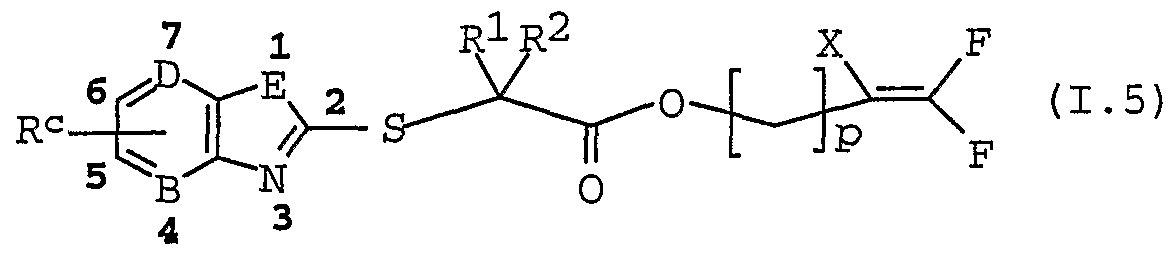
  • B is nitrogen or CH, in particular CH, D is nitrogen or CH, in particular CH, E is oxygen or sulfur
  • R 1 and R 2 are each independently hydrogen, C ⁇ -C4-alkyl or phenyl
  • q is 0 or 1
  • is halogen, methyl, methoxy, ethoxy, trifluoromethyl, trifluorome- thoxy
  • m is 0, 1 or 2
  • n is 0 or 1
  • p is 2 or 4, with the proviso that B is CH when E is sulfur.
  • E' is oxygen, sulfur or NH
  • R 1 and R 2 are each independently hydrogen or C ⁇ -C 4 -alkyl
  • q is 0, 1 , or 2
  • R c is phenyl which may be substituted by one or two halogen
  • m is 0, 1 or 2
  • n is 0 or 1
  • p is 2 or 4.
  • R 1 and R 2 are each independently hydrogen or C ⁇ -C 4 -alkyl
  • R c is C ⁇ -C 4 ⁇ alkyl or phenyl which may be substituted by halogen or methyl
  • p is 2.
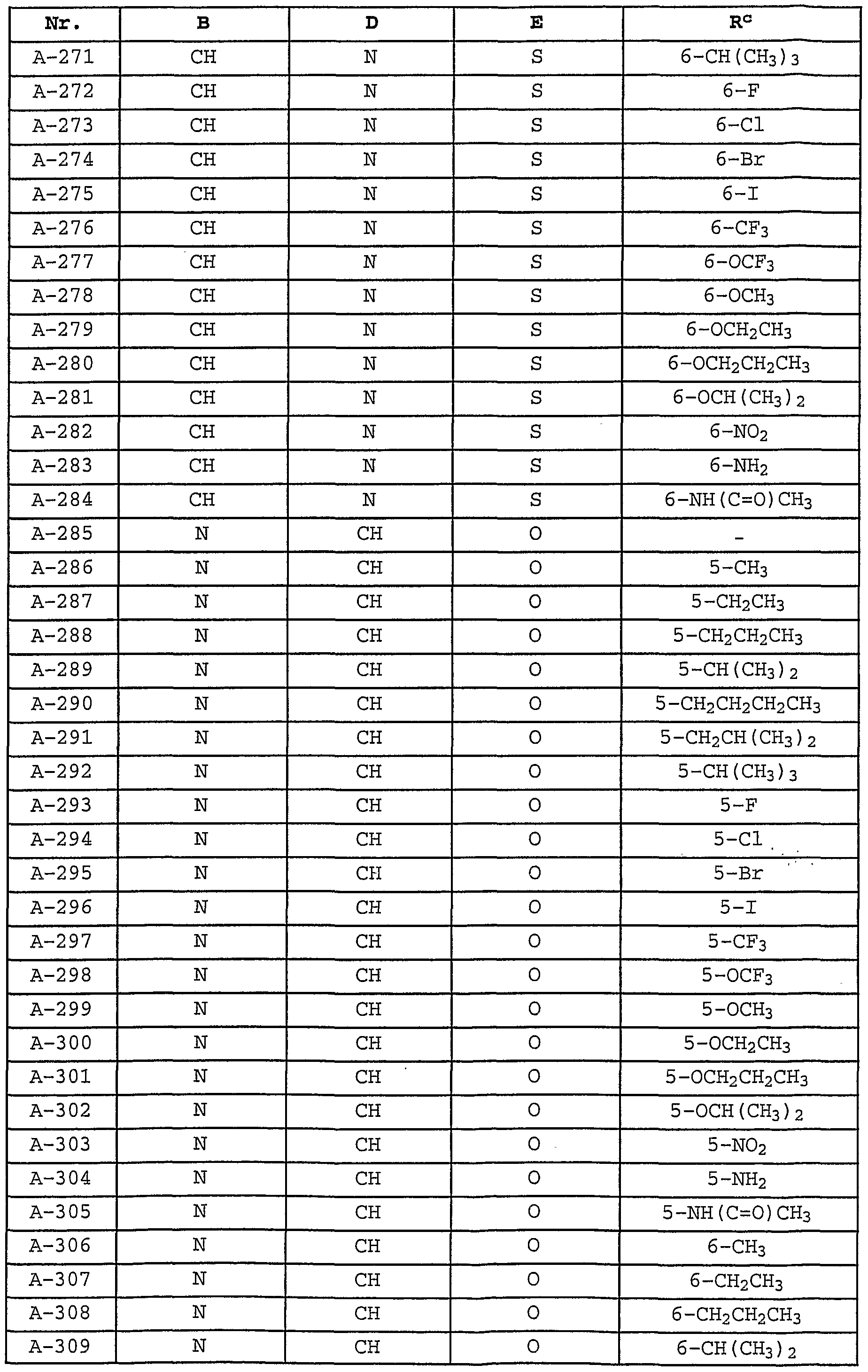
  • Table 7 Compounds of the formula 1.5 wherein X is hydrogen, p is 2, R 1 is hydrogen and R 2 is n-butyl and the combination of B, D, E and R c for a compound corresponds in each case to a row of Table A.
  • Table 8 Compounds of the formula 1.5 wherein X is hydrogen, p is 2, R 1 is hydrogen and R 2 is i-butyl and the combination of B, D, E and R c for a compound corresponds in each case to a row of Table A.
  • Table 12 Compounds of the formula 1.5 wherein X is hydrogen, p is 4, R 1 is hydrogen and R 2 is methyl and the combination of B, D, E and R c for a compound corresponds in each case to a row of Table A.
  • Table 14 Compounds of the formula 1.5 wherein X is hydrogen, p is 4, R 1 is hydrogen and R 2 is i-propyl and the combination of B, D, E and R c for a compound corresponds in each case to a row of Table A.
  • Table 35 Compounds of the formula 1.5 wherein X is fluorine, p is 4, R 1 is hydrogen and R 2 is n-propyl and the combination of B, D, E and R c for a compound corresponds in each case to a row of Table A.
  • Table 36 Compounds of the formula 1.5 wherein X is fluorine, p is 4, R 1 is hydrogen and R 2 is cyclo-propyl and the combination of B, D, E and R for a compound corresponds in each case to a row of Table A.
  • Table 40 Compounds of the formula 1.5 wherein X is fluorine, p is 4, R 1 is hydrogen and R 2 is phenyl and the combination of B, D, E and R c for a compound corresponds in each case to a row of Table A.
  • Table 50 Compounds of the formula 1.6 wherein X is hydrogen, p is 2, R 1 is hydrogen and R 2 is phenyl, E' is oxygen and (R c ) q is in the 4-position and corresponds in each case to a row of Table B.
  • Table 51 Compounds of the formula 1.6 wherein X is hydrogen, p is 4, R 1 and R 2 are hydrogen, E' is oxygen and (R c ) q is in the 4-position and corresponds in each case to a row of Table B.
  • Table 53 Compounds of the formula 1.6 wherein X is hydrogen, p is 4, R 1 is hydrogen and R 2 is ethyl, E' is oxygen and (R c ) q is in the 4-position and corresponds in each case to a row of Table B.
  • Table 54 Compounds of the formula 1.6 wherein X is hydrogen, p is 4, R 1 is hydrogen and R 2 is i-propyl, E' is oxygen and (R c ) q is in the 4-position and corresponds in each case to a row of Table B.
  • Table 55 Compounds of the formula 1.6 wherein X is hydrogen, p is 4, R 1 is hydrogen and R 2 is n-propyl, E' is oxygen and (R c ) q is in the 4-position and corresponds in each case to a row of Table B.
  • Table 56 Compounds of the formula 1.6 wherein X is hydrogen, p is 4, R 1 is hydrogen and R 2 is cyclo-propyl, E' is oxygen and (R c ) q is in the 4-position and corresponds in each case to a row of Table B.
  • Table 57 Compounds of the formula 1.6 wherein X is hydrogen, p is 4, R 1 is hydrogen and R 2 is n-butyl, E' is oxygen and (R c ) q is in the 4-position and corresponds in each case to a row of Table B.
  • Table 58 Compounds of the formula 1.6 wherein X is hydrogen, p is 4, R 1 is hydrogen and R 2 is i-butyl, E' is oxygen and (R c ) q is in the 4-position and corresponds in each case to a row of Table B.
  • Table 78 Compounds of the formula 1.6 wherein X is fluorine, p is 4, R 1 is hydrogen and R 2 is i-butyl, E' is oxygen and (R c ) q is in the 4-position and corresponds in each case to a row of Table B.
  • Table 79 Compounds of the formula 1.6 wherein X is fluorine, p is 4, R 1 is hydrogen and R 2 is tert-butyl, E' is oxygen and (R c ) q is in the 4-position and corresponds in each case to a row of Table B.
  • Table 80 Compounds of the formula 1.6 wherein X is fluorine, p is 4, R 1 is hydrogen and R 2 is phenyl, E' is oxygen and (R c ) q is in the 4-position and corresponds in each case to a row of Table B.
  • Table 81 Compounds of the formula 1.6 wherein X is hydrogen, p is 2, R 1 and R 2 are hydrogen, E' is oxygen and (R c ) q is in the 5-position and corresponds in each case to a row of Table B.
  • Table 82 Compounds of the formula 1.6 wherein X is hydrogen, p is 2, R 1 is hydrogen and R 2 is methyl, E' is oxygen and (R c ) q is in the 5-position and corresponds in each case to a row of Table B.
  • Table 83 Compounds of the formula 1.6 wherein X is hydrogen, p is 2, R 1 is hydrogen " and R 2 is ethyl, E' is oxygen and (R c ) q is in the 5-position and corresponds in each case to a row of Table B.
  • Table 84 Compounds of the formula 1.6 wherein X is hydrogen, p is 2, R 1 is hydrogen and R 2 is i-propyl, E' is oxygen and (R c ) q is in the 5-position and corresponds in each case to a row of Table B.
  • Table 85 Compounds of the formula 1.6 wherein X is hydrogen, p is 2, R 1 is hydrogen and R 2 is n-propyl, E' is oxygen and (R c ) q is in the 5-position and corresponds in each case to a row of Table B.
  • Table 86 Compounds of the formula 1.6 wherein X is hydrogen, p is 2, R 1 is hydrogen and R 2 is cyclo-propyl, E' is oxygen and (R c ) q is in the 5-position and corresponds in each case to a row of Table B.
  • Table 106 Compounds of the formula 1.6 wherein X is fluorine, p is 2, R 1 is hydrogen and R 2 is cyclo-propyl, E' is oxygen and (R c ) q is in the 5-position and corresponds in each case to a row of Table B.
  • Table 107 Compounds of the formula 1.6 wherein X is fluorine, p is 2, R 1 is hydrogen and R 2 is n-butyl, E' is oxygen and (R c ) q is in the 5-position and corresponds in each case to a row of Table B.
  • Table 108 Compounds of the formula 1.6 wherein X is fluorine, p is 2 , R 1 is hydrogen and R 2 is i-butyl, E' is oxygen and (R c ) q is in the 5-position and corresponds in each case to a row of Table B.
  • Table 109 Compounds of the formula 1.6 wherein X is fluorine, p is 2, R 1 is hydrogen and R 2 is tert-butyl, E' is oxygen and (R c ) q is in the 5-position and corresponds in each case to a row of Table B.
  • Table 110 Compounds of the formula 1.6 wherein X is fluorine, p is 2, R 1 is hydrogen and R 2 is phenyl, E' is oxygen and (R c ) q is in the 5-position and corresponds in each case to a row of Table B.
  • Table 111 Compounds of the formula 1.6 wherein X is fluorine, p is 4, R 1 and R 2 are hydrogen, E' is oxygen and (R c ) q is in the 5-position and corresponds in each case to a row of Table B.
  • Table 112 Compounds of the formula 1.6 wherein X is fluorine, p is 4, R 1 is hydrogen and R 2 is methyl, E' is oxygen and (R c ) q is in the 5-position and corresponds in each case to a row of Table B.
  • Table 113 Compounds of the formula 1.6 wherein X is fluorine, p is 4, R 1 is hydrogen and R 2 is ethyl, E' is oxygen and (R c ) q is in the 5-position and corresponds in each case to a row of Table B.
  • Table 114 Compounds of the formula 1.6 wherein X is fluorine, p is 4, R 1 is hydrogen and R 2 is i-propyl, E' is oxygen and (R c ) q is in the 5-position and corresponds in each case to a row of Table B .
  • Table 134 Compounds of the formula 1.6 wherein X is hydrogen, p is 4, R 1 is hydrogen and R 2 is i-propyl, E' is sulfur and (R c ) q is in the 4-position and corresponds in each case to a row of Table B.
  • Table 135 Compounds of the formula 1.6 wherein X is hydrogen, p is 4, R 1 is hydrogen and R 2 is n-propyl, E' is sulfur and (R c ) q is in the 4-position and corresponds in each case to a row of Table B.
  • Table 136 Compounds of the formula 1.6 wherein X is hydrogen, p is 4, R 1 is hydrogen and R 2 is cyclo-propyl, E' is sulfur and (R c ) q is in the 4-position and corresponds in each case to a row of Table B.
  • Table 137 Compounds of the formula 1.6 wherein X is hydrogen, p is 4, R 1 is hydrogen and R 2 is n-butyl, E' is sulfur and (R c ) q is in the 4-position and corresponds in each case to a row of Table B.
  • Table 138 Compounds of the formula 1.6 wherein X is hydrogen, p is 4, R 1 is hydrogen and R 2 is i-butyl, E' is sulfur and (R c ) q is in the 4-position and corresponds in each case to a row of Table B.
  • Table 139 Compounds of the formula 1.6 wherein X is hydrogen, p is 4, R 1 is hydrogen and R 2 is tert-butyl, E' is sulfur and (R c ) q is in the 4-position and corresponds in each case to a row of Table B.
  • Table 140 Compounds of the formula 1.6 wherein X is hydrogen, p is 4, R 1 is hydrogen and R 2 is phenyl, E' is sulfur and (R c ) q is in the 4-position and corresponds in each case to a row of Table B.
  • Table 141 Compounds of the formula 1.6 wherein X is fluorine, p is 2 , R 1 and R 2 are hydrogen, E' is sulfur and (R c ) q is in the 4-position and corresponds in each case to a row of Table B.
  • Table 142 Compounds of the formula 1.6 wherein X is fluorine, p is 2, R 1 is hydrogen and R 2 is methyl, E' is sulfur and (R c ) q is in the 4-position and corresponds in each case to a row of Table B.
  • Table 162 Compounds of the formula 1.6 wherein X is hydrogen, p is 2, R 1 is hydrogen and R 2 is methyl, E' is sulfur and (R c ) q is in the 5-position and corresponds in each case to a row of Table B.
  • Table 163 Compounds of the formula 1.6 wherein X is hydrogen, p is 2, R 1 is hydrogen and R 2 is ethyl, E' is sulfur and (R c ) q is in the 5-position and corresponds in each case to a row of Table B.
  • Table 164 Compounds of the formula 1.6 wherein X is hydrogen, p is 2, R 1 is hydrogen and R 2 is i-propyl, E' is sulfur and (R c ) q is in the 5-position and corresponds in each case to a row of Table B.
  • Table 165 Compounds of the formula 1.6 wherein X is hydrogen, p is 2, R 1 is hydrogen and R 2 is n-propyl, E' is sulfur and (R c ) q is in the 5-position and corresponds in each case to a row of Table B.
  • Table 166 Compounds of the formula 1.6 wherein X is hydrogen, p is 2, R 1 is hydrogen and R 2 is cyclo-propyl, E' is sulfur and (R c ) q is in the 5-position and corresponds in each case to a row of Table B.
  • Table 167 Compounds of the formula 1.6 wherein X is hydrogen, p is 2, R 1 is hydrogen and' R 2 is n-butyl, E' is sulfur and (R c ) q is in the 5-position and corresponds in each case to a row of Table B.
  • Table 168 Compounds of the formula 1.6 wherein X is hydrogen, p is 2, R 1 is hydrogen and R 2 is i-butyl, E' is sulfur and (R c ) q is in the 5-position and corresponds in each case to a row of Table B.
  • Table 169 Compounds of the formula 1.6 wherein X is hydrogen, p is 2, R 1 is hydrogen and R 2 is tert-butyl, E' is sulfur and (R c ) q is in the 5-position and corresponds in each case to a row of Table B.
  • Table 170 Compounds of the formula 1.6 wherein X is hydrogen, p is 2, R 1 is hydrogen and R 2 is phenyl, E' is sulfur and (R c ) q is in the 5-position and corresponds in each case to a row of Table B.
  • Table 190 Compounds of the formula 1.6 wherein X is fluorine, p is 2, R 1 is hydrogen and R 2 is phenyl, E' is sulfur and (R c ) q is in the 5-position and corresponds in each case to a row of Table B.
  • Table 191 Compounds of the formula 1.6 wherein X is fluorine, p is 4, R 1 and R 2 are hydrogen, E' is sulfur and (R c ) q is in the 5-position and corresponds in each case to a row of Table B.
  • Table 192 Compounds of the formula 1.6 wherein X is fluorine, p is 4, R 1 is hydrogen and R 2 is methyl, E' is sulfur and (R c ) q is in the 5-position and corresponds in each case to a row of Table B.
  • Table 194 Compounds of the formula 1.6 wherein X is fluorine, p is 4, R 1 is hydrogen and R 2 is i-propyl, E' is sulfur and (R c ) q is in the 5-position and corresponds in each case to a row of Table B.
  • Table 195 Compounds of the formula 1.6 wherein X is fluorine, p is 4, R 1 is hydrogen and R 2 is n-propyl, E' is sulfur and (R c ) q is in the 5-position and corresponds in each case to a row of Table B.
  • Table 196 Compounds of the formula 1.6 wherein X is fluorine, p is 4, R 1 is hydrogen and R 2 is cyclo-propyl, E' is sulfur and (R c ) q is in the 5-position and corresponds in each case to a row of Table B.
  • Table 197 Compounds of the formula 1.6 wherein X is fluorine, p is 4, R 1 is hydrogen and R 2 is n-butyl, E' is sulfur and (R c ) q is in the 5-position and corresponds in each case to a row of Table B.
  • Table 218 Compounds of the formula 1.6 wherein X is hydrogen, p is 4, R 1 is hydrogen and R 2 is i-butyl, E' is NH and (R c ) q is in the 4-position and corresponds in each case to a row of Table B.
  • Table 219 Compounds of the formula 1.6 wherein X is hydrogen, p is 4, R 1 is hydrogen and R 2 is tert-butyl, E' is NH and (R c ) q is in the 4-position and corresponds in each case to a row of Table B.
  • Table 220 Compounds of the formula 1.6 wherein X is hydrogen, p is 4, R 1 is hydrogen and R 2 is phenyl, E' is NH and (R c ) q is in the 4-position and corresponds in each case to a row of Table B.
  • Table 221 Compounds of the formula 1.6 wherein X is fluorine, p is 2, R 1 and R 2 are hydrogen, E' is NH and (R c ) q is in the 4-position and corresponds in each case to a row of Table B.
  • Table 222 Compounds of the formula 1.6 wherein X is fluorine, p is 2, R 1 is hydrogen and R 2 is methyl, E' is NH and (R c ) q is in the 4-position and corresponds in each case to a row of Table B.
  • Table 223 Compounds of the formula 1.6 wherein X is fluorine, p is 2 , R 1 is hydrogen and R 2 is ethyl, E"' is NH and (R c ) q is in the 4-position and corresponds in each case to a row of Table B.
  • Table 224 Compounds of the formula 1.6 wherein X is fluorine, p is 2, R 1 is hydrogen and R 2 is i-propyl, E' is NH and (R G ) q is in the 4-position and corresponds in each case to a row of Table B.
  • Table 225 Compounds of the formula 1.6 wherein X is fluorine, p is 2, R 1 is hydrogen and R 2 is n-propyl, E' is NH and (R c ) q is in the 4-position and corresponds in each case to a row of Table B.
  • Table 226 Compounds of the formula 1.6 wherein X is fluorine, p is 2, R 1 is hydrogen and R 2 is cyclo-propyl, E' is NH and (R c ) q is in the 4-position and corresponds in each case to a row of Table B.
  • Table 246 Compounds of the formula 1.6 wherein X is hydrogen, p is 2 , R 1 is hydrogen and R 2 is cyclo-propyl, E' is NH and (R c ) q is in the 5-position and corresponds in each case to a row of Table B.
  • Table 247 Compounds of the formula 1.6 wherein X is hydrogen, p is 2 , R 1 is hydrogen and R 2 is n-butyl, E' is NH and (R c ) q is in the 5-position and corresponds in each case to a row of Table B.
  • Table 248 Compounds of the formula 1.6 wherein X is hydrogen, p is 2 , R 1 is hydrogen and R 2 is i-butyl, E' is NH and (R c ) q is in the 5-position and corresponds in each case to a row of Table B.
  • Table 249 Compounds of the formula 1.6 wherein X is hydrogen, p is 2, R 1 is hydrogen and R 2 is tert-butyl, E' is NH and (R c ) q is in the 5-position and corresponds in each case to a row of Table B.
  • Table 250 Compounds of the formula 1.6 wherein X is hydrogen, p is 2, R 1 is hydrogen and R 2 is phenyl, E' is NH and (R c ) q is in the 5-position and corresponds in each case to a row of Table B.
  • Table 251 Compounds of the formula 1.6 wherein X is hydrogen, p is 4, R 1 and R 2 are hydrogen, E' is NH and (R c ) q is in the 5-position and corresponds in each case to a row of Table B.
  • Table 252 Compounds of the formula 1.6 wherein X is hydrogen, p is 4, R 1 is hydrogen and R 2 is methyl, E' is NH and (R c ) q is in the 5-position and corresponds in each case to a row of Table B.
  • Table 253 Compounds of the formula 1.6 wherein X is hydrogen, p is 4, R 1 is hydrogen and R 2 is ethyl, E' is NH and (R c ) q is in the 5-position and corresponds in each case to a row of Table B.
  • Table 254 Compounds of the formula 1.6 wherein X is hydrogen, p is 4, R 1 is hydrogen and R 2 is i-propyl, E' is NH and (R c ) q is in the 5-position and corresponds in each case to a row of Table B.
  • Table 274 Compounds of the formula 1.6 wherein X is fluorine, p is 4, R 1 is hydrogen and R 2 is i-propyl, E' is NH and (R c ) q is in the 5-position and corresponds in each case to a row of Table B.
  • Table 275 Compounds of the formula 1.6 wherein X is fluorine, p is 4, R 1 is hydrogen and R 2 is n-propyl, E' is NH and (R c ) q is in the 5-position and corresponds in each case to a row of Table B.
  • Table 276 Compounds of the formula 1.6 wherein X is fluorine, p is 4, R 1 is hydrogen and R 2 is cyclo-propyl, E' is NH and (R c ) q is in the 5-position and corresponds in each case to a row of Table B.
  • Table 277 Compounds of the formula 1.6 wherein X is fluorine, p is 4, R 1 is hydrogen and R 2 is n-butyl, E' is NH and R c is in the 5-position and corresponds in each case to a row of Table B .
  • Table 278 Compounds of the formula 1.6 wherein X is fluorine, p is 4, R 1 is hydrogen and R 2 is i-butyl, E' is NH and (R c ) q is in the 5-position and corresponds in each case to a row of Table B.
  • Table 279 Compounds of the formula 1.6 wherein X is fluorine, p is 4, R 1 is hydrogen and R 2 is tert-butyl, E' is NH and (R c ) q is in the 5-position and corresponds in each case to a row of Table B.
  • Table 280 Compounds of the formula 1.6 wherein X is fluorine, p is 4, R 1 is hydrogen and R 2 is phenyl, E' is NH and (R c ) q is in the 5-position and corresponds in each case to a row of Table B.
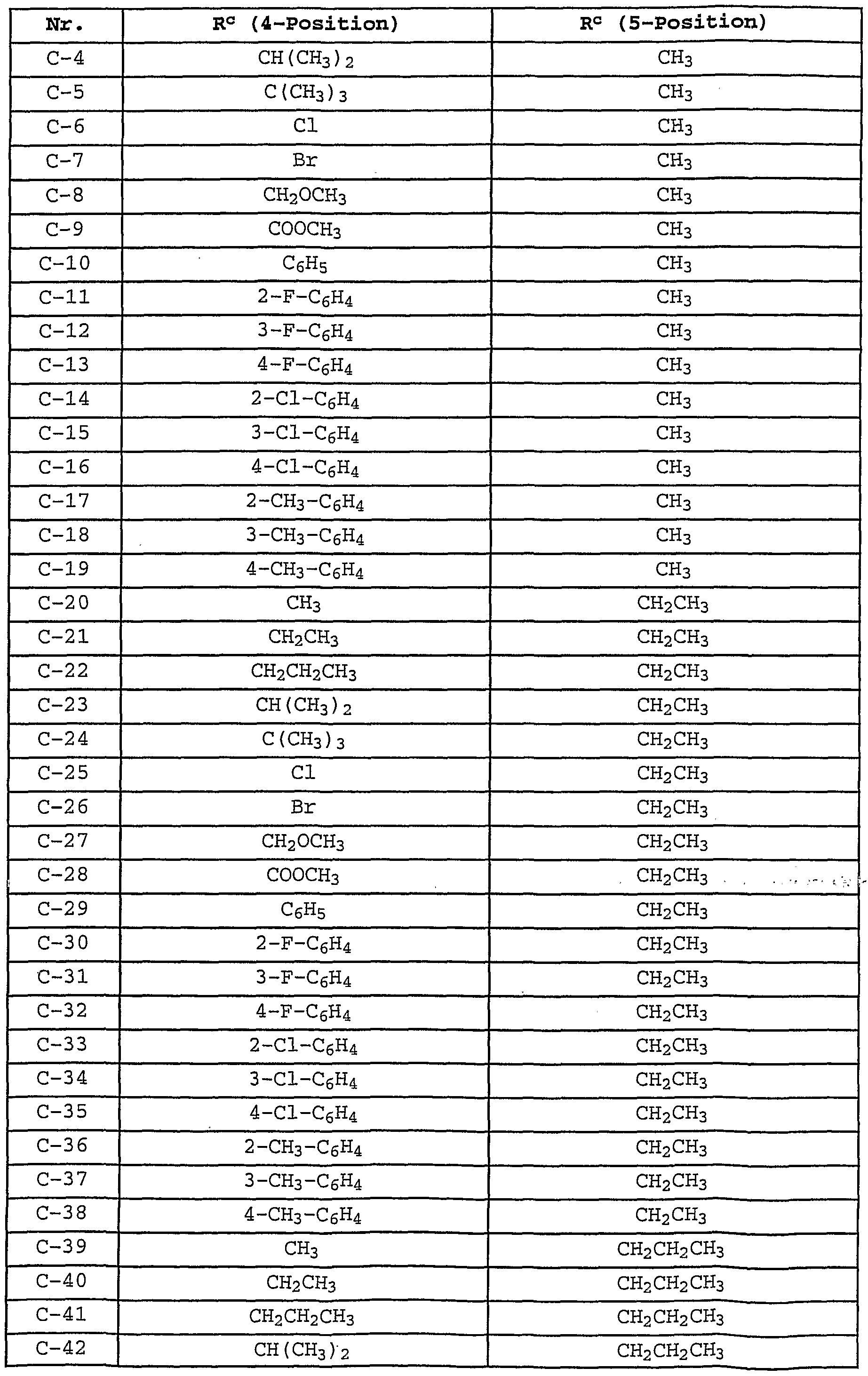
  • Table 310 Compounds of the formula 1.6 wherein X is fluorine, p is 2 , R 1 is hydrogen and R 2 is phenyl, E' is oxygen, q is 2 and (R c ) q for a compound corresponds in each case to a row of Table C.
  • Table 312 Compounds of the formula 1.6 wherein X is fluorine, p is 4, R 1 is hydrogen and R 2 is methyl, E' is oxygen, q is 2 and (R c ) q for a compound corresponds in each case to a row of Table C.
  • Table 315 Compounds of the formula 1.6 wherein X is fluorine, p is 4, R 1 is hydrogen and R 2 is n-propyl, E' is oxygen, q is 2 and (R c ) q for a compound corresponds in each case to a row of Table C.
  • Table 316 Compounds of the formula 1.6 wherein X is fluorine, p is 4, R 1 is hydrogen and R 2 is cyclo-propyl, E' is oxygen, q is 2 and (R c ) q for a compound corresponds in each case to a row of Table C.
  • Table 317 Compounds of the formula 1.6 wherein X is fluorine, p is 4, R 1 is hydrogen and R 2 is n-butyl, E' is oxygen, q is 2 and (R c ) q for a compound corresponds in each case to a row of Table C.
  • Table 340 Compounds of the formula 1.6 wherein X is hydrogen, p is 4, R 1 is hydrogen and R 2 is phenyl, E' is sulfur, q is 2 and (R c ) q for a compound corresponds in each case to a row of Table C.
  • Table 342 Compounds of the formula 1.6 wherein X is fluorine, p is 2, R 1 is hydrogen and R 2 is methyl, E' is sulfur, q is 2 and (R c ) q for a compound corresponds in each case to a row of Table C.
  • Table 345 Compounds of the formula 1.6 wherein X is fluorine, p is 2, R 1 is hydrogen and R 2 is n-propyl, E' is sulfur, q is 2 and (R c ) q for a compound corresponds in each case to a row of Table C.
  • Table 366 Compounds of the formula 1.6 wherein X is hydrogen, p is 2, R 1 is hydrogen and R 2 is cyclo-propyl, E' is NH and (R c ) q for a compound corresponds in each case to a row of Table C.
  • Table 368 Compounds of the formula 1.6 wherein X is hydrogen, p is 2, R 1 is hydrogen and R 2 is i-butyl, E' is NH and (R G ) q for a compound corresponds in each case to a row of Table C.
  • Table 400 Compounds of the formula 1.6 wherein X is fluorine, p is 4, R 1 is hydrogen and R 2 is phenyl, E' is NH and (R c ) q for a compound corresponds in each case to a row of Table C.
  • Table 408 Compounds of the formula 1.7 wherein X is hydrogen, p is 2, R 1 is hydrogen and R 2 is i-butyl and the combination of E and R c for a compound corresponds in each case to a row of Table D.
  • Table 409 Compounds of the formula 1.7 wherein X is hydrogen, p is 2, R 1 is hydrogen and R 2 is tert-butyl and the combination of E and R b for a compound corresponds in each case to a row of Table D.
  • Table 410 Compounds of the formula 1.7 wherein X is hydrogen, p is 2, R 1 is hydrogen and R 2 is phenyl and the combination of E and R c for a compound corresponds in each case to a row of Table D.
  • Table 411 Compounds of the formula 1.7 wherein X is hydrogen, p is 4, R 1 and R 2 are hydrogen and the combination of E and R c for a compound corresponds in each case to a row of Table D.
  • Table 412 Compounds of the formula 1.7 wherein X is hydrogen, p is 4, R 1 is hydrogen and R 2 is methyl and the combination of E and R c for a compound corresponds in each case to a row of Table D.
  • Table 413 Compounds of the formula 1.7 wherein X is hydrogen, p is 4, R 1 is hydrogen and R 2 is ethyl ' and the combination of E and R c for a compound corresponds in each case to a row of Table D.
  • Table 414 Compounds of the formula 1.7 wherein X is hydrogen, p is 4, R 1 is hydrogen and R 2 is i-propyl and the combination of E and R c for a compound corresponds in each case to a row of Table D.
  • Table 415 Compounds of the formula 1.7 wherein X is hydrogen, p is 4, R 1 is hydrogen and R 2 is n-propyl and the combination of E and R c for a compound corresponds in each case to a row of Table D.
  • Table 416 Compounds of the formula 1.7 wherein X is hydrogen, p is 4, R 1 is hydrogen and R 2 is cyclo-propyl and the combination of E and R c for a compound corresponds in each case to a row of Table D.
  • Table 436 Compounds of the formula 1.7 wherein X is fluorine, p is 4, R l is hydrogen and R 2 is cyclo-propyl and the combination of E and R c for a compound corresponds in each case to a row of Table D.
  • Table 437 Compounds of the formula 1.7 wherein X is fluorine, p is 4, R l is hydrogen and R 2 is n-butyl and the combination of E and R c for a compound corresponds in each case to a row of Table D.
  • Table 438 Compounds of the formula 1.7 wherein X is fluorine, p is 4, R l is hydrogen and R 2 is i-butyl and the combination of E and R c for a compound corresponds in each case to a row of Table D.
  • Table 439 Compounds of the formula 1.7 wherein X is fluorine, p is 4, R 1 is hydrogen and R 2 is tert-butyl and the combination of E and R c for a compound corresponds in each case to a row of Table D.
  • Table 440 Compounds of the formula 1.7 wherein X is fluorine, p is 4, Rl is hydrogen and R 2 is phenyl and the combination of E and R c for a compound corresponds in each case to a row of Table D.
  • the compounds of the formula I are suitable for efficiently controlling nematodes, insects, and arachnids in crop protection. In particular, they are suitable for controlling the following animal pests :
  • insects from the order of the lepidopterans for example Agrotis ypsilon, Agrotis segetum, Alabama argillacea, An- ticarsia gemmatalis, Argyresthia conjugella, Autographa gamma, Bupalus piniarius, Cacoecia murinana, Capua reticulana, Cheimato- bia brumata, Choristoneura fumiferana, Choristoneura occidenta- lis, Cirphis unipuncta, Cydia pomonella, Dendrolimus pini, Dia- phania nitidalis, Diatraea grandiosella, Earias insulana, Elasmo- palpus lignosellus, Eupoecilia ambiguella, Evetria bouliana, Fel- tia subterranea, Galleria mellonella, Grapholi tha funebran
  • beetles Coldoptera
  • Agrilus sinuatus for example Agrilus sinuatus, Agriotes li- neatus, Agriotes obscurus, Amphimallus solstitialis, Anisandrus dispar, Anthonomus grandis, Anthonomus pomorum, Atomaria linea- ris, Blastophagus piniperda, Blitophaga undata, Bruchus rufima- nus, Bruchus pisorum, Bruchus lentis, Byctiscus betulae, Cassida nebulosa, Cerotoma trifurcata, Ceuthorrhynchus assimilis, Ceu- thorrhynchus napi, Chaetocnema tibialis, Conoderus vespertinus, Crioceris asparagi, Diabrotica longicornis, Diabrotica 12-puncta- ta, Diabrotica virgifera, Epilachn
  • dipterans dipterans
  • Aedes aegypti Aedes vexans, An- astrepha ludens, Anopheles maculipennis, Ceratitis capi tata, Chrysomya bezziana, Chrysomya hominivorax, Chrysomya macellaria, Contarinia sorghicola, Cordylobia anthropophaga , Culex pipiens, Dacus cucurbi tae, Dacus oleae, Dasineura brassicae, Fannia cani- cularis, Gasterophilus intestinalis, Glossina morsi tans, Haemato- bia irri tans, Haplodiplosis equestris, Hylemyia platura, Hypoder- ma lineata, Liriomyza sativae, Liriomyza trifolii, Lucilia capri- na, Lucilia cuprin
  • Thrips (Thysanoptera) , e . g. Frankliniella fusca, Frankliniella occidentalis, Frankliniella tritici, Scirtothrips citri, Thrips oryzae, Thrips palmi and Thrips t abaci ,
  • hymenopterans Hymenoptera
  • Hymenoptera e . g. Athalia rosae, Atta cephalotes, Atta sexdens, Atta texana, Hoplocampa minuta, Hoplocampa testudi- nea, Monomorium pharaonis, Solenopsis geminata and Solenopsis in- victa,
  • Heteroptera Heteroptera
  • Acrosternum hilare Blis ⁇ us leucopterus, Cyrtopeltis notatus, Dysdercus cingulatus, Dysdercus intermedius, Eurygaster integriceps, Euschistus impictiventris, Leptoglossus phyllopus, Lygus lineolaris, Lygus pratensis, Nezara viridula, Piesma quadrata, Solubea insularis and Thyanta perdi- tor,
  • homopterans e .g. Acyrthosiphon onobrychis, Adelges laricis, Aphidula nasturtii, Aphis fabae, Aphis pomi, Aphis sam- buci, Brachycaudus cardui, Brevicoryne brassicae, Cerosipha gos- sypii, Dreyfusia nordmannianae , Dreyfusia piceae, Dysaphis radi- cola, Dysaulacorthum pseudosolani, Empoasca fabae, Macrosiphum avenae, Macrosiphum euphorbiae, Macrosiphon rosae, Megoura vi- ciae, Metopolophium dirhodum, Myzodes persicae, Myzus cerasi, Ni- laparvata lugens, Pemphigus bursarius, Per
  • orthopterans Orthoptera
  • Orthoptera Orthoptera
  • Orthoptera e . g. Acheta domestica, Blatta orienta- lis, Blattella germanica, Forficula auricularia, Gryllotalpa gryllotalpa, Locusta migratoria, Melanoplus bivittatus, Melano- plus fe ur-rubrum, Melanoplus mexicanus, Melanoplus sanguinipes, Melanoplus spretus, Nomadacris septemfasciata, Periplaneta ameri- cana, Schistocerca americana, Schistocerca peregrina, Stauronotus maroccanus and Tachycines asynamorus, Arachnoidea, such as arachnids (Acarina) , e.g.
  • Nematodes especially plant parasitic nematodes such as root knot nematodes, Meloidogyne hapla, Meloidogyne incogni ta, Meloidogyne javanica, and other Meloidogyne species; cyst-forming nematodes, Globodera rostochiensis and other Globodera species; Heterodera avenae, Heterodera glycines, Heterodera schachtii, Heterodera trifolii, and other Heterodera species; Seed gall nematodes, An- guina species; Stem and foliar nematodes, Aphelenchoides species; Sting nematodes , Belonolaimus longicaudatus and other Belonolaimus species; Pine nematodes, Bursaphelenchus xylophilus and other Bursaphelenchus species; Ring nematodes, Criconema species,
  • the compounds of formula I are especially useful for the control of nematodes .
  • the compounds I also are suitable for use as fungicides. They exhibit activity against a broad spectrum of phytopathogenic fungi, in particular from the classes of the Ascomycetes, Deuteromyce- tes, Phycomycetes and Basidiomycetes. Some of them act system!- cally, and they can be employed in crop protection as foliar- and soil-acting fungicides.
  • Botrytis cinerea (gray mold) on strawberries, vegetables, ornamentals and grapevines, Cercospora arachidicola on peanuts, Erysiphe cichoracearum and Sphaerotheca fuliginea on cucurbits, Erysiphe graminis (pow- dery mildew) on cereals, Fusarium and Verticillium species on various plants, Helminthosporium species on cereals, Mycosphaerella species on bananas and peanuts, Phytophthora infestans on potatoes and tomatoes, Plasmopara viticola on grapevines, Podosphaera leucotricha on apples, Pseudocercosporella herpotrichoides on wheat and barley, Pseudoperonospora species on hops and cucumbers, Puccinia species on cereals, Pyricularia oryzae on rice, Rhizoctonia species on cotton, rice and lawns, Septoria
  • the compounds I are suitable for controlling harmful fungi such as Paecilomyces variotii in the protection of materials (e.g. wood, paper, paint dispersions, fibers and fabrics) and in the protection of stored products.
  • harmful fungi such as Paecilomyces variotii in the protection of materials (e.g. wood, paper, paint dispersions, fibers and fabrics) and in the protection of stored products.
  • the compounds I are applied by treating the fungi, or the plants, seeds, materials or the soil to be protected against fungal attack, with a fungicidally effective amount of the active ingre-transients. Application can be effected both before and after infection of the materials, plants or seeds by the fungi.
  • Compounds of formula I are suitable for use as herbicides.
  • compounds I and herbicidal compositions comprising them may be used in crops for the control of unwanted plants .
  • Exemplary are the following crops : Allium cepa, Ananas comosus, Arachis hypogaea, Asparagus offici- nalis, Beta vulgaris spp. altissima, Beta vulgaris spp. rapa, Brassica napus var . napus, Brassica napus var. napobrassica, Brassica rapa var.
  • Manihot esculenta Manihot esculenta, Medicago sativa, Musa spp. , Nicotiana tabacum (N. rustica) , Olea europaea, Oryza sativa , Phaseolus lunatus, Phaseolus vulgaris, Picea abies, Pi- nus spp. , Pisum sativum, Prunus avium, Prunus persica, Pyrus com- munis, Ribes sylvestre, Ricinus communis, Saccharum officinarum, Secale cereale, Solanum tuberosum, Sorghum bicolor (s . vulgare) , Theobroma cacao, Trifolium pratense, Triticum aestivum, Tri ticum durum, Vicia faba, Vitis vinifera und Zea mays .
  • Compounds of formula I may also be used in crops that have acquired resistance against other herbicides.
  • pesticidally active amounts of com- pounds of formula I are typically applied to the pests or to their food supply, habitat or breeding ground.
  • pesticidally active amounts of the compounds of formula I are typically applied to the foliage, stem or roots of the plants or to the soil or water in which they are growing.
  • the rate of application of active ingredient for controlling animal pests is from 0,01 to 100, preferably 0,1 to 3 kg/ha under field conditions .
  • the compounds I can be converted into the customary formulations, e.g. solutions, emulsions, suspensions, dusts, powders, pastes and granules.
  • the use form depends on the particular purpose; in any case, it should guarantee a fine and uniform distribution of the compound according to the invention.
  • the formulations are prepared in a known manner, e.g. by extending the active ingredient with solvents and/or carriers, if desired using emulsifiers and dispersants, it also being possible to use other organic solvents as auxiliary solvents if water is used as the diluent.
  • Auxiliaries which are suitable are essentially: solvents such as aromatics (e.g. xylene) , chlorinated aromatics (e.g.
  • paraffins e.g. mineral oil fractions
  • alcohols e.g. methanol, butanol
  • ketones e.g. cy- c1ohexanone
  • amines e.g. ethano1amine, dimethy1formamide
  • water water
  • carriers such as ground natural minerals (e.g. kaolins, clays, talc, chalk) and ground synthetic minerals (e.g. highly- disperse silica, silicates)
  • emulsifiers such as non-ionic and anionic emulsifiers (e.g. polyoxyethylene fatty alcohol ethers, alkylsulfonates and arylsulfonates) and dispersants such as li- gnin-sulfite waste liquors and methylcellulose.
  • Suitable surfactants are alkali metal, alkaline earth metal and ammonium salts of lignosulfonic acid, naphthalenesulfonic acid, phenolsulfonic acid, dibutylnaphthalenesulfonic acid, alkylaryl- sulfonates, alkyl sulfates, alkylsulfonates, fatty alcohol sulfates and fatty acids and their alkali metal and alkaline earth metal salts, salts of sulfated fatty alcohol glycol ether, condensates of sulfonated naphthalene and naphthalene derivatives with formaldehyde, condensates of naphthalene or of napthalenesulfonic acid with phenol or formaldehyde, polyoxyethylene octylphenyl ether, ethoxylated isooctylphenol, octylphenol, nonylphenol, al- kylphenol poly
  • Substances which are suitable for the preparation of directly sprayable solutions, emulsions, pastes or oil dispersions are mineral oil fractions of medium to high boiling point, such as kerosene or diesel oil, furthermore coal tar oils and oils of vegetable or animal origin, aliphatic, cyclic and aromatic hydrocarbons, e.g.
  • Granules e.g. coated granules, impregnated granules and homogeneous granules, can be prepared by binding the active ingredients to solid carriers.
  • solid carriers are mineral earths, such as silicas, silica gels, silicates, talc, kaolin, attaclay, limestone, lime, chalk, bole, loess, clay, dolomite, diatomaceous earth, calcium sulfate, magnesium sulfate, magnesium oxide, ground synthetic materials, fertilizers, e.g. ammonium sulfate, ammonium phosphate, ammonium nitrate, ureas, and products of vegetable origin, such as cereal meal, tree bark meal, wood meal and nutshell meal, cellulose powders and other solid carriers.
  • mineral earths such as silicas, silica gels, silicates, talc, kaolin, attaclay, limestone, lime, chalk, bole, loess, clay
  • the formulations comprise of from 0.01 to 95% by weight, preferably from 0.1 to 90% by weight, of the active ingredient.
  • the active ingredients are employed in a purity of from 90% to 100%, preferably 95% to 100% (according to NMR spectrum) .
  • a compound according to the invention 20 parts by weight of a compound according to the invention are dissolved in a mixture composed of 60 parts by weight of cyclohexanone, 30 parts by weight of isobutanol, 5 parts by weight of the adduct of 7 mol of ethylene oxide and 1 mol of isooctylphenol and 5 parts by weight of the adduct of 40 mol of ethylene oxide and 1 mol of castor oil (comprises 16% by weight of active ingredient) .
  • V. 80 parts by weight of a compound according to the invention are mixed thoroughly with 3 parts by weight of sodium diiso- butylnaphthalene-alpha-sulfonate, 10 parts by weight of the sodium salt of a lignosulfonic acid from a sulfite waste liquor and 7 parts by weight of pulverulent silica gel, and the mixture is ground in a hammer mill (comprises 80% by weight of active ingredient) .
  • VIII.20 parts by weight of a compound according to the invention are mixed thoroughly with 3 parts by weight of sodium diiso- butylnaphthalene- -sulfonate, 17 parts by weight of the sodium salt of a lignosulfonic acid from a sulfite waste liquor and 60 parts by weight of pulverulent silica gel, and the mixture is ground in a hammer mill . Finely distributing the mixture in 20,000 parts by weight of water gives a spray mixture which comprises 0.1% by weight of the active ingredient .
  • the active ingredients can be used as such, in the form of their formulations or the use forms prepared therefrom, e.g. in the form of directly sprayable solutions, powders, suspensions or dispersions, emulsions, oil dispersions, pastes, dusts, materials for spreading, or granules, by means of spraying, atomizing, du- sting, scattering or pouring.
  • the use forms depend entirely on the intended purposes; in any case, this is intended to guarantee the finest possible distribution of the active ingredients according to the invention.
  • Aqueous use forms can be prepared from emulsion concentrates, pastes or wettable powders (sprayable powders, oil dispersions) by adding water.
  • emulsions, pastes or oil dispersions the substances as such or dissolved in an oil or solvent, can be homogenized in water by means of wetter, tackifier, dispersant or eulsifier.
  • concentrates composed of active substance, wetter, tackifier, dispersant or emulsifier and, if appropriate, solvent or oil, and such concentrates are suitable for dilution with water.
  • the active ingredient concentrations in the ready-to-use products can be varied within substantial ranges. In general, they are from 0.0001 to 10%, preferably from 0.01 to 1%.
  • the active ingredients may also be used successfully in the ultra-low-volume process (ULV) , it being possible to apply formulations comprising over 95% by weight of active ingredient, or even the active ingredient without additives .
  • UUV ultra-low-volume process
  • oils may be added to the active ingredients, if appropriate also only immediately prior to use (tank mix) .
  • These agents can be admixed with the agents according to the invention in a weight ratio of 1:10 to 10:1.
  • compositions according to the invention can also be present together with other active ingredients, e.g. with herbicides, insecticides, growth regulators, fungicides or else with fertilizers. Mixing the compounds I or the compositions comprising them in the use form as pesticides with other pesticides frequently results in a broader pesticidal spectrum of action.
  • Organophosphates Acephate, Azinphos-methyl, Chlorpyrifos, Chlor- fenvinphos, Diazinon, Dichlorvos, Dicrotophos, Dimethoate, Disul- foton, Ethion, Fenitrothion, Fenthion, Isoxathion, Malathion, Me- thamidophos, Methidathion, Methyl-Parathion, Mevinphos, Monocro- tophos, Oxydemeton-methyl, Paraoxon, Parathion, Phenthoate, Pho- salone, Phosmet, Phosphamidon, Phorate, Phoxi , Pirimiphos-me- thyl, Profenofos, Prothiofos, Sulprophos, Triazophos, Trichlor- fon;
  • Pyrethroids Bifenthrin, Cyfluthrin, Cypermethrin, Deltamethrin, Esfenvalerate, Ethofenprox, Fenpropathrin, Fenvalerate, Cyhalot- hrin, Lambda-Cyhalothrin, Permethrin, Silafluofen, Tau-Fluvali- nate, Tefluthrin, Tralomethrin, Zeta-Cypermethrin;
  • Arthropod growth regulators a) chitin synthesis inhibitors : ben- zoylureas : Chlorfluazuron, Diflubenzuron, Flucycloxuron, Flufeno- xuron, Hexaflumuron, Lufenuron, Novaluron, Teflubenzuron, Triflu- muron; Buprofezin, Diofenolan, Hexythiazox, Etoxazole, Clofenta- zine; b) ecdysone antagonists: Halofenozide, Methoxyfenozide, Te- bufenozide; c) juvenoids: Pyriproxyfen, Methoprene, Fenoxycarb; d) lipid biosynthesis inhibitors: Spirodiclofen;
  • This invention also provides a method for treating, curing, con- trolling, preventing and protecting warm-blooded animals, including humans, and fish against infestation and infection by helminths, acarids and arthropod endo- and ectoparasites which comprises orally, topically or parenterally administering or applying to said animals an anthelmintically, acaricidally or endo- or ectoparasiticidally effective amount of compounds of formula I.
  • the above method is particularly useful for controlling and preventing helminth, acarid and arthropod endo- and ectoparasitic infestations and infections in warm-blooded animals such as cattle, sheep, swine, camels, deer, horses, poultry, fish, rabbits, goats, mink, fox, chinchillas, rabbits, dogs and cats as well as humans .
  • helminths are members of the class Trematoda, commonly known as flukes or flatworms, espe- cially members of the genera Fasciola, Fascioloides, Paramphis to- mum, Dicrocoelium, Eurytrema, Ophisthorchis, Fasciolopsis, Echi- nostoma and Paragon ⁇ mus.
  • Nematodes which can be controlled by the formula I compounds include the genera Haemonchus, Ostertagia, 5 Cooperia, Oesphagastomum, Ne atodirus, Dictyocaulus, Trichuris, Dirofilaria, Ancyclostoma, Ascaris and the like.
  • the formula I compounds of this invention also control endopara- sitic arthropod infestations such as cattle grub and stomach bot.
  • acarid and arthropod ectoparasitic infestations in warm-blooded animals and fish including biting lice, sucking lice, bot flies, biting flies, muscoid flies, myiasitic fly larvae, gnats, mosquitoes, fleas, mites, ticks, nasal bots, keds and chiggers may be controlled, prevented or eliminated by the com-
  • Biting lice include members of Mallo- phaga such as Bovicola bovis, Trichodectes canis and Damilina ovis.
  • Sucking lice include members of Anoplura such as Haematopi- nus eurysternus, Haematopinus suis, Linognathus vituli and Sole- nopotes capillatus.
  • Biting flies include members of Haematobia .
  • Ticks include Boophilus, Rhipicephalus, Ixodes, Hyalomma, Am- blyoi ⁇ ma and Dermacentor.
  • the formula I compounds may also be used to control mites which are parasitic on warm-blooded mammals and poultry including mites of the orders Acari formes and Parasiti- formes .
  • the formula I compounds may be formulated as animal feeds, animal feed premi- xes, animal feed concentrates, pills, solutions, pastes, suspensions, drenches, gels, tablets, boluses and capsules.
  • the formula I compounds may be administered to the animals 30 in their drinking water.
  • the dosage form chosen should provide the animal with ' about 0.01 mg/kg to 100 mg/kg of animal body weight per day of the formula I compound.
  • the formula I compounds • may be administered to animals parenterally, for example, by intraruminal, intramuscular, intravenous or subcutaneous injection.
  • the formula I compounds may be dispersed or dissolved in a physiologically acceptable carrier for subcutaneous injection.
  • the formula I compounds may be formulated into an implant for subcuta- 0 neous administration.
  • the formula I compound may be transdermally administered to animals.
  • the dosage form chosen should provide the animal with about 0.01 mg/kg to 100 mg/kg of animal body weight per day of the formula I compound. 5
  • the formula I compounds may also be applied topically to the animals in the form of dips, dusts, powders, collars, medallions, sprays and pour-on formulations.
  • dips and sprays usually contain about 0.5 ppm to 5,000 ppm and preferably about...1 ppm to 3,000 ppm of the formula I compound.
  • the formula I compounds may be formulated as ear tags for animals, particularly quadrupeds such as cattle and sheep.
  • the formula I compounds of this invention may also be used in combination or conjunction with one or more other parasiticidal compounds including anthelmintics, such as benzimidazoles, pipe- razine, levamisole, pyrantel, and praziquantel; endectocides such as avermectins, and milbe ycins; ectoparasiticides such as aryl- pyrroles, organophosphates, and carbamates, gamabutyric acid inhibitors including fipronil, pyrethroids, spinosads and imidaclo- prid; insect growth regulators such as pyriproxyfen, and cyro a- zine; and chitin synthase inhibitors such as benzoylureas including flufenoxuron.
  • anthelmintics such as benzimidazoles, pipe- razine, levamisole, pyrantel, and praziquantel
  • the formula I compounds may also be used in combination or conjunction with one or more compounds selected from piperonyl buto- xide, N-octyl bicycloheptene dicarboximide, dipropyl pyri- dine-2, 5-dicarboxylate and 1, 5a, 6, 9, 9a, 9b-hexahydro-4a(4H) - dibenzo-furancarboxaldehyde to broaden the spectrum of activity.
  • the parasiticidal compositions of the present invention include a parasiticidally effective amount of a formula I compound of this invention or combinations thereof admixed with one or more physiologically tolerable inert, solid or liquid carriers known from veterinary medicinal practice for oral, percutaneous and topical administration.
  • Such compositions may comprise further additives, such as stabilizers, anifoams, viscosity regulators, binders and ta ⁇ kifiers.
  • commercial products will preferably be formulated as concentrates, the end user will normally employ dilute formulations .
  • the active compounds were formulated a. for testing the activity against nematodes as an about 0.05% w/v strength solution in a carrier of 5% by volume of acetone
  • Tween 20 Polyoxyethylene- (20) -sorbitan monolaurate
  • 5% acetone in water and 0.05% Tween 20 in water to achieve the desired concentrations for drenching.
  • SCN Soybean cyst nematode
  • Tomato root knot nematode (RKN) , Meloidogyne incognita
  • root knot nematode on tomatoes plants were 40 harvested two weeks after treatment and inoculation. Roots were washed free of soil and the number of root knot galls on each root system was visually examined and compared for treated and plants that were only treated with the acetone / Tween 20 carrier. 45 In the case of soybean cyst nematode on soybeans, plants were harvested four weeks after treatment and inoculation. Roots were washed free of soil and the number of cysts per root-mass was visually examined and compared for treated and plants that were only treated with the acetone / Tween 20 carrier.
  • Leaves of two lima bean plants contained in pots at BBCH stage 11 were dipped in the test solution, allowed to dry and then placed in plastic bags with holes punched for ventilation. Ten 2nd instar larvae were introduced. After 4 days, mortality, reduced feeding, or any interference with normal growth was examined visually.
  • 1 ml of the test solution was pipetted onto 1 ccm 3 of talc in a 30 ml screw-top glass jar so as to provide 1.25 mg of active ingredient per jar (corresponding to about 50 kg/ha) .
  • the dried talc was loosened, and 1 ccm 3 of millet seed as food for the insects and 25 ml of moist soil were added to each jar and the contents were mixed mechanically.
  • 10 2nd instar rootworms were added to each jar and the jars are loosely capped to allow air exchange for the larvae. The treatments were held for 5 days when mortality counts were made. Missing larvae were presumed dead, since they decompose rapidly and cannot be found.
  • Tetranychus urticae (OP-resistant strain)
  • 2-spotted spider mite TMS
  • Sieva lima bean plants with primary leaves expanded to 7-8 cm were infested by placing on each a small piece from an infested leaf (with about 100 mites) taken from the main colony. This was done at about 2 hours before treatment to allow the mites to move over to the test plant to lay eggs . The piece of leaf used to transfer the mites was removed. The newly-infested plants were dipped in the test solution and allowed to dry. After 2 days, one leaf is removed and mortality counts are made.
  • Cotton plants at the cotyledon stage were infested by placing a heavily infested leaf from the main colony on top of each cotyledon. The aphids were allowed to transfer to the host plant overnight, and the leaf used to transfer the aphids was removed. The cotyledons were dipped in the test solution and allowed to dry. After 5 days, mortality counts were made.
  • Tetranychus urticae which had been treated with 100 ppm of compound 1.2-6 showed a kill rate of over 75% whereas untreated pests showed a rate of 0%.

Landscapes

  • Life Sciences & Earth Sciences (AREA)
  • Chemical & Material Sciences (AREA)
  • Organic Chemistry (AREA)
  • Health & Medical Sciences (AREA)
  • General Health & Medical Sciences (AREA)
  • Dentistry (AREA)
  • Engineering & Computer Science (AREA)
  • Plant Pathology (AREA)
  • Wood Science & Technology (AREA)
  • Zoology (AREA)
  • Environmental Sciences (AREA)
  • Pest Control & Pesticides (AREA)
  • Agronomy & Crop Science (AREA)
  • Veterinary Medicine (AREA)
  • Chemical Kinetics & Catalysis (AREA)
  • Public Health (AREA)
  • Medicinal Chemistry (AREA)
  • Nuclear Medicine, Radiotherapy & Molecular Imaging (AREA)
  • Tropical Medicine & Parasitology (AREA)
  • Pharmacology & Pharmacy (AREA)
  • Animal Behavior & Ethology (AREA)
  • General Chemical & Material Sciences (AREA)
  • Agricultural Chemicals And Associated Chemicals (AREA)
  • Heterocyclic Carbon Compounds Containing A Hetero Ring Having Nitrogen And Oxygen As The Only Ring Hetero Atoms (AREA)
  • Thiazole And Isothizaole Compounds (AREA)
  • Nitrogen- Or Sulfur-Containing Heterocyclic Ring Compounds With Rings Of Six Or More Members (AREA)
  • Nitrogen And Oxygen Or Sulfur-Condensed Heterocyclic Ring Systems (AREA)
  • Pharmaceuticals Containing Other Organic And Inorganic Compounds (AREA)
  • Plural Heterocyclic Compounds (AREA)

Abstract

Pesticidal fluoroalkene derivatives (I) wherein A is oxygen, NRa; Ra is hydrogen; optionally halogenated alkyl, alkenyl, alkynyl; X is hydrogen, halogen; optionally halogenated alkyl or phenyl; R1,R2 are hydrogen, halogen, hydroxyl, cyano, nitro, mercapto, amino; alkyl, alkenyl, alkynyl, alkoxy, alkenyloxy, alkylthio, alkylamino, dialkylamino, alkoxycarbonyl, alkylcarbonyloxy, optionally halogenated or substituted by 1 to 3 Rb groups: Rb is cyano, nitro, halogen, hydroxy, mercapto, amino, carboxyl, aminocarbonyl, aminothiocarbonyl; optionally halogenated alkyl, haloalkyl, alkenyl, alkenyloxy, alkynyl, alkoxy, haloalkoxy, alkylthio, alkylamino, dialkylamino, formyl, alkylcarbonyl, alkylsulfonyl, alkoxysulfonyl, alkylsulfonyloxy, alkoxycarbonyl, alkylcarbonyloxy, alkylaminocarbonyl, dialkylaminocarbonyl, alkylaminothiocarbonyl, dialkylaminothiocarbonyl, alkylenedioxy or cycloalkyl; Het is a monocyclic or bicyclic 3- to 10-membered heteroaromatic ring system containing 1 to 5 heteroatoms selected from oxygen, sulfur and nitrogen, optionally halogenated or substituted by 1 to 4 Rc groups: Rc is Rb, alkoxyalkyl, alkylsulfinyl, alkylaminosulfonyl, di-alkylaminosulfonyl, alkylcarbonylamino, optionally substituted by halogen or 1 to 3 cyano, hydroxy, mercapto, amino, C1-C6-alkylthio, C1-C6-alkylamino, di-C1-C6-alkylamino, C1-C6-alkoxycarbonyl, C1-C6-alkylcarbonyloxy or nitro groups; cycloalkyl, cycloalkoxy, saturated or partially unsaturated heterocyclyl, heterocyclyloxy, aryl, aryloxy, arylthio, arylalkoxy, arylalkyl, hetaryl, hetaryloxy, hetarylthio, optionally substituted; m is 0-2; n is 0-3; p is 0-6, methods for the preparation of compounds I, compositions and methods comprising the compounds and compositions for the control of nematodes, insects, arachnids, harmful fungi and unwanted plants, and for treating, controlling, preventing and protecting warm-blodded animals, fish and humans against infestation and infection by helminths, arachnids and arthropod endo- and ectoparasites.

Description

Pesticidal Fluoroalkene Derivatives
Description
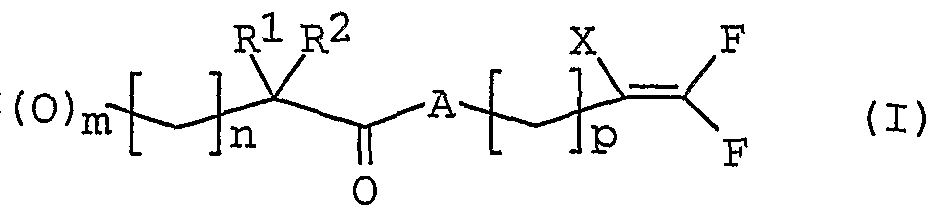
The present invention relates to pesticidal fluoroalkene derivatives of formula I
Figure imgf000002_0001
wherein the substituents and the indices have the following meanings :
A oxygen or NRa;
Ra hydrogen; Cι-C6-alkyl, C2-C5-alkenyl, C2-C6-alkynyl, wherein the carbon atoms may be partially or fully halo- genated;
X hydrogen, halogen; Cχ-C6-alkyl or phenyl wherein the alkyl and phenyl groups may be partially or fully halogenated;
RX,R2 each independently hydrogen, halogen, hydroxyl, cyano, nitro, mercapto, amino; Ci-Cg-alkyl, C2-C6-alkenyl , C -C6-alky- nyl, Cι-C6-alkoxy, C-C6-alkenyloxy, Ci-Cg-alkylthio, Ci-Cέ-al- kylamino, di-Cι-C6-alkylamino, Ci-Cg-alkoxycarbonyl , Ci-Cβ- l- kylcarbonyloxy, wherein the aliphatic moieties in these 10 substituents are unsubstituted, partially or fully. halogenated or substituted by 1 to 3 substituents, each independently selected from Rb:
R cyano, nitro, halogen, hydroxy, mercapto, fpfriino, carbo- xyl, aminocarbonyl , aminothiocarbonyl, alkyl, haloalkyl, alkenyl, alkenyloxy, alkynyl, alkoxy, haloalkoxy, alkylthio, alkylamino, dialkylamino, formyl, alkylcarbonyl, alkylsulfonyl, alkoxysulfonyl, alkylsulfonyloxy, alkoxycarbonyl, alkylcarbonyloxy, alkylaminocarbonyl , dialkylami- nocarbonyl, alkylamino'thiocarbonyl, dialkylaminothiocar- bonyl, alkylenedioxy or cycloalkyl, wherein the alkyl groups in these radicals contain 1 to 6 carbon atoms and the abovementioned alkenyl or alkynyl groups in these radicals contain 2 to 6 carbon atoms, and wherein the car- bon atoms in these groups may be partially or fully halogenated; Het a monocyclic or bicyclic 3- to 10-membered heteroaromatic ring system containing 1 to 5 heteroatoms selected from oxygen, sulfur and nitrogen, unsubstituted, partially or fully halogenated or substituted by 1 to 4 substituents, each in- dependently selected from Rc:
Rc R , Cι-C6-alkoxy-Cι-C6-alkyl , Cι-C5-alkylsulfinyl,
Cι-C6-alkylaminosulfonyl , di-Cι-C6-alkylaminosulfonyl , Ci-Cg-alkylcarbonylamino, wherein the last mentioned 5 carbon chains and those defined under Rb are unsubstituted, partially or fully halogenated or substituted by from 1 to 3 cyano, hydroxy, mercapto, amino, Ci-Cg- l- kylthio, Cι-C6-alkylamino, di-Ci-C6-alkylamino, Cι-C6~al- koxycarbonyl , Cι-C6-alkylcarbonyloxy or nitro groups;
cycloalkyl, cycloalkoxy, saturated or partially unsaturated heterocyclyl, heterocyclyloxy, wherein the cyclic systems contain 3 to 10 ring members, and the carbon atoms in the heterocycles may be substituted by 1 to 4 heteroa- toms selected from nitrogen, sulfur and oxygen,
aryl, aryloxy, arylthio, aryl-Ci-Cδ-alkoxy, aryl-Ci-Ce-al- kyl, wherein the mono- or bicyclic ring systems contain Ξ to 10 ring members,
hetaryl, hetaryloxy, hetarylthio, wherein the mono- or bicyclic ring systems contain 5 to 10 ring members wherein 1 to 3 carbon atoms may be substituted by heteroatoms selected from nitrogen, sulfur and oxygen,
and wherein the cyclic, aromatic and heteroaromatic systems may be partially or fully halogenated or may be substituted by from 1 to 3 groups selected from halogen, cyano, nitro, hydroxy; Ci-Cg-alkyl, Ci-Cβ-alkoxy, Ci-Cδ-alkylthio, Ci-Cg-alkylamino, Ci-Cδ-alkylcarbonyl ,
Ci-Cg-alkoxycarbonyl , di-Cι-C6-alkylamino, C-C6-alkenyl , C2 _C6-alkenyloxy and C2-C6-alkynyl, wherein the carbon atoms of these substituents may be partially or fully halogenated;
m 0 , 1 or 2 ; n 0 , 1 , 2 , or 3 ;
P 0 , 1 , 2 , 3 , 4 , 5 , or 6.
Furthermore, the present invention relates to processes for the preparation of compounds of formula I, compositions containing them and their use for the control of pests such as nematodes, insects, arachnids, harmful fungi and unwanted plants, and the protection of plants from those pests as well as their use for treating, controlling, preventing and protecting warm-blooded animals, fish and humans against infestation and infection by hel- minths, arachnids and arthropod endo- and ectoparasites.
In WO-A 86/07590, nematicidal halosubstituted alkene derivatives are disclosed, some of which are substituted by a carbonyloxy group substituted by dihydrothiazolylthiomethylene.
The compounds of formula I differ from the compounds known from WO-A 86/07590 in that they are substituted by aromatic heterocyclic substituents .
In WO 97/08130, pesticidal 4, 4-difluoro-3-butenylester derivatives and 4, 4-difluoro-3-halogen-3-butenylester derivatives are described some of which carry a hetarylthioalkyl substituent on the carbonyl group.
Contrary to the compounds disclosed in WO-A 97/08130, in compounds of formula I a hetaryl moiety is bonded to the carbonylal- kyl backbone via a sulfur atom.
Furthermore, EP-A 1000946 teachers 2- (substituted thio) thiazolo- [4, 5-b]pyridine compounds which may bear a haloal- kenyl-oxycarbonyl-alkylthio radical as the substituting thio group .
However, the pesticidal activity of the compounds known from the above literature in many cases is unsatisfactory.
It is an object of the present invention to provide compounds having improved nematicidal, insecticidal and acaricidal activity. It is also an object to provide compounds for controlling harmful fungi, unwanted plants and parasites.
We have found that this object is achieved by the fluoroalkene derivatives of formula I. Furthermore, we have found processes for preparing the compounds of formula I and the use of the com- pounds I and compositions comprising them for use for the control of nematodes, insects, arachnids, harmful fungi and unwanted plants and the protection of plants from those pests as well as for treating, controlling, preventing and protecting warm-blooded animals, fish and humans against infestaion and infection by hel- minths, acarids and arthropod endo- and ectoparasites. Fluoroalkene derivatives of formula I .1 ,
Figure imgf000005_0001
wherein A, X, R1, R2, Het, n and p are as defined for formula I above, are obtainable by, in a first step, reaction of compounds of formula II
Het-SH (ID
wherein Het is as defined for formula I, with compounds of formula III
Figure imgf000005_0002
wherein R1, R2 and n are as defined for formula I and is a nu- cleophilic exchangeable leaving group, preferably halogen such as bromine, and R1 is hydrogen, Ci-Cg-alkyl or aryl-Ci-Cg-alkyl , such as benzyl, in the presence of a base to give sulfide compounds of formula IV.
Figure imgf000005_0003
The reaction to sulfides IV is usually carried out at temperatures of from 0°C to 150°C, preferably from 15°C to 80°C, in an inert organic solvent in the presence of a base.
Suitable solvents are halogenated hydrocarbons, such as methylene chloride and chlorobenzene, ethers, such as dimethylether, digylme, dioxane and tetrahydrofuran, nitriles, such as acetonitrile, ketones, such as acetone, and also dimethyl sulfoxide, dimethyl formamide and dimethyl acetamide. Preferred solvents are acetone and dimethyl formamide. It is also possible to use mixtures of the solvents mentioned.
Suitable bases are, inorganic compounds, such as alkali metal and alkaline earth metal carbonates, such as lithium carbonate, potassium carbonate and calcium carbonate, alkali metal bicarbonates , such as sodium bicarbonate, and also organic bases, such as tertiary amines, such as trimethyl amine, triethyl amine, tri-isopropyl ethyl amine und N-methyl- piperidine, and pyridine. Particular preference is given to alkaline earth metal carbonates, especially potassium carbonate. In general, the base is employed in equimolar amounts or in excess .
The starting materials are generally reacted with one another in 5 equimolar amounts . In terms of yield, it may be advantageous to use an excess of compounds of formula III based on compounds Het-SH.
Heterocyclic thiols of formula II are known, or are commercially 10 available, or they can be prepared by known methods [see e.g. Synthesis 3, 358-360 (2001)].
Compounds of formula IV are known from the literature or are commercially available [see e.g. J. Org. Chem. 62, 9173-9176 15 (1997)].
Compounds of formula IV wherein R1 is Ci-Cβ-alkyl or aryl- Ci-Ce-alkyl are hydrolized to compounds IV wherein R1 is H, for example in the presence of an aqueous acid or base, and reacted 20 with fluoroalkenyl compounds of formula V,
Figure imgf000006_0001
25 wherein X and p are as defined for formula I and Y is (a) a nu- cleophilically exchangeable group, such as halogen or hydroxy, to yield compounds I wherein A is oxygen, or (b) an amino group NHRa, wherein Ra is as defined for formula I, preferably hydrogen, to yield compounds I wherein A is Ra.
30
The reaction is carried out by common coupling methods such as in the presence of a base, optionally under activating conditions, such as by converting carboxylic acids of formula V into their corresponding carboxylic acid halides or by means of dehydrating
35 agents such as carbodiimides, to give compounds of formula la [lit. : J. March, Advanced Organic Chemistry: reactions, mechanisms and structure, 4th ed. 1992, Wiley&Sons, New York] .
The reaction is usually carried out at temperatures of from 0°C to 40 150°C, preferably from 20°C to 60°C, in an inert organic solvent in the presence of a base.
Suitable solvents are nitriles, such as acetonitrile and propionitrile, and also dimethyl sulfoxide, dimethyl formamide 45 and dimethyl acetamide. Preferred solvents are dimethylether and acetonitrile. It is also possible to use mixtures of the solvents mentioned.
The starting materials are generally reacted with one another in equimolar amounts. In terms of yield, it may be advantageous to use an excess of compounds V, based on acids IV.
Compounds of formula V are known from the literature or are commercially available [see e.g. WO 86/07590 and WO 95/24403].
Sulfinyl and sulfonyl compounds of formula I wherein m is 1 or 2 may be prepared by oxidizing compounds of formula la. The oxidation is usually carried out at temperatures of from -10°C to 150°C, preferably from 0°C to 60°C, in an inert organic solvent or water. Suitable oxidizing agents are, for example m-chloroperben- zoic acid, peracetic acid, H20 x BF3, K2S207/HS0 , peroxytrifluo- roacetic acid, or hydrogen peroxide, optionally in combination with catalytic amounts of sodium tungsten dihydrate.
Suitable solvents are halogenated hydrocarbons, such as methylene chloride and chloroform alcohols, such as methanol and tert. -butanol, carboxylic acids such as acetic acid and trifluoroacetic acid, and also dimethyl sulfoxide, dimethyl formamide and dimethyl acetamide. Preferred solvents are methylene chloride and acetic acid. It is also possible to use mixtures of the solvents mentioned.
The reaction mixtures are worked up in a customary manner, for example by mixing with water, phase separation and, if appropriate, chromatographic purification of the crude products. In some cases, the intermediates and end products are obtained in the form of colorless or pale brown viscous oils, which are purified or freed from volatile components under reduced pressure and at moderately elevated temperature. If the intermediates and end products are obtained as solids, they can also be purified by recrystallization or digestion.
If individual compounds I are not obtainable by the routes described above, they can be prepared by derivatiza ion of other compounds I .
In the definitions of the symbols given in the above formulae, collective terms were used which generally represent the following substituents:
Halogen: fluorine, chlorine, bromine and iodine; Alkyl: saturated, straight-chain or branched hydrocarbon radicals having 1 to 4 or 6 carbon atoms, such as methyl, ethyl, propyl, 1-methylethyl, butyl, 1-methylpropyl, 2-methylpropyl, 1 , 1-dimethylethyl , pentyl , 1-methylbutyl, 2-methylbutyl , 3-methylbutyl, 2, 2-dimethylpropyl, 1-ethylpropyl, hexyl, 1, 1-dimethylpropyl, 1, 2-dimethylpropyl, 1-methylpentyl, 2-me hylpentyl , 3-methylpentyl , 4-methylpentyl , 1, 1-dimethylbutyl, 1 , 2-dimethylbutyl , 1, 3-dimethylbutyl, 2 , 2-dimethylbutyl, 2,3-dimethylbutyl, 3,3-dimethylbutyl, 1-ethylbutyl, 2-ethylbutyl, 1, 1, 2-trimethylpropyl, 1,2, 2-trimethylpropyl , 1-ethyl-l-methylpropyl and 1-ethy1-2-methylpropy1 ;
Haloalkyl: straight-chain or branched alkyl groups having 1 to 4 or 6 carbon atoms (as mentioned above) , where some or all of the hydrogen atoms in these groups may be replaced by halogen atoms, as mentioned above, for example Cι-C-haloalkyl, such as chloromethyl, bromomethyl, dichloromethyl, trichloromethyl, fluoromethyl , difluoromethyl, trifluoromethyl, chlorofluoromethyl, dichlorofluoromethyl , chlorodifluoromethyl, 1-chloroethyl, 1-bromoethyl, 1-fluoroethyl, 2-fluoroethyl, 2 , 2-difluoroethyl, 2,2, 2-trifluoroethyl, 2-chloro-2-fluoroethyl, 2-chloro-2 , 2-difluoroethyl , 2 , 2-dichloro-2-fluoroethyl, 2,2, 2-trichloroethyl and pentafluoroethyl;
Alkenyl unsaturated, straight-chain or branched hydrocarbon radicals having 2 to 6 carbon atoms and a double bond in any position, such as ethenyl, 1-propenyl, 2-propenyl, 1-methyl- ethenyl, 1-butenyl, 2-butenyl, 3-butenyl, 1-methyl-l-propenyl, 2-methyl-l-propenyl, l-methyl-2-propenyl, 2-methyl-2-propenyl; 1-pentenyl, 2-pentenyl, 3-pentenyl, 4-pentenyl, 1-methyl- 1-butenyl, 2-methyl-l-butenyl, 3-methyl-l-butenyl, 1-methyl- 2-butenyl, 2-methyl-2-butenyl, 3-methyl-2-bu enyl, 1-methyl- 3-butenyl, 2-methyl-3-butenyl, 3-methyl-3-butenyl, 1, 1-dimethyl- 2-propenyl, 1, 2-dimethyl-l-propenyl, 1,2-dimethyl-2-propenyl, 1-ethyl-l-propenyl, l-ethyl-2-propenyl, 1-hexenyl, 2-hexenyl, 3-hexenyl, 4-hexenyl, 5-hexenyl, 1-methyl-l-pentenyl, 2-methyl- 1-pentenyl, 3-methyl-l-pentenyl, 4-methyl-l-pentenyl, 1-methyl- 2-pentenyl, 2-methyl-2-pentenyl, 3-methyl-2-pentenyl, 4-methyl- 2-pentenyl, l-methyl-3-pentenyl, 2-methyl-3-pentenyl, 3-methyl- 3-pentenyl, 4-methyl-3-pentenyl, l-methyl-4-pentenyl, 2-methyl- 4-pentenyl, 3-methyl-4-pentenyl, 4-methyl-4-pentenyl, 1, l-dimethyl-2-butenyl , 1 , l-dimethyl-3-butenyl , 1 , 2-dimethyl- 1-butenyl, 1, 2-dimethyl-2-butenyl, l,2-dimethyl-3-butenyl, 1, 3-dimethyl-l-butenyl, 1, 3-dimethyl-2-butenyl, 1, 3-dimethyl- 3-butenyl, 2,2-dimethyl-3-butenyl, 2, 3-dimethyl-l-butenyl, 2, 3-dimethyl-2-butenyl, 2 , 3-dimethyl-3-butenyl, 3 , 3-dimethyl- 1-butenyl, 3 , 3-dimethyl-2-butenyl, 1-ethyl-1-butenyl, 1-ethyl- 2-butenyl, l-ethyl-3-butenyl, 2-ethyl-1-butenyl, 2-ethyl- 2-butenyl, 2-ethyl-3-butenyl, 1,1, 2-trimethyl-2-propenyl, l-ethyl-l-methyl-2-propenyl, l-ethyl-2-methyl-l-propenyl and l-ethyl-2-methyl-2-propenyl;
Haloalkβnyl: unsaturated, straight-chain or branched hydrocarbon radicals having 2 to 6 carbon atoms and a double bond in any position (as mentioned above) , where some or all of the hydrogen atoms in these groups may be replaced by halogen atoms as mentioned above, in particular by fluorine, chlorine and bromine;
Alkynyl: straight-chain or branched hydrocarbon groups having 2 to 6 carbon atoms and a triple bond in any position, such as ethynyl, 1-propynyl, 2-propynyl, 1-butynyl, 2-butynyl, 3-butynyl, 1-methyl-2-propynyl, 1-pentynyl, 2-pentynyl, 3-pentynyl, 4-pentynyl, l-methyl-2-butynyl, l-methyl-3-butynyl, 2-methyl-3- butynyl, 3-methyl-l-butynyl, 1, l-dimethyl-2-propynyl, l-ethyl-2- propynyl, 1-hexynyl, 2-hexynyl, 3-hexynyl, 4-hexynyl, 5-hexynyl, l-methyl-2-pentynyl, l-methyl-3-pentynyl, l-methyl-4-pentynyl, 2-methyl-3-pentynyl, 2-methyl-4-pentynyl, 3-methyl-l-pentynyl, 3-methyl-4-pentynyl, 4-methyl-l-pentynyl , 4-methyl-2-pentynyl, 1, l-dimethyl-2-butynyl , 1 , l-dimethyl-3-butynyl, 1 , 2-dimethyl-3- butynyl, 2 , 2-dimethyl-3-butynyl, 3,3-dimethyl-l-butynyl, l-ethyl-2-butynyl, 1-ethy1-3-butynyl, 2-ethyl-3-butynyl and l-ethyl-l-methyl-2-propynyl;
Haloalkynyl: straight-chain or branched hydrocarbon groups having 2 to 6 carbon atoms and a triple bond in any position (as mentioned above) , where some or all of the hydrogen atoms in these groups may be replaced by halogen atoms as mentioned above, in particular by fluorine, chlorine and bromine;
Alkoxycarbonyl: straight-chain or branched alkoxy groups having 1 to 6 carbon atoms (as mentioned above) which are attached to the skeleton via a carbonyl group (-CO-) ;
Alkylarainocarbonyl : straight-chain or branched alkylamino groups having 1 to 6 carbon atoms (as mentioned above) which are attached to the skeleton via a carbonyl group (-CO-) ;
Alkylcarbonyloxy: straight-chain or branched alkyl groups having 1 to 6 carbon atoms (as mentioned above) which are attached to the skeleton via a carbonyloxy group (-C(=0)0-); Cycloalkyl: monocyclic or bicyclic saturated hydrocarbon groups having 3 to 6, 8 or 10 carbon ring atoms, e.g. C3-C8-cycloalkyl such as cyclopropyl, cyclobutyl, cyclopentyl, cyclohexyl, cycloheptyl, cyclooctyl and dihydronaphthalin;
Heterocyclyl : 5- to 10-membered saturated or partially unsaturated rings which besides carbon ring atoms contain from 1 to 3 or 4 heteroatoms selected from nitrogen, oxygen and sulfur, e.g. from 1 to 3 nitrogen atoms and/or 1 oxygen or sulfur atom and/or 1 or 2 oxygen and/or sulfur atoms;
Aryl: mono- or bicyclic aromatic ringsystems containing 5 to 10 carbon ring atoms, e.g. phenyl or naphthyl;
Arylmethylenβ: mono- or bicyclic aromatic ringsystems containing 5 to 14 carbon ring atoms (as mentioned above) which are attached to the skeleton via a methylene (-CH2-) group.
Hetaryl: a monocyclic or bicyclic 3- to 10-membered heteroaromatic ring system containing 1 to 5 heteroatoms selected from oxygen, sulfur and nitrogen, e.g. 5-membered hetaryl containing beside carbon atoms 1 to 3 nitrogen atoms and/or 1 sulfur- or oxygen atom, wherein the ring system may be bonded to the backbone via carbon or nitrogen, such as furyl, thienyl, pyrrolyl, isoxazolyl, isothiazolyl, pyrazolyl, oxazolyl, thiazolyl, imidazolyl, 1,2, 4-oxadiazolyl, 1,2,4-thiadiazolyl, 1, 2, 4-triazolyl, 1, 3 , 4-oxadiazolyl, 1, 3, 4-thiadiazolyl and 1, 3, 4-triazolyl; or e.g. 5-membered hetaryl containing beside carbon atoms 1 to 3 nitrogen atoms and/or 1 sulfur- or oxygen atom, wherein the ring system may be bonded to the backbone via carbon or nitrogen, wherein 2 adjacent ring members are bridged by a buta-1, 3-dien-l, 4-diyl group, wherein 1 or 2 carbon atoms may be substituted by nitrogen atoms, such as benzofuranyl, isobenzofuranyl, benzothienyl, isobenzothienyl, indolyl, isoindolyl, indazolyl, indoleninyl, isobenzazolyl, pyranopyrrolyl , isoindazolyl, indoxazinyl, benzoxazolyl, benzothiazolyl , benzimidazolyl, pyridoxazolyl, pyridothiazolyl, pyrazinoxazolyl, pyrazinthiazolyl, pyridazinoxazolyl, pyridazinthiazolyl, pyrimidinoxazolyl, pyri idinthiazolyl, pyrimidinazolyl, benzopyranyl, purinyl;
Alkylsulfinyl: straight-chain or branched alkyl groups having 1 to 6 carbon atoms (as mentioned above) which are attached to the skeleton via a sulfinyl group (-SO-) ; Alkylsulfonyl: straight-chain or branched alkyl groups having 1 to 6 carbon atoms (as mentioned above) which are attached to the skeleton via a sulfonyl group (-S0-) ;
Alkylsulfonyloxy: straight-chain or branched alkylsulfonyl groups having 1 to 6 carbon atoms (as mentioned above) which are attached to the skeleton via an oxygen atom;
Alkoxysulfonyl: straight-chain or branched alkoxy groups having 1 to 6 carbon atoms (as mentioned above) which are attached to the skeleton via a sulfonyl group (-S02-) ;
Alkylaminosulfonyl: straight-chain or branched alkylamino groups having 1 to 6 carbon atoms (as mentioned above) which are attached to the skeleton via a sulfonyl group (-S02-) ;
With respect to the intended use of the fluoroalkene derivatives of formula I, particular preference is given to the following meanings of the substituents, in each case on their own or in combination:
Preference is given to compounds of formula I wherein A is oxygen or NH.
Particular preference is given to compounds of formula I wherein A is oxygen.
Preference is given to compounds of the formula I in which Ra is hydrogen or Cι-C6~alkyl, hydrogen being preferred most.
Furthermore, preference is given to compounds of formula I wherein X is hydrogen, halogen, Cι-C4-alkyl, Cι-C4-haloalkyl, or phenyl .
Particular preference is given to compounds of formula I wherein X is hydrogen or halogen, especially fluorine.
Especially preferred are compounds of formula I wherein X is fluorine .
Preference is given to compounds of formula I wherein R1 and R2 are each independently hydrogen, halogen, Cι-C6-alkyl, or phenyl wherein the alkyl and phenyl group are unsubstituted, partially or fully halogenated. Particular preference is given to compounds of formula I wherein R1 and R2 are each independently hydrogen, halogen, Cι-C4-alkyl, or phenyl .
Especially preferred are compounds of formula I wherein R1 and R2 are each independently hydrogen or Cι-C4-alkyl .
Particular preference is given to compounds of formula I wherein one of R1 and R2 is not hydrogen.
Particular preference is given to compounds of the formula I wherein Rb is halogen, hydroxy, Ci-Cβ-alkyl, Cι-C6-haloalkyl, Cι-C6-alkoxy or Ci-Cδ-haloalkoxy.
Especially preferred are compounds of the formula I wherein R1 and R2 are substituted by hydrogen or Cι-C6~alkyl, hydrogen being preferred most.
Preference is given to compounds of the formula I wherein Het is bonded via carbon.
Particular preference is given to compounds of the formula I wherein Het is oxazolyl, thiazolyl, imidazolyl, pyrimidinyl, pyridyl, purinyl, pyridazinonyl, benzoxazolyl, pyridoxazolyl, benzothiazolyl, pyridothiazolyl, benzimidazolyl, pyrimidinazolyl, 1, 3, 4-oxadiazol-2-yl, or 1,3 ,4-thiadiazol-2-yl, each ring system being unsubstituted, partially or fully halogenated or substituted by from 1 to 3 or 4 groups selected from Rc as defined for formula I above.
Particular preference is given to compounds of the formula I wherein Het is 2-oxazolyl, 2-thiazolyl, 2-imidazolyl, 2-pyrimidinyl, 2-pyridyl, 2-purinyl, 5-pyridazinonyl, 2-benzoxazolyl, 2-pyridoxazolyl, 2-benzothiazolyl, 2-benzimidazolyl, 2-pyrimidinazolyl, 1, 3, 4-oxadiazol-2-yl, or 1, 3 , 4-thiadiazol-2-yl, each ring system being unsubstituted, partially or fully halogenated or substituted by from 1 to 3 or 4 groups selected from Rc as defined for formula I above.
Especially preferred are compounds of formula I wherein Het is 2-oxazolyl, 2-thiazolyl, 2-benzoxazolyl, 2-pyridoxazolyl, 2-benzothiazolyl, 1, 3 , 4-oxadiazol-2-yl, or 1, 3,4-thiadiazol-2-yl, each ring system being unsubstituted, partially or fully halogenated or substituted by from 1 to 2 or 3 groups selected from Rc as defined for formula I above. Preference is given to compounds of the formula I wherein Rc is cyano, nitro, halogen, hydroxy, mercapto, amino, carboxyl, aminocarbonyl, alkyl, haloalkyl, alkoxyalky, alkenyl, alkenyloxy, alkynyl, alkoxy, haloalkoxy, alkylthio, alkylamino, dialkylamino, formyl, alkylcarbonyl, alkylsulfonyl, alkoxycarbonyl, alkylcarbonyloxy, alkylaminocarbonyl, or dialkylaminocarbonyl, wherein the alkyl groups in these radicals contain 1 to 6 carbon atoms and the abovementioned alkenyl or alkynyl groups in these radicals contain 2 to 6 carbon atoms, and wherein the carbon atoms in these groups may be partially or fully halogenated, or 5- to 10-membered mono- or bicyclic aryl, or 5- to 10-membered mono-or bicyclic hetaryl, wherein 1 to 3 carbon atoms may be substituted by heteroatoms selected from nitrogen, sulfur and oxygen, wherein the aryl or hetaryl ring systems may be partially or fully halogenated or may be substituted by from 1 to 3 groups selected from halogen, cyano, nitro, hydroxy, Ci-Cβ-alkyl, Ci-Cβ-haloalkyl, Ci-Cβ-alkoxy, or Cι-C6-haloalkoxy.
Particular preference is given to compounds of the formula I wherein Rc is hydroxy, halogen, Ci-Cg-alkyl, Ci-Ce-haloalkyl, Ci-Cβ-alkoxy, Ci-Cg-haloalkoxy and phenyl, unsubstituted, partially or fully halogenated or substituted by from 1 to 3 nitro, hydroxy, cyano, Cι-C6-alkyl, Cχ-C6-haloalkyl , Cι-C6-alkoxy, Ci-Cβ-haloalkoxy, Ci-Cδ-alkylamino, or di-Ci-Cg-alkylamino.
Particular preference is given to compounds of the formula I in which m is 0 or 2.
Particular preference is given to compounds of the formula I in which m is zero.
Preference is given to compounds of the formula I in which n is 0 or 1.
Particular preference is given to compounds of the formula I in which n is zero.
Preference is given to compounds of the formula I in which p is 2 or 4.
Preference is given to compounds of the formula I in which p is 2.
Moreover, fluoroalkene derivatives of formula I are preferred wherein the substituents and the indices have the following meanings : A oxygen or NH; X hydrogen or halogen;
R^R2 each independently hydrogen, Cχ-C6-alkyl, or phenyl which is unsubstituted or substituted by one to three halogen atoms; Het oxazolyl, thiazolyl, imidazolyl, pyrimidinyl, pyridyl, puri- nyl, pyridazinonyl, benzoxazolyl , pyridoxazolyl, benzothiazolyl, pyridothiazolyl, benzimidazolyl, pyrimidazolyl , oxadia- zolyl, or thiadiazolyl, each ring being unsubstituted, partially or fully halogenated or substituted by from one to three groups selected from Rc. Rc is hydroxy, halogen, Cχ-C6-alkyl, Cχ-C6-haloalkyl , Cχ-C6- alkoxy, Cχ-C6-haloalkoxy and phenyl, unsubstituted, partially or fully halogenated or substituted by from 1 to 3 nitro, hydroxy, cyano, Cχ-C6-alkyl, Cx-Cβ-haloalkyl, Cχ-C6~alkoxy, Cχ-C6-haloalkoxy, Ci-Cg-alkylamino, or di- Cχ-C6~alkylamino . m,n 0, 1 or 2; p 2 or 4;
Likewise, particular preference is given to compounds of the formula I wherein substituents and the indices have the following meanings : A oxygen;
X hydrogen or fluorine;
R^R2 each independently hydrogen, Cχ-C4-alkyl; Het 2-oxazolyl, 2-thiazolyl, 2-benzoxazolyl, 2-pyridoxazolyl,
2-benzothiazolyl, 2-pyridothiazolyl, 1,3, 4-oxadiazol-2-yl, or 1, 3 , 4-thiadiazol-2-yl, each ring being unsubstituted, partially or fully halogenated or substituted by from one to three groups selected from hydroxy, Cχ-C6-alkyl, Cχ-C6-haloal- kyl, Cχ-C6-alkoxy, Cχ-C6~haloalkoxy, or phenyl, unsubstituted, partially. or fully halogenated or substituted .by from 1 to 3 nitro, cyano, Cχ-C6-alkyl, Cχ-C6-haloalkyl , Cχ-Ce-alkoxy or Cχ-C6-haloalkoxy groups . m,n zero; p 2 or 4.
Particular preference is given to compounds of formula I wherein A is oxygen, X is hydrogen or fluorine, R1 and R2 are each independently hydrogen, Cχ-C4-alkyl, or phenyl, Het is 2-benzoxazolyl, 2-benzothiazolyl, 4-pyridothiazol-2-yl, 4-pyridoxazol-2-yl,
5-pyridothiazol-2-yl, 5-pyridoxazol-2-yl, 6-pyridothiazol-2-yl, 6-pyridoxazol-2-yl, 7-pyridothiazol-2-yl, 7-pyridoxazol-2-yl, 2-pyrazinthiazolyl, 2-pyrazinoxazolyl, each ring being unsubstituted or substituted by 1 group selected from halogen, Cι-C4-al- kyl, Cχ-C4-haloalkyl , Cχ-C4-haloalkoxy, Cχ-C4-alkoxy, nitro, amino, and methylcarbonylamino, m is zero, n is 1, and p is 2 or 4. Particular preference is given to compounds of formula I wherein A is oxygen, X is hydrogen or fluorine, R1 and R2 are each independently hydrogen, Cχ-C4-alkyl, or phenyl, Het is 2-oxazolyl, 2-thiazolyl, 2-imidazolyl, each ring being unsubstituted or substituted by 1 or 2 groups selected from halogen, Cχ-C4~alkyl, Cχ-C4-alkoxymethylene, Cχ-C4-alkylcarbonyloxy, and phenyl which may be substutited by from 1 to 3 substituents selected from halogen, Cχ-C4~alkyl and hydroxy, m is zero, n is 1, and p is 2 or 4.
Particular preference is given to compounds of formula I wherein A is oxygen, X is hydrogen or fluorine, R1 and R2 are each independently hydrogen, Cχ-C4-alkyl, or phenyl, Het is thiadiazolyl or oxadiazolyl, each ring being unsubstituted or substituted by one group selected from halogen, Cχ-C4-alkyl, Cχ-C4-haloalkyl, Cχ-C4~ haloalkoxy, Cχ-C4~alkoxy, nitro, amino, and methylcarbonylamino, m and n are integers of 0, and p is an integer of 2 or 4.
Furthermore, compounds of the following formulae are especially preferred:
Compounds of formula I .2
Figure imgf000015_0001
wherein B is nitrogen or CH, in particular CH, D is nitrogen or CH, in particular CH, E is oxygen or sulfur, R1 and R2 are each independently hydrogen, Cχ-C4-alkyl or phenyl, q is 0 or 1, R° is halogen, methyl, methoxy, ethoxy, trifluoromethyl, trifluorome- thoxy, m is 0, 1 or 2, n is 0 or 1 and p is 2 or 4, with the proviso that B is CH when E is sulfur.
Compounds of formula 1.3
Figure imgf000015_0002
wherein E' is oxygen, sulfur or NH, R1 and R2 are each independently hydrogen or Cχ-C4-alkyl, q is 0, 1 , or 2, Rc is phenyl which may be substituted by one or two halogen, m is 0, 1 or 2, n is 0 or 1, p is 2 or 4. Compounds of formula I .4
Figure imgf000016_0001
wherein E is oxygen or sulfur, R1 and R2 are each independently hydrogen or Cχ-C4-alkyl, Rc is Cχ-C4~alkyl or phenyl which may be substituted by halogen or methyl, and p is 2.
With respect to their use, particular preference is given to the compounds 1.5, 1.6 and 1.7 compiled in the Tables below. Moreover, the groups mentioned for a substituent in the Tables are on their own, independently of the combination in which they are mentioned, a particularly preferred embodiment of the substituent in question.
Further preference is given to the compounds of the tables 1 to 440 wherein A is NH.
Table 1
Compounds of the formula I .5
Figure imgf000016_0002
wherein X is hydrogen, p is 2 , R1 and R2 are hydrogen and the combination of B, D, E and Rc for a compound corresponds in each case to a row of Table A.
Table 2
Compounds of the formula 1.5 wherein X is hydrogen, p is 2, R1 is hydrogen and R2 is methyl and the combination of B, D, E and Rc for a compound corresponds in each case to a row of Table A.
Table 3
Compounds of the formula 1.5 wherein X is hydrogen, p is 2, R1 is hydrogen and R2 is ethyl and the combination of B, D, E and Rc for a compound corresponds in each case to a row of Table A.
Table 4
Compounds of the formula 1.5 wherein X is hydrogen, p is 2, R1 is hydrogen and R2 is i-propyl and the combination of B, D, E and Rc for a compound corresponds in each case to a row of Table A.
Table 5
Compounds of the formula 1.5 wherein X is hydrogen, p is 2, R1 is hydrogen and R2 is n-propyl and the combination of B, D, E and Rc for a compound corresponds in each case to a row of Table A.
Table 6 Compounds of the formula 1.5 wherein X is hydrogen, p is 2, R1 is hydrogen and R2 is cyclo-propyl and the combination of B, D, E and Rc for a compound corresponds in each case to a row of Table A.
Table 7 Compounds of the formula 1.5 wherein X is hydrogen, p is 2, R1 is hydrogen and R2 is n-butyl and the combination of B, D, E and Rc for a compound corresponds in each case to a row of Table A.
Table 8 Compounds of the formula 1.5 wherein X is hydrogen, p is 2, R1 is hydrogen and R2 is i-butyl and the combination of B, D, E and Rc for a compound corresponds in each case to a row of Table A.
Table 9 Compounds of the formula 1.5 wherein X is hydrogen, p is 2, R1 is hydrogen and R2 is tert-butyl and the combination of B, D, E and Rb for a compound corresponds in each case to a row of Table A.
Table 10 Compounds of the formula 1.5 wherein X is hydrogen, p is 2, R1 is hydrogen and R2 is phenyl and the combination of B, D, E and Rc for a compound corresponds in each case to a row of Table A.
Table 11 Compounds of the formula 1.5 wherein X is hydrogen, p is 4, R1 and R2 are hydrogen and the combination of B, D, E and Rc for a compound corresponds in each case to a row of Table A.
Table 12 Compounds of the formula 1.5 wherein X is hydrogen, p is 4, R1 is hydrogen and R2 is methyl and the combination of B, D, E and Rc for a compound corresponds in each case to a row of Table A.
Table 13 Compounds of the formula 1.5 wherein X is hydrogen, p is 4, R1 is hydrogen and R2 is ethyl and the combination of B, D, E and Rc for a compound corresponds in each case to a row of Table A.
Table 14 Compounds of the formula 1.5 wherein X is hydrogen, p is 4, R1 is hydrogen and R2 is i-propyl and the combination of B, D, E and Rc for a compound corresponds in each case to a row of Table A.
Table 15
Compounds of the formula 1.5 wherein X is hydrogen, p is 4, R1 is hydrogen and R2 is n-propyl and the combination of B, D, E and Rc for a compound corresponds in each case to a row of Table A.
Table 16
Compounds of the formula 1.5 wherein X is hydrogen, p is 4, R1 is hydrogen and R2 is cyclo-propyl and the combination of B, D, E and Rc for a compound corresponds in each case to a row of Table A.
Table 17
Compounds of the formula 1.5 wherein X is hydrogen, p. is 4, R1 is hydrogen and R2 is n-butyl and the combination of B, D, E and Rc for a compound corresponds in each case to a row of Table A.
Table 18
Compounds of the formula 1.5 wherein X is hydrogen, p is 4, R1 is hydrogen and R2 is i-butyl and the combination of B, D, E and Rc for a compound corresponds in each case to a row of Table A.
Table 19
Compounds of the formula 1.5 wherein X is hydrogen, p is 4, R1 is hydrogen and R2 is tert-butyl and the combination of B, D, E and Rc for a compound corresponds in each case to a row of Table A.
Table 20
Compounds of the formula 1.5 wherein X is hydrogen, p is 4, R1 is hydrogen and R2 is phenyl and the combination of B, D, E and Rc for a compound corresponds in each case to a row of Table A.
Table 21
Compounds of the formula 1.5 wherein X is fluorine, p is 2, R1 and R2 are hydrogen and the combination of B, D, E and Rc for a compound corresponds in each case to a row of Table A.
Table 22
Compounds of the formula 1.5 wherein X is fluorine, p is 2, R1 is hydrogen and R2 is methyl and the combination of B, D, E and Rc for a compound corresponds in each case to a row of Table A.
Table 23
Compounds of the formula 1.5 wherein X is fluorine, p is 2, R1 is hydrogen and R2 is ethyl and the combination of B, D, E and Rc for a compound corresponds in each case to a row of Table A. Table 24
Compounds of the formula 1.5 wherein X is fluorine, p is 2 , R1 is hydrogen and R2 is i-propyl and the combination of B, D, E and Rc for a compound corresponds in each case to a row of Table A.
Table 25
Compounds of the formula 1 .5 wherein X is fluorine, p is 2 , R1 is hydrogen and R2 is n-propyl and the combination of B, D, E and Rc for a compound corresponds in each case to a row of Table A.
Table 26
Compounds of the formula 1.5 wherein X is fluorine, p is 2, R1 is hydrogen and R2 is cyclo-propyl and the combination of B, D, E and Rc for a compound corresponds in each case to a row of Table A.
Table 27
Compounds of the formula 1.5 wherein X is fluorine, p is 2, R1 is hydrogen and R2 is n-butyl and the combination of B, D, E and Rc for a compound corresponds in each case to a row of Table A.
Table 28
Compounds of the formula 1.5 wherein X is fluorine, p is 2, R1 is hydrogen and R2 is i-butyl and the combination of B, D, E and Rc for a compound corresponds in each case to a row of Table A.
Table 29
Compounds of the formula 1.5 wherein X is fluorine, p is 2, R1 is hydrogen and R2 is tert-butyl and the combination of B, D, E and Rc for a compound corresponds in each case to a row of Table A.
Table 30
Compounds of the formula 1.5 wherein X is fluorine, p is 2, R1 is hydrogen and R2 is phenyl and the combination of B, D, E and Rc for a compound corresponds in each case to a row of Table A.
Table 31
Compounds of the formula 1.5 wherein X is fluorine, p is 4, R1 and R2 are hydrogen and the combination of B, D, E and Rc for a compound corresponds in each case to a row of Table A.
Table 32
Compounds of the formula 1.5 wherein X is fluorine, p is 4, R1 is hydrogen and R2 is methyl and the combination of B, D, E and Rc for a compound corresponds in each case to a row of Table A.
Table 33
Compounds of the formula 1.5 wherein X is fluorine, p is 4, R1 is hydrogen and R2 is ethyl and the combination of B, D, E and Rc for a compound corresponds in each case to a row of Table A.
Table 34 Compounds of the formula 1.5 wherein X is fluorine, p is 4, R1 is hydrogen and R2 is i-propyl and the combination of B, D, E and Rc for a compound corresponds in each case to a row of Table A.
Table 35 Compounds of the formula 1.5 wherein X is fluorine, p is 4, R1 is hydrogen and R2 is n-propyl and the combination of B, D, E and Rc for a compound corresponds in each case to a row of Table A.
Table 36 Compounds of the formula 1.5 wherein X is fluorine, p is 4, R1 is hydrogen and R2 is cyclo-propyl and the combination of B, D, E and R for a compound corresponds in each case to a row of Table A.
Table 37 Compounds of the formula 1.5 wherein X is fluorine, p is 4, R1 is hydrogen and R2 is n-butyl and the combination of B, D, E and Rc for a compound corresponds in each case to a row of Table A.
Table 38 Compounds of the formula 1.5 wherein X is fluorine, p is 4, R1 is hydrogen and R2 is i-butyl and the combination of B, D, E and Rc for a compound corresponds in each case to a row of Table A.
Table 39 Compounds of the formula 1.5 wherein X is fluorine, p is 4, R1 is hydrogen and R2 is tert-butyl and the combination of B, D, Ε and Rc for a compound corresponds in each case to a row of Table A.
Table 40 Compounds of the formula 1.5 wherein X is fluorine, p is 4, R1 is hydrogen and R2 is phenyl and the combination of B, D, E and Rc for a compound corresponds in each case to a row of Table A.
Table A
Figure imgf000020_0001
Figure imgf000022_0001
Figure imgf000023_0001
Figure imgf000024_0001
Figure imgf000025_0001
Figure imgf000026_0001
Figure imgf000027_0001
Figure imgf000028_0001
Figure imgf000029_0001
Table 41
Compounds of the formula 1.6
Figure imgf000030_0001
wherein X is hydrogen, p is 2, R1 and R2 are hydrogen, E' is oxygen and (Rc)q is in the 4-position and corresponds in each case to a row of Table B.
Table 42
Compounds of the formula 1.6 wherein X is hydrogen, p is 2, R1 is hydrogen and R2 is methyl, E' is oxygen and (Rc)g is in the 4-position and corresponds in each case to a row of Table B.
Table 43
Compounds of the formula 1.6 wherein X is hydrogen, p is 2, R1 is hydrogen and R2 is ethyl, E' is oxygen and (Rc)q is in the 4-position and corresponds in each case to a row of Table B.
Table 44
Compounds of the formula 1.6 wherein X is hydrogen, p is 2, R1 is hydrogen and R2 is i-propyl, E' is oxygen and (Rc)q is in the 4-position and corresponds in each case to a row of Table B.
Table 45
Compounds of the formula 1.6 wherein X is hydrogen, p is 2, R1 is hydrogen and R2 is n-propyl, E' is oxygen and (Rc)q is in the 4-position and corresponds in each case to a row of Table B.
Table 46
Compounds of the formula 1.6 wherein X is hydrogen, p is 2, R1 is hydrogen and R2 is cyclo-propyl, E' is oxygen and (Rc)q is in the 4-position and corresponds in each case to a row of Table B.
Table 47
Compounds of the formula 1.6 wherein X is hydrogen, p is 2, R1 is hydrogen and R2 is n-butyl, E' is oxygen and (Rc)q is in the 4-position and corresponds in each case to a row of Table B.
Table 48
Compounds of the formula 1.6 wherein X is hydrogen, p is 2 , R1 is hydrogen and R2 is i-butyl, E' is oxygen and (Rc)q is in the 4-position and corresponds in each case to a row of Table B.
Table 49
Compounds of the formula 1.6 wherein X is hydrogen, p is 2, R1 is hydrogen and R2 is tert-butyl, E' is oxygen and (Rc)q is in the 4-position and corresponds in each case to a row of Table B.
Table 50 Compounds of the formula 1.6 wherein X is hydrogen, p is 2, R1 is hydrogen and R2 is phenyl, E' is oxygen and (Rc)q is in the 4-position and corresponds in each case to a row of Table B.
Table 51 Compounds of the formula 1.6 wherein X is hydrogen, p is 4, R1 and R2 are hydrogen, E' is oxygen and (Rc)q is in the 4-position and corresponds in each case to a row of Table B.
Table 52 Compounds of the formula 1.6 wherein X is hydrogen, p is 4, R1 is ' hydrogen and R2 is methyl, E' is oxygen and (Rc)q is in the 4-position and corresponds in each case to a row of Table B.
Table 53 Compounds of the formula 1.6 wherein X is hydrogen, p is 4, R1 is hydrogen and R2 is ethyl, E' is oxygen and (Rc)q is in the 4-position and corresponds in each case to a row of Table B.
Table 54 Compounds of the formula 1.6 wherein X is hydrogen, p is 4, R1 is hydrogen and R2 is i-propyl, E' is oxygen and (Rc)q is in the 4-position and corresponds in each case to a row of Table B.
Table 55 Compounds of the formula 1.6 wherein X is hydrogen, p is 4, R1 is hydrogen and R2 is n-propyl, E' is oxygen and (Rc)q is in the 4-position and corresponds in each case to a row of Table B.
Table 56 Compounds of the formula 1.6 wherein X is hydrogen, p is 4, R1 is hydrogen and R2 is cyclo-propyl, E' is oxygen and (Rc)q is in the 4-position and corresponds in each case to a row of Table B.
Table 57 Compounds of the formula 1.6 wherein X is hydrogen, p is 4, R1 is hydrogen and R2 is n-butyl, E' is oxygen and (Rc)q is in the 4-position and corresponds in each case to a row of Table B.
Table 58 Compounds of the formula 1.6 wherein X is hydrogen, p is 4, R1 is hydrogen and R2 is i-butyl, E' is oxygen and (Rc)q is in the 4-position and corresponds in each case to a row of Table B.
Table 59
Compounds of the formula 1.6 wherein X is hydrogen, p is 4, R1 is hydrogen and R2 is tert-butyl, E' is oxygen and (Rc)q is in the 4-position and corresponds in each case to a row of Table B.
Table 60
Compounds of the formula 1.6 wherein X is hydrogen, p is 4, R1 is hydrogen and R2 is phenyl, E' is oxygen and (Rc)q is in the 4-position and corresponds in each case to a row of Table B.
Table 61
Compounds of the formula 1.6 wherein X is fluorine, p is 2, R1 and R2 are hydrogen, E' is oxygen and (Rc)q is in the 4-position and corresponds in each case to a row of Table B.
Table 62
Compounds of the formula 1.6 wherein X is fluorine, p is 2, R1 is hydrogen and R2 is methyl, E' is oxygen and (Rc)q is in the 4-position and corresponds in each case to a row of Table B.
Table 63
Compounds of the formula 1.6 wherein X is fluorine, p is 2, R1 is hydrogen and R2 is ethyl, E' is oxygen and (Rc)q is in the 4-position and corresponds in each case to a row of Table B.
Table 64
Compounds of the formula 1.6 wherein X is fluorine, p is 2, R1 is hydrogen and R2 is i-propyl, E' is oxygen and (Rc)q is in the 4-position and corresponds in each case to a row of Table B.
Table 65
Compounds of the formula 1.6 wherein X is fluorine, p is 2, R1 is hydrogen and R2 is n-propyl, E' is oxygen and (Rc)q is in the 4-position and corresponds in each case to a row of Table B.
Table 66
Compounds of the formula 1.6 wherein X is fluorine, p is 2, R1 is hydrogen and R2 is cyclo-propyl,' E' is oxygen and (Rc)q is in the 4-position and corresponds in each case to a row of Table B.
Table 67
Compounds of the formula 1.6 wherein X is fluorine, p is 2, R1 is hydrogen and R2 is n-butyl, E' is oxygen and (Rc)q is in the 4-position and corresponds in each case to a row of Table B. Table 68
Compounds of the formula 1.6 wherein X is fluorine, p is 2, R1 is hydrogen and R2 is i-butyl, E' is oxygen and (Rc)q is in the 4-position and corresponds in each case to a row of Table B.
Table 69
Compounds of the formula 1.6 wherein X is fluorine, p is 2, R1 is hydrogen and R2 is tert-butyl, E' is oxygen and (Rc)q is in the 4-position and corresponds in each case to a row of Table B.
Table 70
Compounds of the formula 1.6 wherein X is fluorine, p is 2, R1 is hydrogen and R2 is phenyl, E' is oxygen and (Rc)q is in the 4-position and corresponds in each case to a row of Table B.
Table 71
Compounds of the formula 1.6 wherein X is fluorine, p is 4, R1 and R2 are hydrogen, E' is oxygen and (Rc)q is in the 4-position and corresponds in each case to a row of Table B.
Table 72
Compounds of the formula 1.6 wherein X is fluorine, p is 4, R1 is hydrogen and R2 is methyl, E' is oxygen and (Rc)g is in the 4-position and corresponds in each case to a row of Table B.
Table 73
Compounds of the formula 1.6 wherein X is fluorine, p is 4, R1 is hydrogen and R2 is ethyl, E' is oxygen and (Rc)q is in the 4-position and corresponds in each case to a row of Table B.
Table 74
Compounds of the formula 1.6 wherein X is fluorine, p is 4, R1 is hydrogen and R2 is i-propyl, E' is oxygen and (R°)q is in the 4-position and corresponds in each case to a row of Table B.
Table 75
Compounds of the formula 1.6 wherein X is fluorine, p is 4, R1 is hydrogen and R2 is n-propyl, E' is oxygen and (Rc)q is in the 4-position and corresponds in each case to a row of Table B.
Table 76
Compounds of the formula 1.6 wherein X is fluorine, p is 4, R1 is hydrogen and R2 is cyclo-propyl, E' is oxygen and (Rc)q is in the 4-position and corresponds in each case to a row of Table B.
Table 77
Compounds of the formula 1.6 wherein X is fluorine, p is 4, R1 is hydrogen and R2 is n-butyl, E' is oxygen and (Rc)q is in the 4-position and corresponds in each case to a row of Table B.
Table 78 Compounds of the formula 1.6 wherein X is fluorine, p is 4, R1 is hydrogen and R2 is i-butyl, E' is oxygen and (Rc)q is in the 4-position and corresponds in each case to a row of Table B.
Table 79 Compounds of the formula 1.6 wherein X is fluorine, p is 4, R1 is hydrogen and R2 is tert-butyl, E' is oxygen and (Rc)q is in the 4-position and corresponds in each case to a row of Table B.
Table 80 Compounds of the formula 1.6 wherein X is fluorine, p is 4, R1 is hydrogen and R2 is phenyl, E' is oxygen and (Rc)q is in the 4-position and corresponds in each case to a row of Table B.
Table 81 Compounds of the formula 1.6 wherein X is hydrogen, p is 2, R1 and R2 are hydrogen, E' is oxygen and (Rc)q is in the 5-position and corresponds in each case to a row of Table B.
Table 82 Compounds of the formula 1.6 wherein X is hydrogen, p is 2, R1 is hydrogen and R2 is methyl, E' is oxygen and (Rc)q is in the 5-position and corresponds in each case to a row of Table B.
Table 83 Compounds of the formula 1.6 wherein X is hydrogen, p is 2, R1 is hydrogen" and R2 is ethyl, E' is oxygen and (Rc)q is in the 5-position and corresponds in each case to a row of Table B.
Table 84 Compounds of the formula 1.6 wherein X is hydrogen, p is 2, R1 is hydrogen and R2 is i-propyl, E' is oxygen and (Rc)q is in the 5-position and corresponds in each case to a row of Table B.
Table 85 Compounds of the formula 1.6 wherein X is hydrogen, p is 2, R1 is hydrogen and R2 is n-propyl, E' is oxygen and (Rc)q is in the 5-position and corresponds in each case to a row of Table B.
Table 86 Compounds of the formula 1.6 wherein X is hydrogen, p is 2, R1 is hydrogen and R2 is cyclo-propyl, E' is oxygen and (Rc)q is in the 5-position and corresponds in each case to a row of Table B.
Table 87
Compounds of the formula 1.6 wherein X is hydrogen, p is 2, R1 is hydrogen and R2 is n-butyl, E' is oxygen and (Rc)q is in the 5-position and corresponds in each case to a row of Table B.
Table 88
Compounds of the formula 1.6 wherein X is hydrogen, p is 2, R1 is hydrogen and R2 is i-butyl, E' is oxygen and (Rc)q is in the 5-position and corresponds in each case to a row of Table B.
Table 89
Compounds of the formula 1.6 wherein X is hydrogen, p is 2, R1 is hydrogen and R2 is tert-butyl, E' is oxygen and (Rc)q is in the 5-position and corresponds in each case to a row of Table B.
Table 90
Compounds of the formula 1.6 wherein X is hydrogen, p is 2, R1 is hydrogen and R2 is phenyl, E' is oxygen and (Rc)q is in the 5-position and corresponds in each case to a row of Table B.
Table 91
Compounds of the formula 1.6 wherein X is hydrogen, p is 4, R1 and R2 are hydrogen, E' is oxygen and (Rc)q is in the 5-position and corresponds in each case to a row of Table B.
Table 92
Compounds of the formula 1. 6 wherein X is hydrogen, p is 4 , R1 is hydrogen and R2 is methyl , E ' is oxygen and (Rc) q is in the 5-position and corresponds in each case to a row of Table B .
Table 93
Compounds of the formula 1.6 wherein X is hydrogen, p is 4, R1 is hydrogen and R2 is ethyl, E' is oxygen and (Rc)q is in the 5-position and corresponds in each case to a row of Table B.
Table 94
Compounds of the formula 1.6 wherein X is hydrogen, p is 4, R1 is hydrogen and R2 is i-propyl, E' is oxygen and (Rc)q is in the 5-position and corresponds in each case to a row of Table B.
Table 95
Compounds of the formula 1.6 wherein X is hydrogen, p is 4, R1 is hydrogen and R2 is n-propyl, E' is oxygen and (Rc)q is in the 5-position and corresponds in each case to a row of Table B. Table 96
Compounds of the formula 1.6 wherein X is hydrogen, p is 4, R1 is hydrogen and R2 is cyclo-propyl, E' is oxygen and (Rc)q is in the 5-position and corresponds in each case to a row of Table B.
Table 97
Compounds of the formula 1.6 wherein X is hydrogen, p is 4, R1 is hydrogen and R2 is n-butyl, E' is oxygen and (Rc)q is in the 5-position and corresponds in each case to a row of Table B.
Table 98
Compounds of the formula 1.6 wherein X is hydrogen, p is 4, R1 is hydrogen and R2 is i-butyl, E' is oxygen and (R)q is in the 5-position and corresponds in each case to a row of Table B.
Table 99
Compounds of the formula 1.6 wherein X is hydrogen, p is 4, R1 is hydrogen and R2 is tert-butyl, E' is oxygen and (Rc)q is in the 5-position and corresponds in each case to a row of Table B.
Table 100
Compounds of the formula 1.6 wherein X is hydrogen, p is 4, R1 is hydrogen and R2 is phenyl, E' is oxygen and (Rc)q is in the 5-position and corresponds in each case to a row of Table B.
Table 101
Compounds of the formula 1.6 wherein X is fluorine, p is 2, R1 and R2 are hydrogen, E' is oxygen and (Rc)q is in the 5-position and corresponds in each case to a row of Table B.
Table 102
Compounds of the formula 1.6 wherein X is fluorine, p is 2, R1 is hydrogen and R2 is methyl, E' is oxygen and (Rc)q is in the 5-position and corresponds in each case to a row of Table B.
Table 103
Compounds of the formula 1.6 wherein X is fluorine, p is 2, R1 is hydrogen and R2 is ethyl, E' is oxygen and (Rc)q is in the 5-position and corresponds in each case to a row of Table B.
Table 104
Compounds of the formula 1.6 wherein X is fluorine, p is 2, R1 is hydrogen and R2 is i-propyl, E' is oxygen and (Rc)q is in the 5-position and corresponds in each case to a row of Table B.
Table 105
Compounds of the formula 1.6 wherein X is fluorine, p is 2 , R1 is hydrogen and R2 is n-propyl, E' is oxygen and (Rc)q is in the 5-position and corresponds in each case to a row of Table B.
Table 106 Compounds of the formula 1.6 wherein X is fluorine, p is 2, R1 is hydrogen and R2 is cyclo-propyl, E' is oxygen and (Rc)q is in the 5-position and corresponds in each case to a row of Table B.
Table 107 Compounds of the formula 1.6 wherein X is fluorine, p is 2, R1 is hydrogen and R2 is n-butyl, E' is oxygen and (Rc)q is in the 5-position and corresponds in each case to a row of Table B.
Table 108 Compounds of the formula 1.6 wherein X is fluorine, p is 2 , R1 is hydrogen and R2 is i-butyl, E' is oxygen and (Rc)q is in the 5-position and corresponds in each case to a row of Table B.
Table 109 Compounds of the formula 1.6 wherein X is fluorine, p is 2, R1 is hydrogen and R2 is tert-butyl, E' is oxygen and (Rc)q is in the 5-position and corresponds in each case to a row of Table B.
Table 110 Compounds of the formula 1.6 wherein X is fluorine, p is 2, R1 is hydrogen and R2 is phenyl, E' is oxygen and (Rc)q is in the 5-position and corresponds in each case to a row of Table B.
Table 111 Compounds of the formula 1.6 wherein X is fluorine, p is 4, R1 and R2 are hydrogen, E' is oxygen and (Rc)q is in the 5-position and corresponds in each case to a row of Table B.
Table 112 Compounds of the formula 1.6 wherein X is fluorine, p is 4, R1 is hydrogen and R2 is methyl, E' is oxygen and (Rc)q is in the 5-position and corresponds in each case to a row of Table B.
Table 113 Compounds of the formula 1.6 wherein X is fluorine, p is 4, R1 is hydrogen and R2 is ethyl, E' is oxygen and (Rc)q is in the 5-position and corresponds in each case to a row of Table B.
Table 114 Compounds of the formula 1.6 wherein X is fluorine, p is 4, R1 is hydrogen and R2 is i-propyl, E' is oxygen and (Rc)q is in the 5-position and corresponds in each case to a row of Table B .
Table 115
Compounds of the formula 1.6 wherein X is fluorine, p is 4, R1 is hydrogen and R2 is n-propyl, E' is oxygen and (Rc)q is in the 5-position and corresponds in each case to a row of Table B.
Table 116
Compounds of the formula 1.6 wherein X is fluorine, p is 4, R1 is hydrogen and R2 is cyclo-propyl, E' is oxygen and (Rc)q is in the 5-position and corresponds in each case to a row of Table B.
Table 117
Compounds of the formula 1.6 wherein X is fluorine, p is 4, R1 is hydrogen and R2 is n-butyl, E' is oxygen and (Rc)q is in the 5-position and corresponds in each case to a row of Table B.
Table 118
Compounds of the formula 1.6 wherein X is fluorine, p is 4, R1 is hydrogen and R2 is i-butyl, E' is oxygen and (Rc)q is in the 5-position and corresponds in each case to a row of Table B.
Table 119
Compounds of the formula 1.6 wherein X is fluorine, p is 4, R1 is hydrogen and R2 is tert-butyl, E' is oxygen and (Rc)q is in the 5-position and corresponds in each case to a row of Table B.
Table 120
Compounds of the formula 1.6 wherein X is fluorine, p is 4, R1 is hydrogen and R2 is phenyl, E' is oxygen and (Rc)q is in the 5-position and corresponds in each case to a row of Table B.
Table 121
Compounds of the formula 1.6 wherein X is hydrogen, p is 2, R1 and R2 are hydrogen, E' is sulfur and (Rc)q is in the 4-position and corresponds in each case to a row of Table B.
Table 122
Compounds of the formula 1.6 wherein X is hydrogen, p is 2 , R1 is hydrogen and R2 is methyl, E' is sulfur and (Rc)q is in the 4-position and corresponds in each case to a row of Table B.
Table 123
Compounds of the formula 1.6 wherein X is hydrogen, p is 2 , R1 is hydrogen and R2 is ethyl, E' is sulfur and (Rc)q is in the 4-position and corresponds in each case to a row of Table B. Table 124
Compounds of the formula 1.6 wherein X is hydrogen, p is 2, R1 is hydrogen and R2 is i-propyl, E' is sulfur and (Rc)q is in the 4-position and corresponds in each case to a row of Table B.
Table 125
Compounds of the formula 1.6 wherein X is hydrogen, p is 2, R1 is hydrogen and R2 is n-propyl, E' is sulfur and (Rc)q is in the 4-position and corresponds in each case to a row of Table B.
Table 126
Compounds of the formula 1.6 wherein X is hydrogen, p is 2, R1 is hydrogen and R2 is cyclo-propyl, E' is sulfur and (Rc)q is in the 4-position and corresponds in each case to a row of Table B.
Table 127
Compounds of the formula 1.6 wherein X is hydrogen, p is 2, R1 is hydrogen and R2 is n-butyl, E' is sulfur and (Rc)q is in the 4-position and corresponds in each case to a row of Table B.
Table 128
Compounds of the formula 1.6 wherein X is hydrogen, p is 2, R1 is hydrogen and R2 is i-butyl, E' is sulfur and (R)q is in the 4-position and corresponds in each case to a row of Table B.
Table 129
Compounds of the formula 1.6 wherein X is hydrogen, p is 2 , R1 is hydrogen and R2 is tert-butyl, E' is sulfur and (Rc)q is in the 4-position and corresponds in each case to a row of Table B.
Table 130
Compounds of the formula 1.6 wherein X is hydrogen, p is 2, R1 is hydrogen and R2 is phenyl, E' is sulfur and (Rc)q is in the 4-position and corresponds in each case to a row of Table B.
Table 131
Compounds of the formula 1.6 wherein X is hydrogen, p is 4, R1 and R2 are hydrogen, E' is sulfur and (Rc)q is in the 4-position and corresponds in each case to a row of Table B.
Table 132
Compounds of the formula 1.6 wherein X is hydrogen, p is 4, R1 is hydrogen and R2 is methyl, E' is sulfur and (Rc)q is in the 4-position and corresponds in each case to a row of Table B.
Table 133
Compounds of the formula 1.6 wherein X is hydrogen, p is 4, R1 is hydrogen and R2 is ethyl, E' is sulfur and (Rc)q is in the 4-position and corresponds in each case to a row of Table B.
Table 134 Compounds of the formula 1.6 wherein X is hydrogen, p is 4, R1 is hydrogen and R2 is i-propyl, E' is sulfur and (Rc)q is in the 4-position and corresponds in each case to a row of Table B.
Table 135 Compounds of the formula 1.6 wherein X is hydrogen, p is 4, R1 is hydrogen and R2 is n-propyl, E' is sulfur and (Rc)q is in the 4-position and corresponds in each case to a row of Table B.
Table 136 Compounds of the formula 1.6 wherein X is hydrogen, p is 4, R1 is hydrogen and R2 is cyclo-propyl, E' is sulfur and (Rc)q is in the 4-position and corresponds in each case to a row of Table B.
Table 137 Compounds of the formula 1.6 wherein X is hydrogen, p is 4, R1 is hydrogen and R2 is n-butyl, E' is sulfur and (Rc)q is in the 4-position and corresponds in each case to a row of Table B.
Table 138 Compounds of the formula 1.6 wherein X is hydrogen, p is 4, R1 is hydrogen and R2 is i-butyl, E' is sulfur and (Rc)q is in the 4-position and corresponds in each case to a row of Table B.
Table 139 Compounds of the formula 1.6 wherein X is hydrogen, p is 4, R1 is hydrogen and R2 is tert-butyl, E' is sulfur and (Rc)q is in the 4-position and corresponds in each case to a row of Table B.
Table 140 Compounds of the formula 1.6 wherein X is hydrogen, p is 4, R1 is hydrogen and R2 is phenyl, E' is sulfur and (Rc)q is in the 4-position and corresponds in each case to a row of Table B.
Table 141 Compounds of the formula 1.6 wherein X is fluorine, p is 2 , R1 and R2 are hydrogen, E' is sulfur and (Rc)q is in the 4-position and corresponds in each case to a row of Table B.
Table 142 Compounds of the formula 1.6 wherein X is fluorine, p is 2, R1 is hydrogen and R2 is methyl, E' is sulfur and (Rc)q is in the 4-position and corresponds in each case to a row of Table B.
Table 143
Compounds of the formula 1.6 wherein X is fluorine, p is 2, R1 is hydrogen and R2 is ethyl, E' is sulfur and (Rc)q is in the 4-position and corresponds in each case to a row of Table B.
Table 144
Compounds of the formula 1.6 wherein X is fluorine, p is 2, R1 is hydrogen and R2 is i-propyl, E' is sulfur and (Rc)q is in the 4-position and corresponds in each case to a row of Table B.
Table 145
Compounds of the formula 1.6 wherein X is fluorine, p is 2, R1 is hydrogen and R2 is n-propyl, E' is sulfur and (Rc)q is in the 4-position and corresponds in each case to a row of Table B.
Table 146
Compounds of the formula 1.6 wherein X is fluorine, p is 2, R1 is hydrogen and R2 is cyclo-propyl, E' is sulfur and (Rc)q is in the 4-position and corresponds in each case to a row of Table B.
Table 147
Compounds of the formula 1.6 wherein X is fluorine, p is 2, R1 is hydrogen and R2 is n-butyl, E' is sulfur and (Rc)q is in the 4-position and corresponds in each case to a row of Table B.
Table 148
Compounds of the formula 1.6 wherein X is fluorine, p is 2, R1 is hydrogen and R2 is i-butyl, E' is sulfur and (Rc)g is in the 4-position and corresponds in each case to a row ot Table B.
Table 149
Compounds of the formula 1.6 wherein X is fluorine, p is 2, R1 is hydrogen and R2 is tert-butyl, E' is sulfur and (Rc)q is in the 4-position and corresponds in each case to a row of Table B.
Table 150
Compounds of the formula 1.6 wherein X is fluorine, p is 2, R1 is hydrogen and R2 is phenyl, E' is sulfur and (Rc)q is in the 4-position and corresponds in each case to a row of Table B.
Table 151
Compounds of the formula 1.6 wherein X is fluorine, p is 4, R1 and R2 are hydrogen, E' is sulfur and (Rc)q is in the 4-position and corresponds in each case to a row of Table B. Table 152
Compounds of the formula 1.6 wherein X is fluorine, p is 4, R1 is hydrogen and R2 is methyl, E' is sulfur and (Rc)q is in the 4-position and corresponds in each case to a row of Table B.
Table 153
Compounds of the formula 1.6 wherein X is fluorine, p is 4, R1 is hydrogen and R2 is ethyl, E' is sulfur and (Rc)q is in the 4-position and corresponds in each case to a row of Table B.
Table 154
Compounds of the formula 1.6 wherein X is fluorine, p is 4, R1 is hydrogen and R2 is i-propyl, E' is sulfur and (Rc)q is in the 4-position and corresponds in each case to a row of Table B.
Table 155
Compounds of the formula 1.6 wherein X is fluorine, p is 4, R1 is hydrogen and R2 is n-propyl, E' is sulfur and (Rc)q is in the 4-position and corresponds in each case to a row of Table B.
Table 156
Compounds of the formula 1.6 wherein X is fluorine, p is 4, R1 is hydrogen and R2 is cyclo-propyl, E' is sulfur and (Rc)q is in the 4-position and corresponds in each case to a row of Table B.
Table 157
Compounds of the formula 1.6 wherein X is fluorine, p is 4, R1 is hydrogen and R2 is n-butyl, E' is sulfur and (Rc)q is in the 4-position and corresponds in each case to a row of Table B.
Table 158
Compounds of the formula 1.6 wherein X is fluorine, p is 4, R1 is hydrogen and R2 is i-butyl, E' is sulfur and (Rc)q is in the 4-position and corresponds in each case to a row of Table B.
Table 159
Compounds of the formula 1.6 wherein X is fluorine, p is 4, R1 is hydrogen and R2 is tert-butyl, E' is sulfur and (Rc)q is in the 4-position and corresponds in each case to a row of Table B.
Table 160
Compounds of the formula 1.6 wherein X is fluorine, p is 4, R1 is hydrogen and R2 is phenyl, E' is sulfur and (Rc)q is in the 4-position and corresponds in each case to a row of Table B.
Table 161
Compounds of the formula 1.6 wherein X is hydrogen, p is 2, R1 and R2 are hydrogen, E' is sulfur and (Rc)q is in the 5-position and corresponds in each case to a row of Table B.
Table 162 Compounds of the formula 1.6 wherein X is hydrogen, p is 2, R1 is hydrogen and R2 is methyl, E' is sulfur and (Rc)q is in the 5-position and corresponds in each case to a row of Table B.
Table 163 Compounds of the formula 1.6 wherein X is hydrogen, p is 2, R1 is hydrogen and R2 is ethyl, E' is sulfur and (Rc)q is in the 5-position and corresponds in each case to a row of Table B.
Table 164 Compounds of the formula 1.6 wherein X is hydrogen, p is 2, R1 is hydrogen and R2 is i-propyl, E' is sulfur and (Rc)q is in the 5-position and corresponds in each case to a row of Table B.
Table 165 Compounds of the formula 1.6 wherein X is hydrogen, p is 2, R1 is hydrogen and R2 is n-propyl, E' is sulfur and (Rc)q is in the 5-position and corresponds in each case to a row of Table B.
Table 166 Compounds of the formula 1.6 wherein X is hydrogen, p is 2, R1 is hydrogen and R2 is cyclo-propyl, E' is sulfur and (Rc)q is in the 5-position and corresponds in each case to a row of Table B.
Table 167 Compounds of the formula 1.6 wherein X is hydrogen, p is 2, R1 is hydrogen and' R2 is n-butyl, E' is sulfur and (Rc)q is in the 5-position and corresponds in each case to a row of Table B.
Table 168 Compounds of the formula 1.6 wherein X is hydrogen, p is 2, R1 is hydrogen and R2 is i-butyl, E' is sulfur and (Rc)q is in the 5-position and corresponds in each case to a row of Table B.
Table 169 Compounds of the formula 1.6 wherein X is hydrogen, p is 2, R1 is hydrogen and R2 is tert-butyl, E' is sulfur and (Rc)q is in the 5-position and corresponds in each case to a row of Table B.
Table 170 Compounds of the formula 1.6 wherein X is hydrogen, p is 2, R1 is hydrogen and R2 is phenyl, E' is sulfur and (Rc)q is in the 5-position and corresponds in each case to a row of Table B.
Table 171
Compounds of the formula 1.6 wherein X is hydrogen, p is 4, R1 and R2 are hydrogen, E' is sulfur and (Rc)q is in the 5-position and corresponds in each case to a row of Table B.
Table 172
Compounds of the formula 1.6 wherein X is hydrogen, p is 4, R1 is hydrogen and R2 is methyl, E' is sulfur and (Rc)q is in the 5-position and corresponds in each case to a row of Table B.
Table 173
Compounds of the formula 1.6 wherein X is hydrogen, p is 4, R1 is hydrogen and R2 is ethyl, E' is sulfur and (Rc)q is in the 5-position and corresponds in each case to a row of Table B.
Table 174
Compounds of the formula 1.6 wherein X is hydrogen, p is 4, R1 is hydrogen and R2 is i-propyl, E' is sulfur and (Rc)q is in the 5-position and corresponds in each case to a row of Table B.
Table 175
Compounds of the formula 1.6 wherein X is hydrogen, p is 4, R1 is hydrogen and R2 is n-propyl, E' is sulfur and (Rc)q is in the 5-position and corresponds in each case to a row of Table B.
Table 176
Compounds of the formula 1.6 wherein X is hydrogen, p is 4, R1 is hydrogen and R2 is cyclo-propyl, E' is sulfur and (Rc)q is in the 5-position and corresponds in each case to a row of Table B.
Table 177
Compounds of the formula 1.6 wherein X is hydrogen, p is 4, R1 is hydrogen and R2 is n-butyl, E' is sulfur and (Rc)q is in the 5-position and corresponds in each case to a row of Table B.
Table 178
Compounds of the formula 1.6 wherein X is hydrogen, p is 4, R1 is hydrogen and R2 is i-butyl, E' is sulfur and (Rc)q is in the 5-position and corresponds in each case to a row of Table B.
Table 179
Compounds of the formula 1.6 wherein X is hydrogen, p is 4, R1 is hydrogen and R2 is tert-butyl, E' is sulfur and (Rc)q is in the 5-position and corresponds in each case to a row of Table B. Table 180
Compounds of the formula 1.6 wherein X is hydrogen, p is 4, R1 is hydrogen and R2 is phenyl, E' is sulfur and (Rc)q is in the 5-position and corresponds in each case to a row of Table B.
Table 181
Compounds of the formula 1.6 wherein X is fluorine, p is 2, R1 and R2 are hydrogen, E' is sulfur and (Rc)q is in the 5-position and corresponds in each case to a row of Table B.
Table 182
Compounds of the formula 1.6 wherein X is fluorine, p is 2, R1 is hydrogen and R2 is methyl, E' is sulfur and (Rc)q is in the 5-position and corresponds in each case to a row of Table B.
Table 183
Compounds of the formula 1.6 wherein X is fluorine, p is 2, R1 is hydrogen and R2 is ethyl, E' is sulfur and Rc is in the 5-position and corresponds in each case to a row of Table B.
Table 184
Compounds of the formula 1.6 wherein X is fluorine, p is 2, R1 is hydrogen and R2 is i-propyl, E' is sulfur and (Rc)q is in the 5-position and corresponds in each case to a row of Table B.
Table 185
Compounds of the formula 1.6 wherein X is fluorine, p is 2, R1 is hydrogen and R2 is n-propyl, E' is sulfur and (Rc)q is in the 5-position and corresponds in each case to a row of Table B.
Table 186
Compounds of the formula 1.6 wherein X is fluorine, p is 2, R1 is hydrogen and R2 is cyclo-propyl, E' is sulfur and (Rc)q is in the 5-position and corresponds in each case to a row of Table B.
Table 187
Compounds of the formula 1.6 wherein X is fluorine, p is 2, R1 is hydrogen and R2 is n-butyl, E' is sulfur and (Rc)q is in the 5-position and corresponds in each case to a row of Table B.
Table 188
Compounds of the formula 1.6 wherein X is fluorine, p is 2, R1 is hydrogen and R2 is i-butyl, E' is sulfur and (Rc)q is in the 5-position and corresponds in each case to a row of Table B.
Table 189
Compounds of the formula 1.6 wherein X is fluorine, p is 2, R1 is hydrogen and R2 is tert-butyl, E' is sulfur and (Rc)q is in the 5-position and corresponds in each case to a row of Table B.
Table 190 Compounds of the formula 1.6 wherein X is fluorine, p is 2, R1 is hydrogen and R2 is phenyl, E' is sulfur and (Rc)q is in the 5-position and corresponds in each case to a row of Table B.
Table 191 Compounds of the formula 1.6 wherein X is fluorine, p is 4, R1 and R2 are hydrogen, E' is sulfur and (Rc)q is in the 5-position and corresponds in each case to a row of Table B.
Table 192 Compounds of the formula 1.6 wherein X is fluorine, p is 4, R1 is hydrogen and R2 is methyl, E' is sulfur and (Rc)q is in the 5-position and corresponds in each case to a row of Table B.
Table 193 Compounds of the formula 1.6 wherein X is fluorine, p is 4, R1 is hydrogen and R2 is ethyl, E' is sulfur and (Rc)q is in the 5-position and corresponds in each case to a row of Table B.
Table 194 Compounds of the formula 1.6 wherein X is fluorine, p is 4, R1 is hydrogen and R2 is i-propyl, E' is sulfur and (Rc)q is in the 5-position and corresponds in each case to a row of Table B.
Table 195 Compounds of the formula 1.6 wherein X is fluorine, p is 4, R1 is hydrogen and R2 is n-propyl, E' is sulfur and (Rc)q is in the 5-position and corresponds in each case to a row of Table B.
Table 196 Compounds of the formula 1.6 wherein X is fluorine, p is 4, R1 is hydrogen and R2 is cyclo-propyl, E' is sulfur and (Rc)q is in the 5-position and corresponds in each case to a row of Table B.
Table 197 Compounds of the formula 1.6 wherein X is fluorine, p is 4, R1 is hydrogen and R2 is n-butyl, E' is sulfur and (Rc)q is in the 5-position and corresponds in each case to a row of Table B.
Table 198 Compounds of the formula 1.6 wherein X is fluorine, p is 4, R1 is hydrogen and R2 is i-butyl, E' is sulfur and (R)q is in the 5-position and corresponds in each case to a row of Table B.
Table 199
Compounds of the formula 1.6 wherein X is fluorine, p is 4, R1 is hydrogen and R2 is tert-butyl, E' is sulfur and (Rc)q is in the 5-position and corresponds in each case to a row of Table B.
Table 200
Compounds of the formula 1.6 wherein X is fluorine, p is 4, R1 is hydrogen and R2 is phenyl, E' is sulfur and (Rc)q is in the 5-position and corresponds in each case to a row of Table B.
Table 201
Compounds of the formula 1.6 wherein X is hydrogen, p is 2, R1 and R2 are hydrogen, E' is NH and (Rc)q is in the 4-position and corresponds in each case to a row of Table B.
Table 202
Compounds of the formula 1.6 wherein X is hydrogen, p is 2, R1 is hydrogen and R2 is methyl, E' is NH and (Rc)q is in the 4-position and corresponds in each case to a row of Table B.
Table 203
Compounds of the formula .6 wherein X is hydrogen, p is 2, R1 is hydrogen and R2 is ethyl, E' is NH and (Rc)q is in the 4-position and corresponds in each case to a row of Table B.
Table 204
Compounds of the formula 1.6 wherein X is hydrogen, p is 2, R1 is hydrogen and R2 is i-propyl, E' is NH and (Rc)q is in the 4-position and corresponds in each case to a row of Table B.
Table 205
Compounds of the formula 1.6 wherein X is hydrogen, p is 2, R1 is hydrogen and R2 is n-propyl, E' is NH and (Rc)q is in the 4-position and corresponds in each case to a row of Table B.
Table 206
Compounds of the formula 1.6 wherein X is hydrogen, p is 2, R1 is hydrogen and R2 is cyclo-propyl, E' is NH and (Rc)q is in the 4-position and corresponds in each case to a row of Table B.
Table 207
Compounds of the formula 1.6 wherein X is hydrogen, p is 2, R1 is hydrogen and R2 is n-butyl, E' is NH and (Rc)q is in the
4-position and corresponds in each case to a row of Table B. Table 208
Compounds of the formula 1.6 wherein X is hydrogen, p is 2, R1 is hydrogen and R2 is i-butyl, E' is NH and (Rc)q is in the 4-position and corresponds in each case to a row of Table B.
Table 209
Compounds of the formula 1.6 wherein X is hydrogen, p is 2, R1 is hydrogen and R2 is tert-butyl, E' is NH and (R)q is in the 4-position and corresponds in each case to a row of Table B.
Table 210
Compounds of the formula 1.6 wherein X is hydrogen, p is 2, R1 is hydrogen and R2 is phenyl, E' is NH and (Rc)q is in the 4-position and corresponds in each case to a row of Table B.
Table 211
Compounds of the formula 1.6 wherein X is hydrogen, p is 4, R1 and R2 are hydrogen, E' is NH and (Rc)q is in the 4-position and corresponds in each case to a row of Table B.
Table 212
Compounds of the formula 1.6 wherein X is hydrogen, p is 4, R1 is . hydrogen and R2 is methyl, E' is NH and (Rc)q is in the 4-position and corresponds in each case to a row of Table B.
Table 213
Compounds of the formula 1.6 wherein X is hydrogen, p is 4, R1 is hydrogen and R2 is ethyl, E' is NH and (Rc)q is in the 4-position and corresponds in each case to a row of Table B.
Table 214
Compounds of the formula 1.6 wherein X is hydrogen, p is 4, R1 is hydrogen and R2 is i-propyl, E' is NH and (Rc)q is in the 4-position and corresponds in each case to a row of Table B.
Table 215
Compounds of the formula 1.6 wherein X is hydrogen, p is 4, R1 is hydrogen and R2 is n-propyl, E' is NH and (Rc)q is in the 4-position and corresponds in each case to a row of Table B.
Table 216
Compounds of the formula 1.6 wherein X is hydrogen, p is 4, R1 is "hydrogen and R2 is cyclo-propyl, E' is NH and (Rc)q is in the 4-position and corresponds in each case to a row of Table B.
Table 217
Compounds of the formula 1.6 wherein X is hydrogen, p is 4, R1 is hydrogen and R2 is n-butyl, E' is NH and (Rc)q is in the 4-position and corresponds in each case to a row of Table B.
Table 218 Compounds of the formula 1.6 wherein X is hydrogen, p is 4, R1 is hydrogen and R2 is i-butyl, E' is NH and (Rc)q is in the 4-position and corresponds in each case to a row of Table B.
Table 219 Compounds of the formula 1.6 wherein X is hydrogen, p is 4, R1 is hydrogen and R2 is tert-butyl, E' is NH and (Rc)q is in the 4-position and corresponds in each case to a row of Table B.
Table 220 Compounds of the formula 1.6 wherein X is hydrogen, p is 4, R1 is hydrogen and R2 is phenyl, E' is NH and (Rc)q is in the 4-position and corresponds in each case to a row of Table B.
Table 221 Compounds of the formula 1.6 wherein X is fluorine, p is 2, R1 and R2 are hydrogen, E' is NH and (Rc)q is in the 4-position and corresponds in each case to a row of Table B.
Table 222 Compounds of the formula 1.6 wherein X is fluorine, p is 2, R1 is hydrogen and R2 is methyl, E' is NH and (Rc)q is in the 4-position and corresponds in each case to a row of Table B.
Table 223 Compounds of the formula 1.6 wherein X is fluorine, p is 2 , R1 is hydrogen and R2 is ethyl, E"' is NH and (Rc)q is in the 4-position and corresponds in each case to a row of Table B.
Table 224 Compounds of the formula 1.6 wherein X is fluorine, p is 2, R1 is hydrogen and R2 is i-propyl, E' is NH and (RG)q is in the 4-position and corresponds in each case to a row of Table B.
Table 225 Compounds of the formula 1.6 wherein X is fluorine, p is 2, R1 is hydrogen and R2 is n-propyl, E' is NH and (Rc)q is in the 4-position and corresponds in each case to a row of Table B.
Table 226 Compounds of the formula 1.6 wherein X is fluorine, p is 2, R1 is hydrogen and R2 is cyclo-propyl, E' is NH and (Rc)q is in the 4-position and corresponds in each case to a row of Table B.
Table 227
Compounds of the formula 1.6 wherein X is fluorine, p is 2, R1 is hydrogen and R2 is n-butyl, E' is NH and (Rc)q is in the 4-position and corresponds in each case to a row of Table B.
Table 228
Compounds of the formula 1.6 wherein X is fluorine, p is 2, R1 is hydrogen and R2 is i-butyl, E' is NH and (Rc)q is in the
4-position and corresponds in each case to a row of Table B.
Table 229
Compounds of the formula 1.6 wherein X is fluorine, p is 2, R1 is hydrogen and R2 is tert-butyl, E' is NH and (Rc)q is in the 4-position and corresponds in each case to a row of Table B.
Table 230
Compounds of the formula 1.6 wherein X is fluorine, p is 2, R1 is hydrogen and R2 is phenyl, E' is NH and (Rc)q is in the 4-position and corresponds in each case to a row of Table B.
Table 231
Compounds of the formula 1.6 wherein X is fluorine, p is 4, R1 and R2 are hydrogen, E' is NH and (Rc)q is in the 4-position and corresponds in each case to a row of Table B.
Table 232
Compounds of the formula 1.6 wherein X is fluorine, p is 4, R1 is hydrogen and R2 is methyl, E' is NH and (Rc)q is in the 4-position and corresponds in each case to a row of Table B.
Table 233
Compounds of the formula 1.6 wherein X is fluorine, p is 4, Rl is hydrogen and R2 is ethyl, E' is NH and (Rc)q is in the 4-position and corresponds in each case to a row of Table B.
Table 234
Compounds of the formula 1.6 wherein X is fluorine, p is 4, R1 is hydrogen and R2 is i-propyl, E' is NH and (Rc)q is in the 4-position and corresponds in each case to a row of Table B.
Table 235
Compounds of the formula 1.6 wherein X is fluorine, p is 4, R1 is hydrogen and R2 is n-propyl, E' is NH and (Rc)q is in the 4-position and corresponds in each case to a row of Table B. Table 236
Compounds of the formula 1.6 wherein X is fluorine, p is 4, R1 is hydrogen and R2 is cyclo-propyl, E' is NH and (R )q is in the 4-position and corresponds in each case to a row of Table B.
Table 237
Compounds of the formula 1.6 wherein X is fluorine, p is 4, R1 is hydrogen and R2 is n-butyl, E' is NH and (Rc)q is in the 4-position and corresponds in each case to a row of Table B.
Table 238
Compounds of the formula 1.6 wherein X is fluorine, p is 4, R1 is hydrogen and R2 is i-butyl, E' is NH and (Rc)q is in the 4-position and corresponds in each case to a row of Table B.
Table 239
Compounds of the formula 1.6 wherein X is fluorine, p is 4, R1 is hydrogen and R2 is tert-butyl, E' is NH and (Rc)q is in the 4-position and corresponds in each case to a row of Table B.
Table 240
Compounds of the formula 1.6 wherein X is fluorine, p is 4, R1 is hydrogen and R2 is phenyl, E' is NH and (Rc)q is in the 4-position and corresponds in each case to a row of Table B.
Table 241
Compounds of the formula 1.6 wherein X is hydrogen, p is 2, R1 and R2 are hydrogen, E' is NH and (Rc)q is in the 5-position and corresponds in each case to a row of Table B.
Table 242
Compounds of the formula 1.6 wherein X is hydrogen, p is 2, R1 is hydrogen and R2 is methyl, E' is NH and (Rc)q is in the 5-position and corresponds in each case to a row of Table B.
Table 243
Compounds of the formula 1.6 wherein X is hydrogen, p is 2 , R1 is hydrogen and R2 is ethyl, E' is NH and (Rc)q is in the 5-position and corresponds in each case to a row of Table B.
Table 244
Compounds of the formula 1.6 wherein X is hydrogen, p is 2, R1 is hydrogen and R2 is i-propyl, E' is NH and (Rc)q is in the 5-position and corresponds in each case to a row of Table B.
Table 245
Compounds of the formula 1.6 wherein X is hydrogen, p is 2, R1 is hydrogen and R2 is n-propyl, E' is NH and (Rc)q is in the 5-position and corresponds in each case to a row of Table B.
Table 246 Compounds of the formula 1.6 wherein X is hydrogen, p is 2 , R1 is hydrogen and R2 is cyclo-propyl, E' is NH and (Rc)q is in the 5-position and corresponds in each case to a row of Table B.
Table 247 Compounds of the formula 1.6 wherein X is hydrogen, p is 2 , R1 is hydrogen and R2 is n-butyl, E' is NH and (Rc)q is in the 5-position and corresponds in each case to a row of Table B.
Table 248 Compounds of the formula 1.6 wherein X is hydrogen, p is 2 , R1 is hydrogen and R2 is i-butyl, E' is NH and (Rc)q is in the 5-position and corresponds in each case to a row of Table B.
Table 249 Compounds of the formula 1.6 wherein X is hydrogen, p is 2, R1 is hydrogen and R2 is tert-butyl, E' is NH and (Rc)q is in the 5-position and corresponds in each case to a row of Table B.
Table 250 Compounds of the formula 1.6 wherein X is hydrogen, p is 2, R1 is hydrogen and R2 is phenyl, E' is NH and (Rc)q is in the 5-position and corresponds in each case to a row of Table B.
Table 251 Compounds of the formula 1.6 wherein X is hydrogen, p is 4, R1 and R2 are hydrogen, E' is NH and (Rc)q is in the 5-position and corresponds in each case to a row of Table B.
Table 252 Compounds of the formula 1.6 wherein X is hydrogen, p is 4, R1 is hydrogen and R2 is methyl, E' is NH and (Rc)q is in the 5-position and corresponds in each case to a row of Table B.
Table 253 Compounds of the formula 1.6 wherein X is hydrogen, p is 4, R1 is hydrogen and R2 is ethyl, E' is NH and (Rc)q is in the 5-position and corresponds in each case to a row of Table B.
Table 254 Compounds of the formula 1.6 wherein X is hydrogen, p is 4, R1 is hydrogen and R2 is i-propyl, E' is NH and (Rc)q is in the 5-position and corresponds in each case to a row of Table B.
Table 255
Compounds of the formula 1.6 wherein X is hydrogen, p is 4, R1 is hydrogen and R2 is n-propyl, E' is NH and (Rc)q is in the 5-position and corresponds in each case to a row of Table B.
Table 256
Compounds of the formula 1.6 wherein X is hydrogen, p is 4, R1 is hydrogen and R2 is cyclo-propyl, E' is NH and (Rc)q is in the 5-position and corresponds in each case to a row of Table B.
Table 257
Compounds of the formula 1.6 wherein X is hydrogen, p is 4, R1 is hydrogen and R2 is n-butyl, E' is NH and (Rc)q is in the
5-position and corresponds in each case to a row of Table B.
Table 258
Compounds of the formula 1.6 wherein X is hydrogen, p is 4, R1 is hydrogen and R2 is i-butyl, E' is NH and (Rc)q is in the
5-position and corresponds in each case to a row of Table B.
Table 259
Compounds of the formula 1.6 wherein X is hydrogen, p is 4, R1 is hydrogen and R2 is tert-butyl, E' is NH and (Rc)q is in the 5-position and corresponds in each case to a row of Table B.
Table 260
Compounds of the formula 1.6 wherein X is hydrogen, p is 4, R1 is hydrogen and R2 is phenyl, E' is NH and (Rc)q is in the 5-position and corresponds in each case to a row of Table B.
Table 261
Compounds of the formula 1.6 wherein X is fluorine, p is 2, R1 and R2 are hydrogen, E' is NH and (Rc)q is in the 5-position and corresponds in each case to a row of Table B.
Table 262
Compounds of the formula 1.6 wherein X is fluorine, p is 2, R1 is hydrogen and R2 is methyl, E' is NH and (Rc)q is in the 5-position and corresponds in each case to a row of Table B.
Table 263
Compounds of the formula 1.6 wherein X is fluorine, p is 2, R1 is hydrogen and R2 is ethyl, E' is NH and (Rc)q is in the 5-position and corresponds in each case to a row of Table B. Table 264
Compounds of the formula 1.6 wherein X is fluorine, p is 2, R1 is hydrogen and R2 is i-propyl, E' is NH and (Rc)q is in the 5-position and corresponds in each case to a row of Table B.
Table 265
Compounds of the formula 1.6 wherein X is fluorine, p is 2, R1 is hydrogen and R2 is n-propyl, E' is NH and (RG)q is in the 5-position and corresponds in each case to a row of Table B.
Table 266
Compounds of the formula 1.6 wherein X is fluorine, p is 2, R1 is hydrogen and R2 is cyclo-propyl, E' is NH and (Rc)q is in the 5-position and corresponds in each case to a row of Table B.
Table 267
Compounds of the formula 1.6 wherein X is fluorine, p is 2, R1 is hydrogen and R2 is n-butyl, E' is NH and (Rc)q is in the 5-position and corresponds in each case to a row of Table B.
Table 268
Compounds of the formula 1.6 wherein X is fluorine, p is 2, R1 is hydrogen and R2 is i-butyl, E' is NH and (Rc)q is in the 5-position and corresponds in each case to a row of Table B.
Table 269
Compounds of the formula 1.6 wherein X is fluorine, p is 2, R1 is hydrogen and R2 is tert-butyl, E' is NH and (Rc)q is in the 5-position and corresponds in each case to a row of Table B.
Table 270
Compounds of the formula 1.6 wherein X is fluorine, p is 2, R1 is hydrogen and R2 is phenyl, E' is NH and (Rc)q is in the 5-position and corresponds in each case to a row of Table B.
Table 271
Compounds of the formula 1.6 wherein X is fluorine, p is 4, R1 and R2 are hydrogen, E' is NH and (Rc)q is in the 5-position and corresponds in each case to a row of Table B.
Table 272
Compounds of the formula 1.6 wherein X is fluorine, p is 4, R1 is hydrogen and R2 is methyl, E' is NH and (Rc)q is in the 5-position and corresponds in each case to a row of Table B.
Table 273
Compounds of the formula 1.6 wherein X is fluorine, p is 4, R1 is hydrogen and R2 is ethyl, E' is NH and (Rc)q is in the 5-position and corresponds in each case to a row of Table B.
Table 274 Compounds of the formula 1.6 wherein X is fluorine, p is 4, R1 is hydrogen and R2 is i-propyl, E' is NH and (Rc)q is in the 5-position and corresponds in each case to a row of Table B.
Table 275 Compounds of the formula 1.6 wherein X is fluorine, p is 4, R1 is hydrogen and R2 is n-propyl, E' is NH and (Rc)q is in the 5-position and corresponds in each case to a row of Table B.
Table 276 Compounds of the formula 1.6 wherein X is fluorine, p is 4, R1 is hydrogen and R2 is cyclo-propyl, E' is NH and (Rc)q is in the 5-position and corresponds in each case to a row of Table B.
Table 277 Compounds of the formula 1.6 wherein X is fluorine, p is 4, R1 is hydrogen and R2 is n-butyl, E' is NH and Rc is in the 5-position and corresponds in each case to a row of Table B .
Table 278 Compounds of the formula 1.6 wherein X is fluorine, p is 4, R1 is hydrogen and R2 is i-butyl, E' is NH and (Rc)q is in the 5-position and corresponds in each case to a row of Table B.
Table 279 Compounds of the formula 1.6 wherein X is fluorine, p is 4, R1 is hydrogen and R2 is tert-butyl, E' is NH and (Rc)q is in the 5-position and corresponds in each case to a row of Table B.
Table 280 Compounds of the formula 1.6 wherein X is fluorine, p is 4, R1 is hydrogen and R2 is phenyl, E' is NH and (Rc)q is in the 5-position and corresponds in each case to a row of Table B.
Figure imgf000055_0001
Table B
Figure imgf000055_0002
Figure imgf000056_0001
Figure imgf000057_0001
Figure imgf000058_0001
Figure imgf000059_0001
Figure imgf000060_0001
Figure imgf000061_0001
Table 281
Compounds of the formula 1.6 wherein X is hydrogen, p is 2 , R1 and R2 are hydrogen, E' is oxygen, q is 2 and (Rc)q for a compound corresponds in each case to a row of Table C.
Figure imgf000062_0001
Table 282
Compounds of the formula 1.6 wherein X is hydrogen, p is 2 , R1 is hydrogen and R2 is methyl, E' is oxygen, q is 2 and (Rc)q for a compound corresponds in each case to a row of Table C.
Table 283
Compounds of the formula 1.6 wherein X is hydrogen, p is 2 , R1 is hydrogen and R2 is ethyl, E' is oxygen, q is 2 and (Rc)q for a compound corresponds in each case to a row of Table C.
Table 284
Compounds of the formula 1.6 wherein X is hydrogen, p is 2, R1 is hydrogen and R2 is i-propyl, E' is oxygen, q is 2 and (Rc)q for a compound corresponds in each case to a row of Table C.
Table 285
Compounds of the formula 1.6 wherein X is hydrogen, p is 2, R1 is hydrogen and R2 is n-propyl, E' is oxygen, q is 2 and (Rc)q for a compound corresponds in each case to a row of Table C.
Table 286
Compounds of the formula 1.6 wherein X is hydrogen, p is 2, R1 is hydrogen and R2 is cyclo-propyl, E' is oxygen, q is 2 and (Rc)q for a compound corresponds in each case to a row of Table C.
Table 287
Compounds of the formula 1.6 wherein X is hydrogen, p is 2, R1 is hydrogen and R2 is n-butyl, E' is oxygen, q is 2 and (R)q for a compound corresponds in each case to a row of Table C .
Table 288
Compounds of the formula 1.6 wherein X is hydrogen, p is 2, R1 is hydrogen and R2 is i-butyl, E' is oxygen, q is 2 and (Rc)q for a compound corresponds in each case to a row of Table C.
Table 289
Compounds of the formula 1.6 wherein X is hydrogen, p is 2, R1 is hydrogen and R2 is tert-butyl, E' is oxygen, q is 2 and (Rc)q for a compound corresponds in each case to a row of Table C.
Table 290
Compounds of the formula 1.6 wherein X is hydrogen, p is 2, R1 is hydrogen and R2 is phenyl, E' is oxygen, q is 2 and (R°)q for a compound corresponds in each case to a row of Table C.
Table 291
Compounds of the formula 1.6 wherein X is hydrogen, p is 4, R1 and R2 are hydrogen, E' is oxygen, q is 2 and (Rc)q for a compound corresponds in each case to a row of Table C.
Table 292
Compounds of the formula 1.6 wherein X is hydrogen, p is 4, R1 is hydrogen and R2 is methyl, E' is oxygen, q is 2 and (Rc)q for a compound corresponds in each case to a row of Table C.
Table 293
Compounds of the formula 1.6 wherein X is hydrogen, p is 4, R1 is hydrogen and R2 is ethyl, E' is oxygen, q is 2 and (Rc)q for a compound corresponds in each case to a row of Table C.
Table 294
Compounds of the formula 1.6 wherein X is hydrogen, p is 4, R1 is hydrogen and R2 is i-propyl, E' is oxygen, q is 2 and (Rc)q for a compound corresponds in each case to a row of Table C .
Table 295
Compounds of the formula 1.6 wherein X is hydrogen, p is 4, R1 is hydrogen and R2 is n-propyl, E' is oxygen, q is 2 and (Rc)q for a compound corresponds in each case to a row of Table C.
Table 296
Compounds of the formula 1.6 wherein X is hydrogen, p is 4, R1 is hydrogen and R2 is cyclo-propyl, E' is oxygen, q is 2 and (Rc)q for a compound corresponds in each case to a row of Table C.
Table 297
Compounds of the formula 1.6 wherein X is hydrogen, p is 4, R1 is hydrogen and R2 is n-butyl, E' is oxygen, q is 2 and (Rc)q for a compound corresponds in each case to a row of Table C.
Table 298
Compounds of the formula 1.6 wherein X is hydrogen, p is 4, R1 is hydrogen and R2 is i-butyl, E' is oxygen, q is 2 and (Rc)q for a compound corresponds in each case to a row of Table C.
Table 299
Compounds of the formula 1.6 wherein X is hydrogen, p is 4, R1 is hydrogen and R2 is tert-butyl, E' is oxygen, q is 2 and (Rc)q for a compound corresponds in each case to a row of Table C. Table 300
Compounds of the formula 1.6 wherein X is hydrogen, p is 4, R1 is hydrogen and R2 is phenyl, E' is oxygen, q is 2 and (Rc)q for a compound corresponds in each case to a row of Table C.
Table 301
Compounds of the formula 1.6 wherein X is fluorine, p is 2,'R1 and R2 are hydrogen, E' is oxygen, q is 2 and (R )q for a compound corresponds in each case to a row of Table C.
Table 302
Compounds of the formula 1.6 wherein X is fluorine, p is 2, R1 is hydrogen and R2 is methyl, E' is oxygen, q is 2 and (Rc)q for a compound corresponds in each case to a row of Table C.
Table 303
Compounds of the formula 1.6 wherein X is fluorine, p is 2, R1 is hydrogen and R2 is ethyl, E' is oxygen, q is 2 and (Rc)q for a compound corresponds in each case to a row of Table C.
Table 304
Compounds of the formula 1.6 wherein X is fluorine, p is 2, R1 is hydrogen and R2 is i-propyl, E' is oxygen, q is 2 and (Rc)q for a compound corresponds in each case to a row of Table C.
Table 305
Compounds of the formula 1.6 wherein X is fluorine, p is 2, R1 is hydrogen and R2 is n-propyl, E' is oxygen, q is 2 and (Rc)q for a compound corresponds in each case to a row of Table C.
Table 306
Compounds of the formula 1.6 wherein X is fluorine, p is 2, R1 is hydrogen and R2 is cyclo-propyl, E' is oxygen, q is 2 and (Rc)q for a compound corresponds in each case to a row of Table C.
Table 307
Compounds of the formula 1.6 wherein X is fluorine, p is 2, R1 is hydrogen and R2 is n-butyl, E' is oxygen, q is 2 and (Rc)q for a compound corresponds in each case to a row of Table C.
Table 308
Compounds of the formula 1.6 wherein X is fluorine, p is 2, R1 is hydrogen and R2 is i-butyl, E' is oxygen, q is 2 and (Rc)q for a compound corresponds in each case to a row of Table C.
Table 309
Compounds of the formula 1.6 wherein X is fluorine, p is 2, R1 is hydrogen and R2 is tert-butyl, E' is oxygen, q is 2 and (Rc)q for a compound corresponds in each case to a row of Table C.
Table 310 Compounds of the formula 1.6 wherein X is fluorine, p is 2 , R1 is hydrogen and R2 is phenyl, E' is oxygen, q is 2 and (Rc)q for a compound corresponds in each case to a row of Table C.
Table 311 Compounds of the formula 1.6 wherein X is fluorine, p is 4, R1 and R2 are hydrogen, E' is oxygen, q is 2 and (Rc)q for a compound corresponds in each case to a row of Table C.
Table 312 Compounds of the formula 1.6 wherein X is fluorine, p is 4, R1 is hydrogen and R2 is methyl, E' is oxygen, q is 2 and (Rc)q for a compound corresponds in each case to a row of Table C.
Table 313 Compounds of the formula 1.6 wherein X is fluorine, p is 4, R1 is hydrogen and R2 is ethyl, E' is oxygen, q is 2 and (Rc)q for a compound corresponds in each case to a row of Table C.
Table 314 Compounds of the formula 1.6 wherein X is fluorine, p is 4, R1 is hydrogen and R2 is i-propyl, E' is oxygen, q is 2 and (Rc)q for a compound corresponds in each case to a row of Table C.
Table 315 Compounds of the formula 1.6 wherein X is fluorine, p is 4, R1 is hydrogen and R2 is n-propyl, E' is oxygen, q is 2 and (Rc)q for a compound corresponds in each case to a row of Table C.
Table 316 Compounds of the formula 1.6 wherein X is fluorine, p is 4, R1 is hydrogen and R2 is cyclo-propyl, E' is oxygen, q is 2 and (Rc)q for a compound corresponds in each case to a row of Table C.
Table 317 Compounds of the formula 1.6 wherein X is fluorine, p is 4, R1 is hydrogen and R2 is n-butyl, E' is oxygen, q is 2 and (Rc)q for a compound corresponds in each case to a row of Table C.
Table 318 Compounds of the formula 1.6 wherein X is fluorine, p is 4, R1 is hydrogen and R2 is i-butyl, E' is oxygen, q is 2 and (Rc)q for a compound corresponds in each case to a row of Table C.
Table 319
Compounds of the formula 1.6 wherein X is fluorine, p is 4, R1 is hydrogen and R2 is tert-butyl, E' is oxygen, q is 2 and (Rc)q for a compound corresponds in each case to a row of Table C.
Table 320
Compounds of the formula 1.6 wherein X is fluorine, p is 4, R1 is hydrogen and R2 is phenyl, E' is oxygen, q is 2 and (Rc)q for a compound corresponds in each case to a row of Table C.
Table 321
Compounds of the formula .6 wherein X is hydrogen, p is 2, R1 and R2 are hydrogen, E' is sulfur, q is 2 and (Rc)q for a compound corresponds in each case to a row of Table C.
Table 322
Compounds of the formula 1.6 wherein X is hydrogen, p is 2, R1 is hydrogen and R2 is methyl, E' is sulfur and (Rc)q for a compound corresponds in each case to a row of Table C.
Table 323
Compounds of the formula 1.6 wherein X is hydrogen, p is 2, R1 is hydrogen and R2 is ethyl, E' is sulfur, q is 2 and (Rc)q for a compound corresponds in each case to a row of Table C.
Table 324
Compounds of the formula 1.6 wherein X is hydrogen, p is 2, R1 is hydrogen and R2 is i-propyl, E' is sulfur, q is 2 and (Rc)q for a compound corresponds in each case to a row of Table C.
Table 325
Compounds of the formula 1.6 wherein X is hydrogen, p is 2, R1 is hydrogen and R2 is n-propyl, E' is sulfur, q is 2 and (Rc)q for a compound corresponds in each case to a row of Table C.
Table 326
Compounds of the formula 1.6 wherein X is hydrogen, p is 2, R1 is hydrogen and R2 is cyclo-propyl, E' is sulfur, q is 2 and (Rc)q for a compound corresponds in each case to a row of Table C.
Table 327
Compounds of the formula 1.6 wherein X is hydrogen, p is 2, R1 is hydrogen and R2 is n-butyl, E' is sulfur, q is 2 and (Rc)q for a compound corresponds in each case to a row of Table C. Table 328
Compounds of the formula 1.6 wherein X is hydrogen, p is 2, R1 is hydrogen and R2 is i-butyl, E' is sulfur, q is 2 and (Rc)q for a compound corresponds in each case to a row of Table C.
Table 329
Compounds of the formula 1.6 wherein X is hydrogen, p is 2, R1 is hydrogen and R2 is tert-butyl, E' is sulfur, q is 2 and (Rc)q for a compound corresponds in each case to a row of Table C.
Table 330
Compounds of the formula 1.6 wherein X is hydrogen, p is 2, R1 is hydrogen and R2 is phenyl, E' is sulfur, q is 2 and (Rc)q for a compound corresponds in each case to a row of Table C.
Table 331
Compounds of the formula 1.6 wherein X is hydrogen, p is 4, R1 and R2 are hydrogen, E' is sulfur, q is 2 and (Rc)q for a compound corresponds in each case to a row of Table C.
Table 332
Compounds of the formula 1.6 wherein X is hydrogen, p is 4, R1 is hydrogen and R2 is methyl, E' is sulfur, q is 2 and (Rc)q for a compound corresponds in each case to a row of Table C.
Table 333
Compounds of the formula 1.6 wherein X is hydrogen, p is 4, R1 is hydrogen and R2 is ethyl, E' is sulfur, q is 2 and (Rc)q for a compound corresponds in each case to a row of Table C.
Table 334 - --•• > •
Compounds of the formula 1.6 wherein X is hydrogen, p is 4, R1 is hydrogen and R2 is i-propyl, E' is sulfur, q is 2 and (Rc)q for a compound corresponds in each case to a row of Table C.
Table 335
Compounds of the formula 1.6 wherein X is hydrogen, p is 4, R1 is hydrogen and R2 is n-propyl, E' is sulfur, q is 2 and (Rc)q for a compound corresponds in each case to a row of Table C.
Table 336
Compounds of the formula 1.6 wherein X is hydrogen, p is 4, R1 is hydrogen and R2 is cyclo-propyl, E' is sulfur, q is 2 and (Rc)q for a compound corresponds in each case to a row of Table C.
Table 337
Compounds of the formula 1.6 wherein X is hydrogen, p is 4, R1 is hydrogen and R2 is n-butyl, E' is sulfur, q is 2 and (Rc)q for a compound corresponds in each case to a row of Table C.
Table 338 Compounds of the formula 1.6 wherein X is hydrogen, p is 4, R1 is hydrogen and R2 is i-butyl, E' is sulfur, q is 2 and (Rc)q for a compound corresponds in each case to a row of Table C.
Table 339 Compounds of the formula 1.6 wherein X is hydrogen, p is 4, R1 is hydrogen and R2 is tert-butyl, E' is sulfur, q is 2 and (Rc)q for a compound corresponds in each case to a row of Table C.
Table 340 Compounds of the formula 1.6 wherein X is hydrogen, p is 4, R1 is hydrogen and R2 is phenyl, E' is sulfur, q is 2 and (Rc)q for a compound corresponds in each case to a row of Table C.
Table 341 Compounds of the formula 1.6 wherein X is fluorine, p is 2, R1 and R2 are hydrogen, E' is sulfur, q is 2 and (Rc)q for a compound corresponds in each case to a row of Table C.
Table 342 Compounds of the formula 1.6 wherein X is fluorine, p is 2, R1 is hydrogen and R2 is methyl, E' is sulfur, q is 2 and (Rc)q for a compound corresponds in each case to a row of Table C.
Table 343 Compounds of the formula 1.6 wherein X is fluorine, p is 2, R1 is hydrogen and R2 is ethyl, E' is sulfur, q is 2 and (Rc)q for a compound corresponds in each case to a row of Table C.
Table 344 Compounds of the formula 1.6 wherein X is fluorine, p is 2, R1 is hydrogen and R2 is i-propyl, E' is sulfur, q is 2 and (Rc)q for a compound corresponds in each case to a row of Table C.
Table 345 Compounds of the formula 1.6 wherein X is fluorine, p is 2, R1 is hydrogen and R2 is n-propyl, E' is sulfur, q is 2 and (Rc)q for a compound corresponds in each case to a row of Table C.
Table 346 Compounds of the formula 1.6 wherein X is fluorine, p is 2, R1 is hydrogen and R2 is cyclo-propyl, E' is sulfur, q is 2 and (Rc)q for a compound corresponds in each case to a row of Table C .
Table 347
Compounds of the formula 1.6 wherein X is fluorine, p is 2, R1 is hydrogen and R2 is n-butyl, E' is sulfur, q is 2 and (Rc)q for a compound corresponds in each case to a row of Table C.
Table 348
Compounds of the formula 1.6 wherein X is fluorine, p is 2, R1 is hydrogen and R2 is i-butyl, E' is sulfur, q is 2 and (Rc)q for a compound corresponds in each case to a row of Table C.
Table 349
Compounds of the formula 1.6 wherein X is fluorine, p is 2, R1 is hydrogen and R2 is tert-butyl, E' is sulfur, q is 2 and (Rc)q for a compound corresponds in each case to a row of Table C.
Table 350
Compounds of the formula 1.6 wherein X is fluorine, p is 2, R1 is hydrogen and R2 is phenyl, E' is sulfur, q is 2 and (Rc)q for a compound corresponds in each case to a row of Table C.
Table 351
Compounds of the formula 1.6 wherein X is fluorine, p is 4, R1 and R2 are hydrogen, E' is sulfur, q is 2 and (Rc)q for a compound corresponds in each case to a row of Table C .
Table 352
Compounds of the formula 1.6 wherein X is fluorine, p is 4, R1 is hydrogen and R2 is methyl, E' is sulfur, q is 2 and (Rc)q for a compound corresponds in each case to a row of Table C.
Table 353
Compounds of the formula 1.6 wherein X is fluorine, p is 4, R1 is hydrogen and R2 is ethyl, E' is sulfur, q is 2 and (Rc)q for a compound corresponds in each case to a row of Table C.
Table 354
Compounds of the formula 1.6 wherein X is fluorine, p is 4, R1 is hydrogen and R2 is i-propyl, E' is sulfur, q is 2 and (Rc)q for a compound corresponds in each case to a row of Table C.
Table 355
Compounds of the formula 1.6 wherein X is fluorine, p is 4, R1 is hydrogen and R2 is n-propyl, E' is sulfur, q is 2 and (Rc)q for a compound corresponds in each case to a row of Table C. Table 356
Compounds of the formula 1.6 wherein X is fluorine, p is 4, R1 is hydrogen and R2 is cyclo-propyl, E' is sulfur, q is 2 and (Rc)q for a compound corresponds in each case to a row of Table C.
Table 357
Compounds of the formula 1.6 wherein X is fluorine, p is 4, R1 is hydrogen and R2 is n-butyl, E' is sulfur, q is 2 and (Rc)q for a compound corresponds in each case to a row of Table C.
Table 358
Compounds of the formula 1.6 wherein X is fluorine, p is 4, R1 is hydrogen and R2 is i-butyl, E' is sulfur, q is 2 and (Rc)q for a compound corresponds in each case to a row of Table C.
Table 359
Compounds of the formula 1.6 wherein X is fluorine, p is 4, R1 is hydrogen and R2 is tert-butyl, E' is sulfur, q is 2 and (Rc)q for a compound corresponds in each case to a row of Table C.
Table 360
Compounds of the formula 1.6 wherein X is fluorine, p is 4, R1 is hydrogen and R2 is phenyl, E' is sulfur, q is 2 and (Rc)q for a compound corresponds in each case to a row of Table C.
Table 361
Compounds of the formula 1.6 wherein X is hydrogen, p is 2, R1 and R2 are hydrogen, E' is NH and (Rc)q for a compound corresponds in each case to a row of Table C.
Table 362
Compounds of the formula 1.6 wherein X is hydrogen, p is 2, R1 is hydrogen and R2 is methyl, E' is NH and (Rc)q for a compound corresponds in each case to a row of Table C.
Table 363
Compounds of the formula 1.6 wherein X is hydrogen, p is 2, R1 is hydrogen and R2 is ethyl, E' is NH and (Rc)q for a compound corresponds in each case to a row of Table C.
Table 364
Compounds of the formula 1.6 wherein X is hydrogen, p is 2, R1 is hydrogen and R2 is i-propyl, E' is NH and (Rc)q for a compound corresponds in each case to a row of Table C.
Table 365
Compounds of the formula 1.6 wherein X is hydrogen, p is 2, R1 is hydrogen and R2 is n-propyl, E' is NH and (Rc)q for a compound corresponds in each case to a row of Table C.
Table 366 Compounds of the formula 1.6 wherein X is hydrogen, p is 2, R1 is hydrogen and R2 is cyclo-propyl, E' is NH and (Rc)q for a compound corresponds in each case to a row of Table C.
Table 367 Compounds of the formula 1.6 wherein X is hydrogen, p is 2 , R1 is hydrogen and R2 is n-butyl, E' is NH and (Rc)q for a compound corresponds in each case to a row of Table C.
Table 368 Compounds of the formula 1.6 wherein X is hydrogen, p is 2, R1 is hydrogen and R2 is i-butyl, E' is NH and (RG)q for a compound corresponds in each case to a row of Table C.
Table 369 Compounds of the formula 1.6 wherein X is hydrogen, p is 2, R1 is hydrogen and R2 is tert-butyl, E' is NH and (R)q for a compound corresponds in each case to a row of Table C.
Table 370 Compounds of the formula 1.6 wherein X is hydrogen, p is 2, R1 is hydrogen and R2 is phenyl, E' is NH and (Rc)q for a compound corresponds in each case to a row of Table C.
Table 371 Compounds of the formula 1.6 wherein X is hydrogen, p is 4, R1 and R2 are hydrόgt , E' is NH and (Rc)q for a compound corresponds in each case to a row of Table C.
Table 372 Compounds of the formula 1.6 wherein X is hydrogen, p is 4, R1 is hydrogen and R2 is methyl, E' is NH and (Rc)q for a compound corresponds in each case to a row of Table C.
Table 373 Compounds of the formula 1.6 wherein X is hydrogen, p is 4,. R1 is hydrogen and R2 is ethyl, E' is NH and (Rc)q for a compound corresponds in each case to a row of Table C .
Table 374 Compounds of the formula 1.6 wherein X is hydrogen, p is 4, R1 is hydrogen and R2 is i-propyl, E' is NH and (Rc)q for a compound corresponds in each case to a row of Table C.
Table 375
Compounds of the formula 1.6 wherein X is hydrogen, p is 4, R1 is hydrogen and R2 is n-propyl, E' is NH and (Rc)q for a compound corresponds in each case to a row of Table C.
Table 376
Compounds of the formula 1.6 wherein X is hydrogen, p is 4, R1 is hydrogen and R2 is cyclo-propyl, E' is NH and (Rc)q for a compound corresponds in each case to a row of Table C.
Table 377
Compounds of the formula 1.6 wherein X is hydrogen, p is 4, R1 is hydrogen and R2 is n-butyl, E' is NH and (Rc)q for a compound corresponds in each case to a row of Table C.
Table 378
Compounds of the formula 1.6 wherein X is hydrogen, p is 4, R1 is hydrogen and R2 is i-butyl, E' is NH and (Rc)q for a compound corresponds in each case to a row of Table C.
Table 379
Compounds of the formula 1.6 wherein X is hydrogen, p is 4, R1 is hydrogen and R2 is tert-butyl, E' is NH and (Rc)q for a compound corresponds in each case to a row of Table C.
Table 380
Compounds of the formula 1.6 wherein X is hydrogen, p is 4, R1 is hydrogen and R2 is phenyl, E' is NH and (Rc)q for a compound corresponds in each case to a row of Table C.
Table 381
Compounds of the formula 1.6 wherein X is fluorine, p is 2, R1 and R2 are hydrogen, E' is NH and (Rc)q for a compound corresponds in each case to a row of Table C.
Table 382
Compounds of the formula 1.6 wherein X is fluorine, p is 2, R1 is hydrogen and R2 is methyl, E' is NH and (Rc)q for a compound corresponds in each case to a row of Table C.
Table 383
Compounds of the formula 1.6 wherein X is fluorine, p is 2, R1 is hydrogen and R2 is ethyl, E' is NH and (Rc)q for a compound corresponds in each case to a row of Table C. Table 384
Compounds of the formula 1.6 wherein X is fluorine, p is 2, R1 is hydrogen and R2 is i-propyl, E' is NH and (R)q for a compound corresponds in each case to a row of Table C.
Table 385
Compounds of the formula 1.6 wherein X is fluorine, p is 2, R1 is hydrogen and R2 is n-propyl, E' is NH and (Rc)q for a compound corresponds in each case to a row of Table C.
Table 386
Compounds of the formula 1.6 wherein X is fluorine, p is 2, R1 is hydrogen and R2 is cyclo-propyl, E' is NH and (Rc)q for a compound corresponds in each case to a row of Table C.
Table 387
Compounds of the formula 1.6 wherein X is fluorine, p is 2, R1 is hydrogen and R2 is n-butyl, E' is NH and (R)q for a compound corresponds in each case to a row of Table C.
Table 388
Compounds of the formula 1.6 wherein X is fluorine, p is 2 , R1 is hydrogen and R2 is i-butyl, E' is NH and (R)q for a compound corresponds in each case to a row of Table C .
Table 389
Compounds of the formula 1.6 wherein X is fluorine, p is 2, R1 is hydrogen and R2 is tert-butyl, E' is NH and (Rc)q for a compound corresponds in each case to a row of Table C.
Table' .590
Compounds of the formula 1.6 wherein X is fluorine, p is 2, R1 is hydrogen and R2 is phenyl, E' is NH and (Rc)q for a compound corresponds in each case to a row of Table C.
Table 391
Compounds of the formula 1.6 wherein X is fluorine, p is 4, R1 and R2 are hydrogen, E' is NH and (Rc)q for a compound corresponds in each case to a row of Table C.
Table 392
Compounds of the formula 1.6 wherein X is fluorine, p is 4, R1 is hydrogen and R2 is methyl, E' is NH and (Rc)q for a compound corresponds in each case to a row of Table C.
Table 393
Compounds of the formula 1.6 wherein X is fluorine, p is 4, R1 is hydrogen and R2 is ethyl, E' is NH and (Rc)q for a compound corresponds in each case to a row of Table C.
Table 394 Compounds of the formula 1.6 wherein X is fluorine, p is 4, R1 is hydrogen and R2 is i-propyl, E' is NH and (Rc)q for a compound corresponds in each case to a row of Table C.
Table 395 Compounds of the formula 1.6 wherein X is fluorine, p is 4, R1 is hydrogen and R2 is n-propyl, E' is NH and (Rc)q for a compound corresponds in each case to a row of Table C.
Table 396 Compounds of the formula 1.6 wherein X is fluorine, p is 4, R1 is hydrogen and R2 is cyclo-propyl, E' is NH and (Rc)q for a compound corresponds in each case to a row of Table C.
Table 397 Compounds of the formula 1.6 wherein X is fluorine, p is 4, R1 is hydrogen and R2 is n-butyl, E' is NH and (Rc)q for a compound corresponds in each case to a row of Table C.
Table 398 Compounds of the formula 1.6 wherein X is fluorine, p is 4, R1 is hydrogen and R2 is i-butyl, E' is NH and (Rc)q for a compound corresponds in each case to a row of Table C .
Table 399 Compounds of the formula 1.6 wherein X is fluorine, p is 4, R1 is hydrogen and R2 is tert-butyl, E' is NH and (Rc)q for a compound corresponds in each case to a row of Table C.
Table 400 Compounds of the formula 1.6 wherein X is fluorine, p is 4, R1 is hydrogen and R2 is phenyl, E' is NH and (Rc)q for a compound corresponds in each case to a row of Table C.
Figure imgf000074_0001
Table C
Figure imgf000074_0002
Figure imgf000075_0001
Figure imgf000076_0001
Figure imgf000077_0001
Figure imgf000078_0001
Figure imgf000079_0001
Figure imgf000080_0001
Figure imgf000081_0001
Figure imgf000082_0001
Figure imgf000083_0001
Figure imgf000084_0002
Table 401
Compounds of the formula 1.7 wherein X is hydrogen, p is 2, R1 and R2 are hydrogen and the combination of E and Rc for a compound corresponds in each case to a row of Table D.
Figure imgf000084_0001
Table 402
Compounds of the formula 1.7 wherein X is hydrogen, p is 2, R1 is hydrogen and R2 is methyl and the combination of E and Rc for a compound corresponds in each case to a row of Table D.
Table 403
Compounds of the formula 1.7 wherein X is hydrogen, p is 2, R1 is hydrogen and R2 is ethyl and the combination of E and Rc for a compound corresponds in each case to a row of Table D.
Table 404
Compounds of the formula 1.7 wherein X is hydrogen, p is 2, R1 is hydrogen and R2 is i-propyl and the combination of E and Rc for a compound corresponds in each case to a row of Table D.
Table 405
Compounds of the formula .7 wherein X is hydrogen, p is 2, R1 is hydrogen and R2 is n-propyl and the combination of E and Rc for a compound corresponds in each case to a row of Table D.
Table 406
Compounds of the formula .7 wherein X is hydrogen, p is 2, R1 is hydrogen and R2 is cyclo-propyl and the combination of E and Rc for a compound corresponds in each case to a row of Table D.
Table 407
Compounds of the formula 1.7 wherein X is hydrogen, p is 2, Rl is hydrogen and R2 is n-butyl and the combination of E and Rc for a compound corresponds in each case to a row of Table D.
Table 408 Compounds of the formula 1.7 wherein X is hydrogen, p is 2, R1 is hydrogen and R2 is i-butyl and the combination of E and Rc for a compound corresponds in each case to a row of Table D.
Table 409 Compounds of the formula 1.7 wherein X is hydrogen, p is 2, R1 is hydrogen and R2 is tert-butyl and the combination of E and Rb for a compound corresponds in each case to a row of Table D.
Table 410 Compounds of the formula 1.7 wherein X is hydrogen, p is 2, R1 is hydrogen and R2 is phenyl and the combination of E and Rc for a compound corresponds in each case to a row of Table D.
Table 411 Compounds of the formula 1.7 wherein X is hydrogen, p is 4, R1 and R2 are hydrogen and the combination of E and Rc for a compound corresponds in each case to a row of Table D.
Table 412 Compounds of the formula 1.7 wherein X is hydrogen, p is 4, R1 is hydrogen and R2 is methyl and the combination of E and Rc for a compound corresponds in each case to a row of Table D.
Table 413 Compounds of the formula 1.7 wherein X is hydrogen, p is 4, R1 is hydrogen and R2 is ethyl 'and the combination of E and Rc for a compound corresponds in each case to a row of Table D.
Table 414 Compounds of the formula 1.7 wherein X is hydrogen, p is 4, R1 is hydrogen and R2 is i-propyl and the combination of E and Rc for a compound corresponds in each case to a row of Table D.
Table 415 Compounds of the formula 1.7 wherein X is hydrogen, p is 4, R1 is hydrogen and R2 is n-propyl and the combination of E and Rc for a compound corresponds in each case to a row of Table D.
Table 416 Compounds of the formula 1.7 wherein X is hydrogen, p is 4, R1 is hydrogen and R2 is cyclo-propyl and the combination of E and Rc for a compound corresponds in each case to a row of Table D.
Table 417
Compounds of the formula 1.7 wherein X is hydrogen, p is 4, R1 is hydrogen and R2 is n-butyl and the combination of E and Rc for a compound corresponds in each case to a row of Table D.
Table 418
Compounds of the formula 1.7 wherein X is hydrogen, p is 4, R1 is hydrogen and R2 is i-butyl and the combination of E and Rc for a compound corresponds in each case to a row of Table D.
Table 419
Compounds of the formula 1.7 wherein X is hydrogen, p is 4, R1 is hydrogen and R2 is tert-butyl and the combination of E and Rc for a compound corresponds in each case to a row of Table D.
Table 420
Compounds of the formula 1.7 wherein X is hydrogen, p is 4, R1 is hydrogen and R2 is phenyl and the combination of E and Rc for a compound corresponds in each case to a row of Table D.
Table 421
Compounds of the formula 1.7 wherein X is fluorine, p is 2, R1 and R2 are hydrogen and the combination of E and Rc for a compound corresponds in each case to a row of Table D.
Table 422
Compounds of the formula 1.7 wherein X is fluorine, p is 2, R1 is hydrogen and R2 is methyl and the combination of E and Rc for a compound corresponds in each case to a row of Table D.
Table 423
Compounds of the formula 1.7 wherein X is fluorine, p is 2, R1 is hydrogen and R2 is ethyl and the combination of E and Rc for a compound corresponds in each case to a row of Table D.
Table 424
Compounds of the formula 1.7 wherein X is fluorine, p is 2, R1 is hydrogen and R2 is i-propyl and the combination of E and Rc for a compound corresponds in each case to a row of Table D.
Table 425
Compounds of the formula 1.7 wherein X is fluorine, p is 2, R1 is hydrogen and R2 is n-propyl and the combination of E and Rc for a compound corresponds in each case to a row of Table D. Table 426
Compounds of the formula 1.7 wherein X is fluorine, p is 2, Rl is hydrogen and R2 is cyclo-propyl and the combination of E and Rc for a compound corresponds in each case to a row of Table D.
Table 427
Compounds of the formula 1.7 wherein X is fluorine, p is 2, R1 is hydrogen and R2 is n-butyl and the combination of E and Rc for a compound corresponds in each case to a row of Table D.
Table 428
Compounds of the formula 1.7 wherein X is fluorine, p is 2, R1 is hydrogen and R2 is i-butyl and the combination of E and Rc for a compound corresponds in each case to a row of Table D.
Table 429
Compounds of the formula 1.7 wherein X is fluorine, p is 2, Rl is hydrogen and R2 is tert-butyl and the combination of E and Rc for a compound corresponds in each case to a row of Table D.
Table 430
Compounds of the formula 1.7 wherein X is fluorine, p is 2, R1 is hydrogen and R2 is phenyl and the combination of E and Rc for a compound corresponds in each case to a row of Table D.
Table 431
Compounds of the formula 1.7 wherein X is fluorine, p is 4, Rl and R2 are hydrogen and the combination of E and Rc for a compound corresponds in each case to a row of Table D.
Table 432
Compounds of the formula 1.7 wherein X is fluorine, p is 4, Rl is hydrogen and R2 is methyl and the combination of E and Rc for a compound corresponds in each case to a row of Table D.
Table 433
Compounds of the formula 1.7 wherein X is fluorine, p is 4, R1 is hydrogen and R2 is ethyl and the combination of E and Rc for a compound corresponds in each case to a row of Table D.
Table 434
Compounds of the formula 1.7 wherein X is fluorine, p is 4, R1 is hydrogen and R2 is i-propyl and the combination of E and Rc for a compound corresponds in each case to a row of Table D.
Table 435
Compounds of the formula 1.7 wherein X is fluorine, p is 4, R1 is hydrogen and R2 is n-propyl and the combination of E and Rc for a compound corresponds in each case to a row of Table D.
Table 436 Compounds of the formula 1.7 wherein X is fluorine, p is 4, Rl is hydrogen and R2 is cyclo-propyl and the combination of E and Rc for a compound corresponds in each case to a row of Table D.
Table 437 Compounds of the formula 1.7 wherein X is fluorine, p is 4, Rl is hydrogen and R2 is n-butyl and the combination of E and Rc for a compound corresponds in each case to a row of Table D.
Table 438 Compounds of the formula 1.7 wherein X is fluorine, p is 4, Rl is hydrogen and R2 is i-butyl and the combination of E and Rc for a compound corresponds in each case to a row of Table D.
Table 439 Compounds of the formula 1.7 wherein X is fluorine, p is 4, R1 is hydrogen and R2 is tert-butyl and the combination of E and Rc for a compound corresponds in each case to a row of Table D.
Table 440 Compounds of the formula 1.7 wherein X is fluorine, p is 4, Rl is hydrogen and R2 is phenyl and the combination of E and Rc for a compound corresponds in each case to a row of Table D.
Table D
Figure imgf000088_0001
Figure imgf000088_0002
Figure imgf000089_0001
The compounds of the formula I are suitable for efficiently controlling nematodes, insects, and arachnids in crop protection. In particular, they are suitable for controlling the following animal pests :
insects from the order of the lepidopterans (Lepidoptera) , for example Agrotis ypsilon, Agrotis segetum, Alabama argillacea, An- ticarsia gemmatalis, Argyresthia conjugella, Autographa gamma, Bupalus piniarius, Cacoecia murinana, Capua reticulana, Cheimato- bia brumata, Choristoneura fumiferana, Choristoneura occidenta- lis, Cirphis unipuncta, Cydia pomonella, Dendrolimus pini, Dia- phania nitidalis, Diatraea grandiosella, Earias insulana, Elasmo- palpus lignosellus, Eupoecilia ambiguella, Evetria bouliana, Fel- tia subterranea, Galleria mellonella, Grapholi tha funebrana, Gra- pholi tha molesta, Heliothis armigera, Heliothis virescens , Helio- this zea, Hellula undalis, Hibernia defoliaria, Hyphantria cunea, Hyponomeuta malinellus, Keiferia lycopersicella, La bdina fiscel- laria, Laphygma exigua, Leucoptera coffeella, Leucoptera sci- tella, Lithocolletis blancardella, Lobesia botrana, Loxostege sticticalis, Lymantria dispar, Lymantria monacha, Lyonetia cler- kella, Malacosoma neustria, Mamestra brassicae, Orgyia pseudotsu- gata, Ostrinia nubilalis, Panolis flammea, Pectinophora gossy- piella, Peridroma saucia, Phalera bucephala, Phthorimaea opercu- lella, Phyllocnistis citrella, Pieris brassicae, Plathypena sea- bra, Plutella xylostella, Pseudoplusia includens, Rhyacionia frustrana, Scrobipalpula absoluta, Sitotroga cerealella, Sparga- nothis pilleriana, Spodoptera frugiperda, Spodoptera littoralis, Spodoptera litura, Thaumatopoea pi tyocampa, Tortrix viridana, Trichoplusia ni and Zeiraphera canadensis,
beetles (Coleoptera) , for example Agrilus sinuatus, Agriotes li- neatus, Agriotes obscurus, Amphimallus solstitialis, Anisandrus dispar, Anthonomus grandis, Anthonomus pomorum, Atomaria linea- ris, Blastophagus piniperda, Blitophaga undata, Bruchus rufima- nus, Bruchus pisorum, Bruchus lentis, Byctiscus betulae, Cassida nebulosa, Cerotoma trifurcata, Ceuthorrhynchus assimilis, Ceu- thorrhynchus napi, Chaetocnema tibialis, Conoderus vespertinus, Crioceris asparagi, Diabrotica longicornis, Diabrotica 12-puncta- ta, Diabrotica virgifera, Epilachna varivestis, Epitrix hirtipen- nis, Eutinobothrus brasiliensis, Hylobius abietis, Hypera brun- neipennis, Hypera postica, Ips typographus, Lema bilineata, Lema melanopus, Leptinotarsa decemlineata, Limonius californicus, Lis- sorhoptrus oryzophilus, Melanotus communis, Meligethes aeneus, Melolontha hippocastani, Melolontha melolontha, Oulema oryzae, Ortiorrhynchus sulcatus, Otiorrhynchus ovatus, Phaedon cochlea- riae, Phyllotreta chrysocephala, Phyllophaga sp. , Phyllopertha horticola, Phyllotreta nemorum, Phyllotreta striolata, Popillia japonica, Sitona lineatus and Sitophilus granaria,
dipterans (Diptera) , for example Aedes aegypti, Aedes vexans, An- astrepha ludens, Anopheles maculipennis, Ceratitis capi tata, Chrysomya bezziana, Chrysomya hominivorax, Chrysomya macellaria, Contarinia sorghicola, Cordylobia anthropophaga , Culex pipiens, Dacus cucurbi tae, Dacus oleae, Dasineura brassicae, Fannia cani- cularis, Gasterophilus intestinalis, Glossina morsi tans, Haemato- bia irri tans, Haplodiplosis equestris, Hylemyia platura, Hypoder- ma lineata, Liriomyza sativae, Liriomyza trifolii, Lucilia capri- na, Lucilia cuprina, Lucilia sericata, Lycoria pectoralis, Maye- tiola destructor, Musca domestica, Muscina stabulans, Oestrus ovis, Oscinella frit, Pegomya hysocyami, Phorbia antiqua, Phorbia brassicae, Phorbia coarctata, Rhagoletis cerasi, Rhagoletis pomo- nella, Tabanus bovinus, Tipula oleracea and Tipula paludosa,
thrips (Thysanoptera) , e . g. Frankliniella fusca, Frankliniella occidentalis, Frankliniella tritici, Scirtothrips citri, Thrips oryzae, Thrips palmi and Thrips t abaci ,
hymenopterans (Hymenoptera) , e . g. Athalia rosae, Atta cephalotes, Atta sexdens, Atta texana, Hoplocampa minuta, Hoplocampa testudi- nea, Monomorium pharaonis, Solenopsis geminata and Solenopsis in- victa,
heteropterans (Heteroptera) , e .g. Acrosternum hilare, Blisεus leucopterus, Cyrtopeltis notatus, Dysdercus cingulatus, Dysdercus intermedius, Eurygaster integriceps, Euschistus impictiventris, Leptoglossus phyllopus, Lygus lineolaris, Lygus pratensis, Nezara viridula, Piesma quadrata, Solubea insularis and Thyanta perdi- tor,
homopterans (Homoptera) , e .g. Acyrthosiphon onobrychis, Adelges laricis, Aphidula nasturtii, Aphis fabae, Aphis pomi, Aphis sam- buci, Brachycaudus cardui, Brevicoryne brassicae, Cerosipha gos- sypii, Dreyfusia nordmannianae , Dreyfusia piceae, Dysaphis radi- cola, Dysaulacorthum pseudosolani, Empoasca fabae, Macrosiphum avenae, Macrosiphum euphorbiae, Macrosiphon rosae, Megoura vi- ciae, Metopolophium dirhodum, Myzodes persicae, Myzus cerasi, Ni- laparvata lugens, Pemphigus bursarius, Perkinsiella saccharicida, Phorodon humuli, Psylla mali, Psylla piri, Rhopalomyzus ascaloni- cus, Rhopalosiphum maidis, Sappaphis mala, Sappaphis mali, Schi- zaphis graminum, Schizoneura lanuginosa, Trialeurodes vaporario- rum and Viteus vitifolii ,
termites ( Isoptera) , e . g . Calotermes flavicollis, Leucotermes flavipes, Reticulitermes lucifugus und Termes natalensis,
orthopterans (Orthoptera) , e . g. Acheta domestica, Blatta orienta- lis, Blattella germanica, Forficula auricularia, Gryllotalpa gryllotalpa, Locusta migratoria, Melanoplus bivittatus, Melano- plus fe ur-rubrum, Melanoplus mexicanus, Melanoplus sanguinipes, Melanoplus spretus, Nomadacris septemfasciata, Periplaneta ameri- cana, Schistocerca americana, Schistocerca peregrina, Stauronotus maroccanus and Tachycines asynamorus, Arachnoidea, such as arachnids (Acarina) , e.g. Amblyomma america- num, Amblyomma variegatum, Argas persicus, Boophilus annulatus, Boophilus decoloratus, Boophilus microplus, Brevipalpus phoeni- cis, Bryobia praetiosa, Dermacentor silvarum, Eotetranychus car- pini, Eriophyes sheldoni, Hyalomma truncatum, Ixodes ricinus, Ixodes rubicundus , Ornithodorus moubata, Otobius megnini, Parate- tranychus pilosus, Dermanyssus gallinae, Phyllocoptruta oleivora, Polyphagotarsonemus latus, Psoroptes ovis, Rhipicephalus appendi- culatus, Rhipicephalus evertsi, Sarcoptes scabiei, Tetranychus cinnabarinus, Tetranychus kanzawai, Tetranychus pacificus, Tetranychus telarϊus and Tetranychus urticae,
Nematodes, especially plant parasitic nematodes such as root knot nematodes, Meloidogyne hapla, Meloidogyne incogni ta, Meloidogyne javanica, and other Meloidogyne species; cyst-forming nematodes, Globodera rostochiensis and other Globodera species; Heterodera avenae, Heterodera glycines, Heterodera schachtii, Heterodera trifolii, and other Heterodera species; Seed gall nematodes, An- guina species; Stem and foliar nematodes, Aphelenchoides species; Sting nematodes , Belonolaimus longicaudatus and other Belonolaimus species; Pine nematodes, Bursaphelenchus xylophilus and other Bursaphelenchus species; Ring nematodes, Criconema species, Cri- conemella species, Criconemoides species, Mesocriconema species; Stem and bulb nematodes, Ditylenchus destructor, Ditylenchus dip- saci and other Di tylenchus species; Awl nematodes, Dolichodorus species; Spiral nematodes, Heliocotylenchus multicinctus and other Helicotylenchus species; Sheath and sheathoid nematodes, Hemicycliophora species and Hemicriconemoides species; Hirshman- niella species; Lance nematodes, Hoploaimus species; false root- knot nematodes, Nacobbus species; Needle nematodes, Longidorus elbngatus and other Longidorus species; Pin nematodes, Paratylen- chus species; Lesion nematodes, Pratylenchus neglectus, Pratylen- chus penetrans, Pratylenchus curvitatus, Pratylenchus goodeyi and other Pratylenchus species; Burrowing nematodes, Radopholus similis and other Radopholus species; Reniform nematodes, Roty- lenchus robustus and other Rotylenchus species; Scutellonema species; Stubby root nematodes, Trichodorus primi tivus and other Trichodorus species, Paratrichodorus species; Stunt nematodes, Tylenchorhynchus claytoni, Tylenchorhynchus dubius and other Ty- lenchorhynchus species; Citrus nematodes, Tylenchulus species; Dagger nematodes, Xiphinema species; and other plant parasitic nematode species.
The compounds of formula I are especially useful for the control of nematodes . The compounds I also are suitable for use as fungicides. They exhibit activity against a broad spectrum of phytopathogenic fungi, in particular from the classes of the Ascomycetes, Deuteromyce- tes, Phycomycetes and Basidiomycetes. Some of them act system!- cally, and they can be employed in crop protection as foliar- and soil-acting fungicides.
They are especially important for controlling a large number of fungi on a variety of crop plants such as wheat, rye, barley, oats, rice, maize, grass, bananas, cotton, soya, coffee, sugar cane, grapevines, fruit species, ornamentals and vegetables such as cucumbers, beans, tomatoes, potatoes and cucurbits, and on the seeds of these plants. Specifically, they are suitable for controlling the following plant diseases :
Alternaria species on vegetables and fruit, Botrytis cinerea (gray mold) on strawberries, vegetables, ornamentals and grapevines, Cercospora arachidicola on peanuts, Erysiphe cichoracearum and Sphaerotheca fuliginea on cucurbits, Erysiphe graminis (pow- dery mildew) on cereals, Fusarium and Verticillium species on various plants, Helminthosporium species on cereals, Mycosphaerella species on bananas and peanuts, Phytophthora infestans on potatoes and tomatoes, Plasmopara viticola on grapevines, Podosphaera leucotricha on apples, Pseudocercosporella herpotrichoides on wheat and barley, Pseudoperonospora species on hops and cucumbers, Puccinia species on cereals, Pyricularia oryzae on rice, Rhizoctonia species on cotton, rice and lawns, Septoria nodorum on wheat, Uncinula necator on grapevines, Ustilago species on cereals and sugar cane, and Venturia species (scab) on apples and pears.
Moreover, the compounds I are suitable for controlling harmful fungi such as Paecilomyces variotii in the protection of materials (e.g. wood, paper, paint dispersions, fibers and fabrics) and in the protection of stored products.
The compounds I are applied by treating the fungi, or the plants, seeds, materials or the soil to be protected against fungal attack, with a fungicidally effective amount of the active ingre- dients. Application can be effected both before and after infection of the materials, plants or seeds by the fungi.
Compounds of formula I are suitable for use as herbicides. Depending upon the application method, compounds I and herbicidal compositions comprising them may be used in crops for the control of unwanted plants . Exemplary are the following crops : Allium cepa, Ananas comosus, Arachis hypogaea, Asparagus offici- nalis, Beta vulgaris spp. altissima, Beta vulgaris spp. rapa, Brassica napus var . napus, Brassica napus var. napobrassica, Brassica rapa var. silvestris, Camellia sinensis, Carthamus tinc- torius, Carya illinoinensis, Citrus limon, Citrus sinensis, Cof- fea arabica (Coffea canephora, Coffea liberica) , Cucumis sativus, Cynodon dactylon, Daucus carota, Elaeis guineensis, Fragaria ve- sca, Glycine max, Gossypium hirsutum, (Gossypium arboreum, Gossy- pium herbaceum, Gossypium vi tifolium) , Helianthus annuus, Hevea brasiliensis , Hordeum vulgare, Humulus lupulus, Ipomoea batatas, Juglans regia, Lens culinaris, Linum usitatissimum, Lycopersicon lycopersicum, Malus spp. , Manihot esculenta, Medicago sativa, Musa spp. , Nicotiana tabacum (N. rustica) , Olea europaea, Oryza sativa , Phaseolus lunatus, Phaseolus vulgaris, Picea abies, Pi- nus spp. , Pisum sativum, Prunus avium, Prunus persica, Pyrus com- munis, Ribes sylvestre, Ricinus communis, Saccharum officinarum, Secale cereale, Solanum tuberosum, Sorghum bicolor (s . vulgare) , Theobroma cacao, Trifolium pratense, Triticum aestivum, Tri ticum durum, Vicia faba, Vitis vinifera und Zea mays .
Compounds of formula I may also be used in crops that have acquired resistance against other herbicides.
For controlling animal pests, pesticidally active amounts of com- pounds of formula I are typically applied to the pests or to their food supply, habitat or breeding ground. For the protection of growing plants from attack or .infestation by the pests, pesticidally active amounts of the compounds of formula I are typically applied to the foliage, stem or roots of the plants or to the soil or water in which they are growing.
The rate of application of active ingredient for controlling animal pests is from 0,01 to 100, preferably 0,1 to 3 kg/ha under field conditions .
The compounds I can be converted into the customary formulations, e.g. solutions, emulsions, suspensions, dusts, powders, pastes and granules. The use form depends on the particular purpose; in any case, it should guarantee a fine and uniform distribution of the compound according to the invention. The formulations are prepared in a known manner, e.g. by extending the active ingredient with solvents and/or carriers, if desired using emulsifiers and dispersants, it also being possible to use other organic solvents as auxiliary solvents if water is used as the diluent. Auxiliaries which are suitable are essentially: solvents such as aromatics (e.g. xylene) , chlorinated aromatics (e.g. chlorobenzenes) , paraffins (e.g. mineral oil fractions) , alcohols (e.g. methanol, butanol) , ketones (e.g. cy- c1ohexanone) , amines (e.g. ethano1amine, dimethy1formamide) and water; carriers such as ground natural minerals (e.g. kaolins, clays, talc, chalk) and ground synthetic minerals (e.g. highly- disperse silica, silicates) ; emulsifiers such as non-ionic and anionic emulsifiers (e.g. polyoxyethylene fatty alcohol ethers, alkylsulfonates and arylsulfonates) and dispersants such as li- gnin-sulfite waste liquors and methylcellulose.
Suitable surfactants are alkali metal, alkaline earth metal and ammonium salts of lignosulfonic acid, naphthalenesulfonic acid, phenolsulfonic acid, dibutylnaphthalenesulfonic acid, alkylaryl- sulfonates, alkyl sulfates, alkylsulfonates, fatty alcohol sulfates and fatty acids and their alkali metal and alkaline earth metal salts, salts of sulfated fatty alcohol glycol ether, condensates of sulfonated naphthalene and naphthalene derivatives with formaldehyde, condensates of naphthalene or of napthalenesulfonic acid with phenol or formaldehyde, polyoxyethylene octylphenyl ether, ethoxylated isooctylphenol, octylphenol, nonylphenol, al- kylphenol polyglycol ethers, tributylphenyl polyglycol ethers, alkylaryl polyether alcohols, isotridecyl alcohol, fatty alcohol/ ethylene oxide condensates, ethoxylated castor oil, polyoxyethy- lene alkyl ethers, ethoxylated polyoxypropylene, lauryl alcohol polyglycol ether acetal, sorbitol esters, lignin-sulfite waste liquors and methylcellulose.
Substances which are suitable for the preparation of directly sprayable solutions, emulsions, pastes or oil dispersions are mineral oil fractions of medium to high boiling point, such as kerosene or diesel oil, furthermore coal tar oils and oils of vegetable or animal origin, aliphatic, cyclic and aromatic hydrocarbons, e.g. benzene, toluene, xylene, paraffin, tetrahydronaphtha- lene, alkylated naphthalenes or their derivatives, methanol, ethanol, propanol, butanol, chloroform, carbon tetrachloride, cy- clohexanol, cyclohexanone, chlorobenzene, isophorone, strongly polar solvents, e.g. dimethylformamide, dimethyl sulfoxide, N-me- thylpyrrolidone and water. Powders, materials for scattering and dusts can be prepared by mixing or concomitantly grinding the active substances with a solid carrier.
Granules, e.g. coated granules, impregnated granules and homogeneous granules, can be prepared by binding the active ingredients to solid carriers. Examples of solid carriers are mineral earths, such as silicas, silica gels, silicates, talc, kaolin, attaclay, limestone, lime, chalk, bole, loess, clay, dolomite, diatomaceous earth, calcium sulfate, magnesium sulfate, magnesium oxide, ground synthetic materials, fertilizers, e.g. ammonium sulfate, ammonium phosphate, ammonium nitrate, ureas, and products of vegetable origin, such as cereal meal, tree bark meal, wood meal and nutshell meal, cellulose powders and other solid carriers.
In general, the formulations comprise of from 0.01 to 95% by weight, preferably from 0.1 to 90% by weight, of the active ingredient. The active ingredients are employed in a purity of from 90% to 100%, preferably 95% to 100% (according to NMR spectrum) .
The following are exemplary formulations:
I. 5 parts by weight of a compound according to the invention are mixed intimately with 95 parts by weight of finely divi- ded kaolin. This gives a dust which comprises 5% by weight of the active ingredient.
II. 30 parts by weight of a compound according to the invention are mixed intimately with a mixture of 92 parts by weight of pulverulent silica gel and 8 parts by weight of paraffin oil which had been sprayed onto the surface of this silica gel. This gives a formulation of the active ingredient with good adhesion properties (comprises 23% by weight of active ingredient) .
III. 10 parts by weight of a compound according to the invention are dissolved in a mixture composed of 90 parts by weight of xylene, 6 parts by weight of the adduct of 8 to 10 mol of ethylene oxide and 1 mol of oleic acid N-monoethanolamide, 2 parts by weight of calcium dodecylbenzenesulfonate and 2 parts by weight of the adduct of 40 mol of ethylene oxide and 1 mol of castor oil (comprises 9% by weight of active ingredient) . IV. 20 parts by weight of a compound according to the invention are dissolved in a mixture composed of 60 parts by weight of cyclohexanone, 30 parts by weight of isobutanol, 5 parts by weight of the adduct of 7 mol of ethylene oxide and 1 mol of isooctylphenol and 5 parts by weight of the adduct of 40 mol of ethylene oxide and 1 mol of castor oil (comprises 16% by weight of active ingredient) .
V. 80 parts by weight of a compound according to the invention are mixed thoroughly with 3 parts by weight of sodium diiso- butylnaphthalene-alpha-sulfonate, 10 parts by weight of the sodium salt of a lignosulfonic acid from a sulfite waste liquor and 7 parts by weight of pulverulent silica gel, and the mixture is ground in a hammer mill (comprises 80% by weight of active ingredient) .
VI. 90 parts by weight of a compound according to the invention are mixed with 10 parts by weight of N-methyl-α-pyrrolidone, which gives a solution which is suitable for use in the form of microdrops (comprises 90% by weight of active ingredient) .
VII. 20 parts by weight of a compound according to the invention are dissolved in a mixture composed of 40 parts by weight of cyclohexanone, 30 parts by weight of isobutanol, 20 parts by weight of the adduct of 7 mol of ethylene oxide and 1 mol of isooctylphenol and 10 parts by weight of the adduct of 40 mol of ethylene oxide and 1 mol of castor oil. Pouring the solution into 100,000 parts by weight of water and finely distributing it therein gives an aqueous dispersion which comprises 0.02% by weight of the active ingredient.
VIII.20 parts by weight of a compound according to the invention are mixed thoroughly with 3 parts by weight of sodium diiso- butylnaphthalene- -sulfonate, 17 parts by weight of the sodium salt of a lignosulfonic acid from a sulfite waste liquor and 60 parts by weight of pulverulent silica gel, and the mixture is ground in a hammer mill . Finely distributing the mixture in 20,000 parts by weight of water gives a spray mixture which comprises 0.1% by weight of the active ingredient .
The active ingredients can be used as such, in the form of their formulations or the use forms prepared therefrom, e.g. in the form of directly sprayable solutions, powders, suspensions or dispersions, emulsions, oil dispersions, pastes, dusts, materials for spreading, or granules, by means of spraying, atomizing, du- sting, scattering or pouring. The use forms depend entirely on the intended purposes; in any case, this is intended to guarantee the finest possible distribution of the active ingredients according to the invention.
Aqueous use forms can be prepared from emulsion concentrates, pastes or wettable powders (sprayable powders, oil dispersions) by adding water. To prepare emulsions, pastes or oil dispersions, the substances as such or dissolved in an oil or solvent, can be homogenized in water by means of wetter, tackifier, dispersant or eulsifier. Alternatively, it is possible to prepare concentrates composed of active substance, wetter, tackifier, dispersant or emulsifier and, if appropriate, solvent or oil, and such concentrates are suitable for dilution with water.
The active ingredient concentrations in the ready-to-use products can be varied within substantial ranges. In general, they are from 0.0001 to 10%, preferably from 0.01 to 1%.
The active ingredients may also be used successfully in the ultra-low-volume process (ULV) , it being possible to apply formulations comprising over 95% by weight of active ingredient, or even the active ingredient without additives .
Various types of oils, herbicides, fungicides, other pesticides, or bactericides may be added to the active ingredients, if appropriate also only immediately prior to use (tank mix) . These agents can be admixed with the agents according to the invention in a weight ratio of 1:10 to 10:1.
In the use form as pesticides in crop protection, the compositions according to the invention can also be present together with other active ingredients, e.g. with herbicides, insecticides, growth regulators, fungicides or else with fertilizers. Mixing the compounds I or the compositions comprising them in the use form as pesticides with other pesticides frequently results in a broader pesticidal spectrum of action.
The following list of pesticides together with which the com- pounds according to the invention can be used, is intended to illustrate the possible combinations .
Organophosphates : Acephate, Azinphos-methyl, Chlorpyrifos, Chlor- fenvinphos, Diazinon, Dichlorvos, Dicrotophos, Dimethoate, Disul- foton, Ethion, Fenitrothion, Fenthion, Isoxathion, Malathion, Me- thamidophos, Methidathion, Methyl-Parathion, Mevinphos, Monocro- tophos, Oxydemeton-methyl, Paraoxon, Parathion, Phenthoate, Pho- salone, Phosmet, Phosphamidon, Phorate, Phoxi , Pirimiphos-me- thyl, Profenofos, Prothiofos, Sulprophos, Triazophos, Trichlor- fon;
Carbamates: Alanycarb, Benfuracarb, Carbaryl, Carbosulfan, Feno- xycarb, Furathiocarb, Indoxacarb, Methiocarb, Methomyl, Oxamyl, Pirimicarb, Propoxur, Thiodicarb, Triazamate;
Pyrethroids : Bifenthrin, Cyfluthrin, Cypermethrin, Deltamethrin, Esfenvalerate, Ethofenprox, Fenpropathrin, Fenvalerate, Cyhalot- hrin, Lambda-Cyhalothrin, Permethrin, Silafluofen, Tau-Fluvali- nate, Tefluthrin, Tralomethrin, Zeta-Cypermethrin;
Arthropod growth regulators : a) chitin synthesis inhibitors : ben- zoylureas : Chlorfluazuron, Diflubenzuron, Flucycloxuron, Flufeno- xuron, Hexaflumuron, Lufenuron, Novaluron, Teflubenzuron, Triflu- muron; Buprofezin, Diofenolan, Hexythiazox, Etoxazole, Clofenta- zine; b) ecdysone antagonists: Halofenozide, Methoxyfenozide, Te- bufenozide; c) juvenoids: Pyriproxyfen, Methoprene, Fenoxycarb; d) lipid biosynthesis inhibitors: Spirodiclofen;
Various: Abamectin, Acequinocyl, Amitraz, Azadirachtin, Bifena- zate, Cartap, Chlorfenapyr, Chiordimeform, Cyromazine, Diafent- hiuron, Dinetofuran, Diofenolan, Emamectin, Endosulfan, Fenaza- quin, Fipronil, Formetanate, Formetanate, Hydrochloride, Hydrame- thylnon, Imidacloprid, Indoxacarb, Pyridaben, Pymetrozine, Spino- sad, Sulfur, Tebufenpyrad, Thia ethoxam, and Thiocyclam.
This invention also provides a method for treating, curing, con- trolling, preventing and protecting warm-blooded animals, including humans, and fish against infestation and infection by helminths, acarids and arthropod endo- and ectoparasites which comprises orally, topically or parenterally administering or applying to said animals an anthelmintically, acaricidally or endo- or ectoparasiticidally effective amount of compounds of formula I.
The above method is particularly useful for controlling and preventing helminth, acarid and arthropod endo- and ectoparasitic infestations and infections in warm-blooded animals such as cattle, sheep, swine, camels, deer, horses, poultry, fish, rabbits, goats, mink, fox, chinchillas, rabbits, dogs and cats as well as humans .
Compounds of formula I are especially useful in controlling helminths and nematodes . Examples for helminths are members of the class Trematoda, commonly known as flukes or flatworms, espe- cially members of the genera Fasciola, Fascioloides, Paramphis to- mum, Dicrocoelium, Eurytrema, Ophisthorchis, Fasciolopsis, Echi- nostoma and Paragonϊmus. Nematodes which can be controlled by the formula I compounds include the genera Haemonchus, Ostertagia, 5 Cooperia, Oesphagastomum, Ne atodirus, Dictyocaulus, Trichuris, Dirofilaria, Ancyclostoma, Ascaris and the like.
The formula I compounds of this invention also control endopara- sitic arthropod infestations such as cattle grub and stomach bot.
10 In addition, acarid and arthropod ectoparasitic infestations in warm-blooded animals and fish including biting lice, sucking lice, bot flies, biting flies, muscoid flies, myiasitic fly larvae, gnats, mosquitoes, fleas, mites, ticks, nasal bots, keds and chiggers may be controlled, prevented or eliminated by the com-
, -. pounds of this invention. Biting lice include members of Mallo- phaga such as Bovicola bovis, Trichodectes canis and Damilina ovis. Sucking lice include members of Anoplura such as Haematopi- nus eurysternus, Haematopinus suis, Linognathus vituli and Sole- nopotes capillatus. Biting flies include members of Haematobia . Ticks include Boophilus, Rhipicephalus, Ixodes, Hyalomma, Am- blyoiαma and Dermacentor. The formula I compounds may also be used to control mites which are parasitic on warm-blooded mammals and poultry including mites of the orders Acari formes and Parasiti- formes .
25 For oral administration to warm-blooded animals, the formula I compounds may be formulated as animal feeds, animal feed premi- xes, animal feed concentrates, pills, solutions, pastes, suspensions, drenches, gels, tablets, boluses and capsules. In addition, the formula I compounds may be administered to the animals 30 in their drinking water. For oral administration, the dosage form chosen should provide the animal with ' about 0.01 mg/kg to 100 mg/kg of animal body weight per day of the formula I compound.
Alternatively, the formula I compounds may be administered to animals parenterally, for example, by intraruminal, intramuscular, intravenous or subcutaneous injection. The formula I compounds may be dispersed or dissolved in a physiologically acceptable carrier for subcutaneous injection. Alternatively, the formula I compounds may be formulated into an implant for subcuta- 0 neous administration. In addition the formula I compound may be transdermally administered to animals. For parenteral administration, the dosage form chosen should provide the animal with about 0.01 mg/kg to 100 mg/kg of animal body weight per day of the formula I compound. 5
The formula I compounds may also be applied topically to the animals in the form of dips, dusts, powders, collars, medallions, sprays and pour-on formulations. For topical application, dips and sprays usually contain about 0.5 ppm to 5,000 ppm and preferably about...1 ppm to 3,000 ppm of the formula I compound. In addition, the formula I compounds may be formulated as ear tags for animals, particularly quadrupeds such as cattle and sheep.
The formula I compounds of this invention may also be used in combination or conjunction with one or more other parasiticidal compounds including anthelmintics, such as benzimidazoles, pipe- razine, levamisole, pyrantel, and praziquantel; endectocides such as avermectins, and milbe ycins; ectoparasiticides such as aryl- pyrroles, organophosphates, and carbamates, gamabutyric acid inhibitors including fipronil, pyrethroids, spinosads and imidaclo- prid; insect growth regulators such as pyriproxyfen, and cyro a- zine; and chitin synthase inhibitors such as benzoylureas including flufenoxuron.
The formula I compounds may also be used in combination or conjunction with one or more compounds selected from piperonyl buto- xide, N-octyl bicycloheptene dicarboximide, dipropyl pyri- dine-2, 5-dicarboxylate and 1, 5a, 6, 9, 9a, 9b-hexahydro-4a(4H) - dibenzo-furancarboxaldehyde to broaden the spectrum of activity.
The parasiticidal compositions of the present invention include a parasiticidally effective amount of a formula I compound of this invention or combinations thereof admixed with one or more physiologically tolerable inert, solid or liquid carriers known from veterinary medicinal practice for oral, percutaneous and topical administration. Such compositions may comprise further additives, such as stabilizers, anifoams, viscosity regulators, binders and taσkifiers. Whereas commercial products will preferably be formulated as concentrates, the end user will normally employ dilute formulations .
Synthesis Examples
With due modification of the starting compounds, the protocols shown in the synthesis examples below were used for obtaining further compounds I. The resulting compounds, together with physical data, are listed in Table I which follows.
Example 1
Preparation of 2- (5-Chloro-benzothiazol-2-yl-sulf nyl) -propionic acid ethyl ester
A solution of 5-chloro-benzothiazol-2-thiol (1,4 g) in 50 ml acetonitrile was treated with potassium carbonate (1,0 g) and 2-bromo-propionic acid ethyl ester (1,25 g) for 3 hours at room temperature. The solvent was removed in vacuo and the residue . redissolved in ethyl acetate and washed with water. The organic extract was dried over anhydrous sodium sulfate. Removal of solvent gave 2,1 g of the title compound as a light-brown oil. iH-NMR (δ [CDC13]) = 1.3 (mc,3H), 1.7 (mc,3H), 4.2 (11^, 2H), 4.7 (rticlH), 7.25 (d, IH) , 7.65 (d,lH), 7.85 (s,lH).
Example 2
Preparation of 2- (5-Chloro-benzothiazol-2-yl-sulfanyl) -butyric acid
A solution of 2- (5-chloro-benzothiazol-2-yl-sulfanyl) -butyric acid ethyl ester (1,62 g) in 40 ml of ethanol was treated with 40 ml of water and an aqueous solution of potassium hydroxide in water (85%, 0,36 g) for 14 hours at 25 °C. Ethanol was removed in vacuo, the ressidue acidified with diluted hydrochloric acid and extracted with ethyl acetate. The organic extract was dried over anhydrous sodium sulfate. Removal of solvent gave 1,5 g of the title compound as a light-brown oil . iH-NMR (δ [d6-DMS0]) = 1.00 (t,3H), 2.00 (itic, 2H) , 4.55 (t, IH) , 7.45 (d,lH), 7.95 (s,lH), 8.1 (d,lH).
Example 3
Preparation of 2- [4- (4-chlorophenyl) -thiazol-2-yl-sulfanyl] - hexanoic acid 3 , 4, 4-trifluoro-but-3-enyl ester
A mixture of 2- [4- (4-chlorophenyl) -thiazol-2-yl-sulfanyl]- hexanoic acid (0,3 g) , potassium carbonate (0,16 g) and 4-bromo-l,2, 2-trifluorobut-l-ene (0,21 g) in 20 ml N,N-dimethylformamide was stirred at 40-45°C for 4 hours. The reation mixture was poured into ice water and extracted with ethyl acetate. The organic extract was dried over anhydrous sodium sulfate and concentrated in vacuo to give 0,37 g of the title compound as a light-brown oil. iH-NMR (δ [CDCI3] ) = 0.9 (t,3H), 1.15-2.1 (m, 6H) , 2.6
Figure imgf000102_0001
4.25-4.4 (m,3H), 7.35 (mc,3H), 7.8 (d,2H).
Figure imgf000103_0002
Figure imgf000103_0001
Figure imgf000104_0001
O
Figure imgf000105_0001
Figure imgf000106_0001
1 o
Figure imgf000107_0001
O
Figure imgf000108_0001
Figure imgf000109_0002
Table II
Figure imgf000109_0001
Figure imgf000109_0003
Figure imgf000110_0001
Figure imgf000111_0001
Figure imgf000112_0001
Table III
Figure imgf000113_0001
to
Figure imgf000113_0002
Examples of action against animal pests
The action of the compounds of the formula I against pests was 5 demonstrated by the following experiments :
The active compounds were formulated a. for testing the activity against nematodes as an about 0.05% w/v strength solution in a carrier of 5% by volume of acetone
10 and 0.05% by volume Tween 20 (Polyoxyethylene- (20) -sorbitan monolaurate) in water, which was then diluted with 5% acetone in water and 0.05% Tween 20 in water to achieve the desired concentrations for drenching. b. for testing the activity against insects and arachnids as a 15 10.000 ppm solution in a mixture of 35% acetone and water, which was diluted with water, if needed.
After the experiments were completed, in each case the lowest concentration was determined at which the compound still caused 20 an 80 to 100% inhibition or mortality in comparison with untreated controls (limit or minimal concentration) .
Activity against nematode plant diseases
25 Soybean cyst nematode (SCN) , Heterodera glycines
Tomato root knot nematode (RKN) , Meloidogyne incognita
Silty loam soil in individual pots with 1-week-old tomato transplants (cultivar Bonny Best) and soybean transplants
30 (cultivar Hutcheson) were drenched with the test solution of the active ingredient. Aqueous suspensions of J2 nematode larvae and Meloidogyne incognita in the case of tomatoes and Heterodera glycines in the case of soybeans were drenched on the soil surface. Plants were kept one day in a moist infection chamber at
35 26°C then moved into the greenhouse and maintained with bottom watering until harvested for evaluation. The tests were replicated 3 times for each disease.
In the case of root knot nematode on tomatoes, plants were 40 harvested two weeks after treatment and inoculation. Roots were washed free of soil and the number of root knot galls on each root system was visually examined and compared for treated and plants that were only treated with the acetone / Tween 20 carrier. 45 In the case of soybean cyst nematode on soybeans, plants were harvested four weeks after treatment and inoculation. Roots were washed free of soil and the number of cysts per root-mass was visually examined and compared for treated and plants that were only treated with the acetone / Tween 20 carrier.
In this test, tomato plants which had been treated with 0.6 kg/ha of the compounds 1.2-11, 1.2-29, 1.2-31, I.2. -32, 1.2-33, 1.2-37, I.3. -2, I.3. -4, 1.3-7 and 1.3-11 showed a reduction in root knot galling of 100% compared to plants treated with the acetone/Tween 20 carrier.
Activity against insects and arachnids
Spodoptera eridania, 2nd instar larvae, southern armyworm (SAW)
Leaves of two lima bean plants contained in pots at BBCH stage 11 were dipped in the test solution, allowed to dry and then placed in plastic bags with holes punched for ventilation. Ten 2nd instar larvae were introduced. After 4 days, mortality, reduced feeding, or any interference with normal growth was examined visually.
Diabrotica virgifera virgifera Leconte, 2nd instar western corn rootworm (WCR)
1 ml of the test solution was pipetted onto 1 ccm3 of talc in a 30 ml screw-top glass jar so as to provide 1.25 mg of active ingredient per jar (corresponding to about 50 kg/ha) . The dried talc was loosened, and 1 ccm3 of millet seed as food for the insects and 25 ml of moist soil were added to each jar and the contents were mixed mechanically. 10 2nd instar rootworms were added to each jar and the jars are loosely capped to allow air exchange for the larvae. The treatments were held for 5 days when mortality counts were made. Missing larvae were presumed dead, since they decompose rapidly and cannot be found.
Tetranychus urticae (OP-resistant strain) , 2-spotted spider mite (TSM)
Sieva lima bean plants with primary leaves expanded to 7-8 cm were infested by placing on each a small piece from an infested leaf (with about 100 mites) taken from the main colony. This was done at about 2 hours before treatment to allow the mites to move over to the test plant to lay eggs . The piece of leaf used to transfer the mites was removed. The newly-infested plants were dipped in the test solution and allowed to dry. After 2 days, one leaf is removed and mortality counts are made.
Aphis gossypii , cotton aphid (CA)
Cotton plants at the cotyledon stage (one plant per pot) were infested by placing a heavily infested leaf from the main colony on top of each cotyledon. The aphids were allowed to transfer to the host plant overnight, and the leaf used to transfer the aphids was removed. The cotyledons were dipped in the test solution and allowed to dry. After 5 days, mortality counts were made.
Spodoptera eridania, eggs-southern armyworm and Diabrotica undecimpunctata howardi, eggs-southern corn rootworm (SAW-Eggs) and (SCR-Eggs)
Wells containing artificial diet were treated with the test solutions and dried. The appropriate insect eggs were then placed in the wells which were covered with vented covers. After 7 days, mortality counts were made.
In this test, Tetranychus urticae which had been treated with 100 ppm of compound 1.2-6 showed a kill rate of over 75% whereas untreated pests showed a rate of 0%.

Claims

Claims :
1. Fluoroalkene derivatives of formula I
Figure imgf000117_0001
wherein the substituents and the indices have the following meanings :
A oxygen or NRa;
Ra hydrogen; Cι-C6-alkyl, C -Cδ-alkenyl, C2-C6-alkynyl, wherein the carbon atoms may be partially or fully halogenated;
X hydrogen, halogen; Ci-Cg-alkyl or phenyl wherein the alkyl and phenyl groups may be partially or fully halogenated;
R^R2 each independently hydrogen, halogen, hydroxyl, cyano, nitro, mercapto, amino; Ci-Cg-alkyl, C2-C6~alkenyl, C2-C6-alkynyl, Ci-Cg-alkoxy, C-Ce-alkenyloxy, Ci-Cg-al- kylthio, Ci-Cg-alkylamino, di-Ci-Cg-alkylamino, Ci-Cg- l- koxycarbonyl , Ci-Cβ-alkylcarbonyloxy, wherein the aliphatic moieties in these substituents are unsubstituted, partially or fully halogenated or substituted by 1 to 3 substituents, each independently selected from Rb:
• Rb cyano, nitro, halogen, hydroxy, mercapto, amino, carboxyl, aminocarbonyl/'ciminothiocarbonyl, alkyl, haloalkyl, alkenyl, alkenyloxy, alkynyl, alkoxy, haloalkoxy, alkylthio, alkylamino, dialkylamino, formyl, alkylcarbonyl, alkylsulfonyl, alkoxysulfonyl, alkyl- sulfonyloxy, alkoxycarbonyl, alkylcarbonyloxy, alky- laminocarbonyl , dialkylaminocarbonyl, alkylaminothio- carbonyl, dialkylaminothiocarbonyl , alkylenedioxy or cycloalkyl, wherein the alkyl groups in these radicals contain 1 to 6 carbon atoms and the abovementio- ned alkenyl or alkynyl groups in these radicals contain 2 to 6 carbon atoms, and wherein the carbon atoms in these groups may be partially or fully halogenated;
Het a monocyclic or bicyclic 3- to 10-membered heteroaromatic ring system containing 1 to 5 heteroatoms selected from oxygen, sulfur and nitrogen, unsubstituted, partially or fully halogenated or substituted by 1 to 4 substituents, each independently selected from Rc:
Rc Rb, Cι-Cg-alkoxy-Cι-Cg-alkyl , Cχ-Cg-alkylsulfinyl, Ci-Cg-alkylaminosulfonyl, di-Ci-Cδ-alkylaminosulfo- nyl, Cι-C6-alkylcarbonylamino, wherein the last mentioned 5 carbon chains and those defined under Rb are unsubstituted, partially or fully halogenated or substituted by from 1 to 3 cyano, hydroxy, mercapto, amino, Ci-Cg-alkylthio, Cι-C6-alkylamino, di-Ci-Cg-al- kylamino, Ci-Cg-alkoxycarbonyl , Ci-Cg-alkylcarbony- loxy or nitro groups;
cycloalkyl, cycloalkoxy, saturated or partially unsaturated heterocyclyl , heterocyclyloxy, wherein the cyclic systems contain 3 to 10 ring members, and the carbon atoms in the heterocycles may be substituted by 1 to 4 heteroatoms selected from nitrogen, sulfur and oxygen,
aryl, aryloxy, arylthio, aryl-Ci-Cg-alkoxy, aryl-Ci-Cg-alkyl, wherein the mono- or bicyclic ring systems contain 5 to 10 ring members,
hetaryl, hetaryloxy, hetarylthio, wherein the ono- or bicyclic ring systems contain 5 to 10 ring members wherein 1 to 3 carbon atoms may be substituted by heteroatoms selected from nitrogen, sulfur and oxygen,
and wherein the cyclic, aromatic and heteroaromatic systems may be partially or fully halogenated or may be substituted by from 1 to 3 groups selected from halogen, cyano, nitro, hydroxy; Ci-Cg-alkyl, Ci-Cg-alkoxy, Ci-Cg-alkylthio, Ci-Cg-alkylamino,
Ci-Cg-alkylcarbonyl, Ci-Cg-alkoxycarbonyl, di- Ci-Cg-alkylamino, C2-Cg-alkenyl , C-Cg-alkenyloxy and C-Cg-alkynyl , wherein the carbon atoms of these substituents may be partially or fully halogenated;
m 0, 1 or 2; n 0 , 1 , 2 , or 3 ; p 0, 1, 2, 3, 4, 5, or 6.
2. Fluoroalkene derivatives of formula I according to claim 1 wherein the substituents and the indices have the following meanings :
A oxygen or NH;
R^R2 each independently hydrogen, halogen; Ci-Cg-alkyl or phenyl wherein the alkyl and phenyl groups are unsubstituted, partially or fully halogenated.
3. Fluoroalkene derivatives of formula I according to claims 1 or 2 wherein A is oxygen.
4. Fluoroalkene derivatives of formula I according to claims 1 to 3 wherein X is hydrogen or fluorine.
5. Fluoroalkene derivatives of formula I according to claims 1 to 4 wherein X is fluorine.
6. Fluoroalkene derivatives of formula I according to claims 1 to 5 wherein R1 and R2 are each independently hydrogen, halogen, Ci-Cg-alkyl, or phenyl, which is unsubstituted, partially or fully halogenated.
7. Fluoroalkene derivatives of formula I according to claims 1 to 6 wherein Het is
5-membered hetaryl containing besides carbon atoms 1 to 3 nitrogen atoms and/or 1 sulfur or oxygen atom, unsubstituted or substituted by 1 or 2 Rc groups, wherein
Rc is cyano, nitro, halogen, hydroxy, mercapto, amino, carboxyl, aminocarbonyl, alkyl, haloalkyl, alkoxyalky, alkenyl, alkenyloxy, alkynyl, alkoxy, haloalkoxy, alkylthio, alkylamino, dialkylamino, formyl, alkylcarbonyl, alkylsulfonyl, alkoxycarbonyl, alkylcarbonyloxy, alkylamino- carbonyl, or dialkylaminocarbonyl, wherein the alkyl groups in these radicals contain 1 to 6 carbon atoms and the above entioned alkenyl or alkynyl groups in these . ra- dicals contain 2 to 6 carbon atoms, and wherein the carbon atoms in these groups may be partially or fully halogenated, or 5- to 10-membered mono- or bicyclic aryl, or 5- to 10-membered mono-or bicyclic hetaryl, wherein 1 to 3 carbon atoms may be substituted by heteroatoms selected from nitrogen, sulfur and oxygen, wherein the aryl or hetaryl ring systems may be partially or fully halogenated or may be substituted by 1 to 3 groups selected from halogen, cyano, nitro, hydroxy, Cι-C6-alkyl, Cχ-Cg-haloalkyl , Cχ-Cg-alkoxy, or Ci-Cg-halo- alkoxy; or
5-membered hetaryl containing besides carbon atoms 1 to 3 nitrogen atoms and/or 1 sulfur or oxygen atom wherein 2 adjacent ring members are bridged by a buta-1, 3-dien-l, 4-diyl group, wherein 1 or 2 carbon atoms may be substituted by nitrogen atoms, unsubstituted or substituted by 1 or 2 Rc groups , wherein
Rc is cyano, nitro, hydroxy, amino, alkyl, haloalkyl, alkoxyalkyl, alkenyl, alkenyloxy, alkoxy, haloalkoxy, alkylthio, alkylamino, dialkylamino, or alkylcarbonylamino, wherein the alkyl groups in these radicals contain 1 to 6 carbon atoms and the alkenyl groups in these radicals contain 2 to 6 carbon atoms and wherein the carbon atoms in these groups may be partially or fully halogenated.
8. Fluoroalkene derivatives of formula I according to claims 1 to 7 wherein is an integer of 0 or 2, n is an integer of 0 and p is an integer of 2 or 4.
9. A process for the preparation of fluoroalkene derivatives of formula 1.1/
Figure imgf000120_0001
wherein A, X, R1, R2, Het, n and p are as defined in claim 1, characterized in that compounds of formula II
Het-SH (II) wherein Het is as defined in claim 1, are reacted with compounds of formula III
Figure imgf000120_0002
wherein R1, R2 and n are as defined in claim 1, L is a nucleo- philic exchangeable leaving group, and R1 is hydrogen, Ci-Cg-alkyl or benzyl, in the presence of a base to give compounds of formula IV,
Figure imgf000120_0003
wherein, if 1 is Ci-Cg-alkyl or benzyl, compounds IV are hy- drolized to compounds IV wherein R1 is hydrogen, and compounds of formula IV wherein Rl is hydrogen are reacted with compounds of formula V,
Figure imgf000121_0001
wherein X and p are as defined in claim 1 and Y is a nucleo- 10 philically exchangeable leaving group or a group NHRa, wherein Ra is as defined in claim 1, in the presence of an acid, a base, or an activating agent.
10. A method for the control of nematodes, insects or arachnids 15 which comprises contacting said pests or their food supply, habitat or breeding ground with a pesticidally effective amount of a compound of formula I as defined in claims 1 to 8.
20 11. A method for the protection of plants from infestation or attack by nematodes, insects or arachnids which comprises applying to the plants or to the soil or the water in which they are growing a pesticidally effective amount of a compound of formula I as defined in claims 1 to 8.
25
12. A method for the control of harmful fungi which comprises treating the fungi or the materials, plants, the soil or the seed to be protected against fungal attack with an effective amount of a compound of the formula I as defined in claims 1
30 to 8.
13. A method for the control of unwanted plants which comprises treating these plants or their habitat with an effective amount of a compound of the formula I as defined in claims 1
35 to 8.
14. A method for treating, controlling, preventing or protecting warm-blooded animals or fish against infestation or infection by helminths, arachnids or arthrop endo- or ectoparasites
40 which comprises orally, topically or parenterally administering or applying to said animal or fish a parasiticidally effective amount of a compound of formula I as defined in claims 1 to 8.
45 15. A method for the preparation of a composition for treating, controlling, preventing or protecting warm-blooded animals or fish against infestation or infection by helminths, arachnids or arthrop endo- or ectoparasites which comprises a compound of formula I as defined in claims 1 to 8.
16. A composition for the control of nematodes, insects, arachnids, harmful fungi, unwanted plants, helminths, or arthrop endo- or ectoparasites which comprises an agronomically acceptable and/or physiologically tolerable carrier and a compound of formula I as defined in claims 1 to 8.
PCT/EP2003/008397 2002-08-01 2003-07-30 Pesticidal fluoroalkene derivatives Ceased WO2004013112A1 (en)

Priority Applications (3)

Application Number Priority Date Filing Date Title
JP2004525376A JP2006504664A (en) 2002-08-01 2003-07-30 Agrochemical fluoroalkene derivatives
AU2003252536A AU2003252536A1 (en) 2002-08-01 2003-07-30 Pesticidal fluoroalkene derivatives
US10/523,325 US20060014805A1 (en) 2002-08-01 2003-07-30 Pesticidal fluoroalkene derivatives

Applications Claiming Priority (2)

Application Number Priority Date Filing Date Title
US39973202P 2002-08-01 2002-08-01
US60/399,732 2002-08-01

Publications (1)

Publication Number Publication Date
WO2004013112A1 true WO2004013112A1 (en) 2004-02-12

Family

ID=31495763

Family Applications (1)

Application Number Title Priority Date Filing Date
PCT/EP2003/008397 Ceased WO2004013112A1 (en) 2002-08-01 2003-07-30 Pesticidal fluoroalkene derivatives

Country Status (4)

Country Link
US (1) US20060014805A1 (en)
JP (1) JP2006504664A (en)
AU (1) AU2003252536A1 (en)
WO (1) WO2004013112A1 (en)

Cited By (5)

* Cited by examiner, † Cited by third party
Publication number Priority date Publication date Assignee Title
DE102007012168A1 (en) 2007-03-12 2008-09-18 Bayer Cropscience Ag New thiazole derivatives useful as herbicides and plant growth regulators
WO2009059607A2 (en) 2007-11-05 2009-05-14 Vestergaard Frandsen Sa Room with two counter-resistant insecticidal objects
EP2112143A1 (en) 2008-04-22 2009-10-28 Bayer CropScience AG 2-(benzylsulfonyl)-oxazol-derivatives, chiral 2-(benzylsulfinyl]-oxazol derivatives, 2-(benzylsulfanyl-oxazol) derivatives, process for their preparation, as well as their use as herbicide and plant growth regulators
EP2112149A1 (en) 2008-04-22 2009-10-28 Bayer CropScience Aktiengesellschaft 2-[(1H-Pyrazol-4-ylmethyl)-sulfonyl]-oxazole derivatives, 2-[(1H-pyrazol-4-ylmethyl)-sulfanyl]-oxazole derivatives and chiral 2-[(1H-pyrazol-4-ylmethyl)-sulfinyl]-oxazole derivatives, method for production of same and their use as herbicides and plant growth regulators
US7612226B2 (en) 2005-04-28 2009-11-03 Pfizer Inc. Amino acid derivatives

Citations (6)

* Cited by examiner, † Cited by third party
Publication number Priority date Publication date Assignee Title
WO1986007590A1 (en) * 1985-06-20 1986-12-31 Fmc Corporation Pesticidal polyhaloalkene derivatives
DE3816807A1 (en) * 1988-05-13 1989-11-23 Schering Ag 2-substituted 1,3,4-oxa(thia)diazoles, their preparation, and their use as pesticides
DE3824879A1 (en) * 1988-07-19 1990-02-15 Schering Ag Substituted aryloxazoles, their preparation, and their use as pesticides
GB2294928A (en) * 1994-11-14 1996-05-15 Bayer Ag N-substituted 2-[2-(2,6-difluoro-phenyl)-1,3,4-thiadiazol-5-yl-oxy]-acetamides as herbicides
WO1997008130A1 (en) * 1995-08-25 1997-03-06 Bayer Aktiengesellschaft 4,4-difluoro-3-butenylester derivatives or 4,4-difluoro-3-halogen-3-butenylester derivatives and the use thereof as pesticides
EP1000946A2 (en) * 1998-11-16 2000-05-17 American Cyanamid Company Pesticidal and parasiticidal use of 2-(substituted thio)thiazolo-[4,5-b]pyridine compounds

Patent Citations (6)

* Cited by examiner, † Cited by third party
Publication number Priority date Publication date Assignee Title
WO1986007590A1 (en) * 1985-06-20 1986-12-31 Fmc Corporation Pesticidal polyhaloalkene derivatives
DE3816807A1 (en) * 1988-05-13 1989-11-23 Schering Ag 2-substituted 1,3,4-oxa(thia)diazoles, their preparation, and their use as pesticides
DE3824879A1 (en) * 1988-07-19 1990-02-15 Schering Ag Substituted aryloxazoles, their preparation, and their use as pesticides
GB2294928A (en) * 1994-11-14 1996-05-15 Bayer Ag N-substituted 2-[2-(2,6-difluoro-phenyl)-1,3,4-thiadiazol-5-yl-oxy]-acetamides as herbicides
WO1997008130A1 (en) * 1995-08-25 1997-03-06 Bayer Aktiengesellschaft 4,4-difluoro-3-butenylester derivatives or 4,4-difluoro-3-halogen-3-butenylester derivatives and the use thereof as pesticides
EP1000946A2 (en) * 1998-11-16 2000-05-17 American Cyanamid Company Pesticidal and parasiticidal use of 2-(substituted thio)thiazolo-[4,5-b]pyridine compounds

Cited By (5)

* Cited by examiner, † Cited by third party
Publication number Priority date Publication date Assignee Title
US7612226B2 (en) 2005-04-28 2009-11-03 Pfizer Inc. Amino acid derivatives
DE102007012168A1 (en) 2007-03-12 2008-09-18 Bayer Cropscience Ag New thiazole derivatives useful as herbicides and plant growth regulators
WO2009059607A2 (en) 2007-11-05 2009-05-14 Vestergaard Frandsen Sa Room with two counter-resistant insecticidal objects
EP2112143A1 (en) 2008-04-22 2009-10-28 Bayer CropScience AG 2-(benzylsulfonyl)-oxazol-derivatives, chiral 2-(benzylsulfinyl]-oxazol derivatives, 2-(benzylsulfanyl-oxazol) derivatives, process for their preparation, as well as their use as herbicide and plant growth regulators
EP2112149A1 (en) 2008-04-22 2009-10-28 Bayer CropScience Aktiengesellschaft 2-[(1H-Pyrazol-4-ylmethyl)-sulfonyl]-oxazole derivatives, 2-[(1H-pyrazol-4-ylmethyl)-sulfanyl]-oxazole derivatives and chiral 2-[(1H-pyrazol-4-ylmethyl)-sulfinyl]-oxazole derivatives, method for production of same and their use as herbicides and plant growth regulators

Also Published As

Publication number Publication date
JP2006504664A (en) 2006-02-09
US20060014805A1 (en) 2006-01-19
AU2003252536A1 (en) 2004-02-23

Similar Documents

Publication Publication Date Title
EP0669315A1 (en) Ortho substituted phenylacetic acid amides
EP0407873B1 (en) Process for pest control using pyrimidins
HUT77300A (en) Iminooxymethylene anilides, process and intermediate products for preparing the same and pesticides containing the same
HU214153B (en) Azine substituted phenylacetic acid derivatives, fungicides and insecticides containing them and process for preparation of active ingredients and for use of the compositions
CA2051297A1 (en) N-hetaryl-2-nitroanilines
US5294639A (en) α-arylacrylic acid derivatives, their preparation and their use for controlling pests and fungi
WO2004013112A1 (en) Pesticidal fluoroalkene derivatives
AU648193B2 (en) Alpha-arylacrylic acid derivatives, their preparation and use for controlling pests and fungi
EP1432688A1 (en) Insecticidal and acaricidal 3-substituted pyrazoles
WO1997042192A1 (en) Imidazoquinazolines, agents containing them and their use to combat fungi and animal pests
NZ272489A (en) Pyrazolyl derivatives and pesticidal compositions
AU700515B2 (en) 2-{2-(hetaryl oxymethylene)phenyl} crotonates used as pesticides and fungicides
US6232339B1 (en) Phenylcarbamates, their preparation, and compositions comprising them
EP0469425B1 (en) 2,2'-Thienyl-benzothiophenes, their preparation and their use for combatting pests
EP0873307B1 (en) Cyanimino oxime ethers, process and intermediates for the preparation and use thereof for the control of noxious fungi and animal pests
EP0457023B1 (en) Hydroquinone di-ethers, their preparation and their use
EP0508190B1 (en) 1-Alkoxy-1,3-diazacyclo alkane derivatives, process for their preparation and their use as pesticides
US5132326A (en) Cyclopropanethiocarboxamides
EP0873313A1 (en) Pyridylacetic acid derivatives, process and intermediate products for their preparation, and their use
EP0876334A1 (en) Phenylacetic acid derivatives, process for their preparation and their use as pesticides and fungicides
MXPA97008303A (en) 2- [2- (hetariloximetilen) fenil] crotonatos, supreparacion and its
AU2002338771A1 (en) Insecticidal and acaricidal 3-substituted pyrazoles
EP0486804A2 (en) Hydroquinonediethers, processes for their preparation, and their use in combatting pests

Legal Events

Date Code Title Description
AK Designated states

Kind code of ref document: A1

Designated state(s): AE AG AL AM AT AU AZ BA BB BG BR BY BZ CA CH CN CO CR CU CZ DE DK DM DZ EC EE ES FI GB GD GE GH GM HR HU ID IL IN IS JP KE KG KP KR KZ LC LK LR LS LT LU LV MA MD MG MK MN MW MX MZ NI NO NZ OM PG PH PL PT RO RU SC SD SE SG SK SL SY TJ TM TN TR TT TZ UA UG US UZ VC VN YU ZA ZM ZW

AL Designated countries for regional patents

Kind code of ref document: A1

Designated state(s): GH GM KE LS MW MZ SD SL SZ TZ UG ZM ZW AM AZ BY KG KZ MD RU TJ TM AT BE BG CH CY CZ DE DK EE ES FI FR GB GR HU IE IT LU MC NL PT RO SE SI SK TR BF BJ CF CG CI CM GA GN GQ GW ML MR NE SN TD TG

121 Ep: the epo has been informed by wipo that ep was designated in this application
ENP Entry into the national phase

Ref document number: 2006014805

Country of ref document: US

Kind code of ref document: A1

WWE Wipo information: entry into national phase

Ref document number: 10523325

Country of ref document: US

WWE Wipo information: entry into national phase

Ref document number: 2004525376

Country of ref document: JP

122 Ep: pct application non-entry in european phase
WWP Wipo information: published in national office

Ref document number: 10523325

Country of ref document: US