WO2004014826A1 - Phosphorous removal and diene removal, when using diene sensitive catalyst, during conversion of olefins to branched primary alcohols - Google Patents
Phosphorous removal and diene removal, when using diene sensitive catalyst, during conversion of olefins to branched primary alcohols Download PDFInfo
- Publication number
- WO2004014826A1 WO2004014826A1 PCT/US2003/024752 US0324752W WO2004014826A1 WO 2004014826 A1 WO2004014826 A1 WO 2004014826A1 US 0324752 W US0324752 W US 0324752W WO 2004014826 A1 WO2004014826 A1 WO 2004014826A1
- Authority
- WO
- WIPO (PCT)
- Prior art keywords
- olefins
- sorbent
- feed
- catalyst
- dienes
- Prior art date
- Legal status (The legal status is an assumption and is not a legal conclusion. Google has not performed a legal analysis and makes no representation as to the accuracy of the status listed.)
- Ceased
Links
Classifications
-
- C—CHEMISTRY; METALLURGY
- C07—ORGANIC CHEMISTRY
- C07C—ACYCLIC OR CARBOCYCLIC COMPOUNDS
- C07C29/00—Preparation of compounds having hydroxy or O-metal groups bound to a carbon atom not belonging to a six-membered aromatic ring
- C07C29/16—Preparation of compounds having hydroxy or O-metal groups bound to a carbon atom not belonging to a six-membered aromatic ring by oxo-reaction combined with reduction
-
- C—CHEMISTRY; METALLURGY
- C07—ORGANIC CHEMISTRY
- C07C—ACYCLIC OR CARBOCYCLIC COMPOUNDS
- C07C2/00—Preparation of hydrocarbons from hydrocarbons containing a smaller number of carbon atoms
- C07C2/02—Preparation of hydrocarbons from hydrocarbons containing a smaller number of carbon atoms by addition between unsaturated hydrocarbons
- C07C2/04—Preparation of hydrocarbons from hydrocarbons containing a smaller number of carbon atoms by addition between unsaturated hydrocarbons by oligomerisation of well-defined unsaturated hydrocarbons without ring formation
- C07C2/06—Preparation of hydrocarbons from hydrocarbons containing a smaller number of carbon atoms by addition between unsaturated hydrocarbons by oligomerisation of well-defined unsaturated hydrocarbons without ring formation of alkenes, i.e. acyclic hydrocarbons having only one carbon-to-carbon double bond
- C07C2/08—Catalytic processes
- C07C2/12—Catalytic processes with crystalline alumino-silicates or with catalysts comprising molecular sieves
-
- C—CHEMISTRY; METALLURGY
- C07—ORGANIC CHEMISTRY
- C07C—ACYCLIC OR CARBOCYCLIC COMPOUNDS
- C07C7/00—Purification; Separation; Use of additives
- C07C7/12—Purification; Separation; Use of additives by adsorption, i.e. purification or separation of hydrocarbons with the aid of solids, e.g. with ion-exchangers
-
- C—CHEMISTRY; METALLURGY
- C07—ORGANIC CHEMISTRY
- C07C—ACYCLIC OR CARBOCYCLIC COMPOUNDS
- C07C7/00—Purification; Separation; Use of additives
- C07C7/12—Purification; Separation; Use of additives by adsorption, i.e. purification or separation of hydrocarbons with the aid of solids, e.g. with ion-exchangers
- C07C7/13—Purification; Separation; Use of additives by adsorption, i.e. purification or separation of hydrocarbons with the aid of solids, e.g. with ion-exchangers by molecular-sieve technique
-
- C—CHEMISTRY; METALLURGY
- C07—ORGANIC CHEMISTRY
- C07C—ACYCLIC OR CARBOCYCLIC COMPOUNDS
- C07C7/00—Purification; Separation; Use of additives
- C07C7/148—Purification; Separation; Use of additives by treatment giving rise to a chemical modification of at least one compound
- C07C7/14833—Purification; Separation; Use of additives by treatment giving rise to a chemical modification of at least one compound with metals or their inorganic compounds
- C07C7/14841—Purification; Separation; Use of additives by treatment giving rise to a chemical modification of at least one compound with metals or their inorganic compounds metals
-
- C—CHEMISTRY; METALLURGY
- C07—ORGANIC CHEMISTRY
- C07C—ACYCLIC OR CARBOCYCLIC COMPOUNDS
- C07C2529/00—Catalysts comprising molecular sieves
- C07C2529/04—Catalysts comprising molecular sieves having base-exchange properties, e.g. crystalline zeolites, pillared clays
- C07C2529/06—Crystalline aluminosilicate zeolites; Isomorphous compounds thereof
- C07C2529/65—Crystalline aluminosilicate zeolites; Isomorphous compounds thereof of the ferrierite type, e.g. types ZSM-21, ZSM-35 or ZSM-38
Definitions
- the invention pertains to a process for removing phosphorous and/or dienes from olefin feeds during their conversion to branched primary alcohols.
- olefin feedstocks may comprise a variety of impurities which have a negative impact upon the catalysts later contacted by the olefin feedstock.
- Impurities found in olefins that are produced by oligomerization of ethylene units can include phosphorous-containing impurities, including but not necessarily limited to organophosphines and organophosphine oxides. These phosphorous- containing compounds are largely removed from many olefin streams during the process of distillation to separate various "cuts" of olefins.
- C 6 -C 36 olefins have utility in the fields of paper and pulp processing, drilling fluids, and machine or metal working oils. Alcohols of such olefins have commercial importance in a variety of applications, including detergents, soaps, surfactants, and freeze point depressants in lubricating oils. These alcohols are produced by a number of commercial processes, such as by oxo or hydroformylation of long chain olefins. In many of these applications, the olefin feedstocks are treated using acid catalysts.
- any basic phosphorus-containing compounds in these olefin feedstocks will negatively affect acid catalysts.
- the organophosphine moieties may even cause the olefins to oligomerize into undesirable forms.
- Dienes are another impurity that negatively impact certain catalysts, in particular, hydroformylation catalysts comprising noble metals, such as palladium. Methods are needed to reduce the phosphorous-content, and the diene content, if desired, of olefin feedstocks.
- the present application relates to a process for making a selectively branched alcohol composition, comprising: providing a lower olefin feed comprising linear olefins having at least 3 carbon atoms and a concentration of phosphorous-containing compounds; contacting said lower olefin feed with a sorbent comprising a metal, preferably a transition metal, on a support in an amount and under sorbing conditions effective to substantially reduce said concentration of said phosphorous- containing compounds in said lower olefin feed; contacting said lower olefin feed with a skeletal isomerization catalyst under isomerization conditions effective to produce selectively branched olefins having up to 36 carbon atoms; and, converting said selectively branched olefins to said selectively branched alcohol composition.
- the metal is a transition metal, preferably selected from the group consisting of Sc, Ti, Y, La, Ac, Hf, Unq, V, Nb, Ta, Unp, Cr, Mo, W, Uhn, Mn, Tc, Re, Uns, Fe, Ru, Os, Co, Rh, lr, Ni, Pd, Pt, Cu, Ag, Au, Zn, Zr, Cd, Hg, Ce, Pr, Nd, Pm, Sm, Eu, Gd, Tb, Dy, Ho, Er, Tm, Yb, Lu, Th, Pa, U, Np, Pu, Am, Cm, Bk, Cf, Es, Fm, Md, No, and Lr and combinations thereof, more preferably from the group consisting of Sc, Ti, V, Cr, Fe, Co, Ni, Cu, Zn, Zr, Nb, Mn, Ag and combinations thereof, most preferably from the group consisting of copper, silver, and combinations thereof.
- a transition metal preferably selected from the group consisting
- the sorbent comprises copper oxide on a support in an amount and under sorbing conditions effective to substantially reduce said concentration of said phosphorous-containing compounds.
- Said lower olefin feed or said selectively branched olefins may comprise a quantity of dienes, and the processes according to the present invention may further comprise reducing said quantity of dienes.
- said reducing of said quantity of dienes comprises contacting said lower olefin feed or said selectively branched olefins with a hydrogenation catalyst that is sensitive to diene poisoning in the presence of a gas feed comprising an inert gas and a quantity of hydrogen, preferably under hydrogenation conditions and at a flowrate effective to convert to olefins a majority of dienes present in said lower olefin feed or said selectively branched olefins while producing 1 wt.% or less paraffins.
- a hydrogenation catalyst that is sensitive to diene poisoning in the presence of a gas feed comprising an inert gas and a quantity of hydrogen, preferably under hydrogenation conditions and at a flowrate effective to convert to olefins a majority of dienes present in said lower olefin feed or said selectively branched olefins while producing 1 wt.% or less paraffins.
- said converting comprises contacting said selectively branched olefins with a hydroformylation catalyst under hydroformylation conditions.
- the present application provides a process and sorbents which efficiently and effectively reduce the content of phosphorous-containing compounds and dienes (if present) in olefin streams during the production of selectively branched alcohol compositions.
- the process and sorbents described herein may be used to treat substantially any olefin stream.
- Olefin feedstocks from substantially any source may be treated with sorbents to remove phosphorous and/or dienes.
- the olefin feed may be derived from: the oligomerization of ethylene; cracking of paraffin wax; the oligomerization of larger olefins than ethylene, preferably olefins having from 3 to 6 carbon atoms; the isomerization of alpha olefins; the chlorination-dehydrochlorination of paraffins; paraffin dehydrogenation; Fischer Tropsch synthesis; and, any other methods by which olefins can be synthesized.
- the olefins in the feed preferably have an average chain length of from 6 to 32 carbon atoms, more preferably from 10 to 20 carbon atoms, most preferably from 12 to 18 carbon atoms.
- olefin feeds include, but are not necessarily limited to the Chevron Alpha Olefin product series (trademark of and sold by Chevron Chemical Co.), which are predominantly linear olefins made by the cracking of paraffin wax, which may contain dienes.
- Chevron Alpha Olefin product series trademark of and sold by Chevron Chemical Co.
- NEODENE commercial olefin products manufactured by ethylene oligomerization, marketed in the United States by Shell Chemical Company under the trademark NEODENE and by Ethyl Corporation as Ethyl Alpha-Olefins.
- An olefin feed generally does not consist of 100% olefins within a specified carbon number range, as such purity is not commercially available.
- An olefin feed usually is a distribution of mono-olefins having different carbon lengths, with at least 50 wt. % of the olefins being within the stated carbon chain range or digit, however specified.
- the olefin feed contains greater than 70 wt.%, more preferably 80 wt. % or more of mono- olefins in a specified carbon number range, the remainder of the product being olefin of other carbon number or carbon structure, diolefins, paraffins, aromatics, and other impurities resulting from the synthesis process.
- the location of the double bond is not limited.
- the olefin feed composition may comprise ⁇ -olefins, internal olefins, or mixtures thereof.
- Preferred olefin streams for removal of phosphorous are linear "lower olefin streams" made by oligomerizing ethylene. Some of the known processes for oligomerizing ethylene use organophosphorus compounds that result in phosphorus as a contaminant in the resulting olefin stream.
- a preferred commercially available olefin feed for the treatment of the present invention is the product marketed in the United States by Shell Chemical Company under the trademark NEODENE® .
- the olefin feedstock is treated to remove phosphorous before exposure to an acid catalyst, or before exposure to other conditions which would be adversely affected by the basic nature of phosphorus-containing contaminants.
- the content of phosphorous-containing compounds in the "lower olefin feed" is reduced to 1 ppm or less, preferably 0.5 ppm or less, most preferably to 0.1 ppm or less.
- the sorbents reduce the content of phosphorous-containing compounds in the lower olefin stream to parts per billion (ppb) levels.
- the olefin stream treated with sorbent(s) to remove phosphorous herein sometimes called the "lower olefin feed” is the feedstock for the skeletal isomerization catalyst used in the method described in US-A-5, 849,960, which has been incorporated herein by reference.
- the olefins used in the feed to this skeletal isomerization catalyst are mono-olefins having at least 6 carbon atoms, preferably having from 11 to 20 carbon atoms, and most preferably having from 14 to 18 carbon atoms.
- the olefins in the feed to the skeletal isomerization catalyst are predominately linear.
- the olefin feed processed for skeletal isomerization preferably contains greater than 50 percent, more preferably greater than 70 percent, and most preferably greater than 80 mole percent or more of linear olefin molecules.
- the catalyst used to treat the feed of linear olefins is effective to skeletally isomerize a linear olefin composition into an olefin composition having an average number of branches per molecular chain of at least 0.7, having less than 0.5 atom % of quaternary carbon atoms, and having at least methyl and ethyl branching.
- the phrase "average number of branches per molecular chain” refers to the average number of branches per alcohol molecule, as measured by H and C Nuclear Magnetic Resonance ( ! H and 13 C NMR ), as described in US-A-5,849,960. incorporated herein by reference.
- the average number of carbon atoms in the olefin can also be determined by gas chromatography.
- Typical olefin feeds also comprise from 100 to 2000 ppm dienes.
- the present application provides methods to reduce the concentration of the dienes in an olefin feed by sorption and/or by selective hydrogenation of the dienes to olefins. For convenience, both process are sometimes collectively referred herein to as "removing" dienes.
- the dienes are removed before the olefin feed is contacted with a catalyst which is adversely affected by dienes, such as a skeletal isomerization catalyst and/or a hydroformylation catalyst.
- a most preferred embodiment involves selectively hydrogenating dienes in a selectively branched olefin feed before contacting the selectively branched olefin feed with hydroformylation catalysts comprising one or more rare earth metals, particularly palladium, which is sensitive to diene poisoning.
- the sorbent preferably comprises a support which carries a metal, preferably a metal oxide, in order to sorb phosphorus-containing impurities, including but not necessarily limited to organophosphines and organophosphine oxides.
- the sorbent preferably comprises a support material capable of sorbing dienes, more preferably a neutral or acidic sorbent, most preferably an acidic sorbent.
- Suitable sorbent support materials include, but are not necessarily limited to alumina, silica, molecular sieves, such as zeolites, activated carbon, aluminosilicate clays, and amorphous silicoaluminas.
- Suitable support materials for the metal or metal oxide are SELEXSORB ASTM, which is commercially available from Alcoa Industrial Chemicals, and KL-5715, which is available from KataLeuna GmBH Catalysts, Germany. A most preferred support material is KL-5715.
- the sorbent/support preferably removes 70% or more, preferably 80% or more, more preferably 90% or more of the dienes present in the lower olefin feed.
- the pores preferably are sufficiently large to permit entry of diene containing compounds in the feed.
- the surface area of the sorbent is not a critical feature, the surface area preferably is at least 10 m 2 /g in order to provide sufficient contact between the sorbent and the olefin stream. In a preferred embodiment, the sorbent has a surface area of from 100 m 2 /g to 900 m 2 /g.
- Preferred metals for sorbing phosphorus-containing impurities are transition metals, including but not necessarily limited to those selected from Groups 3-12 of the Periodic Table of the Elements.
- the source of the Periodic Table is: F. Cotton et al. Advanced Inorganic Chemistry (5th Ed. 1988), incorporated herein by reference.
- Groups 3-12 include, but are not necessarily limited to Sc, Ti, Y, La, Ac, Hf, Unq, V, Nb, Ta, Unp, Cr, Mo, W, Uhn, Mn, Tc, Re, Uns, Fe, Ru, Os, Co, Rh, lr, Ni, Pd, Pt, Cu, Ag, Au, Zn, Zr, Cd, Hg, Ce, Pr, Nd, Pm, Sm, Eu, Gd, Tb, Dy, Ho, Er, Tm, Yb, Lu, Th, Pa, U, Np, Pu, Am, Cm, Bk, Cf, Es, Fm, Md, No, and Lr.
- Suitable metals include, but are not necessarily limited to Sc, Ti, V, Cr, Fe, Co, Ni, Cu, Zn, Zr, Nb, Mn, Ag and combinations thereof. Preferred metals are Fe, Co, Ni, Mn, Ag and Cu.
- the metal is silver or copper, preferably in the form of oxides.
- the sorbent suitably comprises from 0.1 wt. % to 50 wt. % of the metal oxide of the foregoing metals, preferably copper.
- the sorbent comprises from 1 wt. % to 50 wt. %, more preferably from 5 wt. % to 35 wt. %, even more preferably from 8 wt. % to 20 wt.
- KL-5715 is a 0.8 mm trilobe shaped aluminum support.
- the metal oxide, preferably copper oxide, may be incorporated onto the support using any suitable technique, including but not necessarily limited to ion exchange, co- mulling, or impregnation.
- a preferred technique is pore volume impregnation using a solution of a copper salt, such as copper nitrate, copper carbonate, or other suitable salts.
- a preferred salt is copper carbonate.
- the use of solutions of other Cu salts than copper nitrate may produce a more uniform Cu loading. Copper nitrate is very soluble in water, and tends to wick out of the pores during drying. The result may be more CuO on the outside of the pellets, although smaller pellets are less prone to this effect.
- the particles of sorbent prefferably be as small as possible; however, if the size of the particles is too small, the pressure drop through the bed becomes too large. Very small particles also are difficult to retain in the sorbent bed.
- a preferred particle size is from 0.05 mm to 6.5 mm, more preferably from 0.8 mm to 3 mm.
- SELEXSORB ASTM is purchased in the form of 1/8 inch (3.2 mm) spheres, and may be used in the process as purchased. However, spheres are not the most efficient particle shape for purposes of maximizing particle surface to volume ratio.
- the particles may have substantially any form, including but not necessarily limited to spherical form, tablet form, cylindrical form, multi-lobed cylindrical forms, and their corresponding hollow counterparts.
- the particles have a diameter of from 50 mesh to 6 mm, preferably 0.8 mm (1/32 inch) to 1.6 mm (1/16 inch), most preferably 0.8 mm.
- the length of the particles is not critical, with suitable lengths including, but not necessarily limited to less than 10 mm, preferably from 3 mm to 5 mm.
- the sorbent may be contacted with the lower olefin feed in any suitable vessel or arrangement, including a fixed bed, a moving bed, a downflow, an upflow, a concurrent flow, a countercurrent flow, etc.
- a column is packed with the sorbent and the olefin feed is passed upflow through the packed bed at a weight hourly space velocity of from 0.01 to 100 per hour, preferably at 0.1 per hour to 5 per hour, more preferably at 0.5 per hour.
- the feed rate is adjusted to sufficiently reduce the level of impurity in the feed to a very low level.
- the liquid effluent is collected in a container purged with an inert gas, preferably nitrogen, to minimize oxidation.
- the olefin feed preferably is subjected to skeletal isomerization.
- Suitable catalysts for skeletal isomerization contain a zeolite having at least one channel with a crystallographic free channel diameter ranging from greater than 4.2A and less than 7 A., measured at room temperature, with essentially no channel present which has a free channel diameter which is greater than 7 A.
- Suitable zeolites are described in detail in US-A-5, 849,960, which has been incorporated herein by reference.
- Examples of zeolites, including molecular sieves, that can be used in the processes with a channel size between 0.42 nm and 0.7 nm, include ferrierite, A1PO-31, SAPO-11, SAPO-31, SAPO-41, FU-9, NU-10, NU-23, ZSM-12, ZSM-22, ZSM-23, ZSM- 35, ZSM-48, ZSM-50, ZSM-57, SUZ-4, SUZ-4A, SM03, DAF-1, MeAPO-11, MeAPO- 31, MeAPO-41, MeAPSO-11, MeAPSO-31, and MeAPSO-41, MeAPSO-46, ELAPO-11, ELAPO-31, ELAPO-41, ELAPSO-11, ELAPSO-31, and ELAPSO-41, laumontite, cancrinite, offretite, hydrogen form of stilbite, the magnesium or calcium form of mordenite and partheite.
- zeolites are those having the ferrierite isotypic framework structure (or homeotypic). See the Atlas of Zeolite Structure Types, by W. M. Meier and D. H. Olson, published by Butterworth-Heinemann, third revised edition, 1992, page 98.
- the prominent structural features of ferrierite found by x-ray crystallography are parallel channels in the alumino-silicate framework which are roughly elliptical in cross-section.
- zeolites having the ferrierite isotypic framework structure include natural and synthetic ferrierite (can be orthorhombic or monoclinic), Sr-D, FU-9 (EP B- 55,529), ISI-6 (US-A-4,578,259), NU-23 (E.P. A-103,981), ZSM-35 (US-A-4,016,245) and ZSM-38 (US-A-4,375,573).
- a preferred skeletal isomerization catalyst for use in conjunction with the present invention is a hydrogen ferrierite catalyst, as described in US- A-5,510,306, incorporated herein by reference.
- the skeletal isomerization catalyst may be combined with a suitable binder, prepared with an acid, and/or have coke oxidation promoting metals incorporated therein, as described in US-A-5, 849,960.
- the temperature at which the isomerization may be conducted is from 200° C to 500° C. Temperatures should not exceed the temperature at which the olefin will crack.
- Suitable pressures maintained during the isomerization reaction are at an olefin partial pressure ranging from 0.1 atmospheres (0.01 MPa) to 10 atmospheres (1 MPa), more preferably from above 1/2 atmosphere (0.05 MPa) to 5 atmospheres (0.5 MPa), most preferably above 1/2 to 2 atmospheres (0.05 to 0.2 MPa).
- the skeletally isomerized olefins also called “selectively branched olefins,” may be converted to any of a broad range of surfactants, including nonionic, anionic, cationic, and amphoteric surfactants, preferably with a degree of branching of at least 0.5, preferably at least 0.7 and no less than 3.
- the skeletally isomerized olefin serves as a surfactant intermediate.
- the skeletally isomerized olefins, or selectively branched olefins serve as the hydrophobic moiety of the surfactant molecule, while the moiety added to the olefin during the conversion process serves as the hydrophile.
- Dienes present in the selectively branched olefins preferably are either removed or hydrogenated, and the resulting olefins are then converted to a primary alcohol by hydroformylation.
- dienes present in the selectively branched olefins formed during skeletal isomerization are selectively hydrogenated in the presence of a suitable catalyst.
- a suitable catalyst In order to accomplish the required selective hydrogenation of dienes to olefins, one of the unsaturated carbon-carbon bonds in the dienes is selectively hydrogenated, leaving a mono-olefin. This selective hydrogenation is accomplished by feeding the lower olefins at a relatively slow (trickle flow) rate to a known, selective hydrogenation catalyst in the presence of a reduced hydrogen content reaction gas.
- Suitable low activity/high selectivity (or "mild”) hydrogenation catalyst may be used.
- Suitable catalysts typically comprise, on a suitable support, a metal selected from Groups 9, 10, or 11 of the Periodic Table of the Elements, F. Cotton et al. Advanced Inorganic Chemistry (Fifth Ed. 1998).
- Preferred metals for use as a catalytic agent in the present process are Co, Ni, Pd, and Pt, most preferably palladium, either alone or alloyed with Ag, Cu, Co, and combinations thereof.
- the reactivity of the catalyst may be reduced to achieve selectivity by using less of a more active metal on the support or by using a less reactive metal.
- the concentration of palladium on a support is from 0.05 to 0.5 wt. %, preferably 0.05 to 0.2 wt. %.
- suitable supports for the catalytic metal include, but are not necessarily limited to aluminas, silicas, molecular sieves, activated carbon, aluminosilicate clays, and amorphous silicoaluminas, preferably alumna, silica and carbon. Most preferred support materials are alumina and silica. Preferred supports have up to 15 m /g surface area, and preferably have from 2 to 5 m /g surface area.
- a most preferred catalyst for use in the present invention comprises palladium on an alumina support.
- the particles of catalyst may be as small as possible; however, if the size of the particles is too small, the pressure drop through the bed becomes too large.
- the particles may have substantially any form, including but not necessarily limited to spherical form, tablet form, cylindrical form, multi-lobed cylindrical forms, and their corresponding hollow counterparts.
- the particles have a diameter of from 50 mesh (0.05 mm) to 6.5 mm, preferably 0.8 mm (1/32 inch) to 3 mm, most preferably 0.8 mm.
- the length of the particles is not critical, with suitable lengths including, but not necessarily limited to less than 10 mm, preferably from 3 mm to 5 mm.
- the catalyst may or may not be modified using a suitable promoter, such as chromium, barium, or lanthanium.
- a preferred promoter is chromium at a preferred concentration of from 0.05 to 0.2 wt. %, preferably 0.05 wt. %.
- other suitable additives which may be used at from 0.05 to 0.25 wt%, preferably 0.05 wt%, include, but are not necessarily limited to Ba, La, Dy, Ce, Nb, or Sm, preferably Ba or La.
- a preferred commercially available catalyst is K-8327, a palladium on aluminum catalyst available from W.C. Heraeus GmbH, Catalyst Department PKT, Heraeusstrasse 12-1, D-63450 Hanau, Germany.
- the catalysts preferably are used in a fixed bed trickle flow reaction mode.
- a relatively long exposure time between the lower olefins and the catalyst in a trickle flow mode would result in more hydrogenation and an undesirably high production of paraffins in the product.
- the longer the exposure to the catalyst and to a reaction gas having a limited hydrogen content the higher the conversion of dienes, and the lower the yield of paraffins.
- the reaction conditions are relatively mild.
- the lower olefins preferably are fed to the fixed bed at a liquid hourly space velocity (LHSV) of 1.0 or less, most preferably 0.5.
- the reaction pressure may be ambient, but preferably is maintained relatively low, from 20 to 200 psig (0.14 to 1.4 MPa gage), most preferably 30 psig (0.21 MPa gage).
- the reaction temperature also preferably is relatively low, from 0 °C (32 °F) to 100 °C (212 °F), preferably from 26 °C (80 °F) to 49 °C (120 °F), most preferably 38 ° C (100.4 °F).
- Hydroformylation is a term used in the art to denote the reaction of an olefin with
- hydroformylation refers to the production of alcohols from olefins via carbonylation and an aldehyde reduction process.
- hydroformylation refers to the ultimate production of alcohols.
- Illustrative hydroformylation catalysts include, but are not necessarily limited to, cobalt hydrocarbonyl catalysts and metal-phosphine ligands comprising metals including, but not necessarily limited to palladium, cobalt, and rhodium.
- the choice of catalysts determines the various reaction conditions imposed, including whether diene removal is advisable. Certain catalysts are not as susceptible to diene poisoning as others. In a preferred embodiment, diene removal is used in conjunction with palladium based catalysts, including, but not necessarily limited to palladium— phosphine ligand catalysts.
- Temperatures can range from room temperature to 300° C. Typical reaction conditions are moderate, with temperatures of from 125° C to 200° C. Reaction pressures range from 300 psig (2.1 MPa gage) to 1500 psig (10.3 MPa gage), although lower or higher pressures may be selected.
- the catalyst to olefin ratio is from 1 : 1000 to 1:1.
- the ratio of hydrogen to carbon monoxide can vary widely, but usually is from 1 to 10, preferably from 2 moles of hydrogen to one mole of carbon monoxide to favor the alcohol product.
- the hydroformylation can be carried out in the presence of an inert solvent, although solvent is not necessary.
- solvents can be used, including but not necessarily limited to: ketones, e.g. acetone, methyl ethyl ketone, methyl isobutyl ketone, acetophenone and cyclohexanone; aromatic compounds such as benzene, toluene and the xylenes; halogenated aromatic compounds such as chlorobenzene and orthodichlorobenzene; halogenated paraffinic hydrocarbons such as methylene chloride and carbon tetrachloride; paraffins such as hexane, heptane, methylcyclohexane and isooctane; and, nitriles, such as benzonitrile and acetonitrile.
- Suitable catalyst ligands include, but are not necessarily limited to tertiary organo phosphines, such as trialkyl phosphines, triamyl phosphine, trihexyl phosphine, dimethyl ethyl phosphine, diamylethyl phosphine, tricyclopentyl(or hexyl) phosphine, diphenyl butyl phosphine, diphenyl benzyl phosphine, triethoxy phosphine, butyl diethyoxy phosphine, triphenyl phosphine, dimethyl phenyl phosphine, methyl diphenyl phosphine, dimethyl propyl phosphine, the tritolyl phosphines and the corresponding arsines and stibines.
- tertiary organo phosphines such as trialkyl phosphines,
- bidentate-type ligands include tetramethyl diphosphinoethane, tetramethyl diphosphinopropane, tetraethyl diphosphinoethane, tetrabutyl diphosphinoethane, dimethyl diethyl diphosphinoethane, tetraphenyl diphosphinoethane, tetraperfluorophenyl diphosphinoethane, tetraphenyl diphosphinopropane, tetraphenyl diphosphinobutane, dimethyl diphenyl diphosphinoethane, diethyl diphenyl diphosphinopropane and tetratrolyl diphosphinoethane.
- Suitable ligands include, but are not necessarily limited to the phosphabicyclohydrocarbons, such as 9-hydrocarbyl-9-phosphabicyclononane in which the smallest P-containing ring contains at least 5 carbon atoms.
- the branched primary alcohol compositions produced from the olefin feeds treated herein are suitable for the manufacture of anionic, nonionic, and cationic surfactants, preferably the former two, more preferably the anionic.
- the branched primary alcohol compositions are useful as the precursor for the manufacture of anionic sulfates, including alcohol sulfates and oxyalkylated alcohol sulfates, and nonionic oxyalkylated alcohols.
- Example I A variety of materials were studied as sorbent beds for removing phosphorus impurities.
- a C16 olefin feed having a density of 0.78 g/cc and comprising 20.2 ppm phosphorus was fed to a reactor tube having a diameter of 1.73 cm at a target flow rate of 54 g/hr.
- the reactor tube was partially filled, to about 50 cm 3 , with the test sorbent.
- the test sorbent was ALCOA 946 (CuO/Al 2 O 3 ) (1/8" spheres) (3.2 mm spheres). Samples were taken at various times and the parameters given in the following Table 1 were recorded: TABLE 1
- the sorbent removed 50% of the phosphorus from the feedstock for about 60 bed volumes. At the flow conditions of the test, the relatively large spheres of sorbent were not able to lower phosphorus to ⁇ 0.5 ppm.
- Example II A C16 olefin feed having a density of 0.78 g/cc and comprising 20.2 ppm of phosphorus was fed to a reactor tube having a diameter of 1.73 cm at a target flow rate of 54 g/hr.
- the reactor tube was partially filled with the test sorbent.
- the test sorbent was "AX-200," a trilobe alumina having a particle size of about 1/32" (0.8 mm) supplied by Criterion Catalyst Company. Samples were taken at various times and the following results recorded in Table 2: TABLE 2
- the small, multilobed particles of sorbent successfully removed substantially all of the phosphorus from the feedstock for about 3 bed volumes, and removed 50% of the phosphorus in the feed for about 40 bed volumes.
- a C16 olefin feed having a density of 0.78 g/cc and comprising 22.6 ppm phosphorus was fed to a reactor tube having a diameter of 1.73 cm at a target flow rate of
- the small, multilobed particles of sorbent successfully removed substantially all of the phosphorus from the feedstock for about 125 bed volumes.
- the intermediate sized, multilobed particles of sorbent successfully removed substantially all of the phosphorus from the feedstock for about 130 bed volumes.
- Example V Example III was repeated using 18% CuO/AX-300 (1/20" trilobe extrudate) (1/20" — 1.3 mm). Samples were taken at various times and the following results were recorded in Table 5: TABLE 5
- the sorbent which had a size and shape similar to that in Example IV, successfully removed substantially all of the phosphorus from the feedstock for about 130 bed volumes. No additional capacity was observed with the higher metal loading (9 wt. % in Example IV vs. 18 wt. % in Example V).
- Example VI A C16 olefin feed having a density of 0.78 g/cc and comprising 10.5 ppm phosphorus was fed to a reactor tube having a diameter of 1.73 cm at a target flow rate of 30 g/hr. The reactor tube was partially filled with the test sorbent 50 cm . The test sorbent was 9% CuO/AX200, which has a particle size of about 1/32" (0.8 mm) trilobe extrudate. Samples were taken at various times and the following results were recorded in Table 6: TABLE 6
- the small, multilobed sorbent successfully removed substantially all of the phosphorus from the feedstock for about 275 bed volumes.
- Example VII The procedures of Example VI were repeated using 9% CuO on AX-300 (1/20") (1.3 mm). The results are given in the following Table 7: TABLE 7
- the intermediate sized, multilobed particles of sorbent successfully removed substantially all of the phosphorus from the feedstock for about 170 bed volumes.
- the larger size particles produced a lower capacity at the same target flow rate as Example VI using the same phosphorus containing feedstock.
- Example VIII A series of experiments was performed to demonstrate higher temperature performance (80 °C and 120 °C) using 1/32" (0.8 mm) trilobe sorbent particles.
- a C16 olefin feed having a density of 0.78 g/cc and comprising 20 ppm phosphorus was fed to a reactor tube having a diameter of 1.73 cm at a target flow rate of 23 g/hr.
- the reactor tube was partially filled with the test sorbent.
- the test sorbent was 9% CuO/AX300, which has a particle diameter of about 1/32" (0.8 mm) as a trilobe extrudate.
- the temperature in the reactor tube was maintained at 80 °C. Samples were taken at various times and the following results were recorded in Table 8:
- the sorbent successfully removed substantially all of the phosphorus from the feedstock for about 150 bed volumes.
- Example IX The procedures of Example VIII were repeated at a temperature of 120 °C. The results appear in the following Table 9: TABLE 9
- Example X NEODENE 16 containing 18 ppm phosphorus was placed in ajar with sorbent and shaken intermittently by a flat bed shaker over a period of 15 hours at 23 °C to achieve equilibration.
- the NEODENE to sorbent weight ratios used was 100.
- the NEODENE was separated from the sorbent and analyzed for phosphorus using inductively coupled plasma analytical method (ICP). The results are given in the following Table 10:
- Example XI The following examples illustrate the nature of the invention and its impact on skeletal isomerization of detergent range olefins.
- a glass column with an inner diameter of 50 mm was packed with 3.2 mm Selexsorb AS spheres obtained from Alcoa Company of America to produce a bed 400 mm in length.
- 20 liters of NEODENE ® 16 olefin, a C 16 linear, alpha olefin commercially available from Shell Chemical Company was passed through the packed bed of Selexsorb AS spheres at a weight hourly space velocity of 0.01 per hour and the liquid effluent was collected in a container purged with nitrogen.
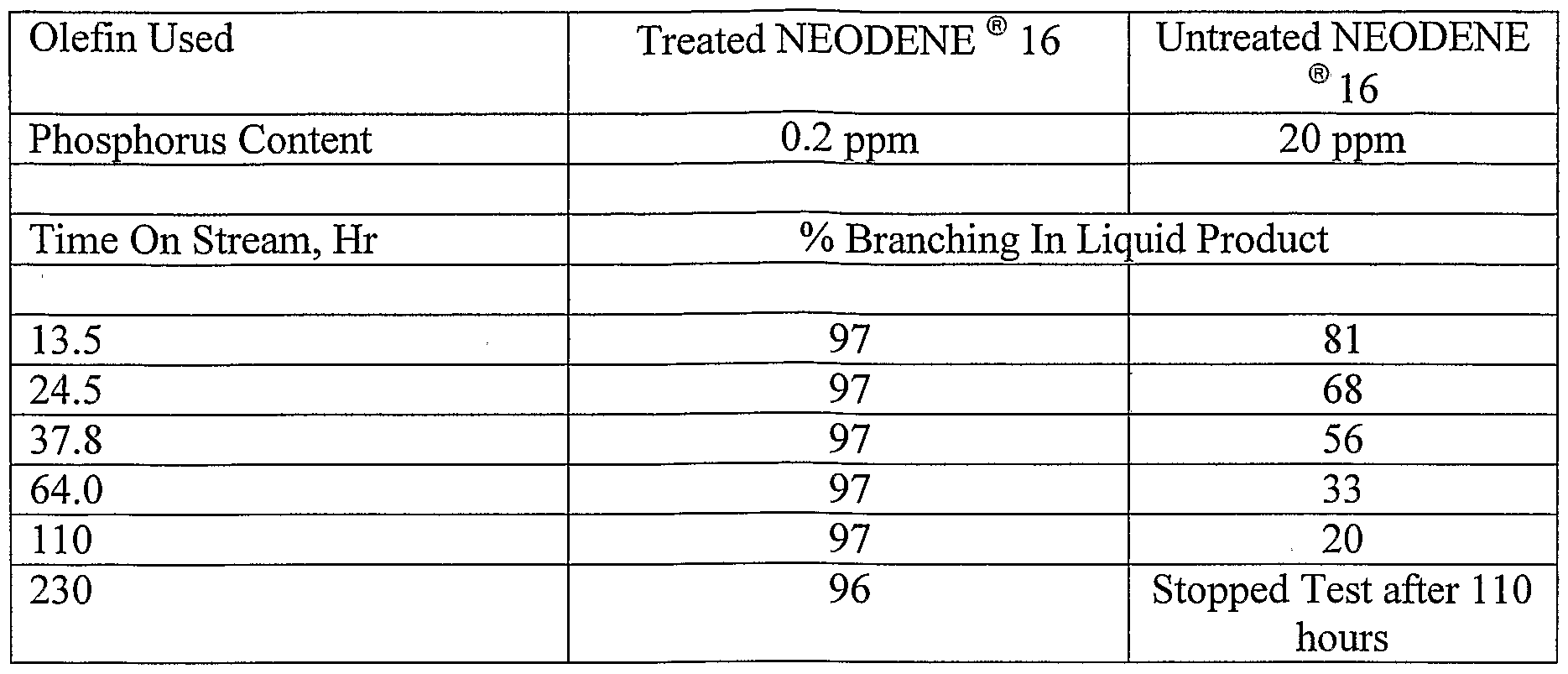
- the phosphorus content of the NEODENE ® 16 olefin was reduced from 20 ppm to 0.2 ppm in the process.
- Example XII A catalyst was prepared in accordance with Example C of US-A-5,510,306, which has been incorporated herein by reference and is reproduced in part herein for convenience.
- An ammonium-ferrierite having a molar silica to alumina ratio of 62: 1, a surface area of 369 square meters per gram (P/Po 0.03), a soda content of 480 ppm and n-hexane sorption capacity of 7.3 g per 100 g of zeolite was used as the starting zeolite.
- the catalyst components were mulled using a Lancaster mix muller. The mulled catalyst material was extruded using a 2.25 inch (5.72 cm) Bonnot pin barrel extruder.
- the catalyst was prepared using 1 weight percent acetic acid and 1 weight percent citric acid.
- the Lancaster mix muller was loaded with 645 grams of ammonium-ferrierite (5.4% LOI) and 91 grams of CATAPAL D ® alumina (LOI of 25.7%). The alumina was blended with the ferrierite for 5 minutes during which time 152 milliliters of de-ionized water was added. A mixture of 6.8 grams glacial acetic acid, 7.0 grams of citric acid and 152 milliliters of de-ionized water was added slowly to the muller in order to peptize the alumina. The mixture was mulled for 10 minutes.
- NEODENE ® 16 olefin with a phosphorus content of 20 ppm and 0.2 ppm was pumped to the reactor at a rate of 60.0 grams per hour, allowed to mix with the incoming nitrogen and then passed through the catalyst bed.
- the inlet pressure was held at 1.6 psig (11 kPa gage) while the outlet pressure of the reactor was maintained at 1.0 psig (6.9 kPa gage).
- the liquid product was collected in a 5 gallon (0.019 m ) vessel while the uncondensed gas was passed through a gas meter. Sampling ports incorporated in the reactor allowed the liquid and gas products to be analyzed regularly. The products were analyzed by gas chromatography. The results of the testing are presented in the following Table 11. TABLE 11 The Effect of the Phosphorus Content in NEODENE ® 16 linear alpha olefin on the Degree of Branching During Skeletal Olefin Isomerization
- Example X The procedures of Example X were repeated using a feed containing 20 ppm P, a NEODENE ® 16 to sorbent weight ratio of 100 using the following sorbents. The results are shown in the following Table 12:
- Example X The procedures of Example X were repeated except the feed contained 16 ppm P. The results are shown in the following Table 13: TABLE 13
- the X-zeolite which contains larger pores than the mordenite, allows for uptake of a greater amount of the bulky phosphorus containing compounds. Also, the load of Ag on the zeolite was higher, which increased the phosphorus uptake. The Ag X-zeolite and the AS SELEXSORBTM both performed very well.
- Example XV A series of tests were performed to illustrate the impact of diene removal on skeletal isomerization of detergent range olefins.
- a glass column with an inner diameter of 50 mm was packed with 150 mesh neutral, activated aluminum oxide (Brockmann I) obtained from Aldrich Chemical Company to produce a bed 400 mm in length.
- the diene content of the mixed C 1 -C 19 olefins was reduced from 270 ppm to 20 ppm in the process.
- the inlet pressure was held at 1.6 psig (11 kPa gage) while the outlet pressure of the reactor was maintained at 1.0 psig (6.9 kPa gage).
- the liquid product was collected in a 5 gallon (0.019 m ) vessel while the uncondensed gas was passed through a gas meter. Sampling ports incorporated in the reactor allowed the liquid and gas products to be analyzed regularly. The products were analyzed by gas chromatography. The results of the testing are presented in Table 14 below.
- the level of branching in the isomerized product was significantly higher when the dienes were first sorbed by passage of the C 14 -C 19 olefins through an alumina bed.
- Example XVI A glass column with an inner diameter of 50 mm was packed with 150 mesh neutral, activated aluminum oxide (Brockmann I) obtained from Aldrich Chemical Company to produce a bed 400 mm in length. 20 L of a mixture of primarily linear C 1 - 19 olefins, obtained from and commercially available from Shell Chemical Company, was passed through the packed bed at a weight hourly space velocity of 0.5 per hour and the liquid effluent was collected in a container purged with nitrogen. The diene content of the mixed C 1 -C 19 olefins was reduced from 270 ppm to 20 ppm in the process.
- Brockmann I activated aluminum oxide
- a glass column with an inner diameter of 50 mm was packed with 150 mesh neutral, activated aluminum oxide (Brockmann I) obtained from Aldrich Chemical Company to produce a bed 400 mm in length.
- Olefins were prepared using the method of Example V and distilled to obtain a mixture of C 1 -C 18 selectively branched olefins.
- the selectively branched olefins were passed through the packed bed at a weight hourly space velocity of 0.1 per hour and the liquid effluent was collected in a container purged with nitrogen.
- the diene content of the selectively branched olefins was reduced from 240 ppm to 24 ppm in the process.
- a conventional type catalyst used for removing (hydrogenating) dienes in pyrolysis gasoline( ⁇ carbon Cs- o) was used to determine hydrogenation specificity.
- the catalyst employed contained (0.5 wt% Pd on alumina).
- the catalyst was used in a trickle- flow reactor at 38° C (100° F), 5 kPa (30 psig), with 25 cc catalyst using a C 13 /C 1 liner olefin feed with approximately 500 ppm dienes and the results are shown in Table 15.
- Example XIX A batch reactor was used to screen a number of different catalysts: 500 ml reactor; 350 ml C 13 /C14 linear olefin feed; 38.33 kPa (230 psig) with 6% H 2 in N ; 1000 rpm; -24° C (75° F). Representative results (paraffin make) are given below in Table 16 for 40% diene removal. TABLE 16
- the in-house developed catalysts were prepared as follows: commercially available alumina powder was obtained from Criterion Catalysts and Technology. The powder was calcined at high temperature from 1100°C to 1300°C to obtain the desired surface of between 14 m2/g and 6 m2/g. The calcined powder was extruded in a typical manner into 2.5 mm trilobe extrudates.
- Example XX Once Hereaus K8327 was identified as a suitable commercially available catalyst, process conditions were varied to optimally balance activity and selectivity.
- the effect of hydrogen flow (GHSV-gas hourly space velocity) for C 13 /C 14 and C n /C 12 linear feeds is given below in Tables 17-19, where the hydrogen was diluted with nitrogen in (6%H /N ).
- GHSV is defined as the vol. feed/vol. cat. hr).
- the range of hydrogen dilution ranged from 2% to 6% and 6% was found preferred.
- Tables 18-19 for two different feed flows of WHSV equal 2 and 1.
- the WHSV is defined by grams feed grams cat. hr).
- results from the C 13 /C 1 feed show that there is an optimal gas flow, above which excess paraffins are made with no significant increase in diene removal (hydrogenation).
- the optimal gas flow also depends on the type of feed used, as shown later. Under the condition above at GHSV equal to 35 for the C 13 /C 1 feed, a longer-term test was performed to check catalyst stability. The test run was carried out for approximately 2000 hr with no significant catalyst performance change.
- Results show that dienes are more easily and selectively hydrogenated in the C ⁇ /C 12 feeds than from the C 13 /C 14 feed.
- One factor affecting activity is the concentration of alpha olefins (AO's), as compared to internal olefins.
- AO's alpha olefins
- High AO feeds ⁇ 20-50%) typically had about 10-20% less hydrogenation respectively and the C ⁇ /C 12 feed had the lowest AO content (-6%).
- Example XXI Initial results on branched feeds are shown below, as determined in a batch reactor. (The conditions of the batch reactor were the same as those given for linear feeds with the Heraeus K8327 catalyst). The feed contained approximately 520 ppm dienes. The results are broken-out depending on the carbon number, as shown below in Table 20.
- dienes can be effectively hydrogenated in branched feeds as well as linear feeds.
- the dienes in lighter feeds were hydrogenated more easily than the dienes in heavier feeds. (Note that by topping the feed, or separating the different olefins based on their carbon number, the lighter components were removed to the degree desired, as is done in the commercial process).
Landscapes
- Chemical & Material Sciences (AREA)
- Organic Chemistry (AREA)
- Chemical Kinetics & Catalysis (AREA)
- Engineering & Computer Science (AREA)
- Analytical Chemistry (AREA)
- Oil, Petroleum & Natural Gas (AREA)
- Water Supply & Treatment (AREA)
- Inorganic Chemistry (AREA)
- General Chemical & Material Sciences (AREA)
- Crystallography & Structural Chemistry (AREA)
- Organic Low-Molecular-Weight Compounds And Preparation Thereof (AREA)
- Low-Molecular Organic Synthesis Reactions Using Catalysts (AREA)
Abstract
Description




Claims
Priority Applications (4)
| Application Number | Priority Date | Filing Date | Title |
|---|---|---|---|
| AU2003256871A AU2003256871A1 (en) | 2002-08-09 | 2003-08-07 | Phosphorous removal and diene removal, when using diene sensitive catalyst, during conversion of olefins to branched primary alcohols |
| MXPA05001455A MXPA05001455A (en) | 2002-08-09 | 2003-08-07 | Phosphorous removal and diene removal, when using diene sensitive catalyst, during conversion of olefins to branched primary alcohols. |
| JP2004527848A JP2006500354A (en) | 2002-08-09 | 2003-08-07 | Phosphorus removal and diene removal during conversion of olefins to branched primary alcohols when using diene-reactive catalysts |
| EP03785008A EP1542950A1 (en) | 2002-08-09 | 2003-08-07 | Phosphorous removal and diene removal, when using diene sensitive catalyst, during conversion of olefins to branched primary alcohols |
Applications Claiming Priority (2)
| Application Number | Priority Date | Filing Date | Title |
|---|---|---|---|
| US10/216,522 | 2002-08-09 | ||
| US10/216,522 US7102038B2 (en) | 2000-05-08 | 2002-08-09 | Phosphorous removal and diene removal, when using diene sensitive catalyst, during conversion of olefins to branched primary alcohols |
Publications (1)
| Publication Number | Publication Date |
|---|---|
| WO2004014826A1 true WO2004014826A1 (en) | 2004-02-19 |
Family
ID=31714291
Family Applications (1)
| Application Number | Title | Priority Date | Filing Date |
|---|---|---|---|
| PCT/US2003/024752 Ceased WO2004014826A1 (en) | 2002-08-09 | 2003-08-07 | Phosphorous removal and diene removal, when using diene sensitive catalyst, during conversion of olefins to branched primary alcohols |
Country Status (9)
| Country | Link |
|---|---|
| US (1) | US7102038B2 (en) |
| EP (1) | EP1542950A1 (en) |
| JP (1) | JP2006500354A (en) |
| CN (1) | CN1678553A (en) |
| AU (1) | AU2003256871A1 (en) |
| MX (1) | MXPA05001455A (en) |
| RU (1) | RU2005106282A (en) |
| WO (1) | WO2004014826A1 (en) |
| ZA (1) | ZA200306106B (en) |
Cited By (10)
| Publication number | Priority date | Publication date | Assignee | Title |
|---|---|---|---|---|
| WO2014160821A1 (en) | 2013-03-28 | 2014-10-02 | The Procter & Gamble Company | Cleaning compositions containing a polyetheramine, a soil release polymer, and a carboxymethylcellulose |
| WO2015148361A1 (en) | 2014-03-27 | 2015-10-01 | The Procter & Gamble Company | Cleaning compositions containing a polyetheramine |
| WO2015148360A1 (en) | 2014-03-27 | 2015-10-01 | The Procter & Gamble Company | Cleaning compositions containing a polyetheramine |
| WO2015187757A1 (en) | 2014-06-06 | 2015-12-10 | The Procter & Gamble Company | Detergent composition comprising polyalkyleneimine polymers |
| WO2016032992A1 (en) | 2014-08-27 | 2016-03-03 | The Procter & Gamble Company | Detergent composition comprising a cationic polymer |
| WO2016032991A1 (en) | 2014-08-27 | 2016-03-03 | The Procter & Gamble Company | Detergent composition comprising a cationic polymer |
| WO2016032995A1 (en) | 2014-08-27 | 2016-03-03 | The Procter & Gamble Company | Method of treating a fabric |
| WO2016032993A1 (en) | 2014-08-27 | 2016-03-03 | The Procter & Gamble Company | Detergent composition comprising a cationic polymer |
| WO2016049388A1 (en) | 2014-09-25 | 2016-03-31 | The Procter & Gamble Company | Fabric care compositions containing a polyetheramine |
| WO2023017794A1 (en) | 2021-08-10 | 2023-02-16 | 株式会社日本触媒 | Polyalkylene-oxide-containing compound |
Families Citing this family (8)
| Publication number | Priority date | Publication date | Assignee | Title |
|---|---|---|---|---|
| US6653514B1 (en) * | 2000-05-08 | 2003-11-25 | Shell Oil Company | Removal of phosphorus-containing impurities from an olefin feedstock |
| US8314277B2 (en) | 2010-06-30 | 2012-11-20 | Uop Llc | Adsorbent for feed and products purification in benzene saturation process |
| US8313641B2 (en) | 2010-06-30 | 2012-11-20 | Uop Llc | Adsorbent for feed and products purification in a reforming process |
| US20120022224A1 (en) * | 2010-07-22 | 2012-01-26 | Geraldine Tosin | Particles Including Zeolite Catalysts And Their Use In Oligomerization Processes |
| EP2986586B1 (en) | 2013-06-28 | 2018-08-08 | Dow Global Technologies LLC | Process for the preparation of a lightly-branched hydrophobe and the corresponding surfactants and applications thereof |
| WO2018128681A1 (en) * | 2016-11-04 | 2018-07-12 | Lyondell Chemical Technology, L.P. | Methods of reducing phosphorus content in liquid hydrocarbons |
| EP3623452A1 (en) | 2018-09-14 | 2020-03-18 | Lyondell Chemical Technology, L.P. | Phosphorus removal and alkylate production |
| CN116063587B (en) * | 2022-12-07 | 2025-05-30 | 宁波工程学院 | Catalytic hydrogenation method of carbon five resin |
Citations (3)
| Publication number | Priority date | Publication date | Assignee | Title |
|---|---|---|---|---|
| US4717785A (en) * | 1986-12-10 | 1988-01-05 | Shell Oil Company | Removal of phosphine impurities from higher olefins |
| WO2001085651A2 (en) * | 2000-05-08 | 2001-11-15 | Shell Internationale Research Maatschappij B.V. | Process for preparation of selectively branched detergent products |
| WO2001085654A2 (en) * | 2000-05-08 | 2001-11-15 | Shell Internationale Research Maatschappij B.V. | Removal of phosphorus-containing compounds from an olefin feedstock |
Family Cites Families (23)
| Publication number | Priority date | Publication date | Assignee | Title |
|---|---|---|---|---|
| JPS4928163B1 (en) | 1970-01-26 | 1974-07-24 | ||
| FR2077907A1 (en) | 1970-02-23 | 1971-11-05 | Inst Francais Du Petrole | |
| US3686351A (en) * | 1971-07-16 | 1972-08-22 | Shell Oil Co | Alpha-olefin production |
| US3676523A (en) * | 1971-07-16 | 1972-07-11 | Shell Oil Co | Alpha-olefin production |
| US3737475A (en) * | 1972-08-17 | 1973-06-05 | Shell Oil Co | Alpha-olefin production |
| US3825615A (en) * | 1973-09-24 | 1974-07-23 | Shell Oil Co | Ethylene oligomerization process |
| CA1064890A (en) * | 1975-06-10 | 1979-10-23 | Mae K. Rubin | Crystalline zeolite, synthesis and use thereof |
| US4020121A (en) * | 1975-12-15 | 1977-04-26 | Shell Oil Company | Oligomerization reaction system |
| JPS54103806A (en) * | 1978-01-30 | 1979-08-15 | Nissan Chem Ind Ltd | New higher alcohol composition |
| US4351980A (en) | 1979-05-22 | 1982-09-28 | Phillips Petroleum Company | Removal of olefin from aliphatic hydrocarbon by treatment with active solid |
| US4551443A (en) | 1984-11-27 | 1985-11-05 | Shell Oil Company | Catalysts for the selective hydrogenation of acetylenes |
| US5072057A (en) | 1986-10-03 | 1991-12-10 | Exxon Research & Engineering Co. | Process for the hydroformylation of sulfur-containing thermally cracked petroleum residue and novel products thereof |
| US5112519A (en) * | 1989-06-05 | 1992-05-12 | Mobil Oil Corporation | Process for production of biodegradable surfactants and compositions thereof |
| FR2652280B1 (en) | 1989-09-22 | 1991-11-29 | Air Liquide | PROCESS FOR THE REMOVAL OF GASEOUS HYDRIDES ON A SOLID SUPPORT BASED ON METAL OXIDES. |
| ES2119905T3 (en) | 1992-12-08 | 1998-10-16 | Abbott Lab | EXTRACTION OF THE PHOSPHORUS FROM MAMMALIAN MILK BY ION EXCHANGE. |
| US5510306A (en) * | 1993-12-29 | 1996-04-23 | Shell Oil Company | Process for isomerizing linear olefins to isoolefins |
| DE69720235T2 (en) | 1996-09-11 | 2004-02-12 | Süd-Chemie Catalysts Japan, Inc. | CATALYST FOR SELECTIVE HYDROGENATION OF MULTIPLE UNSATURATED HYDROCARBON IN AN OLEFINE COMPOUND |
| ES2214650T3 (en) * | 1996-11-26 | 2004-09-16 | Shell Internationale Research Maatschappij B.V. | COMPOSITIONS OF HIGHLY RAMIFIED PRIMARY ALCOHOL, AND BIODEGRADABLE DETERGENTS PREPARED FROM THEM. |
| US5780694A (en) * | 1996-11-26 | 1998-07-14 | Shell Oil Company | Dimerized alcohol compositions and biodegradible surfactants made therefrom having cold water detergency |
| US5849960A (en) * | 1996-11-26 | 1998-12-15 | Shell Oil Company | Highly branched primary alcohol compositions, and biodegradable detergents made therefrom |
| EP0903333B1 (en) | 1997-09-18 | 2001-11-07 | Shell Internationale Researchmaatschappij B.V. | Hydroformylation process |
| US6653514B1 (en) * | 2000-05-08 | 2003-11-25 | Shell Oil Company | Removal of phosphorus-containing impurities from an olefin feedstock |
| US6388162B1 (en) | 2000-05-08 | 2002-05-14 | Shell Oil Company | Diene removal from an olefin feedstock |
-
2002
- 2002-08-09 US US10/216,522 patent/US7102038B2/en not_active Expired - Fee Related
-
2003
- 2003-08-07 EP EP03785008A patent/EP1542950A1/en not_active Withdrawn
- 2003-08-07 WO PCT/US2003/024752 patent/WO2004014826A1/en not_active Ceased
- 2003-08-07 AU AU2003256871A patent/AU2003256871A1/en not_active Abandoned
- 2003-08-07 CN CN03820856.3A patent/CN1678553A/en active Pending
- 2003-08-07 RU RU2005106282/04A patent/RU2005106282A/en not_active Application Discontinuation
- 2003-08-07 JP JP2004527848A patent/JP2006500354A/en active Pending
- 2003-08-07 MX MXPA05001455A patent/MXPA05001455A/en unknown
- 2003-08-07 ZA ZA200306106A patent/ZA200306106B/en unknown
Patent Citations (3)
| Publication number | Priority date | Publication date | Assignee | Title |
|---|---|---|---|---|
| US4717785A (en) * | 1986-12-10 | 1988-01-05 | Shell Oil Company | Removal of phosphine impurities from higher olefins |
| WO2001085651A2 (en) * | 2000-05-08 | 2001-11-15 | Shell Internationale Research Maatschappij B.V. | Process for preparation of selectively branched detergent products |
| WO2001085654A2 (en) * | 2000-05-08 | 2001-11-15 | Shell Internationale Research Maatschappij B.V. | Removal of phosphorus-containing compounds from an olefin feedstock |
Cited By (11)
| Publication number | Priority date | Publication date | Assignee | Title |
|---|---|---|---|---|
| WO2014160821A1 (en) | 2013-03-28 | 2014-10-02 | The Procter & Gamble Company | Cleaning compositions containing a polyetheramine, a soil release polymer, and a carboxymethylcellulose |
| WO2014160820A1 (en) | 2013-03-28 | 2014-10-02 | The Procter & Gamble Company | Cleaning compositions containing a polyetheramine |
| WO2015148361A1 (en) | 2014-03-27 | 2015-10-01 | The Procter & Gamble Company | Cleaning compositions containing a polyetheramine |
| WO2015148360A1 (en) | 2014-03-27 | 2015-10-01 | The Procter & Gamble Company | Cleaning compositions containing a polyetheramine |
| WO2015187757A1 (en) | 2014-06-06 | 2015-12-10 | The Procter & Gamble Company | Detergent composition comprising polyalkyleneimine polymers |
| WO2016032992A1 (en) | 2014-08-27 | 2016-03-03 | The Procter & Gamble Company | Detergent composition comprising a cationic polymer |
| WO2016032991A1 (en) | 2014-08-27 | 2016-03-03 | The Procter & Gamble Company | Detergent composition comprising a cationic polymer |
| WO2016032995A1 (en) | 2014-08-27 | 2016-03-03 | The Procter & Gamble Company | Method of treating a fabric |
| WO2016032993A1 (en) | 2014-08-27 | 2016-03-03 | The Procter & Gamble Company | Detergent composition comprising a cationic polymer |
| WO2016049388A1 (en) | 2014-09-25 | 2016-03-31 | The Procter & Gamble Company | Fabric care compositions containing a polyetheramine |
| WO2023017794A1 (en) | 2021-08-10 | 2023-02-16 | 株式会社日本触媒 | Polyalkylene-oxide-containing compound |
Also Published As
| Publication number | Publication date |
|---|---|
| RU2005106282A (en) | 2006-02-27 |
| CN1678553A (en) | 2005-10-05 |
| US20030149313A1 (en) | 2003-08-07 |
| AU2003256871A1 (en) | 2004-02-25 |
| MXPA05001455A (en) | 2005-06-06 |
| ZA200306106B (en) | 2004-06-14 |
| EP1542950A1 (en) | 2005-06-22 |
| JP2006500354A (en) | 2006-01-05 |
| US7102038B2 (en) | 2006-09-05 |
Similar Documents
| Publication | Publication Date | Title |
|---|---|---|
| US7102038B2 (en) | Phosphorous removal and diene removal, when using diene sensitive catalyst, during conversion of olefins to branched primary alcohols | |
| EP1680387B1 (en) | Preparation of branched aliphatic alcohols using a process stream from a dehydrogenation-isomerization unit | |
| US6566565B1 (en) | Process for preparation of selectively branched detergent products | |
| AU2001262269A1 (en) | Process for preparation of selectively branched detergent products | |
| EP0703888A1 (en) | Process for reducing the degree of branching of branched olefins | |
| AU772929B2 (en) | Removal of phosphorus-containing impurities from an olefin feedstock | |
| CN100447115C (en) | Process for the preparation of branched olefins from linear olefin/paraffin feedstocks | |
| ZA200602828B (en) | Preparation of branched aliphatic alcohols using combined process streams from a hydrogenation unit and a dehydrogenation-isomerization unit | |
| US6492568B1 (en) | Removal of phosphorus-containing compounds from an olefin feedstock | |
| CA2408205A1 (en) | Diene removal from an olefin feedstock |
Legal Events
| Date | Code | Title | Description |
|---|---|---|---|
| AK | Designated states |
Kind code of ref document: A1 Designated state(s): AE AG AL AM AT AU AZ BA BB BG BR BY BZ CA CH CN CO CR CU CZ DE DK DM DZ EC EE ES FI GB GD GE GH GM HR HU ID IL IN IS JP KE KG KP KR KZ LC LK LR LS LT LU LV MA MD MG MK MN MW MX MZ NI NO NZ OM PG PH PL PT RO RU SC SD SE SG SK SL SY TJ TM TN TR TT TZ UA UG US UZ VC VN YU ZA ZM ZW |
|
| AL | Designated countries for regional patents |
Kind code of ref document: A1 Designated state(s): GH GM KE LS MW MZ SD SL SZ TZ UG ZM ZW AM AZ BY KG KZ MD RU TJ TM AT BE BG CH CY CZ DE DK EE ES FI FR GB GR HU IE IT LU MC NL PT RO SE SI SK TR BF BJ CF CG CI CM GA GN GQ GW ML MR NE SN TD TG |
|
| 121 | Ep: the epo has been informed by wipo that ep was designated in this application | ||
| WWE | Wipo information: entry into national phase |
Ref document number: 2003256871 Country of ref document: AU |
|
| WWE | Wipo information: entry into national phase |
Ref document number: PA/a/2005/001455 Country of ref document: MX |
|
| WWE | Wipo information: entry into national phase |
Ref document number: 2004527848 Country of ref document: JP |
|
| WWE | Wipo information: entry into national phase |
Ref document number: 2003785008 Country of ref document: EP |
|
| WWE | Wipo information: entry into national phase |
Ref document number: 20038208563 Country of ref document: CN |
|
| ENP | Entry into the national phase |
Ref document number: 2005106282 Country of ref document: RU Kind code of ref document: A |
|
| WWP | Wipo information: published in national office |
Ref document number: 2003785008 Country of ref document: EP |