WO2004016614A2 - Pyrrolopyrazines as kinase inhibitors - Google Patents

Pyrrolopyrazines as kinase inhibitors Download PDF

Info

Publication number
WO2004016614A2
WO2004016614A2 PCT/EP2003/009515 EP0309515W WO2004016614A2 WO 2004016614 A2 WO2004016614 A2 WO 2004016614A2 EP 0309515 W EP0309515 W EP 0309515W WO 2004016614 A2 WO2004016614 A2 WO 2004016614A2
Authority
WO
WIPO (PCT)
Prior art keywords
alkyl
alkoxy
pyrrolo
hal
derivatives
Prior art date
Legal status (The legal status is an assumption and is not a legal conclusion. Google has not performed a legal analysis and makes no representation as to the accuracy of the status listed.)
Ceased
Application number
PCT/EP2003/009515
Other languages
French (fr)
Other versions
WO2004016614A3 (en
Inventor
Laurent Meijer
Jean-Michel Vierfond
Yvette Mettey
Current Assignee (The listed assignees may be inaccurate. Google has not performed a legal analysis and makes no representation or warranty as to the accuracy of the list.)
Centre National de la Recherche Scientifique CNRS
Original Assignee
Centre National de la Recherche Scientifique CNRS
Priority date (The priority date is an assumption and is not a legal conclusion. Google has not performed a legal analysis and makes no representation as to the accuracy of the date listed.)
Filing date
Publication date
Application filed by Centre National de la Recherche Scientifique CNRS filed Critical Centre National de la Recherche Scientifique CNRS
Priority to CA2495060A priority Critical patent/CA2495060C/en
Priority to AU2003271566A priority patent/AU2003271566A1/en
Priority to EP03753362A priority patent/EP1527077A2/en
Priority to JP2004528508A priority patent/JP4780549B2/en
Priority to US10/524,044 priority patent/US8106050B2/en
Publication of WO2004016614A2 publication Critical patent/WO2004016614A2/en
Publication of WO2004016614A3 publication Critical patent/WO2004016614A3/en
Anticipated expiration legal-status Critical
Ceased legal-status Critical Current

Links

Classifications

    • CCHEMISTRY; METALLURGY
    • C07ORGANIC CHEMISTRY
    • C07DHETEROCYCLIC COMPOUNDS
    • C07D487/00Heterocyclic compounds containing nitrogen atoms as the only ring hetero atoms in the condensed system, not provided for by groups C07D451/00 - C07D477/00
    • C07D487/02Heterocyclic compounds containing nitrogen atoms as the only ring hetero atoms in the condensed system, not provided for by groups C07D451/00 - C07D477/00 in which the condensed system contains two hetero rings
    • C07D487/04Ortho-condensed systems
    • AHUMAN NECESSITIES
    • A61MEDICAL OR VETERINARY SCIENCE; HYGIENE
    • A61PSPECIFIC THERAPEUTIC ACTIVITY OF CHEMICAL COMPOUNDS OR MEDICINAL PREPARATIONS
    • A61P25/00Drugs for disorders of the nervous system
    • A61P25/14Drugs for disorders of the nervous system for treating abnormal movements, e.g. chorea, dyskinesia
    • A61P25/16Anti-Parkinson drugs
    • AHUMAN NECESSITIES
    • A61MEDICAL OR VETERINARY SCIENCE; HYGIENE
    • A61PSPECIFIC THERAPEUTIC ACTIVITY OF CHEMICAL COMPOUNDS OR MEDICINAL PREPARATIONS
    • A61P25/00Drugs for disorders of the nervous system
    • A61P25/28Drugs for disorders of the nervous system for treating neurodegenerative disorders of the central nervous system, e.g. nootropic agents, cognition enhancers, drugs for treating Alzheimer's disease or other forms of dementia
    • AHUMAN NECESSITIES
    • A61MEDICAL OR VETERINARY SCIENCE; HYGIENE
    • A61PSPECIFIC THERAPEUTIC ACTIVITY OF CHEMICAL COMPOUNDS OR MEDICINAL PREPARATIONS
    • A61P33/00Antiparasitic agents
    • AHUMAN NECESSITIES
    • A61MEDICAL OR VETERINARY SCIENCE; HYGIENE
    • A61PSPECIFIC THERAPEUTIC ACTIVITY OF CHEMICAL COMPOUNDS OR MEDICINAL PREPARATIONS
    • A61P35/00Antineoplastic agents
    • AHUMAN NECESSITIES
    • A61MEDICAL OR VETERINARY SCIENCE; HYGIENE
    • A61PSPECIFIC THERAPEUTIC ACTIVITY OF CHEMICAL COMPOUNDS OR MEDICINAL PREPARATIONS
    • A61P43/00Drugs for specific purposes, not provided for in groups A61P1/00-A61P41/00
    • AHUMAN NECESSITIES
    • A61MEDICAL OR VETERINARY SCIENCE; HYGIENE
    • A61PSPECIFIC THERAPEUTIC ACTIVITY OF CHEMICAL COMPOUNDS OR MEDICINAL PREPARATIONS
    • A61P9/00Drugs for disorders of the cardiovascular system

Definitions

  • the invention relates to derivatives of pyrrolo- pyrazines having a kinase inhibitory activity and their biological applications.
  • Protein kinases catalyse the phosphorylation of serine, threonine and tyrosine residues of proteins, using ATP or GTP as the phosphate donor. Protein phosphorylation is considered as one of the main post- translational mechanisms used by cells to finely tune their metabolic and regulatory pathways.
  • Protein kinases (an estimated 800 in the human genome) , and their counterparts the protein phosphatases, appear to be involved in most human diseases. This is the reason why screening for potent and selective inhibitors of protein kinases has intensified over the last few years.
  • CDKs cyclin-dependent kinases
  • GSK-3 glycogen synthase kinase-3
  • CDKs are involved in controlling the cell cycle, apoptosis, neuronal functions and neurodegeneration, transcription and exocytosis.
  • GSK-3 an essential element of the NT signaling pathway, is involved in multiple physiological processes including cell cycle regulation by controlling the levels of cyclin Dl and ⁇ -catenin, dorso-ventral patterning during development, insulin action on glycogen synthesis, axonal outgrowth, HIV-1 Tat-mediated neurotoxicity, and phosphorylation of tau, a characteristic of Alzheimer's disease.
  • Applications of CDK/GSK-3 inhibitors are being evaluated against cancers, neurodegenerative disorders such as Alzheimer's disease, diabetes, proliferation of protozoan parasites and viral infections (HIV, cytomegalovirus and herpes virus) (1) .
  • CDK inhibitors include the purines olomoucine, roscovitine, purvalanols, CVT-313, C2-alkylynated purines, H717 and NU2058, piperidine-substituted purines, toyocamycin, flavopiridol, indirubins, paullones, ⁇ -butyrolactone, hymenialdisine, mdenopyrazoles, the pyrimidmes NU6027 and CGP60474, pyridopyri idine, the aminopyrimidine PNU 112455A, oxindoles, PD0183812, cinnamaldehydes, quinazolines, fasclaplysin, SU9516 and benzocarbazoles (reviewed in ref. 1, 2-8).
  • GSK-3 inhibitors include indirubins, paullones, aleimides and lithium.
  • the inventors have now identified a new family of kinase inhibitors selective for CDKl/2/5 and GSK-3 ⁇ / ⁇ , acting in the sub-micromolar range by competing with ATP for binding to the kinase active site, as revealed by enzymological studies and crystal structure studies.
  • Said family has a therapeutical value in pathological situations involving CDKs and/or GSK-3 / ⁇ deregulations.
  • the invention thus relates to novel derivatives of pyrrolo-pyrazines . It also relates to a method for preparing said derivatives .
  • the invention relates to the use of said derivatives as active principle of drugs.
  • pyrrolo [2, 3b]-pyrazine derivatives of the invention have the general formula (I) :
  • R2 and R3 are identical or different and represent
  • C1-C6 alkyl said alkyl being a straight or branched - chain alkyl, which can be substituted
  • - R6 is an optionally substituted aromatic cycle Ar or a cycloalkyl, said cycloalkyl being optionally substituted by an aryl group which can also be substituted
  • CH 2 -cycloalkyl, CH 2 -Ar, - Z is H or CH 3 .
  • R2 and R3, and/or Z and/or R7 are different from H.
  • Ar is preferably phenyl, naphtyl, furyl, thienyl, pyridyl, cyclopropyl phenyl, phenyl dioxolyl.
  • Cycloalkyl is a C3-C6 cycloalkyl.
  • Substitutions of the alkyl group, aromatic cycle or cycloalkyl are selected in the group comprising one or more halogen (F,C1, Br, I, CF 3 ) , OH, NH 2 , N (H, alkyl), N (alkyl) 2 , O-alkyl, COOH, COO-alkyl, CONH 2 , CON (H, alkyl) , CON (alkyl) 2 , NHCONH 2/ NHCON (H, alkyl) , NHCON (alkyl) 2 , N (alkyl) CONH 2 , N (alkyl) CO (H, alkyl) , N (alkyl) CO (alkyl) 2 , alkoxy, CN, 0-S0 2 - NH 2 0-S0 2 -N (H, alkyl) ,-0-S0 2 -N (alkyl) 2 , SH,S-alkyl.
  • One or more substituents can be present.
  • Alk is a C1-C6 alkylene group, n is 1-6, and "hal.” is F, CI, Br, I or CF 3 .
  • Said pyrrolo [2,3-b] pyrazines are potent kinase inhibitory scaffold, and selective for CDKs and GSK-3 ⁇ / ⁇ , acting for most of them in the sub- icromolar range.
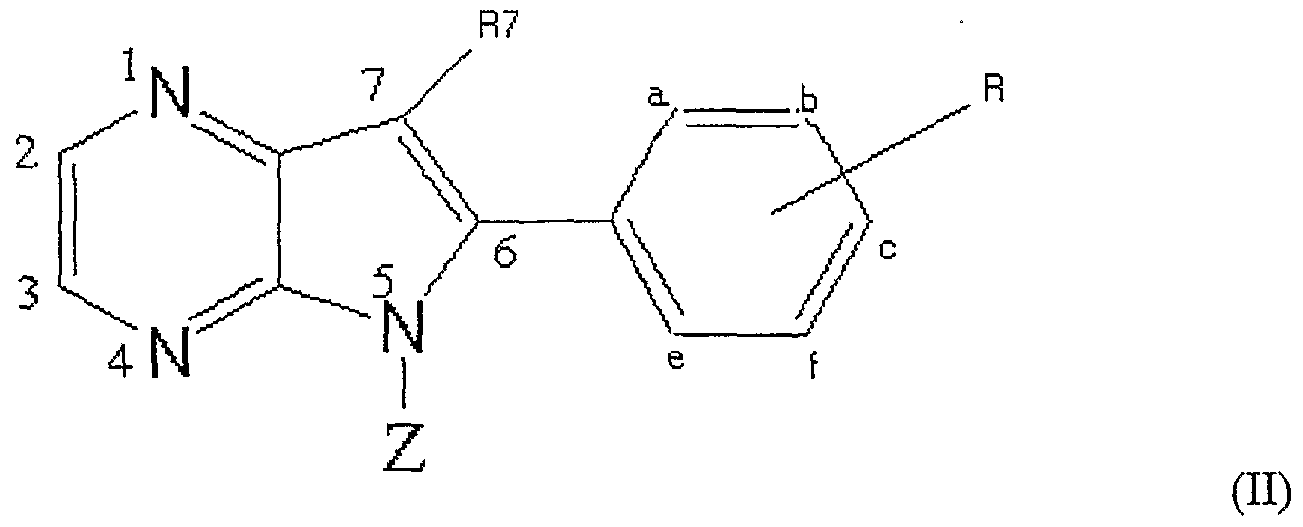
  • Preferred derivatives of pyrrolo-pyrazines have formula (ID :
  • Z is H or CH 3 .
  • Z and/or R7 are different from H.
  • a preferred group of said family has an IC 5 o value ⁇ lO ⁇ M with respect to correspond to CDKl/cyclin B, CDK5/p25 and GSK-3. They correspond to the derivatives of formula (II) wherein
  • a more preferred group of said family of formula (II) has an IC 5 0 value ⁇ 5 ⁇ M with respect to CDKl/cyclin B, CDK5/p25 and GSK-3.
  • Ra, Rb and Rd H
  • Ra, Rb and Rd H
  • a still more preferred group of said family of formula (II) has an IC 50 ⁇ l ⁇ M with respect to CDKl/cyclin B, CDK5/p25 and GSK-3.
  • the derivatives have an IC50 ⁇ 0.5 ⁇ M with respect to CDKl/cyclin B, CDK5/p25 and GSK-3.
  • Another preferred group of said family of formula (II) has an IC 50 value ⁇ lO ⁇ M with respect to CDKl/cyclin B and CDK5/p25 or GSK-3, or to CDK5/p25 and GSK-3.
  • the invention particularly relates to the group with derivatives having an IC 50 ⁇ lO ⁇ M with respect to CDK5/p25 and GSK-3.
  • Preferred derivatives of said group have an IC 50 value 5 ⁇ M with respect to CDK5/p25 and GSK-3.
  • Still more preferred derivatives have an IC 50 ⁇ 0.5 ⁇ M with respect to CDK5/p25 and GSK-3.
  • the derivatives have an IC 50 ⁇ lO ⁇ M with respect to CDK1 and GSK3.
  • the derivatives have an IC 50 ⁇ 5 ⁇ M with respect to CDK1 and GSK-3.
  • Ra, Rb and Rd H
  • Re alkoxy, OH, hal., alkyl
  • CN and R7 H
  • Ra, Rb, Rd H
  • the derivatives have an IC 5 o value ⁇ I ⁇ M with respect to CDKl and GSK-3.
  • the derivatives have an IC 50 value ⁇ 0.5 ⁇ M with respect to CDKl/cyclin B and GSK-3.
  • the invention also relates to the group with derivatives having an IC 50 ⁇ lO ⁇ M with respect to CDKl/cyclin B and CDK5/p25.
  • Preferred derivatives have an IC 5 0 ⁇ 5 ⁇ M with respect to CDKl/cyclin B and GSK-3.
  • the derivatives have an IC 50 ⁇ l ⁇ M with respect to CDKl/cyclin B and GSK-3.
  • the derivatives have an IC 50 ⁇ 0.5 ⁇ M with respect to CDKl/cyclin B and GSK-3.
  • Ra, Rb, and Rd H
  • Re alkoxy or OH
  • R7 alkyl
  • Another preferred family with an IC 50 ⁇ lO ⁇ M with respect to CDKl/cylein B, CDK5 and GSK-3 has formula (III), and even ⁇ 5 ⁇ M with respect to CDK5/p25 and GSK-3.
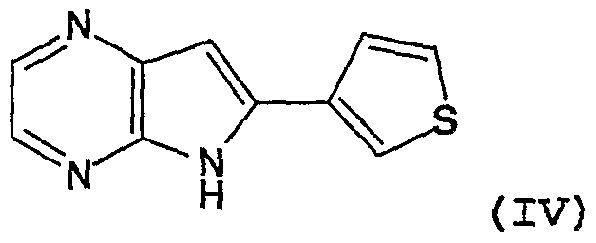
  • Still another preferred family has formula IV with an IC5 0 ⁇ 5 ⁇ M with respect to CDKl/cyclin B, CDK5/p25 and
  • Said derivatives have interestingly an IC 50 value ⁇ l ⁇ M with respect to CDK5/p25 and GSK-3.
  • the invention also relates to a method for preparing said aloisines comprising reacting alkyl-pyrazines of formula (V) :
  • Rl and R3 are as above defined, and Alkyl is a C1-C6 alkyl, ith aromatic nitriles, R ⁇ CN, wherein R ⁇ is as above defined.
  • the alkylpyrazine derivatives of formula (V) are added to an organic solvent containing butyllithium or analog, at a temperature not exceeding 0°C and preferably of about -40°C.
  • the resulting solution is stirred during 30 in to about lh.
  • the nitrile derivative is then added and the solution is stirred during 30 min to about lh, and further at the ambient (around 20°C) for about 1 to 20h.
  • Alkylpyrazines can be obtained by reaction of pyrazinylmethyllithium with bromoalcanes, and benzonitriles. Demethylation of methoxy compounds can be achieved by refluxing in acidic conditions. The time required for demethylation varied from 3-20 h. As above mentioned, and as illustrated in the Examples hereinafter, said compounds strongly inhibit CDKl and/or CDK5 and/or GSK-3.
  • the invention thus relates to pharmaceutical compositions comprising an effective amount of at least one derivative as above defined as active principle in association with a pharmaceutically acceptable carrier.
  • Said carrier may be solid, or liquid, depending on the administration form.
  • Said pharmaceutical compositions are useful for treating or preventing, neurodegenerative disorders such as Alzheimer's disease or Parkison's diseases. They are also useful for treating invention also relates to the use of said pharmaceutical compositions for treating proliferative disorders such as cancers, or the proliferation of unicellular or pluricellular parasites. Other applications comprise the use of said pharmaceutical compositions against cardiovascular disorders linked to proliferation. They also comprise their use for treating viral injections (HIV, cytomegalovirus and herpes virus. The invention also relates to the use of said derivatives as herbicides.
  • Said pharmaceutical compositions can be administered in various forms e.g. orally, topically, by injection (intravenously, subcutaneously, intraperitoneally, or rectally) . They are more particularly administered by the oral route.
  • compositions For administration by the oral route, lozenges, compressed tablets, pills, tablets, capsules, drops, syrups, suspensions or emulsions, may be used. These compositions advantageously comprise 100 to 1000 g of active principle per dose unit, preferably 300 to 600 mg.
  • injectable solutions for the intravenous, subcutaneous or intramuscular route formulated from sterile or sterilizable solutions. They can also be suspensions or emulsions.
  • injectable forms comprise 100 to 1000 mg of active principle preferably 300 to 600 mg, per dose unit.
  • the dosage which can be used in a patient in need thereof corresponds to the following doses : for example, 100 to 1000 mg/day are thus administered to the patient 1 to 4 times per day for the treatment of neurodegenerative disorders.
  • the invention also relates to biological reagents, the 5. active principles of which consist of the compounds of formula (I) as above-defined.
  • FIG. 1 CDKl/cyclin B, CDK5/p25 and GSK-3 ⁇ inhibition results with aloisines of the invention
  • figures 2A to 2C enzyme activities for aloisine A 5 in the presence of ATP (CDl/cyclin B : figure 2A ; CDK5/p25 : figure 2B, and GSK-3 ⁇ : figure 2C)
  • figure 3 stereo view of the interactions between aloisine B and the CDK2 ATP binding site
  • figures 4A to 4E reversible inhibition of 0 exponential cell growth by aloisine A, and figure 5, the comparison of the effects of aloisine A on G0/G1 (A, B, C) and G2/M (D, E, F)
  • the organic layer was dried over Na 2 S0 4 , and concentrated under vacuum.
  • the crude product was chromatographied on silicagel, eluted with ethylene chloride, then ethyl acetate. If necessary the product was crystallized from ethanol or methylene chloride-ethanol mixture .
  • hydrobromic acid was redistilled over a trace of 50% hypophosphorus acid: 1 g for each 100 g of 48% hydrobromic acid.
  • Methoxy compound (0.003 mol) was heated with hydrobromic acid (20 ml) . After removal of the aqueous forerun, the temperature reaches 126 °C. The time required for demethylation varies from 3-10 h. The excess of hydrobromic acid was removed under reduced pressure, and the crude product was crystallised from ethanol .
  • [ ⁇ - 32 P]-ATP (PB 168) was obtained from Amersham.
  • the GS-1 peptide has sequence SEQ ID N°l YRRAAVPPSPSLSRHSSPHQSpEDEEE.
  • Ho ogenization Buffer 60 mM ⁇ -glycerophosphate, 15 mM p-nitrophenylphosphate, 25 mM Mops (pH 7.2), 15 mM EGTA, 15 mM MgCl 2 , 1 mM DTT, 1 mM sodium vanadate, 1 mM NaF, 1 mM phenylphosphate, 10 ⁇ g leupeptin/ml, 10 ⁇ g aprotinin/ml, 10 ⁇ g soybean trypsin inhibitor/ml and 100 ⁇ M benzamidine.
  • Buffer A 10 mM MgCl 2 , 1 mM EGTA, 1 mM DTT, 25 mM Tris- HC1 pH 7.5, 50 ⁇ g heparin/ l.
  • Buffer C homogenization buffer but 5 mM EGTA, no NaF and no protease inhibitors.
  • Tris-Buffered Saline -Tween-20 50 mM Tris pH 7.4, 150 mM NaCl, 0.1% Tween-20.
  • Hypotonic Lysis Buffer 50 mM Tris-HCl pH 7.4, 120 mM NaCl, 10 % glycerol, 1 % Nonidet-P40, 5 mM DTT, 1 mM EGTA, 20 mM NaF, 1 mM orthovanadate, 5 ⁇ M microcystin, 100 ⁇ g/ml each of leupeptin, aprotinin and pepstatin.
  • kinases activities were assayed in Buffer A or C (unless otherwise stated), at 30 °C, at a final ATP concentration of 15 ⁇ M. Blank values were subtracted and activities calculated as pmoles of phosphate incorporated for a 10 min. incubation. The activities are usually expressed in % of the maximal activity, i.e. in the absence of inhibitors. Controls were performed with appropriate dilutions of dimethylsulfoxide. In a few cases phosphorylation of the substrate was assessed by autoradiography after SDS-PAGE.
  • GSK-3 ⁇ / ⁇ was either purified from porcine brain or expressed in and purified from insect Sf9 cells. It was assayed, following a 1/100 dilution in 1 mg BSA/ml 10 mM DTT, with 5 ⁇ l 40 ⁇ M GS-1 peptide as a substrate, in buffer A, in the presence of 15 ⁇ M [ ⁇ - 32 P] ATP (3,000 Ci/mmol; 1 Ci/ml) in a final volume of 30 ⁇ l. After 30 min. incubation at 30 °C, 25 ⁇ l aliquots of supernatant were spotted onto 2.5 x 3 cm pieces of Whatman P81 phosphocellulose paper, and, 20 sec. later, the filters were washed five times (for at least 5 min. each time) in a solution of 10 ml phosphoric acid/liter of water. The wet filters were counted in the presence of 1 ml ACS (Amersham) scintillation fluid.
  • CDKl/cyclin B was extracted in homogenisation buffer from M phase starfish (2Vfart asterias glacialis) oocytes and purified by affinity chromatography on p9 CKShsl -sepharose beads, from which it was eluted by free p9 CKShsl .
  • the kinase activity was assayed in buffer C, with 1 mg histone HI /ml,
  • CDK5/p25 was reconstituted by mixing equal amounts of recombinant mammalian CDK5 and p25 expressed in E. coli as
  • GST Glutathione-S-transferase fusion proteins and purified by affinity chromatography on glutathione-agarose (p25 is a truncated version of p35, the 35 kDa CDK5 activator) . Its activity was assayed in buffer C as described for CDKl/cyclin B.
  • IC 50 ' s were calculated from the dose-response curves and are given in Table 1 hereinafter in ⁇ M.
  • Table 1 (continued) . Structure activity relationship of aloisine-related compounds .
  • Figure 1 gives the results obtained in the presence of increasing concentrations of aloisines A and B. Activity is presented as % of maximal activity, i.e. measured in the absence of inhibitors.
  • Aloisine is a competitive inhibitor of ATP binding
  • Human CDK2 was expressed from a recombinant baculo-virus in Sf9 insect cells and purified. Monomeric unphosphorylated CDK2 crystals were grown as previously described in (11) .
  • the CDK2-aloisine B dataset was collected from a monomeric CDK2 crystal soaked for 60 h in ImM aloisine B in 1 x mother liquor solution (50 mM ammonium acetate, 10% PEG3350, 15 mM NaCl, 100 mM HEPES, pH7.4) plus 5% DMSO. Data was collected on beamline X-RAY DIFFRACTION at the Elettra Light Source at 100K after the crystal had been transferred briefly to cryo-protectant (mother liquor adjusted to contain 20% glycerol) . The images were integrated with the MOSFLM package (12) and reflections were subsequently scaled and merged using SCALA (13) . Subsequent data reduction and structure refinement were pursued through programs of the CCP4 suite.
  • Aloisine B occupies the CDK2 ATP binding site and makes two hydrogen bonds to the CDK2 backbone within the hinge sequence that links the two lobes of the kinase.
  • CDK2 is drawn in ribbon representation and colour-ramped from blue through to red starting at the N-terminus.
  • the N-terminal lobe is dominated by a 5-stranded anti-parallel ⁇ -sheet and the C-terminal lobe is predominantly -helical.
  • Aloisine B is drawn in ball and stick mode bound at the ATP-binding site which lies in the cleft between the two domains.
  • Aloisine B carbon atoms are coloured cyan, nitrogen atoms blue and the chlorine atom is drawn in yellow.
  • aloisine B does not interact with the backbone oxygen of Glu ⁇ l, but instead accepts and donates a hydrogen bond respectively from the backbone nitrogen and oxygen atoms of Leu 83 (Fig. 3) : residues that lie within 4A of the bound aloisine B molecule are drawn in ball and stick mode.
  • Aloisine B carbon atoms are drawn in cyan and those of CDK2 in green.
  • Oxygen atoms are coloured red, nitrogen atoms are blue and the chlorine atom is drawn in yellow.
  • Dotted lines represent hydrogen bonds (d 0->N or dN-O ⁇ 3.4 A) between aloisine B and the backbone nitrogen and oxygen atoms of Leu 83.
  • the Figure also includes (2Fo-Fc) -calc electron density for aloisine B calculated at the end of refinement using map coefficients output from REFMAC with resolution between 20 and 1.9 A.
  • the map is contoured at a level of 0.19 e- A "3 corresponding to 1.0 times the r.m.s. deviation of the map from its mean value.
  • This hydrogen-bonding pattern has previously been observed in the structures of monomeric CDK2 in complex with olomoucine, roscovitine, purvalanol B, OL567 and H717.
  • the CDK2 ATP-binding site is tolerant of a number of positions for the planar heterocyclic ring systems which are a characteristic of the CDK inhibitors identified to date.
  • the position of the aloisine B fused ring system within the CDK2 ATP binding site most closely resembles that of indirubin-5- sulphonate and oxindole-3.
  • aloisine B does not fill the back of the ATP- binding cleft and form an equivalent edge-to-ring stacking interaction with the side-chain of Phe 80.
  • Aloisine A the most active aloisine so far, was tested for selectivity on 26 highly purified kinases.
  • Kinase activities were assayed with appropriate substrates (for example histone HI, casein, myelin basic protein and peptides), with 15 ⁇ M ATP and in the presence of increasing concentrations of aloisine A.
  • IC 50 values were estimated from the dose-response curves and are presented in Table 3. Table 3.
  • Table 3 Kinase inhibition selectivity of aloisine A.
  • CDKs Most kinases tested were poorly or not inhibited (IC 50 > lO ⁇ M) .
  • GSK-3 ⁇ and CDKs were strongly sensitive to aloisine A (IC 50 's of 0.65 and 0.15 ⁇ M, respectively) (Fig. 1; Table 3).
  • CDKs CDKl, CDK2 and CDK5
  • CDK4 were inhibited by aloisine A. This is pronounced of other CDK inhibitors, such as purines, hymenialdisine, paullones, and indirubins, which inhibit CDKl/2/5 but have much less effect on or not CDK4/6.
  • Clonal human NT2 teraterocarcinoma cells were obtained from Stratagene (La Jolla, CA) and grown in Dulbecco' s Modified Eagle Medium: Nutrient Mixture F-12 with 2mM L- Glutamine (BIO WHITTAKER) supplemented with 5% FCS and containing penicillin (20 Ul/ml) and streptomycin (20 ⁇ g/ l) at 37 °C, in a humidified atmosphere containing 5% C0 2 in air.
  • Dulbecco' s Modified Eagle Medium Nutrient Mixture F-12 with 2mM L- Glutamine (BIO WHITTAKER) supplemented with 5% FCS and containing penicillin (20 Ul/ml) and streptomycin (20 ⁇ g/ l) at 37 °C, in a humidified atmosphere containing 5% C0 2 in air.
  • Exponentially growing cells were incubated for 24 h with aloisine A (stock solution dissolved in dimethylsulfoxide) .
  • Nocodazole treatment of cells was performed at a concentration of 0.04 ⁇ g nocodazole/ml of medium for 24 h. Following the nocodazole treatment, cells were washed twice with fresh medium and cultured with or without aloisine A for 24 h. To perform serum deprivation, cells were maintained in serum-free medium for 40 h. Following serum deprivation, cells were washed twice and cultured in fresh serum- containing medium with or without aloisine A for 40 h.
  • RNAse A/ml were washed in PBS, incubated with 10 ⁇ g RNAse A/ml and stained with 25 ⁇ g propidiu iodide/ml for 1 h at 37 °C. The stained cells were then analysed for cell cycle distribution on a FACSort flow cytometer (Becton Dickinson) . Cell cycle analyses were performed multiCYCLE (18) . The effect of aloisine A on the cell cycle distribution was investigated for NT2 cells by flow cytometry. Unsynchronised cells (Fig. 4E) were exposed to 20 ⁇ M aloisine A for 40 h (Fig. 4F) . The proliferation arrest induced by aloisine A in exponentially growing cells was clearly accompanied by an accumulation in G2/M phase. No signs of apoptosis were detectable, confirming the lack of apparent toxicity observed before.
  • NT2 cells were synchronized by nocodazole treatment (0.2 ⁇ g/ l) for 24 h (D) , then cultured for 40 h in fresh medium without (E) or with 20 ⁇ M aloisine A (F) . Serum deprivation for 24 h lead to a significant increase of cells in G0/G1 (Fig. 5A) . Cells were then re- exposed to a serum-enriched media for 40 h in the absence (Fig. 5B) or presence (Fig. 5C) of 20 ⁇ M aloisine A. Aloisine A-treated cells remained essentially in G0/G1, with a small additional accumulation of G2/M cells, most probably derived from the initial S phase sub-population (Fig. 5C) .
  • Control cells redistributed in a classical cell cycle pattern (Fig. 5B) .
  • Nocodazole treatment for 24 h lead to a massive accumulation of cells in G2/M (Fig. 5D) .
  • Cells were then washed to remove nocodazole and incubated for 40 h in the absence (Fig. 5E) or presence (Fig. 5F) of 20 ⁇ M aloisine A.
  • 40 h after nocodazole withdrawal control cells redistributed in the various cell cycle phases (Fig. 8E) .
  • the majority of cells exposed to aloisine A after nocodazole treatment remained in G2/M (Fig. 5F) , precluding the increase in G1/G0 seen in control cells.
  • a small sub-G2-peak may indicate a minor onset of apoptotic cell death.
  • a Gl arrest correlates with aloisine A' s high potency against CDK2/cyclin E.
  • the inability to enter S phase might also be result from inhibition of GSK-3, a kinase known to be involved in cyclin Dl degradation.
  • the G2/M arrest correlates well with the potency of aloisine A against CDKl/cyclin B.
  • CCP4 Cold Processing Computational Project Number 4

Landscapes

  • Health & Medical Sciences (AREA)
  • Organic Chemistry (AREA)
  • Chemical & Material Sciences (AREA)
  • Veterinary Medicine (AREA)
  • General Health & Medical Sciences (AREA)
  • General Chemical & Material Sciences (AREA)
  • Medicinal Chemistry (AREA)
  • Nuclear Medicine, Radiotherapy & Molecular Imaging (AREA)
  • Chemical Kinetics & Catalysis (AREA)
  • Pharmacology & Pharmacy (AREA)
  • Life Sciences & Earth Sciences (AREA)
  • Animal Behavior & Ethology (AREA)
  • Engineering & Computer Science (AREA)
  • Public Health (AREA)
  • Bioinformatics & Cheminformatics (AREA)
  • Neurology (AREA)
  • Biomedical Technology (AREA)
  • Neurosurgery (AREA)
  • Cardiology (AREA)
  • Heart & Thoracic Surgery (AREA)
  • Hospice & Palliative Care (AREA)
  • Tropical Medicine & Parasitology (AREA)
  • Psychiatry (AREA)
  • Psychology (AREA)
  • Pharmaceuticals Containing Other Organic And Inorganic Compounds (AREA)
  • Nitrogen Condensed Heterocyclic Rings (AREA)

Abstract

The invention relates to pyrrolo [2, 3b]-pyrazine derivatives having the general Formula (I) wherein R2 and R3 are identical or different and represent H, C1-C6 alkyl, said alkyl being a straight or branched - chain alkyl, which can be substituted, R6 is an optionally subsituted aromatic cycle Ar or a cycloalkyl, said cycloalkyl being optionally substituted by an aryl group which can also be substituted, R7 is H, C1-C6 alkyl, (alk.)n-hal., CH2-CH = CH2, CH2-cycloalkyl, CH2-Ar, with 'alk.' being a C1-C6 alkylene group, n being 1-6, Z is H or CH3. Application as active principle of pharmaceutical compositions, particularly for treating or preventing neurodegenerative disorders and proliferative disorders.

Description

"Derivatives of pyrrolo-pyrazines having a kinase inhibitory activity and their biological applications . "
The invention relates to derivatives of pyrrolo- pyrazines having a kinase inhibitory activity and their biological applications. Protein kinases catalyse the phosphorylation of serine, threonine and tyrosine residues of proteins, using ATP or GTP as the phosphate donor. Protein phosphorylation is considered as one of the main post- translational mechanisms used by cells to finely tune their metabolic and regulatory pathways.
Protein kinases (an estimated 800 in the human genome) , and their counterparts the protein phosphatases, appear to be involved in most human diseases. This is the reason why screening for potent and selective inhibitors of protein kinases has intensified over the last few years.
The inventors have focused their efforts on two families of kinases, cyclin-dependent kinases (CDKs) and glycogen synthase kinase-3 (GSK-3) .
CDKs are involved in controlling the cell cycle, apoptosis, neuronal functions and neurodegeneration, transcription and exocytosis. GSK-3, an essential element of the NT signaling pathway, is involved in multiple physiological processes including cell cycle regulation by controlling the levels of cyclin Dl and β-catenin, dorso-ventral patterning during development, insulin action on glycogen synthesis, axonal outgrowth, HIV-1 Tat-mediated neurotoxicity, and phosphorylation of tau, a characteristic of Alzheimer's disease. Applications of CDK/GSK-3 inhibitors are being evaluated against cancers, neurodegenerative disorders such as Alzheimer's disease, diabetes, proliferation of protozoan parasites and viral infections (HIV, cytomegalovirus and herpes virus) (1) . CDK inhibitors include the purines olomoucine, roscovitine, purvalanols, CVT-313, C2-alkylynated purines, H717 and NU2058, piperidine-substituted purines, toyocamycin, flavopiridol, indirubins, paullones, γ-butyrolactone, hymenialdisine, mdenopyrazoles, the pyrimidmes NU6027 and CGP60474, pyridopyri idine, the aminopyrimidine PNU 112455A, oxindoles, PD0183812, cinnamaldehydes, quinazolines, fasclaplysin, SU9516 and benzocarbazoles (reviewed in ref. 1, 2-8). GSK-3 inhibitors include indirubins, paullones, aleimides and lithium.
The inventors have now identified a new family of kinase inhibitors selective for CDKl/2/5 and GSK-3α/β, acting in the sub-micromolar range by competing with ATP for binding to the kinase active site, as revealed by enzymological studies and crystal structure studies.
Said family has a therapeutical value in pathological situations involving CDKs and/or GSK-3 /β deregulations.
The invention thus relates to novel derivatives of pyrrolo-pyrazines . It also relates to a method for preparing said derivatives .
According to still another aspect, the invention relates to the use of said derivatives as active principle of drugs.
The pyrrolo [2, 3b]-pyrazine derivatives of the invention have the general formula (I) :
*7
1
7
4 6
( i ; wherein :
R2 and R3 are identical or different and represent
H, C1-C6 alkyl, said alkyl being a straight or branched - chain alkyl, which can be substituted, - R6 is an optionally substituted aromatic cycle Ar or a cycloalkyl, said cycloalkyl being optionally substituted by an aryl group which can also be substituted,
R7 is H, C1-C6 alkyl, (alk. ) n-hal . , CH2-CH = CH2,
CH2-cycloalkyl, CH2-Ar, - Z is H or CH3.
Preferably, R2 and R3, and/or Z and/or R7 are different from H.
Ar is preferably phenyl, naphtyl, furyl, thienyl, pyridyl, cyclopropyl phenyl, phenyl dioxolyl. "Cycloalkyl" is a C3-C6 cycloalkyl.
Substitutions of the alkyl group, aromatic cycle or cycloalkyl are selected in the group comprising one or more halogen (F,C1, Br, I, CF3) , OH, NH2, N (H, alkyl), N (alkyl) 2, O-alkyl, COOH, COO-alkyl, CONH2, CON (H, alkyl) , CON (alkyl) 2, NHCONH2/ NHCON (H, alkyl) , NHCON (alkyl) 2, N (alkyl) CONH2, N (alkyl) CO (H, alkyl) , N (alkyl) CO (alkyl) 2, alkoxy, CN, 0-S02- NH2 0-S02-N (H, alkyl) ,-0-S02-N (alkyl)2, SH,S-alkyl. One or more substituents can be present. "Alkyl" is a C1-C6 alkyl and includes isomers . "Alkoxy" has a C1-C6 alkyl group.
"Alk." is a C1-C6 alkylene group, n is 1-6, and "hal." is F, CI, Br, I or CF3.
Said pyrrolo [2,3-b] pyrazines, also designated aloisines hereinafter, are potent kinase inhibitory scaffold, and selective for CDKs and GSK-3α/β, acting for most of them in the sub- icromolar range.
Kinetic studies, as well as the resolution of co-crystal structures of CDK/aloisines demonstrate that aloisines act by competitive inhibition of ATP binding to the catalytic subunit of the kinase. They interact with the ATP-binding pocket through two hydrogen bonds with backbone nitrogen and oxygen atoms of Leu 83.
Said aloisines are also characterized in that they inhibit cell proliferation by arresting cells both in Gl and
G2 as illustrated by the Examples hereinafter.
Preferred derivatives of pyrrolo-pyrazines have formula (ID :
Figure imgf000005_0001
wherein :
- the phenyl group at position 6 is substituted by one, two or three R substituents selected in the group comprising :
- H, -OH, alkyl, -0 alkyl, hal . , -NH2, -N(H, alkyl), - N (alkyl) 2, -0-S02-NH2, -0-S02-N(H, alkyl), -0-S02- (alkyl) 2, -
COOH, -COO-alkyl, CONH2, -CON (H, alkyl) , -CON (alkyl) 2,
- R7 is H, alkyl, (alk.)n hal., -CH2-CH = CH2, (alk.)n- cycloalkyl, alk.-Ar, and
Z is H or CH3. In a preferred group, Z and/or R7 are different from H.
A preferred group of said family has an IC5o value ≤ lOμM with respect to correspond to CDKl/cyclin B, CDK5/p25 and GSK-3. They correspond to the derivatives of formula (II) wherein
R = H, OH, alkoxy, hal., alkyl and R7 = H or to derivatives wherein R = alkoxy, and R7 = alkyl, (alk. ) n - hal. , CH2-CH = CH2, or
R = O-S02-N-(alkyl)2 preferred, hal., OH, R7 = alkyl, n = 1-3 and Z = H. A more preferred group of said family of formula (II) has an IC50 value < 5μM with respect to CDKl/cyclin B, CDK5/p25 and GSK-3.
They correspond to the derivatives of formula (II) wherein R=H, p-alkoxy, p- and -alkoxy, p-OH, p-hal., p- alkyl, p-0-S02-N (alkyl)2, R7 is alkyl, (alk. )n -hal. , CH2-CH = CH2, or H, Z is H, and n= 1-3.
Preferred derivatives of said group correspond to compounds wherein (a-e correspond to the position of R on the phenyl group) : the phenyl group is unsubtituted and R7 is H, or Ra, Rb and Rd = H, Re = alkoxy, OH or hal., and R7 = H, or
Ra, Rb and Rd = H, Re = alkoxy and R7 = alkyl, or - Ra and Rd = H, Rb and Re = alkoxy and R7 = alkyl, or
Ra, Rb and Rd = H, Re = alkoxy and R7 = alkyl, or Ra, Rb and Rd = H, Re = alkoxy, OH, hal. and R7 = alkyl, (alk.)n-hal, CH2-CH = CH2, or - Ra, Rb and Rd = H, Re = OH, R7 = alkyl.
A still more preferred group of said family of formula (II) has an IC50 < lμM with respect to CDKl/cyclin B, CDK5/p25 and GSK-3.
They correspond to derivatives of formula (II) wherein R is p-alkoxy, p-0-SO2-N- (alkyl) 2, p-OH and R7 is alkyl.
Preferred derivatives correspond to compounds with Ra, Rb and Rd = H, Re = alkoxy, O-S02-N (alkyl) 2, or OH and R7 = alkyl.
In a particularly more preferred group, the derivatives have an IC50 ≤ 0.5 μM with respect to CDKl/cyclin B, CDK5/p25 and GSK-3. Particularly advantageous derivatives have Ra, Rb and Rd = H, Re = alkoxy or OH and R7 = alkyl.
Another preferred group of said family of formula (II) has an IC50 value < lOμM with respect to CDKl/cyclin B and CDK5/p25 or GSK-3, or to CDK5/p25 and GSK-3. The invention particularly relates to the group with derivatives having an IC50 < lOμM with respect to CDK5/p25 and GSK-3.
In such a group, R = H, OH, alkoxy, hal., alkyl, 0-S02- N (alkyl) 2, and R7 = H, alkyl, (alk. ) n-hal . , CH2-CH = CH2.
Preferred derivatives of said group have an IC50 value 5μM with respect to CDK5/p25 and GSK-3. In said derivatives R is H, p-alkoxy, OH, hal., 0-S02-N- (alkyl) 2 and R7 is H, alkyl, (alk.)n, hal., CH2-CH = CH2. Advantageous derivatives have Ra, Rb, Re, Rd and R7 = H, or Ra, Rb and Rd = H, Re = alkoxy, hal., (alk.)n -hal., or OH and R7 = H, or Ra, Rb and Rd = H, Re = alkoxy or OS02- N (alkyl) 2, hal., OH and R7 = alkyl, or Ra and Rd = H, Rb and Re = alkoxy and R7 = alkyl. More preferred derivatives of said group have an IC50 value < lμM with respect to CDK5/p25 and GSK-3. In such derivatives,
R = p-alkoxy, p- and m-dialkoxy, hal., p-0-S02- (alkyl) 2, P~OH and R7 = H or alkyl. Particularly advantageous derivatives have Ra, Rb, Rd = H, Re = alkoxy and R7 = alkyl, or Ra and Rd = H, Rb and Re = alkoxy and R7 = alkyl, or Ra, Rb and Rd = H, Re = 0-S02- N (alkyl) 2 or OH and R7 = alkyl.
Still more preferred derivatives have an IC50 ≤ 0.5μM with respect to CDK5/p25 and GSK-3. Advantageous derivatives have Ra, Rb, and Rd = H, Re = alkoxy or OH, and R7 = alkyl.
In another group of the invention, the derivatives have an IC50 < lOμM with respect to CDK1 and GSK3.
In derivatives of said group R = H, OH, alkoxy, hal., alkyl, CN, 0-S02-N (alkyl) 2 and R7 = H, alkyl, (alk.)n-hal, CH2-CH = CH2, alk. -cycloalkyl, alk.-aryl.
In a preferred group of said family, the derivatives have an IC50 < 5μM with respect to CDK1 and GSK-3.
In advantageous derivatives, R = H, p-alkoxy, p- and m- alkoxy, p-OH, p-hal., p-0-S02-N (alkyl) 2, p-CN, and R7 =H or alkyl, (alk.)n hal., CH2-CH = CH2, (alk. ) n-cycloalkyl, (alk. )n-aryl.
Corresponding preferred derivatives have Ra, Rb and Rd = H, Re = alkoxy, OH, hal., alkyl, CN and R7 = H, or Ra, Rb, Rd = H,
Re = alkoxy and R7 = alkyl, (alk.)n-hal. or CH2-CH = CH2, or Ra and Rd = H, Rb and Re = alkoxy and R7 = alkyl, or Ra, Rb and Re = H, Rd = 0-S02-N- (alkyl) 2, and R7 = alkyl, or Ra, Rb and Rd = H, Re = hal. and R7 = (alk. ) n-aryl .
In a still more preferred group of said family, the derivatives have an IC5o value < IμM with respect to CDKl and GSK-3.
Corresponding derivatives have R = p-alkoxy, p-0-S02- N (alkyl) 2, p-hal., H, p-OH, R7 = alkyl, or (alk.)n-hal, CH2-CH = CH2, (alk. ) n-cycloalkyl, (alk. ) n-aryl .
Preferred derivatives have Ra, Rb and Rd = H, Re = alkoxy, OH, 0-S02-N (alkyl) 2, hal. and R7 = alkyl, CH2-CH = CH2, CH2-cycloalkyl. In a particularly more preferred group of said family, the derivatives have an IC50 value < 0.5μM with respect to CDKl/cyclin B and GSK-3.
Advantageous derivatives have Ra, Rb and Rd = H, Re = alkoxy or OH and R7 = alkyl. The invention also relates to the group with derivatives having an IC50 ≤ lOμM with respect to CDKl/cyclin B and CDK5/p25.
In such a group, R = H, OH, alkoxy, hal., alkyl, 0-S02- N (alkyl) 2 and R7 = H, alkyl, (alk. ) „-hal - , CH2-CH = CH2. Preferred derivatives have an IC50 ≤ 5μM with respect to CDKl/cyclin B and GSK-3.
In such derivatives, R is preferably H, O-alkoxy, p- alkoxy, m— and p-alkoxy, p-OH., p-hal., p-0-S02-N (alkyl) 2 and R7 is H, alkyl, (alk. ) n-hal . , CH2-CH = CH2. Particularly advantageous derivatives have Ra, Rb, Re, Rd and R7 = H, or Ra = OH and Rb, Re, Rd and R7 = H, or Re, Rb and Rd = H, Re = alkoxy, OH or hal. and R7 = H, (alk.)n- hal., CH2-CH = CH2, alkyl, or Ra and Rd = H, Rb and Re = alkoxy and R7 = H, or Ra, Rb and Rd = H, Re = 0-S02-N- (alkyl) 2 or hal. and R7 = alkyl.
In a still more preferred group, the derivatives have an IC50 < lμM with respect to CDKl/cyclin B and GSK-3.
Advantageous derivatives have R = p-alkoxy, p-0-S02- N (alkyl) 2A p-hal., p-OH and R7 = alkyl.
Particularly preferred derivatives have Ra, Rb and Rd = H, Re = alkoxy OH or 0-S02-N (alkyl) 2 and R7 = alkyl.
In a particularly preferred group the derivatives have an IC50 < 0.5μM with respect to CDKl/cyclin B and GSK-3.
In preferred derivatives, Ra, Rb, and Rd = H, Re =alkoxy or OH and R7 = alkyl.
Another preferred family with an IC50 < lOμM with respect to CDKl/cylein B, CDK5 and GSK-3 has formula (III), and even < 5μM with respect to CDK5/p25 and GSK-3.
Figure imgf000009_0001
Still another preferred family has formula IV with an IC50 ≤ 5 μM with respect to CDKl/cyclin B, CDK5/p25 and
GSK-3.
Figure imgf000009_0002
Said derivatives have interestingly an IC50 value < lμM with respect to CDK5/p25 and GSK-3.
The invention also relates to a method for preparing said aloisines comprising reacting alkyl-pyrazines of formula (V) :
Figure imgf000010_0001
(V)
wherein :
Rl and R3 are as above defined, and Alkyl is a C1-C6 alkyl, ith aromatic nitriles, RβCN, wherein Rβ is as above defined.
Advantageously, the alkylpyrazine derivatives of formula (V) are added to an organic solvent containing butyllithium or analog, at a temperature not exceeding 0°C and preferably of about -40°C. The resulting solution is stirred during 30 in to about lh. The nitrile derivative is then added and the solution is stirred during 30 min to about lh, and further at the ambient (around 20°C) for about 1 to 20h.
After hydrolysis, the resulting derivative is recovered, purified and crystallized if desired. Alkylpyrazines can be obtained by reaction of pyrazinylmethyllithium with bromoalcanes, and benzonitriles. Demethylation of methoxy compounds can be achieved by refluxing in acidic conditions. The time required for demethylation varied from 3-20 h. As above mentioned, and as illustrated in the Examples hereinafter, said compounds strongly inhibit CDKl and/or CDK5 and/or GSK-3.
By acting on said kinases, which represent the major kinases involved in the hyperphosphorylation of substrates in neurodegenerative diseases, said derivatives are of great interest as active principles of drugs for preventing and treating corresponding conditions. They have also anti proliferative effects. The invention thus relates to pharmaceutical compositions comprising an effective amount of at least one derivative as above defined as active principle in association with a pharmaceutically acceptable carrier. Said carrier may be solid, or liquid, depending on the administration form.
Said pharmaceutical compositions are useful for treating or preventing, neurodegenerative disorders such as Alzheimer's disease or Parkison's diseases. They are also useful for treating invention also relates to the use of said pharmaceutical compositions for treating proliferative disorders such as cancers, or the proliferation of unicellular or pluricellular parasites. Other applications comprise the use of said pharmaceutical compositions against cardiovascular disorders linked to proliferation. They also comprise their use for treating viral injections (HIV, cytomegalovirus and herpes virus. The invention also relates to the use of said derivatives as herbicides.
Said pharmaceutical compositions can be administered in various forms e.g. orally, topically, by injection (intravenously, subcutaneously, intraperitoneally, or rectally) . They are more particularly administered by the oral route.
For administration by the oral route, lozenges, compressed tablets, pills, tablets, capsules, drops, syrups, suspensions or emulsions, may be used. These compositions advantageously comprise 100 to 1000 g of active principle per dose unit, preferably 300 to 600 mg.
Other forms of administration include injectable solutions for the intravenous, subcutaneous or intramuscular route, formulated from sterile or sterilizable solutions. They can also be suspensions or emulsions.
These injectable forms comprise 100 to 1000 mg of active principle preferably 300 to 600 mg, per dose unit. By way of indication, the dosage which can be used in a patient in need thereof corresponds to the following doses : for example, 100 to 1000 mg/day are thus administered to the patient 1 to 4 times per day for the treatment of neurodegenerative disorders.
The invention also relates to biological reagents, the 5. active principles of which consist of the compounds of formula (I) as above-defined.
These reagents can be used as references or standards in studies of cell division and phosphorylation mechanisms.
Other characteristics and advantages of the invention 0 are given in the Examples disclosed hereinafter, with reference to figures 1 to 7 which represent, respectively ; figure 1 : CDKl/cyclin B, CDK5/p25 and GSK-3β inhibition results with aloisines of the invention, figures 2A to 2C, enzyme activities for aloisine A 5 in the presence of ATP (CDl/cyclin B : figure 2A ; CDK5/p25 : figure 2B, and GSK-3β : figure 2C) , figure 3, stereo view of the interactions between aloisine B and the CDK2 ATP binding site, figures 4A to 4E, reversible inhibition of 0 exponential cell growth by aloisine A, and figure 5, the comparison of the effects of aloisine A on G0/G1 (A, B, C) and G2/M (D, E, F)
A/ Chemistry 5 Melting points were measured in open capillary tubes on an Electrothermal 9200 apparatus and are uncorrected. IR spectra were taken in KBr on an ATI Mattson genesis series
FTIR. XH NMR were recorded on a Varian EM 360 A spectrometer
(60 MHz) and chemical shifts (ppm) are reported relative to TMS. Signals are designated as follows: bs (broad singlet), s
(singlet), d (doublet), dd (doublet of doublets), t
(triplet) , m (multiplet) . Mass spectra were determined on a
LKB 209 (El at 70 eV) . Elemental icroanalyses are indicated by the symbol of the elements and the results were within + 0.4 % of the theoretical values unless otherwise stated; they were performed on a Perkin Elmer 240 apparatus.
All experiments involving butyllithium or sodium hydride were carried out in dried apparatus under an atmosphere of dry oxygen-free nitrogen. Tetrahydrofuran (THF) was distilled from benzophenone-sodium. Diisopropylamine and methyl- heterocycles were distilled and stored over baryum oxide. Butyllithium (1.6M solution in hexane) was supplied by Acros and was assayed by titration against diphenylacetic acid. Alkyl and aralkylpyrazmes were prepared according to usual procedures. Grace silicagel 60 A 20-45 μm was employed for column chromatographies . 2-Phenylindole was purchased from Aldrich and used as received.
a - General method for the synthesis of aloisines
Diisopropylamine (2.23g; 0.022 mol) in THF (50 itiL) was cooled to 0°C, and butyllithium (0.022 mol) was added dropwise. After stirring 30 min at 0°C, the solution was cooled to - 40°C before addition of the alkylpyrazine derivative (0.02 mol) in THF (20 mL) . After 30 min, the nitrile derivative R6-CN (0.01 mol) in THF (20 mL) was added, and the solution was stirred for 30 min at - 40 °C and further (lh-20h) at 20°C, then hydrolyzed with a 10% aqueous solution of NH4C1. The organic layer was dried over Na2S04, and concentrated under vacuum. The crude product was chromatographied on silicagel, eluted with ethylene chloride, then ethyl acetate. If necessary the product was crystallized from ethanol or methylene chloride-ethanol mixture .
b- Experimental results
6- ( 2-Furyl ) [ 5E] pyrrolo [2 , 3-b] pyrazine ( 1 , RP19 ) : mp 232 . 6 ° C ; IR 3157 , 3143 , 3102 cm"1 ; XH NMR δ ( 60 MHz , DMS0-d6) 6. 50-6 . 70 (m, 1H ) , 6 . 80 ( s , 1H ) , 7 . 05 ( d, 1H, J = 3 Hz ) , 7 . 80 (bs, IH) , 8.20 and 8.35 (2d, IH each, J = 3 Hz), 12.45 (bs, IH) . Anal. (C10H7N3O) C, H, N.
6- (2-Thienyl) [5.ff] pyrrolo [2, 3-b] pyrazine (2, RP6) : mp
260.3 °C; IR 3208, 3150, 3068 cm-1; lH NMR δ (60 MHz, DMSO-ds) 6.95 (bs, IH), 7.15-7.45 (m, IH) , 7.75 (s, IH) , 7.85 (bd,
IH) , 8.25 and 8.45 (2d, IH each, J = 2.8 Hz), 12.85 (bs, IH) . Anal. (Ci0H7N3S) C, H, N.
6-(3-Thienyl) [5H] ]pyrrolo [2, 3-b] pyrazine (3, RP128) : mp 230 °C dec; IR 3095, 3050, 3000 cm"1; XH NMR δ (60 MHz, DMSO- d6) 6.95 (s,lH), 7.60-7.75 (m, 2H) , 8.10-8.20 (m, 2H) , 8.30 (d, IH, J = 2.6 Hz), 12.30 (bs, IH) . Anal. (Cι0H7N3S) C, H, N.
6- (2-Pyridyl) [5iϊ] pyrrolo [2, 3-b]pyrazine (4, RP13) : mp
233.1 °C; IR 3100, 3059 cm"1; XH NMR δ (60 MHz, DMSO-d6) 7.30-
7.60 (m, 2H) , 7.95-8.20 (m, 2H) , 8.30 and 8.45 (2d, IH each, J = 2.8 Hz), 8.75 (d, IH, J = 5 Hz), 12.65 (bs, IH) . Anal.
(CUH8N4) C, H, N.
6-Phenyl [5H] pyrrolo [2, 3-b] pyrazine (5, RP7) : mp 216 °C
(lit mp 215-216 °C) ; IR 3135, 3050 cm"1; lR NMR δ (60 MHz,
DMSO-dg) 7.00 (s, IH) , 7.55 (m, 3H) , 7.90 (m, 2H) , 8.25 and 8.50 (2d, IH each, J = 3 Hz), 11.90 (bs, IH) ; MS m / e 209
(M+) (100). Anal. (Cι2H9N3) C, H, N.
6- (1-Naphtyl) [5iϊ]pyrrolo [2, 3-b] pyrazine (6, RP17) : mp
216.4 °C; IR 3214, 3110, 3048 cm"1; XH NMR δ (60 MHz, DMSO-d6) 6.95 (s, IH) , 7.50-7.85 (m, 4H) , 7.95-8.40 (m, 4H) , 8.50 (d, IH, J = 2.5 Hz), 12.05 (bs, IH) . Anal. (Cι6HnN3) C, H, N.
3-Methyl-6-phenyl[5H] pyrrolo [2, 3-b] pyrazine (8, RP18) : mp 261.8 °C; IR 3104, 3030, 2985, 2915, 2878, 2801 cm"1; XR
NMR δ (60 MHz, DMS0-d6) 2.55 (s, 3H) , 7.15 (s, IH) , 7.35-7.60
(m, 3H) , 7.75-8.10 (m, 2H) , 8.40 (s, IH) , 12.30 (bs, IH) ; MS m f e 209 (M+) (100) . Anal. (C13HnN3) C, H, N.
6- [1- (4-Chlorophenyl) -1-cyclopropyl] [5H] pyrrolo [2,3- j ]pyrazine (9, RP124) : mp 189.7°C; IR 3210, 3125, 3049, 3000, 2940,2850 cm"1; XH NMR δ (60 MHz, DMSO-ds) 1.50 (d, 4H) , 6.15 (s, IH) , 7.30 (s, 4H) , 8.10 and 8.25 (2d, IH each, J = 3 Hz), 12.00 (bs,lH) . Anal. (Cι5H12N3Cl) C, H, N. 6- (2-Methoxyphenyl) [5E]pyrrolo [2, 3-j ] pyrazine (10, RP9) : mp 156.9 °C; IR 3080, 3051, 2925, 2887, 2830 cm-1; XH NMR δ (60 MHz, DMSO-d6) 3.90 (s, 3H) , 6.95-7.35 (m, 4H) , 7.80-8.10 (m, IH), 8.20 and 8.35 (2d, IH each, J = 2.5 Hz), 11.90 (bs, IH) . Anal. (C13HnN30) C, H, N.
6- (3-Methoxyphenyl) [5H] pyrrolo [2, 3-b] pyrazine (12,
RP10) : mp 195.7 °C; IR 3123, 2968, 2921, 2836 cm"1; XH NMR δ
(60 MHz, DMSO-ds) 3.95 (s, 3H) , 6.90-7.80 ( , 5H) , 8.25 and
8.40 (2d, IH each, J = 2.5 Hz), 12.55 (bs, IH) . Anal.
Figure imgf000015_0001
6- (4-Methoxyphenyl) [5H] pyrrolo [2, 3-b] pyrazine (14,
RP11) : mp 256.1 °C (lit. 238-240 °C dec); IR 3143, 3035, 2959, 2857 cm"1; XH NMR δ (60 MHz, DMSO-d6) 3.80 (s, 3H) , 6.95-7.10 (m, 3H) , 8.00 (d, 2H, J = 8 Hz), 8.15 and 8.35 (2d, IH each, J = 2.6 Hz), 12.35 (bs, IH) . Anal. (Cι3H1:LN30) C, H, N.
6- (3, 5-Dimethoxyphenyl) [5H] pyrrolo [2, 3-b] pyrazine (16,
RP21) : mp 216.7 °C; IR 3150, 2950, 2880 cm"1; XH NMR δ (60
MHz, DMSO-d6) 3.90 (s, 6H) , 6.55 (s, IH) , 7.20 ( , 3H) , 8.15 and 8.35 (2d, IH each, J = 2.5 Hz), 12.40 (bs, IH) . Anal.
(Cι43N302) C, H, N.
6- (3, 4, 5-Trimethoxyphenyl) [5H] pyrrolo [2, 3-b] pyrazine (17 ,
RP16) : mp 231.7 °C; IR 3098, 2964, 2939, 2834 cm"1; R NMR δ (60 MHz, DMSO-d6) 3.75 (s, 3H) , 3.95 (s, 6H) , 7.25 (s, IH) , 7.40 (bs, 2H) , 8.25 and 8.40 (2d, IH each, J = 2 Hz), 12.45 (bs, IH) . Anal. (C15H15N303) C, H, N.
6- (4-Fluorophenyl) [5H] pyrrolo [2, 3-b] pyrazine (18, RP76) : mp 244 °C dec; IR 3149 cm"1; λti NMR δ (60 MHz, DMSO-d6) 7.05- 7.50 ( , 3H) , 7.65-8.10 ( , 2H) , 8.20 and 8.35 (2d, IH each, J = 2.4 Hz), 12.45 (bs, IH) . Anal. (Cι2H8N3F) C, H, N.
6- (4-Chlorophenyl) [5H] pyrrolo [2, 3-b] pyrazine (19, RP14) : mp 250 °C dec (lit. 250 °C dec); IR 3300 cm"1; 1H NMR δ (60 MHz, DMSO-de) 7.20 (s, IH) , 7.55 and 8.05 (2d, 2H each, J = 8. Hz), 8.20 and 8.35 (2d, IH each, J = 2.4 Hz), 12.45 (bs, IH) . Anal. (C12H8N3C1) C, H, N. 6- (3, 5-Dichlorophenyl) [bH] pyrrolo [2, 3-b] pyrazine (20,
RP15) : mp 252 °C dec; IR 3216, 3164, 3114 cm"1; ti NMR δ (60 MHz, DMSO-d6) 7.35 (s, IH) , 7.75 (m, IH) , 8.15 (d, 2H) , 8.25 and 8.40 (2d, IH each, J = 2.2 Hz), 12.40 (bs, IH) . Anal. (C12H7N3C12) C, H, N.
6- ( 4-Bromophenyl) [5H] pyrrolo [2, 3-b] pyrazine (21, RP77) : mp 256 °C dec; IR 3211, 3109 cm"1; XH NMR δ (60 MHz, DMSO-d6)
7.20 (s, IH) , 7.70 and 8.00 (2d, 2H each, J =. 8.2 Hz), 8.20 and 8.35 (2d, IH each, J = 2.5 Hz), 12.45 (bs, IH) . Anal. (C12H8N3Br) C, H, N.
6- ( 4-Trif luoromethylphenyl) [5H] pyrrolo [2, 3- b]pyrazine(22, RP8) : mp 238 °C dec; IR 3164 cm"1; lH NMR δ (60 MHz, DMSO-de) 7.35 (s, IH) , 7.85 (d, 2H, J = 8.2 Hz), 8.10- 8.50 (m, 4H) , 12.70 (bs, IH) . Anal. (C13H8N3F3) C, H, N. 6- (4-Cyanophenyl) [5H] pyrrolo [2, 3-b] pyrazine (23, RP20) : mp 340 °C dec; IR 3464, 3056, 2205 cm"1; XH NMR δ (60 MHz, DMS0-d6) 7.45 (s, IH) , 7.90-8.65 (m, 6H) , 12.85 (bs, IH) . Anal. (Cι3H8N4) C, H, N.
6- (4-Methylphenyl) [5H] pyrrolo [2, 3-b] yrazine (24, RP78) : p 265.4 °C; IR 3150, 3120, 2940, 2920 cm"1; XH NMR δ (60 MHz,
DMSO-d6) 2.40 (s, 3H) , 7.05 (s, IH) , 7.30 and 7.90 (2d, 2H each, J = 8 Hz), 8.15 and 8.30 (2d, IH each, J = 2.4 Hz),
12.45 (bs, IH) . Anal. (C13HnN3) C, H, N.
6- [4- (2-Dioxolyl) -phenyl] [5H] pyrrolo [2, 3-b] pyrazine (25, RP122) : mp 265.6°C; IR 3120, 2980, 2889 cm_1H NMR δ (60 MHz, DMSO-d6) 3.95 (s, 4H) , 5.75 (s, IH) , 7.15 (s, IH) , 7.50 and 8.05, (2d, 2H each, J = 1 Hz), 8.20 and 8.35 (2d, IH each, J = 3 Hz), 12.45 (bs, IH) . Anal. (Cι5H13N302) C, H, N.
6- (4-Dimethylaminophenyl) [5H] pyrrolo [2, 3-b] pyrazine (26, RP129) : mp 271 °C dec; IR 3211, 3157, 2900, 2818, cm"1; XH NMR δ (60 MHz, DMSO-dg) 3.15 (s, 6H) , 6.80-6.90 (m, 3H) , 7.85 (d, 2H, J = 8. Hz), 8.05 and 8.20 (2d, IH each, J = 3 Hz), 12.15 (bs, IH) . Anal. (Cι44N4) C, H, N.
6- (4-Methoxyphenyl) -7-methyl [5H] pyrrolo [2, 3-b] pyrazine (27, RP95) : mp 221.6 °C; IR 3142, 3043, 2955, 2844 cm"1; LH NMR δ (60 MHz, DMSO-dg) 2.40 (s, 3H) , 3.80 (s, 3H) , 7.10 and 7.70 (2d, 2H each, J = 7Hz) , 8.15 and 8.30 (2d, IH each, J = 2.6 Hz), 12.00 (bs, IH) . Anal. (Cι43N30) C, H, N.
6- (3, 4-Methoxyphenyl) -7 -methyl [5H] pyrrolo [2, 3-b] pyrazine (29, RP123) : mp 230.2°C; IR 3102, 2963, 2920, 2850 cm"1; XH
NMR δ (60 MHz, DMSO-dg) 2.55 (s, 3H) , 3.80 (s, 3H) , 3.85 (s, 3H), 7.00-7.40 (m, 3H) , 8.15 and 8.30 (2d, IH each, J = 3 Hz), 12 (bs, IH) . Anal. (Cι55N302) C, H, N.
6- (4-Chlorophenyl) -7-methyl [5H] pyrrolo [2, 3-b] pyrazine (30, RP80) : mp 260 °C dec; IR 3148, 2920, 2853 cm"1; 1R NMR δ (60 MHz, DMSO-d6) 2.40 (s, 3H) , 7.40-7.85 (m, 4H) , 8.15 and 8.30 (2d, IH each, J = 2.5 Hz), 12.00 (bs, IH) . Anal. (C13H10N3C1) C, H, N.
6- (4-Dimethylaminosulf amoyloxyphenyl) -7- methyl [5ff] pyrrolo [2, 3-b] pyrazine (31, RP125) : mp 235.1°C; IR 3140, 3045, 2970, 2925, 2880 cm"1; XH NMR δ (60 MHz, DMSO-dg) 2.45 (s, 3H) , 2.95 (s, 6H) , 7.45 and 7.90 (2d, 2H each, J = 8 Hz), 8.30-8.50 (m, 2H) , 12.25 (bs, IH) . Anal. (Cι56N4S03) C, H, N. 6- (4-Methoxyphenyl) -7-propyl [5H] ] pyrrolo [2, 3-b] pyrazine
(32, RP127) : mp 188.5 °C; IR 3215, 3158, 3055, 2958, 2934, 2866, 2836 cm"1; XH NMR δ (60 MHz, DMSO-dg) 0.9 (t, 3H, J = 7 Hz), 1.70 (m, 2H) , 2.80 (t, 2H, J = 7 Hz), 3.80 (s, 3H) , 7.05 and 7.65 (2d, 2H each, J = 8 Hz) , 8.15 and 8.30 (2d, IH each, J = 3 Hz), 12.00 (bs, IH) . Anal. (C16H17N30) C, H, N.
7-Allyl-6- (4-methoxyphenyl) [5H] pyrrolo [2, 3-b] pyrazine (34, RP110): mp 193.8 °C; IR 3135, 3063, 2962, 2934, 2878, 2838 cm"1; *H NMR δ (60 MHz, CDC13) 3.65-3.85 (m, 2H) , 3.90 (s, 3H) , 4.80-5.20 (m, 2H) , 5.75-6.45 (m, IH) , 7.10 and 7.75 (2d, 2H each, J - 8.2 Hz), 8.05 and 8.40 (2d, IH each, J = 2.4 Hz), 11.85 (bs, IH) . Anal. (C155N30) C, H, N.
7- (3-Chloropropyl) -6- (4-methoxyphenyl) [5H] pyrrolo [2, 3-b] pyrazine (35, RP126) : mp 178°C dec; IR 3220, 3159, 3050, 3000, 2835 cm"1; XH NMR δ (60 MHz, DMSO-dg) 2.00-2.60 ( , 2H) , 3.00 (m, 2H) , 3.60 (t, 2H, J = 6 Hz), 3.80 (s, 3H) , 7.10 and 7.70 (2d, 2H each, J = 8 Hz) . 8.15 and 8.35 (2d, IH each, J = 3 Hz), 12.00 (bs, lH) ..Anal. (Ci6H16N3OCl) C, H, N.
7-Isopropyl-6- (4-methoxyphenyl) [527] pyrrolo [2, 3- b]pyrazine (36, RP102) : mp 204.8 °C; IR 3135, 3050, 2957, 2924, 2.859 cm"1'; H NMR δ (60 MHz, DMSO-d6) 1.30 (d, 6H) , 3.50
(m, IH) , 3.80 (s, 3H) , 7.10 and 7.55 ( 2d, 2H each, J = 8
Hz), 8.15 and 8.35 (2d, IH each, J = 2.4 Hz), 11.75 (bs, IH) .
Anal. (C167N30) C, H, N.
6- (4-Chlorophenyl) -7-isopropyl [527] pyrrolo [2, 3-b] pyrazine (37, RP90) : mp 208.6 °C; IR 3130, 3051, 2977, 2925, 2869 cm" 1; τR NMR δ (60 MHz, CDC13) 1.50 (d, 6H, J = 6 Hz), 3.25 (m, IH) , 7.60 (s, 4H) , 8.20 and 8.35 (2d, IH each, J = 2.5 Hz), 12.00 (bs, IH) . Anal. (C15H14N3C1) C, H, N.
7-n-Butyl-6- (4-methoxyphenyl) [527] pyrrolo [2, 3-b] pyrazine (38, RP106) : mp 183.8 °C; IR 3143, 3050, 2956, 2934, 2870 cm" x; 1H NMR δ (60 MHz, DMSO-d6) 1.00 (t, 3H, J = 7.2 Hz), 1.60 (m, 4H) , 3.00 (t, 2H, J = 7.6 Hz), 3.90 (s, 3H) , 7.10 and 7.70 (2d, 2H each, J = 8 Hz), 8.00 and 8.30 (2d, IH each, J = 2.6 Hz), 11.75 (bs, IH) . Anal. (C17H19N30) C, H, N. 7-n-Butyl-6- (4-chlorophenyl) [527] pyrrolo [2, 3-b] pyrazine
(40, RP108) : mp 200 °C; IR 3161, 3048, 2954, 2924, 2856 cm"1; XH NMR δ (60 MHz, DMSO-d6) 0.90 (t, 3H, J = 6 Hz) , 1.20-2.00 (m, 4H) , 2.95 (t, 2H, J = 7.2 Hz), 7.65 (s, 4H) , 8.25 and 8.40 (2d, IH each, J = 2.5 Hz), 12.05 (bs, IH) . Anal. (C166N3Cl) C, H, N.
7-n-Heptyl-6- (4-methoxyphenyl) [527] pyrrolo [2 , 3-b] pyrazine (41, RPlll) : p 132.5 °C; IR 3142, 3064, 2955, 2925, 2850 cm" \- XH NMR δ (60 MHz, CDC13) 0.90-2.00 (m, 13H) , 3.05 (t, 2H, J = 7.2 Hz), 3.90 (s, 3H) , 7.05 and 7.70 (2d, 2H each, J = 8.2 Hz), 8.00 and 8.40 (2d, IH each, J = 3 Hz), 12.05 (bs, IH) . Anal. (C20H25N30) C, H, N.
6- (4-Methoxyphenyl) -7-methylcyclopropyl [527] pyrrolo [2,3- b]pyrazine (42, RP104) : mp 193.9 °C; IR 3142, 3080, 3046, 3000, 2931, 2820 cm"1; λR NMR δ (60 MHz, DMSO-dg) 0.20-0.50 (m, 4H) , 1.00-1.40 ( , IH) , 2.90 (d, 2H, J = 6 Hz), 3.85 (s, 3H) , 7.15 and 7.75 (2d, 2H each, J = 8.2 Hz), 8.20 and 8.40 (2d, IH each, J = 2.6 Hz), 12.20 (bs, IH) . Anal. (Cι7H17N30) C, H, N.
7-Benzyl-6-phenyl [527] pyrrolo [2, 3-b] pyrazine (44, RP92) : mp 209.8°C; IR 3144, 3056, 3024, 2929, 2871 cm"1; XH NMR δ (60
MHz, DMSO-d6) 4.30 (s, 2H) , 7.20 (s, 6H) , 7.75-8.25 (m, 4H) ,
8.30 and 8.40 (2d, IH each, J = 3 Hz), 12.25 (bs,lH) . Anal.
(C19H15N3) C, H, N.
7-Benzyl-6- (4-chlorophenyl) [527] pyrrolo [2, 3-b] pyrazine (45, RP91): mp 266.3°C; IR 3138, 3050, 3025, 2928, 2858 cm"1; XH NMR δ (60 MHz, DMS0-ds) 4,25 (s, 2H) , 7.15 (s, 5H) , 7.55 (s, 4H) , 8.20 and 8.35 (2d, IH each, J = 3 Hz), 12.25 (bs, IH) . Anal. (C194N3Cl) C, H, N.
6- (4-Methoxyphenyl) -7-methylcyclohexyl [527] pyrrolo [2,3- b]pyrazine (46, RP98) : mp 220.3 °C; IR 3434, 3135, 2921, 2850 cm"1; XH NMR δ (60 MHz, DMS0-d6) 0.85-1.80 (m, 11H) , 2.80 (d, 2H, J = 6.5 Hz), 3.80 (s, 3H) , 7.15 and 7.70 (2d, 2H each, J = 8.2 Hz), 8.15 and 8.35 (2d, IH each, J = 2.5 Hz), 11.90 (bs, IH) . Anal. (C20H23N30) C, H, N. 6- (4-Chlorophenyl) -7-methylcyclohexyl [527] pyrrolo [2,3- b]pyrazine (47, RP99) : mp 203.5 °C; IR 3142, 3048, 2928, 2847 cm"1; ^Η NMR δ (60 MHz, DMS0-d6) 0.80-1.75 (m, 11H) , 2.80 (d, 2H, J = 6.5 Hz), 7.65 (s, 4H) , 8.20 and 8.40 (2d, IH each, J = 2.4 Hz), 12.10 (bs, IH) . Anal. (Cι9H20N3Cl) C, H, N.
c - General method for the demethylation of methoxy- stbstituted 6-phenyl [5H]pyrrolo [2 ,3-J] pyrazines
First, hydrobromic acid was redistilled over a trace of 50% hypophosphorus acid: 1 g for each 100 g of 48% hydrobromic acid. Methoxy compound (0.003 mol) was heated with hydrobromic acid (20 ml) . After removal of the aqueous forerun, the temperature reaches 126 °C. The time required for demethylation varies from 3-10 h. The excess of hydrobromic acid was removed under reduced pressure, and the crude product was crystallised from ethanol . 6- (2-Hydroxyphenyl) [527] pyrrolo [2, 3-b] pyrazine hydrobromide (11, RP109) : mp 250 °C dec; IR 3419, 3354, 3090, 2710, 2641 crrfVH NMR δ (60 MHz, DMSO-dg) 5.80 (s, 3H) , 6.80- 7.30 (m, 4H) , 7.70-8.00 (m, IH) , 8.40 (bs, 3H) , 12.85 (bs, IH) . Anal. (C12H9N30, HBr, H20) C, H, N.
6- (3-Hydroxyphenyl) [527] pyrrolo [2, 3-b] pyrazine hydrobromide (13, RP134) : mp 258 °C dec; IR 3448, 3137, 3085, 2700, 2630 cm"1; 1R NMR δ (60 MHz, DMSO-d6) 6.70-7.50 (m, 7H) , 8.65 (bs, 2H) , 13.45 (bs, IH) . Anal. (C12H9N30, HBr) C, H, N.
6- (4-Hydroxyphenyl) [527] pyrrolo [2, 3-b] pyrazine hydrobromide (15, RP26) : mp 255 °C dec; IR 3448, 3176, 3060 cm"1; XH NMR δ (60 MHz, DMSO-d6) 6.65-6.85 (m, 4H) , 7.70 and 7.85 (2d, 2H each, J = 8.2 Hz), 8.15 and 8.25 (2d, IH each, J = 3 Hz), 9.65 (s, IH) , 12.10 (bs, IH) . Anal. (Cl2H9N30, HBr, H20) C, H, N.
6- (4-Hydroxyphenyl) -7-methyl [527] pyrrolo [2, 3-b] pyrazine hydrobromide (28, RP96) : mp 262 °C dec; IR 3465, 3143, 3090, 2796, 2759 cm"1; lR NMR δ (60 MHz, DMSO-dg) 2.45 (s, 3H) , 7.00 and 7.70 (2d, 2H each, J = 8.2 Hz), 8.50 (bs, 2H) , 9.80 (s, 2H) , 13.00 (bs, IH) . Anal. (Cι3HuN30, HBr) C, H, N.
6- (4-Hydroxyphenyl) -7-propyl [527] pyrrolo [2, 3-b] pyrazine hydrobromide (33, RP132) : mp 244 °C dec; IR 3187, 3100, 2965, 2873, 2798 cm"1; XH NMR δ (60 MHz, DMSO-d6) 0.85 (t, 3H, J = 7 Hz), 1.35-1.90 (m, 2H) , 3.10-2.75 (m, 2H) , 7.20 and 7.65 (2d, 2H each, J = 8.2 Hz), 8.50 (s, 2H) , 9.8 (s, 2H) , 13.1 (s, IH) . Anal. (Cι5H15N30, HBr) C, H, N.
7-n-Butyl-6- (4-hydroxyphenyl) [527] pyrrolo [2, 3-b] pyrazine (39, RP107) : mp 281.4 °C; IR 3134, 3100, 2946, 2924, 2867 cm" λ; XH NMR δ (60 MHz, DMSO-dg) 0.90 (t, 3H, J = 7 Hz), 1.20- 1.90 (m 4H) , 2.90 (t, 2H, J = 7.5 Hz), 6.95 and 7.60 (2d, 2H each, J = 7 Hz), 8.15 and 8.30 (2d, IH each, J = 2.6 Hz), 9.80 (bs, IH), 11.80 (bs, IH) . Anal. (Cι6H17N30) C, H, N.
6- (4-Hydroxyphenyl) -7-methylcyclopropyl [527] pyrrolo [2, 3- b] pyrazine hydrobromide (43, RP112) : mp 260 °C dec; IR 3482, 3335, 3064, 2983 cm"1 ; XH NMR δ (60 MHz, DMSO-d6) 1.60 (d, 4H, J = 6 Hz), 2.00-2.60 (m, 3H) , 2.90-3.60 (m, 4H) , 7.05 and 7.90 (2d, 2H each, J = 8.2 Hz ), 8.55-8.80 (m, 2H) , 13.45 (bs, IH) . Anal. (Cι65N30, HBr, H20) C, H, N.
B/ Biochemistry
Biochmical Reagents
Sodium ortho-vanadate, EGTA, EDTA, Mops, β- glycerophosphate, phenylphosphate, sodium fluoride, dithiothreitol (DTT) , glutathione-agarose, glutathione, bovine serum albumin (BSA) , nitrophenylphosphate, leupeptin, aprotinin, pepstatin, soybean trypsin inhibitor, benzamidine, histone HI (type III-S) were obtained from Sigma Chemicals.
[γ-32P]-ATP (PB 168) was obtained from Amersham. The GS-1 peptide has sequence SEQ ID N°l YRRAAVPPSPSLSRHSSPHQSpEDEEE.
Buffers
Ho ogenization Buffer : 60 mM β-glycerophosphate, 15 mM p-nitrophenylphosphate, 25 mM Mops (pH 7.2), 15 mM EGTA, 15 mM MgCl2, 1 mM DTT, 1 mM sodium vanadate, 1 mM NaF, 1 mM phenylphosphate, 10 μg leupeptin/ml, 10 μg aprotinin/ml, 10 μg soybean trypsin inhibitor/ml and 100 μM benzamidine.
Buffer A: 10 mM MgCl2, 1 mM EGTA, 1 mM DTT, 25 mM Tris- HC1 pH 7.5, 50 μg heparin/ l. Buffer C: homogenization buffer but 5 mM EGTA, no NaF and no protease inhibitors.
Tris-Buffered Saline -Tween-20 (TBST) : 50 mM Tris pH 7.4, 150 mM NaCl, 0.1% Tween-20.
Hypotonic Lysis Buffer (HLB) : 50 mM Tris-HCl pH 7.4, 120 mM NaCl, 10 % glycerol, 1 % Nonidet-P40, 5 mM DTT, 1 mM EGTA, 20 mM NaF, 1 mM orthovanadate, 5 μM microcystin, 100 μg/ml each of leupeptin, aprotinin and pepstatin. Klna.se preparations and assays
Kinases activities were assayed in Buffer A or C (unless otherwise stated), at 30 °C, at a final ATP concentration of 15 μM. Blank values were subtracted and activities calculated as pmoles of phosphate incorporated for a 10 min. incubation. The activities are usually expressed in % of the maximal activity, i.e. in the absence of inhibitors. Controls were performed with appropriate dilutions of dimethylsulfoxide. In a few cases phosphorylation of the substrate was assessed by autoradiography after SDS-PAGE.
GSK-3α/β was either purified from porcine brain or expressed in and purified from insect Sf9 cells. It was assayed, following a 1/100 dilution in 1 mg BSA/ml 10 mM DTT, with 5 μl 40 μM GS-1 peptide as a substrate, in buffer A, in the presence of 15 μM [γ-32P] ATP (3,000 Ci/mmol; 1 Ci/ml) in a final volume of 30 μl. After 30 min. incubation at 30 °C, 25 μl aliquots of supernatant were spotted onto 2.5 x 3 cm pieces of Whatman P81 phosphocellulose paper, and, 20 sec. later, the filters were washed five times (for at least 5 min. each time) in a solution of 10 ml phosphoric acid/liter of water. The wet filters were counted in the presence of 1 ml ACS (Amersham) scintillation fluid.
CDKl/cyclin B was extracted in homogenisation buffer from M phase starfish (2Vfart asterias glacialis) oocytes and purified by affinity chromatography on p9CKShsl-sepharose beads, from which it was eluted by free p9CKShsl. The kinase activity was assayed in buffer C, with 1 mg histone HI /ml,
32 in the presence of 15 μM [λ- P] ATP (3,000 Ci/mmol; 1 mCi/ml) in a final volume of 30 μl. After 10 min. incubation at 30°C, 25 μl aliquots of supernatant were spotted onto P81 phosphocellulose papers and treated as described above.
CDK5/p25 was reconstituted by mixing equal amounts of recombinant mammalian CDK5 and p25 expressed in E. coli as
GST (Glutathione-S-transferase) fusion proteins and purified by affinity chromatography on glutathione-agarose (p25 is a truncated version of p35, the 35 kDa CDK5 activator) . Its activity was assayed in buffer C as described for CDKl/cyclin B.
Other kinases were expressed, purified and assayed as described previously (9), (10).
Results
^^J^^p Z_^f^pt_s_of_ ^? i e -?P- ^?κlf CDK5 & GSK-3_
Kinases were assayed as above described in the presence
10 of increasing concentrations of aloisines. IC50' s were calculated from the dose-response curves and are given in Table 1 hereinafter in μM.
Table 1
Figure imgf000023_0001
Figure imgf000023_0002
Figure imgf000024_0001
Figure imgf000025_0002
Table 1 (continued) . Structure activity relationship of aloisine-related compounds .
Figure imgf000025_0001
Figure imgf000026_0001
Figure 1 gives the results obtained in the presence of increasing concentrations of aloisines A and B. Activity is presented as % of maximal activity, i.e. measured in the absence of inhibitors.
Said results show that the aloisines of the invention are potent inhibitors of CDKs and GSK-3 and for most of them in the submicromolar range.
Aloisine is a competitive inhibitor of ATP binding
To investigate the mechanism of aloisine action, kinetic experiments were performed by varying both ATP levels and aloisine A concentrations. Double reciprocal plots of kinetic data from assays of CDKl/cyclin B (A) , CDK5/p25 (B) and GSK- 3β (C) kinase activities at different concentrations of aloisine A are given on Figure 2. Enzyme activities were assayed as described in the Experimental section. ATP concentrations in the reaction mixture varied from 0.1 to 0.25 mM (CDKl and CDK5) or 0.015 to 0.15 mM (GSK-3D) . The concentrations of histone Hi (A, B) and GS-1 (C) were kept constant at 0.7 mg/ml and 6.7 μM, respectively.
The data demonstrate that aloisine A acts as a competitive inhibitor for ATP. These results are in complete agreement with the localization of aloisine B within the ATP binding pocket of CDK2 (see below) .
Crystallography Expression, purification and crystallisation of human CDK2
Human CDK2 was expressed from a recombinant baculo-virus in Sf9 insect cells and purified. Monomeric unphosphorylated CDK2 crystals were grown as previously described in (11) .
X-ray crystallography data collection and processing
The CDK2-aloisine B dataset was collected from a monomeric CDK2 crystal soaked for 60 h in ImM aloisine B in 1 x mother liquor solution (50 mM ammonium acetate, 10% PEG3350, 15 mM NaCl, 100 mM HEPES, pH7.4) plus 5% DMSO. Data was collected on beamline X-RAY DIFFRACTION at the Elettra Light Source at 100K after the crystal had been transferred briefly to cryo-protectant (mother liquor adjusted to contain 20% glycerol) . The images were integrated with the MOSFLM package (12) and reflections were subsequently scaled and merged using SCALA (13) . Subsequent data reduction and structure refinement were pursued through programs of the CCP4 suite. Aloisine B occupies the CDK2 ATP binding site and makes two hydrogen bonds to the CDK2 backbone within the hinge sequence that links the two lobes of the kinase. CDK2 is drawn in ribbon representation and colour-ramped from blue through to red starting at the N-terminus. The N-terminal lobe is dominated by a 5-stranded anti-parallel β-sheet and the C-terminal lobe is predominantly -helical. Aloisine B is drawn in ball and stick mode bound at the ATP-binding site which lies in the cleft between the two domains. Aloisine B carbon atoms are coloured cyan, nitrogen atoms blue and the chlorine atom is drawn in yellow.
Unlike the natural ligand, ATP, aloisine B does not interact with the backbone oxygen of Gluδl, but instead accepts and donates a hydrogen bond respectively from the backbone nitrogen and oxygen atoms of Leu 83 (Fig. 3) : residues that lie within 4A of the bound aloisine B molecule are drawn in ball and stick mode. Aloisine B carbon atoms are drawn in cyan and those of CDK2 in green. Oxygen atoms are coloured red, nitrogen atoms are blue and the chlorine atom is drawn in yellow. Dotted lines represent hydrogen bonds (d 0->N or dN-O < 3.4 A) between aloisine B and the backbone nitrogen and oxygen atoms of Leu 83. The Figure also includes (2Fo-Fc) -calc electron density for aloisine B calculated at the end of refinement using map coefficients output from REFMAC with resolution between 20 and 1.9 A. The map is contoured at a level of 0.19 e- A"3 corresponding to 1.0 times the r.m.s. deviation of the map from its mean value.
This hydrogen-bonding pattern has previously been observed in the structures of monomeric CDK2 in complex with olomoucine, roscovitine, purvalanol B, OL567 and H717. The CDK2 ATP-binding site is tolerant of a number of positions for the planar heterocyclic ring systems which are a characteristic of the CDK inhibitors identified to date. The position of the aloisine B fused ring system within the CDK2 ATP binding site most closely resembles that of indirubin-5- sulphonate and oxindole-3. However, being smaller than indirubin-5-sulphonate and in a different orientation to oxindole-3, aloisine B does not fill the back of the ATP- binding cleft and form an equivalent edge-to-ring stacking interaction with the side-chain of Phe 80.
I Aloisines, kinase selectivity
Aloisine A, the most active aloisine so far, was tested for selectivity on 26 highly purified kinases. Kinase activities were assayed with appropriate substrates (for example histone HI, casein, myelin basic protein and peptides), with 15 μM ATP and in the presence of increasing concentrations of aloisine A. IC50 values were estimated from the dose-response curves and are presented in Table 3. Table 3. Kinase inhibition selectivity of aloisine A.
Figure imgf000029_0001
Most kinases tested were poorly or not inhibited (IC50 > lOμM) . However, two families of kinases, GSK-3αβ and CDKs were strongly sensitive to aloisine A (IC50's of 0.65 and 0.15 μM, respectively) (Fig. 1; Table 3). Among the CDKs, CDKl, CDK2 and CDK5, but not CDK4 were inhibited by aloisine A. This is reminiscent of other CDK inhibitors, such as purines, hymenialdisine, paullones, and indirubins, which inhibit CDKl/2/5 but have much less effect on or not CDK4/6. Although aloisines appear to be remarkably specific to CDKs and GSK-3, the actual spectrum of their intracellular targets remains to be identified. For this purpose we are currently designing an immobilized aloisine matrix to purify aloisine- binding proteins by the affinity chromatography method described for purines and paullones.
C/ Cell Biology Reagents
Penicillin, streptomycin, nocodazole, insulin, transferrin, progesterone, putrescine, sodium selenite, 3- (4, 5-dimethylthiazol-2-yl) -2, 5-diphenyltetrazolium-bromide (MTT) , RNAse A, propidium iodide were purchased from Sigma.
Cell cultures
Clonal human NT2 teraterocarcinoma cells were obtained from Stratagene (La Jolla, CA) and grown in Dulbecco' s Modified Eagle Medium: Nutrient Mixture F-12 with 2mM L- Glutamine (BIO WHITTAKER) supplemented with 5% FCS and containing penicillin (20 Ul/ml) and streptomycin (20 μg/ l) at 37 °C, in a humidified atmosphere containing 5% C02 in air.
NT2 differentiation
Differentiation of NT2 cells to hNT cells was induced according to the method of Pleasure et al. (17) modified by
Soulie et al. Briefly, after the second replating, cells were cultured in serum-free medium with a combination of mitotic inhibitors (1 μM cytosine arabinoside, 10 μM fluorodeoxyuridine and 10 μM uridine) and a mixture of salt and hormones (25 μg insulin /ml, lOOμg transferrin /ml, 20 nM progesterone, 60 μM putrescine and 30 nM sodium selenite) for 5 days before treatment.
Treatment with aloisine
Exponentially growing cells were incubated for 24 h with aloisine A (stock solution dissolved in dimethylsulfoxide) . Nocodazole treatment of cells was performed at a concentration of 0.04 μg nocodazole/ml of medium for 24 h. Following the nocodazole treatment, cells were washed twice with fresh medium and cultured with or without aloisine A for 24 h. To perform serum deprivation, cells were maintained in serum-free medium for 40 h. Following serum deprivation, cells were washed twice and cultured in fresh serum- containing medium with or without aloisine A for 40 h.
Cell viability assay To quantify the toxicity of aloisine A on NT2 cells and hNT human neurons, the inhibition of cellular reduction of MTT to MTT formazan was measured according to Saille et al. Following aloisine A exposure, cells were incubated with 0.5 mg MTT /ml fresh medium at 37°C for 1 hour. The formazan products were dissolved in DMSO and quantified by measurement of the absorbance at 562 nm.
Cell cycle analysis by flow cytom try
Cells were trypsinised, collected by centrifugation and fixed in cold 70% ethanol for at least 4 h. Fixed cells were washed in PBS, incubated with 10 μg RNAse A/ml and stained with 25 μg propidiu iodide/ml for 1 h at 37 °C. The stained cells were then analysed for cell cycle distribution on a FACSort flow cytometer (Becton Dickinson) . Cell cycle analyses were performed multiCYCLE (18) . The effect of aloisine A on the cell cycle distribution was investigated for NT2 cells by flow cytometry. Unsynchronised cells (Fig. 4E) were exposed to 20 μM aloisine A for 40 h (Fig. 4F) . The proliferation arrest induced by aloisine A in exponentially growing cells was clearly accompanied by an accumulation in G2/M phase. No signs of apoptosis were detectable, confirming the lack of apparent toxicity observed before.
The effects of aloisine A on NT2 cells synchronized either in G0/G1 by serum deprivation or in G2/M by nocodazole treatment was also investigated. The results are given on Figure 4 : the cell cycle phase distribution was analysed by flow cytometry following propidium iodide staining. (A, B, C) . NT2 cells were synchronized by serum deprivation for 24 h (A) , then cultured for 40 h in fresh medium without (B) or with 20 μM aloisine A (C) . (D, E, F) . NT2 cells were synchronized by nocodazole treatment (0.2 μg/ l) for 24 h (D) , then cultured for 40 h in fresh medium without (E) or with 20 μM aloisine A (F) . Serum deprivation for 24 h lead to a significant increase of cells in G0/G1 (Fig. 5A) . Cells were then re- exposed to a serum-enriched media for 40 h in the absence (Fig. 5B) or presence (Fig. 5C) of 20 μM aloisine A. Aloisine A-treated cells remained essentially in G0/G1, with a small additional accumulation of G2/M cells, most probably derived from the initial S phase sub-population (Fig. 5C) . Control cells redistributed in a classical cell cycle pattern (Fig. 5B) . Nocodazole treatment for 24 h lead to a massive accumulation of cells in G2/M (Fig. 5D) . Cells were then washed to remove nocodazole and incubated for 40 h in the absence (Fig. 5E) or presence (Fig. 5F) of 20 μM aloisine A. 40 h after nocodazole withdrawal, control cells redistributed in the various cell cycle phases (Fig. 8E) . In contrast, the majority of cells exposed to aloisine A after nocodazole treatment remained in G2/M (Fig. 5F) , precluding the increase in G1/G0 seen in control cells. A small sub-G2-peak may indicate a minor onset of apoptotic cell death.
All together these data indicate that aloisine A has anti-proliferative properties and that it is able to block both the exit from GO/Gl and the exit from G2/M, suggesting the existence of several intracellular targets. A Gl arrest correlates with aloisine A' s high potency against CDK2/cyclin E. The inability to enter S phase might also be result from inhibition of GSK-3, a kinase known to be involved in cyclin Dl degradation. The G2/M arrest correlates well with the potency of aloisine A against CDKl/cyclin B.
REFERENCES
1. Meijer, L. Cyclin-dependent kinases inhibitors as potential anticancer, anti-neurodegenerative, anti- viral and anti-parasitic agents. Drug Resistance Update 2000, 3, 83-88.
2. Toogood, P.L. Cyclin-dependent kinase inhibitors for treating cancer. Med. Res . Rev. 2001, 21 , 487-498.
3. Gray, N . ; Detivaud, L.; Doerig, C; Meijer, L. ATP-site directed inhibitors of cyclin-dependent kinases. Curr.
Med. Chem . 1999, 6, 859-876.
4. Fischer, P.M.; Lane, D.P. Inhibitors of cyclin- dependent kinases as anti-cancer therapeutics. Curr. Med. Chem . 2000, 7, 1213-1245. 5. Pestell, R. ; Mani, S . ; ange, C; u, K. ; Francis, R. Cyclin-dependent kinase inhibitors: novel anticancer agents. Expert Opin . Investig. Drugs 2000, 9, 1849- 1870.
6. Rosiana, G.R.; Chang, Y.T. Targeting hyperproliferative disorders with cyclin dependent kinase inhibitors. Exp .
Opin . Ther . Pa tents 2000, 10, 1-16.
7. Sielecki, T.M.; Boylan, J.F.; Benfield, P.A.; Trainor, G.L. Cyclin-dependent kinase inhibitors: useful targets in cell cycle regulation. J. Med. Chem . 2000, 43, 1-18. 8. Kaubisch, A.; Schwartz G.K. Cyclin-dependent kinase and protein kinase C inhibitors: a novel class of antineoplastic agents in clinical development. Cancer
J. 2000, 6, 192-212.
9. Meijer, L.; Borgne, A.; Mulner, 0.; Chong, J.P.J.; Blow, J.J.; Inagaki, N.; Inagaki, M. ; Delcros, J.G.; Moulinoux, J.P. Biochemical and cellular effects of roscovitine, a potent and selective inhibitor of the cyclin-dependent kinases cdc2, cdk2 and cdk5. Eur. J. Bioche . 1997, 243, 527-536. 10. Meijer, L. ; Thunissen, A.M. .H. ; White, A.; Gamier, M. ; Nikolic, M.; Tsai, L.H. ; Walter, J. ; Cleverley, K.E.; Salinas, P.C. ; Wu, Y.Z.; Biernat, J. ; Mandelkow, E.M. ; Kim, S.-H.; Pettit, G.R. Inhibition of cyclin- dependent kinases, GSK-3β and casein kinase 1 by hymenialdisine, a marine sponge constituent. Chem . & Biol . 2000, ,7-51-63.
11. Lawrie, A.M.; Noble, M.E.; Tunnah, P.; Brown, N.R.; Johnson, L.N.; Endicott, J.A. Protein kinase inhibition by staurosporine revealed in details of the molecular interaction with CDK2. Na ture Structural Biol . 1997, 4, 796-800.
12. Leslie, A.G.W. Joint CCP4 and ESF-EAMCB Newsletter on Protein Crystallography. 1992, vol. 26.
13. CCP4. The CCP4 (Collaborative Computational Project Number 4) suite: Programs for protein crystallography. Acta Cryst . D, 1994, 50, 760-763.
14. Navaza, J. AMoRe : An automated package for molecular replacement. Acta . Cryst . , 1994, A50 , 157-163.
15. Murshudov, G.N.; Vagin, A. A.; and Dodson, E.J. Refinement of macromolecular structures by the maximum- likelihood method. Acta Cryst . D, 1997, 53, 240-255.
16. Jones, T.A., Zou, J.Y., Cowan, S.W., Kjeldgaard, M. Improved methods for building protein models in electron density maps and the location of errors in these models. Acta Cryst . A, 1991, 47, 110-119. 17. Pleasure, S.J.; Page, C; Lee, V.M.Y. Pure, post- mitotic polarized human neurons derived from NT2 cells provide a system for expressing exogenous proteins in terminally differentiated neurons. J. Neurosci . 1992, 12, 1802-1815. 18. Damiens, E.; Baratte, B.; Marie, D.; Eisenbrand, G.; and Meijer, L. Anti-mitotic properties of indirubin-3' - monoxime, a CDK/GSK-3 inhibitor : induction of endoreplication following prophase arrest. Oncogene, 2001, 20, 3786-3797.

Claims

C L A I M S
1/ Pyrrolo [2 , 3b]-pyrazine derivatives having the general formula ( I ) :
R T
Figure imgf000036_0001
;D wherein : - R2 and R3 are identical or different and represent H, C1-C6 alkyl, said alkyl being a straight or branched - chain alkyl, which can be substituted,
R6 is an optionally substituted aromatic cycle Ar or a cycloalkyl, said cycloalkyl being optionally substituted by an aryl group which can also be substituted,
R7 is H, C1-C6 alkyl, (alk. ) n-hal . , CH2-CH = CH2, CH2-cycloalkyl, CH2-Ar, with "alk." being a C1-C6 alkylene group, n being 1-6,
Z is H or CH3. 2/ The pyrrolo [2 , 3b]-pyrazine derivatives of claim 1, wherein Ar is phenyl, naphtyl, furyl, thienyl, pyridyl, cyclopropyl phenyl, phenyl dioxolyl.
3/ The pyrrolo [2, 3b]-pyrazine derivatives of claim 1, wherein the Cycloalkyl group is a C3-C6 cycloalkyl. 4/ The pyrrolo [2, 3b]-pyrazine derivatives of anyone of claims 1 to 3, wherein the substitutions groups are selected in the group comprising one or more halogen (F,C1, Br, I, CF3) , OH, NH2, N(H, alkyl), N (alkyl) 2, O-alkyl, COOH,COO- alkyl, CONH2, CON (H, alkyl) , CON (alkyl) 2, NHCONH2, NHCON (H, alkyl) , NHCON (alkyl) 2, N (alkyl) CONH2, N (alkyl) CON (H, alkyl) , N (alkyl) CO (alkyl) 2, alkoxy, CN, 0-S02- NH2, 0-S02-N (H, alkyl) ,-0-S02-N (alkyl)2, SH,S-alkyl.
5/ The pyrrolo [2, 3b]-pyrazine derivatives of anyone of claims 1 to 4, with an IC50 ≤ lOμM with respect to CDKl/cyclin B and/or CDK5/p25 and/or GSK-3 and having formula (ID :
Figure imgf000037_0001
wherein : - the phenyl group at position 6 is substituted by one, two or three R substituents selected in the group comprising :
- H, -OH, alkyl, -O alkyl, hal., -NH2, -N(H, alkyl), - N (alkyl) 2, -0-S02-NH2, -0-S02-N(H, alkyl), -0-S02-N (alkyl) 2, - COOH, -COO-alkyl, CONH2, -CON (H, alkyl) , -CON (alkyl) 2,
- R7 is H, alkyl, (alk.)n hal., -CH2-CH = CH2, (alk.)n- cycloalkyl, alk.-Ar, and
- Z is H or CH3.
6/ The pyrrolo [2, 3b]-pyrazine derivatives of claim 5, corresponding to the derivatives of formula (II) wherein
R = H, OH, alkoxy, hal., alkyl and R7 = H or to derivatives wherein R = alkoxy, and R7 = alkyl, (alk.)n ~ hal., CH2-CH = CH2, or
R = 0-S02-N-(alkyl)2, hal., OH, R7 = alkyl, n = 1-3 and Z = H.
7/ The pyrrolo [2 , 3b]-pyrazine derivatives of claim 5 , having an IC50 value < 5μM with respect to CDKl/cyclin B, CDK5/p25 and GSK-3 . 8/ The pyrrolo [2, 3b]-pyrazine derivatives of claim 7, corresponding to the derivatives of formula (II) wherein R=H, p-alkoxy, p- and m-alkoxy, p-OH, p-hal., p-alkyl, p-0-S02-N
(alkyl ) 2, R7 is alkyl, (alk. ) n -hal . , CH2-CH = CH2, or H, Z is H, and n = 1-3 .
9/ The pyrrolo [2, 3b]-pyrazine derivatives of claim 8, corresponding to compounds wherein (a-e correspond to the position of R on the phenyl group) : the phenyl group is unsubtituted and R7 is H, or - Ra, Rb and Rd = H, Re = alkoxy, OH or hal., and R7 = H, or
Ra, Rb and Rd = H, Re = alkoxy and R7 = alkyl, or Ra and Rd = H, Rb and Re = alkoxy and R7 = alkyl, or - Ra, Rb and Rd = H, Re = alkoxy and R7 = alkyl, or Ra, Rb and Rd = H, Re = alkoxy, OH, hal. and R7 = alkyl, (alk.)n-hal, CH2-CH = CH2, or Ra, Rb and Rd = H, Re = OH, R7 = alkyl. 10/ The pyrrolo [2, 3b]-pyrazine derivatives of claim 5 having an IC50 < IμM with respect to CDKl/cyclin B, CDK5/p25 and GSK-3.
11/ The pyrrolo [2, 3b]-pyrazine derivatives of claim 10, corresponding to derivatives of formula (II) wherein R is p-alkoxy, p-0-SO2-N- (alkyl) 2, p-OH and R7 is alkyl. 12/ The pyrrolo [2, 3b]-pyrazine derivatives of claim 11, corresponding to compounds with Ra, Rb and Rd = H, Re = alkoxy, 0-S02-N (alkyl) 2, or OH and R7 = alkyl.
13/ The pyrrolo [2, 3b]-pyrazine derivatives of claim 5, having an IC50 ≤ 0.5 μM with respect to CDKl/cyclin B, CDK5/p25 and GSK-3, wherein Ra, Rb and Rd = H, Re = alkoxy or OH and R7 = alkyl.
14/ The pyrrolo [2, 3b]-pyrazine derivatives of anyone of claims 1 to 4, has an IC50 value < lOμM with respect to CDKl/cyclin B and CDK5/p25 or GSK-3, or to CDK5/p25 and GSK- 3.
15/ The pyrrolo [2, 3b]-pyrazine derivatives of claim 14, having an IC50 lOμM with respect to CDK5/p25 and GSK-3. 16/ The pyrrolo [2, 3b]-pyrazine derivatives of claim 15, wherein R = H, OH, alkoxy, hal., alkyl, 0-S02-N (alkyl) 2, and R7 = H, alkyl, (alk. ) n-hal . , CH2-CH = CH2-
17/ The pyrrolo [2, 3b]-pyrazine derivatives of claim 15, having an IC50 value < 5μM with respect to CDK5/p25 and GSK- 3, with R is H, p-alkoxy, OH, hal., 0-S02-N- (alkyl) 2 and R7 is H, alkyl, (alk.)n, hal., CH2-CH = CH2.
18/ The pyrrolo [2, 3b]-pyrazine derivatives of claim 17, having Ra, Rb, Re, Rd and R7 = H, or Ra, Rb and Rd = H, Re = alkoxy, hal., (alk.)n -hal., or OH and R7 = H, or Ra, Rb and Rd = H, Re = alkoxy or OS02-N (alkyl) 2, hal., OH and R7 = alkyl, or Ra and Rd = H, Rb and Re = alkoxy and R7 = alkyl.
19/ The pyrrolo [2, 3b]-pyrazine derivatives of claim 15, having an IC50 value < IμM with respect to CDK5/p25 and GSK- 3, with R = p-alkoxy, p- and m-dialkoxy, hal., p-0-S02- N (alkyl) 2, p-OH and R7 = H or alkyl.
20/ The pyrrolo [2 , 3b]-pyrazine derivatives of claim 19, herein Ra, Rb, Rd = H, Re = alkoxy and R7 = alkyl, or Ra and Rd = H, Rb and Re = alkoxy and R7 = alkyl, or Ra, Rb and Rd = H, Re = 0-S02-N(alkyl)2 or OH and R7 = alkyl. 21/ The pyrrolo [2, 3b]-pyrazine derivatives of claim 15, having an IC50 < 0.5μM with respect to CDK5/p25 and GSK-3, with Ra, Rb, and Rd = H, Re = alkoxy or OH, and R7 = alkyl.
22/ The pyrrolo [2, 3b]-pyrazine derivatives of claim 14, wherein said derivatives have an IC50 ≤ lOμM with respect to CDKl and GSK3, with R = H, OH, alkoxy, hal., alkyl, CN, 0-
S02-N(alkyl)2 and R7 = H, alkyl, (alk. ) n-hal, CH2-CH = CH2, alk. -cycloalkyl, alk.-aryl.
23/ The pyrrolo [2, 3b]-pyrazine derivatives of claim 22, wherein said derivatives have an IC50 ≤ 5μM with respect to CDKl and GSK-3, with R = H, p-alkoxy, p- and -alkoxy, p-OH, p-hal., p-0-S02-N (alkyl) 2, p-CN, and R7 =H or alkyl, (alk.)n hal., CH2-CH = CH2, (alk. ) n-cycloalkyl, (alk. ) n-aryl .
24/ The pyrrolo [2, 3b]-pyrazine derivatives of claim 23, wherein said derivatives have Ra, Rb and Rd = H,
Re = alkoxy, OH, hal., alkyl, CN and R7 = H, or Ra, Rb, Rd = H,
Re = alkoxy and R7 = alkyl, (alk.)n-hal. or CH2-CH = CH2, or Ra and Rd = H, Rb and Re = alkoxy and R7 = alkyl, or Ra, Rb and Re = H, Rd = 0-S02-N- (alkyl) 2, and R7 = alkyl, or Ra, Rb and Rd = H, Re = hal. and R7 = (alk. ) n-aryl.
25/ The pyrrolo [2, 3b]-pyrazine derivatives of claim 22, having an IC50 value ≤ lμM with respect to CDKl and GSK-3, with R = p-alkoxy, p-O-S02-N (alkyl) 2, p-hal., H, p-OH, R7 = al kyl , or ( al k . ) n-hal , CH2-CH = CH2 , ( al k . ) n-cycloalkyl ,
( alk . ) n-aryl .
26/ The pyrrolo [2, 3b]-pyrazine derivatives of claim 25, wherein Ra, Rb and Rd = H, Re = alkoxy, OH, 0-S02-N (alkyl) 2, hal. and R7 = alkyl, CH2-CH = CH2, CH2-cycloalkyl . 27/ The pyrrolo [2, 3b]-pyrazine derivatives of claim 22, wherein said derivatives have an IC50 value < 0.5μM with respect to CDKl/cyclin B and GSK-3, with Ra, Rb and Rd = H, Re = alkoxy or OH and R7 = alkyl.
28/ The pyrrolo [2, 3b]-pyrazine derivatives of claim 14, wherein said derivatives have an IC50 < lOμM with respect to CDKl/cyclin B and CDK5/p25, with R = H, OH, alkoxy, hal., alkyl, 0-S02-N (alkyl) 2 and R7 = H, alkyl, (alk. ) n-hal . , CH2-CH = CH2.
29/ The pyrrolo [2, 3b]-pyrazine derivatives of claim 28, having an IC50 ≤ 5μM with respect to CDKl/cyclin B and GSK-3, and R is preferably H, 0-alkoxy, p-alkoxy, m- and p-alkoxy, p-OH., p-hal., p-0-S02-N(alkyl)2 and R7 is H, alkyl, (alk.)n- hal., CH2-CH = CH2 - 30/ The pyrrolo [2, 3b]-pyrazine derivatives of claim 29, wherein Ra, Rb, Re, Rd and R7 = H, or Ra = OH and Rb, Re, Rd and R7 = H, or Re, Rb and Rd = H, Re = alkoxy, OH or hal. and R7 = H, (alk. ) n-hal., CH2-CH = CH2, alkyl, or Ra and Rd = H, Rb and Re = alkoxy and R7 = H, or Ra, Rb and Rd = H, Re = O- S0-N-(alkyl)2 or hal. and R7 = alkyl.
31/ The Pyrrolo [2, 3b]-pyrazine derivatives of claim 28, wherein said derivatives have an IC50 ≤ IμM with respect to CDKl/cyclin B and GSK-3, and R = p-alkoxy, p-0-S02-N (alkyl) 2, p-hal., p-OH and R7 = alkyl.
32/ The pyrrolo [2 , 3b]-pyrazine derivatives of claim 31, wherein Ra, Rb and Rd = H, Re = alkoxy OH or 0-S02-N (alkyl) 2 and R7 = alkyl.
33/ The pyrrolo [2, 3b]-pyrazine derivatives of claim 28, wherein said derivatives have an IC50 ≤ 0.5μM with respect to CDKl/cyclin B and GSK-3, and Ra, Rb, and Rd = H, Re =alkoxy or OH and R7 = alkyl.
34/ The pyrrolo [2, 3b]-pyrazine derivatives of anyone of claims 1 to 4, with an IC50 ≤ lOμM with respect to CDKl/cylein B, CDK5 and GSK-3 has formula (III), and even < 5μM with respect to CDK5/p25 and GSK-3.
Figure imgf000041_0001
35/ The pyrrolo [2, 3b]-pyrazine derivatives of anyone of claims 1 to 4, having formula IV with an IC50 < 5 μM with respect to CDKl/cyclin B, CDK5/p25 and GSK-3, and an IC50 value < lμM with respect to CDK5/p25 and GSK-3.
Figure imgf000041_0002
36/ The pyrrolo [2, 3b]-pyrazine derivatives of anyone of the preceding wherein R2 and R3, and/or Z and/or R7 are different from H.
37/ A method for preparing the pyrrolo [2, 3b]-pyrazine derivatives of formula I according to claim 1 comprising reacting alkyl-pyrazines of formula (V) :
Figure imgf000042_0001
(V) wherein : Rl and R3 are as above defined, and Alkyl is a C1-C6 alkyl, with aromatic nitriles, R6CN, wherein R6 is as above defined.
38/ Pharmaceutical compositions comprising an effective amount of at least one derivative of anyone of claims 1 to 36 as active principle in association with a pharmaceutically acceptable carrier.
39/ The ^pharmaceutical compositions of claim 38 for treating or preventing neurodegenerative disorders such as Alzheimer's disease and Parkison' s diseases. 40/ The pharmaceutical composition of claim 38 for treating anti proliferative disorders such as, but not limited to, cancers. This includes, but is not limited to, the use against the proliferation of unicellular or pluricellular parasites, the use against cardiovascular disorders linked to proliferation, the use as herbicides.
41/ The pharmaceutical compositions of claim 38,39 or 40, administered in various forms e.g. orally, topically, by injection (intravenously, subcutaneously, intraperitoneally, or rectally) . 42/ The pharmaceutical composition of claim 41, for administration by the oral route comprising 100 to 1000 mg of active principle per dose unit, preferably 300 to 600 mg.
43/ The pharmaceutical compositions of claim 41 under injectable forms, comprising 100 to 1000 mg of active principle preferably 300 to 600 mg, per dose unit.
PCT/EP2003/009515 2002-08-09 2003-08-08 Pyrrolopyrazines as kinase inhibitors Ceased WO2004016614A2 (en)

Priority Applications (5)

Application Number Priority Date Filing Date Title
CA2495060A CA2495060C (en) 2002-08-09 2003-08-08 Derivatives of pyrrolo-pyrazines having a kinase inhibitory activity and their biological applications
AU2003271566A AU2003271566A1 (en) 2002-08-09 2003-08-08 Pyrrolopyrazines as kinase inhibitors
EP03753362A EP1527077A2 (en) 2002-08-09 2003-08-08 Pyrrolopyrazines as kinase inhibitors
JP2004528508A JP4780549B2 (en) 2002-08-09 2003-08-08 Pyrrolopyrazine derivatives having kinase inhibitory activity and biological uses thereof
US10/524,044 US8106050B2 (en) 2002-08-09 2003-08-08 Derivatives of pyrrolo-pyrazines having a kinase inhibitory activity and their biological applications

Applications Claiming Priority (2)

Application Number Priority Date Filing Date Title
EP20020292019 EP1388541A1 (en) 2002-08-09 2002-08-09 Pyrrolopyrazines as kinase inhibitors
EP02292019.3 2002-08-09

Publications (2)

Publication Number Publication Date
WO2004016614A2 true WO2004016614A2 (en) 2004-02-26
WO2004016614A3 WO2004016614A3 (en) 2004-05-06

Family

ID=30129256

Family Applications (1)

Application Number Title Priority Date Filing Date
PCT/EP2003/009515 Ceased WO2004016614A2 (en) 2002-08-09 2003-08-08 Pyrrolopyrazines as kinase inhibitors

Country Status (6)

Country Link
US (1) US8106050B2 (en)
EP (2) EP1388541A1 (en)
JP (1) JP4780549B2 (en)
AU (1) AU2003271566A1 (en)
CA (1) CA2495060C (en)
WO (1) WO2004016614A2 (en)

Cited By (6)

* Cited by examiner, † Cited by third party
Publication number Priority date Publication date Assignee Title
FR2876377A1 (en) * 2004-10-11 2006-04-14 Univ Claude Bernard Lyon NOVEL 9H-PYRIDO [2,3-B] INDOLE DERIVATIVES, PROCESS FOR THEIR PREPARATION, AND PHARMACEUTICAL COMPOSITIONS CONTAINING SUCH COMPOUNDS
FR2918061A1 (en) * 2007-06-28 2009-01-02 Sanofi Aventis Sa 6-CYCLOAMINO-3- (PYRIDIN-4-YL) IMIDAZO [1,2-B] -PYRIDAZINE DERIVATIVES, THEIR PREPARATION AND THEIR THERAPEUTIC USE.
JP2010500365A (en) * 2006-08-07 2010-01-07 インサイト・コーポレイション Triazolotriazines as kinase inhibitors
US8470310B2 (en) 2008-03-04 2013-06-25 The Trustees Of The University Of Pennsylvania Simian adenoviruses SAdV-36, -42.1, -42.2, and -44 and uses thereof
US8658649B2 (en) 2006-09-11 2014-02-25 Sanofi Kinase inhibitor
US9217159B2 (en) 2012-05-18 2015-12-22 The Trustees Of The University Of Pennsylvania Subfamily E simian adenoviruses A1302, A1320, A1331 and A1337 and uses thereof

Families Citing this family (36)

* Cited by examiner, † Cited by third party
Publication number Priority date Publication date Assignee Title
EP1388541A1 (en) 2002-08-09 2004-02-11 Centre National De La Recherche Scientifique (Cnrs) Pyrrolopyrazines as kinase inhibitors
FR2876582B1 (en) * 2004-10-15 2007-01-05 Centre Nat Rech Scient Cnrse USE OF PYRROLO-PYRAZINE DERIVATIVES FOR THE MANUFACTURE OF MEDICAMENTS FOR THE TREATMENT OF MUCOVISCIDOSIS AND DISEASES ASSOCIATED WITH A DEFECT OF ADDRESSING PROTEINS IN CELLS
FR2899107B1 (en) * 2006-03-30 2008-06-13 Neurokin Entpr Unipersonnelle USE OF (S) -ROSCOVITINE FOR THE MANUFACTURE OF A MEDICINAL PRODUCT
EP2012822B1 (en) * 2006-04-28 2010-01-20 The Trustees of the University of Pennsylvania Modified adenovirus hexon protein and uses thereof
WO2008063888A2 (en) 2006-11-22 2008-05-29 Plexxikon, Inc. Compounds modulating c-fms and/or c-kit activity and uses therefor
US8110576B2 (en) 2008-06-10 2012-02-07 Plexxikon Inc. Substituted pyrrolo[2,3b]pyrazines and methods for treatment of raf protein kinase-mediated indications
MY172424A (en) 2009-04-03 2019-11-25 Hoffmann La Roche Propane- i-sulfonic acid {3- (4-chloro-phenyl)-1h-pyrrolo [2, 3-b] pyridine-3-carconyl] -2, 4-difluoro-phenyl} -amide compositions and uses thereof
CN106220623A (en) 2009-11-06 2016-12-14 普莱希科公司 Compounds and methods for and indication thereof for kinases regulation
US8754114B2 (en) 2010-12-22 2014-06-17 Incyte Corporation Substituted imidazopyridazines and benzimidazoles as inhibitors of FGFR3
US9624213B2 (en) 2011-02-07 2017-04-18 Plexxikon Inc. Compounds and methods for kinase modulation, and indications therefor
WO2013028952A2 (en) * 2011-08-25 2013-02-28 Rutgers, The State University Of New Jersey Compositions and methods for enhancing lipid production in microalgae via induction of cell cycle arrest
US9150570B2 (en) 2012-05-31 2015-10-06 Plexxikon Inc. Synthesis of heterocyclic compounds
RS58514B1 (en) 2012-06-13 2019-04-30 Incyte Holdings Corp Substituted tricyclic compounds as fgfr inhibitors
US9388185B2 (en) 2012-08-10 2016-07-12 Incyte Holdings Corporation Substituted pyrrolo[2,3-b]pyrazines as FGFR inhibitors
US9266892B2 (en) 2012-12-19 2016-02-23 Incyte Holdings Corporation Fused pyrazoles as FGFR inhibitors
PH12015502383B1 (en) 2013-04-19 2023-02-03 Incyte Holdings Corp Bicyclic heterocycles as fgfr inhibitors
US10851105B2 (en) 2014-10-22 2020-12-01 Incyte Corporation Bicyclic heterocycles as FGFR4 inhibitors
MA41551A (en) 2015-02-20 2017-12-26 Incyte Corp BICYCLIC HETEROCYCLES USED AS FGFR4 INHIBITORS
TWI712601B (en) 2015-02-20 2020-12-11 美商英塞特公司 Bicyclic heterocycles as fgfr inhibitors
US9580423B2 (en) 2015-02-20 2017-02-28 Incyte Corporation Bicyclic heterocycles as FGFR4 inhibitors
WO2016190847A1 (en) * 2015-05-26 2016-12-01 Calitor Sciences, Llc Substituted heteroaryl compounds and methods of use
AR111960A1 (en) 2017-05-26 2019-09-04 Incyte Corp CRYSTALLINE FORMS OF A FGFR INHIBITOR AND PROCESSES FOR ITS PREPARATION
HRP20241288T1 (en) 2018-05-04 2024-12-06 Incyte Corporation Solid forms of an fgfr inhibitor and processes for preparing the same
AU2019262579B2 (en) 2018-05-04 2024-09-12 Incyte Corporation Salts of an FGFR inhibitor
MX2021003904A (en) * 2018-10-05 2021-10-26 Annapurna Bio Inc COMPOUNDS AND COMPOSITIONS FOR THE TREATMENT OF CONDITIONS ASSOCIATED WITH APJ RECEPTOR ACTIVITY.
US11628162B2 (en) 2019-03-08 2023-04-18 Incyte Corporation Methods of treating cancer with an FGFR inhibitor
US11591329B2 (en) 2019-07-09 2023-02-28 Incyte Corporation Bicyclic heterocycles as FGFR inhibitors
WO2021067374A1 (en) 2019-10-01 2021-04-08 Incyte Corporation Bicyclic heterocycles as fgfr inhibitors
CA3157361A1 (en) 2019-10-14 2021-04-22 Incyte Corporation Bicyclic heterocycles as fgfr inhibitors
WO2021076728A1 (en) 2019-10-16 2021-04-22 Incyte Corporation Bicyclic heterocycles as fgfr inhibitors
CA3163875A1 (en) 2019-12-04 2021-06-10 Incyte Corporation Tricyclic heterocycles as fgfr inhibitors
JP7832891B2 (en) 2019-12-04 2026-03-18 インサイト・コーポレイション Derivatives of FGFR inhibitors
US12012409B2 (en) 2020-01-15 2024-06-18 Incyte Corporation Bicyclic heterocycles as FGFR inhibitors
WO2022221170A1 (en) 2021-04-12 2022-10-20 Incyte Corporation Combination therapy comprising an fgfr inhibitor and a nectin-4 targeting agent
CA3220155A1 (en) 2021-06-09 2022-12-15 Incyte Corporation Tricyclic heterocycles as fgfr inhibitors
US11939331B2 (en) 2021-06-09 2024-03-26 Incyte Corporation Tricyclic heterocycles as FGFR inhibitors

Family Cites Families (18)

* Cited by examiner, † Cited by third party
Publication number Priority date Publication date Assignee Title
US5286860A (en) * 1992-11-12 1994-02-15 Neurogen Corporation Certain aryl substituted pyrrolopyrazines; a new class of GABA brain receptor ligands
US5834469A (en) * 1994-06-09 1998-11-10 Smithkline Beecham Corporation Endothelin receptor antagonists
KR20000057137A (en) * 1996-11-19 2000-09-15 스티븐 엠. 오드레 Aryl and heteroaryl substituted fused pyrrole antiinflammatory agents
BR9812944A (en) * 1997-10-20 2000-08-08 Hoffmann La Roche Bicyclic kinase inhibitors
SK286640B6 (en) * 1998-06-19 2009-03-05 Pfizer Products Inc. Pyrrolo[2,3-d]pyrimidine compounds, the use thereof for producing a medicament, pharmaceutical composition containing the same, the use of its combination with additional agents and kits containing the same for producing a medicament
PA8474101A1 (en) * 1998-06-19 2000-09-29 Pfizer Prod Inc PYROLEUM [2,3-D] PIRIMIDINE COMPOUNDS
ES2253930T3 (en) * 1998-09-18 2006-06-01 ABBOTT GMBH &amp; CO. KG 4-AMINOPIRROLOPIRIMIDINAS AS QUINASA INHIBITORS.
JP4649046B2 (en) * 1999-05-21 2011-03-09 ブリストル−マイヤーズ スクイブ カンパニー Pyrrotriazine inhibitor of kinase
DE60037345T2 (en) * 1999-12-10 2008-11-13 Pfizer Products Inc., Groton -Pyrrolo (2,3-d) pyrimidin-compounds
WO2001047922A2 (en) * 1999-12-24 2001-07-05 Aventis Pharma Limited Azaindoles
KR20010111298A (en) 2000-02-05 2001-12-17 버텍스 파마슈티칼스 인코포레이티드 Pyrazole compositions useful as inhibitors of erk
JP2004503553A (en) * 2000-06-14 2004-02-05 ワーナー−ランバート・カンパニー、リミテッド、ライアビリティ、カンパニー 6,5-fused bicyclic heterocycle
ATE423120T1 (en) * 2000-06-26 2009-03-15 Pfizer Prod Inc PYRROLOÄ2,3-DÜPYRIMIDINE COMPOUNDS AS IMMUNOSUPPRESSIVE ACTIVES
KR20050008691A (en) 2002-04-19 2005-01-21 셀룰러 지노믹스 아이엔씨 Imidazo[1,2-a]Pyrazin-8-ylamines Method Of Making And Method Of Use Thereof
EP1388541A1 (en) 2002-08-09 2004-02-11 Centre National De La Recherche Scientifique (Cnrs) Pyrrolopyrazines as kinase inhibitors
DE60313872T2 (en) 2002-09-04 2008-01-17 Schering Corp. PYRAZOLOE1,5-ATPYRIMIDINES AS INHIBITORS CYCLINE-DEPENDENT KINASES
AU2003279230A1 (en) 2002-10-09 2004-05-04 Scios Inc. AZAINDOLE DERIVATIVES AS INHIBITORS OF p38 KINASE
FR2876582B1 (en) 2004-10-15 2007-01-05 Centre Nat Rech Scient Cnrse USE OF PYRROLO-PYRAZINE DERIVATIVES FOR THE MANUFACTURE OF MEDICAMENTS FOR THE TREATMENT OF MUCOVISCIDOSIS AND DISEASES ASSOCIATED WITH A DEFECT OF ADDRESSING PROTEINS IN CELLS

Cited By (12)

* Cited by examiner, † Cited by third party
Publication number Priority date Publication date Assignee Title
FR2876377A1 (en) * 2004-10-11 2006-04-14 Univ Claude Bernard Lyon NOVEL 9H-PYRIDO [2,3-B] INDOLE DERIVATIVES, PROCESS FOR THEIR PREPARATION, AND PHARMACEUTICAL COMPOSITIONS CONTAINING SUCH COMPOUNDS
WO2006040451A3 (en) * 2004-10-11 2006-06-08 Univ Claude Bernard Lyon Novel 9h-pyrido[2,3-b]indole derivatives serving as cdk and gsk3 inhibitors, method for the preparation thereof, and the pharmaceutical compositions containing such compounds
JP2010500365A (en) * 2006-08-07 2010-01-07 インサイト・コーポレイション Triazolotriazines as kinase inhibitors
US8658649B2 (en) 2006-09-11 2014-02-25 Sanofi Kinase inhibitor
FR2918061A1 (en) * 2007-06-28 2009-01-02 Sanofi Aventis Sa 6-CYCLOAMINO-3- (PYRIDIN-4-YL) IMIDAZO [1,2-B] -PYRIDAZINE DERIVATIVES, THEIR PREPARATION AND THEIR THERAPEUTIC USE.
WO2009016286A3 (en) * 2007-06-28 2009-04-09 Sanofi Aventis 6-cycloamino-3-(pyridin-4-yl)imidazo[1,2-b]pyridazine derivatives, preparation thereof and therapeutic use thereof
US8354405B2 (en) 2007-06-28 2013-01-15 Sanofi 6-cycloamino-3-(pyrid-4-yl)imidazo[1,2-b]pyridazine derivatives, preparation thereof and therapeutic use thereof
US8846676B2 (en) 2007-06-28 2014-09-30 Sanofi 6-cycloamino-3-(pyrid-4-yl)imidazo[1,2-b]pyridazine derivatives, preparation thereof and therapeutic use thereof
US8470310B2 (en) 2008-03-04 2013-06-25 The Trustees Of The University Of Pennsylvania Simian adenoviruses SAdV-36, -42.1, -42.2, and -44 and uses thereof
US9597363B2 (en) 2008-03-04 2017-03-21 The Trustees Of The University Of Pennsylvania Simian adenoviruses SAdV-36, -42.1, -42.2, and -44 and uses thereof
US9217159B2 (en) 2012-05-18 2015-12-22 The Trustees Of The University Of Pennsylvania Subfamily E simian adenoviruses A1302, A1320, A1331 and A1337 and uses thereof
US10113182B2 (en) 2012-05-18 2018-10-30 The Trustees Of The University Of Pennsylvania Subfamily E simian adenoviruses A1302, A1320, A1331 and A1337 and uses thereof

Also Published As

Publication number Publication date
JP4780549B2 (en) 2011-09-28
EP1527077A2 (en) 2005-05-04
WO2004016614A3 (en) 2004-05-06
US20080161312A1 (en) 2008-07-03
AU2003271566A1 (en) 2004-03-03
AU2003271566A8 (en) 2004-03-03
CA2495060C (en) 2012-01-03
US8106050B2 (en) 2012-01-31
JP2006502137A (en) 2006-01-19
EP1388541A1 (en) 2004-02-11
CA2495060A1 (en) 2004-02-26

Similar Documents

Publication Publication Date Title
US8106050B2 (en) Derivatives of pyrrolo-pyrazines having a kinase inhibitory activity and their biological applications
Mettey et al. Aloisines, a new family of CDK/GSK-3 inhibitors. SAR study, crystal structure in complex with CDK2, enzyme selectivity, and cellular effects
JP5542196B2 (en) 1-Heterocyclic-1,5-dihydro-pyrazolo [3,4-D] pyrimidin-4-one derivatives and their use as PDE9A modulators
EP2387315B1 (en) IMIDAZO[1,2-a]PYRIDINES AND IMIDAZO[1,2-b]PYRIDAZINES AS MARK INHIBITORS
Legraverend et al. Cyclin-dependent kinase inhibition by new C-2 alkynylated purine derivatives and molecular structure of a CDK2− inhibitor complex
EP3444254B1 (en) Heterocyclic-substituted pyridinopyrimidinone derivative as cdk inhibitor and use thereof
AU2002225096B8 (en) Cyclin-dependent kinase (CDK) and glycogen synthase kinase-3 (GSK-3) inhibitors
ES2338234T3 (en) USEFUL COMPOSITIONS AS INHIBITORS OF KINASE PROTEINS.
AU2013366513B2 (en) Novel benzimidazole derivatives as kinase inhibitors
RU2753520C2 (en) Derivatives of n-(substituted phenyl)-sulfonamide as kinase inhibitors
JP2005526765A (en) CDK-inhibiting 2-heteroaryl-pyrimidines, their production and use as pharmaceuticals
JP2004535414A (en) CDK-inhibiting pyrimidines, their production and use as medicaments
US20130109693A1 (en) Derivatives of pyrido [3,2-d] pyrimidine, methods for preparation thereof and therapeutic uses thereof
EP2351751A1 (en) Substituted pyrazolopyrimidines
SK8982002A3 (en) Benzazole derivatives, process for their preparation, pharmaceutical composition comprising the same and their use
JP2004532248A (en) 3,5-Diamino-1,2,4, -triazole as kinase inhibitor
WO2013060098A1 (en) Kinase inhibitor and method for treatment of related diseases
EP1295885A1 (en) Substituted 2-pyridinyl-6,7,8,9-tetrahydropyrimido(1,2-a)pyrimidin-4-one and 7-pyridinyl-2,3-dihydroimidazo(1,2-a)pyrimidin-5(1H)one derivatives
EP3077383B1 (en) Sulfoximine substituted quinazolines for pharmaceutical compositions
HK1064084A (en) Pyrrolopyrazines as kinase inhibitors
Demange et al. Synthesis and evaluation of new potent inhibitors of CK1 and CDK5, two kinases involved in Alzheimer’s disease
CN109476666B (en) A compound that acts as a kinase inhibitor
CN108822110B (en) Aromatic heterocycle-containing a, β -unsaturated ketone compound and preparation method and application thereof
US20080261974A1 (en) Novel Chemical Compounds
CN106336412A (en) 2-(N-Oxyaryl-2-ylamino)-pyrrolopyrimidines and purines as CDK4/6 inhibitors

Legal Events

Date Code Title Description
AK Designated states

Kind code of ref document: A2

Designated state(s): AE AG AL AM AT AU AZ BA BB BG BR BY BZ CA CH CN CO CR CU CZ DE DK DM DZ EC EE ES FI GB GD GE GH GM HR HU ID IL IN IS JP KE KG KP KR KZ LC LK LR LS LT LU LV MA MD MG MK MN MW MX MZ NI NO NZ OM PG PH PL PT RO RU SC SD SE SG SK SL SY TJ TM TN TR TT TZ UA UG US UZ VC VN YU ZA ZM ZW

AL Designated countries for regional patents

Kind code of ref document: A2

Designated state(s): GH GM KE LS MW MZ SD SL SZ TZ UG ZM ZW AM AZ BY KG KZ MD RU TJ TM AT BE BG CH CY CZ DE DK EE ES FI FR GB GR HU IE IT LU MC NL PT RO SE SI SK TR BF BJ CF CG CI CM GA GN GQ GW ML MR NE SN TD TG

121 Ep: the epo has been informed by wipo that ep was designated in this application
ENP Entry into the national phase

Ref document number: 2495060

Country of ref document: CA

WWE Wipo information: entry into national phase

Ref document number: 2003753362

Country of ref document: EP

WWE Wipo information: entry into national phase

Ref document number: 2004528508

Country of ref document: JP

WWP Wipo information: published in national office

Ref document number: 2003753362

Country of ref document: EP

WWE Wipo information: entry into national phase

Ref document number: 10524044

Country of ref document: US