WO2004018459A1 - Pyrazole derivatives as gnrh inhibitors - Google Patents

Pyrazole derivatives as gnrh inhibitors Download PDF

Info

Publication number
WO2004018459A1
WO2004018459A1 PCT/GB2003/003623 GB0303623W WO2004018459A1 WO 2004018459 A1 WO2004018459 A1 WO 2004018459A1 GB 0303623 W GB0303623 W GB 0303623W WO 2004018459 A1 WO2004018459 A1 WO 2004018459A1
Authority
WO
WIPO (PCT)
Prior art keywords
optionally substituted
alkyl
formula
compound
hydrogen
Prior art date
Legal status (The legal status is an assumption and is not a legal conclusion. Google has not performed a legal analysis and makes no representation as to the accuracy of the status listed.)
Ceased
Application number
PCT/GB2003/003623
Other languages
French (fr)
Inventor
Thomas Geoffrey Colerick Bird
Mickael Louis Pierre Maudet
Current Assignee (The listed assignees may be inaccurate. Google has not performed a legal analysis and makes no representation or warranty as to the accuracy of the list.)
AstraZeneca UK Ltd
AstraZeneca AB
Original Assignee
AstraZeneca UK Ltd
AstraZeneca AB
Priority date (The priority date is an assumption and is not a legal conclusion. Google has not performed a legal analysis and makes no representation as to the accuracy of the date listed.)
Filing date
Publication date
Application filed by AstraZeneca UK Ltd, AstraZeneca AB filed Critical AstraZeneca UK Ltd
Priority to DE60314158T priority Critical patent/DE60314158T2/en
Priority to AU2003255811A priority patent/AU2003255811A1/en
Priority to EP03792484A priority patent/EP1539743B1/en
Priority to JP2004530359A priority patent/JP2006501231A/en
Priority to US10/525,111 priority patent/US7253290B2/en
Publication of WO2004018459A1 publication Critical patent/WO2004018459A1/en
Anticipated expiration legal-status Critical
Ceased legal-status Critical Current

Links

Classifications

    • CCHEMISTRY; METALLURGY
    • C07ORGANIC CHEMISTRY
    • C07DHETEROCYCLIC COMPOUNDS
    • C07D401/00Heterocyclic compounds containing two or more hetero rings, having nitrogen atoms as the only ring hetero atoms, at least one ring being a six-membered ring with only one nitrogen atom
    • C07D401/14Heterocyclic compounds containing two or more hetero rings, having nitrogen atoms as the only ring hetero atoms, at least one ring being a six-membered ring with only one nitrogen atom containing three or more hetero rings
    • AHUMAN NECESSITIES
    • A61MEDICAL OR VETERINARY SCIENCE; HYGIENE
    • A61PSPECIFIC THERAPEUTIC ACTIVITY OF CHEMICAL COMPOUNDS OR MEDICINAL PREPARATIONS
    • A61P43/00Drugs for specific purposes, not provided for in groups A61P1/00-A61P41/00
    • AHUMAN NECESSITIES
    • A61MEDICAL OR VETERINARY SCIENCE; HYGIENE
    • A61PSPECIFIC THERAPEUTIC ACTIVITY OF CHEMICAL COMPOUNDS OR MEDICINAL PREPARATIONS
    • A61P5/00Drugs for disorders of the endocrine system
    • A61P5/24Drugs for disorders of the endocrine system of the sex hormones
    • CCHEMISTRY; METALLURGY
    • C07ORGANIC CHEMISTRY
    • C07DHETEROCYCLIC COMPOUNDS
    • C07D487/00Heterocyclic compounds containing nitrogen atoms as the only ring hetero atoms in the condensed system, not provided for by groups C07D451/00 - C07D477/00
    • C07D487/02Heterocyclic compounds containing nitrogen atoms as the only ring hetero atoms in the condensed system, not provided for by groups C07D451/00 - C07D477/00 in which the condensed system contains two hetero rings
    • C07D487/08Bridged systems

Definitions

  • the present invention relates to compounds which are antagonists of gonadotropin releasing hormone (GnRH) activity.
  • the invention also relates to pharmaceutical formulations, the use of a compound of the present invention in the manufacture of a medicament, a method of therapeutic treatment using such a compound and processes for producing the compounds.
  • Gonadotropin releasing hormone is a decapeptide that is secreted by the hypothalamus into the hypophyseal portal circulation in response to neural and/or chemical stimuli, causing the biosynthesis and release of luteinizing hormone (LH) and follicle- stimulating hormone (FSH) by the pituitary.
  • GnRH is also known by other names, including gonadoliberin, LH releasing hormone (LHRH), FSH releasing hormone (FSH RH) and
  • LH/FSH releasing factor (LH/FSH RF).
  • GnRH plays an important role in regulating the action of LH and FSH (by regulation of their levels), and thus has a role in regulating the levels of gonadal steroids in both sexes, including the sex hormones progesterone, oestrogens and androgens. More discussion of
  • GnRH can be found in WO 98/5519 and WO 97/14697, the disclosures of which are incorporated herein by reference.
  • sex hormone related conditions such as sex hormone dependent cancer, benign prostatic hypertrophy and myoma of the uterus.
  • sex hormone dependent cancers are prostatic cancer, uterine cancer, breast cancer and pituitary gonadotrophe adenoma.
  • A represents a direct bond or optionally substituted Q-salkylene
  • B is a group of Formula (II):
  • Formula (II) wherein at position (a) Formula (II) is attached to the nitrogen atom and the group X is attached to R 8 ; M is -(CH 2 )o- 2 -O-;
  • R 1 represents hydrogen; optionally substituted .salkyl; or (CH2)b-R a , wherein
  • R a represents C 3 . 8 cycloalkyl and b is zero or an integer from 1 to 6;
  • R represents an optionally substituted mono- or bi-cyclic aromatic ring structure wherein the optional substituents are selected from cyano, NR 3 R a , optionally substituted -salkyl, optionally substituted C ⁇ - 8 alkoxy or halo;
  • R 3 and R 3a are independently selected from hydrogen; optionally substituted -salkyl and optionally substituted aryl; R 5 is selected from an optionally substituted 3 to 8 membered heterocyclic ring containing from 1 to 4 heteroatoms independently selected from O, N and S; or a group of formula Ili a; III-b; III-c; Ill-d; Ill-e; Ill-f, Ill-g , Ill-h, Ill-i or: III-j, lll-a lll-b lll-c lll-d lll-e
  • lll-j wherein het represents an optionally substituted 3 to 8 membered heterocyclic ring containing from 1 to 4 heteroatoms independently selected from O, N and S; R 6 and R 6a , are independently selected from hydrogen and optionally substituted -salkyl; or R 6 and R 6a together represent carbonyl;
  • R 7 represents hydrogen or optionally substituted C ⁇ salkyl
  • R 6 ⁇ -N-R 7 together from an optionally substituted 3- to 8- membered heterocyclic ring containing from 1 to 3 further heteroatoms independently selected from O, N and S, and R 6a represents hydrogen and optionally substituted Q-salkyl;
  • X and R 8 are selected from:
  • X represents N and R 8 is selected from: cyano, hydrogen, hydroxy, -O-R b , -NR R c -C(O)O-R b , -CONR b R c or NH-C(O)-R b , where R b and R c are independently selected from hydrogen and Ci- 4 alkyl optionally substituted with hydroxy, amino, N-C ⁇ alkylamino, N,N-di-C ⁇ - 4 alkylamino, HO-C 2 . 4 alkyl-NH- or HO-C 2 . 4 alkyl-N(C 1 . 4 alkyl)-;
  • R 11 is a group of the formula: N(R 9 R 10 ) wherein R 9 represents hydrogen, aryl, an optionally substituted 3- to 10 membered heterocyclic ring or optionally-substituted Ci-salkyl and R 10 represents hydrogen or optionally substituted -salkyl; or the structure N(R 9 R 10 ) represents an optionally-substituted 3- to 10 membered heterocyclic ring optionally containing from 1 to 3 further heteroatoms independently selected from O, N and S; R 12 and R 12a are independently selected from hydrogen or optionally substituted Ci-salkyl; or R 12 and R 12a together with the carbon to which they are attached form an optionally substituted 3 to 7-membered cycloalkyl ring; R 13 and R 14 are selected from:
  • R is selected from hydrogen; optionally substituted Ci-salkyl; optionally substituted aryl; -R d -Ar, where R d represents Ci-salkylene and Ar represents optionally substituted aryl; and optionally substituted 3 to 8 membered heterocyclic ring optionally containing from 1 to 3 further heteroatoms independently selected from O, N and S; and R 14 is selected from hydrogen; optionally substituted Ci-salkyl and optionally substituted aryl; (ii) where R 5 represents a group of formula Ill-a , Ill-b or Ill-i, then the group
  • NR 13 (-R 14 ) represents an optionally substituted 3 to 8 membered heterocyclic ring optionally containing from 1 to 3 further heteroatoms independently selected from O, N and S; or
  • R 5 represents structure Ill-e
  • group v represents an optionally substituted 3 to 8 membered heterocyclic ring optionally containing from 1 to 4 heteroatoms independently selected from O, N and S; or a salt, pro-drug or solvate thereof.
  • a pharmaceutical formulation comprising a compound of Formula (I), or salt, pro-drag or solvate thereof, and a pharmaceutically acceptable diluent or carrier.
  • a compound of Formula (I), or salt, pro-drug or solvate thereof (a) the use in the manufacture of a medicament for antagonising gonadotropin releasing hormone activity; (b) the use in the manufacture of a medicament for administration to a patient, for reducing the secretion of luteinizing hormone by the pituitary gland of the patient; and (c) the use in the manufacture of a medicament for administration to a patient, for therapeutically treating and/or preventing a sex hormone related condition in the patient, preferably a sex hormone related condition selected from prostate cancer and pre- menopausal breast cancer.
  • a method of antagonising gonadotropin releasing hormone activity in a patient comprising administering a compound of Formula (I), or salt, pro-drug or solvate thereof, to a patient.
  • compositions of the invention Whilst pharmaceutically-acceptable salts of compounds of the invention are preferred, other non-pharmaceutically-acceptable salts of compounds of the invention may also be useful, for example in the preparation of pharmaceutically-acceptable salts of compounds of the invention. Whilst the invention comprises compounds of the invention, and salts, pro-drugs or solvates thereof, in a further embodiment of the invention, the invention comprises compounds of the invention and salts thereof.
  • alkyl, alkylene or alkenyl moiety may be linear or branched.
  • alkylene refers to the group -CH2-.
  • C 8 alkylene for example is
  • aryl refers to phenyl or naphthyl.
  • carbamoyl refers to the group -CONH 2 .
  • heterocyclyl or “heterocyclic ring” refers to a 5-10 membered aromatic mono or bicyclic ring or a 5-10 membered saturated or partially saturated mono or bicyclic ring, said aromatic, saturated or partially unsaturated rings containing up to 5 heteroatoms independently selected from nitrogen, oxygen or sulphur, linked via ring carbon atoms or ring nitrogen atoms where a bond from a nitrogen is allowed, for example no bond is possible to the nitrogen of a pyridine ring, but a bond is possible through the 1 -nitrogen of a pyrazole ring.
  • 5- or 6-membered aromatic heterocyclic rings examples include pyrrolyl, furanyl, imidazolyl, triazolyl, pyrazinyl, pyrimidinyl, pyridazinyl, pyridinyl, isoxazolyl, oxazolyl, 1,2,4 oxadiazolyl, isothiazolyl, thiazolyl and thienyl.
  • a 9 or 10 membered bicyclic aromatic heterocyclic ring is an aromatic bicyclic ring system comprising a 6-membered ring fused to either a 5 membered ring or another 6 membered ring.
  • Examples of 5/6 and 6/6 bicyclic ring systems include benzofuranyl, benzimidazolyl, benzthiophenyl, benzthiazolyl, benzisothiazolyl, benzoxazolyl, benzisoxazolyl, indolyl, pyridoimidazolyl, pyrimidoimidazolyl, quinolinyl, isoquinolinyl, quinoxalinyl, quinazolinyl, phthalazinyl, cinnolinyl and naphthyridinyl.
  • saturated or partially saturated heterocyclic rings include pyrrolinyl, pyrrolidinyl, morpholinyl, piperidinyl, piperazinyl, dihydropyridinyl and dihydropyrimidinyl.
  • This definition further comprises sulphur-containing rings wherein the sulphur atom has been oxidised to an S(O) or S(O2) group.
  • aromatic ring refers to a 5-10 membered aromatic mono or bicyclic ring optionally containing up to 5 heteroatoms independently selected from nitrogen, oxygen or sulphur.
  • aromatic rings examples include: phenyl, pyrrolyl, furanyl, imidazolyl, triazolyl, pyrazinyl, pyrimidinyl, pyridazinyl, pyridinyl, isoxazolyl, oxazolyl, 1,2,4 oxadiazolyl, isothiazolyl, thiazolyl and thienyl.
  • Preferred aromatic rings include 'phenyl, thienyl and pyridyl.
  • R 6 ' / ⁇ X" ⁇ -N-R together form an optionally substituted 3- to 8- membered heterocyclic ring containing from 1 to 3 further heteroatoms independently selected from O, N and S, then the groups shown cyclise to form a nitrogen-containing heterocyclic ring, i.e
  • Ci-salkyl examples include: methyl, ethyl, propyl, isopropyl, butyl, iso-butyl, tert-butyl and 2-methyl-pentyl;
  • example of Ci-salkylene include: methylene, ethylene and 2-methyl-propylene;
  • examples of Ci-salkoxy include methoxy, ethoxy and butyloxy;
  • examples of N-C ⁇ . 4 alkylamino include N-methylamino and N-ethylamino; examples of N,N-di-C ⁇ . 4 alkylamino, examples of HO-C 2 .
  • 4 alkyl-NH include hydroxymethylamino hydroxyethylamino and hydroxypropyamino
  • examples of HO-C 2 - 4 alkyl-N(C ⁇ . 4 alkyl) include N-methyl-hydroxymethylamino, N-ethyl-hydroxyethylamino, and N-propyl-hydroxypropyamino.
  • the invention includes in its definition any such optically active or racemic form which possesses the property of antagonizing gonadotropin releasing hormone (GnRH) activity.
  • GnRH gonadotropin releasing hormone
  • the synthesis of optically active forms may be carried out by standard techniques of organic chemistry well known in the art, for example by synthesis from optically active starting materials or by resolution of a racemic form. Similarly, activity of these compounds may be evaluated using the standard laboratory techniques referred to hereinafter.
  • the invention also relates to any and all tautomeric forms of the compounds of the different features of the invention that possess the property of antagonizing gonadotropin releasing hormone (GnRH) activity.
  • GnRH gonadotropin releasing hormone
  • A represents optionally substituted C ⁇ - 5 alkylene. Further preferably C 1 . alkylene. Most preferably methylene or ethylene.
  • M is -CH 2 -O-.
  • R 1 represents hydrogen or optionally substituted Ci- 6 alkyl. More preferably
  • R represents hydrogen, methyl, ethyl or tert-butyl. Most preferably R represents hydrogen.
  • R 2 represents an optionally substituted monocyclic aromatic ring structure wherein the optional substituents are selected from cyano, NR e R f , optionally substituted C ⁇ salkyl (preferably, Ci- 4 alkyl, eg, methyl or ethyl), optionally substituted Ci. 8 alkoxy (preferably, Ci_ 6 alkoxy, eg, methoxy, ethoxy or tert-butoxy) or halo (eg, F, Br or CI) wherein R e and R f are independently selected from hydrogen, Ci- 6 alkyl or aryl.
  • optional substituents are selected from cyano, NR e R f , optionally substituted C ⁇ salkyl (preferably, Ci- 4 alkyl, eg, methyl or ethyl), optionally substituted Ci. 8 alkoxy (preferably, Ci_ 6 alkoxy, eg, methoxy, ethoxy or tert-butoxy) or halo (eg
  • R 2 is optionally substituted phenyl wherein the optional substituents are selected from cyano, NR e R f , optionally substituted Ci- 4 alkyl, optionally substituted Ci- 6 alkoxy, F, Br or CI wherein R e and R f are as defined above. Yet further preferably R 2 is optionally substituted phenyl wherein the optional substituents are selected from methyl, ethyl, methoxy, ethoxy, tert-butoxy, F or CI. Most preferably R 2 represents wherein Me represents methyl. Preferably R bears 1, 2 or 3 substituents.
  • R 3 and R 3a are independently selected from hydrogen; optionally substituted Ci- ⁇ alkyl and , optionally substituted aryl . Further preferably R 3 and R 3a are independently selected from methyl, ethyl, tert-butyl and phenyl.
  • R 5 is selected from a group of formula Ill-a , Ill-g, Ill-h, or Ill-i or: III-j
  • R »5 is selected from one of the following groups:
  • R 5 is selected from one of the following groups:
  • R 5 is selected from one of the following groups
  • R 6 and R 6a each represent hydrogen and A represents Ci_ alkylene (preferably methylene).
  • R 6 represents hydrogen
  • R 6a represents methyl
  • A represents Ci_ 4 alkylene (preferably methylene).
  • R 7 is selected from hydrogen or optionally-substituted Ci- 6 alkyl. Further preferably R represents hydrogen, methyl, ethyl or tert-butyl.
  • X and R represent either: - (a) X represents N and R 8 represents cyano or -C(O)O-R b ; or (b) X represents N and R 8 represents hydrogen. Further preferably X represents N and R 8 represents cyano or -C(O)O-R b ; wherein R b represents Ci- ⁇ alkyl;
  • X represents N and R 8 represents -CONR b R c wherein R b and R c are as defined above.
  • R 9 comprise part of the group N(R 9 R 10 ) or is hydrogen, optionally substituted aryl, an optionally substituted 3- to 10 membered heterocyclic ring or optionally substituted Ci- 4 alkyl wherein the optional substituents are selected from: hydroxy, amino, nitro, cyano, optionally-substituted aryl, optionally substituted 3- to 8- membered heterocyclyl containing from 1 to 4 heteroatoms independently selected from O, N and S, -O-R b , C(O)NR b R c , -NR b R c , -NR c C(O)-R b , -C(O)NR b R c , -NR c S(O 0 - 2 )R b , -S(O 0 - 2 )R b , wherein R b and R c are as defined above.
  • R 9 is a C ⁇ . 6 a ⁇ kyl group substituted by an optionally-substituted 3 to 10 membered heterocyclic ring containing from 1 to 4 heteroatoms independently selected from O, N and S
  • the heterocyclic ring is preferably selected from pyridyl, thienyl, piperidinyl, imidazolyl, triazolyl, thiazolyl, pyrrolidinyl, piperazinyl, morpholinyl, imidazolinyl, benztriazolyl, benzimidazolyl, pyrimidinyl, pyrazinyl, pyridazinyl, oxazolyl, furanyl, pyrrolyl, 1,3-dioxolanyl, 2-azetinyl, each of which is optionally substituted.
  • R .16 represents hydrogen, aryl, a 3- to 10 membered heterocyclic ring or optionally substituted Ci- 4 alkyl wherein the optional substituents are selected from: hydroxy, amino, nitro, cyano, optionally-substituted phenyl, optionally substituted 3- to 8- membered heterocyclyl containing from 1 to 4 heteroatoms independently selected from O, N and S, -O-R b ,
  • R 10 comprises part of the group N(R 9 R 10 ) or is optionally substituted C ⁇ - 6 alkyl. Further preferably R 10 comprises part of the group N(R 9 R 10 ) or is selected from: methyl, ethyl or tert-butyl.
  • N(R 9 R 10 ) represents an optionally substituted 3- to 10- membered heterocyclic ring
  • N(R 9 R 10 ) is preferably selected from a 5- or 6-membered monocyclic ring containing between 1 and 3 (preferably 1 or 2) heteroatoms independently selected from O, N and S.
  • a 5- or 6-membered monocyclic ring containing between 1 and 3 (preferably 1 or 2) heteroatoms independently selected from O, N and S selected from pyrrolidinyl, thienyl, pyrazolidinyl, piperidinyl, morpholinyl, thiomorpholinyl piperazinyl, imidazole, azetidinyl or azetinyl.
  • N(R 9 R 10 ) is a heterocyclic ring selected from an optionally-substituted group of formula, IV-a, IV-b, IV-c, IV-d and IV-e, wherein the optional substituents are preferably selected from the groups listed for R 1S below
  • N(R 9 R 10 ) is selected from a group of formula Va, Vb or Vc:
  • V-a V-b V-c Most preferably the structure N(R 9 R 10 ) is a group of formula V-c:
  • R 15 represents hydrogen, optionally substituted aryl, an optionally substituted 3- to 10 membered heterocyclic ring or optionally substituted C ⁇ _ 4 alkyl wherein the optional substituents on aryl, a heterocyclic ring or Ci- 4 alkyl are selected from: hydroxy, amino, nitro, cyano, halo, optionally-substituted aryl, optionally substituted 3- to 8- membered heterocyclyl containing from 1 to 4 heteroatoms independently selected from O, N and S,
  • R 15 is heterocyclyl. Further preferably R 15 is selected from: pyridyl, pyrazinyl, pyridazinyl, pyrimidinyl or thiazolyl. Most preferably R 15 is pyridyl.
  • N(R 9 R 10 ) represent an optionally substituted 3- to 10- membered heterocyclic ring, wherein the optional substituents are selected from R 15 as defined above.
  • R 12 and R 12a are independently selected from: hydrogen, optionally substituted C ⁇ - 6 alkyl or R 12 and R 12a together with carbon to which they are attached from an optionally substituted 3- to 6-membered cycloalkyl ring. Further preferably R 12 and R 12a are independently selected from: hydrogen, methyl, ethyl or tert-butyl. Most preferably R and R 12a are both methyl.
  • R 13 and R 14 are independently selected from hydrogen, optionally substituted Ci_ 6 alkyl, optionally substituted phenyl and -R d -phenyl, where R d represents Ci_ 6 alkylene or and an optionally substituted 3- to 8- membered heterocyclic ring (preferably, a 5- or 6-membered monocyclic ring) containing from 1 to 3 (preferably 1 or 2) further heteroatoms independently selected from O, N and S.
  • R 13 and R 14 are independently selected from hydrogen or C ⁇ . 6 alkyl. Where optional substitution is mentioned at various places, this refers to one, two, three or more optional substituents.
  • each substituent can be independently selected from C ⁇ - 8 alkyl (eg, C 2 - 6 alkyl, and most preferably methyl, ethyl or tert-butyl); C 3 .
  • cycloalkoxy preferably cyclopropoxy, cyclobutoxy or cyclopentoxy
  • Ci- 6 alkoxy preferably methoxy or C 2 - 4 alkoxy
  • halo preferably CI or F
  • R h N- wherein R g and R h independently represent hydrogen or Ci- 8 alkyl (preferably methyl or C 2 . 6 alkyl or C 2 . 4 alkyl), or R g -R h N- represents an optionally substituted C 3 . 8 , preferably C 3 . 6 , heterocyclic ring optionally containing from 1 to 3 further heteroatoms independently selected from O, N and S; hydrogen; or R k C(O)O- or R k C(O)-, R k representing hydrogen, optionally substituted phenyl or Ci_ 6 alkyl (preferably methyl, ethyl, ,-fo-propyl or tert-butyl).
  • At least one (eg, c two or three) substituents may be provided independently selected from Ci- 6 alkyl (eg, C 2- 4 alkyl, more preferably methyl); phenyl; CF 3 O-; F CHO-; Ci-salkoxy, preferably methoxy, ethoxy or C 3 _6alkoxy; C ⁇ - 8 alkoxyC(O), preferably methoxycarbonyl, ethoxycarbonyl, tert-butoxycarbonyl or C 3 _ 6 alkoxyC(O)-; phenoxycarbonyl; phenoxy; C ⁇ _ 8 alkanoyl, preferably acetyl, ethanoyl or C 3 .
  • nn is an integer between 0 and 2, preferably methylthio, ethylthio, C 3 . 6 alkylthio, methylsulphinyl, ethylsulphinyl, C 3 .
  • Ci- 8 alkoxy preferably methoxy, ethoxy or C 3 . 6 alkoxy
  • Ci- 8 alkylS(O) nn wherein nn is an integer between 0 and 2, preferably methylthio, ethylthio, C 3 - 6 alkylthio, methylsulphinyl, ethylsulphinyl, C 3 . 6 alkylsulphinyl, methylsulphonyl, ethylsulphonyl or C 3 . 6 alkylsulphonyl; halo (eg, F, CI or Br); cyano; and NO2.
  • halo eg, F, CI or Br
  • a preferred group of compounds of the invention comprise compounds of Formula (I) wherein:
  • R 11 is a group of the formula: N(R 9 R 10 );
  • N(R 9 R 10 ) represents an optionally-substituted 3- to 8- membered heterocyclic ring optionally containing from 1 to 3 further heteroatoms independently selected from O, N and S, preferably substituted by heterocyclyl; or a salt, pro-drug or solvate thereof.
  • a preferred group of compounds of the invention comprise compounds of Formula (I) wherein: R 11 is a group of the formula: N(R 9 R 10 );
  • R 9 is a Ci-ealkyl group substituted by an optionally-substituted 3 to 8 membered heterocyclic ring containing from 1 to 4 heteroatoms independently selected from O, N and S; and R 10 represents hydrogen or Ci_ 6 alkyl or a salt, pro-drag or solvate thereof.
  • a preferred group of compounds of the invention comprises a compound of Formula
  • A, B, M, X, R ⁇ R 5 , R 6 , R 6a , R 7 , R 8 , R 9 , R 10 , R 11 , R 12 and R 12a are as defined above; or a salt, pro-drug or solvate thereof.
  • a preferred group of compounds of the invention comprises a compound of Formula (lb):
  • R 5 3 is selected from: Ilia, Illb, Illg, Illi or IIIj
  • R 1 , R s , R 6 , R 6a , R 7 , R 8 , R 9 , R 10 , R 11 , R 12 , R 12a , R 13 , and R 14 are as defined above; or a salt, pro-drug or solvate thereof.
  • a further preferred group of compounds of the invention comprises a compound of Formula (Ic):
  • R 5 is selected from a Ilia, Illb, Illg, Illi or IIIj:
  • R 1 , R 6 , R 6a , R 7 , R 8 , R 9 , R 10 , R 11 , R 12 , R 12a , R 13 , and R 14 are as defined above; or a salt, pro-drug or solvate thereof.
  • a yet further preferred group of compounds of the invention comprises a compound of Formula (la), (lb) or (Ic) wherein: R 5 is a group of formula Ilia:
  • NR 13 (-R 14 ) represents an optionally substituted 7- to 8- membered bicyclic heterocyclic ring and A, B, X, R 1 , M, R 6 , R 6a , R 7 , R 8 , R 9 , R 10 , R 11 , R 12 and R 12a are as defined above; or a salt, pro-drag or solvate thereof.
  • a preferred compound according to the present invention is: 3-[2,2-dimethyl-3-oxo-3-(azabicyclo[2.2.1]heptan-7-yl)propyl]- 4-[lS-methyl-2-(N'-isopro ⁇ oxycarbonyl-3-pyrid-4-yl-pyrrolidin-l-ylc_-rboximidamido) ethyl]-5-(3,5-dimethylphenyl)-lH-pyrazole; or a salt, pro-drug or solvate thereof.
  • particularly preferred compounds according to the present invention are wherein the compound is selected from: isopropyl (lZ)-( ⁇ 2-[3-(2,2-dimethyl-3-oxo-3-pyrrolidin-l-ylpropoxy)-5-(3,5- dimethylphenyl)- lH-pyrazol-4-yl] ethyl ⁇ amino)(3 -pyridin-4-ylpyrrolidin- 1 - yl)methylidenecarbamate; isopropyl (lZ)-( ⁇ 2-[3-(2,2-dimethyl-3-oxo-3-(7-azabicyclo[2.2.
  • a pharmaceutical formulation comprising a compound of Formula (la), Formula (lb), Formula (Ic) or preferred compounds of the invention, or salt, pro-drug or solvate thereof, and a pharmaceutically acceptable diluent or carrier.
  • a sex hormone related condition in the patient preferably a sex hormone related condition selected from prostate cancer and pre- menopausal breast cancer.
  • the compounds of Formula (I) may be administered in the form of a pro-drug which is broken down in the human or animal body to give a compound of the Formula (I).
  • pro-drags include in- vivo hydrolysable esters of a compound of the Formula (I). Narious forms of pro-drugs are known in the art. For examples of such pro-drag derivatives, see: a) Design of Prodrags, edited by H.
  • Bundgaard (Elsevier, 1985) and Methods in Enzymology, Nol. 42, p. 309-396, edited by K. Widder, et al. (Academic Press, 1985); b) A Textbook of Drug Design and Development, edited by Krogsgaard-Larsen and H. Bundgaard, Chapter 5 "Design and Application of Prodrags", by H. Bundgaard p. 113- 191 (1991); c) H. Bundgaard, Advanced Drug Delivery Reviews, 8, 1-38 (1992); d) H. Bundgaard, et al., Journal of Pharmaceutical Sciences, 77, 285 (1988); and e) ⁇ . Kakeya, et al., Chem Pharm Bull, 32, 692 (1984).
  • An in- vivo hydrolysable ester of a compound of the Formula (I) containing a carboxy or a hydroxy group is, for example, a pharmaceutically-acceptable ester which is hydrolysed in the human or animal body to produce the parent acid or alcohol.
  • Suitable pharmaceutically-acceptable esters for carboxy include C ⁇ - 6 alkoxymethyl esters for example methoxymethyl, Ci_ 6 alkanoyloxymethyl esters for example pivaloyloxymethyl, phthalidyl esters, C 3 . 8 cycloalkoxycarbonyloxyC ⁇ . alkyl esters for example
  • An in- vivo hydrolysable ester of a compound of the Formula (I) containing a hydroxy group includes inorganic esters such as phosphate esters (including phosphoramidic cyclic esters) and ⁇ -acyloxyalkyl ethers and related compounds which as a result of the in- vivo hydrolysis of the ester breakdown to give the parent hydroxy group/s.
  • Examples of ⁇ -acyloxyalkyl ethers include acetoxymethoxy and 2,2-dimethylpropionyloxy-methoxy.
  • a selection of in- vivo hydrolysable ester forming groups for hydroxy include alkanoyl, benzoyl, phenylacetyl and substituted benzoyl and phenylacetyl, alkoxycarbonyl (to give alkyl carbonate esters), dialkylcarbamoyl and ⁇ -(dialkylaminoethyl)- ⁇ -alkylcarbamoyl (to give carbamates), dialkylaminoacetyl and carboxyacetyl.
  • a suitable pharmaceutically-acceptable salt of a compound of the invention is, for example, an acid-addition salt of a compound of the invention which is sufficiently basic, for example, an acid-addition salt with, for example, an inorganic or organic acid, for example hydrochloric, hydrobromic, sulphuric, phosphoric, trifluoroacetic, citric or maleic acid.
  • a suitable pharmaceutically-acceptable salt of a compound of the invention which is sufficiently acidic is an alkali metal salt, for example a sodium or potassium salt, an alkaline earth metal salt, for example a calcium or magnesium salt, an ammonium salt or a salt with an organic base which affords a physiologically-acceptable cation, for example a salt with methylamine, dimethylamine, Irimethylamine, piperidine, morpholine or tris-(2-hydroxyethyl)amine.
  • an alkali metal salt for example a sodium or potassium salt
  • an alkaline earth metal salt for example a calcium or magnesium salt
  • an ammonium salt or a salt with an organic base which affords a physiologically-acceptable cation
  • a salt with methylamine, dimethylamine, Irimethylamine, piperidine, morpholine or tris-(2-hydroxyethyl)amine for example a salt with methylamine, dimethylamine, Irimethylamine, piperidine, morpholine
  • the compounds of Formula (I) can be prepared by a process comprising a step selected from (a) to (f) as follows, these processes are provided as a further feature of the invention:- (a) for compounds wherein X is N and R is CN, reaction of a compound of formula XXXII as follows
  • XXXXI XXXX1I and thereafter if necessary: i) converting a compound of the Formula (I) into another compound of the Formula (I); ii) removing any protecting groups; iii) forming a salt, pro-drug or solvate.
  • certain functional groups such as hydroxyl or amino groups in the starting reagents or intermediate compounds may need to be protected by protecting groups.
  • the preparation of the compounds of Formula (I) may involve, at an appropriate stage, the addition and subsequent removal of one or more protecting groups.
  • the protection and de-protection of functional groups is described in 'Protective Groups in Organic Chemistry', edited by J.W.F. McOrnie, Plenum Press (1973) and 'Protective Groups in Organic Synthesis', 2nd edition, T.W. Greene and P.G.M. Wuts, Wiley-Interscience (1991).
  • a suitable protecting group for an amino or alkylamino group is, for example, an acyl group, for example an alkanoyl group such as acetyl, an alkoxycarbonyl group, for example a methoxycarbonyl, ethoxycarbonyl or tert-butoxycarbonyl group, an arylmethoxycarbonyl group, for example benzyloxycarbonyl, or an aroyl group, for example benzoyl.
  • the de- protection conditions for the above protecting groups necessarily vary with the choice of protecting group.
  • an acyl group such as an alkanoyl or alkoxycarbonyl group or an aroyl group may be removed for example, by hydrolysis with a suitable base such as an alkali metal hydroxide, for example lithium or sodium hydroxide.
  • a suitable base such as an alkali metal hydroxide, for example lithium or sodium hydroxide.
  • an acyl group such as a tert-butoxycarbonyl group may be removed, for example, by treatment with a suitable acid as hydrochloric, sulphuric or phosphoric acid or trifluoroacetic acid and an arylmethoxycarbonyl group such as a benzyloxycarbonyl group may be removed, for example, by hydrogenation over a catalyst such as palladium-on-carbon, or by treatment with a Lewis acid for example boron tris(trifluoroacetate).
  • a suitable alternative protecting group for a primary amino group is, for example, a phthaloyl group which may be removed by treatment with an alkylamine, for example dimethylaminopropylamine, or with hydrazine.
  • a suitable protecting group for a hydroxy group is, for example, an acyl group, for example an alkanoyl group such as acetyl, an aroyl group, for example benzoyl, or an arylmethyl group, for example benzyl.
  • the de-protection conditions for the above protecting groups will necessarily vary with the choice of protecting group.
  • an acyl group such as an alkanoyl or an aroyl group may be removed, for example, by hydrolysis with a suitable base such as an alkali metal hydroxide, for example lithium or sodium hydroxide.
  • an arylmethyl group such as a benzyl group may be removed, for example, by hydrogenation over a catalyst such as palladium-on-carbon.
  • a suitable protecting group for a carboxy group is, for example, an esterifying group, for example a methyl or an ethyl group which may be removed, for example, by hydrolysis with a base such as sodium hydroxide, or for example a tert-butyl group which may be removed, for example, by treatment with an acid, for example an organic acid such as trifluoroacetic acid, or for example a benzyl group which may be removed, for example, by hydrogenation over a catalyst such as palladium-on-carbon.
  • a base such as sodium hydroxide
  • a tert-butyl group which may be removed, for example, by treatment with an acid, for example an organic acid such as trifluoroacetic acid, or for example a benzyl group which may be removed, for example, by hydrogenation over a catalyst such as palladium-on-carbon.
  • the amine 6 can be prepared from a compound of formula 5 and phthalimide using a Mitsunobu reaction with an activating agent such as diethyldiazocarboxylate (DEAD), diisopropyldiazocarboxylate or the like with triphenylphosphine, tri-butylphosphine and the like, in an inert solvent such as benzene, toluene, tetrahydrofuran or mixtures thereof, followed by deprotection with hydrazine (Scheme b).
  • DEAD diethyldiazocarboxylate
  • diisopropyldiazocarboxylate or the like with triphenylphosphine, tri-butylphosphine and the like
  • an inert solvent such as benzene, toluene, tetrahydrofuran or mixtures thereof, followed by deprotection with hydrazine (Scheme b).
  • a suitable pyrazole 6 can be converted to a urea by either direct treatment with an iso- cyanate in an inert solvent such as methylene chloride, chloroform or THF and the such like, or by a two step procedure of reaction with triphosgene (6— >7) followed by addition of an amine (7— >8), bearing the required substitution to yield 8 (Scheme c).
  • a suitable pyrazole (6) can be converted to a guandine or guanidine derivative (12) by reaction with a suitable isothiocyanate (9) to form a compound of formula 10, followed by displacement by a suitable amine (11) (Scheme d).
  • R 2 is as defined above; and R x and R y are independently selected from: optionally substituted alkyl, optionally substituted aryl or optionally substituted heteocyclyl.
  • the starting material Bb4 was prepared as follows:
  • Example 5.1 shows the R group relating to the above structure, the reaction conditions and characteristics for each example, corresponding to the description of the preparation of Example 5 given above:- Example 5.1
  • Example 6 A solution of Ce (170 mg ; 0.4 mmol) in CH 2 C1 2 (5 ml) was cooled to 0°C and DIEA (140 ⁇ ; 0.8 mmol) was added. A solution of 4-nitrophenyl chloroformate (85 mg ; 0.42 mmol) in CH 2 C1 2 (1 ml) was added and the mixture was allowed to stir for 30 min. 4-(3-Pyrrolidyl)- pyridine (71 mg ; 0.48 mmol) was added and the mixture allowed to warm to room temperature for 1 h. The mixture was directly purified by flash chromatography eluting with MeOH/CH 2 Cl 2 (0-10% MeOH) to give Example 6 as a pale yellow powder (212 mg). Yield : 88%
  • the table shows the R group relating to the above structure, the reaction conditions and characteristics for each example, corresponding to the description of the preparation of
  • a compound of Formula (I) is provided as medicaments for antagonising gonadotropin releasing hormone (GnRH) activity in a patient, eg, in men and/or women.
  • a compound of Formula (I) can be provided as part of a pharmaceutical formulation which also includes a pharmaceutically acceptable diluent or carrier (eg, water).
  • the formulation may be in the form of tablets, capsules, granules, powders, syrups, emulsions (eg, lipid emulsions), suppositories, ointments, creams, drops, suspensions (eg, aqueous or oily suspensions) or solutions (eg, aqueous or oily solutions).
  • the formulation may include one or more additional substances independently selected from stabilising agents, wetting agents, emulsifying agents, buffers, lactose, sialic acid, magnesium stearate, terra alba, sucrose, corn starch, talc, gelatin, agar, pectin, peanut oil, olive oil, cacao butter and ethylene glycol.
  • stabilising agents wetting agents, emulsifying agents, buffers, lactose, sialic acid, magnesium stearate, terra alba, sucrose, corn starch, talc, gelatin, agar, pectin, peanut oil, olive oil, cacao butter and ethylene glycol.
  • the patient may receive a daily dose of O.lmgkg "1 to 30mgkg _1 (preferably, 5mgkg _1 to 20mgkg "1 ) of the compound, the compound being administered 1 to 4 times per day.
  • the intravenous, subcutaneous and intramuscular dose may be given by means of a bolus injection.
  • the intravenous dose may be given by continuous infusion over a period of time.
  • the patient may receive a daily oral dose which is approximately equivalent to the daily parenteral dose, the composition being administered 1 to 4 times per day.
  • a suitable pharmaceutical formulation is one suitable for oral administration in unit dosage form, for example as a tablet or capsule, which contains between lOmg and lg (preferably, 100 mg and lg) of the compound of the invention.
  • Buffers eg, pharmaceutically acceptable co-solvents (eg, polyethylene glycol, propylene glycol, glycerol or EtOH) or complexing agents such as hydroxy-propyl ⁇ cyclodextrin may be used to aid formulation.
  • pharmaceutically acceptable co-solvents eg, polyethylene glycol, propylene glycol, glycerol or EtOH
  • complexing agents such as hydroxy-propyl ⁇ cyclodextrin may be used to aid formulation.
  • One aspect of the invention relates to the use of compounds according to the invention for reducing the secretion of LH and/or FSH by the pituitary gland of a patient.
  • the reduction may be by way of a reduction in biosynthesis of the LH and FSH and/or a reduction in the release of LH and FSH by the pituitary gland.
  • compounds according to the invention can be used for therapeutically treating and/or preventing a sex hormone related condition in the patient.
  • preventing we mean reducing the patient's risk of contracting the condition.
  • treating we mean eradicating the condition or reducing its severity in the patient.
  • sex hormone related conditions are: a sex hormone dependent cancer, benign prostatic hypertrophy, myoma of the uterus, endometriosis, polycystic ovarian disease, uterine fibroids, prostatauxe, myoma uteri, hirsutism and precocious puberty.
  • sex hormone dependent cancers are: prostatic cancer, uterine cancer, breast cancer and pituitary gonadotrophe adenoma.
  • the compounds of the invention may be used in combination with other drugs and therapies used to treat / prevent sex-hormone related conditions. If formulated as a fixed dose such combination products employ the compounds of this invention within the dosage range described herein and the other pharmaceutically-active agent within its approved dosage range. Sequential use is contemplated when a combination formulation is inappropriate.
  • anti-angiogenic agents for example linomide, inhibitors of integrin c.v ⁇ 3 function, angiostatin, endostatin, razoxin, thalidomide
  • NEGF vascular endothelial growth factor receptor tyrosine kinase inhibitors
  • cytostatic agents such as anti-oestrogens (for example tamoxifen, toremifene, raloxifene, droloxifene, iodoxyfene), progestogens (for example megestrol acetate), aromatase inhibitors (for example anastrozole, letrozole, vorazole, exemestane), anti- progestogens, anti-androgens (for example flutamide, nilutamide, bicalutamide, cyproterone acetate), inhibitors of testosterone 5 -dihydroreductase (for example finasteride), anti- invasion agents (for example metalloproteinase inhibitors like marimastat and inhibitors of urokinase plasminogen
  • the compounds of the invention may also be used in combination with surgery or radiotherapy.
  • the IC50 of the test compound can be determined as the concentration of the compound required to inhibit radio-ligand binding to GnRH receptors by 50%.
  • Compounds according to the present invention have activity at a concentration from InM to 5 ⁇ M.
  • Binding Assay Using Human GnRH Receptor Crude membranes prepared from CHO cells expressing human GnRH receptors are sources for the GnRH receptor.
  • the binding activity of compounds according to the invention can be determined as an IC50 which is the compound concentration required to inhibit the
  • the LH release assay can be used to demonstrate antagonist activity of compounds, as demonstrated by a reduction in GnRH-induced LH release.
  • Suitable rats are Wistar male rats (150-200g) which have been maintained at a constant temperature (eg, 25°C) on a 12 hour light/12 hour dark cycle. The rats are sacrificed by decapitation before the pituitary glands are aseptically removed to tube containing Hank's Balanced Salt Solution (HBSS).
  • HBSS Hank's Balanced Salt Solution
  • the glands are further processed by:-
  • test compound is dissolved in DMSO to a final concentration of 0.5% in the incubation medium.
  • each well is analysed by removing the medium from the well and centrifuging the medium at 2000 x g for 15 minutes to remove any cellular material. The supernatant is removed and assayed for LH content using a double antibody radio-immuno assay. Comparison with a suitable control (no test compound) is used to determine whether the test compound reduces LH release.
  • Compounds according to the present invention have activity at a concentration from InM to 5 ⁇ M.

Landscapes

  • Chemical & Material Sciences (AREA)
  • Organic Chemistry (AREA)
  • Health & Medical Sciences (AREA)
  • General Health & Medical Sciences (AREA)
  • Veterinary Medicine (AREA)
  • General Chemical & Material Sciences (AREA)
  • Medicinal Chemistry (AREA)
  • Nuclear Medicine, Radiotherapy & Molecular Imaging (AREA)
  • Bioinformatics & Cheminformatics (AREA)
  • Pharmacology & Pharmacy (AREA)
  • Life Sciences & Earth Sciences (AREA)
  • Animal Behavior & Ethology (AREA)
  • Engineering & Computer Science (AREA)
  • Public Health (AREA)
  • Chemical Kinetics & Catalysis (AREA)
  • Diabetes (AREA)
  • Endocrinology (AREA)
  • Pharmaceuticals Containing Other Organic And Inorganic Compounds (AREA)
  • Nitrogen Condensed Heterocyclic Rings (AREA)
  • Plural Heterocyclic Compounds (AREA)
  • Heterocyclic Carbon Compounds Containing A Hetero Ring Having Oxygen Or Sulfur (AREA)
  • Detergent Compositions (AREA)
  • Pyridine Compounds (AREA)
  • Heterocyclic Carbon Compounds Containing A Hetero Ring Having Nitrogen And Oxygen As The Only Ring Hetero Atoms (AREA)

Abstract

The invention relates to a group of novel thieno-pyrrole compounds of Formula (I); wherein: R1, R2, R5, R6, R6a, R7, R8, A, B and M are as defined in the specification, which are useful as gonadotrophin releasing hormone antagonists. The invention also relates to pharmaceutical formulations of said compounds, methods of treatment using said compounds and to processes for the preparation of said compounds.

Description

PYRAZOLE DERIVATIVES AS GNRH INHIBITORS
The present invention relates to compounds which are antagonists of gonadotropin releasing hormone (GnRH) activity. The invention also relates to pharmaceutical formulations, the use of a compound of the present invention in the manufacture of a medicament, a method of therapeutic treatment using such a compound and processes for producing the compounds.
Gonadotropin releasing hormone (GnRH) is a decapeptide that is secreted by the hypothalamus into the hypophyseal portal circulation in response to neural and/or chemical stimuli, causing the biosynthesis and release of luteinizing hormone (LH) and follicle- stimulating hormone (FSH) by the pituitary. GnRH is also known by other names, including gonadoliberin, LH releasing hormone (LHRH), FSH releasing hormone (FSH RH) and
LH/FSH releasing factor (LH/FSH RF).
GnRH plays an important role in regulating the action of LH and FSH (by regulation of their levels), and thus has a role in regulating the levels of gonadal steroids in both sexes, including the sex hormones progesterone, oestrogens and androgens. More discussion of
GnRH can be found in WO 98/5519 and WO 97/14697, the disclosures of which are incorporated herein by reference.
It is believed that several diseases would benefit from the regulation of GnRH activity, in particular by antagonising such activity. These include sex hormone related conditions such as sex hormone dependent cancer, benign prostatic hypertrophy and myoma of the uterus. Examples of sex hormone dependent cancers are prostatic cancer, uterine cancer, breast cancer and pituitary gonadotrophe adenoma.
The following disclose compounds purported to act as GnRH antagonists:
WO 97/21435, WO 97/21703, WO 97/21704, WO 97/21707, WO 55116, WO 98/55119, WO 98/55123, WO 98/55470, WO 98/55479, WO 99/21553, WO 99/21557, WO 99/41251, WO
99/41252, WO 00/04013, WO 00/69433, WO 99/51231, WO 99/51232, WO 99/51233, WO
99/51234, WO 99/51595, WO 99/51596, WO 00/53178, WO 00/53180, WO 00/53179, WO
00/53181, WO 00/53185, WO 00/53602, WO 02/066477, WO 02/066478, WO 02/06645 and
WO 02/092565. It would be desirable to provide further compounds, such compounds being
GnRH antagonists. Thus, according to the first aspect of the invention there is provided a compound of Formula (I),
Figure imgf000003_0001
wherein
A represents a direct bond or optionally substituted Q-salkylene; B is a group of Formula (II):
Figure imgf000003_0002
Formula (II); wherein at position (a) Formula (II) is attached to the nitrogen atom and the group X is attached to R8; M is -(CH2)o-2-O-;
R1 represents hydrogen; optionally substituted .salkyl; or (CH2)b-Ra, wherein
Ra represents C3.8cycloalkyl and b is zero or an integer from 1 to 6; R represents an optionally substituted mono- or bi-cyclic aromatic ring structure wherein the optional substituents are selected from cyano, NR3R a, optionally substituted -salkyl, optionally substituted Cι-8alkoxy or halo;
R3 and R3a are independently selected from hydrogen; optionally substituted -salkyl and optionally substituted aryl; R5 is selected from an optionally substituted 3 to 8 membered heterocyclic ring containing from 1 to 4 heteroatoms independently selected from O, N and S; or a group of formula Ili a; III-b; III-c; Ill-d; Ill-e; Ill-f, Ill-g , Ill-h, Ill-i or: III-j,
Figure imgf000004_0001
lll-a lll-b lll-c lll-d lll-e
Figure imgf000004_0002
C^alkylχ ^
Figure imgf000004_0003
lll-j wherein het represents an optionally substituted 3 to 8 membered heterocyclic ring containing from 1 to 4 heteroatoms independently selected from O, N and S; R6 and R6a, are independently selected from hydrogen and optionally substituted -salkyl; or R6 and R6a together represent carbonyl;
R7 represents hydrogen or optionally substituted C^salkyl;
or R6 Δ-N-R7 together from an optionally substituted 3- to 8- membered heterocyclic ring containing from 1 to 3 further heteroatoms independently selected from O, N and S, and R6a represents hydrogen and optionally substituted Q-salkyl; X and R8 are selected from:
(i) X represents N and R8 is selected from: cyano, hydrogen, hydroxy, -O-Rb, -NR Rc -C(O)O-Rb, -CONRbRc or NH-C(O)-Rb, where Rb and Rc are independently selected from hydrogen and Ci-4alkyl optionally substituted with hydroxy, amino, N-C^alkylamino, N,N-di-Cι-4alkylamino, HO-C2.4alkyl-NH- or HO-C2.4alkyl-N(C1.4alkyl)-;
(ii) X represents CH and R8 represents NO2; and
(iii) X-R8 represents O; R11 is a group of the formula: N(R9R10) wherein R9 represents hydrogen, aryl, an optionally substituted 3- to 10 membered heterocyclic ring or optionally-substituted Ci-salkyl and R10 represents hydrogen or optionally substituted -salkyl; or the structure N(R9R10) represents an optionally-substituted 3- to 10 membered heterocyclic ring optionally containing from 1 to 3 further heteroatoms independently selected from O, N and S; R12 and R12a are independently selected from hydrogen or optionally substituted Ci-salkyl; or R12 and R12a together with the carbon to which they are attached form an optionally substituted 3 to 7-membered cycloalkyl ring; R13 and R14 are selected from:
(i) R is selected from hydrogen; optionally substituted Ci-salkyl; optionally substituted aryl; -Rd-Ar, where Rd represents Ci-salkylene and Ar represents optionally substituted aryl; and optionally substituted 3 to 8 membered heterocyclic ring optionally containing from 1 to 3 further heteroatoms independently selected from O, N and S; and R14 is selected from hydrogen; optionally substituted Ci-salkyl and optionally substituted aryl; (ii) where R5 represents a group of formula Ill-a , Ill-b or Ill-i, then the group
NR13(-R14) represents an optionally substituted 3 to 8 membered heterocyclic ring optionally containing from 1 to 3 further heteroatoms independently selected from O, N and S; or
R1 . .R14
(iii) where R5 represents structure Ill-e, then the group v represents an optionally substituted 3 to 8 membered heterocyclic ring optionally containing from 1 to 4 heteroatoms independently selected from O, N and S; or a salt, pro-drug or solvate thereof.
According to a further feature of the first aspect of the invention there is provided a pharmaceutical formulation comprising a compound of Formula (I), or salt, pro-drag or solvate thereof, and a pharmaceutically acceptable diluent or carrier.
According to a further feature of the first aspect of the invention there is provided the following uses of a compound of Formula (I), or salt, pro-drug or solvate thereof: (a) the use in the manufacture of a medicament for antagonising gonadotropin releasing hormone activity; (b) the use in the manufacture of a medicament for administration to a patient, for reducing the secretion of luteinizing hormone by the pituitary gland of the patient; and (c) the use in the manufacture of a medicament for administration to a patient, for therapeutically treating and/or preventing a sex hormone related condition in the patient, preferably a sex hormone related condition selected from prostate cancer and pre- menopausal breast cancer.
According to a further aspect of the invention there is provided a method of antagonising gonadotropin releasing hormone activity in a patient, comprising administering a compound of Formula (I), or salt, pro-drug or solvate thereof, to a patient.
Whilst pharmaceutically-acceptable salts of compounds of the invention are preferred, other non-pharmaceutically-acceptable salts of compounds of the invention may also be useful, for example in the preparation of pharmaceutically-acceptable salts of compounds of the invention. Whilst the invention comprises compounds of the invention, and salts, pro-drugs or solvates thereof, in a further embodiment of the invention, the invention comprises compounds of the invention and salts thereof.
In the present specification, unless otherwise indicated, an alkyl, alkylene or alkenyl moiety may be linear or branched. The term "alkylene" refers to the group -CH2-. Thus, C8 alkylene for example is
-(CH2)8-.
The term "aryl" refers to phenyl or naphthyl.
The term "carbamoyl" refers to the group -CONH2.
The term "halo" refers to fluoro, chloro, bromo or iodo. The term "heterocyclyl" or "heterocyclic ring" refers to a 5-10 membered aromatic mono or bicyclic ring or a 5-10 membered saturated or partially saturated mono or bicyclic ring, said aromatic, saturated or partially unsaturated rings containing up to 5 heteroatoms independently selected from nitrogen, oxygen or sulphur, linked via ring carbon atoms or ring nitrogen atoms where a bond from a nitrogen is allowed, for example no bond is possible to the nitrogen of a pyridine ring, but a bond is possible through the 1 -nitrogen of a pyrazole ring. Examples of 5- or 6-membered aromatic heterocyclic rings include pyrrolyl, furanyl, imidazolyl, triazolyl, pyrazinyl, pyrimidinyl, pyridazinyl, pyridinyl, isoxazolyl, oxazolyl, 1,2,4 oxadiazolyl, isothiazolyl, thiazolyl and thienyl. A 9 or 10 membered bicyclic aromatic heterocyclic ring is an aromatic bicyclic ring system comprising a 6-membered ring fused to either a 5 membered ring or another 6 membered ring. Examples of 5/6 and 6/6 bicyclic ring systems include benzofuranyl, benzimidazolyl, benzthiophenyl, benzthiazolyl, benzisothiazolyl, benzoxazolyl, benzisoxazolyl, indolyl, pyridoimidazolyl, pyrimidoimidazolyl, quinolinyl, isoquinolinyl, quinoxalinyl, quinazolinyl, phthalazinyl, cinnolinyl and naphthyridinyl. Examples of saturated or partially saturated heterocyclic rings include pyrrolinyl, pyrrolidinyl, morpholinyl, piperidinyl, piperazinyl, dihydropyridinyl and dihydropyrimidinyl. This definition further comprises sulphur-containing rings wherein the sulphur atom has been oxidised to an S(O) or S(O2) group. The term "aromatic ring" refers to a 5-10 membered aromatic mono or bicyclic ring optionally containing up to 5 heteroatoms independently selected from nitrogen, oxygen or sulphur. Examples of such "aromatic rings" include: phenyl, pyrrolyl, furanyl, imidazolyl, triazolyl, pyrazinyl, pyrimidinyl, pyridazinyl, pyridinyl, isoxazolyl, oxazolyl, 1,2,4 oxadiazolyl, isothiazolyl, thiazolyl and thienyl. Preferred aromatic rings include 'phenyl, thienyl and pyridyl.
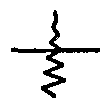
The symbol
Figure imgf000007_0001
denotes where the respective group is linked to the remainder of the molecule.
For the avoidance of doubt, when R6'/^X"Δ-N-R together form an optionally substituted 3- to 8- membered heterocyclic ring containing from 1 to 3 further heteroatoms independently selected from O, N and S, then the groups shown cyclise to form a nitrogen-containing heterocyclic ring, i.e
Figure imgf000007_0002
, optionally containing from 1 to 3 further heteroatoms independently selected from O, N and S.
Examples of Ci-salkyl include: methyl, ethyl, propyl, isopropyl, butyl, iso-butyl, tert-butyl and 2-methyl-pentyl; example of Ci-salkylene include: methylene, ethylene and 2-methyl-propylene; examples of Ci-salkoxy include methoxy, ethoxy and butyloxy; examples of N-Cι.4alkylamino include N-methylamino and N-ethylamino; examples of N,N-di-Cι.4alkylamino, examples of HO-C2.4alkyl-NH include hydroxymethylamino hydroxyethylamino and hydroxypropyamino, examples of HO-C2-4alkyl-N(Cι.4alkyl) include N-methyl-hydroxymethylamino, N-ethyl-hydroxyethylamino, and N-propyl-hydroxypropyamino.
It is to be understood that, insofar as certain of the compounds of the invention may exist in optically active or racemic forms by virtue of one or more asymmetric carbon atoms, the invention includes in its definition any such optically active or racemic form which possesses the property of antagonizing gonadotropin releasing hormone (GnRH) activity. The synthesis of optically active forms may be carried out by standard techniques of organic chemistry well known in the art, for example by synthesis from optically active starting materials or by resolution of a racemic form. Similarly, activity of these compounds may be evaluated using the standard laboratory techniques referred to hereinafter.
The invention also relates to any and all tautomeric forms of the compounds of the different features of the invention that possess the property of antagonizing gonadotropin releasing hormone (GnRH) activity.
It will also be understood that certain compounds of the present invention may exist in solvated, for example hydrated, as well as unsolvated forms. It is to be understood that the present invention encompasses all such solvated forms which possess the property of antagonizing gonadotropin releasing hormone (GnRH) activity. Preferred compounds of Formula (I) are those wherein any one of the following or a combination of the following apply.
Preferably A represents optionally substituted Cι-5alkylene. Further preferably C1. alkylene. Most preferably methylene or ethylene. Preferably M is -CH2-O-. Preferably R1 represents hydrogen or optionally substituted Ci-6alkyl. More preferably
R represents hydrogen, methyl, ethyl or tert-butyl. Most preferably R represents hydrogen.
Preferably R2 represents an optionally substituted monocyclic aromatic ring structure wherein the optional substituents are selected from cyano, NReRf, optionally substituted C^salkyl (preferably, Ci-4alkyl, eg, methyl or ethyl), optionally substituted Ci.8alkoxy (preferably, Ci_6alkoxy, eg, methoxy, ethoxy or tert-butoxy) or halo (eg, F, Br or CI) wherein Re and Rf are independently selected from hydrogen, Ci-6alkyl or aryl. Further preferably R2 is optionally substituted phenyl wherein the optional substituents are selected from cyano, NReRf, optionally substituted Ci-4alkyl, optionally substituted Ci-6alkoxy, F, Br or CI wherein Re and Rf are as defined above. Yet further preferably R2 is optionally substituted phenyl wherein the optional substituents are selected from methyl, ethyl, methoxy, ethoxy, tert-butoxy, F or CI. Most preferably R2 represents
Figure imgf000009_0001
wherein Me represents methyl. Preferably R bears 1, 2 or 3 substituents.
Preferably R3 and R3a are independently selected from hydrogen; optionally substituted Ci-βalkyl and , optionally substituted aryl . Further preferably R3 and R3a are independently selected from methyl, ethyl, tert-butyl and phenyl.
Preferably R5 is selected from a group of formula Ill-a , Ill-g, Ill-h, or Ill-i or: III-j
Figure imgf000009_0002
-a Ill-g Ill-h
Figure imgf000009_0003
Ill-i III-j
Further preferably R »5 ; is selected from one of the following groups:
Figure imgf000009_0004
Ill-a Ill-g Ill-h
Yet further preferably R5 is selected from one of the following groups:
Figure imgf000010_0001
wherein Me represents methyl.
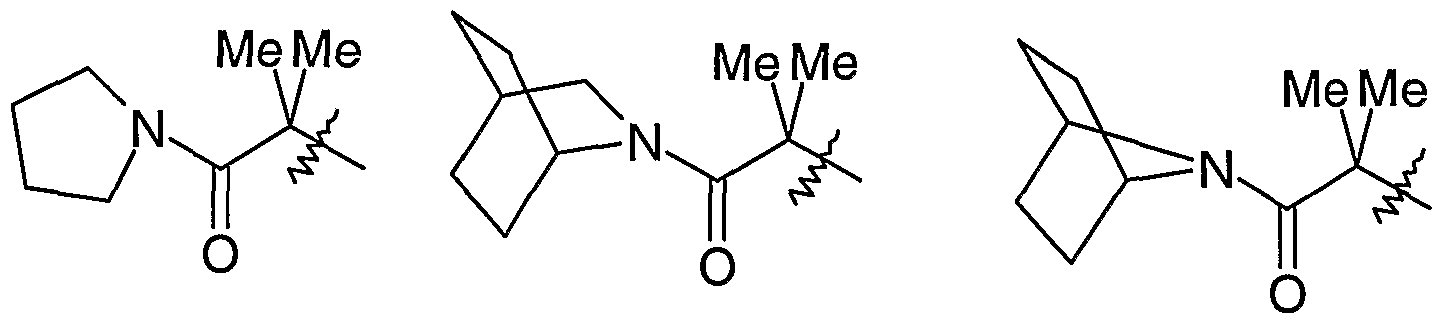
Most preferably R5 is selected from one of the following groups
Figure imgf000010_0002
In one embodiment, R6 and R6a each represent hydrogen and A represents Ci_ alkylene (preferably methylene).
In a further embodiment of the invention R6 represents hydrogen, R6a represents methyl, and A represents Ci_4alkylene (preferably methylene).
Preferably R7 is selected from hydrogen or optionally-substituted Ci-6alkyl. Further preferably R represents hydrogen, methyl, ethyl or tert-butyl.
Preferably X and R represent either: - (a) X represents N and R8 represents cyano or -C(O)O-Rb; or (b) X represents N and R8 represents hydrogen. Further preferably X represents N and R8 represents cyano or -C(O)O-Rb; wherein Rb represents Ci-βalkyl;
In a further embodiment of the invention X represents N and R8 represents -CONRbRc wherein Rb and Rc are as defined above.
Preferably R9 comprise part of the group N(R9R10) or is hydrogen, optionally substituted aryl, an optionally substituted 3- to 10 membered heterocyclic ring or optionally substituted Ci-4alkyl wherein the optional substituents are selected from: hydroxy, amino, nitro, cyano, optionally-substituted aryl, optionally substituted 3- to 8- membered heterocyclyl containing from 1 to 4 heteroatoms independently selected from O, N and S, -O-Rb, C(O)NRbRc, -NRbRc, -NRcC(O)-Rb, -C(O)NRbRc, -NRcS(O0-2)Rb, -S(O0-2)Rb, wherein Rb and Rc are as defined above. When R9 is a Cι.6aιkyl group substituted by an optionally-substituted 3 to 10 membered heterocyclic ring containing from 1 to 4 heteroatoms independently selected from O, N and S, the heterocyclic ring is preferably selected from pyridyl, thienyl, piperidinyl, imidazolyl, triazolyl, thiazolyl, pyrrolidinyl, piperazinyl, morpholinyl, imidazolinyl, benztriazolyl, benzimidazolyl, pyrimidinyl, pyrazinyl, pyridazinyl, oxazolyl, furanyl, pyrrolyl, 1,3-dioxolanyl, 2-azetinyl, each of which is optionally substituted. Further preferably a group of formula Vl-a, Vl-b, VI-c, Vl-d, Vl-e, Vl-f , VI-g, VI-h, Vl-i, VI-j or VI-k:, wherein each group is optionally substituted by one or more groups selected from R .
Figure imgf000011_0001
Vl-a Vl-b VI-c Vl-d Vl-e Vl-f
Figure imgf000011_0002
VI-g VI-h Vl-i VI-j Vl-k
Most preferably a group of formula VT-b, Vl-i or VI-j:
Figure imgf000011_0003
Vl-b Vl-i VI-j wherein
R .16 represents hydrogen, aryl, a 3- to 10 membered heterocyclic ring or optionally substituted Ci-4alkyl wherein the optional substituents are selected from: hydroxy, amino, nitro, cyano, optionally-substituted phenyl, optionally substituted 3- to 8- membered heterocyclyl containing from 1 to 4 heteroatoms independently selected from O, N and S, -O-Rb,
C(O)NRbRc, -NRbRc, -NRcC(O)-Rb, -C(O)NRbRc, -NRcS(O0-2)Rb, -S(O0.2)Rb, wherein Rb and Rc are as defined above;
Preferably R10 comprises part of the group N(R9R10) or is optionally substituted Cι-6alkyl. Further preferably R10 comprises part of the group N(R9R10) or is selected from: methyl, ethyl or tert-butyl.
When N(R9R10) represent an optionally substituted 3- to 10- membered heterocyclic ring, N(R9R10) is preferably selected from a 5- or 6-membered monocyclic ring containing between 1 and 3 (preferably 1 or 2) heteroatoms independently selected from O, N and S. Further preferably a 5- or 6-membered monocyclic ring containing between 1 and 3 (preferably 1 or 2) heteroatoms independently selected from O, N and S, selected from pyrrolidinyl, thienyl, pyrazolidinyl, piperidinyl, morpholinyl, thiomorpholinyl piperazinyl, imidazole, azetidinyl or azetinyl. Further preferably the structure N(R9R10) is a heterocyclic ring selected from an optionally-substituted group of formula, IV-a, IV-b, IV-c, IV-d and IV-e, wherein the optional substituents are preferably selected from the groups listed for R1S below
Figure imgf000012_0001
IV-a IV-b IV-c IV-d IV-e
Further preferably the structure N(R9R10) is selected from a group of formula Va, Vb or Vc:
Figure imgf000012_0002
V-a V-b V-c Most preferably the structure N(R9R10) is a group of formula V-c:
R15 represents hydrogen, optionally substituted aryl, an optionally substituted 3- to 10 membered heterocyclic ring or optionally substituted Cι_4alkyl wherein the optional substituents on aryl, a heterocyclic ring or Ci-4alkyl are selected from: hydroxy, amino, nitro, cyano, halo, optionally-substituted aryl, optionally substituted 3- to 8- membered heterocyclyl containing from 1 to 4 heteroatoms independently selected from O, N and S,
-O-Rb, C(O)NR Rc, -NR Rc, -NRcC(O)-Rb, -C(O)NRbRc, -NRcS(O0-2)Rb, -S(O0-2)Rb, wherein Rb and Rc are as defined above. Preferably R15 is heterocyclyl. Further preferably R15 is selected from: pyridyl, pyrazinyl, pyridazinyl, pyrimidinyl or thiazolyl. Most preferably R15 is pyridyl.
In a further embodiment of the invention N(R9R10) represent an optionally substituted 3- to 10- membered heterocyclic ring, wherein the optional substituents are selected from R15 as defined above.
Preferably R12 and R12a are independently selected from: hydrogen, optionally substituted Cι-6alkyl or R12 and R12a together with carbon to which they are attached from an optionally substituted 3- to 6-membered cycloalkyl ring. Further preferably R12 and R12a are independently selected from: hydrogen, methyl, ethyl or tert-butyl. Most preferably R and R12a are both methyl.
Preferably R13 and R14, are independently selected from hydrogen, optionally substituted Ci_6alkyl, optionally substituted phenyl and -Rd-phenyl, where Rd represents Ci_6alkylene or and an optionally substituted 3- to 8- membered heterocyclic ring (preferably, a 5- or 6-membered monocyclic ring) containing from 1 to 3 (preferably 1 or 2) further heteroatoms independently selected from O, N and S. Further preferably R13 and R14, are independently selected from hydrogen or Cι.6alkyl. Where optional substitution is mentioned at various places, this refers to one, two, three or more optional substituents. Unless otherwise indicated above (ie, where a list of optional substituents is provided), each substituent can be independently selected from Cι-8alkyl (eg, C2-6alkyl, and most preferably methyl, ethyl or tert-butyl); C3.8cycloalkoxy, preferably cyclopropoxy, cyclobutoxy or cyclopentoxy; Ci-6alkoxy, preferably methoxy or C2-4alkoxy; halo, preferably CI or F; Hal3C-, Hal2CH-, HalCH2-, Hal3CO-, Hal2CHO or Hal CH2O, wherein Hal represents halo (preferably F); R CH2O-, RhC(O)N(R)-, RhSO2N(R)- or R -
RhN-, wherein Rg and Rh independently represent hydrogen or Ci-8alkyl (preferably methyl or C2.6alkyl or C2.4alkyl), or Rg-RhN- represents an optionally substituted C3.8, preferably C3.6, heterocyclic ring optionally containing from 1 to 3 further heteroatoms independently selected from O, N and S; hydrogen; or RkC(O)O- or RkC(O)-, Rk representing hydrogen, optionally substituted phenyl or Ci_6alkyl (preferably methyl, ethyl, ,-fo-propyl or tert-butyl). For optional substitution of the heterocyclic ring represented by R -RhN-, at least one (eg, c two or three) substituents may be provided independently selected from Ci-6alkyl (eg, C2-4alkyl, more preferably methyl); phenyl; CF3O-; F CHO-; Ci-salkoxy, preferably methoxy, ethoxy or C3_6alkoxy; Cι-8alkoxyC(O), preferably methoxycarbonyl, ethoxycarbonyl, tert-butoxycarbonyl or C3_6alkoxyC(O)-; phenoxycarbonyl; phenoxy; Cι_8alkanoyl, preferably acetyl, ethanoyl or C3.6alkyanoyl; carboxy; C1-8alkylS(O) wherein nn is an integer between 0 and 2, preferably methylthio, ethylthio, C3.6alkylthio, methylsulphinyl, ethylsulphinyl, C3.6alkylsulρhinyl, methylsulphonyl, ethylsulphonyl or C3_6alkylsulphonyl; hydroxy; halo (eg, F, CI or Br); RmRnN- where Rm and Rn are independently hydrogen or Ci_6alkyl (preferably C2-4alkyl, more preferably methyl, most preferably Rm=Rn=methyl); and nitro. Where optional substitution of a ring is mentioned at various places, this most preferably refers to one, two, three or more substituents selected from Ci.8alkyl (eg, C2.6alkyl, and most preferably methyl); Ci-8alkoxy, preferably methoxy, ethoxy or C3.6alkoxy; Ci-8alkylS(O)nn wherein nn is an integer between 0 and 2, preferably methylthio, ethylthio, C3-6alkylthio, methylsulphinyl, ethylsulphinyl, C3.6alkylsulphinyl, methylsulphonyl, ethylsulphonyl or C3.6alkylsulphonyl; halo (eg, F, CI or Br); cyano; and NO2.
A preferred group of compounds of the invention comprise compounds of Formula (I) wherein:
R11 is a group of the formula: N(R9R10); and
N(R9R10) represents an optionally-substituted 3- to 8- membered heterocyclic ring optionally containing from 1 to 3 further heteroatoms independently selected from O, N and S, preferably substituted by heterocyclyl; or a salt, pro-drug or solvate thereof.
A preferred group of compounds of the invention comprise compounds of Formula (I) wherein: R11 is a group of the formula: N(R9R10);
R9 is a Ci-ealkyl group substituted by an optionally-substituted 3 to 8 membered heterocyclic ring containing from 1 to 4 heteroatoms independently selected from O, N and S; and R10 represents hydrogen or Ci_6alkyl or a salt, pro-drag or solvate thereof. A preferred group of compounds of the invention comprises a compound of Formula
(la):
Figure imgf000015_0001
Formula (la) wherein:
A, B, M, X, R\ R5, R6, R6a, R7, R8, R9, R10, R11, R12 and R12a are as defined above; or a salt, pro-drug or solvate thereof.
A preferred group of compounds of the invention comprises a compound of Formula (lb):
Figure imgf000015_0002
Formula (lb) wherein:
R 53 is selected from: Ilia, Illb, Illg, Illi or IIIj
Figure imgf000016_0001
and A, B, M, X, R1, Rs, R6, R6a, R7, R8, R9, R10, R11, R12, R12a, R13, and R14 are as defined above; or a salt, pro-drug or solvate thereof.
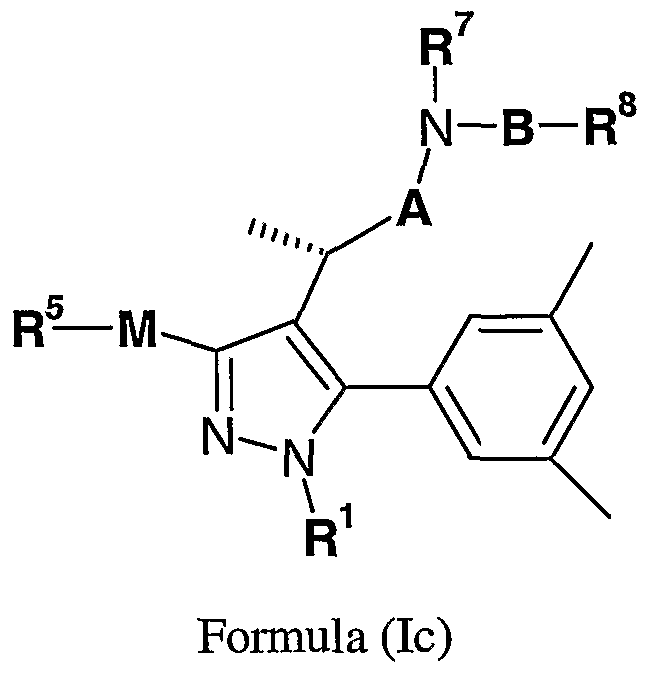
A further preferred group of compounds of the invention comprises a compound of Formula (Ic):
Figure imgf000016_0002
wherein:
R5 is selected from a Ilia, Illb, Illg, Illi or IIIj:
Figure imgf000017_0001
Ill-a lll-b lll-g
Figure imgf000017_0002
lll-i Ill-i and A, B, M, X, R1, R6, R6a, R7, R8, R9, R10, R11, R12, R12a, R13, and R14 are as defined above; or a salt, pro-drug or solvate thereof.
A yet further preferred group of compounds of the invention comprises a compound of Formula (la), (lb) or (Ic) wherein: R5 is a group of formula Ilia:
Figure imgf000017_0003
NR13(-R14) represents an optionally substituted 7- to 8- membered bicyclic heterocyclic ring and A, B, X, R1, M, R6, R6a, R7, R8, R9, R10, R11, R12 and R12a are as defined above; or a salt, pro-drag or solvate thereof.
A preferred compound according to the present invention is: 3-[2,2-dimethyl-3-oxo-3-(azabicyclo[2.2.1]heptan-7-yl)propyl]- 4-[lS-methyl-2-(N'-isoproρoxycarbonyl-3-pyrid-4-yl-pyrrolidin-l-ylc_-rboximidamido) ethyl]-5-(3,5-dimethylphenyl)-lH-pyrazole; or a salt, pro-drug or solvate thereof. In a further embodiment particularly preferred compounds according to the present invention are wherein the compound is selected from: isopropyl (lZ)-({2-[3-(2,2-dimethyl-3-oxo-3-pyrrolidin-l-ylpropoxy)-5-(3,5- dimethylphenyl)- lH-pyrazol-4-yl] ethyl } amino)(3 -pyridin-4-ylpyrrolidin- 1 - yl)methylidenecarbamate; isopropyl (lZ)-({ 2-[3-(2,2-dimethyl-3-oxo-3-(7-azabicyclo[2.2. l]hept-7-yl)ρropoxy)-5- (3 ,5-dimethylphenyl)- lH-pyrazol-4-yl] ethyl } amino)(3 -pyridin-4-ylpyrrolidin- 1 - yl)methylidenecarbamate; isopropyl (lZ)-({2-[3-[3-(diethylamino)-2,2-dimethyl-3-oxopropoxy]-5-(3,5- dimethylphenyl)-lH-pyrazol-4-yl]ethyl}amino)(3-pyridin-4-ylpyrrolidin-l- yl)methylidenecarbamate ; N-{2-[3-[3-(diethylamino)-2,2-dimethyl-3-oxoproρoxy]-5-(3,5-dimethylphenyl)-lH- pyrazol-4-yl] ethyl } -3 -pyridin-4-ylpyrrolidine- 1 -carboxamide; or a salt, pro-drag or solvate thereof. According to a further feature of the first aspect of the invention there is provided a pharmaceutical formulation comprising a compound of Formula (la), Formula (lb), Formula (Ic) or preferred compounds of the invention, or salt, pro-drug or solvate thereof, and a pharmaceutically acceptable diluent or carrier.
According to a further feature of the first aspect of the invention there is provided the following uses of a compound of Formula (la), Formula (lb), Formula (Ic) or preferred compounds of the invention, or salt, pro-drug or solvate thereof:
(a) the use in the manufacture of a medicament for antagonising gonadotropin releasing hormone activity;
(b) the use in the manufacture of a medicament for administration to a patient, for reducing the secretion of luteinizing hormone by the pituitary gland of the patient; and
(c) the use in the manufacture of a medicament for administration to a patient, for therapeutically treating and/or preventing a sex hormone related condition in the patient, preferably a sex hormone related condition selected from prostate cancer and pre- menopausal breast cancer. The compounds of Formula (I) may be administered in the form of a pro-drug which is broken down in the human or animal body to give a compound of the Formula (I). Examples of pro-drags include in- vivo hydrolysable esters of a compound of the Formula (I). Narious forms of pro-drugs are known in the art. For examples of such pro-drag derivatives, see: a) Design of Prodrags, edited by H. Bundgaard, (Elsevier, 1985) and Methods in Enzymology, Nol. 42, p. 309-396, edited by K. Widder, et al. (Academic Press, 1985); b) A Textbook of Drug Design and Development, edited by Krogsgaard-Larsen and H. Bundgaard, Chapter 5 "Design and Application of Prodrags", by H. Bundgaard p. 113- 191 (1991); c) H. Bundgaard, Advanced Drug Delivery Reviews, 8, 1-38 (1992); d) H. Bundgaard, et al., Journal of Pharmaceutical Sciences, 77, 285 (1988); and e) Ν. Kakeya, et al., Chem Pharm Bull, 32, 692 (1984).
An in- vivo hydrolysable ester of a compound of the Formula (I) containing a carboxy or a hydroxy group is, for example, a pharmaceutically-acceptable ester which is hydrolysed in the human or animal body to produce the parent acid or alcohol. Suitable pharmaceutically-acceptable esters for carboxy include Cι-6alkoxymethyl esters for example methoxymethyl, Ci_6alkanoyloxymethyl esters for example pivaloyloxymethyl, phthalidyl esters, C3.8cycloalkoxycarbonyloxyCι. alkyl esters for example
1-cyclohexylcarbonyloxyethyl; l,3-dioxolen-2-onylmethyl esters, for example 5-methyl-l,3- dioxolen-2-onylmethyl; and Cι_6alkoxycarbonyloxyethyl esters. An in- vivo hydrolysable ester of a compound of the Formula (I) containing a hydroxy group includes inorganic esters such as phosphate esters (including phosphoramidic cyclic esters) and α-acyloxyalkyl ethers and related compounds which as a result of the in- vivo hydrolysis of the ester breakdown to give the parent hydroxy group/s. Examples of α-acyloxyalkyl ethers include acetoxymethoxy and 2,2-dimethylpropionyloxy-methoxy. A selection of in- vivo hydrolysable ester forming groups for hydroxy include alkanoyl, benzoyl, phenylacetyl and substituted benzoyl and phenylacetyl, alkoxycarbonyl (to give alkyl carbonate esters), dialkylcarbamoyl and Ν-(dialkylaminoethyl)-Ν-alkylcarbamoyl (to give carbamates), dialkylaminoacetyl and carboxyacetyl.
A suitable pharmaceutically-acceptable salt of a compound of the invention is, for example, an acid-addition salt of a compound of the invention which is sufficiently basic, for example, an acid-addition salt with, for example, an inorganic or organic acid, for example hydrochloric, hydrobromic, sulphuric, phosphoric, trifluoroacetic, citric or maleic acid. In addition a suitable pharmaceutically-acceptable salt of a compound of the invention which is sufficiently acidic is an alkali metal salt, for example a sodium or potassium salt, an alkaline earth metal salt, for example a calcium or magnesium salt, an ammonium salt or a salt with an organic base which affords a physiologically-acceptable cation, for example a salt with methylamine, dimethylamine, Irimethylamine, piperidine, morpholine or tris-(2-hydroxyethyl)amine.
The compounds of Formula (I) can be prepared by a process comprising a step selected from (a) to (f) as follows, these processes are provided as a further feature of the invention:- (a) for compounds wherein X is N and R is CN, reaction of a compound of formula XXXII as follows
- RiIL
Figure imgf000020_0002
Figure imgf000020_0001
XXXII XXXIII
(b) for compounds wherein X is N and R is hydrogen, cleavage of the cyano group of compound of formula XXXIII in the presence of acid to produce compound of formula XXXIV
Figure imgf000020_0003
XXXIV
(c) ffoorr ccoommppoouunnddss wherein X is CH and R8 is NO2, reaction of compound of formula XXXV as follows
Figure imgf000021_0001
XXXV XXXVI
(d) for compounds where X-R is O, reaction of compound of formula XXXVII as follows
Figure imgf000021_0002
XXXVII xxxviii (e) for compounds where X-R is O, reaction of compound of formula XXXIX as follows
Figure imgf000021_0003
xxxix xxxx
(f) to form a compound wherein X is nitrogen and Reaction of a compound of formula
XXXXI as follows
Figure imgf000021_0004
XXXXI XXXX1I and thereafter if necessary: i) converting a compound of the Formula (I) into another compound of the Formula (I); ii) removing any protecting groups; iii) forming a salt, pro-drug or solvate. It will be appreciated by those skilled in the art that in the processes of the present invention certain functional groups such as hydroxyl or amino groups in the starting reagents or intermediate compounds may need to be protected by protecting groups. Thus, the preparation of the compounds of Formula (I) may involve, at an appropriate stage, the addition and subsequent removal of one or more protecting groups. The protection and de-protection of functional groups is described in 'Protective Groups in Organic Chemistry', edited by J.W.F. McOrnie, Plenum Press (1973) and 'Protective Groups in Organic Synthesis', 2nd edition, T.W. Greene and P.G.M. Wuts, Wiley-Interscience (1991).
A suitable protecting group for an amino or alkylamino group is, for example, an acyl group, for example an alkanoyl group such as acetyl, an alkoxycarbonyl group, for example a methoxycarbonyl, ethoxycarbonyl or tert-butoxycarbonyl group, an arylmethoxycarbonyl group, for example benzyloxycarbonyl, or an aroyl group, for example benzoyl. The de- protection conditions for the above protecting groups necessarily vary with the choice of protecting group. Thus, for example, an acyl group such as an alkanoyl or alkoxycarbonyl group or an aroyl group may be removed for example, by hydrolysis with a suitable base such as an alkali metal hydroxide, for example lithium or sodium hydroxide. Alternatively an acyl group such as a tert-butoxycarbonyl group may be removed, for example, by treatment with a suitable acid as hydrochloric, sulphuric or phosphoric acid or trifluoroacetic acid and an arylmethoxycarbonyl group such as a benzyloxycarbonyl group may be removed, for example, by hydrogenation over a catalyst such as palladium-on-carbon, or by treatment with a Lewis acid for example boron tris(trifluoroacetate). A suitable alternative protecting group for a primary amino group is, for example, a phthaloyl group which may be removed by treatment with an alkylamine, for example dimethylaminopropylamine, or with hydrazine. A suitable protecting group for a hydroxy group is, for example, an acyl group, for example an alkanoyl group such as acetyl, an aroyl group, for example benzoyl, or an arylmethyl group, for example benzyl. The de-protection conditions for the above protecting groups will necessarily vary with the choice of protecting group. Thus, for example, an acyl group such as an alkanoyl or an aroyl group may be removed, for example, by hydrolysis with a suitable base such as an alkali metal hydroxide, for example lithium or sodium hydroxide.
Alternatively an arylmethyl group such as a benzyl group may be removed, for example, by hydrogenation over a catalyst such as palladium-on-carbon.
A suitable protecting group for a carboxy group is, for example, an esterifying group, for example a methyl or an ethyl group which may be removed, for example, by hydrolysis with a base such as sodium hydroxide, or for example a tert-butyl group which may be removed, for example, by treatment with an acid, for example an organic acid such as trifluoroacetic acid, or for example a benzyl group which may be removed, for example, by hydrogenation over a catalyst such as palladium-on-carbon.
EXPERIMENTAL
GENERAL REACTION SCHEMES
Figure imgf000023_0001
2 3
Scheme a Pyrazoles, such as 3 can be synthesised in two steps (Scheme a):
(1) by the reaction of a lactone with the appropriate ester using a Claisen condensation to form a compound of formula 2, under conditions of an inert atmosphere, such as argon, at a temperature of about 0°C in a suitable solvent such as THF.
(2) followed by cyclization of a compound of formula 2 with hydrazine to form the pyrazole 3, at a room temperature in a suitable solvent such as ethanol.
Figure imgf000023_0002
3 4 5 6
Scheme b The pyrazole 3 can undergo a selective alkylation reaction with a compound of formula 4, under conditions of an inert atmosphere, such as argon, in the presence of a suitable base, such as potassium carbonate in the a suitable solvent such as DMA at a temperature of about 90°C, to form a compound of formula 5. Then the amine 6 can be prepared from a compound of formula 5 and phthalimide using a Mitsunobu reaction with an activating agent such as diethyldiazocarboxylate (DEAD), diisopropyldiazocarboxylate or the like with triphenylphosphine, tri-butylphosphine and the like, in an inert solvent such as benzene, toluene, tetrahydrofuran or mixtures thereof, followed by deprotection with hydrazine (Scheme b).
triphosgene
Figure imgf000024_0001
Figure imgf000024_0002
Figure imgf000024_0003
8
Scheme c. A suitable pyrazole 6 can be converted to a urea by either direct treatment with an iso- cyanate in an inert solvent such as methylene chloride, chloroform or THF and the such like, or by a two step procedure of reaction with triphosgene (6— >7) followed by addition of an amine (7— >8), bearing the required substitution to yield 8 (Scheme c).
Figure imgf000024_0004
A suitable pyrazole (6) can be converted to a guandine or guanidine derivative (12) by reaction with a suitable isothiocyanate (9) to form a compound of formula 10, followed by displacement by a suitable amine (11) (Scheme d).
Thus, according to a further feature of the invention there is provided a process for the synthesis of a substituted pyrazole of formula XXXXIN which comprises reaction of a compound of formula XXXXLU with hydrazine.
Figure imgf000025_0001
XXXXIII XXXXIV wherein:
R2 is as defined above; and Rx and Ry are independently selected from: optionally substituted alkyl, optionally substituted aryl or optionally substituted heteocyclyl.
According to a further feature of the invention there is provided an intermediate compound of formula XXXXIII as defined above.
EXAMPLES
The invention will now be illustrated with the following non-limiting Examples in which, unless otherwise stated:
(i) evaporations were carried out by rotary evaporation in vacuo and work-up procedures were carried out after removal of residual solids such as drying agents by filtration;
(ii) operations were carried out at room temperature, that is in the range 18-25°C and under an atmosphere of an inert gas such as argon or nitrogen;
(iii) yields are given for illustration only and are not necessarily the maximum attainable; (iv) the structures of the end-products of the Formula (I) were confirmed by nuclear
(generally proton) magnetic resonance (ΝMR) and mass spectral techniques; proton magnetic resonance chemical shift values were measured on the delta scale and peak multiplicities are shown as follows: s, singlet; d, doublet; t, triplet; m, multiplet; br, broad; q, quartet, quin, quintet; (v) intermediates were not generally fully characterised and purity was assessed by thin layer chromatography (TLC), high-performance liquid chromatography (HPLC), infra-red (IR) or NMR analysis;
(vi) chromatography was performed on silica (Merck Keiselgel: Art.9385);
Abbreviations
DCC 1 ,3-dicyclohexylcarbodiimide
DEAD diethylazodicarboxylate
DMSO dimethyl sulphoxide DMAP 4-dimethylaminopyridine
DMF dimethylformamide
DNS 2,4-dinitrobenzenesulphonyl
EDC l-(3-dimethylaminopropyl)-3-ethylcarbodiimide hydrochloride HOBt 1 -hydroxybenotriazole
LHMDS lithium bis(trimethylsilyl)amide
THF tetrahydrofuran
Starting Materials The starting material were prepared as follows :-
Figure imgf000026_0001
Figure imgf000026_0002
A solution of methyl 3,5-dimethylbenzoate (25 g ; 152 mmol) and butyrolactone (40 ml ; 520 mmol) in THF (300 ml) under argon was cooled to 0°C and treated dropwise with LHMDS (200 ml ; 200 mmol ; IM in hexanes). The mixture was stirred and allowed to warm to room temperature overnight. The THF was evaporated. The residue was taken up in Et2O and the organic phase was washed with sat. aq. NaHCO3, brine and dried over MgSO4. The residue was purified by flash chromatography eluting with increasingly polar mixtures of EtOAc/hexanes (20 to 40% EtOAc) to give an oil which slowly crystallised to give 2 as a white solid (9.2 g). During the chromatography, the starting material methyl 3,5- dimethylbenzoate (12.4g) was recovered.
Yield : 55% based on recovered methyl 3,5-dimethylbenzoate.
1H NMR spectrum (CDCL) : 2.39 (s, 6H) ; 2.5 (m, 1H) ; 2.82 (m, 1H) ; 4.41 (m, 1H) ; 4.51 (m, 2H) ; 7.25 (s, 1H) ; 7.65 (s, 2H). MS-ESI : 219 [M+H]+
Compound 2 (7.43 g ; 34 mmol) was dissolved in EtOH (200 ml) and hydrazine hydrate (17.2 ml ; 354 mmol) was added. The mixture was stirred for 30 min. The solvent was evaporated and the residue was triturated with pentane to give 3 as a white solid (7.05 g).
Yield : 90%
1H NMR spectrum (DMSO d6) : 2.32 (s, 6H) ; 2.58 (t, 2H) ; 3.50 (t, 2H) ; 4.8 (br s, 1H) ; 7.01 (s, 1H) ; 7.14 (s, 2H) ; 9.5 (br s, 1H). MS-ESI : 233 [M+H]+
A mixture of 3 (4.26 g ; 18.4 mmol) and 4 (4.51 g ; 19.3 mmol) in DMA (40 ml) under argon was treated with K2CO3 (5.07 g ; 36.7 mmol). The mixture was stirred and heated at 90°C for 2h. The mixture was poured into sat. aq. NaHCO3, extracted with EtOAc and the organic phase was washed with water, brine and dried over MgSO4. The residue was purified by flash chromatography eluting with increasingly polar mixtures of EtOAc/CH2Cl2 (0 to 100% EtOAc) to give the alcohol 5 as a pale yellow oil (6.56 g).
Yield : 93% 1H NMR spectrum (DMSO d6) : 1.30 (s, 6H) ; 1.8 (m, 4H) ; 2.33 (s, 6H) ; 2.55 (m, 2H) ; 3.32 (m, 2H) ; 3.5 (m, 4H) ; 4.17 (s, 2H) ; 4.62 (t, 1H) ; 7.04 (s, 1H) ; 7.16 (s, 2H) ; 11.9 (br s, 1H). MS-ESI : 386 [M+H]+ A mixture of 5 (3.85 g ; 10 mmol), phthalimide (1.62 g ; 11 mmol) and triphenylphosphine
(10.5 g ; 40 mmol) in THF (100 ml) at 0°C under argon was treated with DEAD (6.33 ml ; 40 mmol). The mixture was stirred at this temperature for lh when water was added. The mixture was extracted with Et2O and the organic phase was washed with water, brine and dried over MgSO4.
Evaporation gave a crade solid which, without further purification, was immediately taken up in EtOH (50 ml) and treated with hydrazine hydrate (5 ml ; 100 mmol). The mixture was stirred for 1.5h and then the EtOH was partially evaporated. Addition of CH2C12 caused precipitation of phthalhydrazide which was filtered and rinsed with CH2C12. The filtrate was evaporated and the residue was purified by flash chromatography eluting with increasingly polar mixtures of EtO Ac/CH2C12 (0 to 100% EtOAc) and then MeOH/CH2Cl2 (0 to 8%
MeOH) to give 6 as a beige solid (2.34 g).
Yield : 61% 1H NMR spectrum (DMSO d6) : 1.30 (s, 6H) ; 1.79 (m, 4H) ; 2.33 (s, 6H) ; 2.52 (m, 2H) ; 2.67 (t, 2H) ; 3.5 (m, 4H) ; 4.18 (s, 2H) ; 7.03 (s, IH) ; 7.14 (s, 2H) ; 8.95 (br s, IH). MS-ESI : 385 [M+H]+
Starting material 4 was prepared as follows:
Figure imgf000028_0001
A mixture of 8 (14.48 g ; 80 mmol) and oxalyl bromide (43.2 g ; 200 mmol) containing one drop of DMF was heated at 50°C for 2h and then cooled. The excess of oxalyl bromide was evaporated and the residue azeotroped with toluene to give crade 9 which was taken up directly in CH2C1 (25 ml) and cooled to 0°C. Diisopropylethylamine (14 ml ; 80 mmol) was added followed by a solution of pyrrolidine (3.3 ml ; 40 mmol) in CH C12 (30 ml). The mixture was allowed to warm to room temperature overnight and was diluted with CH2C12, washed with aq. HCl (2N), aq. NaOH (IN), water, brine and dried over MgSO4. The residue was purified by flash chromatography eluting with increasingly polar mixtures of EtOAc/CH2C12 (5 to 10% EtOAc) to give 4 as a white solid (6.5 g).
Yield : 70% 1H NMR spectrum (DMSO d6) : 1.39 (s, 6H) ; 1.9 (m, 4H) ; 3.57 (m, 4H) ; 3.62 (s, 2H) MS-ESI : 235 [M+H]+
Example 1 3-[2,2-dimethyl-3-oxo-3-(pyrrolidin-l-yl)propoxy]-4-[2-(3-pyridin-4-ylpyrrolidin-l- carboxamido)ethyl]-5-(3,5-dirnethylphenyl)-l-r-r-pyrazole
Figure imgf000029_0001
Example 1
A solution of 6 (150 mg ; 0.39 mmol) in CH2C12 (2 ml) was cooled to 0°C. Diisopropylethylamine (136 ul ; 0.78 mmol) was added followed by a solution of 4- nitrophenyl chloroformate (83 mg ; 0.41 mmol) in CH2C12 (2 ml). The mixture was stirred for 3h when a solution of 4-(3-pyrrolidyl)-pyridine (70 mg ; 0.47 mmol) in CH2C1 (2 ml) was added and the mixture was allowed to warm to room temperature overnight. The mixture was directly purified by flash chromatography eluting with increasingly polar mixtures of MeOH/EtOAc (0 to 10%> MeOH) to give Example 1 as a beige solid (95 mg).
Yield : 44%
1H NMR spectrum (DMSO d6) : 1.29 (s, 6H) ; 1.75 (m, 4H) ; 1.95 (m, IH) ; 2.2 (m, IH) ; 2.31 (s, 6H) ; 2.56 (m, 2H) ; 3.1-3.4 (m, 6H) ; 3.5 (m, 4H) ; 3.64 (m, IH) ; 4.18 (s, 2H) ; 6.22 (t, IH) ; 6.99 (s, IH) ; 7.21 (s, 2H) ; 7.27 (d, 2H) ; 8.48 (d, 2H). MS-ESI : 559 [M+H]+ Example 2
3-[2,2-dimethyl-3-oxo-3-(azabicycIo[2.2.1]heptan-7-yl)propyl]-
4-[2-(N'-isopropoxycarbonyl-3-pyrid-4-yl-pyrrolidin-l-ylcarboximidamido)ethyl]-5-(3,5- dimethylphenyl)-l-f-T-pyrazole
Figure imgf000030_0001
Example 2
10
A solution of 10 (260 mg ; 0.5 mmol) in CH2C12 (5 ml) was cooled to 0°C. EDCI (145 mg ; 0.75 mmol) and diisopropylethylamine (130 ul ; 0.75 mmol) were added followed by 4-(3- pyrrolidyl)-pyridine (111 mg ; 0.75 mmol) and the mixture was allowed to warm to room temperature overnight. The mixture was diluted with CH2C12 and the organic phase was washed with sat. aq. NaHCO3, brine and dried over MgSO4. The residue was purified by flash chromatography eluting with increasingly polar mixtures of EtO Ac/CH C1 (0 to 100% EtOAc) to give Example 2 as a beige solid (277 mg).
Yield : 86%
1H NMR spectrum (DMSO d6) : 1.07 (m, 6H) ;1.29 (s, 6H) ; 1.8 (m, 4H) ; 1.95 (m, IH) ; 2.2 (m, IH) ; 2.30 (s, 6H) ; 2.65 (m, 2H) ; 3.2-3.4 (m, 6H) ; 3.5 (m, 4H) ; 3.65 (m, IH) ; 4.18 (s, 2H) ; 4.6 (m, IH) ; 6.95 (m,lH) ; 7.00 (s, IH) ; 7.12 (s, 2H) ; 7.27 (d, 2H) ; 8.49 (d, 2H).
MS-ESI : 644 [M+H]+ The starting material 10 was prepared as follows :-
Figure imgf000031_0001
10
A solution of 6 (200 mg ; 0.52 mmol) in CH2C12 (2 ml) was cooled to 0°C. A solution of 11 (115 mg ; 0.78 mmol) was added and the mixture was allowed to warm to room temperature for lh. The mixture was treated with water, diluted with CH2C12 and the organic phase was washed with brine and dried over MgSO4. The residue was purified by flash chromatography eluting with increasingly polar mixtures of Et2O/hexanes (0 to 100% Et2O) to give 10 as a beige solid (260 mg). Yield : 94%
1H NMR spectrum (DMSO d6) : 1.22 (m, 6H) ;1.31 (s, 6H) ; 1.8 (m, 4H) ; 2.32 (s, 6H) ; 2.71 (m, 2H) ; 3.5 (m, 4H) ; 3.74 (m, 2H) ; 4.20 (s, 2H) ; 4.83 (m, IH) ; 7.02 (s,lH) ; 7.17 (s, 2H) ; 9.89 (t, IH) ; 10.81 (s, IH). MS-ESI : 530 [M+H]+
Example 3
3-[2,2-dimethyl-3-oxo-3-(N,N-diethylamino)propyl]-
4-[2-(N'-isopropoxycarbonyl-3-pyrid-4-yl-pyrrolidin-l-ylcarboximidamido)ethyl]-5-(3,5- dimethylphenyl)-lH-pyrazole
Figure imgf000031_0002
Example 3
Bb4
A solution of Bb4 (156 mg ; 0.29 mmol) in CH2C12 (2 ml) was cooled to 0°C. EDCI (85 mg ; 0.44 mmol) and diisopropylethylamine (77 ul ; 0.44 mmol) were added followed by 4-(3- pyrrolidyl)-pyridine (56 mg ; 0.38 mmol) and the mixture was allowed to warm to room temperature overnight. The mixture was diluted with CH2C1 and the organic phase was washed with sat. aq. NaHCO3, brine and dried over MgSO . The residue was purified by flash chromatography eluting with increasingly polar mixtures of MeOH/CH2Cl2 (0 to 100% MeOH) to give Example 3 as a beige solid (180 mg). Yield : 96%
1H NMR spectrum (DMSO d6) : 1.07 (m, 12H) ,1.31 (s, 6H) ; 1.93 (m, IH) ; 2.23 (m, IH) ; 2.30 (s, 6H) ; 2.65 (m, 2H) ; 3.2-3.55 (m, 10H) ; 3.57 (m, IH) ; 4.17 (s, 2H) ; 4.58 (m, IH) ; 6.95 (m,lH) ; 7.00 (s, IH) ; 7.13 (s, 2H) ; 7.27 (d, 2H) ; 8.50 (d, 2H) ;11.9 (br s, IH). MS-ESI : 646 [M+H]+
The starting material Bb4 was prepared as follows:
Figure imgf000032_0001
Bb3 Bb4 A mixture of 3 (1.23 g ; 5.3 mmol) and Bbl (1.32 g ; 5.5 mmol) in DMA (20 ml) under argon was treated with K2CO3 (1.46 g ; 10.6 mmol). The mixture was stirred and heated at 70°C for 2h. The mixture was poured into sat. aq. NaHCO3, extracted with EtOAc and the organic phase was washed with water, brine and dried over MgSO4. The residue was purified by flash chromatography eluting with increasingly polar mixtures of EtOAc/CH2Cl2 (0 to 100% EtOAc) to give the alcohol Bb2 as a pale yellow oil (1.92 g). Yield : 94%
1H NMR spectrum (DMSO de) : 1.08 (t, 6H) ; 1.32 (s, 6H) ; 2.33 (s, 6H) ; 2.57 (m, 2H) ; 3.38 (m, 4H) ; 3.5 (m, IH) ; 4.18 (s, 2H) ; 4.61 (t, IH) ; 7.04 (s, IH) ; 7.16 (s, 2H) ; 11.9 (br s, IH). MS-ESI : 388 [M+H]+ A mixture of Bb2 (1.92 g ; 4.96 mmol), phthalimide (0.8 g ; 5.46 mmol) and triphenylphosphine (5.24 g ; 20 mmol) in THF (50 ml) at 0°C under argon was treated with DEAD (3.2 ml ; 20 mmol). The mixture was stirred at this temperature for 2h when water was added. The mixture was extracted with Et2O and the organic phase was washed with water, brine and dried over MgSO4.
Evaporation gave a crude solid which, without further purification, was immediately taken up in EtOH (50 ml) and treated with hydrazine hydrate (2.5 ml ; 50 mmol). The mixture was stirred for 2h and then the EtOH was partially evaporated. Addition of CH2C12 caused precipitation of phthalhydrazide which was filtered and rinsed with CH C12. The filtrate was evaporated and the residue was purified by flash chromatography eluting with increasingly polar mixtures of EtO Ac/CH2C12 (0 to 100% EtOAc) to give Bb3 as a beige solid (0.865 g). Yield : 45% 1H NMR spectrum (DMSO d6) : 1.06 (t, 6H) ; 1.30 (s, 6H) ; 2.32 (s, 6H) ; 2.47 (m, 2H) ; 2.66 (t, 2H) ; 3.35 (m, 4H) ; 4.16 (s, 2H) ; 7.02 (s, IH) ; 7.13 (s, 2H) ; 11.9 (br s, IH). MS-ESI : 387 [M+H]+
A solution of Bb3 (210 mg ; 0.544 mmol) in CH2C12 (5 ml) was cooled to 0°C. A solution of
11 (120 mg ; 0.82 mmol) was added and the mixture was allowed to warm to room temperature for lh. The mixture was treated with water, diluted with CH2C12 and the organic phase was washed with brine and dried over MgSO4. The residue was purified by flash chromatography eluting with CH2C12 to give Bb4 as a beige solid (235 mg).
Yield : 81%
1H NMR spectrum (CDC13) : 1.18 (t, 6H) ; 1.27 (d, 6H) ;1.44 (s, 6H) ; 2.38 (s, 6H) ; 2.87 (m, 2H) ; 3.45 (m, 4H) ; 3.88 (m, 2H) ; 4.36 (s, 2H) ; 4.93 (m, IH) ; 7.04 (s,lH) ; 7.11 (s, 2H) ;
7.81 (s, IH) ; 8.9 (s br, IH) ; 9.7 (s, IH).
MS-ESI : 532 [M+H]+
Starting material Bbl was prepared as follows:-
HOOC -"* Br-Cό^/ ~ . -Cό^
Bb1 A mixture of 8 (14.48 g ; 80 mmol) and oxalyl bromide (43.2 g ; 200 mmol) containing one drop of DMF was heated at 50°C for 2h and then cooled. The excess of oxalyl bromide was evaporated and the residue azeotroped with toluene to give crude 9 which was taken up directly in CH2C12 (25 ml) and cooled to 0°C. Diisopropylethylamine (14 ml ; 80 mmol) was added followed by a solution of pyrrolidine (3.3 ml ; 40 mmol) in CH C12 (30 ml). The mixture was allowed to warm to room temperature overnight and was diluted with CH2C12, washed with aq. HCl (2N), aq. NaOH (IN), water, brine and dried over MgSO4.The residue was purified by flash chromatography eluting with increasingly polar mixtures of EtOAc/CH2Cl2 (5 to 10% EtOAc) to give Bbl as a white solid (6.5 g). Yield : 70%
1H NMR spectrum (DMSO d6) : 1.19 (m, 6H) ; 1.42 (s, 6H) ; 3.41 (m, 4H) ; 3.65 (s, 2H) MS-ESI : 237 [M+H]+
Example 4 3-[2,2-dimethyl-3-oxo-3-(N,N-diethylamino)propyl]-4-[2-(3-pyridin-4-ylpyrrolidin-l- carboxamido)ethyl]-5-(3,5-dimethylphenyl)-lH-pyrazole
Figure imgf000034_0001
Example 4
Bb3
A solution of Bb3 (150 mg ; 0.39 mmol) in CH2C12 (2 ml) was cooled to 0°C. Diisopropylethylamine (135 ul ; 0.78 mmol) was added followed by a solution of 4- nitrophenyl chloroformate (83 mg ; 0.41 mmol) in CH2C12 (2 ml). The mixture was stirred for 3h when a solution of 4-(3-pyrrolidyl)-pyridine (70 mg ; 0.47 mmol) in CH2C12 (2 ml) was added and the mixture was allowed to warm to room temperature overnight. The mixture was directly purified by flash chromatography eluting with increasingly polar mixtures of MeOH EtOAc (0 to 10% MeOH) to give Example 4 as a beige solid (138 mg). Yield : 63%
1H NMR spectrum (DMSO d6) : 1.05 ; (m, 6H) ; 1.32 (s, 6H) ; 1.89 (m, IH) ; 2.2 (m, IH) ; 2.31 (s, 6H) ; 2.57 (m, 2H) ; 3.1-3.4 (m, 10H) ; 3.64 (m, IH) ; 4.17 (s, 2H) ; 6.22 (t, IH) ; 6.99 (s, IH) ; 7.22 (s, 2H) ; 7.27 (d, 2H) ; 8.48 (d, 2H) ; 11.9 (br s, IH). MS-ESI : 561 [M+H]+
Example 5
3- [2,2-dimethyl-3-oxo-3- (azabicyclo [2.2. l]heptan-7-yl)propyl] - 4-[lS-methyl-2-(N'-isopropoxycarbonyl-3-pyrid-4-yl-pyrrolidin-l-ylcarboximidamido) ethyl]-5-(3,5-dimethylphenyl)-lH-pyrazole
Figure imgf000035_0001
Example 5
CNR
A solution of CNR (141 mg ; 0.25 mmol) in CH2C12 (5 ml) was cooled to 0°C. EDCI (72 mg ; 0.37 mmol) and diisopropylethylamine (65 ul ; 0.37 mmol) were added followed by 4-(3- pyrrolidyl)-pyridine (46 mg ; 0.31 mmol) and the mixture was allowed to warm to room temperature overnight. The mixture was diluted with CH2C1 and the organic phase was washed with sat. aq. NaHCO3, brine and dried over MgSO4. The residue was purified by flash chromatography eluting with increasingly polar mixtures of EtO Ac/CH2C12 (0 to 100% EtOAc) to give Example 5 as a beige solid (128 mg). Yield : 78%
1H NMR spectrum (DMSO d6) : 1.05 (m, 6H) ; 1.12 (m, 3H) ; 1.28 (s, 6H) ; 1.42 (m, 4H) ; 1.62 (m, 4H) ; 1.91 (m, IH) ; 2.2 (m, IH) ; 2.30 (s, 6H) ; 2.95 (m, IH) ; 3.2-3.7 (m, 7H) ; 4.17 (s, 2H) ; 4.56 (m, 3H) ; 7.01 (s, IH) ; 7.04 (s, IH) ; 7.06 (s, IH) ; 7.2 (s br, IH) ; 7.27 (dd, 2H); 8.49 (dd, 2H) ; 11.79 (s, IH). MS-ESI : 684 [M+H]+ The starting material CNR was prepared as follows:-
Figure imgf000036_0001
Ce (from broad scope) CNR
A solution of Ce (150 mg ; 0.35 mmol) in CH2C12 (5 ml) was cooled to 0°C. A solution of 11 (77 mg ; 0.53 mmol) in CH2C12 (1 ml) was added and the mixture was allowed to warm to room temperature for 1 h. The mixture was treated with water, diluted with CH C12 and the organic phase was washed with brine and dried over MgSO4. The residue was purified by flash chromatography eluting with EtOAc/CH2Cl2 (0-20% EtOAc) to give CNR as a gum (141 mg). Yield : 70%
1H NMR spectrum (DMSO d6) : 1.22 (d, 3H) ; 1.8 (m, 6H) ; 1.27 (m, 6H) ;1.41 (m, 4H) ; 1.61 (m, 4H) ; 2.29 (s, 6H) ; 3.06 (q, IH) ; 3.65 (m, IH) ; 3.84 (m, IH) ; 4.19 (m, 2H) ; 4.58 (s, 2H); 4.79 (m, IH) ; 7.02 (s,lH) ; 7.04 (s, 2H) ; 9.84 (s, IH) ; 11.8 (s br, IH). MS-ESI : 570 [M+H]+
Examples 5.1 - 5.2
The following examples were prepared in a similar manner to Example 5,
Figure imgf000036_0002
the table shows the R group relating to the above structure, the reaction conditions and characteristics for each example, corresponding to the description of the preparation of Example 5 given above:- Example 5.1
Figure imgf000037_0002
1H NMR spectram (DMSO d6) : 0.9-1.2 (m, 14H) ; 1.28 (m, 6H) ; 1.43 (m, 4H) ; 1.5 (m, 2H) 1.6 (m, 6H) ; 2.31 (s, 6H) ; 2.7 (m, 2H) ; 2.95 (m, IH) ; 3.2-3.7 (m, 5H) ; 3.75 (m, 2H) ; 3.83 (m, 2H) ; 4.16 (s, 2H) ; 4.57 (m, 3H) ; 7.02 (s, IH) ; 7.04 (s, 2H) ; 7.46 (s br, IH) ; 11.80 (s, IH).
Example 5.2
Figure imgf000037_0001
Chromato. - EtOAc/ CH2C12 (0 to 100% E tOAc) and th en MeOH CH2( :ι2 (0 to 5% ] MeOH) 1H NMR spectram (DMSO d6) : 1.07 (m, 6H) ; 1.11 (m, 3H) ; 1.28 (m, 6H) ; 1.42 (m, 4H) ; 1.5 (m, 2H) ; 1.62 (m, 4H) ; 1.72 (m, 2H) ; 2.30 (s, 6H) ; 2.7 (m, IH) ; 2.9 (m, 2H) ; 2.95 (m, IH) ; 3.2-3.4 (m, 2H) ; 3.85 (m, 2H) ; 4.17 (m, 2H) ; 4.57 (m, 3H) ; 7.01 (s, IH) ; 7.06 (s, 2H); 7.18 (d, 2H) ; 7.5 (s br, IH) ; 8.45 (d, 2H) ; 11.81 (s, IH).
Example 6
3-[2,2-dimethyl-3-oxo-3-( azabicyclo[2.2.1]heptan-7-yl)propoxy]-4-[lS-methyl-2-(3- pyridin-4-ylpyrrolidin-l-carboxamido)ethyl]-5-(3,5-dimethylphenyl)-lH-pyrazole
Figure imgf000038_0001
Ce (from broad scope) Example 6 A solution of Ce (170 mg ; 0.4 mmol) in CH2C12 (5 ml) was cooled to 0°C and DIEA (140 μ\ ; 0.8 mmol) was added. A solution of 4-nitrophenyl chloroformate (85 mg ; 0.42 mmol) in CH2C12 (1 ml) was added and the mixture was allowed to stir for 30 min. 4-(3-Pyrrolidyl)- pyridine (71 mg ; 0.48 mmol) was added and the mixture allowed to warm to room temperature for 1 h. The mixture was directly purified by flash chromatography eluting with MeOH/CH2Cl2 (0-10% MeOH) to give Example 6 as a pale yellow powder (212 mg). Yield : 88%
1H NMR spectram (DMSO d6) : 1.11 (m, 3H) ; 1.28 (m, 6H) ; 1.42 (m, 4H) ; 1.62 (m, 4H) ; 1.95 (m, IH) ; 2.22 (m, IH) ; 2.29 (s, 6H) ; 2.93 (m, IH) ; 3.2-3.7 (m, 6H) ; 3.67 (m, IH) ; 4.17 (s, 2H) ; 4.58 (s, 2H) ; 6.21 (m, IH) ; 7.00 (s, IH) ; 7.14 (s, 2H) ; 7.26 (m, 2H) ; 8.47 (m, 2H) ; 11.79 (s, lH). MS-ESI : 599 [M+H]+
Examples 6.1 - 6.
The following examples were prepared in a similar manner to Example 6,
Figure imgf000038_0002
the table shows the R group relating to the above structure, the reaction conditions and characteristics for each example, corresponding to the description of the preparation of
Example 6 given above:- Example 6.1
Figure imgf000039_0001
1H NMR spectram (DMSO de) : 1.11 (m, 3H) ; 1.28 (m, 6H) ; 1.42 (m, 4H) ; 1.62 (m, 4H) ; 1.99 (m, IH) ; 2.20 (m, IH) ; 2.29 (s, 6H) ; 2.93 (m, IH) ; 3.2-3.5 (m, 6H) ; 3.68 (m, IH) ; 4.17 (s, 2H) ; 4.58 (s, 2H) ; 6.15 (m, IH) ; 7.00 (s, IH) ; 7.14 (m, 2H) ; 7.24 (m, IH) ; 7.29 (m, IH) ; 7.72 (m, IH) ; 8.49 (m, IH) ; 11.74 (s, IH).
Figure imgf000039_0002
Chromato. - EtOAc/CH2Cl2 (0 to 100% EtOAc) 1H NMR spectram (DMSO d6) : 0.9 (m, 2H) ; 1.07 (m, 3H) ; 1.14 (m, 4H) ; 1.28 (m, 6H) ; 1.4-1.7 (m, 12H) ; 2.30 (s, 6H) ; 2.9 (m, IH) ; 3.2-3.4 (m, 6H) ; 3.82 (m, 2H) ; 3.96 (m, 2H) ; 4.17 (m, 2H) ; 4.58 (m, 2H) ; 6.45 (m, IH) ; 6.99 (s, IH) ; 7.14 (s, 2H) ; 11.81 (s, IH).
THERAPEUTIC USES Compounds of Formula (I) are provided as medicaments for antagonising gonadotropin releasing hormone (GnRH) activity in a patient, eg, in men and/or women. To this end, a compound of Formula (I) can be provided as part of a pharmaceutical formulation which also includes a pharmaceutically acceptable diluent or carrier (eg, water). The formulation may be in the form of tablets, capsules, granules, powders, syrups, emulsions (eg, lipid emulsions), suppositories, ointments, creams, drops, suspensions (eg, aqueous or oily suspensions) or solutions (eg, aqueous or oily solutions). If desired, the formulation may include one or more additional substances independently selected from stabilising agents, wetting agents, emulsifying agents, buffers, lactose, sialic acid, magnesium stearate, terra alba, sucrose, corn starch, talc, gelatin, agar, pectin, peanut oil, olive oil, cacao butter and ethylene glycol. The compound is preferably orally administered to a patient, but other routes of administration are possible, such as parenteral or rectal administration. For intravenous, subcutaneous or intramuscular administration, the patient may receive a daily dose of O.lmgkg"1 to 30mgkg_1 (preferably, 5mgkg_1 to 20mgkg"1) of the compound, the compound being administered 1 to 4 times per day. The intravenous, subcutaneous and intramuscular dose may be given by means of a bolus injection. Alternatively, the intravenous dose may be given by continuous infusion over a period of time. Alternatively, the patient may receive a daily oral dose which is approximately equivalent to the daily parenteral dose, the composition being administered 1 to 4 times per day. A suitable pharmaceutical formulation is one suitable for oral administration in unit dosage form, for example as a tablet or capsule, which contains between lOmg and lg (preferably, 100 mg and lg) of the compound of the invention.
Buffers, pharmaceutically acceptable co-solvents (eg, polyethylene glycol, propylene glycol, glycerol or EtOH) or complexing agents such as hydroxy-propyl β cyclodextrin may be used to aid formulation.
One aspect of the invention relates to the use of compounds according to the invention for reducing the secretion of LH and/or FSH by the pituitary gland of a patient. In this respect, the reduction may be by way of a reduction in biosynthesis of the LH and FSH and/or a reduction in the release of LH and FSH by the pituitary gland. Thus, compounds according to the invention can be used for therapeutically treating and/or preventing a sex hormone related condition in the patient. By "preventing" we mean reducing the patient's risk of contracting the condition. By "treating" we mean eradicating the condition or reducing its severity in the patient. Examples of sex hormone related conditions are: a sex hormone dependent cancer, benign prostatic hypertrophy, myoma of the uterus, endometriosis, polycystic ovarian disease, uterine fibroids, prostatauxe, myoma uteri, hirsutism and precocious puberty. Examples of sex hormone dependent cancers are: prostatic cancer, uterine cancer, breast cancer and pituitary gonadotrophe adenoma.
The compounds of the invention may be used in combination with other drugs and therapies used to treat / prevent sex-hormone related conditions. If formulated as a fixed dose such combination products employ the compounds of this invention within the dosage range described herein and the other pharmaceutically-active agent within its approved dosage range. Sequential use is contemplated when a combination formulation is inappropriate. Iri the field of medical oncology examples of such combinations include combinations with the following categories of therapeutic agent: i) anti-angiogenic agents (for example linomide, inhibitors of integrin c.vβ3 function, angiostatin, endostatin, razoxin, thalidomide) and including vascular endothelial growth factor (NEGF) receptor tyrosine kinase inhibitors (RTKIs) (for example those described in international patent applications publication nos. WO-97/22596, WO-97/30035, WO-97/32856 and WO-98/13354, the entire disclosure of which documents is incorporated herein by reference); ii) cytostatic agents such as anti-oestrogens (for example tamoxifen, toremifene, raloxifene, droloxifene, iodoxyfene), progestogens (for example megestrol acetate), aromatase inhibitors (for example anastrozole, letrozole, vorazole, exemestane), anti- progestogens, anti-androgens (for example flutamide, nilutamide, bicalutamide, cyproterone acetate), inhibitors of testosterone 5 -dihydroreductase (for example finasteride), anti- invasion agents (for example metalloproteinase inhibitors like marimastat and inhibitors of urokinase plasminogen activator receptor function) and inhibitors of growth factor function, (such growth factors include for example epidermal growth factor (EGF), platelet derived growth factor and hepatocyte growth factor such inhibitors include growth factor antibodies, growth factor receptor antibodies, tyrosine kinase inhibitors and serine/threonine kinase inhibitors); iii) biological response modifiers (for example interferon); iv) antibodies (for example edrecolomab); and v) anti-proliferative/anti-neoplastic drugs and combinations thereof, as used in medical oncology, such as anti-metabolites (for example anti-folates like methotrexate, fluoropyrimidines like 5-fluorouracil, purine and adenosine analogues, cytosine arabinoside); anti-tumour antibiotics (for example anthracyclines like doxorabicin, daunomycin, epirabicin and idarabicin, mitomycin-C, dactinomycin, mithramycin); platinum derivatives (for example cisplatin, carboplatin); alkylating agents (for example nitrogen mustard, melphalan, chlorambucil, busulphan, cyclophosphamide, ifosfamide, nitrosoureas, thiotepa); anti-mitotic agents (for example vinca alkaloids like vincristine and taxoids like taxol, taxotere); enzymes (for example asparaginase); thymidylate synthase inhibitors (for example raltitrexed); topoisomerase inhibitors (for example epipodophyllotoxins like etoposide and teniposide, amsacrine, topotecan, irinotecan).
The compounds of the invention may also be used in combination with surgery or radiotherapy.
ASSAYS
The ability of compounds according to the invention to act as antagonists of GnRH can be determined using the following in vitro assays. Binding Assay Using Rat pituitary GnRH Receptor The assay is performed as follows:-
1. Incubate crude plasma membranes prepared from rat pituitary tissues in a Tris.HCl buffer (pH. 7.5, 50 mM) containing bovine serum albumin (0.1%), [I-125]D-t-Bu-Ser6-Pro9~ ethyl amide-GnRH, and the test compound. Incubation is at 4 C for 90 minutes to 2 hours.
2. Rapidly filter and repeatedly wash through a glass fibre filter.
3. Determine the radioactivity of membrane bound radio-ligands using a gamma counter.
From this data, the IC50 of the test compound can be determined as the concentration of the compound required to inhibit radio-ligand binding to GnRH receptors by 50%.
Compounds according to the present invention have activity at a concentration from InM to 5 μM.
Binding Assay Using Human GnRH Receptor Crude membranes prepared from CHO cells expressing human GnRH receptors are sources for the GnRH receptor. The binding activity of compounds according to the invention can be determined as an IC50 which is the compound concentration required to inhibit the
1 1 K specific binding of [ Jbuserelin to GnRH receptors by 50%. [ IJBuserelin (a peptide GnRH analogue) is used here as a radiolabelled ligand of the receptor.
Assay to Determine Inhibition of LH release
The LH release assay can be used to demonstrate antagonist activity of compounds, as demonstrated by a reduction in GnRH-induced LH release.
Preparation of Pituitary Glands
Pituitary glands obtained from rats are prepared as follows. Suitable rats are Wistar male rats (150-200g) which have been maintained at a constant temperature (eg, 25°C) on a 12 hour light/12 hour dark cycle. The rats are sacrificed by decapitation before the pituitary glands are aseptically removed to tube containing Hank's Balanced Salt Solution (HBSS).
The glands are further processed by:-
1. Centrifugation at 250 x g for 5 minutes;
2. Aspiration of the HBSS solution;
3. Transfer of the glands to a petri dish before mincing with a scalpel;
4. Transfer of the minced tissue to a centrifuge tube by suspending the tissue three successive times in 10 ml aliquots of HBSS containing 0.2% collagenase and 0.2% hyaluronidase;
5. Cell dispersion by gentle stirring of the tissue suspension while the tube is kept in a water bath at 37°C;
6. Aspiration 20 to 30 times using a pipette, undigested pituitary fragments being allowed to settle for 3 to 5 minutes; 7. Aspiration of the suspended cells followed by centrifugation at 1200 x g for 5 minutes;
8. Re-suspension of the cells in culture medium of DMEM containing 0.37% NaHCO3, 10% horse serum, 2.5% foetal bovine serum, 1% non essential amino acids, 1% glutamine and 0.1% gentamycin;
9. Treatment of the undigested pituitary fragments 3 times with 30 ml aliquots of the collagenase and hyaluronidase;
10. Pooling of the cell suspensions and dilution to a concentration of 3 x 10 cells/ml;
11. Placing of 1.0ml of this suspension in each of a 24 well tray, with the cells being maintained in a humidified 5% CO2/95% air atmosphere at 37°C for 3 to 4 days
Testing of Compounds
The test compound is dissolved in DMSO to a final concentration of 0.5% in the incubation medium.
1.5 hours prior to the assay, the cells are washed three times with DMEM containing
0.37% NaHCO3, 10% horse serum, 2.5% foetal bovine serum, 1% non essential amino acids (100X), 1% glutamine (100X), 1% penicillin/streptomycin (10,000 units of each per ml) and 25 mM HEPES at pH 7.4. Immediately prior to the assay, the cells are again washed twice in this medium . Following this, 1ml of fresh medium containing the test compound and 2nM GnRH is added to two wells. For other test compounds (where it is desired to test more than one compound), these are added to other respective duplicate wells. Incubation is then carried out at 37°C for three hours. Following incubation, each well is analysed by removing the medium from the well and centrifuging the medium at 2000 x g for 15 minutes to remove any cellular material. The supernatant is removed and assayed for LH content using a double antibody radio-immuno assay. Comparison with a suitable control (no test compound) is used to determine whether the test compound reduces LH release. Compounds according to the present invention have activity at a concentration from InM to 5 μM.

Claims

CLAIMS:
A compound of Formula (I),
Figure imgf000045_0001
Formula (I) wherein
A represents a direct bond or optionally substituted Cι-5alkylene; B is a group of Formula (II):
Figure imgf000045_0002
Formula (II); wherein at position (a) Formula (II) is attached to the nitrogen atom and the group X is attached to R8; M is -(CH2)o-2-O-;
R represents hydrogen; optionally substituted Cι-8alkyl; or (CH2)b-Ra > wherein Ra represents C3-8cycloalkyl and b is zero or an integer from 1 to 6;
R represents an optionally substituted mono- or bi-cyclic aromatic ring structure wherein the optional substituents are selected from cyano, NR3R3a, optionally substituted Cι-8alkyl, optionally substituted Cι-8alkoxy or halo; R3 and R3a are independently selected from hydrogen; optionally substituted Ci_8alkyl and optionally substituted aryl;
R is selected from an optionally substituted 3 to 8 membered heterocyclic ring containing from 1 to 4 heteroatoms independently selected from O, N and S; or a group of formula IH-a; IH-b; III-c; Ill-d; Ill-e; Ill-f, Ill- , IH-h, Ill-i or: III-j;
Figure imgf000046_0001
Ill-a l-b III-c Ill-d -e
Figure imgf000046_0002
III-j wherein het represents an optionally substituted 3 to 8 membered heterocyclic ring containing from 1 to 4 heteroatoms independently selected from O, N and S;
R6 and R6a, are independently selected from hydrogen and optionally substituted Ci_8alkyl; or R6 and R a together represent carbonyl;
R7 represents hydrogen or optionally substituted Ci_8alkyl;
or R6 Δ-N-R7 together from an optionally substituted 3- to 8- membered heterocyclic ring containing from 1 to 3 further heteroatoms independently selected from O, N and S, and R6a represents hydrogen and optionally substituted Ci_8alkyl; X and R are selected from:
(i) X represents N and R8 is selected from: cyano, hydrogen, hydroxy, -O-Rb, -NRbRc -C(O)O-Rb, -CONRbRc or NH-C(O)-Rb, where R and Rc are independently selected from hydrogen and Ci_4alkyl optionally substituted with hydroxy, amino, N-Cι-4alkylamino, N,N-di-Ci-4alkylamino, HO-C2-4alkyl-NH- or HO-C2-4alkyl-N(Ci-4alkyl)-;
(ii) X represents CH and R represents NO2; and
(iii) X- R8 represents -O-; R11 is a group of the formula: N(R9R10) wherein R9 represents hydrogen, aryl, an optionally substituted 3- to 10 membered heterocyclic ring or optionally-substituted Cι_8alkyl and R10 represents hydrogen or optionally substituted Cι-8alkyl; or the structure N(R9R10) represents an optionally-substituted 3- to 10 membered heterocyclic ring optionally containing from 1 to 3 further heteroatoms independently selected from O, N and S; R12 and R12a are independently selected from hydrogen or optionally substituted
Ci.8alkyl; or R12 and R12a together with the carbon to which they are attached form an optionally substituted 3 to 7-membered cycloalkyl ring; R13 and R14 are selected from:
(i) R13 is selected from hydrogen; optionally substituted Chalky.; optionally substituted aryl; -Rd-Ar, where Rd represents Ci_8alkylene and Ar represents optionally substituted aryl; and optionally substituted 3 to 8 membered heterocyclic ring optionally containing from 1 to 3 further heteroatoms independently selected from O, N and S; and R14 is selected from hydrogen; optionally substituted Cι_8alkyl and optionally substituted aryl; (ii) where R5 represents a group of formula Ill-a , Ill-b or Ill-i, then the group
NR13(-R14) represents an optionally substituted 3 to 8 membered heterocyclic ring optionally containing from 1 to 3 further heteroatoms independently selected from O, N and S; or
(iii) where R5 represents structure Ill-e, then the group R1 /R14 represents an optionally substituted 3 to 8 membered heterocyclic ring optionally containing from 1 to 4 heteroatoms independently selected from O, N and S; or a salt, pro-drug or solvate thereof.
2. A compound according to Claim 1 wherein R9 represents hydrogen, optionally substituted aryl, an optionally substituted 3- to 10 membered heterocyclic ring or optionally-substituted Ci_8alkyl and R10 represents hydrogen or optionally substituted Cι.8alkyl wherein the optional substituents on aryl, the heterocyclic ring and Ci_8alkyl are selected from: hydroxy, amino, nitro, cyano, optionally-substituted aryl, optionally substituted 3 to 8 membered heterocyclyl containing from 1 to 4 heteroatoms independently selected from O, N and S, -O-Rb, C(O)NRbRc, -NRbRc, -NRcC(O)-Rb, -C(O)NRbRc, -NRcS(O0.2)Rb, -S(O0.2)Rb, wherein Rb and Rc are as defined in Claim 1.
3. A compound according to Claim 2 wherein R9 is a Ci_6alkyl group substituted by pyridyl, thienyl, piperidinyl, imidazolyl, triazolyl, thiazolyl, pyrrolidinyl, piperazinyl, morpholinyl, imidazolinyl, benztriazolyl, benzimidazolyl, pyrimidinyl, pyrazinyl, pyridazinyl, oxazolyl, furanyl, pyrrolyl, 1,3-dioxolanyl or 2-azetinyl, each of which is optionally substituted.
4. A compound according to Claim 1 wherein the structure N(R9R10) represents an optionally-substituted 3- to 10 membered heterocyclic ring optionally containing from 1 to 3 further heteroatoms independently selected from O, N and S.
5. A compound according to Claim 4 wherein the 3- to 10 membered heterocyclic ring is optionally substituted by one of more groups selected from R wherein R is selected from optionally substituted aryl, an optionally substituted 3 to 10 membered heterocyclic ring or optionally substituted Ci-4alkyl wherein the optional substituents on aryl, a heterocyclic ring or Cι-4alkyl are selected from: hydroxy, amino, nitro, cyano, optionally-substituted aryl, optionally substituted 3 to 8 membered heterocyclyl containing from 1 to 4 heteroatoms independently selected from O, N and S, -O-Rb, C(O)NRbRc, -NRbRc, -NRcC(O)-Rb, -C(O)NRbRc, -NRcS(O0-2)Rb, -S(Oo-2)Rb, wherein Rb and Rc are as defined in Claim 1.
6. A compound according to any one of the preceding claims wherein R5 is selected from a group of formula Ill-a , Ill-g, Ill-h, Ill-i or III-j:
Figure imgf000048_0001
7. A compound according to any one of the preceding claims wherein X and R are selected from
(a) X represents N and R represents cyano or -C(O)O-R ; or
(b) X represents N and R represents hydrogen. 5
8. A compound according to any one of the preceding claims wherein R is selected from an optionally substituted monocyclic aromatic ring structure wherein the optional substituents are selected from cyano, NReRf, optionally substituted Cι-8alkyl, optionally substituted Ci.8alkoxy or halo wherein Re and Rf are independently selected from
10 hydrogen, Cι-6alkyl or aryl.
9. A compound according to any one of the preceding claims wherein R1 is hydrogen.
10. The compound:
15 3-[2,2-dimethyl-3-oxo-3-(azabicyclo[2.2.1]heptan-7-yl)propyl]-
4-[lS-methyl-2-(N'-isopropoxycarbonyl-3-pyrid-4-yl-pyrrolidin-l-yl carboximidamido) ethyl]-5-(3,5-dimethylphenyl)-lH-pyrazole; or a salt, pro-drug or solvate thereof.
20 11. A compound, or salt, pro-drug or solvate thereof, according to any one of Claims 1 to 10 for use as a medicament.
12. A pharmaceutical formulation comprising a compound, or salt, pro-drug or solvate thereof, according to any one of Claims 1 to 10 and a pharmaceutically acceptable
25 diluent or carrier.
13. Use of a compound, or salt, pro-drag or solvate thereof, according to any one of Claims 1 to 10, in the manufacture of a medicament for administration to a patient, for therapeutically treating and/or preventing a sex hormone related condition in the patient.
30
4. A process of producing a compound, or salt, pro-drug or solvate thereof, according to any one of Claims 1 to 10, wherein the process comprises a reaction step selected from any one of steps (a) to (f):-
(a) for compounds wherein X is N and R is CN, reaction of a compound of formula XXXII as follows
Figure imgf000050_0001
xxxπ XXXIII
(b) for compounds wherein X is N and R is hydrogen, cleavage of the cyano group of compound of formula XXXIII in the presence of acid to produce compound of formula XXXIV
Figure imgf000050_0002
XXXIV
(c) for compounds wherein X is CH and R is NO2, reaction of compound of formula XXXV as follows
Figure imgf000050_0003
XXXV XXXVI (d) for compounds where X-R is O, reaction of compound of formula XXXVII as follows
Figure imgf000051_0001
xxxix xxxx
(e) for compounds where X-R is O, reaction of compound of formula XXXIX as follows
Figure imgf000051_0002
xxxix xxxx
(f) to form a compound wherein X is nitrogen reaction of a compound of formula XXXXI as follows
Figure imgf000051_0003
XXXXI XXXXII and thereafter if necessary: i) converting a compound of the Formula (I) into another compound of the Formula (I); ii) removing any protecting groups; iii) forming a salt, pro-drug or solvate.
PCT/GB2003/003623 2002-08-21 2003-08-19 Pyrazole derivatives as gnrh inhibitors Ceased WO2004018459A1 (en)

Priority Applications (5)

Application Number Priority Date Filing Date Title
DE60314158T DE60314158T2 (en) 2002-08-21 2003-08-19 PYRAZONE DERIVATIVES AS GNRH INHIBITORS
AU2003255811A AU2003255811A1 (en) 2002-08-21 2003-08-19 Pyrazole derivatives as gnrh inhibitors
EP03792484A EP1539743B1 (en) 2002-08-21 2003-08-19 Pyrazole derivatives as gnrh inhibitors
JP2004530359A JP2006501231A (en) 2002-08-21 2003-08-19 Pyrazole derivatives as GNRH inhibitors
US10/525,111 US7253290B2 (en) 2002-08-21 2003-08-19 Pyrazole derivatives as GnRH inhibitors

Applications Claiming Priority (2)

Application Number Priority Date Filing Date Title
EP02292075 2002-08-21
EP02292075.5 2002-08-21

Publications (1)

Publication Number Publication Date
WO2004018459A1 true WO2004018459A1 (en) 2004-03-04

Family

ID=31896980

Family Applications (1)

Application Number Title Priority Date Filing Date
PCT/GB2003/003623 Ceased WO2004018459A1 (en) 2002-08-21 2003-08-19 Pyrazole derivatives as gnrh inhibitors

Country Status (8)

Country Link
US (1) US7253290B2 (en)
EP (1) EP1539743B1 (en)
JP (1) JP2006501231A (en)
AT (1) ATE363481T1 (en)
AU (1) AU2003255811A1 (en)
DE (1) DE60314158T2 (en)
ES (1) ES2286493T3 (en)
WO (1) WO2004018459A1 (en)

Citations (2)

* Cited by examiner, † Cited by third party
Publication number Priority date Publication date Assignee Title
WO1997044339A1 (en) * 1996-05-20 1997-11-27 Merck & Co., Inc. Antagonists of gonadotropin releasing hormone
WO2000004013A1 (en) * 1998-07-14 2000-01-27 Merck & Co., Inc. Antagonists of gonadotropin releasing hormone

Family Cites Families (28)

* Cited by examiner, † Cited by third party
Publication number Priority date Publication date Assignee Title
CN1208412A (en) 1995-12-14 1999-02-17 麦克公司 GnRH antagonists
SK77598A3 (en) 1995-12-14 1999-01-11 Merck & Co Inc Nonpeptide derivatives, pharmaceutical composition containing them and their use
WO1997021435A1 (en) 1995-12-14 1997-06-19 Merck & Co., Inc. Antagonists of gonadotropin releasing hormone
JP3092946B2 (en) 1995-12-14 2000-09-25 メルク エンド カンパニー インコーポレーテッド Gonadotropin-releasing hormone antagonist
EP0986385A4 (en) 1997-06-05 2001-05-16 Merck & Co Inc GONADOLIBERINE ANTAGONISTS
WO1998055123A1 (en) 1997-06-05 1998-12-10 Merck & Co., Inc. Antagonists of gonadotropin releasing hormone
WO1998055479A1 (en) 1997-06-05 1998-12-10 Merck & Co., Inc. Antagonists of gonadotropin releasing hormone
AU729752B2 (en) 1997-06-05 2001-02-08 Merck & Co., Inc. Antagonists of gonadotropin releasing hormone
US6156772A (en) 1997-06-05 2000-12-05 Merck & Co., Inc. Antagonists of gonadotropin releasing hormone
AU7806998A (en) 1997-06-05 1998-12-21 Merck & Co., Inc. Antagonists of gonadotropin releasing hormone
JP2001520997A (en) 1997-10-28 2001-11-06 メルク エンド カムパニー インコーポレーテッド Gonadotropin-releasing hormone antagonist
CA2308454A1 (en) 1997-10-28 1999-05-06 Merck & Co., Inc. Antagonists of gonadotropin releasing hormone
CA2317451A1 (en) 1998-02-11 1999-08-19 Merck & Co., Inc. Antagonists of gonadotropin releasing hormone
JP2002503661A (en) 1998-02-11 2002-02-05 メルク エンド カムパニー インコーポレーテッド Gonadotropin-releasing hormone antagonist
JP2002510631A (en) 1998-04-02 2002-04-09 メルク エンド カムパニー インコーポレーテッド Gonadotropin-releasing hormone antagonist
WO1999051233A1 (en) 1998-04-02 1999-10-14 Merck & Co., Inc. Antagonists of gonadotropin releasing hormone
CA2326143A1 (en) 1998-04-02 1999-10-14 Merck & Co., Inc. Antagonists of gonadotropin releasing hormone
AU3117899A (en) 1998-04-02 1999-10-25 Merck & Co., Inc. Antagonists of gonadotropin releasing hormone
AU3367999A (en) 1998-04-02 1999-10-25 Merck & Co., Inc. Antagonists of gonadotropin releasing hormone
WO1999051595A1 (en) 1998-04-02 1999-10-14 Merck & Co., Inc. Antagonists of gonadotropin releasing hormone
AU3514200A (en) 1999-03-10 2000-09-28 Merck & Co., Inc. 6-azaindole compounds as antagonists of gonadotropin releasing hormone
JP2002538204A (en) 1999-03-10 2002-11-12 メルク エンド カムパニー インコーポレーテッド 6-azaindole compounds as gonadotropin-releasing hormone antagonists
EP1171125A1 (en) 1999-03-10 2002-01-16 Merck & Co., Inc. 6-azaindole compounds as antagonists of gonadotropin releasing hormone
JP2002538206A (en) 1999-03-10 2002-11-12 メルク エンド カムパニー インコーポレーテッド 6-azaindole compounds as gonadotropin-releasing hormone antagonists
EP1161431A4 (en) 1999-03-10 2002-04-24 Merck & Co Inc 6-AZAINDOLE COMPOUNDS FOR USE AS GONADOTROPIN RELEASING HORMONE ANTAGONISTS
CA2367121A1 (en) 1999-03-10 2000-09-14 Merck & Co., Inc. 6-azaindole compounds as antagonists of gonadotropin releasing hormone
SE0100566D0 (en) 2001-02-20 2001-02-20 Astrazeneca Ab Compounds
SE0101692D0 (en) 2001-05-14 2001-05-14 Astrazeneca Ab Compounds

Patent Citations (2)

* Cited by examiner, † Cited by third party
Publication number Priority date Publication date Assignee Title
WO1997044339A1 (en) * 1996-05-20 1997-11-27 Merck & Co., Inc. Antagonists of gonadotropin releasing hormone
WO2000004013A1 (en) * 1998-07-14 2000-01-27 Merck & Co., Inc. Antagonists of gonadotropin releasing hormone

Also Published As

Publication number Publication date
DE60314158T2 (en) 2008-01-31
US7253290B2 (en) 2007-08-07
AU2003255811A1 (en) 2004-03-11
ATE363481T1 (en) 2007-06-15
ES2286493T3 (en) 2007-12-01
JP2006501231A (en) 2006-01-12
EP1539743B1 (en) 2007-05-30
US20050239858A1 (en) 2005-10-27
DE60314158D1 (en) 2007-07-12
EP1539743A1 (en) 2005-06-15

Similar Documents

Publication Publication Date Title
BRPI0708016A2 (en) compound or a salt, solvate or n-oxide thereof, pharmaceutical composition, use of a compound or a salt, solvate or n-oxide thereof, and method for treating and / or preventing disorders
EP1531811B1 (en) Derivatives of 3-hydroxy-4-(cyclyl-alkylaminoalkyl)-5-phenyl-1h-pyrazole as antagonists of the gonadotropin releasing hormone (gnrh) for use in the treatment of sex hormone related conditions, such as prostatic of uterine cancer
EP1532154B1 (en) Thieno-pyrrole compounds as antagonists of gonadotropin releasing hormone
JP4216608B2 (en) Compound
EP1543012B1 (en) 6h-thien 2, 3-b]pyrrole derivatives as antagonists of gonadotropin releasing hormone (gnrh)
EP1539743B1 (en) Pyrazole derivatives as gnrh inhibitors
US7449489B2 (en) Indolylalkylamino-methylidenecarbamate derivatives useful as GnRH antagonists
JP2007523145A (en) Pyrrole derivatives as gonadotropin releasing hormone (GNRH) antagonists
EP1730155A1 (en) Thienopyrroles as antagonists of gnrh
US20070185185A1 (en) Derivatives of thienopyrrole as gnrh antagonists

Legal Events

Date Code Title Description
AK Designated states

Kind code of ref document: A1

Designated state(s): AE AG AL AM AT AU AZ BA BB BG BR BY BZ CA CH CN CO CR CU CZ DE DK DM DZ EC EE ES FI GB GD GE GH GM HR HU ID IL IN IS JP KE KG KP KR KZ LC LK LR LS LT LU LV MA MD MG MK MN MW MX MZ NI NO NZ OM PG PH PL PT RO RU SC SD SE SG SK SL SY TJ TM TN TR TT TZ UA UG US UZ VC VN YU ZA ZM ZW

AL Designated countries for regional patents

Kind code of ref document: A1

Designated state(s): GH GM KE LS MW MZ SD SL SZ TZ UG ZM ZW AM AZ BY KG KZ MD RU TJ TM AT BE BG CH CY CZ DE DK EE ES FI FR GB GR HU IE IT LU MC NL PT RO SE SI SK TR BF BJ CF CG CI CM GA GN GQ GW ML MR NE SN TD TG

121 Ep: the epo has been informed by wipo that ep was designated in this application
WWE Wipo information: entry into national phase

Ref document number: 2003792484

Country of ref document: EP

WWE Wipo information: entry into national phase

Ref document number: 10525111

Country of ref document: US

WWE Wipo information: entry into national phase

Ref document number: 2004530359

Country of ref document: JP

WWP Wipo information: published in national office

Ref document number: 2003792484

Country of ref document: EP

WWG Wipo information: grant in national office

Ref document number: 2003792484

Country of ref document: EP