WO2004022016A1 - Mittel zum färben von keratinhaltigen fasern - Google Patents

Mittel zum färben von keratinhaltigen fasern Download PDF

Info

Publication number
WO2004022016A1
WO2004022016A1 PCT/EP2003/009366 EP0309366W WO2004022016A1 WO 2004022016 A1 WO2004022016 A1 WO 2004022016A1 EP 0309366 W EP0309366 W EP 0309366W WO 2004022016 A1 WO2004022016 A1 WO 2004022016A1
Authority
WO
WIPO (PCT)
Prior art keywords
group
hydroxy
amino
dihydro
acid
Prior art date
Legal status (The legal status is an assumption and is not a legal conclusion. Google has not performed a legal analysis and makes no representation as to the accuracy of the status listed.)
Ceased
Application number
PCT/EP2003/009366
Other languages
English (en)
French (fr)
Inventor
Wibke Gross
Horst Höffkes
Doris Oberkobusch
Sandra Mausberg
Current Assignee (The listed assignees may be inaccurate. Google has not performed a legal analysis and makes no representation or warranty as to the accuracy of the list.)
Henkel AG and Co KGaA
Original Assignee
Henkel AG and Co KGaA
Priority date (The priority date is an assumption and is not a legal conclusion. Google has not performed a legal analysis and makes no representation as to the accuracy of the date listed.)
Filing date
Publication date
Application filed by Henkel AG and Co KGaA filed Critical Henkel AG and Co KGaA
Priority to EP03793751A priority Critical patent/EP1534227B1/de
Priority to JP2004533392A priority patent/JP2006508915A/ja
Priority to AU2003266308A priority patent/AU2003266308B2/en
Priority to DE50306124T priority patent/DE50306124D1/de
Publication of WO2004022016A1 publication Critical patent/WO2004022016A1/de
Priority to US11/069,745 priority patent/US7105032B2/en
Anticipated expiration legal-status Critical
Ceased legal-status Critical Current

Links

Classifications

    • AHUMAN NECESSITIES
    • A61MEDICAL OR VETERINARY SCIENCE; HYGIENE
    • A61QSPECIFIC USE OF COSMETICS OR SIMILAR TOILETRY PREPARATIONS
    • A61Q5/00Preparations for care of the hair
    • A61Q5/10Preparations for permanently dyeing the hair
    • AHUMAN NECESSITIES
    • A61MEDICAL OR VETERINARY SCIENCE; HYGIENE
    • A61KPREPARATIONS FOR MEDICAL, DENTAL OR TOILETRY PURPOSES
    • A61K8/00Cosmetics or similar toiletry preparations
    • A61K8/18Cosmetics or similar toiletry preparations characterised by the composition
    • A61K8/30Cosmetics or similar toiletry preparations characterised by the composition containing organic compounds
    • A61K8/33Cosmetics or similar toiletry preparations characterised by the composition containing organic compounds containing oxygen
    • A61K8/35Ketones, e.g. benzophenone
    • AHUMAN NECESSITIES
    • A61MEDICAL OR VETERINARY SCIENCE; HYGIENE
    • A61KPREPARATIONS FOR MEDICAL, DENTAL OR TOILETRY PURPOSES
    • A61K8/00Cosmetics or similar toiletry preparations
    • A61K8/18Cosmetics or similar toiletry preparations characterised by the composition
    • A61K8/30Cosmetics or similar toiletry preparations characterised by the composition containing organic compounds
    • A61K8/49Cosmetics or similar toiletry preparations characterised by the composition containing organic compounds containing heterocyclic compounds
    • A61K8/494Cosmetics or similar toiletry preparations characterised by the composition containing organic compounds containing heterocyclic compounds with more than one nitrogen as the only hetero atom
    • A61K8/4953Cosmetics or similar toiletry preparations characterised by the composition containing organic compounds containing heterocyclic compounds with more than one nitrogen as the only hetero atom containing pyrimidine ring derivatives, e.g. minoxidil

Definitions

  • the invention relates to an agent for dyeing keratin-containing fibers, in particular human hair, which contains 1,2-dihydropyrimidinium derivatives in combination with reactive carbonyl compounds, the use of this combination in agents for dyeing keratin-containing fibers, for color refreshing or shading of already dyed keratin fibers and a method for dyeing keratin fibers, especially human hair.
  • Coupler and developer components are also referred to as oxidation dye precursors.
  • Primary aromatic amines with a further free or substituted hydroxy or amino group in the para or ortho position, diaminopyridine derivatives, heterocyclic hydrazones, 4-aminopyrazolone derivatives and 2,4,5,6-tetraaminopyrimidine and derivatives thereof are usually used as developer components used.
  • M-Phenylenediamine derivatives, naphthols, resorcinol and resorcinol derivatives, pyrazolones, m-aminophenols and substituted pyridine derivatives are generally used as coupler components.
  • coupler substances are ⁇ -naphthol, 1, 5-, 2,7- and 1,7-dihydroxynaphthalene, 5-amino-2-methylphenol, m-aminophenol, resorcinol, resorcinol monomethyl ether, m-phenylenediamine, 2,4-diaminophenoxyethanol , 2-amino-4- (2-hydroxyethylamino) anisole (Lehmanns Blau), 1-phenyl-3-methyl-pyrazol-5-one, 2,4-di-chloro-3-aminophenol, 1,3-bis- (2,4-diaminophenoxy ) -propane, 2-chlororesorcinol, 4-chlororesorcinol, 2-chloro-6-methyl-3-aminophenol, 2-methylresorcinol, 5-methylresorcinol, 3-amino-6-methoxy-2-methylamino-pyridine and 3, 5-diamino-2,6-dimethoxy
  • Colorants containing 1,2-dihydropyrimidinium derivatives and their use for dyeing keratin-containing fibers or for color refreshing or shading of already colored keratin-containing fibers have hitherto not been known.
  • German patent application DE-A1-2165913 proposes a method for producing bleaching images using photosensitive dyes.
  • the claimed light-sensitive dyes belong to the class of pyrimidone or thiopyrimidone dyes.
  • the colorants may have no or only a very low sensitization potential.
  • 1,2-dihydropyrimidinium derivatives shown in the formula I are outstandingly suitable for dyeing keratin-containing fibers even in the absence of oxidizing agents. They result in colorations with excellent brilliance and depth of color and lead to a wide range of color nuances. In particular, colorations with improved fastness properties are obtained over a range of shades from yellow to yellow-brown, orange, brown-orange, brown, red, red-violet to blue-violet and black.
  • oxidizing agents should not be excluded in principle.
  • the invention relates to an agent for dyeing keratin-containing fibers, in particular human hair, containing at least one 1,2-dihydro-pyrimidinium derivative according to formula I and / or its enamine form, in which
  • R 1 and R 2 independently of one another represent a linear or cyclic dC 6 alkyl group, a C 2 -C 6 alkenyl group, an optionally substituted aryl group, an optionally substituted heteroaryl group, an aryl dC 6 alkyl group, a dC 6 - Hydroxyalkyl group, a C 2 -C 6 polyhydroxyalkyl group, a d-Ce-alkoxy-d-Ce-alkyl group, a group R'R "N- (CH 2 ) m -, wherein R 1 and R 11 are independently of one another Hydrogen atom, a dd-alkyl group, a dC 4 -hydroxyalkyl group or an aryl-CrC 6 -alkyl group, where R 1 and R "together with the nitrogen atom can form a 5-, 6- or 7-membered ring and m represents a number 2, 3, 4, 5 or 6,
  • R 3 and R 4 independently represent a hydrogen atom or a dC 6 alkyl group, wherein at least one of the radicals R 3 and R 4 is a dC 6 - alkyl group,
  • R 5 represents a hydrogen atom, a dC 6 alkyl group, a dC 6 hydroxyalkyl group, a C 2 -C 6 polyhydroxyalkyl group, a CrC 6 alkoxy group, a CrC 6 hydroxyalkoxy group, a group R '"R lv N- (CH 2 ) q -, in which R 1 "and R ⁇ v independently of one another represent a hydrogen atom, a dC 6 -alkyl group, a d-C ⁇ -hydroxyalkyl group or an aryl-dC 6 -alkyl group and q represents a number 1, 2 , 3, 4, 5 or 6, where the radical R 5 together with one of the radicals R 3 or R 4 can form a 5- or 6-membered aromatic or aliphatic ring, optionally with a halogen atom, a d-C ⁇ -alkyl group , a dC 6 - hydroxyalkyl group, a C 2 -C
  • Y represents an oxygen atom, a sulfur atom or a group NR V ", where R" represents a hydrogen atom, an aryl group, a heteroaryl group, a CC 6 alkyl group or a dC 6 arylalkyl group, X- stands for halide, benzenesulfonate, p-toluenesulfonate, C r C 4 -alkanesulfonate, trifluoromethanesulfonate, perchlorate, 0.5 sulfate, hydrogen sulfate, tetrafluoroborate, hexafluorophosphate or tetrachlorozincate,
  • component B at least one compound with a reactive carbonyl group
  • Y represents an oxygen or a sulfur atom, particularly preferably an oxygen atom.
  • X preferably represents a halide, in particular chloride, bromide or iodide, p-toluenesulfonate, tetrafluoroborate, trifluoromethanesulfonate, hexafluorophosphate, 0.5 sulfate, or hydrogen sulfate.
  • the anions chloride, bromide, iodide, hydrogen sulfate or p-toluenesulfonate are particularly preferred as X" used.
  • R 5 preferably represents a hydrogen atom.
  • At least one group R 3 or R 4 according to formula I represents a dC 6 alkyl group.
  • This alkyl group preferably carries at least two hydrogen atoms on its ⁇ carbon atom.
  • Particularly preferred alkyl groups are the methyl, ethyl, propyl, n-butyl, iso-butyl, n-pentyl, neo-pentyl, n-hexyl group.
  • R 3 and R 4 very particularly preferably independently of one another represent hydrogen or a methyl group, at least one group R 3 or R 4 representing a methyl group.
  • the compounds of the formula I are preferably selected from the group consisting of 1,2-dihydro-1,3,4,6-tetramethyl-2-oxopyrimidinium chloride, 1,2-dihydro-1,3-diethyl-4 , 6-dimethyl-2-oxo-pyrimidinium chloride, 1, 2-dihydro-1, 3-dipropyl-4,6-dimethyl-2-oxo-pyrimidinium chloride, 1, 2-dihydro-1, 3-di (2-hydroxyethyl) -4,6-dimethyl-2-oxo-pyrimidinium chloride, 1, 2-dihydro-1, 3-diphenyl-4,6-dimethyl-2-oxo-pyrimidinium chloride, 1, 2- Dihydro-1, 3,4,6-tetramethyl-2-oxo-pyhmidinium hydrogen sulfate, 1, 2-dihydro-1,3-diethyl-4,6-dimethyl-2-oxo-pyrimidinium hydrogen sul
  • the compounds of the formula I of component A according to the invention are very particularly preferably selected from 1,2-dihydro-1,3,4,6-tetramethyl-2-oxopyrimidinium chloride, 1,2-dihydro-1,3,4 , 6-tetramethyl-2-oxo-pyrimidinium hydrogen sulfate, 1, 2-dihydro-1, 3,4-thmethyl-2-oxo-pyrimidinium chloride, 1, 2-dihydro-4,6-dimethyl-1,3 - dipropyl-2-oxopyrimidinium chloride, 1, 2-dihydro-1, 3,4,6-tetramethyl-2-thioxopyrimidinium hydrogen sulfate and 2-dihydro-1, 3,4,5,6-pentamethyl- 2-oxopyrimidinium chloride.
  • Examples of the groups or radicals mentioned as substituents in the context of this application will be mentioned below.
  • Examples of dC 6 -alkyl radicals are the groups methyl, ethyl, propyl, isopropyl, n-butyl, sec-butyl and tert-butyl, n-pentyl and n-hexyl.
  • Propyl, ethyl and methyl are preferred alkyl radicals.
  • Examples of corresponding cyclic alkyl groups are cyclopentyl and cyclohexyl.
  • Examples of preferred C 2 -C 6 alkenyl radicals are vinyl and allyl.
  • Preferred dC 6 alkoxy radicals according to the invention are, for example, a methoxy or an ethoxy group.
  • the methoxycarbonyl, ethoxycarbonyl, n-propoxycarbonyl, isopropoxycarbonyl, n-butoxycarbonyl, sec-butoxycarbonyl and tert-butoxycarbonyl groups are examples of dC -alkoxycarbonyl groups; the methoxycarbonyl and the ethoxycarbonyl group are particularly preferred.
  • dC 6 - hydroxyalkyl group are a hydroxymethyl, a 2-hydroxyethyl, a 2-hydroxypropyl, a 3-hydroxypropyl, a 4-hydroxybutyl group, a 5-hydroxypentyl and a 6-hydroxyethyl group.
  • a 2-hydroxyethyl group is particularly preferred.
  • the methoxyethyl, ethoxyethyl, methoxypropyl, methoxybutyl, ethoxybutyl and methoxyhexyl groups are examples of d-Ce-alkoxy-d-Ce alkyl groups according to the invention.
  • Examples of a C 2 -C 6 polyhydroxyalkyl group are the 2,3-dihydroxypropyl group, 3,4-dihydroxybutyl group and the 2,4-dihydroxybutyl group.
  • a preferred hydroxy-Ci-Ce-alkoxy group is the 2-hydroxyethoxy group.
  • Preferred aryl groups are phenyl, naphthyl and biphenyl. Examples of halogen atoms are F, Cl, Br or I atoms, with Cl atoms being very particularly preferred.
  • Preferred dC 6 -aminoalkyl groups are the aminomethyl, the aminoethyl and the aminopropyl group.
  • Preferred aryl-dC 6 -alkyl groups are benzyl and 2-phenylethyl.
  • aminomethyl, 2-aminoethyl, 3-aminopropyl, 2-dimethylaminoethyl, diethylaminomethyl, dimethylaminomethyl, 2-methylaminoethyl, dimethylamino, piperidinomethyl, pyrrolidinomethyl, morpholinomethyl and the amino group are examples of a group R'R "N- (CH 2 ) n -, with the diethylaminomethyl, piperidinomethyl, 2-dimethylaminoethyl, dimethylamino and the amino group being particularly preferred.
  • Examples of a heteroaryl group are pyrrolidyl, 2-furyl, 2-thienyl, 4-pyridyl, 3-pyridyl, 2-pyridyl, triazolyl and 1-imidazolyl
  • examples of a heterocycle d- ⁇ alkyl group are pyrrolidino- (C ⁇ ⁇ ) - alkyl, piperidino- (C ⁇ ) - alkyl, morpholino- (d ⁇ ) - alkyl, 2-furyl- (C ⁇ ) - alkyl, 2-thienyl- (C ⁇ ) - alkyl, 4-pyridyl- (d ⁇ ) - alkyl, 3 -Pyridyl- (d ⁇ ) - alkyl, 2-pyridyl- (C ⁇ - 4 ) alkyl, triazolyl- (d ⁇ ) - alkyl and 1- imidazolyl- (C 1.
  • a preferred d ⁇ carboxyalkyl group is the 3-carboxypropyl group.
  • Particularly preferred C 2 -C 6 alkenylene groups are vinylene and propylene.
  • a particularly preferred C 4 -C 6 alkadienylene group is the 1,3-butadiene-1,4-diyl group.
  • the groups 1-carboxypropylene and 1-carboxyethylene are preferred carboxy (dC) alkylene groups. According to the invention, the other terms used are derived from the definitions given here.
  • the 1,2-dihydropyrimidinium derivatives according to the formula I according to the invention are CH-acidic compounds. They are in chemical equilibrium with the enamine form of the 1,2-dihydropyrimidinium derivatives according to formula I. With the aid of a base, the corresponding enamines can be specifically prepared from the compounds of the formula I by deprotonation on the ⁇ -carbon atom of the dC 6 -alkyl radicals R 3 or R 4 . This deprotonation is illustrated below by way of example, R 3 being selected as the radical R-CH 2 - for clarification.
  • a compound according to formula Ia is an example of an enamine form of the 1,2-dihydro-pyrimidinium derivatives according to the invention.
  • Keratin-containing fibers are wool, furs, feathers and in particular human hair.
  • the colorants according to the invention can also be used for dyeing other natural fibers, such as, for. As cotton, jute, sisal, linen or silk, modified natural fibers, such as. B. regenerated cellulose, nitro, alkyl or hydroxyalkyl or acetyl cellulose can be used.
  • 1,2-Dihydro-pyrimidinium derivatives of the formula I are to a large extent known from the literature, commercially available or by known synthetic methods according to D. Lloyd et al., J. Chem. Soc. Perkin Trans I, 1977, 16, 1862-1869; ST Oswald et al., J. Heterocycl.
  • Colorings with increased brilliance and improved fastness properties are achieved if the compounds of the formula I used according to the invention together with at least one substance with a reactive carbonyl group (hereinafter referred to as component B or reactive carbonyl compound) in the agents according to the invention are included.
  • Reactive carbonyl compounds according to the invention have at least one carbonyl group as the reactive group, which reacts with the CH-acidic compound of the formula I to form a carbon-carbon bond.
  • Compounds B in which the reactive carbonyl group is derivatized such that the reactivity of the carbon atom of the derivatized carbonyl group with respect to the CH-acidic compounds of the formula I is always present can also be used as component B according to the invention.
  • These derivatives are preferably addition compounds of a) amines and their derivatives to form imines or oximes as addition compounds b) of alcohols to form acetals or ketals as addition compounds to the carbon atom of the carbonyl group of the reactive carbonyl compound.
  • Component B is preferably selected from compounds according to formula II,
  • AR stands for benzene, naphthalene, pyridine, pyrimidine, pyrazine, pyridazine, carbazole, pyrrole, pyrazole, furan, thiophene, 1, 2,3-triazine, 1,3,5-triazine, quinoline, isoquinoline, indole, indoline, Indolizine, indan, imidazole, 1, 2,4-thazole, 1, 2,3-thazole, tetrazole, Benzimidazole, 1,3-thiazole, benzothiazole, indazole, benzoxazole, quinoxaline, quinazoline, quinolizine, cinnoline, acridine, julolidine, acenaphthene, fluorene, biphenyl, diphenylmethane, benzophenone, diphenyl ether, azobenzene, chromon, coumarin, di
  • Z represents a direct bond, a carbonyl, a carboxy ⁇ d-dJ alkylene, an optionally substituted C 2 -C 6 alkenylene, C 4 -C 6 alkadienylene, furylene, thienylene, arylene , Vinylene arylene, vinylene furylene, vinyl thienylene group, where Z together with the -YR 6 group can also form an optionally substituted 5-, 6- or 7-ring,
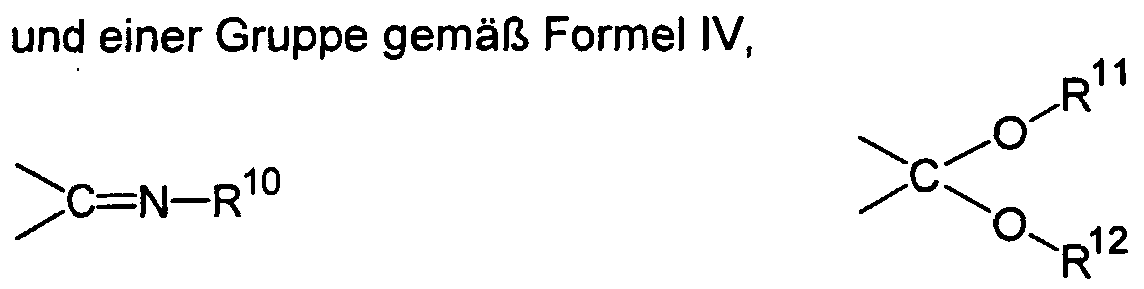
  • Y represents a group selected from carbonyl, a group according to formula III and a group according to formula IV,
  • R 10 stands for a hydrogen atom, a hydroxy group, a dC 4 alkoxy group, a dC 6 alkyl group, a CC 6 hydroxyalkyl group, a C 2 -C 6 polyhydroxyalkyl group, a CrCe alkoxy-Ci-Ce-alkyl group,
  • R 11 and R 12 independently of one another represent a dC 6 alkyl group, an aryl group or together with the structural element OCO of the formula IV form a 5- or 6-membered ring.
  • Component B is particularly preferably selected from the group consisting of acetophenone, propiophenone, 2-hydroxyacetophenone, 3-hydroxyacetophenone, 4-hydroxyacetophenone, 2-hydroxypropiophenone, 3-hydroxypropiophenone, 4-hydroxyproprophenone, 2-hydroxybutyrophenone, 3- Hydroxybutyrophenone, 4-hydroxybutyrophenone, 2,4-dihydroxyacetophenone, 2,5-dihydroxyacetophenone, 2,6-dihydroxyacetophenone, 2,3,4-trihydroxyacetophenone, 3,4,5-trihydroxyacetophenone, 2,4,6-trihydroxyacetophenone, 2,4,6-thmethoxyacetophenone, 3,4,5-trimethoxyacetophenone, 3,4,5-trimethoxyacetophenone diethyl ketal, 4-hydroxy-3-methoxyacetophenone, 3,5-dimethoxy-4-hydroxyacetophenone, 4- Aminoacetophenone, 4-dimethylaminoacetophenone, 4-morpholin
  • Ethoxybenzaldehyde 4-hydroxy-2,3-dimethoxy-benzaldehyde, 4-hydroxy-2,5-dimethoxy-benzaldehyde, 4-hydroxy-2,6-dimethoxy-benzaldehyde, 4-hydroxy-2-methyl-benzaldehyde, 4- Hydroxy-3-methyl-benzaldehyde, 4-hydroxy-2,3-dimethyl-benzaldehyde, 4-hydroxy-2,5-dimethyl-benzaldehyde, 4-hydroxy-2,6-dimethyl-benzaldehyde, 4-hydroxy-3, 5-dimethoxy-benzaldehyde, 4-hydroxy-3,5-dimethyl-benzaldehyde, 3,5-diethoxy-4-hydroxy-benzaldehyde, 2,6-diethoxy-4-hydroxy-benzaldehyde, 3-hydroxy-4-methoxy benzaldehyde, 2-hydroxy-4-methoxy-benzaldehyde, 2-ethoxy-4-hydroxy-benzaldehyde, 3-
  • component B such that group Y from formula II is not a carbonyl group.
  • Benzaldehyde, cinnamaldehyde and naphthaldehyde and their derivatives, in particular with one or more hydroxy, alkoxy and amino substituents, are very particularly preferably used as component B in the agents according to the invention.
  • the compounds of formula V are preferred
  • R 13, R 14 and R 15 independently represent a hydrogen atom, a halogen atom, a dC 6 alkyl group, a hydroxy group, a dC 6 - alkoxy group, an amino group, a dC 6 dialkylamino group, a di (C 2 -C 6 -hydroxyalkyl) amino group, a di (C 1 -C 6 -alkoxy-C 1 -C 6 -alkyl) amino group, ad- C 6 -hydroxyalkyloxy group, a sulfonyl group, a carboxyl group, a sulfonic acid group, a sulfonamido group, a sulfonamide group, a carbamoyl group, a C 2 -C 6 acyl group, an acetyl group or a nitro group,
  • R 13a and R 14a stand for hydrogen or together with the rest of the molecule form a 5- or 6-membered aromatic or aliphatic ring.
  • Very particularly preferred compounds of component B are selected from the group consisting of vanillin, coniferylaldehyde, 2-methoxybenzaldehyde, 3-methoxybenzaldehyde, 4-methoxybenzaldehyde, 2-ethoxybenzaldehyde, 3-
  • Trihydroxybenzaldehyde 4-hydroxy-2-methoxybenzaldehyde, 4-dimethylaminobenzaldehyde, 4-diethylaminobenzaldehyde, 4-dimethylamino-2-hydroxybenzaldehyde, 4-diethylamino-2-hydroxybenzaldehyde, 4-pyrrolidinobenzaldehyde, 4- Morpholinobenzaldehyde, 2-morpholinobenzaldehyde, 4-piperidinobenzaldehyde, 2-methoxy-1-naphthaldehyde, 4-methoxy-1-naphthaldehyde, 2-hydroxy-1-naphthaldehyde, 2,4-dihydroxy-1-naphthaldehyde, 4-hydroxy-3- methoxy-1-naphthaldehyde, 2-hydroxy-4-methoxy-1-naphthaldehyde, 3-hydroxy-4-methoxy-1-naphthaldehyde, 2,4-dimethoxy-1-naphthaldeh
  • At least one compound of the formula I and at least one reactive carbonyl compound (component B) to the agents according to the invention at least one further compound as component C, selected from (a) CH-acidic compounds and (b) compounds having a primary or secondary amino or hydroxy group selected from aromatic hydroxy compounds, primary or secondary aromatic amines and nitrogen-containing heterocyclic compounds.
  • the CH-acidic compounds of component C are preferably selected from the group consisting of 1, 2,3,3-tetramethyl-3H-indolium iodide, 1, 2,3,3-tetramethyl-3H-indolium-p-toluenesulfonate, 1, 2,3,3-tetramethyl-3H-indolium methanesulfonate, 1, 3,3-trimethyl-2-methyleneindoline (Fischer's base), 2,3-dimethyl-benzothiazolium iodide, 2,3-dimethyl-benzothiazolium-p- toluenesulfonate, 2,3-dimethyl-naphtho [1,2-d] thiazolium-p-toluenesulfonate, 3-ethyl-2-methyl-naphtho [1,2-d] thiazolium-p-toluenesulfonate, rhodanine, rhodanine-3-
  • Trimethylquinoxalinium iodide 3-ethyl-2-methyl-benzoxazolium-p-toluenesulfonate, 3-ethyl-2- methyl benzothiazolium p-toluenesulfonate, 1-ethyl-4-methyl-quinolinium p-toluenesulfonate, 1 - ethyl 2-methylquinolinium p-toluenesulfonate, and 1, 2,3-trimethylquinoxalinium p-toluenesulfonate.
  • the primary and secondary aromatic amines of component C are preferably selected from the group consisting of N, N-dimethyl-p-phenylenediamine, N, N-diethyl-p-phenylenediamine, N- (2-hydroxyethyl) -N-ethyl-p -phenylene diamine, N, N-bis (2-hydroxyethyl) p-phenylene diamine, N- (2-methoxyethyl) p-phenylene diamine, 2,3-dichloro-p-phenylene diamine, 2,4-dichloro-p-phenylene diamine , 2,5-dichloro-p-phenylenediamine, 2-chloro-p-phenylenediamine, 2,5-dihydroxy-4-morpholinoaniline, 2-aminophenol, 3-aminophenol, 4-aminophenol, 2-aminomethyl-4-aminophenol, 2 -Hydroxymethyl-4-aminophenol, o-
  • R 16 for a hydroxy or an amino group which can be substituted by C 6 -C 6 -alkyl, dC 6 -Hydroxyalkyl-, dC 6 -alkoxy or C 1 -C 6 -alkoxy-C 1 -C 6 -alkyl groups can stands
  • R 17 , R 18 , R 19 , R 20 and R 21 independently of one another for a hydrogen atom, a hydroxyl or an amino group, which can be substituted by Ci-Ce-alkyl, dC 6 -hydroxyalkyl, dC 6 - alkoxy-, Ci -Ce aminoalkyl or dC 6 alkoxy -CC -C 6 alkyl groups can be substituted, and
  • Q is a direct bond, a CH 2 or CHOH group
  • O denotes a number from 1 to 4,
  • 4,4'-diaminostilbene and its hydrochloride 4,4'-diaminostilbene-2,2'-disulfonic acid mono- or di-Na salt, 4-amino-4'-dimethylaminostilbene and its hydrochloride, 4, 4'-diaminodiphenylmethane, 4,4'-diaminodiphenyl sulfide, 4,4'- Diaminodiphenyl sulfoxide, 4,4'-diaminodiphenylamine, 4,4'-diaminodiphenylamine-2-sulfonic acid, 4,4'-diaminobenzophenone, 4,4'-diaminodiphenyl ether, S.S ⁇ ⁇ '- tetraaminodiphenyl, S.S' ⁇ '- tetraamino-benzophenone, 1,3-bis (2,4-diaminophenoxy) propane, 1,8-bis
  • the nitrogen-containing heterocyclic compounds of component C are preferably selected from the group consisting of 2-aminopyridine, 3-aminopyridine, 4-aminopyridine, 2-amino-3-hydroxy-pyridine, 2,6-diamino-pyridine, 2,5-diamino -pyridine, 2- (aminoethylamino) -5-aminopyridine, 2,3-diamino-pyridine, 2-dimethylamino-5-amino-pyridine, 2-methylamino-3-amino-6-methoxy-pyhdin, 2,3-diamino -6-methoxy-pyridine, 2,6-dimethoxy-3,5-diamino-pyridine, 2,4,5-triamino-pyhdin, 2,6-dihydroxy-3,4-dimethylpyridine, N- [2- (2nd , 4-diaminophenyl) aminoethyl] -N- (5-amino-2-pyridy
  • the hydroxypyrimidines disclosed in DE-U 1-299 08 573 can also be used as heterocyclic compounds.
  • the aforementioned compounds can be used both in free form and in the form of their physiologically tolerable salts, e.g. B. as salts of inorganic acids, such as hydrochloric or sulfuric acid.
  • the aromatic hydroxy compounds of component C are preferably selected from the group consisting of 2-, 4-, 5-methylresorcinol, 2,5-dimethylresorcinol, resorcinol, 3-methoxyphenol, pyrocatechol, hydroquinone, pyrogallol, phloroglucin, hydroxyhydroquinone, 2-, 3 -, 4-methoxy, 3-dimethylamino, 2- (2-hydroxyethyl) -, 3,4-methylenedioxyphenol, 2,4-, 3,4-dihydroxybenzoic acid, -phenylacetic acid, gallic acid, 2,4,6-trihydroxybenzoic acid , -acetophenone, 2-, 4-chlororesorcinol, 1-naphthol, 1, 5-, 2,3-, 2,7-dihydroxynaphthalene, 6-dimethylamino-4-hydroxy-2-naphthalenesulfonic acid and 3,6-dihydroxy-2 , 7-naphthalene s
  • reaction product RP contains at least one reaction product (hereinafter referred to as reaction product RP) from a 1,2-dihydro-pyrimidinium derivative of the formula I and a compound of component B, in particular compounds of the formula II, as a direct dye.
  • reaction products RP can, for. B.
  • reaction products RP can be obtained by heating the two reactants in an aqueous neutral to weakly alkaline medium, the reaction products RP either precipitating out of the solution as a solid or being isolated therefrom by evaporation of the solution.
  • literature H. Baumann et al J. Liebigs Ann. Chem., 1968, 717, 124-136 or DE-A1-2165913.
  • Reaction products RP according to formula VIII can thus be contained in the agents according to the invention.
  • R 1 , R 2 , R 5 , Y and X are defined as described under formula I,
  • R 23 and R 24 independently of one another represent a hydrogen atom, a dC 6 alkyl group, a group according to formula IX, wherein
  • R, R, R, R, AR and Z are defined as described under formula II,
  • R ü25 represents a hydrogen atom or a dC 5 alkyl group
  • molar ratios of component B to the compound of the formula I from about 1: 1 to about 2: 1 can be expedient. If, in the case of a 1,2-dihydro-pyrimidinium dehvate according to formula I, only one substituent R 3 or R 4 is different from hydrogen, in the synthesis of the reaction products RP about 1 molar equivalent of component B with one molar equivalent of 1,2-dihydro-pyrimidinium is used - Implemented derivative. In this case, either R 23 or R 24 in formula VIII represents a hydrogen atom and the other radical in each case represents a group according to formula IX.
  • both substituents R 3 and R 4 in formula I are different from a hydrogen atom, these 1,2-dihydropyhmidinium derivatives can be reacted with both about one and about two molar equivalents of component B.
  • both R 23 and R 24 in the resulting reaction products RP represent a group according to formula IX.
  • the agents according to the invention contain those reaction products RP according to formula VIII in which AR according to formula IX represents benzene or naphthalene.
  • the agents according to the invention contain those reaction products RP according to formula VIII in which Z according to formula IX represents a direct bond or vinylene.
  • agents according to the invention are such Contain reaction products RP according to formula VIII, in which R 25 according to formula IX represents a hydrogen atom.
  • the agents according to the invention contain those reaction products RP according to formula VIII in which R 6 according to formula IX represents a hydrogen atom.
  • the agents according to the invention contain those reaction products RP according to formula VIII in which R 7 , R 8 and R 9 according to formula IX independently of one another represent a hydrogen atom, a halogen atom, a d-Ce-alkyl group, a hydroxy group, a dC 6 alkoxy group, an amino group, a d-C ⁇ -dialkylamino group, a di (C 2 -C 6 hydroxyalkyl) amino group, a di (C 1 -C 6 alkoxy-C -C 6 alkyl) amino group, a CrC 6 hydroxyalkyloxy group, a sulfonyl group, a carboxyl group, a sulfonamide group, a carbamoyl group, a C ⁇ -Ce acyl group, an acetyl group, a sulfonic acid group, a sulfonamido group or a nitro group.
  • the agents according to the invention contain those reaction products RP according to formula VIII in which the radicals R 7 , R 8 and R 9 according to formula IX independently of one another represent a hydrogen atom, a halogen atom, a dC 6 -alkyl group, a hydroxy group , a d-Ce-alkoxy group, an amino group, a dC 6 -dialkylamino group, a di (C 2 -C 6 -hydroxyalkyl) amino group, a di (C 1 -C 6 -alkoxy-C 1 -C 6 -alkyl) amino group , a dC 6 - hydroxyalkyloxy group, a sulfonyl group, a carboxyl group, a sulfonamide group, a carbamoyl group, a C 2 -C 6 acyl group, an acetyl group, a sulfonic acid group, a sulfon
  • the agents according to the invention contain those reaction products RP according to formula VIII in which the radicals R 7 , R 8 and R 9 independently of one another represent a hydrogen atom, a halogen atom, a C 1 -C 6 -alkyl group, a hydroxyl group, a CC 6 alkoxy group, an amino group, ad Ce-dialkylamino group, a di (C 2 -C 6 -hydroxyalkyl) amino group, a di (dC 6 -alkoxy-CrC 6 -alkyl) amino group, a dC 6 -hydroxyalkyloxy group, a sulfonyl group, a carboxyl group, a sulfonamide group, a carbamoyl group, a C 2 -C 6 acyl group, an acetyl group, a sulfonic acid group, a sulfonamido group or a nitro group, with the proviso
  • At least one compound selected from the group consisting of 4- [2- [2-hydroxyphenyl] ethenyl] -2,3-dihydro-1,3,6 is selected as a very particularly preferred reaction product RP according to formula VIII in this embodiment -trimethyl-2-oxo-pyhmidinium chloride, 4- [2- [3-hydroxyphenyl] ethenyl] -2,3-dihydro-1,3,6-trimethyl-2-oxo-pyrimidinium hydrogen sulfate, 4- [2 - [4-hydroxyphenyl] ethenyl] -2,3-dihydro-1,3,6-thmethyl-2-oxopyrimidinium chloride, 4- [2- [2,3-dihydroxyphenyl] ethenyl] - 2,3- dihydro-1,3,6-trimethyl-2-oxopyrimidinium chloride, 4- [2- [2,4-dihydroxyphenyl] ethenyl] -2,
  • 6-trimethyl-2-oxopyrimidinium chloride 4- [2- [3,6-dihydroxyphenyl] ethenyl] -2,3-dihydro-1,3,6-thmethyl-2-oxopyrimidinium chloride, 4 - [2- [2,3,4-trihydroxyphenyl] ethenyl] -2,3-dihydro-1, 3,6-trimethyl-2-oxo-pyhmidinium chloride, 4- [2- [2,3,5- trihydroxyphenyl] ethenyl] -2,3-dihydro-1,3,6-trimethyl-2-oxopyrimidinium hydrogen sulfate, 4- [2- [2,3,6-trihydroxyphenyl] ethenyl] -2,3-dihydro- 1, 3,6-trimethyl-2-oxopyrimidinium chloride, 4- [2- [3,4,5-thhydroxyphenyl] ethenyl] -2,3-dihydro-1, 3,6-tri
  • 6-thmethyl-2-oxopyrimidinium chloride 4- [2- [2,4-dimethoxyphenyl] ethenyl] -2,3-dihydro-1,3,6-trimethyl-2-oxopyrimidinium ch lohd, 4- [2- [2,5-dimethoxyphenyl] ethenyl] -2,3-dihydro-1,3,6-trimethyl-2-oxopyrimidinium chloride, 4- [2- [2,6-dimethoxyphenyl] ethenyl] -2,3-dihydro-1, 3,6-thmethyl-2-oxo-pyhmidinium chloride, 4- [2- [3,4-dimethoxyphenyl] ethenyl] -2.3 -dihydro-1, 3,6-thmethyl-2-oxopyrimidinium chloride, 4- [2- [3,5-dimethoxyphenyl] ethenyl] -2,3-dihydro-1,3,
  • 6-trimethyl-2-oxopyrimidinium chloride 4- [2- [4- (diethylamino) -2-hydroxyphenyl] ethenyl] -2,3-dihydro-1, 3,6-trimethyl-2-oxopyrimidinium -chloride, 4- [2- [4- (diethylamino) -3-hydroxyphenyl] ethenyl] - 2,3-dihydro-1, 3,6-thmethyl-2-oxopyrimidinium chloride, 4- [2- [ 4- (diethylamino) -2-methylphenyl] ethenyl] -2,3-dihydro-1, 3,6-trimethyl-2-oxopyrimidinium chloride, 4- [2- [4- (diethylamino) -3-methylphenyl ] -ethenyl] -2,3-dihydro-1, 3,6-trimethyl-2-oxopyrimidinium chloride, 4- [2- [4- (die
  • the above-mentioned compounds with the formula I, the compounds of component B, component C and the reaction products RP are each preferably used in an amount of 0.03 to 65 mmol, in particular 1 to 40 mmol, based on 100 g of the total colorant, used.
  • the agents according to the invention can contain, in addition to at least one compound of the formula I and at least one reactive carbonyl compound, at least one developer component and, if appropriate, at least one coupler component as oxidation dye precursors.
  • P-Phenylenediamine derivatives of the formula (E1) are particularly preferred
  • G 1 represents a hydrogen atom, a C to C 4 alkyl radical, a C to C 4 -
  • Monohydroxyalkyl radical a C 2 - to C -polyhydroxyalkyl radical, a (d- to C 4 ) -
  • Alkyl radical which is substituted by a nitrogen-containing group, a phenyl or a 4'-
  • G 2 represents a hydrogen atom, ad- to C 4 -alkyl radical, ad- to C 4 -
  • Monohydroxyalkyl radical a C 2 - to C 4 -polyhydroxyalkyl radical, a (d- to C) -
  • G 3 represents a hydrogen atom, a halogen atom, such as a chlorine, bromine, iodine or
  • Fluorine atom a d- to C 4 alkyl, a d- to C 4 monohydroxyalkyl radical, a
  • G 4 represents a hydrogen atom, a halogen atom or a d- to C 4 -alkyl radical or if G 3 and G 4 are in the ortho position to one another, they can together form a bridging ⁇ , ⁇ -alkylenedioxo group, such as, for example, an ethylenedioxy group.
  • Examples of the C to C alkyl radicals mentioned as substituents in the compounds according to the invention are the groups methyl, ethyl, propyl, isopropyl and butyl. Ethyl and methyl are preferred alkyl radicals.
  • Preferred d- to C-alkoxy radicals according to the invention are, for example, a methoxy or an ethoxy group.
  • Further preferred examples of a d- to C 4 -hydroxyalkyl group are a hydroxymethyl, a 2-hydroxyethyl, a 3-hydroxypropyl or a 4-hydroxybutyl group. A 2-hydroxyethyl group is particularly preferred.
  • a particularly preferred C 2 - to C 4 -polyhydroxyalkyl group is the 1,2-dihydroxyethyl group.
  • halogen atoms according to the invention are F, Cl or Br atoms, Cl atoms are very particularly preferred.
  • the other terms used are derived from the definitions given here.
  • nitrogen-containing groups of the formula (E1) are, in particular, the amino groups, d- to C 4 -monoalkylamino groups, d- to C 4 -dialkylamino groups, d- to C 4 -trialkylammonium groups, C to C 4 -monohydroxyalkylamino groups, imidazolinium and ammonium.
  • Particularly preferred p-phenylenediamines of the formula (E1) are selected from p-phenylenediamine, p-toluenediamine, 2-chloro-p-phenylenediamine, 2,3-dimethyl-p-phenylenediamine, 2,6-dimethyl-p-phenylenediamine, 2 , 6-diethyl-p-phenylenediamine, 2,5-dimethyl-p-phenylenediamine, N, N-dimethyl-p-phenylenediamine, N, N-diethyl-p-phenylenediamine, N, N-dipropyl-p-phenylenediamine, 4 -Amino-3-methyl- (N, N-diethyl) aniline, N, N-bis- ( ⁇ -hydroxyethyl) -p-phenylenediamine, 4-N, N-bis- ( ⁇ -hydroxyethyl) -amino-2 - methylaniline,
  • p-phenylenediamine derivatives of the formula (E1) which are particularly preferred are p-phenylenediamine, p-toluenediamine, 2- ( ⁇ -hydroxyethyl) -p-phenylenediamine, 2- ( ⁇ .ß-dihydroxyethyl) -p-phenylenediamine and N, N bis (.beta.-hydroxyethyl) -p-phenylenediamine.
  • developer component compounds which contain at least two aromatic nuclei which are substituted by amino and / or hydroxyl groups.
  • binuclear developer components which can be used in the coloring compositions according to the invention, one can name in particular the compounds which correspond to the following formula (E2) and their physiologically tolerable salts: in which:
  • Z 1 and Z 2 independently of one another represent a hydroxyl or NH 2 radical, which may be by a d- to C 4 -alkyl radical, by a C to C 4 -
  • the bridge Y represents an alkylene group having 1 to 14 carbon atoms, such as a linear or branched alkylene chain or an alkylene ring, which is one or more nitrogen-containing groups and / or one or more
  • Heteroatoms such as oxygen, sulfur or nitrogen atoms can be interrupted or terminated and possibly by one or more hydroxyl or d bis
  • C ⁇ -alkoxy radicals can be substituted, or a direct bond
  • G 5 and G 6 independently of one another represent a hydrogen or halogen atom, a Cr to C 4 -alkyl radical, a d- to C 4 -monohydroxyalkyl radical, a C 2 - to C 4 -
  • G 7 , G 8 , G 9 , G 10 , G 1 and G 12 independently represent one another
  • the compounds of formula (E2) contain at least one amino group which carries at least one hydrogen atom.
  • Preferred dinuclear developer components of the formula (E2) are in particular: N, N'-bis (ß-hydroxyethyl) -N, N'-bis- (4 , -aminophenyl) -1, 3-diamino-propan-2-ol, N, N'-bis- (ß-hydroxyethyl) ) -N, N'-bis (4'-aminophenyl) ethylenediamine, N, N'-bis (4-aminophenyl) tetramethylene diamine, N, N'-bis (ß-hydroxyethyl) -N, N ' -bis- (4-aminophenyl) tetramethylene diamine, N, N'-bis (4-methylaminophenyl) tetramethylene diamine, N, N'-diethyl-N, N'-bis- (4'-amino-3 ' -methylphenyl) ethylenediamine, bis (2-hydroxy-5-aminoph
  • Very particularly preferred dinuclear developer components of the formula (E2) are N, N , -Bis- (ß-hydroxyethyl) -N, N'-bis- (4 , -aminophenyl) -1, 3-diamino-propan-2-ol, Bis (2-hydroxy-5-aminophenyl) methane, N, N'-bis (4'-aminophenyl) -1, 4-diazacycloheptane and 1, 10-bis (2 ', 5'-diaminophenyl) - 1, 4,7,10-tetraoxadecane or one of its physiologically acceptable salts.
  • P-Aminophenol derivatives of the formula (E3) are particularly preferred
  • G 13 represents a hydrogen atom, a halogen atom, a d- to C 4 -alkyl radical, a Cr to C 4 -monohydroxyalkyl radical, a C 2 - to C -polyhydroxyalkyl radical, a (C to C 4 ) -alkoxy- (d- bis C 4 ) -alkyl radical, ad- to C 4 -aminoalkyl radical, a hydroxy- (d- to C 4 ) -alkylamino radical, a C to C -hydroxyalkoxy radical, ad- to d-hydroxyalkyHd-to C 4 ) -aminoalkyl radical or a (di-d to C 4 alkylamino) - (C r to C) alkyl radical, and
  • G 14 represents a hydrogen or halogen atom, a d- to C 4 -alkyl radical, a d- to C -monohydroxyalkyl radical, a C 2 - to C 4 -polyhydroxyalkyl radical, a (d- to C 4 ) -alkoxy- (Cr to C 4 ) -alkyl, ad- to C 4 -aminoalkyl or ad- to C-cyanoalkyl, G 15 represents hydrogen, ad to C alkyl, ad to C monohydroxyalkyl, C 2 to C 4 polyhydroxyalkyl, phenyl or benzyl, and G 16 represents hydrogen or a halogen atom.
  • Preferred p-aminophenols of the formula (E3) are in particular p-aminophenol, N-methyl-p-aminophenol, 4-amino-3-methylphenol, 4-amino-3-fluorophenol, 2-hydroxymethylamino-4-aminophenol, 4 -Amino-3-hydroxymethylphenol, 4-amino-2- (ß-hydroxyethoxy) phenol, 4-amino-2-methylphenol, 4-amino-2-hydroxymethylphenol, 4-amino-2-methoxymethyl-phenol, 4-amino -2-aminomethylphenol, 4-amino-2- (ß-hydroxyethyl-aminomethyl) phenol, 4-amino-2- ( ⁇ , ß-dihydroxyethyl) phenol, 4-amino-2-fluorophenol, 4-amino-2 -chlorophenol, 4-amino-2,6-dichlorophenol, 4-amino-2- (diethylaminomethyl) phenol and their physiologically tolerable salts
  • Very particularly preferred compounds of the formula (E3) are p-aminophenol, 4-amino-3-methylphenol, 4-amino-2-aminomethylphenol, 4-amino-2- ( ⁇ , ⁇ -dihydroxyethyl) phenol and 4-amino- 2- (diethylaminomethyl) -phenol.
  • the developer component can be selected from o-aminophenol and its derivatives, such as, for example, 2-amino-4-methylphenol, 2-amino-5-methylphenol or 2-amino-4-chlorophenol.
  • the developer component can be selected from heterocyclic developer components, such as, for example, the pyridine, pyrimidine, pyrazole, pyrazole-pyrimidine derivatives and their physiologically tolerable salts.
  • heterocyclic developer components such as, for example, the pyridine, pyrimidine, pyrazole, pyrazole-pyrimidine derivatives and their physiologically tolerable salts.
  • Preferred pyridine derivatives are, in particular, the compounds described in patents GB 1 026 978 and GB 1 153 196, such as 2,5-diamino-pyridine, 2- (4'-methoxyphenyl) amino-3-aminopyridine , 2,3-diamino-6-methoxy-pyridine, 2- (ß-
  • Methoxyethyl amino-3-amino-6-methoxy-pyridine and 3,4-diamino-pyridine.
  • Preferred pyrimidine derivatives are, in particular, the compounds described in German Patent DE 2,359,399, Japanese laid-open specification JP 02019576 A2 or in laid-open specification WO 96/15765, such as 2,4,5,6-tetraaminopyrimidine, 4-hydroxy-2,5,6-triaminopyrimidine, 2-hydroxy- 4,5,6-triaminopyrimidine, 2-dimethylamino-4,5,6-triaminopyhmidine, 2,4-dihydroxy-5,6-diaminopyrimidine and 2,5,6-triaminopyrimidine.
  • Preferred pyrazole derivatives are, in particular, the compounds described in patents DE 3 843 892, DE 4 133 957 and patent applications WO 94/08969, WO 94/08970, EP-740 931 and DE 195 43 988, such as 4.5 -Diamino-1-methylpyrazole, 4,5-diamino-1- (ß-hydroxyethyl) -pyrazole, 3,4-diaminopyrazole, 4,5-diamino-1- (4'-chlorobenzyl) -pyrazole, 4,5- Diamino-1, 3-dimethylpyrazole, 4,5-diamino-3-methyl-1-phenylpyrazole, 4,5-diamino-1-methyl-3-phenylpyrazole, 4-amino-1, 3-dimethyl-5-hydrazinopyrazole, 1-benzyl-4,5-diamino-3-methylpyrazole, 4,5-diamino-3-tert-but
  • Preferred pyrazole-pyrimidine derivatives are, in particular, the derivatives of pyrazole- [1,5-a] -pyrimidine of the following formula (E4) and its tautomeric forms, provided there is a tautomeric equilibrium:
  • G 17 , G 18 , G 19 and G 20 independently represent a hydrogen atom, a C to C 4 alkyl radical, an aryl radical, a Cr to C 4 hydroxyalkyl radical, a C 2 to C polyhydroxyalkyl radical a (i.e.
  • - i has the value 0, 1, 2 or 3
  • p has the value 0 or 1
  • q has the value 0 or 1
  • n has the value 0 or 1, with the proviso that the sum of p + q is not equal to 0 if p + q is 2, n has the value 0, and the groups NG 17 G 18 and NG 19 G 20 occupy positions (2,3); (5,6); (6,7); (3.5) or (3.7);
  • the pyrazole [1, 5-a] pyrimidines of the above formula (E4) can be prepared as described in the literature by cyclization starting from an aminopyrazole or from hydrazine.
  • the coupler components optionally present in the agents according to the invention are preferably selected from m-aminophenol and its derivatives such as 5-amino-2-methylphenol, N-cyclopentyl-3-aminophenol, 3-amino-2-chloro-6-methylphenol, 2- Hydroxy-4-aminophenoxyethanol, 2,6-dimethyl-3-aminophenol, 3-trifluoroacetylamino-2-chloro-6-methylphenol, 5-amino-4-chloro-2-methylphenol, 5-amino-4-methoxy-2- methylphenol, 5- (2'-hydroxyethyl) amino-2-methylphenol, 3- (diethylamino) phenol, N-cyclopentyl-3-aminophenol, 1, 3-dihydroxy-5- (methylamino) benzene, 3-ethylamino
  • Diaminophenoxyethanol 1, 3-bis- (2,, 4'-diaminophenoxy) -propane, 1-methoxy-2-amino-
  • Resorcinol monomethyl ether 2-methylresorcinol, 5-methylresorcinol, 2,5-dimethylresorcinol,
  • Pyridine derivatives such as 2,6-dihydroxypyridine, 2-amino-3-hydroxypyridine,
  • Naphthalene derivatives such as 1-naphthol, 2-methyl-1-naphthol, 2-
  • Morpholine derivatives such as 6-hydroxybenzomorpholine and 6-aminobenzomorpholine,
  • Indole derivatives such as 4-hydroxyindole, 6-hydroxyindole and 7-hydroxyindole,
  • Pyrimidine derivatives such as, for example, 4,6-diaminopyhmidine, 4-amino-2,6-dihydroxypyrimidine, 2,4-diamino-6-hydroxypyrimidine, 2,4,6-thhydroxypyrimidine, 2-
  • Methylenedioxybenzene derivatives such as 1-hydroxy-3,4-methylenedioxybenzene
  • Coupler components which are particularly preferred according to the invention are 1-naphthol, 1, 5-, 2,7- and 1,7-dihydroxynaphthalene, 3-aminophenol, 5-amino-2-methylphenol, 2-amino-3-hydroxypyridine, resorcinol, 4-chlororesorcinol, 2-chloro-6-methyl-3-aminophenol, 2 -Methyl resorcinol, 5-methylresorcinol, 2,5-dimethylresorcinol and 2,6-dihydroxy-3,4-dimethylpyridine.
  • indoles and indolines which have at least one hydroxyl or amino group, preferably as a substituent on the six-membered ring, can furthermore preferably be used in the agents according to the invention as precursors of nature-analogous dyes.
  • These groups can carry further substituents, e.g. B. in the form of etherification or esterification of the hydroxy group or an alkylation of the amino group.
  • the colorants contain at least one indole and / or indole linden.
  • G 21 represents hydrogen, a dd-alkyl group or a dd-hydroxy-alkyl group
  • G 22 stands for hydrogen or a -COOH group, where the -COOH group can also be present as a salt with a physiologically compatible cation,
  • G 23 represents hydrogen or a CrC alkyl group
  • G 24 represents hydrogen, a dC 4 alkyl group or a group -CO-G 26 , in which
  • G 26 stands for a dd-alkyl group
  • G 25 stands for one of the groups mentioned under G 24 , as well as physiologically tolerable salts of these compounds with an organic or inorganic acid.
  • Particularly preferred derivatives of indoline are 5,6-dihydroxyindoline, N-methyl-5,6-dihydroxyindoline, N-ethyl-5,6-dihydroxyindoline, N-propyl-5,6-dihydroxyindoline, N-butyl-5,6 dihydroxyindoline, 5,6-dihydroxyindoline-2-carboxylic acid and 6-hydroxyindoline, 6-aminoindoline and 4-aminoindoline.
  • N-methyl-5,6-dihydroxyindoline N-ethyl-5,6-dihydroxyindoline, N-propyl-5,6-dihydroxyindoline, N-butyl-5,6-dihydroxyindoline and especially the 5 6-Dihydroxyindolin.
  • G 27 represents hydrogen, a dd-alkyl group or a dC 4 -hydroxyalkyl group
  • G 28 stands for hydrogen or a -COOH group, where the -COOH group can also be present as a salt with a physiologically compatible cation,
  • G 29 represents hydrogen or a dC 4 alkyl group
  • G 30 stands for hydrogen, a dd-alkyl group or a group -CO-G 32 , in which G 32 stands for a dC 4 -alkyl group, and
  • G 31 stands for one of the groups mentioned under G 30 ,
  • Particularly preferred derivatives of indole are 5,6-dihydroxyindole, N-methyl-5,6-dihydroxyindole, N-ethyl-5,6-dihydroxyindole, N-propyl-5,6-dihydroxyindole, N-butyl-5, 6-dihydroxyindole, 5,6-dihydroxyindole-2-carboxylic acid, 6-hydroxyindole, 6-aminoindole and 4-aminoindole.
  • N-methyl-5,6-dihydroxyindole, N-ethyl-5,6-dihydroxyindole, N-propyl-5,6-dihydroxyindole, N-butyl-5,6-dihydroxyindole and in particular 5.6 are to be emphasized -Dihydroxyindol.
  • the indoline and indole derivatives can be used in the colorants according to the invention both as free bases and in the form of their physiologically tolerable salts with inorganic or organic acids, for.
  • the indole or indoline derivatives are usually contained in these in amounts of 0.05-10% by weight, preferably 0.2-5% by weight.
  • the colorants according to the invention contain, in addition to the compounds contained according to the invention, customary direct dyes, such as nitrophenylenediamines, nitroaminophenols, azo dyes, anthraquinones or indophenols, in addition to the compounds contained according to the invention.
  • customary direct dyes such as nitrophenylenediamines, nitroaminophenols, azo dyes, anthraquinones or indophenols, in addition to the compounds contained according to the invention.
  • Preferred direct dyes are those with the international names or trade names HC Yellow 2, HC Yellow 4, HC Yellow 5, HC Yellow 6, HC Yellow 12, Acid Yellow 1, Acid Yellow 10, Acid Yellow 23, Acid Yellow 36, HC Orange 1, Disperse Orange 3, Acid Orange 7, HC Red 1, HC Red 3, HC Red 10, HC Red 11, HC Red 13, Acid Red 33, Acid Red 52, HC Red BN, Pigment Red 57: 1, HC Blue 2, HC Blue 12, Disperse Blue 3, Acid Blue 7, Acid Green 50, HC Violet 1, Disperse Violet 1, Disperse Violet 4, Acid Violet 43, Disperse Black 9, Acid Black 1, and Acid Black 52 known compounds and 1 , 4-diamino-2-nitrobenzene, 2-amino-4-nitrophenol, 1, 4-bis (ß-hydroxyethyl) amino-2-nitrobenzene, 3-nitro-4- (ß-hydroxyethyl) aminophenol, 2 - (2'-Hydroxyethyl) amino-4,6-dinitrophenol, 1- (2'-hydroxyethyl) amino-4-methyl
  • agents according to the invention can preferably contain a cationic direct dye.
  • a cationic direct dye is particularly preferred.
  • (C) direct dyes which contain a heterocycle which has at least one quaternary nitrogen atom, as are mentioned, for example, in EP-A2-998 908, to which reference is expressly made here, in claims 6 to 11.
  • Preferred cationic direct dyes of group (c) are in particular the following compounds:
  • the compounds of the formulas (DZ1), (DZ3) and (DZ5) are very particularly preferred cationic direct dyes of group (c).
  • the cationic direct dyes, which are sold under the trademark Arianor ® are, according to the invention particularly preferred substantive dyes.
  • the agents according to the invention in accordance with this embodiment preferably contain the substantive dyes in an amount of 0.01 to 20% by weight, based on the total colorant.
  • the preparations according to the invention can furthermore also contain naturally occurring dyes, such as those contained in henna red, henna neutral, henna black, chamomile flowers, sandalwood, black tea, sapwood, sage, blue wood, madder root, catechu, sedre and alkanna root.
  • naturally occurring dyes such as those contained in henna red, henna neutral, henna black, chamomile flowers, sandalwood, black tea, sapwood, sage, blue wood, madder root, catechu, sedre and alkanna root.
  • the optional direct dyes each represent uniform compounds. Rather, in the colorants according to the invention, due to the production process for the individual dyes, further components may be present in minor amounts, provided that these do not adversely affect the coloring result or for other reasons, e.g. B. toxicological, must be excluded.
  • the agents according to the invention can additionally contain color enhancers.
  • the color enhancers are preferably selected from the group consisting of piperidine, piperidine-2-carboxylic acid, piperidine-3-carboxylic acid, piperidine-4-carboxylic acid, pyridine, 2-hydroxypyridine, 3-hydroxypyridine, 4- Hydroxypyridine, imidazole, 1-methylimidazole, arginine, histidine, pyrrolidine, proline, pyrrolidone, pyrrolidone-5-carboxylic acid, pyrazole, 1,2,4-triazole, piperazidine, their derivatives and their physiologically tolerable salts.
  • the above-mentioned color enhancers can be used in an amount of 0.03 to 65 mmol, in particular 1 to 40 mmol, in each case based on 100 g of the entire colorant.
  • Oxidizing agents e.g. B. H 2 O 2
  • the agent according to the invention contains no oxidation dye precursors.
  • the agent according to the invention contains air-oxidizable oxidation dye precursors or indole or indoline derivatives, there can be no need for oxidizing agents.
  • it can It may be desirable to add hydrogen peroxide or other oxidizing agents to the agents according to the invention to achieve the shades that are lighter than the keratin-containing fiber to be colored.
  • Oxidizing agents are generally used in an amount of 0.01 to 6% by weight, based on the application solution.
  • a preferred oxidizing agent for human hair is H 2 O 2 .
  • Oxidation catalysts are, for example, metal salts, metal chelate complexes or metal oxides, which enable an easy change between two oxidation states of the metal ions.
  • Enzymes represent further possible oxidation catalysts. Suitable enzymes are, for example, peroxidases, which can significantly increase the effect of small amounts of hydrogen peroxide. Furthermore, such enzymes are suitable according to the invention which directly oxidize the oxidation dye precursors with the help of atmospheric oxygen, such as for example the laccases, or generate small amounts of hydrogen peroxide in situ and in this way activate the oxidation of the dye precursors biocatalytically.
  • catalysts for the oxidation of the dye precursors are the so-called 2-electron oxidoreductases in combination with the substrates specific for this, for example Pyranose oxidase and, for example, D-glucose or galactose,
  • Lactate oxidase and lactic acid and their salts Lactate oxidase and lactic acid and their salts
  • the colorants according to the invention produce intensive colorations even at physiologically tolerable temperatures of below 45 ° C. They are therefore particularly suitable for dyeing human hair.
  • the colorants can usually be incorporated into a water-containing cosmetic carrier.
  • Suitable water-containing cosmetic carriers are e.g. B. creams, emulsions, gels or surfactant-containing foaming solutions such.
  • the colorants according to the invention can contain all active ingredients, additives and auxiliaries known in such preparations.
  • the colorants contain at least one surfactant, with both anionic and zwitterionic, ampholytic, nonionic and cationic surfactants being suitable in principle.
  • Suitable anionic surfactants in preparations according to the invention are all anionic surface-active substances suitable for use on the human body. These are characterized by a water-solubilizing, anionic group such as. B. a carboxylate, sulfate, sulfonate or phosphate group and a lipophilic alkyl group with about 10 to 22 carbon atoms. In addition, glycol or polyglycol ether groups, ester, ether and amide groups as well as hydroxyl groups are included. Examples of suitable anionic surfactants are, in each case in the form of the sodium, potassium and ammonium as well as the mono-, di- and trialkanolammonium salts with 2 or 3 carbon atoms in the alkanol group,
  • Ether carboxylic acids of the formula RO- (CH 2 -CH 2 0) x -CH 2 -COOH, in which R is a linear alkyl group with 10 to 22 C atoms and x 0 or 1 to 16, acyl sarcosides with 10 to 18 C- Atoms in the acyl group, acyl taurides with 10 to 18 carbon atoms in the acyl group, acyl isethionates with 10 to 18 carbon atoms in the acyl group,
  • Sulfosuccinic acid mono- and dialkyl esters with 8 to 18 carbon atoms in the alkyl group and sulfosuccinic acid mono-alkyl polyoxyethyl esters with 8 to 18 carbon atoms in the alkyl group and 1 to 6 oxyethyl groups, linear alkane sulfonates with 12 to 18 carbon atoms, linear alpha-olefin sulfonates with 12 to 18 carbon atoms, alpha-sulfofatty acid methyl ester of fatty acids with 12 to 18 carbon atoms, alkyl sulfates and alkyl polyglycol ether sulfates of the formula RO (CH 2 -CH 2 O) x -SO 3 H, in which R is a preferably linear alkyl group with 10 to 18 carbon atoms and x 0 or 1 to 12,
  • Esters of tartaric acid and citric acid with alcohols the addition products of about 2 to 15 molecules of ethylene oxide and / or propylene oxide to fatty alcohols with 8 to 22 carbon atoms.
  • Particularly suitable zwitterionic surfactants are the so-called betaines such as the N-alkyl-N, N-dimethylammonium glycinate, for example the coconut alkyl dimethylammonium glycinate, N-acylaminopropyl-N, N-dimethylammonium glycinate, for example the coconut acylaminopropyl dimethylammonium glycinate, and 2 -Alkyl-3-carboxymethyl-3-hydroxyethyl-imidazolines each having 8 to 18 carbon atoms in the alkyl or acyl group and the cocoacylaminoethylhydroxyethylcarboxymethylglycinate.
  • a preferred zwitterionic surfactant is the fatty acid amide derivative known under the CTFA name Cocamidopropyl Betaine.
  • Ampholytic surfactants are surface-active compounds which, apart from a C 8 . ⁇ 8 alkyl or acyl group in the molecule at least one free amino group and at least one -COOH or -SO 3 H group and the formation of internal salts are capable .
  • suitable ampholytic surfactants are N-alkylglycine, N-alkylpropionic acid, N-alkylaminobutyric acid, N-alkyliminodipropionic acid, N-hydroxyethyl-N-alkylamidopropylglycine, N-alkyltauhne, N-alkylsarcosine, 2-alkylaminopropionic acid and alkylaminoacetic acid each with about 8 to 18 carbon atoms in the alkyl group.
  • Particularly preferred ampholytic surfactants are N-cocoalkylaminopropionate, cocoacylaminoethylaminopropionate and C 12 . 18 - acyl sarco
  • Nonionic surfactants contain z as a hydrophilic group.
  • B a polyol group, a polyalkylene glycol ether group or a combination of polyol and polyglycol ether group.
  • Such connections are, for example
  • Examples of the cationic surfactants which can be used in the hair treatment compositions according to the invention are, in particular, quaternary ammonium compounds.
  • Ammonium halides such as alkyltrimethylammonium chlorides, dialkyldimethylammonium chlorides and trialkylmethylammonium chlorides, e.g. B. cetyltrimethylammonium chloride, stearylthmethylammonium chloride, distearyldimethylammonium chloride, lauryldimethylammonium chloride, lauryldimethylbenzylammonium chloride and tricetylmethylammonium chloride.
  • the quaternized protein hydrolyzates are further cationic surfactants which can be used according to the invention.
  • cationic silicone oils such as, for example, the commercially available products Q2-7224 (manufacturer: Dow Corning; a stabilized trimethylsilylamodimethicone), Dow Corning 929 emulsion (containing a hydroxylamino-modified silicone, which is also referred to as amodimethicone) , SM-2059 (manufacturer: General Electric), SLM-55067 (manufacturer: Wacker) and Abil ® -Quat 3270 and 3272 (manufacturer: Th. Goldschmidt; diquaternary polydimethylsiloxanes, Quatemium-80).
  • alkylamidoamines especially fatty acid amidoamines such as the stearylamidopropyldimethylamine available under the name Tego Amid ® S 18, are notable for their good biodegradability.
  • a suitable cationic surfactant quaternary sugar derivative is the commercial product Glucquat ® 100, according to CTFA nomenclature a "lauryl methyl Gluceth-10 Hydroxypropyl Dimonium Chloride”.
  • the compounds with alkyl groups used as surfactants can each be uniform substances. However, it is generally preferred to start from natural vegetable or animal raw materials in the production of these substances, so that substance mixtures with different alkyl chain lengths depending on the respective raw material are obtained.
  • the surfactants which are addition products of ethylene and / or propylene oxide onto fatty alcohols or derivatives of these addition products
  • both products with a "normal” homolog distribution and those with a narrowed homolog distribution can be used.
  • “Normal” homolog distribution is understood to mean mixtures of homologs which are obtained as catalysts from the reaction of fatty alcohol and alkylene oxide using alkali metals, alkali metal hydroxides or alkali metal alcoholates.
  • narrow homolog distributions are obtained if, for example, hydrotalcites, alkaline earth metal salts of ether carboxylic acids, alkaline earth metal oxides, hydroxides or alcoholates are used as catalysts.
  • hydrotalcites alkaline earth metal salts of ether carboxylic acids, alkaline earth metal oxides, hydroxides or alcoholates are used as catalysts.
  • the use of products with a narrow homolog distribution can be preferred.
  • auxiliaries and additives are, for example, nonionic polymers such as, for example, vinylpyrrolidone / vinyl acrylate copolymers, polyvinylpyrrolidone and vinylpyrrolidone / vinyl acetate copolymers and polysiloxanes, cationic polymers such as quaternized cellulose ethers, polysiloxanes with quaternary groups, dimethyldidyldiallyl ammonium diallyl amide Copolymers, dimethylaminoethyl methacrylate-vinylpyrrolidone copolymers quaternized with diethyl sulfate, vinylpyrrolidone-imidazolinium methochloride copolymers and quaternized polyvinyl alcohol, zwitterionic and amphoteric polymers such as, for example, acrylamidopropyltrimethylammonium chloride / acrylate methacrylate / acrylate methacrylate / acryl
  • Thickeners such as agar agar, guar gum, alginates, xanthan gum, gum arabic, karaya gum, locust bean gum, linseed gums, dextrans, cellulose dehvate, e.g. B. methyl cellulose, hydroxyalkyl cellulose and carboxymethyl cellulose, starch fractions and derivatives such as amylose, amylopectin and dextrins, clays such. B. bentonite or fully synthetic hydrocolloids such. B. polyvinyl alcohol, Structurants such as glucose and maleic acid, hair-conditioning compounds such as phospholipids, for example soy lecithin, egg lecithin and cephalins, and silicone oils,
  • Protein hydrolyzates in particular elastin, collagen, keratin, milk protein, soy protein and wheat protein hydrolyzates, their condensation products with fatty acids and quaternized protein hydrolyzates, perfume oils, dimethyl isosorbide and cyclodextrins,
  • Solubilizers such as ethanol, isopropanol, ethylene glycol, propylene glycol, glycerin and diethylene glycol,
  • Anti-dandruff agents such as piroctone olamine and zinc omadine, other substances for adjusting the pH value,
  • Active ingredients such as panthenol, pantothenic acid, allantoin, pyrrolidone carboxylic acids and their salts, plant extracts and vitamins, cholesterol, light stabilizers,
  • Consistency enhancers such as sugar esters, polyol esters or polyol alkyl ethers, fats and waxes such as walnut, beeswax, montan wax, paraffins, fatty alcohols and fatty acid esters, fatty acid alkanolamides,
  • Swelling and penetration substances such as glycerol, propylene glycol monoethyl ether, carbonates, hydrogen carbonates, guanidines, ureas and primary, secondary and tertiary phosphates, imidazoles, tannins, pyrrole, opacifiers such as latex,
  • Pearlescent agents such as ethylene glycol mono- and distearate
  • Blowing agents such as propane-butane mixtures, N 2 O, dimethyl ether, CO 2 and air as well as antioxidants.
  • Suitable metal salts are e.g. B. formates, carbonates, halides, Sulfates, butyrates, valerates, capronates, acetates, lactates, glycolates, tartrates, citrates, gluconates, propionates, phosphates and phosphonates of alkali metals, such as potassium, sodium or lithium, alkaline earth metals, such as magnesium, calcium, strontium or barium, or of aluminum, Manganese, iron, cobalt, copper or zinc, with sodium acetate, lithium bromide, calcium bromide, calcium gluconate, zinc chloride, zinc sulfate, magnesium chloride, magnesium sulfate, ammonium carbonate, chloride and acetate being preferred.
  • These salts are preferably present in an amount of 0.03 to 65 mmol, in particular 1 to 40 mmol, based on 100 g of the total colorant
  • the pH of the ready-to-use coloring preparations is usually between 2 and 11, preferably between 5 and 10.
  • a second subject of the invention are coloring agents for fibers containing keratin, in particular human hair, the reaction products RP according to formula VIII as coloring component,
  • R and R independently of one another represent a hydrogen atom, a dC 6 alkyl group, a group according to formula IX,
  • R 6 , R 7 , R 8 , R 9 , AR and Z are defined as described under formula II, R 25 represents a hydrogen atom or a CrC 5 alkyl group, with the proviso that at least one of the radicals R 23 and R 24 represents a group of the formula IX.
  • the agents according to the invention contain those reaction products RP according to formula VIII in which AR according to formula IX represents benzene or naphthalene.
  • the agents according to the invention contain those reaction products RP according to formula VIII in which Z according to formula IX represents a direct bond or vinylene.
  • the agents according to the invention contain those reaction products RP according to formula VIII in which R 25 according to formula IX represents a hydrogen atom.
  • the agents according to the invention contain those reaction products RP according to formula VIII in which R 6 according to formula IX represents a hydrogen atom.
  • the agents according to the invention contain those reaction products RP according to formula VIII in which R 7 , R 8 and R 9 according to formula IX independently of one another represent a hydrogen atom, a halogen atom, a CrC 6 alkyl group, a hydroxy group, a dC 6 alkoxy group, an amino group, a -C 6 dialkylamino group, a di (C 2 -C 6 -hydroxyalkyl) amino group, a di (CrC 6 alkoxy-CrC 6 alkyl) aminoguppe, a CrC 6 -Hydroxyalkyloxy distr, a sulfonyl group , a carboxyl group, a sulfonamide group, a carbamoyl group, a C 2 -C 6 acyl group, an acetyl group, a sulfonic acid group, a sulfonamido group or a nitro group.
  • the agents according to the invention contain those reaction products RP according to formula VIII in which the radicals R 7 , R 8 and R 9 according to formula IX independently of one another represent a hydrogen atom, a halogen atom, a CC 6 alkyl group, a hydroxy group , a CrC 6 alkoxy group, an amino group, a CrC 6 dialkylamino group, a di (C 2 -C 6 - hydroxyalkyl) amino group, a di (CrC 6 alkoxy-CrC 6 alkyl) amino group, a d-Ce-hydroxyalkyloxy group, a sulfonyl group, a carboxyl group, a sulfonamide group, a carbamoyl group, a C 2 -C 6 acyl group, an acetyl group, a sulfonic acid group, a sulfonamido group or a nitro group, with the proviso that when
  • the agents according to the invention contain those reaction products RP according to formula VIII in which the radicals R 7 , R 8 and R 9 independently of one another represent a hydrogen atom, a halogen atom, a dd-alkyl group, a hydroxy group, a dC 6 -Alkoxy group, an amino group, a d-Ce-dialkylamino group, a di (C 2 -C 6 -hydroxyalkyl) amino group, a di (dC 6 -alkoxy-CrC 6 -alkyl) amino group, a d-Ce-hydroxyalkyloxy group, a sulfonyl group , a carboxyl group, a sulfonamide group, a carbamoyl group, a C 2 -C 6 acyl group, an acetyl group, a sulfonic acid group, a sulfonamido group or a nitro group, with the radicals R 7
  • the particularly preferred compounds according to formula VIII are the compounds already mentioned in the first subject of the invention.
  • the reaction product RP is preferably contained in the agents in an amount of 0.03 to 65 mmol, in particular from 1 to 40 mmol, based on 100 g of the entire colorant.
  • colorants can additionally a) at least one of the aforementioned substantive dyes and / or b) at least one of the aforementioned oxidation dye precursors and / or at least one of the aforementioned derivatives of indoline or indole and c) optionally oxidizing agents such as hydrogen peroxide contain.
  • a third object of the present invention relates to the use of at least one 1,2-dihydropyrimidinium derivative according to formula I and / or its enamine form,
  • R 1 , R 2 , R 3 , R 4 , R 5 , Y and X are as defined above, in combination with at least one reactive carbonyl compound (component B) as a coloring component in hair colorants.
  • the 1,2-dihydropyrimidinium derivatives of the formula I in combination with at least one reactive carbonyl compound of component B selected from the preferred and particularly preferred representatives mentioned above are used as the coloring component in hair colorants.
  • reaction product RP from a 1,2-dihydropyridinium derivative according to formula I and a compound of component B as coloring components in hair colorants.
  • a fourth object of the present invention relates to a process for dyeing keratin-containing fibers, in particular human hair, in which a colorant containing at least one 1,2-dihydropyrimidinium derivative according to formula I and / or its enamine form, where R 1 , R 2 , R 3 , R 4 , R 5 , Y and X "are as defined above in combination with at least one compound having a reactive carbonyl group (component B), and also conventional cosmetic ingredients, applied to the keratin-containing fibers, leave on the fiber for some time, usually about 15-30 minutes, and then rinse it out or wash it out with a shampoo.
  • a colorant containing at least one 1,2-dihydropyrimidinium derivative according to formula I and / or its enamine form where R 1 , R 2 , R 3 , R 4 , R 5 , Y and X "are as defined above in combination with at least one compound having a reactive carbonyl group (component B), and also conventional cosmetic ingredients
  • An external heat source such as warm air from a warm air blower, and also, in particular in the case of hair dyeing on the living test subject, can be generated by the body temperature of the test subject, with the latter option usually covering the area to be colored with a hood.
  • the 1,2-dihydro-pyrimidinium derivatives according to formula I and the compounds of component B can be applied to the hair either as color-imparting components or else in succession, ie. H. in a multi-stage process, it doesn't matter which of the components is applied first.
  • the optionally contained ammonium or metal salts can be added to the compounds of formula I or the compounds of component B. There may be an interval of up to 30 minutes between the application of the individual components. Pretreatment of the fibers with the saline solution is also possible.
  • the agent according to the invention Before the agent according to the invention is used in the method according to the invention, it may be desirable to pretreat the keratin-containing fiber to be dyed.
  • the chronological sequence of the pretreatment step required for this and the application of the agent according to the invention need not be immediately one after the other, but there can be a period of up to a maximum of two weeks between the pretreatment step and the application of the agent according to the invention.
  • Several pretreatment methods are suitable for this.
  • the fiber is preferred V1 before the application of the agent according to the invention of a bleaching or V2 before application of the agent of the invention of an oxidative coloring
  • the keratin-containing fiber is treated with a bleaching agent.
  • a bleaching agent such as usually hydrogen peroxide
  • the bleaching agent preferably contains at least one inorganic persalt, such as e.g. a peroxodisulfate of sodium, potassium or ammonium. Colorings according to the method according to the invention obtain a special brilliance and depth of color from the pretreatment V1.
  • an agent containing the aforementioned oxidation dye precursors is applied to the fiber as developer and, if appropriate, coupler components and, if appropriate, the aforementioned derivatives of indole or indoline and, after an exposure time, with the addition of the aforementioned suitable oxidizing agents to the hair for 5-45 minutes leave the Kertinmaschine. Then the hair is rinsed.
  • the subsequent application of the agent according to the invention can give existing oxidation colorations a new shade. If the shade of the agent according to the invention is selected in the same shade of the oxidative dyeing, the dyeing of existing oxidation dyeings can be refreshed by the process according to the invention. It has been shown that the color refreshment or shading according to the inventive method is superior to color refreshment or shading alone with conventional direct dyes in terms of color brilliance and color depth.
  • the 1,2-dihydropyrimidinium derivatives according to formula I and the compounds of component B can either be stored separately or together, either in a liquid to pasty preparation (aqueous or anhydrous) or as a dry powder. If the components are stored together in a liquid preparation, this should be largely anhydrous to reduce a reaction of the components. In the case of separate storage, the reactive components are only intimately mixed with one another immediately before use. In dry storage, a defined amount of warm (30 ° C to 80 ° C) water is usually added before use and a homogeneous mixture is produced.
  • a fifth object of the invention is the use of at least one 1,2-dihydro-pyrimidinium derivative according to formula I and / or its enamine form,
  • R 1 , R 2 , R 3 , R 4 , R 5 , Y and X are as defined above, in combination with reactive carbonyl compounds (component B), for shading the oxidation colorations of keratin-containing fibers, in particular human hair.
  • component B reactive carbonyl compounds
  • a sixth object of the invention is the use of at least one 1,2-dihydro-pyhmidinium derivative according to formula I and / or its enamine form, wherein R 1 , R 2 , R 3 , R 4 , R 5 , Y and X "are as defined above in combination with at least one reactive carbonyl compound (component B), for the color refreshment of keratin-containing fibers dyed with oxidative dyes.
  • the dyeings of keratin-containing fibers are known to be exposed to environmental influences, such as light, friction or washing, and can therefore lose their brilliance and depth of color. In the worst case, there may be a shift in the shade.
  • Such aged dyeings of keratin-containing fibers can, if the user so wishes, be brought back approximately to the color state by a color refreshment, as was presented immediately after the original dyeing. It is in accordance with the invention to use a combination of at least one compound of formula I and at least one reactive carbonyl compound for such a color refreshment.
  • a slurry or solution of 3 mmol of the 1, 2-dihydropyrimidinium derivative of the formula I (component A) with 0.41 g of sodium acetate in 30 ml of water at approx. 50 ° C. was prepared.
  • 3 mmol of the compounds of component B are added to this mixture.
  • the mixture was adjusted either to a pH of 9 with a 10% strength aqueous sodium hydroxide solution or to a pH of 4 or 6 using hydrochloric acid (see Table 1).
  • a strand of 90% gray, untreated human hair was introduced into the freshly prepared dyeing solution at 30 ° C. for 30 minutes.
  • the tress was then rinsed for 30 seconds with warm water, with warm air (30 ⁇ C to 40 ° C) dried and then combed.

Landscapes

  • Health & Medical Sciences (AREA)
  • Life Sciences & Earth Sciences (AREA)
  • Animal Behavior & Ethology (AREA)
  • General Health & Medical Sciences (AREA)
  • Public Health (AREA)
  • Veterinary Medicine (AREA)
  • Birds (AREA)
  • Epidemiology (AREA)
  • Emergency Medicine (AREA)
  • Cosmetics (AREA)

Abstract

Die Erfindung betrifft Mittel zum Färben von keratinhaltigen Fasern, insbesondere menschlichen Haaren, die 1,2-Dihydro-pyrimidinium-Derivate in Kombination mit reaktiven Carbonylverbindungen enthalten, die Verwendung dieser Kombination in Mitteln zum Färben von keratinhaltigen Fasern, zur Farbauffrischung bzw. Nuancierung von bereits gefärbten keratinhaltigen Fasern sowie ein Verfahren zum Färben von keratinhaltigen Fasern, insbesondere menschlichen Haaren.

Description

"Mittel zum Färben von keratinhaltigen Fasern"
Die Erfindung betrifft ein Mittel zum Färben von keratinhaltigen Fasern, insbesondere menschlichen Haaren, das 1,2-Dihydro-pyrimidinium-Derivate in Kombination mit reaktiven Carbonylverbindungen enthält, die Verwendung dieser Kombination in Mitteln zum Färben von keratinhaltigen Fasern, zur Farbauffrischung bzw. Nuancierung von bereits gefärbten keratinhaltigen Fasern sowie ein Verfahren zum Färben von keratinhaltigen Fasern, insbesondere menschlichen Haaren.
Für das Färben von keratinhaltigen Fasern kommen im allgemeinen entweder direktziehende Farbstoffe oder Oxidationsfarbstoffe, die durch oxidative Kupplung einer oder mehrerer Entwicklerkomponenten untereinander oder mit einer oder mehreren Kupplerkomponenten entstehen, zur Anwendung. Kuppler- und Entwicklerkomponenten werden auch als Oxidationsfarbstoffvorprodukte bezeichnet.
Als Entwicklerkomponenten werden üblicherweise primäre aromatische Amine mit einer weiteren, in para- oder ortho-Position befindlichen freien oder substituierten Hydroxy- oder Aminogruppe, Diaminopyridinderivate, heterocyclische Hydrazone, 4-Aminopyra- zolonderivate sowie 2,4,5,6-Tetraaminopyrimidin und dessen Derivate eingesetzt.
Spezielle Vertreter sind beispielsweise p-Phenylendiamin, p-Toluylendiamin, 2,4,5,6-Te- traaminopyrimidin, p-Aminophenol, N,N-Bis-(2-hydroxyethyl)-p-phenylendiamin, 2-(2,5- Diaminophenyl)-ethanol, 2-(2,5-Diaminophenoxy)-ethanol, 1 -Phenyl-3-carboxyamido-4- amino-pyrazol-5-on, 4-Amino-3-methylphenol, 2-Aminomethyl-4-aminophenol, 2- Hydroxymethyl-4-aminophenol, 2-Hydroxy-4,5,6-triaminopyrimidin, 2,4-Dihydroxy-5,6- diaminopyrimidin und 2,5,6-Triamino-4-hydroxypyrimidin.
Als Kupplerkomponenten werden in der Regel m-Phenylendiaminderivate, Naphthole, Resorcin und Resorcinderivate, Pyrazolone, m-Aminophenole und substituierte Pyridin- derivate verwendet. Als Kupplersubstanzen eignen sich insbesondere α-Naphthol, 1 ,5-, 2,7- und 1,7-Dihydroxynaphthalin, 5-Amino-2-methylphenol, m-Aminophenol, Resorcin, Resorcinmonomethylether, m-Phenylendiamin, 2,4-Diaminophenoxyethanol, 2-Amino-4- (2-hydroxyethylamino)-anisol (Lehmanns Blau), 1-Phenyl-3-methyl-pyrazol-5-on, 2,4-Di- chlor-3-aminophenol, 1 ,3-Bis-(2,4-diaminophenoxy)-propan, 2-Chlorresorcin, 4-Chlorre- sorcin, 2-Chlor-6-methyl-3-aminophenol, 2-Methylresorcin, 5-Methylresorcin, 3-Amino-6- methoxy-2-methylamino-pyridin und 3,5-Diamino-2,6-dimethoxypyridin.
Bezüglich weiterer üblicher Farbstoffkomponenten wird ausdrücklich auf die Reihe "Der- matology", herausgeben von Ch. Culnan, H. Maibach, Verlag Marcel Dekker Inc., New York, Basel, 1986, Bd. 7, Ch. Zviak, The Science of Hair Care, Kap. 7, Seiten 248 - 250 (Direktziehende Farbstoffe), und Kap. 8, Seiten 264 - 267 (Oxidationsfarbstoffe), sowie das "Europäische Inventar der Kosmetikrohstoffe", 1996, herausgegeben von der Europäischen Kommission, erhältlich in Diskettenform vom Bundesverband der deutschen Industrie- und Handelsunternehmen für Arzneimittel, Reformwaren und Körperpflegemittel e.V., Mannheim, Bezug genommen.
Mit Oxidationsfarbstoffen lassen sich zwar intensive Färbungen mit guten Echtheitseigenschaften erzielen, die Entwicklung der Farbe geschieht jedoch im allgemeinen unter dem Einfluss von Oxidationsmitteln wie z. B. H2O2, was in einigen Fällen Schädigungen der Faser zur Folge haben kann. Problematisch gestaltet sich nach wie vor eine Bereitstellung von Oxidationshaarfärbungen im Rotbereich mit ausreichenden Echtheitseigenschaften, insbesondere in mit sehr guten Wasch- und Reibechtheiten. Desweiteren können einige Oxidationsfarbstoffvorprodukte bzw. bestimmte Mischungen von Oxidationsfarbstoffvorprodukten bisweilen bei Personen mit empfindlicher Haut sen- sibilisierend wirken. Direktziehende Farbstoffe werden unter schonenderen Bedingungen appliziert, ihr Nachteil liegt jedoch darin, daß die Färbungen häufig nur über unzureichende Echtheitseigenschaften verfügen.
Färbemittel, enthaltend 1 ,2-Dihydro-pyrimidinium-Derivate sowie deren Verwendung zum Färben von keratinhaltigen Fasern oder zur Farbauffrischung bzw. Nuancierung von bereits gefärbten keratinhaltigen Fasern sind bislang nicht bekannt.
In der Veröffentlichung H. Baumann et al., Liebigs Ann. Chem., 1968, 717, 124-136, werden Reaktionen von Pyrimidonen als Methylenbasen beschrieben. Ein Haarfärbemittel, enthaltend 1 ,2-Dihydro-pyrimidinium-Derivate, oder die Verwendung der offenbarten Hemicyanine zum Färben von keratinhaltigen Fasern wird nicht vorgeschlagen. In der deutschen Patentanmeldung DE-A1 -2047431 werden kationische Methinfarbstoffe zur Färbung von anionisch modifizierten Fasern, wie sauer modifizierten Polyestern oder Acrylnitrilpolymerisaten beschrieben. Zur Darstellung der kationischen Methinfarbstoffe werden unter anderem 3,4-Dihydro-3-methyl-4-methylen- chinazol-2-on und 1 ,3,6-Trimethyl-4-methylen-pyrimidin-2-on sowie zwingend Terephthalaldehyd verwendet.
In der deutschen Patentanmeldung DE-A1-2165913 wird ein Verfahren zur Herstellung von Ausbleichbildern unter Verwendung von lichtempfindlichen Farbstoffen vorgeschlagen. Die beanspruchten lichtempfindlichen Farbstoffe gehören zu der Klasse der Pyrimidon- bzw. Thiopyrimidonfarbstoffe.
Aufgabe der vorliegenden Erfindung ist es, Färbemittel für keratinhaltige Fasern, insbesondere menschliche Haare, bereitzustellen, die hinsichtlich der Farbtiefe, der Grauabdeckung und den Echtheitseigenschaften, wie beispielsweise Licht-, Reib- und Waschechtheit sowie Schweiß- und Kaltwellechtheit, insbesondere im Rotbereich, qualitativ den üblichen Oxidationshaarfärbemitteln mindestens gleichwertig sind, ohne jedoch unbedingt auf Oxidationsmittel wie z. B. H2O2 angewiesen zu sein. Darüber hinaus dürfen die Färbemittel kein oder lediglich ein sehr geringes Sensibilisierungspo- tential aufweisen.
Überraschenderweise wurde nun gefunden, daß die in der Formel I dargestellten 1,2- Dihydro-pyrimidinium-Derivate, insbesondere in Kombination mit Verbindungen enthaltend mindestens eine reaktive Carbonylgruppe, sich auch in Abwesenheit von oxi- dierenden Agentien hervorragend zum Färben von keratinhaltigen Fasern eignen. Sie ergeben Ausfärbungen mit hervorragender Brillanz und Farbtiefe und führen zu vielfältigen Farbnuancen. Es werden insbesondere Ausfärbungen mit verbesserten Echtheitseigenschaften über einen Nuancenbereich von gelb über gelbbraun, orange, braunorange, braun, rot, rotviolett bis hin zu blauviolett und schwarz erhalten. Der Einsatz von oxidierenden Agentien soll jedoch nicht prinzipiell ausgeschlossen werden.
Gegenstand der Erfindung ist ein Mittel zum Färben von keratinhaltigen Fasern, insbesondere menschlichen Haaren, enthaltend mindestens ein 1 ,2-Dihydro-pyrimidinium- Derivat gemäß Formel I und/oder dessen Enaminform,
Figure imgf000005_0001
wobei
• R1 und R2 stehen unabhängig voneinander für eine lineare oder cyclische d-C6- Alkylgruppe, eine C2-C6-Alkenylgruppe, eine gegebenenfalls substituierte Arylgruppe, eine gegebenenfalls substituierte Heteroarylgruppe, eine Aryl-d-C6- alkylgruppe, eine d-C6-Hydroxyalkylgruppe, eine C2-C6-Polyhydroxyalkylgruppe, eine d-Ce-Alkoxy-d-Ce-alkylgruppe, eine Gruppe R'R"N-(CH2)m-, worin R1 und R11 stehen unabhängig voneinander für ein Wasserstoffatom, eine d-d-Alkylgruppe, eine d-C4-Hydroxyalkylgruppe oder eine Aryl-CrC6-alkylgruppe, wobei R1 und R" gemeinsam mit dem Stickstoffatom einen 5-, 6- oder 7-gliedrigen Ring bilden können und m steht für eine Zahl 2, 3, 4, 5 oder 6,
• R3 und R4 stehen unabhängig voneinander für ein Wasserstoffatom oder eine d- C6-Alkylgruppe, wobei mindestens einer der Reste R3 und R4 eine d-C6- Alkylgruppe bedeutet,
• R5 steht für ein Wasserstoffatom, eine d-C6-Alkylgruppe, eine d-C6- Hydroxyalkylgruppe, eine C2-C6-Polyhydroxyalkylgruppe, eine CrC6-Alkoxygruppe, eine CrC6-Hydroxyalkoxygruppe, eine Gruppe R'"RlvN-(CH2)q-, worin R1" und Rιv stehen unabhängig voneinander für ein Wasserstoffatom, eine d-C6-Alkylgruppe, eine d-Cβ-Hydroxyalkylgruppe oder eine Aryl-d-C6-alkylgruppe und q steht für eine Zahl 1 , 2, 3, 4, 5 oder 6, wobei der Rest R5 zusammen mit einem der Reste R3 oder R4 einen 5- oder 6-gliedrigen aromatischen oder aliphatischen Ring bilden kann, der gegebenenfalls mit einem Halogenatom, einer d-Cβ-Alkylgruppe, einer d-C6- Hydroxyalkylgruppe, einer C2-C6-Polyhydroxyalkylgruppe, einer Cι-C6-Alkoxygruppe, einer C,-C6-Hydroxyalkoxygruppe, einer Nitrogruppe, einer Hydroxygruppe, einer Gruppe RVRVIN-(CH2)S-, worin Rv und R stehen unabhängig voneinander für ein Wasserstoffatom, eine Cι-C6-Alkylgruppe, eine CrC6-Hydroxyalkylgruppe oder eine Aryl-d-C6-alkylgruppe und s steht für eine Zahl 0, 1 , 2, 3, 4, 5 oder 6 substituiert sein kann,
• Y steht für ein Sauerstoffatom, ein Schwefelatom oder eine Gruppe NRV", worin R " steht für ein Wasserstoff atom, eine Arylgruppe, eine Heteroarylgruppe, eine C C6- Alkylgruppe oder eine d-C6-Arylalkylgruppe, • X- steht für Halogenid, Benzolsulfonat, p-Toluolsulfonat, CrC4-Alkansulfonat, Trifluormethansulfonat, Perchlorat, 0.5 Sulfat, Hydrogensulfat, Tetrafluoroborat, Hexafluorophosphat oder Tetrachlorozinkat,
und mindestens eine Verbindung mit einer reaktiven Carbonylgruppe (Komponente B).
In einer bevorzugten Ausführungsform steht Y für ein Sauerstoff- oder ein Schwefelatom, besonders bevorzugt für ein Sauerstoffatom.
Bevorzugt steht X" für ein Halogenid, insbesondere Chlorid, Bromid oder lodid, p- Toluolsulfonat, Tetrafluoroborat, Trifluormethansulfonat, Hexafluorophosphat, 0.5 Sulfat, oder Hydrogensulfat. Besonders bevorzugt werden die Anionen Chlorid, Bromid, lodid, Hydrogensulfat oder p-Toluolsulfonat als X" eingesetzt.
R5 steht bevorzugt für ein Wasserstoffatom.
Mindestens eine Gruppe R3 oder R4 gemäß Formel I steht für eine d-C6-Alkylgruppe. Diese Alkylgruppe trägt an deren α-Kohlenstoffatom bevorzugt mindestens zwei Wasserstoffatome. Besonders bevorzugte Alkylgruppen sind die Methyl-, Ethyl-, Propyl-, n-Butyl-, iso-Butyl, n-Pentyl-, neo-Pentyl-, n-Hexylgruppe. Ganz besonders bevorzugt stehen R3 und R4 unabhängig voneinander für Wasserstoff oder eine Methylgruppe, wobei mindestens eine Gruppe R3 oder R4 eine Methylgruppe bedeutet.
Vorzugsweise sind die Verbindungen gemäß Formel I ausgewählt aus der Gruppe bestehend aus 1 ,2-Dihydro-1 ,3,4,6-tetramethyl-2-oxo-pyrimidinium-chlorid, 1,2-Dihydro- 1 ,3-diethyl-4,6-dimethyl-2-oxo-pyrimidinium-chlorid, 1 ,2-Dihydro-1 ,3-dipropyl-4,6- dimethyl-2-oxo-pyrimidinium-chlorid, 1 ,2-Dihydro-1 ,3-di(2-hydroxyethyl)-4,6-dimethyl-2- oxo-pyrimidinium-chlorid, 1 ,2-Dihydro-1 ,3-diphenyl-4,6-dimethyl-2-oxo-pyrimidinium- chlorid, 1 ,2-Dihydro-1 ,3,4,6-tetramethyl-2-oxo-pyhmidinium-hydrogensulfat, 1 ,2-Dihydro- 1 ,3-diethyl-4,6-dimethyl-2-oxo-pyrimidinium-hydrogensulfat, 1 ,2-Dihydro-1 ,3-dipropyl- 4,6-dimethyl-2-oxo-pyrimidinium-hydrogensulfat, 1 ,2-Dihydro-1 ,3-di(2-hydroxyethyl)-4,6- dimethyl-2-oxo-pyrimidinium-hydrogensulfat, 1 ,2-Dihydro-1 ,3-diphenyl-4,6-dimethyl-2- oxo-pyrimidinium-hydrogensulfat, 1 ,2-Dihydro-1 ,3,4-trimethyl-2-oxo-pyrimidinium-chlohd, 1 ,2-Dihydro-1 ,3,4-trimethyl-2-oxo-pyrimidinium-hydrogensulfat, 1 ,2-Dihydro-1 ,3-diethyl- 4-methyl-2-oxo-pyrimidinium-chlorid, 1 ,2-Dihydro-1 ,3-diethyl-4-methyl-2-oxo- pyrimidinium-hydrogensulfat, 1 ,2-Dihydro-1 ,3-dipropyl-4-methyl-2-oxo-pyrimidinium- chlorid, 1 ,2-Dihydro-1 ,3-dipropyl-4-methyl-2-oxo-pyrimidinium-hydrogensulfat, 1 ,2- Dihydro-1 ,3-di(2-hydroxyethyl)-4-methyl-2-oxo-pyrimidinium-chlorid, 1 ,2-Dihydro-1 ,3- di(2-hydroxyethyl)-4-methyl-2-oxo-pyrimidinium-hydrogensulfat, 1 ,2-Dihydro-1 ,3- diphenyl-4-methyl-2-oxo-pyrimidinium-chlorid, 1 ,2-Dihydro-1 ,3-diphenyl-4-methyl-2-oxo- pyrimidinium-hydrogensulfat, 1 ,2-Dihydro-1 ,3,4,5,6-pentamethyl-2-oxo-pyrimidinium- chlorid, 1 ,2-Dihydro-1 ,3,4,6-tetramethyl-2-thioxo-pyhmidinium-chlohd, 1 ,2-Dihydro-1 ,3- diethyl-4,6-dimethyl-2-thioxo-pyrimidinium-chlorid, 1 ,2-Dihydro-1 ,3-dipropyl-4,6-dimethyl- 2-thioxo-pyrimidinium-chlorid, 1 ,2-Dihydro-1 ,3-di(2-hydroxyethyl)-4,6-dimethyl-2-thioxo- pyrimidinium-chlorid, 1 ,2-Dihydro-1 ,3-diphenyl-4,6-dimethyl-2-thioxo-pyrimidinium- chlorid, 1 ,2-Dihydro-1 ,3,4,6-tetramethyl-2-thioxo-pyrimidinium-hydrogensulfat, 1 ,2- Dihydro-1 ,3-dipropyl-4,6-dimethyl-2-thioxo-pyrimidinium-hydrogensulfat, 1 ,2-Dihydro-1 ,3- di(2-hydroxyethyl)-4,6-dimethyl-2-thioxo-pyrimidinium-hydrogensulfat, 1 ,2-Dihydro-1 ,3- diphenyl-4,6-dimethyl-2-thioxo-pyrimidinium-hydrogensulfat, 1 ,2-Dihydro-1 ,3,4-trimethyl- 2-thioxo-pyrimidinium-chlorid, 1 ,2-Dihydro-1 ,3,4-trimethyl-2-thioxo-pyrimidinium- hydrogensulfat, 1 ,2-Dihydro-1 ,3-diethyl-4-methyl-2-thioxo-pyrimidinium-chlorid, 1 ,2- Dihydro-1 ,3-diethyl-4-methyl-2-thioxo-pyrimidinium-hydrogensulfat, 1 ,2-Dihydro-1 ,3- dipropyl-4-methyl-2-thioxo-pyrimidinium-chlorid, 1 ,2-Dihydro-1 ,3-dipropyl-4-methyl-2- thioxo-pyrimidinium-hydrogensulfat, 1 ,2-Dihydro-1 ,3-di(2-hydroxyethyl)-4-methyl-2- thioxo-pyrimidinium-chlorid, 1 ,2-Dihydro-1 ,3-di(2-hydroxyethyl)-4-methyl-2-thioxo- pyrimidinium-hydrogensulfat, 1 ,2-Dihydro-1 ,3-diphenyl-4-methyl-2-thioxo-pyrimidinium- chlorid, 1 ,2-Dihydro-1 ,3-diphenyl-4-methyl-2-thioxo-pyrimidinium-hydrogensulfat, 1 ,2- Dihydro-3,4-dimethyl-2-oxo-chinazoliniumchlorid, 1,2-Dihydro-3,4-dimethyl-2-oxo- chinazolinium-p-toluolsulfonat, 1,2-Dihydro-3,4-dimethyl-2-thioxo-chinazoliniumchlohd, 1 ,2-Dihydro-3,4-dimethyl-2-thioxo-chinazolinium-p-toluolsulfonat, 1 ,2-Dihydro-1 ,3,4- thmethyl-2-thioxo-chinazolinium-hydrogensulfat, 1,3,4-^1716^1-2-0X0-2,3,5,6,7,8- hexahydrochinazolinium-hydrogensulfat, 1,3,4-Trimethyl-2-thioxo-2,3,5,6,7,8- hexahydrochinazolinium-hydrogensulfat, 1,3,4-Trimethyl-2-oxo-3,5,6,7-tetrahydro-2H- cyclopenta[a]pyrimidinium-hydrogensulfat und 1 ,3,4-Trimethyl-2-thioxo-3,5,6,7- tetrahydro-2H-cyclopenta[a]pyrimidinium-hydrogensulfat.
Ganz besonders bevorzugt werden die erfindungsgemäßen Verbindungen gemäß Formel I der Komponente A ausgewählt aus 1 ,2-Dihydro-1,3,4,6-tetramethyl-2-oxo- pyrimidinium-chlorid, 1 ,2-Dihydro-1 ,3,4,6-tetramethyl-2-oxo-pyrimidinium-hydrogensulfat, 1 ,2-Dihydro-1 ,3,4-thmethyl-2-oxo-pyrimidinium-chlorid, 1 ,2-Dihydro-4,6-dimethyl-1 ,3- dipropyl-2-oxo-pyrimidinium-chlorid, 1 ,2-Dihydro-1 ,3,4,6-tetramethyl-2-thioxo- pyrimidinium-hydrogensulfat und 2-Dihydro-1 ,3,4,5,6-pentamethyl-2-oxo-pyrimidinium- chlorid.
Im folgenden sollen Beispiele für die als Substituenten im Rahmen dieser Anmeldung genannten Gruppen bzw. Reste erwähnt werden. Beispiele für d-C6-Alkylreste sind die Gruppen Methyl, Ethyl, Propyl, Isopropyl, n-Butyl, sec-Butyl und tert.-Butyl, n-Pentyl und n-Hexyl. Propyl, Ethyl und Methyl sind bevorzugte Alkylreste. Beispiele für entsprechende cyclische Alkylgruppen sind Cyclopentyl und Cyclohexyl. Beispiele für bevorzugte C2-C6-Alkenylreste sind Vinyl und Allyl. Erfindungsgemäß bevorzugte d-C6- Alkoxyreste sind beispielsweise eine Methoxy- oder eine Ethoxygruppe. Die Methoxycarbonyl-, Ethoxycarbonyl-, n-Propoxycarbonyl-, Isopropoxycarbonyl-, n- Butoxycarbonyl-, sec-Butoxycarbonyl- und tert-Butoxycarbonylgruppe sind Beispiele für d-C -Alkoxycarbonylgruppen; die Methoxycarbonyl- und die Ethoxycarbonylgruppe sind dabei besonders bevorzugt. Weiterhin können als bevorzugte Beispiele für eine d-C6- Hydroxyalkylgruppe eine Hydroxymethyl-, eine 2-Hydroxyethyl-, eine 2-Hydroxypropyl, eine 3-Hydroxypropyl-, eine 4-Hydroxybutylgruppe, eine 5-Hydroxypentyl- und eine 6- Hydroxyethylgruppe genannt werden. Eine 2-Hydroxyethylgruppe ist besonders bevorzugt. Die Methoxyethyl-, Ethoxyethyl-, Methoxypropyl-, Methoxybutyl-, Ethoxybutyl- und die Methoxyhexylgruppe sind Beispiele für erfindungsgemäße d-Ce-Alkoxy-d-Ce- alkylgruppen. Beispiele für eine C2-C6-Polyhydroxyalkylgruppe sind die 2,3- Dihydroxypropylgruppe, 3,4-Dihydroxybutylgruppe und die 2,4-Dihydroxybutylgruppe. Eine bevorzugte Hydroxy-Ci-Ce-alkoxygruppe ist die 2-Hydroxyethoxygruppe. Bevorzugte Arylgruppen sind Phenyl, Naphthyl und Biphenyl. Beispiele für Halogenatome sind F-, Cl-, Br- oder I-Atome, wobei Cl-Atome ganz besonders bevorzugt sind. Bevorzugte d-C6-Aminoalkylgruppen sind die Aminomethyl-, die Aminoethyl und die Aminopropylgruppe. Bevorzugte Aryl-d-C6-alkylgruppen sind Benzyl und 2-Phenylethyl. Die Aminomethyl-, 2-Aminoethyl-, 3-Aminopropyl-, 2- Dimethylaminoethyl-, Diethylaminomethyl-, Dimethylaminomethyl, 2-Methylaminoethyl-, Dimethylamino-, Piperidinomethyl-, Pyrrolidinomethyl, Morpholinomethyl- und die Aminogruppe sind Beispiele für eine Gruppe R'R"N-(CH2)n-, wobei die Diethylaminomethyl-, Piperidinomethyl, 2-Dimethylaminoethyl-, Dimethylamino- und die Aminogruppe besonders bevorzugt sind. Beispiele für eine Heteroarylgruppe sind Pyrrolidyl, 2-Furyl, 2-Thienyl, 4-Pyridyl, 3-Pyridyl, 2-Pyridyl, Triazolyl und 1-lmidazolyl. Beispiele für eine Heterozyklus-d-^alkylgruppe sind Pyrrolidino-(Cι^)-alkyl, Piperidino- (C^)-alkyl, Morpholino-(d^)-alkyl, 2-Furyl-(C^)-alkyl, 2-Thienyl-(C^)-alkyl, 4-Pyridyl- (d^)-alkyl, 3-Pyridyl-(d^)-alkyl, 2-Pyridyl-(Cι-4)-alkyl, Triazolyl-(d^)-alkyl und 1- lmidazolyl-(C1.4)-alkyl. Eine bevorzugte d^-Carboxyalkylgruppe ist die 3- Carboxypropylgruppe. Besonders bevorzugte C2-C6-Alkenylengruppen sind Vinylen und Propylen. Eine besonders bevorzugte C4-C6-Alkadienylengruppe ist die 1 ,3-Butadien- 1 ,4-diylgruppe. Die Gruppen 1-Carboxypropylen und 1-Carboxyethylen sind bevorzugte Carboxy-(d-C )-alkylengruppen. Die weiteren verwendeten Begriffe leiten sich erfindungsgemäß von den hier gegebenen Definitionen ab.
Die erfindungsgemäßen 1 ,2-Dihydro-pyrimidinium-Derivate gemäß Formel I sind CH- acide Verbindungen. Sie liegen im chemischen Gleichgewicht mit der Enaminform der 1,2-Dihydro-pyrimidinium-Derivate gemäß Formel I vor. Mit Hilfe einer Base lassen sich aus den Verbindungen gemäß Formel I durch Deprotonierung am α-Kohlenstoffatom der d-C6-Alkylreste R3 bzw. R4 die korrespondierenden Enamine gezielt darstellen. Exemplarisch wird diese Deprotonierung nachfolgend illustriert, wobei zur Verdeutlichung R3 als Rest R-CH2- gewählt wurde. Eine Verbindung gemäß der Formel la ist ein Beispiel für eine erfindungsgemäße Enaminform der 1 ,2-Dihydro-pyrimidinium- Derivate.
Figure imgf000009_0001
(I) (la)
Unter keratinhaltigen Fasern sind Wolle, Pelze, Federn und insbesondere menschliche Haare zu verstehen. Die erfindungsgemäßen Färbemittel können prinzipiell aber auch zum Färben anderer Naturfasern, wie z. B. Baumwolle, Jute, Sisal, Leinen oder Seide, modifizierter Naturfasern, wie z. B. Regeneratcellulose, Nitro-, Alkyl- oder Hydroxyalkyl- oder Acetylcellulose verwendet werden. 1 ,2-Dihydro-pyrimidinium-Derivate der Formel I sind zum großen Teil literaturbekannt, im Handel erhältlich oder nach bekannten Syntheseverfahren nach D. Lloyd et al., J. Chem. Soc. Perkin Trans I, 1977, 16, 1862-1869; S. T. Oswald et al., J. Heterocycl. Chem., 1974, 11(3), 441-443; H. Baumann et al., Liebigs Ann. Chem., 1968, 717, 124-136 und V. A. Chuiguk, Ukr. Khim. Zh. (Russ Ed.), 1982, 48(11), 1220-1223 herstellbar.
Färbungen mit erhöhter Brillanz und verbesserten Echtheitseigenschaften (Lichtechtheit, Waschechtheit, Reibechtheit) über einen weiten Nuancenbereich werden erzielt, wenn die eingesetzten Verbindungen der Formel I erfindungsgemäß gemeinsam mit mindestens einer Substanz mit einer reaktiven Carbonylgruppe (im folgenden Komponente B oder reaktive Carbonylverbindung genannt) in den erfindungsgemäßen Mitteln enthalten sind. Erfindungsgemäße reaktive Carbonylverbindungen besitzen mindestens eine Carbonylgruppe als reaktive Gruppe, welche mit der CH-aciden Verbindung gemäß Formel I unter Ausbildung einer Kohlenstoff-Kohlenstoff-Bindung reagiert. Ferner sind erfindungsgemäß auch solche Verbindungen als Komponente B verwendbar, in denen die reaktive Carbonylgruppe derart derivatisiert ist, daß die Reaktivität des Kohlenstoffatoms der derivatisierten Carbonylgruppe gegenüber den CH- aciden Verbindungen der Formel I stets vorhanden ist. Diese Derivate sind bevorzugt Additionsverbindungen von a) Aminen und deren Derivate unter Bildung von Iminen oder Oximen als Additionsverbindung b) von Alkoholen unter Bildung von Acetalen oder Ketalen als Additionsverbindung an das Kohlenstoffatom der Carbonylgruppe der reaktiven Carbonylverbindung.
Die Komponente B ist bevorzugt ausgewählt aus Verbindungen gemäß Formel II,
Figure imgf000010_0001
wobei
• AR steht für Benzol, Naphthalin, Pyridin, Pyrimidin, Pyrazin, Pyridazin, Carbazol, Pyrrol, Pyrazol, Furan, Thiophen, 1 ,2,3-Triazin, 1,3,5-Triazin, Chinolin, Isochinolin, Indol, Indolin, Indolizin, indan, Imidazol, 1 ,2,4-Thazol, 1 ,2,3-Thazol, Tetrazol, Benzimidazol, 1,3-Thiazol, Benzothiazol, Indazol, Benzoxazol, Chinoxalin, Chinazolin, Chinolizin, Cinnolin, Acridin, Julolidin, Acenaphthen, Fluoren, Biphenyl, Diphenylmethan, Benzophenon, Diphenylether, Azobenzol, Chromon, Cumarin, Diphenylamin, Stilben, wobei die N-Heteroaromaten auch quaterniert sein können, R6 steht für ein Wasserstoffatom, eine d-C6-AlkyI-, C2-C6-Acyl-, C2-C -Alkenyl-, d- d-Perfluoralkyl-, eine ggf. substituierte Aryl- oder Heteroarylgruppe, R7, R8 und R9 stehen unabhängig voneinander für ein Wasserstoff atom, ein Halogenatom, eine Cι-C6-Alkyl-, d-C6-Alkoxy-, d-C6-Aminoalkyl-, d-C6- Hydroxyalkylgruppe, eine d-Ce-Alkoxy-d-Cβ-alkyloxygruppe, eine C2-C6- Acylgruppe, eine Acetyl-, Carboxyl-, Carboxylato-, Carbamoyl-, Sulfo-, Sulfato-, Sulfonamid-, Sulfonamido-, C2-C6-Alkenyl-, eine Aryl-, eine Aryl-d-C6-alkylgruppe, eine Hydroxy-, eine Nitro-, eine Pyrrolidino-, eine Morpholino-, eine Piperidino-, eine Amino- bzw. Ammonio- oder eine 1-lmidazol(in)iogruppe, wobei die letzten drei Gruppen mit einer oder mehrerer d-C6-Alkyl-, d-C6-Carboxyalkyl-, d-C6- Hydroxyalkyl-, C2-C6-Alkenyl-, d-Ce-Alkoxy-d-Ce-alkyl-, mit ggf. substituierten Benzylgruppen, mit Sulfo-(d-C4)-alkyl- oder Heterozyklus-(C1-C )-alkylgruppen substituiert sein können, wobei auch zwei der Reste aus R7, R8, R9 und -Z-Y-R6 zusammen mit dem Restmolekül einen ankondensierten gegebenenfalls substituierten 5-, 6- oder 7-Ring, der ebenfalls einen ankondensierten aromatischen Ring tragen kann, bilden können, wobei das System AR in Abhängigkeit von der Größe des Ringes weitere Substituenten tragen kann, die unabhängig voneinander für die gleichen Gruppen stehen können wie R7, R8 und R9,
Z steht für eine direkte Bindung, eine Carbonyl-, eine Carboxy^d-dJ-alkylen-, eine gegebenenfalls substituierte C2-C6-Alkenylen-, C4-C6-Alkadienylen-, Furylen-, Thienylen-, Arylen-, Vinylenarylen-, Vinylenfurylen-, Vinylenthienylengruppe, wobei Z zusammen mit der -Y-R6-Gruppe auch einen gegebenenfalls substituierten 5-, 6- oder 7-Ring bilden kann,
Y steht für eine Gruppe, die ausgewählt ist aus Carbonyl, einer Gruppe gemäß Formel III und einer Gruppe gemäß Formel IV,
Figure imgf000011_0001
wobei • R10 steht für ein Wasserstoffatom, eine Hydroxygruppe, eine d-C4- Alkoxygruppe, eine d-C6-Alkylgruppe, eine C C6-Hydroxyalkylgruppe, eine C2- C6-Polyhydroxyalkylgruppe, eine CrCe-Alkoxy-Ci-Ce-alkylgruppe,
• R11 und R12 stehen unabängig voneinander für eine d-C6-Alkylgruppe, eine Arylgruppe oder bilden zusammen mit dem Strukturelement O-C-O der Formel IV einen 5- oder 6-gliederigen Ring.
Die Komponente B wird besonders bevorzugt ausgewählt aus der Gruppe bestehend aus Acetophenon, Propiophenon, 2-Hydroxyacetophenon, 3-Hydroxyacetophenon, 4-Hy- droxyacetophenon, 2-Hydroxypropiophenon, 3-Hydroxypropiophenon, 4-Hydroxypro- piophenon, 2-Hydroxybutyrophenon, 3-Hydroxybutyrophenon, 4-Hydroxybutyrophenon, 2,4-Dihydroxyacetophenon, 2,5-Dihydroxyacetophenon, 2,6-Dihydroxyacetophenon, 2,3,4-Trihydroxyacetophenon, 3,4,5-Trihydroxyacetophenon, 2,4,6-Trihydroxyacetophe- non, 2,4,6-Thmethoxyacetophenon, 3,4,5-Trimethoxyacetophenon, 3,4,5-Trimethoxy- acetophenon-diethylketal, 4-Hydroxy-3-methoxy-acetophenon, 3,5-Dimethoxy-4- hydroxyacetophenon, 4-Aminoacetophenon, 4-Dimethylaminoacetophenon, 4- Morpholinoacetophenon, 4-Piperidinoacetophenon, 4-lmidazolinoacetophenon, 2- Hydroxy-5-brom-acetophenon, 4-Hydroxy-3-nitroacetophenon, Acetophenon-2-carbon- säure, Acetophenon-4-carbonsäure, Benzophenon, 4-Hydroxybenzophenon, 2- Aminobenzophenon, 4,4'-Dihydroxybenzophenon, 2,4-Dihydroxy-benzophenon, 2,4,4'- Trihydroxybenzophenon, 2,3,4-Trihydroxybenzophenon, 2-Hydroxy-1-acetonaphthon, 1- Hydroxy-2-acetonaphthon, Chromon, Chromon-2-carbonsäure, Flavon, 3-Hydroxyflavon, 3,5,7-Trihydroxyflavon, 4',5,7-Trihydroxyflavon, 5,6,7-Trihydroxyflavon, Quercetin, 1- Indanon, 9-Fluorenon, 3-Hydroxyfluorenon, Anthron, 1,8-Dihydroxyanthron, Vanillin, Coniferylaldehyd, 2-Methoxybenzaldehyd, 3-Methoxybenzaldehyd, 4- Methoxybenzaldehyd, 2-Ethoxybenzaldehyd, 3-Ethoxybenzaldehyd, 4-
Ethoxybenzaldehyd, 4-Hydroxy-2,3-dimethoxy-benzaldehyd, 4-Hydroxy-2,5-dimethoxy- benzaldehyd, 4-Hydroxy-2,6-dimethoxy-benzaldehyd, 4-Hydroxy-2-methyl-benzaldehyd, 4-Hydroxy-3-methyl-benzaldehyd, 4-Hydroxy-2,3-dimethyl-benzaldehyd, 4-Hydroxy-2,5- dimethyl-benzaldehyd, 4-Hydroxy-2,6-dimethyl-benzaldehyd, 4-Hydroxy-3,5-dimethoxy- benzaldehyd, 4-Hydroxy-3,5-dimethyl-benzaldehyd, 3,5-Diethoxy-4-hydroxy- benzaldehyd, 2,6-Diethoxy-4-hydroxy-benzaldehyd, 3-Hydroxy-4-methoxy-benzaldehyd, 2-Hydroxy-4-methoxy-benzaldehyd, 2-Ethoxy-4-hydroxy-benzaldehyd, 3-Ethoxy-4- hydroxy-benzaldehyd, 4-Ethoxy-2-hydroxy-benzaldehyd, 4-Ethoxy-3-hydroxy- benzaldehyd, 2,3-Dimethoxybenzaldehyd, 2,4-Dimethoxybenzaldehyd, 2,5- Dimethoxybenzaldehyd, 2,6-Dimethoxybenzaldehyd, 3,4-Dimethoxybenzaldehyd, 3,5- Dimethoxybenzaldehyd, 2,3,4-Trimethoxybenzaldehyd, 2,3,5-Trimethoxybenzaldehyd, 2,3,6-Trimethoxybenzaldehyd, 2,4,6-Trimethoxybenzaldehyd, 2,4,5-
Trimethoxybenzaldehyd, 2,5,6-Trimethoxybenzaldehyd, 2-Hydroxybenzaldehyd, 3- Hydroxybenzaldehyd, 4-Hydroxybenzaldehyd, 2,3-Dihydroxybenzaldehyd, 2,4- Dihydroxybenzaldehyd, 2,5-Dihydroxybenzaldehyd, 2,6-Dihydroxybenzaldehyd, 3,4- Dihydroxybenzaldehyd, 3,5-Dihydroxybenzaldehyd, 2,3,4-Trihydroxybenzaldehyd, 2,3,5- Trihydroxybenzaldehyd, 2,3,6-Trihydroxybenzaldehyd, 2,4,6-Trihydroxybenzaldehyd, 2,4,5-Trihydroxybenzaldehyd, 2,5,6-Trihydroxybenzaldehyd, 4-Hydroxy-2- methoxybenzaldehyd, 4-Dimethylaminobenzaldehyd, 4-Diethylaminobenzaldehyd, 4- Dimethylamino-2-hydroxybenzaldehyd, 4-Diethylamino-2-hydroxybenzaldehyd, 4-Pyrroli- dinobenzaldehyd, 4-Morpholinobenzaldehyd, 2-Morpholinobenzaldehyd, 4- Piperidinobenzaldehyd, 2-Methoxy-1-naphthaldehyd, 4-Methoxy-1-naphthaldehyd, 2- Hydroxy-1 -naphthaldehyd, 2,4-Dihydroxy-1 -napthaldehyd, 4-Hydroxy-3-methoxy-1 - naphthaldehyd, 2-Hydroxy-4-methoxy-1 -naphthaldehyd, 3-Hydroxy-4-methoxy-1 - naphthaldehyd, 2,4-Dimethoxy-1 -naphthaldehyd, 3,4-Dimethoxy-1 -naphthaldehyd, 4- Hydroxy-1 -naphthaldehyd, 4-Dimethylamino-1 -naphthaldehyd, 4-Dimethyl- aminozimtaldehyd, 2-Dimethylaminobenzaldehyd, 2-Chlor-4-dimethylaminobenzaldehyd, 4-Dimethylamino-2-methylbenzaldehyd, 4-Diethylamino-zimtaldehyd, 4-Dibutylamino- benzaldehyd, 4-Diphenylamino-benzaldehyd, 4-Dimethylamino-2-methoxybenzaldehyd, 4-(1-lmidazolyl)-benzaldehyd, Piperonal, 2,3,6,7-Tetrahydro-1 H,5H-benzo[ij]chinolizin-9- carboxaldehyd, 2,3,6,7-Tetrahydro-8-hydroxy-1 H,5H-benzo[ij]chinolizin-9- carboxaldehyd, N-Ethylcarbazol-3-aldehyd, 2-Formylmethylen-1 ,3,3-thmethylindolin (Fischers Aldehyd oder Tribasen Aldehyd),
2-lndolaldehyd, 3-lndolaldehyd, 1-Methylindol-3-aldehyd, 2-Methylindol-3-aldehyd, 1- Acetylindol-3-aldehyd, 3-Acetylindol, 1-Methyl-3-acetylindol, 2-(1',3,,3,-Thmethyl-2-indoli- nyliden)-acetaldehyd, 1-Methylpyrrol-2-aldehyd, 1-Methyl-2-acetylpyrrol, 4-Pyridinalde- hyd, 2-Pyridinaldehyd, 3-Pyhdinaldehyd, 4-Acetylpyridin, 2-Acetylpyhdin, 3-Acetylpyridin, Pyridoxal, Chinolin-3-aldehyd, Chinolin-4-aldehyd, Antipyhn-4-aldehyd, Furfural, 5-Nitro- furfural, 2-Thenoyl-trifluor-aceton, Chromon-3-aldehyd, 3-(5'-Nitro-2,-furyl)-acrolein, 3- (2'-Furyl)-acrolein und lmidazol-2-aldehyd,
1 ,3-Diacetylbenzol, 1 ,4-Diacetylbenzol, 1 ,3,5-Triacetylbenzol, 2-Benzoyl-acetophenon, 2-(4'-Methoxybenzoyl)-acetophenon, 2-(2'-Furoyl)-acetophenon, 2-(2'-Pyridoyl)-ace- tophenon und 2-(3'-Pyridoyl)-acetophenon, Benzylidenaceton, 4-Hydroxybenzylidenaceton, 2-Hydroxybenzylidenaceton, 4-Methoxy- benzylidenaceton, 4-Hydroxy-3-methoxybenzylidenaceton, 4-Dimethylaminobenzyliden- aceton, 3,4-Methylendioxybenzylidenaceton, 4-Pyrrolidinobenzylidenaceton, 4- Piperidinobenzylidenaceton, 4-Morpholinobenzylidenaceton, 4-
Diethylaminobenzylidenaceton, 3-Benzyliden-2,4-pentandion, 3-(4'-Hydroxybenzyliden)- 2,4-pentandion, 3-(4'-Dimethylaminobenzyliden)-2,4-pentandion, 2-
Benzylidencyclohexanon, 2-(4'-Hydroxybenzyliden)-cyclohexanon, 2-(4'-
Dimethylaminobenzyliden)-cyclohexanon, 2-Benzyliden-1 ,3-cyclohexandion, 2-(4'- Hydroxybenzyliden)-1 ,3-cyclohexandion, 3-(4'-Dimethylaminobenzyliden)-1 ,3- cyclohexandion, 2-Benzyliden-5,5-dimethyl-1 ,3-cyclohexandion, 2-(4'-Hydroxybenzyli- den)-5,5-dimethyl-1 ,3-cyclohexandion, 2-(4'-Hydroxy-3-methoxybenzyliden)-5,5- dimethyl-1 ,3-cyclohexandion, 2-(4'-Dimethylaminobenzyliden)-5,5-dimethyl-1 ,3- cyclohexandion, 2-Benzylidencyclopentanon, 2'-(4-Hydroxybenzyliden)-cyclopentanon, 2-(4'-Dimethylaminobenzyliden)-cyclopentanon,
5-(4-Dimethylaminophenyl)penta-2,4-dienal, 5-(4-Diethylaminophenyl)penta-2,4-dienal, 5-(4-Methoxyphenyl)penta-2,4-dienal, 5-(3,4-Dimethoxyphenyl)penta-2,4-dienal, 5-(2,4- Dimethoxyphenyl)penta-2,4-dienal, 5-(4-Piperidinophenyl)penta-2,4-dienal, 5-(4- Morpholinophenyl)penta-2,4-dienal, 5-(4-Pyrrolidinophenyl)penta-2,4-dienal, 6-(4-Dimethylaminophenyl)hexa-3,5-dien-2-on, 6-(4-Diethylaminophenyl)hexa-3,5-dien- 2-on, 6-(4-Methoxyphenyl)hexa-3,5-dien-2-on, 6-(3,4-Dimethoxyphenyl)hexa-3,5-dien-2- on, 6-(2,4-Dimethoxyphenyl)hexa-3,5-dien-2-on, 6-(4-Piperidinophenyl)hexa-3,5-dien-2- on, 6-(4-Morpholinophenyl)hexa-3,5-dien-2-on, 6-(4-Pyrrolidinophenyl)hexa-3,5-dien-2- on,
5-(4-Dimethylamino-1 -naphthyl)penta-3,5-dienal, 2-Nitrobenzaldehyd, 3-
Nitrobenzaldehyd, 4-Nitrobenzaldehyd, 4-Methyl-3-nitrobenzaldehyd, 3-Hydroxy-4- nitrobenzaldehyd, 4-Hydroxy-3-nitrobenzaldehyd, 5-Hydroxy-2-nitrobenzaldehyd, 2- Hydroxy-5-nitrobenzaldehyd, 2-Hydroxy-3-nitrobenzaldehyd, 2-Fluor-3-nitrobenzaldehyd, 3-Methoxy-2-nitrobenzaldehyd, 4-Chlor-3-nitrobenzaldehyd, 2-Chlor-6-nitrobenzaldehyd, 5-Chlor-2-nitrobenzaldehyd, 4-Chlor-2-nitrobenzaldehyd, 2,4-Dinitrobenzaldehyd, 2,6- Dinitrobenzaldehyd, 2-Hydroxy-3-methoxy-5-nitrobenzaldehyd, 4,5-Dimethoxy-2- nitrobenzaldehyd, 6-Nitropiperonal, 2-Nitropiperonal, 5-Nitrovanillin, 2,5- Dinitrosalicylaldehyd, 5-Brom-3-nitrosalicylaldehyd, 3-Nitro-4-formylbenzolsulfonsäure, 4-Nitro-1 -naphthaldehyd, 2-Nitrozimtaldehyd, 3-Nitrozimtaldehyd, 4-Nitrozimtaldehyd, 9- Methyl-3-carbazolaldehyd, 9-Ethyl-3-carbazolaldehyd, 3-Acetylcarbazol, 3,6-Diacetyl-9- ethylcarbazol, 3-Acetyl-9-methylcarbazol, 1,4-Dimethyl-3-carbazolaldehyd, 1 ,4,9- Trimethyl-3-carbazolaldehyd, 4-Formyl-1 -methylpyridinium-, 2-Formyl-1 -methylpyridinium-, 4-Formyl-1 -ethylpyridinium- 2-Formyl-1 -ethylpyridinium-, 4-Formyl-1-benzylpyridinium-, 2-Formyl-1- benzylpyridinium-, 4-Formyl-1 ,2-dimethylpyhdinium-, 4-Formyl-1 ,3-dimethylpyridinium-, 4-Formyl-1 -methylchinolinium-, 2-Formyl-1 -methylchinolinium-, 4-Acetyl-1 - methylpyridinium-, 2-Acetyl-1 -methylpyridinium-, 4-Acetyl-1 -methylchinolinium-, 5- Formyl-1 -methylchinolinium-, 6-Formyl-1 -methylchinolinium-, 7-Formyl-1- methylchinolinium-, 8-Formyl-1 -methylchinolinium, 5-Formyl-1-ethylchinolinium-, 6- Formyl-1-ethylchinolinium-, 7-Formyl-1-ethylchinolinium-, 8-Formyl-1-ethylchinolinium, 5- Formyl-1-benzylchinolinium-, 6-Formyl-1-benzylchinolinium-, 7-Formyl-1- benzylchinolinium-, 8-Formyl-1-benzylchinolinium, 5-Formyl-1-allylchinolinium-, 6- Formyl-1-allylchinolinium-, 7-Formyl-1-allylchinolinium- und 8-Formyl-1-allylchinolinium-, 5-Acetyl-1 -methylchinolinium-, 6-Acetyl-1 -methylchinolinium-, 7-Acety 1-1 -methylchinolinium-, 8-Acetyl-1 -methylchinolinium, 5-Acetyl-1-ethylchinolinium-, 6-Acetyl-1- ethylchinolinium-, 7-Acetyl-1-ethylchinolinium-, 8-Acetyl-1-ethylchinolinium, 5-Acetyl-1- benzylchinolinium-, 6-Acetyl-1-benzylchinolinium-, 7-Acetyl-1-benzylchinolinium-, 8- Acetyl-1-benzylchinolinium, 5-Acetyl-1-allylchinolinium-, 6-Acetyl-1-allylchinolinium-, 7- Acetyl-1-allylchinolinium- und 8-Acetyl-1-allylchinolinium, 9-Formyl-10-methylacridinium-, 4-(2'-Formylvinyl)-1 -methylpyridinium-, 1 ,3-Dimethyl-2-(4'-formylphenyl)-benzimidazo- lium-, 1 ,3-Dimethyl-2-(4'-formylphenyl)-imidazolium-, 2-(4'-Formylphenyl)-3-methylben- zothiazolium-, 2-(4'-Acetylphenyl)-3-methylbenzothiazolium-, 2-(4'-Formylphenyl)-3-me- thylbenzoxazolium-, 2-(5'-Formyl-2,-furyl)-3-methylbenzothiazolium-, 2-(5'-Formyl-2'-fu- ryl)-3-methylbenzothiazolium-, 2-(5'-Formyl-2'-thienyl)-3-methylbenzothiazolium-, 2-(3'- Formylphenyl)-3-methylbenzothiazolium-, 2-(4'-Formyl-1-naphthyl)-3- methylbenzothiazolium-, 5-Chlor-2-(4'-formylphenyl)-3-methylbenzothiazolium-, 2-(4'- Formylphenyl)-3,5-dimethylbenzothiazolium-benzolsulfonat, -p-toluolsulfonat, -methan- sulfonat, -perchlorat, -sulfat, -Chlorid, -bromid, -iodid, -tetrachlorozinkat, -methylsulfat-, trifluormethansulfonat, -tetrafluoroborat,
Isatin, 1-Methyl-isatin, 1-Allyl-isatin, 1-Hydroxymethyl-isatin, 5-Chlor-isatin, 5-Methoxy- isatin, 5-Nitroisatin, 6-Nitro-isatin, 5-Sulfo-isatin, 5-Carboxy-isatin, Chinisatin, 1-Methyl- chinisatin, sowie beliebigen Gemischen der voranstehenden Verbindungen.
In einer speziellen Ausführungsform kann es günstig sein, die Komponente B derart auszuwählen, daß die Gruppe Y aus Formel II keine Carbonylgruppe ist. In diesem Fall kann es bevorzugt sein, die Komponente B auszuwählen, aus 2-{[(2- Hydroxyethy|)imino]methyl}phenol, 3-{[(2-Hydroxyethyl)imino]methyl}phenol, 4-{[(2- Hydroxyethyl)imino]methyl}phenol, 3-{[(2-Hydroxyethyl)imino]methyl}benzol-1 ,2-diol, 4- {[(2-Hydroxyethyl)imino]methyl}benzol-1 ,3-diol, 2-{[(2-Hydroxyethyl)imino]methyl}benzol- 1 ,4-diol, 2-{[(2-Hydroxyethyl)imino]methyl}benzol-1 ,3-diol, 4-{[(2-
Hydroxyethyl)imino]methyl}benzol-1 ,2-diol, 5-{[(2-Hydroxyethyl)imino]methyl}benzol-1 ,3- diol, 4-{[(2-Hydroxyethyl)imino]methyl}benzol-1 ,2,3-thol, 6-{[(2-
Hydroxyethyl)imino]methyl}benzol-1 ,2,4-thol, 3-{[(2-Hydroxyethyl)imino]methyl}benzol- 1 ,2,4-triol, 2-{[(2-Hydroxyethyl)imino]methyl}benzol-1 ,3,5-triol, 5-{[(2-Hydroxyethyl)imino]- methyl}benzol-1 ,2,4-triol, 3-{[(2-Hydroxyethyl)imino]methyl}benzole-1 ,2,4-triol, 2-{[(2- Methoxyphenyl)methylen]amino}ethanol, 2-{[(3-Methoxyphenyl)methylen]amino}ethanol, 2-{[(4-Methoxyphenyl)methylen]amino}ethanol, 2-{[(2-Ethoxyphenyl)methylen]- aminojethanol, 2-{[(3-Ethoxyphenyl)methylen]amino}ethanol, 2-{[(4-Ethoxyphenyl)- methylen]amino}ethanol, 2-{[(2,3-Dimethoxyphenyl)methylen]amino}ethanol, 2-{[(2,4- Dimethoxyphenyl)methylen]amino}ethanol, 2-{[(2,5-Dimethoxyphenyl)methylen]- aminojethanol, 2-{[(2,6-Dimethoxyphenyl)methylen]amino}ethanol, 2-{[(3,4-
Dimethoxyphenyl)methylen]amino}ethanol, 2-{[(3,5-Dimethoxyphenyl)methylen]- amino}ethanol, 2-{[(2,3,4-Trimethoxyphenyl)methylen]amino}ethanol, 2-{[(2,3,5- Trimethoxyphenyl)methylen]amino}ethanol, 2-{[(2,3,6-Trimethoxyphenyl)methylen]- amino}ethanol, 2-{[(2,4,6-Trimethoxyphenyl)methylen]amino}ethanol, 2-{[(2,4,5- Thmethoxyphenyl)methylen]amino}ethanol, 2-{[(2,3,6-Trimethoxyphenyl)methylen]- amino}ethanol, 4-{[(2-Hydroxyethyl)imino]methyl}-3-methoxyphenol, 4-{[(2-
Hydroxyethyl)imino]methyl}-2-methoxyphenol, 5-{[(2-Hydroxyethyl)imino]methyl}-2- methoxyphenol, 2-{[(2-Hydroxyethyl)imino]methyl}-5-methoxyphenol, 3-Ethoxy-4-{[(2- hydroxyethyl)imino]methyl}phenol, 2-Ethoxy-4-{[(2-hydroxyethyl)imino]methyl}phenol, 5- Ethoxy-2-{[(2-hydroxyethyl)imino]methyl}phenol, 2-Ethoxy-5-{[(2-hydroxyethyl)imino]- methyljphenol, 4-{[(2-Hydroxyethyl)imino]methyl}-2,3-dimethoxyphenol, 4-{[(2-
Hydroxyethyl)imino]methyl}-2,5-dimethoxyphenol, 4-{[(2-Hydroxyethyl)imino]methyl}-3,5- dimethoxyphenol, 4-{[(2-Hydroxyethyl)imino]methyl}-2,6-dimethoxyphenol, 2,6-Diethoxy- 4-{[(2-hydroxyethyl)imino]methyl}phenol, 3,5-Diethoxy-4-{[(2-hydroxyethyl)imino]- methyljphenol, 4-{[(2-Hydroxyethyl)imino]methyl}-3-methylphenol, 4-{[(2-
Hydroxyethyl)imino]methyl}-2-methylphenol, 4-{[(2-Hydroxyethyl)imino]methyl}-2,3- dimethylphenol, 4-{[(2-Hydroxyethyl)imino]methyl}-2,5-dimethylphenol, 4-{[(2-
Hydroxyethyl)imino]methyl}-3,5-dimethylphenol, 4-{[(2-Hydroxyethyl)imino]methyl}-2,6- dimethylphenol, 2-({[4-(Dibutylamino)phenyl]methylen}amino)ethanol, 2-({[2-Chlor-4- (dimethylamino)phenyl]methylen}amino)ethanol, 2-({[4-(Dimethylamino)-2-methylphenyl]- methylen}amino)ethanol, 2-({[4-(Dimethylamino)-2-methoxyphenyl]methylen}- amino)ethanol, 2-({[2-(Dimethylamino)phenyl]methylen}amino)ethanol, 2-({[4-
(Dimethylamino)phenyl]methylen}amino)ethanol, 2-({[4-(Diethylamino)phenyl]methylen}- amino)ethanol, 5-(Dimethylamino)-2-{[(2-hydroxyethyl)imino]methyl}phenol, 5-
(Diethylamino)-2-{[(2-hydroxyethyl)imino]methyl}phenol, 2-{[(4-Pyrrolidin-1- ylphenyl)methylen]amino}ethanol, 2-{[(4-Piperidin-1 -ylphenyl)methylen]amino}ethanol, 2- {[(4-Morpholin-4-ylphenyl)methylen]amino}ethanol, 2-{[(2-Morpholin-4- ylphenyl)methylen]amino}ethanol, 2-{[(2-Methoxy-1 -naphthyl)methylen]amino}ethanol, 2- {[(4-Methoxy-1-naphthyl)methylen]amino}ethanol, 1-{[(2-Hydroxyethyl)imino]methyl}-2- naphthol, 4-{[(2-Hydroxyethyl)imino]methyl}-1-naphthol, 4-{[(2-
Hydroxyethyl)imino]methyl}naphthalene-1,3-diol, 4-{[(2-Hydroxyethyl)imino]methyl}-2- methoxy-1 -naphthol, 1 -{[(2-Hydroxyethyl)imino]methyl}-4-methoxy-2-naphthol, 4-{[(2- Hydroxyethyl)imino]methyl}-1-methoxy-2-naphthol, 2-{[(2,4-Dimethoxy-1- naphthyl)methylen]amino}ethanol, 2-{[(3,4-Dimethoxy-1- naphthyl)methylen]amino}ethanol, 2-({[4-(Dimethylamino)-1-naphthyl]- methylen}amino)ethanol, 2-({3-[4-(Dimethylamino)phenyl]prop-2-enyliden}amino)ethanol, 2-({3-[4-(Diethylamino)phenyl]prop-2-enyliden}amino)ethanol, 4-{3-[(2-Hydroxyethyl)- imino]prop-1 -enyl}-2-methoxyphenol, 2-(Diethoxymethyl)phenol, 3-(Diethoxymethyl)- phenol, 4-(Diethoxymethyl)phenol, 3-(Diethoxymethyl)benzol-1,2-diol, 4-
(Diethoxymethyl)benzol-1 ,3-diol, 2-(Diethoxymethyl)benzol-1 ,4-diol, 2-(Diethoxymethyl)- benzol-1 ,3-diol, 4-(Diethoxymethyl)benzol-1,2-diol, 5-(Diethoxymethyl)benzol-1,3-diol, 4- (Diethoxymethyl)benzol-1 ,2,3-triol, 6-(Diethoxymethyl)benzol-1 ,2,4-triol, 3-(Diethoxy- methyl)benzol-1 ,2,4-triol, 2-(Diethoxymethyl)benzol-1 ,3,5-triol, 5-(Diethoxymethyl)benzol- 1,2,4-triol, 3-(Diethoxymethyl)benzol-1,2,4-triol, 1-(Diethoxymethyl)-2-methoxybenzol, 1- (Diethoxymethyl)-3-methoxybenzol, 1 -(Diethoxymethyl)-4-methoxybenzol, 1 -
(Diethoxymethyl)-2-ethoxybenzol, 1-(Diethoxymethyl)-3-ethoxybenzol, 1-
(Diethoxymethyl)-4-ethoxybenzol, 1 -(Diethoxymethyl)-2,3-dimethoxybenzol, 1 -
(Diethoxymethyl)-2,4-dimethoxybenzol, 2-(Diethoxymethyl)-1 ,4-dimethoxybenzol, 2- (Diethoxymethyl)-1 ,3-dimethoxybenzol, 4-(Diethoxymethyl)-1 ,2-dimethoxybenzol, 1- (Diethoxymethyl)-3,5-dimethoxybenzol, 1 -(Diethoxymethyl)-2,3,4-trimethoxybenzol, 1 - (Diethoxymethyl)-2,3,5-thmethoxybenzol, 2-(Diethoxymethyl)-1 ,3,4-thmethoxybenzol, 2- (Diethoxymethyl)-1 ,3,5-trimethoxybenzol, 1-(Diethoxymethyl)-2,4,5-thmethoxybenzol, 2- (Diethoxymethyl)-1 ,3,4-trimethoxybenzol, 4-(Diethoxymethyl)-3-methoxyphenol, 4- (Diethoxymethyl)-2-methoxyphenol, 5-(Diethoxymethyl)-2-methoxyphenol, 2-
(Diethoxymethyl)-5-methoxyphenol, 4-(Diethoxymethyl)-3-ethoxyphenol, 4-
(Diethoxymethyl)-2-ethoxyphenol, 2-(Diethoxymethyl)-5-ethoxyphenol, 5- (Diethoxymethyl)-2-ethoxyphenol, 4-(Diethoxymethyl)-2,3-dimethoxyphenol, 4-
(Diethoxymethyl)-2,5-dimethoxyphenol, 4-(Diethoxymethyl)-3,5-dimethoxyphenol, 4- (Diethoxymethyl)-2,6-dimethoxyphenol, 4-(Diethoxymethyl)-2,6-diethoxyphenol, 4- (Diethoxymethyl)-3,5-diethoxyphenol, 4-(Diethoxymethyl)-3-methylphenol, 4-
(Diethoxymethyl)-2-methylphenol, 4-(Diethoxymethyl)-2,3-dimethylphenol, 4-
(Diethoxymethyl)-2,5-dimethylphenol, 4-(Diethoxymethyl)-3,5-dimethylphenol, 4- (Diethoxymethyl)-2,6-dimethylphenol, Λ/-[4-(Diethoxymethyl)phenyl]-Λ/,Λ/-dibutylamin, N- [3-Chlor-4-(diethoxymethyl)phenyl]-Λ/,Λ/-dimethylamin, Λ/-[4-(Diethoxymethyl)-3-methyl- phenyl]-Λ/,Λ/-dimethylamin, Λ/-[4-(Diethoxymethyl)-3-methoxyphenyl]-Λ/,/V-dimethylamin, Λ/-[2-(Diethoxymethyl)phenyl]-Λ/,Λ/-dimethylamin, Λ -[4-(Diethoxymethyl)phenyl]-Λ/,Λ/- dimethylamin, Λ/-[4-(Diethoxymethyl)phenyl]-Λ ,Λ/-diethylamin, 2-(Diethoxymethyl)-5- (dimethylamino)phenol, 2-(Diethoxymethyl)-5-(diethylamino)phenol, 1-[4-
(Diethoxymethyl)phenyl]pyrrolidin, 1 -[4-(Diethoxymethyl)phenyl]piperidin, 4-[4-
(Diethoxymethyl)phenyl]morpholin, 4-[2-(Diethoxymethyl)phenyl]morpholin, 1-
(Diethoxymethyl)-2-methoxynaphthalin, 1 -(Diethoxymethyl)-4-methoxynaphthalin, 1 - (Diethoxymethyl)-2-naphthol, 4-(Diethoxymethyl)-1 -naphthol, 4-(Diethoxymethyl)- naphthalin-1 ,3-diol, 4-(Diethoxymethyl)-2-methoxy-1 -naphthol, 1-(Diethoxymethyl)-4- methoxy-2-naphthol, 4-(Diethoxymethyl)-1 -methoxy-2-naphthol, 1 -(Diethoxymethyl)-2,4- dimethoxynaphthalin, 4-(Diethoxymethyl)-1 ,2-dimethoxynaphthalin, Λ/-[4-
(Diethoxymethyl)-I -naphthyl]-Λ/,Λ/-dimethylamin, Λ/-{4-[3,3-Diethoxyprop-1 -enyljphenyl}- Λ/,Λ/-dimethylamin, Λ/-{4-[3,3-Diethoxyprop-1-enyl]phenyl}-Λ/,Λ/-diethylamin und 4-(3,3- Diethoxyprop-1-enyl)-2-methoxyphenol.
Ganz besonders bevorzugt werden in den erfindungsgemäßen Mitteln Benzaldehyd, Zimtaldhyd und Naphthaldehyd sowie deren Derivate, insbesondere mit einem oder mehreren Hydroxy-, Alkoxy- und Aminosubstituenten, als Komponente B verwendet. Dabei werden wiederum die Verbindungen gemäß Formel V bevorzugt,
Figure imgf000018_0001
worin • R13, R14 und R15 stehen unabhängig voneinander für ein Wasserstoffatom, ein Halogenatom, eine d-C6-Alkylgruppe, eine Hydroxygruppe, eine d-C6- Alkoxygruppe, eine Aminogruppe, eine d-C6-Dialkylaminogruppe, eine Di(C2-C6- hydroxyalkyl)aminogruppe, eine Di(C1-C6-alkoxy-C1-C6-alkyl)aminoguppe, eine d- C6-Hydroxyalkyloxygruppe, eine Sulfonylgruppe, eine Carboxylgruppe, eine Sulfonsäuregruppe, eine Sulfonamidogruppe, eine Sulfonamidgruppe, eine Carbamoylgruppe, eine C2-C6-Acylgruppe, eine Acetylgruppe oder eine Nitrogruppe,
• Z' steht für eine direkte Bindung oder eine Vinylengruppe,
• R13a und R14a stehen für Wasserstoff oder bilden zusammen mit dem Restmolekül einen 5- oder 6-gliederigen aromatischen oder aliphatischen Ring.
Ganz besonders bevorzugte Verbindungen der Komponente B werden ausgewählt aus der Gruppe bestehend aus Vanillin, Coniferylaldehyd, 2-Methoxybenzaldehyd, 3- Methoxybenzaldehyd, 4-Methoxybenzaldehyd, 2-Ethoxybenzaldehyd, 3-
Ethoxybenzaldehyd, 4-Ethoxybenzaldehyd, 4-Hydroxy-2,3-dimethoxy-benzaldehyd, 4- Hydroxy-2,5-dimethoxy-benzaldehyd, 4-Hydroxy-2,6-dimethoxy-benzaldehyd, 4-Hydroxy- 2-methyl-benzaldehyd, 4-Hydroxy-3-methyl-benzaldehyd, 4-Hydroxy-2,3-dimethyl- benzaldehyd, 4-Hydroxy-2,5-dimethyl-benzaldehyd, 4-Hydroxy-2,6-dimethyl- benzaldehyd, 4-Hydroxy-3,5-dimethoxy-benzaldehyd, 4-Hydroxy-3,5-dimethyl- benzaldehyd, 3,5-Diethoxy-4-hydroxy-benzaldehyd, 2,6-Diethoxy-4-hydroxy- benzaldehyd, 3-Hydroxy-4-methoxy-benzaldehyd, 2-Hydroxy-4-methoxy-benzaldehyd, 2- Ethoxy-4-hydroxy-benzaldehyd, 3-Ethoxy-4-hydroxy-benzaldehyd, 4-Ethoxy-2-hydroxy- benzaldehyd, 4-Ethoxy-3-hydroxy-benzaldehyd, 2,3-Dimethoxybenzaldehyd, 2,4- Dimethoxybenzaldehyd, 2,5-Dimethoxybenzaldehyd, 2,6-Dimethoxybenzaldehyd, 3,4- Dimethoxybenzaldehyd, 3,5-Dimethoxybenzaldehyd, 2,3,4-Trimethoxybenzaldehyd, 2,3,5-Trimethoxybenzaldehyd, 2,3,6-Trimethoxybenzaldehyd, 2,4,6-
Trimethoxybenzaldehyd, 2,4,5-Trimethoxybenzaldehyd, 2,5,6-Trimethoxybenzaldehyd, 2-Hydroxybenzaldehyd, 3-Hydroxybenzaldehyd, 4-Hydroxybenzaldehyd, 2,3- Dihydroxybenzaldehyd, 2,4-Dihydroxybenzaldehyd, 2,5-Dihydroxybenzaldehyd, 2,6- Dihydroxybenzaldehyd, 3,4-Dihydroxybenzaldehyd, 3,5-Dihydroxybenzaldehyd, 2,3,4- Thhydroxybenzaldehyd, 2,3,5-Thhydroxybenzaldehyd, 2,3,6-Trihydroxybenzaldehyd, 2,4,6-Trihydroxybenzaldehyd, 2,4,5-Trihydroxybenzaldehyd, 2,5,6-
Trihydroxybenzaldehyd, 4-Hydroxy-2-methoxybenzaldehyd, 4-Dimethylaminobenzalde- hyd, 4-Diethylaminobenzaldehyd, 4-Dimethylamino-2-hydroxybenzaldehyd, 4- Diethylamino-2-hydroxybenzaldehyd, 4-Pyrrolidinobenzaldehyd, 4- Morpholinobenzaldehyd, 2-Morpholinobenzaldehyd, 4-Piperidinobenzaldehyd, 2- Methoxy-1 -naphthaldehyd, 4-Methoxy-1 -naphthaldehyd, 2-Hydroxy-1 -naphthaldehyd, 2,4-Dihydroxy-1-napthaldehyd, 4-Hydroxy-3-methoxy-1 -naphthaldehyd, 2-Hydroxy-4- methoxy-1-naphthaldehyd, 3-Hydroxy-4-methoxy-1 -naphthaldehyd, 2,4-Dimethoxy-1- naphthaldehyd, 3,4-Dimethoxy-1 -naphthaldehyd, 4-Hydroxy-1 -naphthaldehyd, 4- Dimethylamino-1 -naphthaldehyd, 4-Dimethylaminozimtaldehyd, 2-
Dimethylaminobenzaldehyd, 2-Chlor-4-dimethylaminobenzaldehyd, 4-Dimethylamino-2- methylbenzaldehyd, 4-DiethyIamino-zimtaldehyd, 4-Dibutylamino-benzaldehyd, 4- Diphenylamino-benzaldehyd, 4-Dimethylamino-2-methoxybenzaldehyd, 4-(1 -Imidazolyl)- benzaldehyd und Piperonal.
In einer zweiten Ausführungsform kann es zur Erweiterung des Farbspektrums sowie zur Verbesserung der Echtheitseigenschaften vorteilhaft sein, den erfindungsgemäßen Mitteln neben mindestens einer Verbindung gemäß Formel I und mindestens einer reaktiven Carbonylverbindung (Komponente B) mindestens eine weitere Verbindung als Komponente C, ausgewählt aus (a) CH-aciden Verbindungen und (b) Verbindungen mit primärer oder sekundärer Amino- oder Hydroxygruppe, ausgewählt aus aromatischen Hydroxyverbindungen, primären oder sekundären aromatischen Aminen und stickstoffhaltigen heterozyklischen Verbindungen, zuzusetzen.
Die CH-aciden Verbindungen der Komponente C sind bevorzugt ausgewählt aus der Gruppe bestehend aus 1 ,2,3,3-Tetramethyl-3H-indoliumiodid, 1 ,2,3,3-Tetramethyl-3H- indolium-p-toluolsulfonat, 1 ,2,3,3-Tetramethyl-3H-indolium-methansulfonat, 1 ,3,3-Tri- methyl-2-methylenindolin (Fischersche Base), 2,3-Dimethyl-benzothiazoliumiodid, 2,3- Dimethyl-benzothiazolium-p-toluolsulfonat, 2,3-Dimethyl-naphtho[1 ,2-d]thiazolium-p- toluolsulfonat, 3-Ethyl-2-methyl-naphtho[1 ,2-d]thiazolium-p-toluolsulfonat, Rhodanin, Rhodanin-3-essigsäure, 1 ,4-Dimethylchinolinium-iodid, 1 ,2-Dimethylchinolinium-iodid, Barbitursäure, Thiobarbitursäure, 1 ,3-Dimethylthiobarbitursäure, 1 ,3-Diethylthiobarbitur- säure, 1,3-Diethylbarbitursäure, Oxindol, 3-lndoxylacetat, 2-Cumaranon, 5-Hydroxy-2- cumaranon, 6-Hydroxy-2-cumaranon, 3-Methyl-1-phenyl-pyrazolin-5-on, lndan-1 ,2-dion, lndan-1 ,3-dion, lndan-1-on, Benzoylacetonitril, 3-Dicyanmethylenindan-1-on, 2-Amino-4- imino-1 ,3-thiazolin-hydrochlorid, 5,5-Dimethylcyclohexan-1 ,3-dion, 2H-1 ,4-Benzoxazin- 4H-3-on, 3-Ethyl-2-methyl-benzoxazoliumiodid, 3-Ethyl-2-methyl-benzothiazoliumiodid, 1-Ethyl-4-methyl-chinoliniumiodid, 1-Ethyl-2-methylchinoliniumiodid, 1 ,2,3-
Trimethylchinoxaliniumiodid, 3-Ethyl-2-methyl-benzoxazolium-p-toluolsulfonat, 3-Ethyl-2- methyl-benzothiazolium-p-toluolsulfonat, 1 -Ethyl-4-methyl-chinolinium-p-toluolsulfonat, 1 - Ethyl-2-methylchinolinium-p-toluolsulfonat, und 1 ,2,3-Trimethylchinoxalinium-p- toluolsulfonat.
Die primären und sekundären aromatischen Amine der Komponente C sind bevorzugt ausgewählt aus der Gruppe bestehend aus N,N-Dimethyl-p-phenylendiamin, N,N- Diethyl-p-phenylendiamin, N-(2-Hydroxyethyl)-N-ethyl-p-phenylendiamin, N,N-Bis-(2- hydroxyethyl)-p-phenylendiamin, N-(2-Methoxyethyl)-p-phenylendiamin, 2,3-Dichlor-p- phenylendiamin, 2,4-Dichlor-p-phenylendiamin, 2,5-Dichlor-p-phenylendiamin, 2-Chlor-p- phenylendiamin, 2,5-Dihydroxy-4-morpholinoanilin, 2-Aminophenol, 3-Aminophenol, 4- Aminophenol, 2-Aminomethyl-4-aminophenol, 2-Hydroxymethyl-4-aminophenol, o- Phenylendiamin, m-Phenylendiamin, p-Phenylendiamin, 2,5-Diaminotoluol, 2,5,- Diaminophenol, 2,5-Diaminoanisol, 2,5,Diaminophenethol, 4-Amino-3-methylphenol, 2- (2,5-Diaminophenyl)-ethanol, 2,4-Diaminophenoxyethanol, 2-(2,5-Diaminophenoxy)- ethanol, 3-Amino-4-(2-hydroxyethyloxy)phenol, 3,4-Methylendioxyphenol, 3,4-Me- thylendioxyanilin, 3-Amino-2,4-dichlorphenol, 4-Methylaminophenol, 2-Methyl-5- aminophenol, 3-Methyl-4-aminophenol, 2-Methyl-5-(2-hydroxyethylamino)phenol, 3-Ami- no-2-chlor-6-methylphenol, 2-Methyl-5-amino-4-chlorphenol, 5-(2-Hydroxyethylamino)-4- methoxy-2-methylphenol, 4-Amino-2-hydroxymethylphenol, 2-(Diethylaminomethyl)-4- aminophenol, 4-Amino-1-hydroxy-2-(2-hydroxyethylaminomethyl)-benzol, 1-Hydroxy-2- amino-5-methyl-benzol, 1 -Hydroxy-2-amino-6-methyl-benzol, 2-Amino-5-acetamido- phenol, 1,3-Dimethyl-2,5-diaminobenzol, 5-(3-Hydroxypropylamino-)2-methylphenol, 5- Amino-4-methoxy-2-methylphenol, N,N-Dimethyl-3-aminophenol, N-Cyclopentyl-3- aminophenol, 5-Amino-4-fluor-2-methylphenol, 2,4-Diamino-5-fluortoluol, 2,4-Diamino-5- (2-hydroxyethoxy)-toluol, 2,4-Diamino-5-methylphenetol, 3,5-Diamino-2-methoxy-1 - methylbenzol, 2-Amino-4-(2-hydroxyethylamino)-anisol, 2,6-Bis-(2-hydroxyethylamino)-1 - methylbenzol, 1 ,3-Diamino-2,4-dimethoxybenzol, 3,5-Diamino-2-methoxy-toluol, 2- Aminobenzoesäure, 3-Aminobenzoesäure, 4-Aminobenzoesäure, 2-Amino- phenylessigsäure, 3-Aminophenylessigsäure, 4-Aminophenylessigsäure, 2,3- Diaminobenzoesäure, 2,4-Diaminobenzoesäure, 2,5-Diaminobenzoesäure, 3,4- Diaminobenzoesäure 3,5-Diaminobenzoesäure, 4-Aminosalicylsäure, 5-Aminosalicyl- säure, 3-Amino-4-hydroxy-benzoesäure, 4-Amino-3-hydroxy-benzoesäure, 2-Ami- nobenzolsulfonsäure, 3-Aminobenzolsulfonsäure, 4-Aminobenzolsulfonsäure, 3-Amino- 4-hydroxybenzolsulfonsäure, 4-Amino-3-hydroxynaphthalin-1 -sulfonsäure, 6-Amino-7- hydroxynaphthalin-2-sulfonsäure, 7-Amino-4-hydroxynaphthalin-2-sulfonsäure, 4-Amino- 5-hydroxynaphthalin-2,7-disulfonsäure, 3-Amino-2-naphthoesäure, 3-Aminophthalsäure, 5-Aminoisophthalsäure, 1 ,3,5-Triaminobenzol, 1 ,2,4-Triaminobenzol, 1 ,2,4,5-Tetra- aminobenzol, 2,4,5-Triaminophenol, Pentaaminobenzol, Hexaaminobenzol, 2,4,6-Tri- aminoresorcin, 4,5-Diaminobrenzcatechin, 4,6-Diaminopyrogallol, 1-(2-Hydroxy-5- aminobenzyl)-2-imidazolidinon, 4-Amino-2-((4-[(5-amino-2-hydroxyphenyl)methyl]- piperazinyl)methyl)phenol, 3,5-Diamino-4-hydroxybrenzcatechin, 1 ,4-Bis-(4- aminophenyl)-1 ,4-diazacycloheptan, aromatische Nitrile, wie 2-Amino-4-hydroxy- benzonitril, 4-Amino-2-hydroxybenzonithl, 4-Aminobenzonithl, 2,4-Diaminobenzonitril, Nitrogruppen-haltige Aminoverbindungen, wie 3-Amino-6-methylamino-2-nitro-pyridin, Pikraminsäure, [8-[(4-Amino-2-nitrophenyl)-azo]-7-hydroxy-naphth-2-yl]- trimethylammoniumchlorid, [8-((4-Amino-3-nitrophenyl)-azo)-7-hydroxy-naphth-2-yl]- trimethylammoniumchlorid (Basic Brown 17), 1-Hydroxy-2-amino-4,6-dinitrobenzol, 1- Amino-2-nitro-4-[bis-(2-hydroxyethyl)amino]-benzol, 1-Amino-2-[(2-hydroxyethyl)amino]- 5-nitrobenzol (HC Yellow Nr. 5), 1-Amino-2-nitro-4-[(2-hydroxyethyl)amino]-benzol (HC Red Nr. 7), 2-Chlor-5-nitro-N-2-hydroxyethyl-1,4-phenylendiamin, 1-[(2-
Hydroxyethyl)amino]-2-nitro-4-amino-benzol (HC Red Nr. 3), 4-Amino-3-nitrophenol, 4- Amino-2-nitrophenol, 6-Nitro-o-toluidin, 1 -Amino-3-methyl-4-[(2-hydroxyethyl)amino]-6- nitrobenzol (HC Violet Nr. 1), 1-Amino-2-nitro-4-[(2,3-dihydroxypropyl)amino]-5-chlor- benzol (HC Red Nr. 10), 2-(4-Amino-2-nitroanilino)-benzoesäure, 6-Nitro-2,5- diaminopyridin, 2-Amino-6-chlor-4-nitrophenol, 1-Amino-2-(3-nitrophenylazo)-7- phenylazo-8-naphthol-3,6-disulfonsäure Dinatnumsalz (Acid blue Nr. 29), 1-Amino-2-(2- hydroxy-4-nitrophenylazo)-8-naphthol-3,6-disulfonsäure Dinatnumsalz (Palatinchrome green), 1-Amino-2-(3-chlor-2-hydroxy-5-nitrophenylazo)-8-naphthol-3,6-disulfonsäure Dinatnumsalz (Gallion), 4-Amino-4'-nitrostilben-2,2'-disulfonsäure Dinatnumsalz, 2,4- Diamino-3',5'-dinitro-2'-hydroxy-5-methyl-azobenzol (Mordant brown 4), 4'-Amino-4- nitrodiphenylamin-2-sulfonsäure, 4'-Amino-3'-nitrobenzophenon-2-carbonsäure, 1 - Amino-4-nitro-2-(2-nitrobenzylidenamino)-benzol, 2-[2-(Diethylamino)ethylamino]-5- nitroanilin, 3-Amino-4-hydroxy-5-nitrobenzolsulfonsäure, 3-Amino-3'-nitrobiphenyl, 3- Amino-4-nitro-acenaphthen, 2-Amino-1-nitronaphthalin, 5-Amino-6-nitrobenzo-1 ,3-dioxol, Aniline, insbesondere Nitrogruppen-haltige Aniline, wie 4-Nitroanilin, 2-Nitroanilin, 1,4- Diamino-2-nitrobenzol, 1,2-Diamino-4-nitrobenzol, 1-Amino-2-methyl-6-nitrobenzol, 4- Nitro-1 ,3-phenylendiamin, 2-Nitro-4-amino-1-(2-hydroxyethylamino)-benzol, 2-Nitro-1-a- mino-4-[bis-(2-hydroxyethyl)-amino]-benzol, 4-Amino-2-nitrodiphenylamin-2'-carbonsäu- re, 1-Amino-5-chlor-4-(2-hydroyethylamino)-2-nitrobenzol, aromatische Aniline bzw. Phenole mit einem weiteren aromatischen Rest, wie sie in der Formel VI dargestellt sind
Figure imgf000023_0001
in der
• R16 für eine Hydroxy- oder eine Aminogruppe, die durch Cι-C6-Alkyl-, d-C6-Hy- droxyalkyl-, d-C6-Alkoxy- oder Cι-C6-Alkoxy-Cι-C6-alkylgruppen substituiert sein kann, steht,
• R17, R18, R19, R20 und R21 unabhängig voneinander für ein Wasserstoffatom, eine Hydroxy- oder eine Aminogruppe, die durch Ci-Ce-Alkyl-, d-C6-Hydroxyalkyl-, d-C6- Alkoxy-, Ci-Ce-Aminoalkyl- oder d-C6-Alkoxy-Cι-C6-alkylgruppen substituiert sein kann, stehen, und
• Z" für eine direkte Bindung, eine gesättigte oder ungesättigte, ggf. durch Hydroxy- gruppen substituierte Kohlenstoffkette mit 1 bis 4 Kohlenstoffatomen, eine Carbonyl-, Sulfonyl- oder Iminogruppe, ein Sauerstoff- oder Schwefelatom, oder eine Gruppe mit der Formel VII
-Q'-(CH2-Q-CH2-Q")0- (VII)
in der
• Q eine direkte Bindung, eine CH2- oder CHOH-Gruppe bedeutet,
• Q' und Q" unabhängig voneinander für ein Sauerstoffatom, eine NR^-Gruppe, worin R22 ein Wasserstoffatom, eine Ci-Ce-Alkylgruppe oder d-C6-Hydroxyal- kylgruppe, wobei auch beide Gruppen zusammen mit dem Restmolekül einen 5-, 6- oder 7-Ring bilden können, bedeutet, die Gruppe O-(CH2)p-NH oder NH- (CH2)p'-O, worin p und p' 2 oder 3 sind, stehen und
• o eine Zahl von 1 bis 4 bedeutet,
wie beispielsweise 4,4'-Diaminostilben und dessen Hydrochlorid, 4,4'-Diaminostilben- 2,2'-disulfonsäure-mono- oder -di-Na-Salz, 4-Amino-4'-dimethylaminostilben und dessen Hydrochlorid, 4,4'-Diaminodiphenylmethan, 4,4'-Diaminodiphenylsulfid, 4,4'- Diaminodiphenylsulfoxid, 4,4'-Diaminodiphenylamin, 4,4'-Diaminodiphenylamin-2-sulfon- säure, 4,4'-Diaminobenzophenon, 4,4'-Diaminodiphenylether, S.SΑ^'-Tetraamino- diphenyl, S.S'^^'-Tetraamino-benzophenon, 1 ,3-Bis-(2,4-diaminophenoxy)-propan, 1 ,8- Bis-(2,5-diaminophenoxy)-3,6-dioxaoctan, 1 ,3-Bis-(4-aminophenylamino)propan, , 1,3- Bis-(4-aminophenylamino)-2-propanol, 1,3-Bis-[N-(4-aminophenyl)-2-hydroxyethyla- mino]-2-propanol, N,N-Bis-[2-(4-aminophenoxy)-ethyl]-methylamin, N-Phenyl-1 ,4-phe- nylendiamin und Bis-(5-amino-2-hydroxyphenyl)-methan.
Die stickstoffhaltigen heterocyclischen Verbindungen der Komponente C sind bevorzugt ausgewählt aus der Gruppe bestehend aus 2-Aminopyridin, 3-Aminopyridin, 4- Aminopyridin, 2-Amino-3-hydroxy-pyridin, 2,6-Diamino-pyridin, 2,5-Diamino-pyridin, 2- (Aminoethylamino)-5-aminopyridin, 2,3-Diamino-pyridin, 2-Dimethylamino-5-amino- pyridin, 2-Methylamino-3-amino-6-methoxy-pyhdin, 2,3-Diamino-6-methoxy-pyridin, 2,6- Dimethoxy-3,5-diamino-pyridin, 2,4,5-Triamino-pyhdin, 2,6-Dihydroxy-3,4- dimethylpyridin, N-[2-(2,4-Diaminophenyl)aminoethyl]-N-(5-amino-2-pyridyl)-amin, N-[2- (4-Aminophenyl)aminoethyl]-N-(5-amino-2-pyridyl)-amin, 2,4-Dihydroxy-5,6- diaminopyrimidin, 4,5,6-Thaminopyrimidin, 4-Hydroxy-2,5,6-triaminopyrimidin, 2-Hy- droxy-4,5,6-triaminopyrimidin, 2,4,5,6-Tetraaminopyrimidin, 2-Methylamino-4,5,6-triami- nopyrimidin, 2,4-Diaminopyrimidin, 4,5-Diaminopyrimidin, 2-Amino-4-methoxy-6-methyl- pyrimidin, 3,5-Diaminopyrazol, 3,5-Diamino-1 ,2,4-triazol, 3-Aminopyrazol, 3-Amino-5- hydroxypyrazol, 1-Phenyl-4,5-diaminopyrazol, 1-(2-Hydroxyethyl)-4,5-diaminopyrazol, 1- Phenyl-3-methyl-4,5-diaminopyrazol, 4-Amino-2,3-dimethyl-1-phenyl-3-pyrazolin-5-on (4- Aminoantipyrin), 1-Phenyl-3-methylpyrazol-5-on, 2-Aminochinolin, 3-Aminochinolin, 8- Aminochinolin, 4-Aminochinaldin, 2-Aminonicotinsäure, 6-Aminonicotinsäure, 5-Amino- isochinolin, 5-Aminoindazol, 6-Aminoindazol, 5-Aminobenzimidazol, 7-Ami- nobenzimidazol, 5-Aminobenzothiazol, 7-Aminobenzothiazol, 2,5-Dihydroxy-4- morpholino-anilin sowie Indol- und Indolinderivaten, wie 4-Aminoindol, 5-Aminoindol, 6- Aminoindol, 7-Aminoindol, 5,6-Dihydroxyindol, 5,6-Dihydroxyindolin und 4-Hydroxyin- dolin. Weiterhin als heterocyclische Verbindungen können erfindungsgemäß die in der DE-U 1-299 08 573 offenbarten Hydroxypyrimidine eingesetzt werden. Die vorgenannten Verbindungen können sowohl in freier Form als auch in Form ihrer physiologisch verträglichen Salze, z. B. als Salze anorganischer Säuren, wie Salz- oder Schwefelsäure, eingesetzt werden. Die aromatischen Hydroxyverbindungen der Komponente C sind bevorzugt ausgewählt aus der Gruppe bestehend aus 2-, 4-, 5-Methylresorcin, 2,5-Dimethylresorcin, Resorcin, 3-Methoxyphenol, Brenzkatechin, Hydrochinon, Pyrogallol, Phloroglucin, Hydroxyhydrochinon, 2-, 3-, 4-Methoxy-, 3-Dimethylamino-, 2-(2-Hydroxyethyl)-, 3,4- Methylendioxyphenol, 2,4-, 3,4-Dihydroxybenzoesäure, -phenylessigsäure, Gallussäure, 2,4,6-Trihydroxybenzoesäure, -acetophenon, 2-, 4-Chlorresorcin, 1 -Naphthol, 1 ,5-, 2,3-, 2,7-Dihydroxynaphthalin, 6-Dimethylamino-4-hydroxy-2-naphthalinsulfonsäure und 3,6- Dihydroxy-2,7-naphthalinsulfonsäure.
Aus den Druckschriften EP-A2-998 908 und JP-A2-2002047153 sind dem Fachmann Haarfärbemittel bekannt, die u.a. als direktziehenden Farbstoff mindestens eine Verbindung mit einem 1 ,2-Dihydro-pyrimidinium-Rest enthalten. In einer dritten Ausführungsform enthält das Färbemittel mindestens ein Reaktionsprodukt (im folgenden als Reaktionsprodukt RP bezeichnet) aus einem 1 ,2-Dihydro-pyrimidinium- Derivat der Formel I und einer Verbindung der Komponente B, insbesondere Verbindungen gemäß Formel II, als direktziehenden Farbstoff. Derartige Reaktionsprodukte RP können z. B. durch Erwärmen der beiden Reaktionspartner in wässrigem neutralen bis schwach alkalischen Milieu erhalten werden, wobei die Reaktionsprodukte RP entweder als Feststoff aus der Lösung ausfallen oder durch Eindampfen der Lösung daraus isoliert werden. Ferner besteht die Möglichkeit, die Reaktionsprodukte gemäß Literatur H. Baumann et al, J. Liebigs Ann. Chem., 1968, 717, 124-136 oder DE-A1-2165913 darzustellen.
In den erfindungsgemäßen Mitteln können somit Reaktionsprodukte RP gemäß Formel VIII enthalten sein,
Figure imgf000025_0001
worin
• R1, R2, R5, Y und X so definiert sind, wie unter Formel I beschrieben,
• R23 und R24 unabhängig voneinander stehen für ein Wasserstoffatom, eine d-C6- Alkylgruppe, eine Gruppe gemäß Formel IX,
Figure imgf000026_0001
worin
• R , R , R , R , AR und Z so definiert sind, wie unter Formel II beschrieben,
R ü25 steht für ein Wasserstoffatom oder eine d-C5-Alkylgruppe,
mit der Maßgabe, daß mindestens einer der Reste R 3 und R24 für eine Gruppe gemäß Formel IX steht.
Zur Synthese der Reaktionsprodukte RP können Molverhältnisse der Komponente B zu der Verbindung gemäß Formel I von etwa 1 :1 bis etwa 2:1 sinnvoll sein. Ist bei einem 1 ,2-Dihydro-pyrimidinium-Dehvat gemäß Formel I nur ein Substituent R3 oder R4 von Wasserstoff verschieden, wird bei der Synthese der Reaktionsprodukte RP etwa 1 Moläquivalent der Komponente B mit einem Moläquivalent 1 ,2-Dihydro-pyrimidinium- Derivat umgesetzt. In diesem Fall steht entweder R23 oder R24 in Formel VIII für ein Wasserstoffatom und der jeweils andere Rest für eine Gruppe gemäß Formel IX. Sind beide Substituenten R3 und R4 in Formel I von einem Wasserstoffatom verschieden, können diese 1 ,2-Dihydro-pyhmidinium-Derivate sowohl mit etwa einem, als auch mit etwa zwei Moläquivalenten der Komponente B umgesetzt werden. In letzterem Fall stehen beide Reste R23 und R24 in den resultierenden Reaktionsprodukten RP für eine Gruppe gemäß Formel IX.
Es ist besonders bevorzugt, wenn die erfindungsgemäßen Mittel solche Reaktionsprodukte RP gemäß Formel VIII enthalten, in denen AR gemäß Formel IX für Benzol oder Naphthalin steht.
Ferner ist es besonders bevorzugt, wenn die erfindungsgemäßen Mittel solche Reaktionsprodukte RP gemäß Formel VIII enthalten, in denen Z gemäß Formel IX für eine direkte Bindung oder Vinylen steht.
Es ist besonders bevorzugt, wenn die erfindungsgemäßen Mittel solche Reaktionsprodukte RP gemäß Formel VIII enthalten, in denen R25 gemäß Formel IX für ein Wasserstoffatom steht.
Es ist besonders bevorzugt, wenn die erfindungsgemäßen Mittel solche Reaktionsprodukte RP gemäß Formel VIII enthalten, in denen R6 gemäß Formel IX für ein Wasserstoffatom steht.
Es ist besonders bevorzugt, wenn die erfindungsgemäßen Mittel solche Reaktionsprodukte RP gemäß Formel VIII enthalten, in denen R7, R8 und R9 gemäß Formel IX stehen unabhängig voneinander für ein Wasserstoffatom, ein Halogenatom, eine d-Ce-Alkylgruppe, eine Hydroxygruppe, eine d-C6-Alkoxygruppe, eine Aminogruppe, eine d-Cβ-Dialkylaminogruppe, eine Di(C2-C6-hydroxyalkyl)aminogruppe, eine Di(C1-C6-alkoxy-C -C6-alkyl)aminoguppe, eine CrC6-Hydroxyalkyloxygruppe, eine Sulfonylgruppe, eine Carboxylgruppe, eine Sulfonamidgruppe, eine Carbamoylgruppe, eine C-Ce-Acylgruppe, eine Acetylgruppe, eine Sulfonsäuregruppe, eine Sulfonamidogruppe oder eine Nitrogruppe.
Es ist besonders bevorzugt, wenn die erfindungsgemäßen Mittel solche Reaktionsprodukte RP gemäß Formel VIII enthalten, in denen die Reste R7, R8 und R9 gemäß Formel IX stehen unabhängig voneinander für ein Wasserstoffatom, ein Halogenatom, eine d-C6-Alkylgruppe, eine Hydroxygruppe, eine d-Ce-Alkoxygruppe, eine Aminogruppe, eine d-C6-Dialkylaminogruppe, eine Di(C2-C6- hydroxyalkyl)aminogruppe, eine Di(C1-C6-alkoxy-C1-C6-alkyl)aminoguppe, eine d-C6- Hydroxyalkyloxygruppe, eine Sulfonylgruppe, eine Carboxylgruppe, eine Sulfonamidgruppe, eine Carbamoylgruppe, eine C2-C6-Acylgruppe, eine Acetylgruppe, eine Sulfonsäuregruppe, eine Sulfonamidogruppe oder eine Nitrogruppe, mit der Maßgabe, daß, wenn AR für Benzol und einer der Reste R7, R8 oder R9 in para-Position zu Gruppe Z für ein Wasserstoffatom, ein Halogenatom, eine d-C6-Alkoxygruppe oder eine Aminogruppe steht, die beiden anderen Reste unabhängig voneinander weder ein Wasserstoffatom noch ein Halogenatom bedeuten.
Es ist besonders bevorzugt, wenn die erfindungsgemäßen Mittel solche Reaktionsprodukte RP gemäß Formel VIII enthalten, in denen die Reste R7, R8 und R9 unabhängig voneinander stehen für ein Wasserstoffatom, ein Halogenatom, eine Cι-C6- Alkylgruppe, eine Hydroxygruppe, eine C C6-Alkoxygruppe, eine Aminogruppe, eine d- Ce-Dialkylaminogruppe, eine Di(C2-C6-hydroxyalkyl)aminogruppe, eine Di(d-C6-alkoxy- CrC6-alkyl)aminoguppe, eine d-C6-Hydroxyalkyloxygruppe, eine Sulfonylgruppe, eine Carboxylgruppe, eine Sulfonamidgruppe, eine Carbamoylgruppe, eine C2-C6- Acylgruppe, eine Acetylgruppe, eine Sulfonsäuregruppe, eine Sulfonamidogruppe oder eine Nitrogruppe, mit der Maßgabe, daß, wenn AR für Benzol steht, mindestens einer der Reste R7, R8 und R9 für eine Gruppe steht, die ausgewählt ist aus einer Hydroxygruppe, einer d-Ce-Dialkylaminogruppe, einer Di(C2-C6- hydroxyalkyl)aminogruppe, einer Di(C1-C6-alkoxy-d-C6-alkyl)aminoguppe und einer d- C6-Hydroxyalkyloxygruppe.
Als ganz besonders bevorzugte Reaktionsprodukte RP gemäß Formel VIII ist gemäß dieser Ausführungsform in den erfindungsgemäßen Mitteln mindestens eine Verbindung ausgewählt aus der Gruppe bestehend aus 4-[2-[2-hydroxyphenyl]ethenyl]-2,3-dihydro- 1,3,6-trimethyl-2-oxo-pyhmidinium-chlohd, 4-[2-[3-hydroxyphenyl]ethenyl]-2,3-dihydro- 1 ,3,6-trimethyl-2-oxo-pyrimidinium-hydrogensulfat, 4-[2-[4-hydroxyphenyl]ethenyl]-2,3- dihydro-1,3,6-thmethyl-2-oxo-pyrimidinium-chlorid, 4-[2-[2,3-dihydroxyphenyl]ethenyl]- 2,3-dihydro-1,3,6-trimethyl-2-oxo-pyrimidinium-chlorid, 4-[2-[2,4- dihydroxyphenyl]ethenyl]-2,3-dihydro-1 ,3,6-trimethyl-2-oxo-pyrimidinium-chlorid, 4-[2- [2,5-dihydroxyphenyl]ethenyl]-2,3-dihydro-1,3,6-trimethyl-2-oxo-pyrimidinium- hydrogensulfat, 4-[2-[2,6-dihydroxyphenyl]ethenyl]-2,3-dihydro-1 ,3,6-thmethyl-2-oxo- pyrimidinium-chlorid, 4-[2-[3,4-dihydroxyphenyl]ethenyl]-2,3-dihydro-1,3,6-trimethyl-2- oxo-pyrimidinium-chlorid, 4-[2-[3,5-dihydroxyphenyl]ethenyl]-2,3-dihydro-1 ,3,6-trimethyl- 2-oxo-pyrimidinium-chlorid, 4-[2-[3,6-dihydroxyphenyl]ethenyl]-2,3-dihydro-1,3,6- thmethyl-2-oxo-pyrimidinium-chlohd, 4-[2-[2,3,4-trihydroxyphenyl]ethenyl]-2,3-dihydro- 1 ,3,6-trimethyl-2-oxo-pyhmidinium-chlorid, 4-[2-[2,3,5-trihydroxyphenyl]ethenyl]-2,3- dihydro-1,3,6-trimethyl-2-oxo-pyrimidinium-hydrogensulfat, 4-[2-[2,3,6- trihydroxyphenyl]ethenyl]-2,3-dihydro-1 ,3,6-trimethyl-2-oxo-pyrimidinium-chlorid, 4-[2- [3,4,5-thhydroxyphenyl]ethenyl]-2,3-dihydro-1 ,3,6-trimethyl-2-oxo-pyrimidinium- hydrogensulfat, 4-[2-[3,4,6-trihydroxyphenyl]-ethenyl]-2,3-dihydro-1 ,3,6-trimethyl-2-oxo- pyrimidinium-chlorid, 4-[2-[2,4,5-trihydroxy-phenyl]ethenyl]-2,3-dihydro-1,3,6-trimethyl-2- oxo-pyrimidinium-chlorid, 4-[2-[2,4,6-trihydroxyphenyl]ethenyl]-2,3-dihydro-1,3,6- trimethyl-2-oxo-pyrimidinium-hydrogensulfat, 4-[2-[2,3-dimethoxyphenyl]ethenyl]-2,3- dihydro-1 ,3,6-thmethyl-2-oxo-pyrimidinium-chlorid, 4-[2-[2,4-dimethoxyphenyl]ethenyl]- 2,3-dihydro-1 ,3,6-trimethyl-2-oxo-pyrimidinium-chlohd, 4-[2-[2,5- dimethoxyphenyl]ethenyl]-2,3-dihydro-1,3,6-trimethyl-2-oxo-pyrimidinium-chlorid, 4-[2- [2,6-dimethoxyphenyl]ethenyl]-2,3-dihydro-1 ,3,6-thmethyl-2-oxo-pyhmidinium-chlorid, 4- [2-[3,4-dimethoxyphenyl]ethenyl]-2,3-dihydro-1 ,3,6-thmethyl-2-oxo-pyrimidinium-chlorid, 4-[2-[3,5-dimethoxyphenyl]ethenyl]-2,3-dihydro-1,3,6-trimethyl-2-oxo-pyrimidinium- chlorid, 4-[2-[3,6-dimethoxyphenyl]ethenyl]-2,3-dihydro-1,3,6-thmethyl-2-oxo- pyrimidinium-chlorid, 4-[2-[2,3,4-trimethoxyphenyl]ethenyl]-2,3-dihydro-1,3,6-trimethyl-2- oxo-pyrimidinium-chlorid, 4-[2-[2,3,5-trimethoxyphenyl]ethenyl]-2,3-dihydro-1,3,6- trimethyl-2-oxo-pyrimidinium-chlorid, 4-[2-[2,3,6-trimethoxyphenyl]ethenyl]-2,3-dihydro- 1,3,6-trimethyl-2-oxo-pyhmidinium-chlohd, 4-[2-[3,4,5-trimethoxyphenyl]ethenyl]-2,3- dihydro-1 ,3,6-trimethyl-2-oxo-pyrimidinium-chlorid, 4-[2-[3,4,6-trimethoxyphenyl]ethenyl]- 2,3-dihydro-1,3,6-trimethyl-2-oxo-pyrimidinium-hydrogensulfat, 4-[2-[2,4,6- trimethoxyphenyl]ethenyl]-2,3-dihydro-1,3,6-trimethyl-2-oxo-pyrimidinium-chlorid, 4-[2- [2-hydroxy-3-methoxyphenyl]-ethenyl]-2,3-dihydro-1,3,6-thmethyl-2-oxo-pyrimidinium- chlorid, 4-[2-[2-hydroxy-4-methoxyphenyl]ethenyl]-2,3-dihydro-1 ,3,6-trimethyl-2-oxo- pyrimidinium-chlorid, 4-[2-[2-hydroxy-5-methoxyphenyl]ethenyl]-2,3-dihydro-1,3,6- trimethyl-2-oxo-pyrimidinium-chlorid, 4-[2-[2-hydroxy-6-methoxyphenyl]ethenyl]-2,3- dihydro-1 ,3,6-trimethyl-2-oxo-pyrimidinium-hydrogensulfat, 4-[2-[3-hydroxy-2- methoxyphenylJethenylJ^.S-dihydro-I.S.e-trimethyl^-oxo-pyhmidinium-chlorid, 4-[2-[3- hydroxy-4-methoxyphenyl]ethenyl]-2,3-dihydro-1,3,6-thmethyl-2-oxo-pyrimidinium- hydrogensulfat, 4-[2-[3-hydroxy-5-methoxyphenyl]ethenyl]-2,3-dihydro-1,3,6-trimethyl-2- oxo-pyrimidinium-chlorid, 4-[2-[3-hydroxy-6-methoxyphenyl]-ethenyl]-2,3-dihydro-1 ,3,6- trimethyl-2-oxo-pyrimidinium-hydrogensulfat, 4-[2-[4-hydroxy-2-methoxyphenyl]ethenyl]- 2,3-dihydro-1,3,6-trimethyl-2-oxo-pyrimidinium-chlorid, 4-[2-[4-hydroxy-3- methoxyphenyl]ethenyl]-2,3-dihydro-1,3l6-trimethyl-2-oxo-pyrimidinium-chlorid, 4-[2-
[2,3-dihydroxy-4-methoxyphenyl]ethenyl]-2,3-dihydro-1,3,6-trimethyl-2-oxo-pyrimidinium- chlorid, 4-[2-[2,3-dihydroxy-5-methoxyphenyl]ethenyl]-2,3-dihydro-1,3,6-trimethyl-2-oxo- pyrimidinium-chlorid, 4-[2-[2,3-dihydroxy-6-methoxyphenyl]ethenyl]-2,3-dihydro-1 ,3,6- thmethyl-2-oxo-pyrimidiniumchlorid, 4-[2-[2,4-dihydroxy-3-methoxy-phenyl]ethenyl]-2,3- dihydro-1,3,6-thmethyl-2-oxo-pyhmidinium-chlorid, 4-[2-[2,4-dihydroxy-5- methoxyphenyl]ethenyl]-2,3-dihydro-1 ,3,6-trimethyl-2-oxo-pyrimidinium-chlorid, 4-[2-
[2,4-dihydroxy-6-methoxyphenyl]ethenyl]-2,3-dihydro-1,3,6-trimethyl-2-oxo-pyrimidinium- hydrogensulfat, 4-[2-[2,5-dihydroxy-3-methoxyphenyl]ethenyl]-2,3-dihydro-1 ,3,6- trimethyl-2-oxo-pyrimidinium-hydrogensulfat, 4-[2-[2,5-dihydroxy-4-methoxyphenyl]- ethenyl]-2,3-dihydro-1 ,3,6-trimethyl-2-oxo-pyrimidinium-chlorid, 4-[2-[2,5-dihydroxy-6- methoxyphenyl]ethenyl]-2,3-dihydro-1 ,3,6-trimethyl-2-oxo-pyrimidinium-chlorid, 4-[2-
[2,6-dihydroxy-3-methoxyphenyl]ethenyl]-2,3-dihydro-1 ,3,6-trimethyl-2-oxo-pyrimidinium- Chlorid, 4-[2-[2,6-dihydroxy-4-methoxyphenyl]ethenyl]-2,3-dihydro-1 ,3,6-trimethyl-2-oxo- pyrimidinium-chlorid, 4-[2-[2,6-dihydroxy-5-methoxyphenyl]ethenyl]-2,3-dihydro-1 ,3,6- trimethyl-2-oxo-pyrimidinium-chlohd, 4-[2-[2,3-dimethoxy-4-hydroxy-phenyl]ethenyl]-2,3- dihydro-1 ,3,6-thmethyl-2-oxo-pyrimidinium-chlorid, 4-[2-[2,3-dimethoxy-5-hydroxy- phenyl]ethenyl]-2,3-dihydro-1 ,3,6-trimethyl-2-oxo-pyrimidinium-chlorid, 4-[2-[2,3- dimethoxy-6-hydroxy-phenyl]ethenyl]-2,3-dihydro-1,3,6-trimethyl-2-oxo-pyrimidinium- chlorid, 4-[2-[2,4-dimethoxy-3-hydroxy-phenyl]ethenyl]-2,3-dihydro-1 ,3,6-trimethyl-2-oxo- pyrimidinium-chlorid, 4-[2-[2,4-dimethoxy-5-hydroxy-phenyl]ethenyl]-2,3-dihydro-1 ,3,6- trimethyl-2-oxo-pyrimidinium-chlorid, 4-[2-[2,4-dimethoxy-6-hydroxy-phenyl]ethenyl]-2,3- dihydro-1 ,3,6-trimethyl-2-oxo-pyhmidinium-chlorid, 4-[2-[2,5-dimethoxy-3-hydroxy- phenyl]ethenyl]-2,3-dihydro-1 ,3,6-trimethyl-2-oxo-pyrimidinium-chlorid, 4-[2-[2,5- dimethoxy-4-hydroxy-phenyl]ethenyl]-2,3-dihydro-1 ,3,6-trimethyl-2-oxo-pyrimidinium- hydrogensulfat, 4-[2-[2,5-dimethoxy-6-hydroxy-phenyl]ethenyl]-2,3-dihydro-1,3,6- thmethyl-2-oxo-pyrimidinium-chlorid, 4-[2-[2,6-dimethoxy-3-hydroxy-phenyl]ethenyl]-2,3- dihydro-1 ,3,6-trimethyl-2-oxo-pyhmidinium-hydrogensulfat, 4-[2-[2,6-dimethoxy-4- hydroxy-phenyl]ethenyl]-2,3-dihydro-1 ,3,6-trimethyl-2-oxo-pyrimidinium-chlorid, 4-[2-[2,6- dimethoxy-5-hydroxy-phenyl]ethenyl]-2,3-dihydro-1 ,3,6-trimethyl-2-oxo-pyrimidinium- chlorid, 4-[2-[3,4-dimethoxy-3-hydroxy-phenyl]ethenyl]-2,3-dihydro-1 ,3,6-trimethyl-2-oxo- pyrimidinium-hydrogensulfat, 4-[2-[3,4-dimethoxy-5-hydroxy-phenyl]ethenyl]-2,3-dihydro- 1 ,3,6-trimethyl-2-oxo-pyrimidinium-chlorid, 4-[2-[3,4-dimethoxy-6-hydroxy-phenyl]- ethenyl]-2,3-dihydro-1 ,3,6-trimethyl-2-oxo-pyrimidinium-hydrogensulfat, 4-[2-[3,5- dimethoxy-2-hydroxy-phenyl]ethenyl]-2,3-dihydro-1,3,6-trimethyl-2-oxo-pyrimidinium- chlorid, 4-[2-[3,5-dimethoxy-4-hydroxy-phenyl]ethenyl]-2,3-dihydro-1 ,3,6-trimethyl-2-oxo- pyrimidinium-chlorid, 4-[2-[3,5-dimethoxy-6-hydroxy-phenyl]ethenyl]-2,3-dihydro-1 ,3,6- trimethyl-2-oxo-pyhmidinium-chlorid, 4-[2-[3,5-dimethyl-4-hydroxy-phenyl]ethenyl]-2,3- dihydro-1 ,3,6-trimethyl-2-oxo-pyrimidinium-chlohd, 4-[2-[3,5-dimethyl-2-hydroxy-phenyl]- ethenyl]-2,3-dihydro-1 ,3,6-trimethyl-2-oxo-pyhmidinium-chlorid, 4-[2-[4-(dimethylamino)- 2-hydroxyphenyl]ethenyl]-2,3-dihydro-1,3,6-trimethyl-2-oxo-pyrimidiniumchlorid, 4-[2-[4- (dimethylamino)-3-hydroxyphenyl]ethenyl]-2,3-dihydro-1 ,3,6-trimethyl-2-oxo- pyrimidinium-chlorid, 4-[2-[4-(diethylamino)-2-hydroxyphenyl]ethenyl]-2,3-dihydro-1 ,3,6- trimethyl-2-oxo-pyrimidinium-chlorid, 4-[2-[4-(diethylamino)-3-hydroxyphenyl]ethenyl]- 2,3-dihydro-1 ,3,6-thmethyl-2-oxo-pyrimidinium-chlorid, 4-[2-[4-(diethylamino)-2- methylphenyl]ethenyl]-2,3-dihydro-1 ,3,6-trimethyl-2-oxo-pyrimidinium-chlorid, 4-[2-[4- (diethylamino)-3-methylphenyl]-ethenyl]-2,3-dihydro-1 ,3,6-trimethyl-2-oxo-pyhmidinium- chlorid, 4-[2-[2-hydroxy-naphth-1 -yl]ethenyl]-2,3-dihydro-1 ,3,6-thmethyl-2-oxo- pyrimidinium-chlorid, 4-[2-[3-hydroxy-naphth-1 -yl]ethenyl]-2,3-dihydro-1 ,3,6-trimethyl-2- oxo-pyrimidinium-chlorid, 4-[2-[4-hydroxy-naphth-1-yl]ethenyl]-2,3-dihydro-1,3,6- trimethyl-2-oxo-pyrimidinium-chlorid, 4-[2-[2-methoxy-naphth-1-yl]ethenyl]-2,3-dihydro- 1,3,6-trimethyl-2-oxopyrimidinium-chlorid, 4-[2-[3-methoxy-naphth-1-yl]ethenyl]-2,3- dihydro-1,3,6-trimethyl-2-oxopyrimidinium-chlorid, 4-[2-[4-methoxy-naphth-1-yl]ethenyl]- 2,3-dihydro-1 ,3,6-trimethyl-2-oxopyrimidinium-chlohd, 4-[2-[4-(dimethylamino)-naphth-1 - yl]ethenyl]-2,3-dihydro-1,3,6-trimethyl-2-oxo-pyrimidinium-hydrogensulfat, 4-[2-[4-
(diethylamino)-naphth-1-yl]ethenyl]-2,3-dihydro-1,3,6-trimethyl-2-oxo-pyrimidinium- chlorid, 4,6-Bis[2-[2-hydroxyphenyl]ethenyl]-2,3-diyhydro-1 ,3-dimethyl-2-oxo- pyrimidiniumchlorid, 4,6-Bis[2-[3-hydroxyphenyl]ethenyl]-2,3-diyhydro-1,3-dimethyl-2- oxo-pyrimidinium-chlorid, 4,6-Bis[2-[4-hydroxyphenyl]ethenyl]-2,3-diyhydro-1 ,3-dimethyl- 2-oxo-pyrimidinium-chlohd, 4,6-Bis[2-[2,3-dihydroxyphenyl]ethenyl]-2,3-diyhydro-1,3- dimethyl-2-oxo-pyrimidinium-hydrogensulfat, 4,6-Bis[2-[2,4-dihydroxy-phenyl]ethenyl]- 2,3-diyhydro-1,3-dimethyl-2-oxo-pyrimidinium-chlorid, 4,6-Bis[2-[2,5- dihydroxyphenyl]ethenyl]-2,3-diyhydro-1,3-dimethyl-2-oxo-pyrimidinium-chlorid, 4,6-
Bis[2-[2,6-dihydroxyphenyl]ethenyl]-2,3-diyhydro-1,3-dimethyl-2-oxo-pyrimidinium- hydrogensulfat, 4,6-Bis[2-[3,4-dihydroxyphenyl]ethenyl]-2,3-diyhydro-1 ,3-dimethyl-2-oxo- pyrimidinium-chlorid, 4,6-Bis[2-[3,5-dihydroxyphenyl]ethenyl]-2,3-diyhydro-1,3-dimethyl- 2-oxo-pyhmidinium-hydrogensulfat, 4,6-Bis[2-[3,6-dihydroxyphenyl]ethenyl]-2,3-diyhydro- 1 ,3-dimethyl-2-oxo-pyrimidinium-chlohd, 4,6-Bis[2-[2,3,4-trihydroxyphenyl]ethenyl]-2,3- diyhydro-1 ,3-dimethyl-2-oxo-pyrimidinium-chlorid, 4,6-Bis[2-[2,3,5-thhydroxyphenyl]- ethenyl]-2,3-diyhydro-1 ,3-dimethyl-2-oxo-pyrimidinium-chlohd, 4,6-Bis[2-[2,3,6- trihydroxy-phenyl]ethenyl]-2,3-diyhydro-1,3-dimethyl-2-oxo-pyrimidinium-chlorid, 4,6- Bis[2-[3,4,5-trihydroxyphenyl]ethenyl]-2,3-diyhydro-1,3-dimethyl-2-oxo-pyrimidinium- chlorid, 4,6-Bis[2-[2,4,6-trihydroxyphenyl]ethenyl]-2,3-diyhydro-1,3-dimethyl-2-oxo- pyrimidinium-chlorid, 4,6-Bis[2-[2-methoxyphenyl]ethenyl]-2,3-diyhydro-1,3-dimethyl-2- oxo-pyrimidinium-chlorid, 4,6-Bis[2-[3-methoxyphenyl]ethenyl]-2,3-diyhydro-1,3-dimethyl- 2-oxo-pyrimidinium-chlohd, 4,6-Bis[2-[4-methoxyphenyl]ethenyl]-2,3-diyhydro-1,3- dimethyl-2-oxo-pyrimidinium-chlorid, 4,6-Bis[2-[2-hydroxy-3-methoxyphenyl]ethenyl]-2,3- diyhydro-1,3-dimethyl-2-oxo-pyrimidinium-chlorid, 4,6-Bis[2-[2-hydroxy-4- methoxyphenyl]ethenyl]-2,3-diyhydro-1 ,3-dimethyl-2-oxo-pyhmidinium-chlorid, 4,6-Bis[2- [2-hydroxy-5-methoxyphenyl]ethenyl]-2,3-diyhydro-1,3-dimethyl-2-oxo-pyhmidinium- chlorid, 4,6-Bis[2-[2-hydroxy-6-methoxyphenyl]-ethenyl]-2,3-diyhydro-1 ,3-dimethyl-2-oxo- pyrimidinium-chlorid, 4,6-Bis[2-[2-hydroxy-3,4-dimethoxyphenyl]ethenyl]-2,3-diyhydro- 1 ,3-dimethyl-2-oxo-pyrimidinium-chlohd, 4,6-Bis[2-[2-hydroxy-3,5- dimethoxyphenyl]ethenyl]-2,3-diyhydro-1,3-dimethyl-2-oxo-pyrimidinium-chlorid, 4,6- Bis[2-[2-hydroxy-3,6-methoxyphenyl]ethenyl]-2,3-diyhydro-1,3-dimethyl-2-oxo- pyrimidinium-chlorid, 4,6-Bis[2-[3-hydroxy-2,4-dimethoxyphenyl]ethenyl]-2,3-diyhydro- 1 ,3-dimethyl-2-oxo-pyrimidinium-chlorid, 4,6-Bis[2-[3-hydroxy-2,5- dimethoxyphenyl]ethenyl]-2,3-diyhydro-1,3-dimethyl-2-oxo-pyrimidinium-chlorid, 4,6- Bis[2-[3-hydroxy-2,6-dimethoxyphenyl]ethenyl]-2,3-diyhydro-1,3-dimethyl-2-oxo- pyrimidinium-chlorid, 4,6-Bis[2-[4-hydroxy-2,3-dimethoxyphenyl]ethenyl]-2,3-diyhydro- 1 ,3-dimethyl-2-oxo-pyrimidinium-chlorid, 4,6-Bis[2-[4-hydroxy-2,5- dimethoxyphenyl]ethenyl]-2,3-diyhydro-1,3-dimethyl-2-oxo-pyrimidinium-chlorid, 4,6- Bis[2-[4-hydroxy-2,6-dimethoxyphenyl]ethenyl]-2,3-diyhydro-1,3-dimethyl-2-oxo- pyrimidinium-chlorid, 4,6-Bis[2-[4-hydroxy-3,5-dimethoxyphenyl]-ethenyl]-2,3-diyhydro- 1 ,3-dimethyl-2-oxo-pyrimidinium-chlorid, 4,6-Bis[2-[4-(diethylamino)phenyl]ethenyl]-2,3- diyhydro-1 ,3-dimethyl-2-oxo-pyrimidinium-chlorid und 4,6-Bis[2-[4-(diethylamino)-2- hydroxyphenyl]ethenyl]-2,3-diyhydro-1,3-dimethyl-2-oxo-pyrimidinium-chlohd enthalten.
Die voranstehend genannten Verbindungen mit der Formel I, die Verbindungen der Komponente B, Komponente C sowie die Reaktionsprodukte RP werden jeweils vorzugsweise in einer Menge von 0,03 bis 65 mmol, insbesondere von 1 bis 40 mmol, bezogen auf 100 g des gesamten Färbemittels, verwendet.
In einer vierten Ausführungsform können die erfindungsgemäßen Mittel neben mindestens einer Verbindung gemäß Formel I und mindestens einer reaktiven Carbonylverbindung, mindestens eine Entwicklerkomponente und gegebenenfalls mindestens eine Kupplerkomponente als Oxidationsfarbstoffvorprodukte enthalten.
Es kann erfindungsgemäß bevorzugt sein, als Entwicklerkomponente ein p- Phenylendiaminderivat oder eines seiner physiologisch verträglichen Salze einzusetzen. Besonders bevorzugt sind p-Phenylendiamindehvate der Formel (E1)
Figure imgf000032_0001
wobei
G1 steht für ein Wasserstoffatom, einen C bis C4-Alkylrest, einen C bis C4-
Monohydroxyalkylrest, einen C2- bis C -Polyhydroxyalkylrest, einen (d- bis C4)-
Alkoxy-(C1- bis C )-alkylrest, einen 4'-Aminophenylrest oder einen d- bis C4-
Alkylrest, der mit einer stickstoffhaltigen Gruppe, einem Phenyl- oder einem 4'-
Aminophenylrest substituiert ist;
G2 steht für ein Wasserstoffatom, einen d- bis C4-Alkylrest, einen d- bis C4-
Monohydroxyalkylrest, einen C2- bis C4-Polyhydroxyalkylrest, einen (d- bis C )-
Alkoxy-(d- bis C4)-alkylrest oder einen d- bis C4-Alkylrest, der mit einer stickstoffhaltigen Gruppe substituiert ist;
G3 steht für ein Wasserstoffatom, ein Halogenatom, wie ein Chlor-, Brom-, lod- oder
Fluoratom, einen d- bis C4-Alkylrest, einen d- bis C4-Monohydroxyalkylrest, einen
C2- bis C4-Polyhydroxyalkylrest, einen C bis C4-Hydroxyalkoxyrest, einen d- bis
C -Acetylaminoalkoxyrest, einen d- bis C - Mesylaminoalkoxyrest oder einen d- bis C4-Carbamoylaminoalkoxyrest;
G4 steht für ein Wasserstoff atom, ein Halogenatom oder einen d- bis C4-Alkylrest oder wenn G3 und G4 in ortho-Stellung zueinander stehen, können sie gemeinsam eine verbrückende α,ω-Alkylendioxogruppe, wie beispielsweise eine Ethylendioxygruppe bilden.
Beispiele für die als Substituenten in den erfindungsgemäßen Verbindungen genannten C bis C -Alkylreste sind die Gruppen Methyl, Ethyl, Propyl, Isopropyl und Butyl. Ethyl und Methyl sind bevorzugte Alkylreste. Erfindungsgemäß bevorzugte d- bis C - Alkoxyreste sind beispielsweise eine Methoxy- oder eine Ethoxygruppe. Weiterhin können als bevorzugte Beispiele für eine d- bis C4-Hydroxyalkylgruppe eine Hydroxymethyl-, eine 2-Hydroxyethyl-, eine 3-Hydroxypropyl- oder eine 4- Hydroxybutylgruppe genannt werden. Eine 2-Hydroxyethylgruppe ist besonders bevorzugt. Eine besonders bevorzugte C2- bis C4-Polyhydroxyalkylgruppe ist die 1,2- Dihydroxyethylgruppe. Beispiele für Halogenatome sind erfindungsgemäß F-, Cl- oder Br-Atome, Cl-Atome sind ganz besonders bevorzugt. Die weiteren verwendeten Begriffe leiten sich erfindungsgemäß von den hier gegebenen Definitionen ab. Beispiele für stickstoffhaltige Gruppen der Formel (E1) sind insbesondere die Aminogruppen, d- bis C4-Monoalkylaminogruppen, d- bis C4-Dialkylaminogruppen, d- bis C4- Trialkylammoniumgruppen, C bis C4-Monohydroxyalkylaminogruppen, Imidazolinium und Ammonium.
Besonders bevorzugte p-Phenylendiamine der Formel (E1) sind ausgewählt aus p- Phenylendiamin, p-Toluylendiamin, 2-Chlor-p-phenylendiamin, 2,3-Dimethyl-p- phenylendiamin, 2,6-Dimethyl-p-phenylendiamin, 2,6-Diethyl-p-phenylendiamin, 2,5- Dimethyl-p-phenylendiamin, N,N-Dimethyl-p-phenylendiamin, N,N-Diethyl-p- phenylendiamin, N,N-Dipropyl-p-phenylendiamin, 4-Amino-3-methyl-(N,N-diethyl)-anilin, N,N-Bis-(ß-hydroxyethyl)-p-phenylendiamin, 4-N,N-Bis-(ß-hydroxyethyl)-amino-2- methylanilin, 4-N,N-Bis-(ß-hydroxyethyl)-amino-2-chloranilin, 2-(ß-Hydroxyethyl)-p- phenylendiamin, 2-(α,ß-Dihydroxyethyl)-p-phenylendiamin, 2-Fluor-p-phenylendiamin, 2- Isopropyl-p-phenylendiamin, N-(ß-Hydroxypropyl)-p-phenylendiamin, 2-Hydroxymethyl-p- phenylendiamin, N,N-Dimethyl-3-methyl-p-phenylendiamin, N,N-(Ethyl,ß-hydroxyethyl)- p-phenylendiamin, N-(ß,γ-Dihydroxypropyl)-p-phenylendiamin, N-(4'-Aminophenyl)-p- phenylendiamin, N-Phenyl-p-phenylendiamin, 2-(ß-Hydroxyethyloxy)-p-phenylendiamin, 2-(ß-Acetylaminoethyloxy)-p-phenylendiamin, N-(ß-Methoxyethyl)-p-phenylendiamin und 5,8-Diaminobenzo-1 ,4-dioxan sowie ihren physiologisch verträglichen Salzen.
Erfindungsgemäß ganz besonders bevorzugte p-Phenylendiaminderivate der Formel (E1) sind p-Phenylendiamin, p-Toluylendiamin, 2-(ß-Hydroxyethyl)-p-phenylendiamin, 2- (α.ß-Dihydroxyethyl)-p-phenylendiamin und N,N-Bis-(ß-hydroxyethyl)-p-phenylendiamin.
Es kann erfindungsgemäß weiterhin bevorzugt sein, als Entwicklerkomponente Verbindungen einzusetzen, die mindestens zwei aromatische Kerne enthalten, die mit Amino- und/oder Hydroxylgruppen substituiert sind.
Unter den zweikernigen Entwicklerkomponenten, die in den Färbezusammensetzungen gemäß der Erfindung verwendet werden können, kann man insbesondere die Verbindungen nennen, die der folgenden Formel (E2) entsprechen, sowie ihre physiologisch verträglichen Salze:
Figure imgf000035_0001
Figure imgf000035_0002
wobei:
Z1 und Z2 stehen unabhängig voneinander für einen Hydroxyl- oder NH2-Rest, der gegebenenfalls durch einen d- bis C4-Alkylrest, durch einen C bis C4-
Hydroxyalkylrest und/oder durch eine Verbrückung Y substituiert ist oder der gegebenenfalls Teil eines verbrückenden Ringsystems ist, die Verbrückung Y steht für eine Alkylengruppe mit 1 bis 14 Kohlenstoffatomen, wie beispielsweise eine lineare oder verzweigte Alkylenkette oder einen Alkylenring, die von einer oder mehreren stickstoffhaltigen Gruppen und/oder einem oder mehreren
Heteroatomen wie Sauerstoff-, Schwefel- oder Stickstoffatomen unterbrochen oder beendet sein kann und eventuell durch einen oder mehrere Hydroxyl- oder d- bis
Cβ-Alkoxyreste substituiert sein kann, oder eine direkte Bindung,
G5 und G6 stehen unabhängig voneinander für ein Wasserstoff- oder Halogenatom, einen Cr bis C4-Alkylrest, einen d- bis C4-Monohydroxyalkylrest, einen C2- bis C4-
Polyhydroxyalkylrest, einen d- bis C4-Aminoalkylrest oder eine direkte Verbindung zur Verbrückung Y,
G7, G8, G9, G10, G1 und G12 stehen unabhängig voneinander für ein
Wasserstoffatom, eine direkte Bindung zur Verbrückung Y oder einen d- bis C4-
Alkylrest, mit den Maßgaben, dass
- die Verbindungen der Formel (E2) nur eine Verbrückung Y pro Molekül enthalten und
- die Verbindungen der Formel (E2) mindestens eine Aminogruppe enthalten, die mindestens ein Wasserstoffatom trägt.
Die in Formel (E2) verwendeten Substituenten sind erfindungsgemäß analog zu den obigen Ausführungen definiert.
Bevorzugte zweikernige Entwicklerkomponenten der Formel (E2) sind insbesondere: N,N'-Bis-(ß-hydroxyethyl)-N,N'-bis-(4,-aminophenyl)-1 ,3-diamino-propan-2-ol, N,N'-Bis- (ß-hydroxyethyl)-N,N'-bis-(4'-aminophenyl)-ethylendiamin, N,N'-Bis-(4-aminophenyl)- tetramethylendiamin, N,N'-Bis-(ß-hydroxyethyl)-N,N'-bis-(4-aminophenyl)- tetramethylendiamin, N,N'-Bis-(4-methyl-aminophenyl)-tetramethylendiamin, N,N'- Diethyl-N,N'-bis-(4'-amino-3'-methylphenyl)-ethylendiamin, Bis-(2-hydroxy-5- aminophenyl)-methan, N,N'-Bis-(4'-aminophenyl)-1 ,4-diazacycloheptan, N,N'-Bis-(2- hydroxy-5-aminobenzyl)-piperazin, N-(4'-Aminophenyl)-p-phenylendiamin und 1 ,10-Bis- ( .δ'-diaminopheny -I ^ .IO-tetraoxadecan und ihre physiologisch verträglichen Salze.
Ganz besonders bevorzugte zweikernige Entwicklerkomponenten der Formel (E2) sind N,N,-Bis-(ß-hydroxyethyl)-N,N'-bis-(4,-aminophenyl)-1 ,3-diamino-propan-2-ol, Bis-(2- hydroxy-5-aminophenyl)-methan, N,N'-Bis-(4'-aminophenyl)-1 ,4-diazacycloheptan und 1 ,10-Bis-(2',5'-diaminophenyl)-1 ,4,7,10-tetraoxadecan oder eines ihrer physiologisch verträglichen Salze.
Weiterhin kann es erfindungsgemäß bevorzugt sein, als Entwicklerkomponente ein p- Aminophenolderivat oder eines seiner physiologisch verträglichen Salze einzusetzen. Besonders bevorzugt sind p-Aminophenolderivate der Formel (E3)
Figure imgf000036_0001
wobei:
G13 steht für ein Wasserstoffatom, ein Halogenatom, einen d- bis C4-Alkylrest, einen Cr bis C4-Monohydroxyalkylrest, einen C2- bis C -Polyhydroxyalkylrest, einen (C bis C4)-Alkoxy-(d- bis C4)-alkylrest, einen d- bis C4-Aminoalkylrest, einen Hydroxy-(d- bis C4)-alkylaminorest, einen C bis C -Hydroxyalkoxyrest, einen d- bis d-HydroxyalkyHd-bis C4)-aminoalkylrest oder einen (Di-d- bis C4-Alkylamino)- (Cr bis C )-alkylrest, und
G14 steht für ein Wasserstoff- oder Halogenatom, einen d- bis C4-Alkylrest, einen d- bis C -Monohydroxyalkylrest, einen C2- bis C4-Polyhydroxyalkylrest, einen (d- bis C4)-Alkoxy-(Cr bis C4)-alkylrest, einen d- bis C4-Aminoalkylrest oder einen d- bis C -Cyanoalkylrest, G15 steht für Wasserstoff, einen d- bis C -Alkylrest, einen d- bis C - Monohydroxyalkylrest, einen C2- bis C4-Polyhydroxyalkylrest, einen Phenylrest oder einen Benzylrest, und G16 steht für Wasserstoff oder ein Halogenatom.
Die in Formel (E3) verwendeten Substituenten sind erfindungsgemäß analog zu den obigen Ausführungen definiert.
Bevorzugte p-Aminophenole der Formel (E3) sind insbesondere p-Aminophenol, N- Methyl-p-aminophenol, 4-Amino-3-methyl-phenol, 4-Amino-3-fluorphenol, 2- Hydroxymethylamino-4-aminophenol, 4-Amino-3-hydroxymethylphenol, 4-Amino-2-(ß- hydroxyethoxy)-phenol, 4-Amino-2-methylphenol, 4-Amino-2-hydroxymethylphenol, 4- Amino-2-methoxymethyl-phenol, 4-Amino-2-aminomethylphenol, 4-Amino-2-(ß- hydroxyethyl-aminomethyl)-phenol, 4-Amino-2-(α,ß-dihydroxyethyl)-phenol, 4-Amino-2- fluorphenol, 4-Amino-2-chlorphenol, 4-Amino-2,6-dichlorphenol, 4-Amino-2-(diethyl- aminomethyl)-phenol sowie ihre physiologisch verträglichen Salze.
Ganz besonders bevorzugte Verbindungen der Formel (E3) sind p-Aminophenol, 4- Amino-3-methylphenol, 4-Amino-2-aminomethylphenol, 4-Amino-2-(α,ß-dihydroxyethyl)- phenol und 4-Amino-2-(diethyl-aminomethyl)-phenol.
Ferner kann die Entwicklerkomponente ausgewählt sein aus o-Aminophenol und seinen Derivaten, wie beispielsweise 2-Amino-4-methylphenol, 2-Amino-5-methylphenol oder 2- Amino-4-chlorphenol.
Weiterhin kann die Entwicklerkomponente ausgewählt sein aus heterocyclischen Entwicklerkomponenten, wie beispielsweise den Pyridin-, Pyrimidin-, Pyrazol-, Pyrazol- Pyrimidin-Dehvaten und ihren physiologisch verträglichen Salzen.
Bevorzugte Pyridin-Derivate sind insbesondere die Verbindungen, die in den Patenten GB 1 026 978 und GB 1 153 196 beschrieben werden, wie 2,5-Diamino-pyridin, 2-(4'- Methoxyphenyl)-amino-3-amino-pyridin, 2,3-Diamino-6-methoxy-pyridin, 2-(ß-
Methoxyethyl)-amino-3-amino-6-methoxy-pyridin und 3,4-Diamino-pyridin.
Bevorzugte Pyrimidin-Derivate sind insbesondere die Verbindungen, die im deutschen Patent DE 2 359 399, der japanischen Offenlegungsschrift JP 02019576 A2 oder in der Offenlegungsschrift WO 96/15765 beschrieben werden, wie 2,4,5,6- Tetraaminopyrimidin, 4-Hydroxy-2,5,6-triaminopyrimidin, 2-Hydroxy-4,5,6- triaminopyrimidin, 2-Dimethylamino-4,5,6-triaminopyhmidin, 2,4-Dihydroxy-5,6- diaminopyrimidin und 2,5,6-Triaminopyrimidin.
Bevorzugte Pyrazol-Derivate sind insbesondere die Verbindungen, die in den Patenten DE 3 843 892, DE 4 133 957 und Patentanmeldungen WO 94/08969, WO 94/08970, EP-740 931 und DE 195 43 988 beschrieben werden, wie 4,5-Diamino-1-methylpyrazol, 4,5-Diamino-1-(ß-hydroxyethyl)-pyrazol, 3,4-Diaminopyrazol, 4,5-Diamino-1-(4'- chlorbenzyl)-pyrazol, 4,5-Diamino-1 ,3-dimethylpyrazol, 4,5-Diamino-3-methyl-1- phenylpyrazol, 4,5-Diamino-1-methyl-3-phenylpyrazol, 4-Amino-1 ,3-dimethyl-5- hydrazinopyrazol, 1-Benzyl-4,5-diamino-3-methylpyrazol, 4,5-Diamino-3-tert.-butyl-1- methylpyrazol, 4,5-Diamino-1 -tert.-butyl-3-methylpyrazol, 4,5-Diamino-1 -(ß- hydroxyethyl)-3-methylpyrazol, 4,5-Diamino-1-ethyl-3-methylpyrazol, 4,5-Diamino-1- ethyl-3-(4'-methoxyphenyl)-pyrazol, 4,5-Diamino-1 -ethyl-3-hydroxymethylpyrazol, 4,5- Diamino-3-hydroxymethyl-1 -methylpyrazol, 4,5-Diamino-3-hydroxymethyl-1 - isopropylpyrazol, 4,5-Diamino-3-methyl-1-isopropylpyrazol, 4-Amino-5-(ß-aminoethyl)- amino-1 ,3-dimethylpyrazol, 3,4,5-Triaminopyrazol, 1-Methyl-3,4,5-triaminopyrazol, 3,5- Diamino-1-methyl-4-methylaminopyrazol und 3,5-Diamino-4-(ß-hydroxyethyl)-amino-1- methylpyrazol.
Bevorzugte Pyrazol-Pyrimidin-Derivate sind insbesondere die Derivate des Pyrazol-[1 ,5- a]-pyrimidin der folgenden Formel (E4) und dessen tautomeren Formen, sofern ein tautomeres Gleichgewicht besteht:
Figure imgf000038_0001
wobei:
G17, G18, G19 und G20 unabhängig voneinander stehen für ein Wasserstoffatom, einen C bis C4-Alkylrest, einen Aryl-Rest, einen Cr bis C4-Hydroxyalkylrest, einen C2- bis C -Polyhydroxyalkylrest einen (d- bis C )-Alkoxy-(C bis C )-alkylrest, einen Cr bis C4-Aminoalkylrest, der gegebenenfalls durch ein Acetyl-Ureid- oder einen Sulfonyl-Rest geschützt sein kann, einen (d- bis C4)-Alkylamino-(Cr bis C )- alkylrest, einen Di-[(d- bis C4)-alkyl]-(d- bis C4)-aminoalkylrest, wobei die Dialkyl- Reste gegebenenfalls einen Kohlenstoffzyklus oder einen Heterozyklus mit 5 oder 6 Kettengliedern bilden, einen d- bis C -Hydroxyalkyl- oder einen Di-(d- bis C )- [Hydroxyalkyl]-(d- bis C )-aminoalkylrest, die X-Reste stehen unabhängig voneinander für ein Wasserstoffatom, einen d- bis C4-Alkylrest, einen Aryl-Rest, einen C bis C4-Hydroxyalkylrest, einen C2- bis C4- Polyhydroxyalkylrest, einen Cr bis C4-Aminoalkylrest, einen (d- bis C4)-Alkylamino- (d- bis C4)-alkylrest, einen Di-[(d- bis C4)alkyl]- (d- bis C4)-aminoalkylrest, wobei die Dialkyl-Reste gegebenenfalls einen Kohlenstoffzyklus oder einen Heterozyklus mit 5 oder 6 Kettengliedern bilden, einen d- bis C4-Hydroxyalkyl- oder einen Di-(d- bis C -hydroxyalkyl)-aminoalkylrest, einen Aminorest, einen Cr bis C4-Alkyl- oder Di-(d- bis C4-hydroxyalkyl)-aminorest, ein Halogenatom, eine Carboxylsäuregruppe oder eine Sulfonsäuregruppe,
- i hat den Wert 0, 1 , 2 oder 3, p hat den Wert 0 oder 1 , q hat den Wert 0 oder 1 und n hat den Wert 0 oder 1 , mit der Maßgabe, dass die Summe aus p + q ungleich 0 ist, wenn p + q gleich 2 ist, n den Wert 0 hat, und die Gruppen NG17G18 und NG19G20 belegen die Positionen (2,3); (5,6); (6,7); (3,5) oder (3,7);
- wenn p + q gleich 1 ist, n den Wert 1 hat, und die Gruppen NG17G18 (oder NG19G20) und die Gruppe OH belegen die Positionen (2,3); (5,6); (6,7); (3,5) oder (3,7);
Die in Formel (E4) verwendeten Substituenten sind erfindungsgemäß analog zu den obigen Ausführungen definiert.
Wenn das Pyrazol-[1 ,5-a]-pyrimidin der obenstehenden Formel (E4) eine Hydroxygruppe an einer der Positionen 2, 5 oder 7 des Ringsystems enthält, besteht ein tautomeres Gleichgewicht, das zum Beispiel im folgenden Schema dargestellt wird:
Figure imgf000040_0001
Unter den Pyrazol-[1 ,5-a]-pyrimidinen der obenstehenden Formel (E4) kann man insbesondere nennen:
Pyrazol-[1 ,5-a]-pyrimidin-3,7-diamin;
2,5-Dimethyl-pyrazol-[1 ,5-a]-pyrimidin-3,7-diamin;
Pyrazol-[1 ,5-a]-pyrimidin-3,5-diamin;
2,7-Dimethyl-pyrazol-[1 ,5-a]-pyhmidin-3,5-diamin;
3-Aminopyrazol-[1 ,5-a]-pyrimidin-7-ol;
3-Aminopyrazol-[1 ,5-a]-pyrimidin-5-ol;
2-(3-Aminopyrazol-[1 ,5-a]-pyrimidin-7-ylamino)-ethanol;
2-(7-Aminopyrazol-[1 ,5-a]-pyrimidin-3-ylamino)-ethanol;
2-[(3-Aminopyrazol-[1,5-a]-pyrimidin-7-yl)-(2-hydroxy-ethyl)-amino]-ethanol;
2-[(7-Aminopyrazol-[1,5-a]-pyrimidin-3-yl)-(2-hydroxy-ethyl)-amino]-ethanol;
5,6-Dimethylpyrazol-[1 ,5-a]-pyrimidin-3,7-diamin;
2,6-Dimethylpyrazol-[1 ,5-a]-pyrimidin-3,7-diamin;
3-Amino-7-dimethylamino-2,5-dimethylpyrazol-[1,5-a]-pyrimidin; sowie ihre physiologisch verträglichen Salze und ihre tautomeren Formen, wenn ein tautomers Gleichgewicht vorhanden ist.
Die Pyrazol-[1 ,5-a]-pyrimidine der obenstehenden Formel (E4) können wie in der Literatur beschrieben durch Zyklisierung ausgehend von einem Aminopyrazol oder von Hydrazin hergestellt werden.
Die in den erfindungsgemäßen Mitteln optional enthaltenen Kupplerkomponenten sind bevorzugt ausgewählt aus m-Aminophenol und dessen Derivate wie beispielsweise 5-Amino-2-methylphenol, N- Cyclopentyl-3-aminophenol, 3-Amino-2-chlor-6-methylphenol, 2-Hydroxy-4- aminophenoxyethanol, 2,6-Dimethyl-3-aminophenol, 3-Trifluoroacetylamino-2-chlor- 6-methylphenol, 5-Amino-4-chlor-2-methylphenol, 5-Amino-4-methoxy-2- methylphenol, 5-(2'-Hydroxyethyl)-amino-2-methylphenol, 3-(Diethylamino)-phenol, N-Cyclopentyl-3-aminophenol, 1 ,3-Dihydroxy-5-(methylamino)-benzol, 3-Ethylamino-
4-methylphenol und 2,4-Dichlor-3-aminophenol, o-Aminophenol und dessen Derivate, m-Diaminobenzol und dessen Derivate wie beispielsweise 2,4-
Diaminophenoxyethanol, 1 ,3-Bis-(2,,4'-diaminophenoxy)-propan, 1-Methoxy-2-amino-
4-(2'-hydroxyethylamino)benzol, 1 ,3-Bis-(2',4'-diaminophenyl)-propan, 2,6-Bis-(2'- hydroxyethylamino)-1 -methylbenzol und 1 -Amino-3-bis-(2'-hydroxyethyl)- aminobenzol, o-Diaminobenzol und dessen Derivate wie beispielsweise 3,4-Diaminobenzoesäure und 2,3-Diamino-1 -methylbenzol,
Di- beziehungsweise Trihydroxybenzolderivate wie beispielsweise Resorcin,
Resorcinmonomethylether, 2-Methylresorcin, 5-Methylresorcin, 2,5-Dimethylresorcin,
2-Chlorresorcin, 4-Chlorresorcin, Pyrogallol und 1,2,4-Trihydroxybenzol,
Pyridinderivate wie beispielsweise 2,6-Dihydroxypyridin, 2-Amino-3-hydroxypyridin,
2-Amino-5-chlor-3-hydroxypyridin, 3-Amino-2-methylamino-6-methoxypyridin, 2,6-
Dihydroxy-3,4-dimethylpyridin, 2,6-Dihydroxy-4-methylpyridin, 2,6-Diaminopyridin,
2,3-Diamino-6-methoxypyridin und 3,5-Diamino-2,6-dimethoxypyridin,
Naphthalinderivate wie beispielsweise 1 -Naphthol, 2-Methyl-1 -naphthol, 2-
Hydroxymethyl-1 -naphthol, 2-Hydroxyethyl-1 -naphthol, 1,5-Dihydroxynaphthalin, 1,6-
Dihydroxynaphthalin, 1,7-Dihydroxynaphthalin, 1,8-Dihydroxynaphthalin, 2,7-
Dihydroxynaphthalin und 2,3-Dihydroxynaphthalin,
Morpholinderivate wie beispielsweise 6-Hydroxybenzomorpholin und 6-Amino- benzomorpholin,
Chinoxalinderivate wie beispielsweise 6-Methyl-1 ,2,3,4-tetrahydrochinoxalin,
Pyrazolderivate wie beispielsweise 1-Phenyl-3-methylpyrazol-5-on,
Indolderivate wie beispielsweise 4-Hydroxyindol, 6-Hydroxyindol und 7-Hydroxyindol,
Pyrimidinderivate, wie beispielsweise 4,6-Diaminopyhmidin, 4-Amino-2,6- dihydroxypyrimidin, 2,4-Diamino-6-hydroxypyrimidin, 2,4,6-Thhydroxypyrimidin, 2-
Amino-4-methylpyrimidin, 2-Amino-4-hydroxy-6-methylpyrimidin und 4,6-Dihydroxy-
2-methylpyrimidin, oder
Methylendioxybenzolderivate wie beispielsweise 1-Hydroxy-3,4-methylendioxybenzol,
1 -Amino-3,4-methylendioxybenzol und 1 -(2'-Hydroxyethyl)-amino-3,4- methylendioxybenzol.
Erfindungsgemäß besonders bevorzugte Kupplerkomponenten sind 1 -Naphthol, 1 ,5-, 2,7- und 1 ,7-Dihydroxynaphthalin, 3-Aminophenol, 5-Amino-2-methylphenol, 2-Amino-3- hydroxypyridin, Resorcin, 4-Chlorresorcin, 2-Chlor-6-methyl-3-aminophenol, 2-Methyl- resorcin, 5-Methylresorcin, 2,5-Dimethylresorcin und 2,6-Dihydroxy-3,4-dimethylpyridin.
Als Vorstufen naturanaloger Farbstoffe können im Rahmen einer fünften Ausführungsform ferner bevorzugt solche Indole und Indoline in den erfindungsgemäßen Mitteln eingesetzt werden, die mindestens eine Hydroxy- oder Aminogruppe, bevorzugt als Substituent am Sechsring, aufweisen. Diese Gruppen können weitere Substituenten tragen, z. B. in Form einer Veretherung oder Veresterung der Hydroxygruppe oder eine Alkylierung der Aminogruppe. In einer zweiten bevorzugten Ausführungsform enthalten die Färbemittel mindestens ein Indol- und/oder Indolinde vat.
Besonders gut als Vorstufen naturanaloger Haarfarbstoffe geeignet sind Derivate des 5,6-Dihydroxyindolins der Formel Xa,
Figure imgf000042_0001
in der unabhängig voneinander
G21 steht für Wasserstoff, eine d-d-Alkylgruppe oder eine d-d-Hydroxy-alkyl- gruppe,
G22 steht für Wasserstoff oder eine -COOH-Gruppe, wobei die -COOH-Gruppe auch als Salz mit einem physiologisch verträglichen Kation vorliegen kann,
G23 steht für Wasserstoff oder eine CrC -Alkylgruppe,
G24 steht für Wasserstoff, eine d-C4-Alkylgruppe oder eine Gruppe -CO-G26, in der
G26 steht für eine d-d-Alkylgruppe, und
G25 steht für eine der unter G24 genannten Gruppen, sowie physiologisch verträgliche Salze dieser Verbindungen mit einer organischen oder anorganischen Säure. Besonders bevorzugte Derivate des Indolins sind das 5,6-Dihydroxyindolin, N-Methyl- 5,6-dihydroxyindolin, N-Ethyl-5,6-dihydroxyindolin, N-Propyl-5,6-dihydroxyindolin, N-Butyl-5,6-dihydroxyindolin, 5,6-Dihydroxyindolin-2-carbonsäure sowie das 6-Hydroxy- indolin, das 6-Aminoindolin und das 4-Aminoindolin.
Besonders hervorzuheben sind innerhalb dieser Gruppe N-Methyl-5,6-dihydroxyindolin, N-Ethyl-5,6-dihydroxyindolin, N-Propyl-5,6-dihydroxyindolin, N-Butyl-5,6-dihydroxyindolin und insbesondere das 5,6-Dihydroxyindolin.
Als Vorstufen naturanaloger Haarfarbstoffe hervorragend geeignet sind weiterhin Derivate des 5,6-Dihydroxyindols der Formel Xb,
Figure imgf000043_0001
in der unabhängig voneinander
- G27 steht für Wasserstoff, eine d-d-Alkylgruppe oder eine d-C4-Hydroxyalkyl- gruppe,
- G28 steht für Wasserstoff oder eine -COOH-Gruppe, wobei die -COOH-Gruppe auch als Salz mit einem physiologisch verträglichen Kation vorliegen kann,
- G29 steht für Wasserstoff oder eine d-C4-Alkylgruppe,
G30 steht für Wasserstoff, eine d-d-Alkylgruppe oder eine Gruppe -CO-G32, in der G32 steht für eine d-C4-Alkylgruppe, und
- G31 steht für eine der unter G30 genannten Gruppen,
- sowie physiologisch verträgliche Salze dieser Verbindungen mit einer organischen oder anorganischen Säure.
Besonders bevorzugte Derivate des Indols sind 5,6-Dihydroxyindol, N-Methyl-5,6-dihy- droxyindol, N-Ethyl-5,6-dihydroxyindol, N-Propyl-5,6-dihydroxyindol, N-Butyl-5,6-dihy- droxyindol, 5,6-Dihydroxyindol-2-carbonsäure, 6-Hydroxyindol, 6-Aminoindol und 4- Aminoindol. Innerhalb dieser Gruppe hervorzuheben sind N-Methyl-5,6-dihydroxyindol, N-Ethyl-5,6- dihydroxyindol, N-Propyl-5,6-dihydroxyindol, N-Butyl-5,6-dihydroxyindol sowie insbesondere das 5,6-Dihydroxyindol.
Die Indolin- und Indol-Derivate können in den erfindungsgemäßen Färbemitteln sowohl als freie Basen als auch in Form ihrer physiologisch verträglichen Salze mit anorganischen oder organischen Säuren, z. B. der Hydrochloride, der Sulfate und Hydrobro- mide, eingesetzt werden. Die Indol- oder Indolin-Derivate sind in diesen üblicherweise in Mengen von 0,05-10 Gew.-%, vorzugsweise 0,2-5 Gew.-% enthalten.
In einer sechten Ausführungsform enthalten die erfindungsgemäßen Färbemittel zur weiteren Modifizierung der Farbnuancen neben den erfindungsgemäß enthaltenen Verbindungen zusätzlich übliche direktziehende Farbstoffe, wie Nitrophenylendiamine, Nitroaminophenole, Azofarbstoffe, Anthrachinone oder Indophenole. Bevorzugte direktziehende Farbstoffe sind die unter den internationalen Bezeichnungen bzw. Handelsnamen HC Yellow 2, HC Yellow 4, HC Yellow 5, HC Yellow 6, HC Yellow 12, Acid Yellow 1 , Acid Yellow 10, Acid Yellow 23, Acid Yellow 36, HC Orange 1, Disperse Orange 3, Acid Orange 7, HC Red 1 , HC Red 3, HC Red 10, HC Red 11 , HC Red 13, Acid Red 33, Acid Red 52, HC Red BN, Pigment Red 57:1 , HC Blue 2, HC Blue 12, Disperse Blue 3, Acid Blue 7, Acid Green 50, HC Violet 1 , Disperse Violet 1 , Disperse Violet 4, Acid Violet 43, Disperse Black 9, Acid Black 1 , und Acid Black 52 bekannten Verbindungen sowie 1 ,4-Diamino-2-nitrobenzol, 2-Amino-4-nitrophenol, 1 ,4-Bis-(ß- hydroxyethyl)-amino-2-nitrobenzol, 3-Nitro-4-(ß-hydroxyethyl)-aminophenol, 2-(2'- Hydroxyethyl)amino-4,6-dinitrophenol, 1-(2'-Hydroxyethyl)amino-4-methyl-2-nitrobenzol, 1 -Amino-4-(2'-hydroxyethyl)-amino-5-chlor-2-nitrobenzol, 4-Amino-3-nitrophenol, 1 -(2'- Ureidoethyl)amino-4-nitrobenzol, 4-Amino-2-nitrodiphenylamin-2'-carbonsäure, 6-Nitro- 1 ,2,3,4-tetrahydrochinoxalin, 2-Hydroxy-1 ,4-naphthochinon, Pikraminsäure und deren Salze, 2-Amino-6-chloro-4-nitrophenol, 4-Ethylamino-3-nitrobenzoesäure und 2-Chloro- 6-ethylamino-1-hydroxy-4-nitrobenzol.
Ferner können die erfindungsgemäßen Mittel bevorzugt einen kationischen direktziehenden Farbstoff enthalten. Besonders bevorzugt sind dabei
(a) kationische Triphenylmethanfarbstoffe, wie beispielsweise Basic
Blue 7, Basic Blue 26, Basic Violet 2 und Basic Violet 14, (b) aromatischen Systeme, die mit einer quaternären Stickstoffgruppe substituiert sind, wie beispielsweise Basic Yellow 57, Basic Red 76, Basic Blue 99, Basic Brown 16 und Basic Brown 17, sowie
(C) direktziehende Farbstoffe, die einen Heterocyclus enthalten, der mindestens ein quaternäres Stickstoffatom aufweist, wie sie beispielsweise in der EP-A2-998 908, auf die an dieser Stelle explizit Bezug genommen wird, in den Ansprüchen 6 bis 11 genannt werden.
Bevorzugte kationische direktziehende Farbstoffe der Gruppe (c) sind insbesondere die folgenden Verbindungen:
Figure imgf000045_0001
CH3SO4 "
(DZ1) (Basic Yellow 87)
Figure imgf000045_0002
Cl"
(DZ2)
Figure imgf000045_0003
(DZ3) (Basic Orange 31)
Figure imgf000046_0001
(DZ5) (Basic Red 51)
Figure imgf000046_0002
Figure imgf000047_0001
Die Verbindungen der Formeln (DZ1), (DZ3) und (DZ5) sind ganz besonders bevorzugte kationische direktziehende Farbstoffe der Gruppe (c). Die kationischen direktziehenden Farbstoffe, die unter dem Warenzeichen Arianor® vertrieben werden, sind erfindungsgemäß besonders bevorzugte direktziehende Farbstoffe.
Die erfindungsgemäßen Mittel gemäß dieser Ausführungsform enthalten die direktziehenden Farbstoffe bevorzugt in einer Menge von 0,01 bis 20 Gew.-%, bezogen auf das gesamte Färbemittel.
Weiterhin können die erfindungsgemäßen Zubereitungen auch in der Natur vorkommende Farbstoffe, wie sie beispielsweise in Henna rot, Henna neutral, Henna schwarz, Kamillenblüte, Sandelholz, schwarzen Tee, Faulbaumrinde, Salbei, Blauholz, Krappwurzel, Catechu, Sedre und Alkannawurzel enthalten sind, enthalten.
Es ist nicht erforderlich, daß die fakultativ enthaltenen direktziehenden Farbstoffe jeweils einheitliche Verbindungen darstellen. Vielmehr können in den erfindungsgemäßen Färbemitteln, bedingt durch die Herstellungsverfahren für die einzelnen Farbstoffe, in untergeordneten Mengen noch weitere Komponenten enthalten sein, soweit diese nicht das Färbeergebnis nachteilig beeinflussen oder aus anderen Gründen, z. B. toxikologischen, ausgeschlossen werden müssen.
Zur Erlangung weiterer und intensiverer Ausfärbungen können die erfindungsgemäßen Mittel zusätzlich Farbverstärker enthalten. Die Färb Verstärker sind vorzugsweise ausgewählt aus der Gruppe bestehend aus Piperidin, Piperidin-2-carbonsäure, Piperidin-3- carbonsäure, Piperidin-4-carbonsäure, Pyridin, 2-Hydroxypyridin, 3-Hydroxypyridin, 4- Hydroxypyridin, Imidazol, 1-Methylimidazol, Arginin, Histidin, Pyrrolidin, Prolin, Pyrrolidon, Pyrrolidon-5-carbonsäure, Pyrazol, 1,2,4-Triazol, Piperazidin, deren Derivate sowie deren physiologisch verträglichen Salzen.
Die voranstehend genannten Farbverstärker können in einer Menge von jeweils 0,03 bis 65 mmol, insbesondere 1 bis 40 mmol, jeweils bezogen auf 100 g des gesamten Färbemittels, eingesetzt werden.
Auf die Anwesenheit von Oxidationsmitteln, z. B. H2O2, kann, insbesondere wenn das erfindungsgemäße Mittel keine Oxidationsfarbstoffvorprodukte enthält, verzichtet werden. Wenn das erfindungegemäße Mittel luftoxidable Oxidationsfarbstoffvorprodukte oder Indol bzw. Indolindehvate enthält, kann in einem solchen Fall ohne Probleme auf Oxidationsmittel verzichtet werden. Es kann jedoch u. U. wünschenswert sein, den erfindungsgemäßen Mitteln zur Erzielung der Nuancen, die heller als die zu färbende keratinhaltige Faser sind, Wasserstoffperoxid oder andere Oxidationsmittel zuzusetzen. Oxidationsmittel werden in der Regel in einer Menge von 0,01 bis 6 Gew.-%, bezogen auf die Anwendungslösung, eingesetzt. Ein für menschliches Haar bevorzugtes Oxidationsmittel ist H2O2. Auch Gemische von mehreren Oxidationsmitteln, wie beispielsweise eine Kombination aus Wasserstoffperoxid und Peroxodisulfaten der Alkali- und Erdalkalimetalle oder aus lodidionenquellen, wie z.B. Alkalimetalliodiden und Wasserstoffperoxid oder den vorgenannten Peroxodisulfaten, können verwendet werden. Das Oxidationsmittel bzw. die Oxidationsmittelkombination können erfindungsgemäß in Verbindung mit Oxidationskatalysatoren in dem Haarfärbemittel zur Anwendung kommen. Oxidationskatalysatoren sind beispielsweise Metallsalze, Metallchelat-Komplexe oder Metalloxide, die einen leichten Wechsel zwischen zwei Oxidationsstufen der Metallionen ermöglichen. Beispiele sind Salze, Chelatkomplexe oder Oxide von Eisen, Ruthenium, Mangan und Kupfer. Weitere mögliche Oxidationskatalysatoren stellen Enzyme dar. Geeignete Enzyme sind z.B. Peroxidasen, die die Wirkung geringer Mengen an Wasserstoffperoxid deutlich verstärken können. Weiterhin sind solche Enzyme erfindungsgemäß geeignet, die mit Hilfe von Luftsauerstoff die Oxidationsfarbstoffvorprodukte direkt oxidieren, wie beispielsweise die Laccasen, oder in situ geringe Mengen Wasserstoffperoxid erzeugen und auf diese Weise die Oxidation der Farbstoffvorprodukte biokatalytisch aktivieren. Besonders geeignete Katalysatoren für die Oxidation der Farbstoffvorläufer sind die sogenannten 2- Elektronen-Oxidoreduktasen in Kombination mit den dafür spezifischen Substraten, z.B. - Pyranose-Oxidase und z.B. D-Glucose oder Galactose,
- Glucose-Oxidase und D-Glucose,
- Glycerin-Oxidase und Glycerin,
- Pyruvat-Oxidase und Benztraubensäure oder deren Salze,
- Alkohol-Oxidase und Alkohol (MeOH, EtOH),
- Lactat-Oxidase und Milchsäure und deren Salze,
- Tyrosinase-Oxidase und Tyrosin,
- Uricase und Harnsäure oder deren Salze,
- Cholinoxidase und Cholin,
- Aminosäure-Oxidase und Aminosäuren.
Die erfindungsgemäßen Färbemittel ergeben bereits bei physiologisch verträglichen Temperaturen von unter 45°C intensive Färbungen. Sie eignen sich deshalb besonders zum Färben von menschlichen Haaren. Zur Anwendung auf dem menschlichen Haar können die Färbemittel üblicherweise in einen wasserhaltigen kosmetischen Träger eingearbeitet werden. Geeignete wasserhaltige kosmetische Träger sind z. B. Cremes, Emulsionen, Gele oder auch tensidhaltige schäumende Lösungen wie z. B. Shampoos oder andere Zubereitungen, die für die Anwendung auf den keratinhaltigen Fasern geeignet sind. Falls erforderlich ist es auch möglich, die Färbemittel in wasserfreie Träger einzuarbeiten.
Weiterhin können die erfindungsgemäßen Färbemittel alle in solchen Zubereitungen bekannten Wirk-, Zusatz- und Hilfsstoffe enthalten. In vielen Fällen enthalten die Färbemittel mindestens ein Tensid, wobei prinzipiell sowohl anionische als auch zwitterionische, ampholytische, nichtionische und kationische Tenside geeignet sind. In vielen Fällen hat es sich aber als vorteilhaft erwiesen, die Tenside aus anionischen, zwitterionischen oder nichtionischen Tensiden auszuwählen.
Als anionische Tenside eignen sich in erfindungsgemäßen Zubereitungen alle für die Verwendung am menschlichen Körper geeigneten anionischen oberflächenaktiven Stoffe. Diese sind gekennzeichnet durch eine wasserlöslich machende, anionische Gruppe wie z. B. eine Carboxylat-, Sulfat-, Sulfonat- oder Phosphat-Gruppe und eine lipophile Alkylgruppe mit etwa 10 bis 22 C-Atomen. Zusätzlich können im Molekül Glykol- oder Polyglykolether-Gruppen, Ester-, Ether- und Amidgruppen sowie Hydroxyl- gruppen enthalten sein. Beispiele für geeignete anionische Tenside sind, jeweils in Form der Natrium-, Kalium- und Ammonium- sowie der Mono-, Di- und Trialkanolammonium- salze mit 2 oder 3 C-Atomen in der Alkanolgruppe,
lineare Fettsäuren mit 10 bis 22 C-Atomen (Seifen),
Ethercarbonsäuren der Formel R-O-(CH2-CH20)x-CH2-COOH, in der R eine lineare Alkylgruppe mit 10 bis 22 C-Atomen und x = 0 oder 1 bis 16 ist, Acylsarcoside mit 10 bis 18 C-Atomen in der Acylgruppe, Acyltauride mit 10 bis 18 C-Atomen in der Acylgruppe, Acylisethionate mit 10 bis 18 C-Atomen in der Acylgruppe,
Sulfobernsteinsäuremono- und -dialkylester mit 8 bis 18 C-Atomen in der Alkylgruppe und Sulfobernsteinsäuremono-alkylpolyoxyethylester mit 8 bis 18 C-Atomen in der Alkylgruppe und 1 bis 6 Oxyethylgruppen, lineare Alkansulfonate mit 12 bis 18 C-Atomen, lineare Alpha-Olefinsulfonate mit 12 bis 18 C-Atomen, Alpha-Sulfofettsäuremethylester von Fettsäuren mit 12 bis 18 C-Atomen, Alkylsulfate und Alkylpolyglykolethersulfate der Formel R-O(CH2-CH2O)x-SO3H, in der R eine bevorzugt lineare Alkylgruppe mit 10 bis 18 C-Atomen und x = 0 oder 1 bis 12 ist,
Gemische oberflächenaktiver Hydroxysulfonate gemäß DE-A-37 25 030, sulfatierte Hydroxyalkylpolyethylen- und/oder Hydroxyalkylenpropylenglykolether gemäß DE-A-37 23 354,
Sulfonate ungesättigter Fettsäuren mit 12 bis 24 C-Atomen und 1 bis 6 Doppelbindungen gemäß DE-A-39 26 344,
Ester der Weinsäure und Zitronensäure mit Alkoholen, die Anlagerungsprodukte von etwa 2 bis 15 Molekülen Ethylenoxid und/oder Propylenoxid an Fettalkohole mit 8 bis 22 C-Atomen darstellen.
Bevorzugte anionische Tenside sind Alkylsulfate, Alkylpolyglykolethersulfate und Ethercarbonsäuren mit 10 bis 18 C-Atomen in der Alkylgruppe und bis zu 12 Glykolethergrup- pen im Molekül sowie insbesondere Salze von gesättigten und insbesondere ungesättigten C8-C22-Carbonsäuren, wie ölsäure, Stearinsäure, Isostearinsäure und Palmitin- säure. Als zwitterionische Tenside werden solche oberflächenaktiven Verbindungen bezeichnet, die im Molekül mindestens eine quartäre Ammoniumgruppe und mindestens eine -COOH- oder -SO3 ( )-Gruppe tragen. Besonders geeignete zwitterionische Tenside sind die sogenannten Betaine wie die N-Alkyl-N,N-dimethylammonium-glycinate, beispielsweise das Kokosalkyl-dimethylammoniumglycinat, N-Acyl-aminopropyl-N,N-dimethylam- moniumglycinate, beispielsweise das Kokosacylaminopropyl-dimethylammoniumglycinat, und 2-Alkyl-3-carboxymethyl-3-hydroxyethyl-imidazoline mit jeweils 8 bis 18 C-Atomen in der Alkyl- oder Acylgruppe sowie das Kokosacylaminoethylhydroxyethylcarboxymethyl- glycinat. Ein bevorzugtes zwitterionisches Tensid ist das unter der CTFA-Bezeichnung Cocamidopropyl Betaine bekannte Fettsäureamid-Derivat.
Unter ampholytischen Tensiden werden solche oberflächenaktiven Verbindungen verstanden, die außer einer C88-Alkyl- oder -Acylgruppe im Molekül mindestens eine freie Aminogruppe und mindestens eine -COOH- oder -SO3H-Gruppe enthalten und zur Ausbildung innerer Salze befähigt sind. Beispiele für geeignete ampholytische Tenside sind N-Alkylglycine, N-Alkylpropionsäuren, N-Alkylaminobuttersäuren, N-Alkyliminodipropion- säuren, N-Hydroxyethyl-N-alkylamidopropylglycine, N-Alkyltauhne, N-Alkylsarcosine, 2- Alkylaminopropionsäuren und Alkylaminoessigsäuren mit jeweils etwa 8 bis 18 C-Atomen in der Alkylgruppe. Besonders bevorzugte ampholytische Tenside sind das N-Ko- kosalkylaminopropionat, das Kokosacylaminoethylaminopropionat und das C12.18- Acylsarcosin.
Nichtionische Tenside enthalten als hydrophile Gruppe z. B. eine Polyolgruppe, eine Po- lyalkylenglykolethergruppe oder eine Kombination aus Polyol- und Polyglykolether- gruppe. Solche Verbindungen sind beispielsweise
Anlagerungsprodukte von 2 bis 30 Mol Ethylenoxid und/oder 0 bis 5 Mol Propylen- oxid an lineare Fettalkohole mit 8 bis 22 C-Atomen, an Fettsäuren mit 12 bis 22 C-
Atomen und an Alkylphenole mit 8 bis 15 C-Atomen in der Alkylgruppe,
2.22-Fettsäuremono- und -diester von Anlagerungsprodukten von 1 bis 30 Mol
Ethylenoxid an Glycerin,
C8.22-Alkylmono- und -oligoglycoside und deren ethoxylierte Analoga,
Anlagerungsprodukte von 5 bis 60 Mol Ethylenoxid an Rizinusöl und gehärtetes
Rizinusöl,
Anlagerungsprodukte von Ethylenoxid an Sorbitanfettsäureester Anlagerungsprodukte von Ethylenoxid an Fettsäurealkanolamide.
Beispiele für die in den erfindungsgemäßen Haarbehandlungsmitteln verwendbaren kationischen Tenside sind insbesondere quartäre Ammoniumverbindungen. Bevorzugt sind Ammoniumhalogenide wie Alkyltrimethylammoniumchlohde, Dialkyldimethylammonium- chloride und Trialkylmethylammoniumchloride, z. B. Cetyltrimethylammoniumchlorid, Stearylthmethylammoniumchlorid, Distearyldimethylammoniumchlorid, Lauryldimethyl- ammoniumchlorid, Lauryldimethylbenzylammoniumchlorid und Tricetylmethylammonium- chlorid. Weitere erfindungsgemäß verwendbare kationische Tenside stellen die quaterni- sierten Proteinhydrolysate dar.
Erfindungsgemäß ebenfalls geeignet sind kationische Silikonöle wie beispielsweise die im Handel erhältlichen Produkte Q2-7224 (Hersteller: Dow Corning; ein stabilisiertes Tri- methylsilylamodimethicon), Dow Corning 929 Emulsion (enthaltend ein hydroxyl-amino- modifiziertes Silicon, das auch als Amodimethicone bezeichnet wird), SM-2059 (Hersteller: General Electric), SLM-55067 (Hersteller: Wacker) sowie Abil®-Quat 3270 und 3272 (Hersteller: Th. Goldschmidt; diquatemäre Polydimethylsiloxane, Quatemium-80).
Alkylamidoamine, insbesondere Fettsäureamidoamine wie das unter der Bezeichnung Tego Amid®S 18 erhältliche Stearylamidopropyldimethylamin, zeichnen sich neben einer guten konditionierenden Wirkung speziell durch ihre gute biologische Abbaubarkeit aus.
Ebenfalls sehr gut biologisch abbaubar sind quaternäre Esterverbindungen, sogenannte "Esterquats", wie die unter dem Warenzeichen Stepantex® vertriebenen Methylhydroxy- alkyldialkoyloxyalkylammoniummethosulfate.
Ein Beispiel für ein als kationisches Tensid einsetzbares quaternäres Zuckerderivat stellt das Handelsprodukt Glucquat®100 dar, gemäß CTFA-Nomenklatur ein "Lauryl Methyl Gluceth-10 Hydroxypropyl Dimonium Chloride".
Bei den als Tenside eingesetzten Verbindungen mit Alkylgruppen kann es sich jeweils um einheitliche Substanzen handeln. Es ist jedoch in der Regel bevorzugt, bei der Herstellung dieser Stoffe von nativen pflanzlichen oder tierischen Rohstoffen auszugehen, so daß man Substanzgemische mit unterschiedlichen, vom jeweiligen Rohstoff abhängigen Alkylkettenlängen erhält. Bei den Tensiden, die Anlagerungsprodukte von Ethylen- und/oder Propylenoxid an Fettalkohole oder Derivate dieser Anlagerungsprodukte darstellen, können sowohl Produkte mit einer "normalen" Homologenverteilung als auch solche mit einer eingeengten Homologenverteilung verwendet werden. Unter "normaler" Homologenverteilung werden dabei Mischungen von Homologen verstanden, die man bei der Umsetzung von Fettalkohol und Alkylenoxid unter Verwendung von Alkalimetallen, Alkalimetallhydroxiden oder Alkalimetallalkoholaten als Katalysatoren erhält. Eingeengte Homologenverteilungen werden dagegen erhalten, wenn beispielsweise Hydrotalcite, Erdalkalimetallsalze von Ethercarbonsäuren, Erdalkalimetalloxide, -hydroxide oder -alkoholate als Katalysatoren verwendet werden. Die Verwendung von Produkten mit eingeengter Homologenverteilung kann bevorzugt sein.
Weitere Wirk-, Hilfs- und Zusatzstoffe sind beispielsweise nichtionische Polymere wie beispielsweise Vinylpyrrolidon/Vinylacrylat-Copolymere, Polyvinylpyrrolidon und Vinylpyrrolidon/Vinylacetat-Copolymere und Polysiloxane, kationische Polymere wie quaternisierte Celluloseether, Polysiloxane mit quaternären Gruppen, Dimethyldiallylammoniumchlorid-Polymere, Acrylamid-Dimethyldiallyl- ammoniumchlorid-Copolymere, mit Diethylsulfat quaternierte Dimethylaminoethyl- methacrylat-Vinylpyrrolidon-Copolymere, Vinylpyrrolidon-Imidazoli- niummethochlorid-Copolymere und quaternierter Polyvinylalkohol, zwitterionische und amphotere Polymere wie beispielsweise Acrylamidopropyl-tri- methylammoniumchlorid/Acrylat-Copolymere und Octylacrylamid/Methylmethacry- lat/tert.-Butylaminoethylmethacrylat/2-Hydroxypropylmethacrylat-Copolymere, anionische Polymere wie beispielsweise Polyacrylsäuren, vernetzte Polyacrylsäu- ren, Vinylacetat/Crotonsäure-Copolymere, Vinylpyrrolidon/Vinylacrylat-Copolymere, Vinylacetat/Butylmaleat Isobomylacrylat-Copolymere, Methylvinylether/Maleinsäure- anhydrid-Copolymere und Acrylsäure/Ethylacrylat/N-tert.-Butylacrylamid-Terpoly- mere,
Verdickungsmittel wie Agar-Agar, Guar-Gum, Alginate, Xanthan-Gum, Gummi ara- bicum, Karaya-Gummi, Johannisbrotkernmehl, Leinsamengummen, Dextrane, Cel- lulose-Dehvate, z. B. Methylcellulose, Hydroxyalkylcellulose und Carboxymethylcel- lulose, Stärke-Fraktionen und Derivate wie Amylose, Amylopektin und Dextrine, Tone wie z. B. Bentonit oder vollsynthetische Hydrokolloide wie z. B. Polyvinylalkohol, Strukturanten wie Glucose und Maleinsäure, haarkonditionierende Verbindungen wie Phospholipide, beispielsweise Sojalecithin, Ei-Lecitin und Kephaline, sowie Silikonöle,
Proteinhydrolysate, insbesondere Elastin-, Kollagen-, Keratin-, Milcheiweiß-, Sojaprotein- und Weizenproteinhydrolysate, deren Kondensationsprodukte mit Fettsäuren sowie quatemisierte Proteinhydrolysate, Parfümöle, Dimethylisosorbid und Cyclodextrine,
Lösungsvermittler wie Ethanol, Isopropanol, Ethylenglykol, Propylenglykol, Glycerin und Diethylenglykol,
Antischuppenwirkstoffe wie Piroctone Olamine und Zink Omadine, weitere Substanzen zur Einstellung des pH-Wertes,
Wirkstoffe wie Panthenol, Pantothensäure, Allantoin, Pyrrolidoncarbonsäuren und deren Salze, Pflanzenextrakte und Vitamine, Cholesterin, Lichtschutzmittel,
Konsistenzgeber wie Zuckerester, Polyolester oder Polyolalkylether, Fette und Wachse wie Walrat, Bienenwachs, Montanwachs, Paraffine, Fettalkohole und Fettsäureester, Fettsäurealkanolamide,
Komplexbildner wie EDTA, NTA und Phosphonsäuren,
Quell- und Penetrationsstoffe wie Glycerin, Propylenglykolmonoethylether, Carbonate, Hydrogencarbonate, Guanidine, Harnstoffe sowie primäre, sekundäre und tertiäre Phosphate, Imidazole, Tannine, Pyrrol, Trübungsmittel wie Latex,
Perlglanzmittel wie Ethylenglykolmono- und -distearat,
Treibmittel wie Propan-Butan-Gemische, N2O, Dimethylether, CO2 und Luft sowie Antioxidantien.
Die Bestandteile des wasserhaltigen Trägers werden zur Herstellung der erfindungsgemäßen Färbemittel in für diesen Zweck üblichen Mengen eingesetzt; z. B. werden Emulgiermittel in Konzentrationen von 0,5 bis 30 Gew.-% und Verdickungsmittel in Konzentrationen von 0,1 bis 25 Gew.-% des gesamten Färbemittels eingesetzt.
Für das Färbeergebnis kann es vorteilhaft sein, den Färbemitteln Ammonium- oder Metallsalze zuzugeben. Geeignete Metallsalze sind z. B. Formiate, Carbonate, Halogenide, Sulfate, Butyrate, Valeriate, Capronate, Acetate, Lactate, Glykolate, Tartrate, Citrate, Gluconate, Propionate, Phosphate und Phosphonate von Alkalimetallen, wie Kalium, Natrium oder Lithium, Erdalkalimetallen, wie Magnesium, Calcium, Strontium oder Barium, oder von Aluminium, Mangan, Eisen, Kobalt, Kupfer oder Zink, wobei Natriumace- tat, Lithiumbromid, Caiciumbromid, Caiciumgluconat, Zinkchlorid, Zinksulfat, Magnesiumchlorid, Magnesiumsulfat, Ammoniumcarbonat, -Chlorid und -acetat bevorzugt sind. Diese Salze sind vorzugsweise in einer Menge von 0,03 bis 65 mmol, insbesondere von 1 bis 40 mmol, bezogen auf 100 g des gesamten Färbemittels, enthalten.
Der pH-Wert der gebrauchsfertigen Färbezubereitungen liegt üblicherweise zwischen 2 und 11 , vorzugsweise zwischen 5 und 10.
Ein zweiter Gegenstand der Erfindung sind Färbemittel für keratinhaltige Fasern, insbesondere menschliches Haar, die Reaktionsprodukte RP gemäß Formel VIII als farbgebende Komponente,
Figure imgf000055_0001
worin • R1, R2, R5, Y und X so definiert sind, wie unter Formel I beschrieben,
R und R unabhängig voneinander stehen für ein Wasserstoffatom, eine d-C6- Alkylgruppe, eine Gruppe gemäß Formel IX,
Figure imgf000055_0002
worin
R6, R7, R8, R9, AR und Z so definiert sind, wie unter Formel II beschrieben, R25 steht für ein Wasserstoffatom oder eine CrC5-Alkylgruppe, mit der Maßgabe, daß mindestens einer der Reste R23 und R24 für eine Gruppe gemäß Formel IX steht.
Es ist besonders bevorzugt, wenn die erfindungsgemäßen Mittel solche Reaktionsprodukte RP gemäß Formel VIII enthalten, in denen AR gemäß Formel IX für Benzol oder Naphthalin steht.
Ferner ist es besonders bevorzugt, wenn die erfindungsgemäßen Mittel solche Reaktionsprodukte RP gemäß Formel VIII enthalten, in denen Z gemäß Formel IX für eine direkte Bindung oder Vinylen steht.
Es ist besonders bevorzugt, wenn die erfindungsgemäßen Mittel solche Reaktionsprodukte RP gemäß Formel VIII enthalten, in denen R25 gemäß Formel IX für ein Wasserstoffatom steht.
Es ist besonders bevorzugt, wenn die erfindungsgemäßen Mittel solche Reaktionsprodukte RP gemäß Formel VIII enthalten, in denen R6 gemäß Formel IX für ein Wasserstoffatom steht.
Es ist besonders bevorzugt, wenn die erfindungsgemäßen Mittel solche Reaktionsprodukte RP gemäß Formel VIII enthalten, in denen R7, R8 und R9 gemäß Formel IX stehen unabhängig voneinander für ein Wasserstoffatom, ein Halogenatom, eine CrC6-Alkylgruppe, eine Hydroxygruppe, eine d-C6-Alkoxygruppe, eine Aminogruppe, eine CrC6-Dialkylaminogruppe, eine Di(C2-C6-hydroxyalkyl)aminogruppe, eine Di(CrC6-alkoxy-CrC6-alkyl)aminoguppe, eine CrC6-Hydroxyalkyloxygruppe, eine Sulfonylgruppe, eine Carboxylgruppe, eine Sulfonamidgruppe, eine Carbamoylgruppe, eine C2-C6-Acylgruppe, eine Acetylgruppe, eine Sulfonsäuregruppe, eine Sulfonamidogruppe oder eine Nitrogruppe.
Es ist besonders bevorzugt, wenn die erfindungsgemäßen Mittel solche Reaktionsprodukte RP gemäß Formel VIII enthalten, in denen die Reste R7, R8 und R9 gemäß Formel IX stehen unabhängig voneinander für ein Wasserstoffatom, ein Halogenatom, eine C C6-Alkylgruppe, eine Hydroxygruppe, eine CrC6-Alkoxygruppe, eine Aminogruppe, eine CrC6-Dialkylaminogruppe, eine Di(C2-C6- hydroxyalkyl)aminogruppe, eine Di(CrC6-alkoxy-CrC6-alkyl)aminoguppe, eine d-Ce- Hydroxyalkyloxygruppe, eine Sulfonylgruppe, eine Carboxylgruppe, eine Sulfonamidgruppe, eine Carbamoylgruppe, eine C2-C6-Acylgruppe, eine Acetylgruppe, eine Sulfonsäuregruppe, eine Sulfonamidogruppe oder eine Nitrogruppe, mit der Maßgabe, daß, wenn AR für Benzol steht und einer der Reste R7, R8 oder R9 in paraPosition zu Gruppe Z für ein Wasserstoffatom, ein Halogenatom, eine d-C6- Alkoxygruppe oder eine Aminogruppe steht, die beiden anderen Reste unabhängig voneinander weder ein Wasserstoffatom noch ein Halogenatom bedeuten.
Es ist besonders bevorzugt, wenn die erfindungsgemäßen Mittel solche Reaktionsprodukte RP gemäß Formel VIII enthalten, in denen die Reste R7, R8 und R9 unabhängig voneinander stehen für ein Wasserstoffatom, ein Halogenatom, eine d-d- Alkylgruppe, eine Hydroxygruppe, eine d-C6-Alkoxygruppe, eine Aminogruppe, eine d- Ce-Dialkylaminogruppe, eine Di(C2-C6-hydroxyalkyl)aminogruppe, eine Di(d-C6-alkoxy- CrC6-alkyl)aminoguppe, eine d-Ce-Hydroxyalkyloxygruppe, eine Sulfonylgruppe, eine Carboxylgruppe, eine Sulfonamidgruppe, eine Carbamoylgruppe, eine C2-C6- Acylgruppe, eine Acetylgruppe, eine Sulfonsäuregruppe, eine Sulfonamidogruppe oder eine Nitrogruppe, mit der Maßgabe, daß mindestens einer der Reste R7, R8 und R9 in para-Position zur Gruppe Z für eine Gruppe steht, die ausgewählt ist aus einer Hydroxygruppe, einer CrC6-Dialkylaminogruppe, einer Di(C2-C6- hydroxyalkyl)aminogruppe, einer Di(CrC6-alkoxy-CrC6-alkyl)aminoguppe und einer C C6-Hydroxyalkyloxygruppe.
Die besonders bevorzugten Verbindungen gemäß Formel VIII sind die bereits im ersten Gegenstand der Erfindung genannten Verbindungen.
Das Reaktionsprodukt RP ist bevorzugt in den Mitteln in einer Menge von 0,03 bis 65 mmol, insbesondere von 1 bis 40 mmol, bezogen auf 100 g des gesamten Färbemittels, enthalten.
Diese Färbemittel können zusätzlich a) mindestens einen weiteren der vorgenannten direktziehenden Farbstoffe und/oder b) mindestens ein vorgenanntes Oxidationsfarbstoffvorprodukt und/oder mindestens ein vorgenanntes Derivat des Indolins oder Indols sowie c) gegebenenfalls Oxidationsmittel wie z.B. Wasserstoffperoxid enthalten.
Ferner können alle Tenside, Farbverstärker, Metallsalze oder Oxidationsmittel sowie alle weiteren Hilfs-, Wirk- und Zusatzstoffe in dem erfindungsgemäßen Mittel des zweiten Gegenstandes der Erfindung enthalten sein, die bereits weiter oben genannt wurden.
Ein dritter Gegenstand der vorliegenden Erfindung betrifft die Verwendung von mindestens einem 1,2-Dihydro-pyrimidinium-Derivat gemäß Formel I und/oder dessen Enaminform,
Figure imgf000058_0001
wobei R1, R2, R3, R4, R5, Y und X" wie oben definiert sind, in Kombination mit mindestens einer reaktiven Carbonylverbindung (Komponente B) als färbende Komponente in Haarfärbemitteln.
In einer bevorzugten Ausführungsform werden die 1,2-Dihydro-pyrimidinium-Derivate gemäß Formel I in Kombination mit mindestens einer reaktiven Carbonylverbindung der Komponente B ausgewählt aus den vorstehend benannten bevorzugten und besonders bevorzugten Vertretern, als färbende Komponente in Haarfärbemitteln verwendet.
Darüber hinaus kann es bevorzugt sein, mindestens ein Reaktionsprodukt RP aus einem 1,2-Dihydro-pyridinium-Derivat gemäß Formel I und einer Verbindung der Komponente B als färbende Komponenten in Haarfärbemitteln zu verwenden.
Ein vierter Gegenstand der vorliegenden Erfindung betrifft ein Verfahren zum Färben von keratinhaltigen Fasern, insbesondere menschlichen Haaren, worin ein Färbemittel, enthaltend mindestens ein 1 ,2-Dihydro-pyrimidinium-Derivat gemäß Formel I und/oder dessen Enaminform,
Figure imgf000059_0001
wobei R1, R2, R3, R4, R5, Y und X" wie oben definiert sind in Kombination mit mindestens einer Verbindung mit einer reaktiven Carbonylgruppe (Komponente B), sowie übliche kosmetische Inhaltsstoffe, auf die keratinhaltigen Fasern aufgebracht, einige Zeit, üblicherweise ca. 15-30 Minuten, auf der Faser belassen und anschließend wieder ausgespült oder mit einem Shampoo ausgewaschen wird. Während der Einwirkzeit des Mittels auf der Faser kann es vorteilhaft sein, den Färbevorgang durch Wärmezufuhr zu unterstützen. Die Wärmezufuhr kann durch eine externe Wärmequelle, wie z.B. warme Luft eines Warmluftgebläses, als auch, insbesondere bei einer Haarfärbung am lebenden Probanden, durch die Körpertemperatur des Probanden erfolgen. Bei letzterer Möglichkeit wird üblicherweise die zu färbende Partie mit einer Haube abgedeckt.
Dabei können die 1 ,2-Dihydro-pyrimidinium-Derivate gemäß Formel I und die Verbindungen der Komponente B, insbesondere deren vorstehend benannten bevorzugte und besonders bevorzugte Vertreter, als farbgebende Komponenten entweder gleichzeitig auf das Haar aufgebracht werden oder aber auch nacheinander, d. h. in einem mehrstufigen Verfahren, wobei es unerheblich ist, welche der Komponenten zuerst aufgetragen wird. Die fakultativ enthaltenen Ammonium- oder Metallsalze können dabei den Verbindungen mit der Formel I oder den Verbindungen der Komponente B zugesetzt werden. Zwischen dem Auftragen der einzelnen Komponenten können bis zu 30 Minuten Zeitabstand liegen. Auch eine Vorbehandlung der Fasern mit der Salzlösung ist möglich.
Vor der Anwendung des erfindungsgemäßen Mittels in dem erfindungsgemäßen Verfahren kann es wünschenswert sein, die zu färbende keratinhaltige Faser einer Vorbehandlung zu unterziehen. Die zeitliche Abfolge des dazu erforderlichen Vorbehandlungsschritts und der Anwendung des erfindungsgemäßen Mittels muß nicht unmittelbar nacheinander sein, sondern es kann zwischen dem Vorbehandlungsschritt und der Anwendung des erfindungsgemäßen Mittels ein Zeitraum von bis maximal zwei Wochen liegen. Dazu eignen sich mehrere Vorbehandlungsmethoden. Bevorzugt wird die Faser V1 vor der Anwendung des erfindungsgemäßen Mittels einer Blondierung oder V2 vor der Anwendung des erfindungsgemäßen Mittels einer oxidativen Färbung
unterzogen.
Im Rahmen der Vorbehandlung V1 wird die keratinhaltige Faser mit einem Blondiermittel behandelt. Das Blondiermittel enthält neben einem Oxidationsmittel, wie üblicherweise Wasserstoffperoxid, bevorzugt mindestens ein als Oxidations- und Bleichverstärker wirksames anorganisches Persalz, wie z.B. ein Peroxodisulfat von Natrium, Kalium oder Ammonium. Färbungen gemäß des erfindungsgemäßen Verfahrens erhalten durch die Vorbehandlung V1 eine besondere Brillanz und Farbtiefe.
Im Rahmen der Vorbehandlung V2 wird ein Mittel enthaltend vorgenannte Oxidationsfarbstoffvorprodukte als Entwickler- und gegebenenfalls Kupplerkomponenten sowie gegebenenfalls vorgenannte Derivate des Indols bzw. Indolins auf die Faser aufgetragen und nach einer Einwirkzeit gegebenenfalls unter Zusatz von vorgenannten geeigneten Oxidationsmitteln auf dem Haar für 5-45 Minuten auf der Kertinfaser belassen. Danach wird das Haar gespült. Durch die anschließende Anwendung des erfindungsgemäßen Mittels kann vorhandenen Oxidationsfärbungen einen neue Farbnuance verliehen werden. Wählt man die Farbnuance des erfindungsgemäßen Mittels in der gleichen Farbnuance der oxidativen Färbung aus, so kann die Färbung vorhandener Oxidationsfärbungen nach dem erfindungsgemäßen Verfahren aufgefrischt werden. Es zeigt sich, daß die Farbauffrischung oder Nuancierung gemäß des erfindungsgemäßen Verfahrens einer Farbauffrischung bzw. Nuancierung allein mit herkömmlichen direktziehenden Farbstoffen in der Farbbrillanz und Farbtiefe überlegen ist.
Enthält das Haarfärbemittel neben den Verbindungen gemäß Formel I und gegebenenfalls der Komponente B zusätzlich als Oxidationsmittel Wasserstoffperoxid oder ein wasserstoffperoxidhaltiges Oxidationsmittelgemisch, so liegt der pH-Wert des wasserstoffperoxidhaltigen Haarfärbemittels vorzugsweise in einem pH-Bereich von pH 7 bis pH 11, besonders bevorzugt pH 8 bis pH 10. Das Oxidationmittel kann unmittelbar vor der Anwendung mit dem Haarfärbemittel gemischt und die Mischung auf das Haar aufgebracht werden. Werden die Verbindungen der Formel I und die Komponente B in einem zweistufigen Verfahren auf das Haar appliziert, ist das Oxidationsmittel in einer der beiden Verfahrensstufen zusammen mit der entsprechenden farbgebenden Komponente anzuwenden. Zu diesem Zweck kann es bevorzugt sein, das Oxidationsmittel mit einer der farbgebenden Komponenten in einem Container zu konfektionieren.
Die 1 ,2-Dihydro-pyrimidinium-Derivate gemäß Formel I und die Verbindungen der Komponente B können entweder getrennt oder zusammen gelagert werden, entweder in einer flüssigen bis pastösen Zubereitung (wässrig oder wasserfrei) oder als trockenes Pulver. Werden die Komponenten in einer flüssigen Zubereitung zusammen gelagert, so sollte diese zur Verminderung einer Reaktion der Komponenten weitgehend wasserfrei sein. Bei der getrennten Lagerung werden die reaktiven Komponenten erst unmittelbar vor der Anwendung miteinander innig vermischt. Bei der trockenen Lagerung wird vor der Anwendung üblicherweise eine definierte Menge warmen (30°C bis 80°C) Wassers hinzugefügt und eine homogene Mischung hergestellt.
Ein fünfter Gegenstand der Erfindung ist die Verwendung von mindestens einem 1,2- Dihydro-pyrimidinium-Derivat gemäß Formel I und/oder dessen Enaminform,
Figure imgf000061_0001
wobei R1, R2, R3, R4, R5, Y und X" wie oben definiert sind, in Kombination mit reaktiven Carbonylverbindungen (Komponente B), zur Nuancierung von Oxidationsfärbungen von keratinhaltigen Fasern, insbesondere menschlichen Haaren. Bei der Verwendung ist es unerheblich, ob die Nuancierung gleichzeitig während der oxidativen Färbung erfolgt, oder die oxidative Färbung zeitlich vor der Nuancierung liegt.
Ein sechster Gegenstand der Erfindung ist die Verwendung von mindestens einem 1 ,2- Dihydro-pyhmidinium-Derivat gemäß Formel I und/oder dessen Enaminform,
Figure imgf000062_0001
wobei R1, R2, R3, R4, R5, Y und X" wie oben definiert sind in Kombination mit mindestens einer reaktiven Carbonylverbindung (Komponente B), zur Farbauffrischung von mit oxidativen Färbemitteln gefärbten keratinhaltigen Fasern.
Die Färbungen keratinhaltiger Fasern sind bekanntermaßen Umwelteinflüssen, wie beispielsweise Licht, Reibung oder Waschungen, ausgesetzt und können dadurch an Brillanz und Farbtiefe verlieren. Schlimmstenfalls stellt sich gegebenenfalls eine Nuancenverschiebung der Färbung ein. Solche gealterten Färbungen keratinhaltiger Fasern können, wenn der Anwender es wünscht, durch eine Farbauffrischung wieder annähernd in den farblichen Zustand versetzt werden, wie er sich unmittelbar nach der ursprünglichen Färbung präsentierte. Es ist erfindungsgemäß, für eine solche Farbauffrischung eine Kombination aus mindestens einer Verbindung mit der Formel I und mindestens einer reaktiven Carbonylverbindung zu verwenden.
Beispiele
Herstellung einer Färbelösung
Es wurde je eine Aufschlämmung bzw. Lösung von 3 mmol des 1 ,2-Dihydro- pyrimidinium-Derivats der Formel I (Komponente A) mit 0,41 g Nat umacetat in 30 ml Wasser bei ca. 50°C hergestellt. Unmittelbar vor der Anwendung werden zu dieser Mischung 3 mmol der Verbindungen der Komponente B hinzugefügt. Die Mischung wurde entweder mit einer 10 %igen wäßrigen Natriumhydroxidlösung auf einen pH-Wert von pH 9 oder mit Salzsäure auf einen pH-Wert von pH 4 bzw. 6 eingestellt (siehe Tabelle 1).
Ausfärbungen
In die frisch hergestellte Färbelösung wurde bei 30°C 30 Minuten lang eine Strähne zu 90% ergrauten, nicht vorbehandelten Menschenhaares eingebracht. Die Strähne wurde dann 30 Sekunden mit lauwarmem Wasser gespült, mit warmer Luft (30βC bis 40°C) getrocknet und anschließend ausgekämmt.
Die jeweiligen Farbnuancen und Farbtiefen der Beispielausfärbungen sind in der nachfolgenden Tabelle 1 wiedergegeben.
Verbindungen der Komponente A (zu Tabelle 1):
A1 1 ,2-Dihydro-1 ,3,4,6-tetramethyl-2-oxo-pyrimidinium-chlorid
A2 1 ,2-Dihydro-1 ,3,4-trimethyl-2-oxo-pyrimidinium-chlorid
A3 1 ,2-Dihydro-4,6-dimethyl-1 ,3-dipropyl-2-oxo-pyhmidinium-chlorid
A4 1 ,2-Dihydro-1 ,3,4,6-tetramethyl-2-thioxo-pyrimidinium-hydrogensulfat
A5 1 ,2-Dihydro-1 ,3,4,6-tetramethyl-2-oxo-pyrimidinium-hydrogensulfat
A6 1 ,2-Dihydro-1 ,3,4,5,6-pentamethyl-2-oxo-pyrimidinium-chlorid
Verbindungen der Komponente B (zu Tabelle 1 ):
B1 2,4-Dihydroxybenzaldehyd
B2 Vanillin
B3 Isatin
B4 3-lndolaldehyd
B5 Coniferylaldehyd
B6 3,5-Dimethoxy-4-hydroxy-benzaldehyd B7 4-Dimethylamino-1 -naphthaldehyd
B8 4-Hydroxybenzaldehyd
B9 4-Hydroxy-1 -naphthaldehyd
B10 4-Diethylamino-2-hydroxybenzaldehyd
B11 4-Dimethylamino-benzaldehyd
B12 4-Hydroxy-2-methoxy-benzaldehyd
B13 3,4-Dihydroxybenzaldehyd
B14 4-Dimethylaminozimtaldehyd
B15 3,5-Dimethyl-4-hydroxybenzaldehyd
B16 2,3,4-Trihydroxybenzaldehyd
B17 2,4,6-Trihydroxybenzaldehyd
B18 3-Hydroxy-4-methoxybenzaldehyd
B19 2-Hydroxy-4-methoxybenzaldehyd
B20 2,3-Dimethoxybenzaldehyd
B21 2,4-Dimethoxybenzaldehyd
B22 2,3,4-Trimethoxybenzaldehyd
B23 2,4,5-Trimethoxybenzaldehyd
B24 3-Brom-4-methoxybenzaldehyd
B25 3-Methyl-4-methoxybenzaldehyd
B26 4-Dimethylamino-2-methoxybenzaldehyd
B27 4-Formyl-1 -methylchinolinium-p-toluolsulfonat
B28 Pyrrol-2-carboxaldehyd
B29 1 -Methylpyrrol-2-carboxaldehyd
B30 2-Furaldehyd
B31 4-Diethylaminobenzaldehyd
B32 2,5-Dihydroxybenzaldehyd
B33 3-Hydroxy-4-nitrobenzaldehyd
B34 2-Hydroxy-3-methoxy-5-nitrobenzaldehyd
B35 5-Brom-4-hydroxy-3-methoxybenzaldehyd
B36 4-Methoxybenzaldehyd
B37 2-Hydroxy-1 -naphthaldehyd
B38 2-Methoxy-1 -naphthaldehyd
B39 4-Methoxy-1 -naphthaldehyd
B40 2-{[(4-Methoxyphenyl)methylen]amino}ethanol
B41 4-{[(2-Hydroxyethyl)imino]methyl}-2,6-dimethoxyphenol B42 1 -(Diethoxymethyl)-4-methoxybenzol B43 4-(Diethoxymethyl)-2,6-dimethoxyphenol
Tabelle 1
Figure imgf000065_0001
Figure imgf000066_0001

Claims

Patentansprüche
Mittel zum Färben von keratinhaltigen Fasern, insbesondere menschlichen Haaren, enthaltend mindestens ein 1,2-Dihydro-pyrimidinium-Derivat gemäß Formel I und/oder dessen Enaminform,
Figure imgf000067_0001
wobei
• R1 und R2 stehen unabhängig voneinander für eine lineare oder cyclische d-C6- Alkylgruppe, eine C2-C6-Alkenylgruppe, eine gegebenenfalls substituierte Arylgruppe, eine gegebenenfalls substituierte Heteroarylgruppe, eine Aryl-d-C6- alkylgruppe, eine CrC6-Hydroxyalkylgruppe, eine C2-C6-Polyhydroxyalkylgruppe, eine CrC6-Alkoxy-CrC6-alkylgruppe, eine Gruppe R'R"N-(CH2)m-, worin R1 und R" stehen unabhängig voneinander für ein Wasserstoffatom, eine d-d- Alkylgruppe, eine CrC4-Hydroxyalkylgruppe oder eine Aryl-d-C6-alkylgruppe, wobei R1 und R11 gemeinsam mit dem Stickstoffatom einen 5-, 6- oder 7-gliedrigen Ring bilden können und m steht für eine Zahl 2, 3, 4, 5 oder 6,
• R3 und R4 stehen unabhängig voneinander für ein Wasserstoffatom oder eine d- C6-Alkylgruppe, wobei mindestens einer der Reste R3 und R4 eine d-C6- Alkylgruppe bedeutet,
• R5 steht für ein Wasserstoffatom, eine d-C6-Alkylgruppe, eine d-C6- Hydroxyalkylgruppe, eine C2-C6-Polyhydroxyalkylgruppe, eine d-C6- Alkoxygruppe, eine CrC6-Hydroxyalkoxygruppe, eine Gruppe RlllRl N-(CH2)q-, worin R1" und Rιv stehen unabhängig voneinander für ein Wasserstoffatom, eine d-C6-Alkylgruppe, eine d-C6-Hydroxyalkylgruppe oder eine Aryl-d-C6- alkylgruppe und q steht für eine Zahl 1 , 2, 3, 4, 5 oder 6, wobei der Rest R 51 zusammen mit einem der Reste R3 oder R4 einen 5- oder 6-gliedhgen aromatischen oder aliphatischen Ring bilden kann, der gegebenenfalls mit einem Halogenatom, einer C C6-Alkylgruppe, einer CrC6-Hydroxyalkylgruppe, einer C2-C6-Polyhydroxyalkylgruppe, einer d-C6-Alkoxygruppe, einer d-C6- Hydroxyalkoxygruppe, einer Nitrogruppe, einer Hydroxygruppe, einer Gruppe RVRVIN-(CH2)S-, worin Rv und R stehen unabhängig voneinander für ein Wasserstoffatom, eine d-C6-Alkylgruppe, eine CrC6-Hydroxyalkylgruppe oder eine Aryl-d-C6-alkylgruppe und s steht für eine Zahl 0, 1, 2, 3, 4, 5 oder 6 substituiert sein kann,
• Y steht für ein Sauerstoffatom, ein Schwefelatom oder eine Gruppe NRV", worin Rv" steht für ein Wasserstoff atom, eine Arylgruppe, eine Heteroarylgruppe, eine d-Ce-Alkylgruppe oder eine d-Ce-Arylalkylgruppe,
• X" steht für Halogenid, Benzolsulfonat, p-Toluolsulfonat, d-C4-Alkansulfonat, Trifluormethansulfonat, Perchlorat, 0.5 Sulfat, Hydrogensulfat, Tetrafluoroborat, Hexafluorophosphat oder Tetrachlorozinkat,
und mindestens eine Verbindung mit einer reaktiven Carbonylgruppe (Komponente B).
2. Mittel nach Anspruch 1 , dadurch gekennzeichnet, daß Y für ein Sauerstoffatom oder ein Schwefelatom steht.
3. Mittel nach einem der Ansprüche 1 oder 2, dadurch gekennzeichnet, daß Y für ein Sauerstoffatom steht.
4. Mittel nach einem der Ansprüche 1 bis 3, dadurch gekennzeichnet, daß mindestens ein Rest R3 oder R4 für eine Methylgruppe steht.
5. Mittel nach einem der Ansprüche 1 bis 4, dadurch gekennzeichnet, daß X" steht für Chlorid, Bromid, lodid, Hydrogensulfat oder p-Toluolsulfonat.
6. Mittel nach einem der Ansprüche 1 bis 5, dadurch gekennzeichnet, daß die Verbindungen gemäß Formel I ausgewählt sind aus der Gruppe bestehend aus 1 ,2- Dihydro-1 ,3,4,6-tetramethyl-2-oxo-pyrimidinium-chlorid, 1 ,2-Dihydro-1 ,3-diethyl-4,6- dimethyl-2-oxo-pyrimidinium-chlorid, 1 ,2-Dihydro-1 ,3-dipropyl-4,6-dimethyl-2-oxo- pyrimidinium-chlorid, 1 ,2-Dihydro-1 ,3-di(2-hydroxyethyl)-4,6-dimethyl-2-oxo- pyrimidinium-chlorid, 1 ,2-Dihydro-1 ,3-diphenyl-4,6-dimethyl-2-oxo-pyrimidinium- chlorid, 1 ,2-Dihydro-1 ,3,4,6-tetramethyl-2-oxo-pyrimidinium-hydrogensulfat, 1 ,2- Dihydro-1 ,3-diethyl-4,6-dimethyl-2-oxo-pyhmidinium-hydrogensulfat, 1 ,2-Dihydro- 1 ,3-dipropyl-4,6-dimethyl-2-oxo-pyrimidinium-hydrogensulfat, 1 ,2-Dihydro-1 ,3-di(2- hydroxyethyl)-4,6-dimethyl-2-oxo-pyrimidinium-hydrogensulfat, 1 ,2-Dihydro-1 ,3- diphenyl-4,6-dimethyl-2-oxo-pyrimidinium-hydrogensulfat, 1 ,2-Dihydro-1 ,3,4- trimethyl-2-oxo-pyrimidinium-chlohd, 1 ,2-Dihydro-1 ,3,4-trimethyl-2-oxo-pyrimidinium- hydrogensulfat, 1 ,2-Dihydro-1 ,3-diethyl-4-methyl-2-oxo-pyrimidinium-chlohd, 1 ,2- Dihydro-1 ,3-diethyl-4-methyl-2-oxo-pyrimidinium-hydrogensulfat, 1 ,2-Dihydro-1 ,3- dipropyl-4-methyl-2-oxo-pyhmidinium-chlorid, 1 ,2-Dihydro-1 ,3-dipropyl-4-methyl-2- oxo-pyrimidinium-hydrogensulfat, 1 ,2-Dihydro-1 ,3-di(2-hydroxyethyl)-4-methyl-2- oxo-pyrimidinium-chlorid, 1 ,2-Dihydro-1 ,3-di(2-hydroxyethyl)-4-methyl-2-oxo- pyrimidinium-hydrogensulfat, 1 ,2-Dihydro-1 ,3-diphenyl-4-methyl-2-oxo-pyrimidinium- chlorid, 1 ,2-Dihydro-1 ,3-diphenyl-4-methyl-2-oxo-pyrimidinium-hydrogensulfat, 1 ,2- Dihydro-1 ,3,4,5,6-pentamethyl-2-oxo-pyrimidinium-chlorid, 1 ,2-Dihydro-1 ,3,4,6- tetramethyl-2-thioxo-pyhmidinium-chlorid, 1 ,2-Dihydro-1 ,3-diethyl-4,6-dimethyl-2- thioxo-pyrimidinium-chlorid, 1 ,2-Dihydro-1 ,3-dipropyl-4,6-dimethyl-2-thioxo- pyrimidinium-chlorid, 1 ,2-Dihydro-1 ,3-di(2-hydroxyethyl)-4,6-dimethyl-2-thioxo- pyrimidinium-chlorid, 1 ,2-Dihydro-1 ,3-diphenyl-4,6-dimethyl-2-thioxo-pyrimidinium- chlorid, 1 ,2-Dihydro-1 ,3,4,6-tetramethyl-2-thioxo-pyrimidinium-hydrogensulfat, 1 ,2- Dihydro-1 ,3-dipropyl-4,6-dimethyl-2-thioxo-pyrimidinium-hydrogensulfat, 1 ,2-
Dihydro-1,3-di(2-hydroxyethyl)-4,6-dimethyl-2-thioxo-pyrimidinium-hydrogensulfat, 1 ,2-Dihydro-1 ,3-diphenyl-4,6-dimethyl-2-thioxo-pyrimidinium-hydrogensulfat, 1 ,2- Dihydro-1 ,3,4-thmethyl-2-thioxo-pyhmidinium-chlorid, 1 ,2-Dihydro-1 ,3,4-trimethyl-2- thioxo-pyrimidinium-hydrogensulfat, 1 ,2-Dihydro-1 ,3-diethyl-4-methyl-2-thioxo- pyrimidinium-chlorid, 1 ,2-Dihydro-1 ,3-diethyl-4-methyl-2-thioxo-pyrimidinium- hydrogensulfat, 1 ,2-Dihydro-1 ,3-dipropyl-4-methyl-2-thioxo-pyrimidinium-chlorid, 1 ,2- Dihydro-1 ,3-dipropyl-4-methyl-2-thioxo-pyhmidinium-hydrogensulfat, 1 ,2-Dihydro- 1 ,3-di(2-hydroxyethyl)-4-methyl-2-thioxo-pyrimidinium-chlorid, 1 ,2-Dihydro-1 ,3-di(2- hydroxyethyl)-4-methyl-2-thioxo-pyrimidinium-hydrogensulfat, 1 ,2-Dihydro-1 ,3- diphenyl-4-methyl-2-thioxo-pyhmidinium-chlorid, 1 ,2-Dihydro-1 ,3-diphenyl-4-methyl- 2-thioxo-pyrimidinium-hydrogensulfat, 1 ,2-Dihydro-3,4-dimethyl-2-oxo- chinazoliniumchlorid, 1,2-Dihydro-3,4-dimethyl-2-oxo-chinazolinium-p-toluolsulfonat, 1 ,2-Dihydro-3,4-dimethyl-2-thioxo-chinazoliniumchlorid, 1 ,2-Dihydro-3,4-dimethyl-2- thioxo-chinazolinium-p-toluolsulfonat, 1 ,2-Dihydro-1 ,3,4-trimethyl-2-thioxo- chinazolinium-hydrogensulfat, 1,3,4-trimethyl-2-oxo-2,3,5,6,7,8- hexahydrochinazolinium-hydrogensulfat, 1,3,4-Thmethyl-2-thioxo-2,3,5,6,7,8- hexahydrochinazolinium-hydrogensulfat, 1,3,4-Thmethyl-2-oxo-3,5,6,7-tetrahydro- 2H-cyclopenta[a]pyrimidinium-hydrogensulfat und 1 ,3,4-Trimethyl-2-thioxo-3,5,6,7- tetrahydro-2H-cyclopenta[a]pyrimidinium-hydrogensulfat. Mittel nach einem der Ansprüche 1 bis 6, dadurch gekennzeichnet, daß die Komponente B ausgewählt ist aus Verbindungen gemäß Formel II
Figure imgf000070_0001
wobei
• AR steht für Benzol, Naphthalin, Pyridin, Pyrimidin, Pyrazin, Pyridazin, Carbazol, Pyrrol, Pyrazol, Furan, Thiophen, 1 ,2,3-Triazin, 1 ,3,5-Triazin, Chinolin, Isochinolin, Indol, Indolin, Indolizin, Indan, Imidazol, 1 ,2,4-Triazol, 1 ,2,3-Triazol, Tetrazol, Benzimidazol, 1 ,3-Thiazol, Benzothiazol, Indazol, Benzoxazol, Chinoxalin, Chinazolin, Chinolizin, Cinnolin, Acridin, Julolidin, Acenaphthen, Fluoren, Biphenyl, Diphenylmethan, Benzophenon, Diphenylether, Azobenzol, Chromon, Cumarin, Diphenylamin, Stilben, wobei die N-Heteroaromaten auch quaterniert sein können,
• R6 steht für ein Wasserstoffatom, eine d-C6-Alkyl-, C2-C6-Acyl-, C2-C -Alkenyl-, Crd-Perfluoralkyl-, eine ggf. substituierte Aryl- oder Heteroarylgruppe,
• R7, R8 und R9 stehen unabhängig voneinander für ein Wasserstoffatom, ein Halogenatom, eine d-C6-Alkyl-, d-C6-Alkoxy-, CrC6-Aminoalkyl-, d-C6- Hydroxyalkylgruppe, eine CrC6-Alkoxy-CrC6-alkyloxygruppe, eine C2-C6- Acylgruppe, eine Acetyl-, eine Carboxyl-, Carboxylato-, Carbamoyl-, Sulfo-, Sulfato-, Sulfonamid-, Sulfonamido-, C2-C6-Alkenyl-, eine Aryl-, eine Aryl-CrC6- alkylgruppe, eine Hydroxy-, eine Nitro-, eine Pyrrolidino-, eine Morpholino-, eine Piperidino-, eine Amino- bzw. Ammonio- oder eine 1-lmidazol(in)iogruppe, wobei die letzten drei Gruppen mit einer oder mehrerer d-C6-Alkyl-, CrC6- Carboxyalkyl-, d-Ce-Hydroxyalkyl-, C2-C6-Alkenyl-, CrCe-Alkoxy-d-Ce-alkyl-, mit ggf. substituierten Benzylgruppen, mit Sulfo-(d-C4)-alkyl- oder Heterozyklus-(d- C4)-alkylgruppen substituiert sein können, wobei auch zwei der Reste aus R7, R8, R9 und -Z-Y-R6 zusammen mit dem Restmolekül einen ankondensierten gegebenenfalls substituierten 5-, 6- oder 7- Ring, der ebenfalls einen ankondensierten aromatischen Ring tragen kann, bilden können, wobei das System AR in Abhängigkeit von der Größe des Ringes weitere Substituenten tragen kann, die unabhängig voneinander für die gleichen
Gruppen stehen können wie R7, R8 und R9,
Z steht für eine direkte Bindung, eine Carbonyl-, eine Carboxy-(d-C4)-alkylen-, eine gegebenenfalls substituierte C2-C6-Alkenylen-, C4-C6-Alkadienylen-, Furylen-
, Thienylen-, Arylen-, Vinylenarylen-, Vinylenfurylen-, Vinylenthienylengruppe, wobei Z zusammen mit der -Y-R6-Gruppe auch einen gegebenenfalls substituierten 5-, 6- oder 7-Ring bilden kann,
Y steht für eine Gruppe, die ausgewählt ist aus Carbonyl, einer Gruppe gemäß
Formel III
Figure imgf000071_0001
(Hl) (IV)
wobei
• R10 steht für ein Wasserstoff atom, eine Hydroxygruppe, eine d-C '4" Alkoxygruppe, eine CrC6-Alkylgruppe, eine d-Ce-Hydroxyalkylgruppe, eine C2-C6-Polyhydroxyalkylgruppe, eine CrC6-Alkoxy-CrC6-alkylgruppe,
• R11 und R12 stehen unabängig voneinander für eine d-Ce-Alkylgruppe, eine Arylgruppe oder bilden zusammen mit dem Strukturelement O-C-O der Formel IV einen 5- oder 6-gliederigen Ring.
8. Mittel nach einem der Ansprüche 1 bis 7, dadurch gekennzeichnet, daß die Komponente B ausgewählt ist aus der Gruppe bestehend aus Acetophenon, Propiophenon, 2-Hydroxyacetophenon, 3-Hydroxyacetophenon, 4-Hydroxy- acetophenon, 2-Hydroxypropiophenon, 3-Hydroxypropiophenon, 4-Hydroxypro- piophenon, 2-Hydroxybutyrophenon, 3-Hydroxybutyrophenon, 4-
Hydroxybutyrophenon, 2,4-Dihydroxyacetophenon, 2,5-Dihydroxyacetophenon, 2,6- Dihydroxyacetophenon, 2,3,4-Trihydroxyacetophenon, 3,4,5-
Trihydroxyacetophenon, 2,4,6-Trihydroxyacetophenon, 2,4,6-Trimeth- oxyacetophenon, 3,4,5-Trimethoxyacetophenon, 3,4,5-Trimethoxy-acetophenon-di- ethylketal, 4-Hydroxy-3-methoxy-acetophenon, 3,5-Dimethoxy-4- hydroxyacetophenon, 4-Aminoacetophenon, 4-Dimethylaminoacetophenon, 4- Morpholinoacetophenon, 4-Pipehdinoacetophenon, 4-lmidazolinoacetophenon, 2- Hydroxy-5-brom-acetophenon, 4-Hydroxy-3-nitroacetophenon, Acetophenon-2- carbonsäure, Acetophenon-4-carbonsäure, Benzophenon, 4-Hydroxybenzophenon, 2-Aminobenzophenon, 4,4'-Dihydroxybenzophenon, 2,4-Dihydroxy-benzophenon, 2,4,4'-Trihydroxybenzophenon, 2,3,4-Trihydroxybenzophenon, 2-Hydroxy-1 - acetonaphthon, 1-Hydroxy-2-acetonaphthon, Chromon, Chromon-2-carbonsäure, Flavon, 3-Hydroxyflavon, 3,5,7-Trihydroxyflavon, 4',5,7-Trihydroxyflavon, 5,6,7-Tri- hydroxyflavon, Quercetin, 1-lndanon, 9-Fluorenon, 3-Hydroxyfluorenon, Anthron, 1 ,8-Dihydroxyanthron,
Vanillin, Coniferylaldehyd, 2-Methoxybenzaldehyd, 3-Methoxybenzaldehyd, 4- Methoxybenzaldehyd, 2-Ethoxybenzaldehyd, 3-Ethoxybenzaldehyd, 4- Ethoxybenzaldehyd, 4-Hydroxy-2,3-dimethoxy-benzaldehyd, 4-Hydroxy-2,5- dimethoxy-benzaldehyd, 4-Hydroxy-2,6-dimethoxy-benzaldehyd, 4-Hydroxy-2- methyl-benzaldehyd, 4-Hydroxy-3-methyl-benzaldehyd, 4-Hydroxy-2,3-dimethyl- benzaldehyd, 4-Hydroxy-2,5-dimethyl-benzaldehyd, 4-Hydroxy-2,6-dimethyl- benzaldehyd, 4-Hydroxy-3,5-dimethoxy-benzaldehyd, 4-Hydroxy-3,5-dimethyl- benzaldehyd, 3,5-Diethoxy-4-hydroxy-benzaldehyd, 2,6-Diethoxy-4-hydroxy- benzaldehyd, 3-Hydroxy-4-methoxy-benzaldehyd, 2-Hydroxy-4-methoxy- benzaldehyd, 2-Ethoxy-4-hydroxy-benzaldehyd, 3-Ethoxy-4-hydroxy-benzaldehyd, 4-Ethoxy-2-hydroxy-benzaldehyd, 4-Ethoxy-3-hydroxy-benzaldehyd, 2,3-
Dimethoxybenzaldehyd, 2,4-Dimethoxybenzaldehyd, 2,5-Dimethoxybenzaldehyd, 2,6-Dimethoxybenzaldehyd, 3,4-Dimethoxybenzaldehyd, 3,5-
Dimethoxybenzaldehyd, 2,3,4-Trimethoxybenzaldehyd, 2,3,5-
Trimethoxybenzaldehyd, 2,3,6-Trimethoxybenzaldehyd, 2,4,6-
Trimethoxybenzaldehyd, 2,4,5-Trimethoxybenzaldehyd, 2,5,6-
Trimethoxybenzaldehyd, 2-Hydroxybenzaldehyd, 3-Hydroxybenzaldehyd, 4- Hydroxybenzaldehyd, 2,3-Dihydroxybenzaldehyd, 2,4-Dihydroxybenzaldehyd, 2,5- Dihydroxybenzaldehyd, 2,6-Dihydroxybenzaldehyd, 3,4-Dihydroxybenzaldehyd, 3,5- Dihydroxybenzaldehyd, 2,3,4-Trihydroxybenzaldehyd, 2,3,5-Trihydroxybenzaldehyd, 2,3,6-Thhydroxybenzaldehyd, 2,4,6-Trihydroxybenzaldehyd, 2,4,5-
Trihydroxybenzaldehyd, 2,5,6-Trihydroxybenzaldehyd, 4-Hydroxy-2- methoxybenzaldehyd, 4-Dimethylaminobenzaldehyd, 4-Diethylaminobenzaldehyd, 4- Dimethylamino-2-hydroxybenzaldehyd, 4-Diethylamino-2-hydroxybenzaldehyd, 4- Pyrrolidinobenzaldehyd, 4-Morpholinobenzaldehyd, 2-Morpholinobenzaldehyd, 4- Piperidinobenzaldehyd, 2-Methoxy-1 -naphthaldehyd, 4-Methoxy-1-naphthaldehyd, 2-Hydroxy-1 -naphthaldehyd, 2,4-Dihydroxy-1-napthaldehyd, 4-Hydroxy-3-methoxy- 1 -naphthaldehyd, 2-Hydroxy-4-methoxy-1 -naphthaldehyd, 3-Hydroxy-4-methoxy-1- naphthaldehyd, 2,4-Dimethoxy-1 -naphthaldehyd, 3,4-Dimethoxy-1 -naphthaldehyd, 4-Hydroxy-1 -naphthaldehyd , 4-Dimethylamino-1 -naphthaldehyd , 4-Dimethyl- aminozimtaldehyd, 2-Dimethylaminobenzaldehyd, 2-Chlor-4-dimethylaminoben- zaldehyd, 4-Dimethylamino-2-methylbenzaldehyd, 4-Diethylamino-zimtaldehyd, 4- Dibutylamino-benzaldehyd, 4-Diphenylamino-benzaldehyd, 4-Dimethylamino-2- methoxybenzaldehyd, 4-(1-lmidazolyl)-benzaldehyd, Piperonal, 2,3,6,7-Tetrahydro- 1 H,5H-benzo[ij]chinolizin-9-carboxaldehyd, 2,3,6,7-Tetrahydro-8-hydroxy-1 H.5H- benzo[ij]chinolizin-9-carboxaldehyd, N-Ethylcarbazol-3-aldehyd, 2-Formylmethylen- 1,3,3-trimethylindolin (Fischers Aldehyd oder Tribasen Aldehyd), 2-lndolaldehyd, 3-lndolaldehyd, 1-Methylindol-3-aldehyd, 2-Methylindol-3-aldehyd, 1-Acetylindol-3-aldehyd, 3-Acetylindol, 1-Methyl-3-acetylindol, 2-(1,,3',3'-Trimethyl-2- indolinyliden)-acetaldehyd, 1-Methylpyrrol-2-aldehyd, 1-Methyl-2-acetylpyrrol, 4-Pyri- dinaldehyd, 2-Pyridinaldehyd, 3-Pyridinaldehyd, 4-Acetylpyridin, 2-Acetylpyridin, 3- Acetylpyridin, Pyridoxal, Chinolin-3-aldehyd, Chinolin-4-aldehyd, Antipyrin-4- aldehyd, Furfural, 5-Nitrofurfural, 2-Thenoyl-trifluor-aceton, Chromon-3-aldehyd, 3- (δ'-Nitro^'-fury -acrolein, 3-(2'-Furyl)-acrolein und lmidazol-2-aldehyd, 1,3-Diacetylbenzol, 1 ,4-Diacetylbenzol, 1 ,3,5-Thacetylbenzol, 2-Benzoyl-aceto- phenon, 2-(4'-Methoxybenzoyl)-acetophenon, 2-(2'-Furoyl)-acetophenon, 2-(2'- Pyhdoyl)-acetophenon und 2-(3'-Pyridoyl)-acetophenon,
Benzylidenaceton, 4-Hydroxybenzylidenaceton, 2-Hydroxybenzylidenaceton, 4- Methoxybenzylidenaceton, 4-Hydroxy-3-methoxybenzylidenaceton, 4-
Dimethylaminobenzylidenaceton, 3,4-Methylendioxybenzylidenaceton, 4-
Pyrrolidinobenzylidenaceton, 4-Piperidinobenzylidenaceton, 4-Mor- pholinobenzylidenaceton, 4-Diethylaminobenzylidenaceton, 3-Benzyliden-2,4- pentandion, 3-(4'-Hydroxybenzyliden)-2,4-pentandion, 3-(4'-Dimethylami- nobenzyliden)-2,4-pentandion, 2-Benzylidencyclohexanon, 2-(4'-Hydroxy- benzyliden)-cyclohexanon, 2-(4'-Dimethylaminobenzyliden)-cyclohexanon, 2- Benzyliden-1 ,3-cyclohexandion, 2-(4'-Hydroxybenzyliden)-1 ,3-cyclohexandion, 3-(4'- Dimethylaminobenzyliden)-1 ,3-cyclohexandion, 2-Benzyliden-5,5-dimethyl-1 ,3-cyclo- hexandion, 2-(4'-Hydroxybenzyliden)-5,5-dimethyl-1 ,3-cyclohexandion, 2-(4'-Hydro- xy-3-methoxybenzyliden)-5,5-dimethyl-1,3-cyclohexandion, 2-(4'-Dimethylaminoben- zyliden)-5,5-dimethyl-1 ,3-cyclohexandion, 2-Benzylidencyclopentanon, 2'-(4-Hy- droxybenzyliden)-cyclopentanon, 2-(4'-Dimethylaminobenzyliden)-cyclopentanon, 5-(4-Dimethylaminophenyl)penta-2,4-dienal, 5-(4-Diethylaminophenyl)penta-2,4- dienal, 5-(4-Methoxyphenyl)penta-2,4-dienal, 5-(3,4-Dimethoxyphenyl)penta-2,4- dienal, 5-(2,4-Dimethoxyphenyl)penta-2,4-dienal, 5-(4-Piperidinophenyl)penta-2,4- dienal, 5-(4-Morpholinophenyl)penta-2,4-dienal, 5-(4-Pyrrolidinophenyl)penta-2,4- dienal,
6-(4-Dimethylaminophenyl)hexa-3,5-dien-2-on, 6-(4-Diethylaminophenyl)hexa-3,5- dien-2-on, 6-(4-Methoxyphenyl)hexa-3,5-dien-2-on, 6-(3,4-Dimethoxyphenyl)hexa- 3,5-dien-2-on, 6-(2,4-Dimethoxyphenyl)hexa-3,5-dien-2-on, 6-(4-
Piperidinophenyl)hexa-3,5-dien-2-on, 6-(4-Morpholinophenyl)hexa-3,5-dien-2-on, 6- (4-Pyrrolidinophenyl)hexa-3,5-dien-2-on,
5-(4-Dimethylamino-1-naphthyl)penta-3,5-dienal, 2-Nitrobenzaldehyd, 3-
Nitrobenzaldehyd, 4-Nitrobenzaldehyd, 4-Methyl-3-nitrobenzaldehyd, 3-Hydroxy-4- nitrobenzaldehyd, 4-Hydroxy-3-nitrobenzaldehyd, 5-Hydroxy-2-nitrobenzaldehyd, 2- Hydroxy-5-nitrobenzaldehyd, 2-Hydroxy-3-nitrobenzaldehyd, 2-Fluor-3- nitrobenzaldehyd, 3-Methoxy-2-nitrobenzaldehyd, 4-Chlor-3-nitrobenzaldehyd, 2- Chlor-6-nitrobenzaldehyd, 5-Chlor-2-nitrobenzaldehyd, 4-Chlor-2-nitrobenzaldehyd, 2,4-Dinitrobenzaldehyd, 2,6-Dinitrobenzaldehyd, 2-Hydroxy-3-methoxy-5- nitrobenzaldehyd, 4,5-Dimethoxy-2-nitrobenzaldehyd, 6-Nitropiperonal, 2-Nitropipe- ronal, 5-Nitrovanillin, 2,5-Dinitrosalicylaldehyd, 5-Brom-3-nitrosalicylaldehyd, 3-Nitro- 4-formylbenzolsulfonsäure, 4-Nitro-1 -naphthaldehyd, 2-Nitrozimtaldehyd, 3-Nitro- zimtaldehyd, 4-Nitrozimtaldehyd, 9-Methyl-3-carbazolaldehyd, 9-Ethyl-3- carbazolaldehyd, 3-Acetylcarbazol, 3,6-Diacetyl-9-ethylcarbazol, 3-Acetyl-9- methylcarbazol, 1 ,4-Dimethyl-3-carbazolaldehyd, 1 ,4,9-Trimethyl-3-carbazolaldehyd, 4-Formyl-1 -methylpyridinium-, 2-Formyl-1 -methylpyridinium-, 4-Formyl-1- ethylpyridinium-, 2-Formyl-1 -ethylpyridinium-, 4-Formyl-1-benzylpyhdinium-, 2- Formyl-1-benzylpyridinium-, 4-Formyl-1 ,2-dimethylpyridinium-, 4-Formyl-1 ,3- dimethylpyridinium-, 4-Formyl-1 -methylchinolinium-, 2-Formyl-1 -methylchinolinium-, 4-Acetyl-1 -methylpyridinium-, 2-Acetyl-1 -methylpyridinium-, 4-Acetyl-1- methylchinolinium-, 5-Formyl-1 -methylchinolinium-, 6-Formyl-1 -methylchinolinium-, 7-Formyl-1 -methylchinolinium-, 8-Formyl-1 -methylchinolinium, 5-Formyl-1 - ethylchinolinium-, 6-Formyl-1-ethylchinolinium-, 7-Formyl-1-ethylchinolinium-, 8- Formyl-1-ethylchinolinium, 5-Formyl-1-benzylchinolinium-, 6-Formyl-1-benzylchinoli- nium-, 7-Formyl-1-benzylchinolinium-, 8-Formyl-1-benzylchinolinium, 5-Formyl-1- allylchinolinium-, 6-Formyl-1-allylchinolinium-, 7-Formyl-1-allylchinolinium- und 8- Formyl-1-allylchinolinium-, 5-Acetyl-1 -methylchinolinium-, 6-Acetyl-1- methylchinolinium-, 7-Acetyl-1 -methylchinolinium-, 8-Acetyl-1 -methylchinolinium, 5- Acetyl-1 -ethylchinolinium-, 6-Acetyl-1 -ethylchinolinium-, 7-Acetyl-1 -ethylchinolinium-, 8-Acetyl-1 -ethylchinolinium, 5-Acetyl-1-benzylchinolinium-, 6-Acetyl-1- benzylchinolinium-, 7-Acetyl-1-benzylchinolinium-, 8-Acetyl-1-benzylchinolinium, 5- Acetyl-1-allylchinolinium-, 6-Acetyl-1-allylchinolinium-, 7-Acetyl-1-allylchinolinium- und 8-Acetyl-1-allylchinolinium, 9-Formyl-10-methylacridinium-, 4-(2'-Formylvinyl)-1- methylpyridinium-, 1 ,3-Dimethyl-2-(4'-formylphenyl)-benzimidazolium-, 1 ,3-Dimethyl- 2-(4'-formylphenyl)-imidazolium-, 2-(4'-Formylphenyl)-3-methylbenzothiazolium-, 2- (4'-Acetylphenyl)-3-methylbenzothiazolium-, 2-(4'-Formylphenyl)-3-methyl- benzoxazolium-, 2-(5'-Formyl-2'-furyl)-3-methylbenzothiazolium-, 2-(5'-Formyl-2'-fu- ryl)-3-methylbenzothiazolium-, 2-(5'-Formyl-2'-thienyl)-3-methylbenzothiazolium-, 2- (3'-Formylphenyl)-3-methylbenzothiazolium-, 2-(4'-Formyl-1-naphthyl)-3- methylbenzothiazolium-, 5-Chlor-2-(4'-formylphenyl)-3-methylbenzothiazolium-, 2- (4'-Formylphenyl)-3,5-dimethylbenzothiazolium-benzolsulfonat, -p-toluolsulfonat, - methansulfonat, -perchlorat, -sulfat, -chlorid, -bromid, -iodid, -tetrachlorozinkat, - methylsulfat-, trifluormethansulfonat, -tetrafluoroborat,
Isatin, 1-Methyl-isatin, 1-Allyl-isatin, 1-Hydroxymethyl-isatin, 5-Chlor-isatin, 5- Methoxy-isatin, 5-Nitroisatin, 6-Nitro-isatin, 5-Sulfo-isatin, 5-Carboxy-isatin, Chinisatin, 1-Methylchinisatin, sowie beliebigen Gemischen der voranstehenden Verbindungen.
Mittel nach einem der Ansprüche 1 bis 8, dadurch gekennzeichnet, daß die Komponente B ausgewählt ist aus der Gruppe bestehend aus Vanillin, Coniferylaldehyd, 2-Methoxybenzaldehyd, 3-Methoxybenzaldehyd, 4-
Methoxybenzaldehyd, 2-Ethoxybenzaldehyd, 3-Ethoxybenzaldehyd, 4- Ethoxybenzaldehyd, 4-Hydroxy-2,3-dimethoxy-benzaldehyd, 4-Hydroxy-2,5- dimethoxy-benzaldehyd, 4-Hydroxy-2,6-dimethoxy-benzaldehyd, 4-Hydroxy-2- methyl-benzaldehyd, 4-Hydroxy-3-methyl-benzaldehyd, 4-Hydroxy-2,3-dimethyl- benzaldehyd, 4-Hydroxy-2,5-dimethyl-benzaldehyd, 4-Hydroxy-2,6-dimethyl- benzaldehyd, 4-Hydroxy-3,5-dimethoxy-benzaldehyd, 4-Hydroxy-3,5-dimethyl- benzaldehyd, 3,5-Diethoxy-4-hydroxy-benzaldehyd, 2,6-Diethoxy-4-hydroxy- benzaldehyd, 3-Hydroxy-4-methoxy-benzaldehyd, 2-Hydroxy-4-methoxy- benzaldehyd, 2-Ethoxy-4-hydroxy-benzaldehyd, 3-Ethoxy-4-hydroxy-benzaldehyd, 4-Ethoxy-2-hydroxy-benzaldehyd, 4-Ethoxy-3-hydroxy-benzaldehyd, 2,3-
Dimethoxybenzaldehyd, 2,4-Dimethoxybenzaldehyd, 2,5-Dimethoxybenzaldehyd, 2,6-Dimethoxybenzaldehyd, 3,4-Dimethoxybenzaldehyd, 3,5-
Dimethoxybenzaldehyd, 2,3,4-Trimethoxybenzaldehyd, 2,3,5-
Trimethoxybenzaldehyd, 2,3,6-Thmethoxybenzaldehyd, 2,4,6-
Trimethoxybenzaldehyd, 2,4,5-Thmethoxybenzaldehyd, 2,5,6-
Trimethoxybenzaldehyd, 2-Hydroxybenzaldehyd, 3-Hydroxybenzaldehyd, 4- Hydroxybenzaldehyd, 2,3-Dihydroxybenzaldehyd, 2,4-Dihydroxybenzaldehyd, 2,5- Dihydroxybenzaldehyd, 2,6-Dihydroxybenzaldehyd, 3,4-Dihydroxybenzaldehyd, 3,5- Dihydroxybenzaldehyd, 2,3,4-Trihydroxybenzaldehyd, 2,3,5-Trihydroxybenzaldehyd, 2,3,6-Thhydroxybenzaldehyd, 2,4,6-Trihydroxybenzaldehyd, 2,4,5-
Trihydroxybenzaldehyd, 2,5,6-Trihydroxybenzaldehyd, 4-Hydroxy-2- methoxybenzaldehyd, 4-Dimethylaminobenzaldehyd, 4-Diethylaminobenzaldehyd, 4- Dimethylamino-2-hydroxybenzaldehyd, 4-Diethylamino-2-hydroxybenzaldehyd, 4- Pyrrolidinobenzaldehyd, 4-Morpholinobenzaldehyd, 2-Morpholinobenzaldehyd, 4- Piperidinobenzaldehyd, 2-Methoxy-1 -naphthaldehyd, 4-Methoxy-1 -naphthaldehyd, 2-Hydroxy-1-naphthaldehyd, 2,4-Dihydroxy-1-napthaldehyd, 4-Hydroxy-3-methoxy- 1-naphthaldehyd, 2-Hydroxy-4-methoxy-1-naphthaldehyd, 3-Hydroxy-4-methoxy-1- naphthaldehyd, 2,4-Dimethoxy-1 -naphthaldehyd, 3,4-Dimethoxy-1-naphthaldehyd, 4-Hydroxy-1 -naphthaldehyd, 4-Dimethylamino-1 -naphthaldehyd, 4-Dimethyl- aminozimtaldehyd, 2-Dimethylaminobenzaldehyd, 2-Chlor-4-dimethylaminoben- zaldehyd, 4-Dimethylamino-2-methylbenzaldehyd, 4-Diethylamino-zimtaldehyd, 4- Dibutylamino-benzaldehyd, 4-Diphenylamino-benzaldehyd, 4-Dimethylamino-2- methoxybenzaldehyd, 4-(1-lmidazolyl)-benzaldehyd und Piperonal.
10. Mittel nach einem der Ansprüche 1 bis 9, dadurch gekennzeichnet, daß es mindestens eine Verbindung als Komponente C, ausgewählt aus (a) CH-aciden Verbindungen und (b) Verbindungen mit primärer oder sekundärer Amino- oder Hydroxygruppe, ausgewählt aus aromatischen Hydroxyverbindungen, primären oder sekundären aromatischen Aminen und stickstoffhaltigen heterozyklischen Verbindungen, enthält.
11. Mittel nach Anspruch 10, dadurch gekennzeichnet, daß die CH-aciden Verbindungen der Komponente C ausgewählt sind aus der Gruppe bestehend aus 1 ,2,3,3-Tetramethyl-3H-indoliumiodid, 1 ,2,3,3-Tetramethyl-3H-indolium-p- toluolsulfonat, 1 ,2,3,3-Tetramethyl-3H-indolium-methansulfonat, 1 ,3,3-Trimethyl-2- methylenindolin (Fischersche Base), 2,3-Dimethyl-benzothiazoliumiodid, 2,3- Dimethyl-benzothiazolium-p-toluolsulfonat, 2,3-Dimethyl-naphtho[1 ,2-d]thiazolium-p- toluolsulfonat, 3-Ethyl-2-methyl-naphtho[1 ,2-d]thiazolium-p-toluolsulfonat, Rhodanin, Rhodanin-3-essigsäure, 1 ,4-Dimethylchinolinium-iodid, 1 ,2-Dimethylchinolinium- iodid, Barbitursäure, Thiobarbitursäure, 1 ,3-Dimethylthiobarbitursäure, 1 ,3-Diethyl- thiobarbitursäure, 1 ,3-Diethylbarbitursäure, Oxindol, 3-lndoxylacetat, 2-Cumaranon, 5-Hydroxy-2-cumaranon, 6-Hydroxy-2-cumaranon, 3-Methyl-1-phenyl-pyrazolin-5- on, lndan-1,2-dion, lndan-1,3-dion, lndan-1-on, Benzoylacetonitril, 3- Dicyanmethylenindan-1-on, 2-Amino-4-imino-1 ,3-thiazolin-hydrochlorid, 5,5- Dimethylcyclohexan-1 ,3-dion, 2H-1 ,4-Benzoxazin-4H-3-on, 3-Ethyl-2-methyl- benzoxazoliumiodid, 3-Ethyl-2-methyl-benzothiazoliumiodid, 1-Ethyl-4-methyl- chinoliniumiodid, 1-Ethyl-2-methylchinoliniumiodid, 1,2,3-
Trimethylchinoxaliniumiodid, 3-Ethyl-2-methyl-benzoxazolium-p-toluolsulfonat, 3- Ethyl-2-methyl-benzothiazolium-p-toluolsulfonat, 1-Ethyl-4-methyl-chinolinium-p- toluolsulfonat, 1-Ethyl-2-methylchinolinium-p-toluolsulfonat, und 1 ,2,3-
Trimethylchinoxalinium-p-toluolsulfonat.
12. Mittel nach Anspruch 10, dadurch gekennzeichnet, daß die primären und sekundären aromatischen Amine der Komponente C ausgewählt sind aus der Gruppe bestehend aus N,N-Dimethyl-p-phenylendiamin, N,N-Diethyl-p- phenylendiamin, N-(2-Hydroxyethyl)-N-ethyl-p-phenylendiamin, N,N-Bis-(2- hydroxyethyl)-p-phenylendiamin, N-(2-Methoxyethyl)-p-phenylendiamin, 2,3-Dichlor- p-phenylendiamin, 2,4-Dichlor-p-phenylendiamin, 2,5-Dichlor-p-phenylendiamin, 2- Chlor-p-phenylendiamin, 2,5-Dihydroxy-4-morpholinoanilin, 2-Aminophenol, 3- Aminophenol, 4-Aminophenol, 2-Aminomethyl-4-aminophenol, 2-Hydroxymethyl-4- aminophenol, o-Phenylendiamin, m-Phenylendiamin, p-Phenylendiamin, 2,5-Diami- notoluol, 2,5,-Diaminophenol, 2,5-Diaminoanisol, 2,5,Diaminophenethol, 4-Amino-3- methylphenol, 2-(2,5-Diaminophenyl)-ethanol, 2,4-Diaminophenoxyethanol, 2-(2,5- Diaminophenoxy)-ethanol, 3-Amino-4-(2-hydroxyethyloxy)phenol, 3,4-Me- thylendioxyphenol, 3,4-Methylendioxyanilin, 3-Amino-2,4-dichlorphenol, 4-Methyla- minophenol, 2-Methyl-5-aminophenol, 3-Methyl-4-aminophenol, 2-Methyl-5-(2-hy- droxyethylamino)phenol, 3-Amino-2-chlor-6-methylphenol, 2-Methyl-5-amino-4- chlorphenol, 5-(2-Hydroxyethylamino)-4-methoxy-2-methylphenol, 4-Amino-2- hydroxymethylphenol, 2-(Diethylaminomethyl)-4-aminophenol, 4-Amino-1-hydroxy-2- (2-hydroxyethylaminomethyl)-benzol, 1 -Hydroxy-2-amino-5-methyl-benzol, 1- Hydroxy-2-amino-6-methyl-benzol, 2-Amino-5-acetamido-phenol, 1 ,3-Dimethyl-2,5- diaminobenzol, 5-(3-Hydroxypropylamino-)2-methylphenol, 5-Amino-4-methoxy-2- methylphenol, N,N-Dimethyl-3-aminophenol, N-Cyclopentyl-3-aminophenol, 5- Amino-4-fluor-2-methylphenol, 2,4-Diamino-5-fluortoluol, 2,4-Diamino-5-(2- hydroxyethoxy)-toluol, 2,4-Diamino-5-methylphenetol, 3,5-Diamino-2-methoxy-1 - methylbenzol, 2-Amino-4-(2-hydroxyethylamino)-anisol, 2,6-Bis-(2- hydroxyethylamino)-1 -methylbenzol, 1 ,3-Diamino-2,4-dimethoxybenzol, 3,5- Diamino-2-methoxy-toluol, 2-Aminobenzoesäure, 3-Aminobenzoesäure, 4-Amino- benzoesäure, 2-Aminophenylessigsäure, 3-Aminophenylessigsäure, 4-Amino- phenylessigsäure, 2,3-Diaminobenzoesäure, 2,4-Diaminobenzoesäure, 2,5- Diaminobenzoesäure, 3,4-Diaminobenzoesäure 3,5-Diaminobenzoesäure, 4- Aminosalicylsäure, 5-Aminosalicylsäure, 3-Amino-4-hydroxy-benzoesäure, 4-Amino- 3-hydroxy-benzoesäure, 2-Aminobenzolsulfonsäure, 3-Aminobenzolsulfonsäure, 4- Aminobenzolsulfonsäure, 3-Amino-4-hydroxybenzolsulfonsäure, 4-Amino-3-hydroxy- naphthalin-1-sulfonsäure, 6-Amino-7-hydroxynaphthalin-2-sulfonsäure, 7-Amino-4- hydroxynaphthalin-2-sulfonsäure, 4-Amino-5-hydroxynaphthalin-2,7-disulfonsäure, 3-Amino-2-naphthoesäure, 3-Aminophthalsäure, 5-Aminoisophthalsäure, 1 ,3,5- Triaminobenzol, 1,2,4-Triaminobenzol, 1 ,2,4,5-Tetraaminobenzol, 2,4,5-Triamino- phenol, Pentaaminobenzol, Hexaaminobenzol, 2,4,6-Triaminoresorcin, 4,5-Diamino- brenzcatechin, 4,6-Diaminopyrogallol, 1-(2-Hydroxy-5-aminobenzyl)-2- imidazolidinon, 4-Amino-2-((4-[(5-amino-2-hydroxyphenyl)methyl]- piperazinyl)methyl)phenol, 3,5-Diamino-4-hydroxybrenzcatechin, 1 ,4-Bis-(4- aminophenyl)-1,4-diazacycloheptan, aromatische Nitrile, wie 2-Amino-4-hydroxy- benzonitril, 4-Amino-2-hydroxybenzonitril, 4-Aminobenzonitril, 2,4-
Diaminobenzonitril, Nitrogruppen-haltige Aminoverbindungen, wie 3-Amino-6- methylamino-2-nitro-pyridin, Pikraminsäure, [8-[(4-Amino-2-nitrophenyl)-azo]-7- hydroxy-naphth-2-yl]-trimethylammoniumchlorid, [8-((4-Amino-3-nitrophenyl)-azo)-7- hydroxy-naphth-2-yl]-trimethylammoniumchlorid (Basic Brown 17), 1-Hydroxy-2- amino-4,6-dinitrobenzol, 1 -Amino-2-nitro-4-[bis-(2-hydroxyethyl)amino]-benzol, 1 - Amino-2-[(2-hydroxyethyl)amino]-5-nitrobenzol (HC Yellow Nr. 5), 1-Amino-2-nitro-4- [(2-hydroxyethyl)amino]-benzol (HC Red Nr. 7), 2-Chlor-5-nitro-N-2-hydroxyethyl- 1 ,4-phenylendiamin, 1-[(2-Hydroxyethyl)amino]-2-nitro-4-amino-benzol (HC Red Nr. 3), 4-Amino-3-nitrophenol, 4-Amino-2-nitrophenol, 6-Nitro-o-toluidin, 1-Amino-3- methyl-4-[(2-hydroxyethyl)amino]-6-nitrobenzol (HC Violet Nr. 1), 1-Amino-2-nitro-4- [(2,3-dihydroxypropyl)amino]-5-chlor-benzol (HC Red Nr. 10), 2-(4-Amino-2- nitroanilino)-benzoesäure, 6-Nitro-2,5-diaminopyridin, 2-Amino-6-chlor-4- nitrophenol, 1-Amino-2-(3-nitrophenylazo)-7-phenylazo-8-naphthol-3,6-disulfonsäure Dinatnumsalz (Acid blue Nr. 29), 1-Amino-2-(2-hydroxy-4-nitrophenylazo)-8- naphthol-3,6-disulfonsäure Dinatnumsalz (Palatinchrome green), 1-Amino-2-(3- chlor-2-hydroxy-5-nitrophenylazo)-8-naphthol-3,6-disulfonsäure Dinatnumsalz
(Gallion), 4-Amino-4'-nitrostilben-2,2'-disulfonsäure Dinatnumsalz, 2,4-Diamino-3',5'- dinitro-2'-hydroxy-5-methyl-azobenzol (Mordant brown 4), 4'-Amino-4- nitrodiphenylamin-2-sulfonsäure, 4'-Amino-3'-nitrobenzophenon-2-carbonsäure, 1- Amino-4-nitro-2-(2-nitrobenzylidenamino)-benzol, 2-[2-(Diethylamino)ethylamino]-5- nitroanilin, 3-Amino-4-hydroxy-5-nitrobenzolsulfonsäure, 3-Amino-3'-nitrobiphenyl, 3- Amino-4-nitro-acenaphthen, 2-Amino-1-nitronaphthalin, 5-Amino-6-nitrobenzo-1 ,3- dioxol, Aniline, insbesondere Nitrogruppen-haltige Aniline, wie 4-Nitroanilin, 2- Nitroanilin, 1 ,4-Diamino-2-nitrobenzol, 1,2-Diamino-4-nitrobenzol, 1-Amino-2-methyl- 6-nitrobenzol, 4-Nitro-1 ,3-phenylendiamin, 2-Nitro-4-amino-1-(2-hydroxyethylamino)- benzol, 2-Nitro-1-amino-4-[bis-(2-hydroxyethyl)-amino]-benzol, 4-Amino-2- nitrodiphenylamin-2'-carbonsäure, 1-Amino-5-chlor-4-(2-hydroyethylamino)-2-nitro- benzol, aromatische Aniline bzw. Phenole mit einem weiteren aromatischen Rest, wie sie in der Formel VI dargestellt sind
Figure imgf000079_0001
in der
• R16 für eine Hydroxy- oder eine Aminogruppe, die durch CrC6-Alkyl-, d-C6-Hy- droxyalkyl-, d-C6-Alkoxy- oder CrC6-Alkoxy-CrC6-alkylgruppen substituiert sein kann, steht,
• R17, R18, R19, R20 und R21 unabhängig voneinander für ein Wasserstoffatom, eine Hydroxy- oder eine Aminogruppe, die durch d-C6-Alkyl-, d-Ce-Hydroxyalkyl-, d-Ce-Alkoxy-, d-C6-Aminoalkyl- oder CrC6-Alkoxy-CrC6-alkylgruppen substituiert sein kann, stehen, und
• Z" für eine direkte Bindung, eine gesättigte oder ungesättigte, ggf. durch Hydroxygruppen substituierte Kohlenstoffkette mit 1 bis 4 Kohlenstoffatomen, eine Carbonyl-, Sulfonyl- oder Iminogruppe, ein Sauerstoff- oder Schwefelatom, oder eine Gruppe mit der Formel VII
-QXCHz-Q-CH Cno- (VII)
in der
• Q eine direkte Bindung, eine CH2- oder CHOH-Gruppe bedeutet,
• Q' und Q" unabhängig voneinander für ein Sauerstoffatom, eine NR22- Gruppe, worin R22 ein Wasserstoffatom, eine d-C6-Alkylgruppe oder d-C6- Hydroxyalkylgruppe, wobei auch beide Gruppen zusammen mit dem Restmolekül einen 5-, 6- oder 7-Ring bilden können, bedeutet, die Gruppe O-(CH2)p-NH oder NH-(CH2)p'-O, worin p und p' 2 oder 3 sind, stehen und
• o eine Zahl von 1 bis 4 bedeutet,
wie beispielsweise 4,4'-Diaminostilben und dessen Hydrochlorid, 4,4'-Diaminostil- ben-2,2'-disulfonsäure-mono- oder -di-Na-Salz, 4-Amino-4'-dimethylaminostilben und dessen Hydrochlorid, 4,4'-Diaminodiphenylmethan, 4,4'-Diaminodiphenylsulfid, 4,4'-Diaminodiphenylsulfoxid, 4,4'-Diaminodiphenylamin, 4,4'-Diaminodiphenylamin- 2-sulfonsäure, 4,4'-Diaminobenzophenon, 4,4'-Diaminodiphenylether, 3,3',4,4'- Tetraaminodiphenyl, 3,3',4,4'-Tetraamino-benzophenon, 1 ,3-Bis-(2,4-diaminophen- oxy)-propan, 1 ,8-Bis-(2,5-diaminophenoxy)-3,6-dioxaoctan, 1 ,3-Bis-(4-aminophenyl- amino)propan, , 1 ,3-Bis-(4-aminophenylamino)-2-propanol, 1 ,3-Bis-[N-(4-aminophe- nyl)-2-hydroxyethylamino]-2-propanol, N,N-Bis-[2-(4-aminophenoxy)-ethyl]-methyl- amin, N-Phenyl-1 ,4-phenylendiamin und Bis-(5-amino-2-hydroxyphenyl)-methan.
13. Mittel nach Anspruch 10, dadurch gekennzeichnet, daß die aromatischen Hydroxyverbindungen der Komponente C ausgewählt sind aus der Gruppe bestehend aus 2-, 4-, 5-Methylresorcin, 2,5-Dimethylresorcin, Resorcin, 3- Methoxyphenol, Brenzkatechin, Hydrochinon, Pyrogallol, Phloroglucin, Hydroxyhydrochinon, 2-, 3-, 4-Methoxy-, 3-Dimethylamino-, 2-(2-Hydroxyethyl)-, 3,4- Methylendioxyphenol, 2,4-, 3,4-Dihydroxybenzoesäure, -phenylessigsäure, Gallussäure, 2,4,6-Trihydroxybenzoesäure, -acetophenon, 2-, 4-Chlorresorcin, 1- Naphthol, 1,5-, 2,3-, 2,7-Dihydroxynaphthalin, 6-Dimethylamino-4-hydroxy-2- naphthalinsulfonsäure und 3,6-Dihydroxy-2,7-naphthalinsulfonsäure.
14. Mittel nach Anspruch 10, dadurch gekennzeichnet, daß die stickstoffhaltigen heterocyclischen Verbindungen der Komponente C ausgewählt sind aus der Gruppe bestehend aus 2-Aminopyridin, 3-Aminopyridin, 4-Aminopyhdin, 2-Amino-3-hydroxy- pyridin, 2,6-Diamino-pyridin, 2,5-Diamino-pyridin, 2-(Aminoethylamino)-5- aminopyridin, 2,3-Diamino-pyridin, 2-Dimethylamino-5-amino-pyridin, 2-Methylami- no-3-amino-6-methoxy-pyridin, 2,3-Diamino-6-methoxy-pyridin, 2,6-Dimethoxy-3,5- diamino-pyridin, 2,4,5-Triamino-pyhdin, 2,6-Dihydroxy-3,4-dimethylpyridin, N-[2-(2,4- Diaminophenyl)aminoethyl]-N-(5-amino-2-pyridyl)-amin, N-[2-(4-
Aminophenyl)aminoethyl]-N-(5-amino-2-pyridyl)-amin, 2,4-Dihydroxy-5,6- diaminopyrimidin, 4,5,6-Triaminopyrimidin, 4-Hydroxy-2,5,6-triaminopyrimidin, 2-Hy- droxy-4,5,6-triaminopyhmidin, 2,4,5,6-Tetraaminopyrimidin, 2-Methylamino-4,5,6-tri- aminopyrimidin, 2,4-Diaminopyrimidin, 4,5-Diaminopyrimidin, 2-Amino-4-methoxy-6- methyl-pyrimidin, 3,5-Diaminopyrazol, 3,5-Diamino-1,2,4-triazol, 3-Aminopyrazol, 3- Amino-5-hydroxypyrazol, 1 -Phenyl-4,5-diaminopyrazol, 1 -(2-Hydroxyethyl)-4,5- diaminopyrazol, 1-Phenyl-3-methyl-4,5-diaminopyrazol, 4-Amino-2,3-dimethyl-1- phenyl-3-pyrazolin-5-on (4-Aminoantipyrin), 1-Phenyl-3-methylpyrazol-5-on, 2- Aminochinolin, 3-Aminochinolin, 8-Aminochinolin, 4-Aminochinaldin, 2- Aminonicotinsäure, 6-Aminonicotinsäure, 5-Aminoisochinolin, 5-Aminoindazol, 6- Aminoindazol, 5-Aminobenzimidazol, 7-Aminobenzimidazol, 5-Aminobenzothiazol, 7-Aminobenzothiazol, 2,5-Dihydroxy-4-morpholino-anilin sowie Indol- und Indolinde- rivaten, wie 4-Aminoindol, 5-Aminoindol, 6-Aminoindol, 7-Aminoindol, 5,6- Di hydroxy indol, 5,6-Dihydroxyindolin, 4-Hydroxyindolin und Hydroxypyrimidin- Derivate und die physiologisch verträglichen Salze der vorgenannten Verbindungen.
15. Mittel nach einem der Ansprüche 1 bis 14, dadurch gekennzeichnet, daß die Verbindungen der Formel I, die Verbindungen der Komponente B und die Verbindungen der Komponente C jeweils in einer Menge von 0,03 bis 65 mmol, insbesondere von 1 bis 40 mmol, bezogen auf 100 g des gesamten Färbemittels, enthalten sind.
16. Mittel nach einem der Ansprüche 1 bis 15, dadurch gekennzeichnet, daß es mindestens ein Reaktionsprodukt RP gemäß Formel VIII,
Figure imgf000082_0001
worin
• R j1 , C R32 , | R->5 , Y und X gemäß Anspruch 1 definiert sind,
• R23 und R24 unabhängig voneinander stehen für ein Wasserstoffatom, eine d-C6- Alkylgruppe, eine Gruppe gemäß Formel IX,
Figure imgf000082_0002
worin
R , R , R ,8 , r R-,9 , AR und Z gemäß Anspruch 7 definiert ist,
R ,25 steht für ein Wasserstoffatom oder eine CrC5-Alkylgruppe,
mit der Maßgabe, daß mindestens einer der Reste R23 und R24 für eine Gruppe gemäß Formel IX steht.
17. Mittel zum Färben von keratinhaltigen Fasern, insbesondere menschlichen Haaren, enthaltend als direktziehenden Farbstoff mindestens ein Reaktionsprodukt RP gemäß Formel VIII,
Figure imgf000082_0003
worin
• R1, R2, R5, Y und X gemäß Anspruch 1 definiert sind, R23 und R24 unabhängig voneinander stehen für ein Wasserstoffatom, eine d-C6 Alkylgruppe, eine Gruppe gemäß Formel IX,
Figure imgf000083_0001
worin
R6, R7, R8, R9, AR und Z gemäß Anspruch 7 definiert ist,
R25 steht für ein Wasserstoffatom oder eine CrC5-Alkylgruppe,
mit der Maßgabe, daß mindestens einer der Reste R23 und R24 für eine Gruppe gemäß Formel IX steht.
18. Mittel nach Anspruch 16 oder 17, dadurch gekennzeichnet, daß AR gemäß Formel IX für Benzol oder Naphthalin steht.
19. Mittel nach einem der Ansprüche 16 bis 18, dadurch gekennzeichnet, daß Z gemäß Formel IX für eine direkte Bindung oder Vinylen steht.
20. Mittel nach einem der Ansprüche 16 bis 19, dadurch gekennzeichnet, daß R 25 gemäß Formel IX für ein Wasserstoffatom steht.
21. Mittel nach einem der Ansprüche 16 bis 20, dadurch gekennzeichnet, daß R7, R8 und R9 gemäß Formel IX unabhängig voneinander für ein Wasserstoffatom, ein Halogenatom, eine d-d-Alkylgruppe, eine Hydroxygruppe, eine d-C6- Alkoxygruppe, eine Aminogruppe, eine d-Ce-Dialkylaminogruppe, eine Di(C2-C6- hydroxyalkyl)aminogruppe, eine Di(CrC6-alkoxy-CrC6-alkyl)aminoguppe, eine d- C6-Hydroxyalkyloxygruppe, eine Sulfonylgruppe, eine Carboxylgruppe, eine Sulfonamidgruppe, eine Carbamoylgruppe, eine C2-C6-Acylgruppe, eine Acetylgruppe, eine Sulfonsäuregruppe, eine Sulfonamidogruppe oder eine Nitrogruppe stehen.
22. Mittel nach einem der Ansprüche 16 bis 21, dadurch gekennzeichnet, daß das Reaktionsprodukt RP in einer Menge von 0,03 bis 65 mmol, insbesondere von 1 bis 40 mmol, bezogen auf 100 g des gesamten Färbemittels, enthalten ist.
23. Mittel nach einem der Ansprüche 1 bis 22, dadurch gekennzeichnet, daß es Farbverstärker ausgewählt aus der Gruppe bestehend aus Piperidin, Piperidin-2- carbonsäure, Piperidin-3-carbonsäure, Piperidin-4-carbonsäure, Pyridin, 2- Hydroxypyridin, 3-Hydroxypyridin, 4-Hydroxypyridin, Imidazol, 1-Methylimidazol, Arginin, Histidin, Pyrrolidin, Prolin, Pyrrolidon, Pyrrolidon-5-carbonsäure, Pyrazol, 1 ,2,4-Triazol, Piperazidin oder deren beliebigen Gemischen enthält.
24. Mittel nach einem der Ansprüche 1 bis 23, dadurch gekennzeichnet, daß es mindestens einen direktziehenden Farbstoff, vorzugsweise in einer Menge von 0,01 bis 20 Gew.-%, bezogen auf das gesamte Färbemittel, enthält.
25. Mittel nach einem der Ansprüche 1 bis 24, dadurch gekennzeichnet, daß es mindestens eine Entwicklerkomponente und gegebenenfalls mindestens eine Kupplerkomponente als Oxidationsfarbstoffvorprodukt enthält.
26. Mittel nach einem der Ansprüche 1 bis 25, dadurch gekennzeichnet, daß Ammonium- oder Metallsalze ausgewählt aus der Gruppe der Formiate, Carbonate, Halogenide, Sulfate, Butyrate, Valeriate, Capronate, Acetate, Lactate, Glykolate, Tar- trate, Citrate, Gluconate, Propionate, Phosphate und Phosphonate von Alkalimetallen, wie Kalium, Natrium oder Lithium, Erdalkalimetallen, wie Magnesium, Calcium, Strontium oder Barium, oder von Aluminium, Mangan, Eisen, Kobalt, Kupfer oder Zink, zugegeben werden.
27. Mittel nach einem der Ansprüche 1 bis 26, dadurch gekennzeichnet, daß es Oxidationsmittel, insbesondere H202, in einer Menge von 0,01 bis 6 Gew.-%, bezogen auf die Anwendungslösung, enthält.
28. Mittel nach einem der Ansprüche 1 bis 27, dadurch gekennzeichnet, daß es anionische, zwitterionische oder nichtionische Tenside enthält.
29. Verwendung von mindestens einer Verbindung gemäß Formel I gemäß Anspruch 1 , in Kombination mit mindestens einer Verbindung der Komponente B gemäß Anspruch 1 , als eine färbende Komponente in Haarfärbemitteln.
30. Verfahren zum Färben von keratinhaltigen Fasern, insbesondere menschlichen Haaren, worin ein Färbemittel, gemäß Anspruch 1 , sowie übliche kosmetische Inhaltsstoffe, auf die keratinhaltigen Fasern aufgebracht, einige Zeit, üblicherweise ca. 15-30 Minuten, auf der Faser belassen und anschließend wieder ausgespült oder mit einem Shampoo ausgewaschen wird.
31. Verfahren gemäß Anspruch 30, dadurch gekennzeichnet, daß in einem Zweischrittverfahren die Komponente B vor oder nach Applikation der Verbindung gemäß Formel I auf die keratinhaltigen Fasern aufgebracht, die auf dem Haar erhaltene Mischung einige Zeit, üblicherweise ca. 15-30 Minuten, auf der Faser belassen und anschließend wieder ausgespült oder mit einem Shampoo ausgewaschen wird.
32. Verfahren nach einem der Ansprüche 30 oder 31 , dadurch gekennzeichnet, daß die keratinhaltigen Fasern, bevor ein Färbemittel gemäß Anspruch 1 zur Anwendung kommt, im Rahmen einer Vorbehandlung mit einem Blondiermittel blondiert oder mit einem Oxidationsfärbemittel gefärbt wurden.
33. Verwendung von mindestens einem 1 ,2-Dihydro-pyhmidinium-Derivat gemäß Formel I und/oder dessen Enaminform,
Figure imgf000085_0001
wobei R1, R2, R3, R4, R5, Y und X- wie in Anspruch 1 definiert sind in Kombination mit reaktiven Carbonylverbindungen (Komponente B), zur Nuancierung von Oxidationsfärbungen von keratinhaltigen Fasern, insbesondere menschlichen Haaren.
4. Verwendung von mindestens einem 1,2-Dihydro-pyrimidinium-Derivat gemäß Formel I und/oder dessen Enaminform,
Figure imgf000086_0001
wobei R1, R2, R3, R4, R5, Y und X" wie in Anspruch 1 definiert sind in Kombination mit mindestens einer reaktiven Carbonylverbindung (Komponente
B), zur Farbauffrischung von mit oxidativen Färbemitteln gefärbten keratinhaltigen
Fasern.
PCT/EP2003/009366 2002-09-05 2003-08-23 Mittel zum färben von keratinhaltigen fasern Ceased WO2004022016A1 (de)

Priority Applications (5)

Application Number Priority Date Filing Date Title
EP03793751A EP1534227B1 (de) 2002-09-05 2003-08-23 Mittel zum färben von keratinhaltigen fasern
JP2004533392A JP2006508915A (ja) 2002-09-05 2003-08-23 ケラチン繊維染色に使用される製剤
AU2003266308A AU2003266308B2 (en) 2002-09-05 2003-08-23 Agents used for dyeing keratinous fibers
DE50306124T DE50306124D1 (de) 2002-09-05 2003-08-23 Mittel zum färben von keratinhaltigen fasern
US11/069,745 US7105032B2 (en) 2002-09-05 2005-03-01 Agents used for dyeing keratinous fibers

Applications Claiming Priority (2)

Application Number Priority Date Filing Date Title
DE10241076A DE10241076A1 (de) 2002-09-05 2002-09-05 Mittel zum Färben von keratinhaltigen Fasern
DE10241076.3 2002-09-05

Related Child Applications (1)

Application Number Title Priority Date Filing Date
US11/069,745 Continuation US7105032B2 (en) 2002-09-05 2005-03-01 Agents used for dyeing keratinous fibers

Publications (1)

Publication Number Publication Date
WO2004022016A1 true WO2004022016A1 (de) 2004-03-18

Family

ID=31502417

Family Applications (1)

Application Number Title Priority Date Filing Date
PCT/EP2003/009366 Ceased WO2004022016A1 (de) 2002-09-05 2003-08-23 Mittel zum färben von keratinhaltigen fasern

Country Status (8)

Country Link
US (1) US7105032B2 (de)
EP (1) EP1534227B1 (de)
JP (1) JP2006508915A (de)
CN (1) CN1681470A (de)
AT (1) ATE349246T1 (de)
AU (1) AU2003266308B2 (de)
DE (2) DE10241076A1 (de)
WO (1) WO2004022016A1 (de)

Cited By (19)

* Cited by examiner, † Cited by third party
Publication number Priority date Publication date Assignee Title
WO2006029687A1 (de) * 2004-09-14 2006-03-23 Henkel Kommanditgesellschaft Auf Aktien Mittel zum färben von keratinhaltigen fasern
EP1707187A1 (de) * 2005-04-02 2006-10-04 Wella Aktiengesellschaft System zum reduktiven Färben von Keratinfasern
EP1707188A1 (de) * 2005-04-02 2006-10-04 Wella Aktiengesellschaft System zum reduktiven Färben von Keratinfasern
WO2007073922A1 (de) * 2005-12-27 2007-07-05 Henkel Ag & Co. Kgaa Reversibel schaltbare haarfärbung
WO2007079802A1 (de) * 2005-12-23 2007-07-19 Henkel Ag & Co. Kgaa Mittel zum färben von keratinhaltigen fasern
WO2007118617A1 (de) 2006-04-13 2007-10-25 Henkel Ag & Co. Kgaa Aufhell- und/oder färbemittel mit piperidonen
WO2008028861A1 (de) * 2006-09-05 2008-03-13 Henkel Ag & Co. Kgaa Mittel zum färben von keratinhaltigen fasern
US7393367B2 (en) 2005-05-12 2008-07-01 Henkel Kommanditgesellschaft Auf Aktien Agent for dyeing keratin-based fibers
DE102007028266A1 (de) 2007-06-15 2008-12-18 Henkel Ag & Co. Kgaa Kit zur Bereitstellung von lagerstabilen Formulierungen
DE102007033362A1 (de) 2007-07-16 2009-01-22 Henkel Ag & Co. Kgaa Mittel zum Färben von keratinhaltigen Fasern
DE102007040314A1 (de) 2007-08-24 2009-02-26 Henkel Ag & Co. Kgaa Kit zur Bereitstellung von Färbemitteln
WO2009068362A1 (de) * 2007-11-30 2009-06-04 Henkel Ag & Co. Kgaa Mittel zur hautbräunung
DE102008052618A1 (de) 2008-10-21 2010-04-22 Henkel Ag & Co. Kgaa Tricyclische Aldehyde und C,H-acide Verbindungen
DE102008062239A1 (de) 2008-12-16 2010-06-17 Henkel Ag & Co. Kgaa Verfahren zum Entfärben keratinhaltiger Fasern
US7799096B2 (en) 2006-12-18 2010-09-21 Henkel Ag & Co. Kgaa Agent for dyeing keratin-containing fibers
WO2010046255A3 (de) * 2008-10-22 2011-03-10 Henkel Ag & Co. Kgaa Mittel zum färben von keratinhaltigen fasern
WO2010046256A3 (de) * 2008-10-22 2011-05-26 Henkel Ag & Co. Kgaa Verfahren zur kaschierung grauer haare
DE102010040567A1 (de) 2010-09-10 2012-03-15 Henkel Ag & Co. Kgaa Kosmetisches Mittel mit Mikrokapseln
CN113292573A (zh) * 2021-06-09 2021-08-24 烟台大学 具有抗肿瘤活性的吲嗪并色原酮类化合物及其制备方法和用途

Families Citing this family (24)

* Cited by examiner, † Cited by third party
Publication number Priority date Publication date Assignee Title
DE10261656A1 (de) * 2002-12-23 2004-07-01 Henkel Kgaa Mittel zum Färben von keratinhaltigen Fasern
US7374580B2 (en) 2004-06-14 2008-05-20 L'oreal S.A. Dyeing compositions comprising A 1,2-indandione derivative
FR2871375B1 (fr) * 2004-06-14 2007-07-13 Oreal Compositions tinctoriales comprenant un derive de 1,2-indanedione
DE102004049363A1 (de) 2004-10-08 2006-04-13 Henkel Kgaa Mittel zum Färben von keratinhaltigen Fasern
DE102004053653A1 (de) * 2004-11-03 2006-05-04 Henkel Kgaa Oxidationsfärbemittel ohne Entwicklerkomponente
DE102005003121A1 (de) * 2005-01-21 2006-07-27 Henkel Kgaa Mittel zum Färben von keratinhaltigen Fasern
DE102005022789A1 (de) * 2005-05-12 2006-11-16 Henkel Kgaa Mittel zum Färben von keratinhaltigen Fasern
DE102006038343A1 (de) * 2006-08-15 2008-02-21 Henkel Kgaa Aufhell- und/oder Färbemittel mit Aldehyd(en)
DE102006050650A1 (de) * 2006-10-24 2008-04-30 Henkel Kgaa Leistungsgesteigerte kosmetische Mittel, insbesondere Haarbehandlungsmittel mit Polymeren
CA2672603A1 (en) * 2006-12-18 2008-06-26 Danisco Us, Inc., Genencor Division Novel laccases, compositions and methods of use
BRPI0906916B1 (pt) 2008-01-17 2018-07-17 Basf Se método para tingir cabelo
DE102008061862A1 (de) 2008-12-15 2010-06-17 Henkel Ag & Co. Kgaa Färbemittel, enthaltend spezielle halogensubstituierte Brenzcatechinaldehyde und spezielle CH-acide Verbindungen
US7578857B1 (en) 2008-12-24 2009-08-25 Combe Incorporated Color shampoo formula
BR112012000793B1 (pt) 2009-07-15 2021-06-22 Basf Se Corante polimérico, composição, e, método de tingimento de material orgânico
FR2951374B1 (fr) * 2009-10-16 2012-04-13 Oreal Composition comprenant au moins un derive d'anthrones, procede de coloration des fibres keratiniques a partir de la composition
WO2012084472A1 (en) * 2010-12-20 2012-06-28 L'oreal Process for dyeing keratin fibres using hydroxybenzaldehyde derivatives, oxidizing agents and alkalinizing agents in the presence of heat
FR2969923B1 (fr) * 2011-01-05 2012-12-21 Oreal Procede de coloration de fibres keratiniques a partir de derives du hydroxybenzaldehyde, d'agents oxydant, d'agents alcalinisant en presence de chaleur
FR2968949B1 (fr) * 2010-12-20 2012-12-14 Oreal Procede de coloration de fibres keratiniques a partir de derives du hydroxybenzaldehyde, d'agents oxydant, d'agents alcalinisant en presence de chaleur
FR2974510B1 (fr) * 2011-04-29 2013-04-12 Oreal Composition de coloration mettant en oeuvre un coupleur derive de phenol en milieu riche en corps gras, procedes et dispositif
CN103622844B (zh) 2012-08-24 2016-04-20 浙江养生堂天然药物研究所有限公司 染发产品
CN107532007B (zh) * 2015-05-04 2020-06-30 美利肯公司 在洗衣护理组合物中作为上蓝剂的隐色三苯甲烷着色剂
DE102019218788A1 (de) * 2019-12-03 2021-06-10 Henkel Ag & Co. Kgaa Multitonales Haarfärbeverfahren in drei Schritten
FR3111552B1 (fr) * 2020-06-23 2024-04-05 Oreal Composition pour la décoloration et la coloration simultanées des fibres kératiniques comprenant un sel hétérocyclique particulier et procédé mettant en œuvre cette composition
CN115787325B (zh) * 2022-12-23 2024-08-09 太仓宝霓实业有限公司 一种涤纶低温染色促进剂及其制备方法

Citations (9)

* Cited by examiner, † Cited by third party
Publication number Priority date Publication date Assignee Title
US3574200A (en) * 1967-11-02 1971-04-06 Bayer Ag Basic dyestuffs
DE2047431A1 (en) * 1970-09-26 1972-03-30 Badische Anilin- & Soda-Fabrik Ag, 6700 Ludwigshafen Basic methine dyes - for use on anionic-modified fibres, giving brilliant fluorescent yellow shades
GB1386269A (en) * 1971-12-31 1975-03-05 Agfa Gevaert Ag Photobleachable material and a process for the production of positive colour images
US5279616A (en) * 1991-03-05 1994-01-18 L'oreal Hair dye compositions and process comprising and utilizing a combination of isatin and aminopyridine derivatives
WO1995015144A1 (en) * 1993-11-30 1995-06-08 Ciba-Geigy Ag Cationic dyes for keratin-containing fibres
US5725607A (en) * 1995-07-03 1998-03-10 Bayer Aktiengesellschaft Method for reducing the toxicity of spent liquors and novel cationic dyes
EP0873745A2 (de) * 1997-04-24 1998-10-28 Henkel Kommanditgesellschaft auf Aktien Mittel zum Färben von keratinhaltigen Fasern
FR2787707A1 (fr) * 1998-12-23 2000-06-30 Oreal Procede de teinture mettant en oeuvre un derive cationique et un compose choisi parmi un aldehyde, une cetone, une quinone et un derive de la di-imino-isoindoline ou de la 3-amino-isoindolone
DE10148847A1 (de) * 2001-10-04 2003-04-10 Henkel Kgaa Mittel zum Färben von keratinhaltigen Fasern

Family Cites Families (21)

* Cited by examiner, † Cited by third party
Publication number Priority date Publication date Assignee Title
BE626050A (de) 1962-03-30
DE1492175A1 (de) 1965-07-07 1970-02-12 Schwarzkopf Gmbh Hans Verfahren zum Faerben von lebenden Haaren
DE2359399C3 (de) 1973-11-29 1979-01-25 Henkel Kgaa, 4000 Duesseldorf Haarfärbemittel
SE414271B (sv) 1973-11-29 1980-07-21 Henkel Kgaa Harfergmedel pa basis av oxidationsfergemnen innehallande tetraaminopyrimidiner som framkallningskomponent
DE3723354A1 (de) 1987-07-15 1989-01-26 Henkel Kgaa Sulfatierte hydroxy-mischether, verfahren zu ihrer herstellung und ihre verwendung
DE3725030A1 (de) 1987-07-29 1989-02-09 Henkel Kgaa Oberflaechenaktive hydroxysulfonate
JP2526099B2 (ja) 1988-07-07 1996-08-21 花王株式会社 角質繊維染色組成物
DE3843892A1 (de) 1988-12-24 1990-06-28 Wella Ag Oxidationshaarfaerbemittel mit einem gehalt an diaminopyrazolderivaten und neue diaminopyrazolderivate
DE3926344A1 (de) 1989-08-09 1991-02-28 Henkel Kgaa Verfahren zur herstellung von hellfarbigen oelsaeuresulfonaten
DE4133957A1 (de) 1991-10-14 1993-04-15 Wella Ag Haarfaerbemittel mit einem gehalt an aminopyrazolderivaten sowie neue pyrazolderivate
US5280340A (en) * 1991-10-23 1994-01-18 Phase Metrics Method and apparatus to calibrate intensity and determine fringe order for interferometric measurement of small spacings
US5663366A (en) 1992-10-16 1997-09-02 Wella Aktiengesellschat Process for the synthesis of 4,5-diaminopyrazole derivatives useful for dyeing hair
DE4234885A1 (de) 1992-10-16 1994-04-21 Wella Ag Verfahren zur Herstellung von 4,5-Diaminopyrazol-Derivaten, deren Verwendung zum Färben von Haaren sowie neue Pyrazol-Derivate
DE4234887A1 (de) 1992-10-16 1994-04-21 Wella Ag Oxidationshaarfärbemittel mit einem Gehalt an 4,5-Diaminopyrazolderivaten sowie neue 4,5-Diaminopyrazolderivate und Verfahren zu ihrer Herstellung
DE4440957A1 (de) 1994-11-17 1996-05-23 Henkel Kgaa Oxidationsfärbemittel
FR2733749B1 (fr) 1995-05-05 1997-06-13 Oreal Compositions pour la teinture des fibres keratiniques contenant des diamino pyrazoles, procede de teinture, nouveaux diamino pyrazoles et leur procede de preparation
DE19543988A1 (de) 1995-11-25 1997-05-28 Wella Ag Oxidationshaarfärbemittel mit einem Gehalt an 3,4,5-Triaminopyrazolderivaten sowie neue 3,4,5-Triaminopyrazolderivate
FR2785183B1 (fr) 1998-11-04 2002-04-05 Oreal COMPOSITION TINCTORIALE CONTENANT UN COLORANT DIRECT CATIONIQUE ET UNE PYRAZOLO-[1,5-a]- PYRIMIDINE A TITRE DE BASE D'OXYDATION, ET PROCEDES DE TEINTURE
DE29908573U1 (de) 1999-05-14 1999-08-05 Wella Ag Haarfärbemittel
DE10022743A1 (de) * 2000-05-10 2001-11-22 Wella Ag Mittel zur Färbung von Fasern
JP2002047153A (ja) 2000-07-31 2002-02-12 Kao Corp 染毛剤組成物

Patent Citations (9)

* Cited by examiner, † Cited by third party
Publication number Priority date Publication date Assignee Title
US3574200A (en) * 1967-11-02 1971-04-06 Bayer Ag Basic dyestuffs
DE2047431A1 (en) * 1970-09-26 1972-03-30 Badische Anilin- & Soda-Fabrik Ag, 6700 Ludwigshafen Basic methine dyes - for use on anionic-modified fibres, giving brilliant fluorescent yellow shades
GB1386269A (en) * 1971-12-31 1975-03-05 Agfa Gevaert Ag Photobleachable material and a process for the production of positive colour images
US5279616A (en) * 1991-03-05 1994-01-18 L'oreal Hair dye compositions and process comprising and utilizing a combination of isatin and aminopyridine derivatives
WO1995015144A1 (en) * 1993-11-30 1995-06-08 Ciba-Geigy Ag Cationic dyes for keratin-containing fibres
US5725607A (en) * 1995-07-03 1998-03-10 Bayer Aktiengesellschaft Method for reducing the toxicity of spent liquors and novel cationic dyes
EP0873745A2 (de) * 1997-04-24 1998-10-28 Henkel Kommanditgesellschaft auf Aktien Mittel zum Färben von keratinhaltigen Fasern
FR2787707A1 (fr) * 1998-12-23 2000-06-30 Oreal Procede de teinture mettant en oeuvre un derive cationique et un compose choisi parmi un aldehyde, une cetone, une quinone et un derive de la di-imino-isoindoline ou de la 3-amino-isoindolone
DE10148847A1 (de) * 2001-10-04 2003-04-10 Henkel Kgaa Mittel zum Färben von keratinhaltigen Fasern

Non-Patent Citations (1)

* Cited by examiner, † Cited by third party
Title
HANS BAUMANN ET AL: "Reaktionen der Methylenbasen von Oxazolidinonen und Pyrimidonen", JUSTUS LIEBIGS ANNALEN DER CHEMIE., vol. 717, 1968, VERLAG CHEMIE GMBH. WEINHEIM., DE, pages 124 - 136, XP002265004, ISSN: 0075-4617 *

Cited By (29)

* Cited by examiner, † Cited by third party
Publication number Priority date Publication date Assignee Title
WO2006029687A1 (de) * 2004-09-14 2006-03-23 Henkel Kommanditgesellschaft Auf Aktien Mittel zum färben von keratinhaltigen fasern
US7678156B2 (en) 2004-09-14 2010-03-16 Henkel Ag & Co. Kgaa Compositions for treating keratinic fibers, methods of treating such fibers therewith and compounds contained therein
AU2005284473B2 (en) * 2004-09-14 2011-05-12 Henkel Kommanditgesellschaft Auf Aktien Substance for dyeing keratinic fibers
EP1707187A1 (de) * 2005-04-02 2006-10-04 Wella Aktiengesellschaft System zum reduktiven Färben von Keratinfasern
EP1707188A1 (de) * 2005-04-02 2006-10-04 Wella Aktiengesellschaft System zum reduktiven Färben von Keratinfasern
WO2006107595A1 (en) * 2005-04-02 2006-10-12 The Procter & Gamble Company Reductive colorant for keratin fibres
WO2006107594A1 (en) * 2005-04-02 2006-10-12 The Procter & Gamble Company Reductive colouring system for keratin fibres
US7393367B2 (en) 2005-05-12 2008-07-01 Henkel Kommanditgesellschaft Auf Aktien Agent for dyeing keratin-based fibers
WO2007079802A1 (de) * 2005-12-23 2007-07-19 Henkel Ag & Co. Kgaa Mittel zum färben von keratinhaltigen fasern
WO2007073922A1 (de) * 2005-12-27 2007-07-05 Henkel Ag & Co. Kgaa Reversibel schaltbare haarfärbung
WO2007118617A1 (de) 2006-04-13 2007-10-25 Henkel Ag & Co. Kgaa Aufhell- und/oder färbemittel mit piperidonen
WO2008028861A1 (de) * 2006-09-05 2008-03-13 Henkel Ag & Co. Kgaa Mittel zum färben von keratinhaltigen fasern
US7799096B2 (en) 2006-12-18 2010-09-21 Henkel Ag & Co. Kgaa Agent for dyeing keratin-containing fibers
EP2014275A2 (de) 2007-06-15 2009-01-14 Henkel AG & Co. KGaA Kit zur Bereitstellung von lagerstabilen Formulierungen
DE102007028266A1 (de) 2007-06-15 2008-12-18 Henkel Ag & Co. Kgaa Kit zur Bereitstellung von lagerstabilen Formulierungen
DE102007033362A1 (de) 2007-07-16 2009-01-22 Henkel Ag & Co. Kgaa Mittel zum Färben von keratinhaltigen Fasern
EP2018844A2 (de) 2007-07-16 2009-01-28 Henkel AG & Co. KGaA Mittel zum Färben von keratinhaltigen Fasern enthaltend Naphthaldehydderivate in Kombination mit CH-aciden Verbindungen
EP2018844A3 (de) * 2007-07-16 2012-08-01 Henkel AG & Co. KGaA Mittel zum Färben von keratinhaltigen Fasern enthaltend Naphthaldehydderivate in Kombination mit CH-aciden Verbindungen
DE102007040314A1 (de) 2007-08-24 2009-02-26 Henkel Ag & Co. Kgaa Kit zur Bereitstellung von Färbemitteln
WO2009027237A3 (de) * 2007-08-24 2009-08-06 Henkel Ag & Co Kgaa Kit zur bereitstellung von färbemitteln
WO2009068362A1 (de) * 2007-11-30 2009-06-04 Henkel Ag & Co. Kgaa Mittel zur hautbräunung
DE102008052618A1 (de) 2008-10-21 2010-04-22 Henkel Ag & Co. Kgaa Tricyclische Aldehyde und C,H-acide Verbindungen
WO2010046255A3 (de) * 2008-10-22 2011-03-10 Henkel Ag & Co. Kgaa Mittel zum färben von keratinhaltigen fasern
WO2010046256A3 (de) * 2008-10-22 2011-05-26 Henkel Ag & Co. Kgaa Verfahren zur kaschierung grauer haare
DE102008062239A1 (de) 2008-12-16 2010-06-17 Henkel Ag & Co. Kgaa Verfahren zum Entfärben keratinhaltiger Fasern
WO2010072512A3 (de) * 2008-12-16 2010-09-23 Henkel Ag & Co. Kgaa Verfahren zum entfärben keratinhaltiger fasern
DE102010040567A1 (de) 2010-09-10 2012-03-15 Henkel Ag & Co. Kgaa Kosmetisches Mittel mit Mikrokapseln
CN113292573A (zh) * 2021-06-09 2021-08-24 烟台大学 具有抗肿瘤活性的吲嗪并色原酮类化合物及其制备方法和用途
CN113292573B (zh) * 2021-06-09 2022-04-15 烟台大学 具有抗肿瘤活性的吲嗪并色原酮类化合物及其制备方法和用途

Also Published As

Publication number Publication date
US7105032B2 (en) 2006-09-12
US20050144740A1 (en) 2005-07-07
DE10241076A1 (de) 2004-03-11
EP1534227B1 (de) 2006-12-27
DE50306124D1 (de) 2007-02-08
JP2006508915A (ja) 2006-03-16
EP1534227A1 (de) 2005-06-01
AU2003266308B2 (en) 2007-05-10
AU2003266308A1 (en) 2004-03-29
ATE349246T1 (de) 2007-01-15
CN1681470A (zh) 2005-10-12

Similar Documents

Publication Publication Date Title
EP1534227B1 (de) Mittel zum färben von keratinhaltigen fasern
EP1726289A2 (de) Reduktionsmittel-haltiges Mittel zum Färben von keratinhaltigen Fasern
EP1771145B1 (de) Mittel zum gleichzeitigen Färben und Aufhellen von keratinhaltigen Fasern
EP1778176B1 (de) Mittel zum färben von keratinhaltigen fasern
DE102005052139A1 (de) Haarfärbe- und/oder -aufhellverfahren mit verbesserter Wirksamkeit
EP1800654A2 (de) Verringerung der Haaralterung
EP1715839A1 (de) Mittel zum färben von keratinhaltigen fasern, enthaltend heterocyclische enamine und reaktive carbonylverbindungen und/oder deren reaktionsprodukte
EP1779894A1 (de) Haarfärbemittel
WO2008028895A1 (de) Verringerung der haaralterung
EP1433469B1 (de) Mittel zum Färben von keratinhaltigen Fasern
EP1433468A1 (de) N-Methylchinoliniumimine zum Färben keratinhaltiger Fasern
EP1776984A2 (de) Verfahren zur Verlängerung der Nachfärbezyklen
EP1575540A1 (de) Mittel zum f rben von keratinhaltigen fasern
WO2006018089A1 (de) Oxidationsfärbemittel mit diaminobenzolderivaten
WO2006045454A1 (de) Title: silylcarbonat- und/oder -carbamat-haltiges mittel zum gleichzeitigen färben und aufhellen von keratinhaltigen fasern
EP1909913A1 (de) Verfahren zur schnellen kaschierung des nachgewachsenen haaransatzes bei gefärbtem haar
DE102005042052A1 (de) Oxidationsfärbemittel mit 2,6-Diamino-4-methylanisol und mindestens einem speziellen Entwickler
DE10343236A1 (de) Mittel zur Verminderung der Kopfhautanfärbung
DE10343235A1 (de) Mittel zur Verminderung der Kopfhautanfärbung bei Haarfärbeprozessen
DE102005015330A1 (de) Mittel zum Färben von keratinhaltigen Fasern
DE102005015329A1 (de) Mittel zum Färben von keratinhaltigen Fasern
DE102004045686A1 (de) Haarfärbemittel mit 2-((4-(Di(2-hydroxyethyl)amino)phenyl)amino)-5-((2-hydroxyethyl)-amino)-2,5-cyclohexadien-1,4-dion
DE102004029124A1 (de) Mittel zum Färben von keratinhaltigen Fasern

Legal Events

Date Code Title Description
AK Designated states

Kind code of ref document: A1

Designated state(s): AU BR CA CN JP NO PL RU US VN

AL Designated countries for regional patents

Kind code of ref document: A1

Designated state(s): AT BE BG CH CY CZ DE DK EE ES FI FR GB GR HU IE IT LU MC NL PT RO SE SI SK TR

121 Ep: the epo has been informed by wipo that ep was designated in this application
WWE Wipo information: entry into national phase

Ref document number: 2003793751

Country of ref document: EP

WWE Wipo information: entry into national phase

Ref document number: 11069745

Country of ref document: US

WWE Wipo information: entry into national phase

Ref document number: 2003266308

Country of ref document: AU

WWE Wipo information: entry into national phase

Ref document number: 20038211580

Country of ref document: CN

Ref document number: 2004533392

Country of ref document: JP

WWP Wipo information: published in national office

Ref document number: 2003793751

Country of ref document: EP

WWG Wipo information: grant in national office

Ref document number: 2003793751

Country of ref document: EP

WWG Wipo information: grant in national office

Ref document number: 2003266308

Country of ref document: AU