WO2004024964A2 - Age-hardening copper-base alloy and processing - Google Patents
Age-hardening copper-base alloy and processing Download PDFInfo
- Publication number
- WO2004024964A2 WO2004024964A2 PCT/US2003/027856 US0327856W WO2004024964A2 WO 2004024964 A2 WO2004024964 A2 WO 2004024964A2 US 0327856 W US0327856 W US 0327856W WO 2004024964 A2 WO2004024964 A2 WO 2004024964A2
- Authority
- WO
- WIPO (PCT)
- Prior art keywords
- alloy
- copper
- reduction
- electrical conductivity
- yield strength
- Prior art date
- Legal status (The legal status is an assumption and is not a legal conclusion. Google has not performed a legal analysis and makes no representation as to the accuracy of the status listed.)
- Ceased
Links
Classifications
-
- C—CHEMISTRY; METALLURGY
- C22—METALLURGY; FERROUS OR NON-FERROUS ALLOYS; TREATMENT OF ALLOYS OR NON-FERROUS METALS
- C22C—ALLOYS
- C22C9/00—Alloys based on copper
- C22C9/06—Alloys based on copper with nickel or cobalt as the next major constituent
-
- C—CHEMISTRY; METALLURGY
- C22—METALLURGY; FERROUS OR NON-FERROUS ALLOYS; TREATMENT OF ALLOYS OR NON-FERROUS METALS
- C22C—ALLOYS
- C22C9/00—Alloys based on copper
-
- C—CHEMISTRY; METALLURGY
- C22—METALLURGY; FERROUS OR NON-FERROUS ALLOYS; TREATMENT OF ALLOYS OR NON-FERROUS METALS
- C22F—CHANGING THE PHYSICAL STRUCTURE OF NON-FERROUS METALS AND NON-FERROUS ALLOYS
- C22F1/00—Changing the physical structure of non-ferrous metals or alloys by heat treatment or by hot or cold working
- C22F1/08—Changing the physical structure of non-ferrous metals or alloys by heat treatment or by hot or cold working of copper or alloys based thereon
Definitions
- This invention relates to an age-hardening copper-base alloy and a processing method to make commercially useful products from that alloy. More particularly, a copper alloy containing from 0.35% to 5%, by weight, titanium is wrought to finish gauge by a process that includes an in-process solution anneal and at least one age anneal. The resultant product has an electrical conductivity in excess of 50% IACS and a yield strength in excess of 724 MPa (105 ksi). Throughout this patent application, all compositions are in weight percent and all mechanical and electrical testing was performed at room temperature (nominally 22°C), unless otherwise specified. The word “about” implies ⁇ 10% and the word "base” as in copper-base, means the alloy contains at least 50%, by weight, of the specified base element. The terms “rolling” or “rolled” are intended to encompass drawing or drawn or any other form of cold reduction, for example, as used in the manufacture and processing of wire, rod or tubing.
- electrical connectors are formed from copper-base alloys. Properties important for an electrical connector include yield strength, bend formability, resistance to stress relaxation, modulus of elasticity, ultimate tensile strength and electrical conductivity.
- Target values for these properties and the relative importance of the properties are dependent on the intended application of products manufactured from the subject copper alloys.
- the following property descriptions are generic for many intended applications, but the target values are specific for under the hood automotive applications.
- the yield strength is the stress at which a material exhibits a specified deviation, typically an offset of 0.2%, from proportionality of stress and strain. This is indicative of the stress at which plastic deformation becomes dominant with respect to elastic deformation. It is desirable for copper alloys utilized as connectors to have a yield strength of at least 724 MPa. Stress relaxation becomes apparent when an external stress is applied to a metallic strip in service, such as when the strip is loaded after having been bent into a connector. The metal reacts by developing an equal and opposite internal stress. If the metal is held in a strained position, the internal stress will decrease as a function of both time and temperature. This phenomenon occurs because of the conversion of elastic strain in the metal to plastic, or permanent strain, by microplastic flow.
- Copper based electrical connectors must maintain above a threshold contact force on a mating member for prolonged times for good electrical connection. Stress relaxation reduces the contact force to below the threshold leading to an open circuit. It is desirable for a copper alloy for connector applications to maintain at least 95% of the initial stress when exposed to a temperature of 105°C for 1000 hours and to maintain at least 85% of the initial stress when exposed to a temperature of 150°C for 1000 hours.
- the modulus of elasticity also known as Young's modulus, is a measure of the rigidity or stiffness of a metal and is the ratio of stress to corresponding strain in the elastic region.
- MBR minimum bend radius
- Bend formability may be expressed as, MBR/t, where t is the thickness of the metal strip.
- MBR/t is a ratio of the minimum radius of curvature of a mandrel about which the metallic strip can be bent without failure to the thickness of the strip.
- the "mandrel" test is specified in ASTM (American Society for Testing and Materials) designation E290-92, entitled Standard Test Method for Semi-Guided Bend Test for Ductility of Metallic Materials.
- the MBR/t prefferably be substantially isotropic, a similar value in the "good way”, bend axis perpendicular to the rolling direction of the metallic strip, as well as the “bad way”, bend axis parallel to the rolling direction of the metallic strip. It is desirable for the MBR/t to be about 1.5 or less for a 90° bend and about 2 or less for a 180° bend.
- the bend formability for a 90° bend may be evaluated utilizing a block having a V-shaped recess and a punch with a working surface having a desired radius.
- V-block a strip of the copper alloy in the temper to be tested is disposed between the block and the punch and when the punch is driven down into the recess, the desired bend is formed in the strip.
- V-block method related to the V-block method is the 180° "form punch” method in which a punch with a cylindrical working surface is used to shape a strip of copper alloy into a 180° bend.
- both methods give quantifiable bendability results and either method may be utilized to determine relative bendability.
- the ultimate tensile strength is a ratio of the maximum load a strip withstands before failure during a tensile test divided by the initial cross-sectional area of the strip. It is desirable for the ultimate tensile strength to be approximately 760 MPa. Electrical conductivity is expressed in % IACS (International Annealed
- Copper-base alloys containing titanium are disclosed in United States patent numbers 4,601 ,879 and 4,612,167, among others.
- the 4,601 ,879 patent discloses a copper-base alloy containing 0.25% to 3.0% of nickel, 0.25% to 3.0% of tin and 0.12% to 1.5% of titanium.
- Exemplary alloys have an electrical conductivity of between 48.5% and 51.4% IACS and a yield strength of between 568.8 MPa and 579.2 MPa (82.5 ksi and 84 ksi).
- the 4,612,167 patent discloses a copper alloy containing 0.8% to 4.0% of nickel and 0.2% to 4.0% of titanium. Exemplary alloys have an electrical conductivity of 51% IACS and a yield strength of 663.3 MPa and 679.2 MPa (96.2 ksi to 98.5 ksi).
- AMAX Copper, Inc. (Greenwich, CT) has commercialized copper-nickel- titanium alloys having nominal compositions of Cu-2%Ni-1 %Ti and Cu-5%Ni- 2.5%Ti.
- the reported properties for the Cu-2%Ni-1 %Ti alloy are yield strength 441.3 MPa-551.6 MPa (64 - 80 ksi); ultimate tensile strength 503.3 MPa-655.0 MPa (73 - 95 ksi); elongation 9%; and electrical conductivity 50 - 60% IACS.
- the reported properties for the Cu-5%Ni-2.5%Ti alloy are yield strength 620.6 MPa- 689.5MPa (90 - 100 ksi); ultimate tensile strength 744.7 MPa (108 ksi) UTS; elongation 10 %; and electrical conductivity 40 - 53% IACS.
- an age-hardening copper-base alloy and methods to process this alloy to form a commercially useful product for any application requiring high yield strength and moderately high electrical conductivity.
- Typical forms for the product include strip, plate, wire, foil, tube, powder or cast form.
- the alloys when processed according to the methods of the invention achieve a yield strength of at least 724 MPa (105 ksi) and an electrical conductivity of 50% IACS making the alloys particularly suited for use in electrical connectors and interconnections.
- the alloys consisting essentially of, by weight, from 0.35% to 5% titanium, from 0.001% to 10% of X, where X is selected from Ni, Fe, Sn, P, Al, Zn, Si, Pb, Be, Mn, Mg, Bi, S, Te, Se, Ag, As, Sb, Zr, B, Cr and Co and combinations thereof and the balance is copper and inevitable impurities.
- the alloy has an electrical conductivity of at least 50% IACS and a yield strength of at least 105 ksi..
- the alloy consists essentially of from 0.35% to 2.5% titanium, from 0.5% to 5.0% nickel, from 0.5% to 0.8% of iron, cobalt and mixtures thereof, from 0.01 % to 1.0% magnesium, up to 1 % of Cr, Zr, Ag and combinations thereof and the balance is copper and inevitable impurities.
- Figure 1 illustrates in flow chart format a first method for processing the copper alloys of the invention.
- Figure 2 illustrates in flow chart format a second method for processing the copper alloys of the invention.
- Figure 3 illustrates in flow chart format a third method for processing the copper alloys of the invention.
- Copper alloys having a combination of strength and electrical conductivity, as well as good formability and a resistance to stress relaxation are in demand for many electrical current carrying applications.
- Two exemplary applications are under-the-hood automotive applications and multimedia applications (such as computers, DVD players, CD readers and the like).
- the alloy compositions when processed by the methods of this invention surprisingly provide an optimum combination of properties for meeting the needs for both automotive and multimedia applications, as well as other electrical and electronic applications.
- the alloys can provide moderately high strength along with high conductivity and moderately high conductivity along with very high strength.
- the alloys of the present invention have compositions containing Cu-Ti-X, where X is selected from Ni, Fe, Sn, P, Al, Zn, Si, Pb, Bi, S, Te, Se, Be, Mn, Mg, Ag, As, Sb, Zr, B, Cr and Co and combinations thereof.
- X is selected from Ni, Fe, Sn, P, Al, Zn, Si, Pb, Bi, S, Te, Se, Be, Mn, Mg, Ag, As, Sb, Zr, B, Cr and Co and combinations thereof.
- the titanium content is from 0.35% to 5% and the sum total of the "X" elements is from 0.001 % to 10%.
- Oxygen, sulfur and carbon may be present in the alloys of the invention in amounts typically found in either electrolytic (cathode) copper or remelted copper or copper alloy scrap. Typically, the amount of each of these elements will be in the range of from about 2 ppm to about 50 ppm and preferably, each is present in an amount of less than 20 ppm. Other additions that influence the properties of the alloy may also be included. Such additions include those that improve the free machinability of the alloy, such as bismuth, lead, tellurium, sulfur and selenium. When added to enhance free machinability, these additions may be present in an amount of up to 2%. Preferably, the total of free machinability additions is between about 0.8% and 1.5%.
- Typical impurities found in copper alloys, particularly in copper alloys formed from recycled or scrap copper may be present in an amount of up to about 1%, in total.
- such impurities include magnesium, aluminum, silver, silicon, cadmium, bismuth, manganese, cobalt, germanium, arsenic, gold, platinum, palladium, hafnium, zirconium, indium, antimony, chromium, vanadium, and beryllium.
- Each impurity should be present in an amount of less than 0.35%, and preferably in an amount of less than 0.1%.
- the titanium content is from 0.35% to 2.5% and in a most preferred embodiment, the titanium content is from 0.8% to 1.4%
- X should preferably be effective to cause titanium to precipitate from solution during an age anneal.
- Suitable elements for "X" to enhance such precipitation include Ni, Fe, Sn, P, Al, Si, S, Mg, Cr, Co and combinations of these elements.
- Ni One preferred addition is nickel.
- a combination of Ni and Ti provides precipitates of CuNiTi and the presence of Fe and Ti provides precipitates of Fe 2 Ti.
- Mg increases stress relaxation resistance and softening resistance in finished gauge and temper products.
- the Mg also provides softening resistance during in-process aging annealing heat treatments.
- additions of Cr, Zr and/or Ag provide increased strengthening without unduly reducing conductivity.
- One preferred alloy in accordance with the invention that has an improved combination of yield strength, electrical conductivity, stress relaxation resistance, along with modest levels of bendability consists essentially of about 0.5 - 5.0% Nickel about 0.35 - 2.5% Titanium about 0.5 - 0.8% Iron or Cobalt about 0.01 - 1.0% Magnesium, with optionally up to about 1.0% of one or more of Sn, P, Al, Zn, Si, Pb, Bi, S, Te, Se, Be, Mn, Mg, Ag, As, Sb, Zr, B, Cr and mixtures thereof, and the balance copper and impurities.
- the optional elements comprise up to 1% of one or more of Cr, Zr and Ag.
- the alloy composition and processing provide a yield strength of at least about 793 MPa (115 ksi) and preferably a yield strength of at least about 827 MPa (120 ksi).
- the conductivity is up to about 40% IACS.
- the composition and processing provide a yield strength of more than about 724 MPa (105 ksi), and preferably up to about 793 MPa (115 ksi).
- the electrical conductivity of the alloy is preferably from about 45% to about 55% IACS.
- the composition and processing provide a yield strength of from about 552 MPa (80 ksi) to about 690 MPa (100 ksi) and the electrical conductivity is between about 55% and about 65% IACS.
- Fig. 1 illustrates in flow chart format, a process in accordance with a first embodiment of the invention. The alloy of the invention is melted and cast 10 in accordance with conventional practice.
- the cast alloy is hot rolled 12 at from about 750°C to about 1 ,000°C. After milling to remove oxide, the alloy is then cold rolled 14 to a reduction in cross-sectional area transverse to the rolling direction ("reduction in area") of from about 50% to about 99%.
- the alloy may then be solutionized 16 at a solution annealing temperature of from about 850 to about 1 ,000°C for from about 10 seconds to about one hour, followed by a quench 18 or rapid cool to ambient temperature to obtain equiaxed grains with an average grain size of about 5 and 20 ⁇ m. Thereafter the alloy may be first cold rolled 20 up to about 80% reduction in area, preferably about 30% to about 80% reduction in area.
- the first cold roll 20 is followed by a first anneal 22 at a temperature of from about 400°C to about 650°C and preferably from about 450 °C to about 600°C for from about 1 minute to about 10 hours and preferably from about 1 to about 8 hours.
- the alloy is then second cold rolled 24 from about a 10% to about a 50% reduction in area to finished gauge.
- the second cold roll may be followed by a second anneal 26 at about 150°C to about 600°C and preferably from about 200°C to about 500°C for from about 15 seconds to about 10 hours.
- the alloy is processed to finished gauge without using an in-process solutionizing heat treatment. That is, it can be processed to finish using cycles of lower temperature annealing treatments and intervening cold work.
- This alternative process is especially useful for making a product with higher electrical conductivity levels.
- Fig. 2 illustrates in flow chart representation an alternative process of the invention.
- the alloy of the invention is melted and cast 10 in accordance with conventional practice.
- the cast alloy is hot rolled 12 at from about 750°C to about 1 ,000°C. and then quenched or quickly cooled. After milling to remove oxide, the hot rolled alloy is then cold rolled 14 to a reduction in area of from about 50% to about 99%.
- the alloy may then be first annealed 28 at an annealing temperature of from about 400°C to about 650°C for from about 15 sees, to about 10 hours.
- the cold rolling and first annealing steps may optionally be repeated, if desired
- the alloy is then cold rolled 30 from about 40% to about 80% reduction in area followed by a second anneal 32 at from about 400°C to about 650°C and preferably from about 450°C to about 600°C for from about 1 to about 10 hours.
- the alloy is then cold rolled 34 from about a 10% to about a 50% reduction in area to finished gauge. This may optionally be followed by a third anneal 26 at about 150°C to about 600°C and preferably from about 200°C to about 500°C for from about 15 seconds to about 10 hours.
- a second alternative preferred embodiment of the process of this invention employs an alloy in the preferred composition ranges.
- This process is capable of making the alloy of this invention with nominal properties of about 758 MPa (110 ksi) YS and about 50% IACS conductivity.
- the alloy is melted and cast 10 in accordance with conventional practice.
- the cast alloy is hot rolled 12 at from about 750°C to about 1,000°C. After milling to remove oxide the hot rolled alloy is then cold rolled 14 to a reduction in area of from about 50% to about 99%.
- the alloy is then solutionized 16 at a temperature of from about
- the alloy is next cold rolled 20 to from about a 40% to about a 60% reduction in area and then first annealed 28 at about 400°C to about 650°C and preferably 450°C to about 600°C for from about 1 to about 10 hours and preferably from about 1 to about 3 hours.
- the first anneal 28 is followed by cold rolling 30 from about a 40% to about a 60% reduction in area.
- the alloy is then second annealed 32 at a lower temperature than the first anneal 28.
- the second anneal is at a temperature of from about 375°C to about 550°C for from about 1 to about 3 hrs.
- the doubly annealed alloy is then cold rolled 34 at least about 30% reduction in area to a finished gauge where it may be annealed a third time 26 at a temperature of from about 150°C to about 600°C and preferably from about 200°C to about 500°C for from about 1 to about 3 hours.
- a series of 4.5 kg (ten pound) laboratory ingots with the analyzed compositions listed in Table 1 were melted in a silica crucible and Durville cast into steel molds. After gating the ingots were 10.16 cm x 10.16 cm x 4.45 cm (4"X4"X1.75"). After soaking for three hours at 950°C, the ingots were hot rolled in three passes to 2.8 cm (1.1"), reheated at 950°C for ten minutes, and further hot rolled in three passes to 1.27 cm (0.50”), followed by a water quench. The resultant hot rolled plates were homogenized by soaking for two hours at 1 ,000°C followed by a water quench.
- the alloys were cold rolled to 1.27 mm (0.050"). The alloys were then solutionized at a temperature of 1000°C for from 20 to 60 seconds, with the exception of alloy J346 which was solutionized at 950°C for 60 seconds. Following solutionization and quenching, the alloys were cold rolled 50% to 0.64 mm (0.025") and age annealed at 550°C for 3 hours The alloys were then cold rolled 50% to 0.32 mm (0.0125”) gauge and relief annealed at 275°C for 2 hours and the properties reported in Table 2 measured.
- the data in Table 2 show that high values of yield strength, from 621 MPa to 765 MPa (90 ksi to 111 ksi), and electrical conductivity, from 38.2% IACS to 63.8% IACS were obtained.
- the stress relaxation resistance obtained was close to the desired value of 95% after 1000 hours at 105°C for the Cu-Ni-Ti-Fe alloys J345 and J346.
- the desired value was achieved by the Cu-Ni-Ti-Mg alloy J354.
- Example 2 In accordance with the process illustrated in Fig. 2, the alloys of Table 1 were processed as in Example 1 up through the homogenization heat treatment at hot rolled plate gauge. In this example, the alloys were processed to finish gauge without an in-process solutionizing heat treatment. After trimming and milling to remove the oxide coating, the alloys were cold rolled to 2.54 mm (0.100") and given a first aging anneal at 550°C for 3 hours. The alloys were then cold rolled 70% to 0.76 mm (0.030”) and subjected to a second aging anneal at 525°C for 3 hours. The alloys were then cold rolled 50% to 0.38 mm (0.015”) gauge and relief annealed 275°C for 2 hrs in which condition the properties recited in Table 3 were measured.
- the alloys of this example had a combination of a high yield strength, from 676 MPa to 738 MPa (98 ksi to 107 ksi), but with higher electrical conductivity of between 49.9% IACS and 69.7% IACS.
- Enhanced stress relaxation resistance is obtained when either Fe or Mg is added to the base Cu-Ni-Ti alloy.
- the data in Table 3 show that the highest stress relaxation resistance obtained with a Mg addition to a Cu-Ni-Ti alloy; compare alloy J354 to alloy J351.
- Example 3 In accordance with the process illustrated in Fig. 1 , a series of 4.5 kg (ten pound) laboratory ingots with the analyzed compositions listed in Table 4 were melted in silica crucibles and Durville cast into steel molds. After gating the ingots were 10.16 cm x 10.16 cm x 4.45 cm (4"X4"X1.75"). After soaking three hours at 950°C they were hot rolled in three passes to 2.8 cm (1.1") thick, reheated at 950°C / ten minutes, and further hot rolled in three passes to 1.27 cm (0.50") thick, followed by a water quench. After trimming and milling to remove the oxide coating, the alloys were cold rolled to 1.27 mm (0.050").
- alloys other than J477 were then solution heat treated at 1 ,000°C for 25 seconds followed by a water quench to yield a controlled, fine, recrystallized grain size in the range 12 - 24 ⁇ m in diameter. Alloy J477 was solution heat treated at 950°C / 25 sees + WQ, yielding a grain size of 9 ⁇ m.
- All alloys were then cold rolled 50% to 0.64 mm (0.025") thick and subjected to an aging anneal at 550°C for a time effective to maximize electrical conductivity without unduly softening the matrix. The times at 550°C are reported in Table 5. The alloys were then cold rolled 50% to 0.32 mm (0.0125”) gauge and relief annealed at 275°C for 2 hrs at which condition the properties in Table 5 were measured.
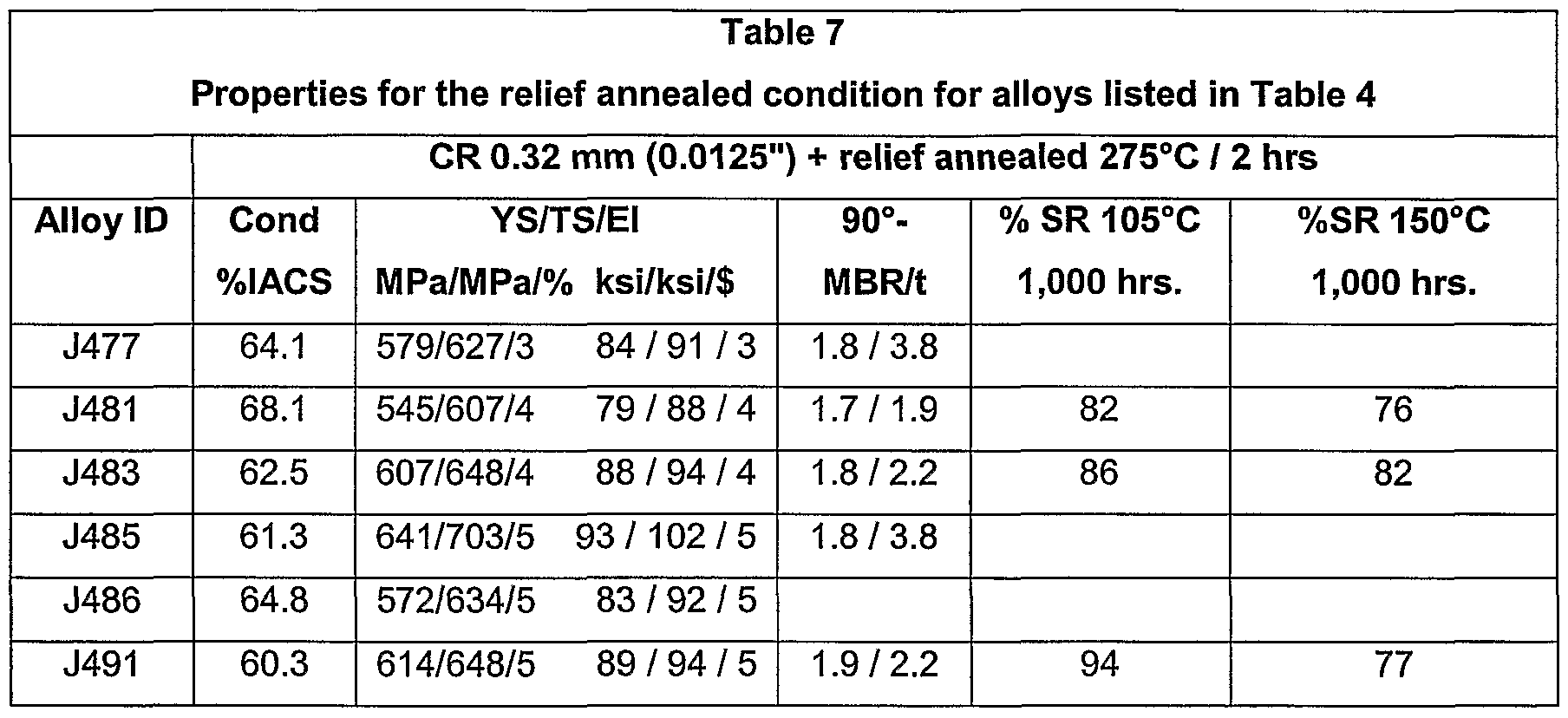
- Example 4 IN accordance with the process illustrated in Fig. 2, the alloys of Table 4 were processed to finish gauge without using an in-process solutionizing heat treatment. After trimming and milling to remove the oxide coating, the alloys in the as hot rolled condition were cold rolled to 0.050" gauge and given a first aging anneal at a temperature and time as shown in Table 6 effective to maximize electrical conductivity. The alloys were then cold rolled 50% to 0.025" gauge and subjected to a second aging anneal at a temperature and time as shown in Table 6 selected to maximize the conductivity without unduly softening the matrix. The specific aging anneals applied to each alloy are noted in Table 6.
- the alloys were then cold rolled 50% to 0.0125" gauge and relief annealed at 275°C for 2 hrs. at which condition the properties in Table 7 were measured. Using this process, the alloys with Fe and Mg additions provide lower, but still good, strength with higher electrical conductivity and good stress relaxation resistance.
- the alloys were cold rolled to 2.54 mm (0.100") thick and solution heat treated in a furnace at 950°C for 40 seconds followed by a water quench to yield a controlled, fine, recrystallized grain size in the range 8.0 - 12 ⁇ m. They were then cold rolled 50% to 1.27 mm (0.050”) gauge and subjected to an aging anneal at 565°C for 3 hrs, designed to maximize the conductivity without unduly softening the matrix.
- the alloys were then cold rolled 50% to 0.64 mm (0.025") gauge and given a second aging anneal of 410°C for 2 hrs, cold rolled to 0.25 mm (0.010"). This was followed by a relief anneal of 250°C for 2 hrs for which condition the properties in Table 9 were measured.
- Comparing baseline alloy J694 to zirconium containing alloy J698 demonstrates that a small amount of zirconium increases the yield strength without affecting electrical conductivity.
- a comparison of alloy J694 with silver containing alloy J699 demonstrates that a small amount of silver increases both the yield strength and the electrical conductivity.
- a comparison of alloy J694 with chromium containing alloy J700 demonstrates that an addition of a small amount of chromium increases the yield strength slightly with a slight penalty in electrical conductivity.
- Example 6 In accordance with the process illustrated in Fig. 3, a series of 4.5 (ten pound) laboratory ingots with the analyzed compositions listed in Table 10 were melted in silica crucibles and Durville cast into steel molds.
- the ingots were 10.16 cm x 10.16 cm x 4.45 cm (4"X4"X1.75"). After soaking three hours at 950°C they were hot rolled in three passes to 2.8 cm (1.1") thick, reheated at 950°C for ten minutes, and further hot rolled in three passes to 1.27 cm (0.50”) thick, followed by a water quench. After trimming and milling to remove the oxide coating, the alloys were cold rolled to 2.54 mm (0.100") gauge and solution heat treated in a furnace at 1 ,000°C for 25-35 seconds followed by a water quench to yield a controlled, fine, recrystallized grain size in the range 6 - 12 ⁇ m.
- Mg addition increases the yield strength ( and tensile strength) values over the Mg range: 0, 0.16, 0.25, 0.31 wt% Mg addition to: 703 (758), 710 (772), 745 (772), 745 (800), 758 (814) MPa [102 (110), 103 (112), 108 (116), 110 (118) ksi], respectively, at nearly constant conductivity values of about 48% IACS.
Landscapes
- Chemical & Material Sciences (AREA)
- Engineering & Computer Science (AREA)
- Materials Engineering (AREA)
- Mechanical Engineering (AREA)
- Metallurgy (AREA)
- Organic Chemistry (AREA)
- Physics & Mathematics (AREA)
- Thermal Sciences (AREA)
- Crystallography & Structural Chemistry (AREA)
- Conductive Materials (AREA)
Abstract
Description




Claims
Priority Applications (6)
| Application Number | Priority Date | Filing Date | Title |
|---|---|---|---|
| CA002497819A CA2497819A1 (en) | 2002-09-13 | 2003-09-05 | Age-hardening copper-base alloy and processing |
| CN038244713A CN1688732B (en) | 2002-09-13 | 2003-09-05 | Age hardening copper base alloy and its preparing process |
| JP2004536112A JP4590264B2 (en) | 2002-09-13 | 2003-09-05 | Age-hardening copper-based alloy and manufacturing method |
| AU2003272276A AU2003272276A1 (en) | 2002-09-13 | 2003-09-05 | Age-hardening copper-base alloy and processing |
| EP03754452.5A EP1537249B1 (en) | 2002-09-13 | 2003-09-05 | Age-hardening copper-base alloy |
| MXPA05002640A MXPA05002640A (en) | 2002-09-13 | 2003-09-05 | Age-hardening copper-base alloy and processing. |
Applications Claiming Priority (2)
| Application Number | Priority Date | Filing Date | Title |
|---|---|---|---|
| US41059202P | 2002-09-13 | 2002-09-13 | |
| US60/410,592 | 2002-09-13 |
Publications (2)
| Publication Number | Publication Date |
|---|---|
| WO2004024964A2 true WO2004024964A2 (en) | 2004-03-25 |
| WO2004024964A3 WO2004024964A3 (en) | 2004-07-01 |
Family
ID=31994162
Family Applications (1)
| Application Number | Title | Priority Date | Filing Date |
|---|---|---|---|
| PCT/US2003/027856 Ceased WO2004024964A2 (en) | 2002-09-13 | 2003-09-05 | Age-hardening copper-base alloy and processing |
Country Status (10)
| Country | Link |
|---|---|
| US (1) | US20040166017A1 (en) |
| EP (1) | EP1537249B1 (en) |
| JP (2) | JP4590264B2 (en) |
| KR (1) | KR20050050654A (en) |
| CN (1) | CN1688732B (en) |
| AU (1) | AU2003272276A1 (en) |
| CA (1) | CA2497819A1 (en) |
| MX (1) | MXPA05002640A (en) |
| TW (1) | TW200422410A (en) |
| WO (1) | WO2004024964A2 (en) |
Cited By (3)
| Publication number | Priority date | Publication date | Assignee | Title |
|---|---|---|---|---|
| JPWO2007015549A1 (en) * | 2005-08-03 | 2009-02-19 | 日鉱金属株式会社 | High strength copper alloy for electronic parts and electronic parts |
| CN111719065A (en) * | 2020-06-08 | 2020-09-29 | 广东中发摩丹科技有限公司 | Cu-Ni-Sn-Si-Ag-P multi-element alloy foil and preparation method thereof |
| CN112867805A (en) * | 2018-11-09 | 2021-05-28 | Jx金属株式会社 | Titanium copper foil, copper-stretched product, electronic device component, and auto-focus camera module |
Families Citing this family (68)
| Publication number | Priority date | Publication date | Assignee | Title |
|---|---|---|---|---|
| JP4332889B2 (en) * | 2003-05-30 | 2009-09-16 | 住友電気工業株式会社 | Method for producing magnesium-based alloy compact |
| EP2626444A3 (en) * | 2003-12-25 | 2013-10-16 | JX Nippon Mining & Metals Corporation | Copper or copper alloy target/copper alloy backing plate assembly |
| DE102005063324B4 (en) * | 2005-05-13 | 2008-02-28 | Federal-Mogul Wiesbaden Gmbh & Co. Kg | Slide bearing composite, use and manufacturing process |
| JP5355865B2 (en) * | 2006-06-01 | 2013-11-27 | 古河電気工業株式会社 | Copper alloy wire manufacturing method and copper alloy wire |
| JP5520438B2 (en) * | 2006-09-05 | 2014-06-11 | 古河電気工業株式会社 | Wire manufacturing method and wire manufacturing apparatus |
| JP4563480B2 (en) * | 2008-11-28 | 2010-10-13 | Dowaメタルテック株式会社 | Copper alloy sheet and manufacturing method thereof |
| US8349724B2 (en) * | 2008-12-31 | 2013-01-08 | Applied Materials, Inc. | Method for improving electromigration lifetime of copper interconnection by extended post anneal |
| JP4889801B2 (en) * | 2009-11-25 | 2012-03-07 | Jx日鉱日石金属株式会社 | Manufacturing method of titanium copper for electronic parts |
| JP5464352B2 (en) * | 2010-03-05 | 2014-04-09 | 三菱マテリアル株式会社 | Method for producing high purity copper processed material having uniform and fine crystal structure |
| JP4672804B1 (en) * | 2010-05-31 | 2011-04-20 | Jx日鉱日石金属株式会社 | Cu-Co-Si based copper alloy for electronic materials and method for producing the same |
| CN101956098B (en) * | 2010-06-08 | 2011-12-28 | 上海华篷防爆科技有限公司 | Titanium alloy explosion-proof material suitable for aerospace field and preparation method thereof |
| CN101892400A (en) * | 2010-06-30 | 2010-11-24 | 天津大学 | Copper-silver-titanium-tin oxide composite electrical contact material and preparation method thereof |
| CN101974702B (en) * | 2010-07-28 | 2011-10-12 | 上海华篷防爆科技有限公司 | Zinc-copper alloy explosionproof material and preparation method thereof |
| JP4834781B1 (en) | 2010-08-24 | 2011-12-14 | Jx日鉱日石金属株式会社 | Cu-Co-Si alloy for electronic materials |
| JP5226057B2 (en) * | 2010-10-29 | 2013-07-03 | Jx日鉱日石金属株式会社 | Copper alloys, copper products, electronic components and connectors |
| JP5611773B2 (en) * | 2010-10-29 | 2014-10-22 | Jx日鉱日石金属株式会社 | Copper alloy, copper-drawn article, electronic component and connector using the same, and method for producing copper alloy |
| JP5226056B2 (en) * | 2010-10-29 | 2013-07-03 | Jx日鉱日石金属株式会社 | Copper alloys, copper products, electronic components and connectors |
| US9181606B2 (en) | 2010-10-29 | 2015-11-10 | Sloan Valve Company | Low lead alloy |
| CN102346000A (en) * | 2011-06-27 | 2012-02-08 | 苏州方暨圆节能科技有限公司 | Copper alloy material of radiator heat pipe |
| JP5380621B1 (en) * | 2013-03-25 | 2014-01-08 | Jx日鉱日石金属株式会社 | Copper alloy sheet with excellent conductivity and stress relaxation properties |
| JP5427971B1 (en) * | 2013-03-25 | 2014-02-26 | Jx日鉱日石金属株式会社 | Copper alloy sheet with excellent conductivity and bending deflection coefficient |
| KR101510222B1 (en) * | 2013-03-29 | 2015-04-08 | 한국기계연구원 | A copper alloy having high strength and high electrical conductivity |
| CN103456385B (en) * | 2013-09-04 | 2016-01-20 | 江西理工大学 | A kind of high-strength highly-conductive Cu-Cr-Ti alloy lead wire and preparation method thereof |
| JP5470499B1 (en) * | 2013-09-25 | 2014-04-16 | Jx日鉱日石金属株式会社 | Copper alloy plate, high-current electronic component and heat dissipation electronic component including the same |
| JP2015086452A (en) * | 2013-11-01 | 2015-05-07 | 株式会社オートネットワーク技術研究所 | Copper alloy wire, copper alloy twisted wire, covered electric wire, wire harness, and copper alloy wire manufacturing method |
| CN103667771A (en) * | 2013-12-03 | 2014-03-26 | 江苏帕齐尼铜业有限公司 | Copper-magnesium alloy and preparation method thereof |
| CN103740976B (en) * | 2014-01-16 | 2016-01-20 | 九星控股集团有限公司 | By White Copper Tubes and preparation method thereof in a kind of oceanographic engineering |
| KR101468959B1 (en) * | 2014-05-13 | 2014-12-08 | 한국기계연구원 | A copper alloy having high strength and high electrical conductivity |
| CN104404292A (en) * | 2014-11-13 | 2015-03-11 | 无锡信大气象传感网科技有限公司 | High-strength copper alloy material for sensor and manufacture method |
| CN104505136A (en) * | 2014-12-22 | 2015-04-08 | 乐清市长虹电工合金材料有限公司 | Ceramic-shaped niobium copper hard special copper-based alloy electrical contact and preparation method thereof |
| CN104404295A (en) * | 2014-12-25 | 2015-03-11 | 春焱电子科技(苏州)有限公司 | Copper alloy for electronic material |
| CN104681145B (en) * | 2015-02-04 | 2017-05-17 | 国网山东省电力公司日照供电公司 | cable for computer |
| CN104674054A (en) * | 2015-03-12 | 2015-06-03 | 天津理工大学 | High-strength copper-titanium alloy and preparation method thereof |
| JP6031548B2 (en) * | 2015-03-27 | 2016-11-24 | 株式会社神戸製鋼所 | Copper alloy plate for heat dissipation parts |
| KR20170132146A (en) * | 2015-04-01 | 2017-12-01 | 후루카와 덴끼고교 가부시키가이샤 | Manufacturing method of flat rolled copper foil, flexible flat cable, rotary connector and flat rolled copper foil |
| CN104911390A (en) * | 2015-06-13 | 2015-09-16 | 陈新棠 | Antimicrobial corrosion-resistant heat exchanger copper tube |
| CN105040036B (en) * | 2015-06-17 | 2017-07-28 | 中南大学 | A kind of preparation method of non-ferrous metal electrodeposition calendering anode |
| CN105132734A (en) * | 2015-07-13 | 2015-12-09 | 南通长江电器实业有限公司 | High-strength and high-electric-conductivity copper alloy material |
| CN108018458A (en) * | 2015-12-02 | 2018-05-11 | 芜湖楚江合金铜材有限公司 | copper alloy wire processing method |
| CN105438637A (en) * | 2015-12-24 | 2016-03-30 | 常熟市新冶机械制造有限公司 | Morgan line bundling machine |
| JP6075490B1 (en) | 2016-03-31 | 2017-02-08 | 株式会社オートネットワーク技術研究所 | Shield wire for communication |
| DE112016006665T5 (en) * | 2016-03-31 | 2018-12-20 | Autonetworks Technologies, Ltd. | communication cable |
| CN105925834A (en) * | 2016-05-10 | 2016-09-07 | 安徽九华金润铜业有限公司 | Anti-corrosion copper molybdenum chromium alloy |
| CN105925833A (en) * | 2016-05-10 | 2016-09-07 | 安徽九华金润铜业有限公司 | Cold-resistant copper chromium zirconium alloy |
| CN106191725B (en) * | 2016-06-24 | 2018-01-26 | 河南江河机械有限责任公司 | High-intensity high-conductivity copper alloy nanometer phase precipitation technique method |
| CN106222484A (en) * | 2016-07-20 | 2016-12-14 | 合肥恒研智能科技有限公司 | A kind of built-in industrial control machine housing high-strength alloy |
| RU2623512C1 (en) * | 2016-10-10 | 2017-06-27 | Юлия Алексеевна Щепочкина | Copper-based alloy |
| WO2018143350A1 (en) * | 2017-02-01 | 2018-08-09 | 株式会社オートネットワーク技術研究所 | Electric wire for communication |
| CN110869525B (en) * | 2017-07-14 | 2021-07-20 | 株式会社自动网络技术研究所 | Covered wires and wires with terminals |
| US10872711B2 (en) * | 2017-08-01 | 2020-12-22 | Sumitomo Electric Industries, Ltd. | Cable having a twisted pair electronic wire and a release layer |
| CN108642419A (en) * | 2018-05-31 | 2018-10-12 | 太原晋西春雷铜业有限公司 | A kind of corson alloy band and preparation method thereof that bending is excellent |
| KR101883627B1 (en) * | 2018-06-08 | 2018-07-31 | 주식회사 지.에이.엠 | Copper alloy and copper alloy casting expressing gold color |
| WO2020041925A1 (en) * | 2018-08-27 | 2020-03-05 | 湖南特力新材料有限公司 | Lead-free superhard self-lubricating copper alloy and manufacturing method therefor |
| JP6629401B1 (en) * | 2018-08-30 | 2020-01-15 | Jx金属株式会社 | Titanium copper plate before aging treatment, pressed product and method for producing pressed product |
| CN109112353A (en) * | 2018-10-29 | 2019-01-01 | 九江中船消防设备有限公司 | A kind of titanium microalloying silicon brass alloy bar and preparation method thereof |
| CN111378890A (en) * | 2018-12-27 | 2020-07-07 | 杭州朱炳仁文化艺术有限公司 | Cast copper sculpture material and preparation process of cast copper sculpture |
| KR102914491B1 (en) * | 2019-04-12 | 2026-01-16 | 마테리온 코포레이션 | Copper alloy having high strength and high conductivity and method for producing such copper alloy |
| CN110512115B (en) * | 2019-09-29 | 2021-08-17 | 宁波金田铜业(集团)股份有限公司 | High-strength and high-elasticity conductive copper-titanium alloy rod and preparation method thereof |
| CN111020277B (en) * | 2019-12-11 | 2021-02-26 | 江西理工大学 | A Cu-Fe-Co-Ti alloy with high electrical conductivity, softening resistance and stress relaxation resistance |
| CN111020278A (en) * | 2019-12-14 | 2020-04-17 | 常州市申鑫新材料科技有限公司 | Superfine high-precision copper alloy composite material |
| CN111041270A (en) * | 2019-12-30 | 2020-04-21 | 南通南平电子科技有限公司 | High-stability high-efficiency vehicle-mounted capacitor guide pin |
| CN112048637B (en) * | 2020-09-15 | 2021-09-14 | 杭州铜信科技有限公司 | Copper alloy material and manufacturing method thereof |
| CN112458332B (en) * | 2020-10-13 | 2022-01-11 | 宁波博威合金材料股份有限公司 | Titanium bronze alloy bar and preparation method and application thereof |
| CN112725655B (en) * | 2020-12-23 | 2021-12-17 | 无锡日月合金材料有限公司 | High-strength high-conductivity copper-chromium alloy for high-power device and preparation method thereof |
| CN113403499A (en) * | 2021-06-01 | 2021-09-17 | 西安工程大学 | Conductive elastic Cu-Ti-Ni-V alloy and preparation method thereof |
| CN115011823B (en) * | 2022-06-28 | 2023-04-18 | 沈阳有色金属研究所有限公司 | Processing method of Cu-Ni-Sn alloy product |
| CN116497297A (en) * | 2023-05-05 | 2023-07-28 | 镇江大全金属表面处理有限公司 | A processing technology of high flexibility copper soft conductor |
| CN120776164A (en) * | 2025-07-29 | 2025-10-14 | 郑州新云锦特导新材料有限公司 | High-strength high-plasticity superfine copper alloy wire, preparation method and application |
Citations (4)
| Publication number | Priority date | Publication date | Assignee | Title |
|---|---|---|---|---|
| US4601879A (en) | 1984-06-07 | 1986-07-22 | Wieland-Werke Ag | Copper-nickel-tin-titanium-alloy and a method for its manufacture |
| US4612167A (en) | 1984-03-02 | 1986-09-16 | Hitachi Metals, Ltd. | Copper-base alloys for leadframes |
| JPS62263942A (en) | 1986-05-09 | 1987-11-16 | Hitachi Metals Ltd | Copper alloy for lead frame |
| JP2002226928A (en) | 2001-01-30 | 2002-08-14 | Nippon Mining & Metals Co Ltd | Copper alloy foil for laminates |
Family Cites Families (41)
| Publication number | Priority date | Publication date | Assignee | Title |
|---|---|---|---|---|
| US1991162A (en) * | 1929-02-28 | 1935-02-12 | Metal & Thermit Corp | Process for improving coppertitanium alloys |
| US3201234A (en) * | 1961-09-25 | 1965-08-17 | Beryllium Corp | Alloy and method of producing the same |
| JPS5853059B2 (en) * | 1979-12-25 | 1983-11-26 | 日本鉱業株式会社 | Precipitation hardening copper alloy |
| JPS60114542A (en) * | 1983-11-22 | 1985-06-21 | Ngk Insulators Ltd | Age hardenable titanium-copper alloy material |
| US4780275A (en) * | 1984-08-25 | 1988-10-25 | William Prym-Werke Gmbh. & Co. Kg. | Corrosion-resistant copper alloy and article containing the same |
| US4678720A (en) * | 1985-01-04 | 1987-07-07 | Gte Laboratories Incorporated | Silver-copper-titanium brazing alloy |
| JPS6250428A (en) * | 1985-08-29 | 1987-03-05 | Furukawa Electric Co Ltd:The | Copper alloy for electronic appliance |
| US4606889A (en) * | 1985-11-07 | 1986-08-19 | Cabot Corporation | Copper-titanium-beryllium alloy |
| JPS63274728A (en) * | 1987-05-01 | 1988-11-11 | Dowa Mining Co Ltd | Copper alloy for wire-harness terminal and its production |
| DE3820203A1 (en) * | 1988-06-14 | 1989-12-21 | Kabelmetal Ag | USE OF A CURABLE copper alloy |
| JP2689507B2 (en) * | 1988-08-10 | 1997-12-10 | 三菱マテリアル株式会社 | Cu alloy terminal and connector materials |
| JPH02173248A (en) * | 1988-12-26 | 1990-07-04 | Nippon Mining Co Ltd | Manufacture of copper alloy improved in adhesive strength of oxide film |
| JPH0315217A (en) * | 1989-06-09 | 1991-01-23 | Kinki Denki Kk | Bird damage preventive tool for wire or the like |
| JPH04231447A (en) * | 1990-12-27 | 1992-08-20 | Nikko Kyodo Co Ltd | Conductive material |
| JP2904372B2 (en) * | 1991-10-08 | 1999-06-14 | 恒昭 三川 | Age hardening special copper alloy |
| DE69317323T2 (en) * | 1992-05-08 | 1998-07-16 | Mitsubishi Materials Corp | Wire for electrical railway line and method for producing the same |
| US5306465A (en) * | 1992-11-04 | 1994-04-26 | Olin Corporation | Copper alloy having high strength and high electrical conductivity |
| US5370840A (en) * | 1992-11-04 | 1994-12-06 | Olin Corporation | Copper alloy having high strength and high electrical conductivity |
| US5486244A (en) * | 1992-11-04 | 1996-01-23 | Olin Corporation | Process for improving the bend formability of copper alloys |
| JPH06330211A (en) * | 1993-05-27 | 1994-11-29 | Kobe Steel Ltd | Heat resistant copper alloy |
| US5338374A (en) * | 1993-07-26 | 1994-08-16 | The United States Of America As Represented By The Secretary Of The Navy | Method of making copper-titanium nitride alloy |
| US5759548A (en) * | 1993-11-30 | 1998-06-02 | Lxr Biotechnology Inc. | Compositions which inhibit apoptosis, methods of purifying the compositions and uses thereof |
| DE4438485C2 (en) * | 1994-10-28 | 1998-05-20 | Wieland Werke Ag | Use of a copper-zinc alloy for drinking water installations |
| US5681662A (en) * | 1995-09-15 | 1997-10-28 | Olin Corporation | Copper alloy foils for flexible circuits |
| US5882442A (en) * | 1995-10-20 | 1999-03-16 | Olin Corporation | Iron modified phosphor-bronze |
| DE19548124C2 (en) * | 1995-12-21 | 2002-08-29 | Euroflamm Gmbh | Friction body and method for producing such |
| JPH09263864A (en) * | 1996-03-26 | 1997-10-07 | Kobe Steel Ltd | Copper alloy excellent in electric-discharge wear resistance |
| US6001196A (en) * | 1996-10-28 | 1999-12-14 | Brush Wellman, Inc. | Lean, high conductivity, relaxation-resistant beryllium-nickel-copper alloys |
| US5865910A (en) * | 1996-11-07 | 1999-02-02 | Waterbury Rolling Mills, Inc. | Copper alloy and process for obtaining same |
| US5820701A (en) * | 1996-11-07 | 1998-10-13 | Waterbury Rolling Mills, Inc. | Copper alloy and process for obtaining same |
| JP2898627B2 (en) * | 1997-03-27 | 1999-06-02 | 日鉱金属株式会社 | Copper alloy foil |
| US5853505A (en) * | 1997-04-18 | 1998-12-29 | Olin Corporation | Iron modified tin brass |
| JPH1081927A (en) * | 1997-05-07 | 1998-03-31 | Mitsubishi Materials Corp | Cu alloy terminal and connector materials |
| US5893953A (en) * | 1997-09-16 | 1999-04-13 | Waterbury Rolling Mills, Inc. | Copper alloy and process for obtaining same |
| DE19756815C2 (en) * | 1997-12-19 | 2003-01-09 | Wieland Werke Ag | Wrought copper alloy, process for producing a semi-finished product therefrom and its use |
| FR2780417B1 (en) * | 1998-06-26 | 2004-04-09 | Kobe Steel Ltd | ALLOY HAVING ANTIBACTERIAL AND STERILIZING EFFECT |
| US6136104A (en) * | 1998-07-08 | 2000-10-24 | Kobe Steel, Ltd. | Copper alloy for terminals and connectors and method for making same |
| JP4154100B2 (en) * | 1999-12-17 | 2008-09-24 | 日鉱金属株式会社 | Copper alloy for electronic materials having excellent surface characteristics and method for producing the same |
| JP4460037B2 (en) * | 2000-07-21 | 2010-05-12 | 古河電気工業株式会社 | Method of heat treatment of copper alloy for electrical connection member and copper alloy for electrical connection member |
| US6749699B2 (en) * | 2000-08-09 | 2004-06-15 | Olin Corporation | Silver containing copper alloy |
| JP4729680B2 (en) * | 2000-12-18 | 2011-07-20 | Dowaメタルテック株式会社 | Copper-based alloy with excellent press punchability |
-
2003
- 2003-09-05 WO PCT/US2003/027856 patent/WO2004024964A2/en not_active Ceased
- 2003-09-05 CA CA002497819A patent/CA2497819A1/en not_active Abandoned
- 2003-09-05 AU AU2003272276A patent/AU2003272276A1/en not_active Abandoned
- 2003-09-05 CN CN038244713A patent/CN1688732B/en not_active Expired - Fee Related
- 2003-09-05 US US10/657,005 patent/US20040166017A1/en not_active Abandoned
- 2003-09-05 KR KR1020057004299A patent/KR20050050654A/en not_active Ceased
- 2003-09-05 JP JP2004536112A patent/JP4590264B2/en not_active Expired - Fee Related
- 2003-09-05 MX MXPA05002640A patent/MXPA05002640A/en unknown
- 2003-09-05 EP EP03754452.5A patent/EP1537249B1/en not_active Expired - Lifetime
- 2003-09-12 TW TW092125248A patent/TW200422410A/en unknown
-
2010
- 2010-08-12 JP JP2010180707A patent/JP2010275640A/en active Pending
Patent Citations (4)
| Publication number | Priority date | Publication date | Assignee | Title |
|---|---|---|---|---|
| US4612167A (en) | 1984-03-02 | 1986-09-16 | Hitachi Metals, Ltd. | Copper-base alloys for leadframes |
| US4601879A (en) | 1984-06-07 | 1986-07-22 | Wieland-Werke Ag | Copper-nickel-tin-titanium-alloy and a method for its manufacture |
| JPS62263942A (en) | 1986-05-09 | 1987-11-16 | Hitachi Metals Ltd | Copper alloy for lead frame |
| JP2002226928A (en) | 2001-01-30 | 2002-08-14 | Nippon Mining & Metals Co Ltd | Copper alloy foil for laminates |
Non-Patent Citations (1)
| Title |
|---|
| See also references of EP1537249A4 |
Cited By (4)
| Publication number | Priority date | Publication date | Assignee | Title |
|---|---|---|---|---|
| JPWO2007015549A1 (en) * | 2005-08-03 | 2009-02-19 | 日鉱金属株式会社 | High strength copper alloy for electronic parts and electronic parts |
| CN112867805A (en) * | 2018-11-09 | 2021-05-28 | Jx金属株式会社 | Titanium copper foil, copper-stretched product, electronic device component, and auto-focus camera module |
| US12000029B2 (en) | 2018-11-09 | 2024-06-04 | Jx Metals Corporation | Titanium copper foil, extended copper article, electronic device component, and auto-focus camera module |
| CN111719065A (en) * | 2020-06-08 | 2020-09-29 | 广东中发摩丹科技有限公司 | Cu-Ni-Sn-Si-Ag-P multi-element alloy foil and preparation method thereof |
Also Published As
| Publication number | Publication date |
|---|---|
| KR20050050654A (en) | 2005-05-31 |
| TW200422410A (en) | 2004-11-01 |
| MXPA05002640A (en) | 2005-07-19 |
| AU2003272276A1 (en) | 2004-04-30 |
| CN1688732A (en) | 2005-10-26 |
| JP4590264B2 (en) | 2010-12-01 |
| AU2003272276A8 (en) | 2004-04-30 |
| CN1688732B (en) | 2010-05-26 |
| EP1537249A2 (en) | 2005-06-08 |
| CA2497819A1 (en) | 2004-03-25 |
| JP2005539140A (en) | 2005-12-22 |
| JP2010275640A (en) | 2010-12-09 |
| WO2004024964A3 (en) | 2004-07-01 |
| EP1537249A4 (en) | 2007-07-11 |
| US20040166017A1 (en) | 2004-08-26 |
| EP1537249B1 (en) | 2014-12-24 |
Similar Documents
| Publication | Publication Date | Title |
|---|---|---|
| US20040166017A1 (en) | Age-hardening copper-base alloy and processing | |
| EP1179606B1 (en) | Silver containing copper alloy | |
| EP0203389B1 (en) | Multipurpose copper alloys with moderate conductivity and high strength, and process for manufacturing them | |
| US5370840A (en) | Copper alloy having high strength and high electrical conductivity | |
| US5601665A (en) | Process for improving the bend formability of copper alloys | |
| JP4809602B2 (en) | Copper alloy | |
| JPH0625388B2 (en) | High strength, high conductivity copper base alloy | |
| US4728372A (en) | Multipurpose copper alloys and processing therefor with moderate conductivity and high strength | |
| EP1063309A2 (en) | Copper alloy | |
| US5853505A (en) | Iron modified tin brass | |
| JP2790238B2 (en) | Method for producing titanium copper alloy excellent in bending property and stress relaxation property | |
| JPH09143597A (en) | Copper alloy for lead frame and manufacturing method thereof |
Legal Events
| Date | Code | Title | Description |
|---|---|---|---|
| AK | Designated states |
Kind code of ref document: A2 Designated state(s): AE AG AL AM AT AU AZ BA BB BG BR BY BZ CA CH CN CO CR CU CZ DE DK DM DZ EC EE ES FI GB GD GE GH GM HR HU ID IL IN IS JP KE KG KP KR KZ LC LK LR LS LT LU LV MA MD MG MK MN MW MX MZ NI NO NZ OM PG PH PL PT RO RU SC SD SE SG SK SL SY TJ TM TN TR TT TZ UA UG UZ VC VN YU ZA ZM ZW |
|
| AL | Designated countries for regional patents |
Kind code of ref document: A2 Designated state(s): AM AZ BY KG KZ MD RU TJ TM AT BE BG CH CY CZ DE DK EE ES FI FR GB GR HU IE IT LU MC NL PT RO SE SI SK TR BF BJ CF CG CI CM GA GN GQ GW ML MR NE SN TD TG |
|
| 121 | Ep: the epo has been informed by wipo that ep was designated in this application | ||
| DFPE | Request for preliminary examination filed prior to expiration of 19th month from priority date (pct application filed before 20040101) | ||
| WWE | Wipo information: entry into national phase |
Ref document number: 2497819 Country of ref document: CA |
|
| WWE | Wipo information: entry into national phase |
Ref document number: 2003754452 Country of ref document: EP |
|
| WWE | Wipo information: entry into national phase |
Ref document number: PA/a/2005/002640 Country of ref document: MX |
|
| WWE | Wipo information: entry into national phase |
Ref document number: 1020057004299 Country of ref document: KR Ref document number: 2004536112 Country of ref document: JP |
|
| WWE | Wipo information: entry into national phase |
Ref document number: 20038244713 Country of ref document: CN |
|
| WWP | Wipo information: published in national office |
Ref document number: 1020057004299 Country of ref document: KR |
|
| WWP | Wipo information: published in national office |
Ref document number: 2003754452 Country of ref document: EP |