WO2004029006A2 - Process for the preparation of fluorohaloalkanes - Google Patents
Process for the preparation of fluorohaloalkanes Download PDFInfo
- Publication number
- WO2004029006A2 WO2004029006A2 PCT/GB2003/004026 GB0304026W WO2004029006A2 WO 2004029006 A2 WO2004029006 A2 WO 2004029006A2 GB 0304026 W GB0304026 W GB 0304026W WO 2004029006 A2 WO2004029006 A2 WO 2004029006A2
- Authority
- WO
- WIPO (PCT)
- Prior art keywords
- formula
- compound
- alkyl
- haloalkyl
- group
- Prior art date
- Legal status (The legal status is an assumption and is not a legal conclusion. Google has not performed a legal analysis and makes no representation as to the accuracy of the status listed.)
- Ceased
Links
Classifications
-
- C—CHEMISTRY; METALLURGY
- C07—ORGANIC CHEMISTRY
- C07B—GENERAL METHODS OF ORGANIC CHEMISTRY; APPARATUS THEREFOR
- C07B59/00—Introduction of isotopes of elements into organic compounds ; Labelled organic compounds per se
- C07B59/001—Acyclic or carbocyclic compounds
-
- C—CHEMISTRY; METALLURGY
- C07—ORGANIC CHEMISTRY
- C07C—ACYCLIC OR CARBOCYCLIC COMPOUNDS
- C07C17/00—Preparation of halogenated hydrocarbons
- C07C17/093—Preparation of halogenated hydrocarbons by replacement by halogens
-
- C—CHEMISTRY; METALLURGY
- C07—ORGANIC CHEMISTRY
- C07C—ACYCLIC OR CARBOCYCLIC COMPOUNDS
- C07C303/00—Preparation of esters or amides of sulfuric acids; Preparation of sulfonic acids or of their esters, halides, anhydrides or amides
- C07C303/26—Preparation of esters or amides of sulfuric acids; Preparation of sulfonic acids or of their esters, halides, anhydrides or amides of esters of sulfonic acids
Definitions
- the present invention relates to a process for the preparation of fluorohaloalkane compounds such as [ 18 F]bromofluoromethane.
- [ 18 F]Fluorohaloalkanes are important reagents for performing O-, N-, and S-[ 18 F]fluoroalkylations and are commonly used to radiolabel radioligands for use in positron emission tomography
- [ 18 F]Fluorohaloalkanes have previously been prepared by nucleophilic displacement, by [ 18 F]F " , of a leaving group from a suitable precursor compound.
- Zhang et al, Applied Radiation and Isotopes 57, 335-342 (2002) describes synthesis of [ 18 F]fluoroethyl bromide by nucleophilic displacement of 2-trifluoromethanesulphonyloxy ethylbromide with [ 18 F]F " and Seung-Jun et al Applied Radiation and Isotopes (1999), 51 , 293-7 describes an analogous synthesis of 3-[ 18 F]fluoropropylbromide.
- n is as defined for the compound of formula (I); and R', R", and R'" are independently selected from C ⁇ - 6 alkyl and C ⁇ _ 6 haloalkyl; and R" may alternatively be the group:
- the fluorohaloalkane of formula (I) is a [ 18 F]fluorohaloalkane. Therefore, according to a further aspect of the present invention, there is provided a process for preparation of a [ 18 F]fluorohaloalkane of formula (la)
- n is as defined for the compound of formula (la); and R', R", and R'" are independently selected from C ⁇ _ 6 alkyl and C ⁇ . 6 haloalkyl; and R" may alternatively be the group:
- formula (I) which may be prepared using the present process, include fluorobromomethane, fluoroiodomethane, fluorobromoethane, fluoroiodoethane, fluorobromopropane, and fluoroiodopropane, each of which is suitably prepared in [ 18 F]-labelled form.
- the reaction of a compound of formula (II) or (lla) with a compound of formula (III) may be performed in the presence of a catalyst, suitably a tetra (C ⁇ . 6 alkyl) ammonium salt, such as a tetra (C ⁇ _ 6 alkyl) ammonium fluoride salt, for example tetrabutylammonium fluoride or tetraethylammonium fluoride; and in a suitable solvent for example acetonitrile or an alcohol such as methanol or ethanol at elevated temperature, for example 50°C to 150°C, suitably 70°C to 120°C.
- a catalyst suitably a tetra (C ⁇ . 6 alkyl) ammonium salt, such as a tetra (C ⁇ _ 6 alkyl) ammonium fluoride salt, for example tetrabutylammonium fluoride or tetraethylammonium fluoride
- a suitable solvent for example
- the resulting compound of formula (I) or (la) may be isolated from the reaction mixture, for example, by distillation followed by chromatography, suitably gas or liquid chromatography.
- chromatography suitably gas or liquid chromatography.
- the crude reaction mixture is distilled and the distillate is then passed under a stream of inert gas, such as helium, through a temperature controlled GC column packed with silica gel.
- the resulting compound of formula (I) or (la) may also be converted to a corresponding fluoroalkylsulphonyl ester of formula (V) or (Va) respectively:
- C- ⁇ - 6 alkyl for example, methyl
- C ⁇ - 6 perfluoroalkyl for example, trifluoromethyl
- aryl for example, phenyl
- tolyl for example, para-tolyl
- perfluoroaryl for example, perfluorophenyl
- perfluorotolyl for example, perfluoro para-tolyl
- a [ 18 F]fluorohaloalkyl compound of formula (la) may be converted to a [ 18 F]fluoroalkyltosylate of formula (Va) such as [ 18 F]fluoromethyltosylate.
- Fluoroalkylsulphonyl esters of formulae(V) and (Va) are also useful as fluoroalkylating agents.
- Conversion of a compound of formula (I) or (la) to a compound of formula (V) or (Va) respectively may be effected by reaction with the appropriate sulphonic acid of formula R 1 SO 2 OH or a salt thereof, such as a silver salt. Depending on the particular compound to be prepared, this conversion may be performed in solution phase, or in gaseous phase, for example by methods analogous to those described by Iwata et al, Applied Radiation and Isotopes, 57 (2002), 347-352.
- the resulting compound of formula (I) or (la), or a corresponding compound of formula (V) or (Va) as described above, may be used in the preparation of a fluoroalkyl ligand or radiotracer, for example a [ 18 F]fluoroalkylated radioligand or [ 18 F]-radiotracer suitable for use in a PET study.
- a fluoroalkyl ligand or radiotracer for example a [ 18 F]fluoroalkylated radioligand or [ 18 F]-radiotracer suitable for use in a PET study.
- Examples of [ 18 F]fluoroalkylated radioligands and [ 18 F]-radiotracers which may be prepared using the compounds of formula (la) or (Va) include 2-(1 ,1-dicyanopropen-2-yl)-6-(2-[ 18 ⁇ -fluoroC 1 .
- [ 18 F]fluoroC ⁇ alkyl)spiperone for example 3-(2'-[ 18 F]fluoroethyl)spiperone
- n is preferably 1, 2, or 3 such that the fluorohaloalkane prepared in the process is a fluorohalomethane, fluorohaloethane, or fluorohalopropane.
- halo means fluoro, chloro, iodo, or bromo.
- X is halo, and is preferably bromo or iodo.
- Y is halo, preferably bromo or iodo, and is preferably the same asX, such that the compound of formula (III) is preferably Br 2 or l 2 .
- R', R", and R'" are suitably selected from C ⁇ . 6 alkyl and for example methyl, ethyl, propyl, and isopropyl, typically methyl.
- R is the group:
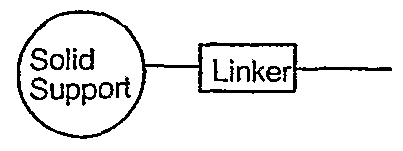
- the “Solid Support” may be any suitable material which is insoluble in any solvents to be used in the process but to which the "Linker” and/or compound of formula (II) or (lla) can be covalently bound.
- suitable solid support include polymers such as polystyrene (which may be block grafted, for example, with polyethylene glycol), polyacrylamide, and polypropylene or glass or silicon suitably coated with such a polymer.
- the solid support may be in the form of small discrete particles such as beads or pins, or as a coating on the inner surface of a cartridge or on a microfabricated vessel; and
- the “Linker” may be any suitable organic group which serves to space the reactive site sufficiently from the solid support structure so as to maximise reactivity.
- the Linker comprises an organic group of from 1 to 12 carbon atoms and from 0 to 6 heteroatoms selected from oxygen, nitrogen, and sulphur. Examples of such linkers are well known to those skilled in the art of solid-phase chemistry, but include phenyl(C ⁇ . 6 alkyl) and phenyl.
- n is an integer of from 1 to 6;
- R' and R"' are independently selected from C-i- ⁇ alkyl and C ⁇ _ 6 haloalkyl; and R" is the group:
- n is an integer of from 1 to 6;
- R', R", and R m are independently selected from C- ⁇ -6 alkyl and C ⁇ _ 6 haloalkyl;
- R" may alternatively be the group:
- n, R ⁇ R", and R'" are as defined for the compound of formula (II) or (lla) and L is a leaving group;
- F a source of F " , preferably 18 F ⁇ suitably an alkali metal fluoride salt such as Na 18 F, K 18 F, or Cs 18 F, tetraalkylammonium 18 F fluoride, or tetraalkylphosphonium 18 F fluoride.; in the presence of a phase transfer catalyst, suitably 18-crown-6 or a cryptand such as Kryptofix 2.2.2., Kryptofix 2.2.2B., Kryptofix 2.2.1. (all available from Aldrich).
- the reaction may be performed in a suitable solvent such as acetonitrile and at elevated temperature, suitably 50°C to 100°C.
- the leaving group, L, in the compound of formula (IV) is suitably a sulphonyl ester group i.e. -OSO 2 R 2 wherein R 2 is selected from C ⁇ _ 6 alkyl (for example, methyl), C- ⁇ - 6 perfluoroalkyl (for example, trifluoromethyl), aryl (for example, phenyl), tolyl (for example, para-tolyl), perfluoroaryl (for example, perfluorophenyl), and perfluorotolyl (for example, perfluoro para-tolyl).
- R 2 is selected from C ⁇ _ 6 alkyl (for example, methyl), C- ⁇ - 6 perfluoroalkyl (for example, trifluoromethyl), aryl (for example, phenyl), tolyl (for example, para-tolyl), perfluoroaryl (for example, perfluorophenyl), and perfluorotolyl (for example, perfluoro para-toly
- n is an integer of from 1 to 6;
- R', R", and R'" are independently selected from C-
- L is a group -OSO 2 R 2 wherein R 2 is selected from alkyl, C ⁇ - 6 perfluoroalkyl, aryl, perfluoroaryl, tolyl, and perfluorotolyl; provided that:
- R" is C ⁇ _ 6 alkyl or C ⁇ - 6 haloalkyl and n is 2 to 6, L is not -OSO 2 CH 3 or -OSO 2 (para-methyl)phenyl.
- Compounds of formula (IV) are either commercially available (for example, from Aldrich), or a readily prepared from commercially available starting materials using methods available to the person skilled in the art.
- the compound of formula (IV) is prepared by reaction of the corresponding azide with the appropriate sulphonic acid or a salt thereof, for example using methods analogous to those described in Al-Busafi et al, Tetrahedron Letters, 39, 12 (1998).
- the invention will now be illustrated by way of the following Example.
- Trimethylsilylmethyl trifluoromethanesulphonate (Aldrich) (5mg) in acetonitrile (1 ml) was added to fully dried 18 F7Kryptofix 2.2.2 complex prepared by standard methods, for example as described in Hammacher et al, J. Nuclear Medicine, 27, 235-8 (1986). The mixture was heated at 75° C for 5 minutes. l o Tetrabutylammonium fluoride (16mg) in acetonitrile (0.5ml) and bromine (8mg) in methanol (0.5ml) were added to the reaction mixture. The reaction vessel was then sealed and heated at 110°C for 3 to 4 minutes.
- Suitable solvents include acetonitrile,
Landscapes
- Chemical & Material Sciences (AREA)
- Organic Chemistry (AREA)
- Organic Low-Molecular-Weight Compounds And Preparation Thereof (AREA)
- Low-Molecular Organic Synthesis Reactions Using Catalysts (AREA)
- Inorganic Compounds Of Heavy Metals (AREA)
- Physical Or Chemical Processes And Apparatus (AREA)
Abstract
Description




Claims


Priority Applications (5)
| Application Number | Priority Date | Filing Date | Title |
|---|---|---|---|
| EP03798241A EP1554231B1 (en) | 2002-09-27 | 2003-09-18 | Process for the preparation of fluorohaloalkanes |
| AU2003264895A AU2003264895A1 (en) | 2002-09-27 | 2003-09-18 | Process for the preparation of fluorohaloalkanes |
| JP2004539176A JP2006500419A (en) | 2002-09-27 | 2003-09-18 | Chemical process |
| US10/528,645 US7405332B2 (en) | 2002-09-27 | 2003-09-18 | Chemical process |
| DE60314167T DE60314167T2 (en) | 2002-09-27 | 2003-09-18 | PROCESS FOR THE PREPARATION OF FLUORO-HALOGENAL CANS |
Applications Claiming Priority (2)
| Application Number | Priority Date | Filing Date | Title |
|---|---|---|---|
| GBGB0222426.9A GB0222426D0 (en) | 2002-09-27 | 2002-09-27 | Chemical process |
| GB0222426.9 | 2002-09-27 |
Publications (2)
| Publication Number | Publication Date |
|---|---|
| WO2004029006A2 true WO2004029006A2 (en) | 2004-04-08 |
| WO2004029006A3 WO2004029006A3 (en) | 2004-05-13 |
Family
ID=9944852
Family Applications (1)
| Application Number | Title | Priority Date | Filing Date |
|---|---|---|---|
| PCT/GB2003/004026 Ceased WO2004029006A2 (en) | 2002-09-27 | 2003-09-18 | Process for the preparation of fluorohaloalkanes |
Country Status (9)
| Country | Link |
|---|---|
| US (1) | US7405332B2 (en) |
| EP (1) | EP1554231B1 (en) |
| JP (1) | JP2006500419A (en) |
| AT (1) | ATE363460T1 (en) |
| AU (1) | AU2003264895A1 (en) |
| DE (1) | DE60314167T2 (en) |
| ES (1) | ES2287567T3 (en) |
| GB (1) | GB0222426D0 (en) |
| WO (1) | WO2004029006A2 (en) |
Cited By (5)
| Publication number | Priority date | Publication date | Assignee | Title |
|---|---|---|---|---|
| WO2007067074A1 (en) * | 2005-12-08 | 2007-06-14 | Hammersmith Imanet Limited | Method for the preparation of [18f]fluoroalkylhalides |
| EP1545525A4 (en) * | 2002-09-24 | 2009-07-01 | Merck & Co Inc | RADIOMARTIC ANTAGONISTS OF THE NEUROKININ-1 RECEPTOR |
| WO2010117557A1 (en) | 2009-03-31 | 2010-10-14 | Hammersmith Imanet Limited | Radiolabelling methods |
| CN102186796A (en) * | 2008-10-20 | 2011-09-14 | 哈默史密斯网上成像有限公司 | Radiofluorination |
| US8309054B2 (en) | 2006-08-03 | 2012-11-13 | Hammersmith Imanet Limited | Method for the purification of radiolabelled compounds |
Families Citing this family (1)
| Publication number | Priority date | Publication date | Assignee | Title |
|---|---|---|---|---|
| GB0410448D0 (en) * | 2004-05-11 | 2004-06-16 | Hammersmith Imanet Ltd | Purification methods |
Family Cites Families (5)
| Publication number | Priority date | Publication date | Assignee | Title |
|---|---|---|---|---|
| JPH0834021B2 (en) | 1987-07-08 | 1996-03-29 | 日立電子株式会社 | VTR splicing method |
| JPH02290885A (en) * | 1989-04-28 | 1990-11-30 | Rikagaku Kenkyusho | Organosilicon compound and its manufacturing method |
| DE3935638A1 (en) | 1989-10-26 | 1991-05-02 | Consortium Elektrochem Ind | ORGANOSILYL ALKYL FLAVORS |
| US5536732A (en) | 1990-04-27 | 1996-07-16 | Merrell Pharmaceuticals Inc. | N-derivatives of 1-deoxy nojirimycin |
| JPH0892258A (en) | 1994-09-22 | 1996-04-09 | Mitsui Petrochem Ind Ltd | Tetralin compound and liquid crystal additive |
-
2002
- 2002-09-27 GB GBGB0222426.9A patent/GB0222426D0/en not_active Ceased
-
2003
- 2003-09-18 US US10/528,645 patent/US7405332B2/en not_active Expired - Fee Related
- 2003-09-18 AT AT03798241T patent/ATE363460T1/en not_active IP Right Cessation
- 2003-09-18 WO PCT/GB2003/004026 patent/WO2004029006A2/en not_active Ceased
- 2003-09-18 AU AU2003264895A patent/AU2003264895A1/en not_active Abandoned
- 2003-09-18 ES ES03798241T patent/ES2287567T3/en not_active Expired - Lifetime
- 2003-09-18 JP JP2004539176A patent/JP2006500419A/en not_active Withdrawn
- 2003-09-18 DE DE60314167T patent/DE60314167T2/en not_active Expired - Lifetime
- 2003-09-18 EP EP03798241A patent/EP1554231B1/en not_active Expired - Lifetime
Cited By (6)
| Publication number | Priority date | Publication date | Assignee | Title |
|---|---|---|---|---|
| EP1545525A4 (en) * | 2002-09-24 | 2009-07-01 | Merck & Co Inc | RADIOMARTIC ANTAGONISTS OF THE NEUROKININ-1 RECEPTOR |
| WO2007067074A1 (en) * | 2005-12-08 | 2007-06-14 | Hammersmith Imanet Limited | Method for the preparation of [18f]fluoroalkylhalides |
| US8614360B2 (en) | 2005-12-08 | 2013-12-24 | Hammersmith Imanet Limited | Method for the preparation of [18F]fluoroalkylhalides |
| US8309054B2 (en) | 2006-08-03 | 2012-11-13 | Hammersmith Imanet Limited | Method for the purification of radiolabelled compounds |
| CN102186796A (en) * | 2008-10-20 | 2011-09-14 | 哈默史密斯网上成像有限公司 | Radiofluorination |
| WO2010117557A1 (en) | 2009-03-31 | 2010-10-14 | Hammersmith Imanet Limited | Radiolabelling methods |
Also Published As
| Publication number | Publication date |
|---|---|
| GB0222426D0 (en) | 2002-11-06 |
| WO2004029006A3 (en) | 2004-05-13 |
| US20060106219A1 (en) | 2006-05-18 |
| ATE363460T1 (en) | 2007-06-15 |
| DE60314167T2 (en) | 2008-01-31 |
| EP1554231B1 (en) | 2007-05-30 |
| AU2003264895A1 (en) | 2004-04-19 |
| JP2006500419A (en) | 2006-01-05 |
| AU2003264895A8 (en) | 2004-04-19 |
| EP1554231A2 (en) | 2005-07-20 |
| ES2287567T3 (en) | 2007-12-16 |
| DE60314167D1 (en) | 2007-07-12 |
| US7405332B2 (en) | 2008-07-29 |
Similar Documents
| Publication | Publication Date | Title |
|---|---|---|
| EP1697279B1 (en) | Radical trap in fluoridation of iodinium salt | |
| Pike | Hypervalent aryliodine compounds as precursors for radiofluorination | |
| Chun et al. | Single‐Step Radiosynthesis of “18F‐Labeled Click Synthons” from Azide‐Functionalized Diaryliodonium Salts | |
| Wüst et al. | Synthesis of 18 F-labelled cyclooxygenase-2 (COX-2) inhibitors via Stille reaction with 4-[18 F] fluoroiodobenzene as radiotracers for positron emission tomography (PET) | |
| Talko et al. | Nucleophilic fluorination with aqueous bifluoride solution: effect of the phase-transfer catalyst | |
| Römer et al. | Automated production of 16α-[18F] fluoroestradiol for breast cancer imaging | |
| US20060083677A1 (en) | Solid-phase fluorination of benzothiazoles | |
| EP1554231B1 (en) | Process for the preparation of fluorohaloalkanes | |
| JP2009504849A (en) | Method for producing radiolabeled tracer and precursor thereof | |
| Naulet et al. | In Situ Generated DBU⋅ HF Acts as a Fluorinating Agent in a Hexafluoroisobutylation Tandem Reaction: An Effective Route to 5, 5, 5, 5’, 5’, 5’‐Hexafluoroleucine | |
| Mingueza-Verdejo et al. | Additive-free commercial alumina catalyzes the halogen exchange reaction of long alkyl halides in batch and in flow processes | |
| US20120004404A1 (en) | Radiolabelling methods | |
| Steffann et al. | Last-step 18 F-fluorination of supported 2-(aryl-di-tert-butylsilyl)-N-methyl-imidazole conjugates for applications in positron emission tomography | |
| WO2009029633A1 (en) | Synthesis of [18f]-labelled alkyl mesylates using fluorous spe separation | |
| JP2022046502A (en) | Alkylation method | |
| EP1960324B1 (en) | Method for the preparation of [18f]fluoroalkylhalides | |
| Kramer et al. | Fluorination of silyl prosthetic groups by fluorine mediated silyl ether linker cleavage: a concept study with conditions applicable in radiofluorination | |
| KR20140069001A (en) | Simplified radiosynthesis of [18f]fluoromethyl bromide | |
| Bongarzone et al. | Carbon-11 Carboxylation of Trialkoxysilane and Trimethylsilane Derivatives Using [¹¹C] CO2 | |
| Murtagh | " Positive" Fluorine Compounds | |
| Neumann | Late-Stage Fluorination With 19F− and 18F− via Concerted Nucleophilic Aromatic Substitution | |
| Balatoni | Radiolabelling of organic molecules with short-lived radionuclides (¹¹C, ¹⁸F) | |
| Rock | New methodology for the synthesis of fluorinated aromatics | |
| Kastern | Synthesis of diaryliodonium salts for use in nucleophilic substitution reactions | |
| Kirjavainen | Radiosynthesis and use of [18F] F2 derivatives [18F] Selectfluor bis (triflate) and [18F] ClF |
Legal Events
| Date | Code | Title | Description |
|---|---|---|---|
| AK | Designated states |
Kind code of ref document: A2 Designated state(s): AE AG AL AM AT AU AZ BA BB BG BR BY BZ CA CH CN CO CR CU CZ DE DK DM DZ EC EE EG ES FI GB GD GE GH GM HR HU ID IL IN IS JP KE KG KP KR KZ LC LK LR LS LT LU LV MA MD MG MK MN MW MX MZ NI NO NZ OM PG PH PL PT RO RU SC SD SE SG SK SL SY TJ TM TN TR TT TZ UA UG US UZ VC VN YU ZA ZM ZW |
|
| AL | Designated countries for regional patents |
Kind code of ref document: A2 Designated state(s): GH GM KE LS MW MZ SD SL SZ TZ UG ZM ZW AM AZ BY KG KZ MD RU TJ TM AT BE BG CH CY CZ DE DK EE ES FI FR GB GR HU IE IT LU MC NL PT RO SE SI SK TR BF BJ CF CG CI CM GA GN GQ GW ML MR NE SN TD TG |
|
| 121 | Ep: the epo has been informed by wipo that ep was designated in this application | ||
| WWE | Wipo information: entry into national phase |
Ref document number: 2003798241 Country of ref document: EP |
|
| WWE | Wipo information: entry into national phase |
Ref document number: 2004539176 Country of ref document: JP |
|
| WWP | Wipo information: published in national office |
Ref document number: 2003798241 Country of ref document: EP |
|
| ENP | Entry into the national phase |
Ref document number: 2006106219 Country of ref document: US Kind code of ref document: A1 |
|
| WWE | Wipo information: entry into national phase |
Ref document number: 10528645 Country of ref document: US |
|
| WWP | Wipo information: published in national office |
Ref document number: 10528645 Country of ref document: US |
|
| WWG | Wipo information: grant in national office |
Ref document number: 2003798241 Country of ref document: EP |