WO2004032929A2 - Dual binding site acetylcholinesterase inhibitors for the treatment of alzheimer’s disease - Google Patents
Dual binding site acetylcholinesterase inhibitors for the treatment of alzheimer’s disease Download PDFInfo
- Publication number
- WO2004032929A2 WO2004032929A2 PCT/GB2003/004314 GB0304314W WO2004032929A2 WO 2004032929 A2 WO2004032929 A2 WO 2004032929A2 GB 0304314 W GB0304314 W GB 0304314W WO 2004032929 A2 WO2004032929 A2 WO 2004032929A2
- Authority
- WO
- WIPO (PCT)
- Prior art keywords
- acridin
- tetrahydro
- ylamino
- chloro
- disease
- Prior art date
- Legal status (The legal status is an assumption and is not a legal conclusion. Google has not performed a legal analysis and makes no representation as to the accuracy of the status listed.)
- Ceased
Links
- FRGZBLIFAIALIQ-RYDFDWSBSA-N CC(CNc1c(cccc2)c2nc2c1cccc2)N([C@@H](c1c2cccc1)O)C2=O Chemical compound CC(CNc1c(cccc2)c2nc2c1cccc2)N([C@@H](c1c2cccc1)O)C2=O FRGZBLIFAIALIQ-RYDFDWSBSA-N 0.000 description 1
- 0 CN(NC=C**N*)Nc1c2S=[As]**c2nc(I)c1**** Chemical compound CN(NC=C**N*)Nc1c2S=[As]**c2nc(I)c1**** 0.000 description 1
- DOUNROWYLRXZQY-UHFFFAOYSA-N Oc1cc2nc(CCCC3)c3c(CCCCCCCCCCNC(CN(C(c3c4cccc3)=O)C4=O)=O)c2cc1 Chemical compound Oc1cc2nc(CCCC3)c3c(CCCCCCCCCCNC(CN(C(c3c4cccc3)=O)C4=O)=O)c2cc1 DOUNROWYLRXZQY-UHFFFAOYSA-N 0.000 description 1
Classifications
-
- C—CHEMISTRY; METALLURGY
- C07—ORGANIC CHEMISTRY
- C07D—HETEROCYCLIC COMPOUNDS
- C07D401/00—Heterocyclic compounds containing two or more hetero rings, having nitrogen atoms as the only ring hetero atoms, at least one ring being a six-membered ring with only one nitrogen atom
- C07D401/02—Heterocyclic compounds containing two or more hetero rings, having nitrogen atoms as the only ring hetero atoms, at least one ring being a six-membered ring with only one nitrogen atom containing two hetero rings
- C07D401/12—Heterocyclic compounds containing two or more hetero rings, having nitrogen atoms as the only ring hetero atoms, at least one ring being a six-membered ring with only one nitrogen atom containing two hetero rings linked by a chain containing hetero atoms as chain links
-
- A—HUMAN NECESSITIES
- A61—MEDICAL OR VETERINARY SCIENCE; HYGIENE
- A61P—SPECIFIC THERAPEUTIC ACTIVITY OF CHEMICAL COMPOUNDS OR MEDICINAL PREPARATIONS
- A61P25/00—Drugs for disorders of the nervous system
- A61P25/14—Drugs for disorders of the nervous system for treating abnormal movements, e.g. chorea, dyskinesia
- A61P25/16—Anti-Parkinson drugs
-
- A—HUMAN NECESSITIES
- A61—MEDICAL OR VETERINARY SCIENCE; HYGIENE
- A61P—SPECIFIC THERAPEUTIC ACTIVITY OF CHEMICAL COMPOUNDS OR MEDICINAL PREPARATIONS
- A61P25/00—Drugs for disorders of the nervous system
- A61P25/28—Drugs for disorders of the nervous system for treating neurodegenerative disorders of the central nervous system, e.g. nootropic agents, cognition enhancers, drugs for treating Alzheimer's disease or other forms of dementia
-
- A—HUMAN NECESSITIES
- A61—MEDICAL OR VETERINARY SCIENCE; HYGIENE
- A61P—SPECIFIC THERAPEUTIC ACTIVITY OF CHEMICAL COMPOUNDS OR MEDICINAL PREPARATIONS
- A61P43/00—Drugs for specific purposes, not provided for in groups A61P1/00-A61P41/00
-
- A—HUMAN NECESSITIES
- A61—MEDICAL OR VETERINARY SCIENCE; HYGIENE
- A61P—SPECIFIC THERAPEUTIC ACTIVITY OF CHEMICAL COMPOUNDS OR MEDICINAL PREPARATIONS
- A61P9/00—Drugs for disorders of the cardiovascular system
- A61P9/10—Drugs for disorders of the cardiovascular system for treating ischaemic or atherosclerotic diseases, e.g. antianginal drugs, coronary vasodilators, drugs for myocardial infarction, retinopathy, cerebrovascula insufficiency, renal arteriosclerosis
-
- C—CHEMISTRY; METALLURGY
- C07—ORGANIC CHEMISTRY
- C07D—HETEROCYCLIC COMPOUNDS
- C07D219/00—Heterocyclic compounds containing acridine or hydrogenated acridine ring systems
- C07D219/04—Heterocyclic compounds containing acridine or hydrogenated acridine ring systems with hetero atoms or with carbon atoms having three bonds to hetero atoms with at the most one bond to halogen, e.g. ester or nitrile radicals, directly attached to carbon atoms of the ring system
- C07D219/08—Nitrogen atoms
- C07D219/10—Nitrogen atoms attached in position 9
- C07D219/12—Amino-alkylamino radicals attached in position 9
-
- C—CHEMISTRY; METALLURGY
- C07—ORGANIC CHEMISTRY
- C07D—HETEROCYCLIC COMPOUNDS
- C07D417/00—Heterocyclic compounds containing two or more hetero rings, at least one ring having nitrogen and sulfur atoms as the only ring hetero atoms, not provided for by group C07D415/00
- C07D417/02—Heterocyclic compounds containing two or more hetero rings, at least one ring having nitrogen and sulfur atoms as the only ring hetero atoms, not provided for by group C07D415/00 containing two hetero rings
- C07D417/12—Heterocyclic compounds containing two or more hetero rings, at least one ring having nitrogen and sulfur atoms as the only ring hetero atoms, not provided for by group C07D415/00 containing two hetero rings linked by a chain containing hetero atoms as chain links
Definitions
- the invention relates to a novel family of compounds which behaves as dual site acetylcholinesterase inhibitors, as well as to the synthesis and biological evaluation of the compounds of said family. These compounds are especially useful for the treatment of cognitive disorders as senile dementia, cerebrovascular dementia, mild cognition impairment, attention deficit disorder, and/or neurodegenerative dementing disease with aberrant protein aggregations as specially Alzheimer ' s disease, Parkinson disease, ALS, or prion diseases, as Creutzfeldt-Jakob disease or Gerstmann-Straussler-Scheinher disease.
- the invention also relates to pharmaceutical compositions containing said compounds.
- AD Alzheimer's disease
- ⁇ -amyloid derived from amyloid precursor protein, APP
- neurof ⁇ brillary tangles containing an abnormally phosphorylated form of a microtubule associated protein, tau
- AD cholinergic hypothesis of AD has launched on the market various cholinergic drugs primarily AChE inhibitors as tacrine, donepezil or rivastigmine, and more recently galanthamine, indicated modest improvement in the cognitive function of Alzheimer's patients.
- Inhibitors of AChE act on two target sites on the enzyme, the active site and the peripheral site. Inhibitors directed to the active site prevent the binding of a substrate molecule, or its hydrolysis, either by occupying the site with a high affinity molecule (tacrine) or by reacting irreversibly with the catalytic serine (organophosphates and carbamates).
- the peripheral site consists of a less well-defined area, located at the entrance of the catalytic gorge.
- Inhibitors that bind to that site include small molecules, such as propidium and peptide toxins as fasciculins. Bis- quaternary inhibitors as decamethonium and others, simultaneously bind to the active and peripheral sites, thus occupying the entire catalytic gorge.
- AChE inhibitors to slow the disorder progression. This fact was based on a range of evidence, which showed that AChE has secondary non- cholinergic functions. New evidence shows that AChE may have a direct role in neuronal differentiation. Transient expression of AChE in the brain during embryogenesis suggests that AChE may function in the regulation of neurite outgrowth and in the development of axon tracts. Additionally, the role of AChE in cell adhesion have been studied. The results indicate that AChE promotes neurite outgrowth in neuroblastoma cell line through a cell adhesive role.
- senile plaques are one of pathological hallmarks in AD in which their main component is ⁇ A peptide. This is found as an aggregated poorly soluble form. In contrast soluble ⁇ A is identified normally circulating in human body fluids. Structural studies of ⁇ A showed that synthetic peptides containing the sequences 1-40 and 1-42 of ⁇ A can adopt two major conformational states in solution: an amyloidogenic conformer ( ⁇ A ac) with a high content of ⁇ -sheet and partly resistant to proteases and a non-amyloidogenic conformer ( ⁇ A nac) with a random coil conformation or ⁇ -helix and protease- sensitive.
- ⁇ A ac amyloidogenic conformer
- ⁇ A nac non-amyloidogenic conformer
- AChE colocalizes with ⁇ A peptide deposits present in the brain of Alzheimer's patients. It is postulated that AChE binds to a ⁇ A nac form acting as a "pathological chaperone" and inducing a conformational transition from ⁇ A nac into ⁇ A ac in vitro and therefore to amyloid fibrils. AChE directly promotes the assembly of ⁇ A peptide into amyloid fibrils forming stable ⁇ A-AChE complexes. These complexes are able to change the biochemical and pharmacological properties of the enzyme and cause an increase in the neurotoxicity of the ⁇ A fibrils. Moreover, the interaction between these two molecules to form the complex was confirmed by crosslinking experiments. Different studies concerned to the establishment of the binding site of AChE on A ⁇ have suggested that hydrophobic interactions may play a role in the stabilization of the ⁇ A-AChE complex probably due to specific binding to peripheral sites.
- AChE cholinergic enzyme
- the AChE active site contains a catalytic triad (Ser 200, His 440, Glu 327) located at the bottom of a deep and narrow gorge, lined with aromatic residues and a subsite, including Trp 84, located near the bottom of the cavity.
- Trp 84 has been identified as the binding site of the quaternary group of acetylcholine, decamethonium and edrophonium.
- Trp 279 at the peripheral site, located at the opening of the gorge is involved in the binding of the second quaternary group of decamethonium being responsible for the adhesion function of the enzyme.
- the Figure is a model of the catalytic gorge of AChE
- US Patent 6, 194,403 describes bis-halo- tacrinylalkanes for use in the treatment of Alheimer's disease.
- the invention discloses a novel family of compounds which behaves as dual site acetylcholinesterase inhibitors, as well as to the synthesis and biological evaluation of the compounds of said family. These compounds are especially useful for the treatment of cognitive disorders as senile dementia, cerebrovascular dementia, mild cognition impairment, attention deficit disorder, and /or neurodegenerative dementing disease with aberrant protein aggregations as specially Alzheimer ' s disease, Parkinson disease, ALS, or prion diseases, as Creutzfeldt-Jakob disease or Gerstmann-Straussler-Scheinher disease.
- the invention also relates to pharmaceutical compositions containing said compounds.
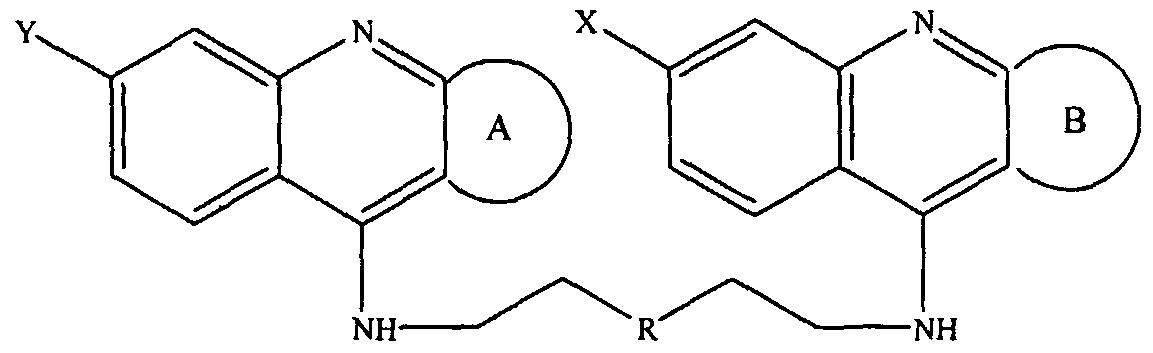
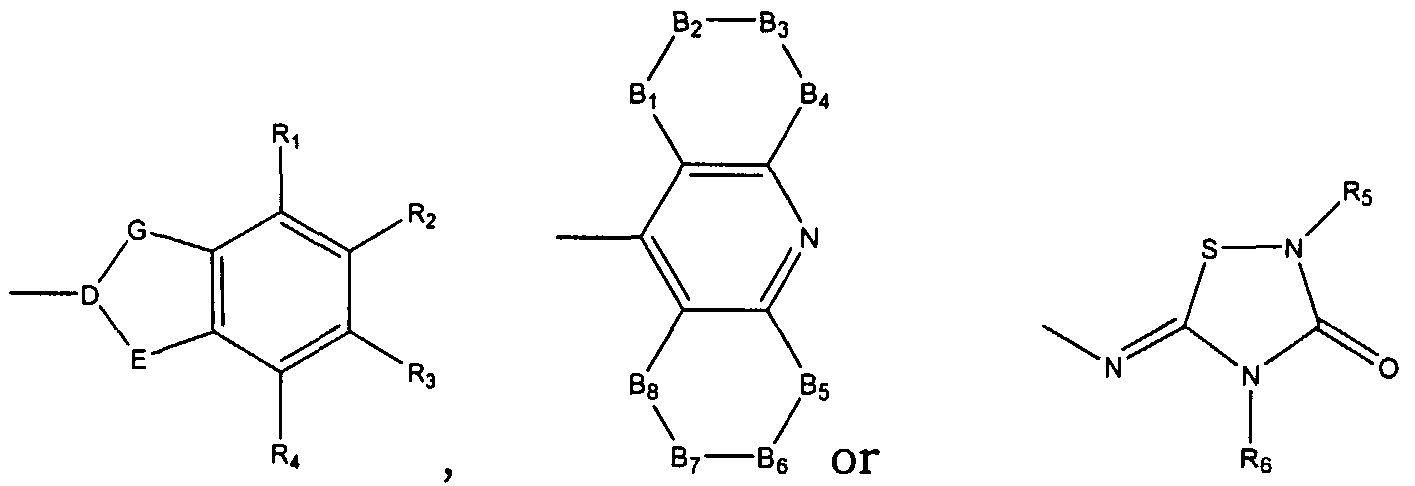
- the invention is directed to the compounds represented by the general formula I
- X is one of the following radicals:
- L is independently selected from -C(R)(R " )-, -CO-, -O- or -NR ' -
- n is zero, one, two, three, four, five, six, seven, eight, nine or ten
- R and R " are independently selected from hydrogen, alkyl, aryl,heteroaryl, halo, haloalkyl, alkoxy, hydroxyl, nitro and alkylthio
- Ri, R2, R3, R4, R9, Rio and Rn are independently selected from hydrogen, alkyl, alkoxy, hydroxyl, alkylthio, cycloalkyl, haloalkyl, halo, aryl, -(Z) n -, aryl, heteroaryl, -O(R7), -C(O)R7, -C(O)OR7, -S(O)t, cyano, nitro and mercapto, aryl substituted by alkyl, alkoxy, hydroxy, halo, haloalkyl, nitro or alkylthio; and heteroaryl substituted by alkyl, alkoxy, hydroxy, halo, haloalkyl, nitro or alkylthio; and heteroaryl substituted by alkyl, alkoxy, hydroxy, halo, haloalkyl, nitro or alkylthio
- Rs, Re, and R12 are independently selected from hydrogen, alkyl, alkoxy, hydroxyl, cycloalkyl, haloalkyl, aryl, heteroaryl, aryl substituted by alkyl, alkoxy, hydroxy, halo, haloalkyl, or alkylthio; and heteroaryl substituted by alkyl, alkoxy, hydroxy, halo, haloalkyl, nitro or alkylthio
- Z is independently selected from -C(R7)(Rs)-, -C(O)-, -O-, -
- R 7 and Rs are independently selected from hydrogen, alkyl, alkoxy, alkylthio, cycloalkyl, haloalkyl, halo, aryl, heteroaryl, cyano, nitro, mercapto, aryl substituted by alkyl, alkoxy, hydroxy, halo, haloalkyl, nitro or alkylthio; and heteroaryl substituted by alkyl, alkoxy, hydroxy, halo, haloalkyl, nitro or alkylthio
- t is zero, one or two.
- the invention is directed to the compounds within the formula (I) and represented by the general formula la and Ila:
- X is -C(Ri a )(R 2a )-, -CO-, -O- or -NR**-;
- n is zero, one, two, three, four, five, six, seven, eight, nine or ten;
- R la and R 2a are independently selected from hydrogen, alkyl, aryl, halo, haloalkyl;
- R 3a , R 4a and R 5a are independently selected from hydrogen, alkyl, cycloaklyl, haloalkyl, halo, aryl, -(Z) n -aryl, heteroaryl, -
- t is zero, one or two;
- alkyl refers to a straight-line or branched hydrocarbon chain comprising only atoms of carbon and hydrogen and containing no unsaturated bonds, having from one to eight carbon atoms and bound to the remainder of the molecule by a single bond, e.g. methyl, ethyl, n-propyl, i-propyl, n- butyl, t-butyl, n-pentyl, etc.
- alkyl radicals may optionally be substituted by one or more substituents chosen independently from the group comprising halogens, hydroxyl, alcoxides, carboxy, cyano, carbonyl, acyl, alkoxycarbonyl, amino, nitro, mercapto and alkylthio.
- substituents chosen independently from the group comprising halogens, hydroxyl, alcoxides, carboxy, cyano, carbonyl, acyl, alkoxycarbonyl, amino, nitro, mercapto and alkylthio.
- alkyl is C.-C ⁇ alkyl.
- alkoxy refers to a radical of formula -OR a , where R a is an alkyl radical as described above, e.g. methoxy, ethoxy, propoxy, etc.
- alkoxycarbonyl refers to a radical of formula -C(O)OR a , where R a is an alkyl radical as described above, e.g. methoxycarbonyl, ethoxycarbonyl, propoxycarbonyl, etc.
- alkylthio refers to a radical of formula -SRa, where Ra is an alkyl radical as described above, e.g. methylthio, ethylthio, propylthio, etc.
- amino refers to a radical of formula -NH2
- aryl refers to a phenyl or naphthyl radical.
- the aryl radical may optionally be substituted by one or more substituents selected from among the group comprising hydroxy, mercapto, halogens, alkyl, phenyl, alkoxy, haloalkyl, nitro, cyano, dialkylamino, aminoalkyl, acyl and alkoxycarbonyl as they are defined here.
- acyl refers to a radical of formula -C(O)-R a and -C(O)-R
- R a is an alkyl radical as described above and R j -, is an aryl radical as described above, e.g. acetyl, propionyl, benzoyl, and similar.
- cyano refers to a radical of formula -CN
- cycloalkyl refers to stable cycles of 3 to 10 monocyclic or bicyclic members that are saturated or partially saturated and consist exclusively of carbon and hydrogen atoms. This term also includes cycloalkylo radicals, which may optionally be substituted by one or more substituents chosen independently from the group comprising alkyl, halogen, hydroxy, amino, cyano, nitro, alkoxy, carboxy and alkoxycarbonyl
- halogens refers to bromine, chlorine, iodine or fluorine
- haloalkyl refers to an alkyl radical, as defined above, which is substituted by one or more halogens, also as defined above, e.g. trifluoromethyl, trichloromethyl, 2,2,2-trifluoroethyl, l-fluoromethyl-2-fluoroethyl, and similar.
- heterocycle refers to a heterocyclic radical.
- the heterocycle refers to a stable cycle of 3 to 15 members comprising carbon atoms and one to five heteroatoms chosen from the group comprising nitrogen, oxygen and sulphur.
- the heterocycle may be a monocyclic, bicyclic or tricyclic system that may include fused rings, and the nitrogen, carbon or sulphur atoms may optionally be oxidised, the nitrogen atom may optionally be quaternised, and the heterocycle may be partly or totally saturated or aromatic.
- heterocycles include, but are not limited to, azepines, benzimidazole, benzothiazole, furan, isothiazole, imidazole, indole, piperidine, piperazine, purine, quinoline, thiadiazole, tetrahydrofuran.
- the heterocycle may optionally be substituted by R3 and R4 as defined in the summary of the invention, "mercapto” refers to a radical of formula -SH "nitro" refers to a radical of formula -NO2.
- the or each group -(L) n - is preferably -(CH2)n- (where n is not zero), -CO- -NH- or -NCH3-.
- the chain is of the formula -(CH2)n-, -(CH2)n-NR a — (CH 2 )n-, -(CH 2 )n-NR a -CO-, -(CH 2 )n-NRa-CO-(CH 2 )n- or -(CH 2 )n-NR a - (CH2)n-NR a -CO-, where the or each n is not zero, and the or each R a is - NH- or -NCH3-, usually preferably -NH-.
- the total for the sum of the n integers is preferably in the range 2 to 15.
- R ⁇ to R 4 are hydrogen.
- X is: phthalimidyl (l,3-dioxo-l ,3-dihydro-isoindol-2-yl), indol-2-yl, indanon-2-yl, benzimidazol-2-yl, indandion-2-yl, indazol-2-yl, benzofuran-2-yl, benzothiophen-2-yl or benzotriazol-2-yl.
- More preferred compounds are those in which X is phthalimide (l ,3-dioxo- l,3-dihydro-isoindol-2-yl) and the cyclic part of formula I represents 9-acridinyl, l,2,3,4-tetrahydro-acridin-9-yl or 6- chloro, 1,2,3, 4-tetrahydro-acridin-9-yl.
- X is phthalimide (l ,3-dioxo- l,3-dihydro-isoindol-2-yl) and the cyclic part of formula I represents 9-acridinyl, l,2,3,4-tetrahydro-acridin-9-yl or 6- chloro, 1,2,3, 4-tetrahydro-acridin-9-yl.
- More preferred compounds are those in which X is l-indanon-2-yl and the cyclic part of formula I represents l,2,3,4-tetrahydro-acridin-9- yl; within these compounds are included, among others, the following compounds:
- the preferred compounds are those in which X is 9-acridinyl, 6-chloro- l,2,3,4-tetrahydro-acridin-9-yl and 1 ,2,3,4- tetrahydro-acridin-9-yl.
- cyclic part of formula I represents: 9-acridinyl, 6- chloro- 1 ,2,3,4-tetrahydro-acridin-9-yl or 1 ,2,3,4-tetrahydro-acridin-9- yl; within these compounds are included, among others, the following compounds:
- the groups Rs and R ⁇ are suitably alkyl or substituted alkyl, notably alkoxycarbonylalkyl.
- the preferred compounds are those in which the cyclic part of formula I represents: 9-acridinyl, 6-chloro, 1,2,3,4- tetrahydro-acridin-9-yl or l,2,3,4-tetrahydro-acridin-9-yl; within these compounds are included, among others, the following compounds:
- Another object of the invention is the synthesis of the compounds of the invention.
- 9-Alkylaminotetrahydroacridines have been synthesized following the procedure previously reported in bibliography. Carlier, P.R.; Chow. E.S.-H; Han, Y.; Liu, J.; El Yazal, J.; Pang Y.-P. J. Med. Chem., 1999,42, 4225-4231.
- Example 1 5,6-Dimethoxy-2- ⁇ [7-(l,2,3,4-tetrahydro-acridin-9-ylamino)- heptylamino]-methyl ⁇ -indan- 1 -one.
- Example 2 5,6-Dimethoxy-2- ⁇ [6-(l ,2,3,4-tetrahydro-acridin-9-ylamino)- hexylamino]-methyl ⁇ -indan- 1 -one.
- Reagents 9-Amino-acridine (60 mg, 0.24 mmol), DMSO (5 ml), KOH (27 mg, 0.48 mmol), and 2-(7-Bromo-heptyl)-isoindole-l,3-dione (80mg, 0.24 mmol).
- Reagents 9-Amino-acridina (60 mg, 0.24 mmol), DMSO (5 ml), KOH (27 mg, 0.48 mmol), and 2-(7-Bromo-heptyl)-isoindole- l ,3-dione (68.64 mg, 0.24 mmol).
- Purification silica gel column chromatography using DCM/ MeOH (10: 1 :0.1%NH 3 ). Yellow syrup, yield: 20 mg (18.5%).
- Reagents 9-Amino-acridine (150 mg, 0.60 mmol), DMSO (10 ml), KOH (67.3 mg, 1.2 mmol), and 2-(9-Bromo-nonyl)-isoindole- l,3-dione (68.64 mg, 0.24 mmol).
- Purification silica gel column chromatography using DCM/ MeOH (10: 1 :0.1%NH 3 ). Yellow syrup, yield: 20 mg (18.5%).
- the derivatives of the present invention may be prepared as described below in scheme 5.
- N-phthaloglycine (83 mg, 0.48 mmol), THF anhydrous (5 ml), 1 , 1 '-carbonyldiimidazol (83 mg, 0.51 mmol), and 6-chloro-9-(7- aminoheptylamino)- 1 ,2,3,4-tetrahydroacridine (165 mg, 0.48 mmol).
- Purification silica gel column chromatography using DCM/ MeOH/ ⁇ H 3 (20: 1 :0.5%). Yellow syrup, yield: 80 mg (31%).
- N-phthaloglycine 160 mg, 0.78 mmol
- THF anhydrous 10 ml
- 1 , 1 '-carbonyldiimidazol 126.5 mg, 0.78 mmol
- 6-chloro-9-(6- aminohexylamino)- 1,2,3,4-tetrahydroacridine 260 mg, 0.78 mmol
- N-phthaloglycine (76 mg, 0.34 mmol)
- THF anhydrous (8 ml)
- 1 , l'-carbonyldiimidazol (55.1 mg, 0.34 mmol)
- 6-chloro-9-(6- aminohexylamino)- 1,2,3,4-tetrahydroacridine 200 mg, 0.34 mmol.
- Chlorine was bubbled slowly through a solution of alkylisothiocyanate in dry hexane (15 ml) under nitrogen atmosphere at -15°C to -10°C. Chlorine was generated by addition of 35% HCl to KMn ⁇ 4. The temperature of the reaction mixture was carefully controlled during the addition step. At this point the Alkyl- S- chloroisothiocarbamoyl chloride was formed. Afterward, alkylisocyanate was added. The mixture was stirred at room temperature during 10 hours and the solvent was evaporated to dryness. The residue was resolved in anhydrous tetrahydrofurane (10 ml) after this point the amine and triethylamine were added.
- reaction mixture was stirred for 24 hours at room temperature, the white solid was filtered off, The solvent was evaporated under reduced pressure and the residue purified by silica gel column chromatography using as eluent mixtures of solvents in the proportions indicated for each case.
- Example 13 2-Ethyl-4-isopropyl-5-[7-(l ,2,3,4-tetrahydro-acridin-9- ylamino)-heptyl-iminio]-[ 1 ,2,4]thiadiazolidin-3-one.
- ethylisothiocyanate (569 ⁇ l, 6.5 mmol), KMnO 4 (500mg, 3.16mmol), HCl (3.1ml, 3.4mmol), isopropylisocyanate (640 ⁇ l, 6.5 mmol), triethylamine (94 ⁇ l, 0.68 mmol) and 9-(7-aminoheptylamino)- 1 ,2,3,4-tetrahydroacridine (105 mg, 0.34 mmol).
- Example 14 2-Ethyl-4-isopropyl-5-[9-( 1 ,2,3, 4-tetrahydro-acridin-9- ylamino)-nonyl-iminio]-[ 1 ,2,4]thiadiazolidin-3-one.
- ethylisothiocyanate (569 ⁇ l, 6.5 mmol), KMn ⁇ 4 (500mg, 3.16mmol), HCl (3.1ml, 3.4mmol), isopropylisocyanate (640 ⁇ l, 6.5 mmol), triethylamine (140 ⁇ l, 1.0 mmol) and 9-(9-aminononylamino)- 1,2,3,4-tetrahydroacridine (173 mg, 0.5 mmol).
- Purification silica gel column chromatography using AcOEt/MeOH (15: 1). Yellow syrup (36 mg, 14 %).
- Example 15 4-isopropyl-3-oxo-5-[9-(l,2,3,4-tetrahydro-acridin-9- ylamino)-nonyl-iminio]-[ 1 ,2,4]thiadiazolidine-2-carboxylic acid ethyl ester.
- ethoxycarbonylmethylisothiocyanate (0.8 ml, 6.5 mmol), KMnO4 (500mg, 3.16mmol), HCl (3.1ml, 3.4mmol), isopropylisocyanate (640 ⁇ l, 6.5 mmol), triethylamine (140 ⁇ l, 1.0 mmol) and 9-(9- aminononylamino)- 1 ,2,3,4-tetrahydroacridine (173 mg, 0.5 mmol).
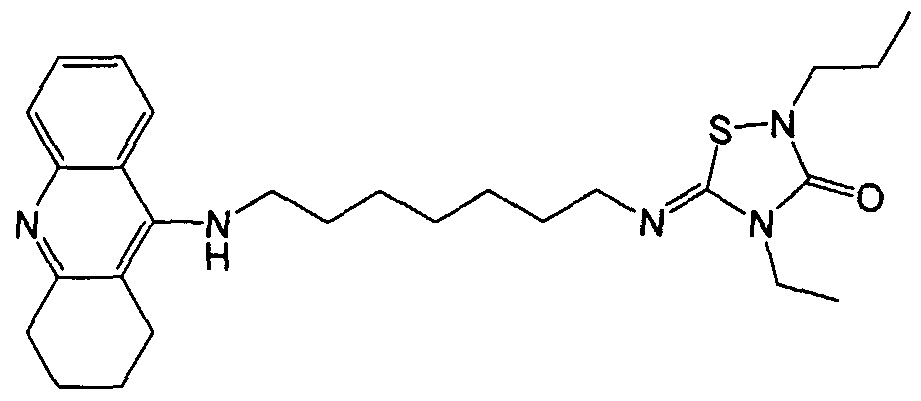
- Example 16 4-Ethyl-2- ⁇ ropyl-5-[7-(l,2,3,4-tetrahydro-acridin-9- ylamino)-heptyl-imino]-[ 1 ,2,4]thiadiazolidin-3-one
- Reagents ethylisothiocyanate (0.57ml, 6.5 mmol), KMnO 4 (500mg, 3.16mmol), HCl (3.1ml, 3.4mmol), propylisocyanate (0.60ml, 6.5mmol), triethylamine (0.12ml, 1.26mmol) and 9-(7-aminoheptylamino)- 1,2,3,4- tetrahydroacridine (200mg, 0.63mmol).
- ethylisothiocyanate (0.57ml, 6.5 mmol), KMnO4 (500mg, 3.16mmol), HCl (3.1ml, 3.4mmol), ispropylisocyanate (0.60ml, 6.5 mmol), triethylamine (0.12ml, 1.26mmol) and 9-(8-aminooctylamino)- 1 ,2,3,4-tetrahydroacridine (200mg, 0.61mmol).
- ethylisothiocyanate (0.57ml, 6.5 mmol), KMnO 4 (500mg, 3.16mmol), HCl (3.1ml, 3.4mmol), ispropylisocyanate (0.60ml, 6.5 mmol), triethylamine (0.12ml, 1.26mmol) and 9-(6-aminohexylamino)- 1,2,3,4-tetrahydroacridine (200mg, 0.66mmol).
- Example 20 N-Acridin-9-yl-N'-( 1 ,2,3,4-tetrahydro-acridin-9-yl)- nonane- 1 ,9-diamine
- Reagents ⁇ -(2-Amino-ethyl)- ⁇ -methyl- ⁇ '-(l,2,3,4-tetrahydro-acridin-9- yl)-ethane- l ,2-diamine (143 mg, 0.44 mmol), 1-pentanol (10 ml), 9- Chloro-acridine (115.5 mg, 0.53mmol).
- Example 22 N-[2-(Acridin-9-ylamino)-ethyl]-N'-(6-chloro- 1,2,3,4- tetrahydro-acridin-9-yl)-N-methyl-ethane- 1 ,2-diamine
- Reagents ⁇ -( ⁇ -Chloro- 1,2,3, 4-tetrahydro-acridin-9-yl)-octane- 1,8- diamine (165 mg, 0.46 mmol), 1-pentanol (5 ml), and 9-Chloro-acridine (99.8 mg, 0.46 mmol).
- Purification silica gel column chromatography using. AcOEt/ MeOH/ NH 3 from (15: 1:0%) to (9: 1:0.5%) .Yellow solid. Yield: 19 mg (8%).
- the method of Ellman et al. (Ellman, G.L.; Courtney, K.D.; Andres, B.; Featherstone, R.M. Biochem. Pharmacol. 1961 , 7, 88-95) was followed.
- the assay solution consisted of 0.1 M phosphate buffer pH 8, 200 ⁇ M 5,5'-dithiobis(2-nitrobenzoic acid) (DTNB, Elian's reagent), 0.02 unit/ ml AChE (Sigma Chemical Co. from human erythrocytes), and 400 ⁇ M acetylthiocholine iodide as the substrate of the enzymatic reaction.
- the compounds tested were added to the assay solution and pre incubated with the enzyme for 10 min at 30°C.
- the substrate was added.
- the absorbance changes at 412 nm were recorded for 5 min with a Perkin-Elmer 550 SE UV/VIS spectrometer, the reaction rates were compared, and the percent inhibition due to the presence of test compounds was calculated.
- the IC50 is defined as the concentration of each compound that reduces a 50% the enzymatic activity with respect to that without inhibitors. Table 1 : Human Erythrocytes AChE inhibition
- AChE inhibitory activity was evaluated at 25°C by the colorimetric method reported by Ellman (Ellman, G.L.; Courtney, K.D.; Andres, B.; Featherstone, R.M. Biochem. Pharmacol. 1961, 7, 88-95).
- the assay solution consisted on 0.02 unit/ ml AChE from bovine erythrocytes, 0.1 M sodium phosphate buffer pH 8, 0.3 mM 5,5 ' -dithiobis (2-nitrobenzoic acid) (DTNB, Ellman- s reagent), and 0.5 mM acetylthiocholine iodide as the substrate of the enzymatic reaction.
- Enzyme activity was determined by measuring the absorbance at 405 nm during 10 minutes with a Fluostar optima plate reader (BMG). The tested compounds were preincubated with the enzyme for 10 minutes at 30°C. In this conditions, compound 16 showed an IC50 value of 2.03 E-07 M.
- Acetylcholinesterase (AChE) enzyme preparations were obtained from SH-SY5Y, SK-N-SH and N2A cells.
- the human neuroblastoma cell line SH-SY5Y was cultured in minimum essential medium, Han ' s F12 medium, supplemented with 10% fetal bovine serum and 1% penicillin/ streptomycin, and grown in a 5% CO2 humidified incubator at 37°C.
- the human neuroblastoma cell line SK-N-SH was cultured in RPMI 1640 medium, supplemented with 10% fetal bovine serum and 1% penicillin/ streptomycin, and grown in a 5% CO2 humidified incubator at 37°C.
- the rat neuroblastoma cell line N2A was cultured in DULBECCO ' S MOD EAGLE medium, supplemented with 10% fetal bovine serum and 1% penicillin/ streptomycin, and grown in a 5% CO2 humidified incubator at 37°C.
- the cells were plated at 250 10 3 cells for each reaction, at least, 48 hours before the AChE activity measure. Cells were washed and harvested in 0.1 M sodium phosphate buffer pH 8, at 4°C.
- AChE inhibitory activity was evaluated at 25°C by the colorimetric method reported by Ellman (Ellman, G.L.; Courtney, K.D.; Andres, B.; Featherstone, R.M. Biochem. Pharmacol. 1961 , 7, 88- 95).
- the assay solution consisted of AChE from neuronal cells, 0.1 M phosphate buffer pH 8, 0.3 mM 5,5 ' -dithiobis (2-nitrobenzoic acid) (DTNB, Ellman-s reagent), and 0.5 mM acetylthiocholine iodide as the substrate of the enzymatic reaction.
- Enzyme activity was determined by measuring the absorbance at 405 nm during 10 minutes with a Fluostar optima plate reader (BMG).The tested compounds were preincubated with the enzyme for 10 minutes at 30°C. The reaction rate was calculated with, at least, triplicate measurements, and the percent inhibition due to the presence of test compound was calculated relative to the compound-free control. The compound concentration producing 50% of AChE inhibition (IC50) was determined.
- AChE-A ⁇ complexes were carried out as described previously [39,40].
- Stock solutions of A ⁇ -4o at 3.5 mM were prepared in DMSO.
- the amount of peptide used in the assays was 0.1 mM.
- Human recombinant AChE (Sigma- Aldrich) was used at a molar ratio A ⁇ -AChE 200: 1.
- AChE was mixed with the appropriate amount of AChE in PBS pH 7.4 and stirred for 48 hours in a microtiter plate at room temperature.
- the fibrils obtained were characterized by Congo Red (CR) binding.
- the compounds tested were used at the IC50 defined in the previous paragraph of the biological evaluation. Propidium iodide 50 ⁇ M for comparison.
- the indanone-tacrine derivative 1 showed a 18.7% reduction of the amyloid-AChE complex aggregation, while the thiadiazolidinone-tacrine derivative 15 decrease the ⁇ -amyloid-AChE complex aggregation by 27.8%.
- the peripheral inhibitor propidium reduces the aggregation of the ⁇ -amyloid-AChE complex by 18.1 %. This compound was used as standard of reference.
- AChE inhibitory activity was evaluated at 30°C by the colorimetric method reported by Ellman [Ellman, G.L.; Courtney, K.D.; Andres, B.; Featherstone, R.M. Biochem. Pharmacol. 1961 , 7, 88-95].
- the assay solution consisted of 0.1 M phosphate buffer pH 8, 0.3 mM 5,5'- dithiobis (2-nitrobenzoic acid) (DTNB, Ellman 's reagent), 0.02 units AChE (Sigma Chemical Co. from bovine erythrocytes), and 0.5 mM acetylthiocholine iodide as the substrate of the enzymatic reaction.
- the compounds tested were added to the assay solution and preincubated with the enzyme for 5 min at 30°C. After that period, the substrate was added. The absorbance changes at 405 nm were recorded for 5 min with a microplate reader Digiscan 340T, the reaction rates were compared, and the percent inhibition due to the presence of test compounds was calculated. The reaction rate was calculated with, at least, triplicate measurements, and the percent inhibition due to the presence of test compound was calculated relative to the compound-free control. The compound concentration producing 50% of AChE inhibition (ICso) was determined. The results are shown in table 2.
- BuChE inhibitory activity was evaluated at 30°C by the colorimetric method reported by Ellman [Ellman, G.L.; Courtney, K.D.; Andres, B.; Featherstone, R.M. Biochem. Pharmacol. 1961, 7, 88-95].
- the assay solution consisted of 0.01 units BuChE from human serum, 0.1 M sodium phosphate buffer pH 8, 0.3 mM 5, 5 ' -dithiobis (2- nitrobenzoic acid) (DTNB, Ellman ' s reagent), and 0.5 mM butyrylthiocholine iodide as the substrate of the enzymatic reaction.
- Enzyme activity was determined by measuring the absorbance at 405 nm during 5 minutes with a microplate reader Digiscan 340T. The tested compounds were preincubated with the enzyme for 10 minutes at 30°C. The reaction rate was calculated with, at least, triplicate measurements. The IC50 is defined as the concentration of each compound that reduces a 50% the enzymatic activity with respect to that without inhibitors. The results are shown in table 2.
- the cytotoxicity effect of the molecules was tested in the human neuroblastoma cell line SH-SY5Y. These cells were cultured in 96-well plates in minimum essential medium, Han ' s F12 medium, supplemented with 10% fetal bovine serum, 1% glutamine and 1% penicillin/ streptomycin, and grown in a 5% CO2 humidified incubator at 37°C.
- the cells were plated at 10 4 cells for each well, at least, 48 hours before the toxicity measure. Cells were exposed for 24 hours to the compounds at different concentrations (from 10" 5 to 10' 9 ), quantitative assessment of cell death was made by measurement of the intracellular enzyme lactate dehydrogenase (LDH) (citotoxicity detection kit, Roche). The cuantity of LDH was evaluated in a microplate reader Anthos 2010, at 492 and 620 nm. Controls were taken as 100% viability. The results are shown in table 2.
- LDH lactate dehydrogenase
- Propidium exhibits an increase in fluorescence on binding to AchE peripheral site, making it a useful probe for competitive ligand binding to the enzyme.
Landscapes
- Organic Chemistry (AREA)
- Chemical & Material Sciences (AREA)
- Health & Medical Sciences (AREA)
- Bioinformatics & Cheminformatics (AREA)
- Engineering & Computer Science (AREA)
- Veterinary Medicine (AREA)
- Medicinal Chemistry (AREA)
- Nuclear Medicine, Radiotherapy & Molecular Imaging (AREA)
- General Chemical & Material Sciences (AREA)
- Pharmacology & Pharmacy (AREA)
- Life Sciences & Earth Sciences (AREA)
- Animal Behavior & Ethology (AREA)
- General Health & Medical Sciences (AREA)
- Public Health (AREA)
- Chemical Kinetics & Catalysis (AREA)
- Neurosurgery (AREA)
- Neurology (AREA)
- Biomedical Technology (AREA)
- Heart & Thoracic Surgery (AREA)
- Cardiology (AREA)
- Vascular Medicine (AREA)
- Urology & Nephrology (AREA)
- Psychology (AREA)
- Hospice & Palliative Care (AREA)
- Psychiatry (AREA)
- Pharmaceuticals Containing Other Organic And Inorganic Compounds (AREA)
- Medicines That Contain Protein Lipid Enzymes And Other Medicines (AREA)
- Acyclic And Carbocyclic Compounds In Medicinal Compositions (AREA)
- Plural Heterocyclic Compounds (AREA)
- Enzymes And Modification Thereof (AREA)
- Nitrogen Condensed Heterocyclic Rings (AREA)
Abstract
Description






Claims



Priority Applications (8)
| Application Number | Priority Date | Filing Date | Title |
|---|---|---|---|
| CA002501491A CA2501491A1 (en) | 2002-10-09 | 2003-10-07 | Dual binding site acetylcholinesterase inhibitors for the treatment of alzheimer's disease |
| DE60310753T DE60310753T2 (en) | 2002-10-09 | 2003-10-07 | DUAL BINDING ACETYLCHOLINESTERASE INHIBITORS FOR THE TREATMENT OF ALZHEIMER |
| DK03751019T DK1558255T3 (en) | 2002-10-09 | 2003-10-07 | Double-binding site acetylcholinesterase inhibitors for the treatment of Alzheimer's disease |
| EP03751019A EP1558255B1 (en) | 2002-10-09 | 2003-10-07 | Dual binding site acetylcholinesterase inhibitors for the treatment of alzheimer's disease |
| JP2004542615A JP4652054B2 (en) | 2002-10-09 | 2003-10-07 | Double binding site acetylcholinesterase inhibitors for the treatment of Alzheimer's disease |
| MXPA05003734A MXPA05003734A (en) | 2002-10-09 | 2003-10-07 | Dual binding site acetylcholinesterase inhibitors for the treatment of alzheimer's disease. |
| AU2003269240A AU2003269240B2 (en) | 2002-10-09 | 2003-10-07 | Dual binding site acetylcholinesterase inhibitors for the treatment of Alzheimer's disease |
| US10/530,667 US20060142323A1 (en) | 2002-10-09 | 2003-10-07 | Dual binding site acetylcholinesterase inhibitors for the treatment of alzheimer's disease |
Applications Claiming Priority (2)
| Application Number | Priority Date | Filing Date | Title |
|---|---|---|---|
| GBGB0223494.6A GB0223494D0 (en) | 2002-10-09 | 2002-10-09 | Dual binding site acetylcholinesterase inhibitors for the treatment of alzheimer's disease |
| GB0223494.6 | 2002-10-09 |
Publications (2)
| Publication Number | Publication Date |
|---|---|
| WO2004032929A2 true WO2004032929A2 (en) | 2004-04-22 |
| WO2004032929A3 WO2004032929A3 (en) | 2004-07-01 |
Family
ID=9945614
Family Applications (1)
| Application Number | Title | Priority Date | Filing Date |
|---|---|---|---|
| PCT/GB2003/004314 Ceased WO2004032929A2 (en) | 2002-10-09 | 2003-10-07 | Dual binding site acetylcholinesterase inhibitors for the treatment of alzheimer’s disease |
Country Status (16)
| Country | Link |
|---|---|
| US (1) | US20060142323A1 (en) |
| EP (1) | EP1558255B1 (en) |
| JP (1) | JP4652054B2 (en) |
| CN (1) | CN100436421C (en) |
| AT (1) | ATE349211T1 (en) |
| AU (1) | AU2003269240B2 (en) |
| CA (1) | CA2501491A1 (en) |
| DE (1) | DE60310753T2 (en) |
| DK (1) | DK1558255T3 (en) |
| ES (1) | ES2279143T3 (en) |
| GB (1) | GB0223494D0 (en) |
| MX (1) | MXPA05003734A (en) |
| PL (1) | PL375018A1 (en) |
| PT (1) | PT1558255E (en) |
| RU (1) | RU2325379C2 (en) |
| WO (1) | WO2004032929A2 (en) |
Cited By (23)
| Publication number | Priority date | Publication date | Assignee | Title |
|---|---|---|---|---|
| WO2005005413A1 (en) * | 2003-07-09 | 2005-01-20 | Neuropharma S.A. | Tacrine derivatives as inhibitors of acetylcholinesterase |
| WO2006092395A1 (en) * | 2005-03-01 | 2006-09-08 | Heinrich-Heine Universität Düsseldorf | 9-amino-acridine derivatives and their use for eliminating misfolded proteins |
| WO2007122274A1 (en) * | 2006-04-20 | 2007-11-01 | Universidad De Barcelona | Acetylcholinesterase-inhibiting compounds for treating alzheimer's disease |
| WO2008055945A1 (en) | 2006-11-09 | 2008-05-15 | Probiodrug Ag | 3-hydr0xy-1,5-dihydr0-pyrr0l-2-one derivatives as inhibitors of glutaminyl cyclase for the treatment of ulcer, cancer and other diseases |
| WO2008065141A1 (en) | 2006-11-30 | 2008-06-05 | Probiodrug Ag | Novel inhibitors of glutaminyl cyclase |
| WO2008104580A1 (en) | 2007-03-01 | 2008-09-04 | Probiodrug Ag | New use of glutaminyl cyclase inhibitors |
| WO2011029920A1 (en) | 2009-09-11 | 2011-03-17 | Probiodrug Ag | Heterocylcic derivatives as inhibitors of glutaminyl cyclase |
| WO2011100373A1 (en) | 2010-02-09 | 2011-08-18 | The Johns Hopkins University | Methods and compositions for improving cognitive function |
| WO2011107530A2 (en) | 2010-03-03 | 2011-09-09 | Probiodrug Ag | Novel inhibitors |
| WO2011110613A1 (en) | 2010-03-10 | 2011-09-15 | Probiodrug Ag | Heterocyclic inhibitors of glutaminyl cyclase (qc, ec 2.3.2.5) |
| WO2011131748A2 (en) | 2010-04-21 | 2011-10-27 | Probiodrug Ag | Novel inhibitors |
| CN102391180A (en) * | 2011-03-07 | 2012-03-28 | 华中科技大学 | Sulfydryl-containing tacrine derivative and preparation method and application thereof |
| WO2012123563A1 (en) | 2011-03-16 | 2012-09-20 | Probiodrug Ag | Benz imidazole derivatives as inhibitors of glutaminyl cyclase |
| WO2012165981A1 (en) | 2011-06-03 | 2012-12-06 | Uniwersytet Warszawski | Novel hybrid cholinesterase inhibitors |
| CN103333163A (en) * | 2013-07-09 | 2013-10-02 | 广州中医药大学 | Coumarone derivative, and preparation method and applications thereof |
| WO2014144801A1 (en) | 2013-03-15 | 2014-09-18 | Agenebio Inc. | Methods and compositions for improving cognitive function |
| EP2818467A1 (en) * | 2013-06-27 | 2014-12-31 | Universitat de Barcelona | Multi-target drug compounds for the treatment of neurodegenerative disorders |
| EP2865670A1 (en) | 2007-04-18 | 2015-04-29 | Probiodrug AG | Thiourea derivatives as glutaminyl cyclase inhibitors |
| US10154988B2 (en) | 2012-11-14 | 2018-12-18 | The Johns Hopkins University | Methods and compositions for treating schizophrenia |
| US10159648B2 (en) | 2015-05-22 | 2018-12-25 | Agenebio, Inc. | Extended release pharmaceutical compositions of levetiracetam |
| PL422526A1 (en) * | 2017-08-09 | 2019-02-11 | Uniwersytet Medyczny w Łodzi | N-substituted compounds of tacrine, method for producing and application of those compounds |
| EP3461819A1 (en) | 2017-09-29 | 2019-04-03 | Probiodrug AG | Inhibitors of glutaminyl cyclase |
| US10806717B2 (en) | 2013-03-15 | 2020-10-20 | The Johns Hopkins University | Methods and compositions for improving cognitive function |
Families Citing this family (4)
| Publication number | Priority date | Publication date | Assignee | Title |
|---|---|---|---|---|
| CN103992312A (en) * | 2013-02-18 | 2014-08-20 | 江苏欧威医药有限公司 | 1,2,4-thiadiazole-3,5-dione derivatives, and pharmaceutical composition and application thereof |
| CN104003987B (en) * | 2014-06-03 | 2016-03-23 | 中国药科大学 | The multi-functional anticholinesterase of the different two disjunctor class of tacrine-β-carboline |
| WO2016146655A1 (en) * | 2015-03-16 | 2016-09-22 | INSERM (Institut National de la Santé et de la Recherche Médicale) | Novel 1,4-bis(3-aminopropyl)piperazine derivative and its use |
| RU2675794C1 (en) * | 2017-11-01 | 2018-12-25 | Федеральное Государственное Бюджетное Учреждение Науки Институт Физиологически Активных Веществ Российской Академии Наук (Ифав Ран) | Multifunctional conjugates of tacrine and its analogues with derivatives of 1,2,4-tiadiazole, the way of their synthesis and application for the treatment of neurodegenerative diseases |
Family Cites Families (8)
| Publication number | Priority date | Publication date | Assignee | Title |
|---|---|---|---|---|
| JPH02152967A (en) * | 1988-12-02 | 1990-06-12 | Mitsubishi Kasei Corp | 9-Acylamino-tetrahydroacridine derivative and a memory impairment improving agent containing the derivative as an active ingredient |
| US4916135A (en) * | 1989-05-08 | 1990-04-10 | Hoechst Roussel Pharmaceuticals Inc. | N-heteroaryl-4-quinolinamines |
| JP2720517B2 (en) * | 1989-05-31 | 1998-03-04 | 三菱化学株式会社 | 9-acylamino-tetrahydroacridine derivative and memory disorder improving agent containing the derivative as an active ingredient |
| FR2651230B1 (en) * | 1989-08-25 | 1992-03-13 | Synthese Rech | DERIVATIVES OF 5-AMINO-1,2,3,4 TETRAHYDRO-ACRIDINE AND APPLICATIONS AS DRUGS. |
| RU2024509C1 (en) * | 1991-05-07 | 1994-12-15 | Всероссийский научный центр по безопасности биологически активных веществ | Derivatives of 9-aminoacridine or their salts with organic or inorganic acids showing psychotropic, antiamnestic and lipid-regulating activity |
| JPH06184152A (en) * | 1991-11-18 | 1994-07-05 | Sanwa Kagaku Kenkyusho Co Ltd | New compound, its production and brain function improver using the same as main ingredient |
| US5783584A (en) * | 1995-12-11 | 1998-07-21 | Mayo Foundation For Medical Education And Research | THA analogs useful as cholinesterase inhibitors |
| US6194403B1 (en) * | 1999-09-09 | 2001-02-27 | Unitech Pharmaceuticals, Inc. | Tacrine derivatives for treating Alzheimer's disease |
-
2002
- 2002-10-09 GB GBGB0223494.6A patent/GB0223494D0/en not_active Ceased
-
2003
- 2003-10-07 US US10/530,667 patent/US20060142323A1/en not_active Abandoned
- 2003-10-07 CA CA002501491A patent/CA2501491A1/en not_active Abandoned
- 2003-10-07 PT PT03751019T patent/PT1558255E/en unknown
- 2003-10-07 CN CNB2003801012523A patent/CN100436421C/en not_active Expired - Fee Related
- 2003-10-07 JP JP2004542615A patent/JP4652054B2/en not_active Expired - Fee Related
- 2003-10-07 MX MXPA05003734A patent/MXPA05003734A/en active IP Right Grant
- 2003-10-07 DK DK03751019T patent/DK1558255T3/en active
- 2003-10-07 DE DE60310753T patent/DE60310753T2/en not_active Expired - Lifetime
- 2003-10-07 ES ES03751019T patent/ES2279143T3/en not_active Expired - Lifetime
- 2003-10-07 PL PL03375018A patent/PL375018A1/en not_active Application Discontinuation
- 2003-10-07 AU AU2003269240A patent/AU2003269240B2/en not_active Ceased
- 2003-10-07 WO PCT/GB2003/004314 patent/WO2004032929A2/en not_active Ceased
- 2003-10-07 EP EP03751019A patent/EP1558255B1/en not_active Expired - Lifetime
- 2003-10-07 RU RU2005114353/04A patent/RU2325379C2/en not_active IP Right Cessation
- 2003-10-07 AT AT03751019T patent/ATE349211T1/en active
Cited By (35)
| Publication number | Priority date | Publication date | Assignee | Title |
|---|---|---|---|---|
| AU2004255930B2 (en) * | 2003-07-09 | 2009-10-01 | Noscira, S.A. | Tacrine derivatives as inhibitors of acetylcholinesterase |
| WO2005005413A1 (en) * | 2003-07-09 | 2005-01-20 | Neuropharma S.A. | Tacrine derivatives as inhibitors of acetylcholinesterase |
| JP2007534616A (en) * | 2003-07-09 | 2007-11-29 | ニューロファルマ・ソシエダード・アノニマ | Tacrine derivatives as inhibitors of acetylcholinesterase |
| US7910739B2 (en) | 2003-07-09 | 2011-03-22 | Noscira, S.A. | Acetylcholinesterase dual inhibitors |
| WO2006092395A1 (en) * | 2005-03-01 | 2006-09-08 | Heinrich-Heine Universität Düsseldorf | 9-amino-acridine derivatives and their use for eliminating misfolded proteins |
| US7951796B2 (en) | 2005-03-01 | 2011-05-31 | Carsten Korth | 9-amino-acridine derivatives and their use for eliminating misfolded proteins |
| ES2288406A1 (en) * | 2006-04-20 | 2008-01-01 | Universidad De Barcelona | ACETILCOLINESTERASE INHIBITING COMPOUNDS FOR THE TREATMENT OF ALZHEIMER'S DISEASE. |
| ES2288406B1 (en) * | 2006-04-20 | 2008-12-16 | Universidad De Barcelona | ACETILCOLINESTERASE INHIBITING COMPOUNDS FOR THE TREATMENT OF ALZHEIMER'S DISEASE. |
| WO2007122274A1 (en) * | 2006-04-20 | 2007-11-01 | Universidad De Barcelona | Acetylcholinesterase-inhibiting compounds for treating alzheimer's disease |
| WO2008055945A1 (en) | 2006-11-09 | 2008-05-15 | Probiodrug Ag | 3-hydr0xy-1,5-dihydr0-pyrr0l-2-one derivatives as inhibitors of glutaminyl cyclase for the treatment of ulcer, cancer and other diseases |
| WO2008065141A1 (en) | 2006-11-30 | 2008-06-05 | Probiodrug Ag | Novel inhibitors of glutaminyl cyclase |
| WO2008104580A1 (en) | 2007-03-01 | 2008-09-04 | Probiodrug Ag | New use of glutaminyl cyclase inhibitors |
| EP2481408A2 (en) | 2007-03-01 | 2012-08-01 | Probiodrug AG | New use of glutaminyl cyclase inhibitors |
| EP2865670A1 (en) | 2007-04-18 | 2015-04-29 | Probiodrug AG | Thiourea derivatives as glutaminyl cyclase inhibitors |
| WO2011029920A1 (en) | 2009-09-11 | 2011-03-17 | Probiodrug Ag | Heterocylcic derivatives as inhibitors of glutaminyl cyclase |
| WO2011100373A1 (en) | 2010-02-09 | 2011-08-18 | The Johns Hopkins University | Methods and compositions for improving cognitive function |
| WO2011107530A2 (en) | 2010-03-03 | 2011-09-09 | Probiodrug Ag | Novel inhibitors |
| WO2011110613A1 (en) | 2010-03-10 | 2011-09-15 | Probiodrug Ag | Heterocyclic inhibitors of glutaminyl cyclase (qc, ec 2.3.2.5) |
| WO2011131748A2 (en) | 2010-04-21 | 2011-10-27 | Probiodrug Ag | Novel inhibitors |
| CN102391180A (en) * | 2011-03-07 | 2012-03-28 | 华中科技大学 | Sulfydryl-containing tacrine derivative and preparation method and application thereof |
| WO2012123563A1 (en) | 2011-03-16 | 2012-09-20 | Probiodrug Ag | Benz imidazole derivatives as inhibitors of glutaminyl cyclase |
| WO2012165981A1 (en) | 2011-06-03 | 2012-12-06 | Uniwersytet Warszawski | Novel hybrid cholinesterase inhibitors |
| US10624875B2 (en) | 2012-11-14 | 2020-04-21 | The Johns Hopkins University | Methods and compositions for treating schizophrenia |
| US10154988B2 (en) | 2012-11-14 | 2018-12-18 | The Johns Hopkins University | Methods and compositions for treating schizophrenia |
| WO2014144801A1 (en) | 2013-03-15 | 2014-09-18 | Agenebio Inc. | Methods and compositions for improving cognitive function |
| US11160785B2 (en) | 2013-03-15 | 2021-11-02 | Agenebio Inc. | Methods and compositions for improving cognitive function |
| US10806717B2 (en) | 2013-03-15 | 2020-10-20 | The Johns Hopkins University | Methods and compositions for improving cognitive function |
| EP2818467A1 (en) * | 2013-06-27 | 2014-12-31 | Universitat de Barcelona | Multi-target drug compounds for the treatment of neurodegenerative disorders |
| WO2014206877A1 (en) * | 2013-06-27 | 2014-12-31 | Universitat De Barcelona | Multi-target drug compounds for the treatment of neurodegenerative disorders |
| CN103333163A (en) * | 2013-07-09 | 2013-10-02 | 广州中医药大学 | Coumarone derivative, and preparation method and applications thereof |
| US10159648B2 (en) | 2015-05-22 | 2018-12-25 | Agenebio, Inc. | Extended release pharmaceutical compositions of levetiracetam |
| US10925834B2 (en) | 2015-05-22 | 2021-02-23 | Agenebio, Inc. | Extended release pharmaceutical compositions of levetiracetam |
| PL235351B1 (en) * | 2017-08-09 | 2020-06-29 | Univ Medyczny W Lodzi | N-substituted tacrine compounds, production method and use of these compounds |
| PL422526A1 (en) * | 2017-08-09 | 2019-02-11 | Uniwersytet Medyczny w Łodzi | N-substituted compounds of tacrine, method for producing and application of those compounds |
| EP3461819A1 (en) | 2017-09-29 | 2019-04-03 | Probiodrug AG | Inhibitors of glutaminyl cyclase |
Also Published As
| Publication number | Publication date |
|---|---|
| CN1703220A (en) | 2005-11-30 |
| PL375018A1 (en) | 2005-11-14 |
| EP1558255B1 (en) | 2006-12-27 |
| AU2003269240B2 (en) | 2010-02-18 |
| ES2279143T3 (en) | 2007-08-16 |
| JP2006514922A (en) | 2006-05-18 |
| AU2003269240A1 (en) | 2004-05-04 |
| RU2005114353A (en) | 2005-11-10 |
| PT1558255E (en) | 2007-03-30 |
| US20060142323A1 (en) | 2006-06-29 |
| MXPA05003734A (en) | 2005-09-30 |
| CA2501491A1 (en) | 2004-04-22 |
| RU2325379C2 (en) | 2008-05-27 |
| GB0223494D0 (en) | 2002-11-13 |
| JP4652054B2 (en) | 2011-03-16 |
| DE60310753D1 (en) | 2007-02-08 |
| WO2004032929A3 (en) | 2004-07-01 |
| CN100436421C (en) | 2008-11-26 |
| DK1558255T3 (en) | 2007-05-07 |
| DE60310753T2 (en) | 2007-10-11 |
| ATE349211T1 (en) | 2007-01-15 |
| EP1558255A2 (en) | 2005-08-03 |
Similar Documents
| Publication | Publication Date | Title |
|---|---|---|
| WO2004032929A2 (en) | Dual binding site acetylcholinesterase inhibitors for the treatment of alzheimer’s disease | |
| Li et al. | Design, synthesis and evaluation of novel tacrine–rhein hybrids as multifunctional agents for the treatment of Alzheimer's disease | |
| Scipioni et al. | Synthesis of novel vanillin derivatives: novel multi-targeted scaffold ligands against Alzheimer's disease | |
| CA2563038C (en) | Neurologically-active compounds | |
| Ma et al. | Novel deoxyvasicinone derivatives as potent multitarget-directed ligands for the treatment of Alzheimer's disease: Design, synthesis, and biological evaluation | |
| Tomassoli et al. | Synthesis, biological assessment and molecular modeling of new dihydroquinoline-3-carboxamides and dihydroquinoline-3-carbohydrazide derivatives as cholinesterase inhibitors, and Ca channel antagonists | |
| Hiremathad et al. | Tacrine-allyl/propargylcysteine–benzothiazole trihybrids as potential anti-Alzheimer's drug candidates | |
| Sadeghian et al. | Design, synthesis and biological activity evaluation of novel carbazole-benzylpiperidine hybrids as potential anti Alzheimer agents | |
| Xu et al. | Multifunctional 5, 6-dimethoxybenzo [d] isothiazol-3 (2H)-one-N-alkylbenzylamine derivatives with acetylcholinesterase, monoamine oxidases and β-amyloid aggregation inhibitory activities as potential agents against Alzheimer’s disease | |
| Montanari et al. | Multitarget Strategy to Address Alzheimer's Disease: Design, Synthesis, Biological Evaluation, and Computational Studies of Coumarin‐Based Derivatives | |
| RU2402545C2 (en) | Tacrine derivatives as acetylcholinesterase inhibitors | |
| Osman et al. | Structure–activity relationship studies of benzyl‐, phenethyl‐, and pyridyl‐substituted tetrahydroacridin‐9‐amines as multitargeting agents to treat Alzheimer's disease | |
| US8999994B2 (en) | Derivatives of propargylamine having neuroprotective capacity for the treatment of Alzheimer's and Parkinson's diseases | |
| PT94750A (en) | METHOD FOR THE PREPARATION OF 4,5,6,7-TETRA-SUBSTITUTED BENZOXAZOLONES | |
| CN101575341B (en) | Aminoalkanoamido xanthonopyridine derivatives and preparation method and application thereof | |
| ES2924575A1 (en) | QUINOLYLNITRONES DERIVATIVES FOR USE IN THE PREVENTION AND TREATMENT OF CEREBRAL ISCHEMIA, ISCHEMIC STROKE AND NEURODEGENERATIVE DISEASES | |
| CN113956249B (en) | Brain-targeted AChE inhibitor prodrugs and preparation methods and applications thereof | |
| CA2321143A1 (en) | 9-aminoacridine derivatives and process for the preparation thereof | |
| WO2025257687A1 (en) | Hydroxypyridinone compounds as inhibitors of catechol-o-methyltransferase | |
| Tosonyan | Synthesis and Characterisation of Novel Phenanthroline Quinone Derivatives and Their Evaluation as Alzheimer's Disease Therapeutic Active Ingredients | |
| Shameema et al. | Acetylcholinesterase Inhibition Activity and Molecular Docking Studies of 3-α-Carboxy Ethyl/3-Benzamidoacetic Acid Rhodanine Derivatives | |
| Patel | Design and Development of Novel Potential Therapeutics for Alzheimer's Disease | |
| Verano et al. | Synthesis and Biological Profiling of New 1, 2, 3, 4-Tetrahydrobenzo [h] naphthyridine-Based Hybrids as Dual Inhibitors of β-Amyloid and Tau Aggregation with Anticholinesterase Activity | |
| Bortolami | Design, synthesis and in vitro evaluation of new cholinesterase inhibitors with metal-chelating and antioxidant properties as multitarget compounds for Alzheimer’s disease | |
| CA2064736A1 (en) | Acridine derivatives |
Legal Events
| Date | Code | Title | Description |
|---|---|---|---|
| AK | Designated states |
Kind code of ref document: A2 Designated state(s): AE AG AL AM AT AU AZ BA BB BG BR BY BZ CA CH CN CO CR CU CZ DE DK DM DZ EC EE EG ES FI GB GD GE GH GM HR HU ID IL IN IS JP KE KG KP KR KZ LC LK LR LS LT LU LV MA MD MG MK MN MW MX MZ NI NO NZ OM PG PH PL PT RO RU SC SD SE SG SK SL SY TJ TM TN TR TT TZ UA UG US UZ VC VN YU ZA ZM ZW |
|
| AL | Designated countries for regional patents |
Kind code of ref document: A2 Designated state(s): GH GM KE LS MW MZ SD SL SZ TZ UG ZM ZW AM AZ BY KG KZ MD RU TJ TM AT BE BG CH CY CZ DE DK EE ES FI FR GB GR HU IE IT LU MC NL PT RO SE SI SK TR BF BJ CF CG CI CM GA GN GQ GW ML MR NE SN TD TG |
|
| 121 | Ep: the epo has been informed by wipo that ep was designated in this application | ||
| WWE | Wipo information: entry into national phase |
Ref document number: 2003269240 Country of ref document: AU |
|
| WWE | Wipo information: entry into national phase |
Ref document number: 2501491 Country of ref document: CA |
|
| WWE | Wipo information: entry into national phase |
Ref document number: 375018 Country of ref document: PL |
|
| WWE | Wipo information: entry into national phase |
Ref document number: PA/a/2005/003734 Country of ref document: MX |
|
| WWE | Wipo information: entry into national phase |
Ref document number: 2004542615 Country of ref document: JP |
|
| WWE | Wipo information: entry into national phase |
Ref document number: 20038A12523 Country of ref document: CN |
|
| WWE | Wipo information: entry into national phase |
Ref document number: 2003751019 Country of ref document: EP |
|
| ENP | Entry into the national phase |
Ref document number: 2005114353 Country of ref document: RU Kind code of ref document: A |
|
| WWP | Wipo information: published in national office |
Ref document number: 2003751019 Country of ref document: EP |
|
| ENP | Entry into the national phase |
Ref document number: 2006142323 Country of ref document: US Kind code of ref document: A1 |
|
| WWE | Wipo information: entry into national phase |
Ref document number: 10530667 Country of ref document: US |
|
| WWP | Wipo information: published in national office |
Ref document number: 10530667 Country of ref document: US |
|
| WWG | Wipo information: grant in national office |
Ref document number: 2003751019 Country of ref document: EP |