WO2004034806A1 - Biotechnologisch erzeugbares proteinhaltiges präparat, verfahren zu seiner herstellung und seine verwendung als lebensmittelzutat - Google Patents
Biotechnologisch erzeugbares proteinhaltiges präparat, verfahren zu seiner herstellung und seine verwendung als lebensmittelzutat Download PDFInfo
- Publication number
- WO2004034806A1 WO2004034806A1 PCT/EP2003/011264 EP0311264W WO2004034806A1 WO 2004034806 A1 WO2004034806 A1 WO 2004034806A1 EP 0311264 W EP0311264 W EP 0311264W WO 2004034806 A1 WO2004034806 A1 WO 2004034806A1
- Authority
- WO
- WIPO (PCT)
- Prior art keywords
- protein
- lactic acid
- preparation according
- protein preparation
- milk
- Prior art date
- Legal status (The legal status is an assumption and is not a legal conclusion. Google has not performed a legal analysis and makes no representation as to the accuracy of the status listed.)
- Ceased
Links
Classifications
-
- A—HUMAN NECESSITIES
- A23—FOODS OR FOODSTUFFS; TREATMENT THEREOF, NOT COVERED BY OTHER CLASSES
- A23G—COCOA; COCOA PRODUCTS, e.g. CHOCOLATE; SUBSTITUTES FOR COCOA OR COCOA PRODUCTS; CONFECTIONERY; CHEWING GUM; ICE-CREAM; PREPARATION THEREOF
- A23G9/00—Frozen sweets, e.g. ice confectionery, ice-cream; Mixtures therefor
- A23G9/32—Frozen sweets, e.g. ice confectionery, ice-cream; Mixtures therefor characterised by the composition containing organic or inorganic compounds
-
- A—HUMAN NECESSITIES
- A23—FOODS OR FOODSTUFFS; TREATMENT THEREOF, NOT COVERED BY OTHER CLASSES
- A23C—DAIRY PRODUCTS, e.g. MILK, BUTTER OR CHEESE; MILK OR CHEESE SUBSTITUTES; PREPARATION THEREOF
- A23C9/00—Milk preparations; Milk powder or milk powder preparations
- A23C9/12—Fermented milk preparations; Treatment using microorganisms or enzymes
- A23C9/13—Fermented milk preparations; Treatment using microorganisms or enzymes using additives
- A23C9/1315—Non-milk proteins or fats; Seeds, pulses, cereals or soja; Fatty acids, phospholipids, mono- or diglycerides or derivatives therefrom; Egg products
-
- A—HUMAN NECESSITIES
- A23—FOODS OR FOODSTUFFS; TREATMENT THEREOF, NOT COVERED BY OTHER CLASSES
- A23G—COCOA; COCOA PRODUCTS, e.g. CHOCOLATE; SUBSTITUTES FOR COCOA OR COCOA PRODUCTS; CONFECTIONERY; CHEWING GUM; ICE-CREAM; PREPARATION THEREOF
- A23G9/00—Frozen sweets, e.g. ice confectionery, ice-cream; Mixtures therefor
- A23G9/32—Frozen sweets, e.g. ice confectionery, ice-cream; Mixtures therefor characterised by the composition containing organic or inorganic compounds
- A23G9/36—Frozen sweets, e.g. ice confectionery, ice-cream; Mixtures therefor characterised by the composition containing organic or inorganic compounds containing microorganisms or enzymes; containing paramedical or dietetical agents, e.g. vitamins
- A23G9/363—Frozen sweets, e.g. ice confectionery, ice-cream; Mixtures therefor characterised by the composition containing organic or inorganic compounds containing microorganisms or enzymes; containing paramedical or dietetical agents, e.g. vitamins containing microorganisms, enzymes
-
- A—HUMAN NECESSITIES
- A23—FOODS OR FOODSTUFFS; TREATMENT THEREOF, NOT COVERED BY OTHER CLASSES
- A23G—COCOA; COCOA PRODUCTS, e.g. CHOCOLATE; SUBSTITUTES FOR COCOA OR COCOA PRODUCTS; CONFECTIONERY; CHEWING GUM; ICE-CREAM; PREPARATION THEREOF
- A23G9/00—Frozen sweets, e.g. ice confectionery, ice-cream; Mixtures therefor
- A23G9/32—Frozen sweets, e.g. ice confectionery, ice-cream; Mixtures therefor characterised by the composition containing organic or inorganic compounds
- A23G9/38—Frozen sweets, e.g. ice confectionery, ice-cream; Mixtures therefor characterised by the composition containing organic or inorganic compounds containing peptides or proteins
-
- A—HUMAN NECESSITIES
- A23—FOODS OR FOODSTUFFS; TREATMENT THEREOF, NOT COVERED BY OTHER CLASSES
- A23J—PROTEIN COMPOSITIONS FOR FOODSTUFFS; WORKING-UP PROTEINS FOR FOODSTUFFS; PHOSPHATIDE COMPOSITIONS FOR FOODSTUFFS
- A23J3/00—Working-up of proteins for foodstuffs
- A23J3/14—Vegetable proteins
-
- A—HUMAN NECESSITIES
- A23—FOODS OR FOODSTUFFS; TREATMENT THEREOF, NOT COVERED BY OTHER CLASSES
- A23J—PROTEIN COMPOSITIONS FOR FOODSTUFFS; WORKING-UP PROTEINS FOR FOODSTUFFS; PHOSPHATIDE COMPOSITIONS FOR FOODSTUFFS
- A23J3/00—Working-up of proteins for foodstuffs
- A23J3/14—Vegetable proteins
- A23J3/16—Vegetable proteins from soybean
-
- A—HUMAN NECESSITIES
- A23—FOODS OR FOODSTUFFS; TREATMENT THEREOF, NOT COVERED BY OTHER CLASSES
- A23L—FOODS, FOODSTUFFS OR NON-ALCOHOLIC BEVERAGES, NOT OTHERWISE PROVIDED FOR; PREPARATION OR TREATMENT THEREOF
- A23L27/00—Spices; Flavouring agents or condiments; Artificial sweetening agents; Table salts; Dietetic salt substitutes; Preparation or treatment thereof
- A23L27/20—Synthetic spices, flavouring agents or condiments
- A23L27/24—Synthetic spices, flavouring agents or condiments prepared by fermentation
- A23L27/25—Dairy flavours
-
- A—HUMAN NECESSITIES
- A23—FOODS OR FOODSTUFFS; TREATMENT THEREOF, NOT COVERED BY OTHER CLASSES
- A23L—FOODS, FOODSTUFFS OR NON-ALCOHOLIC BEVERAGES, NOT OTHERWISE PROVIDED FOR; PREPARATION OR TREATMENT THEREOF
- A23L33/00—Modifying nutritive qualities of foods; Dietetic products; Preparation or treatment thereof
- A23L33/10—Modifying nutritive qualities of foods; Dietetic products; Preparation or treatment thereof using additives
- A23L33/135—Bacteria or derivatives thereof, e.g. probiotics
-
- A—HUMAN NECESSITIES
- A23—FOODS OR FOODSTUFFS; TREATMENT THEREOF, NOT COVERED BY OTHER CLASSES
- A23L—FOODS, FOODSTUFFS OR NON-ALCOHOLIC BEVERAGES, NOT OTHERWISE PROVIDED FOR; PREPARATION OR TREATMENT THEREOF
- A23L33/00—Modifying nutritive qualities of foods; Dietetic products; Preparation or treatment thereof
- A23L33/10—Modifying nutritive qualities of foods; Dietetic products; Preparation or treatment thereof using additives
- A23L33/17—Amino acids, peptides or proteins
- A23L33/185—Vegetable proteins
-
- A—HUMAN NECESSITIES
- A61—MEDICAL OR VETERINARY SCIENCE; HYGIENE
- A61K—PREPARATIONS FOR MEDICAL, DENTAL OR TOILETRY PURPOSES
- A61K36/00—Medicinal preparations of undetermined constitution containing material from algae, lichens, fungi or plants, or derivatives thereof, e.g. traditional herbal medicines
- A61K36/18—Magnoliophyta (angiosperms)
- A61K36/185—Magnoliopsida (dicotyledons)
- A61K36/48—Fabaceae or Leguminosae (Pea or Legume family); Caesalpiniaceae; Mimosaceae; Papilionaceae
-
- A—HUMAN NECESSITIES
- A23—FOODS OR FOODSTUFFS; TREATMENT THEREOF, NOT COVERED BY OTHER CLASSES
- A23V—INDEXING SCHEME RELATING TO FOODS, FOODSTUFFS OR NON-ALCOHOLIC BEVERAGES AND LACTIC OR PROPIONIC ACID BACTERIA USED IN FOODSTUFFS OR FOOD PREPARATION
- A23V2002/00—Food compositions, function of food ingredients or processes for food or foodstuffs
-
- A—HUMAN NECESSITIES
- A23—FOODS OR FOODSTUFFS; TREATMENT THEREOF, NOT COVERED BY OTHER CLASSES
- A23V—INDEXING SCHEME RELATING TO FOODS, FOODSTUFFS OR NON-ALCOHOLIC BEVERAGES AND LACTIC OR PROPIONIC ACID BACTERIA USED IN FOODSTUFFS OR FOOD PREPARATION
- A23V2400/00—Lactic or propionic acid bacteria
- A23V2400/11—Lactobacillus
- A23V2400/169—Plantarum
Definitions
- Biotechnologically producible protein-containing preparation process for its preparation and its use as a food ingredient
- the present invention relates to a protein-containing preparation of plant origin with significantly improved sensory and possibly also nutritional and undiminished good techno-functional properties, which can be obtained by fermentation with a lactic acid bacterium.
- This preparation is suitable as a versatile food ingredient.
- Proteins or protein-containing preparations are used as ingredients for the food and feed industry and are often used in the formulation of food (meat and sausage products, baked goods, delicatessen products, beverages, ice cream and many more). The great importance of protein products initially lies in supplying people with essential amino acids.
- protein-containing preparations offer multiple uses because, due to their technical properties ("technofunctionality"), they can also be used to improve or control a large number of properties such as water or oil binding, foaming, texturing, dispersibility, viscosity control or emulsifiability or the like ,
- protein-containing preparations have different properties with regard to the techno-functional effect in recipes, but also with regard to their sensory influence.
- the starting materials are usually swollen in water, optionally pretreated, for example with sodium bicarbonate, blanched and / or ground if necessary and then extracted.
- the milk obtained is filtered and then pasteurized or boiled.
- a variant of the so-called Illinois process is often used for soy milk (see, for example, Al Nelson et al., J. of Food Science 41 (1976), 57 or KM Kamaly, Food Research Int., 30, (1997) 675-682. Production examples are also described which produce a yogurt-like product from lupine or soy milk with the help of suitable lactic acid bacteria in biotechnological processes. , J. Fd Technol. 15 (1980), 647-652)
- the soy milk is fermented according to Pinthong, loc.
- the object of the present invention is to provide a protein-containing preparation made from plant materials that has been modified so that it reliably has positive taste and smell properties that are otherwise assigned to milk products, and its technical properties such as emulsifying activity, gel formation and foaming properties compared to those of the starting material are not or not significantly deteriorated.
- protein content as used in the present application is defined as the content which is calculated from the determination of the nitrogen and its multiplication by the factor 6.25.
- the protein-containing preparation according to the invention contains lactic acid.
- this is D-lactic acid, L-lactic acid or a mixture of the two optical variants.
- the left-turning L-lactic acid is particularly valuable from a nutritional point of view, and it is therefore preferred that a large part or all of the lactic acid is present as L-lactic acid.
- the protein preparation according to the invention contains a larger amount of lactic acid, preferably at least about 5 g / l and more preferably at least about 8 g / l. In particularly favorable cases, 10 g / l lactic acid or even more can be obtained, as explained in more detail below.
- the protein-containing preparation according to the invention is characterized by a milk product-like aroma.
- the aroma comes from the fermentation.
- a key substance of this aroma is diacetyl, and in many cases a high diacetyl content is desirable, especially if the protein preparation is to be used as an ingredient in food preparations, because in these cases the taste and smell should remain perceptible despite the dilution by other ingredients.
- the perceptibility threshold of diacetyl is about 0.1 ppm, and the diacetyl content in the product according to the invention should generally not be significantly below 1 ppm. About 10-20 ppm are particularly preferred, and in some cases it can be increased even further.
- the protein-containing preparation according to the invention is made from a vegetable starting material with a high protein content in the dry matter. receive.
- This content can be naturally present or the vegetable raw material is pretreated to achieve this content.
- suitable vegetable starting materials are protein-rich plant extracts, such as are obtainable in particular from lupins, peanuts, soybeans, peas and other legumes.
- aqueous plant extracts are common, the dry substance of which consists of approximately one third fat, one third protein and one third carbohydrates.
- the invention is based on significantly higher protein proportions in the dry matter, and this surprisingly leads to the effect that a "bean" off-flavor is objectively either not at all or only present in a significantly reduced amount, and in the latter case by the Flavors that can be characterized as "milk product-like" are so heavily covered that it is not perceived subjectively.
- the protein-containing preparation according to the invention is generally completely or essentially lactose-free, since the starting materials are generally lactose-free. In most cases there will be no reason to add lactose to it, although in specific cases this is readily possible. In addition, it is generally completely or essentially cholesterol-free because, unlike corresponding animal materials, the plant starting materials generally do not contain any cholesterol. And of course it is usually free of animal protein or other animal constituents, unless these are added for special reasons.
- the protein content of the protein preparation according to the invention is essentially unchanged compared to that of the starting material used.
- the protein-containing preparation according to the invention can be pasteurized or otherwise sterilized, that is to say a prebiotic, or it can also contain living microorganisms, that is to say a biologically active, probiotic food or such an ingredient for food.
- a probiotic food is preferably adjusted to a content of 10 6 to 10 12 , more preferably of about 10 8 to 10 10 and in particular of about 10 9 microorganisms per gram of food, unless this content has already been given.
- the preparation can be obtained as a protein solution or protein dispersion and then used either in liquid or dried form (for example spray-dried or in a comparable manner convectively dried). Surprisingly, it was found that the milk-product-like aroma is retained even in dried products.
- the protein-containing preparation according to the invention is suitable, for example, as a food ingredient in
- the preparation of the protein-containing preparation according to the invention begins with the preparation of the raw material.
- legumes will be used as plant raw materials because they are grown on a large scale and are suitable due to their acceptable protein content.
- the invention is not limited to protein preparations from legumes.
- the dry matter content of protein is increased if this is not sufficiently high in the raw material.
- de-oiling eg with a lipophilic solvent such as hexane or with CO 2
- Carbohydrates can also be separated if necessary.
- Further steps, such as are known from the prior art can of course also be provided, such as, for example, debittering of the starting materials or the like.
- a favorable starting material is, for example, that obtained by treating lupine seeds according to EP 1 024 706 B1.
- Lupine seeds naturally contain about 38-50% of the dry matter protein and thus a little more than, for example, soy or even rapeseed.
- Very pure protein isolates can be obtained with the treatment method described in the cited EP patent.
- Such very pure materials, also from other vegetable protein sources, are very suitable according to the invention; however, it should be clear that such a high degree of protein purity is particularly favorable for the present invention, but is not a requirement. For example, it may be sufficient to deoil the plant parts used and, if necessary, to free them from enzymatic activity which could have a negative influence and / or to debitter.
- the person skilled in the art will decide whether the vegetable starting material for the fermentation should contain a smaller amount of mono-, oligo- and / or polysaccharides.
- the raw material is converted into a form suitable for fermentation, e.g. in an aqueous suspension or solution.
- a form suitable for fermentation e.g. in an aqueous suspension or solution.
- the person skilled in the art knows the procedural steps necessary for this, such as comminuting the plant starting material, extraction, separation of
- additives may or may be added to it if required or desired. Care must be taken to ensure that there is a sufficient amount of sugar (eg glucose) which serves as a source of nutrients for the fermenting microorganisms, and this must or may be added, or additives must or may be added that release such sugars from existing carbohydrates during fermentation.
- sugar eg glucose
- a suitable nitrogen source must also be available to the microorganisms. If the suspension or solution to be fermented cannot offer it sufficiently, for example due to the presence of amino acids, corresponding nitrogen-containing compounds or additives which release such compounds from the material present must be added, as is known in the art.
- a yeast extract for example, is suitable as a nitrogen source. The same applies to the mineral salts, the presence of which is necessary for the metabolic activity of the microorganisms. They can also be added if necessary.
- the fermentation is carried out in a manner known per se with the help of lactic acid-producing microorganisms.
- the fermentation can take place anaerobically or in the presence of oxygen, homofermentative or heterofermentative.
- Lactococci such as Lactococcus lactis or lactobacilli such as Lactobacillus casei, both of which produce L-lactic acid, or other bacteria such as Pediococcus damnosus, which use a lactic acid racemate can be used.
- Lactobacilli from the strains Lactobacillus perolens, Lactobacillus paracasei or Lactobacillus plantarum are particularly suitable from this aspect.
- Lactobacillus perolens is a microorganism isolated by Back from lemonade in 1985, deposited among others with the German Collection of Microorganisms and Cell Cultures GmbH (DSMZ) in Braunschweig, Germany under the number 12744. The organism was developed by Prof. Dr. Werner Back, deposited on October 23, 2002 with the DSMZ under the number DSM 15255 according to the Budapest Treaty.
- the address of the DSMZ is: D-38124 Braunschweig; Mascheroder Weg 1 b.
- the other microorganisms, Lactobacillus paracasei and Lactobacillus plantarum, have been known for a long time and can be purchased, for example from the DSZM in Braunschweig, Germany. Examples of strains stored there are e.g. DSZM 5622, 2649, 5457, 8741, 8742, 20006, 20020, 20207, 20244, 20312 or 46331.
- Conventional methods can be used to prepare the fermentation medium. With the exception of glucose, the ingredients can be mixed and, if necessary, diluted with water, for example by introducing the mixture into water that has already been placed in the fermenter.
- suitable measures In order to prevent the growth of foreign microorganisms, suitable measures must be taken, for example pasteurization or tyndallization of the fermentation medium.
- a carbon source such as glucose, which can be used by the selected organism, can then be added to the nutrient medium after the heating step. This prevents browning reactions in the fermentation medium.
- the fermenter is then inoculated with the inoculum of the microorganism chosen accordingly. For example, an approximately 1% bacterial suspension is suitable.
- the microorganisms can of course also be used immobilized on a stationary substrate.
- the fermentation can be carried out batchwise or continuously; Suitable measures for this are known to the person skilled in the art, they do not deviate from the usual.
- the fermentation takes place at a temperature suitable for the selected bacterium.
- the contact with the fermentation medium can last for a few hours, possibly even for a few days, depending on how quickly the microorganism produces lactic acid.
- the decreasing pH value can be buffered if necessary in order to keep the medium as long as possible in a pH value range in which further lactic acid is produced. With this measure the lactic acid production can be increased to well over 10g / l.
- fruit acid preferably citric acid
- This can increase the amount of diacetyl.
- the inventors have in this influence
- Fermentation especially in the case of citric acid, can establish a linear correlation between the amount of added fruit acid and the diacetyl formed.
- a quantity of approx. 2 g / l citric acid has proven to be favorable.
- the fermentation process is not adversely affected by this.
- the end product obtained is a solution or a suspension which, depending on the concentration of the solution or suspension of the raw material used, generally has about 5 to 25% dry matter, preferably about 15 to 20% dry matter.
- the Diacetyl content is usually around 9 to 21 ppm.
- Anti-nutritionally linked ⁇ -glycosidically linked carbohydrates are usually not or almost not present.
- Technologically important parameters of the protein preparation according to the invention can easily be set in a suitable manner.
- a 1% solution of the protein preparation according to the invention (approx. 85% Protein TS; starting material approx. 95% Protein TS), produced according to the process described above, an emulsifying capacity (emulsifying capacity) at pH 7 in the range from 400 to over 500 ml oil / g protein and an emulsifying activity of 40-50% can be observed in a 10% solution, the control group (identical starting material, not fermented) being able to emulsify 500 ml oil / g protein under the same conditions.
- Commercial milk protein Na caseinate
- Commercial milk protein Na caseinate
- the foam activity of the protein preparations according to the invention was at least 600% and preferably over 1000% with a foam density of 190 to 250 g / l.
- the untreated starting material had one Foam activity from 900 to 1200% and a foam density from 150 to 200 g / l.
- a Hobart 50-N was used as the serving machine.
- Chicken egg white powder (egg white) with 12.6% dry substance in solution has a foam activity of 1500% and a foam density of 70g / l after 4 minutes under the same test conditions.
- the protein preparation according to the invention can be used either as such or as a food ingredient. Possibilities for this are listed above. The use in ice cream and the advantageous properties which are achieved with it are given in Example 7.
- Lupine seed was peeled and flaked and then deoiled and debittered in accordance with EP 1 024 706 B1.
- antinutritive substances such as soluble carbohydrates were separated.
- the protein of the pretreated material was extracted by exposure to an alkaline medium (pH 7-9) from 35 ° C to 45 ° C, with a fractionation between raffinate and protein extracts. Protein precipitation was carried out from the protein extract in an acidic medium (pH 4.5). The resulting "protein curd" was thermally treated and spray dried.
- the protein isolate obtained in this way had the following composition (% by weight): water 5-7 dry matter 92-93 crude protein content (i.d.r.)> 90% fat content (i.d.r.) ⁇ 2.5% carbohydrates (i.Tr .) ⁇ 1%.
- the protein isolate from Example 1 was mixed with yeast extract, mineral salt and citric acid (composition: 15% protein isolate, 0.5% yeast extract, 0.5% mineral salts, 0.2% citric acid) and dispersed in previously sterilized water that has already been placed in the fermenter.
- the fermentation medium was then tyndallized:
- Fermentation medium content after 48 h fermentation L + lactic acid 17.5 g / l; pH 4.1 diacetyl 11.5 ppm
- the example was repeated with changed amounts of citric acid (0g / 5g), it being found that the formation of diacetyl correlated linearly with the amount of citric acid and did not adversely affect the course of the fermentation. If no citric acid was added, a diacetyl concentration lower by a factor of 1.5-2 was found in the end product.
- Example 2 was repeated, with the proviso that, with the conditions remaining unchanged, the fermentation was carried out under aerobic conditions with 15% oxygen saturation. Fermentation medium content after 48 h fermentation: L + lactic acid 17.5 g / l; pH 4.2 diacetyl 21.9 ppm
- the fermentation was carried out using the fermentation medium and fermentation conditions listed under Example 2, but using Lb. paracasei.
- Lactic acid and diacetyl content after 48 h fermentation L + lactic acid 13.9 g / l, pH 4.0 diacetyl 2-3.8 ppm
- Example 4 was repeated, with the proviso of an aerobic process control, as described under example 3. After 48 h fermentation the following contents were measured: L + lactic acid 14.5 g / l, pH 4.0 diacetyl 6.98 ppm
- ice cream production protein preparations according to Examples 2 to 5 were used in spray-dried form in addition to a standard preparation (containing milk protein) and a non-fermented preparation of plant origin. Different ice cream recipes were examined.
- the ice cream mix is prepared in a heatable laboratory reactor (IKA), which is equipped with a mixer.
- IKA heatable laboratory reactor
- a rotor-stator system (Ultra-Turrax) is used to obtain a homogeneous structure.
- the water is placed in the IKA reactor and heated to 95 ° C.
- the powdered recipe components are weighed, mixed and with the agitator running (approx. 100 rpm) as well Homogenizer (IKA 8500 U / min) metered.
- the oil is then added spontaneously.
- the temperature is controlled throughout the process. When the mix has reached a temperature of 75 ° C, pasteurization is continued for 2 minutes.
- the heating circuit is switched to the cooling circuit and the mix is cooled down to 15 ° C with the agitator and homogenizer running.
- the finished ice cream mix is filled and left to mature at 5 ° C for 24 hours so that the aroma components can take effect.
- the ice cream mix is frozen out with an ice machine with a cold accumulator and stirrer and hardened in a cold room at -20 ° C for 24 hours. After this time, the texture, the melting behavior and the sensory properties of the ice cream are characterized.
- Table 1 Recipes for type ice cream products with vegetable fat and substitution products:
- a total of eight ice creams were tested for their sensory behavior, of which a product for comparison without vegetable proteins and a product with a native, non-fermented lupine protein isolate according to Example 1 were produced.
- Four ice creams came from the second series of experiments mentioned above, in which 50% of the milk proteins were replaced by protein preparations from Examples 2 to 5.
- the remaining two ice creams were prepared with the compositions 2 and 4 according to Table 1 using the dry product according to Example 2.
- Table 2 shows the sensory characteristics of the ice creams produced.
- the ice creams produced were evaluated for shape, appearance, color, smell, taste and consistency / mouthfeel.
- the ice cream 01 (without vegetable proteins) appears broken, edgy and grayish-whitish in color on the spoon.
- the ice 02 (with protein isolate) is broken in the shape on the spoon, but not so angular. The color is yellowish to brownish.
- Ice creams 03 to 08 are broken in shape, but the color is yellowish to whitish.
- the ice creams 01 and 02 differ only slightly in smell. Both products smell mild, vanilla and slightly sweet.
- the smell of the protein preparation according to the invention gives the ice creams 03-08 an aromatic, sour and yoghurt-like note.
- the ice creams 01 and 02 differ in taste in that the addition of 50% lupine protein according to Example 1 gives the milky taste an additional nutty note.
- all testers rated the ice cream 03 as a particularly good-tasting ice cream within the ice cream products that were produced with the protein preparation according to the invention.
- the characteristics of milk-like, yoghurt-like, vanilla and slightly acidic were determined. But all other ice cream products (03 to 08) also showed this milky taste profile and good creaminess.
- ice creams with "simple ice cream” recipes can be produced, but the consistency of higher-quality recipes is equivalent.
- the consistency characteristics of ice creams 03 to 08 are usually attributed to the types of ice cream, egg cream or cream ice cream.
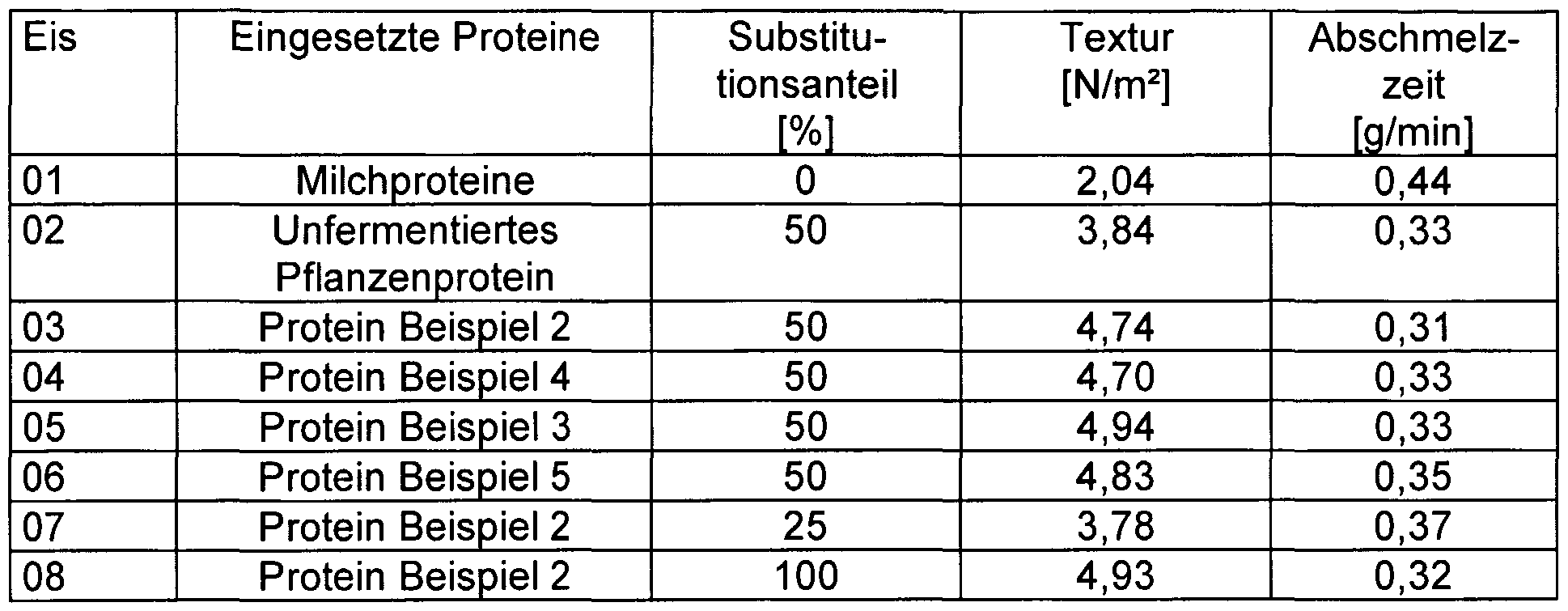
- Table 3 shows the strength and the melting behavior of the ice creams examined.
- the structure of the ice cream products can be clearly improved by adding vegetable proteins.
- due to the usually legume-like taste such products are of less interest.
- products can be obtained which have a milk-like aroma profile. All tests showed that the ice cream produced with the protein preparations according to the invention was almost or completely free of legume-like taste.
- the products fermented with Lactobacillus perolens showed a completely pure aroma profile, comparable to that of pure milk products.
Landscapes
- Life Sciences & Earth Sciences (AREA)
- Chemical & Material Sciences (AREA)
- Health & Medical Sciences (AREA)
- Engineering & Computer Science (AREA)
- Food Science & Technology (AREA)
- Polymers & Plastics (AREA)
- Nutrition Science (AREA)
- Natural Medicines & Medicinal Plants (AREA)
- Mycology (AREA)
- Inorganic Chemistry (AREA)
- Microbiology (AREA)
- Biotechnology (AREA)
- Proteomics, Peptides & Aminoacids (AREA)
- Biochemistry (AREA)
- Botany (AREA)
- Public Health (AREA)
- Biophysics (AREA)
- Medical Informatics (AREA)
- Medicinal Chemistry (AREA)
- Pharmacology & Pharmacy (AREA)
- Epidemiology (AREA)
- Animal Behavior & Ethology (AREA)
- General Health & Medical Sciences (AREA)
- Alternative & Traditional Medicine (AREA)
- Veterinary Medicine (AREA)
- Confectionery (AREA)
- Peptides Or Proteins (AREA)
- Dairy Products (AREA)
- Medicines Containing Material From Animals Or Micro-Organisms (AREA)
- General Preparation And Processing Of Foods (AREA)
- Seasonings (AREA)
- Seeds, Soups, And Other Foods (AREA)
Abstract
Description


Claims
Priority Applications (6)
| Application Number | Priority Date | Filing Date | Title |
|---|---|---|---|
| AU2003273984A AU2003273984A1 (en) | 2002-10-16 | 2003-10-10 | Protein-containing preparation which can be biotechnologically produced, method for the production thereof, and use of the same as a food ingredient |
| AT03757954T ATE469563T1 (de) | 2002-10-16 | 2003-10-10 | Biotechnologisch erzeugbares proteinhaltiges präparat, verfahren zu seiner herstellung und seine verwendung als lebensmittelzutat |
| CA2502380A CA2502380C (en) | 2002-10-16 | 2003-10-10 | Protein-containing preparation which can be biotechnologically produced, method for the production thereof, and use of the same as a food ingredient |
| DE50312782T DE50312782D1 (de) | 2002-10-16 | 2003-10-10 | Biotechnologisch erzeugbares proteinhaltiges präparat, verfahren zu seiner herstellung und seine verwendung als lebensmittelzutat |
| EP03757954A EP1560501B1 (de) | 2002-10-16 | 2003-10-10 | Biotechnologisch erzeugbares proteinhaltiges präparat, verfahren zu seiner herstellung und seine verwendung als lebensmittelzutat |
| US10/528,191 US20060127560A1 (en) | 2002-10-16 | 2003-10-10 | Protein-containing preparation which can be biotechnologically produced, method for the production thereof, and use of the same as a food ingredient |
Applications Claiming Priority (4)
| Application Number | Priority Date | Filing Date | Title |
|---|---|---|---|
| DE10248263.2 | 2002-10-16 | ||
| DE10248263 | 2002-10-16 | ||
| EP02023980.2 | 2002-10-25 | ||
| EP02023980A EP1410719A1 (de) | 2002-10-16 | 2002-10-25 | Biotechnologisch erzeugbares proteinhaltiges Präparat, Verfahren zu seiner Herstellung und seine Verwendung als Lebensmittelzutat |
Publications (1)
| Publication Number | Publication Date |
|---|---|
| WO2004034806A1 true WO2004034806A1 (de) | 2004-04-29 |
Family
ID=32038725
Family Applications (1)
| Application Number | Title | Priority Date | Filing Date |
|---|---|---|---|
| PCT/EP2003/011264 Ceased WO2004034806A1 (de) | 2002-10-16 | 2003-10-10 | Biotechnologisch erzeugbares proteinhaltiges präparat, verfahren zu seiner herstellung und seine verwendung als lebensmittelzutat |
Country Status (7)
| Country | Link |
|---|---|
| US (1) | US20060127560A1 (de) |
| EP (2) | EP1410719A1 (de) |
| AT (1) | ATE469563T1 (de) |
| AU (1) | AU2003273984A1 (de) |
| CA (1) | CA2502380C (de) |
| DE (1) | DE50312782D1 (de) |
| WO (1) | WO2004034806A1 (de) |
Cited By (3)
| Publication number | Priority date | Publication date | Assignee | Title |
|---|---|---|---|---|
| WO2008089734A1 (de) * | 2007-01-23 | 2008-07-31 | Fraunhofer-Gesellschaft zur Förderung der angewandten Forschung e.V. | Verfahren zur veränderung des aromaprofils eines pflanzlichen proteinpräparats |
| EP3445175A4 (de) * | 2016-04-22 | 2019-12-25 | Ripple Foods, PBC | Milchproduktanaloga und verfahren zur herstellung davon |
| US11730182B2 (en) | 2014-06-30 | 2023-08-22 | Prolupin Gmbh | Emulsion with lupine protein |
Families Citing this family (9)
| Publication number | Priority date | Publication date | Assignee | Title |
|---|---|---|---|---|
| US20090283630A1 (en) * | 2008-05-15 | 2009-11-19 | Al-Garni Ahmed Z | Lighter-than-air vehicle for shading |
| WO2010127414A1 (en) * | 2009-05-08 | 2010-11-11 | George Weston Foods Limited | Oil-in-water emulsifier |
| BRPI1007567B1 (pt) * | 2009-05-25 | 2022-09-27 | The Coca-Cola Company | Processo para modificar o sabor de um substrato contendo proteína de soja |
| JP6022463B2 (ja) * | 2011-09-30 | 2016-11-09 | 理研ビタミン株式会社 | 呈味改善剤 |
| US20200029613A1 (en) | 2015-06-30 | 2020-01-30 | Ben & Jerry's Homemade, Inc. | Frozen confection |
| WO2020025391A1 (de) | 2018-07-30 | 2020-02-06 | Fraunhofer-Gesellschaft zur Förderung der angewandten Forschung e. V. | Zuckerhaltiges pflanzenproteinpräparat mit besonderen funktionellen eigenschaften |
| US12274272B1 (en) * | 2019-03-15 | 2025-04-15 | Eclipse Foods Co. | Functionalized non-dairy base and method for producing non-dairy analogs |
| US12357002B2 (en) | 2019-03-15 | 2025-07-15 | Eclipse Foods Co. | Functionalized non-dairy base and method for producing non-dairy analogs |
| CN110510173A (zh) * | 2019-08-13 | 2019-11-29 | 刘江 | 即食型免回软膨化豆腐干的包装方法 |
Citations (6)
| Publication number | Priority date | Publication date | Assignee | Title |
|---|---|---|---|---|
| GB1356363A (en) * | 1972-02-26 | 1974-06-12 | Arkady New Foods Ltd | Manufacture of protein containing foodstuffs |
| EP0006380A1 (de) * | 1978-06-08 | 1980-01-09 | Fromageries Bel | Verfahren zur Herstellung von protein-und fetthaltigen Konzentraten mit Käsearoma und deren Verwendung, insbesondere für die Zubereitung von Schmelzkäse |
| US4678673A (en) * | 1984-03-09 | 1987-07-07 | Kraft, Inc. | Fermented oilseed product for preparing imitation dairy products |
| DD278058A1 (de) * | 1988-12-19 | 1990-04-25 | Adw Ddr | Verfahren zur behandlung von oel- und leguminosensamen |
| EP0988793A1 (de) * | 1998-09-21 | 2000-03-29 | Fuji Oil Company, Limited | Verfahren zur Herstellung von mit Milchsäurebakterien gesäuerter Milch |
| WO2002005657A1 (en) * | 2000-07-13 | 2002-01-24 | Nederlandse Organisatie Voor Toegepast- Natuurwetenschappelijk Onderzoek Tno | Structured protein food |
Family Cites Families (2)
| Publication number | Priority date | Publication date | Assignee | Title |
|---|---|---|---|---|
| DE19813207C1 (de) * | 1997-10-08 | 1999-06-24 | Fraunhofer Ges Forschung | Verfahren zur Behandlung und Verarbeitung alkaloid-, öl- und proteinhaltiger Lupinensamen |
| WO2000054608A1 (de) * | 1999-03-17 | 2000-09-21 | Fraunhofer Gesellschaft zur Förderung der angewandten Forschung e.V. | Verfahren zur behandlung und verarbeitung alkaloid-, öl- und proteinhaltiger lupinensamen |
-
2002
- 2002-10-25 EP EP02023980A patent/EP1410719A1/de not_active Withdrawn
-
2003
- 2003-10-10 DE DE50312782T patent/DE50312782D1/de not_active Expired - Lifetime
- 2003-10-10 WO PCT/EP2003/011264 patent/WO2004034806A1/de not_active Ceased
- 2003-10-10 EP EP03757954A patent/EP1560501B1/de not_active Expired - Lifetime
- 2003-10-10 US US10/528,191 patent/US20060127560A1/en not_active Abandoned
- 2003-10-10 AT AT03757954T patent/ATE469563T1/de not_active IP Right Cessation
- 2003-10-10 CA CA2502380A patent/CA2502380C/en not_active Expired - Lifetime
- 2003-10-10 AU AU2003273984A patent/AU2003273984A1/en not_active Abandoned
Patent Citations (6)
| Publication number | Priority date | Publication date | Assignee | Title |
|---|---|---|---|---|
| GB1356363A (en) * | 1972-02-26 | 1974-06-12 | Arkady New Foods Ltd | Manufacture of protein containing foodstuffs |
| EP0006380A1 (de) * | 1978-06-08 | 1980-01-09 | Fromageries Bel | Verfahren zur Herstellung von protein-und fetthaltigen Konzentraten mit Käsearoma und deren Verwendung, insbesondere für die Zubereitung von Schmelzkäse |
| US4678673A (en) * | 1984-03-09 | 1987-07-07 | Kraft, Inc. | Fermented oilseed product for preparing imitation dairy products |
| DD278058A1 (de) * | 1988-12-19 | 1990-04-25 | Adw Ddr | Verfahren zur behandlung von oel- und leguminosensamen |
| EP0988793A1 (de) * | 1998-09-21 | 2000-03-29 | Fuji Oil Company, Limited | Verfahren zur Herstellung von mit Milchsäurebakterien gesäuerter Milch |
| WO2002005657A1 (en) * | 2000-07-13 | 2002-01-24 | Nederlandse Organisatie Voor Toegepast- Natuurwetenschappelijk Onderzoek Tno | Structured protein food |
Non-Patent Citations (15)
| Title |
|---|
| ANKENMAN GRANATA L ET AL: "IMPROVED ACID FLAVOR AND VOLATILE COMPOUND PRODUCTION IN A HIGH PROTEIN AND FIBER SOYMILK YOGHURT-LIKE PRODUCT", JOURNAL OF FOOD SCIENCE, INSTITUTE OF FOOD TECHNOLOGISTS. CHICAGO, US, vol. 61, no. 2, 1 March 1996 (1996-03-01), pages 331 - 336, XP000589501, ISSN: 0022-1147 * |
| C. MOK ET AL., KOREAN JOURNAL OF FOOD SCIENCE TECHNOLOGY, vol. 23, no. 6, 1991, pages 745 - 749 |
| CAMACHO L ET AL: "NUTRITIONAL QUALITY OF LUPINE (LUPINUS ALBUS CV. MULTOLUPA) AS AFFECTED BY LACTIC ACID FERMENTATION", INTERNATIONAL JOURNAL OF FOOD MICROBIOLOGY, ELSEVIER SCIENCE PUBLISHERS, AMSTERDAM, NL, vol. 14, no. 3/4, 1991, pages 277 - 286, XP000986834, ISSN: 0168-1605 * |
| CHENG Y J ET AL: "SOGURT, A YOGURT-LIKE SOYBEAN PRODUCT: DEVELOPMENT AND PROPERTIES", JOURNAL OF FOOD SCIENCE, INSTITUTE OF FOOD TECHNOLOGISTS. CHICAGO, US, vol. 55, no. 4, July 1990 (1990-07-01), pages 1178 - 1179, XP000159987, ISSN: 0022-1147 * |
| CZARNECKA M ET AL: "EFFECT OF LACTIC FERMENTATION AND EXTRUSION OF BEAN AND PEA SEEDS ON NUTRITIONAL AND FUNCTIONAL PROPERTIES", DIE NAHRUNG, VCH VERLAGSGESELLSCHAFT, WEINHEIM, XX, vol. 42, no. 1, 1998, pages 7 - 11, XP008012511, ISSN: 0027-769X * |
| DATABASE FSTA [online] INTERNATIONAL FOOD INFORMATION SERVICE (IFIS), FRANFURT/MAIN, DE; HAN O ET AL: "Lactic acid fermentation of lupinseed milk.", XP002227514, Database accession no. 87-1-05-h0099 * |
| DATABASE FSTA [online] INTERNATIONAL FOOD INFORMATION SERVICE (IFIS), FRANFURT/MAIN, DE; MOK C ET AL: "Risogurt, a mixture of lactic acid fermented rice and soybean protein: development and properties.", XP002227512, Database accession no. 92-1-08-m0027 * |
| DATABASE FSTA [online] INTERNATIONAL FOOD INFORMATION SERVICE (IFIS), FRANFURT/MAIN, DE; PAIK I S ET AL: "Keeping quality of yogurt beverage prepared from soy protein concentrate.", XP002227513, Database accession no. 85-2-11-h0079 * |
| HAGEN M ET AL: "PRODUCTION OF ICE CREAM CONTAINING PROBIOTIC BACTERIA", MILCHWISSENSCHAFT, VV GMBH VOLKSWIRTSCHAFTLICHER VERLAG. MUNCHEN, DE, vol. 54, no. 5, 1999, pages 265 - 267, XP000852082, ISSN: 0026-3788 * |
| I.S. PAIK ET AL., KOREAN JOURNAL OF FOOD SCIENCE TECHNOLOGY, vol. 17, no. 1, 1985, pages 45 - 50 |
| KOREAN JOURNAL OF APPLIED MICROBIOLOGY AND BIOENGINEERING 1985 DEP. OF FOOD TECH., KOREA UNIV., SEOUL, KOREA REPUBLIC, vol. 13, no. 3, pages 191 - 198 * |
| KOREAN JOURNAL OF FOOD SCIENCE AND TECHNOLOGY 1985 DEP. OF FOODS & NUTR., DUKSUNG WOMEN'S COLL., SEOUL, S. KOREA, vol. 17, no. 1, pages 45 - 50 * |
| KOREAN JOURNAL OF FOOD SCIENCE AND TECHNOLOGY 1991 KOREA FOOD RES. INST., SAN 46-1 BAEKHYONDONG BOONDANGKU, SONGNAM, KYONGKIDO 462-420, KOREA REPUBLIC, vol. 23, no. 6, pages 745 - 749 * |
| MITAL B K ET AL: "FLAVOR ACCEPTABILITY OF UNFERMENTED AND LACTIC-FERMENTED SOY MILKS", JOURNAL OF MILK AND FOOD TECHNOLOGY, THE ASSOCIATION, AMES, IA, US, vol. 5, no. 39, May 1976 (1976-05-01), pages 342 - 344, XP008005528, ISSN: 0022-2747 * |
| PINTHONG R ET AL: "The development of a soya-based yoghurt. I. Acid production by lactic acid bacteria.", JOURNAL OF FOOD TECHNOLOGY 1980 DEP. OF FOOD SCI., UNIV. OF READING, LONDON ROAD, READING RG1 5AQ, UK, vol. 15, no. 6, pages 647 - 652, XP008012461 * |
Cited By (8)
| Publication number | Priority date | Publication date | Assignee | Title |
|---|---|---|---|---|
| WO2008089734A1 (de) * | 2007-01-23 | 2008-07-31 | Fraunhofer-Gesellschaft zur Förderung der angewandten Forschung e.V. | Verfahren zur veränderung des aromaprofils eines pflanzlichen proteinpräparats |
| US8309160B2 (en) | 2007-01-23 | 2012-11-13 | Fraunhofer-Gesellschaft zur Förderung der angewandten Forschung e.V. | Method for modifying the flavor profile of a plant protein preparation |
| US11730182B2 (en) | 2014-06-30 | 2023-08-22 | Prolupin Gmbh | Emulsion with lupine protein |
| EP3445175A4 (de) * | 2016-04-22 | 2019-12-25 | Ripple Foods, PBC | Milchproduktanaloga und verfahren zur herstellung davon |
| AU2017252132B2 (en) * | 2016-04-22 | 2021-09-30 | Ripple Foods, Pbc | Dairy product analogs and processes for making same |
| US11571002B2 (en) | 2016-04-22 | 2023-02-07 | Ripple Foods, Pbc | Dairy product analogs and processes for making same |
| AU2021273561B2 (en) * | 2016-04-22 | 2023-06-01 | Ripple Foods, Pbc | Dairy product analogs and processes for making same |
| US11785960B2 (en) | 2016-04-22 | 2023-10-17 | Ripple Foods, Pbc | Dairy product analogs and processes for making same |
Also Published As
| Publication number | Publication date |
|---|---|
| EP1560501A1 (de) | 2005-08-10 |
| CA2502380C (en) | 2012-04-24 |
| ATE469563T1 (de) | 2010-06-15 |
| EP1560501B1 (de) | 2010-06-02 |
| DE50312782D1 (de) | 2010-07-15 |
| CA2502380A1 (en) | 2004-04-29 |
| AU2003273984A8 (en) | 2004-05-04 |
| AU2003273984A1 (en) | 2004-05-04 |
| US20060127560A1 (en) | 2006-06-15 |
| EP1410719A1 (de) | 2004-04-21 |
Similar Documents
| Publication | Publication Date | Title |
|---|---|---|
| DE69804688T2 (de) | Verfahren zur Herstellung fermentierter Sojamilch | |
| DE60016959T2 (de) | Lactobacillus helveticus, welches blutdrucksenkende di- und tripeptide herstellt | |
| DE60221255T2 (de) | Verfahren zur herstellung von käse und anderen molkereiprodukten sowie deren produkte | |
| DE69831420T3 (de) | Herstellung von nahrungsmitteln durch fermentierung von sojamilch mit streptococcus thermophilus | |
| DE60012524T2 (de) | Verfahren zur herstellung eines milchproduktes mit immunstimulierender wirkung und dessen verwendung | |
| DE60122881T2 (de) | Nicht-lebensfähigen lactobacillus enthaltendes lebensmittelprodukt | |
| DE60211680T2 (de) | Verfahren zur herstellung von pikant schmeckenden produkten durch fermentation von proteinen | |
| DE60120018T2 (de) | Verfahren zur Herstellung von 'pflanzlichem Joghurt' durch Obst- oder Gemüse-Fermentation | |
| DE60123986T2 (de) | Den Knochenmetabolismus verbesserndes Mittel | |
| CH627349A5 (de) | Verfahren zur herstellung fermentierter, lebensfaehiger bifidobakterien enthaltender milch und verwendung derselben zur herstellung von nahrungsmitteln. | |
| EP1560501B1 (de) | Biotechnologisch erzeugbares proteinhaltiges präparat, verfahren zu seiner herstellung und seine verwendung als lebensmittelzutat | |
| EP0111420B1 (de) | Sonnenblumensamenmilch und ihre Herstellung | |
| DE69901590T2 (de) | Verfahren zur Herstellung von mit Milchsäurebakterien gesäuerter Milch | |
| EP2888945A1 (de) | Auf Sauermolke basierende Zusammensetzungen | |
| DE69616360T2 (de) | Verfahren zur kontinuierlichen Milchansäuerung | |
| DE69506002T2 (de) | Milchsäureferment, und ihre verwendung zur herstellung von antidiarrhöeprodrukten | |
| JPH05184320A (ja) | 豆乳の発酵方法 | |
| DE3404474A1 (de) | Verfahren zur herstellung eines mehrfach fermentierten molkereiproduktes | |
| DE69001570T2 (de) | Fermentiertes lebensmittel. | |
| DE60224889T2 (de) | Käsegeschmackszutat und ihre herstellung | |
| DE202021101792U1 (de) | Fermentierter Extrakt und ein Lebensmittelprodukt, das diesen Extrakt enthält | |
| DE69834274T3 (de) | Mit heissen aromastoffen aromatisierte sauermilchprodukte mit niedrigem säuregrad | |
| EP0896508B1 (de) | Gefrorener joghurt und verfahren zu dessen herstellung | |
| DE60021551T2 (de) | Getreideprodukt | |
| DE602005005032T2 (de) | Lagerstabiles product mit lebenden mikroorganismen |
Legal Events
| Date | Code | Title | Description |
|---|---|---|---|
| AK | Designated states |
Kind code of ref document: A1 Designated state(s): AE AG AL AM AT AU AZ BA BB BG BR BY BZ CA CH CN CO CR CU CZ DE DK DM DZ EC EE EG ES FI GB GD GE GH GM HR HU ID IL IN IS JP KE KG KP KR KZ LC LK LR LS LT LU LV MA MD MG MK MN MW MX MZ NI NO NZ OM PG PH PL PT RO RU SC SD SE SG SK SL SY TJ TM TN TR TT TZ UA UG US UZ VC VN YU ZA ZM ZW |
|
| AL | Designated countries for regional patents |
Kind code of ref document: A1 Designated state(s): GH GM KE LS MW MZ SD SL SZ TZ UG ZM ZW AM AZ BY KG KZ MD RU TJ TM AT BE BG CH CY CZ DE DK EE ES FI FR GB GR HU IE IT LU MC NL PT RO SE SI SK TR BF BJ CF CG CI CM GA GN GQ GW ML MR NE SN TD TG |
|
| 121 | Ep: the epo has been informed by wipo that ep was designated in this application | ||
| WWE | Wipo information: entry into national phase |
Ref document number: 2502380 Country of ref document: CA |
|
| WWE | Wipo information: entry into national phase |
Ref document number: 2003757954 Country of ref document: EP |
|
| WWP | Wipo information: published in national office |
Ref document number: 2003757954 Country of ref document: EP |
|
| ENP | Entry into the national phase |
Ref document number: 2006127560 Country of ref document: US Kind code of ref document: A1 |
|
| WWE | Wipo information: entry into national phase |
Ref document number: 10528191 Country of ref document: US |
|
| WWP | Wipo information: published in national office |
Ref document number: 10528191 Country of ref document: US |
|
| NENP | Non-entry into the national phase |
Ref country code: JP |
|
| WWW | Wipo information: withdrawn in national office |
Country of ref document: JP |