WO2004039822A2 - 4’’ - modified erythromycin derivatives - Google Patents

4’’ - modified erythromycin derivatives Download PDF

Info

Publication number
WO2004039822A2
WO2004039822A2 PCT/EP2003/012068 EP0312068W WO2004039822A2 WO 2004039822 A2 WO2004039822 A2 WO 2004039822A2 EP 0312068 W EP0312068 W EP 0312068W WO 2004039822 A2 WO2004039822 A2 WO 2004039822A2
Authority
WO
WIPO (PCT)
Prior art keywords
compound
hydrogen
optionally substituted
group
formula
Prior art date
Legal status (The legal status is an assumption and is not a legal conclusion. Google has not performed a legal analysis and makes no representation as to the accuracy of the status listed.)
Ceased
Application number
PCT/EP2003/012068
Other languages
French (fr)
Other versions
WO2004039822A3 (en
Inventor
John Michael Berge
Catherine Simone Victoire Frydrych
Richard Lewis Jarvest
Current Assignee (The listed assignees may be inaccurate. Google has not performed a legal analysis and makes no representation or warranty as to the accuracy of the list.)
Glaxo Group Ltd
Original Assignee
Glaxo Group Ltd
Priority date (The priority date is an assumption and is not a legal conclusion. Google has not performed a legal analysis and makes no representation as to the accuracy of the date listed.)
Filing date
Publication date
Application filed by Glaxo Group Ltd filed Critical Glaxo Group Ltd
Priority to AU2003293635A priority Critical patent/AU2003293635A1/en
Priority to EP03788981A priority patent/EP1558625A2/en
Priority to US10/533,461 priority patent/US7351696B2/en
Priority to JP2004547617A priority patent/JP2006506389A/en
Publication of WO2004039822A2 publication Critical patent/WO2004039822A2/en
Publication of WO2004039822A3 publication Critical patent/WO2004039822A3/en
Anticipated expiration legal-status Critical
Ceased legal-status Critical Current

Links

Classifications

    • CCHEMISTRY; METALLURGY
    • C07ORGANIC CHEMISTRY
    • C07HSUGARS; DERIVATIVES THEREOF; NUCLEOSIDES; NUCLEOTIDES; NUCLEIC ACIDS
    • C07H17/00Compounds containing heterocyclic radicals directly attached to hetero atoms of saccharide radicals
    • C07H17/04Heterocyclic radicals containing only oxygen as ring hetero atoms
    • C07H17/08Hetero rings containing eight or more ring members, e.g. erythromycins
    • AHUMAN NECESSITIES
    • A61MEDICAL OR VETERINARY SCIENCE; HYGIENE
    • A61PSPECIFIC THERAPEUTIC ACTIVITY OF CHEMICAL COMPOUNDS OR MEDICINAL PREPARATIONS
    • A61P31/00Antiinfectives, i.e. antibiotics, antiseptics, chemotherapeutics
    • A61P31/04Antibacterial agents

Definitions

  • Macrolide antibacterial agents are known to be useful in the treatment or prevention of bacterial infections
  • the emergence of macrohde-resistant bacte ⁇ al strains has resulted in the need to develop new macrolide compounds
  • EP 0 895 999 describes derivatives modified at the 4" position of the macrolide ⁇ ng having antibacte ⁇ al activity
  • R. IS hydrogen or a hydroxyl protecting group
  • R is hydrogen, C ⁇ alkyl or C3_6alkenyl optionally substituted by 9 to 10 membered fused bicyclic heteroaryl,
  • R5 IS hydroxy, C .galkenyloxy optionally substituted by 9 to 10 membered fused bicyclic heteroaryl, or 0(CH2)pO(CH 2 ) q R 10 ,
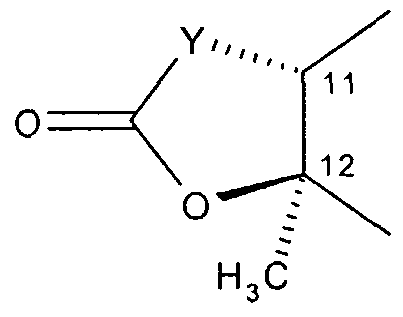
  • R" is hydroxy, or R5 and R ⁇ taken together with the intervening atoms form a cyclic group having the following structure:
  • Y is a bivalent radical selected from -CH2-, -CH(CN)-, -0-, -N(R ⁇ 1 )- and
  • R' is a heterocychc group having the following structure:
  • R 8 and R 9 are each independently selected from hydrogen and C j ⁇ alkyl
  • R 10 is hydrogen or NR 8 R 9 ;
  • R' hydrogen or C ⁇ alkyl substituted by a group selected from optionally substituted phenyl, optionally substituted 5 or 6 membered heteroaryl and optionally substituted 9 to 10 membered fused bicyclic heteroaryl;
  • R 12 is hydrogen, C(0)OR 15 , C(0)NHR 15 or C(0)CH 2 N0 2 ;
  • Rl3 is hydrogen, C ⁇ alkyl optionally substituted by hydroxy or C1 ⁇ alkoxy, C3.
  • R 14 is halogen, C ⁇ alkyl, C ⁇ thioalkyl, C alkoxy, NH 2 , NH ⁇ alkyl) or N(C ⁇ _ 4alkyl)2;
  • R ⁇ is hydrogen or C ⁇ alkyl optionally substituted by up to three groups independently selected from halogen, C ⁇ alkoxy, OC(0)C j ⁇ alkyl and OC(0)OC j ⁇ alkyl;
  • R i is hydrogen, C ⁇ alkyl, C . cycloalkyl, optionally substituted phenyl or benzyl, acetyl or benzoyl; Rl is hydrogen or R ⁇ , or R ⁇ and R ⁇ are linked to form the bivalent radical -0(CH2)2- or
  • X is -U(CH2) S Z- or X is a group selected from:
  • U and Z independently are a divalent radical selected from -N(R*")- -0-, -S(0) t - ,
  • W is CRl or a nitrogen atom; m is 0 or an integer from 1 to 5; n, r and t are each independently selected from 0, 1 and 2, p and q are each independently selected from 1 to 6 ; s is an integer from 2 to 8, and v is 2 or 3; and pharmaceutically acceptable derivatives thereof
  • the present mvention provides compounds of general formula (IA)
  • R3 IS hydrogen, C ⁇ _4alkyl or C3_6alkenyl optionally substituted by 9 to 10 membered fused bicyclic heteroaryl;
  • R4 is hydrogen, C ⁇ alkyl, C3_7cycloalkyl, C3_.galkenyl or a 5 or 6 membered heterocychc group, wherein the alkyl, cycloalkyl, alkenyl and heterocychc groups are optionally substituted by up to three substituents independently selected from optionally substituted 5 or
  • R5 is hydroxy, C3_galkenyloxy optionally substituted by 9 to 10 membered fused bicyclic heteroaryl or O(CH 2 )pO(CH2)qR 10 ; R° is hydroxy, or
  • Y is a bivalent radical selected from -CH2-, -CH(CN)-, -O-, -N(Rl )- and ⁇
  • R ' is a heterocychc group having the following structure:
  • R 8 and R 9 are each independently selected from hydrogen and C ⁇ alkyl
  • R 10 is hydrogen or NR 8 R 9 ;
  • Ri MS hydrogen or C ⁇ ⁇ alkyl substituted by a group selected from optionally substituted phenyl, optionally substituted 5 or 6 membered heteroaryl and optionally substituted 9 to 10 membered fused bicyclic heteroaryl;
  • R 12 is hydrogen, C(0)OR 15 , C(0)NHR 1 5 or C(0)CH 2 N0 2 ;
  • R! 5 IS hydrogen or C ⁇ alkyl
  • R!6 IS hydrogen, C ⁇ alkyl, C _7cycloalkyl, optionally substituted phenyl or benzyl, acetyl or benzoyl;
  • X is -U(CH2) S Z- or X is a group selected from:
  • U and Z independently are a divalent radical selected from -N(R ⁇ ). ) -0-, -S(0) t - , - N(R 16 )C(0)-, -C(0)N(R!6)- and -N[C(0)R 16 ]-, W is a carbon or a nitrogen atom; m is 0 or an integer from 1 to 5; n, r and t are each independently selected from 0, 1 and 2; p and q are each independently selected from 1 and 2; and s is an integer from 2 to 8; and pharmaceutically acceptable salts and solvates thereof.
  • salts and solvates of compounds of the mvention which are suitable for use in medicine are those wherein the counte ⁇ on or associated solvent is pharmaceutically acceptable.
  • salts and solvates having non-pharmaceutically acceptable countenons or associated solvents are within the scope of the present invention, for example, for use as intermediates m the preparation of other compounds of the invention and their pharmaceutically acceptable salts and solvates
  • prodrug as used herein means a compound which is converted within the body, e.g. by hydrolysis in the blood, into its active form that has medical effects.
  • pharmaceutically acceptable prodrugs are described in T. Higuchi and N. Stella, "Prodrugs as Novel Delivery Systems", Nol. 14 of the A.C.S. Symposium Series, Edward B. Roche, ed., "Bioreversible Carriers in Drug Design", American Pharmaceutical Association and Pergamon Press, 1987, and in D. Fleisher, S. Ramon and H. Barbra "Improved oral drug delivery: solubility limitations overcome by the use of prodrugs", Advanced Drug Delivery Reviews (1996) 19(2) 115-130, each of which are incorporated herein by reference.
  • Prodrugs are any covalently bonded carriers that release a compound of structure (I) in vivo when such prodrug is administered to a patient.
  • Prodrugs are generally prepared by modifying functional groups in a way such that the modification is cleaved, either by routine manipulation or in vivo, yielding the parent compound
  • Prodrugs include, for example, compounds of this invention wherein hydroxy, amme or sulfhydryl groups are bonded to any group that, when administered to a patient, cleaves to form the hydroxy, amme or sulfhydryl groups.
  • prodrugs include (but are not limited to) acetate, formate and benzoate de ⁇ vatives of alcohol, sulfhydryl and amme functional groups of the compounds of structure (I).
  • esters may be employed, such as methyl esters, ethyl esters, and the like. Esters may be active in their own ⁇ ght and/or be hydrolysable under in vivo conditions m the human body Suitable pharmaceutically acceptable in vivo hydrolysable ester groups include those which break down readily in the human body to leave the parent acid or its salt.
  • the compound of formula (I) and salts thereof may form solvates (e.g. hydrates) and the invention includes all such solvates.
  • the solid wedge shaped bond indicates that the bond is above the plane of the paper.
  • the broken bond indicates that the bond is below the plane of the paper.
  • ether groups include those in which R 2 is a t ⁇ alkylsilyl (i.e. t ⁇ methylsilyl).
  • R 2 represents an acyloxy group
  • suitable groups R 2 include acetyl or benzoyl.
  • R' is a heterocychc group having the following structure:
  • W is CR* 7 or nitrogen, where R ⁇ is hydrogen or R ⁇ 4 , said heterocychc is linked in the 7 or 6 position to the Z group as above defined or to one of the nitrogen atoms contained in the following structures:
  • R' is a heterocychc group having the following structure:
  • R' is a heterocychc group having the following structure:
  • W is CR 17 , where R 17 is hydrogen or R 14 , said heterocychc is linked in the 8 or 7 position to the Z group as above defined or to one of the nitrogen atoms contained in the following structures:
  • R 7 is a heterocychc group having the following structure:
  • W is CR* 7 , where R. ⁇ and R ⁇ are linked to form the bivalent radical -0(CH2)2" or -(CH2) V -, said heterocychc is linked in the (i) or (ii) position to the Z group as above defined or to one of the nitrogen atoms contained in the following structures:
  • heterocychc is linked in the 2 or 3 position to the Z group as above defined or to one of the nitrogen atoms contained in the following structures:
  • Ci ⁇ alkyl refers to a straight or branched alkyl group containing from 1 to 4 carbon atoms; examples of such groups include methyl, ethyl, propyl, isopropyl, n-butyl, isobutyl, tert-butyl.
  • C2_6alkenyl group refers to a straight or branched alkenyl group containing from 2 to 6 carbon atoms; examples of such groups include 2-propenyl, 1-propenyl, isopropenyl, 2-butenyl, 2-pentenyl, 2-hexenyl and the like. It will be appreciated that in groups of the form -0-C2-6alkenyl, the double bond is preferably not adjacent to the oxygen.
  • C3_7Cycloalkyl group means a non-aromatic monocyclic hydrocarbon ring of 3 to 7 carbon atoms such as, for example, cyclopropyl, cyclobutyl, cyclopentyl, cyclohexyl or cycloheptyl.
  • 5 or 6 membered heteroaryl as used herein as a group or a part of the group refers to furanyl, thiophenyl, imidazolyl, oxazolyl, thiazolyl, pyrazolyl, pyridyl, pyridazinyl or pyrimidinyl.
  • heterocyclyl groups include, but are not limited to, pyrrolidinyl, imidazolidinyl, pyrazolidinyl, piperidyl, piperazinyl, morpholino, tetrahydropyranyl, tetrahydrofuranyl, and thiomorpholino.
  • halogen refers to a fluorine, chlorine, bromine or iodine atom.
  • C ⁇ alkoxy group may be a straight chain or a branched chain alkoxy group, for example methoxy, ethoxy, propoxy, prop-2-oxy, butoxy, but-2-oxy or 2-methylprop-2-oxy.
  • 9 to 10 membered fused bicyclic heteroaryl refers to quinolinyl, isoquinolinyl, 1,2,3,4-tetrahydroisoquinolinyl, benzofuranyl, benzimidazolyl, benzothienyl, benzoxazolyl, 1,3-benzodioxazolyl, indolyl, benzothiazolyl, furylpyridine, oxazolopyridyl or benzothiophenyl.
  • optionally substituted phenyl, optionally substituted 5 or 6 membered heteroaryl, optionally substituted 9 to 10 membered fused bicyclic heteroaryl or optionally substituted 5 or 6 membered heterocychc group refer to a group which is substituted by 1 to 3 groups selected from halogen, Cj ⁇ alkyl, C ⁇ alkoxy, hydroxy, nitro, cyano, amino, Cj ⁇ alkylammo or d ⁇ C ⁇ _4 alkylamino, phenyl and 5 or 6 membered heteroaryl.
  • Preferred compounds of formula (I) are those wherein R 2 is hydrogen
  • R ⁇ is hydrogen
  • R 4 is hydrogen or C j ⁇ alkyl optionally substituted by up to three substituents independently selected from optionally substituted 5 or 6 membered heteroaryl, OR 8 , S(0) n R 8 , NR R 9 , halogen and cyano In another embodiment, R 4 is hydrogen or Ci .
  • R 4 is C ⁇ alkyl optionally substituted by up to three substituents independently selected from optionally substituted 5 or 6 membered heteroaryl, OR 8 , S(0) n R 8 , NR 8 R 9 , halogen and cyano
  • R 4 is Ci ⁇ alkyl optionally substituted by up to two substituents independently selected from optionally substituted 5 or 6 membered heteroaryl, OR 8 , S(0) n R 8 , NR 8 R 9 , halogen and cyano
  • Representative examples of R 4 include include hydrogen and C ⁇ alkyl, for example methyl, ethyl, propyl or isopropyl, optionally substituted by optionally substituted 5 or 6 membered heteroaryl such as pyridyl,
  • R 5 is 0(CH2) p O(CH2) q R 10 , wherein R 10 is preferably NR 8 R 9
  • R ⁇ is hydroxy
  • R ⁇ is hydroxy
  • R5 and R° taken together with the intervening atoms form a cyclic group having the following structure
  • R ' include heterocychc groups having the following structure
  • W is preferably CR ⁇ where R ⁇ is hydrogen
  • R 8 and R 9 include C ⁇ alkyl, for example methyl and ethyl
  • R ⁇ 2 is C(0)OR ⁇ , wherein R ⁇ is preferably hydrogen.
  • R ⁇ is hydrogen, Ci _4alkyl, C3_7cycloalkyl, or optionally substituted phenyl or benzyl.
  • a representative example of R ⁇ is C3_7cycloalkyl, for example C3.
  • gcycloalkyl such as cyclopropyl, cyclobutyl, cyclopentyl and cyclohexyl, in particular cyclopropyl.
  • R* 4 include halogen, in particular fluorine and chlonne.
  • R ⁇ is hydrogen or C ⁇ alkyl. Preferably, R ⁇ is hydrogen.
  • X is -U(CH2) S Z-.
  • X is -U(CH2) S Z- wherein U and Z are preferably -NH-.
  • X is -U(CH2) S Z- wherein U and Z are preferably independently -NH- or -O-.
  • W is carbon 1 e. CR ⁇ ' where R* ' is hydrogen or R* 4 , m particular where R ⁇ 7 is hydrogen, or nitrogen
  • m is 1 to 3, in particular 2.
  • n 0.
  • p and q are each independently selected from 1 and 2.
  • p is 1, q is preferably 2.
  • s is 2 to 4, in particular 2.
  • Particularly preferred compounds of the invention are- 4"-6>-[3 -[[2-[(3 -carboxy-7-chloro- 1 -cyclopropyl- 1 ,4-dihydro-4-oxo-6- quinolinyl ) amino]ethyl]amino]propionyl]- 11 - ⁇ 9-(2-dimethylaminoethoxymethyl)-(9E)- methoximino erythromycin A,
  • the compounds of the invention may also be active against resistant strains, for example erythromycin resistant strains.
  • the compounds of the invention may be active against erythromycin resistant strains of Streptococcus pneumoniae and Streptococcus pyogenes.
  • the compounds of the mvention may therefore be used for treating a variety of diseases caused by pathogenic microorganisms, in particular bacteria, in human beings and animals.
  • a compound of formula (I) or a physiologically acceptable derivative, for example salt, thereof for use in the therapy or prophylaxis of systemic or topical microbial infections, in particular bacterial infections, in a human or animal subject.
  • a compound of formula (I) or a physiologically acceptable derivative, for example salt, thereof for the manufacture of a therapeutic agent for the treatment or prophylaxis of systemic or topical microbial infections, in particular bacterial infections, in a human or animal body.
  • a method of treatment of the human or non-human animal body to combat microbial infections, in particular bacterial infections comprises administering to the body an effective amount of a compound of formula (I) or a physiologically acceptable derivative, for example salt, thereof. While it is possible that, for use m therapy, a compound of the invention may be administered as the raw chemical it is preferable to present the active ingredient as a pharmaceutical formulation
  • compositions comp ⁇ smg a compound of the invention adapted for use in human or vete ⁇ nary medicine.
  • Such compositions may be presented for use in conventional manner with the aid of one or more suitable carriers or excipients.
  • the compositions of the invention include those in a form especially formulated for parenteral, oral, buccal, rectal, topical, implant, ophthalmic, nasal or genito-unnary use.
  • the compounds of the invention may also, for example, be formulated as suppositories e g containing conventional suppository bases for use in human or veterinary medicine or as pessaries e g containing conventional pessary bases
  • the compounds according to the mvention may be formulated for topical administration, for use in human and veterinary medicine, in the form of ointments, creams, gels, lotions, shampoos, powders, (including spray powders), pessaries, tampons, sprays, dips, aerosols, drops (e.g eye ear or nose drops) or pour-ons.
  • Aerosol sprays are conveniently delivered from pressurised packs, with the use of a suitable propellant, eg dichlorodifluoromethane, t ⁇ chlorofluoromethane, dichlorotetrafluoroethane, carbon dioxide or other suitable gas.
  • the compounds according to the invention may be delivered for use in human or veterinary medicine via a nebuhser.
  • compositions for topical administration may also contain other active ingredients such as corticosteroids or antifungals as appropriate.
  • compositions may contain from 0 01 -99% of the active material
  • the composition will generally contain from 0 01-10%, more preferably 0.01-1% of the active material.
  • the daily dose as employed for adult human treatment it will range from 2-100mg/kg body weight, preferably 5-60mg/kg body weight, which may be administered in 1 to 4 daily doses, for example, depending on the route of administration and the condition of the patient.
  • each unit will preferably contain 200mg to lg of active ingredient.
  • the duration of treatment will be dictated by the rate of response rather than by arbitrary numbers of days.
  • the compounds of general formula (I) and de ⁇ vatives thereof may be pu ⁇ fied by conventional methods known in the art.
  • the compounds may be purified by HPLC using an aqueous solution of an acid such as formic acid or t ⁇ fluoroacetic acid.
  • Suitable activated derivatives of the carboxyl group include the corresponding acyl hahde, mixed anhydride or activated ester such as a thioester.
  • the reaction is preferably carried out m a suitable aprotic solvent such as a halohydrocarbon (e.g. dichloromethane) or N,N- dimethylformamide optionally in the presence of a tertiary organic base such as dimethylaminopy ⁇ dine or tnethylamme or in the presence of inorganic base (i.e sodium hydride) and at a temperature within the range of 0° to 120°C.
  • a suitable aprotic solvent such as a halohydrocarbon (e.g. dichloromethane) or N,N- dimethylformamide
  • a tertiary organic base such as dimethylaminopy ⁇ dine or tnethylamme or in the presence of inorganic base (i.e sodium hydride) and at
  • Compounds of formula (I) wherein m is 0 and U is selected from -N(R*")- , -O- and -S(O) ⁇ - wherem t is 0, may be prepared by reaction of compounds of formula (II), in which the 4" hydroxy is suitably activated, with a compound of formula X a R a (IN), followed where necessary by subsequent removal of the hydroxyl protecting group R 2 and conversion of the X a R a group to XR 7 .
  • Suitable activated de ⁇ vatives of the 4" hydroxy group include for example carbonyl lmidazole.
  • the reaction is preferably earned out m a suitable aprotic solvent such as a halohydrocarbon (e.g.
  • dichloromethane or ⁇ , ⁇ -d ⁇ methylformam ⁇ de optionally in the presence of a tertiary base such as dimethylaminopy ⁇ dme or tnethylamme and at a temperature within the range of 0° to 120°C.
  • a tertiary base such as dimethylaminopy ⁇ dme or tnethylamme and at a temperature within the range of 0° to 120°C.
  • bases examples include organic bases such as diisopropylethylamine, triethylamine and l,8-diazabicyclo[5.4.0]undec-7-ene, and inorganic bases such as potassium hydroxide, cesium hydroxide, tetraalkylammonium hydroxyde, sodium hydride, potassium hydride and the like.
  • Suitable leaving groups for this reaction include halide (e.g. chloride, bromide or iodide) or a sulfonyloxy group (e.g. tosyloxy or methansulfonyloxy).
  • compounds of formula (I) wherein m is 2, U is a group selected from - ⁇ (Rl")-, -O- and -S-, may be prepared by Michael reaction of a compound of formula (IX), wherein R 2 is optionally a hydroxyl protecting group
  • compounds of formula (I) may be converted into other compounds of formula (I).
  • compounds of formula (I) wherein U is -S(0)f and t is 1 or 2 may be prepared by oxidation of the corresponding compound of formula (I) wherein t is 0.
  • the oxidation is preferably carried out using a peracid, e.g. peroxybenzoic acid, followed by treatment with a phosphine, such as t ⁇ phenylphosphine
  • the reaction is suitably earned out in an organic solvent such as methylene chloride.
  • R 7a R 7a (IN), wherein X a has the meaning defined above with R ⁇ 7 OC(0)(CH2) m L (X) wherein R* 7 is carboxyl protecting group and L is a suitable leaving group, followed by removal of R ⁇ .
  • L is a suitable leaving group such as chlorine, fluorine or bromine
  • a compound of formula -U(CH2) S Z- (XII) in which Z is -N(R1 ")-, -O- or -S- with piperazine or with lH-pyrrolo[3,4-b]pyridine, octahydro.
  • Suitable hydroxy protecting reagents are those described by T.W. Greene and P.G.M Wuts in Protective Groups in Organic Synthesis 2 nd ed., John Wiley & Son, Inc 1991, which is incorporated by reference.
  • suitable hydroxy protecting reagents include acetic anhydride, benzoic anhydride or a trialkylsilyl chloride in a protic solvent.
  • aprotic solvents are dichloromethane, NN-dimethylformamide, dimethylsulfoxide, tetrahydrofuran and the like.
  • Suitable R 7 carboxyl protecting group include t-butyl, allyl or benzyl.
  • the crude product was treated with HC1 (6% aqueous solution) heating for 1 h in the presence of charcoal. After filtration, the solution was cooled to 35-40°C and a first precipitation happened. The precipitate was filtered, washed with water and dried at 110°C for 1 h. The title compound (6.4 g) was obtained as the hydrochloride salt. The hydrochloride salt was then converted to the free base using standard conditions.
  • Example 4 4"-0-[3-[[2-[(3-Carboxy-l-cycIopropyI-l,4-dihydro-6-fluoro-4-oxo-7- quinolinyl) amino]ethyl]amino]propionyl]-ll,12-carbonate-(9E)-methoximino erythromycin A
  • Example 8 4"-0-[3-[[2-[(3-Carboxy-7-chloro-l-cyclopropyl-l,4-dihydro-4-oxo-6- quinolinyl) amino]ethyl]amino]propionyl]-ll,12-carbonate-(9E)-0- (ethoxymethyl)oximino erythromycin A
  • Example 14 4"-0-[3-[[2-[(3-Carboxy-7-chloro-l-cycIopropyl-l,4-dihydro-4-oxo-6-quinolinyl)- amino]ethyI]amino]propionyl]-(9E)-0-propyloximino erythromycin A
  • MIC ⁇ g/ml
  • test compounds against various organisms were determined including: S. aureus Smith ATCC 13709, S. pneumoniae SP030, S. pyogenes 3565, E. faecalis ATCC 29212, H. influenzae ATCC 49247, M. catarrhalis ATCC 23246.
  • Examples 1-3 and 6-8 have an MIC ⁇ 1 ⁇ g/ml against S. aureus Smith ATCC 13709, S. pneumoniae SP030, S. pyogenes 3565 and E. faecalis ATCC 29212.
  • Examples 1 and 3 have an MIC ⁇ 2 ⁇ g/ml against H. influenzae ATCC 49247 and M. catarrhalis ATCC 23246.
  • Examples 1-3 and 6-8 have an MIC ⁇ 0.25 ⁇ g/ml against erythromycin resistant strains of Streptococcus pneumoniae and Streptococcus pyogenes.

Landscapes

  • Chemical & Material Sciences (AREA)
  • Organic Chemistry (AREA)
  • Health & Medical Sciences (AREA)
  • General Health & Medical Sciences (AREA)
  • Life Sciences & Earth Sciences (AREA)
  • Engineering & Computer Science (AREA)
  • Biochemistry (AREA)
  • Molecular Biology (AREA)
  • Genetics & Genomics (AREA)
  • Biotechnology (AREA)
  • Chemical Kinetics & Catalysis (AREA)
  • Animal Behavior & Ethology (AREA)
  • Oncology (AREA)
  • Public Health (AREA)
  • Veterinary Medicine (AREA)
  • Communicable Diseases (AREA)
  • Medicinal Chemistry (AREA)
  • Pharmacology & Pharmacy (AREA)
  • General Chemical & Material Sciences (AREA)
  • Nuclear Medicine, Radiotherapy & Molecular Imaging (AREA)
  • Pharmaceuticals Containing Other Organic And Inorganic Compounds (AREA)
  • Saccharide Compounds (AREA)

Abstract

The present invention relates to compounds of formula (I) and pharmaceutically acceptable derivatives thereof, to processes for their preparation and their use in therapy or prophylaxis of systemic or topical microbial infections in a human or animal body.

Description

Compounds
The present invention relates to novel semi-synthetic macrohdes having antimicrobial activity, in particular antibacteπal activity. More particularly, this mvention relates to novel oxime macrolide scaffolds substituted at the 4" position, to processes for their preparation, to compositions containing them and to their use in medicine
Macrolide antibacterial agents are known to be useful in the treatment or prevention of bacterial infections However, the emergence of macrohde-resistant bacteπal strains has resulted in the need to develop new macrolide compounds For example, EP 0 895 999 describes derivatives modified at the 4" position of the macrolide πng having antibacteπal activity
Accordmg to the present invention, we have now found novel oxime macrolide scaffolds substituted at the 4" position which also have antimicrobial activity
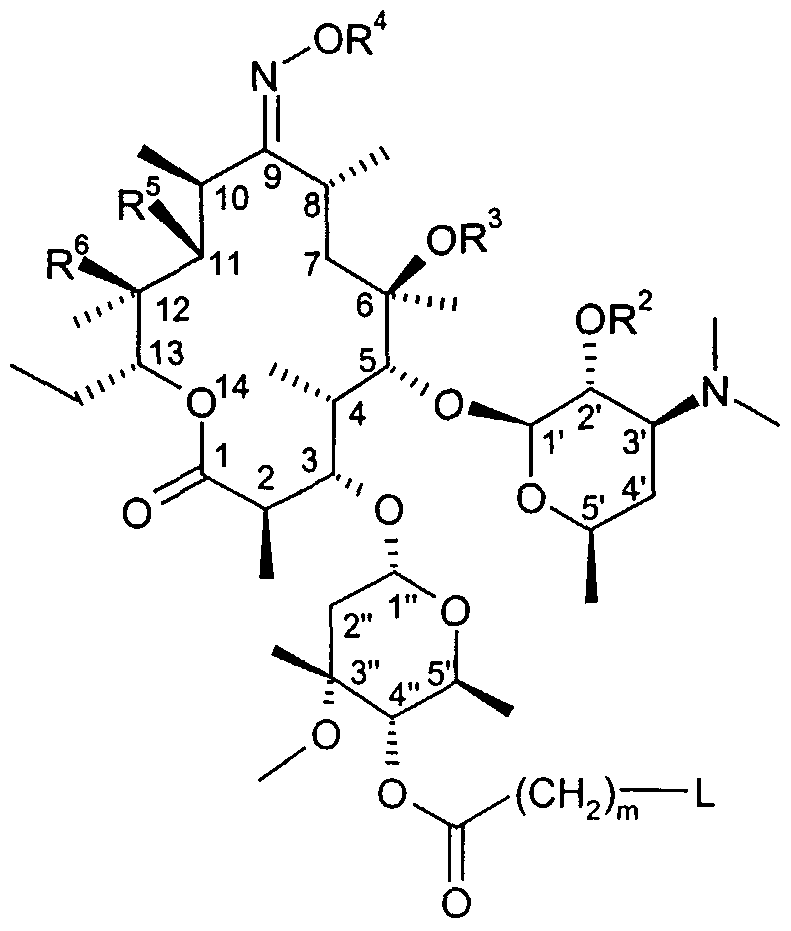
Thus, the present invention provides compounds of general formula (I)
Figure imgf000002_0001
wherein
Figure imgf000002_0002
R. IS hydrogen or a hydroxyl protecting group,
R is hydrogen, C^alkyl or C3_6alkenyl optionally substituted by 9 to 10 membered fused bicyclic heteroaryl,
R is hydrogen, C\ _4alkyl, C . cycloalkyl, C3_ alkenyl or a 5 or 6 membered heterocychc group, wherein the alkyl, cycloalkyl, alkenyl and heterocychc groups are optionally substituted by up to three substituents independently selected from optionally substituted 5 or
6 membered heterocychc group, optionally substituted 5 or 6 membered heteroaryl, OR0*,
S(0)nR8, NR8R9, CONR8R9, halogen and cyano,
R5 IS hydroxy, C .galkenyloxy optionally substituted by 9 to 10 membered fused bicyclic heteroaryl, or 0(CH2)pO(CH2)qR10,
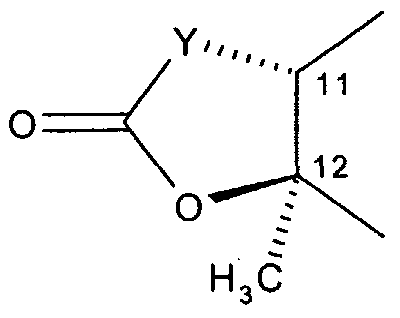
R" is hydroxy, or R5 and R^ taken together with the intervening atoms form a cyclic group having the following structure:
Figure imgf000003_0001
wherein Y is a bivalent radical selected from -CH2-, -CH(CN)-, -0-, -N(RΪ 1)- and
CH(SRn)-;
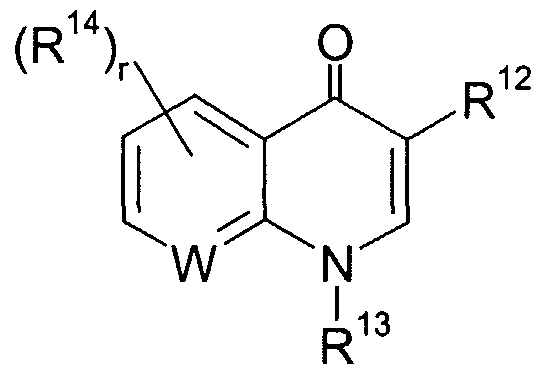
R' is a heterocychc group having the following structure:
or
Figure imgf000003_0002
R8 and R9 are each independently selected from hydrogen and Cj^alkyl;
R10 is hydrogen or NR8R9;
R' S hydrogen or C^alkyl substituted by a group selected from optionally substituted phenyl, optionally substituted 5 or 6 membered heteroaryl and optionally substituted 9 to 10 membered fused bicyclic heteroaryl;
R12 is hydrogen, C(0)OR15, C(0)NHR15 or C(0)CH2N02;
Rl3 is hydrogen, C^alkyl optionally substituted by hydroxy or C1 ^alkoxy, C3.
7cycloalkyl, or optionally substituted phenyl or benzyl;
R14 is halogen, C^alkyl, C^thioalkyl, C alkoxy, NH2, NH^^alkyl) or N(Cι_ 4alkyl)2;
R^ is hydrogen or C^alkyl optionally substituted by up to three groups independently selected from halogen, C ^alkoxy, OC(0)C j ^alkyl and OC(0)OC j ^alkyl;
Ri" is hydrogen, C^alkyl, C . cycloalkyl, optionally substituted phenyl or benzyl, acetyl or benzoyl; Rl is hydrogen or R^, or R^ and R^ are linked to form the bivalent radical -0(CH2)2- or
-(CH2)V-;
X is -U(CH2)SZ- or X is a group selected from:
/ \
N N
\ / and
Figure imgf000004_0001
U and Z independently are a divalent radical selected from -N(R*")- -0-, -S(0)t- ,
N(R16)C(0)-, -C(0)N(R16)- and -N[C(0)R16]-;
W is CRl or a nitrogen atom; m is 0 or an integer from 1 to 5; n, r and t are each independently selected from 0, 1 and 2, p and q are each independently selected from 1 to 6 ; s is an integer from 2 to 8, and v is 2 or 3; and pharmaceutically acceptable derivatives thereof
In one embodiment, the present mvention provides compounds of general formula (IA)
Figure imgf000004_0002
wherein
Figure imgf000004_0003
R IS hydrogen or a hydroxyl protecting group;
R3 IS hydrogen, C\ _4alkyl or C3_6alkenyl optionally substituted by 9 to 10 membered fused bicyclic heteroaryl;
R4 is hydrogen, C^alkyl, C3_7cycloalkyl, C3_.galkenyl or a 5 or 6 membered heterocychc group, wherein the alkyl, cycloalkyl, alkenyl and heterocychc groups are optionally substituted by up to three substituents independently selected from optionally substituted 5 or
6 membered heterocychc group, optionally substituted 5 or 6 membered heteroaryl, OR8,
S(0)nR8, NR8R9, CONR8R9, halogen and cyano,
R5 is hydroxy, C3_galkenyloxy optionally substituted by 9 to 10 membered fused bicyclic heteroaryl or O(CH2)pO(CH2)qR10 ; R° is hydroxy, or
R5 and R > taken together with the intervening atoms form a cyclic group having the following structure:
Figure imgf000005_0001
wherein Y is a bivalent radical selected from -CH2-, -CH(CN)-, -O-, -N(Rl )- and ■
CH(SR8)-;
R ' is a heterocychc group having the following structure:
or
Figure imgf000005_0002
R8 and R9 are each independently selected from hydrogen and C^alkyl;
R10 is hydrogen or NR8R9;
Ri MS hydrogen or C\ ^alkyl substituted by a group selected from optionally substituted phenyl, optionally substituted 5 or 6 membered heteroaryl and optionally substituted 9 to 10 membered fused bicyclic heteroaryl;
R12 is hydrogen, C(0)OR15, C(0)NHR15 or C(0)CH2N02;
Rl3 IS hydrogen, C^alkyl, C3_7cycloalkyl, or optionally substituted phenyl or benzyl;
R14 is halogen, C1.4alkyl, C^thioalkyl, C^alkoxy, NH , NH(Cι_4alkyl) or N(Cι_
4alkyl)2;
R! 5 IS hydrogen or C^alkyl;
R!6 IS hydrogen, C^alkyl, C _7cycloalkyl, optionally substituted phenyl or benzyl, acetyl or benzoyl;
X is -U(CH2)SZ- or X is a group selected from:
/ \
N 1 Inl¬
\ / and
Figure imgf000006_0001
U and Z independently are a divalent radical selected from -N(R^). ) -0-, -S(0)t- , - N(R16)C(0)-, -C(0)N(R!6)- and -N[C(0)R16]-, W is a carbon or a nitrogen atom; m is 0 or an integer from 1 to 5; n, r and t are each independently selected from 0, 1 and 2; p and q are each independently selected from 1 and 2; and s is an integer from 2 to 8; and pharmaceutically acceptable salts and solvates thereof.
The term "pharmaceutically acceptable" as used herein means a compound which is suitable for pharmaceutical use. Salts and solvates of compounds of the mvention which are suitable for use in medicine are those wherein the counteπon or associated solvent is pharmaceutically acceptable. However, salts and solvates having non-pharmaceutically acceptable countenons or associated solvents are within the scope of the present invention, for example, for use as intermediates m the preparation of other compounds of the invention and their pharmaceutically acceptable salts and solvates
The term "pharmaceutically acceptable derivative" as used herein means any pharmaceutically acceptable salt, solvate or prodrug, e.g. ester, of a compound of the invention, which upon administration to the recipient is capable of providing (directly or indirectly) a compound of the invention, or an active metabolite or residue thereof. In one embodiment, the pharmaceutically acceptable denvatives are salts and solvates. Such derivatives are recognizable to those skilled in the art, without undue expeπmentation.
Nevertheless, reference is made to the teaching of Burger's Medicinal Chemistry and Drug Discovery, 5th Edition, Vol 1: Principles and Practice, which is incorporated herein by reference to the extent of teaching such derivatives. Preferred pharmaceutically acceptable derivatives are salts, solvates, esters, carbamates and phosphate esters Particularly preferred pharmaceutically acceptable derivatives are salts, solvates and esters Most preferred pharmaceutically acceptable derivatives are salts and esters.
Suitable pharmaceutically acceptable salts of the compounds of general formula (I) include acid addition salts formed with pharmaceutically acceptable organic or inorganic acids, for example hydrochloπdes, hydrobromides, sulphates, alkyl- or arylsulphonates (e.g. methanesulphonates or p-toluenesulphonates), phosphates, acetates, citrates, succinates, tartrates, fumarates and maleates.
The solvates may, for example, be hydrates. The term "prodrug" as used herein means a compound which is converted within the body, e.g. by hydrolysis in the blood, into its active form that has medical effects. Pharmaceutically acceptable prodrugs are described in T. Higuchi and N. Stella, "Prodrugs as Novel Delivery Systems", Nol. 14 of the A.C.S. Symposium Series, Edward B. Roche, ed., "Bioreversible Carriers in Drug Design", American Pharmaceutical Association and Pergamon Press, 1987, and in D. Fleisher, S. Ramon and H. Barbra "Improved oral drug delivery: solubility limitations overcome by the use of prodrugs", Advanced Drug Delivery Reviews (1996) 19(2) 115-130, each of which are incorporated herein by reference.
Prodrugs are any covalently bonded carriers that release a compound of structure (I) in vivo when such prodrug is administered to a patient. Prodrugs are generally prepared by modifying functional groups in a way such that the modification is cleaved, either by routine manipulation or in vivo, yielding the parent compound Prodrugs include, for example, compounds of this invention wherein hydroxy, amme or sulfhydryl groups are bonded to any group that, when administered to a patient, cleaves to form the hydroxy, amme or sulfhydryl groups. Thus, representative examples of prodrugs include (but are not limited to) acetate, formate and benzoate deπvatives of alcohol, sulfhydryl and amme functional groups of the compounds of structure (I). Further, in the case of a carboxy c acid (-COOH), esters may be employed, such as methyl esters, ethyl esters, and the like. Esters may be active in their own πght and/or be hydrolysable under in vivo conditions m the human body Suitable pharmaceutically acceptable in vivo hydrolysable ester groups include those which break down readily in the human body to leave the parent acid or its salt.
References hereinafter to a compound according to the invention include both compounds of formula (I) and their pharmaceutically acceptable derivatives In particular, references hereinafter to a compound according to the invention include both compounds of formula (I) and their pharmaceutically acceptable acid addition salts together with pharmaceutically acceptable solvates
The compound of formula (I) and salts thereof may form solvates (e.g. hydrates) and the invention includes all such solvates.
In the general formula (I) as drawn the solid wedge shaped bond indicates that the bond is above the plane of the paper. The broken bond indicates that the bond is below the plane of the paper.
Compounds wherein R2 represents a hydroxyl protecting group are general intermediates for the preparation of other compounds of formula (I).
When the group OR2 is a protected hydroxyl group this is conveniently an ether or an acyloxy group Examples of particularly suitable ether groups include those in which R2 is a tπalkylsilyl (i.e. tπmethylsilyl). When the group OR2 represents an acyloxy group, then examples of suitable groups R2 include acetyl or benzoyl.
When R' is a heterocychc group having the following structure:
Figure imgf000008_0001
wherein W is CR*7 or nitrogen, where R^ is hydrogen or R^4, said heterocychc is linked in the 7 or 6 position to the Z group as above defined or to one of the nitrogen atoms contained in the following structures:
Figure imgf000008_0002
When R' is a heterocychc group having the following structure:
Figure imgf000008_0003
wherein W is CR^, where R^ and R^ are linked to form the bivalent radical -0(CH2)2- or -(CH2)V-, said heterocychc is linked in the (i) or (ii) position to the Z group as above defined or to one of the nitrogen atoms contained in the following structures:
Figure imgf000008_0004
When R' is a heterocychc group having the following structure:
Figure imgf000008_0005
wherein W is CR17, where R17 is hydrogen or R14, said heterocychc is linked in the 8 or 7 position to the Z group as above defined or to one of the nitrogen atoms contained in the following structures:
Figure imgf000009_0001
When R7 is a heterocychc group having the following structure:
Figure imgf000009_0002
wherein W is CR*7, where R.^ and R^ are linked to form the bivalent radical -0(CH2)2" or -(CH2)V-, said heterocychc is linked in the (i) or (ii) position to the Z group as above defined or to one of the nitrogen atoms contained in the following structures:
Figure imgf000009_0003
When R? is a heterocychc group having the following structure:
Figure imgf000009_0004
said heterocychc is linked in the 2 or 3 position to the Z group as above defined or to one of the nitrogen atoms contained in the following structures:
Figure imgf000010_0001
The term Ci ^alkyl as used herein as a group or a part of the group refers to a straight or branched alkyl group containing from 1 to 4 carbon atoms; examples of such groups include methyl, ethyl, propyl, isopropyl, n-butyl, isobutyl, tert-butyl.
The term C2_6alkenyl group as used herein as a group or a part of the group refers to a straight or branched alkenyl group containing from 2 to 6 carbon atoms; examples of such groups include 2-propenyl, 1-propenyl, isopropenyl, 2-butenyl, 2-pentenyl, 2-hexenyl and the like. It will be appreciated that in groups of the form -0-C2-6alkenyl, the double bond is preferably not adjacent to the oxygen.
The term C3_7Cycloalkyl group means a non-aromatic monocyclic hydrocarbon ring of 3 to 7 carbon atoms such as, for example, cyclopropyl, cyclobutyl, cyclopentyl, cyclohexyl or cycloheptyl.
The term 5 or 6 membered heteroaryl as used herein as a group or a part of the group refers to furanyl, thiophenyl, imidazolyl, oxazolyl, thiazolyl, pyrazolyl, pyridyl, pyridazinyl or pyrimidinyl.
The term 5 or 6 membered heterocychc group as used herein as a group or part of the group refers to a monocyclic 5 or 6 membered saturated hydrocarbon ring containing at least one heteroatom independently selected from oxygen, nitrogen and sulfur. Examples of heterocyclyl groups include, but are not limited to, pyrrolidinyl, imidazolidinyl, pyrazolidinyl, piperidyl, piperazinyl, morpholino, tetrahydropyranyl, tetrahydrofuranyl, and thiomorpholino.
The term halogen refers to a fluorine, chlorine, bromine or iodine atom.
The term C^alkoxy group may be a straight chain or a branched chain alkoxy group, for example methoxy, ethoxy, propoxy, prop-2-oxy, butoxy, but-2-oxy or 2-methylprop-2-oxy.
The term 9 to 10 membered fused bicyclic heteroaryl as used herein as a group or a part of the group refers to quinolinyl, isoquinolinyl, 1,2,3,4-tetrahydroisoquinolinyl, benzofuranyl, benzimidazolyl, benzothienyl, benzoxazolyl, 1,3-benzodioxazolyl, indolyl, benzothiazolyl, furylpyridine, oxazolopyridyl or benzothiophenyl.
The terms optionally substituted phenyl, optionally substituted 5 or 6 membered heteroaryl, optionally substituted 9 to 10 membered fused bicyclic heteroaryl or optionally substituted 5 or 6 membered heterocychc group refer to a group which is substituted by 1 to 3 groups selected from halogen, Cj^alkyl, C^alkoxy, hydroxy, nitro, cyano, amino, Cj^alkylammo or dιCι_4 alkylamino, phenyl and 5 or 6 membered heteroaryl.
Preferred compounds of formula (I) are those wherein R2 is hydrogen
A representative example of R^ is hydrogen
In one embodiment, R4 is hydrogen or Cj^alkyl optionally substituted by up to three substituents independently selected from optionally substituted 5 or 6 membered heteroaryl, OR8, S(0)nR8, NR R9, halogen and cyano In another embodiment, R4 is hydrogen or Ci . 4alkyl optionally substituted by up to two substituents independently selected from optionally substituted 5 or 6 membered heteroaryl, OR8, S(0)nR8, NR R9, halogen and cyano In another embodiment, R4 is C^alkyl optionally substituted by up to three substituents independently selected from optionally substituted 5 or 6 membered heteroaryl, OR8, S(0)nR8, NR8R9, halogen and cyano In a further embodiment, R4 is Ci ^alkyl optionally substituted by up to two substituents independently selected from optionally substituted 5 or 6 membered heteroaryl, OR8, S(0)nR8, NR8R9, halogen and cyano Representative examples of R4 include include hydrogen and C^alkyl, for example methyl, ethyl, propyl or isopropyl, optionally substituted by optionally substituted 5 or 6 membered heteroaryl such as pyridyl, OR8 or S(0)nR8 Additional representative examples of R4 include Cj^alkyl, for example methyl or isopropyl, optionally substituted by optionally substituted 5 or 6 membered heteroaryl such as pyridyl, OR8 or S(0)nR8 Further representative examples of R4 include include hydrogen and C\ _4alkyl, for example ethyl, propyl or isopropyl
In one embodiment, R5 is 0(CH2)pO(CH2)qR10, wherein R10 is preferably NR8R9 In another embodiment, R^ is hydroxy In a further embodiment, R^ is hydroxy Alternatively, R5 and R° taken together with the intervening atoms form a cyclic group having the following structure
Figure imgf000011_0001
wherein Y is the bivalent radical -O-
Representative examples of R ' include heterocychc groups having the following structure
Figure imgf000011_0002
wherein W is preferably CR^ where R^ is hydrogen Representative examples of R8 and R9 include C^alkyl, for example methyl and ethyl
A representative example of R^2 is C(0)OR^, wherein R^ is preferably hydrogen.
In one embodiment, R^ is hydrogen, Ci _4alkyl, C3_7cycloalkyl, or optionally substituted phenyl or benzyl. A representative example of R^ is C3_7cycloalkyl, for example C3. gcycloalkyl such as cyclopropyl, cyclobutyl, cyclopentyl and cyclohexyl, in particular cyclopropyl.
Representative examples of R*4 include halogen, in particular fluorine and chlonne. When R7 IS a heterocychc group having the following structure:
Figure imgf000012_0001
wherein W is preferably CR* ' where R^ is hydrogen, R*4 is preferably fluoπne or chloπne at the 6 or 7 position and the heterocychc is linked in the unsubstituted 6 or 7 position to the X group.
In one embodiment, R^ is hydrogen or C^alkyl. Preferably, R^ is hydrogen.
A representative example of X is -U(CH2)SZ-. In particular, X is -U(CH2)SZ- wherein U and Z are preferably -NH-. In another embodiment, X is -U(CH2)SZ- wherein U and Z are preferably independently -NH- or -O-.
In one embodiment, W is carbon 1 e. CR^ ' where R* ' is hydrogen or R*4, m particular where R^7 is hydrogen, or nitrogen
Preferably m is 1 to 3, in particular 2.
A representative example of n is 0.
In one embodiment, p and q are each independently selected from 1 and 2. When p is 1, q is preferably 2.
A representative example of r is 1.
Preferably s is 2 to 4, in particular 2.
Particularly preferred compounds of the invention are- 4"-6>-[3 -[[2-[(3 -carboxy-7-chloro- 1 -cyclopropyl- 1 ,4-dihydro-4-oxo-6- quinolinyl ) amino]ethyl]amino]propionyl]- 11 -<9-(2-dimethylaminoethoxymethyl)-(9E)- methoximino erythromycin A,
4"-C-[3-[[2-[(3-carboxy-7-chloro-l-cyclopropyl-l,4-dihydro-4-oxo-6- quinolinyl) amino]ethyl]amino]propionyl]-l l,12-carbonate-(9E)-0-(2-propyl)oximino erythromycin A,
4"-0-[3-[[2-[(3-carboxy-7-chloro-l-cyclopropyl-l,4-dihydro-4-oxo-6- quinolinyl) amino]ethyl]amino]propionyl]-l l,12-carbonate-(9E)-methoximino erythromycin A, and 4"-C»-[3-[[2-[(3-carboxy-7-chloro-l-cyclopropyl-l,4-dihydro-4-oxo-6- quinolinyl) amino]ethyl]amino]propionyl]-ll,12-carbonate-(9E)-C>-(ethoxymethyl)oximino erythromycin A.
Compounds according to the invention also exhibit a broad spectrum of antimicrobial activity, in particular antibacterial activity, against a wide range of clinical pathogenic microorganisms. Using a standard microtiter broth serial dilution test, compounds of the invention have been found to exhibit useful levels of activity against a wide range of pathogenic microorganisims. In particular, the compounds of the invention may be active against strains of Staphylococcus aureus, Streptopococcus pneumoniae, Moraxella catarrhalis, Streptococcus pyogenes, Haemophilus influenzae, Chlamydia pneumoniae, Mycoplasma pneumoniae and Legionella pneumophila. The compounds of the invention may also be active against resistant strains, for example erythromycin resistant strains. In particular, the compounds of the invention may be active against erythromycin resistant strains of Streptococcus pneumoniae and Streptococcus pyogenes.
The compounds of the mvention may therefore be used for treating a variety of diseases caused by pathogenic microorganisms, in particular bacteria, in human beings and animals.
Thus, according to another aspect of the present invention, we provide a compound of formula (I) or a physiologically acceptable derivative, for example salt, thereof for use in the therapy or prophylaxis of systemic or topical microbial infections, in particular bacterial infections, in a human or animal subject.
According to a further aspect of the invention we provide the use of a compound of formula (I) or a physiologically acceptable derivative, for example salt, thereof for the manufacture of a therapeutic agent for the treatment or prophylaxis of systemic or topical microbial infections, in particular bacterial infections, in a human or animal body.
According to a yet further aspect of the invention we provide a method of treatment of the human or non-human animal body to combat microbial infections, in particular bacterial infections, which method comprises administering to the body an effective amount of a compound of formula (I) or a physiologically acceptable derivative, for example salt, thereof. While it is possible that, for use m therapy, a compound of the invention may be administered as the raw chemical it is preferable to present the active ingredient as a pharmaceutical formulation
The compounds of the invention may be formulated for administration in any convenient way for use in human or veterinary medicine and the invention therefore includes within its scope pharmaceutical compositions compπsmg a compound of the invention adapted for use in human or veteπnary medicine. Such compositions may be presented for use in conventional manner with the aid of one or more suitable carriers or excipients. The compositions of the invention include those in a form especially formulated for parenteral, oral, buccal, rectal, topical, implant, ophthalmic, nasal or genito-unnary use.
The compounds accordmg to the invention may be formulated for use in human or veterinary medicine by injection (e.g. by intravenous bolus injection or infusion or via intramuscular, subcutaneous or intrathecal routes) and may be presented m unit dose form, in ampoules, or other unit-dose containers, or in multi-dose containers, if necessary with an added preservative. The compositions for injection may be in the form of suspensions, solutions, or emulsions, in oily or aqueous vehicles, and may contain formulatory agents such as suspending, stabilising, solubihsmg and/or dispersing agents. Alternatively the active ingredient may be in sterile powder form for reconstitution with a suitable vehicle, e.g. steπle, pyrogen-free water, before use
The compounds of the invention may also be presented for human or veterinary use in a form suitable for oral or buccal administration, for example in the form of solutions, gels, syrups, mouth washes or suspensions, or a dry powder for constitution with water or other suitable vehicle before use, optionally with flavouring and colouπng agents. Solid compositions such as tablets, capsules, lozenges, pastilles, pills, boluses, powder, pastes, granules, bullets or premix preparations may also be used. Solid and liquid compositions for oral use may be prepared according to methods well known in the art. Such compositions may also contain one or more pharmaceutically acceptable carriers and excipients which may be in solid or liquid form.
The compounds of the invention may also be administered orally in veterinary medicine in the form of a liquid drench such as a solution, suspension or dispersion of the active ingredient together with a pharmaceutically acceptable earner or excipient.
The compounds of the invention may also, for example, be formulated as suppositories e g containing conventional suppository bases for use in human or veterinary medicine or as pessaries e g containing conventional pessary bases
The compounds according to the mvention may be formulated for topical administration, for use in human and veterinary medicine, in the form of ointments, creams, gels, lotions, shampoos, powders, (including spray powders), pessaries, tampons, sprays, dips, aerosols, drops (e.g eye ear or nose drops) or pour-ons. Aerosol sprays are conveniently delivered from pressurised packs, with the use of a suitable propellant, eg dichlorodifluoromethane, tπchlorofluoromethane, dichlorotetrafluoroethane, carbon dioxide or other suitable gas.
For topical administration by inhalation the compounds according to the invention may be delivered for use in human or veterinary medicine via a nebuhser.
The pharmaceutical compositions for topical administration may also contain other active ingredients such as corticosteroids or antifungals as appropriate.
The compositions may contain from 0 01 -99% of the active material For topical administration, for example, the composition will generally contain from 0 01-10%, more preferably 0.01-1% of the active material.
For systemic administration the daily dose as employed for adult human treatment it will range from 2-100mg/kg body weight, preferably 5-60mg/kg body weight, which may be administered in 1 to 4 daily doses, for example, depending on the route of administration and the condition of the patient. When the composition compnses dosage units, each unit will preferably contain 200mg to lg of active ingredient. The duration of treatment will be dictated by the rate of response rather than by arbitrary numbers of days.
Compounds of general formula (I) and deπvatives thereof may be prepared by the general method outlined hereinafter. In the following description, the groups R*, R2, R^, R4, R^, R", R7, R8, R9 R10, Ru, R12, R13, R14, R15, R16, R17, X, Y, U, Z, W, m, n, p, q, r, s, t and v have the meaning defined for the compounds of formula (1) unless otherwise stated The groups XaR a and ZaR7a are XR ' and ZR7 as defined for formula (I) or groups convertible to XR7 and ZR7 respectively. Conversion of a group XaR a or Z R7a to a XR7 or ZR7 group typically arises if a protecting group is needed duπng the reactions descπbed below. A comprehensive discussion of the ways in which such groups may be protected and methods for cleaving the resulting protected deπvatives is given in for example T.W Greene and P.G.M Wuts in Protective Groups m Organic Synthesis 2nd ed., John Wiley & Son, fric 1991.
The compounds of general formula (I) and deπvatives thereof may be puπfied by conventional methods known in the art. For example, the compounds may be purified by HPLC using an aqueous solution of an acid such as formic acid or tπfluoroacetic acid.
Compounds of formula (I) wherein m is an integer 1 to 5, may be prepared by reaction of 4" hydroxy of formula (II) with a suitable activated and protected deπvative of the carboxyhc acid (III), followed where necessary by subsequent removal of the hydroxyl protecting group R2 and conversion of the XaR7a group to XR7.
Figure imgf000016_0001
(H) (III)
Suitable activated derivatives of the carboxyl group include the corresponding acyl hahde, mixed anhydride or activated ester such as a thioester. The reaction is preferably carried out m a suitable aprotic solvent such as a halohydrocarbon (e.g. dichloromethane) or N,N- dimethylformamide optionally in the presence of a tertiary organic base such as dimethylaminopyπdine or tnethylamme or in the presence of inorganic base (i.e sodium hydride) and at a temperature within the range of 0° to 120°C.
Compounds of formula (I) wherein m is 0 and U is selected from -N(R*")- , -O- and -S(O)^- wherem t is 0, may be prepared by reaction of compounds of formula (II), in which the 4" hydroxy is suitably activated, with a compound of formula XaR a (IN), followed where necessary by subsequent removal of the hydroxyl protecting group R2 and conversion of the XaR a group to XR7. Suitable activated deπvatives of the 4" hydroxy group include for example carbonyl lmidazole. The reaction is preferably earned out m a suitable aprotic solvent such as a halohydrocarbon (e.g. dichloromethane) or Ν,Ν-dιmethylformamιde optionally in the presence of a tertiary base such as dimethylaminopyπdme or tnethylamme and at a temperature within the range of 0° to 120°C.
Compounds of formula (I) wherein m is 0 and U is -N(R^°)C(0)-, may be prepared by reaction of compounds of formula (N),
Figure imgf000017_0001
(V)
with a compound of formula HOC(0)(CH2)sZaR7a (Nl), followed where necessary by subsequent removal of the hydroxyl protecting group R2 and conversion of the ZaR7a group to ZR7. The reaction is preferably earned out in a suitable aprotic solvent such as a halohydrocarbon (e.g. dichloromethane) or Ν,Ν-dιmethylformamιde optionally in the presence of a tertiary base such as dimethylaminopyπdine or tnethylamme and at a temperature within the range of 0° to 120°C
Compounds of formula (V) may be prepared by treatment of compounds of formula (II), in which the 4" hydroxy is suitably activated, with an amine of formula NH2R (Nϋa). Suitable activated deπvatives of the 4" hydroxy group include, for example, the carbonyl lmidazole.
Compounds of formula (I) wherein m is 0 and U is -C(0)Ν(R^)- may be prepared by reaction of 4" hydroxy of formula (II) with a suitable activated derivative of the carboxyhc acid HOC(0)C(0)N(R16XCH2)mZaR7a (Vllb) followed where necessary by subsequent removal of the hydroxyl protecting group R2 and conversion of the ZaR a group to ZR7.
In a further embodiment of the mvention, compounds of formula (I) wherein m is 1 to 5 and U is a group selected from -N(R*")-, -0-, -S-, may be prepared by reaction of compounds of formula (Nil),
Figure imgf000018_0001
(VII) wherein m is an integer from 1 to 5 and L is a suitable leaving group, with XaR7a (IV) in which U is a group selected from -N(Rl")-, -O- and -S-. The reaction is preferably carried out in a solvent such as a halohydrocarbon (e.g. dichloromethane), an ether (e.g. tetrahydrofuran, dimethoxyethane), acetonitrile or ethyl acetate and the like), dimethylsulfoxide, N,N-dimethylformamide, 1 -methyl -pyrrolidone and in the presence of a base, followed, if desired, by removal of the hydroxyl protecting group R2 and conversion of the XaR7a group to XR7. Examples of the bases which may be used include organic bases such as diisopropylethylamine, triethylamine and l,8-diazabicyclo[5.4.0]undec-7-ene, and inorganic bases such as potassium hydroxide, cesium hydroxide, tetraalkylammonium hydroxyde, sodium hydride, potassium hydride and the like. Suitable leaving groups for this reaction include halide (e.g. chloride, bromide or iodide) or a sulfonyloxy group (e.g. tosyloxy or methansulfonyloxy).
Compounds of formula (Nil) may be prepared by reaction of a compound of formula (IT), wherein R2 is a hydroxyl protecting group, with a suitable activated derivative of the carboxyhc acid HOC(0)(CH2)mL (NIII), wherein L is a suitable leaving group as above defined. Suitable activated derivatives of the carboxyl group are those defined above for carboxyhc acid (III). The reaction is carried out using the conditions described above for the reaction of a compound of formula (I) with carboxyhc acid (III).
In a preferred embodiment of the invention, compounds of formula (I) wherein m is 2, U is a group selected from -Ν(Rl")-, -O- and -S-, may be prepared by Michael reaction of a compound of formula (IX), wherein R2 is optionally a hydroxyl protecting group
Figure imgf000019_0001
(IX)
with a compound of formula XaR7a (IV). The reaction is suitably earned out in a solvent such as dimethylsulfoxide, N,N-dιmethylformamιde, 1-methyl-pyπohdone, a halohydrocarbon (e.g. dichloromethane), an ether (e.g. tetrahydrofuran, dimethoxyethane), acetonitnle or ethyl acetate or alcohol (e.g methanol, isopropanol) and the like, and m the presence of a base, followed, if desired, by removal of hydroxyl protecting group R2 and conversion of the XaR7a group to XR7.
Compounds of formula (I) may be converted into other compounds of formula (I). Thus compounds of formula (I) wherein U is -S(0)f and t is 1 or 2 may be prepared by oxidation of the corresponding compound of formula (I) wherein t is 0. The oxidation is preferably carried out using a peracid, e.g. peroxybenzoic acid, followed by treatment with a phosphine, such as tπphenylphosphine The reaction is suitably earned out in an organic solvent such as methylene chloride.
Compounds of formula (II), wherein R or R" are hydroxy or R and R° taken together with the intervening atoms form a cyclic group having the following structure
Figure imgf000019_0002
may be prepared by analogous methods to those known in the art. Thus they can be prepared according to the procedures descπbed in EP 284203.
Compounds of formula (III) wherein X is -U(CH2)SN(R16)-, m which U is -N(R16)-, -O- or S-, or X is a group selected from:
/ \
N N
\ / or
Figure imgf000020_0001
may be prepared by reaction of XaR7a (IN), wherein Xa has the meaning defined above with R^7OC(0)(CH2)mL (X) wherein R*7 is carboxyl protecting group and L is a suitable leaving group, followed by removal of R^ .
Compounds of formula (IN) wherein X is -U(CH2)SZ- in which Z is -Ν(R^)-, -O- or -S-, or X is a group selected from:
/ \
— N N 1 -
\ / or
Figure imgf000020_0002
may be prepared by reaction of a compound of formula R aL (XI), wherein L is a suitable leaving group such as chlorine, fluorine or bromine, with a compound of formula -U(CH2)SZ- (XII) in which Z is -N(R1 ")-, -O- or -S-, with piperazine or with lH-pyrrolo[3,4-b]pyridine, octahydro.
Suitable hydroxy protecting reagents are those described by T.W. Greene and P.G.M Wuts in Protective Groups in Organic Synthesis 2nd ed., John Wiley & Son, Inc 1991, which is incorporated by reference. Examples of suitable hydroxy protecting reagents include acetic anhydride, benzoic anhydride or a trialkylsilyl chloride in a protic solvent. Examples of aprotic solvents are dichloromethane, NN-dimethylformamide, dimethylsulfoxide, tetrahydrofuran and the like.
Suitable R 7 carboxyl protecting group include t-butyl, allyl or benzyl.
In order that the invention may be more fully understood the following examples are given by way of illustration only.
The following abbreviations are used in the text: DBU for l,8-diazabicyclo[5.4.0]undecene-7- ene, DCM for dichloromethane, DMAP for 4-dimethylaminopyridine, DMF for N,N- dimethylformamide, EDC HCL for l-(3-dimethylaminopropyl)-3-ethylcarbodiimide hydrochloride, DMSO for dimethyl sulfoxide, Et for ethyl, EtOH for ethanol, KOtøu for potassium tert-butoxide, Me for methyl, MeOH for methanol, ∑-Pr for isopropyl and f-PrOH for isopropanol. Examples
Intermediate 1
2*-0- Acetyl- 1 l-0-(2-dimethylaminoethoxymethyl)-(9E)-methoximino erythromycin A A solution of 11 -0-(2-dιmethylammoethoxymethyl)-(9E)-methoxιmιno erythromycin A^ (0.423 g, 0.5 mmol) in dichloromethane (40 mL) was treated with sodium hydrogen carbonate (0.126 g, 1.5 mmol) followed by acetic anhydπde (0.056 g, 0.55 mmol). After stirnng overnight at room temperature the mixture was diluted with dichloromethane (10 mL) and washed with water (10 mL). The organic layer was separated, dried and evaporated to yield the title product as a solid. ESMS m/z 907 (100%) [MH+].
Intermediate 2 2'-0-Acetyl-ll,12-carbonate-(9E)-0-(2-propyl)oximino erythromycin A
The title compound was prepared from 1 l,12-carbonate-(9E)-O-(2-propyl)oxιmmo erythromycin A2 ( 0.6 g, 0.73 mmol) in similar fashion to that descπbed for Intermediate 1. ESMS m/z 859 [MH +].
Intermediate 3 2'-0-Acetyl-ll,12-carbonate-(9E)-methoximino erythromycin A The title compound was prepared from 11 , 12-carbonate-(9E)- methoximmo erythromycin A2 (0.615 g, 0.78 mmol) m similar fashion to that descπbed for Intermediate 1. ESMS m/z 832 [MH +].
Intermediate 4 2'-0-Acetyl-ll,12-carbonate-(9E)-0-(2-pyridylmethyl)oximino erythromycin A
The title compound was prepared from 1 l,12-carbonate-(9E)-O-(2-pyridylmethyl)oximmo erythromycin A3 (0 095 g, 0.11 mmol) in similar fashion to that descnbed for Intermediate 1. ESMS m/z 909 [MH+].
Intermediate 5
2'-0-AcetyI-l l,12-carbonate-(9E)-0-(methythiomethyl)oximino erythromycin A
The title compound was prepared from 1 l,12-carbonate-(9E)-O-(methylthiomethyl)oximino erythromycin A3 (0.092 g, 0.11 mmol) in similar fashion to that descπbed for Intermediate 1. ESMS m/z 878 [MH+].
Intermediate 6
2'-0-Acetyl-ll,12-carbonate-(9E)-0-(ethoxymethyl)oximino erythromycin A
The title compound was prepared from 1 l,12-carbonate-(9E)-O-(ethoxymethyl)oxιmιno erythromycin A2 (0 12 g, 0.14 mmol) in similar fashion to that described for Intermediate 1. ESMS m/z 876 [MH+].
Intermediate 7
2 '-0-Acetyl-l l-0-(2-dimethylaminoethoxymethyl)-(9E)-methoximino-4' '-0-propenoyl erythromycin A To a solution of Intermediate 1 ( 0 31 g, 0 34 mmol) in toluene (20 mL) was added tnethylamme (0.069 g, 0.68 mmol) followed by 3-chloroproριonyl chloride (0.052 g, 0.41 mmol) at room temperature. After stirπng overnight the mixture was washed with water (10 mL), the organic layer separated, dned and evaporated to yield the title compound as a white solid. ESMS m/z 961 [MH +].
Intermediate 8 2'-0-Acetyl-0-ll,12-carbonate-(9E)-0-(2-propyloximmo)-4"-0-propenoyl erythromycin
A The title compound was prepared from Intermediate 2 (0.62 g, 0.72 mmol) in similar fashion to that descnbed for Intermediate 7.
Intermediate 9 2'-0-Acetyl-ll,12-carbonate-(9E)-methoximino-4"-0-propenoyl erythromycin A The title compound was prepared from Intermediate 3 (0.7 g, 0.84 mmol) in similar fashion to that descnbed for Intermediate 7. ESMS m/z 886 [MH+].
Intermediate 10
2'-(_>-Acetyl-ll,12-carbonate-(9E)-0-(2-pyridylmethyloxiιnino)-4"-C>-propenoyl erythromycin A
The title compound was prepared from Intermediate 4 (0.1 g, 0.11 mmol) in similar fashion to that descnbed for Intermediate 7. ESMS m/z 963 [MH+].
Intermediate 11 2 '-0- Acetyl- 11 , 12-carbonate-(9E)-<9-(methythiomethyloximino)-4' '-0-propenoyl erythromycin A
The title compound was prepared from Intermediate 5 (0 096 g, 0.11 mmol) in similar fashion to that descnbed for Intermediate 7 ESMS m/z 932 [MH+].
Intermediate 12
2'-0-Acetyl-ll,12-carbonate-(9E)-0-(ethoxymethyIoximino)-4"-0-propenoyl erythromycin A
The title compound was prepared from Intermediate 6 (0.12 g, 0.14 mmol) in similar fashion to that descnbed for Intermediate 7.
Intermediate 13
6-[(2-Aminoethyl)amino]-7-chloro-l-cyclopropyl-l,4-dihydro-4-oxo-quinoline-3- carboxylic acid
7-Chloro-l-cyclopropyl-l,4-dιhydro-6-fluoro-4-oxo-qumohne-3-carboxyhc acid (56.3 g) and ethylenediamine (36 g) were dissolved in N,N-dιmethylacetamιde (650 mL) at 100°C and stirred for 8.5 h at 115°C. Water (700 mL) was added to the reaction mixture cooled at room temperature. The reaction mixture was stirred at room temperature for 2 h, cooled at 0-5°C and stirred for 1 h The precipitate obtained was filtered, washed with cold water, cold EtOH, and dned at 110°C under reduced pressure for 1 h. The crude product was treated with HC1 (6% aqueous solution) heating for 1 h in the presence of charcoal. After filtration, the solution was cooled to 35-40°C and a first precipitation happened. The precipitate was filtered, washed with water and dried at 110°C for 1 h. The title compound (6.4 g) was obtained as the hydrochloride salt. The hydrochloride salt was then converted to the free base using standard conditions.
Intermediate 14
4"-0-[3-[[2-[(3-Carboxy-7-chIoro-l-cyclopropyl-l,4-dihydro-4-oxo-6- quinolinyl) amino]ethyl]amino]propionyl]-2'-0-acetyl-ll-0-(2- dimethyIaminoethoxymethyl)-(9E)- methoximino erythromycin A A mixture of Intermediate 7 (0.07 g, 0.07 mmol) and Intermediate 13 (0.94 g, 0.29 mmol) in DMSO (5 mL), water (10 drops) and triethylamine (0.015 g, 0.15 mmol) was heated at 80°C. After 8 h the mixture was cooled and the crude mixture chromatographed over silica gel eluting with dichloromethane containing an increasing concentration of methanol/ammonium hydroxide to yield the title compound as a white solid. ESMS m/z 1282 [MH +].
Intermediate 15
4"-0- [3-[ [2- [(3-Carboxy-7-chloro-l-cyclopropyI-l ,4-dihydro-4-oxo-6- quinolinyl ) amino] ethyl] amino] propionyl]-2'-0-acetyl-l 1 , 12-carbonate-(9E)-0-(2- propyl)oximino erythromycin A
The title compound was prepared by the method of Intermediate 14 but using Intermediate
8 (0.6 g, 0.065 mmol) and Intermediate 13 (0.04 g, 0.13 mmol).
Intermediate 16 4"-0-[3-[[2-[(3-Carboxy-7-chloro-l-cyclopropyl-l,4-dihydro-4-oxo-6- quinolinyl) amino]ethyl]amino]propionyl]-2'-6)-acetyl-ll,12-carbonate-(9E)- methoximino erythromycin A
The title compound was prepared by the method of Intermediate 14 but using Intermediate
9 (0.14 g, 0.16 mmol) and Intermediate 13 (0.1 g, 0.31 mmol). ESMS m/z 1207 [MH+].
Intermediate 17
4"-0-[3-[[2-[(3-Carboxy-l-cyclopropyl-l,4-dihydro-6-fluoro-4-oxo-7- quinolinyl) amino]ethyl]amino]propionyI]-2'-0-acetyl-ll,12-carbonate-(9E)- methoximino erythromycin A The title compound was prepared by the method of Intermediate 14 but using Intermediate
9 (0.07 g, 0.079 mmol) and 7-[(2-aminoethyl)amino]-l -cyclopropyl- 1 ,4-dihydro-6-fluoro-4- oxo-quinoline-3-carboxylic acid4 (0.048 g, 0.16 mmol).
Intermediate 18 4"-0-[3-[[2-[(3-Carboxy-7-chIoro-l-cyclopropyl-l,4-dihydro-4-oxo-6- quinoIinyl) amino]ethyI]amino]propionyl]-2'-0-acetyl-ll,12-carbonate-(9E)-0-(2- pyridylmethyl)oximino erythromycin A
The title compound was prepared by the method of Intermediate 14 but using Intermediate
10 (0.095 g, 0.11 mmol) and Intermediate 13. ESMS m/z 1282 [MH"]. Intermediate 19
4"-0-[3-[[2-[(3-Carboxy-7-chloro-l-cyclopropyl-l,4-dihydro-4-oxo-6- quinoUnyl) amino]ethyl]amino]propionyl]-2'-0-acetyl-ll,12-carbonate-(9E)-0- (methylthiomethyl)oxi ino erythromycin A The title compound was prepared by the method of Intermediate 14 but using Intermediate
11 (0.095 g, 0.11 mmol) and Intermediate 13. ESMS m z 1251 [MH"].
Intermediate 20
4"-6>-[3-[[2-[(3-Carboxy-7-chloro-l-cyclopropyl-l,4-dihydro-4-oxo-6- quinolinyl) amino]ethyl]amino]propionyl]-2'-0-acetyl-ll,12-carbonate-(9E)-0- (ethoxymethyl)oximino erythromycin A
The title compound was prepared by the method of Intermediate 14 but using Intermediate
12 (0.13 g, 0.14 mmol) and Intermediate 13. ESMS m/z 1249 [MH"].
Intermediate 21
2'-0-Acetyl-(9E)-0-ethyloximino erythromycin A
Acetic anhydride (43 μL, 1.1 eq) was added to a suspension of 9E-ethoxyimino erythromycin A^ (336 mg, 0.4 mmol) in ethylacetate (10 ml). After stirring overnight at room temperature, 10 ml of water was added to the reaction and the mixture was stirred for an additional 20 min. The pH of the aqueous layer was adjusted to the pH 11 with IN NaOH and extracted with ethylacetate. The organic layer was washed with brine, dried and evaporated to yield the title compound as a white solid (200 mg). ESMS m/z 820 [MH*]
Intermediate 22 2'-0-Acetyl-(9E)-0-propyloximino erythromycin A
The title compound was prepared from (9E)-0-propyloximino erythromycin A^ (1.87 g, 2.4 mmol) in an analogous procedure to that described for Intermediate 21. ESMS m/z 833 [MH+]
Intermediate 23
2'-0-Acetyl-(9E)-0-(2-propyl)oximino erythromycin A
The title compound was prepared from (9E)-0-(2-propyl)oximino erythromycin A^ (1.09 g, 1.3 mmol) in an analogous procedure to that described for Intermediate 21. ESMS m/z 833 [MH+]
Intermediate 24
2'-0-Acetyl-4"-0-propenoyl-(9E)-0-propyloximino erythromycin A Intermediate 22 (2.0 g, 2.4 mmol) was dissolved in toluene (15 mL) and the solvent was evaporated. This operation was repeated twice. The residue was dissolved again in toluene (30 mL) and the solution was stirred under argon. Triethylamine (1.76 mL) was added followed by 3-chloropropionyl chloride (0.46 mL), added in two portions over a period of 10 minutes. After 0.5 h a saturated aqueous solution of NaHC03 (50 mL) was added and the aqueous phase was extracted with toluene (3 x 50 mL). The organic phase was concentrated under reduced pressure, the residue (2.34 g) dissolved in MeOH (350 mL) and the resulting solution stirred overnight. The solvent was evaporated under reduced pressure affording the title compound (2.0 g). MS; m z (ES): 846.3 [MH]+
Intermediate 25 2'-0-Acetyl-(9E)-0-acetyloximino erythromycin A The title compound was prepared from (9E)-< -oximino erythromycin A^ (2.0 g, 2.7 mmol) in similar fashion to that described for Intermediate 1. ESMS m/z 833.3 [MH+]
Intermediate 26
7-Chloro-l-cyclopropyl-6-(2-hydroxy-ethoxy)-4-oxo-l,4-dihydro-quinoline-3-carboxylic acid (A) and l-Cyclopropyl-6-fluoro-7-(2-hydroxy-ethoxy)-4-oxo-l,4-dihydro-quinoline-3-carboxylic acid (B)
To a mixture of DMSO (5 ml) and ethyleneglycol (6 ml), KOteu (1.6 g, 14.23 mmol) was added portionwise over 10 min, and then heated to 90 °C. To the mixture, 7-chloro-l- cyclopropyl-6-fluoro-4-oxo-l,4-dihydro-quinoline-3 -carboxyhc acid (1.0 g) was added portionwise over 20 min, the temperature was increased to 105 °C and the mixture was stirred for 6 h. Water (30 ml) was added to the reaction solution and the pH of the solution was adjusted to pH=5. The resulting solution was left in the refrigerator overnight. The precipitate obtained was filtered, washed with cold water, and dried affording a 2:1 mixture of
Intermediate 26A and Intermediate 26B (1.0 g).
Part of the crude product (700 mg) was dissolved in EtOH (15 ml) by heating to the reflux. The resulting solution was cooled to 30°C and a first precipitation occurred. The precipitate was filtered, washed with cold EtOH and dried under reduced pressure. Intermediate 26A (204 mg) was obtained as a white solid. Η-NMR (500 MHz, DMSO-d6) δ: 15.06 (s, IH), 8.71 (s, IH), 8.40 (s, IH), 7.86 (s, IH), 4.97 (t, IH), 4.25 (t, 2H), 3.87 (m, IH), 3.82 (q, 2H), 1.32 (m, 2H), 1.20 (m, 2H). 13C-NMR (75 MHz, DMSO-d6) δ: 176.61, 165.67, 152.47, 147.54, 135.34, 129.48, 124.95, 120.02, 106.90, 106.66, 71.22, 59.15, 35.99, 7.46. MS; m/z (ES): [MH]+
Intermediate 27
7-Chloro-6-[2-(2-cyano-ethoxy)-ethoxy]-l-cyclopropyl-4-oxo-l,4-dihydro-quinoline-3- carboxylic acid To a suspension of Intermediate 26A (2 g) in acrylonitrile (40 ml) was added DBU (2.3 ml). The reaction mixture was stirred at 80°C for 24 h. The acrylonitrile was evaporated under reduced pressure. Isopropanol (30 ml) was added to the residue and the pH of the solution was adjusted to pH=5 by adding 2M HC1, during which the product precipitated. The precipitate was filtered, washed with water, and dried affording Intermediate 27 (1.7 g) as a white solid. Η-NMR (500 MHz, DMSO-d6) δ: 8.68 (s, IH), 8.38 (s, IH), 7.84 (s, IH), 4.38 (t, 2H), 3.91 (t, 2H), 3.86 (m, IH), 3.75 (t, 2H), 2.79 (t, 2H), 1.32 (m, 2H). 1.20 (m. 2H). 13C- NMR (75 MHz, DMSO-d6) δ: 176.63, 165.65, 152.18, 147.61, 135.50, 129.44, 124.97, 120.04, 119.11, 106.96, 106.80, 69.02, 68.30, 65.49, 35.99, 18.06, 7.46. MS; m/z (ES): 377.03 [MH]+
Intermediate 28 6-[2-(2-Carboxy-ethoxy)-ethoxy]-7-chloro-l-cycIopropyl-4-oxo-l,4-dihydro-quinoline-3- carboxylic acid
A solution of Intermediate 27 (1.10 g) in a mixture of cone. H2SO4 (10 ml) and H20 (20 ml) was stirred at 75 °C for 24 h. The pH of the reaction mixture was adjusted to 0.2 with 40% NaOH, during which the product precipitated. The precipitate was filtered, washed with water, and dried affording Intermediate 28 (0.8 g) as a white solid. 'H-NMR (300 MHz, DMSO-d6) δ: 15.0 (s, IH), 11.8 (s, IH), 8.69 (s, IH), 8.38 (s, IH), 7.85 (s, IH), 4.35 (m, 2H), 3.91-3.82 (m, 3H), 3.74 (dt, 2H), 2.49 (m, 2H), 1.31 (m, 2H), 1.19 (m, 2H). MS; m/z (ES): 396.02 [MH]+.
Intermediate 29
7-Chloro-l-cyclopropyl-6-(2-hydroxy-ethylamino)-4-oxo-l,4-dihydro-quinoline-3- carboxylic acid (A) and l-Cyclopropyl-6-fluoro-7-(2-hydroxy-ethylamino)-4-oxo-l,4-dihydro-quinoline-3- carboxylic acid (B)
To a solution of ethanolamine (55.5 ml) in N-methyl pyrrolidinone (500 ml) at 95 °C, 7- chloro-l-cyclopropyl-6-fluoro-4-oxo-l,4-dihydro-quinoline-3-carboxylic acid (50.0 g) was slowly added under vigorous stirring. The temperature was increased to 105 °C and the reaction mixture was stirred at this temperature for 22 hours. The reaction mixture was cooled to about 60 °C and poured into MeOH (800 ml). This mixture was stirred in an ice bath and the precipitate was filtered off and dried affording a mixture of Intermediate 29A and Intermediate 29B (49 g ) in a 1:1 ratio.
Intermediate 29A: MS; m/z (ES): 322.99 [MH]+ Intermediate 29B: MS; m/z (ES): 307.02 [MH]+
Intermediate 30
7-Chloro-6-[2-(2-cyano-ethoxy)-ethylamino]-l-cyclopropyl-4-oxo-l,4-dihydro-quinoline-
3-carboxylic acid (A) and
7-[2-(2-Cyano-ethoxy)-ethylamino]-l-cyclopropyl-6-fluoro-4-oxo-l,4-dihydro-quinoline-
3-carboxylic acid B)
A solution of a mixture of Intermediate 29A and Intermediate 29B (14 g) in acrylonitrile
(140 ml) and DBU (14 ml) was stirred at 70 °C for 16 hours. The solvent was evaporated and the residue dissolved in i-PrOH (50 ml). Water (50 ml) was added and the pH value adjusted to 4. The precipitate was filtered and then triturated with methanol. After filtration, 5.35 g of pure Intermediate 30A was obtained. The mother liquor was left overnight at 4 °C and 4.4 g of Intermediate 30B precipitated. Intermediate 30A: Η-NMR (500 MHz, DMSO-d6) δ: 8.56 (s, IH), 8.23 (s, IH), 7.40 (s, IH), 5.93 (t, NH), 3.83 (qv, IH), 3.72 (t, 2H), 3.67 (t, 2H), 3.46 (q, 2H), 2.79 (t, 2H), 1.30 (q, 2H), 1.18 (q, 2H). 13C-NMR (75 MHz, DMSO-d6) δ: 176.52, 166.09, 145.72, 142.72, 132.17, 126.37, 125.38, 119.15, 118.99, 106.14, 102.76, 67.93, 65.05, 42.40, 35.77, 18.01, 7.32. MS; m/z (ES): 376.02 [MH]+
Intermediate 30B: Η-NMR (500 MHz, DMSO-d6) δ: 8.55 (s, IH), 7.76 (d, IH), 7.22 (d, IH), 3.74 (t, 2H+1H), 3.67 (t, 2H), 3.52 (q, 2H), 2.78 (t, 2H), 1.31 (m, 2H), 1.18 (m, 2H). I3C-NMR (75 MHz, DMSO-d6) δ: 175.80, 166.20, 148.12, 146.89, 142.55, 140.30, 119.22, 108.79, 106.10, 96.68, 68.29, 65.17, 42.06, 35.70, 17.99, 7.48. MS; m/z (ES): 360.04 [MH]+
Intermediate 31
6-[2-(2-Carboxy-ethoxy)-ethylamino]-7-chloro-l-cyclopropyl-4-oxo-l,4-dihydro- quinoline-3-carboxylic acid A solution of Intermediate 30A (4.7 g) in 60 ml cone. H2S04 an<^ 60 ml H20 was stirred for 20 hours at 75 °C. The reaction mixture was poured into water (150 ml) and the pH value was adjusted to 2. Filtration of the precipitate obtained yielded pure Intermediate 31 (3.07 g); 'H-NMR (500 MHz, DMSO-d6) δ: 8.56 (s, IH), 8.23 (s, IH), 7.39 (s, IH), 3.82 (m, IH), 3.66 (q, 2H+2H), 3.42 (t, 2H), 2.49 (t, 2H), 1.30 (q, 2H), 1.17 (m, 2H). 13C-NMR (75 MHz, DMSO-d6) δ: 178.70, 174.73, 168.28, 147.89, 144.93, 134.34, 128.55, 127.56, 121.15, 118.99, 108.32, 104.90, 69.98, 68.16, 44.59, 37.95, 36.74, 9.50. MS; m/z (ES): 395.05 [MH]+.
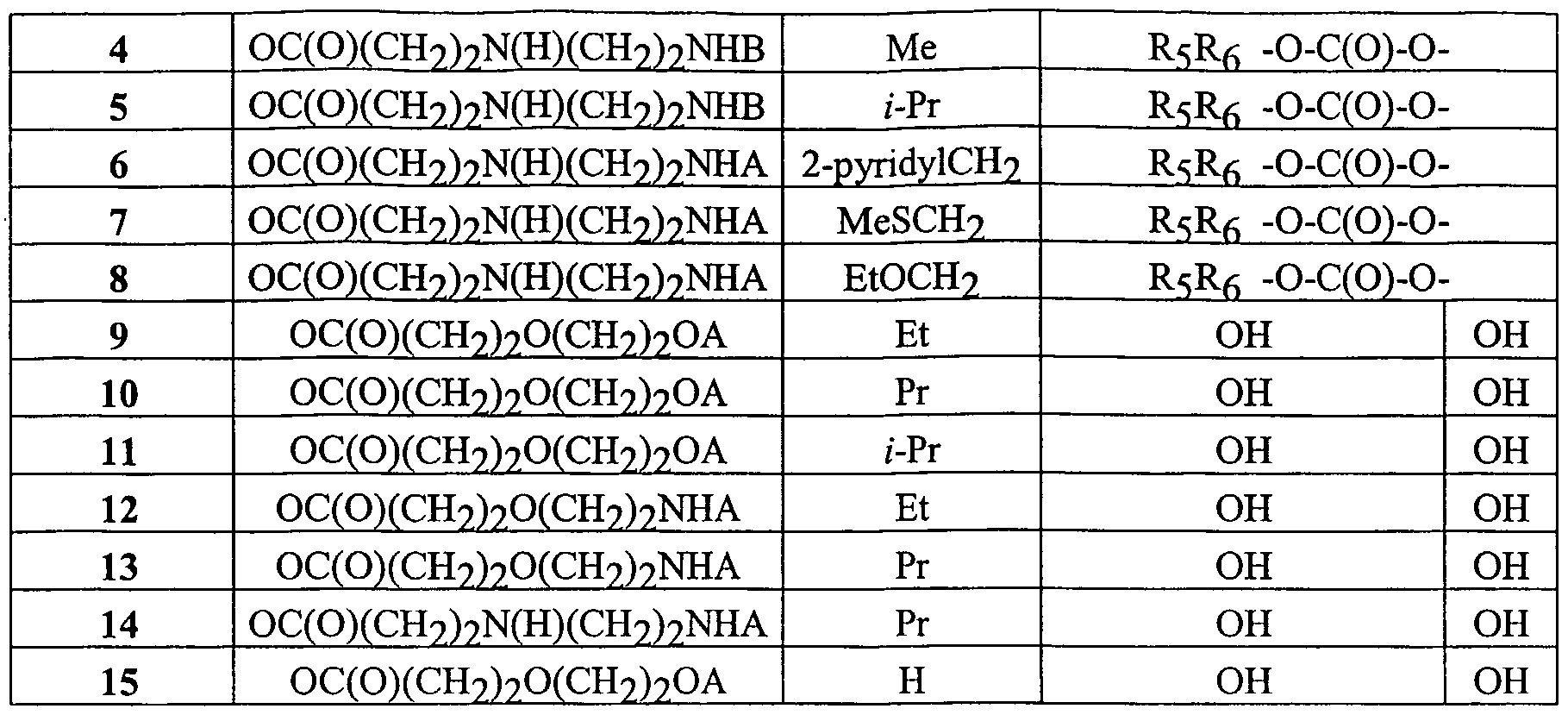
The compounds of Examples 1 to 15 were prepared by the procedures described below.
Figure imgf000027_0001
Figure imgf000027_0002
Figure imgf000028_0001
Example 1
4"-0-[3-[[2-[(3-Carboxy-7-chloro-l-cyclopropyl-l,4-dihydro-4-oxo-6- quinolinyl ) amino] ethyl] amino] propionyI]-l l-0-(2-dimethylaminoethoxymethyl)-(9E)- methoximino erythromycin A
A solution of Intermediate 14 (0.03 g, 0.023 mmol) in methanol (3 mL) was warmed at 50°C with stirring. After 16 h the mixture was cooled and the solvent evaporated to yield the title compound as a yellow solid. ESMS m/z 1240 [MH +]. C13 NMR δ CDC13 7.50, 9.20, 10.9, 13.6, 14.2, 17.4, 17.6, 18.2, 20.8, 21.2, 22.6, 23.9, 27.1, 31.2, 34.3, 34.6, 34.9, 35.7, 39.3, 39.9, 41.9, 43.0, 44.3, 44.7, 44.8, 47.5, 49.1, 58.8, 60.3, 63.5, 64.7, 66.8, 68.1, 71.5, 73.2, 74.4, 76.3, 77.6, 78.6, 78.8, 79.0, 84.4, 96.2, 98.9, 102.4, 104.1, 110.1, 118.9, 127.0, 127.4, 133.1, 143.4, 146.3, 167.4, 169.9, 172.5, 176.6, 177.2.
Example 2
4"-0-[3-[[2-[(3-Carboxy-7-chloro-l-cyclopropyl-l,4-dihydro-4-oxo-6- quinolinyl) amino]ethyl]amino]propionyl]-ll,12-carbonate-(9E)-0-(2-propyl)oximino erythromycin A
In an analogous procedure to that of Example 1, Intermediate 15 gave the title compound as a white solid. ESMS m/z 1192 [MH+] .
Example 3
4"-0-[3-[[2-[(3-Carboxy-7-chloro-l-cyclopropyl-l,4-dihydro-4-oxo-6- quinolinyl ) amino] ethyl] amino] propionyl] -11 , 12-carbonate-(9E)-methoximino erythromycin A
In an analogous procedure to that of Example 1, Intermediate 16 gave the title compound as a white solid. ESMS m/z 1165 [MH+].
Example 4 4"-0-[3-[[2-[(3-Carboxy-l-cycIopropyI-l,4-dihydro-6-fluoro-4-oxo-7- quinolinyl) amino]ethyl]amino]propionyl]-ll,12-carbonate-(9E)-methoximino erythromycin A In analogous procedure to that of Example 1, Intermediate 17 gave the title compound as a white solid; IH NMR δ (CD3OD) inter alia 8.78 (IH, s), 7.87(1H, d, J = 11.6 Hz), 7.35 (IH, d, J = 6.0 Hz).
Example 5
4"-0-[3-[[2-[(3-Carboxy-l-cyclopropyl-l,4-dihydro-6-fluoro-4-oxo-7- quinolinyl) amino]ethyl]amino]propionyl]-ll,12-carbonate-(9E)-0-(2-propyl)oximino erythromycin A
A mixture of Intermediate 8 (0.06 g, 0.066 mmol) and 7-[(2-aminoethyl)amino]-l- cyclopropyl-l,4-dihydro-6-fluoro-4-oxo-quinoline-3-carboxylic acid4 (0.04 g, 0.13 mmol) in DMSO (3 mL) and diethylisopropylamine (0.029 mL, 0.17 mmol) was heated at 80°C for 8 h. After stirring at room temperature for 12 h the mixture was diluted with diethyl ether and the solid formed filtered to yield the title compound as a white solid. ESMS m/z 1176 [MH +].
Example 6
4"-0-[3-[[2-[(3-Carboxy-7-chloro-l-cyclopropyl-l,4-dihydro-4-oxo-6- quinolinyl) amino]ethyI]amino]propionyl]-ll,12-carbonate-(9E)-0-(2- pyridylmethyl)oximino erythromycin A
In an analogous procedure to that of Example 1, Intermediate 18 gave the title compound as a white solid. ESMS m/z 1240 [M-H]".
Example 7
4"-0-[3-[[2-[(3-Carboxy-7-chloro-l-cyclopropyl-l,4-dihydro-4-oxo-6- quinolinyl) amino]ethyl]amino]propionyl]-ll,12-carbonate-(9E)-0- (methylthiomethyl)oximino erythromycin A
In an analogous procedure to that of Example 1, Intermediate 19 gave the title compound as a white solid. ESMS m/z 1210 [M-H]".
Example 8 4"-0-[3-[[2-[(3-Carboxy-7-chloro-l-cyclopropyl-l,4-dihydro-4-oxo-6- quinolinyl) amino]ethyl]amino]propionyl]-ll,12-carbonate-(9E)-0- (ethoxymethyl)oximino erythromycin A
In an analogous procedure to that that of Example 1, Intermediate 20 gave the title compound as a white solid. ESMS m/z 1207 [M-H]".
Example 9
4"-0-[3-[[2-[(3-Carboxy-7-chloro-l-cyclopropyl-l,4-dihydro-4-oxo-6-quinolinyl)- oxy]ethyl]oxy]propionyl]-(9E)-0-ethyloximino erythromycin A
EDC HC1 (105 mg, 0.49 mol) was added to a DMF/dry (1ml) solution of Intermediate 28 (130 mg, 0.33 mmol) cooled on ice bath and the reaction mixture was stiπed at 0° C for
~30min under the flow of N2. A solution of Intermediate 21 (200 mg, 0.25 mmol) in 0.5 ml DMF was added and after 1 hour DMAP (50 mg; 0,33 mmol) was also added. The resulting mixture was stirred for 24h, during which time the reaction mixture was allowed to warm to ambient temperature. Water (10 ml) and DCM (15 ml) were added and the layers separated. The water layer was extracted twice with DCM. The organic layers are collected, dried on Na2S04, filtered off and the organic solvent evaporated. The oily residue (260 mg) was dissolved in MeOH (20 ml) and the solution was stirred overnight. The solution was then heated for 2h on an oil bath at 60°C. The methanol was evaporated under vacuum and the foamy residue purified by column chromatography (DCM : MeOH : NH3 = 90:9: 1.5) yielding the title compound (20mg). ESMS m/z 1155 90 % [MH+]. C13 NMR δ CDC13 177.5,
174.6, 171.4, 171.1, 166.8, 153.2, 147.3, 135.6, 131.3, 125.8, 1 19.3, 108.3, 107.7, 100.6, 95.9, 83.2, 78.9, 78.5, 77.0, 74.9, 74.2, 72.9, 71.3, 70.7, 69.6, 69.5, 69.2, 67.1, 66.9, 65.4, 63.0, 49.4, 44.5, 38.2, 37.7, 35.6, 35.2, 32.9, 29.7, 26.9, 26.3, 21.2, 21.1, 20.9, 18.6, 18.1,
16.3, 14.4, 10.6, 9.9, 8.3.
Example 10
4"-0-[3-[[2-[(3-Carboxy-7-chloro-l-cyclopropyl-l,4-dihydro-4-oxo-6-quinoIinyl)- oxy] ethyl] oxy] propionyl] -(9E)-0-propyloximino erythromycin A
In an analogous procedure to that of Example 9, Intermediate 22 gave the title compound as a yellow solid. ESMS m/z 1168 90%[MH+]. C13 NMR CDC13 177.5, 174.7, 171.3, 171.0, 166.8, 153.1, 147.3, 135.5, 131.3, 125.7, 119.2, 108.3, 107.7, 101.0, 95.9, 82.9, 79.0, 78.6, 77.0, 75.7, 74.9, 74.2, 72.9,71.2, 70.7, 69.4, 69.2, 67.1, 65.3, 62.9, 49.4, 44.5, 38.2, 37.6, 35.6, 35.2, 32.8, 26.9, 26.2, 22.3, 21.3, 20.9, 18.7, 18.1, 16.3, 14.5, 10.6, 10.4, 8.3.
Example 11
4"-0-[3-[[2-[(3-Carboxy-7-chloro-l-cyclopropyl-l,4-dihydro-4-oxo-6-quinolinyl)- oxy]ethyl]oxy]propionyl]-(9E)-0-(2-propyl)oximino erythromycin A
In an analogous procedure to that of Example 9, Intermediate 23 gave the title compound as a yellow solid. ESMS m/z 1169 80% [MH+]. C13 NMR δ CDC13 177.5, 174.9, 171.2, 171.0,
166.7, 153.1, 147.3, 135.5, 131.2, 125.8, 119.2, 108.4, 107.7, 101.6, 96.1, 82.7, 79.3, 78.8, 76.9, 75.4, 75.1, 74.2, 72.8, 71.2, 70.8, 69.4, 69.1, 67.6, 67.1, 65.3, 62.9, 49.5, 44.6, 38.5, 37.7, 35.5, 35.4, 35.2, 32.8, 29.7, 26.9, 26.4, 21.7, 21.6, 21.5, 21.1, 21.0, 18.6, 18.2, 16.3,
14.4, 10.6, 9.5, 8.3.
Example 12
4"-0-[3-[[2-[(3-Carboxy-7-chloro-l-cyclopropyl-l,4-dihydro-4-oxo-6-quinolinyl)- amino]ethyl]oxy]propionyl]-(9E)-0-ethyIoximino erythromycin A EDC HCl (660 mg, 3.45mol) was added to a DMF/dry (4ml) solution of Intermediate 31 (904 mg, 2.3 mmol) cooled on ice bath and the reaction mixture was stirred at 0° C for ~30min under the flow of N2. A solution of Intermediate 21 (1.5 g, 1.8 mmol) in 4 ml of DCM was then added and after 1 hour DMAP (300 mg, 2.45 mmol) was also added. The resulting mixture was stirred for 24h, during which time the reaction mixture was allowed to warm to ambient temperature. Water (10 ml) and DCM (15 ml) were added and the layers separated. The water layer was extracted twice with DCM. The organic layers were collected, dried on Na2S04, filtered off and the organic solvent evaporated. The residue was dissolved in MeOH (50 ml) and the solution was stirred overnight at 60°C on an oil bath. The methanol was evaporated under vacuum and the foamy residue was purified by column chromatography (DCM : MeOH : NH3 = 90:9: 1.5) yielding the title compound (120 mg). ESMS m/z l l53 80% [MH*]. C13 NMR δ CDC13 177.5, 174.9, 171.3, 171.2, 167.3, 145.9, 142.9, 132.7, 127.6, 126.3, 118.1, 107.6, 104.5, 101.7, 96.1, 82.7, 79.3, 78.8, 76.9, 75.2, 74.2, 72.8, 71.1, 70.7, 69.5, 68.8, 67.6, 66.3, 65.3, 62.9, 49.5, 44.5, 43.3, 40.4, 38.6, 37.7, 35.4,
35.3, 34.9, 32.8, 29.7, 26.9, 26.4, 21.6, 21.1, 21.0, 18.6, 18.2, 16.3, 14.4, 14.1, 10.7, 9.5, 8.1.
Example 13
4"-0-[3-[[2-[(3-Carboxy-7-chloro-l-cyclopropyl-l,4-dihydro-4-oxo-6-quinolinyl)- amino]ethyI]oxy]propionyl]-(9E)-0-propyloximino erythromycin A
In an analogous procedure to that of Example 12, Intermediate 22 gave the title compound as a yellow solid. ESMS m/z 1167 [MH+], C13 NMR δ CDC13 176.9, 174.4, 170.6, 166.8, 145.4, 142.3, 132.1, 127.0, 125.7, 117.5, 107.0, 103.9, 100.9, 95.5, 82.2, 79.6, 78.7, 76.3, 75.0, 74.5, 73.6, 72.2, 70.5, 70.1, 68.2, 66.8, 65.7, 64.7, 62.3, 49.2, 43.9, 42.7, 39.9, 37.9, 37.0, 34.8, 34.7, 34.4, 32.2, 29.1, 26.4, 25.7, 21.7, 20.9, 20.5, 20.4, 18.1, 17.5, 15.6, 14.3, 10.5, 10.1, 8.9, 7.5.
Example 14 4"-0-[3-[[2-[(3-Carboxy-7-chloro-l-cycIopropyl-l,4-dihydro-4-oxo-6-quinolinyl)- amino]ethyI]amino]propionyl]-(9E)-0-propyloximino erythromycin A
Intermediate 13 (1.3 g) was added to a solution of Intermediate 24 (1.1 g, 1.3 mmol) in CH3OH (20 mL). The resulting mixture was heated at 70°C for 48 h. The solvent was concentrated under reduced pressure and the residue purified by silica column (CHCl3/MeOH/NH4OH (6:1:0.1)) affording the title compound (120 mg). MS; m/z (ES): 1166.6 [MH]+. C13 NMR δ CDC13 177.5, 175.0, 174.9, 172.0, 171.2, 167.3, 145.9, 143.1,
132.6, 127.7, 126.9, 126.3, 118.1, 107.6, 104.5, 101.7, 96.1, 82.9, 79.5, 78.8, 76.9, 75.6, 75.4, 75.2, 74.2, 72.8, 71.1, 70.7, 67.6, 65.3, 63.0, 49.5, 47.5, 44.6, 44.4, 42.7, 40.4, 38.6, 37J,
35.4, 34.9, 32.9, 29.7, 27.0, 26.3, 22.3, 21.6, 21.2, 21.1, 18.7, 18.2, 16.3, 14.5, 10.7, 10.4, 9.5, 8.4.
Example 15
4"-0-[3-[[2-[(3-Carboxy-7-chloro-l-cyclopropyl-l,4-dihydro-4-oxo-6-quinoIinyl)- oxygen]ethyl]oxygen]propionyl]-(9E)-oximino erythromycin A
In an analogous procedure to that of Example 9, Intermediate 25 (0.5 g, 0.6 mmol) gave the title compound. The residue was purified by column chromatography (DCM-MeOH- NH4OH=90:9:1.5). ESMS m/z 1126.4 [MH+].
References
1 Knowles et al, J. Antibiot., 1989, 42, 454-62.
2. Hunt et al, J. Antibiot. , 1989, 42, 1817-22. 3. EP 284203, 1988.
4. Yoshida et al J Pharm. Soc. Japan, 1990, 110, 258.
5. Compound was prepared by the procedure described in EP 1 167 375 (page 72) starting from erythromycin oxime.
6. Tetrahedron Lett., 1967: 1645, 1967.
Biological Data The MIC (μg/ml) of test compounds against various organisms was determined including: S. aureus Smith ATCC 13709, S. pneumoniae SP030, S. pyogenes 3565, E. faecalis ATCC 29212, H. influenzae ATCC 49247, M. catarrhalis ATCC 23246.
Examples 1-3 and 6-8 have an MIC <1 μg/ml against S. aureus Smith ATCC 13709, S. pneumoniae SP030, S. pyogenes 3565 and E. faecalis ATCC 29212.
Examples 1 and 3 have an MIC <2 μg/ml against H. influenzae ATCC 49247 and M. catarrhalis ATCC 23246. Examples 1-3 and 6-8 have an MIC <0.25 μg/ml against erythromycin resistant strains of Streptococcus pneumoniae and Streptococcus pyogenes.
The application of which this description and claims forms part may be used as a basis for priority in respect of any subsequent application. The claims of such subsequent application may be directed to any feature or combination of features described herein. They may take the form of product, composition, process, or use claims and may include, by way of example and without limitation, the following claims:

Claims

Claims
1. A compound of general formula (I)
Figure imgf000033_0001
wherein
R1 is OC(0)(CH2)mXR7;
R2 is hydrogen or a hydroxyl protecting group; R^ is hydrogen, C\ _4alkyl or C3_6alkenyl optionally substituted by 9 to 10 membered fused bicyclic heteroaryl;
R4 is hydrogen, C^alkyl, C3_7cycloalkyl, C3_($alkenyl or a 5 or 6 membered heterocychc group, wherein the alkyl, cycloalkyl, alkenyl and heterocychc groups are optionally substituted by up to three substituents independently selected from optionally substituted 5 or 6 membered heterocychc group, optionally substituted 5 or 6 membered heteroaryl, OR8,
S(0)nR8, NR8R9, CONR8R9, halogen and cyano;
R? is hydroxy, C3_galkenyloxy optionally substituted by 9 to 10 membered fused bicyclic heteroaryl, or 0(CH2)pO(CH2)qR10,
R" is hydroxy, or R^ and R^ taken together with the intervening atoms form a cyclic group having the following structure:
Figure imgf000033_0002
wherein Y is a bivalent radical selected from -CH2-, -CH(CN)-, -O-, -N(R* 1)- and ■
CH SR1 1)-;
R7 is a heterocychc group having the following structure:
Figure imgf000034_0001
R8 and R9 are each independently selected from hydrogen and Ci _4alkyl; R1 ° is hydrogen or NR8R9;
Ri MS hydrogen or C^alkyl substituted by a group selected from optionally substituted phenyl, optionally substituted 5 or 6 membered heteroaryl and optionally substituted 9 to 10 membered fused bicyclic heteroaryl;
R12 is hydrogen, C(0)OR15, C(0)NHR15 or C(0)CH2N02; Rl3 is hydrogen, C^alkyl optionally substituted by hydroxy or C\ _4alkoxy, C3_
7cycloalkyl, or optionally substituted phenyl or benzyl;
R14 is halogen,
Figure imgf000034_0002
or N(Cj. alkyl)2;
R*5 is hydrogen or C galley 1 optionally substituted by up to three groups independently selected from halogen, C^alkoxy, OC(0)Cι_4alkyl and OC(O)OCι^alkyl;
R1" is hydrogen, C\ _4alkyl, C3_ cycloalkyl, optionally substituted phenyl or benzyl, acetyl or benzoyl;
Ri is hydrogen or Ri4, or R^7 and R1^ are linked to form the bivalent radical -0(CH2)2- or
-(CH2)V-; X is -U(CH2)SZ- or X is a group selected from:
/ \
— N N
\ / and
Figure imgf000034_0003
U and Z independently are a divalent radical selected from -N(R^). } -0-, -S(0)f , N(R16)C(0)-, -C(0)N(R16)- and -N[C(0)R16]-; W is CR*7 or a nitrogen atom; m is 0 or an integer from 1 to 5; n, r and t are each independently selected from 0, 1 and 2; p and q are each independently selected from 1 to 6 ; s is an integer from 2 to 8; and v is 2 or 3; and pharmaceutically acceptable derivatives thereof.
2. A compound according to claim 1 wherein R2 is hydrogen.
3. A compound according to claim 1 or 2 wherein R^ is hydrogen.
4. A compound according to any one of the preceding claims wherein R4 is hydrogen or C\ _4alkyl optionally substituted by up to three substituents independently selected from optionally substituted 5 or 6 membered heteroaryl, OR8, S(0)nR8, NR R9, halogen and cyano.
5. A compound according to any one of the preceding claims wherein R^ is hydroxy or 0(CH )pO(CH2)qR10 and R6 is hydroxy, or R5 and R6 taken together with the intervening atoms form a cyclic group having the following structure:
Figure imgf000035_0001
wherein Y is the bivalent radical -0-.
6. A compound according to any one of the preceding claims wherein R7 is a heterocychc group having the following structure:
Figure imgf000035_0002
wherein W is CR*7 where R*7 is hydrogen.
7. A compound according to any one of the preceding claims wherein X is -U(CH2)SZ- wherein U and Z are independently -ΝH- or -0-.
8. A compound according to claim 1 as defined in any one of Examples 1 to 15, or a pharmaceutically derivative thereof.
A compound selected from: 4"-0-[3-[[2-[(3-carboxy-7-chloro-l-cyclopropyl-l,4-dihydro-4-oxo-6- quinolinyl) amino]ethyl]amino]propionyl]-l l-C-(2-dimethylaminoethoxymethyl)-(9E)- methoximino erythromycin A,
4"-0-[3-[[2-[(3-carboxy-7-chloro-l-cyclopropyl-l,4-dihydro-4-oxo-6- quinolinyl) amino]ethyl]amino]propionyl]-l l,12-carbonate-(9E)-0-(2-propyl)oximino erythromycin A,
4"-0-[3-[[2-[(3-carboxy-7-chloro-l-cyclopropyl-l,4-dihydro-4-oxo-6- quinolinyl) amino]ethyl]amino]propionyl]-l l,12-carbonate-(9E)-methoximino erythromycin A, and * ' ■ " 4"-O-[3-[[2-[(3-carboxy-7-chloro-l -cyclopropyl- 1 ,4-dihydro-4-oxo-6- quinolinyl ) amino]ethyl]amino]propionyl]-l 1 , 12-carbonate-(9E)-0-(ethoxymethyl)oximino erythromycin A, or a pharmaceutically acceptable derivative thereof.
10. A process for the preparation of a compound as claimed in claim 1 which comprises: a) reacting a compound of formula (II)
Figure imgf000036_0001
(II) (HI)
with a suitable activated derivative of the acid (III), wherein m is an integer 1 to 5, Xa and R a are X and R7 as defined in claim 1 or groups convertible to X and R7, to produce a compound of formula (I) wherein m is an integer 1 to 5;
b) reacting a compound of formula (II), in which the 4" hydroxy is suitably activated, with a compound of formula XaR7a (IN), wherein R7a is R7a as defined in claim 1 or a group convertible to R7, s and Z have the meanings defined in claim 1 and Xa is -U(CH2)SZ- or a group convertible to -U(CH )SZ-, in which U is a group selected from selected from - Ν(R1 °)- , -0-, and -S-, to produce a compound of formula (I) wherein m is 0 and U is a group selected from -N(R16)- , -O- and -S-;
c) reacting a compound of formula (V)
Figure imgf000037_0001
(V) wherein Rl° has the meaning defined in claim 1 with a suitable activated derivative of the carboxyhc acid HOC(0)(CH )sZaR7a (VI), wherein R7a and Za are R7 and Z as defined in claim 1 or groups convertible to R7 and Z, to produce a compound of formula (I) wherein m is 0 and U is -N(R16)C(O)-;
d) reacting a compound of formula (II) with a suitably activated derivative of the carboxyhc acid HOC(0)C(0)N(R16)(CH2)sZaR7a (Vllb) to produce a compound of formula (I) wherein m is 0 and U is -C(0)N(R16)-;
e) reacting a compound o
Figure imgf000037_0002
(vπ) with a compound of formula XaR7a (IN), wherein R7a and Xa are R7 and X as defined in claim 1 or groups convertible to R7 and X, U is a group selected from -Ν(R^).; _0- and -S-, and L is suitable leaving group, to produce a compound of formula (I) wherein m is 1 to 5 and U is a group selected from -N^1^)-, -O- and -S-; or f) reacting a compound of formula (DC), with a compound of formula XaR7a (IN),
Figure imgf000038_0001
(DC)
wherein R7a and Xa are R7 and X as defined in claim 1 or groups convertible to R7 and X, U is a group selected from -Ν R1")-, -O- and -S-, to produce a compound of formula (I) wherein m is 2 and U is a group selected from -Ν(R ")-, -O- and -S-;
and thereafter, if required, subjecting the resulting compound to one or more of the following operations: i) removal of the protecting group R2, ii) conversion of XaR7a or ZaR7a to XR7 or ZR7 respectively, and iii) conversion of the resultant compound of formula (I) into a pharmaceutically acceptable derivative thereof.
11. A compound as claimed in any one of claims 1 to 9 or a pharmaceutically acceptable derivative thereof for use in therapy.
12. The use of a compound as claimed in any one of claims 1 to 9 or a pharmaceutically acceptable derivative thereof in the preparation of a medicament for use in the therapy of systemic or topical microbial infections in a human or animal body.
13. The use of a compound as claimed in any one of claims 1 to 9 or a pharmaceutically acceptable derivative thereof for use in the treatment or prophylaxis of systemic or topical microbial infections in a human or animal body.
14. A pharmaceutical composition comprising a compound as claimed any one of claims 1 to 9 or a pharmaceutically acceptable derivative thereof in admixture with one or more pharmaceutically acceptable carriers or excipients.
15. A method for the treatment of the human or non-human animal body to combat microbial infection comprising administration of an effective amount of a compound as claimed in any one of claims 1 to 9 or a pharmaceutically acceptable derivative thereof.
16. A compound of general formula (IA)
Figure imgf000039_0001
wherein
R1 is OC(0)(CH2)mXR7;
R2 is hydrogen or a hydroxyl protecting group;
R-> is hydrogen, C^alkyl or C3_galkenyl optionally substituted by 9 to 10 membered fused bicyclic heteroaryl; R4 is hydrogen, C^alkyl, C3_7cycloalkyl, C3_galkenyl or a 5 or 6 membered heterocychc group, wherein the alkyl, cycloalkyl, alkenyl and heterocychc groups are optionally substituted by up to three substituents independently selected from optionally substituted 5 or
6 membered heterocychc group, optionally substituted 5 or 6 membered heteroaryl, OR8,
S(0)nR8, NR8R9, CONR8R9, halogen and cyano; R-> is hydroxy, C3_galkenyloxy optionally substituted by 9 to 10 membered fused bicyclic heteroaryl or O(CH2)pO(CH2)qR10 !
R° is hydroxy, or
R5 and R" taken together with the intervening atoms form a cyclic group having the following structure:
Figure imgf000039_0002
wherein Y is a bivalent radical selected from -CH2-, -CH(CN)-, -0-, -N(R* *)- and
CH(SR8)-;
R7 is a heterocychc group having the following structure: or
Figure imgf000040_0001
R8 and R9 are each independently selected from hydrogen and C \ _4alkyl;
R10 is hydrogen or NR8R9;
R 1 is hydrogen or C^alkyl substituted by a group selected from optionally substituted phenyl, optionally substituted 5 or 6 membered heteroaryl and optionally substituted 9 to 10 membered fused bicyclic heteroaryl;
R12 is hydrogen, C(0)OR15, C(0)NHR15 or C(0)CH2N02;
Rl3 is hydrogen, C^alkyl, C3_7cycloalkyl, or optionally substituted phenyl or benzyl;
R14 is halogen, Cj^alkyl, C^thioalkyl, C^alkoxy, NH2, NH(C1. alkyl) or N(Cμ
4alkyl)2;
R ^ is hydrogen or C^alkyl;
Rl6 is hydrogen, C^alkyl, C3_7cycloalkyl, optionally substituted phenyl or benzyl, acetyl or benzoyl;
X is -U(CH2)SZ- or X is a group selected from:
/ \ — N N —
\ / and
Figure imgf000040_0002
U and Z independently are a divalent radical selected from -N(R ^)- , -0-, -S(0)f , N(R16)C(0)-, -C(0)N(R16)- and -N[C(0)R16]-; W is a carbon or a nitrogen atom; m is 0 or an integer from 1 to 5; n, r and t are each independently selected from 0, 1 and 2; p and q are each independently selected from 1 and 2; and s is an integer from 2 to 8; and pharmaceutically acceptable salts and solvates thereof.
PCT/EP2003/012068 2002-10-31 2003-10-29 4’’ - modified erythromycin derivatives Ceased WO2004039822A2 (en)

Priority Applications (4)

Application Number Priority Date Filing Date Title
AU2003293635A AU2003293635A1 (en) 2002-10-31 2003-10-29 4'' - modified erythromycin derivatives
EP03788981A EP1558625A2 (en) 2002-10-31 2003-10-29 4''-modified erythromycin derivatives
US10/533,461 US7351696B2 (en) 2002-10-31 2003-10-29 Compounds
JP2004547617A JP2006506389A (en) 2002-10-31 2003-10-29 4 "modified erythromycin derivative

Applications Claiming Priority (2)

Application Number Priority Date Filing Date Title
GBGB0225384.7A GB0225384D0 (en) 2002-10-31 2002-10-31 Novel compounds
GB0225384.7 2002-10-31

Publications (2)

Publication Number Publication Date
WO2004039822A2 true WO2004039822A2 (en) 2004-05-13
WO2004039822A3 WO2004039822A3 (en) 2004-07-08

Family

ID=9946942

Family Applications (1)

Application Number Title Priority Date Filing Date
PCT/EP2003/012068 Ceased WO2004039822A2 (en) 2002-10-31 2003-10-29 4’’ - modified erythromycin derivatives

Country Status (7)

Country Link
US (1) US7351696B2 (en)
EP (1) EP1558625A2 (en)
JP (1) JP2006506389A (en)
AR (1) AR041860A1 (en)
AU (1) AU2003293635A1 (en)
GB (1) GB0225384D0 (en)
WO (1) WO2004039822A2 (en)

Cited By (11)

* Cited by examiner, † Cited by third party
Publication number Priority date Publication date Assignee Title
WO2004101589A1 (en) * 2003-05-13 2004-11-25 Glaxo Group Limited Novel 14 and 15 membered-ring compounds
WO2004101585A1 (en) * 2003-05-13 2004-11-25 Glaxo Group Limited Macrolides substituded at the 4'-position
WO2004101587A1 (en) * 2003-05-13 2004-11-25 Glaxo Group Limited Novel 14 and 15 memberred-ring compounds
WO2004101588A1 (en) * 2003-05-13 2004-11-25 Glaxo Group Limited Novel 14 and 15 membered ring compounds
WO2005108412A1 (en) * 2004-05-06 2005-11-17 Glaxosmithkline Istrazivacki Centar Zagreb D.O.O. Ester linked macrolides useful for the treatment of microbial infections
WO2006050941A1 (en) * 2004-11-11 2006-05-18 Glaxo Group Limited Macrolone compounds
WO2006050942A1 (en) * 2004-11-11 2006-05-18 Glaxo Group Limited Macrolones - amino substituted quinolones
WO2006050943A1 (en) * 2004-11-11 2006-05-18 Glaxo Group Limited Macrolone compounds
WO2006050940A1 (en) * 2004-11-11 2006-05-18 Glaxo Group Limited Macrolone compounds
US7547679B2 (en) 2005-05-10 2009-06-16 Glaxosmithkline Istrazivacki Center Zagreb D.O.O Ether linked macrolides useful for the treatment of microbial infections
WO2012038372A1 (en) 2010-09-20 2012-03-29 Novartis Ag Novel process for the preparation of 9-deoxo-9a-aza- 9a-homoerythromycin a modified in the c-4'' of the cladinose ring by an epoxide group

Family Cites Families (8)

* Cited by examiner, † Cited by third party
Publication number Priority date Publication date Assignee Title
AU1204288A (en) 1987-02-24 1988-08-25 Beecham Group Plc Erythromycins
WO1996034007A1 (en) * 1995-04-27 1996-10-31 Laboratorios Aranda, S.A. De C.V. Quinolonylcarboxyerythromycin derivatives and pharmaceutical compositions containing them
AU710532B2 (en) * 1996-05-07 1999-09-23 Abbott Laboratories 3-descladinose-2,3-anhydroerythromycin derivatives
EP0895999A1 (en) * 1997-08-06 1999-02-10 Pfizer Products Inc. C-4" substituted macrolide antibiotics
HUP0201516A3 (en) 1999-05-24 2003-03-28 Pfizer Prod Inc 13-methyl-erythromycin derivatives, process for their preparation and pharmaceutical compositions containing them
US6946446B2 (en) 2000-02-24 2005-09-20 Abbott Laboratories Anti-infective agents useful against multidrug-resistant strains of bacteria
ATE312839T1 (en) 2000-02-24 2005-12-15 Abbott Lab ANTI-INFECTIVE AGENTS USEFUL AGAINST MULTIPLE DRUG-RESISTANT STRAINS OF BACTERIA
GB0127349D0 (en) * 2001-11-14 2002-01-02 Glaxo Group Ltd Macrolides

Cited By (12)

* Cited by examiner, † Cited by third party
Publication number Priority date Publication date Assignee Title
WO2004101589A1 (en) * 2003-05-13 2004-11-25 Glaxo Group Limited Novel 14 and 15 membered-ring compounds
WO2004101585A1 (en) * 2003-05-13 2004-11-25 Glaxo Group Limited Macrolides substituded at the 4'-position
WO2004101587A1 (en) * 2003-05-13 2004-11-25 Glaxo Group Limited Novel 14 and 15 memberred-ring compounds
WO2004101588A1 (en) * 2003-05-13 2004-11-25 Glaxo Group Limited Novel 14 and 15 membered ring compounds
WO2005108412A1 (en) * 2004-05-06 2005-11-17 Glaxosmithkline Istrazivacki Centar Zagreb D.O.O. Ester linked macrolides useful for the treatment of microbial infections
WO2006050941A1 (en) * 2004-11-11 2006-05-18 Glaxo Group Limited Macrolone compounds
WO2006050942A1 (en) * 2004-11-11 2006-05-18 Glaxo Group Limited Macrolones - amino substituted quinolones
WO2006050943A1 (en) * 2004-11-11 2006-05-18 Glaxo Group Limited Macrolone compounds
WO2006050940A1 (en) * 2004-11-11 2006-05-18 Glaxo Group Limited Macrolone compounds
US7718621B2 (en) 2004-11-11 2010-05-18 Glaxo Group Ltd. Macrolones—amino substituted quinolones
US7547679B2 (en) 2005-05-10 2009-06-16 Glaxosmithkline Istrazivacki Center Zagreb D.O.O Ether linked macrolides useful for the treatment of microbial infections
WO2012038372A1 (en) 2010-09-20 2012-03-29 Novartis Ag Novel process for the preparation of 9-deoxo-9a-aza- 9a-homoerythromycin a modified in the c-4'' of the cladinose ring by an epoxide group

Also Published As

Publication number Publication date
AU2003293635A1 (en) 2004-05-25
AU2003293635A8 (en) 2004-05-25
GB0225384D0 (en) 2002-12-11
US7351696B2 (en) 2008-04-01
JP2006506389A (en) 2006-02-23
US20070037757A1 (en) 2007-02-15
WO2004039822A3 (en) 2004-07-08
AR041860A1 (en) 2005-06-01
EP1558625A2 (en) 2005-08-03

Similar Documents

Publication Publication Date Title
EP1453846B1 (en) 14 or 15 membered macrolides with antibacterial activity
US6900183B2 (en) Macrolide antibiotics
ZA200301047B (en) New macrolides with antibacterial activity.
WO2004039822A2 (en) 4’’ - modified erythromycin derivatives
KR20070085919A (en) Macroron-Amino Substituted Quinolone
US20070293472A1 (en) Novel 14 and 15 Membered Ring Compounds
AU2005240849B2 (en) Ester linked macrolides useful for the treatment of microbial infections
JP2008519787A (en) Macrolone compounds
EP1328535B1 (en) Macrolides
MXPA05012163A (en) Novel 14 and 15 membered-ring compounds.
WO2004101589A1 (en) Novel 14 and 15 membered-ring compounds
JP2006528947A (en) 4 &#34;-substituted macrolide
EP1633765B1 (en) Novel 14 and 15 membered-ring compounds
CA2525457A1 (en) Novel 14 and 15 membered ring compounds
EP1756134A1 (en) Carbamate linked macrolides useful for the treatment of microbial infections
US20080312167A1 (en) 4&#39;&#39; Amino Linked Macrolides Useful for the Treatment of Microbial Infections
JP2008519789A (en) Macrolone compounds
KR20070031900A (en) Ester linked macrolides useful in the treatment of microbial infections

Legal Events

Date Code Title Description
AK Designated states

Kind code of ref document: A2

Designated state(s): AE AG AL AM AT AU AZ BA BB BG BR BY BZ CA CH CN CO CR CU CZ DE DK DM DZ EC EE EG ES FI GB GD GE GH GM HR HU ID IL IN IS JP KE KG KP KR KZ LC LK LR LS LT LU LV MA MD MG MK MN MW MX MZ NI NO NZ OM PG PH PL PT RO RU SC SD SE SG SK SL SY TJ TM TN TR TT TZ UA UG US UZ VC VN YU ZA ZM ZW

AL Designated countries for regional patents

Kind code of ref document: A2

Designated state(s): GH GM KE LS MW MZ SD SL SZ TZ UG ZM ZW AM AZ BY KG KZ MD RU TJ TM AT BE BG CH CY CZ DE DK EE ES FI FR GB GR HU IE IT LU MC NL PT RO SE SI SK TR BF BJ CF CG CI CM GA GN GQ GW ML MR NE SN TD TG

DFPE Request for preliminary examination filed prior to expiration of 19th month from priority date (pct application filed before 20040101)
121 Ep: the epo has been informed by wipo that ep was designated in this application
WWE Wipo information: entry into national phase

Ref document number: 2004547617

Country of ref document: JP

WWE Wipo information: entry into national phase

Ref document number: 2003788981

Country of ref document: EP

WWP Wipo information: published in national office

Ref document number: 2003788981

Country of ref document: EP

WWE Wipo information: entry into national phase

Ref document number: 2007037757

Country of ref document: US

Ref document number: 10533461

Country of ref document: US

WWP Wipo information: published in national office

Ref document number: 10533461

Country of ref document: US