WO2004046096A2 - Novel ligands that are antagonists of raf receptors, process for preparing them and use thereof in human medicine and in cosmetics - Google Patents

Novel ligands that are antagonists of raf receptors, process for preparing them and use thereof in human medicine and in cosmetics Download PDF

Info

Publication number
WO2004046096A2
WO2004046096A2 PCT/EP2003/014860 EP0314860W WO2004046096A2 WO 2004046096 A2 WO2004046096 A2 WO 2004046096A2 EP 0314860 W EP0314860 W EP 0314860W WO 2004046096 A2 WO2004046096 A2 WO 2004046096A2
Authority
WO
WIPO (PCT)
Prior art keywords
dimethyl
dihydro
naphthyl
tolyl
benzoic acid
Prior art date
Legal status (The legal status is an assumption and is not a legal conclusion. Google has not performed a legal analysis and makes no representation as to the accuracy of the status listed.)
Ceased
Application number
PCT/EP2003/014860
Other languages
French (fr)
Other versions
WO2004046096A3 (en
Inventor
Philippe Diaz
Catherine Raffin
Thibaud Biadatti
Current Assignee (The listed assignees may be inaccurate. Google has not performed a legal analysis and makes no representation or warranty as to the accuracy of the list.)
Galderma Research and Development SNC
Original Assignee
Galderma Research and Development SNC
Priority date (The priority date is an assumption and is not a legal conclusion. Google has not performed a legal analysis and makes no representation as to the accuracy of the date listed.)
Filing date
Publication date
Priority claimed from FR0214391A external-priority patent/FR2847255B1/en
Application filed by Galderma Research and Development SNC filed Critical Galderma Research and Development SNC
Priority to AU2003298239A priority Critical patent/AU2003298239A1/en
Priority to CA2505286A priority patent/CA2505286C/en
Priority to EP03795963A priority patent/EP1565433B1/en
Priority to DE60312548T priority patent/DE60312548T2/en
Publication of WO2004046096A2 publication Critical patent/WO2004046096A2/en
Publication of WO2004046096A3 publication Critical patent/WO2004046096A3/en
Priority to US11/116,344 priority patent/US7348449B2/en
Anticipated expiration legal-status Critical
Priority to US11/978,623 priority patent/US7592478B2/en
Ceased legal-status Critical Current

Links

Classifications

    • C—CHEMISTRY; METALLURGY
    • C07—ORGANIC CHEMISTRY
    • C07D—HETEROCYCLIC COMPOUNDS
    • C07D213/00—Heterocyclic compounds containing six-membered rings, not condensed with other rings, with one nitrogen atom as the only ring hetero atom and three or more double bonds between ring members or between ring members and non-ring members
    • C07D213/02—Heterocyclic compounds containing six-membered rings, not condensed with other rings, with one nitrogen atom as the only ring hetero atom and three or more double bonds between ring members or between ring members and non-ring members having three double bonds between ring members or between ring members and non-ring members
    • C07D213/04—Heterocyclic compounds containing six-membered rings, not condensed with other rings, with one nitrogen atom as the only ring hetero atom and three or more double bonds between ring members or between ring members and non-ring members having three double bonds between ring members or between ring members and non-ring members having no bond between the ring nitrogen atom and a non-ring member or having only hydrogen or carbon atoms directly attached to the ring nitrogen atom
    • C07D213/60—Heterocyclic compounds containing six-membered rings, not condensed with other rings, with one nitrogen atom as the only ring hetero atom and three or more double bonds between ring members or between ring members and non-ring members having three double bonds between ring members or between ring members and non-ring members having no bond between the ring nitrogen atom and a non-ring member or having only hydrogen or carbon atoms directly attached to the ring nitrogen atom with hetero atoms or with carbon atoms having three bonds to hetero atoms with at the most one bond to halogen, e.g. ester or nitrile radicals, directly attached to ring carbon atoms
    • C07D213/78—Carbon atoms having three bonds to hetero atoms, with at the most one bond to halogen, e.g. ester or nitrile radicals
    • C07D213/79—Acids; Esters
    • A—HUMAN NECESSITIES
    • A61—MEDICAL OR VETERINARY SCIENCE; HYGIENE
    • A61P—SPECIFIC THERAPEUTIC ACTIVITY OF CHEMICAL COMPOUNDS OR MEDICINAL PREPARATIONS
    • A61P17/00—Drugs for dermatological disorders
    • A—HUMAN NECESSITIES
    • A61—MEDICAL OR VETERINARY SCIENCE; HYGIENE
    • A61P—SPECIFIC THERAPEUTIC ACTIVITY OF CHEMICAL COMPOUNDS OR MEDICINAL PREPARATIONS
    • A61P17/00—Drugs for dermatological disorders
    • A61P17/06—Antipsoriatics
    • A—HUMAN NECESSITIES
    • A61—MEDICAL OR VETERINARY SCIENCE; HYGIENE
    • A61P—SPECIFIC THERAPEUTIC ACTIVITY OF CHEMICAL COMPOUNDS OR MEDICINAL PREPARATIONS
    • A61P17/00—Drugs for dermatological disorders
    • A61P17/10—Anti-acne agents
    • A—HUMAN NECESSITIES
    • A61—MEDICAL OR VETERINARY SCIENCE; HYGIENE
    • A61P—SPECIFIC THERAPEUTIC ACTIVITY OF CHEMICAL COMPOUNDS OR MEDICINAL PREPARATIONS
    • A61P31/00—Antiinfectives, i.e. antibiotics, antiseptics, chemotherapeutics
    • A61P31/12—Antivirals
    • C—CHEMISTRY; METALLURGY
    • C07—ORGANIC CHEMISTRY
    • C07C—ACYCLIC OR CARBOCYCLIC COMPOUNDS
    • C07C229/00—Compounds containing amino and carboxyl groups bound to the same carbon skeleton
    • C07C229/02—Compounds containing amino and carboxyl groups bound to the same carbon skeleton having amino and carboxyl groups bound to acyclic carbon atoms of the same carbon skeleton
    • C07C229/04—Compounds containing amino and carboxyl groups bound to the same carbon skeleton having amino and carboxyl groups bound to acyclic carbon atoms of the same carbon skeleton the carbon skeleton being acyclic and saturated
    • C07C229/06—Compounds containing amino and carboxyl groups bound to the same carbon skeleton having amino and carboxyl groups bound to acyclic carbon atoms of the same carbon skeleton the carbon skeleton being acyclic and saturated having only one amino and one carboxyl group bound to the carbon skeleton
    • C07C229/18—Compounds containing amino and carboxyl groups bound to the same carbon skeleton having amino and carboxyl groups bound to acyclic carbon atoms of the same carbon skeleton the carbon skeleton being acyclic and saturated having only one amino and one carboxyl group bound to the carbon skeleton the nitrogen atom of the amino group being further bound to carbon atoms of six-membered aromatic rings
    • C—CHEMISTRY; METALLURGY
    • C07—ORGANIC CHEMISTRY
    • C07C—ACYCLIC OR CARBOCYCLIC COMPOUNDS
    • C07C229/00—Compounds containing amino and carboxyl groups bound to the same carbon skeleton
    • C07C229/38—Compounds containing amino and carboxyl groups bound to the same carbon skeleton having amino groups bound to acyclic carbon atoms and carboxyl groups bound to carbon atoms of six-membered aromatic rings of the same carbon skeleton
    • C—CHEMISTRY; METALLURGY
    • C07—ORGANIC CHEMISTRY
    • C07C—ACYCLIC OR CARBOCYCLIC COMPOUNDS
    • C07C229/00—Compounds containing amino and carboxyl groups bound to the same carbon skeleton
    • C07C229/52—Compounds containing amino and carboxyl groups bound to the same carbon skeleton having amino and carboxyl groups bound to carbon atoms of six-membered aromatic rings of the same carbon skeleton
    • C—CHEMISTRY; METALLURGY
    • C07—ORGANIC CHEMISTRY
    • C07C—ACYCLIC OR CARBOCYCLIC COMPOUNDS
    • C07C233/00—Carboxylic acid amides
    • C07C233/01—Carboxylic acid amides having carbon atoms of carboxamide groups bound to hydrogen atoms or to acyclic carbon atoms
    • C07C233/45—Carboxylic acid amides having carbon atoms of carboxamide groups bound to hydrogen atoms or to acyclic carbon atoms having the nitrogen atom of at least one of the carboxamide groups bound to a carbon atom of a hydrocarbon radical substituted by carboxyl groups
    • C07C233/53—Carboxylic acid amides having carbon atoms of carboxamide groups bound to hydrogen atoms or to acyclic carbon atoms having the nitrogen atom of at least one of the carboxamide groups bound to a carbon atom of a hydrocarbon radical substituted by carboxyl groups with the substituted hydrocarbon radical bound to the nitrogen atom of the carboxamide group by a carbon atom of a six-membered aromatic ring
    • C07C233/54—Carboxylic acid amides having carbon atoms of carboxamide groups bound to hydrogen atoms or to acyclic carbon atoms having the nitrogen atom of at least one of the carboxamide groups bound to a carbon atom of a hydrocarbon radical substituted by carboxyl groups with the substituted hydrocarbon radical bound to the nitrogen atom of the carboxamide group by a carbon atom of a six-membered aromatic ring having the carbon atom of the carboxamide group bound to a hydrogen atom or to a carbon atom of a saturated carbon skeleton
    • C—CHEMISTRY; METALLURGY
    • C07—ORGANIC CHEMISTRY
    • C07C—ACYCLIC OR CARBOCYCLIC COMPOUNDS
    • C07C235/00—Carboxylic acid amides, the carbon skeleton of the acid part being further substituted by oxygen atoms
    • C07C235/02—Carboxylic acid amides, the carbon skeleton of the acid part being further substituted by oxygen atoms having carbon atoms of carboxamide groups bound to acyclic carbon atoms and singly-bound oxygen atoms bound to the same carbon skeleton
    • C07C235/32—Carboxylic acid amides, the carbon skeleton of the acid part being further substituted by oxygen atoms having carbon atoms of carboxamide groups bound to acyclic carbon atoms and singly-bound oxygen atoms bound to the same carbon skeleton the carbon skeleton containing six-membered aromatic rings
    • C07C235/38—Carboxylic acid amides, the carbon skeleton of the acid part being further substituted by oxygen atoms having carbon atoms of carboxamide groups bound to acyclic carbon atoms and singly-bound oxygen atoms bound to the same carbon skeleton the carbon skeleton containing six-membered aromatic rings having the nitrogen atom of at least one of the carboxamide groups bound to a carbon atom of a six-membered aromatic ring
    • C—CHEMISTRY; METALLURGY
    • C07—ORGANIC CHEMISTRY
    • C07C—ACYCLIC OR CARBOCYCLIC COMPOUNDS
    • C07C235/00—Carboxylic acid amides, the carbon skeleton of the acid part being further substituted by oxygen atoms
    • C07C235/42—Carboxylic acid amides, the carbon skeleton of the acid part being further substituted by oxygen atoms having carbon atoms of carboxamide groups bound to carbon atoms of six-membered aromatic rings and singly-bound oxygen atoms bound to the same carbon skeleton
    • C—CHEMISTRY; METALLURGY
    • C07—ORGANIC CHEMISTRY
    • C07C—ACYCLIC OR CARBOCYCLIC COMPOUNDS
    • C07C235/00—Carboxylic acid amides, the carbon skeleton of the acid part being further substituted by oxygen atoms
    • C07C235/70—Carboxylic acid amides, the carbon skeleton of the acid part being further substituted by oxygen atoms having carbon atoms of carboxamide groups and doubly-bound oxygen atoms bound to the same carbon skeleton
    • C07C235/72—Carboxylic acid amides, the carbon skeleton of the acid part being further substituted by oxygen atoms having carbon atoms of carboxamide groups and doubly-bound oxygen atoms bound to the same carbon skeleton with the carbon atoms of the carboxamide groups bound to acyclic carbon atoms
    • C07C235/76—Carboxylic acid amides, the carbon skeleton of the acid part being further substituted by oxygen atoms having carbon atoms of carboxamide groups and doubly-bound oxygen atoms bound to the same carbon skeleton with the carbon atoms of the carboxamide groups bound to acyclic carbon atoms of an unsaturated carbon skeleton
    • C07C235/78—Carboxylic acid amides, the carbon skeleton of the acid part being further substituted by oxygen atoms having carbon atoms of carboxamide groups and doubly-bound oxygen atoms bound to the same carbon skeleton with the carbon atoms of the carboxamide groups bound to acyclic carbon atoms of an unsaturated carbon skeleton the carbon skeleton containing rings
    • C—CHEMISTRY; METALLURGY
    • C07—ORGANIC CHEMISTRY
    • C07C—ACYCLIC OR CARBOCYCLIC COMPOUNDS
    • C07C259/00—Compounds containing carboxyl groups, an oxygen atom of a carboxyl group being replaced by a nitrogen atom, this nitrogen atom being further bound to an oxygen atom and not being part of nitro or nitroso groups
    • C07C259/04—Compounds containing carboxyl groups, an oxygen atom of a carboxyl group being replaced by a nitrogen atom, this nitrogen atom being further bound to an oxygen atom and not being part of nitro or nitroso groups without replacement of the other oxygen atom of the carboxyl group, e.g. hydroxamic acids
    • C07C259/10—Compounds containing carboxyl groups, an oxygen atom of a carboxyl group being replaced by a nitrogen atom, this nitrogen atom being further bound to an oxygen atom and not being part of nitro or nitroso groups without replacement of the other oxygen atom of the carboxyl group, e.g. hydroxamic acids having carbon atoms of hydroxamic groups bound to carbon atoms of six-membered aromatic rings
    • C—CHEMISTRY; METALLURGY
    • C07—ORGANIC CHEMISTRY
    • C07C—ACYCLIC OR CARBOCYCLIC COMPOUNDS
    • C07C271/00—Derivatives of carbamic acids, i.e. compounds containing any of the groups, the nitrogen atom not being part of nitro or nitroso groups
    • C07C271/06—Esters of carbamic acids
    • C07C271/08—Esters of carbamic acids having oxygen atoms of carbamate groups bound to acyclic carbon atoms
    • C07C271/26—Esters of carbamic acids having oxygen atoms of carbamate groups bound to acyclic carbon atoms with the nitrogen atom of at least one of the carbamate groups bound to a carbon atom of a six-membered aromatic ring
    • C07C271/28—Esters of carbamic acids having oxygen atoms of carbamate groups bound to acyclic carbon atoms with the nitrogen atom of at least one of the carbamate groups bound to a carbon atom of a six-membered aromatic ring to a carbon atom of a non-condensed six-membered aromatic ring
    • C—CHEMISTRY; METALLURGY
    • C07—ORGANIC CHEMISTRY
    • C07C—ACYCLIC OR CARBOCYCLIC COMPOUNDS
    • C07C323/00—Thiols, sulfides, hydropolysulfides or polysulfides substituted by halogen, oxygen or nitrogen atoms, or by sulfur atoms not being part of thio groups
    • C07C323/50—Thiols, sulfides, hydropolysulfides or polysulfides substituted by halogen, oxygen or nitrogen atoms, or by sulfur atoms not being part of thio groups containing thio groups and carboxyl groups bound to the same carbon skeleton
    • C07C323/62—Thiols, sulfides, hydropolysulfides or polysulfides substituted by halogen, oxygen or nitrogen atoms, or by sulfur atoms not being part of thio groups containing thio groups and carboxyl groups bound to the same carbon skeleton having the sulfur atom of at least one of the thio groups bound to a carbon atom of a six-membered aromatic ring of the carbon skeleton
    • C—CHEMISTRY; METALLURGY
    • C07—ORGANIC CHEMISTRY
    • C07C—ACYCLIC OR CARBOCYCLIC COMPOUNDS
    • C07C391/00—Compounds containing selenium
    • C07C391/02—Compounds containing selenium having selenium atoms bound to carbon atoms of six-membered aromatic rings
    • C—CHEMISTRY; METALLURGY
    • C07—ORGANIC CHEMISTRY
    • C07C—ACYCLIC OR CARBOCYCLIC COMPOUNDS
    • C07C63/00—Compounds having carboxyl groups bound to a carbon atoms of six-membered aromatic rings
    • C07C63/33—Polycyclic acids
    • C07C63/337—Polycyclic acids with carboxyl groups bound to condensed ring systems
    • C07C63/34—Polycyclic acids with carboxyl groups bound to condensed ring systems containing two condensed rings
    • C07C63/36—Polycyclic acids with carboxyl groups bound to condensed ring systems containing two condensed rings containing one carboxyl group
    • C—CHEMISTRY; METALLURGY
    • C07—ORGANIC CHEMISTRY
    • C07C—ACYCLIC OR CARBOCYCLIC COMPOUNDS
    • C07C63/00—Compounds having carboxyl groups bound to a carbon atoms of six-membered aromatic rings
    • C07C63/64—Monocyclic acids with unsaturation outside the aromatic ring
    • C—CHEMISTRY; METALLURGY
    • C07—ORGANIC CHEMISTRY
    • C07C—ACYCLIC OR CARBOCYCLIC COMPOUNDS
    • C07C63/00—Compounds having carboxyl groups bound to a carbon atoms of six-membered aromatic rings
    • C07C63/66—Polycyclic acids with unsaturation outside the aromatic rings
    • C—CHEMISTRY; METALLURGY
    • C07—ORGANIC CHEMISTRY
    • C07C—ACYCLIC OR CARBOCYCLIC COMPOUNDS
    • C07C65/00—Compounds having carboxyl groups bound to carbon atoms of six—membered aromatic rings and containing any of the groups OH, O—metal, —CHO, keto, ether, groups, groups, or groups
    • C07C65/01—Compounds having carboxyl groups bound to carbon atoms of six—membered aromatic rings and containing any of the groups OH, O—metal, —CHO, keto, ether, groups, groups, or groups containing hydroxy or O-metal groups
    • C07C65/105—Compounds having carboxyl groups bound to carbon atoms of six—membered aromatic rings and containing any of the groups OH, O—metal, —CHO, keto, ether, groups, groups, or groups containing hydroxy or O-metal groups polycyclic
    • C07C65/11—Compounds having carboxyl groups bound to carbon atoms of six—membered aromatic rings and containing any of the groups OH, O—metal, —CHO, keto, ether, groups, groups, or groups containing hydroxy or O-metal groups polycyclic with carboxyl groups on a condensed ring system containing two rings
    • C—CHEMISTRY; METALLURGY
    • C07—ORGANIC CHEMISTRY
    • C07C—ACYCLIC OR CARBOCYCLIC COMPOUNDS
    • C07C65/00—Compounds having carboxyl groups bound to carbon atoms of six—membered aromatic rings and containing any of the groups OH, O—metal, —CHO, keto, ether, groups, groups, or groups
    • C07C65/01—Compounds having carboxyl groups bound to carbon atoms of six—membered aromatic rings and containing any of the groups OH, O—metal, —CHO, keto, ether, groups, groups, or groups containing hydroxy or O-metal groups
    • C07C65/19—Compounds having carboxyl groups bound to carbon atoms of six—membered aromatic rings and containing any of the groups OH, O—metal, —CHO, keto, ether, groups, groups, or groups containing hydroxy or O-metal groups having unsaturation outside the aromatic ring
    • C—CHEMISTRY; METALLURGY
    • C07—ORGANIC CHEMISTRY
    • C07C—ACYCLIC OR CARBOCYCLIC COMPOUNDS
    • C07C65/00—Compounds having carboxyl groups bound to carbon atoms of six—membered aromatic rings and containing any of the groups OH, O—metal, —CHO, keto, ether, groups, groups, or groups
    • C07C65/21—Compounds having carboxyl groups bound to carbon atoms of six—membered aromatic rings and containing any of the groups OH, O—metal, —CHO, keto, ether, groups, groups, or groups containing ether groups, groups, groups, or groups
    • C07C65/28—Compounds having carboxyl groups bound to carbon atoms of six—membered aromatic rings and containing any of the groups OH, O—metal, —CHO, keto, ether, groups, groups, or groups containing ether groups, groups, groups, or groups having unsaturation outside the aromatic rings
    • C—CHEMISTRY; METALLURGY
    • C07—ORGANIC CHEMISTRY
    • C07C—ACYCLIC OR CARBOCYCLIC COMPOUNDS
    • C07C65/00—Compounds having carboxyl groups bound to carbon atoms of six—membered aromatic rings and containing any of the groups OH, O—metal, —CHO, keto, ether, groups, groups, or groups
    • C07C65/32—Compounds having carboxyl groups bound to carbon atoms of six—membered aromatic rings and containing any of the groups OH, O—metal, —CHO, keto, ether, groups, groups, or groups containing keto groups
    • C07C65/34—Compounds having carboxyl groups bound to carbon atoms of six—membered aromatic rings and containing any of the groups OH, O—metal, —CHO, keto, ether, groups, groups, or groups containing keto groups polycyclic
    • C—CHEMISTRY; METALLURGY
    • C07—ORGANIC CHEMISTRY
    • C07C—ACYCLIC OR CARBOCYCLIC COMPOUNDS
    • C07C65/00—Compounds having carboxyl groups bound to carbon atoms of six—membered aromatic rings and containing any of the groups OH, O—metal, —CHO, keto, ether, groups, groups, or groups
    • C07C65/32—Compounds having carboxyl groups bound to carbon atoms of six—membered aromatic rings and containing any of the groups OH, O—metal, —CHO, keto, ether, groups, groups, or groups containing keto groups
    • C07C65/38—Compounds having carboxyl groups bound to carbon atoms of six—membered aromatic rings and containing any of the groups OH, O—metal, —CHO, keto, ether, groups, groups, or groups containing keto groups having unsaturation outside the aromatic rings
    • C—CHEMISTRY; METALLURGY
    • C07—ORGANIC CHEMISTRY
    • C07C—ACYCLIC OR CARBOCYCLIC COMPOUNDS
    • C07C69/00—Esters of carboxylic acids; Esters of carbonic or haloformic acids
    • C07C69/76—Esters of carboxylic acids having a carboxyl group bound to a carbon atom of a six-membered aromatic ring
    • C—CHEMISTRY; METALLURGY
    • C07—ORGANIC CHEMISTRY
    • C07D—HETEROCYCLIC COMPOUNDS
    • C07D213/00—Heterocyclic compounds containing six-membered rings, not condensed with other rings, with one nitrogen atom as the only ring hetero atom and three or more double bonds between ring members or between ring members and non-ring members
    • C07D213/02—Heterocyclic compounds containing six-membered rings, not condensed with other rings, with one nitrogen atom as the only ring hetero atom and three or more double bonds between ring members or between ring members and non-ring members having three double bonds between ring members or between ring members and non-ring members
    • C07D213/04—Heterocyclic compounds containing six-membered rings, not condensed with other rings, with one nitrogen atom as the only ring hetero atom and three or more double bonds between ring members or between ring members and non-ring members having three double bonds between ring members or between ring members and non-ring members having no bond between the ring nitrogen atom and a non-ring member or having only hydrogen or carbon atoms directly attached to the ring nitrogen atom
    • C07D213/24—Heterocyclic compounds containing six-membered rings, not condensed with other rings, with one nitrogen atom as the only ring hetero atom and three or more double bonds between ring members or between ring members and non-ring members having three double bonds between ring members or between ring members and non-ring members having no bond between the ring nitrogen atom and a non-ring member or having only hydrogen or carbon atoms directly attached to the ring nitrogen atom with substituted hydrocarbon radicals attached to ring carbon atoms
    • C07D213/28—Radicals substituted by singly-bound oxygen or sulphur atoms
    • C07D213/30—Oxygen atoms
    • C—CHEMISTRY; METALLURGY
    • C07—ORGANIC CHEMISTRY
    • C07D—HETEROCYCLIC COMPOUNDS
    • C07D213/00—Heterocyclic compounds containing six-membered rings, not condensed with other rings, with one nitrogen atom as the only ring hetero atom and three or more double bonds between ring members or between ring members and non-ring members
    • C07D213/02—Heterocyclic compounds containing six-membered rings, not condensed with other rings, with one nitrogen atom as the only ring hetero atom and three or more double bonds between ring members or between ring members and non-ring members having three double bonds between ring members or between ring members and non-ring members
    • C07D213/04—Heterocyclic compounds containing six-membered rings, not condensed with other rings, with one nitrogen atom as the only ring hetero atom and three or more double bonds between ring members or between ring members and non-ring members having three double bonds between ring members or between ring members and non-ring members having no bond between the ring nitrogen atom and a non-ring member or having only hydrogen or carbon atoms directly attached to the ring nitrogen atom
    • C07D213/60—Heterocyclic compounds containing six-membered rings, not condensed with other rings, with one nitrogen atom as the only ring hetero atom and three or more double bonds between ring members or between ring members and non-ring members having three double bonds between ring members or between ring members and non-ring members having no bond between the ring nitrogen atom and a non-ring member or having only hydrogen or carbon atoms directly attached to the ring nitrogen atom with hetero atoms or with carbon atoms having three bonds to hetero atoms with at the most one bond to halogen, e.g. ester or nitrile radicals, directly attached to ring carbon atoms
    • C07D213/78—Carbon atoms having three bonds to hetero atoms, with at the most one bond to halogen, e.g. ester or nitrile radicals
    • C07D213/79—Acids; Esters
    • C07D213/80—Acids; Esters in position 3
    • C—CHEMISTRY; METALLURGY
    • C07—ORGANIC CHEMISTRY
    • C07D—HETEROCYCLIC COMPOUNDS
    • C07D333/00—Heterocyclic compounds containing five-membered rings having one sulfur atom as the only ring hetero atom
    • C07D333/02—Heterocyclic compounds containing five-membered rings having one sulfur atom as the only ring hetero atom not condensed with other rings
    • C07D333/04—Heterocyclic compounds containing five-membered rings having one sulfur atom as the only ring hetero atom not condensed with other rings not substituted on the ring sulphur atom
    • C07D333/06—Heterocyclic compounds containing five-membered rings having one sulfur atom as the only ring hetero atom not condensed with other rings not substituted on the ring sulphur atom with only hydrogen atoms, hydrocarbon or substituted hydrocarbon radicals, directly attached to the ring carbon atoms
    • C07D333/14—Radicals substituted by singly bound hetero atoms other than halogen
    • C07D333/16—Radicals substituted by singly bound hetero atoms other than halogen by oxygen atoms
    • C—CHEMISTRY; METALLURGY
    • C07—ORGANIC CHEMISTRY
    • C07B—GENERAL METHODS OF ORGANIC CHEMISTRY; APPARATUS THEREFOR
    • C07B2200/00—Indexing scheme relating to specific properties of organic compounds
    • C07B2200/07—Optical isomers
    • C—CHEMISTRY; METALLURGY
    • C07—ORGANIC CHEMISTRY
    • C07C—ACYCLIC OR CARBOCYCLIC COMPOUNDS
    • C07C2602/00—Systems containing two condensed rings
    • C07C2602/02—Systems containing two condensed rings the rings having only two atoms in common
    • C07C2602/04—One of the condensed rings being a six-membered aromatic ring
    • C07C2602/10—One of the condensed rings being a six-membered aromatic ring the other ring being six-membered, e.g. tetraline

Definitions

  • Novel ligands that are antagonists of RAR receptors , process for preparing them and use thereof in human medicine and in cosmetics
  • the invention relates to novel compounds as novel and useful industrial products.
  • the invention also relates to the process for preparing them and to their use in pharmaceutical compositions for use in human or veterinary medicine, or alternatively in cosmetic compositions.
  • vitamin A and its derivatives are widely described in the literature as having activity in cell proliferation and differentiation processes. These properties give this class of compounds high potential in the treatment or prevention of numerous pathologies, and more particularly in dermatology and cancer. Many biological effects of retinoids are mediated by modulating the nuclear retinoic acid receptors (RAR) .
  • RAR nuclear retinoic acid receptors
  • RAR receptors activate transcription by binding to DNA sequence elements, known as RAR response elements (RARE) , in the form of a heterodimer with the retinoid X receptors (known as RXRs) .
  • RARE RAR response elements
  • RAR ⁇ Three subtypes of human RARs have been identified and described: RAR ⁇ , RAR ⁇ and RAR ⁇ .
  • the prior art contains a large number of chemical compounds with inhibitory activity on receptors of RAR type.
  • patent US 6 150 413 which describes triaromatic compounds
  • patent US 6 214 878 which describes stilbene compounds
  • patent US 6 218 128, which describes a family of bicyclic or tricyclic molecules.
  • the Applicant has invented novel compounds that are antagonists of the retinoic acid receptors.
  • R 3 being defined below
  • - Rx represents a radical -OH, -OR, -NHR 5 or NR 5 R 6 ; R , R 5 and R ⁇ being defined below, - R 2 represents a hydrogen, fluorine, chlorine or bromine atom, a linear or branched alkyl radical of 1 to 5 carbon atoms, a CF 3 , 0R 7 , SR 7 , NHR 8 , NR 8 R 9 , 2-naphthyl, 2-pyridyl, 3-pyridyl, 4-pyridyl, 2-thio- phenyl, CH 2 OR ⁇ 0 or CH 2 NRnR ⁇ 2 radical or a phenyl radical which is unsubstituted or substituted with at least one fluorine atom or a methyl, ethyl, isopropyl, tert-butyl or CF 3 radical;
  • R , R 8 , Rg, Rio, R11 and R ⁇ 2 being defined below,
  • R 3 represents a hydrogen, fluorine or chlorine atom or a radical OH, OR 13 , CF 3 or NR 14 R1 5 ;
  • R 4 represents a linear or branched alkyl radical of 1 to 4 carbon atoms
  • R 5 represents a hydrogen atom, an OH group or a linear or branched alkyl radical of 1 to 4 carbon atoms;
  • R ⁇ represents a linear or branched alkyl radical of 1 to 4 carbon atoms
  • R represents a hydrogen atom, a linear or branched alkyl of 1 to 6 carbon atoms, a radical CH 2 OR 16 or a benzyl radical which is unsubstituted or substituted with at least one halogen atom, preferably an fluorine atom, methyl, ethyl, isopropyl, tert-butyl or CF 3 radical; R 16 being defined below,
  • - Rio represents a linear or branched alkyl radical of 1 to 4 carbon atoms or a benzyl or phenyl radical optionally substituted by one halogen atom, preferably one fluorine atom, or one alkyl radical of 1 to 3 carbon atoms;
  • Ri 3 represents a methyl, ethyl or acetyl ' radical
  • Ri6 represents a methyl, ethyl or CH 2 CH 2 OCH 3 radical
  • R ⁇ represents a hydrogen atom, a linear or branched alkyl radical of 1 to 4 carbon atoms; and the stereoisomers and optical or geometrical isomers, pure or in mixture in all proportions, the salts obtained with a pharmaceutically acceptable acid or base, and also mixtures of the said compounds of formula (I) , with the exception of the following combination:
  • the invention embraces optical isomers of the compounds of formula (I) as well as mixtures thereof including racemic mixtures.
  • the invention also embraces stereoisomers of the compounds of formula (I) including mixtures thereof.
  • the compounds according to the invention are in the form of a salt, it is preferably an alkali metal or alkaline-earth metal salt, or alternatively a zinc salt or salts of an organic amine .
  • alkyl radical containing from 1 to 4 carbon atoms preferably means methyl, ethyl, propyl, isopropyl, butyl, tert-butyl or isobutyl.
  • 5 carbon atoms preferably means methyl, ethyl, n-propyl, isopropyl, n-butyl, tert-butyl, isobutyl, n-pentyl or 2, 2-dimethylpropyl.
  • 6 carbon atoms preferably means methyl, ethyl, n-propyl, isopropyl, n-butyl, tert-butyl, isobutyl, n- pentyl, 2, 2-dimethylpropyl or n-hexyl radicals.
  • the compounds of formula (I) are those wherein R x represents a radical -OH, the others substituants remaining as previously defined.
  • the compounds of formula (I) are those in wherein R 2 represents a linear or branched alkyl radical of 1 to 5 carbon atoms, a OR 7 , or NR 8 R 9 radical, the others substituants remaining as previously defined.
  • a subject of the present invention is also processes for preparing the compounds of formula (I) , in particular according to the reaction schemes given in Figure 1.
  • the compounds of formula .(I) can be prepared from known compounds by the application or adaptation of known methods.
  • 6-Bromo-4, 4-dimethyltetralone 1 is obtained by electrophilic cyclization of 4- (4-bromophenyl) -2- methylpentanol followed by oxidation of the benzylic position.
  • an organometallic reagent for example an arylmagnesium halide, followed by a dehydration reaction, gives the compounds of general structure 2.
  • the compounds of structure 4 are then obtained, from the corresponding disulphides or diselenides 3, by reduction to sulphide or selenide, for example using sodium borohydride, followed by coupling with an aryl iodide corresponding to the acid portion, in the presence of bis (bipyridyl) nickel dibromide, followed by saponification of the esters obtained.
  • the compounds of structure 5 are obtained after bromination of the disulphide or diselenide function, followed by addition of a true alkyne function in the presence of copper iodide. The esters obtained are then saponified.
  • the compounds of structure 7 may then be obtained by deoxygenation, for example with triethylsilyl hydride, and the compounds of formula 8 by oxidation of the alcohol function to a carbonyl, for example using manganese oxide.
  • the methyl ketones of the type 9 may be obtained after reacting the carboxylic acids 3 with methyllithium.
  • the chalcones of general structure 10 may then be produced after reacting the compounds of type 9 with corresponding benzaldehydes in the presence of strong bases', for instance potassium hydroxide.
  • the compounds according to the invention have inhibitory properties on RAR-type receptors.
  • This RAR- receptor inhibitory activity is measured in a test of transactivation by means of the dissociation constant Kdapp (apparent) and the IC 50 (concentration that inhibits 50% of the reference agonist activity) .
  • the expXession "inhibitor of RAR-type receptors” means any compound which, for at least one of the RAR subtypes, has a dissociation constant Kdapp of less than or equal ' to 1 ⁇ M, and an IC 5 o value ⁇ 100 nM, in a transactivation test as described in Example 26.
  • the preferred compounds of the present invention have, for at least one of the RAR subtypes, a dissociation constant Kdapp of less than or equal to 500 nM and advantageously less than or equal to 100 nM, and an IC 50 ⁇ 25 nM.
  • a subject of the present invention is also the compounds of formula (I) as described above, as medicinal products.
  • the compounds according to the invention are particularly suitable in the following fields of treatment:. 1) for treating dermatological complaints associated with a keratinization disorder relating to cell differentiation and proliferation, especially for treating common acne, comedones, polymorphs, acne rosacea, nodulocystic acne, acne conglobata, senile acne, and secondary acnes such as solar acne, medication-related acne or occupational acne; 2) for treating other types of keratinization disorders, especially ichthyosis, ichthyosiform conditions, Darier's disease, palmoplantar keratoderma, leukoplakia and leukoplakiform conditions, and cutaneous or mucous (buccal) lichen;
  • lipid metabolism complaints such as obesity, hyperlipidaemia, or non-insulin- dependent diabetes
  • a subject of the present invention is also a pharmaceutical composition
  • a pharmaceutical composition comprising, in a physiologically acceptable medium, at least one compound of formula (I) as defined above.
  • a subject of the present invention is also a novel medicinal composition intended especially for treating the abovementioned complaints, which is characterized in that it comprises, in a pharmaceutically acceptable support that is compatible with the mode of administration selected for this composition, at least one compound of formula (I), an optical isomer thereof or a salt thereof.
  • the composition according to the invention may be administered orally, enterally, parenterally, topically or ocularly.
  • the pharmaceutical composition is preferably packaged in a form that is suitable for topical or oral application.
  • the composition may be in the form of tablets, gel capsules, dragees, syrups, suspensions, solutions, powders, granules, emulsions, suspensions of microspheres or nanospheres or lipid or polymer vesicles allowing a controlled release.
  • the composition Via the parenteral route, the composition may be in the form of solutions or suspensions for infusion or for injection.
  • the compounds according to the invention ' are generally administered at a daily dose of about 0.01 mg/kg to 100 mg/kg of body weight, in 1 to 3 dosage intakes .
  • the compounds are used systemically, at a concentration generally of between 0.001% and 10% by weight and preferably between 0.01% and 1% by weight relative to the weight of the composition.
  • the pharmaceutical composition according to the invention is more particularly intended for treating the skin and mucous membranes and may be in' liquid, -pasty or solid form, and more particularly in the form of ointments, creams, milks, pomades, powders, impregnated pads, syndets, solutions, gels, sprays, mousses, suspensions, sticks, shampoos or washing bases. It may also be in the form of suspensions of microspheres or nanospheres or of lipid or polymer vesicles or gelled or polymer patches allowing a controlled release.
  • the compounds are used topically at a concentration generally of between 0.001% and 10% by weight and preferably between 0.01% and 1% by weight, relative to the total weight of the composition.
  • the compounds of formula (I) according to the invention also find an application in cosmetics, in particular in body and hair hygiene .and especially for treating acne-prone skin, for promoting regrowth of the hair or for limiting hair loss, for combating the greasy appearance of the skin or the hair, in protection against the harmful aspects of sunlight or in the treatment of physiologically dry skin, and for preventing and/or combating photoinduced or chronological ageing.
  • a subject of the invention is thus also a composition comprising, in a cosmetically acceptable support, at least one of the compounds of formula (I) .
  • a subject of the invention is also the cosmetic use of a composition comprising at least one compound of formula (I) for preventing and/or treating the signs of ageing and/or dry skin.
  • a subject of the invention is also the cosmetic use of a composition comprising at least one compound of formula (I) for body or hair hygiene.
  • the cosmetic composition according to the invention containing, in a cosmetically acceptable support, at least one compound of formula (I) or an optical or geometrical isomer thereof or a salt thereof, may be especially in the form of a cream, a milk, a gel, suspensions of microspheres or nanospheres or lipid or polymer vesicles, impregnated pads, solutions, sprays, mousses, sticks, soaps, shampoos or washing bases.
  • the concentration of compound of formula (I) in the cosmetic composition is preferably between 0.001% and 3% by weight relative to the total weight of the composition.
  • compositions as described above may also contain inert additives, or even pharmacodynamically active additives as regards the pharmaceutical compositions, or combinations of these additives, and especially:
  • antioxidants such as ⁇ -tocopherol, butylhydroxyanisole, butylhydroxytoluene, superoxide dismutase, ubiquinol or certain metal-chelating agents;
  • - depigmenting agents such as hydroquinone, azelaic acid, caffeic acid or kojic acid
  • moisturizers for instance glycerol, PEG 400, thiamorpholinone and its derivatives or urea;
  • antiseborrhoeic or antiacne agents such as S-carboxymethylcysteine, S-benzylcysteamine, salts thereof or derivatives thereof, or benzoyl peroxide;
  • antibiotics for instance erythromycin and its esters, neomycin, clindamycin and its esters, and tetracyclines ;
  • antifungal agents such as ketoconazole or poly-4,5- methylene-3-isothiazolidones ;
  • agents for promoting regrowth of the hair for instance Minoxidil (2, 4-diamino-6-piperidino- pyrimidine 3-oxide) and its derivatives, Diazoxide (7-chloro 3-methyl-l, 2 , -benzothiadiazine 1,1-dioxide) and Phenytoin (5, -diphenyl- imidazolidine-2, 4-dione) ; - non-steroidal anti-inflammatory agents;
  • - reti ⁇ oids i.e. natural or synthetic RXR receptor ligands
  • ⁇ - ⁇ -hydroxy acids and ⁇ -keto acids or derivatives thereof such as lactic acid, malic acid, citric acid, glycolic acid, mandelic acid, tartaric acid, glyceric acid or ascorbic acid, and also salts, amides or esters thereof, or ⁇ -hydroxy acids or derivatives thereof, such as salicylic acid and its salts, amides ' or esters;
  • - ion-channel blockers such as potassium-channel blockers
  • compositions in combination with medicinal products known to interfere with the immune system (for example cyclosporin, FK 506, glucocorticoids, monoclonal antibodies, cytokines or growth factors, etc.).
  • medicinal products for example cyclosporin, FK 506, glucocorticoids, monoclonal antibodies, cytokines or growth factors, etc.
  • EXAMPLE 1 4- (8 , 8-Dimethyl-5-p-tolyl-7 , 8-dihydro-2- naphthylselanylethynyl)benzoic acid a. Methyl 4-ethynylbenzoa te ' 3.3 g (14.5 mmol) of methyl 4-iodobenzoate and 4.1 ml (29 mmol) of trimethylsilylacetylene are dissolved in 20 ml of triethylamine, and 1 g (1.4 mmol) of trai-s-dichlorobis (triphenylphosphine) palladium and 0.55 g (2.8 mmol) of copper iodide are then added.
  • the reaction medium is stirred for 24 hours, filtered through Celite and rinsed with ethyl acetate.
  • the medium is stirred for 48 hours and then concentrated to dryness.
  • the residue obtained is purified by chromatography (eluent: 8/2 heptane/ dichloromethane) .
  • EXAMPLE 4 5- [5- (4-tert-Butylphenyl) -8 , 8-dimethyl-7 , 8- dihydro-2-naphthylselanyl] -3-methylpent-2-en-4-ynoic acid a. Methyl 5- [5- (4-tert-Butylphenyl) -8 , 8-dimethyl-7 , 8- dihydro-2-naphthylselanyl] -3-methylpent-2-en-4-ynoate
  • the reaction medium is stirred for 2 hours and then treated with ammonium chloride solution and extracted with ethyl acetate.
  • the residue obtained is dissolved in 70 ml of toluene, and 0.1 g (0.52 mmol) ' of para-toluenesulphonic acid is added.
  • the reaction medium is refluxed for one hour and then treated with sodium bicarbonate solution and extracted with ethyl ether.
  • the reaction medium is stirred for one hour and then treated with 30 ml of IN hydrochloric acid soluXion and extracted with ethyl acetate.
  • the residue obtained is dissolved in 15 ml of ethanol, and 0.04 g (1 mmol) of sodium hydroxide is added.
  • Methyl 4- [5- (4-methoxyphenyl) -8 , 8-dimethyl- 7 , 8- dihydro-2 -naphthylselanylethynyl] benzoate In a manner similar to that of Example If, by reacting 1.4 g (2 mmol) of bis [5- (4-methoxyphenyl) -8 , 8- dimethyl-7, 8-dihydro-2-naphthalene] diselenide with 2 ml (2 mmol) of a IM solution of dibromine in tetrahydrofuran, 2.28 g (12 mmol) of copper iodide, 150 ml of dimethylformamide and 0.63 g (3.6 mmol) of methyl 4-ethynylbenzoate (described in Example la) .
  • EXAMPLE 8 6- (8 , 8-Dimethyl-5-p-tolyl-7 , 8-dihydro-2- naphthylselanylethynyl) nicotinic acid a. Ethyl 6-iodonicotina te
  • Methyl 4- (8 r 8-dimethyl-5-p-tolyl- 7 , 8-dihydro-2- naphthylselanylethynyl) -2-fluorobenzoa te In a manner similar to that of Example If, by reacting 1.5 g (2.3 mmol) of bis (8 , 8-dimethyl-5-p- tolyl-7 , 8-dihydro-2-naphthalene) diselenide (described in Example le) with 4.2 ml (4.2 mmol) of a IM solution of dibromine in tetrahydrofuran, 2.63 g (14 mmol) of copper iodide, 20 ml of dimethylformamide and 0.66 g (3.7 mmol) of methyl 4-ethynyl-2-fluorobenzoate (described in Example 8b).
  • Example le with 0.046 g (1.2 mol) of sodium borohydride, 0.011 g (0.02 mmol) of bis (bipyridyl) nickel dibromide and 0.245 g (0.81 mmol) of ethyl (E) -3- (3-iodophenyl) acrylate (described above).
  • EXAMPLE 12 3- ⁇ 4- [5- (4-tert-Butylphenyl) -8 ,8-dimethyl- 7 , 8-dihydro-2-naphthylselanyl]phenyl ⁇ acrylic acid a. Ethyl 3- (4- [5- (4-tert-butylphenyl) -8 , 8-dimethyl 7. , 8- dihydro-2-naphthylselanyl] phenyl ⁇ acrylate
  • Example 3b In a manner similar to that of Example lOe, by reacting 0.039 g (0.053 mmol) of bis [5- (4-tert- butylphenyl) -8, 8-dimethyl-7, 8-dihydro-2-naphthalene] diselenide (described in Example 3b) with 0.007 g (0.16 mmol) of sodium borohydride, 0.005 g (0.009 m ⁇ l) of bis (bipyridyl) nickel dibromide and 0.02 g (0.07 mmol) of ethyl (E) -3- (4-iodophenyl) acrylate
  • Example 10d In a manner analogous to Example 10d, ' by reacting 0.039 g (0.053 mmol) of bis [5- (4-tert-butylphenyl) -8, 8-dimethyl-7 , 8-dihydro-2-naphthalene] diselenide (described in Example 3b) with 0.007 g (0.16 mmol) of sodium borohydride, 0.005 g (0.009 mmol) of bis (bipyridyl) nickel dibromide and 0.02 g (0.07 mmol) of ethyl (E) -3- (3-iodophenyl) acrylate
  • EXAMPLE 14 6- (8 , 8-Dimethyl-5-p-tolyl-7 , 8-dihydro-2- naphthylselanyl) naphthalene-2-carboxylic acid a. 2- (6-Bromo-2-naphthyl) -4 , 4-dimethyl-4 , 5 ⁇ dihydro- oxazole
  • reaction medium is added dropwise to a solution of 1.94 g (5.5 mmol) of 1, l-dimethyl-7-seleno- cyanato-4-p-tolyl-l, 2-dihydronaphthalene dissolved in tetrahydrofuran at -78 °C.
  • the medium is warmed to 0°C, stirred for 2 hours treated with ammonium chloride solution and extracted with ethyl acetate.
  • 6- (8 , 8-Dimethyl-5-p-tolyl- 7 , 8-dihydro-2-naphthyl- selanyl) -2-naphthalenecarboxylic acid 1 g (1.81 mmol) of 2- [6- (8, 8-dimethyl-5-p- tolyl-7 , 8-dihydro-2-naphthylselanyl) naphthalen-2-yl] - 4, 4-dimethyl-4 , 5-dihydrooxazole is dissolved in 10 ml of tetrahydrofuran, and 15 ml of 5N hydrochloric acid solution are then added.
  • reaction medium is refluxed for 4 hours with stirring, hydrolysed and extracted with ethyl ether.
  • residue obtained is purified by chromatography (eluent: 4/6 heptane/ethyl acetate) .
  • EXAMPLE 15 4- [3- (8 ,8-Dimethyl-5-p-tolyl-7 , 8-dihydro-2- naphthyl) -3-hydroxyprop-l-ynyl]benzoic acid a . 8 r 8-Dimethyl-5-p-tolyl - 7 r 8 -dihydro-2 -naphtha lene- carbal dehyde 53.3 g (162 mmol) of 7-bromo-l, l-dimethyl-4- p-tolyl-1, 2-dihydronaphthalene (described in Example Id) are dissolved in 320 ml of tetrahydrofuran at -65 °C, and 72 ml (180 mmol) of 2.5M butyllithium are • then added dropwise.
  • EXAMPLE 16 4- [3- (8 , 8-Dimethyl-5-p-tolyl-7 , 8-dihydro-2- naphthyl) -3-hydroxyprop-l-ynyl] -2-hydroxybenzoic acid a .
  • the yellow oil obtained is -dissolved in 150 ml of toluene, and 0.713 g (3.75 mmol) of para- toluenesulphonic acid is then added.
  • the reaction medium is refluxed for -one hour and, after cooling, 200 ml of methanol and a few drops of sulphuric acid are then added.
  • the medium is stirred for 15 hours, treated with sodium bicarbonate solution and extracted with ethyl ether.
  • EXAMPLE 19 4- ⁇ 3- [5- (4-Dimethylaminophenyl) -8 , 8- dimethyl-7 , 8-dihydro-2-naphthyl] -3-hydroxyprop-l-ynyl ⁇ - benzoic acid a. [4- (6-Bromo-4 r -4-dimethyl -3, 4-dihydro-l -naphthyl) - phenyl] dimethylamine
  • 5- (4-Dimethylaminophenyl) -8 8-dimethyl - 7 , 8-dihy ' dro- 2 -naphtha lenecarbaldehyde
  • Example 16b In a manner similar to that of Example 16b, by reacting 0.81 g (2.4 mmol) of 1- [5- (4-dimethylamino- phenyl) -8, 8-dimethyl-7, 8-dihydro-2-naphthyl] prop-2-yn- l-ol with 0.496 g (2 mmol) of 4-iodobenzoic acid,
  • EXAMPLE 20 4- [3- (8 , 8-Dimethyl-5-p-tolyl-7 , 8-dihydro-2- naphthyl) -3-oxoprop-l-ynyl]benzoic acid 0.1 g (0.237 mmol) of 4- [3- (8 , 8-dimethyl-5-p- tolyl-7 , 8-dihydro-2-naphthyl) -3-hydroxyprop-l-ynyl] - benzoic acid (described in Example 15d) is dissolved in 2 ml of pentane and 2 ml of dichloromethane, 0.31 g (3.55 mmol) of manganese dioxide is then added and the medium is heated at 37 °C for 24 hours.
  • EXAMPLE 21 4- [3- (8 ,8-Dimethyl-5-p-tolyl-7,8-dihydro-2- naphthyl) -3-hydroxypropenyl]benzoic acid a. 1 - (8 , 8-Dimethyl-5-p-tolyl- , ⁇ 8 -dihydro-2 -naphthyl) - ethanone
  • Methyl 6- (8 r 8-dimethyl -5-p-tolyl-7 f 8-dihydro-2- naphthylcarbonyl) -2 -naphthalenecarboxylate 5 g (15.3 mmol) of 7-bromo-l, l-dimethyl-4-p- tolyl-1, 2-dihydronaphthalene (described in Example Id) are dissolved in tetrahydrofuran and 9.5 ml (16 mmol) of 1.7M tert-butyllithium are then added.
  • the activation of receptors with an agonist (activator) in HeLa cells leads to the expression of a reporter gene, luciferase, which, in the presence of a substrate, generates light.
  • the activation of the receptors may thus be measured by quantifying the luminescence produced after incubating the cells in the presence of a reference agonist.
  • the inhibitory products displace the agonist from its site, thus preventing activation of the receptor.
  • the activity is measured by quantifying the reduction in light produced. This measurement makes it possible to determine the inhibitory activity of the compounds according to the invention.
  • KdApp Kd apparent
  • the HeLa cell lines used are stable transfectants containing the plasmids ERE- ⁇ Glob-Luc-SV- Neo (reporter gene) and RAR ( ⁇ , ⁇ , ⁇ ) ER-DBD-puro. These cells are inoculated into 96-well plates at a rate of 10 000 cells per well in 100 ⁇ l of DMEM medium without phenol red, and supplemented with 10% defatted calf serum. The plates are then incubated at 37 °C and 7% C0 2 for 4 hours .
  • test products of the reference ligand (4- [2- (5, 5, 8 , 8-tetramethyl- 5,6,7, 8-tetrahydro-2-naphthyl) propenyl] benzoic acid) , of the 100% control, (100 nM 4- [2- (5, 5, 8 , 8-tetramethyl- 5,6,7, 8-tetrahydro-2-naphthyl) propenyl] benzoic acid) and of the 0% control (500 nM 4- ⁇ (E) -3- [4- (4-tert- butylphenyl) -5,5,8, 8-tetramethyl-5, 6, 7 , 8-tetrahydro-2- naphthyl] -3-oxopropenyl ⁇ benzoic acid) are added at a rate of 5 ⁇ l per well. The plates are then incubated for 18 hours at 37 °C and 7% C0 2 .
  • the culture medium is removed by turning over and 100 ⁇ l of a 1:1 PBS/luciferine mixture is added to each well. After 5 minutes, the plates are read using the luminescence reader. 69
  • Liquid petroleum jelly fluid 9.100 g

Landscapes

  • Organic Chemistry (AREA)
  • Chemical & Material Sciences (AREA)
  • Health & Medical Sciences (AREA)
  • Life Sciences & Earth Sciences (AREA)
  • Medicinal Chemistry (AREA)
  • General Health & Medical Sciences (AREA)
  • Chemical Kinetics & Catalysis (AREA)
  • Animal Behavior & Ethology (AREA)
  • Pharmacology & Pharmacy (AREA)
  • Nuclear Medicine, Radiotherapy & Molecular Imaging (AREA)
  • Veterinary Medicine (AREA)
  • Public Health (AREA)
  • General Chemical & Material Sciences (AREA)
  • Engineering & Computer Science (AREA)
  • Bioinformatics & Cheminformatics (AREA)
  • Dermatology (AREA)
  • Oncology (AREA)
  • Communicable Diseases (AREA)
  • Virology (AREA)
  • Acyclic And Carbocyclic Compounds In Medicinal Compositions (AREA)
  • Cosmetics (AREA)
  • Organic Low-Molecular-Weight Compounds And Preparation Thereof (AREA)
  • Pharmaceuticals Containing Other Organic And Inorganic Compounds (AREA)

Abstract

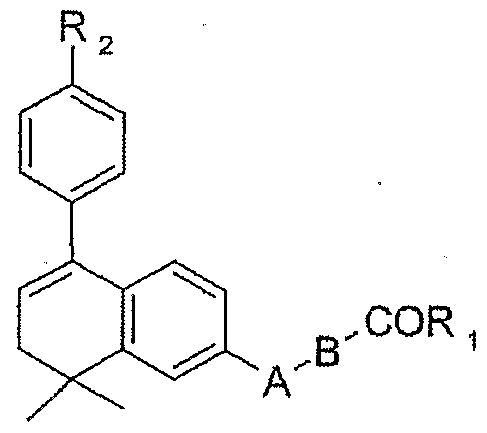
The invention relates to novel compounds corresponding to formula (I) below: and to the method for preparing them, and to their use in pharmaceutical compositions intended for use in human or veterinary medicine, or alternatively in cosmetic compositions.

Description

Novel ligands that are antagonists of RAR receptors , process for preparing them and use thereof in human medicine and in cosmetics
The invention relates to novel compounds as novel and useful industrial products. The invention also relates to the process for preparing them and to their use in pharmaceutical compositions for use in human or veterinary medicine, or alternatively in cosmetic compositions. Compounds with activity of retinoid type
(vitamin A and its derivatives) are widely described in the literature as having activity in cell proliferation and differentiation processes. These properties give this class of compounds high potential in the treatment or prevention of numerous pathologies, and more particularly in dermatology and cancer. Many biological effects of retinoids are mediated by modulating the nuclear retinoic acid receptors (RAR) .
The RAR receptors activate transcription by binding to DNA sequence elements, known as RAR response elements (RARE) , in the form of a heterodimer with the retinoid X receptors (known as RXRs) .
Three subtypes of human RARs have been identified and described: RARα, RARβ and RARγ. The prior art contains a large number of chemical compounds with inhibitory activity on receptors of RAR type. Among the prior art documents that may be mentioned, for example, are patent US 6 150 413, which describes triaromatic compounds, patent US 6 214 878, which describes stilbene compounds, and patent US 6 218 128, which describes a family of bicyclic or tricyclic molecules.
The Applicant has invented novel compounds that are antagonists of the retinoic acid receptors.
Thus, the present invention relates to compounds corresponding to formula (I) below:
Figure imgf000003_0001
(I)
in which:
- A represents a CH2, CHOH, C=0 or C=N-OH radical or a sulphur or selenium atom;
- B is chosen from formulae (a) to (f) :
Figure imgf000003_0002
(d) (e) (f)
Ar being defined below,
- Ar is chosen from formulae (g) to (i) :
Figure imgf000004_0001
R3 being defined below,
- Rx represents a radical -OH, -OR, -NHR5 or NR5R6; R , R5 and Rε being defined below, - R2 represents a hydrogen, fluorine, chlorine or bromine atom, a linear or branched alkyl radical of 1 to 5 carbon atoms, a CF3, 0R7, SR7, NHR8, NR8R9, 2-naphthyl, 2-pyridyl, 3-pyridyl, 4-pyridyl, 2-thio- phenyl, CH2ORι0 or CH2NRnRι2 radical or a phenyl radical which is unsubstituted or substituted with at least one fluorine atom or a methyl, ethyl, isopropyl, tert-butyl or CF3 radical;
R , R8, Rg, Rio, R11 and Rι2 being defined below,
- R3 represents a hydrogen, fluorine or chlorine atom or a radical OH, OR13, CF3 or NR14R15;
Ri3c 14 and R15 being defined below,
- R4 represents a linear or branched alkyl radical of 1 to 4 carbon atoms;
- R5 represents a hydrogen atom, an OH group or a linear or branched alkyl radical of 1 to 4 carbon atoms;
- Rδ represents a linear or branched alkyl radical of 1 to 4 carbon atoms;
- R represents a hydrogen atom, a linear or branched alkyl of 1 to 6 carbon atoms, a radical CH2OR16 or a benzyl radical which is unsubstituted or substituted with at least one halogen atom, preferably an fluorine atom, methyl, ethyl, isopropyl, tert-butyl or CF3 radical; R16 being defined below,
- R8, Rg, R11, Rι2, Ri4 and Ri5, which may be identical or different, represent a hydrogen atom, a linear or branched alkyl ■ radical of 1 to 4 carbon atoms, (C=0)-Rι7 or (C=0)-OR17; Rι7 being defined below,
- Rio represents a linear or branched alkyl radical of 1 to 4 carbon atoms or a benzyl or phenyl radical optionally substituted by one halogen atom, preferably one fluorine atom, or one alkyl radical of 1 to 3 carbon atoms;
- Ri3 represents a methyl, ethyl or acetyl ' radical;
- Ri6 represents a methyl, ethyl or CH2CH2OCH3 radical;
- Rι represents a hydrogen atom, a linear or branched alkyl radical of 1 to 4 carbon atoms; and the stereoisomers and optical or geometrical isomers, pure or in mixture in all proportions, the salts obtained with a pharmaceutically acceptable acid or base, and also mixtures of the said compounds of formula (I) , with the exception of the following combination:
- A represents a C=0 radical and - B corresponds to formula (d)
Figure imgf000006_0001
It will be understood that the invention embraces optical isomers of the compounds of formula (I) as well as mixtures thereof including racemic mixtures. The invention also embraces stereoisomers of the compounds of formula (I) including mixtures thereof.
When the compounds according to the invention are in the form of a salt, it is preferably an alkali metal or alkaline-earth metal salt, or alternatively a zinc salt or salts of an organic amine .
According to the present invention:
The term "alkyl radical containing from 1 to 4 carbon atoms" preferably means methyl, ethyl, propyl, isopropyl, butyl, tert-butyl or isobutyl.
The term "alkyl radical containing from 1 to
5 carbon atoms" preferably means methyl, ethyl, n-propyl, isopropyl, n-butyl, tert-butyl, isobutyl, n-pentyl or 2, 2-dimethylpropyl.
The term "alkyl radical containing from 1 to
6 carbon atoms" preferably means methyl, ethyl, n-propyl, isopropyl, n-butyl, tert-butyl, isobutyl, n- pentyl, 2, 2-dimethylpropyl or n-hexyl radicals. In one preferred embodiment, the compounds of formula (I) are those wherein A represents a CHOH or C=0 radical or a selenium atom, the others substituants remaining as previously defined.
In another preferred embodiment, the compounds of formula (I) are those wherein Rx represents a radical -OH, the others substituants remaining as previously defined.
In another preferred embodiment, the compounds of formula (I) are those in wherein R2 represents a linear or branched alkyl radical of 1 to 5 carbon atoms, a OR7, or NR8R9 radical, the others substituants remaining as previously defined.
Among the compounds corresponding to formula (I) above, mention, may be made of the following, alone or as a mixture:
1. 4- (8, 8-dimethyl-5-p-tolyl-7, 8-dihydro-2-naphthyl- selanylethynyl) benzoic acid
2. 5- (8, 8-dimethyl-5-p-tolyl-7, 8-dihydro-2-naphthyl- selanyl) -3-methylpent-2-en-4-ynoic acid 3. 4-[5-(4-tert-butylphenyl)-8, 8-dimethyl-7 , 8- dihydro-2-naphthylselanylethynyl] benzoic acid 4. 5-[5-(4-tert-butylphenyl)-8, 8-dimethyl-7 , 8- dihydro-2-naphthylselanyl] -3-methylpent-2-en-4-ynoic acid 5. 4- (8,8-dimethyl-5-p-tolyl-7,8-dihydro-2-naphthyl- selanylethynyl) -2-methoxybenzoic acid 6. 4- (8, 8-dimethyl-5-p-tolyl-7, 8-dihydro-2-naphthyl- selanylethynyl) -2-hydroxybenzoic acid
7. 4-[5-(4-methoxyphenyl)-8,8-dimethyl-7,8-dihydro-2- naphthylselanylethynyl] benzoic acid
8. 6- (8, 8-dimethyl-5-p-tolyl-7, 8-dihydro-2-naphthyl- selanylethynyl) nicόtinic acid
9. 4- (8, 8-dimethyl-5-p-tolyl-7, 8-dihydro-2-naphthyl- selanylethynyl) -2-fluorobenzoic acid
10. (E) -3- [4- (8, 8-dimethyl-5-p-tolyl-7, 8-dihydro-2- naphthylselanyl) phenyl] acrylic acid 11. (Z)-3-[3-(8,8-dimethyl-5-p-tolyl-7,8-dihydro-2- naphthylselanyl) phenyl] acrylic acid
12. 3-{4- [5- (4-tert-butylphenyl) -8, 8-dimethyl-7, 8- dihydro-2-naphthylselanyl] phenyl } acrylic acid
13. 3-{3- [5- (4-tert-butylphenyl) -8, 8-dimethyl-7, 8- dihydro-2-naphthylselanyl] phenyl} acrylic acid
14. 6- (8, 8-dimethyl-5-p-tolyl-7, 8-dihydro-2-naphthyl- selanyl) naphthalene-2-carboxylic acid
15. 4- [ 3- ( 8 , 8-dimethyl-5-p-tolyl-7 , 8-dihydro-2- naphthyl) -3-hydroxyprop-l-ynyl] benzoic acid 16. 4-[3-'(8,8-dimethyl-5-p-tolyl-7, 8-dihydro-2- naphthyl) -3-hydroxyprop-l-ynyl] -2-hydroxybenzoic acid
17. 4-{ 3- [5- (4-ethoxymethoxyphenyl) -8, 8-dimethyl-7, 8- dihydro-2-naphthyl] -3-hydroxyprop-l-ynyl }benzoic acid
18. 4-{3- [5- (4-benzyloxyphenyl) -8, 8-dimethyl-7 , 8- dihydro-2-naphthyl] -3-hydroxyprop-l-ynyl }benzoic acid
19. 4-{ 3- [5- (4-dimethylaminophenyl) -8, 8-dimethyl-7, 8- dihydro-2-naphthyl] -3-hydroxyprop-l-ynyl }benzoic acid 20. 4-[3- (8, 8-dimethyl-5-p-tolyl-7, 8-dihydro-2- naphthyl) -3-oxoprop-l-ynyl] benzoic acid
21. 4- [3- (8, 8-dimethyl-5-p-tolyl-7,8-dihydro-2- naphthyl) -3-hydroxypropenyl] benzoic acid 22. 6-[ (8,8-dimethyl-5-p-tolyl-7,8-dihydro-2- naphthyl) hydroxymethyl] naphthalene-2-carboxylic acid
23. 6-(8,8-dimethyl-5-p-tolyl-7, 8-dihydro-2- naphthylcarbonyl) naphthalene-2-carboxylic acid
24. 4-[2-(8,8-dimethyl-5-p-tolyl-7,8-dihydro-2- naphthyl) -2-oxoacetylamino] benzoic acid
25. 4- [2- (8,8-dimethyl-5-p-tolyl-7,8-dihydro-2- naphthyl) -2-hydroxya.cetylamino] benzoic acid
26. ethyl 4- [3- (8, 8-dimethyl-5-p-tolyl-7, 8-dihydro-2- naphthyl) -3-hydroxyprop-l-ynyl] benzoate 27. isobutyl 4- [3- (8, 8-dimethyl-5-p-tolyl-7, 8-dihydro- 2-naphthyl ) -3-hydroxyprop-l-ynyl ] benzoate
28. 4- [3- (8, 8-dimethyl-5-p-tolyl-7, 8-dihydro-2- naphthyl) -3-hydroxyprop-l-ynyl] -N-hydroxybenzamide
29. 4- [3- ( 8 , 8-dimethyl-5-p-tolyl-7 , 8-dihydro-2- naphthyl) -3-hydroxyprop-l-ynyl] -N, N-dimethylbenzamide
30. 4- [3- (8, 8-dimethyl-5-p-tolyl-7, 8-dihydro-2- naphthyl) -3-hydroxyprop-l-ynyl] -N-methylbenzamide
31. 4- [3- (8, 8-dimethyl-5-p-tolyl-7, 8-dihydro-2- naphthyl) -3-hydroxyprop-l-ynyl] -N-isobutylbenzamide 32. 4-[3-(8,8-dimethyl-5-p-tolyl-7,8-dihydro-2- naphthyl) -3-hydroxyprop-l-ynyl] -N-isobutyl-N- methylbenzamide 33. isobutyl 4- (8, 8-dimethyl-5-p-tolyl-7 , 8-dihydro-2- naphthylselanylethynyl) benzoate
34. 4- ( 5-biphenyl-4-yl-8 , 8-dimethyl-7 , 8-dihydro-2- naphthylselanylethynyl) benzoic acid
■5 35. 4-[3-(5-biphenyl-4-yl-8,8-dimethyl-7,8-dihydro-2- naphthyl) -3-hydroxyprop-l-ynyl] benzoic acid
36. 4-{3-[8,8-dimethyl-5-(4-pyrid-2-ylphenyl)-7, 8- dihydro-2-naphthyl] -3-hydroxyprop-l-ynyl Jbenzoic acid
37. 4- [8, 8-dimethyl-5- (4-pyrid-2-ylphenyl) -7,8- i
10 dihydro-2-naphthylselanylethynyl] benzoic acid
38. 4- [8, 8-dimethyl-5- (4-thiophen-2-ylphenyl) -7, 8- dihydro-2-naphthylselanylethynyl] benzoic acid
39. 4-{ 3-hydroxy-3- [5- (4-methoxymethylphenyl) -8,8- dimethyl-7 , 8-dihydro-2-naphthyl] prop-1-ynyl }benzoic
15 acid
40. 4- [5- (4-methoxymethylphenyl) -8, 8-dimethyl-7, 8- dihydro-2-naphthylselanylethynyl] benzoic acid
41. 4- [8, 8-dimethyl-5- (4-phenoxymethylphenyl) -7, 8- dihydro-2-naphthylselanylethynyl] benzoic acid
20 42. 4-{3- [8, 8-dimethyl-5- (4-phenoxymethylphenyl) -7,8- dihydro-2-naphthyl] -3-hydroxyprop-l-ynyl }benzoic acid 43. 4-(3-{5-[4- (4-fluorophenoxymethyl) phenyl] -8,8- dimethyl-7 , 8-dihydro-2-naphthyl } -3-hydroxyprop-l- ynyl) benzoic acid
25 44. 4-{5- [4- (4-fluorophenoxymethyl) phenyl] -8, 8- dimethyl-7, 8-dihydro-2-naphthylselanylethynyl}benzoic acid 45. 4- [5- (4-dimethylaminomethylphenyl) -8, 8-dimethyl- 7, 8-dihydro-2-naphthylselanylethynyl] benzoic acid
46. 4-{3-[5- (4-dimethylaminomethylphenyl) -8,8- dimethyl-7, 8-dihydro-2-naphthyl] -3-hydroxyprop-l-ynyl }- benzoic acid
47. 4-[3-(5-{4-[ (acetylmethylamino) methyl] phenyl} -8, 8- dimethyl-7, 8-dihydro-2-naphthyl) -3-hydroxyprop-l-ynyl] - benzoic acid
48. 4-(5-{4-[ (acetylmethylamino.) methyl] phenyl}-8, 8- dimethyl-7, 8-dihydro-2-naphthylselanylethynyl) enzoic
• acid
49. 4-[5-(4-acetylaminophenyl)-8,8-dimethyl-7, 8- dihydro-2-naphthylselanylethynyl] benzoic acid
50. 4-{ 3- [5- (4-tert-butoxycarbonylaminophenyl) -8,8- ■ dimethyl-7, 8-dihydro-2-naphthyl] -3-hydroxyprop-l-ynyl }- benzoic acid
51. 4- (3-{ 5- [4- (tert-butoxycarbonylmethylamino) - phenyl] -8, 8-dimethyl-7 , 8-dihydro-2-naphthyl } -3-hydroxyprop-l-ynyl) benzoic acid ' 52. 4-{5- [4- (tert-butoxycarbonylmethylamino) phenyl] - 8, 8-dimethyl-7, 8-dihydro-2-naphthylselanylethynyl }- benzoic acid
53. 4- [5- (4-tert-butoxycarbonylaminophenyl) -8,8- dimethyl-7, 8-dihydro-2-naphthylselanylethynyl] benzoic acid
54. 4-{5- [4- ( 4-fluorobenzyloxy) phenyl] -8, 8-dimethyl- 7 , 8-dihydro-2-naphthylselanylethynyl }benzoic acid 55. 4- (3-{5- [4- (4-fluorobenzyloxy) phenyl] -8, 8- dimethyl-7 , 8-dihydro-2-naphthyl } -3-hydroxyprop-l- ynyl) benzoic acid
56. 4- {3- [5- (4-benzylsulphanylphenyl) -8, 8-dimethyl- 7 , 8-dihydro-2-naphthyl] -3-hydroxyprop-l-ynyl }benzoic acid
57. 4- [5- (4-benzylsulphanylphenyl) -8, 8-dimethyl-7, 8- dihydro-2-naphthylselanylethynyl] benzoic acid
58. 4-{3-hydroxy-3-[5- (4-thiophen-2-ylphenyl) -8,8- dimethyl-7 , 8-dihydro-2-naphthyl] prop-1-ynyl }benzoic acid
59. 4- { 3- [5- (4-acetylaminophenyl) -8, 8-dimethyl-7, 8- dihydro-2-naphthyl] -3-hydroxyprop-l-ynyl }benzoic acid
60. (S) -4- [3- (8, 8-dimethyl-5-p-tolyl-7, 8-dihydro-2- naphthyl) -3-hydroxyprop-l-ynyl] benzoic acid
61. (R) -4- [3- (8 , 8-dimethyl-5-p-tolyl-7 , 8-dihydro-2- naphthyl) -3-hydroxyprop-l-ynyl] benzoic acid.
A subject of the present invention is also processes for preparing the compounds of formula (I) , in particular according to the reaction schemes given in Figure 1.
It will be understood that the compounds of formula .(I) can be prepared from known compounds by the application or adaptation of known methods. 6-Bromo-4, 4-dimethyltetralone 1 is obtained by electrophilic cyclization of 4- (4-bromophenyl) -2- methylpentanol followed by oxidation of the benzylic position. The addition of an organometallic reagent, for example an arylmagnesium halide, followed by a dehydration reaction, gives the compounds of general structure 2. The formation of a lithiated reagent or of a Grignard reagent gives access to the products of general formula 3, by trapping the anion with sulphur or selenium (R = S or Se) , dimethylformamide (R = CHO) or carbon dioxide (R = COOH) .
The compounds of structure 4 are then obtained, from the corresponding disulphides or diselenides 3, by reduction to sulphide or selenide, for example using sodium borohydride, followed by coupling with an aryl iodide corresponding to the acid portion, in the presence of bis (bipyridyl) nickel dibromide, followed by saponification of the esters obtained. The compounds of structure 5 are obtained after bromination of the disulphide or diselenide function, followed by addition of a true alkyne function in the presence of copper iodide. The esters obtained are then saponified.
The compounds of structure 6 are obtained by nucleophilic addition of a cyanide ion or of an ethynyl ion to the aldehyde function of 3, followed by formation of an amide bond (P-Q= (C=0) -NH) or alternatively by Sonogashira coupling with a corresponding aryl halide (P-Q = alkyne) . The compounds of structure 7 may then be obtained by deoxygenation, for example with triethylsilyl hydride, and the compounds of formula 8 by oxidation of the alcohol function to a carbonyl, for example using manganese oxide. The methyl ketones of the type 9 may be obtained after reacting the carboxylic acids 3 with methyllithium. The chalcones of general structure 10 may then be produced after reacting the compounds of type 9 with corresponding benzaldehydes in the presence of strong bases', for instance potassium hydroxide. The reduction of the carbonyl group then gives access to the compounds of structure 11 (U = OH) , and deoxyg'enation of these compounds can lead to compounds of the type 11 (U = H) . The compounds of general structure 12 may be obtained after generating an organometallic reagent, for example an organozinc reagent, from the aryl bromides of structure 2, and nucleophilic attack on a corresponding acid chloride. Reduction of the carbonyl group then gives access to the compounds of structure 13 (U = OH) , and deoxygenation of these compounds can lead to compounds of the type 13 (U = H) .
The compounds according to the invention have inhibitory properties on RAR-type receptors. This RAR- receptor inhibitory activity is measured in a test of transactivation by means of the dissociation constant Kdapp (apparent) and the IC50 (concentration that inhibits 50% of the reference agonist activity) .
According to the invention, the expXession "inhibitor of RAR-type receptors" means any compound which, for at least one of the RAR subtypes, has a dissociation constant Kdapp of less than or equal' to 1 μM, and an IC5o value < 100 nM, in a transactivation test as described in Example 26.
The preferred compounds of the present invention have, for at least one of the RAR subtypes, a dissociation constant Kdapp of less than or equal to 500 nM and advantageously less than or equal to 100 nM, and an IC50 < 25 nM.
• A subject of the present invention is also the compounds of formula (I) as described above, as medicinal products.
The compounds according to the invention are particularly suitable in the following fields of treatment:. 1) for treating dermatological complaints associated with a keratinization disorder relating to cell differentiation and proliferation, especially for treating common acne, comedones, polymorphs, acne rosacea, nodulocystic acne, acne conglobata, senile acne, and secondary acnes such as solar acne, medication-related acne or occupational acne; 2) for treating other types of keratinization disorders, especially ichthyosis, ichthyosiform conditions, Darier's disease, palmoplantar keratoderma, leukoplakia and leukoplakiform conditions, and cutaneous or mucous (buccal) lichen;
3) for treating other dermatological complaints with an inflammatory immunoallergic component, with or without cell proliferation disorder, and especially all 'forms of psoriasis, whether cutaneous, mucous or ungual, and even psoriatic rheumatism, or cutaneous atopy, such as eczema, or respiratory atopy, or alternatively gingival hypertrophy;
4) for treating all dermal or epidermal proliferations, whether benign or malignant, and whether of viral origin or otherwise, such as common warts, flat warts and verruciform epidermodysplasia, oral or florid papillomatoses, T lymphoma, and proliferations that may be induced by ultraviolet radiation, especially in the ca.se of, basocellular and spinocellular epithelioma, and also any cutaneous precancerous lesion such as keratoacanthomas;
5) for treating other dermatological disorders such as immune dermatoses, such as lupus erythematosus, immune bullous diseases and collagen diseases, such as scleroderma;
6) in the treatment of dermatological or general complaints with an immunological component; 7) for treating certain ophthalmological disorders, especially corneopathies,
8) for preventing or curing the stigmata of epidermal and/or dermal atrophy induced by local or systemic corticosteroids, or any other form of cutaneous atrophy,
9) in the treatment of any cutaneous or general complaint of viral origin,
10) in the treatment of skin disorders caused by exposure to UV radiation, and also for repairing or combating ageing of the skin, whether photoinduced or chronological ageing, or for reducing pigmentations and actinic keratosis, or any pathology associated with chronological or actinic ageing, such as xerosis; 11) for combating sebaceous function disorders, such as the hyperseborrhoea of acne or simple seborrhoea; 12) for preventing or treating cicatrization disorders, or for preventing or repairing stretch marks, or alternatively for promoting cicatrization; 13) in the treatment of pigmentation disorders, such as hyperpigmentation, melasma, hypopigmentation or vitiligo;
14) in the treatment of lipid metabolism complaints, such as obesity, hyperlipidaemia, or non-insulin- dependent diabetes;
15) in the treatment of inflammatory complaints such as arthritis; 16) in the treatment or prevention of cancerous or precancerous conditions;
17) in the prevention or treatment of alopecia of various origins, especially alopecia caused by chemotherapy or radiation;
18) in the treatment of disorders of the immune system, such as asthma, type I sugar diabetes, multiple sclerosis or other selective dysfunctions of the immune system; and 19) in the treatment of complaints of the cardiovascular system, such as arteriosclerosis or hypertension.
A subject of the present invention is also a pharmaceutical composition comprising, in a physiologically acceptable medium, at least one compound of formula (I) as defined above.
A subject of the present invention is also a novel medicinal composition intended especially for treating the abovementioned complaints, which is characterized in that it comprises, in a pharmaceutically acceptable support that is compatible with the mode of administration selected for this composition, at least one compound of formula (I), an optical isomer thereof or a salt thereof. The composition according to the invention may be administered orally, enterally, parenterally, topically or ocularly. The pharmaceutical composition is preferably packaged in a form that is suitable for topical or oral application.
Via the oral route, the composition may be in the form of tablets, gel capsules, dragees, syrups, suspensions, solutions, powders, granules, emulsions, suspensions of microspheres or nanospheres or lipid or polymer vesicles allowing a controlled release. Via the parenteral route, the composition may be in the form of solutions or suspensions for infusion or for injection. The compounds according to the invention ' are generally administered at a daily dose of about 0.01 mg/kg to 100 mg/kg of body weight, in 1 to 3 dosage intakes .
The compounds are used systemically, at a concentration generally of between 0.001% and 10% by weight and preferably between 0.01% and 1% by weight relative to the weight of the composition.
Via the topical route, the pharmaceutical composition according to the invention is more particularly intended for treating the skin and mucous membranes and may be in' liquid, -pasty or solid form, and more particularly in the form of ointments, creams, milks, pomades, powders, impregnated pads, syndets, solutions, gels, sprays, mousses, suspensions, sticks, shampoos or washing bases. It may also be in the form of suspensions of microspheres or nanospheres or of lipid or polymer vesicles or gelled or polymer patches allowing a controlled release.
The compounds are used topically at a concentration generally of between 0.001% and 10% by weight and preferably between 0.01% and 1% by weight, relative to the total weight of the composition.
The compounds of formula (I) according to the invention also find an application in cosmetics, in particular in body and hair hygiene .and especially for treating acne-prone skin, for promoting regrowth of the hair or for limiting hair loss, for combating the greasy appearance of the skin or the hair, in protection against the harmful aspects of sunlight or in the treatment of physiologically dry skin, and for preventing and/or combating photoinduced or chronological ageing.
A subject of the invention is thus also a composition comprising, in a cosmetically acceptable support, at least one of the compounds of formula (I) . A subject of the invention is also the cosmetic use of a composition comprising at least one compound of formula (I) for preventing and/or treating the signs of ageing and/or dry skin.
A subject of the invention is also the cosmetic use of a composition comprising at least one compound of formula (I) for body or hair hygiene. The cosmetic composition according to the invention containing, in a cosmetically acceptable support, at least one compound of formula (I) or an optical or geometrical isomer thereof or a salt thereof, may be especially in the form of a cream, a milk, a gel, suspensions of microspheres or nanospheres or lipid or polymer vesicles, impregnated pads, solutions, sprays, mousses, sticks, soaps, shampoos or washing bases. The concentration of compound of formula (I) in the cosmetic composition is preferably between 0.001% and 3% by weight relative to the total weight of the composition.
The pharmaceutical and cosmetic compositions as described above may also contain inert additives, or even pharmacodynamically active additives as regards the pharmaceutical compositions, or combinations of these additives, and especially:
- wetting agents; - flavour enhancers;
- preserving agents such as para-hydroxybenzoic acid esters;
- stabilizers;
- moisture regulators; - pH regulators;
- osmotic pressure modifiers;
- emulsifiers; - UV-A and UV-B screening agents;
- antioxidants such as α-tocopherol, butylhydroxyanisole, butylhydroxytoluene, superoxide dismutase, ubiquinol or certain metal-chelating agents;
- depigmenting agents such as hydroquinone, azelaic acid, caffeic acid or kojic acid;
- emollients;
- moisturizers, for instance glycerol, PEG 400, thiamorpholinone and its derivatives or urea;
- antiseborrhoeic or antiacne agents, such as S-carboxymethylcysteine, S-benzylcysteamine, salts thereof or derivatives thereof, or benzoyl peroxide;
- antibiotics, for instance erythromycin and its esters, neomycin, clindamycin and its esters, and tetracyclines ;
- antifungal agents such as ketoconazole or poly-4,5- methylene-3-isothiazolidones ;
- agents for promoting regrowth of the hair, for instance Minoxidil (2, 4-diamino-6-piperidino- pyrimidine 3-oxide) and its derivatives, Diazoxide (7-chloro 3-methyl-l, 2 , -benzothiadiazine 1,1-dioxide) and Phenytoin (5, -diphenyl- imidazolidine-2, 4-dione) ; - non-steroidal anti-inflammatory agents;
- carotenoids and especially β-carotene;
- anti-psoriatic agents such as anthralin and its derivatives;
- eicosa-5, 8, 11, 14-tetraynoic acid and eicosa-5, 8 , 11- triynoic acid, and esters and amides thereof;
- retiήoids, i.e. natural or synthetic RXR receptor ligands;
- corticosteroids or oestrogens;
- α-hydroxy acids and α-keto acids or derivatives thereof, such as lactic acid, malic acid, citric acid, glycolic acid, mandelic acid, tartaric acid, glyceric acid or ascorbic acid, and also salts, amides or esters thereof, or β-hydroxy acids or derivatives thereof, such as salicylic acid and its salts, amides' or esters;
- ion-channel blockers such as potassium-channel blockers;
- or alternatively, more particularly for pharmaceutical compositions, in combination with medicinal products known to interfere with the immune system (for example cyclosporin, FK 506, glucocorticoids, monoclonal antibodies, cytokines or growth factors, etc.).
Needless to. say, a person skilled in the art will take care to select the optional compound (s) to be added to these compositions such that the advantageous properties intrinsically attached to the present invention are not, or are not substantially, adversely affected by the envisaged addition. Several examples of the production of active compounds of formula (I) according to the invention, biological activity results and also various concrete formulations based on such compounds, will now be given, for illustrative purposes and with no limiting nature.
EXAMPLE 1: 4- (8 , 8-Dimethyl-5-p-tolyl-7 , 8-dihydro-2- naphthylselanylethynyl)benzoic acid a. Methyl 4-ethynylbenzoa te ' 3.3 g (14.5 mmol) of methyl 4-iodobenzoate and 4.1 ml (29 mmol) of trimethylsilylacetylene are dissolved in 20 ml of triethylamine, and 1 g (1.4 mmol) of trai-s-dichlorobis (triphenylphosphine) palladium and 0.55 g (2.8 mmol) of copper iodide are then added. The reaction medium is stirred for 24 hours, filtered through Celite and rinsed with ethyl acetate. The brown oil obtained (2.8 g; yield = 96%) is dissolved in 30 ml of methanol and 6.6 g (48 mmol) of potassium carbonate are added. The medium is stirred for 48 hours and then concentrated to dryness. The residue obtained is purified by chromatography (eluent: 8/2 heptane/ dichloromethane) . An orange oil is obtained (1.8 g; yield = 91%) . b. 7-Bromo-l r 1 -dimethyl-l , 2f 3f 4-tetrahydronaphthalene 21.5 g (84 mmol) of 2-methyl-5- (4-bromo- phenyl) -2-pentanol are dissolved in 42 g of polyphosphoric acid. The reaction medium is heated at 60 °C for 9 hours and then hydrolysed and then extracted with ethyl acetate. The organic phase is treated with saturated sodium carbonate solution and then with sodium chloride solution. The residue obtained is purified by chromatography (eluent: 9/1 heptane/ethyl acetate). A viscous red oil is obtained (19.2 g; yield = 77%) . c. 6-Bromo-4 , 4-dimethyl-3 , 4-dihydxo-2H-naphthalen-l-one
A solution of 8.1 g (81 mmol) of chromium trioxide in 74 ml of acetic acid and 3.9 ml of water is added slowly to 14.3 g (60 mmol) of 7-bromo-l, 1- dimethyl-1, 2, 3, 4-tetrahydronaphthalene dissolved in 1.5 1 of acetic acid. The reaction medium is stirred for 15 hours, reduced to a volume of 500 ml by concentration, hydrolysed with ice, extracted with ethyl ether and neutralized with 35% sodium hydroxide solution. The solid obtained is washed with heptane. A pink-white powder is obtained (8 g; 53%) . d. 7-Bromo-l- , l-dimethyl-4-para-tolyl-l , 2-dihydro- naphthalene
5 g (20 mmol) of 6-bromo-4 , 4-dimethyl-3, 4- dihydro-2H-naphthalen-l-one and 5.1 g (20 mmol) of magnesium bromide diethyl etherate are dissolved in 130 ml of tetrahydrofuran. The reaction medium is refluxed until the precipitate has disappeared, and
30 ml (30 mmol) of a IM solution of para-tolylmagnesium bromide in ethyl ether are then added dropwise. The reaction medium is refluxed for 4 hours, hydrolysed with IN hydrochloric acid solution and then extracted with ethyl ether. The brownish paste obtained is dissolved in 65 ml of toluene, and 0.14 g (0.73 mmol) of para-toluenesulphonic acid is then added. The reaction medium is refluxed for 45 minutes and then hydrolysed and extracted with ethyl ether. The residue obtained is purified by chromatography (eluent: 7/3 heptane/dichloromethane) . A brown oil is obtained (3.2 g; yield = 50%) . e. Bis (8 , 8-dimethyl-5-para-tolyl-7 , 8-dihydro-2- naphthalene) diselenide
1.5 g (4.9 mmol) of 7-bromo-l, l-dimethyl-4- para-tolyl-1, 2-dihydronaphthalene are dissolved in 30 ml of tetrahydrofuran at -78°C. 6.9 ml (11.6 mmol) of a 1.7M solution of tert-butyllithium are added dropwise. The reaction medium is stirred for 30 minutes while allowing the temperature to rise to 0°C. 0.42 g (5.3 mmol) of selenium is added portionwise. The reaction medium is stirred for 15 minutes at 0°C and then for 30 minutes while allowing the temperature to rise to room temperature. 6 ml of IN hydrochloric acid are added and the medium is then extracted with ethyl ether. The residue obtained is purified by chromatography (eluent: 95/5 heptane/dichloromethane). A yellow solid is obtained (0.8 g; yield = 50%). f. Methyl 4- (8 , 8-dimethyl -5-p-tolyl - 7 r 8-dihydro-2- naphthylselanylethynyl) benzoa te
0.785 g (1.2 mmol) of bis (8 , 8-dimethyl-5-p- tolyl-7, 8-dihydro-2-naphthalene) diselenide is dissolved in 8 ml of tetrahydrofuran and 1.2 ml (1.2 mmol) of a IM solution of dibromine in tetrahydrofuran are then added dropwise at -78 °C. 15 minutes later, 1.4 g (7.3 mmol) of copper iodide and 17 ml of dimethylformamide are added. The reaction medium is stirred for 20 minutes while allowing the temperature to rise to 20°C. 0.32 g (2 mmol) of methyl 4-ethynylbenzoate (described in Example la) is added portionwise. The reaction medium is stirred for 24. hours, treated with ammonium chloride solution and extracted with ethyl acetate. The residue obtained is purified by chromatography (eluent: 8/2 heptane/ dichloromethane) . A yellow solid is obtained (0.46 g; yield = 47%) . g. 4- (8 r 8-Dimethyl -5-p-tolyl- 7 , 8 ~dihydro-2 -naphthylselanylethynyl) benzoic acid 0.46 g (0.95 mmol) of methyl 4- (8 , 8-dimethyl-
5-p-tolyl-7 , 8-dihydro-2-naphthylselanylethynyl) benzoate is dissolved in 20 ml of tetrahydrofuran, 2 ml of ethanol and 1 ml of water, and 0.46 g (11 mmol) of lithium hydroxide onohydrate is then added. The reaction medium is refluxed for 15 hours, acidified with 2N hydrochloric acid solution and then extracted with ethyl acetate. The solid obtained is washed with a heptane/ethyl ether mixture (90/10) and then purified by chromatography (eluent: dichloromethane) . An off- white powder is obtained (0.2 g; yield = 45%). XH NMR (CDC13) 1.35 (s, 6H) ; 2.35 (d, 2H, 7.6 Hz); 2.39 (s, 3H) ; 5.97 (t, 1H, 7.6 Hz); 7.02 (d, 1H, 13.2 Hz); 7.34-7.17 (M, 5H) ; 7.57-7.51 (M, 3H) ; 8.06 (d, 2H, 16 Hz) .
EXAMPLE 2 : 5- (8 , 8-Dimethyl-5-p-tolyl-7 , 8-dihydro-2- naphthylselanyl) -3-methylpent-2-en-4-ynoic acid a . Methyl 3-methylpent-2-en-4-ynoate
0.67 g (3 mmol) of palladium diacetate and 1.3 g (3 mmol) of tris (2, 6-dimethoxyphenyl) phosphine are dissolved in 300 ml of tetrahydrofuran. The reaction medium is' stirred for 40 minutes and 11.4 g (102 mmol) of ethyl butynoate are then added dropwise. After 30 minutes, 11 g (112 mmol) of (trimethylsilyl) - acetylene are added and the medium is then stirred for 15 hours and concentrated to dryness. The residue obtained is purified by chromatography (eluent: 7/3 heptane/dichloromethane) . The orange-coloured liquid obtained (22.4 g; yield = 100%) is dissolved in 200 ml of ethanol, 200 ml of tetrahydrofuran and 20 ml of water. 11.9 g (204 mmol) of potassium fluoride are added portionwise and the medium is then stirred for 15 hours, treated with ammonium chloride solution and extracted with ethyl ether. The residue obtained is purified by chromatography (eluent: 7/3 pentane/ . dichloromethane) . A yellow liquid is obtained (10.4 g; yield = 74%) . b. Methyl 5- (8 r 8-dimethyl-5-p-tolyl-7 r 8-dihydro-2- naphthylselanyl) -3-methylpent-2-en-4-ynoate In a manner similar to that of Example If, by reacting 0.3 g (0.46 mmol) of bis (8 , 8-dimethyl-5-p- tolyl-7, 8-dihydro-2-naphthalene) diselenide with 0.46 ml (0.46 mmol) of a IM solution of dibromine in tetrahydrofuran, 0.7 g (3.7 mmol) of copper iodide, 7.5 ml of dimethylformamide and 0.13 g (0.92 mmol) ,of methyl 3-methylpent-2-en-4-ynoate (described above) . A yellow oil is obtained (0.24 g; yield = 55%) . c. 5- (8 , 8-Dimethyl-5-p~tolyl-7 , 8-dihydro-2-naphthyl- selanyl) -3-methylpent-2-en-4-ynoic acid In a manner similar to that of Example lg, by reacting 0.23 g (0.5 mmol) of methyl 5- (8, 8-dimethyl-5- p-tolyl-7, 8-dihydro-2-naphthylselanyl) -3-methylpent-2- en-4-ynoate with 0.23 g (5.5 mmol) of lithium hydroxide monohydrate. A pale yellow solid is obtained (0.05 g; yield = 23%; .p. = 166°C) .
1R NMR (DMSO) 1.20 (s, 6H) ; 2.18 (s, 3H) ; 2.24 (s, 3H) ; 5.87 (s, 1H) ; 5.91 (s, 1H) ; 6.82 (d, 1H, 13.2 Hz); 7.14-7.06 (M, 4H) ; 7.26 (d, 1H, 12.8 Hz); 7.50 (s, 1H) ; 12.4 (s, 1H) . EXAMPLE 3 : 4- [5- (4-tert-Butylphenyl) -8 , 8-dimethyl-7 , 8- dihydro-2-naphthylselanylethynyl]benzoic acid a . 7--3roiΩθ-4- (4-tert-butylphenyl) -1 , 1 -dimethyl -l , 2- dihydronaph thalene
In a manner similar to that of Example Id, by reacting 3.4 g (13.6 mmol) of 6-bromo-4, 4-dimethyl-3, 4- dihydro-2H-naphthalen-l-one with 3.5 g (13.6 mmol) of magnesium bromide diethyl etherate, 10.2 ml (20.4 mmol) of a 2M solution of 4- tert-butylphenylmagnesium bromide in ethyl ether and 96 mg (0.5 mmol) of para-toluene- sulphonic acid. A brown solid is obtained (3.5 g; 70%). b . Bis [5- (4-tert-butylphenyl) -8 r 8 -dime thy 1-7 ' , 8-dihydro- 2 -naphthalene] diselenide
In a manner similar to that of Example le, by reacting 2 g (5.4 mmol) of 7-bromo-4- (4-tert- butylphenyl) -1, 1-dimethyl-l, 2-dihydronaphthalene with 7.6 ml (13 mmol) of a 1.7M solution of tert- butyllithium and 0.47 g (5.9 mmol) of selenium. A yellow solid is obtained (0.92 g; yield = 46%) . c. Methyl 4- [5- (4-tert-butylphenyl) -8 , 8-dimethyl- 7 , 8- dihydro-2-naphthylselanylethynyl] benzoate
In a manner similar to that of Example If, by reacting 0.30 g (0.41 mmol) of bis [5- (4-tert- butylphenyl) -8, 8-dimethyl-7, 8-dihydro-2-naphthalene] selenide with 0.4 ml (0.41 mmol) of a IM solution of dibromine in tetrahydrofuran, 0.46 g (2.4 mmol) of copper iodide, 6 ml of dimethylformamide and 0.11 g (0.68 mmol) of methyl 4-ethynylbenzoate (described in Example la). A yellow oil is obtained (0.28 g; yield = 78%) . ..4- [5- (4-tert-Butylphenyl) -8 , 8-dimethyl-7 , 8-dihydro- 2 -naphthylselanylethynyl ] benzoic acid
In a manner similar 'to that of Example lg, by reacting 0.28 g (0.5 mmol) of methyl 4- [5- (4-tert- butylphenyl) -8, 8-dimethyl-7, 8-dihydro-2-naphthyl- selanylethynyl] benzoate with 0.28 g (6.6 mmol) of lithium hydroxide monohydrate. A cream-coloured powder is obtained (0.08 g; yield = 30%; m.p. = 231°C). lE NMR (CDC13) 1.36 (s, 15H) ; 2.35 (d, 2H, 7.6 Hz); 5.99 (t, IH, 7.6 Hz); 7.07 (d, IH, 13.2 Hz); 7.57-7.26 (M, 8H) ; 8.06 (d, IH, 13.6 Hz) .
EXAMPLE 4: 5- [5- (4-tert-Butylphenyl) -8 , 8-dimethyl-7 , 8- dihydro-2-naphthylselanyl] -3-methylpent-2-en-4-ynoic acid a. Methyl 5- [5- (4-tert-Butylphenyl) -8 , 8-dimethyl-7 , 8- dihydro-2-naphthylselanyl] -3-methylpent-2-en-4-ynoate
In a manner similar to that of Example 3c, by reacting 0.30 g (0.41 mmol) of bis [5- (4-tert-butylphenyl) -8, 8-dimethyl-7 , 8-dihydro-2-naphthalene] diselenide with 0.4 ml (0.41 mmol) of a IM solution of dibromine in tetrahydrofuran, 0.46 g (2.4 mmol) of copper iodide, 6 ml of dimethylformamide and 0.11 g (0.68 mmol) of methyl 3-methylpent-2-en-4-ynoate (described in Example 2a) . A yellow oil is obtained (0.19 g; yield = 52%) . b. 5- [5- (4-tert-Butylphenyl) -8 , 8-dimethyl-7 r 8-dihydro- 2-naphthylselanyl] -3-methylpent-2-en-4-ynoic acid In a manner similar to that of Example 3d, by reacting 0.19 q (0.37 mmol) of methyl 5- [5- (4-tert- butylphenyl) -8, 8-dimethyl-7, 8-dihydro-2-naphthyl- selanyl] -3-methylpent-2-en-4-ynoate with 0.19 g (4.5 mmol) of lithium hydroxide monohydrate. A cream- coloured powder is obtained (0.06 g; yield = 33%; m.p. = 231°C) .
1H NMR (CDC13) 1-36 (s, 15H) ; 2.34 (m, 5H) ; 5.99 (t, IH, 7.6 Hz); 6.04 (m, IH) ; 7.06 (d, IH, 13.2 Hz); 7.27 (m, 3H) ; 7.39 (d, 2H, 13.6 Hz); 7.50 (m, IH) .
EXAMPLE 5: 4- (8,8-Dimethyl-5-p-tolyl-7 , 8-dihydro-2- naphthylselanylethynyl) -2-methoxybenzoic acid a. Methyl 4-ethynyl-2-hydroxybenzoate
5.5 g (20 mmol) of methyl 4-iodosalicylate and 2.3 g (24 mmol) of trimethylsilylacetylene are dissolved Xn 50 ml of triethylamine, and 0.7 g (1 mmol) of irans-dichlorobis (triphenylphosphine) palladium and 0.28 g (2 mmol) of copper iodide are then added. The reaction medium is stirred for 24 hours, treated with ammonium chloride solution and extracted with ethyl ether. The residue obtained is purified by chromatography (eluent: 8/2 heptane/dichloromethane). The yellow oil obtained (5.1 g; yield = 100%) is dissolved in 100 ml of tetrahydrofuran, and 22 ml (22 mmol) of a IM solution of tetrabutylammonium fluoride in tetrahydrofuran are added. The medium is stirred for one hour, acidified with IN hydrochloric acid solution and then extracted with ethyl acetate. A beige-coloured solid is obtained (3.1 g; yield = 89%; m.p. = 85°C) . b . Methyl 4- (8 , 8-dimethyl-5-p-tolyl-7 , 8-dihydro-2- naphthylselanylethynyl) -2-hydroxybenzoa te
In a manner similar to that of Example If, by reacting 1.3 g (2 mmol) of bis [8 , 8-dimethyl-5-p-tolyl- • 7, 8-dihydro-2-naphthalene] selenide with 2 ml (2 mmol) of a IM solution of dibromine in tetrahydrofuran, 2.29 g (12 mmol) of copper iodide, 150 ml of dimethylformamide and 0.163 g (3.6 mmol) of methyl 4- ethynyl-2-hydroxybenzoate . A yellow solid is obtained (1.85 g; yield = 93%; m.p. = 98°C). c. Methyl 4- (8 r 8-dimethyl-5-p-tolyl- 7 r 8-dihydro-2- naphthylselanylethynyl) -2-methoxybenzoa te
1.2 g (2.4 mmol) of methyl 4- (8, 8-dimethyl-5- p-tolyl-7, 8-dihydro-2-naphthylselanylethynyl) -2- hydroxybenzoate are dissolved in 15 ml of dimethyl- formamide, and 0.3 ml (4.8 mmol) of methyl iodide is then added. The reaction medium is cooled to 0°C and 0.12 g (2.9 mmol) of sodium hydride is then added portionwise. After' 30 minutes, the medium is hydrolysed with ammonium chloride solution and extracted with ethyl ether. The residue obtained is purified by chromatography (eluent : 9/1 heptane/ethyl acetate). A white solid is obtained (1.1 g; yield = 91%; m.p. = 88°C) . d. 4- (8 , 8-Dimethyl-5-p-tolyl-7 r 8-dihydro-2-naphthyl- selanyl ethynyl) -2-methoxybenzoic acid
0.55 g (1.1 mmol) of methyl 4- (8 , 8-dimethyl- 5-p-tolyl-7, 8-dihydro-2-naphthylselanylethynyl) -2- methoxybenzoate is dissolved in 15 ml of tetrahydrofuran and 2 drops of water. 0.26 g (6.4 mmol) of sodium hydroxide is added. The medium is stirred for 15 hours, acidified with 2N hydrochloric acid solution and then extracted with ethyl, acetate. The solid obtained is purified by chromatography (eluent: 3/7 heptane/ethyl acetate) . A white solid is obtained (0.53 g; yield = 99%; m.p. = 150°C).
1H NMR (DMSO) 1.36 (s, 6H) ; 2.40 (m, 5H) ; 3.89 (s, 3H) ; 6.03 (t, IH, 4.80 Hz); 6.98 (d, IH, 8.4 Hz); 7.19 (dd, IH, 1.6 and 8.4 Hz); 7.29-7.23 (M, 5H) ; 7.49 (dd, IH, 1.6 and 8.0 Hz); 7.72 (m, 2H) .
EXAMPLE 6 : 4- (8 , 8-Dimethyl-5-p-tolyl-7 , 8-dihydro-2- naphthylselanylethynyl) -2-hydroxybenzoic acid
1.1 g (2 mmol) of methyl 4- (8, 8-dimethyl-5-p- tolyl-7, 8-dihydro-2-naphthylselanylethynyl) -2-hydroxy- benzoate (described in Example 5b) are dissolved in 10 ml of tetrahydrofuran, and 0.96 g (24 mmol) of sodium hydroxide is then added. The reaction medium is heated at 100°C for 14 hours, acidified with 2N hydrochloric acid solution and then extracted with ethyl ether. The residue obtained is purified by chromatography (eluent: 7/3 heptane/ethyl acetate). After recrystallization from a heptane/ethyl ether mixture, a white solid is obtained (0.65 g; yield = 61%; m.p. = 201°C) .
XH NMR (DMSO) 1.11 (s, 6H) ; 2.15 (m, 5H) / 5.78 (t, IH, 4.80 Hz); 6.74 (d, IH, 8.4 Hz); 6.87-6.83 (M, 2H) ;
7.04-6.98 (M, 4H) ; 7.24 (dd, IH, 1.6 and 6.4 Hz); 7.46 (s, IH) ; 7.59 (d, IH, 8.4 Hz) .
EXAMPLE 7: 4- [5- (4-Methoxyphenyl) -8 ,8-dimethyl-7 , 8- dihydro-2-naphthylselanylethynyl]benzoic acid
a . 7-Bromo-4- (4-methoxyphenyl) -1 , 1 -dimethyl- 1 r 2- dihydronaphthalene
1.77 ml (14.1 mmol) of 4-bromoanisole are dissolved in 5 ml of tetrahydrofuran and added dropwise to a suspension of 0.37 g (15.3 mmol) of magnesium in 5 ml of tetrahydrofuran. Once the formation of the organomagnesium reagent is complete, the solution is diluted with 10 ml of tetrahydrofuran and then added slowly to a solution of 3 g (11.8 mmol) of 6-bromo-4,4- dimethyl-3, 4-dihydro-2H-naphthalen-l-one (described in Example lc) in 100 ml of ethyl ether. The reaction medium is stirred for 2 hours and then treated with ammonium chloride solution and extracted with ethyl acetate. The residue obtained is dissolved in 70 ml of toluene, and 0.1 g (0.52 mmol)' of para-toluenesulphonic acid is added. The reaction medium is refluxed for one hour and then treated with sodium bicarbonate solution and extracted with ethyl ether. The residue obtained is purified by chromatography (eluent: 98/2 heptane/ethyl acetate). A solid is obtained (3.1 g; yield = 68%; m.p. = 48°C) . b. bis [5- (4-Methoxyphenyl) -8 r 8 -dimethyl-7 r 8-dihydro-2- naphthalene] diselenide
3.1' ml (9 mmol) of 7-bromo-4- (4-me hoxy- phenyl) -1, 1-dimethyl-l, 2-dihydronaphthalene are dissolved in 5 ml of tetrahydrofuran and added dropwise to a suspension of 0.24 g (9.9 mmol) of magnesium in 5 ml of tetrahydrofuran. Once the formation of the Grignard reagent is complete, the solution is added slowly to a suspension of 0.67 g (8.5 mmol) of selenium in 5 ml of tetrahydrofuran. The reaction medium is stirred for one hour and then treated with 30 ml of IN hydrochloric acid soluXion and extracted with ethyl acetate. The residue obtained is dissolved in 15 ml of ethanol, and 0.04 g (1 mmol) of sodium hydroxide is added. The reaction medium is stirred for 15 hours, concentrated, taken up in ethyl acetate and washed with sodium bicarbonate solution. An orange-coloured oil is obtained (2.7 g; yield = 90%). c. Methyl 4- [5- (4-methoxyphenyl) -8 , 8-dimethyl- 7 , 8- dihydro-2 -naphthylselanylethynyl] benzoate In a manner similar to that of Example If, by reacting 1.4 g (2 mmol) of bis [5- (4-methoxyphenyl) -8 , 8- dimethyl-7, 8-dihydro-2-naphthalene] diselenide with 2 ml (2 mmol) of a IM solution of dibromine in tetrahydrofuran, 2.28 g (12 mmol) of copper iodide, 150 ml of dimethylformamide and 0.63 g (3.6 mmol) of methyl 4-ethynylbenzoate (described in Example la) . A solid is obtained (1.4 g; yield = 69%; m.p. = 117°C). d. 4- [5- (4-Methoxyphenyl) -8 , 8-dimethyl-7 , 8-dihydro-2- naphthyl selanylethynyl] benzoic acid
0.31 g (0.62 mmol) of methyl 4- [5- (4-methoxyphenyl) -8 , 8-dimethyl-7, 8-dihydro-2-naphthylselanyl.- ethynyl] benzoate is dissolved in 10 ml of tetrahydrofuran and 2 drops of water. 0.075 g (1.86 mmol) of sodium hydroxide is -added. The medium is stirred for 2 hours, acidified with 2N hydrochloric acid solution and then extracted with ethyl acetate. The solid obtained is purified by chromatography
(eluent: 3/7 heptane/ethyl acetate). A white solid is obtained (0.28 g; yield = 94%; m.p. = 167°C). 1H NMR (CDC13) 1.35 (s, 6H) ; 2.35 (d, 2H, 4.4 Hz); 3.85 (s, 3H) ; 5.95 (t, IH, 4.4 Hz); 6.92 (dd, 2H, 2 and 6.4 Hz); 7.02 (d, IH, 8 Hz); 7.25 (m, 2H) ; 7.33 (dd, IH, 1.6 and 8.0 Hz); 7.57-7.52 (M, 3H) ; 8.05 (d, 2H, 8.0 Hz) .
EXAMPLE 8 : 6- (8 , 8-Dimethyl-5-p-tolyl-7 , 8-dihydro-2- naphthylselanylethynyl) nicotinic acid a. Ethyl 6-iodonicotina te
112 g (450 mmol) of 6-iodonicotinic acid are dissolved in 1.3 1 of dichloromethane and 40 ml (670 mmol) of ethanol . 102 g (495 mmol) of N,N'- dicyclohexylcarbodiimide and 16.5 g (1.345 mol) of dimethylaminopyridine are added. The reaction medium is stirred for one hour, filtered through Celite and concentrated. The residue obtained is taken up in heptane and filtered to give a powder (116 g; yield = 93%) . b . Ethyl 6-ethynylnicotina te
5 g (18 mmol) of ethyl 6-iodonicotinate are dissolved in 50 ml of triethylamine . 0.34 g (1.8 mmol) of copper iodide, 1.04 g (0.9 mmol) of tetrakis (tri- phenylphosphine) palladium and 2.6 ml (19 mmol) of trimethylsilylacetylene are added. The medium is stirred for 2 hours, hydrolysed and then extracted with ethyl acetate. The residue obtained is purified by chromatography (eluent: 85/15 heptane/ethyl' acetate) . The solid obtained (3.55 g; yield = 80%) is dissolved in 50 ml of tetrahydrofuran, and 17.2 ml (17 mmol) of a IM solution of tetrabutylammonium fluoride in tetrahydrofuran are added dropwise. The medium is stirred for 2 hours, treated with ammonium chloride solution and then extracted with ethyl acetate. A solid is obtained (1.74 g; yield = 71%). c. Ethyl 6- (8 , 8-dimethyl-5-p-tolyl -7 r 8-dihydro~2- naphthylselanylethynyl) icotina te
In a manner similar to that of Example If, by reacting 1.5 g (2.3 mmol) of bis (8, 8-dimethyl-5-p- tolyl-7, 8-dihydro-2-naphthalene) diselenide (described in Example le) with 4.2 ml (2.1 mmol) of a IM solution of dibromine in tetrahydrofuran, 2.63 g (14 mmol) of copper iodide, 20 ml of dimethylformamide and 0.64 g (3.7 mmol) of ethyl 6-ethynylnicotinate. A yellow oil is obtained (1.4 g; yield = 76%) . d. 6- (8 , 8-Dimethyl~5-p-tolyl- r 8-dihydro-2-naphthyl- selanylethynyl) nicotinic acid
In a manner similar to that of Example 7d, by reacting 0.9 g (1.8 mmol) of -ethyl 6- (8, 8-dimethyl-5-p- tolyl-7, 8-dihydro-2-naphthylselanylethynyl) nicotinate with 0.36 g (9 mmol) of sodium hydroxide. A yellow solid is obtained (0.60 g; yield = 71%; m.p. = 171°C). ^ NMR (DMSO) 1.24 (s, 6H) ; 2.24 (d, 2H, 4 Hz); 2.28 (s, 3H) ; 5154 (s, IH) ; 5.89 (t, IH, 4.8 Hz); 6.84 (d, IH, 4.8 Hz); 6.89 (m, 2H) ; 7.13 (m, 4H) ; 7.22 (dd, 1.6 Hz, 8 Hz, IH) ; 7.47 (d, IH, 1.6 Hz); 7.70 (d, IH, 8 Hz) EXAMPLE 9: 4- (8 , 8-Dimethyl-5-p-tolyl-7 ,8-dihydro-2- naphthylselanylethynyl) -2-fluorobenzoic acid a . Methyl 4-bromo-2-fluorobenzoate
5 g (23 mmol) of 4-bromo-2-fluorobenzoic acid are dissolved in methanol with a few drops of sulphuric acid. The reaction medium is refluxed for 20 hours, hydrolysed and extracted with ethyl acetate. A white solid is obtained (5.6 g; yield = 100%). ' b . Methyl 4-ethynyl-2-fluorobenzoate
In a manner similar to that of Example 8b, by reacting 4.9 g (21 mmol) of methyl 4-bromo-2-fluoro- benzoate with 0.4 g (2.1 mmol) of copper iodide, 1.21 g (1 mmol) of tetrakis (triphenylphosphine) palladium, 3 ml (22 mmol) of trimethylsilylacetylene and 25 ml (25 mmol) of a IM solution of tetrabutylammonium fluoride in tetrahydrofuran. A solid is obtained (1.25 g; yield = 33%) . c . Methyl 4- (8 r 8-dimethyl-5-p-tolyl- 7 , 8-dihydro-2- naphthylselanylethynyl) -2-fluorobenzoa te In a manner similar to that of Example If, by reacting 1.5 g (2.3 mmol) of bis (8 , 8-dimethyl-5-p- tolyl-7 , 8-dihydro-2-naphthalene) diselenide (described in Example le) with 4.2 ml (4.2 mmol) of a IM solution of dibromine in tetrahydrofuran, 2.63 g (14 mmol) of copper iodide, 20 ml of dimethylformamide and 0.66 g (3.7 mmol) of methyl 4-ethynyl-2-fluorobenzoate (described in Example 8b). A solid is obtained (1.28 g; yield = 69%) . d. 4- (8 p 8-Dimethyl-5-p-tolyl- 7 r 8 -dihydro- 2 -naphthyl- selanylethynyl) -2-fluorobenzoic acid
•In a manner similar to that of Example 7d, by reacting 1.28 g (2.5 mmol) of methyl 4- (8, 8-dimethyl-5- p-tolyl-7, 8-dihydro-2-naphthylselanylethynyl) -2-fluorobenzoate with 0.51 g (13 mmol) of sodium hydroxide. A yellow solid is obtained (0.77 g; yield = 63%; m.p. = 145°C) . *H NMR (CDC13) 1.35 (s, 6H) ; 2.35 (d, 2H, 4.8 Hz); 2.39 (s, 3H) ; 5.98 (t, IH, 4.4 Hz); 7.02 (d, IH, 8.0 Hz);
7.18-7.23 (M, 5H) ; 7.28-7.32 (m, 2H) ; 7.55 (d, IH,
2 Hz) ; 7.97 (t, IH, 7.6 Hz) .
EXAMPLE 10: (E) -3- [4- (8 , 8-Dimethyl-5-p-tolyl-7 , 8- dihydro-2-naphthylselanyl)phenyl] acrylic acid a . 2- ( 4-Iodophenyl) ethanol
12.5 g (50.4 mmol) of 4-iodobenzoic acid are dissolved in 125 ml of .tetrahydrofuran, and 112 ml
(122 mmol) of a IM solution of borane in tetrahydrofuran are then added dropwise. The reaction medium is stirred for 4 hours, acidified with 2N hydrochloric acid solution and then extracted with ethyl acetate. A white solid is obtained (11.49 g; yield = 97%) . b. 4-Iodobenzaldehyde
11.49 g-(49.1 mmol) of 2- (4-iodophenyl) - ethanol are dissolved in 37.5 ml of dichloromethane, and
37 g (98.2 mmol) of pyridinium dichromate are then added portionwise. The reaction medium is stirred for 15 hours, filtered through silica and eluted with dichloromethane. A yellow solid is obtained (10.4 g; yield = 91%) . c. Ethyl (E) -3- (4-iodophenyl) acrylate
2.15 g (53.8 mmol) of sodium hydride are added portionwise to a solution of 10.7 ml (53.8 mmol) of triethyl phosphonoacetate in 50 ml of tetrahydrofuran. The reaction medium is stirred for one hour and is then added to a solution of 10.4 g (44.8 mmol) of 4-iodobenzaldehyde in 40 ml of tetrahydrofuran. The medium is stirred for 15 hours and concentrated. The residue obtained is purified by chromatography (eluent: 95/5 heptane/ethyl acetate). A yellow solid is obtained (12.2 g; yield = 90%). d. Ethyl (E) -3- [4- (8, 8-dimethyl -5-p-tolyl-7, 8-dihydro- 2-naphthylselanyl) phenyl] acryla te
0.265 g (0.406 mmol) of bis (8 , 8-dimethyl-5-p- tolyl-7, 8-dihydro-2-naphthalene) diselenide (described in Example le) is dissolved in 10 ml of tetrahydrofuran and 2.5 ml of ethanol. 0.046 g (1.2 mol) of sodium borohydride, 0.011 g (0.02 mmol) of bis (bipyridyl) nickel dibromide and 0.245 g (0.81 mmol) of ethyl 3- (4-iodophenyl) acrylate (described above) are added. The reaction medium is stirred for 15 hours, filtered and concentrated. The residue obtained is purified by chromatography (eluent: 95/5 heptane/ethyl acetate). A yellow solid is obtained (0.11 g; yield = 30%). e. (E) -3- [4- (8 , 8-Dimethyl-5-p-tolyl -7 , 8-dihydro-2- naphthylselanyl) phenyl] acrylic acid
In a manner similar to that of Example Ig, by reacting 0.11 g (0.23 mmol) of ethyl (E) -3- [4- ( 8, 8- dimethyl-5-p-tolyl-7, 8-dihydro-2-naphthylselanyl) - phenyl] acrylate with 0.11 g (2.6 mmol) of lithium hydroxide hydrate. A yellow solid is obtained (0.08 g; yield = 78%) .
XH NMR (CDC13) 1.30 (s, 6H) ; 2.35 (d, 2H, 4.8 Hz) ; 2.38 (s, 3H) ; 5.98 (t, IH, 7.6 Hz) ; 6.40 (d, IH, 25.6 Hz) ; 7.00 (d, IH, 12.8 Hz); 7.28-7.,16 (M, 5H) ; 7.42-7.35 (M, 4H) ; 7.54 (s, IH) ; 7.71 (d, IH, 25.6 Hz) .
EXAMPLE 11: (Z) -3- [3- (8 , 8-Dimethyl-5-p-tol l-7 , 8- dihydro-2-naphthylselanyl)phenyl] crylic acid a. 2- (3-1 odophenyl) ethanol
In a manner similar to that of Example 10a, by reacting 12.5 g (50.4 mmol) of 3-iodobenzoic acid with 112 ml (122 mmol) of a IM solution of borane in tetrahydrofuran. A yellow oil is obtained (10.22 g; yield = 87%) . b. 3-Iodobenzaldehyde In a manner similar to that of Example 10b, by reacting 10.22 g (43.6 mmol) of 2- (3-iodophenyl) - ethanol with 32.8 g (87.2 mmol) of pyridinium dichromate. A yellow solid is obtained (9.3 g; yield = 91%) . c. Ethyl (E) -3- (3-iodophenyl) acrylate
In a manner similar to that of Example 10c, by reacting 1.92 g (48 mmol) of sodium hydride with 9.5 ml (48 mmol) of triethyl phosphonoacetate and 9.3 g (40 mmol) of 3-iodobenzaldehyde . A yellow solid is obtained (12.2 g; yield = 90%). d. Ethyl (E) -3- [3- (8 ,8~dimethyl-5-p-tolyl-7 r8-dihydro- 2 -naphthyl selanyl) phenyl] acrylate In a manner similar to that of Example lOd, by reacting 0.265 g (0.406 mmol) of bis (8, 8-dimethyl-5- p-tolyl-7, 8-dihydro-2-naphthalene) diselenide (described in. Example le) with 0.046 g (1.2 mol) of sodium borohydride, 0.011 g (0.02 mmol) of bis (bipyridyl) nickel dibromide and 0.245 g (0.81 mmol) of ethyl (E) -3- (3-iodophenyl) acrylate (described above). A yellow solid is obtained (0.88 g; yield = 22%) . e. (E) -3- [3- (8 8-Dimethyl-5-p-tolyl-7 8-dihydro-2- naphthylselanyl) phenyl] acrylic acid
In a manner similar to that of Example lg, by reacting 0.088 g (0.18 mmol) of ethyl (E) -3- [3- (8, 8- dimethyl-5-p-tolyl-7, 8-dihydro-2-naphthylselanyl) - phenyl] acrylate with 0.09 g (2.14 mmol) of lithium hydroxide hydrate. A yellow solid is obtained (0.06 g; yield = 73%) .
XH NMR (CDC13) 1.28 (s, 6H) ; 2.35 (d, 2H, 4.4 Hz); 2.38 (s, 3H) ; 5.97 (t, IH, 7.6 Hz); 6.39 (d, IH, 25.6 Hz); 6.96 (d, IH, 12.8 Hz); 7.50-7.14 (M, 9H); 7.61 (s, IH) ; 7.69 (d, IH, 25.6 Hz) .
EXAMPLE 12: 3-{4- [5- (4-tert-Butylphenyl) -8 ,8-dimethyl- 7 , 8-dihydro-2-naphthylselanyl]phenyl}acrylic acid a. Ethyl 3- (4- [5- (4-tert-butylphenyl) -8 , 8-dimethyl 7. , 8- dihydro-2-naphthylselanyl] phenyl } acrylate
In a manner similar to that of Example lOe, by reacting 0.039 g (0.053 mmol) of bis [5- (4-tert- butylphenyl) -8, 8-dimethyl-7, 8-dihydro-2-naphthalene] diselenide (described in Example 3b) with 0.007 g (0.16 mmol) of sodium borohydride, 0.005 g (0.009 mόl) of bis (bipyridyl) nickel dibromide and 0.02 g (0.07 mmol) of ethyl (E) -3- (4-iodophenyl) acrylate
(descri-bed in Example 10c) . A yellow oil' is obtained. b. 3- { 4- [5- (4-tert-Butylphenyl) -8 , 8-dimethyl- 7 , 8- dihydro-2-naphthylselanyl] phenyl ] acrylic acid
In a manner similar to that of Example lg, a saponification is performed on the above product.
XH NMR (CDC13) 1.30 (s, 15H) ; 2.35 (d, 2H, 4.8 Hz); 5.98 (t, IH, 7.6 Hz); 6.40 (d, IH, 25.6 Hz); 7.00 (d, IH, 12.8 Hz); 7.28-7.16 (M, 5H) ; 7.42-7.35 (M, 4H) ; 7.54 (s, IH) ; 7.71 (d, IH, 25.6 Hz). EXAMPLE 13: 3-{3- [5- (4-tert-Butylphenyl) -8 ,8-dimethyl- 7 , 8-dihydro-2-naphthylselanyl]phenyl}acrylic acid a. Ethyl 3- { 3- [5- (4-tert-butylphenyl) -8 , 8-dimethyl- 7 , 8- dihydro-2-naphthylselanyl] phenyl } acryla te
In a manner analogous to Example 10d,' by reacting 0.039 g (0.053 mmol) of bis [5- (4-tert-butylphenyl) -8, 8-dimethyl-7 , 8-dihydro-2-naphthalene] diselenide (described in Example 3b) with 0.007 g (0.16 mmol) of sodium borohydride, 0.005 g (0.009 mmol) of bis (bipyridyl) nickel dibromide and 0.02 g (0.07 mmol) of ethyl (E) -3- (3-iodophenyl) acrylate
(described in Example lie) . A yellow oil is obtained. b. 3- {3- [5- (4-tert-Butylphenyl) -8 , 8 -dimethyl-7 , 8- dihydro-2-naphthylselanyl] phenyl } acrylic acid
In a manner similar to that of Example lg, a saponification is performed on the above product. XH NMR (CDCI3) 1.28 (s, 15H) ; 2.35 (d, 2H, 4.'4 Hz); 5.97 (t, IH, 7.6 Hz); 6.39 (d, . IH, 25.6 Hz); 6.96 (d, IH,
12.8 Hz); 7.50-7.14 (M, 9H) ; 7.61 (s, IH) ; 7.69 (d, IH, 25.6 Hz) .
EXAMPLE 14: 6- (8 , 8-Dimethyl-5-p-tolyl-7 , 8-dihydro-2- naphthylselanyl) naphthalene-2-carboxylic acid a. 2- (6-Bromo-2-naphthyl) -4 , 4-dimethyl-4 , 5~dihydro- oxazole
11 g (43.8 mmol) of 6-bromo-2-naphthoic acid are dissolved in 300 ml of dichloromethane and 5 ml of pyridine. The medium is cooled to 0°C and 4.'7 ml of thionyl chloride are added dropwise, and the medium is then stirred for 2 hours while allowing the temperature to rise. After concentrating, the residue is dissolved in 150 ml of toluene and 27.3 g (307 mmol) of 2-amino- 2-methyl-l-propanol are added. The medium is heated at 50°C for 4 hours, treated with IN hydrochloric acid solution and extracted with ethyl acetate. The residue obtained is dissolved in dichloromethane and the medium is cooled to 0°C. 3.8 ml of thionyl chloride are added dropwise and the medium is stirred for 6 hours and then hydrolysed and extracted with dichloromethane. The residue obtained is purified by chromatography (eluent: 90/10 heptane/ethyl acetate) . A solid is obtained ( 8 . 1 g; yield = 61% ) . b. 1 /. l-Dimethyl-7-selenocyanato' -4-p-tolyl-l ,2-dihydro- naphthalene
3.2 g (4.9 mmol) of bis [8, 8-dimethyl-5-p- tolyl-7 , 8-dihydro-2-naphthalene] selenide (described in Example le) are dissolved in 100 ml of tetrahydrofuran at -78 °C, and 4.9 ml (4.9 mmol) of a IM solution of dibromine in tetrahydrofuran are then added dropwise. After 30 minutes, the reaction medium is added dropwise to a solution of 1.6 ml (12 mmol) of trimethylsilyl cyanide in 40 ml of tetrahydrofuran at room temperature. After 30 minutes, the medium is concentrated to dryness. c. 2- [6- (8 , 8-Dimethyl-5-p-tolyl-7 ' , 8-dihydro-2-naphthyl- selanyl) naphthalen-2-yl] -4 , 4-dimethyl-4 r 5- dihydrooxazole
1.52 g (5 mmol) of 2- ( 6-bromo-2-naphthyl) - 4, 4-dimethyl-4, 5-dihydrooxazole are dissolved in 50 ml of tetrahydrofuran at -78°C, and 2.1 ml (5.25 mmol) of 2.5M butyllithium are then added dropwise. After
30 minutes, the reaction medium is added dropwise to a solution of 1.94 g (5.5 mmol) of 1, l-dimethyl-7-seleno- cyanato-4-p-tolyl-l, 2-dihydronaphthalene dissolved in tetrahydrofuran at -78 °C. The medium is warmed to 0°C, stirred for 2 hours treated with ammonium chloride solution and extracted with ethyl acetate. The residue obtained is. purified by chromatography (eluent: 90/10 heptane/ethyl acetate)-. A solid is obtained (2.75 g;- yield = 70%) . d. 6- (8 , 8-Dimethyl-5-p-tolyl- 7 , 8-dihydro-2-naphthyl- selanyl) -2-naphthalenecarboxylic acid 1 g (1.81 mmol) of 2- [6- (8, 8-dimethyl-5-p- tolyl-7 , 8-dihydro-2-naphthylselanyl) naphthalen-2-yl] - 4, 4-dimethyl-4 , 5-dihydrooxazole is dissolved in 10 ml of tetrahydrofuran, and 15 ml of 5N hydrochloric acid solution are then added. The reaction medium is refluxed for 4 hours with stirring, hydrolysed and extracted with ethyl ether. The residue obtained is purified by chromatography (eluent: 4/6 heptane/ethyl acetate) . A solid is obtained (0.55.g; yield = 61%; 207°C). XH NMR (CDC13) 1.30 (s, 6H) ; 2.37 (d, 2H, 4.8 Hz); 2.38 (s, 3H) ; 5.99 (t, IH, 7.6 Hz); 7.00 (d, IH, 8 Hz); 7.29-7.18 (M, 5H) ; 7.52 (dd, IH, 1.6 and 8.4 Hz); 7.58 (d, IH, 2 Hz); 7.75 (d, IH, 8.4 Hz); 7.82 (d, IH, 8.4 Hz); 7.89 (s, IH) ; 8.05 (dd, IH, 1.6 and 8.4 Hz); 8.60 (s, IH) .
EXAMPLE 15: 4- [3- (8 ,8-Dimethyl-5-p-tolyl-7 , 8-dihydro-2- naphthyl) -3-hydroxyprop-l-ynyl]benzoic acid a . 8 r 8-Dimethyl-5-p-tolyl - 7 r 8 -dihydro-2 -naphtha lene- carbal dehyde 53.3 g (162 mmol) of 7-bromo-l, l-dimethyl-4- p-tolyl-1, 2-dihydronaphthalene (described in Example Id) are dissolved in 320 ml of tetrahydrofuran at -65 °C, and 72 ml (180 mmol) of 2.5M butyllithium are • then added dropwise. After one hour, 14 ml (180 mmol) of dimethylformamide are added dropwise while maintaining the temperature at -65 °C. The reaction medium is stirred for 2 hours while allowing the temperature to rise, and the medium is then hydrolysed and extracted with toluene. The residue obtained is purified by chromatography (eluent: 95/5 heptane/ethyl acetate) . A yellow solid is obtained (27 -g; yield = 60%). b. 1- (8 , 8-Dimethyl-5-p-tolyl-7 r 8 -dihydro-2 -naphthyl) -3- trimethylsilanylpropynone
8 ml (19.9 mmol) of 2.5M butyllithium are added dropwise to 2.8 ml (19.9 mmol) of trimethylsilyl- acetylene dissolved in 10 ml of tetrahydrofuran at -78°C. After 2 hours, the reaction medium is added dropwise to 5 g (18.1 mmol) of 8 , 8-dimethyl-5-p-tolyl- 7, 8-dihydro-2-naphthalenecarbaldehyde dissolved in 20 ml of tetrahydrofuran. The reaction medium is stirred for 2 hours while allowing the temperature to rise, and the medium is then treated with 2N hydrochloric acid solution and extracted with ethyl ether. The residue obtained is purified by chromatography (eluent: 95/5 heptane/ethyl acetate). A yellow oil is obtained (6.1 g; yield = 90%). c. 1- (8 f 8-Dimethyl-5-p-tolyl-7 r 8-dihydro-2-naphthyl) - ■ propynone 6.1 g (16.3 mmol) of 1- (8 , 8-dimethyl~5-p- tolyl-7, 8-dihydro-2-naphthyl) -3-trimethylsilanyl- propynone and 4.73 g (32.6 mmol) of potassium fluoride on alumina (40%) are dissolved in 35 ml of tetrahydrofuran, 35 ml of ethanol and 3.5 ml of water. The reaction medium is stirred for two hours, treated with IN hydrochloric acid solution and extracted with ethyl acetate. The residue obtained is purified by chromatography (eluent: 95/5 heptane/ethyl acetate). A yellow oil is obtained (4.6 g; yield = 93%). d. 4- [3- (8 , 8-Dimethyl-5-p-tolyl-7 , 8-dihydro-2- naphthyl) -3-hydroxyprop-l -ynyl] benzoic acid
1.5 g (5 mmol) of 1- (8, 8-dimethyl-5-p-tolyl- 7 , 8-dihydro-2-naphthyl) propynone and 0.831 g (3.35 mmol) of 4-iodobenzoic acid are dissolved in 15 ml of tetrahydrofuran and 15 ml of triethylamine . The medium is degassed with nitrogen and then 0.065 g (0.084 mmol) of trans-dichlorobis (triphenylphosphine) - palladium and 0.045 g (0.218 mmol) of copper iodide are then added. After 3 hours, the medium is treated with IN hydrochloric acid solution and extracted with ethyl ether. The residue obtained is purified by chromatography (eluent: 7/3 heptane/ethyl acetate). A yellow solid is obtained (1.2 g; yield = 86%; 111°C). λE NMR (CDC13) 1.36 (s, 6H) ; 2.35 (d, 2H, 8.4 Hz); 2.39 (s, 3H) ; 5.70 (s, IH) ; 5.98 (m, IH) ; 7.09 (d, 8 Hz); 7.27-7.18 (M, 4H); 7.35-7.33 (M, IH) ; 7.68-7.52 (M, . 3H) ; 8 . 04 (d, 2H, 8 Hz) .
EXAMPLE 16 : 4- [3- (8 , 8-Dimethyl-5-p-tolyl-7 , 8-dihydro-2- naphthyl) -3-hydroxyprop-l-ynyl] -2-hydroxybenzoic acid a . I- (8 , 8-Dimethyl-5-p-tolyl -7 , 8-dihydro-2-naphthyl) - propynone
6.66 g (24 mmol) of 8 , 8-dimethyl-5-p-tolyl- 7 , 8-dihydro-2-naphthenecarbaldehyde (described in Example 15a) are dissolved in 100 ml of tetrahydrofuran at 0°C, and 62 ml (31 mmol) of a 0.5M solution of ethynylmagnesium bromide in tetrahydrofuran are then added dropwise. After 2 hours, the medium is treated with ammonium chloride solution and extracted with ethyl acetate. The residue obtained is purified by chromatography (eluent: 85/15 heptane/ethyl acetate). A yellow oil is obtained (1.2 g; yield = 86%) . b . 4- [3- (8, 8-Dimethyl-5-p-tolyl-7, 8-dihydro-2- naphthyl) -3-hydroxyprop-l -ynyl] -2-hydroxybenzoic acid
In a manner similar to that of Example 15d, with 0.6 g (2 mmol) of 1- (8 , 8-dimethyl-5-p-tolyl-7, 8- dihydro-2-naphthyl) propynone, 0.449 g (1.7 mmol) of 2-hydroxy-4-iodobenzoic acid, 0.03 g (0.042 mmol) of trans-dichlorobis (triphenylphosphine) palladium and 0.016 g (0.085 mmol) of copper iodide. A brown oil is obtained (0.418 g; yield = 56%; 228°C). XH NMR (DMSO) 1.24 (s, 6H) ; 2.24 (d, 2H, 4 Hz); 2.28 (s, 3H) ; 5.54 (s, IH) ; 5.89 (t, IH, 4.8 Hz); 6.84 (d, IH, 4.8 Hz); 6.89 (m, 2H) ; 7.13 (m, 4H) ; 7.22 (dd, 1.6 Hz, 8 Hz, IH) ; 7.47 (d, IH) , 1.6 Hz); 7.70 (d, IH, 8 Hz) EXAMPLE 17: 4-{3- [5- (4-Ethoxymethoxyphenyl) -8 , 8- dimethyl-7 , 8-dihydro-2-naphthyl] -3-hydroxyprop-l-ynyl} - benzoic acid a . l -Bromo-4-ethoxymethoxybenzene
20 g (116 mmol) of 4-bromophenol dissolved in 20 ml of dimethylformamide are added dropwise to a suspension of 5.6 g (139 mmol) of sodium hydride in 200 ml of di ethylformamide at 0°C. After 40 minutes, 12.9 ml (139 mmol) of chloromethoxyethane are added dropwise. The medium is warmed to room temperature, stirred for 15 hours, hydrolysed and extracted with ethyl acetate. An oil is obtained (27 g; yield = 100%). b . 4- (6-Bromo-4 r 4 -dimethyl-3 , 4-dihydro-l -naphthyl) - phenol
23.27 g (100 mmol) of l-bromo-4-ethoxy- methoxybenzene dissolved in 50 ml of tetrahydrofuran are added dropwise to 3.14 g (130 mmol) of magnesium suspended in 50 ml of tetrahydrofuran. After 15 minutes, the solution obtained is added to a solution of 21 g (83 mmol) of 6-bromo-4, 4-dimethyl-3, 4-dihydro- 2H-naphthalen-l-one (described in Example lc) in 150 ml of 'ethyl ether at 0°C. After 3 hours, the medium is treated with ammonium chloride solution and extracted with ethyl ether. The yellow oil obtained is -dissolved in 150 ml of toluene, and 0.713 g (3.75 mmol) of para- toluenesulphonic acid is then added. The reaction medium is refluxed for -one hour and, after cooling, 200 ml of methanol and a few drops of sulphuric acid are then added. The medium is stirred for 15 hours, treated with sodium bicarbonate solution and extracted with ethyl ether. The residue obtained is purified by chromatography (eluent: 90/10 heptane/ethyl acetate). An oil is obtained (19.2 g; yield = 70%). c. 7-Bromo-4- (4-ethoxymethoxyphenyl) -1 , 1-dimethyl-l ,2- di hydron aph thalene In a manner 'similar to that of Example 17a, by reacting 15 g (46 mmol) of 4- (6-bromo-4 , 4-dimethyl- 3, 4-dihydro-l-naphthyl) phenol with 2.2 g (55 mmol) of sodium hydride and 5.1 ml (55 mmol) of chloromethoxyethane. An oil- is obtained (11 g; yield = 62%). d. 5- (4-Ethoxymethoxyphenyl) -8 , 8-dimethyl- 7 8-dihydro- 2 -naphtha lenecarbaldehyde
In a manner similar to that of Example 15a, by reacting 11 g (28 mmol) of 7-bromo-4- (4-ethoxymethoxyphenyl) -1, 1-dimethyl-l, 2-dihydronaphthalene with 17 ml (43 mmol) of 2.5M butyllithium and 3.34 ml (43 mmol) of dimethylformamide . A yellow oil is obtained (2.7 g; yield = 29%). e . ' 1- [5- (4-Ethoxymethoxyphenyl) -8 , 8 '-dimethyl-7 , 8- dihydro-2-naphthyl] propynone In a manner similar to that of Example 16a, by reacting 0.5 g (1.5 mmol) of 5- (4-ethoxymethoxyphenyl) -8, 8-dimethyl-7, 8-dihydro-2-naphthalene- carbaldehyde with 3.9 ml (1.9 mmol) of a 0 , 5M solution of ethynylmagnesium bromide in tetrahydrofuran. A yellow oil is obtained (0.44 g; yield = 81%). f. 4- (3- [5- (4-Ethoxymethoxyphenyl) -8 , 8-dimethyl - 7 , 8- dihydro -2 -naphthyl] -3-hydroxyprop-l -ynyl }benzoic acid In a manner similar to that of Example 16b, by reacting 0.44 g (1.2 mmol) of 1- [5- (4-ethoxy- methoxyphenyl) -8, 8-dimethyl-7, 8-dihydro-2-naphthyl] - propynone with 0.248 g (1 mmol) of 4-iodobenzoic acid, 0.021 g (0.03 mmol) of trans-dichlorobis (triphenyl- phosphine) palladium and 0.011 g (0.006 mmol) of copper iodide. A yellow solid is obtained (0.352 g; yield = 61%; 89°C) . xti NMR (CDC13) 1-29 (s, 3H) ; 1.38 (s, 6H) ; 2.37 (d, 2H, 4.8 Hz); 3.79- (q, 2H, 6.8 Hz); 5.28 (s, 2H) ; 5.72 (s, 1 Hz); 5.99 (t, IH, 4.8 Hz), 7.08 (dd, 2H, 2.4 and 6.8 Hz); 7.12 (d, IH, 8 Hz) ;.7.29-7.26 (M, 2H) ; 7.37 (dd, IH, 1.6H and 8 Hz); 7.57 (d, IH, 8.4 Hz); 7.61 (d, 2H, 1.6 Hz); 8.07 (d, 2H, 7.4 Hz). EXAMPLE 18 : 4-{3- [5- (4-Benzyloxyphenyl) -8 , 8-dimethyl- 7 , 8-dihydro-2-naphthyl] -3-hydroxyprop-l-ynyl}benzoic acid a . 1 - [5- (4-Ethoxymethoxyphenyl) -8 , 8 -dimethyl- 7 , 8- dihydro-2 -naphthyl] propynone 2.18 g (6.5 mmol) of 5- (4-ethoxymethoxy- phenyl) -8, 8-dimethyl-7, 8-dihydro-2-naphthalene- carbaldehyde (described in Example 17d) are dissolved in 20 ml of methanol and a few drops of sulphuric acid are added. After stirring for two hours at room temperature, the reaction medium is hydrolysed and extracted with ethyl acetate. The residue obtained is purified by chromatography (eluent: 85/15 heptane/ethyl acetate). A white solid is obtained (1.2 g; yield = 66%) . b. 5- (4-Benzyloxyphenyl) -8 , 8-dimethyl- 7 , 8-dihydro-2- naphthalenecarbaldehyde In a manner similar to that of Example 17a, by reacting 0.3 g (1.1 mmol) of 1- [5- (4-ethoxymethoxy- phenyl) -8, 8-dimethyl-7, 8-dihydro-2-naphthyl] propynone with 0.052 g (1.3 mmol) of sodium hydride and 0.14 ml (1.2 mmol) of benzyl bromide. An oil is obtained (0.29 g; yield = 73%) . c. 1 - [5- (4-Benzyloxyphenyl ) -8 , 8 -dime thy 1- 7 r 8-dihydro-2- naphthyl ] prop-2-yn-l -ol
In a manner similar to that of Example 16a, by reacting 0.29 g (0.79 mmol) of 5- (4-benzyloxy- phenyl) -8, 8-dimethyl-7, 8-dihydro-2-naphthalene- carbaldehyde with 2 ml (1 mmol) of a 0.5M solution of ethynylmagnesium bromide in tetrahydrofuran. A colourless oil is obtained (0.28 g; yield = 90%). d. 4- {3- [5- (4-Benzyloxyphenyl) -8 , 8 -dimethyl- 7 , 8- dihydro-2 -naphthyl] -3-hydroxyprop-l -ynyl ] benzoic acid In a manner similar to that of Example 16b, , by reacting 0.28 g (0.71 mmol) of 1- [5- (4-benzyloxy- phenyl) -8, 8-dimethyl-7, 8-dihydro-2-naphthyl] prop-2-yn- l-ol with 0.146 g (0.6 mmol) of 4-iodobenzoic acid, 0.010 g (0.015 mmol) of trans-dichlorobis (triphenyl- phosphine) palladium and 0.006 g (0.003 mmol) of copper iodide. A yellow solid is obtained (0.03 g; yield = 10%; m.p. = 171°C) .
1H NMR (DMSO) 1.30 (s, 6H) ; 2.30 (d, 2H, 4 Hz); 5.14 .(s, 2H) ; 5.62 (d. IH, 5.2 Hz); 5.75 (m, IH) ; 6.20 (d, 1 Hz, 5.6 Hz); 6.93 (d, IH, 8.0 Hz); 7.04 (d, 2H, 8.0 Hz); 7.22 (d, 2H, 8.0 Hz); 7.30 (d, 2H, 8.0 Hz); 7.35 (d, 2H, 8.0 Hz); 7.41 (t, 2H, 8.0 Hz); 7.47 (d, 2H, 8.0 Hz); 7.55 (d, 3H, 1.6 Hz); 7.92 (d, 2H, 8.0 Hz). EXAMPLE 19 : 4-{3- [5- (4-Dimethylaminophenyl) -8 , 8- dimethyl-7 , 8-dihydro-2-naphthyl] -3-hydroxyprop-l-ynyl}- benzoic acid a. [4- (6-Bromo-4 r-4-dimethyl -3, 4-dihydro-l -naphthyl) - phenyl] dimethylamine
In a manner similar to that of Example 7a, by reacting 19 g (95 mmol) of 4-bromoaniline with 2.5 g (104 mmol) of magnesium, 20 g (79 mmol) of 6-bromo-4,4- dimethyl-3, 4-dihydro-2H-naphthalen-l-one (described in Example lc) and 0.677 g (3.56 mmol) of para-toluenesulphonic acid. A solid is obtained (21.6 g; yield = 77%; m.p. = 104°C) . b . 5- (4-Dimethylaminophenyl) -8 , 8-dimethyl - 7 , 8-dihy' dro- 2 -naphtha lenecarbaldehyde
In a manner similar to that of Example 15a, by reacting 16 'g (45 mmol) of [4- ( 6-bromo-4 , 4-dimethyl- 3, -dihydro-l-naphthyl) phenyl] dimethylamine with 27 ml (67 mmol) of 2.5M butyllithium and 5.2 ml (67 mmol) of dimethylformamide. A yellow solid is obtained (7 g; yield = 50%; m.p. = 108°C). c. 1- [5- (4-Dimethylaminophenyl) -8 r 8-dimethyl- 7 , 8- dihydro -2 -naphthyl ]prop-2-yn-l -ol
In a manner similar to that of Example 16a, by reacting 1 g (3.3 mmol) of 5- (4-dimethylamino- phenyl) -8, 8-dimethyl-7, 8-dihydro-2-naphthalene- carbaldehyde with 8.5 ml (4.2 mmol) of a 0.5M solution of ethynylmagnesium bromide in tetrahydrofuran. A colourless oil is obtained (0.81 g; yield = 74%). d. 4- {3- [5- (4-Dimethylaminophenyl) -8 , 8 -dimethyl-7 ' , 8- dihydro -2-naph thyl -2-yl ] -3 -hydroxyprop-1 -ynyl } benzol c acid
In a manner similar to that of Example 16b, by reacting 0.81 g (2.4 mmol) of 1- [5- (4-dimethylamino- phenyl) -8, 8-dimethyl-7, 8-dihydro-2-naphthyl] prop-2-yn- l-ol with 0.496 g (2 mmol) of 4-iodobenzoic acid,
0.035 g (0.05 mmol) of trans-dichlorobis (triphenyl- phosphine) palladium and 0.019 g (0.1 mmol) of copper iodide. A beige-coloured solid is obtained (0.65 g; yield = 72%; m.p. = 91°C) . XH NMR (CDC13) 1.38 (s, 6H) ; 2.35 (d, 2H, 4.8 Hz); 3.00 (s, 6H) ; 5.72 (s, IH) ; 5.97 (t, IH, 4.8 Hz); 6.80 (d, 2H, 8 Hz); 7.19 (d, IH, 8 Hz); 7.26 (m, 2H) ; 7.37 (dd, IH, 4.0 and 8.0 Hz); 7.59 (m, 3H) ; 8.07 (d, 2H,
8.0 Hz) .
EXAMPLE 20: 4- [3- (8 , 8-Dimethyl-5-p-tolyl-7 , 8-dihydro-2- naphthyl) -3-oxoprop-l-ynyl]benzoic acid 0.1 g (0.237 mmol) of 4- [3- (8 , 8-dimethyl-5-p- tolyl-7 , 8-dihydro-2-naphthyl) -3-hydroxyprop-l-ynyl] - benzoic acid (described in Example 15d) is dissolved in 2 ml of pentane and 2 ml of dichloromethane, 0.31 g (3.55 mmol) of manganese dioxide is then added and the medium is heated at 37 °C for 24 hours. The medium is filtered and concentrated, and the residue obtained is purified by chromatography (eluent: 85/15 heptane/ethyl acetate) . A white solid is obtained (0.02 g; yield = 20%) . λH NMR (CDC13) 1.36 (s, 6H) ; 2.35 (d, 2H, 8.4 Hz); 2.39 (s, 3H) ; 5.98 (m, IH) ; 7.09 (d, 8 Hz); 7.27-7.18 (M, 4H) ; 7.35-7.33 (M, IH) ; 7.68-7.52 (M, 3H) ; 8.04 (d, 2H, 8 Hz) . EXAMPLE 21: 4- [3- (8 ,8-Dimethyl-5-p-tolyl-7,8-dihydro-2- naphthyl) -3-hydroxypropenyl]benzoic acid a. 1 - (8 , 8-Dimethyl-5-p-tolyl- ,■ 8 -dihydro-2 -naphthyl) - ethanone
5 g (18.1 mmol) of 8, 8-dimethyl-5-p-tolyl- 7 , 8-dihydro-2-naphthalenecarbaldehyde (described in Example 15a) are dissolved in tetrahydrofuran at 0°C, and 7.2 ml (21.7 mmol) of methylmagnesium bromide are then added. The medium is stirred for 1 hour while allowing the temperature to rise, and is then treated with ammonium chloride solution, extracted with ethyl ether and filtered through silica. The residue obtained is dissolved in dichloromethane and 15.7 g (181 mmol) of manganese dioxide are added. The medium is heated at 50°C for 15 hours, filtered and concentrated, and the residue obtained is purified by chromatography (eluent: 85/15 heptane/ethyl acetate) . A solid is obtained (5 g; yield = 96%) . b. 4- 13- (8 8-Dimethyl-5-p-tolyl-7 r 8-dihydro-2- naphthyl) -3-oxopropenyl] benzoic acid
5 g (17.2 mmol) of 1- (8, 8-dimethyl-5-p-tolyl- 7 , 8-dihydro-2-naphthyl) ethanone are dissolved in 150 ml of methanol, and 2.86 g (17.2 mmol) of methyl 4-formyl- benzoate and 100 ml of IN sodium hydroxide are then added. The reaction medium is stirred for 13 hours, concentrated, treated with concentrated hydrochloric acid and extracted with ethyl ether. The residue obtained is purified by chromatography (eluent: 4/6 heptane/ethyl acetate). A solid is obtained (3.5 g; yield = 46%; m.p. = 245°C) . c. 4- [3- (8r 8-D±methyl-5-p-tolyl-7f 8-dlhydro-2- naphthyl) -3-hydroxypropenyl] benzoic acid
2 g ( 4 . 7 mmol ) of 4- [ 3- ( 8 , 8-dimethyl-5-p- tolyl-7, 8-dihydro-2-naphthyl) -3-oxopropenyl] benzoic acid are dissolved in 50 ml of methanol, and 2.1 g, (5.6 mmol) of caesium chloride are then added. After 30 minutes, 0.18 g (4.8 mmol) of sodium borohydride is added. After 30 minutes, the medium is treated with ammonium chloride solution and extracted with ethyl acetate. The residue obtained is purified by chromatography (eluent: 50/50 heptane/ethyl acetate) . A ■ solid is obtained (0.42 g; yield = 21%; m.p. > 300°C, dec) . XH NMR (DMSO) 1.26 (s, 6H) ; 2.25 (m, 2H) ; 2.28 (s, 3H) ;
/
5.26 (d, IH, 6.7 Hz); 5.66 (d, IH, 5.9 Hz); 5.87 (m, IH) ; 6.61 (m, IH) ; 6.84 (m, 2H) ; 7.15 (m, 6H) ; 7.44 (m, 1) ; 7.74 (m, 2H) .
EXAMPLE 22 : 6- [ (8 , 8-Dimethyl-5-p-tolyl-7 , 8-dihydro-2- naphthyl) hydroxymethyl] -2-naphthalenecarboxylic acid a. Monomethyl ester of 2 , 6-naphthalenedicarboxylic acid 49 g (200 mmol) of dimethyl 2, 6-naphthalene- dicarboxylate and 42.2 g (1 mol) of lithium hydroxide monohydrate are dissolved in 750 ml of tetrahydrofuran. The medium is refluxed for 26 hours, concentrated to dryness, triturated from 2 litres of 2N hydrochloric acid, filtered and washed until neutral. A solid is obtained (43 g; yield = 94%; m.p. = 265°C) . b. Methyl 6-formyl-2-naphthalenecarboxylate
5.5 g (24 mmol) of the monomethyl ester of 2, 6-naphthalenedicarboxylic acid are dissolved in tetrahydrofuran and 36 ml (36 mmol) of a IM solution of borane in tetrahydrofuran are then added dropwise. The medium is stirred for 15 hours, hydrolysed with ice and extracted with ethyl acetate. The white solid obtained is dissolved in dichloromethane and 20 g (230 mmol) of manganese dioxide are then added. The medium is stirred for 15 hours and filtered. The residue obtained is recrystallized from an ethyl acetate/heptane mixture. A white solid is obtained (3.9 g; yield = 68%; m.p. = 12-5 °C) . c . Methyl 6-chlorocarbonyl-2-naphthalenecarboxyla te
3.9 g (16.8 mmol) of methyl 6-formyl-2- naphthalenecarboxylate are dissolved in 70 ml of thionyl chloride and the medium is then refluxed for two hours and concentrated to dryness. d. Methyl 6- (8 r 8-dimethyl -5-p-tolyl-7 f 8-dihydro-2- naphthylcarbonyl) -2 -naphthalenecarboxylate 5 g (15.3 mmol) of 7-bromo-l, l-dimethyl-4-p- tolyl-1, 2-dihydronaphthalene (described in Example Id) are dissolved in tetrahydrofuran and 9.5 ml (16 mmol) of 1.7M tert-butyllithium are then added. After 15 minutes, 16 ml (16 mmol) of a IM solution of zinc chloride are added, followed, after 30 minutes, by the addition of the methyl 6-chlorocarbonyl-2-naphthalene- carboxylate prepared above and 0.88 g (0.765 mmol) of tetrakis (triphenylphosphine) palladium. The medium is refluxed for 24 hours, treated with ammonium chloride solution and extracted with ethyl acetate. The residue obtained is purified by chromatography (eluent: heptane). A solid is obtained (4.8 g; yield = 38%). e. Methyl 6- [ (8 , 8-dimethyl-5-p-tolyl - 7 , 8-dihydro-2- naphthyl) hydroxymethyl ] -2-naphthalenecarboxylate
0.7 g (1.52 mmol) of methyl 6- (8, 8-dimethyl- ' 5-p-tolyl-7, 8-dihydro-2-naphthylcarbonyl) -2- naphthalenecarboxylate is dissolved in methanol at 0°C and 0.115 g (3 mmol) of sodium borohydride is then added. The medium is stirred for 2 hours, treated with ammonium chloride solution and extracted with ethyl ether. The residue obtained is purified by chromatography. A solid is obtained (0.7 g; yield = 100%) . f. 6- [ (8 r 8-Dimethyl -5-p-tolyl-7 r 8-dihydro-2-naphthyl) - hydroxymethyl ] -2-naphthalenecarboxylic acid
0.5 g (1.08 mmol) of methyl 6- (8 , 8-dimethyl- 5-p-tolyl-7, 8-dihydro-2-naphthylcarbonyl) -2- naphthalenecarboxylate is dissolved in 15 ml of tetrahydrofuran, 15 ml of water and 5 ml of methanol, and 0.14 g (3.25 mmol) of lithium hydroxide monohydrate is then added. The medium is refluxed for 2 hours, treated with IN hydrochloric acid solution and extracted with ethyl acetate. The residue obtained is recrystallized from an ethyl acetate/heptane mixture. A white solid is obtained (0.45 g; yield = 94%; 110°C). 1R NMR (DMSO) 1.06 (s, 6H) ; 2.07 (d, 2H, 4.4 Hz); 2.12 (s, 3H); 5.70 (m, 2H) ; 6.63 (d, IH, 8.0 Hz); 6.96 (m, 4H) ; 7.31 (s, IH) ; 7.39 (d, 2H, 8.4 Hz); 7.84-7.74 (M, 5H) ; 8.34 (s, IH) . EXAMPLE 23 : 6- (8 , 8-Dimethyl-5-p-tolyl-7 , 8-dihydro-2- naphthylcarbonyl) -2-naphthalenecarboxylic acid
In a manner similar to that of Example 22e, by reacting 0.5 g (1 mmol) of methyl 6- (8, 8-dimethyl-5- 'p-tolyl-7 , 8-dihydro-2-naphthylcarbonyl ) -2-naphthalene- carboxylate (described in Example 22c) with 0.126 g (3 mmol) of lithium hydroxide hydrate. A solid is obtained (0.48 g; yield = 98%; m.p. = 267°C). XH NMR (DMSO) 1.58 (s, 6H) ; 2.59 (s, 3H) ; 2.64 (d, 2H, 4.8 Hz); 6.40 (t, IH, 4.8 Hz); 7.32 (d, IH, 8.0 Hz);
7.49 (s, 4H) ; 7.83 (dd, IH, 1.6 and 8 Hz); 8.10 (d, IH, 1.6 Hz); 8.16 (dd, IH, 1.6 and 8.4 Hz); 8.30 (dd, IH, 1.6 and 8.6 Hz); 8.47 (d, IH, 8.4 Hz); 8.53 (d, IH, 8.8 Hz), 8.64 (s, lH); 8.94 (s, IH) . EXAMPLE 24: 4- [2- (8,8-Dimethyl-5-p-tolyl-7,8-dihydro-2- naphthyl) -2-oxoacetylamino]benzoic acid a. (8 r 8 -Dimethyl - 5 -p-tolyl- r 8 -dihydro-2 -naphthyl) oxo- acetic acid
23 g (16 mmol) of 7-bromo-l, l-dimethyl-4-p- tolyl-1, 2-dihydronaphthalene (described in Example Id) are dissolved in tetrahydrofuran at -78 °C, and 7.04 ml (17.6 mmol) of 2.5M butyllithium are then added. After 30 minutes, 4.96 g (19.2 mmol) of magnesium bromide diethyl etherate are added. After 15 minutes, the medium is cannulated onto a mixture of 2.87 g (20 mmol) of copper bromide and 3.47 g ( 40 mmol) of lithium bromide in tetrahydrofuran at 0°C. After 10 minutes, 1.97 ml (17.6 mmol) of ethyl oxalate' chloride are added dropwise. The medium is stirred for 1 hour, treated with ammonium chloride solution and extracted with ethyl ether. The residue obtained is dissolved in '50 ml of tetrahydrofuran and 1 ml of water, and 2.5 g (64 mmol) of sodium hydroxide are then added. The medium is stirred for 15 hours, treated with concentrated hydrochloric acid solution and extracted with ethyl ether. The residue obtained is purified by chromatography (eluent: 60/40 heptane/ethyl acetate). A solid is obtained (2.3 g; yield = 45%) . b . Methyl 4- [2- (8 r 8 -dimethyl- 5 -p-tolyl - , 8-dihydro-2- naphthyl) -2-oxoacetylamino] benzoa te
1.2 g (3.75 mmol) of (8, 8-dimethyl-5-p-tolyl- 7 , 8-dihydro-2-naphthyl) oxoacetic acid are dissolved in dichloromethane, and 0.33 ml (3.75 mmol) of oxalyl chloride and 0.5 ml (3.75 mmol) of triethylamine are then added. The medium is stirred for 30 minutes, concentrated, diluted in dioxane and added to a solution of 0.625 g (4.12 mmol) of methyl 4-amino- benzoate and 1 ml (7.5 mmol) of triethylamine in dioxane. The reaction medium is heated at 100 °C for 12 hours, treated with IN hydrochloric acid solution and extracted with ethyl ether. The residue obtained is purified by chromatography (eluent: 80/20 heptane/ethyl acetate). A solid is obtained (0.73 g; yield = 43%; m.p. = 147°C) . c. 4- [2- (8 , 8-D±methyl-5-p-tolyl-7 , 8-dihydro-2- naphthyl) -2-oxoacetylamino] benzoic acid
In a manner similar to that of Example 22e, by reacting 0.4 g (0.88 mmol) of methyl 4-[2-(8,8- dimethyl-5-p-tolyl-7, 8-dihydro-2-naphthyl) -2- oxoacetylamino] benzoate with 0.074 g (1.77 mmol) of lithium hydroxide hydrate. A yellow solid is obtained (0.21 g; yield = 56%; m.p. = 255°C). 1H NMR (DMSO) 1.26 (s,* 6H); 2.28 (s, 3H) ; 2.33 (d, 2H, 4.8 Hz); 6.13 (m, IH) ; 7.03 (d, IH, 8.0 Hz); 7.18-7.12 (M, 4H) ; 7.75 (dd, 2H, 1.6 and 8 Hz); 7.79 (d, IH, 8.8 Hz); 7.90 (d, 2H, 8.8 Hz); 7.98 (d, IH, 1.6 Hz). EXAMPLE 25: 4- [2- (8 , 8-Dimethyl-5-p-tolyl-7 ,8-dihydro-2- naphthyl) -2-hydroxyacetylamino]benzoic acid a . Methyl (8f 8-dimethyl-5-p-tolyl-7, 8-dlhydro-2- naphthyl) hydroxyacetate
5 g (18.1 mmol) of 8 , 8-dimethyl-5-p-tolyl- 7, 8-dihydro-2-naphthenecarbaldehyde (described in Example 15a) and 2.67 ml (20 mmol) of tetramethylsilyl cyanide are dissolved in 20 ml of acetonitrile, and 2.38 g (25.3 mmol) of lithium tetrafluoroborate are then added. The reaction medium is stirred for 4 hours, hydrolysed and extracted with ethyl acetate. The residue obtained is dissolved in 30 ml of ION hydrochloric acid and then refluxed for 2 hours. The medium is concentrated, taken up in ethyl ether and concentrated. A solid is obtained (3 g; yield = 51%) . b . (8 r 8-Dimethyl-5-p-tolyl- 7 r 8-dihydro-2-naphthyl) - hydroxyacetic acid
In a manner similar to that of Example 22e, by reacting 1.35 g (4 mmol) of methyl (8 , 8-dimethyl-5- p-tolyl-7, 8-dihydro-2-naphthyl) hydroxyacetate with 0.5 g (12 mmol) of lithium hydroxide hydrate. A solid is obtained (1.28 g; yield = 99%; m.p. = 140°C). c. Methyl 4- [2- (8 , 8-dimethyl-5-p-tolyl - 7 r 8-dihydro~2- naphthyl) -2-hydroxyacetylamino] benzoa te 5.44 g (8 mmol) of imidazole are dissolved in
10 ml of dichloromethane at -10°C, and 0.3 ml (4 mmol) of thionyl chloride is then added. After 15 minutes, the medium is added to a solution of 0.605 g (4 mmol) of methyl 4-aminobenzoate in 5 ml of dichloromethane at -40 °C. After stirring for 30 minutes while allowing the temperature to rise, the medium is filtered and concentrated. The residue obtained is added to a solution of 1.26 g (3.9 mmol) of (8 , 8-dimethyl-5-p- tolyl-7 , 8-dihydro-2-naphthyl) hydroxyacetic acid in 20 ml of acetonitrile, and the medium is then refluxed for 24 hours, concentrated, taken up in 100 ml of ethyl ether and washed with IN hydrochloric acid solution and with 0.5M sodium hydroxide solution. A yellow solid is obtained (0.94 g; yield = 53%). d. 4- [2- (8r 8-Dimethyl-5-p-tolyl-7f 8-dihydro-2- naphthyl) -2-hydroxyacetylamino] benzoic acid
In a manner similar to that of Example 22e, by reacting 0.7 g (1.54 mmol) of methyl 4- [2- (8,8- dimethyl-5-p-tolyl-7, 8-dihydro-2-naphthyl) -2-hydroxyacetylamino] benzoate with 0.25 g (6 mmol) of lithium hydroxide hydrate. A solid is obtained (0.68 g; yield = 91%; m.p. = 145°C) . lH NMR (DMSO) 1.21 (s, 6H) ; 2.23 (d, 2H, 4.4 Hz); 2.26 (s, 3H) ; 5.05 (s, IH) ; 5.86 (m, IH) ; 6.39 (m, IH) ; 6.80 (d, IH, 8 Hz); 7.19-7.08 (M, 5H) ; 7.49 (s, IH) ; 7.81- 7.75 (M, 4H) ; 11.00 (s, IH) ; 12.60 (s, 1 Hz). EXAMPLE 26: TRANSACTIVATION TEST
The activation of receptors with an agonist (activator) in HeLa cells leads to the expression of a reporter gene, luciferase, which, in the presence of a substrate, generates light. The activation of the receptors may thus be measured by quantifying the luminescence produced after incubating the cells in the presence of a reference agonist. The inhibitory products displace the agonist from its site, thus preventing activation of the receptor. The activity is measured by quantifying the reduction in light produced. This measurement makes it possible to determine the inhibitory activity of the compounds according to the invention.
In this study, a constant is determined which represents the affinity of the molecule for the receptor. Since this value can fluctuate depending on the basal activity and the expression of the receptor, it is referred to as the Kd apparent (KdApp) .
To determine this constant, "crossed curves" of the test product against a reference agonist, 4- [2- (5,5,8, 8-tetramethyl-5, 6,7, 8-tetrahydro-2-naphthyl) - propenyl] benzoic acid, are performed in 96-well plates. The test product is used at 10 concentrations and the reference agonist at 7 concentrations. In each well, the cells are in contact with a concentration of the test product and a concentration of the reference agonist, 4- [2- (5, 5,8, 8-tetramethyl-5, 6, 7, 8-tetrahydro- 2-naphthyl) propenyl] benzoic acid. Measurements are also taken for the total agonist (4- [2- (5, 5, 8, 8-tetramethyl- 5,6,7, 8-tetrahydro-2-naphthyl) propenyl] benzoic acid) and inverse agonist, 4- { (E) -3- [4- (4-tert-butylphenyl) - 5,5,8, 8-tetramethyl-5, 6,7, 8-tetrahydro-2-naphthyl] -3- oxopropenyljbenzoic acid, controls.
These crossed curves make it possible to determine the AC50 values (concentration at which 50% activation is observed) for the reference ligand at various concentrations of test product . These AC50 values are used to calculate the Schild regression by plotting a straight line corresponding to the Schild equation ("quanti ta tion in receptor pharmacology" Terry P. Kenakin , Receptors and Channels, 2001 , 7_, 371-385) . In the case of an antagonist, an IC50 value (concentration that inhibits 50% of the activity) is calculated by plotting the. curve of the product at the concentration of the reference ligand that gives 80% activation.
The HeLa cell lines used are stable transfectants containing the plasmids ERE-βGlob-Luc-SV- Neo (reporter gene) and RAR (α, β, γ) ER-DBD-puro. These cells are inoculated into 96-well plates at a rate of 10 000 cells per well in 100 μl of DMEM medium without phenol red, and supplemented with 10% defatted calf serum. The plates are then incubated at 37 °C and 7% C02 for 4 hours .
The various dilutions of the test products, of the reference ligand (4- [2- (5, 5, 8 , 8-tetramethyl- 5,6,7, 8-tetrahydro-2-naphthyl) propenyl] benzoic acid) , of the 100% control, (100 nM 4- [2- (5, 5, 8 , 8-tetramethyl- 5,6,7, 8-tetrahydro-2-naphthyl) propenyl] benzoic acid) and of the 0% control (500 nM 4-{ (E) -3- [4- (4-tert- butylphenyl) -5,5,8, 8-tetramethyl-5, 6, 7 , 8-tetrahydro-2- naphthyl] -3-oxopropenyl }benzoic acid) are added at a rate of 5 μl per well. The plates are then incubated for 18 hours at 37 °C and 7% C02.
The culture medium is removed by turning over and 100 μl of a 1:1 PBS/luciferine mixture is added to each well. After 5 minutes, the plates are read using the luminescence reader. 69
Figure imgf000070_0001
The results obtained with the compounds according to the invention clearly show Kdapp values < 100 nM and an IC50 value < 150 nM for at least one of the receptor subtypes, this clearly demonstrating a reduction in the signal, and in the luminescence in the presence of the reference agonist. The compounds according to the invention are thus clearly inhibitors of retinoic acid receptors (.RAR) . EXAMPLE 27: FORMULATION EXAMPLES This example illustrates various concrete formulations based on the compounds according to the invention. A - ORAL ROUTE
(a) 0.2 g tablet Compound of Example 16 0.001 g
- Starch 0.114 g Dicalcium phosphate 0.020 g
- Silica 0.020 g Lactose 0.030 g
- Talc 0.010 g Magnesium stearate 0.005 g (b) Drinkable suspension in 5 ml ampoules Compound of Example 17 ' 0.001 g
- Glycerol 0.500 g
- 70% sorbitol 0.500 g Sodium saccharinate 0.010 g Methyl para-hydroxybenzoate 0.040 g Flavouring qs Purified water qs ' 5 ml
(c) 0.8 g tablet
- Compound of Example 9 0.500 g Pregelatinized starch 0.100 g Microcrystalline cellulose 0.115 g Lactose 0.075 g Magnesium stearate 0.010 g
(d) Drinkable suspension in 10 ml ampoules Compound of Example 2 0.200 g
- Glycerol 1.000 g
- 70% sorbitol 1.000 g Sodium saccharinate 0.010 g Methyl para-hydroxybenzoate 0.080 g Flavouring qs Purified water qs 10 ml
B - PARENTERAL ROUTE . (a) Composition
Compound of Example- 3 0.002' g
Ethyl oleate qs 10 g (b) Composition
Compound of Example 1 0.05%
Polyethylene glycol 20%
- 0.9% NaCl solution qs 100
(c) Composition
Compound of Example 3 2.5%
Polyethylene glycol 400 20%
- 0.9% NaCl solution qs 100
(d) Injectable cyclodextrin composition Compound of Example 3 0.1 mg β-Cyclodextrin 0.10 g Water for injection qs 10.00 g
C - TOPICAL ROUTE (a) Ointment
Compound of Example 12 0.020 g
Isopropyl myristate • 81.700 g
Liquid petroleum jelly fluid 9.100 g
- Silica ("Aerosil 200" sold by
Degussa) 9.180 g
(b) Ointment
Compound of Example 15 0.300 g
White petroleum jelly codex qs 100 g
(c) Nonionic water-in-oil cream Compound of Example 10 0.100 g Mixture of emulsifying lanolin alcohols, waxes and oils
("Anhydrous Eucerin" sold by BDF) 39.900 g Methyl para-hydroxybenzoate 0.075 g
Propyl para-hydroxybenzoate 0.075 g Sterile demineralized water qs 100 g
(d) Lotion
Compound of Example 9 0.100 g
- Polyethylene glycol (PEG 400) 69.900 g
- 95% ethanol 30.000 g
(e) Hydrophobic ointment
Compound of Example 4 0.300 g
Isopropyl myristate 36.400 g
- Silicone oil ("Rhodorsil 47 V 300" sold by Rhδne-Poulenc) 36.400 g
Beeswax 13.600 g
- Silicone oil ("Abil 300 000 cst" sold by Goldschmidt) qs 100 g
(f) Nonionic oil-in-water cream Compound of Example 6 1.000 g
- Cetyl alcohol 4.000 g Glyceryl monostearate 2.500 g
- PEG 50 stearate 2.500 g
- Karite butter 9.200 g Propylene glycol 2.000 g Methyl para-hydroxybenzoate 0.075 g Propyl para-hydroxybenzoate 0.075 g Sterile demineralized water qs 100 g

Claims

1. Compounds, characterized in that they correspond to "formula (I) below:
Figure imgf000074_0001
(I)
in which:
- A represents a CH2, CHOH, C=0 or C=N-OH radical or a sulphur 'or selenium atom;
- B is chosen from formulae (a) to (f) :
Figure imgf000074_0002
(d) (e) (f)
Ar being defined below,
- Ar is chosen from formulae (g) to (i) :
Figure imgf000074_0003
R3 being defined below,
- Ri represents a radical -OH, -OR4, -NHR5 or NR5R6;
R4, R5 and R6 being defined below, - R2 represents a hydrogen, fluorine, chlorine or bromine atom, a linear or branched alkyl radical of 1 to 5 carbon atoms, a CF3, OR7, SR7, NHR8, NR8R9, 2-naphthyl, 2-pyridyl, 3-pyridyl, 4-pyridyl, • 2-thio- phenyl, CH2ORι0 or CH2NRιιRι2 radical or a phenyl radical which is unsubstituted or substituted with at least one fluorine atom or a methyl, ethyl, isopropyl, tert-butyl or CF3 radical;
R/7, R8, Rg, Rio/- Rii and R2 being defined below, - R3 represents a hydrogen, fluorine or chlorine atom or a radical OH, ORι3, CF3 or NRιRι5; RI3A R14 and Ri5 being defined below,
- R4 represents a linear or branched alkyl radical of 1 to 4 carbon atoms; - R5 represents a hydrogen atom, an OH group or a linear or branched alkyl radical of 1 to 4 carbon atoms;
- R6 represents a linear or branched alkyl radical of 1 to 4 carbon atoms; - R7 represents a hydrogen atom, a linear or branched alkyl of 1 to 6 carbon atoms, a radical CH2ORι6 or a benzyl radical which is unsubstituted or substituted with at least one halogen atom, methyl, ethyl, isopropyl, tert-butyl- or CF3 radical; Ri6 being defined below,
- R8, Rg, Rii, R12, Ri4 and R15, which may be identical or different, represent a hydrogen atom, a linear or branched alkyl radical of 1 to 4 carbon atoms, (C=0)-Ri or (C=0)-0Rι7; Rι being defined below,
- Rio represents a linear or branched alkyl radical of 1 to 4 carbon atoms or a benzyl or phenyl radical optionally substituted by one halogen atom, or one alkyl radical of 1 to 3 carbon atoms;
- R13 represents a methyl, ethyl or acetyl radical;
- Ri6 represents a methyl, ethyl or CH2CH2OCH3 radical;
- Rι represents a hydrogen atom, a linear or branched alkyl radical of 1 to 4 carbon atoms; and the stereoisomers and the optical or geometrical isomers, pure or in mixture in all proportions, the salts obtained with a pharmaceutically acceptable acid or base, and also mixtures of the said compounds of formula (I) , with the exception of the following combination:
- A represents a C=0 radical and - B corresponds to formula (d) :
Figure imgf000076_0001
2. Compounds according to Claim- 1, characterized in that they are in the form of alkali metal or alkaline-earth metal salts, zinc salts or salts of an organic amine.
3. Compounds according to either of Claims 1 and 2, characterized in that the alkyl
' radicals containing from 1 to 4 carbon atoms are chosen from methyl, ethyl, propyl, isopropyl, butyl, tert- butyl and isobutyl radicals.
4. Compounds according to either of Claims 1 and 2, characterized in that the alkyl radicals containing from 1 to 5 carbon atoms are chosen from methyl, ethyl, n-propyl, isopropyl, n-butyl, tert- butyl, isobutyl, n-pentyl and 2, 2-dimethylpropyl radicals .
5. Compounds according to either of Claims 1 and 2, characterized in that the alkyl radicals containing from 1 to 6 carbon atoms are chosen from methyl, ethyl, n-propyl, isopropyl, n-butyl, tert- butyl, isobutyl, n-pentyl, 2, 2-dimethylpropyl and n-hexyl radicals.
6- Compounds according to Claim 1, . characterized in that A represents a CHOH or C=0 radical or a selenium atom.
7. Compounds according to Claim 1, characterized in that Ri represents a radical -OH.
8. Compounds according to Claim 1, characterized in that R2 represents a linear or branched alkyl radical of 1 to 5 carbon atoms, a 0R7, or NR8Rg radical.
9. Compounds according to Claim 1, characterized in that they are taken, alone or as a mixture, from the group consisting of:
I . 4- (8, 8-dimethyl-5-p-tolyl-7, 8-dihydro-2-naphthyl- selanylethynyl) benzoic acid 2. 5- (8, 8-dimethyl-5-p-tolyl-7, 8-dihydro-2-naphthyl- selanyl) -3-methylpent-2-en-4-ynoic acid
3. 4- [5- (4-tert-butylphenyl) -8 , 8-dimethyl-7 , 8- dihydro-2-naphthylselanylethynyl] benzoic acid
4. 5- [5- (4-tert-butylphenyl) -8, 8-dimethyl-7, 8- dihydro-2-naphthylselanyl] -3-methylpent-2-en-4-ynoic acid
5. 4- ( 8 , 8-dimethyl-5-p-tolyl-7 , 8-dihydro-2-naphthyl- selanylethynyl) -2-methoxybenzoic acid
6. 4- (8, 8-dimethyl-5-p-tolyl-7, 8-dihydro-2-naphthyl- selanylethynyl) -2-hydroxybenzoic acid
7. 4- [5- (4-methoxyphenyl) -8, 8-dimethyl-7, 8-dihydro-2- naphthylselanylethynyl] benzoic acid
8. 6- (8, 8-dimethyl-5-p-tolyl-7, 8-dihydro-2-naphthyl- selanylethynyl) nicotinic acid 9. 4-(8,8-dimethyl-5-p-tolyl-7,8-dihydro-2-naphthyl- selanylethynyl) -2-fluorobenzoic acid
10. (E)-3-[4-(8,8-dimethyl-5-p-tolyl-7, 8-dihydro-2- naphthylselanyl) phenyl] acrylic acid
II. (Z) -3- [3- (8, 8-dimethyl-5-p-tolyl-7, 8-dihydro-2- naphthylselanyl) phenyl] acrylic acid
12. 3-{ 4- [5- (4-tert-butylphenyl) -8, 8-dimethyl-7, 8- dihydro-2-naphthylselanyl] phenyl} acrylic acid
13. 3-{3- [5- (4-tert-butylphenyl) -8, 8-dimethyl-7, 8- dihydro-2-naphthylselanyl] phenyl } acrylic acid
14. 6- (8, 8-dimethyl-5-p-tolyl-.7, 8-dihydro-2-naphthyl- selanyl) naphthalene-2-carboxylic acid
15. 4-[3-(8,8-dimethyl-5-p-tolyl-7,8-dihydro-2- naphthyl) -3-hydroxyprop-l-ynyl] benzoic acid
16. 4- [3- (8, 8-dimethyl-5-p-tolyl-7, 8-dihydro-2- naphthyl) -3-hydroxyprop-l-ynyl] -2-hydroxybenzoic acid
17. 4-{3-[5- (4-ethoxymethoxyphenyl) -8, 8-dimethyl-7, 8- dihydro-2-naphthyl] -3-hydroxyprop-l-ynyl }benzoic acid
18. 4-{3-[5-(4-benzyloxyphenyl)-8,8-dimethyl-7,8- dihydro-2-naphthyl] -3-hydroxyprop-l-ynyl }benzoic acid
19. 4-{3- [5- (4-dimethylaminophenyl) -8, 8-dimethyl-7, 8- dihydro-2-naphthyl] -3-hydroxyprop-l-ynyl }benzoic acid
20. 4-[3-(8,8-dimethyl-5-p-tolyl-7,8-dihydro-2- naphthyl) -3-oxoprop-l-ynyl] benzoic acid
21. 4- [3- (8, 8-dimethyl-5-p-tolyl-7, 8-dihydro-2- naphthyl) -3-hydroxypropenyl] benzoic acid
22. 6- [ (8, 8-dimethyl-5-p-tolyl-7, 8-dihydro-2- naphthyl) hydroxymethyl] naphthalene-2-carboxylic acid
23. 6- (8, 8-dimethyl-5-p-tolyl-7, 8-dihydro-2- naphthylcarbonyl) naphthalene-2-carboxylic acid
24. 4- [2- (8, 8-dimethyl-5-p-tolyl-7, 8-dihydro-2- naphthyl) -2-oxoacetylamino] benzoic acid
25. 4- [2- (8,8-dimethyl-5-p-tolyl-7,8-dihydro-2- naphthyl) -2-hydroxyacetylamino] benzoic acid
26. ethyl 4- [3- (8, 8-dimethyl-5-p-tolyl-7, 8-dihydro-2- naphthyl) -3-hydroxyprop-l-ynyl] benzoate
27. isobutyl 4- [3- (8 , 8-dimethyl-5-p-tolyl-7, 8-dihydro- 2-naphthyl) -3-hydroxyprop-l-ynyl] benzoate
28. 4-[3-(8,8-dimethyl-5-p-tolyl-7, 8-dihydro-2- naphthyl) -3-hydroxyprop-l-ynyl] -N-hydroxybenzamide
29. 4-[3-(8,8-dimethyl-5-p-tolyl-7,8-dihydro-2- naphthyl) -3-hydroxyprop-l-ynyl] -N, N-dimethylbenzamide
30. 4-[3-(8,8-dimethyl-5-p-tolyl-7,8-dihydro-2- naphthyl) -3-hydroxyprop-l-ynyl] -N-methylbenzamide
31. 4-[3-(8,8-dimethyl-5-p-tolyl-7,8-dihydro-2- naphthyl) -3-hydroxyprop-l-ynyl] -N-isobutylbenzamide
32. 4- [3- (8, 8-dimethyl-5-p-tolyl-7, 8-dihydro-2- naphthyl) -3-hydroxyprop-l-ynyl] -N-isobutyl-N- methylbenzamide
33. isobutyl 4- (8 , 8-dimethyl-5-p-tolyl-7 , 8-dihydro-2- naphthylselanylethynyl) benzoate
34. 4- (5-biphenyl-4-yl-8, 8-dimethyl-7, 8-dihydro-2- naphthylselanylethynyl) benzoic acid
35. 4- [3- (5-biphenyl-4-yl-8, 8-dimethyl-7, 8-dihydro-2- naphthyl) -3-hydroxyprop-l-ynyl] benzoic acid
36. 4-{3-[8, 8-dimethyl-5- (4-pyrid-2-ylphenyl) -7, 8- dihydro-2-naphthyl] -3-hydroxyprop-l-ynyl }benzoic acid
37. 4- [8, 8-dimethyl-5- (4-pyrid-2-ylphenyl) -7,8- dihydro-2-naphthylselanylethynyl] benzoic acid
38. 4-[8,8-dimethyl-5-(4-thiophen-2-ylphenyl)-7,8- dihydro-2-naphthylselanylethynyl] benzoic acid
39. 4-{3-hydroxy-3- [5- (4-methoxymethylphenyl) -8, 8- 10
dimethyl-7, 8-dihydr -2-naphthyl] prop-1-ynyl }benzoic acid
40. 4- [5- (4-methoxymethylphenyl) -8, 8-dimethyl-7, 8- dihydro-2-naphthylselanylethynyl] benzoic acid
41. 4- [8, 8-dimethyl-5- (4-phenoxymethylphenyl) -7, 8- dihydro-2-naphthylselanylethynyl] benzoic acid
42. 4-{3- [8, 8-dimethyl-5- (4-phenoxymethylphenyl) -7,8- dihydro-2-naphthyl] -3-hydroxyprop-l-ynyl }benzoic acid
43. 4- (3-{5- [4- (4-fluorophenoxymethyl) phenyl] -8, 8- dimethyl-7, 8-dihydro-2-naphthyl} -3-hydroxyprop-l- ynyl) benzoic acid
44. 4-{5- [4- (4-fluorophenoxymethyl) phenyl] -8, 8- dimethyl-7 , 8-dihydro-2-naphthylselanylethynyl }benzoic acid
45. 4- [5- (4-dimethylaminomethylphenyl) -8, 8-dimethyl- 7 , 8-dihydro-2-naphthylselanylethynyl] benzoic acid
46. 4-{3-[5- (4-dimethylaminomethylphenyl) -8,8- dimethyl-7, 8-dihydro-2-naphthyl] -3-hydroxyprop-l-ynyl }■ benzoic acid
47. 4-[3-(5-{4-[ (acetylmethylamino) methyl] phenyl }-8, 8- dimethyl-7, 8-dihydro-2-naphthyl) -3-hydroxyprop-l-ynyl] ■ benzoic acid
48. 4-(5-{4-[ (acetylmethylamino) methyl] phenyl} -8, 8- dimethyl-7, 8-dihydro-2-naphthylselanylethynyl) benzoic acid
49. 4- [5- (4-acetylaminophenyl) -8, 8-dimethyl-7 , 8- dihydro-2-naphthylselanylethynyl] benzoic acid
50. 4-{ 3- [5- (4-tert-butoxycarbonylaminophenyl) -8, 8- dimethyl-7, 8-dihydro-2-naphthyl] -3-hydroxyprop-l-ynyl }- benzoic acid
51. 4- (3- { 5- [4- (tert-butoxycarbonylmethylamino) - phenyl] -8, 8-dimethyl-7, 8-dihydro-2-naphthyl } -3-hydroxyprop-l-ynyl) benzoic acid
52. 4-{5-[4- (tert-butoxycarbonylmethylamino) phenyl] - 8, 8-dimethyl-7 , 8-dihydro-2-naphthylselanylethynyl }- benzoic acid
53. 4- [5- (4-tert-butoxycarbonylaminophenyl) -8, 8- dimethyl-7, 8-dihydro-2-naphthylselanylethynyl] benzoic acid
54. 4-{ 5- [4- (4-fluorobenzyloxy) phenyl] -8, 8-dimethyl-
7, 8-dihydro-2-naphthylselanylethynyl }benzoic acid 55. 4-(3-{5-[4-(4-fluorobenzyloxy)phenyl].-8,8- dimethyl-7 , 8-dihydro-2-naphthyl } -3-hydroxyprop-l- ynyl) benzoic acid
56. 4-{3-[5- (4-benzylsulphanylphenyl) -8, 8-dimethyl- 7, 8-dihydro-2-naphthyl] -3-hydroxyprop-l-ynyl }benzoic acid.
57. 4- [5- (4-benzylsulphanylphenyl) -8 , 8-dimethyl-7, 8- dihydro-2-naphthylselanylethynyl] benzoic acid
58. 4-{3-hydroxy-3- [5- (4-thiophen-2-ylphenyl) -8,8- dimethyl-7 , 8-dihydro-2-naphthyl] prop-1-ynyl }benzoic acid
59. 4~{ 3- [5- (4-acetylaminophenyl) -8, 8-dimethyl-7, 8- dihydro-2-naphthyl] -3-hydroxyprop-l-ynyl }benzoic acid
60. (S)-4-[3-(8,8-dimethyl-5-p-tolyl-7,8-dihydro-2- naphthyl) -3-hydroxyprop-l-ynyl] benzoic acid
61. (R) -4- [3- (8, 8-dimethyl-5-p-tolyl-7, 8-dihydro-2- naphthyl) -3-hydroxyprop-l-ynyl] benzoic acid. 10-. Compounds according to any one of
Claims 1 to 9, as medicinal products.
11. Use of - a compound according to any one of Claims 1 to 9, in the manufacture of a composition for treating: - dermatological complaints associated with a keratinization disorder relating to cell differentiation and proliferation;
- ichthyosis, ichthyosiform- conditions, Darier' s disease, palmoplantar keratodermas, leukoplakia and leukoplakiform conditipns, and cutaneous or mucous (buccal) lichen;
- dermatological complaints with an inflammatory immunoallergic component, with or without cell proliferation disorder; - benign or malignant dermal or epidermal ' proliferations, of viral or non-viral origin;
- proliferations which may. be induced by ultraviolet radiation;
- precancerous skin lesions; - immune dermatoses;
- immune bullous diseases;
- collagen diseases; - dermatological conditions with an immunological component;
- ophthalmological disorders;
- stigmata of epidermal and/or dermal atrophy induced by local or systemic corticosteroids, or any other form of cutaneous atrophy;
- skin complaints of viral origin;
- skin disorders caused by exposure to UV radiation, photoinduced or chronological ageing of the skin, or actinic pigmentations and keratoses;
- pathologies associated with chronological or actinic ageing of the skin;
- disorders of sebaceous function;
- cicatrization disorders or stretch marks; or - pigmentation disorders.
12. Use according to Claim 11, characterized in that the dermatological conditions associated with a keratinization disorder are common acne, comedones, polymorphs,. acne rosacea, nodulocystic acne, acne conglobata, senile acne or secondary acnes such as solar acne, medication-related acne or occupational . acne .
13. Use according to Claim 11, characterized in that the dermatological complaints with an inflammatory immunoallergic component are cutaneous, mucous or ungual psoriasis, psoriatic rheumatism or cutaneous atopy, such as eczema, respiratory atopy or 04/046096
84
gingival hypertrophy.
14. Use according to Claim 11, characterized in that the dermal or epidermal proliferations are common warts, flat warts, verruciform epidermodysplasia, oral or florid papillomatoses, or T lymphoma.
15-. Use according to Claim 11, characterized in that the proliferations which may be induced by ultraviolet radiation are basocellular and spinocellular epithelioma.
16. Use according to Claim 11, characterized in that the precancerous skin lesions are keratoacanthomas .
17. ' Use according to Claim 11, characterized in that the immune dermatosis is lupus erythematosus.
18. Use according to Claim 11, characterized in that the collagen disease is scleroderma.
19. Use according to Claim 11, characterized in that the ophthalmological disorders are corneopathies .
20. Use according to Claim 11, characterized in that the pathology associated with chronological or actinic ageing is xerosis.
21. Use according to Claim 11, characterized in that the disorders of sebaceous function are the hyperseborrhoea of acne or simple seborrhoea.
22. Use according to Claim 11, characterized in that the pigmentation disorders are hyperpigmentation, melasma, hypopigmentation and vitiligo. 22. Pharmaceutical composition, characterized in that it comprises, in a , physiologically acceptable support, at least one of the compounds as defined in any one of Claims 1 to 9.
24'. Composition according to Claim 23, characterized in that the concentration of compound (s) according to any one of Claims 1 to 9 is between 0.001% and 10% by weight relative to the total weight of the composition.
25. Composition according to Claim 23, characterized in that the concentration of compound (s) according to any one of Claims 1 to 9 is between 0.01% and 1% by weight relative to the total weight of the composition.
26. Cosmetic composition, characterized in that it comprises, in a cosmetically acceptable support, at least one of the compounds as .defined in any one of Claims 1 to 9.
27. Composition according to Claim 26, characterized in that the concentration of compound (s) according to any one of Claims 1 to 3 is between 0.001% and 3% by weight relative to the total weight of the composition. , Λt , 04/046096
86
'28. Cosmetic use of a composition as defined in either of Claims 26 and 27, for preventing and/or treating the signs of ageing and/or dry skin.
26. Cosmetic use of a composition as defined in either of Claims 26 and 27, for body or hair' hygiene .
PCT/EP2003/014860 2002-11-18 2003-11-18 Novel ligands that are antagonists of raf receptors, process for preparing them and use thereof in human medicine and in cosmetics Ceased WO2004046096A2 (en)

Priority Applications (6)

Application Number Priority Date Filing Date Title
AU2003298239A AU2003298239A1 (en) 2002-11-18 2003-11-18 Novel ligands that are antagonists of raf receptors, process for preparing them and use thereof in human medicine and in cosmetics
CA2505286A CA2505286C (en) 2002-11-18 2003-11-18 Novel ligands that are antagonists of rar receptors, process for preparing them and use thereof in human medicine and in cosmetics
EP03795963A EP1565433B1 (en) 2002-11-18 2003-11-18 Novel ligands that are antagonists of rar receptors, process for preparing them and use thereof in human medicine and in cosmetics
DE60312548T DE60312548T2 (en) 2002-11-18 2003-11-18 NEW LIGANDS WHICH ARE ANTAGONISTS OF RAR RECEPTORS, METHODS OF MANUFACTURING SUCH LIGANDS, AND THE USE OF THESE LIGANDS IN HUMAN MEDICINE AND COSMETICS
US11/116,344 US7348449B2 (en) 2002-11-18 2005-04-28 Ligand antagonists of RAR receptors and pharmaceutical/cosmetic applications thereof
US11/978,623 US7592478B2 (en) 2002-11-18 2007-10-30 Ligand antagonists of RAR receptors and pharmaceutical/cosmetic applications thereof

Applications Claiming Priority (4)

Application Number Priority Date Filing Date Title
FR0214391 2002-11-18
FR0214391A FR2847255B1 (en) 2002-11-18 2002-11-18 NOVEL RAY RECEPTOR ANTAGONIST LIGANDS, PROCESS FOR THEIR PREPARATION AND THEIR USE IN HUMAN MEDICINE AND COSMETICS
US43064002P 2002-12-04 2002-12-04
US60/430640 2002-12-04

Related Child Applications (1)

Application Number Title Priority Date Filing Date
US11/116,344 Continuation US7348449B2 (en) 2002-11-18 2005-04-28 Ligand antagonists of RAR receptors and pharmaceutical/cosmetic applications thereof

Publications (2)

Publication Number Publication Date
WO2004046096A2 true WO2004046096A2 (en) 2004-06-03
WO2004046096A3 WO2004046096A3 (en) 2004-07-08

Family

ID=32327937

Family Applications (1)

Application Number Title Priority Date Filing Date
PCT/EP2003/014860 Ceased WO2004046096A2 (en) 2002-11-18 2003-11-18 Novel ligands that are antagonists of raf receptors, process for preparing them and use thereof in human medicine and in cosmetics

Country Status (8)

Country Link
US (2) US7348449B2 (en)
EP (1) EP1565433B1 (en)
AT (1) ATE356803T1 (en)
AU (1) AU2003298239A1 (en)
CA (1) CA2505286C (en)
DE (1) DE60312548T2 (en)
ES (1) ES2283866T3 (en)
WO (1) WO2004046096A2 (en)

Cited By (13)

* Cited by examiner, † Cited by third party
Publication number Priority date Publication date Assignee Title
WO2007136653A3 (en) * 2006-05-16 2008-07-03 Vitae Pharmaceuticals Inc Use of a rar antagonist or inverse agonist for the treatment of chemotherapy and/or radiation therapy side effects
US9308186B2 (en) 2005-09-30 2016-04-12 Io Therapeutics, Inc. Treatment of cancer with specific RXR agonists
CN109856066A (en) * 2019-01-02 2019-06-07 厦门大学 The evaluation method and application thereof of nickel-containing material gram volume
US10588881B2 (en) 2015-10-31 2020-03-17 Io Therapeutics, Inc. Treatment of nervous system disorders using combinations of RXR agonists and thyroid hormones
US10835507B2 (en) 2016-03-10 2020-11-17 Io Therapeutics, Inc. Treatment of muscular disorders with combinations of RXR agonists and thyroid hormones
CN112062748A (en) * 2020-09-16 2020-12-11 温州大学 Synthesis method of phenoxaseleno/phenothiazine selenium compound
US10946001B2 (en) 2016-03-10 2021-03-16 Io Therapeutics, Inc. Treatment of autoimmune diseases with combinations of RXR agonists and thyroid hormones
US10945976B2 (en) 2011-12-13 2021-03-16 Io Therapeutics, Inc. Autoimmune disorder treatment using RXR agonists
US10966950B2 (en) 2019-06-11 2021-04-06 Io Therapeutics, Inc. Use of an RXR agonist in treating HER2+ cancers
US11517549B2 (en) 2017-09-20 2022-12-06 Io Therapeutics, Inc. Treatment of disease with esters of selective RXR agonists
US11896558B2 (en) 2021-12-07 2024-02-13 Io Therapeutics, Inc. Use of an RXR agonist and taxanes in treating Her2+ cancers
US11998521B2 (en) 2021-12-07 2024-06-04 Io Therapeutics, Inc. Use of an RXR agonist in treating drug resistant HER2+ cancers
US12383521B2 (en) 2011-12-13 2025-08-12 IO Therapeutics, Inc Treatment of diseases by concurrently eliciting remyelination effects and immunomodulatory effects using selective RXR agonists

Families Citing this family (1)

* Cited by examiner, † Cited by third party
Publication number Priority date Publication date Assignee Title
CA2979391C (en) 2015-03-13 2023-10-17 Forma Therapeutics, Inc. Alpha-cinnamide compounds and compositions as hdac8 inhibitors

Family Cites Families (3)

* Cited by examiner, † Cited by third party
Publication number Priority date Publication date Assignee Title
US5489584A (en) * 1994-12-29 1996-02-06 Allergan, Inc. Acetylenes disubstituted with a 5-amino or substituted 5-amino substituted tetrahydronaphthyl group and with an aryl or heteroaryl group having retinoid-like biological activity
US5776699A (en) * 1995-09-01 1998-07-07 Allergan, Inc. Method of identifying negative hormone and/or antagonist activities
FR2779720B1 (en) * 1998-06-12 2002-08-16 Galderma Rech Dermatologique NOVEL DIARYLSELENIDE COMPOUNDS AND THEIR USE IN HUMAN OR VETERINARY MEDICINE AND IN COSMETOLOGY

Cited By (40)

* Cited by examiner, † Cited by third party
Publication number Priority date Publication date Assignee Title
US10596133B2 (en) 2005-09-30 2020-03-24 Io Therapeutics, Inc. Treatment of cancer with specific RXR agonists
US9308186B2 (en) 2005-09-30 2016-04-12 Io Therapeutics, Inc. Treatment of cancer with specific RXR agonists
US9655872B2 (en) 2005-09-30 2017-05-23 Io Therapeutics, Inc. Treatment of cancer with specific RXR agonists
US9717702B2 (en) 2005-09-30 2017-08-01 Io Therapeutics, Inc. Treatment of cancer with specific RXR agonists
US10039731B2 (en) 2005-09-30 2018-08-07 Io Therapeutics, Inc. Treatment of cancer with specific RXR agonists
US10188618B2 (en) 2005-09-30 2019-01-29 Io Therapeutics, Inc. Treatment of cancer with specific RXR agonists
US10973788B2 (en) 2005-09-30 2021-04-13 Io Therapeutics, Inc. Treatment of cancer with specific RXR agonists
US9271946B2 (en) 2006-05-16 2016-03-01 Io Therapeutics, Inc. Use of a RAR antagonist or inverse agonist for the treatment of chemotherapy and/or radiation therapy side effects
WO2007136653A3 (en) * 2006-05-16 2008-07-03 Vitae Pharmaceuticals Inc Use of a rar antagonist or inverse agonist for the treatment of chemotherapy and/or radiation therapy side effects
US11793781B2 (en) 2011-12-13 2023-10-24 Io Therapeutics, Inc. Autoimmune disorder treatment using RXR agonists
US10945976B2 (en) 2011-12-13 2021-03-16 Io Therapeutics, Inc. Autoimmune disorder treatment using RXR agonists
US11576881B2 (en) 2011-12-13 2023-02-14 Io Therapeutics, Inc. Autoimmune disorder treatment using RXR agonists
US11547684B2 (en) 2011-12-13 2023-01-10 Io Therapeutics, Inc. Autoimmune disorder treatment using RXR agonists
US11246845B2 (en) 2011-12-13 2022-02-15 Io Therapeutics, Inc. Autoimmune disorder treatment using RXR agonists
US11166927B2 (en) 2011-12-13 2021-11-09 Io Therapeutics, Inc. Autoimmune disorder treatment using RXR agonists
US12383521B2 (en) 2011-12-13 2025-08-12 IO Therapeutics, Inc Treatment of diseases by concurrently eliciting remyelination effects and immunomodulatory effects using selective RXR agonists
US10695312B2 (en) 2015-10-31 2020-06-30 Io Therapeutics, Inc. Treatment of nervous system disorders using combinations of RXR agonists and thyroid hormones
US10980759B2 (en) 2015-10-31 2021-04-20 Io Therapeutics, Inc. Treatment of nervous system disorders using combinations of RXR agonists and thyroid hormones
US10806713B2 (en) 2015-10-31 2020-10-20 Io Therapeutics, Inc. Treatment of nervous system disorders using combinations of RXR agonists and thyroid hormones
US10857117B2 (en) 2015-10-31 2020-12-08 Io Therapeutics, Inc. Treatment of nervous system disorders using combinations of RXR agonists and thyroid hormones
US10588881B2 (en) 2015-10-31 2020-03-17 Io Therapeutics, Inc. Treatment of nervous system disorders using combinations of RXR agonists and thyroid hormones
US10973791B2 (en) 2015-10-31 2021-04-13 Io Therapeutics, Inc. Treatment of nervous system disorders using combinations of RXR agonists and thyroid hormones
US10842764B2 (en) 2015-10-31 2020-11-24 Io Therapeutics, Inc. Treatment of nervous system disorders using combinations of RXR agonists and thyroid hormones
US10702489B2 (en) 2015-10-31 2020-07-07 Io Therapeutics, Inc. Treatment of nervous system disorders using combinations of RXR agonists and thyroid hormones
US10980760B2 (en) 2015-10-31 2021-04-20 Io Therapeutics, Inc. Treatment of nervous system disorders using combinations of RXR agonists and thyroid hormones
US10980761B2 (en) 2015-10-31 2021-04-20 Io Therapeutics, Inc. Treatment of nervous system disorders using combinations of RXR agonists and thyroid hormones
US11065219B2 (en) 2015-10-31 2021-07-20 Io Therapeutics, Inc. Treatment of nervous system disorders using combinations of RXR agonists and thyroid hormones
US11690832B2 (en) 2016-03-10 2023-07-04 Io Therapeutics Treatment of autoimmune diseases with combinations of RXR agonists and thyroid hormones
US10835507B2 (en) 2016-03-10 2020-11-17 Io Therapeutics, Inc. Treatment of muscular disorders with combinations of RXR agonists and thyroid hormones
US11690831B2 (en) 2016-03-10 2023-07-04 Io Therapeutics, Inc. Treatment of autoimmune diseases with combinations of RXR agonists and thyroid hormones
US10946001B2 (en) 2016-03-10 2021-03-16 Io Therapeutics, Inc. Treatment of autoimmune diseases with combinations of RXR agonists and thyroid hormones
US11517549B2 (en) 2017-09-20 2022-12-06 Io Therapeutics, Inc. Treatment of disease with esters of selective RXR agonists
CN109856066B (en) * 2019-01-02 2020-09-11 厦门大学 Method for evaluating gram capacity of nickel-containing material and application thereof
CN109856066A (en) * 2019-01-02 2019-06-07 厦门大学 The evaluation method and application thereof of nickel-containing material gram volume
US11224583B2 (en) 2019-06-11 2022-01-18 Io Therapeutics, Inc. Use of an RXR agonist in treating HER2+ cancers
US10966950B2 (en) 2019-06-11 2021-04-06 Io Therapeutics, Inc. Use of an RXR agonist in treating HER2+ cancers
CN112062748A (en) * 2020-09-16 2020-12-11 温州大学 Synthesis method of phenoxaseleno/phenothiazine selenium compound
CN112062748B (en) * 2020-09-16 2021-07-27 温州大学 A kind of synthetic method of phenoxoselenide/phenothialine compound
US11896558B2 (en) 2021-12-07 2024-02-13 Io Therapeutics, Inc. Use of an RXR agonist and taxanes in treating Her2+ cancers
US11998521B2 (en) 2021-12-07 2024-06-04 Io Therapeutics, Inc. Use of an RXR agonist in treating drug resistant HER2+ cancers

Also Published As

Publication number Publication date
EP1565433B1 (en) 2007-03-14
DE60312548D1 (en) 2007-04-26
AU2003298239A1 (en) 2004-06-15
US20080213347A1 (en) 2008-09-04
CA2505286A1 (en) 2004-06-03
DE60312548T2 (en) 2007-12-13
WO2004046096A3 (en) 2004-07-08
US20050234131A1 (en) 2005-10-20
US7592478B2 (en) 2009-09-22
EP1565433A2 (en) 2005-08-24
US7348449B2 (en) 2008-03-25
AU2003298239A8 (en) 2004-06-15
ATE356803T1 (en) 2007-04-15
CA2505286C (en) 2012-02-07
ES2283866T3 (en) 2007-11-01

Similar Documents

Publication Publication Date Title
US7592478B2 (en) Ligand antagonists of RAR receptors and pharmaceutical/cosmetic applications thereof
US7807708B2 (en) Ligands that modulate RAR receptors and pharmaceutical/cosmetic compositions comprised thereof
EP1831149B1 (en) Novel ligands that modulate rar receptors and use thereof in human medicine and in cosmetics
CA2575029C (en) Novel biaromatic compounds which activate receptors of ppar type and their use in cosmetic or pharmaceutical compositions
CA2483817C (en) Novel ligands that are inhibitors of the rar receptors, process for preparing them and use thereof in human medicine and in cosmetics
US7439396B2 (en) Pharmaceutical/cosmetic compositions comprising novel ligands that activate RAR receptors
ES2357193T3 (en) NEW LEGAND AGONISTS OF RAR RECEPTORS, USED IN HUMAN MEDICINE AND ALSO IN COSMETICS.
AU2008263668A1 (en) Novel derivatives of 3-phenyl propanoic acid activating PPAR-type receptors, method for preparing same and use thereof in cosmetic or pharmaceutical compositions
EP1694627A2 (en) Novel ligands that are activators of the rar receptors, use in human medicine and in cosmetics
US7326803B2 (en) Ligand inhibitors of the RAR receptors, process for preparing same and therapeutic/cosmetic applications thereof
US8188106B2 (en) Ligand activators of the RAR receptors and pharmaceutical/cosmetic applications thereof
KR20050024302A (en) Novel ligands that are inhibitors of the rar receptors, process for preparing them and use thereof in human medicine and in cosmetics

Legal Events

Date Code Title Description
AK Designated states

Kind code of ref document: A2

Designated state(s): AE AG AL AM AT AU AZ BA BB BG BR BW BY BZ CA CH CN CO CR CU CZ DE DK DM DZ EC EE EG ES FI GB GD GE GH GM HR HU ID IL IN IS JP KE KG KP KR KZ LC LK LR LS LT LU LV MA MD MG MK MN MW MX MZ NI NO NZ OM PG PH PL PT RO RU SC SD SE SG SK SL SY TJ TM TN TR TT TZ UA UG US UZ VC VN YU ZA ZM ZW

AL Designated countries for regional patents

Kind code of ref document: A2

Designated state(s): BW GH GM KE LS MW MZ SD SL SZ TZ UG ZM ZW AM AZ BY KG KZ MD RU TJ TM AT BE BG CH CY CZ DE DK EE ES FI FR GB GR HU IE IT LU MC NL PT RO SE SI SK TR BF BJ CF CG CI CM GA GN GQ GW ML MR NE SN TD TG

121 Ep: the epo has been informed by wipo that ep was designated in this application
DFPE Request for preliminary examination filed prior to expiration of 19th month from priority date (pct application filed before 20040101)
WWE Wipo information: entry into national phase

Ref document number: 2003795963

Country of ref document: EP

WWE Wipo information: entry into national phase

Ref document number: 11116344

Country of ref document: US

WWE Wipo information: entry into national phase

Ref document number: 2505286

Country of ref document: CA

WWP Wipo information: published in national office

Ref document number: 2003795963

Country of ref document: EP

NENP Non-entry into the national phase

Ref country code: JP

WWW Wipo information: withdrawn in national office

Country of ref document: JP

WWG Wipo information: grant in national office

Ref document number: 2003795963

Country of ref document: EP