WO2004052866A1 - 3−フェニル−シンノリン類縁体とそれを用いた抗腫瘍剤 - Google Patents

3−フェニル−シンノリン類縁体とそれを用いた抗腫瘍剤 Download PDF

Info

Publication number
WO2004052866A1
WO2004052866A1 PCT/JP2003/015767 JP0315767W WO2004052866A1 WO 2004052866 A1 WO2004052866 A1 WO 2004052866A1 JP 0315767 W JP0315767 W JP 0315767W WO 2004052866 A1 WO2004052866 A1 WO 2004052866A1
Authority
WO
WIPO (PCT)
Prior art keywords
group
methyl
hydrogen atom
lower alkyl
trifluoromethyl
Prior art date
Legal status (The legal status is an assumption and is not a legal conclusion. Google has not performed a legal analysis and makes no representation as to the accuracy of the status listed.)
Ceased
Application number
PCT/JP2003/015767
Other languages
English (en)
French (fr)
Inventor
Shunsuke Kuroiwa
Junko Odanaka
Sakiko Maruyama
Yoshitaka Sato
Arihiro Tomura
Hiroshi Sato
Yoshikazu Suzuki
Current Assignee (The listed assignees may be inaccurate. Google has not performed a legal analysis and makes no representation or warranty as to the accuracy of the list.)
Nippon Kayaku Co Ltd
Original Assignee
Nippon Kayaku Co Ltd
Priority date (The priority date is an assumption and is not a legal conclusion. Google has not performed a legal analysis and makes no representation as to the accuracy of the date listed.)
Filing date
Publication date
Application filed by Nippon Kayaku Co Ltd filed Critical Nippon Kayaku Co Ltd
Priority to BR0317119-1A priority Critical patent/BR0317119A/pt
Priority to CA002508010A priority patent/CA2508010A1/en
Priority to JP2005502366A priority patent/JPWO2004052866A1/ja
Priority to EP03778763A priority patent/EP1571148A4/en
Priority to AU2003289002A priority patent/AU2003289002B2/en
Priority to US10/538,126 priority patent/US7563893B2/en
Publication of WO2004052866A1 publication Critical patent/WO2004052866A1/ja
Anticipated expiration legal-status Critical
Ceased legal-status Critical Current

Links

Classifications

    • C—CHEMISTRY; METALLURGY
    • C07—ORGANIC CHEMISTRY
    • C07D—HETEROCYCLIC COMPOUNDS
    • C07D471/00—Heterocyclic compounds containing nitrogen atoms as the only ring hetero atoms in the condensed system, at least one ring being a six-membered ring with one nitrogen atom, not provided for by groups C07D451/00 - C07D463/00
    • C07D471/02—Heterocyclic compounds containing nitrogen atoms as the only ring hetero atoms in the condensed system, at least one ring being a six-membered ring with one nitrogen atom, not provided for by groups C07D451/00 - C07D463/00 in which the condensed system contains two hetero rings
    • C07D471/04—Ortho-condensed systems
    • A—HUMAN NECESSITIES
    • A61—MEDICAL OR VETERINARY SCIENCE; HYGIENE
    • A61K—PREPARATIONS FOR MEDICAL, DENTAL OR TOILETRY PURPOSES
    • A61K31/00—Medicinal preparations containing organic active ingredients
    • A61K31/33—Heterocyclic compounds
    • A61K31/395—Heterocyclic compounds having nitrogen as a ring hetero atom, e.g. guanethidine or rifamycins
    • A61K31/495—Heterocyclic compounds having nitrogen as a ring hetero atom, e.g. guanethidine or rifamycins having six-membered rings with two or more nitrogen atoms as the only ring heteroatoms, e.g. piperazine or tetrazines
    • A61K31/50—Pyridazines; Hydrogenated pyridazines
    • A61K31/5025—Pyridazines; Hydrogenated pyridazines ortho- or peri-condensed with heterocyclic ring systems
    • A—HUMAN NECESSITIES
    • A61—MEDICAL OR VETERINARY SCIENCE; HYGIENE
    • A61P—SPECIFIC THERAPEUTIC ACTIVITY OF CHEMICAL COMPOUNDS OR MEDICINAL PREPARATIONS
    • A61P35/00—Antineoplastic agents
    • C—CHEMISTRY; METALLURGY
    • C07—ORGANIC CHEMISTRY
    • C07D—HETEROCYCLIC COMPOUNDS
    • C07D237/00—Heterocyclic compounds containing 1,2-diazine or hydrogenated 1,2-diazine rings
    • C07D237/26—Heterocyclic compounds containing 1,2-diazine or hydrogenated 1,2-diazine rings condensed with carbocyclic rings or ring systems
    • C07D237/28—Cinnolines
    • C—CHEMISTRY; METALLURGY
    • C07—ORGANIC CHEMISTRY
    • C07D—HETEROCYCLIC COMPOUNDS
    • C07D403/00—Heterocyclic compounds containing two or more hetero rings, having nitrogen atoms as the only ring hetero atoms, not provided for by group C07D401/00
    • C07D403/02—Heterocyclic compounds containing two or more hetero rings, having nitrogen atoms as the only ring hetero atoms, not provided for by group C07D401/00 containing two hetero rings
    • C07D403/12—Heterocyclic compounds containing two or more hetero rings, having nitrogen atoms as the only ring hetero atoms, not provided for by group C07D401/00 containing two hetero rings linked by a chain containing hetero atoms as chain links

Definitions

  • the present invention relates to a 3-phenylcinnoline analog or a physiologically acceptable salt thereof, and an antitumor agent containing them as an active ingredient.
  • a malignant tumor is a group of cells that deviate from normal biological mechanisms, continue to proliferate in vivo, and cause death of the host if not treated.
  • Surgical excision, irradiation, hormonal therapy or chemotherapy is generally used for the treatment of malignant tumors. Surgical operation is the first choice especially for the treatment of solid malignant tumors.
  • Radiation therapy, hormonal therapy, and chemotherapy are commonly used to treat malignant solid tumors that are judged to be inoperable before or after surgery or that cannot be treated by surgery.
  • Hormone therapy and chemotherapy are used to narrow the area to be removed by surgery and to reduce or eliminate tumors that cannot be removed by surgery to prevent recurrence.
  • Non-Patent Document 1 reports a cinnoline derivative having an action on the central nervous system
  • Non-Patent Document 2 reports a cinnoline derivative having a monoamine oxidase inhibitory action.
  • cinnoline analogs represented by the following general formula (1) of the present invention there is no description of cinnoline analogs represented by the following general formula (1) of the present invention in these documents, and it is not described that cinnoline analogs have an antitumor effect.
  • Non-Patent Document 3 describes the synthesis and reaction of a cinnoline derivative, but does not describe that the cinnoline analog has an antitumor effect.
  • the present inventors have found that 3-phenylsinnoline analog or a pharmaceutically acceptable salt thereof has cell growth inhibitory activity and antitumor activity, and completed the present invention. That is, the present invention relates to the following 1) to 14).
  • J represents A—C—B (C represents a carbon atom)
  • A represents a ⁇ —Y group ( ⁇ represents an oxygen atom
  • ⁇ represents a hydrogen atom, and may be substituted by a phenyl group.
  • ⁇ represents a hydrogen atom, a lower alkyl group or a carbonyl group or a substituted imino group together with ⁇
  • K represents (CH 2 ) represents q
  • L represents N—W (N represents a nitrogen atom) or W—C—W ′ (C represents a carbon atom)
  • W and W ′ each independently represent a hydroxyl group, lower alkoxyl A lower alkyl group, a phenyl group, a propyloxyl group, a lower alkoxyl propyl group or a hydrogen atom which may have a substituent selected from the group consisting of a phenyl group and
  • An antitumor agent comprising as an active ingredient a 3-phenylsuccinoline analog or a physiologically acceptable salt thereof .
  • A represents a 0-Y group (Y represents a hydrogen atom, a lower alkyl group optionally substituted with a phenyl group, a lower acyl group or an amino acid residue optionally protected), and B Represents a hydrogen atom, a lower alkyl group or a carbonyl group or a substituted imino group together with A, L represents N--W or W--C--W, and W and W each independently represent a hydroxyl group, a lower alkoxyl group and A lower alkyl group which may have a substituent selected from the group consisting of a phenyl group, a phenyl group, a carbonyl group, and a lower alkyl group; X represents a lower alkyl group, a lower alkoxycarbonyl group, a lower acylamino group, a lower alkoxyl group, a trifluoromethyl group, a nitro group, a cyano group, or a halogen
  • B is a hydrogen atom
  • L is W—C—W ′
  • W and W each independently have a substituent selected from the group consisting of a hydroxyl group, a lower alkoxyl group and a phenyl group
  • X is a 3-trifluoromethyl group, 3-nitro group, 3_cyano group or 3-bromo group
  • X ′ is a hydrogen atom
  • both m and ci are 1
  • Y is a glycyl group, an aryl group, a valyl group or an ⁇ -daltamyl group, ⁇ is a hydrogen atom, L is H—C—CH 3 , X is a 3-trifluoromethyl group, X ′ Is a hydrogen atom, m and q are both 1, n is 0 or 1, and n ′ is 0.
  • X and X ′ each independently represent a lower alkyl group, a lower alkoxyl group, a lower acylamino group, a lower alkoxyl group, a trifluoromethyl group, a nitro group, a cyano group, a halogen atom or hydrogen.
  • Y represents a lower alkyl group, a lower acyl group or a hydrogen atom which may be substituted by a phenyl group
  • W represents a hydroxyl group
  • X is a trifluoromethyl group, a nitro group, a cyano group or a halogen atom
  • X ′ is a hydrogen atom
  • W has a substituent selected from the group consisting of a hydroxyl group, a lower alkoxyl group and a phenyl group. 6.
  • the antitumor agent according to the above 6 which is an optionally lower alkyl group.
  • W and W each independently represent a hydrogen atom or a lower alkyl group
  • X represents a halogeno lower alkyl group
  • Z represents an oxygen atom or N--Q
  • Q represents an amino group, a lower alkylamino group, Which represents a hydroxyl group or a lower alkoxyl group.
  • 3-phenyl-2-cinnoline analog is 7-methyl-3- (3-trifluoromethyl) _7,8-dihydro-1H-cinnoline-5-one, 7-methyl-3- (3-trifluoromethyl 1,5,6,7,8-tetrahydrocinnoline-5-ol, 7-methyl-3- (3-trifluoromethylphenyl) cinnoline-5-all, 7-methyl-1-1-oxy-3- (3 —Trifluoromethyl) _5,6,7,8-tetrahydrocinnolin-5-ol, 5-glycyloxy-7-methyl 1,3- (3-trifluoromethyl) -1,5,6,7,8-tetrahydrocinnoline, 5- (L-alanyloxy) -7-methyl—3- (3_trifluoromethyl) -5,6 , 7,8-tetrahydrocinnoline, 5- (L-valyloxy) -1-7-methyl-3- (3-trifluor
  • a cell growth inhibitor comprising, as an active ingredient, the 3-phenyrucinorin analog or the physiologically acceptable salt thereof according to any one of the above 1) to 12).
  • the antitumor agent of the present invention comprises a 3-phenylcinnoline analog represented by the general formula (1) or (2) or a physiologically acceptable salt thereof as an active ingredient.
  • lower alkyl group means a linear or branched alkyl group having 1 to 6 carbon atoms unless otherwise specified.
  • preferred groups include a methyl group, an ethyl group, and an isopropyl group, and a particularly preferred group includes a methyl group.
  • the “lower acyl group” is an unsubstituted straight-chain or branched-chain acyl group having 1 to 6 carbon atoms, for example, formyl group, acetyl group, propionyl group.
  • a preferred group is an acetyl group.
  • the ⁇ amino acid residue which may be protected '' in the substituent of the general formula (1) is generally known as an essential amino acid whose side chain and / or N-terminal may be protected.
  • ⁇ -amino acid residues may be either L or D.
  • the bond with an oxygen atom is preferably an ester bond with a carboxylic acid group in the main chain or side chain.
  • the functional group to be protected include an amino group, a carboxyl group, a guanidino group, a hydroxyl group, a thiol group, and the like.
  • the protective group is not particularly limited, and includes a protective group used in a general peptide synthesis reaction and the like. .
  • typical protecting groups include an alkoxycarbonyl group such as a tert-butoxycarbonyl group or a benzyloxycarbonyl group; an alkyl group such as a methyl group, a tert-butyl group or a benzyl group; an acetyl group; And an acyl group such as a benzoyl group.
  • N- (tert-butoxycarponyl) _L-valyl group ⁇ -benzyl-D-tyrosyl group
  • N- (tert-butoxycarponyl) -1L-prolyl group examples include N- (tert-butoxycarponyl) -L-phenylalanyl group, L-aralanyl group, L-valyl group, L-hyglutamyl group, darylyl group and the like.
  • Preferred groups include, for example, L-arael group, L-valyl group, LQ! -Daltamyl group, glycyl group and the like.
  • the lower alkyl group substituted with a phenyl group in the substituent of the general formula (1) include a benzyl group, an 11-phenylethyl group, a 2-phenylethyl group and a benzyl group. Is a benzyl group or the like.
  • the “lower alkoxyl group” in the substituent of the general formula (1) or (2) is a straight-chain or branched-chain alkoxyl group having 1 to 6 carbon atoms, for example, a methoxy group, an ethoxy group, an n-propoxy group. , Isopropoxy group, n-butoxy group, isobutoxy group, tert-butoxy group, n-pentyloxy group, isopentyloxy group, n-hexyloxy group and the like. Of these, preferred groups are methoxy group, Ethoxy groups are mentioned.
  • L is N (nitrogen atom) -W and W means an aliphatic heterocyclic ring containing a nitrogen atom substituted by W.
  • L include N-methyl, N-benzyl, N-methoxymethyl, N- (2-hydroxy) methyl, and the like, and are preferably N-benzyl or N-methyl.
  • L is W—C (carbon atom) —W ′ means an aliphatic carbocycle in which W and W are exchanged, and W and W are specifically W Is a hydrogen atom, and W 'is a methyl group, an ethyl group, an isopropyl group, an ethoxycarbonyl group, a carboxyl group, a hydroxymethyl group, a 2-hydroxy-2-propyl group, a phenyl group or a hydrogen atom.
  • W and W is a methyl group.
  • W is a hydrogen atom
  • W ' is a methyl group or an isopropyl group.
  • the “lower alkoxycarbonyl group” is a group in which the above lower alkoxyl group is bonded to a carbonyl group, and specifically, for example, a methoxycarbonyl group, an ethoxycarbonyl group, an n- And a methoxycarbonyl group and an ethoxycarbonyl group.
  • the “lower alkylamino group” is a group in which one or two lower alkyl groups are bonded to a nitrogen atom, and specifically, for example, a methylamino group, a dimethylamino group And an ethylamino group, a acetylamino group, an n-propylamino group, a di (n-propyl) amino group and the like.
  • substituent of the substituted imino group include an amino group, a lower alkylamino group, a hydroxyl group and a lower alkoxyl group.
  • the “halogen atom” includes a fluorine atom, a chlorine atom, a bromine atom or an iodine atom, and is preferably a bromine atom or a fluorine atom.
  • lower acylamino group includes an amino group to which the above lower acyl group is bonded, and specifically, for example, formylamino group, acetylamino group, propanoylamino group. And the like, preferably acetylamino. Group.
  • the same groups as the above lower alkyl groups can be mentioned, and the preferable groups are also the same.
  • the halogen atom of the “halogeno lower alkyl group” include a fluorine atom, a chlorine atom, a bromine atom and an iodine atom as described above.
  • the number of halogen atoms to be substituted is included in the present invention from 1 to the maximum number that can be substituted. When two or more halogen atoms are substituted, the substituted halogen atoms may be the same or different.
  • X and X ′ are substituted on the benzene ring, the position is not particularly limited, and all isomers are included in the present invention, but preferably the 3-position monosubstitution (X 'is a hydrogen atom), and preferred substituents include a trifluoromethyl group, a nitro group, a cyano group, and a bromine atom, and a 3-trifluoromethyl group is particularly preferred.
  • n and Q are each independently an integer from 0 to 3 and form a 4- to 10-membered ring condensed with a pyridazine ring, preferably 5 to 7 And particularly preferably a 6-membered ring in which m and ci are both 1.
  • n and n ′ being 1 means N-oxide, and it is preferable that both n and n ′ are 0 or that either n or n ′ is 1.
  • the 3-phenyl-cinnoline analog which is an active ingredient of the antitumor agent of the present invention also includes the compound represented by the above general formula (3).
  • a lower alkyl group which may be substituted with a phenyl group, a lower acyl group, Amino acid residue, lower alkyl group, lower alkoxyl group, phenyl group, lower alkoxycarbonyl group, lower acylamino group, halogen atom, and substituted imino group have the same meanings as the respective substituents in formula (1).
  • Preferred groups are also the same.
  • m, d, n, and n are the same as m, q, n, and n 'in the general formula (1), and the preferred ranges are also the same.
  • B is a hydrogen atom
  • L is W_C—W ′
  • W and W are each independently a hydroxyl group, a lower alkoxyl group and a phenyl group.
  • a lower alkyl group or a hydrogen atom which may have a substituent selected from the group consisting of: X is a 3_trifluoromethyl group, a 3-nitro group, a 3-cyano group or a 3-bromo group; X 'is a hydrogen atom, m and q are both 1, n is 0 or 1, and n' is 0.
  • W and W ' are each independently a hydrogen atom Or a compound wherein X is a 3-trifluoromethyl group, which is a lower alkyl group.
  • Y is a glycyl group, an alanyl group, a valyl group or a monoglutamyl group
  • B is a hydrogen atom
  • L is H—C—CH 3
  • X is a 3-trifluoromethyl group
  • X ′ is Compounds which are hydrogen atoms, m and q are both 1, n is 0 or 1, and n 'is 0 are also preferred.
  • Examples of the compound of the general formula (3) include, for example, compounds specifically shown in Table 1 below.
  • Ph is a phenyl group
  • Et is an ethyl group
  • Me is a methyl group
  • Ac is an acetyl group
  • Bn is a benzyl group
  • Boc is a tert-butoxycarponyl group
  • t Bu is a tert-butyl group
  • mix Means a mixture of syn and anti forms, and amino acids use commonly used abbreviations.
  • the 3 _ phenylusinnoline analog which is an active ingredient of the antitumor agent of the present invention, has the above general formula (4)
  • the compound represented by is also included.
  • the compound of the general formula (4) may be substituted by a lower alkyl group, a lower alkoxycarbonyl group, a lower acylamino group, a lower alkoxyl group, a trifluoromethyl group, a nitro group, a cyano group, a halogen atom, and a phenyl group.
  • the lower alkyl group, lower acryl group, phenyl group and hydroxyl group have the same meanings as the respective substituents in the general formula (1), and the preferred groups are also the same.
  • X is a trifluoromethyl group, a nitro group, a cyano group or a halogen atom
  • X ' is a hydrogen atom
  • W is a hydroxyl group, a lower alkoxy group or a phenyl group.
  • a lower alkyl group which may have a substituent selected from the group.
  • X is a 3-trifluoromethyl group, a 3-nitro group, a 3-cyano group or a 3-alkyl group.
  • W is a halogen atom and W is an unsubstituted lower alkyl group.
  • the compound of the general formula (4) include, for example, 3- (3-trifluoromethyl) Tylphenyl) cinnoline-5-ol, 7-methyl-3- (3-trifluoromethylphenyl) cinnoline-1-5-ol, 7-phenyl-3- (3-trifluoromethylphenyl) cinnoline-5-ol, 7— ( 2-Methoxyethyl) 1-3- (3-Trifluoromethylphenyl) cinnoline-5-ol, 7-ethoxycarbonyl 2-3- (3-Trifluoromethylphenyl) cinnoline-5-ol, 3- (3-Cyanophenyl) 1-7-Methylcinnoline-5-ol, 3- (2-Ethylphenyl) _7-Methylcinnoline-5-Chain, 3- (3-ethoxyphenyl) -17-Methyl Cinnolin mono 5-ol, 3- (3-acety
  • the 3-phenyrucinnoline analog which is an active ingredient of the antitumor agent of the present invention, also includes the compound represented by the above general formula (5).
  • the lower alkyl group, halogeno lower alkyl group, lower alkylamino group and lower alkoxyl group have the same meanings as the respective substituents in the general formula (1) or (2), The same applies to preferred groups.
  • W is a hydrogen atom or a methyl group
  • W ′ is a hydrogen atom or a methyl group
  • Z is an oxygen atom or N—NH 2 .
  • Specific examples of the compound represented by the general formula (5) include, for example, 7-methyl-3- (3-trifluoromethylphenyl) -1,4,6,7,8-tetrahydro-1-H-cinnoline-5 -One, 7,7-dimethyl-3- (3-trifluoromethylphenyl) -1,4,6,7,8-tetrahydro-1H-cinnoline-15-one, 7-methyl_3--(4-chloromethylphenyl Enyl) 1,4,6,7,8-tetrahydro-1H-cinnoline-5-one, 3- (3-trifluoromethylphenyl) -1,4,6,7,8-tetrahydro-1H-cinnoline-5-one Is mentioned.
  • 3-phenylsuccinoline analog represented by the general formula (1) include 7-methyl-3- (3-trifluoromethyl) -7,8-dihydro-6H-cinnoline. 5-one, 7-methyl-3- (3-trifluoromethyl) -5,6,7,8-tetrahydrocinnoline-5-ol, 7-methyl-3- (3-trifluoromethyl Enyl) cinnoline-1-5-ol, 7-methyl-1-oxy-1-3- (3-trifluoromethyl) -1,5,6,7,8-tetrahydrocinnoline-5-ol, 5-glycyroxy-7-methyl- 3- (3-trifluoromethyl) 1-5,6,7,8-tetrahydrocinnoline, 5- (L-alanyloxy) -7-methyl-3_ (3-trifluoromethyl) -5,6,7,8 —Tetrahydrin cinnoline, 5- (L-valyloxy) — 7
  • the 3 phenylene cinnoline analog used in the present invention includes those optically active substances, mixtures thereof, and mixtures thereof. All racemic forms are included. Further, hydrates or solvates of the compound are also included.
  • physiologically acceptable salts in the present invention include salts with mineral acids such as hydrochloric acid and sulfuric acid, acetic acid, succinic acid, fumaric acid, maleic acid, cunic acid, benzoic acid, tartaric acid, methanesulfonic acid, and P-toluene. And salts with organic acids such as sulfonic acid. In addition, these salts are easily prepared by subjecting them to a usual salt formation reaction.
  • the antitumor agent of the present invention includes physiological conditions in vivo (for example, described in “Development of Drugs-Volume 7, Molecular Design”, Hirokawa Shoten, 1990, pp. 163-198). Under such physiological conditions, 3-phenyl-2-cinnoline analogs which are converted by an oxidation reaction, reduction reaction, hydrolysis reaction or the like with an enzyme or stomach acid and have an antitumor activity are also included.
  • the antitumor agent of the present invention may be a suspension, an emulsion, an injection, an inhalant, or a mixture of a 3-phenylcinnoline analog or a physiologically acceptable salt thereof alone or in combination with an excipient or a carrier.
  • Pharmaceutically acceptable excipients such as excipients or carriers are selected, and their type and composition are determined by the administration route and administration method.
  • sugars such as salt, glucose and mannitol are generally desirable.
  • starch, lactose, crystalline cellulose, magnesium stearate and the like are desirable.
  • auxiliaries, stabilizers, wetting agents, or emulsifiers, buffers, and other commonly used additives may be included in the above formulations.
  • the content of the present compound in the preparation varies depending on the preparation, it is usually 0.1 to 100% by weight, preferably 1 to 98% by weight.
  • the active ingredient is usually contained in an amount of 0.1 to 30% by weight, preferably 1 to 10% by weight.
  • oral preparations they are used in the form of tablets, capsules, powders, granules, liquids, dry syrups, etc. together with additives.
  • Capsules, tablets, granules and powders generally contain from 5 to 100% by weight, preferably from 25 to 98% by weight, of active ingredient.
  • the dose is determined according to the age, sex, weight, symptoms, treatment purpose, etc. of the patient.
  • the therapeutic dose is usually 0.001 to 10 O mg gK gZ days for parenteral administration.
  • the method for producing the 3-phenylsuccinoline analog used in the present invention can be performed, for example, according to the method described in Non-Patent Document 3 described above.
  • a synthetic example is also shown in the following Examples. However, there is no particular limitation.
  • some of the perhalogeno-substituted acetophenone derivatives represented by the following general formula (6) are compounds that can be purchased from Tokyo Chemical Industry Co., Ltd., etc., and are commercially available or manufactured according to known literature.
  • N-halogenosuccinimide a simple halogen such as bromine or iodine, or a salt such as pyridinium bromide perbromide in a reaction solvent such as toluene, tetrahydrofuran or the like under heating and reflux at room temperature. Can also be obtained.
  • 1,3-cycloalkanediones used in the production of the compound of the general formula (1) wherein L is W_C—W ′ include, for example, 1,3-pentanedione and 1,3-cyclohexane.
  • Heptanedione and the like can be purchased from Aldrich Co., Ltd. and the like.
  • Some of the 1,3-cyclohexanedione derivatives represented by the following general formula (7) can be purchased, but if necessary, the methylvinyl ketone derivative (8) and the malonic ester can be prepared according to the following scheme.
  • the derivative (9) may be reacted in a solvent such as water, methanol or ethanol under heating and reflux at room temperature in the presence of a metal alkoxide such as sodium methoxide or sodium ethoxide, or a hydroxide such as sodium hydroxide or hydroxide. Be prepared.
  • a solvent such as water, methanol or ethanol under heating and reflux at room temperature in the presence of a metal alkoxide such as sodium methoxide or sodium ethoxide, or a hydroxide such as sodium hydroxide or hydroxide.
  • R represents a lower alkyl group, and W and W have the same meaning as described above.
  • it can be prepared by hydrogenating the resorcinol derivative (10) in an organic solvent such as methanol or tetrahydrofuran in the presence of a catalyst such as platinum or palladium as follows.
  • a 5-aza_1,3-cyclohexanedione derivative (7b) which can be used for producing a compound of the general formula (1) wherein L is N—W is Archi V der Pharma zie , 1967, No. 300, pp. 91-94. That is, the glycine derivative represented by the general formula (11) and bromoacetophenone are mixed with an organic solvent such as ethanol, dimethyl sulfoxide, and tetrahydrofuran in the presence of a base such as sodium hydrogen carbonate, potassium carbonate, or cesium carbonate.
  • an organic solvent such as ethanol, dimethyl sulfoxide, and tetrahydrofuran
  • the ketoester (12) obtained by reacting the mixture under heating and reflux at room temperature is heated to 0 ° in an organic solvent such as ethanol, tert-butanol or dimethyl sulfoxide in the presence of a base such as sodium methoxide, potassium tert-butoxide or sodium hydride.
  • a base such as sodium methoxide, potassium tert-butoxide or sodium hydride.
  • R represents a lower alkyl group
  • W has the same meaning as described above.
  • the compound represented by the general formula (14) is obtained by reacting the compound represented by the general formula (13) with hydrazine hydrochloride in an organic solvent such as methanol or ethanol in the presence of a base such as triethylamine or pyridine under heating and reflux from room temperature. 4,7,8-Hexahydro-1H-cinnolin-5-one derivative can be obtained.
  • the compound is subjected to, for example, air oxidation by heating and refluxing in a basic solvent such as pyridine and triethylamine, and heating and refluxing in an organic solvent such as methanol, ethanol or tetrahydrofuran in the presence of a metal catalyst such as palladium and platinum.
  • a basic solvent such as pyridine and triethylamine
  • an organic solvent such as methanol, ethanol or tetrahydrofuran in the presence of a metal catalyst such as palladium and platinum.
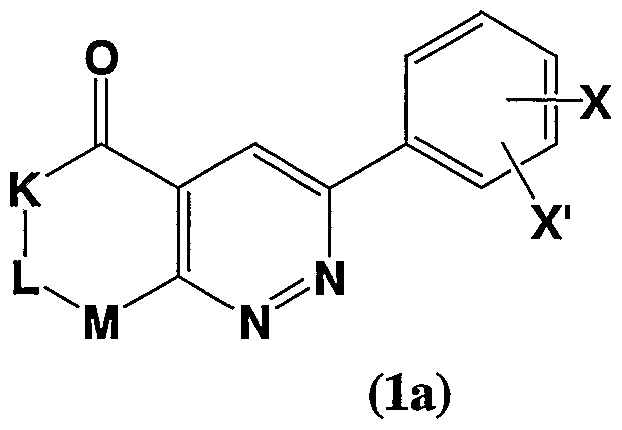
  • an oxidizing agent such as ammonium cerium nitrate (IV), 2,3-dichloro-5,6-dicyano_p-benzoquinone in a solvent such as acetone, methanol, tetrahydrofuran or a mixture thereof to give the following general formula (1a ) Can be obtained.
  • the compound represented by the general formula (la) is reduced in an organic solvent such as tetrahydrofuran, methanol, ethanol or the like by reduction of sodium borohydride, lithium aluminum hydride or lithium tri-tert-butoxyaluminohydride.
  • an agent or an alkyl metal compound such as methyllithium or isopropylmagnesium bromide at room temperature under ice cooling
  • J in the general formula (1) is H--C---OH, and n and n 'are 0. Can lead to the compounds represented.
  • an acid chloride such as acetyl chloride, propanoyl bromide or the like is reacted in the presence or absence of a base such as pyridine or triethylamine, or N — Tert _butoxycarboxyl L-valine, N-benzyloxycarboxyl D
  • a base such as pyridine or triethylamine
  • N-benzyloxycarboxyl D Protected amino acids such as proline, dicyclohexylcarpoimide, N-ethyl—N '— 3-dimethylaminopropylcarpoimide
  • the reaction is carried out in the presence of dimethylaminopyridine or the like using a condensing agent such as, or the protecting group of the amino acid is removed using trifluoromethanesulfonic acid, hydrochloric acid, hydrogenation or the like according to a conventional method, or N,
  • an oxidizing agent such as m-chloroperbenzoic acid, peracetic acid or the like is added to a compound of the general formula (1) in which n and n 'are 0 in an organic solvent such as methylene chloride, chloroform, and the like under ice-cooling to room temperature.
  • an organic solvent such as methylene chloride, chloroform, and the like under ice-cooling to room temperature.
  • a compound represented by the general formula (1a) (wherein either W or W ′ is a hydrogen atom) is treated with copper bromide (I 1) in the presence or absence of an organic solvent such as acetic acid, N, N-dimethylformamide, Reaction with a halogenating agent such as lithium chloride or iodine under heating to reflux from room temperature, and if necessary, a base such as collidine, triethylamine or 1,8-diazabicyclo [5.4.0] —7-undecene This can lead to the compound represented by the general formula (4). Also, a compound represented by the general formula (la) (either w or w 'is a hydrogen atom) can be directly subjected to an oxidation reaction to lead to the compound represented by the above general formula (4).
  • an organic solvent such as acetic acid, N, N-dimethylformamide
  • a halogenating agent such as lithium chloride or iodine
  • Various derivatives can be further produced by subjecting the obtained compound to a conventional phenolic hydroxyl group conversion reaction.
  • an organic solvent such as dichloromethane, tetrahydrofuran, N, N-dimethylformamide and ethyl acetate
  • an acid chloride such as acetyl chloride, propanoyl bromide or the like is reacted in the presence or absence of a base such as pyridine or triethylamine in the presence or absence.
  • a base such as t-butoxy potassium, sodium hydride or N, N-diisopropylethylamine in an organic solvent such as N, N-dimethylformamide, dimethylsulfoxide, or tetrahydrofuran.
  • organic solvent such as N, N-dimethylformamide, dimethylsulfoxide, or tetrahydrofuran.
  • alkyl groups can be introduced by reacting an alkyl halide such as methyl iodide or benzyl bromide.
  • a compound represented by the above general formula (14) or (1a) is converted to a lower alkyl hydrazine such as hydrazine hydrochloride, ethyl hydrazine hydrochloride, methyl hydrazine hydrochloride, hydroxylamine hydrochloride, methoxylamine hydrochloride or the like.
  • Reaction with a lower alkylhydroxylamine such as O-ethylhydroxylamine hydrochloride and an organic solvent such as methanol and ethanol in the presence of a base such as pyridine and triethylamine is carried out by heating and refluxing from room temperature under room temperature. By attaching the compound, it is possible to lead to an derivative having an imino bond.
  • a 3-phenyrucinnoline analog represented by the general formula (1), the general formula (2), the general formula (3), the general formula (4) or the general formula (5) or a physiological salt thereof is provided.
  • Cell growth inhibitors containing a commercially acceptable salt as an active ingredient are also included.
  • a compound similar to the above compound represented by the general formula (1), (2), (3), (4) or (5) is used as a cell. It can be used as a growth inhibitor, as are specific compounds.
  • the present invention relates to a 3_phenylenecinnoline analog or a product thereof represented by the above general formula (1) or (2), other than the compound represented by the general formula (2) wherein Z is an oxygen atom. Also included are physically acceptable salts. That is, in the present invention, the following general formula (1) or (2)
  • J represents A—C—B (C represents a carbon atom), and A represents a ⁇ _Y group ( ⁇ represents an oxygen atom, ⁇ represents a hydrogen atom, and a lower group which may be substituted with a phenyl group.)
  • ⁇ represents a hydrogen atom, a lower alkyl group or a carbonyl group or a substituted imino group together with ⁇
  • K represents (CH 2 ).
  • L represents N—W (N represents a nitrogen atom) or W—C—W ′ (C represents a carbon atom), and IW is each independently a hydroxyl group, a lower alkoxyl group and a phenyl group.
  • Physiologically acceptable salts are also included in the present invention.
  • ESI Electron Spray Ionization
  • FAB Fast Atom Bombardmnt, which is one of ionization methods in molecular weight measurement mass spectrometry.
  • NMR Hydrogen nuclear magnetic resonance spectrum
  • Example 66 The 5-oxo-3- (3-trifluoromethylphenyl) -7,8-dihydro-6H-cinnoline (1 g, 3.28 mmo 1) obtained in Example 66 was treated in the same manner as in Example 3. Treatment gives target compound (917.9mg, 90.9%) as white Obtained as a solid. The synZanti ratio was approximately 9/1 for HP LC.
  • the obtained compound was dissolved in methanol (5 mL), 2N sodium hydroxide (1 mL) was added, and the mixture was reacted at room temperature for 1 hour. Distilled water (2 mL) and ethyl acetate (5 mL) were added, and the organic layer obtained after extraction was washed with saturated saline.
  • Example 8 syn-5- ⁇ N- (tert-butyloxycarbonyl) -L_prolyl ⁇ oxy-7-methyl-3--3- (3-trifluoromethylphenyl) -5,6N— ( tert _butyloxyl-propionyl) — L-proline (21 mg, 0.098 mm o 1), 7 _methyl-3- (3-trifluoromethylphenyl) —5,6,7,8-tetrahydrocinnoline To a solution of 5-ol (23.4 mg, 0.076 mmo 1) and N, N-dimethylaminopyridine (catalytic amount) in tetrahydrofuran (0.5 mL) was added dicyclohexylcarbodiimide (24 mg, 0.5 mg).
  • Example 9 The same compound as in Example 9 was treated with the syn-diastereomer (17.5 mg), which was a highly polar component, obtained in Example 8 to obtain the desired compound (9.8 mg).
  • Example 66 5-Oxo-1- (3-trifluoromethylphenyl) -7,8-dihydro-6H-cinnoline (306 mg, lmmol) obtained in Example 66 was treated in the same manner as in Example 12. Gave the desired compound (124 mg, 38%).
  • the target compound was obtained by treating 3- (3-cyanophenyl) -7-methyl-7,8-dihydro-6H-cinnolin-15-one obtained in Example 15 in the same manner as in Example 3.
  • Example 22 Synthesis of 3- (3-methoxycarbonylphenyl) -17-methyl-7,8-dihydro-16H-cinnolin-15-one
  • 3- (2,1-bromoacetyl) methyl benzoate 5-phenyl-1,3—instead of cyclohexanedione, 5—
  • the product obtained by the same treatment using methyl-1,3-cyclohexanedione was subsequently treated in the same manner as in Reference Example 2 and Example 1, to obtain the desired compound.
  • Example 29 Synthesis of 3 — ((2-fluoro-5-trifluoromethyl) phenyl) — ⁇ —methyl-1,5,6,7,8-tetrahydrocinnolin-1-5-ol 3-— obtained in Example 28 ((2-Fluoro-5-trifluoromethyl) phenyl) 17-methyl-17,8-dihydro-6H-cinnolin-15-one was treated in the same manner as in Example 3 to obtain the desired compound. MS (ES I)
  • Example 32 Synthesis of 5- (L-alanyl) oxy-1 7-methyl- (3_trifluoromethylphenyl) -5,6,7,8-tetrahydrocinnoline dihydrochloride 5 obtained in Example 31 — (N- (tert-butoxycarbonyl) — L-aranyl) oxy 7-methyl-3- (3-trifluoromethylphenyl) —5,6,7,8-tetrahydrocinnoline to dioxane (0. 5N), and 4N hydrogen chloride Z-dioxane (0.5 mL) was added thereto under ice-cooling and reacted overnight. The reaction compound was concentrated to dryness to obtain the target compound as a white solid.
  • Example 31 N- (tert-butoxycarbonyl) -L-alanine was replaced with N- (tert-butoxycarbonyl) - ⁇ - (tert-butyl) monoaspartic acid, and the same operation was carried out. The compound was obtained. MS (ES I)
  • Example 31 was repeated except that N- (tert-butoxycarbonyl) -L-alanine was replaced with N- (tert-butoxycarponyl)-(tert-butyl) -monoglutamic acid. was obtained.
  • Example 38 Synthesis of 5-(-glutamyl) oxy-1 7-methyl-3- (3-trifluoromethylphenyl) _5,6,7,8-tetrahydrocinnoline dihydrochloride 5- (N- (tert_butoxycarbonyl) -fer (tert-butyl) -_ daltamyl) oxy-7-methyl-3- (3-trifluoromethylphenyl) _5 obtained in Example 37 , 6,7,8-Tetrahydrocinnoline was treated in the same manner as in Example 32 to obtain the desired product as a white solid.
  • Example 31 was repeated except that N- (tert-butoxycarbonyl) -L-alanine was replaced with N- (tert-butoxycarbonyl) -1- (tert-butyl) -1-glutamic acid in Example 31. was obtained.
  • Example 39 (N- (tert-butoxycarponyl) -hi_ (tert-butyl) -r-daltamyl) oxy-7-methyl-3- (3-trifluoromethylphenyl) obtained in Example 39 _5,6,7,8-Tetrahydrocinnoline was treated in the same manner as in Example 32 to obtain the desired product as a white solid.
  • Example 31 The same procedure as in Example 31 was carried out except that N— (tert-butoxycarbonyl) glycine was used instead of N— (tert-butoxycarbonyl) -l-alanine. By doing so, the target compound was obtained.
  • Example 42 Synthesis of 5-glycosyloxy 7 _methyl-3- (3-trifluoromethylphenyl) 1,5,6,7,8-tetrahydrocinnoline dihydrochloride N- (tert-butoxycarbonyl) glycyl) oxy-7-methyl-3- (3-trifluoromethylphenyl) -5,6,7,8-tetrahydrocinnoline is treated in the same manner as in Example 32. Thus, the target product was obtained as a white solid.
  • the desired compound was obtained in the same manner as in Example 31, except that N- (tert-butoxycarponyl) -l-leucine was used instead of N- (tert-butoxycarponyl) -l-alanine.
  • Example 43 5- (N- (tert-butoxycarbonyl) 1 L-leucyl) oxy-7-methyl-3- (3-trifluoromethylphenyl) —5, 6, 7, 8— obtained in Example 43
  • the target product was obtained as a white solid by treating tetrahydrocinnoline in the same manner as in Example 32.
  • Example 45 5- (N ( ⁇ ), N ( ⁇ ) — (di-tert-butoxycarbonyl) —lysyl) oxy-7-methyl-3- (3-trifluoromethylphenyl
  • N_ The target compound was obtained by performing the same operation using N (Q!), N ( ⁇ ) — (Gee tert-butoxycarbonyl) —L —lysine instead of (tert-butoxycarbonyl) —L-alanine.
  • Example 46 Synthesis of 5- (L-lysyloxy) -7-methyl-3- (3-trifluoromethylphenyl) _5,6,7,8-tetrahydrocinnoline ⁇ 3 acid salt obtained in Example 45 (N (), N ( ⁇ ) _ (di-tert-butoxycarponyl) — L-lysyl) oxy-1 7-methyl-3- (3-trifluoromethylphenyl) 1,5,6,7,8-tetrahydrocinnoline The desired product was obtained as a white solid by treating in the same manner as in Example 32.
  • the desired compound was obtained in the same manner as in Example 31, except that N- (tert-butoxycarbonyl) -L-alanine was replaced by N- (tert-butoxycarbonyl) -1-L-methionine.
  • Example 47 5- (N- (tert-butoxycarbonyl) -L- obtained in Example 47
  • the desired product was obtained as a white solid by treating methionyl) oxy-7-methyl-3- (3-trifluoromethylphenyl) -5,6,7,8-tetrahydrocinnoline in the same manner as in Example 32. .
  • Example 31 N- (tert-butoxycarponyl) -1-L-alanine was used in place of N- (tert-butoxycarponyl) -L-alanine, and the same operation was carried out to obtain the target compound.
  • Example 49 5- (N- (tert-butoxycarbonyl) -L-phenylalanyl) oxy_7-methyl-3- (3-trifluoromethylphenyl) -5,6 obtained in Example 49
  • the target product was obtained as a white solid by treating 7,8-tetrahydrocinnoline in the same manner as in Example 32. .
  • Example 31 N- (tert-butoxycarponyl) -l-valine was used instead of N- (tert-butoxycarbonyl) -l-alanine to carry out the same operation to obtain the target compound.
  • the target product was obtained as a white solid by treating 6,7,8-tetrahydrocinnoline in the same manner as in Example 32.
  • N, N-dimethylaminopyridine (1.2 g, 9.Omol) was added to the mixture under cooling with water, and the mixture was stirred overnight.
  • Ethanol (187 mL) was added to the residue obtained after concentration of the organic layer, and the mixture was stirred at room temperature overnight. The resulting crystals were collected by filtration and washed with ethanol (35 mL) to give the title compound (14.8 g).
  • Example 54 N- (tert-butoxycarbonyl) -N- (tert-butoxycarbonyl) was substituted for D-phenylalanine-L-valine, and 2-propanol was used in place of ethanol to perform the same treatment. The compound was obtained.
  • Example 56 (5R, 7R) -15- (N- (tert-butoxycarponyl) -1-L-paryl) oxyl-7-methyl-3- (3-trifluoromethylphenyl) -1,5 obtained in Example 56
  • the desired title compound was obtained by operating 7,8-tetrahydrocinnoline in the same manner as in Example 55.
  • the obtained compound was identical to the compound obtained in Example 9.
  • Example 56 (5R, 7R) -5- (N- (tert-butoxycarbonyl) _L-valyl) oxy-7-7-methyl-3- (3-trifluoromethylphenyl) obtained in Example 56
  • the same title compound was obtained as a white solid by operating 1,7,8-tetrahydrocinnoline in the same manner as in Example 32.
  • Example 7 instead of 4-nitrobenzoic acid, (N_ (ter t.-butoxycaprolponyl) -l-parin, 7-methyl-3_ (3-trifluoromethylphenyl) -1,5,6,7 , 8-Tetrahydrocinnolin-1-ol instead of 5-ol
  • Example 59 (5S, 7R) —5- (N— (tert-butoxycarbonyl) _L-valyl) oxyl-7-methyl_3_ (3-trifluoromethylphenyl) obtained in Example 59
  • the desired title compound was obtained by treating 6,7,8-tetrahydrocinnoline in the same manner as in Example 55.
  • Example 7 N— (tert_butoxycaprolponyl) —L-valine, 7-methyl-3- (3-trifluoromethylphenyl) -15,6,7 instead of 4-nitrobenzoic acid Instead of, 8-tetrahydrocinnoline-1-5-ol, (5S, 7S) —7-methyl-3- (3-trifluoromethylphenyl) —5,6,7,8-tetrahydrocinnori Mitsunobu reaction was carried out using 1-ol to give the title compound.
  • Example 62 (5R, 7S) -5- (N- (tert-butoxycarbonyl) -L-valyl) oxyl-7-methyl_3- (3-trifluoromethylphenyl) obtained in Example 62
  • the target title compound was obtained by treating, 6,7,8-tetrahydrocinnoline in the same manner as in Example 55.
  • the target compound was obtained in the same manner as in Reference Example 4, except that N-benzylglycineethyl ester hydrochloride was used instead of N-methylglycineethyl ester hydrochloride.
  • Example 68 Synthesis of 3- (3-trifluoromethylphenyl) -1,7-dihydro-6H-cinnolin-5-one The reaction was carried out using a commercially available 1,3-cyclohexanedione instead of the 5-methyl-1,3-cyclohexanedione used in Reference Example 7, and the reaction was carried out in the same manner as in Example 65 and Example 66. The target compound was obtained by the treatment.
  • Example 65 The reaction was carried out using a commercially available 5,5-dimethyl_1,3-cyclohexanedione instead of the 5-methyl-1,3-cyclohexanedione used in Reference Example 7, and the reaction was continued in Example 65.
  • the target compound was obtained by treating in the same manner as in Example 66.
  • the toluene layer was washed with 40 OmL of saturated aqueous sodium hydrogen carbonate, dried over anhydrous sodium sulfate, concentrated in toluene, and then distilled under reduced pressure to obtain the desired compound (92.35 g, 81.7%).
  • reaction solution was concentrated under reduced pressure, distilled water (1 mL) was added, and the mixture was extracted with ethyl acetate.
  • Example 65 was added to 4,000 breast cancer cells T-47D under the same conditions as above, and the test was carried out.
  • the result was 1 ( 5.
  • the value was 0.67 ⁇ gZm 0.28. gZml, and also showed antitumor effect on breast cancer cells T-47D Test
  • Example 2 Antitumor effect in vivo using breast cancer tumor ZR-75-1 Breast cancer tumor subcutaneously on the back of female and nude mice 500 mg Zkg of the compound of Example 66 and Example 53 from the time when the tumor began to grow exponentially after implantation of ZR-75-1 Was orally administered once daily for 14 days. The minor axis and major axis of the tumor were measured over time, and the volume of the tumor was determined by the following formula. Relative tumor volume was calculated with the tumor volume at the start of administration as 1, and the effect was determined by dividing the tumor volume of the treatment group by the tumor volume of the control group (TZC).
  • Tumor volume minor axis X minor axis X major axis 2
  • the TZC on the 15th day after the administration of the compound of Example 66 and Example 53 was 30.3% and 34.0%, respectively, and the compound of Example 66 and Example 53 was in vivo. Has an anti-tumor effect that suppresses the growth of breast cancer tumors
  • a cinnoline analog or a physiologically acceptable salt thereof, and an antitumor agent containing the cinnoline analog or a physiologically acceptable salt thereof as an active ingredient which can be effectively used for prevention or treatment of tumors ⁇ A cell growth inhibitor is provided.

Landscapes

  • Chemical & Material Sciences (AREA)
  • Organic Chemistry (AREA)
  • Health & Medical Sciences (AREA)
  • Veterinary Medicine (AREA)
  • General Health & Medical Sciences (AREA)
  • Medicinal Chemistry (AREA)
  • Public Health (AREA)
  • Pharmacology & Pharmacy (AREA)
  • Life Sciences & Earth Sciences (AREA)
  • Animal Behavior & Ethology (AREA)
  • General Chemical & Material Sciences (AREA)
  • Nuclear Medicine, Radiotherapy & Molecular Imaging (AREA)
  • Chemical Kinetics & Catalysis (AREA)
  • Epidemiology (AREA)
  • Pharmaceuticals Containing Other Organic And Inorganic Compounds (AREA)
  • Nitrogen Condensed Heterocyclic Rings (AREA)
  • Acyclic And Carbocyclic Compounds In Medicinal Compositions (AREA)

Abstract

本発明は3−フェニル−シンノリン類縁体又はその生理学的に許容される塩とそれを有効成分とする細胞増殖阻害剤・抗腫瘍剤に関するものである。

Description

明 細 書
3 _フエニル—シンノリン類.緣体とそれを用いた抗腫瘍剤 技術分野
本発明は、 3—フエ二ルーシンノリン類縁体又はその生理学的に許容される塩、 並びにそれらを有効成分とする抗腫瘍剤等に関する。 背景技術
悪性腫瘍とは正常の生体機構からはずれて生体内で増殖を続け、 治療をしなけ れば宿主の死を招くような細胞群である。 悪性腫瘍の治療は、 外科的な切除、 放 射線照射、 ホルモン療法又は化学療法が一般的であり、 特に悪性固形腫瘍の治療 においては外科的手術が第一選択となっている。 放射線療法、 ホルモン療法及び 化学療法は、 手術前又は手術後の補助療法あるいは手術による治療が不可能と判 断された悪性固形腫瘍の治療に用いられるのが一般的である。 ホルモン療法や化 学療法等は、 手術で切除する範囲を狭め、 又、 手術によって切除しきれない腫瘍 を縮小 ·消失させ再発を予防するために使用されている。 しかしながら、 手術は 癌患者に対して肉体的,精神的な苦痛を与え、 更に、 腫瘍が転移していれば切除 は広範囲にわたることとなり手技的にも困難を極めているのが現状である。 化学 療法が悪性固形腫瘍に対して主たる治療方法ではないのは重篤な副作用がなく臨 床上有効な抗腫瘍剤が事実上存在しなかったからである。 従って、 悪性固形腫瘍 に対して優れた抗腫瘍効果を有する抗腫瘍剤が望まれている。
一方、 下記の非特許文献 1には中枢神経系に作用を持つシンノリン誘導体が、 非特許文献 2にはモノアミンォキシダーゼ阻害作用を有するシンノリン誘導体が 報告されている。 しかしながら、 本発明の下記一般式 (1 ) で表されるシンノリ ン類縁体についてはこれら文献には記載が無く、 又、 シンノリン類縁体が抗腫瘍 作用を有することも記載されていない。
又、 下記の非特許文献 3にはシンノリン誘導体の合成や反応が記載されている が、 シンノリン類縁体が抗腫瘍作用を有することは記載がない。 文献リスト
[非特許文献 1 ]
Ra s hmi Sh ah e t a l .、 Ce n t r a l N e r V o u s
Sy s t em Ac t i v e 5 -Ox o- 1, 4, 5, 6, 7, 8 ― H e X a hyd r o c i n n o 1 i n e s、 J ou r n a l o f Me d i c i n a 1
Chemi s t ry、 197 6、 vo l . 19、 p. 508 - 51 1
[非特許文献 2 ]
An g e 1 o Ca r o t t i e t a l .、 I nh i b i t i o n 0 f M ono ami ne 〇x i d a s e— B by Conde n s e d P y r i d a z i ne s and P y r imi d i ne s : E f f e c t s o f L i p o ph i l i c i t y and S t r u c t u r e— Ac t i V i t y
Re l a t i on s h i p s 、 J ou rn a l o f Me d i c i n a 1 C hemi s t r y、 1998 、 vo l . 41、 p. 3812-38 2 0
[非特許文献 3 ]
K. Nag a r a j an e t a l .、 Syn t he s i s & R e a c t i o n s o f 4, 6, 7, 8-Te t r ahyd r o-5 ( 1 H) ― c i n n o l i none s、 I nd i an J ou r n a l o f Chemi s t ry, 1986、 vo l . 25B、 p. 697 - 708
発明の開示
本発明者等は 3—フエ二ルーシンノリン類縁体又はその薬学的に許容される塩 が細胞増殖阻害活性及び抗腫瘍活性を有することを見出し、 本発明を完成した。 即ち、 本発明は以下の 1) 〜14) に関する。
1) 下記一般式 (1) 又は (2)
Figure imgf000003_0001
[式中、 Jは A— C一 B ( Cは炭素原子を示す) を示し、 Aは〇—Y基 (Οは酸 素原子、 Υは水素原子、 フエニル基で置換されていてもよい低級アルキル基、 低 級ァシル基若しくは保護されていてもよいアミノ酸残基を示す) を示し、 Βは水 素原子、低級アルキル基又は Αと共にカルボニル基若しくは置換ィミノ基を示し、 Kは(C H 2) qを示し、 Lは N— W (Nは窒素原子を示す)若しくは W— C—W' ( Cは炭素原子を示す) を示し、 W、 W 'はそれぞれ独立して、 水酸基、 低級ァ ルコキシル基及びフエニル基からなる群から選ばれる置換基を有していてもよい 低級アルキル基、 フエニル基、 力ルポキシル基、 低級アルコキシ力ルポ二ル基若 しくは水素原子を示し、 Mは(C H 2) mを示し、あるいは J— K— L一 Mが C (O 一 Y) = C H - C (W) = C H (Y及び Wは上記と同じ意味を示す) を示し、 Zは 酸素原子若しくは N— Q (Qはァミノ基、 低級アルキルアミノ基、 水酸基あるい は低級アルコキシル基を示す) を示し、 X, X ' はそれぞれ独立して低級アルキ ル基、低級アルコキシカルポニル基、低級ァシルァミノ基、低級アルコキシル基、 ハロゲノ低級アルキル基、 ニトロ基、 シァノ基、 ハロゲン原子若しくは水素原子 を示し、 m、 qはそれぞれ独立して 0〜 3までの整数を示し、 n、 n ' はそれぞ れ独立して 0又は 1を示す] で表される 3—フエ二ルーシンノリン類縁体又ばそ の生理学的に許容される塩を有効成分とする抗腫瘍剤。
2 ) 3—フエ二ルーシンノリン類縁体が下記一般式 (3 )
Figure imgf000004_0001
[式中、 Aは 0— Y基 (Yは水素原子、 フエニル基で置換されていてもよい低級 アルキル基、 低級ァシル基又は保護されていてもよいアミノ酸残基を示す) を示 し、 Bは水素原子、 低級アルキル基又は Aと共にカルボニル基若しくは置換イミ ノ基を示し、 Lは N— Wあるいは W— C一 W' を示し、 W、 W はそれぞれ独立 して、 水酸基、 低級アルコキシル基及びフエニル基からなる群から選ばれる置換 基を有していてもよい低級アルキル基、 フエニル基、 力ルポキシル基、 低級アル コキシ力ルポニル基又は水素原子を示し、 Xは低級アルキル基、 低級アルコキシ カルポニル基、 低級ァシルァミノ基、 低級アルコキシル基、 トリフルォロメチル 基、 ニトロ基、 シァノ基又はハロゲン原子を示し、 X ' は低級アルキル基、 低級 アルコキシカルポニル基、 低級ァシルァミノ基、 低級アルコキシル基、 トリフル ォロメチル基、 ニトロ基、 シァノ基、 ハロゲン原子又は水素原子を示し、 m、 q はそれぞれ独立して 0〜 3までの整数を示し、 n、 n ' はそれぞれ独立して 0又 は 1を示す] で表される化合物である上記 1 ) 記載の抗腫瘍剤。
3 ) Bが水素原子であり、 Lが W— C—W' であり、 W、 W がそれぞれ独立し て水酸基、 低級アルコキシル基及びフヱニル基からなる群から選ばれる置換基を 有していてもよい低級アルキル基又は水素原子であり、 Xが 3—トリフルォロメ チル基、 3—ニトロ基、 3 _シァノ基又は 3—ブロモ基であり、 X ' が水素原子 であり、 m、 ciがともに 1であり、 nが 0又は 1、 n ' が 0である上記 2 ) 記載 の抗腫瘍剤。
4 ) W, W がそれぞれ独立して水素原子又は低級アルキル基であり、 Xが 3— トリフルォロメチル基である上記 3 ) 記載の抗腫瘍剤。
5 ) Yがグリシル基、 ァラエル基、 バリル基又は α—ダルタミル基であり、 Βが 水素原子であり、 Lが H— C— C H 3であり、 Xが 3—トリフルォロメチル基、 X ' が水素原子であり、 m、 qがともに 1であり、 nが 0又は 1、 n ' が 0であ る上記 2 ) 記載の抗腫瘍剤。
6 ) 3—フエ二ルーシンノリン類緣体が下記一般式 (4 )
Figure imgf000005_0001
(4)
[式中、 X, X ' はそれぞれ独立して低級アルキル基、 低級アルコキシ力ルポ二 ル基、 低級ァシルァミノ基、 低級アルコキシル基、 トリフルォロメチル基、 ニト 口基、 シァノ基、 ハロゲン原子又は水素原子を示し、 Yはフエニル基で置換され ていてもよい低級アルキル基、 低級ァシル基又は水素原子を示し、 Wは水酸基、 低級アルコキシル基、 フエニル基からなる群から選ばれる置換基を有していても よい低級アルキル基、 フエニル基、 カルボキシル基、 低級アルコキシカルボニル 基又は水素原子を示す] で表される化合物である上記 1) 記載の抗腫瘍剤。
7) Xがトリフルォロメチル基、 ニトロ基、 シァノ基又はハロゲン原子であり、 X' が水素原子であり、 Wが水酸基、 低級アルコキシル基、 フエニル基からなる 群から選ばれる置換基を有していてもよい低級アルキル基である上記 6) 記載の 抗腫瘍剤。
8) Xが 3—トリフルォロメチル基、 3—ニトロ基、 3—シァノ基又は 3—ハロ ゲン原子であり、 Wが無置換の低級アルキル基である上記 7) 記載の抗腫瘍剤。
9) 3—フエ二ルーシンノリン類縁体が下記一般式 (5)
Figure imgf000006_0001
[式中、 W、 W はそれぞれ独立に水素原子あるいは低級アルキル基を示し、 X はハロゲノ低級アルキル基を示し、 Zは酸素原子又は N— Qを示し、 Qはァミノ 基、 低級アルキルアミノ基、 水酸基あるいは低級アルコキシル基を示す] で表さ れる化合物である上記 1) 記載の抗腫瘍剤。
10) Wが水素原子又はメチル基、 W' が水素原子又はメチル基、 Xが 3—トリ フルォロメチル基、 Zが酸素原子である上記 9) 記載の抗腫瘍剤。
11) Wが水素原子又はメチル基、 W' が水素原子又はメチル基、 Xが 3_トリ フルォロメチル基、 Zが N— NH2である上記 9) 記載の抗腫瘍剤。
12) 3—フエ二ルーシンノリン類縁体が 7—メチル—3— (3—トリフルォロ メチル) _7, 8—ジヒドロ一 6 H—シンノリン一 5—オン、 7—メチル—3— (3—トリフルォロメチル) 一5, 6, 7, 8—テトラヒドロシンノリン— 5— オール、 7—メチルー 3— (3—トリフルォロメチルフエニル) シンノリンー 5 一オール、 7—メチル— 1一ォキシ一 3— (3—トリフルォロメチル) _5, 6, 7, 8—テトラヒドロシンノリンー 5—オール、 5—グリシルォキシ— 7—メチ ル一3— (3—トリフルォロメチル) 一 5, 6, 7, 8—テトラヒドロシンノリ ン、 5— (Lーァラニルォキシ) - 7ーメチル— 3— (3 _トリフルォロメチル) —5, 6, 7, 8—テトラヒドロシンノリン、 5— (L—バリルォキシ) 一 7— メチルー 3— (3—トリフルォロメチル) — 5, 6, 7, 8—テトラヒドロシン ノリン、 5— (L— «—ダルタミルォキシ) 一 7—メチル一3— (3—トリフル ォロメチル) 一 5, 6, 7, 8—テトラヒドロシンノリンである上記 1) 記載の 抗腫瘍剤。
13) 上記 1) 〜12) のいずれか 1項に記載の 3—フエ二ルーシンノリン類縁 体又はその生理学的に許容される塩を有効成分とする細胞増殖阻害剤。
14) 上記 1) 〜12) のいずれか 1項に記載の 3—フエ二ルーシンノリン類縁 体又はその生理学的に許容される塩、ただし、 Zが酸素原子である化合物を除く。 発明を実施するための最良の形態
本発明の抗腫瘍剤は、 上記一般式 (1) 又は (2) で表される 3—フエ二ルー シンノリン類縁体、 又はその生理学的に許容される塩を有効成分とする。
一般式 (1) 又は (2) の置換基において 「低級アルキル基」 とは、 特に断ら ない限り炭素数 1〜 6の直鎖もしくは分岐鎖のアルキル基であり、 例えばメチル 基、 ェチル基、 n—プロピル基、 イソプロピル基、 n—ブチル基、 s e c—ブチ ル基、 t e r t一ブチル基、 n—ペンチル基、イソペンチル基、ネオペンチル基、 n—へキシル基等が挙げられる。 これらのうち好ましい基としてはメチル基、 ェ チル基、 イソプロピル基が挙げられ、 特に好ましい基としてはメチル基が挙げら れる。
一般式 (1) 又は (2) の置換基において 「低級ァシル基」 とは、 無置換の炭 素数 1〜6の直鎖もしくは分岐鎖のァシル基であり、 例えばホルミル基、 ァセチ ル基、 プロピオニル基、 n—プチリル基、 イソプチリル基、 バレリル基、 イソバ レリル基、 ピバロイル基、 へキサノィル基等が挙げられ、 これらのうち好ましい 基としてはァセチル基が挙げられる。
又、 一般式 (1) の置換基において 「保護されていてもよいアミノ酸残基」 と は、 側鎖及び/又は N末が保護されていてもよい必須アミノ酸として通常知られ ている α—アミノ酸の残基が挙げられる。 但し、 その絶対配置は L又は Dのどち らでもよい。 酸素原子との結合は、 主鎖又は側鎖のカルボン酸基とのエステル結 合が好ましい。 保護される官能基としてはァミノ基、 カルボキシル基、 グァニジ ノ基、 水酸基、 チオール基等が挙げられ、 保護基としては特に限定されず、 通常 のペプチド合成反応等に使用される保護基が挙げられる。 代表的な保護基を具体 的に示すと、 t e r t—ブトキシカルポニル基又はベンジルォキシカルポニル基 のようなアルコキシカルポニル基、 メチル基、 t e r t—プチル基又はべンジル 基のようなアルキル基、 ァセチル基又はベンゾィル基のようなァシル基等が挙げ られる。 即ち、 保護されていてもよいアミノ酸残基としては例えば、 N— (t e r t一ブトキシカルポニル) _ Lーバリル基、 〇—ベンジルー D—チロシル基、 N— ( t e r t _ブトキシカルポニル) 一 L—プロリル基、 N— ( t e r t—ブ トキシカルポニル)一 L一フエニルァラニル基、 L—ァラニル基、 Lーバリル基、 L -ひ—グルタミル基、ダリシル基等が挙げられる。好ましい基としては例えば、 L—ァラエル基、 Lーバリル基、 L— Q!—ダルタミル基、 グリシル基等が挙げら れる。
一般式 ( 1 ) の置換基においてフエニル基で置換されている低級アルキル基と しては、具体的にはべンジル基、 1一フエニルェチル基、 2—フエニルェチル基、 ベンジル基等が挙げられ、 好ましくはベンジル基等である。
一般式 ( 1 ) 又は (2 ) の置換基において 「低級アルコキシル基」 とは、 炭素 数 1〜6の直鎖もしくは分岐鎖のアルコキシル基であり、 例えばメトキシ基、 ェ トキシ基、 n—プロポキシ基、 イソプロポキシ基、 n—ブトキシ基、 イソブトキ シ基、 t e r t一ブトキシ基、 n—ペンチルォキシ基、 イソペンチルォキシ基、 n—へキシルォキシ基等が挙げられ、 これらのうち好ましい基としてはメトキシ 基、 エトキシ基が挙げられる。
一般式 ( 1 ) 又は (2 ) の置換基において水酸基、 低級アルコキシル基及びフ ェニル基からなる群から選ばれる置換基を有している低級アルキル基とは、 1個 〜複数個の同一又は異なった置換基を有する低級アルキル基であり、 具体的には ヒドロキシメチル基、 2—ヒドロキシ— 2 _プロピル基、 ベンジル基、 メトキシ メチル基等が挙げられ、 好ましくはヒドロキシメチル基、 ベンジル基等である。 一般式 ( 1 ) 又は (2 ) において Lが N (窒素原子) 一 Wとは、 Wが置換した 窒素原子を含む脂肪族複素環を意味する。 Lとして具体的には N—メチル、 N— ベンジル、 N—メトキシメチル又は N— (2—ヒドロキシ) メチル基等が挙げら れ、 好ましくは N—ベンジル基又は N—メチル基である。
一般式 ( 1 ) 又は (2 ) において Lが W— C (炭素原子) 一 W' とは、 W及び W が廈換した脂肪族炭素環を意味し、 W、 W として具体的には、 Wが水素原 子で W' がメチル基、 ェチル基、 イソプロピル基、 エトキシカルポニル基、 カル ポキシル基、 ヒドロキシメチル基、 2—ヒドロキシ— 2—プロピル基、 フエニル 基若しくは水素原子等が挙げられ、又、 W、 Wが共にメチル基等が挙げられる。 好ましくは、 Wが水素原子、 W' がメチル基、 イソプロピル基である。
又、 一般式 (1 ) 又は (2 ) において 「低級アルコキシカルポニル基」 とは、 上記の低級アルコキシル基がカルポニル基と結合した基であり、 具体的に例えば メトキシカルポニル基、 エトキシカルポニル基、 n—プロピルォキシカルポニル 基等が挙げられ、 好ましくはメトキシカルポニル基、 エトキシカルポニル基であ る。
一般式 ( 1 ) 又は (2 ) において 「低級アルキルアミノ基」 とは、 上記の低級 アルキル基が窒素原子に 1〜 2個結合した基であり、 具体的には例えば、 メチル アミノ基、 ジメチルァミノ基、 ェチルァミノ基、 ジェチルァミノ基、 n—プロピ ルァミノ基、 ジ (n—プロピル) アミノ基等が挙げられる。
—般式 (1 ) の. Jは A— C (炭素原子) — Bであるが、 A、 Bは力ルポニル基 (C = 0) 又は置換イミノ基 (C = N— (置換基)) を形成してもよい。 置換イミ ノ基の置換基としては、 アミノ基、 低級アルキルアミノ基、 水酸基あるいは低級 アルコキシル基等が挙げられる。
一般式 ( 1 ) 又は (2 ) において 「ハロゲン原子」 とは、 フッ素原子、 塩素原 子、 臭素原子又はヨウ素原子が挙げられ、 好ましくは臭素原子、 フッ素原子であ る。
一般式 ( 1 ) 又は (2 ) において 「低級ァシルァミノ基」 とは、 上記の低級ァ シル基が結合したァミノ基が挙げられ、 具体的に例えばホルミルアミノ基、 ァセ チルァミノ基、 プロパノィルァミノ基等が挙げられ、 好ましくはァセチルァミノ 基である。
一般式 (1) 又は (2) において 「ハロゲノ低級アルキル基」 における低級ァ ルキル基としては、 上記の低級アルキル基と同様な基が挙げられ、 好ましい基も 同様である。 「ハロゲノ低級アルキル基」 のハロゲン原子としては、上記と同じく フッ素原子、 塩素原子、 臭素原子又はヨウ素原子が挙げられる。 ハロゲン原子の 置換数としては 1個から置換可能な最大個数まで本発明に含まれ、 複数個置換し ている場合、 置換しているハロゲン原子は同一でも異なっていてもよい。 具体的 には例えば、 1_クロ口プロピル基、 トリクロロメチル基、 トリフルォロメチル 基、 1, 1, 1 _トリフルォロェチル基、 ペンタフルォロェチル基、 1, 1—ジ フルオロー 1一クロ口ェチル基等が挙げられ、 好ましくはペン夕フルォロェチル 基、 トリフルォロメチル基等が挙げられ、 特に好ましくはトリフルォロメチル基 である。
J_K_LーMがC (O-Y) =CH-C (W) = CH (Y及び Wは上記と同じ 意味を示す) とは、 ピリダジン環にベンゼン環が縮環したシンノリン骨格構造を 有することを意味する。 具体的には例えば、 上記一般式 (4) で表わされる化合 物である。
一般式 (1) 又は (2) において X及び X' はベンゼン環上に置換しており、 その位置は特に限定されず、 すべての異性体は本発明に含まれるが、 好ましくは 3位モノ置換体 (X' が水素原子) であり、 好ましい置換基はトリフルォロメチ ル基、 ニトロ基、 シァノ基、 臭素原子等が挙げられ、 特に 3—トリフルォロメチ ル基が好ましい。
本発明の一般式 (1) において、 m、 Qとは、 それぞれ独立して 0〜 3までの 整数であり、 ピリダジン環に縮環した 4〜10員環を形成するが、 好ましくは 5 〜7員環であり、 特に好ましくは m、 ciがともに 1である 6員環の場合である。 本発明の一般式 (1) において n、 n' が 1であるとは、 N—ォキシドを意味 し、 n、 n' がともに 0又は n、 n' のどちらかが 1である場合が好ましい。 本発明の抗腫瘍剤の有効成分である 3—フヱニルーシンノリン類縁体には、 上 記一般式 (3) で表される化合物も含まれる。 一般式 (3)の化合物においてフエ ニル基で置換されていてもよい低級アルキル基、 低級ァシル基、 保護されていて もよいアミノ酸残基、 低級アルキル基、 低級アルコキシル基、 フエニル基、 低級 アルコキシカルポニル基、 低級ァシルァミノ基、 ハロゲン原子、 置換イミノ基と は、 一般式 (1) における各置換基と同様な意味であり、 好ましい基も同様であ る。 又、、 m、 d、 n、 n, とは、 一般式 (1) における m、 q、 n、 n' と同様 であり、 好ましい範囲も同様である。
特に好ましくは、 一般式 (3,) の Bが水素原子であり、 Lが W_C— W' であ り、 W、 W がそれぞれ独立して水酸基、 低級アルコキシル基及びフエ二ル基か らなる群から選ばれる置換基を有していてもよい低級アルキル基又は水素原子で あり、 Xが 3 _トリフルォロメチル基、 3—二トロ基、 3—シァノ基又は 3—ブ ロモ基であり、 X'が水素原子であり、 m、 qがともに 1であり、 nが 0又は 1、 n' が 0である化合物が挙げられ、 更に好ましくは、 W, W' .がそれぞれ独立し て水素原子又は低級アルキル基であり、 Xが 3—トリフルォロメチル基である化 合物が挙げられる。 又、 Yがグリシル基、 ァラニル基、 バリル基又はひ一グルタ ミル基であり、 Bが水素原子であり、 Lが H— C— CH3であり、 Xが 3—トリ フルォロメチル基、 X' が水素原子であり、 m、 qがともに 1であり、 nが 0又 は 1、 n' が 0である化合物も好ましい。
一般式 (3) の化合物としては、 例えば以下の表 1に具体的に示す化合物が挙 げられる。 表中、 Phはフエニル基、 E tはェチル基、 Meはメチル基、 Acは ァセチル基、 Bnはべンジル基、 B o cは t e r t _ブトキシカルポニル基、 t Buは t e r t—ブチル基を示し、 m i xとは s yn体と an t i体の混合物を 意味し、 アミノ酸は通常使用される略号を用いている。
Figure imgf000011_0001
Figure imgf000012_0001
Figure imgf000013_0001
69 -0-Val,H C(H)Me syn 1 1 0 0 3-CF3 H (5R, 7R)
70 -0-Val (Boc),H COD Me anti 1 1 0 0 3-CF3 H (5S, 7R)
71 -0H,H COD Me anti 1 1 0 0 3-CF3 H (5S, 7R)
72 -0-Val,H C(H)Me ant i 1 1 0 0 3-CF3 H (5S, 7R)
73 -0-Val(Boc),H C(H)Me anti 1 1 0 0 3-CF3 H (5R, 7S)
74 - 0H,H C(H)Me anti 1 1 0 0 3-CF3 H (5R, 7S)
75 -0-Val,H C(H)Me anti 1 1 0 0 3-CF3 H (5R, 7S)
76 =0 C(Me)2 - 1 1 0 0 3-CF3 H 一 ,
77 =0 CH2 - 1 1 0 0 3-CF3 H ―
78 =0 C(H)Me - 1 1 0 0 3-CH2C1 H (+)
79 =0 C(H)Me - 1 1 0 0 3-CF3 H (±)
80 =0 C(H)Et 一 1 1 0 0 2-CH2Br H (士)
81 =0 C(H)Me - 1 1 0 0 4-C2F5 H (±)
82 =0 C (Me) 2 - 1 1 0 0 3-CF3 H -
83 =N -腿 C(H)Me 一 1 1 0 0 3-CF3 H (土)
84 =N-NHEt C(H)iPr - 1 1 0 0 4-CH2C1 H (土)
85 -N-OMe C(H)iPr - 1 1 0 0 2-CH2C1 H (+)
86 =N- OEt C(Me)Et - 1 1 0 0 4-CF3 H (士)
87 -ΟΗ,Η C(H) Me mix 0 0 3-CF3 H (士)
88 =0 丽 e - 1 1 0 0 3-CF3 H (士)
89 -0 NH - 1 1 0 0 3-CF3 H (+)
90 - ΟΗ,Η C(H)Me mix 1 1 1 1 3-CF3 H (+) 本発明の抗腫瘍剤の有効成分である 3 _フエ二ルーシンノリン類縁体には、 上 記一般式 (4) で表される化合物も含まれる。 一般式 (4)の化合物において低級 アルキル基、 低級アルコキシカルポニル基、 低級ァシルァミノ基、 低級アルコキ シル基、 トリフルォロメチル基、 ニトロ基、 シァノ基、 ハロゲン原子、 フエニル 基で置換されていてもよい低級アルキル基、 低級ァシル基、 フエニル基、 力ルポ キシル基としては、 一般式 (1) における各置換基と同様な意味であり、 好まし い基も同様である。
特に好ましくは、 一般式 (4) の Xがトリフルォロメチル基、 ニトロ基、 シァノ 基又はハロゲン原子であり、 X' が水素原子であり、 Wが水酸基、 低級アルコキ シル基、 フエニル基からなる群から選ばれる置換基を有していてもよい低級アル キル基である化合物が挙げられ、 更に好ましくは、 Xが 3—トリフルォロメチル 基、 3—二トロ基、 3—シァノ基又は 3—ハロゲン原子であり、 Wが無置換の低 級アルキル基である化合物が挙げられる。
一般式 (4) の化合物として具体的には、 例えば、 3— (3—トリフルォロメ チルフエニル) シンノリン— 5—オール、 7ーメチルー 3 - (3—トリフルォロ メチルフエニル) シンノリン一 5—オール、 7—フエ二ルー 3— (3—トリフル ォロメチルフエニル) シンノリン— 5—オール、 7— (2—メトキシェチル) 一 3— (3—トリフルォロメチルフエニル) シンノリンー 5—オール、 7—ェトキ シカルポ二ルー 3— (3—トリフルォロメチルフエニル) シンノリン— 5—ォー ル、 3 - (3—シァノフエニル) 一7—メチルシンノリン一 5—オール、 3— (2 —ェチルフエ二ル) _ 7—メチルシンノリンー 5—才一ル、 3— (3—エトキシ フエニル) 一 7—メチルシンノリン一 5—オール、 3 - (3—ァセチルアミノフ ェニル) — 5—ァセチルォキシ— 7—メチルシンノリン、 5—メトキシ— 7—メ チルー 3— (3—トリフルォロメチルフエニル) シンノリン、 5—ァセチルォキ シー 7ーメチルー 3— (3—トリフルォロメチルフエニル) シンノリン、 5—べ ンジルォキシ一 7—メチル— 3 _ (3—トリフルォロメチルフエニル) シンノリ ン、 5—ァセチルォキシー 7—メチルー 3 - (3—ニトロフエニル)シンノリン、 3 - (2—フルオロフェニル) 一 7—イソプロピル一 5—メトキシシンノリン、 3— (3, 5 _ビス一トリフルォロメチルフエニル) —7—ヒドロキシメチルシ ンノリン— 5—オール、 7—ベンジル— 5—エトキシ— 3 - (2—メトキシカル ポニルフエニル) シンノリン、 3_ (3—ァセチルァミノフエニル) シンノリン _5_オール、 3 _ (2 _クロロー 5—トリフルォロメチルフエニル) 一 5—ヒ ドロキシシンノリンー 7—カルボン酸、 3— (2—フルオロー 5 _トリフルォロ メチルフエニル) —5—ヒドロキシシンノリンー 7—力ルボン酸等が挙げられ、 好ましくは 7—メチル— 3 _ (3—トリフルォロメチルフエニル) シンノリン一 5—オール、 5—メトキシ— 7—メチル—3— (3 _トリフルォロメチルフエ二 ル) シンノリン、 5—ァセチルォキシ— 7—メチル _ 3— (3—トリフルォロメ チルフエニル) シンノリン又は 5—ベンジルォキシー 7 _メチル _ 3 _ (3—ト リフルォロメチルフエニル) シンノリンである。
本発明の抗腫瘍剤の有効成分である 3—フエ二ルーシンノリン類縁体には、 上 記一般式 (5) で表される化合物も含まれる。 一般式 (5)の化合物において低級 アルキル基、 ハロゲノ低級アルキル基、 低級アルキルアミノ基、 低級アルコキシ ル基としては、 一般式 (1) 又は (2) における各置換基と同様な意味であり、 好ましい基も同様である。
特に好ましくは、 Wが水素原子又はメチル基、 W' が水素原子又はメチル基、 が 3—トリフルォロメチル基、 Zが酸素原子又は N— NH 2である化合物が挙 げられる。
一般式 (5) の化合物として具体的には、 例えば、 7—メチル—3— (3—ト リフルォロメチルフエニル) 一4, 6, 7, 8—テトラヒドロ一 1 H—シンノリ ン— 5—オン、 7, 7—ジメチルー 3— (3—トリフルォロメチルフエニル) 一 4, 6, 7, 8—テトラヒドロ一 1H—シンノリン一 5—オン、 7—メチル _3 - (4一クロロメチルフエニル) 一 4, 6, 7, 8—テトラヒドロ一 1H—シン ノリン— 5—オン、 3— (3—トリフルォロメチルフエニル) 一 4, 6, 7, 8 ーテトラヒドロ一 1H—シンノリンー 5—オンが挙げられる。
上記一般式 (1) で表わされる 3—フエ二ルーシンノリン類縁体としては、 具 体的には 7—メチル—3— (3—トリフルォロメチル) —7, 8—ジヒドロ— 6 H—シンノリン一 5—オン、 7—メチル一3— (3—トリフルォロメチル)— 5, 6, 7, 8—テトラヒドロシンノリン— 5—オール、 7—メチル—3— (3—ト リフルォロメチルフエニル) シンノリン一 5—オール、 7—メチルー 1—ォキシ 一 3— (3—トリフルォロメチル) 一 5, 6, 7, 8—テトラヒドロシンノリン —5—オール、 5—グリシルォキシ— 7—メチル— 3— (3—トリフルォロメチ ル) 一 5, 6, 7, 8—テトラヒドロシンノリン、 5— (L—ァラニルォキシ) —7—メチルー 3 _ (3—トリフルォロメチル) — 5, 6, 7, 8—テトラヒド 口シンノリン、 5— (L—バリルォキシ) — 7—メチルー 3— (3—トリフルォ ロメチル) 一 5, 6, 7, 8—テトラヒドロシンノリン、 5— (L_Q!_ダル夕 ミルォキシ) 一 7—メチル— 3— (3—トリフルォロメチル) _ 5, 6, 7, 8 —テトラヒドロシンノリン等が好ましい。
本発明に使用される 3 _フエ二ルーシンノリン類縁体には、 該化合物が不斉炭 素を有し、 光学活性体あるいはラセミ体として存在する場合にはそれらの光学活 性体、 それらの混合物あるいはラセミ体等がすべて包含される。 更に、 該化合物 の水和物又は溶媒和物も含まれる。
又、 ィミノ結合 (C = N) に基づく立体異性体及びそれらの混合物も上記 3— フエ二ルーシンノリン類縁体にすべて含まれる。
本発明において生理学的に許容される塩としては、塩酸、硫酸等の鉱酸との塩、 酢酸、 コハク酸、 フマル酸、 マレイン酸、 クェン酸、 安息香酸、 酒石酸、 メタン スルホン酸、 P—トルエンスルホン酸等の有機酸との塩等が挙げられる。 又、 こ れらの塩は通常の造塩反応に付すことにより容易に調製される。
本発明の抗腫瘍剤には、 生体内における生理的条件(例えば, 「医薬品の開発 - 第 7巻 分子設計」、広川書店、 1 9 9 0年、 1 6 3〜1 9 8頁に記載されている ような生理的条件) 下、 例えば酵素や胃酸等による酸化反応、 還元反応、 加水分 解反応等により変換され、 抗腫瘍活性を示す 3—フエ二ルーシンノリン類縁体も 含まれる。
本発明の抗腫瘍剤は、 3—フエ二ルーシンノリン類縁体又はその生理学的に許 容される塩を単独又は賦形剤あるいは担体と混合して懸濁液、 乳剤、 注射剤、 吸 入剤、 錠剤、 丸剤、 顆粒剤、 細粒剤、 散剤、 カプセル剤、 経口用液剤、 座剤、 経 皮用液剤、 経皮用貼付剤、 軟膏剤、 経粘膜液剤、 経粘膜添付剤等の製剤とし、 経 口的に、 又は非経口的に投与される。 賦形剤又は担体等の添加剤としては薬剤学 的に許容されるものが選ばれ、 その種類及び組成は投与経路や投与方法によって 決まる。 例えば注射剤の場合、 一般に食塩、 グルコースやマンニトール等の糖類 が望ましい。 経口剤の場合、 でんぷん、 乳糖、 結晶セルロース、 ステアリン酸マ グネシゥム等が望ましい。 所望に応じて上記製剤中に助剤、 安定剤、 湿潤剤、 又 は乳化剤、 緩衝液及びその他の通常使用される添加剤が含まれていてもよい。 製剤中における本化合物の含量は製剤により種々異なるが、 通常、 0 . 1〜1 0 0重量%、好ましくは 1〜9 8重量%である。例えば注射剤の場合には、通常、 0 . 1〜3 0重量%、 好ましくは 1〜1 0重量%の有効成分を含むようにするこ とがよい。経口剤の場合には、添加剤とともに錠剤、カプセル剤、散剤、顆粒剤、 液剤、 ドライシロップ剤等の形態で用いられる。 カプセル剤、 錠剤、 顆粒、 散剤 は一般に 5〜1 0 0重量%、 好ましくは 2 5〜9 8重量%の有効成分を含む。 投与量は、 患者の年令、 性別、 体重、 症状、 治療目的等により決定されるが、 治療量は通常、 非経口投与で 0 . 0 0 1〜1 0 O m gZ k gZ日であり、 経口投 与では 0 . 0 1〜5 0 O m g / k g /日、 好ましくは 0 . 1〜:! O O m gZ k g ノ日、 これを 1回で、 あるいは 2〜4回に分けて投与する。
本発明に使用される 3—フエ二ルーシンノリン類縁体の製造法は、 例えば、 上 記非特許文献 3に記載されている方法に準じて可能であり、 下記の実施例にも合 成例を示すが、 特に限定されない。
具体的には例えば、 下記一般式 ( 6 ) で表されるひーハロゲノ置換ァセトフエ ノン誘導体は、 東京化成 (株) 等から購入可能な化合物もあり、 又、 市販又は公 知文献に準じた製法で入手容易なァセトフエノン誘導体を、ハロゲン化剤として、
N—ハロゲノスクシンイミド、 あるいは臭素、 ヨウ素等のハロゲン単体もしくは 過臭化臭化ピリジニゥムのような塩等を用いトルエン、 テトラヒドロフラン等の 反応溶媒中室温から加熱還流下反応させることで容易にハロゲン化することによ り得ることもできる。
Figure imgf000018_0001
[式中、 Eは八ロゲン原子を示し、 X, X ' は前記と同じ意味を示す。] 一方、上記一般式(1 )の Lが W_ C— W'である化合物の製造に使用する 1 , 3—シクロアルカンジオン類は、 例えば、 1 , 3一ペンタンジオンや 1, 3—シ クロヘプタンジオン等についてはアルドリツチ(株)等から購入可能である。又、 下記一般式 ( 7 ) で表される 1 , 3—シクロへキサンジオン誘導体には購入可能 な化合物もあるが、 必要に応じて下記スキームに従い、 メチルビ二ルケトン誘導 体 (8 ) とマロン酸エステル誘導体 (9 ) をナトリウムメトキシド、 ナトリウム ェトキシド等の金属アルコキシドあるいは水酸化ナトリゥム、 水酸化力リゥム等 の水酸化物存在下、 水、 メタノール、 エタノール等の溶媒中室温から加熱還流下 反応させることでも調製される。
Figure imgf000018_0002
[式中、 Rは低級アルキル基を示し、 W, W は上記と同じ意味を示す。] あるいは、 以下のように、 レゾルシノール誘導体 (10) をメタノール、 テト ラヒドロフラン等の有機溶媒中白金、 パラジウム等の触媒存在下水素添加するこ とで調製することも可能である。
Figure imgf000019_0001
[式中 Wは上記と同じ意味を示す。 ]
又、 一般式 (1) の Lが N— Wである化合物の製造に使用しうる例えば 5—ァ ザ _ 1, 3—シクロへキサンジオン誘導体(7 b)は、 A r c h i V d e r P ha rma z i e、 1967、 No. 300、 p 91 - 94に記載されている方 法に準じる方法にて調製可能である。 即ち、 一般式 (11) で表されるグリシン 誘導体とプロモアセトフエノンとを炭酸水素ナトリウム、 炭酸カリウム又は炭酸 セシウム等の塩基存在下、 ェタノ一ル、 ジメチルスルホキシド、 テトラヒドロフ ラン等の有機溶媒中室温から加熱還流下反応させて得られるケトエステル(12) をナトリウムメトキシド、 カリウム一 t e r t—ブトキシドあるいは水素化ナト リウムのような塩基存在下エタノール、 t e r t—ブタノールあるいはジメチル スルホキシド等の有機溶媒中 0°Cから室温下反応させることで目的の (7 b) を 得ることができる。
Figure imgf000019_0002
(11) (12) (7b)
[式中、 Rは低級アルキル基を示し、 Wは上記と同じ意味を示す。]
上記の 1, 3—シクロアルカンジオン誘導体と上記一般式 (6) の化合物をジ メチルスルホキシド、 ジクロロメタン、 クロ口ホルム、 テトラヒドロフラン、 メ 夕ノール、 エタノール等の有機溶媒中、 水素化ナトリウム、 水酸化ナトリウム、 水酸化カリウム、 炭酸カリウム、 炭酸セシウム、 ナトリウムメトキシド、 ナトリ ゥムエトキシド等の塩基存在下、 室温から加熱還流下反応させ、 一般式 (13) で表される化合物へと導かれる。
Figure imgf000020_0001
[式中、 K、 L、 M、 X、 X' は上記と同じ意味を示す。]
一般式 (13) で表される化合物をメタノール、 'エタノール等の有機溶媒中ト リエチルァミン、 ピリジン等の塩基存在下、 塩酸ヒドラジンと室温から加熱還流 下反応させることで一般式 (14) で表される 4,· 6, 7, 8—へキサヒドロー 1 H—シンノリンー 5—オン誘導体を得ることができる。
Figure imgf000020_0002
[式中、 K、 L、 M、 X、 X' は上記と同じ意味を示す。]
更に該化合物に、 例えば、 ピリジン、 トリェチルァミン等の塩基性溶媒中加熱 還流することによる空気酸化、 パラジウム、 白金等の金属触媒存在下、 メタノー ル、 エタノール又はテトラヒドロフラン等の有機溶媒中加熱還流することによる 酸化、アセトン、メタノール、テトラヒドロフランあるいはそれらの混合溶媒中、 硝酸アンモニゥムセリウム ( I V)、 2, 3—ジクロロー 5, 6—ジシァノ _ p— ベンゾキノン等の酸化剤を作用させ下記一般式 (1 a) で表わされる化合物を得 ることが可能である。
Figure imgf000020_0003
[式中、 :、 L、 M X、 X' は上記と同じ意味を示す。] 更に、 一般式 (l a ) で表される化合物をテトラヒドロフラン、 メタノール、 エタノール等の有機溶媒中、 水素化ホウ素ナトリウム、 水素化リチウムアルミ二 ゥムあるいはリチウム—トリ _ t e r t —ブトキシアルミノハイドライド等の還 元剤、 又はメチルリチウム、 イソプロピルマグネシウムプロミド等のアルキル金 属化合物を氷冷下から室温で反応させることで一般式 (1 ) の Jが H— C一 OH であり、 n及び n ' が 0で表される化合物へと導くことができる。
更に、ジクロロメタン、テトラヒドロフラン、 N, N—ジメチルホルムアミド、 酢酸ェチル等の有機溶媒中、 ピリジン、 トリェチルァミン等の塩基存在又は非存 在下、 塩化ァセチル、 臭化プロパノィル等の酸塩化物を反応させる、 又は N— t e r t _ブトキシカルポ二ルー L—バリン、 N—ベンジルォキシカルポ二ルー D 一プロリンのような保護アミノ酸を、 ジシクロへキシルカルポジイミド、 N—ェ チル— N ' — 3—ジメチルァミノプロピルカルポジイミド等の縮合剤を用いジメ チルァミノピリジン等の存在下反応させる、 アミノ酸の保護基を常法に従いトリ フルォロメタンスルホン酸、 塩酸、 水素添加等を用いて除去する、 あるいは N, N—ジメチルホルムアミド、 ジメチルスルホキシド又はテトラヒドロフランのよ うな有機溶媒中、 t e r t —ブトキシカリウム、 水素化ナトリウムあるいは N, N—ジィソプロピルェチルァミンのような塩基存在下ヨウ化メチル、 臭化べンジ ル等のハロゲン化アルキルを反応させること、 で一般式 (1 ) における Yが種々 の化合物を製造することができる。
又、 一般式 ( 1 ) の n及び n ' が 0の化合物に、 塩化メチレン、 クロ口ホルム 等の有機溶媒中、 m—クロ口過安息香酸、 過酢酸等の酸化剤を氷冷下から室温で 反応させることで一般式(1 )で表される N—才キシド化合物(n及び Z又は n ' が 1 ) へと導くことができる。
一般式(1 a )で表される化合物(W又は W'のいずれかが水素原子) を酢酸、 N, N—ジメチルホルムアミド等の有機溶媒存在あるいは非存在下、 臭化銅 (I 1 )、塩化リチウム、又はヨウ素等のハロゲン化剤と室温から加熱還流下反応させ、 もし必要であればコリジン、 トリェチルァミン又は 1 , 8—ジァザビシクロ [ 5 . 4. 0 ] — 7—ゥンデセン等の塩基を作用させることで上記一般式 (4 ) で表わ される化合物へと導くことも可能である。 又、 一般式 (l a ) で表される化合物 (w又は w' のいずれかが水素原子) を直接酸化反応に付すことにより上記一般 式 (4 ) で表わされる化合物へと導くことも可能である。
得られた化合物を通常のフエノ一ル性水酸基の変換反応に付すことにより、 更 に種々の誘導体が製造可能である。 例えば、 ジクロロメタン、 テトラヒドロフラ ン、 N, N—ジメチルホルムアミド、 酢酸ェチル等の有機溶媒中、 ピリジン、 ト リエチルァミン等の塩基存在又は非存在下、 塩化ァセチル、 臭化プロパノィル等 の酸塩化物を反応させ各種のァシル基を導入したり、 N, N—ジメチルホルムァ ミド、 ジメチルスルホキシド、 テトラヒドロフラン等の有機溶媒中、 t—ブトキ シカリウム、 水素化ナトリウムあるいは N, N—ジイソプロピルェチルァミンの ような塩基存在下ヨウ化メチル、 臭化べンジル等のハロゲン化アルキルを反応さ せ各種のアルキル基を導入することができる。
更に、上記一般式(1 4 )又は(1 a )で表される化合物を、塩酸ヒドラジン、 塩酸ェチルヒドラジン、 塩酸メチルヒドラジン等の低級アルキルヒドラジン類、 あるいは塩酸ヒドロキシルァミン、 塩酸メトキシルァミンや塩酸 O—ェチルヒド ロキシルァミン等の低級アルキルヒドロキシルァミン類と、 メタノール、 ェ夕ノ —ル等の有機溶媒中ピリジン、 トリェチルァミン等の塩基存在下室温から加熱還 流下反応させ、 必要に応じて酸化反応に付することによりイミノ結合を有する誘 導体へと導くこともできる。
上記の各製法により得られる反応混合物から目的化合物を単離、 精製するため には、 定法による溶媒抽出、 濃縮、 蒸留、 再結晶、 クロマトグラフィー等が適宜 用い得る。
本発明には、 上記一般式 (1 )、 一般式 (2 )、 一般式 (3 )、 一般式 (4 ) 又 は一般式 (5 ) で表される 3—フエ二ルーシンノリン類縁体又はその生理学的に 許容される塩を有効成分とする細胞増殖阻害剤も含まれる。 本発明の抗腫瘍剤と して一般式 (1 )、 一般式 (2 )、 一般式 (3 )、 一般式 (4 ) 又は一般式 (5 ) で 表される上記化合物と同様な化合物が細胞増殖阻害剤として使用でき、 具体的な 化合物も同様である。
更に本発明には、 上記一般式 ( 1 ) 又は (2 ) で表され、 一般式 ( 2 ) におけ る Zが酸素原子である化合物以外の 3 _フエ二ルーシンノリン類縁体又はその生 理学的に許容される塩も含まれる。 即ち、 本発明には下記一般式 (1) 又は (2)
Figure imgf000023_0001
[式中、 Jは A— C— B (Cは炭素原子を示す) を示し、 Aは〇_Y基 (〇は酸 素原子、 Υは水素原子、 フエニル基で置換されていてもよい低級アルキル基、 低 級ァシル基若しくは保護されていてもよいアミノ酸残基を示す) を示し、 Βは水 素原子、低級アルキル基又は Αと共に力ルポニル基若しくは置換ィミノ基を示し、 Kは(CH2) 。を示し、 Lは N— W (Nは窒素原子を示す)若しくは W— C— W' (Cは炭素原子を示す) を示し、 I W はそれぞれ独立して、 水酸基、 低級ァ ルコキシル基及びフエニル基からなる群から選ばれる置換基を有していてもよい 低級アルキル基、 フエニル基、 力ルポキシル基、 低級アルコキシ力ルポ二ル基若 しくは水素原子を示し、 Mは(CH2) mを示し、'あるいは J一 K— L—Mが C (O — Y) =CH-C(W) = CH (Y及び Wは上記と同じ意味を示す) を示し、 Zは N-Q (Qはァミノ基、 低級アルキルアミノ基、 水酸基あるいは低級アルコキシ ル基を示す) を示し、 X, X' はそれぞれ独立して低級アルキル基、 低級アルコ キシカルポニル基、 低級ァシルァミノ基、 低級アルコキシル基、 ハロゲノ低級ァ ルキル基、 ニトロ基、 シァノ基、 ハロゲン原子若しくは水素原子を示し、 m、 q はそれぞれ独立して 0〜3までの整数を示し、 n、 n' はそれぞれ独立して 0又 は 1を示す] で表される 3—フエ二ルーシンノリン類縁体又はその生理学的に許 容される塩が含まれる。
又、 一般式 (3)、 一般式 (4) 又は一般式 (5) で表わされ、 一般式 (5) に おける Zが酸素原子である化合物以外の 3—フエ二ルーシンノリン類縁体又はそ の生理学的に許容される塩も本発明に含まれる。
具体的には、 一般式 (2) 若しくは一般式 (5) において Zが酸素原子である 化合物以外の上記一般式(1)〜(5)に例示したすべての化合物が挙げられる。 実施例
以下実施例、 試験例、 参考例を挙げて本発明を具体的に説明するが、 本発明は これらにより限定されるものではない。
本実施例において、 E S Iとは E l e c t r on Sp r ay I o n i z a t i onの、 FABとは Fa s t At om B omb a r dme n tの略であ り、 分子量測定質量分析におけるイオン化法の 1つである。
水素核磁気共鳴スペクトル — NMR) は TMS (テ卜ラメチルシラン) 等を基準とした《5値で表わす。
実施例 1 7—フエ二ルー 3— (3—トリフルォロメチルフエニル) —7, 8 - ジヒドロー 6 H—シンノリンー 5—オンの合成
参考例 2で得られた 7—フエ二ルー 3 _ ( 3 _トリフルォロメチルフエニル)
-4, 6, 7, 8—テトラヒドロー 1H—シンノリン—5—オンの粗生成物 (6
03mg) のピリジン (5mL) 溶液を 70 °Cで 3日間攪拌した。 反応液を減圧 濃縮して得られる残渣をシリカゲル力ラムクロマトグラフィー (へキサン Z酢酸 ェチル =3ノ1) で精製し黄色の粗生成物を得た。 更に懸濁精製 (へキサン/"酢 酸ェチル =3mLZ0. 5mL) を行い目的化合物 ( 124. 0mg、 48. 9
% i n 2 s t e p s) を得た。
^-NMR (200 MHz FT, TMS、 CDC 13)
2. 93 - 3. 23 (2H、 c omp 1 e x) 3. 51— 3. 75 (2H、 c opp l ex) 、 3. 76 - 3. 97 ( 1 H, m) , 7. 20— 7. 49 (5H , m) , 7. 70 (1H、 t、 J = 7. 8Hz) 、 7. 80 ( 1 H、 d、 J = 7 . 8Hz) 、 8. 31— 8. 42 (lH、 m) 、 8. 46 (1H、 b r s) MS (ES I)
m/z 369 [M + H] +
実施例 2 5—ォキソ一 3— (3—トリフルォロメチルフエニル) 一 7, 8—ジ ヒドロ— 6H—シンノリン一 7—カルボン酸ェチルエステルの合成
参考例 1において、 5—フエ二ルー 1, 3—シクロへキサンジオンの替わりに 参考例 3で得られる 3—ヒドロキシー 5—ォキソーシクロへキサ— 3—ェンカル ボン酸ェチルを用いて同様の反応を行い、 引き続き参考例 2、 実施例 1と同様に 処理することで、 目的の化合物を得た。
— NMR (200MHz FT、 TMS、 CDC 13)
1. 26 (3H、 d t、 J = 1. 8、 7. 1 Hz) 、 3. 04 (2H、 d、 J = 6. 4Hz) 、 3. 62 - 3. 87 (2H、 m) 、 4. 19 (1H、 q, J = 7 . 1Hz) 、 7. 69 (1H、 t、 J = 7. 7Hz) 、 7. 80 ( 1 H、 d、 J =8. 0Hz) 、 8. 31 (1H、 s) 、 8. 34 ( 1 H、 d、 J = 7. 7Hz ) 、 8. 44 (1H、 s)
MS (ES I)
m/z 365 [M + H] +
実施例 3 5—ヒドロキシー 3— (3—トリフルォロメチルフエニル) — 5, 6 , 7, 8—テトラヒドロシンノリン—7—カルボン酸ェチルエステルの合成
.実施例 2で得られた 5—ォキソ—3— (3—トリフルォロメチルフエニル) 一 7, 8—ジヒドロ— 6 H—シンノリンー 7—カルボン酸ェチルエステル (100 mg、 0. 274mmo 1 ) のエタノール (0. 5 mL) 溶液に水素化ホウ素ナ トリウム (10. 4mg, 0. 274mmo 1 ) を加え、 室温で 1時間攪拌した 反応終了後、 1規定の硫酸水素カリウム水溶液 (lmL) でクェンチし、 酢酸 ェチル (3mL) で抽出した。 硫酸ナトリウムで乾燥後乾燥剤を濾別し有機層を 減圧濃縮し得られる残渣をシリ力ゲル力ラムクロマトグラフィー (へキサン Z酢 酸ェチル =lZl〜l/2) で精製し、 目的の化合物 (65mg、 64. 8 %) を淡黄色固体として得た。
XH-NMR (200MHz FT、 TMS、 CDC ")
1. 30 (3H、 t、 J = 7. 1Hz) 、 2. 11 ( 1 H、 ddd、 J = 8. 2 、 9. 5、 13. 5Hz) 、 2. 56 ( 1 H、 d q J = 3. 1、 13. 5Hz ) 、 3. 00-3. 18 (2H、 c om l e x) , 3. 38— 3. 63 (2H 、 m) 、 4. 21 (2H、 q、 J = 7. lHz) 、 4. 92 (1H、 b r t、 J =7. 2Hz) 、 7. 65 (1H、 t、 J = 7. 7Hz) , 7. 75 (1H、 b r d、 J = 7. 8Hz) 、 8. 09 (1H、 s) 、 8. 32 ( 1 H、 d、 J = 7 . 7Hz) 、 8. 37 (1H、 b r s)
MS (ES I)
m/z 367 [M + H] +
実施例 4 5—ヒドロキシー 3— (3—トリフルォロメチルフエニル) —5, 6 , 7, 8—テトラヒドロシンノリンー 7—力ルボン酸の合成
実施例 3で得られた 5—ヒドロキシー 3— (3—トリフルォロメチルフエニル ) —5, 6, 7, 8—テトラヒドロシンノリン— 7—力ルボン酸ェチルエステル (60mg、 0. 164mmo 1 ) をジォキサン (lmL) に溶解させ、 濃塩酸 を 0. lmL加え終夜攪拌を行った。 反応液を濃縮し、 炭酸水素ナトリウム水溶 液で中和後、 1規定硫酸水素ナトリウム水溶液で弱酸性とし酢酸ェチルで抽出し た。 無水硫酸ナトリウムで乾燥後、 濾過して得られる有機層を減圧濃縮し、 残渣 をシリカゲルカラムクロマトグラフィ一 (塩化メチレン Zメタノール = 10/1
) で精製し目的の化合物 (3mg、 5. 4%) を得た。
MS (ES I)
m/z 339 [M + H] +
実施例 5 5—ォキソ— 3_ (3—トリフルォロメチルフエニル) —7, 8—ジ ヒドロー 6 H—シンノリン— 7—カルボン酸の合成
実施例 2で得られる、 5—ォキソ一 3 _ (3—トリフルォロメチルフエニル)
-7, 8—ジヒドロー 6 H—シンノリン _ 7—カルボン酸ェチルエステル (10 0mg、 0. 274mmo 1 ) を実施例 4と同様に酸加水分解を行うことで目的 の化合物 (67. 7mg、 73. 5%) を得た。
MS (ES I)
m/z 337 [M + H] +
実施例 6 7—メチルー 3 _ (3—トリフルォロメチルフエニル) —5, 6, 7 , 8—テトラヒドロシンノリン一 5—オールの合成
実施例 66で得られた、 5—ォキソ—3— (3—トリフルォロメチルフエニル ) -7, 8—ジヒドロー 6 H—シンノリン (1 g、 3. 28mmo 1 ) を実施例 3と同様に処理することで目的の化合物 (917. 9mg、 90. 9 %) を白色 固体として得た。 その s ynZan t i比は HP L Cでおよそ 9/ 1であった。 一 NMR (200MHz FT、 TMS、 CDC 13)
1. 22 (3H、 d、 J-6. 6Hz) , 1. 5 1 ( 1 H、 q、 J = 12. 2H z) 、 1. 88 -2. 44 (lH、 m) 、 2. 24- 2. 42 (lH、 m) 、 2 . 73 (1H、 d dd、 J = 1. 1、 1 1. 7、 18. 0Hz) 3. 41 (1 H、 ddd、 J = 1. 8、 5. 2、 17. 8Hz) 、 4. 90 (1H、 Q、 J = 5. 8、 1 1. 3Hz) 、 7. 62 (1H、 t、 1 = 7. 7Hz) 、 7. 73 ( 1H、 d、 J = 7. 8Hz) 、 8. 14 ( 1 H、 d、 J = 1. 1Hz) 、 8. 2 9 (1H、 d、 J = 8. 0Hz) 、 8. 34 ( 1 H、 s)
MS (ES I)
m/z 309 [M + H] +
実施例 7 7—メチルー 3— (3—トリフルォロメチルフエニル) 一 5, 6, 7 , 8—テトラヒドロシンノリン一 5—オールの合成
実施例 6で得られた、 7—メチル _ 3— (3—トリフルォロメチルフエニル) -5, 6, 7, 8—テトラヒドロシンノリン一 5—オール (92. 5mg、 0. 3mmo 1) のベンゼン溶液 (16mL) にトリフエニルフォスフィン (480 mg、 1. 47mmo 1 ) 、 4一二トロ安息香酸 (22 lmg、 1. 32mmo 1) 及びァゾジ力ルポン酸ジェチル (0. 23mL、 1. 47 mm o 1 ) を加え 室温で 1時間攪拌した。 反応液をそのままシリカゲル力ラムクロマトグラフィー (へキサン Z酢酸ェチル =2/1) で精製し、 an t i— (土) —7—メチルー 5— (4—ニトロフエ二ルカルポニルォキシ) _3— (3—トリフルォロメチル フエニル) 一 5, 6, 7, 8—テトラヒドロシンノリンを得た。 得られた化合物 をメタノール (5mL) に溶解し、 2規定水酸化ナトリウム (lmL) を加え室 温で 1時間反応させた。 蒸留水 (2mL) 及び酢酸ェチル (5mL) を加え抽出 後得られる有機層を飽和食塩水で洗浄した。 無水硫酸ナトリウムで乾燥後有機層 を減圧濃縮して得られる残渣をシリカゲル力ラムクロマトグラフィー (へキサン /酢酸ェチル =3Z1) で精製し目的の化合物 (45mg、 48. 7%) を白色 固体として得た。 その s ynZan t i比は HPL Cでおよそ 7Z93であった ^-NMR (200MHz FT、 TMS、 CDC 13)
1. 20 (3H、 d、 J = 6. 7Hz) 、 1. 78 ' ( 1 H、 ddd、 J =4. 5 、 10. 7、 14. 0Hz) 、 2. 0 1 -2. 1 5 ( 1 H, m) , 2. 20-2 . 45 (1H、 m) 、 2. 7 1 (1H、 dd、 J = 10. 1、 17. 6Hz) 、 3. 41 (1H、 ddd、 J = 1. 3、 4. 9、 17. 6Hz) 、 4. 97 (1 H、 t、 J =4. 3Hz) 、 7. 63 (1H、 t、 1=7. 7Hz) 、 7. 73 (1H、 d、 J = 7. 7Hz) 、 7. 92 ( 1 H、 s) 、 8. 25 - 8. 36 ( 2 H、 c omp l e x)
MS (ES I)
m/z 309 [M + H] +
実施例 8 s yn-5 - {N- (t e r t一ブチルォキシカルボニル) — L_プロ リル } ォキシ一 7 _メチル— 3— (3—トリフルォロメチルフエニル) - 5, 6 N— ( t e r t _ブチルォキシ力ルポニル) — L—プロリン (21mg、 0. 098 mm o 1 ) 、 7 _メチル—3— ( 3—トリフルォロメチルフエニル) —5 , 6, 7, 8—テトラヒドロシンノリンー 5—オール (23. 4mg、 0. 07 6 mm o 1 ) 及び N, N—ジメチルァミノピリジン (触媒量) のテトラヒドロフ ラン (0. 5mL) 溶液にジシクロへキシルカルポジイミド (24mg、 0. 1 14mmo 1) を加え、 室温で一晩撹拌した。 反応液にへキサン Z酢酸ェチル ( 1/1、 lm l) を加え, 径 1 OmmX l 5 mmのシリカゲルカラムに展着した 。 酢酸ェチルで溶出し、 溶出液を減圧濃縮した。 残渣を分取薄層 TLC (0. 5 mm厚、 20 cmX20 cm、 2枚、 へキサン Z酢酸ェチル = 2 / 1 ) で精製し 、 低極性成分 (1 7. 4mg) ならびに高極性成分 (17. 5mg) として目的 化合物のジァステレオマ一を 2種類得た。 又同時に an t i体のジァステレオマ —混合物を 5. lmg得た。
MS (ES I)
m/z 506 [M + H] + 実施例 9 s yn— (一) 一 7—メチル—3— ( 3—トリフルォロメチルフエ二 ル) 一 5, 6, 7, 8—テトラヒドロシンノリン一 5—オールの合成
実施例 8で得られた低極性成分である s yn—ジァステレオマー (17. 4m g) のメタノール (1ml) 溶液に 1規定水酸化ナトリウム水溶液 (3滴) を加 え, 室温で 3. 25時間撹拌した。 反応液を減圧濃縮して得られた残渣を酢酸ェ チルで径 1 OmmXl 5mmのシリカゲルカラムに展着した。 酢酸ェチルで溶出 し、 溶出液を減圧濃縮した。 残渣を分取薄層 TLC (0. 5mm厚、 20 cmX 10 cm, へキサン Z酢酸ェチル = 1Z1) で精製し、 目的の化合物 (10. 1 mg を得た。
MS (ES I)
m/z 309 [M + H] +
[a]D 25 — 131。 (c O. 51、 メタノール)
実施例 10 s yn— ( + ) — 7—メチル—3— ( 3—トリフルォロメチルフエ ニル) —5, 6, 7, 8—テトラヒドロシンノリン— 5—オールの合成
実施例 8で得られた高極性成分である s yn—ジァステレオマー (17. 5m g) を用いて実施例 9と同様に処理することで目的の化合物 (9. 8mg) を得 た。
MS (ES I)
m/z 309 [M + H] +
[a]D 25 + 135 ° (c O. 49、 メタノール)
実施例 11 5—ァセチルォキシ— 7—メチル一 3 _ (3—トリフルォロメチル フエニル) 一5, 6, 7, 8—テトラヒドロシンノリンの合成
実施例 6で得られた、 7—メチル—3— (3—トリフルォロメチルフエニル) -5, 6, 7, 8—テトラヒドロシンノリン一 5—オール (61. 6mg, 0. 2mmo 1 ) のピリジン (ImL) 溶液に氷冷下無水酢酸 (0. 027mL、 0 . 24mmo 1) を加え室温で 2時間反応させた。 反応液をそのまま減圧濃縮し て得られる残渣をシリカゲルカラムクロマトグラフィー (へキサン Z酢酸ェチル = 3/1) で精製し、 目的化合物 (57. 6mg、 82. 3%) を得た。 — NMR (200MHz FT、 TMS、 CDC ")
1. 23 (3H、 d、 J = 6. 6Hz) 、 1. 51 ( 1 H、 Q、 J = 12. 3H z) , 2. 07 - 2. 27 (lH、 m) 、 2. 24 (3H、 s) 、 2. 32— 2 . 46 (1H、 m) 、 2. 80 (1H、 ddd、 J = 1. 4、 11. 5、 17. 8Hz) , 3. 44 (1H、 ddd、 J = 1. 8、 5. 1、 17. 9Hz) 、 6 . 03 (1H、 dd、 J = 6. 1、 10. 8Hz) 、 7. 65 ( 1 H、 t、 J 7. 7Hz) 、 7. 68 (1H、 s) 、 7. 75 ( 1 H、 d、 J = 7. 6Hz) 、 8. 23 (1H、 d、 J = 7. 7Hz) 、 8. 33 ( 1 H、 b r s)
MS (ES I)
m/z 351 [M + H] +、 291 [M + H—CH3C〇〇H] + 実施例 12 7 _メチル— 1一ォキシ—3 _ (3—トリフルォロメチルフエニル ) -7, 8—ジヒドロ _ 6 H—シンノリンー 5—オールの合成
実施例 6で得られた、 7—メチル—3— (3—トリフルォロメチルフエニル) -5, 6, 7, 8—テトラヒドロシンノリン一 5—オール (90mg、 0. 29 4mmo 1) の塩化メチレン溶液に、 氷冷下 3—クロ口過安息香酸 (122. 5 mg、 0, 7 lmmo 1) を加え 2時間反応させた。 溶媒を濃縮した後 3%炭酸 カリウム水溶液 (ImL) 及び酢酸ェチル (3mL) を加え抽出した。 無水硫酸 ナトリゥムで乾燥後、 溶媒を減圧留去して得られる残渣をシリ力ゲルカラムクロ マトグラフィー (へキサン Z酢酸ェチル = 1ノ1〜0/1) で精製し、 目的の化 合物 (49. 2mg、 51. 6 %) を得た。
^-NMR (200MHz FT、 TMS、 CDC 13)
1. 22 (3H、 d、 J = 6. 6Hz) 、 1. 51 ( 1 H、 dd、 J = 12. 3 Hz) 、 1. 66 - 2. 20 (2H、 c omp 1 e x) 、 2. 21-2. 36 ( 1H、 m) 2. 40 (1H、 dd、 J = l l. 3、 19. 3Hz) 、 3. 24 ( 1H、 dd、 J = 5. 3、 19. 3Hz) 、 4. 88 (1H、 dd、 J = 5. 5 , 11. 4Hz) 、 7. 60 (1H、 t、 J = 7. 8Hz) 、 7. 69 ( 1 H、 d、 J = 7. 7Hz) 、 8. 19 (1H、 d、 J = 7. 8Hz) 、 8. 25 (1 H、 b r s) MS (ES I)
mZz 325 [M + H] +
実施例 13 5—ォキソ一 1一ォキシ _ 3— (3—トリフルォロメチルフエニル ) -7, 8—ジヒドロー 6 H—シンノリンの合成
実施例 66で得られた 5—ォキソ一3— (3—トリフルォロメチルフエニル) -7, 8—ジヒドロ _ 6H—シンノリン (306mg、 lmmo l) を実施例 1 2と同様に処理することで目的化合物 (124mg、 38%) を得た。
MS (ES I)
m/z 323 [M + H] +
実施例 14 7—ヒドロキシメチル _3— (3—トリフルォロメチルフエニル) —5, 6, 7, 8—テトラヒドロシンノリン一 5—オールの合成
水素化リチウムアルミニウム (14. 5mg、 0. 38mmo 1 ) のテトラヒ ドロフラン (lmL) 懸濁液に、 実施例 2で得られた 5—ォキソ—3— (3—ト リフルォロメチルフエニル) 一7, 8—ジヒドロー 6 H—シンノリン一 7—カル ポン酸ェチルエステル (92. 8mg、 0. 25mmo 1 ) を一 40°Cで加えた 。 そのまま 1時間攪拌後、 徐々に室温まで昇温した。 酢酸ェチル (3mL) 及び 1規定塩酸 (0. 5mL) を加え反応をクェンチし、 更に蒸留水 (2mL) を加 え抽出した。 飽和食塩水で洗浄後得られる有機層を無水硫酸ナトリゥムで乾燥し た。 乾燥剤を濾別し、 有機層を減圧濃縮して得られる残渣をシリカゲルカラムク 口マトグラフィー (塩化メチレン/メタノール = 10Z1) で精製し、 目的の化 合物 (29. 9mg、 36. 3 %) を得た。
MS (ES I)
m/z 325 [M + H] +
実施例 15 3 - (3—シァノフエニル) —7—メチル _ 7, 8—ジヒドロー 6 H—シンノリンー 5 _オンの合成
参考例 1において、 2一プロモ— 3 ' —トリフルォロメチルァセトフエノンの 替わりに 2—ブロモ一3' —シァノアセトフエノン、 5—フエ二ルー 1, 3—シ クロへキサンジオンの替わりに 5—メチル— 1, 3ーシクロへキサンジオンを用 い同様に処理することで得られる生成物を、 引き続き参考例 2、 実施例 1と同様 に処理することで目的の化合物を得た。
MS (ES I)
m/z 264 [M + H] +
実施例 16 3— (3—シァノフエニル) —7—メチルー 5, 6, 7, 8—テト ラヒドロシンノリン— 5—オールの合成
実施例 15で得られた 3— (3—シァノフエニル) —7—メチル—7, 8—ジ ヒドロー 6H—シンノリン一 5—オンを実施例 3と同様に処理することで目的の 化合物を得た。
MS (ES I)
mZz 266 [M + H] +
実施例 17 7, 7—ジメチルー 3— (3—トリフルォロメチルフエニル) 一 5 , 6, 7, 8—テトラヒドロシンノリン _ 5 _オールの合成
参考例 1において、 5 _フエ二ルー 1, 3—シクロへキサンジオンの替わりに 5, 5—ジメチル _ 1, 3—シクロへキサンジオンを用い同様に処理することで 得られる生成物を、 引き続き参考例 2、 実施例 1、 実施例 3と同様に処理するこ とで目的の化合物を得た。
MS (ES I)
m/z 323 [M + H] +
実施例 18 3- (3」トリフルォロメチルフエニル) — 5, 6, 7, 8—テト ラヒドロシンノリン— 5一オールの合成
参考例 1において、 5—フエニル— 1, 3—シクロへキサンジオンの替わりに
1, 3—シクロへキサンジオンを用い同様に処理することで得られる生成物を、 引き続き参考例 2、 実施例 実施例 3と同様に処理することで目的の化合物を 得た。
MS (ES I)
m/z 295 [M + H] +
実施例 1 9 3 - (3—ブロモフエニル) _7—メチルー 7, 8—ジヒドロー 6 H—シンノリンー 5—オンの合成
参考例 1において、 2ーブロモ— 3 ' -トリフルォロメチルァセトフエノンの 替わりに 2, 3, 一ジブ口モアセトフエノン、 5—フエニル一 1, 3—シクロへ キサンジオンの替わりに 5—メチル— 1, 3—シクロへキサンジオンを用い同様 に処理することで得られる生成物を、 引き続き参考例 2、 実施例 1と同様に処理 することで目的の化合物を得た。 '
MS (ES I)
m/z 317, 319 [M + H] +
実施例 20 7—メチル—3 _ (3—ニトロフエニル) —7, 8—ジヒドロー 6 H—シンノリンー 5—オンの合成
参考例 1において、 2—ブロモ—3' —トリフルォロメチルァセトフエノンの 替わりに 2_ブロモ—3' —ニトロァセトフエノン、 5_フエニル— 1, 3—シ クロへキサンジオンの替わりに 5 _メチル— 1, 3—シクロへキサンジオンを用 い同様に処理することで得られる生成物を、 引き続き参考例 2、 実施例 1と同様 に処理することで目的の化合物を得た。
MS (ES I)
m/z 284 [M + H] +
実施例 21 7—メチルー 3— (3—トリル) ー7, 8—ジヒドロ— 6H—シン ノリン一 5 _オンの合成
参考例 1において、 2ーブロモー 3 ' 一トリフルォロメチルァセトフエノンの 替わりに 2—ブロモー 3' 一メチルァセトフエノン、 5—フエ二ルー 1, 3—シ クロへキサンジオンの替わりに 5—メチルー 1, 3—シクロへキサンジオンを用 い同様に処理することで得られる生成物を、 引き続き参考例 2、 実施例 1と同様 に処理することで目的の化合物を得た。
MS (ES I)
m/z 253 [M + H] +
実施例 22 3— (3—メトキシカルボニルフエニル) 一 7—メチル—7, 8— ジヒドロ一 6 H—シンノリン一 5—オンの合成 参考例 1において、 2—プロモー 3 ' -トリフルォロメチルァセトフエノンの 替わりに 3— (2, 一プロモアセチル) 安息香酸メチル、 5—フエニル— 1, 3 —シクロへキサンジオンの替わりに 5—メチルー 1, 3—シクロへキサンジオン を用い同様に処理することで得られる生成物を、 引き続き参考例 2、 実施例 1と 同様に処理することで目的の化合物を得た。
MS (ES I)
m/z 297 [M + H] +
実施例 23 3— (3—ァセチルァミノフエニル) —7—メチルー 7, 8—ジヒ ドロー 6 H—シンノリン _ 5—オンの合成
参考例 1において、 2—ブロモ—3' —トリフルォロメチルァセトフエノンの 替わりに 3— (2, —プロモアセチル) ァセトァニリド、 5—フエニル— 1, 3
—シクロへキサンジオンの替わりに 5—メチル _ 1, 3—シクロへキサンジオン を用い同様に処理することで得られる生成物を、 引き続き参考例 2、 実施例 1と 同様に処理することで目的の化合物を得た。
MS (ES I)
m/z 296 [M + H] +
実施例 24 3 - (3—フルオロフェニル) —7—メチル—7, 8—ジヒドロー
6H—シンノリン— 5—オンの合成
参考例 1において、 2—ブロモ—3' —トリフルォロメチルァセトフエノンの 替わりに 2—ブロモ—3' —フルォロアセトフエノン、 5—フエニル— 1, 3— シクロへキサンジオンの替わりに 5—メチルー 1, 3—シクロへキサンジオンを 用い同様に処理することで得られる生成物を、 引き続き参考例 2、 実施例 1と同 様に処理することで目的の化合物を得た。
MS (ES I)
m/z 257 [M + H] +
実施例 25 3 - (3—メトキシフエニル) —7—メチル—7, 8—ジヒドロー
6 H—シンノリン— 5—オンの合成
参考例 1において、 2—ブロモー 3, 一トリフルォロメチルァセトフエノンの 替わりに 2—ブロモ—3, —メトキシァセトフエノン、 5—フエ二ルー 1, 3— シクロへキサンジオンの替わりに 5—メチル— 1, 3ーシクロへキサンジオンを 用い同様に処理することで得られる生成物を、 引き続き参考例 2、 実施例 1と同 様に処理することで目的の化合物を得た。
— NMR (200MHz FT、 TMS、 CDC 13)
1. 27 (3H、 d、 J = 6. 2Hz) 、 2. 37— 2. 59 (2H、 c omp l e x) , 2. 78-3. 14 (2H、 c omp l ex) 、 3. 51-3. 67 (1H、 m) 、 3. 92 (3H、 s) 7. 07 (1H、 ddd、 J = l. 0, 2. 6, 8. 2Hz) 、 7. 45 ( 1 H、 t、 J = 8. 0Hz) 、 7. 66 (1 H、 ddd、 J = 1. 1、 1. 5、 7. 7Hz) , 7. 78 (1H、 dd、 J = 1. 6、 2. 6Hz) 、 8. 25 ( 1 H、 s)
MS (ES I)
m/z 269 [M + H] +
実施例 26 7—ベンジル— 3— (3—トリフルォロメチルフエ二ル) — 7, 8 —ジヒドロー 6H—ピリド [3, 4_c] ピリダジン— 3—オンの合成
参考例 1において、 5_フェニル_ 1, 3—シクロへキサンジオンの替わりに
1—ベンジル一 5—ヒドロキシ一 1, 6—ジヒドロー 2H—ピリジン一 3—オン を用い同様に処理することで得られる生成物を、 引き続き参考例 2、 実施例 1と 同様に処理することで目的の化合物を得た。
MS (ES I)
m/z 384 [M + H] +
実施例 27 7 - (2—ヒドロキシ— 2_プロピル) _3— (3—トリフルォロ メチルフエニル) 一5, 6, 7, 8—テトラヒドロシンノリン— 5—オールの合 成
実施例 3で得られる 5—ヒドロキシ— 3— (3—トリフルォロメチルフエニル ) —5, 6, 7, 8—テトラヒドロシンノリン— 7—力ルボン酸ェチルエステル (5mg、 0. 0 lmmo 1 ) のテトラヒドロフラン (lmL) 溶液を一 20。C に冷却し、 3規定一臭ィ匕メチルマグネシウムのテトラヒドロフラン溶液 (0. 3 mL、 0. 9 mm o 1 ) を加え昇温しながら終夜攪拌した。 反応液に酢酸ェチル (3mL) 及び 1規定硫酸水素ナトリウム溶液 (lmL) を加え分液した。 得ら れる有機層を無水硫酸ナトリゥムで乾燥後、 乾燥剤を濾別し得られる有機層を減 圧濃縮して目的の化合物 (4. 5mg、 93. 9%) を得た。
iH— NMR (200MHz FT、 TMS、 CDC 13)
1. 21 (3H、 s) 、 1. 24 (3H、 s) 、 1. 58— 1. 74 ( 1 H、 m ) , 1. 94-2. 14 (1H, m) , 2. 42- 2. 56 (lH、 m) 、 3. 03 (1H、 dd、 J = 11. 0、 17. 6Hz) 、 3. 41 ( 1 H、 dd、 J =5. 2、 17. 6Hz) , 4. 88 ( 1 H、 dd、 J = 5. 3、 10. 4Hz ) 、 7. 62 (1H、 t、 J = 7. 7Hz) 、 7. 73 ( 1 H、 d、 J = 7. 7 Hz) 、 8. 08 (1H、 b r s) 、 8. 28 (1H、 d、 1 = 7. 7Hz) 、 8. 34 (1 H b r s)
MS (ES I) '
m/z 353 [M + H] +
実施例 28 3 - ( (2 _フルオロー 5—トリフルォロメチル) フエニル) - 7 一メチル— 7, 8—ジヒドロ一 6 H—シンノリン一 5—オンの合成
参考例 1において、 2—ブロモー 3' —トリフルォロメチルァセトフエノンの 替わりに 2—プロモー 2·' —フルオロー 5, —トリフルォロメチルァセトフエノ ン、 5 _フエ二ルー 1, 3—シクロへキサンジオンの替わりに 5—メチル _ 1, 3—シクロへキサンジオンを用い同様に処理することで得られる生成物を、 引き 続き参考例 2、 実施例 1と同様に処理することで目的の化合物を得た。
MS (ES I)
m/z 325 [M + H] +
実施例 29 3— ( (2—フルオロー 5—トリフルォロメチル) フエニル) —Ί —メチル一 5, 6, 7, 8—テトラヒドロシンノリン一 5—オールの合成 実施例 28で得られた 3— ( (2—フルオロー 5—トリフルォロメチル) フエ ニル) 一 7—メチル一7, 8ージヒドロー 6 H—シンノリン一 5—オンを実施例 3と同様に処理することで目的の化合物を得た。 MS (ES I)
m/z 327 [M + H] +
実施例 30 5, 7—ジメチルー 3— (3—トリフルォロメチルフエニル) - 5 , 6, 7, 8—テトラヒドロシンノリンー 5—オールの合成
実施例 66で得られた、 5—ォキソ一 3— (3—トリフルォロメチルフエニル ) -7, 8—ジヒドロー 6 H—シンノリン (200mg、 0. 65mmo 1 ) を テトラヒドロフラン (ImL) に溶解し、 _20°Cまで冷却した。 反応液に 3規 定—塩化メチルマグネシウムのテトラヒドロフラン溶液 (0. 26mL, 0. 7 8mmoL) を加え昇温しながら 3時間反応させた。 反応液に蒸留水 (ImL) を加えクェンチし、 酢酸ェチル (5mL) 及び 1規定硫酸水素ナトリウム水溶液 (5mL) を加え抽出し、 有機層を飽和食塩水 (3mL) で洗浄した。 無水硫酸 ナトリウムで乾燥後、 濃縮して得られる残渣をシリカゲルカラムクロマトグラフ ィー (へキサン 酢酸ェチル =2ノ 1〜 1/1) で精製し、 目的の化合物 (74 . lmg、 35%) を淡黄色結晶として得た。
MS (ES I)
m/z 323 [M + H] +
実施例 3 1 5 - (N- (t e r t _ブトキシカルポニル) — L—ァラエル) ォ キシー 7—メチルー 3— (3—トリフルォロメチルフエニル) —5, 6, 7, 8 ーテトラヒドロシンノリンの合成
実施例 6で得られる、 7—メチル—3— (3 _トリフルォロメチルフエニル) -5, 6, 7, 8—テトラヒドロシンノリン一 5—オール (1 Omg、 0. 03 mmoL) をテトラヒドロフラン及びジクロロメタン (0. 5mLZ0. 5mL ) の混合溶媒に溶解し、 N—ェチル—N' — 3—ジメチルァミノプロピル力ルポ ジイミド (9mg、 0. 045mmoL) 、 N, N—ジメチルァミノピリジン ( 触媒量) 及び N— (t e r t—ブトキシカルポニル) —Lーァラニン (9mg、 0. 045mmoL) を加え室温で終夜攪拌した。 反応終了後、 反応液を濃縮し て得られる残渣をシリカゲルカラムクロマトグラフィー (へキサン/酢酸ェチル MS (ES I)
m/z 480 [M + H] +
実施例 32 5 - (Lーァラニル) ォキシ一 7—メチル— (3 _トリフルォロメ チルフエ二ル) — 5, 6, 7, 8—テトラヒドロシンノリン · 2塩酸塩の合成 実施例 31で得られた、 5— (N- (t e r t—ブトキシカルポニル) — L— ァラニル) ォキシ一 7 _メチル—3— (3—トリフルォロメチルフエニル) —5 , 6, 7, 8—テトラヒドロシンノリンをジォキサン (0. 5mL) に溶解し、 氷冷下 4規定塩化水素 Zジォキサン (0. 5mL) を加え終夜反応させた。 反応 液を濃縮乾固することで目的化合物を白色固体として得た。
MS (ES I)
m/z 380 [M + H] +
実施例 33 5— (N— ( t e r t一ブトキシカルボニル) — β— ( t e r t - プチル) 一ひーァスパラチル) ォキシ一7—メチル一3— (3—トリフルォロメ チルフエニル) 一 5, 6, 7, 8—テトラヒドロシンノリンの合成
実施例 31において、 N— ( t e r t—ブトキシカルポニル) —Lーァラニン の代わりに、 N— ( t e r t _ブトキシカルポニル) — β— (t e r t—ブチル ) 一 ひーァスパラギン酸を用い同様に操作することで目的の化合物を得た。 MS (ES I)
m/z 580 [M + H] +
実施例 34 5- (α—ァスパラチル) ォキシ _ 7—メチル—3— (3—トリフ ルォロメチルフエニル) —5, 6, 7, 8—テトラヒドロシンノリン · 2塩酸塩 の合成
実施例 33で得られた、 5— (Ν— ( t e r t—ブトキシカルポニル) — β— (t e r t—プチル) —《—ァスパラチル) ォキシ一 7—メチル—3— (3—ト リフルォロメチルフエニル) 一5, 6, 7, 8—テトラヒドロシンノリンを実施 例 32と同様に処理することで目的物を白色固体として得た。
MS (ES I)
m/z 424 [M + H] + 実施例 35 5 - (N— ( t e r t一ブトキシカルボ二ル) 一 — ( t e r t - プチル) 一 i3—ァスパラチル) ォキシ—7—メチル _ 3— (3—トリフルォロメ チルフエニル) _5, 6, 7, 8—テトラヒドロシンノリンの合成
実施例 3 1において、 N— ( t e r t—ブトキシカルポニル) 一 L—ァラニン の代わりに、 N— (t e r t—ブトキシカルポ二ル) _ α— (t e r t—ブチル ) 一) 3—ァスパラギン酸を用い同様に操作することで目的の化合物を得た。 MS (ES I)
mZz 580 [M + H] +
実施例 36 5— (/3—ァスパラチル) ォキシ _ 7—メチルー 3— (3—トリフ ルォロメチルフエ二ル) — 5, 6, 7, 8—テトラヒドロシンノリン · 2塩酸塩 の合成
実施例 35で得られた、 5— (N— ( t e r t—ブトキシカルポニル) 一 β— (t e r t—プチル) _ ;3—ァスパラチル) ォキシ _ 7—メチル _ 3— (3—ト リフルォロメチルフエニル) 一 5, 6, 7, 8—テトラヒドロシンノリンを実施 例 32と同様に処理することで目的物を白色固体として得た。
MS (ES I)
m/z 424 [M + H] +
実施例 37 5 - (N- (t e r t一ブトキシカルポニル) —了一 (t e r t - プチル) 一ひ _ダルタミル) ォキシ一 7—メチルー 3— (3—トリフルォロメチ ルフエ二ル) 一 5, 6, 7, 8—テトラヒドロシンノリンの合成
実施例 3 1において、 N— ( t e r t—ブトキシカルボニル) 一 Lーァラニン の代わりに、 N— (t e r t—ブトキシカルポニル) 一了一 (t e r t—ブチル ) —ひ一グルタミン酸を用い同様に操作することで目的の化合物を得た。
MS (ES I)
m/z 594 [M + H] +
実施例 38 5 - (ひ—グルタミル) ォキシ一 7—メチル—3— (3—トリフル ォロメチルフエニル) _5, 6, 7, 8—テトラヒドロシンノリン · 2塩酸塩の 合成 実施例 37で得られた、 5— (N— ( t e r t _ブトキシカルポニル) —ァー (t e r t—プチル) — _ダルタミル) ォキシ—7—メチルー 3— (3—トリ フルォロメチルフエニル) _5, 6, 7, 8—テトラヒドロシンノリンを実施例 32と同様に処理することで目的物を白色固体として得た。
MS (ES I)
m/z 438 [M + H] +
実施例 39 5 - (N- (t e r t—ブトキシカルポニル) 一 α— (t e r t - プチル) _r_ダル夕ミル) ォキシ—7—メチル _ 3— (3—トリフルォロメチ ルフエ二ル) 一5, 6, 7, 8—テトラヒドロシンノリンの合成
実施例 31において、 N— (t e r t—ブトキシカルポニル) —L—ァラニン の代わりに、 N— ( t e r t _ブトキシカルポ二ル) 一 — (t e r t—ブチル ) 一ァ—グルタミン酸を用い同様に操作することで目的の化合物を得た。
MS (ES I)
m/z 594 [M + H] +
実施例 40 5 - (ァ—ダルタミル) ォキシ—7—メチル—3— (3—トリフル ォロメチルフエニル) 一5, 6, 7, 8—テトラヒドロシンノリン · 2塩酸塩の 合成
実施例 39で得られた、 5_ (N- ( t e r t—ブトキシカルポニル) —ひ _ (t e r t—プチル) 一 r一ダルタミル) ォキシ—7—メチル—3— (3—トリ フルォロメチルフエニル) _5, 6, 7, 8—テトラヒドロシンノリンを実施例 32と同様に処理することで目的物を白色固体として得た。
MS (ES I)
m/z 438 [M + H] +
実施例 41 5— (N— (t e r t一ブトキシカルポニル) グリシル) ォキシ一 7 _メチル—3— (3—トリフルォロメチルフエニル) —5, 6, 7, 8—テト ラヒドロシンノリンの合成
実施例 31において、 N— ( t e r t—ブトキシカルポニル) 一 Lーァラニン の代わりに、 N— ( t e r t一ブトキシカルポニル) グリシンを用い同様に操作 することで目的の化合物を得た。
MS (ES I)
m/z 466 [M + H] +
実施例 42 5—グリシルォキシー 7 _メチル—3— (3—トリフルォロメチル フエニル) 一5, 6, 7, 8—テトラヒドロシンノリン · 2塩酸塩の合成 実施例 41で得られた、 5— (N— (t e r t—ブトキシカルポニル) グリシ ル) ォキシ—7—メチル—3— (3—トリフルォロメチルフエニル) —5, 6, 7, 8—テトラヒドロシンノリンを実施例 32と同様に処理することで目的物を 白色固体として得た。
MS (ES I)
m/z 366 [M + H] +
実施例 43 5 - (N- ( t e r t _ブトキシカルポニル) 一 L一口イシル) ォ キシー 7—メチルー 3— (3—トリフルォロメチルフエニル) —5, 6, 7, 8 —テトラヒドロシンノリンの合成
実施例 31において、 N— ( t e r t—ブトキシカルポニル) 一 L—ァラニン の代わりに、 N— (t e r t一ブトキシカルポニル) 一 L—ロイシンを用い同様 に操作することで目的の化合物を得た。
MS (ES I)
m/z 480 [M + H] +
実施例 44 5 - (L—ロイシルォキシ) _7_メチル—3— (3—トリフルォ ロメチルフエニル) 一 5, 6, 7, 8—テトラヒドロシンノリン · 2塩酸塩の合 成
実施例 43で得られた、 5— (N— ( t e r t—ブトキシカルボニル) 一 L一 ロイシル) ォキシ—7—メチルー 3— (3—トリフルォロメチルフエニル) —5 , 6, 7, 8—テトラヒドロシンノリンを実施例 32と同様に処理することで目 的物を白色固体として得た。
MS (ES I)
m/z 380 [M + H] + 実施例 45 5— (N (α) 、 N (ε) — (ジ一 t e r t—ブトキシカルポニル ) — リシル) ォキシ—7—メチルー 3— (3—トリフルォロメチルフエニル 実施例 31において、 N_ (t e r t—ブトキシカルポニル) — L—ァラニン の代わりに、 N (Q!) 、 N (ε) — (ジー t e r t—ブトキシカルボニル) —L —リシンを用い同様に操作することで目的の化合物を得た。
MS (ES I)
m/z 637 [M + H] +
実施例 46 5- (L—リシルォキシ) —7—メチル—3— (3—トリフルォロ メチルフエニル) _5, 6, 7, 8—テトラヒドロシンノリン · 3酸塩の合成 実施例 45で得られた、 5— (N ( ) 、 N (ε) _ (ジー t e r t—ブトキ シカルポニル) — L一リシル) ォキシ一 7—メチル—3— (3—トリフルォロメ チルフエニル) 一 5, 6, 7, 8—テトラヒドロシンノリンを実施例 32と同様 に処理することで目的物を白色固体として得た。
MS (ES I)
m/z 437 [M + H] +
実施例 47 5— (N— ( t e r t—ブトキシカルポ二ル) — L_メチォニル) ォキシ—7—メチル—3— (3—トリフルォロメチルフエニル) —5, 6, 7, 8—テトラヒドロシンノリンの合成
実施例 31において、 N— (t e r t—ブトキシカルポニル) — L—ァラニン の代わりに、 N— ( t e r t一ブトキシカルポニル) 一 L—メチォニンを用い同 様に操作することで目的の化合物を得た。
MS (ES I)
m/z 539 [M + H] +
実施例 48 5- (L_メチォニルォキシ) —7—メチルー 3— (3—トリフル ォロメチルフエニル) 一 5, 6, 7, 8—テトラヒドロシンノリン · 2塩酸塩の 合成
実施例 47で得られた、 5— (N— ( t e r t—ブトキシカルポニル) 一 L— メチォニル) ォキシ—7—メチルー 3— (3 _トリフルォロメチルフエニル) ― 5, 6, 7, 8—テトラヒドロシンノリンを実施例 32と同様に処理することで 目的物を白色固体として得た。
MS (ES I)
m/z 439 [M + H] +
実施例 49 5 - (N— (t e r t—ブトキシカルポニル) 一 L一フエ二ルァラ ニル) ォキシ—7—メチルー 3— (3—トリフルォロメチルフエニル) —5, 6 , 7, 8—テトラヒドロシンノリンの合成
実施例 31において、 N— (t e r t—ブトキシカルポニル) 一 Lーァラニン の代わりに、 N— ( t e r t—ブトキシカルポニル) 一 L—フエ二ルァラニンを 用い同様に操作することで目的の化合物を得た。
MS (ES I)
m/z 556 [M + H] +
実施例 50 5 - (L—フエ二ルァラニルォキシ) —7—メチル—3— (3—ト リフルォロメチルフエニル) —5, 6, 7, 8—テトラヒドロシンノリン · 2塩 酸塩の合成
実施例 49で得られた、 5— (N— (t e r t—ブトキシカルポニル) — L— フエ二ルァラニル) ォキシ _ 7—メチル—3— (3—トリフルォロメチルフエ二 ル) —5, 6, 7, 8—テトラヒドロシンノリンを実施例 32と同様に処理する ことで目的物を白色固体として得た。 .
MS (ES I)
m/z 456 [M + H] +
実施例 51 5 - (L一プロリルォキシ) _ 7—メチル—3— (3 _トリフルォ ロメチルフエニル) 一 5, 6, 7, 8—テトラヒドロシンノリン · 2塩酸塩の合 成
実施例 8で得られた、 高極性成分である s yn— 5— (N— (t e r t—ブト キシカルポニル) —L一プロリル) ォキシ一 7—メチル—3— (3—トリフルォ ロメチルフエニル) 一 5, 6, 7, 8—テトラヒドロシンノリンを実施例 32と 同様に処理することで目的物を白色固体として得た。
MS (ES I)
m/z 406 [M + H] +
実施例 52 5 _ (N— (t e r t—ブトキシカルポニル) 一 Lーバリル) ォキ シ—7—メチル—3— (3—トリフルォロメチルフエニル) —5, 6, 7, 8 - テトラヒドロシンノリンの合成
実施例 31において、 N— ( t e r t—ブトキシカルポニル) 一 Lーァラニン の代わりに、 N— ( t e r t一ブトキシカルポニル) 一 L—バリンを用い同様に 操作することで目的の化合物を得た。
MS (ES I)
m/z 508 [M + H] +
実施例 53 5 - (L—バリルォキシ) —7—メチルー 3— (3—トリフルォロ メチルフエニル) 一 5, 6, 7, 8—テトラヒドロシンノリン · 2塩酸塩の合成 実施例 52で得られた、 5— (N— ( t e r t—ブトキシカルボニル) — L一 バリル) ォキシ一 7—メチルー 3— (3—トリフルォロメチルフエニル) —5,
6, 7, 8—テトラヒドロシンノリンを実施例 32と同様に処理することで目的 物を白色固体として得た。
^-NMR (200MHz FT、 TMS、 DMSO - d6)
1. 02 (3H、 d、 J = 6. 9Hz) 、 1. 07 (3H、 d、 J = 6. 9Hz ) 、 1. 17 (3H, d, J = 6. 4Hz) 、 1. 54 ( 1 H, q, J = 11. 6Hz) 、 2. 10-2. 45 (3H, c omp l e x) , 2. 81 (1H, d d, J = 11. 1, 17. 5Hz) 、 2. 37— 2. 59 (2H、 c om 1 e x) 、 2. 78-3. 14 (2H、 c omp l e x) 、 3. 51— 3. 67 (1 H、 m) 、 3. 92 (3H、 s) 、 6. 11 (1H, d d, J = 6. 1, 10. 1Hz) 、 7. 82 ( 1 H, t, J = 7. 7Hz) 、 7. 92 (1H, d、 J =
7. 9Hz) 、 8. 55 (1H, s) 、 8. 63 ( 1 H, d, J = 7. 7Hz) 、 8. 68 (1H, s) 、 8. 85 - 9. 03 (2H, b r)
[ひ] D 25 + 105. 2 ° (C I. 016, Me OH) m. p. 20 1 - 3 °C
MS (ES I)
/z 408 [M + H] +
実施例 54 (5 S, 7 S) - 5 - (N— ( t e r t—ブトキシカルポニル) 一 D—フエ二ルァラニル) ォキシ一 7—メチルー 3— (3—トリフルォロメチルフ ェニル) 一 5, 6, 7, 8—テトラヒドロシンノリンの合成
実施例 6で得られる 7—メチルー 3— (3—トリフルォロメチルフエニル) 一 5, 6, 7, 8—テトラヒドロシンノリン一 5—オール (27. 8 g, 90. 4 mmo 1 ) の N, N—ジメチルホルムアミド (18 1mL) 溶液に、 1— [3 - ( ジメチルァミノ) プロピル] 一 3 _ェチルカルポジイミド塩酸塩 (26 g, 13 5. 7 mm o 1 ) 及び N— ( t e r t—ブトキシカルポニル) 一 D—フエニルァ ラニン (31. 2 g、 1 17. 6mmo 1 ) を加え、 N—メチルピロリドン (3 6ml ) で洗いこむ。 混合液中に水冷下、 N, N—ジメチルァミノピリジン (1 . 2 g、 9. Ommo l) を加え、 一晩攪拌した。 反応液に酢酸ェチル (0. 6 L) 、 蒸留水 (0. 3 L) を加え抽出される有機層を 5%硫酸水素カリウム水溶 液 (40 OmL) 、 飽和重曹水 (30 OmL) 、 10 %食塩水 (30 OmL) で 順次洗浄した。 有機層を濃縮後得られる残渣にエタノール (187mL) を加え 室温で終夜攪拌した。 生じた結晶を濾取し、 エタノール (35mL) で洗浄し目 的の表記化合物 (14. 8 g) を得た。
^-NMR (200MHz FT、 TMS、 CDC 13)
1. 18 (3H, d, J = 6. 5Hz) 、 1. 22— 1. 38 ( 1 H, m) 、 7 1 (9H, s) 、 1. 90 - 2. 23 (2H, c om l e x) , 2. 72 (1 H, dd, J = 1 1. 5, 17. 9Hz) , 3. 10 (2H, d, J = 7. 1H z) 、 3. 40 (1H, dd d, J = 1. 4, 5. 0, 17. 7Hz) , 4. 5 2 (1H, q, J = 7. 1Hz) 、 5. 02 (1H, d, J = 6. 5Hz) 、 6 . 07 (1H, d d, J = 5. 9, 1 1. lHz) 、 7. 01— 7. 40 (5H , c omp l e x) , 7. 60 (1H, t, J = 7. 8Hz) 、 7. 92 (1H , s) 、 8. 32 (1H, d, J = 7. 7Hz) 、 8. 55 ( 1 H, s) MS (ES I)
mZz 556 [M + H] +
実施例 55 (5 S, 7 S) 一 7—メチル—3— ( 3 _トリフルォロメチルフエ ニル) —5, 6, 7, 8—テトラヒドロシンノリン— 5 _オールの合成
実施例 54で得られた (5 S, 7 S) - 5- (N— (t e r t—ブトキシカル ポニル) 一 D—フエニルァラエル) ォキシ一 7—メチル—3— (3—トリフルォ ロメチルフエニル) 一 5, 6, 7, 8—テトラヒドロシンノリン (280 g, 0 . 5mo 1) のメタノール (1. 2L) 溶液に室温で 1規定水酸化ナトリウム水 溶液 (0. 6 L) を加え 40°Cで終夜反応を行った。 反応液を 10°Cに冷却し、 蒸留水 (1. 8L) を加え 4時間懸濁攪拌後結晶を濾取することで表記化合物を 得た。 得られた化合物は実施例 1 0で得られた化合物と一致した。
実施例 56 (5 R, 7R) - 5 - (N_ ( t e r t—ブトキシカルボニル) ― Lーバリル) ォキシ一 7—メチル—3— (3—トリフルォロメチルフエニル) 一
5, 6, 7, 8—テトラヒドロシンノリンの合成
実施例 54において、 N— (t e r t—ブトキシカルポニル) — D—フエニル ァラニンの代わりに N_ ( t e r t _ブトキシカルポニル) — Lーバリン、 エタ ノールの代わりに 2—プロパノールを用い同様に処理することで目的の化合物を 得た。
XH-NMR (200MHz FT, TMS、 CDC )
1. 03 (6H, d d, J = 5. 7, 6. 8Hz) 、 1. 24 (3H, d, J =
6. 6Hz) 、 1. 48 (9H, s) , 1. 51 - 1. 69 (lH, m) 、 2. 04-2. 37 (3H, c omp l e x) 、 2. 79 (1H, dd, J = 1 1. 4, 17. 9Hz) 、 3. 44 ( 1 H, ddd、 J = 1. 7, 4. 9, 17. 9 Hz) 、 4. 15 (1H, dd, J = 6. 0, 7. 9Hz) 、 5. 01 ( 1 H, d, J = 7. 8Hz) 、 6. 18 ( 1 H, dd, J =4. 7Hz) 、 7. 6 1 ( 1H, t, J = 7. 8Hz) 、 7. 73 ( 1 H, d) 、 8. 00 (1H, s) 、 8. 35 (1H, d, J = 7. 4Hz) 、 8. 56 ( 1 H, s)
MS (ES I) m/z 508 [M + H] +
実施例 57 (5 R, 7 R) 一 7—メチル _ 3 _ ( 3 _トリフルォロメチルフエ ニル) —5, 6, 7, 8ーテトラヒドロシンノリン— 5—オールの合成
実施例 56で得られる (5R, 7 R) 一 5— (N— (t e r t—ブトキシカル ポニル) 一 Lーパリル) ォキシ一 7—メチルー 3— (3—トリフルォロメチルフ ェニル) 一5, 6, 7, 8—テトラヒドロシンノリンを実施例 55と同様に操作 することで目的の表記化合物を得た。 得られた化合物は実施例 9で得られた化合 物と一致した。
実施例 58 (―) ― (5R, 7R) 一 5— Lーバリルォキシ—7—メチル—3 - (3—トリフルォロメチルフエニル) 一5, 6, 7, 8—テトラヒドロシンノ リン · 2塩酸塩の合成
実施例 56で得られる (5R, 7 R) — 5— (N— (t e r t—ブトキシカル ポニル) _L—バリル) ォキシ—7—メチル—3— (3—トリフルォロメチルフ ェニル) 一 5, 6, 7, 8—テトラヒドロシンノリンを実施例 32と同様に操作 することで目的の表記化合物を白色固体として得た。
XH-NMR (200MHz FT、 TMS、 DMSO - d6)
0. 87 - 1. 22 (1 OH, c omp l e x) 、 1. 60 (1H, q, J = 1 2. 0Hz) 、 2. 12-2. 40 (3H, c omp l e x) 、 2. 81 (1H , dd, J = 1 1. 4, 17. 6Hz) 、 3. 30 (1H, d d, J =4. 3, 17. 6Hz) 、 4. 04 ( 1 H, t, 1=4. 8Hz) 、 6. 22 ( 1 H, d d, J = 5. 9, 10. 6Hz) 、 7. 81 (1H, t , 1=7. 8Hz) 、 7 . 92 (1H, d, J =8. 0Hz) 、 8. 46— 8. 70 (2H, c omp 1 e x) 、 8. 82 -9. 04 (2H, b r)
[ ] D 25 - 68. 8 ° (C O. 999、 MeOH)
m. p . 162 - 5 °C
MS (FAB)
m/z 408 [M + H] +
実施例 59 (5 S, 7 R) - 5 - (N- ( t e r t一ブトキシカルポニル) 一 L—バリル) ォキシ _ 7—メチルー 3— (3—トリフルォロメチルフエニル) 一
5, 6, 7, 8—テトラヒドロシンノリンの合成
実施例 7において 4 _ニトロ安息香酸の替わりに (N_ (t e r t.—ブトキシ 力ルポニル) 一 L—パリン、 7—メチルー 3 _ (3—トリフルォロメチルフエ二 ル) 一 5, 6, 7, 8—テトラヒドロシンノリン一 5—オールの替わりに、 (5
R, 7 R) —7—メチル—3— (3—トリフルォロメチルフエニル) 一 5, 6,
7, 8—テ卜ラヒドロシンノリンー 5 _オールを用いて光延反応を行い、 表記化 合物を得た。
MS (ES I)
m/z 508 [M + H] +
実施例 60 (5 S, 7R) — 7—メチルー 3— (3—トリフルォロメチルフエ ニル) —5, 6, 7, 8—テトラヒドロシンノリン _ 5—オールの合成
実施例 59で得られた (5 S, 7 R) — 5— (N— ( t e r t一ブトキシカル ポニル) _Lーバリル) ォキシ一 7—メチル _ 3 _ (3—トリフルォロメチルフ ェニル) — 5, 6, 7, 8—テトラヒドロシンノリンを実施例 55と同様に処理 することで目的の表記化合物を得た。
実施例 61 (+ ) ― (5 S, 7 R) 一 5— L—バリルォキシ _ 7—メチルー 3 ― (3—トリフルォロメチルフエニル) 一 5, 6, 7, 8—テトラヒドロシンノ リン · 2塩酸塩の合成
実施例 59で得られた (5 S, 7 R) 一 5— (N— (t e r t—ブトキシカル ポニル) 一 L—バリル) ォキシ一 7—メチルー 3— (3—トリフルォロメチルフ ェニル) — 5, 6, 7, 8—テトラヒドロシンノリンを実施例 32と同様に操作 することで目的の表記化合物を得た。
一 NMR (200MHz FT、 TMS、 DMSO - d6)
0. 92 (3H, d, J = 3. 7Hz) 、 0. 96 (3H, d, J = 3. 7Hz ) 、 1. 13 (3H, d, J = 6. 6Hz) 、 1. 72 - 1. 92 (1H, m) 、 2. 02-2. 36 (3H, c omp 1 e x) 、 2. 72 (1H, dd, J = 1 1. 4, 17. 6Hz) 、 3. 36 ( 1 H, d d, J =4. 3, 17. 6Hz ) , 3. 79 (1H, b r t, J =4. 5Hz) 、 6. 1 2 ( 1 H, b r s) 、 7. 82 (1H, t, 1=7. 6Hz) 、 7. 92 ( 1 H, d, J = 8. 0Hz ) 、 7. 98 - 8. 50 (1H, b r) 、 8. 52 (1H, d, J = 8. 5Hz ) 、 8. 60 (1H, s) 、 8. 70 - 8. 88 (2H, b r)
[ D 25 + 36. 9 ° (C O. 975, MeOH)
m. p. 186 - 9 °C
MS (FAB)
m/z 408 [M + H] +
実施例 62 (5 R, 7 S) 一 5— (N— ( t e r t—ブトキシカルポニル) 一 L—パリル) ォキシ—7—メチル—3— (3 _トリフルォロメチルフエニル) 一 5, 6, 7, 8—テトラヒドロシンノリンの合成
• 実施例 7において 4一二トロ安息香酸の替わりに (N— (t e r t _ブトキシ 力ルポニル) — Lーバリン、 7—メチルー 3— (3—トリフルォロメチルフエ二 ル) 一 5, 6, 7, 8—テトラヒドロシンノリン一 5—オールの替わりに、 (5 S, 7 S) —7—メチル—3— (3—トリフルォロメチルフエニル) —5, 6, 7, 8—テトラヒドロシンノリンー 5—オールを用いて光延反応を行い、 表記化 合物を得た。
MS (ES I)
m/z 508 [M + H] +
実施例 63 (5R, 7 S) —7_メチル— 3— (3—トリフルォロメチルフエ ニル) 一 5, 6, 7, 8—テトラヒドロシンノリンー 5—オールの合成
実施例 62で得られた (5R, 7 S) - 5 - (N— (t e r t—ブトキシカル ポニル) — L—バリル) ォキシ一 7—メチル _ 3— (3—トリフルォロメチルフ ェニル) — 5, 6, 7, 8—テトラヒドロシンノリンを実施例 55と同様に処理 することで目的の表記化合物を得た。
実施例 64 (-) 一 (5R, 7 S) — 5— L—バリルォキシ— 7—メチルー 3
- (3—トリフルォロメチルフエニル) 一5, 6, 7, 8—テトラヒドロシンノ リン · 2塩酸塩の合成 実施例 62で得られた (5 R, 7 S) - 5 - (N— (t e r t—ブトキシカル ポニル) — L一バリル) ォキシ—7—メチル—3— (3—トリフルォロメチルフ ェニル) 一 5, 6, 7, 8—テトラヒドロシンノリンを実施例 32と同様に操作 することで目的の表記化合物を得た。
^-NMR (200MHz FT、 TMS、 DMSO— d6)
0. 95— 1. 06 (6H, c omp l e x) , 1. 1 5 (3H, d, J = 6. 6Hz) , 1. 77 - 2. 34 (4H, c omp l e x) 、 2. 74 (1H, d d, J = 10. 9, 17. 4Hz) 、 3. 37 ( 1 H, d d, J = 4. 2, 17 . 5Hz) 、 3. 75 - 3. 90 (1H, m) 、 6. 20 ( 1 H, b r t, J = 3. 3Hz) , 7. 82 (1H, t , 1 = 7. 7Hz) 、 7. 93 ( 1 H, t, J = 7. 7Hz) 、 8. 50 - 8. 59 (2H, c omp l e x) , 8. 70— 8. 88 (3H, c om 1 e x)
[ ] D 25 - 15. 8° (C I. 010 Me OH)
m. p. 18 1— 5 °C
MS (FAB)
m/z 408 [M + H] + 参考例 1 3—ヒドロキシー 2— [2—ォキソ—2— (3—トリフルォロメチル フエニル) ーェチル] 一 5—フエニルシクロへキサー 2—ェノンの合成
2—ブロモー 3' —トリフルォロメチルァセトフエノン (534. lmg、 2 mmo 1 ) 及び 5—フエ二ルー 1, 3—シクロへキサンジオン ( 376. 5mg 、 2 mm o 1 ) のクロ口ホルム (2mL) 溶液に、 炭酸カリウム (276. 4m g、 2 mmo 1) を加え室温で終夜懸濁攪拌した。 反応液に酢酸ェチル (5mL ) を加え不溶物を濾別し得られる有機層を減圧濃縮した。 濃縮残渣をシリカゲル カラムクロマトグラフィー (へキサンノ酢酸ェチル = 1/1) で精製し、 得られ る粗生成物を更に懸濁精製 (へキサン lmLZ酢酸ェチル 0. 2mL) して目的 化合物 (257. 8mg、 35. 0%) を得た。
MS (ES I) m/z 375 [M + H] +
参考例 2 7—フエ二ルー 3— (3—トリフルォロメチルフエニル) —4, 6, 7, 8—テトラヒドロ一 1H—シンノリンー 5—オンの合成
参考例 1で得られた 3—ヒドロキシ— 2— [2—ォキソ一 2— (3—トリフル ォロメチルフエ二ル).—ェチル] 一 5—フエニルシクロへキサー 2—ェノン (2 57. 8mg、 0. 69 mm o 1 ) のエタノール (lmL) 溶液に塩酸ヒドラジ ン (72. 3mg、 0. 69mmo 1 ) 及びトリェチルァミン (0. 19mL、 1. 38mmo 1) を加え室温で 1時間攪拌した。 反応液に蒸留水 (3mL) を 加え生じた黄色結晶を濾取し、 目的の粗生成物 (603mg) を得た。
MS (ES I)
m/z 371 [M + H] +
参考例 3 3—ヒドロキシー 5—ォキソ—シクロへキサ— 3—ェンカルボン酸ェ チルの合成
3, 5—ジヒドロキシ安息香酸 (25 g、 162. 2mmo l) のエタノール (20 OmL) 懸濁液に硫酸 (3mL) を加え室温で一晩、 65°Cで 4日間加熱 攪拌を行った。 反応液を減圧濃縮した後、 氷水 (約 30 OmL) 中に攪拌しなが ら注ぎ込んだ。 生じた白色結晶を濾取して 3, 5—ジヒドロキシ安息香酸ェチル (22. 8 g、 77. 2 %) を得た。
3, 5—ジヒドロキシ安息香酸ェチル (10 g、 54. 89mmo l) をエタ ノール (15mL) に溶解し、 ギ酸ナトリウム (4. 48 g, 65. 87mmo 1) を加えた後、 反応容器内を 30°Cで 15分間窒素置換した。 パラジウム炭素 (364mg) を加え 30°Cで 3時間、 40 °Cで終夜反応を行った。 触媒を濾別 し、 1規定塩酸で中和した後に減圧濃縮して得られる残渣をシリ力ゲルカラムク 口マトグラフィー (へキサンノ酢酸ェチル = ιζι〜οζι) で精製して目的の 化合物 (1. 53 g、 15. 1%) を得た。
^-NMR (200MHz FT、 TMS、 CDC ")
1. 26 (3H、 d t、 J = 1. 8、 7. 1Hz) 、 2. 66 (2H、 d、 J = 2. 7Hz) 2. 83 (1H、 dd、 J - 1. 8、 6. 6Hz) 、 3. 01— 3 . 19 (1H、 m) 、 3. 32 - 3. 55 ( 1 H、 m) 、 4. 18 (2H、 Q、
J = 7. 2Hz) , 5. 51 (1H、 s) 、 5. 80— 6. 10 (1H、 b r) MS (ES I)
m/z 185 [M + H] +
参考例 4 5—ヒドロキシー 1一メチル— 1, 6—ジヒドロー 2H—ピリジン一 3—オンの合成
N—メチルグリシンェチルエステル塩酸塩 (3. 06 g、 20mmo l) のェ 夕ノール (3 OmL) 溶液に炭酸水素ナトリウム (3. 36 g、 40 mm o 1 ) 及びブロモアセトン (1. 68mL、 20 mm o 1 ) を加え 60 °Cで終夜攪拌し た。 反応液を濾過後減圧濃縮して得られる残渣に 10%塩酸 (25 OmL) 及び 酢酸ェチル (25 OmL) を加え分液した。 得られる水層に炭酸水素ナトリウム を pH>7になるまで加え、 酢酸ェチル (25 OmL) で抽出した。 無水硫酸マ グネシゥムで乾燥後減圧濃縮して目的の N—メチル— N— (2—ォキソプロピル ) 一グリシンェチルエステル (2. 58 g、 74%) を得る。 得られた化合物を t e r t—ブ夕ノ一ル (4 OmL) に溶解し、 t e r t—ブトキシカリウム ( 1 . 67 g、 14. 9mmo 1) を加え、 室温で 30分攪拌した。 反応液を減圧濃 縮して得られる残渣をシリカゲルカラムクロマトグラフィー (クロ口ホルム Zメ タノール/ /30%アンモニア水 =6 2. 5/0. 5) で精製することで目的の 化合物 ( 1. 83 g、 96%) を得た。
MS (ES I)
m/z 128 [M + H] +
参考例 5 1 _ベンジルー 5—ヒドロキシー 1, 6—ジヒドロ一 2 H—ピリジン 一 3—オンの合成
参考例 4において、 N—メチルグリシンェチルエステル塩酸塩の替わりに N— ベンジルグリシンェチルエステル塩酸塩を用い同様に処理することで目的の化合 物を得た。
MS (ES I)
m/z 204 [M + H] + 実施例 65 7—メチルー 3— (3—トリフルォロメチルフエニル) _4, 6, 7, 8—テトラヒドロー 1H—シンノリンー 5—オンの合成
参考例 7で得られた 3—ヒドロキシー 5—メチルー 2— [2—ォキソ一2— ( 3—トリフルォロメチルフエニル) 一ェチル] —シクロへキサ一 2—ェノン (4 38. 7mg、 1. 4mmo 1 ) のエタノール (14mL) 溶液に塩酸ヒドラジ ン (177mg、 1. 7mmo 1 ) 及びトリェチルァミン (0. 49mL、 3. 5mmo 1) を加え室温で 3時間攪拌した。 反応液を濃縮して得られる残渣をシ リカゲルカラムクロマトグラフィー (塩化メチレン/メタノール =30/1) で 精製し目的化合物 (1 00. 9mg、 23. 3%) を得た。
^-NMR (200MHz FT、 TMS、 CDC 13)
1. 13 (3H、 d、 J = 5. 9Hz) 、 2. 00— 2. 60 (5H、 c omp l e x) ., 3. 27 (1H、 d、 J = 9. 3Hz) 、 3. 57 (1H、 d、 J = 9. 3Hz) 、 7. 49 (1H、 b r s) 、 7. 54 (1H、 b r d、 J = 7. 9Hz) 、 7. 65 (1H、 b r d、 J = 7. 7Hz) , 7. 94 (1H、 b r d、 J = 7. 8Hz) 、 8. 08 (1H、 b r s)
MS (ES I)
m/z 309 [M + H] +
実施例 66 7—メチルー 3— (3—トリフルォロメチルフエニル) -7, 8— ジヒドロー 6 H—シンノリンー 5—オンの合成
実施例 65で得られた 7—メチル _ 3— (3—トリフルォロメチルフエニル) -4, 6, 7, 8—テトラヒドロ一 1H—シンノリンー 5—オン (136. 2m g、 0. 44mmo 1 ) のピリジン (lmL) 溶液に p—トルエンスルホン酸 1 水和物 (84mg、 0. 44mmo 1) を加え室温で 3日間攪拌した。 反応液を 濃縮して得られる残渣をシリカゲルカラムクロマトグラフィー (塩化メチレンノ メタノール =30ノ 1) で精製し目的化合物 (89. 0mg、 66. 1%) を得 た。
^-NMR (200MHz FT, TMS、 CDC 13) 1. 28 (3H、 d、 J = 1. 3Hz) 、 2. 40 -2. 62 (2H、 c omp l e x) , 2. 80 - 2. 89 (lH、 m) 、 2. 90- 3. 19 (lH、 m) 、 3. 55 - 3. 70 (lH、 m) 、 7. 68 (1H、 b r t、 J = 7. 7Hz ) 、 7. 74 (1H、 b r d、 1 = 7. 7Hz) 、 8. 29 ( 1 H、 s) 、 8. 34 (1H、 b r d、 1=7. 3Hz) 、 8. 44 (1H、 b r s)
MS (ES I)
m/z 307 [M + H] +
実施例 67 [7—メチル— 3— (3—トリフルォロメチルフエニル) —7, 8 ージヒドロー 6 H—シンノリンー 5—イリデン] ヒドラジンの合成
実施例 65で得られた 7—メチルー 3— (3—トリフルォロメチルフエニル) -4, 6, 7, 8—テトラヒドロー 1H—シンノリンー 5—オン (230mg、 0. 74mmo 1 ) のエタノール (3mL) 溶液に塩酸ヒドラジン (77. 3m g、 0. 74mmo 1 ) 及びトリェチルァミン (0. 206mL、 1. 48mm o 1) を加え室温で終夜攪拌した。 反応液を濃縮して得られる残渣をシリカゲル カラムクロマトグラフィー (へキサン Z酢酸ェチル =1Z1) で精製し目的化合 物 (29. 5mg、 12. 5 %) を得た。
^-NM (200MHz FT、 TMS、 CDC )
1. 26 (3H、 d、 J = 1. 3Hz) 、 2. 03 (1H、 d d、 J = 10. 6
、 1 6. 4Hz) 、 2 . 06- - 2. 36 ( 1 H、 m) 、 2. 7 5 (1H、 ddd
、 J = 1 .' 6、 4 . 4 、 16. 4H'z) 、 2. 83 (1H、 d d、 J = 10. 8
、 1 6. 5Hz) 、 3 . 49 (1H、 ddd、 J = 1. 5、 3 . 6、 1 6. 5H z) 、 4 . 5-6 . 5 (2H、 m) 7. 65 (1 H、 t、 J =7. 7Hz) 、
7. 75 (1H、 d、 J = 7. 8Hz) , 8. 26-8. 4 7 ( 3 H、 c omp
1 e x)
MS (ES I)
m/z 321 [M + H] +
実施例 68 3— (3—トリフルォロメチルフエニル) 一 7, 8—ジヒドロー 6 H—シンノリンー 5—オンの合成 参考例 7で用いられる 5—メチル— 1、 3—シクロへキサンジオンの替わりに 、 市販の 1, 3—シクロへキサンジオンを用いて反応をし、 引き続き実施例 65 、 続いて実施例 66と同様に処理することで目的化合物を得た。
MS (ES I)
m/z 293 [M + H] +
実施例 69 7, 7—ジメチル— 3— (3—トリフルォロメチルフエ二ル) — 7 , 8—ジヒドロ一 6H—シンノリンー 5—オンの合成
参考例 7で用いられる 5—メチルー 1, 3—シク口へキサンジオンの替わりに 、 市販の 5, 5—ジメチル _ 1, 3—シクロへキサンジオンを用いて反応をし、 引き続き実施例 65、 続いて実施例 66と同様に処理することで目的化合物を得 た。
MS (ES I)
m/z 321 [M + H] + 参考例 6 2—ブロモー 3 ' —トリフルォロメチルァセトフエノンの合成 市販の 3' —トリフルォロメチルァセトフエノン (79. 6 g、 0. 423m o 1) のトルエン (423mL) 溶液に、 氷冷下過臭化臭ィ匕ピリジニゥム (13 5. 4 g、 0. 423mo 1) を加え室温まで昇温しながら 5時間攪拌した。 反 応液を再び氷冷し、 蒸留水 40 OmLを滴下して反応を停止してから分液した。 トルエン層を飽和重曹水 40 OmLで洗浄後、 無水硫酸ナトリゥムで乾燥しトル ェンを減圧濃縮した後、 減圧蒸留を行い目的化合物 (92. 35 g、 81. 7% ) を得た。
XH-NMR (200MHz FT、 TMS、 CDC 13)
4. 46 (2H、 s) 、 7. 66 (1H、 b r t、 J = 7. 9Hz) 、 7. 88 (1H、 b r d、 J = 7. 6Hz) , 8. 19 ( 1 H、 b r d、 J = 7. 5Hz ) , 8. 25 (1H、 b r s)
b. p. 92°C//3mmHg
参考例 7 3—ヒドロキシー 5—メチルー 2 _ [2—ォキソ—2— (3—トリフ ルォロメチルフエニル) ーェチル] ーシクロへキサー 2—ェノンの合成 参考例 6で得られた 2—ブロモ—3' —トリフルォロメチルァセトフエノン ( 63. 5 g、 0. 238moL) 及び 5—メチル _ 1, 3—シクロへキサンジォ ン (30 g、 0. 238moL) のクロ口ホルム (240mL) 溶液に、 炭酸力 リウム (32. 9 g、 0. 238moL) を加え室温で終夜攪拌した。 反応液を 濾過し、 得られた白色固体を蒸留水 (300mL) に懸濁させ氷冷下濃塩酸 (3 OmL) を滴下した。 酢酸ェチル (700mL) 及びエタノール (50mL) で 抽出し、 無水硫酸ナトリウムで乾燥した。 濾過して得られる有機層を減圧濃縮後 得られる残渣に酢酸ェチル (20 OmL) を加え室温で 4時間懸濁攪拌を行った 。 結晶を濾取して目的の化合物 (25. 7 g、 34. 6%) を得た。
XH-NMR (200MHz FT、 TMS、 CDC 13)
1. 06 (3H、 d、 J = 5. 9Hz) 、 1. 98— 2. 63 (5H、 c omp l e x) 、 3. 77 (1H、 d、 J = 13. 6Hz) 、 4. 29 ( 1 H、 d、 J = 13. 6Hz) 、 7. 63 ( 1 H、 b r t、 J = 7. 6Hz) , 7. 87 (1 H、 b r d、 J = 7. 8Hz) 、 8. 43— 8. 52 (2H、 c omp l e x) 、 9. 64 (1H、 s)
MS (ES I)
m/z 313 [M + H] + 実施例 70 7—メチル一3— (3—トリフルォロメチルフエニル) シンノリン 一 5一オールの合成
実施例 66で得られる 7—メチル—3— (3 _トリフルォロメチルフエニル) -7, 8—ジヒドロー 6H—シンノリン一 5 _オン (306mg, 1. Ommo 1) の酢酸ェチル (lmL) 溶液に臭化銅 (I I) (446mg, 2. Ommo 1) を加え 8時間加熱還流下反応を行った。 反応液に飽和重曹水 (2mL) を加 え酢酸ェチルで抽出した。 有機層を減圧濃縮した後得られる残渣に酢酸ェチル ( lmL) を加え、 得られる固体を濾取することで目的物 (17mg、 5. 5%) を黄色固体として得た。 - NMR (200MHz FT、 TMS、 DMS〇— d6)
2. 54 (3H, s) 、 7. 02 ( 1 H, s) 、 7. 79 ( 1 H, s) 、 7. 80 - 7. 95 (2H, c omp l e x) 、 8. 52 - 8. 69 (2H, c om l e x) , 11. 1 ( 1 H, s)
MS (ES I)
m/z 305 [M + H] +
実施例 71 5—メトキシー 7—メチルー 3— (3—トリフルォロメチルフエ二 ル) シンノリンの合成
実施例 70で得られた 7—メチルー 3— (3—トリフルォロメチルフエニル) シンノリンー 5—オール (30. 4mg、 0. 1 mmo 1 ) のアセトン ( 5 mL ) 溶液に、 ヨウ化メチル (0. 006mL、 0. 1 lmmo 1 ) 及び炭酸力リウ ム (13. 8mg, 0. l lmmo l) を加え、 室温で終夜反応させた。 反応液 を減圧濃縮して得られる残渣に蒸留水 (ImL) を加え酢酸ェチルで抽出した。 有機層を減圧濃縮し得られる残渣を HP LCカラムクロマトグラフィー (へキサ ン /酢酸ェチル =1Z1) で精製し目的の化合物 (5mg、 15%) を白色固体 として得た。
MS (ES I)
m/z 319 [M + H] +
実施例 72 5—ァセチルォキシー 7—メチル—3— (3—トリフルォロメチル フエニル) シンノリンの合成
実施例 70で得られた 7—メチル— 3— (3—トリフルォロメチルフエニル) シンノリンー 5—オール (6 Omg、 0. 2mmo 1 ) のピリジン (2mL) 溶 液に無水酢酸 (3mL) を加え、 室温で終夜反応させた。 反応液を減圧濃縮し、 蒸留水 (ImL) を加え酢酸ェチルで抽出した。 有機層を減圧濃縮し得られる残 渣を HPLCカラムクロマトグラフィー (へキサン Z酢酸ェチル =3Z1) で精 製し目的の化合物 (25mg、 36%) を淡黄色固体として得た。
MS (ES I)
m/z 347 [M + H] + 実施例 73 5 _ベンジルォキシー 7—メチルー 3— (3—トリフルォロメチル フエニル) シンノリンの合成
実施例 70で得られた 7—メチル— 3— (3—トリフルォロメチルフエニル) シンノリンー 5_オール (60mg、 0. 2mmo 1 ) のアセトン (5mL) 溶 液に臭化べンジル (0. 024mL) 及び炭酸カリウム (28mg, 0. 2mm o 1) を加え室温で終夜攪拌した。 その後 3時間加熱還流を行った。 反応液に更 に臭化べンジル (0. 024mL) 及び炭酸カリウム (28mg, 0. 2mmo 1) を加え終夜室温で攪拌した。 反応液を減圧濃縮し、 蒸留水 (lmL) を加え 酢酸ェチルで抽出した。 有機層を減圧濃縮し得られる残渣を HP LCカラムクロ マトグラフィー (へキサンノ酢酸ェチル =3/1) で精製し目的の化合物 (8m g、 10%) を得た。
MS (ES I)
m/z 395 [M + H] + 試験例 1 乳癌細胞 MCF— 7及び MDA— MB— 453を用いた i n v i t r oにおける抗腫瘍効果
2000個の MCF— 7、 4000個の MDA— MB— 453を 10 %血清添 加の RPMI 1640培地 (旭テクノクラス社) を用い 96穴プレートに播種 した。 各細胞を 37°C、 5%C02/95%A i rの条件下で 24時間培養後、 実施例 1、 2、 6、 9〜13、 20、 24、 26、 27、 65, 66, 70, 7 1, 72及び 73の化合物を添加し、 更に 3日間培養した。 細胞を 0. 05%の Me t hy l e ne B l u e溶液で染色し、 660 nMの吸光度をマイクロプ レートリーダー (B e n c hma r k P l u s - B I O RAD製) で測定し た。 増殖抑制率は下記式で求め、 実施例 1、 2、 6、 9〜: 13、 20、 24、 2 6、 27、 65, 66, 70, 71, 72及び 73の化合物の 50 %細胞増殖抑 制濃度を表 2に示した。
増殖抑制率 = (1一薬剤添加の吸光度 ÷対照群の吸光度) X 100
表 2
Figure imgf000059_0001
表 1から明らかなように、 実施例 1、 2、 6、 9-13, 20、 24、 26、 27、 65, 66, 70, 71, 72及び 7 3の化合物は乳癌細胞の増殖を抑制 する抗腫瘍効果を有している。
更に、 4000個の乳癌細胞 T一 47 Dを用いて上記と同様な条件下、 実施例 65又は 66の化合物を添加し試験をしたところ、 1 ( 5。値が0. 67 ^ gZm 0. 28 gZm lとなり、 乳癌細胞 T一 47 Dにも抗腫瘍効果を示した。 試験例 2 乳癌腫瘍 Z R— 75— 1を用いた i n v i voにおける抗腫瘍効果 雌、 ヌードマウスの背側部皮下に乳癌腫瘍 ZR— 75— 1を移植し、 腫瘍が対 数増殖を始めた時点から実施例 66及び実施例 53の化合物を 500mgZkg の用量で 1日 1回 1 4日間連続経口投与した。 経時的に腫瘍の短径及び長径を測 定し、 下記式にて腫瘍の体積を求めた。 投与開始時の腫瘍体積を 1とした相対腫 瘍体積を求め、 治療群の腫瘍体積を対照群の腫瘍体積で割った値 (TZC) で効 果を判定した。
腫瘍体積 =短径 X短径 X長径 2
実施例 6 6及び実施例 5 3の化合物を投与開始後 1 5日目の TZCはそれぞれ 3 0 . 3 %及び 3 4. 0 %であり、実施例 6 6及び実施例 5 3の化合物は i n v i v oにおいても乳癌腫瘍の増殖を抑制する抗腫瘍効果を有していることを示した 産業上の利用可能性
本発明により、 腫瘍の予防又は治療に有効に使用し得るシンノリン類縁体又はそ の生理学的に許容される塩、 並びにシンノリン類縁体又はその生理学的に許容さ れる塩を有効成分とする抗腫瘍剤 ·細胞増殖阻害剤が提供される。

Claims

請 求 の 範 囲
1. 下記一般式 (1) 又は (2)
Figure imgf000061_0001
[式中、 Jは A_C— B (Cは炭素原子を示す) を示し、 Aは O— Y基 (〇は酸 素原子、 Yは水素原子、 フエニル基で置換されていてもよい低級アルキル基、 低 級ァシル基若しくは保護されていてもよいアミノ酸残基を示す) を示し、 Bは水 素原子、低級アルキル基又は Aと共にカルボニル基若しくは置換ィミノ基を示し、 Kは(CH2) qを示し、 Lは N_W (Nは窒素原子を示す)若しくは W_C— W' (Cは炭素原子を示す) を示し、 w、 Wはそれぞれ独立して、 水酸基、 低級ァ ルコキシル基及びフエニル基からなる群から選ばれる置換基を有していてもよい 低級アルキル基、 フエニル基、 カルボキシル基、 低級アルコキシ力ルポ二ル基若 しくは水素原子を示し、 Mは(CH2) mを示し、あるいは J— K—L一 Mが C (0 — Y) =CH-C(W)=CH (Y及び Wは上記と同じ意味を示す) を示し、 Zは 酸素原子若しくは N— Q (Qはァミノ基、 低級アルキルアミノ基、 水酸基あるい は低級アルコキシル基を示す) を示し、 X, X, はそれぞれ独立して低級アルキ ル基、低級アルコキシカルポニル基、低級ァシルァミノ基、低級アルコキシル基、 ハロゲノ低級アルキル基、 ニトロ基、 シァノ基、 ハロゲン原子若しくは水素原子 を示し、 m、 qはそれぞれ独立して 0〜 3までの整数を示し、 n、 n' はそれぞ れ独立して 0又は 1を示す] で表される 3—フエ二ルーシンノリン類縁体又はそ の生理学的に許容される塩を有効成分とする抗腫瘍剤。
2. 3—フエ二ルーシンノリン類縁体が下記一般式 (3)
Figure imgf000062_0001
[式中、 Aは〇一 Y基 (Υは水素原子、 フエニル基で置換されていてもよい低級 アルキル基、 低級ァシル基又は保護されていてもよいアミノ酸残基を示す) を示 し、 Βは水素原子、 低級アルキル基又は Αと共に力ルポニル基若しくは置換イミ ノ基を示し、 Lは N—Wあるいは W_ C— W' を示し、 W、 W はそれぞれ独立 して、 水酸基、 低級アルコキシル基及びフエニル基からなる群から選ばれる置換 基を有していてもよい低級アルキル基、 フエニル基、 力ルポキシル基、 低級アル コキシ力ルポニル基又は水素原子を示し、 Xは低級アルキル基、 低級アルコキシ カルポニル基、 低級ァシルァミノ基、 低級アルコキシル基、 トリフルォロメチル 基、 ニトロ基、 シァノ基又はハロゲン原子を示し、 X ' は低級アルキル基、 低級 アルコキシカルポニル基、 低級ァシルァミノ基、 低級アルコキシル基、 トリフル ォロメチル基、 ニトロ基、 シァノ基、 ハロゲン原子又は水素原子を示し、 m、 q はそれぞれ独立して 0〜 3までの整数を示し、 n、 n ' はそれぞれ独立して 0又 は 1を示す] で表される化合物である請求項 1記載の抗腫瘍剤。
3 . Bが水素原子であり、 Lが W—C—W' であり、 W、 W がそれぞれ独立し て水酸基、 低級アルコキシル基及びフエニル基からなる群から選ばれる置換基を 有していてもよい低級アルキル基又は水素原子であり、 Xが 3—トリフルォロメ チル基、 3—二トロ基、 3—シァノ基又は 3—ブロモ基であり、 X ' が水素原子 であり、 m、 g_がともに 1であり、 nが 0又は 1、 n ' が 0である請求項 2記載 の抗腫瘍剤。
4. W, W がそれぞれ独立して水素原子又は低級アルキル基であり、 Xが 3— トリフルォロメチル基である請求項 3記載の抗腫瘍剤。
5 . Yがグリシル基、 ァラニル基、 バリル基又はひ_ダルタミル基であり、 Bが 水素原子であり、 Lが H— C— C H 3であり、 Xが 3—トリフルォロメチル基、 X ' が水素原子であり、 m、 qがともに 1であり、 nが 0又は 1、 n ' が 0であ る請求項 2記載の抗腫瘍剤。
6 . 3 _フエ二ルーシンノリン類縁体が下記一般式 (4 )
Figure imgf000063_0001
(4)
[式中、 X, X ' はそれぞれ独立して低級アルキル基、 低級アルコキシ力ルポ二 ル基、 低級ァシルァミノ基、 低級アルコキシル基、 トリフルォロメチル基、 ニト 口基、 シァノ基、 ハロゲン原子又は水素原子を示し、 Yはフエニル基で置換され ていてもよい低級アルキル基、 低級ァシル基又は水素原子を示し、 Wは水酸基、 低級アルコキシル基、 フエニル基からなる群から選ばれる置換基を有していても よい低級アルキル基、 フエニル基、 力ルポキシル基、 低級アルコキシカルポニル 基又は水素原子を示す] で表される化合物である請求項 1記載の抗腫瘍剤。
7 . Xがトリフルォロメチル基、 ニトロ基、 シァノ基又はハロゲン原子であり、 X, が水素原子であり、 Wが水酸基、 低級アルコキシル基、 フエニル基からなる 群から選ばれる置換基を有していてもよい低級アルキル基である請求項 6記載の 抗腫瘍剤。
8 . Xが 3—トリフルォロメチル基、 3—ニトロ基、 3—シァノ基又は 3—ハロ ゲン原子であり、 Wが無置換の低級アルキル基である請求項 7記載の抗腫瘍剤。
9 . 3 _フエ二ルーシンノリン類縁体が下記一般式 (5 )
Figure imgf000063_0002
(5)
[式中、 W、 W はそれぞれ独立に水素原子あるいは低級アルキル基を示し、 X はハロゲノ低級アルキル基を示し、 Zは酸素原子又は N— Qを示し、 Qはァミノ 基、 低級アルキルアミノ基、 水酸基あるいは低級アルコキシル基を示す] で表さ れる化合物である請求項 1記載の抗腫瘍剤。
10. Wが水素原子又はメチル基、 W' が水素原子又はメチル基、 Xが 3—トリ フルォロメチル基、 Zが酸素原子である請求項 9記載の抗腫瘍剤。
11. Wが水素原子又はメチル基、 W' が水素原子又はメチル基、 Xが 3—トリ フルォロメチル基、 Zが N— NH2である請求項 9記載の抗腫瘍剤。
12. 3—フエ二ルーシンノリン類縁体が 7—メチルー 3— (3—トリフルォロ メチル) 一7, 8—ジヒドロ _ 6H—シンノリンー 5—オン、 7—メチル一3— (3—トリフルォロメチル) _5, 6, 7, 8—テトラヒドロシンノリン一 5— オール、 7—メチルー 3— (3—トリフルォロメチルフエニル) シンノリンー 5 一オール、 7—メチルー 1—ォキシ— 3— (3—トリフルォロメチル)—5, 6, 7, 8—テトラヒドロシンノリン— 5 _オール、 5—グリシルォキシー 7—メチ ルー 3— (3—トリフルォロメチル) 一 5, 6, 7, 8—テトラヒドロシンノリ ン、 5— (Lーァラニルォキシ) —7—メチルー 3— (3—トリフルォロメチル) _5, 6, 7, 8—テトラヒドロシンノリン、 5— (L—バリルォキシ) 一7— メチルー 3— (3—トリフルォロメチル) 一 5, 6, 7, 8—テトラヒドロシン ノリン、 5— (L—ひ一ダルタミルォキシ) 一7—メチル一3— (3—トリフル ォロメチル) _5, 6, 7, 8—テトラヒドロシンノリンである請求項 1記載の 抗腫瘍剤。
13. 請求項 1〜12のいずれか 1項に記載の 3—フエニル—シンノリン類縁体 又はその生理学的に許容される塩を有効成 細胞増殖阻害剤。
14. 請求項 1〜12のいずれか 1項に記載の 3—フエ二ルーシンノリン類縁体 又はその生理学的に許容される塩、 ただし、 Zが酸素原子である化合物を除く。
PCT/JP2003/015767 2002-12-10 2003-12-10 3−フェニル−シンノリン類縁体とそれを用いた抗腫瘍剤 Ceased WO2004052866A1 (ja)

Priority Applications (6)

Application Number Priority Date Filing Date Title
BR0317119-1A BR0317119A (pt) 2002-12-10 2003-12-10 Agente antitumor, inibidor de proliferação celular, e, análogo de 3-fenil-cinolina
CA002508010A CA2508010A1 (en) 2002-12-10 2003-12-10 3-phenyl-cinnoline analogue and antitumor agent using the same
JP2005502366A JPWO2004052866A1 (ja) 2002-12-10 2003-12-10 3−フェニル−シンノリン類縁体とそれを用いた抗腫瘍剤
EP03778763A EP1571148A4 (en) 2002-12-10 2003-12-10 APPROVED OF 3-PHENYLCINNOLINE AND ANTI-TUMOR AGENT CONTAINING THE SAME
AU2003289002A AU2003289002B2 (en) 2002-12-10 2003-12-10 3-phenyl-cinnoline homologue and antitumor agent containing the same
US10/538,126 US7563893B2 (en) 2002-12-10 2003-12-10 3-Phenyl-cinnoline analogue and antitumor agent using the same

Applications Claiming Priority (6)

Application Number Priority Date Filing Date Title
JP2002-357556 2002-12-10
JP2002357556 2002-12-10
JP2003166082 2003-06-11
JP2003-166082 2003-06-11
JP2003183766 2003-06-27
JP2003-183766 2003-06-27

Publications (1)

Publication Number Publication Date
WO2004052866A1 true WO2004052866A1 (ja) 2004-06-24

Family

ID=32512120

Family Applications (1)

Application Number Title Priority Date Filing Date
PCT/JP2003/015767 Ceased WO2004052866A1 (ja) 2002-12-10 2003-12-10 3−フェニル−シンノリン類縁体とそれを用いた抗腫瘍剤

Country Status (9)

Country Link
US (1) US7563893B2 (ja)
EP (1) EP1571148A4 (ja)
JP (1) JPWO2004052866A1 (ja)
KR (1) KR20050085474A (ja)
AU (1) AU2003289002B2 (ja)
BR (1) BR0317119A (ja)
CA (1) CA2508010A1 (ja)
TW (1) TWI314455B (ja)
WO (1) WO2004052866A1 (ja)

Cited By (4)

* Cited by examiner, † Cited by third party
Publication number Priority date Publication date Assignee Title
WO2005121105A1 (ja) * 2004-06-09 2005-12-22 Nippon Kayaku Kabushiki Kaisha 新規3-フェニルテトラヒドロシンノリン-5-オール誘導体及びその医薬用途
JP2006225333A (ja) * 2005-02-18 2006-08-31 Nippon Kayaku Co Ltd 新規ピラノピリダジン誘導体とその用途
WO2008090884A1 (ja) * 2007-01-23 2008-07-31 Nippon Kayaku Kabushiki Kaisha 新規トリフルオロメチルフェニルテトラヒドロシンノリン誘導体及びその医薬用途
JP4787321B2 (ja) * 2005-07-05 2011-10-05 エフ.ホフマン−ラ ロシュ アーゲー ピリダジン誘導体

Families Citing this family (1)

* Cited by examiner, † Cited by third party
Publication number Priority date Publication date Assignee Title
TW200817424A (en) 2006-08-04 2008-04-16 Daiichi Sankyo Co Ltd Benzylphenyl glucopyranoside derivatives

Family Cites Families (3)

* Cited by examiner, † Cited by third party
Publication number Priority date Publication date Assignee Title
ES2114654T3 (es) * 1993-06-08 1998-06-01 Vertex Pharma Piridazinas como inhibidores de la enzima de conversion de la interleuquina-1beta.
US6008208A (en) * 1995-10-23 1999-12-28 Osteoscreen, Inc. Compositions and methods for treating bone deficit conditions
US5919808A (en) * 1996-10-23 1999-07-06 Zymogenetics, Inc. Compositions and methods for treating bone deficit conditions

Non-Patent Citations (4)

* Cited by examiner, † Cited by third party
Title
ALTOMARE CASIMO ET AL.: "Inhibition of monoamine oxidase-B by condensed pyridazines and pyrimidines: Effects of lipophilicity and structure-activity relationships", JOURNAL OF MEDICINAL CHEMISTRY, vol. 41, no. 20, 1998, pages 3812 - 3820, XP002976308 *
NAGARAJAN K., SHAH R.K., SHENOY S.J.: "Synthesis and reactions of 4,6,7,8-tetrahydro-5(1H)-cinnolinones", INDIAN JOURNAL OF CHEMISTRY, SECTION B: ORGANIC CHEMISTRY INCLUDING MEDICINAL CHEMISTRY, vol. 25B, no. 7, 1986, pages 697 - 708, XP002976309 *
NJOROGE F. GEORGE ET AL.: "Structure-activity relationship of 3-substituted N-(pyridinylacetyl)-4-(8-chloro-5,6-dihydro-11H-benzo(5,6)cyclohepta(1,2-b)pyridin-11-ylidene)piperidine inhibitors of farnesyl-protein transferase: design and synthesis of in vivo active antitumor compounds", JOURNAL OF MEDICINAL CHEMISTRY, vol. 40, no. 26, 1997, pages 4290 - 4301, XP000992970 *
See also references of EP1571148A4 *

Cited By (4)

* Cited by examiner, † Cited by third party
Publication number Priority date Publication date Assignee Title
WO2005121105A1 (ja) * 2004-06-09 2005-12-22 Nippon Kayaku Kabushiki Kaisha 新規3-フェニルテトラヒドロシンノリン-5-オール誘導体及びその医薬用途
JP2006225333A (ja) * 2005-02-18 2006-08-31 Nippon Kayaku Co Ltd 新規ピラノピリダジン誘導体とその用途
JP4787321B2 (ja) * 2005-07-05 2011-10-05 エフ.ホフマン−ラ ロシュ アーゲー ピリダジン誘導体
WO2008090884A1 (ja) * 2007-01-23 2008-07-31 Nippon Kayaku Kabushiki Kaisha 新規トリフルオロメチルフェニルテトラヒドロシンノリン誘導体及びその医薬用途

Also Published As

Publication number Publication date
KR20050085474A (ko) 2005-08-29
JPWO2004052866A1 (ja) 2006-04-13
TWI314455B (en) 2009-09-11
AU2003289002B2 (en) 2009-11-05
EP1571148A1 (en) 2005-09-07
BR0317119A (pt) 2005-10-25
CA2508010A1 (en) 2004-06-24
TW200412965A (en) 2004-08-01
US7563893B2 (en) 2009-07-21
US20060058305A1 (en) 2006-03-16
EP1571148A4 (en) 2007-08-22
AU2003289002A1 (en) 2004-06-30

Similar Documents

Publication Publication Date Title
CN112778275B (zh) 金刚烷基prmt5抑制剂及其应用
TW202229285A (zh) Kras g12d抑制劑
EP2364185B1 (en) Disubstituted phthalazine hedgehog pathway antagonists
CN118005656A (zh) Kras g12c突变蛋白嘧啶并噻喃二酮类抑制剂的制备及其应用
TWI357327B (en) Pyrazoline compounds
CN116157400B (zh) 杂环类衍生物及其制备方法和用途
CN116113416B (zh) 四环类衍生物、其制备方法和其医药上的用途
EP2358703B1 (en) Tetrasubstituted pyridazines hedgehog pathway antagonists
KR102894005B1 (ko) 항바이러스 1,3-다이-옥소-인덴 화합물
CN119173505A (zh) 抗病毒杂环化合物
CN104341396A (zh) 二芳基乙内酰脲衍生物、其制备方法、药物组合物和应用
CN101268084A (zh) 天冬氨酸特异性半胱氨酸蛋白酶抑制剂前体药物
KR20260019517A (ko) 3,4-디히드로프탈라진-1(2h)-온 유도체, 및 이의 제조 방법 및 이의 용도
WO2017185959A1 (zh) 具有ido/tdo抑制活性的稠合咪唑衍生物及其制备方法和应用
WO2024222614A1 (zh) 杂环类gspt1降解剂
AU2003289002B2 (en) 3-phenyl-cinnoline homologue and antitumor agent containing the same
CN100497317C (zh) 3-苯基-噌啉类似物和使用该类似物的抗肿瘤剂
RU2324683C2 (ru) Аналог 3-фенилциннолина и противоопухолевое средство на его основе
KR102964218B1 (ko) 비만의 치료
CN117586230A (zh) 降解ebna1的protac化合物及其制备方法和应用
KR20240079589A (ko) Stat3 분해 화합물 및 분해 방법
EA050143B1 (ru) Ингибиторы альдостеронсинтазы человека (cyp11b2)
TW202519521A (zh) 一種酞嗪酮類gspt1蛋白降解劑及其應用
KR20210080378A (ko) 비만의 치료
WO1998003509A1 (en) Dc-89 derivatives

Legal Events

Date Code Title Description
AK Designated states

Kind code of ref document: A1

Designated state(s): AE AG AL AM AT AU AZ BA BB BG BR BW BY BZ CA CH CN CO CR CU CZ DE DK DM DZ EC EE EG ES FI GB GD GE GH GM HR HU ID IL IN IS JP KE KG KP KR KZ LC LK LR LS LT LU LV MA MD MG MK MN MW MX MZ NI NO NZ OM PG PH PL PT RO RU SC SD SE SG SK SL SY TJ TM TN TR TT TZ UA UG US UZ VC VN YU ZA ZM ZW

AL Designated countries for regional patents

Kind code of ref document: A1

Designated state(s): BW GH GM KE LS MW MZ SD SL SZ TZ UG ZM ZW AM AZ BY KG KZ MD RU TJ TM AT BE BG CH CY CZ DE DK EE ES FI FR GB GR HU IE IT LU MC NL PT RO SE SI SK TR BF BJ CF CG CI CM GA GN GQ GW ML MR NE SN TD TG

121 Ep: the epo has been informed by wipo that ep was designated in this application
WWE Wipo information: entry into national phase

Ref document number: 2508010

Country of ref document: CA

Ref document number: 2003778763

Country of ref document: EP

Ref document number: 2003289002

Country of ref document: AU

ENP Entry into the national phase

Ref document number: 2006058305

Country of ref document: US

Kind code of ref document: A1

WWE Wipo information: entry into national phase

Ref document number: 10538126

Country of ref document: US

WWE Wipo information: entry into national phase

Ref document number: 2005502366

Country of ref document: JP

WWE Wipo information: entry into national phase

Ref document number: 1020057010446

Country of ref document: KR

WWE Wipo information: entry into national phase

Ref document number: 20038A82850

Country of ref document: CN

ENP Entry into the national phase

Ref document number: 2005121559

Country of ref document: RU

Kind code of ref document: A

WWP Wipo information: published in national office

Ref document number: 1020057010446

Country of ref document: KR

WWP Wipo information: published in national office

Ref document number: 2003778763

Country of ref document: EP

WWP Wipo information: published in national office

Ref document number: 10538126

Country of ref document: US