WO2004052947A1 - 新規なポリ酢酸ビニル鹸化物系感光性樹脂、感光性樹脂組成物及びそれを用いた含水ゲルの形成方法並びに化合物 - Google Patents
新規なポリ酢酸ビニル鹸化物系感光性樹脂、感光性樹脂組成物及びそれを用いた含水ゲルの形成方法並びに化合物 Download PDFInfo
- Publication number
- WO2004052947A1 WO2004052947A1 PCT/JP2003/014467 JP0314467W WO2004052947A1 WO 2004052947 A1 WO2004052947 A1 WO 2004052947A1 JP 0314467 W JP0314467 W JP 0314467W WO 2004052947 A1 WO2004052947 A1 WO 2004052947A1
- Authority
- WO
- WIPO (PCT)
- Prior art keywords
- photosensitive resin
- resin composition
- compound
- acid
- water
- Prior art date
- Legal status (The legal status is an assumption and is not a legal conclusion. Google has not performed a legal analysis and makes no representation as to the accuracy of the status listed.)
- Ceased
Links
Classifications
-
- G—PHYSICS
- G03—PHOTOGRAPHY; CINEMATOGRAPHY; ANALOGOUS TECHNIQUES USING WAVES OTHER THAN OPTICAL WAVES; ELECTROGRAPHY; HOLOGRAPHY
- G03F—PHOTOMECHANICAL PRODUCTION OF TEXTURED OR PATTERNED SURFACES, e.g. FOR PRINTING, FOR PROCESSING OF SEMICONDUCTOR DEVICES; MATERIALS THEREFOR; ORIGINALS THEREFOR; APPARATUS SPECIALLY ADAPTED THEREFOR
- G03F7/00—Photomechanical, e.g. photolithographic, production of textured or patterned surfaces, e.g. printing surfaces; Materials therefor, e.g. comprising photoresists; Apparatus specially adapted therefor
- G03F7/004—Photosensitive materials
- G03F7/027—Non-macromolecular photopolymerisable compounds having carbon-to-carbon double bonds, e.g. ethylenic compounds
- G03F7/032—Non-macromolecular photopolymerisable compounds having carbon-to-carbon double bonds, e.g. ethylenic compounds with binders
-
- C—CHEMISTRY; METALLURGY
- C08—ORGANIC MACROMOLECULAR COMPOUNDS; THEIR PREPARATION OR CHEMICAL WORKING-UP; COMPOSITIONS BASED THEREON
- C08F—MACROMOLECULAR COMPOUNDS OBTAINED BY REACTIONS ONLY INVOLVING CARBON-TO-CARBON UNSATURATED BONDS
- C08F8/00—Chemical modification by after-treatment
- C08F8/28—Condensation with aldehydes or ketones
-
- C—CHEMISTRY; METALLURGY
- C07—ORGANIC CHEMISTRY
- C07C—ACYCLIC OR CARBOCYCLIC COMPOUNDS
- C07C69/00—Esters of carboxylic acids; Esters of carbonic or haloformic acids
- C07C69/52—Esters of acyclic unsaturated carboxylic acids having the esterified carboxyl group bound to an acyclic carbon atom
- C07C69/533—Monocarboxylic acid esters having only one carbon-to-carbon double bond
- C07C69/54—Acrylic acid esters; Methacrylic acid esters
-
- C—CHEMISTRY; METALLURGY
- C07—ORGANIC CHEMISTRY
- C07C—ACYCLIC OR CARBOCYCLIC COMPOUNDS
- C07C69/00—Esters of carboxylic acids; Esters of carbonic or haloformic acids
- C07C69/76—Esters of carboxylic acids having a carboxyl group bound to a carbon atom of a six-membered aromatic ring
-
- C—CHEMISTRY; METALLURGY
- C08—ORGANIC MACROMOLECULAR COMPOUNDS; THEIR PREPARATION OR CHEMICAL WORKING-UP; COMPOSITIONS BASED THEREON
- C08F—MACROMOLECULAR COMPOUNDS OBTAINED BY REACTIONS ONLY INVOLVING CARBON-TO-CARBON UNSATURATED BONDS
- C08F8/00—Chemical modification by after-treatment
-
- G—PHYSICS
- G03—PHOTOGRAPHY; CINEMATOGRAPHY; ANALOGOUS TECHNIQUES USING WAVES OTHER THAN OPTICAL WAVES; ELECTROGRAPHY; HOLOGRAPHY
- G03F—PHOTOMECHANICAL PRODUCTION OF TEXTURED OR PATTERNED SURFACES, e.g. FOR PRINTING, FOR PROCESSING OF SEMICONDUCTOR DEVICES; MATERIALS THEREFOR; ORIGINALS THEREFOR; APPARATUS SPECIALLY ADAPTED THEREFOR
- G03F7/00—Photomechanical, e.g. photolithographic, production of textured or patterned surfaces, e.g. printing surfaces; Materials therefor, e.g. comprising photoresists; Apparatus specially adapted therefor
- G03F7/004—Photosensitive materials
- G03F7/027—Non-macromolecular photopolymerisable compounds having carbon-to-carbon double bonds, e.g. ethylenic compounds
- G03F7/032—Non-macromolecular photopolymerisable compounds having carbon-to-carbon double bonds, e.g. ethylenic compounds with binders
- G03F7/033—Non-macromolecular photopolymerisable compounds having carbon-to-carbon double bonds, e.g. ethylenic compounds with binders the binders being polymers obtained by reactions only involving carbon-to-carbon unsaturated bonds, e.g. vinyl polymers
-
- G—PHYSICS
- G03—PHOTOGRAPHY; CINEMATOGRAPHY; ANALOGOUS TECHNIQUES USING WAVES OTHER THAN OPTICAL WAVES; ELECTROGRAPHY; HOLOGRAPHY
- G03F—PHOTOMECHANICAL PRODUCTION OF TEXTURED OR PATTERNED SURFACES, e.g. FOR PRINTING, FOR PROCESSING OF SEMICONDUCTOR DEVICES; MATERIALS THEREFOR; ORIGINALS THEREFOR; APPARATUS SPECIALLY ADAPTED THEREFOR
- G03F7/00—Photomechanical, e.g. photolithographic, production of textured or patterned surfaces, e.g. printing surfaces; Materials therefor, e.g. comprising photoresists; Apparatus specially adapted therefor
- G03F7/004—Photosensitive materials
- G03F7/038—Macromolecular compounds which are rendered insoluble or differentially wettable
- G03F7/0388—Macromolecular compounds which are rendered insoluble or differentially wettable with ethylenic or acetylenic bands in the side chains of the photopolymer
-
- Y—GENERAL TAGGING OF NEW TECHNOLOGICAL DEVELOPMENTS; GENERAL TAGGING OF CROSS-SECTIONAL TECHNOLOGIES SPANNING OVER SEVERAL SECTIONS OF THE IPC; TECHNICAL SUBJECTS COVERED BY FORMER USPC CROSS-REFERENCE ART COLLECTIONS [XRACs] AND DIGESTS
- Y10—TECHNICAL SUBJECTS COVERED BY FORMER USPC
- Y10S—TECHNICAL SUBJECTS COVERED BY FORMER USPC CROSS-REFERENCE ART COLLECTIONS [XRACs] AND DIGESTS
- Y10S430/00—Radiation imagery chemistry: process, composition, or product thereof
- Y10S430/1053—Imaging affecting physical property or radiation sensitive material, or producing nonplanar or printing surface - process, composition, or product: radiation sensitive composition or product or process of making binder containing
- Y10S430/1055—Radiation sensitive composition or product or process of making
- Y10S430/106—Binder containing
- Y10S430/11—Vinyl alcohol polymer or derivative
Definitions
- the present invention provides a novel polyvinyl acetate test compound photosensitive resin and a photosensitive resin for use in the formation of a photocurable coating film or a photocurable water-containing gel, or in the formation of a pattern using an aqueous developer.
- This P.VA-S b Q resin is excellent in stability and safety, and is applied to various uses, but because it has a 'cationic site' in the structure of the compound, the enzyme, bacterial cell There is a disadvantage that the range of compounds that can be mixed and dissolved is limited in the fixation of.
- PVA-S bQ resin has the disadvantage of extremely low sensitivity when it is insufficiently dried and contains a large amount of water. Therefore, when it is desired to fix a compound which can not be subjected to the drying process, it remains wet. There was a problem in the application because no sufficient curability was obtained.
- a photopolymerization type poly (vinyl acetate) boride having a specific structure developed by the present inventors. There is a photosensitive resin (Japanese Patent Application Laid-Open No. 2000-181062).
- the photosensitive resin and composition described in JP-A-2000-181062 are very excellent as a so-called photoresist, in which an aqueous solution is applied and dried, followed by pattern exposure and development.
- a photosensitive gel compound which forms a gel by light curing as it is a photosensitive resin and photosensitive resin composition having higher sensitivity than desired can not be said to have sufficient sensitivity.
- the present invention is a material which is excellent in storage stability, has affinity for various compounds, mixed solubility, and can be solidified at high sensitivity and in a water-containing state. It is an object of the present invention to provide a photosensitive resin, a photosensitive resin composition and a novel compound which are high in sensitivity, excellent in flexibility and capable of uniform solidification even at high moisture content.
- the polyvinyl acetate boride type photosensitive resin which has a structural unit shown by following General formula (1) has high sensitivity of hardened
- a first aspect of the present invention is a polyvinyl acetate boride-based photosensitive resin characterized by having a constitutional unit represented by the following general formula (1).
- R2 C2-C10 linear or branched alkylene group
- n an integer from 0 to 6
- a second aspect of the present invention is a photosensitive resin composition comprising the photosensitive resin of the first aspect.
- a third aspect of the present invention is, in the second aspect, a photosensitive resin composition characterized by further containing a photopolymerization initiator.
- a fourth aspect of the present invention is the photosensitive resin composition according to the second or third aspect, characterized in that it contains water as a solvent.
- a fifth aspect of the present invention is a method for forming a water-containing gel characterized by obtaining a water-containing gel by photopolymerization reaction using the photosensitive resin composition of any of the second to fourth aspects.
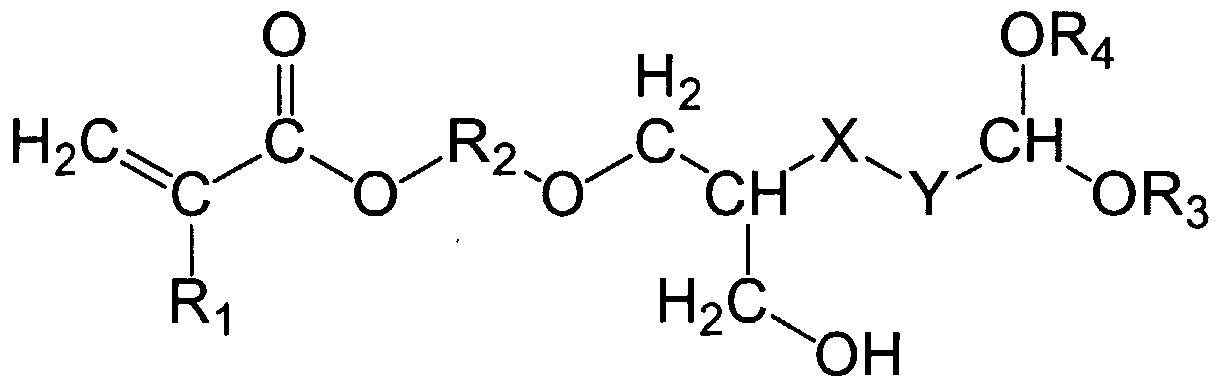
- a sixth aspect of the present invention is a compound represented by the following general formula (2).
- n integer from 0 to 6
- a seventh aspect of the present invention is a compound characterized by being represented by the following general formula (3)
- R2 linear or branched alkylene group having 2 to 10 carbon atoms
- n integer from 0 to 6 '
- R 3 and R 4 each independently a C 1 to C 3 alkyl group
- FIG. 1 is a diagram showing the analysis results by high performance liquid chromatography of Example 1.
- FIG. 2 is a view showing the measurement results of 1 H-NMR of Example 1.
- FIG. 3 is a view showing the measurement results of I R of Example 1. BEST MODE FOR CARRYING OUT THE INVENTION
- the photosensitive resin having a constituent unit represented by the general formula (1) of the present invention can be obtained by using a compound represented by the general formula (2) or (3) with a polyvinyl acetate compound.
- the photosensitive resin having a structural unit represented by the general formula (1) is a carboxylic acid compound having an aldehyde group, a phenolic compound having an aldehyde group, or an acetaride compound thereof, which is acetylated into a polyacetic acid boyl boride.
- the compound can also be synthesized by adding a hydroxyalkyl acrylate glycidyl ether to its carboxylic acid group or phenolic hydroxyl group.
- the degree of polymerization is preferably in the range of 200 to 500. If the degree of polymerization is less than 200, sufficient coating strength can not be obtained, and if it is more than 500, the solution viscosity becomes too high, making it difficult to handle.
- the degree of experiment is preferably 60% or more, more preferably 70% or more. If the degree of hatching is less than 60%, sufficient water solubility can not be obtained.
- the above polyacetic acid boulders are those obtained by copolymerizing other vinyl monomers for the purpose of adjusting developability and improving resist physical properties, hydrophilic group modification, lipophilic group modification, terminal modification, force thione modification, anion modification, etc.
- Modified polyvinyl acetate borides are also applicable.
- the compounds of the general formulas (2) and (3) are prepared by addition reaction of hydroxyalkylazarylate glycite dilutenore and a carboxylic acid compound having an aldehyde group or its acetalide compound, hydroxyalkyl acrylate glycidyl ether and aldehyde group It can be obtained by the addition reaction of phenols or its acetalides. The reaction is the same as the known reaction described in Japanese Patent Application Laid-Open No. 60-222424.
- the reaction of the method using this hydroxyalkyl acrylate glycidyl ether can usually be carried out by heating the reaction substrate or by using a catalyst or a combination thereof. If necessary, a solvent may be added to the reaction system, and a polymerization inhibitor may be added for the purpose of suppressing side reactions.
- the solvent used for the reaction is not particularly limited, but aliphatic hydrocarbons such as hexane, heptane, octane, nonane and decane, aromatic hydrocarbons such as benzene, toluene, xylene and diethylbenzene, jetyl ether, diethylene glycol Ethers such as propyl ether, dibutyl ether, dioxane, tetrahydrofuran, etc., esters such as ethyl acetate, butyl acetate, amyl acetate, etc.
- Halogenated solvents such as methylene chloride, chloroform, carbon tetrachloride, trichlene, tetraclene, etc.
- Alcohols such as methanol, ethanol, 2-propanol, n-butanol, sec-butanol, isobutanol, isobutanol, tert-butanol, and ethylene glycols such as ethylene glycol, diethylene glycol, triethylene glycolonole, and tetraethylene glycolonole Cornoles, ethylene glycol monomethyl ether, diethylene glycol monomethyl etherate, ethylene glycolon regetino oleate tenole, diethylene glycolon dimethyl ether such as diglyconenoglycenoethyle nore etherate, ethylene glycolone monoethynoleate etherate acetate, diethyleneglyconolemonoethylo acetate Dareky ether acetates such as reethene acetate, diethylene glycol monobutyl ether acetate, etc.
- ethylene glycol monomethyl ether diethylene glycol mono
- Propylene glycols such as propylene glycol, dipropylene glycol, tripropylene glycolonole, etc., propylene glycol monomethyl ether, propyrenda Recall monoethile etherate, dipropylene glycol monomethyl ether, dipropylene glycol Noechirueteru, propylene glycol dimethacrylate Chinoreetenore, di propylene glycol Kono regime Chino les ether Honoré, propylene glycol one Propylene glycol ethers such as noregetyl ether tenolee, dipropylene dicaryl jetinore ether, Propylene dicaryl monomethyl etherate acetate, Propylene daryconol monoethyl ether acetate, Dipropylene diallyl monomethyl ethene acetate Propylene glycol ether acetates such as dipropylenediaryl monoethyl ether acetate, Sulfur solvents such as dimethyl
- the catalyst used in the reaction there is no limitation on the catalyst used in the reaction, but as an example, as an acid catalyst, inorganic acids such as sulfuric acid, phosphoric acid and perchloric acid, Lewis acids such as BF 3 , methanesulfonic acid, benzenesulfonic acid, p- Organic sulfonic acids such as toluene sulfonic acid and dodecyl benzene sulfonic acid can be mentioned.
- Examples of basic catalysts include triethlyamine, tetramethylethylenediamine, tributylamine, tri-n-octylamine, dimethylbenzylamine, pyridine, N, N-dimethyl-4-tert-aminopyridine, etc.
- tertiary amines tetramethyl Quaternary ammonium salts such as ammonium chloride, tetramethyl ammonium bromide, tetraethyl ammonium bromide, tetrabutyl ammonium bromide, etc., and phosphorus compounds such as trifenyl phosphine and It can be mentioned.
- liquid catalysts such as pyridine and triethylamine can also be used as a solvent.
- polymerization inhibitor there are no particular limitations on the applicable polymerization inhibitor, but as an example, phenol, alkyl phenyl, catechol, alkyl catechol, nodidoquinone, hydroquinone quinone monomethyl ether, N-alkyl-one N--trosaniline, N-nitroso Monophenylhydroxylamine salt, phenothiazine, 2,2,6,6-tetramethylbiperidine_1-oxyl, 2,2,6,6-tetramethyl-4-hydoxypiperidine 1-oxyl, p-methoxyphenol, etc. .
- 2,2,6,6-tetramethyl-4-hydroxypiperidine-1-oxyl is most preferable, since it is required to be water-soluble when acetalization is carried out to polyacetic acid boules.
- the solvent, the catalyst and the polymerization inhibitor may be removed if necessary, but it may be used in the reaction for acetalization of polyacetic acid as a test compound without removal. I do not turn.
- a small amount of a compound corresponding to the following general formula (4) or (5) may be produced as a side reaction product. Although these may be separated and purified, they generally do not cause any practical problems and may be used as they are.
- aldehyde or acetal compound represented by the general formula (2) or (3) is itself novel and may be used for other applications.
- the reaction to obtain a photosensitive resin having a constitutional unit represented by the general formula (1) is generally carried out by acetalation of a compound represented by the general formula (2) or (3) into a polyvinyl acetate test compound. Heat or acid catalysis or a combination thereof. At that time, a polymerization inhibitor may be added for the purpose of suppressing side reactions.
- the solvent constituting the solution is not particularly limited, but a composition in which polyvinyl acetate boride dissolves is preferable.
- ethylene glycols such as water, ethylene glycolonole, diethylene glycolonole, triethylene glycolonole, tetraethyleneglycolonole, ethylene glycol monomethinoleate tenolee, diethyleneglyconole monomethinoleate tenolee, ethylene glycolonolege tyruethenole, Glycol ethers such as diethylene glycol dimethinole ether, ethylene glycol monoleethyl ether acetate, diethylene glycole monoether Monoethyl phenol ether acetate such as monoethynol atenole acetate, diethylene glycolon monobutynol etherate acetate, propylene glycol, propylene glycol such as propylene glycol, dipropylene glycol, tripropylene glycol, etc.
- Glycol ethers such as diethylene glycol dimethinole ether, ethylene glycol monoleethyl
- water is preferred because of safety and safety.
- a high-boiling solvent it is preferable to use propylene glycol ⁇ dipropylene glycol or ⁇ -methylpyrrolidone mixed with water or used alone.
- inorganic acids such as sulfuric acid, phosphoric acid, nitric acid, perchloric acid, formic acid, acetic acid, propionic acid, oxalic acid, malonic acid, succinic acid, maleic acid, fumaric acid
- inorganic acids such as sulfuric acid, phosphoric acid, nitric acid, perchloric acid, formic acid, acetic acid, propionic acid, oxalic acid, malonic acid, succinic acid, maleic acid, fumaric acid
- organic carboxylic acids such as phthalic acid, methanesulfonic acid, benzenesulfonic acid, ⁇ -toluenesulfonic acid, and organic sulfonic acids such as dodecylbenzenesulfonic acid.
- these acids are preferably removed using an alkali compound such as sodium hydroxide, potassium hydroxide, ammonia, organic amine or a solution thereof or a solution to neutralize it, or a basic ion exchange resin.
- an alkali compound such as sodium hydroxide, potassium hydroxide, ammonia, organic amine or a solution thereof or a solution to neutralize it, or a basic ion exchange resin.
- the reaction temperature largely depends on the type of compound to be pendant, the type of acid catalyst, and the concentration, but generally, a range from room temperature to 100 ° C. is suitably used.
- the compound introduction ratio of the compound represented by the general formula (2) or (3) to polyvinyl acetate boride differs depending on the kind of the compound, 0.2 to 2 O mo 1% to the vinyl acetate monomer unit Is preferred. More preferably, it is 0.:! To 5 mol%. If the introduction rate is too high, the developability is lowered, and if it is too low, sufficient sensitivity can not be obtained, the coating strength is also lowered, and it is also difficult to form a water-containing gel.
- the photosensitive resin which has a structural unit shown by the said General formula (1) of this invention can be used for a photosensitive resin composition.
- the photosensitive resin composition of the present invention is formed using the photosensitive resin of the present invention, it is desirable to mix a photopolymerization initiator and a photosensitizer for the purpose of promoting a photocrosslinking reaction.
- a photopolymerization initiator may be chemically bonded to the photosensitive resin, or they may be mixed with the photosensitive resin in the state of being dissolved or dispersed in a solvent.
- the amount of the photopolymerization initiator is usually 0.1 to 30% by weight, preferably 1 to 10% by weight, based on the photosensitive resin. Do.
- the photopolymerization initiator and the photosensitizer to be applied are not particularly limited, but as an example, benzophenone, hydroxybenzophenone, bis-one N, N-dimethy ⁇ amino-benzophenosi, bis-one N, N- Benzoylphenophenones such as dithioaminophenzophenone, 4-methoxicylene 4'-dimethylaminophensophenone, thioxanthones, 2,4 _getylthioxanthones, isopropylthioxanthones, chlorothioxanthones, isopropoxychlorothioxanthones such as isopropoxy crothioxantones, Anthraquinones such as anthraquinones, benzanthraquinones, aminoanthraquinones, chloroanthraquinones, etc., Acetophenones, benzoin methylated phenols, benzoin methyl
- promoters and the like can also be added.
- examples thereof include ethyl p-dimethylaminobenzoate, isoamyl p-dimethylaminobenzoate, ethanolamine, diethanolamine, triethanolamine and the like.
- polyethylene glycol diacrylate having 2 to 14 ethylene groups
- polyethylene glycol dimethacrylate having 2 to 14 ethylene groups
- trimethylolpropane diacrylate Rate trimethylolpropane dimethacrylate, trimethylolpropane triarylate, trimethylonelepropane trimethacrylate, trimethylolpropane ethoxy triarylate, trimethylolpropane ethoxy trimethacrylate, trimethylolpropane propoxy triarylate
- Trimethylolpropane propoxy trimethacrylate tetramethylol methane triaryl late, tetramethylol methane trimethacrylic acid, tetramethylol methane tetra atalylated acid, teto La
- the photosensitive resin composition of the present invention as the other components, conventionally known materials such as a polymerization inhibitor, a plasticizer, a pigment, a dye, an antifoaming agent, a coupling agent and the like can be added as necessary.
- the photosensitive resin composition of this invention contains water as a solvent.
- the photosensitive resin composition of the present invention may be simply diluted with water, but it may be dissolved by water after solvent substitution by distillation or drying and solidification.
- it may be added to a nonpolar solvent such as aliphatic hydrocarbon, aromatic hydrocarbon, ethyl acetate and butyl acetate, and the solid content may be separated and then redissolved in water.
- the photosensitive resin composition of the present invention has high sensitivity even in a low concentration state, and therefore, it can be photopolymerized even as a low concentration aqueous solution having a solid concentration of 0.5 to 50%, preferably 1% or more.
- a hydrogel can be formed.
- the photosensitive resin composition of the present invention can be mixed with various medicinal components, enzymes, cells, etc. which form a function.
- by photocuring a photosensitive resin composition containing various medicinal components, enzymes, cells and the like it is possible to form a water-containing gel including various medicinal components, enzymes, cells and the like. .
- various medicinal components, enzymes, cells, etc. may be impregnated.
- the photosensitive resin composition of the present invention can be patterned in the same manner as a conventional resist composition. Therefore, the photosensitive resin composition of the present invention is a mixture of various medicinal components, enzymes, cells and the like which form a function, or the photosensitive resin composition of the present invention forms a function after forming a water-containing gel. It is also possible to put a variety of medicinal ingredients, enzymes, cells, etc. impregnated into it by photolithography. Of course, it can also be used as a regular photoresist.
- the developing method may be any of a spray type, a nozzle type, an immersion type and the like, but a spray set with little residue is preferable. If necessary, ultrasonic waves can also be emitted.
- the developer is preferably neutral water, but may be weakly acidic or weakly alkaline. It is also possible to add an organic solvent, a surfactant, an antifoaming agent, etc. for the purpose of assisting developability.
- the present invention will be described below based on examples. However, the present invention is different depending on the type of the photosensitive resin composition to be formed using the photosensitive resin and the purpose of use, and the scope of the present invention is not limited. There is no restriction.
- the resulting reddish brown viscous liquid (A) was analyzed by high performance liquid chromatography, 1 H—NMR, IR.
- the measurement conditions for high performance liquid chromatography are as follows: Force column: SUPER I OREX ODS (manufactured by Shiseido Co., Ltd.) size ⁇ 4.6 mm x 250 mm, Eluent: CH 3 CN: 0.1 w t% phosphoric acid water (40 Flow rate: 1. Om 1 / min, column temperature: 35.0 ° C.
- Product EG-30) 50 g of the product was dispersed in 430 g of purified water, and dissolved by raising the temperature to 90 ° C. After cooling this solution to 60 ° C., 3.0 g of phosphoric acid as a catalyst, 4.2 g of the reddish brown viscous liquid (A) obtained in Example 1, 59 g of 2-propanol as a solvent and Add 13.6 mg of 2,2,6,6-tetramethinolee 4-hydroxypiperidine-1-oxynore (Asaken Denka Kogyo Co., Ltd.
- the aqueous solution of the photosensitive resin composition was diluted with water to the concentration shown in Table 1, and each was placed in a test tube and sealed up with a metal halide lamp UV irradiator at an illuminance of 38 OmW / cm 2 for 2. 8 seconds. After UV irradiation, the test tube was erected, the stopper was opened, and an iron ball weighing 5.5 g was placed on the liquid surface, and the curability was compared and evaluated by sedimentation and holding of the iron ball. The results are shown in Table 1.
- the aqueous solution of this photosensitive resin composition was diluted with water to the concentration shown in Table 2, and under the same conditions as in Example 2, the curability was evaluated by sedimentation and retention of iron balls. The results are shown in Table 2.
- PVA-SbQ resin manufactured by Toyo Gosei Co., Ltd. product SPP-H_13 degree of polymerization 1 700
- Table 3 the concentration shown in Table 3
- Table 3 the concentration shown in Table 3.
- Example 2 the solid content concentration is 2%, and even in the case of a low concentration aqueous solution having a solid content concentration of 1% in Example 3, it is a strong and uniform water-containing gel. I was able to hold it. On the other hand, in Comparative Example 1, the iron spheres could not be held unless the aqueous solution had a solid concentration of 8%, which is higher than that of the example.
- Polyvinyl chloride boride with a degree of polymerization of 1700 and a degree of hatching of 88% (Japan Synthetic Industry Co., Ltd.) Product Brand name EG-30)
- As an inhibitor 2, 2, 6, 6- tetramethyl- 1-hydroxy piperidine 1-oxyl (Asahi Denka Kogyo Co., Ltd. product Adekatab LA-7RD) 14.
- this photosensitive resin composition In play de coater this photosensitive resin composition, entirely coated on a glass substrate, and dried for 5 minutes in a clean oven at 80 ° C, cooled to room temperature, through a mask example Bei a predetermined pattern, illuminance 4.
- OmWZcm 2 It was irradiated with ultraviolet light of 50 Om J cm 2 with an extra-high pressure mercury lamp. Subsequently, spray development was carried out with ion exchange water for 30 seconds to obtain a desired pattern.
- the film thickness of the pattern was 1.0 / m, the resolution was ⁇ ⁇ ⁇ ⁇ , and the sensitivity was 5 steps on the Gras step tablet.
- the material has excellent storage stability, affinity to various compounds, mixed solubility, high sensitivity, and can be solidified even in the wet state, and the sensitivity of the cured product is high. It is possible to provide a photosensitive resin, a photosensitive resin composition and a novel compound which are excellent in flexibility and can be uniformly solidified even at a high water content.
- the photosensitive resin and the photosensitive resin composition of the present invention can be applied, for example, to the formation of a strong and uniform gel even at low concentrations when applied to the solidification of an aqueous solution, and to the case of application to photo-turning.
- New high-sensitivity, high-resolution water-soluble resists One useful thing
Landscapes
- Chemical & Material Sciences (AREA)
- Organic Chemistry (AREA)
- Physics & Mathematics (AREA)
- General Physics & Mathematics (AREA)
- Spectroscopy & Molecular Physics (AREA)
- Chemical Kinetics & Catalysis (AREA)
- Medicinal Chemistry (AREA)
- Polymers & Plastics (AREA)
- Health & Medical Sciences (AREA)
- General Chemical & Material Sciences (AREA)
- Materials For Photolithography (AREA)
- Addition Polymer Or Copolymer, Post-Treatments, Or Chemical Modifications (AREA)
- Macromonomer-Based Addition Polymer (AREA)
Description




Claims


Priority Applications (3)
| Application Number | Priority Date | Filing Date | Title |
|---|---|---|---|
| DE60327555T DE60327555D1 (de) | 2002-12-10 | 2003-11-13 | Neues auf verseiftem polyvinylacetat basierendes lichtempfindliches harz, lichtempfindliche harzzusammensetzung, verfahren zur bildung von wässrigem gel daraus und verbindung |
| EP03772745A EP1574528B1 (en) | 2002-12-10 | 2003-11-13 | Novel photosensitive resin based on saponified polyvinyl acetate, photosensitive resin composition, method of forming aqueous gel from the same, and compound |
| US10/538,690 US7348128B2 (en) | 2002-12-10 | 2003-11-13 | Photosensitive resin based on saponified polyvinyl acetate photosensitive resin composition, method of forming aqueous gel from the same, and compound |
Applications Claiming Priority (2)
| Application Number | Priority Date | Filing Date | Title |
|---|---|---|---|
| JP2002358263A JP4278083B2 (ja) | 2002-12-10 | 2002-12-10 | 新規なポリ酢酸ビニル鹸化物系感光性樹脂、感光性樹脂組成物及びそれを用いた含水ゲルの形成方法並びに化合物 |
| JP2002-358263 | 2002-12-10 |
Publications (1)
| Publication Number | Publication Date |
|---|---|
| WO2004052947A1 true WO2004052947A1 (ja) | 2004-06-24 |
Family
ID=32500895
Family Applications (1)
| Application Number | Title | Priority Date | Filing Date |
|---|---|---|---|
| PCT/JP2003/014467 Ceased WO2004052947A1 (ja) | 2002-12-10 | 2003-11-13 | 新規なポリ酢酸ビニル鹸化物系感光性樹脂、感光性樹脂組成物及びそれを用いた含水ゲルの形成方法並びに化合物 |
Country Status (7)
| Country | Link |
|---|---|
| US (1) | US7348128B2 (ja) |
| EP (1) | EP1574528B1 (ja) |
| JP (1) | JP4278083B2 (ja) |
| KR (1) | KR100721711B1 (ja) |
| CN (1) | CN100338102C (ja) |
| DE (1) | DE60327555D1 (ja) |
| WO (1) | WO2004052947A1 (ja) |
Cited By (12)
| Publication number | Priority date | Publication date | Assignee | Title |
|---|---|---|---|---|
| EP1702961A1 (en) * | 2005-03-14 | 2006-09-20 | Konica Minolta Holdings, Inc. | Ink-jet ink, ink-jet ink set, and ink-jet recording method |
| EP1767597A1 (en) * | 2005-09-21 | 2007-03-28 | Konica Minolta Holdings, Inc. | Ink-jet ink, ink-jet ink set and ink-jet recording method |
| US20080254297A1 (en) * | 2007-04-11 | 2008-10-16 | Boston Scientific Scimed, Inc. | Photoresist coating to apply a coating to select areas of a medical device |
| US8142007B2 (en) * | 2004-10-13 | 2012-03-27 | Seiko Epson Corporation | Ink-jet recording method and ink composition set |
| US8480799B2 (en) | 2007-09-18 | 2013-07-09 | Seiko Epson Corporation | Inkjet-recording non-aqueous ink composition, inkjet recording method, and recorded matter |
| US8518169B2 (en) | 2007-01-29 | 2013-08-27 | Seiko Epson Corporation | Ink set, ink container, inkjet recording method, recording device, and recorded matter |
| US8523343B2 (en) | 2010-01-28 | 2013-09-03 | Seiko Epson Corporation | Aqueous ink composition, ink jet recording method, and recorded matter |
| US8530538B2 (en) | 2005-03-29 | 2013-09-10 | Seiko Epson Corporation | Ink composition |
| US8614264B2 (en) | 2010-01-28 | 2013-12-24 | Seiko Epson Corporation | Aqueous ink composition, ink jet recording method and recorded material |
| US8673994B2 (en) | 2006-11-30 | 2014-03-18 | Seiko Epson Corporation | Ink composition, two-pack curing ink composition set, and recording method and recorded matter using these |
| US8894197B2 (en) | 2007-03-01 | 2014-11-25 | Seiko Epson Corporation | Ink set, ink-jet recording method, and recorded material |
| US9034427B2 (en) | 2008-02-29 | 2015-05-19 | Seiko Epson Corporation | Method of forming opaque layer, recording process, ink set, ink cartridge, and recording apparatus |
Families Citing this family (14)
| Publication number | Priority date | Publication date | Assignee | Title |
|---|---|---|---|---|
| US20070032571A1 (en) * | 2005-08-08 | 2007-02-08 | Konica Minolta Holdings, Inc. | Ink-jet ink, ink-jet ink set, and ink-jet recording method |
| JP2007106110A (ja) * | 2005-09-13 | 2007-04-26 | Konica Minolta Holdings Inc | 画像形成方法 |
| JP2007076149A (ja) * | 2005-09-14 | 2007-03-29 | Konica Minolta Holdings Inc | インクジェット記録方法及びインクセット |
| US20070109375A1 (en) * | 2005-11-16 | 2007-05-17 | Konica Minolta Holdings, Inc. | Ink-jet ink, ink-jet ink set and ink-jet recording method |
| US20070115325A1 (en) * | 2005-11-21 | 2007-05-24 | Konica Minolta Holdings, Inc. | Ink-jet ink and ink-jet recording method |
| JP4525574B2 (ja) * | 2005-11-28 | 2010-08-18 | コニカミノルタホールディングス株式会社 | インクジェット記録方法、及びインクジェット用インクセット |
| JP2007160728A (ja) * | 2005-12-14 | 2007-06-28 | Konica Minolta Holdings Inc | インクジェット記録方法 |
| US8652833B2 (en) | 2006-04-28 | 2014-02-18 | Kuraray Co., Ltd. | Cell culture container and method of producing the same |
| JPWO2008007550A1 (ja) | 2006-07-14 | 2009-12-10 | コニカミノルタホールディングス株式会社 | 製版方法及び平版印刷版 |
| JP2008208298A (ja) | 2007-02-28 | 2008-09-11 | Konica Minolta Holdings Inc | インクジェット用インク及びインクジェット記録方法 |
| JP2008221468A (ja) | 2007-03-08 | 2008-09-25 | Konica Minolta Holdings Inc | インクジェット記録方法 |
| JP5098397B2 (ja) | 2007-03-29 | 2012-12-12 | コニカミノルタホールディングス株式会社 | インクジェットインク、及びインクジェット記録方法 |
| EP2075293B1 (en) | 2007-12-28 | 2014-03-12 | Konica Minolta Holdings, Inc. | Ink-jet ink and ink-jet recording method |
| JP5287847B2 (ja) | 2008-03-05 | 2013-09-11 | コニカミノルタ株式会社 | インクジェット記録装置及びインクジェット記録方法 |
Citations (3)
| Publication number | Priority date | Publication date | Assignee | Title |
|---|---|---|---|---|
| JPS60222442A (ja) * | 1984-04-18 | 1985-11-07 | Mitsui Petrochem Ind Ltd | 3−メタクリロキシ−2−ヒドロキシプロピルオキシベンズアルデヒド |
| JPH0899968A (ja) * | 1994-09-30 | 1996-04-16 | Mitsubishi Chem Corp | エポキシ基を有する(メタ)アクリレートの製造方法 |
| EP0726486A2 (en) * | 1995-02-08 | 1996-08-14 | Fuji Photo Film Co., Ltd. | Optical compensatory sheet |
Family Cites Families (14)
| Publication number | Priority date | Publication date | Assignee | Title |
|---|---|---|---|---|
| JPH0823545B2 (ja) | 1986-09-18 | 1996-03-06 | 株式会社エー・アンド・デイ | 簡易酵素電極 |
| JP2748516B2 (ja) | 1989-03-14 | 1998-05-06 | エヌオーケー株式会社 | グルコースセンサ |
| WO1996018133A1 (en) * | 1994-12-06 | 1996-06-13 | Napp Systems, Inc. | High-resolution letterpress printing plates and water-soluble photopolymerizable compositions comprising a polyvinylalcohol derivative useful therefor |
| GB9604578D0 (en) | 1996-03-04 | 1996-05-01 | Sericol Ltd | Photocurable compositions |
| JP3620155B2 (ja) * | 1996-06-14 | 2005-02-16 | 上野化学工業株式会社 | 水溶性感光性組成物 |
| JPH11327139A (ja) | 1998-05-18 | 1999-11-26 | Nippon Kayaku Co Ltd | 樹脂組成物及びその硬化物 |
| TWI224715B (en) * | 1998-08-05 | 2004-12-01 | Toyo Gosei Kogyo Kk | Photosensitive resin derived from saponified poly(vinyl acetate) |
| JP4066110B2 (ja) * | 1998-12-21 | 2008-03-26 | 東洋合成工業株式会社 | 感光性樹脂及び感光性樹脂組成物 |
| JP4572431B2 (ja) | 1999-08-19 | 2010-11-04 | 日本化成株式会社 | (メタ)アクリレート誘導体およびその製造方法 |
| JP4248137B2 (ja) | 2000-11-22 | 2009-04-02 | 富士フイルム株式会社 | ネガ型感光性平版印刷版 |
| JP4093557B2 (ja) * | 2002-11-14 | 2008-06-04 | 東洋合成工業株式会社 | 感光性樹脂組成物および含水ゲルの形成方法並びに含水ゲル |
| GB0318115D0 (en) * | 2003-08-01 | 2003-09-03 | Sericol Ltd | A printing ink |
| EP1702961B1 (en) * | 2005-03-14 | 2008-11-05 | Konica Minolta Holdings, Inc. | Ink-jet ink, ink-jet ink set, and ink-jet recording method |
| US20070109375A1 (en) * | 2005-11-16 | 2007-05-17 | Konica Minolta Holdings, Inc. | Ink-jet ink, ink-jet ink set and ink-jet recording method |
-
2002
- 2002-12-10 JP JP2002358263A patent/JP4278083B2/ja not_active Expired - Lifetime
-
2003
- 2003-11-13 EP EP03772745A patent/EP1574528B1/en not_active Expired - Lifetime
- 2003-11-13 KR KR1020057010423A patent/KR100721711B1/ko not_active Expired - Fee Related
- 2003-11-13 DE DE60327555T patent/DE60327555D1/de not_active Expired - Lifetime
- 2003-11-13 WO PCT/JP2003/014467 patent/WO2004052947A1/ja not_active Ceased
- 2003-11-13 CN CNB2003801056911A patent/CN100338102C/zh not_active Expired - Fee Related
- 2003-11-13 US US10/538,690 patent/US7348128B2/en not_active Expired - Fee Related
Patent Citations (3)
| Publication number | Priority date | Publication date | Assignee | Title |
|---|---|---|---|---|
| JPS60222442A (ja) * | 1984-04-18 | 1985-11-07 | Mitsui Petrochem Ind Ltd | 3−メタクリロキシ−2−ヒドロキシプロピルオキシベンズアルデヒド |
| JPH0899968A (ja) * | 1994-09-30 | 1996-04-16 | Mitsubishi Chem Corp | エポキシ基を有する(メタ)アクリレートの製造方法 |
| EP0726486A2 (en) * | 1995-02-08 | 1996-08-14 | Fuji Photo Film Co., Ltd. | Optical compensatory sheet |
Non-Patent Citations (1)
| Title |
|---|
| See also references of EP1574528A4 * |
Cited By (16)
| Publication number | Priority date | Publication date | Assignee | Title |
|---|---|---|---|---|
| US8142007B2 (en) * | 2004-10-13 | 2012-03-27 | Seiko Epson Corporation | Ink-jet recording method and ink composition set |
| EP1702961A1 (en) * | 2005-03-14 | 2006-09-20 | Konica Minolta Holdings, Inc. | Ink-jet ink, ink-jet ink set, and ink-jet recording method |
| US8530538B2 (en) | 2005-03-29 | 2013-09-10 | Seiko Epson Corporation | Ink composition |
| EP1767597A1 (en) * | 2005-09-21 | 2007-03-28 | Konica Minolta Holdings, Inc. | Ink-jet ink, ink-jet ink set and ink-jet recording method |
| US8673994B2 (en) | 2006-11-30 | 2014-03-18 | Seiko Epson Corporation | Ink composition, two-pack curing ink composition set, and recording method and recorded matter using these |
| US9790386B2 (en) | 2006-11-30 | 2017-10-17 | Seiko Epson Corporation | Ink composition, two-pack curing ink composition set, and recording method and recorded matter using these |
| US9169410B2 (en) | 2006-11-30 | 2015-10-27 | Seiko Epson Corporation | Ink composition, two-pack curing ink composition set, and recording method and recorded matter using these |
| US8518169B2 (en) | 2007-01-29 | 2013-08-27 | Seiko Epson Corporation | Ink set, ink container, inkjet recording method, recording device, and recorded matter |
| US9616675B2 (en) | 2007-03-01 | 2017-04-11 | Seiko Epson Corporation | Ink set, ink-jet recording method, and recorded material |
| US8894197B2 (en) | 2007-03-01 | 2014-11-25 | Seiko Epson Corporation | Ink set, ink-jet recording method, and recorded material |
| US8257777B2 (en) * | 2007-04-11 | 2012-09-04 | Boston Scientific Scimed, Inc. | Photoresist coating to apply a coating to select areas of a medical device |
| US20080254297A1 (en) * | 2007-04-11 | 2008-10-16 | Boston Scientific Scimed, Inc. | Photoresist coating to apply a coating to select areas of a medical device |
| US8480799B2 (en) | 2007-09-18 | 2013-07-09 | Seiko Epson Corporation | Inkjet-recording non-aqueous ink composition, inkjet recording method, and recorded matter |
| US9034427B2 (en) | 2008-02-29 | 2015-05-19 | Seiko Epson Corporation | Method of forming opaque layer, recording process, ink set, ink cartridge, and recording apparatus |
| US8614264B2 (en) | 2010-01-28 | 2013-12-24 | Seiko Epson Corporation | Aqueous ink composition, ink jet recording method and recorded material |
| US8523343B2 (en) | 2010-01-28 | 2013-09-03 | Seiko Epson Corporation | Aqueous ink composition, ink jet recording method, and recorded matter |
Also Published As
| Publication number | Publication date |
|---|---|
| JP2004189841A (ja) | 2004-07-08 |
| JP4278083B2 (ja) | 2009-06-10 |
| US7348128B2 (en) | 2008-03-25 |
| CN1723222A (zh) | 2006-01-18 |
| DE60327555D1 (de) | 2009-06-18 |
| KR100721711B1 (ko) | 2007-05-25 |
| US20060148925A1 (en) | 2006-07-06 |
| EP1574528B1 (en) | 2009-05-06 |
| EP1574528A1 (en) | 2005-09-14 |
| KR20050089814A (ko) | 2005-09-08 |
| EP1574528A4 (en) | 2007-02-28 |
| CN100338102C (zh) | 2007-09-19 |
Similar Documents
| Publication | Publication Date | Title |
|---|---|---|
| JP4278083B2 (ja) | 新規なポリ酢酸ビニル鹸化物系感光性樹脂、感光性樹脂組成物及びそれを用いた含水ゲルの形成方法並びに化合物 | |
| KR101395375B1 (ko) | 광경화성ㆍ열경화성 수지 조성물 및 그의 경화물 및 그것을이용하여 얻어지는 인쇄 배선판 | |
| TWI400565B (zh) | A photohardenable resin composition, a dry film, a hardened product, and a printed wiring board | |
| KR101571239B1 (ko) | 광 경화성 수지 조성물, 그의 드라이 필름 및 경화물, 및 이들을 이용하여 형성된 경화 피막을 갖는 프린트 배선판 | |
| CN105182688B (zh) | 感光性树脂组合物、感光性元件、抗蚀剂图形的制造方法以及印刷电路板的制造方法 | |
| CN101183217B (zh) | 感光性组合物 | |
| KR101720804B1 (ko) | 고분자 화합물, 화학 증폭 네가티브형 레지스트 조성물 및 패턴 형성 방법 | |
| WO2008013207A1 (en) | Curable resin composition and method for forming cured coating film | |
| JP2016161939A (ja) | ネガティブ型感光性樹脂組成物、それから形成された光硬化パターン、及びそれを含む画像表示装置 | |
| CN111032720B (zh) | 树脂、感光性树脂组合物、树脂固化膜及图像显示装置 | |
| JP2003507758A (ja) | 感光性樹脂組成物 | |
| CN107817652B (zh) | 感光性树脂组合物和由其制造的光固化图案 | |
| JP5239787B2 (ja) | 感光性樹脂組成物、並びにこれを用いた感光性エレメント、レジストパターンの形成方法及びプリント配線板の製造方法 | |
| CN101183212B (zh) | 光工具以及阻焊图案的形成方法 | |
| JP4441806B2 (ja) | 新規なポリ酢酸ビニルけん化物系樹脂、感光性樹脂組成物及びそれを用いた含水ゲルの形成方法並びに化合物 | |
| JP2010054847A (ja) | 感光性樹脂組成物及び凹凸基板の製造方法 | |
| JP5251523B2 (ja) | 感光性樹脂組成物、並びにこれを用いた感光性エレメント、レジストパターンの形成方法及びプリント配線板の製造方法 | |
| JP5449729B2 (ja) | 感光性樹脂組成物 | |
| Lee et al. | Rational Design of Degradable Multiarm Polymers Applicable for Photoimaging Materials | |
| JPH02212502A (ja) | 光硬化性組成物 | |
| JP2008032794A (ja) | 感光性樹脂組成物 | |
| JP2009221284A (ja) | 高分子化合物、感光性樹脂組成物、液体及びゲル形成方法 | |
| JPS61174202A (ja) | 水溶性の感光性樹脂の製造方法 | |
| KR20170133063A (ko) | 감광성 수지 조성물 및 이로부터 형성된 광경화 패턴 | |
| JP2009221286A (ja) | 高分子化合物、感光性樹脂組成物、液体及びゲル形成方法 |
Legal Events
| Date | Code | Title | Description |
|---|---|---|---|
| AK | Designated states |
Kind code of ref document: A1 Designated state(s): CN KR US |
|
| AL | Designated countries for regional patents |
Kind code of ref document: A1 Designated state(s): AT BE BG CH CY CZ DE DK EE ES FI FR GB GR HU IE IT LU MC NL PT RO SE SI SK TR |
|
| 121 | Ep: the epo has been informed by wipo that ep was designated in this application | ||
| WWE | Wipo information: entry into national phase |
Ref document number: 2003772745 Country of ref document: EP |
|
| WWE | Wipo information: entry into national phase |
Ref document number: 1020057010423 Country of ref document: KR |
|
| ENP | Entry into the national phase |
Ref document number: 2006148925 Country of ref document: US Kind code of ref document: A1 |
|
| WWE | Wipo information: entry into national phase |
Ref document number: 10538690 Country of ref document: US Ref document number: 20038A56911 Country of ref document: CN |
|
| WWP | Wipo information: published in national office |
Ref document number: 1020057010423 Country of ref document: KR |
|
| WWP | Wipo information: published in national office |
Ref document number: 2003772745 Country of ref document: EP |
|
| WWP | Wipo information: published in national office |
Ref document number: 10538690 Country of ref document: US |