WO2004072053A1 - 複素多環系化合物、それを用いた色素、顔料又は染料、色変換材料組成物及び色変換膜 - Google Patents
複素多環系化合物、それを用いた色素、顔料又は染料、色変換材料組成物及び色変換膜 Download PDFInfo
- Publication number
- WO2004072053A1 WO2004072053A1 PCT/JP2004/001472 JP2004001472W WO2004072053A1 WO 2004072053 A1 WO2004072053 A1 WO 2004072053A1 JP 2004001472 W JP2004001472 W JP 2004001472W WO 2004072053 A1 WO2004072053 A1 WO 2004072053A1
- Authority
- WO
- WIPO (PCT)
- Prior art keywords
- substituent
- carbon atoms
- group
- color conversion
- aryl group
- Prior art date
- Legal status (The legal status is an assumption and is not a legal conclusion. Google has not performed a legal analysis and makes no representation as to the accuracy of the status listed.)
- Ceased
Links
Classifications
-
- C—CHEMISTRY; METALLURGY
- C07—ORGANIC CHEMISTRY
- C07D—HETEROCYCLIC COMPOUNDS
- C07D307/00—Heterocyclic compounds containing five-membered rings having one oxygen atom as the only ring hetero atom
- C07D307/77—Heterocyclic compounds containing five-membered rings having one oxygen atom as the only ring hetero atom ortho- or peri-condensed with carbocyclic rings or ring systems
-
- C—CHEMISTRY; METALLURGY
- C07—ORGANIC CHEMISTRY
- C07D—HETEROCYCLIC COMPOUNDS
- C07D263/00—Heterocyclic compounds containing 1,3-oxazole or hydrogenated 1,3-oxazole rings
- C07D263/52—Heterocyclic compounds containing 1,3-oxazole or hydrogenated 1,3-oxazole rings condensed with carbocyclic rings or ring systems
- C07D263/60—Naphthoxazoles; Hydrogenated naphthoxazoles
-
- C—CHEMISTRY; METALLURGY
- C07—ORGANIC CHEMISTRY
- C07D—HETEROCYCLIC COMPOUNDS
- C07D311/00—Heterocyclic compounds containing six-membered rings having one oxygen atom as the only hetero atom, condensed with other rings
- C07D311/02—Heterocyclic compounds containing six-membered rings having one oxygen atom as the only hetero atom, condensed with other rings ortho- or peri-condensed with carbocyclic rings or ring systems
- C07D311/78—Ring systems having three or more relevant rings
-
- C—CHEMISTRY; METALLURGY
- C07—ORGANIC CHEMISTRY
- C07D—HETEROCYCLIC COMPOUNDS
- C07D498/00—Heterocyclic compounds containing in the condensed system at least one hetero ring having nitrogen and oxygen atoms as the only ring hetero atoms
- C07D498/02—Heterocyclic compounds containing in the condensed system at least one hetero ring having nitrogen and oxygen atoms as the only ring hetero atoms in which the condensed system contains two hetero rings
- C07D498/04—Ortho-condensed systems
-
- C—CHEMISTRY; METALLURGY
- C09—DYES; PAINTS; POLISHES; NATURAL RESINS; ADHESIVES; COMPOSITIONS NOT OTHERWISE PROVIDED FOR; APPLICATIONS OF MATERIALS NOT OTHERWISE PROVIDED FOR
- C09B—ORGANIC DYES OR CLOSELY-RELATED COMPOUNDS FOR PRODUCING DYES, e.g. PIGMENTS; MORDANTS; LAKES
- C09B57/00—Other synthetic dyes of known constitution
-
- C—CHEMISTRY; METALLURGY
- C09—DYES; PAINTS; POLISHES; NATURAL RESINS; ADHESIVES; COMPOSITIONS NOT OTHERWISE PROVIDED FOR; APPLICATIONS OF MATERIALS NOT OTHERWISE PROVIDED FOR
- C09K—MATERIALS FOR MISCELLANEOUS APPLICATIONS, NOT PROVIDED FOR ELSEWHERE
- C09K11/00—Luminescent materials, e.g. electroluminescent or chemiluminescent
- C09K11/06—Luminescent materials, e.g. electroluminescent or chemiluminescent containing organic luminescent materials
-
- C—CHEMISTRY; METALLURGY
- C09—DYES; PAINTS; POLISHES; NATURAL RESINS; ADHESIVES; COMPOSITIONS NOT OTHERWISE PROVIDED FOR; APPLICATIONS OF MATERIALS NOT OTHERWISE PROVIDED FOR
- C09K—MATERIALS FOR MISCELLANEOUS APPLICATIONS, NOT PROVIDED FOR ELSEWHERE
- C09K2211/00—Chemical nature of organic luminescent or tenebrescent compounds
- C09K2211/10—Non-macromolecular compounds
- C09K2211/1003—Carbocyclic compounds
- C09K2211/1011—Condensed systems
-
- C—CHEMISTRY; METALLURGY
- C09—DYES; PAINTS; POLISHES; NATURAL RESINS; ADHESIVES; COMPOSITIONS NOT OTHERWISE PROVIDED FOR; APPLICATIONS OF MATERIALS NOT OTHERWISE PROVIDED FOR
- C09K—MATERIALS FOR MISCELLANEOUS APPLICATIONS, NOT PROVIDED FOR ELSEWHERE
- C09K2211/00—Chemical nature of organic luminescent or tenebrescent compounds
- C09K2211/10—Non-macromolecular compounds
- C09K2211/1018—Heterocyclic compounds
- C09K2211/1025—Heterocyclic compounds characterised by ligands
- C09K2211/1029—Heterocyclic compounds characterised by ligands containing one nitrogen atom as the heteroatom
- C09K2211/1033—Heterocyclic compounds characterised by ligands containing one nitrogen atom as the heteroatom with oxygen
-
- C—CHEMISTRY; METALLURGY
- C09—DYES; PAINTS; POLISHES; NATURAL RESINS; ADHESIVES; COMPOSITIONS NOT OTHERWISE PROVIDED FOR; APPLICATIONS OF MATERIALS NOT OTHERWISE PROVIDED FOR
- C09K—MATERIALS FOR MISCELLANEOUS APPLICATIONS, NOT PROVIDED FOR ELSEWHERE
- C09K2211/00—Chemical nature of organic luminescent or tenebrescent compounds
- C09K2211/10—Non-macromolecular compounds
- C09K2211/1018—Heterocyclic compounds
- C09K2211/1025—Heterocyclic compounds characterised by ligands
- C09K2211/1088—Heterocyclic compounds characterised by ligands containing oxygen as the only heteroatom
Definitions
- Heteropolycyclic compound dye, pigment or dye using the same, color conversion material composition and color
- the present invention relates to a novel heteropolycyclic compound, a dye, a pigment or a dye using the same, and a color conversion light.
- the present invention relates to a material composition and a color conversion film.
- organic fluorescent dyes have been used not only as dyes and pigments, but also as fluorescent conversion films in various display devices, dye lasers, copy protection, solar energy conversion, fluorescent film dyes in greenhouses, etc. It is used in a wide range of fields.
- a fluorescent dye that has the ability to form a novel clathrate (clathrate) that can significantly change the original color and fluorescence of the dye by inclusion of a low-molecular compound (organic guest molecule) (For example, “Chem. Lett.”, Page 9 (1996), “Chem. Lett.”, Page 837 (1999), “Chem. Lett. Pp. 714 (2000), “Chem. Lett.”, 808 (2001), “J. Chem. Perkin Trans.”, Vol. 2, pp.
- the orientation and arrangement of the dye molecules can be varied in various ways at the molecular level by inclusion of the organic guest molecules. It can greatly change the solid-state optical properties (color tone and fluorescence) of the dye.
- Organic electroluminescent devices (hereafter, organic EL devices) are completely solid-state devices that can be used to produce lightweight, thin, and low-voltage driven displays, and are being actively studied in various fields.
- OLEDs organic electroluminescent devices
- the biggest technical challenge for converting OLEDs into displays is the development of full-color methods.
- the methods include the three-color coating method, the color filter method, and the color method. Three methods are considered: the conversion method.
- the color conversion method has an advantage that it is easy to enlarge the screen as compared with the three-color coating method, and has the advantage of less loss of luminance than the color filter method.
- Have studied full colorization of organic EL devices by color conversion method When a full-color display is manufactured using this color conversion method, it is necessary to finely pattern a color conversion film used to convert blue light emission to green or red.
- the color conversion film is composed of fluorescent dyes and a resin that disperses them, but in order to pattern the film with high definition, the resin itself needs to have fine workability.
- Japanese Patent Application Laid-Open No. 9-208944 discloses a color conversion material composition using a basic resin such as a butyl pyridine derivative or an aminostyrene derivative.
- Japanese Patent Application Laid-Open No. 9-106688 discloses a color conversion material composition using an ethylenically unsaturated carboxylic acid copolymer.
- the publication discloses that an unsaturated group-containing compound obtained by reacting a reaction product of an epoxy compound and acrylic acid or methacrylic acid with a polybasic carboxylic acid or an anhydride thereof, a fluorescent dye and a fluorescent dye. It discloses a color conversion material composition containing at least one phosphor selected from pigments.
- An object of the present invention has been made to solve the above-mentioned problems, and has a function as a general organic dye or an organic fluorescent dye, or has a clathrate-forming ability and a fluorescent property, and includes various kinds of organic guest molecules.
- a color conversion material composition that provides pigments or dyes, and further uses the compound to prevent color conversion performance from deteriorating even when used for a long period of time, and to prevent the use of pigments during storage for use. Things and it An object of the present invention is to provide a color conversion film using the same.
- the present inventors have conducted intensive studies to achieve the above object, and as a result, the dyes represented by the following general formulas (I) and (II), and the fluorescent dyes represented by the following general formulas ( ⁇ ) to (VI II) It has been found that the above-mentioned object is achieved by using a heteropolycyclic compound having a specific structure.
- the present invention provides a heteropolycyclic compound represented by any of the following general formulas (I) to ( ⁇ ).
- R ′ and R 2 each independently represent an alkyl group having 1 to 10 carbon atoms which may have a substituent, or an aryl group having 7 to 30 carbon atoms which may have a substituent.
- X is an oxygen atom, a sulfur atom, one NH— or one NR 3 —
- R 3 is an alkyl group having 1 to 10 carbon atoms which may have a substituent, and may have a substituent.
- Y is an oxygen atom, a sulfur atom, one NH— or —NR 4 —
- R 4 is an alkyl group having 1 to 10 carbon atoms which may have a substituent, and may have a substituent.
- Y represents an oxygen atom, a sulfur atom or 1 NR 4 —.
- Ar represents an aryl group having 6 to 20 carbon atoms which may have a substituent or a heteroaryl group having 5 to 20 carbon atoms which may have a substituent.
- the present invention provides (A) a fluorescent dye comprising at least one kind of the heteropolycyclic compounds represented by the general formulas (HI) to (VHI); and (B) a color containing a binder material.
- Another object is to provide a conversion material composition and a color conversion film comprising the color conversion material composition.
- the present invention provides a dye comprising the heteropolycyclic compound, and a pigment or dye containing the heteropolycyclic compound.
- FIG. 3 is a diagram illustrating a configuration of an L element.
- FIG. 2 is a diagram for explaining a method for evaluating color conversion performance in Examples and Comparative Examples.
- FIG. 3 is a diagram illustrating a method for evaluating a chromaticity retention rate in Examples and Comparative Examples.
- 1 is a glass substrate
- 2 is a color conversion film
- 3 is an anode
- 4 is an organic EL light emitting layer
- 5 is a cathode.
- the heteropolycyclic compound of the present invention is a novel heteropolycyclic compound having a structure represented by any of the following general formulas (I) to (VIII), which has not been published in any literature.
- R 1 and R 2 each independently represent an alkyl group having 1 to 10 carbon atoms which may have a substituent, Good aryl-alkyl group having 7 to 30 carbon atoms, aryl group having 6 to 20 carbon atoms which may have a substituent, heteroaryl having 5 to 20 carbon atoms which may have a substituent And represents a group, which may be bonded to each other to form a ring structure, or may form a ring structure together with a benzene ring to which a nitrogen atom is bonded.
- the alkyl group may be linear, branched, or cyclic, and examples thereof include a methyl group, an ethyl group, an n-propyl group, an isopropyl group, various butyl groups, various pentyl groups, and various types.
- arylalkyl group examples include a benzyl group, a 1-phenylethyl group, a 2-phenylethyl group, a 1-phenylisopropyl group, a 2-phenylisopropyl group, a phenyl-1-t-butyl group, and an ⁇ -naphthylmethyl group.
- aryl group examples include a phenyl group, a naphthyl group, an anthryl group and a pyrenyl group.
- heteroaryl group examples include 1-aza-indridine-11-yl group,
- 1-aza-indolizine-1-3-yl group 1-aza-indolizine-5-yl group, 1-aza-indolizine-1 6-yl group, 1-aza-indolizine-1 7-yl Group, 1-aza-dridine 8-yl group, 2-aza-drididine-1-yl group,
- 2-aza-indolizine-1 3-yl group 2-aza-indolizine-1 5-yl group, 2-aza-indolizine-1 6-yl group, 1-aza-indolizine-1 7- Group, 2-aza-indolizine-1-8-yl group, 6-aza-indolizine-1-1-yl group, 6-aza-indolizine-1-2-yl group, 6-aza-indolizine-1-3-yl Group, 6-aza-indolizine-1 5-inole group, 6-aza-indolizine-1 7-inole group, 6-aza-indolizine-1 8-yl group, 7-aza-indolizine-1 1-yl group, 7-aza-indridine 1-2-yl group, 7-aza-indridine 1-3-yl group, 7-aza-indridine-1 5-yl group, 7-aza-indridine 1 6 —Yil group,
- Each of these groups may have a suitable substituent.
- substituents include an alkyl group, an alkoxyl group, a halogen atom, a cyano group, an alkoxycarbonyl group, a carboxyl group, an ester group, and the like.
- substituents include an amide group, a sulfoxyl group, a sulfone amide group, a nitro group, an aryl group, and a heteroaryl group.
- alkyl group, aryl group, and heteroaryl group examples include the same as those described above.
- halogen atom examples include a fluorine atom, a chlorine atom, a bromine atom, and an iodine atom.
- sulfonamide group may be either a substituted sulfonamide or an unsubstituted sulfonamide, and an amide group. May be either a substituted amide or an unsubstituted amide.
- alkoxyl groups, sulfonamide de group, the substituent of the amino-de-group include the same as the R 1 and R 2. Further, examples of the alkoxyl group in the alkoxycarbonyl group include the same as those described above.
- Examples of the ring structure formed by bonding R 1 and R 2 together with a nitrogen atom include 1-pyrrolidinyl group, piperidino group, morpholino group and the like.
- R 1 and R 2 are formed together with the benzene ring to which the nitrogen atom is bonded.
- Examples of the ring structure include the following,
- X represents an oxygen atom, a sulfur atom, a mono- or —NR 3 — (R 3 may have a substituent
- R 3 may have a substituent
- Examples of the alkyl group, aryl group and heteroaryl group represented by R 3 include the same examples as those described in R 1 and R 2 above, respectively, and the substituents thereof also include the same. .
- ⁇ represents an oxygen atom, a sulfur atom or one NR 4 —
- R 4 is an alkyl group having 1 to 10 carbon atoms which may have a substituent, Represents an aryl group having 6 to 20 carbon atoms which may have a substituent, or a heteroaryl group having 5 to 20 carbon atoms which may have a substituent.
- ⁇ represents an oxygen atom, a sulfur atom, ⁇ — or —NR 4 — (R 4 is the same).
- Examples of the alkyl group, aryl group and heteroaryl group represented by R 4 include the same examples as those described in R 1 and R 2 above, and the same substituents as those described above. .
- A represents a substituted or unsubstituted aryl group having 6 to 10 carbon atoms or a substituted or unsubstituted aryl group having 5 to 20 carbon atoms.
- a ring formed by X is represented by a general formula (Ia) II) and those having a 6-membered ring structure.
- the compounds represented by the general formulas (I) and (II) of the present invention are dyes, and disperse dyes containing the dyes, ink jet dyes, electrophotographic toners, thermal transfer dyes, light modulation elements, etc. It can be suitably used as a non-linear optical material, a photoelectric conversion dye such as an organic solar cell, and a high-density optical recording dye. Further, it can be used as an intermediate for producing the following general formulas (V) to (VIII) of the present invention.
- Specific examples of the compound represented by the general formula (VII) include, for example, a ring formed by X in the compounds represented by the general formulas (Va) to (Vc). Has a 6-membered ring structure represented by the general formula (VII).
- Specific examples of the compound represented by the general formula (VIII) include, for example, the compound represented by the general formulas (VI-a) to (VI-c), which is formed by X The ring has a six-membered ring structure represented by the general formula (V111).
- the compounds represented by the general formulas ( ⁇ ) to (VIII) of the present invention are organic fluorescent dyes, which contain a disperse dye, a dye for ink jet printing, an electrophotographic toner, a thermal transfer dye, Light-emitting materials such as organic electroluminescent devices, nonlinear optical materials such as light modulation devices, photoelectric conversion dyes such as organic solar cells, fluorescent dyes such as organic EL and dye lasers, and agriculture It can be suitably used as a receptor for dimming / wavelength conversion dyes, high-density optical recording dyes, fluorescent dyes for molecular recognition, etc. for industrial films. In addition, some of them have clathrate forming ability. By including various kinds of organic guest molecules, the color tone and the fluorescence emission are changed, and the solid-state light-emitting organic compound consisting of an inclusion complex with further enhanced functions is provided. It can also be induced to a fluorescent dye.
- the compounds represented by the general formulas ( ⁇ ⁇ ) to (Vi II) and the inclusion complexes thereof of the present invention can be used as organic fluorescent dyes in various applications, for example, for use in fluorescent conversion films in various display devices, dye lasers, and the like. , Dimming, energy conversion, high-density optical recording, display, molecular recognition, and fluorescence sensor for recognition.
- the fluorescent conversion film in various display devices is applied to electronic display devices such as FDP (plasma display), ELD (electroluminescence display), LED (light emitting diode), VFD (fluorescent display tube) and the like. be able to.
- FDP plasma display
- ELD electroluminescence display
- LED light emitting diode
- VFD fluorescent display tube
- the heteropolycyclic compound of the present invention which is a 1,2-naphthoquinone derivative represented by the general formula (I), can be produced according to the following reaction formula (A) when X is an oxygen atom. can do.
- reaction formula (A) a substantially stoichiometric ⁇ -staggered amount of 1,2-naphthoquinone-l-4-sulfonic acid alkali metal salt (a) and m-substituted phenol (b) are converted to a suitable compound such as acetic acid.
- a catalyst such as copper (II) halide
- the benzofurano 1, 2-— represented by the general formula (I-11) is obtained.
- a compound having a naphthoquinone skeleton and wherein X is an oxygen atom is obtained.
- the compound represented by the general formula (c) is by-produced.
- the method for producing the compound of the general formula (II) of the present invention includes, for example, the compound represented by the general formula (c) by using a catalyst having a weak oxidizing power such as nickel chloride in the above reaction formula (A). Is obtained as a main component, and after isolating the compound represented by the general formula (c) in a solvent such as dimethyl sulfoxide in the presence of a strong oxidizing catalyst such as copper acetate at 40 to 120 °. It can be produced by performing a cyclization reaction at a temperature of about C.
- the compound can be produced according to the following reaction formula (B).
- the method for producing the compounds of the general formulas (VII) and (VIII) of the present invention includes, for example, In the reaction formula (C), the compound can be produced by using a compound represented by the general formula (II) instead of the general formula (1-1).
- the color conversion material composition of the present invention comprises: (A) a fluorescent dye comprising at least one of the heteropolycyclic compounds represented by the general formulas (III) to (VI II); and ( ⁇ ) a binder material. Is included.
- the concentration of the component (II) is not particularly limited, but is preferably from 0.1 to 10% by weight, more preferably from 0.2 to 5% by weight, based on the total weight of the solid components of the color conversion material composition. It is. Concentration to zero. 1 by weight 0 / if 0 or more can in sufficiently absorbed can color converting light from the light source, or decreases the color conversion efficiency due to concentration quenching if 1 0 wt% or less, high-definition The patterning Can not be stopped.
- the binder material of the component (II) is a photoreactive resin.
- the photoreactive resin refers to a resin that shows a curing reaction by light, and is a resin mixture containing a polymerizable oligomer and / or a monomer such as epoxyacrylate, urethane acrylate, or polyether acrylate. There is a resin blended with a sulphonyl salt and an epoxy compound.
- the binder material of the component (II) is a thermosetting resin or a thermoplastic resin.
- thermosetting resin examples include an epoxy resin, a urethane resin, an alkyd resin, and a polyimide resin. Particularly, an epoxy resin and a urethane resin are preferable because of high transparency and high dispersibility of a dye.
- thermoplastic resin examples include (meth) acrylic resin, polystyrene resin, polycarbonate resin, polyester resin and the like, and (meth) ataryl resin and polycarbonate resin are particularly preferable because of high transparency and dispersibility of pigment.
- the color conversion material composition of the present invention further contains an oral-damine-based fluorescent dye such as oral amines and rhodamine 6G.
- the (B) binder material used in the present invention comprises (C) an ester methacrylate methacrylate copolymer and (D) a monomer and / or oligomer having a photopolymerizable ethylenically unsaturated group. It is preferable to include.
- the (C) methacrylate-methacrylic acid copolymer is represented by the following structure.
- R is a substituted or unsubstituted alkyl group having 1 to 10 carbon atoms, or a substituted or unsubstituted aryl group having 6 to 20 carbon atoms, such as benzyl group, methyl group, ethyl group, cycloalkyl group; Examples thereof include a hexyl group, a cyclohexylmethyl group, and a hydroxyethyl group.
- R is preferably a methyl group or a benzyl group because the solubility, developability and film quality are balanced.
- m and n are each an integer of 1 or more.
- Mw weight average molecular weight
- the Mw is 5,000 or more, the strength of the color conversion film does not decrease, and when the Mw is 100,000 or less, a uniform color conversion film is formed without increasing the solution viscosity.
- the copolymerization ratio is 0.5 or more, the developer In this case, the film does not swell and the accuracy of the pattern jungle does not decrease.
- the value is 0.95 or less, the solubility in a developing solution is not so small that development cannot be performed.
- the monomer (D) having a photopolymerizable ethylenically unsaturated group and / or the oligomer 2-hydroxyethyl (meth) acrylate, 2-hydroxypropyl (meth) acrylate as a monomer having a hydroxyl group And 2-hydroxyhexyl (meth) acrylate.
- Examples of the above (meth) acrylate include ethylene glycol di (meth) acrylate, methylene glycol di (meth) acrylate, triethylene glycol di (meth) acrylate, tetraethylene glycol di (meth) acrylate, Tetramethylene glycol di (meth) acrylate, trimethylolpropane tri (meth) acrylate, pentaerythritol di (meth) acrylate, pentaerythritol tri (meth) acrylate, pentaerythritol tritetra (meth) acrylate, dipentaerythritol hexa ( Meth) acrylate and glycerol (meth) acrylate.
- the monomer and / or oligomer of the component (D) can be used alone or in combination of two or more. These monomers and oligomers can be used within a range that does not impair the properties of the color conversion composition composition and the color conversion film of the present invention.
- the color conversion material composition of the present invention preferably further comprises (E) a compound having an epoxy group in addition to the components (A) and (B), or the components (A) to (D).
- examples thereof include a phenol novolak epoxy compound and a cresol novolak epoxy compound.
- (E) content of the compound having an epoxy group based on the total amount of the color conversion material composition preferably from 0.1 to 1 5 weight 0/0, more preferably at 0. 5 weight 0/0 .
- the content is 15% by weight or less, the compound having an epoxy group does not polymerize during storage of the color conversion material composition, and the solution viscosity does not fluctuate.
- the content is 0.1% by weight or more, a sufficient effect is obtained. can get.
- a photopolymerization initiator or a sensitizer may be added to the color conversion material composition of the present invention, if necessary.
- the photopolymerization initiator or the sensitizer is a photopolymerizable ethylenic component of the component (D). It is used not only for the photocuring reaction of monomers and / or oligomers having an unsaturated group, but also as a polymerization initiator for other photopolymerizable compounds to be blended as required.
- the photopolymerization initiator for example, acetophenones, benzophenones, benzoin ethers, thio compounds, anthraquinones, organic peroxides and thiols are preferably used.
- examples of acetate phenone I include acetate phenone, 2,2-jetoxyacetophenone, p-methylacetophenone, p-dimethylaminopropiophenone, and dichloroacetophenone.
- Benzotriones such as benzophenone, 2-chlorobenzophenone, ⁇ , ⁇ '-bisdimethylaminobenzophenone, and benzophenones.
- Classes include benzyl, benzoin, benzoin methyl ether, benzoin isopropyl ether, benzoin isobutyl ester, and the like.
- Benzyl methyl ketal, thioxanthone, 2-cloth thioxanthone, 2, 4 1-ethylthioxanthone, 2-methylthioxanthone, 2-isopropylthioxanthone, etc., and anthraquinones include 2-ethylanthraquinone, octamethylanthraquinone, 1,2-benzanthraquinone, 2,3-diphenylanthraquinone, etc.
- azobisisobutyl nitrile benzoyl peroxide, coumarin oxide and the like.
- 2-mercaptobenzothiazole 2-mercaptobenzothiazole and the like.
- One of these photopolymerization initiators and sensitizers can be used alone, but two or more can be used in combination.
- the photopolymerization initiator itself does not act as a sensitizer, but a compound capable of increasing the ability of the photopolymerization initiator or the sensitizer when used in combination with the above compounds can also be added.
- a compound capable of increasing the ability of the photopolymerization initiator or the sensitizer when used in combination with the above compounds can also be added.
- Such compounds include, for example, tertiary amines such as triethanolamine, which are effective when used in combination with benzophenone.
- the preferred amount of the photopolymerization initiator / sensitizer used is 0 to 10 parts by weight based on 100 parts by weight of the component (D).
- the amount used is 10 parts by weight or less, light easily reaches the inside, uncured portions are not generated, the adhesion between the substrate and the resin is good, and the fluorescence of the dye does not decrease.
- the color conversion material composition of the present invention may further comprise a melamine resin, a phenol resin, an alkyd resin, a polyurethane resin, a polyester resin, an oligomer or polymer of a polyamide resin, or a polybutyl resin, in order to improve the fluorescence yield of the fluorescent dye.
- a transparent resin such as alcohol, polyhydrhydrin, hydroxyethyl cellulose, carboxymethyl cellulose, aromatic sulfonamide resin, urea resin or benzoguanamine resin can be added, and melamine resin and benzoguanamine resin are particularly preferable. .
- These resins can be used as long as the properties of the color conversion material composition and the color conversion film are not impaired.
- the preferred amount is 100 parts by weight of the methacrylate-methacrylate copolymer (C). To 200 parts by weight or less, and more preferably 100 parts by weight or less. If the amount used is 200 parts by weight or less, there is no possibility that a problem will occur in the tackiness after precuring.
- the color conversion material composition of the present invention may further contain, if necessary, additives such as a curing accelerator, a thermal polymerization inhibitor, a plasticizer, a filler, a solvent, an antifoaming agent, and a leveling agent.
- a curing accelerator include perbenzoic acid derivatives, peracetic acid, and benzofuran.
- the thermal polymerization inhibitor include hydroquinone, hydroquinone monomethyl ether, pyrogallol, t-butylcatechol, and phenothiazine.
- the plasticizer include dibutyl phthalate and dioctyl phthalate.
- Rate, tricresyl, etc., as fillers for example, glass fiber, silica, myriki, alumina, etc., as antifoaming and leveling agents, for example, silicone, fluorine, acrylic Compounds and the like are preferably used.
- the color conversion film of the present invention is composed of the color conversion material composition of the present invention, and is formed into a film using the color conversion material composition, or by using a method such as coating on a substrate.
- a color conversion film having a desired pattern can be formed with high accuracy, particularly by using photolithography.
- ketones, esters, lactones, and the like are preferable as solvents for dissolving various components used in the color conversion material composition in the solvent, depending on the method for producing the color conversion film.
- ketones include methylethyl ketone, methyl isobutyl ketone, and cyclohexanone.
- esters include 2-acetoxy-11-ethoxypropane, methylcellosolve, ethylcellesolve, butylcellesolve, and cellosolve acetate.
- lactones include, for example, lactones.
- the photosensitive color conversion material composition is first applied as a solution to a substrate surface, and then the solvent is dried by a pre-curer. After that, a photomask is placed on the film thus obtained, and the exposed area is cured by irradiating with actinic rays, and the unexposed area is eluted with a weak alkaline aqueous solution. A pattern is formed by development, and post-baking is performed as post-drying.
- the substrate on which the solution of the color conversion material composition is applied is preferably a smooth substrate having a light transmittance of 50% or more in the visible region of 400 to 700 nm.
- a glass substrate or a polymer plate is used.
- soda lime glass, barium-strontium-containing glass, lead glass, aluminogate glass, borosilicate glass, barium borate glass, quartz, or the like can be preferably used.
- the polymer plate include polycarbonate, acrylic, polyethylene terephthalate, polyethylene terephthalate ', and polysulfone.
- the method of applying the solution of the color conversion composition of the present invention to a substrate may be any of a known solution immersion method, a spray method, a method using a roller coater, a land coater, and a spinner. Can also be used. After coating to a desired thickness by these methods, the solvent is removed (prebake) to form a film.
- This pre-bake is performed by heating with an oven, a hot plate or the like.
- the heating temperature and heating time in the pre-beta are appropriately selected according to the solvent used, and for example, the heating is performed at a temperature of 80 to 150 ° C for 1 to 30 minutes.
- the exposure performed after the pre-bake is performed by an exposure machine, and by exposing through a photomask, only the resist corresponding to the pattern is exposed.
- the exposure machine and the exposure irradiation conditions can be appropriately selected.
- As the irradiation light for example, visible light, ultraviolet light, X-ray, electron beam and the like can be used.
- Amount of irradiation is not particularly limited, for example, is selected in the range of 1 ⁇ 3 0 0 O m J / cm 2.
- the post-exposure re-developing is performed for the purpose of removing the resist in the unexposed portion, and a desired pattern is formed by this developing.
- a developer suitable for the alkali development for example, an aqueous solution of an alkali metal or alkaline earth metal carbonate can be used. In particular, at a temperature of 10 to 50 ° C, preferably 20 to 40 ° C, using a weak alkaline aqueous solution containing 1 to 3% by weight of a carbonate such as sodium carbonate, potassium carbonate, lithium carbonate and the like.
- the image is preferably developed, and a fine image can be precisely formed using a commercially available developing machine or an ultrasonic cleaning machine.
- postbaking After development in this manner, heat treatment (postbaking) is performed at 80 to 220 ° (10 to 120 minutes). Color change This is performed to improve the adhesion between the exchange film and the substrate. This is done by heating in an oven, hot plate, etc., as in the case of pre-baking.
- the exposure step is unnecessary.
- the film of the thermosetting resin is cured by heat treatment (postbaking) after prebaking.
- the film thickness of the color conversion film of the present invention is required to appropriately select a film thickness necessary for converting incident light into a desired wavelength, and is preferably in the range of 1 to 100 im, more preferably 1 to 2 000 im. The thickness is 0 m.
- color conversion film of the present invention can be provided with a color filter in order to obtain a desired wavelength to adjust the color purity.
- Color filters include, for example, perylene pigments, lake pigments, azo pigments, quinacridone pigments, anthraquinone pigments, anthracene pigments, isoindolin pigments, isoindolinone pigments, and Russian Russian pigments.
- Pigment triphenylmethane-based basic dye, indanthrone-based pigment, indophenol-based pigment, cyanine-based pigment, dioxazine-based pigment, etc., either alone or as a mixture of two or more of these, or the pigment is dissolved in binder resin Alternatively, a dispersed solid state can be suitably used.
- the respective components may be sequentially stacked or may be bonded.
- the procedure for laminating the color conversion film is not particularly limited, and it may be formed from either direction, and may be formed from left to right or from right to left.
- the color conversion film of the present invention preferably absorbs light from a light source and emits light of a longer wavelength.
- the light source may be an organic EL device, an LED (light emitting diode), a cold cathode tube, an inorganic EL device, Fluorescent lamps or incandescent lamps are used, and organic EL elements and LED elements that generate less ultraviolet light that degrades dyes are particularly preferable.
- FIG. 1 shows a specific example of a case where a colorized organic EL device is formed by combining a color conversion film and an organic EL device.
- the colorized organic EL device includes a glass substrate 1, a color conversion film 2, an anode 3, an organic EL light emitting layer 4, and a cathode 5, as viewed from the light extraction side. Since the organic EL light emitting layer 4 is easily deteriorated in the presence of moisture and oxygen, the organic EL light emitting layer 4 is sealed from the side of the cathode 5 using a counter glass substrate so as to cover the entire element portion including the color conversion film.
- a test piece in which a color conversion film was formed on a transparent glass plate was prepared, and the test piece was separately prepared in the range of 450 to 470 nm according to the dye used for the color conversion film.
- a blue organic EL element having an appropriately selected peak wavelength is superimposed and illuminated and irradiated with blue light, and a spectrum of transmitted light obtained through a color conversion film and a color filter is converted into a spectral luminometer (Minol Yu CS- The measurement was carried out twice in a visual field by using the method (1).
- the relative fluorescence intensity of the color conversion film was defined as follows.
- Color conversion efficiency (brightness of transmitted light obtained through color conversion film and color filter) / (brightness of EL element)
- the color coordinates were determined from the measured spectrum.
- the organic EL device Since the organic EL device has a half-lifetime of the emission intensity, a blue EL device having a peak at a wavelength of 470 nm is used as the excitation light source having a constant intensity.
- An excitation light source and a color conversion film (a test piece made of (1)) were placed in contact with the light source. These were placed in a dry nitrogen atmosphere. Lighted continuously for hours.
- the dye retention was calculated by comparing the absorbance of the dye on the test piece before and after irradiation with blue light (in the case of the comparative example, the absorbance derived from coumarin 6).
- Synthesis Example 8 Synthesis of Compound (IV-d) Compound (IV-d) was prepared in the same manner as in Synthesis Example 7 except that 91-anthraldehyde (9.82 mmol) was used instead of 1-pyrenecarbaldehyde. Obtained.
- jgti-i-dani (I- d) (9- (Cyc 1 ohexy I me thy 1 -hex 1 -am i no) benzo [b] naphtho [1, 2-d] furan-5, 6-dione) ( 0.135 g, 3 ⁇ 04x 10- 4 mol) and p- Xia Bruno benz aldehyde arsenide de a (0.048 3.66 10 4 mol) was dissolved in acetic acid 20 ml, to which acetic en Moniumu (0.375g, 4.86xi0- 3 moles ) And reacted at 90 ° C for 10 hours.
- 1,2-Naphthoquinone-4-sulfonic acid sodium salt (1.0 g, 3.84 ramol), N, N-dibutyl-3-aminophenol (1.28 g, 4.01 mmol) and NiCl 2 (0.5 g, 3.84 ol) was dissolved in 45 ml of dimethylformamide (DMF), and heated and stirred at 50 ° C for 3 hours. After completion of the reaction, the mixture was poured into 300 ml of ion-exchanged water, and the precipitate was collected by filtration.
- DMF dimethylformamide
- Binder resin Resin Benzyl methacrylate Methyl methacrylate-same as in Example 2
- a film was formed on a 2.5 cnix 5 cm glass substrate by a spin coater method.
- the film formation conditions were as follows: the spin coater was rotated at 100 rpm, the rotation time was 10 seconds, and the film was dried at 120 ° C. for 2 minutes. Then, after irradiating 300 mJ / cm 2 of ultraviolet light, heat treatment was performed at 200 ° C. for 60 minutes to obtain a color conversion film having a film thickness of 10 O / m or less.
- the obtained color conversion film has a peak at 44 O nm according to the method of (1) Evaluation of color conversion performance and (2) Continuous irradiation test of excitation light to color conversion film (evaluation of dye retention).
- the initial color conversion efficiency and chromaticity coordinates were obtained using the blue EL device, and the chromaticity and the dye retention after the blue EL device was irradiated at 400 nits for 1000 hours were measured. Table 3 shows the results. Comparative Examples 1 and 1
- binder materials binder resin, photopolymerizable monomers and / or oligomers having an ethylenically unsaturated group
- compounds having an epoxy group and other components (including solvents)
- a color conversion film was obtained in the same manner as in Examples 1 to 3, and the initial color conversion efficiency and the initial chromaticity were determined. Was measured. Table 3 shows the results. Table 3 As shown in Table 3, in Comparative Examples 1 and 1, the initial color conversion efficiency is not inferior to Examples 1 to 3, but the dye retention is remarkably inferior, and the color change before and after light irradiation is large. Further, in the color conversion material composition of the comparative example, crystals of coumarin 6 were deposited during storage (fridge 5 ° C.).
- A a fluorescent dye
- B a binder material
- C a binder resin
- D a monomer having a photopolymerizable ethylenically unsaturated group and / or a ligoma
- E shown in Tables 4 to 6 below.
- a color conversion material composition was prepared using a compound having an epoxy group and other components (including a solvent).
- Table 4 Example 4
- Example 5 Example 6
- Dye Compound 11 Compound 10
- Binder resin Methyl methacrylate Same as in Example 9 Benzi methacrylate (C component) Tacrylic acid copolymer Methacrylic acid copolymer
- a film was formed on a 2.5 cm ⁇ 5 cm glass substrate by a spin coater method using the obtained resin composition for a color conversion film.
- Film forming conditions were as follows: a spin coater was rotated at 100 rpm, the rotation time was 10 seconds, and the film was dried at 120 ° C. for 2 minutes.
- Examples 4 to 11 were irradiated with 300 mJ / cm 2 of ultraviolet light and then subjected to a heat treatment at 200 ° C. for 60 minutes to obtain a color conversion film having a film thickness of 10 / m or less.
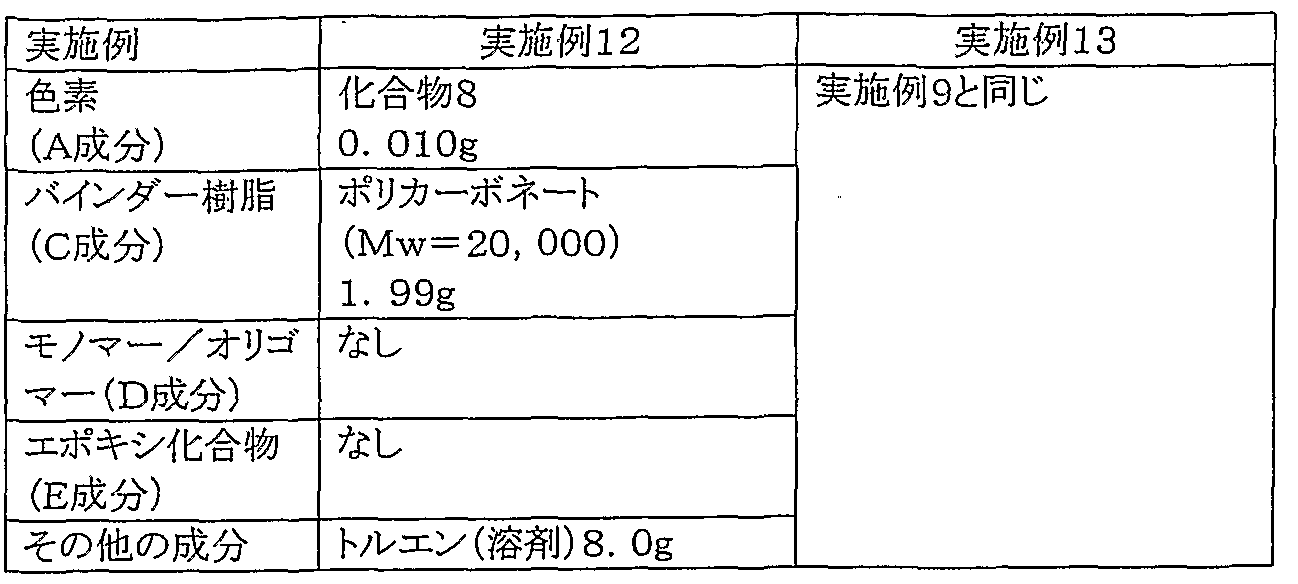
- Example 12 only heat treatment at 200: for 60 minutes was performed.
- Example 13 the prepared color conversion material was applied to a commercially available blue LED element and dried at 70 ° C.
- the obtained color conversion film is peaked at 47 O nm according to the method of (1) Evaluation of color conversion performance and (2) Test of continuous irradiation of excitation light to color conversion film (evaluation of dye retention).
- the initial color conversion efficiency and chromaticity coordinates were determined using a blue EL device having the following formula, and the chromaticity and dye retention after the blue EL device was irradiated at 400 ⁇ for 1000 hours were measured. Table 8 shows the results. Table 8
- Example 4 the color conversion material compositions of Examples 4 to 12 could be stably stored at 5 ° C in a refrigerator. Further, in Example 13, green light emission was visually confirmed. Industrial applicability
- a novel heteropolycyclic system that functions as an organic fluorescent dye that can greatly change the solid-state optical properties (color tone and fluorescence) of a pigment by inclusion of a guest molecule)
- a compound can be provided, and a dye comprising the heteropolycyclic compound, a pigment or dye containing the heteropolycyclic compound is useful for various uses, and is particularly suitable as a material for a color conversion material composition.
- the color conversion film obtained from the color conversion material composition of the present invention does not deteriorate in color conversion performance even when used for a long time, and does not become unusable due to precipitation of a dye during storage.
- the color conversion film of the present invention is most suitable as a color conversion film for fully integrating organic electroluminescent devices, LED devices, and the like.
Landscapes
- Chemical & Material Sciences (AREA)
- Organic Chemistry (AREA)
- Engineering & Computer Science (AREA)
- Materials Engineering (AREA)
- Electroluminescent Light Sources (AREA)
- Nitrogen Condensed Heterocyclic Rings (AREA)
- Nitrogen And Oxygen Or Sulfur-Condensed Heterocyclic Ring Systems (AREA)
- Furan Compounds (AREA)
- Heterocyclic Carbon Compounds Containing A Hetero Ring Having Nitrogen And Oxygen As The Only Ring Hetero Atoms (AREA)
Abstract
Description



Claims


Priority Applications (5)
| Application Number | Priority Date | Filing Date | Title |
|---|---|---|---|
| US10/545,319 US7420065B2 (en) | 2003-02-14 | 2004-02-12 | Hetero-polycyclic compounds, and coloring matters, pigments, dyes, color-changing material compositions, and color-changing films, made by using the compounds |
| EP04710500A EP1593675A4 (en) | 2003-02-14 | 2004-02-12 | HETEROPOLYCYCLIC COMPOUNDS AND COLOR MATERIALS PRODUCED BY USING THE COMPOUNDS, PIGMENTS, DYES, COLOR CHANGING MATERIAL COMPOSITIONS AND COLOR CHANGING FILMS |
| JP2005504979A JP4514710B2 (ja) | 2003-02-14 | 2004-02-12 | 複素多環系化合物 |
| US12/183,905 US20080290329A1 (en) | 2003-02-14 | 2008-07-31 | Hetero-polycyclic compounds, and coloring matters, pigments, dyes, color-changing material compositions, and color-changing films, made by using the compounds |
| US12/184,653 US20090043116A1 (en) | 2003-02-14 | 2008-08-01 | Hetero-polycyclic compounds, and coloring matters, pigments, dyes, color-changing material compositions, and color-changing films, made by using the compounds |
Applications Claiming Priority (4)
| Application Number | Priority Date | Filing Date | Title |
|---|---|---|---|
| JP2003-036790 | 2003-02-14 | ||
| JP2003036790 | 2003-02-14 | ||
| JP2003-036738 | 2003-02-14 | ||
| JP2003036738 | 2003-02-14 |
Related Child Applications (2)
| Application Number | Title | Priority Date | Filing Date |
|---|---|---|---|
| US12/183,905 Division US20080290329A1 (en) | 2003-02-14 | 2008-07-31 | Hetero-polycyclic compounds, and coloring matters, pigments, dyes, color-changing material compositions, and color-changing films, made by using the compounds |
| US12/184,653 Division US20090043116A1 (en) | 2003-02-14 | 2008-08-01 | Hetero-polycyclic compounds, and coloring matters, pigments, dyes, color-changing material compositions, and color-changing films, made by using the compounds |
Publications (1)
| Publication Number | Publication Date |
|---|---|
| WO2004072053A1 true WO2004072053A1 (ja) | 2004-08-26 |
Family
ID=32871192
Family Applications (1)
| Application Number | Title | Priority Date | Filing Date |
|---|---|---|---|
| PCT/JP2004/001472 Ceased WO2004072053A1 (ja) | 2003-02-14 | 2004-02-12 | 複素多環系化合物、それを用いた色素、顔料又は染料、色変換材料組成物及び色変換膜 |
Country Status (6)
| Country | Link |
|---|---|
| US (3) | US7420065B2 (ja) |
| EP (1) | EP1593675A4 (ja) |
| JP (2) | JP4514710B2 (ja) |
| KR (1) | KR20050109940A (ja) |
| TW (1) | TW200427656A (ja) |
| WO (1) | WO2004072053A1 (ja) |
Cited By (11)
| Publication number | Priority date | Publication date | Assignee | Title |
|---|---|---|---|---|
| JP2005259688A (ja) * | 2004-02-13 | 2005-09-22 | Kochi Univ | 色変換フィルム、色変換フィルタおよびそれを用いた有機elディスプレイ |
| JP2006228477A (ja) * | 2005-02-15 | 2006-08-31 | Kochi Univ | 色変換フィルタおよびそれを用いた有機elディスプレイ |
| WO2007111136A1 (ja) * | 2006-03-28 | 2007-10-04 | Adeka Corporation | エポキシ樹脂硬化性組成物 |
| JP2008195749A (ja) * | 2007-02-08 | 2008-08-28 | Kochi Univ | 複素多環系フェナジン化合物 |
| EP1852486A4 (en) * | 2005-02-25 | 2010-03-03 | Toray Industries | MATERIAL FOR LIGHT-EMITTING ELEMENT AND LIGHT-EMITTING ELEMENT |
| WO2010137285A1 (ja) * | 2009-05-29 | 2010-12-02 | 出光興産株式会社 | アントラセン誘導体及びそれを用いた有機エレクトロルミネッセンス素子 |
| WO2011013474A1 (ja) | 2009-07-31 | 2011-02-03 | 株式会社Adeka | シッフベース型化合物及び該化合物を含有する色素材料 |
| JP4759737B2 (ja) * | 2004-02-13 | 2011-08-31 | 国立大学法人高知大学 | 複素多環化合物及び色素 |
| JP2012503027A (ja) * | 2008-09-23 | 2012-02-02 | エルジー・ケム・リミテッド | 新規な化合物、その製造方法、およびそれを用いた有機電子素子 |
| JP2012180451A (ja) * | 2011-03-01 | 2012-09-20 | Noda Screen:Kk | 蛍光性化合物、蛍光性重合体およびコーティング剤 |
| CN105086885A (zh) * | 2014-05-20 | 2015-11-25 | 太湖金张科技股份有限公司 | 一种阻隔蓝光丙烯酸胶及其制成的薄膜 |
Families Citing this family (12)
| Publication number | Priority date | Publication date | Assignee | Title |
|---|---|---|---|---|
| US7989802B2 (en) * | 2007-03-07 | 2011-08-02 | Toray Industries, Inc. | Light emitting device material and light emitting device |
| EP2213639B1 (en) * | 2007-11-19 | 2016-04-13 | Idemitsu Kosan Co., Ltd. | Monobenzochrysene derivatives and their use in materials for organic electroluminescent devices |
| GB0816557D0 (en) * | 2008-09-10 | 2008-10-15 | Merck Patent Gmbh | Electro-optical switching element and electro-optical display |
| WO2016126423A2 (en) | 2015-02-03 | 2016-08-11 | E I Du Pont De Nemours And Company | Electroactive materials |
| CN105086499B (zh) * | 2015-08-20 | 2017-04-19 | 中国科学院长春应用化学研究所 | 一种光敏染料及其制备方法和太阳电池 |
| WO2017175986A1 (en) | 2016-04-08 | 2017-10-12 | Rohm And Haas Electronic Materials Korea Ltd. | Organic electroluminescent compound and organic electroluminescent device comprising the same |
| KR102794564B1 (ko) * | 2016-04-08 | 2025-04-15 | 듀폰스페셜티머터리얼스코리아 유한회사 | 유기 전계 발광 화합물 및 이를 포함하는 유기 전계 발광 소자 |
| CN107256881B (zh) * | 2017-06-28 | 2020-05-08 | 京东方科技集团股份有限公司 | 显示面板及其制作方法、显示装置 |
| US11426818B2 (en) | 2018-08-10 | 2022-08-30 | The Research Foundation for the State University | Additive manufacturing processes and additively manufactured products |
| KR102173413B1 (ko) * | 2018-11-23 | 2020-11-04 | 한국생산기술연구원 | 산 가스 감지용 염료 및 그를 포함하는 산 가스 감지 센서 |
| KR102721327B1 (ko) * | 2019-10-21 | 2024-10-23 | 주식회사 엘지화학 | 감광성 수지 조성물, 이를 이용한 디스플레이 장치용 색변환필터의 제조 방법 및 이에 의하여 제조된 디스플레이 장치용 색변환필터 |
| WO2023177217A1 (ko) * | 2022-03-18 | 2023-09-21 | 에스에프씨 주식회사 | 신규한 헤테로고리 화합물 및 이를 포함하는 유기발광소자 |
Citations (6)
| Publication number | Priority date | Publication date | Assignee | Title |
|---|---|---|---|---|
| EP0600668A1 (en) * | 1992-12-03 | 1994-06-08 | Pilkington Plc | Photochromic compounds |
| WO1999020630A1 (en) * | 1997-10-20 | 1999-04-29 | James Robinson Limited | Photochromic compounds |
| JPH11124572A (ja) * | 1997-06-17 | 1999-05-11 | Mitsubishi Chemical Corp | 蛍光材料およびこれを用いた有機電界発光素子 |
| JP2003217857A (ja) * | 2002-01-29 | 2003-07-31 | Nippon Kayaku Co Ltd | 発光素子 |
| JP2003229274A (ja) * | 2002-02-04 | 2003-08-15 | Nippon Kayaku Co Ltd | 発光素子 |
| JP2004006064A (ja) * | 2002-03-22 | 2004-01-08 | Nippon Kayaku Co Ltd | 発光素子 |
Family Cites Families (4)
| Publication number | Priority date | Publication date | Assignee | Title |
|---|---|---|---|---|
| US2783248A (en) * | 1954-06-30 | 1957-02-26 | American Cyanamid Co | Process for preparing dinaphtho-[2, 1, 1', 2']-furan-5, 6-dione |
| GB9225348D0 (en) * | 1992-12-03 | 1993-01-27 | Pilkington Plc | Bridged photochromics |
| JP4514466B2 (ja) * | 2003-02-14 | 2010-07-28 | 株式会社テクノネットワーク四国 | 複素多環系化合物 |
| JP3980003B2 (ja) * | 2003-02-14 | 2007-09-19 | 出光興産株式会社 | 色変換材料組成物及びそれを用いた色変換膜 |
-
2004
- 2004-02-12 WO PCT/JP2004/001472 patent/WO2004072053A1/ja not_active Ceased
- 2004-02-12 JP JP2005504979A patent/JP4514710B2/ja not_active Expired - Fee Related
- 2004-02-12 KR KR1020057014918A patent/KR20050109940A/ko not_active Withdrawn
- 2004-02-12 EP EP04710500A patent/EP1593675A4/en not_active Withdrawn
- 2004-02-12 US US10/545,319 patent/US7420065B2/en not_active Expired - Fee Related
- 2004-02-13 TW TW093103540A patent/TW200427656A/zh unknown
-
2008
- 2008-07-31 US US12/183,905 patent/US20080290329A1/en not_active Abandoned
- 2008-08-01 US US12/184,653 patent/US20090043116A1/en not_active Abandoned
-
2009
- 2009-12-18 JP JP2009287588A patent/JP2010143904A/ja active Pending
Patent Citations (6)
| Publication number | Priority date | Publication date | Assignee | Title |
|---|---|---|---|---|
| EP0600668A1 (en) * | 1992-12-03 | 1994-06-08 | Pilkington Plc | Photochromic compounds |
| JPH11124572A (ja) * | 1997-06-17 | 1999-05-11 | Mitsubishi Chemical Corp | 蛍光材料およびこれを用いた有機電界発光素子 |
| WO1999020630A1 (en) * | 1997-10-20 | 1999-04-29 | James Robinson Limited | Photochromic compounds |
| JP2003217857A (ja) * | 2002-01-29 | 2003-07-31 | Nippon Kayaku Co Ltd | 発光素子 |
| JP2003229274A (ja) * | 2002-02-04 | 2003-08-15 | Nippon Kayaku Co Ltd | 発光素子 |
| JP2004006064A (ja) * | 2002-03-22 | 2004-01-08 | Nippon Kayaku Co Ltd | 発光素子 |
Non-Patent Citations (1)
| Title |
|---|
| See also references of EP1593675A4 * |
Cited By (26)
| Publication number | Priority date | Publication date | Assignee | Title |
|---|---|---|---|---|
| JP4759737B2 (ja) * | 2004-02-13 | 2011-08-31 | 国立大学法人高知大学 | 複素多環化合物及び色素 |
| JP2005259688A (ja) * | 2004-02-13 | 2005-09-22 | Kochi Univ | 色変換フィルム、色変換フィルタおよびそれを用いた有機elディスプレイ |
| JP2006228477A (ja) * | 2005-02-15 | 2006-08-31 | Kochi Univ | 色変換フィルタおよびそれを用いた有機elディスプレイ |
| EP1852486A4 (en) * | 2005-02-25 | 2010-03-03 | Toray Industries | MATERIAL FOR LIGHT-EMITTING ELEMENT AND LIGHT-EMITTING ELEMENT |
| US7901794B2 (en) | 2005-02-25 | 2011-03-08 | Toray Industries, Inc. | Material for light-emitting element and light emitting element |
| WO2007111136A1 (ja) * | 2006-03-28 | 2007-10-04 | Adeka Corporation | エポキシ樹脂硬化性組成物 |
| JP2007262204A (ja) * | 2006-03-28 | 2007-10-11 | Adeka Corp | エポキシ樹脂硬化性組成物 |
| US7763700B2 (en) | 2006-03-28 | 2010-07-27 | Adeka Corporation | Epoxy resin curing composition |
| KR101344704B1 (ko) | 2006-03-28 | 2013-12-26 | 가부시키가이샤 아데카 | 에폭시 수지 경화성 조성물 |
| JP2008195749A (ja) * | 2007-02-08 | 2008-08-28 | Kochi Univ | 複素多環系フェナジン化合物 |
| JP2014111598A (ja) * | 2008-09-23 | 2014-06-19 | Lg Chem Ltd | 新規な化合物、その製造方法、およびそれを用いた有機電子素子 |
| JP2012503027A (ja) * | 2008-09-23 | 2012-02-02 | エルジー・ケム・リミテッド | 新規な化合物、その製造方法、およびそれを用いた有機電子素子 |
| US9028977B2 (en) | 2008-09-23 | 2015-05-12 | Lg Chem, Ltd. | Compound, method for preparing same and organic electronic device using same |
| US8866135B2 (en) | 2009-05-29 | 2014-10-21 | Idemitsu Kosan Co., Ltd. | Anthracene derivative and organic electroluminescent element using the same |
| US8629430B2 (en) | 2009-05-29 | 2014-01-14 | Idemitsu Kosan Co., Ltd. | Anthracene derivative and organic electroluminescent element using the same |
| KR101368164B1 (ko) | 2009-05-29 | 2014-02-27 | 이데미쓰 고산 가부시키가이샤 | 안트라센 유도체 및 그것을 이용한 유기 전계 발광 소자 |
| WO2010137285A1 (ja) * | 2009-05-29 | 2010-12-02 | 出光興産株式会社 | アントラセン誘導体及びそれを用いた有機エレクトロルミネッセンス素子 |
| JP5280526B2 (ja) * | 2009-05-29 | 2013-09-04 | 出光興産株式会社 | アントラセン誘導体及びそれを用いた有機エレクトロルミネッセンス素子 |
| US9147847B2 (en) | 2009-05-29 | 2015-09-29 | Idemitsu Kosan Co., Ltd. | Anthracene derivative and organic electroluminescent element using the same |
| US9373792B2 (en) | 2009-05-29 | 2016-06-21 | Idemitsu Kosan Co., Ltd. | Anthracene derivative and organic electroluminescent element using the same |
| KR101754445B1 (ko) | 2009-05-29 | 2017-07-05 | 이데미쓰 고산 가부시키가이샤 | 안트라센 유도체 및 그것을 이용한 유기 전계 발광 소자 |
| US8568884B2 (en) | 2009-07-31 | 2013-10-29 | Adeka Corporation | Schiff base type compound and coloring material containing the same |
| WO2011013474A1 (ja) | 2009-07-31 | 2011-02-03 | 株式会社Adeka | シッフベース型化合物及び該化合物を含有する色素材料 |
| US8758897B2 (en) | 2009-07-31 | 2014-06-24 | Adeka Corporation | Schiff base type color conversion layer, light absorbing layer, and filter |
| JP2012180451A (ja) * | 2011-03-01 | 2012-09-20 | Noda Screen:Kk | 蛍光性化合物、蛍光性重合体およびコーティング剤 |
| CN105086885A (zh) * | 2014-05-20 | 2015-11-25 | 太湖金张科技股份有限公司 | 一种阻隔蓝光丙烯酸胶及其制成的薄膜 |
Also Published As
| Publication number | Publication date |
|---|---|
| US20090043116A1 (en) | 2009-02-12 |
| EP1593675A4 (en) | 2008-03-19 |
| US20060235060A1 (en) | 2006-10-19 |
| JPWO2004072053A1 (ja) | 2006-06-01 |
| US20080290329A1 (en) | 2008-11-27 |
| KR20050109940A (ko) | 2005-11-22 |
| EP1593675A1 (en) | 2005-11-09 |
| US7420065B2 (en) | 2008-09-02 |
| TW200427656A (en) | 2004-12-16 |
| JP4514710B2 (ja) | 2010-07-28 |
| JP2010143904A (ja) | 2010-07-01 |
Similar Documents
| Publication | Publication Date | Title |
|---|---|---|
| WO2004072053A1 (ja) | 複素多環系化合物、それを用いた色素、顔料又は染料、色変換材料組成物及び色変換膜 | |
| You et al. | Novel Norrish type I flavonoid photoinitiator for safe LED light with high activity and low toxicity by inhibiting the ESIPT process | |
| KR102349690B1 (ko) | 착색 조성물, 착색 경화막 및 표시 소자 | |
| TW201245131A (en) | Colored resin composition, color filter, liquid crystal display device, organic el display device | |
| CN104880909B (zh) | 着色组合物、着色固化膜和显示元件 | |
| TW201233733A (en) | Novel compound, dye and colored photosensitive composition | |
| KR20170116565A (ko) | 신규 화합물 및 착색 감광성 조성물 | |
| KR102545326B1 (ko) | 옥심에스테르 화합물 및 상기 화합물을 함유하는 광중합 개시제 | |
| WO2015080217A1 (ja) | 着色樹脂組成物、カラーフィルタ、液晶表示装置及び有機el表示装置 | |
| JP3980003B2 (ja) | 色変換材料組成物及びそれを用いた色変換膜 | |
| CN118510852B (zh) | 化合物和着色树脂组合物 | |
| KR102818081B1 (ko) | 수지, 수지 조성물 및 이를 이용한 표시장치 | |
| CN108693701B (zh) | 着色固化性树脂组合物 | |
| JP7636147B2 (ja) | ベンゾペリレン化合物及び着色硬化性樹脂組成物 | |
| JP2015127407A (ja) | 着色樹脂組成物、カラーフィルタ、液晶表示装置及び有機el表示装置 | |
| TW202242067A (zh) | 波長轉換材料 | |
| JP2021107525A (ja) | 化合物 | |
| JP7636189B2 (ja) | 化合物、着色剤及び着色樹脂組成物 | |
| CN114671882B (zh) | 一种三聚茚基桥联锌卟啉-香豆素星型三重态光敏剂及其制备方法和应用 | |
| CN108663902B (zh) | 着色树脂组合物、滤色器和显示装置 | |
| Hu et al. | Synthesis of two carbazole-based dyes and application of two-photon initiating polymerization | |
| KR20240102859A (ko) | 착색 경화성 조성물, 컬러 필터, 및 표시 장치 | |
| CN120882761A (zh) | 着色固化性树脂组合物、光学滤波器和固体摄像元件 | |
| KR20250110082A (ko) | 저반사율의 감광성 수지 조성물 및 이를 이용한 차광층 | |
| CN118244579A (zh) | 着色固化性组合物、滤色器和显示装置 |
Legal Events
| Date | Code | Title | Description |
|---|---|---|---|
| AK | Designated states |
Kind code of ref document: A1 Designated state(s): AE AG AL AM AT AU AZ BA BB BG BR BW BY BZ CA CH CN CO CR CU CZ DE DK DM DZ EC EE EG ES FI GB GD GE GH GM HR HU ID IL IN IS JP KE KG KP KR KZ LC LK LR LS LT LU LV MA MD MG MK MN MW MX MZ NA NI NO NZ OM PG PH PL PT RO RU SC SD SE SG SK SL SY TJ TM TN TR TT TZ UA UG US UZ VC VN YU ZA ZM ZW |
|
| AL | Designated countries for regional patents |
Kind code of ref document: A1 Designated state(s): BW GH GM KE LS MW MZ SD SL SZ TZ UG ZM ZW AM AZ BY KG KZ MD RU TJ TM AT BE BG CH CY CZ DE DK EE ES FI FR GB GR HU IE IT LU MC NL PT RO SE SI SK TR BF BJ CF CG CI CM GA GN GQ GW ML MR NE SN TD TG |
|
| 121 | Ep: the epo has been informed by wipo that ep was designated in this application | ||
| WWE | Wipo information: entry into national phase |
Ref document number: 2005504979 Country of ref document: JP |
|
| WWE | Wipo information: entry into national phase |
Ref document number: 2004710500 Country of ref document: EP Ref document number: 1020057014918 Country of ref document: KR Ref document number: 20048040446 Country of ref document: CN |
|
| WWP | Wipo information: published in national office |
Ref document number: 2004710500 Country of ref document: EP |
|
| WWP | Wipo information: published in national office |
Ref document number: 1020057014918 Country of ref document: KR |
|
| WWE | Wipo information: entry into national phase |
Ref document number: 2006235060 Country of ref document: US Ref document number: 10545319 Country of ref document: US |
|
| WWP | Wipo information: published in national office |
Ref document number: 10545319 Country of ref document: US |