WO2004081098A1 - Liant bitumineux et son procede de preparation - Google Patents
Liant bitumineux et son procede de preparation Download PDFInfo
- Publication number
- WO2004081098A1 WO2004081098A1 PCT/FR2004/000543 FR2004000543W WO2004081098A1 WO 2004081098 A1 WO2004081098 A1 WO 2004081098A1 FR 2004000543 W FR2004000543 W FR 2004000543W WO 2004081098 A1 WO2004081098 A1 WO 2004081098A1
- Authority
- WO
- WIPO (PCT)
- Prior art keywords
- bitumen
- acid
- binder
- weight
- temperature
- Prior art date
- Legal status (The legal status is an assumption and is not a legal conclusion. Google has not performed a legal analysis and makes no representation as to the accuracy of the status listed.)
- Ceased
Links
Classifications
-
- C—CHEMISTRY; METALLURGY
- C08—ORGANIC MACROMOLECULAR COMPOUNDS; THEIR PREPARATION OR CHEMICAL WORKING-UP; COMPOSITIONS BASED THEREON
- C08K—Use of inorganic or non-macromolecular organic substances as compounding ingredients
- C08K3/00—Use of inorganic substances as compounding ingredients
- C08K3/32—Phosphorus-containing compounds
-
- C—CHEMISTRY; METALLURGY
- C08—ORGANIC MACROMOLECULAR COMPOUNDS; THEIR PREPARATION OR CHEMICAL WORKING-UP; COMPOSITIONS BASED THEREON
- C08L—COMPOSITIONS OF MACROMOLECULAR COMPOUNDS
- C08L95/00—Compositions of bituminous materials, e.g. asphalt, tar, pitch
-
- C—CHEMISTRY; METALLURGY
- C04—CEMENTS; CONCRETE; ARTIFICIAL STONE; CERAMICS; REFRACTORIES
- C04B—LIME, MAGNESIA; SLAG; CEMENTS; COMPOSITIONS THEREOF, e.g. MORTARS, CONCRETE OR LIKE BUILDING MATERIALS; ARTIFICIAL STONE; CERAMICS; REFRACTORIES; TREATMENT OF NATURAL STONE
- C04B26/00—Compositions of mortars, concrete or artificial stone, containing only organic binders, e.g. polymer or resin concrete
- C04B26/02—Macromolecular compounds
- C04B26/26—Bituminous materials, e.g. tar, pitch
-
- E—FIXED CONSTRUCTIONS
- E01—CONSTRUCTION OF ROADS, RAILWAYS, OR BRIDGES
- E01C—CONSTRUCTION OF, OR SURFACES FOR, ROADS, SPORTS GROUNDS, OR THE LIKE; MACHINES OR AUXILIARY TOOLS FOR CONSTRUCTION OR REPAIR
- E01C7/00—Coherent pavings made in situ
- E01C7/08—Coherent pavings made in situ made of road-metal and binders
- E01C7/18—Coherent pavings made in situ made of road-metal and binders of road-metal and bituminous binders
- E01C7/26—Coherent pavings made in situ made of road-metal and binders of road-metal and bituminous binders mixed with other materials, e.g. cement, rubber, leather, fibre
-
- C—CHEMISTRY; METALLURGY
- C08—ORGANIC MACROMOLECULAR COMPOUNDS; THEIR PREPARATION OR CHEMICAL WORKING-UP; COMPOSITIONS BASED THEREON
- C08L—COMPOSITIONS OF MACROMOLECULAR COMPOUNDS
- C08L17/00—Compositions of reclaimed rubber
-
- C—CHEMISTRY; METALLURGY
- C08—ORGANIC MACROMOLECULAR COMPOUNDS; THEIR PREPARATION OR CHEMICAL WORKING-UP; COMPOSITIONS BASED THEREON
- C08L—COMPOSITIONS OF MACROMOLECULAR COMPOUNDS
- C08L19/00—Compositions of rubbers not provided for in groups C08L7/00 - C08L17/00
- C08L19/003—Precrosslinked rubber; Scrap rubber; Used vulcanised rubber
-
- C—CHEMISTRY; METALLURGY
- C08—ORGANIC MACROMOLECULAR COMPOUNDS; THEIR PREPARATION OR CHEMICAL WORKING-UP; COMPOSITIONS BASED THEREON
- C08L—COMPOSITIONS OF MACROMOLECULAR COMPOUNDS
- C08L21/00—Compositions of unspecified rubbers
Definitions
- TITLE BITUMINOUS BINDER AND PROCESS FOR PREPARING THE SAME
- the present invention relates to a process for preparing a bituminous binder, the bituminous binder obtainable by this process and bituminous concrete comprising this binder.
- Bituminous binders are particularly used in the fields of pavements, roofing materials, coatings, sealing. We can also mention the use of asphalt for the realization of pavements.
- bituminous binder means bitumens and / or all compositions based on bitumens.
- bituminous binder is used to mean both a binder based on pure bitumen and binders containing all types of usual additives, in particular polymers. In the context of the present invention, it will be indifferent speak of binder or bituminous binder.
- bituminous concretes comprise a bituminous binder and aggregates or mineral fillers. This may include aggregates or pebbles, sand, and fines. Bituminous concretes can also be called bituminous mixes.
- bituminous mixes have many disadvantages when they are used as such for different applications: there may be mentioned in particular a significant sensitivity to temperature, a limited adhesion with respect to aggregates, poor properties at low temperatures, high low resistance to fatigue and shock.
- bituminous binders are difficult ⁇ to handle and require specific technologies.
- bituminous concretes which consist of approximately 95% by weight of aggregates and approximately 5% mass of bitumen which serves as a binder.
- bitumen as a binder is preponderant on the properties of the road which is subjected to various constraints of mechanical origin: thermal fracture, fatigue and rutting.
- thermal fractures the binder evolves to a glassy state and becomes brittle. It can then form long transverse cracks due to thermal stresses, known as thermal fractures.
- the binder becomes more fluid and goes from a viscoelastic state to a Newtonian viscous state, with a viscosity increasingly low. Also the repeated passage of high masses, that vehicles, including trucks, on the roadway helps to deform the asphalt and therefore the bituminous binder permanently and thus to deform the pavement. This phenomenon is at the origin of the ruts.
- the binder also ensures the waterproofing of the roadway, thus protecting the underpinnings of the road.
- the main characteristics required for a road pavement and therefore for bituminous binders are therefore good resistance to low temperature cracking, typically at temperatures of less than or equal to about -15 ° C., and low deformation at high temperature, typically at temperatures greater than or equal to about 60 ° C, and good fatigue resistance to improve durability.
- French patent application FR 2 764 897 describes a mixture of bitumen, rubber crumb and copolymers used as a road binder.
- French patent application FR 2,732,702 describes a mixture of bitumen, rubber crumb and digestion catalysts, which are olefinically unsaturated synthetic polymers, such as copolymers of SES, SBR, EVA, EMA, EPDM type and nitrile rubber.
- French application FR 2 657 447 describes a process for preparing a bitumen-rubber mixture.
- the rubber crumbs can be used either as powders added to the mixture sand and aggregates, it is called “dry” incorporation, or incorporated hot directly into the binder, it is called “wet” incorporation.
- dry incorporation or incorporated hot directly into the binder, it is called “wet” incorporation.
- wet incorporation The properties obtained are then different, depending on the technology used.
- the Applicant has discovered that the incorporation into the bitumen of rubber and acid crumbs makes it possible to improve the properties of the bituminous binder, in particular its rheological properties. Surprisingly, the Applicant has discovered a synergy between the acid and the rubber crumbs.
- the subject of the present invention is therefore a process for the preparation of a bituminous binder comprising the following successive stages of: a) - mixture of 0.05 to 5% by weight of acid, of 0.5 to 25% by weight of rubber crumbs and 70 to 99.5% by weight of bitumen heated to a temperature of between 120 and 220 ° C, b) - heating of the mixture at a temperature of between 120 and 220 ° C for a time of between 15 minutes and 10 hours, advantageously between 15 minutes and 3 hours, with stirring, and c) - where appropriate, degassing any air bubbles that may be present in the mixture.
- the term "acid” means any Bronsted and Lewis acid. It can be mineral or organic acids.
- inorganic acid means hydrochloric, nitric, sulfuric, phosphorous, hypophosphoric, phosphoric, polyphosphoric or sulphonic acid or the metal salts of these acids, such as in particular nitrates, sulphates, iron chlorides, cerium, copper, aluminum for example.
- organic acid is understood to mean mono- or polycarboxylic acids having a number of carbon atoms of between 1 and 22, in particular tartaric acid, citric acid, oxalic acid and acid.
- sulphonic acid, adipic acid advantageously having a number of carbon atoms greater than 8, organophosphate acids, organophosphonate acids, especially aliphosphonic acids (OPA), organophosphinates acids, amino acids, amino phosphonic acids (AMPA), amino phosphoric acids, aminophosphinic acids, carbamic acids, organothiophosphoric acids, organothiophosphonic acids, organothiophosphinic acids, thioic acids.
- the acid used is a sulfuric acid, a phosphoric acid, a polyphosphoric acid or an organophosphate acid. Even more preferably, the added acid is a phosphoric acid or a polyphosphoric acid.
- the phosphoric acid is orthophosphoric acid, also called monophosphoric acid, of the formula H 3 PO.
- the polyphosphoric acids according to the invention may be chosen from those described in the book entitled “Phosphorus an outline of its Chemistry, Biochemistry and Uses", Fifth Edition, DEC Corbridge, Elsevier, 1995 pages 170 and 180 to 182.
- the polyphosphoric acid is advantageously chosen from pyrophosphoric acid or disphosphoric acid of formula H 4 P 2 O 7 , triphosphoric acid of formula H 5 P 3 O 10 , polyphosphoric acids of formula H n + 2 P n O 3n + 1 , metaphosphoric acids of formula H n P n O 3n or mixtures thereof.
- the phosphoric acid or commercial polyphosphoric acids are characterized by their P 2 O 5 or H 3 PO 4 equivalent. in percentage relative to the weight of the acid.
- the acids can be used in free form or in the form of salts.
- the acids can be in liquid or solid form.
- a porous mineral support in the case of ortho or polyphosphoric acid.
- the porous mineral support is a mineral solid of high porosity, advantageously its volume is at least 1 ml / g, more preferably at least 3 ml / g. It is especially selected from silicas, aluminas, silicoaluminates.
- the advantage of the compound based on phosphoric or polyphosphoric acid supported on a mineral solid of high porosity is that it is in the form of powder or granules and therefore is very easily handled with respect to solutions of liquid acids which are very viscous .
- Another advantage of this compound is that it makes it possible to reinforce the bituminous products in which it is incorporated, in particular at the level of the rigidity at high temperature.
- this compound retains the same properties as those of phosphoric or polyphosphoric acids.
- the amount by weight of acid added in the mixture in step a) is between 0.5 and 2% by weight relative to the total weight of the mixture.
- the rubber crumbs may be obtained from natural or synthetic rubber, styrene-butadiene type, or by grinding including tires, floor mats or shoe soles.
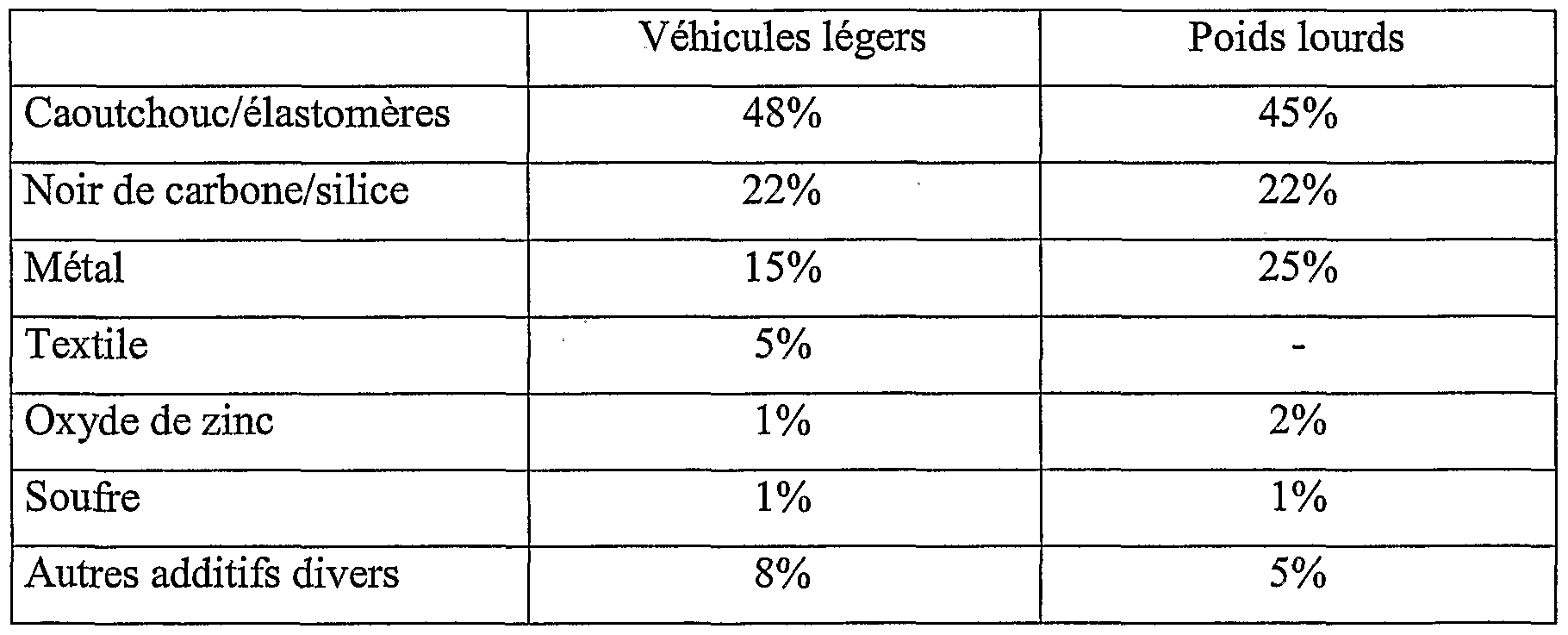
- compositions As examples of rubber powder compositions, the following approximate compositions are given:
- the essential difference between the different types of crumbs lies in the nature of the rubbers which can be one or more synthetic elastomers, such as polybutadiene, SBR, which can be associated with natural rubber in the case light vehicle tires, or natural rubber in the case of truck tires.
- SBR polybutadiene
- Granulometry is defined by grinding mills that offer a large number of spindles depending on the intended uses.
- the most common spindles correspond to a particle size of between 0.5 and 1.5 mm, 1 and 2 mm, 1 and 3 mm, 1 and 4 mm, 1 and 5 mm, 1 and 6 mm, 1 and 7 mm.
- the rubber crumbs have a diameter of less than 5 mm, advantageously the diameter of the rubber crumbs is between 0.0001 and 2 mm, more advantageously it is less than 1.5 mm.
- the amount by weight of rubber crumbs added to the mixture in step a) is between 1 and 10% by weight relative to the total weight of the mixture, still more advantageously between 3 and 7% by weight relative to the total weight of the mixture.
- the total amount of bitumen added to the mixture is the total weight of the mixture minus the weight of the added amounts of acid and crumb.
- bitumen is understood to mean either any composition of pure bitumen or any composition based on bitumen containing any type of usual additive, in particular polymers.
- the bitumen, added during step a) is heated to a temperature between 140 and 190 ° C.
- step b) The mixture obtained after step b) is then advantageously heated to a temperature between 140 ° C and 190 ° C.
- the new process takes place in milder conditions than the hot processes of the prior art, in which the bitumen had to be heated to a high degree. facilitate the swelling of the crumbs. This also makes it possible to limit the oxidation phenomena of the bitumen and to shorten the homogenization times of a conventional polymer-bitumen mixture.
- step a) is carried out by mixing the bitumen and the acid followed by the addition of the rubber crumbs.
- step a) is carried out by premixing the acid and rubber crumbs before adding them to the bitumen.
- step a) is carried out by mixing at least a portion of the bitumen and rubber crumbs followed by the addition of the acid and optionally the final addition. the remaining amount of bitumen.
- the present invention also relates to a bituminous binder obtainable by the process, as described above.
- the viscosity ratio, at 135 ° C., between a bituminous binder comprising rubber crumbs but no acid, said binder without acid, and a bituminous binder according to the invention, said binder containing acid, is between 10 and 70%, advantageously between 10 and 50%.
- the bitumen used for the manufacture of the binder without acid and that of the binder with acid is identical, in particular, it comprises the same additives, such as polymers, apart from the acid.
- the bituminous binder according to the invention is less viscous than a binder without acid, at equal temperature.
- the critical temperature difference between bituminous binder comprising rubber crumbs but no acid, said binder without acid, and a bituminous binder according to the invention, said binder containing acid, is between 1 and 50 ° C, advantageously between 1 and 25 ° C.
- the bitumen used for the manufacture of the binder without acid and that of the binder with acid is identical, in particular, it comprises the same additives, such as polymers, apart from the acid.
- the bituminous binder according to the invention has a higher critical temperature than that of the binder without acid, the critical temperature being measured according to the same operating mode.
- the critical temperature which is defined in the AASHTO standard, can be measured either according to a so-called hot procedure or according to a so-called cold procedure.
- the determination of the critical temperature according to a hot procedure is described in the standard HTPP5-98 or EN1427.
- the softening temperature (called the critical temperature) is then measured according to the so-called TBA test, namely Ring and Bail Test.
- the determination of the critical temperature according to a cold operating procedure is described in the standard HTPP1-98 or AASHTO.
- the strain-strain temperature is then measured according to the test called BBR, namely Bending Beam Rheometer.
- the process according to the invention makes it possible to obtain a bituminous binder which contains a lower percentage of rubber crumbs and which has the same properties, in particular rheological properties, as a bituminous binder of the prior art comprising a higher percentage. rubber crumbs.
- bituminous binder according to the invention can also be prepared in the form of a masterbatch with higher concentrations of acid and rubber crumb and subsequently diluted with pure bitumen and / or with any bituminous binder. , so as to obtain a bituminous binder having the desired concentrations of acid and rubber crumb and the properties, including rheological properties, desired.
- bituminous binder according to the invention can be used in building materials, especially roofing materials. It can also be used as a sealing agent, as a surface coating or as an anti-backcracking system.
- the binder according to the invention can be used as a polymer bitumen, in the manufacture of hot or cold bituminous concrete which can be used in particular as a wearing course or a low layer, as a surface coating or as an anti-backcracking system.
- the present invention also relates to a bituminous concrete comprising the binder according to the invention and the necessary amount of aggregates.
- the present invention also relates to a process for preparing such a bituminous concrete.
- the bituminous concrete is prepared according to a hot process.
- the aggregates are added to the binder according to the invention, with stirring, at a temperature between 120 and 220 ° C.
- the aggregates are added to the binder with stirring at a temperature between 120 and 190 ° C.
- the bituminous concrete is prepared according to a cold process.
- the process for the cold preparation of asphalt concrete comprises the following steps: i) preparation of a bitumen emulsion by mixing water, a bituminous binder according to the invention and an emulsifier at room temperature, ii) incorporation of aggregates into the emulsion of bitumen, obtained in stage i), with stirring at ambient temperature, iii) the emulsion obtained in stage ii) is sprayed to obtain a uniform layer of the mixture obtained in stage ii), iv ) the bitumen emulsion is broken.
- step i) Any type of emulsifier can be used in step i).
- the rubber crumbs optionally premixed with the acid, are introduced at the same time as the aggregates in the bitumen, possibly comprising the acid.
- the aggregates are subsequently introduced into the bitumen-rubber powder mixture, that is to say in the binder according to the invention.
- the concrete according to the invention is used for the manufacture of pavements, in particular of the wearing course of a roadway or road.
- the present invention also relates to the use of an acid to facilitate the incorporation of rubber crumb into a bituminous binder.
- the present invention also relates to a premix containing from 0.02% to 91% by weight of acid and from 9% to 99.98% by weight of rubber crumb.
- a premix containing from 0.02% to 91% by weight of acid and from 9% to 99.98% by weight of rubber crumb.
- it contains between 5% and 50% by weight of acid and between 50% and 95% by weight of rubber crumb.
- it contains between 10 and 20% by weight of acid and between 80% and 90% by weight of rubber crumb.
- this premix is used in the process for the preparation of bituminous binder according to the present invention.
- bitumen is placed in a beaker.
- the beaker is then heated with a hot plate to 170 ° C until it is completely liquid.
- the incorporation of the additive is then carried out.
- the additive may be any additive usually added, such as a polymer, and / or vulcanized rubber crumb and / or acid.
- the mixture is maintained at about 170 ° C. for 120 minutes with stirring using a rotary stirrer at 300 rpm.
- the temperature is kept strictly below 180 ° C, so as not to alter the characteristics of the bitumen.
- the mixture is kept for 10 minutes at about 170 ° C under slow stirring to remove any air bubbles that may have formed.
- Example 2 Determination of the rheological properties of an additive SHELL 70/100 bitumen.
- a bitumen of grade 70/100 was used for testing. This is a bitumen from Shell, located in Petit Couronne, France.
- Hot deformation is a critical factor that must be taken into account in a bituminous mix formulation.
- the specifications on binders are designed so that the corresponding mixes have a good resistance to rutting.
- the properties of high-temperature binders are evaluated by the ball-ring softening point (TBA).
- TSA ball-ring softening point
- the SHRP has developed a criterion based on the complex modulus / phase angle ratio, evaluated through a rheology test: Dynamic Shear Rheometer (DSR) test.
- DSR Dynamic Shear Rheometer
- the rheological characterization of the additive bitumen is done according to a procedure derived from the SHRP standards (AASHTO TP5-98).
- the frequency range used ranges from 7.8 Hz to 200 Hz, for a temperature range of between 25 ° C and 60 ° C.
- the rheology tests are performed in annular shear using a Metravib RDS VA 2000 viscoelastic tester.
- the liquid bitumen is introduced into the shear cell, previously heated to
- the bitumen sample has a thickness of 1 mm.
- the tests are carried out at different temperatures, at 30, 40, 50 and 60 ° C, and in a frequency range to demonstrate the behavior of the material, that is to say 7.8 - 15.6 - 31.2 - 62 , 5 - 125 and 200 Hz. 2 / Rheological properties of the modified bitumen in the presence of polymer in the form of vulcanized rubber.
- results can be represented either at iso-frequency (isochronous) as a function of the temperature, or at isothermal (isotherms) as a function of the frequency.
- bitumen preparation methods and the rheology tests were conducted as described above.
- the vulcanized rubber crumb is a powder obtained by cryomilling from heavy-duty tires: particle size D max ⁇ 500 microns (Micronis).
- the SB S polymer (SB S linear) is a micronized powder: Kraton D1101.
- the polyphosphoric acid (APP) used is a 105% condensed acid (Rhodia).
- the following table 1 collects the measured values at 60 ° C. for a frequency of 7.8 Hz.
- the reinforcing effect that is to say stiffening, provided by the vulcanized rubber crumb additive or SBS is clearly visible. Indeed, we observe a increasing the complex modulus G *, and especially the viscous component G ", in the presence of 10% by weight of vulcanized rubber crumb or SBS The phase angle ⁇ is substantially reduced, which reflects a more elastic behavior bitumen additive of vulcanized rubber crumb or SBS The addition of 10% by weight of vulcanized rubber crumb resulted in a modified bitumen with a clearly marked elastic behavior, very similar to that obtained with 3% by weight of SBS.
- the following table 2 gathers the module values G * at 25 ° C, and the phase angle ⁇ at
- the critical temperature Te is determined according to a criterion inspired by the procedure
- Te is the temperature for which the ratio G * / sin ⁇ is greater than 1100 Pa.
- the thermal susceptibility of the bitumen is determined by an index LS, which is the index of thermal susceptibility.
- the critical temperature Te is markedly increased in the presence of the vulcanized rubber crumb, and this as soon as 5% by weight of vulcanized rubber crumb is added. Similarly, there is a significant decrease in thermal susceptibility IS from the addition of 5% by weight of vulcanized rubber crumb.
- phase angle ⁇ at a temperature of 40 ° C, is greatly reduced, which reflects a more elastic behavior of the additive bitumen. This effect is all the more marked as the content of vulcanized rubber crumb is important.
- Table 3 below collects the measured values at 60 ° C, for a frequency of 7.8
- the following table 4 collects the values of module G * at 25 ° C., and the phase angle ⁇ at
- the critical temperature Te is determined according to the criterion inspired by the SHRP procedure.
- Te is the temperature for which the ratio G * / sin ⁇ is greater than 1100 Pa.
- the thermal susceptibility of the bitumen is determined by the IS index, thermal susceptibility index.
- the critical temperature Te is strongly increased by the combination of polyphosphoric acid (1% by weight) and vulcanized rubber crumb (5% by weight). Similarly, there is a significant decrease in the thermal susceptibility IS, in the case of bitumen additive polyphosphoric acid (1% by weight) and vulcanized rubber crumb (5% by weight).
- phase angle ⁇ at 40 ° C. is very greatly reduced in the case of polyphosphoric acid-additive bitumen (1% by weight) and vulcanized rubber crumb (5% by weight), which reflects a more elastic behavior of the additive bitumen. This angle is smaller than that obtained in the case of bitumen additive with 3% by weight of SBS polymer powder.
- bitumen by a polyphosphoric acid mixture (1%) and vulcanized rubber crumb (5% by weight) makes it possible to achieve the performance of polymer modified bitumens (BmP) containing 3% by weight of SBS polymer.
- polyphosphoric acid 1% by weight makes it possible to greatly reduce the content of vulcanized rubber crumb to be added while preserving the properties of the bitumen obtained: the properties are improved compared to the same bitumen additive with 10% by weight of vulcanized rubber crumb.
- Brookfield viscosity of the additive bitumens and bitumens prepared as described above is measured between 120 ° C. and 160 ° C.
- the viscosity of the additive bitumen is greatly increased by the addition of 10% by weight of vulcanized rubber crumb.
- the advantage of the presence of polyphosphoric acid (1% by weight) is clearly seen: the combination of 1% by weight of polyphosphoric acid + 5% by weight of vulcanized rubber crumb gives the bitumen a viscosity of interest.
- Example 3 Determination of the rheological properties of an additive PKQA8 80/100 bitumen.
- Bitumen grade 80/100 (grade Péné) was used for these tests. This is a bitumen from the company 'PRO AS, located in Spain.
- Grade 4 Dmax ⁇ 400 microns (Necaflex) Grades 1, 2, and 3 were obtained by mechanical grinding. Grade 4 was obtained by cryogrinding.
- the polyphosphoric acid (APP) used is a 105% condensed acid (Rhodia).
- bitumen / rubber powder / acid mixtures were made hot (170 ° C.) with stirring for 120 minutes (as indicated in Example 1).
- the rheological characterization of the additive bitumen is done according to the procedure SHRP (AASHTO TP5-98): tests DSR, Dynamic Shear Rheometer. The rheology tests are carried out in annular shear, using a Metravib RDS VA 2000 viscoelastic tester. The frequency range used ranges from 1.5 Hz to 125 Hz, for a temperature range between 25 ° C and 60 ° C. ° C.
- the liquid bitumen is introduced into the shear cell, previously heated to
- the bitumen sample has a thickness of 1 mm.
- the tests are carried out at different temperatures, at 25, 30, 40, 50 and 60 ° C, and in a frequency range to demonstrate the behavior of the material, ie at 1.5 - 7.8 - 15.6 - 31.2 - 62.5 - and 125 Hz.
- the critical temperature Te is significantly increased in the presence of the vulcanized rubber crumb, and this as soon as adding 5% by weight of crumb.
- phase angle ⁇ at a temperature of 40 ° C, is greatly reduced, which reflects a more elastic behavior of the additive bitumen.
- Table 7 collects the G * modulus values at 25 ° C, as well as the thermal susceptibility index IS. Table 7
- bitumen preparation methods and the rheology tests were conducted as described above.
- the different grades of rubber crumb were compared on the basis of the same formulation: Bitumen + 1% by weight of Polyphosphoric Acid + 5% by weight of vulcanized rubber crumb. i) Acid modified bitumen with Grade 1 crumb; (ii) Acid modified bitumen with Grade 2 crumb; (iii) Acid modified bitumen with Grade 3 crumb; iv) Acid modified bitumen with Grade 4 crumb.
- Table 8 gathers the values measured at different temperatures, for a frequency of 1.5 Hz.
- grades 2 and 3 seem to give the best properties. There is no significant effect of the particle size: Dmax ⁇ 800 ⁇ m, and Dmax ⁇ 400 ⁇ m.
- Grade 1 (Mesallès) seems a little less efficient.
- Cryomilled grade 4 (Necaflex) leads to significantly worse performance than grade 2 from standard grinding.
- Table 9 gathers the module values at 25 ° C, as well as the thermal susceptibility index IS.
- Bitumen grade 80/100 (grade PNU) was used for the tests. This is a bitumen from the company PRQAS, located in Spain.
- the crumb used is Necaflex crumb granulometry: Dmax ⁇ 400 microns (Grade 3).
- Incorporation is made into the modified bitumen 1% by weight polyphosphoric acid, at 170 ° C.
- the composition is: Bitumen + 1% by weight of Polyphosphoric Acid 105 + 5% by weight of vulcanized rubber crumb.
- Table 10 gathers the values measured at different temperatures, for a frequency of 1.5 Hz. (Birume + 1% by weight of Polyphosphoric Acid + 5% by weight of Grade 3 Powder)
- phase angle ⁇ 40 ° C
- critical temperature goes from 87 ° C to 95 ° C.
- Pen A grade 80/100 bitumen, called Pen, was used for testing. This is a bitumen from the company PROAS, located in Spain.
- a premix was made at room temperature with Grade 2 rubber crumb and 105% condensed polyphosphoric acid as described in Example 2. This premix was made in a ratio of 5: 1 to 83, 30 g of Cartoontte for 16.65 g of acid (100 g of premix). This premix was incorporated into the hot bitumen, according to a procedure identical to that described in Example 1, in order to obtain an additive bitumen containing 1% acid and 5% of crumb.
- Pre-mixing, at room temperature, before incorporation in the hot bitumen leads to excellent performance, equal to or slightly less than the direct mixture.
- Example 6 Behavior at low temperature. PROAS 80/100 (Spain).
- Pen A grade 80/100 bitumen, called Pen, was used for testing. This is a bitumen from the company PROAS, located in Spain.
- Binder specifications are designed so that the corresponding mixes have good cold resistance.
- Properties of low temperature binders are generally evaluated by Fraass's brittleness point.
- the SHRP has developed a criterion based on the stiffness of bitumen samples evaluated through a friable test: BBR test (3-point bending rheometer).
- Tg glass transition temperature
- the glass transition temperature, Tg, was measured in DSC on 80/100 Proas bitumen.
- the influence of the addition of 10% by weight of vulcanized rubber crumb was considered, as was the system 1% by weight of polyphosphoric acid + 5% by weight of vulcanized rubber crumb.
- Table 12 gathers the characteristic values: Tg, but also G * x sin ⁇ (fatigue criterion at ambient temperature), as well as the high critical temperature Tc +.
- Tg -27 ° C.
- Tg -29 ° C.
- This lower Tg corresponds to a better resistance to cold cracking of the bitumen.
- Bitumen grade 80/100 (grade Pffy) was used for testing. This is a bitumen from the company PROAS, located in Spain.
- Crusts were obtained by cryo-grinding (laboratory scale): granulo Dmax ⁇ 500 microns.
- the polyphosphoric acid used is the 105% condensed acid (cf Example 2).
- Table 13 gathers the values measured at different temperatures, for a frequency of 1.5 Hz. (Bitumen + 1% by weight of Polyphosphoric Acid + 5% by weight of Poudrette) Table 13:
- the vulcanized rubber crumb used has a nominal size of between 0 and
- the polyphosphoric acid used is a 105% condensed acid (Rhodia).
- Rhodia condensed acid
- the fabrication was carried out in the laboratory at 180 ° C. by initially infusing the vulcanized rubber crumb into the bitumen and maintaining a strong stirring for 90 minutes, then adding polyphosphoric acid and maintaining stirring for 30 minutes.
- the modified bitumen 1 was evaluated as such, that is to say without simulated aging, and after accelerated aging under the effect of temperature and air ("Rolling Thin Film Over Test" RTFOT according to EN 12607-1) by the tests described in Table 15 below:
- the modified bitumen obtains a score of 9, comparable to that of commercial modified bitumens, and much higher than that obtained for a standard unmodified bitumen (typical value of 3 for a bitumen 70 / 100).
- Example 8 The formula of Example 8 above was carried out on an industrial scale to obtain several tons of a modified bitumen 2 of the same formula as the modified bitumen 1 and from the same ingredients. This modified bitumen 2 has been characterized after manufacture. The tests and results are collated in the following table 16:
- This modified bitumen 2 was then used to manufacture and implement a semi-grained bituminous mix 0/12 (Coated A) according to the Spanish standardized spindle S 12 with 4.8 parts of binder per 100 parts of dry aggregates and 5% in volume of voids.
- the Marshall stability of the mix thus produced was measured in comparison with that of the same mix, but made with an unmodified bitumen B 40/50 from Proas. of penetration 42 1 / 10mm, TBA 55 ° C reference (Coated B).
- Table 17 The results are summarized in Table 17 below:
- Table 17 comparison of asphalt mixes obtained from a bitumen modified according to the present invention or not modified
- asphalt mix A carried out using conventional construction equipment (at the finisher), did not pose any particular problem and was considered very satisfactory and comparable in terms of maneuverability to that of the asphalt mix.
- B This is not the case with current commercial polymer modified bitumen mixes that have reduced workability compared to conventional asphalt mixes.
- Vulcanized rubber crumbs of varying origin and composition were each blended with Petrogal supplied road bitumen B 78 1/10 mm and Ball and Ring Softening Temperature (TBA) 45.6 ° C. the following composition:
- Vulcanized rubber crumb 5% by weight Polyphosphoric acid 1% by weight
- the polyphosphoric acid used is a 105% condensed acid (Rhodia).
- the manufacture was carried out in the laboratory at 180 ° C by first introducing the vulcanized rubber crumb and maintaining a strong stirring for 90 min, then adding the polyphosphoric acid and maintaining the stirring for 30 min.
- blends were also made with each of the powder and bitumen B, but without the addition of acid, that is to say according to the following composition:
- the manufacture was carried out in the laboratory at 180 ° C by introducing the vulcanized rubber crumb and maintaining strong stirring for 120 min.
- the crumbs were characterized by their median volume diameter measured by laser diffraction on a Malvern Multisizer 2000 apparatus. The results are collated in the following Table 18:
- polyphosphoric acid makes it possible to improve the mechanical properties of the modified bitumen by vulcanized rubber crumb, regardless of its origin, and with a storage stability which is maintained at that of the mixture. without acid.
- Example 10 Bl mixture of Example 10 was emulsified using an Emulbitume laboratory colloid mill. To do this, the modified binder was brought to the temperature of 170 ° C giving it a viscosity of about 200 mPa.s.
- compositions of each of the emulsions and their corresponding properties are collated in the following table:
- Table 20 Properties and compositions of modified bitumen emulsions according to the present invention
- the modified binder according to the invention can therefore be emulsified using the techniques in use in the art and then gives emulsions of spreading (emulsion type 1) or coating (emulsion type 2) whose properties correspond to the corresponding specifications.
- emulsion type 1 emulsion type 1
- coating emulsion type 2
- a rubber crumb of the company Mésallès was mixed with a road bitumen C supplied by Repsol Puertollano, penetration 80 1/10 mm and Ball and Ring Softening Temperature 48.6 ° C to obtain a modified modified binder of composition:
- the polyphosphoric acid used is a 105% condensed acid (Rhodia).
- the manufacture was carried out in the laboratory at 180 ° C by first introducing the rubber crumb and maintaining a strong stirring for 90 min, then adding the polyphosphoric acid and maintaining the stirring for 30 min.
- the modified concentrated binder was then diluted to a 50/50 weight ratio by a penetration rate of 91 1/10 mm Cepsa D bitumen and a 49.2 ° C ring and ball softening temperature to obtain a modified new bitumen having this time. a total content of fine powder of 5% and a total quantity of polyphosphoric acid to 1%.
- the modified bitumen obtained by dilution of a concenferred modified binder thus has improved properties compared to an unmodified bitumen and gives results comparable to those given in the preceding examples by the direct addition of 5% of powder and 1 % of acid.
Landscapes
- Chemical & Material Sciences (AREA)
- Engineering & Computer Science (AREA)
- Structural Engineering (AREA)
- Organic Chemistry (AREA)
- Polymers & Plastics (AREA)
- Health & Medical Sciences (AREA)
- Chemical Kinetics & Catalysis (AREA)
- Medicinal Chemistry (AREA)
- Materials Engineering (AREA)
- Civil Engineering (AREA)
- Ceramic Engineering (AREA)
- Architecture (AREA)
- Compositions Of Macromolecular Compounds (AREA)
- Sealing Material Composition (AREA)
- Paints Or Removers (AREA)
- Processes Of Treating Macromolecular Substances (AREA)
- Road Paving Structures (AREA)
Abstract
Description


Claims
Priority Applications (12)
| Application Number | Priority Date | Filing Date | Title |
|---|---|---|---|
| JP2006505705A JP4837554B2 (ja) | 2003-03-07 | 2004-03-08 | 瀝青質結合剤およびその製造方法 |
| BRPI0408152-8A BRPI0408152B1 (pt) | 2003-03-07 | 2004-03-08 | Processo de preparação de um aglutinante e de um concreto betuminoso, aglutinante e concreto betuminoso, utilização dos mesmos e pré-mistura |
| KR1020057016700A KR101106043B1 (ko) | 2003-03-07 | 2004-03-08 | 아스팔트 바인더 및 이의 제조방법 |
| CA2518052A CA2518052C (fr) | 2003-03-07 | 2004-03-08 | Liant bitumineux et son procede de preparation |
| PL04718322T PL1606344T3 (pl) | 2003-03-07 | 2004-03-08 | Spoiwo bitumiczne i sposób jego wytwarzania |
| ES04718322T ES2338518T3 (es) | 2003-03-07 | 2004-03-08 | Ligante bituminoso y su procedimiento de preparación |
| US10/548,091 US8114926B2 (en) | 2003-03-07 | 2004-03-08 | Bituminous binder and method for the production thereof |
| NZ542213A NZ542213A (en) | 2003-03-07 | 2004-03-08 | Bituminous binder and method for the production thereof |
| AU2004220301A AU2004220301B2 (en) | 2003-03-07 | 2004-03-08 | Bituminous binder and method for the production thereof |
| EP04718322A EP1606344B1 (fr) | 2003-03-07 | 2004-03-08 | Liant bitumineux et son procede de preparation |
| CN2004800097571A CN1823125B (zh) | 2003-03-07 | 2004-03-08 | 沥青粘合剂及其生产方法 |
| MXPA05009569A MXPA05009569A (es) | 2003-03-07 | 2004-03-08 | Aglutinante bituminoso y metodo para su preparacion. |
Applications Claiming Priority (2)
| Application Number | Priority Date | Filing Date | Title |
|---|---|---|---|
| FR0302896A FR2852018B1 (fr) | 2003-03-07 | 2003-03-07 | Liant bitumineux et son procede de preparation. |
| FR03/02896 | 2003-03-07 |
Publications (1)
| Publication Number | Publication Date |
|---|---|
| WO2004081098A1 true WO2004081098A1 (fr) | 2004-09-23 |
Family
ID=32865359
Family Applications (1)
| Application Number | Title | Priority Date | Filing Date |
|---|---|---|---|
| PCT/FR2004/000543 Ceased WO2004081098A1 (fr) | 2003-03-07 | 2004-03-08 | Liant bitumineux et son procede de preparation |
Country Status (16)
| Country | Link |
|---|---|
| US (1) | US8114926B2 (fr) |
| EP (1) | EP1606344B1 (fr) |
| JP (2) | JP4837554B2 (fr) |
| KR (1) | KR101106043B1 (fr) |
| CN (1) | CN1823125B (fr) |
| AU (1) | AU2004220301B2 (fr) |
| BR (1) | BRPI0408152B1 (fr) |
| CA (1) | CA2518052C (fr) |
| ES (1) | ES2338518T3 (fr) |
| FR (1) | FR2852018B1 (fr) |
| MX (1) | MXPA05009569A (fr) |
| NZ (1) | NZ542213A (fr) |
| PL (1) | PL1606344T3 (fr) |
| PT (1) | PT1606344E (fr) |
| WO (1) | WO2004081098A1 (fr) |
| ZA (1) | ZA200507633B (fr) |
Cited By (5)
| Publication number | Priority date | Publication date | Assignee | Title |
|---|---|---|---|---|
| WO2006119354A1 (fr) | 2005-05-03 | 2006-11-09 | Innophos, Inc. | Liant bitumineux modifie utilisant des rognures de gomme, et procedes de fabrication d'un liant bitumineux modifie |
| JP2008540741A (ja) * | 2005-05-02 | 2008-11-20 | イノフォス インコーポレーテッド | クラムラバーを使用する改質アスファルトバインダ材料および改質アスファルトバインダを製造する方法 |
| JP2009538970A (ja) * | 2006-05-31 | 2009-11-12 | イノフォス インコーポレーテッド | ポリリン酸および架橋性ポリマーの添加による、改良されたビチューメンの製造方法 |
| CN101974236A (zh) * | 2010-11-04 | 2011-02-16 | 爱思开(北京)公路科技有限公司 | 浇注式沥青组合物及其制备方法 |
| WO2011074003A2 (fr) | 2009-12-14 | 2011-06-23 | Bharat Petroleum Corporation Ltd. | Compositions de bitume modifié à la poudrette de caoutchouc et procédé associé |
Families Citing this family (31)
| Publication number | Priority date | Publication date | Assignee | Title |
|---|---|---|---|---|
| US20070249762A1 (en) * | 2002-08-29 | 2007-10-25 | Ram Technologies Group, Inc. | Rubber modified asphalt cement compositions and methods |
| FR2852018B1 (fr) * | 2003-03-07 | 2005-04-29 | Liant bitumineux et son procede de preparation. | |
| US20080015287A1 (en) * | 2004-10-15 | 2008-01-17 | Butler James R | Process for the preparation of crumb rubber/asphalt blends |
| CN101675114B (zh) * | 2007-05-01 | 2012-09-26 | 科腾聚合物美国有限责任公司 | 沥青粘合剂组合物及其制备方法 |
| US20090137690A1 (en) * | 2007-11-26 | 2009-05-28 | Semmaterials, L.P. | Delinked Polymer Modified Bitumen and Method of Producing Same |
| US9617424B2 (en) | 2009-03-08 | 2017-04-11 | Lehigh Technologies, Inc. | Polyolefin asphalt modifiers, methods of modifying asphalt, asphalt compositions and methods of making |
| US9896582B2 (en) * | 2009-03-08 | 2018-02-20 | Lehigh Technologies, Inc. | Micronized asphalt modifiers, methods of modifying asphalt, asphalt compositions and methods of making |
| US9884965B2 (en) | 2009-03-08 | 2018-02-06 | Lehigh Tehnologies, Inc. | Functional group asphalt modifiers, methods of modifying asphalt, asphalt compositions and methods of making |
| KR100935465B1 (ko) * | 2009-05-20 | 2010-01-06 | 정홍기 | 개질 아스팔트 및 개질 아스팔트콘크리트 |
| KR100937213B1 (ko) * | 2009-07-10 | 2010-01-20 | (주)일우피피씨 | 폐아스팔트콘크리트를 함유하는 재생 개질아스팔트콘크리트 |
| ES2532431T3 (es) * | 2009-10-13 | 2015-03-26 | Innophos, Inc. | Asfalto modificado con caucho granulado con estabilidad mejorada |
| CN102821940A (zh) * | 2010-02-17 | 2012-12-12 | 亨利有限责任公司 | 减少微生物的建筑屏障、用于形成此类屏障的组合物和相关方法 |
| KR101292204B1 (ko) * | 2011-04-11 | 2013-08-01 | 주식회사 토탈페이브시스템 | 저교통량 아스팔트 포장체의 보수공법 |
| CN105110707B (zh) * | 2015-08-20 | 2017-09-15 | 中国葛洲坝集团第二工程有限公司 | 沥青路面裂缝强力修补材料 |
| WO2017112915A1 (fr) * | 2015-12-22 | 2017-06-29 | Ingevity South Carolina, Llc | Mélange de rapiéçage bio-fluxé à mécanisme de durcissement déclenché |
| US11565972B2 (en) | 2016-08-25 | 2023-01-31 | Cornell University | Bitumen nanocomposites and uses thereof |
| FR3056609B1 (fr) | 2016-09-26 | 2018-09-14 | Eurovia | Procede d'indentation d'un echangeur thermique recyclable a haute cadence dans une infrastructure terrestre |
| FR3056581B1 (fr) | 2016-09-26 | 2022-06-17 | Eurovia | Enrobe hydrocarbone adapte pour integrer un dispositif pour echangeur de chaleur |
| EP3630880B1 (fr) | 2017-05-24 | 2025-12-17 | POET Research, Inc. | Compositions d'huile contenant de l'ester d'alkyle amélioré, et procédés de production et d'utilisation desdites compositions |
| US12157822B2 (en) | 2017-05-24 | 2024-12-03 | Poet Research, Inc. | Methods of producing vegetable oils with low minerals, metals, or other contaminants |
| FR3067370B1 (fr) | 2017-06-07 | 2019-07-26 | Eurovia | Procede de fabrication d'un revetement de voiries comprenant un dispositif pour echangeur de chaleur |
| CA3027820C (fr) | 2017-12-15 | 2026-03-17 | Owens Corning Intellectual Capital, Llc | Materiau de toiture d'asphalte modifie par un polymere |
| CA3103242C (fr) | 2018-06-11 | 2023-08-29 | Poet Research, Inc. | Procedes de raffinage d'une matiere premiere de composition d'huile d'oleagineux, et systemes, compositions et utilisations associes |
| JP7502265B2 (ja) * | 2018-08-15 | 2024-06-18 | ベーアーエスエフ・エスエー | 性能向上添加剤としてイソシアネート及びポリマーの混合物を含むアスファルト組成物 |
| KR101989849B1 (ko) * | 2018-12-26 | 2019-06-17 | 주식회사 도화엔지니어링 | 시멘트 콘크리트와 아스팔트 접합용 유무기 혼합형 결합 첨가제 |
| CN110452624B (zh) * | 2019-09-10 | 2020-05-19 | 广州市市政工程维修处有限公司 | 一种无缝伸缩缝填缝料密封胶及其制备方法和应用 |
| US12139657B1 (en) | 2020-03-10 | 2024-11-12 | Poet Research, Inc. | Emulsifiers and emulsions as by-products of fermentation, compositions comprising same, and methods of use thereof |
| RU2730857C1 (ru) | 2020-04-20 | 2020-08-26 | Андрей Леонидович Воробьев | Низкотемпературный способ изготовления модифицированной резиновой крошки |
| CN111978744B (zh) * | 2020-07-10 | 2022-08-16 | 苏州三创路面工程有限公司 | 一种橡胶粉改性高粘沥青排水路面混合料的设计制备方法 |
| BR112023001818A2 (pt) | 2020-08-06 | 2023-02-23 | Poet Res Inc | Lipase endógena para redução de metais em óleo de milho de destilaria |
| CN113529541A (zh) * | 2021-07-19 | 2021-10-22 | 中建八局第一建设有限公司 | 一种建筑工程沥青铺设装置及其方法 |
Citations (4)
| Publication number | Priority date | Publication date | Assignee | Title |
|---|---|---|---|---|
| US5385401A (en) * | 1993-10-06 | 1995-01-31 | Cyclean, Inc. | Process for adding recycled tire particle to asphalt |
| WO1995028446A1 (fr) * | 1994-04-18 | 1995-10-26 | Elf Antar France | Preparation de compositions bitume/polymere, leur utilisation |
| FR2732702A1 (fr) * | 1995-04-06 | 1996-10-11 | Beugnet Sa | Procede de preparation d'un enrobe hydrocarbone a chaud, pour assises de chaussees, notamment pour couche de roulement a base de granulats et d'un liant au bitume-caoutchouc |
| FR2764897A1 (fr) * | 1997-06-24 | 1998-12-24 | Atochem Elf Sa | Melanges de bitume, de poudrette de caoutchouc et de polymere utilises comme liant routier |
Family Cites Families (34)
| Publication number | Priority date | Publication date | Assignee | Title |
|---|---|---|---|---|
| DE2255173C3 (de) | 1972-11-10 | 1982-03-25 | Shell Internationale Research Maatschappij B.V., 2596 's-Gravenhage | Bitumenmasse aus einem durch Vakuumdestillation von Roherdöl gewonnenem Bitumen und einem thermoplastischen Blockcopolymeren und Verfahren zu ihrer Herstellung |
| JPS5153522A (en) * | 1974-11-05 | 1976-05-12 | Kuraray Co | Kairyosareta rekiseisoseibutsu |
| FR2493329A1 (fr) | 1980-11-05 | 1982-05-07 | British Petroleum Co | Composition bitumineuse |
| GB2087407B (en) | 1980-11-05 | 1984-11-28 | British Petroleum Co | Bituminous composition |
| FR2512827B1 (fr) | 1981-09-16 | 1986-10-17 | Beugnet Sa | Composition de liant pour revetement a base de bitume caoutchouc, ainsi que procede de fabrication d'une telle composition |
| FR2567447B1 (fr) | 1984-07-11 | 1987-04-10 | Beugnet Sa | Procede de preparation d'un melange bitume-caoutchouc |
| FR2577545B1 (fr) * | 1985-02-15 | 1987-03-27 | Elf France | Emulsions cationiques de liants bitumineux du type bitume/polymere et systeme emulsifiant cationique utilisable notamment pour l'obtention de ces emulsions |
| FR2580658B1 (fr) | 1985-04-22 | 1987-06-05 | Beugnet Sa | Composition pour revetement, a base de bitume et de poudre de caoutchouc de recuperation |
| FR2619821B1 (fr) | 1987-08-27 | 1990-01-19 | Beugnet Sa | Procede de preparation d'un liant pour revetement de chaussee a base de bitume et de poudre de caoutchouc de recuperation ainsi que liant obtenu par la mise en oeuvre de ce procede |
| US5070123A (en) * | 1988-08-29 | 1991-12-03 | Exxon Research & Engineering Company | Method for improving the storage stability of polymer modified asphalt |
| JP2716798B2 (ja) * | 1989-05-17 | 1998-02-18 | ダイセル化学工業株式会社 | 弾力性カラー舗装材組成物 |
| US5095055A (en) * | 1989-08-23 | 1992-03-10 | Exxon Research And Engineering Company | Using branched polymers to improve the storage stability of acid treated polymer modified asphalts (PNE-577) |
| FR2658526B1 (fr) | 1990-02-21 | 1993-12-24 | Institut Francais Petrole | Procede de production de compositions bitumineuses par extrusion. |
| IT1244685B (it) * | 1991-01-24 | 1994-08-08 | Euron Spa | Miscele di bitume polimero e procedimento per la loro preparazione |
| US5336705A (en) * | 1992-03-05 | 1994-08-09 | Exxon Research And Engineering Company | Polymer-modified, oxidized asphalt compositions and methods of preparation |
| US5348994A (en) | 1992-03-05 | 1994-09-20 | Exxon Research & Engineering Co. | Polymer-modified functionalized asphalt compositions and methods of preparation (C-2747) |
| US5288773A (en) * | 1992-03-05 | 1994-02-22 | Exxon Research And Engineering Company | Sulfonated unhydrogenated copolymers of styrene and butadiene |
| JP3339969B2 (ja) * | 1994-09-05 | 2002-10-28 | 花王株式会社 | 再生加熱アスファルト混合物の製造方法 |
| IT1271038B (it) | 1994-10-25 | 1997-05-26 | Himont Inc | Processo per la preparazione di mescole di bitumi e di composizioni polimeriche |
| ES2194984T3 (es) * | 1995-03-13 | 2003-12-01 | Mathy Construction Company | Composiciones asfalticas modificadas con polimero y hechas reaccionar con acido, y su preparacion. |
| GB9511162D0 (en) * | 1995-06-02 | 1995-07-26 | Spendlove Peter D | Macadam flexible pavement |
| FR2739863B1 (fr) * | 1995-10-16 | 1997-11-21 | Elf Antar France | Procede de preparation de compositions bitume/polymere a caractere multigrade renforce et application des compositions obtenues a la production de liants bitume/polymere pour revetements |
| JP3375244B2 (ja) * | 1996-02-28 | 2003-02-10 | 花王株式会社 | アスファルト改質材及びアスファルト組成物 |
| FR2748488B1 (fr) * | 1996-05-10 | 1998-07-10 | Elf Antar France | Procede de preparation de compositions bitume/polymere a tres faible susceptibilite thermique et application des compositions obtenues a la production de liants bitume/polymere pour revetements |
| JP3340042B2 (ja) * | 1996-12-25 | 2002-10-28 | 花王株式会社 | アスファルト系ルーフィング材 |
| US6031029A (en) * | 1997-03-31 | 2000-02-29 | Ergon, Incorporated | Asphalt compositions and methods of preparation thereof |
| US6414056B1 (en) * | 1998-05-08 | 2002-07-02 | Exxonmobil Research And Engineering Company | Asphalt compositions and method for making (LAW617) |
| US5936015A (en) * | 1998-10-16 | 1999-08-10 | Creanova Inc. | Rubber-modified asphalt paving binder |
| CA2301928A1 (fr) | 1999-04-30 | 2000-10-30 | Gerald Owen Schulz | Latex pour le traitement d'aggregats |
| FR2803608A1 (fr) | 2000-01-07 | 2001-07-13 | Colas Sa | Enrobe bitumineux a chaud comportant du caoutchouc, procede de fabrication d'un tel enrobe et procede de realisation d'une couche de roulement avec un tel enrobe |
| FR2841561B1 (fr) * | 2002-07-01 | 2004-08-06 | Rhodia Cons Spec Ltd | Produit bitumineux et son procede de preparation |
| US7087665B2 (en) * | 2002-08-29 | 2006-08-08 | Ram Technologies, Inc. | Quick-setting cationic aqueous emulsions using pre-treated rubber modified asphalt cement |
| FR2852018B1 (fr) * | 2003-03-07 | 2005-04-29 | Liant bitumineux et son procede de preparation. | |
| CN101595169B (zh) | 2006-11-30 | 2012-11-21 | 德克萨斯A&M大学系统 | 可用于制备纳米复合聚合物的不含插层剂的组合物 |
-
2003
- 2003-03-07 FR FR0302896A patent/FR2852018B1/fr not_active Expired - Lifetime
-
2004
- 2004-03-08 EP EP04718322A patent/EP1606344B1/fr not_active Expired - Lifetime
- 2004-03-08 MX MXPA05009569A patent/MXPA05009569A/es active IP Right Grant
- 2004-03-08 WO PCT/FR2004/000543 patent/WO2004081098A1/fr not_active Ceased
- 2004-03-08 NZ NZ542213A patent/NZ542213A/en not_active IP Right Cessation
- 2004-03-08 AU AU2004220301A patent/AU2004220301B2/en not_active Ceased
- 2004-03-08 US US10/548,091 patent/US8114926B2/en not_active Expired - Fee Related
- 2004-03-08 PL PL04718322T patent/PL1606344T3/pl unknown
- 2004-03-08 BR BRPI0408152-8A patent/BRPI0408152B1/pt not_active IP Right Cessation
- 2004-03-08 JP JP2006505705A patent/JP4837554B2/ja not_active Expired - Fee Related
- 2004-03-08 PT PT04718322T patent/PT1606344E/pt unknown
- 2004-03-08 ES ES04718322T patent/ES2338518T3/es not_active Expired - Lifetime
- 2004-03-08 KR KR1020057016700A patent/KR101106043B1/ko not_active Expired - Fee Related
- 2004-03-08 CN CN2004800097571A patent/CN1823125B/zh not_active Expired - Fee Related
- 2004-03-08 CA CA2518052A patent/CA2518052C/fr not_active Expired - Fee Related
-
2005
- 2005-09-21 ZA ZA200507633A patent/ZA200507633B/en unknown
-
2010
- 2010-11-12 JP JP2010253461A patent/JP5547041B2/ja not_active Expired - Fee Related
Patent Citations (4)
| Publication number | Priority date | Publication date | Assignee | Title |
|---|---|---|---|---|
| US5385401A (en) * | 1993-10-06 | 1995-01-31 | Cyclean, Inc. | Process for adding recycled tire particle to asphalt |
| WO1995028446A1 (fr) * | 1994-04-18 | 1995-10-26 | Elf Antar France | Preparation de compositions bitume/polymere, leur utilisation |
| FR2732702A1 (fr) * | 1995-04-06 | 1996-10-11 | Beugnet Sa | Procede de preparation d'un enrobe hydrocarbone a chaud, pour assises de chaussees, notamment pour couche de roulement a base de granulats et d'un liant au bitume-caoutchouc |
| FR2764897A1 (fr) * | 1997-06-24 | 1998-12-24 | Atochem Elf Sa | Melanges de bitume, de poudrette de caoutchouc et de polymere utilises comme liant routier |
Cited By (10)
| Publication number | Priority date | Publication date | Assignee | Title |
|---|---|---|---|---|
| JP2008540741A (ja) * | 2005-05-02 | 2008-11-20 | イノフォス インコーポレーテッド | クラムラバーを使用する改質アスファルトバインダ材料および改質アスファルトバインダを製造する方法 |
| US20090054562A1 (en) * | 2005-05-02 | 2009-02-26 | Jean-Valery Martin | Modified Asphalt Binder Material Using Crumb Rubber And Methods Of Manufacturing A Modified Asphalt Binder |
| EP1877493A4 (fr) * | 2005-05-02 | 2012-11-28 | Innophos Inc | Materiau liant modifie pour asphalte utilisant un granule de caoutchouc et procedes de fabrication d'un tel liant |
| US8664303B2 (en) * | 2005-05-02 | 2014-03-04 | Innophos, Inc. | Modified asphalt binder material using crumb rubber and methods of manufacturing a modified asphalt binder |
| WO2006119354A1 (fr) | 2005-05-03 | 2006-11-09 | Innophos, Inc. | Liant bitumineux modifie utilisant des rognures de gomme, et procedes de fabrication d'un liant bitumineux modifie |
| JP2008540739A (ja) * | 2005-05-03 | 2008-11-20 | イノフォス インコーポレーテッド | 架橋クラムラバーを使用する改質アスファルトバインダ材料および改質アスファルトバインダを製造する方法 |
| EP1877492A4 (fr) * | 2005-05-03 | 2013-03-27 | Innophos Inc | Liant bitumineux modifie utilisant des rognures de gomme, et procedes de fabrication d'un liant bitumineux modifie |
| JP2009538970A (ja) * | 2006-05-31 | 2009-11-12 | イノフォス インコーポレーテッド | ポリリン酸および架橋性ポリマーの添加による、改良されたビチューメンの製造方法 |
| WO2011074003A2 (fr) | 2009-12-14 | 2011-06-23 | Bharat Petroleum Corporation Ltd. | Compositions de bitume modifié à la poudrette de caoutchouc et procédé associé |
| CN101974236A (zh) * | 2010-11-04 | 2011-02-16 | 爱思开(北京)公路科技有限公司 | 浇注式沥青组合物及其制备方法 |
Also Published As
| Publication number | Publication date |
|---|---|
| CA2518052A1 (fr) | 2004-09-23 |
| CN1823125B (zh) | 2010-05-05 |
| ES2338518T3 (es) | 2012-11-26 |
| CA2518052C (fr) | 2013-10-22 |
| AU2004220301B2 (en) | 2008-09-04 |
| EP1606344B1 (fr) | 2012-09-05 |
| JP2006523248A (ja) | 2006-10-12 |
| CN1823125A (zh) | 2006-08-23 |
| EP1606344A1 (fr) | 2005-12-21 |
| AU2004220301A1 (en) | 2004-09-23 |
| PL1606344T3 (pl) | 2013-07-31 |
| KR101106043B1 (ko) | 2012-01-19 |
| FR2852018B1 (fr) | 2005-04-29 |
| KR20050119644A (ko) | 2005-12-21 |
| BRPI0408152B1 (pt) | 2015-06-16 |
| JP5547041B2 (ja) | 2014-07-09 |
| NZ542213A (en) | 2008-07-31 |
| ES2338518T1 (es) | 2010-05-10 |
| ZA200507633B (en) | 2006-10-25 |
| US8114926B2 (en) | 2012-02-14 |
| BRPI0408152A (pt) | 2006-03-01 |
| US20060250886A1 (en) | 2006-11-09 |
| JP4837554B2 (ja) | 2011-12-14 |
| PT1606344E (pt) | 2012-11-19 |
| JP2011057996A (ja) | 2011-03-24 |
| FR2852018A1 (fr) | 2004-09-10 |
| MXPA05009569A (es) | 2006-05-19 |
Similar Documents
| Publication | Publication Date | Title |
|---|---|---|
| EP1606344B1 (fr) | Liant bitumineux et son procede de preparation | |
| CA2707747C (fr) | Compositions bitumineuses | |
| US8444760B2 (en) | Bituminous composition | |
| WO2012014219A1 (fr) | Compositions d'asphalte comprenant une dispersion de microgels dispersés dans une huile | |
| EP2907853B1 (fr) | Matériau bitumineux coulé à froid paraffinique à montée en cohésion rapide | |
| FR2847584A1 (fr) | Procede pour ameliorer les proprietes physico-chimiques de compositions de bitume ainsi que de nouvelles compositions de bitume aux proprietes ameliorees et leurs utilisations | |
| EP3097151B1 (fr) | Mélanges primaires bitume-polymère, utiles pour la préparation de liants bitume-polymère, produits obtenus a partir de ces mélanges primaires | |
| WO2020193692A1 (fr) | Additifs pour matériau bitumineux coule a froid avec un liant paraffinique a montée en cohésion rapide | |
| FR2841561A1 (fr) | Produit bitumineux et son procede de preparation | |
| EP3491069B1 (fr) | Agents fluxants pour liants hydrocarbones | |
| EP1546259B1 (fr) | Produit bitumeux et son procede de preparation | |
| EP3649199A1 (fr) | Agents fluxants pour liants hydrocarbones | |
| WO2025068300A1 (fr) | Enrobes hydrocarbones compactes ayant des proprietes de maniabilite et de compactibilites ameliorees | |
| EP2989162A1 (fr) | Composition de pre-melange pour bitumes | |
| EP3556827A1 (fr) | Procédé de préparation de composition de bitume polymère réticulé à faible émission d'h2s et application de ces compositions à la réalisation de revêtements |
Legal Events
| Date | Code | Title | Description |
|---|---|---|---|
| AK | Designated states |
Kind code of ref document: A1 Designated state(s): AE AG AL AM AT AU AZ BA BB BG BR BW BY BZ CA CH CN CO CR CU CZ DE DK DM DZ EC EE EG ES FI GB GD GE GH GM HR HU ID IL IN IS JP KE KG KP KR KZ LC LK LR LS LT LU LV MA MD MG MK MN MW MX MZ NA NI NO NZ OM PG PH PL PT RO RU SC SD SE SG SK SL SY TJ TM TN TR TT TZ UA UG US UZ VC VN YU ZA ZM ZW |
|
| AL | Designated countries for regional patents |
Kind code of ref document: A1 Designated state(s): BW GH GM KE LS MW MZ SD SL SZ TZ UG ZM ZW AM AZ BY KG KZ MD RU TJ TM AT BE BG CH CY CZ DE DK EE ES FI FR GB GR HU IE IT LU MC NL PL PT RO SE SI SK TR BF BJ CF CG CI CM GA GN GQ GW ML MR NE SN TD TG |
|
| 121 | Ep: the epo has been informed by wipo that ep was designated in this application | ||
| WWE | Wipo information: entry into national phase |
Ref document number: 2518052 Country of ref document: CA |
|
| WWE | Wipo information: entry into national phase |
Ref document number: 2004220301 Country of ref document: AU |
|
| WWE | Wipo information: entry into national phase |
Ref document number: 542213 Country of ref document: NZ |
|
| WWE | Wipo information: entry into national phase |
Ref document number: 2006505705 Country of ref document: JP Ref document number: 1020057016700 Country of ref document: KR |
|
| WWE | Wipo information: entry into national phase |
Ref document number: 2005/07633 Country of ref document: ZA Ref document number: 200507633 Country of ref document: ZA |
|
| ENP | Entry into the national phase |
Ref document number: 2004220301 Country of ref document: AU Date of ref document: 20040308 Kind code of ref document: A |
|
| WWP | Wipo information: published in national office |
Ref document number: 2004220301 Country of ref document: AU |
|
| WWE | Wipo information: entry into national phase |
Ref document number: 2004718322 Country of ref document: EP |
|
| WWE | Wipo information: entry into national phase |
Ref document number: 20048097571 Country of ref document: CN |
|
| WWP | Wipo information: published in national office |
Ref document number: 2004718322 Country of ref document: EP Ref document number: 1020057016700 Country of ref document: KR |
|
| ENP | Entry into the national phase |
Ref document number: PI0408152 Country of ref document: BR |
|
| DPEN | Request for preliminary examination filed prior to expiration of 19th month from priority date (pct application filed from 20040101) | ||
| WWE | Wipo information: entry into national phase |
Ref document number: 2006250886 Country of ref document: US Ref document number: 10548091 Country of ref document: US |
|
| WWP | Wipo information: published in national office |
Ref document number: 10548091 Country of ref document: US |