WO2004085353A2 - Palladium-based catalyst for selective hydrogenation of acetylene - Google Patents
Palladium-based catalyst for selective hydrogenation of acetylene Download PDFInfo
- Publication number
- WO2004085353A2 WO2004085353A2 PCT/EP2004/003263 EP2004003263W WO2004085353A2 WO 2004085353 A2 WO2004085353 A2 WO 2004085353A2 EP 2004003263 W EP2004003263 W EP 2004003263W WO 2004085353 A2 WO2004085353 A2 WO 2004085353A2
- Authority
- WO
- WIPO (PCT)
- Prior art keywords
- catalyst
- acetylene
- weight
- palladium
- reduced
- Prior art date
- Legal status (The legal status is an assumption and is not a legal conclusion. Google has not performed a legal analysis and makes no representation as to the accuracy of the status listed.)
- Ceased
Links
Classifications
-
- C—CHEMISTRY; METALLURGY
- C07—ORGANIC CHEMISTRY
- C07C—ACYCLIC OR CARBOCYCLIC COMPOUNDS
- C07C5/00—Preparation of hydrocarbons from hydrocarbons containing the same number of carbon atoms
- C07C5/02—Preparation of hydrocarbons from hydrocarbons containing the same number of carbon atoms by hydrogenation
- C07C5/08—Preparation of hydrocarbons from hydrocarbons containing the same number of carbon atoms by hydrogenation of carbon-to-carbon triple bonds
- C07C5/09—Preparation of hydrocarbons from hydrocarbons containing the same number of carbon atoms by hydrogenation of carbon-to-carbon triple bonds to carbon-to-carbon double bonds
-
- B—PERFORMING OPERATIONS; TRANSPORTING
- B01—PHYSICAL OR CHEMICAL PROCESSES OR APPARATUS IN GENERAL
- B01J—CHEMICAL OR PHYSICAL PROCESSES, e.g. CATALYSIS OR COLLOID CHEMISTRY; THEIR RELEVANT APPARATUS
- B01J23/00—Catalysts comprising metals or metal oxides or hydroxides, not provided for in group B01J21/00
- B01J23/38—Catalysts comprising metals or metal oxides or hydroxides, not provided for in group B01J21/00 of noble metals
- B01J23/54—Catalysts comprising metals or metal oxides or hydroxides, not provided for in group B01J21/00 of noble metals combined with metals, oxides or hydroxides provided for in groups B01J23/02 - B01J23/36
- B01J23/56—Platinum group metals
- B01J23/58—Platinum group metals with alkali- or alkaline earth metals
-
- B—PERFORMING OPERATIONS; TRANSPORTING
- B01—PHYSICAL OR CHEMICAL PROCESSES OR APPARATUS IN GENERAL
- B01J—CHEMICAL OR PHYSICAL PROCESSES, e.g. CATALYSIS OR COLLOID CHEMISTRY; THEIR RELEVANT APPARATUS
- B01J23/00—Catalysts comprising metals or metal oxides or hydroxides, not provided for in group B01J21/00
- B01J23/38—Catalysts comprising metals or metal oxides or hydroxides, not provided for in group B01J21/00 of noble metals
- B01J23/54—Catalysts comprising metals or metal oxides or hydroxides, not provided for in group B01J21/00 of noble metals combined with metals, oxides or hydroxides provided for in groups B01J23/02 - B01J23/36
- B01J23/56—Platinum group metals
- B01J23/63—Platinum group metals with rare earths or actinides
-
- B—PERFORMING OPERATIONS; TRANSPORTING
- B01—PHYSICAL OR CHEMICAL PROCESSES OR APPARATUS IN GENERAL
- B01J—CHEMICAL OR PHYSICAL PROCESSES, e.g. CATALYSIS OR COLLOID CHEMISTRY; THEIR RELEVANT APPARATUS
- B01J23/00—Catalysts comprising metals or metal oxides or hydroxides, not provided for in group B01J21/00
- B01J23/38—Catalysts comprising metals or metal oxides or hydroxides, not provided for in group B01J21/00 of noble metals
- B01J23/54—Catalysts comprising metals or metal oxides or hydroxides, not provided for in group B01J21/00 of noble metals combined with metals, oxides or hydroxides provided for in groups B01J23/02 - B01J23/36
- B01J23/56—Platinum group metals
- B01J23/64—Platinum group metals with arsenic, antimony, bismuth, vanadium, niobium, tantalum, polonium, chromium, molybdenum, tungsten, manganese, technetium or rhenium
- B01J23/648—Vanadium, niobium or tantalum or polonium
- B01J23/6484—Niobium
-
- B—PERFORMING OPERATIONS; TRANSPORTING
- B01—PHYSICAL OR CHEMICAL PROCESSES OR APPARATUS IN GENERAL
- B01J—CHEMICAL OR PHYSICAL PROCESSES, e.g. CATALYSIS OR COLLOID CHEMISTRY; THEIR RELEVANT APPARATUS
- B01J37/00—Processes, in general, for preparing catalysts; Processes, in general, for activation of catalysts
- B01J37/02—Impregnation, coating or precipitation
- B01J37/0201—Impregnation
-
- B—PERFORMING OPERATIONS; TRANSPORTING
- B01—PHYSICAL OR CHEMICAL PROCESSES OR APPARATUS IN GENERAL
- B01J—CHEMICAL OR PHYSICAL PROCESSES, e.g. CATALYSIS OR COLLOID CHEMISTRY; THEIR RELEVANT APPARATUS
- B01J37/00—Processes, in general, for preparing catalysts; Processes, in general, for activation of catalysts
- B01J37/02—Impregnation, coating or precipitation
- B01J37/0201—Impregnation
- B01J37/0205—Impregnation in several steps
-
- B—PERFORMING OPERATIONS; TRANSPORTING
- B01—PHYSICAL OR CHEMICAL PROCESSES OR APPARATUS IN GENERAL
- B01J—CHEMICAL OR PHYSICAL PROCESSES, e.g. CATALYSIS OR COLLOID CHEMISTRY; THEIR RELEVANT APPARATUS
- B01J37/00—Processes, in general, for preparing catalysts; Processes, in general, for activation of catalysts
- B01J37/02—Impregnation, coating or precipitation
- B01J37/0238—Impregnation, coating or precipitation via the gaseous phase-sublimation
-
- B—PERFORMING OPERATIONS; TRANSPORTING
- B01—PHYSICAL OR CHEMICAL PROCESSES OR APPARATUS IN GENERAL
- B01J—CHEMICAL OR PHYSICAL PROCESSES, e.g. CATALYSIS OR COLLOID CHEMISTRY; THEIR RELEVANT APPARATUS
- B01J37/00—Processes, in general, for preparing catalysts; Processes, in general, for activation of catalysts
- B01J37/16—Reducing
- B01J37/18—Reducing with gases containing free hydrogen
-
- C—CHEMISTRY; METALLURGY
- C07—ORGANIC CHEMISTRY
- C07C—ACYCLIC OR CARBOCYCLIC COMPOUNDS
- C07C7/00—Purification; Separation; Use of additives
- C07C7/148—Purification; Separation; Use of additives by treatment giving rise to a chemical modification of at least one compound
- C07C7/163—Purification; Separation; Use of additives by treatment giving rise to a chemical modification of at least one compound by hydrogenation
- C07C7/167—Purification; Separation; Use of additives by treatment giving rise to a chemical modification of at least one compound by hydrogenation for removal of compounds containing a triple carbon-to-carbon bond
-
- C—CHEMISTRY; METALLURGY
- C07—ORGANIC CHEMISTRY
- C07C—ACYCLIC OR CARBOCYCLIC COMPOUNDS
- C07C2523/00—Catalysts comprising metals or metal oxides or hydroxides, not provided for in group C07C2521/00
- C07C2523/38—Catalysts comprising metals or metal oxides or hydroxides, not provided for in group C07C2521/00 of noble metals
- C07C2523/54—Catalysts comprising metals or metal oxides or hydroxides, not provided for in group C07C2521/00 of noble metals combined with metals, oxides or hydroxides provided for in groups C07C2523/02 - C07C2523/36
- C07C2523/56—Platinum group metals
- C07C2523/58—Platinum group metals with alkali- or alkaline earth metals or beryllium
-
- C—CHEMISTRY; METALLURGY
- C07—ORGANIC CHEMISTRY
- C07C—ACYCLIC OR CARBOCYCLIC COMPOUNDS
- C07C2523/00—Catalysts comprising metals or metal oxides or hydroxides, not provided for in group C07C2521/00
- C07C2523/38—Catalysts comprising metals or metal oxides or hydroxides, not provided for in group C07C2521/00 of noble metals
- C07C2523/54—Catalysts comprising metals or metal oxides or hydroxides, not provided for in group C07C2521/00 of noble metals combined with metals, oxides or hydroxides provided for in groups C07C2523/02 - C07C2523/36
- C07C2523/56—Platinum group metals
- C07C2523/63—Platinum group metals with rare earths or actinides
-
- C—CHEMISTRY; METALLURGY
- C07—ORGANIC CHEMISTRY
- C07C—ACYCLIC OR CARBOCYCLIC COMPOUNDS
- C07C2523/00—Catalysts comprising metals or metal oxides or hydroxides, not provided for in group C07C2521/00
- C07C2523/38—Catalysts comprising metals or metal oxides or hydroxides, not provided for in group C07C2521/00 of noble metals
- C07C2523/54—Catalysts comprising metals or metal oxides or hydroxides, not provided for in group C07C2521/00 of noble metals combined with metals, oxides or hydroxides provided for in groups C07C2523/02 - C07C2523/36
- C07C2523/66—Silver or gold
- C07C2523/68—Silver or gold with arsenic, antimony, bismuth, vanadium, niobium, tatalum, polonium, chromium, molybdenum, tungsten, manganese, technetium or rhenium
-
- Y—GENERAL TAGGING OF NEW TECHNOLOGICAL DEVELOPMENTS; GENERAL TAGGING OF CROSS-SECTIONAL TECHNOLOGIES SPANNING OVER SEVERAL SECTIONS OF THE IPC; TECHNICAL SUBJECTS COVERED BY FORMER USPC CROSS-REFERENCE ART COLLECTIONS [XRACs] AND DIGESTS
- Y02—TECHNOLOGIES OR APPLICATIONS FOR MITIGATION OR ADAPTATION AGAINST CLIMATE CHANGE
- Y02P—CLIMATE CHANGE MITIGATION TECHNOLOGIES IN THE PRODUCTION OR PROCESSING OF GOODS
- Y02P20/00—Technologies relating to chemical industry
- Y02P20/50—Improvements relating to the production of bulk chemicals
- Y02P20/52—Improvements relating to the production of bulk chemicals using catalysts, e.g. selective catalysts
Definitions
- the invention concerns Pd-based, supported catalysts and the production of same particularly for use in the selective hydrogenation of acetylene to ethylene.
- the ethylene stream from the overhead of a deethanizer unit in a naphta cracker contains about 0.5 to 2.0% by weight of acetylene which is a poison in the ensuing process of ethylene polymerisation, so that the ethylene impurities should be lowered to below 5 ppm.
- Selective hydrogenation is a common method to remove acetylene in the stream. To factors are important in this process.
- One is the ethylene selectivity, i.e. the fraction of acetylene produced by acetylene conversion, and the other is the catalyst lifetime which is limited by green-oil deposition during reaction.
- noble metal supported catalysts are usually used and especially, palladium-based catalyst is known to show high activity and high ethylene selectivity.
- a catalyst preparation method for impregnating palladium on silica is presented in US patent No. 4,387,258 and a catalyst preparation method of palladium/titania is presented in US patent No. 4,829,329.
- alumina is also commercially used as a support for catalysts used in acetylene hydrogenation. These supported catalysts are easily deactivated by the formation of green oil, which is a side reaction occurring on the support surface. This green oil blocks the pores and covers the active sites, so that the phenomenon shortens the regeneration cycle and catalyst lifetime.
- diolefin as an additive to the reactant stream of acetylene hydrogenation, we can suppress the adsorption of ethylene and consequently, can selec- tively hydrogenate acetylene to ethylene.
- This diolefin which has adsorption strength stronger than that of ethylene and weaker than that of acetylene, is called as a moderator.
- the diolefin itself induces the green oil formation, and furthermore, a separation of unreacted diolefin after acetylene hydrogenation is difficult. For this reason, carbon monoxide, which also acts as a moderator in acetylene hydrogenation, is preferred.
- Titanium promoter was proposed as an additive to solve the catalyst deactivation problem in acetylene hydrogenation, and the detail is presented in Korean patent No. 2000- 0059743.
- palladium catalyst is modified with titanium species and reduced at high temperatures, such as 500 °C
- titanium oxide species is partially reduced and mi- grates onto the Pd surface and electron is transferred from titanium oxide to palladium, making palladium an electron rich surface. This is called a Strong Metal-Support Interaction (SMSI).
- SMSI Strong Metal-Support Interaction
- the SMSI phenomenon increases the ethylene selectivity, and retards the catalyst deactivation. But, the highest ethylene selectivity of Pd-Ti-catalyst in the experimental condition described in the patent is about 90%, which still needs further improvement.
- the present invention provides new catalysts and production method of same, which have high ethylene selectivity even after reduction at low temperatures in the catalyst preparation or in the catalyst regeneration step, and a production method of same.
- the new catalysts of the invention comprise beside palladium titanium and potassium, lanthanum, lanthanum and silicon or niobium.
- the palladium catalysts according to the present invention consist of a support and
- the rest of the catalyst is the support.
- the above Pd-based hydrogenation catalyst is prepared by the following process:
- K impregnation procedure wherein a Pd-Ti-K-catalyst is prepared by impregnating the Pd-Ti-catalyst in potassium precursor solution followed by drying and calcination;
- (1) describes the preparation method of Pd-catalyst.
- the loaded amount of palladium on the catalyst is adjusted to 0.05 - 2.00% by weight.
- a support Silicon, Titania, Alumina etc.
- tetra amine palladium hydroxide NH 3 ) 4 Pd(OH) 2 in water, stirred for 12 hours and washed with distilled water.
- the catalyst was then dried at 50 - 150 °C overnight and calcinated in air at 300 - 700 °C for 1 - 5 hours.
- (2) describes the preparation method of Pd-Ti, Pd-La or Pd-Nb catalyst by impregnating Ti, La or Nb on Pd catalyst, wherein the La-precursor is lanthanum nitrate hydrate dissolved in water, the niobium precursor is tetrakisniobium (?) dissolved in water or hexane and the titanium precursor is chosen from a group consisting of Ti(0- iPr) 2 (DPM) 2 , titanium ethoxide, titanium oxide acetylacetonate and titanium butoxide, each dissolved in water or hexane. 0.02 - 1.0% by weight of titanium, 0.035 - 5.2% by weight of lanthanum or 0.045 - 1.8 % by weight, in each case based on the supported catalyst, niobium is loaded on the catalyst.
- the La-precursor is lanthanum nitrate hydrate dissolved in water
- the niobium precursor is tetraki
- the Si-precursor is chosen from the group consisting of tetrahydrosilane, triethylsilane, tripropylsilane and phenylsilane.
- the precursor is delivered to the catalyst by carrier gas, such as H 2 at 200 - 300 °C.
- step (3) describes a reduction procedure of the catalyst which is made in step (3).
- the catalyst is reduced at 300 - 600 °C for 1 - 5 hours.
- Silicon which was deposited through step (3) maintains the interaction of La and Pd even after the catalyst is exposed to air and reduced at low temperatures.
- the present invention concerns a continuous process for the selective hydrogenation of acetylene to ethylene in the presence of a catalyst according to the pre- sent invention, wherein 0.5 to 2.0% by weight of acetylene in ethylene/acetylene gas mixture is used, the reaction temperature is 30 to 120 °C and the flow rate of the gas mixture is 200 to 2500 ml/minxg catalyst.
- the present invention concerns the use of a palladium catalyst according to the present invention in the selective hydrogenation of acetylene.
- Pd/Si0 2 catalyst was prepared by a literature method. 20 g of Silica (JRC-SIO-6, BET surface area: 109 m 2 /g) were impregnated with 200 ml solution of 0.33% by weight Pd(NH 3 ) 4 (OH) 2 and the solution was stirred for 12 hours, and centrifuged and washed with distilled water. The catalyst was then dried at 100 °C for 12 hours and calcinated in air at 300 °C for 2 hours. 1 % by weight Pd/Si0 2 catalyst was obtained.
- K addition Pd-Ti catalyst was impregnated in 100 ml aqueous solution of 0.02% by weight KN0 3 , and the catalyst was then dried at 100 °C for 3 hours and calcinated in air at 300 °C for
- the catalyst samples were flushed with N 2 to remove 0 2 , and then reduced in H 2 at 300 °C for 2 hours. Consequently, the catalyst was prepared with the atomic ratio of K Ti/Pd was adjusted to 0.1/1/1.
- Pd catalyst was prepared using the same method as in Example 1 , except for Ti addition (Step B) and K addition (Step C). That is, 1% by weight Pd catalyst by impregnating Pd on silica was prepared (Step A), and reduced in H 2 at 300 °C for 1 hour (Step D).
- Pd-Ti catalyst was prepared using the same method as in Example 1 , except for K ad- dition (Step C). That is, 1% by weight Pd catalyst by impregnating Pd on silica was prepared (Step A), Pd-Ti catalyst by Ti addition with the atomic ratio of Pd/To of 1 was prepared (Step B), and reduced in H 2 at 300 °C for 1 hour (Step D).
- Pd-Ti catalyst was prepared using the same method as in Example 3, except that the catalyst was reduced at 500 °C.
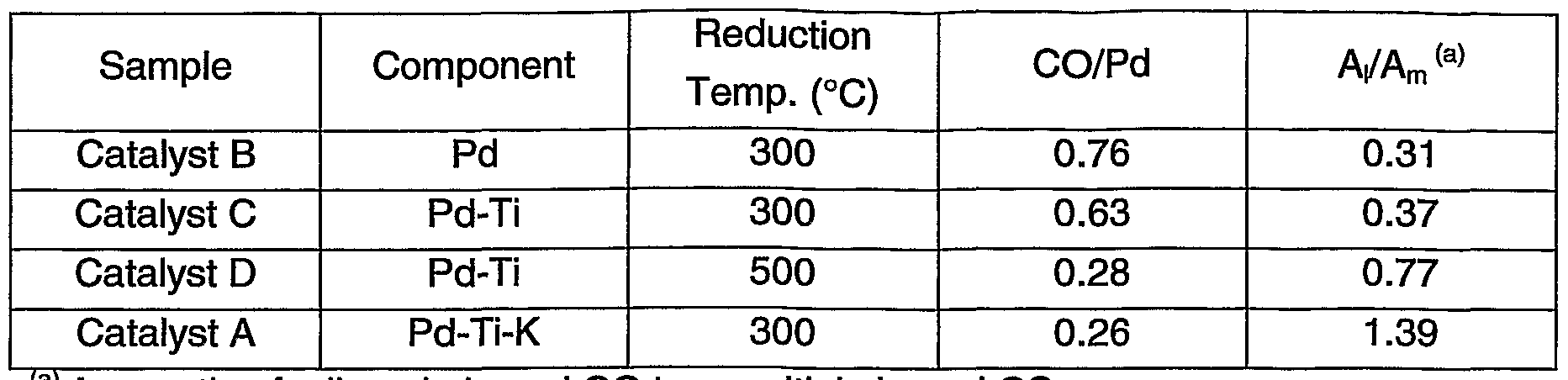
- Chemisorption experiment was performed to investigate the amount of CO chemi- sorbed on the catalyst surface.
- Catalysts A - D were pressed into a self-supporting disc, placed in an IR cell, reduced in H 2 , and then absorbed H 2 was removed by evacuation. IR cell was cooled to 40 °C, and then the catalyst was exposed to CO. The IR spectra of adsorbed CO were recorded after removing gaseous CO form the cell by evacuation. The amounts of CO chemisorbed and the chemisorption behaviour of the catalysts are summarized in Table 1.
- the concentration of Ti and Pd on the catalyst surface before and after reduction was investigated by XPS analyses.
- Catalysts A, C and D were reduced, protected from air oxidation by wetting the surface with isooctane, mounted on a double-sided adhesive tape, and then placed in UHV chamber for XPS analysis.
- Table 2 shows the area ratios of Ti/Pd on the catalyst surface before and after reduction.
- the Ti/Pd ratio of Pd-Ti catalyst reduced at 500 °C (Catalyst D) is higher than that of Pd-Ti catalyst reduced at 300 °C (Catalyst C) due to the decoration of the Pd surface with Ti species.
- the Ti/Pd ratio of Pd-Ti-K catalyst is remarkably increased even after reduction at a lower temperature, 300 °C.
- ES ethylene selectivity
- A means catalyst A
- B means catalyst B
- C means catalyst C
- D means catalyst D.
- a 0 represents the initial concentration of acetylene in the feed
- ⁇ A represents a change in the acetylene concentration
- ⁇ B represents a change in the ethylene concentration
- the ethylene selectivity is higher than that of Pd-Ti catalyst reduced at 500 °C (Catalyst D), even though the Pd-Ti-K catalyst is reduced at 300 °C (Catalyst A).
- Potassium titanate has a significantly lower melting point, that is a lower Tammann temperature, than titania, therefore, it effectively modifies the Pd surface even after reduction at a low temperature, 300 °C.
- the trend of reaction tests is in accordance with that of XPS results.
- Pd-Ti-K catalysts were prepared using the same method as in Example 1 , except for the mole ratio of K/Ti/Pd, which was 0.01/1/1 (Catalyst E), 1/1/1 (Catalyst F), 4/1/1 (Catalyst G), and 10/1/1 (Catalyst H).
- the ethylene selectivity is increased until the ratio of K Pd is 0.1 (Catalyst A), and then is decreased as the amount of added K increases to above certain amounts (Catalyst E - H).
- the existence of the excessive K increases the formation of oligomer such as 1 ,3-butadiene and consequently, degrades the activity and selectivity of a catalyst.
- the optimal ratio of K/Pd is 0.1 (Catalyst A).
- Pd-Ti-K catalyst has very high ethylene selectivity over a wide range of conversion even after reduction at a low temperature, 300 °C.
- Pd/SiO 2 catalyst was prepared by a literature method. 20 g of Silica (JRC-SIO-6, BET surface area: 109 m 2 /g) were impregnated with 200 ml solution of 0.33% by weight Pd(NH 3 ) 4 (OH) 2 and the solution was stirred for 12 hours, and centrifuged and washed with distilled water. The catalyst was then dried at 100 °C for 12 hours and calcined in air at 300 °C for 2 hours. 1 % by weight Pd/SiO 2 catalyst was obtained. B. La addition
- La-modified Pd catalysts were prepared by incipient wetness impregnation method. 1 % by weight Pd/SiO 2 was impregnated with 3 ml of 2% by weight lanthanum nitrate hydrate (La(NO 3 ) 3 -xH 2 O) aqueous solution. The catalyst was then dried at 100 °C for 6 hours and calcinated in air at 300 °C for 2 hours.
- La(NO 3 ) 3 -xH 2 O lanthanum nitrate hydrate
- the catalyst was prepared using the same method as in Example 10, except that the mole ratio of Si/Pd was 0.006.
- the catalyst was prepared using the same method as in Example 10, except that the mole ratio of Si/Pd was 0.12.
- the catalyst was prepared using the same method as in Example 2, however, the catalyst was reduced at 500 °C.
- the catalyst was prepared using the same method as in Example 10, except for Si addition (Step C). That is, 1% by weight Pd catalyst was prepared (Step A), Pd-La catalyst was prepared with the La/Pd ratio of 1 (Step B), and reduced in H 2 at 300 °C for 1 hour (Step D).
- Example 15 comparative - Catalyst N> The catalyst was prepared using the same method as Example 14, however, the catalyst was reduced at 500 °C.
- reaction gas Gas mixture containing 1.02% by volume of acetylene in ethylene.
- Acetylene hydrogenation was performed in a pyrex micro-reactor with V ⁇ inch diameter using 0.03 g catalysts.
- the flow rate of the reactant mixture was varied at 400, 800, 1200 ⁇ 1600, 2000, and 2400 ml/min. Mole ratio of H 2 /acetylene was 2, and experiments were conducted at 60 °C.
- Fig. 3 Acetylene conversion and ethylene selectivity, calculated by the following equations are shown in Fig. 3.
- ES means ethylene selectivity
- I means catalyst I
- B means catalyst B
- L means catalyst L
- M means catalyst M
- N means catalyst N.
- a 0 represents the initial concentration of acetylene in the feed
- ⁇ A represents a change in the acetylene concentration
- ⁇ B represents a change in the ethylene concentration
- the ethylene selectivity of Pd-La catalyst reduced at 300 °C is a little higher than that of Pd catalyst reduced at 300 °C (Catalyst B).
- Pd-La catalyst is reduced at 500 °C (Catalyst N)
- the ethylene selectivity is improved significantly compared to that of Pd-La (Catalyst M) and Pd catalyst (Catalyst B) reduced at 300 °C.
- the ethylene selectivity of Pd catalyst reduced at 500 °C (Catalyst L) is very low due to the sintering of Pd particles.
- the high ethylene selectivity of Pd-La catalyst reduced at 500 °C originates from the Strong Metal- Support Interaction (SMSI) between La and Pd.
- La species modifies Pd surface, such that reduces the ethane production by suppressing the ethylidyne formation which needs multiply-bound adsorption sites and also suppresses the 1 ,3-butadiene production which causes catalyst deactivation, and consequently, the ethylene selectivity is increased.
- the Si/Pd ratio, and reduced at 300 °C (Catalyst K), the ethylene selectivity as well as the acetylene conversion is decreased.
- Catalyst J with the Si/Pd ratio of 0.006 the amount of silicon is so small that it cannot anchor the lanthanum effectively, and vice versa
- Catalyst K with the Si/Pd ratio of 0.12 the amount of silicon is so large that it can cover most of the active sites, consequently, both the conversion and the selectivity is decreased significantly.
- the optimal Si/Pd ratio to obtain an elevated selectivity while maintaining a relatively high acetylene conversion exists and is 0.012 under this experimental condition.
- Pd-La-Si catalyst has very high ethylene selectivity, which is comparable to that of Pd-La catalyst reduced at 500 °C, in the wide ranges of conversion even after reduction at a low temperature, 300 °C.
- Pd/SiO 2 catalyst was prepared by a literature method. 20 g of Silica (JRC-SIO-6, BET surface area: 109 m 2 /g) were impregnated with 200 ml solution of 0.33% by weight Pd(NH 3 ) 4 (OH) 2 and the solution was stirred for 12 hours, and centrifuged and washed with distilled water. The catalyst was then dried at 100 °C for 12 hours and calcined in air at 300 °C for 2 hours. 1 % by weight Pd/SiO 2 catalyst was obtained.
- Nb addition Nb-mddified Pd catalysts were prepared by wet impregnation method. 1% by weight Pd/SiO 2 was impregnated with tetrakis niobium dissolved hexane solution. The catalyst was then dried at 100 °C for 6 hours and calcined in air at 300 °C for 2 hours.
- Pd-Nb catalysts were prepared using the same method as in Example 18, except that the catalyst was reduced at 500 °C.
- Acetylene hydrogenation was performed in a pyrex micro-reactor with ! inch diameter using 0.03 g catalysts.
- the flow rate of the reactant mixture was varied at 400, 800, 1200, 1600, 2000, and 2400 ml/min. Mole ratio of H 2 /acetylene was 2, and experiments were conducted at 60 °C.
- a 0 represents the initial concentration of acetylene in the feed
- ⁇ A represents a change in the acetylene concentration
- ⁇ B represents a change in the ethylene concentration
- the ethylene selectivities of Pd-Nb catalysts are higher than those of Pd catalysts (Catalyst B, L) irrespective of reduction temperatures.
- Pd catalyst reduced at 500 °C Catalyst P
- Pd particles are sintered, resulting in the formation of multiply-coordinated Pd sites, which accelerates 1 ,3-butadiene formation, consequently, the ethylene selectivity is lowered.
- Nb effectively modifies Pd surface even after reduction at low temperatures, suppresses the multiply-coordinated Pd sites, which is responsible for the ethane formation via ethyldine and green oil formation via 1 ,3-butadiene production, consequently, increases the ethylene selectivity.
- Pd-Nb catalyst has very high ethylene selectivity over a wide range of conversion even after reduction at low temperatures.
- Pd/SiO 2 catalyst was prepared by a literature method. 20 g of Silica (JRC-SIO-6, BET surface area: 109 m 2 /g) were impregnated with 200 ml solution of 0.33% by weight Pd(NH 3 ) 4 (OH) 2 and the solution was stirred for 12 hours, and centrifuged and washed with distilled water. The catalyst was then dried at 100 °C for 12 hours and calcined in air at 300 °C for 2 hours. 1% by weight Pd/SiO 2 catalyst was obtained.
- La-modified Pd catalysts were prepared by incipient wetness impregnation method. 1% by weight Pd/SiO 2 was impregnated with 3 ml of 2% by weight lanthanum nitrate hydrate (La(NO 3 ) 3 -xH 2 O) aqueous solution. The catalyst was then dried at 100 °C for 6 hours and calcined in air at 300 °C for 2 hours. C. Reduction
- the catalyst samples were flushed with N 2 to remove 0 2 , and then reduced in H 2 at 500 °C for 2 hours. Consequently, the Pd-La catalyst was prepared with the atomic ratio of La Pd adjusted to 1.
- Pd catalyst was prepared using the same method as Example 23 (Step A), and La species was added to Pd catalyst (Step B). The reduction in Step C was conducted at 300 °C (Catalyst R), 400 °C (Catalyst S), and 450 °C (Catalyst T). The atomic ratio of La/Pd was adjusted to 1 in the three catalysts.
- Chemisorption experiment was performed to investigate the amount of CO chemisorbed on the catalyst surface.
- Catalysts B, Q - T were pressed into a self-supporting disc, placed in an I R cell, reduced in H 2 , and then adsorbed H 2 was removed by evacuation.
- IR cell was cooled to 40 °C, and then the catalyst was exposed to CO.
- the IR spectra of adsorbed CO were recorded after removing gaseous CO from the cell by evacuation.
- the amounts of CO chemisorbed and the chemisorption behaviour on the catalysts was summarized in Table 4.
- Acetylene hydrogenation was performed in a pyrex micro-reactor with 14 inch diameter using ' 0.03 g catalysts.
- the flow rate of the reactant mixture was varied at 400, 800, 1200, 1600, 2000, and 2400 ml/min. Mole ratio of H 2 /acetylene was 2, and experiments were conducted at 60 °C.
- a 0 represents the initial concentration of acetylene in the feed
- ⁇ A represents a change in the acetylene concentration
- ⁇ B represents a change in the ethylene concentration
- the ethylene selectivity of Pd-La catalyst reduced at 300 °C (Catalyst R) and at 400 °C (Catalyst S) is similar to that of Pd catalyst reduced at 300 °C (Catalyst B).
- the reduction temperature increases to a value higher than 450 °C
- the ethylene selectivity increases (Catalyst T and Catalyst Q), and that of Pd-La catalyst reduced at 500 °C (Catalyst Q) increases up to 98%. This value is 10% higher than that of Pd-Ti catalyst, the results of which was presented in the previous examples.
- the high ethylene selectivity of Pd-La catalyst reduced at 500 °C originates from the Strong Metal-Support Interaction (SMSI) between La and Pd.
- La species modifies Pd surface, such that the species reduces the ethane production by suppressing the ethylidyne formation which needs multiply-bound adsorption sites and also suppresses the production of 1, 3-butadiene which causes catalyst deactivation. Consequently, the ethylene selectivity is increased.
- Pd-La catalysts were prepared by using the same method as in Example 22, except for the mole ratio of La/Pd, which was 0.5/1 (Catalyst U), 0.75/1 (Catalyst V, 1.5/1 (Catalyst W), and 2/1 (Catalyst X).
- the ethylene selectivity is increased until the ratio of La/Pd is 1 (Catalyst R), and then is decreased to the level of Pd catalyst (Catalyst B), when the ratio of La/Pd is 2/1 (Catalyst X).
- the La/Pd ratio is smaller than 1 (Catalyst U, V)
- the catalytic performance is not improved significantly because the La species cannot effectively decorate Pd surface although the reduction temperature is sufficiently high.
- La/Pd ratio is larger than 1 (Catalyst W, X)
- the La species decorate Pd surface too much, such that the catalytic activity is lowered. Therefore, it is concluded that there is an optimum La/Pd ratio which permits the La species to effec- tively modify the Pd surface, and that the ratio is 1 (Catalyst Q) under the above- experimental condition.
- the reactant stream contained 4.84% by volume of acetylene in ethylene.
- the Pd-La catalyst has very high ethylene selectivity over a wide range of conversion, and retards the catalyst deactivation by suppressing the formation of 1 ,3-butadiene in the selective hydrogenation of acetylene. Therefore, Pd-La catalyst has an advantage in an economical aspect in a sense that it extends the catalyst regeneration cycle.
Landscapes
- Chemical & Material Sciences (AREA)
- Organic Chemistry (AREA)
- Engineering & Computer Science (AREA)
- Chemical Kinetics & Catalysis (AREA)
- Materials Engineering (AREA)
- Analytical Chemistry (AREA)
- General Chemical & Material Sciences (AREA)
- Oil, Petroleum & Natural Gas (AREA)
- Water Supply & Treatment (AREA)
- Organic Low-Molecular-Weight Compounds And Preparation Thereof (AREA)
- Catalysts (AREA)
- Low-Molecular Organic Synthesis Reactions Using Catalysts (AREA)
- Chemical Vapour Deposition (AREA)
Abstract
Description


Claims
Priority Applications (7)
| Application Number | Priority Date | Filing Date | Title |
|---|---|---|---|
| EP04723597A EP1611072B1 (en) | 2003-03-26 | 2004-03-26 | Palladium-based catalyst for selective hydrogenation of acetylene |
| DE602004010242T DE602004010242T2 (en) | 2003-03-26 | 2004-03-26 | Palladium Catalyst for the Selective Hydrogenation of Acetyllenes |
| JP2006504885A JP4346642B2 (en) | 2003-03-26 | 2004-03-26 | Pd-based catalyst for selective hydrogenation of acetylene |
| US10/549,774 US7453017B2 (en) | 2003-03-26 | 2004-03-26 | Palladium-based catalyst for selective hydrogenation of acetylene |
| CA2519994A CA2519994C (en) | 2003-03-26 | 2004-03-26 | Palladium-based catalyst for selective hydrogenation of acetylene |
| PL04723597T PL1611072T3 (en) | 2003-03-26 | 2004-03-26 | Palladium-based catalyst for selective hydrogenation of acetylene |
| MXPA05008643A MXPA05008643A (en) | 2003-03-26 | 2004-03-26 | Palladium-based catalyst for selective hydrogenation of acetylene. |
Applications Claiming Priority (8)
| Application Number | Priority Date | Filing Date | Title |
|---|---|---|---|
| KR2003/18891 | 2003-03-26 | ||
| KR10-2003-0018890A KR100505526B1 (en) | 2003-03-26 | 2003-03-26 | Pd-Ti-K catalyst for selective hydrogenation of acetylene and production method of the same |
| KR2003/18888 | 2003-03-26 | ||
| KR2003/18890 | 2003-03-26 | ||
| KR10-2003-0018888A KR100505519B1 (en) | 2003-03-26 | 2003-03-26 | Pd-La catalyst for selective hydrogenation of acetylene and production method of the same |
| KR10-2003-0018891A KR100478333B1 (en) | 2003-03-26 | 2003-03-26 | Pd-Nb catalyst for selective hydrogenation of acetylene and production method of the same |
| KR10-2003-0019039A KR100505531B1 (en) | 2003-03-27 | 2003-03-27 | Pd-La-Si catalyst for selective hydrogenation of acetylene and production method of the same |
| KR2003/19039 | 2003-03-27 |
Publications (3)
| Publication Number | Publication Date |
|---|---|
| WO2004085353A2 true WO2004085353A2 (en) | 2004-10-07 |
| WO2004085353A3 WO2004085353A3 (en) | 2004-12-23 |
| WO2004085353A8 WO2004085353A8 (en) | 2005-11-17 |
Family
ID=36147038
Family Applications (1)
| Application Number | Title | Priority Date | Filing Date |
|---|---|---|---|
| PCT/EP2004/003263 Ceased WO2004085353A2 (en) | 2003-03-26 | 2004-03-26 | Palladium-based catalyst for selective hydrogenation of acetylene |
Country Status (12)
| Country | Link |
|---|---|
| US (1) | US7453017B2 (en) |
| EP (2) | EP1611072B1 (en) |
| JP (1) | JP4346642B2 (en) |
| KR (3) | KR100985309B1 (en) |
| CN (2) | CN100558684C (en) |
| AT (1) | ATE458711T1 (en) |
| CA (2) | CA2519994C (en) |
| DE (2) | DE602004010242T2 (en) |
| ES (1) | ES2294487T3 (en) |
| MX (1) | MXPA05008643A (en) |
| PL (1) | PL1611072T3 (en) |
| WO (1) | WO2004085353A2 (en) |
Cited By (3)
| Publication number | Priority date | Publication date | Assignee | Title |
|---|---|---|---|---|
| CN111450879A (en) * | 2020-05-08 | 2020-07-28 | 内蒙古自治区石油化工监督检验研究院 | Propane diamine modified low-ruthenium catalyst for acetylene hydrochlorination and preparation method thereof |
| WO2021110472A1 (en) | 2019-12-03 | 2021-06-10 | Basf Se | Process for preparing amines over a copper catalyst |
| CN113262820A (en) * | 2021-05-19 | 2021-08-17 | 北京单原子催化科技有限公司 | Has M1Catalyst with structure of @ MOFs, preparation method and application |
Families Citing this family (24)
| Publication number | Priority date | Publication date | Assignee | Title |
|---|---|---|---|---|
| JP4802521B2 (en) * | 2004-06-25 | 2011-10-26 | 荒川化学工業株式会社 | Catalytic hydrogenation method using microreactor |
| CN101433841B (en) * | 2007-12-13 | 2010-04-14 | 中国石油天然气股份有限公司 | Selective hydrogenation catalyst and preparation method thereof |
| US8921631B2 (en) | 2008-12-18 | 2014-12-30 | Saudi Basic Industries Corporation | Selective catalytic hydrogenation of alkynes to corresponding alkenes |
| RU2394645C1 (en) * | 2008-12-26 | 2010-07-20 | Габитов Фаризан Ракибович | Method of preparing palladium catalyst for hydrogenating acetylene |
| WO2011107565A1 (en) * | 2010-03-05 | 2011-09-09 | Shell Internationale Research Maatschappij B.V. | Hydrogenation catalyst |
| JP5661816B2 (en) | 2010-03-19 | 2015-01-28 | シエル・インターナシヨナル・リサーチ・マートスハツペイ・ベー・ヴエー | Hydrogenation catalyst |
| CN102247876B (en) * | 2010-05-19 | 2013-06-26 | 中国科学院大连化学物理研究所 | A method for the selective catalytic hydrogenation of acetylene to produce ethylene |
| US8258356B2 (en) | 2010-08-17 | 2012-09-04 | Uop Llc | Selective CO oxidation for acetylene converter feed CO control |
| CN102407118B (en) * | 2010-09-21 | 2013-06-05 | 中国石油化工股份有限公司 | Unsaturated hydrocarbon hydrogenation catalyst and application thereof |
| PL215952B1 (en) | 2011-05-05 | 2014-02-28 | Politechnika Lodzka | Process for the preparation of three-component carburizing mixture and device for the preparation of three-component carburizing mixture |
| US8822370B2 (en) * | 2011-05-16 | 2014-09-02 | Uop Llc | Substantially non-porous substrate supported noble metal-and lanthanide-containing catalysts |
| EP2570470A1 (en) | 2011-09-19 | 2013-03-20 | Shell Internationale Research Maatschappij B.V. | Hydrogenation catalyst |
| CN103071490A (en) * | 2011-10-26 | 2013-05-01 | 中国石油化工股份有限公司 | Palladium catalyst used in unsaturated hydrocarbon hydrogenation, and application thereof |
| FR2990882B1 (en) * | 2012-05-24 | 2015-05-15 | IFP Energies Nouvelles | PROCESS FOR PREPARING A CATALYST BASED ON GROUP VIII METAL AND CONTAINING SILICON, AND SELECTIVE HYDROGENATION PROCESS USING SAID CATALYST |
| CN103418378B (en) * | 2013-08-01 | 2016-04-27 | 济南开发区星火科学技术研究院 | A kind of cracking c_4 fraction selective hydrogenation palladium-based catalyst |
| CN105732255B (en) * | 2014-12-11 | 2018-07-13 | 中国石油天然气股份有限公司 | A kind of method of alkyne selective hydrogenation |
| CN105732288B (en) * | 2014-12-11 | 2018-07-13 | 中国石油天然气股份有限公司 | A kind of selective hydrogenation method of C4 fraction |
| CN105732289B (en) * | 2014-12-11 | 2018-07-13 | 中国石油天然气股份有限公司 | A kind of method of alkyne selective hydrogenation recovery butadiene |
| TWI737728B (en) | 2016-06-27 | 2021-09-01 | 日商捷恩智股份有限公司 | Liquid crystal composition, mixture, liquid crystal composite material, optical element and its use |
| CN107088439B (en) * | 2017-05-08 | 2019-07-26 | 扬州大学 | Preparation method of catalyst for hydrogenation reduction reaction of 2-hydrocarbylene cyclobutanone |
| WO2018225737A1 (en) * | 2017-06-06 | 2018-12-13 | エヌ・イー ケムキャット株式会社 | Catalyst for debenzylation reactions |
| US10507435B1 (en) * | 2018-06-28 | 2019-12-17 | Uop Llc | Membrane process for olefin separation |
| EP3911436B1 (en) | 2019-01-17 | 2024-07-24 | Shell Internationale Research Maatschappij B.V. | A bimetallic nanoparticle-based catalyst, its use in selective hydrogenation, and a method of making the catalyst |
| CN112570015B (en) * | 2020-12-22 | 2022-08-26 | 天津大学 | Molecular sieve catalyst for packaging Pd-based alloy and preparation method and application thereof |
Family Cites Families (9)
| Publication number | Priority date | Publication date | Assignee | Title |
|---|---|---|---|---|
| US3325556A (en) | 1964-05-18 | 1967-06-13 | Universal Oil Prod Co | Selective hydrogenation of acetylene in a mixture of acetylene and other unsaturated hydrocarbons |
| US4387258A (en) | 1981-01-28 | 1983-06-07 | Exxon Research & Engineering Co. | Selective hydrogenation using palladium/platinum on crystalline silica polymorph/silicalite/high silica zeolite |
| US4906800A (en) | 1986-11-17 | 1990-03-06 | The Standard Oil Company | Procedure for imparting selectivity to hydrogenation catalysts and method for using the same |
| US4829329A (en) | 1987-01-14 | 1989-05-09 | Canon Kabushiki Kaisha | Brake device for a shutter |
| DE19854635A1 (en) * | 1998-11-26 | 2000-05-31 | Basf Ag | Supported catalyst and its use in hydrogenation |
| KR20000059743A (en) | 1999-03-08 | 2000-10-05 | 이정국 | Hydrogenation catalyst for selectively converting a triple bonded, conjugated double bonded or allene-type hydrocarbon and method of preparing the same |
| WO2001041923A1 (en) * | 1999-12-13 | 2001-06-14 | Phillips Petroleum Company | Hydrocarbon hydrogenation catalyst and process |
| CN1145687C (en) * | 2000-12-29 | 2004-04-14 | 中国石油化工股份有限公司 | Selective hydrogenation catalyst carrier and its prepn and use |
| US6797669B2 (en) * | 2000-12-29 | 2004-09-28 | China Petroleum & Chemical Corporation | Catalyst for selective hydrogenation, its preparation process and application |
-
2004
- 2004-03-26 EP EP04723597A patent/EP1611072B1/en not_active Expired - Lifetime
- 2004-03-26 DE DE602004010242T patent/DE602004010242T2/en not_active Expired - Lifetime
- 2004-03-26 US US10/549,774 patent/US7453017B2/en not_active Expired - Lifetime
- 2004-03-26 DE DE602004025740T patent/DE602004025740D1/en not_active Expired - Lifetime
- 2004-03-26 EP EP06115610A patent/EP1700836B1/en not_active Expired - Lifetime
- 2004-03-26 AT AT06115610T patent/ATE458711T1/en not_active IP Right Cessation
- 2004-03-26 JP JP2006504885A patent/JP4346642B2/en not_active Expired - Fee Related
- 2004-03-26 CN CNB2004800081200A patent/CN100558684C/en not_active Expired - Fee Related
- 2004-03-26 KR KR1020107010847A patent/KR100985309B1/en not_active Expired - Fee Related
- 2004-03-26 CN CN2009101738568A patent/CN101676025B/en not_active Expired - Fee Related
- 2004-03-26 ES ES04723597T patent/ES2294487T3/en not_active Expired - Lifetime
- 2004-03-26 MX MXPA05008643A patent/MXPA05008643A/en active IP Right Grant
- 2004-03-26 PL PL04723597T patent/PL1611072T3/en unknown
- 2004-03-26 WO PCT/EP2004/003263 patent/WO2004085353A2/en not_active Ceased
- 2004-03-26 KR KR1020097026227A patent/KR100971585B1/en not_active Expired - Fee Related
- 2004-03-26 CA CA2519994A patent/CA2519994C/en not_active Expired - Lifetime
- 2004-03-26 CA CA2730846A patent/CA2730846C/en not_active Expired - Lifetime
- 2004-03-26 KR KR1020057017963A patent/KR100951206B1/en not_active Expired - Fee Related
Cited By (4)
| Publication number | Priority date | Publication date | Assignee | Title |
|---|---|---|---|---|
| WO2021110472A1 (en) | 2019-12-03 | 2021-06-10 | Basf Se | Process for preparing amines over a copper catalyst |
| CN111450879A (en) * | 2020-05-08 | 2020-07-28 | 内蒙古自治区石油化工监督检验研究院 | Propane diamine modified low-ruthenium catalyst for acetylene hydrochlorination and preparation method thereof |
| CN113262820A (en) * | 2021-05-19 | 2021-08-17 | 北京单原子催化科技有限公司 | Has M1Catalyst with structure of @ MOFs, preparation method and application |
| CN113262820B (en) * | 2021-05-19 | 2023-05-26 | 北京单原子催化科技有限公司 | M is provided with 1 Catalyst with@MOFs structure, preparation method and application |
Also Published As
| Publication number | Publication date |
|---|---|
| ATE458711T1 (en) | 2010-03-15 |
| ES2294487T3 (en) | 2008-04-01 |
| US20060229478A1 (en) | 2006-10-12 |
| CA2519994C (en) | 2011-08-02 |
| KR20100010031A (en) | 2010-01-29 |
| EP1700836A1 (en) | 2006-09-13 |
| MXPA05008643A (en) | 2005-10-18 |
| CA2730846C (en) | 2012-05-22 |
| WO2004085353A8 (en) | 2005-11-17 |
| KR100971585B1 (en) | 2010-08-11 |
| KR20100058681A (en) | 2010-06-03 |
| PL1611072T3 (en) | 2008-05-30 |
| WO2004085353A3 (en) | 2004-12-23 |
| DE602004010242D1 (en) | 2008-01-03 |
| CN1764617A (en) | 2006-04-26 |
| CN101676025A (en) | 2010-03-24 |
| KR100951206B1 (en) | 2010-04-27 |
| JP2006521197A (en) | 2006-09-21 |
| US7453017B2 (en) | 2008-11-18 |
| CA2519994A1 (en) | 2004-10-07 |
| CN101676025B (en) | 2012-12-05 |
| KR20050109602A (en) | 2005-11-21 |
| EP1611072A2 (en) | 2006-01-04 |
| EP1611072B1 (en) | 2007-11-21 |
| CN100558684C (en) | 2009-11-11 |
| EP1700836B1 (en) | 2010-02-24 |
| DE602004025740D1 (en) | 2010-04-08 |
| DE602004010242T2 (en) | 2008-03-13 |
| KR100985309B1 (en) | 2010-11-11 |
| CA2730846A1 (en) | 2004-10-07 |
| JP4346642B2 (en) | 2009-10-21 |
Similar Documents
| Publication | Publication Date | Title |
|---|---|---|
| US7453017B2 (en) | Palladium-based catalyst for selective hydrogenation of acetylene | |
| US5889187A (en) | Catalytic hydrogenation process and a catalyst for use in the process | |
| Sarkany et al. | Promoter effect of Pd in hydrogenation of 1, 3-butadiene over Co-Pd catalysts | |
| Kang et al. | Selective hydrogenation of acetylene on TiO2-added Pd catalysts | |
| US7199273B2 (en) | Selective hydrogenation of alkynes and/or diolefins | |
| JP2004529759A (en) | Process for selective hydrogenation of alkynes and catalyst therefor | |
| US6054409A (en) | Selective hydrogenation catalyst and a process using that catalyst | |
| KR100449965B1 (en) | Selective Hydrogenation Catalysts and How to Use the Catalysts | |
| CA1252080A (en) | Catalysts and process for the selective hydrogenation of acetylenes | |
| US20110313220A1 (en) | Selective catalytic hydrogenation of alkynes to corresponding alkenes | |
| RU2048909C1 (en) | Catalyst for vapor hydrocarbon conversion | |
| WO2005051538A1 (en) | Catalyst and process for selective hydrogenation | |
| CA1290354C (en) | Process for the selective hydrogenation of alkynes | |
| KR100505526B1 (en) | Pd-Ti-K catalyst for selective hydrogenation of acetylene and production method of the same | |
| KR100505531B1 (en) | Pd-La-Si catalyst for selective hydrogenation of acetylene and production method of the same | |
| KR100478333B1 (en) | Pd-Nb catalyst for selective hydrogenation of acetylene and production method of the same | |
| Margitfalvi et al. | Hydrogenation of Crotonaldehyde Over New Type of Sn-Pt/SiO~ 2 Catalysts | |
| Pajonk et al. | Carrier effect on hydrogenation properties of Metals | |
| MXPA98007589A (en) | Bimetallic catalyst for the simultaneous selective hydrogenation of diolephins and nitrile, and method to manufacture my |
Legal Events
| Date | Code | Title | Description |
|---|---|---|---|
| AK | Designated states |
Kind code of ref document: A2 Designated state(s): AE AG AL AM AT AU AZ BA BB BG BR BW BY BZ CA CH CN CO CR CU CZ DE DK DM DZ EC EE EG ES FI GB GD GE GH GM HR HU ID IL IN IS JP KE KG KP KR KZ LC LK LR LS LT LU LV MA MD MG MK MN MW MX MZ NA NI NO NZ OM PG PH PL PT RO RU SC SD SE SG SK SL SY TJ TM TN TR TT TZ UA UG US UZ VC VN YU ZA ZM ZW |
|
| AL | Designated countries for regional patents |
Kind code of ref document: A2 Designated state(s): BW GH GM KE LS MW MZ SD SL SZ TZ UG ZM ZW AM AZ BY KG KZ MD RU TJ TM AT BE BG CH CY CZ DE DK EE ES FI FR GB GR HU IE IT LU MC NL PL PT RO SE SI SK TR BF BJ CF CG CI CM GA GN GQ GW ML MR NE SN TD TG |
|
| 121 | Ep: the epo has been informed by wipo that ep was designated in this application | ||
| WWE | Wipo information: entry into national phase |
Ref document number: PA/a/2005/008643 Country of ref document: MX |
|
| WWE | Wipo information: entry into national phase |
Ref document number: 2006229478 Country of ref document: US Ref document number: 10549774 Country of ref document: US |
|
| WWE | Wipo information: entry into national phase |
Ref document number: 2519994 Country of ref document: CA |
|
| WWE | Wipo information: entry into national phase |
Ref document number: 2006504885 Country of ref document: JP |
|
| WWE | Wipo information: entry into national phase |
Ref document number: 1020057017963 Country of ref document: KR |
|
| WWE | Wipo information: entry into national phase |
Ref document number: 20048081200 Country of ref document: CN |
|
| WWE | Wipo information: entry into national phase |
Ref document number: 2004723597 Country of ref document: EP |
|
| CFP | Corrected version of a pamphlet front page | ||
| CR1 | Correction of entry in section i |
Free format text: IN PCT GAZETTE 41/2004 DELETE "DECLARATION UNDER RULE 4.17: - AS TO THE APPLICANT S ENTITLEMENT TO CLAIM THE PRIORITY OF THE EARLIER APPLICATION (RULE 4.17(III)) FOR ALL DESIGNATIONS." |
|
| WWP | Wipo information: published in national office |
Ref document number: 1020057017963 Country of ref document: KR |
|
| WWP | Wipo information: published in national office |
Ref document number: 2004723597 Country of ref document: EP |
|
| DPEN | Request for preliminary examination filed prior to expiration of 19th month from priority date (pct application filed from 20040101) | ||
| WWP | Wipo information: published in national office |
Ref document number: 10549774 Country of ref document: US |
|
| WWG | Wipo information: grant in national office |
Ref document number: 2004723597 Country of ref document: EP |