WO2004094373A2 - A method of providing a steroid-sparing benefit with a cyclooxygenase-2 inhibitor and compositions therewith - Google Patents

A method of providing a steroid-sparing benefit with a cyclooxygenase-2 inhibitor and compositions therewith Download PDF

Info

Publication number
WO2004094373A2
WO2004094373A2 PCT/US2004/008319 US2004008319W WO2004094373A2 WO 2004094373 A2 WO2004094373 A2 WO 2004094373A2 US 2004008319 W US2004008319 W US 2004008319W WO 2004094373 A2 WO2004094373 A2 WO 2004094373A2
Authority
WO
WIPO (PCT)
Prior art keywords
alkyl
cox
group
trifluoromethyl
phenyl
Prior art date
Legal status (The legal status is an assumption and is not a legal conclusion. Google has not performed a legal analysis and makes no representation as to the accuracy of the status listed.)
Ceased
Application number
PCT/US2004/008319
Other languages
French (fr)
Other versions
WO2004094373A3 (en
Inventor
Karen Seibert
Current Assignee (The listed assignees may be inaccurate. Google has not performed a legal analysis and makes no representation or warranty as to the accuracy of the list.)
Pharmacia LLC
Original Assignee
Pharmacia LLC
Priority date (The priority date is an assumption and is not a legal conclusion. Google has not performed a legal analysis and makes no representation as to the accuracy of the date listed.)
Filing date
Publication date
Application filed by Pharmacia LLC filed Critical Pharmacia LLC
Priority to MXPA05010347A priority Critical patent/MXPA05010347A/en
Priority to BRPI0408944-8A priority patent/BRPI0408944A/en
Priority to EP04759655A priority patent/EP1611095A2/en
Priority to CA002520360A priority patent/CA2520360A1/en
Priority to JP2006507329A priority patent/JP2006521356A/en
Publication of WO2004094373A2 publication Critical patent/WO2004094373A2/en
Anticipated expiration legal-status Critical
Publication of WO2004094373A3 publication Critical patent/WO2004094373A3/en
Ceased legal-status Critical Current

Links

Classifications

    • AHUMAN NECESSITIES
    • A61MEDICAL OR VETERINARY SCIENCE; HYGIENE
    • A61KPREPARATIONS FOR MEDICAL, DENTAL OR TOILETRY PURPOSES
    • A61K45/00Medicinal preparations containing active ingredients not provided for in groups A61K31/00 - A61K41/00
    • A61K45/06Mixtures of active ingredients without chemical characterisation, e.g. antiphlogistics and cardiaca
    • AHUMAN NECESSITIES
    • A61MEDICAL OR VETERINARY SCIENCE; HYGIENE
    • A61PSPECIFIC THERAPEUTIC ACTIVITY OF CHEMICAL COMPOUNDS OR MEDICINAL PREPARATIONS
    • A61P1/00Drugs for disorders of the alimentary tract or the digestive system
    • A61P1/04Drugs for disorders of the alimentary tract or the digestive system for ulcers, gastritis or reflux esophagitis, e.g. antacids, inhibitors of acid secretion, mucosal protectants
    • AHUMAN NECESSITIES
    • A61MEDICAL OR VETERINARY SCIENCE; HYGIENE
    • A61PSPECIFIC THERAPEUTIC ACTIVITY OF CHEMICAL COMPOUNDS OR MEDICINAL PREPARATIONS
    • A61P11/00Drugs for disorders of the respiratory system
    • AHUMAN NECESSITIES
    • A61MEDICAL OR VETERINARY SCIENCE; HYGIENE
    • A61PSPECIFIC THERAPEUTIC ACTIVITY OF CHEMICAL COMPOUNDS OR MEDICINAL PREPARATIONS
    • A61P11/00Drugs for disorders of the respiratory system
    • A61P11/06Antiasthmatics
    • AHUMAN NECESSITIES
    • A61MEDICAL OR VETERINARY SCIENCE; HYGIENE
    • A61PSPECIFIC THERAPEUTIC ACTIVITY OF CHEMICAL COMPOUNDS OR MEDICINAL PREPARATIONS
    • A61P13/00Drugs for disorders of the urinary system
    • A61P13/12Drugs for disorders of the urinary system of the kidneys
    • AHUMAN NECESSITIES
    • A61MEDICAL OR VETERINARY SCIENCE; HYGIENE
    • A61PSPECIFIC THERAPEUTIC ACTIVITY OF CHEMICAL COMPOUNDS OR MEDICINAL PREPARATIONS
    • A61P17/00Drugs for dermatological disorders
    • A61P17/02Drugs for dermatological disorders for treating wounds, ulcers, burns, scars, keloids, or the like
    • AHUMAN NECESSITIES
    • A61MEDICAL OR VETERINARY SCIENCE; HYGIENE
    • A61PSPECIFIC THERAPEUTIC ACTIVITY OF CHEMICAL COMPOUNDS OR MEDICINAL PREPARATIONS
    • A61P17/00Drugs for dermatological disorders
    • A61P17/06Antipsoriatics
    • AHUMAN NECESSITIES
    • A61MEDICAL OR VETERINARY SCIENCE; HYGIENE
    • A61PSPECIFIC THERAPEUTIC ACTIVITY OF CHEMICAL COMPOUNDS OR MEDICINAL PREPARATIONS
    • A61P19/00Drugs for skeletal disorders
    • A61P19/02Drugs for skeletal disorders for joint disorders, e.g. arthritis, arthrosis
    • AHUMAN NECESSITIES
    • A61MEDICAL OR VETERINARY SCIENCE; HYGIENE
    • A61PSPECIFIC THERAPEUTIC ACTIVITY OF CHEMICAL COMPOUNDS OR MEDICINAL PREPARATIONS
    • A61P19/00Drugs for skeletal disorders
    • A61P19/08Drugs for skeletal disorders for bone diseases, e.g. rachitism, Paget's disease
    • A61P19/10Drugs for skeletal disorders for bone diseases, e.g. rachitism, Paget's disease for osteoporosis
    • AHUMAN NECESSITIES
    • A61MEDICAL OR VETERINARY SCIENCE; HYGIENE
    • A61PSPECIFIC THERAPEUTIC ACTIVITY OF CHEMICAL COMPOUNDS OR MEDICINAL PREPARATIONS
    • A61P21/00Drugs for disorders of the muscular or neuromuscular system
    • AHUMAN NECESSITIES
    • A61MEDICAL OR VETERINARY SCIENCE; HYGIENE
    • A61PSPECIFIC THERAPEUTIC ACTIVITY OF CHEMICAL COMPOUNDS OR MEDICINAL PREPARATIONS
    • A61P25/00Drugs for disorders of the nervous system
    • A61P25/04Centrally acting analgesics, e.g. opioids
    • AHUMAN NECESSITIES
    • A61MEDICAL OR VETERINARY SCIENCE; HYGIENE
    • A61PSPECIFIC THERAPEUTIC ACTIVITY OF CHEMICAL COMPOUNDS OR MEDICINAL PREPARATIONS
    • A61P25/00Drugs for disorders of the nervous system
    • A61P25/14Drugs for disorders of the nervous system for treating abnormal movements, e.g. chorea, dyskinesia
    • A61P25/16Anti-Parkinson drugs
    • AHUMAN NECESSITIES
    • A61MEDICAL OR VETERINARY SCIENCE; HYGIENE
    • A61PSPECIFIC THERAPEUTIC ACTIVITY OF CHEMICAL COMPOUNDS OR MEDICINAL PREPARATIONS
    • A61P25/00Drugs for disorders of the nervous system
    • A61P25/24Antidepressants
    • AHUMAN NECESSITIES
    • A61MEDICAL OR VETERINARY SCIENCE; HYGIENE
    • A61PSPECIFIC THERAPEUTIC ACTIVITY OF CHEMICAL COMPOUNDS OR MEDICINAL PREPARATIONS
    • A61P25/00Drugs for disorders of the nervous system
    • A61P25/28Drugs for disorders of the nervous system for treating neurodegenerative disorders of the central nervous system, e.g. nootropic agents, cognition enhancers, drugs for treating Alzheimer's disease or other forms of dementia
    • AHUMAN NECESSITIES
    • A61MEDICAL OR VETERINARY SCIENCE; HYGIENE
    • A61PSPECIFIC THERAPEUTIC ACTIVITY OF CHEMICAL COMPOUNDS OR MEDICINAL PREPARATIONS
    • A61P29/00Non-central analgesic, antipyretic or antiinflammatory agents, e.g. antirheumatic agents; Non-steroidal antiinflammatory drugs [NSAID]
    • AHUMAN NECESSITIES
    • A61MEDICAL OR VETERINARY SCIENCE; HYGIENE
    • A61PSPECIFIC THERAPEUTIC ACTIVITY OF CHEMICAL COMPOUNDS OR MEDICINAL PREPARATIONS
    • A61P31/00Antiinfectives, i.e. antibiotics, antiseptics, chemotherapeutics
    • A61P31/04Antibacterial agents
    • AHUMAN NECESSITIES
    • A61MEDICAL OR VETERINARY SCIENCE; HYGIENE
    • A61PSPECIFIC THERAPEUTIC ACTIVITY OF CHEMICAL COMPOUNDS OR MEDICINAL PREPARATIONS
    • A61P35/00Antineoplastic agents
    • AHUMAN NECESSITIES
    • A61MEDICAL OR VETERINARY SCIENCE; HYGIENE
    • A61PSPECIFIC THERAPEUTIC ACTIVITY OF CHEMICAL COMPOUNDS OR MEDICINAL PREPARATIONS
    • A61P37/00Drugs for immunological or allergic disorders
    • A61P37/08Antiallergic agents
    • AHUMAN NECESSITIES
    • A61MEDICAL OR VETERINARY SCIENCE; HYGIENE
    • A61PSPECIFIC THERAPEUTIC ACTIVITY OF CHEMICAL COMPOUNDS OR MEDICINAL PREPARATIONS
    • A61P43/00Drugs for specific purposes, not provided for in groups A61P1/00-A61P41/00
    • AHUMAN NECESSITIES
    • A61MEDICAL OR VETERINARY SCIENCE; HYGIENE
    • A61PSPECIFIC THERAPEUTIC ACTIVITY OF CHEMICAL COMPOUNDS OR MEDICINAL PREPARATIONS
    • A61P9/00Drugs for disorders of the cardiovascular system
    • A61P9/10Drugs for disorders of the cardiovascular system for treating ischaemic or atherosclerotic diseases, e.g. antianginal drugs, coronary vasodilators, drugs for myocardial infarction, retinopathy, cerebrovascula insufficiency, renal arteriosclerosis

Definitions

  • the present invention relates generally to the use of a cyclooxygenase-2 inhibitor to provide steroid-sparing benefits and, more particularly, to the use of a cyclooxygenase-2 inhibitor in combination with a corticosteroid to provide steroid-sparing benefits for the treatment of inflammatory disorders.
  • corticosteroids which have the ability to suppress immunologic and inflammatory responses. See Barnes, et al., J. Allergy Clin. Immunol., 101:S427-33.
  • Corticosteroids are routinely used in the treatment of inflammation arising from asthma, chronic obstructive pulmonary disease, (COPD), autoimmune diseases and various dermatological disorders. See e.g., Sterry, et al., W. Arch. Dermatol. Res. 284:S27-S29 (1992).
  • Corticosteroids exert their effects by binding to the steroid- binding domain of glucocorticoid receptors found throughout the body. See Barnes, P., et al., Am. J. Respir. Crit. Care Med, 157:S1-S53 (1998). Corticosteroid binding activates glucocorticoid receptors, causing them to translocate to the nucleus and bind to glucocorticoid response elements (GREs) in the promoters of steroid-responsive genes. Once glucocorticoid receptors bind to their associated GREs, their physical binding results in the downregulation of pro-inflammatory genes (e.g. cytokines and cyclooxygenase-2), while anti-inflammatory genes become upregulated (e.g. ⁇ 2 -adrenoreceptor). Id.
  • pro-inflammatory genes e.g. cytokines and cyclooxygenase-2
  • anti-inflammatory genes become upregulated (e.g.
  • nflammatory cell-types include eosinophils, CD4 + T lymphocytes, macrophages, neutrophils, dendritic cells, mast cells, and structural cells. See Bundschuh, D., et al., Pharm. Exper. Therap., 297(1 ):280-290 (2001).
  • inflammatory cells release a plethora of mediators, including histamine and the products of arachidonic acid metabolism, such as leukotrienes, prostaglandins, cytokines, interleukins IL-1 to IL-12, alpha-, beta- and gamma-interferon, tumor necrosis factor (TNF) and proteases, all ultimately leading to the harmful inflammatory symptoms and the histopathology of asthma.
  • mediators including histamine and the products of arachidonic acid metabolism, such as leukotrienes, prostaglandins, cytokines, interleukins IL-1 to IL-12, alpha-, beta- and gamma-interferon, tumor necrosis factor (TNF) and proteases, all ultimately leading to the harmful inflammatory symptoms and the histopathology of asthma.
  • TNF tumor necrosis factor
  • corticosteroid administration can result in unintended and unwanted side effects.
  • those side effects can include fungal infections of the mouth and throat (thrush), hoarseness, cough, and delayed growth.
  • orally ingested corticosteroids are prescribed as short-term burst therapies to treat acute severe episodes or as routine maintenance therapies.
  • prednisone is the most commonly prescribed orally ingested corticosteroid.
  • Orally prescribed steroids are known to cause severe side effects, especially with higher doses and during the course of long-term therapies.
  • high doses of oral corticosteroids can cause suppression of growth, suppression of the pituitary and adrenal glands, osteoporosis, loss of blood supply to the bones, obesity, cataracts, high blood pressure, weight gain, increase in body hair and acne, diabetes, muscle weakness, stomach irritations, emotional disturbances, and several other adverse effects.
  • steroid-sparing benefits Typical of the development of inflammatory symptoms is upregulation of the enzyme, cyclooxygenase-2 (Cox-2).
  • Cox-2 is an enzyme that is produced by an inducible gene, which is responsible for the biosynthesis of prostaglandins in inflammatory cells.
  • Inflammation causes the induction of Cox-2, leading to the release of prostanoids (prostaglandin E2), which sensitize peripheral nociceptor terminals and produce localized inflammation and oedema.
  • prostanoids prostaglandin E2
  • NSAIDs nonsteroidal anti-inflammatory drugs
  • Gl gastrointestinal bleeding or ulcers in subjects undergoing consistent long term regimens of NSAID therapy.
  • Cox-1 is a constitutive enzyme responsible for the biosynthesis of prostaglandins in the gastric mucosa and in the kidney.
  • Many common NSAIDs are now known to be inhibitors of both Cox-1 and Cox-2. Accordingly, when administered in sufficiently high levels, these NSAIDs not only alleviate the inflammatory consequences of Cox-2 activity, but also inhibit the beneficial gastric maintenance activities of Cox- 1.
  • Cox-2 selective inhibitors are believed to offer advantages that include the capacity to prevent or reduce inflammation while avoiding harmful side effects associated with the inhibition of Cox-1.
  • Cox-2 selective inhibitors have shown great promise for use in therapies - especially in therapies that require maintenance administration, such as for pain and inflammation control.
  • the present invention is directed to a novel method of providing a steroid-sparing benefit to a subject that is in need of, or that is presently receiving, a corticosteroid, the method comprising administering to the subject a Cox-2 inhibitor in combination with a corticosteroid.
  • the present invention is also directed to a novel method of preventing or treating a corticosteroid-responsive disease or disorder in a subject comprising administering to the subject a Cox-2 inhibitor in combination with a corticosteroid.
  • the present invention is also directed to a novel method for the treatment or prevention of pain, inflammation or an inflammation- related disorder in a subject comprising administering to the subject a Cox- 2 inhibitor and a corticosteroid.
  • the present invention is also directed to a novel therapeutic composition comprising a Cox-2 inhibitor and a corticosteroid.
  • the present invention is also directed to a novel pharmaceutical composition comprising a Cox-2 inhibitor, a corticosteroid, and a pharmaceutically acceptable carrier.
  • the present invention is also directed to a novel kit comprising one dosage form comprising a Cox-2 inhibitor and a second dosage form comprising a corticosteroid.
  • a steroid-sparing benefit can be provided to a subject that is in need of, or that is presently receiving, a corticosteroid, by administering to the subject a Cox-2 inhibitor in combination with a corticosteroid.
  • This method can be used for preventing or treating a corticosteroid-responsive disease or disorder, such as asthma, in a subject that is in need of the prevention or treatment of this type of disease or disorder.
  • the method is particularly effective when the Cox-2 inhibitor is selective for the inhibition of the Cox-2 enzyme, and, celecoxib, in particular, has been found to be a preferred Cox-2 inhibitor.
  • celecoxib in particular, has been found to be a preferred Cox-2 inhibitor.
  • the administration of the combination of the Cox-2 inhibitor with a corticosteroid has been found to be unexpectedly superior to the use of a corticosteroid alone, because the presence of the Cox-2 inhibitor permits the use of a lower amount of the corticosteroid to obtain the same therapeutic benefit than when the corticosteroid is administered without the Cox-2 inhibitor.
  • corticosteroids and “steroids,” both used interchangeably herein, refer to all steroid medications that have or exhibit or can be expected to exhibit any capability of modulating the activity of glucocorticoid-responsive receptors, such as, for example, the glucocorticoid receptor.
  • corticosteroid is intended to encompass the glucocorticoid subcategory of corticosteroids, but not mineralocorticoids.
  • the term "steroid-sparing benefit” refers to the capacity of a Cox-2 inhibitor, when administered with a corticosteroid to a subject in need of, or who is receiving, a corticosteroid medicament, to enhance the therapeutic benefits provided by a given amount of the corticosteroid.
  • administering to a subject a corticosteroid and a Cox-2 inhibitor synergistically combines the effects of both treatments providing for treatment of the indicated disorder and sparing the amount of corticosteroid that normally would have been required without the synergistic addition of the Cox-2 inhibitor.
  • a steroid-sparing benefit also includes the synergistic addition of a Cox-2 inhibitor that can help keep the disorder under control while corticosteroids are being tapered.
  • the combination therapy of a Cox-2 inhibitor and a corticosteroid is also useful for decreasing the required number of separate dosages, thus, potentially improving patient compliance.
  • the combination therapy of the present invention is useful for reducing the dosing frequency of corticosteroids.
  • administering the combination therapy of the present invention to a subject undergoing multiple dosings with a corticosteroid may reduce the required number of separate doses normally prescribed.
  • the phrases "combination therapy”, “co- administration”, “administration with”, or “co-therapy”, when referring to use of a Cox-2 inhibitor and a corticosteroid, are intended to embrace administration of each agent in a sequential manner in a regimen that will provide beneficial effects of the drug combination, and is intended as well to embrace co-administration of these agents in a substantially simultaneous manner.
  • the phrase “combination therapy” also can embrace the administration of the combination of therapeutic agents as described above in further combination with other biologically active ingredients and non-drug therapies.
  • Substantially simultaneous administration can be accomplished, for example, by administering to the subject the Cox-2 inhibitor and corticosteroid together in one therapeutic dosage form, such as in a single capsule, tablet, or injection, or in multiple separate therapeutic dosage forms, such as in separate capsules, tablets, or injections.
  • each therapeutic agent can be effected by any appropriate route including, but not limited to, oral routes, intravenous routes, intramuscular routes, subcutaneous routes, intraarticular routes, and direct absorption through mucous membrane tissues.
  • Each therapeutic agent can be administered by the same route or by different routes.
  • a first therapeutic agent of the combination selected may be administered by intravenous injection while the second therapeutic agent of the combination may be administered orally.
  • both therapeutic agents may be administered orally or both therapeutic agents may be administered by intravenous injection.
  • Sequential administration of such treatments encompasses both relatively short and relatively long periods between the administration of each of the compounds of the present method.
  • the second compound is administered while the first compound is still having an efficacious effect on the subject.
  • the present invention in one embodiment, takes advantage of the fact that the simultaneous presence of the combination of a Cox-2 inhibitor and a corticosteroid in a subject has a greater efficacy than the administration of either one of the agents alone.
  • the second compound is to be given to the subject within the therapeutic response time of the first compound to be administered.
  • the terms "therapeutic response time” mean the duration of time after administration that a compound has a therapeutic effect within a subject's body.
  • the present invention encompasses administration of a Cox-2 inhibitor to the subject and the later administration of a corticosteroid as long as the corticosteroid is administered to the subject while the Cox-2 inhibitor is still present in the subject at a level, which in combination with the level of the corticosteroid, is therapeutically effective, and vice versa.
  • the administration of lowered dosages of corticosteroids can, in one embodiment, provide a reduction in side effects corresponding to such agents.
  • Lowered dosages of corticosteroids are beneficial where normal dosages often exhibit harmful side effects.
  • the phrases "reduced dosages”, “lowered dosages”, “low dose”, or “low dose amount”, in characterizing a therapeutically effective amount of the Cox-2 inhibitor and the corticosteroid in the combination therapy, defines a quantity of such agent, or a range of quantity of such agent, that is capable of reducing or avoiding one or more side effects of a monotherapy with the corticosteroid, while optionally reducing the discomfort from pain and/or inflammation.
  • the novel combination therapy comprising a Cox-2 inhibitor in combination with a corticosteroid is also useful for the purpose of preventing and/or treating pain or inflammation, and in preferred embodiments, inflammation-related disorders, in a subject.
  • the subject is one that is in need of the prevention or treatment of pain or inflammation, and in preferred embodiments, an inflammation-related disorder.
  • the combination therapy of the present invention would be useful, for example, to reduce symptoms such as pain and inflammation, and in preferred embodiments, such symptoms as 1) pain; 2) swelling; 3) edema; 4) redness; 5) tissue damage; 6) fever; 7) cellular injury; and/or 8) relieving or reducing the side effects associated with the administration of anti-inflammatory agents.
  • the combination therapy of the present invention would also be useful to prevent the occurrence of such symptoms.
  • the novel combination of the present invention prevents and treats these pain and inflammation symptoms in a subject regardless of the underlying cause of the symptom being treated or prevented.
  • the novel combination prevents and treats such symptoms when their underlying cause is an inflammation- related disorder, and in further preferred embodiments, when their underlying cause is one of the inflammation-related disorders described herein.
  • the novel combination of the present invention is useful for the prevention and/or treatment of an inflammation-related disorder.
  • the methods and compositions of the present invention are also useful to reduce the number of hospitalizations of subjects suffering from pain or inflammation, and in preferred embodiments, inflammation-related disorders, or to prevent or retard, in subjects, the development of complications associated with inflammation, which may eventually arise from having an inflammation-related disorder.
  • the present invention encompasses a method for preventing a pain, inflammation or an inflammation-related disorder in a subject, the method comprising administering to the subject a Cox-2 inhibitor in combination with a corticosteroid.
  • prevention refer to any reduction, no matter how slight, of a subject's predisposition or risk for developing pain, inflammation or an inflammation- related disorder.
  • the subject is any subject, and preferably is a subject that is at risk for, or is predisposed to, developing pain, inflammation or an inflammation-related disorder.
  • prevention includes either preventing the onset of clinically evident inflammation altogether or preventing the onset of preclinically evident inflammation in individuals at risk. Also intended to be encompassed by this definition is the prevention of initiation for inflammatory cells or to arrest or reverse the progression of the inflammation cascade. This includes prophylactic treatment of those at risk of developing the inflammation.
  • a subject that is "predisposed to developing pain, inflammation, or an inflammation-related disorder” or “at risk for developing pain, inflammation, or an inflammation-related disorder,” both of which are used interchangeably herein, includes any subject with an increased chance for developing pain, inflammation, or an inflammation- related disorder.
  • the subject may be at risk due to genetic predisposition, diet, age, exposure to pain or inflammation causing agents, and the like.
  • the subject may also be at risk for re-developing inflammation during a relapse of such a disorder.
  • the subject may also be at risk due to physiological factors such as anatomical and biochemical abnormalities and certain autoimmune diseases.
  • the present invention encompasses a method for treating pain, inflammation and/or inflammation-related disorders in a subject, the method comprising administering to the subject a Cox-2 inhibitor in combination with a corticosteroid.
  • Treating mean to alleviate symptoms, eliminate the causation either on a temporary or permanent basis, or to alter or slow the appearance of symptoms or symptom worsening.
  • treatment includes alleviation or elimination of causation of pain and/or inflammation, and in preferred embodiments, pain and/or inflammation associated with, but not limited to, any of the inflammation-related disorders described herein.
  • a Cox-2 inhibitor is used to reduce the dosage of a corticosteroid needed for the treatment or prevention of an inflammatory disorder.
  • the present invention is intended to reduce the dosages and/or side-effects of a subject that undergoing a corticosteroid therapy for any disorder that is related in any way to an inflammatory process.
  • the methods and compositions of the present invention are used to reduce the dosages and/or side-effects of a corticosteroid therapy for pain or inflammation, or in preferred emobodiments, inflammation- related disorders, in a subject suffering from pain, inflammation, or an inflammation-related disorder.
  • Inhibitors of the Cox pathway in the metabolism of arachidonic acid may inhibit enzyme activity through a variety of mechanisms.
  • the Cox-2 inhibitors used in the methods described herein may block the enzyme activity directly by binding at the substrate site of the enzyme.
  • the use of a Cox-2 selective inhibitor is highly advantageous in that it minimizes the gastric side effects that can occur with non-selective non- steroidal anti-inflammatory drugs (NSAIDs), especially where prolonged treatment is expected.
  • NSAIDs non-selective non- steroidal anti-inflammatory drugs
  • cyclooxygenase-2 inhibitor or "Cox-2 inhibitor”, which can be used interchangeably herein, embrace compounds, which inhibit the Cox-2 enzyme regardless of the degree of inhibition of the Cox- 1 enzyme, and include pharmaceutically acceptable salts of those compounds.
  • a compound is considered a Cox-2 inhibitor irrespective of whether the compound inhibits the Cox-2 enzyme to an equal, greater, or lesser degree than the Cox-1 enzyme.
  • the Cox-2 inhibitor compound is a non-steroidal anti-inflammatory drug (NSAID). Therefore, preferred materials that can serve as the Cox-2 inhibitor of the present invention include non-steroidal anti-inflammatory drug compounds, a pharmaceutically acceptable salt thereof, mixed isomer, or a pure (-) or (+) optical isomeric form thereof.
  • NSAID non-steroidal anti-inflammatory drug
  • NSAID compounds include ibuprofen, naproxen, sulindac, ketoporfen, fenoprofen, tiaprofenic acid, suprofen, etodolac, carprofen, ketrolac, piprofen, indoprofen, salicylic acid, flurbiprofen, and mixtures thereof.
  • the Cox-2 inhibitor is a Cox-2 selective inhibitor.
  • the term "Cox-2 selective inhibitor” embraces compounds, which selectively inhibit the Cox-2 enzyme over the Cox-1 enzyme, and also include pharmaceutically acceptable salts and prodrugs of those compounds.
  • the selectivity of a Cox-2 inhibitor varies depending upon the condition under which the test is performed and on the inhibitors being tested. However, for the purposes of this specification, the selectivity of a Cox-2 inhibitor can be measured as a ratio of the in vitro or in vivo IC 50 value for inhibition of Cox-1 , divided by the IC 50 value for inhibition of Cox-2 (Cox-1 IC 50 /C0X-2 IC 50 ).
  • a Cox-2 selective inhibitor is any inhibitor for which the ratio of Cox-1 IC 50 to Cox-2 IC 50 is greater than 1. In preferred embodiments, this ratio is greater than 2, more preferably greater than 5, yet more preferably greater than 10, still more preferably greater than 50, and more preferably still greater than 100.
  • IC 50 refers to the concentration of a compound that is required to produce 50% inhibition of Cox activity.
  • Preferred Cox-2 selective inhibitors of the present invention have a Cox-2 IC 50 of less than about 1 ⁇ M, more preferred of less than about 0.5 ⁇ M, and even more preferred of less than about 0.2 ⁇ M.
  • Preferred Cox-2 selective inhibitors have a Cox-1 IC 50 of greater than about 1 ⁇ M, and more preferably of greater than 20 ⁇ M. Such preferred selectivity may indicate an ability to reduce the incidence of common NSAID-induced side effects.
  • the term "prodrug” refers to a chemical compound that can be converted into an active Cox-2 selective inhibitor by metabolic or simple chemical processes within the body of the subject.
  • a prodrug for a Cox-2 selective inhibitor is parecoxib, which is a therapeutically effective prodrug of the tricyclic Cox-2 selective inhibitor valdecoxib.
  • An example of a preferred Cox-2 selective inhibitor prodrug is sodium parecoxib.
  • a class of prodrugs of Cox-2 inhibitors is described in U.S. Patent No. 5,932,598.
  • the Cox-2 selective inhibitor of the present invention can be, for example, the Cox-2 selective inhibitor meloxicam, Formula B-1 (CAS registry number 71125-38-7), or a pharmaceutically acceptable salt or prodrug thereof.
  • the Cox-2 selective inhibitor can be the Cox-2 selective inhibitor RS 57067, 6-[[5-(4- chlorobenzoyl)-1 ,4-dimethyl-1 H-pyrrol-2-yl]methyl]-3(2H)-pyridazinone, Formula B-2 (CAS registry number 179382-91-3), or a pharmaceutically acceptable salt or prodrug thereof.
  • alkyl is used, either alone or within other terms such as “haloalkyl” and “alkylsulfonyl”; it embraces linear or branched radicals having one to about twenty carbon atoms or, preferably, one to about twelve carbon atoms. More preferred alkyl radicals are “lower alkyl” radicals having one to about ten carbon atoms. Most preferred are lower alkyl radicals having one to about five carbon atoms. The number of carbon atoms can also be expressed as "C 1 -C 5 ", for example.
  • alkenyl refers to an unsaturated, acyclic hydrocarbon radical, linear or branched, in so much as it contains at least one double bond. Unless otherwise noted, such radicals preferably contain from 2 to about 6 carbon atoms, preferably from 2 to about 4 carbon atoms, more preferably from 2 to about 3 carbon atoms.
  • the alkenyl radicals may be optionally substituted with groups as defined below.
  • alkenyl radicals examples include propenyl, 2-chloropropylenyl, buten-1yl, isobutenyl, penten-1yl, 2-methylbuten-1 -yl, 3-methylbuten-1 -yl, hexen-1 -yl, 3- hydroxyhexen-1 -yl, hepten-1 -yl, octen-1 -yl, and the like.
  • alkynyl refers to an unsaturated, acyclic hydrocarbon radical, linear or branched, in so much as it contains one or more triple bonds, such radicals preferably containing 2 to about 6 carbon atoms, more preferably from 2 to about 3 carbon atoms.
  • alkynyl radicals may be optionally substituted with groups as described below.
  • suitable alkynyl radicals include ethynyl, proynyl, hydroxypropynyl, butyn-1 -yl, bulyn-2-yl, pentyn-1 -yl, pentyn-2-yl, 4-methoxypentyn-2-yl, 3-methylbutyn-1 -yl, hexyl- 1 -yl, hexyn-2-yl, hexyn-3-yl, 3,3-dimethylbutyn-1 -yl radicals, and the like.
  • oxo means a single double-bonded oxygen.
  • hydro denotes a single hydrogen atom (H). This hydrido radical may be attached, for example, to an oxygen atom to form a hydroxyl radical, or two hydrido radicals may be attached to a carbon atom to form a methylene (-CH 2 -) radical.
  • halo means halogens such as fluorine, chlorine, and bromine or iodine atoms.
  • haloalkyl embraces radicals wherein any one or more of the alkyl carbon atoms is substituted with halo as defined above.
  • a monohaloalkyl radical for one example, may have a bromo, chloro, or a fluoro atom within the radical.
  • Dihalo radicals may have two or more of the same halo atoms or a combination of different halo radicals and polyhaloalkyl radicals may have more than two of the same halo atoms or a combination of different halo radicals.
  • halo when it is appended to alkenyl, alkynyl, alkoxy, aryl, cycloalkyl, heteroalkyl, heteroaryl, and the like, includes radicals having mono-, di-, or tri ⁇ , halo substitution on one or more of the atoms of the radical.
  • hydroxyalkyl embraces linear or branched alkyl radicals having one to about ten carbon atoms any one of which may be substituted with one or more hydroxyl radicals.
  • alkoxy and alkoxyalkyl embrace linear or branched oxy-containing radicals each having alkyl portions of one to about ten carbon atoms, such as methoxy radical.
  • alkoxyalkyl also embraces alkyl radicals having two or more alkoxy radicals attached to the alkyl radical, that is, to form monoalkoxyalkyl and diaikoxyalkyl radicals.
  • alkoxy or “alkoxyalkyl” radicals may be further substituted with one or more halo atoms, such as fluoro, chloro, or bromo, to provide "haloalkoxy” or “haloalkoxyalkyl” radicals.
  • haloalkoxy or "haloalkoxyalkyl” radicals.
  • alkoxy radicals include methoxy, butoxy, and trifluoromethoxy.
  • Terms such as “alkoxy(halo)alkyl” indicate a molecule having a terminal alkoxy that is bound to an alkyl, which is bonded to the parent molecule, while the alkyl also has a substituent halo group in a non-terminal location. In other words, both the alkoxy and the halo group are substituents of the alkyl chain.
  • aryl alone or in combination, means a carbocyclic aromatic system containing one, two, or three rings wherein such rings may be attached together in a pendent manner or may be fused.
  • aryl embraces aromatic radicals such as phenyl, naphthyl, tetrahydronapthyl, indane, and biphenyl.
  • heterocyclyl means a saturated or unsaturated mono- or multi-ring carbocycle wherein one or more carbon atoms is replaced by N, S, P, or O. This includes, for example, structures such as:
  • Z, Z 1 , Z 2 , or Z 3 is C, S, P, O, or N, with the proviso that one of Z, Z 1 , Z 2 , or Z 3 is other than carbon, but is not O or S when attached to another Z atom by a double bond or when attached to another O or S atom.
  • the optional substituents are understood to be attached to Z, Z 1 , Z 2 , or Z 3 only when each is C.
  • heterocycle also includes fully saturated ring structures, such as piperazinyl, dioxanyl, tetrahydrofuranyl, oxiranyl, aziridinyl, morpholinyl, pyrrolidinyl, piperidinyl, thiazolidinyl, and others.
  • heteroaryl embraces unsaturated heterocyclic radicals.
  • heteroaryl radicals examples include thienyl, pyrryl, furyl, pyridyl, pyrimidyl, pyrazinyl, pyrazolyl, oxazolyl, isoxazolyl, imidazolyl, thiazolyl, pyranyl, and tetrazolyl.
  • the term also embraces radicals where heterocyclic radicals are fused with aryl radicals. Examples of such fused bicyclic radicals include benzofuran, benzothiophene, and the like.
  • aryl or heteroaryl as appropriate, include the following structures:
  • a 9 and A 10 are carbon; when n is greater than or equal to 0, and m is greater than or equal to 0, 1 or more sets of 2 or more adjacent atoms
  • the remaining A ⁇ -A 8 are CR X or N, and A 9 and A-j 0 are carbon; when n is greater than or equal to 0, and m greater than or equal to 0, atoms separated by 2 atoms (i.e., A 1 and A 4 ) are Sp3 O, S, NR X , CR x R y , and remaining ArA 8 are independently CR X or N, and A 9 and A- are carbon.
  • alkylsulfonyl whether used alone or linked to other terms such as alkylsulfonyl, denotes respectively divalent radicals -S0 2 - "Alkylsulfonyl”, embraces alkyl radicals attached to a sulfonyl radical, where alkyl is defined as above.
  • arylsulfonyl embraces sulfonyl radicals substituted with an aryl radical.
  • sulfamyl or “sulfonamidyl”, whether alone or used with terms such as "N- alkylsulfamyl", “N-arylsulfamyl”, “N,N-dialkylsulfamyl” and “N-alkyl-N- arylsulfamyl”, denotes a sulfonyl radical substituted with an amine radical, forming a sulfonamide (-S0 2 -NH 2 ), which may also be termed an "aminosulfonyl".
  • N-alkylsulfamyl and “N,N-dialkylsulfamy1” denote sulfamyl radicals substituted, respectively, with one alkyl radical, a cycloalkyl ring, or two alkyl radicals.
  • N-arylsulfamyl and “N- alkyl-N-arylsulfamyl” denote sulfamyl radicals substituted, respectively, with one aryl radical, and one alkyl and one aryl radical.
  • carbboxy or “carboxyl”, whether used alone or with other terms, such as “carboxyalkyl”, denotes -C0 2 -H.
  • carboxyalkyl embraces radicals having a carboxy radical as defined above, attached to an alkyl radical.
  • alkylcarbonyl embraces radicals having a carbonyl radical substituted with an alkyl radical.
  • An example of an “alkylcarbonyl” radical is CH 3 - (CO) -.
  • alkylcarbonylalkyl denotes an alkyl radical substituted with an "alkylcarbonyl” radical.
  • amido or “carbamyl”, when used alone or with other terms such as “amidoalkyl”, “N-monoalkylamido”, “N- monoarylamido”, “N,N-dialkylamido”, “N-alkyl-N-arylamido”, “N-alkyl-N- hydroxyamido” and “N-alkyl-N-hydroxyamidoalkyl”, embraces a carbonyl radical substituted with an amino radical.
  • N-alkylamido and “N,N-dialkylamido” denote amido groups which have been substituted with one alkylradical and with two alkyl radicals, respectively.
  • N- monoarylamido and N-alkyl-N-arylamido denote amido radicals substituted, respectively, with one aryl radical, and one alkyl and one aryl radical.
  • N-alkyl-N-hydroxyamido embraces amido radicals substituted with a hydroxyl radical and with an alkyl radical.
  • N- alkyl-N-hydroxyamidoalkyl embraces alkylradicals substituted with an N- alkyl-N-hydroxyamido radical.
  • amidoalkyl embraces alkyl radicals substituted with amido radicals.
  • aminoalkyl embraces alkyl radicals substituted with amino radicals.
  • alkylaminoalkyl embraces aminoalkyl radicals having the nitrogen atom substituted with an alkyl radical.
  • amino denotes an -C(-NH)-NH 2 radical.
  • cyanoamidin denotes an -C(-N-CN) -NH 2 radical.
  • heterocycloalkyl embraces heterocyclic-substituted alkyl radicals such as pyridylmethyl and thienylmethyl.
  • aralkyl or "arylalkyl” embrace aryl-substituted alkyl radicals such as benzyl, diphenylmethyl, triphenylmethyl, phenethyl, and diphenethyl.
  • benzyl and phenylmethyl are interchangeable.
  • cycloalkyl embraces radicals having three to ten carbon atoms, such as cyclopropyl cyclobutyl, cyclopentyl, cyclohexyl, and cycloheptyl.
  • cycloalkenyl embraces unsaturated radicals having three to ten carbon atoms, such as cylopropenyl, cyclobutenyl, cyclopentenyl, cyclohexenyl, and cycloheptenyl.
  • alkylthio embraces radicals containing a linear or branched alkyl radical, of one to ten carbon atoms, attached to a divalent sulfur atom.
  • An example of “alkylthio” is methylthio, (CH 3 -S-).
  • alkylsulfinyl embraces radicals containing a linear or branched alkyl radical, of one to ten carbon atoms, attached to a divalent -S(-O) - atom.
  • N-alkylamino and “N, N-dialkylamino” denote amino groups which have been substituted with one alkyl radical and with two alkyl radicals, respectively.
  • acyl denotes a radical provided by the residue after removal of hydroxyl from an organic acid.
  • acylamino embraces an amino radical substituted with an acyl group.
  • substituent groups for general chemical structures, the naming of the chemical components of the group is typically from the terminal group-toward the parent compound unless otherwise noted, as discussed below. In other words, the outermost chemical structure is named first, followed by the next structure in line, followed by the next, etc. until the structure that is connected to the parent structure is named.
  • a substituent group having a structure such as:
  • haloarylalkylaminocarboxylalkyl may be referred to generally as a "haloarylalkylaminocarboxylalkyl".
  • An example of one such group would be fluorophenylmethylcarbamylpentyl.
  • the bonds having wavy lines through them represent the parent structure to which the alkyl is attached.
  • Substituent groups may also be named by reference to one or more "R” groups.
  • the structure shown above would be included in a description, such as, "-C- ⁇ -C 6 -alkyl-COR u , where R u is defined to include - NH-CrC -alkylaryI-R y , and where R y is defined to include halo.
  • R u is defined to include - NH-CrC -alkylaryI-R y
  • R y is defined to include halo.
  • atoms having an "R” group are shown with the "R” group being the terminal group (i.e., furthest from the parent).
  • C(R X ) 2 it should be understood that the two R x groups can be the same, or they can be different if R x is defined as having more than one possible identity.
  • the Cox-2 selective inhibitor is of the chromene/chroman structural class, which encompasses substituted benzopyrans or substituted benzopyran analogs, as well as substituted benzothiopyrans, dihydroquinolines, or dihydronaphthalenes having the structure of any one of the general Formulas I, II, III, IV, V, and VI, shown below, and including, by way of non- limiting example, the structures disclosed in Table 1 , and the diastereomers, enantiomers, racemates, tautomers, salts, esters, amides and prodrugs thereof.
  • Benzopyrans that can serve as a Cox-2 selective inhibitor of the present invention include substituted benzopyran derivatives that are described in U.S. Patent Nos. 6,271 ,253 and 6,492,390.
  • One such class of compounds is defined by the general formula shown below in formula I:
  • X 1 is selected from O, S, CR C R b and NR a ; wherein R a is selected from hydrido, Ci -C 3 -alkyl, (optionally substituted phenyl)-C ⁇ -C 3 -alkyl, acyl and carboxy-Ci -C ⁇ -alkyl; wherein each of R b and R c is independently selected from hydrido, Ci -C 3 -alkyl, phenyl-Ci -C 3 -alkyl, Ci -C 3 -perfluoroalkyl, chloro, Ci -C ⁇ - alkylthio, Ci -C 6 -alkoxy, nitro, cyano and cyano-Ci -C 3 -alkyl; or wherein CR ft R c forms a 3-6 membered cycloalkyl ring; wherein R 1 is selected from carboxyl, aminocarbonyl, Ci ⁇ C 6
  • X 2 is selected from O, S, CR C R b and NR a ; wherein R a is selected from hydrido, Ci -C 3 -alkyl, (optionally substituted phenyl)-C ⁇ -C 3 -alkyl, alkylsulfonyl, phenylsulfonyl, benzylsulfonyl, acyl and carboxy-Ci -C 6 -alkyl; wherein each of R b and R c is independently selected from hydrido, Ci -C 3 -alkyl, phenyl-Ci -C 3 -alkyl, Ci -C 3 -perfluoroalkyl, chloro, Ci -C 6 -alkylthio, Ci -C 6 -alkoxy, nitro, cyano and cyano-Ci -C 3 -alkyl; or wherein CR C R d form a cyclopropy
  • X 3 is selected from the group consisting of O or S or NR a ; wherein R a is alkyl; wherein R 9 is selected from the group consisting of H and aryl; wherein R 10 is selected from the group consisting of carboxyl, aminocarbonyl, alkylsulfonylaminocarbonyl and alkoxycarbonyl; wherein R 11 is selected from the group consisting of haloalkyl, alkyl, aralkyl, cycloalkyl and aryl optionally substituted with one or more radicals selected from alkylthio, nitro and alkylsulfonyl; and wherein R 12 is selected from the group consisting of one or more radicals selected from H, halo, alkyl, aralkyl, alkoxy, aryloxy, heteroaryloxy, aralkyloxy, heteroaralkyloxy, haloalkyl, haloalkoxy, alkylamino, arylamino,
  • X 4 is selected from O or S or NR a ; wherein R a is alkyl; wherein R 13 is selected from carboxyl, aminocarbonyl, alkylsulfonylaminocarbonyl and alkoxycarbonyl; wherein R 14 is selected from haloalkyl, alkyl, aralkyl, cycloalkyl and aryl optionally substituted with one or more radicals selected from alkylthio, nitro and alkylsulfonyl; and wherein R 15 is one or more radicals selected from hydrido, halo, alkyl, aralkyl, alkoxy, aryloxy, heteroaryloxy, aralkyloxy, heteroaralkyloxy, haloalkyl, haloalkoxy, alkylamino, arylamino, aralkylamino, heteroarylamino, heteroarylalkylamino, nitro, amino, aminosulfonyl, alky
  • X 5 is selected from the group consisting of O or S or NR b ; R b is alkyl;
  • R 16 is selected from the group consisting of carboxyl, aminocarbonyl, alkylsulfonylaminocarbonyl and alkoxycarbonyl;
  • R 17 is selected from the group consisting of haloalkyl, alkyl, aralkyl, cycloalkyl and aryl, wherein haloalkyl, alkyl, aralkyl, cycloalkyl, and aryl each is independently optionally substituted with one or more radicals selected from the group consisting of alkylthio, nitro and alkylsulfonyl; and
  • R 18 is one or more radicals selected from the group consisting of hydrido, halo, alkyl, aralkyl, alkoxy, aryloxy, heteroaryloxy, aralkyloxy, heteroaralkyloxy, haloalkyl, haloalkoxy, alkylamino, arylamino, aralkylamino, heteroarylamino, heteroarylalkylamino, nitro, amino, aminosulfonyl, alkylaminosulfonyl, arylaminosulfonyl, heteroarylaminosulfonyl, aralkylaminosulfonyl, heteroaralkylaminosulfonyl, heterocyclosulfonyl, alkylsulfonyl, optionally substituted aryl, optionally substituted heteroaryl, aralkylcarbonyl, heteroarylcarbonyl, aminocarbonyl, and alkylcarbonyl
  • the Cox-2 selective inhibitor may also be a compound of
  • X 5 is selected from the group consisting of oxygen and sulfur
  • R 16 is selected from the group consisting of carboxyl, lower alkyl, lower aralkyl and lower alkoxycarbonyl;
  • R 17 is selected from the group consisting of lower haloalkyl, lower cycloalkyl and phenyl;
  • R 18 is one or more radicals selected from the group of consisting of hydrido, halo, lower alkyl, lower alkoxy, lower haloalkyl, lower haloalkoxy, lower alkylamino, nitro, amino, aminosulfonyl, lower alkylaminosulfonyl, 5- membered heteroarylalkylaminosulfonyl, 6-membered heteroarylalkylaminosulfonyl, lower aralkylaminosulfonyl, 5-membered nitrogen-containing heterocyclosulfonyl, 6-membered nitrogen-containing heterocyclosulfonyl, lower alkylsulfonyl, optionally substituted phenyl, lower aralkylcarbonyl, and lower alkylcarbonyl; or wherein R 18 together with ring A forms a naphthyl radical; or an isomer or pharmaceutically acceptable salt thereof.
  • the Cox-2 selective inhibitor may also be a compound
  • X 5 is selected from the group consisting of oxygen and sulfur
  • R 16 is carboxyl
  • R 17 is lower haloalkyl
  • R 18 is one or more radicals selected from the group consisting of hydrido, halo, lower alkyl, lower haloalkyl, lower haloalkoxy, lower alkylamino, amino, aminosulfonyl, lower alkylaminosulfonyl, 5-membered heteroarylalkylaminosulfonyl, 6-membered heteroarylalkylaminosulfonyl, lower aralkylaminosulfonyl, lower alkylsulfonyl, 6-membered nitrogen- containing heterocyclosulfonyl, optionally substituted phenyl, lower aralkylcarbonyl, and lower alkylcarbonyl; or wherein R 18 together with ring A forms a naphthyl radical; or an isomer or pharmaceutically acceptable salt thereof.
  • the Cox-2 selective inhibitor may also be a compound of
  • X 5 is selected from the group consisting of oxygen and sulfur
  • R 16 is selected from the group consisting of carboxyl, lower alkyl, lower aralkyl and lower alkoxycarbonyl;
  • R 17 is selected from the group consisting of fluoromethyl, chloromethyl, dichloromethyl, trichloromethyl, pentafluoroethyl, heptafluoropropyl, difluoroethyl, difluoropropyl, dichloroethyl, dichloropropyl, difluoromethyl, and trifluoromethyl; and
  • R 18 is one or more radicals selected from the group consisting of hydrido, chloro, fluoro, bromo, iodo, methyl, ethyl, isopropyl, tert-butyl, butyl, isobutyl, pentyl, hexyl, methoxy, ethoxy, isopropyloxy, tertbutyloxy, trifluoromethyl, difluoromethyl, trifluoromethoxy, amino, N,N- dimethylamino, N,N-diethylamino, N-phenylmethylaminosulfonyl, N- phenylethylaminosulfonyl, N-(2-furylmethyl)aminosulfonyl, nitro, N,N- dimethylaminosulfonyl, aminosulfonyl, N-methylaminosulfonyl, N- ethylsulfonyl, 2,2-dimethylethy
  • X 5 is selected from the group consisting of oxygen and sulfur
  • R 16 is selected from the group consisting of carboxyl, lower alkyl, lower aralkyl and lower alkoxycarbonyl;
  • R 17 is selected from the group consisting trifluoromethyl and pentafluoroethyl;
  • R 18 is one or more radicals selected from the group consisting of hydrido, chloro, fluoro, bromo, iodo, methyl, ethyl, isopropyl, feri-butyl, methoxy, trifluoromethyl, trifluoromethoxy, N-phenylmethylaminosulfonyl, N-phenylethylaminosulfonyl, N-(2-furylmethyl)aminosulfonyl, N,N- dimethylaminosulfonyl, N-methylaminosulfonyl, N-(2,2- dimethylethyl)aminosulfonyl, dimethylaminosulfonyl, 2- methylpropylaminosulfonyl, N-morpholinosulfonyl, methylsulfonyl, benzylcarbonyl, and phenyl; or wherein R 18 together with ring A forms a naphthyl radical; or an isomer
  • Cox-2 selective inhibitor of the present invention can also be a compound having the structure of Formula VI:
  • X 6 is selected from the group consisting of O and S;
  • R 19 is lower haloalkyl
  • R 20 is selected from the group consisting of hydrido, and halo
  • R 21 is selected from the group consisting of hydrido, halo, lower alkyl, lower haloalkoxy, lower alkoxy, lower aralkylcarbonyl, lower dialkylaminosulfonyl, lower alkylaminosulfonyl, lower aralkylaminosulfonyl, lower heteroaralkylaminosulfonyl, 5-membered nitrogen-containing heterocyclosulfonyl, and 6- membered nitrogen-containing heterocyclosulfonyl;
  • R 22 is selected from the group consisting of hydrido, lower alkyl, halo, lower alkoxy, and aryl; and
  • R 23 is selected from the group consisting of the group consisting of hydrido, halo, lower alkyl, lower alkoxy, and aryl; or an isomer or prodrug thereof.
  • the Cox-2 selective inhibitor can also be a compound of having the structure of Formula VI, wherein:
  • X 6 is selected from the group consisting of O and S;
  • R 19 is selected from the group consisting of trifluoromethyl and pentafluoroethyl
  • R 20 is selected from the group consisting of hydrido, chloro, and fluoro;
  • R 21 is selected from the group consisting of hydrido, chloro, bromo, fluoro, iodo, methyl, tert-butyl, trifluoromethoxy, methoxy, benzylcarbonyl, dimethylaminosulfonyl, isopropylaminosulfonyl, methylaminosulfonyl, benzylaminosulfonyl, phenylethylaminosulfonyl, methylpropylaminosulfonyl, methylsulfonyl, and morpholinosulfonyl;
  • R 22 is selected from the group consisting of hydrido, methyl, ethyl, isopropyl, tert-butyl, chloro, methoxy, diethylamino, and phenyl;
  • R 23 is selected from the group consisting of hydrido, chloro, bromo, fluoro, methyl, ethyl, tert-butyl, methoxy, and phenyl; or an isomer or prodrug thereof.
  • the chromene Cox-2 inhibitor is comprises at least one compound selected from the group consisting of 6-chloro-2-trifluoromethyl-2H-1 -benzopyran-3-carboxylic acid, 6-chloro-7-methyl-2-trifluoromethyl-2H-1 -benzopyran-3-carboxylic acid, 8-(1 -methylethyl)-2-trif luoromethyl-2H-1 -benzopyran-3-carboxylic acid, 6-chloro-7-(1 ,1 -dimethylethyl)-2-trifluoromethyl-2H-1 -benzopyran-3-. carboxylic acid,
  • 2-trifluoromethyl-3H-naphthopyran-3-carboxylic acid 7-(1 ,1 -dimethylethyl)-2-trifluoromethyl-2H-1-benzopyran-3-carboxylic acid, 6-bromo-2-trifluoromethyl-2H-1 -benzopyran-3-carboxylic acid, 8-chloro-2-trif luoromethyl-2H-1 -benzopyran-3-carboxylic acid, 6-trifluoromethoxy-2-trifluoromethyl-2H-1 -benzopyran-3-carboxylic acid, 5,7-dichloro-2-trifluoromethyl-2H-1-benzopyran-3-carboxylic acid, 8-phenyl-2-trifluoromethyl-2H-1 -benzopyran-3-carboxylic acid, 7,8-dimethyl-2-trifluoromethyl-2H-1 -benzopyran-3-carboxylic acid, 6,8-bis(dimethyleth
  • 6-phenylacetyl-2-trifluoromethyl-2H-1 -benzopyran-3-carboxyIic acid 6,8-dibromo-2-trifluoromethyl-2H-1-benzopyran-3-carboxylic acid, 8-chloro-5,6-dimethyl-2-trifluoromethyl-2H-1 -benzopyran-3-carboxylic acid, 6,8-dichloro-(S)-2-trifluoromethyl-2H-1 -benzopyran-3-carboxylic acid,
  • the chromene Cox-2 inhibitor is selected from (S)-6-chloro-7-(1 ,1 -dimethylethyl)-2-
  • the Cox-2 inhibitor can be selected from the class of tricyclic Cox-2 selective inhibitors represented by the general structure of formula VII:
  • Z 1 is selected from the group consisting of partially unsaturated or unsaturated heterocyclyl and partially unsaturated or unsaturated carbocyclic rings;
  • R is selected from the group consisting of heterocyclyl, cycloalkyl,
  • R is optionally substituted at a substitutable position with one or more radicals selected from alkyl, haloalkyl, cyano, carboxyl, alkoxycarbonyl, hydroxyl, hydroxyalkyl, haloalkoxy, amino, alkylamino, arylamino, nitro, alkoxyalkyl, alkylsulfinyl, halo, alkoxy and alkylthio;
  • R is selected from the group consisting of methyl or amino
  • R is selected from the group consisting of a radical selected from H, halo, alkyl, alkenyl, alkynyl, oxo, cyano, carboxyl, cyanoalkyl, heterocyclyloxy, alkyloxy, alkylthio, alkylcarbonyl, cycloalkyl, aryl, haloalkyl, heterocyclyl, cycloalkenyl, aralkyl, heterocyclylalkyl, acyl, alkylthioalkyl, hydroxyalkyl, alkoxycarbonyl, arylcarbonyl, aralkylcarbonyl, aralkenyl, alkoxyalkyl, arylthioalkyl, aryloxyalkyl, aralkylthioalkyl, aralkoxyalkyl, alkoxyaralkoxyalkyl, alkoxycarbonylalkyl, aminocarbonyl, aminocarbonylalkyl, alkyla
  • 2 selective inhibitor comprises at least one compound selected from the group consisting of celecoxib, parecoxib, deracoxib, valdecoxib, lumiracoxib, etoricoxib, rofecoxib, prodrugs of any of them, and mixtures thereof.
  • deracoxib (CAS RN 169590-41 -4); rofecoxib (CAS RN 162011 -90-7); compound B-24 (U.S. Patent No. 5,840,924); compound B- 26 (WO 00/25779); and etoricoxib (CAS RN 202409-33-4, MK-663, SC- 86218, and in WO 98/03484).
  • the Cox-2 selective inhibitor is selected from the group consisting of celecoxib, rofecoxib and etoricoxib.
  • a preferred form of parecoxib is sodium parecoxib.
  • Another tricyclic Cox-2 selective inhibitor useful in the present invention is the compound ABT-963, having the formula B-28 shown below, that has been previously described in International Publication Number WO 00/24719.
  • the Cox-2 inhibitor can be selected from the class of phenylacetic acid derivative Cox-2 selective inhibitors represented by the general structure of formula VIII:
  • R 27 is methyl, ethyl, or propyl
  • R 28 is chloro or fluoro
  • R 29 is hydrogen, fluoro, or methyl
  • R 30 is hydrogen, fluoro, chloro, methyl, ethyl, methoxy, ethoxy or hydroxyl;
  • R 31 is hydrogen, fluoro, or methyl
  • R 32 is chloro, fluoro, trifluoromethyl, methyl, or ethyl, provided that R 28 , R 29 , R 30 and R 31 are not all fluoro when R 27 is ethyl and R 30 is H.
  • An exemplary phenylacetic acid derivative Cox-2 selective inhibitor that is described in WO 99/11605 is a compound that has the structure shown in formula VIII, wherein:
  • R 27 is ethyl
  • R 28 and R 30 are chloro
  • R 29 and R 31 are hydrogen
  • R 32 is methyl.
  • Another phenylacetic acid derivative Cox-2 selective inhibitor is a compound that has the structure shown in formula VIII, wherein:
  • R 27 is propyl
  • R 28 and R 30 are chloro
  • R 29 and R 31 are methyl
  • R 32 is ethyl.
  • Another phenylacetic acid derivative Cox-2 selective inhibitor that is disclosed in WO 02/20090 is a compound that is referred to as COX-189 (also termed lumiracoxib; CAS Reg. No. 220991 -20-8), having the structure shown in formula VIII, wherein:
  • R 27 is methyl
  • R 28 is fluoro
  • R 32 is chloro; and R 29 , R 30 , and R 31 are hydrogen.
  • Compounds having a structure similar to that shown in formula VIII, that can serve as the Cox-2 selective inhibitor of the present invention, are described in U.S. Patent Nos. 6,451 ,858, 6,310,099, 6,291 ,523, and 5,958,978.
  • Cox-2 selective inhibitors that can be used in the present invention have the general structure shown in formula IX, where the J group is a carbocycle or a heterocycle.
  • Preferred embodiments have the structure:
  • X 7 is O; J is 1 -phenyl; R 33 is 2-NHS0 2 CH 3 ; R 34 is 4-N0 2 ; and there is no R 35 group, (nimesulide), or
  • X 7 is O; J is 1 -oxo-inden-5-yl; R 33 is 2-F; R 34 is 4-F; and R 35 is 6- NHSO2CH3, (flosulide); or
  • X 7 is O; J is cyclohexyl; R 33 is 2-NHS0 2 CH 3 ; R 34 is 5-N0 2 ; and there is no R 35 group, (NS-398); or
  • X 7 is S; J is 1-oxo-inden-5-yl; R 33 is 2-F; R 34 is 4-F; and R 35 is 6-N " S0 2 CH 3 • Na + , (L-745337); or
  • X 7 is S; J is thiophen-2-yl; R 33 is 4-F; there is no R 34 group; and R 35 is 5-NHSO 2 CH 3 , (RWJ-63556); or
  • X 7 is O; J is 2-oxo-5(R)-methyl-5-(2,2,2-trifluoroethyl)furan-(5H)-3- yl; R 33 is 3-F; R 34 is 4-F; and R 35 is 4-(p-S0 2 CH 3 )C 6 H 4 , (L-784512).
  • the Cox-2 selective inhibitor NS-398 also known as N-(2- cyclohexyloxynitrophenyl) methane sulfonamide (CAS RN 123653-11 -2), having a structure as shown below in formula B-29, has been described in, for example, Yoshimi, N. et al., in Japanese J. Cancer Res., 90(4):406 412 (1999).
  • Materials that can serve as the Cox-2 selective inhibitor of the present invention include diarylmethylidenefuran derivatives that are described in U.S. Patent No. 6,180,651. Such diarylmethylidenefuran derivatives have the general formula shown below in formula X:
  • the rings T and M independently are a phenyl radical, a naphthyl radical, a radical derived from a heterocycle comprising 5 to 6 members and possessing from 1 to 4 heteroatoms, or a radical derived from a saturated hydrocarbon ring having from 3 to 7 carbon atoms; at least one of the substituents Q 1 , Q 2 , L 1 or L 2 is an — S(0) n — R group, in which n is an integer equal to 0, 1 or 2 and R is a lower alkyl radical having
  • L 2 are a methylenedioxy group
  • R 36 , R 37 , R 38 and R 39 independently are a hydrogen atom, a halogen atom, a lower alkyl radical having 1 to 6 carbon atoms, a lower haloalkyl radical having 1 to 6 carbon atoms, or an aromatic radical selected from the group consisting of phenyl, naphthyl, thienyl, furyl and pyridyl; or,
  • R 36 , R 37 or R 38 , R 39 are an oxygen atom
  • R 36 , R 37 or R 38 , R 39 together with the carbon atom to which they are attached, form a saturated hydrocarbon ring having from 3 to 7 carbon atoms; or an isomer or prodrug thereof.
  • Particular diarylmethylidenefuran derivatives that can serve as the Cox-2 selective inhibitor of the present invention include, for example, N-(2-cyclohexyloxynitrophenyl)methane sulfonamide, and (E)-4- [(4-methylphenyl)(tetrahydro-2-oxo-3-furanylidene) methyl]benzenesulfonamide.
  • Cox-2 selective inhibitors that are useful in the present invention include darbufelone (Pfizer), CS-502 (Sankyo), LAS 34475 (Almirall Profesfarma), LAS 34555 (Almirall Profesfarma), S-33516 (Servier), SD 8381 (Pharmacia, described in U.S. Patent No. 6,034,256), BMS-347070 (Bristol Myers Squibb, described in U.S. Patent No.
  • Compounds that may act as Cox-2 selective inhibitors of the present invention include multibinding compounds containing from 2 to 10 ligands covanlently attached to one or more linkers, as described in U.S. Patent No. 6,395,724.
  • Conjugated linoleic as described in U.S. Patent No. 6,077,868, is useful as a Cox-2 selective inhibitor in the present invention.
  • Compounds that can serve as a Cox-2 selective inhibitor of the present invention include heterocyclic aromatic oxazole compounds that are described in U.S. Patents 5,994,381 and 6,362,209. Such heterocyclic aromatic oxazole compounds have the formula shown below in formula XI:
  • Z 2 is an oxygen atom; one of R 40 and R 41 is a group of the formula
  • R 43 is lower alkyl, amino or lower alkylamino; and R 44 , R 45 , R 46 and R 47 are the same or different and each is hydrogen atom, halogen atom, lower alkyl, lower alkoxy, trifluoromethyl, hydroxyl or amino, provided that at least one of R 44 , R 45 , R 46 and R 47 is not hydrogen atom, and the other is an optionally substituted cycloalkyl, an optionally substituted heterocyclic group or an optionally substituted aryl; and
  • R 30 is a lower alkyl or a halogenated lower alkyl, and a pharmaceutically acceptable salt thereof.
  • Cox-2 selective inhibitors that are useful in the method and compositions of the present invention include compounds that are described in U.S. Patent Nos. 6,080,876 and 6,133,292, and described by formula XII:
  • Z 3 is selected from the group consisting of linear or branched Ci - C 6 alkyl, linear or branched Ci -C 6 alkoxy, unsubstituted, mono-, di- or tri- substituted phenyl or naphthyl wherein the substituents are selected from the group consisting of hydrogen, halo, Ci -C 3 alkoxy, CN, Ci -C 3 fluoroalkyl d -C 3 alkyl, and -C0 2 H;
  • R 48 is selected from the group consisting of NH 2 and CH 3
  • R 49 is selected from the group consisting of Ci -C 6 alkyl unsubstituted or substituted with C 3 -C 6 cycloalkyl, and C 3 -C 6 cycloalkyl
  • R 50 is selected from the group consisting of:
  • Ci -C 6 alkyl unsubstituted or substituted with one, two or three fluoro atoms, and C 3 -C 6 cycloalkyl; with the proviso that R 49 and R 50 are not the same.
  • R 51 is selected from the group consisting of CH 3 , NH 2 , NHC(0)CF 3 , and NHCH 3 ;
  • Z 4 is a mono-, di-, or trisubstituted phenyl or pyridinyl (or the N- oxide thereof), wherein the substituents are chosen from the group consisting of hydrogen, halo, Ci -C ⁇ alkoxy, C 1 -C 6 alkylthio, CN, Ci -C 6 alkyl, Ci -C 6 fluoroalkyl, N 3 , -C0 2 R 53 , hydroxyl, -C(R 54 )(R 55 )— OH, - Ci - C 6 alkyl-C0 2 — R 56 , Ci -C 6 fluoroalkoxy;
  • R 52 is chosen from the group consisting of: halo, Ci -C 6 alkoxy, Ci -C 6 alkylthio, CN, Ci -C 6 alkyl, Ci -C 6 fluoroalkyl, N 3 , — C0 2 R 57 , hydroxyl, — C(R 58
  • R 53 , R 54 , R 55 , R 56 , R 57 , R 58 , R 59 , R 60 , R 61 , R 62 , and R 63 are each independently chosen from the group consisting of hydrogen andCi -C 6 alkyl; or R 54 and R 55 , R 58 and R 59 , or R 61 and R 62 together with the atom to which they are attached form a saturated monocyclic ring of 3, 4, 5, 6, or 7 atoms.
  • X 8 is an oxygen atom or a sulfur atom
  • R 64 and R 65 are independently a hydrogen atom, a halogen atom, a Ci -C 6 lower alkyl group, a trifluoromethyl group, an alkoxy group, a hydroxyl group, a nitro group, a nitrile group, or a carboxyl group;
  • R 66 is a group of a formula: S(0) n R 68 wherein n is an integer of 0-2, R 68 is a hydrogen atom, a Ci -C 6 lower alkyl group, or a group of a formula: NR 69 R 70 wherein R 69 and R 70 , identical to or different from each other, are independently a hydrogen atom, or a Ci -C 6 lower alkyl group; and
  • R 67 is oxazolyl, benzo[b]thienyl, furanyl, thienyl, naphthyl, thiazolyl, indolyl, pyrolyl, benzofuranyl, pyrazolyl, pyrazolyl substituted with a Ci -C 6 lower alkyl group, indanyl, pyrazinyl, or a substituted group represented by the following structures:
  • R 71 through R 75 are independently a hydrogen atom, a halogen atom, a Ci -C 6 lower alkyl group, a trifluoromethyl group, an alkoxy group, a hydroxyl group, a hydroxyalkyl group, a nitro group, a group of a formula: S(0) n R 68 , a group of a formula: NR 69 R 70 , a trifluoromethoxy group, a nitrile group a carboxyl group, an acetyl group, or a formyl group, wherein n, R 68 , R 69 and R 70 have the same meaning as defined by R 66 above; and R 76 is a hydrogen atom, a halogen atom, a Ci -C 6 lower alkyl group, a trifluoromethyl group, an alkoxy group, a hydroxyl group, a trifluoromethoxy group, a carboxyl group, or
  • Materials that can serve as the Cox-2 selective inhibitor of the present invention include 1-(4-sulfamylaryl)-3-substituted-5 ⁇ aryl-2- pyrazolines that are described in U.S. Patent No. 6,376,519.
  • Such 1-(4- sulfamylaryl)-3-substituted-5-aryl-2-pyrazolines have the formula shown below in formula XV:
  • X 9 is selected from the group consisting of Ci -C 6 trihalomethyl, preferably trifluoromethyl; Ci -C 6 alkyl; and an optionally substituted or di- substituted phenyl group of formula XVI:
  • R 77 and R 78 are independently selected from the group consisting of hydrogen, halogen, preferably chlorine, fluorine and bromine; hydroxyl; nitro; Ci -C 6 alkyl, preferably Ci -C 3 alkyl; Ci -C 6 alkoxy, preferably Ci - C 3 alkoxy; carboxy; C -C 6 trihaloalkyl, preferably trihalomethyl, most preferably trifluoromethyl; and cyano;
  • Z 5 is selected from the group consisting of substituted and unsubstituted aryl.
  • Compounds useful as Cox-2 selective inhibitors of the present invention include heterocycles that are described in U.S. Patent No. 6,153,787. Such heterocycles have the general formulas shown below in formulas XVII and XVIII:
  • R 80 is selected from the group consisting of CH 3 , NH , NHC(0)CF 3 , and NHCH 3 ;
  • R 81 and R 82 are independently chosen from the group consisting of hydrogen and Ci -C 10 alkyl; or R 81 and R 82 together with the carbon to which they are attached form a saturated monocyclic carbon ring of 3, 4, 5, 6 or 7 atoms.
  • Formula XVIII is:
  • X 10 is fluoro or chloro.
  • Materials that can serve as the Cox-2 selective inhibitor of the present invention include 2,3,5-trisubstituted pyridines that are described in U.S. Patent No. 6,046,217. Such pyridines have the general formula shown below in formula XIX:
  • X 11 is selected from the group consisting of O, S, and a bond; n is 0 or 1 ;
  • R 83 is selected from the group consisting of CH 3 , NH 2 , and NHC(0)CF 3 ;
  • R 84 is chosen from the group consisting of halo, Ci -C 6 alkoxy, Ci - C 6 alkylthio, CN, Ci -C 6 alkyl, d -C 6 fluoroalkyl, N 3 , — C0 2 R 92 , hydroxyl, — C(R 93 )(R 94 )— OH, — Ci -C 6 alkyl-C0 2 — R 95 , Ci -C 6 fluoroalkoxy, N0 2 , NR 96 R 97 , and NHCOR 98 ;
  • R 85 to R 89 are independently chosen from the group consisting of hydrogen and Ci -C 6 alkyl; or R 85 and R 89 , or R 89 and R 90 together with the atoms to which they are attached form a carbocyclic ring of 3, 4, 5, 6 or 7 atoms, or R 85 and R 87 are joined to form a bond.
  • Compounds that are useful as the Cox-2 selective inhibitor of the present invention include diaryl bicyclic heterocycles that are described in U.S. Patent No. 6,329,421. Such diaryl bicyclic heterocycles have the general formula shown below in formula XX:
  • R" is selected from the group consisting of S(0) 2 CH 3 , S(0) 2 NH 2 , S(0) 2 NHCOCF 3 , S(0)(NH)CH 3 , S(0)(NH)NH 2 , S(0)(NH)NHCOCF 3 , P(0)(CH 3 )OH, and P(0)(CH 3 )NH 2 ;
  • R 100 is selected from the group consisting of:
  • heteroaryl is a monocyclic aromatic ring of 5 atoms, said ring having one hetero atom which is S, O, or N, and optionally 1 , 2, or 3 additional N atoms; or the heteroaryl is a monocyclic ring of 6 atoms, said ring having one hetero atom which is N, and optionally 1 , 2, 3, or 4 additional N atoms; said substituents are selected from the group consisting of:
  • halo including fluoro, chloro, bromo and iodo
  • R 103 , R 104 and R 105 are each independently selected from the group consisting of hydrogen and Ci -C 6 alkyl; or
  • R 103 and R 104 together with the carbon to which they are attached form a saturated monocyclic carbon ring of 3, 4, 5, 6 or 7 atoms, or two R 105 groups on the same carbon form a saturated monocyclic carbon ring of 3, 4, 5, 6 or 7 atoms;
  • R 106 is hydrogen or Ci -C 6 alkyl
  • R 107 is hydrogen, Ci -C 6 alkyl or aryl
  • Compounds that may act as Cox-2 selective inhibitors include salts of 5-amino or a substituted amino 1 ,2,3-triazole compound that are described in U.S. Patent No. 6,239,137.
  • the salts are of a class of compounds of formula XXI:
  • R 108 is:
  • R 113 is hydrogen, loweralkyl, hydroxyl, loweralkoxy, amino, loweralkylamino, diloweralkylamino or cyano
  • R 111 and R 112 are independently halogen, cyano, trifluoromethyl, loweralkanoyl, nitro, loweralkyl, loweralkoxy, carboxy, lowercarbalkoxy, trifuloromethoxy, acetamido, loweralkylthio, loweralkylsulfinyl, loweralkylsulfonyl, trichlorovinyl, trifluoromethylthio, trifluoromethylsulfinyl, or trifluoromethylsulfonyl;
  • R 109 is amino, mono or diloweralkyl amino, acetamido, acetimido, ureido, formamido, or guanidino;
  • R 110 is carbamoyl, cyano, carbazoyl, amidino or N- hydroxycarbamoyl; wherein the loweralkyl, loweralkyl containing, loweralkoxy and loweralkanoyl groups contain from 1 to 3 carbon atoms.
  • Pyrazole derivatives such as those described in U.S. Patent 6,136,831 can serve as a Cox-2 selective inhibitor of the present invention. Such pyrazole derivatives have the formula shown below in formula XXII:
  • R 114 is hydrogen or halogen
  • R 15 and R 16 are each independently hydrogen, halogen, lower alkyl, lower alkoxy, hydroxyl or lower alkanoyloxy;
  • R 117 is lower haloalkyl or lower alkyl
  • X 14 is sulfur, oxygen or NH
  • Z 6 is lower alkylthio, lower alkylsulfonyl or sulfamoyl; or a pharmaceutically acceptable salt thereof.
  • Materials that can serve as a Cox-2 selective inhibitor of the present invention include substituted derivatives of benzosulphonamides that are described in U.S. Patent 6,297,282.
  • Such benzosulphonamide derivatives have the formula shown below in formula XXIII:
  • X 15 denotes oxygen, sulphur or NH
  • R 118 is an optionally unsaturated alkyl or alkyloxyalkyl group, optionally mono- or polysubstituted or mixed substituted by halogen, alkoxy, oxo or cyano, a cycloalkyl, aryl or heteroaryl group optionally mono- or polysubstituted or mixed substituted by halogen, alkyl, CF 3 , cyano or alkoxy;
  • R 119 and R 120 independently from one another, denote hydrogen, an optionally polyfluorised alkyl group, an aralkyl, aryl or heteroaryl group or a group (CH 2 ) n -X 16 ; or
  • R 119 and R 120 together with the N- atom, denote a 3 to 7- membered, saturated, partially or completely unsaturated heterocycle with one or more heteroatoms N, O or S, which can optionally be substituted by oxo, an alkyl, alkylaryl or aryl group, or a group (CH ) n — X 16 ;
  • X 16 denotes halogen, N0 2l —OR 121 , —COR 121 , — C0 2 R 121 , — OC0 2 R 121 , -CN, -CONR 121 OR 122 , -CONR 121 R 122 , -SR 121 , — S(0)R 121 , — S(0) 2 R 121 , — NR 121 R 122 , — NHC(0)R 121 , — NHS(0) 2 R 121 ; n denotes a whole number from 0 to 6;
  • R 123 denotes a straight-chained or branched alkyl group with 1-10 C- atoms, a cycloalkyl group, an alkylcarboxyl group, an aryl group, aralkyl group, a heteroaryl or heteroaralkyl group which can optionally be mono- or polysubstituted or mixed substituted by halogen or alkoxy;
  • R 124 denotes halogen, hydroxyl, a straight-chained or branched alkyl, alkoxy, acyloxy or alkyloxycarbonyl group with 1 -6 C- atoms, which can optionally be mono- or polysubstituted by halogen, N0 2 , — OR 121 , — COR 121 , — C0 2 R 121 , — OC0 2 R 121 , — CN, —CONR 121 OR 122 , —CONR 121 — NHS(0) R 121 , or a polyfluoroalkyl group;
  • R 121 and R 122 independently from one another, denote hydrogen, alkyl, aralkyl or aryl; and m denotes a whole number from 0 to 2; and the pharmaceutically-acceptable salts thereof.
  • Compounds that are useful as Cox-2 selective inhibitors of the present invention include phenyl heterocycles that are described in U.S. Patent Nos. 5,474,995 and 6,239,173. Such phenyl heterocyclic compounds have the formula shown below in formula XXIV:
  • X 17 — Y 1 — Z 7 - is selected from the group consisting of:
  • X 17 — Y 1 — Z 7 - is selected from the group consisting of:
  • R 125 is selected from the group consisting of:
  • R 126 is selected from the group consisting of
  • heteroaryl is a monocyclic aromatic ring of 5 atoms, said ring having one hetero atom which is S, O, or N, and optionally 1 , 2, or 3 additionally N atoms; or the heteroaryl is a monocyclic ring of 6 atoms, said ring having one hetero atom which is N, and optionally 1 , 2, 3, or 4 additional N atoms; said substituents are selected from the group consisting of:
  • halo including fluoro, chloro, bromo and iodo
  • R 127 is selected from the group consisting of:
  • R 128 and R 128' are each independently selected from the group consisting of:
  • R 129 , R 129' , R 130 , R 131 and R 132 are each independently selected from the group consisting of:
  • Ci -C 6 alkyl or R 129 and R 130 or R 131 and R 132 together with the carbon to which they are attached form a saturated monocyclic carbon ring of 3, 4, 5, 6 or 7 atoms;
  • Q 5 is C0 2 H, C0 2 — d -C 4 alkyl, tetrazolyl-5-yl, C(R 131 )(R 32 )(OH), or
  • An exemplary phenyl heterocycle that is disclosed in U.S. Patent No. 6,239,173 is 3-phenyl-4-(4-(methylsulfonyl)phenyl)-2-(2H)- furanone.
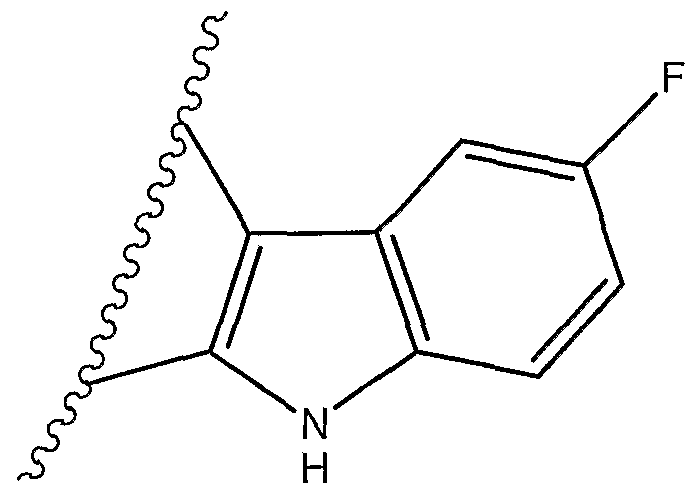
  • Bicycliccarbonyl indole compounds such as those described in U.S. Patent No. 6,303,628 are useful as Cox-2 selective inhibitors of the present invention.
  • Such bicycliccarbonyl indole compounds have the formula shown below in formula XXV:
  • a 9 is Ci -C 6 alkylene or — NR 133 — ;
  • Z 9 is CH or N
  • Z 10 and Y 2 are independently selected from — CH 2 — , O, S and — N— R 133 ; m is 1 , 2 or 3; q and r are independently 0, 1 or 2;
  • X 18 is independently selected from halogen, C -C alkyl, halo- substituted Ci -C 4 alkyl, hydroxyl, Ci -C 4 alkoxy, halo-substituted Ci -C 4 alkoxy, Ci -C 4 alkylthio, nitro, amino, mono- or di-(C ⁇ -C 4 alkyl)amino and cyano; n is 0, 1 , 2, 3 or 4;
  • L 3 is oxygen or sulfur
  • R 133 is hydrogen or Ci -C 4 alkyl
  • R 134 is hydroxyl, Ci -C 6 alkyl, halo-substituted Ci -C 6 alkyl, Ci -C 6 alkoxy, halo-substituted Ci -C 6 alkoxy, C 3 -C 7 cycloalkoxy, Ci -C 4 alkyl(C 3 -C 7 cycloalkoxy), — NR 136 R 137 , Ci -C 4 alkylphenyl-O— or phenyl-O— , said phenyl being optionally substituted with one to five substituents independently selected from halogen, Ci -C 4 alkyl, hydroxyl, Ci -C 4 alkoxy and nitro; R 135 is Ci -C 6 alkyl or halo-substituted Ci -C 6 alkyl; and R 136 and R 137 are independently selected from hydrogen, C ⁇ -6 alkyl and halo-substituted Ci -C 6 alkyl.
  • a 10 is heteroaryl selected from a 5-membered monocyclic aromatic ring having one hetero atom selected from O, S and N and optionally containing one to three N atom(s) in addition to said hetero atom, or a 6-membered monocyclic aromatic ring having one N atom and optionally containing one to four N atom(s) in addition to said N atom; and said heteroaryl being connected to the nitrogen atom on the benzimidazole through a carbon atom on the heteroaryl ring;
  • X 20 is independently selected from halo, Ci -C 4 alkyl, hydroxyl, Ci - C alkoxy, halo-substituted Ci -C 4 alkyl, hydroxyl-substituted Ci -C 4 alkyl, (Ci -C 4 alkoxy)C ⁇ -C alkyl, halo-substituted Ci -C 4 alkoxy, amino, N-(C ⁇ -C alkyl)amino, N, N-di(C ⁇ -C 4 alkyl)amino, [N-(C ⁇ -C 4 alkyl)amino]C ⁇ - C 4 alkyl, [N, N-di(C ⁇ -C 4 alkyl)amino]C ⁇ -C 4 alkyl, N-(C ⁇ -C 4 alkanoyl)amonio, N-(C ⁇ -C 4 alkyl)(C ⁇ -C 4 alkanoyl)amino,
  • X 21 is independently selected from halo, Ci -C 4 alkyl, hydroxyl, Ci - C alkoxy, halo-substituted Ci -C 4 . alkyl, hydroxyl-substituted Ci -C 4 alkyl, (Ci -C alkoxy)C ⁇ -C 4 alkyl, halo-substituted d -C 4 alkoxy, amino, N-(d -C 4 alkyl)amino, N, N-di(C ⁇ -C 4 alkyl)amino, [N-(C ⁇ -C 4 alkyl)amino]C ⁇ - C 4 alkyl, [N, N-di(C ⁇ -C 4 alkyl)amino]C ⁇ -C alkyl, N-(C ⁇ -C 4 alkanoyl)amino, N-(C ⁇ -C 4 alkyl)-N-(C ⁇ -C 4 alkanoyl
  • R 138 is selected from: hydrogen; straight or branched Ci -C 4 alkyl optionally substituted with one to three substituent(s) wherein said substituents are independently selected from halo, hydroxyl, C -C 4 alkoxy, amino, N-(C ⁇ -C alkyl)amino and N, N-di(C ⁇ -C 4 alkyl)amino;
  • C 3 -C 8 cycloalkyl optionally substituted with one to three substituent(s) wherein said substituents are indepently selected from halo, Ci -C 4 alkyl, hydroxyl, Ci -C 4 alkoxy, amino, N-(C ⁇ -C alkyl)amino and N, N-di(C ⁇ -C 4 alkyl)amino;
  • R 139 and R 140 are independently selected from: hydrogen; halo;
  • Ci -C 4 alkyl phenyl optionally substituted with one to three substituent(s) wherein said substituents are independently selected from halo, Ci -C alkyl, hydroxyl, Ci -C 4 alkoxy, amino, N-(C ⁇ -C 4 alkyl)amino and N, N- di(C ⁇ -C alkyl)amino; or R 138 and R 139 can form, together with the carbon atom to which they are attached, a C 3 -C 7 cycloalkyl ring; m is 0, 1 , 2, 3, 4 or 5; and n is O, 1 , 2, 3 or 4.
  • Compounds that may be employed as a Cox-2 selective inhibitor of the present invention include indole compounds that are described in U.S. Patent No. 6,300,363. Such indole compounds have the formula shown below in formula XXVII:
  • L 4 is oxygen or sulfur
  • Y 3 is a direct bond or Ci -C alkylidene
  • Q 6 is:
  • Ci -C 6 alkyl or halosubstituted Ci -C 6 alkyl said alkyl being optionally substituted with up to three substituents independently selected from hydroxyl, Ci -C 4 alkoxy, amino and mono- or di-( Ci -C 4 alkyl)amino,
  • (c-1) halo, Ci -C alkyl, halosubstituted Ci -C 4 alkyl, hydroxyl, Ci -C 4 alkoxy, halosubstituted Ci -C 4 alkoxy, S(0) m R 143 , S0 2 NH 2 , S0 2 N(C ⁇ -C 4 alkyl) 2 , amino, mono- or di-( Ci -C 4 alkyl)amino, NHS0 2 R 143 , NHC(0)R 143 , CN, C0 2 H, C0 2 (Ci -C 4 alkyl), Ci -C 4 alkyl-OH, Ci -C 4 alkyl-OR 143 , CONH 2 , CONH(C ⁇ -C 4 alkyl), CON(C ⁇ -C 4 alkyl) 2 and — O — Y-phenyl, said phenyl being optionally substituted with one or two substituents independently selected from halo, Ci -C
  • R 141 is hydrogen or Ci -C 6 alkyl optionally substituted with a substituent selected independently from hydroxyl, OR 143 , nitro, amino, mono- or di-( Ci -C alkyl)amino, C0 2 H, C0 2 (Ci -C 4 alkyl), CONH 2 , CONH(C ⁇ -C 4 alkyl) and CON(C ⁇ -C 4 alkyl) 2 ;
  • R 142 is:
  • (c-1) Ci -C 22 alkyl or C 2 -C22 alkenyl said alkyl or alkenyl being optionally substituted with up to four substituents independently selected from: (c-1-1) halo, hydroxyl, OR 143 , S(0) m R 143 , nitro, amino, mono- or di-( Ci -C 4 alkyl)amino, NHS0 2 R 143 , C0 2 H, C0 2 (Ci -C 4 alkyl), CONH 2 , CONH(C ⁇ -C 4 alkyl), CON(C ⁇ -C 4 alkyl) 2> OC(0)R 143 , thienyl, naphthyl and groups of the following formulas:
  • (c-2) Ci -C 22 alkyl or C 2 -C 2 alkenyl, said alkyl or alkenyl being optionally substituted with five to forty-five halogen atoms, (c-3) -Y 5 — C 3 -C 7 cycloalkyl or -Y 5 — C 3 -C 7 cycloalkenyl, said cycloalkyl or cycloalkenyl being optionally substituted with up to three substituent independently selected from: (c-3-1) Ci -C 4 alkyl, hydroxyl, OR 143 , S(0) m R 143 , amino, mono- or di- ( Ci -C alkyl)amino, CONH 2 , CONH(C ⁇ -C 4 alkyl) and CON(C ⁇ -C 4 alkyl) 2 , (c-4) phenyl or naphthyl, said phenyl or naphthyl being optionally substituted with up to seven (preferably up to seven) substituents
  • (c-5) a monocyclic aromatic group as defined in (d) and (e) above, said aromatic group being optionally substituted with up to three substituents independently selected from: (c-5-1) halo, Ci -C 8 alkyl, Ci -C 4 alkyl-OH, hydroxyl, Ci -C 8 alkoxy, CF 3 , OCF 3 , CN, nitro, S(0) m R 143 , amino, mono- or di-( d -C 4 alkyl)amino, CONH 2 , CONH(C ⁇ -C 4 alkyl), CON(C ⁇ -C 4 alkyl) 2 , C0 2 H and C0 2 (Ci -C 4 alkyl), and — Y-phenyl, said phenyl being optionally substituted with up to three substituents independently selected halogen, Ci -C alkyl, hydroxyl, Ci -C alkoxy, CF 3 , OCF 3 , CN, nitro, S(0)
  • X 22 is halo, Ci -C alkyl, hydroxyl, C -C 4 alkoxy, halosubstitutued Ci - lkoxy, S(0) m R 143 , amino, mono- or di-(C ⁇ -C 4 alkyl)amino, NHS0 R 143 , nitro, halosubstitutued Ci -C 4 alkyl, CN, C0 2 H, C0 2 (Ci -C 4 alkyl), Ci -C 4 alkyl-OH, d -C 4 alkylOR 143 , CONH 2 , CONH(C ⁇ -C 4 alkyl) or CON(C ⁇ -C 4 alkyl) 2 ;
  • R 143 is Ci -C 4 alkyl or halosubstituted Ci -C 4 alkyl; m is 0, 1 or 2; n is 0, 1 , 2 or 3; p is 1 , 2, 3, 4 or 5; q is 2 or 3;
  • Z 11 is oxygen, sulfur or NR 144 ;
  • R 144 is hydrogen, Ci -C 6 alkyl, halosubstitutued Ci -C 4 alkyl or -Y 5 - phenyl, said phenyl being optionally substituted with up to two substituents independently selected from halo, Ci -C 4 alkyl, hydroxyl, Ci -C 4 alkoxy, S(0) m R 143 , amino, mono- or di-(C ⁇ -C 4 alkyl)amino, CF 3 , OCF 3 , CN and nitro; with the proviso that a group of formula -Y 5 — Q is not methyl or ethyl when X 22 is hydrogen; L 4 is oxygen; R 141 is hydrogen; and R 142 is acetyl.
  • Aryl phenylhydrazides that are described in U.S. Patent No. 6,077,869 can serve as Cox-2 selective inhibitors of the present invention.
  • Such aryl phenylhydrazides have the formula shown below in formula XXVIII:
  • X 23 and Y 6 are selected from hydrogen, halogen, alkyl, nitro, amino, hydroxy, methoxy and methylsulfonyl; or a pharmaceutically acceptable salt thereof,.
  • Materials that can serve as a Cox-2 selective inhibitor of the present invention include 2-aryloxy, 4-aryl furan-2-ones that are described in U.S. Patent No. 6,140,515. Such 2-aryloxy, 4-aryl furan-2-ones have the formula shown below in formula XXIX:
  • R 146 is selected from the group consisting of SCH 3 , — S(0) 2 CH 3 and — S(0) 2 NH 2 ;
  • R 147 is selected from the group consisting of OR 150 , mono or di- substituted phenyl or pyridyl wherein the substituents are selected from the group consisting of methyl, chloro and F;
  • R 150 is unsubstituted or mono or di-substituted phenyl or pyridyl wherein the substituents are selected from the group consisting of methyl, chloro and F;
  • R 148 is H, Ci -C 4 alkyl optionally substituted with 1 to 3 groups of F, Cl or Br;
  • R 149 is H, Ci -C alkyl optionally substituted with 1 to 3 groups of F, Cl or Br, with the proviso that R 148 and R 149 are not the same.
  • Materials that can serve as a Cox-2 selective inhibitor of the present invention include bisaryl compounds that are described in U.S. Patent No. 5,994,379. Such bisaryl compounds have the formula shown below in formula XXX:
  • Z 13 is C or N; when Z 13 is N, R 151 represents H or is absent, or is taken in conjunction with R 152 as described below: when Z 13 is C, R 151 represents H and R 152 is a moiety which has the following characteristics:
  • R 151 and R 152 are taken in combination and represent a 5- or 6- membered aromatic or non-aromatic ring D fused to ring A, said ring D containing 0-3 heteroatoms selected from O, S and N; said ring D being lipophilic except for the atoms attached directly to ring A, which are lipophilic or non-lipophilic, and said ring D having available an energetically stable configuration planar with ring A to within about 15 degrees; said ring D further being substituted with 1 R a group selected from the group consisting of: Ci -C 2 alkyl, — OC ⁇ -C 2 alkyl, — NHd -C 2 alkyl, —
  • Y 7 represents N, CH or C— OC ⁇ -C 3 alkyl, and when Z 13 is N, Y 7 can also represent a carbonyl group;
  • R 153 represents H, Br, Cl or F
  • R 154 represents H or CH 3 .
  • Compounds useful as Cox-2 selective inhibitors of the present invention include 1 ,5-diarylpyrazoles that are described in U.S. Patent No. 6,028,202. Such 1 ,5-diarylpyrazoles have the formula shown below in formula XXXI:
  • R 155 , R 156 , R 157 , and R 158 are independently selected from the groups consisting of hydrogen, Ci -C 5 alkyl, Ci -C 5 alkoxy, phenyl, halo, hydroxyl, Ci -C 5 alkylsulfonyl, Ci -C 5 alkylthio, trihaloCi -C 5 alkyl, amino, nitro and 2-quinolinylmethoxy;
  • R 159 is hydrogen, Ci -C 5 alkyl, trihaloCi -C 5 alkyl, phenyl, substituted phenyl where the phenyl substitutents are halogen, Ci -C 5 alkoxy, trihaloCi -C5 alkyl or nitro or
  • R 159 is heteroaryl of 5-7 ring members where at least one of the ring members is nitrogen, sulfur or oxygen;
  • R 160 is hydrogen, Ci -C 5 alkyl, phenyl Ci -C 5 alkyl, substituted phenyl Ci -C 5 alkyl where the phenyl substitutents are halogen, Ci -C 5 alkoxy, trihaloCi -C5 alkyl or nitro, or R 160 is Ci -C 5 alkoxycarbonyl, phenoxycarbonyl, substituted phenoxycarbonyl where the phenyl substitutents are halogen, Ci -C 5 alkoxy, trihaloCi -C 5 alkyl or nitro;
  • R 161 is Ci -C1 0 alkyl, substituted Ci -C 10 alkyl where the substituents are halogen, trihaloCi -C 5 alkyl, Ci -C 5 alkoxy, carboxy, Ci - C 5 alkoxycarbonyl, amino, Ci -C 5 alkylamino, diCi -C 5 alkylamino, diCi - C 5 alkylaminoCi -C 5 alkylamino, Ci -C 5 alkylaminoCi -C 5 alkylamino or a heterocycle containing 4-8 ring atoms where one more of the ring atoms is nitrogen, oxygen or sulfur, where said heterocycle may be optionally substituted with Ci -C 5 alkyl; or R 161 is phenyl, substituted phenyl (where the phenyl substitutents are one or more of Ci -C 5 alkyl, halogen, Ci -C 5 alkoxy, trihaloCi
  • R 161 is NR 163 R 164 where R 163 and R 164 are independently selected from hydrogen and C ⁇ -5 alkyl or R 163 and R 164 may be taken together with the depicted nitrogen to form a heteroaryl ring of 5-7 ring members where one or more of the ring members is nitrogen, sulfur or oxygen where said heteroaryl ring may be optionally substituted with Ci -C 5 alkyl; R 162 is hydrogen, Ci -C 5 alkyl, nitro, amino, and halogen; and pharmaceutically acceptable salts thereof.
  • Materials that can serve as a Cox-2 selective inhibitor of the present invention include 2-substituted imidazoles that are described in U.S. Patent No. 6,040,320. Such 2-substituted imidazoles have the formula shown below in formula XXXII: XXXII
  • R 164 is phenyl, heteroaryl wherein the heteroaryl contains 5 to 6 ring atoms, or substituted phenyl; wherein the substituents are independently selected from one or members of the group consisting of d -5 alkyl, halogen, nitro, trifluoromethyl and nitrile;
  • R 165 is phenyl, heteroaryl wherein the heteroaryl contains 5 to 6 ring atoms, substituted heteroaryl; wherein the substituents are independently selected from one or more members of the group consisting of Ci -C 5 alkyl and halogen, or substituted phenyl, wherein the substituents are independently selected from one or members of the group consisting of Ci -C 5 alkyl, halogen, nitro, trifluoromethyl and nitrile;
  • R 166 is hydrogen, 2-(trimethylsilyl)ethoxymethyl), Ci -C 5 alkoxycarbonyl, aryloxycarbonyl, arylCi -C 5 alkyloxycarbonyl, arylCi -C 5 alkyl, phthalimidoCi -C 5 alkyl, aminoCi -C 5 alkyl, diaminoCi -C 5 alkyl, succinimidoCi -C 5 alkyl, Ci -C 5 alkylcarbonyl, arylcarbonyl, Ci -C 5 alkylcarbonylCi -C 5 alkyl, aryloxycarbonylCi -C 5 alkyl, heteroarylCi -C 5 alkyl where the heteroaryl contains 5 to 6 ring atoms, or substituted arylCi -C 5 alkyl, wherein the aryl substituents are independently selected from one or more members of the group consisting of Ci -C 5 alkyl
  • R 167 is (A 11 ) n -(CH 65 ) q -X 24 wherein:
  • a 11 is sulfur or carbonyl; n is 0 or 1 ; q is 0-9;
  • X 24 is selected from the group consisting of hydrogen, hydroxyl, halogen, vinyl, ethynyl, Ci -C 5 alkyl, C 3 -C 7 cycloalkyl, Ci -C 5 alkoxy, phenoxy, phenyl, arylCi -C 5 alkyl, amino, Ci ⁇ G 5 alkylamino, nitrile, phthalimido, amido, phenylcarbonyl, Ci -C 5 alkylaminocarbonyl, phenylaminocarbonyl, arylCi -C 5 alkylaminocarbonyl, Ci -C 5 alkylthio, Ci -C 5 alkylsulfonyl, phenylsulfonyl, substituted sulfonamido, wherein the sulfonyl substituent is selected from the group consisting of Ci -C 5 alkyl, phenyl, araCi -C 5 alkyl
  • Materials that can serve as a Cox-2 selective inhibitor of the present invention include 1 ,3- and 2,3-diarylcycloalkano and cycloalkeno pyrazoles that are described in U.S. Patent No. 6,083,969. Such 1 ,3- and
  • 2,3-diarylpyrazole compounds have the general formulas shown below in formulas XXXIII and XXXIV:
  • R 168 and R 169 are independently selected from the group consisting of hydrogen, halogen, (Ci -Ce)alkyl, (Ci -C 6 )alkoxy, nitro, amino, hydroxyl, trifluoro, — S(C ⁇ -C 6 )alkyl, — SO(C ⁇ -C 6 )alkyl and — S0 2 (C -C 6 )alkyl; and the fused moiety M is a group selected from the group consisting of an optionally substituted cyclohexyl and cycloheptyl group having the formulae:
  • R 73 is selected from the group consisting of hydrogen, halogen, hydroxyl, carbonyl, amino, (Ci -C 6 )alkyl, (d -C 6 )alkoxy and optionally substituted carboxyphenyl, wherein substituents on the carboxyphenyl group are selected from the group consisting of halogen, hydroxyl, amino, (Ci -C 6 )alkyl and (Ci -C 6 )alkoxy; or R 172 and R 173 taken together form a moiety selected from the group consisting of — O — and
  • R 174 is selected from the group consisting of hydrogen, OH, — OCOCH 3 , — COCHs and (Ci -C 6 )alkyl;
  • R 175 is selected from the group consisting of hydrogen, OH, — OCOCH 3 , — COCH 3) (Ci -C 6 )alkyl, — CONH 2 and — S0 2 CH 3 ; with the proviso that if M is a cyclohexyl group, then R 170 through R 173 may not all be hydrogen; and pharmaceutically acceptable salts, esters and pro-drug forms thereof.
  • Esters derived from indolealkanols and novel amides derived from indolealkylamides that are described in U.S. Patent No. 6,306,890 can serve as Cox-2 selective inhibitors of the present invention. Such compounds have the general formula shown below in formula XXXV:
  • R 176 is Ci -C 6 alkyl, -C 6 branched alkyl, C 4 -C 8 cycloalkyl, Ci - C 6 hydroxyalkyl, branched Ci -C 6 hydroxyalkyl, hydroxyl substituted C 4 - C 8 aryl, primary, secondary or tertiary Ci -C 6 alkylamino, primary, secondary or tertiary branched Ci -C 6 alkylamino, primary, secondary or tertiary C -C 8 arylamino, Ci -C 6 alkylcarboxylic acid, branched Ci -C 6 alkylcarboxylic acid, Ci -C 6 alkylester, branched Ci -C 6 alkylester, C 4 -C 8 aryl, C 4 -C 8 arylcarboxylic acid, C 4 -C 8 arylester, C 4 -C 8 aryl substituted Ci -C 6 alkyl, C 4 -
  • R 177 is Ci -C 6 alkyl, Ci -C 6 branched alkyl, C 4 -C 8 cycloalkyl, C 4 - C 8 aryl, C 4 -C 8 aryl-substituted Ci -C 6 alkyl, Ci -C 6 alkoxy, Ci -C 6 branched alkoxy, C -C 8 aryloxy, or halo-substituted versions thereof or
  • R 177 is halo where halo is chloro, fluoro, bromo, or iodo;
  • R 178 is hydrogen, Ci -C 6 alkyl or Ci -C 6 branched alkyl
  • R 179 is Ci -C 6 alkyl, C 4 -C 8 aroyl, C 4 -C 8 aryl, C 4 -C 8 heterocyclic alkyl or aryl with O, N or S in the ring, C -C 8 aryl-substituted Ci -C 6 alkyl, alkyl-substituted or aryl-substituted C -C 8 heterocyclic alkyl or aryl with O, N or S in the ring, alkyl-substituted C -C 8 aroyl, or alkyl-substituted C - C 8 aryl, or halo-substituted versions thereof where halo is chloro, bromo, or iodo; n is 1 , 2, 3, or 4; and
  • X 25 is O, NH, or N— R 180 , where R 80 is Ci -C 6 or Ci -C 6 branched alkyl.
  • Materials that can serve as a Cox-2 selective inhibitor of the present invention include pyridazinone compounds that are described in U.S. Patent No. 6,307,047. Such pyridazinone compounds have the formula shown below in formula XXXVI:
  • X 26 is selected from the group consisting of O, S, — NR 185 , — NOR a , and -NNR b R c ;
  • R 185 is selected from the group consisting of alkenyl, alkyl, aryl, arylalkyl, cycloalkenyl, cycloalkenylalkyl, cycloalkyl, cycloalkylalkyl, heterocyclic, and heterocyclic alkyl;
  • R a , R b , and R c are independently selected from the group consisting of alkyl, aryl, arylalkyl, cycloalkyl, and cycloalkylalkyl;
  • R 181 is selected from the group consisting of alkenyl, alkoxy, alkoxyalkyl, alkoxyiminoalkoxy, alkyl, alkylcarbonylalkyl, alkylsulfonylalkyl, alkynyl, aryl, arylalkenyl, arylalkoxy, arylalkyl, arylalkynyl, arylhaloalkyl, arylhydroxyalkyl, aryloxy, aryloxyhaloalkyl, aryloxyhydroxyalkyl, arylcarbonylalkyl, carboxyalkyl, cyanoalkyl, cycloalkenyl, cycloalkenylalkyl, cycloalkyl, cycloalkylalkyl, cycloalkylidenealkyl, haloalkenyl, haloalkoxyhydroxyalkyl, haloalkynyl, heterocyclic
  • R 186 is selected from the group consisting of hydrogen, alkenyl, alkyl, alkynyl, aryl, arylalkyl, cycloalkenyl, cycloalkyl, haloalkenyl, haloalkyl, haloalkynyl, heterocyclic, and heterocyclic alkyl;
  • R 187 is selected from the group consisting of alkenylene, alkylene, halo-substituted alkenylene, and halo-substituted alkylene;
  • R 188 is selected from the group consisting of hydrogen, alkenyl, alkyl, alkynyl, aryl, arylalkyl, cycloalkyl, cycloalkenyl, haloalkyl, heterocyclic, and heterocyclic alkyl;
  • R d and R e are independently selected from the group consisting of hydrogen, alkenyl, alkyl, alkynyl, aryl, arylalkyl, cycloalkenyl, cycloalkyl, haloalkyl, heterocyclic, and heterocyclic alkyl;
  • X 26 is halogen; m is an integer from 0-5; n is an integer from 0-10; p is an integer from 0-10;
  • R 182 , R 183 , and R 184 are independently selected from the group consisting of hydrogen, alkenyl, alkoxyalkyl, alkoxyiminoalkoxy, alkoxyiminoalkyl, alkyl, alkynyl, alkylcarbonylalkoxy, alkylcarbonylamino, alkylcarbonylaminoalkyl, aminoalkoxy, aminoalkylcarbonyloxyalkoxy aminocarbonylalkyl, aryl, arylalkenyl, arylalkyl, arylalkynyl, carboxyalkylcarbonyloxyalkoxy, cyano, cycloalkenyl, cycloalkyl, cycloalkylidenealkyl, haloalkenyloxy, haloalkoxy, haloalkyl, halogen, heterocyclic, hydroxyalkoxy, hydroxyiminoalkoxy, hydroxyiminoalkyl, mercaptoal
  • Z 14 is selected from the group consisting of:
  • X27 is selected from the group consisting of S(0) 2 ,
  • X 28 is selected from the group consisting of hydrogen, alkenyl, alkyl, alkynyl and halogen;
  • R 190 is selected from the group consisting of alkenyl, alkoxy, alkyl, alkylamino, alkylcarbonylamino, alkynyl, amino, cycloalkenyl, cycloalkyl, dialkylamino, — NHNH 2 , and — NCHN(R 191 )R 192 ;
  • R ,191 , R ,192 , R ,193 , and R ,194 are independently selected from the group consisting of hydrogen, alkyl, and cycloalkyl, or R 193 and R 194 can be taken together, with the nitrogen to which they are attached, to form a 3-6 membered ring containing 1 or 2 heteroatoms selected from the group consisting of O, S, and NR 188 ;
  • Y 8 is selected from the group consisting of -OR 195 , — SR 195 , — C(R 197 )(R 198 )R 195 , — C(0)R 195 , — C(0)OR 195 , — N(R 197 )C(0)R 195 , — NC(R 197 )R 195 , and — N(R 197 )R 195 ;
  • R 195 is selected from the group consisting of hydrogen, alkenyl, alkoxyalkyl, alkyl, alkylthioalkyl, alkynyl, cycloalkenyl, cycloalkenylalkyl, cycloalkyl, cycloalkylalkyl, aryl, arylalkyl, heterocyclic, heterocyclic alkyl, hydroxyalkyl, and NR 199 R 200 ; and
  • R ,1 ⁇ 97 , R ,198 , R ,199 , and R ,2 ⁇ 0 u 0 ⁇ are independently selected from the group consisting of hydrogen, alkenyl, alkoxy, alkyl, cycloalkenyl, cycloalkyl, aryl, arylalkyl, heterocyclic, and heterocyclic alkyl.
  • a 12 denotes oxygen, sulphur or NH
  • R 201 denotes a cycloalkyl, aryl or heteroaryl group optionally mono- or polysubstituted by halogen, alkyl, CF 3 or alkoxy;
  • D 5 denotes a group of formula XXXVIII or XXXIX:
  • R 202 and R 203 independently of each other denote hydrogen, an optionally polyfluorinated alkyl radical, an aralkyl, aryl or heteroaryl radical or a radical (CH 2 ) n -X 29 ; or
  • R ,202 and R ,203 together with the N-atom denote a three- to seven- membered, saturated, partially or totally unsaturated heterocycle with one or more heteroatoms N, O, or S, which may optionally be substituted by oxo, an alkyl, alkylaryl or aryl group or a group (CH 2 ) n -X 29
  • R 202 ' denotes hydrogen, an optionally polyfluorinated alkyl group, an aralkyl, aryl or heteroaryl group or a group (CH 2 ) n -X 29 , wherein:
  • X 29 denotes halogen, N0 2 , —OR 204 , —COR 204 , — C0 2 R 204 , — OC0 2 R 204 , -CN, -CONR 204 OR 205 , —CONR 204 R 205 , -SR 204 , — S(0)R 204 , — S(0) 2 R 204 , — NR 204 R 205 , -NHC(0)R 204 , -NHS(0) 2 R 204 ;
  • R 204 and R 205 independently of each other denote hydrogen, alkyl, aralkyl or aryl; n is an integer from 0 to 6;
  • R 206 is a straight-chained or branched Ci -C 4 alkyl group which may optionally be mono- or polysubstituted by halogen or alkoxy, or R 206 denotes CF 3 ; and m denotes an integer from 0 to 2; with the proviso that A 12 does not represent O if R 206 denotes CF 3 ; and the pharmaceutically acceptable salts thereof.
  • Materials that can serve as Cox-2 selective inhibitors of the present invention include methanesulfonyl-biphenyl derivatives that are described in U.S. Patent No. 6,583,321. Such methanesulfonyl-biphenyl derivatives have the formula shown below in formula XL:
  • R 207 and R 208 are respectively a hydrogen; d -C 4 -alkyl substituted or not substituted by halogens;
  • Cox-2 selective inhibitors such as 1 H-indole derivatives described in U.S. Patent No. 6,599,929 are useful in the present invention.
  • 1 H-indole derivatives have the formula shown below in formula XLI: wherein:
  • X 30 is -NHS0 2 R 209 wherein R 209 represents hydrogen or Ci -C 3 - alkyl;
  • Y 9 is hydrogen, halogen, Ci -C 3 -alkyl substituted or not substituted by halogen, N0 2 , NH 2 , OH, OMe, C0 2 H, or CN; and
  • Cox-2 selective inhibitors of the present invention include prodrugs of Cox-2 inhibitors that are described in U.S. Patent Nos. 6,436,967 and 6,613,790. Such prodrugs of Cox-2 inhibitors have the formula shown below in formula XLII:
  • a 13 is a ring substituent selected from partially unsaturated heterocyclic, heteroaryl, cycloalkenyl and aryl, wherein A 13 is unsubstituted or substituted with one or more radicals selected from alkylcarbonyl, formyl, halo, alkyl, haloalkyl, oxo, cyano, nitro, carboxyl, alkoxy, aminocarbonyl, alkoxycarbonyl, carboxyalkyl, cyanoalkyl, hydroxyalkyl, haloalkylsulfonyloxy, alkoxyalkyloxyalkyl, carboxyalkoxyalkyl, cycloalkylalkyl, alkenyl, alkynyl, heterocycloxy, alkylthio, cycloalkyl, aryl, heterocyclyl, cycloalkenyl, aralkyl, heterocyclylalkyl, alkylthioalkyl, arylcarbonyl,
  • R 210 is selected from heterocyclyl, cycloalkyl, cycloalkenyl, and aryl, wherein R 210 is unsubstituted or substituted with one or more radicals selected from alkyl, haloalkyl, cyano, carboxyl, alkoxycarbonyl, hydroxyl, hydroxyalkyl, haloalkoxy, amino, alkylamino, arylamino, nitro, alkoxyalkyl, alkylsulfinyl, halo, alkoxy, and alkylthio;
  • R 211 is selected from hydrido and alkoxycarbonylalkyl
  • R 212 is selected from alkyl, carboxyalkyl, acyl, alkoxycarbonyl, heteroarylcarbonyl, alkoxycarbonylalkylcarbonyl, alkoxycarbonylcarbonyl, amino acid residue, and alkylcarbonylaminoalkylcarbonyl; provided A 13 is not tetrazolium, or pyridinium; and further provided A 13 is not indanone when R 212 is alkyl or carboxyalkyl; further provided A 13 is not thienyl, when R 210 is 4-fluorophenyl, when R 211 is hydrido, and when R 212 is methyl or acyl; and
  • R 213 is hydrido; or a pharmaceutically-acceptable salt thereof.
  • a 13 is a pyrazole group optionally substituted at a substitutable position with one or more radicals independently selected at each occurrence from the group consisting of alkylcarbonyl, formyl, halo, alkyl, haloalkyl, oxo, cyano, intro, carboxyl, alkoxy, aminocarbonyl, alkoxycarbonyl, carboxyalkyl, cyanoalkyl, hydroxyalkyl, haloalkylsulonyloxy, alkoxyalkyloxyalkyl, carboxyalkoxyalkyl, alkenyl, alkynyl, alkylthio, alkylthioalkyl, alkoxyalkyl, alkoxycarbonylalkyl, aminocarbonylalkyl, alkylaminocarbonyl, alkylaminocarbonylalkyl, alkylamino, aminoalkyl, alkylaminoalkyl, alkylsutfinyl, alkyls
  • R 211 and R 212 are independently selected from the group consisting of hydroxyalkyl and hydrido but at least one of R 211 and R 212 is other than hydrido;
  • R 213 is selected from the group consisting of hydrido and fluoro.
  • prodrug compounds disclosed in U.S. 6,613,790 that are useful as Cox-2 inhibitors of the present invention include, but are not limited to, N-(2-hydroxyethyl)-4-[5-(4-methylphenyl)-3- (trifluoromethyl)-l H-pyrazol-1 - yl]benzenesulfonamide, N,N-bis(2- hydroxyethyl)-4-[5-(4-methylphenyl)-3-(trifluoromethyl)-1 H-pyraz ol-1 - yljbenzenesulfonamide, or pharmaceuticaly-acceptable salts thereof.
  • Cox-2 selective inhibitors such as sulfamoylheleroaryl pyrazole compounds that are described in U.S. Patent No. 6,583,321 may serve as Cox-2 inhibitors of the present invention.
  • Such sulfamoylheleroaryl pyrazole compounds have the formula shown below in formula XLIII:
  • R 214 is furyl, thiazolyl or oxazolyl; R 215 is hydrogen, fluoro or ethyl; and X 31 and X 32 are independently hydrogen or chloro.
  • Heteroaryl substituted amidinyl and imidazolyl compounds such as those described in U.S. Patent No. 6,555,563 are useful as Cox-2 selective inhibitors of the present invention. Such heteroaryl substituted amidinyl and imidazolyl compounds have the formula shown below in formula XLIV
  • Z 16 is O or S
  • R 216 is optionally substituted aryl
  • R 217 is aryl optionally substituted with aminosulfonyl
  • R 218 and R 219 cooperate to form an optionally substituted 5- membered ring.
  • Materials that can serve as Cox-2 selective inhibitors of the present invention include substituted hydroxamic acid derivatives that are described in U.S. Patent Nos. 6,432,999, 6,512,121 , and 6,515,014. These compounds also act as inhibitors of the lipoxygenase-5 enzyme.
  • substituted hydroxamic acid derivatives have the general formulas shown below in formulas XLV and XLVI:
  • a 14 is pyrazolyl optionally substituted with a substituent selected from acyl, halo, hydroxyl, lower alkyl, lower haloalkyl, oxo, cyano, nitro, carboxyl, lower alkoxy, aminocarbonyl, lower alkoxycarbonyl, lower carboxyalkyl, lower cyanoalkyl, and lower hydroxyalkyl;
  • Y 10 is selected from lower alkenylene and lower alkynylene
  • R 220 is a substituent selected from 5- and 6-membered heterocyclo, lower cycloalkyl, lower cycloalkenyl and aryl selected from phenyl, biphenyl and naphthyl, wherein R 220 is optionally substituted at a substitutable position with one or more substituents selected from lower alkyl, lower haloalkyl, cyano, carboxyl, lower alkoxycarbonyl, hydroxyl, lower hydroxyalkyl, lower haloalkoxy, amino, lower alkylamino, phenylmino, nitro, lower alkoxyalkyl, lower alkylsulfinyl, halo, lower alkoxy and lower alkylthio;
  • R 221 is selected from lower alkyl and amino
  • R 222 is selected from hydrido, lower alkyl, phenyl, 5- and 6- membered heterocyclo and lower cycloalkyl; or a pharmaceutically- acceptable salt thereof.
  • a 15 is pyrazolyl optionally substituted with a substituent selected from acyl, halo, hydroxyl, lower alkyl, lower haloalkyl, oxo, cyano, nitro, carboxyl, lower alkoxy, aminocarbonyl, lower alkoxycarbonyl, lower carboxyalkyl, lower cyanoalkyl, and lower hydroxyalkyl;
  • Y 11 is selected from lower alkylene, lower alkenylene and lower alkynylene;
  • R 223 is a substituent selected from 5- and 6-membered heterocyclo, lower cycloalkyl, lower cycloalkenyl and aryl selected from phenyl, biphenyl and naphthyl, wherein R 223 is optionally substituted at a substitutable position with one or more substituents selected from lower alkyl, lower haloalkyl, cyano, carboxyl, lower alkoxycarbonyl, hydroxyl, lower hydroxyalkyl, lower haloalkoxy, amino, lower alkylamino, phenylmino, nitro, lower alkoxyalkyl, lower alkylsulfinyl, halo, lower alkoxy and lower alkylthio;
  • R 224 is selected from lower alkyl and amino
  • R 225 is selected from hydrido, lower alkyl; or a pharmaceutically-acceptable salt thereof.
  • a 14 is a ring substiuent selected from oxazolyl, furyl, pyrrolyl, thiazolyl, imidazolyl, isochiazolyl, isoxazolyl, cyclopentenyl, phenyl, and pyridyl; wherein A 14 is optionally substituted with a substituent selected from acyl, halo, hydroxy, lower alkyl, lower haloalkyl, oxo, cyano, nitro, carboxyl, lower alkoxy, aminocarbonyl, lower alkoxycarbonyl, lower carboxyalkyl, lower cyanoalkyl, and lower hydroxyalkyl;
  • Y 10 is lower alkylene, lower alkenylene, and lower alkynylene
  • R 220 is a substituent selected from 5- and 6-membered heterocyclo, lower cycloalkyl, lower cycloalkenyl and aryl selected from phenyl, biphenyl and naphthyl, wherein R 220 is otionallv substituted at a substitutable position with one or more substituents selected from lower alkyl, lower haloalkyl, cyano, carboxyl, lower alkoxycarbonyl, hydroxyl, lower hydroxyalkyl, lower haloalkoxy, amino, lower alkylamino, phenylamino, nitro, lower alkoxyalkyl, lower alkylsulfinyl, halo, lower alkoxy and lower alkylthio;
  • R 221 is selected from lower alkyl and amino
  • R 222 is selected from hydrido, lower alkyl, phenyl, 5- and 6- membered heterocyclo and lower cycloalkyl; or a pharmaceutically- acceptable salt thereof.
  • Heterocyclo substituted hydroxamic acid derivatives described in U.S. Patent No. 6,512,121 may also have the formula shown above in formula XLVI, wherein:
  • a 15 is a ring substituent selected from oxazolyl, furyl, pyrrolyl, thiazolyl, imidazolyl, isothiazolyl, isoxazolyl, cyclopentenyl, phenyl, and pyridyl; wherein A is optionally substituted with a substituent selected from acyl, halo, hydroxy, lower alkyl, lower haloalkyl, oxo, cyano, nitro, carboxyl, lower alkoxy, aminocarbonyl, lower alkoxycarboryl, lower carboxyalkyl, lower cyanoalkyl, and lower hydroxyalkyl;
  • Y 11 is selected from lower alkyl, lower alkenyl and lower alkynyl;
  • R 223 is a substituent selected from 5- and 6-membered heterocyclo, lower cycloalkyl, lower cycloalkenyl and aryl selected from phenyl, biphenyl and naphthyl, wherein R 223 is optionally substituted at a substitutable position with one or more substituents selected from lower alkyl, lower haloalkyl, cyano, carboxyl, lower alkoxycarbonyl, hydroxyl, lower hydroxyalkyl, lower haloalkoxy, amino, lower alkylamino, phenylamino, nitto, lower alkoxyalkyl, lower alkylsulfinyl, halo, lower alkoxy and lower alkylthio;
  • R 224 is selected from lower alkyl and amino
  • R 225 is selected from hydrido and alkyl; or a pharmaceutically- acceptable salt thereof.
  • a 14 is thienyl optionally substituted with a substituent selected from acyl, halo, hydroxy, lower alkyl, lower haloalkyl, oxo, cyano, nitro, carboxyl, lower alkoxy, aminocarbonyl, lower alkoxycarbonyl, lower carboxyalkyl, lower cyanoalkyl, and lower hydroxyalkyl;
  • Y 10 is ethylene, isopropylene, propylene, butylene, lower alkenylene, and lower alkynylene;
  • R 220 is a substituent selected from 5- and 6-membered heterocyclo, lower cycloalkyl, lower cycloalkenyl and aryl selected from phenyl, biphenyl and naphthyl, wherein R 220 is optionally substituted at a substitutable position with one or more substituents selected from lower alkyl, lower haloalkyl, cyano, carboxyl, lower alkoxycarbonyl, hydroxyl, lower hydroxyalkyl, lower haloalkoxy, amino, lower alkylamino, phenylamino, nitro, lower alkoxyalkyl, lower alkylsulfinyl, halo, lower alkoxy and lower alkylthio;
  • R 221 is selected from lower alkyl and amino
  • R 222 is selected from hydrido, lower alkyl, phenyl, 5- and 6- membered heterocyclo and lower cycloalkyl; or a pharmaceutically- acceptable salt thereof.
  • Thiophene substituted hydroxamic acid derivatives described in U.S. Patent No. 6,515,014 may also have the formula shown above in formula XLV, wherein:
  • a 15 is thienyl optionally substituted with a substituent selected from acyl, halo, hydroxy, lower alkyl, lower haloalkyl, oxo, cyano, nitro, carboxyl, lower alkoxy, aminocarbonyl, lower alkoxycarbonyl, lower carboxyalkyl, lower cyanoalkyl, and lower hydroxyalkyl;
  • Y 11 is selected from lower alkyl, lower alkenyl and lower alkynyl;
  • R 223 is a substituent selected from 5- and 6-membered heterocyclo, lower cycloalkyl, lower cycloalkenyl and aryl selected from phenyl, biphenyl 'and naphthyl, wherein R 223 is optionally substituted at a substitutable position with one or more substituents selected from lower alkyl, lower haloalkyl, cyano, carboxyl, lower alkoxycarbonyl, hydroxyl, lower hydroxyalkyl, lower haloalkoxy, amino, lower alkylamino, phenylamino, nitro, lower alkoxyalkyl, lower alkylsulfinyl, halo, lower alkoxy and lower alkylthio; R 224 is selected from lower alkyl and amino; and R 225 is selected from hydrido and alkyl; or a pharmaceutically- acceptable salt thereof.
  • Compounds that are useful as Cox-2 selective inhibitors of the present invention include pyrazolopyridine compounds that are described in U.S. Patent No. 6,498,166. Such pyrazolopyridine compounds have the formula shown below in formula XLVII:
  • R 226 and R 227 are independently selected from the group consisting of H, halogen, Ci -C 6 alkyl, Ci -C 6 alkoxy, and Ci -d alkoxy substituted by one or more fluorine atoms;
  • R 228 is halogen, CN, CON R 230 R 231 , C0 2 H, C0 2 Ci -C 6 alkyl, or NHS0 2 R 230 ;
  • R 229 is Ci -C 6 alkyl or NH 2 ;
  • R 225 and R 225 are independently selected from the group consisting of H, Ci -C ⁇ alkyl, phenyl, phenyl substituted by one or more atoms or groups selected from the group consisting of halogen, Ci -C ⁇ alkyl, Ci -C 6 alkoxy, and Ci -C ⁇ alkoxy substituted by one or more fluorine atoms, or a pharmaceutically acceptable salt, solvate, ester, or salt or solvate of such ester thereof.
  • Materials that are useful as Cox-2 selective inhibitors of the present invention include 4,5-diaryl-3(2H)-furanone derivatives that are described in U.S. Patent No. 6,492,416. Such 4,5-diaryl-3(2H)-furanone derivatives have the formula shown below in formula XLVI1I:
  • X 33 represents halo, hydrido, or alkyl
  • Y 12 represents alkylsulfonyl, aminosulfonyl, alkylsulfinyl, (N- acylamino)-sulfonyl, (N-alkylamino)sulfonyl, or alkylthio;
  • Z 7 represents oxygen or sulfur atom
  • R 233 and R 234 are selected independently from lower alkyl radicals; and R 232 represents a substituted or non-substituted aromatic group of 5 to 10 atoms; or a pharmaceutically-acceptable salt thereof.
  • Cox-2 selective inhibitors that can be used in the present invention include 2-phenyl-1 ,2-benzisoselenazol-3(2H)-one derivatives and 2-phenylcarbomyl-phenylselenyl derivatives that are described in U.S. Patent No. 6,492,416.
  • Such 2-phenyl-1 ,2-benzisoselenazol-3(2H)-one derivatives and 2-phenylcarbomyl-phenylselenyl derivatives have the formulas shown below in formulas XLIX or XLIX': wherein:
  • R 235 is a hydrogen atom or an alkyl group having 1-3 carbon atoms
  • R 236 is a hydrogen atom, a hydroxyl group, an organothiol group that is bound to the selenium atom by its sulfur atom, or R 235 and R 236 are joined to each other by a single bond;
  • R 237 is a hydrogen atom, a halogen atom, an alkyl group having 1-3 carbon atoms, an alkoxyl group having 1-3 carbon atoms, a trifluoromethyl group, or a nitro group;
  • R 238 and R 239 are identical to or different from each other, and each is a hydrogen atom, a halogen atom, an alkoxyl group having 1 -4 carbon atoms, a trifluoromethyl group, or R 238 and R 239 are joined to each other to form a methylenedioxy group, a salt thereof, or a hydrate thereof.
  • X 34 is selected from the group consisting of:
  • R 240 is selected from the group consisting of:
  • Ci -Cio alkyl optionally substituted with 1-3 substituents independently selected from the group consisting of: hydroxy, halo, Ci -Cio alkoxy, Ci - Cio alkylthio, and CN,
  • heteroaryl which is comprised of a monocyclic aromatic ring of 5 atoms having one hetero atom which is S, O or N, and optionally 1 , 2, or 3 additional N atoms; or a monocyclic ring of 6 atoms having one hetero atom which is N, and optionally 1 , 2, or 3 additional N atoms, wherein groups (b) and (c) above are each optionally substituted with 1 -3 substituents independently selected from the group consisting of: halo, Ci -Cio alkoxy, Ci -C ⁇ 0 alkylthio, CN, Ci -C ⁇ 0 alkyl, optionally substituted to its maximum with halo, and N ;
  • R 241 is selected from the group consisting of (a) Ci -C 6 alkyl, optionally substituted to its maximum with halo,
  • R 242 and R 243 are each independently selected from the group consisting of: hydrogen, halo, and Ci -C 6 alkyl, optionally substituted to its maximum with halo; and
  • R 244 is selected from the group consisting of: hydrogen and Ci -C 6 alkyl, optionally substituted to its maximum with halo.
  • Examples of pyrone compounds that are useful as Cox-2 selective inhibitors of the present invention include, but are not limited to: 4-(4-Methylsulfonyl)phenyl-3-phenyl-pyran-2-one, 3-(4-Fluorophenyl)-6-methyl-4-(4-methylsulfonyl)phenyl-pyran-2-one, 3-(3-Fluorophenyl)-6-methyl-4-(4-methylsulfonyl)phenyl-pyran-2-one, 6-Methyl-4-(4-methylsulfonyl)phenyl-3-phenyl-pyran-2-one, 6-Difluoromethyl-4-(4-methylsulfonyl)phenyl-3-phenyl-pyran-2-one, 6-Fluoromethyl-4-(4-
  • free-B-ring flavanoids such as those described in U.S. Published Application No. 2003/0165588, are useful as Cox-2 selective inhibitors of the present invention.
  • free-B-ring flavanoids have the general structure shown in formula LI: wherein:
  • R 246 , R 247 , R 248 , R 249 , and R 250 are independently selected from the group consisting of: --H, --OH, -SH, -OR, -SR, -NH 2 , -NHR 245 , - N(R 245 ) 2 , ⁇ N(R 245 ) 3 + X 35- , a carbon, oxygen, nitrogen or sulfur, glycoside of a single or a combination of multiple sugars including, aldopentoses, methyl-aldopentose, aldohexoses, ketohexose and their chemical derivatives thereof; wherein R 245 is an alkyl group having between 1-10 carbon atoms; and X 35 is selected from the group of pharmaceutically acceptable counter anions including, hydroxyl, chloride, iodide, sulfate, phosphate, acetate, fluoride and carbonate.
  • Heterocyclo-alkylsulfonyl pyrazoles such as those described in European Patent Application No. EP 1312367 are useful as Cox-2 selective inhibitors of the present invention.
  • Such heterocyclo-alkylsulfonyl pyrazoles have the general formula shown below in formula Lll:
  • the ring of the formula (R 255 )-A-(SO m R 254 ) is selected from the group ⁇ c ⁇ onnssiissttiinn ⁇ g n off-:
  • n 0, 1 or 2;
  • X 35 is >CR 255 or >N;
  • R 254 is an (C ⁇ -C 6 )alkyl radical optionally substituted by one to four fluoro substituents;
  • 2-phenylpyran-4-one derivatives such as those described in U.S. Patent No. 6,518,303 are also useful as Cox-2 selective inhibitors of the present invention.
  • Such 2-phenylpyran-4-one derivatives have the general formula shown below in formula Llll: wherein:
  • R 256 represents an alkyl or -NR 259 R 260 group, wherein R 259 and
  • R 260 each independently represents a hydrogen atom or an alkyl group
  • R 257 represents an alkyl, C 3 -C 7 cycloalkyl, naphthyl, tetrahydronaphthyl or indanyl group, or a phenyl group which may be unsubstituted or substituted by one or more halogen atoms or alkyl, trifluoromethyl, hydroxy, alkoxy, methylthio, amino, mono- or dialkylamino, hydroxyalkyl or hydroxycarbonyl groups;
  • R 258 represents a methyl, hydroxymethyl, alkoxymethyl, C 3 -C 7 cycloalkoxymethyl, benzyloxymethyl, hydroxycarbonyl, nitrile, trifluoromethyl or difluoromethyl group or a CH 2 ⁇ R 261 group wherein R 261 represents an alkyl group; and X 36 represents a single bond, an oxygen atom, a sulfur atom or a methylene group; or a pharmaceutically acceptable salt thereof.
  • Examples of 2-phenylpyran-4-one derivatives useful in the present invention include, but are not limited to: 3-(4-fluorophenyl)-2-(4-methanesulfonylphenyl)-6-methylpyran-4-one, 3-(2-fluorophenyl)-2-(4-methanesulfonylphenyl)-6-methylpyran-4-one, 3-(4-chlorophenyl)-2-(4-methanesulfonylphenyl)-6-methylpyran-4-one, 3-(4-bromophenyl)-2-(4-methylsulfonylphenyl)-6-methylpyran-4-one, 3-(2,4-difluorophenyl)-2-(4-methanesulfonylphenyl)-6-methylpyran-4-one, 3-(3,4-dichlorophenyl)-2-(4-methanesulfonylphenyl)-6-methyl
  • Cox-2 selective inhibitors that are useful in the subject method and compositions can also include the compounds that are described in U.S. Patent No. 6,472,416 (sulfonylphenylpyrazoles); U.S.
  • Patent No. 6,451 ,794 (2,3-diaryl-pyrazolo[1 ,5-b]pyridazines); U.S. Patent No. 6,451 ,794 (2,3-diaryl-pyrazolo[1 ,5-b]pyridazines); U.S. Patent No. 6,451 ,794 (2,3-diaryl-pyrazolo[1 ,5-b]pyridazines); U.S. Patent No. 6,451 ,794 (2,3-diaryl-pyrazolo[1 ,5-b]pyridazines); U.S. Patent No. 6,451 ,794 (2,3-diaryl-pyrazolo[1 ,5-b]pyridazines); U.S. Patent No. 6,451 ,794 (2,3-diaryl-pyrazolo[1 ,5-b]pyridazines); U.S. Patent No
  • Examples of specific compounds that are useful as Cox-2 selective inhibitors include, without limitation: a1 ) 8-acetyl-3-(4-fluorophenyl)-2-(4-methylsulfonyl)phenyl-imidazo(1 ,2- a)pyridine; a2) 5,5-dimethyl-4-(4-methylsulfonyl)phenyl-3-phenyl-2-(5H)-furanone; a3) 5-(4-fluorophenyl)-1 -[4-(methylsulfonyl)phenyl]-3-
  • Cox-2 inhibitors that are useful in the methods and compositions of present invention can be supplied by any source as long as the Cox-2 inhibitor is pharmaceutically acceptable.
  • Cox-2 inhibitors that are useful in the compositions and methods of present invention can be synthesized, for example, according to the description in Example 1.
  • Several Cox-2 inhibitors that are suitable for use with the compositions and methods of the present invention may be synthesized by the methods described in, for example, in U.S. Patent No. 5,466,823 to Talley, et al.
  • Cox-2 selective inhibitor compounds are those compounds selected from the group consisting of celecoxib, parecoxib, deracoxib, valdecoxib, etoricoxib, meloxicam, rofecoxib, lumiracoxib, RS 57067, T-614, BMS-347070 (Bristol Meyers Squibb, described in U.S. Patent No.
  • Cox-2 selective inhibitor is selected from the group consisting of celecoxib, parecoxib, deracoxib, valdecoxib, lumiracoxib, etoricoxib, rofecoxib, prodrugs of any of them, and mixtures thereof.
  • the Cox-2 selective inhibitor is celecoxib.
  • Cox-2 inhibitors that are useful in the methods and compositions and methods of present invention can be supplied by any source as long as the Cox-2 inhibitor is pharmaceutically acceptable.
  • Various classes of Cox-2 inhibitors useful in the present invention can be prepared as follows. Pyrazoles can be prepared by methods described in WO 95/15316. Pyrazoles can further be prepared by methods described in WO 95/15315. Pyrazoles can also be prepared by methods described in WO 96/03385.
  • Thiophene analogs useful in the present invention can be prepared by methods described in WO 95/00501. Preparation of thiophene analogs is also described in WO 94/15932.
  • Oxazoles useful in the present invention can be prepared by the methods described in WO 95/00501. Preparation of oxazoles is also described in WO 94/27980.
  • Isoxazoles useful in the present invention can be prepared by the methods described in WO 96/25405.
  • Imidazoles useful in the present invention can be prepared by the methods described in WO 96/03388. Preparation of imidazoles is also described in WO 96/03387.
  • Cyclopentene Cox-2 inhibitors useful in the present invention can be prepared by the methods described in U.S. Patent No.
  • Terphenyl compounds useful in the present invention can be prepared by the methods described in WO 96/16934.
  • Thiazole compounds useful in the present invention can be prepared by the methods described in WO 96/03,392.
  • Pyridine compounds useful in the present invention can be prepared by the methods described in WO 96/03392. Preparation of pyridine compounds is also described in WO 96/24,585.
  • Benzopyranopyrazolyl compounds useful in the present invention can be prepared by the methods described in WO 96/09304.
  • Chromene compounds useful in the present invention can be prepared by the methods described in WO 98/47890. Preparation of chromene compounds is also described in WO 00/23433. Chromene compounds can further be prepared by the methods described in U.S.
  • Patent No. 6,077,850 Preparation of chromene compounds is further described in U.S. Patent No. 6,034,256.
  • Arylpyridazinones useful in the present invention can be prepared by the methods described in WO 00/24719. Preparation of arylpyridazinones is also described in WO 99/10332. Arylpyridazinones can further be prepared by the methods described in WO 99/10331.
  • 5-Alkyl-2-arylaminophenylacetic acids and derivatives useful in the present invention can be prepared by the methods described in WO
  • Diarylmethylidenefuran derivative Cox-2 selective inhibitors useful in the present invention can be prepared by the methods described in U.S. Patent No. 6,180,651.
  • the celecoxib used in the compositions and methods of the present invention can be prepared in the manner set forth in U.S. Patent
  • valdecoxib used in the compositions and methods of the present invention can be prepared in the manner set forth in U.S. Patent
  • deracoxib used in the compositions and methods of the present invention can be prepared in the manner set forth in U.S. Patent
  • etoricoxib used in the compositions and methods of the present invention can be prepared in the manner set forth in WO
  • meloxicam used in the compositions and methods of the present invention can be prepared in the manner set forth in U.S.
  • the compound 2-(3,4-difluorophenyl)-4-(3-hydroxy-3- methylbutoxy)-5-[4-(methylsulfonyl)phenyl]-3(2H)-pyridazinone used in the compositions and methods of the present invention can be prepared in the manner set forth in WO 00/24719.
  • the compound 2-[(2-chloro-6-fluorophenyl)aminoj-5-methyl- benzeneacetic acid used in the compositions and methods of the present invention can be prepared in the manner set forth in WO 99/11605.
  • Patent No. 4,885,367
  • Cox-2 inhibitors can also be isolated and purified from natural sources. Cox-2 inhibitors should be of a quality and purity that is conventional in the trade for use in pharmaceutical products.
  • Corticosteroids are a class of therapeutic compounds that are useful in the treatment of inflammatory conditions. Corticosteroids inhibit the attraction of inflammatory cells to the site of an allergic reaction, upregulate ⁇ 2 - receptors, block leukotriene synthesis, and inhibit cytokine production and adhesion protein activation. See The Merck Manual, 17 th edition, Sec. 6, Chapter 68, Chronic Obstructive Airway Disorders, Asthma. [000200] While not intended to be limiting, normally prescribed dosages for corticosteroids have been reported to range from about 0.05 mg/day to about 1 gram/day, depending upon the particular corticosteroid used.
  • the normally prescribed dosages for one commonly prescribed inhaled corticosteroid is from 168 ⁇ g to 336 ⁇ g per day for adults and children 6 years of age.
  • Beclomethasone is normally prescribed as an inhaler therapy. See Vancenase® patient prescribing information, ⁇ http://www.sch- plough.com/documents/18780275_Vancenase_Pl.pdf>.
  • a dosage of 0.25 - 2.0 mg/kg (usually 0.5 mg/kg) of body weight is a normally prescribed dosage in a two to four week treatment course. See The Merck Manual, 17 th edition, Sec. 6, Chapter 68, Chronic Obstructive Airway Disorders, COPD.
  • the present invention encompasses corticosteroids that are naturally occurring, synthetic, or semi-synthetic in origin.
  • Examples of useful corticosteroids include, but are not limited to, those recited in Table 3 below.
  • Cox-2 inhibitors include a Cox-2 inhibitor and a corticosteroid. Any combination of Cox-2 inhibitors and corticosteroids can be used. In a preferred embodiment, one or more Cox-2 inhibitors be combined with any one or more of the corticosteroids selected from hydrocortisone, mometasone, fluticasone, fluocinolone acetonide, fluocinolone, flurandrenolone acetonide, ciclesonide, budesonide, beclomethasone, deflazacort, flunisolide, beclomethasone dipropionate, betamethasone, betamethasone valerate, methyl-prednisolone, dexamethasone, prednisolone, cortisol, triamcinolone, clobetasol, clobetasol propionate, clobetasol butyrate, cortisone, corticosterone
  • one or more Cox-2 selective inhibitors be combined with any one or more of the corticosteroids selected from hydrocortisone, mometasone, fluticasone, fluocinolone acetonide, fluocinolone, flurandrenolone acetonide, ciclesonide, budesonide, beclomethasone, deflazacort, flunisolide, beclomethasone dipropionate, betamethasone, betamethasone valerate, methyl- prednisolone, dexamethasone, prednisolone, cortisol, triamcinolone, clobetasol, clobetasol propionate, clobetasol butyrate, cortisone, corticosterone, clocortolone, dihydroxycortisone, alclometasone, amcinonide, diflucortolone valerate, flucortolone, flupredniden
  • a Cox-2 selective inhibitor selected from the group consisting of celecoxib, parecoxib, deracoxib, valdecoxib, meloxicam, rofecoxib, lumiracoxib, etoricoxib, RS 57067, T- 614, BMS-347070, JTE-522, S-2474, SVT-2016, CT-3, ABT-963, SC- 58125, nimesulide, flosulide, NS-398, L-745337, RWJ-63556, L-784512, darbufelone, CS-502, LAS-34475, LAS-34555, S-33516 and SD-8381 , be combined with any of one or more corticosteroids selected from the group consisting of hydrocortisone, mometasone, fluticasone, fluocinolone acetonide, fluocinolone, flurandrenolone acetonide, ciclesonide,
  • a Cox-2 selective inhibitor selected from the group consisting of celecoxib, parecoxib, deracoxib, valdecoxib, etoricoxib, meloxicam, rofecoxib and lumiracoxib, be combined with any of one or more corticosteroids selected from the group consisting of hydrocortisone, mometasone, fluticasone, fluocinolone acetonide, fluocinolone, flurandrenolone acetonide, ciclesonide, budesonide, beclomethasone, deflazacort, flunisolide, beclomethasone dipropionate, betamethasone, betamethasone valerate, methyl-prednisolone, dexamethasone, prednisolone, cortisol, triamcinolone, clobetasol, clobetasol propionate, clobetasol butyrate, cort
  • celecoxib be combined with any of one or more corticosteroids selected from the group consisting of hydrocortisone, mometasone, fluticasone, fluocinolone acetonide, fluocinolone, flurandrenolone acetonide, ciclesonide, budesonide, beclomethasone, deflazacort, flunisolide, beclomethasone dipropionate, betamethasone, betamethasone valerate, methyl-prednisolone, dexamethasone, prednisolone, cortisol, triamcinolone, clobetasol, clobetasol propionate, clobetasol butyrate, cortisone, corticosterone, clocortolone, dihydroxycortisone, alclometasone, amcinonide, diflucortolone valerate, flucortolone, flupredniden
  • the Cox-2 selective inhibitor, celecoxib can be combined with any of the corticosteroids cited in Table 3, including, for example, the corticosteroid, fluticasone.
  • the present invention encompasses a novel therapeutic composition comprising a Cox-2 inhibitor and a corticosteroid.
  • a novel therapeutic composition that has been found to be useful for the purpose of preventing or treating a corticosteroid-responsive disease or disorder in a subject that is in need of such prevention or treatment, includes a Cox-2 inhibitor and a corticosteroid.
  • a Cox-2 inhibitor and a corticosteroid are supplied in the form of a salt, or prodrug, if desirable.
  • Cox-2 inhibitors and corticosteroids that are useful in the present invention can be of any purity or grade, as long as the preparation is of a quality suitable for pharmaceutical use.
  • the Cox-2 inhibitors and corticosteroids can be provided in pure form, or it can be accompanied with impurities or commonly associated compounds that do not affect its physiological activity or safety.
  • the Cox-2 inhibitors and corticosteroids can be supplied as a pure compound, or in the form of a pharmaceutically acceptable salt.
  • the Cox-2 inhibitors and corticosteroids can be supplied in the form of a prodrug, an isomer, a mixed isomer, a racemic mixture, or in any other chemical form or combination that, under physiological conditions, provides the corticosteroid.
  • compositions of the present invention can comprise a Cox-2 inhibitor and a corticosteroid as an active ingredient or a pharmaceutically acceptable salt, thereof, and also contain a pharmaceutically acceptable carrier and optionally other therapeutic ingredients.
  • a pharmaceutical composition of the present invention is directed to a composition suitable for the reduction or amelioration or prevention of steroid-related side-effects and/or for preventing or treating a corticosteroid-responsive disease or disorder in a subject.
  • pharmaceutical compositions which include a pharmaceutically acceptable carrier in addition to the Cox-2 inhibitor and the corticosteroid.
  • the present invention encompasses a pharmaceutical composition for preventing or treating a a corticosteroid-responsive disease or disorder in a subject comprising a Cox-2 inhibitor, a corticosteroid, and a pharmaceutically acceptable carrier.
  • Pharmaceutically acceptable carriers and excipients include, but are not limited to, physiological saline, Ringer's solution, phosphate solution or buffer, buffered saline and other carriers known in the art.
  • Pharmaceutical compositions may also include stabilizers, anti-oxidants, colorants, and diluents.
  • Pharmaceutically acceptable carriers and additives are chosen such that side effects from the pharmaceutical compound are minimized and the performance of the compound is not canceled or inhibited to such an extent that treatment is ineffective.
  • the Cox-2 inhibitor and the corticosteroid are administered to a subject together in one pharmaceutical carrier. In another embodiment, the Cox-2 inhibitor and the corticosteroid are administered separately.
  • the pharmaceutically acceptable carrier can also be selected on the basis of the desired route of administration of the compound.
  • the carrier is suitable for oral administration.
  • pharmaceutically acceptable salt refers to salts prepared from pharmaceutically acceptable non-toxic bases including inorganic bases and organic bases.
  • Illustrative pharmaceutically acceptable salts are prepared from formic, acetic, propionic, succinic, glycolic, gluconic, lactic, malic, tartaric, citric, ascorbic, glucuronic, maleic, fumaric, pyruvic, aspartic, glutamic, benzoic, hydrochloric, trifluoroacetic, anthranilic, mesylic, stearic, salicylic, p-hydroxybenzoic, phenylacetic, mandelic, embonic (pamoic), methanesulfonic, ethanesulfonic, benzenesulfonic, pantothenic, toluenesulfonic, 2-hydroxyethanesulfonic, sulfanilic, cyclohexylaminosulfonic, algenic, ⁇ -hydroxy
  • Salts derived from inorganic bases include aluminum, ammonium, calcium, copper, ferric, ferrous, lithium, magnesium, manganic salts, manganous, potassium, sodium, zinc, and the like. Particularly preferred are the ammonium, calcium, magnesium, potassium, and sodium salts.
  • Salts derived from pharmaceutically acceptable organic non- toxic bases include salts of primary, secondary, and tertiary amines, substituted amines including naturally occurring substituted amines, cyclic amines, and basic ion exchange resins, such as arginine, betaine, caffeine, choline, N,N-dibenzylethylenediamine, diethylamine, 2- diethylaminoethanol, 2-dimethylaminoethanol, ethanolamine, ethylenediamine, N-ethylmorpholine, N-ethylpiperidine, glucamine, glucosamine, histidine, hydrabamine, isopropylamine, lysine, methylglucamine, morpholine, piperazine, piperidine, polyamine resins, procaine, purines, theobromine, triethylamine, trimethylamine, tripropylamine, tromethamine and the like.
  • basic ion exchange resins such as argin
  • Pharmaceutically acceptable cations include metallic ions and organic ions. More preferred metallic ions include, but are not limited to, appropriate alkali metal salts, alkaline earth metal salts and other physiological acceptable metal ions. Exemplary ions include aluminum, calcium, lithium, magnesium, potassium, sodium and zinc in their usual valences.
  • Preferred organic ions include protonated tertiary amines and quaternary ammonium cations, including in part, trimethylamine, diethylamine, N, N'-dibenzylethylenediamine, chloroprocaine, choline, diethanolamine, ethylenediamine, meglumine (N-methylglucamine) and procaine.
  • Exemplary pharmaceutically acceptable acids include, without limitation, hydrochloric acid, hydroiodic acid, hydrobromic acid, phosphoric acid, sulfuric acid, methanesulfonic acid, acetic acid, formic acid, tartaric acid, maleic acid, malic acid, citric acid, isocitric acid, succinic acid, lactic acid, gluconic acid, glucuronic acid, pyruvic acid oxalacetic acid, fumaric acid, propionic acid, aspartic acid, glutamic acid, benzoic acid, and the like.
  • a Cox-2 inhibitor and a corticosteroid are administered to a subject according to standard routes of drug delivery that are well known to one of ordinary skill in the art.
  • the particular route and dosage of the Cox-2 inhibitor and the corticosteroid depend upon the needs of the subject being treated, the type of treatment or prevention, the efficacy of the compound and the degree of disease severity in the subject.
  • the pharmaceutical compositions may be administered enterally and parenterally.
  • Oral intra-gastric
  • Pharmaceutically acceptable carriers can be in solid dosage forms for the methods of the present invention, which include tablets, capsules, pills, and granules, which can be prepared with coatings and shells, such as enteric coatings and others well known in the art.
  • Liquid dosage forms for oral administration include pharmaceutically acceptable emulsions, solutions, suspensions, syrups, and elixirs.
  • Enteral administration includes solution, tablets, sustained release capsules, enteric-coated capsules, and syrups. When administered, the pharmaceutical composition may be at or near body temperature.
  • compositions intended for oral use may be prepared according to any method known in the art for the manufacture of pharmaceutical compositions and such compositions may contain one or more agents selected from the group consisting of sweetening agents, flavoring agents, coloring agents and preserving agents in order to provide pharmaceutically elegant and palatable preparations.
  • Tablets contain the active ingredient in admixture with non- toxic pharmaceutically acceptable excipients, which are suitable for the manufacture of tablets.
  • excipients may be, for example, inert diluents, such as calcium carbonate, sodium carbonate, lactose, calcium phosphate or sodium phosphate, granulating and disintegrating agents, for example, maize starch, or alginic acid, binding agents, for example starch, gelatin or acacia, and lubricating agents, for example magnesium stearate, stearic acid, or talc.
  • the tablets may be uncoated or they may be coated by known techniques to delay disintegration and absorption in the gastrointestinal tract and thereby provide a sustained action over a longer period.
  • a time delay material such as glyceryl monostearate or glyceryl distearate may be employed.
  • Formulations for oral use may also be presented as hard gelatin capsules wherein the active ingredients are mixed with an inert solid diluent, for example, calcium carbonate, calcium phosphate or kaolin, or as soft gelatin capsules wherein the active ingredients are present as such, or mixed with water or an oil medium, for example, peanut oil, liquid paraffin, or olive oil.
  • an inert solid diluent for example, calcium carbonate, calcium phosphate or kaolin
  • an oil medium for example, peanut oil, liquid paraffin, or olive oil.
  • Aqueous suspensions can be produced that contain the active materials in a mixture with excipients suitable for the manufacture of aqueous suspensions.
  • excipients are suspending agents, for example, sodium carboxymethylcellulose, methylcellulose, hydroxypropylmethyl-cellulose, sodium alginate, polyvinylpyrrolidone gum tragacanth and gum acacia; dispersing or wetting agents may be naturally- occurring phosphatides, for example lecithin, or condensation products of an alkylene oxide with fatty acids, for example polyoxyethylene stearate, or condensation products of ethylene oxide with long chain aliphatic alcohols, for example heptadecaethyleneoxycetanol, or condensation products of ethylene oxide with partial esters derived from fatty acids and a hexitol such as polyoxyethylene sorbitol monooleate, or condensation products of ethylene oxide with partial esters derived from fatty acids and hexitol anhydrides, for example polyoxyethylene sorbitan mono
  • the aqueous suspensions may also contain one or more preservatives, for example, ethyl or n-propyl p-hydroxybenzoate, one or more coloring agents, one or more flavoring agents, or one or more sweetening agents, such as sucrose or saccharin.
  • Oily suspensions may be formulated by suspending the active ingredients in an omega-3 fatty acid, a vegetable oil, for example, arachis oil, olive oil, sesame oil or coconut oil, or in a mineral oil such as liquid paraffin.
  • the oily suspensions may contain a thickening agent, for example beeswax, hard paraffin or cetyl alcohol.
  • Sweetening agents, such as those set forth above, and flavoring agents may be added to provide a palatable oral preparation. These compositions may be preserved by the addition of an antioxidant such as ascorbic acid.
  • Dispersible powders and granules suitable for preparation of an aqueous suspension by the addition of water provide the active ingredient in admixture with a dispersing or wetting agent, a suspending agent and one or more preservatives. Suitable dispersing or wetting agents and suspending agents are exemplified by those already mentioned above. Additional excipients, for example sweetening, flavoring and coloring agents, may also be present.
  • Syrups and elixirs containing the Cox-2 inhibitor and corticosteroid may be formulated with sweetening agents, for example glycerol, sorbitol, or sucrose.
  • Such formulations may also contain a demulcent, a preservative and flavoring and coloring agents.
  • the subject method of prescribing a Cox-2 inhibitor and a corticosteroid and compositions comprising the same can also be administered parenterally, either subcutaneously, or intravenously, or intramuscularly, or intrasternally, or by infusion techniques, in the form of sterile injectable aqueous or olagenous suspensions.
  • Parenteral administration includes subcutaneous, intramuscular, intradermal, intramammary, intravenous, and other administrative methods known in the art.
  • Such suspensions may be formulated according to the known art using those suitable dispersing of wetting agents and suspending agents, which have been mentioned above or other acceptable agents.
  • the sterile injectable preparation may also be a sterile injectable solution or suspension in a non-toxic parenterally acceptable diluent or solvent, for example as a solution in 1 ,3-butanediol.
  • a non-toxic parenterally acceptable diluent or solvent for example as a solution in 1 ,3-butanediol.
  • the acceptable vehicles and solvents that may be employed are water, Ringer's solution and isotonic sodium chloride solution.
  • sterile, fixed oils are conventionally employed as a solvent or suspending medium.
  • any bland fixed oil may be employed, including synthetic mono- or diglycerides.
  • n-3 polyunsaturated fatty acids may find use in the preparation of injectables.
  • administration of the Cox-2 inhibitor and corticosteroid can also be by inhalation, in the form of aerosols or solutions for nebulizers. Therefore, in one embodiment, the Cox-2 inhibitor and the corticosteroid are administered by direct inhalation into the respiratory system of a subject for delivery as a mist or other aerosol or dry powder.
  • Delivery of drugs or other active ingredients directly to the subject's lungs provides numerous advantages including, providing an extensive surface area for drug absorption, direct delivery of therapeutic agents to the disease site in the case of regional drug therapy, eliminating the possibility of drug degradation in the subject's intestinal tract (a risk associated with oral administration), and eliminating the need for repeated subcutaneous injections.

Landscapes

  • Health & Medical Sciences (AREA)
  • Veterinary Medicine (AREA)
  • Public Health (AREA)
  • General Health & Medical Sciences (AREA)
  • Animal Behavior & Ethology (AREA)
  • Life Sciences & Earth Sciences (AREA)
  • Pharmacology & Pharmacy (AREA)
  • Chemical & Material Sciences (AREA)
  • Medicinal Chemistry (AREA)
  • General Chemical & Material Sciences (AREA)
  • Bioinformatics & Cheminformatics (AREA)
  • Nuclear Medicine, Radiotherapy & Molecular Imaging (AREA)
  • Organic Chemistry (AREA)
  • Chemical Kinetics & Catalysis (AREA)
  • Engineering & Computer Science (AREA)
  • Neurology (AREA)
  • Neurosurgery (AREA)
  • Biomedical Technology (AREA)
  • Physical Education & Sports Medicine (AREA)
  • Pulmonology (AREA)
  • Orthopedic Medicine & Surgery (AREA)
  • Rheumatology (AREA)
  • Pain & Pain Management (AREA)
  • Epidemiology (AREA)
  • Immunology (AREA)
  • Urology & Nephrology (AREA)
  • Dermatology (AREA)
  • Psychiatry (AREA)
  • Hospice & Palliative Care (AREA)
  • Oncology (AREA)
  • Communicable Diseases (AREA)
  • Psychology (AREA)
  • Heart & Thoracic Surgery (AREA)
  • Cardiology (AREA)
  • Vascular Medicine (AREA)
  • Pharmaceuticals Containing Other Organic And Inorganic Compounds (AREA)
  • Medicines That Contain Protein Lipid Enzymes And Other Medicines (AREA)
  • Acyclic And Carbocyclic Compounds In Medicinal Compositions (AREA)

Abstract

A method is described for providing a steroid-sparing benefit to a subject that is in need of, or that is presently receiving, a corticosteroid, the method comprising administering to the subject a cyclooxygenase-2 inhibitor in combination with a corticosteroid. Therapeutic compositions, pharmaceutical compositions and kits that are useful for implementing the present method are also described.

Description

A METHOD OF PROVIDING A STEROID-SPARING BENEFIT WITH A CYCLOOXYGENASE-2 INHIBITOR AND COMPOSITIONS THEREWITH
CROSS-REFERENCE TO RELATED PATENTS AMD PATENT
APPLICATIONS [0001] This application is related to and claims the priority benefit of
U.S. Provisional Patent Application Serial No. 60/458,595 filed March 28, 2003, which is incorporated by reference herein in its entirety. BACKGROUND OF THE INVENTION
(1) Field of the Invention:
[0002] The present invention relates generally to the use of a cyclooxygenase-2 inhibitor to provide steroid-sparing benefits and, more particularly, to the use of a cyclooxygenase-2 inhibitor in combination with a corticosteroid to provide steroid-sparing benefits for the treatment of inflammatory disorders.
(2) Description of the Related Art:
[0003] Currently, the front-line therapy of choice for a variety of immune and inflammatory disorders are corticosteroids, which have the ability to suppress immunologic and inflammatory responses. See Barnes, et al., J. Allergy Clin. Immunol., 101:S427-33. Corticosteroids are routinely used in the treatment of inflammation arising from asthma, chronic obstructive pulmonary disease, (COPD), autoimmune diseases and various dermatological disorders. See e.g., Sterry, et al., W. Arch. Dermatol. Res. 284:S27-S29 (1992).
[0004] Corticosteroids exert their effects by binding to the steroid- binding domain of glucocorticoid receptors found throughout the body. See Barnes, P., et al., Am. J. Respir. Crit. Care Med, 157:S1-S53 (1998). Corticosteroid binding activates glucocorticoid receptors, causing them to translocate to the nucleus and bind to glucocorticoid response elements (GREs) in the promoters of steroid-responsive genes. Once glucocorticoid receptors bind to their associated GREs, their physical binding results in the downregulation of pro-inflammatory genes (e.g. cytokines and cyclooxygenase-2), while anti-inflammatory genes become upregulated (e.g. β2-adrenoreceptor). Id.
[0005] Administration of a corticosteroid to a subject suffering from such inflammatory disorders as asthma and COPD limits inflammatory cell activities such as mast cell degranulation, hi stamine release, cytokine production, bronchoconstriction, and attracti oi n of inflammatory cells to the site of an allergic reaction. Representative nflammatory cell-types include eosinophils, CD4+ T lymphocytes, macrophages, neutrophils, dendritic cells, mast cells, and structural cells. See Bundschuh, D., et al., Pharm. Exper. Therap., 297(1 ):280-290 (2001). These inflammatory cells release a plethora of mediators, including histamine and the products of arachidonic acid metabolism, such as leukotrienes, prostaglandins, cytokines, interleukins IL-1 to IL-12, alpha-, beta- and gamma-interferon, tumor necrosis factor (TNF) and proteases, all ultimately leading to the harmful inflammatory symptoms and the histopathology of asthma. Therefore, corticosteroids treat asthma and COPD by decreasing inflammation and swelling in the airways and lessening airway hyperreactivity to irritants and allergens.
[0006] In some instances, corticosteroid administration can result in unintended and unwanted side effects. For inhaled corticosteroids, those side effects can include fungal infections of the mouth and throat (thrush), hoarseness, cough, and delayed growth. For more severe or chronic forms of asthma and COPD, orally ingested corticosteroids are prescribed as short-term burst therapies to treat acute severe episodes or as routine maintenance therapies. Although there are several different oral corticosteroids available, prednisone is the most commonly prescribed orally ingested corticosteroid. Orally prescribed steroids are known to cause severe side effects, especially with higher doses and during the course of long-term therapies.
[0007] For example, high doses of oral corticosteroids can cause suppression of growth, suppression of the pituitary and adrenal glands, osteoporosis, loss of blood supply to the bones, obesity, cataracts, high blood pressure, weight gain, increase in body hair and acne, diabetes, muscle weakness, stomach irritations, emotional disturbances, and several other adverse effects.
[0008] Other unintended effects may develop with long-term inhaled and oral corticosteroid therapies, such as steroid resistance and steroid rebound effects. Resistance to corticosteroids may develop over time to maintenance therapies, thus requiring increasingly higher dosing and a corresponding increase in side effects. Likewise, certain inflammatory or immunological diseases exhibit refractoriness to steroid treatment (disease resistance). See U.S. Patent No. 6,054,487 to Sekut, et al. It has also been noted that sudden cessation of corticosteroid therapy can give rise to an apparent worsening of the original inflammatory symptoms (steroid-rebound effect).
[0009] Therefore, oral corticosteroid therapy requires careful monitoring by the prescribing physician, and continual efforts to wean the subject from the corticosteroids as soon as possible. Because many of the side effects from corticosteroid usage appear to be dose-dependent, clinicians have continued to search for alternative therapies that reduce the level of corticosteroids required for a particular benefit level (hereinafter referred to as steroid-sparing benefits). [00010] Typical of the development of inflammatory symptoms is upregulation of the enzyme, cyclooxygenase-2 (Cox-2). Cox-2 is an enzyme that is produced by an inducible gene, which is responsible for the biosynthesis of prostaglandins in inflammatory cells. Inflammation causes the induction of Cox-2, leading to the release of prostanoids (prostaglandin E2), which sensitize peripheral nociceptor terminals and produce localized inflammation and oedema. See e.g. Samad, T. A. et al., Nature 47O(6827):471 -5 (2001).
[00011] Historically, physicians have treated inflammation-related disorders with a regimen of nonsteroidal anti-inflammatory drugs (NSAIDs), such as, for example, aspirin and ibuprofen. Undesirably, however, some NSAIDs are known to cause gastrointestinal (Gl) bleeding or ulcers in subjects undergoing consistent long term regimens of NSAID therapy.
[00012] A reduction of unwanted side effects of common NSAIDs was made possible by the discovery that two cyclooxygenases are involved in the transformation of arachidonic acid as the first step in the prostaglandin synthesis pathway. These enzymes exist in two forms and have been termed cyclooxygenase-1 (Cox-1) and cyclooxygenase-2 (Cox- 2). See Needleman, P., et al., J. Rheumatol. 24, Suppl.49:6-8 (1997) and Fu, J., et al., J. Biol. Chem. 265(28)-A 6737-40 (1990). [00013] Cox-1 is a constitutive enzyme responsible for the biosynthesis of prostaglandins in the gastric mucosa and in the kidney. Many common NSAIDs are now known to be inhibitors of both Cox-1 and Cox-2. Accordingly, when administered in sufficiently high levels, these NSAIDs not only alleviate the inflammatory consequences of Cox-2 activity, but also inhibit the beneficial gastric maintenance activities of Cox- 1.
[00014] Research into the area of arachidonic acid metabolism has resulted in the discovery of compounds that inhibit the Cox-2 enzyme to a greater extent than the activity of Cox-1. The Cox-2 selective inhibitors are believed to offer advantages that include the capacity to prevent or reduce inflammation while avoiding harmful side effects associated with the inhibition of Cox-1. Thus, Cox-2 selective inhibitors have shown great promise for use in therapies - especially in therapies that require maintenance administration, such as for pain and inflammation control. [00015] From the foregoing, it can be seen that a need exists for improved methods and therapeutic compositions that enable the use of lower effective dosage of corticosteroids -- in other words, which provide steroid-sparing benefits. It would also be useful to provide an improved method for reducing the unwanted side effects associated with corticosteroids. Likewise, methods that reduce the chances for developing corticosteroid resistance and also ameliorate the effects of steroid rebound would also be highly desirable. Finally, methods that improve the efficacy of treating a disorder that is considered corticosteroid-resistant would be desirable.
SUMMARY OF THE INVENTION [00016] Briefly, therefore, the present invention is directed to a novel method of providing a steroid-sparing benefit to a subject that is in need of, or that is presently receiving, a corticosteroid, the method comprising administering to the subject a Cox-2 inhibitor in combination with a corticosteroid.
[00017] The present invention is also directed to a novel method of preventing or treating a corticosteroid-responsive disease or disorder in a subject comprising administering to the subject a Cox-2 inhibitor in combination with a corticosteroid.
[00018] The present invention is also directed to a novel method for the treatment or prevention of pain, inflammation or an inflammation- related disorder in a subject comprising administering to the subject a Cox- 2 inhibitor and a corticosteroid.
[00019] The present invention is also directed to a novel therapeutic composition comprising a Cox-2 inhibitor and a corticosteroid. [00020] The present invention is also directed to a novel pharmaceutical composition comprising a Cox-2 inhibitor, a corticosteroid, and a pharmaceutically acceptable carrier. [00021] The present invention is also directed to a novel kit comprising one dosage form comprising a Cox-2 inhibitor and a second dosage form comprising a corticosteroid.
[00022] Among the several advantages found to be achieved by the present invention, therefore, may be noted the provision of methods and therapeutic compositions that enable the use of lower effective dosage of corticosteroids ~ in other words, which provide steroid-sparing benefits; and also the provision of an improved method for reducing the unwanted side effects associated with corticosteroids; and also the provision of methods that reduce the chances for developing corticosteroid resistance and also ameliorate the effects of steroid rebound would also be highly desirable; and also the provision of methods that improve the efficacy of treating a disorder that is considered corticosteroid-resistant would be desirable.
DETAILED DESCRIPTION OF THE PREFERRED EMBODIMENTS [00023] In accordance with the present invention it has been discovered that a steroid-sparing benefit can be provided to a subject that is in need of, or that is presently receiving, a corticosteroid, by administering to the subject a Cox-2 inhibitor in combination with a corticosteroid. This method can be used for preventing or treating a corticosteroid-responsive disease or disorder, such as asthma, in a subject that is in need of the prevention or treatment of this type of disease or disorder. It has been found that the method is particularly effective when the Cox-2 inhibitor is selective for the inhibition of the Cox-2 enzyme, and, celecoxib, in particular, has been found to be a preferred Cox-2 inhibitor. [00024] The administration of the combination of the Cox-2 inhibitor with a corticosteroid has been found to be unexpectedly superior to the use of a corticosteroid alone, because the presence of the Cox-2 inhibitor permits the use of a lower amount of the corticosteroid to obtain the same therapeutic benefit than when the corticosteroid is administered without the Cox-2 inhibitor.
[00025] The terms "corticosteroids" and "steroids," both used interchangeably herein, refer to all steroid medications that have or exhibit or can be expected to exhibit any capability of modulating the activity of glucocorticoid-responsive receptors, such as, for example, the glucocorticoid receptor. As used herein, the term "corticosteroid" is intended to encompass the glucocorticoid subcategory of corticosteroids, but not mineralocorticoids.
[00026] Both corticosteroids and Cox-2 inhibitors are known separately for treating inflammation, and it is known that corticosteroids are associated with potentially harmful side-effects and a steroid-rebound effect. However, it was unexpected that the administration of a Cox-2 inhibitor in combination with a corticosteroid would provide the steroid- sparing benefits that are obtained.
[00027] As used herein, the term "steroid-sparing benefit" refers to the capacity of a Cox-2 inhibitor, when administered with a corticosteroid to a subject in need of, or who is receiving, a corticosteroid medicament, to enhance the therapeutic benefits provided by a given amount of the corticosteroid. In other words, administering to a subject a corticosteroid and a Cox-2 inhibitor synergistically combines the effects of both treatments providing for treatment of the indicated disorder and sparing the amount of corticosteroid that normally would have been required without the synergistic addition of the Cox-2 inhibitor. A steroid-sparing benefit also includes the synergistic addition of a Cox-2 inhibitor that can help keep the disorder under control while corticosteroids are being tapered.
[00028] The combination therapy of a Cox-2 inhibitor and a corticosteroid is also useful for decreasing the required number of separate dosages, thus, potentially improving patient compliance. For example, in one embodiment, the combination therapy of the present invention is useful for reducing the dosing frequency of corticosteroids. Thus, administering the combination therapy of the present invention to a subject undergoing multiple dosings with a corticosteroid may reduce the required number of separate doses normally prescribed. [00029] As used herein, the phrases "combination therapy", "co- administration", "administration with", or "co-therapy", when referring to use of a Cox-2 inhibitor and a corticosteroid, are intended to embrace administration of each agent in a sequential manner in a regimen that will provide beneficial effects of the drug combination, and is intended as well to embrace co-administration of these agents in a substantially simultaneous manner. The phrase "combination therapy" also can embrace the administration of the combination of therapeutic agents as described above in further combination with other biologically active ingredients and non-drug therapies. [00030] Substantially simultaneous administration can be accomplished, for example, by administering to the subject the Cox-2 inhibitor and corticosteroid together in one therapeutic dosage form, such as in a single capsule, tablet, or injection, or in multiple separate therapeutic dosage forms, such as in separate capsules, tablets, or injections.
[00031] Sequential or substantially simultaneous administration of each therapeutic agent can be effected by any appropriate route including, but not limited to, oral routes, intravenous routes, intramuscular routes, subcutaneous routes, intraarticular routes, and direct absorption through mucous membrane tissues. Each therapeutic agent can be administered by the same route or by different routes. For example, a first therapeutic agent of the combination selected may be administered by intravenous injection while the second therapeutic agent of the combination may be administered orally. Alternatively, for example, both therapeutic agents may be administered orally or both therapeutic agents may be administered by intravenous injection.
[00032] Sequential administration of such treatments encompasses both relatively short and relatively long periods between the administration of each of the compounds of the present method. However, for purposes of the present invention, the second compound is administered while the first compound is still having an efficacious effect on the subject. Thus, the present invention, in one embodiment, takes advantage of the fact that the simultaneous presence of the combination of a Cox-2 inhibitor and a corticosteroid in a subject has a greater efficacy than the administration of either one of the agents alone.
[00033] Preferably, the second compound is to be given to the subject within the therapeutic response time of the first compound to be administered.
[00034] As used herein, the terms "therapeutic response time" mean the duration of time after administration that a compound has a therapeutic effect within a subject's body. [00035] For example, the present invention encompasses administration of a Cox-2 inhibitor to the subject and the later administration of a corticosteroid as long as the corticosteroid is administered to the subject while the Cox-2 inhibitor is still present in the subject at a level, which in combination with the level of the corticosteroid, is therapeutically effective, and vice versa.
[00036] The administration of lowered dosages of corticosteroids can, in one embodiment, provide a reduction in side effects corresponding to such agents. Lowered dosages of corticosteroids are beneficial where normal dosages often exhibit harmful side effects. [00037] The phrases "reduced dosages", "lowered dosages", "low dose", or "low dose amount", in characterizing a therapeutically effective amount of the Cox-2 inhibitor and the corticosteroid in the combination therapy, defines a quantity of such agent, or a range of quantity of such agent, that is capable of reducing or avoiding one or more side effects of a monotherapy with the corticosteroid, while optionally reducing the discomfort from pain and/or inflammation.
[00038] For purposes of the present invention, the novel combination therapy comprising a Cox-2 inhibitor in combination with a corticosteroid is also useful for the purpose of preventing and/or treating pain or inflammation, and in preferred embodiments, inflammation-related disorders, in a subject.
[00039] In preferred embodiments, the subject is one that is in need of the prevention or treatment of pain or inflammation, and in preferred embodiments, an inflammation-related disorder. [00040] Thus, the combination therapy of the present invention would be useful, for example, to reduce symptoms such as pain and inflammation, and in preferred embodiments, such symptoms as 1) pain; 2) swelling; 3) edema; 4) redness; 5) tissue damage; 6) fever; 7) cellular injury; and/or 8) relieving or reducing the side effects associated with the administration of anti-inflammatory agents. The combination therapy of the present invention would also be useful to prevent the occurrence of such symptoms.
[00041] The novel combination of the present invention prevents and treats these pain and inflammation symptoms in a subject regardless of the underlying cause of the symptom being treated or prevented. However, in preferred embodiments, the novel combination prevents and treats such symptoms when their underlying cause is an inflammation- related disorder, and in further preferred embodiments, when their underlying cause is one of the inflammation-related disorders described herein. In still further preferred embodiments, the novel combination of the present invention is useful for the prevention and/or treatment of an inflammation-related disorder.
[00042] In preferred embodiments, the methods and compositions of the present invention are also useful to reduce the number of hospitalizations of subjects suffering from pain or inflammation, and in preferred embodiments, inflammation-related disorders, or to prevent or retard, in subjects, the development of complications associated with inflammation, which may eventually arise from having an inflammation- related disorder.
[00043] In one embodiment, the present invention encompasses a method for preventing a pain, inflammation or an inflammation-related disorder in a subject, the method comprising administering to the subject a Cox-2 inhibitor in combination with a corticosteroid. [00044] As used herein, the terms "to prevent", "preventing", or
"prevention" refer to any reduction, no matter how slight, of a subject's predisposition or risk for developing pain, inflammation or an inflammation- related disorder. For purposes of prevention, the subject is any subject, and preferably is a subject that is at risk for, or is predisposed to, developing pain, inflammation or an inflammation-related disorder. The term "prevention" includes either preventing the onset of clinically evident inflammation altogether or preventing the onset of preclinically evident inflammation in individuals at risk. Also intended to be encompassed by this definition is the prevention of initiation for inflammatory cells or to arrest or reverse the progression of the inflammation cascade. This includes prophylactic treatment of those at risk of developing the inflammation.
[00045] As used herein, a subject that is "predisposed to developing pain, inflammation, or an inflammation-related disorder" or "at risk for developing pain, inflammation, or an inflammation-related disorder," both of which are used interchangeably herein, includes any subject with an increased chance for developing pain, inflammation, or an inflammation- related disorder. The subject may be at risk due to genetic predisposition, diet, age, exposure to pain or inflammation causing agents, and the like. The subject may also be at risk for re-developing inflammation during a relapse of such a disorder. The subject may also be at risk due to physiological factors such as anatomical and biochemical abnormalities and certain autoimmune diseases.
[00046] In another embodiment, the present invention encompasses a method for treating pain, inflammation and/or inflammation-related disorders in a subject, the method comprising administering to the subject a Cox-2 inhibitor in combination with a corticosteroid. [00047] As used herein, the terms "treating", "treatment", "treated", or "to treat," mean to alleviate symptoms, eliminate the causation either on a temporary or permanent basis, or to alter or slow the appearance of symptoms or symptom worsening. The term "treatment" includes alleviation or elimination of causation of pain and/or inflammation, and in preferred embodiments, pain and/or inflammation associated with, but not limited to, any of the inflammation-related disorders described herein. [00048] In a preferred embodiment, a Cox-2 inhibitor is used to reduce the dosage of a corticosteroid needed for the treatment or prevention of an inflammatory disorder. In another preferred embodiment, the present invention is intended to reduce the dosages and/or side-effects of a subject that undergoing a corticosteroid therapy for any disorder that is related in any way to an inflammatory process. In preferred embodiments, the methods and compositions of the present invention are used to reduce the dosages and/or side-effects of a corticosteroid therapy for pain or inflammation, or in preferred emobodiments, inflammation- related disorders, in a subject suffering from pain, inflammation, or an inflammation-related disorder.
[00049] Inhibitors of the Cox pathway in the metabolism of arachidonic acid that are used in the treatment, prevention or reduction of pain or inflammation may inhibit enzyme activity through a variety of mechanisms. By way of example, the Cox-2 inhibitors used in the methods described herein may block the enzyme activity directly by binding at the substrate site of the enzyme. In preferred embodiments, the use of a Cox-2 selective inhibitor is highly advantageous in that it minimizes the gastric side effects that can occur with non-selective non- steroidal anti-inflammatory drugs (NSAIDs), especially where prolonged treatment is expected.
[00050] The terms "cyclooxygenase-2 inhibitor", or "Cox-2 inhibitor", which can be used interchangeably herein, embrace compounds, which inhibit the Cox-2 enzyme regardless of the degree of inhibition of the Cox- 1 enzyme, and include pharmaceutically acceptable salts of those compounds. Thus, for purposes of the present invention, a compound is considered a Cox-2 inhibitor irrespective of whether the compound inhibits the Cox-2 enzyme to an equal, greater, or lesser degree than the Cox-1 enzyme.
[00051] In one embodiment of the present invention, it is preferred that the Cox-2 inhibitor compound is a non-steroidal anti-inflammatory drug (NSAID). Therefore, preferred materials that can serve as the Cox-2 inhibitor of the present invention include non-steroidal anti-inflammatory drug compounds, a pharmaceutically acceptable salt thereof, mixed isomer, or a pure (-) or (+) optical isomeric form thereof. [00052] Examples of NSAID compounds that are useful in the present invention include acemetacin, acetyl salicylic acid, alclofenac, alminoprofen, azapropazone, benorylate, benoxaprofen, bucloxic acid, carprofen, choline magnesium trisalicylate, clidanac, clopinac, dapsone, diclofenac, diflunisal, droxicam, etodolac, fenoprofen, fenbufen, fenclofenec, fentiazac, floctafenine, flufenisal, flurbiprofen, (r)-flurbiprofen, (s)-flurbiprofen, furofenac, feprazone, flufenamic acid, fluprofen, ibufenac, ibuprofen, indometacin, indomethacin, indoprofen, isoxepac, isoxicam, ketoprofen, ketorolac, miroprofen, piroxicam, meloxicam, mefenamic, mefenamic acid, meclofenamic acid, meclofen, nabumetone, naproxen, niflumic acid, oxaprozin, oxipinac, oxyphenbutazone, phenylbutazone, podophyllotoxin derivatives, proglumetacin, piprofen, pirprofen, prapoprofen, salicylic acid, salicylate, sudoxicam, suprofen, sulindac, tenoxicam, tiaprofenic acid, tiopinac, tioxaprofen, tolfenamic acid, tolmetin, zidometacin, zomepirac, and 2-fluoro-a-methyl[1 ,1 '-biphenyl]-4-acetic acid, a 4-(nitrooxy)butyl ester, and mixtures thereof. [00053] Further preferred NSAID compounds include ibuprofen, naproxen, sulindac, ketoporfen, fenoprofen, tiaprofenic acid, suprofen, etodolac, carprofen, ketrolac, piprofen, indoprofen, salicylic acid, flurbiprofen, and mixtures thereof.
[00054] In a preferred embodiment, the Cox-2 inhibitor is a Cox-2 selective inhibitor. The term "Cox-2 selective inhibitor" embraces compounds, which selectively inhibit the Cox-2 enzyme over the Cox-1 enzyme, and also include pharmaceutically acceptable salts and prodrugs of those compounds.
[00055] In practice, the selectivity of a Cox-2 inhibitor varies depending upon the condition under which the test is performed and on the inhibitors being tested. However, for the purposes of this specification, the selectivity of a Cox-2 inhibitor can be measured as a ratio of the in vitro or in vivo IC50 value for inhibition of Cox-1 , divided by the IC50 value for inhibition of Cox-2 (Cox-1 IC50/C0X-2 IC50). A Cox-2 selective inhibitor is any inhibitor for which the ratio of Cox-1 IC50 to Cox-2 IC50 is greater than 1. In preferred embodiments, this ratio is greater than 2, more preferably greater than 5, yet more preferably greater than 10, still more preferably greater than 50, and more preferably still greater than 100. [00056] As used herein, the term "IC50" refers to the concentration of a compound that is required to produce 50% inhibition of Cox activity. Preferred Cox-2 selective inhibitors of the present invention have a Cox-2 IC50 of less than about 1 μM, more preferred of less than about 0.5 μM, and even more preferred of less than about 0.2 μM. [00057] Preferred Cox-2 selective inhibitors have a Cox-1 IC50 of greater than about 1 μM, and more preferably of greater than 20 μM. Such preferred selectivity may indicate an ability to reduce the incidence of common NSAID-induced side effects.
[00058] Also included within the scope of the present invention are compounds that act as prodrugs of Cox-2-selective inhibitors. As used herein in reference to Cox-2 selective inhibitors, the term "prodrug" refers to a chemical compound that can be converted into an active Cox-2 selective inhibitor by metabolic or simple chemical processes within the body of the subject. One example of a prodrug for a Cox-2 selective inhibitor is parecoxib, which is a therapeutically effective prodrug of the tricyclic Cox-2 selective inhibitor valdecoxib. An example of a preferred Cox-2 selective inhibitor prodrug is sodium parecoxib. A class of prodrugs of Cox-2 inhibitors is described in U.S. Patent No. 5,932,598. [00059] The Cox-2 selective inhibitor of the present invention can be, for example, the Cox-2 selective inhibitor meloxicam, Formula B-1 (CAS registry number 71125-38-7), or a pharmaceutically acceptable salt or prodrug thereof.
Figure imgf000015_0001
[00060] In another embodiment of the invention the Cox-2 selective inhibitor can be the Cox-2 selective inhibitor RS 57067, 6-[[5-(4- chlorobenzoyl)-1 ,4-dimethyl-1 H-pyrrol-2-yl]methyl]-3(2H)-pyridazinone, Formula B-2 (CAS registry number 179382-91-3), or a pharmaceutically acceptable salt or prodrug thereof.
Figure imgf000016_0001
[00061] The meaning of any substituent at any one occurrence in
Formula I, or any other general chemical formula herein, is independent of its meaning, or any other substituent's meaning, at any other occurrence, unless specified otherwise.
[00062] The term "alkyl" is used, either alone or within other terms such as "haloalkyl" and "alkylsulfonyl"; it embraces linear or branched radicals having one to about twenty carbon atoms or, preferably, one to about twelve carbon atoms. More preferred alkyl radicals are "lower alkyl" radicals having one to about ten carbon atoms. Most preferred are lower alkyl radicals having one to about five carbon atoms. The number of carbon atoms can also be expressed as "C1-C5", for example. Examples of such radicals include methyl, ethyl, n-propyl, isopropyl, n-butyl, isobutyl, sec-butyl, tert-butyl, pentyl, isoamyl, hexyl, octyl and the, like. The term "alkenyl" refers to an unsaturated, acyclic hydrocarbon radical, linear or branched, in so much as it contains at least one double bond. Unless otherwise noted, such radicals preferably contain from 2 to about 6 carbon atoms, preferably from 2 to about 4 carbon atoms, more preferably from 2 to about 3 carbon atoms. The alkenyl radicals may be optionally substituted with groups as defined below. Examples of suitable alkenyl radicals include propenyl, 2-chloropropylenyl, buten-1yl, isobutenyl, penten-1yl, 2-methylbuten-1 -yl, 3-methylbuten-1 -yl, hexen-1 -yl, 3- hydroxyhexen-1 -yl, hepten-1 -yl, octen-1 -yl, and the like. The term "alkynyl" refers to an unsaturated, acyclic hydrocarbon radical, linear or branched, in so much as it contains one or more triple bonds, such radicals preferably containing 2 to about 6 carbon atoms, more preferably from 2 to about 3 carbon atoms. The alkynyl radicals may be optionally substituted with groups as described below. Examples of suitable alkynyl radicals include ethynyl, proynyl, hydroxypropynyl, butyn-1 -yl, bulyn-2-yl, pentyn-1 -yl, pentyn-2-yl, 4-methoxypentyn-2-yl, 3-methylbutyn-1 -yl, hexyl- 1 -yl, hexyn-2-yl, hexyn-3-yl, 3,3-dimethylbutyn-1 -yl radicals, and the like. [00063] The term "oxo" means a single double-bonded oxygen.
[00064] The terms "hydrido", "-H", or "hydrogen", denote a single hydrogen atom (H). This hydrido radical may be attached, for example, to an oxygen atom to form a hydroxyl radical, or two hydrido radicals may be attached to a carbon atom to form a methylene (-CH2 -) radical. [00065] The term "halo" means halogens such as fluorine, chlorine, and bromine or iodine atoms. The term "haloalkyl" embraces radicals wherein any one or more of the alkyl carbon atoms is substituted with halo as defined above. Specifically embraced are monohaloalkyl, dihaloalkyl, and polyhaloalkyl radicals. A monohaloalkyl radical, for one example, may have a bromo, chloro, or a fluoro atom within the radical. Dihalo radicals may have two or more of the same halo atoms or a combination of different halo radicals and polyhaloalkyl radicals may have more than two of the same halo atoms or a combination of different halo radicals. Likewise, the term "halo", when it is appended to alkenyl, alkynyl, alkoxy, aryl, cycloalkyl, heteroalkyl, heteroaryl, and the like, includes radicals having mono-, di-, or tri~, halo substitution on one or more of the atoms of the radical.
[00066] The term "hydroxyalkyl" embraces linear or branched alkyl radicals having one to about ten carbon atoms any one of which may be substituted with one or more hydroxyl radicals. [00067] The terms "alkoxy" and "alkoxyalkyl" embrace linear or branched oxy-containing radicals each having alkyl portions of one to about ten carbon atoms, such as methoxy radical. The term "alkoxyalkyl" also embraces alkyl radicals having two or more alkoxy radicals attached to the alkyl radical, that is, to form monoalkoxyalkyl and diaikoxyalkyl radicals. The "alkoxy" or "alkoxyalkyl" radicals may be further substituted with one or more halo atoms, such as fluoro, chloro, or bromo, to provide "haloalkoxy" or "haloalkoxyalkyl" radicals. Examples of "alkoxy" radicals include methoxy, butoxy, and trifluoromethoxy. Terms such as "alkoxy(halo)alkyl", indicate a molecule having a terminal alkoxy that is bound to an alkyl, which is bonded to the parent molecule, while the alkyl also has a substituent halo group in a non-terminal location. In other words, both the alkoxy and the halo group are substituents of the alkyl chain.
[00068] The term "aryl", alone or in combination, means a carbocyclic aromatic system containing one, two, or three rings wherein such rings may be attached together in a pendent manner or may be fused. The term "aryl" embraces aromatic radicals such as phenyl, naphthyl, tetrahydronapthyl, indane, and biphenyl. [00069] The term "heterocyclyl" means a saturated or unsaturated mono- or multi-ring carbocycle wherein one or more carbon atoms is replaced by N, S, P, or O. This includes, for example, structures such as:
Figure imgf000018_0001
where Z, Z1, Z2, or Z3 is C, S, P, O, or N, with the proviso that one of Z, Z1, Z2, or Z3 is other than carbon, but is not O or S when attached to another Z atom by a double bond or when attached to another O or S atom. Furthermore, the optional substituents are understood to be attached to Z, Z1, Z2, or Z3 only when each is C. The term "heterocycle" also includes fully saturated ring structures, such as piperazinyl, dioxanyl, tetrahydrofuranyl, oxiranyl, aziridinyl, morpholinyl, pyrrolidinyl, piperidinyl, thiazolidinyl, and others. The term "heteroaryl" embraces unsaturated heterocyclic radicals. Examples of unsaturated heterocyclic radicals, also termed "heteroaryl" radicals include thienyl, pyrryl, furyl, pyridyl, pyrimidyl, pyrazinyl, pyrazolyl, oxazolyl, isoxazolyl, imidazolyl, thiazolyl, pyranyl, and tetrazolyl. The term also embraces radicals where heterocyclic radicals are fused with aryl radicals. Examples of such fused bicyclic radicals include benzofuran, benzothiophene, and the like. The terms aryl or heteroaryl, as appropriate, include the following structures:
Figure imgf000019_0001
where: when n=1 , m=1 and A A8 are each CRX or N, A9 and A10 are carbon; when n=0, or 1 , and m=0, or 1 , one of A -A4 and/or A5-A7 is optionally S, O, or NRX, and other ring members are CRX or N, with the proviso that oxygen cannot be adjacent to sulfur in a ring. A9 and A10 are carbon; when n is greater than or equal to 0, and m is greater than or equal to 0, 1 or more sets of 2 or more adjacent atoms A Aι0 are sp3 O, S, NRX, CRxRy, or C=(0 or S), with the proviso that oxygen and sulfur cannot be adjacent. The remaining Aι-A8 are CRX or N, and A9 and A-j0 are carbon; when n is greater than or equal to 0, and m greater than or equal to 0, atoms separated by 2 atoms (i.e., A1 and A4) are Sp3 O, S, NRX, CRxRy, and remaining ArA8 are independently CRX or N, and A9 and A- are carbon.
[00070] The term "sulfonyl", whether used alone or linked to other terms such as alkylsulfonyl, denotes respectively divalent radicals -S02- "Alkylsulfonyl", embraces alkyl radicals attached to a sulfonyl radical, where alkyl is defined as above. The term "arylsulfonyl" embraces sulfonyl radicals substituted with an aryl radical. The terms "sulfamyl" or "sulfonamidyl", whether alone or used with terms such as "N- alkylsulfamyl", "N-arylsulfamyl", "N,N-dialkylsulfamyl" and "N-alkyl-N- arylsulfamyl", denotes a sulfonyl radical substituted with an amine radical, forming a sulfonamide (-S02-NH2), which may also be termed an "aminosulfonyl". The terms "N-alkylsulfamyl" and "N,N-dialkylsulfamy1" denote sulfamyl radicals substituted, respectively, with one alkyl radical, a cycloalkyl ring, or two alkyl radicals. The terms "N-arylsulfamyl" and "N- alkyl-N-arylsulfamyl" denote sulfamyl radicals substituted, respectively, with one aryl radical, and one alkyl and one aryl radical. [00071] The terms "carboxy" or "carboxyl", whether used alone or with other terms, such as "carboxyalkyl", denotes -C02-H. The term "carboxyalkyl" embraces radicals having a carboxy radical as defined above, attached to an alkyl radical. The term "carbonyl", whether used alone or with other terms, such as "alkylcarbonyl", denotes - (C=0) -. The term "alkylcarbonyl" embraces radicals having a carbonyl radical substituted with an alkyl radical. An example of an "alkylcarbonyl" radical is CH3 - (CO) -. The term "alkylcarbonylalkyl" denotes an alkyl radical substituted with an "alkylcarbonyl" radical. The term "alkoxycarbonyl" means a radical containing an alkoxy radical, as defined above, attached via an oxygen atom to a carbonyl (C=0) radical. Examples of such "alkoxycarbonyl" radicals include (CH3)3-C-0-C=0) - and - (0=)C- OCH3. The term "alkoxycarbonylalkyl" embraces radicals having "alkoxycarbonyl", as defined above substituted to an alkyl radical. Examples of such "alkoxycarbonylalkyl" radicals include (CH3)3C-OC(=0)-(CH2)2 - and - (CH2)2 (-0)COCH3. The terms "amido", or "carbamyl", when used alone or with other terms such as "amidoalkyl", "N-monoalkylamido", "N- monoarylamido", "N,N-dialkylamido", "N-alkyl-N-arylamido", "N-alkyl-N- hydroxyamido" and "N-alkyl-N-hydroxyamidoalkyl", embraces a carbonyl radical substituted with an amino radical. The terms "N-alkylamido" and "N,N-dialkylamido" denote amido groups which have been substituted with one alkylradical and with two alkyl radicals, respectively. The terms "N- monoarylamido" and "N-alkyl-N-arylamido" denote amido radicals substituted, respectively, with one aryl radical, and one alkyl and one aryl radical. The term "N-alkyl-N-hydroxyamido" embraces amido radicals substituted with a hydroxyl radical and with an alkyl radical. The term "N- alkyl-N-hydroxyamidoalkyl" embraces alkylradicals substituted with an N- alkyl-N-hydroxyamido radical. The term "amidoalkyl" embraces alkyl radicals substituted with amido radicals. The term "aminoalkyl" embraces alkyl radicals substituted with amino radicals. The term "alkylaminoalkyl" embraces aminoalkyl radicals having the nitrogen atom substituted with an alkyl radical. The term "amidino" denotes an -C(-NH)-NH2 radical. The term "cyanoamidin" denotes an -C(-N-CN) -NH2 radical. The term "heterocycloalkyl" embraces heterocyclic-substituted alkyl radicals such as pyridylmethyl and thienylmethyl.
[00072] The terms "aralkyl", or "arylalkyl" embrace aryl-substituted alkyl radicals such as benzyl, diphenylmethyl, triphenylmethyl, phenethyl, and diphenethyl. The terms benzyl and phenylmethyl are interchangeable. The term "cycloalkyl" embraces radicals having three to ten carbon atoms, such as cyclopropyl cyclobutyl, cyclopentyl, cyclohexyl, and cycloheptyl. The term "cycloalkenyl" embraces unsaturated radicals having three to ten carbon atoms, such as cylopropenyl, cyclobutenyl, cyclopentenyl, cyclohexenyl, and cycloheptenyl.
[00073] The term "alkylthio" embraces radicals containing a linear or branched alkyl radical, of one to ten carbon atoms, attached to a divalent sulfur atom. An example of "alkylthio" is methylthio, (CH3 -S-). The term "alkylsulfinyl" embraces radicals containing a linear or branched alkyl radical, of one to ten carbon atoms, attached to a divalent -S(-O) - atom. The terms "N-alkylamino" and "N, N-dialkylamino" denote amino groups which have been substituted with one alkyl radical and with two alkyl radicals, respectively.
[00074] The term "acyl", whether used alone, or within a term such as "acylamino", denotes a radical provided by the residue after removal of hydroxyl from an organic acid. The term "acylamino" embraces an amino radical substituted with an acyl group. An examples of an "acylamino" radical is acetylamino (CH3-C(=0) -NH-).
[00075] In the naming of substituent groups for general chemical structures, the naming of the chemical components of the group is typically from the terminal group-toward the parent compound unless otherwise noted, as discussed below. In other words, the outermost chemical structure is named first, followed by the next structure in line, followed by the next, etc. until the structure that is connected to the parent structure is named. For example, a substituent group having a structure such as:
Figure imgf000022_0001
may be referred to generally as a "haloarylalkylaminocarboxylalkyl". An example of one such group would be fluorophenylmethylcarbamylpentyl. The bonds having wavy lines through them represent the parent structure to which the alkyl is attached.
[00076] Substituent groups may also be named by reference to one or more "R" groups. The structure shown above would be included in a description, such as, "-C-ι-C6-alkyl-CORu, where Ru is defined to include - NH-CrC -alkylaryI-Ry, and where Ry is defined to include halo. In this scheme, atoms having an "R" group are shown with the "R" group being the terminal group (i.e., furthest from the parent). In a term such as "C(RX)2", it should be understood that the two Rx groups can be the same, or they can be different if Rx is defined as having more than one possible identity.
[00077] In one embodiment of the present invention, the Cox-2 selective inhibitor is of the chromene/chroman structural class, which encompasses substituted benzopyrans or substituted benzopyran analogs, as well as substituted benzothiopyrans, dihydroquinolines, or dihydronaphthalenes having the structure of any one of the general Formulas I, II, III, IV, V, and VI, shown below, and including, by way of non- limiting example, the structures disclosed in Table 1 , and the diastereomers, enantiomers, racemates, tautomers, salts, esters, amides and prodrugs thereof.
[00078] Benzopyrans that can serve as a Cox-2 selective inhibitor of the present invention include substituted benzopyran derivatives that are described in U.S. Patent Nos. 6,271 ,253 and 6,492,390. One such class of compounds is defined by the general formula shown below in formula I:
Figure imgf000023_0001
wherein X1 is selected from O, S, CRC Rb and NRa ; wherein Ra is selected from hydrido, Ci -C3 -alkyl, (optionally substituted phenyl)-Cι -C3 -alkyl, acyl and carboxy-Ci -Cβ -alkyl; wherein each of Rb and Rc is independently selected from hydrido, Ci -C3 -alkyl, phenyl-Ci -C3 -alkyl, Ci -C3 -perfluoroalkyl, chloro, Ci -Cβ - alkylthio, Ci -C6 -alkoxy, nitro, cyano and cyano-Ci -C3 -alkyl; or wherein CRft Rc forms a 3-6 membered cycloalkyl ring; wherein R1 is selected from carboxyl, aminocarbonyl, Ci ~C6 - alkylsulfonylaminocarbonyl and Ci -C6 -alkoxycarbonyl; wherein R2 is selected from hydrido, phenyl, thienyl, Ci -Cβ -alkyl and C2 -C6 -alkenyl; wherein R3 is selected from Ci -C3 -perfluoroalkyl, chloro, Ci -C6 - alkylthio, C -Cβ -alkoxy, nitro, cyano and cyano-Ci -C3 -alkyl; wherein R4 is one or more radicals independently selected from hydrido, halo, Ci -C6 -alkyl, C2 -C6 -alkenyl, C2 -Cβ -alkynyl, halo-C2 -C6 -alkynyl, aryl-Ci -C3 -alkyl, aryl-C2 -C6 -alkynyl, aryl-C2 -Cβ -alkenyl, Ci -Ce -alkoxy, methylenedioxy, Ci -Ce -alkylthio, Ci -Cβ -alkylsulfinyl, aryloxy, arylthio, arylsulfinyl, heteroaryloxy, Ci -C6 -alkoxy-Ci -C6 -alkyl, aryl-Ci -C6 -alkyloxy, heteroaryl-Ci -C6 -alkyloxy, aryl-Ci -C6 -alkoxy-Ci -C6 -alkyl, Ci -C6 -haloalkyl, C-i -C6 -haloalkoxy, Ci -C6 -haloalkylthio, Ci -C6 -haloalkylsulfinyl, Ci -C6 -haloalkylsulfonyl, Ci -C3 -(haloalkyl-i - C3 -hydroxyalkyl, Ci -C6 -hydroxyalkyl, hydroxyimino-Ci -Cβ -alkyl, Ci - C6 -alkylamino, arylamino, aryl-Ci -C6 -alkylamino, heteroarylamino, heteroaryl-Ci -C6 -alkylamino, nitro, cyano, amino, aminosulfonyl, Ci -C6 -alkylaminosulfonyl, arylaminosulfonyl, heteroarylaminosulfonyl, aryl-Ci - C6 -alkylaminosulfonyl, heteroaryl-Ci -C6 -alkylaminosulfonyl, heterocyclylsulfonyl, Ci -C6 -alkylsulfonyl, aryl-Ci -C6 -alkylsulfonyl, optionally substituted aryl, optionally substituted heteroaryl, aryl-Ci -C6 - alkylcarbonyl, heteroaryl-Ci -C6 -alkylcarbonyl, heteroarylcarbonyl, arylcarbonyl, aminocarbonyl, C-i -Ci -alkoxycarbonyl, formyl, Ci -C6 - haloalkylcarbonyl and C-i -Cβ -alkylcarbonyl; and wherein the A ring atoms A1, A2, A3 and A4 are independently selected from carbon and nitrogen with the proviso that at least two of A1, A2, A3 and A4 are carbon; or wherein R4 together with ring A forms a radical selected from naphthyl, quinolyl, isoquinolyl, quinolizinyl, quinoxalinyl and dibenzofuryl; or an isomer or pharmaceutically acceptable salt thereof. [00079] Another class of benzopyran derivatives that can serve as the Cox-2 selective inhibitor of the present invention includes compounds having the structure of formula II:
Figure imgf000025_0001
wherein X2 is selected from O, S, CRC Rb and NRa ; wherein Ra is selected from hydrido, Ci -C3 -alkyl, (optionally substituted phenyl)-Cι -C3 -alkyl, alkylsulfonyl, phenylsulfonyl, benzylsulfonyl, acyl and carboxy-Ci -C6 -alkyl; wherein each of Rb and Rc is independently selected from hydrido, Ci -C3 -alkyl, phenyl-Ci -C3 -alkyl, Ci -C3 -perfluoroalkyl, chloro, Ci -C6 -alkylthio, Ci -C6 -alkoxy, nitro, cyano and cyano-Ci -C3 -alkyl; or wherein CRC Rd form a cyclopropyl ring; wherein R5 is selected from carboxyl, aminocarbonyl, Ci -Cβ - alkylsulfonylaminocarbonyl and Ci -C6 -alkoxycarbonyl; wherein R6 is selected from hydrido, phenyl, thienyl, C2 -C6 - alkynyl and C2 -Cβ -alkenyl; wherein R7 is selected from Ci -C3 -perfluoroalkyl, chloro, Ci -C6 - alkylthio, Ci -C6 -alkoxy, nitro, cyano and cyano-Ci -C3 -alkyl; wherein R8 is one or more radicals independently selected from hydrido, halo, Ci -Cβ -alkyl, C2 -Cβ -alkenyl, C2 -C6 -alkynyl, halo-C2 -C6 -alkynyl, aryl-Ci -C3 -alkyl, aryl-C2 -C6 -alkynyl, aryl-C2 -C6 -alkenyl, Ci -C6 -alkoxy, methylenedioxy, Ci -Cβ -alkylthio, Ci -Ce -alkylsulfinyl, — 0(CF2)2 O — , aryloxy, arylthio, arylsulfinyl, heteroaryloxy, Ci -C6 -alkoxy- Cι -Cβ -alkyl, aryl-Ci -C6 -alkyloxy, heteroaryl-Ci -Cβ -alkyloxy, aryl-Ci - Cβ -alkoxy-Ci -C6 -alkyl, Ci -C6 -haloalkyl, Ci -C6 -haloalkoxy, Ci -C6 - haloalkylthio, Ci -C6 -haloalkylsulfinyl, Ci -C6 -haloalkylsulfonyl, C-i -C3 - (haloalkyl-C-i -C3 -hydroxyalkyl), Ci -C6 -hydroxyalkyl, hydroxyimino-Ci - Cβ -alkyl, Ci -C6 -alkylamino, arylamino, aryl-Ci -C6 -alkylamino, heteroarylamino, heteroaryl-Ci -C6 -alkylamino, nitro, cyano, amino, aminosulfonyl, Ci -C6 -alkylaminosulfonyl, arylaminosulfonyl, heteroarylaminosulfonyl, aryl-C-i -C6 -alkylaminosulfonyl, heteroaryl-Ci - Cβ -alkylaminosulfonyl, heterocyclylsulfonyl, Ci -C6 -alkylsulfonyl, aryl-Ci -Cβ -alkylsulfonyl, optionally substituted aryl, optionally substituted heteroaryl, aryl-C-i -Cβ -alkylcarbonyl, heteroaryl-Ci -C6 -alkylcarbonyl, heteroarylcarbonyl, arylcarbonyl, aminocarbonyl, Ci -C6 -alkoxycarbonyl, formyl, Ci -C6 -haloalkylcarbonyl and Ci -C6 -alkylcarbonyl; and wherein the D ring atoms D1, D2, D3 and D4 are independently selected from carbon and nitrogen with the proviso that at least two of D1, D2, D3 and D4 are carbon; or wherein R8 together with ring D forms a radical selected from naphthyl, quinolyl, isoquinolyl, quinolizinyl, quinoxalinyl and dibenzofuryl; or an isomer or pharmaceutically acceptable salt thereof. [00080] Other benzopyran Cox-2 selective inhibitors useful in the practice of the present invention are described in U.S. Patent Nos. 6,034,256 and 6,077,850. The general formula for these compounds is shown in formula III:
Figure imgf000026_0001
wherein X3 is selected from the group consisting of O or S or NRa; wherein Ra is alkyl; wherein R9 is selected from the group consisting of H and aryl; wherein R10 is selected from the group consisting of carboxyl, aminocarbonyl, alkylsulfonylaminocarbonyl and alkoxycarbonyl; wherein R11 is selected from the group consisting of haloalkyl, alkyl, aralkyl, cycloalkyl and aryl optionally substituted with one or more radicals selected from alkylthio, nitro and alkylsulfonyl; and wherein R12 is selected from the group consisting of one or more radicals selected from H, halo, alkyl, aralkyl, alkoxy, aryloxy, heteroaryloxy, aralkyloxy, heteroaralkyloxy, haloalkyl, haloalkoxy, alkylamino, arylamino, aralkylamino, hefβroarylamino, heteroarylalkylamino, nitro, amino, aminosulfonyl, alkylaminosulfonyl, arylaminosulfonyl, heteroarylaminosulfonyl, aralkylaminosulfonyl, heteroaralkylaminosulfonyl, heterocyclosulfonyl, alkylsulfonyl, hydroxyarylcarbonyl, nitroaryl, optionally substituted aryl, optionally substituted heteroaryl, aralkylcarbonyl, heteroarylcarbonyl, arylcarbonyl, aminocarbonyl, and alkylcarbonyl; or wherein R12 together with ring E forms a naphthyl radical; or an isomer or pharmaceutically acceptable salt thereof; and including the diastereomers, enantiomers, racemates, tautomers, salts, esters, amides and prodrugs thereof.
[00081] A related class of compounds useful as Cox-2 selective inhibitors in the present invention is described by Formulas IV and V below:
Figure imgf000027_0001
wherein X4 is selected from O or S or NRa ; wherein Ra is alkyl; wherein R13 is selected from carboxyl, aminocarbonyl, alkylsulfonylaminocarbonyl and alkoxycarbonyl; wherein R14 is selected from haloalkyl, alkyl, aralkyl, cycloalkyl and aryl optionally substituted with one or more radicals selected from alkylthio, nitro and alkylsulfonyl; and wherein R15 is one or more radicals selected from hydrido, halo, alkyl, aralkyl, alkoxy, aryloxy, heteroaryloxy, aralkyloxy, heteroaralkyloxy, haloalkyl, haloalkoxy, alkylamino, arylamino, aralkylamino, heteroarylamino, heteroarylalkylamino, nitro, amino, aminosulfonyl, alkylaminosulfonyl, arylaminosulfonyl, heteroarylaminosulfonyl, aralkylaminosulfonyl, heteroaralkylaminosulfonyl, heterocyclosulfonyl, alkylsulfonyl, optionally substituted aryl, optionally substituted heteroaryl, aralkylcarbonyl, heteroarylcarbonyl, arylcarbonyl, aminocarbonyl, and alkylcarbonyl; or wherein R15 together with ring G forms a naphthyl radical; or an isomer or pharmaceutically acceptable salt thereof. [00082] Formula V is:
Figure imgf000028_0001
wherein:
X5 is selected from the group consisting of O or S or NRb; Rb is alkyl;
R16 is selected from the group consisting of carboxyl, aminocarbonyl, alkylsulfonylaminocarbonyl and alkoxycarbonyl;
R17 is selected from the group consisting of haloalkyl, alkyl, aralkyl, cycloalkyl and aryl, wherein haloalkyl, alkyl, aralkyl, cycloalkyl, and aryl each is independently optionally substituted with one or more radicals selected from the group consisting of alkylthio, nitro and alkylsulfonyl; and
R18 is one or more radicals selected from the group consisting of hydrido, halo, alkyl, aralkyl, alkoxy, aryloxy, heteroaryloxy, aralkyloxy, heteroaralkyloxy, haloalkyl, haloalkoxy, alkylamino, arylamino, aralkylamino, heteroarylamino, heteroarylalkylamino, nitro, amino, aminosulfonyl, alkylaminosulfonyl, arylaminosulfonyl, heteroarylaminosulfonyl, aralkylaminosulfonyl, heteroaralkylaminosulfonyl, heterocyclosulfonyl, alkylsulfonyl, optionally substituted aryl, optionally substituted heteroaryl, aralkylcarbonyl, heteroarylcarbonyl, arylcarbonyl, aminocarbonyl, and alkylcarbonyl; or wherein R18 together with ring A forms a naphthyl radical; or an isomer or pharmaceutically acceptable salt thereof.
[00083] The Cox-2 selective inhibitor may also be a compound of
Formula V, wherein:
X5 is selected from the group consisting of oxygen and sulfur;
R16 is selected from the group consisting of carboxyl, lower alkyl, lower aralkyl and lower alkoxycarbonyl;
R17 is selected from the group consisting of lower haloalkyl, lower cycloalkyl and phenyl; and
R18 is one or more radicals selected from the group of consisting of hydrido, halo, lower alkyl, lower alkoxy, lower haloalkyl, lower haloalkoxy, lower alkylamino, nitro, amino, aminosulfonyl, lower alkylaminosulfonyl, 5- membered heteroarylalkylaminosulfonyl, 6-membered heteroarylalkylaminosulfonyl, lower aralkylaminosulfonyl, 5-membered nitrogen-containing heterocyclosulfonyl, 6-membered nitrogen-containing heterocyclosulfonyl, lower alkylsulfonyl, optionally substituted phenyl, lower aralkylcarbonyl, and lower alkylcarbonyl; or wherein R18 together with ring A forms a naphthyl radical; or an isomer or pharmaceutically acceptable salt thereof. [00084] The Cox-2 selective inhibitor may also be a compound of
Formula V, wherein:
X5 is selected from the group consisting of oxygen and sulfur;
R16 is carboxyl;
R17 is lower haloalkyl; and
R18 is one or more radicals selected from the group consisting of hydrido, halo, lower alkyl, lower haloalkyl, lower haloalkoxy, lower alkylamino, amino, aminosulfonyl, lower alkylaminosulfonyl, 5-membered heteroarylalkylaminosulfonyl, 6-membered heteroarylalkylaminosulfonyl, lower aralkylaminosulfonyl, lower alkylsulfonyl, 6-membered nitrogen- containing heterocyclosulfonyl, optionally substituted phenyl, lower aralkylcarbonyl, and lower alkylcarbonyl; or wherein R18 together with ring A forms a naphthyl radical; or an isomer or pharmaceutically acceptable salt thereof. [00085] The Cox-2 selective inhibitor may also be a compound of
Formula V, wherein:
X5 is selected from the group consisting of oxygen and sulfur;
R16 is selected from the group consisting of carboxyl, lower alkyl, lower aralkyl and lower alkoxycarbonyl;
R17 is selected from the group consisting of fluoromethyl, chloromethyl, dichloromethyl, trichloromethyl, pentafluoroethyl, heptafluoropropyl, difluoroethyl, difluoropropyl, dichloroethyl, dichloropropyl, difluoromethyl, and trifluoromethyl; and
R18 is one or more radicals selected from the group consisting of hydrido, chloro, fluoro, bromo, iodo, methyl, ethyl, isopropyl, tert-butyl, butyl, isobutyl, pentyl, hexyl, methoxy, ethoxy, isopropyloxy, tertbutyloxy, trifluoromethyl, difluoromethyl, trifluoromethoxy, amino, N,N- dimethylamino, N,N-diethylamino, N-phenylmethylaminosulfonyl, N- phenylethylaminosulfonyl, N-(2-furylmethyl)aminosulfonyl, nitro, N,N- dimethylaminosulfonyl, aminosulfonyl, N-methylaminosulfonyl, N- ethylsulfonyl, 2,2-dimethylethylaminosulfonyl, N,N-dimethylaminosulfonyl, N-(2-methylpropyl)aminosulfonyl, N-morpholinosulfonyl, methylsulfonyl, benzylcarbonyl, 2,2-dimethylpropylcarbonyl, phenylacetyl and phenyl; or wherein R2 together with ring A forms a naphthyl radical; or an isomer or pharmaceutically acceptable salt thereof. [00086] The Cox-2 selective inhibitor may also be a compound of
Formula V, wherein:
X5 is selected from the group consisting of oxygen and sulfur;
R16 is selected from the group consisting of carboxyl, lower alkyl, lower aralkyl and lower alkoxycarbonyl; R17 is selected from the group consisting trifluoromethyl and pentafluoroethyl; and
R18 is one or more radicals selected from the group consisting of hydrido, chloro, fluoro, bromo, iodo, methyl, ethyl, isopropyl, feri-butyl, methoxy, trifluoromethyl, trifluoromethoxy, N-phenylmethylaminosulfonyl, N-phenylethylaminosulfonyl, N-(2-furylmethyl)aminosulfonyl, N,N- dimethylaminosulfonyl, N-methylaminosulfonyl, N-(2,2- dimethylethyl)aminosulfonyl, dimethylaminosulfonyl, 2- methylpropylaminosulfonyl, N-morpholinosulfonyl, methylsulfonyl, benzylcarbonyl, and phenyl; or wherein R18 together with ring A forms a naphthyl radical; or an isomer or prodrug thereof.
[00087] The Cox-2 selective inhibitor of the present invention can also be a compound having the structure of Formula VI:
Figure imgf000031_0001
wherein:
X6 is selected from the group consisting of O and S;
R19 is lower haloalkyl;
R20 is selected from the group consisting of hydrido, and halo;
R21 is selected from the group consisting of hydrido, halo, lower alkyl, lower haloalkoxy, lower alkoxy, lower aralkylcarbonyl, lower dialkylaminosulfonyl, lower alkylaminosulfonyl, lower aralkylaminosulfonyl, lower heteroaralkylaminosulfonyl, 5-membered nitrogen-containing heterocyclosulfonyl, and 6- membered nitrogen-containing heterocyclosulfonyl; R22 is selected from the group consisting of hydrido, lower alkyl, halo, lower alkoxy, and aryl; and
R23 is selected from the group consisting of the group consisting of hydrido, halo, lower alkyl, lower alkoxy, and aryl; or an isomer or prodrug thereof.
[00088] The Cox-2 selective inhibitor can also be a compound of having the structure of Formula VI, wherein:
X6 is selected from the group consisting of O and S;
R19 is selected from the group consisting of trifluoromethyl and pentafluoroethyl;
R20 is selected from the group consisting of hydrido, chloro, and fluoro;
R21 is selected from the group consisting of hydrido, chloro, bromo, fluoro, iodo, methyl, tert-butyl, trifluoromethoxy, methoxy, benzylcarbonyl, dimethylaminosulfonyl, isopropylaminosulfonyl, methylaminosulfonyl, benzylaminosulfonyl, phenylethylaminosulfonyl, methylpropylaminosulfonyl, methylsulfonyl, and morpholinosulfonyl;
R22 is selected from the group consisting of hydrido, methyl, ethyl, isopropyl, tert-butyl, chloro, methoxy, diethylamino, and phenyl; and
R23 is selected from the group consisting of hydrido, chloro, bromo, fluoro, methyl, ethyl, tert-butyl, methoxy, and phenyl; or an isomer or prodrug thereof.
[00089] Table 1. Examples of Chromene Cox-2 Selective Inhibitors
Figure imgf000033_0001
Figure imgf000034_0001
Figure imgf000035_0001
Figure imgf000036_0001
Figure imgf000037_0001
Figure imgf000038_0001
[00090] In preferred embodiments, the chromene Cox-2 inhibitor is comprises at least one compound selected from the group consisting of 6-chloro-2-trifluoromethyl-2H-1 -benzopyran-3-carboxylic acid, 6-chloro-7-methyl-2-trifluoromethyl-2H-1 -benzopyran-3-carboxylic acid, 8-(1 -methylethyl)-2-trif luoromethyl-2H-1 -benzopyran-3-carboxylic acid, 6-chloro-7-(1 ,1 -dimethylethyl)-2-trifluoromethyl-2H-1 -benzopyran-3-. carboxylic acid,
6-chloro-8-(1 -methylethyl)-2-trifluoromethyl-2H-1 -benzopyran-3-carboxylic acid,
2-trifluoromethyl-3H-naphthopyran-3-carboxylic acid, 7-(1 ,1 -dimethylethyl)-2-trifluoromethyl-2H-1-benzopyran-3-carboxylic acid, 6-bromo-2-trifluoromethyl-2H-1 -benzopyran-3-carboxylic acid, 8-chloro-2-trif luoromethyl-2H-1 -benzopyran-3-carboxylic acid, 6-trifluoromethoxy-2-trifluoromethyl-2H-1 -benzopyran-3-carboxylic acid, 5,7-dichloro-2-trifluoromethyl-2H-1-benzopyran-3-carboxylic acid, 8-phenyl-2-trifluoromethyl-2H-1 -benzopyran-3-carboxylic acid, 7,8-dimethyl-2-trifluoromethyl-2H-1 -benzopyran-3-carboxylic acid, 6,8-bis(dimethylethyl)-2-trifluoromethyl-2H-1 -benzopyran-3-carboxylic acid,
7-(1 -methylethyl)-2-trifluoromethyl-2H-1 -benzopyran-3-carboxylic acid, 7-phenyl-2-trifluoromethyl-2H-1 -benzopyran-3-carboxylic acid, 6-chloro-7-ethyl-2-trifluoromethyl-2H-1-benzopyran-3-carboxylic acid, 6-chloro-8-ethyl-2-trifluoromethyl-2H-1 -benzopyran-3-carboxylic acid, 6-chloro-7-phenyl-2-trifIuoromethyl-2H-1-benzopyran-3-carboxylic acid, 6,7-dichloro-2-trifluoromethyl-2H-1-benzopyran-3-carboxylic acid, 6,8-dichloro-2-trifluoromethyl-2H-1-benzopyran-3-carboxylic acid, 2-trifluoromethyl-3H-naptho[2,1 -b]pyran-3-carboxylic acid, 6-chloro-8-methyl-2-trifluoromethyl-2H-1 -benzopyran-3-carboxylic acid, 8-chloro-6-methyl-2-trifluoromethyl-2H-1 -benzopyran-3-carboxylic acid, 8-chloro-6-methoxy-2-trifluoromethyl-2H-1 -benzopyran-3-carboxylic acid, 6-bromo-8-chloro-2-trifluoromethyl-2H-1 -benzopyran-3-carboxylic acid, 8-bromo-6-fluoro-2-trifluoromethyl-2H-1-benzopyran-3-carboxylic acid, 8-bromo-6-methyl-2-trifluoromethyl-2H-1-benzopyran-3-carboxylic acid, 8-bromo-5-fluoro-2-trifluoromethyl-2H-1 -benzopyran-3-carboxylic acid, 6-chloro-8-fluoro-2-trifluoromethyl-2H-1 -benzopyran-3-carboxylic acid, 6-bromo-8-methoxy-2-trifluoromethyl-2H-1 -benzopyran-3-carboxylic acid, 6-[[(phenylmethyl)amino]sulfonyl]-2-trifluoromethyl-2H-1 -benzopyran-3- carboxylic acid,
6-[(dimethylamino)sulfonyl]-2-trifluoromethyl-2H-1 -benzopyran-3- carboxylic acid,
6-[(methylamino)sulfonyl]-2-trifluoromethyl-2H-1 -benzopyran-3-carboxylic acid,
6-[(4-morpholino)sulfonyl]-2-trifluoromethyl-2H-1 -benzopyran-3-carboxylic acid,
6-[(1 ,1 -dimethylethyl)aminosulfonyl]-2-trifluoromethyl-2H-1 -benzopyran-3- carboxylic acid,
6-[(2-methylpropyl)aminosulfonyl]-2-trifluoromethyl-2H-1 -benzopyran-3- carboxylic acid,
6-methylsulfonyl-2-trifluoromethyl-2H-1 -benzopyran-3-carboxylic acid, 8-chloro-6-[[(phenylmethyl)amino]sulfonyl]-2-trifluoromethyl-2H-1- benzopyran-3-carboxylic acid,
6-phenylacetyl-2-trifluoromethyl-2H-1 -benzopyran-3-carboxyIic acid, 6,8-dibromo-2-trifluoromethyl-2H-1-benzopyran-3-carboxylic acid, 8-chloro-5,6-dimethyl-2-trifluoromethyl-2H-1 -benzopyran-3-carboxylic acid, 6,8-dichloro-(S)-2-trifluoromethyl-2H-1 -benzopyran-3-carboxylic acid,
6-benzylsulfonyl-2-trifluoromethyl-2H-1-benzopyran-3-carboxylic acid,
6-[[N-(2-furylmethyl)amino]sulfonyl]-2-trifluoromethyl-2H-1-benzopyran-3- carboxylic acid,
6-[[N-(2-phenylethyl)amino]sulfonyl]-2-trifluoromethyl-2H-1 -benzopyran-3- carboxylic acid,
6-iodo-2-trifluoromethyl-2H-1 -benzopyran-3-carboxylic acid,
7-(1 ,1 -dimethylethyl)-2-pentafluoroethyl-2H-1 -benzopyran-3-carboxylic acid,
6-chloro-2-trifluoromethyl-2H-1 -benzothiopyran-3-carboxylic acid,
6-chIoro-2-trifluoromethyl-2H-1 -benzopyran-3-carboxylic acid,
(S)-6-chloro-2-trifluoromethyl-2H-1-benzopyran-3-carboxylic acid,
6-chloro-7-(1 ,1 -dimethylethyl)-2-trifluoromethyl-2H-1 -benzopyran-3- carboxylic acid,
(S)-6-chloro-7-(1 ,1 -dimethylethyl)-2-(trifluoromethyl)-2H-1 -benzopyran-3- carboxylic acid,
6-trifluoromethoxy-2-trifluoromethyl-2H-1 -benzopyran-3-carboxylic acid,
(S)-6-trifluoromethoxy-2-trifluoromethyl-2H-1 -benzopyran-3-carboxylic acid,
6-formyl-2-(trifluoromethyl)-2H-1 -benzopyran-3-carboxylic acid,
6-(difluoromethyl)-2-(trifluoromethyl)-2H-1 -benzopyran-3-carboxylic acid,
6,8-dichloro-7-methyl-2-(trifluoromethyl)-2H-1 -benzopyran-3-carboxylic acid,
6,8-dichloro-2-trifluoromethyl-2H-1 -benzopyran-3-carboxylic acid,
(S)-6,8-dichloro-2-(trifluoromethyl)-2H-1-benzopyran-3-carboxylic acid,
6-chloro-1 ,2-dihydro-2-(trifluoromethyl)-3-quinolinecarboxylic acid,
(S)-6-chloro-1 ,2-dihydro-2-(trifluoromethyl)-3-quinolinecarboxylic acid,
6,8-dichloro-1 ,2-dihydro-2-(trifluoromethyl)-3-quinolinecarboxylic acid,
7-(1 ,1 -dimethylethyl)-2-trifluoromethyl-2H-1 -benzopyran-3-carboxylic acid,
6,7-dichloro-2-trifluoromethyl-2H-1 -benzopyran-3-carboxylic acid,
5,6-dichloro-2-(trifluoromethyl)-2H-1-benzopyran-3-carboxylic acid,
2,6-bis(trif luoromethyl)-2H-1 -benzopyran-3-carboxylic acid, δ.ej-trichloro^-^rifluoromethyO^H-l -benzopyran-S-carboxylic acid,
6,7,8-trichloro-2-(trifluoromethyl)-2H-1 -benzopyran-3-carboxylic acid,
6-iodo-1 ,2-dihydro-2-(trifluoromethyl)-3-quinolinecarboxylic acid,
6-bromo-1 ,2-dihydro-2-(trifluoromethyl)-3-quinolinecarboxylic acid,
6-chloro-7-methyl-2-(trifluoromethyl)-2H-1 -benzothiopyran-3-carboxylic acid,
6,8-dichloro-2-trifluoromethyl-2H-1 -benzothiopyran-3-carboxylic acid, and mixtures thereof.
[00091] In further preferred embodiments, the chromene Cox-2 inhibitor is selected from (S)-6-chloro-7-(1 ,1 -dimethylethyl)-2-
(trifluoromethyl)-2H-1 -benzopyran-3-carboxylic acid, (2S)-6,8-dimethyl-2-
(trifluoromethyl)-2H-chromene-3-carboxylic acid, (2S)-6-chloro-8-methyl-2-
(trifluoromethyl)-2H-chromene-3-carboxylic acid, (2S)-8-ethyl-6-
(trifluoromethoxy)-2-(trifluoromethyl)-2H-chromene-3-carboxylic acid, (S)-
6,8-dichloro-2-(trifluoromethyl)-2H-1 -benzopyran-3-carboxylic acid, (2S)-6- chloro-5,7-dimethyl-2-(trifluoromethyl)-2H-chromene-3-carboxylic acid, and mixtures thereof.
[00092] In a preferred embodiment of the invention, the Cox-2 inhibitor can be selected from the class of tricyclic Cox-2 selective inhibitors represented by the general structure of formula VII:
Figure imgf000041_0001
wherein:
Z1 is selected from the group consisting of partially unsaturated or unsaturated heterocyclyl and partially unsaturated or unsaturated carbocyclic rings;
24
R is selected from the group consisting of heterocyclyl, cycloalkyl,
24 cycloalkenyl and aryl, wherein R is optionally substituted at a substitutable position with one or more radicals selected from alkyl, haloalkyl, cyano, carboxyl, alkoxycarbonyl, hydroxyl, hydroxyalkyl, haloalkoxy, amino, alkylamino, arylamino, nitro, alkoxyalkyl, alkylsulfinyl, halo, alkoxy and alkylthio;
25
R is selected from the group consisting of methyl or amino; and
26
R is selected from the group consisting of a radical selected from H, halo, alkyl, alkenyl, alkynyl, oxo, cyano, carboxyl, cyanoalkyl, heterocyclyloxy, alkyloxy, alkylthio, alkylcarbonyl, cycloalkyl, aryl, haloalkyl, heterocyclyl, cycloalkenyl, aralkyl, heterocyclylalkyl, acyl, alkylthioalkyl, hydroxyalkyl, alkoxycarbonyl, arylcarbonyl, aralkylcarbonyl, aralkenyl, alkoxyalkyl, arylthioalkyl, aryloxyalkyl, aralkylthioalkyl, aralkoxyalkyl, alkoxyaralkoxyalkyl, alkoxycarbonylalkyl, aminocarbonyl, aminocarbonylalkyl, alkylaminocarbonyl, N- arylaminocarbonyl, N-alkyl-N- arylaminocarbonyl, alkylaminocarbonylalkyl, carboxyalkyl, alkylamino, N- arylamino, N-aralkylamino, N-alkyl-N-aralkylamino, N-alkyl-N-arylamino, aminoalkyl, alkylaminoalkyl, N-arylaminoalkyl, N-aralkylaminoalkyl, N-alkyl- N-aralkylaminoalkyl, N-alkyl-N-arylaminoalkyl, aryloxy, aralkoxy, arylthio, aralkylthio, alkylsulfinyl, alkylsulfonyl, aminosulfonyl, alkylaminosulfonyl, N- arylaminosulfonyl, arylsulfonyl, N-alkyl-N-arylaminosulfonyl; or a prodrug thereof.
[00093] In a preferred embodiment of the invention, the tricyclic Cox-
2 selective inhibitor comprises at least one compound selected from the group consisting of celecoxib, parecoxib, deracoxib, valdecoxib, lumiracoxib, etoricoxib, rofecoxib, prodrugs of any of them, and mixtures thereof.
[00094] In a further preferred embodiment of the invention, the Cox-
2 selective inhibitor represented by the above Formula VII is selected from the group of compounds, illustrated in Table 2, which includes celecoxib (B-21), valdecoxib (B-22), deracoxib (B-23), rofecoxib (B-24), etoricoxib (MK-663; B-25), JTE-522 (B-26), or prodrugs thereof. [00095] Additional information about selected examples of the Cox-2 selective inhibitors discussed above can be found as follows: celecoxib (CAS RN 169590-42-5, C-2779, SC-58653, and in U.S. Patent No. 5,466,823); deracoxib (CAS RN 169590-41 -4); rofecoxib (CAS RN 162011 -90-7); compound B-24 (U.S. Patent No. 5,840,924); compound B- 26 (WO 00/25779); and etoricoxib (CAS RN 202409-33-4, MK-663, SC- 86218, and in WO 98/03484).
Table 2. Examples of Tricyclic Cox-2 Selective Inhibitors
Figure imgf000044_0001
Figure imgf000045_0001
[00096] In a more preferred embodiment of the invention, the Cox-2 selective inhibitor is selected from the group consisting of celecoxib, rofecoxib and etoricoxib.
[00097] In a preferred embodiment, parecoxib (See, U.S. Patent No.
5,932,598), having the structure shown in B-27, and which is a therapeutically effective prodrug of the tricyclic Cox-2 selective inhibitor valdecoxib, B-22, (See, U.S. Patent No. 5,633,272), may be advantageously employed as the Cox-2 inhibitor of the present invention.
Figure imgf000045_0002
[00098] A preferred form of parecoxib is sodium parecoxib.
[00099] Another tricyclic Cox-2 selective inhibitor useful in the present invention is the compound ABT-963, having the formula B-28 shown below, that has been previously described in International Publication Number WO 00/24719.
Figure imgf000046_0001
B-28
[000100] In a further embodiment of the invention, the Cox-2 inhibitor can be selected from the class of phenylacetic acid derivative Cox-2 selective inhibitors represented by the general structure of formula VIII:
Figure imgf000046_0002
wherein: R27 is methyl, ethyl, or propyl;
R28 is chloro or fluoro;
R29 is hydrogen, fluoro, or methyl;
R30 is hydrogen, fluoro, chloro, methyl, ethyl, methoxy, ethoxy or hydroxyl;
R31 is hydrogen, fluoro, or methyl; and
R32 is chloro, fluoro, trifluoromethyl, methyl, or ethyl, provided that R28, R29, R30 and R31 are not all fluoro when R27 is ethyl and R30 is H.
[000101] An exemplary phenylacetic acid derivative Cox-2 selective inhibitor that is described in WO 99/11605 is a compound that has the structure shown in formula VIII, wherein:
R27 is ethyl;
R28 and R30 are chloro;
R29 and R31 are hydrogen; and
R32 is methyl. [000102] Another phenylacetic acid derivative Cox-2 selective inhibitor is a compound that has the structure shown in formula VIII, wherein:
R27 is propyl;
R28 and R30 are chloro;
R29 and R31 are methyl; and
R32 is ethyl. [000103] Another phenylacetic acid derivative Cox-2 selective inhibitor that is disclosed in WO 02/20090 is a compound that is referred to as COX-189 (also termed lumiracoxib; CAS Reg. No. 220991 -20-8), having the structure shown in formula VIII, wherein:
R27 is methyl;
R 28 is fluoro;
R 32 is chloro; and R29, R30, and R31 are hydrogen. [000104] Compounds having a structure similar to that shown in formula VIII, that can serve as the Cox-2 selective inhibitor of the present invention, are described in U.S. Patent Nos. 6,451 ,858, 6,310,099, 6,291 ,523, and 5,958,978.
[000105] Other Cox-2 selective inhibitors that can be used in the present invention have the general structure shown in formula IX, where the J group is a carbocycle or a heterocycle. Preferred embodiments have the structure:
Figure imgf000048_0001
wherein:
X7 is O; J is 1 -phenyl; R33 is 2-NHS02CH3; R34 is 4-N02; and there is no R35 group, (nimesulide), or
X7 is O; J is 1 -oxo-inden-5-yl; R33 is 2-F; R34 is 4-F; and R35 is 6- NHSO2CH3, (flosulide); or
X7 is O; J is cyclohexyl; R33 is 2-NHS02CH3; R34 is 5-N02; and there is no R35 group, (NS-398); or
X7 is S; J is 1-oxo-inden-5-yl; R33 is 2-F; R34 is 4-F; and R35 is 6-N" S02CH3 • Na+, (L-745337); or
X7 is S; J is thiophen-2-yl; R33 is 4-F; there is no R34 group; and R35 is 5-NHSO2CH3, (RWJ-63556); or
X7 is O; J is 2-oxo-5(R)-methyl-5-(2,2,2-trifluoroethyl)furan-(5H)-3- yl; R33 is 3-F; R34 is 4-F; and R35 is 4-(p-S02CH3)C6H4, (L-784512). [000106] The Cox-2 selective inhibitor NS-398, also known as N-(2- cyclohexyloxynitrophenyl) methane sulfonamide (CAS RN 123653-11 -2), having a structure as shown below in formula B-29, has been described in, for example, Yoshimi, N. et al., in Japanese J. Cancer Res., 90(4):406 412 (1999).
Figure imgf000049_0001
[000107] An evaluation of the anti-inflammatory activity of the Cox-2 selective inhibitor, RWJ 63556, in a canine model of inflammation, was described by Kirchner et al., in J Pharmacol Exp Ther282, 1094-1101 (1997).
[000108] Materials that can serve as the Cox-2 selective inhibitor of the present invention include diarylmethylidenefuran derivatives that are described in U.S. Patent No. 6,180,651. Such diarylmethylidenefuran derivatives have the general formula shown below in formula X:
Figure imgf000049_0002
wherein: the rings T and M independently are a phenyl radical, a naphthyl radical, a radical derived from a heterocycle comprising 5 to 6 members and possessing from 1 to 4 heteroatoms, or a radical derived from a saturated hydrocarbon ring having from 3 to 7 carbon atoms; at least one of the substituents Q1, Q2, L1 or L2 is an — S(0)n — R group, in which n is an integer equal to 0, 1 or 2 and R is a lower alkyl radical having
1 to 6 carbon atoms, a lower haloalkyl radical having 1 to 6 carbon atoms, or an -S02NH2 group; and is located in the para position, the others independently being a hydrogen atom, a halogen atom, a lower alkyl radical having 1 to 6 carbon atoms, a trifluoromethyl radical, or a lower O-alkyl radical having 1 to 6 carbon atoms, or Q1 and Q2 or L1 and
L2 are a methylenedioxy group; and
R36, R37, R38 and R39 independently are a hydrogen atom, a halogen atom, a lower alkyl radical having 1 to 6 carbon atoms, a lower haloalkyl radical having 1 to 6 carbon atoms, or an aromatic radical selected from the group consisting of phenyl, naphthyl, thienyl, furyl and pyridyl; or,
R36, R37 or R38, R39 are an oxygen atom; or
R36, R37 or R38, R39, together with the carbon atom to which they are attached, form a saturated hydrocarbon ring having from 3 to 7 carbon atoms; or an isomer or prodrug thereof.
[000109] Particular diarylmethylidenefuran derivatives that can serve as the Cox-2 selective inhibitor of the present invention include, for example, N-(2-cyclohexyloxynitrophenyl)methane sulfonamide, and (E)-4- [(4-methylphenyl)(tetrahydro-2-oxo-3-furanylidene) methyl]benzenesulfonamide.
[000110] Other Cox-2 selective inhibitors that are useful in the present invention include darbufelone (Pfizer), CS-502 (Sankyo), LAS 34475 (Almirall Profesfarma), LAS 34555 (Almirall Profesfarma), S-33516 (Servier), SD 8381 (Pharmacia, described in U.S. Patent No. 6,034,256), BMS-347070 (Bristol Myers Squibb, described in U.S. Patent No. 6,180,651 ), MK-966 (Merck), L-783003 (Merck), T-614 (Toyama), D-1367 (Chiroscience), L-748731 (Merck), CT3 (Atlantic Pharmaceutical), CGP- 28238 (Novartis), BF-389 (Biofor/Scherer), GR-253035 (Glaxo Wellcome), 6-dioxo-9H-purin-8-yl-cinnamic acid (Glaxo Wellcome), and S-2474 (Shionogi).
[000111] Compounds that may act as Cox-2 selective inhibitors of the present invention include multibinding compounds containing from 2 to 10 ligands covanlently attached to one or more linkers, as described in U.S. Patent No. 6,395,724.
[000112] Conjugated linoleic, as described in U.S. Patent No. 6,077,868, is useful as a Cox-2 selective inhibitor in the present invention. [000113] Compounds that can serve as a Cox-2 selective inhibitor of the present invention include heterocyclic aromatic oxazole compounds that are described in U.S. Patents 5,994,381 and 6,362,209. Such heterocyclic aromatic oxazole compounds have the formula shown below in formula XI:
Figure imgf000051_0001
wherein:
Z2 is an oxygen atom; one of R40 and R41 is a group of the formula
Figure imgf000051_0002
wherein:
R43 is lower alkyl, amino or lower alkylamino; and R44, R45, R46 and R47 are the same or different and each is hydrogen atom, halogen atom, lower alkyl, lower alkoxy, trifluoromethyl, hydroxyl or amino, provided that at least one of R44, R45, R46 and R47 is not hydrogen atom, and the other is an optionally substituted cycloalkyl, an optionally substituted heterocyclic group or an optionally substituted aryl; and
R30 is a lower alkyl or a halogenated lower alkyl, and a pharmaceutically acceptable salt thereof.
[000114] Cox-2 selective inhibitors that are useful in the method and compositions of the present invention include compounds that are described in U.S. Patent Nos. 6,080,876 and 6,133,292, and described by formula XII:
Figure imgf000052_0001
wherein:
Z3 is selected from the group consisting of linear or branched Ci - C6 alkyl, linear or branched Ci -C6 alkoxy, unsubstituted, mono-, di- or tri- substituted phenyl or naphthyl wherein the substituents are selected from the group consisting of hydrogen, halo, Ci -C3 alkoxy, CN, Ci -C3 fluoroalkyl d -C3 alkyl, and -C02 H;
R48 is selected from the group consisting of NH2 and CH3, R49 is selected from the group consisting of Ci -C6 alkyl unsubstituted or substituted with C3 -C6 cycloalkyl, and C3 -C6 cycloalkyl; R50 is selected from the group consisting of:
Ci -C6 alkyl unsubstituted or substituted with one, two or three fluoro atoms, and C3 -C6 cycloalkyl; with the proviso that R49 and R50 are not the same.
[000115] Pyridines that are described in U.S. Patent Nos. 6,596,736,
6,369,275, 6,127,545, 6,130,334, 6,204,387, 6,071 ,936, 6,001 ,843 and
6,040,450, and can serve as Cox-2 selective inhibitors of the present invention, have the general formula described by formula XIII:
Figure imgf000053_0001
wherein:
R51 is selected from the group consisting of CH3, NH2, NHC(0)CF3, and NHCH3;
Z4 is a mono-, di-, or trisubstituted phenyl or pyridinyl (or the N- oxide thereof), wherein the substituents are chosen from the group consisting of hydrogen, halo, Ci -Cβ alkoxy, C1 -C6 alkylthio, CN, Ci -C6 alkyl, Ci -C6 fluoroalkyl, N3, -C02R53, hydroxyl, -C(R54)(R55)— OH, - Ci - C6 alkyl-C02— R56, Ci -C6 fluoroalkoxy; R52 is chosen from the group consisting of: halo, Ci -C6 alkoxy, Ci -C6 alkylthio, CN, Ci -C6 alkyl, Ci -C6 fluoroalkyl, N3, — C02R57, hydroxyl, — C(R58)(R59)— OH, — Ci -C6 alkyl-C02— R60, Ci -C6 fluoroalkoxy, N02, NR61R62, and HCOR63;
R53, R54, R55, R56, R57, R58, R59, R60, R61, R62, and R63, are each independently chosen from the group consisting of hydrogen andCi -C6 alkyl; or R54 and R55, R58 and R59, or R61 and R62 together with the atom to which they are attached form a saturated monocyclic ring of 3, 4, 5, 6, or 7 atoms.
[000116] Materials that can serve as the Cox-2 selective inhibitor of the present invention include diarylbenzopyran derivatives that are described in U.S. Patent No. 6,340,694. Such diarylbenzopyran derivatives have the general formula shown below in formula XIV:
Figure imgf000054_0001
wherein:
X8 is an oxygen atom or a sulfur atom;
R64 and R65, identical to or different from each other, are independently a hydrogen atom, a halogen atom, a Ci -C6 lower alkyl group, a trifluoromethyl group, an alkoxy group, a hydroxyl group, a nitro group, a nitrile group, or a carboxyl group;
R66 is a group of a formula: S(0)nR68 wherein n is an integer of 0-2, R68 is a hydrogen atom, a Ci -C6 lower alkyl group, or a group of a formula: NR69 R70 wherein R69 and R70, identical to or different from each other, are independently a hydrogen atom, or a Ci -C6 lower alkyl group; and
R67 is oxazolyl, benzo[b]thienyl, furanyl, thienyl, naphthyl, thiazolyl, indolyl, pyrolyl, benzofuranyl, pyrazolyl, pyrazolyl substituted with a Ci -C6 lower alkyl group, indanyl, pyrazinyl, or a substituted group represented by the following structures:
Figure imgf000055_0001
Figure imgf000055_0002
wherein:
R71 through R75, identical to or different from one another, are independently a hydrogen atom, a halogen atom, a Ci -C6 lower alkyl group, a trifluoromethyl group, an alkoxy group, a hydroxyl group, a hydroxyalkyl group, a nitro group, a group of a formula: S(0)nR68, a group of a formula: NR69 R70, a trifluoromethoxy group, a nitrile group a carboxyl group, an acetyl group, or a formyl group, wherein n, R68, R69 and R70 have the same meaning as defined by R66 above; and R76 is a hydrogen atom, a halogen atom, a Ci -C6 lower alkyl group, a trifluoromethyl group, an alkoxy group, a hydroxyl group, a trifluoromethoxy group, a carboxyl group, or an acetyl group. [000117] Materials that can serve as the Cox-2 selective inhibitor of the present invention include 1-(4-sulfamylaryl)-3-substituted-5~aryl-2- pyrazolines that are described in U.S. Patent No. 6,376,519. Such 1-(4- sulfamylaryl)-3-substituted-5-aryl-2-pyrazolines have the formula shown below in formula XV:
Figure imgf000056_0001
wherein:
X9 is selected from the group consisting of Ci -C6 trihalomethyl, preferably trifluoromethyl; Ci -C6 alkyl; and an optionally substituted or di- substituted phenyl group of formula XVI:
Figure imgf000057_0001
wherein:
R77 and R78 are independently selected from the group consisting of hydrogen, halogen, preferably chlorine, fluorine and bromine; hydroxyl; nitro; Ci -C6 alkyl, preferably Ci -C3 alkyl; Ci -C6 alkoxy, preferably Ci - C3 alkoxy; carboxy; C -C6 trihaloalkyl, preferably trihalomethyl, most preferably trifluoromethyl; and cyano;
Z5 is selected from the group consisting of substituted and unsubstituted aryl.
[000118] Compounds useful as Cox-2 selective inhibitors of the present invention include heterocycles that are described in U.S. Patent No. 6,153,787. Such heterocycles have the general formulas shown below in formulas XVII and XVIII:
Figure imgf000057_0002
wherein:
R 5 9 is a mono-, di-, or tri-substituted Ci -C12 alkyl, or a mono-, or an unsubstituted or mono-, di- or tri-substituted linear or branched C2 -Cι0 alkenyl, or an unsubstituted or mono-, di- or tri-substituted linear or branched C2 -C10 alkynyl, or an unsubstituted or mono-, di- or tri- substituted C3 -C12 cycloalkenyl, or an unsubstituted or mono-, di- or tri- substituted C5 -C12 cycloalkynyl, wherein the substituents are chosen from the group consisting of halo selected from F, Cl, Br, and I, OH, CF3, C3 - C6 cycloalkyl, =0,dioxolane, CN;
R80 is selected from the group consisting of CH3, NH , NHC(0)CF3, and NHCH3;
R81 and R82 are independently chosen from the group consisting of hydrogen and Ci -C10 alkyl; or R81 and R82 together with the carbon to which they are attached form a saturated monocyclic carbon ring of 3, 4, 5, 6 or 7 atoms. [000119] Formula XVIII is:
XVIII
Figure imgf000058_0001
wherein X10 is fluoro or chloro.
[000120] Materials that can serve as the Cox-2 selective inhibitor of the present invention include 2,3,5-trisubstituted pyridines that are described in U.S. Patent No. 6,046,217. Such pyridines have the general formula shown below in formula XIX:
Figure imgf000059_0001
or a pharmaceutically acceptable salt thereof, wherein:
X11 is selected from the group consisting of O, S, and a bond; n is 0 or 1 ;
R83 is selected from the group consisting of CH3, NH2, and NHC(0)CF3;
R84 is chosen from the group consisting of halo, Ci -C6 alkoxy, Ci - C6 alkylthio, CN, Ci -C6 alkyl, d -C6 fluoroalkyl, N3, — C02 R92, hydroxyl, — C(R93)(R94)— OH, — Ci -C6 alkyl-C02 — R95, Ci -C6 fluoroalkoxy, N02, NR96 R97, and NHCOR98;
R85 to R89 are independently chosen from the group consisting of hydrogen and Ci -C6 alkyl; or R85 and R89, or R89 and R90 together with the atoms to which they are attached form a carbocyclic ring of 3, 4, 5, 6 or 7 atoms, or R85 and R87 are joined to form a bond.
[000121] Compounds that are useful as the Cox-2 selective inhibitor of the present invention include diaryl bicyclic heterocycles that are described in U.S. Patent No. 6,329,421. Such diaryl bicyclic heterocycles have the general formula shown below in formula XX:
Figure imgf000060_0001
and pharmaceutically acceptable salts thereof wherein: — A5=A6 — A7=A8 — is selected from the group consisting of:
(a) — CH=CH— CH=CH— ,
(b) — CH2 — CH2 — CH2 — C(O)— , — CH2 — CH2 — C(O)— CH2 — , — CH2 — C(O)— CH2 — CH2, — C(O)— CH2 — CH2 — CH2,
(c) — CH2 — CH2 — C(O)— , — CH2 — C(O)— CH2 — , — C(O)— CH2 — CH2
(d) — CH2 — CH2 — O— C(O)— , CH2 — O— C(O)— CH2 — , — O— C(O)— CH2 — CH2 — ,
(e) — CH2 — CH2 — C(O)— O— , — CH2 — C(O)— OCH2 — , — C(O)— O— CH — CH2 — ,
(f) — C(R105)2 — O— C(O)— , — C(O)— O— C(R105)2 — — O— C(O)— C(R105)2 — , — C(R105)2 — C(O)— O— ,
(g) — N=CH— CH=CH— , (h) — CH=N— CH=CH— , (i) — CH=CH— N=CH— , (j) — CH=CH— CH=N— , (k) — N=CH— CH=N— , (I) — N=CH— N=CH— , (m) — CH=N— CH=N— , (n) — S— CH=N— ,
(o) — S— N=CH— , (p) — N=N— NH— , (q) — CH=N— S— , and (r) — N=CH— S— ; R" is selected from the group consisting of S(0)2CH3, S(0)2NH2, S(0)2NHCOCF3, S(0)(NH)CH3, S(0)(NH)NH2, S(0)(NH)NHCOCF3, P(0)(CH3)OH, and P(0)(CH3)NH2;
R100 is selected from the group consisting of:
(a) Ci -C6 alkyl,
(b) C3 -C7 cycloalkyl,
(c) mono- or di-substituted phenyl or naphthyl wherein the substituent is selected from the group consisting of:
(1) hydrogen,
(2) halo, including F, Cl, Br, I,
(3) Ci -C6 alkoxy,
(4) Ci -C6 alkylthio,
(5) CN,
(6) CF3,
(7) Ci -C6 alkyl,
(8) N3,
(9) — C02 H,
(10) — C02 —Cι -C4 alkyl, (11) — C(R103)(R104)— OH,
(12) — C(R103)(R104)— O— d -C4 alkyl, and
(13) — Ci -C6 alkyl-C02 — R106;
(d) mono- or di-substituted heteroaryl wherein the heteroaryl is a monocyclic aromatic ring of 5 atoms, said ring having one hetero atom which is S, O, or N, and optionally 1 , 2, or 3 additional N atoms; or the heteroaryl is a monocyclic ring of 6 atoms, said ring having one hetero atom which is N, and optionally 1 , 2, 3, or 4 additional N atoms; said substituents are selected from the group consisting of:
(1) hydrogen,
(2) halo, including fluoro, chloro, bromo and iodo,
(3) Ci -C6 alkyl,
(4) Ci -C6 alkoxy,
(5) Ci -C6 alkylthio, (6) CN,
(7) CF3,
(8) N3,
(9) — C(R103)(R104)— OH, and
(10) — C(R103)(R104)— O— Ci -C4 alkyl;
(e) benzoheteroaryl which includes the benzo fused analogs of (d);
R101 and R102 are the substituents residing on any position of - A5=A6 — A7=A8 — and are selected independently from the group consisting of:
(a) hydrogen,
(b) CF3,
(c) CN,
(d) Ci -C6 alkyl,
(e) — Q3 wherein Q3 is Q4, C02 H, C(R103)(R104)OH,
(f) -O-Q4,
(g) — S— Q4, and
(h) optionally substituted: (1) — Ci -C5 alkyl-Q3,
(2) — O— Ci -C5 alkyl-Q3,
(3) — S— Ci -C5 alkyl-Q3,
(4) — Ci -C3 alkyl-O— Cι-3 alkyl-Q3,
(5) — Ci -C3 alkyl-S— Ci-3 alkyl-Q3,
(6) — d -C5 alkyl-O— Q4,
(7) — d -C5 alkyl-S— Q4, wherein the substituent resides on the alkyl chain and the substituent is Ci -C3 alkyl, and Q3 is Q4, C02 H, C(R103)(R104)OH Q4 is C02 — Ci -C4 alkyl, tetrazolyl-5-yl, or C(R103)(R104)O— Ci -C4 alkyl;
R103, R104 and R105 are each independently selected from the group consisting of hydrogen and Ci -C6 alkyl; or
R103 and R104 together with the carbon to which they are attached form a saturated monocyclic carbon ring of 3, 4, 5, 6 or 7 atoms, or two R105 groups on the same carbon form a saturated monocyclic carbon ring of 3, 4, 5, 6 or 7 atoms;
R106 is hydrogen or Ci -C6 alkyl;
R107 is hydrogen, Ci -C6 alkyl or aryl;
X7 is O, S, NR107, CO, C(R107)2, C(R107)(OH), — C(R107)=C(R107)— ; — C(R10 )=N— ; or — N=C(R107)— .
[000122] Compounds that may act as Cox-2 selective inhibitors include salts of 5-amino or a substituted amino 1 ,2,3-triazole compound that are described in U.S. Patent No. 6,239,137. The salts are of a class of compounds of formula XXI:
Figure imgf000063_0001
wherein:
R108 is:
Figure imgf000063_0002
wherein: p is 0 to 2; m is 0 to 4; and n is 0 to 5;
X13 is O, S, SO, S02, CO, CHCN, CH2 or C=NR113 where R113 is hydrogen, loweralkyl, hydroxyl, loweralkoxy, amino, loweralkylamino, diloweralkylamino or cyano; R111 and R112 are independently halogen, cyano, trifluoromethyl, loweralkanoyl, nitro, loweralkyl, loweralkoxy, carboxy, lowercarbalkoxy, trifuloromethoxy, acetamido, loweralkylthio, loweralkylsulfinyl, loweralkylsulfonyl, trichlorovinyl, trifluoromethylthio, trifluoromethylsulfinyl, or trifluoromethylsulfonyl;
R109 is amino, mono or diloweralkyl amino, acetamido, acetimido, ureido, formamido, or guanidino; and
R110 is carbamoyl, cyano, carbazoyl, amidino or N- hydroxycarbamoyl; wherein the loweralkyl, loweralkyl containing, loweralkoxy and loweralkanoyl groups contain from 1 to 3 carbon atoms. [000123] Pyrazole derivatives such as those described in U.S. Patent 6,136,831 can serve as a Cox-2 selective inhibitor of the present invention. Such pyrazole derivatives have the formula shown below in formula XXII:
Figure imgf000064_0001
wherein:
R114 is hydrogen or halogen;
R 15 and R 16 are each independently hydrogen, halogen, lower alkyl, lower alkoxy, hydroxyl or lower alkanoyloxy;
R117 is lower haloalkyl or lower alkyl;
X14 is sulfur, oxygen or NH; and
Z6 is lower alkylthio, lower alkylsulfonyl or sulfamoyl; or a pharmaceutically acceptable salt thereof.
[000124] Materials that can serve as a Cox-2 selective inhibitor of the present invention include substituted derivatives of benzosulphonamides that are described in U.S. Patent 6,297,282. Such benzosulphonamide derivatives have the formula shown below in formula XXIII:
Figure imgf000065_0001
wherein:
X15 denotes oxygen, sulphur or NH;
R118 is an optionally unsaturated alkyl or alkyloxyalkyl group, optionally mono- or polysubstituted or mixed substituted by halogen, alkoxy, oxo or cyano, a cycloalkyl, aryl or heteroaryl group optionally mono- or polysubstituted or mixed substituted by halogen, alkyl, CF3, cyano or alkoxy;
R119 and R120, independently from one another, denote hydrogen, an optionally polyfluorised alkyl group, an aralkyl, aryl or heteroaryl group or a group (CH2)n -X16; or
R119 and R120, together with the N- atom, denote a 3 to 7- membered, saturated, partially or completely unsaturated heterocycle with one or more heteroatoms N, O or S, which can optionally be substituted by oxo, an alkyl, alkylaryl or aryl group, or a group (CH )n — X16;
X16 denotes halogen, N02l —OR121, —COR121, — C02 R121, — OC02 R121, -CN, -CONR121 OR122, -CONR121 R122, -SR121, — S(0)R121, — S(0)2 R121, — NR121 R122, — NHC(0)R121, — NHS(0)2 R121; n denotes a whole number from 0 to 6;
R123 denotes a straight-chained or branched alkyl group with 1-10 C- atoms, a cycloalkyl group, an alkylcarboxyl group, an aryl group, aralkyl group, a heteroaryl or heteroaralkyl group which can optionally be mono- or polysubstituted or mixed substituted by halogen or alkoxy;
R124 denotes halogen, hydroxyl, a straight-chained or branched alkyl, alkoxy, acyloxy or alkyloxycarbonyl group with 1 -6 C- atoms, which can optionally be mono- or polysubstituted by halogen, N02, — OR121, — COR121, — C02 R121, — OC02 R121, — CN, —CONR121 OR122, —CONR121
Figure imgf000066_0001
— NHS(0) R121, or a polyfluoroalkyl group;
R121 and R122, independently from one another, denote hydrogen, alkyl, aralkyl or aryl; and m denotes a whole number from 0 to 2; and the pharmaceutically-acceptable salts thereof. [000125] Compounds that are useful as Cox-2 selective inhibitors of the present invention include phenyl heterocycles that are described in U.S. Patent Nos. 5,474,995 and 6,239,173. Such phenyl heterocyclic compounds have the formula shown below in formula XXIV:
Figure imgf000066_0002
or pharmaceutically acceptable salts thereof wherein: X17 — Y1 — Z7-is selected from the group consisting of:
(a) — CH2 CH2 CH2 — ,
(b) — C(0)CH2 CH2 — ,
(c) — CH2 CH2 C(O)— , (d) — CR129 (R129')— 0— C(O)— ,
(e) — C(O)— O— CR129 (R129')— ,
(f) — CH2 — R127 — CH2
(g) — CR129 (R129')— R127 — C(0)— ,
(h) -CR1 8=CR128' -S-
(i) -S-CR128=CR128' — , (j) -S-N=CH_
(k) — CH=N— S— ,
(I) — N=CR128 — O— ,
(m) — O— CR128 =N— ,
(n) — N=CR128 — NH— ,
(o) — N=CR128 — S— , and
(p) — S— CR128=N— ,
(q) — C(O)— NR127 — CR129 (R129')— ,
(r) — R127 N— CH=CH— provided R122 is not — S(0)2CH3,
(s) — CH=CH— NR127 — provided R 25 is not — S(0)2CH3; when side b is a double bond, and sides a and c are single bonds; and
X17 — Y1 — Z7-is selected from the group consisting of:
(a) =CH— O— CH=, and
(b) =CH— NR127 — CH=,
(c) =N— S— CH=,
(d) =CH— S— N=,
(e) =N— O— CH=,
(f) =CH— O— N=,
(g) =N-S— N=, (h) =N— O— =, when sides a and c are double bonds and side b is a single bond; R125 is selected from the group consisting of:
(a) S(0)2 CH3,
(b) S(0)2 NH2,
(c) S(0)2 NHC(0)CF3,
(d) S(0)(NH)CH3, (e) S(0)(NH)NH2,
(f) S(0)(NH)NHC(0)CF3,
(g) P(0)(CH3)OH, and (h) P(0)(CH3)NH2;
R126 is selected from the group consisting of
(a) Ci -C6 alkyl,
(b) C3, C4, C , C6, and C7, cycloalkyl,
(c) mono-, di- or tri-substituted phenyl or naphthyl, wherein the substituent is selected from the group consisting of:
(1) hydrogen,
(2) halo,
(3) Ci -C6 alkoxy,
(4) Ci -C6 alkylthio,
(5) CN,
(6) CF3,
(7) Ci -C6 alkyl,
(8) N3,
(9) _co2 H,
(10) — C02 —Cι -C4 alkyl, (11) — C(R129)(R130)— OH,
(12) — C(R129)(R130)— O— Ci -C4 alkyl, and
(13) — Ci -C6 alkyl-C02 — R129 ;
(d) mono-, di- or tri-substituted heteroaryl wherein the heteroaryl is a monocyclic aromatic ring of 5 atoms, said ring having one hetero atom which is S, O, or N, and optionally 1 , 2, or 3 additionally N atoms; or the heteroaryl is a monocyclic ring of 6 atoms, said ring having one hetero atom which is N, and optionally 1 , 2, 3, or 4 additional N atoms; said substituents are selected from the group consisting of:
(1) hydrogen,
(2) halo, including fluoro, chloro, bromo and iodo,
(3) Ci -C6 alkyl,
(4) Ci -C6 alkoxy, (5) Ci -C6 alkylthio,
(6) CN,
(7) CF3,
(8) N3,
(9) — C(R129)(R130)— OH, and
(10) — C(R129)(R130)— O— Ci -C4 alkyl;
(e) benzoheteroaryl which includes the benzo fused analogs of (d); R127 is selected from the group consisting of:
(a) hydrogen,
(b) CF3,
(c) CN,
(d) Ci -C6 alkyl,
(e) hydroxyl Ci -C6 alkyl,
(f) — C(O)— Ci -C6 alkyl,
(g) optionally substituted: (1) — C1 -C5 alkyl-Q5,
(2) — Ci -C5 alkyl-O— Ci -C3 alkyl-Q5,
(3) — Ci -C3 alkyl-S— Ci -C3 alkyl-Q5,
(4) — Ci -C5 alkyl-O— Q5, or
(5) — d -C5 alkyl-S— Q5, wherein the substituent resides on the alkyl and the substituent is Ci -
C3 alkyl; (h) -Q5;
R128 and R128' are each independently selected from the group consisting of:
(a) hydrogen,
(b) CF3,
(c) CN,
(d) Ci -C6 alkyl,
(e) -Q5,
(f) — O— Q5;
(g) — S— Q5, and (h) optionally substituted: (1) — C1 -C5 alkyl-Q5,
(2) — O— Ci -C5 alkyl-Q5,
(3) — S— Ci -C5 alkyl-Q5,
(4) — -C3 alkyl-O— Ci -C3 alkyl-Q5,
(5) — Ci -C3 alkyl-S— Ci -C3 alkyl-Q5,
(6) — d -C5 alkyl-O— Q5,
(7) — Ci -C5 alkyl-S— Q5, wherein the substituent resides on the alkyl and the substituent is Ci - C3 alkyl, and
R129, R129', R130, R131 and R132 are each independently selected from the group consisting of:
(a) hydrogen,
(b) Ci -C6 alkyl; or R129 and R130 or R131 and R132 together with the carbon to which they are attached form a saturated monocyclic carbon ring of 3, 4, 5, 6 or 7 atoms;
Q5 is C02 H, C02 — d -C4 alkyl, tetrazolyl-5-yl, C(R131)(R 32)(OH), or
C(R131)(R132)(0— Ci -C4 alkyl); provided that when X— Y— Z is — S— CR128=CR128', then R128 and R128' are other than CF3.
[000126] An exemplary phenyl heterocycle that is disclosed in U.S. Patent No. 6,239,173 is 3-phenyl-4-(4-(methylsulfonyl)phenyl)-2-(2H)- furanone.
[000127] Bicycliccarbonyl indole compounds such as those described in U.S. Patent No. 6,303,628 are useful as Cox-2 selective inhibitors of the present invention. Such bicycliccarbonyl indole compounds have the formula shown below in formula XXV:
Figure imgf000071_0001
or the pharmaceutically acceptable salts thereof wherein:
A9 is Ci -C6 alkylene or — NR133 — ;
Z8 is C(=L3)R134, or S02 R135 ;
Z9 is CH or N;
Z10 and Y2 are independently selected from — CH2 — , O, S and — N— R133; m is 1 , 2 or 3; q and r are independently 0, 1 or 2;
X18 is independently selected from halogen, C -C alkyl, halo- substituted Ci -C4 alkyl, hydroxyl, Ci -C4 alkoxy, halo-substituted Ci -C4 alkoxy, Ci -C4 alkylthio, nitro, amino, mono- or di-(Cι -C4 alkyl)amino and cyano; n is 0, 1 , 2, 3 or 4;
L3 is oxygen or sulfur;
R133 is hydrogen or Ci -C4 alkyl;
R134 is hydroxyl, Ci -C6 alkyl, halo-substituted Ci -C6 alkyl, Ci -C6 alkoxy, halo-substituted Ci -C6 alkoxy, C3 -C7 cycloalkoxy, Ci -C4 alkyl(C3 -C7 cycloalkoxy), — NR136 R137, Ci -C4 alkylphenyl-O— or phenyl-O— , said phenyl being optionally substituted with one to five substituents independently selected from halogen, Ci -C4 alkyl, hydroxyl, Ci -C4 alkoxy and nitro; R135 is Ci -C6 alkyl or halo-substituted Ci -C6 alkyl; and R136 and R137 are independently selected from hydrogen, Cι-6 alkyl and halo-substituted Ci -C6 alkyl.
[000128] Materials that can serve as a Cox-2 selective inhibitor of the present invention include benzimidazole compounds that are described in U.S. Patent No. 6,310,079. Such benzimidazole compounds have the formula shown below in formula XXVI:
Figure imgf000072_0001
or a pharmaceutically acceptable salt thereof, wherein:
A10 is heteroaryl selected from a 5-membered monocyclic aromatic ring having one hetero atom selected from O, S and N and optionally containing one to three N atom(s) in addition to said hetero atom, or a 6-membered monocyclic aromatic ring having one N atom and optionally containing one to four N atom(s) in addition to said N atom; and said heteroaryl being connected to the nitrogen atom on the benzimidazole through a carbon atom on the heteroaryl ring;
X20 is independently selected from halo, Ci -C4 alkyl, hydroxyl, Ci - C alkoxy, halo-substituted Ci -C4 alkyl, hydroxyl-substituted Ci -C4 alkyl, (Ci -C4 alkoxy)Cι -C alkyl, halo-substituted Ci -C4 alkoxy, amino, N-(Cι -C alkyl)amino, N, N-di(Cι -C4 alkyl)amino, [N-(Cι -C4 alkyl)amino]Cι - C4 alkyl, [N, N-di(Cι -C4 alkyl)amino]Cι -C4 alkyl, N-(Cι -C4 alkanoyl)amonio, N-(Cι -C4 alkyl)(Cι -C4 alkanoyl)amino, N-[(Cι -C4 alkyl)sulfonyl]amino, N-[(halo-substituted Ci -C4 alkyl)sulfonyl]amino, Ci - C alkanoyl, carboxy, (Ci -C alkoxy)carbonyl, carbamoyl, [N-(Cι -C alkyl)amino]carbonyl, [N, N-di(Cι -C4 alkyl)amino]carbonyl, cyano, nitro, mercapto, (Ci -C4 alkyl)thio, (Ci -C alkyl)sulfinyl, (Ci -C4 alkyl)sulfonyl, aminosulfonyl, [N-(Cι -C4 alkyl)amino]sulfonyl and [N, N-di(Cι -C4 alkyl)amino]sulfonyl;
X21 is independently selected from halo, Ci -C4 alkyl, hydroxyl, Ci - C alkoxy, halo-substituted Ci -C4. alkyl, hydroxyl-substituted Ci -C4 alkyl, (Ci -C alkoxy)Cι -C4 alkyl, halo-substituted d -C4 alkoxy, amino, N-(d -C4 alkyl)amino, N, N-di(Cι -C4 alkyl)amino, [N-(Cι -C4 alkyl)amino]Cι - C4 alkyl, [N, N-di(Cι -C4 alkyl)amino]Cι -C alkyl, N-(Cι -C4 alkanoyl)amino, N-(Cι -C4 alkyl)-N-(Cι -C4 alkanoyl) amino, N-[(Cι -C alkyl)sulfonyl]amino, N-[(halo-substituted Ci -C4 alkyl)sulfonyl]amino, Ci - C alkanoyl, carboxy, (Ci -C4 alkoxy)hydroxyl, cabamoyl, [N-(Cι -C4 alkyl) aminojcarbonyl, [N, N-di(Cι -C alkyl)amino]carbonyl, N-carbomoylamino, cyano, nitro, mercapto, (Ci -C4 alkyl)thio, (Ci -C4 alkyl)sulfinyl, (Ci -C alkyl)sulfonyl, aminosulfonyl, [N-(Cι -C alkyl)amino]sulfonyl and [N, N- di(Cι -C4 alkyl)amino]sulfonyl;
R138 is selected from: hydrogen; straight or branched Ci -C4 alkyl optionally substituted with one to three substituent(s) wherein said substituents are independently selected from halo, hydroxyl, C -C4 alkoxy, amino, N-(Cι -C alkyl)amino and N, N-di(Cι -C4 alkyl)amino;
C3 -C8 cycloalkyl optionally substituted with one to three substituent(s) wherein said substituents are indepently selected from halo, Ci -C4 alkyl, hydroxyl, Ci -C4 alkoxy, amino, N-(Cι -C alkyl)amino and N, N-di(Cι -C4 alkyl)amino;
C4 -C8 cycloalkenyl optionally substituted with one to three substituent(s) wherein said substituents are independently selected from halo, Ci -C4 alkyl, hydroxyl, Ci -C alkoxy, amino, N-(Cι -C4 alkyl)amino and N, N-di(Cι -C alkyl)amino; phenyl optionally substituted with one to three substituent(s) wherein said substituents are independently selected from halo, Ci -C4 alkyl, hydroxyl, Ci -C4 alkoxy, halo-substituted Ci -C4 alkyl, Dydroxyl- substituted Ci -C4 alkyl, (Ci -C alkoxy)Cι -C4 alkyl, halo-substituted Ci - C4 alkoxy, amino, N-(Cι -C alkyl)amino, N, N-di(Cι -C4 alkyl)amino, [N- (Cι -C4 alkyl)amino]Cι -C4 alkyl, [N, N-di(Cι -C4 alkyl)amino]d -C4 alkyl, N-(Cι -C4 alkanoyl)amino, N-[Cι -C4 alkyl)(Cι -C4 alkanoyl)jarnino, N-[(Cι -C4 alkyl)sulfony]amino, N-[(halo-substituted Ci -C4 alkyl)sulfonyl]amino, Ci -C4 alkanoyl, carboxy, (Ci -C4 alkoxy)carbonyl, carbomoyl, [N-(d -C4 alky)amino]carbonyl, [N, N-di(d -C alkyl)amino]carbonyl, cyano, nitro, mercapto, (Ci -C alkyl)thio, (Ci -C alkyl)sulfinyl, (Ci -C alkyl)sulfonyl, aminosulfonyl, [N-(Cι -C alkyl)aminojsulfonyl and [N, N-di(d -C4 alkyl)amino]sulfonyl; and heteroaryl selected from: a 5-membered monocyclic aromatic ring having one hetero atom selected from O, S and N and optionally containing one to three N atom(s) in addition to said hetero atom; or a 6-membered monocyclic aromatic ring having one N atom and optionally containing one to four N atom(s) in addition to said N atom; and said heteroaryl being optionally substituted with one to three substituent(s) selected from X20 ;
R139 and R140 are independently selected from: hydrogen; halo;
Ci -C4 alkyl; phenyl optionally substituted with one to three substituent(s) wherein said substituents are independently selected from halo, Ci -C alkyl, hydroxyl, Ci -C4 alkoxy, amino, N-(Cι -C4 alkyl)amino and N, N- di(Cι -C alkyl)amino; or R138 and R139 can form, together with the carbon atom to which they are attached, a C3 -C7 cycloalkyl ring; m is 0, 1 , 2, 3, 4 or 5; and n is O, 1 , 2, 3 or 4. [000129] Compounds that may be employed as a Cox-2 selective inhibitor of the present invention include indole compounds that are described in U.S. Patent No. 6,300,363. Such indole compounds have the formula shown below in formula XXVII:
JVAVII
Figure imgf000075_0001
and the pharmaceutically acceptable salts thereof, wherein: L4 is oxygen or sulfur; Y3 is a direct bond or Ci -C alkylidene; Q6 is:
(a) Ci -C6 alkyl or halosubstituted Ci -C6 alkyl, said alkyl being optionally substituted with up to three substituents independently selected from hydroxyl, Ci -C4 alkoxy, amino and mono- or di-( Ci -C4 alkyl)amino,
(b) C3 -C7 cycloalkyl optionally substituted with up to three substituents independently selected from hydroxyl, Ci -C alkyl and Ci -C alkoxy,
(c) phenyl or naphthyl, said phenyl or naphthyl being optionally substituted with up to four substituents independently selected from:
(c-1) halo, Ci -C alkyl, halosubstituted Ci -C4 alkyl, hydroxyl, Ci -C4 alkoxy, halosubstituted Ci -C4 alkoxy, S(0)m R143, S02 NH2, S02 N(Cι -C4 alkyl)2, amino, mono- or di-( Ci -C4 alkyl)amino, NHS02 R143, NHC(0)R143, CN, C02 H, C02 (Ci -C4 alkyl), Ci -C4 alkyl-OH, Ci -C4 alkyl-OR143, CONH2, CONH(Cι -C4 alkyl), CON(Cι -C4 alkyl)2 and — O — Y-phenyl, said phenyl being optionally substituted with one or two substituents independently selected from halo, Ci -C4 alkyl, CF3, hydroxyl, OR143, S(0)mR143, amino, mono- or di-( Ci -C4 alkyl)amino and CN;
(d) a monocyclic aromatic group of 5 atoms, said aromatic group having one heteroatom selected from O, S and N and optionally containing up to three N atoms in addition to said heteroatom, and said aromatic group being substituted with up to three substitutents independently selected from:
(d-1) halo, Ci -C4 alkyl, halosubstituted d -C4 alkyl, hydroxyl, Ci -C4 alkoxy, halosubstituted Ci -C4 alkoxy, Ci -C4 alkyl-OH, S(0)m R143, S02 NH2, S02 N(Cι -C4 alkyl)2, amino, mono- or di-( Ci -C4 alkyl)amino, NHS02 R143, NHC(0)R143, CN, C02 H, C02 (Ci -C4 alkyl), Ci -C4 alkyl-OR143, CONH2) CONH(d -C alkyl), CON(d -C4 alkyl)2, phenyl, and mono-, di- or tri-substituted phenyl wherein the substituent is independently selected from halo, CF3, Ci -C4 alkyl, hydroxyl, Ci - C4 alkoxy, OCF3, SR143, S02 CH3, S02 NH2, amino, C1- alkylamino
Figure imgf000076_0001
(e) a monocyclic aromatic group of 6 atoms, said aromatic group having one heteroatom which is N and optionally containing up to three atoms in addition to said heteroatom, and said aromatic group being substituted with up to three substituents independently selected from the above group
(d-1);
R141 is hydrogen or Ci -C6 alkyl optionally substituted with a substituent selected independently from hydroxyl, OR143, nitro, amino, mono- or di-( Ci -C alkyl)amino, C02 H, C02 (Ci -C4 alkyl), CONH2, CONH(Cι -C4 alkyl) and CON(Cι -C4 alkyl)2 ;
R142 is:
(a) hydrogen,
(b) Ci -C4 alkyl,
(c) C(0)R145, wherein R145 is selected from:
(c-1) Ci -C22 alkyl or C2 -C22 alkenyl, said alkyl or alkenyl being optionally substituted with up to four substituents independently selected from: (c-1-1) halo, hydroxyl, OR143, S(0)m R143, nitro, amino, mono- or di-( Ci -C4 alkyl)amino, NHS02 R143, C02 H, C02 (Ci -C4 alkyl), CONH2, CONH(Cι -C4 alkyl), CON(Cι -C4 alkyl)2> OC(0)R143, thienyl, naphthyl and groups of the following formulas:
Figure imgf000077_0001
Figure imgf000077_0002
(c-2) Ci -C22 alkyl or C2 -C2 alkenyl, said alkyl or alkenyl being optionally substituted with five to forty-five halogen atoms, (c-3) -Y5— C3 -C7 cycloalkyl or -Y5— C3 -C7 cycloalkenyl, said cycloalkyl or cycloalkenyl being optionally substituted with up to three substituent independently selected from: (c-3-1) Ci -C4 alkyl, hydroxyl, OR143, S(0)m R143, amino, mono- or di- ( Ci -C alkyl)amino, CONH2, CONH(Cι -C4 alkyl) and CON(Cι -C4 alkyl)2, (c-4) phenyl or naphthyl, said phenyl or naphthyl being optionally substituted with up to seven (preferably up to seven) substituents independently selected from: (c-4-1) halo, d -Cβ alkyl, Ci -C alkyl-OH, hydroxyl, d -C8 alkoxy, halosubstituted Ci -C8 alkyl, halosubstituted Ci -C8 alkoxy, CN, nitro, S(0)m R143, S02 NH2, S02 NH(d -C4 alkyl), S02 N(Cι -C4 alkyl)2, amino, Ci -C4 alkylamino, di-(Cι -C4 alkyl)amino, CONH2, CONH(Cι -C4 alkyl), CON(Cι -C4 alkyl)2, OC(0)R143, and phenyl optionally substituted with up to three substituents independently selected from halo, Ci -C4 alkyl, hydroxyl, OCH3, CF3, OCF3, CN, nitro, amino, mono- or di-(Cι -C alkyl)amino, C02 H, C02 (Ci -C4 alkyl) and CONH2,
(c-5) a monocyclic aromatic group as defined in (d) and (e) above, said aromatic group being optionally substituted with up to three substituents independently selected from: (c-5-1) halo, Ci -C8 alkyl, Ci -C4 alkyl-OH, hydroxyl, Ci -C8 alkoxy, CF3, OCF3, CN, nitro, S(0)m R143, amino, mono- or di-( d -C4 alkyl)amino, CONH2, CONH(Cι -C4 alkyl), CON(Cι -C4 alkyl)2, C02 H and C02 (Ci -C4 alkyl), and — Y-phenyl, said phenyl being optionally substituted with up to three substituents independently selected halogen, Ci -C alkyl, hydroxyl, Ci -C alkoxy, CF3, OCF3, CN, nitro, S(0)m R143, amino, mono- or di-( Ci -C4 alkyl)amino, C02 H, C02 (Ci -C4 alkyl), CONH2, CONH(d -C4 alkyl) and CON(Cι -C4 alkyl)2,
(c-6) a group of the following formula:
Figure imgf000078_0001
X22 is halo, Ci -C alkyl, hydroxyl, C -C4 alkoxy, halosubstitutued Ci - lkoxy, S(0)m R143, amino, mono- or di-(Cι -C4 alkyl)amino, NHS0 R143, nitro, halosubstitutued Ci -C4 alkyl, CN, C02 H, C02 (Ci -C4 alkyl), Ci -C4 alkyl-OH, d -C4 alkylOR143, CONH2, CONH(Cι -C4 alkyl) or CON(Cι -C4 alkyl)2 ;
R143 is Ci -C4 alkyl or halosubstituted Ci -C4 alkyl; m is 0, 1 or 2; n is 0, 1 , 2 or 3; p is 1 , 2, 3, 4 or 5; q is 2 or 3;
Z11 is oxygen, sulfur or NR144 ; and
R144 is hydrogen, Ci -C6 alkyl, halosubstitutued Ci -C4 alkyl or -Y5- phenyl, said phenyl being optionally substituted with up to two substituents independently selected from halo, Ci -C4 alkyl, hydroxyl, Ci -C4 alkoxy, S(0)m R143, amino, mono- or di-(Cι -C4 alkyl)amino, CF3, OCF3, CN and nitro; with the proviso that a group of formula -Y5 — Q is not methyl or ethyl when X22 is hydrogen; L4 is oxygen; R141 is hydrogen; and R142 is acetyl. [000130] Aryl phenylhydrazides that are described in U.S. Patent No. 6,077,869 can serve as Cox-2 selective inhibitors of the present invention. Such aryl phenylhydrazides have the formula shown below in formula XXVIII:
XXVIII
Figure imgf000079_0001
wherein:
X23 and Y6 are selected from hydrogen, halogen, alkyl, nitro, amino, hydroxy, methoxy and methylsulfonyl; or a pharmaceutically acceptable salt thereof,. [000131] Materials that can serve as a Cox-2 selective inhibitor of the present invention include 2-aryloxy, 4-aryl furan-2-ones that are described in U.S. Patent No. 6,140,515. Such 2-aryloxy, 4-aryl furan-2-ones have the formula shown below in formula XXIX:
Figure imgf000080_0001
or a pharmaceutical salt thereof, wherein:
R146 is selected from the group consisting of SCH3, — S(0)2 CH3 and — S(0)2 NH2 ;
R147 is selected from the group consisting of OR150, mono or di- substituted phenyl or pyridyl wherein the substituents are selected from the group consisting of methyl, chloro and F;
R150 is unsubstituted or mono or di-substituted phenyl or pyridyl wherein the substituents are selected from the group consisting of methyl, chloro and F;
R148 is H, Ci -C4 alkyl optionally substituted with 1 to 3 groups of F, Cl or Br; and
R149 is H, Ci -C alkyl optionally substituted with 1 to 3 groups of F, Cl or Br, with the proviso that R148 and R149 are not the same. [000132] Materials that can serve as a Cox-2 selective inhibitor of the present invention include bisaryl compounds that are described in U.S. Patent No. 5,994,379. Such bisaryl compounds have the formula shown below in formula XXX:
Figure imgf000081_0001
or a pharmaceutically acceptable salt, ester or tautomer thereof, wherein:
Z13 is C or N; when Z13 is N, R151 represents H or is absent, or is taken in conjunction with R152 as described below: when Z13 is C, R151 represents H and R152 is a moiety which has the following characteristics:
(a) it is a linear chain of 3-4 atoms containing 0-2 double bonds, which can adopt an energetically stable transoid configuration and if a double bond is present, the bond is in the trans configuration,
(b) it is lipophilic except for the atom bonded directly to ring A, which is either lipophilic or non-lipophilic, and
(c) there exists an energetically stable configuration planar with ring A to within about 15 degrees; or R151 and R152 are taken in combination and represent a 5- or 6- membered aromatic or non-aromatic ring D fused to ring A, said ring D containing 0-3 heteroatoms selected from O, S and N; said ring D being lipophilic except for the atoms attached directly to ring A, which are lipophilic or non-lipophilic, and said ring D having available an energetically stable configuration planar with ring A to within about 15 degrees; said ring D further being substituted with 1 Ra group selected from the group consisting of: Ci -C2 alkyl, — OCι -C2 alkyl, — NHd -C2 alkyl, —
N(Cι -C2 alkyl)2, — C(O) Ci -C2 alkyl, — S— Ci -C2 alkyl and — C(S) Ci -
C2 alkyl;
Y7 represents N, CH or C— OCι -C3 alkyl, and when Z13 is N, Y7 can also represent a carbonyl group;
R153 represents H, Br, Cl or F; and
R154 represents H or CH3. [000133] Compounds useful as Cox-2 selective inhibitors of the present invention include 1 ,5-diarylpyrazoles that are described in U.S. Patent No. 6,028,202. Such 1 ,5-diarylpyrazoles have the formula shown below in formula XXXI:
Figure imgf000082_0001
wherein:
R155, R156, R157, and R158 are independently selected from the groups consisting of hydrogen, Ci -C5 alkyl, Ci -C5 alkoxy, phenyl, halo, hydroxyl, Ci -C5 alkylsulfonyl, Ci -C5 alkylthio, trihaloCi -C5 alkyl, amino, nitro and 2-quinolinylmethoxy; R159 is hydrogen, Ci -C5 alkyl, trihaloCi -C5 alkyl, phenyl, substituted phenyl where the phenyl substitutents are halogen, Ci -C5 alkoxy, trihaloCi -C5 alkyl or nitro or R159 is heteroaryl of 5-7 ring members where at least one of the ring members is nitrogen, sulfur or oxygen;
R160 is hydrogen, Ci -C5 alkyl, phenyl Ci -C5 alkyl, substituted phenyl Ci -C5 alkyl where the phenyl substitutents are halogen, Ci -C5 alkoxy, trihaloCi -C5 alkyl or nitro, or R160 is Ci -C5 alkoxycarbonyl, phenoxycarbonyl, substituted phenoxycarbonyl where the phenyl substitutents are halogen, Ci -C5 alkoxy, trihaloCi -C5 alkyl or nitro;
R161 is Ci -C10 alkyl, substituted Ci -C10 alkyl where the substituents are halogen, trihaloCi -C5 alkyl, Ci -C5 alkoxy, carboxy, Ci - C5 alkoxycarbonyl, amino, Ci -C5 alkylamino, diCi -C5 alkylamino, diCi - C5 alkylaminoCi -C5 alkylamino, Ci -C5 alkylaminoCi -C5 alkylamino or a heterocycle containing 4-8 ring atoms where one more of the ring atoms is nitrogen, oxygen or sulfur, where said heterocycle may be optionally substituted with Ci -C5 alkyl; or R161 is phenyl, substituted phenyl (where the phenyl substitutents are one or more of Ci -C5 alkyl, halogen, Ci -C5 alkoxy, trihaloCi -C5 alkyl or nitro), or R161 is heteroaryl having 5-7 ring atoms where one or more atoms are nitrogen, oxygen or sulfur, fused heteroaryl where one or more 5-7 membered aromatic rings are fused to the heteroaryl; or
R161 is NR163 R164 where R163 and R164 are independently selected from hydrogen and Cι-5 alkyl or R163 and R164 may be taken together with the depicted nitrogen to form a heteroaryl ring of 5-7 ring members where one or more of the ring members is nitrogen, sulfur or oxygen where said heteroaryl ring may be optionally substituted with Ci -C5 alkyl; R162 is hydrogen, Ci -C5 alkyl, nitro, amino, and halogen; and pharmaceutically acceptable salts thereof.
[000134] Materials that can serve as a Cox-2 selective inhibitor of the present invention include 2-substituted imidazoles that are described in U.S. Patent No. 6,040,320. Such 2-substituted imidazoles have the formula shown below in formula XXXII: XXXII
Figure imgf000084_0001
wherein:
R164 is phenyl, heteroaryl wherein the heteroaryl contains 5 to 6 ring atoms, or substituted phenyl; wherein the substituents are independently selected from one or members of the group consisting of d-5 alkyl, halogen, nitro, trifluoromethyl and nitrile;
R165 is phenyl, heteroaryl wherein the heteroaryl contains 5 to 6 ring atoms, substituted heteroaryl; wherein the substituents are independently selected from one or more members of the group consisting of Ci -C5 alkyl and halogen, or substituted phenyl, wherein the substituents are independently selected from one or members of the group consisting of Ci -C5 alkyl, halogen, nitro, trifluoromethyl and nitrile;
R166 is hydrogen, 2-(trimethylsilyl)ethoxymethyl), Ci -C5 alkoxycarbonyl, aryloxycarbonyl, arylCi -C5 alkyloxycarbonyl, arylCi -C5 alkyl, phthalimidoCi -C5 alkyl, aminoCi -C5 alkyl, diaminoCi -C5 alkyl, succinimidoCi -C5 alkyl, Ci -C5 alkylcarbonyl, arylcarbonyl, Ci -C5 alkylcarbonylCi -C5 alkyl, aryloxycarbonylCi -C5 alkyl, heteroarylCi -C5 alkyl where the heteroaryl contains 5 to 6 ring atoms, or substituted arylCi -C5 alkyl, wherein the aryl substituents are independently selected from one or more members of the group consisting of Ci -C5 alkyl, Ci -C5 alkoxy, halogen, amino, d -d alkylamino, and did -C5 alkylamino;
R167 is (A11)n -(CH 65)q -X24 wherein:
A11 is sulfur or carbonyl; n is 0 or 1 ; q is 0-9;
X24 is selected from the group consisting of hydrogen, hydroxyl, halogen, vinyl, ethynyl, Ci -C5 alkyl, C3 -C7 cycloalkyl, Ci -C5 alkoxy, phenoxy, phenyl, arylCi -C5 alkyl, amino, Ci ~G5 alkylamino, nitrile, phthalimido, amido, phenylcarbonyl, Ci -C5 alkylaminocarbonyl, phenylaminocarbonyl, arylCi -C5 alkylaminocarbonyl, Ci -C5 alkylthio, Ci -C5 alkylsulfonyl, phenylsulfonyl, substituted sulfonamido, wherein the sulfonyl substituent is selected from the group consisting of Ci -C5 alkyl, phenyl, araCi -C5 alkyl, thienyl, furanyl, and naphthyl; substituted vinyl, wherein the substituents are independently selected from one or members of the group consisting of fluorine, bromine, chlorine and iodine, substituted ethynyl, wherein the substituents are independently selected from one or more members of the group consisting of fluorine, bromine chlorine and iodine, substituted Ci -C5 alkyl, wherein the substituents are selected from the group consisting of one or more Ci -C5 alkoxy, trihaloalkyl, phthalimido and amino, substituted phenyl, wherein the phenyl substituents are independently selected from one or more members of the group consisting of Ci -C5 alkyl, halogen and Ci -C5 alkoxy, substituted phenoxy, wherein the phenyl substituents are independently selected from one or more members of the group consisting of Ci -C5 alkyl, halogen and Ci -C5 alkoxy, substituted Ci -C5 alkoxy, wherein the alkyl substituent is selected from the group consisting of phthalimido and amino, substituted arylCi -C5 alkyl, wherein the alkyl substituent is hydroxyl, substituted aryld -d alkyl, wherein the phenyl substituents are independently selected from one or more members of the group consisting of Ci -C5 alkyl, halogen and Ci -C5 alkoxy, substituted amido, wherein the carbonyl substituent is selected from the group consisting of
Ci -C5 alkyl, phenyl, arylCi -C5 alkyl, thienyl, furanyl, and naphthyl, substituted phenylcarbonyl, wherein the phenyl substituents are independently selected from one or members of the group consisting of Ci -C5 alkyl, halogen and Ci -C5 alkoxy, substituted Ci -C5 alkylthio, wherein the alkyl substituent is selected from the group consisting of hydroxyl and phthalimido, substituted Ci -C5 alkylsulfonyl, wherein the alkyl substituent is selected from the group consisting of hydroxyl and phthalimido, substituted phenylsulfonyl, wherein the phenyl substituents are independently selected from one or members of the group consisting of bromine, fluorine, chlorine, Ci -C5 alkoxy and trifluoromethyl, with the proviso: if A11 is sulfur and X24 is other than hydrogen, Ci -C5 alkylaminocarbonyl, phenylaminocarbonyl, arylCi -C5 alkylaminocarbonyl, Ci -C5 alkylsulfonyl or phenylsulfonyl, then q must be equal to or greater than 1 ; if A11 is sulfur and q is 1 , then X24 cannot be Ci -C2 alkyl; if A11 is carbonyl and q is 0, then X24 cannot be vinyl, ethynyl, Ci -C5 alkylaminocarbonyl, phenylaminocarbonyl, arylCi -C5 alkylaminocarbonyl,
Ci -C5 alkylsulfonyl or phenylsulfonyl; if A11 is carbonyl, q is 0 and X24 is H, then R166 is not 2-
(trimethylsilyl)ethoxymethyl; if n is 0 and q is 0, then X24 cannot be hydrogen; and pharmaceutically acceptable salts thereof.
[000135] Materials that can serve as a Cox-2 selective inhibitor of the present invention include 1 ,3- and 2,3-diarylcycloalkano and cycloalkeno pyrazoles that are described in U.S. Patent No. 6,083,969. Such 1 ,3- and
2,3-diarylpyrazole compounds have the general formulas shown below in formulas XXXIII and XXXIV:
XXXIII
Figure imgf000087_0001
XXXIV
Figure imgf000088_0001
wherein:
R168 and R169 are independently selected from the group consisting of hydrogen, halogen, (Ci -Ce)alkyl, (Ci -C6)alkoxy, nitro, amino, hydroxyl, trifluoro, — S(Cι -C6)alkyl, — SO(Cι -C6)alkyl and — S02 (C -C6)alkyl; and the fused moiety M is a group selected from the group consisting of an optionally substituted cyclohexyl and cycloheptyl group having the formulae:
Figure imgf000088_0002
wherein:
R170 is selected from the group consisting of hydrogen, halogen, hydroxyl and carbonyl; or R170 and R171 taken together form a moiety selected from the group consisting of — OCOCH2 — , — ONH(CH3)COCH — , — OCOCH= and — O — ; R171 and R172 are independently selected from the group consisting of hydrogen, halogen, hydroxyl, carbonyl, amino, (d -C6)alkyl, (Ci - C6)alkoxy, =NOH, — NR174 R175, — OCH3, — OCH2 CH3, — OS02 NHC02 CH3, =CHC02 CH2 CH3, — CH2 C02 H, — CH2 C02 CH3, — CH2 C02 CH2 CH3, — CH2 CON(CH3)2, — CH2 C02 NHCH3, — CHCHC02 CH2 CH3, — OCON(CH3)OH, — C(COCH3)2, di(d -C6)alkyl and di(Cι -C6)alkoxy;
R 73 is selected from the group consisting of hydrogen, halogen, hydroxyl, carbonyl, amino, (Ci -C6)alkyl, (d -C6)alkoxy and optionally substituted carboxyphenyl, wherein substituents on the carboxyphenyl group are selected from the group consisting of halogen, hydroxyl, amino, (Ci -C6)alkyl and (Ci -C6)alkoxy; or R172 and R173 taken together form a moiety selected from the group consisting of — O — and
Figure imgf000089_0001
R174 is selected from the group consisting of hydrogen, OH, — OCOCH3, — COCHs and (Ci -C6)alkyl; and
R175 is selected from the group consisting of hydrogen, OH, — OCOCH3, — COCH3) (Ci -C6)alkyl, — CONH2 and — S02 CH3 ; with the proviso that if M is a cyclohexyl group, then R170 through R173 may not all be hydrogen; and pharmaceutically acceptable salts, esters and pro-drug forms thereof. [000136] Esters derived from indolealkanols and novel amides derived from indolealkylamides that are described in U.S. Patent No. 6,306,890 can serve as Cox-2 selective inhibitors of the present invention. Such compounds have the general formula shown below in formula XXXV:
Figure imgf000090_0001
wherein:
R176 is Ci -C6 alkyl, -C6 branched alkyl, C4 -C8 cycloalkyl, Ci - C6 hydroxyalkyl, branched Ci -C6 hydroxyalkyl, hydroxyl substituted C4 - C8 aryl, primary, secondary or tertiary Ci -C6 alkylamino, primary, secondary or tertiary branched Ci -C6 alkylamino, primary, secondary or tertiary C -C8 arylamino, Ci -C6 alkylcarboxylic acid, branched Ci -C6 alkylcarboxylic acid, Ci -C6 alkylester, branched Ci -C6 alkylester, C4 -C8 aryl, C4 -C8 arylcarboxylic acid, C4 -C8 arylester, C4 -C8 aryl substituted Ci -C6 alkyl, C4 -C8 heterocyclic alkyl or aryl with O, N or S in the ring, alkyl-substituted or aryl-substituted C4 -C8 heterocyclic alkyl or aryl with O, N or S in the ring, or halo-substituted versions thereof, where halo is chloro, bromo, fluoro or iodo;
R177 is Ci -C6 alkyl, Ci -C6 branched alkyl, C4 -C8 cycloalkyl, C4 - C8 aryl, C4 -C8 aryl-substituted Ci -C6 alkyl, Ci -C6 alkoxy, Ci -C6 branched alkoxy, C -C8 aryloxy, or halo-substituted versions thereof or
R177 is halo where halo is chloro, fluoro, bromo, or iodo;
R178 is hydrogen, Ci -C6 alkyl or Ci -C6 branched alkyl;
R179 is Ci -C6 alkyl, C4 -C8 aroyl, C4 -C8 aryl, C4 -C8 heterocyclic alkyl or aryl with O, N or S in the ring, C -C8 aryl-substituted Ci -C6 alkyl, alkyl-substituted or aryl-substituted C -C8 heterocyclic alkyl or aryl with O, N or S in the ring, alkyl-substituted C -C8 aroyl, or alkyl-substituted C - C8 aryl, or halo-substituted versions thereof where halo is chloro, bromo, or iodo; n is 1 , 2, 3, or 4; and
X25 is O, NH, or N— R180, where R 80 is Ci -C6 or Ci -C6 branched alkyl.
[000137] Materials that can serve as a Cox-2 selective inhibitor of the present invention include pyridazinone compounds that are described in U.S. Patent No. 6,307,047. Such pyridazinone compounds have the formula shown below in formula XXXVI:
XXXVI
Figure imgf000091_0001
or a pharmaceutically acceptable salt, ester, or prodrug thereof, wherein:
X26 is selected from the group consisting of O, S, — NR185, — NORa, and -NNRb Rc ;
R185 is selected from the group consisting of alkenyl, alkyl, aryl, arylalkyl, cycloalkenyl, cycloalkenylalkyl, cycloalkyl, cycloalkylalkyl, heterocyclic, and heterocyclic alkyl;
Ra, Rb, and Rc are independently selected from the group consisting of alkyl, aryl, arylalkyl, cycloalkyl, and cycloalkylalkyl;
R181 is selected from the group consisting of alkenyl, alkoxy, alkoxyalkyl, alkoxyiminoalkoxy, alkyl, alkylcarbonylalkyl, alkylsulfonylalkyl, alkynyl, aryl, arylalkenyl, arylalkoxy, arylalkyl, arylalkynyl, arylhaloalkyl, arylhydroxyalkyl, aryloxy, aryloxyhaloalkyl, aryloxyhydroxyalkyl, arylcarbonylalkyl, carboxyalkyl, cyanoalkyl, cycloalkenyl, cycloalkenylalkyl, cycloalkyl, cycloalkylalkyl, cycloalkylidenealkyl, haloalkenyl, haloalkoxyhydroxyalkyl, haloalkyl, haloalkynyl, heterocyclic, heterocyclic alkoxy, heterocyclic alkyl, heterocyclic oxy, hydroxyalkyl, hydroxyiminoalkoxy, — (CH2)n C(0)R186, — (CH2)n CH(OH)R186, — (CH2)n C(NORd)R186, — (CH2)n CH(NORd)R186, — (CH2)n CH(NRd Re)R186, — R187 R188, -(CH2)n C≡CR188, -(CH2)n [CH(CX26 3)]m (CH2)P R188, -(CH2)n (CX26'2)m (CH2)p R188, and -(CH2)n (CHX26')m (CH2)m R188 ;
R186 is selected from the group consisting of hydrogen, alkenyl, alkyl, alkynyl, aryl, arylalkyl, cycloalkenyl, cycloalkyl, haloalkenyl, haloalkyl, haloalkynyl, heterocyclic, and heterocyclic alkyl;
R187 is selected from the group consisting of alkenylene, alkylene, halo-substituted alkenylene, and halo-substituted alkylene;
R188 is selected from the group consisting of hydrogen, alkenyl, alkyl, alkynyl, aryl, arylalkyl, cycloalkyl, cycloalkenyl, haloalkyl, heterocyclic, and heterocyclic alkyl;
Rd and Re are independently selected from the group consisting of hydrogen, alkenyl, alkyl, alkynyl, aryl, arylalkyl, cycloalkenyl, cycloalkyl, haloalkyl, heterocyclic, and heterocyclic alkyl;
X26 is halogen; m is an integer from 0-5; n is an integer from 0-10; p is an integer from 0-10;
R182, R183, and R184 are independently selected from the group consisting of hydrogen, alkenyl, alkoxyalkyl, alkoxyiminoalkoxy, alkoxyiminoalkyl, alkyl, alkynyl, alkylcarbonylalkoxy, alkylcarbonylamino, alkylcarbonylaminoalkyl, aminoalkoxy, aminoalkylcarbonyloxyalkoxy aminocarbonylalkyl, aryl, arylalkenyl, arylalkyl, arylalkynyl, carboxyalkylcarbonyloxyalkoxy, cyano, cycloalkenyl, cycloalkyl, cycloalkylidenealkyl, haloalkenyloxy, haloalkoxy, haloalkyl, halogen, heterocyclic, hydroxyalkoxy, hydroxyiminoalkoxy, hydroxyiminoalkyl, mercaptoalkoxy, nitro, phosphonatoalkoxy, Y8, and Z14; provided that one of R182, R183, or R184 must be Z14, and further provided that only one of R182, R183, or R184 is Z14;
Z14 is selected from the group consisting of:
Figure imgf000093_0001
X27 is selected from the group consisting of S(0)2,
Figure imgf000093_0002
S(O), Se(0)2,
Figure imgf000093_0003
and P(0)(NR 1η9tM3
Figure imgf000093_0004
X28 is selected from the group consisting of hydrogen, alkenyl, alkyl, alkynyl and halogen;
R190 is selected from the group consisting of alkenyl, alkoxy, alkyl, alkylamino, alkylcarbonylamino, alkynyl, amino, cycloalkenyl, cycloalkyl, dialkylamino, — NHNH2, and — NCHN(R191)R192 ;
R ,191 , R ,192 , R ,193 , and R ,194 are independently selected from the group consisting of hydrogen, alkyl, and cycloalkyl, or R193 and R194 can be taken together, with the nitrogen to which they are attached, to form a 3-6 membered ring containing 1 or 2 heteroatoms selected from the group consisting of O, S, and NR188 ;
Y8 is selected from the group consisting of -OR195, — SR195, — C(R197)(R198)R195, — C(0)R195, — C(0)OR195, — N(R197)C(0)R195, — NC(R197)R195, and — N(R197)R195 ;
R195 is selected from the group consisting of hydrogen, alkenyl, alkoxyalkyl, alkyl, alkylthioalkyl, alkynyl, cycloalkenyl, cycloalkenylalkyl, cycloalkyl, cycloalkylalkyl, aryl, arylalkyl, heterocyclic, heterocyclic alkyl, hydroxyalkyl, and NR199 R200 ; and
R ,1η97 , R ,198 , R ,199 , and R ,2^0u0υ are independently selected from the group consisting of hydrogen, alkenyl, alkoxy, alkyl, cycloalkenyl, cycloalkyl, aryl, arylalkyl, heterocyclic, and heterocyclic alkyl.
[000138] Benzosulphonamide derivatives that are described in U.S. Patent No. 6,004,948 are useful as Cox-2 selective inhibitors of the present invention. Such benzosulphonamide derivatives have the formula shown below in formula XXXVII:
XXXVII
Figure imgf000094_0001
wherein:
A12 denotes oxygen, sulphur or NH;
R201 denotes a cycloalkyl, aryl or heteroaryl group optionally mono- or polysubstituted by halogen, alkyl, CF3 or alkoxy;
D5 denotes a group of formula XXXVIII or XXXIX:
XXXVIII
Figure imgf000094_0002
or
XXXIX
Figure imgf000094_0003
R202 and R203 independently of each other denote hydrogen, an optionally polyfluorinated alkyl radical, an aralkyl, aryl or heteroaryl radical or a radical (CH2)n -X29; or
R ,202 and R ,203 together with the N-atom denote a three- to seven- membered, saturated, partially or totally unsaturated heterocycle with one or more heteroatoms N, O, or S, which may optionally be substituted by oxo, an alkyl, alkylaryl or aryl group or a group (CH2)n -X29, R202' denotes hydrogen, an optionally polyfluorinated alkyl group, an aralkyl, aryl or heteroaryl group or a group (CH2)n -X29, wherein:
X29 denotes halogen, N02, —OR204, —COR204, — C02 R204, — OC02 R204, -CN, -CONR204 OR205, —CONR204 R205, -SR204, — S(0)R204, — S(0)2 R204, — NR204 R205, -NHC(0)R204, -NHS(0)2 R204;
Z15 denotes -CH2 — , — CH2 -CH2 — , — CH2 -CH2 -CH2 — , — CH2 — CH=CH — , — CH=CH — CH — , — CH2 — CO — , — CO — CH2 — , — NHCO— , — CONH— , — NHCH2 — — CH2 NH— , — N=CH— , — NHCH— , — CH2-CH2— NH— , — CH=CH— , >N— R203, >C=0, >S(0)m;
R204 and R205 independently of each other denote hydrogen, alkyl, aralkyl or aryl; n is an integer from 0 to 6;
R206 is a straight-chained or branched Ci -C4 alkyl group which may optionally be mono- or polysubstituted by halogen or alkoxy, or R206 denotes CF3; and m denotes an integer from 0 to 2; with the proviso that A12 does not represent O if R206 denotes CF3; and the pharmaceutically acceptable salts thereof. [000139] Materials that can serve as Cox-2 selective inhibitors of the present invention include methanesulfonyl-biphenyl derivatives that are described in U.S. Patent No. 6,583,321. Such methanesulfonyl-biphenyl derivatives have the formula shown below in formula XL:
Figure imgf000096_0001
wherein:
R207 and R208 are respectively a hydrogen; d -C4-alkyl substituted or not substituted by halogens;
C3 -C7-cycloalkyl;
Ci -C5-alkyl containing 1 -3 ether bonds and/or an aryl substitute; substituted or not substituted phenyl; or substituted or not substituted five or six ring-cycled heteroaryl containing more than one hetero atoms selected from a group consisting of nitrogen, sulfur, and oxygen (wherein phenyl or heteroaryl can be one- or multi-substituted by a substituent selected from a group consisting of hydrogen, methyl, ethyl, and isopropyl).
[000140] Cox-2 selective inhibitors such as 1 H-indole derivatives described in U.S. Patent No. 6,599,929 are useful in the present invention. Such 1 H-indole derivatives have the formula shown below in formula XLI:
Figure imgf000097_0001
wherein:
X30 is -NHS02R209 wherein R209 represents hydrogen or Ci -C3- alkyl;
Y9 is hydrogen, halogen, Ci -C3-alkyl substituted or not substituted by halogen, N02, NH2, OH, OMe, C02H, or CN; and
Q7 is C=0, C=S, or CH2. [000141] Compounds that are useful as Cox-2 selective inhibitors of the present invention include prodrugs of Cox-2 inhibitors that are described in U.S. Patent Nos. 6,436,967 and 6,613,790. Such prodrugs of Cox-2 inhibitors have the formula shown below in formula XLII:
Figure imgf000097_0002
wherein:
A13 is a ring substituent selected from partially unsaturated heterocyclic, heteroaryl, cycloalkenyl and aryl, wherein A13 is unsubstituted or substituted with one or more radicals selected from alkylcarbonyl, formyl, halo, alkyl, haloalkyl, oxo, cyano, nitro, carboxyl, alkoxy, aminocarbonyl, alkoxycarbonyl, carboxyalkyl, cyanoalkyl, hydroxyalkyl, haloalkylsulfonyloxy, alkoxyalkyloxyalkyl, carboxyalkoxyalkyl, cycloalkylalkyl, alkenyl, alkynyl, heterocycloxy, alkylthio, cycloalkyl, aryl, heterocyclyl, cycloalkenyl, aralkyl, heterocyclylalkyl, alkylthioalkyl, arylcarbonyl, aralkylcarbonyl, aralkenyl, alkoxyalkyl, arylthioalkyl, aryloxyalkyl, aralkylthioalkyl, araalkoxyalkyl, alkoxycarbonylalkyl, aminocarbonylalkyl, alkylaminocarbonyl, N-arylaminocarbonyl, N-alkyl-N- arylaminocarbonyl, alkylaminocarbonylalkyl, alkylamino, -arylamino, N- aralkylamino, N-alkyl-N-aralkylamino, N-alkyl-N-arylamino, aminoalkyl, alkylaminoalkyl, N-arylaminoalkyl, N-aralkylaminoalkyl, N-alkyl-N- arylaminoalkyl, aryloxy, aralkoxy, arylthio, aralkylthio, alkylsulfinyl, alkylsulfonyl, aminosulfonyl, alkylaminosulfonyl, N-arylaminosulfonyl, arylsulfonyl, and N-alkyl-N-arylaminosulfonyl;
R210 is selected from heterocyclyl, cycloalkyl, cycloalkenyl, and aryl, wherein R210 is unsubstituted or substituted with one or more radicals selected from alkyl, haloalkyl, cyano, carboxyl, alkoxycarbonyl, hydroxyl, hydroxyalkyl, haloalkoxy, amino, alkylamino, arylamino, nitro, alkoxyalkyl, alkylsulfinyl, halo, alkoxy, and alkylthio;
R211 is selected from hydrido and alkoxycarbonylalkyl;
R212 is selected from alkyl, carboxyalkyl, acyl, alkoxycarbonyl, heteroarylcarbonyl, alkoxycarbonylalkylcarbonyl, alkoxycarbonylcarbonyl, amino acid residue, and alkylcarbonylaminoalkylcarbonyl; provided A13 is not tetrazolium, or pyridinium; and further provided A13 is not indanone when R212 is alkyl or carboxyalkyl; further provided A13 is not thienyl, when R210 is 4-fluorophenyl, when R211 is hydrido, and when R212 is methyl or acyl; and
R213 is hydrido; or a pharmaceutically-acceptable salt thereof.
[000142] Specific non-limiting examples of substituted sulfonamide prodrugs of Cox-2 inhibitors disclosed in U.S. Patent No. 6,436,967 that are useful in the present invention include:
N-[[4-[3-(difluoromethyl)-5-(3-fluoro-4-methoxyphenyl)-1 H-pyrazol-1 - yljphenyljsulfonyljpropanamide; N-[[4-[3-(difluoromethyl)-5-(3-fluoro-4-methoxyphenyl)-1 H-pyrazol-1 - yljphen yljsulfonyljbutanamide;
N-[[4-[1 ,5-dimethyl)-3-phenyl-1 H-pyrazol-4-yl]phenyl]sulfonyl]acetamide;
N-[[4-(2-(3-pyridinyl)-4-(trifluoromethyl)-1 H-imidazol-1 - yl)phenyl]sulfonyl]acetamide;
N-[[4-[2-(5-methylpyridin-3-yl)-4-(trifluoromethyl)-1 H-imidazol-1 - yl]phenyl]sulfonyl]acetamide;
N-[[4-[2-(2-methylpyridin-3-yl)-4-(trifluoromethyl)-1 H-imidazol-1 - yljphenyljsulfonyljacetamide;
N-[[4-[2-(5-methylpyridin-3-yl)-4-(trifluoromethyl)-1 H-imidazol-1 - yljphenyljsulfonyljbutanamide;
N-[[4-[2-(2-methylpyridin-3-yl)-4-(trifluoromethyl)-1 H-imidazol-1 - yljphenyljsulfonyljbutanamide;
N-[[4-[2-(3-chloro-5-methylphenyl)-4-(trifluoromethyl)-1 H-imidazol-1 - yljphenyljsulfonyljacetamide;
N-[[4-[3-(3-fluorophenyl)-5-methylisoxazol-4-yl]phenyl]sulfonyl]acetamide;
2-methyl-N-[[4-(5-methyl-3-phenylisoxazol-4- yl)phenyl]sulfonyl]propanamide;
N-[[4-(5-methyl-3-phenylisoxazol-4-yl]phenyl]sulfonyl]propanamide;
N-[[4-(5-methyl-3-phenylisoxazol-4-yl)phenyl]sulfonyl]benzamide;
2,2-dimethyl-N-[[4-(5-methyl-3-phenylisoxazol-4- yl)phenyljsulfonyl]propanamide;
N-[[4-5-methyl-3-phenylisoxazol-4-yl)phenyljsulfonyl]butanamide;
N-[[4-(5-methyl-3-phenylisoxazol-4-yl)phenyl]sulfonyl]pentanamide;
N-[[4-(5-methyl-3-phenylisoxazol-4-yl)phenyl]sulfonyl]hexanamide;
3-methoxy-N-[[4-(5-methyl-3-phenylisoxazol-4- yl)phenyl]sulfonyl]propanamide ;
2-ethoxy-N-[[4-(5-methyl-3-phenylisoxazol-4-yl)phenyl]sulfonyl]acetamide;
N-[[4-[5-methyl-3-phenylisoxazol-4-yl]phenyl]sulfonyl]acetamide;
N-[[4-[5-(4-chlorophenyl)-3-(trif luoromethyl)-1 H pyrazol-1 - yl]phenyl]sulfonyl]propanamide; N-[[4-[5-(4-chlorophenyl)-3-(trifluoromethyl)-1 H-pyrazol-1 - yl]phenyl]sulfonyl]butanamide;
N-[[4-[5-(4-chlorophenyl)-3-(trifluoromethyl)-1 H-pyrazol-1 - yl]phenyl]sulfonyl]acetamide;
N-[[4-[3-(difluoromethyl)-6-fluoro-1 ,5-dihydro-7-methoxy-
[2]benzothiopyrano [4,3-c]pyrazol-1 -yl)phenyl]sulfonyl]acetamide;
N-[[4-[6-fluoro-1 ,5-dihydro-7-methoxy-3-(trifluoromethyl)-[2]benzothiopyran o[4,3-c]pyrazol-1-yl]phenyl]sulfonyl]acetamide;
N-[[4-[3-(difluoromethyl)-5-(3-fluoro-4-methoxyphenyl)-1 H-pyrazol-1 - yl]phenyl]sulfonyl]acetamide;
N-[[4-(2-methyl-4-phenyloxazol-5-yl)phenyl]sulfonyl]acetamide; methyl[[[4-(5-methyl-3-phenylisoxazol-4- yl)phenyl]sulfonyl]amino]oxoacetate;
2-methoxy-N-[[4-(5-methyl-3-phenylisoxazol-4- yl)phenyl]sulfonyl]acetamide;
N-[[4-[5-(difluoromethyl)-3-phenylisoxazol-4- yl]phenyl]sulfonyl]propanamide;
N-[[4-[5-(difluoromethyl)-3-phenylisoxazol-4-yl]phenyl]sulfonyl]butanamide;
N-[[4-(5-methyl-3-phenylisoxazol-4-yl)phenyl]sulfonyl]formamide;
1 , 1 -dimethylethyl-N-[[4-(5-methyl-3-phenylisoxazol-4- yl)phenyl]sulfonyl]carbamate;
N-[[.sup.4 -(5-methyl-3-phenylisoxazol-4-yl)phenyl]sulfonyl]glycine;
2-amino-N-[[4-(5-methyl-3-phenylisoxazol-4-yl)phenyl]sulfonyl]acetamide;
2-(acetylamino)-N-[[4-(5-methyl-3-phenylisoxazol-4- yl)phenyl]sulfonyl]acetamide; methyl 4-[[[4-(5-methyl-3-phenylisoxazol-4-yl)phenyl]sulfonyl]amino]-4- oxobutanoate; methyl N-[[4-(5-methyl-3-phenylisoxazol-4-yl)phenyl]sulfonyl]carbamate;
N-acetyl-N-[[4-(5-methyl-3-phenylisoxazol-4-yl)phenyl]sulfonyl]glycine, ethyl ester;
N-[[4-(5-(4-methylphenyl)-3-(trifluoromethyl)-1 H-pyrazol-1 - yl)phenyl]sulfonyl]acetamide; methyl 3-[[[4-(5-methyl-3-phenylisoxazol-4-yl)phenyl]sulfonyl]amino]-3- oxopropanoate;
4-[5-(3-bromo-5-fluoro-4-methoxyphenyl)-2-(trifluoromethyl)oxazol-4-yl]-N- methylbene∑enesulfonamide;
N-(1 ,1 -dimethylethyl)-4-(5-methyl-3-phenylisoxazol-4- yl)benzenesulfonamide;
4-[5-(4-fluorophenyl)-3-(trifluoromethyl)-1 H-pyrazol-1 -yl]-N- methylbenzenesulfonamide;
N-methyl-4-(5-methyl-3-phenylisoxazol-4-yl)benezenesulfonamide;
N-[[4-[5-(hydroxymethyl)-3-phenylisoxazol-4-yl]phenyl]sulfonyl]acetamide:
N-[[4-[5-(acetoxymethyl)-3-phenylisoxazol-4-yl]phenyl]sulfonyl]acetamide;
N-[[4-[2-(3-chloro-4-fluorophenyl)cyclopenten-1- yl)phenyl]sulfonyl]acetamide;
4-[2-(4-fluorophenyl)-1 H-pyrrol-1 -yl]-N-methylbenzenesulfonamide;
N-[[4-(3,4-dimethyl-1 -phenyl-1 H-pyrazol-5-yl]phenyl]sulfonyl]propanamide;
N-[[4-[2-(2-methylpyridin-3-yl)-4-trifluoromethylimidazol-1 - yl]phenyl]sulfonyl]propanamide;
4-[2-(4-fluorophenyl)cyclopenten-1 -yl]-N-methylbenezenesulfonamide; and
N-[[4-(3-phenyl-2,3-dihydro-2-oxofuran-4-yl)phenyl]sulfonyl]propanamide.
[000143] Those prodrugs disclosed in U.S. Patent No. 6,613,790 have the general formula shown above in formula XLII wherein:
A13 is a pyrazole group optionally substituted at a substitutable position with one or more radicals independently selected at each occurrence from the group consisting of alkylcarbonyl, formyl, halo, alkyl, haloalkyl, oxo, cyano, intro, carboxyl, alkoxy, aminocarbonyl, alkoxycarbonyl, carboxyalkyl, cyanoalkyl, hydroxyalkyl, haloalkylsulonyloxy, alkoxyalkyloxyalkyl, carboxyalkoxyalkyl, alkenyl, alkynyl, alkylthio, alkylthioalkyl, alkoxyalkyl, alkoxycarbonylalkyl, aminocarbonylalkyl, alkylaminocarbonyl, alkylaminocarbonylalkyl, alkylamino, aminoalkyl, alkylaminoalkyl, alkylsutfinyl, alkylsulfonyl, aminosulfonyl, and alkylaminosulfonyl; R ,210 is a phenyl group optionally substituted at a substitutable position with one or more radicals independently selected at each occurrence from the group consisting of alkyl, haloalkyl, cyano, carboxyl, alkoxycarbonyl, hydroxyl, hydroxyalkyl, haloalkoxy, amino, alkylamino, nitro, alkoxyalkyl, alkylsulfinyl, halo, alkoxy, and alkylthio;
R211 and R212 are independently selected from the group consisting of hydroxyalkyl and hydrido but at least one of R211 and R212 is other than hydrido; and
R213 is selected from the group consisting of hydrido and fluoro. [000144] Examples of prodrug compounds disclosed in U.S. 6,613,790 that are useful as Cox-2 inhibitors of the present invention include, but are not limited to, N-(2-hydroxyethyl)-4-[5-(4-methylphenyl)-3- (trifluoromethyl)-l H-pyrazol-1 - yl]benzenesulfonamide, N,N-bis(2- hydroxyethyl)-4-[5-(4-methylphenyl)-3-(trifluoromethyl)-1 H-pyraz ol-1 - yljbenzenesulfonamide, or pharmaceuticaly-acceptable salts thereof. [000145] Cox-2 selective inhibitors such as sulfamoylheleroaryl pyrazole compounds that are described in U.S. Patent No. 6,583,321 may serve as Cox-2 inhibitors of the present invention. Such sulfamoylheleroaryl pyrazole compounds have the formula shown below in formula XLIII:
XLIII
Figure imgf000102_0001
wherein:
R214 is furyl, thiazolyl or oxazolyl; R215 is hydrogen, fluoro or ethyl; and X31 and X32 are independently hydrogen or chloro. [000146] Heteroaryl substituted amidinyl and imidazolyl compounds such as those described in U.S. Patent No. 6,555,563 are useful as Cox-2 selective inhibitors of the present invention. Such heteroaryl substituted amidinyl and imidazolyl compounds have the formula shown below in formula XLIV
Figure imgf000103_0001
wherein:
Z16 is O or S,
R216 is optionally substituted aryl,
R217 is aryl optionally substituted with aminosulfonyl, and
R218 and R219 cooperate to form an optionally substituted 5- membered ring.
[000147] Materials that can serve as Cox-2 selective inhibitors of the present invention include substituted hydroxamic acid derivatives that are described in U.S. Patent Nos. 6,432,999, 6,512,121 , and 6,515,014. These compounds also act as inhibitors of the lipoxygenase-5 enzyme. Such substituted hydroxamic acid derivatives have the general formulas shown below in formulas XLV and XLVI:
Figure imgf000103_0002
Figure imgf000104_0001
[000148] Pyrazole substituted hydroxamic acid derivatives described in U.S. Patent No. 6,432,999 have the formula shown above in formula XLV, wherein:
A14 is pyrazolyl optionally substituted with a substituent selected from acyl, halo, hydroxyl, lower alkyl, lower haloalkyl, oxo, cyano, nitro, carboxyl, lower alkoxy, aminocarbonyl, lower alkoxycarbonyl, lower carboxyalkyl, lower cyanoalkyl, and lower hydroxyalkyl;
Y10 is selected from lower alkenylene and lower alkynylene;
R220 is a substituent selected from 5- and 6-membered heterocyclo, lower cycloalkyl, lower cycloalkenyl and aryl selected from phenyl, biphenyl and naphthyl, wherein R220 is optionally substituted at a substitutable position with one or more substituents selected from lower alkyl, lower haloalkyl, cyano, carboxyl, lower alkoxycarbonyl, hydroxyl, lower hydroxyalkyl, lower haloalkoxy, amino, lower alkylamino, phenylmino, nitro, lower alkoxyalkyl, lower alkylsulfinyl, halo, lower alkoxy and lower alkylthio;
R221 is selected from lower alkyl and amino; and
R222 is selected from hydrido, lower alkyl, phenyl, 5- and 6- membered heterocyclo and lower cycloalkyl; or a pharmaceutically- acceptable salt thereof.
[000149] Pyrazole substituted hydroxamic acid derivatives described in U.S. Patent No. 6,432,999 may also have the formula shown above in formula XLVI, wherein:
A15 is pyrazolyl optionally substituted with a substituent selected from acyl, halo, hydroxyl, lower alkyl, lower haloalkyl, oxo, cyano, nitro, carboxyl, lower alkoxy, aminocarbonyl, lower alkoxycarbonyl, lower carboxyalkyl, lower cyanoalkyl, and lower hydroxyalkyl;
Y11 is selected from lower alkylene, lower alkenylene and lower alkynylene;
[000150] R223 is a substituent selected from 5- and 6-membered heterocyclo, lower cycloalkyl, lower cycloalkenyl and aryl selected from phenyl, biphenyl and naphthyl, wherein R223 is optionally substituted at a substitutable position with one or more substituents selected from lower alkyl, lower haloalkyl, cyano, carboxyl, lower alkoxycarbonyl, hydroxyl, lower hydroxyalkyl, lower haloalkoxy, amino, lower alkylamino, phenylmino, nitro, lower alkoxyalkyl, lower alkylsulfinyl, halo, lower alkoxy and lower alkylthio;
R224 is selected from lower alkyl and amino; and
R225 is selected from hydrido, lower alkyl; or a pharmaceutically-acceptable salt thereof. [000151] Heterocyclo substituted hydroxamic acid derivatives described in U.S. Patent No. 6,512,121 have the formula shown above in formula XLV, wherein:
A14 is a ring substiuent selected from oxazolyl, furyl, pyrrolyl, thiazolyl, imidazolyl, isochiazolyl, isoxazolyl, cyclopentenyl, phenyl, and pyridyl; wherein A14 is optionally substituted with a substituent selected from acyl, halo, hydroxy, lower alkyl, lower haloalkyl, oxo, cyano, nitro, carboxyl, lower alkoxy, aminocarbonyl, lower alkoxycarbonyl, lower carboxyalkyl, lower cyanoalkyl, and lower hydroxyalkyl;
Y10 is lower alkylene, lower alkenylene, and lower alkynylene;
R220 is a substituent selected from 5- and 6-membered heterocyclo, lower cycloalkyl, lower cycloalkenyl and aryl selected from phenyl, biphenyl and naphthyl, wherein R220 is otionallv substituted at a substitutable position with one or more substituents selected from lower alkyl, lower haloalkyl, cyano, carboxyl, lower alkoxycarbonyl, hydroxyl, lower hydroxyalkyl, lower haloalkoxy, amino, lower alkylamino, phenylamino, nitro, lower alkoxyalkyl, lower alkylsulfinyl, halo, lower alkoxy and lower alkylthio;
R221 is selected from lower alkyl and amino; and
R222 is selected from hydrido, lower alkyl, phenyl, 5- and 6- membered heterocyclo and lower cycloalkyl; or a pharmaceutically- acceptable salt thereof.
[000152] Heterocyclo substituted hydroxamic acid derivatives described in U.S. Patent No. 6,512,121 may also have the formula shown above in formula XLVI, wherein:
A15 is a ring substituent selected from oxazolyl, furyl, pyrrolyl, thiazolyl, imidazolyl, isothiazolyl, isoxazolyl, cyclopentenyl, phenyl, and pyridyl; wherein A is optionally substituted with a substituent selected from acyl, halo, hydroxy, lower alkyl, lower haloalkyl, oxo, cyano, nitro, carboxyl, lower alkoxy, aminocarbonyl, lower alkoxycarboryl, lower carboxyalkyl, lower cyanoalkyl, and lower hydroxyalkyl;
Y11 is selected from lower alkyl, lower alkenyl and lower alkynyl;
R223 is a substituent selected from 5- and 6-membered heterocyclo, lower cycloalkyl, lower cycloalkenyl and aryl selected from phenyl, biphenyl and naphthyl, wherein R223 is optionally substituted at a substitutable position with one or more substituents selected from lower alkyl, lower haloalkyl, cyano, carboxyl, lower alkoxycarbonyl, hydroxyl, lower hydroxyalkyl, lower haloalkoxy, amino, lower alkylamino, phenylamino, nitto, lower alkoxyalkyl, lower alkylsulfinyl, halo, lower alkoxy and lower alkylthio;
R224 is selected from lower alkyl and amino; and
R225 is selected from hydrido and alkyl; or a pharmaceutically- acceptable salt thereof.
[000153] Thiophene substituted hydroxamic acid derivatives described in U.S. Patent No. 6,515,014 have the formula shown above in formula XLV, wherein:
A14 is thienyl optionally substituted with a substituent selected from acyl, halo, hydroxy, lower alkyl, lower haloalkyl, oxo, cyano, nitro, carboxyl, lower alkoxy, aminocarbonyl, lower alkoxycarbonyl, lower carboxyalkyl, lower cyanoalkyl, and lower hydroxyalkyl;
Y10 is ethylene, isopropylene, propylene, butylene, lower alkenylene, and lower alkynylene;
R220 is a substituent selected from 5- and 6-membered heterocyclo, lower cycloalkyl, lower cycloalkenyl and aryl selected from phenyl, biphenyl and naphthyl, wherein R220 is optionally substituted at a substitutable position with one or more substituents selected from lower alkyl, lower haloalkyl, cyano, carboxyl, lower alkoxycarbonyl, hydroxyl, lower hydroxyalkyl, lower haloalkoxy, amino, lower alkylamino, phenylamino, nitro, lower alkoxyalkyl, lower alkylsulfinyl, halo, lower alkoxy and lower alkylthio;
R221 is selected from lower alkyl and amino; and
R222 is selected from hydrido, lower alkyl, phenyl, 5- and 6- membered heterocyclo and lower cycloalkyl; or a pharmaceutically- acceptable salt thereof.
[000154] Thiophene substituted hydroxamic acid derivatives described in U.S. Patent No. 6,515,014 may also have the formula shown above in formula XLV, wherein:
A15 is thienyl optionally substituted with a substituent selected from acyl, halo, hydroxy, lower alkyl, lower haloalkyl, oxo, cyano, nitro, carboxyl, lower alkoxy, aminocarbonyl, lower alkoxycarbonyl, lower carboxyalkyl, lower cyanoalkyl, and lower hydroxyalkyl;
Y11 is selected from lower alkyl, lower alkenyl and lower alkynyl;
R223 is a substituent selected from 5- and 6-membered heterocyclo, lower cycloalkyl, lower cycloalkenyl and aryl selected from phenyl, biphenyl 'and naphthyl, wherein R223 is optionally substituted at a substitutable position with one or more substituents selected from lower alkyl, lower haloalkyl, cyano, carboxyl, lower alkoxycarbonyl, hydroxyl, lower hydroxyalkyl, lower haloalkoxy, amino, lower alkylamino, phenylamino, nitro, lower alkoxyalkyl, lower alkylsulfinyl, halo, lower alkoxy and lower alkylthio; R224 is selected from lower alkyl and amino; and R225 is selected from hydrido and alkyl; or a pharmaceutically- acceptable salt thereof.
[000155] Compounds that are useful as Cox-2 selective inhibitors of the present invention include pyrazolopyridine compounds that are described in U.S. Patent No. 6,498,166. Such pyrazolopyridine compounds have the formula shown below in formula XLVII:
XLVII
Figure imgf000108_0001
wherein:
R226 and R227 are independently selected from the group consisting of H, halogen, Ci -C6 alkyl, Ci -C6 alkoxy, and Ci -d alkoxy substituted by one or more fluorine atoms;
R228 is halogen, CN, CON R230 R231, C02 H, C02 Ci -C6 alkyl, or NHS02R230;
R229 is Ci -C6 alkyl or NH2 ; and
R225 and R225 are independently selected from the group consisting of H, Ci -Cβ alkyl, phenyl, phenyl substituted by one or more atoms or groups selected from the group consisting of halogen, Ci -Cβ alkyl, Ci -C6 alkoxy, and Ci -Cβ alkoxy substituted by one or more fluorine atoms, or a pharmaceutically acceptable salt, solvate, ester, or salt or solvate of such ester thereof.
[000156] Materials that are useful as Cox-2 selective inhibitors of the present invention include 4,5-diaryl-3(2H)-furanone derivatives that are described in U.S. Patent No. 6,492,416. Such 4,5-diaryl-3(2H)-furanone derivatives have the formula shown below in formula XLVI1I:
XLVIII
Figure imgf000109_0001
wherein:
X33 represents halo, hydrido, or alkyl;
Y12 represents alkylsulfonyl, aminosulfonyl, alkylsulfinyl, (N- acylamino)-sulfonyl, (N-alkylamino)sulfonyl, or alkylthio;
Z 7 represents oxygen or sulfur atom;
R233 and R234 are selected independently from lower alkyl radicals; and R232 represents a substituted or non-substituted aromatic group of 5 to 10 atoms; or a pharmaceutically-acceptable salt thereof.
[000157] Cox-2 selective inhibitors that can be used in the present invention include 2-phenyl-1 ,2-benzisoselenazol-3(2H)-one derivatives and 2-phenylcarbomyl-phenylselenyl derivatives that are described in U.S. Patent No. 6,492,416. Such 2-phenyl-1 ,2-benzisoselenazol-3(2H)-one derivatives and 2-phenylcarbomyl-phenylselenyl derivatives have the formulas shown below in formulas XLIX or XLIX':
Figure imgf000110_0001
wherein:
R235 is a hydrogen atom or an alkyl group having 1-3 carbon atoms;
R236 is a hydrogen atom, a hydroxyl group, an organothiol group that is bound to the selenium atom by its sulfur atom, or R235 and R236 are joined to each other by a single bond;
R237 is a hydrogen atom, a halogen atom, an alkyl group having 1-3 carbon atoms, an alkoxyl group having 1-3 carbon atoms, a trifluoromethyl group, or a nitro group;
R238 and R239 are identical to or different from each other, and each is a hydrogen atom, a halogen atom, an alkoxyl group having 1 -4 carbon atoms, a trifluoromethyl group, or R238 and R239 are joined to each other to form a methylenedioxy group, a salt thereof, or a hydrate thereof.
[000158] Pyrones such as those disclosed in U.S. Patent No. 6,465,509 are also useful as Cox-2 inhibitors of the present invention. These pyrone compounds have the general formula shown below in formula L:
Figure imgf000111_0001
wherein:
X34 is selected from the group consisting of:
(a) a bond,
(b) ~(CH2)m --, wherein m 1 or 2,
(c) -C(O)-,
(d) -0-,
(e) --S-, and
(f) -N(R244)-;
R240 is selected from the group consisting of:
(a) Ci -Cio alkyl, optionally substituted with 1-3 substituents independently selected from the group consisting of: hydroxy, halo, Ci -Cio alkoxy, Ci - Cio alkylthio, and CN,
(b) phenyl or naphthyl, and
(c) heteroaryl, which is comprised of a monocyclic aromatic ring of 5 atoms having one hetero atom which is S, O or N, and optionally 1 , 2, or 3 additional N atoms; or a monocyclic ring of 6 atoms having one hetero atom which is N, and optionally 1 , 2, or 3 additional N atoms, wherein groups (b) and (c) above are each optionally substituted with 1 -3 substituents independently selected from the group consisting of: halo, Ci -Cio alkoxy, Ci -Cι0 alkylthio, CN, Ci -Cι0 alkyl, optionally substituted to its maximum with halo, and N ;
R241 is selected from the group consisting of (a) Ci -C6 alkyl, optionally substituted to its maximum with halo,
(b) NH2, and
(c) NHC(0)Cι -Cio alkyl, optionally substituted to its maximum with halo;
R242 and R243 are each independently selected from the group consisting of: hydrogen, halo, and Ci -C6 alkyl, optionally substituted to its maximum with halo; and
R244 is selected from the group consisting of: hydrogen and Ci -C6 alkyl, optionally substituted to its maximum with halo. [000159] Examples of pyrone compounds that are useful as Cox-2 selective inhibitors of the present invention include, but are not limited to: 4-(4-Methylsulfonyl)phenyl-3-phenyl-pyran-2-one, 3-(4-Fluorophenyl)-6-methyl-4-(4-methylsulfonyl)phenyl-pyran-2-one, 3-(3-Fluorophenyl)-6-methyl-4-(4-methylsulfonyl)phenyl-pyran-2-one, 6-Methyl-4-(4-methylsulfonyl)phenyl-3-phenyl-pyran-2-one, 6-Difluoromethyl-4-(4-methylsulfonyl)phenyl-3-phenyl-pyran-2-one, 6-Fluoromethyl-4-(4-methylsulfonyl)phenyl-3-phenyl-pyran-2-one, 6-Methyl-4-(4-methylsulfonyl)phenyl-3-phenylthio-pyran-2-one, 6-Methyl-4-(4-methylsulfonyl)phenyl-3-phenoxy-pyran-2-one, 6-Methyl-4-(4-methylsulfonyl)phenyl-3-pyridin-3-yl-pyran-2-one, 3-lsopropylthio-6-methyl-4-(4-methylsulfonyl)phenyl-pyran-2-one, 4-(4-Methylsulfonyl)phenyl)-3-phenylthio-6-trifluoromethyl-pyran-2-one, 3-lsopropylthio-4-(4-methylsulfonyl)phenyl-6-trifluoromethyl-pyran-2-one, 4-(4-Methylsulfonyl)phenyl-3-phenyl-6-(2,2,2-trifluoroethyl)-pyran-2-one, and
3-(3-Hydroxy-3-methylbutyl)-6-methyl-4-(4-methylsulfonyl)phenyl-pyran-2- one.
[000160] Organically synthesized or purified from plant sources, free- B-ring flavanoids such as those described in U.S. Published Application No. 2003/0165588, are useful as Cox-2 selective inhibitors of the present invention. Such free-B-ring flavanoids have the general structure shown in formula LI:
Figure imgf000113_0001
wherein:
R246, R247, R248, R249, and R250 are independently selected from the group consisting of: --H, --OH, -SH, -OR, -SR, -NH2, -NHR245, - N(R245)2, ~N(R245)3 +X35- , a carbon, oxygen, nitrogen or sulfur, glycoside of a single or a combination of multiple sugars including, aldopentoses, methyl-aldopentose, aldohexoses, ketohexose and their chemical derivatives thereof; wherein R245 is an alkyl group having between 1-10 carbon atoms; and X35 is selected from the group of pharmaceutically acceptable counter anions including, hydroxyl, chloride, iodide, sulfate, phosphate, acetate, fluoride and carbonate.
[000161] Heterocyclo-alkylsulfonyl pyrazoles such as those described in European Patent Application No. EP 1312367 are useful as Cox-2 selective inhibitors of the present invention. Such heterocyclo-alkylsulfonyl pyrazoles have the general formula shown below in formula Lll:
Figure imgf000113_0002
or a pharmaceutically acceptable salt thereof, wherein: the ring of the formula (R255)-A-(SOmR254) is selected from the group π cπonnssiissttiinnπg n off-:
Figure imgf000114_0001
m is 0, 1 or 2;
X35 is >CR255 or >N;
R251 is a radical selected from the group consisting of H, N02, CN, (Ci -C6)alkyl, (Ci -C6)alkyl-S02-, (C6 -Cι0)aryl-SO2-, H-(C=0)-, (Ci -C6)alkyl-(C=0)-, (Ci -C6)alkyl-)-(C=0)-, (Ci -C9)heteroaryl-(C=0)-, (Ci -C9)heterocyclyl-(C=0)-, H2N-(C=0)-, (Ci -C6)alkyl-NH-(C=0)-, [(Ci - C6)alkylj2-N-(C=0)-, [(C6 -Cιo)aryl]2-NH-(C=0)-, [(Ci -C6)alkyl]-[((C6 - Cιo)aryl-N]-(C=0)-, HO-NH-(C=0)-, and (d -C6)alkyl-0-NH-(C=0)-; R252 is a radical selected from the group consisting of H, -N02, -CN, (C2- C6)alkenyl, (C2-C6)alkynyl, (C3-C7)cycloalkyl, (C6-Cι0)aryl, (C C9)heteroaryl, (d-C9)heterocyclyl, (d-Ce)alkyl-O-, (C3-C7)cycloalkyl-0-, (Ce-Cιo)aryl-O-, (Ci -C9)heteroaryl-0-, (C6 -C9)heterocyclyl-0-, H-(C=0)-,
Figure imgf000114_0002
(C3-C7)cycloalkyl-(C=0)-, (C6-Cι0)aryl-(C=O)-, (C C9)heteroaryl-(C=0)-, (C C9)heterocyclyl-(C=0)-, (Ci-C6)alkyl-0-(C=0)-, (C3-C7)cycloalkyl-0-(C=0)-, (C6-Cι0)aryl-O-(C=O)-, (C C9)heteroaryl-0- (C=0)-, (C C9)heterocyclyl-0-(C=0)-, (CrC6)alkyl-(C=0)-0-, (C3- C7)cycloalkyl-(C=0)-0-, (C6-Cι0)aryl-(C=O)-O-, (d-C9)heteroaryl-(C=0)- 0-, (d-C9)heterocyclyl-(C=0)-0-, (d-C6)alkyl-(C=0)-NH-, (C3- C7)cycloalkyl-(C=0)-NH-, (C6-Cι0aryl-(C=O)-NH-. (d-C9)heteroaryl-(C=0)- NH-, (C C9)heterocyclyl-(C=0)-NH-, (d-C6)alkyl-0-(C=0)-NH-, (C C6)alkyl-NH, [(CrCe)alkyl]2-N-, (C3-C7)cycloalkyl-NH-. [(C3-C7)cycloalkyl]2- N-, [(Ce-Cιo)arylj-NH-, [(C6-Cι 0)aryl]2-N-, [(d -C6)alkyl]-[((C6-do)aryl)-N]-, [(Ci -C9)heteroaryl]-NH-, [(C C9)heteroarylj2-N-, [(Cι-C9)heterocycly]-NH-, [(Cι-C9)heterocyclyl]2-N-, H2N-(C=0)-, HO-NH-(C=0)-, (d-C6)alkyl-0-NH- (C=Q)-, [(Ci-C6)alkyl]-NH-(C=0)-, [(C C6)alkyl]2-N-(C=0)-, [(C3- C7)cycloalkylj-NH-(C=0)-, [(C3-C7)cycloalkylj2-N-(C=0)-, [(Ce-Cιo)arylj-NH- (C=0)-, [(C6-Ci0arylj2-N-(C=O)-, [(C C 6)alkylj-[((C6-Cι0)aryl)-N]-(C=O)-, [(Cι-C9)heteroaryl]-NH-(C=0)-, [(d-C9)heferoaryl]2-N-(0=0)-, [(Cι- C9)heterocyclyl]-NH-(C=0)-, (d-C6)alkyl-S- and (C C6)alkyl optionally substituted by one -OH substituent or by one to four fluoro substituents; R253 is a saturated (3- to 4-membered)-heterocyclyl ring radical; or a saturated, partially saturated or aromatic (7- to 9-membered)-heterocyclyl ring radical; wherein said saturated (3- to 4-membered)-heterocyclyl ring radical orsaid saturated, partially saturated or aromatic (7- to 9-rnembered)- heterocyclyl ring radical; may optionally contain one to four ring heteroatoms independently selected Irom the groups consisting of -N=, -NH-, -0-. and -S-; wherein said saturated (3- to 4-membered)-heterooyclyl ring radical; or said saturated, partially saturated or aromatic (7- to 9- nembered)-heterocyclyl ring radical; may optionally be substituted on any ring carbon atom by one to three substituents per ring independently selected from the group consisting of halo, -OH, -CN, -N02, (C2~ C6)alkenyl, (C -C6)alkynyl, (C3-C7)cycloalkyl, (C6-Cι0)aryl, (C2- C9)hetorocyclyl, (Ci -C6)alkyl-0~, H-(C=0)-, (C C6)alkyl-(C=0)-, HO- (C=0)-, (C Ce)alkyl-0-(C=0)-, -NH2, (C C6)alkyl-NH-, [(C Ce) alkyl]2-N-, (C3-C7)cycloalkyl-NH-, (Ce-do)aryl-NH-, [(Cι-C6)alkyl]-[((C6-Cιo)aryl)-N]-, (d-C9)heteroaryl-NH-, H2N-(C=0)-[(C C6)alkyl]-NH-(C=0)-, [(C C6)alkyl]2-N-(C=0)-, [(C6-C10)aryl]-NH-(C=0)-, [(Cι-C6)alkyl]-[((C6-Cιo)aryl)- N]-(C=0)-, (d-Ce)alkyl-0-NH-(C=0)-, (Ci-C6)alkyl-(C=0)-HN-, (C C6)alkyl-(C=0)-[(Ci-C6)alkyl-N]-, -SH, (Cι-C6)alkyl-S-, (CrC6)alkyl-(S=0)-, (CrC6)alkyl-S02- and (d-Ce)alkyl optionally substituted with one to fourfluoro moieties; wherein said saturated (3- to 4-membered)-heterocyclyl ring radical; or said saturated, partially saturated or aromatic (7- to 9- membered)-heterocyclyl ring radical; may also optionally be substituted on any ring nitrogen atom by one to three substituents per ring independently selected from the group consisting of (C3-C7)cyoloalkyl, (C6-Cι0)aryl, (C2- C9)heterocyclyl, H-(C=0)-, (d-C6)alkyl-(C=0)-, (d-C6)alkyl-0-(C=0)-, H2N-(C=0)-, [(C Ce)alkyl]-NH-(C=0)-, [(Ci-C6)alkyl]2-N-(C=0)-, [(C6- Cio)aryl]-NH-(C=0)-, [(Ci-C6)alkyl]-[((C6-Cio)aryl)-N]-(C=0)-, (Ci -C6)alkyl- 0-NH-(C=0)-, and (CrC6)alkyl optionally substituted with one to four fluoro moieties;
R254 is an (Cι-C6)alkyl radical optionally substituted by one to four fluoro substituents; and
R255 is a radical selected from the group consisting of H, halo, - OH, (d-Ce)alkyl-O-, (C2-C6)alkenyl, (C2-C6) alkynyl, (C3-C7)cycloalkyl, - CN, H-(C=0)-, (Cι-C6)alkyl-(C=0)-, (C C6)alkyl-(C=0)-0-, HO-(C=0)-, (Ci-C6)aIkyl-0-(C=0)-, (d-Ce)alkyl-NH-. [(d-C6)alkyl]2-N-, (C3- C7)cycloalkyl-NH-, (C6-Cιo)aryl-NH-, [(Cι-C6)alkyl]-[((C6-Cι0)aryl)-N]-, (C C9)heteroaryl-NH-, H2N-(C=0)-, (Ci-C6)alkyl-NH-(C=0)-. [(d-C6)alkyl]2-N- (C=0)-, (C6-Cιo)aryl-(C=0)-, [(Cι-C6)alkyl]-[((C6-Cιo)aryl)-N]-(C=0)-, (C C6)alkyl-0-NH-(C=0)-, (d-Ce)alkyl-S-, and (d-C6)alkyl optionally substituted by one to four fluoro substituents.
[000162] 2-phenylpyran-4-one derivatives such as those described in U.S. Patent No. 6,518,303 are also useful as Cox-2 selective inhibitors of the present invention. Such 2-phenylpyran-4-one derivatives have the general formula shown below in formula Llll:
Figure imgf000117_0001
wherein:
R256 represents an alkyl or -NR259 R260 group, wherein R259 and
R260 each independently represents a hydrogen atom or an alkyl group;
R257 represents an alkyl, C3 -C7 cycloalkyl, naphthyl, tetrahydronaphthyl or indanyl group, or a phenyl group which may be unsubstituted or substituted by one or more halogen atoms or alkyl, trifluoromethyl, hydroxy, alkoxy, methylthio, amino, mono- or dialkylamino, hydroxyalkyl or hydroxycarbonyl groups;
R258 represents a methyl, hydroxymethyl, alkoxymethyl, C3 -C7 cycloalkoxymethyl, benzyloxymethyl, hydroxycarbonyl, nitrile, trifluoromethyl or difluoromethyl group or a CH2 ~ R261 group wherein R261 represents an alkyl group; and X36 represents a single bond, an oxygen atom, a sulfur atom or a methylene group; or a pharmaceutically acceptable salt thereof.
[000163] Examples of 2-phenylpyran-4-one derivatives useful in the present invention include, but are not limited to: 3-(4-fluorophenyl)-2-(4-methanesulfonylphenyl)-6-methylpyran-4-one, 3-(2-fluorophenyl)-2-(4-methanesulfonylphenyl)-6-methylpyran-4-one, 3-(4-chlorophenyl)-2-(4-methanesulfonylphenyl)-6-methylpyran-4-one, 3-(4-bromophenyl)-2-(4-methylsulfonylphenyl)-6-methylpyran-4-one, 3-(2,4-difluorophenyl)-2-(4-methanesulfonylphenyl)-6-methylpyran-4-one, 3-(3,4-dichlorophenyl)-2-(4-methanesulfonylphenyl)-6-methylpyran-4-one, 3-(3-chloro-4-methylphenyl)-2-(4-methanesulfonylphenyl)-6-methylpyran- 4-one , 2-(4-methanesulfonylphenyl)-6-methyl-3-phenoxypyran-4-one,
3-(4-fluorophenoxy)-2-(4-methanesulfonylphenyl)-6-methylpyran-4-one,
3-(2-fluorophenoxy)-2-(methanesulfonylphenyl)-6-methylpyran-4-one,
3-(4-chlorophenoxy)-2-(methanesulfonylphenyl)-6-methylpyran-4-one,
3-(2-chlorophenoxy)-2-(methanesulfonylphenyl)-6-methylpyran-4-one,
3-(4-bromophenoxy)-2-(4-methanesulfonylphenyl)-6-methylpyran-4-one,
2-(4-methanesulfonylphenyl)-6-methyl-3-(4-methylphenoxy)pyran-4-one,
3-(2,4-difluorophenoxy)-2-(4-methanesulfonylphenyl)-6-methylpyran-4- one,
3-(2,5-difluorophenoxy)-2-(methanesulfonylphenyl)-6-methylpyran-4-one,
3-(4-chlorophenyl)-2-(4-methanesulfonylphenyl)-6-methoxymethylpyran-4- one,
3-(4-chlorophenyl)-6-difluoromethyl-2-(4-methanesulfonylphenyl)pyran-4- one, and pharmaceutically acceptable salts thereof.
[000164] Cox-2 selective inhibitors that are useful in the subject method and compositions can also include the compounds that are described in U.S. Patent No. 6,472,416 (sulfonylphenylpyrazoles); U.S.
Patent No. 6,451 ,794 (2,3-diaryl-pyrazolo[1 ,5-b]pyridazines); U.S. Patent
Nos. 6,169,188, 6,020,343, and 5,981 ,576 ((methylsulfonyl)phenyl furanones); U.S. Patent No. 6,222,048 (diaryl-2-(5H)-furanones); U.S.
Patent No. 6,057,319 (3,4-diaryl-2-hydroxy-2,5-dihydrofurans); U.S. Patent
No. 6,046,236 (carbocyclic sulfonamides); U.S. Patent Nos. 6,002,014 and
5,945,539 (oxazole derivatives); U.S. Patent Nos. 6,359,182 and
6,538,116 (C-nitroso compounds); U.S. Published Application No.
2003/0065011 (substituted pyridines); U.S. Published Application No.
2003/0207897 (substituted indole derivatives); and mixtures thereof.
[000165] Examples of specific compounds that are useful as Cox-2 selective inhibitors include, without limitation: a1 ) 8-acetyl-3-(4-fluorophenyl)-2-(4-methylsulfonyl)phenyl-imidazo(1 ,2- a)pyridine; a2) 5,5-dimethyl-4-(4-methylsulfonyl)phenyl-3-phenyl-2-(5H)-furanone; a3) 5-(4-fluorophenyl)-1 -[4-(methylsulfonyl)phenyl]-3-
(trifluoromethyl)pyrazole; a4) 4-(4-fluorophenyl)-5-[4-(methylsulfonyl)phenyl]-1 -phenyl-3-
(trifluoromethyl)pyrazole; a5) 4-(5-(4-chlorophenyl)-3-(4-methoxyphenyl)-1 H-pyrazol-1 - yl)benzenesulfonamide a6) 4-(3,5-bis(4-methylphenyl)-1 H-pyrazol-1 -yl)benzenesulfonamide; a7) 4-(5-(4-chlorophenyl)-3-phenyl-1 H-pyrazol-1 - yl)benzenesulfonamide; a8) 4-(3,5-bis(4-methoxyphenyl)-1 H-pyrazol-1 -yl)benzenesulfonamide; a9) 4-(5-(4-chlorophenyl)-3-(4-methylphenyl)-1 H-pyrazol-1 - yl)benzenesulfonamide; a10) 4-(5-(4-chlorophenyl)-3-(4-nitrophenyl)-1 H-pyrazol-1 - yl)benzenesulfonamide; b1 ) 4-(5-(4-chlorophenyl)-3-(5-chloro-2-thienyl)-1 H-pyrazol-1 - yl)benzenesulfonamide; b2) 4-(4-chloro-3,5-diphenyl-1 H-pyrazol-1 -yl)benzenesulfonamide b3) 4-[5-(4-chlorophenyl)-3-(trif luoromethyl)-1 H-pyrazol-1 - yljbenzenesulfonamide; b4) 4-[5-phenyl-3-(trifluoromethyl)-1 H-pyrazol-1 -yljbenzenesulfonamide; b5) 4-[5-(4-fluorophenyl)-3-(trifluoromethyl)-1 H-pyrazol-1 - yljbenzenesulfonamide; b6) 4-[5-(4-methoxyphenyl)-3-(trif luoromethyl)-1 H-pyrazol-1 - yljbenzenesulfonamide; b7) 4-[5-(4-chlorophenyl)-3-(dif luoromethyl)-1 H-pyrazol-1 - yljbenzenesulfonamide; b8) 4-[5-(4-methylphenyl)-3-(trifluoromethyl)-1 H-pyrazol-1 - yljbenzenesulfonamide; b9) 4-[4-chloro-5-(4-chlorophenyl)-3-(trifluoromethyl)-1 H-pyrazol-1 - yljbenzenesulfonamide; b10) 4-[3-(dif luoromethyl)-5-(4-methylphenyl)-1 H-pyrazol-1 - yljbenzenesulfonamide; d ) 4-[3-(dif luoromethyl)-5-phenyl-1 H-pyrazol-1 -yljbenzenesulfonamide; c2) 4-[3-(dif luoromethyl)-5-(4-methoxyphenyl)-1 H-pyrazol-1 - yljbenzenesulfonamide; c3) 4-[3-cyano-5-(4-fluorophenyl)-1 H-pyrazol-1 -yljbenzenesulfonamide; c4) 4-[3-(difluoromethyl)-5-(3-f luoro-4-methoxyphenyl)-1 H-pyrazol-1 - yljbenzenesulfonamide; c5) 4-[5-(3-fluoro-4-methoxyphenyl)-3-(trif luoromethyl)-1 H-pyrazol-1 - yljbenzenesulfonamide; c6) 4-[4-chloro-5-phenyl-1 H-pyrazol-1 -yljbenzenesulfonamide; c7) 4-[5-(4-chlorophenyl)-3-(hydroxymethyl)-1 H-pyrazol-1 - yljbenzenesulfonamide; c8) 4-[5-(4-(N,N-dimethylamino)phenyl)-3-(trifluoromethyl)-1 H-pyrazol-
1 -yljbenzenesulfonamide; c9) 5-(4-fluorophenyl)-6-[4-(methylsulfonyl)phenyl]spiro[2.4jhept-5-ene; c10) 4-[6-(4-fluorophenyl)spiro[2.4]hept-5-en-5-yl]benzenesulfonamide; d1) 6-(4-fluorophenyl)-7-[4-(methylsulfonyl)phenyl]spiro[3.4]oct-6-ene; d2) 5-(3-chloro-4-methoxyphenyl)-6-[4-
(methylsulfonyl)phenyljspiro[2.4]hept-5-ene; d3) 4-[6-(3-chloro-4-methoxyphenyl)spiro[2.4]hept-5-en-5- yljbenzenesulfonamide; d4) 5-(3,5-dichloro-4-methoxyphenyl)-6-[4-
(methylsulfonyl)phenyl]spiro[2.4]hept-5-ene; d5) 5-(3-chloro-4-fluorophenyl)-6-[4-
(methylsulfonyl)phenyl]spiro[2.4]hept-5-ene; d6) 4-[6-(3,4-dichlorophenyl)spiro[2.4]hept-5-en-5- yljbenzenesulfonamide; d7) 2-(3-chloro-4-fluorophenyl)-4-(4-fluorophenyl)-5-(4- methylsulfonylphenyl)thiazole; d8) 2-(2-chlorophenyl)-4-(4-fluorophenyl)-5-(4- methylsulfonylphenyl)thiazole; d9) 5-(4-fluorophenyl)-4-(4-methylsulfonylphenyI)-2-methylthiazole; d10) 4-(4-fluorophenyl)-5-(4-methylsulfonylphenyl)-2- trifluoromethylthiazole; e1 ) 4-(4-fluorophenyl)-5-(4-methylsulfonylphenyl)-2-(2-thienyl)thiazole; e2) 4-(4-fluorophenyl)-5-(4-methylsulfonylphenyl)-2- benzylaminothiazole; e3) 4-(4-f luorophenyl)-5-(4-methylsulfonylphenyl)-2-(1 - propylamino)thiazolβ; e4) 2-[(3,5-dichlorophenoxy)methyl)-4-(4-fluorophenyl)-5-[4-
(methylsulfonyl)phenyljthiazole; e5) 5-(4-fluorophenyl)-4-(4-methylsulfonylphenyl)-2- trifluoromethylthiazole; e6) 1 -methylsulfonyl-4-[1 ,1 -dimethyl-4-(4-fluorophenyl)cyclopenta-2,4- dien-3-yl]benzene; e7) 4-[4-(4-fluorophenyl)-1 ,1-dimethylcyclopenta-2,4-dien-3- yljbenzenesulfonamide; e8) 5-(4-fluorophenyl)-6-[4-(methylsulfonyl)phenyl]spiro[2.4jhepta-4,6- diene; e9) 4-[6-(4-fluorophenyl)spiro[2.4]hepta-4,6-dien-5- yljbenzenesulfonamide; e10) 6-(4-fluorophenyl)-2-methoxy-5-[4-(methylsulfonyl)phenyl]-pyridine-
3-carbonitrile; f1) 2-bromo-6-(4-fluorophenyl)-5-[4-(methylsulfonyl)phenyl]-pyridine-3- carbonitrile; f2) 6-(4-fIuorophenyl)-5-[4-(methylsulfonyl)phenyl]-2-phenyl-pyridine-3- carbonitrile; f3) 4-[2-(4-methylpyridin-2-yl)-4-(trifluoromethyl)-1 H-imidazol-1 - yljbenzenesulfonamide; f4) 4-[2-(5-methylpyridin-3-yl)-4-(trifluoromethyl)-1 H-imidazol-1 - yljbenzenesulfonamide; f5) 4-[2-(2-methylpyridin-3-yl)-4-(trifluoromethyl)-1 H-imidazol-1 - yljbenzenesulfonamide; f6) 3-[1 -[4-(methylsulfonyl)phenyl]-4-(trifluoromethyl)-1 H-imidazol-2- yljpyridine; f7) 2-[1 -[4-(methylsulfonyl)phenyl-4-(trifluoromethyl)-1 H-imidazol-2- yljpyridine; f8) 2-methyl-4-[1 -[4-(methylsulfonyl)phenyl-4-(trifluoromethyl)-1 H- imidazol-2-yljpyridine; f9) 2-methyl-6-[1 -[4-(methylsulfonyl)phenyl-4-(trif luoromethyl)-1 H- imidazol-2-yl]pyridine; f 10) 4-[2-(6-methylpyridin-3-yl)-4-(trifluoromethyl)-1 H-imidazol-1 - yljbenzenesulfonamide; g1 ) 2-(3,4-difluorophenyl)-1 -[4-(methylsulfonyl)phenyl]-4-
(trifluoromethyl)-l H-imidazole; g2) 4-[2-(4-methylphenyl)-4-(trif luoromethyl)-1 H-imidazol-1 - yljbenzenesulfonamide; g3) 2-(4-chlorophenyl)-1 -[4-(methylsulfonyl)phenyl]-4-methyl-1 H- imidazole; g4) 2-(4-chlorophenyl)-1 -[4-(methylsulfonyl)phenyl]-4-phenyl-1 H- imidazole; g5) 2-(4-chlorophenyl)-4-(4-fluorophenyl)-1 -[4-(methylsulfonyl)phenylj-
1 H-imidazole; g6) 2-(3-fluoro~4-methoxyphenyl)-1 -[4-(methylsulfonyl)phenyl-4-
(trif luoromethyl)-1 H-imidazole; g7) 1 -[4-(methylsulfonyl)phenyl]-2-phenyl-4-trifluoromethyl-1 H- imidazole; g8) 2-(4-methylphenyl)-1 -[4-(methylsulfonyl)phenyl]-4-trifluoromethyl-
1 H-imidazole; g9) 4-[2-(3-chloro-4-methylphenyl)-4-(trifluoromethyl)-1 H-imidazol-1 - yljbenzenesulfonamide; g10) 2-(3-fluoro-5-methylphenyl)-1 -[4-(methylsulfonyl)phenylj-4-
(trif luoromethyl)-1 H-imidazole; hi ) 4-[2-(3-f luoro-5-methylphenyl)-4-(trifluoromethyl)-1 H-imidazol-1 - yljbenzenesulfonamide; h2) 2-(3-methylphenyl)-1-[4-(methylsulfonyl)phenyl]-4-trifluoromethyl-
1 H-imidazoIe; h3) 4-[2-(3-methylphenyl)-4-trifluoromethyl-1 H-imidazol-1 - yljbenzenesulfonamide; h4) 1 -[4-(methylsulfonyl)phenyl]-2-(3-chlorophenyl)-4-trifluoromethyl-
1 H-imidazole; h5) 4-[2-(3-chlorophenyl)-4-trifluoromethyl-1 H-imidazol-1 - yljbenzenesulfonamide; h6) 4-[2-phenyl-4-trif luoromethyl-1 H-imidazol-1 -yljbenzenesulfonamide; h7) 4-[2-(4-methoxy-3-chlorophenyl)-4-trif luoromethyl-1 H-imidazol-1 - yljbenzenesulfonamide; h8) 1 -allyl-4-(4-fluorophenyl)-3-[4-(methylsulfonyl)phenyl]-5-
(trifluoromethyl)-l H-pyrazole; h9) 4-[1 -ethyl-4-(4-f luorophenyl)-5-(trif luoromethyl)-1 H-pyrazol-3- yljbenzenesulfonamide; i1) N-phenyl-[4-(4-luorophenyl)-3-[4-(methylsulfonyl)phenyl]-5-
(trifluoromethyl)-l H-pyrazol-1 -yljacetamide; i2) ethyl [4-(4-fluorophenyl)-3-[4-(methylsulfonyl)phenyl]-5-
(trifluoromethyl)-l H-pyrazol-1 -yljacetate; i3) 4-(4-fluorophenyl)-3-[4-(methylsulfonyl)phenyl]-1-(2-phenylethyl)-
1 H-pyrazole; i4) 4-(4-fluorophenyl)-3-[4-(methylsulfonyl)phenyl]-1-(2-phenylethyl)-5-
(trifluoromethyl)pyrazole; i5) 1 -ethyl-4-(4-f luorophenyl)-3-[4-(methylsulfonyl)phenyl]-5-
(trifluoromethyl)-l H-pyrazole; i6) 5-(4-fluorophenyl)-4-(4-methylsulfonylphenyl)-2-trif luoromethyl-1 H- imidazole; i7) 4-[4-(methylsulfonyl)phenyl]-5-(2-thiophenyl)-2-(trifluoromethyl)-1 H- imidazole; i8) 5-(4-fluorophenyl)-2-methoxy-4-[4-(methylsulfonyl)phenyl]-6-
(trifluoromethyl)pyridinβ; i9) 2-ethoxy-5-(4-fluorophenyl)-4-[4-(methylsulfonyl)phenyl]-6-
(trifluoromethyl)pyridine; ii 0) 5-(4-fluorophenyl)-4-[4-(methylsulfonyl)phenyl]-2-(2-propynyloxy)-6-
(trifluoromethyl)pyridine; j1) 2-bromo-5-(4-fluorophenyl)-4-[4-(methylsulfonyl)phenyl]-6-
(trifluoromethyl)pyridine; j2) 4-[2-(3-chloro-4-methoxyphenyl)-4,5- difluorophenyljbenzenesulfonamide; j3) 1 -(4-fluorophenyl)-2-[4-(methylsulfonyl)phenyl]benzene; j4) 5-difluoromethyl-4-(4-methylsulfonylphenyl)-3-phenylisoxazole; j5) 4-[3-ethyl-5-phenylisoxazol-4-yl]benzenesulfonamide; j6) 4-[5-difluoromethyl-3-phenylisoxazol-4-yl]benzenesulfonamide; j7) 4-[5-hydroxymethyl-3-phenylisoxazol-4-yl]benzenesulfonamide; j8) 4-[5-methyl-3-phenyl-isoxazol-4-yl]benzenesulfonamide; j9) 1 -[2-(4-f luorophenyl)cyclopenten-1 -yl]-4-(methylsulfonyl)benzene; j10) 1 -[2-(4-fluoro-2-methylphenyl)cyclopenten-1 -yl]-4-
(methylsulfonyl)benzene; k1 ) 1 -[2-(4-chlorophenyl)cycIopenten-1 -yl]-4-(methylsulfonyl)benzene; k2) 1 -[2-(2,4-dichlorophenyl)cyclopenten-1 -yl]-4-
(methylsulfonyl)benzene; k3) 1 -[2-(4-trifluoromethylphenyl)cyclopenten-1 -yl]-4-
(methylsulfonyl)benzene; k4) 1 -[2-(4-methylthiophenyl)cyclopenten-1 -yl]-4-
(methylsulfonyl)benzene; k5) 1 -[2-(4-fluorophenyl)-4,4-dimethylcyclopenten-1 -yl]-4-
(methylsulfonyl)benzene; k6) 4-[2-(4-fluorophenyl)-4,4-dimethylcyclopenten-1 - yljbenzenesulfonamide; k7) 1 -[2-(4-chlorophenyl)-4,4-dimethylcyclopenten-1 -yl]-4-
(methylsulfonyl)benzene; l<8) 4-[2-(4-chlorophenyl)-4,4-dimethylcyclopenten-1 - yljbenzenesulfonamide; k9) 4-[2-(4-fluorophenyl)cyclopenten-1 -yljbenzenesulfonamide; k10) 4-[2-(4-chlorophenyl)cyclopenten-1 -yljbenzenesulfonamide;
11 ) 1 -[2-(4-methoxyphenyl)cyclopenten-1 -yl]-4- (methylsulfonyl)benzene;
12) 1 -[2-(2,3-difluorophenyI)cyclopenten-1 -yl]-4- (methylsulfonyl)benzene;
13) 4-[2-(3-f luoro-4-methoxyphenyl)cyclopenten-1 - yljbenzenesulfonamide;
14) 1 -[2-(3-chloro-4-methoxyphenyl)cyclopenten-1 -ylj-4- (methylsulfonyl)benzene;
15) 4-[2-(3-chloro-4-fluorophenyl)cyclopenten-1 -yljbenzenesulfonamide;
16) 4-[2-(2-methylpyridin-5-yl)cyclopenten-1 -yljbenzenesulfonamide;
17) ethyl 2-[4-(4-fluorophenyl)-5-[4-(methylsulfonyl) phenyljoxazol-2-ylj- 2-benzyl-acetate;
18) 2-[4-(4-fluorophenyl)-5-[4-(methylsulfonyl)phenyl]oxazol-2-yl]acetic acid;
19) 2-(te -butyl)-4-(4-fluorophenyl)-5-[4-(methylsulfonyl)phenyl]oxazole; 110) 4-(4-fluorophenyl)-5-[4-(methylsulfonyl)phenyl]-2-phenyloxazole; m 1 ) 4-(4-f luorophenyl)-2-methyl-5-[4-(methylsulf onyl)phenyl]oxazole; and m2) 4-[5-(3-fluoro-4-methoxyphenyl)-2-trifluoromethyl-4- oxazolyljbenzenesulfonamide. m3) 6-chloro-2-trif luoromethyl-2H-1 -benzopyran-3-carboxylic acid; m4) 6-chloro-7-methyl-2-trifluoromethyl-2H-1-benzopyran-3-carboxylic acid; m5) 8-(1 -methylethyl)-2-trifluoromethyl-2H-1 -benzopyran-3-carboxylic acid; m6) 6-chloro-7-(1 , 1 -dimethylethyl)-2-trif luoromethyl-2H-1 -benzopyran-3- carboxylic acid; m7) 6-chloro-8-(1 -methylethyl)-2-trifluoromethyl-2H-1 -benzopyran-3- carboxylic acid; m8) 2-trifluoromethyl-3H-naphthopyran-3-carboxylic acid ; m9) 7-(1 ,1-dimethylethyl)-2-trifluoromethyl-2H-1-benzopyran-3- carboxylic acid; ml 0) 6-bromo-2-trifluoromethyl-2H-1 -benzopyran-3-carboxylic acid; n1 ) 8-chloro-2-trifluoromethyl-2H-1 -benzopyran-3-carboxylic acid; n2) 6-trifluoromethoxy-2-trifluoromethyl-2H-1 -benzopyran-3-carboxylic acid; n3) 5,7-dichloro-2-trifluoromethyl-2H-1 -benzopyran-3-carboxylic acid; n4) 8-phenyl-2-trifluoromethyl-2H-1 -benzopyran-3-carboxylic acid; n5) 7,8-dimethyl-2-trifluoromethyl-2H-1 -benzopyran-3-carboxylic acid; n6) 6,8-bis(dimethylethyl)-2-trifluoromethyl-2H-1 -benzopyran-3- carboxylic acid; n7) 7-(1 -methylethyl)-2-trifluoromethyl-2H-1 -benzopyran-3-carboxylic acid; n8) 7-phenyl-2-trifluoromethyl-2H-1 -benzopyran-3-carboxylic acid; n9) 6-chloro-7-ethyl-2-trifluoromethyl-2H-1 -benzopyran-3-carboxylic acid; n10) 6-chloro-8-ethyl-2-trifluoromethyl-2H-1 -benzopyran-3-carboxylic acid;
01 ) 6-chloro-7-phenyl-2-trifluoromethyl-2H-1 -benzopyran-3-carboxylic acid;
02) 6,7-dichloro-2-trifluoromethyl-2H-1 -benzopyran-3-carboxylic acid;
03) 6,8-dichloro-2-trifluoromethyl-2H-1 -benzopyran-3-carboxylic acid;
04) 2-trifluoromethyl-3H-naptho[2,1 -b]pyran-3-carboxylic acid;
05) 6-chloro-8-methyl-2-trifluoromethyl-2H-1 -benzopyran-3-carboxylic acid o6) 8-chloro-6-methyl-2-trifluoromethyl-2H-1 -benzopyran-3-carboxylic acid
07) 8-chloro-6-methoxy-2-trifluoromethyl-2H-1-benzopyran-3-carboxylic acid o8) 6-bromo-8-chloro-2-trifluoromethyl-2H-1-benzopyran-3-carboxylic acid 09) 8-bromo-6-fluoro-2-trifluoromethyl-2H-1 -benzopyran-3-carboxylic acid;
010) 8-bromo-6-methyl-2-trifluoromethyl-2H-1 -benzopyran-3-carboxylic
O.ClQj p1 ) 8-bromo-5-fluoro-2-trifluoromethyl-2H-1 -benzopyran-3-carboxylic acid; p2) 6-chloro-8-fluoro-2-trifluoromethyl-2H-1-benzopyran-3-carboxylic acid; p3) 6-bromo-8-methoxy-2-trifluoromethyl-2H-1 -benzopyran-3-carboxylic acid; p4) 6-[[(phenylmethyl)amino]sulfonyl]-2-trif luoromethyl-2H-1 - benzopyran-3-carboxylic acid; p5) 6-[(dimethylamino)sulfonyl]-2-trifluoromethyl-2H-1-benzopyran-3- carboxylic acid; p6) 6-[(methylamino)sulfonyl]~2-trifluoromethyl-2H-1 -benzopyran-3- carboxylic acid; p7) 6-[(4-morpholino)sulfonyl]-2-trifluoromethyl-2H-1 -benzopyran-3- carboxylic acid; p8) 6-[(1 ,1 -dimethylethyl)aminosulfonyl]-2-trifluoromethyl-2H-1- benzopyran-3-carboxylic acid; p9) 6-[(2-methylpropyl)aminosulfonylj-2-trifluoromethyl-2H-1 - benzopyran-3-carboxylic acid; p10) 6-methylsulfonyl-2-trifluoromethyl-2H-1 -benzopyran-3-carboxylic acid; q1 ) 8-chloro-6-[[(phenylmethyl)amino]sulfonyl]-2-trifluoromethyl-2H-1 - benzopyran-3-carboxylic acid; q2) 6-phenylacetyl-2-trifluoromethyl-2H-1 -benzopyran-3-carboxylic acid; q3) 6,8-dibromo-2-trifluoromethyl-2H-1 -benzopyran-3-carboxylic acid; q4) 8-chloro-5,6-dimethyl-2-trifluoromethyl-2H-1 -benzopyran-3- carboxylic acid; q5) 6,8-dichloro-(S)-2-trifluoromethyl-2H-1 -benzopyran-3-carboxylic acid; q6) 6-benzylsulfonyl-2-trifluoromethyl-2H-1-benzopyran-3-carboxylic acid; q7) 6-[[N-(2-furylmethyl)amino]sulfonyl]-2-trifluoromethyl-2H-1 - benzopyran-3-carboxylic acid; q8) 6-[[N-(2-phenylethyl)amino]sulfonyl]-2-trifluoromethyl-2H-1- benzopyran-3-carboxylic acid; q9) 6-iodo-2-trifluoromethyl-2H-1 -benzopyran-3-carboxylic acid; q10) 7-(1 ,1 -dimethylethyl)-2-pentafluoroethyl-2H-1 -benzopyran-3- carboxylic acid; r1) 5,5-dimethyl-3-(3-fluorophenyl)-4-(4-methyl-sulphonyl-2(5H)- fluranone; r2) 6-chloro-2-trif luoromethyl-2H-1 -benzothiopyran-3-carboxylic acid; r3) 4-[5-(4-chlorophenyl)-3-(trifluoromethyl)-1 H-pyrazol-1 - yljbenzenesulfonamide; r4) 4-[5-(4-methylphenyl)-3-(trifluoromethyl)-1 H-pyrazol-1 - yljbenzenesulfonamide; r5) 4-[5-(3-fluoro-4-methoxyphenyl)-3-(difluoromethyl)-1 H-pyrazol-1 - yljbenzenesulfonamide; r6) 3-[1 -[4-(methylsulfonyl)phenylj-4-trifluoromethyl-1 H-imidazol-2- yljpyridine; r7) 2-methyl-5-[1 -[4-(methylsulfonyl)phenyl]-4-trifluoromethyl-1 H- imidazol-2-yl]pyridine; r8) 4-[2-(5-methylpyridin-3-yl)-4-(trifluoromethyl)-1 H-imidazol-1 - yljbenzenesulfonamide; r9) 4-[5-methyl-3-phenylisoxazol-4-yl]benzenesulfonamide; r10) 4-[5-hydroxymethyl-3-phenylisoxazol-4-yl]benzenesulfonamide; s1 ) [2-trifluoromethyl-5-(3,4-difluorophenyl)-4- oxazolyljbenzenesulfonamide; s2) 4-[2-methyl-4-phenyl-5-oxazolyl]benzenesulfonamide; or s3) 4-[5-(3-fluoro-4-methoxyphenyl-2-trifluoromethyl)-4- oxazolyljbenzenesulfonamide; or a pharmaceutically acceptable salt or prodrug thereof. [000166] Cox-2 inhibitors that are useful in the methods and compositions of present invention can be supplied by any source as long as the Cox-2 inhibitor is pharmaceutically acceptable. Likewise, Cox-2 inhibitors that are useful in the compositions and methods of present invention can be synthesized, for example, according to the description in Example 1. Several Cox-2 inhibitors that are suitable for use with the compositions and methods of the present invention may be synthesized by the methods described in, for example, in U.S. Patent No. 5,466,823 to Talley, et al.
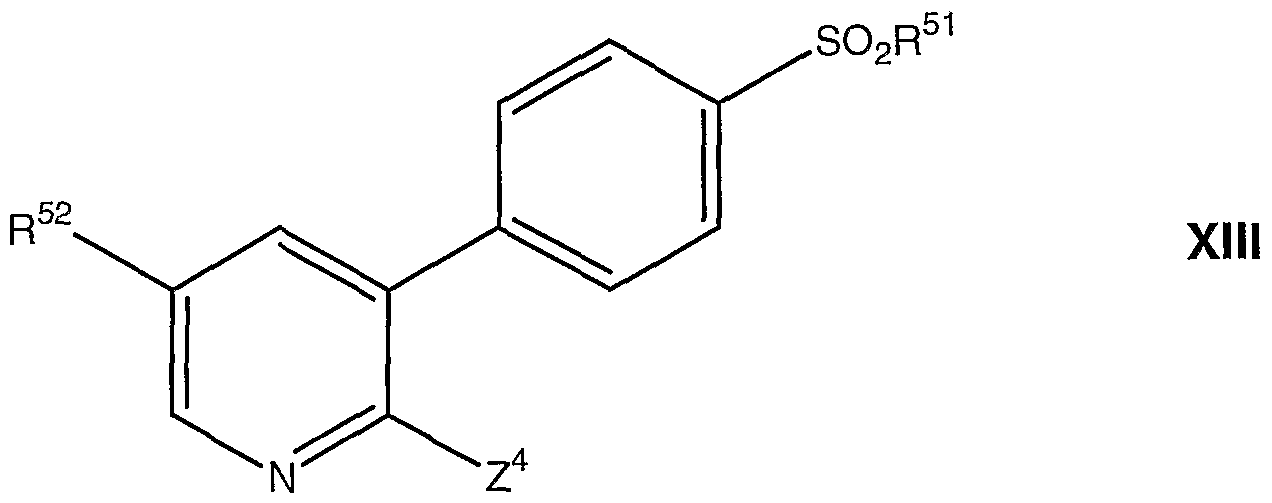
[000167] Preferred Cox-2 selective inhibitor compounds are those compounds selected from the group consisting of celecoxib, parecoxib, deracoxib, valdecoxib, etoricoxib, meloxicam, rofecoxib, lumiracoxib, RS 57067, T-614, BMS-347070 (Bristol Meyers Squibb, described in U.S. Patent No. 6,180,651), JTE-522 (Japan Tabacco), S-2474 (Shionogi), SVT-2016, CT-3 (Atlantic Pharmaceutical), ABT-963 (Abbott), SC-58125 (GD Searle), nimesulide, flosulide, NS-398 (Taisho Pharmaceutical), L- 745337 (Merck), RWJ-63556, L-784512 (Merck), darbufelone (Pfizer), CS- 502 (Sankyo), LAS-34475 (Almirall Prodesfarma), LAS-34555 (Almirall Prodesfarma), S-33516 (Servier), SD-8381 (Pharmacia, described in U.S. Patent No. 6,0340256), MK-966 (Merck), L-783003 (Merck), T-614 (Toyama), D-1376 (Chiroscience), L-748731 (Merck), CGP-28238 (Novartis), BF-389 (Biofor/Scherer), GR-253035 (Glaxo Wellcome), prodrugs of any of them, and mixtures thereof. [000168] More preferred is that the Cox-2 selective inhibitor is selected from the group consisting of celecoxib, parecoxib, deracoxib, valdecoxib, lumiracoxib, etoricoxib, rofecoxib, prodrugs of any of them, and mixtures thereof.
[000169] Even more preferred still is that the Cox-2 selective inhibitor is celecoxib.
[000170] Cox-2 inhibitors that are useful in the methods and compositions and methods of present invention can be supplied by any source as long as the Cox-2 inhibitor is pharmaceutically acceptable. [000171] Various classes of Cox-2 inhibitors useful in the present invention can be prepared as follows. Pyrazoles can be prepared by methods described in WO 95/15316. Pyrazoles can further be prepared by methods described in WO 95/15315. Pyrazoles can also be prepared by methods described in WO 96/03385.
[000172] Thiophene analogs useful in the present invention can be prepared by methods described in WO 95/00501. Preparation of thiophene analogs is also described in WO 94/15932.
[000173] Oxazoles useful in the present invention can be prepared by the methods described in WO 95/00501. Preparation of oxazoles is also described in WO 94/27980.
[000174] Isoxazoles useful in the present invention can be prepared by the methods described in WO 96/25405.
[000175] Imidazoles useful in the present invention can be prepared by the methods described in WO 96/03388. Preparation of imidazoles is also described in WO 96/03387.
[000176] Cyclopentene Cox-2 inhibitors useful in the present invention can be prepared by the methods described in U.S. Patent No.
5,344,991. Preparation of cyclopentene Cox-2 inhibitors is also described in WO 95/00501.
[000177] Terphenyl compounds useful in the present invention can be prepared by the methods described in WO 96/16934.
[000178] Thiazole compounds useful in the present invention can be prepared by the methods described in WO 96/03,392.
[000179] Pyridine compounds useful in the present invention can be prepared by the methods described in WO 96/03392. Preparation of pyridine compounds is also described in WO 96/24,585.
[000180] Benzopyranopyrazolyl compounds useful in the present invention can be prepared by the methods described in WO 96/09304.
[000181] Chromene compounds useful in the present invention can be prepared by the methods described in WO 98/47890. Preparation of chromene compounds is also described in WO 00/23433. Chromene compounds can further be prepared by the methods described in U.S.
Patent No. 6,077,850. Preparation of chromene compounds is further described in U.S. Patent No. 6,034,256.
[000182] Arylpyridazinones useful in the present invention can be prepared by the methods described in WO 00/24719. Preparation of arylpyridazinones is also described in WO 99/10332. Arylpyridazinones can further be prepared by the methods described in WO 99/10331.
[000183] 5-Alkyl-2-arylaminophenylacetic acids and derivatives useful in the present invention can be prepared by the methods described in WO
99/11605.
[000184] Diarylmethylidenefuran derivative Cox-2 selective inhibitors useful in the present invention can be prepared by the methods described in U.S. Patent No. 6,180,651.
[000185] The celecoxib used in the compositions and methods of the present invention can be prepared in the manner set forth in U.S. Patent
No. 5,466,823.
[000186] The valdecoxib used in the compositions and methods of the present invention can be prepared in the manner set forth in U.S. Patent
No. 5,633,272.
[000187] The parecoxib used in the compositions and methods of the present invention can be prepared in the manner set forth in U.S. Patent
No. 5,932,598.
[000188] The rofecoxib used in the compositions and methods of the present invention can be prepared in the manner set forth in U.S. Patent
No. 5,474,995.
[000189] The deracoxib used in the compositions and methods of the present invention can be prepared in the manner set forth in U.S. Patent
No. 5,521 ,207.
[000190] The etoricoxib used in the compositions and methods of the present invention can be prepared in the manner set forth in WO
98/03484. [000191] The meloxicam used in the compositions and methods of the present invention can be prepared in the manner set forth in U.S.
Patent No. 4,233,299.
[000192] The compound 4-(4-cyclohexyl-2-methyloxazol-5-yl)-2- fluorobenzenesulfonamide used in the compositions and methods of the present invention can be prepared in the manner set forth in U.S. Patent
No. 5,994,381.
[000193] The compound 2-(3,4-difluorophenyl)-4-(3-hydroxy-3- methylbutoxy)-5-[4-(methylsulfonyl)phenyl]-3(2H)-pyridazinone used in the compositions and methods of the present invention can be prepared in the manner set forth in WO 00/24719.
[000194] The compound 2-(3,5-difluorophenyl)-3-[4-
(methylsulfonyl)phenyl]-2-cyclopenten-1 -one used in the compositions and methods of the present invention can be prepared in the manner set forth in EP 863134.
[000195] The compound 2-[(2-chloro-6-fluorophenyl)aminoj-5-methyl- benzeneacetic acid used in the compositions and methods of the present invention can be prepared in the manner set forth in WO 99/11605.
[000196] The compound N-[2-(cyclohexyloxy)-4- nitrophenyljmethanesulfonamide used in the compositions and methods of the present invention can be prepared in the manner set forth in U.S.
Patent No. 4,885,367.
[000197] The compound (3Z)-3-[(4-chlorophenyl)[4-
(methylsulfonyl)phenyl]methylene]dihydro-2(3H)-furanone used in the compositions and methods of the present invention can be prepared in the manner set forth in U.S. Patent No. 6,180,651.
[000198] Cox-2 inhibitors can also be isolated and purified from natural sources. Cox-2 inhibitors should be of a quality and purity that is conventional in the trade for use in pharmaceutical products.
[000199] The present invention provides methods that spare or reduce the normally prescribed dosages of corticosteroids. Corticosteroids are a class of therapeutic compounds that are useful in the treatment of inflammatory conditions. Corticosteroids inhibit the attraction of inflammatory cells to the site of an allergic reaction, upregulate β2- receptors, block leukotriene synthesis, and inhibit cytokine production and adhesion protein activation. See The Merck Manual, 17th edition, Sec. 6, Chapter 68, Chronic Obstructive Airway Disorders, Asthma. [000200] While not intended to be limiting, normally prescribed dosages for corticosteroids have been reported to range from about 0.05 mg/day to about 1 gram/day, depending upon the particular corticosteroid used. See U.S. Patent No. 6,054,487 to Sekut, et al. As an example, the normally prescribed dosages for one commonly prescribed inhaled corticosteroid, beclomethasone dipropionate, is from 168 μg to 336 μg per day for adults and children 6 years of age. Beclomethasone is normally prescribed as an inhaler therapy. See Vancenase® patient prescribing information, <http://www.sch- plough.com/documents/18780275_Vancenase_Pl.pdf>. For orally ingested corticosteroids such as prednisone and prednisolone, a dosage of 0.25 - 2.0 mg/kg (usually 0.5 mg/kg) of body weight is a normally prescribed dosage in a two to four week treatment course. See The Merck Manual, 17th edition, Sec. 6, Chapter 68, Chronic Obstructive Airway Disorders, COPD.
[000201] The present invention encompasses corticosteroids that are naturally occurring, synthetic, or semi-synthetic in origin. Examples of useful corticosteroids include, but are not limited to, those recited in Table 3 below.
Table 3
Figure imgf000134_0001
Figure imgf000134_0002
C5
90 O O
O O
H U α.
C5
o
Figure imgf000135_0001
o o
O
C5
90 O O
O O
H U α.
C5
C5 o o o
Figure imgf000136_0001
O
C5
90 O O
O O
H U α.
C5
o o o
Figure imgf000137_0001
O
C5
90 O O
O O
H U α.
C5
o o o
O
Figure imgf000138_0001
C5
90 © ©
© ©
P H U Q-
90 C5
C5
©
© ©
O
Figure imgf000139_0001
C5
90 © ©
© ©
H U α.
C5
Figure imgf000140_0001
©
© ©
O
C5
90 © ©
© ©
H U α.
C5
Figure imgf000141_0001
©
© ©
O
[000202] Included in the present invention are methods, compositions and kits that include a Cox-2 inhibitor and a corticosteroid. Any combination of Cox-2 inhibitors and corticosteroids can be used. In a preferred embodiment, one or more Cox-2 inhibitors be combined with any one or more of the corticosteroids selected from hydrocortisone, mometasone, fluticasone, fluocinolone acetonide, fluocinolone, flurandrenolone acetonide, ciclesonide, budesonide, beclomethasone, deflazacort, flunisolide, beclomethasone dipropionate, betamethasone, betamethasone valerate, methyl-prednisolone, dexamethasone, prednisolone, cortisol, triamcinolone, clobetasol, clobetasol propionate, clobetasol butyrate, cortisone, corticosterone, clocortolone, dihydroxycortisone, alclometasone, amcinonide, diflucortolone valerate, flucortolone, fluprednidene, fluandrenolone, fluorometholone, halcinonide, halobetasol, desonide, diflorasone, flurandrenolide, fluocinonide, prednicarbate, desoximetasone, fluprednisolone, prednisone, azelastine, dexamethasone 21 -phosphate, fludrocortisone, flumethasone, fluocinonide, halopredone, hydrocortisone 17-valerate, hydrocortisone 17- butyrate, hydrocortisone 21 -acetate, prednisolone, prednisolone 21 - phosphate, clobetasol propionate, triamcinolone acetonide, and mixtures thereof.
[000203] Further preferred is that one or more Cox-2 selective inhibitors be combined with any one or more of the corticosteroids selected from hydrocortisone, mometasone, fluticasone, fluocinolone acetonide, fluocinolone, flurandrenolone acetonide, ciclesonide, budesonide, beclomethasone, deflazacort, flunisolide, beclomethasone dipropionate, betamethasone, betamethasone valerate, methyl- prednisolone, dexamethasone, prednisolone, cortisol, triamcinolone, clobetasol, clobetasol propionate, clobetasol butyrate, cortisone, corticosterone, clocortolone, dihydroxycortisone, alclometasone, amcinonide, diflucortolone valerate, flucortolone, fluprednidene, fluandrenolone, fluorometholone, halcinonide, halobetasol, desonide, diflorasone, flurandrenolide, fluocinonide, prednicarbate, desoximetasone, fluprednisolone, prednisone, azelastine, dexamethasone 21 -phosphate, fludrocortisone, flumethasone, fluocinonide, halopredone, hydrocortisone 17-valerate, hydrocortisone 17-butyrate, hydrocortisone 21 -acetate, prednisolone, prednisolone 21 -phosphate, clobetasol propionate, triamcinolone acetonide, and mixtures thereof. [000204] Even more preferred is that a Cox-2 selective inhibitor selected from the group consisting of celecoxib, parecoxib, deracoxib, valdecoxib, meloxicam, rofecoxib, lumiracoxib, etoricoxib, RS 57067, T- 614, BMS-347070, JTE-522, S-2474, SVT-2016, CT-3, ABT-963, SC- 58125, nimesulide, flosulide, NS-398, L-745337, RWJ-63556, L-784512, darbufelone, CS-502, LAS-34475, LAS-34555, S-33516 and SD-8381 , be combined with any of one or more corticosteroids selected from the group consisting of hydrocortisone, mometasone, fluticasone, fluocinolone acetonide, fluocinolone, flurandrenolone acetonide, ciclesonide, budesonide, beclomethasone, deflazacort, flunisolide, beclomethasone dipropionate, betamethasone, betamethasone valerate, methyl- prednisolone, dexamethasone, prednisolone, cortisol, triamcinolone, clobetasol, clobetasol propionate, clobetasol butyrate, cortisone, corticosterone, clocortolone, dihydroxycortisone, alclometasone, amcinonide, diflucortolone valerate, flucortolone, fluprednidene, fluandrenolone, fluorometholone, halcinonide, halobetasol, desonide, diflorasone, flurandrenolide, fluocinonide, prednicarbate, desoximetasone, fluprednisolone, prednisone, azelastine, dexamethasone 21 -phosphate, fludrocortisone, flumethasone, fluocinonide, halopredone, hydrocortisone 17-valerate, hydrocortisone 17-butyrate, hydrocortisone 21 -acetate, prednisolone, prednisolone 21 -phosphate, clobetasol propionate, triamcinolone acetonide, and mixtures thereof. [000205] Still further preferred is that a Cox-2 selective inhibitor selected from the group consisting of celecoxib, parecoxib, deracoxib, valdecoxib, etoricoxib, meloxicam, rofecoxib and lumiracoxib, be combined with any of one or more corticosteroids selected from the group consisting of hydrocortisone, mometasone, fluticasone, fluocinolone acetonide, fluocinolone, flurandrenolone acetonide, ciclesonide, budesonide, beclomethasone, deflazacort, flunisolide, beclomethasone dipropionate, betamethasone, betamethasone valerate, methyl-prednisolone, dexamethasone, prednisolone, cortisol, triamcinolone, clobetasol, clobetasol propionate, clobetasol butyrate, cortisone, corticosterone, clocortolone, dihydroxycortisone, alclometasone, amcinonide, diflucortolone valerate, flucortolone, fluprednidene, fluandrenolone, fluorometholone, halcinonide, halobetasol, desonide, diflorasone, flurandrenolide, fluocinonide, prednicarbate, desoximetasone, fluprednisolone, prednisone, azelastine, dexamethasone 21 -phosphate, fludrocortisone, flumethasone, fluocinonide, halopredone, hydrocortisone 17-valerate, hydrocortisone 17-butyrate, hydrocortisone 21 -acetate, prednisolone, prednisolone 21 -phosphate, clobetasol propionate and triamcinolone acetonide.
[000206] Even further preferred is that celecoxib be combined with any of one or more corticosteroids selected from the group consisting of hydrocortisone, mometasone, fluticasone, fluocinolone acetonide, fluocinolone, flurandrenolone acetonide, ciclesonide, budesonide, beclomethasone, deflazacort, flunisolide, beclomethasone dipropionate, betamethasone, betamethasone valerate, methyl-prednisolone, dexamethasone, prednisolone, cortisol, triamcinolone, clobetasol, clobetasol propionate, clobetasol butyrate, cortisone, corticosterone, clocortolone, dihydroxycortisone, alclometasone, amcinonide, diflucortolone valerate, flucortolone, fluprednidene, fluandrenolone, fluorometholone, halcinonide, halobetasol, desonide, diflorasone, flurandrenolide, fluocinonide, prednicarbate, desoximetasone, fluprednisolone, prednisone, azelastine, dexamethasone 21 -phosphate, fludrocortisone, flumethasone, fluocinonide, halopredone, hydrocortisone 17-valerate, hydrocortisone 17-butyrate, hydrocortisone 21 -acetate, prednisolone, prednisolone 21 -phosphate, clobetasol propionate, triamcinolone acetonide, and mixtures thereof. [000207] In preferred embodiments, any combination of the Cox-2 inhibitors and corticosteroids that are described above can be used in the novel methods, compositions, pharmaceutical compositions and kits of the present invention.
[000208] In a preferred embodiment, the Cox-2 selective inhibitor, celecoxib can be combined with any of the corticosteroids cited in Table 3, including, for example, the corticosteroid, fluticasone. [000209] In another preferred embodiment, the present invention encompasses a novel therapeutic composition comprising a Cox-2 inhibitor and a corticosteroid.
[000210] A novel therapeutic composition that has been found to be useful for the purpose of preventing or treating a corticosteroid-responsive disease or disorder in a subject that is in need of such prevention or treatment, includes a Cox-2 inhibitor and a corticosteroid. [000211] Each of the Cox-2 inhibitors and corticosteroids of the present invention can be supplied in the form of a salt, or prodrug, if desirable. Cox-2 inhibitors and corticosteroids that are useful in the present invention can be of any purity or grade, as long as the preparation is of a quality suitable for pharmaceutical use. The Cox-2 inhibitors and corticosteroids can be provided in pure form, or it can be accompanied with impurities or commonly associated compounds that do not affect its physiological activity or safety. The Cox-2 inhibitors and corticosteroids can be supplied as a pure compound, or in the form of a pharmaceutically acceptable salt. The Cox-2 inhibitors and corticosteroids can be supplied in the form of a prodrug, an isomer, a mixed isomer, a racemic mixture, or in any other chemical form or combination that, under physiological conditions, provides the corticosteroid.
[000212] In the methods of the present invention, a Cox-2 inhibitor and a corticosteroid are administered to a subject according to standard routes of drug delivery that are well known to one of ordinary skill in the art. The particular route and dosage of the Cox-2 inhibitor and the corticosteroid depend upon the needs of the subject being treated, the type of treatment, the efficacy of the compound and the degree of disease severity in the subject. See U.S. Patent No. 6,054,487 to Sekut, et al. [000213] The compositions of the present invention can comprise a Cox-2 inhibitor and a corticosteroid as an active ingredient or a pharmaceutically acceptable salt, thereof, and also contain a pharmaceutically acceptable carrier and optionally other therapeutic ingredients. When the Cox-2 inhibitor and corticosteroid are supplied along with a pharmaceutically acceptable carrier, a pharmaceutical composition is formed. A pharmaceutical composition of the present invention is directed to a composition suitable for the reduction or amelioration or prevention of steroid-related side-effects and/or for preventing or treating a corticosteroid-responsive disease or disorder in a subject. Also useful in the present invention are pharmaceutical compositions, which include a pharmaceutically acceptable carrier in addition to the Cox-2 inhibitor and the corticosteroid. [000214] In a preferred embodiment, the present invention encompasses a pharmaceutical composition for preventing or treating a a corticosteroid-responsive disease or disorder in a subject comprising a Cox-2 inhibitor, a corticosteroid, and a pharmaceutically acceptable carrier.
[000215] The term "pharmaceutically acceptable" is used herein to mean that the modified noun is appropriate for use in a pharmaceutical product.
[000216] Pharmaceutically acceptable carriers and excipients include, but are not limited to, physiological saline, Ringer's solution, phosphate solution or buffer, buffered saline and other carriers known in the art. [000217] Pharmaceutical compositions may also include stabilizers, anti-oxidants, colorants, and diluents. Pharmaceutically acceptable carriers and additives are chosen such that side effects from the pharmaceutical compound are minimized and the performance of the compound is not canceled or inhibited to such an extent that treatment is ineffective. [000218] In one embodiment the Cox-2 inhibitor and the corticosteroid are administered to a subject together in one pharmaceutical carrier. In another embodiment, the Cox-2 inhibitor and the corticosteroid are administered separately.
[000219] The pharmaceutically acceptable carrier can also be selected on the basis of the desired route of administration of the compound. For example, in a preferred embodiment the carrier is suitable for oral administration.
[000220] The term "pharmaceutically acceptable salt" refers to salts prepared from pharmaceutically acceptable non-toxic bases including inorganic bases and organic bases. Illustrative pharmaceutically acceptable salts are prepared from formic, acetic, propionic, succinic, glycolic, gluconic, lactic, malic, tartaric, citric, ascorbic, glucuronic, maleic, fumaric, pyruvic, aspartic, glutamic, benzoic, hydrochloric, trifluoroacetic, anthranilic, mesylic, stearic, salicylic, p-hydroxybenzoic, phenylacetic, mandelic, embonic (pamoic), methanesulfonic, ethanesulfonic, benzenesulfonic, pantothenic, toluenesulfonic, 2-hydroxyethanesulfonic, sulfanilic, cyclohexylaminosulfonic, algenic, β-hydroxybutyric, galactaric and galacturonic acids.
[000221] Salts derived from inorganic bases include aluminum, ammonium, calcium, copper, ferric, ferrous, lithium, magnesium, manganic salts, manganous, potassium, sodium, zinc, and the like. Particularly preferred are the ammonium, calcium, magnesium, potassium, and sodium salts.
[000222] Salts derived from pharmaceutically acceptable organic non- toxic bases include salts of primary, secondary, and tertiary amines, substituted amines including naturally occurring substituted amines, cyclic amines, and basic ion exchange resins, such as arginine, betaine, caffeine, choline, N,N-dibenzylethylenediamine, diethylamine, 2- diethylaminoethanol, 2-dimethylaminoethanol, ethanolamine, ethylenediamine, N-ethylmorpholine, N-ethylpiperidine, glucamine, glucosamine, histidine, hydrabamine, isopropylamine, lysine, methylglucamine, morpholine, piperazine, piperidine, polyamine resins, procaine, purines, theobromine, triethylamine, trimethylamine, tripropylamine, tromethamine and the like.
[000223] Pharmaceutically acceptable cations include metallic ions and organic ions. More preferred metallic ions include, but are not limited to, appropriate alkali metal salts, alkaline earth metal salts and other physiological acceptable metal ions. Exemplary ions include aluminum, calcium, lithium, magnesium, potassium, sodium and zinc in their usual valences.
[000224] Preferred organic ions include protonated tertiary amines and quaternary ammonium cations, including in part, trimethylamine, diethylamine, N, N'-dibenzylethylenediamine, chloroprocaine, choline, diethanolamine, ethylenediamine, meglumine (N-methylglucamine) and procaine. Exemplary pharmaceutically acceptable acids include, without limitation, hydrochloric acid, hydroiodic acid, hydrobromic acid, phosphoric acid, sulfuric acid, methanesulfonic acid, acetic acid, formic acid, tartaric acid, maleic acid, malic acid, citric acid, isocitric acid, succinic acid, lactic acid, gluconic acid, glucuronic acid, pyruvic acid oxalacetic acid, fumaric acid, propionic acid, aspartic acid, glutamic acid, benzoic acid, and the like.
[000225] All of the above salts and ions can be prepared by those skilled in the art by conventional means from the corresponding compounds of the present invention.
[000226] In the present invention, a Cox-2 inhibitor and a corticosteroid are administered to a subject according to standard routes of drug delivery that are well known to one of ordinary skill in the art. The particular route and dosage of the Cox-2 inhibitor and the corticosteroid depend upon the needs of the subject being treated, the type of treatment or prevention, the efficacy of the compound and the degree of disease severity in the subject.
[000227] The pharmaceutical compositions may be administered enterally and parenterally. Oral (intra-gastric) is a preferred route of administration. Pharmaceutically acceptable carriers can be in solid dosage forms for the methods of the present invention, which include tablets, capsules, pills, and granules, which can be prepared with coatings and shells, such as enteric coatings and others well known in the art. Liquid dosage forms for oral administration include pharmaceutically acceptable emulsions, solutions, suspensions, syrups, and elixirs. [000228] Enteral administration includes solution, tablets, sustained release capsules, enteric-coated capsules, and syrups. When administered, the pharmaceutical composition may be at or near body temperature.
[000229] Compositions intended for oral use may be prepared according to any method known in the art for the manufacture of pharmaceutical compositions and such compositions may contain one or more agents selected from the group consisting of sweetening agents, flavoring agents, coloring agents and preserving agents in order to provide pharmaceutically elegant and palatable preparations. [000230] Tablets contain the active ingredient in admixture with non- toxic pharmaceutically acceptable excipients, which are suitable for the manufacture of tablets. These excipients may be, for example, inert diluents, such as calcium carbonate, sodium carbonate, lactose, calcium phosphate or sodium phosphate, granulating and disintegrating agents, for example, maize starch, or alginic acid, binding agents, for example starch, gelatin or acacia, and lubricating agents, for example magnesium stearate, stearic acid, or talc. The tablets may be uncoated or they may be coated by known techniques to delay disintegration and absorption in the gastrointestinal tract and thereby provide a sustained action over a longer period. For example, a time delay material such as glyceryl monostearate or glyceryl distearate may be employed.
[000231] Formulations for oral use may also be presented as hard gelatin capsules wherein the active ingredients are mixed with an inert solid diluent, for example, calcium carbonate, calcium phosphate or kaolin, or as soft gelatin capsules wherein the active ingredients are present as such, or mixed with water or an oil medium, for example, peanut oil, liquid paraffin, or olive oil.
[000232] Aqueous suspensions can be produced that contain the active materials in a mixture with excipients suitable for the manufacture of aqueous suspensions. Such excipients are suspending agents, for example, sodium carboxymethylcellulose, methylcellulose, hydroxypropylmethyl-cellulose, sodium alginate, polyvinylpyrrolidone gum tragacanth and gum acacia; dispersing or wetting agents may be naturally- occurring phosphatides, for example lecithin, or condensation products of an alkylene oxide with fatty acids, for example polyoxyethylene stearate, or condensation products of ethylene oxide with long chain aliphatic alcohols, for example heptadecaethyleneoxycetanol, or condensation products of ethylene oxide with partial esters derived from fatty acids and a hexitol such as polyoxyethylene sorbitol monooleate, or condensation products of ethylene oxide with partial esters derived from fatty acids and hexitol anhydrides, for example polyoxyethylene sorbitan monooleate. [000233] The aqueous suspensions may also contain one or more preservatives, for example, ethyl or n-propyl p-hydroxybenzoate, one or more coloring agents, one or more flavoring agents, or one or more sweetening agents, such as sucrose or saccharin. [000234] Oily suspensions may be formulated by suspending the active ingredients in an omega-3 fatty acid, a vegetable oil, for example, arachis oil, olive oil, sesame oil or coconut oil, or in a mineral oil such as liquid paraffin. The oily suspensions may contain a thickening agent, for example beeswax, hard paraffin or cetyl alcohol. [000235] Sweetening agents, such as those set forth above, and flavoring agents may be added to provide a palatable oral preparation. These compositions may be preserved by the addition of an antioxidant such as ascorbic acid.
[000236] Dispersible powders and granules suitable for preparation of an aqueous suspension by the addition of water provide the active ingredient in admixture with a dispersing or wetting agent, a suspending agent and one or more preservatives. Suitable dispersing or wetting agents and suspending agents are exemplified by those already mentioned above. Additional excipients, for example sweetening, flavoring and coloring agents, may also be present. [000237] Syrups and elixirs containing the Cox-2 inhibitor and corticosteroid may be formulated with sweetening agents, for example glycerol, sorbitol, or sucrose. Such formulations may also contain a demulcent, a preservative and flavoring and coloring agents. [000238] The subject method of prescribing a Cox-2 inhibitor and a corticosteroid and compositions comprising the same can also be administered parenterally, either subcutaneously, or intravenously, or intramuscularly, or intrasternally, or by infusion techniques, in the form of sterile injectable aqueous or olagenous suspensions. Parenteral administration includes subcutaneous, intramuscular, intradermal, intramammary, intravenous, and other administrative methods known in the art.
[000239] Such suspensions may be formulated according to the known art using those suitable dispersing of wetting agents and suspending agents, which have been mentioned above or other acceptable agents. The sterile injectable preparation may also be a sterile injectable solution or suspension in a non-toxic parenterally acceptable diluent or solvent, for example as a solution in 1 ,3-butanediol. Among the acceptable vehicles and solvents that may be employed are water, Ringer's solution and isotonic sodium chloride solution. In addition, sterile, fixed oils are conventionally employed as a solvent or suspending medium. For this purpose, any bland fixed oil may be employed, including synthetic mono- or diglycerides. In addition, n-3 polyunsaturated fatty acids may find use in the preparation of injectables. [000240] In preferred embodiments, administration of the Cox-2 inhibitor and corticosteroid can also be by inhalation, in the form of aerosols or solutions for nebulizers. Therefore, in one embodiment, the Cox-2 inhibitor and the corticosteroid are administered by direct inhalation into the respiratory system of a subject for delivery as a mist or other aerosol or dry powder. Delivery of drugs or other active ingredients directly to the subject's lungs provides numerous advantages including, providing an extensive surface area for drug absorption, direct delivery of therapeutic agents to the disease site in the case of regional drug therapy, eliminating the possibility of drug degradation in the subject's intestinal tract (a risk associated with oral administration), and eliminating the need for repeated subcutaneous injections.
[000241] Aerosols of liquid particles comprising the active materials may be produced by any suitable means, such as inhalatory delivery systems. Nebulizers are commercially available devices which transform solutions or suspensions of the active ingredient into a therapeutic aerosol mist either by means of acceleration of compressed gas, typically air or oxygen, through a narrow venturi orifice or by means of ultrasonic agitation. Suitable formulations for use in nebulizers consist of the active ingredient in a liquid carrier. The carrier is typically water, and most preferably sterile, pyrogen-free water, or a dilute aqueous alcoholic solution, preferably made isotonic, but may be hypertonic with body fluids by the addition of, for example, sodium chloride. Optional additives include preservatives if the formulation is not made sterile, for example, methyl hydroxybenzoate, as well as antioxidants, flavoring agents, volatile oils, buffering agents and surfactants, which are normally used in the preparation of pharmaceutical compositions.
[000242] Aerosols of solid particles comprising the active materials may likewise be produced with any solid particulate medicament aerosol generator. Aerosol generators for administering solid particulate medicaments to a subject produce particles which are respirable, as explained above, and generate a volume of aerosol containing a predetermined metered dose of a medicament at a rate suitable for human administration.
[000243] One type of solid particulate aerosol generator is an insufflator. Suitable formulations for administration by insufflation include finely comminuted powders which may be delivered by means of an insufflator or taken into the nasal cavity in the manner of a snuff. In the insufflator, the powder is contained in capsules or cartridges, typically made of gelatin or plastic, which are either pierced or opened in situ and the powder delivered by means of air drawn through the device upon inhalation or by means of a manually-operated pump. The powder employed in the insufflator consists either solely of the active ingredient or of a powder blend comprising the active materials, a suitable powder diluent, such as lactose, and an optional surfactant. [000244] A second type of aerosol generator is a metered dose inhaler. Metered dose inhalers are pressurized aerosol dispensers, typically containing a suspension or solution formulation of the Cox-2 inhibitor and the corticosteroid in a liquified propellant. During use, the metered dose inhaler discharges the formulation through a valve, adapted to deliver a metered volume, to produce a fine particle spray containing the active materials. Any propellant may be used for aerosol delivery, including both chlorofluorocarbon-containing propellants and non- chlorofluorocarbon-containing propellants.
[000245] A third type of aerosol generator is a electrohydrodynamic (EHD) aerosol generating device, which has the advantage of being adjustable to create substantially monomodal aerosols having particles more uniform in size than aerosols generated by other devices or methods. Typical EHD devices include a spray nozzle in fluid communication with a source of liquid to be aerosolized, at least one discharge electrode, a first voltage source for maintaining the spray nozzle at a negative (or positive) potential relative to the potential of the discharge electrode, and a second voltage source for maintaining the discharge electrode at a positive (or negative) potential relative to the potential of the spray nozzle.
[000246] Most EHD devices create aerosols by causing a liquid to form droplets that enter a region of high electric field strength. The electric field then imparts a net electric charge to these droplets, and this net electric charge tends to remain on the surface of the droplet. The repelling force of the charge on the surface of the droplet balances against the surface tension of the liquid in the droplet, thereby causing the droplet to form a cone-like structure known as a Taylor Cone. In the tip of this conelike structure, the electric force exerted on the surface of the droplet overcomes the surface tension of the liquid, thereby generating a stream of liquid that disperses into a many smaller droplets of roughly the same size. These smaller droplets form a mist which constitutes the aerosol cloud that the user ultimately inhales.
[000247] In a preferred embodiment, the administration of the compositions of the present invention can also be by a rectal route of delivery. Rectal routes of delivery are in the form of suppositories prepared by mixing the drug with a suitable non-irritating excipient which is solid at ordinary temperature, but liquid at the rectal temperature and will therefore, melt in the rectum to release the drug. Such materials are cocoa butter and polyethylene glycols.
[000248] Also encompassed by the present invention is buccal or "sub-lingual" administration, which includes lozenges or a chewable gum comprising the compounds, set forth herein. The compounds can be deposited in a flavored base, usually sucrose, and acacia or tragacanth, and pastilles comprising the compounds in an inert base such as gelatin and glycerin or sucrose and acacia.
[000249] The present invention further encompasses intranasal administration comprising the compounds set forth herein. Intranasal dosage forms include, but are not limited to, aerosols, drops, gels, powders, and mixtures thereof.
[000250] Other methods for administration of the Cox-2 inhibitor and the corticosteroid include dermal patches that release the medicaments directly into a subject's skin.
[000251] Topical delivery systems are also encompassed by the present invention and include ointments, powders, sprays, creams, jellies, collyriums, solutions or suspensions. [000252] The compositions of the present invention can optionally be supplemented with additional agents such as, for example, viscosity enhancers, preservatives, surfactants and penetration enhancers. [000253] Viscosity is an important attribute of many medications. Drops that have a high viscosity tend to stay in the body for longer periods and thus, increase absorption of the active compounds by the target tissues or increase the retention time. Such viscosity-building agents include, for example, polyvinyl alcohol, polyvinyl pyrrolidone, methylcellulose, hydroxy propyl methylcellulose, hydroxyethyl cellulose, carboxymethyl cellulose, hydroxy propyl cellulose or other agents know to those skilled in the art. Such agents are typically employed at a level of from 0.01% to 2% by weight.
[000254] Preservatives are optionally employed to prevent microbial contamination during use. Suitable preservatives include polyquaternium- 1 , benzalkonium chloride, thimerosal, chlorobutanol, methyl paraben, propyl paraben, phenylethyl alcohol, edetate disodium, sorbic acid, or other agents known to those skilled in the art. The use of polyquaternium- 1 as the antimicrobial preservative is preferred. Typically, such preservatives are employed at a level of from 0.001% to 1.0% by weight. [000255] The solubility of the components of the present compositions may be enhanced by a surfactant or other appropriate co-solvent in the composition. Such co-solvents include polysorbate 20, 60, and 80, polyoxyethylene/polyoxypropylene surfactants (e.g. Pluronic F-68, F-84 and P-103), cyclodextrin, or other agents known to those skilled in the art. Typically, such co-solvents are employed at a level of from 0.01% to 2% by weight.
[000256] A penetration enhancer is an agent used to increase the permeability of the skin to an active agent to increase the rate at which the drug diffuses through the skin and enters the tissues and bloodstream. Thus, in one embodiment of the present invention, a penetration enhancer may be added to the Cox-2 inhibitor and/or the corticosteroid topical composition. [000257] Examples of penetration enhancers suitable for use with the compositions of the present invention include: alcohols, such as ethanol and isopropanol; polyols, such as n-alkanols, limonene, terpenes, dioxolane, propylene glycol, ethylene glycol, other glycols, and glycerol; sulfoxides, such as dimethylsulfoxide (DMSO), dimethylformamide, methyl dodecyl sulfoxide, dimethylacetamide; esters, such as isopropyl myristate/palmitate, ethyl acetate, butyl acetate, methyl proprionate, and capric/caprylic triglycerides; ketones; amides, such as acetamides; oleates, such as triolein; various surfactants, such as sodium lauryl sulfate; various alkanoic acids, such as caprylic acid; lactam compounds, such as azone; alkanols, such as oleyl alcohol; dialkylamino acetates, and admixtures thereof.
[000258] In preferred embodiments, the corticosteroid medications are administered to a subject via a route that is selected from the group consisting of nasal sprays, metered-dose-inhalers, oral forms (pills or syrups), injections, topical forms, and intravenous (IV) solutions, while the Cox-2 inhibitor is administered to the subject via an oral form (pills or syrups).
[000259] Pharmaceutically acceptable excipients and carriers encompass all the foregoing and the like. The above considerations concerning effective formulations and administration procedures are well known in the art and are described in standard textbooks. See e.g. Gennaro, A. R., Remington: The Science and Practice of Pharmacy, 20* Edition, (Lippincott, Williams and Wilkins), 2000; Hoover, John E., Remington's Pharmaceutical Sciences, Mack Publishing Co., Easton, Pennsylvania, 1975; Liberman, et al., Eds., Pharmaceutical Dosage Forms, Marcel Decker, New York, N.Y., 1980; and Kibbe, et al., Eds., Handbook of Pharmaceutical Excipients (3rd Ed.), American Pharmaceutical Association, Washington, 1999.
[000260] It is preferred that the amount of the Cox-2 inhibitor and the amount of the corticosteroid that are administered to a subject together comprise an effective amount of the combination of the two compounds. Preferably, the amount of the combination is a therapeutically effective amount.
[000261] As used herein, an "effective amount" means the dose or effective amount to be administered to a subject and the frequency of administration to the subject which is readily determined by one having ordinary skill in the art, by the use of known techniques and by observing results obtained under analogous circumstances. The dose or effective amount to be administered to a subject and the frequency of administration to the subject can be readily determined by one of ordinary skill in the art by the use of known techniques and by observing results obtained under analogous circumstances. In determining the effective amount or dose, a number of factors are considered by the attending diagnostician, including, but not limited to, the potency and duration of action of the compounds used, the nature and severity of the illness to be treated, as well as the sex, age, weight, general health and individual responsiveness of the subject to be treated, and other relevant circumstances.
[000262] As used herein, the term "therapeutically effective" is intended to qualify the amount of each agent for use in therapy which will achieve the goal of preventing, or improvement in the severity of, the disorder being treated, while avoiding adverse side effects typically associated with monotherapies with corticosteroids. [000263] An inflammatory symptom is considered ameliorated or improved if any benefit is achieved, no matter how slight. An amount of either a Cox-2 or corticosteroid that causes a decrease in the frequency of incidence is "prophylactically effective", where the term "prophylactic" refers to the prevention of disease, whereas the term "therapeutic" refers to the effective treatment of existing disease. Those skilled in the art will appreciate that dosages may also be determined with guidance from Goodman & Gilman's The Pharmacological Basis of Therapeutics, Ninth Edition (1996), Appendix II, pp. 1707-1711. [000264] Daily dosages can vary within wide limits and will be adjusted to the individual requirements in each particular case. In general, for administration to adults, an appropriate daily dosage has been described above, although the limits that were identified as being preferred may be exceeded if expedient. The daily dosage can be administered as a single dosage or in divided dosages.
[000265] Therefore, for purposes of the present invention, it is preferred to dose the Cox-2 inhibitor in an amount sufficient to provide a steroid-sparing benefit when given as a combination therapy to a subject in need of such treatment, wherein the amount of the Cox-2 inhibitor which is administered and the amount of the corticosteroid which is administered together comprise a therapeutically effective amount of the combination. [000266] The appropriate dosage level of a Cox-2 inhibitor will generally be from about 0.01 mg/kg to about 140 mg/kg subject body weight per day, which may be administered in single or multiple doses. Preferably, the dosage level will be about 0.1 mg/kg to about 25 mg/kg per day; more preferably about 0.5 mg to about 10 mg/kg per day. [000267] In larger mammals, for example humans, a typical indicated dose is about 0.5 mg to 7 grams orally per day. A compound may be administered on a regimen of several times per day, for example 1 to 4 times per day, preferably once or twice per day.
[000268] The amount of the Cox-2 inhibitor that may be combined with the carrier materials to produce a single dosage form will vary depending upon the host treated and the particular mode of administration. For example, a formulation intended for the oral administration of humans may contain from 0.5 mg to 7 g of active agent compounded with an appropriate and convenient amount of carrier material which may vary from about 5 to about 95 percent of the total composition. Dosage unit forms for the Cox-2 inhibitor will generally contain between from about 1 mg to about 500 mg of an active ingredient, typically 25 mg, 50 mg, 100 mg, 200 mg, 300 mg, 400 mg, 500 mg, 600 mg, 800 mg, or 1000 mg. [000269] In a preferred embodiment, the methods of the present invention encompass any detectable reduction in the dosage of corticosteroids normally required to treat a subject in need of such treatment provided the lowered dosage of corticosteroids does not substantially worsen the subject's inflammatory symptoms (steroid-sparing benefit).
[000270] One of ordinary skill in the art will know how to measure and quantify the symptoms of inflammation. For example, the degree and severity of asthma and COPD can be determined by measuring lung expiratory flow volume and expiratory flow rates. Measurement can be accomplished with, for example, a spirometer, flow volume loop, or pneumotach, before and after each of the treatments. Use of spirometry is a standard test for determining the efficacy of Cox-2 inhibitors and corticosteroids after administration to a subject suffering from a pulmonary inflammatory disorder. A device called a spirometer is used to measure how much air the lungs can hold and how well the respiratory system is able to move air into and out of the lungs.
[000271] Spirometry is a medical test that measures the physical volume of air an individual forcibly inhales or exhales into a device. The objective of spirometry is to assess ventilatory function. An estimate of flow rate, or the rate at which the volume is changing as a function of time can also be calculated with spirometery. See College of Physicians and Surgeons of Alberta, "Guidelines For Spirometry & Flow Volume Measurements"^ 998).
<www.cpsa.ab.ca/qoc/Guidelines%20for%20Spirometry%20cSc%20Flow%2 0Volume%20Measurements.doc>. Thus, with the methods of the present invention, spirometric comparisons of pulmonary airflow before and after treatment will elucidate similarities and differences that enable one of skill to determine the effectiveness of the treatment methods. [000272] Common parameters that spirometry measures are Forced Vital Capacity (FVC) - the maximum volume of air, measured in liters that can be forcibly and rapidly exhaled. Another parameter is Forced Expiratory Volume (FEV1) - the volume of air expelled in the first second of a forced expiration. Normal parameters for a subject not suffering from an inflammatory disorder such as asthma or COPD is: Tidal volume - 5 to 7 milliliters per kilogram of body weight; Expiratory reserve volume - 25% of vital capacity; Inspiratory capacity - 75% of vital capacity forced expiratory volume - 75% of vital capacity after 1 second, 94% after 2 seconds, and 97% after 3 seconds. Healthatoz.com, wellness, test & procedures, spirometry <http://www.healthatoz.com /atoz/TestProcedures/TPspirometry.html>.
[000273] Spirometry results are expressed as a percentage, and are considered abnormal if less than 80% of the normal predicted value. An abnormal result usually indicates the presence of some degree of obstructive lung disease such as COPD and chronic bronchitis, or restrictive lung disease such as pulmonary fibrosis or asthma. [000274] The Cox-2 inhibitor and corticosteroid are administered to a subject in a manner that reduces the dosage of the corticosteroid over time and, thus, ameliorates any steroid rebound effect associated with administration of reduced dosages of the corticosteroid. Thus, a steroid- sparing benefit will result from the synergistic addition of another medication that can help keep a disorder under control while corticosteroids are being tapered.
[000275] For example, the dosage of the Cox-2 inhibitor could be held steady or increased slightly while the dosage of the corticosteroid is gradually reduced. In particular, a subject that has developed resistance over time to corticosteroid therapy alone will benefit from the gradual reduction in corticosteroid dosage, while simultaneously being treated with a Cox-2 inhibitor dosage. In yet another embodiment, the Cox-2 inhibitor and corticosteroid are administered to a subject where the inflammatory disorder being treated is substantially resistant to corticosteroid therapy alone.
[000276] As used herein, the term "subject" for purposes of treatment includes any subject, and preferably is a subject who is in need of a reduction in the required dosage of a corticosteroid that is normally administered to the subject for the prevention or treatment of pain, inflammation or an inflammation-related disorder. For purposes of prevention, the subject is any subject, and preferably is a subject that is at risk for, or is predisposed to, developing side-effects and/or a steroid- rebound effect (e.g. a sudden termination of corticosteroid therapy) from the administration of a corticosteroid for the prevention or treatment of pain, inflammation, or an inflammation-related disorder. [000277] As used herein, the terms "subject who is in need of a reduction in the required dosage of a corticosteroid that is normally administered to the subject for the prevention or treatment of pain, inflammation or an inflammation-related disorder" refer to any subject who is being administered a corticosteroid medication. The terms "subject who is in need of a reduction in the required dosage of a corticosteroid that is normally administered to the subject for the prevention or treatment of pain, inflammation or an inflammation-related disorder" also refer to any subject that requires a lower dose of corticosteroids. In addition, the terms "subject who is in need of a reduction in the required dosage of a corticosteroid that is normally administered to the subject for the prevention or treatment of pain, inflammation or an inflammation-related disorder," means any subject who requires a reduction in the side-effects of a corticosteroid medication. In addition, the terms "subject who is in need of a reduction in the required dosage of a corticosteroid that is normally administered to the subject for the prevention or treatment of pain, inflammation or an inflammation-related disorder," means any subject who requires the prevention of and/or improvement of a steroid- rebound effect. Furthermore, the terms "subject who is in need of a reduction in the required dosage of a corticosteroid that is normally administered to the subject for the prevention or treatment of pain, inflammation or an inflammation-related disorder," means any subject who requires improved tolerability to corticosteroids for pain or inflammation therapy. As used herein, the terms "subject in need of a corticosteroid" refer to any subject who is in need of the prevention or treatment of pain, inflammation or an inflammation-related disorder. As used herein, the terms "subject that is presently receiving a corticosteroid" refer to any subject who is being administered a corticosteroid medication. [000278] As used herein, the terms "predisposed to side-effects and/or a steroid-rebound effect from administration of a corticosteroid medication" and "at risk for side-effects and/or a steroid-rebound effect from administration of a corticosteroid medication," both of which are used interchangeably herein, mean any subject at risk for developing side- effects and/or a steroid-rebound effect from administration of a corticosteroid medication. The subject may be a human subject who is at risk for developing side-effects and/or a steroid-rebound effect from administration of a corticosteroid medication. The subject may be at risk due to genetic predisposition, diet, age, sex, exposure to a potentially traumatic environment, immunosuppression, immunodeficiency, exposure to pain or inflammation-causing agents, and the like. [000279] The method of the present invention is useful for, but not limited to, lowering the required dosages of corticosteroids that are normally administered to a subject for the prevention and/or treatment of pain or inflammation regardless of the underlying cause of the pain or inflammation. The method of the present invention is also useful for, but not limited to, lowering the required dosages of corticosteroids that are normally administered to a subject for the prevention and/or treatment of inflammation-related disorders and such inflammation-related disorders as arthritis. For example, the compounds described herein would be useful for lowering the required dosages of corticosteroids that are normally administered to a subject for the treatment of any inflammation-related disorder described below, such as an analgesic in the treatment of pain and headaches, or as an antipyretic for the treatment of fever. The compounds described herein would also be useful for lowering the required dosages of corticosteroids that are normally administered to a subject for the treatment of an inflammation-related disorder in a subject suffering from such an inflammation-associated disorder. [000280] In preferred embodiments, the methods and compositions of the present invention encompass lowering the required dosages of corticosteroids that are normally administered to a subject for the prevention and/or treatment of inflammation-related disorders. As used herein, the terms "inflammation-related disorder" or "inflammation disorder" are meant to include, without limitation, each of the symptoms or disorders that are mentioned below.
[000281] In preferred embodiments, the methods and compositions of the present invention encompass lowering the required dosages of corticosteroids that are normally administered to a subject for the prevention and/or treatment of any one or more of the disorders selected from the group consisting of connective tissue and joint disorders, pain and pain-related disorders, neoplasia disorders, cardiovascular disorders, otic disorders, ophthalmic disorders, respiratory disorders, gastrointestinal disorders, angiogenesis-related disorders, immunological disorders, allergic disorders, nutritional disorders, infectious diseases and disorders, endocrine disorders, metabolic disorders, neurological and neurodegenerative disorders, psychiatric disorders, hepatic and biliary disorders, musculoskeletal disorders, genitourinary disorders, gynecologic and obstetric disorders, injury and trauma disorders, surgical disorders, dental and oral disorders, sexual dysfunction disorders, dermatologic disorders, hematological disorders, and poisoning disorders. [000282] As used herein, the terms "neoplasia" and "neoplasia disorder", used interchangeably herein, refer to new cell growth that results from a loss of responsiveness to normal growth controls, e.g. to "neoplastic" cell growth. Neoplasia is also used interchangeably herein with the term "cancer" and for purposes of the present invention; cancer is one subtype of neoplasia. As used herein, the term "neoplasia disorder" also encompasses other cellular abnormalities, such as hyperplasia, metaplasia and dysplasia. The terms neoplasia, metaplasia, dysplasia and hyperplasia can be used interchangeably herein and refer generally to cells experiencing abnormal cell growth.
[000283] Both of the terms, "neoplasia" and "neoplasia disorder", refer to a "neoplasm" or tumor, which may be benign, premalignant, metastatic, or malignant. Also encompassed by the present invention are benign, premalignant, metastatic, or malignant neoplasias. Also encompassed by the present invention are benign, premalignant, metastatic, or malignant tumors. Thus, all of benign, premalignant, metastatic, or malignant neoplasia or tumors are encompassed by the present invention and may be referred to interchangeably, as neoplasia, neoplasms or neoplasia- related disorders. Tumors are generally known in the art to be a mass of neoplasia or "neoplastic" cells. Although, it is to be understood that even one neoplastic cell is considered, for purposes of the present invention to be a neoplasm or alternatively, neoplasia.
[000284] Compounds of the invention would be useful for lowering the required dosages of corticosteroids that are normally administered to a subject for the prevention or treatment of benign and malignant tumors/neoplasia including cancer, such as colorectal cancer, brain cancer, bone cancer, epithelial cell derived neoplasia (epithelial carcinoma) such as basal cell carcinoma, adenocarcinoma, gastrointestinal cancer such as lip cancer, mouth cancer, esophogeal cancer, small bowel cancer and stomach cancer, colon cancer, liver cancer, bladder cancer, pancreas cancer, ovary cancer, cervical cancer, lung cancer, breast cancer and skin cancer, such as squamus cell and basal cell cancers, prostate cancer, renal cell carcinoma, and other known cancers that effect epithelial cells throughout the body. Preferably, neoplasia is selected from gastrointestinal cancer, Barrett's esophagus, liver cancer, bladder cancer, pancreas cancer, ovary cancer, prostate cancer, cervical cancer, lung cancer, breast cancer and skin cancer, such as squamus cell and basal cell cancers. The compounds can also be used to lower the required dosages of corticosteroids that are normally administered to a subject to treat fibrosis, which occurs with radiation therapy. The method can be used to lower the required dosages of corticosteroids that are normally administered to a subject to treat subjects having adenomatous polyps, including those with sporadic adenomatous polyposis (SAP) or familial adenomatous polyposis (FAP). Additionally, the method can be used to lowering the required dosages of corticosteroids that are normally administered to a subject for preventing polyps from forming in subjects at risk of FAP. [000285] In other preferred embodiments, the methods and compositions of the present invention encompass lowering the required dosages of corticosteroids that are normally administered to a subject for the prevention and treatment of the neoplasia disorders selected from the group consisting of acral lentiginous melanoma, actinic keratoses, adenocarcinoma, adenoid cycstic carcinoma, adenomas, familial adenomatous polyposis, familial polyps, colon polyps, polyps, adenosarcoma, adenosquamous carcinoma, adrenocortical carcinoma, AIDS-related lymphoma, anal cancer, astrocytic tumors, bartholin gland carcinoma, basal cell carcinoma, bile duct cancer, bladder cancer, brain stem glioma, brain tumors, breast cancer, bronchial gland carcinomas, capillary carcinoma, carcinoids, carcinoma, carcinosarcoma, cavernous, central nervous system lymphoma, cerebral astrocytoma, cholangiocarcinoma, chondosarcoma, choriod plexus papilloma/carcinoma, clear cell carcinoma, skin cancer, brain cancer, colon cancer, colorectal cancer, cutaneous T-cell lymphoma, cystadenoma, endodermal sinus tumor, endometrial hyperplasia, endometrial stromal sarcoma, endometrioid adenocarcinoma, ependymal, epitheloid, esophageal cancer, Ewing's sarcoma, extragonadal germ cell tumor, fibrolamellar, focal nodular hyperplasia, gallbladder cancer, gastrinoma, germ cell tumors, gestational trophoblastic tumor, glioblastoma, glioma, glucagonoma, hemangiblastomas, hemangioendothelioma, hemangiomas, hepatic adenoma, hepatic adenomatosis, hepatocellular carcinoma, Hodgkin's lymphoma, hypopharyngeal cancer, hypothalamic and visual pathway glioma, insulinoma, intaepithelial neoplasia, interepithelial squamous cell neoplasia, intraocular melanoma, invasive squamous cell carcinoma, large cell carcinoma, islet cell carcinoma, Kaposi's sarcoma, kidney cancer, laryngeal cancer, leiomyosarcoma, lentigo maligna melanomas, leukemia- related disorders, lip and oral cavity cancer, liver cancer, lung cancer, lymphoma, malignant mesothelial tumors, malignant thymoma, medulloblastoma, medulloepithelioma, melanoma, mβningeal, merkel cell carcinoma, mesothelial, metastatic carcinoma, mucoepidermoid carcinoma, multiple myeloma/plasma cell neoplasm, mycosis fungoides, myelodysplastic syndrome, myeloproliferative disorders, nasal cavity and paranasal sinus cancer, nasopharyngeal cancer, neuroblastoma, neuroepithelial adenocarcinoma nodular melanoma, non-Hodgkin's lymphoma, oat cell carcinoma, oligodendroglial, oral cancer, oropharyngeal cancer, osteosarcoma, pancreatic polypeptide, ovarian cancer, ovarian germ cell tumor, pancreatic cancer, papillary serous adenocarcinoma, pineal cell, pituitary tumors, plasmacytoma, pseudosarcoma, pulmonary blastoma, parathyroid cancer, penile cancer, pheochromocytoma, pineal and supratentorial primitive neuroectodermal tumors, pituitary tumor, plasma cell neoplasm, pleuropulmonary blastoma, prostate cancer, rectal cancer, renal cell carcinoma, retinoblastoma, rhabdomyosarcoma, sarcoma, serous carcinoma, small cell carcinoma, small intestine cancer, soft tissue carcinomas, somatostatin-secreting tumor, squamous carcinoma, squamous cell carcinoma, submesothelial, superficial spreading melanoma, supratentorial primitive neuroectodermal tumors, thyroid cancer, undifferentiatied carcinoma, urethral cancer, uterine sarcoma, uveal melanoma, verrucous carcinoma, vaginal cancer, vipoma, vulvar cancer, Waldenstrom's macroglobulinemia, well differentiated carcinoma, and Wilm's tumor. [000286] In still other preferred embodiments, the methods and compositions of the present invention encompass lowering the required dosages of corticosteroids that are normally administered to a subject for the prevention and treatment of the connective tissue and joint disorders selected from the group consisting of arthritis, rheumatoid arthritis, spondyloarthopathies, gouty arthritis, lumbar spondylarthrosis, carpal tunnel syndrome, canine hip dysplasia, systemic lupus erythematosus, juvenile arthritis, osteoarthritis, tendonitis and bursitis. [000287] In other preferred embodiments, the methods and compositions of the present invention encompass lowering the required dosages of corticosteroids that are normally administered to a subject for the prevention and treatment of the cardiovascular disorders selected from the group consisting of myocardial ischemia, hypertension, hypotension, heart arrhythmias, pulmonary hypertension, hypokalemia, vascular diseases, vascular rejection, atherosclerosis including cardiac transplant atherosclerosis, myocardial infarction, embolism, stroke, thrombosis, including venous thrombosis, angina including unstable angina, coronary plaque inflammation, cardiac ischemia, myocardial infarction, cardiac remodeling, cardiac fibrosis, myocardial necrosis, aneurysm, arterial fibrosis, embolism, vascular plaque inflammation, vascular plaque rupture, bacterial-induced inflammation and viral induced inflammation, edema, swelling, fluid accumulation, cirrhosis of the liver, Bartter's syndrome, myocarditis, arteriosclerosis, atherosclerosis, calcification (such as vascular calcification and valvar calcification), coronary artery disease, heart failure, congestive heart failure, shock, arrhythmia, left ventricular hypertrophy, angina, diabetic nephropathy, kidney failure, eye damage, migraine headaches, aplastic anemia, cardiac damage, diabetic cardiac myopathy, renal insufficiency, renal injury, renal arteriopathy, peripheral vascular disease, cognitive dysfunction, stroke, headache, and inflammation associated with surgical procedures such as vascular grafting including coronary artery bypass surgery, revascularization procedures including angioplasty, stent placement, endarterectomy, or other invasive procedures involving arteries, veins and capillaries. [000288] In other preferred embodiments, the methods and compositions of the present invention encompass lowering the required dosages of corticosteroids that are normally administered to a subject for the prevention and treatment of the metabolic disorders selected from the group consisting of obesity, overweight, type I and type II diabetes, hypothyroidism, and hyperthyroidism.
[000289] In other preferred embodiments, the methods and compositions of the present invention lower the required dosages of corticosteroids that are normally administered to a subject for the prevention and treatment of the respiratory disorders selected from the group consisting of asthma, bronchitis, chronic obstructive pulmonary disease (COPD), cystic fibrosis, pulmonary edema, pulmonary embolism, pneumonia, pulmonary sarcoisosis, silicosis, pulmonary fibrosis, respiratory failure, acute respiratory distress syndrome and emphysema. [000290] In other preferred embodiments, the methods and compositions of the present invention encompass lowering the required dosages of corticosteroids that are normally administered to a subject for the prevention and treatment of the angiogenesis-related disorders selected from the group consisting of angiofibroma, neovascular glaucoma, arteriovenous malformations, arthritis, osler-weber syndrome, atherosclerotic plaques, psoriasis, corneal graft neovascularization, pyogenic granuloma, delayed wound healing, retrolental fibroplasias, diabetic retinopathy, scleroderma, granulations, solid tumors, hemangioma, trachoma, hemophilic joints, vascular adhesions, hypertrophic scars, age-related macular degeneration, coronary artery disease, stroke, cancer, AIDS complications, ulcers and infertility. [000291] In other preferred embodiments, the methods and compositions of the present invention encompass lowering the required dosages of corticosteroids that are normally administered to a subject for the prevention and treatment of the infectious diseases and disorders selected from the group consisting of viral infections, bacterial infections, prion infections, spirochetes infections, mycobacterial infections, rickettsial infections, chlamydial infections, parasitic infections and fungal infections. [000292] In still further embodiments, the methods and compositions of the present invention encompass lowering the required dosages of corticosteroids that are normally administered to a subject for the prevention and treatment of the infectious diseases and disorders selected from the group consisting of hepatitis, HIV (AIDS), small pox, chicken pox, common cold, bacterial influenza, viral influenza, warts, oral herpes, genital herpes, herpes simplex infections, herpes zoster, bovine spongiform encephalopathy, septicemia, streptococcus infections, staphylococcus infections, anthrax, severe acquired respiratory syndrome (SARS), malaria, African sleeping sickness, yellow fever, chlamydia, botulism, canine heartworm, rocky mountain spotted fever, lyme disease, cholera, syphilis, gonorrhea, encephalitis, pneumonia, conjunctivitis, yeast infections, rabies, dengue fever, Ebola, measles, mumps, rubella, West Nile virus, meningitis, gastroenteritis, tuberculosis, hepatitis, and scarlet fever.
[000293] The present invention also provides a therapy comprising a Cox-2 inhibitor in combination with a corticosteroid, which encompasses lowering the required dosages of corticosteroids that are normally administered to a subject for the treatment and prevention of such neurodegenerative disorder symptoms as, for example, dementia, aphasia, memory loss, depression, apraxia, anxiety, personality disorders, agnosia, and hallucinations in a subject suffering from such symptoms. [000294] As used herein, the terms "neurodegenerative disorder" is defined as having any abnormality of one or more nerves, a post-surgical condition of any tissue that is comprised of nerves, or an age-related condition of one or more nerves. As used herein, the term "neuro" or "nerve" includes any component or structure found within or on the central nervous system or peripheral nervous system, including, but not limited to, neurons, brain tissue, spinal cord tissue, glial cells, astrocytes, dendrites, cholinergic receptors, adrenergic receptors, gaba receptors, serotoninergic (5-HT) receptors, glutamate receptors, endorphin-enkephalin (opioid) receptors, Schwann cells, axons, oligodendrocytes, microglia, ependyma, myelin sheaths, and any other neurological tissue within a subject's body. [000295] The terms "neurodegenerative disorder" also include any complications that arise from having such a disorder. For example, many chronic neurodegenerative disorders are often associated with complications, such as, for example, complications caused by immobility, muscle contractures, reduced life span, opportunistic infections, and pressure sores, any of which may eventually arise from having a chronic or recurring neurodegenerative disorder. Behavioral neurodegenerative disorder complications include hostility, aggression, agitation, wandering, and uncooperativeness. Psychiatric complications include depression, anxiety, paranoid reactions, delusions, and hallucinations. Thus, the terms "neurodegenerative disorder complication" and "neurodegenerative disorder-related complication," used interchangeably herein, includes any subsequent disease, disorder, injury or condition that may arise from having a neurodegenerative disorder. The term "neurodegenerative disorder-related complication" refers to any condition where developing a neurodegenerative disorder is a risk factor for developing health complications.
[000296] Neurodegenerative disorders may arise in a subject via several determinants including chronic substance abuse, vascular disease, and inadequate consumption of vitamins, infectious agents, causative agents, brain cancer, mental or physical trauma, brain trauma and genetics. The methods and compositions of the present invention are intended to treat a subject suffering from a neurodegenerative disorder regardless of how the disorder first arose.
[000297] In preferred embodiments, the methods and compositions of the present invention encompass lowering the required dosages of corticosteroids that are normally administered to a subject for the prevention and treatment of the neurodegenerative disorders selected from the group consisting of cortical dementias, general dementia, old- age, Alzheimer's disease, vascular dementia, multi-infarct dementia, pre- senile dementia, alcoholic dementia, senile dementias, stroke, coma, seizures, epilepsy, amnesia, hypovolemic shock, phenylketonuria, aminoacidurias, Tay-Sachs, Niemann-Pick, Gaucher's diseases, Hurler's syndrome, Krabbe's disease, leukodystrophies, traumatic shock, reperfusion injury, multiple sclerosis, AIDS, associated dementia, neuron toxicity, head trauma, adult respiratory disease (ARDS), acute spiral cord njury, Parkinson's Disease, frontotemporal dementia, Pick's disease, schemia, palsy, supranuclear palsy, corticobasal degeneration, multi- nfarct dementia, Creutzfeldt-Jakob disease, normal pressure hydrocephalus, delirium, headaches, migraine headaches, Parkinson's disease, memory loss, senility, amyotrophy, ALS, muscular dystrophies, epilepsy, schizophrenia, depression, anxiety, anxiety, autism, phobias, spongiform encephalopathies, Huntington's Chorea, ischemia, obsessive- compulsive disorder, anxiety-related disorders, stress-related disorders, psychosis, neuroendocrine system disorders, thermoregulation disorders, vasoreactive headaches, sexual dysfunction, tooth-germ morphogenesis disorders, Tourette's syndrome, autism, attention deficit disorders, hyperactivity disorders, sleep disorders, social phobias, urinary incontinence, vasospasm, stroke, eating disorders such as obesity, anorexia and bullemia, manic depression, bipolar disorders, drug addiction, alcoholism and smoking addiction. In addition, the neurodegenerative disorders that may be treated with the compositions and methods described herein, include a subject who is otherwise normal, but wishes to improve upon certain cognitive abilities, such as memory retention and thought processes.
[000298] In other preferred embodiments, the methods and compositions of the present invention encompass lowering the required dosages of corticosteroids that are normally administered to a subject for the prevention and treatment of the dermatological disorders selected from the group consisting of acne, psoriasis, eczema, burns, poison ivy, poison oak and dermatitis.
[000299] In other preferred embodiments, the methods and compositions of the present invention encompass lowering the required dosages of corticosteroids that are normally administered to a subject for the prevention and treatment of the surgical disorders selected from the group consisting of pain and swelling following surgery, infection following surgery and inflammation following surgery. [000300] In other preferred embodiments, the methods and compositions of the present invention encompass lowering the required dosages of corticosteroids that are normally administered to a subject for the prevention and treatment of the gastrointestinal disorders selected from the group consisting of inflammatory bowel disease, irritable bowel syndrome, Crohn's disease, gastritis, irritable bowel syndrome, diarrhea, constipation, dysentery, ulcerative colitis, gastric esophageal reflux, gastric ulcers, gastric varices, ulcers, and heartburn. [000301] In other preferred embodiments, the methods and compositions of the present invention encompass lowering the required dosages of corticosteroids that are normally administered to a subject for the prevention and treatment of the otic disorders selected from the group consisting of otic pain, inflammation, otorrhea, otalgia, fever, otic bleeding, Lermoyez's syndrome, Meniere's disease, vestibular neuronitis, benign paroxysmal positional vertigo, herpes zoster oticus, Ramsay Hunt's syndrome, viral neuronitis, ganglionitis, geniculate herpes, labyrinthitis, purulent labyrinthitis, viral endolymphatic labyrinthitis, perilymph fistulas, noise-induced hearing loss, presbycusis, drug-induced ototoxicity, acoustic neuromas, aerotitis media, infectious myringitis, bullous myringitis, otitis media, otitis media with effusion, acute otitis media, secretory otitis media, serous otitis media, acute mastoiditis, chronic otitis media, otitis extema, otosclerosis, squamous cell carcinoma, basal cell carcinoma, nonchromaffin paragangliomas, chemodectomas, globus jugulare tumors, globus tympanicum tumors, external otitis, perichondritis, aural eczematoid dermatitis, malignant external otitis, subperichondrial hematoma, ceruminomas, impacted cerumen, sebaceous cysts, osteomas, keloids, otalgia, tinnitus, vertigo, tympanic membrane infection, typanitis, otic furuncles, otorrhea, acute mastoiditis, petrositis, conductive and sensorineural hearing loss, epidural abscess, lateral sinus thrombosis, subdural empyema, otitic hydrocephalus, Dandy's syndrome, bullous myringitis, cerumen-impacted, diffuse external otitis, foreign bodies, keratosis obturans, otic neoplasm, otomycosis, trauma, acute barotitis media, acute eustachian tube obstruction, post-otic surgery, postsurgical otalgia, cholesteatoma, conductive and sensorineural hearing loss, epidural abscess, lateral sinus thrombosis, subdural empyema and otitic hydrocephalus.
[000302] In other preferred embodiments, the methods and compositions of the present invention encompass lowering the required dosages of corticosteroids that are normally administered to a subject for the prevention and treatment of the ophthalmic disorders selected from the group consisting of retinopathies, uveitis, ocular photophobia, acute injury to the eye tissue, conjunctivitis, macular degeneration, age-related macular degeneration, diabetic retinopathy, detached retina, glaucoma, vitelliform macular dystrophy type 2, gyrate atrophy of the choroid and retina, conjunctivitis, corneal infection, Fuchs' dystrophy, iridocomeal endothelial syndrome, retinitis, keratoconus, lattice dystrophy, map-dot- fingerprint dystrophy, ocular herpes, pterygium, myopia, hyperopia, and cataracts,
[000303] The combinations and methods would also be useful for lowering the required dosages of corticosteroids that are normally administered to a subject for the treatment or prevention of pain, but not limited to postoperative pain, dental pain, muscular pain, neuropathic pain and pain resulting from cancer.
[000304] In other preferred embodiments, the methods and compositions of the present invention encompass lowering the required dosages of corticosteroids that are normally administered to a subject for the prevention and treatment of menstrual cramps, kidney stones, minor injuries, wound healing, vaginitis, candidiasis, sinus headaches, tension headaches, periarteritis nodosa, thyroiditis, myasthenia gravis, sarcoidosis, nephrotic syndrome, Bahcet's syndrome, polymyositis, gingivitis, hypersensitivity, swelling occurring after injury, closed head injury, liver disease, and endometriosis.
[000305] In one embodiment, the combinations of the invention would be useful for lowering the required dosages of corticosteroids that are normally administered to a subject to treat arthritis, including, but not limited to, rheumatoid arthritis, spondyloarthopathies, gouty arthritis, osteoarthritis, systemic lupus erythematosus and juvenile arthritis. [000306] In other embodiments, the methods and compositions of the present invention encompass lowering the required dosages of corticosteroids that are normally administered to a subject for the prevention and/or treatment of any one or more of the disorders selected from the group consisting of neoplasia disorders, cardiovascular disorders, otic disorders, ophthalmic disorders, respiratory disorders, gastrointestinal disorders, angiogenesis-related disorders, immunological disorders, allergic disorders, nutritional disorders, infectious diseases and disorders, endocrine disorders, metabolic disorders, neurological and neurodegenerative disorders, psychiatric disorders, hepatic and biliary disorders, genitourinary disorders, gynecologic and obstetric disorders, injury and trauma disorders, surgical disorders, dental and oral disorders, sexual dysfunction disorders, dermatologic disorders, hematological disorders, and poisoning disorders.
[000307] In still other embodiments, the combinations of the invention would be useful for lowering the required dosages of corticosteroids that are normally administered to a subject for the treatment prevention of asthma, bronchitis, menstrual cramps, tendinitis, bursitis and skin related conditions such as psoriasis, eczema, burns and dermatitis. Combinations of the invention also would be useful for lowering the required dosages of corticosteroids that are normally administered to a subject to treat or prevent gastrointestinal conditions such as inflammatory bowel disease, gastric ulcer, gastric varices, Crohn's disease, gastritis, irritable bowel syndrome and ulcerative colitis and for the prevention or treatment of cancer, such as colorectal cancer. Combinations of the invention would be useful in treating inflammation in diseases and conditions such as herpes simplex infections, HIV, pulmonary edema, kidney stones, minor injuries, wound healing, vaginitis, candidiasis, lumbar spondylanhrosis, lumbar spondylarthrosis, vascular diseases, migraine headaches, sinus headaches, tension headaches, dental pain, periarteritis nodosa, thyroiditis, aplastic anemia, Hodgkin's disease, sclerodoma, rheumatic fever, type I diabetes, myasthenia gravis, multiple sclerosis, sarcoidosis, nephrotic syndrome, Behcet's syndrome, polymyositis, gingivitis, hypersensitivity, swelling occurring after injury, myocardial ischemia, and the like.
[000308] Compositions having the novel combination would also be useful for lowering the required dosages of corticosteroids that are normally administered to a subject for in the treatment or prevention of ophthalmic diseases, such as retinitis, retinopathies, conjunctivitis, uveitis, ocular photophobia, and of acute injury to the eye tissue. The compositions would also be useful for lowering the required dosages of corticosteroids that are normally administered to a subject for the treatment or prevention of pulmonary inflammation, such as that associated with viral infections and cystic fibrosis. The compositions would also be useful for lowering the required dosages of corticosteroids that are normally administered to a subject for the treatment of certain central nervous system disorders such as cortical dementias including Alzheimer's disease.
[000309] As used herein, the terms "inflammation-associated disorder", and "Cox-2 mediated disorder" are meant to include, without limitation, each of the symptoms or disorders that is mentioned above. [000310] The methods and compositions of the present invention not only encompass lowering the required dosages of corticosteroids that are normally administered to a subject for the prevention or treatment of pain, inflammation or inflammation-related disorders in humans, but also in several animals. For example, many animals also suffer adverse consequences related to pain and inflammation and inflammation-related disorders. Moreover, many inflammation-related disorders in dogs respond to the same treatment used in humans.
[000311] Accordingly, besides being useful for humans, the methods and compositions of the present invention also encompass lowering the required dosages of corticosteroids that are normally administered to a subject for the treatment and prevention of pain or inflammation, and in preferred embodiments, inflammation-related disorders, in other mammals, including horses, dogs, cats, rats, mice, sheep, pigs, cattle, hamsters, gerbils, and the like. Thus, it is preferred that the subject is an animal, and yet more preferred, the subject is a mammal. Preferably, the mammal is a human.
[000312] The present invention further comprises kits that are suitable for use in performing the methods of treatment or prevention described above. In one embodiment, the kit contains a first dosage form comprising one or more of the Cox-2 inhibitors or prodrugs thereof identified above and a second dosage form comprising a corticosteroid in one or more of the forms identified above, in quantities sufficient to carry out the methods of the present invention. Preferably, the first dosage form and the second dosage form together comprise a therapeutically effective amount of the compounds for the treatment, prevention, or inhibition of side-effects or a steroid-rebound effect for the administration of corticosteroid medications. [000313] The following examples describe embodiments of the invention. Other embodiments within the scope of the claims herein will be apparent to one skilled in the art from consideration of the specification or practice of the invention as disclosed herein. It is intended that the specification, together with the examples, be considered to be exemplary only, with the scope and spirit of the invention being indicated by the claims which follow the examples. In the examples, all percentages are given on a weight basis unless otherwise indicated.
EXAMPLE 1 [00031 ] This example shows the preparation of the Cox-2 inhibitor, celecoxib. [000315] Step 1 : Preparation of 1 -(4-methylphenyl)-4,4,4- trif luorobutane-1 ,3-dione.
[000316] Following the disclosure provided in U.S. Patent No. 5,760,068, 4'-Methylacetophenone (5.26 g, 39.2 mmol) was dissolved in 25 mL of methanol under argon and 12 mL (52.5 mmol) sodium methoxide in methanol (25%) was added. The mixture was stirred for 5 minutes and 5.5 mL (46.2 mmol) ethyl trifluoroacetate was added. After refluxing for 24 hours, the mixture was cooled to room temperature and concentrated. 100 mL 10% HCl was added and the mixture extracted with 4 x 75 mL ethyl acetate. The extracts were dried over MgS0 , filtered and concentrated to afford 8.47 g (94%) of a brown oil which was carried on without further purification.
[000317] Step 2: Preparation of 4-[5-(4-methylphenyl)-3- (trif luoromethyl)-1 H-pyrazol-1 -yljbenzenesulfonamide. [000318] To the dione from Step 1 (4.14 g, 18.0 mmol) in 75 mL absolute ethanol, 4.26 g (19.0 mmol) 4-sulphonamidophenylhydrazine hydrochloride was added. The reaction was refluxed under argon for 24 hours. After cooling to room temperature and filtering, the reaction mixture was concentrated to afford 6.13 g of an orange solid. The solid was recrystallized from methylene chloride/hexane to give 3.11 g (8.2 mmol, 46%) of the product as a pale yellow solid, having a melting point (mp) of 157°-159°C; and a calculated composition of C17 H14 N3 02 SF3 : C, 53.54; H, 3.70; N, 11.02. The composition that was found by analysis was: C, 53.17; H, 3.81 ; N, 10.90.
EXAMPLE 2 [000319] This illustrates the production of a composition containing the combination of celecoxib and a corticosteroid, and of a pharmaceutical composition containing the combination.
[000320] A therapeutic composition of the present invention can be formed by intermixing prednisone (10 g, available as Deltasone® in 10mg tablets from Pfizer, Inc., New York, NY) and 4-[5-(4-methylphenyl)-3- (trifluoromethyl)-l H-pyrazol-1 -yljbenzenesulfonamide (200 g, as produced in Example 1 , or available from Pfizer, Inc., New York, NY), in a laboratory mill or mixing device suitable for intimate mixing of powders without substantial generation of shear or temperature sufficient to degrade either of the two compounds. After mixing, the combination of celecoxib and prednisone form a therapeutic composition that is sufficient for the production of about 1000 single dose units. Each single dose unit contains about 10 mg of prednisone and about 200 mg of celecoxib. [000321] If desirable, a solid carrier and other materials may be intermixed with the therapeutic composition to form a pharmaceutical composition and the resulting pharmaceutical composition may be formed into capsules for consumption, for example, by conventional capsule- forming equipment, where each capsule contains 10 mg of prednisone and 200 mg celecoxib.
[000322] Alternatively, the prednisone and the celecoxib may be dissolved into a liquid carrier, such as, for example, normal saline solution, to form a pharmaceutical composition suitable for human consumption. A single dosage of the liquid pharmaceutical composition for human use would be a volume sufficient to provide 10 mg of prednisone and 200 mg of celecoxib.
[000323] Therapeutic and pharmaceutical compositions comprising a combination of any of the Cox-2 inhibitors and any of the sources of corticosteroids that are described above can be formed by similar methods.
[000324] All references cited in this specification, including without limitation all papers, publications, patents, patent applications, presentations, texts, reports, manuscripts, brochures, books, internet postings, journal articles, periodicals, and the like, are hereby incorporated by reference into this specification in their entireties. The discussion of the references herein is intended merely to summarize the assertions made by their authors and no admission is made that any reference constitutes prior art. Applicants reserve the right to challenge the accuracy and pertinency of the cited references. [000325] In view of the above, it will be seen that the several advantages of the invention are achieved and other advantageous results obtained.
[000326] As various changes could be made in the above methods and compositions without departing from the scope of the invention, it is intended that all matter contained in the above description shall be interpreted as illustrative and not in a limiting sense. In addition, it should be understood that aspects of the various embodiments may be interchanged both in whole or in part.

Claims

WHAT IS CLAIMED IS:
1. A method of providing a steroid-sparing benefit to a subject that is in need of, or that is presently receiving, a corticosteroid, the method comprising administering to the subject a Cox-2 inhibitor in combination with a corticosteroid.
2. The method according to claim 1 , wherein the Cox-2 inhibitor comprises a Cox-2 selective inhibitor.
3. The method according to claim 2, wherein the Cox-2 selective inhibitor comprises at least one compound that is selected from the group consisting of celecoxib, parecoxib, deracoxib, valdecoxib, etoricoxib, meloxicam, rofecoxib, lumiracoxib, prodrugs of any of them, and mixtures thereof.
4. The method according to claim 2, wherein the Cox-2 selective inhibitor comprises celecoxib.
5. The method according to claim 2, wherein the Cox-2 selective inhibitor comprises a chromene Cox-2 selective inhibitor.
6. The method according to claim 5, wherein the chromene Cox-2 selective inhibitor comprises at least one compound selected from the group consisting of
(S)-6-chloro-7-(1 ,1 -dimethylethyl)-2-(trifluoromethyl)-2H-1 -benzopyran-3- carboxylic acid,
(2S)-6,8-dimethyl-2-(trifluoromethyl)-2H-chromene-3-carboxylic acid, (2S)-6-chloro-8-methyl-2-(trifluoromethyl)-2H-chromene-3-carboxylic acid, (2S)-8-ethyl-6-(trifluoromethoxy)-2-(trifluoromethyl)-2H-chromene-3- carboxylic acid,
(S)-6,8-dichloro-2-(trifluoromethyl)-2H-1 -benzopyran-3-carboxylic acid, (2S)-6-chloro-5,7-dimethyl-2-(trifluoromethyl)-2H-chromene-3-carboxylic acid, and mixtures thereof.
7. The method according to claim 1 , wherein the corticosteroid comprises at least one compound selected from the group consisting of hydrocortisone, mometasone, fluticasone, fluocinolone acetonide, fluocinolone, flurandrenolone acetonide, ciclesonide, budesonide, beclomethasone, deflazacort, flunisolide, beclomethasone dipropionate, betamethasone, betamethasone valerate, methylprednisolone, dexamethasone, prednisolone, cortisol, triamcinolone, clobetasol, clobetasol propionate, clobetasol butyrate, cortisone, corticosterone, clocortolone, dihydroxycortisone, alclometasone, amcinonide, diflucortolone valerate, flucortolone, fluprednidene, fluandrenolone, fluorometholone, halcinonide, halobetasol, desonide, diflorasone, flurandrenolide, fluocinonide, prednicarbate, desoximetasone, fluprednisolone, prednisone, azelastine, dexamethasone 21 -phosphate, fludrocortisone, flumethasone, fluocinonide, halopredone, hydrocortisone 17-valerate, hydrocortisone 17-butyrate, hydrocortisone 21 -acetate, prednisolone, prednisolone 21 -phosphate, clobetasol propionate, triamcinolone acetonide, and mixtures thereof.
8. The method according to claim 1 , wherein the administering of the Cox-2 inhibitor and the administering of the corticosteroid are carried out substantially simultaneously.
9. A method of preventing or treating a corticosteroid- responsive disease or disorder in a subject comprising administering to the subject a Cox-2 inhibitor in combination with a corticosteroid.
10. The method according to claim 9, wherein the corticosteroid- responsive disease or disorder is selected from the group consisting of pulmonary inflammatory disorders, inflammation, pulmonary hypertension, asthma, retinopathy, diabetic angiopathy, edema formation, arthritis, rheumatoid arthritis, multiple sclerosis, Crohn's disease, chronic bronchitis, eosinophilic granuloma, psoriasis and other benign or malignant proliferative skin diseases, endotoxic shock, septic shock, ulcerative colitis, reperfusion injury of the myocardium and brain, osteoarthritis, osteoporosis, chronic glomerulonephritis, atopic dermatitis, contact dermatitis, psoriasis vulgaris, lichen planus, keloids, urticaria pigmentosa, urticaria, adult respiratory distress syndrome, infant respiratory distress syndrome, chronic obstructive pulmonary disease, diabetes insipidus, rhinitis, allergic conjunctivitis, vernal conjunctivitis, arterial restenosis, atherosclerosis, neurogenic inflammation, pain, cough, ankylosing spondylitis, lupus, autoimmune diseases, transplant rejection and graft versus host disease, hypersecretion of gastric acid, bacterial, fungal or viral induced sepsis or septic shock, inflammation and cytokine-mediated chronic tissue degeneration, cancer, cachexia, conjunctivitis, dermatitis, muscle wasting, depression, inflammatory bowel disease, allergic responses to insect and arthropod bites, memory impairment, monopolar depression, acute and chronic neurodegenerative disorders with inflammatory components, Parkinson disease, Alzheimer's disease, spinal cord trauma, head injury, joint injury, multiple sclerosis, tumor growth and cancerous invasion of normal tissues.
11. A method for the treatment or prevention of pain, inflammation or an inflammation-related disorder in a subject comprising administering to the subject a Cox-2 inhibitor and a corticosteroid.
12. Use of a Cox-2 inhibitor in combination with a corticosteroid for the production of a medicament for the treatment or prevention of pain, inflammation or an inflammation-related disorder in a subject
13. A therapeutic composition comprising a Cox-2 inhibitor and a corticosteroid.
14. A pharmaceutical composition comprising a Cox-2 inhibitor, a corticosteroid, and a pharmaceutically acceptable carrier.
15. A kit comprising one dosage form comprising a Cox-2 inhibitor and a second dosage form comprising a corticosteroid.
PCT/US2004/008319 2003-03-28 2004-03-18 A method of providing a steroid-sparing benefit with a cyclooxygenase-2 inhibitor and compositions therewith Ceased WO2004094373A2 (en)

Priority Applications (5)

Application Number Priority Date Filing Date Title
MXPA05010347A MXPA05010347A (en) 2003-03-28 2004-03-18 A method of providing a steroid-sparing benefit with a cyclooxygenase-2 inhibitor and compositions therewith.
BRPI0408944-8A BRPI0408944A (en) 2003-03-28 2004-03-18 method for providing a steroid reducing benefit with a cyclooxygenase-2 inhibitor and compositions with this
EP04759655A EP1611095A2 (en) 2003-03-28 2004-03-18 A method of providing a steroid-sparing benefit with a cyclooxygenase-2 inhibitor and compositions therewith
CA002520360A CA2520360A1 (en) 2003-03-28 2004-03-18 A method of providing a steroid-sparing benefit with a cyclooxygenase-2 inhibitor and compositions therewith
JP2006507329A JP2006521356A (en) 2003-03-28 2004-03-18 Method for providing a steroid-sparing effect by using a cyclooxygenase-2 inhibitor and a composition comprising the cyclooxygenase-2 inhibitor

Applications Claiming Priority (2)

Application Number Priority Date Filing Date Title
US45859503P 2003-03-28 2003-03-28
US60/458,595 2003-03-28

Publications (2)

Publication Number Publication Date
WO2004094373A2 true WO2004094373A2 (en) 2004-11-04
WO2004094373A3 WO2004094373A3 (en) 2006-02-16

Family

ID=33310686

Family Applications (1)

Application Number Title Priority Date Filing Date
PCT/US2004/008319 Ceased WO2004094373A2 (en) 2003-03-28 2004-03-18 A method of providing a steroid-sparing benefit with a cyclooxygenase-2 inhibitor and compositions therewith

Country Status (7)

Country Link
US (1) US20040220155A1 (en)
EP (1) EP1611095A2 (en)
JP (1) JP2006521356A (en)
BR (1) BRPI0408944A (en)
CA (1) CA2520360A1 (en)
MX (1) MXPA05010347A (en)
WO (1) WO2004094373A2 (en)

Cited By (2)

* Cited by examiner, † Cited by third party
Publication number Priority date Publication date Assignee Title
WO2008008549A3 (en) * 2006-07-14 2008-03-06 Boston Medical Ct Corp Combination of an immunosuppressive agent and nonsteroidal anti -inflammatory drugs to treat neoplasia
WO2021124044A1 (en) * 2019-12-16 2021-06-24 Themis Medicare Limited Pharmaceutical composition of cyclooxygenase – 2 inhibitors

Families Citing this family (12)

* Cited by examiner, † Cited by third party
Publication number Priority date Publication date Assignee Title
DK3072978T3 (en) 2002-05-09 2018-09-17 Brigham & Womens Hospital Inc : 1L1RL-1 AS A CARDIOVASCULAR DISEASE MARKER
AU2004211978A1 (en) * 2003-02-10 2004-08-26 Todd Ovokaitys Enhanced bioavailability of nutrients, pharmaceutical agents, and other bioactive substances through laser resonant homogenization or modification of molecular shape or crystalline form
US7803150B2 (en) * 2004-04-21 2010-09-28 Acclarent, Inc. Devices, systems and methods useable for treating sinusitis
US20070259829A1 (en) * 2006-03-24 2007-11-08 Maen Abdelrahim Uses of diphenyl/diphenylamine carboxylic acids
DK2848938T3 (en) 2006-04-24 2017-11-13 Critical Care Diagnostics Inc EVALUATION OF THE EFFECTIVENESS OF A ST2 LEVEL INDIVIDUAL TREATMENT
JP5526122B2 (en) 2008-04-18 2014-06-18 クリティカル ケア ダイアグノスティクス インコーポレイテッド How to predict the risk of major adverse heart events
US20110196383A1 (en) * 2009-05-05 2011-08-11 Atherolysis Medical, Inc Atherosclerotic Plaque Dissolution Composition
JP2012532889A (en) * 2009-07-09 2012-12-20 クレッシェンド セラピューティクス、エルエルシー Wound treatment method and scar degeneration method
US9044464B2 (en) * 2012-07-12 2015-06-02 Euclises Pharmaceuticals, Inc. No-releasing guanidine-coxib anti-cancer agents
JP6450679B2 (en) 2012-08-21 2019-01-09 クリティカル ケア ダイアグノスティクス インコーポレイテッド Multi-marker risk stratification
US10058542B1 (en) 2014-09-12 2018-08-28 Thioredoxin Systems Ab Composition comprising selenazol or thiazolone derivatives and silver and method of treatment therewith
RU2712281C1 (en) * 2018-11-23 2020-01-28 Общество С Ограниченной Ответственностью "Хемиммьюн Терапьютикс" Use of a derivative glutarimide to overcome resistance to steroids and therapy of diseases associated with aberrant signaling of interferon gamma

Family Cites Families (67)

* Cited by examiner, † Cited by third party
Publication number Priority date Publication date Assignee Title
DE2756113A1 (en) * 1977-12-16 1979-06-21 Thomae Gmbh Dr K NEW 4-HYDROXY-2H-1,2-BENZOTHIAZINE-3-CARBOXAMIDE-1,1-DIOXIDES, THE PROCESS FOR THEIR MANUFACTURING AND THE MEDICINAL PRODUCTS CONTAINING THESE
US4885367A (en) * 1987-11-19 1989-12-05 Taisho Pharmaceutical Co., Ltd. Sulfonanilide compounds
CA2113787A1 (en) * 1993-01-29 1994-07-30 Nobuyuki Hamanaka Carbocyclic sulfonamides
US5474995A (en) * 1993-06-24 1995-12-12 Merck Frosst Canada, Inc. Phenyl heterocycles as cox-2 inhibitors
US5344991A (en) * 1993-10-29 1994-09-06 G.D. Searle & Co. 1,2 diarylcyclopentenyl compounds for the treatment of inflammation
DE69422306T4 (en) * 1993-11-30 2000-09-07 G.D. Searle & Co., Chicago SUBSTITUTED PYRAZOLYL-BENZOLSULFONAMIDES FOR TREATING INFLAMMATION
US5466823A (en) * 1993-11-30 1995-11-14 G.D. Searle & Co. Substituted pyrazolyl benzenesulfonamides
US5521213A (en) * 1994-08-29 1996-05-28 Merck Frosst Canada, Inc. Diaryl bicyclic heterocycles as inhibitors of cyclooxygenase-2
JP2636819B2 (en) * 1994-12-20 1997-07-30 日本たばこ産業株式会社 Oxazole-based heterocyclic aromatic compounds
JP3181190B2 (en) * 1994-12-20 2001-07-03 日本たばこ産業株式会社 Oxazole derivatives
US5633272A (en) * 1995-02-13 1997-05-27 Talley; John J. Substituted isoxazoles for the treatment of inflammation
CA2223154A1 (en) * 1995-06-02 1996-12-05 G.D. Searle & Co. Heterocyclo substituted hydroxamic acid derivatives as cyclooxygenase-2 and 5-lipoxygenase inhibitors
US6512121B2 (en) * 1998-09-14 2003-01-28 G.D. Searle & Co. Heterocyclo substituted hydroxamic acid derivatives as cyclooxygenase-2 and 5-lipoxygenase inhibitors
US6515014B2 (en) * 1995-06-02 2003-02-04 G. D. Searle & Co. Thiophene substituted hydroxamic acid derivatives as cyclooxygenase-2 and 5-lipoxygenase inhibitors
DK0848703T3 (en) * 1995-07-21 2001-01-02 Nycomed Austria Gmbh Derivatives of benzosulfonamides as inhibitors of the enzyme cyclooxygenase II
DE69633566T2 (en) * 1995-07-21 2005-12-08 Savvipharm Inc. OROTATE SALTS OF 5-AMINO OR SUBSTITUTED AMINO-1,2,3-TRIAZOLENES FOR THE TREATMENT OF NEOPLASMS
JPH0977664A (en) * 1995-09-13 1997-03-25 Yakult Honsha Co Ltd Cyclooxygenase-2 specific inhibitor and anti-inflammatory agent
US6020343A (en) * 1995-10-13 2000-02-01 Merck Frosst Canada, Inc. (Methylsulfonyl)phenyl-2-(5H)-furanones as COX-2 inhibitors
US5981576A (en) * 1995-10-13 1999-11-09 Merck Frosst Canada, Inc. (Methylsulfonyl)phenyl-2-(5H)-furanones as COX-2 inhibitors
US6057319A (en) * 1995-10-30 2000-05-02 Merck Frosst Canada & Co. 3,4-Diaryl-2-hydroxy-2,5-dihydrofurans as prodrugs to cox-2 inhibitors
US6222048B1 (en) * 1995-12-18 2001-04-24 Merck Frosst Canada & Co. Diaryl-2-(5H)-furanones as Cox-2 inhibitors
US6180651B1 (en) * 1996-04-04 2001-01-30 Bristol-Myers Squibb Diarylmethylidenefuran derivatives, processes for their preparation and their uses in therapeutics
ATE233743T1 (en) * 1996-04-12 2003-03-15 Searle & Co N-((4-(5-METHYL-3-PHENYLISOXAZOLE-4- YL)PHENYL)SULPHONYLPROPYLAMIDE AND ITS SODIUM SALT AS PRO-PHARMACONE OF COX-2 INHIBITORS
US5883267A (en) * 1996-05-31 1999-03-16 Merck & Co., Inc. Process for making phenyl heterocycles useful as cox-2 inhibitors
GB9615867D0 (en) * 1996-07-03 1996-09-11 Merck & Co Inc Process of preparing phenyl heterocycles useful as cox-2 inhibitors
US5861419A (en) * 1996-07-18 1999-01-19 Merck Frosst Canad, Inc. Substituted pyridines as selective cyclooxygenase-2 inhibitors
ATA16597A (en) * 1997-02-03 1998-04-15 Nycomed Austria Gmbh NEW SUBSTITUTED P-SULFONYLAMINOBENZOL SULFONIC ACID
US6054487A (en) * 1997-03-18 2000-04-25 Basf Aktiengesellschaft Methods and compositions for modulating responsiveness to corticosteroids
DE69810938T2 (en) * 1997-04-11 2003-11-06 Grelan Pharmaceutical Co., Ltd. PYRAZOL DERIVATIVES AND COX INHIBITORS CONTAINING THEM
US6130334A (en) * 1998-04-15 2000-10-10 Merck & Co., Inc. Process for making 2-aryl-3-aryl-5-halo pyridines useful as COX-2 inhibitors
US6127545A (en) * 1997-04-18 2000-10-03 Merck & Co., Inc. Process for making 2-aryl-3-aryl-5-halo pyridines useful as COX-2 inhibitors
US6034256A (en) * 1997-04-21 2000-03-07 G.D. Searle & Co. Substituted benzopyran derivatives for the treatment of inflammation
US6077850A (en) * 1997-04-21 2000-06-20 G.D. Searle & Co. Substituted benzopyran analogs for the treatment of inflammation
AU8757098A (en) * 1997-06-30 1999-02-10 Ortho-Mcneil Pharmaceutical, Inc. 2-substituted imidazoles useful in the treatment of inflammatory diseases
AP9801302A0 (en) * 1997-07-23 2000-01-23 Pfizer Indole compounds as anti-inflammatory/analgesic agents..
US6307047B1 (en) * 1997-08-22 2001-10-23 Abbott Laboratories Prostaglandin endoperoxide H synthase biosynthesis inhibitors
CO4960662A1 (en) * 1997-08-28 2000-09-25 Novartis Ag CERTAIN 5-ALKYL-2-ARYLAMINOPHENYLACETIC ACIDS AND THEIR DERIVATIVES
DK1032575T3 (en) * 1997-09-05 2003-10-20 Glaxo Group Ltd 2,3-diaryl-pyrazole (1,5-b) pyridazine derivatives, their preparation and use as cyclooxygenase 2 (COX-2) inhibitor
US5925769A (en) * 1997-09-09 1999-07-20 Ortho Pharmaceutical, Corp. Acetylenic 1,5-diarylpyrazoles as antiinflammatory agents
US6046217A (en) * 1997-09-12 2000-04-04 Merck Frosst Canada & Co. 2,3,5-trisubstituted pyridines as inhibitors of cyclooxygenase-2
US6140515A (en) * 1997-09-24 2000-10-31 Merck & Co., Inc. Process of making 3-aryloxy, 4-aryl furan-2-ones useful as inhibitors of COX-2
US6040450A (en) * 1997-09-25 2000-03-21 Merck & Co., Inc. Process for making diaryl pyridines useful as cox-2-inhibitors
US6080876A (en) * 1997-10-29 2000-06-27 Merck & Co., Inc. Process for making phenyl heterocycles useful as COX-2 inhibitors
US6133292A (en) * 1997-10-30 2000-10-17 Merck Frosst Canada & Co. Diaryl-5-alkyl-5-methyl-2-(5H)-furanones as selective cyclooxygenase-2-inhibitors
JP3256513B2 (en) * 1998-02-11 2002-02-12 ファイザー製薬株式会社 Benzimidazole cyclooxygenase-2 inhibitor
US5994379A (en) * 1998-02-13 1999-11-30 Merck Frosst Canada, Inc. Bisaryl COX-2 inhibiting compounds, compositions and methods of use
JP2002517423A (en) * 1998-06-08 2002-06-18 アドバンスド メディスン インコーポレーテッド Multiple binding inhibitors of cyclooxygenase-2
KR100295206B1 (en) * 1998-08-22 2001-07-12 서경배 Diarylbenzopyran derivatives and cyclooxygenase-2 inhibitor composition containing the same
TW587079B (en) * 1998-09-25 2004-05-11 Almirall Prodesfarma Ag 2-phenylpyran-4-one derivatives
US6077869A (en) * 1998-10-29 2000-06-20 Ortho-Mcneil Pharmaceutical, Inc. Aryl phenylhydrazides as selective COX-2 inhibitors for treatment of inflammation
ATE261444T1 (en) * 1999-02-27 2004-03-15 Glaxo Group Ltd PYRAZOLOPYRIDINES
BRPI0011172B8 (en) * 1999-04-14 2021-05-25 Pacific Corp 4,5-diaryl-3(2h)-furanone derivatives as cyclooxygenase-2 inhibitors
AU771668C (en) * 1999-06-16 2005-08-11 Temple University - Of The Commonwealth System Of Higher Education 1-(4-sulfamylaryl)-3-substituted-5-aryl-2-pyrazolines as inhibitors of cyclooxygenase-2
MXPA00006605A (en) * 1999-07-02 2004-12-09 Pfizer Bicycliccarbonyl indole compounds as anti-inflammatory/analgesic agents.
US6077868A (en) * 1999-07-20 2000-06-20 Wisconsin Alumni Research Foundation Selective inhibition of cyclooxygenase-2
US6472416B1 (en) * 1999-08-27 2002-10-29 Abbott Laboratories Sulfonylphenylpyrazole compounds useful as COX-2 inhibitors
US6306890B1 (en) * 1999-08-30 2001-10-23 Vanderbilt University Esters derived from indolealkanols and novel amides derived from indolealkylamides that are selective COX-2 inhibitors
US6083969A (en) * 1999-10-20 2000-07-04 Ortho-Mcneil Pharaceutical, Inc. 1,3- and 2,3-diarylcycloalkano and cycloalkeno pyrazoles as selective inhibitors of cyclooxygenase-2 and antiinflammatory agents
US6465509B2 (en) * 2000-06-30 2002-10-15 Merck Frosst Canada & Co. Pyrones as inhibitors of cyclooxygenase-2
ATE338566T1 (en) * 2000-07-27 2006-09-15 Pharmacia Corp ALDOSTERONE ANTAGONIST AND CYCLOOXYGENASE-2 INHIBITOR COMBINATION THERAPY FOR PREVENTING OR TREATING INFLAMMATORY-RELATED CARDIOVASCULAR DISEASES
US6359182B1 (en) * 2000-10-26 2002-03-19 Duke University C-nitroso compounds and use thereof
US20030105144A1 (en) * 2001-04-17 2003-06-05 Ping Gao Stabilized oral pharmaceutical composition
KR100809489B1 (en) * 2001-10-10 2008-03-03 씨제이제일제당 (주) 4'-methanesulfonyl-biphenyl derivative having excellent selectivity as an inhibitor of cyclooxygenase-2
KR100810468B1 (en) * 2001-10-10 2008-03-07 씨제이제일제당 (주) 1H-indole derivative having excellent selectivity as an inhibitor of cyclooxygenase-2
US6555563B1 (en) * 2001-11-16 2003-04-29 Medinox, Inc. Heteroaryl substituted amidinyl and imidazolyl compounds and methods employing same for the treatment of inflammation
US20030165588A1 (en) * 2002-03-01 2003-09-04 Unigen Pharmaceuticals, Inc. Identification of free-B-ring flavonoids as potent COX-2 inhibitors
WO2003089427A1 (en) * 2002-04-22 2003-10-30 Pfizer Products Inc. Indol-2-ones as selective inhibitors of cyclooxygenase-2

Cited By (3)

* Cited by examiner, † Cited by third party
Publication number Priority date Publication date Assignee Title
WO2008008549A3 (en) * 2006-07-14 2008-03-06 Boston Medical Ct Corp Combination of an immunosuppressive agent and nonsteroidal anti -inflammatory drugs to treat neoplasia
WO2021124044A1 (en) * 2019-12-16 2021-06-24 Themis Medicare Limited Pharmaceutical composition of cyclooxygenase – 2 inhibitors
US12502383B2 (en) 2019-12-16 2025-12-23 Themis Medicare Limited Pharmaceutical composition of cyclooxygenase-2 inhibitors

Also Published As

Publication number Publication date
MXPA05010347A (en) 2005-11-17
EP1611095A2 (en) 2006-01-04
JP2006521356A (en) 2006-09-21
CA2520360A1 (en) 2004-11-04
WO2004094373A3 (en) 2006-02-16
BRPI0408944A (en) 2006-07-04
US20040220155A1 (en) 2004-11-04

Similar Documents

Publication Publication Date Title
US20040204472A1 (en) Treatment and prevention of obesity with COX-2 inhibitors alone or in combination with weight-loss agents
US20040147581A1 (en) Method of using a Cox-2 inhibitor and a 5-HT1A receptor modulator as a combination therapy
US20040029864A1 (en) Treatment of colds and cough with a combination of a cyclooxygenase-2 selective inhibitor and a colds and cough active ingredient and compositions thereof
US20030220374A1 (en) Compositions and methods of treatment involving peroxisome proliferator-activated receptor-gamma agonists and cyclooxygenase-2 selective inhibitors
US20030212138A1 (en) Combinations of peroxisome proliferator-activated receptor-alpha agonists and cyclooxygenase-2 selective inhibitors and therapeutic uses therefor
WO2005041864A2 (en) Combination of cyclooxygenase-2 inhibitor and phosphodiesterase 4 inhibitor and method
EP1725222A2 (en) Methods and compositions for treating or preventing psychiatric disorders with cox-2 inhibitors alone and in combination with antidepressant agents
US20050101563A1 (en) Method and compositions for the treatment and prevention of pain and inflammation
US20030114416A1 (en) Method and compositions for the treatment and prevention of pain and inflammation with a cyclooxygenase-2 selective inhibitor and chondroitin sulfate
US20040220155A1 (en) Method of providing a steroid-sparing benefit with a cyclooxygenase-2 inhibitor and compositions therewith
US20030114418A1 (en) Method for the treatment and prevention of pain and inflammation with glucosamine and a cyclooxygenase-2 selective inhibitor and compositions therefor
US20030207846A1 (en) Treatment of pain, inflammation, and inflammation-related disorders with a combination of a cyclooxygenase-2 selective inhibitor and aspirin
WO2005009340A2 (en) Method for the treatment or prevention of respiratory disorders with a cyclooxygenase-2 inhibitor in combination with a muscarinic receptor antagonist and compositions therewith
US20050004224A1 (en) Treatment of Alzheimer&#39;s disease with the R(-) isomer of a 2-arylpropionic acid non-steroidal anti-inflammatory drug alone or in combination with a cyclooxygenase-2 selective inhibitor
KR20040063112A (en) Compositions for the treatment and prevention of pain and inflammation with a cyclooxygenase-2 selective inhibitor and glucosamine

Legal Events

Date Code Title Description
AK Designated states

Kind code of ref document: A2

Designated state(s): AE AG AL AM AT AU AZ BA BB BG BR BW BY BZ CA CH CN CO CR CU CZ DE DK DM DZ EC EE EG ES FI GB GD GE GH GM HR HU ID IL IN IS JP KE KG KP KR KZ LC LK LR LS LT LU LV MA MD MG MK MN MW MX MZ NA NI NO NZ OM PG PH PL PT RO RU SC SD SE SG SK SL SY TJ TM TN TR TT TZ UA UG US UZ VC VN YU ZA ZM ZW

AL Designated countries for regional patents

Kind code of ref document: A2

Designated state(s): BW GH GM KE LS MW MZ SD SL SZ TZ UG ZM ZW AM AZ BY KG KZ MD RU TJ TM AT BE BG CH CY CZ DE DK EE ES FI FR GB GR HU IE IT LU MC NL PL PT RO SE SI SK TR BF BJ CF CG CI CM GA GN GQ GW ML MR NE SN TD TG

121 Ep: the epo has been informed by wipo that ep was designated in this application
DPEN Request for preliminary examination filed prior to expiration of 19th month from priority date (pct application filed from 20040101)
WWE Wipo information: entry into national phase

Ref document number: 2004759655

Country of ref document: EP

WWE Wipo information: entry into national phase

Ref document number: 2520360

Country of ref document: CA

WWE Wipo information: entry into national phase

Ref document number: PA/a/2005/010347

Country of ref document: MX

Ref document number: 2006507329

Country of ref document: JP

WWP Wipo information: published in national office

Ref document number: 2004759655

Country of ref document: EP

ENP Entry into the national phase

Ref document number: PI0408944

Country of ref document: BR

WWW Wipo information: withdrawn in national office

Ref document number: 2004759655

Country of ref document: EP