WO2004110184A2 - Catalyst to reduce carbon monoxide and nitric oxide from the mainstream smoke of a cigarette - Google Patents
Catalyst to reduce carbon monoxide and nitric oxide from the mainstream smoke of a cigarette Download PDFInfo
- Publication number
- WO2004110184A2 WO2004110184A2 PCT/IB2004/002176 IB2004002176W WO2004110184A2 WO 2004110184 A2 WO2004110184 A2 WO 2004110184A2 IB 2004002176 W IB2004002176 W IB 2004002176W WO 2004110184 A2 WO2004110184 A2 WO 2004110184A2
- Authority
- WO
- WIPO (PCT)
- Prior art keywords
- nanoscale
- cigarette
- particles
- fibrous support
- catalyst
- Prior art date
- Legal status (The legal status is an assumption and is not a legal conclusion. Google has not performed a legal analysis and makes no representation as to the accuracy of the status listed.)
- Ceased
Links
Classifications
-
- A—HUMAN NECESSITIES
- A24—TOBACCO; CIGARS; CIGARETTES; SIMULATED SMOKING DEVICES; SMOKERS' REQUISITES
- A24B—MANUFACTURE OR PREPARATION OF TOBACCO FOR SMOKING OR CHEWING; TOBACCO; SNUFF
- A24B15/00—Chemical features or treatment of tobacco; Tobacco substitutes, e.g. in liquid form
-
- A—HUMAN NECESSITIES
- A24—TOBACCO; CIGARS; CIGARETTES; SIMULATED SMOKING DEVICES; SMOKERS' REQUISITES
- A24B—MANUFACTURE OR PREPARATION OF TOBACCO FOR SMOKING OR CHEWING; TOBACCO; SNUFF
- A24B15/00—Chemical features or treatment of tobacco; Tobacco substitutes, e.g. in liquid form
- A24B15/18—Treatment of tobacco products or tobacco substitutes
- A24B15/28—Treatment of tobacco products or tobacco substitutes by chemical substances
- A24B15/285—Treatment of tobacco products or tobacco substitutes by chemical substances characterised by structural features, e.g. particle shape or size
- A24B15/286—Nanoparticles
-
- A—HUMAN NECESSITIES
- A24—TOBACCO; CIGARS; CIGARETTES; SIMULATED SMOKING DEVICES; SMOKERS' REQUISITES
- A24B—MANUFACTURE OR PREPARATION OF TOBACCO FOR SMOKING OR CHEWING; TOBACCO; SNUFF
- A24B15/00—Chemical features or treatment of tobacco; Tobacco substitutes, e.g. in liquid form
- A24B15/18—Treatment of tobacco products or tobacco substitutes
- A24B15/28—Treatment of tobacco products or tobacco substitutes by chemical substances
-
- A—HUMAN NECESSITIES
- A24—TOBACCO; CIGARS; CIGARETTES; SIMULATED SMOKING DEVICES; SMOKERS' REQUISITES
- A24B—MANUFACTURE OR PREPARATION OF TOBACCO FOR SMOKING OR CHEWING; TOBACCO; SNUFF
- A24B15/00—Chemical features or treatment of tobacco; Tobacco substitutes, e.g. in liquid form
- A24B15/18—Treatment of tobacco products or tobacco substitutes
- A24B15/28—Treatment of tobacco products or tobacco substitutes by chemical substances
- A24B15/281—Treatment of tobacco products or tobacco substitutes by chemical substances the action of the chemical substances being delayed
- A24B15/282—Treatment of tobacco products or tobacco substitutes by chemical substances the action of the chemical substances being delayed by indirect addition of the chemical substances, e.g. in the wrapper, in the case
-
- A—HUMAN NECESSITIES
- A24—TOBACCO; CIGARS; CIGARETTES; SIMULATED SMOKING DEVICES; SMOKERS' REQUISITES
- A24B—MANUFACTURE OR PREPARATION OF TOBACCO FOR SMOKING OR CHEWING; TOBACCO; SNUFF
- A24B15/00—Chemical features or treatment of tobacco; Tobacco substitutes, e.g. in liquid form
- A24B15/18—Treatment of tobacco products or tobacco substitutes
- A24B15/28—Treatment of tobacco products or tobacco substitutes by chemical substances
- A24B15/287—Treatment of tobacco products or tobacco substitutes by chemical substances by inorganic substances only
-
- A—HUMAN NECESSITIES
- A24—TOBACCO; CIGARS; CIGARETTES; SIMULATED SMOKING DEVICES; SMOKERS' REQUISITES
- A24D—CIGARS; CIGARETTES; TOBACCO SMOKE FILTERS; MOUTHPIECES OF CIGARS OR CIGARETTES; MANUFACTURE OF TOBACCO SMOKE FILTERS OR MOUTHPIECES
- A24D3/00—Tobacco smoke filters, e.g. filter tips or filtering inserts; Filters specially adapted for simulated smoking devices; Mouthpieces of cigars or cigarettes
- A24D3/06—Use of materials for tobacco smoke filters
-
- A—HUMAN NECESSITIES
- A24—TOBACCO; CIGARS; CIGARETTES; SIMULATED SMOKING DEVICES; SMOKERS' REQUISITES
- A24D—CIGARS; CIGARETTES; TOBACCO SMOKE FILTERS; MOUTHPIECES OF CIGARS OR CIGARETTES; MANUFACTURE OF TOBACCO SMOKE FILTERS OR MOUTHPIECES
- A24D3/00—Tobacco smoke filters, e.g. filter tips or filtering inserts; Filters specially adapted for simulated smoking devices; Mouthpieces of cigars or cigarettes
- A24D3/06—Use of materials for tobacco smoke filters
- A24D3/16—Use of materials for tobacco smoke filters of inorganic materials
-
- B—PERFORMING OPERATIONS; TRANSPORTING
- B01—PHYSICAL OR CHEMICAL PROCESSES OR APPARATUS IN GENERAL
- B01J—CHEMICAL OR PHYSICAL PROCESSES, e.g. CATALYSIS OR COLLOID CHEMISTRY; THEIR RELEVANT APPARATUS
- B01J23/00—Catalysts comprising metals or metal oxides or hydroxides, not provided for in group B01J21/00
- B01J23/70—Catalysts comprising metals or metal oxides or hydroxides, not provided for in group B01J21/00 of the iron group metals or copper
Definitions
- the invention relates generally to methods for reducing constituents such as carbon monoxide in the mainstream smoke of a cigarette during smoking. More specifically, the invention relates to cut filler compositions, cigarettes, methods for making cigarettes and methods for smoking cigarettes, which involve the use of nanoparticle additives capable of reducing the amounts of various constituents in tobacco smoke.
- Smoking articles such as cigarettes or cigars, produce both mainstream smoke during a puff and sidestream smoke during static burning.
- One constituent of both mainstream smoke and sidestream smoke is carbon monoxide (CO).
- CO carbon monoxide
- the reduction of carbon monoxide in smoke is desirable.
- Iron and/or iron oxide has been described for use in tobacco products (see e.g., U.S. Patent No. 4,197,861; 4,489,739 and 5,728,462). Iron oxide has been
- a coloring agent e.g. U.S. Patent Nos. 4,119,104; 4,195,645; 5,284,166
- a burn regulator e.g. U.S. Patent Nos. 3,931,824; 4,109,663 and 4,195,645
- has been used to improve taste, color and/or appearance e.g. U.S. Patent Nos. 6,095,152; 5,598,868; 5,129,408; 5,105,836 and 5,101,839).
- One embodiment provides a cut filler composition
- tobacco comprising tobacco and a catalyst for the conversion of carbon monoxide in mainstream smoke to carbon dioxide and/or nitric oxide in mainstream smoke to nitrogen, wherein the catalyst comprises nanoscale metal particles and/or nanoscale metal oxide particles supported on a fibrous support.
- Another embodiment provides a cigarette comprising cut filler and a catalyst capable of converting carbon monoxide in mainstream smoke to carbon dioxide and/or nitric oxide in mainstream smoke to nitrogen, wherein the catalyst comprises nanoscale metal particles and/or nanoscale metal oxide particles supported on a fibrous support.
- a further embodiment provides a method of making a cigarette, comprising (i) adding a catalyst to tobacco cut filler, cigarette paper wrapper and/or a cigarette filter, wherein the catalyst comprises nanoscale metal particles and/or nanoscale metal oxide particles supported on a fibrous support; (ii) providing the cut filler to a cigarette making machine to form a tobacco rod; (iii) placing a paper wrapper around the tobacco column to form a tobacco rod; and (iv) optionally
- Cigarettes produced according to the invention preferably comprise up to about 200 mg of the catalyst per cigarette or more.
- the nanoscale metal particles and/or nanoscale metal oxide particles comprise metallic elements selected from the group consisting of Group IB-VIIB, VIII, IIIA and IVA elements of the Periodic Table of Elements, and mixtures thereof.
- the nanoscale metal oxide particles can comprise iron oxide, iron oxyhydroxide and copper oxide, and mixtures thereof.
- the nanoscale metal particles and/or nanoscale metal oxide particles can have a specific surface area of from between about 20 to 2500 m 2 /g, an average particle size of less than about 50 nm, preferably less than about 10 nm. While the nanoscale metal particles and/or nanoscale metal oxide particles can further comprise carbon, preferably the nanoscale metal particles and/or nanoscale metal oxide particles are carbon-free.
- the fibrous support can comprise refractory carbides and oxides selected
- the fibrous support can have a specific surface area of about 0.1 to 200 m 2 /g and can comprise millimeter, micron, submicron and/or nanoscale fibers.
- the nanoscale metal oxide particles comprise iron oxide, iron oxyhydroxide, copper oxide, and mixtures thereof.
- the catalyst can be added to a cigarette in an amount effective to convert at least 10% of the carbon monoxide in the mainstream smoke to carbon dioxide and/or at least 10% of the nitric oxide in the mainstream smoke to nitrogen.
- less than a monolayer of the nanoscale particles are deposited within and/or on the fibrous support.
- the catalyst can comprise from 0.1 to 50 wt.% nanoscale particles supported on a fibrous support, the catalyst being present in the cut filler, cigarette paper and/or filter of the cigarette.
- the catalyst is formed by (i) combining nanoscale metal particles and/or nanoscale metal oxide particles and a liquid to form a dispersion; (ii) combining the dispersion with a fibrous support; and (iii) heating the fibrous support to a remove the liquid and deposit nanoscale particles within and/or on the fibrous support.
- the catalyst is formed by (i) combining a metal precursor and a solvent to form a metal precursor solution; (ii) contacting the fibrous support with the metal precursor solution; (iii) drying the fibrous support; and (iv) heating the fibrous support to a temperature sufficient to thermally decompose the metal precursor to form nanoscale particles within and/or on the fibrous support.
- a dispersion of nanoscale particles or a metal precursor solution can be sprayed onto a fibrous support, preferably a heated fibrous support.
- a dispersion of nanoscale particles can be added to the metal
- the metal precursor can be one or more of metal ⁇ -diketonates, metal dionates, metal oxalates and metal hydroxides, and the metal in the metal precursor can comprise at least one element selected from Groups IB-VIIB, VIII, IIIA and IVA of the Periodic Table of Elements, and mixtures thereof.
- Liquids used to form a dispersion of nanoscale particles, and solvents used to form a metal precursor solution can include distilled water, pentanes, hexanes, aromatic hydrocarbons, cyclohexanes, xylenes, ethyl acetates, toluene, benzenes, tetrahydrofuran, acetone, carbon disulfide, dichlorobenzenes, nitrobenzenes, pyridine, methyl alcohol, ethyl alcohol, butyl alcohol, aldehydes, ketones, chloroform, mineral spirits, and mixtures thereof.
- the metal precursor can be decomposed to nanoscale metal and/or metal
- oxide particles by heating to a temperature of from about 200 to 400EC.
- Yet another embodiment provides a method of smoking the cigarette described above, which involves lighting the cigarette to form smoke and drawing the smoke through the cigarette, wherein during the smoking of the cigarette, the catalyst acts as a catalyst for the conversion of carbon monoxide to carbon dioxide and/or nitric oxide to nitrogen.
- Figure 1 shows SEM images of a catalyst prepared according to an
- Figure 3 depicts the temperature dependence for the conversion rates of CuO and Fe O 3 nanoscale particles as catalysts for the oxidation of carbon monoxide with oxygen to produce carbon dioxide.
- Tobacco cut filler compositions, cigarettes, methods for making cigarettes and methods for smoking cigarettes that involve the use of catalysts having nanoscale metal particles and/or nanoscale metal oxide particles on a fibrous support capable of acting as a catalyst for the conversion of carbon monoxide (CO) to carbon dioxide (CO 2 ) and/or nitric oxide (NO x ) to nitrogen (N 2 ) are provided.
- a catalyst is capable of affecting the rate of a chemical reaction, e.g. , increasing the rate of oxidation of carbon monoxide to carbon dioxide and/or increasing the rate of reduction of nitric oxide to nitrogen without participating as a reactant or product of the reaction.
- An oxidant is capable of oxidizing a reactant, e.g., by donating oxygen to the reactant, such that the oxidant itself is reduced.
- "Smoking" of a cigarette means the heating or combustion of the cigarette to form smoke, which can be drawn through the cigarette. Generally, smoking of a cigarette involves lighting one end of the cigarette and, while the tobacco contained therein undergoes a combustion reaction, drawing the cigarette smoke through the mouth end of the cigarette.
- the cigarette may also be smoked by other means.
- the cigarette may be smoked by heating the cigarette and/or heating using electrical heater means, as described in commonly-assigned U.S. Patent Nos. 6,053,176; 5,934,289; 5,591,368 and 5,322,075.
- mainstream smoke refers to the mixture of gases passing down the tobacco rod and issuing through the filter end, i.e., the amount of smoke issuing or drawn from the mouth end of a cigarette during smoking of the cigarette.
- the temperature and the oxygen concentration within the cigarette during smoking are factors affecting the formation and reaction of carbon monoxide, nitric oxide and carbon dioxide.
- the total amount of carbon monoxide formed during smoking comes from a combination of three main sources: thermal decomposition (about 30%), combustion (about 36%) and reduction of carbon dioxide with carbonized tobacco (at least 23%). Formation of carbon monoxide from thermal decomposition, which
- the combustion zone the pyrolysis/distillation zone
- the condensation/filtration zone the catalyst of the invention can target the various reactions that occur in different regions of the cigarette during smoking.
- the combustion zone is the burning zone of the cigarette produced during smoking of the cigarette, usually at the lighted end of the cigarette.
- temperature in the combustion zone ranges from about 700EC to about 950EC
- the heating rate can be as high as 500EC/second. Because oxygen is being used
- the concentration of oxygen is low in the combustion zone.
- the low oxygen concentration coupled with the high temperature leads to the reduction of carbon dioxide to carbon monoxide by the carbonized tobacco.
- the catalyst can convert carbon
- the catalyst can convert nitric oxide to nitrogen via both catalysis and reduction mechanisms.
- the combustion zone is highly exothermic and the heat generated is carried to the pyrolysis/distillation zone.
- the pyrolysis zone is the region behind the combustion zone, where the
- temperatures range from about 200EC to about 600EC.
- the pyrolysis zone is where
- the major reaction is the pyrolysis (i.e. the thermal degradation) of the tobacco that produces carbon monoxide, carbon dioxide, nitric oxide, smoke components, and charcoal using the heat generated in the combustion zone.
- the catalyst may act as a catalyst for the oxidation of carbon monoxide to carbon dioxide and/or reduction of nitric oxide to nitrogen.
- partial pressure of oxygen in the condensation/filtration zone does not generally recover to the atmospheric level.
- the catalyst comprises metal and/or metal oxide nanoscale particles supported on a fibrous support.
- the nanoscale particles can comprise metallic
- the fibrous support can comprise oxide-bonded silicon carbide, boria, alumina, silica, aluminosilicates, titania, yttria, ceria, glasses, zirconia optionally stabilized with calcia or magnesia, and mixtures thereof. While direct placement of the catalyst in the tobacco cut filler is preferred, the catalyst may be placed in the cigarette filter, or incorporated in the cigarette paper. The catalyst can also be placed both in the tobacco cut filler and in other locations.
- Nanoscale particles are a novel class of materials whose distinguishing
- nanoscale particles can have an average particle size less than about 100 nm, preferably less than about 50 nm, most preferably less than about 10 nm. Nanoscale particles have very high surface area to volume ratios, which makes them attractive for catalytic applications.
- nanoscale particles By dispersing nanoscale particles on a fibrous support the particles are easier to handle and easier to combine with tobacco cut filler than unsupported nanoscale particles.
- nanoscale particles can be combined with tobacco cut filler before and/or during incorporation of the tobacco cut filler into a
- the fibrous support can act as a separator, which inhibits agglomeration or sintering together of the particles during combustion of the cut filler. Particle sintering may disadvantageously elongate the combustion zone, which can result in
- the fibrous support minimizes particle sintering, and thus minimizes elongation of the combustion zone and a loss of active surface
- nanoscale particles available for catalysis, preferably less than a monolayer of the nanoscale particles is
- the catalyst can be any suitable material that can be deposited within and/or on the fibrous support.
- the catalyst can be any suitable material that can be used to deposit within and/or on the fibrous support.
- the catalyst can be any suitable material that can be used to deposit within and/or on the fibrous support.
- the catalyst can be any suitable material that can be used to deposit within and/or on the fibrous support.
- the catalyst can be any suitable material that can be used to deposit within and/or on the fibrous support.
- the catalyst can be any suitable material that can be deposited within and/or on the fibrous support.
- the activities of the catalyst/oxidant can be regulated.
- a catalytically active fibrous support can produce a more efficient catalyst.
- nanoscale metal oxide particles such as nanoscale copper oxide and/or nanoscale
- iron oxide particles can be dispersed in a liquid and intimately contacted with a
- fibrous support which is dried to produce an intimate dispersion of nanoscale
- nanoscale particles can be formed in situ upon heating a fibrous support that has been contacted with a metal precursor compound.
- a metal precursor such as copper pentane dionate can be dissolved in a solvent such as alcohol and contacted with a fibrous support.
- the impregnated support can be heated to a relatively low temperature, for example 200-
- nanoscale metal oxide particles is iron oxide particles.
- MACH I, Inc. King of Prussia, PA sells Fe 2 O 3 nanoscale particles under the trade names NANOCATD Superfine Iron Oxide (SFIO) and NANOCATD
- the NANOCATD Superfine Iron Oxide (SFIO) is amorphous
- ferric oxide in the form of a free flowing powder, with a particle size of about 3 nm, a specific surface area of about 250 m 2 /g, and a bulk density of about 0.05 g/ml.
- the NANOCATD Superfine Iron Oxide (SFIO) is synthesized by a vapor-phase process,
- Oxide is a free flowing powder with a particle size of about 25 nm and a specific surface area of about 40 m 2 /g.
- the fibrous support can comprise a mixture of refractory carbides and
- Exemplary classes of ceramic materials that can be used as a fibrous support include fused quartz and fused silica.
- Fused quartz and fused silica are ultra pure, single component glasses. Both fused quartz and fused silica are inert to most substances.
- Fused quartz is manufactured using powdered quartz crystal as a feedstock and is normally transparent, while fused silica products are generally produced from high purity silica sand. In both cases, the fusion process is carried out at high temperature
- the specific surface area of the fibers used as the fibrous support is preferably low, typically less than about 200 m 2 /g, but greater than about 0.001 m 2 /g, preferably between about 0.1 to 200 m 2 /g.
- the length of the fibers is preferably greater than about 1 cm, e.g., greater than about 2.5 cm, but typically less than about 25 cm.
- the fibers are not woven like cloth, but instead are randomly intertwined as in a non-woven mat or rug.
- the fibers are catalytically active fibers.
- Molecular organic decomposition can be used to prepare nanoscale particles.
- the MOD process starts with a metal precursor containing the desired metallic element dissolved in a suitable solvent.
- a metal precursor containing the desired metallic element dissolved in a suitable solvent.
- MOD can be used to prepare nanoscale metal particles and/or nanoscale metal oxide particles prior to adding the particles to the fibrous support, or in situ, by contacting a fibrous support with a metal precursor solution and thermally decomposing the metal precursor to give nanoscale particles.
- the decomposition temperature of the metal precursor is the temperature at which the ligands substantially dissociate (or volatilize) from the metal atoms. During this process the bonds between the ligands and the metal atoms are broken such that the ligands are vaporized or otherwise separated from the metal. Preferably all of the ligand(s) decompose. However, nanoscale particles may also contain carbon obtained from partial decomposition of the organic or inorganic components present in the metal precursor and/or solvent.
- the metal precursors used in MOD processing preferably are high purity, non-toxic, and easy to handle and store (with long shelf lives). Desirable physical properties include solubility in solvent systems, compatibility with other precursors for multi-component synthesis, and volatility for low temperature processing.
- Multicomponent nanoscale particles can be obtained from mixtures of single metal (homo-metallic) precursors or from a single-source mixed metal (hetero- metallic) precursor molecule in which one or more metallic elements are
- the use of different single-metal precursors has the advantage of flexibility in designing precursor rheology as well as product stoichiometry.
- Hetero-metallic precursors may offer access to metal systems whose single metal precursors have undesirable solubility, volatility or compatibility.
- Mixed-metal species can be obtained via Lewis acid-base reactions or substitution reactions by mixing metal alkoxides and/or other metal precursors such
- the stoichiometry of the hetero-compound once isolated may not reflect the composition ratios in the mixture from which it was prepared.
- most metal alkoxides can be combined to produce hetero-metallic species that are often more soluble than the starting materials.
- An aspect of the method described herein for making a catalyst is that a commercially desirable stoichiometry in the nanoscale particles can be obtained.
- the desired atomic ratio in the nanoscale particles can be achieved by selecting a metal precursor or mixture of metal precursors having a ratio of first metal atoms to second metal atoms that is equal to the desired atomic ratio.
- the metal precursor compounds are preferably metal organic compounds, which have a central main group, transition, lanthanide, or actinide metal or metalloid atom or atoms bonded to a bridging atom (e.g., N, O, P or S) that is in turn bonded to an organic radical.
- a bridging atom e.g., N, O, P or S
- the central metal or metalloid atom include, but are not limited to, B, C, Mg, Al, Si, Ti, V, Cr, Mn, Fe, Co, Ni, Cu, Zn, Ge, Y, Zr, Nb, Mo, Ru, Rh, Pd, Ag, Sn, Ce, Hf, Ta, W, Re, Os, Ir, Pt and Au.
- Such metal compounds may include alkoxides, ⁇ -diketonates, carboxylates,
- the metal precursor can also be a so-called organometallic compound, wherein a central metal atom is bonded to one or more carbon atoms of an organic group. Aspects of processing with these metal precursors are discussed below.
- Precursors for the synthesis of nanoscale oxides are molecules having pre-existing metal-oxygen bonds such as metal alkoxides M(OR) n or oxoalkoxides
- MO(OR) n D saturated or unsaturated organic group, alkyl or aryl), ⁇ -diketonates
- Metal alkoxides have both good solubility and volatility and are readily applicable to MOD processing. Generally, however, these compounds are highly hygroscopic and require storage under inert atmosphere. In contrast to silicon alkoxides, which are liquids and monomeric, the alkoxides based on most metals are solids. On the other hand, the high reactivity of the metal-alkoxide bond can make these metal precursor materials useful as starting compounds for a variety of heteroleptic species
- Metal alkoxides M(OR) n react easily with the protons of a large variety of molecules. This allows easy chemical modification and thus control of stoichiometry by using, for example, organic hydroxy compounds such as alcohols, silanols (R 3 SiOH), glycols OH(CH 2 ) n OH, carboxylic and hydroxycarboxylic acids, hydroxyl surfactants, etc.
- organic hydroxy compounds such as alcohols, silanols (R 3 SiOH), glycols OH(CH 2 ) n OH, carboxylic and hydroxycarboxylic acids, hydroxyl surfactants, etc.
- Acetylacetone can, for
- metal ⁇ -diketonate precursors are provided.
- nanoscale particles are preferred for preparing nanoscale particles.
- Metal carboxylates such as acetates (M(O 2 CMe) n ) are commercially available as hydrates, which can be rendered anhydrous by heating with acetic anhydride or with 2-methoxyethanol.
- Many metal carboxylates generally have poor solubility in organic solvents and, because carboxylate ligands act mostly as bridging-chelating ligands, readily form oligomers or polymers.
- 2-ethylhexanoates (M(O 2 CCHEt n Bu) n ), which are the carboxylates with the smallest number of carbon atoms, are generally soluble in most organic solvents. A large number of carboxylate derivatives are available for aluminum.
- Nanoscale aluminum-oxygen macromolecules and clusters can be used as nanoscale particles.
- formate Al(O 2 CH) 3 (H 2 O) and carboxylate-alumoxanes [AlO x (OH) y (O 2 CR) z ] m can be prepared from the inexpensive minerals gibsite or boehmite.
- the solvent(s) used in MOD processing are selected based on a number of criteria including high solubility for the metal precursor compounds;
- rheological compatibility with the deposition technique being used e.g., the desired viscosity, wettability and/or compatibility with other rheology adjusters
- boiling point e.g., the desired viscosity, wettability and/or compatibility with other rheology adjusters
- economic factors e.g. cost, recoverability, toxicity, etc.
- Solvents that may be used in MOD processing include distilled water, pentanes, hexanes, aromatic hydrocarbons, cyclohexanes, xylenes, ethyl acetates, toluene, benzenes, tetrahydrofuran, acetone, carbon disulfide, dichlorobenzenes, nitrobenzenes, pyridine, methyl alcohol, ethyl alcohol, butyl alcohol, aldehydes, ketones, chloroform, mineral spirits, and mixtures thereof.
- Nanoscale metal particles may be incorporated into the fibrous support by methods known in the art, such as ion exchange, impregnation, or physical admixture.
- nanoscale particles and/or a metal precursor may be suspended or dissolved in a liquid, and the fibrous support may be contacted, mixed or sprayed with the liquid having the dispersed particles and/or dissolved metal precursor.
- the fibrous support can be dried and/or heat treated during or after the coating step.
- Nanoscale particles can be combined with a fibrous support. Nanoscale particles may be suspended or dissolved in a liquid, and the fibrous support may be mixed or sprayed
- the liquid may be substantially removed from the fibrous support, such as by heating the fibrous support at a temperature higher than the boiling point of the liquid or by reducing the pressure of the atmosphere surrounding the fibrous support so that the particles remain on the support.
- the liquid used to form a dispersion of the nanoscale particles can include distilled water, pentanes, hexanes, aromatic hydrocarbons, cyclohexanes, xylenes, ethyl acetates, toluene, benzenes, tetrahydrofuran, acetone, carbon disulfide, dichlorobenzenes, nitrobenzenes, pyridine, methyl alcohol, ethyl alcohol, butyl alcohol, aldehydes, ketones, chloroform, mineral spirits, and mixtures thereof.
- nanoscale particles and a fibrous support can be combined in any suitable ratio to give a desired loading of metal particles on the support.
- nanoscale iron oxide particles or copper oxide particles can be combined with ceramic fibers to produce from about 0.1% to 50% wt.%, e.g. 10 wt.% or 20 wt.% nanoscale particles of iron oxide or copper oxide on ceramic fibers.
- FIG. 1 SEM images of the resulting catalyst are shown in Figure 1.
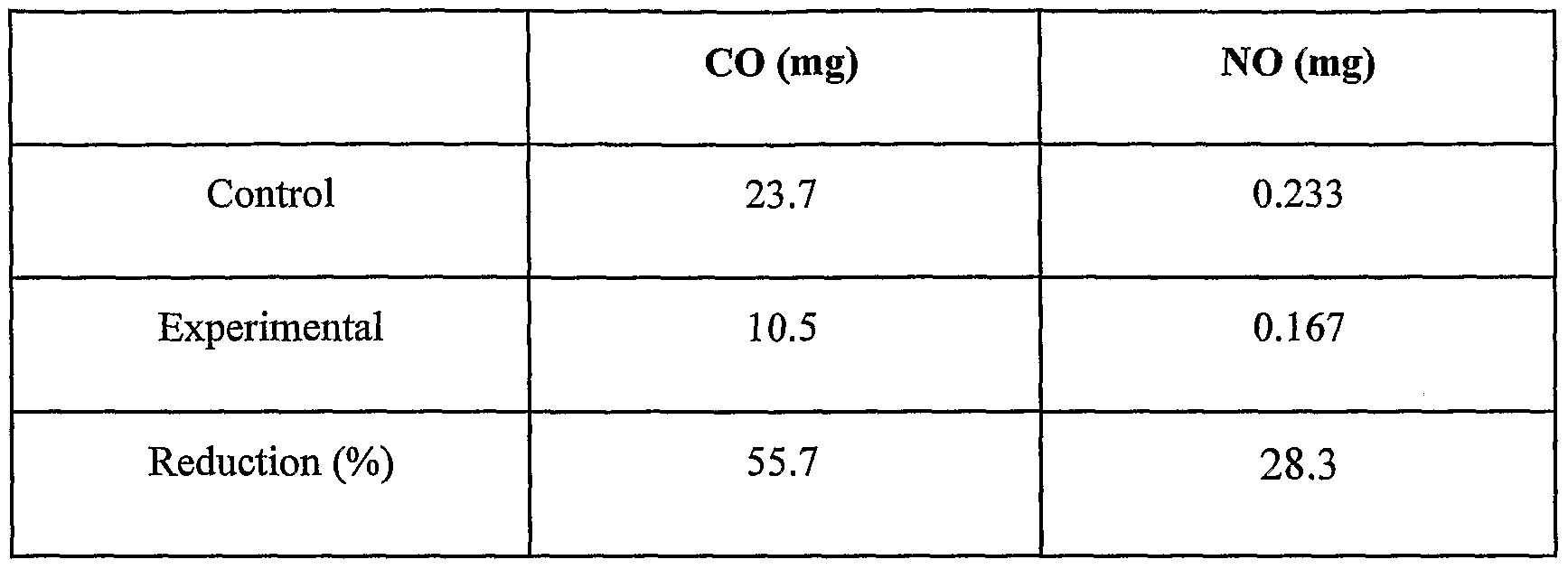
- the catalyst was incorporated into the cut filler of an experimental cigarette that was smoked under continuous draw conditions at a flow rate of 500 ml/min.
- a multi-gas analyzer was used to measure CO and NO.
- the amount of CO and NO drawn through the experimental cigarette was compared with the amount drawn through a catalyst-free control cigarette.
- the data in Table 1 illustrate the improvement obtained by using a nanoscale particles/quartz wool catalyst.
- Table 1 Reduction of CO and NO using NANOCAT/quartz wool catalyst.
- nanoscale particles can be formed in situ on a fibrous support via the thermal decomposition of a metal precursor compound.
- Suitable precursor compounds for the metal, or metal oxide nanoscale particles are those that thermally decompose at relatively low temperatures, such as discussed above.
- the concentration of the metal precursor in the solvent generally ranges from about 0.001 molar (M) to 10 M, preferably from about 0.1 to 1 M.
- the metal precursor solution and fibrous support can be combined at about ambient temperature, e.g., by spraying or dip coating, or at elevated temperatures, e.g., through reflux.
- the temperature of the mixing typically ranges
- the mixing is preferably conducted
- the fibrous support material can be dried in air at a temperature ranging from about 23EC to a temperature below the decomposition temperature of the
- metal precursor typically a temperature between about 23EC and lOOEC.
- the dried precursor-fibrous support can be any suitable material. According to one preferred embodiment, the dried precursor-fibrous support can be any suitable material.
- the dried precursor-fibrous support can be combined with cut filler.
- the metal precursor can be decomposed to form nanoscale particles that are dispersed within or on the fibrous support by thermally treating the metal precursor to above its decomposition temperature. Thermal treatment causes decomposition of the metal precursor to dissociate the constituent metal atoms, whereby the metal atoms may combine to form nanoscale metal or metal oxide particles. Where the metal precursor comprises more than one metallic element, the nanoscale particles may have an atomic ratio approximately equal to the stoichiometric ratio of the metals in the metal precursor solution.
- the thermal treatment can be carried out in various atmospheres.
- the fibrous support can be contacted with a metal precursor solution and
- the contacted support can be heated in the presence of an oxidizing atmosphere and then heated in the substantial absence of an oxidizing atmosphere to form nanoscale
- the oxidizing atmosphere can comprise air or oxygen.
- the fibrous support can be contacted with a metal precursor solution and the contacted support can be heated in an inert or reducing atmosphere to form nanoscale metal particles.
- the reducing atmosphere can comprise hydrogen, nitrogen, ammonia, carbon dioxide and mixtures thereof.
- a preferred reducing atmosphere is a hydrogen-nitrogen mixture (e.g., forming gas).
- the metal precursor-contacted support is preferably heated to a temperature equal to or greater than the decomposition temperature of the metal precursor.
- the preferred heating temperature will depend on the particular ligands used as well as on the degradation temperature of the metal(s) and any other desired groups which are to remain. However, the preferred temperature is from about
- uniformly dispersed metal precursor preferably results in the uniform deposition of nanoscale particles within and/or on the surface of the fibrous support.
- nanoscale copper oxide particles were formed on
- quartz wool by uniformly mixing quartz wool with a 0.5 M solution of copper pentane dionate in alcohol to the point of incipient wetness.
- the support was dried
- a metal precursor and a fibrous support can be combined in any suitable ratio to give a desired loading of metal particles on the support.
- iron oxalate or copper pentane dionate can be combined with quartz wool to produce from about 0.1% to 50% wt.%, e.g., 10 wt.% or 20 wt.% nanoscale particles of iron oxide, iron oxyhydroxide or copper oxide on quartz wool.
- the fibrous support may include any thermally stable/fire resistant material which, when heated to a temperature at which a metal precursor is converted to a metal on the surface thereof, does not melt, vaporize completely, or otherwise become incapable of supporting nanoscale particles.
- the oxide nanoscale particles may become reduced.
- nanoscale Fe 2 O 3 particles may be reduced to Fe 3 O 4 , FeO or Fe during the reaction of CO to CO 2 .
- the fibrous support advantageously acts as a spacer between the nanoscale particles and prevents them from sintering together, which would result in a loss of surface area and catalytic activity.
- Iron oxide is a preferred constituent in the catalyst because it may have a dual function as a CO catalyst in the presence of oxygen, and as a CO and/or NO oxidant for the direct oxidation of CO in the absence of oxygen and/or reduction of NO.
- a catalyst that can also be used as an oxidant is especially useful for certain
- nanoscale particles 50 mg samples
- SFIO Superfine Iron Oxide
- Fe 2 O 3 nanoscale particles are capable of acting as both an oxidant for the conversion of carbon monoxide to carbon dioxide and as a catalyst for the conversion of carbon monoxide to carbon dioxide and/or nitric oxide to nitrogen.
- the Fe 2 O 3 nanoscale particles can act as a catalyst in the pyrolysis zone and can act as an oxidant in the combustion zone.
- Nanoscale iron oxide particles can act as a catalyst for the conversion
- particles can act as a oxidant for the conversion of CO to CO 2 according to the
- Figure 3 illustrates a comparison between the temperature dependence of conversion rate for
- Table 2 shows a comparison between the ratio of carbon monoxide to carbon dioxide, and the percentage of oxygen depletion when using CuO and Fe 2 O 3 nanoscale particles.
- carbon dioxide is about 0.51 and the oxygen depletion is about 48%.
- the data in Table 2 illustrate the improvement obtained by using nanoscale particles.
- the ratio of carbon monoxide to carbon dioxide drops to 0.29 and 0.23 for CuO and Fe 2 O 3 nanoscale particles, respectively.
- the oxygen depletion increases to 67% and 100% for CuO and Fe 2 O nanoscale particles, respectively.
- the catalysts will preferably be distributed throughout the tobacco rod portion of a cigarette. By providing the catalysts throughout the tobacco rod, it
- the catalysts which comprise nanoscale particles supported on a fibrous support, may be provided along the length of a tobacco rod by distributing the catalysts on the tobacco or incorporating them into the cut filler tobacco.
- the catalysts may also be added to the cut filler tobacco stock supplied to the cigarette making machine or added to a tobacco rod prior to wrapping cigarette paper around the cigarette rod.
- heating the fibrous support comprising a metal precursor solution to a temperature sufficient to thermally decompose the metal precursor into nanoscale particles can be performed prior to adding the impregnated support to the cigarette.
- the amount of the catalyst can be selected such that the amount of carbon monoxide and/or nitric oxide in mainstream smoke is reduced during smoking of a cigarette.
- the amount of the catalyst will be a catalytically
- effective amount e.g., from about a few milligrams, for example, 5 mg/cigarette, to about 200 mg/cigarette or more.
- One embodiment provides a cut filler composition
- tobacco comprising tobacco and at least one catalyst, as described above, which is capable of converting carbon monoxide to carbon dioxide and/or nitric oxide to nitrogen, where the catalyst is in the form of a nanoscale metal particles and/or nanoscale metal oxide particles supported on a fibrous support.
- Any suitable tobacco mixture may be used for the cut filler.
- suitable types of tobacco materials include flue-cured, Burley, Maryland or Oriental tobaccos, the rare or specialty tobaccos, and blends thereof.
- the tobacco material can be provided in the form of tobacco lamina, processed tobacco materials such as volume expanded or puffed tobacco, processed tobacco stems such as cut-rolled or cut-puffed stems, reconstituted tobacco materials, or blends thereof.
- the tobacco can also include tobacco substitutes.
- the tobacco is normally employed in the form of cut filler, i.e. in the form of shreds or strands cut into widths ranging from about 1/10 inch to about 1/20 inch or even 1/40 inch.
- the lengths of the strands range from between about 0.25 inches to about 3.0 inches.
- the cigarettes may further comprise one or more flavorants or other additives (e.g. burn additives, combustion modifying agents, coloring agents, binders, etc.) known in the art.
- Another embodiment provides a cigarette comprising a tobacco rod
- the tobacco rod comprises tobacco cut filler having at least one catalyst, as described above, which is capable of converting carbon monoxide to carbon dioxide and/or nitric oxide to nitrogen.
- tobacco cut filler having at least one catalyst, as described above, which is capable of converting carbon monoxide to carbon dioxide and/or nitric oxide to nitrogen.
- a further embodiment provides a method of making a cigarette, comprising (i) adding a catalyst to a tobacco cut filler, cigarette paper and/or a cigarette filter; (ii) providing the cut filler to a cigarette making machine to form a tobacco column; (iii) placing a paper wrapper around the tobacco column to form a tobacco rod; and (iv) optionally attaching a cigarette filter to the tobacco rod to form
- any conventional or modified cigarette making technique may be used to incorporate the catalysts.
- the resulting cigarettes can be manufactured to any known specifications using standard or modified cigarette making techniques and equipment.
- the cut filler composition is optionally combined with other cigarette additives, and provided to a cigarette making machine to produce a tobacco rod, which is then wrapped in cigarette paper, and optionally tipped with filters.
- Cigarettes may range from about 50 mm to about 120 mm in length. Generally, a regular cigarette is about 70 mm long, a "King Size” is about 85 mm long, a “Super King Size” is about 100 mm long, and a “Long” is usually about 120 mm in length.
- the circumference is from about 15 mm to about 30 mm in circumference, and preferably around 25 mm.
- the tobacco packing density is typically between the range of about 100 mg/cm 3 to about 300 mg/cm 3 , and
- Yet another embodiment provides a method of smoking the cigarette described above, which involves lighting the cigarette to form smoke and drawing the smoke through the cigarette, wherein during the smoking of the cigarette, the catalyst acts as a catalyst for the conversion of carbon monoxide to carbon dioxide and/or nitric oxide to nitrogen.
Landscapes
- Chemical & Material Sciences (AREA)
- Chemical Kinetics & Catalysis (AREA)
- General Chemical & Material Sciences (AREA)
- Health & Medical Sciences (AREA)
- General Health & Medical Sciences (AREA)
- Toxicology (AREA)
- Engineering & Computer Science (AREA)
- Materials Engineering (AREA)
- Inorganic Chemistry (AREA)
- Nanotechnology (AREA)
- Organic Chemistry (AREA)
- Catalysts (AREA)
- Cigarettes, Filters, And Manufacturing Of Filters (AREA)
- Manufacture Of Tobacco Products (AREA)
- Carbon And Carbon Compounds (AREA)
Abstract
Description

Claims
Priority Applications (14)
| Application Number | Priority Date | Filing Date | Title |
|---|---|---|---|
| EA200600031A EA008235B1 (en) | 2003-06-13 | 2004-06-10 | Catalyst to reduce carbon monoxide and nitric oxide from the mainstream smoke of a cigarette |
| KR1020057023677A KR101145045B1 (en) | 2003-06-13 | 2004-06-10 | Catalyst to Reduce Carbon Monoxide and Nitric Oxide from the Mainstream Smoke of a Cigarette |
| PL04743844T PL1635656T3 (en) | 2003-06-13 | 2004-06-10 | Catalyst to reduce carbon monoxide and nitric oxide from the mainstream smoke of a cigarette |
| BRPI0411419-1A BRPI0411419B1 (en) | 2003-06-13 | 2004-06-10 | Cigarette comprising cut filler and catalyst for converting carbon monoxide to carbon dioxide and / or nitric oxide to nitrogen and their method of production |
| AU2004246879A AU2004246879B2 (en) | 2003-06-13 | 2004-06-10 | Catalyst to reduce carbon monoxide and nitric oxide from the mainstream smoke of a cigarette |
| CA2527569A CA2527569C (en) | 2003-06-13 | 2004-06-10 | Catalyst to reduce carbon monoxide and nitric oxide from the mainstream smoke of a cigarette |
| HK06106417.6A HK1083992B (en) | 2003-06-13 | 2004-06-10 | Catalyst to reduce carbon monoxide and nitric oxide from the mainstream smoke of a cigarette |
| DE602004014764T DE602004014764D1 (en) | 2003-06-13 | 2004-06-10 | CATALYST FOR LOWERING CARBON MONOXIDE AND NITROGEN OXIDE FROM THE MAIN POWER OF A CIGARETTE |
| EP04743844A EP1635656B1 (en) | 2003-06-13 | 2004-06-10 | Catalyst to reduce carbon monoxide and nitric oxide from the mainstream smoke of a cigarette |
| MXPA05013557A MXPA05013557A (en) | 2003-06-13 | 2004-06-10 | Catalyst to reduce carbon monoxide and nitric oxide from the mainstream smoke of a cigarette. |
| JP2006516589A JP4773956B2 (en) | 2003-06-13 | 2004-06-10 | Catalysts for reducing carbon monoxide and nitric oxide from cigarette mainstream smoke. |
| UAA200600253A UA82106C2 (en) | 2003-06-13 | 2004-10-06 | Composition of filler and cigarette containing catalyst for reduction of content of carbon monoxide and nitric oxide in smoke and method for making cigarette |
| IL172083A IL172083A (en) | 2003-06-13 | 2005-11-21 | Catalyst to reduce carbon monoxide and nitric oxide from the mainstream smoke of cigarette |
| NO20060188A NO20060188L (en) | 2003-06-13 | 2006-01-12 | Catalyst for reducing the amount of carbon monoxide and nitric oxide in the main stream of smoke from a cigarette |
Applications Claiming Priority (2)
| Application Number | Priority Date | Filing Date | Title |
|---|---|---|---|
| US10/460,303 US7152609B2 (en) | 2003-06-13 | 2003-06-13 | Catalyst to reduce carbon monoxide and nitric oxide from the mainstream smoke of a cigarette |
| US10/460,303 | 2003-06-13 |
Publications (2)
| Publication Number | Publication Date |
|---|---|
| WO2004110184A2 true WO2004110184A2 (en) | 2004-12-23 |
| WO2004110184A3 WO2004110184A3 (en) | 2005-02-10 |
Family
ID=33510973
Family Applications (1)
| Application Number | Title | Priority Date | Filing Date |
|---|---|---|---|
| PCT/IB2004/002176 Ceased WO2004110184A2 (en) | 2003-06-13 | 2004-06-10 | Catalyst to reduce carbon monoxide and nitric oxide from the mainstream smoke of a cigarette |
Country Status (20)
| Country | Link |
|---|---|
| US (1) | US7152609B2 (en) |
| EP (1) | EP1635656B1 (en) |
| JP (1) | JP4773956B2 (en) |
| KR (1) | KR101145045B1 (en) |
| CN (1) | CN100455222C (en) |
| AT (1) | ATE399475T1 (en) |
| AU (1) | AU2004246879B2 (en) |
| BR (1) | BRPI0411419B1 (en) |
| CA (1) | CA2527569C (en) |
| DE (1) | DE602004014764D1 (en) |
| EA (1) | EA008235B1 (en) |
| IL (1) | IL172083A (en) |
| MA (1) | MA27876A1 (en) |
| MX (1) | MXPA05013557A (en) |
| NO (1) | NO20060188L (en) |
| PL (1) | PL1635656T3 (en) |
| PT (1) | PT1635656E (en) |
| UA (1) | UA82106C2 (en) |
| WO (1) | WO2004110184A2 (en) |
| ZA (1) | ZA200509485B (en) |
Cited By (7)
| Publication number | Priority date | Publication date | Assignee | Title |
|---|---|---|---|---|
| WO2008056011A1 (en) | 2006-11-07 | 2008-05-15 | Universidad De Alicante | Tobacco/catalyst mixtures for reducing toxic compounds in tobacco smoke |
| JP2008246447A (en) * | 2007-03-30 | 2008-10-16 | Taiyo Kagaku Co Ltd | Nitric oxide remover |
| JP2009519726A (en) * | 2005-12-20 | 2009-05-21 | フィリップ・モーリス・プロダクツ・ソシエテ・アノニム | Metal-containing nanowires prepared using mesoporous molecular sieves as templates and their use in smoking articles |
| US7856992B2 (en) | 2005-02-09 | 2010-12-28 | Headwaters Technology Innovation, Llc | Tobacco catalyst and methods for reducing the amount of undesirable small molecules in tobacco smoke |
| US8353301B2 (en) | 2003-07-11 | 2013-01-15 | Schweitzer-Mauduit International, Inc. | Smoking articles having reduced carbon monoxide delivery |
| US10264816B2 (en) | 2012-05-03 | 2019-04-23 | British American Tobacco (Investments) Limited | Smoking article filters |
| US10440990B2 (en) | 2011-12-29 | 2019-10-15 | Philip Morris Products S.A. | Composite heat source for a smoking article |
Families Citing this family (44)
| Publication number | Priority date | Publication date | Assignee | Title |
|---|---|---|---|---|
| US7028694B2 (en) * | 2003-08-22 | 2006-04-18 | Philip Morris Usa Inc. | Method for dispersing powder materials in a cigarette rod |
| US8006703B2 (en) * | 2003-10-27 | 2011-08-30 | Philip Morris Usa Inc. | In situ synthesis of composite nanoscale particles |
| US20050166935A1 (en) * | 2003-10-27 | 2005-08-04 | Philip Morris Usa Inc. | Reduction of carbon monoxide in smoking articles using transition metal oxide clusters |
| US8051859B2 (en) * | 2003-10-27 | 2011-11-08 | Philip Morris Usa Inc. | Formation and deposition of sputtered nanoscale particles in cigarette manufacture |
| US7934510B2 (en) * | 2003-10-27 | 2011-05-03 | Philip Morris Usa Inc. | Cigarette wrapper with nanoparticle spinel ferrite catalyst and methods of making same |
| US7640936B2 (en) * | 2003-10-27 | 2010-01-05 | Philip Morris Usa Inc. | Preparation of mixed metal oxide catalysts from nanoscale particles |
| US7677254B2 (en) * | 2003-10-27 | 2010-03-16 | Philip Morris Usa Inc. | Reduction of carbon monoxide and nitric oxide in smoking articles using iron oxynitride |
| CN1306084C (en) * | 2003-11-27 | 2007-03-21 | 安徽格菱环保股份有限公司 | Modified active carbon fiber and its preparing method |
| WO2005120687A1 (en) * | 2004-06-05 | 2005-12-22 | Umicore Ag & Co. Kg | Particle filter provided with a catalytic coating |
| WO2006046145A2 (en) * | 2004-10-25 | 2006-05-04 | Philip Morris Products S.A. | Gold-ceria catalyst for oxidation of carbon monoxide |
| US7744846B2 (en) * | 2005-03-11 | 2010-06-29 | Philip Morris Usa Inc. | Method for forming activated copper oxide catalysts |
| US7357903B2 (en) | 2005-04-12 | 2008-04-15 | Headwaters Heavy Oil, Llc | Method for reducing NOx during combustion of coal in a burner |
| US8118035B2 (en) | 2005-12-13 | 2012-02-21 | Philip Morris Usa Inc. | Supports catalyst for the combustion of carbon monoxide formed during smoking |
| JP4931931B2 (en) * | 2006-03-09 | 2012-05-16 | ポステック・アカデミー‐インダストリー・ファウンデーション | Tobacco added with cucurbituril and method for producing the same |
| UA92214C2 (en) * | 2006-03-31 | 2010-10-11 | Филип Моррис Продактс С.А. | Filter element, a cigarette, comprising thereof, and a method for making the filter element |
| US20070235049A1 (en) * | 2006-03-31 | 2007-10-11 | Philip Morris Usa Inc. | Magnetic filter elements and cigarettes having magnetic filter elements |
| KR100836060B1 (en) * | 2006-04-04 | 2008-06-09 | 한국에너지기술연구원 | Highly Conductive Scandia Stabilized Zirconia and Manufacturing Method of Electrolyte Using the Same |
| US7910514B2 (en) | 2007-08-09 | 2011-03-22 | Nissan Motor Co., Ltd. | Inorganic fiber catalyst, production method thereof and catalyst structure |
| CN102046751B (en) * | 2008-04-18 | 2013-08-28 | 圣戈班磨料磨具有限公司 | High porosity abrasive articles and methods of manufacturing same |
| TW201026242A (en) * | 2008-11-06 | 2010-07-16 | Japan Tobacco Inc | Smoking article and manufacturing method for the same, and method for manufacturing carbon monoxide reducer |
| FR2945966B1 (en) * | 2009-05-28 | 2014-06-20 | Centre Nat Rech Scient | USE OF A POROUS CRYSTALLINE HYBRID SOLID AS A CATALYST FOR REDUCING NITROGEN OXIDES AND DEVICES |
| US8534294B2 (en) | 2009-10-09 | 2013-09-17 | Philip Morris Usa Inc. | Method for manufacture of smoking article filter assembly including electrostatically charged fiber |
| US8997755B2 (en) | 2009-11-11 | 2015-04-07 | R.J. Reynolds Tobacco Company | Filter element comprising smoke-altering material |
| US20110271968A1 (en) | 2010-05-07 | 2011-11-10 | Carolyn Rierson Carpenter | Filtered Cigarette With Modifiable Sensory Characteristics |
| US8720450B2 (en) * | 2010-07-30 | 2014-05-13 | R.J. Reynolds Tobacco Company | Filter element comprising multifunctional fibrous smoke-altering material |
| US11957163B2 (en) | 2011-04-08 | 2024-04-16 | R.J. Reynolds Tobacco Company | Multi-segment filter element including smoke-altering flavorant |
| US10609955B2 (en) | 2011-04-08 | 2020-04-07 | R.J. Reynolds Tobacco Company | Filtered cigarette comprising a tubular element in filter |
| US10064429B2 (en) | 2011-09-23 | 2018-09-04 | R.J. Reynolds Tobacco Company | Mixed fiber product for use in the manufacture of cigarette filter elements and related methods, systems, and apparatuses |
| CN102669818B (en) * | 2012-05-29 | 2014-04-16 | 红塔烟草(集团)有限责任公司 | Method for reducing release amount of carbon oxide of main stream smoke of cigarette |
| US9179709B2 (en) | 2012-07-25 | 2015-11-10 | R. J. Reynolds Tobacco Company | Mixed fiber sliver for use in the manufacture of cigarette filter elements |
| US9119419B2 (en) | 2012-10-10 | 2015-09-01 | R.J. Reynolds Tobacco Company | Filter material for a filter element of a smoking article, and associated system and method |
| CN103767058A (en) * | 2012-10-25 | 2014-05-07 | 湖北中烟工业有限责任公司 | Method for preparing reconstituted tobacco with low carbon monoxide release amount |
| UA117487C2 (en) | 2013-07-19 | 2018-08-10 | Філіп Морріс Продактс С.А. | Smoking article having a particle containing wrapper |
| CN103564637A (en) * | 2013-11-03 | 2014-02-12 | 云南瑞升烟草技术(集团)有限公司 | Method for reducing smoke CO (carbon oxide) release amount of paper-making reconstituted tobaccos |
| JP2016010750A (en) * | 2014-06-27 | 2016-01-21 | 地方独立行政法人青森県産業技術センター | Photocatalyst composite and production method thereof |
| CN105568752A (en) * | 2015-12-10 | 2016-05-11 | 民丰特种纸股份有限公司 | Preparation method of functional cigarette paper capable of reducing harmful ingredients of smoke |
| CN108256286B (en) * | 2018-01-10 | 2021-07-02 | 内蒙古工业大学 | Reaction Mechanism Study of Amphoteric Water-Soluble Catalyst for Aerobic Oxidation of Benzyl Alcohol to Benzaldehyde |
| US11311044B2 (en) | 2020-01-17 | 2022-04-26 | Good Tree International, Inc. | Hollow leaf tube with flavor capsule |
| US11700879B2 (en) | 2021-02-26 | 2023-07-18 | Good Tree International, Inc. | Smoking accessory with filter and filter having a flavor capsule |
| US11744281B2 (en) | 2021-03-24 | 2023-09-05 | Good Tree International, Inc. | Hollow conical member with flavor capsule |
| US11969008B2 (en) | 2021-03-24 | 2024-04-30 | Good Tree International, Inc. | Filters and elongated members formed of palm paper and having a flavor capsule |
| US12167747B2 (en) | 2021-10-26 | 2024-12-17 | Good Tree International, Inc. | Filter having a shaped rim structure and a flavor capsule |
| CN117256915A (en) * | 2023-10-23 | 2023-12-22 | 云南中烟工业有限责任公司 | A kind of magnetic reconstructed tobacco leaf, its preparation method and use |
| CN117137172A (en) * | 2023-10-23 | 2023-12-01 | 云南中烟工业有限责任公司 | A kind of magnetic laminated reconstituted tobacco leaf, its preparation method and use |
Family Cites Families (103)
| Publication number | Priority date | Publication date | Assignee | Title |
|---|---|---|---|---|
| US538A (en) * | 1837-12-26 | Self-separating link for connecting railroad-cars and locomotives | ||
| US629978A (en) * | 1898-08-26 | 1899-08-01 | Carl Bieberstein | Coin-freed apparatus for distributing electric currents.. |
| US3292636A (en) * | 1964-05-04 | 1966-12-20 | Union Carbide Corp | Smoking tobacco preparation |
| GB1204353A (en) | 1967-11-30 | 1970-09-09 | Chem Seek Inc | Carbon-coated alumina |
| US3720214A (en) * | 1970-12-03 | 1973-03-13 | Liggett & Myers Inc | Smoking composition |
| AU4252472A (en) * | 1971-06-11 | 1973-11-22 | British American Tobacco Co | Reconstituted-tobacco smoking materials |
| US3931824A (en) * | 1973-09-10 | 1976-01-13 | Celanese Corporation | Smoking materials |
| US4109663A (en) * | 1974-10-17 | 1978-08-29 | Takeda Chemical Industries, Ltd. | Tobacco product containing a thermo-gelable β-1,3-glucan-type polysaccharide |
| US4197861A (en) * | 1975-06-24 | 1980-04-15 | Celanese Corporation | Smoking material |
| AU1871276A (en) * | 1975-11-11 | 1978-04-20 | Brown & Williamson Tobacco Corp | Tobacco |
| US4108151A (en) * | 1975-12-10 | 1978-08-22 | Olin Corporation | Gamma alumina filled paper wrapper for smoking articles |
| NL7600738A (en) * | 1976-01-23 | 1977-07-26 | Plasmainvent Ag | DEVICE FOR PLASMA SYRINGES. |
| DE2740011A1 (en) * | 1977-09-06 | 1979-03-08 | Bat Cigarettenfab Gmbh | METHOD FOR REMOVING NITROGEN MONOXIDE AND CARBON MONOXIDE FROM TOBACCO SMOKE AND TOBACCO MATERIAL, SMOKE FILTER AND CIGARETTE PAPER FOR ITS IMPLEMENTATION |
| GB2013476B (en) | 1978-01-20 | 1983-04-07 | Gallaher Ltd | Smoking products |
| US4256609A (en) * | 1978-01-20 | 1981-03-17 | Gallaher Limited | Catalysts |
| US4317460A (en) * | 1978-01-20 | 1982-03-02 | Gallaher Limited | Smoking products |
| US4195645A (en) * | 1978-03-13 | 1980-04-01 | Celanese Corporation | Tobacco-substitute smoking material |
| FR2424061A1 (en) * | 1978-04-25 | 1979-11-23 | Lyon Applic Catalytiques | NEW CONTACT MASS FOR HETEROGENOUS CATALYSIS |
| US4463030A (en) * | 1979-07-30 | 1984-07-31 | Graham Magnetics Incorporated | Process for forming novel silver powder composition |
| FR2483804A2 (en) * | 1980-06-04 | 1981-12-11 | Applic Catalytiques Ste Ly | NEW CONTACT MASS FOR HETEROGENEOUS CATALYSIS |
| DE3267865D1 (en) * | 1981-03-26 | 1986-01-23 | Gallaher Ltd | Catalysts and their production |
| US4450847A (en) * | 1982-04-07 | 1984-05-29 | Olin Corporation | Wrapper for smoking articles and method |
| US4489739A (en) * | 1982-05-24 | 1984-12-25 | Kimberly-Clark Corporation | Smokable tobacco composition and method of making |
| GB8300554D0 (en) * | 1983-01-10 | 1983-02-09 | Atomic Energy Authority Uk | Catalyst preparation |
| US4453553A (en) * | 1983-01-24 | 1984-06-12 | Cohn Charles C | Treatment of cigarette paper |
| US4744374A (en) * | 1983-12-27 | 1988-05-17 | Scopas Technology Company, Inc. | Hydrophobic, crystalline, microporous silaceous materials of regular geometry |
| JPS60216843A (en) * | 1984-04-03 | 1985-10-30 | Patent Puromooto Center:Kk | Catalytic filter for oxidizing reducing gas |
| US4957710A (en) * | 1985-01-11 | 1990-09-18 | Toyota Motor Corporation | Catalytic combustion type exhaust gas processing device and drying furnace for use in coating utilizing the same |
| CA1244817A (en) * | 1985-06-27 | 1988-11-15 | Hugues Menard | Filter for removing cancer causing compounds from exhaust fumes |
| US4763674A (en) * | 1986-04-16 | 1988-08-16 | Hercules Incorporated | Method and device for controlling hydrogen cyanide and nitric oxide concentrations in cigarette smoke |
| GB8609603D0 (en) | 1986-04-19 | 1986-05-21 | Hardy L R | Tobacco products |
| US4855274A (en) * | 1987-08-31 | 1989-08-08 | The United States Of America As Represented By The Administrator Of The National Aeronautics And Space Administration | Process for making a noble metal on tin oxide catalyst |
| GB8819291D0 (en) * | 1988-08-12 | 1988-09-14 | British American Tobacco Co | Improvements relating to smoking articles |
| US5040551A (en) * | 1988-11-01 | 1991-08-20 | Catalytica, Inc. | Optimizing the oxidation of carbon monoxide |
| DE3842771A1 (en) * | 1988-12-19 | 1990-06-21 | Patent Treuhand Ges Fuer Elektrische Gluehlampen Mbh | HIGH PRESSURE DISCHARGE LAMP OF SMALL ELECTRICAL POWER AND METHOD FOR OPERATING |
| US5211684A (en) * | 1989-01-10 | 1993-05-18 | R. J. Reynolds Tobacco Company | Catalyst containing smoking articles for reducing carbon monoxide |
| US4991181A (en) * | 1989-01-18 | 1991-02-05 | The United States Of America As Represented By The Administrator Of The National Aeronautics And Space Administration | Catalyst for carbon monoxide oxidation |
| US5017357A (en) * | 1989-06-14 | 1991-05-21 | Phillips Petroleum Company | Catalytic process for oxidation of carbon monoxide |
| US4956330A (en) * | 1989-06-19 | 1990-09-11 | Phillips Petroleum Company | Catalyst composition for the oxidation of carbon monoxide |
| US4940686A (en) * | 1989-08-07 | 1990-07-10 | Phillips Petroleum Company | Catalyst for oxidation of carbon monoxide |
| US5101839A (en) * | 1990-08-15 | 1992-04-07 | R. J. Reynolds Tobacco Company | Cigarette and smokable filler material therefor |
| US5129408A (en) * | 1990-08-15 | 1992-07-14 | R. J. Reynolds Tobacco Company | Cigarette and smokable filler material therefor |
| US5105836A (en) * | 1989-09-29 | 1992-04-21 | R. J. Reynolds Tobacco Company | Cigarette and smokable filler material therefor |
| FR2665184B1 (en) * | 1990-07-24 | 1993-10-15 | Centre Nal Recherc Scientifique | ALUMINA / METAL COMPOSITE POWDERS, CERMETS PRODUCED FROM SAID POWDERS AND METHODS OF MANUFACTURE. |
| US5139824A (en) * | 1990-08-28 | 1992-08-18 | Liburdi Engineering Limited | Method of coating complex substrates |
| US5258340A (en) * | 1991-02-15 | 1993-11-02 | Philip Morris Incorporated | Mixed transition metal oxide catalysts for conversion of carbon monoxide and method for producing the catalysts |
| US5591368A (en) * | 1991-03-11 | 1997-01-07 | Philip Morris Incorporated | Heater for use in an electrical smoking system |
| KR0130128B1 (en) * | 1991-07-16 | 1998-04-09 | 다니이 아끼오 | Heating element for deodorization |
| US5281447A (en) * | 1991-10-25 | 1994-01-25 | International Business Machines Corporation | Patterned deposition of metals via photochemical decomposition of metal-oxalate complexes |
| US5322075A (en) * | 1992-09-10 | 1994-06-21 | Philip Morris Incorporated | Heater for an electric flavor-generating article |
| US5284166A (en) * | 1992-10-07 | 1994-02-08 | Kimberly-Clark Corporation | Method of producing brown cigarette wrapper paper |
| US5446003A (en) * | 1993-01-12 | 1995-08-29 | Philip Morris Incorporated | Production of supported particulate catalyst suitable for use in a vapor phase reactor |
| US6258974B1 (en) * | 1993-04-13 | 2001-07-10 | Southwest Research Institute | Metal oxide compositions composites thereof and method |
| US5386838A (en) * | 1993-07-09 | 1995-02-07 | Kimberly-Clark Corporation | High surface area iron-magnesium smoke suppressive compositions |
| JP3342763B2 (en) * | 1994-02-04 | 2002-11-11 | ダイセル化学工業株式会社 | Cigarette filter material |
| US5422331A (en) * | 1994-02-25 | 1995-06-06 | Engelhard Corporation | Layered catalyst composition |
| CA2196907C (en) * | 1994-09-07 | 2000-05-02 | John Lawson Beven | Smoking articles |
| US5503874A (en) * | 1994-09-30 | 1996-04-02 | General Electric Company | Method for low temperature chemical vapor deposition of aluminides containing easily oxidized metals |
| US5494704A (en) * | 1994-10-03 | 1996-02-27 | General Electric Company | Low temperature chemical vapor deposition of protective coating containing platinum |
| DE59503637D1 (en) * | 1994-10-18 | 1998-10-22 | Atotech Deutschland Gmbh | METHOD FOR DEPOSITING METAL LAYERS |
| US5585020A (en) * | 1994-11-03 | 1996-12-17 | Becker; Michael F. | Process for the production of nanoparticles |
| US5671758A (en) * | 1994-12-13 | 1997-09-30 | Rongved; Paul I. | Catalytic cigarette smoke cleaning devise and process |
| US5780101A (en) * | 1995-02-17 | 1998-07-14 | Arizona Board Of Regents On Behalf Of The University Of Arizona | Method for producing encapsulated nanoparticles and carbon nanotubes using catalytic disproportionation of carbon monoxide |
| WO1996038212A2 (en) * | 1995-05-23 | 1996-12-05 | United Technologies Corp | Back-side illuminated organic pollutant removal system |
| DE69623252T2 (en) * | 1995-09-07 | 2003-04-10 | Japan Tobacco Inc., Tokio/Tokyo | CIGARETTE PAPER FOR TOBACCO PRODUCTS |
| JPH09241709A (en) * | 1996-03-11 | 1997-09-16 | Murata Mfg Co Ltd | Production of copper powder |
| US5702836A (en) * | 1996-05-03 | 1997-12-30 | University Of Massachusetts | Electrocatalyst |
| US6121191A (en) * | 1996-09-20 | 2000-09-19 | Teruo Komatsu | Ultrafine metal particle carrying photocatalyst, highly function material loaded with the photocatalyst, and method of manufacturing them |
| WO1998016125A1 (en) * | 1996-10-15 | 1998-04-23 | Rothmans, Benson & Hedges, Inc. | Cigarette sidestream smoke and free-burn rate control device |
| US5934289A (en) * | 1996-10-22 | 1999-08-10 | Philip Morris Incorporated | Electronic smoking system |
| JP3466856B2 (en) * | 1997-02-05 | 2003-11-17 | トヨタ自動車株式会社 | Exhaust gas purification catalyst and method for producing the same |
| US5766562A (en) * | 1997-03-10 | 1998-06-16 | Ford Global Technologies, Inc. | Diesel emission treatment using precious metal on titania aerogel |
| AU735668B2 (en) * | 1997-03-24 | 2001-07-12 | Materials Innovation Inc. | Method for making parts from particulate ferrous material |
| BG62687B1 (en) | 1997-05-15 | 2000-05-31 | "Ламан-Консулт"Оод | Gold catalyst for the oxidation of carbon oxide and hydrocarbons, reduction of nitrogen oxides and ozone decomposition |
| DE19721601A1 (en) * | 1997-05-23 | 1998-11-26 | Hoechst Ag | Polybetain-stabilized, palladium-containing nanoparticles, a process for their production and catalysts made therefrom for the production of vinyl acetate |
| DE19741498B4 (en) | 1997-09-20 | 2008-07-03 | Evonik Degussa Gmbh | Production of a ceramic stainless steel mesh composite |
| BG62723B1 (en) | 1997-09-29 | 2000-06-30 | "Ламан-Консулт"Оод | Gold catalyst and its application in fuel components |
| JP2004500226A (en) | 1997-10-29 | 2004-01-08 | ウニベルジテート ウルム | Nanostructure |
| DE19754304A1 (en) * | 1997-12-08 | 1999-06-10 | Hoechst Ag | Polybetaine-stabilized platinum nanoparticles, process for their preparation and use for electrocatalysts in fuel cells |
| US6132694A (en) * | 1997-12-16 | 2000-10-17 | The United States Of America As Represented By The Administrator Of The National Aeronautics And Space Administration | Catalyst for oxidation of volatile organic compounds |
| JPH11235169A (en) * | 1998-02-23 | 1999-08-31 | Daicel Chem Ind Ltd | Tobacco element and its production |
| CA2268469C (en) * | 1998-04-10 | 2004-03-23 | University Of Central Florida | Apparatus and method for photocatalytic and thermocatalytic pollution control |
| TW536395B (en) * | 1998-04-16 | 2003-06-11 | Rothmans Benson & Hedges | Cigarette sidestream smoke treatment material |
| JP2000070718A (en) * | 1998-06-17 | 2000-03-07 | Nippon Shokubai Co Ltd | Production of benzyl ester |
| US6262129B1 (en) * | 1998-07-31 | 2001-07-17 | International Business Machines Corporation | Method for producing nanoparticles of transition metals |
| DE19836585C1 (en) | 1998-08-12 | 2000-05-11 | Zsw | Au / Fe¶2¶0¶3¶ catalyst materials, process for their preparation and their use |
| US6235677B1 (en) * | 1998-08-20 | 2001-05-22 | Conoco Inc. | Fischer-Tropsch processes using xerogel and aerogel catalysts by destabilizing aqueous colloids |
| KR20000047148A (en) | 1998-12-30 | 2000-07-25 | 최상구 | Cigarette added with loess and production method thereof |
| US6053176A (en) * | 1999-02-23 | 2000-04-25 | Philip Morris Incorporated | Heater and method for efficiently generating an aerosol from an indexing substrate |
| US6348431B1 (en) * | 1999-04-19 | 2002-02-19 | Sandia National Laboratories | Method for low temperature preparation of a noble metal alloy |
| DE60038075T2 (en) * | 1999-07-02 | 2009-02-19 | Nissan Motor Co., Ltd., Yokohama-shi | emission Control system |
| US6316377B1 (en) * | 1999-09-10 | 2001-11-13 | Battelle Memorial Institute | Rare earth oxide fluoride nanoparticles and hydrothermal method for forming nanoparticles |
| US6346136B1 (en) * | 2000-03-31 | 2002-02-12 | Ping Chen | Process for forming metal nanoparticles and fibers |
| US6625341B1 (en) * | 2000-06-12 | 2003-09-23 | Vlad J. Novotny | Optical cross connect switching array system with electrical and optical position sensitive detection |
| US6353037B1 (en) * | 2000-07-12 | 2002-03-05 | 3M Innovative Properties Company | Foams containing functionalized metal oxide nanoparticles and methods of making same |
| NZ524597A (en) * | 2000-09-18 | 2005-06-24 | Rothmans Benson & Hedges | Low sidestream smoke cigarette with non-combustible treatment material |
| AU2002228901A1 (en) | 2000-11-10 | 2002-05-21 | Vector Tobacco (Bermuda) Ltd. | Method and product for removing carcinogens from tobacco smoke |
| US20040025895A1 (en) * | 2001-08-31 | 2004-02-12 | Ping Li | Oxidant/catalyst nanoparticles to reduce tobacco smoke constituents such as carbon monoxide |
| US7011096B2 (en) * | 2001-08-31 | 2006-03-14 | Philip Morris Usa Inc. | Oxidant/catalyst nanoparticles to reduce carbon monoxide in the mainstream smoke of a cigarette |
| US6769437B2 (en) | 2002-04-08 | 2004-08-03 | Philip Morris Incorporated | Use of oxyhydroxide compounds for reducing carbon monoxide in the mainstream smoke of a cigarette |
| US6782892B2 (en) * | 2002-08-30 | 2004-08-31 | Philip Morris Usa Inc. | Manganese oxide mixtures in nanoparticle form to lower the amount of carbon monoxide and/or nitric oxide in the mainstream smoke of a cigarette |
| US6857431B2 (en) * | 2002-12-09 | 2005-02-22 | Philip Morris Usa Inc. | Nanocomposite copper-ceria catalysts for low temperature or near-ambient temperature catalysis and methods for making such catalysts |
| US20040173229A1 (en) * | 2003-03-05 | 2004-09-09 | Crooks Evon Llewellyn | Smoking article comprising ultrafine particles |
-
2003
- 2003-06-13 US US10/460,303 patent/US7152609B2/en not_active Expired - Lifetime
-
2004
- 2004-06-10 KR KR1020057023677A patent/KR101145045B1/en not_active Expired - Fee Related
- 2004-06-10 BR BRPI0411419-1A patent/BRPI0411419B1/en not_active IP Right Cessation
- 2004-06-10 WO PCT/IB2004/002176 patent/WO2004110184A2/en not_active Ceased
- 2004-06-10 EP EP04743844A patent/EP1635656B1/en not_active Expired - Lifetime
- 2004-06-10 CA CA2527569A patent/CA2527569C/en not_active Expired - Fee Related
- 2004-06-10 EA EA200600031A patent/EA008235B1/en not_active IP Right Cessation
- 2004-06-10 CN CNB2004800165795A patent/CN100455222C/en not_active Expired - Fee Related
- 2004-06-10 JP JP2006516589A patent/JP4773956B2/en not_active Expired - Fee Related
- 2004-06-10 AU AU2004246879A patent/AU2004246879B2/en not_active Ceased
- 2004-06-10 PL PL04743844T patent/PL1635656T3/en unknown
- 2004-06-10 AT AT04743844T patent/ATE399475T1/en not_active IP Right Cessation
- 2004-06-10 PT PT04743844T patent/PT1635656E/en unknown
- 2004-06-10 DE DE602004014764T patent/DE602004014764D1/en not_active Expired - Lifetime
- 2004-06-10 MX MXPA05013557A patent/MXPA05013557A/en active IP Right Grant
- 2004-10-06 UA UAA200600253A patent/UA82106C2/en unknown
-
2005
- 2005-11-21 IL IL172083A patent/IL172083A/en not_active IP Right Cessation
- 2005-11-23 ZA ZA200509485A patent/ZA200509485B/en unknown
- 2005-12-09 MA MA28641A patent/MA27876A1/en unknown
-
2006
- 2006-01-12 NO NO20060188A patent/NO20060188L/en not_active Application Discontinuation
Cited By (9)
| Publication number | Priority date | Publication date | Assignee | Title |
|---|---|---|---|---|
| US8353301B2 (en) | 2003-07-11 | 2013-01-15 | Schweitzer-Mauduit International, Inc. | Smoking articles having reduced carbon monoxide delivery |
| US8443812B2 (en) | 2003-07-11 | 2013-05-21 | Schweitzer-Mauduit International, Inc. | Smoking articles having reduced carbon monoxide delivery |
| US7856992B2 (en) | 2005-02-09 | 2010-12-28 | Headwaters Technology Innovation, Llc | Tobacco catalyst and methods for reducing the amount of undesirable small molecules in tobacco smoke |
| JP2009519726A (en) * | 2005-12-20 | 2009-05-21 | フィリップ・モーリス・プロダクツ・ソシエテ・アノニム | Metal-containing nanowires prepared using mesoporous molecular sieves as templates and their use in smoking articles |
| US8578943B2 (en) | 2005-12-20 | 2013-11-12 | Philip Morris Usa Inc. | Metal-containing nanowires prepared using mesoporous molecular sieves as templates, and their use in smoking articles for removing certain gas phase constituents from tobacco smoke |
| WO2008056011A1 (en) | 2006-11-07 | 2008-05-15 | Universidad De Alicante | Tobacco/catalyst mixtures for reducing toxic compounds in tobacco smoke |
| JP2008246447A (en) * | 2007-03-30 | 2008-10-16 | Taiyo Kagaku Co Ltd | Nitric oxide remover |
| US10440990B2 (en) | 2011-12-29 | 2019-10-15 | Philip Morris Products S.A. | Composite heat source for a smoking article |
| US10264816B2 (en) | 2012-05-03 | 2019-04-23 | British American Tobacco (Investments) Limited | Smoking article filters |
Also Published As
| Publication number | Publication date |
|---|---|
| JP4773956B2 (en) | 2011-09-14 |
| WO2004110184A3 (en) | 2005-02-10 |
| BRPI0411419B1 (en) | 2014-01-28 |
| KR20060026871A (en) | 2006-03-24 |
| ZA200509485B (en) | 2006-10-25 |
| CN1805695A (en) | 2006-07-19 |
| CA2527569C (en) | 2012-09-25 |
| UA82106C2 (en) | 2008-03-11 |
| IL172083A (en) | 2010-11-30 |
| EA200600031A1 (en) | 2006-04-28 |
| KR101145045B1 (en) | 2012-05-21 |
| MA27876A1 (en) | 2006-05-02 |
| BRPI0411419A (en) | 2006-07-25 |
| ATE399475T1 (en) | 2008-07-15 |
| PL1635656T3 (en) | 2008-11-28 |
| IL172083A0 (en) | 2009-02-11 |
| EA008235B1 (en) | 2007-04-27 |
| PT1635656E (en) | 2008-08-21 |
| MXPA05013557A (en) | 2006-04-05 |
| US20040250826A1 (en) | 2004-12-16 |
| JP2007527782A (en) | 2007-10-04 |
| HK1083992A1 (en) | 2006-07-21 |
| US7152609B2 (en) | 2006-12-26 |
| EP1635656B1 (en) | 2008-07-02 |
| AU2004246879A1 (en) | 2004-12-23 |
| CN100455222C (en) | 2009-01-28 |
| NO20060188L (en) | 2006-01-12 |
| CA2527569A1 (en) | 2004-12-23 |
| EP1635656A2 (en) | 2006-03-22 |
| DE602004014764D1 (en) | 2008-08-14 |
| AU2004246879B2 (en) | 2010-05-13 |
Similar Documents
| Publication | Publication Date | Title |
|---|---|---|
| AU2004246879B2 (en) | Catalyst to reduce carbon monoxide and nitric oxide from the mainstream smoke of a cigarette | |
| US7243658B2 (en) | Nanoscale composite catalyst to reduce carbon monoxide in the mainstream smoke of a cigarette | |
| US9107452B2 (en) | Catalyst to reduce carbon monoxide in the mainstream smoke of a cigarette | |
| US8434495B2 (en) | Tobacco cut filler including metal oxide supported particles | |
| US7165553B2 (en) | Nanoscale catalyst particles/aluminosilicate to reduce carbon monoxide in the mainstream smoke of a cigarette | |
| US7568485B2 (en) | System for dispersing powder materials in a cigarette rod | |
| US20090275466A1 (en) | Preparation of intermetallics by metallo-organic decomposition | |
| HK1083992B (en) | Catalyst to reduce carbon monoxide and nitric oxide from the mainstream smoke of a cigarette | |
| ZA200509484B (en) | Catalyst to reduce carbon monoxide in the mainstream smoke of a cigarette | |
| HK1083991B (en) | Catalyst to reduce carbon monoxide in the mainstream smoke of a cigarette |
Legal Events
| Date | Code | Title | Description |
|---|---|---|---|
| AK | Designated states |
Kind code of ref document: A2 Designated state(s): AE AG AL AM AT AU AZ BA BB BG BR BW BY BZ CA CH CN CO CR CU CZ DE DK DM DZ EC EE EG ES FI GB GD GE GH GM HR HU ID IL IN IS JP KE KG KP KR KZ LC LK LR LS LT LU LV MA MD MG MK MN MW MX MZ NA NI NO NZ OM PG PH PL PT RO RU SC SD SE SG SK SL SY TJ TM TN TR TT TZ UA UG US UZ VC VN YU ZA ZM ZW |
|
| AL | Designated countries for regional patents |
Kind code of ref document: A2 Designated state(s): BW GH GM KE LS MW MZ NA SD SL SZ TZ UG ZM ZW AM AZ BY KG KZ MD RU TJ TM AT BE BG CH CY CZ DE DK EE ES FI FR GB GR HU IE IT LU MC NL PL PT RO SE SI SK TR BF BJ CF CG CI CM GA GN GQ GW ML MR NE SN TD TG |
|
| 121 | Ep: the epo has been informed by wipo that ep was designated in this application | ||
| WWE | Wipo information: entry into national phase |
Ref document number: 172083 Country of ref document: IL |
|
| WWE | Wipo information: entry into national phase |
Ref document number: 2004246879 Country of ref document: AU |
|
| WWE | Wipo information: entry into national phase |
Ref document number: 2005/09485 Country of ref document: ZA Ref document number: 200509485 Country of ref document: ZA |
|
| WWE | Wipo information: entry into national phase |
Ref document number: 2527569 Country of ref document: CA |
|
| WWE | Wipo information: entry into national phase |
Ref document number: 12005502195 Country of ref document: PH |
|
| WWE | Wipo information: entry into national phase |
Ref document number: 1020057023677 Country of ref document: KR |
|
| WWE | Wipo information: entry into national phase |
Ref document number: PA/a/2005/013557 Country of ref document: MX Ref document number: 2004743844 Country of ref document: EP Ref document number: 20048165795 Country of ref document: CN Ref document number: 2006516589 Country of ref document: JP |
|
| ENP | Entry into the national phase |
Ref document number: 2004246879 Country of ref document: AU Date of ref document: 20040610 Kind code of ref document: A |
|
| WWP | Wipo information: published in national office |
Ref document number: 2004246879 Country of ref document: AU |
|
| WWE | Wipo information: entry into national phase |
Ref document number: 200600031 Country of ref document: EA |
|
| WWP | Wipo information: published in national office |
Ref document number: 2004743844 Country of ref document: EP |
|
| WWP | Wipo information: published in national office |
Ref document number: 1020057023677 Country of ref document: KR |
|
| ENP | Entry into the national phase |
Ref document number: PI0411419 Country of ref document: BR |
|
| WWG | Wipo information: grant in national office |
Ref document number: 2004743844 Country of ref document: EP |