WO2004110453A1 - Pyrimidine derivatives as cannabinoid receptor ligands - Google Patents

Pyrimidine derivatives as cannabinoid receptor ligands Download PDF

Info

Publication number
WO2004110453A1
WO2004110453A1 PCT/IB2004/001971 IB2004001971W WO2004110453A1 WO 2004110453 A1 WO2004110453 A1 WO 2004110453A1 IB 2004001971 W IB2004001971 W IB 2004001971W WO 2004110453 A1 WO2004110453 A1 WO 2004110453A1
Authority
WO
WIPO (PCT)
Prior art keywords
alkyl
compound
aryl
heteroaryl
substituents
Prior art date
Legal status (The legal status is an assumption and is not a legal conclusion. Google has not performed a legal analysis and makes no representation as to the accuracy of the status listed.)
Ceased
Application number
PCT/IB2004/001971
Other languages
French (fr)
Inventor
Robert L. Dow
Current Assignee (The listed assignees may be inaccurate. Google has not performed a legal analysis and makes no representation or warranty as to the accuracy of the list.)
Pfizer Products Inc
Original Assignee
Pfizer Products Inc
Priority date (The priority date is an assumption and is not a legal conclusion. Google has not performed a legal analysis and makes no representation as to the accuracy of the date listed.)
Filing date
Publication date
Application filed by Pfizer Products Inc filed Critical Pfizer Products Inc
Priority to JP2006516548A priority Critical patent/JP2006527759A/en
Priority to BRPI0411617-8A priority patent/BRPI0411617A/en
Priority to CA002529068A priority patent/CA2529068A1/en
Priority to MXPA05013282A priority patent/MXPA05013282A/en
Priority to EP04736431A priority patent/EP1638570A1/en
Publication of WO2004110453A1 publication Critical patent/WO2004110453A1/en
Anticipated expiration legal-status Critical
Ceased legal-status Critical Current

Links

Classifications

    • CCHEMISTRY; METALLURGY
    • C07ORGANIC CHEMISTRY
    • C07DHETEROCYCLIC COMPOUNDS
    • C07D239/00Heterocyclic compounds containing 1,3-diazine or hydrogenated 1,3-diazine rings
    • C07D239/02Heterocyclic compounds containing 1,3-diazine or hydrogenated 1,3-diazine rings not condensed with other rings
    • C07D239/24Heterocyclic compounds containing 1,3-diazine or hydrogenated 1,3-diazine rings not condensed with other rings having three or more double bonds between ring members or between ring members and non-ring members
    • C07D239/28Heterocyclic compounds containing 1,3-diazine or hydrogenated 1,3-diazine rings not condensed with other rings having three or more double bonds between ring members or between ring members and non-ring members with hetero atoms or with carbon atoms having three bonds to hetero atoms with at the most one bond to halogen, directly attached to ring carbon atoms
    • AHUMAN NECESSITIES
    • A61MEDICAL OR VETERINARY SCIENCE; HYGIENE
    • A61PSPECIFIC THERAPEUTIC ACTIVITY OF CHEMICAL COMPOUNDS OR MEDICINAL PREPARATIONS
    • A61P1/00Drugs for disorders of the alimentary tract or the digestive system
    • A61P1/14Prodigestives, e.g. acids, enzymes, appetite stimulants, antidyspeptics, tonics, antiflatulents
    • AHUMAN NECESSITIES
    • A61MEDICAL OR VETERINARY SCIENCE; HYGIENE
    • A61PSPECIFIC THERAPEUTIC ACTIVITY OF CHEMICAL COMPOUNDS OR MEDICINAL PREPARATIONS
    • A61P15/00Drugs for genital or sexual disorders; Contraceptives
    • A61P15/10Drugs for genital or sexual disorders; Contraceptives for impotence
    • AHUMAN NECESSITIES
    • A61MEDICAL OR VETERINARY SCIENCE; HYGIENE
    • A61PSPECIFIC THERAPEUTIC ACTIVITY OF CHEMICAL COMPOUNDS OR MEDICINAL PREPARATIONS
    • A61P25/00Drugs for disorders of the nervous system
    • AHUMAN NECESSITIES
    • A61MEDICAL OR VETERINARY SCIENCE; HYGIENE
    • A61PSPECIFIC THERAPEUTIC ACTIVITY OF CHEMICAL COMPOUNDS OR MEDICINAL PREPARATIONS
    • A61P25/00Drugs for disorders of the nervous system
    • A61P25/08Antiepileptics; Anticonvulsants
    • AHUMAN NECESSITIES
    • A61MEDICAL OR VETERINARY SCIENCE; HYGIENE
    • A61PSPECIFIC THERAPEUTIC ACTIVITY OF CHEMICAL COMPOUNDS OR MEDICINAL PREPARATIONS
    • A61P25/00Drugs for disorders of the nervous system
    • A61P25/14Drugs for disorders of the nervous system for treating abnormal movements, e.g. chorea, dyskinesia
    • A61P25/16Anti-Parkinson drugs
    • AHUMAN NECESSITIES
    • A61MEDICAL OR VETERINARY SCIENCE; HYGIENE
    • A61PSPECIFIC THERAPEUTIC ACTIVITY OF CHEMICAL COMPOUNDS OR MEDICINAL PREPARATIONS
    • A61P25/00Drugs for disorders of the nervous system
    • A61P25/18Antipsychotics, i.e. neuroleptics; Drugs for mania or schizophrenia
    • AHUMAN NECESSITIES
    • A61MEDICAL OR VETERINARY SCIENCE; HYGIENE
    • A61PSPECIFIC THERAPEUTIC ACTIVITY OF CHEMICAL COMPOUNDS OR MEDICINAL PREPARATIONS
    • A61P25/00Drugs for disorders of the nervous system
    • A61P25/24Antidepressants
    • AHUMAN NECESSITIES
    • A61MEDICAL OR VETERINARY SCIENCE; HYGIENE
    • A61PSPECIFIC THERAPEUTIC ACTIVITY OF CHEMICAL COMPOUNDS OR MEDICINAL PREPARATIONS
    • A61P25/00Drugs for disorders of the nervous system
    • A61P25/26Psychostimulants, e.g. nicotine, cocaine
    • AHUMAN NECESSITIES
    • A61MEDICAL OR VETERINARY SCIENCE; HYGIENE
    • A61PSPECIFIC THERAPEUTIC ACTIVITY OF CHEMICAL COMPOUNDS OR MEDICINAL PREPARATIONS
    • A61P25/00Drugs for disorders of the nervous system
    • A61P25/28Drugs for disorders of the nervous system for treating neurodegenerative disorders of the central nervous system, e.g. nootropic agents, cognition enhancers, drugs for treating Alzheimer's disease or other forms of dementia
    • AHUMAN NECESSITIES
    • A61MEDICAL OR VETERINARY SCIENCE; HYGIENE
    • A61PSPECIFIC THERAPEUTIC ACTIVITY OF CHEMICAL COMPOUNDS OR MEDICINAL PREPARATIONS
    • A61P25/00Drugs for disorders of the nervous system
    • A61P25/30Drugs for disorders of the nervous system for treating abuse or dependence
    • A61P25/32Alcohol-abuse
    • AHUMAN NECESSITIES
    • A61MEDICAL OR VETERINARY SCIENCE; HYGIENE
    • A61PSPECIFIC THERAPEUTIC ACTIVITY OF CHEMICAL COMPOUNDS OR MEDICINAL PREPARATIONS
    • A61P29/00Non-central analgesic, antipyretic or antiinflammatory agents, e.g. antirheumatic agents; Non-steroidal antiinflammatory drugs [NSAID]
    • AHUMAN NECESSITIES
    • A61MEDICAL OR VETERINARY SCIENCE; HYGIENE
    • A61PSPECIFIC THERAPEUTIC ACTIVITY OF CHEMICAL COMPOUNDS OR MEDICINAL PREPARATIONS
    • A61P3/00Drugs for disorders of the metabolism
    • A61P3/04Anorexiants; Antiobesity agents
    • AHUMAN NECESSITIES
    • A61MEDICAL OR VETERINARY SCIENCE; HYGIENE
    • A61PSPECIFIC THERAPEUTIC ACTIVITY OF CHEMICAL COMPOUNDS OR MEDICINAL PREPARATIONS
    • A61P3/00Drugs for disorders of the metabolism
    • A61P3/08Drugs for disorders of the metabolism for glucose homeostasis
    • A61P3/10Drugs for disorders of the metabolism for glucose homeostasis for hyperglycaemia, e.g. antidiabetics
    • AHUMAN NECESSITIES
    • A61MEDICAL OR VETERINARY SCIENCE; HYGIENE
    • A61PSPECIFIC THERAPEUTIC ACTIVITY OF CHEMICAL COMPOUNDS OR MEDICINAL PREPARATIONS
    • A61P43/00Drugs for specific purposes, not provided for in groups A61P1/00-A61P41/00
    • CCHEMISTRY; METALLURGY
    • C07ORGANIC CHEMISTRY
    • C07DHETEROCYCLIC COMPOUNDS
    • C07D401/00Heterocyclic compounds containing two or more hetero rings, having nitrogen atoms as the only ring hetero atoms, at least one ring being a six-membered ring with only one nitrogen atom
    • C07D401/02Heterocyclic compounds containing two or more hetero rings, having nitrogen atoms as the only ring hetero atoms, at least one ring being a six-membered ring with only one nitrogen atom containing two hetero rings
    • C07D401/06Heterocyclic compounds containing two or more hetero rings, having nitrogen atoms as the only ring hetero atoms, at least one ring being a six-membered ring with only one nitrogen atom containing two hetero rings linked by a carbon chain containing only aliphatic carbon atoms
    • CCHEMISTRY; METALLURGY
    • C07ORGANIC CHEMISTRY
    • C07DHETEROCYCLIC COMPOUNDS
    • C07D401/00Heterocyclic compounds containing two or more hetero rings, having nitrogen atoms as the only ring hetero atoms, at least one ring being a six-membered ring with only one nitrogen atom
    • C07D401/02Heterocyclic compounds containing two or more hetero rings, having nitrogen atoms as the only ring hetero atoms, at least one ring being a six-membered ring with only one nitrogen atom containing two hetero rings
    • C07D401/12Heterocyclic compounds containing two or more hetero rings, having nitrogen atoms as the only ring hetero atoms, at least one ring being a six-membered ring with only one nitrogen atom containing two hetero rings linked by a chain containing hetero atoms as chain links
    • CCHEMISTRY; METALLURGY
    • C07ORGANIC CHEMISTRY
    • C07DHETEROCYCLIC COMPOUNDS
    • C07D403/00Heterocyclic compounds containing two or more hetero rings, having nitrogen atoms as the only ring hetero atoms, not provided for by group C07D401/00
    • C07D403/02Heterocyclic compounds containing two or more hetero rings, having nitrogen atoms as the only ring hetero atoms, not provided for by group C07D401/00 containing two hetero rings
    • C07D403/06Heterocyclic compounds containing two or more hetero rings, having nitrogen atoms as the only ring hetero atoms, not provided for by group C07D401/00 containing two hetero rings linked by a carbon chain containing only aliphatic carbon atoms
    • CCHEMISTRY; METALLURGY
    • C07ORGANIC CHEMISTRY
    • C07DHETEROCYCLIC COMPOUNDS
    • C07D403/00Heterocyclic compounds containing two or more hetero rings, having nitrogen atoms as the only ring hetero atoms, not provided for by group C07D401/00
    • C07D403/02Heterocyclic compounds containing two or more hetero rings, having nitrogen atoms as the only ring hetero atoms, not provided for by group C07D401/00 containing two hetero rings
    • C07D403/12Heterocyclic compounds containing two or more hetero rings, having nitrogen atoms as the only ring hetero atoms, not provided for by group C07D401/00 containing two hetero rings linked by a chain containing hetero atoms as chain links
    • CCHEMISTRY; METALLURGY
    • C07ORGANIC CHEMISTRY
    • C07DHETEROCYCLIC COMPOUNDS
    • C07D405/00Heterocyclic compounds containing both one or more hetero rings having oxygen atoms as the only ring hetero atoms, and one or more rings having nitrogen as the only ring hetero atom
    • C07D405/02Heterocyclic compounds containing both one or more hetero rings having oxygen atoms as the only ring hetero atoms, and one or more rings having nitrogen as the only ring hetero atom containing two hetero rings
    • C07D405/12Heterocyclic compounds containing both one or more hetero rings having oxygen atoms as the only ring hetero atoms, and one or more rings having nitrogen as the only ring hetero atom containing two hetero rings linked by a chain containing hetero atoms as chain links
    • CCHEMISTRY; METALLURGY
    • C07ORGANIC CHEMISTRY
    • C07DHETEROCYCLIC COMPOUNDS
    • C07D405/00Heterocyclic compounds containing both one or more hetero rings having oxygen atoms as the only ring hetero atoms, and one or more rings having nitrogen as the only ring hetero atom
    • C07D405/14Heterocyclic compounds containing both one or more hetero rings having oxygen atoms as the only ring hetero atoms, and one or more rings having nitrogen as the only ring hetero atom containing three or more hetero rings
    • CCHEMISTRY; METALLURGY
    • C07ORGANIC CHEMISTRY
    • C07DHETEROCYCLIC COMPOUNDS
    • C07D417/00Heterocyclic compounds containing two or more hetero rings, at least one ring having nitrogen and sulfur atoms as the only ring hetero atoms, not provided for by group C07D415/00
    • C07D417/02Heterocyclic compounds containing two or more hetero rings, at least one ring having nitrogen and sulfur atoms as the only ring hetero atoms, not provided for by group C07D415/00 containing two hetero rings
    • C07D417/12Heterocyclic compounds containing two or more hetero rings, at least one ring having nitrogen and sulfur atoms as the only ring hetero atoms, not provided for by group C07D415/00 containing two hetero rings linked by a chain containing hetero atoms as chain links

Definitions

  • the present invention relates to substituted pyrimidine-2-carboxamide compounds as cannabinoid receptor ligands, in particular CB1 receptor antagonists, and uses thereof for treating diseases, conditions and/or disorders modulated by cannabinoid receptor antagonists.
  • BMI body mass index
  • Overweight is typically defined as a BMI of 25-29.9 kg/m 2
  • obesity is typically defined as a BMI of 30 kg/m 2 .
  • Obesity is now recognized as a chronic disease that requires treatment to reduce its associated health risks.
  • weight loss is an important treatment outcome
  • one of the main goals of obesity management is to improve cardiovascular and metabolic values to reduce obesity-related morbidity and mortality. It has been shown that 5-10% loss of body weight can substantially improve metabolic values, such as blood glucose, blood pressure, and lipid concentrations. Hence, it is believed that a 5-10% intentional reduction in body weight may reduce morbidity and mortality.
  • Currently available prescription drugs for managing obesity generally reduce weight by inducing satiety or decreasing dietary fat absorption. Satiety is achieved by increasing synaptic levels of norepinephrine, serotonin, or both.
  • stimulation of serotonin receptor subtypes 1 B, 1 D, and 2C and 1 - and 2-adrenergic receptors decreases food, intake by regulating satiety. See, Bray GA, "The New Era of Drug Treatment. Pharmacologic Treatment of Obesity: Symposium Overview," Obes_Res., 3(suppl 4), 415s-7s (1995).
  • Adrenergic agents e.g., diethylpropion, , benzphetamine, phendimetrazine, mazindol, and phentermine
  • Older adrenergic weight-loss drugs e.g., amphetamine, methamphetamine, and phenmetrazine
  • amphetamine e.g., amphetamine, methamphetamine, and phenmetrazine
  • Fenfluramine and dexfenfluramine both serotonergic agents used to regulate appetite, are no longer available for use. , .
  • CB1 cannabinoid receptor antagonists/inverse agonists have been suggested as potential appetite suppressants. See, e.g., Arnone, M., et al., "Selective Inhibition of Sucrose and ( ⁇ thanol Intake by SR141716, an Antagonist of Central Cannabinoid (CB1) Receptors.” Psvchopharmacol. 132, 104-106 (1997); Colombo, G., et al., "Appetite Suppression and Weight Loss after the Cannabinoid Antagonist SR141716.” Life ScL.
  • Alcoholism affects approximately 10.9 million men and 4.4 million women in the United States. Approximately 100,000 deaths per year have been attributed to alcohol abuse or dependence. Health risks associated with alcoholism include impaired motor control and decision making, cancer, liver disease, birth defects, heart disease, drug/drug interactions, pancreatitis and interpersonal problems. Studies have suggested that endogenous cannabinoid tone plays a critical role in the control of ethanol intake.
  • the endogenous CB1 receptor antagonist SR-141716A has been shown to block voluntary ethanol intake in rats and mice.
  • the present inventio'n provides compounds of Formula (I) that act as cannabinoid receptor ligands (in particular, CB1 receptor antagonists)
  • R 1 are R 2 are each independently aryl or heteroaryl, where the aryl and the heteroaryl moieties are optionally substituted with one or more substituents, provided that R 1 and R 2 are not both a mono-substituted (C r C 4 )alkoxyphenyl;
  • R 3 is hydrogen, (C r C 4 )alkyl, or halo-substituted (C r C 4 )alkyl;
  • R 4 is -(NH) n -N(R 4a )(R 4a' ), where n is 0 or 1 , R 4a is hydrogen or an optionally substituted (C r C 8 )alkyl and R 4a' is a chemical moiety selected from the group consisting of (C r C 8 )alkyl, aryl, heteroaryl, aryl(C r C 4 )alkyl, a partially or fully saturated (C 3 -C 10 )cycloalkyl, heteroaryl
  • R 1 is phenyl substituted with one or more substituents, 2-pyridyl optionally substituted with one or more substituents, or 4-pyridyl optionally substituted with one or more substituents; more preferably, R 1 is a phenyl substituted with one to three substituents independently selected from the group consisting of halo (preferably, chloro or fluoro), (C 1 - C 4 )alkoxy, (C 1 -C 4 )alkyl, halo-substituted (CrC 4 )alkyl (preferably fluo ' ro-substituted alkyl), and cyano; most preferably, R 1 is 2-chlorophenyl, 2-fluorophenyl, 2,4- dichlorqphenyl, 2-fluoro-4-chlorophenyl, 2-chloro-4-fluorophenyl, or 2,4- difluorophenyl: and
  • R 2 is a phenyl substituted with one or more substituents or a 2-pyridyl substituted with one or more substituents; more preferably, R 2 is a phenyl substituted with one to three substituents independently selected from the group consisting of halo (preferably, chloro or fluoro), (Ci-C 4 )alkoxy, (C r C 4 )alkyl, halo-substituted (C 1 - C 4 )alkyl (preferably fluoro-substituted alkyl), and cyano; most preferably, R 2 is 4- chlorophenyl or 4-fluorpphenyl.
  • a compound of Formula (I) where R 4 is -'(NH) n -N(R 4a )(R 4a' ), where n is 0 or 1 , R 4a is hydrogen and R 4a' , is a chemical moiety selected from the group consisting of (CrC 8 )alkyl, aryl, heteroaryl, aryl(CrC 4 )alkyl, a partially or fully saturated (C 3 -C 10 )cycloalkyl, heteroaryl(Ci-C 3 )alkyl, 5-6 membered lactone, 5- to 6-membered lactam, and a 3- to 6-membered partially or fully saturated heterocycle, where said chemical moiety is optionally substituted with one or more substituents; a pharmaceutically acceptable salt thereof or a solvate or hydrate of the compound or the salt.
  • R 4a is preferably a chemical moiety selected from (C r C 8 )alkyl, phenyl(C r C 4 )alkyl, or a partially or fully saturated (C 3 - C 10 )cycloalkyl, where the chemical moiety is optionally substituted with one or more substituents (preferably, 1 to 3 substituents).
  • Preferred compounds where n is 0 include: 5-(4-chloro-phenyl)-4-(2,4-dichloro ⁇ phenyl)-pyrimidine-2-carboxylic acid benzylamide;
  • R 4 is -(NH) n -N(R 4a )(R 4a ), where n is 0, R 4a is an optionally substituted ' (CrC 8 )alkyl, and R 4a ' is a, chemical moiety selected from the group consisting of (C 1 - C 8 )alkyl, aryl, heteroaryl, 317!(C 1 -C 4 )BlRyI, a partially or fully saturated (C 3 - C 10 )cycloalkyl, heteroaryl(C r C 3 )alkyl, 5-6 membered lactone, 5- to 6-membered , lactam, and a 3- to 6-membered partially or fully saturated heterocycle, where the chemical moiety is optionally substituted with one or more substituents; a pharmaceutically acceptable salt thereof or a solvate or hydrate of the compound or the salt.
  • R 4a is preferably (C r C 6 )alkyl, and R 4a' is preferably a chemical moiety selected from (C ⁇ -C 8 )alkyl, aryl, heteroaryl, aryl(CrC 4 )alkyl, a partially or fully
  • Representative compounds of this embodiment include: 5-(4-chloro-phenyl)-4-(2,4-dichloro-phenyl)-pyrimidine-2-carboxylic acid cyclohexyl-methyl-amide;
  • a compound of Formula (I) where R 4 is -(NH) n -N(R 4a )(R 4a '), where n is 0, and R 4a and R 4a' are taken together to form a heterocycle having Formula (IA)
  • R 4b and R 4b' are each independently hydrogen, cyano, hydroxy, amino, H 2 NC(O)-, or a chemical moiety selected from the group consisting of (Ci-C 6 )alkyl, (CrC ⁇ )alkoxy, acyloxy, acyl, (C r C 3 )alkyl-O-C(O)-, (C r C 4 )alkyl-NH-C(O)-, (C 1 - C 4 )alkyl) 2 N-C(O)-, (C r C 6 )alkylamino-, ((C r C 4 )alkyl) 2 amino-, (C 3 -C 6 )cycloalkylamino-, acylamino-, aryl(C r C 4 )alkylamino-, heteroaryKCrC ⁇ Jalkylamino 1 , aryl, heteroaryl, a 3- 6 membered partially or fully saturated heterocycle, ,and
  • X is a bond, -CH 2 CH 2 - Or -C(R 4c )(R 4c' )-, where R 4c and R 4c' are each independently hydrogen, cyano, hydroxy, amino, H 2 NC(O)-, or a chemical moiety , selected from the group consisting of (C r C 6 )alkyl, (Ci-C 6 )alkoxy, acyloxy, acyl, (C 1 - C 3 )alkyl-O-C(O)-, (C r C 4 )alkyl-NH-C(O)-, ((CrC 4 )alkylj 2 N-C(O)-, (C r C 6 )alkylamino-, di(C- ⁇ -C 4 )alkylamino-, (Cs-Cejcycloalkylamino-, acylamino-, aryl(C 1 -C 4 )alkylamino-, heteroaryl(C
  • Y is oxygen, sulfur, -C(O)-, or -C(R 4d )(R 4d' )-, where R 4d and R 4d' are each independently hydrogen, cyano, hydroxy, amino, H 2 NC(O)-, or a chemical moiety selected from the group consisting of (CrC 6 )alkyl, (C 1 -C 6 JaIkOXy, acyloxy, acyl, (C 1 - C 3 )alkyl-O-C(O)-, (C r C 4 )alkyl-NH-C(O)-, ((C r C 4 )alkyl) 2 N-C(O)-, (C r C 6 )alkylamino-, di(CrC 4 )alkylamino-, (C 3 -C 6 )cycloalkylamino-, acylamino-, aryl(CrC 4 )alkylamino-, heteroaryl(Ci-
  • R 4d' or R 4d" taken together with R 4c , R 4c' , R 4e , or R 4e' forms a fused aromatic ring
  • Y is -NR 4d " -, where R 4d" is a hydrogen or a chemical moiety selected from the group consisting of (Ci-C 6 )alkyl, (C 3 -C 6 )cycloalkyl, (C r C 3 )alkylsulfonyl-, (C r C 3 )alkylaminosulfonyl-, di(C 1 -C 3 )alkylaminosulfonyl-, acyl, (C r C 6 )alkyl-O-C(O)-, aryl, and heteroaryl, where said moiety is optionally substituted with one or more substituents;
  • Z is a bond, -CH 2 CH 2 -, or -C(R 4e )(R 4e' )-, where R 4
  • R 4f and R 4f are each independently hydrogen, cyano, hydroxy, amino, H 2 NC(O)-, or a chemical moiety selected from the group consisting of (CrC 6 )alkyl, (CrC ⁇ )alkoxy, acyloxy, acyl, (C r C 3 )alkyl-O-C(O)-, (C r C 4 )alkyl-N H-C(O)-, ((C 1 - C 4 )alkyl) 2 N-C(O)-, (C r C 6 )alkylamino-, di(Ci-C 4 )alkylamino-, (C 3 -C 6 )cycloalkylamino-, acylamino-, aryl(CrC 4 )alkylamino-, heteroaryl(C r C 4 )alkylamino-, aryl, heteroaryl, a 3- 6 membered partially or fully saturated heterocycle, and a 3-6
  • R 4b is hydrogen, an optionally substituted (C r C 3 )alkyl, or taken , together with R 4e , R 4e' , R 4f , or R 4f forms a bond, a methylene bridge, or an ethylene bridge;
  • R 4b is hydrogen, an optionally substituted (C r C 3 )alkyl, or taken together with R 4 ⁇ , R 4e ', R 4f , or R 4f forms a bond, a methylene bridge, or an ethylene bridge;
  • R 4f is hydrogen, an optionally substituted (C r C 3 )alkyl, or taken together with R 4b , R 4b' , R 4c , or R 4c' forms a bond, a methylene, bridge, or an ethylene bridge;
  • R 4f is hydrogen, an optionally substituted (C r C 3 )alkyl, or taken together with 'R 4b , R 4b> , R 4c , or R 4c
  • R 4d is preferably a hydrogen, heteroary, or an optionally substituted (C r C 6 )alkyl
  • X is -CH 2 CH 2 - or -C(R 4c )(R 4c' )-, where R 4 ° and, R 4c' are each independently hydrogen, or an optionally substituted (Ci-C 6 )alkyl, or either , ' R 40 Or R 4c' taken together with R 4e , R 4e' , R 4f , or R 4f forms a bond, a methylene bridge or an ethylene bridge; and Z is -CH 2 CH 2 - or -C(R 4e )(R 4 ⁇ ' )-, where R 4e and R 4e' are each independently hydrogen, or an optionally substituted (CrC 6 )alkyl, or either R 4e or R 4e' taken together with R 4b , R 4b' , R 4c ,
  • Preferred compounds include:
  • R 4d is preferably hydrogen, cyano, hydroxy, amino, H 2 NC(O)-, or a chemical moiety selected from the group consisting of (C 1 - C 6 )alkyl, (C r C 6 )alkoxy, acyloxy, acyl, (CrC 3 )alkyl-O-C(O)-, (C r C 4 )alkyl-NH-C(O)-, ((C r C 4 )alkyl) 2 N-C(O)-, (C r C 6 )alkylamino-, ((C r C 4 )alkyl) 2 amino-, (C 3 - C 6 )cycloalkylamino-, acylamino-, aryl(CrC 4 )alkylamino-, heteroaryl(CrC 4 )alkylarnino- , (C r C 6
  • R 4d' is hydrogen, H 2 NC(O)-, or a chemical moiety selected from the group consisting of (CrC 6 )alkyl, acyl, (C r C 3 )alkyl-O-C(O)-, (C r C 4 )alkyl-NH-C(O)-, (C 1 - C 4 )alkyl) 2 NrC(O)-, aryl, heteroaryl, a 3-6 membered partially or fully saturated heterocycle, and a 3-6 membered partially or fully saturated carbocyclic ring, where the moiety is optionally substituted with one or more substituents; or either R 4d or R 4d" taken together with R 4c , R 4c> , R 4e , or R 4e' forms a fused aromatic ring; X is a bond or -C(R 4c )(R 4c' )-, where R 4c and R 4c' are hydrogen or either R 4c or R 4c' is hydroxy
  • Preferred compounds include:
  • X is preferably -C(R 4c )(R 4c' )-, where R 40 and R 4c' are each independently hydrogen or (CrC 6 )alkyl; and Z is-C(R 4e )(R 4e' )-, where R 4e and R 4e' are each independently hydrogen or (CrC 6 )alkyl; a pharmaceutically acceptable salt thereof or a solvate or hydrate of said compound or said salt.
  • Representative compounds of this embodiment include: [5-(4-chloro-phenyl)-4-(2,4-dichloro-phe'nyl)-pyrimidin-2-yl]-morpholin-4-yl- methanone; and
  • R 4 is -(NH) n -N(R 4a )(R 4a ), where n is 1 ; a pharmaceutically acceptable salt thereof or a solvate or hydrate of the compound or the salt.
  • Preferred embodiments include R 4a and R 4a as defined above for those compounds where n is 0.
  • a preferred compound of this embodiment is 5-(4-Chloro-phenyl)-4-(2- chloro-phenyl)-pyrimidine-2-carboxylic acid piperidin-1-ylamide; a pharmaceutically acceptable salt thereof, or a solvate or hydrate of the compound or the salt.
  • a pharmaceutical composition comprising (1) a compound of the present invention; and (2) a pharmaceutically acceptable excipi ⁇ nt, diluent; or carrier.
  • the composition comprises a thereapeutically effective amount of a compound of the present invention.
  • the composition may also contain at least one additional pharmaceutical agent (described herein).
  • Preferred agents include nicotine receptor partial agonists, opioid antagonists (e.g., naltrexone' and nalmefene), dopaminergic agents (e.g., apomorphine), attention deficit activity disorder (ADHD) agents (e.g.,
  • a method for treating a disease, condition or disorder modulated by a cannabinoid receptor (in particular, a CB1 receptor) antagonist in animals that includes the step of administering to an animal in need of such treatment a therapeutically effective amount of a compound of the present invention including compounds where I-? 1 and R 2 are both a mono- substituted (C r C 4 )alkoxyphenyl,(or a pharmaceutical composition thereof).
  • Diseases, conditions, and/or disorders modulated by cannabinoid , receptor antagonists include eating disorders (e.g., binge eating disorder, anorexia, and bulimia), weight loss or control (e.g., reduction in calorie or food intake, and/or appetite suppression), obesity, depression, atypical depression, bipolar disorders, psychoses, schizophrenia, behavioral addictions, suppression of reward-related behaviors (e.g., conditioned place avoidance, such as suppression of cocaine- and morphine-induced conditioned place preference), substance abuse, addictive disorders, impulsivity, alcoholism (e.g., alcohol abuse, addiction and/or dependence including treatment for abstinence, craving reduction and relapse prevention of alcohol intake), tobacco abuse (e.g., smoking addiction, cessation and/or dependence including treatment for craving reduction and relapse prevention of tobacco smoking), dementia (including memory loss, Alzheimer's disease, dementia of aging, vascular dementia, mild cognitive impairment, age-related cognitive decline, and mild neurocognitive disorder), sexual dysfunction in males (e.g.
  • Compounds of the present invention may be administered in combination with other pharmaceutical agents.
  • Preferred pharmaceutical agents include nicotine . receptor partial agonists, opioid antagonists (e.g., naltrexone (including naltrexone depot), antabuse, and nalmefene), dopaminergic agents (e.g., apomorphine), ADD/ADHD agents (e.g., methylphenidate hydrochloride (e.g., RitalinTM and ConcertaTM), atomoxetine (e.g., StratteraTM), and amphetamines (e.g., AdderallTM)) and anti-obesity agents, such as apo-B/MTP inhibitors, 11 ⁇ -hydroxy steroid dehydrogenase- 1 (11 ⁇ -HSD type 1) inhibitors, peptide YY 3-36 or analogs thereof, MCR-4 agonists, CCK-A agonists, monoamine reuptake inhibitors, sympathomimetic agents, ⁇ 3 a
  • bombesin receptor agonists e.g., NPY-5 receptor antagonists such as those described herein below
  • neuropeptide-Y receptor antagonists e.g., NPY-5 receptor antagonists such as those described herein below
  • .thyromimetic agents e.g., dehydroepiandrosterone or analogs thereof, glucocorticoid receptor antagonists, orexin receptor antagonists, glucagon- 1 like peptide-1 receptor agonists, ciliary neurotrophic, factors, human agouti-related protein antagonists, ghrelin receptor antagonists, histamine 3 receptor antagonists or inverse agonists, and neuromedin U receptor agonists, and the like.
  • the combination therapy may be administered as (a) a single pharmaceutical composition which comprises a compound of the present invention, at least one additional pharmaceutical agent described herein and a pharmaceutically acceptable excipient, diluent, or carrier; or (b) two separate pharmaceutical compositions comprising (i) a first composition comprising a compound of the present invention and a pharmaceutically acceptable excipient, diluent, or carrier, and (ii) a second composition comprising at least one additional pharmaceutical agent described herein and a pharmaceutically acceptable excipient, diluent, or carrier.
  • the pharmaceutical compositions may be administered simultaneously or sequentially and in any order.
  • a pharmaceutical kit for use by a consumer to treat diseases, conditions or disorders modulated by cannabinoid receptor antagonists in an animal.
  • the kit comprises a) a suitable , dosage form comprising a compound of the present invention; and b) instructions describing a method of using the dosage form to tr ⁇ at diseases, conditions or disorders that are modulated by cannabinoid receptor (in particular, the CB 1 receptor) antagonists.
  • a pharmaceutical kit comprising: a) a first dosage form comprising (i) a compound of the present invention and (ii) a pharmaceutically acceptable carrier, excipient or diluent; b) a second dosage form comprising (i) an additional pharmaceutical agent described herein, and (ii) a pharmaceutically acceptable carrier, excipient or diluent; and c) a container.
  • alkyl refers to a hydrocarbon radical of the general , formula C n H 2n +i-
  • the alkane 1 radical may be straight or branched.
  • (CrC 6 )alkyl refers to a monovalent, straight, or branched aliphatic group containing 1 to 6 carbon atoms (e.g., methyl, ethyl, n-propyl, /-propyl, n-butyl, /-butyl, s-butyl, f-butyl, n-pentyl, 1-methylbutyl, 2-methylbutyl, 3-methylbutyl, neopentyl, 3,3- dimethylpropyl, hexyl, 2-methylpentyl, and the Ijke),
  • the alkyl portion i.e., alkyl moiety
  • acyl e.g., alkanoyl
  • alkane radical or alkyl moiety may be unsubstituted or substituted with one or more substituents (generally, one to three substituents except in the case of halogen substituents such as perchloro or perfluoroalkyls) independently selected from the group of substituents listed below in the definition for "substituted.”
  • Halo- substituted alkyl refers to an alkyl group substituted with one or more halogen atoms (e.g., fluoromethyl, difluoromethyl, trifluoromethyl, perfluoroethyl, and the like).
  • the alkane radicals or alkyl moieties are preferably substituted with 1 to 3 fluoro substituents, or 1 or 2 substituents independently selected from (CrC 3 )alkyl, (C 3 -C 6 )cycloalkyl, (C 2 -C 3 )alkenyl, aryl, heteroaryl, 3- to 6-membered heterocycle, chloro, cyano, hydroxy, (CrC 3 )alkoxy, aryloxy, amino, (C r C 6 )alkyl amino, (Ji-(C 1 - C 4 )alkyl amino, aminocarboxylate (i.e., (C r C 3 )alkyl-O-C(O)-NH-), hydroxy(C 2 - C 3 )alkylamino, or keto (oxy), and more preferably, 1 to 3 fluoro groups, or 1 substituent selected from (CrC 3 )alkyl, (C 3 -C 6 )cyclo
  • partially or fully saturated cycloalkyl refers to nonaromatic rings that are either partially or fully hydrogenated and may exist as a single ring, bicyclic ring or a spiral ring. Unless specified otherwise, the carbocyclic ring is generally a 3- to 8-membered ring.
  • partially or fully saturated carbocyclic rings include groups such as cyclopropyl, cyclopropenyl, cyclobutyl, cyclobutenyl, cyclopentyl, cyclpentenyl, cyclopentadienyl, cyclohexyl, cyclohexenyl, cyclohexadienyl, norbornyl (bicyclo[2.2.1]heptyl), norbornenyl, bicyclo[2.2.2]octyl, and the like.
  • the partially saturated or fully saturated cycloalkyl group may be unsubstituted or substituted with one or more substituents (typically, one to three substituents) independently selected from the group of substituents listed below in the definition for "substituted.”
  • a substituted carbocyclic ring also includes groups wherein the carbocyclic ring is fused to a phenyl ring (e.g., indanyl).
  • the carbocyclic group may be attached to the chemical entity or moiety by any one of the carbon atoms within the carbocyclic ring system.
  • the carbocyclic group is preferably substituted with 1 or 2 substituents independently selected from (C r C 3 )alkyl, (C 2 -C 3 )alkenyl, (Ci-C 6 )alkylidenyl, aryl, heteroaryl, 3- to 6- membered heterocycle, chloro, fluoro, cyario, hydroxy, (C r C 3 )alkoxy, aryloxy, amino, (C r C 6 )alkyl amino, di-(C-
  • any cycloalkyl portion of a group (e.g., cycloalkylalkyl, cycloalkylamino, etc.) has the same definition as above.
  • the term "partially saturated or fully saturated heterocyclic ring” (also referred to as “partially saturated or fully saturated heterocycle”) refers to nonaromatic rings that are either partially or fully hydrogenated and may exist as a single ring, bicyclic ring or a spiral ring.
  • the heterocyclic ring is generally a 3- to 6-membered ring containing 1 to 3 heteroatoms (preferably 1 or 2 heteroatoms) independently selected from sulfur, oxygen or nitrogen.
  • Partially saturated or fully saturated heterocyclic rings include groups such as epoxy, aziridinyl, tetrahydrofuranyl, dihydrofuranyl, dihydropyridinyl, pyrrolidinyl, N-methylpyrrolidinyl, imidazolidinyl, imidazolinyl, piperidinyl, piperazinyl, pyrazolidinyl, 2H-pyranyl, 4H- pyranyl, 2H-chromenyl, oxazinyl, morpholino, thiomorpholino, tetrahydrothienyl, tetrahydrothienyl 1 ,1 -dioxide, and the like.
  • the partially saturated or fully saturated heterocycle group may be unsubstiuted or substituted with one or more substijuents 1 (typically, one to three substituents) independently selected from the group of substituents listed below in the definition for "substituted.”
  • a substituted heterocyclic ring includes groups wherein the heterocyclic ring is fused to an aryl or heteroaryl ring (e.g., 2,3- dihydrobenzofuranyl, 2,3-dihydroindolyl, 2,3-dihydrobenzothiophenyl, 2,3- dihydrobenzothiazolyl, etc.).
  • the heterocycle group is preferably substituted with 1 or 2 substituents independently selected from (C r C 3 )alkyl, (C 3 - C 6 )cycloalkyl, (C 2 -C 4 )alkenyl, aryl, heteroaryl, 3- to 6-membered heterocycle, chloro, fluoro, cyano, hydroxy, (C r C 3 )alkoxy, aryloxy, amino, (C r C 6 )alkyl amino, di-(Cr , C 3 )alkyl amino, aminocarboxylate (i.e., (C r C 3 )alkyl-O-C(O)-NH-), or keto (oxy), and , more preferably with 1 or 2 substituents independently selected from (C r C 3 )alkyl, (C 3 -C 6 )cycloalkyl, (C 6 )aryl, 6-membered-heteroaryl, 3- to 6-membered heterocycle, or fluor
  • heterocyclic group may be attached to the chemical entity or moiety by any one of the ring atoms within the heterocyclic ring system.
  • any heterocycle portion of a group e.g., heterocycle-si ⁇ stituted alkyl, heterocycle carbo ⁇ yl, etc. has the same definition as above.
  • aryl or "aromatic carbocyclic ring” refers to aromatic r ⁇ oieties having a single (e.g., phenyl) or a fused ring system (e.g., naphthalene, anthracene, phenanthrene, etc.).
  • a typical aryl group is a 6- to 10-membered aromatic carbocyclic ring(s).
  • the aryl groups When indicated as being “optionally substituted,” the aryl groups may be unsubstituted or substituted with one or more substituents (preferably no more than three substituents) independently selected from the group of substituents listed below in the definition for "substituted.”
  • substituents preferably no more than three substituents
  • Substituted aryl groups include a chain of aromatic moieties (e.g., biphenyl, terphenyl, phenylnaphthalyl, etc.).
  • the aromatic moieties are preferably substituted with 1 or 2 substituents independently selected from (C r C 4 )alkyl, (C 2 -C 3 )alkenyl, aryl, heteroaryl, 3- to 6- membered heterocycle, bromo, chloro, fluoro, iodo, cyano, hydroxy, (C r C 4 )alkoxy, aryloxy, amino, (C-
  • 1 or 2 substituents selected independently selected from (C r C 4 )alkyl, chloro, fluoro,
  • the aryl group may be attached to the chemical entity or moiety by any one of the carbon atoms within the aromatic ring system.
  • the aryl portion (i.e., aromatic moiety) of an aroyl, aroyloxy (i.e., (aryl)-C(O)-O-), aryl substituted alkyl, and til ' so on has th ⁇ same. definition as above.
  • heteroaryl or “heteroaromatic ring” refers to aromatic moieties containing at least one heteratom (e.g., oxygen, sulfur, nitrogen or combinations thereof) within a 5- to 10-membered aromatic ring -system (e.g., pyrrolyl, pyridyl, .
  • heteroaromatic moiety may consist of a single pr fused ring system.
  • a typical single heteroaryl ring is a 5- to 6- membered ring containing one to three heteroatoms independently selected from oxygen, sulfur and nitrogen and a typical fused heteroaryl ring system is a 9- to 10- membered ring system containing one to four heteroatoms independently selected from oxygen, sulfur and nitrogen.
  • the heteroaryl groups may be unsubstituted or substituted with one or more substituents (preferably no more than three substituents) independently selected from the group of substituents listed below in the definition for "substituted.”
  • the heteroaromatic moieties are preferably substituted with 1 or 2 substituents independently selected from (C r C 4 )alkyl, (C 2 -C 3 )alkenyl, aryl, heteroaryl, 3- to 6-membered heterocycle, bromoj chlord, fludro, iodo, cyano, hydroxy, (Cr C 4 )alkoxy, aryloxy, amino, (C r C 6 )alkyl amino, di-(C r C 3 )alkyl amino, or aminocarboxylate (i.e., (C r C 3 )alkyl-O-C(O)-NH-); and more preferably, 1 or 2 substituents independently selected from (C r C 4 )alkyl,
  • the heteroaryl group may be attached to the chemical entity or moiety by any one of the atoms within the aromatic ring system (e.g., imidazol-1-yl, imidazol-2-yl, imidazol-4-yl, imidazol-5-yl, pyrid-2-yl, pyrid-3-yl, pyrid-4-yl, pyrid-5-yl, or pyrid-6-yl).
  • the heteroaryl portion i.e., heteroaromatic moiety
  • a heteroaroyl i.e., (heteroaryl)-C(O)-O-
  • heteroaryl substituted alkyl i.e., (heteroaryl)-C(O)-O-
  • acyl refers to alkyl, partially saturated or fully saturated cycloalkyl, partially saturated or fully saturated heterocycle, aryl, and heteroaryl substituted carbonyl groups.
  • acyl includes groups such as (C r C 6 )alkanoyl (e.g., formyl, acetyl, propionyl, butyryl, valeryl, caproyl, f-butylacetyl, etc.), (C 3 - C 6 )cycloalkylcarbonyl (e.g., cyclopropylcarbonyl, cyclobutylcarbonyl, cyclopentylcarbonyl, cyclohexylcarbonyl, etc.), heterocyclic carbonyl (e.g., - -
  • pyrrolidinylcarbonyl pyrrolid-2-one-5-carbonyl, piperidinylcarbonyl, piperazinylcarbonyl, tetrahydrofuranylcarbonyl, etc.
  • aroyl e.g., benzoyl
  • heteroaroyl e.g., thiophenyl-2-carbonyl, thiophenyl-3-carbonyl, furanyl-2-carbonyl, furanyl-3-carbonyl, 1 H-pyrroyl-2-carbonyl, 1 H-pyrroyl-3-carbonyl, benzo[b]thiophenyl- 2-carbonyl, etc.
  • the alkyl, cycloalkyl, heterocycle, aryl and heteroaryl i . . • > ⁇ • portion Df the acyl group may be any one of the groups described in the respective definitions above.
  • the acyl group may be unsubstituted or optionally substituted with.
  • one or more substituents typically, one to three substituents independently selected from the group of substituents listed below in the definition for "substituted” or the alkyl, cycloalkyl, heterocycle, aryl and heteroaryl portion of the acyl group may be substituted as , described above in the preferred and more preferred list of substituents, respectively.
  • substituents specifically envisions and allows for one or more substitutions that are common in the art. However, it is generally understood by those skilled in the art that the substituents should be selected so as to not adversely affect the pharmacological characteristics of the compound or adversely interfere with the use of the medicament.
  • Suitable substitue ⁇ ts fpr any of the groups defined above include (C r C 6 )alkyl, (C 3 -C 7 )cycloalkyl, (C 2 -C 6 )alkenyl, (C r C 6 )alkylidenyl, aryl, .
  • heteroaryl 3- to 6-membered heterocycle, halo (e.g 1 ., chloro, bromo, iodq and fluoro), cyano, hydroxy, (C r C 6 )alkoxy, aryloxy, sulfhydryl (mercapto), (C r C 6 )alkylthio, arylthio, amino, mono- or di-(Ci-C 6 )alkyl amino, quaternary ammonium salts, amino(Ci-C 6 )alkoxy, aminocarboxylate (i.e., (Ci-C 6 )alkyl-O-C(O)-NH-), hydroxy(C 2 - C 6 )alkylamino, amino(CrC 6 )alkylthio, cyanoamino, nitro, (Ci-C 6 )carbamyl, keto (oxy), acyl, (CrC 6 )alkyl-CO 2 -, glycolyl,
  • substituted combinations such as "substituted aryl(Ci-C 6 )alkyl"
  • either the aryl or the alkyl group may be substituted, or both the aryl and the alkyl groups may be substituted with one or more substituents (typically, one to three substituents except in the case of perhalo substitutions).
  • An aryl or heteroaryl substituted carbocyclic or heterocyclic group may be a fused ring (e.g., indanyl, dihydrobenzofuranyl, dihydroindolyl, etc.).
  • solvate refers to a molecular complex of a compound represented by Formula (I) (including prodrugs and pharmaceutically acceptable salts thereof) with one or more solvent molecules.
  • solvent molecules are those commonly used in the pharmaceutical art, which are known to be innocuous to the recipient, e,g.> water, ethanol, and the like.
  • hydrate refers to the complex where the solvent molecule is water.
  • protecting group refers to a substituent that is commonly employed to block or protect a particular functionality while reacting other functional groups on the compound.
  • an “amino-protecting group” is a substituent attached to an amino group that blocks or protects the amino functionality in the compound. Suitable amino-protecting groups include acetyl, trifluor ⁇ acetyl, t- butoxycarbonyl (BOC), benzyloxycarbonyl (CBz) and 9-fluorenylmethylenoxycarbonyl (Fmoc).
  • a "hydroxy-protecting group” refers to a substituent of a hydroxy group that blocks or protects the hydroxy functionality.
  • Suitable protecting groups include acetyl and silyl.
  • a "carboxy-protecting group” refers to a substituent of the carboxy group that blocks or protects the carboxy functionality.
  • Common carboxy- protecting groups include -CH 2 CH 2 SO 2 Ph, cyanbethyl, 2-(trimethylsilyl)ethyl, 2- (trimethylsilyl)ethoxymethyl, 2-(p-toluenesulfonyl)ethyl, 2-(p-nitrophenylsulfenyl)ethyl, 2-(diphenylphosphino)-ethyl', nitroethyl and the like.
  • protecting groups and fheir use see T. W. Greene, Protective Groups in Organic Synthesis, John Wiley & Sons, New York, 1991.
  • terapéuticaally effective amount means an amount of a compound of the present invention that (i) treats or prevents the particular disease, condition, or disorder, (ii) attenuates, ameliorates, or eliminates one or more symptoms of the particular disease, condition, or disorder, or (iii) prevents or delays the onset of one or more symptoms of the particular disease, condition, or disorder described herein.
  • animal refers to humans (male or female), companion animals
  • Edible animals refers to food-source animals such as cows, pigs, sheep and poultry.
  • phrases "pharmaceutically acceptable” indicates that the substance or composition must be compatible chemically and/or toxicologically, with the other ingredients comprising a formulation, and/or the mammal being treated therewith.
  • the terms “treating”, “treat”, or “treatment” embrace both preventative, i.e., prophylactic, and palliative treatment.
  • the terms “modulated by a cannabinoid receptor” or “modulation of a cannabinoid receptor” refers to the activation or deactivation of a cannabinoid receptor.
  • a ligand may act as an agonist, partial agonist, inverse agonist, antagonist, or partial antagonist.
  • the term “antagonist” includes both full antagonists and partial antagonists, as well as inverse agonists.
  • CB-1 receptor refers to the G-protein coupled type 1 cannabinoid receptor.
  • compounds of the present invention refer to compounds of Formula (I), prodrugs thereof, pharmaceutically acceptable salts of the compounds, and/or prodrugs, and hydrates or solvates of t,he compounds, salts, and/or prodrugs, as well as, all stereoisomers (including diastereoisomers and enantiomers), tautomers and isotopically labeled compounds.
  • the present invention provides compounds and pharmaceutical formulations thereof that are useful in the treatment of diseases, conditions and/or disorders modulated by cannabinoid receptor antagonists,. ,
  • Compounds of the present invention may be synthesized by synthetic' routes that include processes analogous to those well-known in the chemical arjs, particularly in light of the description contained herein.
  • the starting materials are generally available from commercial sources such as Aldrich Chemicals (Milwaukee, Wl) or are readily prepared using methods well known to those skilled in the art (e.g., prepared by methods generally described in Louis F. Fieser and Mary Fieser, Reagents for Organic Synthesis, v. 1 -19, Wiley, New York (1967-1999 ed.), or Beilsteins Handbuch der organischen Chemie, 4, Aufl. ed. Springer-Verlag, Berlin, including supplements (also available via the Beilstein online database)).
  • reaction schemes depicted below provide potential routes for synthesizing the compounds of the present invention as well as key intermediates.
  • Examples section below For a more detailed description of the individual reaction steps, see the Examples section below.
  • Those skilled in the art will appreciate that other synthetic routes may be used to synthesize the inventive compounds.
  • specific starting materials and reagents are depicted in the schemes and discussed below, other starting materials and reagents can be easily substituted to provide a variety of derivatives and/or reaction conditions.
  • many of the compounds prepared by the methods described below can be further modified in light of this disclosure using conventional chemistry well known to those skilled in the art.
  • Suitable amino- protecting groups include acetyl, trifluoroa ' cetyl, f-butoxycarbonyl (BOC), benzyloxycarbonyl (CBz) and 9-fluorenylmethyleneoxycarbonyl (Fmoc).
  • NH-Pg amino- protecting groups
  • BOC f-butoxycarbonyl
  • CBz benzyloxycarbonyl
  • Fmoc 9-fluorenylmethyleneoxycarbonyl
  • Intermediate alcohol (1a) can be prepared by condensing the desired halide (e.g., chloride or bromide) with the desired aldehyde (R 1 CHO) using a conventional Grignard reaction.
  • the chloride is first reacted with Magnesium to form the Grignard reagent (R 2 -CH 2 -Mg-CI) which is then condensed with the aldehyde (R 1 - CHO) to form the desired alcohol (1a).
  • the intermediate alcohol (1a) can then be oxidized to the corresponding ketone (1b) using procedures well-known to those skilled in the art.
  • the ketone (1 b) is formed by reacting aldehyde (1a) with a Jones reagent (Chromic acid).
  • the enamine (1c) can be produced by condensing the ketone (1b) with N,N-dimethylformamide dimethyl acetal.
  • the condensation is generally performed by heating the reactants in a polar solvent (e.g., tetrahydrofuran (THF)).
  • THF tetrahydrofuran
  • the pyrimidine ring of intermediate (1d) may then be formed by condensing the enamine (1c) with acetamidine hydrochloride.
  • the reaction is - -
  • an inorganic base e.g., sodium or potassium hydroxide, carbonate, alkoxide, etc.
  • organic base triethylamine, pyridine, M- methylmorpholine, dimethylbenzylamine, etc.
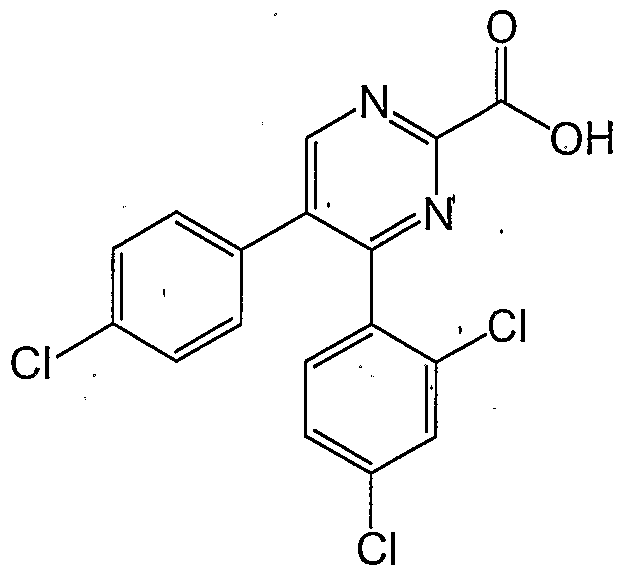
  • the methyl group at the 2-position of the pyrimidine ring of intermediate (1d) can then be oxidized to the corresponding carboxylic acid (1e) using procedures well-known to those skilled in the art.
  • pyrimidine intermediate (Id) is treated with selenium dioxide in refluxing pyridine.
  • the final amide compound (I) can then be formed by first activating the carboxylic acid (1e).
  • the acid chloride may be formed by treating the carboxylic acid (1e) with thionyl chloride.
  • the activated carboxylic acid can then be reacted with the desired amine compound (R 4 -H) to form a compound of the presence invention (I).
  • Suitable amino compounds can be either purchased commercially or easily prepared using standard procedures well-known to those skilled in the art. Preparations for various piperidine and azetidine starting materials (R 4 -H, where R 4 is an amino group of Formula (IA)) may be found in U.S. Provisional Application Nos. 60/421874, filed on October 28, 2002, and 60/445728 filed' on February 6, 2003, 'both of which are incorporated herein by reference.
  • R 4 -H, where R 4 is an amino group of Formula (IA) see Scheme III (below) and the "Preparation of Key Intermediates" in the Example section (below).
  • Scheme III (below)
  • the keto alkylene intermediate (2a) can be easily sythnesjzed using a
  • the methoxy group of intermediate (2b) can then be converted to the corresponding hydroxy group by treating intermediate (2b) with boron tribromide at a temperature from about -78°C to about 0°C followed by quenching with a protic solvent (e.g., methanol) at about - 78 0 C.
  • a protic solvent e.g., methanol
  • the pendant hydroxy-methylene group can then be oxidized to the corresponding carboxylic acid by first treating the hydroxy-intermediate (2c) using the Swern reaction (treatment with oxalyl chloride in the presence of dimethylsulfoxide) followed by oxidation of the resultant aldehyde using procedures well-known to those skilled in the art.
  • the aldehyde is treated with sodium chlorite and sodium dihydrogen phosphate at ambient temperature.
  • the amide compound (I) may then produced from the carboxylic acid intermediate (2d) using procedures described above in Scheme I for the conversion of intermediate carboxylic acid (1e) via (1f).
  • the amide linkage may be formed by treating the carboxylic acid (2d) in the presence of the desired amine (R 4 -H) and triethylamine withi- propanephosphonic acid cyclic anhydride.
  • R 4 -H desired amine
  • triethylamine i- propanephosphonic acid cyclic anhydride
  • the amino group of 4-piperidinone is first protected to provide intermediate (3a).
  • a useful protecting group is benzyl.
  • 4-Piperidinone and derivatives thereof may be purchased commercially from a variety of sources (e.g., lnterchem Corporation,, Paramus, NJ and Sigma-Aldrich Co., St. Louis, MO 1 ).
  • Piperidinone (3a) is then reacted with the desired alkylamine and potassium pyanide in an aqueous HCI/ethanol solvent mixture at about 0 0 C to about 30 0 C.
  • the cyano group is converted to the corresponding amide w,ith acid and water.
  • the protecting group is then removed using conventional .methods for the particular protecting group employed. For example, a benzyl-protecting group may be removed by hydrogenation in the presence of Pd/C.
  • a detailed description of some representative amines having Formula (3c) above may be found in the "Preparation of Key Intermediates" section of the Examples below.
  • the compounds of the present invention may be isolated and used perse or in the form of its pharmaceutically acceptable salt, solvate and/or hydrate.
  • salts refers to inorganic and organic salts of a compound of the present invention. These salts can be prepared in situ during the final isolation and purification of a compound, or by separately reacting the compound, or prodrug with a suitable organic or inorganic acid or base and isolating the salt thus formed.
  • Representative salts include the hydrobromide, hydrochloride, hydro'iodide, sulfate, bisulfate, nitrate, acetate, trifluoroacetate, oxalate, besylate, palmitiate, pamoate, malonate, stearate, laurate, malate, borate, benzoate, lactate, phosphate, hexafluorophosphate, benzene sulfonate, tosylate, formate, citrate, maleate, fumarate, succinate, tartrate, naphthylate, mesylate, glucoheptonate, lactobionate, and laurylsulfonate salts, and the like.
  • a preferred salt of the compounds of the present invention is the hydrochloride salt.
  • the salts may include cations based on the alkali and alkaline earth metals, such as sodium, lithium, potassium, calcium, magnesium, and the like, as well as non-toxic ammonium, quaternary ammonium, and amine cations including, but not limited to, ammonium, tetramethylammonium, tetraethylammonium, - -
  • methylamine dimethylamine, trimethylamine, triethylamine, ethylamine, and the like. See, e.g., B ⁇ rge, et al., J. Pharm. Sd., 66, 1-19 (197,7).
  • prodrug means a compound that is transformed in vivo to yield a compound of Formula (I) or a pharmaceutically acceptable salt, hydrate or solvate of the compound. The transformation may occur by various mechanisms, such as . through hydrolysis in blood.
  • a discussion of the use of prodrugs is provided by T. Higuchi and W. Stella, "Pro-drugs as Novel Delivery Systems," Vol. 14 of the A.C.S. Symposium Series, and in Bioreversible Carriers in Drug Design, ed. Edward B. Roche, American Pharmaceutical Association and Pergamon Press, 1987.
  • a prodrug can comprise an ester formed by the replacement of the hydrogen atom of the acid group with a group, such as (CrC 8 )alkyl, (C 2 - Ci 2 )alkanoyloxymethyl, 1-(alkanoyloxy)ethyl having from 4 to 9 carbon atoms, 1- methyl-1-(alkanoyloxy)-ethyl having from 5 to 10' carbon atoms, alkoxycarbonyloxymethyl having from 3 to 6 carbon atoms, 1-
  • a group such as (CrC 8 )alkyl, (C 2 - Ci 2 )alkanoyloxymethyl, 1-(alkanoyloxy)ethyl having from 4 to 9 carbon atoms, 1- methyl-1-(alkanoyloxy)-ethyl having from 5 to 10' carbon atoms, alkoxycarbonyloxymethyl having from 3 to 6 carbon atoms, 1-
  • a prodrug can be formed by the replacement of the hydrogen atom of the alcohol group with a group such as (Ci-C 6 )alkanoyloxymethyl, 1-((C 1 - C 6 )alkanoyloxy)ethyl, 1-methyl-1-((Ci-C 6 )alkanoyloxy)ethyl, (C 1 - C 6 )alkoxycarbonyloxymethyl, N-(CrC 6 )alkoxycarbonylaminomethyl, succinoyl, (C 1 - C 6 )alkanoyl, ⁇ -amino(CrC 4 )alkanoyl, arylacyl and ⁇ -aminoacyl, or ⁇ -aminoacyl- ⁇ - aminoacyl, where each ⁇ -aminoacyl group is selected from the naturally occurring L- amino acids, P(O)(OH) 2 , P(O)(O(C
  • a prodrug can be formed by the replacement of a hydrogen atom in the amine group with a group such as R-carbonyl, RO-carbonyl, NRR'-carbonyl where R and R' are each independently (C r C 10 )alkyl, (C 3 -C 7 )cycloalkyl, benzyl, or R-carbonyl is a , natural ⁇ -aminoacyl or natural ⁇ -aminoacyi-natural cc ⁇ aminoacyl, -C(OH)C(O)OY' wherein Y' is H, (C r C 6 )alkyl or benzyl, -C(OY 0 )Yi wfiereirt Y 0 is (C 1 -C 4 ) alkyl and Y 1 is (C r C 6 )alkyl, carboxy(C r C 6 )alkyl, amino(C r
  • the compounds of the present invention may contain asymmetric or chiral centers, and, therefore, exist in different stereoisomer ⁇ forms. It is intended that all stereoisomeric forms of the compounds of the present invention as well as mixtures thereof, including racemic mixtures, form part of the present invention.
  • the present invention embraces all geometric and positional isomers. For exampl ⁇ , if a compound of the present invention incorporates a double bond or a fused ring, both , the , c/s- and trans- forms, as well as mixtures, are embraced within the scope of the invention. Both the single positional isomers and mixture of positional isomers resulting from the N-oxidation of the nitrogen containing heterocyclic rings are also within the scope of the present invention.
  • Diastereomeric mixtures can be separated into their individual diaster.eoisomers on the basis of their physical chemical differences by methods well known to those skilled in the art, such as by chromatography and/or fractional crystallization.
  • Enantiomers can be separated by converting the enantiomeric mixture into a diastereomeric mixture by reaction with an appropriate optically active compound (e.g., chiral auxiliary such as a chiral alcohol or Mosher's acid chloride), separating the diastereoisomers and converting (e.g., hydrolyzing) the individual diastereoisomers to the corresponding pure enantiomers.
  • an appropriate optically active compound e.g., chiral auxiliary such as a chiral alcohol or Mosher's acid chloride
  • converting e.g., hydrolyzing
  • some of the compounds of the present invention may be atropisomers (e.g., substituted biaryls) and are considered as part of this invention.
  • the compounds of the present invention may exist in unsolvated as well as solvated forms with pharmaceutically acceptable solvents such as water, ethanol, and the like, and it is intended that the invention embrace both solvated and unsolvated forms.
  • the compounds of the present invention may exist in different tautomeric forms, and all such forms are embraced within the scope of the invention.
  • all of the tautomeric forms of the triazinone moiety are included in the invention.
  • all keto-enol and imine-enamine forms of the compounds are included in the invention.
  • the present invention also embraces isotopically-labeled compounds of the present invention which are identical to those recited herein, but for the fact that one or more atoms are replaced by an atom having an atomic mass or mass number , different from the atomic mass or m.ass number usually found in nature.
  • isotopes that can be incorporated into compounds of the invention include isotopes of hydrogen, carbon, nitrogen, oxygen, phosphorus, sulfur, fluorine, iodine, and chlorine, such as 2 H, 3 H, 11 C, 13 C, 14 C, 13 N, 15 N, 15 0, 17 0, 18 0, 31 P, 32 P, 35 S, 18 F, 123 1, 125 I and 36 CI, respectively.
  • Certain isotopically-labeled compounds of the present invention are useful in compound and/or substrate tissue distribution assays.
  • Tritiated (i.e., 3 H) and carbon-14 (i.e., 14 C) isotopes are particularly preferred for their ease of preparation and detectability.
  • substitution with heavier isotopes such as deuterium (i.e., 2 H) ,may afford certain therapeutic advantages resulting from greater metabolic stability (e.g., increased in vivo half-life or reduced dosage requirements) ,and hence may be preferred in some circumstances.
  • Positron emitting isotopes such as 15 0, 13 N, 11 C, and 18 F are useful for positron er ⁇ ission tomography (PET) studies to examine substrate receptor occupancy
  • lsotopically i labeled compounds of the present invention can generally be prepared by following procedures analogous to those disclosed in the Schemes and/or in the Examples herein below, by substituting an isotopically labeled reagent for a non-isotopically labeled reagent.
  • Another aspect of the present invention is a method of treating diseases, conditions and/or disorders modulated by cannabinoid receptor antagonists in an animal that includes administering to an animal in need of such treatment a therapeutically effective amount of a compound of the present invention or a pharmaceutical composition comprising an effective amount of a compound of the present invention and a pharmaceutically acceptable excipient, diluent, or carrier.
  • the method is particularly useful for treating diseases, conditions and/or disorders modulated by cannabinoid receptor (in particular, CB1 receptor) antagonists.
  • cannabinoid receptor in particular, CB1 receptor
  • Preliminary investigations have indicated that the following diseases, conditions, and/or disorders are modulated by cannabinoid receptor antagonists: eating disorders (e.g., binge eating disorder, anorexia, and bulimia), weight loss or . -3 -
  • control e.g., reduction in calorie or food intake, and/or appetite suppression
  • obesity depression, atypical depression, bipolar disorders, psychoses, schizophrenia, behavioral addictions, suppression of reward-related behaviors (e.g., conditioned place avoidance, such as suppression of cocaine- and morphine-induced conditioned place preference), substance abuse; addictive disorders, impuls ' ivity, alcoholism (e.g., alcohol 'abuse, addiction and/or dependence includipg treatment for abstinence, craving reduction and relapse prevention of alcohol intake), tobacco abuse (e.g., smoking addiction, cessation and/or dependence including treatment for craving reduction and relapse prevention of tobacco smoking), dementia (including memory loss, Alzheimer's disease, dementia of aging, vascular dementia, mild cognitive impairment, age-related cognitive decline, and mild neurocognitive disorder), sexual dysfunction in males (e.g., erectile difficulty), seizure disorders, epilepsy, /inflammation, gastrointestinal disorders (e.g., dysfunction of gastrointestinal . motility or intestinal
  • the compounds of the present invention are useful in treating diseases, conditions, or disorders that are modulated by cannabinoid receptor antagonists. Consequently, the compounds of the present invention . (including the compositions and processes used therein) may be used in, the manufacture of a medicament for the therapeutic applications described herein.
  • disorders associated with impulsive behaviours such as, disruptive behaviour disorders (e.g., anxiety/depression, executive function improvement, tic disorders, conduct disorder and/or oppositional defiant disorder), adult personality disorders (e.g., borderline personality disorder and antisocial personality disorder), diseases associated with impulsive behaviours (e.g., substance abuse, paraphilias and self-mutilation), and impulse control disorders (e.g., intermittene explosive disorder, kleptomania, pyromania, pathological gambling, and trichotillomania)), obsessive compulsive disorder, chronic fatigue syndrome, sexual dysfunction in males (e.g., premature ejaculation), sexual dysfunction in females, disorders of sleep (
  • the compounds of the present invention described herein are useful in treating diseases, conditions, or disorders that are modulated by cannabinoid receptor antagonists. Consequently, the compounds of the present invention (including the compositions and processes used therein) may be used in the manufacture of a medicament for the therapeutic applications described herein.
  • the compounds of the present invention can be administered to a patient at dosage levels in the range of from about 0.7 mg to about 7,000 mg per day.
  • dosage levels in the range of from about 0.7 mg to about 7,000 mg per day.
  • a dosage in the range of from about 0.01 mg to about 100 mg per kilogram body weight is typically sufficient.
  • some variability in the general dosage range may be required depending on
  • sustained release, controlled release, and delayed release formulations which forms are also well known to one of ordinary skill in the art.
  • the compounds of this invention may also be used in conjunction with other pharmaceutical agents for the treatment of the diseases, conditions and/or disorders described herein. Therefore, methods of treatment that include administering
  • Suitable pharmaceutical agents that may be used in combination with the compounds of the present invention include anti-obesity agents such as apolipoprotein-B secretion/microsomal triglyceride transfer protein (apo-B/MTP) inhibitors, 11 ⁇ -hydroxy steroid dehydrogenase-1 (11 ⁇ -HSD type 1) inhibitors, peptide
  • anti-obesity agents such as apolipoprotein-B secretion/microsomal triglyceride transfer protein (apo-B/MTP) inhibitors, 11 ⁇ -hydroxy steroid dehydrogenase-1 (11 ⁇ -HSD type 1) inhibitors, peptide
  • MCR-4 agonists cholecystokinin-A (CCK-A) agonists, monoamine reuptake inhibitors (such as sibutramine), sympathomimetic agents, ⁇ 3 adrenergic receptor agonists, dopamine agonists (such as bromocriptine), melanocyte-stimulating hormone receptor analogs, 5HT2c agonists, melanin concentrating hormone antagonists, leptin (the OB protein), leptin analogs, leptin - -
  • Neuropeptide-Y receptor antagonists e.g., NPY Y5 receptor antagonists, such as the spiro compounds described in US Patent Nos. 6,566,367; 6,649,624; 6,638,942; 6,605,720; 6,495,559; 6,462,053; 6,388,077; 6,335,345; and 6,326,375; US Publication Nos. 2002/0151456 and 2003/036652; and PCT Publication Nos. WO 03/010175.
  • thyromimetic agents dehydroepia ⁇ droster ⁇ ne or an analog thereof, glucocorticoid receptor agonists or antagonists, orexin receptor antagonists, glucagon-like peptide-1 receptor agonists, ciliary neurotrophic factors (such as AxokineTM available from Regeneron Pharmaceuticals, Inc., Tarrytown, NY and
  • anti-obesity agents selected from the group consisting of orlistat, sibutramine, bromocriptine, ephedrine, leptin, pseudoephedrine; peptide YY 3-36 Or an analog thereof; and 2-oxo-N-(5-phenylpyrazinyl)spiro- [is X Beingzofuran-1 (3H),4'-piperidine]-1 '-carboxamide.
  • compo ⁇ nds of the present invention and combination therapies are administered in conjunction with exercise and a sensible diet.
  • anti-obesity agents for use in the combinations, pharmaceutical compositions, and methods of the invention can be prepared using methods known to one of ordinary skill in the art, for example, sibutramine can be prepared as described in U.S. Pat. No. 4,929,629; bromocriptine can be prepared as described in U.S. Pat. Nos. 3,752,814 and 3,752,888; orlistat can be prepared as described in U.S. Pat. Nos. 5,274,143; 5,420,305; 5,540,917; and 5,643,874; PYY 3 - 36 (including analogs) can be prepared as described in US Publication No.
  • NPY Y5 receptor antagonist 2-o ⁇ o-N- (5-phenylpyrazinyl)spiro[isobenzofuran-1(3H),4'-piperidine]-1 '-carboxamide can be prepared as described in US Publication No. 2002/0151456.
  • Other useful NPY Y5 receptor antagonists include those described in PCT Publication No.
  • 03/082190 such as 3-oxo-N-(5-phenyl-2-pyrazinyl)-spiro[isobenzofuran-1(3H), 4'-piperidine]-1'- carboxamide; 3-oxo-N-(7-trifluoromethylpyrido[3,2-b]pyridin-2-yl)-spiro- - -
  • tobacco abuse e.g., nicotine receptor partial agonists, bupropion hypochloride (also known under the tradename ZybanTM) and nicotine replacement therapies
  • agents to treat erectile dysfunction
  • agents for reducing alcohol withdrawal symptoms may also be co-administered, such as benzodiazepines, beta-blockers, clonidine, carbamazepine, pregabalin, and gabapentin (NeurontinTM).
  • Treatment for alcoholism is preferably administered in combination with behavioral therapy including such components as motivational enhancement therapy, cognitive - -
  • antihypertensive agents include antihypertensive agents; anti-inflammatory agents (e.g., COX-2 inhibitors); antidepressants (e.g., fluoxetine hydrochloride (ProzacTM)); 1 cognitive improvement agents (e.g., donepezil hydrochloride (AirceptTM) and other acetylcholinesterase inhibitors); neuroprotective -agents (e.g., memantine); antipsychotic medications (e.g., zi'prasidone (GeodonTM), risperidone (RisperdalTM), and olanzapine (ZyprexaTM)); insulin and insulin analogs (e.g., LysPro insulin); GLP-1 (7-37) (insulinotropin) and GLP-1 (7-36)-NH 2 ; sulfonylureas and analogs thereof: chlorpropamide, glibenclamide, tolbutamide, tolazamide, acetohexamide, Glypizide
  • the compounds of the present invention may also be administered in combination with a naturally occurring compound that acts to lower plasma cholesterol levels.
  • a naturally occurring compound that acts to lower plasma cholesterol levels.
  • Such naturally occurring compounds are commonly called nutraceuticals and include, for example, garlic extract, Hoodia plant extracts, and niacin.
  • the dosage of the additional pharmaceutical agent e.g., anti-obesity agent
  • the dosage range of an anti-obesity agent is in the range of from about 0.001 mg to about 100 mg per kilogram body weight of the individual per day, preferably from about 0.1 mg to about 10 mg per kilogram body weight of the individual per day.
  • some variability in the general dosage ' range may also be required depending upon the age and weight of the subject being treated, the intended route of administration, the particular anti-obesity agent being administered and the like.
  • the determination of dosage ranges arid optimal dosages for a particular patient is also well within the ability of one of ordinary skill in the art having the benefit of the instant disclosure.
  • the compounds of tihe present invention are useful for treating diseases, conditions and/or disorders modulated by cannabinoid receptor antagonists; therefore, another embodiment of the present invention is a pharmaceutical comp ⁇ sition comprising a therapeutically effective amount of a compound of the present invention and a pharmaceutically acceptable excipient, diluent or carrier.
  • a compound of the present invention may be , administered in combination with at least one additional pharmaceutical agent
  • a compound of the present invention or a combination can be administered in any conventional oral, rectal, transdermal, parenteral, (for example, intravenous, intramuscular, or subcutaneous) intracisternal, intravaginal, intraperitoneal, intravesical, local (for example, powder, ointment or drop), or buccal, or nasal, dosage form.
  • the compound of the present invention and at least one other pharmaceutical agent e.g., anti-obesity agent described above
  • a combination When a combination is administered, such administration can be sequential in time or simultaneous with the simultaneous method being generally preferred.
  • the combination can be administered in any order. It is , generally preferred that such administration be oral., Jt is especially preferred that ⁇ such administration be oral and simultaneous.
  • the administration of the compound of the present invention and the additional pharmaceutical agent can'be by the same or by different methods.
  • a typical formulation is prepared by mixing a, compound of the present invention and a excipient, diluent or carrier.
  • Suitable excipiehts, diluents and carriers are well known to those skilled in the art and include materials such as carbohydrates, waxes, water soluble and/or swellable polymers, hydrophilic or hydrophobic materials, gelatin, oils, solvents, water, and the like.
  • the particular excipient, diluent or carrier used will depend upon the means and purpose for whiph the compound of the present invention is being applied.
  • Solvents are generally selected based on solvents 'recognized by persons skilled in the art as safe (GRAS) to be administered to a mammal.
  • safe solvents are non-toxic aqueous solvents such as water and other non-toxic solvents that are soluble or miscible in water.
  • Suitable aqueous solvents include water, ethanol, propylene glycol,
  • the formulations may also include one or more buffers, stabilizing agents, surfactants, wetting agents, lubricating agents; emulsifiers, suspending agents, preservatives, antioxidants, opaquing agents, glidants, processing aids, colorants, sweeteners, perfuming agents, flavoring agents and other known additives to provide an elegant presentation of the drug (i.e., a compound of the present invention or pharmaceutical composition thereof) or aid in the manufacturing of the pharmaceutical product (i.e., medicament).
  • the formulations may be prepared using conventional dissolution and mixing procedures.
  • compositions suitable for parenteral injection generally include pharmaceutically acceptable sterile aqueous or nonaqueous solutions, dispersions, suspensions, or emulsions.
  • compositions generally include sterile excipients, diluents or carriers for reconstitution into sterile injectable solutions or dispersions.
  • aqueous and nonaqueous excipients, diluents or carriers examples include water, ethan'ol, polyols (propylene glycol, polyethylene glycol, glycerol, and the like), suitable mixtures thereof, vegetable oils (such as olive oil) and injectable organic esters such as ethyl oleate.
  • a coating such as lecithin
  • surfactants for example
  • compositions may also contain adjuvants such as preserving, wetting, emulsifying, and dispersing agents. Prevention of microorganism contamination of the compositions can be accomplished with various antibacterial and antifungal agents, for example, parabens, chlorobutanol, phenol, sorbic acid, and the like. It may also be desirable to include isotonic agents, for example, sugars, sodium chloride, and the like. Prolonged absorption of injectable pharmaceutical compositions can be brought about by the use of agents capable of delaying absorption, for example, aluminum monostearate and gelatin.
  • Solid dosage forms for oral administration include capsules, tablets, powders, and granules.
  • a compound of the present invention or a combination is admixed with' at least one pharmaceutically acceptable excipient, diluent or carrier.
  • Suitable excipients, diluents, or carriers include sodium citrate or dicalcium phosphate, or (a) fillers or extenders (e.g., starches, lactose, sucrose, mannitol, silicic acid and the like); (b) binders (e.g., carboxymethylcellulose, alginates, gelatin, polyvinylpyrrolidone, sucrose, acacia and the like); (c) humectants (e.g., glycerol and the like); (d) disintegrating agents (e.g., agar-agar, calcium carbonate, potato or tapioca starch, alginic acid, certain complex silicates, sodium carbonate and the like); (e) solution retarders (e.g., paraffin and the like); (f) absorption accelerators (e.g., quaternary ammonium compounds and the like); (g) wetting agents (e.g., cetyl alcohol, glycerol mono
  • compositions of a similar type may also be used as fillers in soft or hard filled gelatin capsules using such excipients as lactose or milk sugar, as well as high molecular weight polyethylene glycols, and the like.
  • Solid dosage forms such as tablets, dragees, capsules, and granules can be prepared with coatings and shells, such as enteric coatings and others well known in the art. They may also contain opacifying agents, and can also be of such -3 -
  • compositions that they release the compound of the present invention and/or the , additional pharmaceutical agent in a delayed manner.
  • embedding compositions that can be used are polymeric substances and waxes.
  • the drug can also be in micro-encapsulated form, if appropriate, with one or more of the above- mentioned excipients.
  • Liquid dosage forms for oral administration include pharmaceutically acceptable emulsions, solutions, suspensions, syrups, and elixirs.
  • the liquid dosage form may contain excipients, diluents or carriers.
  • Suitable excipients, diluents or carriers include additives such as water or other solvents, solubilizing agents and emulsifiers, as for example, ethyl alcohol, isopropyl alcohol, ethyl carbonate, ethyl acetate, bepzyl alcohol, benzyl benzoate, propylene glycol, 1 ,3-butylene glycol, dimethylformamide, , oils (e.g., cottonseed oil, groundnut oil, corn germ oil, olive oil, castor oil, sesame seed oil and the like), glycerol, tetrahydrofurfuryl alcohol, polyethylene glycols and fatty acid esters of sorbitan, or mixtures of these substances, and the like.
  • additives such as water or other solvents, solubilizing agents and emulsifiers, as for example, ethyl alcohol, isopropyl alcohol, ethyl carbonate, ethyl acetate,
  • suitable additives include wetting agents, emulsifying and suspending agents, sweetening, flavoring, and perfuming agents.
  • Suspensions in addition, to the compound of the present invention or the ' combination, may further comprise suspending agents, e.g., ethoxylated,isostearyl alcohols, polyoxyethylene sorbitol and sorbitan esters, microcrystalline cellulose, aluminum metahydroxide, bentonite, agar-agar, and tragacanth, or mixtures of these substances, and the like.
  • compositions for rectal or vaginal administration preferably comprise suppositories, which can be prepared by mixing a compound of the present invention or a combination with suitable non-irritating excipients, diluents, or carriers, such as cocoa butter, polyethylene glycol or a suppository wax which are solid at ordinary room temperature but liquid at body temperature and therefore melt in the rectum or vaginal cavity thereby releasing the active component(s).
  • suitable non-irritating excipients, diluents, or carriers such as cocoa butter, polyethylene glycol or a suppository wax which are solid at ordinary room temperature but liquid at body temperature and therefore melt in the rectum or vaginal cavity thereby releasing the active component(s).
  • Dosage forms for topical administration of the compounds of the present invention and combinations of the compounds of the present invention with anti- obesity agents may comprise ointments, powders, sprays and inhalants.
  • the drugs are admixed under sterile condition with a pharmaceutically acceptable excipient, diluent or carrier, and any preservatives, buffers, or propellants that may be required.
  • Ophthalmic formulations, eye ointments, powders, and solutions are also intended to be included .within the scope of the present invention.
  • an article for distribution includes a container having deposited therein the pharmaceutical formulation in an appropriate form.
  • suitable containers are well-known to those skilled in the art and include materials such as bottles (plastic and glass), sachets, ampoules, plastic bags, metal cylinders, and the like.
  • the container may also include a tamper-proof assemblage to prevent indiscreet access to the contents of the package.
  • the container has deposited thereon a label that describes the contents of the container. The label may also include appropriate warnings.
  • a compound of the present invention or combination i.e., a compound of the present invention with at least one additional pharmaceutical agent
  • administration of a compound of the present invention or combination can be effected orally or non-orally (e.g., by injection).
  • a daily dose that is administered orally to an animal is between about 0.01 and about 1 ,000 mg/kg of body weight, preferably between about 0.01 and about 300 mg/kg of body weight.
  • a compound of the present invention (or combination) can be carried in the drinking water so that a therapeutic dosage of the compound is ingested with the daily water supply.
  • the compound can be directly metered into drinking water, preferably in the form of a liquid, water-soluble concentrate (such as an aqueous solution of a water-soluble salt).
  • a compound of the present invention can also be added directly to the feed, as such, or in the form of an animal feed supplement, also referred to as a premix or concentrate.
  • a premix or concentrate of the compound with an excipient, diluent or carrier is more commonly employed for the inclusion of the agent in the feed.
  • Suitable carriers are liquid or solid, as desired, - -
  • a particularly effective carrier is the respective animal feed itself; that is, a small portion of such feed.
  • the carrier facilitates uniform distribution of the compound in the finished feed with which the premix is blended.
  • the compound is thoroughly blended into the premix and, subsequently, the feed.
  • the compound may be dispersed or dissolved in a suitable oily vehicle such as soybean oil, corn oil, cottonseed oil, and the like, or in a volatile organic solvent and then blended with the carrier.
  • a suitable oily vehicle such as soybean oil, corn oil, cottonseed oil, and the like, or in a volatile organic solvent and then blended with the carrier.
  • High potency concentrates may be blended by the feed manufacturer with proteinaceous carrier such as soybean oil meal and other meals, as described above, to produce concentrated supplements, which are suitable for direct feeding to animals.
  • the animals are pe,rmit,ted to consume the usual diet.
  • concentrated supplements may be added directly to the feed to produce a nutritionally balanced, finished feed containing a therapeutically effective level of a compound of the present invention.
  • the mixtures are thoroughly blended by standard procedures, such as in a twin shell blender, to ensure homogeneity.
  • Drinking water and feed effective for increasing lean meat deposition and for improving lean meat to fat ratio are generally prepared by mixing a compound of the present invention with a sufficient amount of animal feed to provide from about 1CT 3 to about 500 ppm of the compound in the feed or water.
  • the preferred medicated swine, cattle, sheep and goat feed generally contain from about 1 to about 400 grams of a compound of the present invention (or combination) per ton of feed, the optimum amount for these animals usually being about 50 to about 300 grams per ton of feed.
  • the preferred poultry and domestic pet feeds usually contain about 1 to about 400 grams and preferably about 10 to about 400 grams of a compound of the present invention (or combination) per ton of feed. - -
  • the compounds of the present hi invention may be prepared in the form of a paste or a pellet and administered as an implant, usually under the skin of the head or ear of the animal in which increase in lean meat deposition and improvement in lean meat to fat ratio is sought.
  • parenteral administration involves injection of a sufficient amount of a compound of the present invention (or combination) to provide the animal with about 0.01 to about 20 mg/kg/day of body weight of the drug.
  • the preferred dosage for poultry, swine, cattle, sheep, goats and domestic pets is in the range of from about 0.05 to about 10 mg/kg/day of body weight of drug.
  • Paste formulations can be prepared by dispersing the drug in a pharmaceutically acceptable oil such as peanut oil, sesame oil, corn oil or the like.
  • Pellets containing an effective amount of a compound of the present invention, pharmaceutical composition, or combination can be prepared by admixing a compound of the present invention, or combination with a diluent such as carbowax, carnuba wax, and the like, and a lubricant, such as magnesium or calcium stearate, can be added to imprqve the pelleting process.
  • a diluent such as carbowax, carnuba wax, and the like
  • a lubricant such as magnesium or calcium stearate
  • pellets may be administered to an animal to achieve the desired dose level which will provide the increase in lean , meat deposition and improvement in lean meat to fat ratio desired.
  • implants may also be made periodically during the animal treatment period in order to maintain the proper drug level in the animal's body.
  • the present invention has several advantageous veterinary features.
  • the instant invention provides the means by which this may be accomplished.
  • utilization of the method of the present invention yields leaner animals that command higher sale prices from the meat industry.
  • starting materials are generally available from commercial sources such as Aldrich Chemicals Co. (Milwaukee, Wl), Lancaster Synthesis, Inc. (Windham, NH), Acros Organics (Fairlawn, NJ), Maybridge Chemical Compafiy, Ltd. (Cornwall, England), TygerScientific ' (Priricet ⁇ n, ' NJ), and AstraZeneca Pharmaceuticals (London, England).
  • NMR spectra were recorded on a Varian UnityTM 400 or 500 (available from Varian Inc., Palo Alto, CA) at room temperature at 400 and 500 MHz 1 H, respectively. Chemical shifts are expressed in parts per million ( ⁇ ) relative to residual solvent as an internal reference.
  • the peak shapes are denoted as follows: s, singlet; d, doublet; t, triplet; q, quartet; m, multiplet; br s, broad singlet; v br s, very broad singlet; br m, broad multiplet; 2s, two singlets. In some cases only representative 1 H NMR peaks are given. '
  • Mass spectra were recorded by direct flow analysis using positive and negative atmospheric pressure chemical ionization" (APcI) scan modes.
  • a Waters ' ' APcl/MS model ZMD mass spectrometer equipped with Gilson 215 liquid handling system was used to carry out the experiments Mass spectrometry analysis was also obtained by RP-HPLC gradient method for chromatographic separation. Molecular weight identification was recorded by positive and negative electrospray ionization (ESI) scan modes.
  • ESI electrospray ionization
  • a Waters/Micromass ESI/MS model ZMD or LCZ mass spectrometer equipped with Gilson 215 liquid handling system and HP 1100 DAD was used to carry out the experiments.
  • reaction mixture wgs concentrated in vacuo,' azeotroped with methanol, and concentrated on high vacuum.
  • the solid was stirred in methanol/ 6N HCI (30 ml/ 2.5 ml) and concentrated in vacuo.
  • the residue was dissolved in ethyl acetate, washed with water, brine, dried (Na 2 SO 4 ) and concentrated in vacuo to afford the title compound I -2c as a brown oil (1.0 g).
  • the mixture was diluted with methanol (350 ml) filtered through Celite®, rinsing with additional methanol.
  • the methanol fractions were filtered through a 0.45 Dm filter disk, and, then concentrated undenreduced pressure to give a solid residue that was triturated ifrom diethyl ether, collected by vacuum filtration, washed with ether and then dried, in vacuo, to afford l-5c (6.3 g, 91%) as a tan solid.
  • a protein assay was performed and 200 ⁇ l of tissue totaling 20 ⁇ g was added to the assay.
  • the test compounds were diluted in drug buffer (0.5% BSA, 10% DMSO and TME) and then 25 ⁇ l were added to a deep well polypropylene plate.
  • [ 3 H] SR141716A was diluted in a ligand buffer (0.5% 'BSA plus TME) and 25 ⁇ l were added to the plate,
  • a BCA protein assay was used to determine the appropriate tissue concentration and then 200 ⁇ l of rat brain tissue at the appropriate concentration was added to the plate.
  • the plates were covered and placed in an incubator at 20 0 C for 60 minutes.
  • a protein assay was performed and 200 ⁇ l of tissue totaling 20 ⁇ g was added to the assay. /6
  • test compounds were diluted in drug buffer (0.5% BSA, 10% DMSO , and TME) and then 25 ⁇ l were added to a deep welj polypropylene plate.
  • [3H] SR141716A was diluted in a ligand buffer (0.5% BSA plus TME) and 25 ⁇ l were added to the plate.
  • the plates were covered and placed in an incubator at 3O 0 C for 60 minutes. At the end of the incubation period 250 ⁇ l of stop buffer (5% BSA plus TME) was added to the reaction plate.
  • the plates were then harvested by Skatron onto GF/B filtermats presoaked in BSA (5 mg/ml) plus TME. Each filter was washed twice. The filters were dried overnight. In the morning the filters were counted on a Wallac BetaplateTM counter (available from PerkinElmer Life SciencesTM, Boston, MA). . .
  • the homogenate was then .spun. at ,1 ,0Q0X g for 5 minut ⁇ s at 4 0 C.
  • the supernatant was recovered and centrifuged at 100,000X G for 1 hour at 4°C.
  • a protein assay was performed and 200 ⁇ l of tissue totaling 10 ⁇ g was added to the assay.
  • test compounds were diluted in drug buffer (0.5% BSA, 10% DMSO, and 80.5% TME) and then 25 ⁇ l were added to the deep well polypropylene plate.
  • [3H] CP-55940 was diluted a ligand buffer (0.5% BSA and 99.5% TME) and then 25 ⁇ l were added to each well at a concentration of 1 nM.
  • a BCA protein assay was used to determine the appropriate tissue concentration and 200 ⁇ l of the tissue at the appropriate concentration was added to the plate.
  • the plates were covered and placed in an incubator at 30 0 C for 60 minutes. At the end of the incubation period 250 ⁇ l of stop buffer (5% BSA plus TME) was added to the reaction plate.
  • Membranes were. prepared from CHO-K1 cells stably transfected with the human CB-1 receptor cDNA. Membranes were prepared from cells as described by Bass et al, in "Identification and characterization of novel somatostatin antagonists," Molecular Pharmacology. 50, 709-715 (1996).
  • GTPy [ 35 S] binding assays were performed in a 96 well FlashPlate TM format in duplicate using 100 pM GTPy[ 35 S] and 10 ⁇ g membrane per well in assay buffer composed of 50 mM Tris HCI, pH 7.4, 3 mM MgCI 2 , pH 7.4; 10 mM MgCI 2 , 20 mM EGTA, 100 mM NaCI, 30 ⁇ M GDP, 0.1 % bovine serum albumin and the following protease inhibitors: 100 ⁇ g/ml bacitracin, 100 ⁇ g/ml benzamidine, 5 ⁇ g/ml aprotinin, 5 ⁇ g/ml leupeptin.
  • cyclic-AMP assay protocol using intact cells was used to determine inverse agonist activity.
  • ⁇ Cells were plated into a 96-well plate at a plating density of 10,000-14,000 cells pe'r well at a concentration of 100 ⁇ l per well. , The plates were incubated for
  • Serum free medium containing 1 mM IBMX was added to each well followed by 10 ⁇ l of test compound (1 :10 stock solution (25 mM compound in DMSO) into 50% DMSO/PBS) diluted 10X in PBS with 0.1% BSA. After incubating for 20 minutes at 37°C, 2 ⁇ M of Forskolin was added and then incubated for an additional 20 minutes 1 at 37°C. The media was removed, 100 ⁇ l of 0.01 N HCI was added and then incubated for 20 minutes at room temperature. Cell lysate (75 ⁇ l) along with 25 ⁇ l of assay buffer (supplied in FlashPlateTM cAMP assay kit available from NEN Life ⁇ . Science Products Boston, MA) into a. Flashplate.
  • Cannabinoid agoinists such as ⁇ 9 -tetrahydrocannabinol ( ⁇ 9 -THC) and CP-55940 have been shown to affect four characteristic behaviors in mice, collectively known as the Tetrad.
  • Tetrad ⁇ 9 -tetrahydrocannabinol
  • the rats were individually housed and fed powdered chow. They were maintained on a 12 hour light/dark cycle and received food and water ad , libitum. The animals were acclimated to the vivarium for a period of one week before testing was conducted. Testing was completed during the light portion of the cycle.
  • rats were transferred to individual test cages without food the aftemoop prjor to testing, and the rats were fasted overnight. After the overnight fast, rats- were dosed the following morning wtth vehicle or test compounds.
  • a known antagonist was dosed (3 mg/,kg) as a positive control, and a control group received vehicle alone (no compound).
  • the test compounds were dosed at ranges between 0.1 and 100 mg/kg depending upon the compound.
  • the standard vehicle was 0.5% (w/v) methylcellulose in water and the standard route of administration was oral. However, different vehicles and routes of administration were used to accommodate various compounds when required.
  • Food was provided to the rats 30 minutes after dosing and the Oxymax automated food intake system (Columbus Instruments, Columbus, Ohio) was started.
  • mice were individually housed and, given unlimited access to powdered rat chow, water and a 10 % (w/v) alcohol solution. After 2-3 weeks of unlimited access, wate.r was restricted for 20 hours and alcohol was restricted to only 2 hours access daily. This was done in a manner that the access period was the last 2 hours qf the dark part of the light cycle.
  • mice were considered stable when the average alcohol consumption for 3 days was ⁇ 20% of the average for all 3 days.
  • day 2 and 3 mice were injected with vehicle or test compound and the same protocol as the , previous day was followed. ' Day 4 was wash out and no injections were given. Data was analyzed using repeated measures ANOVA. Change in water or alcohol consumption was compared back to vehicle for each day of the test. Positive results would be interpreted as a compound that was able to significantly reduce alcohol consumption while having no effect on water , ,
  • Oxygen Consumption Methods Whole body oxygen consumption is measured using an indirect calorimeter
  • Rats (Oxymax from Columbus Instruments, Columbus, OH) in male Sprague Dawley rats (if another rat strain or female rats are used, it will be specified). Rats (300-38Og body weight) are placed in the calorimeter chambers and the chambers are placed in activity monitors. These studies are done during the light cycle. Prior to the measurement of oxygen consumption, the rats are fed standard chow ad libitum. During the measurement of oxygen consumption, food is not available. Basal pre- dose oxygen consumption and ambulatory activity are measured every 10 minutes for 2.5 to 3 hours.
  • the chambers are opened and the animals are administered a single dose of compound (the usual dose range is 0.001 to 10 mg/kg) by oral gavage (or other route of administration as specified, i.e. s.c, i.p., Lv.).
  • Drugs are prepared in methylcellulose, water or other specified vehicle (examples include PEG400, 30% beta-cyclodextran and propylene - -
  • Oxygen consumption and ambulatory activity are measured every 10 minutes for an additional 1-6 hours post-dosing.
  • the Oxymax calorimeter software calculates the oxygen consumption (ml/kg/h) based on the flow rate of air through the chambers and difference in oxygen content at inlet and output ports.
  • the activity monitors have 15 infrared' light beams spaced one inch apart on each axis, ambulatory activity is recorded when two consecutive beams are broken and the results are recorded as counts.

Landscapes

  • Organic Chemistry (AREA)
  • Chemical & Material Sciences (AREA)
  • Health & Medical Sciences (AREA)
  • Bioinformatics & Cheminformatics (AREA)
  • Engineering & Computer Science (AREA)
  • Life Sciences & Earth Sciences (AREA)
  • General Health & Medical Sciences (AREA)
  • Nuclear Medicine, Radiotherapy & Molecular Imaging (AREA)
  • General Chemical & Material Sciences (AREA)
  • Pharmacology & Pharmacy (AREA)
  • Chemical Kinetics & Catalysis (AREA)
  • Animal Behavior & Ethology (AREA)
  • Medicinal Chemistry (AREA)
  • Public Health (AREA)
  • Veterinary Medicine (AREA)
  • Biomedical Technology (AREA)
  • Neurosurgery (AREA)
  • Neurology (AREA)
  • Psychiatry (AREA)
  • Diabetes (AREA)
  • Pain & Pain Management (AREA)
  • Obesity (AREA)
  • Hematology (AREA)
  • Endocrinology (AREA)
  • Addiction (AREA)
  • Nutrition Science (AREA)
  • Hospice & Palliative Care (AREA)
  • Psychology (AREA)
  • Child & Adolescent Psychology (AREA)
  • Rheumatology (AREA)
  • Emergency Medicine (AREA)
  • Gynecology & Obstetrics (AREA)
  • Reproductive Health (AREA)
  • Pharmaceuticals Containing Other Organic And Inorganic Compounds (AREA)
  • Plural Heterocyclic Compounds (AREA)
  • Nitrogen Condensed Heterocyclic Rings (AREA)
  • Medicines That Contain Protein Lipid Enzymes And Other Medicines (AREA)
  • Acyclic And Carbocyclic Compounds In Medicinal Compositions (AREA)

Abstract

Compounds of Formula (I) that act as canncelbinoid receptor ligands and their uses in the treatment of diseases linked to the mediation of the cannabinoid receptors in animals are described herein.

Description

PYRIMIDINE DERIVATIVES AS CANNABINOID RECEPTOR LIGANDS
FIELD OF THE INVENTION The present invention relates to substituted pyrimidine-2-carboxamide compounds as cannabinoid receptor ligands, in particular CB1 receptor antagonists, and uses thereof for treating diseases, conditions and/or disorders modulated by cannabinoid receptor antagonists.
BACKGROUND Obesity is a major public health concern because of its increasing prevalence and associated health risks. Obesity and overweight are generally defined by body mass index (BMI), which is correlated with total body fat and estimates the relative risk of disease. BMI is calculated by weight in kilograms divided by height in meters , squared (kg/m2). Overweight is typically defined as a BMI of 25-29.9 kg/m2, and obesity is typically defined as a BMI of 30 kg/m2. See, e.g., National Heart, Lung, and Blood Institute, Clinical Guidelines on the Identification, Evaluation, and Treatment of Overweight and Obesity in Adults, The Evidence Report, Washington, DC: U.S.
Department of Health and Human Services, NIH publication no. 98-4083 (1998).
The increase in obesity js of concern because of the excessive health risks associated with obesity, including coronary heart disease, strokes, hypertension, type 2 diabetes mellitus, dyslipidemia, sleep apnea, osteoarthritis, gall bladder disease, depression, and certain forms of cancer (e.g., endometrial, breast, prostate, and colon). The negative health consequences of obesity make it the second leading cause of preventable death in the United States and impart a significant economic and psychosocial effect on society. See, McGinnis M, Foege WH., "Actual Causes of Death in the United States,1' JAMA. 270, 2207-12 (1993).
Obesity is now recognized as a chronic disease that requires treatment to reduce its associated health risks. Although weight loss is an important treatment outcome, one of the main goals of obesity management is to improve cardiovascular and metabolic values to reduce obesity-related morbidity and mortality. It has been shown that 5-10% loss of body weight can substantially improve metabolic values, such as blood glucose, blood pressure, and lipid concentrations. Hence, it is believed that a 5-10% intentional reduction in body weight may reduce morbidity and mortality. Currently available prescription drugs for managing obesity generally reduce weight by inducing satiety or decreasing dietary fat absorption. Satiety is achieved by increasing synaptic levels of norepinephrine, serotonin, or both. For example, stimulation of serotonin receptor subtypes 1 B, 1 D, and 2C and 1 - and 2-adrenergic receptors decreases food, intake by regulating satiety. See, Bray GA, "The New Era of Drug Treatment. Pharmacologic Treatment of Obesity: Symposium Overview," Obes_Res., 3(suppl 4), 415s-7s (1995). Adrenergic agents (e.g., diethylpropion, , benzphetamine, phendimetrazine, mazindol, and phentermine)' act by modulating central norepinephrine and dopamine receptors through the promotion of catecholamine release. Older adrenergic weight-loss drugs (e.g., amphetamine, methamphetamine, and phenmetrazine), which strongly engage in dopamine pathways, are no longer recommended because of the risk of their abuse. Fenfluramine and dexfenfluramine, both serotonergic agents used to regulate appetite, are no longer available for use. , .
More recently, CB1 cannabinoid receptor antagonists/inverse agonists have been suggested as potential appetite suppressants. See, e.g., Arnone, M., et al., "Selective Inhibition of Sucrose and (Ξthanol Intake by SR141716, an Antagonist of Central Cannabinoid (CB1) Receptors." Psvchopharmacol. 132, 104-106 (1997); Colombo, G., et al., "Appetite Suppression and Weight Loss after the Cannabinoid Antagonist SR141716." Life ScL. 63, PL113-PL117 (1998); Simiand, J., ,et aL, "SR141716, a CB1 Cannabinoid Receptor Antagonist, Selectively Reduces Sweet Food Intake in Marmose," Behav. Pharmacol., 9, 179-181 (1998); and Chaperon, F., et al., "Involvement of Central Cannabinoid (CB1) Receptors in the Establishment of Place Conditioning in Rats," Psvchopharmacology, 135, 324-332 (1998). For a review of cannabinoid CB1 and CB2 receptor modulators, see Pertwee, R.G., "Cannabinoid Receptor Ligands: Clinical and Neuropharmacological Considerations, Relevant to Future Drug Discovery and Development," Exp. Opin. Invest. Drugs. 9(7), 1553-1571 (2000).
Although investigations are on-going, there still exists a need for a more effective and safe therapeutic treatment for reducing or preventing weight-gain.
In addition to obesity, there also exists an unmet need for treatment of alcohol abuse. Alcoholism affects approximately 10.9 million men and 4.4 million women in the United States. Approximately 100,000 deaths per year have been attributed to alcohol abuse or dependence. Health risks associated with alcoholism include impaired motor control and decision making, cancer, liver disease, birth defects, heart disease, drug/drug interactions, pancreatitis and interpersonal problems. Studies have suggested that endogenous cannabinoid tone plays a critical role in the control of ethanol intake. The endogenous CB1 receptor antagonist SR-141716A has been shown to block voluntary ethanol intake in rats and mice. See, Arnone, M., et al., "Selective Inhibition of Sucrose and Ethanol Intake by SR141716, an Antagonist of Central Cannabinoid (CB1) Receptors/' Psvchopharmacol. 132/104-106 (1997). i . . > ■ •
For a review, see Hungund, B. L and B. S. Basavarajappa, "Are Anadamide and
Cannabinoid Receptors involved in Ethanol Tolerance? A Review of the Evidence," Alcohol & Alcoholism. 35(2) 126-133, 2000.
Current treatments for alcohol abuse or dependence generally suffer from non-compliance or potential hepatotoxicity; therefore, there is a high unmet need for more effective treatment of alcohol abuse/dependence.
SUMMARY
The present inventio'n provides compounds of Formula (I) that act as cannabinoid receptor ligands (in particular, CB1 receptor antagonists)
Figure imgf000004_0001
(I) wherein
R1 are R2 are each independently aryl or heteroaryl, where the aryl and the heteroaryl moieties are optionally substituted with one or more substituents, provided that R1 and R2 are not both a mono-substituted (CrC4)alkoxyphenyl; R3 is hydrogen, (CrC4)alkyl, or halo-substituted (CrC4)alkyl; R4 is -(NH)n-N(R4a)(R4a'), where n is 0 or 1 , R4a is hydrogen or an optionally substituted (CrC8)alkyl and R4a' is a chemical moiety selected from the group consisting of (CrC8)alkyl, aryl, heteroaryl, aryl(CrC4)alkyl, a partially or fully saturated (C3-C10)cycloalkyl, heteroaryl(CrC3)alkyl, 5-6 membered lactone, 5- to 6- membered lactam, and a 3- to 6-membered partially or fully saturated heterocycle, where said chemical moiety is optionally substituted with one or more substituents, or R4a and R4a' taken together with the nitrogen to which they are attached form an optionally substituted 5- to 8-membered heterocycle; a pharmaceutically acceptable salt thereof, a prodrug of the compound or the salt, or a solvate or hydrate of the compound, the salt or the prodrug.
. In a preferred embodiment or the present invention, R1 is phenyl substituted with one or more substituents, 2-pyridyl optionally substituted with one or more substituents, or 4-pyridyl optionally substituted with one or more substituents; more preferably, R1 is a phenyl substituted with one to three substituents independently selected from the group consisting of halo (preferably, chloro or fluoro), (C1- C4)alkoxy, (C1-C4)alkyl, halo-substituted (CrC4)alkyl (preferably fluo'ro-substituted alkyl), and cyano; most preferably, R1 is 2-chlorophenyl, 2-fluorophenyl, 2,4- dichlorqphenyl, 2-fluoro-4-chlorophenyl, 2-chloro-4-fluorophenyl, or 2,4- difluorophenyl: and
R2 is a phenyl substituted with one or more substituents or a 2-pyridyl substituted with one or more substituents; more preferably, R2 is a phenyl substituted with one to three substituents independently selected from the group consisting of halo (preferably, chloro or fluoro), (Ci-C4)alkoxy, (CrC4)alkyl, halo-substituted (C1- C4)alkyl (preferably fluoro-substituted alkyl), and cyano; most preferably, R2 is 4- chlorophenyl or 4-fluorpphenyl.
In one embodiment of the present invention, a compound of Formula (I) is provided where R4 is -'(NH)n-N(R4a)(R4a'), where n is 0 or 1 , R4a is hydrogen and R4a', is a chemical moiety selected from the group consisting of (CrC8)alkyl, aryl, heteroaryl, aryl(CrC4)alkyl, a partially or fully saturated (C3-C10)cycloalkyl, heteroaryl(Ci-C3)alkyl, 5-6 membered lactone, 5- to 6-membered lactam, and a 3- to 6-membered partially or fully saturated heterocycle, where said chemical moiety is optionally substituted with one or more substituents; a pharmaceutically acceptable salt thereof or a solvate or hydrate of the compound or the salt. R4a is preferably a chemical moiety selected from (CrC8)alkyl, phenyl(CrC4)alkyl, or a partially or fully saturated (C3- C10)cycloalkyl, where the chemical moiety is optionally substituted with one or more substituents (preferably, 1 to 3 substituents).
Preferred compounds where n is 0 include: 5-(4-chloro-phenyl)-4-(2,4-dichloro~phenyl)-pyrimidine-2-carboxylic acid benzylamide;
5-(4-chloro-phenyl)-4-(2,4-dichloro-phenyl)-pyrimidine-2-carboxylic acid adamantan-1 -ylamide; 5-(4-chloro-phenyl)-4-(2,4-dichloro-phenyl)-pyrimidine-2-carboxylic acid indan-2-ylamide;
5-(4-chloro-phenyl)-4-(2,4-dichloro-phenyl)-pyrimidine-2-carboxylic acid (1- phenyl-ethyl)-amide; 5-(4-chloro-phenyl)-4-(2,4-dichlofθ-phenyl)-pyrimidine-2-'carboxylic acid 2- fluoro-4'-trifluoromethyl-benzylamide;
5-(4-chloro-phenyl)-4-(2,4-dichloro-phenyl)-pyrimidine-2-carboxylic acid [1-(4- fluoro-phenyl)-ethyl]-amide; .
5-(4-chioro-phenyl)-4-(2,4-dichloro-phenyl)-pyrimidine-2-carboxylic acid (1- phenyl-ethyl)-amide;
5-(4-chloro-phenyl)-4-(2,4-dichloro-phenyl)-pyrimidine-2-carboxylic acid [1,-(4- - chloro-phenyl)-ethyl]-amide;
5-(4-chloro-phenyl)-4-(2,4-dichloro-phenyl)-pyrimidine-2-carboxylic acid [1-(2- methoxy-phenyl)-ethyl]-amide; 5-(4-chloro-phenyl)-4-(2,4-dichloro-phenyl)-pyrimidine-2-carboxylic acid (1 (S)- p-tolyl-ethyl)-amide;
5-(4-chloro-phenyl)-4-(2,4-dichloro-phepyl)-pyrimidine-2-carboxylic acid (1 - methyl-1-phenyl-ethyl)-amide; . ,
: 5-(4-chloro-phenyl)-4-(2,4-dichloro-phenyl)-pyrimidine-2-carboxylic acid (1 ,1- dimethyl-propyl)-amide;
4-(5-bromo-pyridin-2-yl)-5-(4-chloro-phenyl)-pyrimidine-2-carboxylic acid (1 - methyl-1 -phenyl-ethyl)-amide;
4-(5-bromo-pyridin-2-yl)-5-(4-chloro-phenyl)-pyrimidine-2-carboxylic acid (1 (R)-phenyl-ethyl)-amide; 4-(5-bromo-pyridin-2-yl)-5-(4-chloro-phenyl)-pyrimidine-2-carboxylic acid [2-
(4-fluoro-phenyl)-1 , 1 -dimethyl-ethyl]-amide;
5-(4-chloro-phenyl)-4-(2,4-dimethyl-phenyl)-pyrimidine-2-carboxylic acid (1 - methyl-1 -phenyl-ethyl)-amide;
5-(5-chloro-pyridin-2-yl)-4-(2,4-dichloro-phenyl)-pyrimidine-2-carboxylic acid (1 -methyl-1 -phenyl-ethyl)-amide; and
5-(5-chloro-pyridin-2-yl)-4-(2,4-dichloro-phenyl)-pyrimidine-2-carboxylic acid (1 (R)-phenyl-ethyl)-amide; a pharmaceutically acceptable salt thereof or a solvate or hydrate of said compound or said salt. - -
In another embodiment of the present invention, a compound of Formula (I) is provided whβre R4 is -(NH)n-N(R4a)(R4a), where n is 0, R4a is an optionally substituted ' (CrC8)alkyl, and R4a' is a, chemical moiety selected from the group consisting of (C1- C8)alkyl, aryl, heteroaryl, 317!(C1-C4)BlRyI, a partially or fully saturated (C3- C10)cycloalkyl, heteroaryl(CrC3)alkyl, 5-6 membered lactone, 5- to 6-membered , lactam, and a 3- to 6-membered partially or fully saturated heterocycle, where the chemical moiety is optionally substituted with one or more substituents; a pharmaceutically acceptable salt thereof or a solvate or hydrate of the compound or the salt. R4a is preferably (CrC6)alkyl, and R4a' is preferably a chemical moiety selected from (C^-C8)alkyl, aryl, heteroaryl, aryl(CrC4)alkyl, a partially or fully
Saturated (C3-C10)cycloalkyl, heteroaryl(CrC3)alkyl, or a 3- to 6-membered partially or fully saturated heterocycle, where the chemical mpiety is optionally substituted with one or more substituents (preferably, 1 to 3 substituents);
Representative compounds of this embodiment include: 5-(4-chloro-phenyl)-4-(2,4-dichloro-phenyl)-pyrimidine-2-carboxylic acid cyclohexyl-methyl-amide;
5-(4-chloro-phenyl)-4-(2,4-dichloro-phenyl)-pyrirnidine-2-carboxylic acid methyl-pyridin-2-yl-amide;
5-(4-chloro-phenyl)-4-(2,4-dichϊoro-phenyl)-pyrimidine-2-carboxylic acid (2- , hydroxy-ethyl)-propyl-amide;
5-(4-chloro-phenyl)-4-(2,4-dichloro-phenyl)-pyrimidine-2-carboxylic acid methyl-(1-methyl-pyrrolidin-3-yl)-amide; and
5-(4-chloro-phenyl)-4-(2,4-dichloro-phenyl)-pyrimidine-2-carboxylic acid (1 - benzyl-pyrrolidin-3-yl)-methyl-amide; a pharmaceutically acceptable salt thereof or a solvate or hydrate of said compound or said salt.
In yet another embodiment of the present invention, a compound of Formula (I) is provided where R4 is -(NH)n-N(R4a)(R4a'), where n is 0, and R4a and R4a' are taken together to form a heterocycle having Formula (IA)
Figure imgf000007_0001
IA where R4b and R4b' are each independently hydrogen, cyano, hydroxy, amino, H2NC(O)-, or a chemical moiety selected from the group consisting of (Ci-C6)alkyl, (CrCβ)alkoxy, acyloxy, acyl, (CrC3)alkyl-O-C(O)-, (CrC4)alkyl-NH-C(O)-, (C1- C4)alkyl)2N-C(O)-, (CrC6)alkylamino-, ((CrC4)alkyl)2amino-, (C3-C6)cycloalkylamino-, acylamino-, aryl(CrC4)alkylamino-, heteroaryKCrC^Jalkylamino1, aryl, heteroaryl, a 3- 6 membered partially or fully saturated heterocycle, ,and a 3-6 membered partially or fully saturated carbocyclic ring, where said moiety is optionally substituted with one or more substituents, or either R4b or R4b' taken together with R4e, R4e', R4f, or R4f forms a bond, a methylene bridge, or an ethylene bridge;
X is a bond, -CH2CH2- Or -C(R4c)(R4c')-, where R4c and R4c' are each independently hydrogen, cyano, hydroxy, amino, H2NC(O)-, or a chemical moiety , selected from the group consisting of (CrC6)alkyl, (Ci-C6)alkoxy, acyloxy, acyl, (C1- C3)alkyl-O-C(O)-, (CrC4)alkyl-NH-C(O)-, ((CrC4)alkylj2N-C(O)-, (CrC6)alkylamino-, di(C-ι-C4)alkylamino-, (Cs-Cejcycloalkylamino-, acylamino-, aryl(C1-C4)alkylamino-, heteroaryl(CrC4)alkylamino-, aryl, heteroaryl, a 3-6 membered partially or fully saturated heterocycle, and a 3-6 membered partially or fully saturated carbocyclic ring, where said moiety is optionally substituted with one or more substituents, or either R4cor R4c' taken together with R4e, R4e', R4f, or' R4f forms a bond, a methylene bridge or an ethylene bridge, or either R4cor R4c' taken together with either R4d' or R4d" forms a fused aromatic ring;
Y is oxygen, sulfur, -C(O)-, or -C(R4d)(R4d')-, where R4d and R4d' are each independently hydrogen, cyano, hydroxy, amino, H2NC(O)-, or a chemical moiety selected from the group consisting of (CrC6)alkyl, (C1-C6JaIkOXy, acyloxy, acyl, (C1- C3)alkyl-O-C(O)-, (CrC4)alkyl-NH-C(O)-, ((CrC4)alkyl)2N-C(O)-, (CrC6)alkylamino-, di(CrC4)alkylamino-, (C3-C6)cycloalkylamino-, acylamino-, aryl(CrC4)alkylamino-, heteroaryl(Ci-C4)alkylamino-, (CrC6)alkyl-SO2-, aryl, heteroaryl, a 3-6 membered partially or fully saturated heterocycle, and a 3-6 membered partially or fully saturated carbocyclic ring, where said moiety is optionally substituted with one or more substituents, or R4d and R4d taken together form a 3-6 membered partially or fully saturated heterocyclic ring, a 5-6 membered lactone ring, or a 4-6 membered lactam ring, where said heterocyclic ring, said lactone ring and said lactam ring are optionally substituted with one' or more substituents and said lactone ring and said lactam ring optionally cqntain, an additional heteroatom selected, from oxygen, nitrogen or sulfur,
. or either R4d' or R4d" taken together with R4c, R4c', R4e, or R4e' forms a fused aromatic ring; Y is -NR4d "-, where R4d" is a hydrogen or a chemical moiety selected from the group consisting of (Ci-C6)alkyl, (C3-C6)cycloalkyl, (CrC3)alkylsulfonyl-, (Cr C3)alkylaminosulfonyl-, di(C1-C3)alkylaminosulfonyl-, acyl, (CrC6)alkyl-O-C(O)-, aryl, and heteroaryl, where said moiety is optionally substituted with one or more substituents; Z is a bond, -CH2CH2-, or -C(R4e)(R4e')-, where R4e and R4e> are each independently hydrogen, cyano, hydroxy, amino, H2NC(O)-, or a chemical moiety selected from the group consisting of (CrC6)alkyl, (C-i-C6)alkoxy, acyloxy, acyl, (Cr C3)alkyl-O-C(O)-, (CrC4)alkyl-NH-C(O)-, ((d-C^alkyl^N-qO)-, (CrC6)alkylamino-, di(CrC4)alkylamino-, (Cs-Ce^ycloalkylamino-, acylamino-, aryl(CrC4)alkylamino-, heteroaryl(CrC4)alkylamino-, aryl, heteroaryl, a 3-6 membered partially or fully saturated heterocycle, and a 3-6 membered partially or fully saturated carbocyclic ring, where said moiety is optionally substituted with one or more substituents, or either R4e or R4e' taken together with R4b, R4b', R4°, or R4c' forms,a bond, a methylene bridge or an ethylene bridge or either R4e or R4e' is taken together with either R4d' or R4d" forms a fused aromatic ring; and
R4f and R4f are each independently hydrogen, cyano, hydroxy, amino, H2NC(O)-, or a chemical moiety selected from the group consisting of (CrC6)alkyl, (CrCβ)alkoxy, acyloxy, acyl, (CrC3)alkyl-O-C(O)-, (CrC4)alkyl-N H-C(O)-, ((C1- C4)alkyl)2N-C(O)-, (CrC6)alkylamino-, di(Ci-C4)alkylamino-, (C3-C6)cycloalkylamino-, acylamino-, aryl(CrC4)alkylamino-, heteroaryl(CrC4)alkylamino-, aryl, heteroaryl, a 3- 6 membered partially or fully saturated heterocycle, and a 3-6 membered partially or fully saturated carbocyclic ring, where said moiety is optionally substituted with one or more substituents, or either R4f or R4f taken together with R4b, R4b', R4c, or R4c' forms a bond, a methylene bridge or an ethylene bridge; a pharmaceutically acceptable salt thereof or a solvate or hydrate of the compound or the salt. Preferably, R4b is hydrogen, an optionally substituted (CrC3)alkyl, or taken , together with R4e, R4e', R4f, or R4f forms a bond, a methylene bridge, or an ethylene bridge; R4b is hydrogen, an optionally substituted (CrC3)alkyl, or taken together with R, R4e', R4f, or R4f forms a bond, a methylene bridge, or an ethylene bridge; R4f is hydrogen, an optionally substituted (CrC3)alkyl, or taken together with R4b, R4b', R4c, or R4c' forms a bond, a methylene, bridge, or an ethylene bridge; and R4f is hydrogen, an optionally substituted (CrC3)alkyl, or taken together with 'R4b, R4b>, R4c, or R4c' forms a bond, a methylene bridge, or an ethylene bridge, and even more preferably, R4b, R4b', R4f, and R4f are all hydrogen. ' When Y is -NR4d "-, then R4d" is preferably a hydrogen, heteroary, or an optionally substituted (CrC6)alkyl; X is -CH2CH2- or -C(R4c)(R4c')-, where R4° and, R4c' are each independently hydrogen, or an optionally substituted (Ci-C6)alkyl, or either , 'R40Or R4c' taken together with R4e, R4e', R4f, or R4f forms a bond, a methylene bridge or an ethylene bridge; and Z is -CH2CH2- or -C(R4e)(R4β')-, where R4e and R4e' are each independently hydrogen, or an optionally substituted (CrC6)alkyl, or either R4e or R4e' taken together with R4b, R4b', R4c, or R4c' forms, a bond, a methylene bridge or an ethylene bridge.
Preferred compounds include:
[5-(4-chloro-phenyl)-4-(2,4-dichloro-phenyl')-pyrimidiιi-2-yl]-(4-pyrimidin-2-yl- piperazin-1-yl)-methanone;
[5-(4-chloro-phenyl)-4-(2,4-dichloro-phenyl)-pyrimidin-2-yl]-(4-pyridin-2-yl- piperazin-1 -yl)-methanone;
[5-(4-chloro-phenyl)-4-(2,4-dichloro-phenyl)-pyrimidin-2-yl]-(4-methyl- piperazin-1 -yl)-methanone; [5-(4-chloro-phenyl)-4-(2,4-dichloro-phenyl)'-pyrimidin-2-yl]-(4-ethyl- piperazin-1 -yl)-methanone;
[4-(4-chloro-phenyl)-5-(2,4-dichloro-phenyl)-pyrimidin-2-yl]-(4-pyridin-2-yl- piperazin-1 -yl)-methanone;
[5-(4-chloro-phenyl)-4-(2,4-dichloro-phenyl)-pyrimidin-2-yl]-(4-pyridin-2-yl- piperazin-1-yl)-methanone; and
[5-(4-chloro-phenyl)-4-(2,4-dichloro-phenyl)-pyrimidin-2-yl]-(4-methyl- [1 ,4]diazepan-1 -yl)-methanone; a pharmaceutically acceptable salt thereof, or a solvate or hydrate of said compound or said salt. When Y is -C(R4d)(R4d')-, then R4d is preferably hydrogen, cyano, hydroxy, amino, H2NC(O)-, or a chemical moiety selected from the group consisting of (C1- C6)alkyl, (CrC6)alkoxy, acyloxy, acyl, (CrC3)alkyl-O-C(O)-, (CrC4)alkyl-NH-C(O)-, ((CrC4)alkyl)2N-C(O)-, (CrC6)alkylamino-, ((CrC4)alkyl)2amino-, (C3- C6)cycloalkylamino-, acylamino-, aryl(CrC4)alkylamino-, heteroaryl(CrC4)alkylarnino- , (CrC6)alkyl-Sθ2-, aryl, heteroaryl,,a 3-6 membered partially or fully saturated heterocycle, and a 3-6 membered partially or fully saturated carbocyclic ring, where the moiety is optionally substituted with one or more substituents;
R4d' is hydrogen, H2NC(O)-, or a chemical moiety selected from the group consisting of (CrC6)alkyl, acyl, (CrC3)alkyl-O-C(O)-, (CrC4)alkyl-NH-C(O)-, (C1- C4)alkyl)2NrC(O)-, aryl, heteroaryl, a 3-6 membered partially or fully saturated heterocycle, and a 3-6 membered partially or fully saturated carbocyclic ring, where the moiety is optionally substituted with one or more substituents; or either R4d or R4d" taken together with R4c, R4c>, R4e, or R4e' forms a fused aromatic ring; X is a bond or -C(R4c)(R4c')-, where R4c and R4c' are hydrogen or either R4c or R4c' is hydroxy or taken together with R4d' or R4d forms a fused aromatic ring; and Z is a bond or - C(R4e)(R4e'h where R4e and R4e' are each hydrogen or either R4e or R4e' is hydroxy or taken together with R4d or R4d forms a fused aromatic ring; a pharmaceutically acceptable salt thereof or a solvate or hydrate of said compound or said salt. Representative compounds for this embodiment include:
[5-(4-chloro-phenyl)-4-(2,4-dichloro-phehyl)-pyrimidin-2-yl]-[4-(3,5-difluoro- phenyl)-4-methanesulfonyl-piperidin-1 -yl]-methanone;
[5-(4-chloro-phenyl)-4-(2,4-dichloro-phenyl)-pyrimidin-2-yl]-[4-(2-hydroxy- ethyl)-piperidin-1-yl]-methanone; [5-(4-chloro-phenyl)-4-(2,4-dichloro-phenyl)-pyrimidin-2-yl]-(2-hydroxymethyl- pyrrolidin-1 -yl)-methanone;
[5-(4-chloro-phenyl)-4-(2,4-dichloro-phenyl)-pyrimidin-2-yl]-(6-hydroxymethyl- 3-aza-bicyclo[3.1.0]hex-3-yl)-methanone;
[5-(4-Chloro-phenyl)-4-(2,4-dichloro-phenyl)-pyrimidin-2-yl]-(2(S)- methoxymethyl-pyrrolidin-1-yl)-methanone;
[5-(4~chloro-phenyl)-4-(2,4-dichloro-phenyl)-pyrimidin-2-yl]-(4-hydroxy- piperidin-1 -yl)-methanone;
[5-(4-chloro-phenyl)-4-(2,4-dichloro-phenyl)-pyrimidin-2-yl]-(3,4-dihydro-1 H- isoquinolin-2-yl)-methanone; - -
[5-(4-chloro-phenyl)-4-(2,4-dichloro-phenyl)-pyrimidin-2-yl]-(3,5-dimethyl- piperidin-1 -yl)-methanone;
[5-(4-chloro-phenyl)-4-(2,4-dichloro-phenyl)τpyrimidin-2-yl]-piperidin-1-yl- methanone; [5-(4-chloro-phenyl)-4-(2,4-di'chlqro-phenyl)-pyrinnidin-2-yl]-[4-(4-fluoro- i • ' • phenyl)L4-hydroxy-piperidin-1-yl]-methanone;
[5-(4-chloro-phenyl)-4-(2,4-dichloro-phenyl)-pyrimidin-2-yl]-(3-hydroxy- piperidin-1 -yl)-methanone;
1-[5-(4-chloro-phenyl)-4-(2,4-dichloro-phenyl)-pyrimidine-2-carbonyl]- piperidine-4-carboxylic acid amide;
[1 ,4']bipiperidinyl-1'-yl-[5-(4-chloro-phenyl)-4-(2,4-dichloro-phenyl)-pyrimidin-2- yl]-methanone;
[5-(4-chloro-phenyl)-4-(2,4-dichloro-phenyl)-pyrimidin-2-yl]-(2,6-dimethyl- piperidin-1 -yl)-methanone; (2,5-bis-methoxymethyl-pyrrolidin-1 -yl)-[5-(4-chloro-phenyl)-4-(2,4-dichloro- phenyl)-pyrimidin-2-yl]-methanone;
[5-(4-chloro-phenyl)-4-(2,4-dichloro-phe(nyl)rpyrimidin-2-yl]-(4-phenyl- piperidin-1-yl)-methanone; and. , .
1-[4-(5-bromo-pyridin-2-yl)-5-(4-chloro-phenyl)-pyrimidine-2-carbρnyl]-4- phenyl-piperidine-4-carbonitrile;
1-{1-[5-(4-chloro-phenyl)-4-(2,4-dichloro-phenyl)-pyrimidine-2-carbonyl]-4- phenyl-piperidin-4-yl}-ethanone;
{1-[5-(4-chloro-phenyl)-4-(2,4-dichloro-phenyl)-pyrimidine-2-carbonyl]-4- phenyl-piperidin-4-yl}-pyrrolidin-1-yl-methanone; 1-[5-(4-chIoro-phenyl)-4-(2,4-dichloro-pheny'l)-pyrimidine-2-carbonyl]-4- phenyl-piperidine-4-carbonitrile; and
1-[5-(5-chloro-pyridin-2-yl)-4-(2,4-dichloro-phenyl)-pyrimidine-2-carbonyl]-4- phenyl-piperidine-4-carbonitrile; a pharmaceutically acceptable salt thereof or a solvate or hydrate of said compound or said salt.
Preferred compounds include:
1-{1-[5-(4-chloro-phenyl)-4-(2,4-dichloro-phenyl)-pyrimidine-2-carbonyl]-4- phenyl-piperidin-4-yl}-ethanone; {1-[5-(4-chlo'ro-phenyl)-4-(2,4-dichloro-phenyl)-pyrimidine-2-carbonyl]-4- phenyl-piper,idin-4-yl}-pyrrolidin-1-yl-methanone;
. 1-[5-(4-chloro-phenyl)-4-(2,4-dichloro-phenyl)-pyrimidine-2-carbonyl]-4- phenyl-piperidine-4-carbonitrile; and 1-[5-(5-chloro-pyridin-2-yl)-4-(2,4-dichlororphenyl)-pyrimidine-2-carbonyl]-4- phenyl-piperidine-4-carbonitrile; a pharmaceutically acceptable salt thereof or a solvate or hydrate of said compound or said salt.
When Y is oxygen, X is preferably -C(R4c)(R4c')-, where R40 and R4c' are each independently hydrogen or (CrC6)alkyl; and Z is-C(R4e)(R4e')-, where R4e and R4e' are each independently hydrogen or (CrC6)alkyl; a pharmaceutically acceptable salt thereof or a solvate or hydrate of said compound or said salt. Representative compounds of this embodiment include: [5-(4-chloro-phenyl)-4-(2,4-dichloro-phe'nyl)-pyrimidin-2-yl]-morpholin-4-yl- methanone; and
[5-(4-chloro-phenyl)-4-(2,4-dichloro-phenyl)-pyrimidin-2-yl]-(2,6-dimethyl- morpholin-4-yl)-metha,none; a pharmaceutically acceptable salt thereof, or a solvate or hydrate of the compound or the salt.' In yet another embodiment of the present invention, a compound of Formula
(I) is provided where R4 is -(NH)n-N(R4a)(R4a ), where n is 1 ; a pharmaceutically acceptable salt thereof or a solvate or hydrate of the compound or the salt. Preferred embodiments include R4a and R4a as defined above for those compounds where n is 0. A preferred compound of this embodiment is 5-(4-Chloro-phenyl)-4-(2- chloro-phenyl)-pyrimidine-2-carboxylic acid piperidin-1-ylamide; a pharmaceutically acceptable salt thereof, or a solvate or hydrate of the compound or the salt.
Some of the compounds described herein contain at least one chiral center; consequently, those skilled in the art will appreciate that all stereoisomers (e.g., enantiomers and diasteroisomers) of the compounds illustrated and discussed herein are within the scope of the present invention. In addition, tautomeric forms of the compounds are also within the scope of the present invention. Those skilled in the art will recognize that chemical moieties such as an alpha-amino ether or an alpha- chloro amine may be too unstable to isolate; therefore, such moieties do not form a part of this invention.
In another embodiment of the present invention, a pharmaceutical composition is provided that comprises (1) a compound of the present invention; and (2) a pharmaceutically acceptable excipiβnt, diluent; or carrier. Preferably, the composition comprises a thereapeutically effective amount of a compound of the present invention. The composition may also contain at least one additional pharmaceutical agent (described herein). Preferred agents include nicotine receptor partial agonists, opioid antagonists (e.g., naltrexone' and nalmefene), dopaminergic agents (e.g., apomorphine), attention deficit activity disorder (ADHD) agents (e.g.,
Ritalin™, Strattera™, Concerta™ and Adderall™), and anti-obesity agents (described herein below).
In yet another embodiment of the present invention, a method for treating a disease, condition or disorder modulated by a cannabinoid receptor (in particular, a CB1 receptor) antagonist in animals that includes the step of administering to an animal in need of such treatment a therapeutically effective amount of a compound of the present invention including compounds where I-?1 and R2 are both a mono- substituted (CrC4)alkoxyphenyl,(or a pharmaceutical composition thereof).
Diseases, conditions, and/or disorders modulated by cannabinoid, receptor antagonists include eating disorders (e.g., binge eating disorder, anorexia, and bulimia), weight loss or control (e.g., reduction in calorie or food intake, and/or appetite suppression), obesity, depression, atypical depression, bipolar disorders, psychoses, schizophrenia, behavioral addictions, suppression of reward-related behaviors (e.g., conditioned place avoidance, such as suppression of cocaine- and morphine-induced conditioned place preference), substance abuse, addictive disorders, impulsivity, alcoholism (e.g., alcohol abuse, addiction and/or dependence including treatment for abstinence, craving reduction and relapse prevention of alcohol intake), tobacco abuse (e.g., smoking addiction, cessation and/or dependence including treatment for craving reduction and relapse prevention of tobacco smoking), dementia (including memory loss, Alzheimer's disease, dementia of aging, vascular dementia, mild cognitive impairment, age-related cognitive decline, and mild neurocognitive disorder), sexual dysfunction in males (e.g., erectile difficulty), seizure disorders, epilepsy, inflammation, gastrointestinal disorders (e.g., dysfunction of gastrointestinal motility or intestinal propulsion), attention deficit disorder (ADD/ADHb), Parkinson's disease, and type Il diabetes. In a preferred embodiment, the method is used in the treatment of .weight loss, obesity, bulimia, ADD/ADHD, Parkinson's .disease, dementia, alcoholism, and/or tobacco abuse.
Compounds of the present invention may be administered in combination with other pharmaceutical agents. Preferred pharmaceutical agents include nicotine . receptor partial agonists, opioid antagonists (e.g., naltrexone (including naltrexone depot), antabuse, and nalmefene), dopaminergic agents (e.g., apomorphine), ADD/ADHD agents (e.g., methylphenidate hydrochloride (e.g., Ritalin™ and Concerta™), atomoxetine (e.g., Strattera™), and amphetamines (e.g., Adderall™)) and anti-obesity agents, such as apo-B/MTP inhibitors, 11β-hydroxy steroid dehydrogenase- 1 (11β-HSD type 1) inhibitors, peptide YY3-36 or analogs thereof, MCR-4 agonists, CCK-A agonists, monoamine reuptake inhibitors, sympathomimetic agents, β3 adrenergic receptor agonists, dopamine receptor agonists, melanocyte- stimulating hormone receptor analogs, 5-HT2c receptor agonists, melanin concentrating hormone receptor antagonists, leptin, leptin analogs, leptin receptor agonists, galanin receptor antagonists, lipase inhibitors,. bombesin receptor agonists, neuropeptide-Y receptor antagonists (e.g., NPY-5 receptor antagonists such as those described herein below), .thyromimetic agents, dehydroepiandrosterone or analogs thereof, glucocorticoid receptor antagonists, orexin receptor antagonists, glucagon-1 like peptide-1 receptor agonists, ciliary neurotrophic, factors, human agouti-related protein antagonists, ghrelin receptor antagonists, histamine 3 receptor antagonists or inverse agonists, and neuromedin U receptor agonists, and the like.
The combination therapy may be administered as (a) a single pharmaceutical composition which comprises a compound of the present invention, at least one additional pharmaceutical agent described herein and a pharmaceutically acceptable excipient, diluent, or carrier; or (b) two separate pharmaceutical compositions comprising (i) a first composition comprising a compound of the present invention and a pharmaceutically acceptable excipient, diluent, or carrier, and (ii) a second composition comprising at least one additional pharmaceutical agent described herein and a pharmaceutically acceptable excipient, diluent, or carrier. The pharmaceutical compositions may be administered simultaneously or sequentially and in any order.
In yet another aspect of the present invention, a pharmaceutical kit is provided for use by a consumer to treat diseases, conditions or disorders modulated by cannabinoid receptor antagonists in an animal. The kit comprises a) a suitable , dosage form comprising a compound of the present invention; and b) instructions describing a method of using the dosage form to tr^at diseases, conditions or disorders that are modulated by cannabinoid receptor (in particular, the CB 1 receptor) antagonists.
In yet another embodiment of the present inyention is a pharmaceutical kit comprising: a) a first dosage form comprising (i) a compound of the present invention and (ii) a pharmaceutically acceptable carrier, excipient or diluent; b) a second dosage form comprising (i) an additional pharmaceutical agent described herein, and (ii) a pharmaceutically acceptable carrier, excipient or diluent; and c) a container.
Definitions
As used herein, the term "alkyl" refers to a hydrocarbon radical of the general , formula CnH2n+i- The alkane1 radical may be straight or branched. For example, the term "(CrC6)alkyl" refers to a monovalent, straight, or branched aliphatic group containing 1 to 6 carbon atoms (e.g., methyl, ethyl, n-propyl, /-propyl, n-butyl, /-butyl, s-butyl, f-butyl, n-pentyl, 1-methylbutyl, 2-methylbutyl, 3-methylbutyl, neopentyl, 3,3- dimethylpropyl, hexyl, 2-methylpentyl, and the Ijke), Similarly, the alkyl portion (i.e., alkyl moiety) of an alkoxy, acyl (e.g., alkanoyl), alkylamino, dialkylamino, and alky'lthio group have the same definition as above. When indicated as being "optipnally substituted", the alkane radical or alkyl moiety may be unsubstituted or substituted with one or more substituents (generally, one to three substituents except in the case of halogen substituents such as perchloro or perfluoroalkyls) independently selected from the group of substituents listed below in the definition for "substituted." "Halo- substituted alkyl" refers to an alkyl group substituted with one or more halogen atoms (e.g., fluoromethyl, difluoromethyl, trifluoromethyl, perfluoroethyl, and the like). When substituted, the alkane radicals or alkyl moieties are preferably substituted with 1 to 3 fluoro substituents, or 1 or 2 substituents independently selected from (CrC3)alkyl, (C3-C6)cycloalkyl, (C2-C3)alkenyl, aryl, heteroaryl, 3- to 6-membered heterocycle, chloro, cyano, hydroxy, (CrC3)alkoxy, aryloxy, amino, (CrC6)alkyl amino, (Ji-(C1- C4)alkyl amino, aminocarboxylate (i.e., (CrC3)alkyl-O-C(O)-NH-), hydroxy(C2- C3)alkylamino, or keto (oxy), and more preferably, 1 to 3 fluoro groups, or 1 substituent selected from (CrC3)alkyl, (C3-C6)cycloalkyl, (C^aryl, 6-membered- heteroaryl, 3- to 6-membered heterocycle, (C1-C3)BIkOXy, (Ci-C4)alkyl amino or di-(Cr C2)alkyl amino. - -
The terms "partially or fully saturated carbocyclic ring" (also referred to as til
"partially or fully saturated cycloalkyl") refers to nonaromatic rings that are either partially or fully hydrogenated and may exist as a single ring, bicyclic ring or a spiral ring. Unless specified otherwise, the carbocyclic ring is generally a 3- to 8-membered ring. For example, partially or fully saturated carbocyclic rings (or cycloalkyl) include groups such as cyclopropyl, cyclopropenyl, cyclobutyl, cyclobutenyl, cyclopentyl, cyclpentenyl, cyclopentadienyl, cyclohexyl, cyclohexenyl, cyclohexadienyl, norbornyl (bicyclo[2.2.1]heptyl), norbornenyl, bicyclo[2.2.2]octyl, and the like. When designated as being "optionally substituted", the partially saturated or fully saturated cycloalkyl group may be unsubstituted or substituted with one or more substituents (typically, one to three substituents) independently selected from the group of substituents listed below in the definition for "substituted." A substituted carbocyclic ring also includes groups wherein the carbocyclic ring is fused to a phenyl ring (e.g., indanyl). The carbocyclic group may be attached to the chemical entity or moiety by any one of the carbon atoms within the carbocyclic ring system. When substituted, the carbocyclic group is preferably substituted with 1 or 2 substituents independently selected from (CrC3)alkyl, (C2-C3)alkenyl, (Ci-C6)alkylidenyl, aryl, heteroaryl, 3- to 6- membered heterocycle, chloro, fluoro, cyario, hydroxy, (CrC3)alkoxy, aryloxy, amino, (CrC6)alkyl amino, di-(C-|-C4)alkyl amino,, aminocarboxylate (i.e., (Ci-C3)alkyl-O- i C(O)-NH-), hydroxy(C2-C3)alkylamino, or keto (oxy), and more preferably 1 or 2 from substituents independently selected from (CrC2)alkyl, 3- to 6-membered heterocycle, fluoro, (CrC3)alkoxy, (CrC4)alkyl amino or di-(CrC2)alkyl amino. Similarly, any cycloalkyl portion of a group (e.g., cycloalkylalkyl, cycloalkylamino, etc.) has the same definition as above. The term "partially saturated or fully saturated heterocyclic ring" (also referred to as "partially saturated or fully saturated heterocycle") refers to nonaromatic rings that are either partially or fully hydrogenated and may exist as a single ring, bicyclic ring or a spiral ring. Unless specified otherwise, the heterocyclic ring is generally a 3- to 6-membered ring containing 1 to 3 heteroatoms (preferably 1 or 2 heteroatoms) independently selected from sulfur, oxygen or nitrogen. Partially saturated or fully saturated heterocyclic rings include groups such as epoxy, aziridinyl, tetrahydrofuranyl, dihydrofuranyl, dihydropyridinyl, pyrrolidinyl, N-methylpyrrolidinyl, imidazolidinyl, imidazolinyl, piperidinyl, piperazinyl, pyrazolidinyl, 2H-pyranyl, 4H- pyranyl, 2H-chromenyl, oxazinyl, morpholino, thiomorpholino, tetrahydrothienyl, tetrahydrothienyl 1 ,1 -dioxide, and the like. When indicated as being "optionally substituted", the partially saturated or fully saturated heterocycle group may be unsubstiuted or substituted with one or more substijuents1 (typically, one to three substituents) independently selected from the group of substituents listed below in the definition for "substituted." A substituted heterocyclic ring includes groups wherein the heterocyclic ring is fused to an aryl or heteroaryl ring (e.g., 2,3- dihydrobenzofuranyl, 2,3-dihydroindolyl, 2,3-dihydrobenzothiophenyl, 2,3- dihydrobenzothiazolyl, etc.). When substituted, the heterocycle group is preferably substituted with 1 or 2 substituents independently selected from (CrC3)alkyl, (C3- C6)cycloalkyl, (C2-C4)alkenyl, aryl, heteroaryl, 3- to 6-membered heterocycle, chloro, fluoro, cyano, hydroxy, (CrC3)alkoxy, aryloxy, amino, (CrC6)alkyl amino, di-(Cr , C3)alkyl amino, aminocarboxylate (i.e., (CrC3)alkyl-O-C(O)-NH-), or keto (oxy), and , more preferably with 1 or 2 substituents independently selected from (CrC3)alkyl, (C3-C6)cycloalkyl, (C6)aryl, 6-membered-heteroaryl, 3- to 6-membered heterocycle, or fluoro. The heterocyclic group may be attached to the chemical entity or moiety by any one of the ring atoms within the heterocyclic ring system. Similarly, any heterocycle portion of a group (e.g., heterocycle-siφstituted alkyl, heterocycle carboηyl, etc.) has the same definition as above.
The term "aryl" or "aromatic carbocyclic ring" refers to aromatic rηoieties having a single (e.g., phenyl) or a fused ring system (e.g., naphthalene, anthracene, phenanthrene, etc.). A typical aryl group is a 6- to 10-membered aromatic carbocyclic ring(s). When indicated as being "optionally substituted", the aryl groups may be unsubstituted or substituted with one or more substituents (preferably no more than three substituents) independently selected from the group of substituents listed below in the definition for "substituted." Substituted aryl groups include a chain of aromatic moieties (e.g., biphenyl, terphenyl, phenylnaphthalyl, etc.). When substituted, the aromatic moieties are preferably substituted with 1 or 2 substituents independently selected from (CrC4)alkyl, (C2-C3)alkenyl, aryl, heteroaryl, 3- to 6- membered heterocycle, bromo, chloro, fluoro, iodo, cyano, hydroxy, (CrC4)alkoxy, aryloxy, amino, (C-|-C6)alkyl amino, di-(C-ι-C3)alkyl amino, or aminocarboxylate (i.e., (CrC3)alkyl-O-C(O)-NH-), and more preferably, 1 or 2 substituents selected independently from (CrC4)alkyl, chloro, fluoro, cyano, hydroxy, or (CrC4)alkoxy. The aryl group may be attached to the chemical entity or moiety by any one of the carbon atoms within the aromatic ring system. Similarly, the aryl portion (i.e., aromatic moiety) of an aroyl, aroyloxy (i.e., (aryl)-C(O)-O-), aryl substituted alkyl, and til ' so on has thβ same. definition as above.
, The term "heteroaryl" or "heteroaromatic ring" refers to aromatic moieties containing at least one heteratom (e.g., oxygen, sulfur, nitrogen or combinations thereof) within a 5- to 10-membered aromatic ring -system (e.g., pyrrolyl, pyridyl, . pyrazolyl, indolyl, indazolyl, thienyl, furanyl, benzofuranyl, oxazolyl, imidazolyl, tetrazolyl, triazinyl, pyrimidyl, pyrazinyl, thiazolyl, pύrinyl, benzimidazolyl, quinolinyl, isoquinolinyl, benzothiophenyl, benzoxazolyl, etc.). The heteroaromatic moiety may consist of a single pr fused ring system. A typical single heteroaryl ring is a 5- to 6- membered ring containing one to three heteroatoms independently selected from oxygen, sulfur and nitrogen and a typical fused heteroaryl ring system is a 9- to 10- membered ring system containing one to four heteroatoms independently selected from oxygen, sulfur and nitrogen. When indicated as being "optionally substituted", the heteroaryl groups may be unsubstituted or substituted with one or more substituents (preferably no more than three substituents) independently selected from the group of substituents listed below in the definition for "substituted." When substituted, the heteroaromatic moieties are preferably substituted with 1 or 2 substituents independently selected from (CrC4)alkyl, (C2-C3)alkenyl, aryl, heteroaryl, 3- to 6-membered heterocycle, bromoj chlord, fludro, iodo, cyano, hydroxy, (Cr C4)alkoxy, aryloxy, amino, (CrC6)alkyl amino, di-(CrC3)alkyl amino, or aminocarboxylate (i.e., (CrC3)alkyl-O-C(O)-NH-); and more preferably, 1 or 2 substituents independently selected from (CrC4)alkyl, chloro, fluoro, cyano, hydroxy, (CrC4)alkoxy, (CrC4)alkyl amino or di-(CrC2)alkyl amino. The heteroaryl group may be attached to the chemical entity or moiety by any one of the atoms within the aromatic ring system (e.g., imidazol-1-yl, imidazol-2-yl, imidazol-4-yl, imidazol-5-yl, pyrid-2-yl, pyrid-3-yl, pyrid-4-yl, pyrid-5-yl, or pyrid-6-yl). Similarly, the heteroaryl portion (i.e., heteroaromatic moiety) of a heteroaroyl (i.e., (heteroaryl)-C(O)-O-) or heteroaryl substituted alkyl, and so on has the same definition as above.
The term "acyl" refers to alkyl, partially saturated or fully saturated cycloalkyl, partially saturated or fully saturated heterocycle, aryl, and heteroaryl substituted carbonyl groups. For example, acyl includes groups such as (CrC6)alkanoyl (e.g., formyl, acetyl, propionyl, butyryl, valeryl, caproyl, f-butylacetyl, etc.), (C3- C6)cycloalkylcarbonyl (e.g., cyclopropylcarbonyl, cyclobutylcarbonyl, cyclopentylcarbonyl, cyclohexylcarbonyl, etc.), heterocyclic carbonyl (e.g., - -
pyrrolidinylcarbonyl, pyrrolid-2-one-5-carbonyl, piperidinylcarbonyl, piperazinylcarbonyl, tetrahydrofuranylcarbonyl, etc.), aroyl (e.g., benzoyl) and heteroaroyl (e.g., thiophenyl-2-carbonyl, thiophenyl-3-carbonyl, furanyl-2-carbonyl, furanyl-3-carbonyl, 1 H-pyrroyl-2-carbonyl, 1 H-pyrroyl-3-carbonyl, benzo[b]thiophenyl- 2-carbonyl, etc.). In addition, the alkyl, cycloalkyl, heterocycle, aryl and heteroaryl i . . > ■ • portion Df the acyl group may be any one of the groups described in the respective definitions above. When indicated as being "optionally substituted", the acyl group may be unsubstituted or optionally substituted with. one or more substituents (typically, one to three substituents) independently selected from the group of substituents listed below in the definition for "substituted" or the alkyl, cycloalkyl, heterocycle, aryl and heteroaryl portion of the acyl group may be substituted as , described above in the preferred and more preferred list of substituents, respectively.
The term "substituted" specifically envisions and allows for one or more substitutions that are common in the art. However, it is generally understood by those skilled in the art that the substituents should be selected so as to not adversely affect the pharmacological characteristics of the compound or adversely interfere with the use of the medicament. Suitable substitueηts fpr any of the groups defined above include (CrC6)alkyl, (C3-C7)cycloalkyl, (C2-C6)alkenyl, (CrC6)alkylidenyl, aryl, . heteroaryl, 3- to 6-membered heterocycle, halo (e.g1., chloro, bromo, iodq and fluoro), cyano, hydroxy, (CrC6)alkoxy, aryloxy, sulfhydryl (mercapto), (CrC6)alkylthio, arylthio, amino, mono- or di-(Ci-C6)alkyl amino, quaternary ammonium salts, amino(Ci-C6)alkoxy, aminocarboxylate (i.e., (Ci-C6)alkyl-O-C(O)-NH-), hydroxy(C2- C6)alkylamino, amino(CrC6)alkylthio, cyanoamino, nitro, (Ci-C6)carbamyl, keto (oxy), acyl, (CrC6)alkyl-CO2-, glycolyl, glycyl, hydrazino, guanyl, sulfamyl, sulfonyl, sulfinyl, thio(CrC6)alkyl-C(O)-, thio(CrC6)alkyl-CO2-, and combinations thereof. In the case of substituted combinations, such as "substituted aryl(Ci-C6)alkyl", either the aryl or the alkyl group may be substituted, or both the aryl and the alkyl groups may be substituted with one or more substituents (typically, one to three substituents except in the case of perhalo substitutions). An aryl or heteroaryl substituted carbocyclic or heterocyclic group may be a fused ring (e.g., indanyl, dihydrobenzofuranyl, dihydroindolyl, etc.).
The term "solvate" refers to a molecular complex of a compound represented by Formula (I) (including prodrugs and pharmaceutically acceptable salts thereof) with one or more solvent molecules. Such solvent molecules are those commonly used in the pharmaceutical art, which are known to be innocuous to the recipient, e,g.> water, ethanol, and the like. The term "hydrate" refers to the complex where the solvent molecule is water.
The term "protecting group" or "Pg" refers to a substituent that is commonly employed to block or protect a particular functionality while reacting other functional groups on the compound. For example, an "amino-protecting group" is a substituent attached to an amino group that blocks or protects the amino functionality in the compound. Suitable amino-protecting groups include acetyl, trifluorόacetyl, t- butoxycarbonyl (BOC), benzyloxycarbonyl (CBz) and 9-fluorenylmethylenoxycarbonyl (Fmoc). Similarly, a "hydroxy-protecting group" refers to a substituent of a hydroxy group that blocks or protects the hydroxy functionality. Suitable protecting groups include acetyl and silyl. A "carboxy-protecting group" refers to a substituent of the carboxy group that blocks or protects the carboxy functionality. Common carboxy- protecting groups include -CH2CH2SO2Ph, cyanbethyl, 2-(trimethylsilyl)ethyl, 2- (trimethylsilyl)ethoxymethyl, 2-(p-toluenesulfonyl)ethyl, 2-(p-nitrophenylsulfenyl)ethyl, 2-(diphenylphosphino)-ethyl', nitroethyl and the like. For a general description of protecting groups and fheir use, see T. W. Greene, Protective Groups in Organic Synthesis, John Wiley & Sons, New York, 1991.
The phrase "therapeutically effective amount" means an amount of a compound of the present invention that (i) treats or prevents the particular disease, condition, or disorder, (ii) attenuates, ameliorates, or eliminates one or more symptoms of the particular disease, condition, or disorder, or (iii) prevents or delays the onset of one or more symptoms of the particular disease, condition, or disorder described herein. The term "animal" refers to humans (male or female), companion animals
(e.g., dogs, cats and horses), food-source animals, zoo animals, marine animals, birds and other similar animal species. "Edible animals" refers to food-source animals such as cows, pigs, sheep and poultry.
The phrase "pharmaceutically acceptable" indicates that the substance or composition must be compatible chemically and/or toxicologically, with the other ingredients comprising a formulation, and/or the mammal being treated therewith. The terms "treating", "treat", or "treatment" embrace both preventative, i.e., prophylactic, and palliative treatment. The terms "modulated by a cannabinoid receptor" or "modulation of a cannabinoid receptor" refers to the activation or deactivation of a cannabinoid receptor. For example, a ligand may act as an agonist, partial agonist, inverse agonist, antagonist, or partial antagonist. As used herein, the term "antagonist" includes both full antagonists and partial antagonists, as well as inverse agonists.
The term "CB-1 receptor" refers to the G-protein coupled type 1 cannabinoid receptor.
The term "compounds of the present invention" (unless specifically identified otherwise) refer to compounds of Formula (I), prodrugs thereof, pharmaceutically acceptable salts of the compounds, and/or prodrugs, and hydrates or solvates of t,he compounds, salts, and/or prodrugs, as well as, all stereoisomers (including diastereoisomers and enantiomers), tautomers and isotopically labeled compounds.
DETAILED DESCRIPTION The present invention provides compounds and pharmaceutical formulations thereof that are useful in the treatment of diseases, conditions and/or disorders modulated by cannabinoid receptor antagonists,. ,
Compounds of the present invention may be synthesized by synthetic' routes that include processes analogous to those well-known in the chemical arjs, particularly in light of the description contained herein. The starting materials are generally available from commercial sources such as Aldrich Chemicals (Milwaukee, Wl) or are readily prepared using methods well known to those skilled in the art (e.g., prepared by methods generally described in Louis F. Fieser and Mary Fieser, Reagents for Organic Synthesis, v. 1 -19, Wiley, New York (1967-1999 ed.), or Beilsteins Handbuch der organischen Chemie, 4, Aufl. ed. Springer-Verlag, Berlin, including supplements (also available via the Beilstein online database)).
For illustrative purposes, the reaction schemes depicted below provide potential routes for synthesizing the compounds of the present invention as well as key intermediates. For a more detailed description of the individual reaction steps, see the Examples section below. Those skilled in the art will appreciate that other synthetic routes may be used to synthesize the inventive compounds. Although specific starting materials and reagents are depicted in the schemes and discussed below, other starting materials and reagents can be easily substituted to provide a variety of derivatives and/or reaction conditions. In addition, many of the compounds prepared by the methods described below can be further modified in light of this disclosure using conventional chemistry well known to those skilled in the art.
. In the preparation, of compounds of the present invention, protection of remote functionality (e.g., primary or secondary amine) of intermediates may be necessary. The need for such protection will vary depending on the nature of the remote functionality and the conditions of the preparation methods. Suitable amino- protecting groups (NH-Pg) include acetyl, trifluoroa'cetyl, f-butoxycarbonyl (BOC), benzyloxycarbonyl (CBz) and 9-fluorenylmethyleneoxycarbonyl (Fmoc). The need for such protection is readily determined by one skilled in the art. For a general description of protecting groups and their use, see T. W. Greene, Protective Groups ih Organic Synthesis, John Wiley & Sons, New York; 1991.
Compounds of Formula (I) can be prepared using procedures analogous to those described Chem. Pharrn. Bull. 42(9) 1828 (1994); Chem. Pharm. Bull.. 28(2) 571 (1980); and WO 9824782. Scheme I below outlines one, approach that one could use to synthesis compounds of the present invention.
Figure imgf000024_0001
(1 a) (1 b)
Figure imgf000024_0002
Figure imgf000024_0003
Figure imgf000024_0004
L = leaving (1f) group . (|)
Scheme 1
Intermediate alcohol (1a) can be prepared by condensing the desired halide (e.g., chloride or bromide) with the desired aldehyde (R1CHO) using a conventional Grignard reaction. For example, the chloride is first reacted with Magnesium to form the Grignard reagent (R2-CH2-Mg-CI) which is then condensed with the aldehyde (R1- CHO) to form the desired alcohol (1a). The intermediate alcohol (1a) can then be oxidized to the corresponding ketone (1b) using procedures well-known to those skilled in the art. For example, the ketone (1 b) is formed by reacting aldehyde (1a) with a Jones reagent (Chromic acid). The enamine (1c) can be produced by condensing the ketone (1b) with N,N-dimethylformamide dimethyl acetal. The condensation is generally performed by heating the reactants in a polar solvent (e.g., tetrahydrofuran (THF)). The pyrimidine ring of intermediate (1d) may then be formed by condensing the enamine (1c) with acetamidine hydrochloride. The reaction is - -
generally carried out in the presence of an inorganic base (e.g., sodium or potassium hydroxide, carbonate, alkoxide, etc.), or an organic base (triethylamine, pyridine, M- methylmorpholine, dimethylbenzylamine, etc.). The methyl group at the 2-position of the pyrimidine ring of intermediate (1d) can then be oxidized to the corresponding carboxylic acid (1e) using procedures well-known to those skilled in the art. For . example, pyrimidine intermediate (Id) is treated with selenium dioxide in refluxing pyridine. The final amide compound (I) can then be formed by first activating the carboxylic acid (1e). One approach for activating the carboxylic acid is by making the corresponding acid chloride (1f). The acid chloride may be formed by treating the carboxylic acid (1e) with thionyl chloride. The activated carboxylic acid can then be reacted with the desired amine compound (R4-H) to form a compound of the presence invention (I).
Suitable amino compounds (R4-H) can be either purchased commercially or easily prepared using standard procedures well-known to those skilled in the art. Preparations for various piperidine and azetidine starting materials (R4-H, where R4 is an amino group of Formula (IA)) may be found in U.S. Provisional Application Nos. 60/421874, filed on October 28, 2002, and 60/445728 filed' on February 6, 2003, 'both of which are incorporated herein by reference. For detailed preparations, of representative amino compounds, R4-H, where R4 is an amino group of Formula (IA), see Scheme III (below) and the "Preparation of Key Intermediates" in the Example section (below). For a detailed description of representative compounds of the present invention prepared by the synthesis outlined in Scheme I (above), see Example 1 in the Examples section (below).
Scheme Il below outlines an approach for synthesizing compounds of the present invention where R3 is other than hydrogen.
- -
Figure imgf000026_0001
Scheme Il
The keto alkylene intermediate (2a) can be easily sythnesjzed using a
,. traditional aldol condensation of the desired ketone,, with the desired aldehyde. The, , pyrimidine ring of intermediate (2b) can be forrήed by condensing the keto alkylene. (2a) with 2-methyl-isourea in the1 presence of a base (e.g., sodium or potassiμm alkoxide) and heat in a polar solvent (e.g., dimethylsulfoxide (DMSO)). The methoxy group of intermediate (2b) can then be converted to the corresponding hydroxy group by treating intermediate (2b) with boron tribromide at a temperature from about -78°C to about 0°C followed by quenching with a protic solvent (e.g., methanol) at about - 780C. The pendant hydroxy-methylene group can then be oxidized to the corresponding carboxylic acid by first treating the hydroxy-intermediate (2c) using the Swern reaction (treatment with oxalyl chloride in the presence of dimethylsulfoxide) followed by oxidation of the resultant aldehyde using procedures well-known to those skilled in the art. For example, the aldehyde is treated with sodium chlorite and sodium dihydrogen phosphate at ambient temperature. The amide compound (I) may then produced from the carboxylic acid intermediate (2d) using procedures described above in Scheme I for the conversion of intermediate carboxylic acid (1e) via (1f). Alternatively, the amide linkage may be formed by treating the carboxylic acid (2d) in the presence of the desired amine (R4-H) and triethylamine withi- propanephosphonic acid cyclic anhydride. As previously described, a variety of amino compounds (R4-H) are available commercially or easily synthesized using - -
procedures well-known to those skilled in the art or described herein. For a detailed description of representative compounds of the present invention prepared by the synthesis outlined in Scheme Il (above), see Example 2 in the Examples section below. Numerous amine compounds of Formula (IA) are available from commercial sources or prepared by known methods readily available to those skilled in the art. Representative preparations of amine compounds'of Formula (IA) are illustrated in the Examples below. The preparation of 4-aminopiperidine-4-carbdxamide groups of Formula (IA) and 4-amino-4-cyano piperidine groups of Formula (IA) and their benzyl protected precursors are described by P.A.J. Janssen in US Patent No. 3,161 ,644, C. van de Westeringh et al. in J. Med. Chem.. 7, 619-623 (1964), and K.A. Metwally et al. in J. Med. Chem.. 41 , 5084-5093 (1998) where the above 4-amino groups are unsubstituted, monosubstituted, disubstituted, or part of a heterocyclic ring. Related bicyclic derivatives are described by K. Frohlich'et al. in Tetrahedron. 54, 13115- 13128 (1998) and references contained therein. Spiro-substituted piperidines of formula (IA) are described by P.A.J. Janssen in US Patent No. 3,155,670, K. A. Metwally et al. in J. Med Chem.. 41 , 5084-5093 (1998), T. Toda et al. in Bull. Chem. Soc. Japan. 44, 3445-3450 (1971), and W. Brandau and S. Samnick in WO 9522544. The preparation of 3-aminoazetidine-3-carboxamide is described by A.P. Kozikowski and A.H. Fauq in Synlett, 783-784 (1991). The preparation of preferred 4-alkylamino- piperidine-4-carboxamide groups of Formula (IA)' are depicted in Scheme III below. The corresponding 3-alkylaminoazetidine-3-carboxamides and 3-alkylaminopyrolidine-3-carboxamides may be prepared in an analogous fashion.
Figure imgf000027_0001
(3a) (3b) . (3c)
n, m = 0 or 1 Scheme III
The amino group of 4-piperidinone is first protected to provide intermediate (3a). A useful protecting group is benzyl. 4-Piperidinone and derivatives thereof may be purchased commercially from a variety of sources (e.g., lnterchem Corporation,, Paramus, NJ and Sigma-Aldrich Co., St. Louis, MO1). Piperidinone (3a) is then reacted with the desired alkylamine and potassium pyanide in an aqueous HCI/ethanol solvent mixture at about 00C to about 300C. The cyano group is converted to the corresponding amide w,ith acid and water. The protecting group is then removed using conventional .methods for the particular protecting group employed. For example, a benzyl-protecting group may be removed by hydrogenation in the presence of Pd/C. A detailed description of some representative amines having Formula (3c) above may be found in the "Preparation of Key Intermediates" section of the Examples below.
Conventional methods and/or techniques of separation and purification kηown to one of ordinary skill in the art can be used to isolate the compounds of the present , invention, as well as the various intermediates related thereto. Such techniques will be well-known to one of ordinary skill in the art and may include, for example, all types of chromatography (high pressure liquid chromatography (HPLC), column chromatography using common adsorbents such as .silica gel, and thin-layer chromatography), recrystallization, and differeηtial (i.e., liquid-liquid) extraction techniques.
The compounds of the present invention may be isolated and used perse or in the form of its pharmaceutically acceptable salt, solvate and/or hydrate. The term "salts" refers to inorganic and organic salts of a compound of the present invention. These salts can be prepared in situ during the final isolation and purification of a compound, or by separately reacting the compound, or prodrug with a suitable organic or inorganic acid or base and isolating the salt thus formed. Representative salts include the hydrobromide, hydrochloride, hydro'iodide, sulfate, bisulfate, nitrate, acetate, trifluoroacetate, oxalate, besylate, palmitiate, pamoate, malonate, stearate, laurate, malate, borate, benzoate, lactate, phosphate, hexafluorophosphate, benzene sulfonate, tosylate, formate, citrate, maleate, fumarate, succinate, tartrate, naphthylate, mesylate, glucoheptonate, lactobionate, and laurylsulfonate salts, and the like. A preferred salt of the compounds of the present invention is the hydrochloride salt. The salts may include cations based on the alkali and alkaline earth metals, such as sodium, lithium, potassium, calcium, magnesium, and the like, as well as non-toxic ammonium, quaternary ammonium, and amine cations including, but not limited to, ammonium, tetramethylammonium, tetraethylammonium, - -
methylamine, dimethylamine, trimethylamine, triethylamine, ethylamine, and the like. See, e.g., Bβrge, et al., J. Pharm. Sd., 66, 1-19 (197,7).
. The term "prodrug" means a compound that is transformed in vivo to yield a compound of Formula (I) or a pharmaceutically acceptable salt, hydrate or solvate of the compound. The transformation may occur by various mechanisms, such as . through hydrolysis in blood. A discussion of the use of prodrugs is provided by T. Higuchi and W. Stella, "Pro-drugs as Novel Delivery Systems," Vol. 14 of the A.C.S. Symposium Series, and in Bioreversible Carriers in Drug Design, ed. Edward B. Roche, American Pharmaceutical Association and Pergamon Press, 1987. For example, if a compound of the present invention contains a carboxylic εicid functional group, a prodrug can comprise an ester formed by the replacement of the hydrogen atom of the acid group with a group, such as (CrC8)alkyl, (C2- Ci2)alkanoyloxymethyl, 1-(alkanoyloxy)ethyl having from 4 to 9 carbon atoms, 1- methyl-1-(alkanoyloxy)-ethyl having from 5 to 10' carbon atoms, alkoxycarbonyloxymethyl having from 3 to 6 carbon atoms, 1-
(alkoxycarbonyloxy)ethyl having from 4 to 7 carbon atoms, 1-methyl-1- (alkoxycarbonyloxy)etl"|yl having from 5 to 8 carbon atoms, N- (alkoxycarbonyl)aminomethyl haying from 3 to 9 carbon atoms, 1-(N- (alkoxycarbonyl)amind)ethyl having from 4 to 10 carbon atoms, 3-phthalidyl, 4- crotonolactonyl, gamma-butyrolacton-4-yl, di-N,N-(Ci-C2)alkylamino(C2-C3)alkyl (such as β-dimethylaminoethyl), carbamoyl-(CrC2)alkyl, N,N-di(C1-C2)alkylcarbamoyl-(C1- C2)alkyl and piperidino-, pyrrolidino- or morpholino(C2-C3)alkyl.
Similarly, if a compound of the present invention contains an alcohol functional group, a prodrug can be formed by the replacement of the hydrogen atom of the alcohol group with a group such as (Ci-C6)alkanoyloxymethyl, 1-((C1- C6)alkanoyloxy)ethyl, 1-methyl-1-((Ci-C6)alkanoyloxy)ethyl, (C1- C6)alkoxycarbonyloxymethyl, N-(CrC6)alkoxycarbonylaminomethyl, succinoyl, (C1- C6)alkanoyl, α-amino(CrC4)alkanoyl, arylacyl and α-aminoacyl, or α-aminoacyl-α- aminoacyl, where each α-aminoacyl group is selected from the naturally occurring L- amino acids, P(O)(OH)2, P(O)(O(CrC6)alkyl)2 or glycosyl (the radical resulting from the removal of a hydroxy! group of the hemiacetal form of a carbohydrate).
If a compound of the present invention incorporates an amine functional group, a prodrug can be formed by the replacement of a hydrogen atom in the amine group with a group such as R-carbonyl, RO-carbonyl, NRR'-carbonyl where R and R' are each independently (CrC10)alkyl, (C3-C7)cycloalkyl, benzyl, or R-carbonyl is a , natural α-aminoacyl or natural α-aminoacyi-natural cc^aminoacyl, -C(OH)C(O)OY' wherein Y' is H, (CrC6)alkyl or benzyl, -C(OY0)Yi wfiereirt Y0 is (C1-C4) alkyl and Y1 is (CrC6)alkyl, carboxy(CrC6)alkyl, amino(CrC4)alkyl or mono-N- or di-N, N-(C1- C6)alkylaminoalkyl, -C(Y2)Y3 wherein'Y2 is H or methyl and Y3 is mono-N- or di-N, N- (CrC6)alkylamino, morpholino, piperidin-1-yl or pyrrplidin-1-yl.
,The compounds of the present invention may contain asymmetric or chiral centers, and, therefore, exist in different stereoisomer^ forms. It is intended that all stereoisomeric forms of the compounds of the present invention as well as mixtures thereof, including racemic mixtures, form part of the present invention. In addition, the present invention embraces all geometric and positional isomers. For examplβ, if a compound of the present invention incorporates a double bond or a fused ring, both , the, c/s- and trans- forms, as well as mixtures, are embraced within the scope of the invention. Both the single positional isomers and mixture of positional isomers resulting from the N-oxidation of the nitrogen containing heterocyclic rings are also within the scope of the present invention.
Diastereomeric mixtures can be separated into their individual diaster.eoisomers on the basis of their physical chemical differences by methods well known to those skilled in the art, such as by chromatography and/or fractional crystallization. Enantiomers can be separated by converting the enantiomeric mixture into a diastereomeric mixture by reaction with an appropriate optically active compound (e.g., chiral auxiliary such as a chiral alcohol or Mosher's acid chloride), separating the diastereoisomers and converting (e.g., hydrolyzing) the individual diastereoisomers to the corresponding pure enantiomers. Also, some of the compounds of the present invention may be atropisomers (e.g., substituted biaryls) and are considered as part of this invention. Enantiomers can also be separated by use of a chiral HPLC column.
The compounds of the present invention may exist in unsolvated as well as solvated forms with pharmaceutically acceptable solvents such as water, ethanol, and the like, and it is intended that the invention embrace both solvated and unsolvated forms.
It is also possible that the compounds of the present invention may exist in different tautomeric forms, and all such forms are embraced within the scope of the invention. For example, all of the tautomeric forms of the triazinone moiety are included in the invention. Also, for example, all keto-enol and imine-enamine forms of the compounds are included in the invention.
, The present invention also embraces isotopically-labeled compounds of the present invention which are identical to those recited herein, but for the fact that one or more atoms are replaced by an atom having an atomic mass or mass number , different from the atomic mass or m.ass number usually found in nature. Examples of isotopes that can be incorporated into compounds of the invention include isotopes of hydrogen, carbon, nitrogen, oxygen, phosphorus, sulfur, fluorine, iodine, and chlorine, such as 2H, 3H, 11C, 13C, 14C, 13N, 15N, 150, 170, 180, 31P, 32P, 35S, 18F, 1231, 125I and 36CI, respectively.
Certain isotopically-labeled compounds of the present invention (e.g., those labeled with 3H and 14C) are useful in compound and/or substrate tissue distribution assays. Tritiated (i.e., 3H) and carbon-14 (i.e., 14C) isotopes are particularly preferred for their ease of preparation and detectability. Further, substitution with heavier isotopes such as deuterium (i.e., 2H) ,may afford certain therapeutic advantages resulting from greater metabolic stability (e.g., increased in vivo half-life or reduced dosage requirements) ,and hence may be preferred in some circumstances. Positron emitting isotopes such as 150, 13N, 11C, and 18F are useful for positron erηission tomography (PET) studies to examine substrate receptor occupancy, lsotopically i labeled compounds of the present invention can generally be prepared by following procedures analogous to those disclosed in the Schemes and/or in the Examples herein below, by substituting an isotopically labeled reagent for a non-isotopically labeled reagent.
Another aspect of the present invention is a method of treating diseases, conditions and/or disorders modulated by cannabinoid receptor antagonists in an animal that includes administering to an animal in need of such treatment a therapeutically effective amount of a compound of the present invention or a pharmaceutical composition comprising an effective amount of a compound of the present invention and a pharmaceutically acceptable excipient, diluent, or carrier. The method is particularly useful for treating diseases, conditions and/or disorders modulated by cannabinoid receptor (in particular, CB1 receptor) antagonists. Preliminary investigations have indicated that the following diseases, conditions, and/or disorders are modulated by cannabinoid receptor antagonists: eating disorders (e.g., binge eating disorder, anorexia, and bulimia), weight loss or . -3 -
control (e.g., reduction in calorie or food intake, and/or appetite suppression), obesity, depression, atypical depression, bipolar disorders, psychoses, schizophrenia, behavioral addictions, suppression of reward-related behaviors (e.g., conditioned place avoidance, such as suppression of cocaine- and morphine-induced conditioned place preference), substance abuse; addictive disorders, impuls'ivity, alcoholism (e.g., alcohol 'abuse, addiction and/or dependence includipg treatment for abstinence, craving reduction and relapse prevention of alcohol intake), tobacco abuse (e.g., smoking addiction, cessation and/or dependence including treatment for craving reduction and relapse prevention of tobacco smoking), dementia (including memory loss, Alzheimer's disease, dementia of aging, vascular dementia, mild cognitive impairment, age-related cognitive decline, and mild neurocognitive disorder), sexual dysfunction in males (e.g., erectile difficulty), seizure disorders, epilepsy, /inflammation, gastrointestinal disorders (e.g., dysfunction of gastrointestinal. motility or intestinal propulsion), attention deficit disorder (ADD including attention deficit hyperactivity disorder (ADHD)), Parkinson's disease, and type Il diabetes.
Accordingly, the compounds of the present invention, described herein are useful in treating diseases, conditions, or disorders that are modulated by cannabinoid receptor antagonists. Consequently, the compounds of the present invention . (including the compositions and processes used therein) may be used in, the manufacture of a medicament for the therapeutic applications described herein.
Other diseases, conditions and/or disorders for which cannabinoid receptor antagonists may be effective include: premenstrual syndrome or late luteal phase syndrome, migraines, panic disorder, anxiety, post-traumatic syndrome, social phobia, cognitive impairment in non-demented individuals, non-amnestic mild cognitive impairment, post operative cognitive decline, disorders associated with impulsive behaviours (such as, disruptive behaviour disorders (e.g., anxiety/depression, executive function improvement, tic disorders, conduct disorder and/or oppositional defiant disorder), adult personality disorders (e.g., borderline personality disorder and antisocial personality disorder), diseases associated with impulsive behaviours (e.g., substance abuse, paraphilias and self-mutilation), and impulse control disorders (e.g., intermittene explosive disorder, kleptomania, pyromania, pathological gambling, and trichotillomania)), obsessive compulsive disorder, chronic fatigue syndrome, sexual dysfunction in males (e.g., premature ejaculation), sexual dysfunction in females, disorders of sleep (e.g., sleep apnea), autism, mutism, neurodegenerative movement disorders, spinal cord injury, damage of the centra.! nervous system (e.g., trauma), stroke,. neurodegenerative diseases or toxic or infective CNS diseases (e.g., encephalitis or meningitis), cardiovascular disorders (e.g., thrombosis), and diabetes.
5 Accordingly, the compounds of the present invention described herein are useful in treating diseases, conditions, or disorders that are modulated by cannabinoid receptor antagonists. Consequently, the compounds of the present invention (including the compositions and processes used therein) may be used in the manufacture of a medicament for the therapeutic applications described herein.
10. The compounds of the present invention can be administered to a patient at dosage levels in the range of from about 0.7 mg to about 7,000 mg per day. For a normal adult human having a body weight of about 70 kg, a dosage in the range of from about 0.01 mg to about 100 mg per kilogram body weight is typically sufficient. However, some variability in the general dosage range may be required depending
15 upon the age and weight of the subject being treated, the intended route of administration, the particular compound being administered and the like. The determination of dosage ranges and optimal dosages for a particular patient is well within the ability of one of ordinary skill in the art having the benefit of the, instant disclosure. It is also rioted that the compounds of the present invention can be used
20 in sustained release, controlled release, and delayed release formulations, which forms are also well known to one of ordinary skill in the art.
The compounds of this invention may also be used in conjunction with other pharmaceutical agents for the treatment of the diseases, conditions and/or disorders described herein. Therefore, methods of treatment that include administering
25 compounds of the present invention in combination with other pharmaceutical agents are also provided. Suitable pharmaceutical agents that may be used in combination with the compounds of the present invention include anti-obesity agents such as apolipoprotein-B secretion/microsomal triglyceride transfer protein (apo-B/MTP) inhibitors, 11 β-hydroxy steroid dehydrogenase-1 (11β-HSD type 1) inhibitors, peptide
30 YY3-36 or analogs thereof, MCR-4 agonists, cholecystokinin-A (CCK-A) agonists, monoamine reuptake inhibitors (such as sibutramine), sympathomimetic agents, β3 adrenergic receptor agonists, dopamine agonists (such as bromocriptine), melanocyte-stimulating hormone receptor analogs, 5HT2c agonists, melanin concentrating hormone antagonists, leptin (the OB protein), leptin analogs, leptin - -
receptor agonists, galanin antagonists, lipase inhibitors (such as tetrahydrolipstatin, i.e. orlistat), anorectic agents (such as a bombesin agonist), Neuropeptide-Y receptor antagonists (e.g., NPY Y5 receptor antagonists, such as the spiro compounds described in US Patent Nos. 6,566,367; 6,649,624; 6,638,942; 6,605,720; 6,495,559; 6,462,053; 6,388,077; 6,335,345; and 6,326,375; US Publication Nos. 2002/0151456 and 2003/036652; and PCT Publication Nos. WO 03/010175. WO 03/082190 and WO 02/048152), thyromimetic agents, dehydroepiaήdrosterόne or an analog thereof, glucocorticoid receptor agonists or antagonists, orexin receptor antagonists, glucagon-like peptide-1 receptor agonists, ciliary neurotrophic factors (such as Axokine™ available from Regeneron Pharmaceuticals, Inc., Tarrytown, NY and
Procter & Gamble Company, Cincinnati, OH), human agouti-related proteins (AGPvP), ghrelin receptor antagonists, histamine 3 receptor antagonists or inverse agonists, , neuromedin U receptor ago'nists and the like. Other anti-obesity agents, including the preferred agents set forth hereinbelow, are well known, or will be readily apparent in light of the instant disclosure, to one of ordinary skill in the art.
Especially preferred are anti-obesity agents selected from the group consisting of orlistat, sibutramine, bromocriptine, ephedrine, leptin, pseudoephedrine; peptide YY3-36Or an analog thereof; and 2-oxo-N-(5-phenylpyrazinyl)spiro- [isXobenzofuran-1 (3H),4'-piperidine]-1 '-carboxamide.' Preferably, compoμnds of the present invention and combination therapies are administered in conjunction with exercise and a sensible diet.
Representative anti-obesity agents for use in the combinations, pharmaceutical compositions, and methods of the invention can be prepared using methods known to one of ordinary skill in the art, for example, sibutramine can be prepared as described in U.S. Pat. No. 4,929,629; bromocriptine can be prepared as described in U.S. Pat. Nos. 3,752,814 and 3,752,888; orlistat can be prepared as described in U.S. Pat. Nos. 5,274,143; 5,420,305; 5,540,917; and 5,643,874; PYY3-36 (including analogs) can be prepared as described in US Publication No. 2002/0141985 and WO 03/027637; and the NPY Y5 receptor antagonist 2-oχo-N- (5-phenylpyrazinyl)spiro[isobenzofuran-1(3H),4'-piperidine]-1 '-carboxamide can be prepared as described in US Publication No. 2002/0151456. Other useful NPY Y5 receptor antagonists include those described in PCT Publication No. 03/082190, such as 3-oxo-N-(5-phenyl-2-pyrazinyl)-spiro[isobenzofuran-1(3H), 4'-piperidine]-1'- carboxamide; 3-oxo-N-(7-trifluoromethylpyrido[3,2-b]pyridin-2-yl)-spiro- - -
[isobenzofuran-1(3H), 4l-piperidine]-1'-carboxamide; N- [5-(3-fluorophenyl)-2- pyrimidinyl]-3-oxQspiro-[isobenzofuran-1 (3H), [4'-piperidine]-1 '-carboxamide; trans- 3'-oxorN-(5-phenyl-2-pyrimidinyl)] spiro[cyclohexane-1 , 1 '(3'H)-isobenzofuran]-4- carboxamide; trans-3' -oxo-N- [1 -(3-quinolyl)-4-imidazolyl]spiro[cyclohexane- 1 ,1'(3Η)-isobenzofuran]-4-carboxamide; frans-3-oxo-N-(5-phenyl-2- pyrazinyl)spiro[4-azaiso-benzofuraη-1 (3H),1'-cyclohexane]-4'-carboxamide; trans- N-[5-(3-fluorophenyl)-2-pyrimidinyl]-3-oxospirp[5-azaisobenzofuran-1 (3H), 1 '- cyclohexane]-4'-carboxamide; frans-N-[5-(2-fluorophenyl)-2-pyrimidinyl]-3- oxospiro[5-azaisobenzofuran-1 (3H), 1'-cyclohexane]-4'-carboxamide; fra/?s-N-[1- (3,5-difluorophenyl)-4-imidazolyl]-3-oxospiro[7-azaisobenzofuran-1 (3H),1'- cyclohexarie]-4'-carboxamide; fra/is-3-oxo-N-(1-phenyl-4-pyrazolyl)spiro[4- azaisobenzofuran-1 (3H),1/-cyclohexane]-4'-carboxamide; £rans-N-[1-(2- fluorophenyl)-3-pyrazolyl]-3-oxospiro[6-azaisobenzofuran-1 (3H), 1 '-cyclohexane]-4'- carboxamide; frans-3-oxo-N-(l-phenyl-3-pyrazolyl)spiro[6-azaisobenzofuran- 1 (3H),1'-cyclohexane]-4'-carboxamide; frans-3-oxo-N-(2-phenyl-1 ,2,3-triazol-4- yl)spiro[6-azaisobenzofuran-1 (3H),1'-cyclohexane]-4'-carboxamide; and pharmaceutically acceptable salts and esters thereof. All of the above recited U.S. 'patents and publications are incorporated herein by reference.
Other suitable pharmaceutical agents that may be administered in combination with the compounds of the present invention include agents designed to treat tobacco abuse (e.g., nicotine receptor partial agonists, bupropion hypochloride (also known under the tradename Zyban™) and nicotine replacement therapies), agents to treat erectile dysfunction (e.g., dopaminergic agents, such as apoηnorphine), ADD/ADHD agents (e.g., Ritalin™, Strattera™, Concerta™ and Adderall™), and agents to treat alcoholism, such as opioid antagonists (e.g., naltrexone (also known under the tradename ReVia™) and nalmefene), disulfiram (also known under the tradename Antabuse™), and acamprosate (also known under the tradename Campral™)). In addition, agents for reducing alcohol withdrawal symptoms may also be co-administered, such as benzodiazepines, beta-blockers, clonidine, carbamazepine, pregabalin, and gabapentin (Neurontin™). Treatment for alcoholism is preferably administered in combination with behavioral therapy including such components as motivational enhancement therapy, cognitive - -
behavioral therapy, and referral to self-help groups, including Alcohol Anonymous , (AA).
Other pharmaceutical agents that may be useful include antihypertensive agents; anti-inflammatory agents (e.g., COX-2 inhibitors); antidepressants (e.g., fluoxetine hydrochloride (Prozac™));1 cognitive improvement agents (e.g., donepezil hydrochloride (Aircept™) and other acetylcholinesterase inhibitors); neuroprotective -agents (e.g., memantine); antipsychotic medications (e.g., zi'prasidone (Geodon™), risperidone (Risperdal™), and olanzapine (Zyprexa™)); insulin and insulin analogs (e.g., LysPro insulin); GLP-1 (7-37) (insulinotropin) and GLP-1 (7-36)-NH2; sulfonylureas and analogs thereof: chlorpropamide, glibenclamide, tolbutamide, tolazamide, acetohexamide, Glypizide®, glimepiride, repaglinide, meglitinide; , biguanides: metformin, phenformin, buformin; D2-antagonists and imidazolines: midaglizole, isaglidole, dericjlidole, idazoxan, efaroxan, fluparoxan; other insulin secretagogues: linogliride, A-4166; glitazones: ciglitazόne, Actos® (pioglitazone), englitazone, troglitazone, darglitazone, Avandia® (BRL49653); fatty acid oxidation inhibitors: clomoxir, etomoxir; D-glucosidase inhibitors: acarbose, miglitol, emiglitate, voglibose, MDL-25,637, camiglibose, MDL-73,9,45;, D-agonists: BRL 35135, BRL 37344, RQ 16-8714, ICI D7114,,CL 316,243; phosphodiesterase inhibitors: L- 386,398; lipid-lowering agents: behfluorex: fenfluramine; vanadate and vanadium complexes (e.g., Naglivan®) and peroxovanadium complexes; amylin antagonists; glucagon antagonists; gluconeogenesis inhibitors; somatostatin analogs; antilipolytic agents: nicotinic acid, acipimox, WAG 994, pramlintide (SymlinD), AC 2993, nateglinide, aldose reductase inhibitors (e.g., zopolrestat), glycogen phosphorylase inhibitors, sorbitol dehydrogenase inhibitors, sodium-hydrogen exchanger type i (NHE-1 ) inhibitors and/or cholesterol biosynthesis inhibitors or cholesterol absorption inhibitors, especially a HMG-CoA reductase inhibitor (e.g., atorvastatin or the hemicalcium salt thereof), or a HMG-CoA synthase inhibitor, or a HMG-CoA reductase or synthase gene expression inhibitor, a CETP inhibitor, a bile acid sequesterant, a fibrate, an ACAT inhibitor, a squalene synthetase inhibitor, an anti- oxidant or niacin. The compounds of the present invention may also be administered in combination with a naturally occurring compound that acts to lower plasma cholesterol levels. Such naturally occurring compounds are commonly called nutraceuticals and include, for example, garlic extract, Hoodia plant extracts, and niacin. The dosage of the additional pharmaceutical agent (e.g., anti-obesity agent) will also be generally dependent upon a number of factors including the health of the subject being treated, the, extent of treatment desired, the nature and kind of concurrent therapy, if any, and the frequency of treatment and the nature of the effect desired. In general, the dosage range of an anti-obesity agent is in the range of from about 0.001 mg to about 100 mg per kilogram body weight of the individual per day, preferably from about 0.1 mg to about 10 mg per kilogram body weight of the individual per day. However, some variability in the general dosage' range may also be required depending upon the age and weight of the subject being treated, the intended route of administration, the particular anti-obesity agent being administered and the like. The determination of dosage ranges arid optimal dosages for a particular patient is also well within the ability of one of ordinary skill in the art having the benefit of the instant disclosure.
As discussed above, the compounds of tihe present invention are useful for treating diseases, conditions and/or disorders modulated by cannabinoid receptor antagonists; therefore, another embodiment of the present invention is a pharmaceutical compςsition comprising a therapeutically effective amount of a compound of the present invention and a pharmaceutically acceptable excipient, diluent or carrier. Alternatively, a compound of the present invention may be , administered in combination with at least one additional pharmaceutical agent
(referred to herein as a "combination") which is also preferably administered in the form of a pharmaceutical composition. A compound of the present invention or a combination can be administered in any conventional oral, rectal, transdermal, parenteral, (for example, intravenous, intramuscular, or subcutaneous) intracisternal, intravaginal, intraperitoneal, intravesical, local (for example, powder, ointment or drop), or buccal, or nasal, dosage form. In the combination aspect of the invention, the compound of the present invention and at least one other pharmaceutical agent (e.g., anti-obesity agent described above) may be administered either separately or in the pharmaceutical composition comprising both. It is generally preferred that such administration be oral. However, if the subject being treated is unable to swallow, or oral administration is otherwise impaired or undesirable, parenteral or transdermal administration may be appropriate.
When a combination is administered, such administration can be sequential in time or simultaneous with the simultaneous method being generally preferred. For sequential administration, the combination can be administered in any order. It is , generally preferred that such administration be oral., Jt is especially preferred that such administration be oral and simultaneous. When the combination is administered sequentially, the administration of the compound of the present invention and the additional pharmaceutical agent can'be by the same or by different methods.
A typical formulation is prepared by mixing a, compound of the present invention and a excipient, diluent or carrier. Suitable excipiehts, diluents and carriers are well known to those skilled in the art and include materials such as carbohydrates, waxes, water soluble and/or swellable polymers, hydrophilic or hydrophobic materials, gelatin, oils, solvents, water, and the like. The particular excipient, diluent or carrier used will depend upon the means and purpose for whiph the compound of the present invention is being applied. Solvents are generally selected based on solvents 'recognized by persons skilled in the art as safe (GRAS) to be administered to a mammal. In general, safe solvents are non-toxic aqueous solvents such as water and other non-toxic solvents that are soluble or miscible in water. Suitable aqueous solvents include water, ethanol, propylene glycol,
. polyethylene glycols (e.g., PEG400, PEG300), etc., and mixtures thereof. The formulations may also include one or more buffers, stabilizing agents, surfactants, wetting agents, lubricating agents; emulsifiers, suspending agents, preservatives, antioxidants, opaquing agents, glidants, processing aids, colorants, sweeteners, perfuming agents, flavoring agents and other known additives to provide an elegant presentation of the drug (i.e., a compound of the present invention or pharmaceutical composition thereof) or aid in the manufacturing of the pharmaceutical product (i.e., medicament). The formulations may be prepared using conventional dissolution and mixing procedures. For example, the bulk drug substance (i.e., compound of the present invention or stabilized form of the compound (e.g., complex with a cyclodextrin derivative or other known complexation agent)) is dissolved in a suitable solvent in the presence of one or more of the excipients described above. Compositions suitable for parenteral injection generally include pharmaceutically acceptable sterile aqueous or nonaqueous solutions, dispersions, suspensions, or emulsions. The compositions generally include sterile excipients, diluents or carriers for reconstitution into sterile injectable solutions or dispersions. Examples of suitable aqueous and nonaqueous excipients, diluents or carriers include water, ethan'ol, polyols (propylene glycol, polyethylene glycol, glycerol, and the like), suitable mixtures thereof, vegetable oils (such as olive oil) and injectable organic esters such as ethyl oleate. Proper fluidity can be maintained, for example, by the use of a coating such as lecithin, by the maintenance of the required particle size in the case of dispersions, and by the use of surfactants.
These compositions may also contain adjuvants such as preserving, wetting, emulsifying, and dispersing agents. Prevention of microorganism contamination of the compositions can be accomplished with various antibacterial and antifungal agents, for example, parabens, chlorobutanol, phenol, sorbic acid, and the like. It may also be desirable to include isotonic agents, for example, sugars, sodium chloride, and the like. Prolonged absorption of injectable pharmaceutical compositions can be brought about by the use of agents capable of delaying absorption, for example, aluminum monostearate and gelatin.
Solid dosage forms for oral administration include capsules, tablets, powders, and granules. In such solid dosage forms, a compound of the present invention or a combination is admixed with' at least one pharmaceutically acceptable excipient, diluent or carrier. Suitable excipients, diluents, or carriers include sodium citrate or dicalcium phosphate, or (a) fillers or extenders (e.g., starches, lactose, sucrose, mannitol, silicic acid and the like); (b) binders (e.g., carboxymethylcellulose, alginates, gelatin, polyvinylpyrrolidone, sucrose, acacia and the like); (c) humectants (e.g., glycerol and the like); (d) disintegrating agents (e.g., agar-agar, calcium carbonate, potato or tapioca starch, alginic acid, certain complex silicates, sodium carbonate and the like); (e) solution retarders (e.g., paraffin and the like); (f) absorption accelerators (e.g., quaternary ammonium compounds and the like); (g) wetting agents (e.g., cetyl alcohol, glycerol monostearate and the like); (h) adsorbents (e.g., kaolin, bentonite and the like); and/or (i) lubricants (e.g., talc, calcium stearate, magnesium stearate, solid polyethylene glycols, sodium lauryl sulfate and the like). In the case of capsules and tablets, the dosage forms may also comprise buffering agents.
Solid compositions of a similar type may also be used as fillers in soft or hard filled gelatin capsules using such excipients as lactose or milk sugar, as well as high molecular weight polyethylene glycols, and the like.
Solid dosage forms such as tablets, dragees, capsules, and granules can be prepared with coatings and shells, such as enteric coatings and others well known in the art. They may also contain opacifying agents, and can also be of such -3 -
composition that they release the compound of the present invention and/or the , additional pharmaceutical agent in a delayed manner. Examples of embedding compositions that can be used are polymeric substances and waxes. The drug can also be in micro-encapsulated form, if appropriate, with one or more of the above- mentioned excipients.
. i . . ■ • • '
Liquid dosage forms for oral administration include pharmaceutically acceptable emulsions, solutions, suspensions, syrups, and elixirs. In addition to the compound of the present invention or the combination, the liquid dosage form may contain excipients, diluents or carriers. Suitable excipients, diluents or carriers include additives such as water or other solvents, solubilizing agents and emulsifiers, as for example, ethyl alcohol, isopropyl alcohol, ethyl carbonate, ethyl acetate, bepzyl alcohol, benzyl benzoate, propylene glycol, 1 ,3-butylene glycol, dimethylformamide, , oils (e.g., cottonseed oil, groundnut oil, corn germ oil, olive oil, castor oil, sesame seed oil and the like), glycerol, tetrahydrofurfuryl alcohol, polyethylene glycols and fatty acid esters of sorbitan, or mixtures of these substances, and the like. Other suitable additives (i.e., excipients, diluents or carriers) include wetting agents, emulsifying and suspending agents, sweetening, flavoring, and perfuming agents. Suspensions, in addition, to the compound of the present invention or the ' combination, may further comprise suspending agents, e.g., ethoxylated,isostearyl alcohols, polyoxyethylene sorbitol and sorbitan esters, microcrystalline cellulose, aluminum metahydroxide, bentonite, agar-agar, and tragacanth, or mixtures of these substances, and the like.
Compositions for rectal or vaginal administration preferably comprise suppositories, which can be prepared by mixing a compound of the present invention or a combination with suitable non-irritating excipients, diluents, or carriers, such as cocoa butter, polyethylene glycol or a suppository wax which are solid at ordinary room temperature but liquid at body temperature and therefore melt in the rectum or vaginal cavity thereby releasing the active component(s).
Dosage forms for topical administration of the compounds of the present invention and combinations of the compounds of the present invention with anti- obesity agents may comprise ointments, powders, sprays and inhalants. The drugs are admixed under sterile condition with a pharmaceutically acceptable excipient, diluent or carrier, and any preservatives, buffers, or propellants that may be required. Ophthalmic formulations, eye ointments, powders, and solutions are also intended to be included .within the scope of the present invention.
. The compound of the present invention or combination is typically formulated into pharmaceutical dosage forms to provide an easily controllable dosage of the drug and to give the patient an elegant and easily.handleable product. The pharmaceutical composition (or formulation) for application may then be packaged in a variety of ways depending upon the method used for administering the drug. Generally, an article for distribution includes a container having deposited therein the pharmaceutical formulation in an appropriate form. Suitable containers are well- known to those skilled in the art and include materials such as bottles (plastic and glass), sachets, ampoules, plastic bags, metal cylinders, and the like. The container may also include a tamper-proof assemblage to prevent indiscreet access to the contents of the package. In addition, the container has deposited thereon a label that describes the contents of the container. The label may also include appropriate warnings.
The following paragraphs describe exemplary formulations, dosages, etc. useful for non-human animals. The administration of a compound of the present invention or combination (i.e., a compound of the present invention with at least one additional pharmaceutical agent) can be effected orally or non-orally (e.g., by injection).
An amount of a compound of the present' invention (or combination) is administered such that an effective dose is received. Generally, a daily dose that is administered orally to an animal is between about 0.01 and about 1 ,000 mg/kg of body weight, preferably between about 0.01 and about 300 mg/kg of body weight. Conveniently, a compound of the present invention (or combination) can be carried in the drinking water so that a therapeutic dosage of the compound is ingested with the daily water supply. The compound can be directly metered into drinking water, preferably in the form of a liquid, water-soluble concentrate (such as an aqueous solution of a water-soluble salt). Conveniently, a compound of the present invention (or combination) can also be added directly to the feed, as such, or in the form of an animal feed supplement, also referred to as a premix or concentrate. A premix or concentrate of the compound with an excipient, diluent or carrier is more commonly employed for the inclusion of the agent in the feed. Suitable carriers are liquid or solid, as desired, - -
such as water, various meals such as alfalfa meal, soybean meal, cottonseed oil , meal, linseed oil meal, corncob meal and corn meaj^ molasses, urea, bone meal, and mineral mixes such as are commonly employed in poultry feeds. A particularly effective carrier is the respective animal feed itself; that is, a small portion of such feed. The carrier facilitates uniform distribution of the compound in the finished feed with which the premix is blended. , Preferably, the compound is thoroughly blended into the premix and, subsequently, the feed. In this respect,' the compound may be dispersed or dissolved in a suitable oily vehicle such as soybean oil, corn oil, cottonseed oil, and the like, or in a volatile organic solvent and then blended with the carrier. It will be appreciated that the proportions of compound in the concentrate are capable of wide variation since the amount of the compound in the finished feed may be adjusted by blending the appropriate proportion of premix with the feed to obtain a , desired level of compound. '
High potency concentrates may be blended by the feed manufacturer with proteinaceous carrier such as soybean oil meal and other meals, as described above, to produce concentrated supplements, which are suitable for direct feeding to animals. In such instances, the animals are pe,rmit,ted to consume the usual diet. Alternatively, such concentrated supplements may be added directly to the feed to produce a nutritionally balanced, finished feed containing a therapeutically effective level of a compound of the present invention. The mixtures are thoroughly blended by standard procedures, such as in a twin shell blender, to ensure homogeneity.
If the supplement is used as a top dressing for the feed, it likewise helps to ensure uniformity of distribution of the compound across the top of the dressed feed. Drinking water and feed effective for increasing lean meat deposition and for improving lean meat to fat ratio are generally prepared by mixing a compound of the present invention with a sufficient amount of animal feed to provide from about 1CT3 to about 500 ppm of the compound in the feed or water.
The preferred medicated swine, cattle, sheep and goat feed generally contain from about 1 to about 400 grams of a compound of the present invention (or combination) per ton of feed, the optimum amount for these animals usually being about 50 to about 300 grams per ton of feed.
The preferred poultry and domestic pet feeds usually contain about 1 to about 400 grams and preferably about 10 to about 400 grams of a compound of the present invention (or combination) per ton of feed. - -
For parenteral administration in animals, the compounds of the present hi invention (or, combination) may be prepared in the form of a paste or a pellet and administered as an implant, usually under the skin of the head or ear of the animal in which increase in lean meat deposition and improvement in lean meat to fat ratio is sought.
In general, parenteral administration involves injection of a sufficient amount of a compound of the present invention (or combination) to provide the animal with about 0.01 to about 20 mg/kg/day of body weight of the drug. The preferred dosage for poultry, swine, cattle, sheep, goats and domestic pets is in the range of from about 0.05 to about 10 mg/kg/day of body weight of drug.
Paste formulations can be prepared by dispersing the drug in a pharmaceutically acceptable oil such as peanut oil, sesame oil, corn oil or the like.
Pellets containing an effective amount of a compound of the present invention, pharmaceutical composition, or combination can be prepared by admixing a compound of the present invention, or combination with a diluent such as carbowax, carnuba wax, and the like, and a lubricant, such as magnesium or calcium stearate, can be added to imprqve the pelleting process.
It is, of course, recognized that more than one pellet may be administered to an animal to achieve the desired dose level which will provide the increase in lean , meat deposition and improvement in lean meat to fat ratio desired. Moreover, implants may also be made periodically during the animal treatment period in order to maintain the proper drug level in the animal's body.
The present invention has several advantageous veterinary features. For the pet owner or veterinarian who wishes to increase leanness and/or trim unwanted fat from pet animals, the instant invention provides the means by which this may be accomplished. For poultry, beef, and swine breeders, utilization of the method of the present invention yields leaner animals that command higher sale prices from the meat industry.
Embodiments of the present invention are illustrated by the following Examples. It is to be understood, however, that the embodiments of the invention are not limited to the specific details of these Examples, as other variations thereof will be known, or apparent in light of the instant disclosure, to one of ordinary skill in the art. EXAMPLES
Unless specified otherwise, starting materials are generally available from commercial sources such as Aldrich Chemicals Co. (Milwaukee, Wl), Lancaster Synthesis, Inc. (Windham, NH), Acros Organics (Fairlawn, NJ), Maybridge Chemical Compafiy, Ltd. (Cornwall, England), TygerScientific'(Priricetόn,' NJ), and AstraZeneca Pharmaceuticals (London, England).
General Experimental Procedures
NMR spectra were recorded on a Varian Unity™ 400 or 500 (available from Varian Inc., Palo Alto, CA) at room temperature at 400 and 500 MHz 1H, respectively. Chemical shifts are expressed in parts per million (δ) relative to residual solvent as an internal reference. The peak shapes are denoted as follows: s, singlet; d, doublet; t, triplet; q, quartet; m, multiplet; br s, broad singlet; v br s, very broad singlet; br m, broad multiplet; 2s, two singlets. In some cases only representative 1H NMR peaks are given. '
Mass spectra were recorded by direct flow analysis using positive and negative atmospheric pressure chemical ionization" (APcI) scan modes. A Waters ' ' APcl/MS model ZMD mass spectrometer equipped with Gilson 215 liquid handling system was used to carry out the experiments Mass spectrometry analysis was also obtained by RP-HPLC gradient method for chromatographic separation. Molecular weight identification was recorded by positive and negative electrospray ionization (ESI) scan modes. A Waters/Micromass ESI/MS model ZMD or LCZ mass spectrometer equipped with Gilson 215 liquid handling system and HP 1100 DAD was used to carry out the experiments. Where the intensity of chlorine or bromine-containing ions are described, the expected intensity ratio was observed (approximately 3:1 for 35CI/37CI-containing ions and 1:1 for 79Br/81Br-containing ions) and only the lower mass ion is given. MS peaks are reported for all examples.
Optical rotations were determined on a PerkinElmer™ 241 polarimeter (available from PerkinElmer Inc., Wellesley, MA) using the sodium D line (λ = 589 nm) at the indicated temperature and are reported as follows [oc]D temp, concentration (c = g/100 ml), and solvent.
Column chromatography was performed with either Baker™ silica gel (40 μrή; JT. Baker, Phillipsburg, NJ) or Silica Gel 50 (EM Sciences™, Gibbstown, NJ) in glass columns or in biotage™ columns (ISC, Inc., Shelton, CT) under low nitrogen pressure. Radial .chromatography was performed using a Chromatotron™ (Harrison Research).
Preparation of Key Intermediates
Preparation of Intermediate 2-(4-Chloro-phenyl)-1-(2.4-dichloro-Dhenyl)-ethanol (1-1 a):
Figure imgf000045_0001
1-1 a To a slurry of magnesium turnings (1.28g) in ether (50 rril) was added iodine (1 mg) and then dropwise a solution of 4-chlorobenzylchloride (9.45 g in 25 ml of ether) over 1 hour. The reaction mixture was cooled to O0C and to it was added 2,4- Dichlorobenzaldehyde (8.75 g) portidnwise over 10 minutes. After 1.5 h. saturated NH4CI (50 ml) was added arid stirred for 15 minutes. 0.5N .HCI,(50, ml) was adde,d tp . the resulting mixture and the solution was extracted with ethyl acetate. The organic ' layers were washed with brine, dried (Na2SO4), and concentrated in vacuo to afford crude product. The crude product was heated in hexanes (50 ml), allowed to cool, ' and filtered to. give the title compound (Ha) as a white crystalline solid (9.89 g).
Preparation of Intermediate 2-(4-Chloro-Dhenyl)-1-(2,4-dichloro-Dhenyl)-ethanone (I-
Figure imgf000045_0002
1-1 b
A stirred solution of 2-(4-chloro-phenyl)-1-(2,4-dichloro-phenyl)-ethanol 1-1 a (1.21 g) in acetone (20 ml) was cooled in a cold water bath and to it was added chromic acid solution (0.5 ml H2SO4 in cooled aqueous solution of CrO3 (0.49 g in 2.5 ml H2O)) dropwise over 15 minutes. The reaction mixture was quenched after 30 minutes with isopropanol. The excess liquid was decanted and the solids washed with ethyl acetate (300 ml). The combined organics were washed with water, brine, dried (Na2SO4), and concentrated in vacuo to afford, the title compound (Mb) as a white semi-solid (1.22 g).
Preparation of Intermediate 2-(4-Chloro-phenyl)-1-(2,4-dichloro-bhenyl)-3- dimethylamino-prop-2-en- 1-one (IrIc):
Figure imgf000046_0001
1-1 c , A solution of 2-(4-chloro-phenyl)-1-(2,4-dichloro-phenyl)-ethanone 1-1 b (1.21 g) and N,N-dimethylformamide dimethyl acetal (1.6 ml) in tetrahydorfuran (3 ml) was heated to 600C for 3 hours. The reaction mixture was concentrated in vacuo to afford the title, compound (M_c) as a red oil (1.42 g).
Preparation of Intermediate 5-(4-Chloro-phenyl)-4-(2,4rdichloro-phenyl)-2-methyl- pyrimidine (1-1 d):
Figure imgf000046_0002
1-1 d
To a slurry of 2-(4-chloro-phenyl)-1 -(2,4-dichloro-phenyl)-3-dimethylamino- prop-2-en-1-one M_c (1.42 g) and acetamidine hydrochloride (1.13 g) in ethanol (20 ml) was added potassium tert-butoxide (1.74 g). The resulting mixture was heated at reflux for 1.5 hours. The reaction mixture was cooled, diluted with ethyl acetate, and washed with water and brine. The organic layer was dried (Na2SO4), concentrated in vacuo, and chromatographed on a Biotage® F40M column (gradient of 10% to 30% ethyl acetate/hexanes) to afford the title compound (Hd) as a yellow foam (930 mg). - -
Preparation of Intermediate 5-(4-Chloro-phenyl)-4-(2.4-dichloro-phenyl)-pyrimidine-2-
In , ' carboxylic acid (I-.1 e):
Figure imgf000047_0001
l-1.e
A solution of 5-(4-chloro-phenyl)-4-(2,4-dichloro-phenyl)-2-methyl-pyrimidine.JI Id (920 mg) and selenium dioxide (934 mg) in pyridine (7 ml) was refluxed for 22 hours. The reaction mixture was cooled, decanted, washed with pyridine, and concentrated in vacuo to give a tan semi-solid. The material was dissolved in a mixture of ethyl acetate/2N HCI (60 ml) and the layers separated. The aqueous layer was washed, with ethyl acetate,, the combined organic layers were dried (Na2SO4), ,., and concetrated in vaόuo to afford the title compound He as an off-white solid (998 'mg).
Preparation of Intermediate 5-(4-Chloro-phenyl)-4-(2,4-dichloro-phenyl)-pyrimidine-2- carbonyl chloride (1-1 '/):
Figure imgf000047_0002
Mf
To a slurry of 5-(4-chloro-phenyl)-4-(2,4-dichloro-phenyl)-pyrimidine-2- carboxylic acid I1Ie (998 mg) in toluene (20 ml) was added thionyl chloride (0.96 ml) and the resulting mixture was heated to reflux. The mixture was homogeneous within 30 minutes. After 1 hour the orange solution was concentrated in vacuo, azeotroped - -
with toluene, and dried on high vacuum. to afford the title compound (NIf) as a light, yellow solid (1.03 g).
Preparation of Intermediate 3-(4-Chloro-phenyl)-4~(2,4-dichloro-phenyl)-but-3-en-2- one (l-2a):
Figure imgf000048_0001
l-2a
A solution of 1-(4-chloro-phenyl)-propan-2-one (2.5 g), 2,4-dichloro- benzaldehyde (2.6 g), and piperidine (100 mg) in benzene (60 ml) was refluxed through a Dean-Stark trap. After 18 hours the reaction mixture was concentrated in vacuo to afford the title compound l-2a (4.82 g).
Preparation of Intermediate 5-(4-Ch'lόro:phenyl)-4-t2,4-dichloro-phenyl)-2-
I I methoxymethyl-6-methyl-pyrimidine (l-2b):
Figure imgf000048_0002
3-(4-chloro-phenyl)-4-(2,4-dichloro-phenyl)-but-3-en-2-one V£a (2.9 g) and 2- methyl-isourea (3.32 g) were combined in dimethyl sulfoxide (36 ml) in an open round bottom flask and to it was added potassium tert-butoxide (2.8 g). The reaction mixture was heated to 8O0C for 2 hours and then the temperature was increased to 1200C and stirred overnight. The reaction was cooled to room temperature, diluted in ether, and washed with water and brine. The organic layer was dried (Na2SO4) and concentrated in vacuo to a dark semi-solid material. The crude product was purified on a Biotage®F40M column (gradient 10%-40% ethyl acetate/hexanes) to afford the title compound l-2b (1.04 g). Preparation of intermediate [5-(4-Ch'loro-phenyl)-4-(2,4-dichloro-phenyl)-6-methyl-
Dyrimidin-2-yll-methanol (l-2c):
Figure imgf000049_0001
L2c
A solution of 5-(4-chloro-phenyl)-4-(2,4-dichloro-phenyl)-2-methoxymethyl-6- methyl-pyrimidine l-2b (1.0 g) in dichloromethane (25 ml) was stirred and cooled to - 780C and to it was added dropwise boron tribromide (3.75 ml of 1.0M in dichloromethane) over 10 minutes. The reaction mixture was warmed to 00C and stirred for 1 hour until complete. The reaction mixture was cooled back to -78°C, quenched by added methanol (10 ml.) dropwise over 10 minutes, and then warmed to ambient temperature for 2h. The reaction mixture wgs concentrated in vacuo,' azeotroped with methanol, and concentrated on high vacuum. The solid was stirred in methanol/ 6N HCI (30 ml/ 2.5 ml) and concentrated in vacuo. The residue was dissolved in ethyl acetate, washed with water, brine, dried (Na2SO4) and concentrated in vacuo to afford the title compound I -2c as a brown oil (1.0 g).
Preparation of Intermediate 5-(4-Chloro-phenyl)-4-(2;4-dichloro-phenyl)-6-methyl- pyrimidine-2-carbaldehvde (i-2d):
Figure imgf000049_0002
l-2d
A solution of oxalyl chloride (0.26 ml) in dichloromethane (6 ml) was cooled to -78°C and to it was added dropwise dimethyl sulfoxide (0.39 ml) and stirred for 5 minutes. A solution of [5-(4-chloro-phenyl)-4-(2,4-dichloro-phenyl)-6-methyl- pyrimidin-2-yl]-methanol l-2c (1.0 g in 8 ml of dichlofomethane) was added to the reaction mixture and allowed to stir for 50 minutes before adding triethylamine (1.7 ml) dropwise. The solution was stirred at -780C for 20 minutes then warmed to ambient temperature. The reaction rnixture was poured into ethyl acetate and washed with 0.5N NaHSO4 solution, water, and brine. The organic layer was dried
(Na2SO4), concentrated in vacuo, and the resulting brown oil chromatographed on a Biotage® F40M (gradient 10% to 30% ethyl acetate/hexanes) to yield the title compound (l-2d) as a tan foam (733 mg).
Preparation of Intermediate 5-(4-Chloro-phenyl)-4-(2,4-dichloro-phenvO-6-methyl-ι pyrimidine-2-carboxylic acid (l-2e):
Figure imgf000050_0001
l-2e A suspension of 5-(4-Chloro-phenyl)-4-(2,4-dichloro-phenyl)-6-methyl- pyrimidine-2-carbaldehyde l-2d (730 mg) and 2-methyl-2-butene (3.0 ml) in tert- butanol (19.3 ml) was stirred at ambient temperature while a solution of NaCIO2 (1.57 g) and NaH2PO4 (1.87 g) in water (22 ml) was added dropwise over 15 minutes. A slight exotherm was noted. After 1 hour the reaction' was poured into ethyl acetate and washed with water and brine. The organic phase precipitated heavily, therefore both phases were filtered together. The filtrate had further precipitation upon standing and was filtered again. Both precipitates were washed with ethyl acetate and water. The solids were combined and dried under high vacuum to afford the title compound (l-2e) as a white powder (750 mg). Preparations for various piperidine and azetidine starting materials (R4-H) may be found in U.S. Provisional Application Nos. 60/421874, filed on October 28, 2002, and 60/445728 filed on February 6, 2003, both of which are incorporated herein by reference. Representative examples of these preparations are reproduced below. Preparation ,of Intermediate 1-Benzyl-4-ethylaminoDipendine-4-carbonitrile (l-3a):
Figure imgf000051_0001
l-3a To a solution of 4-N-benzylpiperidone (5.69 g, 29.5 mmol) in ethanol (4.2 ml) cooled in an ice bath was added ethylamine hydrochloride (2.69 g, 32.3 mmol) in water (3 ml), keeping the internal temperature of the reaction below 10°C. A solution of KCN (2.04 g, 31.3 mmol) in water (7 ml) was added to reaction solution over 10 minutes keeping the internal temperature below 100C. . The reaction was then warmed to room temperature and stirred 18 hours, lsopropanol (10 ml) was added to the reaction mixture to give two distinct layers: lower colorless aqueous layer and an orange organic upper layer. The organic layer was separated and stirred with water (30 ml) for 30 minutes. The organic layer was separated (orange organic layer now the bottom layer) and the orange oil was diluted in methylene chloride (30 ml).. The organic layer was washed with brine, dried (Na2SO4), filtered and concentrated, in vacuo, to give l-3a as an orange oil (6.05 g, 84%): +APCI MS (M+1) 244.2; 1 H NMR (400 MHz, CD2CI2) □ 7.32 (d, J = 4.1 Hz, 4H), 7.29-7.23 (m, 1 H), 3.54 (s, 2H), 2.81-2.76 (m, 2H), 2.75 (q, J = 7.1 Hz, 2H), 2.35-2.29 (m, 2H), 2.01-1.98 (rri, 2H), 1.74-1.68 (m, 2H), 1.14 (t, J = 7.1 Hz, 3H).
Preparation of Intermediate i-Benzyl-^ethylaminopiperidine-^carboxylic Acid Amide (l-3b):
Figure imgf000051_0002
l-3b A solution of 1-benzyl-4-ethylaminopiperidine-4-carbonitrile K3a (0.58 g,
2.38 mmol) in methylene chloride (2 ml) cooled in an ice bath was treated with H2SO4 (1.8 ml, 33 mmol), dropwise, while keeping the internal temperature below 20°C. The reaction was then warmed to room temperature and stirred for 19 hours. After stirring was discontinued, the thick pale orange H2SO4 bottom layer was separated, cooled in an ice bath and then carefully quenched with concentrated NH4OH keeping internal temperature below 55°C. ,The aqueous layer was extracted with methylene chloride (2 X 10 ml), the combined organic layers were washed with brine (20 ml), dried (Na2SQ4), and then concentrated, in vacuo, to afford l-3b as a pale orange oil that solidifies to a peach colored solid upon standing
(0.54 gj 87%): +APCI MS (M+1 ) 262.2; 1H NMR (400 MHz, 'CD2CI2) D 7.34-7.30 (m, 4H), 7.29-7.21 (m, 1 H), 7.16 (br s, 1 H), 3.48 (s, 2H), 2.71-2.68 (m, 2H), 2.47 (q, J = 7.0 Hz, 2H), 2.17-2.02 (m, 4H), 1.62-1.58 (m, 2H), 1.41 (br is, 1 H), 1.09 (t, J = 7.0 Hz, 3H).
Preparation of Intermediate 4-EthylaminoDiDeridine-4-carboxylic Acid Amide (l-3c):
Figure imgf000052_0001
l-3c • To a solution of 1-benzyl-4-ethylaminopiperidine-4-carboxylic acid amide (k
3b; 7.39 g, 28.3 mmol) in methanol (100 ml) was added 20% Pd(OH)2 on carbon (50% water; 1.48 g). The mixture was placed on a Parr® shaker and then reduced (50 psi H2) at room temperature overnight. The mixture was filtered through a pad of Celite®, and then concentrated to colorless solid K3c (4.84 g, quantitative): +APCI MS (M+1 ) 172.2; 1H NMR (400 MHz, CD2CI2) □ 2.89 (3A-5, J = 12.9, 8.7, 3.3 Hz, 2H), 2.75 (3A-5, J = 12.9, 6.6, 3.7 Hz, 2H), 2.45 (q, J = 7.2 Hz, 2H), 1.95 (3A-5, J = 13.7, 8.3, 3.7 Hz, 2H), 1.55 (3A-5, J = 13.7, 6.6, 3.3 Hz, 2h), 1.08 (t, J = 7.1 Hz, 3H).
Preparation of Intermediate i-Benzhvdryl-S-benzylaminoazetidine-S-carbonitrile (I- 4a): ■
Figure imgf000053_0001
. l-4a
To a solution of 1-benzhydrylazetidin-3-one (3.3 g, 14 mmol) in methanol (35 ml) was added benzylamine (1.6 ml, 15 mmol) and then acetic acid (0.88 ml, 15 mmol) at room temperature. After stirring for 45 minutes, solid NaCN (0.76 g, 15 mmol) was added in portions over 2 minutes and the mixture was heated to reflux overnight. The reaction, which how contaihed a precipitate', was cooled and the'n stirred at room temperature. The solids were collected by vacuum filtration, rinsed ' with a small volume of cold methanol, and then dried, in vacuo, to give I -4a as a solid (3.56 g, 72%): +APCI MS (M+1) 354.4; 1H NMR (400 MHz, CD3OD) D 7.40 (d, J = 7.5 Hz, 4H), 7.35 (d, J = 7.5 Hz, 2H), 7.31-7.20 (m, 7H), 7.16 (t, J = 7.3 Hz, 2H), 4.44 (s, 1 H), 3.76 (s, 2H), 3.48 (d, J = 8.3 Hz, 2H), 3.05 (d, J = 8.3 Hz, 2H).
Preparation of Intermediate i-Benzhvdryl-S-benzylaminoazetidineS-carboxylic Acid Amide (l-4b):
Figure imgf000053_0002
l-4b A solution of 1 -benzhydryl-S-benzylaminoazetidine-S-carbonitrile l-4a (3.45 . g, 9.76 mmol) in methylene chloride (55 ml) cooled,, in an ice bath was treated with H2SO4 (8.1 ml, 0.15 mol), dropwise. After the reaction mixture was allowed to warm to room temperature and stir overnight, it was cooled in an ice bath and then carefully quenched with concentrated NH4OH to pH 10. The mixture was extracted with methylene chloride; the combined organic layers were washed with brine, dried (Na2SO4) and then concentrated, in vacuo, to afford a brown solid. Trituration of this material from hexanes/ diethyl ether afforded a light tan solid which were collected by vacuum filtration, washed with additional hexanes and dried, in vacuo, to give J1 4b (3.34 g, 92%): +ES MS (M+1 ) 372.4; 1H NMR (400 MHz, CD3OD) D 7.41 (d, J = 7.5 Hz, 4H), 7.35 (d, J = 7.5 Hz, 2H), 7.31-7.22 (m, 7H), 7.16 (t, J = 7.7 Hz, 2H)1, 4.50 (s, 1 H), 3.60 (s, 2H), 3.48 (d, J = 8.3 Hz, 2H), 3.16 (d, J = 8.3 Hz, 2H).
Preparation of Intermediate 1-Benzhydryl-3-(benzylethylamino)-azetidine~3- carboxylic Acid Amide, Hydrochloride Salt (l-4c):
Figure imgf000054_0001
l-4c
A suspension of i-benzhydryl-S-benzylaminoazetidine-S-carboxylic acid amide l-4b (3.06 g, 8,24 mmol) in methanol (80 ml) cooled in an ice bath was treated with acetic acid (2.4 ml, 41 mmol), sodium acetate (6.8 g, 82 mmol) and acetaldehyde (1.8 ml, 41 mmol). After stirring for 10 minutes, NaCNBH3 (6.24 mg, 9.9 mmol) was added, portionwise. After stirring for 45 minutes, the mixture was then allowed to warm to room temperature and stir overnight. The reaction was concentrated, in vacuo, and the residue then extracted from saturated aqueous sodium bicarbonate with ethyl acetate, the combined organic layers were washed with brine, dried (MgSO4), and then concentrated, in vacuo, to afford the crude product Bc (3.8 g): +APCI MS (M+1 ) 400.5; 1H NMR (400 MHz, CD2CI2) D 7.41- 7.37 (m, 6H), 7.29-7:22 (m, 6H), 7.20-7.12 (m, 3H), 4.44 (s, 1 H), 3.74 (s, 2H), 3.47 (d, J = 8.3 H,z, 2H), 3.12 (d, J = 8.3 Hz, 2H), 2.56 (q, J = 7.2 Hz, 2H), 0.85 (t, J = 7.1 Hz, 3H).
For purification, a solution of the free base in methanol (75 ml) was treated with 1 M HCI in diethyl ether (21 ml), dropwise over 5 minutes. After stirring for 20 minutes, the mixture was concentrated under reduced pressure followed by concentration from addition methanol (2X) and then ethanol. The residue was then suspended and stirred in isopropanol (3 ml) while diethyl ether (50 ml) was slowly added. After stirring for 45 minutes, the solids were then isolated by vacuum filtration, were washed with ether and dried, in vacuo, to provide l-4c (4.4 g, quantitative): +APCI MS (M+1 ) 400.5; 1H NMR (400 MHz, CD3OD) D 7.55-7.25 (br m, 15H), 5.76 (br s, 1 H), 4.21 (br s, 4H), 3.93 (v br s, 2H), 1.02' (br s, 3H).
Preparation of Intermediate i-BenzhydrylS-ethylaminoazetidine-S-carbonitrile (I- M
Figure imgf000055_0001
l-5a
To a mixture of 1-benzhydrylazetidin-3-one (9.5 g, 40 mmol) in methanol (30 ml) was added ethylamine hydrochloride (4.2 g, 52 mmol) and then acetic acid (3.0 ml, 52 mmol) at room temperature. After stirring for 15 minutes, solid KCN (3.4 g, 52 mmol) was added and the homogeneous mixture was heated at 60 0C, overnight. The reaction was cooled and then concentrated, in vacuo. The residue was then extracted from saturated aqueous sodium bicarbonate with ethyl acetate, the combined organic layers were washed with brine, dried (MgSO4), and then concentrated, in vacuo, to afford l-5a as a colorless solid (11.7 g, quantitative): +ES MS (M+1 ) 292.2; 1H NMR (400 MHz, CD3OD) D 7.42 (d, J = 7.5 Hz, 4H), 7.26 (t, J = 7.5 Hz, 4H), 7.17 (t, J = 7.3 Hz, 2H), 4.47 (s, 1 H), 3.54 (d, J = 8.3 Hz, 2H), 3.25 (d, J = 8.3 Hz, 2H), 2.61 (s, J = 7.2 Hz, 2H), 1.11 (t, J = 7.3 Hz, 3H). Preparation of Intermediate 1-Benzhydryl÷3-ethylaminoazetidine-3-carboxyHc Acid Amide (ISb):
Figure imgf000056_0001
VSo
A vigorously stirred solution of 1-benzhydryl-3-ethylaminoazetidine-3- carbonitrile (l-5a; 11.7 g, 4Q mmol) in methylene chloride (150 ml) cooled in an ice ' bath was treated with H2SO4 (22 ml, 0.4 mol), dropwise. After the reaction mixture was allowed to warm to room temperature and stir overnight, it was cooled in an ice bath and then carefully quenched with concentrated NH4OH to pH 11. The off- > white s'olids that formed during the quench were collected by vacuum filtration. The aqueous mixture was then extracted with methylene chloride, the combined organic layers were washed with brine, dried (Na2SO4) and then concentrated, in vacuo, to afford additional solids. The combined solids were stirred for 1 hour in ethyl acetate (150 mL) and then collected by vacuum filtration to give l-5b (9.2 g, 74%) as a solid: +ES MS (M+1) 310.2; 1H NMR (400 MHz, CD3OD) D 7.41 (d, J = 7.1 Hz, 4H), 7.25 (t, J = 7.5 Hz, 4H), 7.16 (t, J = 7.5 Hz, 2H), 4.49 (s, 1 H), 3.44 (d, J = 8.3 Hz, 2H), 3.11 (d, J = 8.3 Hz, 2H), 2.47 (q, J = 7.1 Hz, 2H), 1.10 (t, J = 7.3 Hz, 3H).
Preparation of Intermediate S-Ethylaminopiperidine-S-carboxylic Acid Amide, Hydrochloride Salt (l-5c):
Figure imgf000056_0002
l-5c
To a solution of 1-benzhydryl-3-(benzylethylamino)-azetidine-3-carboxylic acid amide hydrochloride salt (J^δb; 0.66 g, 1.4 mmol) in methanol (25 ml) was added 20% Pd(OH)2 on carbon (30% water; 0.13 g). The mixture was placed on a Parr® shaker and then reduced (45 psi H2) at room, temperature overnight. The mixture was diluted with methanol (200 ml) filtered through a 0.45 Dm filter disk, and then concentrated to a solid. The residue was triturated from diethyl ether, collected by vacuum filtration, washed with. ether and then dried, in vacuo, to afford l-5c (298 mg, 98%): +APCI MS (MfI ) 144.1; 1H NMR (400 MHz, CD2CI2) D 4.56 (s, 4H), 3.00 (q, J = 7.2 Hz, 2H), 1 ,36 (t, J = 7.1 Hz, 3H).
Alternatively, a solution of 1-benzhydryl-3-ethylaminoazetidine-3-carboxylic acid amide (H5b; 9.2 g, 30 mmol) in methanol (150 ml) at 0 0C was added 1 M HCI in ether (75 ml, 75 mmol). The mixture was. concentrated to 2/3 volume to remove the ether, in vacuo, and then methanol was added to bring the reaction volume to 150 ml_. This was repeated a second time. After the addition of 20% Pd(OH)2 on carbon (50% water; 2.3 g), the mixture was placed on a Parr® shaker and then reduced (45 psi H2) at room temperature overnight. The mixture was diluted with methanol (350 ml) filtered through Celite®, rinsing with additional methanol. The methanol fractions were filtered through a 0.45 Dm filter disk, and, then concentrated undenreduced pressure to give a solid residue that was triturated ifrom diethyl ether, collected by vacuum filtration, washed with ether and then dried, in vacuo, to afford l-5c (6.3 g, 91%) as a tan solid.
Preparation of Intermediate i-Benzhvdryl-S-isoproDylaminoazetidine-S-carbonitrile
(l-6a):
Figure imgf000057_0001
l-6a To a solution of 1-benzhydrylazetidin-3-one (3.20 g, 13.5 mmol) in ethanol
(100 ml) cooled in an ice bath was added isopropylamine (1.26 ml, 14.8 mmol), followed by dropwise addition of concentrated aqueous HCI (1.23 ml, 14.8 mmol). After stirring for 15 minutes, a solution of NaCN (0.727 g, 14.8 mmol) in water (30 ml) was added to the reaction mixture over 7 minutes. The reaction was then warmed to room temperature and stirred overnightr u After concentrating the reaction to half volume, in vacuo, it was then extracted frorη saturated aqueous sodium bicarbonate with ethyl acetate. The combined organic layers were washed with brine, dried (Na2SO4), filtered and concentrated, in vacuo, to give an oil (3.17 g) that was 2:1' cyanohydrin to ketone as judged by H NIV|R and LCMS. A solution of the residue in methanol (17 ml) was treated with isopropylamine (2.3 mmol, 27 mmol) and then acetic acid (1.6 ml, 27 mmol) at room temperature. After stirring for 30 minutes, solid NaCN (330 mg, 6.7 mmol) was added and the mixture was heated to reflux overnight. The reaction was concentrated, in vacuo, and then extracted from saturated aqueous sodium bicarbonate with ethyl. acetate. The combined organjc layers were washed with brine, dried (Na2SO4), filtered and concentrated, in vacuo, ,to give an J \ te as a dark foam (3.41 g, 83%): +APCI MS (M+1 ) 306.4; 1H NMR (400 MHz, CD2CI2) D 7.45-7.42 (m, 4H), 7.31-7.18 (m, 6H), 4.42 (s, 1 H), 3.68 (d, J = 8.3 Hz, 2H), 3.11 (septuplet, J = 6.2 Hz, 1 H), 3.07 (d, J = 8.3 Hz, 2H), 1.01 (d, J = 6.2 Hz, 6H).
Preparation of Intermediate i-Benzhydryl-S-isopropylaminoazetidine-S-carboxylic
Acid Amide (l-6b):
Figure imgf000058_0001
l-6b
A solution of i-benzhydryl-S-isopropylaminoazetidine-S-carbonitrile (l-6a; 3.40 g, 11.1 mmol) in methylene chloride (25 ml) cooled in an ice bath was treated with H2SO4 (5.95 ml, 111 mmol), dropwise. After the reaction mixture was allowed to warm to room temperature and stir overnight, it was cooled in an ice bath and then carefully quenched with concentrated NH4OH to pH 11. The mixture was extracted with methylene chloride, the combined organic layers were dried (Na2SO4) and then concentrated, in vacuo, to afford a crude foam (3.3 g) that was then purified on a Biotage™ Flash 4OM column using 0-2% methanol in> methylene chloride as eluant to afford the title compound H-Jb (2.32 g, 64%) as a brown solid: +ES MS (M+1 ) 324.4; 1H1NMR (400 MHz, CD3OD) D 7.40 (d, J = 7.5 Hz, 4H), 7.24 (t, J = 7.5 Hz, 4H), 7.15 (t, J = 7.1 Hz, 2H), 4.46 (s, 1 H), 3.53 (d, J = 8.7 Hz, 2H), 3.06 (d, J - 8.7 Hz, 2H), 2.90 (septuplet, J = 6.4 Hz, 1 H), 0.97 (d, J = 6.6 Hz, 6H).
Preparation of Intermediate S-lsopropylaminoazetidine-S-carboxylic Acid Amide, Hydrochloride Salt (l-6c):
Figure imgf000059_0001
L6c ,
To a solution of i-benzhydryl-S-isopropylaminoazetidine-S-carboxylic acid amide (h^b; 2.28 g, 7.05 mmol) in methanol (100 ml) was added 1 M HCI in ether (14.8 ml, 14:8 mmol) and then water (10 ml). After the addition of 20% Pd(OH)2J on1 carbon (60% water;11.43 g), the mixture was placed on a Parr® shaker and then 'reduced (50 psi H2) at room temperature overnight. The mixture was filtered through a pad of Celite®, and then concentrated, in vacuo. The residue was then concentrated, in vacuo, from toluene (2X), acetonitrile (2X) and then methanol to give Iz6c (1.59 g, 98%) as a tan solid: +APCI MS (M+1 ) 158.1 ; 1H NMR (400 MHz, CD3OD) D 4.71 (d, J = 13.3 Hz, 2H), 4.60 (d, J = 13.3 Hz, 2H), 3.49 (septuplet, J = 6.6 Hz, 1 H), 1.34 (d, J = 6.6 Hz, 6H).
Preparation of Intermediate i-Benzhydryl-S-methylaminoazetidine-S-carbonitrile (I- M1
Figure imgf000059_0002
l-7a - -
To a solution of i-benzhydrylazetidin-3-one (2.13 g, 8.98 mmol) in methanol (17 ml) was added methylamine hydrochloride (1.21 g, 18.0 mmol) and then acetic acid (1.03 ml, 18.0 mmol) at room temperature. After stirring for 5 minutes, solid KCN (1.17 g, 18.0 mmol) was added and the mixture was heated to 60 0C for 19 hours. The reaction was cooled; the' solid product was collected by vacuum filtration1, rinsed with methanol, and then dried, in vacuo, to afford l-7a as a colorless solid (2.50 g, quantitative): +ES MS (M+1 ) 278.3; 1H NMR ('400 MHz, CD2CI2) D 7.43 (d, J = 7.5 Hz, 4H), 7.29 (t, J = 7.5 Hz, 4H), 7.23 (t, J = 7.3 Hz, 2H), 4.45 (s, 1 H), 3.55 (d, J = 7.5 Hz, 2H), 3.15 (d, J = 7.1 Hz, 2H), 2.40 (s, 3H). .
Preparation of Intermediate i-BenzhydrviS-methylaminoazetidine-S-carboxyiic Acid Amide (l-7b):
Figure imgf000060_0001
l-7b A vigorously stirred solution of 1 -benzhydryl-S-methylaminoazetidine-S- carbonitrile (JbZa; 2.1O g, 7.57 mmol) in methylene chloride (25 ml) cooled in an ice bath was treated with H2SO4 (4.0 ml, 76 mmol), dropwise. After the reaction mixture was allowed to warm to room temperature and stir overnight, it was cooled in an ice bath and then carefully quenched with concentrated NH4OH to pH 11. The mixture was extracted with methylene chloride, the combined organic layers were dried (Na2SO4) and then concentrated, in vacuo, to afford NTb (1.2 g, 54%) as an off- white solid: +ES MS (M+1 ) 296.3; 1H NMR (400 MHz, CD3OD) D 7.41 (d, J = 7.5 Hz, 4H), 7.25 (t, J = 7.5 Hz, 4H), 7.16 (t, J = 7.1 Hz, 2H), 4.48 (s, 1 H), 3.41 (d, J = 8.7 Hz, 2H), 3.09 (d, J = 8.7 Hz, 2H), 2.24 (s, 3H). Preparation ,of Intermediate 3-Methylaminoazetidme-3-carboxylic Acid Amide.
Hydrochloride Salt (l-7c):,
Figure imgf000061_0001
To a suspension of i-benzhydryl-S-methylaminoazetidine-S-carboxylic acid amide (l-7b; 13.5 g, 45.8 mmol) in methanol (90 ml) was added concentrated aqueous HCI (8.0 ml, 96 mol), dropwise, to give a homogeneous solution. After the addition of 20% Pd(OH)2 on carbon (50% water; 4.1 g), the mixture was placed on a Parr® shaker and then reduced (50 psi H2) at room temperature for 7 hours. The mixture was filtered through a pad of Celite®, washing with copious amount of 9:1 methanol/water, and then 9:1 tetrahydrofuran/water until no product eluted (determined with ninhydrin stain). The filtrate was then concentrated, in vacuo, and the residue was then triturated from diethyl ether to give l.-.7c (9.3 g, quantitative) as . a brown solid: +APCI MS (M+1 ) 129.9; 1H NMR (400 MHz, CD3OD) D 4.50 (d, J = • 12.0 Hz, 2H), 4.43 (d, J = 12.9 Hz, 2H), 2.64 (s, 3H).
Preparation of Intermediate i-Benzhvdryl-S-dimethylaminoazetidine-S-carbonitrile (l-8a):
Figure imgf000061_0002
l-8a
A solution of 2M dimethylamine in THF (3.92 ml, 7.83 mmol) was added to 1-benzhydrylazetidin-3-one (1.43 g, 6.03 mmol). After stirring 5 minutes, acetic acid (0.450 ml, 7.83 mmol), solid KCN (0.510 g, 7.83 mmol), and methanol (0.5 ml) were added at room temperature. After stirring for 5 minutes, the mixture was heated to 6O0C for 19 hours. The reaction was cooled and extracted from saturated aqueous NaHCO3 with ethyl acetate. The combined extracts were dried (Na2SO4), and concentrated, in vacuo, to afford l-8a as a foam (1.77 g, quantitative): +ES MS , (M+1) 292.3; 1H NMR (400 MHz, CD2CI2) D 7.44 (d,μ J = 7.5 Hz, 4H), 7.29 (t, J = 7.5 Hz, 4H), 7.21 (t, J = 7.3 Hz, 2H), 4.41 (s, 1 H), 3.58, (d, J = 8.3 Hz, 2H), 3.05 (d, J = 8.3 Hz, 2H), 2.13 (s, 6H).
Preparation of Intermediate i-Benzhydryl-S-dimethylaminoazetidine-S-carboxylic Acid Amide (l-8b):
Figure imgf000062_0001
l-8b A vigorously stirred solution of 1-benzhydryl-3-dimethylarnino-azetidine-3-
,. ,carbonitrile,(l-8a; 1.55 g, 5.32 mmol) in . methylene,, chloride (30 ml) cooled in an ice, bath was treated with H2SO4 (3.0 ml, 53 mmol), drbpwise. After warming to room, temperature and stirring overnight, the reaction was cooled in an ice bath and then carefully quenched with concentrated aqueous NH4OH to pH 11. The mixture was extracted with methylene chloride. The combined organic layers were dried (Na2SO4) and then concentrated. The crude product (4:1 product to starting material) was then purified on a Biotage™ Flash 4OM column using 3% methanol in methylene chloride as eluant. The residue (1.04 g) was then triturated from ether to . afford μβb (0.75 g, 45%): +ES MS (M+1 ) 310.3; 1H NMR (400 MHz, CD3OD) D 7.40 (d, J = 7.5 Hz, 4H), 7.24 (t, J = 7.5 Hz, 4H), 7.17 (t, J = 7.3 Hz, 2H), 4.42 (s, 1 H), 3.41 (d, J = 8.7 Hz, 2H), 3.12 (d, J = 8.7 Hz, 2H), 2.26 (s, 6H).
Preparation of Intermediate S-Diethylaminoazetidine-S-carboxylic Acid Amide. Hydrochloride Salt (ISc):
Figure imgf000062_0002
l-8c To a solution of i-benzhydryl-S-dimethylaminoazetidine-S-carboxylic acid amide (l-8b;, 730 mg, 2.36 mmol) in methanol/methylene chloride was added excess 1 M HCI in diethyl ether (5.0 ml). The solvent was removed, in vacuo, and the resultant hydrochloride salt dissolved in methanol (30 ml). After the addition of 20% Pd(OH)2 on carbon (50% water; 365 mg), the mixture was placed on a Parr® shaker and then reduced (50 psi H2) at room temperature for 5 hours. The reaction was filtered through a 0.45 DM disk, and then concentrated, in vacuo, to give I -8c (224 mg, 44%) as an off-white solid: +APCI MS (M+1 ) 144.0; 1H NMR (400 MHz, CD3OD) D 4.52 (d, J = 12.5 Hz, 2H), 4.39 (d, J = 12.9 Hz, 2H), 2.70 (s, 6H).
Preparation of Intermediate 3-Aminoazetidine-3-carboxyiic Acid Amide, Hydrochloride Salt (i-9a):
Figure imgf000063_0001
l-,9a . , To a solution of i-benzhydryl-S-benzylaminoazetidine-S-carboxylic acid
'amide (l-4b; 1.83 g, 4.80 mmol) in methanol/methylene chloride was added excess 1 M HCI in diethyl ether (3.5 ml). After stirring for 10 minutes, the solvent was ' removed, in vacuo, and the resultant hydrochloride salt dissolved in 10:1 methanol/water (55 ml). After the addition of 20% Pd(OH)2 on carbon (50% water; 0.37 g), the mixture was placed on a Parr® shaker and then reduced (50 psi H2) at room temperature for 23 hours. The reaction was diluted with methanol (50 ml), . filtered through a 0.45 DM disk, and the disk rinsed with methanol (2 x 100 ml). The combined methanolic solutions were concentrated, in vacuo, and then triturated from diethyl ether to afford j^θa (262 mg, 85%) as a tan solid: +APCI MS (M+1 ) 115.8; 1H NMR (400 MHz, CD3OD) D 4.58 (d, J = 13.3 Hz, 2H), 4.47 (d, J = 13.3 Hz, 2H). Example 1
Preparation of 1-{1-r5-(4~Chloro-Dhenyl)-4-(2Λ-dichlbro-phenyl)-Dyrimidine-2- carbonyll-4-phenyl-piperidin-4-yl}-ethanone (1-1Ah
Figure imgf000064_0001
1A-1
A stirred slurry of 5-(4-chloro-phenyl)-4-(2,4-dichloro-phenyl)-pyrimidine-2- carbonyl chloride Mf (50 mg) and 4-acetyl-4-phenyl-piperidine hydrochloride (45 mg) in dichloromethane (1 ml) was cooled to 5°C. Triethylamine (57 mg in 0.5 ml in ,0. . ,. dichloromethane) was added dropwise to produce βή orange solution which was , , allowed to warm to ambient temperature. After11 hbur, the solution was concentrated inΛ/acuo and the residue chromatographed on a TLC prep plate (50% ethyl , acetate/hexanes) to afford the title compound (1-1A) as a colorless solid '(43 mg); ms (APCI) m/z = 563.8 (M+1 ). 1H NMR (400 MHz, CD3OD) D 8.84 (s, 1 H), 7.38-7.04 (m, 5 12H), 4.40-4.36 (m, 1H), 3.56-3.32 (m, 3H), 2.52-2.42 (m, 2H), 2.30-2.51 (m, 1 H), 2.05-1.98 (m, 1 H), 1.93 (s, 3H).
The compounds listed in Table 1 below were prepared using procedures analogous to those described above for the synthesis of Compound 1A-1 using the appropriate starting materials which are available commercially, prepared using 0 preparations well-known to those skilled in the art, or prepared in a manner analogous to routes described above for other intermediates.
Table 1
Figure imgf000064_0002
Figure imgf000065_0001
Figure imgf000066_0001
Figure imgf000067_0001
- -
Figure imgf000068_0001
Figure imgf000069_0001
Figure imgf000070_0001
Figure imgf000071_0001
Figure imgf000072_0001
Example 2 ,
Preparation of 5-(4-Chloro-phenyl)-4-(2Λ-dichloro-phenvfl-6-methyl-DVrimidine-2- carboxylic acid cyclohexylamide (2A-1):
Figure imgf000073_0001
2A-1
To a stirred suspension of 5-(4-chloro-phenyl)-4-(2,4-dichloro-phenyl)-6- methyl-pyrimidine-2-carboxylic acid l-2'e (25 mg), triethylamine (44 μl), and cyclohexarhine (8.7 μl) in dichloromethane (300 μl) at ambient temperature was added 1-propanephosphonic acid cyclic anhydride, 50% wt. % solution in ethyl ' acetate (57' μl). The reaction mixture immediately solubiϊized and was stirred overnight at ambient temperature. Ethyl acetate was added to the reaction mixture and was washed with water, brine, saturated bicarbonate solution, and brine again. The organic layer was dried (Na2SO4), concentrated in vacuo, and chromatographed on a prep TLC plate (1:1 ethyl acetate/hexanes) to give the title compound (2A- 1 ) as a white foam (15 mg); ms (LCMS) m/z = 474.2 (M+1). 1H NMR (400 MHz, CDCI3) D7.89 (d, 1 H), 7.30-6.99 (m, 7H), 4-02 (m, 1 H), 2.50 (s, 3H), 2.01-1.17 (m, 10H).
The compounds listed in Table 2 below were prepared using procedures analogous to those described above for the syntheέis of Compound 2A-1 using the appropriate starting materials which are available commercially, prepared usiηg preparations well-known to those skilled in the art, or prepared in a manner analogous to routes described above for other intermediates. The compounds listed below were generally isolated as the free base and then converted to their corresponding hydrochloride salt for testing in vivo (if tested in vivo). Table 2
Figure imgf000074_0001
PHARMACOLOGICAL TESTING
The utility of the compounds of the present invention in the practice of the instant invention can be evidenced by activity in at least one of the protocols described hereinbelow. The following acronyms are used in the protocols described below. BSA - bovine serum albumin
DMSO - dimethylsulfoxide EDTA - ethylenediamine tetracetic acid PBS - phosphate-buffered saline
EGTA - ethylene glycol-6/s(β-aminoethyl ether) N,N,N',N'-tetraacetic acid GDP - guanosine diphosphate - -
sc - subcutaneous po - orally ip - intraperitoneal icv - intra cerebro ventricular iv - intravenous '
. i fH]SR141716A - radiolabeled N-(piperidin-'i-yl)-5-(4-chlorophenyl)-1-(2,4- dichlorophenyl)-4-methyl-1 H-pyrazole-3-carboxamide hydrochloride available from Amersham Biosciences, Piscataway, NJ. [3H]CP-55940 - radiolabled 5-(1 ,1-dimethylheptyl)-2-[5-hydroxy-2-(3- hydroxypropyl)-cyclohexyl]-phenol available from NEN Life Science 'Products, Boston, MA.
AM251 - N -(piperidjn-1-yl)-1-(2,4-dichlorophenyl)-5-(4-iodophenyl)-4- methyl-1 H-pyrazole-3-carboxamide available from Tocris™, Ellisville, MO.
All of the compounds listed in the Example section above Were tested in the ' CB-1 receptor binding assay below.' The compounds provided a range of binding activities from 0.1 - 10000 nM. Selected compounds having an activity <20 nM were then tested in the CB-1 GTPy [35S] Binding Assay and the CBτ2 binding assay described below in the Biological Binding Assays section. Selected compounds were then tested in vivo using one or more of the functional assays described in the Biological Functional Assays section below.
In Vitro Biological Assays
Bioassay systems for determining the CB-1 and CB-2 binding properties and pharmacological activity of cannabinoid receptor ligands are described by Roger G. Pertwee in "Pharmacology of Cannabinoid Receptor Ligands" Current Medicinal Chemistry. 6, 635-664 (1999) and in WO 92/02640 (U.S. Application No. 07/564,075 filed August 8, 1990, incorporated herein by reference).
The following assays were designed to detect compounds that inhibit the binding of [3H] SR141716A (selective radiolabeled CB-1 ligand) and [3H] 5-(1,1- dimethylheptyl)-2-[5-hydroxy-2-(3-hydroxypropyl)-cyclohexyl]-phenol ([3H] CP-55940; radiolabeled CB-1 /CB-2 ligand) to their respective receptors. Rat CB-1 Receptor Binding Protocol
PelFreeze brains (available from Pel Freeze Biologicals, Rogers, Arkansas) were cut up and placed in tissue preparation buffer (5 mM Tris HCI, pH = 7.4 and 2 mM EDTA), polytroned at high speed and kept on ice for 15 minutes. The homogenate was then spun at 1 ,000 X g for 5 minutes at 40C. The supernatant was recovered and centrifuged at 100,000 X G for 1 hour at 4°C. The pellet was then re-suspended in 25 ml of TME (25 nM Tris, pH = 7.4, 5 mM MgCb, and 1 mM EDTA) per brain used. A protein assay was performed and 200 μl of tissue totaling 20 μg was added to the assay. The test compounds were diluted in drug buffer (0.5% BSA, 10% DMSO and TME) and then 25 μl were added to a deep well polypropylene plate. [3H] SR141716A was diluted in a ligand buffer (0.5% 'BSA plus TME) and 25 μl were added to the plate, A BCA protein assay was used to determine the appropriate tissue concentration and then 200 μl of rat brain tissue at the appropriate concentration was added to the plate. The plates were covered and placed in an incubator at 200C for 60 minutes. At the end of the incubation period 250 μl of stop buffer (5% BSA plus TME) was added to the reaction plate. The plates were then 'harvested by Skatron onto GF/B filtermats presoaked in BSA (5 mg/ml) plus TME. Each filter was washed twice. The filters were dried overnight. In the morning the filters were counted on a Wallac Betaplate™ counter (available from PerkinElmer Life Sciences™, Boston, MA).
Human CB-1 Receptor Binding Protocol
Human embryonic kidney 293 (HEK 293) cells transfected with the CB-1 receptor cDNA (obtained from Dr. Debra Kendall, University of Connecticut) were harvested in homogenization buffer (10 mM EDTA, 10 mM EGTA, 10 mM Na Bicarbonate, protease inhibitors; pH = 7.4), and homogenized with a Dounce Homogenizer. The homogenate was then spun at 1 ,000X g for 5 minutes at 40C. The supernatant was recovered and centrifuged at 25,00OX G for 20 minutes at 40C. The pellet was then re-suspended in 10 ml of homogenization buffer and re-spun at 25,000X G for 20 minutes at 4°C. The final pellet was re-suspended in 1 ml of TME (25 mM Tris buffer (pH = 7.4) containing 5 mM MgCI2 and 1 mM EDTA). A protein assay was performed and 200 μl of tissue totaling 20 μg was added to the assay. /6
The test compounds were diluted in drug buffer (0.5% BSA, 10% DMSO , and TME) and then 25 μl were added to a deep welj polypropylene plate. [3H] SR141716A was diluted in a ligand buffer (0.5% BSA plus TME) and 25 μl were added to the plate. The plates were covered and placed in an incubator at 3O0C for 60 minutes. At the end of the incubation period 250 μl of stop buffer (5% BSA plus TME) was added to the reaction plate. The plates were then harvested by Skatron onto GF/B filtermats presoaked in BSA (5 mg/ml) plus TME. Each filter was washed twice. The filters were dried overnight. In the morning the filters were counted on a Wallac Betaplate™ counter (available from PerkinElmer Life Sciences™, Boston, MA). . .
CB-2 Receptor Binding Protocol
Chinese hamster ovary-K1 (CHO-K1 ) cells transfected with CB-2 cDNA ' (obtained from Dr. Debra Kendall, University of Connecticut) were harvested in tissue preparation buffer (5 mM Tris-HCI buffer (pH = 7.4) containing 2 mM EDTA), polytroned at high speed and kept on ice for 15 minutes. The homogenate was then .spun. at ,1 ,0Q0X g for 5 minutβs at 40C. The supernatant was recovered and centrifuged at 100,000X G for 1 hour at 4°C. The pellet was then re-suspended in 25 rn^of TME (25 mM Tris buffer (p'H = 7.4) containing 5 mM MgCI2 and 1 mM EDTA) per brain used. A protein assay was performed and 200 μl of tissue totaling 10 μg was added to the assay.
The test compounds were diluted in drug buffer (0.5% BSA, 10% DMSO, and 80.5% TME) and then 25 μl were added to the deep well polypropylene plate. [3H] CP-55940 was diluted a ligand buffer (0.5% BSA and 99.5% TME) and then 25 μl were added to each well at a concentration of 1 nM. .A BCA protein assay was used to determine the appropriate tissue concentration and 200 μl of the tissue at the appropriate concentration was added to the plate. The plates were covered and placed in an incubator at 300C for 60 minutes. At the end of the incubation period 250 μl of stop buffer (5% BSA plus TME) was added to the reaction plate. The plates, were then harvested by Skatron format onto GF/B filtermats presoaked in BSA (5 mg/ml) plus TME. Each filter was washed twice. The filters were dried overnight. The filters were then counted on the Wallac Betaplate™ counter. CB-1 GTPv T35SI Bindinq.Assav
• Membranes were. prepared from CHO-K1 cells stably transfected with the human CB-1 receptor cDNA. Membranes were prepared from cells as described by Bass et al, in "Identification and characterization of novel somatostatin antagonists," Molecular Pharmacology. 50, 709-715 (1996). GTPy [35S] binding assays were performed in a 96 well FlashPlate format in duplicate using 100 pM GTPy[35S] and 10 μg membrane per well in assay buffer composed of 50 mM Tris HCI, pH 7.4, 3 mM MgCI2, pH 7.4; 10 mM MgCI2, 20 mM EGTA, 100 mM NaCI, 30 μM GDP, 0.1 % bovine serum albumin and the following protease inhibitors: 100 μg/ml bacitracin, 100 μg/ml benzamidine, 5 μg/ml aprotinin, 5 μg/ml leupeptin. The assay mix was then incubated with increasing concentrations of antagonist (10"1° M to 10'5 M) for 10 minutes and challenged with the cannabinoid agonist CP-55940 (10 μM). Assays were performed at 300C for one hour. The FlashPlates™ were then centrifuged at 2000Xg for 10 minutes. Stimulation of GTPy[35S] binding was then quantified using a Wallac Microbeta.EC50 calculations done using Prism™ byGraphpad. Inverse agoήism was measured in the abse'nse of agonist. CB-1 FLIPR-based Functional Assay Protocol CHO-K1 cells co-transfected with the human CB-1 receptor cDNA (obtained from Dr. Debra Kendall, University of Connecticut) and the promiscuous G-protein G16 were used for this assay. Cells were plated 48 hours in advance at 12500 cells per well on collagen coated 384 well black clear assay plates. Cells were incubated for one hour with 4DM Fluo-4 AM (Molecular Probes) in DMEM (Gibco) containing 2.5 mM probenicid and pluronic acid (.04%). The plates were then washed 3 times with HEPES-buffered saline (containing probenicid; 2.5 mM) to remove excess dye. After 20 min the plates were added to the FLIPR individually and fluorescence levels was continuously monitored over an 80 s period. Compound additions were made simultaneously to all 384 wells after 20 s of baseline. Assays were performed in triplicate and 6 point concentration-response curves generated. Antagonist compounds were subsequently challenged with 3DM WIN 55,212-2 (agonist). Data were analyzed using Graph Pad Prism. Detection of Inverse Agonists
The following cyclic-AMP assay protocol using intact cells was used to determine inverse agonist activity. Cells were plated into a 96-well plate at a plating density of 10,000-14,000 cells pe'r well at a concentration of 100 μl per well. , The plates were incubated for
24 hours in a 37°C incubator. The media was removed and media lacking serum (100 μl) was added. The plates were then incubated for 18 hours at 370C.
Serum free medium containing 1 mM IBMX was added to each well followed by 10 μl of test compound (1 :10 stock solution (25 mM compound in DMSO) into 50% DMSO/PBS) diluted 10X in PBS with 0.1% BSA. After incubating for 20 minutes at 37°C, 2 μM of Forskolin was added and then incubated for an additional 20 minutes 1 at 37°C. The media was removed, 100 μl of 0.01 N HCI was added and then incubated for 20 minutes at room temperature. Cell lysate (75 μl) along with 25 μl of assay buffer (supplied in FlashPlate™ cAMP assay kit available from NEN Life ι. Science Products Boston, MA) into a. Flashplate. cAMP standards and cAMP tracen were added following the kit's protocol. The flashplate was then incubated for 18, ■ hours at 4°C. The content of the wells were aspirated and counted in a Scintillation counter. In Vivo Biological Assays
Cannabinoid agoinists such as Δ9-tetrahydrocannabinol (Δ9-THC) and CP-55940 have been shown to affect four characteristic behaviors in mice, collectively known as the Tetrad. For a description of these behaviors see: Smith, P. B., et al. in "The pharmacological activity of anandamide, a putative endogenous cannabinoid, in mice." J. Pharmacol. EXP. Ther.. 270(1), 219-227 (1994) and Wiley, J., et al. in "Discriminative stimulus effects of anandamide in rats," Eur. J. Pharmacol., 276(1-2), 49-54 (1995). Reversal of these activities in the Locomotor Activity, Catalepsy, Hypothermia, and Hot Plate assays described below provides a screen for in vivo activity of CB-1 antagonists. All data is presented as % reversal from agonist alone using the following formula: (CP/agonist - vehicle/agonist)/(vehicle/vehicle - vehicle/agonist). Negative numbers indicate a potentiation of the agonist activity or non-antagonist activity. Positive numbers indicate a reversal of activity for that particular test. - -
Locomotor Activity
Malei ICR .mice (n=6) (17-19 g, Charles River Laboratories, Inc., Wilmington, MA) were pre-treated with test compound (sc, po, ip, or icv). Fifteen minutes later, the mice were challenged with CP-55940 (sc). Twenty-five minutes after the agonist injection; the mice were placed in clear acrylic cages (431.8 cm x 20.9 cm x 20.3 cm) containing clean wood shavings. The subjects were allowed to explore surroundings for a total of about 5 minutes and the activity was recorded by infrared motion detectors (available from Coulbourn Instruments™, Allentown, PA) that were placed on top of the cages. The data was computer collected and expressed as "movement units." ,
Catalepsy
Male ICR mice (n=6)(17-19 g upon, arrival) were pre-treated with test compound (sc, po, ip or icv). Fifteen minutes later, the mice were challenged with CP-55940 (sc). Ninety minutes post injection, the mice were placed on a 6.5 cm steel ring attached to a ring stand at a height of about 12 inches. The ring was mounted in a horizontal orientation and the mouse was suspended in the gap of the ring with fore- and hind-paws gripping the perimeter. The duration that the mouse remained completely motionless (except for respiratory movements) was, recorded over a 3-minute period. The data were presented as a percent immobility rating. The rating was calculated by dividing the number of seconds the mouse remains motionless by the total time of the observation period and multiplying the result by 100. A percent reversal from the agonist was then calculated.
Hypothermia Male ICR mice (n=5) (17-19 g upon arrival) were pretreated with test compounds (sc, po, ip or icv). Fifteen minutes later, mice were challenged with the cannabinoid agonist CP-55940 (sc). Sixty-five minutes post agonist injection, rectal body temperatures were taken. This was done by inserting a small thermostat probe approximately 2- 2.5 cm into the rectum. Temperatures were recorded to the nearest tenth of a degree
Hot Plate
Male ICR mice (n=7) (17-19 g upon arrival) are pre-treated with test compounds (sc, po, ip or iv). Fifteen minutes later, mice were challenged with a cannabinoid agonist CP-55940 (sc). Forty-five minutes later, each mouse was tested for reversal of analgesia using a standard hot plate meter (Columbus Instruments). The hot plate was 10" x 10" x 0.75" .with a surrounding clear acrylic wall. Latency to kick, lick or flick hindpaw or jump from the platform was recorded to the nearest tenth of a second. The timer was experimenter activated and each test had a 40 second cut off. Data were presented1 as a percent reversal of the agonist1 induced analgesia.
Food Intake
The following screen was used to evaluate the efficacy of test compounds for inhibiting food intake in Sprague-Dawley rats after an overnight fast. Male Sprague-Dawley rats were obtained from Charles River Laboratories,
Inc. (Wilmington, MA). The rats were individually housed and fed powdered chow. They were maintained on a 12 hour light/dark cycle and received food and water ad , libitum. The animals were acclimated to the vivarium for a period of one week before testing was conducted. Testing was completed during the light portion of the cycle.
To conduct the food intake efficacy screen, rats were transferred to individual test cages without food the aftemoop prjor to testing, and the rats were fasted overnight. After the overnight fast, rats- were dosed the following morning wtth vehicle or test compounds. A known antagonist was dosed (3 mg/,kg) as a positive control, and a control group received vehicle alone (no compound). The test compounds were dosed at ranges between 0.1 and 100 mg/kg depending upon the compound. The standard vehicle was 0.5% (w/v) methylcellulose in water and the standard route of administration was oral. However, different vehicles and routes of administration were used to accommodate various compounds when required. Food was provided to the rats 30 minutes after dosing and the Oxymax automated food intake system (Columbus Instruments, Columbus, Ohio) was started. Individual rat food intake was recorded continuously at 10-minute intervals for a period of two hours. When required, food intake was recorded manually using an electronic scale; food was weighed every 30 minutes after food was provided up to four hours after food was provided. Compound efficacy was determined by comparing the food intake pattern of compound-treated rats to vehicle and the standard positive control. - -
Alcohol Intake .
. The following protocol evaluates the effects of alcohol intake in alcohol preferring (P) female rats (bred at Indiana University) with an extensive drinking history. The following references provide detailed, descriptions of P rats: Li ,T.-K.j et al., "Indiana selection studies on alcohol related behaviors" in Development of Animal Models as Pharmacoqenetic Tools (eds McClearn C. E., Deitrich R. A. and Erwin V. G.), Research Monograph 6, 171-192 (1981 ) NIAAA, ADAMHA, Rockville, MD; Lumeng, L, et al., "New strains of rats with alcohol preference and nonpreference" Alcohol And Aldehyde Metabolizing Systems. 3, Academic Press, New York, 537-544 (1977); and Lumeng, L, et al., "Different sensitivities to ethanol in alcohol-preferring and -nonpreferring rats." Pharmacol, Biochem Beriav., 16, 125-130 (1982).
Female rats were given 2 hours of access to alcohol (10% v/v and water, 2- bottle choice) daily at the onset of the dark cycle. The rats were maintained on a reverse cycle to facilitate experimenter interactions. The animals were initially assigned to four groups equated for alcohol intakes: Group 1 - vehicle (n =8); Group 2 -positive control (e.g. 5.6 mg/kg AM251 ; n = 8); Group 3 - low dose test compound (n = 8); and Group 4 - high dose of test compound (n = 8). Test compounds were generally mixed into a' vehicle of 30% (w/v) β-cyclόdextrin in distilled water at a i volume of 1-2 ml/kg. Vehicle injections were given to all groups for the first two days of the experiment. This was followed by 2 days of drug injections (to the appropriate groups) and a final day of vehicle injections. On the drug injection days, drugs were given sc 30 minutes prior to a 2-hour alcohol access period. Alcohol intake for all animals was measured during the test period and a comparison was made between drug and vehicle-treated animals to determine effects of the compounds on alcohol drinking behavior.
Additional drinking studies were done utilizing female C57BI/6 mice (Charles River). Several studies have shown that this strain of mice will readily consume alcohol with little to no manipulation required (Middaugh et al., "Ethanol Consumption by C57BL/6 Mice: Influence of Gender and Procedural Variables" Alcohol. 17 (3), 175-183, 1999; Le et al., "Alcohol Consumption by C57BL/6, BALA/c, and DBA/2 Mice in a Limited Access Paradigm" Pharmacology Biochemisrtv and Behavior. 47, 375-378, 1994). For pur purposes, upon arrival (17-19 g) mice were individually housed and, given unlimited access to powdered rat chow, water and a 10 % (w/v) alcohol solution. After 2-3 weeks of unlimited access, wate.r was restricted for 20 hours and alcohol was restricted to only 2 hours access daily. This was done in a manner that the access period was the last 2 hours qf the dark part of the light cycle.
' Once drinking behavior stabilized, testing commenced. Mice were considered stable when the average alcohol consumption for 3 days was ± 20% of the average for all 3 days. Day 1 of test consisted of all mice receiving vehicle injection (sc or ip). Thirty to 120 minutes post injection access was given to alcohol and water. Alcohol consumption for that day was calculated (g/kg) and groups were assigned (n=7-10) so that all groups had equivocal alcohol intake. On day 2 and 3, mice were injected with vehicle or test compound and the same protocol as the , previous day was followed. ' Day 4 was wash out and no injections were given. Data was analyzed using repeated measures ANOVA. Change in water or alcohol consumption was compared back to vehicle for each day of the test. Positive results would be interpreted as a compound that was able to significantly reduce alcohol consumption while having no effect on water , ,
Oxygen Consumption Methods: Whole body oxygen consumption is measured using an indirect calorimeter
(Oxymax from Columbus Instruments, Columbus, OH) in male Sprague Dawley rats (if another rat strain or female rats are used, it will be specified). Rats (300-38Og body weight) are placed in the calorimeter chambers and the chambers are placed in activity monitors. These studies are done during the light cycle. Prior to the measurement of oxygen consumption, the rats are fed standard chow ad libitum. During the measurement of oxygen consumption, food is not available. Basal pre- dose oxygen consumption and ambulatory activity are measured every 10 minutes for 2.5 to 3 hours. At the end of the basal pre-dosing period, the chambers are opened and the animals are administered a single dose of compound (the usual dose range is 0.001 to 10 mg/kg) by oral gavage (or other route of administration as specified, i.e. s.c, i.p., Lv.). Drugs are prepared in methylcellulose, water or other specified vehicle (examples include PEG400, 30% beta-cyclodextran and propylene - -
glycol). Oxygen consumption and ambulatory activity are measured every 10 minutes for an additional 1-6 hours post-dosing.
1 The Oxymax calorimeter software calculates the oxygen consumption (ml/kg/h) based on the flow rate of air through the chambers and difference in oxygen content at inlet and output ports. The activity monitors have 15 infrared' light beams spaced one inch apart on each axis, ambulatory activity is recorded when two consecutive beams are broken and the results are recorded as counts.
Resting oxygen consumption, during pre- and post-dosing, is calculated by averaging the 10-min O2 consumption values, excluding periods of high ambulatory activity (ambulatory activity count > 100) and excluding the first 5 values of the pre- dose period and the first value from the post-dose period. Change in oxygen consumption is reported as percent and is calculated by dividing the post-dosing resting oxygen consumption by the pre-dose oxygen consumption *100. Experiments will typically be done with n = 4-6 rats and results reported are mean +/- SEM.
Interpretation:
An increase in oxygen cpnsumptipn of >10% is considered a positive result. Historically, vehicle-treated rats have no change in oxygen consumption from pre- dose basal.

Claims

- -CLAIMS What is claimed is:
1. A compound of Formula (I)
Figure imgf000085_0001
(I) wherein
R1 are R2 are each independently aryl or heteroaryl, where said aryl and said heteroaryl moieties are optionally substituted with one or more substituents, provided that R1 and R2 are not both a mono-substituted (C-ι-C4)alkoxyphenyl;
R3 is hydrogen, (CrC4)alkyl, or halo-substituted (CrC4)alkyl;
R4 is -(NH)π-N(R4a)(R4a'), where n is 0 or 1 , R4a is hydrogen or an optionally > substituted (CrG8)alkyl and R4a is a chemical moiety selected from the group • • consisting of (CrC8)alkyl, aryl, heteroaryl, aryl(6rc'4)alkyl, a partially or fully saturated (C3-C10)cycloalkyl, heteroaryl(CrC3)alkyl, ,5-6 membered lactone, 5- to 6- membered lactam, and a 3- to 6-membered partially or fully saturated heterocycle, where said chemical moiety is optionally substituted with one or more substituents, or R4a and R4a taken together with the nitrogen to which they are attached form an optionally substituted 5- to 8-membered heterocycle; a pharmaceutically acceptable salt thereof, a prodrug of said compound, or said salt, or a solvate or hydrate of said compound, said salt or said prodrug.
2. The compound of Claim 1 wherein R4 is -(NH)n-N(R4a)(R4a'), where n is 0, R4a is hydrogen and R4a is a chemical moiety selected from the group consisting of (CrCβJalkyl, aryl, heteroaryl, aryl(CrC4)alkyl, a partially or fully saturated (C3- . Cio)cycloalkyl, heteroaryl(CrC3)alkyl, 5-6 membered lactone, 5- to 6-membered lactam, and a 3- to 6-membered partially or fully saturated heterocycle, where said chemical moiety is optionally substituted with one or more substituents; a pharmaceutically acceptable salt thereof or a solvate or hydrate of said compound or said salt.
3. , Th,e compound of Claim 1 wherein Ri is -(NH)n-N(R4a)(R4a'), where n is ' 1 , R4a is hydrogen and R4a' is a chemical moiety selected from the group consisting of (Ci-C8)alkyl, aryl, heteroaryl, aryl(Ci-C4)alkyl, a partially or fully saturated (C3- Cio)cycloalkyl, heteroaryl(CrC3)alkyl, 5-6 membered lactone, 5- to 6-membered , lactam, and a 3- to 6-membered partially or fully saturated hete'rocycle, where said chemical moiety is optionally substituted with one or more substituents; a pharmaceutically acceptable salt thereof or a solvate or hydrate of said compound or said salt. .
4. . The compound of Claim 2 or 3 wherein R4a' is a chemical moiety selected from (CrC8)alkyl, phenyl(Ci-C4)alkyl, or a partially or fully saturated (C3- Cio)cycloalkyl, where the chemical moiety is optionally substituted with one or more substituents; a pharmaceutically acceptable salt thereof or a solvate or hydrate of said compound or said salt.
5. The compound of Claim 1 wherein R4 is -(NH)n-N(R4a)(R4a>), where n is 0, R4a is an optionally substituted (CrC8)alkyl, and R4a is a chemical moiety , selected from the group consisting of (Ci-C8)alkyl, aryl, heteroaryl, aryl(CrC4)alkyl, a partially or fully saturated (C3-C10)cycloalkyl, heteroaryl(Ci-C3)alkyl, 5-6 membered lactone, 5- to 6-membered lactam, and a 3- to 6-membered partially or fully saturated heterocycle, where the chemical moiety is optionally substituted with one or more substituents; a pharmaceutically acceptable salt thereof or a solvate or hydrate of the compound or the salt.
6. The compound of Claim 5 wherein R4a is (C-|-C6)alkyl, and R4a' is a chemical moiety selected from (CrC8)alkyl, aryl, heteroaryl, aryl(C1-C4)alkyl, a partially or fully saturated (C3-C10)cycloalkyl, heteroaryl(CrC3)alkyl, or a 3- to 6- membered partially or fully saturated heterocycle, where the chemical moiety is optionally substituted with one or more substituents; a pharmaceutically acceptable salt thereof or a solvate or hydrate of said compound or said salt. _ _
7. The compound of Claim 1 wherein R4Js -(NH)n-N(R4a)(R4a'), where n is 1 , R4a is an optionally substituted (Ci-C8)alkyl, and R4a' is a chemical moiety selected from the group consisting of (C-ι-C8)alkyl, aryl, heteroaryl, aryl(CrC4)alkyl, a partially or fully saturated (C3-C10)cycloalkyl, hete,roaryl(CrC3)alkyl, 5-6 membered lactone, 5- to 6-membered lactam, and. a 3- to 6-membered partially or fully saturated heterocycle, where the chemical moiety is optionally substituted with one or more substituents; a pharmaceutically acceptable salt thereof or a solvate or hydrate of the compound or the salt.
8. The compound of Claim 7 wherein R4a is (Ci-C6)alkyl, and R4a' is a , chemical moiety selected from (Ci-C8)alkyl, aryl, heteroaryl, aryl(CrC4)alkyl, a partially or fully saturated (C3-C-|0)cycloalkyl, heteroaryi(CrC3)alkyl, or a 3- to 6- membered partially or fully saturated heterocycle, where the chemical moiety is optionally substituted with one or more substituents; ,
9. , The compound of Claim 1 wherein R4 is -(NH)n-N(R4a)(R4a), where n is 0 or 1 , and R4a and R4a are taken together to form a' heterocycle having fjormula (IA)
Figure imgf000087_0001
IA where R4b and R4b' are each independently hydrogen, cyano, hydroxy, amino, H2NC(O)-, or a chemical moiety selected from the group consisting of (Ci-C6)alkyl, (CrC6)alkoxy, acyloxy, acyl, (CrC3)alkyl-O-C(O)-, (CrC4)alkyl-NH-C(O)-, (C1- C4)alkyl)2N-C(O)-, (CrC6)alkylamino-, ((CrC4)alkyl)2amino-, (C3-C6)cycloalkylamino-, acylamino-, aryl(Ci-C4)alkylamino-, heteroaryl(CrC4)alkylamino-, aryi, heteroaryl, a 3- 6 membered partially or fully saturated heterocycle, and a 3-6 membered partially or fully saturated carbocyclic ring, where said moiety is optionally substituted with one or more substituents, or either R4b or R4b' taken together with R4e, R4β', R4f, or R4f forms a bond, a methylene bridge, or an ethylene bridge; . X is a bond, -CH2CH2- or -C(R4o)(R4c')-, where R4c and R4c> are each hi independently hydrogen, cyano, hydroxy, amino, H2NC(O)-, or a chemical moiety selected from the group consisting of (CrC6)alkyl, (CrC6)alkoxy, acyloxy, acyl, (C1- C3)alkyl-O-C(O)-, (CrC4)alkyl-NH-C(O)-, ((CrC4)alkyl)2N-C(O)-, (CrC6)alkylamino-, di(CrC4)alkylamino-, (C3-C6)cycloalkylamino-, acylamino-, aryl(CrC4)alkylamino-, heteroaryl(CrC4)alkylamino-, aryl, heteroaryl, a 3-6 membered' partially or fully saturated heterocycle, and a 3-6 membered partially or fully saturated carbocyclic ring, where said moiety is optionally substituted with one or more substituents, or either R4cor R4c' taken together with R4e, R4e', R4f, or R4f forms a bond, a methylene bridge or an ethylene bridge, or either R4c or R4c' taken together with either R4d' or R4d " forms a fused aromatic ring;
Y is oxygen, sulfur, -C(O)-, or -C(R4d)(R4d')-, where R4d and R4d' are each independently hydrogen, cyano, hydroxy, amino', H2NC(O)-, or a chemical moiety selected from the group consisting of, (C-ι-C6)alkyl, (CrC6)alkoxy, acyloxy, acyl, (C1- C3)alkyl-O-C(O)-, (CrC4)alkyl-N H-C(O)-, ((CrC4)alkyl)2N-C(O)-, (CrC6)alkylamino-, di(CrC4)alkylamino-, (Cs-C^cycloalkylamino-, acylamino-, aryl(CrC4)alkylamino-, heteroaryl(C1-C4)alkylamino-, (C(rC6)alkyl-Sθ2-, aryl, heteroaryl, a 3-6 membered partially or fully saturated heterocycle, and a 3-6 membered partially or fully saturated carbocyclic ring, where said moiety is optionally substituted with one or more substituents, or R4d and R4d taken together form a 3-6 membered partially or fully saturated heterocyclic ring, a 5-6 membered lactone ring, or a 4-6 membered lactam ring, where said heterocyclic ring, said lactone ring and said lactam ring are optionally substituted with one or more substituents and said lactone ring and said lactam ring optionally contain an additional heteroatom selected from oxygen, nitrogen or sulfur, or either R4d' or R4d" taken together with R4c, R4α', R4e, or R4e' forms a fused aromatic ring;
Y is -NR4d "-, where R4d" is a hydrogen or a chemical moiety selected from the group consisting of (CrC6)alkyl, (C3-C6)cyclόalkyl, (CrC3)alkylsulfonyl-, (C1-
C3)alkylaminosulfonyl-, di(CrC3)alkylaminosulfonyl-, acyl, (CrC6)alkyl-O-C(O)-, aryl, and heteroaryl, where said moiety is optionally substituted with one or more substituents; Z is a bond, -CH2CH2-, or -C(R4e)(R4e')-, where R4e and R4e' are each independently hydrogen, cyano, hydroxy, amino, HaNC(O)-, or a chemical moiety selected from the group consisting of (CrC6)alkyl, (prC6)alkoxy, acyloxy, acyl, (C1- C3)alkyl-O-C(O)-, (CrC4)alkyl-NH-C(O)-, ((CrC4)alkyl)2N-C(O)-, (CrC6)alkylamino-, di(CrC4)alkylamino-, (C3-C6)cycloalkylarnino-, acylamino-, aryl(CrC4)alkylamino-, heteroaryl(C-ι-C4)alkylamino-, aryl,, heteroaryl, a 3-6 membered partially or fully saturated heterocycle, and a 3-6 membered partially or fully saturated carbocyclic ring, where said moiety is optionally substituted with one or more substituents, or either R4eor R4e' taken together with R4b, R4b>, R4c, or R4c" forms a bond, a • methylene bridge or an ethylene bridge or either R4e or R4e' is taken together with either R4d or R4d" forms a fused , aromatic ring; and
R4f and R4f are each' independently hydrogen, cyano, hydroxy, amino, H2NC(O)-, or a chemical moiety selected from the group consisting of (CrC6)alkyl, (CrC6)alkoxy, acyloxy, acyl, (CrC3)alkyl-O-C(O)-, (CrC4)alkyl-NH-C(O)~, ((C1-
1
C4)alkyl)2N-C(O)-, (CrC6)alkylamino-, di(CrC4)alkylamino-, (C3-C6)cycloalkylamino-, acylamino-, aryl(CrC4)alkylamino-, heteroaryl(CrC,4)alkylamino-, aryl, heteroaryl, a 3- 6 membered partially or fully saturated heterocycle, and a 3-6 membered partially or fully saturated carbocyclic ring, where said moiety is optionally substituted with one or more substituents, or either R4f or R4f taken together with R4b, R4b', R4c, or R4c' forms a bond, a methylene bridge or an ethylene bridge; a pharmaceutically acceptable salt thereof or a solvate or hydrate of said compound or said salt.
10. The compound of Claim 1 , 2, 3, 4, 5, 6, 7, 8 or 9 wherein
R1 is phenyl substituted with one or more substituents, 2-pyridyl optionally substituted with one or more substituents, or 4-pyridyl optionally substituted with one or more substituents; and R2 is a phenyl substituted with one or more substituents or a 2-pyridyl substituted with one or more substituents; a pharmaceutically acceptable salt thereof or a solvate or hydrate of said compound or said salt. - 9-
11. A pharmaceutical composition comprising (1 ) a compound of any one of the preceding Claims, a prodrug of said compound, a pharmaceutically acceptable salt of .said compound or said prodrug, or a solvate or hydrate of said compound, said prodrug, or said salt; and (2) a pharmaceutically acceptable excipient, diluent, or carrier; and (3) an optional additional pharmaceutical agent.
12. The composition of Claim 11 wherein said additional pharmaceutical agent is a nicotine receptor partial agonist, an opioid antagonist, a dopaminergic agent, an ADHD agent, or an anti-obesity agent.
13.. A method for treating a disease, condition or disorder which is modulated by a cannabinoid receptor antagonistjn animals comprising the step of administering to an animal in need of such treatment a therapeutically effective amount of a compound of Claim 1 , 2, 3, 4, 5, 6,' 7, 8, 9 or 10.
14. The use of a compound of Claim 1 , 2, 3, 4, 5, 6, 7, 8, 9 or 10 in the manufacture of a medipament for treating a disease, condition or disorder which is modulated by a cannabinoid receptor antagonist.
PCT/IB2004/001971 2003-06-18 2004-06-09 Pyrimidine derivatives as cannabinoid receptor ligands Ceased WO2004110453A1 (en)

Priority Applications (5)

Application Number Priority Date Filing Date Title
JP2006516548A JP2006527759A (en) 2003-06-18 2004-06-09 Pyrimidine derivatives as cannabinoid receptor ligands
BRPI0411617-8A BRPI0411617A (en) 2003-06-18 2004-06-09 pyrimidine derivatives as cannabinoid receptor ligands
CA002529068A CA2529068A1 (en) 2003-06-18 2004-06-09 Pyrimidine derivatives as cannabinoid receptor ligands
MXPA05013282A MXPA05013282A (en) 2003-06-18 2004-06-09 Pyrimidine derivatives as cannabinoid receptor ligands.
EP04736431A EP1638570A1 (en) 2003-06-18 2004-06-09 Pyrimidine derivatives as cannabinoid receptor ligands

Applications Claiming Priority (2)

Application Number Priority Date Filing Date Title
US47974603P 2003-06-18 2003-06-18
US60/479,746 2003-06-18

Publications (1)

Publication Number Publication Date
WO2004110453A1 true WO2004110453A1 (en) 2004-12-23

Family

ID=33551899

Family Applications (1)

Application Number Title Priority Date Filing Date
PCT/IB2004/001971 Ceased WO2004110453A1 (en) 2003-06-18 2004-06-09 Pyrimidine derivatives as cannabinoid receptor ligands

Country Status (7)

Country Link
US (1) US20040259887A1 (en)
EP (1) EP1638570A1 (en)
JP (1) JP2006527759A (en)
BR (1) BRPI0411617A (en)
CA (1) CA2529068A1 (en)
MX (1) MXPA05013282A (en)
WO (1) WO2004110453A1 (en)

Cited By (37)

* Cited by examiner, † Cited by third party
Publication number Priority date Publication date Assignee Title
US7094572B2 (en) 2003-03-14 2006-08-22 Bristol-Myers Squibb Polynucleotide encoding a novel human G-protein coupled receptor variant of HM74, HGPRBMY74
FR2888237A1 (en) * 2005-07-08 2007-01-12 Sanofi Aventis Sa N - [(4,5-DIPHENYLPYRIMIDIN-2-YL) METHYL] AMINE DERIVATIVES, THEIR PREPARATION AND THEIR THERAPEUTIC USE
US7229999B2 (en) 2005-04-06 2007-06-12 Hoffmann-La Roche Inc. Pyridine-3-carboxamide derivatives as CB1 inverse agonists
WO2008017381A1 (en) 2006-08-08 2008-02-14 Sanofi-Aventis Arylaminoaryl-alkyl-substituted imidazolidine-2,4-diones, processes for preparing them, medicaments comprising these compounds, and their use
US7405221B2 (en) 2002-09-27 2008-07-29 Merck & Co., Inc. Substituted pyrimidines
WO2008084081A3 (en) * 2007-01-11 2008-10-09 Basf Se 2-substituted 5-phenylpyrimidines for the treatment of proliferative disorders
WO2008130953A3 (en) * 2007-04-17 2008-12-11 Abbott Lab 2-imin0is0thiaz0le derivatives as cannabinoid receptor ligands
WO2009021740A2 (en) 2007-08-15 2009-02-19 Sanofis-Aventis Substituted tetrahydronaphthalenes, process for the preparation thereof and the use thereof as medicaments
US7553861B2 (en) 2005-04-22 2009-06-30 Alantos Pharmaceuticals Holding, Inc. Dipeptidyl peptidase-IV inhibitors
US7629346B2 (en) 2006-06-19 2009-12-08 Hoffmann-La Roche Inc. Pyrazinecarboxamide derivatives as CB1 antagonists
WO2010003624A2 (en) 2008-07-09 2010-01-14 Sanofi-Aventis Heterocyclic compounds, processes for their preparation, medicaments comprising these compounds, and the use thereof
WO2010068601A1 (en) 2008-12-08 2010-06-17 Sanofi-Aventis A crystalline heteroaromatic fluoroglycoside hydrate, processes for making, methods of use and pharmaceutical compositions thereof
US7781593B2 (en) 2006-09-14 2010-08-24 Hoffmann-La Roche Inc. 5-phenyl-nicotinamide derivatives
WO2011023754A1 (en) 2009-08-26 2011-03-03 Sanofi-Aventis Novel crystalline heteroaromatic fluoroglycoside hydrates, pharmaceuticals comprising these compounds and their use
WO2011157827A1 (en) 2010-06-18 2011-12-22 Sanofi Azolopyridin-3-one derivatives as inhibitors of lipases and phospholipases
WO2012120050A1 (en) 2011-03-08 2012-09-13 Sanofi Novel substituted phenyl-oxathiazine derivatives, method for producing them, drugs containing said compounds and the use thereof
WO2012120057A1 (en) 2011-03-08 2012-09-13 Sanofi Novel substituted phenyl-oxathiazine derivatives, method for producing them, drugs containing said compounds and the use thereof
WO2012120051A1 (en) 2011-03-08 2012-09-13 Sanofi Benzyl-oxathiazine derivates substituted with adamantane or noradamantane, medicaments containing said compounds and use thereof
WO2012120058A1 (en) 2011-03-08 2012-09-13 Sanofi Oxathiazine derivatives which are substituted with benzyl or heteromethylene groups, method for producing them, their use as medicine and drug containing said derivatives and the use thereof
WO2012120056A1 (en) 2011-03-08 2012-09-13 Sanofi Tetrasubstituted oxathiazine derivatives, method for producing them, their use as medicine and drug containing said derivatives and the use thereof
WO2012120052A1 (en) 2011-03-08 2012-09-13 Sanofi Oxathiazine derivatives substituted with carbocycles or heterocycles, method for producing same, drugs containing said compounds, and use thereof
WO2012120055A1 (en) 2011-03-08 2012-09-13 Sanofi Di- and tri-substituted oxathiazine derivates, method for the production thereof, use thereof as medicine and drug containing said derivatives and use thereof
WO2012120054A1 (en) 2011-03-08 2012-09-13 Sanofi Di- and tri-substituted oxathiazine derivates, method for the production thereof, use thereof as medicine and drug containing said derivatives and use thereof
WO2012120053A1 (en) 2011-03-08 2012-09-13 Sanofi Branched oxathiazine derivatives, method for the production thereof, use thereof as medicine and drug containing said derivatives and use thereof
US8410107B2 (en) 2010-10-15 2013-04-02 Hoffmann-La Roche Inc. N-pyridin-3-yl or N-pyrazin-2-yl carboxamides
US8501794B2 (en) 2007-04-17 2013-08-06 Abbvie Inc. Compounds as cannabinoid receptor ligands
US8569282B2 (en) 2007-12-11 2013-10-29 Cytopathfinder, Inc. Carboxamide compounds and their use
US8669254B2 (en) 2010-12-15 2014-03-11 Hoffman-La Roche Inc. Pyridine, pyridazine, pyrimidine or pyrazine carboxamides as HDL-cholesterol raising agents
US8735434B2 (en) 2007-05-18 2014-05-27 Abbvie Inc. Compounds as cannabinoid receptor ligands
US8841334B2 (en) 2006-05-31 2014-09-23 Abbvie Inc. Compounds as cannabinoid receptor ligands and uses thereof
US8846730B2 (en) 2008-09-08 2014-09-30 Abbvie Inc. Compounds as cannabinoid receptor ligands
US8859596B2 (en) 2008-09-16 2014-10-14 Abbvie Inc. Compounds as cannabinoid receptor ligands
US8865753B2 (en) 2007-03-28 2014-10-21 Abbvie Inc. Compounds as cannabinoid receptor ligands
US8895592B2 (en) 2008-12-16 2014-11-25 Abbvie Inc. Compounds as cannabinoid receptor ligands
US9006275B2 (en) 2006-05-31 2015-04-14 Abbvie Inc. Compounds as cannabinoid receptor ligands and uses thereof
US9193713B2 (en) 2007-10-12 2015-11-24 Abbvie Inc. Compounds as cannabinoid receptor ligands
EP4392418A4 (en) * 2021-08-24 2025-06-18 The Johns Hopkins University COMPOSITIONS AND METHODS FOR TREATING DISEASES ASSOCIATED WITH PROTEOTOXICITY

Families Citing this family (9)

* Cited by examiner, † Cited by third party
Publication number Priority date Publication date Assignee Title
CN100445269C (en) * 2003-04-04 2008-12-24 巴斯福股份公司 2-substituted pyrimidines
US7151097B2 (en) 2003-11-07 2006-12-19 Pfizer Inc. Bicyclic pyrazolyl and imidazolyl compounds and uses thereof
CA2606288A1 (en) * 2005-04-18 2006-10-26 Neurogen Corporation Subtituted heteroaryl cb1 antagonists
KR100970055B1 (en) * 2005-06-22 2010-07-16 에프. 호프만-라 로슈 아게 6- (Fluoro-benzo [1,3] dioxylyl) -morpholin-4-yl-methanone and its use as CVII ligands
DE102006021874B4 (en) * 2006-05-11 2008-03-27 Sanofi-Aventis 4,5-diphenyl-pyrimidinyl-amino substituted carboxylic acids, process for their preparation and their use as medicaments
DE102006021872B4 (en) * 2006-05-11 2008-04-17 Sanofi-Aventis 4,5-Diphenyl-pyrimidinyl-oxy or -mercapto substituted carboxylic acids, process for their preparation and their use as medicaments
WO2008156607A1 (en) * 2007-06-12 2008-12-24 Neurogen Corporation Substituted pyrimidinones
FR2948120A1 (en) * 2009-07-16 2011-01-21 Sanofi Aventis 5,6-BISARYL-2-PYRIMIDINE CARBOXAMIDE DERIVATIVES, THEIR PREPARATION AND THEIR THERAPEUTIC USE AS ANTAGONISTS OF UROTENSIN II RECEPTORS
CN107531721B (en) * 2015-04-30 2020-07-17 诺华股份有限公司 Fused tricyclic pyrazole derivatives for modulating farnesoid X receptors

Citations (3)

* Cited by examiner, † Cited by third party
Publication number Priority date Publication date Assignee Title
WO2003027076A2 (en) * 2001-09-21 2003-04-03 Solvay Pharmaceuticals B.V. 1h-imidazole derivatives having cb1 agonistic, cb1 partial agonistic or cb1- antagonistic activity
WO2004018433A1 (en) * 2002-08-21 2004-03-04 Glaxo Group Limited Pyrimidine derivatives and their use as cb2 modulators
WO2004029204A2 (en) * 2002-09-27 2004-04-08 Merck & Co., Inc. Substituted pyrimidines

Family Cites Families (27)

* Cited by examiner, † Cited by third party
Publication number Priority date Publication date Assignee Title
GB8613591D0 (en) * 1986-06-04 1986-07-09 Roussel Lab Ltd Chemical compounds
ES2037739T3 (en) * 1986-10-22 1993-07-01 Ciba-Geigy Ag DERIVATIVES OF THE 1,5-DIPHENYLPIRAZOLE-3-CARBOXYLIC ACID FOR THE PROTECTION OF CROP PLANTS.
PH27357A (en) * 1989-09-22 1993-06-21 Fujisawa Pharmaceutical Co Pyrazole derivatives and pharmaceutical compositions comprising the same
FR2665898B1 (en) * 1990-08-20 1994-03-11 Sanofi DERIVATIVES OF AMIDO-3 PYRAZOLE, PROCESS FOR THEIR PREPARATION AND PHARMACEUTICAL COMPOSITIONS CONTAINING THEM.
FR2692575B1 (en) * 1992-06-23 1995-06-30 Sanofi Elf NOVEL PYRAZOLE DERIVATIVES, PROCESS FOR THEIR PREPARATION AND PHARMACEUTICAL COMPOSITIONS CONTAINING THEM.
FR2714057B1 (en) * 1993-12-17 1996-03-08 Sanofi Elf New derivatives of 3-pyrazolecarboxamide, process for their preparation and pharmaceutical compositions containing them.
US5596106A (en) * 1994-07-15 1997-01-21 Eli Lilly And Company Cannabinoid receptor antagonists
FR2741621B1 (en) * 1995-11-23 1998-02-13 Sanofi Sa NOVEL PYRAZOLE DERIVATIVES, PROCESS FOR THEIR PREPARATION AND PHARMACEUTICAL COMPOSITIONS CONTAINING THE SAME
FR2742148B1 (en) * 1995-12-08 1999-10-22 Sanofi Sa NOVEL PYRAZOLE-3-CARBOXAMIDE DERIVATIVES, PROCESS FOR THEIR PREPARATION AND PHARMACEUTICAL COMPOSITIONS CONTAINING THEM
DE69822449T2 (en) * 1997-01-21 2005-01-27 Smithkline Beecham Corp. NEW CANNABINOID RECEPTOR MODULATORS
FR2758723B1 (en) * 1997-01-28 1999-04-23 Sanofi Sa USE OF CENTRAL CANNABINOID RECEPTOR ANTAGONISTS FOR THE PREPARATION OF DRUGS
FR2761266B1 (en) * 1997-03-28 1999-07-02 Sanofi Sa PHARMACEUTICAL COMPOSITION FORMED BY WET GRANULATION FOR THE ORAL ADMINISTRATION OF A DERIVATIVE OF N-PIPERIDINO-3- PYRAZOLECARBOXAMIDE, ITS SALTS AND THEIR SOLVATES
IL141769A0 (en) * 1998-09-11 2002-03-10 Aventis Pharma Sa Azetidine derivatives, preparation and medicines containing them
FR2789079B3 (en) * 1999-02-01 2001-03-02 Sanofi Synthelabo PYRAZOLECARBOXYLIC ACID DERIVATIVE, ITS PREPARATION, PHARMACEUTICAL COMPOSITIONS CONTAINING SAME
WO2001058869A2 (en) * 2000-02-11 2001-08-16 Bristol-Myers Squibb Company Cannabinoid receptor modulators, their processes of preparation, and use of cannabinoid receptor modulators in treating respiratory and non-respiratory diseases
US6479479B2 (en) * 2000-03-03 2002-11-12 Aventis Pharma S.A. Azetidine derivatives, their preparation and pharmaceutical compositions containing them
US6566356B2 (en) * 2000-03-03 2003-05-20 Aventis Pharma S.A. Pharmaceutical compositions containing 3-aminoazetidine derivatives, novel derivatives and their preparation
US6355631B1 (en) * 2000-03-03 2002-03-12 Aventis Pharma S.A. Pharmaceutical compositions containing azetidine derivatives, novel azetidine derivatives and their preparation
UA74367C2 (en) * 2000-03-23 2005-12-15 Сольве Фармас'Ютікалз Б.В. DERIVATIVES OF 4,5-DIHYDRO-1Н-PYRAZOLE, REVEALING ANTAGONISTIC ACTIVITY RELATIVE TO СВ<sub>1, A METHOD FOR PRODUCING THEREOF, PHARMACEUTICAL COMPOSITION AND A METHOD FOR PRODUCING THEREOF, A METHOD FOR THE TREATMENT OF DISEASES (VARIANTS)
US20020019421A1 (en) * 2000-07-05 2002-02-14 Roni Biberman Compositions and therapy for substance addiction
US20020091114A1 (en) * 2000-10-04 2002-07-11 Odile Piot-Grosjean Combination of a CB1 receptor antagonist and of sibutramine, the pharmaceutical compositions comprising them and their use in the treatment of obesity
WO2003007887A2 (en) * 2001-07-20 2003-01-30 Merck & Co., Inc. Substituted imidazoles as cannabinoid receptor modulators
US6509367B1 (en) * 2001-09-22 2003-01-21 Virginia Commonwealth University Pyrazole cannabinoid agonist and antagonists
US20030139386A1 (en) * 2001-12-21 2003-07-24 Sophie Cote Pharmaceutical compositions based on azetidine derivatives
US6825209B2 (en) * 2002-04-15 2004-11-30 Research Triangle Institute Compounds having unique CB1 receptor binding selectivity and methods for their production and use
AU2003267728A1 (en) * 2002-10-18 2004-05-04 Pfizer Products Inc. Cannabinoid receptor ligands and uses thereof
US7129239B2 (en) * 2002-10-28 2006-10-31 Pfizer Inc. Purine compounds and uses thereof

Patent Citations (3)

* Cited by examiner, † Cited by third party
Publication number Priority date Publication date Assignee Title
WO2003027076A2 (en) * 2001-09-21 2003-04-03 Solvay Pharmaceuticals B.V. 1h-imidazole derivatives having cb1 agonistic, cb1 partial agonistic or cb1- antagonistic activity
WO2004018433A1 (en) * 2002-08-21 2004-03-04 Glaxo Group Limited Pyrimidine derivatives and their use as cb2 modulators
WO2004029204A2 (en) * 2002-09-27 2004-04-08 Merck & Co., Inc. Substituted pyrimidines

Non-Patent Citations (1)

* Cited by examiner, † Cited by third party
Title
HETZHEIM A. ET AL.: "Ringtransformation von O,N-Heterocyclen", PHARMAZIE, vol. 40, no. 1, 1985, pages 17 - 20, XP002295697 *

Cited By (43)

* Cited by examiner, † Cited by third party
Publication number Priority date Publication date Assignee Title
US7405221B2 (en) 2002-09-27 2008-07-29 Merck & Co., Inc. Substituted pyrimidines
US7094572B2 (en) 2003-03-14 2006-08-22 Bristol-Myers Squibb Polynucleotide encoding a novel human G-protein coupled receptor variant of HM74, HGPRBMY74
US7371822B2 (en) 2003-03-14 2008-05-13 Bristol-Myers Squibb Company Human G-protein coupled receptor variant of HM74, HGPRBMY74
US7229999B2 (en) 2005-04-06 2007-06-12 Hoffmann-La Roche Inc. Pyridine-3-carboxamide derivatives as CB1 inverse agonists
US7553861B2 (en) 2005-04-22 2009-06-30 Alantos Pharmaceuticals Holding, Inc. Dipeptidyl peptidase-IV inhibitors
WO2007006928A1 (en) * 2005-07-08 2007-01-18 Sanofi-Aventis N-[(4,5-diphenylpyrimidin-2-yl)methyl]amine derivatives, the preparation thereof and their therapeutic use
FR2888237A1 (en) * 2005-07-08 2007-01-12 Sanofi Aventis Sa N - [(4,5-DIPHENYLPYRIMIDIN-2-YL) METHYL] AMINE DERIVATIVES, THEIR PREPARATION AND THEIR THERAPEUTIC USE
JP2009500381A (en) * 2005-07-08 2009-01-08 サノフイ−アベンテイス N-[(4,5-diphenylpyrimidin-2-yl) methyl] amine derivatives, their preparation and their therapeutic use
US7541361B2 (en) 2005-07-08 2009-06-02 Sanofi-Aventis N-[4,5-diphenylpyrimidin-2-yl)methyl]amine derivatives, the preparation thereof and their therapeutic use
US8841334B2 (en) 2006-05-31 2014-09-23 Abbvie Inc. Compounds as cannabinoid receptor ligands and uses thereof
US9006275B2 (en) 2006-05-31 2015-04-14 Abbvie Inc. Compounds as cannabinoid receptor ligands and uses thereof
US7629346B2 (en) 2006-06-19 2009-12-08 Hoffmann-La Roche Inc. Pyrazinecarboxamide derivatives as CB1 antagonists
WO2008017381A1 (en) 2006-08-08 2008-02-14 Sanofi-Aventis Arylaminoaryl-alkyl-substituted imidazolidine-2,4-diones, processes for preparing them, medicaments comprising these compounds, and their use
US7781593B2 (en) 2006-09-14 2010-08-24 Hoffmann-La Roche Inc. 5-phenyl-nicotinamide derivatives
WO2008084081A3 (en) * 2007-01-11 2008-10-09 Basf Se 2-substituted 5-phenylpyrimidines for the treatment of proliferative disorders
US8865753B2 (en) 2007-03-28 2014-10-21 Abbvie Inc. Compounds as cannabinoid receptor ligands
US8501794B2 (en) 2007-04-17 2013-08-06 Abbvie Inc. Compounds as cannabinoid receptor ligands
US7872033B2 (en) 2007-04-17 2011-01-18 Abbott Laboratories Compounds as cannabinoid receptor ligands
WO2008130953A3 (en) * 2007-04-17 2008-12-11 Abbott Lab 2-imin0is0thiaz0le derivatives as cannabinoid receptor ligands
US8835475B2 (en) 2007-04-17 2014-09-16 Abbvie Inc. Compounds as cannabinoid receptor ligands
US8735434B2 (en) 2007-05-18 2014-05-27 Abbvie Inc. Compounds as cannabinoid receptor ligands
WO2009021740A2 (en) 2007-08-15 2009-02-19 Sanofis-Aventis Substituted tetrahydronaphthalenes, process for the preparation thereof and the use thereof as medicaments
US9193713B2 (en) 2007-10-12 2015-11-24 Abbvie Inc. Compounds as cannabinoid receptor ligands
US8569282B2 (en) 2007-12-11 2013-10-29 Cytopathfinder, Inc. Carboxamide compounds and their use
WO2010003624A2 (en) 2008-07-09 2010-01-14 Sanofi-Aventis Heterocyclic compounds, processes for their preparation, medicaments comprising these compounds, and the use thereof
US8846730B2 (en) 2008-09-08 2014-09-30 Abbvie Inc. Compounds as cannabinoid receptor ligands
US8859596B2 (en) 2008-09-16 2014-10-14 Abbvie Inc. Compounds as cannabinoid receptor ligands
WO2010068601A1 (en) 2008-12-08 2010-06-17 Sanofi-Aventis A crystalline heteroaromatic fluoroglycoside hydrate, processes for making, methods of use and pharmaceutical compositions thereof
US8895592B2 (en) 2008-12-16 2014-11-25 Abbvie Inc. Compounds as cannabinoid receptor ligands
WO2011023754A1 (en) 2009-08-26 2011-03-03 Sanofi-Aventis Novel crystalline heteroaromatic fluoroglycoside hydrates, pharmaceuticals comprising these compounds and their use
WO2011157827A1 (en) 2010-06-18 2011-12-22 Sanofi Azolopyridin-3-one derivatives as inhibitors of lipases and phospholipases
US8410107B2 (en) 2010-10-15 2013-04-02 Hoffmann-La Roche Inc. N-pyridin-3-yl or N-pyrazin-2-yl carboxamides
US8669254B2 (en) 2010-12-15 2014-03-11 Hoffman-La Roche Inc. Pyridine, pyridazine, pyrimidine or pyrazine carboxamides as HDL-cholesterol raising agents
WO2012120050A1 (en) 2011-03-08 2012-09-13 Sanofi Novel substituted phenyl-oxathiazine derivatives, method for producing them, drugs containing said compounds and the use thereof
WO2012120051A1 (en) 2011-03-08 2012-09-13 Sanofi Benzyl-oxathiazine derivates substituted with adamantane or noradamantane, medicaments containing said compounds and use thereof
WO2012120057A1 (en) 2011-03-08 2012-09-13 Sanofi Novel substituted phenyl-oxathiazine derivatives, method for producing them, drugs containing said compounds and the use thereof
WO2012120053A1 (en) 2011-03-08 2012-09-13 Sanofi Branched oxathiazine derivatives, method for the production thereof, use thereof as medicine and drug containing said derivatives and use thereof
WO2012120054A1 (en) 2011-03-08 2012-09-13 Sanofi Di- and tri-substituted oxathiazine derivates, method for the production thereof, use thereof as medicine and drug containing said derivatives and use thereof
WO2012120055A1 (en) 2011-03-08 2012-09-13 Sanofi Di- and tri-substituted oxathiazine derivates, method for the production thereof, use thereof as medicine and drug containing said derivatives and use thereof
WO2012120052A1 (en) 2011-03-08 2012-09-13 Sanofi Oxathiazine derivatives substituted with carbocycles or heterocycles, method for producing same, drugs containing said compounds, and use thereof
WO2012120056A1 (en) 2011-03-08 2012-09-13 Sanofi Tetrasubstituted oxathiazine derivatives, method for producing them, their use as medicine and drug containing said derivatives and the use thereof
WO2012120058A1 (en) 2011-03-08 2012-09-13 Sanofi Oxathiazine derivatives which are substituted with benzyl or heteromethylene groups, method for producing them, their use as medicine and drug containing said derivatives and the use thereof
EP4392418A4 (en) * 2021-08-24 2025-06-18 The Johns Hopkins University COMPOSITIONS AND METHODS FOR TREATING DISEASES ASSOCIATED WITH PROTEOTOXICITY

Also Published As

Publication number Publication date
CA2529068A1 (en) 2004-12-23
MXPA05013282A (en) 2006-03-09
JP2006527759A (en) 2006-12-07
EP1638570A1 (en) 2006-03-29
BRPI0411617A (en) 2006-08-08
US20040259887A1 (en) 2004-12-23

Similar Documents

Publication Publication Date Title
WO2004110453A1 (en) Pyrimidine derivatives as cannabinoid receptor ligands
US7232823B2 (en) Cannabinoid receptor ligands and uses thereof
EP1622903B1 (en) Cannabinoid receptor ligands and uses thereof
US7145012B2 (en) Cannabinoid receptor ligands and uses thereof
US7176210B2 (en) Cannabinoid receptor ligands and uses thereof
US7329658B2 (en) Cannabinoid receptor ligands and uses thereof
US7247628B2 (en) Cannabinoid receptor ligands and uses thereof
US20040235926A1 (en) Cannabinoid receptor ligands and uses thereof
EP1622902A1 (en) Cannabinoid receptor ligands and uses thereof
WO2007020502A2 (en) Cannabinoid receptor ligands and uses thereof
US20050026983A1 (en) Imidazole compounds and uses thereof
US20060241100A1 (en) Acylaminobicyclic heteroaromatic compounds and uses thereof
WO2005103052A1 (en) Pyrazolo [1,5-a] pyrimidin-7-one compounds and uses thereof
WO2005061507A1 (en) Bicyclic pyrazol-4-one cannabinoid receptor ligands and uses thereof
WO2005061504A1 (en) Bicyclic pyridazinone cannabinoid receptor ligands and uses thereof
WO2005061506A1 (en) Bicyclic pyrazolyl and imidazolyl compounds as cannabinoid receptor ligands and uses thereof
WO2005061505A1 (en) Bicyclic imidazolyl pyrimidin-4-one cannabinoid receptor ligands and uses thereof
US20070213334A1 (en) Cannabinoid receptor ligands and uses thereof

Legal Events

Date Code Title Description
AK Designated states

Kind code of ref document: A1

Designated state(s): AE AG AL AM AT AU AZ BA BB BG BR BW BY BZ CA CH CN CO CR CU CZ DE DK DM DZ EC EE EG ES FI GB GD GE GH GM HR HU ID IL IN IS JP KE KG KP KR KZ LC LK LR LS LT LU LV MA MD MG MK MN MW MX MZ NA NI NO NZ OM PG PH PL PT RO RU SC SD SE SG SK SL SY TJ TM TN TR TT TZ UA UG US UZ VC VN YU ZA ZM ZW

AL Designated countries for regional patents

Kind code of ref document: A1

Designated state(s): GM KE LS MW MZ NA SD SL SZ TZ UG ZM ZW AM AZ BY KG KZ MD RU TJ TM AT BE BG CH CY CZ DE DK EE ES FI FR GB GR HU IE IT LU MC NL PL PT RO SE SI SK TR BF BJ CF CG CI CM GA GN GQ GW ML MR NE SN TD TG

DPEN Request for preliminary examination filed prior to expiration of 19th month from priority date (pct application filed from 20040101)
121 Ep: the epo has been informed by wipo that ep was designated in this application
WWE Wipo information: entry into national phase

Ref document number: 2004736431

Country of ref document: EP

WWE Wipo information: entry into national phase

Ref document number: PA/a/2005/013282

Country of ref document: MX

ENP Entry into the national phase

Ref document number: 2529068

Country of ref document: CA

WWE Wipo information: entry into national phase

Ref document number: 2006516548

Country of ref document: JP

WWP Wipo information: published in national office

Ref document number: 2004736431

Country of ref document: EP

ENP Entry into the national phase

Ref document number: PI0411617

Country of ref document: BR

WWW Wipo information: withdrawn in national office

Ref document number: 2004736431

Country of ref document: EP