WO2004113322A1 - Processes for the preparation of 1-[(benzoimidazole-1yl) quinolin-8-yl] piperidin-4-ylamine derivatives - Google Patents

Processes for the preparation of 1-[(benzoimidazole-1yl) quinolin-8-yl] piperidin-4-ylamine derivatives Download PDF

Info

Publication number
WO2004113322A1
WO2004113322A1 PCT/IB2004/001983 IB2004001983W WO2004113322A1 WO 2004113322 A1 WO2004113322 A1 WO 2004113322A1 IB 2004001983 W IB2004001983 W IB 2004001983W WO 2004113322 A1 WO2004113322 A1 WO 2004113322A1
Authority
WO
WIPO (PCT)
Prior art keywords
alkyl
cycloalkyl
formula
independently selected
group
Prior art date
Legal status (The legal status is an assumption and is not a legal conclusion. Google has not performed a legal analysis and makes no representation as to the accuracy of the status listed.)
Ceased
Application number
PCT/IB2004/001983
Other languages
French (fr)
Inventor
Norma Jacqueline Tom
David Harold Brown Ripin
Michael James Castaldi
Current Assignee (The listed assignees may be inaccurate. Google has not performed a legal analysis and makes no representation or warranty as to the accuracy of the list.)
Pfizer Products Inc
Original Assignee
Pfizer Products Inc
Priority date (The priority date is an assumption and is not a legal conclusion. Google has not performed a legal analysis and makes no representation as to the accuracy of the date listed.)
Filing date
Publication date
Priority to MXPA05014203A priority Critical patent/MXPA05014203A/en
Priority to NZ543714A priority patent/NZ543714A/en
Priority to HK06109559.8A priority patent/HK1089170B/en
Priority to EP04736779A priority patent/EP1641780B1/en
Priority to DE602004017731T priority patent/DE602004017731D1/en
Priority to BRPI0411794-8A priority patent/BRPI0411794A/en
Priority to CA002529032A priority patent/CA2529032C/en
Priority to JP2006516552A priority patent/JP2007516168A/en
Application filed by Pfizer Products Inc filed Critical Pfizer Products Inc
Priority to DK04736779T priority patent/DK1641780T3/en
Priority to AU2004249511A priority patent/AU2004249511B2/en
Publication of WO2004113322A1 publication Critical patent/WO2004113322A1/en
Priority to IL172064A priority patent/IL172064A/en
Anticipated expiration legal-status Critical
Priority to NO20060376A priority patent/NO20060376L/en
Ceased legal-status Critical Current

Links

Classifications

    • CCHEMISTRY; METALLURGY
    • C07ORGANIC CHEMISTRY
    • C07DHETEROCYCLIC COMPOUNDS
    • C07D401/00Heterocyclic compounds containing two or more hetero rings, having nitrogen atoms as the only ring hetero atoms, at least one ring being a six-membered ring with only one nitrogen atom
    • C07D401/14Heterocyclic compounds containing two or more hetero rings, having nitrogen atoms as the only ring hetero atoms, at least one ring being a six-membered ring with only one nitrogen atom containing three or more hetero rings
    • AHUMAN NECESSITIES
    • A61MEDICAL OR VETERINARY SCIENCE; HYGIENE
    • A61PSPECIFIC THERAPEUTIC ACTIVITY OF CHEMICAL COMPOUNDS OR MEDICINAL PREPARATIONS
    • A61P35/00Antineoplastic agents
    • CCHEMISTRY; METALLURGY
    • C07ORGANIC CHEMISTRY
    • C07DHETEROCYCLIC COMPOUNDS
    • C07D403/00Heterocyclic compounds containing two or more hetero rings, having nitrogen atoms as the only ring hetero atoms, not provided for by group C07D401/00
    • C07D403/14Heterocyclic compounds containing two or more hetero rings, having nitrogen atoms as the only ring hetero atoms, not provided for by group C07D401/00 containing three or more hetero rings
    • CCHEMISTRY; METALLURGY
    • C07ORGANIC CHEMISTRY
    • C07DHETEROCYCLIC COMPOUNDS
    • C07D405/00Heterocyclic compounds containing both one or more hetero rings having oxygen atoms as the only ring hetero atoms, and one or more rings having nitrogen as the only ring hetero atom
    • C07D405/14Heterocyclic compounds containing both one or more hetero rings having oxygen atoms as the only ring hetero atoms, and one or more rings having nitrogen as the only ring hetero atom containing three or more hetero rings
    • CCHEMISTRY; METALLURGY
    • C07ORGANIC CHEMISTRY
    • C07DHETEROCYCLIC COMPOUNDS
    • C07D413/00Heterocyclic compounds containing two or more hetero rings, at least one ring having nitrogen and oxygen atoms as the only ring hetero atoms
    • C07D413/14Heterocyclic compounds containing two or more hetero rings, at least one ring having nitrogen and oxygen atoms as the only ring hetero atoms containing three or more hetero rings

Definitions

  • This invention relates to novel processes for preparing benzimidazole derivatives that are useful in the treatment of abnormal cell growth, such as cancer, in mammals.
  • This invention also relates to novel processes for preparing intermediates that may be converted to the aforementioned benzimidazole derivatives.
  • Benzimidazole derivatives, intermediates useful in preparing such bezimidazole derivatives and processes for preparing such benzimidazole derivatives and intermediates have been disclosed in International Patent Publication WO 01/40217, published June 7, 2001 , and United States Provisional Patent Application Serial Numbers 60/406,524 and 60/417,047, filed August 28, 2002, and October 28, 2002 respectively.
  • each P. 1 , P ⁇ , and R 3 i ⁇ independently selected from ihe group consisting of H, (C Cyal l, (G ⁇ - C 6 )cycloalkyl, halo, cyano, CF 3 , difluoromethoxy, trifluoromethoxy, -0(C C 6 )alkyl, -0(C 3 - C 6 )cycloalkyl, and -NR 12 R 13 ; wherein R 4 is -(CR 5 R 6 ) m H, or -(CR 7 R 8 ) n (4 to 10 memb ⁇ red)-aromatic or nonaromatic heterocyclic containing one or more heteroatoms each selected from O, S and N, wherein m is an integer ranging from 1 to 5, wherein n is an integer ranging from 0 to 5, wherein said 4 to 10 membered heterocyclic when aromatic is optionally substituted by
  • BOC is t-butoxycarbonyl
  • R 1 , R 2 , R 3 and R 4 are as defined above for the compound of formula I
  • a metal alkoxide preferably an alkaline earth metal in the presence of water to give a compound of the formula I
  • the water is preseni in an amount of about one equivalent (i.e., one equivalent with respect to the compound of formula II).
  • the alkaline earth metal alkoxide is preferably an alkaline earth metal (C ⁇ -C 6 )alkoxide.
  • the alkaline earth metal is is preferably sodium or potassium, and the (CrC 6 )alkoxide is preferably t-butoxide.
  • the reaction is preferably conducted in the presence of a solvent, such as an ether.
  • a solvent such as an ether.
  • the ether is preferably a cyclic ether, although acyclic ethers may also be used.
  • suitable ethers include dioxane, dimethoxymethane, diethoxymethane, tetrahydrofuran and 2- methyl tetrahydrofuran, or mixtures of at least two thereof. Tetrahydrofuran, 2- methyltetrahydrofuran or mixtures thereof are especially preferred.
  • the reaction is conducted at a temperature of about 50°C to about 110°C, and in a more preferable embodiment at a temperature of about 60°C to about 80°C.
  • An embodiment of the present invention refers to thoses processes wherein the 4 to 10 membered heterocyclic is a 4 to 8 membered heterocyclic, in another embodiment a 4 to 6 membered heterocyclic, in another embodiment a 6-membered heterocyclic, in another embodiment a 5-membered heterocyclic and in another embodiment a 4-membered heterocyclic.
  • Another embodiment of the present invention refers to thoses processes wherein m is an integer from 1 to 5, in another embodiment 1 , and in another embodiment 2.
  • Another embodiment of the present invention refers to thoses processes wherein n is an integer from 0 to 5, in another embodiment 1 , and in another embodiment 2.
  • Another embodiment of the present invention refers to thoses processes wherein when the 4 to 10 membered heterocyclic is aromatic, it may be optionally substituted by 1 R 9 substituent.
  • An embodiment of the present invention refers to thoses processes wherein the 4 to 10 membered heterocyclic group is an aromatic heterocyclic group.
  • suitable of such aromatic hetercyclic groups include: pyridinyl, pyrimidinyl, pyrazinyl, quinolinyl, isoquinolinyl, pyrrolyl, pyrazolyl, imidazolyl, thiophenyl, furanyl, indolyl and benzofuranyl.
  • Another embodiment of the present invention refers to those processes wherein the the 4 to 10 membered hetercyclic group is a non-aromatic heterocyclic group.
  • suitable non-aromatic heterocyclic groups include tetrahydrothiopyranyl, thiomorpholino, dioxanyl, pyrrolidinyl, tetrahydrofuranyl, tetrahydropyranyl, piperidino, morpholino, piperazinyl, homopiperazinyl, azetidinyl, oxetanyl, homopiperidinyl, 3-azabicyclo[3.1.0]hexanyl, 3- azabicyclo[4.1.0]heptanyl, azabicyclo[2.2.2]hexanyl, 3H-indolyl, and 4H-pyranyl.
  • Another embodiment of the present invention refers to those processes wherein the 4 to 10 membered aromatic heterocyclic group containing one or more heteroatoms each selected from O, S and N contains one to four heteroatoms each selected from O, S and N, with the proviso that said 4 to 10 membered aromatic heterocylclic does not contain two adjacent O or S atoms.
  • the 4 to 10 membered hetercyclic group contains one to two O atoms, and in another embodiment one O atom.
  • the -I to 10 membered hetercyclic group contains one to two M atoms, and in a preferred embodiment one N atom.
  • Another embodiment of the present invention refers to those processes wherein the compound of formula I is selected from the group consisting of 1- ⁇ 2-[5-(3-Morpholin-4-yl- propoxy)-benzoimidazol-1-yl]-quinolin-8-yl ⁇ -piperidin-4-ylamine;
  • the present invention refers to those processes wherein the compound of formula I is the benezenesulfonate salt of 1- ⁇ 2-[5-(3- Methyl-oxetan-3-ylmethoxy)-benzoimidazol-1-yl]-quinolin-8-yl ⁇ -piperidin-4-ylamine.
  • the present invention also relates to a process for preparing a compound of formula VI
  • R 1 and R 2 are as defined above for formula I, in the presence of 1 ,2- Bis(diphenylphosphino)ethane, a base and a a palladium catalyst, such as a palladium (0) or a palladium (II) catalyst.
  • the palladium catalyst is preferably tris(dibenzylidene acetone) dipalladium (0) or palladium acetate, with the latter being most preferred.
  • suitable bases include potassium phosphate, sodium t-butoxide and cesium carbonate.
  • One especially preferred embodiment of the present invention refers to those processes wherein the palladium catalyst is palladium acetate, and the base is cesium carbonate.
  • the reaction is preferably carried out in the presence of an aromatic solvent, such as toluene, an ether, such as dioxane, dimethoxyethane, or tetrahydrofuran, or a polar nitrogen-containing solvent such as dimethylformamide (DMF). Solvent mixtures can also be used.
  • the reaction may be carried out at a temperature of of about 90°C to about 120°C.
  • An especially preferred embodiment of the present invention refers to those processes wherein R 1 and R 2 in the compound of formula VIII are both hydrogen, and the compound of formula VII is a compound of formula VIIA
  • halo as used herein, unless otherwise indicated, includes fluoro, chloro, bromo or iodo. Preferred halo groups are fluoro and chloro.
  • alkyl as used herein, unless otherwise indicated, includes saturated monovalent hydrocarbon radicals having straight or branched moieties. It is understood that for said alkyl group to include cyclic moieties it must contain at least three carbon atoms.
  • cycloalkyl as used herein, unless otherwise indicated, includes saturated monovalent hydrocarbon radicals having cyclic (including mono- or multi-cyclic) moieties.
  • alkenyl as used herein, unless otherwise indicated, includes alkyl groups, as defined above, having at least one carbon-carbon double bond.
  • allynyl as used herein, unless otherwise indicated, includes all .yl groups, as defined above, having at least one carbon-carbon triple bond.
  • alkoxy as used herein, unless otherwise indicated, includes -O-alkyl groups wherein alkyl is as defined above.
  • solvate includes, a compound of the invention or a salt thereof, that further includes a stoichiometric or non-stoichiometric amount of a solvent bound by non-covalent intermolecular forces.
  • Preferred solvents are volatile, non-toxic, and/or acceptable for topical administration to humans.
  • hydrate refers to a compound of the invention or a salt thereof, that further includes a stoichiometric or non-stoichiometric amount of water bound by non-covalent intermolecular forces.
  • 4 to 10 membered heterocyclic includes aromatic and non-aromatic heterocyclic groups containing one or more heteroatoms each selected from O, S and N, wherein each heterocyclic group has from 4 to 10 atoms in its ring system.
  • Non-aromatic heterocyclic groups include groups having only 4 atoms in their ring system, but aromatic heterocyclic groups must have at least 5 atoms in their ring system.
  • the heterocyclic groups include benzo-fused ring systems and ring systems substituted with one or more oxo moieties.
  • An example of a 4 membered heterocyclic group is azetidinyl (derived from azetidine).
  • An example of a 5 membered heterocyclic group is thiazolyl and an example of a 10 membered heterocyclic group is quinolinyl.
  • non-aromatic heterocyclic groups are pyrrolidinyl, tetrahydrofuranyl, tetrahydrothienyl, tetrahydropyranyl, tetrahydrothiopyranyl, piperidino, morpholino, thiomorpholino, thioxanyl, piperazinyl, azetidinyl, oxetanyl, thietanyl, homopiperidinyl, oxepanyl, thiepanyl, oxazepinyl, diazepinyl, thiazepinyl, 1 ,2,3,6- tetrahydropyridinyl, 2-pyrrolinyl, 3-pyrrolinyl, indolinyl, 2H-pyranyl, 4H-pyranyl, dioxanyl, 1 ,3- dioxolanyl, pyrazolinyl, dithianyl, dithiolanyl,
  • aromatic heterocyclic groups are pyridinyl, imidazolyl, pyrimidinyl, pyrazolyl, triazolyl, pyrazinyl, tetrazolyl, furyl, thienyl, isoxazolyl, thiazolyl, oxazolyl, isothiazolyl, pyrrolyl, quinolinyl, isoquinolinyl, indolyl, benzimidazolyl, benzofuranyl, cinnolinyl, indazolyl, indolizinyl, phthalazinyl, pyridazinyl, triazinyl, isoindolyl, pteridinyl, purinyl, oxadiazolyl, thiadiazolyl, furazanyl, benzofurazanyl, benzothiophenyl, benzothiazolyl, benzoxazolyl, quinazolinyl, quinox
  • Spiro moieties are also included within the scope of this definition including 1-oxa- 6-a ⁇ a-spiro[2.5]oct-6-yl.
  • the foregoing groups may be C-attached or N-attached where such is possible.
  • a group derived from pyrrole may be pyrrol-1-yl (N-attached) or pyrrol-3-yl (C-attached).
  • a group derived from imidazole may be imidazol-1-yl (N-attached) or imidazol-3-yl (C-attached).
  • pharmaceutically acceptable salt(s) includes salts of acidic or basic groups which may be present in the compounds of formula I.
  • the compounds of formula I that are basic in nature are capable of forming a wide variety of salts with various inorganic and organic acids.
  • acids that may be used to prepare pharmaceutically acceptable acid addition salts of such basic compounds of formula I are those that form non-toxic acid addition salts, Le ⁇ salts containing pharmacologically acceptable anions, such as the acetate, benzenesulfonate, benzoate, bicarbonate, bisulfate, bitartrate, borate, bromide, calcium edetate, camsylate, carbonate, chloride, davulanate, citrate, dihydrochloride, edetate, edislyate, estolate, esylate, ethylsuccinate, fumarate, gluceptate, gluconate, giutamate, glycollylarsanilate, hexylresorcinate, hydrabamine, hydrobromide, hydrochloride, iodide, isothionate, lactate, lactobionate, laurate, malate, maleate, mandelate, mesylate, methylsulfate,
  • prodrugs of the compounds of the formula I are functional derivativatives of the compounds of formula " ! which are readily convertible convertible in vivo into the required compound of formula I.
  • Conventional procedures for the selection and preparation of suitable prodrug derivatives are described, for example, in "Design of Prodrugs", ed. H.
  • a prodrug may be a pharmacologically inactive derivative of a biologically active substance (the "parent drug” or “parent molecule”) that requires transformation within the body in order to release the active drug, and that has improved delivery properties over the parent drug molecule.
  • the transformation in vivo may be, for example, as the result of some metabolic process, such as chemical or enzymatic hydrolysis of a carboxylic, phosphoric or sulphate ester, or reduction or oxidation of a susceptible functionality.
  • Compounds referrred to in the processes of the present invention having free amino, amido, hydroxy or carboxylic groups can be converted into prodrugs.
  • Prodrugs include compounds wherein an amino acid residue, or a polypeptide chain of two or more (e.g., two, three or four) amino acid residues is covalently joined through an amide or ester bond to a free amino, hydroxy or carboxylic acid group of compounds of the present invention.
  • the amino acid residues include but are not limited lo the 20 naturally occurring amino acids commonly designated by three letter symbols and also includes 4-hydroxyproline, hydroxylysine, demosine, isodemosine, 3-methylhislidine, norvalin, bela-alanine, gamma- aminobulyric acid, citrulline homocysteine, homoserine, ornithine and melhionine sulfone. Additional types of prodrugs are also encompassed.
  • tree carbo 'yl groups can be derivatized as amides or alkyl esters.
  • Free hydroxy groups may be derivatized using groups including but not limited to hemisuccinates, phosphate esters, dimelhylaminoacetates, and phosphoryloxymethyloxycarbonyls, as outlined in Advanced Drug Delivery Reviews, 1996, 19, 115.
  • Carbamate prodrugs of hydroxy and amino groups are also included, as are carbonate prodrugs, sulfonate esters and sulfate esters of hydroxy groups.
  • acyl group may be an alkyl ester, optionally substituted with groups including but not limited to ether, amine and carboxylic acid functionalities, or where the acyl group is an amino acid ester as described above, are also encompassed.
  • Prodrugs of this type are described in J. Med. Chem. 1996, 39, 10. Free amines can also be derivatized as amides, sulfonamides or phosphonamides. All of these prodrug moieties may incorporate groups including but not limited to ether, amine and carboxylic acid functionalities.
  • the compounds referred to in the processes of the present invention may have one or more asymmetric centres, and may accordingly exist both as enantiomers and as diastereoisomers. It is to be understood that all such isomers and mixtures thereof are encompassed within the scope of such compounds.
  • Certain compounds of formula I may have asymmetric centers and therefore exist in different enantiomeric forms. All optical isomers and stereoisomers of the compounds of formula I, and mixtures thereof, are considered to be within the scope of the compounds of formula I.
  • the compounds of formula I may include a racemate, one or more enantiomeric forms, one or more diastereomeric forms, or mixtures thereof.
  • the compounds of formula I may also exist as tautomers. Reference to the compound of formula l includes reference to the use of all such tautomers and mixtures thereof.
  • Me means methyl
  • Et means ethyl
  • Ac means acetyl
  • DMF dimethylformamide
  • NMP N- methylpyrrolidinone (also known as 1-Methyl-2-pyrrolidinone).
  • DIPHOS 2- Bis(diphenylphosphino)ethane
  • Bll lAP (abbreviation for 2,2'-Bi3(diphenylphosphino)-1 , l'-binaphthyl) ; a ⁇ used herein, unless otherwise indicated, is represented by the following formula:
  • the compounds referred to in the processes of the present invention also include isotopically-labelled compounds, which are identical to compounds referred to herein, but for the fact that one or more atoms are replaced by an atom having an atomic mass or mass number different from the atomic mass or mass number usually found in nature.
  • isotopes that can be incorporated into compounds of the invention include isotopes of hydrogen, carbon, nitrogen, oxygen, phosphorous, fluorine and chlorine, such as 2 H, 3 H, 13 C, 14 C, 15 N, 18 0, 17 0, 31 P, 32 P, 35 S, 18 F, and 36 Cl, respectively.
  • Isotopically labelled compounds of Formula I of this invention and prodrugs thereof can generally be prepared by carrying out the procedures disclosed in the Schemes and/or in the Examples and Preparations below, by substituting a readily available isotopically labelled reagent for a non-isotopically labelled reagent.
  • the compond of formula I may be prepared starting with the palladium amination of reaction of a 2-chloro-8-ben ⁇ yloxyquinoline (VIII) and an appropriate 2-amino-nitrobenzene (VII) to provide the quinoline (VI).
  • Reduction of the nitro group and removal of the benzyl group via catalytic hydrogenation, followed by addition of formamidine acetate provides the benzimidazole (V) which can then be transformed into the corresponding triflate (IV).
  • a second palladium catalyzed amination with amine (III) provides piperidinyl quinoline (II) and subsequent removal of the t-butyloxycarbonyl group provides (I).
  • the reaction of the compound of formula VIII with the compound of formula VII in the presence of palladium acetate and DIPHOS (1 , 2-Bis(diphenylphosphino)ethane) to produce the compound of foi mula VI is particularly and unexpectedly advantageous compared to the same reaction using palladium acetate, BINAP and PhB(OH) 2 .
  • the reaction in the presence of DIPHOS results in higher (e.g., 15-25% higher) yields of the product and takes less time to go to completion, particularly in high scale (e.g., 100 grams and higher) synthesis. This process has significant commercial advantages for the production of active ingredients for use in the preparation of a drug.
  • pressure is not critical unless otherwise indicated. Pressures from about 0.5 atmospheres to about 5 atmospheres are generally acceptable, and ambient pressure, L , about 1 atmosphere, is preferred as a matter of convenience.
  • HPLC chromatography is referred to in the preparations and examples below, the general conditions used, unless otherwise indicated, are as follows.
  • the column used is a ZORBAX RXC18 column (manufactured by Hewlett Packard) of 150 mm distance and 4.6 mm interior diameter.
  • the samples are run on a Hewlett Packard-1100 system.
  • a gradient solvent method is used running 100 percent ammonium acetate / acetic acid buffer (0.2 M) to 100 percent acetonitrile over 10 minutes.
  • the system then proceeds on a wash cycle with 100 percent acetonitrile for 1.5 minutes and then 100 percent buffer solution for 3 minutes.
  • the flow rate over this period is a constant 3 mL/ minute.
  • the flask and the filter cake were rinsed with 2 by 6 volumes of ethyl acetate.
  • the filtrate was then washed with 25 volumes of 0.5 N sodium hydroxide solution, followed by 25 volumes of saturated sodium chloride solution.
  • the resulting solution was concentrated to low volume and isopropanol (25 mL, 5 volumes) was added.
  • the solids were granulated at 20-25°C for at least 10 hours and then collected and dried under vacuum at 40°C with a slight nitrogen bleed to provide 7.7 g of a reddish orange fluffy solid (74% yield).
  • MethyI-oxetan-3-ylmethoxy)-2-nitro-phenyIamine 5.3 g, 22.2 mmol, 1.2 equivalents
  • cesium carbonate 8.46 g, 26 mmol, 1.4 equivalents
  • DIPHOS 1-Bis(diphenylphosphino)ethane; 443 mg, 111 ⁇ mol, 0.06 equivalents
  • toluene 75 mL, 15 volumes
  • reaction completion the reaction was cooled to 55 °C and dichloroethane ("DCE"; 75 mL, 15 volumes) was charged. The slurry was filtered through a pad of Celite and then the flask and filter were rinsed once with additional DCE (50 mL, 10 volumes). The organics were concentrated to low volume and ethyl acetate (50 mL, 10 volumes) was added. The reaction was heated to reflux and allowed to cool to 20-25 °C.
  • DCE dichloroethane
  • the slurry was filtered through a pad of Celite and rinsed with dichloroethane (5 volumes). The mother liquor was then concentrated to low volume and ethyl acetate (75 mL, 15 volumes) was charged. The thin slurry was granulated al 20-25X for 8-15 h and then filtered. The mother liquor was collected and washed with a 2.5% NaH 2 P0 4 solution (3 :: 9 volumes). The organics were again concentrated to low volume and aceionilrile (25 mL, 5 volumes) was charged.

Landscapes

  • Chemical & Material Sciences (AREA)
  • Organic Chemistry (AREA)
  • Health & Medical Sciences (AREA)
  • Chemical Kinetics & Catalysis (AREA)
  • General Chemical & Material Sciences (AREA)
  • Medicinal Chemistry (AREA)
  • Nuclear Medicine, Radiotherapy & Molecular Imaging (AREA)
  • Pharmacology & Pharmacy (AREA)
  • Life Sciences & Earth Sciences (AREA)
  • Animal Behavior & Ethology (AREA)
  • General Health & Medical Sciences (AREA)
  • Public Health (AREA)
  • Veterinary Medicine (AREA)
  • Pharmaceuticals Containing Other Organic And Inorganic Compounds (AREA)
  • Plural Heterocyclic Compounds (AREA)
  • Epoxy Compounds (AREA)

Abstract

The present invention relates to a process for preparing a compound of the formula (I) or a pharmaceutically acceptable salt, prodrug, hydrate or solvate thereof, wherein R', R2, R3 and R4 are as defined herein. The compound of formula (I) is useful in the treatment of abnormal cell growth, such as cancer, in mammals.

Description

PROCESSES FOE THE PREPARATION OF 1 - \2 - (BΞNCIMIDASOL - 1 - YL) QUI OLIN- 8 - ϊ L] PIPERIDIN- 4 - YLAMIWE DERIVATIVES
Background of the Invention
This invention relates to novel processes for preparing benzimidazole derivatives that are useful in the treatment of abnormal cell growth, such as cancer, in mammals. This invention also relates to novel processes for preparing intermediates that may be converted to the aforementioned benzimidazole derivatives. Benzimidazole derivatives, intermediates useful in preparing such bezimidazole derivatives and processes for preparing such benzimidazole derivatives and intermediates have been disclosed in International Patent Publication WO 01/40217, published June 7, 2001 , and United States Provisional Patent Application Serial Numbers 60/406,524 and 60/417,047, filed August 28, 2002, and October 28, 2002 respectively.
Summary of the Invention The present invention relates to a process for preparing a compound of the formula I
Figure imgf000002_0001
or a pharmaceutically acceptable sail, prodrug, hydrate or solvale thereof; wherein each P.1, P~, and R3 iε independently selected from ihe group consisting of H, (C Cyal l, (G<- C6)cycloalkyl, halo, cyano, CF3, difluoromethoxy, trifluoromethoxy, -0(C C6)alkyl, -0(C3- C6)cycloalkyl, and -NR12R13; wherein R4 is -(CR5R6)mH, or -(CR7R8)n(4 to 10 membβred)-aromatic or nonaromatic heterocyclic containing one or more heteroatoms each selected from O, S and N, wherein m is an integer ranging from 1 to 5, wherein n is an integer ranging from 0 to 5, wherein said 4 to 10 membered heterocyclic when aromatic is optionally substituted by 1 to 3 R9 substituents, and wherein said 4 to 10 membered heterocyclic when non-aromatic is optionally substituted by 1 to 3 R10 substituents at any position and optionally substituted by 1 to 3 R11 substituents at any position not adjacent to or directly attached to a heteroatom; wherein each R5, R6, R7 and R8 is independently selected from the group consisting of H and (C C6)alkyl, such as methyl, ethyl, propyl, butyl and pentyl; wherein each R9 is independently selected from H, (Cι-C6)alkyl, such as methyl, ethyl, propyl, butyl and pentyl, (C3-C6)cycloalkyl, halo, cyano, CF3, difluoromethoxy, trifluoromethoxy, -0(C-Cβ)alkyl, -0(C3-C6)cycloalkyl, and -NR14R15; wherein each R10 is independently selected from H, (C C6)alkyI, and (C3- C6)cycloalkyl; wherein each R11 is independently selected from halo, cyano, CF3, difluoromethoxy, trifluoromethoxy, -0(C C6)alkyl, -0(C3-C6)cycloalkyl, and -NR16R17; wherein each R12, R13, R14, R15, R16 and R17 is independently selected from the group consisting of H, (C CβJalkyl, and (C3-C6)cycloaIkyl; wherein each of the aforesaid (CrC6)alkyl, (C3-C6)cycloalkyl, -0(C C6)alkyl and -0(C3-C6)cycloalkyl substituents wherever they occur may optionally be independently substituted by one to three substituents independently selected from the group consisting of halo, cyano, amino, (C1-C6)alkylamino, [(C CeJalkylk-amino, perhalo(C1-C6)alkyl, perhaIo(C-,- C6)alkoxy, (C C6)alkyl, (C2-C6)alkenyl, (C2-C6)alkynyl, hydroxy, and (C-|-C6)alkoxy; comprising reacting a compound of the formula II
Figure imgf000003_0001
wherein BOC is t-butoxycarbonyl, and R1, R2, R3 and R4 are as defined above for the compound of formula I, with a metal alkoxide, preferably an alkaline earth metal in the presence of water to give a compound of the formula I, Preferably, the water is preseni in an amount of about one equivalent (i.e., one equivalent with respect to the compound of formula II). The alkaline earth metal alkoxide is preferably an alkaline earth metal (Cι-C6)alkoxide. The alkaline earth metal is is preferably sodium or potassium, and the (CrC6)alkoxide is preferably t-butoxide.
The reaction is preferably conducted in the presence of a solvent, such as an ether. The ether is preferably a cyclic ether, although acyclic ethers may also be used. Examples of suitable ethers include dioxane, dimethoxymethane, diethoxymethane, tetrahydrofuran and 2- methyl tetrahydrofuran, or mixtures of at least two thereof. Tetrahydrofuran, 2- methyltetrahydrofuran or mixtures thereof are especially preferred. Preferably the reaction is conducted at a temperature of about 50°C to about 110°C, and in a more preferable embodiment at a temperature of about 60°C to about 80°C.
An embodiment of the present invention refers to thoses processes wherein the 4 to 10 membered heterocyclic is a 4 to 8 membered heterocyclic, in another embodiment a 4 to 6 membered heterocyclic, in another embodiment a 6-membered heterocyclic, in another embodiment a 5-membered heterocyclic and in another embodiment a 4-membered heterocyclic. Another embodiment of the present invention refers to thoses processes wherein m is an integer from 1 to 5, in another embodiment 1 , and in another embodiment 2. Another embodiment of the present invention refers to thoses processes wherein n is an integer from 0 to 5, in another embodiment 1 , and in another embodiment 2. Another embodiment of the present invention refers to thoses processes wherein when the 4 to 10 membered heterocyclic is aromatic, it may be optionally substituted by 1 R9 substituent.
An embodiment of the present invention refers to thoses processes wherein the 4 to 10 membered heterocyclic group is an aromatic heterocyclic group. Examples of suitable of such aromatic hetercyclic groups include: pyridinyl, pyrimidinyl, pyrazinyl, quinolinyl, isoquinolinyl, pyrrolyl, pyrazolyl, imidazolyl, thiophenyl, furanyl, indolyl and benzofuranyl.
Another embodiment of the present invention refers to those processes wherein the the 4 to 10 membered hetercyclic group is a non-aromatic heterocyclic group. Examples of suitable non-aromatic heterocyclic groups include tetrahydrothiopyranyl, thiomorpholino, dioxanyl, pyrrolidinyl, tetrahydrofuranyl, tetrahydropyranyl, piperidino, morpholino, piperazinyl, homopiperazinyl, azetidinyl, oxetanyl, homopiperidinyl, 3-azabicyclo[3.1.0]hexanyl, 3- azabicyclo[4.1.0]heptanyl, azabicyclo[2.2.2]hexanyl, 3H-indolyl, and 4H-pyranyl.
Another embodiment of the present invention refers to those processes wherein the 4 to 10 membered aromatic heterocyclic group containing one or more heteroatoms each selected from O, S and N contains one to four heteroatoms each selected from O, S and N, with the proviso that said 4 to 10 membered aromatic heterocylclic does not contain two adjacent O or S atoms. In a preferred embodiment, the 4 to 10 membered hetercyclic group contains one to two O atoms, and in another embodiment one O atom. In another embodiment, the -I to 10 membered hetercyclic group contains one to two M atoms, and in a preferred embodiment one N atom.
Another embodiment of the present invention refers to those processes wherein the compound of formula I is selected from the group consisting of 1-{2-[5-(3-Morpholin-4-yl- propoxy)-benzoimidazol-1-yl]-quinolin-8-yl}-piperidin-4-ylamine;
(±)-1-{2-[5-(Tetrahydro-furan-3-yloxy)-benzoimidazol-1-yl]-quinolin-8-yl}-piperidin-4- ylamine;
(+)-1-{2-[5-(Tetrahydro-furan-3-yIoxy)-benzoimidazol-1-yl]-quinolin-8-yl}-piperidin-4- ylamine;
(-)-1-{2-[5-(Tetrahydro-furan-3-yloxy)-benzoimidazol-1-yl]-quinoIin-8-yl}-piperidin-4- ylamine; 1 -{2-[5-(3-Methyl-oxetan-3-yImethoxy)-benzoimidazol-1 -yl]-quinolin-8-yl}-piperidin-4- ylamine; 1-{2-[5-(Tetrahydro-pyran-4-yloxy)-benzoimidazol-1-yl]-quinolin-8-yl}-piperidin-4- ylamine; and the pharmaceutically acceptable salts, prodrugs, hydrates and solvates of the foregoing compounds.
In an especially preferred embodiment, the present invention refers to those processes wherein the compound of formula I is the benezenesulfonate salt of 1-{2-[5-(3- Methyl-oxetan-3-ylmethoxy)-benzoimidazol-1-yl]-quinolin-8-yl}-piperidin-4-ylamine.
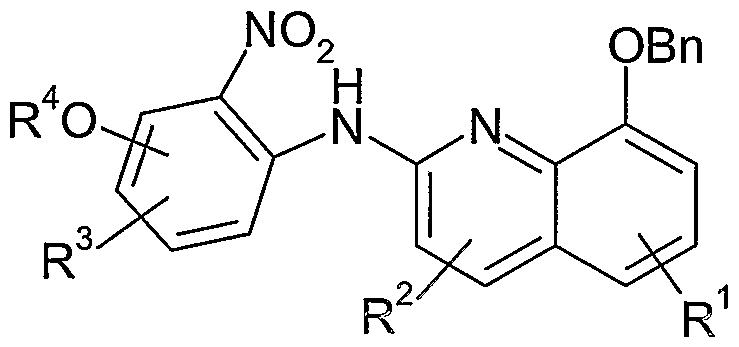
The present invention also relates to a process for preparing a compound of formula VI
Figure imgf000005_0001
VI wherein Bn is benzyl and wherein R1, R2, R3 and R4 are as defined above for formula I; comprising reacting a compound of formula VII
Figure imgf000005_0002
VII wherein R3 and R4 are as defined above for formula I, with a compound of formula VIII
Figure imgf000005_0003
VIII wherein R1 and R2 are as defined above for formula I, in the presence of 1 ,2- Bis(diphenylphosphino)ethane, a base and a a palladium catalyst, such as a palladium (0) or a palladium (II) catalyst. The palladium catalyst is preferably tris(dibenzylidene acetone) dipalladium (0) or palladium acetate, with the latter being most preferred. Examples of suitable bases include potassium phosphate, sodium t-butoxide and cesium carbonate. One especially preferred embodiment of the present invention refers to those processes wherein the palladium catalyst is palladium acetate, and the base is cesium carbonate. The reaction is preferably carried out in the presence of an aromatic solvent, such as toluene, an ether, such as dioxane, dimethoxyethane, or tetrahydrofuran, or a polar nitrogen-containing solvent such as dimethylformamide (DMF). Solvent mixtures can also be used. The reaction may be carried out at a temperature of of about 90°C to about 120°C.
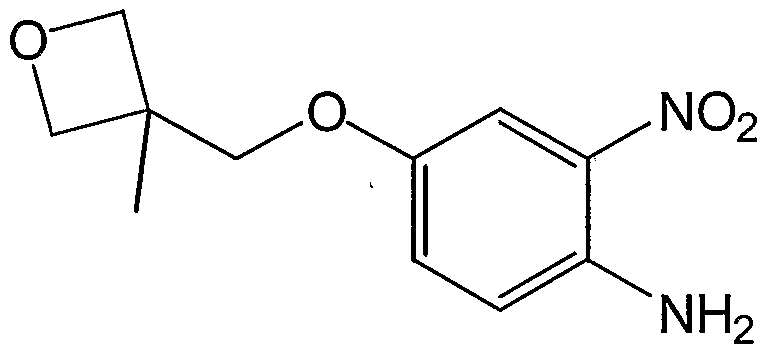
An especially preferred embodiment of the present invention refers to those processes wherein R1 and R2 in the compound of formula VIII are both hydrogen, and the compound of formula VII is a compound of formula VIIA
Figure imgf000006_0001
VIIA
The compound of formula VI is useful as an intermediate toward the preparation of the compounds of formula I. The term "halo", as used herein, unless otherwise indicated, includes fluoro, chloro, bromo or iodo. Preferred halo groups are fluoro and chloro.
The term "alkyl", as used herein, unless otherwise indicated, includes saturated monovalent hydrocarbon radicals having straight or branched moieties. It is understood that for said alkyl group to include cyclic moieties it must contain at least three carbon atoms. The term "cycloalkyl", as used herein, unless otherwise indicated, includes saturated monovalent hydrocarbon radicals having cyclic (including mono- or multi-cyclic) moieties.
The term "alkenyl", as used herein, unless otherwise indicated, includes alkyl groups, as defined above, having at least one carbon-carbon double bond.
The term "allynyl", as used herein, unless otherwise indicated, includes all .yl groups, as defined above, having at least one carbon-carbon triple bond.
The term "alkoxy", as used herein, unless otherwise indicated, includes -O-alkyl groups wherein alkyl is as defined above.
The term "solvate", as used herein includes, a compound of the invention or a salt thereof, that further includes a stoichiometric or non-stoichiometric amount of a solvent bound by non-covalent intermolecular forces. Preferred solvents are volatile, non-toxic, and/or acceptable for topical administration to humans.
The term "hydrate", as used herein refers to a compound of the invention or a salt thereof, that further includes a stoichiometric or non-stoichiometric amount of water bound by non-covalent intermolecular forces. The term "4 to 10 membered heterocyclic", as used herein, unless otherwise indicated, includes aromatic and non-aromatic heterocyclic groups containing one or more heteroatoms each selected from O, S and N, wherein each heterocyclic group has from 4 to 10 atoms in its ring system. Non-aromatic heterocyclic groups include groups having only 4 atoms in their ring system, but aromatic heterocyclic groups must have at least 5 atoms in their ring system. The heterocyclic groups include benzo-fused ring systems and ring systems substituted with one or more oxo moieties. An example of a 4 membered heterocyclic group is azetidinyl (derived from azetidine). An example of a 5 membered heterocyclic group is thiazolyl and an example of a 10 membered heterocyclic group is quinolinyl. Examples of non-aromatic heterocyclic groups are pyrrolidinyl, tetrahydrofuranyl, tetrahydrothienyl, tetrahydropyranyl, tetrahydrothiopyranyl, piperidino, morpholino, thiomorpholino, thioxanyl, piperazinyl, azetidinyl, oxetanyl, thietanyl, homopiperidinyl, oxepanyl, thiepanyl, oxazepinyl, diazepinyl, thiazepinyl, 1 ,2,3,6- tetrahydropyridinyl, 2-pyrrolinyl, 3-pyrrolinyl, indolinyl, 2H-pyranyl, 4H-pyranyl, dioxanyl, 1 ,3- dioxolanyl, pyrazolinyl, dithianyl, dithiolanyl, dihydropyranyl, dihydrothienyl, dihydrofuranyl, pyrazolidinyl, imidazolinyl, imidazolidinyl, 3-azabicyclo[3.1.0]hexanyl, 3- azabicyclo[4.1.0]heptanyl, 3H-indolyl and quinolizinyl. Examples of aromatic heterocyclic groups are pyridinyl, imidazolyl, pyrimidinyl, pyrazolyl, triazolyl, pyrazinyl, tetrazolyl, furyl, thienyl, isoxazolyl, thiazolyl, oxazolyl, isothiazolyl, pyrrolyl, quinolinyl, isoquinolinyl, indolyl, benzimidazolyl, benzofuranyl, cinnolinyl, indazolyl, indolizinyl, phthalazinyl, pyridazinyl, triazinyl, isoindolyl, pteridinyl, purinyl, oxadiazolyl, thiadiazolyl, furazanyl, benzofurazanyl, benzothiophenyl, benzothiazolyl, benzoxazolyl, quinazolinyl, quinoxalinyl, naphthyridinyl, and furopyridinyl. Spiro moieties are also included within the scope of this definition including 1-oxa- 6-a~a-spiro[2.5]oct-6-yl. The foregoing groups, as derived from the groups listed above, may be C-attached or N-attached where such is possible. For instance, a group derived from pyrrole may be pyrrol-1-yl (N-attached) or pyrrol-3-yl (C-attached). Further, a group derived from imidazole may be imidazol-1-yl (N-attached) or imidazol-3-yl (C-attached). An example of a heterocyclic group wherein 2 ring carbon atoms are substituted with o o (=0) moieties is 1 ,1- dioxo-thiomorpholinyl. The phrase "pharmaceutically acceptable salt(s)", as used herein, unless otherwise indicated, includes salts of acidic or basic groups which may be present in the compounds of formula I. The compounds of formula I that are basic in nature are capable of forming a wide variety of salts with various inorganic and organic acids. The acids that may be used to prepare pharmaceutically acceptable acid addition salts of such basic compounds of formula I are those that form non-toxic acid addition salts, Le^ salts containing pharmacologically acceptable anions, such as the acetate, benzenesulfonate, benzoate, bicarbonate, bisulfate, bitartrate, borate, bromide, calcium edetate, camsylate, carbonate, chloride, davulanate, citrate, dihydrochloride, edetate, edislyate, estolate, esylate, ethylsuccinate, fumarate, gluceptate, gluconate, giutamate, glycollylarsanilate, hexylresorcinate, hydrabamine, hydrobromide, hydrochloride, iodide, isothionate, lactate, lactobionate, laurate, malate, maleate, mandelate, mesylate, methylsulfate, mucate, napsylate, nitrate, oleate, oxalate, pamoate (embonate), palmitate, pantothenate, phospate/diphosphate, polygalacturonate, salicylate, stearate, subacetate, succinate, tannate, tartrate, teoclate, tosylate, triethiodode, and valerate salts. Since a single compound of the present invention may include more than one acidic or basic moieties, the compounds of the present invention may include mono, di or tri-salts in a single compound.
In general, "prodrugs" of the compounds of the formula I are functional derivativatives of the compounds of formula" ! which are readily convertible convertible in vivo into the required compound of formula I. Conventional procedures for the selection and preparation of suitable prodrug derivatives are described, for example, in "Design of Prodrugs", ed. H.
Bundgaard, Elsevier, 1985.
A prodrug may be a pharmacologically inactive derivative of a biologically active substance (the "parent drug" or "parent molecule") that requires transformation within the body in order to release the active drug, and that has improved delivery properties over the parent drug molecule. The transformation in vivo may be, for example, as the result of some metabolic process, such as chemical or enzymatic hydrolysis of a carboxylic, phosphoric or sulphate ester, or reduction or oxidation of a susceptible functionality. Compounds referrred to in the processes of the present invention having free amino, amido, hydroxy or carboxylic groups can be converted into prodrugs. Prodrugs include compounds wherein an amino acid residue, or a polypeptide chain of two or more (e.g., two, three or four) amino acid residues is covalently joined through an amide or ester bond to a free amino, hydroxy or carboxylic acid group of compounds of the present invention. The amino acid residues include but are not limited lo the 20 naturally occurring amino acids commonly designated by three letter symbols and also includes 4-hydroxyproline, hydroxylysine, demosine, isodemosine, 3-methylhislidine, norvalin, bela-alanine, gamma- aminobulyric acid, citrulline homocysteine, homoserine, ornithine and melhionine sulfone. Additional types of prodrugs are also encompassed. For instance, tree carbo 'yl groups can be derivatized as amides or alkyl esters. Free hydroxy groups may be derivatized using groups including but not limited to hemisuccinates, phosphate esters, dimelhylaminoacetates, and phosphoryloxymethyloxycarbonyls, as outlined in Advanced Drug Delivery Reviews, 1996, 19, 115. Carbamate prodrugs of hydroxy and amino groups are also included, as are carbonate prodrugs, sulfonate esters and sulfate esters of hydroxy groups. Derivatization of hydroxy groups as (acyloxy)methyl and (acyloxy)ethyl ethers wherein the acyl group may be an alkyl ester, optionally substituted with groups including but not limited to ether, amine and carboxylic acid functionalities, or where the acyl group is an amino acid ester as described above, are also encompassed. Prodrugs of this type are described in J. Med. Chem. 1996, 39, 10. Free amines can also be derivatized as amides, sulfonamides or phosphonamides. All of these prodrug moieties may incorporate groups including but not limited to ether, amine and carboxylic acid functionalities. The compounds referred to in the processes of the present invention may have one or more asymmetric centres, and may accordingly exist both as enantiomers and as diastereoisomers. It is to be understood that all such isomers and mixtures thereof are encompassed within the scope of such compounds. Certain compounds of formula I may have asymmetric centers and therefore exist in different enantiomeric forms. All optical isomers and stereoisomers of the compounds of formula I, and mixtures thereof, are considered to be within the scope of the compounds of formula I. The compounds of formula I may include a racemate, one or more enantiomeric forms, one or more diastereomeric forms, or mixtures thereof. The compounds of formula I may also exist as tautomers. Reference to the compound of formula l includes reference to the use of all such tautomers and mixtures thereof.
The term "Me" means methyl, "Et" means ethyl, and "Ac" means acetyl.
The term "DMF", as used herein, unless otherwise indicated, means dimethylformamide. The term "NMP", as used herein, unless otherwise indicated, means N- methylpyrrolidinone (also known as 1-Methyl-2-pyrrolidinone).
The acronym "DIPHOS", as used herein, unless otherwise indicated, refers to 1 , 2- Bis(diphenylphosphino)ethane
The term " Bll lAP" (abbreviation for 2,2'-Bi3(diphenylphosphino)-1 , l'-binaphthyl); aε used herein, unless otherwise indicated, is represented by the following formula:
Figure imgf000009_0001
The compounds referred to in the processes of the present invention also include isotopically-labelled compounds, which are identical to compounds referred to herein, but for the fact that one or more atoms are replaced by an atom having an atomic mass or mass number different from the atomic mass or mass number usually found in nature. Examples of isotopes that can be incorporated into compounds of the invention include isotopes of hydrogen, carbon, nitrogen, oxygen, phosphorous, fluorine and chlorine, such as 2H, 3H, 13C, 14C, 15N, 180, 170, 31P, 32P, 35S, 18F, and 36Cl, respectively. Compounds referred to in the present invention, prodrugs thereof, and pharmaceutically acceptable salts of said compounds or of said prodrugs which contain the aforementioned isotopes and/or other isotopes of other atoms are within the scope of such compounds. Certain isotopically-labelled compounds referred to in the present invention, for example those into which radioactive isotopes such as 3H and 14C are incorporated, are useful in drug and/or substrate tissue distribution assays. Tritiated, i.e., 3H, and carbon-14, i.e., 14C, isotopes are particularly preferred for their ease of preparation and detectability. Further, substitution with heavier isotopes such as deuterium, i.e., H, can afford certain therapeutic advantages resulting from greater metabolic stability, for example increased in vivo half-life or reduced dosage requirements and, hence, may be preferred in some circumstances. Isotopically labelled compounds of Formula I of this invention and prodrugs thereof can generally be prepared by carrying out the procedures disclosed in the Schemes and/or in the Examples and Preparations below, by substituting a readily available isotopically labelled reagent for a non-isotopically labelled reagent.
Each of the patents, patent applications, published International applications, and scientific publications referred to in this patent application is incorporated herein by reference in its entirety. Detailed Description Of The Invention
General synthetic methods which may be referred to for preparing the compounds of formula I are provided in United States patent 5,990,146 (issued November 23, 1999)(Wamer-Lambert Co.) and PCT published application numbers WO 99/16755 (published April 8, 1999)(Mercl Z- Co.) and WO 01/40217 (published July 7, 2001 )(Pfi~er, Inc.).
Compounds of the formula I may also be prepared according to the following reaction scheme and discussion. Unless otherwise indicated, R1, R2, R3 and R4 in the reaction scheme and discussion that follow are as defined above.
Scheme 1
Figure imgf000011_0001
ii i
With reference to Scheme 1 above, the compond of formula I may be prepared starting with the palladium amination of reaction of a 2-chloro-8-ben∑yloxyquinoline (VIII) and an appropriate 2-amino-nitrobenzene (VII) to provide the quinoline (VI). Reduction of the nitro group and removal of the benzyl group via catalytic hydrogenation, followed by addition of formamidine acetate provides the benzimidazole (V) which can then be transformed into the corresponding triflate (IV). A second palladium catalyzed amination with amine (III) provides piperidinyl quinoline (II) and subsequent removal of the t-butyloxycarbonyl group provides (I).
While not wishing to be bound by theory, the presently claimed process for the preparation of the compounds of formula I from the compounds of formula II under basic (alkaline) conditions is believed to proceed through an isocyanate intermediate (IX) that results from the deprotonation (of the NH proton) of (II) followed by elimination of the t-butoxy group. Hydrolysis of the isocyanate (IX) is believed to produce a carbamic acid (X), which undergoes decarboxylation to produce (I). This mechanism is illustrated in Scheme 2 below. The presence of water as a reactant can be explained by this mechanism. Scheme 2
Figure imgf000012_0001
IX
Decarboxylation
Figure imgf000012_0002
The reaction of the compound of formula VIII with the compound of formula VII in the presence of palladium acetate and DIPHOS (1 , 2-Bis(diphenylphosphino)ethane) to produce the compound of foi mula VI is particularly and unexpectedly advantageous compared to the same reaction using palladium acetate, BINAP and PhB(OH)2. The reaction in the presence of DIPHOS results in higher (e.g., 15-25% higher) yields of the product and takes less time to go to completion, particularly in high scale (e.g., 100 grams and higher) synthesis. This process has significant commercial advantages for the production of active ingredients for use in the preparation of a drug.
The starting materials employed in Scheme 1 are readily commercially available or readily prepared useing methods well known to those of ordinary skill in the art.
In each of the reactions discussed or illustrated in the Schemes, pressure is not critical unless otherwise indicated. Pressures from about 0.5 atmospheres to about 5 atmospheres are generally acceptable, and ambient pressure, L , about 1 atmosphere, is preferred as a matter of convenience.
The examples and preparations provided below further illustrate and exemplify the compounds of the present invention, methods of preparing such compounds, and the methods of the present invention. It is to be understood that the scope of the present invention is not limited in any way by the scope of the following examples and preparations. In the following examples molecules with a single chiral center, unless otherwise noted, exist as a racemic mixture. Those molecules with two or more chiral centers, unless otherwise noted, exist as a racemic mixture of diastereomers. Single enantiomers/diastereomers may be obtained by methods known to those skilled in the art.
Where HPLC chromatography is referred to in the preparations and examples below, the general conditions used, unless otherwise indicated, are as follows. The column used is a ZORBAX RXC18 column (manufactured by Hewlett Packard) of 150 mm distance and 4.6 mm interior diameter. The samples are run on a Hewlett Packard-1100 system. A gradient solvent method is used running 100 percent ammonium acetate / acetic acid buffer (0.2 M) to 100 percent acetonitrile over 10 minutes. The system then proceeds on a wash cycle with 100 percent acetonitrile for 1.5 minutes and then 100 percent buffer solution for 3 minutes. The flow rate over this period is a constant 3 mL/ minute.
The present invention is illustrated by the following Examples. It will be understood, however, that the invention is not limited by the specific details of the following Examples.
EXAMPLE 1
Preparation of 4-(3-Methyl-oxetan-3-ylmethoxy)-2-nitro-phenylamine
Figure imgf000013_0001
The compound, 3-methyl-3-oxetanemethanol (4.68 g, 45.8 mmol, 1.05 equivalent), acetonitrile (25 rnL, 5 volumes), and triethylamine (6.7 mL, 48 mmol, 1.1 equivalent) were charged to a 100 mL round bottomed flask and then cooled to 5-15°C. Methanesulfonyl chloride (3.4 mL, 43.6 mmol, 1.0 equivalent) was charged at a rate which kept the temperature below 45°C. The mixture was stirred at 15-20αC for 2-6 hours, then cooled to 0- 5°C. The solids were filtered through a pad of Celite, then the flask and the filter cake were washed once with 10 mL of acetonitrile. Thereafter, 4-amino-3-nitophenol (6.73 g, 43.6 mmol, 1 equivalent) and cesium carbonate (18.5 g, 56.7 mmol, 1.3 equivalents) were charged to the filtrate and the mixture was heated at 45-60°C for 24 h. Upon reaction completion, ethyl acetate 30 mL, 6 volumes) was charged to the flask. The mixture was stirred for 15-60 min at 35-40°C, and then filtered at 35-40 °C through a pad of Celite. The flask and the filter cake were rinsed with 2 by 6 volumes of ethyl acetate. The filtrate was then washed with 25 volumes of 0.5 N sodium hydroxide solution, followed by 25 volumes of saturated sodium chloride solution. The resulting solution was concentrated to low volume and isopropanol (25 mL, 5 volumes) was added. The solids were granulated at 20-25°C for at least 10 hours and then collected and dried under vacuum at 40°C with a slight nitrogen bleed to provide 7.7 g of a reddish orange fluffy solid (74% yield). 1H NMR (d6-DMSO): δ 7.41 (d, 1 H, J = 2.9 Hz), 7.29 (br s, 2H), 7.18 (dd, 1 H, J = 9.1 , 2.9 Hz), 6.98 (d, 1 H, J = 9.1 Hz), 4.46 (d, 2H, J = 5.8 Hz), 4.26 (d, 2H, J = 5.8 Hz), 3.98 (s, 2H), 1.32 (s, 3H). EXAMPLE 2 Preparation of (8-Benzyloxy-αuinolin-2-yl)-r4-(3-methyl-oxetan-3-ylmethoxy)-2- nitro-phenvn-amine
Figure imgf000014_0001
toluene, reflux The compound, 8-Benzyloxy-quinolin-2-ol (5 g, 18.5 m.mol, 1.0 equivalent), 4-(3-
MethyI-oxetan-3-ylmethoxy)-2-nitro-phenyIamine (5.3 g, 22.2 mmol, 1.2 equivalents), cesium carbonate (8.46 g, 26 mmol, 1.4 equivalents), DIPHOS (1 , 2-Bis(diphenylphosphino)ethane; 443 mg, 111 μmol, 0.06 equivalents) and toluene (75 mL, 15 volumes) were charged to a 100 mL round bottom flask. The reaction was deoxygenated. Palladium acetate (83 mg, 37 μmol, 0.02 equivalents) was added and the reaction was deoxygenated again. The reaction was heated to 100 °C for 24-30 hours. At reaction completion, the reaction was cooled to 55 °C and dichloroethane ("DCE"; 75 mL, 15 volumes) was charged. The slurry was filtered through a pad of Celite and then the flask and filter were rinsed once with additional DCE (50 mL, 10 volumes). The organics were concentrated to low volume and ethyl acetate (50 mL, 10 volumes) was added. The reaction was heated to reflux and allowed to cool to 20-25 °C. The solids were granulated for 10-20 hours, filtered, and dried under vacuum at 40 °C with a slight nitrogen bleed to yield 6.72 g (8-Benzyloxy-quinolin-2-yI)-[4-(3-methyl-oxetan-3-ylmethoxy)-2- nitro-phenylj-amine as an orange solid (77% yield). The material was judged to be about 95% pure by MMR, with -5% of the DIPHOS bis-oxide. 1H NMR (d6-DMSO): δ 9.78 (s, 1 H), 8.73 (d, 1 H, J = 9.1 Hz), 8.11 (d, 1 H, J = 8.7 Hz),
7.55 (m, 2H), 7.36 (m, 4H), 7.22 (m, 4H), 5.20 (s, 2H), 4.52 (d, 2H, J = 5.8 Hz), 4.34 (d, 2H, J = 5.8 Hz), 4.12 (s, 2H), 1.40 (s, 3H).
ΪPLE 3
Preparation of 2-r5-(3-Methyl-oxetan-3-ylmethoxy)-benzoimidazol-1 -yll-quinolin- 8-ol
Figure imgf000014_0002
The compound (8-Benzyloxy-quinolin-2-yI)-[4-(3-methyI-oxetan-3-ylmethoxy)-2-nitro- phenylj-amine (5 g, 10.6 mmol, 1.0 equivalent), ethanol (50 mL, 10 volumes), triethylamine (7.8 mL, 56.2 mmol, 5.3 equivalents), and palladium hydroxide on carbon (500 mg, 0.1 weight equivalents) were charged to a 100 mL round bottom flask. The solution was deoxygenated and then heated to 50 °C. Once the reaction reached 50°C, formic acid (2.2 mL, 56.2 mmol, 5.3 equivalents) was charged slowly to control any exotherm or off-gasing. The reaction was then heated at 55°C for 15-25 hours. After nitro group reduction and benzyl group removal was noted by APCI MS, the reaction was cooled to 40°C and filtered through a pad of Celite. The flask and the filter cake were washed once with ethanol (2.5 volumes). The filtrate was then charged to another 100 mL round bottom flask containing formamidine acetate (2.3 g, 22.3 mmol, 2.1 equivalents) and the reaction was heated at reflux for - 8 hours. At reaction completion, the reaction was cooled to 20-25°C and allowed to granulate for 10-20 hours. The solids were isolated by filtration and dried under vacuum at 40°C with a slight nitrogen bleed to afford 3.14 g of 2-[5-(3-Methyl-oxetan-3-ylmethoxy)-benzoimidazol-1-yl]-quinolin-8-ol as a yellow solid (82% yield). 1H NMR (d6-DMSO): δ 9.88 (s, 1 H), 9.25 (s, 1 H), 8.61 (d, 1 H, J = 9.1 Hz), 8.51 (d, 1 H, J = 9.1 Hz), 8.10 (d, 1 H, J = 9.1 Hz), 7.44 (m, 2H), 7.35 (d, 1 H, J = 2.5 Hz), 7.18 (dd, 1 H, J = 7.5, 1.7 Hz), 7.08 (dd, 1 H, J = 8.7, 2.5 Hz), 4.51 (d, 2H, J = 5.8 Hz), 4.31 (d, 2H, J = 5.8 Hz), 4.12 (s, 2H), 1.39 (s, 3H).
EXAMPLE 4 Preparation of Trifluoro-methanesulfonic acid 2-r5-(3-methyl-oxetan-3- ylmethoxy)-benzoimidazol-1 -yll-quinQlin-8-yl ester
Figure imgf000015_0001
M-Phenyltrifluorornethanesυlfonirnide (PhH(Tf). , ~ 72 g, 7 6 mmol, 1 1 equivalents), 2- l5-(3-Melhyl-oxetan-3-ylmethoxy)-benzoimidaiol-1-yl]-quinolin-8-ol(2.5 g, 6.9 mmol, 1.0 equivalent), DMF (7.5 mL, 3 volumes), and then triethylamine (1.9 mL, 13.8 mmol, 2.0 equivalents) were charged to a 50 mL round bottom flask. The slurry was stirred at 20-30°C for 20-30 hours. After the stirring period, the reaction was filtered and washed with DMF (2.5 mL, 1 volume), followed by isopropyl ether (5 mL, 2 volumes) to yield, after drying under vacuum at 40 °C with a slight nitrogen bleed, 2.9 g trifluoro-methanesulfonic acid 2-[5-(3- methyl-oxetan-3-ylmethoxy)-benzoimidazol-1-yl]-quinolin-8-yl ester as an off-white solid (85% yield).
1H NMR (d6-DMSO): δ 9.18 (s, 1H), 8.75 (d, 1 H, J = 9.1 Hz), 8.65 (d, 1 H, J = 8.7 Hz), 8.33 (d, 1 H, J = 9.1 Hz), 8.18 (dd, 1 H, J = 8.3, 1.2 Hz), 7.94 (d, 1 H, J = 8.9 Hz), 7.70 (t, 1 H, J = 7.9 Hz), 7.36 (d, 1 H, J = 2.1 Hz), 7.02 (dd, 1 H, J = 9.1 , 2.5 Hz), 4.51 (d, 2H, J = 5.8 Hz), 4.31 (d, 2H, J = 5.8 Hz), 4.12 (s, 2H), 1.39 (s, 3H). EXAMPLE 5 Preparation of (1 -{2-r5-(3-Methyl-oxetan-3-ylmethoxy)-benzoimidazol-1 -yll- quinolin-8-yl}-piperidin-4-yl)-carbamic acid tert-butyl ester
Figure imgf000016_0001
BINAP (379 mg, 608 μmol, 0.06 equivalents), tris(dibenzylideneacetone)dipalladium
(186 mg, 203 μmol, 0.02 equivalents) and toluene (35 mL, 7 volumes) were added to a 100 mL round bottom flask. The solution was deoxygenated and stirred at 20-25°C for ~30 minutes. Next, trifluoro-methanesulfonic acid 2-[5-(3-methyl-oxetan-3-ylmethoxy)- benzoimidazol-1-yI]-quinolin-8-yl ester (5 g, 10.1 mmol, 1 equivalent), piperidin-4-yl-carbamic acid tert-butyl ester (4.06 g, 20.3 mmol, 2.0 equivalents), and cesium carbonate (4.62 g, 14.2 mmol, 1.3 equivalents) were charged. The reaction was again deoxygenated and then heated to 85°C for 24-32 hours. At reaction completion, the reaction was cooled to 30°C and dichloroethane (5 volumes) and Celite (0.5 wt. equivalent) were added. The slurry was filtered through a pad of Celite and rinsed with dichloroethane (5 volumes). The mother liquor was then concentrated to low volume and ethyl acetate (75 mL, 15 volumes) was charged. The thin slurry was granulated al 20-25X for 8-15 h and then filtered. The mother liquor was collected and washed with a 2.5% NaH2P04 solution (3 :: 9 volumes). The organics were again concentrated to low volume and aceionilrile (25 mL, 5 volumes) was charged. The slurry was granulated for 10-20 hours, and then the solids were filtered and dried under vacuum at 40°C with a slight nitrogen bleed to yield 4.33 g (1-{2-[5-(3-Melhyl-oxetan-3- ylmethoxy)-benzoimidazol-1-yI]-quinolin-8-yI}-piperidin-4-yl)-carbamic acid tert-butyl ester as a yellow solid (79% yield).
1H NMR (d6-DMSO): δ 9.17 (s, 1 H), 8.89 (d, 1 H, J = 8.7 Hz), 8.51 (d, 1 H, J = 9.1 Hz), 8.15 (d, 1 H, J = 9.1 Hz), 7.59 (d, 1 H, J = 8.3 Hz), 7.47 (t, 1 H, J = 7.9 Hz), 7.35 (m, 2H), 7.29 (m, 1 H), 7.14 (d, 1 H, J = 8.3 Hz), 4.54 (d, 2H, J = 5.4 Hz), 4.32 (d, 2H, J = 5.8 Hz), 4.13 (s, 2H), 3.75 (d, 2H, J = 11.6 Hz), 3.45 (m, 1 H), 2.75 (m, 2H), 1.84 (m, 4H), 1.40 (s, 3H), 1.39 (s, 9H). EXAMPLE 6 Preparation of 1-(2-r5-(3-Methyl-oxetan-3-ylmethoxy)-benzoimidazol-1-vπ- quinolin-8-yl}-piperidin-4-ylamine
Figure imgf000017_0001
The compound, (1-{2-[5-(3-Methyl-oxetan-3-ylmethoxy)-benzoimidazol-1-yI]-quinolin-
8-yl}-piperidin-4-yl)-carbamic acid tert-butyl ester (2 g, 3.68 mmol, 1 equivalent), sodium t- butoxide (1.77 g, 18.4 mmol, 5 equivalents), 2-methyltetrahydrofuran (30 mL, 15 volumes), and water (66 mL, 1 equivalent) were added to a 100 mL round bottom flask. The mixture was heated to reflux and held at reflux for 24-30 hours. At reaction completion, the mixture was cooled to 20-30°C. The reaction was quenched into a 20% citric acid solution (10 volumes) and stirred at 20-30°C for 30-60 minutes. The citrate salt precipitated out of solution during this time. A 50% sodium hydroxide solution (~1 weight equivalent) was charged to basify the reaction mixture (pH 10-12). The layers were separated at 30-40°C. The aqueous layer was washed with ethyl acetate (10 volumes) and then the combined organics were concentrated to low volume. Ethyl acetate (14 mL, 7 volumes) was charged and the slurry was allowed to granulate for 10-20 hours. The solids were filtered and 1 -{2-[5-(3-Methyl- oxetan-3-ylmethoxy)-benzoimidazol-1-yl]-quinolin-8-yl}-piρeridin-4-ylamine (1.4 g, 86% yield) was isolated.
Η NMR (d6-DMSO): δ 9.17 (s, 1 H), 8.88 (d, I H, J = 8.7 Hz), 8.51 (d, 1 H, J = 9.1 Hz), 8.14 (d, 1 H, J = 9.1 Hz), 7.57 (d, 1 H, J = 7.5 Hz), 7.46 (t, 1 H, J = 7.9 Hz), 7.37 (d, 1 H, J = 2.5 Hz), 7.26 (d, 1 H, J = 7.9 Hz), 7.15 (dd, 1 H, J = 9.1 , 2.5 Hz), 4.53 (d, 2H, J = 5.8 Hz), 4.31 (d, 2H, J = 5.8 Hz), 4.13 (s, 2H), 3.71 (d, 2H, J = 10.4 Hz), 2.73 (m, 3H), 1.87 (d, 2H, J - 11.4 Hz), 1.77 (m, 2H), 1.39 (s, 3H). EXAMPLE 7 Preparation of 1 -f2-r5-(3-Methyl-oxetan-3-ylmethoxy)-benzoimidazol-1 -yll- quinolin-8-yl}-piperidin-4-ylamine benzenesulfonate
Benzenesulfonic Acid
Figure imgf000018_0002
Figure imgf000018_0001
The compound, 1-{2-[5-(3-Methyl-oxetan-3-ylmethoxy)-benzoimidazol-1-yl]-quinolin-8- yI}-piperidin-4-ylamine (2.44 g, 5.5 mmol, 1 equivalent) and ethanol (24 mL, 10 volumes) were added to a 100 mL round bottom flask. The solution was heated to reflux to dissolve the starting material and then cooled to room temperature. A solution of benzenesulfonic acid (918 mg, 5.2 mmol, 0.95 equivalents) in ethanol (5 mL, 2 volumes) was charged and the reaction was heated to reflux for -30 minutes. The reaction was cooled to 20-30°C and allowed to granulate for 16-32 hours. The material was then filtered and dried under vacuum with a slight nitrogen bleed to afford 1~{2-[5-(3-Methyl-oxetan-3-ylmethoxy)-benzoimidazol-1- yl]-quinolin-8-yl}-piperidin-4-ylamine benzenesulfonate (2.8 g, 85% yield) as an off-white solid.
Η NMR (dβ-DMSO): ϋ 9.19 (s, I H), 8.87 (d, 1 H, J = 9.1 Hz), 8.54 (d, 1 H, J = 9.1 Hz), 8.16 (d, 1H, J = 9.1 Hz), 7.94 (br s, 3H), 7.63 (d, 1H, J = 7.5 Hz), 7.56 (m, 2H), 7.48 (t, 1H, J = 7.9 Hz), 7.39 (d, 1 H, J = 2.5 Hz), 7.26 (m, 5H), 4.53 (d, 2H, J = 5.8 Hz), 4.31 (d, 2H, J = 5.8 Hz), 4. 12 (s, 2H), 3.83 (m, 2H), 3.2 (m, 1 H), 2.78 (m, 2H), 2.05 (rn, 2H), 1 95 (m, 2H), 1.39 (s, OH).

Claims

CLAIMS 1. A process for preparing a compound of the formula I
Figure imgf000019_0001
or a pharmaceutically acceptable salt, prodrug, hydrate or solvate thereof; wherein each R1, R2, and R3 is independently selected from the group consisting of H, (Cι-C6)alkyl, (C3- C6)cycloaIkyl, halo, cyano, CF3, difluoromethoxy, trifluoromethoxy, -0(CrC6)alkyl, -0(C3- C6)cycloalkyl, and -NR12R13; wherein R4 is -(CR5R6)mH, or -(CR7R8)n(4 to 10 membered)-aromatic or nonaromatic heterocyclic containing one or more heteroatoms each selected from O, S and N, wherein m is an integer ranging from 1 to 5, wherein n is an integer ranging from 0 to 5, wherein said 4 to 10 membered heterocyclic when aromatic is optionally substituted by 1 to 3 P.9 substituents, and wherein said 4 to 10 membered heterocyclic when non-aromatic is optionally substituted by 1 to 3 R10 substituents at any position and optionally substituted by 1 to 3 R11 substituents at any position not adjacent to or directly attached to a heteroatom; wherein each R5, R6, R' and R8 are independently selected from the group consisting of H and (CrCG)alkyl; wherein each R9 is independently selected from H, (Cι-C6)alkyl, (C3-C6)cycIoalkyl, halo, cyano, CF3, difluoromethoxy, trifluoromethoxy, -0(C C6)alkyl, -0(C3-C6)cycloalkyl, and - NR14R15; wherein each R10 is independently selected from H, (C1-C6)alkyl, and (C3-
C6)cycloalkyl; wherein each R11 is independently selected from halo, cyano, CF3, difluoromethoxy, trifluoromethoxy, -0(C C6)alkyl, -0(C3-C6)cycloalkyl, and -NR16R17; wherein R12, R13, R14, R15, R16 and R17 are independently selected from the group consisting of H, (CτC6)alkyl, and (C3-C6)cycloalkyl; wherein each of the aforesaid (C C6)alkyl, (C3-C6)cycloalkyl, -0(C1-C6)alkyl and -0(C3-C6)cycloalkyl substituents wherever they occur may optionally be independently substituted by one to three substituents independently selected from the group consisting of halo, cyano, amino, (Cι-C6)alkylamino, [(CrC^alkylk-amino, perhalo(C C6)alkyl, perhalo(C C6)alkoxy, (C C6)alkyl, (C2-C6)alkenyl, (C2-C6)alkynyl, hydroxy, and (C CβJalkoxy; comprising reacting a compound of the formula II C
Figure imgf000020_0001
wherein BOC is t-butoxycarbonyl, and R1, R2, R3 and R4 are as defined above for the compound of formula I, with a metal alkoxide in the presence of water to give a compound of the formula I.
2. A process according to claim 1 , wherein each R1, R2, and R3 is independently selected from the group consisting of H, (C C6)alkyl, and (C3-C6)cycloalkyl, halo, and cyano.
3. A process according to claim 1 , wherein R4 is -(CR5R6)nH.
4. A process according to claim 1 , wherein R4 is -(CR7R8)n(4 to 10 membered)- aromafic heterocyclic, wherein n is an integer from 0 to 5 and wherein said 4 to 10 membered aromatic heterocyclic is optionally substituted by 1 to 3 Ra substituents.
5. A process according to claim 4, wherein said 4 to 10 membered aromatic heterocyclic contains one to four heteroatoms each selected from O, S and N, with the proviso that said 4 to 10 membered aromatic heterocyclic does not, contain two adjacent O or S atoms.
6. A process according to claim 1 , wherein P^ is -(CR'R8)„(4 to 10 membered)- non-aromatic heterocyclic, wherein n is an integer from 0 to 1 and wherein said 4 to 10 membered nonaromatic heterocyclic group is optionally substituted by 1 to 3 R10 substituents.
7. A process according to claim 6, wherein said 4 to 10 membered non-aromatic heterocyclic is selected from the group consisting of tetrahydrothiopyranyl, thiomorpholino, dioxanyl, pyrrolidinyl, tetrahydrofuranyl, tetrahydropyranyl, piperidino, morpholino, piperazinyl, homopiperazinyl, azetidinyl, oxetanyl, homopiperidinyl, 3-azabicyclo[3.1.0]hexanyl, 3- azabicyclo[4.1.0]heptanyl, azabicyclo[2.2.2]hexanyl, 3H-indolyl, and 4H-pyranyl.
8. A process according to claim 1 , wherein the compound of formula I is selected from the group consisting of:
1-{2-[5-(3-MorphoIin-4-yl-propoxy)-benzoimidazol-1-yl]-quinolin-8-yl}-piperidin-4- ylamine;
(±)-1-{2-[5-(Tetrahydro-furan-3-yloxy)-benzoimidazol-1-yl]-quinolin-8-yl}-piperidin-4- ylamine; 1-{2-[5-(3-Methyl-oxetan-3-ylmethoxy)-benzoimidazol-1-yl]-quinolin-8-yl}-piperidin-4- ylamine;
1-{2-[5-(Tetrahydro-pyran-4-yloxy)-benzoimidazol-1-yl]-quinolin-8-yl}-piperidin-4- ylamine; and the pharmaceutically acceptable salts, prodrugs, hydrates and solvates of the foregoing compounds.
9. A process according to claim 8, wherein the salt is the benzenesulfonate salt.
10. A process according to claim 1 , wherein the water is present in an amount of about 1 equivalent.
11. A process according to claim 1 , wherein the reaction is performed in the presence of an ether solvent.
12. A process according to claim 1 , wherein the alkaline earth metal alkoxide is sodium t-butoxide.
13. A process for preparing a compound of formula VI
Figure imgf000021_0001
wherein Bn is benzyl; wherein each R1, R2, and R3 is independently selected from the group consisting of H,
(CrC6)alkyl, (C3-C6)cycloalkyl, halo, cyano, CF3, difluoromethoxy, trifluoromethoxy, -0(C
C0)all.yl, -0(C3-C6)cycloall .yl, and -i P' 3, wherein R4 is -(CR5Rb)mH, or -(CR'R3)n(4 to 10 rnembered)-arornaiic or non-aromatic heterocyclic, wherein m is an integer ranging from 1 to 5, wherein n is an integer ranging from
0 to 5, wherein said 4 to 10 membered heterocyclic when aromatic is optionally substituted by
1 to 3 R9 substituents, and wherein said 4 to 10 membered heterocyclic when non-aromatic is optionally substituted by 1 to 3 R10 substituents at any position and optionally substituted by 1 to 3 R11 substituents at any position not adjacent to or directly attached to a heteroatom; wherein each R5, R6, R7 and R8 is independently selected from the group consisting of H and (CrC6) alkyl; wherein each R9 is independently selected from H, (C1-C6)alkyl, (C3-C3)cycloalkyl, halo, cyano, CF3, difluoromethoxy, trifluoromethoxy, -0(Ci-C6)alkyI, -0(C3-C6)cycloalkyl, and - NR1 R15; wherein each R10 is independently selected from H, (C C6)alkyl, and (C3- C6)cycloalkyl; wherein each R is independently selected from halo, cyano, CF3, difluoromethoxy, trifluoromethoxy, -0(C C6)alkyl, -0(C3-C6)cycloalkyl, and -NR16R17; wherein R12, R13, R14, R15, R16 and R17 are independently selected from the group consisting of H, (C1-C6)alkyl, and (C3-C6)cycloalkyl; wherein each of the aforesaid (C C6)alkyl, (C3-C6)cycloalkyl, -©(C-i-CβJalkyl and
-0(C3-C6)cycloalkyl substituents wherever they occur may optionally be independently substituted by one to three substituents independently selected from the group consisting of halo, cyano, amino, (C CβJalkylamino, [(Ci-CβJalkylk-amino, perhalo(C1-C6)alkyl, perhalo(C1- C6)alkoxy, (C1-C6)alkyl, (C2-C6)alkenyl, (C2-C6)alkynyl, hydroxy, and (C C6)alkoxy; comprising reacting a compound of formula VII
Figure imgf000022_0001
VII wherein R3 and R4 are as defined above for formula VI, with a compound of formula VIII
Figure imgf000022_0002
¥111 wherein P.1 and F2 are defined above for formula vl, in the presence of
Bis(diphenylρhosphino)elhane, a palladium catalyst and a base
14. A process according lo claim 13, wherein R1 and R2 are both hydrogen, and the compound of formula VII is a compound of formula VIIA
Figure imgf000022_0003
VIIA
15. A process according to claim 14, wherein the reaction is performed in the presence of an aromatic solvent, an ether or a mixture thereof.
PCT/IB2004/001983 2003-06-24 2004-06-14 Processes for the preparation of 1-[(benzoimidazole-1yl) quinolin-8-yl] piperidin-4-ylamine derivatives Ceased WO2004113322A1 (en)

Priority Applications (12)

Application Number Priority Date Filing Date Title
CA002529032A CA2529032C (en) 2003-06-24 2004-06-14 Processes for the preparation of 1-[2-benzimidazol-1-yl) quinolin-8-yl] piperidin-4-ylamine derivatives
HK06109559.8A HK1089170B (en) 2003-06-24 2004-06-14 Processes for the preparation of 1-[(benzoimidazole-1yl) quinolin-8-yl] piperidin-4-ylamine derivatives
EP04736779A EP1641780B1 (en) 2003-06-24 2004-06-14 Processes for the preparation of 1- [(benzoimidazole-1yl) quinolin-8-yl] piperidin-4-ylamine derivatives
DE602004017731T DE602004017731D1 (en) 2003-06-24 2004-06-14 PROCESS FOR THE PREPARATION OF 1-Ä (BENZIMIDAZOL-1-YL) CHINOLIN-8-YLIPIPERIDIN-4-YLAMINE DERIVATIVES
BRPI0411794-8A BRPI0411794A (en) 2003-06-24 2004-06-14 processes for the preparation of 1 - [(benzoimidazol-1-yl) quinolin-8-yl] piperidin-4-ylamine derivatives
JP2006516552A JP2007516168A (en) 2003-06-24 2004-06-14 Process for producing 1- [2- (benzimidazol-1-yl) quinolin-8-yl] -piperidin-4-ylamine derivative
DK04736779T DK1641780T3 (en) 2003-06-24 2004-06-14 Methods for Preparation of 1 - [(benzimidazol-1yl) quinolin-8-yl] -piperidin-4-ylamine derivatives
MXPA05014203A MXPA05014203A (en) 2003-06-24 2004-06-14 Processes for the preparation of 1-[(benzoimidazole-1yl) quinolin-8-yl] piperidin-4-ylamine derivatives.
NZ543714A NZ543714A (en) 2003-06-24 2004-06-14 Processes for the preparation of 1-[(benzoimidazol-1yl)quinolin-8-yl]piperidin-4-ylamine derivatives
AU2004249511A AU2004249511B2 (en) 2003-06-24 2004-06-14 Processes for the preparation of 1-[(benzoimidazole-1yl) quinolin-8-yl] piperidin-4-ylamine derivatives
IL172064A IL172064A (en) 2003-06-24 2005-11-20 Processes for the preparation of 1-[(benzoimidazole-1-yl) quinolin- 8-yl] piperidin-4-ylamine derivatives
NO20060376A NO20060376L (en) 2003-06-24 2006-01-24 Methods for Preparation of 1 - [(Benzothmidazol-1-yl) quinol-8-yl] piperidin-4-ylamine derivatives

Applications Claiming Priority (2)

Application Number Priority Date Filing Date Title
US48217603P 2003-06-24 2003-06-24
US60/482,176 2003-06-24

Publications (1)

Publication Number Publication Date
WO2004113322A1 true WO2004113322A1 (en) 2004-12-29

Family

ID=33539339

Family Applications (1)

Application Number Title Priority Date Filing Date
PCT/IB2004/001983 Ceased WO2004113322A1 (en) 2003-06-24 2004-06-14 Processes for the preparation of 1-[(benzoimidazole-1yl) quinolin-8-yl] piperidin-4-ylamine derivatives

Country Status (24)

Country Link
US (2) US7183414B2 (en)
EP (1) EP1641780B1 (en)
JP (1) JP2007516168A (en)
KR (2) KR100787649B1 (en)
CN (1) CN100404530C (en)
AR (1) AR044849A1 (en)
AT (1) ATE414077T1 (en)
AU (1) AU2004249511B2 (en)
BR (1) BRPI0411794A (en)
CA (1) CA2529032C (en)
CL (1) CL2004001470A1 (en)
CO (1) CO5650165A2 (en)
DE (1) DE602004017731D1 (en)
DK (1) DK1641780T3 (en)
ES (1) ES2315663T3 (en)
IL (1) IL172064A (en)
MX (1) MXPA05014203A (en)
NO (1) NO20060376L (en)
NZ (2) NZ571898A (en)
RU (1) RU2323214C2 (en)
SG (1) SG161745A1 (en)
TW (1) TWI294425B (en)
WO (1) WO2004113322A1 (en)
ZA (1) ZA200509253B (en)

Cited By (9)

* Cited by examiner, † Cited by third party
Publication number Priority date Publication date Assignee Title
WO2006038111A1 (en) * 2004-10-07 2006-04-13 Pfizer Products Inc. Benzoimidazole derivatives useful as antiproliferative agents
JP2008534689A (en) * 2005-04-05 2008-08-28 ファーマコペイア, インコーポレイテッド Purine and imidazopyridine derivatives for immunosuppression
US7504513B2 (en) 2006-02-27 2009-03-17 Hoffman-La Roche Inc. Thiazolyl-benzimidazoles
US8044213B2 (en) 2008-12-18 2011-10-25 Hoffmann-La Roche Inc. Thiazolyl-benzimidazoles
US8518952B2 (en) 2008-08-06 2013-08-27 Pfizer Inc. 6 substituted 2-heterocyclylamino pyrazine compounds as CHK-1 inhibitors
CN107382984A (en) * 2017-08-24 2017-11-24 扬州市三药制药有限公司 A kind of preparation method for treating leukemia medicament
CN109678849A (en) * 2019-01-16 2019-04-26 北京悦康科创医药科技股份有限公司 A kind of preparation method of anticancer drug
US20220017500A1 (en) * 2020-07-20 2022-01-20 Arog Pharmaceuticals, Inc. Crystal forms of crenolanib and methods of use thereof
CN116234549A (en) * 2020-08-05 2023-06-06 总医院公司 Salt-Inducible Kinase Inhibitors

Families Citing this family (22)

* Cited by examiner, † Cited by third party
Publication number Priority date Publication date Assignee Title
GB0411421D0 (en) * 2004-05-21 2004-06-23 Glaxo Group Ltd Novel compounds
CN101993416B (en) * 2009-08-27 2013-09-11 中国科学院上海药物研究所 Quinoline compound and preparation method thereof, medicament combination containing compound and application of compound
JP6407504B2 (en) 2012-09-21 2018-10-17 アログ・ファーマシューティカルズ・インコーポレイテッドArog Pharmaceuticals,Inc. Method for inhibiting constitutively active phosphorylated FLT3 kinase
TWI599356B (en) 2012-09-26 2017-09-21 安羅格製藥有限責任公司 Method of inhibiting mutant c-kit
US10835525B2 (en) 2012-09-26 2020-11-17 Arog Pharmaceuticals, Inc. Method of inhibiting mutant C-KIT
US11642340B2 (en) 2012-09-26 2023-05-09 Arog Pharmaceuticals, Inc. Method of inhibiting mutant C-KIT
BR112015016282A2 (en) 2013-01-07 2017-07-11 Arog Pharmaceuticals, Inc. crenolanib for treatment of mutated flt3 proliferative disorders
US10463658B2 (en) 2013-10-25 2019-11-05 Videra Pharmaceuticals, Llc Method of inhibiting FLT3 kinase
BR112019008762A2 (en) 2016-11-02 2019-07-16 Arog Pharmaceuticals, Inc. method for treating a flt3 mutated proliferative disorder
US12534764B2 (en) 2016-11-02 2026-01-27 Arog Pharmaceuticals, Inc. Crenolanib for treating FLT3 mutated proliferative disorders associated mutations
CN107382983B (en) * 2017-08-24 2020-08-07 扬州市三药制药有限公司 Synthesis method of medicine for treating leukemia
CN110840893A (en) 2018-12-13 2020-02-28 安罗格制药有限责任公司 Claranib-containing pharmaceutical composition and use thereof
US11471451B2 (en) 2019-08-19 2022-10-18 Arog Pharmaceuticals, Inc. Uses of crenolanib
CN117447376A (en) * 2019-12-09 2024-01-26 苏州恩华生物医药科技有限公司 Siama-1 receptor inhibitors of the bicyclic structure
CN114981298B (en) 2019-12-12 2024-08-20 听治疗有限责任公司 Compositions and methods for preventing and treating hearing loss
JP2023536068A (en) * 2020-07-20 2023-08-23 アログ・ファーマシューティカルズ・インコーポレイテッド CRYSTALLINE FORM OF CRENOLANIB AND METHODS OF USING THE SAME
US11524006B2 (en) 2020-09-17 2022-12-13 Arog Pharmaceuticals, Inc. Crenolanib for treating TRK kinase associated proliferative disorders
US20220079934A1 (en) * 2020-09-17 2022-03-17 Arog Pharmaceuticals, Inc. Crenolanib for treating pain
US11969420B2 (en) 2020-10-30 2024-04-30 Arog Pharmaceuticals, Inc. Combination therapy of crenolanib and apoptosis pathway agents for the treatment of proliferative disorders
WO2022090547A1 (en) 2020-10-30 2022-05-05 Dsm Ip Assets B.V. Production of carotenoids by fermentation
CN113683594B (en) * 2021-09-07 2022-12-27 曲靖师范学院 Quinoline-benzimidazole salt compound and synthesis method and application thereof
JP2023063189A (en) 2021-10-22 2023-05-09 アログ・ファーマシューティカルズ・インコーポレイテッド Crenolanib for Treating FLT3 Mutant Proliferative Disorders Relapsed/Refractory to Previous Therapy

Citations (2)

* Cited by examiner, † Cited by third party
Publication number Priority date Publication date Assignee Title
WO2001040217A1 (en) * 1999-11-30 2001-06-07 Pfizer Products Inc. Novel benzoimidazole derivatives useful as antiproliferative agents
WO2004020431A2 (en) * 2002-08-28 2004-03-11 Pfizer Products Inc. Novel benzoimidazole derivatives useful as antiproliferative agents

Family Cites Families (5)

* Cited by examiner, † Cited by third party
Publication number Priority date Publication date Assignee Title
US4897401A (en) * 1987-06-19 1990-01-30 Janssen Pharmaceutical N.V. N-(4-piperidinyl) bicyclic condensed 2-imidazolamine derivatives useful in treating allergic diseases
US5478832A (en) * 1992-05-08 1995-12-26 The Green Cross Corporation Quinoline compounds
HU225960B1 (en) * 1997-02-27 2008-01-28 Takeda Pharmaceutical Amine compounds, their production and use
WO2001042017A1 (en) * 1999-12-10 2001-06-14 Fujitsu Limited Ink-jet head and printer
EP1321454A4 (en) * 2000-09-14 2005-11-02 Kaneka Corp Process for the removal of nitrobenzenesulfonyl

Patent Citations (2)

* Cited by examiner, † Cited by third party
Publication number Priority date Publication date Assignee Title
WO2001040217A1 (en) * 1999-11-30 2001-06-07 Pfizer Products Inc. Novel benzoimidazole derivatives useful as antiproliferative agents
WO2004020431A2 (en) * 2002-08-28 2004-03-11 Pfizer Products Inc. Novel benzoimidazole derivatives useful as antiproliferative agents

Cited By (12)

* Cited by examiner, † Cited by third party
Publication number Priority date Publication date Assignee Title
WO2006038111A1 (en) * 2004-10-07 2006-04-13 Pfizer Products Inc. Benzoimidazole derivatives useful as antiproliferative agents
JP2008534689A (en) * 2005-04-05 2008-08-28 ファーマコペイア, インコーポレイテッド Purine and imidazopyridine derivatives for immunosuppression
US7504513B2 (en) 2006-02-27 2009-03-17 Hoffman-La Roche Inc. Thiazolyl-benzimidazoles
US8518952B2 (en) 2008-08-06 2013-08-27 Pfizer Inc. 6 substituted 2-heterocyclylamino pyrazine compounds as CHK-1 inhibitors
US8044213B2 (en) 2008-12-18 2011-10-25 Hoffmann-La Roche Inc. Thiazolyl-benzimidazoles
CN107382984A (en) * 2017-08-24 2017-11-24 扬州市三药制药有限公司 A kind of preparation method for treating leukemia medicament
CN109678849A (en) * 2019-01-16 2019-04-26 北京悦康科创医药科技股份有限公司 A kind of preparation method of anticancer drug
US20220017500A1 (en) * 2020-07-20 2022-01-20 Arog Pharmaceuticals, Inc. Crystal forms of crenolanib and methods of use thereof
US11713310B2 (en) * 2020-07-20 2023-08-01 Arog Pharmaceuticals, Inc. Crystal forms of crenolanib and methods of use thereof
CN116234549A (en) * 2020-08-05 2023-06-06 总医院公司 Salt-Inducible Kinase Inhibitors
EP4192459A4 (en) * 2020-08-05 2024-12-04 The General Hospital Corporation Salt inducible kinase inhibitors
US12600719B2 (en) 2020-08-05 2026-04-14 The General Hospital Corporation Salt inducible kinase inhibitors

Also Published As

Publication number Publication date
DK1641780T3 (en) 2009-02-02
TW200517393A (en) 2005-06-01
CN1809556A (en) 2006-07-26
TWI294425B (en) 2008-03-11
CA2529032A1 (en) 2004-12-29
NO20060376L (en) 2006-01-24
CA2529032C (en) 2009-12-22
EP1641780A1 (en) 2006-04-05
ZA200509253B (en) 2007-01-31
EP1641780B1 (en) 2008-11-12
IL172064A (en) 2011-01-31
KR20060012033A (en) 2006-02-06
RU2005138367A (en) 2006-08-10
KR20070092333A (en) 2007-09-12
CO5650165A2 (en) 2006-06-30
AU2004249511A1 (en) 2004-12-29
US20050020625A1 (en) 2005-01-27
NZ543714A (en) 2009-06-26
AR044849A1 (en) 2005-10-05
US7183414B2 (en) 2007-02-27
JP2007516168A (en) 2007-06-21
CN100404530C (en) 2008-07-23
NZ571898A (en) 2010-01-29
AU2004249511B2 (en) 2011-01-20
KR100787649B1 (en) 2007-12-21
ES2315663T3 (en) 2009-04-01
CL2004001470A1 (en) 2005-05-13
DE602004017731D1 (en) 2008-12-24
ATE414077T1 (en) 2008-11-15
BRPI0411794A (en) 2006-08-08
SG161745A1 (en) 2010-06-29
MXPA05014203A (en) 2006-02-24
US20070088032A1 (en) 2007-04-19
HK1089170A1 (en) 2006-11-24
RU2323214C2 (en) 2008-04-27

Similar Documents

Publication Publication Date Title
EP1641780B1 (en) Processes for the preparation of 1- [(benzoimidazole-1yl) quinolin-8-yl] piperidin-4-ylamine derivatives
JP3367945B2 (en) 2-Substituted-1-piperidylbenzimidazole compounds as ORL1 receptor agonists
ES2278578T3 (en) PROCEDURES AND INTERMEDIATE COMPOUNDS TO PREPARE ANTI-VANEER COMPOUNDS.
TWI508961B (en) Heterocyclic compounds
JP7008064B2 (en) Heterocyclic compound as an FGFR4 inhibitor
EP1551803B1 (en) Azabicyclo derivatives as muscarinic receptor antagonists
JP5746821B2 (en) Pyrazolylbenzimidazole derivatives, compositions containing them and their use
CN116157396B (en) Pyridazinone derivatives and their use in medicine
WO2022040469A1 (en) Spiro compounds as kras inhibitors
EP1940823A2 (en) Substituted 1-amino-phthalzine derivatives, preparation and therapeutic use thereof
CN114206836B (en) New pyrrole compounds
KR20040032639A (en) The preparation method for pyrimidinone compound and trihydrate of the salt of the pyrimidinone compound
AU2014252281A1 (en) Derivatives of 1-(substituted sulfonyl)-2-aminoimidazoline as antitumor and antiproliferative agents
DE60003169T2 (en) PROCESS FOR PREPARING [S- (R *, S *)] - G (B) - [[1- [1-OXO-3- (4-PIPERIDINYL) PROPYL] -3-PIPERIDINYL] CARBONYL] AMINO] -3 -PYRIDINPROPANSÄUREDERIVATE
KR100617953B1 (en) Method for preparing pyrimidinone compound and salts thereof
JP3140155B2 (en) N, N&#39;-disubstituted amide derivatives
KR20240110861A (en) Compounds used as kinase inhibitors and their uses
HK1089170B (en) Processes for the preparation of 1-[(benzoimidazole-1yl) quinolin-8-yl] piperidin-4-ylamine derivatives
CN110963991A (en) PI3K inhibitor and preparation method and application thereof
KR0184340B1 (en) N-substituted heterocyclic compound and preparation method thereof
CN106800538A (en) A kind of benzimidizole derivatives and its synthetic method
CN119638695A (en) Phenanthroline-substituted methyl guanidine compound, and preparation and application thereof
JP2009529575A (en) Pyridine-containing large heterocyclic compounds as kinase inhibitors
WO1994021641A1 (en) Process for production of an imidazole derivative

Legal Events

Date Code Title Description
AK Designated states

Kind code of ref document: A1

Designated state(s): AE AG AL AM AT AU AZ BA BB BG BR BW BY BZ CA CH CN CO CR CU CZ DE DK DM DZ EC EE EG ES FI GB GD GE GH GM HR HU ID IL IN IS JP KE KG KP KR KZ LC LK LR LS LT LU LV MA MD MG MK MN MW MX MZ NA NI NO NZ OM PG PH PL PT RO RU SC SD SE SG SK SL SY TJ TM TN TR TT TZ UA UG US UZ VC VN YU ZA ZM ZW

AL Designated countries for regional patents

Kind code of ref document: A1

Designated state(s): BW GH GM KE LS MW MZ NA SD SL SZ TZ UG ZM ZW AM AZ BY KG KZ MD RU TJ TM AT BE BG CH CY CZ DE DK EE ES FI FR GB GR HU IE IT LU MC NL PL PT RO SE SI SK TR BF BJ CF CG CI CM GA GN GQ GW ML MR NE SN TD TG

DPEN Request for preliminary examination filed prior to expiration of 19th month from priority date (pct application filed from 20040101)
121 Ep: the epo has been informed by wipo that ep was designated in this application
WWE Wipo information: entry into national phase

Ref document number: 2005/09253

Country of ref document: ZA

Ref document number: 200509253

Country of ref document: ZA

WWE Wipo information: entry into national phase

Ref document number: 172064

Country of ref document: IL

WWE Wipo information: entry into national phase

Ref document number: 543714

Country of ref document: NZ

WWE Wipo information: entry into national phase

Ref document number: 5390/DELNP/2005

Country of ref document: IN

WWE Wipo information: entry into national phase

Ref document number: 12005502132

Country of ref document: PH

WWE Wipo information: entry into national phase

Ref document number: 2004249511

Country of ref document: AU

WWE Wipo information: entry into national phase

Ref document number: 2006516552

Country of ref document: JP

WWE Wipo information: entry into national phase

Ref document number: 2529032

Country of ref document: CA

ENP Entry into the national phase

Ref document number: 2004249511

Country of ref document: AU

Date of ref document: 20040614

Kind code of ref document: A

WWP Wipo information: published in national office

Ref document number: 2004249511

Country of ref document: AU

WWE Wipo information: entry into national phase

Ref document number: 05127734

Country of ref document: CO

WWE Wipo information: entry into national phase

Ref document number: PA/a/2005/014203

Country of ref document: MX

Ref document number: 2004736779

Country of ref document: EP

WWE Wipo information: entry into national phase

Ref document number: 1020057024593

Country of ref document: KR

WWE Wipo information: entry into national phase

Ref document number: 20048175706

Country of ref document: CN

WWE Wipo information: entry into national phase

Ref document number: 1200600110

Country of ref document: VN

WWE Wipo information: entry into national phase

Ref document number: 2005138367

Country of ref document: RU

WWP Wipo information: published in national office

Ref document number: 1020057024593

Country of ref document: KR

WWP Wipo information: published in national office

Ref document number: 2004736779

Country of ref document: EP

ENP Entry into the national phase

Ref document number: PI0411794

Country of ref document: BR