WO2005000865A1 - Microbial method for hydrolysis and oxidation of androst-5-ene and pregn-5-ene steroid esters - Google Patents
Microbial method for hydrolysis and oxidation of androst-5-ene and pregn-5-ene steroid esters Download PDFInfo
- Publication number
- WO2005000865A1 WO2005000865A1 PCT/IB2004/001987 IB2004001987W WO2005000865A1 WO 2005000865 A1 WO2005000865 A1 WO 2005000865A1 IB 2004001987 W IB2004001987 W IB 2004001987W WO 2005000865 A1 WO2005000865 A1 WO 2005000865A1
- Authority
- WO
- WIPO (PCT)
- Prior art keywords
- formula
- compound
- give
- eplerenone
- steroid
- Prior art date
- Legal status (The legal status is an assumption and is not a legal conclusion. Google has not performed a legal analysis and makes no representation as to the accuracy of the status listed.)
- Ceased
Links
- NPHAVLULUWJQAS-UHFFFAOYSA-N CC(C)(CC1)OC1=O Chemical compound CC(C)(CC1)OC1=O NPHAVLULUWJQAS-UHFFFAOYSA-N 0.000 description 1
- QAHXHJJVMHUXJF-UHFFFAOYSA-N CC(C)(CC1)OC1O Chemical compound CC(C)(CC1)OC1O QAHXHJJVMHUXJF-UHFFFAOYSA-N 0.000 description 1
- 0 CC(CC(C1[C@@]2(C)CC3)O)([C@](CC4)C1[C@](*)CC2=CC3=O)C4(CC1)OC1=O Chemical compound CC(CC(C1[C@@]2(C)CC3)O)([C@](CC4)C1[C@](*)CC2=CC3=O)C4(CC1)OC1=O 0.000 description 1
- YUOIRIVWIIYZAS-KEUZLUOYSA-N CC(CCC(C1[C@@H](C2)c3ccc(C)[o]3)[C@@](C)(CC3)C2=CC3=O)([C@@](CC2)(CC3)OC3=O)[C@]12N Chemical compound CC(CCC(C1[C@@H](C2)c3ccc(C)[o]3)[C@@](C)(CC3)C2=CC3=O)([C@@](CC2)(CC3)OC3=O)[C@]12N YUOIRIVWIIYZAS-KEUZLUOYSA-N 0.000 description 1
- ZYDNRZOTRVTMRC-FATFIRRNSA-N CC(C[C@H]1O)([C@@H](CC2)C([C@@H](C3)C(OC)=O)C1C(C)(CC1)C3=CC1=O)[C@@]2(CC1)OC1=O Chemical compound CC(C[C@H]1O)([C@@H](CC2)C([C@@H](C3)C(OC)=O)C1C(C)(CC1)C3=CC1=O)[C@@]2(CC1)OC1=O ZYDNRZOTRVTMRC-FATFIRRNSA-N 0.000 description 1
- LXQCBINQQLXICL-RATVEBJZSA-N CC(C[C@H]1[C@H](C=C)O)(C(CC2)C([C@@H](C3)C(OC)=O)C1C(C)(CC1)C3=CC1O)C2(CC1)OC1=O Chemical compound CC(C[C@H]1[C@H](C=C)O)(C(CC2)C([C@@H](C3)C(OC)=O)C1C(C)(CC1)C3=CC1O)C2(CC1)OC1=O LXQCBINQQLXICL-RATVEBJZSA-N 0.000 description 1
- VSUVKEJGOKIURB-UHFFFAOYSA-N CC1(C(CC2)C(C(CC(C3)C4(C)CCC33OCCO3)C(OC)=O)C4=CC1)C2(C#C)O Chemical compound CC1(C(CC2)C(C(CC(C3)C4(C)CCC33OCCO3)C(OC)=O)C4=CC1)C2(C#C)O VSUVKEJGOKIURB-UHFFFAOYSA-N 0.000 description 1
- KGXMDDCXXFKJRI-OVYLFTTASA-N CC1(C(CC2)C([C@@H](C=C(C3)C4(C)CCC33OCCO3)C(OC)=O)C4=CC1)C2(CC1)COC1=O Chemical compound CC1(C(CC2)C([C@@H](C=C(C3)C4(C)CCC33OCCO3)C(OC)=O)C4=CC1)C2(CC1)COC1=O KGXMDDCXXFKJRI-OVYLFTTASA-N 0.000 description 1
- LZAMWBGNOBSFPX-VTFMXZPYSA-N CC1(C(CC2)C([C@@H](CC3C4(C)CCC5OC5C3)C(OC)=O)C4=CC1)C2(C#C)O Chemical compound CC1(C(CC2)C([C@@H](CC3C4(C)CCC5OC5C3)C(OC)=O)C4=CC1)C2(C#C)O LZAMWBGNOBSFPX-VTFMXZPYSA-N 0.000 description 1
- VUCGZZMCAHJHHT-XTSVTJHRSA-N C[C@H]1C=C(C[C@H](CC2)OC(C)=O)C2(C)C([C@@H](C2)OC(C)=O)C1[C@H](CC1)C2(C)C1(CC1)OC1=O Chemical compound C[C@H]1C=C(C[C@H](CC2)OC(C)=O)C2(C)C([C@@H](C2)OC(C)=O)C1[C@H](CC1)C2(C)C1(CC1)OC1=O VUCGZZMCAHJHHT-XTSVTJHRSA-N 0.000 description 1
Classifications
-
- C—CHEMISTRY; METALLURGY
- C12—BIOCHEMISTRY; BEER; SPIRITS; WINE; VINEGAR; MICROBIOLOGY; ENZYMOLOGY; MUTATION OR GENETIC ENGINEERING
- C12P—FERMENTATION OR ENZYME-USING PROCESSES TO SYNTHESISE A DESIRED CHEMICAL COMPOUND OR COMPOSITION OR TO SEPARATE OPTICAL ISOMERS FROM A RACEMIC MIXTURE
- C12P33/00—Preparation of steroids
- C12P33/20—Preparation of steroids containing heterocyclic rings
Definitions
- This invention describes a microbial transformation of 3,7-dihydroxy or 3- hydroxy-7-carboxy substituted 5-ene steroid compounds in which there is concomitant hydrolysis of alkanoyl esters, oxidation of a 3-hydroxy to a 3-ketone and migration of the 5,6 double bond to the 4,5 position.
- the resultant products are intermediates useful in the preparation of eplerenone and other 7-substituted steroids.
- Certain 7-carboxy substituted steroids for example eplerenone, are well known for their aldosterone antagonist activity and are thus useful in the treatment and prevention of diseases of the circulatory system.
- U.S. Patent Nos. 4,559,332 and 5,981,744 and International Publication WO98/25948 describe methods for the preparation of eplerenone and related compounds.
- the advent of new and expanded clinical uses for eplerenone creates a need for improved processes for the manufacture of this and other related steroids.
- This invention relates to processes for the microbial transformation of 7-substituted steroid compounds of Formula I,
- Ri is H or C ⁇ -C 6 -alkylC(O)-;
- R 2 is -ORi or -C(O)-OC ⁇ -C 6 alkyl O C O
- R j I Z is ⁇ C
- Z 2 is -CH-; or Zi and Z 2 may be taken together to form a carbon-carbon double bond;
- R 2 , Z 1( Z 2> and Q are as for Formula I; when compounds of Formula II are used as intermediates for eplerenone synthesis, R 2 is ⁇ -ORi or OrC(O)-OCi-C 6 alkyl.
- the compounds of Formula II are useful for the preparation of 7 substitued steroids, especially eplerenone, as described in detail in the Description of Embodiments.
- alkyl by itself or as part of another substituent, means, unless otherwise stated, a straight or branched chain, or cyclic hydrocarbon radical, or combination thereof.
- saturated hydrocarbon radicals include, but are not limited to, groups such as methyl, ethyl, n-propyl, isopropyl, n-butyl, t-butyl, isobutyl, sec-butyl, cyclohexyl, (cyclohexyl)ethyl, cyclopropylmethyl, homologs and isomers of, for example, n-pentyl, n-hexyl, n-heptyl, n-octyl, and the like.
- biotransformation means transformation of chemical compounds within a living system.
- Lewis acid means an electron pair acceptor as defined in McQuarrie, D.A., et.al., General Chemistry, third edition, W.H.Freeman and Company pub., 1991, p. 665.
- Ri is H or C ⁇ -C 6 -alkylC(O)-;
- R 2 is -ORj or -C(O)-OC ⁇ -C 6 alkyl
- Z 2 is -CH-; or Z ⁇ and Z 2 may be taken together to form a carbon-carbon double bond;
- R 2 is ⁇ -ORi or -C(O)-OC ! -C 6 alkyl.
- the biotransformation proceeds through the intermediates I, where Ri is H, which can also be isolated.
- the biotransformation can be achieved with any bacterium belonging to the genus Flavobacterium capable of performing the biotransformation, and in particular Flavobacterium dehydrogenans the strain ATCC 13930.
- a method for identifying strains capable of performing the biotransformation is illustrated in Example 1.
- the bacterium maybe utilized in the form of an actively growing culture, either in the absence or presence of a water-immiscible organic solvent. Usually, the bacterium is grown in submerged culture under aerobic conditions, using any art-recognized procedure, and steroid transformations performed in situ.
- the desired bacterium may be cultured using conditions identified in examples 1-3 using the ingredients specified.
- Carbon sources may include sugars such as monosaccharides, disaccharides, trisaccharides, hydrolyzed polysaccharides, sugar acids, and sugar alcohols.
- sugars such as monosaccharides, disaccharides, trisaccharides, hydrolyzed polysaccharides, sugar acids, and sugar alcohols.
- a monosaccharide, disaccharide or sugar alcohol is used as the carbon source.
- the monosaccharide glucose (dextrose) is used.
- the concentration of carbon source maybe from about 0.5 g/L to about 40 g/L, but typically from about 2 g/L to about 10 g/L.
- Nitrogen sources may include nitrogen-containing organic substances such as casein, cornsteep liquor, meat extract, peptone, soy protein hydrolysate, soy flour, and yeast extract, and/or nitrogen- containing inorganic compounds such as nitrates and inorganic ammonium salts.
- nitrogen-containing organic substance yeast extract and the nitrogen- containing inorganic compound ammonium sulfate are used.
- Yeast extract may be used at a concentration from about zero g/L to about 25 g/L, but typically about 10 g/L to about 20 g/L.
- Ammonium sulfate may be used at a concentration from about zero g/L to about 10 g/L, but typically from about 0.5 g/L to about 5 g/L.
- Other suitable carbon and nitrogen sources are known to those skilled in the art.
- a primary and secondary vegetative seed procedure is used in preparation for the bacterial steroid transformation.
- a primary vegetative seed can be used directly to inoculate bioconversion media.
- Primary vegetative seed cultures may be incubated for a period of about 24 to about 96 hours (preferably about 48 hours) at a temperature between about 22° and about 37° (preferably about 28°), and a pH between about 5.0 and about 8.0 (preferably between about 6.0 and about 7.5).
- Secondary vegetative seed medium is inoculated with about 0.1 % to about 1.0 % (v/v) primary vegetative seed culture, but typically about 0.5 % (v/v), and incubated for a period of about 24 to about 96 hours (preferably about 48 to about 72 hours) at a temperature between about 22° and about 37° (preferably about 28°).
- the pH of the secondary seed medium can be between about 5.0 and about 8.0 (preferably between about 6.0 and about 7.5.
- the bioconversion medium is inoculated with about 1% to about 10% (v/v) secondary vegetative seed culture, but typically about 5 % (v/v), and incubated at a temperature between about 22° and about 37° (preferably about 28°).
- the pH of the bioconversion medium can be between about 5.0 and about 8.0 (preferably between about 6.0 and about 7.5).
- Steroid substrates of Formula (I) may be added to the bioconversion medium, dissolved in a minimal volume of water-miscible solvent such as acetone, methanol, ethanol, DMSO or DMF, prior to sterilization and inoculation. It is preferred to use substrates of Formula (I) at a concentration greater than 0.5 g/L, more preferably greater than 1.0 g/L, even more preferably greater than 4 g/L.
- micronized steroid substrates of Formula (I) may be added to the growing culture between zero hours and about 72 hours post-inoculation (preferably between about 24 hours and about 48 hours).
- Water-immiscible organic solvents such as toluene, branched octane, dichloromethane, octanol, and mixtures thereof may be used at a ratio of about 0.1-2 : 1 (v/v), solvent : whole beer, but typically about 0.5:1 (v/v). Any 3-ol- ⁇ 5 -steroid possessing acetate esters can be used to induce these enzyme activities.
- the concentration of inducer used is from about 1 mg/L to about 100 mg/L, but typically about 10 mg/L.
- Inducer may be added to the bioconversion medium, dissolved in a minimal volume of water-miscible solvent such as acetone, methanol, ethanol, DMSO or DMF, prior to sterilization and inoculation, or as a micronized slurry between zero hours and about 36 hours post-inoculation, but typically between about 12 hours and 24 hours.
- Bioconversion of steroid substrates of Formula (I) is allowed to proceed for between about 1 and 5 days, but typically about 2 to about 3 days.
- steroid products of Formula (II) can be isolated using any one of a number of art-recognized procedures or, more specifically, using the solvents and conditions described in the examples.
- the whole beer is extracted using an organic solvent, such as ethyl acetate, toluene, butyl acetate, or methylene chloride and the deacylated products of Formula (II) are isolated by crystallization.
- Silica gel chromatography (approximately 50 g of silica per gram of product) may be used to separate the deacylated products of Formula (II) prior to crystallization.
- the column chromatography and crystallization solvents include solvents such as water, methanol, acetone, butyl acetate, methylene chloride, or combinations thereof.
- the preferred extraction solvent is methylene chloride; the preferred chromatography solvent is 95% methylene chloride / 5% methanol; and, the preferred crystallization solvent is n-butyl acetate.
- the products of the biotransformations are useful in the synthesis of 7-substituted steroids and, in particular, eplerenone.
- Schemes I-NI illustrate the processes of this invention where the products of the biotransformation are compounds of Formula II. In the schemes, illustrative of the invention are steps I-F, II-C, III-B, IN-C, NA and VIA.
- Scheme VI Preparation of the starting material 1, (3 ⁇ ,7 ⁇ ,ll ⁇ -trihydroxy-5-androsten-17- one) for Schemes I- ⁇ is obtained in one of two ways.
- One way is to first contact 5-anrosten-3 ⁇ -ol-17-one with a submerged culture of Diplodia gossypina ATCC 20517 (synonym Botryodiplodia theobromae IFO 6469) to generate 5-androsten- 3 ⁇ ,7 ⁇ -diol-17-one (see Example 10), and then contact 5-androsten-3 ⁇ ,7 ⁇ -diol-17-one with a submerged culture of Aspergillus ochraceus ATCC 18500 to generate 5- androsten-3 ⁇ ,7 ⁇ ,ll -triol-17-one 1.
- Aspergillus ochraceus ATCC 18500 to generate 5-androsten-3 ⁇ ,l l ⁇ -diol-17-one (see Example 13), then chemically eliminating the 1 l ⁇ -hydroxyl to generate 5,9(11)- androstadien-3 ⁇ -ol-17-one, followed by contacting 5,9(1 l)-androstadien-3 ⁇ -ol-17-one with a submerged culture of Diplodia gossypina ATCC 20517 (synonym Botryodiplodia theobromae IFO 6469) to generate 5,9(1 l)-androstadien-3 ⁇ ,7 ⁇ -diol- 17-one 25.
- a general description of the various steps in the processes follows.
- Steps I-F, II-C, III-B, IV-C, VA and VIA Biotransformations are accomplished as described above.
- Steps I-B, II-A and IV A hydroxy acylations Hydroxy intermediates are acylated with an acylating reagent in the presence of a tertiary organic base by procedures well known in the art.
- Acylating reagents include lower alkanoic anhydrides, lower alkanoic chlorides and the like.
- Suitable tertiary organic bases include pyridine, 4-dimethyam ⁇ nopyridine, 4-dimethyaminopyridine N- oxide, triethyl amine, diisopropylethyl amine and the like.
- Steps I-C, II-F, III-E andW-F Hydroformylation of acetylene adducts Formation of the lactol intermediates is achieved by hydroformylation with carbon monoxide and hydrogen in the presence of a catalytic amount of rhodium catalyst and a rhodium coordinating ligand according to procedures described in the literature (Wuts, P.G.M., et al, J.Org.Chem. 1989, 54, 5180; Botteghi, C, et al., Tetrahedron, 2001, 57, 1631). The reaction is conducted at a pressure of from 14-500 psi, preferably from 100-200 psi.
- Suitable rhodium catalysts include rhodium acetate, rhodium chloride, hydridorhodiumtristriphenylphosphine and dicarbonyl acetylacetonato rhodium II.
- Suitable ligands include triarylphosphines, trialkyl phosphites bidentate phosphines such as xantphos, bidentate phosphites and the like. Steps I-D, II-G and III-F: Oxidation ofLactols to Lactones:
- Oxidation of lactols to lactones can be achieved with a variety of standard oxidizing reagents.
- suitable oxidizing reagents include: Iodosuccinimide/tetrabutyl ammonium iodide (Kraus, G.A., et al., Bioorganic & Medicinal Chemistry Letters (2000), 10(9), 895-897; Barrett, A.G.M., et al., J Org. Chem.
- Steps I-E, II-B andlY-B Carbonylation at C-7 Carbonylation of steroidal ⁇ 5 -ene-7-acylates (Compounds 5, 10 and 26) is accomplished by reaction with carbon monoxide in the presence of an alcohol, a base, a palladium catalyst and, optionally, a co-solvent, to provide the steroid compounds of Formula I according to methods described in the literature (Tsuji, J., et al., J. Org. Chem., (1984), 49, 1341; Murahashi, S.-L, et al., J. Org. Chem., (1993), 58, 1538; Satoh, T., et al., J. Org.
- Suitable palladium catalysts include, but are not limited to, palladium acetate, palladium(II) acetylacetonate, palladium(0)bis(dibe ⁇ zylideneacetone) (Pd 2 (dba) 2 ), palladium 1,3-diphenylphosphinopropane dibromide, (Pd(dppp)Br 2 ), dimethyl-2- (dimethylphosphino)ethylphosphine palladium and bistriphenylphosphine palladium dibromide (Pd 2 (Ph 3 P) 2 Br 2 .
- Suitable bases include, but are not limited to N- methylmorpholine (NMM), triethylamine (TEA), diisopropylethylamine (DIPEA) and the like. Reactions were conducted at 70-80° C and 1200-1400 psi carbon monoxide in methanol for 10-12 firs. The reaction mixture optionally contains bromide from, for example, lithium bromide. The results of carbonylation under a variety of conditions are summarized in Table 1. As can be seen, yields of product are dependent on conditions and range from 0% up to nearly 80%. Specific conditions for this reaction are found in the examples.
- Steps I-G, II-I and III-H Dehydration ofllhydroxy intermediates: Dehydration of 11 -hydroxy intermediates 7b and 18b is achieved using phosphorous pentachloride as has been described (U.S. Patent 4,559,332). Alternatively, the 11- hydroxy intermediates may be converted to a sulfonyl ester, for example a methane sulfonate or a -toluene sulfonate, followed by treatment with a base to affect elimination as is described in WO97/21720 and WO98/25948.
- a sulfonyl ester for example a methane sulfonate or a -toluene sulfonate
- Step III-A Allylation of 2-methylfuran; Reaction of the triacylated compound 10 with 2-methylfuran in the presence of a Lewis acid, usually in an inert solvent such as acetonitrile or methylene chloride, gives 17.
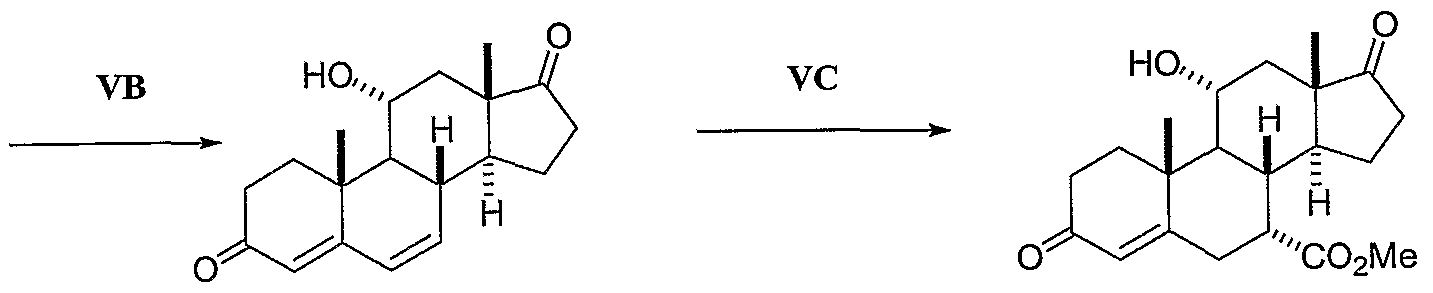
- Step III-I Conversion of 7-furanyl steroids to 7 carbomethoxy steroids: Degradation of the furan ring in 24 to the methyl ester 8 is achieved by ozonolysis, oxidation and esterification as described in the examples. Steps I-H, II-H and III-H: Oxidation ofC-9,11 olefins to epoxides: Methods for conversion of the known intermediate 8 to 9 (eplereneone) are described in U.S. Patent Nos. 3095412, 4,559,332, and 5,981,744. Steps VB and VB: Dehydration of 7-hydroxy-4-ene-3 -one steroids to 4,6- diene-3-one steroids:
- Steps VC and VIC conversion of 4,6-diene-3-one steroids to 7-carboxy-4-ene- 3-one steroids:
- Dieneones 34 and 36 are converted to the corresponding 7-carbomethoxy compounds 12b and 7b by: a) treatment of the dieneone with acetone cyanohydrin in dimethylformamide in the presence of lithium chloride and triethyl amine at 85° C for 8-15 hours; b) treatment of the product of step a) with hydrochloric acid in methanol/water at 80° C for 5 hours; and, c) treating the product of step b) with sodium methoxide in methanol at reflux for 20 hours as described in U.S. Patent No. 5,981,744.
- Example 1 Biotransformation of 5-androsten-3 ⁇ ,7 ⁇ , 11 ⁇ -triacetoxy-17-one 10 to 4-androsten-7 ⁇ ,l l -diol-3,17-dione 27 and/or 5-androsten-3 ⁇ ,7 ⁇ ,ll ⁇ -triol-17-one 1 is performed using a submerged culture of Flavobacterium dehydrogenans ATCC 13930.
- a single colony of Flavobacterium dehydrogenans ATCC 13930 is used to inoculate a 500-mL shake flask containing 100 mL primary-seed medium.
- Primary- seed medium consists of (per liter of RO water): nutrient broth, 8 g; glycerol, 4 mL; water-soluble brewers yeast extract, 1 g; KH 2 PO 4 , 2.72 g; polyoxyethylenesorbitan monooleate, 2 mL; pre-sterilization pH 6.8, adjusted with 2N NaOH.
- Shake flasks, containing 100 mL primary-seed medium are sterilized for 30 minutes at 121° C using an autoclave.
- Flavobacterium dehydrogenans ATCC 13930 is incubated for 48 hours at 28° C, using a controlled-environment incubator-shaker set at 270 r.p.m. (2" orbital stroke).
- B Secondary-Seed Stage One hundred milliliter secondary-seed medium, in a 500-mL shake flask, is inoculated using 0.12 mL of vegetative primary-seed culture (approximately 0.12 % [v/v] inoculation rate).
- Secondary-seed medium contains (per liter of RO water): cerelose, 20 g; hydrolyzed soy protein, 6 g; water-soluble brewers yeast extract; 6 g; silicone defoamer (SAG 471), 0.5 mL; pre-sterilization pH 6.8, adjusted with 2N NaOH.
- Shake flasks, containing 100 mL secondary-seed medium, are sterilized for 30 minutes at 121° C using an autoclave.
- Flavobacterium dehydrogenans ATCC 13930 is incubated for 48 hours at 28° C, using a controlled-environment incubator- shaker set at 270 r.p.m. (2" orbital stroke).
- Steroid Bioconversion Fifty milliliter steroid-bioconversion medium, in a 500-mL shake flask, is inoculated using 2.5 mL of vegetative secondary-seed culture (approximately 5 % [v/v] inoculation rate).
- Steroid-bioconversion medium contains (per liter of water): cerelose, 5 g; water-soluble brewers yeast extract, 15 g; polyoxyethylenesorbitan monooleate, 0.1 mL; (NBU) 2 SO , 1 g; KH 2 PO ; 1 g; pre-sterilization pH 6.8, adjusted with 2N NaOH.
- steroid substrate dissolved in a mitiimal volume of acetone Prior to sterilizing the steroid-bioconversion medium, steroid substrate dissolved in a mitiimal volume of acetone is added to vigorously stirring medium to a final concentration of 1 g/L.
- Shake flasks, containing 50 mL steroid- bioconversion medium are sterilized for 30 minutes at 121° C using an autoclave.
- Flavobacterium dehydrogenans ATCC 13930 is incubated at 28° C, using a controlled-environment incubator-shaker set at 270 r.p.m. (2" orbital stroke) for 96 hours.
- the methylene chloride extracts are polished, pooled, dried onto 5 g of silica gel G-60 by distillation, and placed on top of 100 g of silica gel G-60 in a 1" x 20" glass column equilibrated with 95% methylene chloride and 5% methanol.
- the chromatography is developed with the same 95% methylene chloride and 5% methanol mixture.
- the column eluate is collected in 20 mL fractions and the development monitored by TLC using the same 95% methylene chloride and 5% methanol mobile phase. Fractions of each of the two end products are combined and each is concentrated by evaporation to about 5-10 mL.
- Example 2 Bioconversion of 5-androsten-3 ⁇ ,l l ⁇ -diacetoxy-7 ⁇ -carbomethoxy-17- one 11 to 4-androsten-ll ⁇ -ol-7 ⁇ -carbomethoxy-3,17-dione 12b and or 5-androsten- 3 ⁇ ,l l ⁇ -diol-7 ⁇ -carbomethoxy-17-one 12a is performed using a submerged culture of Flavobacterium dehydrogenans ATCC 13930.
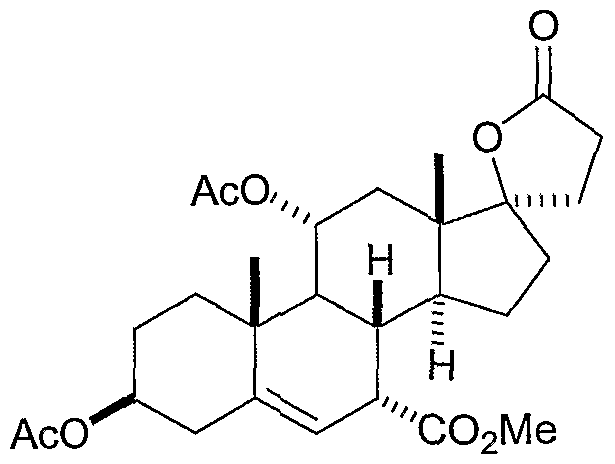
- Example 3 Bioconversion of pregn-5-ene-7 ⁇ ,21-dicarboxylic acid-3 ⁇ ,l l - diacetoxy-17 ⁇ -hydroxy- ⁇ -lactone methyl ester 6 to pregn-4-ene-7 ⁇ ,21-dicarboxylic acid-3-oxo-l l ,17 ⁇ -dihydroxy- ⁇ -lactone methyl ester, 7b and regn-5-ene-7 ,21- dicarboxylic acid-3 ⁇ ,l l ,17 ⁇ -trihydroxy- ⁇ -lactone methyl ester 7a is performed using a submerged culture of Flavobacterium dehydrogenans ATCC 13930.
- Example 4 Bioconversion of 5 -androsten-3 ⁇ , 11 ⁇ -diacetoxy-7 -furan- 17-one 15 to 5-androsten-3 ⁇ ,l l ⁇ -diol-7 ⁇ -furan-l 7-one 16a and 4-androsten-l l -ol-7 ⁇ -furan-3,17- dione 16b is performed using a submerged culture of Flavobacterium dehydrogenans ATCC 13930.
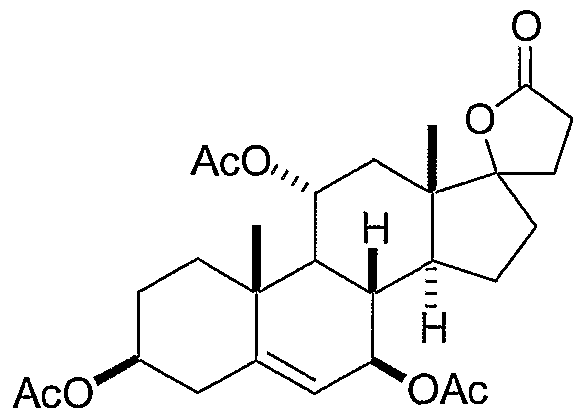
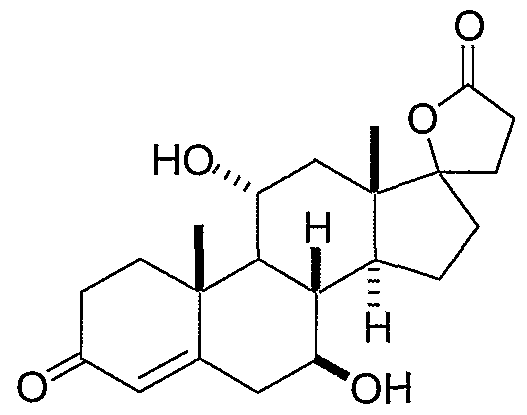
- Example 5 Bioconversion of 3 ⁇ ,7 ⁇ ,l l -triacetoxy-17 ⁇ -hydroxypregn-5-ene-21- carboxylic acid ⁇ - lactone 5 to 7 ⁇ ,l l , 17 ⁇ -trihydroxy-3-oxo-pregn-4-ene-21- carboxylic acid, ⁇ -lactone 35a, 7 ⁇ ,ll , 17 ⁇ -trihydroxy-3-oxo-pregn-4-ene-21- carboxylic acid, ⁇ -lactone 35b and l l ,17 ⁇ -dihydroxy-3-oxo-pregn-4,6-diene-21- carboxylic acid, ⁇ -lactone 36 is performed using a submerged culture of Flavobacterium dehydrogenans ATCC 13930.
- HMDS Hexamethyldisilazane
- Step 1 Bioconversion of 5-androsten-3 ⁇ -ol-17-one to 5-androsten- 3 ⁇ ,7 ⁇ -diol-17-one
- the bioconversion of 5-androsten-3 ⁇ -ol-l 7-one to 5-androsten-3 ⁇ ,7 ⁇ -diol-17- one is performed using a submerged culture of Diplodia gossypina ATCC 20571 (synonym Botryodiplodia theobromae IFO 6469) at a 10-L fermentation scale.
- Primary-seed medium consists of (per liter of RO water): dextrin, 50 g; soyflour, 35 g; cerelose, 5 ; cobalt chloride hexahydrate, 2 mg; silicone defoamer (SAG 471), 0.5 mL; pre-sterilization pH 7.0-7.2, adjusted with sodium hydroxide (2N).
- Diplodia gossypina ATCC 20571 is incubated for 48 hours at 28°, using a controlled-environment incubator-shaker set at 280 r.p.m. (1" orbital stroke).
- (B) Secondary-Seed Stage Ten-liter secondary-seed fermentations are inoculated using 1.2 mL vegetative primary-seed culture (0.012 % [v/v] inoculation rate).
- Secondary-seed medium contains (per liter of RO water): cerelose, 60 g; soyflour, 25 g; soybean oil, 30 mL; magnesium sulfate heptahydrate, 1 g; potassium dihydrogen phosphate, 0.74 g; polyoxyethylenesorbitan monooleate, 2 mL; silicone defoamer (SAG 471), 0.5 mL; pre-sterilization pH 3.95-4.00, adjusted with concentrated sulfuric acid.
- the fermentors, containing secondary-seed medium are sterilized for 20 minutes at 121° using both jacket and injection steam. The agitation rate during sterilization is 200 r.p.m..
- the medium pH is adjusted to 4.0 using sterile sulfuric acid (5 %).
- the DO first drops to 30 % the airflow is increased to 5 SLM (0.5 WM).
- 30 % DO is maintained using agitation control.
- Secondary-seed cultures are harvested at approximately 60 hours post-inoculation, when the OUR is between about 10 and about 15 mM/L/h.
- Steroid-bioconversion Ten-liter steroid-bioconversion fermentations are inoculated using 500 mL vegetative secondary-seed culture (5 % [v/v] inoculation rate). Steroid-bioconversion medium is the same as secondary-seed medium. Sterilization conditions and pH adjustment are as described for secondary-seed medium. Diplodia gossypina ATCC 20571 is incubated at 28° using essentially the same initial parameters as those used for secondary-seed cultivation, with the exception that the low DO set-point is increased from 30 % to 50 %. When the DO first drops to 50 %, the air flow is increased from 2.5 SLM (0.25 WM) to 5 SLM (0.5 WM).
- Cells are separated from the aqueous-methanol mixture by centrifugation (3,000 x g for 10 minutes), and several microliters applied to a TLC plate.
- the TLC plate is developed in cyclohexane: ethyl acetate :methanol (90:60:15) and the product visualized by spraying the TLC with 50% sulfuric acid, followed by charring in an oven.
- Product is compared with authentic standard, which turns blue on spraying with 50 % sulfuric acid.
- Bioconversion of 5-androsten-3 ⁇ -ol-l 7-one to 5-androsten-3 ⁇ ,7 ⁇ - diol-17-one is complete approximately 4 days post-inoculation.
- Step 2 Example 13: Bioconversion of to 5-androsten-3 ⁇ ,7 ⁇ -diol-l 7-one to 5- androsten-3 ⁇ ,7 ⁇ ,ll ⁇ -triol-17-one.
- 3 ⁇ ,7 ⁇ ,l l -triol-17-one is performed using a submerged culture of Aspergillus ochraceus ATCC 18500 (synonym NRRL 405) at a 10-L fermentation scale.
- A Primary- Seed Stage Primary-seed cultures of Aspergillus ochraceus ATCC 18500 are prepared as described for Diplodia gossypina ATCC 20571 in EXAMPLE 12.
- B Secondary-Seed Stage Ten-liter secondary-seed fermentations are inoculated using 1.2 mL vegetative primary-seed culture (0.012 % [v/v] inoculation rate).
- Secondary-seed medium contains (per liter of RO water): cerelose, 40 g; soyflour, 25 g; soybean oil, 30 mL; magnesium sulfate heptahydrate, 1 g; potassium dihydrogen phosphate, 0.74 g; nonylphenoxypolyethoxyethanol, 0.25 mL; silicone defoamer (SAG 471), 0.5 mL; pre-sterilization pH 3.95-4.00, adjusted with concentrated sulfuric acid.
- the fermentors, containing secondary-seed medium are sterilized for 20 minutes at 121 ° using both jacket and injection steam. The agitation rate during sterilization is 200 r.p.m..
- the medium pH is adjusted to 4.0 using sterile sulfuric acid (5 %).
- the DO first drops to 50 % the airflow is increased to 5 SLM (0.5 WM).
- 50 % DO is maintained using agitation control.
- Secondary-seed cultures are harvested between 50 to 54 hours post-inoculation, when the OUR is between about 20 and about 26 mM/L/h.
- Steroid-bioconversion Ten-liter steroid-bioconversion fermentations are inoculated using 500 mL vegetative secondary-seed culture (5 % [v/v] inoculation rate).
- Steroid-bioconversion medium is essentially the same as secondary-seed medium, with the exception that the nonylphenoxypolyethoxyethanol is increased from 0.25 mL/L to 2 mL/L, and pre- sterilization pH is adjusted to 2.95-3.00 with concentrated sulfuric acid. Sterilization conditions are as described for secondary-seed medium. Post-sterilization, the medium pH is adjusted to 3.0 using sterile sulfuric acid (5 %).
- Aspergillus ochraceus ATCC 18500 is incubated at 28° using essentially the same initial parameters as those used for secondary-seed cultivation, with the exception that agitation is initially set at 200 r.p.m..
- agitation is initially set at 200 r.p.m.
- 200 g micronized 5-androsten-3 ⁇ ,7 ⁇ - diol-17-one, slurried in a mimmal volume of 0.2 % nonylphenoxypolyethoxyethanol is added to the 10-L fermentation.
- Bioconversion cultures are assayed on a daily basis for 5-androsten- 3 ⁇ ,7 ⁇ ,ll ⁇ -triol-17-one using TLC, as described in EXAMPLE 10.
- the water- wet crystals are triturated in 600 milliliters of methylene chloride to remove impurities, dissolved in 700 milliliters of methanol (by heating to 55° C), and then decolorized with 5 grams of Darco G-60 carbon. After filtration to remove carbon, the filtrate is concentrated to crystallize the product.
- the methanol is removed further by adding 300 mL of n-butyl acetate and concentrating to a thick crystal slurry. The crystals are filtered, washed with n-butyl acetate, and dried to give 158 grams of purified crystalline 5-androsten-3 ⁇ ,7 ⁇ ,l l ⁇ -triol-17-one.
- Example 14 Preparation of 1, Method 2, Bioconversion of 5-androsten-3 ⁇ -ol-17- one to 5-androsten-3 ⁇ ,7 ⁇ ,ll ⁇ -triol-17-one.
- Secondary-seed medium contains (per liter of RO water): dextrin, 50 g; soyflour, 35 g; cerelose, 5 g; cobalt chloride hexahydrate, 2 mg; silicone defoamer (SAG 471), 0.5 mL; pre-sterilization pH 4.95-5.00, adjusted with concentrated sulfuric acid.
- the fermentors, containing secondary-seed medium are sterilized for 20 minutes at 121° using both jacket and injection steam. The agitation rate during sterilization is 200 r.p.m.. Post- sterilization, the medium pH is adjusted to 5.0 using sterile sulfuric acid (5 %).
- Steroid-bioconversion medium contains (per liter of RO water): dextrin, 50 g; soyflour, 35 g; cerelose, 20 g; silicone defoamer (SAG 471), 0.5 mL; pre-sterilization pH 2.95-3.00, adjusted with concentrated sulfuric acid. Sterilization conditions are as described for secondary- seed medium. Post-sterilization, the medium pH is adjusted to 3.0 using sterile sulfuric acid (5 %).
- Absidia coerulea ATCC 6647 is incubated at 28° using the same initial parameters as those used for secondary-seed cultivation. At about 17 hours post-inoculation, 200 g micronized 5-androsten-3 ⁇ -ol-17-one, slurried in a minimal volume of 0.2 % octylphenoxypolyethoxyethanol, is added to the 10-L fermentation. Bioconversion cultures are assayed on a daily basis for 5-androsten- 3 ⁇ ,7 ⁇ ,l l ⁇ -triol-17-one using TLC, as described in EXAMPLE 1.
- Bioconversion of 5-androsten-3 ⁇ -ol-l 7-one to 5-androsten-3 ⁇ ,7 ⁇ ,l l ⁇ -triol-17-one is complete approximately 6-7 days post-inoculation.
- D Isolation Procedure The whole beer solids are recovered by centrifugation. The liquid is discarded. The rich solids are extracted using 10 liters of 85% acetone 15% water at 45° C to 50° C and the warm extract is clarified by filtration. The rich filtrate is concentrated by distillation to remove acetone generating an aqueous slurry of crude crystals. The crystal slurry is filtered and the mother liquor is discarded.
- the water- et crystals are triturated in 600 milliliters of methylene chloride to remove impurities, dissolved in 700 milliliters of methanol (by heating to 55° C), and then decolorized with 5 grams of Darco G-60 carbon. After filtration to remove carbon, the filtrate is concentrated to crystallize the product.
- the methanol is removed further by adding 300 mL of n-butyl acetate and concentrating to a thick crystal slurry. The crystals are filtered, washed with n-butyl acetate, and dried to give 75.5 grams of crude crystalline 5-androsten- 3 ⁇ ,7 ⁇ ,ll -triol-17-one.
- the crude crystals are triturated in 600 milliliters of methylene chloride to remove additional impurities, dissolved in 700 milliliters of methanol (by heating to 55° C), and then decolorized with 5 grams of Darco G-60 carbon. After filtration to remove carbon, the filtrate is concentrated to crystallize the product. The methanol is removed further by adding 300 mL of n-butyl acetate and concentrating to a thick crystal slurry. The crystals are filtered, washed with n-butyl acetate, and dried to give 42.1 grams of purified crystalline 5-androsten-3 ⁇ ,7 ⁇ ,l l -triol-17-one.
- Example 15 Bioconversion of 5-androsten-3 ⁇ -ol-17-one to 5-androsten-3 ⁇ ,ll ⁇ - diol-17-one.
- the bioconversion of 5-androsten-3 ⁇ -ol-17-one to 5-androsten-3 ⁇ ,l l -diol- 17-one is performed using a submerged culture of Aspergillus ochraceus ATCC 18500 (synonym NRRL 405) at a 10-L fermentation scale.
- A Primary-Seed Stage Primary-seed cultures of Aspergillus ochraceus ATCC 18500 are prepared as described in EXAMPLE 13.
- Steroid-bioconversion medium is essentially the same as secondary-seed medium, with the exception that the nonylphenoxypolyethoxyethanol is increased from 0.25 mL/L to 2 mL/L, and pre- sterilization pH is adjusted to 2.95-3.00 with concentrated sulfuric acid. Sterilization conditions are as described for secondary-seed medium. Post-sterilization, the medium pH is adjusted to 3.0 using sterile sulfuric acid (5 %).
- Aspergillus ochraceus ATCC 18500 is incubated at 28° using essentially the same initial parameters as those used for secondary-seed cultivation, with the exception that agitation is initially set at 200 r.p.m..
- 200 g micronized 5-androsten-3 ⁇ -ol- 17-one, slurried in a minimal volume of 0.2 % nonylphenoxypolyethoxyethanol, is added to the 10-L fermentation.
- Bioconversion cultures are assayed on a daily basis for 5 -androsten-3 ⁇ , 1 l - diol-17-one using TLC.
- One milliliter of whole beer is extracted with 19 mL methanol.
- Cells are separated from the aqueous-methanol mixture by centrifugation (3,000 x g for 10 minutes), and several microliters applied to a TLC plate.
- the TLC plate is developed in cyclohexane: ethyl acetate :methanol (90:60:15) and the product visualized by spraying the TLC with 50% sulfuric acid, followed by charring in an oven.
- Bioconversion of 5-androsten-3 ⁇ -ol-l 7-one to 5-androsten-3 ⁇ , 11 oc-diol-17-one is complete approximately 3 days post-inoculation.
- D Isolation Procedure The whole beer solids are recovered by centrifugation. The liquid is discarded.
- the rich solids are extracted with 10 liters of 85% acetone 15% water at 45° C to 50° C and the rich extract is recovered by centrifugation.
- the extract is concentrated by distillation to remove acetone to generate an aqueous slurry of crude crystals.
- the crude crystals are recovered by filtration and the mother liquor is discarded.
- the water- wet crude crystals are dissolved in 700 milliliters of methanol by heating to 55° C and then decolorized with 5 grams of Darco G-60 carbon. After filtration to remove carbon, the filtrate is concentrated to crystallize the product.
- the methanol is removed further by adding 300 mL of n-butyl acetate and concentrating to a thick crystal slurry.
- Example 16 Preparation of 5,9(1 l)-androstadien-3 ⁇ -ol-l 7-one from 5- androsten-3 ⁇ ,ll ⁇ -diol-17-one, starting material 25.
- step 2 The carbonate of step 1 (38.0 g, 0.105 mol) was dissolved in 570 mL of THF and cooled to -35° C.
- Step 3 This oil of step 2 was dissolved in methanol (500 ml) and treated with 36.1 g of K CO 3 and the mixture stirred at room temperature for 15 hours. The residual carbonate was removed by filtration. The solution was partially concentrated and water added to precipitate the desired dienic alcohol, which was dried in an oven at 45° C. Yield 29.52 g
- Step 4 The bioconversion of 5,9(1 l)-androstadien-3 ⁇ -ol-l 7-one to 5,9(11)- androstadien-3 ⁇ ,7 ⁇ -diol-17-one is performed using a submerged culture of Diplodia gossypina ATCC 20571 (synonym Botryodiplodia theobromae IFO 6469) at a 10-L fermentation scale.
- A Primary-Seed Stage Primary-seed cultures are prepared as described in EXAMPLE 12.
- B Secondary-Seed Stage Ten-liter secondary-seed cultures are prepared as described in EXAMPLE 12.
- O Steroid Bioconversion Ten-liter steroid-bioconversion cultures are prepared as described in EXAMPLE 12.
- Example 17 Formation of furan 15. A solution of the triacetate 10 (2.02 mmol) in 7 mL of acetonitrile at 22°C is treated with 2-methylfuran (0.2 mL, 2.22 mmol) and 0.298g of Sc(OTf) 3 for 1 hour. Chromatography on silica gel with 25% EtO Ac/Hex affords the furan 17.
- a solution of furan derivative 8 (1.0 g, 2.280 mmoles) in 100 ml methylene chloride was cooled to -79°C.
- a stream of O 3 /O 2 was passed through the solution for 10 minutes, then the mixture was warmed to room temperature and concentrated to a solid residue, which was taken up in 50 ml 1/1 methanol/methylene chloride, treated with 1.0 ml of pyridine, and stirred at room temperature for 18 hours.
- the solution was then cooled to -80°C.
- a stream of O 3 /O 2 was then passed through the solution for 4 minutes.
- the mixture was then diluted with 100 ml ethyl acetate and extracted with 70 ml aqueous sodium bicarbonate.
- the aqueous phase was acidified with aqueous hydrochloric acid to pH 0.5, then extracted with methylene chloride and concentrated to a foam (weight: 250 mg).
- the foam was dissolved in toluene/methanol, treated with trimethylsilyldiazomethane (0.5 ml of 2.0 M solution in hexane, 1.0 mmoles) at room temperature, then the solution was concentrated to give ester 9 as an oil.
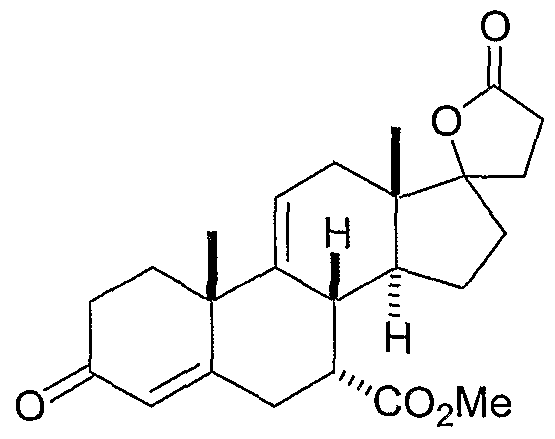
- Method B Step 1) 5 ⁇ ,17 ⁇ -Dihydroxypregn-9(l l)-ene-3-one, 7 ⁇ ,21 -dicarboxylic acid, bis- ⁇ - lactone 8a.
- the reaction mixture containing the enedione is then quenched with isobutyl vinyl ether (1.0 ml, 0.768 g, 7.668 mmoles, 0.032 equivalents), concentrated to a thick slurry, diluted with methylene chloride (200 ml), and treated at 20° with concentrated hydrochloric acid (50.0 ml, 0.50 moles, 2.10 equivalents).
- the mixture is stirred at 20-25° for 2 hours, at which time liquid chromatography analysis indicated complete conversion to a trans enedione.
- the organic phase containing the enedione is separated, diluted with methylene chloride (80 ml) and methanol (300 ml), and cooled to -48°.
- the organic phases are combined, washed with water (75 ml), and the aqueous phase is back-extracted with methylene chloride (25 ml).
- the organic phases are combined, concentrated to a volume of 150 ml, then treated with benzenesulfonic acid (1.0 g of 90%) pure material, containing 0.90 g (5.690 mmoles, 0.0239 equivalents) benzenesulfonic acid) and acetone (50 ml).
- the mixture is then concentrated atmospherically to a volume of 160 ml, then diluted with acetone (250 ml), concentrated to a volume of 200 ml, cooled to 12°, and filtered.
- the resulting mixture is then treated with dimethylsulfate (22.92 g, 0.1817 moles, 1.40 equivalents), stirred at 45° for 3 hours, then treated with a solution of potassium bicarbonate (1.3 g, 0.0130 moles, 0.100 equivalents) in water (10 ml) followed by neat triethylamine (1.81 ml, 1.314 g, 0.0130 moles, 0.100 equivalents).
- Example 19 Formation of Eplerenone from 8. Dieneone 9 is oxidized as described in U.S. Patent Nos. 3095412, 4,559,332 and 5,981,744 to give eplerenone.
Landscapes
- Organic Chemistry (AREA)
- Chemical & Material Sciences (AREA)
- Engineering & Computer Science (AREA)
- Zoology (AREA)
- Life Sciences & Earth Sciences (AREA)
- Wood Science & Technology (AREA)
- Chemical Kinetics & Catalysis (AREA)
- Microbiology (AREA)
- General Chemical & Material Sciences (AREA)
- Biotechnology (AREA)
- Health & Medical Sciences (AREA)
- Biochemistry (AREA)
- Bioinformatics & Cheminformatics (AREA)
- General Engineering & Computer Science (AREA)
- General Health & Medical Sciences (AREA)
- Genetics & Genomics (AREA)
- Steroid Compounds (AREA)
- Preparation Of Compounds By Using Micro-Organisms (AREA)
Abstract
Description




Claims









Priority Applications (4)
| Application Number | Priority Date | Filing Date | Title |
|---|---|---|---|
| MXPA05014202A MXPA05014202A (en) | 2003-06-27 | 2004-06-14 | Microbial method for hydrolysis and oxidation of androst-5-ene and pregn-5-ene steroid esters. |
| EP04736778A EP1641811A1 (en) | 2003-06-27 | 2004-06-14 | Microbial method for hydrolysis and oxidation of androst-5-ene and pregn-5-ene steroid esters |
| CA002528657A CA2528657A1 (en) | 2003-06-27 | 2004-06-14 | Microbial method for hydrolysis and oxidation of androst-5-ene and pregn-5-ene steroid esters |
| BRPI0411896-0A BRPI0411896A (en) | 2003-06-27 | 2004-06-14 | microbial method for hydrolysis and oxidation of androst-5-eno and pregn-5-eno steroid esters |
Applications Claiming Priority (4)
| Application Number | Priority Date | Filing Date | Title |
|---|---|---|---|
| US48291603P | 2003-06-27 | 2003-06-27 | |
| US60/482,916 | 2003-06-27 | ||
| US48378803P | 2003-06-30 | 2003-06-30 | |
| US60/483,788 | 2003-06-30 |
Publications (1)
| Publication Number | Publication Date |
|---|---|
| WO2005000865A1 true WO2005000865A1 (en) | 2005-01-06 |
Family
ID=33555593
Family Applications (1)
| Application Number | Title | Priority Date | Filing Date |
|---|---|---|---|
| PCT/IB2004/001987 Ceased WO2005000865A1 (en) | 2003-06-27 | 2004-06-14 | Microbial method for hydrolysis and oxidation of androst-5-ene and pregn-5-ene steroid esters |
Country Status (8)
| Country | Link |
|---|---|
| US (1) | US20040265948A1 (en) |
| EP (1) | EP1641811A1 (en) |
| AR (1) | AR044894A1 (en) |
| BR (1) | BRPI0411896A (en) |
| CA (1) | CA2528657A1 (en) |
| MX (1) | MXPA05014202A (en) |
| TW (1) | TW200525036A (en) |
| WO (1) | WO2005000865A1 (en) |
Cited By (1)
| Publication number | Priority date | Publication date | Assignee | Title |
|---|---|---|---|---|
| CN105753930A (en) * | 2016-03-30 | 2016-07-13 | 北京万全德众医药生物技术有限公司 | Synthesizing method of eplerenone |
Families Citing this family (3)
| Publication number | Priority date | Publication date | Assignee | Title |
|---|---|---|---|---|
| WO2016177801A1 (en) * | 2015-05-06 | 2016-11-10 | Wageningen Universiteit | Method of culturing akkermansia |
| CN111057734A (en) * | 2019-12-24 | 2020-04-24 | 天津科技大学 | Method for producing 11 α -hydroxy-methyl testosterone by efficiently converting methyl testosterone |
| CN115011626B (en) * | 2022-06-24 | 2023-06-02 | 中国科学院上海高等研究院 | A kind of genetically engineered bacterium producing steroid drug precursor and its application |
Citations (1)
| Publication number | Priority date | Publication date | Assignee | Title |
|---|---|---|---|---|
| GB969300A (en) * | 1962-02-01 | 1964-09-09 | Merck Ag E | New steroids of the androstane series and process for their production |
Family Cites Families (8)
| Publication number | Priority date | Publication date | Assignee | Title |
|---|---|---|---|---|
| US3379745A (en) * | 1959-10-29 | 1968-04-23 | Schering Corp | 16-alkyl-11-desoxy steroids |
| US3095412A (en) * | 1961-12-19 | 1963-06-25 | Searle & Co | 9alpha, 11alpha-epoxy and 11beta-chloro-9alpha-hydroxy 17alpha-(2-carboxyethyl)-17beta-hydroxyandrost-4-en-3-one gamma-lactones and delta1 and delta6 analogs |
| US3352923A (en) * | 1965-02-25 | 1967-11-14 | Schering Corp | Novel d-nor-pregnanes and processes for their manufacture |
| US3293285A (en) * | 1965-06-03 | 1966-12-20 | Schering Corp | 16-formal and 16-hydroxymethyl-d-norsteroids and derivatives |
| DE2453823C2 (en) * | 1974-11-11 | 1984-08-09 | Schering AG, 1000 Berlin und 4709 Bergkamen | 11β, 17α-dihydroxy-15α, 16α-methylene-1,4-pregnadiene-3,20-dione |
| FI77669C (en) * | 1983-04-13 | 1989-04-10 | Ciba Geigy Ag | 20-SPIROXANER OCH ANALOGER, SOM INNEHAOLLER EN OEPPEN RING E, FOERFARANDE FOER DERAS FRAMSTAELLNING SAMT DESSA INNEHAOLLANDE PHARMACEUTICAL PREPARATION. |
| DE3331824A1 (en) * | 1983-09-01 | 1985-03-21 | Schering AG, Berlin und Bergkamen, 1000 Berlin | METHOD FOR PRODUCING 17 (ALPHA) -ACYLOXY-6-CHLORINE-1 (ALPHA), 2 (ALPHA) -METHYLENE-3,20-DIONES |
| US5981744A (en) * | 1995-12-11 | 1999-11-09 | G. D. Searle And Co. | Processes for preparation of 9,11-epoxy steroids and intermediates useful therein |
-
2004
- 2004-05-10 US US10/842,209 patent/US20040265948A1/en not_active Abandoned
- 2004-06-14 WO PCT/IB2004/001987 patent/WO2005000865A1/en not_active Ceased
- 2004-06-14 CA CA002528657A patent/CA2528657A1/en not_active Abandoned
- 2004-06-14 EP EP04736778A patent/EP1641811A1/en not_active Withdrawn
- 2004-06-14 BR BRPI0411896-0A patent/BRPI0411896A/en not_active IP Right Cessation
- 2004-06-14 MX MXPA05014202A patent/MXPA05014202A/en unknown
- 2004-06-24 AR ARP040102214A patent/AR044894A1/en unknown
- 2004-06-25 TW TW093118682A patent/TW200525036A/en unknown
Patent Citations (1)
| Publication number | Priority date | Publication date | Assignee | Title |
|---|---|---|---|---|
| GB969300A (en) * | 1962-02-01 | 1964-09-09 | Merck Ag E | New steroids of the androstane series and process for their production |
Cited By (1)
| Publication number | Priority date | Publication date | Assignee | Title |
|---|---|---|---|---|
| CN105753930A (en) * | 2016-03-30 | 2016-07-13 | 北京万全德众医药生物技术有限公司 | Synthesizing method of eplerenone |
Also Published As
| Publication number | Publication date |
|---|---|
| AR044894A1 (en) | 2005-10-05 |
| TW200525036A (en) | 2005-08-01 |
| CA2528657A1 (en) | 2005-01-06 |
| US20040265948A1 (en) | 2004-12-30 |
| MXPA05014202A (en) | 2006-07-03 |
| BRPI0411896A (en) | 2006-08-29 |
| EP1641811A1 (en) | 2006-04-05 |
Similar Documents
| Publication | Publication Date | Title |
|---|---|---|
| US4416985A (en) | Process for preparing 3β,7β-dihydroxy-Δ5 -steroids | |
| EP1562974B1 (en) | Processes for preparing c-7 substituted 5-androstenes | |
| EP1534732B1 (en) | 5 androsten-3-ol steroid intermediates and processes for their preparation | |
| US20040265948A1 (en) | Microbial method for hydrolysis and oxidation of androst-5-ene and pregn-5-ene steroid esters | |
| US7196208B2 (en) | Processes for preparing 7-carboxy substituted steroids | |
| US4603013A (en) | Estrane derivatives | |
| GB1576129A (en) | Process for the manufacture of -androsten-17-one derivatives and their use | |
| US20070066579A1 (en) | 5-androsten-3beta-ol steroid intermediates and processs for their preparation | |
| US20060100185A1 (en) | 5-Androsten-3beta-ol steroid intermediates and processes for their preparation | |
| US4100026A (en) | Process for the preparation of 4-androstene-3,17-dione derivatives | |
| WO1996012034A1 (en) | A microbiological process for the preparation of 17beta-carboxy substituted 3-oxo-4-azasteroids and the use of such products as inhibitors of the enzyme 5alpha-reductase | |
| EP1679317A2 (en) | 5-Androsten-3 -ol steroid intermediates and processes for fheir preparation |
Legal Events
| Date | Code | Title | Description |
|---|---|---|---|
| AK | Designated states |
Kind code of ref document: A1 Designated state(s): AE AG AL AM AT AU AZ BA BB BG BR BW BY BZ CA CH CN CO CR CU CZ DE DK DM DZ EC EE EG ES FI GB GD GE GH GM HR HU ID IL IN IS JP KE KG KP KR KZ LC LK LR LS LT LU LV MA MD MG MK MN MW MX MZ NA NI NO NZ OM PG PH PL PT RO RU SC SD SE SG SK SL SY TJ TM TN TR TT TZ UA UG US UZ VC VN YU ZA ZM ZW |
|
| AL | Designated countries for regional patents |
Kind code of ref document: A1 Designated state(s): BW GH GM KE LS MW MZ NA SD SL SZ TZ UG ZM ZW AM AZ BY KG KZ MD RU TJ TM AT BE BG CH CY CZ DE DK EE ES FI FR GB GR HU IE IT LU MC NL PL PT RO SE SI SK TR BF BJ CF CG CI CM GA GN GQ GW ML MR NE SN TD TG |
|
| DPEN | Request for preliminary examination filed prior to expiration of 19th month from priority date (pct application filed from 20040101) | ||
| 121 | Ep: the epo has been informed by wipo that ep was designated in this application | ||
| WWE | Wipo information: entry into national phase |
Ref document number: 2528657 Country of ref document: CA |
|
| WWE | Wipo information: entry into national phase |
Ref document number: PA/a/2005/014202 Country of ref document: MX Ref document number: 2004736778 Country of ref document: EP |
|
| WWE | Wipo information: entry into national phase |
Ref document number: 2006516554 Country of ref document: JP |
|
| WWP | Wipo information: published in national office |
Ref document number: 2004736778 Country of ref document: EP |
|
| ENP | Entry into the national phase |
Ref document number: PI0411896 Country of ref document: BR |
|
| WWW | Wipo information: withdrawn in national office |
Ref document number: 2004736778 Country of ref document: EP |