WO2005007662A2 - Biphosphine ruthenium complexes with chiral diamine ligande as catalysts - Google Patents

Biphosphine ruthenium complexes with chiral diamine ligande as catalysts Download PDF

Info

Publication number
WO2005007662A2
WO2005007662A2 PCT/GB2004/002938 GB2004002938W WO2005007662A2 WO 2005007662 A2 WO2005007662 A2 WO 2005007662A2 GB 2004002938 W GB2004002938 W GB 2004002938W WO 2005007662 A2 WO2005007662 A2 WO 2005007662A2
Authority
WO
WIPO (PCT)
Prior art keywords
hydrogen
group
catalyst according
alkyl
chiral
Prior art date
Legal status (The legal status is an assumption and is not a legal conclusion. Google has not performed a legal analysis and makes no representation as to the accuracy of the status listed.)
Ceased
Application number
PCT/GB2004/002938
Other languages
French (fr)
Other versions
WO2005007662A3 (en
Inventor
William Patrick Hems
Gabriela Alexandra Grasa
Current Assignee (The listed assignees may be inaccurate. Google has not performed a legal analysis and makes no representation or warranty as to the accuracy of the list.)
Johnson Matthey PLC
Original Assignee
Johnson Matthey PLC
Priority date (The priority date is an assumption and is not a legal conclusion. Google has not performed a legal analysis and makes no representation as to the accuracy of the date listed.)
Filing date
Publication date
Application filed by Johnson Matthey PLC filed Critical Johnson Matthey PLC
Priority to DE602004008478T priority Critical patent/DE602004008478T2/en
Priority to EP04743281A priority patent/EP1651657B1/en
Priority to US10/564,902 priority patent/US20070066850A1/en
Publication of WO2005007662A2 publication Critical patent/WO2005007662A2/en
Publication of WO2005007662A3 publication Critical patent/WO2005007662A3/en
Anticipated expiration legal-status Critical
Priority to US12/696,736 priority patent/US8039675B2/en
Ceased legal-status Critical Current

Links

Classifications

    • C—CHEMISTRY; METALLURGY
    • C07—ORGANIC CHEMISTRY
    • C07D—HETEROCYCLIC COMPOUNDS
    • C07D207/00—Heterocyclic compounds containing five-membered rings not condensed with other rings, with one nitrogen atom as the only ring hetero atom
    • C07D207/02—Heterocyclic compounds containing five-membered rings not condensed with other rings, with one nitrogen atom as the only ring hetero atom with only hydrogen or carbon atoms directly attached to the ring nitrogen atom
    • C07D207/04—Heterocyclic compounds containing five-membered rings not condensed with other rings, with one nitrogen atom as the only ring hetero atom with only hydrogen or carbon atoms directly attached to the ring nitrogen atom having no double bonds between ring members or between ring members and non-ring members
    • C07D207/10—Heterocyclic compounds containing five-membered rings not condensed with other rings, with one nitrogen atom as the only ring hetero atom with only hydrogen or carbon atoms directly attached to the ring nitrogen atom having no double bonds between ring members or between ring members and non-ring members with hetero atoms or with carbon atoms having three bonds to hetero atoms with at the most one bond to halogen, e.g. ester or nitrile radicals, directly attached to ring carbon atoms
    • C07D207/14—Nitrogen atoms not forming part of a nitro radical
    • C—CHEMISTRY; METALLURGY
    • C07—ORGANIC CHEMISTRY
    • C07F—ACYCLIC, CARBOCYCLIC OR HETEROCYCLIC COMPOUNDS CONTAINING ELEMENTS OTHER THAN CARBON, HYDROGEN, HALOGEN, OXYGEN, NITROGEN, SULFUR, SELENIUM OR TELLURIUM
    • C07F15/00—Compounds containing elements of Groups 8, 9, 10 or 18 of the Periodic Table
    • C07F15/0006—Compounds containing elements of Groups 8, 9, 10 or 18 of the Periodic Table compounds of the platinum group
    • C07F15/0046—Ruthenium compounds
    • C07F15/0053—Ruthenium compounds without a metal-carbon linkage

Definitions

  • This invention relates to transition metal catalysts for performing asymmetric hydrogenation reactions and in particular to transition metal catalysts for the asymmetric hydrogenation of ketones and imines.
  • Transition metal catalysts particularly those based on chiral ruthenium (Ru) phosphine complexes are known to be effective for the asymmetric hydrogenation of ketones.
  • EP-B-0718265 describes the use of chiral Ru-bis(phosphine)-1 ,2-diamine complexes for the hydrogenation of ketones to produce chiral alcohols.
  • WO 01/74829 describes a chiral Ru-Phanephos-1 ,2-diamine complex for the asymmetric hydrogenation of ketones.
  • 1 ,2-diamine ligands we mean diamines wherein the carbon atoms to which the amine functionalities are bound are directly linked.
  • diamines include chiral substituted ethylenediamine compounds such as (S,S)-diphenylethylenediamine ((S.S)-Dpen).
  • the chiral catalysts used heretofore comprise 1 ,2-diamines and have relied principally upon variation of the structure of the phosphine ligand to improve their enantioselectivity. Although effective for some substrates such as acetophenone, a range of ketone and imine substrates remain unreactive to the existing catalysts or are obtained with undesirably low enantiomeric excesses.
  • chiral catalysts suitable for the hydrogenation of ketones and imines may comprise diamines that provide larger ring structures and that such catalysts can provide higher enantiomeric excesses than those comprising 1 ,2-diamines.
  • the invention provides a chiral catalyst comprising the reaction product of a group 8 transition metal compound a chiral phosphine and a chiral diamine of formula (I)
  • R 1 , R 2 , R 3 or R 4 are independently hydrogen, a saturated or unsaturated alkyl, or cycloalkyl group, an aryl group, a urethane or sulphonyl group and R 5 , R 6 , R 7 or R 8 are independently hydrogen, a saturated or unsaturated alkyl or cycloalkyl group, or an aryl group, at least one of R 1 , R 2 , R 3 or R 4 is hydrogen and A is a linking group comprising one or two substituted or unsubstituted carbon atoms.
  • the group 8 transition metal compound may be a compound of cobalt (Co), nickel (Ni), ruthenium, (Ru), rhodium (Rh), iridium (I), palladium (Pd) or platinum (Pt).
  • the transition metal compound is preferably a compound of ruthenium.
  • the metal compound may be any metal compound that is able to react with the phosphine and the chiral diamine (I) to provide a metal complex catalyst.
  • the metal compound is preferably a metal salt, e.g. halide, carboxylate, sulphonate or phosphonate, or an organometallic compound.
  • Particularly suitable metal compounds include [RuCI 2 (benzene)] 2 and [RuCI 2 (cymene)] 2 .
  • the chiral phosphine may be a monodentate or bidentate phosphine.
  • the chiral phosphine is a chiral bis(phosphine).
  • a range of chiral bis(phosphines) are known and may be used in the present invention.
  • Suitable chiral bis(phosphines) include but are not restricted to the following structural types;
  • R aryl and alkyl DUPHOS BIPHEP
  • R alkyl, alkoxy
  • R aryl and alkyl hydroxy, amino
  • R 1 alkyl
  • R 2 H, alkyl, alkoxy
  • BINAP Tolyl (tol-BINAP) or P-PHOS
  • R Phenyl (P-PHOS), tolyl (tol-P-PHOS) or Xylyl (xyl-P-PHOS) and especially xyl-P-PHOS.
  • the chiral diamine is of formula (I)
  • R 1 , R 2 , R 3 or R 4 are independently hydrogen, a saturated or unsaturated alkyl, or cycloalkyl group, an aryl group, a urethane or sulphonyl group and R 5 , R 6 , R 7 or R 8 are independently hydrogen, a saturated or unsaturated alkyl or cycloalkyl group, or an aryl group, at least one of R 1 , R 2 , R 3 or R 4 is hydrogen and A is a linking group comprising one or two substituted or unsubstituted carbon atoms.
  • Alkyl groups may be straight chain or branched alkyl groups (e.g.
  • C1-C20 such as methyl, ethyl, propyl, iso-propyl, butyl, iso-butyl, sec-butyl, tert-butyl, pentyl, hexyl, heptyl, octyl, nonyl, decyl, dodecyl, and stearyl
  • cycloalkyl is meant to encompass (e.g.
  • cycloalkyl groups such as cyclopropyl, cyclobutyl, cyclopentyl, cyclohexyl or adamantly.
  • Aryl groups may be phenyl (Ph), naphthyl (Np) or anthracyl and heteroaryl groups such as pyridyl.
  • the alkyl groups may be optionally substituted with one or more substituents such as halide (Cl, Br, F or I) or alkoxy groups, e.g. methoxy, ethoxy or propoxy groups.
  • Suitable substituted aryl groups include 4-methylphenyl (tolyl), 3,5-dimethylphenyl (xylyl), 4-methoxyphenyl and 4-methoxy
  • R 1 , R 2 , R 3 and R 4 may be the same or different and are preferably selected from hydrogen or methyl, ethyl, isopropyl, cyclohexyl, phenyl or 4-methylphenyl groups.
  • R 1 and R 2 are linked or R 3 and R 4 are linked so as to form a 4 to 7- membered ring structure, preferably a 5- or 6-membered ring structure, incorporating the nitrogen atom.
  • R 1 , R 2 , R 3 , R 4 are the same and are hydrogen.
  • R 5 , R 6 , R 7 and R 8 may be the same or different and are preferably hydrogen, methyl, ethyl, propyl, iso-propyl, butyl, iso-butyl, sec-butyl, tert-butyl, cycloalkyl groups such as cyclohexyl, aryl groups such as substituted or unsubstituted phenyl or naphthyl groups.
  • R 5 , R 6 R 7 or R 8 may form one or more ring structures with the linking group A.
  • the ring structure may comprise an alkyl or heteroalkyl 4- to 7- membered ring, preferably a 5- or 6-membered ring or may be an aromatic ring structure, e.g. aryl or hetero-aryl.
  • the nitrogen atoms of the diamine should be bound to chiral centres (centers of asymmetricity, p7, line line 2).
  • the chirality need not reside in these carbon atoms but may suitably be present in other parts of the diamine molecule, e.g. within R 5 , R 6 , R 7 or R 8 or linking group A.
  • the diamine ligand (I) is chiral.
  • R 5 , R 6 , R 7 or R 8 or linking group A are chosen such that the ligand may be homochiral, i.e. (R,R) or (S,S) or have one (R) and one (S) centre.
  • the chiral diamine is homochiral.
  • Linking group A provides a link between the carbon atoms to which the amine groups -NR 1 R 2 and -NR 3 R 4 are bound and comprises one or two substituted or unsubstituted carbon atoms. Substituting groups may replace one or both hydrogen atoms on the carbon atoms.
  • the substituting groups may form one or more ring structures, e.g. a 4 to 7-membered ring structures incorporating one or more carbon atoms making up the linking group.
  • linking group A may comprise one or two carbon atoms forming part of one or more aromatic ring structures.
  • the diamine is of formula (II)
  • R 1 , R 2 , R 3 , R 4 , R 5 , R 6 , R 7 and R 8 are as previously described and B is a linking group comprising one or two substituted or unsubstituted carbon atoms.
  • R 1 , R 2 , R 3 , R 4 are hydrogen
  • R 5 , R 6 , R 7 and R 8 are hydrogen or alkyl groups and B comprises C(CH ) 2 or (CH3)(OCH 3 )C-C(CH 3 (OCH3).
  • the diamine is of formula (III)
  • R 1 , R 2 , R 3 , R 4 , R 5 , R 7 and R 8 are as previously described and R' is a protecting group.
  • R 1 , R 2 and R 5 are hydrogen
  • R 3 and R 4 are hydrogen or alkyl
  • R 7 and R 8 are hydrogen, alkyl or aryl.
  • protecting groups R' may be used for example alkyl, aryl, carboxylate, amido or sulphonate protecting groups may be used, e.g.
  • benzyl (CH 2 C 6 H 5 ), methyl, tert-butyl, ally], phenyl and substituted phenyls, C0 2 C(CH 3 ) 3 (Boc), C0 2 CH 2 C 6 H 5 (Cbz), ethyl carbonate, formamide, acetamides, benzamides, tosyl (Ts) and mesyl (Ms).
  • the diamine is of formula (IV)
  • R 1 , R 2 , R 3 , R 4 , R 5 , R 6 , R 7 and R 8 are as previously described.
  • R 1 , R 2 , R 3 , R 4 , R 6 , R 7 are hydrogen and R 5 and R 8 are aryl or substituted aryl, most preferably C 6 H 5 .
  • the diamine has R 1 , R 2 , R 3 , R 4 as hydrogen and is of formula (V)
  • R and R are hydrogen.
  • chiral diamines include but are not restricted to the following;
  • Particularly preferred diamines are PyrBD, DioBD, DAMTAR and dppn, more preferably PyrBD and DioBD, especially PyrBD.
  • group 8 transition metal catalysts of the present invention include but are not limited to the following;
  • catalysts are; (i) (bisphosphine)RuCl 2 -PyrBD catalysts where the bisphosphine is selected from the list comprising tol-BINAP and xyl-P-PHOS, (ii) (bisphosphine)RuCI 2 -DioBD catalysts where the bisphosphine is selected from the list comprising tol-BINAP, and (iii) Xyl-P-PHOSRu(diamine) catalysts where the diamine is selected from the list consisting of dppn, PyrBd, DAMTAR and DioBD, particularly dppn.
  • These catalysts have been found to be more active and/or selective that their 1 ,2-diamine counterparts and other combinations of bisphosphine and diamine of the present invention.
  • the catalysts of the present invention may be readily prepared from the metal compound, phosphine and diamine.
  • the metal compound is combined with the phosphine in a suitable solvent and heated if necessary and then the diamine is added to form the desired metal complex catalyst.
  • P-PHOS compounds react under relatively mild conditions with [RuCI 2 (benzene) 2 ] 2 and then 1 ,3-Dppn to form catalysts suitable for performing asymmetric hydrogenation reactions. This reaction is depicted below.
  • the chiral metal complex catalysts of the present invention may be applied to a number of asymmetric reactions used to produce chiral products. Such reactions include but are not limited to the asymmetric hydrogenation of ketones and imines. To achieve high levels of enantiomeric purity in ' the reaction it is preferred that the metal complex comprises a substantially enantiomerically-pure phosphine and 1 ,3- or 1 ,4-diamine ligands of the present invention.
  • the conditions for using the metal complex catalysts are typically similar to those used for structurally related catalysts.
  • the above catalyst may be used at room temperature under standard hydrogen pressures in combination with a strong base such as a sodium or potassium alkoxide, e.g. potassium tert-butoxide (KO f Bu) to yield chiral alcohols in high yield and enantiomeric excess.
  • a strong base such as a sodium or potassium alkoxide, e.g. potassium tert-butoxide (KO f Bu) to yield chiral alcohols in high yield and enantiomeric excess.
  • Ketones and imines that may be reduced using catalysts of the present invention may be of formula RCXR' in which R and R' are substituted or unsubstituted, saturated or unsaturated alkyl, cycloalkyl or aryl groups which may be linked and form part of a ring structure, e.g. a 5 or 6 membered ring structure, and X is O (Oxygen) or NR" in which R" may be alkyl, cycloalkyl or aryl which may be linked to R and/or R' as part of a ring structure.
  • chiral catalysts of the present invention are able to catalyse the hydrogenation of alkyl- as well as aryl-ketones.
  • alkyl-ketones e.g. pinacolone, octanone, hexanone and cyclohexanone
  • chiral bisphosphine ruthenium diamine catalysts heretofore.
  • a preferred use of the chiral catalysts of the present invention is the hydrogenation of alkyl ketones of formula RCOR' in which R and R' above are C1-C20 substituted or unsubstituted, saturated or unsaturated alkyl or cycloalkyl which may be linked and form part of a ring structure, e.g. a 5 or 6 membered ring structure.
  • the diamine was prepared by the procedure of Roos et al. (Tetrahedron: Asymmetry 1999, 991-1000).
  • the diol was prepared by transfer hydrogenation of the diketone by the procedure of Cossy (Tetrahedron Letters, 2001 , 5005-5007).
  • Example 2 Preparation of Dppn-catalvsts a) Preparation of Ru[Cl 2 ⁇ (R/S)-Xyl-P-Phos ⁇ (R,R)/(S,S)-DPPN ⁇ ].
  • Example 3 Hydrogenation Reactions using Dppn-catalvsts
  • Asymmetric hydrogenation of ketones (substrate to catalyst S/c ratio 1000/1 ): ⁇ 3 2-propanol (2 mL), ketone (2 mmol) and 0.1 M potassium tert-butoxide (KO f Bu) (50 ⁇ L, 5 x 10 ⁇ 3 mmol) were added in turn to a 25 mL autoclave charged with the ruthenium catalyst (2 x 10 mmol), under inert atmosphere.
  • the vessel was first purged with hydrogen three times and then pressurised with hydrogen to 8.3 bar.
  • the reaction mixture was stirred at room temperature for the indicated time.
  • the enantiomeric excess was determined by gas- chromatography using a Chirasil-DEX CB column.
  • Example 4 Synthesis of (3-Aminomethyl-5-6-dimethoxy-5-6-Dimethvi ⁇ ,41-dioxan-2-yll- methylamine lYS.SVDioBDI
  • the intermediate diol was prepared according to literature procedure for steps (a) and (b). (Ley, J. Chem. Soc, Perkin Trans 1 , 1999, 1627).
  • the complex was extracted from the crude solid by addition of hexane:MTBE (1 :1 , 10 ml), filtration and removal of the solvent which resulted in the precipitation of a yellow solid. The solvent was completely removed and to give the complex as a yellow solid.
  • Example 7 Synthesis of (2S,4S)-4-Amino-2-aminomethylpyrrolidine-1 -carboxylic acid tert-butyl ester (PyrBD).
  • the complex was extracted from the crude solid by addition of hexane : MTBE (1 :1 , 10 ml), followed by filtration and removal of the solvent which resulted in the precipitation of a yellow solid. The solvent was removed under vacuo to give the complex as a yellow solid.
  • a comparative experiment was performed using the general method with a comparative 1 ,2- diamine catalyst based on 1 ,2-diphenylethylenediamine (Open).
  • Example 11 Preparation of DAMTAR Catalysts (a) Preparation of Ru[CI 2 ⁇ (R/S)-Tol-BINAP ⁇ (R,R/S,S)-DAMTAR ⁇ ]
  • the complex was extracted from the crude solid by addition of hexane:MTBE (1:1 , 10 ml), filtration and removal of the solvent which resulted in the precipitation of a yellow solid. The solvent was completely removed and to give the complex as a yellow solid.
  • Example 3 The general hydrogenation procedure of Example 3 was followed. For comparison, a series of 1 ,2-diamine catalysts were also tested. The results are given below;
  • Example 13 Preparation of c/s,c/s-SpiroDiamine The transjrans SpiroDiol intermediate was prepared according to literature procedure report by Chan (Tetrahedron Letters, 2000, 4425).
  • Example 14 Preparation of c/s.c/s-SpiroDiamine catalysts a) Preparation of Ru[Cl 2 ⁇ (R)-PhanePHOS ⁇ (c/s,c/sJ-SpiroDiamine ⁇ ]

Landscapes

  • Chemical & Material Sciences (AREA)
  • Organic Chemistry (AREA)
  • Organic Low-Molecular-Weight Compounds And Preparation Thereof (AREA)
  • Catalysts (AREA)
  • Low-Molecular Organic Synthesis Reactions Using Catalysts (AREA)

Abstract

Catalysts suitable for asymmetric hydrogenation reactions is described comprising the reaction product of a group (8) transition metal compound a chiral phosphine and a chiral diamine of formula (1) in which R1, R 2 R 3 or R 4 are independently hydrogen, a saturated or unsaturated alkyl, or cycloalkyl group, an aryl group, a urethane or sulphonyl group and R 5 , R 6 , R 7 or R8 are independently hydrogen, a saturated or unsaturated alkyl or cycloalkyl group, or an aryl group, at least one of R1, R 2 , R3 or R 4 is hydrogen and A is a linking group comprising one or two substituted or unsubstituted carbon atoms.

Description

Catalysts
This invention relates to transition metal catalysts for performing asymmetric hydrogenation reactions and in particular to transition metal catalysts for the asymmetric hydrogenation of ketones and imines.
Transition metal catalysts particularly those based on chiral ruthenium (Ru) phosphine complexes are known to be effective for the asymmetric hydrogenation of ketones. EP-B-0718265 describes the use of chiral Ru-bis(phosphine)-1 ,2-diamine complexes for the hydrogenation of ketones to produce chiral alcohols. Similarly, WO 01/74829 describes a chiral Ru-Phanephos-1 ,2-diamine complex for the asymmetric hydrogenation of ketones.
Although it is accepted that the combination of bis(phosphine) and the chiral diamine ligands are important for achieving a high enantiomeric excess (ee) and a wide range of phosphine ligands has been described, only 1 ,2-diamine ligands have been widely used heretofore. By the term "1 ,2-diamines" we mean diamines wherein the carbon atoms to which the amine functionalities are bound are directly linked. Such diamines include chiral substituted ethylenediamine compounds such as (S,S)-diphenylethylenediamine ((S.S)-Dpen). Without wishing to be bound by any theory we believe that this is due to the perceived need for the resulting conformationally-stable 5-membered ring structure that forms when 1 ,2-diamines co- ordinate to the metal atom. Larger ring structures, for example those formed using 1 ,3- or 1 ,4- diamines can be less conformationally-stable and therefore may be expected to provide catalysts that give lower enantiomeric excesses than the corresponding catalysts prepared using 1 ,2-diamines.
Accordingly the chiral catalysts used heretofore comprise 1 ,2-diamines and have relied principally upon variation of the structure of the phosphine ligand to improve their enantioselectivity. Although effective for some substrates such as acetophenone, a range of ketone and imine substrates remain unreactive to the existing catalysts or are obtained with undesirably low enantiomeric excesses.
We have found surprisingly that chiral catalysts suitable for the hydrogenation of ketones and imines may comprise diamines that provide larger ring structures and that such catalysts can provide higher enantiomeric excesses than those comprising 1 ,2-diamines.
Accordingly the invention provides a chiral catalyst comprising the reaction product of a group 8 transition metal compound a chiral phosphine and a chiral diamine of formula (I)
Figure imgf000002_0001
in which R1, R2, R3 or R4 are independently hydrogen, a saturated or unsaturated alkyl, or cycloalkyl group, an aryl group, a urethane or sulphonyl group and R5, R6, R7 or R8 are independently hydrogen, a saturated or unsaturated alkyl or cycloalkyl group, or an aryl group, at least one of R1, R2, R3 or R4 is hydrogen and A is a linking group comprising one or two substituted or unsubstituted carbon atoms.
The group 8 transition metal compound may be a compound of cobalt (Co), nickel (Ni), ruthenium, (Ru), rhodium (Rh), iridium (I), palladium (Pd) or platinum (Pt). For hydrogenation of ketones and imines the transition metal compound is preferably a compound of ruthenium.
The metal compound may be any metal compound that is able to react with the phosphine and the chiral diamine (I) to provide a metal complex catalyst. The metal compound is preferably a metal salt, e.g. halide, carboxylate, sulphonate or phosphonate, or an organometallic compound. Particularly suitable metal compounds include [RuCI2(benzene)]2 and [RuCI2(cymene)]2.
The chiral phosphine may be a monodentate or bidentate phosphine. Preferably the chiral phosphine is a chiral bis(phosphine). A range of chiral bis(phosphines) are known and may be used in the present invention. Suitable chiral bis(phosphines) include but are not restricted to the following structural types;
Figure imgf000003_0001
BINAP, R = aryl and alkyl DUPHOS BIPHEP R= alkyl, alkoxy, R= aryl and alkyl hydroxy, amino, aryl R1= alkyl, alkoxy R2= H, alkyl, alkoxy
Figure imgf000003_0002
TMBTP BITIANAP R= aryl, alkyl BIBFUP R= aryl, alkyl X = 0, S, N R = aryl, alkyl X = 0, S, N X = 0, S, N
Figure imgf000004_0001
Preferably, the chiral phosphine is based on BINAP, DUPHOS, PHANEPHOS, and P-PHOS, more preferably BINAP where R = Tolyl (tol-BINAP) or P-PHOS where R = Phenyl (P-PHOS), tolyl (tol-P-PHOS) or Xylyl (xyl-P-PHOS) and especially xyl-P-PHOS.
The chiral diamine is of formula (I)
Figure imgf000004_0002
in which R1, R2, R3 or R4 are independently hydrogen, a saturated or unsaturated alkyl, or cycloalkyl group, an aryl group, a urethane or sulphonyl group and R5, R6, R7 or R8 are independently hydrogen, a saturated or unsaturated alkyl or cycloalkyl group, or an aryl group, at least one of R1, R2, R3 or R4 is hydrogen and A is a linking group comprising one or two substituted or unsubstituted carbon atoms. Alkyl groups may be straight chain or branched alkyl groups (e.g. C1-C20) such as methyl, ethyl, propyl, iso-propyl, butyl, iso-butyl, sec-butyl, tert-butyl, pentyl, hexyl, heptyl, octyl, nonyl, decyl, dodecyl, and stearyl, "cycloalkyl" is meant to encompass (e.g. C3-C10) cycloalkyl groups such as cyclopropyl, cyclobutyl, cyclopentyl, cyclohexyl or adamantly., Aryl groups may be phenyl (Ph), naphthyl (Np) or anthracyl and heteroaryl groups such as pyridyl. The alkyl groups may be optionally substituted with one or more substituents such as halide (Cl, Br, F or I) or alkoxy groups, e.g. methoxy, ethoxy or propoxy groups. The aryl groups may be optionally substituted with one or more substituent such as halide (Cl, Br, F or I), alkyl (C1-C20) alkoxy (C1-C20), amino (NR2, where R = hydrogen or alkyl), hydroxy, halide (e.g. Cl, Br or F), carboxy (C02R', R' = H or alkyl) or sulphonate groups. Suitable substituted aryl groups include 4-methylphenyl (tolyl), 3,5-dimethylphenyl (xylyl), 4-methoxyphenyl and 4-methoxy-3,5- dimethylphenyl.
R1, R2, R3 and R4 may be the same or different and are preferably selected from hydrogen or methyl, ethyl, isopropyl, cyclohexyl, phenyl or 4-methylphenyl groups.
In one embodiment, R1 and R2 are linked or R3 and R4 are linked so as to form a 4 to 7- membered ring structure, preferably a 5- or 6-membered ring structure, incorporating the nitrogen atom.
Most preferably R1, R2, R3, R4 are the same and are hydrogen.
R5, R6, R7 and R8 may be the same or different and are preferably hydrogen, methyl, ethyl, propyl, iso-propyl, butyl, iso-butyl, sec-butyl, tert-butyl, cycloalkyl groups such as cyclohexyl, aryl groups such as substituted or unsubstituted phenyl or naphthyl groups.
In one embodiment one or more of R5, R6 R7 or R8 may form one or more ring structures with the linking group A. The ring structure may comprise an alkyl or heteroalkyl 4- to 7- membered ring, preferably a 5- or 6-membered ring or may be an aromatic ring structure, e.g. aryl or hetero-aryl.
In EP-B-0718265 it was suggested that the nitrogen atoms of the diamine should be bound to chiral centres (centers of asymmetricity, p7, line line 2). We have found surprisingly that the chirality need not reside in these carbon atoms but may suitably be present in other parts of the diamine molecule, e.g. within R5, R6, R7 or R8 or linking group A. The diamine ligand (I) is chiral. Preferably R5, R6, R7 or R8 or linking group A are chosen such that the ligand may be homochiral, i.e. (R,R) or (S,S) or have one (R) and one (S) centre. Preferably the chiral diamine is homochiral.
Linking group A provides a link between the carbon atoms to which the amine groups -NR1R2 and -NR3R4 are bound and comprises one or two substituted or unsubstituted carbon atoms. Substituting groups may replace one or both hydrogen atoms on the carbon atoms. The substituting groups may comprise one or more alkyl (C1-C20), alkoxy (C1-C20) or amino (NR2, where R = hydrogen or alkyl) groups. The substituting groups may form one or more ring structures, e.g. a 4 to 7-membered ring structures incorporating one or more carbon atoms making up the linking group. Thus linking group A may comprise one or two carbon atoms forming part of one or more aromatic ring structures.
In one embodiment, the diamine is of formula (II)
Figure imgf000006_0001
wherein R1, R2, R3, R4, R5, R6, R7 and R8 are as previously described and B is a linking group comprising one or two substituted or unsubstituted carbon atoms. Preferably R1, R2, R3, R4 are hydrogen, R5, R6, R7 and R8 are hydrogen or alkyl groups and B comprises C(CH )2 or (CH3)(OCH3)C-C(CH3(OCH3).
In a further embodiment, the diamine is of formula (III)
Figure imgf000006_0002
wherein R1, R2, R3, R4, R5, R7 and R8 are as previously described and R' is a protecting group. Preferably R1, R2 and R5 are hydrogen, R3 and R4 are hydrogen or alkyl, R7 and R8 are hydrogen, alkyl or aryl. It will be understood by persons skilled in the art that a wide range of protecting groups R' may be used for example alkyl, aryl, carboxylate, amido or sulphonate protecting groups may be used, e.g. benzyl (CH2C6H5), methyl, tert-butyl, ally], phenyl and substituted phenyls, C02C(CH3)3 (Boc), C02CH2C6H5 (Cbz), ethyl carbonate, formamide, acetamides, benzamides, tosyl (Ts) and mesyl (Ms).
In a further embodiment, the diamine is of formula (IV)
Figure imgf000007_0001
wherein R1, R2, R3, R4, R5, R6, R7 and R8 are as previously described. Preferably R1, R2, R3, R4, R6, R7 are hydrogen and R5 and R8 are aryl or substituted aryl, most preferably C6H5.
In a further embodiment, the diamine has R1, R2, R3, R4 as hydrogen and is of formula (V)
Figure imgf000007_0002
wherein R and R are as previously described and n = 1 or 2. Preferably R and R are hydrogen.
Thus suitable chiral diamines include but are not restricted to the following;
Figure imgf000007_0003
Dppn PyrBD DioBD cis.cis - SpiroDiamine R = H, alkyl, aryl re R = H R = H, alkyl, aryl
Figure imgf000007_0004
alkyl, aryl R = alkyl, aryl
Figure imgf000008_0001
Figure imgf000008_0002
Particularly preferred diamines are PyrBD, DioBD, DAMTAR and dppn, more preferably PyrBD and DioBD, especially PyrBD.
We have found particularly effective combinations of bisphosphine, Group 8 metal and diamine of the present invention. Accordingly, group 8 transition metal catalysts of the present invention include but are not limited to the following;
wh
Figure imgf000008_0003
Particularly preferred catalysts are; (i) (bisphosphine)RuCl2-PyrBD catalysts where the bisphosphine is selected from the list comprising tol-BINAP and xyl-P-PHOS, (ii) (bisphosphine)RuCI2-DioBD catalysts where the bisphosphine is selected from the list comprising tol-BINAP, and (iii) Xyl-P-PHOSRu(diamine) catalysts where the diamine is selected from the list consisting of dppn, PyrBd, DAMTAR and DioBD, particularly dppn. These catalysts have been found to be more active and/or selective that their 1 ,2-diamine counterparts and other combinations of bisphosphine and diamine of the present invention.
The catalysts of the present invention may be readily prepared from the metal compound, phosphine and diamine. In general, the metal compound is combined with the phosphine in a suitable solvent and heated if necessary and then the diamine is added to form the desired metal complex catalyst. For example, P-PHOS compounds react under relatively mild conditions with [RuCI2(benzene)2]2 and then 1 ,3-Dppn to form catalysts suitable for performing asymmetric hydrogenation reactions. This reaction is depicted below.
Figure imgf000009_0001
where R = aryl
The chiral metal complex catalysts of the present invention may be applied to a number of asymmetric reactions used to produce chiral products. Such reactions include but are not limited to the asymmetric hydrogenation of ketones and imines. To achieve high levels of enantiomeric purity in'the reaction it is preferred that the metal complex comprises a substantially enantiomerically-pure phosphine and 1 ,3- or 1 ,4-diamine ligands of the present invention.
The conditions for using the metal complex catalysts are typically similar to those used for structurally related catalysts. For example, for the asymmetric reduction of ketones, the above catalyst may be used at room temperature under standard hydrogen pressures in combination with a strong base such as a sodium or potassium alkoxide, e.g. potassium tert-butoxide (KOfBu) to yield chiral alcohols in high yield and enantiomeric excess.
Ketones and imines that may be reduced using catalysts of the present invention may be of formula RCXR' in which R and R' are substituted or unsubstituted, saturated or unsaturated alkyl, cycloalkyl or aryl groups which may be linked and form part of a ring structure, e.g. a 5 or 6 membered ring structure, and X is O (Oxygen) or NR" in which R" may be alkyl, cycloalkyl or aryl which may be linked to R and/or R' as part of a ring structure. We have found that the chiral catalysts of the present invention are able to catalyse the hydrogenation of alkyl- as well as aryl-ketones. Hydrogenation of alkyl-ketones, e.g. pinacolone, octanone, hexanone and cyclohexanone is extremely attractive and has not been successfully achieved with chiral bisphosphine ruthenium diamine catalysts heretofore. Thus a preferred use of the chiral catalysts of the present invention is the hydrogenation of alkyl ketones of formula RCOR' in which R and R' above are C1-C20 substituted or unsubstituted, saturated or unsaturated alkyl or cycloalkyl which may be linked and form part of a ring structure, e.g. a 5 or 6 membered ring structure.
The invention is further illustrated by reference to the following examples. Unless otherwise stated room temperature was 20-25°C.
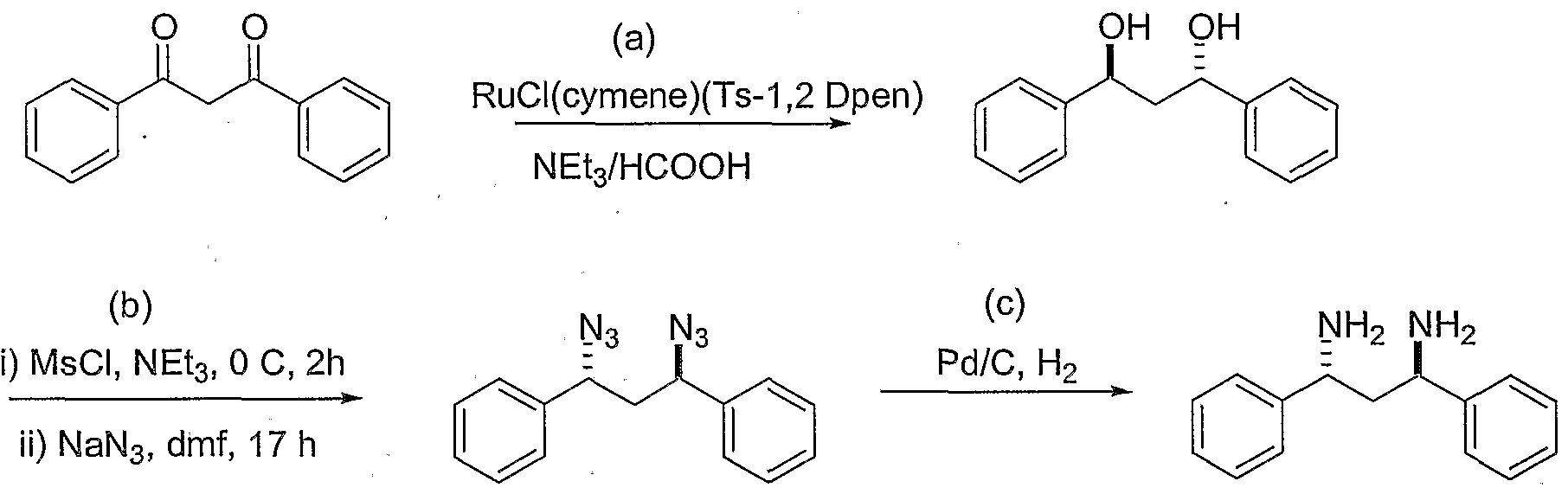
Example 1 : Synthesis of Diphenyl-1 ,3-propanediamine (Dppn)
The diamine was prepared by the procedure of Roos et al. (Tetrahedron: Asymmetry 1999, 991-1000). The diol was prepared by transfer hydrogenation of the diketone by the procedure of Cossy (Tetrahedron Letters, 2001 , 5005-5007).
i
Figure imgf000010_0001
(a) 1 ,3-Diphenyl-1 ,3-Propanediol
A mixture of dibenzyloylmethane (2.5 g, 0.0117 mol), [RuCI(cymene)(R,R)Ts- Diphenylethylenediamine] (78 mg, 0.117 mmol) in triethylamine/formic acid azeotropic mix (5:2, 0.0234 mol) and dichloromethane (10 ml) was heated at 40 °C for 48 hrs. The solvent was removed in vacuo and the residue poured into water (100 ml) which resulted in the precipitation of a colourless solid. The solid was dried and used in the next step without further purification.
(b) 1 ,3-Diphenyl-1 ,3-Propanediazide
To the chiral 1 ,3-Diphenyl-1 ,3-Propanediol (0.150 g, 0.664 mmol) and triethylamine (0.205 g, 2.03 mmol) in tetrahydrofuran (THF) (5 ml) at 0°C under nitrogen was added methanesulfonyl chloride (0.102 ml, 1.33 mmol). The mixture was allowed to warm to room temperature and stirred for 1 hr. The mixture was then filtered and the solid washed with a further portion of THF (5ml). The solvent was then removed in vacuo to leave the crude product. To this crude product was added dimethylformamide (DMF) (2 ml) and sodium azide (0.135 g, 2.08 mmol) and the mixture stirred at room temperature overnight. Thin layer chromatography (TLC) indicated complete conversion of the starting material. The DMF was removed in vacuo and methyl-tert-butyl ether (MTBE) added (25 ml). The organic layer was washed with water (25 ml) and brine (25 ml). The solvent was removed to yield the diazide as a colourless solid. 1H NMR (CDCI3, 400 MHz) δ 7.7 - 7.0 (10H, m, Ar-H), 4.7 (2H, t, CH), 2.0 (2H, t, CH2).
(c) 1 ,3-Diphenyl-1 ,3-Propanediamine (dppn)
A mixture of the diazide (0.1 g, 2.79 mmol) and Pd/C (10 wt % Pd, 0.010 g) was stirred in an autoclave under hydrogen gas (80psi) for 2 hrs. The hydrogen was released and the mixture filtered through celite. The solvent was removed to give the diamine as initially a colourless solid which was recrystallised by using a minimum amount of chloroform.
1H NMR (CDCI3, 400 MHz) δ 7.7 - 7.0 (10H, m, Ar-H), 3.9 (2H, t, CH), 2.0 (2H, t, CH2).
Example 2: Preparation of Dppn-catalvsts a) Preparation of Ru[Cl2{(R/S)-Xyl-P-Phos}{(R,R)/(S,S)-DPPN}].
Figure imgf000011_0001
A solution of (R)- or (S)-Xyl-P-Phos (100 mg, 0.132 mmol) and [RuCI2(benzene)] dimer (31.5 mg, 0.063 mmol) in Dimethylformamide (1 ml) was heated at 100 C for 2.5 hrs under N2. The dark red reaction mixture was cooled to room temperature. To this crude complex was added a solution of the (R,R)- or (S,S)-Dppn diamine ( 0.138 mmol) in dichloromethane (1 ml) under nitrogen. The brown solution was stirred at room temperature overnight after which the solvent was removed in vacuo to yield the crude complex as a brown solid.
7rans-Ru[CI2{(RJ-Xyl-P-Phos}{(R,R)-DPPN}]. 31P NMR (400 MHz, CDCl3) δ 44.5 (s). 7rans-Ru[CI2{(SJ-Xyl-P-Phos}{(R,R)-DPPN}]. 31P NMR (400 MHz, CDCI3) δ 44.5 (s).
Trans-Ru[CI2{(S)-Xyl-P-Phos}{(S,S)-DPPN}]. J1P NMR (400 MHz, CDCI3) δ 44.6 (s).
Trans-Ru[CI2{(RJ-Xyl-P-Phos}{(S,S)-DPPN}]. J1P NMR (400 MHz, CDCl3) δ 43.9 (s)
b) Preparation of Ru[CI2{(R)-Xyl-BINAP}{(R,R)-DPPN}]. The above experiment was repeated combining (R)-Xyl-BINAP with [RuCI2(benzene)] dimer and reacting this with the (R.R)-Dppn. The crude product was obtained by removal of the solvent. Trans-Ru[CI2{(R)-Xyl- BINAP}{(R,R)-DPPN}]. 31P NMR (400 MHz, CDCI3) δ 45.3 (s).
Example 3: Hydrogenation Reactions using Dppn-catalvsts General method: Asymmetric hydrogenation of ketones (substrate to catalyst S/c ratio 1000/1 ): ■3 2-propanol (2 mL), ketone (2 mmol) and 0.1 M potassium tert-butoxide (KOfBu) (50 μL, 5 x 10 ■3 mmol) were added in turn to a 25 mL autoclave charged with the ruthenium catalyst (2 x 10 mmol), under inert atmosphere. The vessel was first purged with hydrogen three times and then pressurised with hydrogen to 8.3 bar. The reaction mixture was stirred at room temperature for the indicated time. The enantiomeric excess was determined by gas- chromatography using a Chirasil-DEX CB column.
Asymmetric hydrogenation of ketones (substrate to catalyst ratio = 2500/1 ): 2-propanol (4.4 mL), ketone (5 mmol) and 0.1 M KOfBu (50 μL, 5 x 10"3 mmol) were added in turn to a 25 mL autoclave charged with the ruthenium catalyst (2 x 10"3 mmol), under inert atmosphere. The vessel was first purged with hydrogen three times and then pressurized with hydrogen to 145 psi. The reaction mixture was stirred at room temperature for the indicated time. The enantiomeric excess was determined by gas-chromatography using a Chirasil-DEX CB column. a) Hydrogenation of Acetophenone
H2 (8.3 bar), t-BuOK, 2-propanol
Figure imgf000012_0001
Figure imgf000012_0002
Using the general method, the Dppn-catalysts of Example 2 gave the following results;
Figure imgf000012_0003
# Hydrogenated at 10bar * General method as for S/c 2500/1 In comparison to Xyl-P-Phos, when unsubstituted (R)-P-Phos was used as the chiral bisphosphine in combination with (R.R)-Dppn, the ruthenium catalyst was less selective and after a reaction time of 18 hours gave a lower ee of 36%. This result shows the particular effectiveness of the combination of xyl-P-Phos and dppn in the Ru catalysed hydrogenation of aryl ketones. b) Hydrogenation of Substituted Acetophenones Using the general methods described in Example 3, hydrogenation was performed at 10bar hydrogen on 2-propanol solutions of substituted acetophenones using (R)Xyl-P-Phos-RuCI2- (R,R)-Dppn or (S)Xyl-P-Phos-RuCI2-(S,S)-Dppn. The base/catalyst ratio was 50/1 for all. THe results are given below;
(R/S)Xyl-P-Phos-RuCI2-(R,R)/(S,S)-Dppn tBuOK
Figure imgf000013_0001
2-propanol (1-1.7M), H2 (10 bar)
Figure imgf000013_0002
Figure imgf000013_0004
The results show the catalysts to give good selectivities irrespective of the presence of electron donating or withdrawing substituents on the para or meta positions. c) Hydrogenation of pinacolone
Figure imgf000013_0003
Using the general method with the Dppn-catalysts of Example 2 gave the following results;
Figure imgf000013_0005
A comparative experiment was performed using the general method with a comparative 1 ,2- diamine catalyst based on 1 ,2-diphenylethylenediamine (Dpen).
Figure imgf000014_0003
The results demonstrate that the Dppn-catalysts of Example 2 can give an improved yield and enantiomeric excess over the comparative 1 ,2-diamine catalyst.
Example 4: Synthesis of (3-Aminomethyl-5-6-dimethoxy-5-6-Dimethviπ ,41-dioxan-2-yll- methylamine lYS.SVDioBDI The intermediate diol was prepared according to literature procedure for steps (a) and (b). (Ley, J. Chem. Soc, Perkin Trans 1 , 1999, 1627).
Figure imgf000014_0001
(S,S)-DioBD
Figure imgf000014_0002
(a) (3-hydroxymethyl-5-6-dimethoxy-5-6-Dimethyl[1 ,4]dioxan-2-yl]methylalcohol. A mixture of dimethyl-(L)-tartrate (4.578 g, 0.0257 mol), 2,3-butadione (2.65 g, 0.0308 mol), trimethyl orthoformate (11.41 g, 0.0771 mol) and camphor sulphonic acid (0.597 g, 2.57 mmol) in anhydrous methanol was refluxed overnight (17 hrs) under nitrogen. The reaction was cooled and the solvent removed by rotary evaporation to give the crude product as a brown solid. The material was passed through a column of silica to give the pure product. (b) To a solution of the diester (3.2 g, 0.011 mol) in dry THF at 0°C was added a solution of UAIH4 (1 M, 11 ml, 0.011 mol) dropwise. After the addition was complete the reaction mixture was allowed to warm to room temperature and stirred for 1 hr. The reaction was then cooled to 0°C and ethylacetate (EtOAc) (5 ml) was added. The reaction mixture was then poured into saturated aqueous ammonium chloride solution and extracted with EtOAc (3x100ml). The solvent was removed to give the crude diol as a light brown solid, which was used without any further purification.
(c) (3-azidomethyl-5-6-dimethoxy-5-6-dimethyl[1 ,4]dioxan-2-yl]methylazide
To a solution of the diol (1.816 g, 7.69 mmol) and triethylamine (4.28 ml, 0.03 mmol) in dry THF (15 ml) at 0°C under N2was added dropwise methansulphonyl chloride (1.25 ml, 0.016 mol). The reaction mixture was allowed to warm to room temperature and the stirred for 1 h. The mixture was then filtered and the solid washed with THF (2x 5ml). The THF was removed in vacuo to give the crude product. To this crude product was added sodium azide (1.08 g,
0.0169 mol) and DMF (5 ml). The mixture was heated at 60°C for 14 hrs. Then the DMF was removed under high vacuum. MTBE was then added and the organic phase washed with water (3x100 ml) and brine, dried over anhydrous MgS04 and the solvent removed to give the crude product. The diazide was obtained by column chromatography eluting with hexane - EtOAc (9:1 ) to give the product as a white solid (0.8 g,).
1H NMR (CDCI3, 400 MHz) δ 3.8 (1 H, t, J 2.5, CH), 3.3 (1 H, m, CHH), 3.25 (3H, s, OCH3), 3.15 (1 H, dd, J 13 and 2.5, CH/- ), 1.25 (3H, s, CH3); 13C NMR (CDCI3, 100 MHz) 100 (C), 69 (CH), 50.8 (CH3), 48.1 (CH2), 17.3 (CH3).
(d) (3-Aminomethyl-5-6-dimethoxy-5-6-Dimethyl[1 ,4]dioxan-2-yl]methylamine [(S.S)DioBD] A mixture of the diazide (0.8g, 2.79 mmol) and Pd/C (10 wt % Pd, 0.025 g) was stirred in an autoclave under H2 (80psi) for 2 hrs. The H2 was released and the mixture filtered through celite. The solvent was removed to give the diamine as initial a colourless oil which eventually solidified upon standing. 1 H NMR (CDCI3, 400 MHz) δ 3.52 (1 H, m, CH), 3.2 (3H, s, OCH3), 2.7 (2H, br d, J 4, CH2), 1.25 (3H, s, CH3); 3C NMR (CDCI3, 100 MHz) δ 98.5 (C), 71.1 (CH), 47.9 (CH3), 42.6 (CH2), 17.6 (CH3).
Example 5: Preparation of DioBD catalysts (a) Preparation of Ru[CI2{(R/S)-Tol-BINAP}{(S,S)-DioBD}]
Figure imgf000015_0001
A solution of (R)- or (S)-TolBinap (100 mg, 0.147 mmol) and [RuCI2(benzene)] dimer (37 mg, 0.0737 mmol) in Dimethylformamide (1 ml) was heated at 110°C for 15 mins under N2. The dark red reaction mixture was cooled and the dmf removed in vacuo. To this crude complex was added a solution of the (S.S)-DioBD diamine (34 mg, 0.147 mmol) in dichloromethane (5 ml) under nitrogen. The yellowish solution was stirred at room temperature for 1 hr after which the solvent was removed in vacuo. The complex was extracted from the crude solid by addition of hexane:MTBE (1 :1 , 10 ml), filtration and removal of the solvent which resulted in the precipitation of a yellow solid. The solvent was completely removed and to give the complex as a yellow solid.
Ru[CI2{(S)-Tol-BINAP}{(S,S)-DioBD}]: 3 a1ιrP NMR (CDCI3, 400 MHz) δ 44.8 Ru[CI2{(R)-Tol-BINAP}{(S,S)-DioBD}]: 31P NMR (CDCI3, 400 MHz) δ 45.4
Example 6: Hydrogenation Reactions using DioBD-catalvsts (a) Hydrogenation of Tetralone
Figure imgf000016_0001
2-propanol (1 mL), tetralone (1 mmol) and 0.1 M KOfBu (50 μL, 5 x 10"3 mmol) were added in turn to a 25 mL autoclave charged with the ruthenium catalyst (2 x 10"3 mmol), under inert atmosphere. The vessel was first purged with hydrogen three times and then pressurized with hydrogen to 8.3 bar. The reaction mixture was stirred at room temperature for the indicated time. The enantiomeric excess was determined by GC using a Chirasil-DEX CB column. Using this method, the DioBD-catalyst of Example 5 gave the following results;
Figure imgf000016_0002
A comparative experiment was performed using the same method with a comparative 1 ,2- diamine catalyst based on 1 ,2-diphenylethylenediamine (Dpen).
Figure imgf000016_0003
The result demonstrates that the DioBD-catalysts of Example 5 can give an improved enantiomeric excess over the comparative 1 ,2-diamine catalyst. Example 7: Synthesis of (2S,4S)-4-Amino-2-aminomethylpyrrolidine-1 -carboxylic acid tert-butyl ester (PyrBD).
The synthesis is based on the commercially available trans diol. Ganesh (Organic Letters, 2001 ,3, 103), has reported the synthesis of these diamines for use as analogues that stabilise DNA duplexes and triplexes.
Figure imgf000017_0001
BOC = C02C(CH3)3
(2S,4R)-4-Methanesulfonyloxy-2-methanesulfonyloxymethylpyrroIidine-1 -carboxylic acid tert- butyl ester: To a solution of alcohol (-15 mmol) and triethylamine (6.5 mL, 45 mmol) in THF (100 mL) was slowly added mesylchloride (MsCI) (2.6 mL, 33 mmol). After stirring for 30 min at room temperature, the precipitated salts were filtered off and the reaction mixture was treated with saturated aqueous NH4CI (100 mL). The aqueous phase was extracted with MTBE (2 x 75 mL). The combined organic layers were washed with saturated aqueous NaHC03 (100 mL) and brine (100 mL), dried over anhydrous MgS04 and concentrated under reduced pressure to afford 4.67 g (12.5 mmol, 83%) of a white solid which was used without further purification.
(i) (2S,4S)-4-Azido-2-azidomethylpyrrolidine-1 -carboxylic acid tert-butyl ester: A solution of mesylate (4.67 g, 12.5 mmol) and NaN3 (2.43 g, 37.5 mmol) in DMF (50 mL) was heated at 90°C for 24 hrs. After cooling down to room temperature, the reaction mixture was diluted with MTBE (50 mL) and washed with H20 (5 x 50 mL). The organic phase was then dried (anhydrous MgS04) and concentrated under reduced pressure to afford a solid which was used without further purification. 1H NMR (CDCI3, 400 MHz) δ 4.1 (1 H, br s), 3.9 (1 H, br m), 3.65 (1 H, br s), 3.5 - 3.2 (3H, br m), 2.2 (1 H, m), 2.0 (1 H, m), 1.4 (9H, s).
(ii) (2S,4S)-4-Amino-2-aminomethylpyrrolidine-1 -carboxylic acid tert-butyl ester. A mixture of the diazide (0.8g, 2.79 mmol) and Pd/C (10 wt % Pd, 0.025 g) was stirred in an autoclave under hydrogen (80psi) for 2 hrs. The hydrogen pressure was released and the mixture filtered through celite. The solvent was removed to give the diamine as a colourless oil.
1H NMR (CDCI3, 400 MHz) δ 3.75 (2H, br s), 3.4 (1 H, m), 3.0 - 2.7 (3H, m), 2.25 (1 H, m), 1.5 - 1.3 (10H, m). Example 8: Preparation of PyrBD catalysts a) Preparation of Ru[CI2{(R/S)-Tol-BINAP}{(S,S)-PyrBD}] j) RuCI2(benzene)]2, dmf, 110 C ii) diamine, DCM, RT
Figure imgf000018_0001
Figure imgf000018_0002
A solution of (R)- or (S)-Tol-Binap (100 mg, 0.147 mmol) and [RuCl2(benzene)] dimer (37 mg, 0.0737 mmol) in Dimethylformamide (1 ml) was heated at 105°C for 15 mins under nitrogen. The dark red reaction mixture was cooled and the DMF removed in vacuo. To this crude complex was added a solution of the (S,S)-PyrBD diamine (34 mg, 0.147 mmol) in dichloromethane (5 ml) under nitrogen. The yellowish solution was stirred at room temperature for 1 hr after which the solvent was removed in vacuo. The complex was extracted from the crude solid by addition of hexane : MTBE (1 :1 , 10 ml), followed by filtration and removal of the solvent which resulted in the precipitation of a yellow solid. The solvent was removed under vacuo to give the complex as a yellow solid.
Ru[Cl2{(R)-Tol-BINAP}{(S,S)-PyrBD}]: 31P NMR (CDCI3, 400 MHz) δ 45.2 (d, J 37) and δ 41.3 (d, J 37) Ru[CI2{(S)-Tol-BINAP}{(S,S)-PyrBD}]: 31P NMR (CDCl3, 400 MHz) δ 44.5 (d, J 37) and δ 42.3 (d, J 37) b) Preparation of Ru[CI2{(R/S)-Xyl-P-Phos}{(S,S)-PyrBD}]
Figure imgf000018_0003
A solution of (R)- or (S)-Xyl-P-Phos (51 mg, 0.066 mmol) and [RuCI2(benzene)] dimer (16.8 mg, 0.0315 mmol) in Dimethylformamide (1 ml) was heated at 100°C for 2.5 hrs under nitrogen. The dark red reaction mixture was cooled to room temperature. To this crude complex was added a solution of the (S,S)-PyrBD diamine (0.067 mmol) in dichloromethane (1 ml) under nitrogen. The brown solution was stirred at room temperature overnight after which the solvent was removed in vacuo to yield the crude complex as a brown solid. Ru[CI2{(R)-Xyl-P-Phos}{(S,S)-PyrBD}]: 31P NMR (CDCI3, 400 MHz) δ 45.2 (d, J 37) and δ 41.3 (d, J 30) Ru[CI2{(S)-Xyl-P-Phos}{(S,S)-PyrBD}]: 31P NMR (CDCl3, 400 MHz) δ 44.6 (d, J 37) and δ 41.7 (d, J 37)
Example 9: Hydrogenation Reactions using PyrBD-catalysts a) Hydrogenation of (3'5')-bis(trifluoromethyl)acetophenone H2 (8.3 bar), tBuOK, 2-Propanol
Figure imgf000019_0002
Figure imgf000019_0001
Hydrogenation was performed according to the general method described in Example 3. The PyrBD-catalysts of Example 8 gave the following results;
Figure imgf000019_0004
A comparative experiment was performed using the general method with a comparative 1 ,2- diamine catalyst based on 1 ,2-diphenylethylenediamine (Open).
Figure imgf000019_0005
The result demonstrates that the PyrBD-catalysts of Example 8 can give an improved enantiomeric excess over the comparative 1 ,2-diamine catalyst. b) Hydrogenation of Isobutyrophenone
Figure imgf000019_0003
Hydrogenation was performed according to the general method described in Example 3. The PyrBD-catalyst of Example 8 gave the following results;
Figure imgf000019_0006
A comparative experiment was performed using the general method with a comparative 1 ,2- diamine catalyst based on 1 ,2-diphenylethylenediamine (Dpen).
Figure imgf000020_0003
The result demonstrates that the PyrBD-catalysts of Example 8 can give an improved activity and yield with comparable enantiomeric excess with the comparative 1 ,2-diamine catalyst.
Example 10: Preparation of (2S,3S)-2,3-0-isopropylidenebutane 1 ,4 diamine, DAMTAR
Figure imgf000020_0001
A mixture of (S,S),(-) 1 ,4-Di-0-p-toluolsulphonyl-2,3-0-isopropylidene-L-threitol (1.88 g, 4 mmol) and NaN3 ( 0.63 g, 10mmol) in dmf (10 ml) was heated at 80 °C for 24 hrs. The dmf was removed in vacuo and the residue suspended in MTBE (150 ml). The organic layer was washed with water (3 x 100ml), brine (100 ml), dried over MgS04, filtered and the solvent removed by rotary evaporation to give the crude diazide. The product was obtained by column chromatography on silica gel, eluting with hexane:EtOAC (9:1) to give the pure diazide as a colourless liquid. 1H NMR (CDCI3, 400 MHz) δ 3.90 (1 H, CH), 3.30 (2H, dddd, CH2), 1.3 (3H, s, CH3); 13C NMR (CDCI3, 100 MHz) δ 110 (C), 76.6 (CH), 51.6 (CH2), 26.8 (CH3).
[(S,S) DAMTAR] A mixture of the diazide (0.8g, 2.79 mmol) and Pd/C (10 wt % Pd, 0.025 g) was stirred in an autoclave under H2 (80psi) for 2 hrs. The H2 was released and the mixture filtered through celite. The solvent was removed to give the diamine as a colourless oil which eventually solidified upon standing. 1H NMR (CDCI3, 400 MHz) δ 3.7 (1 H, CH), 2.7 (2H, m, CH2), 1.25 (3H, s, CH3).
Example 11 : Preparation of DAMTAR Catalysts (a) Preparation of Ru[CI2{(R/S)-Tol-BINAP}{(R,R/S,S)-DAMTAR}]
Figure imgf000020_0002
A solution of (R)- or (S)-Tol-Binap (100 mg, 0.147 mmol) and [RuCI2(benzene)] dimer (37 mg, 0.0737 mmol) in Dimethylformamide (1 ml) was heated at 110°C for 15 mins under N2. The dark red reaction mixture was cooled and the dmf removed in vacuo. To this crude complex was added a solution of the (S,S)-DAMTAR diamine (34 mg, 0.147 mmol) in dichloromethane (5 ml) under nitrogen. The yellow solution was stirred at room temperature for 1 hr after which the solvent was removed in vacuo. The complex was extracted from the crude solid by addition of hexane:MTBE (1:1 , 10 ml), filtration and removal of the solvent which resulted in the precipitation of a yellow solid. The solvent was completely removed and to give the complex as a yellow solid.
(Ru[CI2{(R)-Tol-Binap}{(R,R)-DAMTAR}]. 31P NMR (400 MHz, CDCI3) δ 45.5 (s). Ru[CI2{(R)-Tol-Binap}{(S,S)-DAMTAR}]. 31P NMR (400 MHz, CDCI3) δ 44.8 (s).
The method was repeated using (S)-BINAP and (R)- and (S)-Xyl-BINAP. The analyses of the resulting products were as follows;
Ru[CI2{(S)-Binap)}{(R,R-DAMTAR}]. 31P NMR (400 MHz, CDCI3) δ 46.3 (s). Ru[CI2{(R)-Xyl~Binap}{(R,R)-DAMTAR}]. 31P NMR (400 MHz, CDCI3) δ 45 (s). Ru[CI2{(S)-Xyl-Binap}{(R,R)-DAMTAR}]. 31P NMR (400 MHz, CDCl3) δ 45.2 (s). Ru[CI2{(R)-Xyl-Binap}{(S,S)-DAMTAR}]. 31P NMR (400 MHz, CDCl3) δ 45.2 (s).
(b) Preparation of Ru[Cl2{(R/S)-Xyl-P-PHOS}{(R,R/S,S)-DAMTAR}]
A solution of (R)- or (S)-Xyl-P-PHOS (100 mg, 0.132 mmol) and [RuCI2(benzene)] dimer (31.5 mg, 0.063 mmol) in Dimethylformamide (1 ml) was heated at 100 oC for 2.5 hrs under N2. The dark red reaction mixture was cooled to room temperature. To this crude complex was added a solution of the (R,R)- or (S,S)-DAMTAR diamine ( 0.138 mmol) in dichloromethane (1 ml) under nitrogen. The brown solution was stirred at room temperature overnight after which the solvent was removed in vacuo to yield the crude complex as a brown solid. Ru[CI2{(R)-Xyl-P-PHOS}{CI2(R,R)-DAMTAR}]. 31P NMR (400 MHz, CDCI3) δ 443.7 (s). Ru[CI2{(S)-Xyl-P-PHOS}{2(R,R)-DAMTAR}]. 31P NMR (400 MHz, CDCI3) δ 43.4 (s). Ru[CI2{(S)-Xyl-P-PHOS}{2(S,S)-DAMTAR}]. 31P NMR (400 MHz, CDCI3) δ 43.7 (s).
The method was repeated using (R)- and (S)-P-PHOS. The analyses of the resulting products were as follows; Ru[CI2{(R)-P-PHOS}{(R,R)-DAMTAR}]. 31P NMR (400 MHz, CDCI3) δ 45.4 (s).
Ru[CI2{(R)-P-PHOS}{CI2(S,S)-DAMTAR}]. 31P NMR (400 MHz, CDCI3) δ 44.6 (s). Ru[Cl2{(S)-P-PHOS}{Ci2(R,R)-DAMTAR}]. 31P NMR (400 MHz, CDCI3) δ 44.8 (s). Ru[CI2{(S)-P-PHOS}{2(S,S)-DAMTAR}]. 31P NMR (400 MHz, CDCI3) δ 45.4 (s). Example 12: Hydrogenation Reactions using DAMTAR Catalysts a) Hydrogenation of isopropyl-phenyl ketone
Figure imgf000022_0001
The general hydrogenation procedure of Example 3 was followed. For comparison, a series of 1 ,2-diamine catalysts were also tested. The results are given below;
Figure imgf000022_0002
Figure imgf000023_0002
The results show that excellent selectivities can be obtained using the combination of a phosphine and DAMTAR. Without wishing to be bound by theory it appears that the phosphine may be influencing the selectivity more so that a chiral phosphine in the presence of the racemic diamaine can give high ee. b) Hydrogenation of Tetralone Using the general method of example 3 tetralone was hydrogenated with a range of DAMTAR catalysts. The results are given below;
Figure imgf000023_0001
Figure imgf000023_0003
c) Hydrogenation of Substituted Tetralones Using the general method of Example 3 a series of substituted tetralones were hydrogenated. The results are given below;
Figure imgf000024_0003
The results show that excellent ee's may be obtained using DAMTAR.
Example 13:Preparation of c/s,c/s-SpiroDiamine The transjrans SpiroDiol intermediate was prepared according to literature procedure report by Chan (Tetrahedron Letters, 2000, 4425).
Figure imgf000024_0001
trans, trans
Figure imgf000024_0002
(a) Cis,Cis Spiro-mesylate: To a solution of trans,trans diol (0.27 g, 1.74 mmol) and triethylamine (0.97 ml, 6.97 mmol) in THF (5 mL) was slowly added mesyl chloride (MsCI) (0.29 ml, 3.83 mmol). After stirring for 60 minutes at room temperature, the precipitated salts were filtered off and washed with a further portion of THF (5 ml). The solvent was removed in vacuo to yield the crude product of a white solid that was used into the next reaction without further purification. (b) Cis, cis - Spirodiazide: A solution of mesylate (from previous step) and sodium azide, NaN3 (0.339 g, 5.2 mmol) in DMF (2.5 mL) was heated at 90°C for 17 hrs. After cooling down to room temperature, the reaction was diluted with MTBE (50 mL) and washed with H20 (5 x 50 mL). The organic phase was then dried (anhydrous MgS0 ) and concentrated under reduced pressure to afford the crude product. Flash column chromatography eluting with hexane followed by hexane - ethyl acetate (4:1) gave the cis, cis diazide. 1H NMR (CDCI3, 400 MHz) δ 3.7 (2H, s, CH), 2.0 - 1.0 (6H, m, CH2).
(c) Cis, cis - SpiroDiamine: A mixture of the diazide (0.1 g) and Pd/C (10 wt % Pd, 0.010 g) was stirred in an autoclave under hydrogen (80psi) for 2 hrs. The H2 pressure was released and the mixture filtered through celite. The solvent was removed to give the diamine as a colourless oil. 1H NMR (CDCI3, 400 MHz) δ 3.1 (2H, d, CH), 2.0 - 1.0 (6H, m, CH2).
Example 14: Preparation of c/s.c/s-SpiroDiamine catalysts a) Preparation of Ru[Cl2{(R)-PhanePHOS}{(c/s,c/sJ-SpiroDiamine }]
Figure imgf000025_0001
(R)-PhanePHOS (33 mg, 0.058 mmol) and [Ru(benzene)CI]2 (14.7 mg, 0.0294 mmol) were placed in a Schlenk flask and the air was replaced with nitrogen. Anhydrous, degassed DMF (1.5 ml) and toluene (2 ml) were added. The mixture was then heated at 105°C for 4 hours. A red homogeneous solution was obtained. To the solution was then added solid cis,cis-
SpiroDiamine (0.05889 mmol) and the solution heated again for 1.5 hrs at 105°C. The solvent was then removed under vacuo. The resulting solid was dissolved in CH2CI2 and MTBE added. Removal of the solvent caused precipitation of a tan coloured solid. The solid was not collected but the solvent completely removed to give the crude complex, which was used without any further purification.
Ru[CI2{(R)-Phanephos}{(c/s,c/sJ-SpiroDiamine }]: 31P NMR (CDCI3): 44.68 ppm.

Claims

Claims.
1. A chiral catalyst comprising the reaction product of a group 8 transition metal compound a chiral phosphine and a chiral diamine of formula (I)
Figure imgf000026_0001
in which R1, R2, R3 or R4 are independently hydrogen, a saturated or unsaturated alkyl, or cycloalkyl group, an aryl group, a urethane or sulphonyl group and R5, R6, R7 or R8 are independently hydrogen, a saturated or unsaturated alkyl or cycloalkyl group, or an aryl group, at least one of R1, R2, R3 or R4 is hydrogen and A is a linking group comprising one or two substituted or unsubstituted carbon atoms.
2. A catalyst according to claim 1 wherein the group 8 metal compound is a compound of ruthenium.
3. A catalyst according to claim 1 or claim 2 wherein the chiral phosphine is a chiral bis(phosphine).
4. A catalyst according to claim 3 wherein the chiral bis(phosphine) is P-Phos, tol-P-Phos or xyl-P-Phos.
5. A catalyst according to any one of claims 1 to 4 wherein R1, R2, R3 and R4 are the same or different and are selected from hydrogen, methyl, ethyl, isopropyl, cyclohexyl, phenyl or 4- methylphenyl groups.
6. A catalyst according to any one of claims 1 to 4 wherein R1 and R2 are linked or R3 and R4 are linked so as to form a 4 to 7-membered ring structure incorporating the nitrogen atom.
7. A catalyst according to any one of claims 1 to 6 wherein R5, R6, R7 and R8 are the same or different and are selected from hydrogen, methyl, ethyl, propyl, iso-propyl, butyl, iso-butyl, sec-butyl, tert-butyl, cyclohexyl or substituted or unsubstituted phenyl or naphthyl groups.
8. A catalyst according to any one of claims 1 to 6 wherein one or more of R5, R6 R7 or R8 form one or more ring structures with the linking group A.
9. A catalyst according to any one of claims 1 to 8 wherein a substituting group on the carbon atom of linking group A is alkyl (C1-C20), alkoxy (C1-C20) or amino or forms one or more ring structures incorporating one or more carbon atoms making up the linking group.
10. A catalyst according to any one of claims 1 to 4 wherein the chiral diamine is of formula (II)
Figure imgf000027_0001
wherein B is a linking group comprising one or two substituted or unsubstituted carbon atoms.
11. A catalyst according to claim 10 wherein R1, R2, R3, R4 are hydrogen, R5, R6, R7 and R8 are hydrogen or alkyl groups and B comprises C(CH3)2 or (CH3)(OCH3)C-C(CH3(OCH3).
12. A catalyst according to claim 10 or claim 11 wherein the chiral diamine is selected from 3-Aminomethyl-5-6-dimethoxy-5-6-Dimethyl[1 ,4]-dioxan-2-yl]-methylamine (DioBD) or 2,3- O-isopropylidenebutane 1 ,4 diamine (DAMTAR).
13. A catalyst according to any one of claims 1 to 4 wherein the chiral diamine is of formula (III)
Figure imgf000027_0002
wherein R' is a protecting group.
14. A catalyst according to claim 13 wherein R1, R2 and R5 are hydrogen, R3 and R4 are hydrogen or alkyl, R7 and R8 are hydrogen, alkyl or aryl and R' is selected from an alkyl, aryl, carboxylate, amido or sulphonate protecting group.
15. A catalyst according to claim 13 or claim 14 wherein the chiral diamine is 4-Amino-2- aminomethylpyrrolidine-1 -carboxylic acid tert-butyl ester (PyrBD).
16. A catalyst according to any one of claims 1 to 4 wherein the chiral diamine is of formula (IV)
Figure imgf000028_0001
17. A catalyst according to claim 13 wherein R -.1', o R2, R-5, R\ R°, R' are hydrogen and R5 and R8 are aryl or substituted aryl groups.
18. A catalyst according to claim 16 or claim 17 wherein the chiral diamine is DiphenyI-1 ,3- propanediamine (Dppn).
19. A catalyst according to any one of claims 1 to 4 wherein the chiral diamine is of formula (V).
Figure imgf000028_0002
wherein n = 1 or 2.
20. A catalyst according to claim 15 wherein R5 and R8 are hydrogen.
21. The use of catalysts of claims 1 to 20 for the asymmetric hydrogenation of ketones and imines.
22. The use of catalysts according to claim 21 for the hydrogenation of alkyl ketones of formula RCOR' in which R and R' are substituted or unsubstituted, saturated or unsaturated C1- C20 alkyl or cycloalkyl which may be linked and form part of a ring structure.
23. A chiral diamine of formula (III)
Figure imgf000029_0001
wherein R1, R2, R3 or R4 are independently hydrogen, a saturated or unsaturated alkyl, o cycloalkyl group, an aryl group, a urethane or sulphonyl group and R5, R7 or R8 are independently hydrogen, a saturated or unsaturated alkyl or cycloalkyl group, or an aryl group, at least one of R1, R2, R3 or R4 is hydrogen and R' is a protecting group.
24. A diamine according to claim 23 wherein R1, R2 and R5 are hydrogen, R3 and R4 are hydrogen or alkyl, R7 and R8 are hydrogen, alkyl or aryl and R' is selected from an alkyl, aryl, carboxylate, amido or sulphonate protecting group.
25. A diamine according to claim 23 or claim 24 wherein the chiral diamine is 4-Amino-2- aminomethylpyrrolidine-1 -carboxylic acid tert-butyl ester (PyrBD).
PCT/GB2004/002938 2003-07-15 2004-07-07 Biphosphine ruthenium complexes with chiral diamine ligande as catalysts Ceased WO2005007662A2 (en)

Priority Applications (4)

Application Number Priority Date Filing Date Title
DE602004008478T DE602004008478T2 (en) 2003-07-15 2004-07-07 BIPHOSPHIN RUTHENIUM COMPLEXES WITH CHIRAL DIAMINLIGANDS AS CATALYSTS
EP04743281A EP1651657B1 (en) 2003-07-15 2004-07-07 Biphosphine ruthenium complexes with chiral diamine ligands as catalysts
US10/564,902 US20070066850A1 (en) 2003-07-15 2004-07-07 Catalysts
US12/696,736 US8039675B2 (en) 2003-07-15 2010-01-29 Catalysts

Applications Claiming Priority (2)

Application Number Priority Date Filing Date Title
GBGB0316439.9A GB0316439D0 (en) 2003-07-15 2003-07-15 Catalysts
GB0316439.9 2003-07-15

Related Child Applications (2)

Application Number Title Priority Date Filing Date
US10/564,902 A-371-Of-International US20070066850A1 (en) 2003-07-15 2004-07-07 Catalysts
US12/696,736 Continuation US8039675B2 (en) 2003-07-15 2010-01-29 Catalysts

Publications (2)

Publication Number Publication Date
WO2005007662A2 true WO2005007662A2 (en) 2005-01-27
WO2005007662A3 WO2005007662A3 (en) 2005-03-24

Family

ID=27763778

Family Applications (1)

Application Number Title Priority Date Filing Date
PCT/GB2004/002938 Ceased WO2005007662A2 (en) 2003-07-15 2004-07-07 Biphosphine ruthenium complexes with chiral diamine ligande as catalysts

Country Status (6)

Country Link
US (2) US20070066850A1 (en)
EP (2) EP1849792B1 (en)
AT (2) ATE370959T1 (en)
DE (2) DE602004018402D1 (en)
GB (1) GB0316439D0 (en)
WO (1) WO2005007662A2 (en)

Cited By (9)

* Cited by examiner, † Cited by third party
Publication number Priority date Publication date Assignee Title
WO2007017141A1 (en) * 2005-07-29 2007-02-15 Laboratorios Del Dr. Esteve S.A. Process for the homogeneous hydrogenation of ketones using rutenium catalytic systems
EP1792887A1 (en) * 2005-12-05 2007-06-06 Laboratorios Del Dr. Esteve, S.A. Process for the homogeneous hydrogenation of ketones using ruthenium catalytic systems
WO2010026711A1 (en) * 2008-09-03 2010-03-11 ユニーテック株式会社 Platinum complex and medical compound containing same
JP2010512379A (en) * 2006-12-12 2010-04-22 ビアル−ポルテア アンド シー.エイ., エス.エイ. process
WO2010082503A1 (en) * 2009-01-19 2010-07-22 ユニーテック株式会社 Gold complex and medicinal composition containing same
WO2010064045A3 (en) * 2008-12-03 2010-07-29 Johnson Matthey Public Limited Company Process for preparing cationic ruthenium complexes
WO2013011858A1 (en) * 2011-07-15 2013-01-24 ユニーテック株式会社 Tetravalent platinum complex and pharmaceutical composition containing same
US9193742B2 (en) 2013-07-10 2015-11-24 Momentive Performance Materials Inc. Continuous process for the preparation of thiocarboxylate silane
CN115850129A (en) * 2023-02-28 2023-03-28 凯莱英生命科学技术(天津)有限公司 Preparation method of (S) -1- (3-ethoxy-4-methoxyphenyl) -2- (methylsulfonyl) ethylamine

Families Citing this family (5)

* Cited by examiner, † Cited by third party
Publication number Priority date Publication date Assignee Title
CZ303113B6 (en) * 2010-03-16 2012-04-11 Zentiva, K.S. Process for preparing sitagliptin
CN102417523B (en) * 2010-09-27 2014-10-08 中山奕安泰医药科技有限公司 Preparation and catalytic application of nitrogen heterocyclic ligand transition metal complex
CN105622345B (en) * 2014-11-04 2018-07-20 中国石油化工股份有限公司 A method of preparing beta-diol
CN105622346B (en) * 2014-11-04 2018-08-17 中国石油化工股份有限公司 A method of beta-diol is prepared by beta-diketon fixed bed hydrogenation
CN105541554B (en) * 2014-11-04 2018-04-13 中国石油化工股份有限公司 A kind of method by beta diketone Hydrogenation for β glycol

Family Cites Families (14)

* Cited by examiner, † Cited by third party
Publication number Priority date Publication date Assignee Title
DE69518497T2 (en) 1994-12-07 2001-04-19 Japan Science And Technology Corp., Kawaguchi Process for making an alcohol
US6255493B1 (en) 1997-11-12 2001-07-03 The Penn State Research Foundation Transition metal-catalyzed reactions based on chiral amine oxazolinyl ligands
JP4052702B2 (en) 1997-12-26 2008-02-27 独立行政法人科学技術振興機構 Process for producing optically active alcohols
US6410749B1 (en) 1999-01-18 2002-06-25 Nippon Soda Co., Ltd. Process for the preparation of optically active amino alcohols
US20030045727A1 (en) * 2000-02-08 2003-03-06 Seiji Nakano Process for preparing optically active secondary alcohols having nitrogenous or oxygenic functional groups
JP3720235B2 (en) * 2000-03-14 2005-11-24 高砂香料工業株式会社 Method for producing optically active ruthenium phosphine complex and method for producing optically active alcohol using the complex
WO2001074829A1 (en) 2000-03-30 2001-10-11 Chirotech Technology Limited Ruthenium-diphosphine complexes and their use as catalysts
AU2001270892A1 (en) * 2000-07-24 2002-02-05 Chirotech Technology Limited Ruthenium complexes and their use in asymmetric hydrogenation
JP4286486B2 (en) 2001-01-15 2009-07-01 日本曹達株式会社 Ruthenium compound, diamine ligand and method for producing optically active alcohol
JPWO2002055477A1 (en) 2001-01-15 2004-05-13 日本曹達株式会社 Method for producing ruthenium compound, diamine compound and β-amino alcohol
JP4919562B2 (en) 2001-09-28 2012-04-18 日本曹達株式会社 Ruthenium hydride complex, method for producing alcohol compound, and method for resolving racemic carbonyl compound
GB0129112D0 (en) * 2001-12-05 2002-01-23 Chirotech Technology Ltd Chiral ligands for asymmetric catalysis
JP3566955B2 (en) 2001-12-28 2004-09-15 関東化学株式会社 Novel ruthenium complex and method for producing alcohol compound using the same as catalyst
AU2002318538A1 (en) 2002-07-15 2004-02-02 Nippon Soda Co., Ltd. Ruthenium compounds, diamine ligands, and process for preparation of optically active alcohols

Cited By (19)

* Cited by examiner, † Cited by third party
Publication number Priority date Publication date Assignee Title
ES2327705B1 (en) * 2005-07-29 2010-07-05 Laboratorios Del Dr. Esteve S.A. PROCEDURE FOR HOMOGENIC HYDROGENATION OF KETONES USING RUTENIAL CATALYTIC SYSTEMS.
ES2327705A1 (en) * 2005-07-29 2009-11-02 Laboratorios Del Dr. Esteve S.A. PROCEDURE FOR HOMOGENIC HYDROGENATION OF KETONES USING RUTENIO CATALYTIC SYSTEMS.
EP1757571A1 (en) * 2005-07-29 2007-02-28 Laboratorios Del Dr. Esteve, S.A. Process for the homogeneous hydrogenation of ketones using ruthenium catalytic systems.
WO2007017141A1 (en) * 2005-07-29 2007-02-15 Laboratorios Del Dr. Esteve S.A. Process for the homogeneous hydrogenation of ketones using rutenium catalytic systems
EP1792887A1 (en) * 2005-12-05 2007-06-06 Laboratorios Del Dr. Esteve, S.A. Process for the homogeneous hydrogenation of ketones using ruthenium catalytic systems
WO2007065891A1 (en) * 2005-12-05 2007-06-14 Laboratorios Del Dr. Esteve, S.A. Process for the homogeneous hydrogenation of ketones using ruthenium catalytic systems
JP2010512379A (en) * 2006-12-12 2010-04-22 ビアル−ポルテア アンド シー.エイ., エス.エイ. process
CN102143936A (en) * 2008-09-03 2011-08-03 优尼泰克株式会社 Platinum complex and medical compound containing same
CN102143936B (en) * 2008-09-03 2013-11-20 优尼泰克株式会社 Platinum complex and medical compound containing same
WO2010026711A1 (en) * 2008-09-03 2010-03-11 ユニーテック株式会社 Platinum complex and medical compound containing same
JP2010083867A (en) * 2008-09-03 2010-04-15 Unitech Kk Platinum complex and pharmaceutical composition containing the same
WO2010064045A3 (en) * 2008-12-03 2010-07-29 Johnson Matthey Public Limited Company Process for preparing cationic ruthenium complexes
US8754248B2 (en) 2008-12-03 2014-06-17 Johnson Matthey Public Limited Company Process for preparing cationic ruthenium complexes
JP2010163407A (en) * 2009-01-19 2010-07-29 Unitech Kk Gold complex and pharmaceutical composition containing the same
WO2010082503A1 (en) * 2009-01-19 2010-07-22 ユニーテック株式会社 Gold complex and medicinal composition containing same
WO2013011858A1 (en) * 2011-07-15 2013-01-24 ユニーテック株式会社 Tetravalent platinum complex and pharmaceutical composition containing same
JP2013023444A (en) * 2011-07-15 2013-02-04 Unitech Kk Quadrivalent platinum complex and pharmaceutical composition including the same
US9193742B2 (en) 2013-07-10 2015-11-24 Momentive Performance Materials Inc. Continuous process for the preparation of thiocarboxylate silane
CN115850129A (en) * 2023-02-28 2023-03-28 凯莱英生命科学技术(天津)有限公司 Preparation method of (S) -1- (3-ethoxy-4-methoxyphenyl) -2- (methylsulfonyl) ethylamine

Also Published As

Publication number Publication date
DE602004008478T2 (en) 2008-05-21
US20070066850A1 (en) 2007-03-22
EP1849792B1 (en) 2008-12-10
US20100197976A1 (en) 2010-08-05
DE602004008478D1 (en) 2007-10-04
EP1651657B1 (en) 2007-08-22
GB0316439D0 (en) 2003-08-20
US8039675B2 (en) 2011-10-18
EP1651657A2 (en) 2006-05-03
ATE417053T1 (en) 2008-12-15
DE602004018402D1 (en) 2009-01-22
ATE370959T1 (en) 2007-09-15
EP1849792A1 (en) 2007-10-31
WO2005007662A3 (en) 2005-03-24

Similar Documents

Publication Publication Date Title
US8039675B2 (en) Catalysts
CN103080072B (en) New method for preparing intermediates useful in the production of NEP inhibitors
EP2294075B1 (en) Novel ruthenium complexes having hybrid amine ligands, their preparation and use
JP2004537588A (en) Method for producing amine by reductive amination of carbonyl compound under transfer hydrogenation conditions
JP2008538352A (en) Hydrogenation of esters using Ru / bidentate ligand complexes
EP1276745B1 (en) Ruthenium-diphosphine complexes and their use as catalysts
US20030163003A1 (en) Chiral ligands, transition-metal complexes thereof and uses thereof in asymmetric reactions
US4652657A (en) Chiral rhodium-diphosphine complexes
EP1436304B1 (en) Novel disphospines, their complexes with transition metals and their use in asymmetric synthesis
JPH0517491A (en) Optically active tertiary phosphine compound and transition metal complex comprising the same compound as ligand
JP2546830B2 (en) Novel chiral rhodium-diphosphine complex
KR20090091326A (en) Catalytic Asymmetric Hydrogenation Method
DE602005003572T2 (en) FERROCENYL LIGANDS FOR HOMOGENEOUS, ENANTIOSELECTIVE HYDROGENATION CATALYSTS
WO2008135386A1 (en) Chiral ligands of the n-heterocyclic carbene type for asymmetrical catalysis
US20020035285A1 (en) Chiral ligands for asymmetric catalysis
CN113195460B (en) Enantioselective methods
KR20010033295A (en) Catalytic composition based on chiral ligands with molybdenum, tungsten or chrominum and method for asymmetric alkylation of allylic substrates
US7094725B2 (en) Biphenyldiphosphine compounds
EP1844061B1 (en) Metallocene-based phosphorus chiral phosphines
EP3609859B1 (en) Chiral metal complex compounds
RU2408600C2 (en) Diphosphine and metal complexes
JP2001294594A (en) Phosphine-containing amino compound, method for producing the same, ruthenium complex and method for producing alcohol
JPH05194568A (en) New homochiral diphosphines
JP2008545721A (en) Enantioselective reduction of ketones, .BETA.-ketoesters and ketimines over ruthenium catalysts with chiral diphosphonites as ligands
CN107235843A (en) A kind of synthetic method of the alcohol racemic compound of 2 phenyl, 1,2 dihydronaphthalene 1 and its derivative

Legal Events

Date Code Title Description
AK Designated states

Kind code of ref document: A2

Designated state(s): AE AG AL AM AT AU AZ BA BB BG BR BW BY BZ CA CH CN CO CR CU CZ DE DK DM DZ EC EE EG ES FI GB GD GE GH GM HR HU ID IL IN IS JP KE KG KP KR KZ LC LK LR LS LT LU LV MA MD MG MK MN MW MX MZ NA NI NO NZ OM PG PH PL PT RO RU SC SD SE SG SK SL SY TJ TM TN TR TT TZ UA UG US UZ VC VN YU ZA ZM ZW

AL Designated countries for regional patents

Kind code of ref document: A2

Designated state(s): GM KE LS MW MZ NA SD SL SZ TZ UG ZM ZW AM AZ BY KG KZ MD RU TJ TM AT BE BG CH CY CZ DE DK EE ES FI FR GB GR HU IE IT LU MC NL PL PT RO SE SI SK TR BF BJ CF CG CI CM GA GN GQ GW ML MR NE SN TD TG

121 Ep: the epo has been informed by wipo that ep was designated in this application
DPEN Request for preliminary examination filed prior to expiration of 19th month from priority date (pct application filed from 20040101)
WWE Wipo information: entry into national phase

Ref document number: 2004743281

Country of ref document: EP

WWP Wipo information: published in national office

Ref document number: 2004743281

Country of ref document: EP

WWE Wipo information: entry into national phase

Ref document number: 2007066850

Country of ref document: US

Ref document number: 10564902

Country of ref document: US

WWP Wipo information: published in national office

Ref document number: 10564902

Country of ref document: US

WWG Wipo information: grant in national office

Ref document number: 2004743281

Country of ref document: EP