WO2005007726A1 - Verfahren zur herstellung von hyperverzweigten polymeren - Google Patents
Verfahren zur herstellung von hyperverzweigten polymeren Download PDFInfo
- Publication number
- WO2005007726A1 WO2005007726A1 PCT/EP2004/006911 EP2004006911W WO2005007726A1 WO 2005007726 A1 WO2005007726 A1 WO 2005007726A1 EP 2004006911 W EP2004006911 W EP 2004006911W WO 2005007726 A1 WO2005007726 A1 WO 2005007726A1
- Authority
- WO
- WIPO (PCT)
- Prior art keywords
- hyperbranched polymers
- alkyl
- radicals
- compound
- same
- Prior art date
- Legal status (The legal status is an assumption and is not a legal conclusion. Google has not performed a legal analysis and makes no representation as to the accuracy of the status listed.)
- Ceased
Links
- 0 CC(C)(C(*)C(C)(C)*#C)*(C(*)C(*)N)C(*)C(**)N Chemical compound CC(C)(C(*)C(C)(C)*#C)*(C(*)C(*)N)C(*)C(**)N 0.000 description 1
Classifications
-
- C—CHEMISTRY; METALLURGY
- C08—ORGANIC MACROMOLECULAR COMPOUNDS; THEIR PREPARATION OR CHEMICAL WORKING-UP; COMPOSITIONS BASED THEREON
- C08G—MACROMOLECULAR COMPOUNDS OBTAINED OTHERWISE THAN BY REACTIONS ONLY INVOLVING UNSATURATED CARBON-TO-CARBON BONDS
- C08G63/00—Macromolecular compounds obtained by reactions forming a carboxylic ester link in the main chain of the macromolecule
- C08G63/02—Polyesters derived from hydroxycarboxylic acids or from polycarboxylic acids and polyhydroxy compounds
- C08G63/06—Polyesters derived from hydroxycarboxylic acids or from polycarboxylic acids and polyhydroxy compounds derived from hydroxycarboxylic acids
-
- C—CHEMISTRY; METALLURGY
- C08—ORGANIC MACROMOLECULAR COMPOUNDS; THEIR PREPARATION OR CHEMICAL WORKING-UP; COMPOSITIONS BASED THEREON
- C08G—MACROMOLECULAR COMPOUNDS OBTAINED OTHERWISE THAN BY REACTIONS ONLY INVOLVING UNSATURATED CARBON-TO-CARBON BONDS
- C08G63/00—Macromolecular compounds obtained by reactions forming a carboxylic ester link in the main chain of the macromolecule
- C08G63/02—Polyesters derived from hydroxycarboxylic acids or from polycarboxylic acids and polyhydroxy compounds
- C08G63/12—Polyesters derived from hydroxycarboxylic acids or from polycarboxylic acids and polyhydroxy compounds derived from polycarboxylic acids and polyhydroxy compounds
- C08G63/16—Dicarboxylic acids and dihydroxy compounds
- C08G63/20—Polyesters having been prepared in the presence of compounds having one reactive group or more than two reactive groups
-
- C—CHEMISTRY; METALLURGY
- C08—ORGANIC MACROMOLECULAR COMPOUNDS; THEIR PREPARATION OR CHEMICAL WORKING-UP; COMPOSITIONS BASED THEREON
- C08G—MACROMOLECULAR COMPOUNDS OBTAINED OTHERWISE THAN BY REACTIONS ONLY INVOLVING UNSATURATED CARBON-TO-CARBON BONDS
- C08G63/00—Macromolecular compounds obtained by reactions forming a carboxylic ester link in the main chain of the macromolecule
- C08G63/68—Polyesters containing atoms other than carbon, hydrogen and oxygen
- C08G63/685—Polyesters containing atoms other than carbon, hydrogen and oxygen containing nitrogen
-
- C—CHEMISTRY; METALLURGY
- C09—DYES; PAINTS; POLISHES; NATURAL RESINS; ADHESIVES; COMPOSITIONS NOT OTHERWISE PROVIDED FOR; APPLICATIONS OF MATERIALS NOT OTHERWISE PROVIDED FOR
- C09D—COATING COMPOSITIONS, e.g. PAINTS, VARNISHES OR LACQUERS; FILLING PASTES; CHEMICAL PAINT OR INK REMOVERS; INKS; CORRECTING FLUIDS; WOODSTAINS; PASTES OR SOLIDS FOR COLOURING OR PRINTING; USE OF MATERIALS THEREFOR
- C09D167/00—Coating compositions based on polyesters obtained by reactions forming a carboxylic ester link in the main chain; Coating compositions based on derivatives of such polymers
Definitions
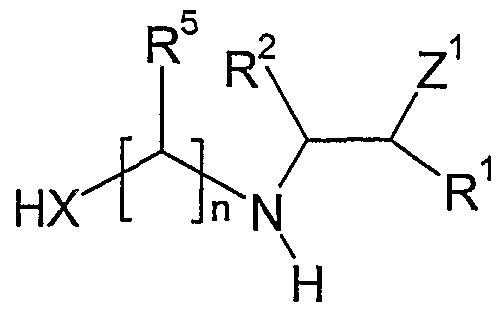
- the present invention relates to a process for the preparation of hyperbranched polymers, characterized in that compounds of the general formula 1
- R 1 , R 3 different or identical and selected from hydrogen, -CC 6 alkyl, C 3 -C 12 cycloalkyl, C 6 -C 4 aryl,
- R 2 , R 4 different or identical and selected from hydrogen, CrC 6 alkyl, C 3 -C 2 -cycloalkyl, C 6 -C 14 aryl,
- ZZ 2 different or identical and selected from COOH and COOR 6 , the radicals R 6 being different or identical and selected from CrC 6 alkyl, formyl, CO-C C 6 alkyl,
- R 5 each different or the same and selected from CC 6 alkyl and hydrogen.
- n is an integer in the range from 2 to 10,
- Dendrimers, arborols, starburst polymers and hyperbranched polymers are names for polymer structures which are distinguished by a branched structure and high functionality. Dendrimers are molecular and structurally uniform macromolecules with a highly symmetrical structure. They are built in multi-step syntheses, in most cases require the use of protective group chemistry and are accordingly expensive. US 4,507,466 may be mentioned as an example.
- hyperbranched polymers are both molecularly and structurally inconsistent.
- AB X molecules are particularly suitable for the synthesis of hyperbranched polymers.
- AB x molecules have two different functional groups A and B, which can react with one another to form a link.
- the functional group A is only present once in the molecule, the group B at least twice, ie x is an integer greater than or equal to 2.
- hyperbranched polymers with functional groups are suitable as an additive for liquid printing inks, for example for flexographic printing.
- Methyl acrylate were synthesized. Precise data on the polymer obtained have not been disclosed.
- Lu Yin et al. disclose in Acta Polym. Sinica 2000, volume 4, p. 411 and volume 5, p. 554 the synthesis of hyperbranched polyamine esters with an extremely broad molecular weight distribution (volume 4, page 412, table 2, lines 1 and 2). Furthermore, Lu Yin et al. Polyamine esters with extremely narrow molecular weight distribution (same table, lines 3-5), which were produced by a so-called pseudo-one-step process. The pseudo-one-step process consists in reacting 1, 1, 1-trimethylol-propane as a so-called core molecule with several portions of N, N-diethylol-3-a-aminomethyl-propionate.
- N, N-diethylol-3-amino-methyl propionate is obtained from methacrylic acid and N, N-diethanolamine, a molar ratio of methacrylic acid and N, N-diethanolamine of 1: 1 being chosen.
- H. Wei et al. disclose in J. Appl. Polym. Be. 2003, 87, 168 that the dendrimers and hyperbranched polymers obtainable in this way can be photopolymerized after modification with acrylic end groups.
- the object was therefore to provide hyperbranched polymers which have improved application properties. There was also the task of providing a process by means of which new hyper-twisted polymers can be produced.
- the present invention therefore relates to a process for producing the hyperbranched polymers according to the invention, also referred to below as the process according to the invention.
- R 1 , R 3 are different or preferably the same and selected from hydrogen
- C Ce-alkyl such as methyl, ethyl, n-propyl, iso-propyl, n-butyl, iso-butyl, sec.-butyl, tert.-butyl, n-pentyl, iso-pentyl, sec.-pentyl, neo- Pentyl, 1, 2-dimethyl-propyl, iso-amyl, n-hexyl, iso-hexyl, sec.-hexyl, particularly preferably C ⁇ C 4 -alkyl such as methyl, ethyl, n-propyl, iso-propyl, n-butyl, iso-butyl, sec-butyl and tert-butyl;
- C 3 -C 12 cycloalkyl such as cyclopropyl, cyclobutyl, cyclopentyl, cyclohexyl, cycloheptyl, cyclooctyl, cyclononyl, cyclodecyl, cycloundecyl and cyclododecyl; cyclopentyl, cyclohexyl and cycloheptyl are preferred.
- C 6 -C 4 aryl such as phenyl, 1-naphthyl, 2-naphthyl, 1-anthryl, 2-anthryl, 9-anthryl, 1-phenanthryl, 2-phenanthryl, 3-phenanthryl, 4-phenanthryl and 9-phenanthryl, preferably phenyl, 1-naphthyl and 2-naphthyl, particularly preferably phenyl.
- R 1 and R 3 are very particularly preferably in each case the same and selected from hydrogen and methyl.
- R 2 , R 4 are different or preferably the same and selected from
- ⁇ CC 6 alkyl such as methyl, ethyl, n-propyl, iso-propyl, n-butyl, iso-butyl, sec-butyl, tert-butyl, n-pentyl, iso-pentyl, sec-pentyl , neo-pentyl, 1,2-dimethyl-propyl, iso-amyl, n-hexyl, iso-hexyl, sec-hexyl, particularly preferably CC 4 - alkyl such as methyl, ethyl, n-propyl, iso-propyl, n -Butyl, iso-butyl, sec-butyl and tert-butyl; C 3 -C 12 cycloalkyl such as cyclopropyl, cyclobutyl, cyclopentyl, cyclohexyl, cycloheptyl,
- ZZ 2 are different or preferably the same and selected from COOH and preferably COOR 6 , the radicals R 6 being different or preferably the same and selected from d-Ce-alkyl such as methyl, ethyl, n-propyl, iso-propyl, n-butyl , iso-butyl, sec.-butyl, tert.-butyl, n-pentyl, iso-pentyl, sec.-pentyl, neo-pentyl, 1, 2-dimethyl propyl, iso-amyl, n-hexyl, iso- Hexyl, sec-hexyl, particularly preferably CC 4 alkyl such as methyl, ethyl, n-propyl, iso-propyl, n-butyl, iso-butyl, sec-butyl and tert-butyl;
- CO-CrCe-alkyl such as CO-CH 3 (acetyl), n-propionyl, isopropionyl, n-butyryl, sec-butyryl, pivaloyl, n-valeroyl, n-caproyl.
- R 5 are in each case different or preferably identical and selected from CC 6 alkyl such as methyl, ethyl, n-propyl, iso-propyl, n-butyl, iso-butyl, sec.-butyl, tert.-butyl, n-pentyl, iso-pentyl, sec.-pentyl, neo-pentyl, 1, 2-dimethylpropyl, iso-amyl, n-hexyl, iso-hexyl, sec.-hexyl, particularly preferably C r C 4 - alkyl such as methyl, ethyl , n-propyl, iso-propyl, n-butyl, iso-butyl, sec-butyl and tert-butyl and in particular hydrogen.
- CC 6 alkyl such as methyl, ethyl, n-propyl, iso-propyl,
- n is an integer in the range from 2 to 10, preferably up to 4 and particularly preferably up to 3.
- compound I a 0 to 1000% by weight of compound I a, based on compound I, can be used, preferably 0 to 100% by weight, particularly preferably 10 to 50% by weight.
- polyfunctional compounds for the purposes of the present invention are compounds with 2 or more identical or different functional groups, such as, for example, acids or their derivatives, such as esters, acid halides or anhydrides.
- Examples include:
- Dicarboxylic acids such as oxalic acid, malonic acid, succinic acid, glutaric acid, adipic acid, pimelic acid, sebacic acid, azelaic acid, phthalic acid, isophthalic acid, terephthalic acid, and mono- and diesters, in particular mono- and di-C 1-4 alkyl esters, halides and anhydrides the aforementioned dicarboxylic acids; where dC 4 alkyl is selected from methyl, ethyl, n-propyl, iso-propyl, n-butyl, iso-butyl, sec-butyl, tert-butyl;
- Tricarboxylic acids such as trimellitic acid (1, 2,4-benzenetricarboxylic acid), 1, 3,5-benzenetricarboxylic acid, and mono-, di- and triesters, in particular mono-, di- and tri-Ci-Cralkyl esters, halides and anhydrides the aforementioned tricarboxylic acids; where C 1 -C 4 alkyl is selected from methyl, ethyl, n-propyl, iso-propyl, n-butyl, iso-butyl, sec-butyl, tert-butyl; Tetracarboxylic acids, such as ethylenediaminetetraacetic acid (EDTA), pyromellitic acid (benzene-1, 2,4,5-tetracarboxylic acid), and mono-, di- and triesters, in particular mono-, di- tri- and tetra-C 1 -C 4 -alkyl esters , Halides and anhydrides of the
- di- or polyisocyanates can also be used as core molecules.
- Suitable di- and polyisocyanates are the aliphatic, cycloaliphatic and aromatic isocyanates known from the prior art.
- Preferred di- or polyisocyanates are 4,4 '-Diphenylmethandüsocyanat, the mixtures of monomeric diphenylmethane diisocyanates and oligomeric diphenylmethane diisocyanates (polymer-MD I), tetramethylene diisocyanate, tetramethylene diisocyanate trimers, hexamethylene diisocyanate, hexamethylene diisocyanate trimers, isophorone diisocyanate
- Trimer 4,4'-methylenebis (cyclohexyl) diisocyanate, xylylene diisocyanate, tetramethylxylylene diisocyanate, dodecyl diisocyanate, lysine alkyl ester diisocyanate, where alkyl is d to C 10 , 2,2,4- or 2,4,4- Trimethyl-1, 6-hexamethylene diisocyanate, 1, 4-diisocyanatocyclohexane or 4-isocyanatomethyl-1, 8-octamethylene diisocyanate, 2,4-tolylene diisocyanate (2,4-TDI), 2,4'-diphenylmethane diisocyanate ( 2,4 ' -MDI), triisocyanatotoluene,
- Isophorone diisocyanate (IPDI), 2-butyl-2-ethylpentamethylene diisocyanate, 2-isocyanato-propylcyclohexyl isocyanate, 3 (4) -isocyanatomethyl-1-methylcyclo-hexyl-isocyanate, 1, 4-diisocyanato-4-methylpentane, 2,4'-methylene bis (cyclohexyl) diisocyanate and 4-methyl-cyclohexane-1,3-diisocyanate (H-TDI), 1,3- and 1,4-phenylene diisocyanate, 1,5-naphthylene diisocyanate, diphenyl diisocyanate, tolidinediisocyanate or 2,6 -Toluenedi-isocyanate.
- IPDI isophorone diisocyanate
- 2-butyl-2-ethylpentamethylene diisocyanate 2-isocyanato-
- oligo- or polyisocyanates which are composed of the di- or polyisocyanates mentioned or their mixtures by being linked by means of urethane, allophanate, urea, biuret, uretdione, amide, isocyanate, Have carbodiimide, uretonimine, oxadiazinetrione or iminooxadiazinedione structures produced.
- an excess of compound of the formula I is usually used. Suitable molar excesses of the compound of the formula I are, for example, 1: 1 to 1000: 1, based in each case on the number of functional groups of the "core molecules”.
- a catalyst is preferably used to carry out the process according to the invention. Enzymes are suitable, for example. If one wishes to use enzymes, the use of lipases and esterases is preferred.
- Candida antarctica lipase B is particularly preferred.
- the enzymes listed are commercially available, for example from Novozymes Biotech Inc., Denmark.
- Enzyme is preferably used in immobilized form, for example on silica gel or Lewatit®.
- Methods for immobilizing enzymes are known per se, for example from Kurt Faber, "Biotransformations in organic chemistry", 3rd edition 1997, Springer Verlag, chapter 3.2 “Immobilization", pages 345-356. Immobilized enzymes are commercially available, for example from Novozymes Biotech Inc., Denmark.
- the amount of enzyme used is usually 1 to 20% by weight, in particular 10-15% by weight, based on the mass of the compound I used overall.
- non-enzymatic catalysts are used.
- the process is preferably carried out in the presence of an acidic inorganic, organometallic or organic catalyst or mixtures of two or more acidic inorganic, organometallic or organic catalysts.
- Acidic inorganic catalysts for the purposes of the present invention include, for example, sulfuric acid, phosphoric acid, phosphonic acid, hypophosphorous acid, aluminum sulfate hydrate, alum, acidic silica gel (pH ⁇ 6, in particular ⁇ 5) and acidic aluminum oxide.
- aluminum compounds of the general formula AI (OR) 3 and titanates of the general formula Ti (OR) 4 can be used as acidic inorganic catalysts, where the radicals R can in each case be the same or different and are selected independently of one another C C ⁇ o-alkyl radicals, for example methyl, ethyl, n-propyl, iso-propyl, n-butyl, iso-butyl, sec-butyl, tert-butyl, n-pentyl, iso-pentyl, sec-pentyl, neo -Pentyl, 1, 2-dimethyl-propyl, iso-amyl, n-hexyl, iso-hexyl, sec.-hexyl, n-heptyl, iso-heptyl, n-octyl, 2-ethyl-hexyl, n-nonyl or n-decyl,
- C 3 -Ci 2 cycloalkyl radicals for example cyclopropyl, cyclobutyl, cyclopentyl, cyclohexyl, cycloheptyl, cyclooctyl, cyclononyl, cyclodecyl, cycloundecyl and cyclododecyl; cyclopentyl, cyclohexyl and cycloheptyl are preferred.
- radicals R in Al (OR) 3 or Ti (OR) 4 are preferably the same and selected from isopropyl or 2-ethylhexyl.
- Preferred acidic organometallic catalysts are selected, for example, from dialkyltin oxides R 2 SnO, where R is defined as above.
- a particularly preferred representative of acidic organometallic catalysts is di-n-butyltin oxide, which is commercially available as so-called oxo-tin or as Fascat® brands.
- Preferred acidic organic catalysts are acidic organic compounds with, for example, phosphate groups, sulfonic acid groups, sulfate groups or phosphonic acid groups. Sulfonic acids such as para-toluenesulfonic acid are particularly preferred. It is also possible to use acidic ion exchangers as acidic organic catalysts, for example polystyrene resins containing sulfonic acid groups, which are crosslinked with about 2 mol% of divinylbenzene.
- Combinations of two or more of the aforementioned catalysts can also be used. It is also possible to use such organic or organometallic or else inorganic catalysts which are in the form of discrete molecules in immobilized form.
- the process according to the invention is preferably carried out at temperatures in the range from 0 ° C. to 120 ° C. It is preferred to work at temperatures below 100 ° C. Temperatures in the range from 40 ° C. to 80 ° C. are preferred, very particularly preferably from 60 to 80 ° C.
- the process according to the invention is preferably carried out at temperature ren from 80 to 200 ° C. Preferably one works at temperatures from 100 to 180, in particular up to 150 ° C or below.
- the process according to the invention is carried out in the presence of a solvent.
- a solvent for example, hydrocarbons such as paraffins or aromatics are suitable.
- paraffins are n-heptane and cyclohexane.
- aromatics are toluene, ortho-xylene, meta-xylene, para-xylene, xylene as a mixture of isomers, ethylbenzene, chlorobenzene and ortho- and meta-dichlorobenzene.
- ethers such as dioxane or tetrahydrofuran and ketones such as methyl ethyl ketone and methyl isobutyl ketone.
- solvents can be dispensed with if compound I or if all the compounds are liquid under the reaction conditions. In the event that compound I is liquid under the reaction conditions, the use of solvents is preferably dispensed with.
- the method according to the invention is carried out under an inert gas atmosphere, that is to say, for example, under carbon dioxide, nitrogen or noble gas, argon and nitrogen in particular being mentioned.
- the printing conditions of the method according to the invention are not critical per se. You can work at a significantly reduced pressure, for example at 0.1 to 500 mbar.
- the method according to the invention can also be used for prints above
- 500 mbar can be carried out.
- the reaction at from 500 mbar to atmospheric pressure is preferred; however, it is also possible to carry out the process at a slightly elevated pressure, for example up to 1200 mbar. You can work under significantly increased pressure, for example at pressures up to 10 bar.
- the conversion is preferred at 0.1 mbar to atmospheric pressure.
- the process is carried out in the presence of a dehydrating agent as an additive which can be added at the start of the reaction.
- a dehydrating agent as an additive which can be added at the start of the reaction.
- one or more enzymes are used as the catalyst.
- weakly acidic silica gels, weakly acidic aluminum oxides, molecular sieves, in particular 4 ⁇ molecular sieve, MgSO and Na 2 SO 4 are suitable.
- Additional dehydrating agents can be added during the reaction, or dehydrating agents can be replaced by fresh dehydrating agents.
- a water separator and entrainer are used to separate water or alcohol or carboxylic acid formed during the reaction.
- the reaction time can usually be in the range from 2 to 48 hours, 8 to 36 hours being preferred.
- the hyperbranched polymers produced by the process according to the invention can be worked up by generally customary operations.
- the catalyst can be separated off, for example by filtration or other methods customary in the laboratory. If you have used a solvent, the reaction mixture is usually concentrated, the concentration usually being carried out under reduced pressure. Other well-suited processing methods are precipitation after the addition of suitable agents, for example water, and subsequent washing and drying.
- Another object of the present invention are hyperbranched polymers obtainable by the process according to the invention.
- the hyperbranched polymers according to the invention have a molecular weight M w of 500 to 100,000 g / mol, preferably 3000 to 20,000 g / mol, particularly preferably 3000 to 7000 g / mol and very particularly preferably 4000 g / mol.
- the polydispersity Pd is 1.2 to 50, preferably 1.4 to 40, particularly preferably 1.5 to 30 and very particularly preferably up to 10. They are usually very readily soluble, ie clear solutions with up to 50% by weight can be obtained. %, in some cases even up to 80% by weight, of the polymers according to the invention in tetrahydrofuran (THF), n-butyl acetate, ethanol and numerous other solvents without gel particles being detectable with the naked eye.
- THF tetrahydrofuran
- the hyperbranched polymers according to the invention are generally carboxyl-terminated, where the carboxyl groups can be esterified, and can be used, for example, for the preparation.
- B. of adhesives, coatings, foams, coatings, printing inks and varnishes can be used advantageously.
- Another aspect of the present invention is a method for the hydrophilic modification of the hyperbranched polymers according to the invention and hydrophilically modified hyperbranched polymers according to the invention.
- a hydrophilic compound for example with at least one polyhydric alcohol or with at least one alkanolamine.
- Examples of preferred polyhydric alcohols are: alcohols with at least 2 hydroxyl groups, such as: ethylene glycol, 1,2-propanediol, 1,4-butanediol, 1,3-propanediol, 1,2-butanediol, glycerol, butane-1, 2,4-triol, n-pentane-1, 2,5-triol, n-pentane-1, 3,5-triol, n-hexane-1, 2,6-triol, n-hexane-1, 2, 5-triol, n-hexane-1, 3,6-triol, trimethylolbutane, trimethylolpropane or di-trimethylolpropane, trimethylolethane, pentaerythritol or dipentaerythritol; Sugar alcohols such as mesoerythritol, threitol, sorbitol, mannitol or mixtures of the above-
- Glycerol trimethylolpropane, trimethylolethane and pentaerythritol can preferably be used.
- alkanolamines used with preference are: monoalkanolamines, N, N-dialkylalkanolamines, N-alkylalkanolamines, dialkanolamines, N-alkylalkanolamines and trialkanolamines each having 2 to 18 carbon atoms in the hydroxyalkyl radical and optionally 1 to 6 carbon atoms in the alkyl radical, preferably 2 to 6 carbon atoms in the alkanol radical and optionally 1 or 2 carbon atoms in the alkyl radical.
- Ethanolamine, diethanolamine, triethanolamine, methyldiethanolamine, n-butyldiethanolamine, N, N-dimethylethanolamine and 2-amino-2-methylpropanol-1 are very particularly preferred.
- Ammonia and N, N-dimethylethanolamine are very particularly preferred.
- Another aspect of the present invention is a method for producing hydrophobically modified hyperbranched polymers using the hyperbranched polymers according to the invention, and a further aspect of the present invention is hydrophobically modified hyperbranched polymers, produced by the inventive hydrophobic modification of hyperbranched polymers according to the invention.
- hydrophobic alcohols are, for example, fatty alcohols, that is, in the sine of the present invention, alcohols with saturated or unsaturated C 10 -C 40 alcohols, or glycerol esterified with one or two equivalents of the same or different fatty acids, for example with oleic acid.
- a preferred example is glycerol monostearate.
- hyperbranched polymers modified with at least one ethylenically unsaturated compound and a method for modifying the hyperbranched polymers according to the invention with ethylenically unsaturated compound.
- hyperbranched polymers according to the invention modified with at least one ethylenically unsaturated compound
- alcohols which in turn have at least one ethylenic double bond, are 2-hydroxyethyl (meth) acrylate), 3-hydroxypropyl (meth) acrylate, ⁇ -hydroxy-n-butyl (meth) acrylate and others with (meth ) - acrylic acid esterified diols and polyols in which at least one hydroxyl group is not esterified.
- Examples include: trimethylolpropane monoacrylate, trimethylolpropane diacrylate, pentaerythritol tri (meth) acrylate, pentaerythritol triallyl ether, pentaerythritol di (meth) acryiatmonostrearat.
- Unsaturated ethers of diols and polyols in which at least one hydroxyl group is not etherified are also suitable, for example trimethylolpropane diallyl ether, trimethylolpropane monoallyl ether, 1,6-hexanediol mono vinyl ether.
- Unsaturated alcohols such as hex-1-en-3-ol and hex-2-en-1-ol may also be mentioned.
- Suitable amines include allylamine and hex-1-en-3-amine.
- Hypbranched polymers modified according to the invention with at least one ethylenically unsaturated compound are particularly suitable for the production of printing varnishes.
- hyperbranched polymers according to the invention for the production of polyaddition or polycondensation products, for example polycarbonates, polyurethanes and polyethers.
- polyaddition or polycondensation products for example polycarbonates, polyurethanes and polyethers.
- the use of the hydroxyl group-terminated hyperbranched polymers according to the invention is preferred for the production of polyaddition or polycondensation products such as polycarbonates or polyurethanes.
- hyperbranched polymers according to the invention are used as a component of adhesives, coatings, foams, coatings and lacquers.
- adhesives, coatings, foams, coatings and lacquers containing the hyperbranched polymers according to the invention are characterized by excellent technical properties.
- Another preferred aspect of the present invention is printing inks, in particular packaging printing inks for flexographic and / or gravure printing, which comprises at least one solvent or a mixture of different solvents, at least one colorant, at least one polymeric binder and optionally further additives, where it is at least one of the polymeric binders is a hyperbranched polymer according to the invention.
- Hyperbranched polymers according to the invention can be used in the context of the present invention in a mixture with other binders.
- examples of other binders for printing inks according to the invention include polyvinyl butyral, nitrocellulose, polyamides, polyacrylates or polyacrylate copolymers.
- the combination of at least one hyperbranched poly- proven with nitrocellulose.
- the total amount of all binders in the printing ink according to the invention is usually 5-35% by weight, preferably 6-30% by weight and particularly preferably 10-25% by weight, based on the sum of all components.
- the ratio of hyperbranched polymers according to the invention to the total amount of all binders is usually in the range from
- a single solvent or a mixture of several solvents can be used.
- the usual solvents for printing inks, in particular packaging printing inks are suitable as solvents.
- Particularly suitable as solvents for the printing ink according to the invention are alcohols such as ethanol, 1-propanol, 2-propanol, ethylene glycol, propylene glycol, diethylene glycol, substituted alcohols such as ethoxypropanol, esters such as ethyl acetate, isopropyl acetate, n-propyl or n butyl acetate.
- Water is also suitable in principle as a solvent.
- Particularly preferred as the solvent is ethanol or mixtures which consist predominantly of ethanol.
- dyes in particular conventional pigments, can be used as colorants.
- inorganic pigments such as titanium dioxide pigments or iron oxide pigments, interference pigments, carbon blacks, metal powders such as in particular aluminum, brass or copper powder, and organic pigments such as azo, phthalocyanine or isoindoline pigments.
- organic pigments such as azo, phthalocyanine or isoindoline pigments.
- Mixtures of different dyes or colorants can of course also be used, as can soluble organic dyes. Usually 5 to 25% by weight of colorant is used in relation to the sum of all components.
- Printing inks according to the invention and in particular packaging printing inks according to the invention can optionally comprise further additives and auxiliary substances.
- additives and auxiliaries are fillers such as calcium carbonate, aluminum oxide hydrate or aluminum or magnesium silicate.
- Waxes increase the abrasion resistance and serve to increase the lubricity.
- examples are, in particular, polyethylene waxes, oxidized polyethylene waxes with an M w in the range from 1500 to 20,000 g / mol, petroleum waxes or ceresin waxes.
- Fatty acid amides can be used to increase the surface Chen smoothness can be used.
- Plasticizers serve to increase the elasticity of the dried film.
- phthalic acid esters such as dibutyl phthalate, diisobutyl phthalate, dioctyl phthalate, citric acid ester or esters of adipic acid.
- Dispersing aids can be used to disperse the pigments.
- Adhesion promoters can advantageously be dispensed with in the printing ink according to the invention, without the use of adhesion promoters thereby being excluded.
- the total amount of all additives and auxiliary substances usually does not exceed 20% by weight with respect to the sum of all components of the printing ink and is preferably 0-10% by weight.
- Packaging printing inks according to the invention can be produced in a manner known in principle by intensive mixing or dispersing of the constituents in conventional apparatus, such as, for example, one or more dissolvers, one or more stirred ball mills or one or more three-roll mills.
- a concentrated pigment dispersion with one part is advantageous of the components and a part of solvent, which is then processed further with the inventive hyperbranched polymer, optionally further constituents and further solvent to give the finished printing ink.
- Another preferred aspect of the present invention is printing varnishes which comprise at least one solvent or a mixture of different solvents, at least one polymeric binder and optionally further additives, where at least one of the polymeric binders is a hyperbranched polymer according to the invention, and the use of Printing varnishes according to the invention for priming, as a protective varnish and for producing multilayer materials.
- Printing varnishes according to the invention contain no colorants, but apart from that they have the same constituents as the printing inks according to the invention described above. The amounts of the other components increase accordingly.
- Flexographic printing inks F1.1 and F1.2 were produced by intensively mixing the following components, whereby flexographic printing inks are to be understood as printing inks for flexo printing.
- flexographic inks F 2.1 and F 2.2 were produced by intensively mixing the following components:
- flexographic printing inks were also produced using conventional polyurethane binders (PUR 7313 (BASF).
- PUR 7313 polyurethane binders
- Test procedure "Tesafestmaschine" serves to determine the adhesion of an ink film on the substrate.
- a tape strip adheresive tape with a width of 19 mm (item BDF 4104), Beiersdorf AG) was stuck onto the ink film, evenly printed and torn off after 10 seconds. This process was carried out four times at the same place on the test specimen, each time with new tape strips. Each tape was stuck on white paper one after the other, on white paper on black paper. The test was carried out immediately after application of the flexographic printing ink.
- Multi-layer materials with various foils were produced with printing inks 1.1 to V5.
- the quality of the composites is determined by determining the bond strength between two foils connected by lamination.
- the lamination film (film 2) is coated with an adhesive-hardener mixture (R&H MOR-FREE A 4123 / hardener C88)) in such a way that a film thickness of approximately 6 ⁇ m resulted.
- Both foils were then pressed in such a way that the printing ink and the adhesive came into contact.
- the composite films obtainable in this way were stored at 60 ° C. for 3 days and the composite value was then determined.
- Table 4 The results of the tests are summarized in Table 4. Test Method:
- Measuring and testing equipment tensile strength tester from Zwick punching tool (width: 15 mm)
- At least 2 strips (width 15 mm) of the composite material to be tested were cut along and across the film web.
- the ends of the punched strips were immersed in a suitable solvent (e.g. 2-butanone) until the materials came apart.
- the pattern was then dried carefully.
- the delaminated ends of the test specimens were clamped in the tensile strength tester. The less stretchable film was placed in the upper clamp.
- the take-off speed was 100 mm / min, the take-off angle of the separated films to the non-separated complex was 90 °.
- the bond value was read off as the mean, given in N / 15 mm.
- Polyamide film Walomid XXL
- PET film Melinex 800
- PP film MB 400 Polyamide film: Walomid XXL
- PET film Melinex 800
- PP film MB 400 Polyamide film: Walomid XXL
- PET film Melinex 800
- PP film MB 400 Polyamide film: Walomid XXL
Landscapes
- Chemical & Material Sciences (AREA)
- Chemical Kinetics & Catalysis (AREA)
- Organic Chemistry (AREA)
- Health & Medical Sciences (AREA)
- Medicinal Chemistry (AREA)
- Polymers & Plastics (AREA)
- Life Sciences & Earth Sciences (AREA)
- Engineering & Computer Science (AREA)
- Materials Engineering (AREA)
- Wood Science & Technology (AREA)
- Organic Low-Molecular-Weight Compounds And Preparation Thereof (AREA)
- Addition Polymer Or Copolymer, Post-Treatments, Or Chemical Modifications (AREA)
Abstract
Description




Claims


Priority Applications (2)
| Application Number | Priority Date | Filing Date | Title |
|---|---|---|---|
| US10/563,971 US20060199913A1 (en) | 2003-07-11 | 2004-06-25 | Method for producing hyperbranched polymers |
| EP04740320A EP1646675A1 (de) | 2003-07-11 | 2004-06-25 | Verfahren zur herstellung von hyperverzweigten polymeren |
Applications Claiming Priority (2)
| Application Number | Priority Date | Filing Date | Title |
|---|---|---|---|
| DE10331770A DE10331770A1 (de) | 2003-07-11 | 2003-07-11 | Verfahren zur Herstellung von hyperverzweigten Polymeren |
| DE10331770.8 | 2003-07-11 |
Publications (1)
| Publication Number | Publication Date |
|---|---|
| WO2005007726A1 true WO2005007726A1 (de) | 2005-01-27 |
Family
ID=33560094
Family Applications (1)
| Application Number | Title | Priority Date | Filing Date |
|---|---|---|---|
| PCT/EP2004/006911 Ceased WO2005007726A1 (de) | 2003-07-11 | 2004-06-25 | Verfahren zur herstellung von hyperverzweigten polymeren |
Country Status (5)
| Country | Link |
|---|---|
| US (1) | US20060199913A1 (de) |
| EP (1) | EP1646675A1 (de) |
| CN (1) | CN100447180C (de) |
| DE (1) | DE10331770A1 (de) |
| WO (1) | WO2005007726A1 (de) |
Cited By (7)
| Publication number | Priority date | Publication date | Assignee | Title |
|---|---|---|---|---|
| WO2010145993A2 (de) | 2009-06-15 | 2010-12-23 | Basf Se | Mikrokapseln mit hochverzweigten polymeren als vernetzer |
| WO2011089078A1 (de) | 2010-01-20 | 2011-07-28 | Basf Se | Verfahren zur herstellung einer wässrigen polymerisatdispersion |
| US8309646B2 (en) | 2007-11-19 | 2012-11-13 | Basf Se | Use of highly-branched polymers for producing polymer dispersions with improved freeze/thaw stability |
| US8399554B2 (en) | 2007-11-19 | 2013-03-19 | Basf Se | Use of highly branched polymers in polymer dispersions for gloss colours |
| WO2014044529A1 (en) | 2012-09-20 | 2014-03-27 | Basf Se | Hyperbranched phosphoric acid esters |
| US8722796B2 (en) | 2010-01-20 | 2014-05-13 | Basf Se | Process for preparing an aqueous polymer dispersion |
| CN111909364A (zh) * | 2020-08-11 | 2020-11-10 | 常州美胜生物材料有限公司 | 一种银系抗菌母粒的制备方法 |
Families Citing this family (2)
| Publication number | Priority date | Publication date | Assignee | Title |
|---|---|---|---|---|
| CN102352011B (zh) * | 2011-08-12 | 2013-03-13 | 安徽大学 | 一种超支化水性聚氨酯的制备方法 |
| CN109206041A (zh) * | 2018-09-04 | 2019-01-15 | 济南大学 | 一种超支化型减水剂的制备及应用 |
Citations (2)
| Publication number | Priority date | Publication date | Assignee | Title |
|---|---|---|---|---|
| WO1996002588A1 (en) * | 1994-07-18 | 1996-02-01 | Dsm N.V. | Process for the preparation of dendrimers |
| US5561214A (en) * | 1995-05-18 | 1996-10-01 | Bayer Corporation | Hyperbranched polyaspartate esters and a process for their preparation |
Family Cites Families (3)
| Publication number | Priority date | Publication date | Assignee | Title |
|---|---|---|---|---|
| US4507466A (en) * | 1983-01-07 | 1985-03-26 | The Dow Chemical Corporation | Dense star polymers having core, core branches, terminal groups |
| US5136014A (en) * | 1990-06-22 | 1992-08-04 | E. I. Du Pont De Nemours And Company | Hyperbranched polyesters |
| AU2002210576A1 (en) * | 2000-10-31 | 2002-05-15 | Basf Drucksysteme Gmbh | Use of hyperbranched polyurethanes for producing printing inks |
-
2003
- 2003-07-11 DE DE10331770A patent/DE10331770A1/de not_active Withdrawn
-
2004
- 2004-06-25 US US10/563,971 patent/US20060199913A1/en not_active Abandoned
- 2004-06-25 CN CNB2004800199486A patent/CN100447180C/zh not_active Expired - Fee Related
- 2004-06-25 EP EP04740320A patent/EP1646675A1/de not_active Withdrawn
- 2004-06-25 WO PCT/EP2004/006911 patent/WO2005007726A1/de not_active Ceased
Patent Citations (2)
| Publication number | Priority date | Publication date | Assignee | Title |
|---|---|---|---|---|
| WO1996002588A1 (en) * | 1994-07-18 | 1996-02-01 | Dsm N.V. | Process for the preparation of dendrimers |
| US5561214A (en) * | 1995-05-18 | 1996-10-01 | Bayer Corporation | Hyperbranched polyaspartate esters and a process for their preparation |
Cited By (9)
| Publication number | Priority date | Publication date | Assignee | Title |
|---|---|---|---|---|
| US8309646B2 (en) | 2007-11-19 | 2012-11-13 | Basf Se | Use of highly-branched polymers for producing polymer dispersions with improved freeze/thaw stability |
| US8399554B2 (en) | 2007-11-19 | 2013-03-19 | Basf Se | Use of highly branched polymers in polymer dispersions for gloss colours |
| WO2010145993A2 (de) | 2009-06-15 | 2010-12-23 | Basf Se | Mikrokapseln mit hochverzweigten polymeren als vernetzer |
| WO2011089078A1 (de) | 2010-01-20 | 2011-07-28 | Basf Se | Verfahren zur herstellung einer wässrigen polymerisatdispersion |
| US8722796B2 (en) | 2010-01-20 | 2014-05-13 | Basf Se | Process for preparing an aqueous polymer dispersion |
| WO2014044529A1 (en) | 2012-09-20 | 2014-03-27 | Basf Se | Hyperbranched phosphoric acid esters |
| US10023690B2 (en) | 2012-09-20 | 2018-07-17 | Basf Se | Hyperbranched phosphoric acid esters |
| CN111909364A (zh) * | 2020-08-11 | 2020-11-10 | 常州美胜生物材料有限公司 | 一种银系抗菌母粒的制备方法 |
| CN111909364B (zh) * | 2020-08-11 | 2022-05-17 | 常州美胜生物材料有限公司 | 一种银系抗菌母粒的制备方法 |
Also Published As
| Publication number | Publication date |
|---|---|
| EP1646675A1 (de) | 2006-04-19 |
| US20060199913A1 (en) | 2006-09-07 |
| CN1823118A (zh) | 2006-08-23 |
| CN100447180C (zh) | 2008-12-31 |
| DE10331770A1 (de) | 2005-02-03 |
Similar Documents
| Publication | Publication Date | Title |
|---|---|---|
| EP1334159B1 (de) | Verwendung von hyperverzweigten polyurethanen zur herstellung von druckfarben | |
| EP1537166A1 (de) | Verfahren zur herstellung hyperverzweigter, wasserlöslicher polyester | |
| EP0708788B1 (de) | Überzugsmittel auf der basis von polyurethanharzen und ihre verwendung | |
| EP2885335B1 (de) | Polyester für die papierindustrie | |
| DE2846479C2 (de) | ||
| WO2005118677A1 (de) | Hochfunktionelle, hoch- oder hyperverzweigte polyester sowie deren herstellung und verwendung | |
| EP0379007B1 (de) | Verfahren zur Herstellung von wässrigen, oxidativ trocknenden Alkydharzen und ihre Verwendung in oder als wässrige Lacke und Beschichtungsmassen | |
| EP0208856B1 (de) | Haftklebstoffe auf der Basis von strahlenhärtbaren, (meth-)acrylgruppenhaltigen Polyestern | |
| EP0217364A2 (de) | Lacke und Formmassen enthaltend polyestergruppenhaltige Polysiloxane | |
| EP0740674A1 (de) | Polyurethanharze, verfahren zu ihrer herstellung sowie ihre verwendung in wasserverdünnbaren überzugsmitteln | |
| WO2002036697A1 (de) | Flüssigdruckfarben für den flexo- und/oder tiefdruck mit hyperverzweigten polymeren als bindemittel | |
| DE60312880T2 (de) | Lufttrocknende wässrige harzzusammensetzung | |
| EP1646675A1 (de) | Verfahren zur herstellung von hyperverzweigten polymeren | |
| DE102012016444A1 (de) | Polyester | |
| DE60007152T2 (de) | Verfahren zur herstellung von olefinharz | |
| EP1912514A2 (de) | Polyglycerolfettsäureesterprodukt und beschichtung | |
| WO2006076974A1 (de) | Wässrige, strahlungshärtbar modifizierte, ungesättigte, amorphe polyester | |
| EP1515844B1 (de) | Mehrschichtmaterialien zum herstellen von verpackungen | |
| EP4150103B1 (de) | Verfahren zur herstellung von hydroxyfettsäurebasierten polyolen | |
| EP0789065A2 (de) | Strahlenhärtbare Mischung und ihre Verwendung | |
| DE69925634T2 (de) | Lufttrocknende beschichtungs-zusammensetzung basierend auf polyesteramid | |
| EP0002488A1 (de) | Verfahren zur Herstellung von wasseremulgierbaren lufttrocknenden Lackbindemitteln | |
| DE60304827T2 (de) | Niedrige voc's vinylester harzzusammensetzungen und anwendungen | |
| DE3219471A1 (de) | Waessrige alkydharzemulsionen fuer lufttrocknende lacke (ii) | |
| DE4202229A1 (de) | Verfahren zur herstellung von thixotropen lackbindemitteln und ihre verwendung in beschichtungsmitteln |
Legal Events
| Date | Code | Title | Description |
|---|---|---|---|
| WWE | Wipo information: entry into national phase |
Ref document number: 200480019948.6 Country of ref document: CN |
|
| AK | Designated states |
Kind code of ref document: A1 Designated state(s): AE AG AL AM AT AU AZ BA BB BG BR BW BY BZ CA CH CN CO CR CU CZ DE DK DM DZ EC EE EG ES FI GB GD GE GH GM HR HU ID IL IN IS JP KE KG KP KR KZ LC LK LR LS LT LU LV MA MD MG MK MN MW MX MZ NA NI NO NZ OM PG PH PL PT RO RU SC SD SE SG SK SL SY TJ TM TN TR TT TZ UA UG US UZ VC VN YU ZA ZM ZW |
|
| AL | Designated countries for regional patents |
Kind code of ref document: A1 Designated state(s): BW GH GM KE LS MW MZ NA SD SL SZ TZ UG ZM ZW AM AZ BY KG KZ MD RU TJ TM AT BE BG CH CY CZ DE DK EE ES FI FR GB GR HU IE IT LU MC NL PL PT RO SE SI SK TR BF BJ CF CG CI CM GA GN GQ GW ML MR NE SN TD TG |
|
| 121 | Ep: the epo has been informed by wipo that ep was designated in this application | ||
| WWE | Wipo information: entry into national phase |
Ref document number: 2004740320 Country of ref document: EP |
|
| WWE | Wipo information: entry into national phase |
Ref document number: 10563971 Country of ref document: US |
|
| WWP | Wipo information: published in national office |
Ref document number: 2004740320 Country of ref document: EP |
|
| WWP | Wipo information: published in national office |
Ref document number: 10563971 Country of ref document: US |