WO2005012266A1 - (thio) carbamoyl-cyclohexane derivatives as d3/d2 receptor antagonists - Google Patents
(thio) carbamoyl-cyclohexane derivatives as d3/d2 receptor antagonists Download PDFInfo
- Publication number
- WO2005012266A1 WO2005012266A1 PCT/HU2004/000056 HU2004000056W WO2005012266A1 WO 2005012266 A1 WO2005012266 A1 WO 2005012266A1 HU 2004000056 W HU2004000056 W HU 2004000056W WO 2005012266 A1 WO2005012266 A1 WO 2005012266A1
- Authority
- WO
- WIPO (PCT)
- Prior art keywords
- phenyl
- cyclohexyl
- ethyl
- piperazin
- formula
- Prior art date
- Legal status (The legal status is an assumption and is not a legal conclusion. Google has not performed a legal analysis and makes no representation as to the accuracy of the status listed.)
- Ceased
Links
- 0 CC(C1)**C1C1C(CCCC*C*)C1 Chemical compound CC(C1)**C1C1C(CCCC*C*)C1 0.000 description 9
Classifications
-
- C—CHEMISTRY; METALLURGY
- C07—ORGANIC CHEMISTRY
- C07D—HETEROCYCLIC COMPOUNDS
- C07D295/00—Heterocyclic compounds containing polymethylene-imine rings with at least five ring members, 3-azabicyclo [3.2.2] nonane, piperazine, morpholine or thiomorpholine rings, having only hydrogen atoms directly attached to the ring carbon atoms
- C07D295/16—Heterocyclic compounds containing polymethylene-imine rings with at least five ring members, 3-azabicyclo [3.2.2] nonane, piperazine, morpholine or thiomorpholine rings, having only hydrogen atoms directly attached to the ring carbon atoms acylated on ring nitrogen atoms
- C07D295/20—Heterocyclic compounds containing polymethylene-imine rings with at least five ring members, 3-azabicyclo [3.2.2] nonane, piperazine, morpholine or thiomorpholine rings, having only hydrogen atoms directly attached to the ring carbon atoms acylated on ring nitrogen atoms by radicals derived from carbonic acid, or sulfur or nitrogen analogues thereof
- C07D295/215—Radicals derived from nitrogen analogues of carbonic acid
-
- A—HUMAN NECESSITIES
- A61—MEDICAL OR VETERINARY SCIENCE; HYGIENE
- A61P—SPECIFIC THERAPEUTIC ACTIVITY OF CHEMICAL COMPOUNDS OR MEDICINAL PREPARATIONS
- A61P15/00—Drugs for genital or sexual disorders; Contraceptives
-
- A—HUMAN NECESSITIES
- A61—MEDICAL OR VETERINARY SCIENCE; HYGIENE
- A61P—SPECIFIC THERAPEUTIC ACTIVITY OF CHEMICAL COMPOUNDS OR MEDICINAL PREPARATIONS
- A61P15/00—Drugs for genital or sexual disorders; Contraceptives
- A61P15/10—Drugs for genital or sexual disorders; Contraceptives for impotence
-
- A—HUMAN NECESSITIES
- A61—MEDICAL OR VETERINARY SCIENCE; HYGIENE
- A61P—SPECIFIC THERAPEUTIC ACTIVITY OF CHEMICAL COMPOUNDS OR MEDICINAL PREPARATIONS
- A61P25/00—Drugs for disorders of the nervous system
-
- A—HUMAN NECESSITIES
- A61—MEDICAL OR VETERINARY SCIENCE; HYGIENE
- A61P—SPECIFIC THERAPEUTIC ACTIVITY OF CHEMICAL COMPOUNDS OR MEDICINAL PREPARATIONS
- A61P25/00—Drugs for disorders of the nervous system
- A61P25/14—Drugs for disorders of the nervous system for treating abnormal movements, e.g. chorea, dyskinesia
-
- A—HUMAN NECESSITIES
- A61—MEDICAL OR VETERINARY SCIENCE; HYGIENE
- A61P—SPECIFIC THERAPEUTIC ACTIVITY OF CHEMICAL COMPOUNDS OR MEDICINAL PREPARATIONS
- A61P25/00—Drugs for disorders of the nervous system
- A61P25/14—Drugs for disorders of the nervous system for treating abnormal movements, e.g. chorea, dyskinesia
- A61P25/16—Anti-Parkinson drugs
-
- A—HUMAN NECESSITIES
- A61—MEDICAL OR VETERINARY SCIENCE; HYGIENE
- A61P—SPECIFIC THERAPEUTIC ACTIVITY OF CHEMICAL COMPOUNDS OR MEDICINAL PREPARATIONS
- A61P25/00—Drugs for disorders of the nervous system
- A61P25/18—Antipsychotics, i.e. neuroleptics; Drugs for mania or schizophrenia
-
- A—HUMAN NECESSITIES
- A61—MEDICAL OR VETERINARY SCIENCE; HYGIENE
- A61P—SPECIFIC THERAPEUTIC ACTIVITY OF CHEMICAL COMPOUNDS OR MEDICINAL PREPARATIONS
- A61P25/00—Drugs for disorders of the nervous system
- A61P25/20—Hypnotics; Sedatives
-
- A—HUMAN NECESSITIES
- A61—MEDICAL OR VETERINARY SCIENCE; HYGIENE
- A61P—SPECIFIC THERAPEUTIC ACTIVITY OF CHEMICAL COMPOUNDS OR MEDICINAL PREPARATIONS
- A61P25/00—Drugs for disorders of the nervous system
- A61P25/22—Anxiolytics
-
- A—HUMAN NECESSITIES
- A61—MEDICAL OR VETERINARY SCIENCE; HYGIENE
- A61P—SPECIFIC THERAPEUTIC ACTIVITY OF CHEMICAL COMPOUNDS OR MEDICINAL PREPARATIONS
- A61P25/00—Drugs for disorders of the nervous system
- A61P25/24—Antidepressants
-
- A—HUMAN NECESSITIES
- A61—MEDICAL OR VETERINARY SCIENCE; HYGIENE
- A61P—SPECIFIC THERAPEUTIC ACTIVITY OF CHEMICAL COMPOUNDS OR MEDICINAL PREPARATIONS
- A61P25/00—Drugs for disorders of the nervous system
- A61P25/28—Drugs for disorders of the nervous system for treating neurodegenerative disorders of the central nervous system, e.g. nootropic agents, cognition enhancers, drugs for treating Alzheimer's disease or other forms of dementia
-
- A—HUMAN NECESSITIES
- A61—MEDICAL OR VETERINARY SCIENCE; HYGIENE
- A61P—SPECIFIC THERAPEUTIC ACTIVITY OF CHEMICAL COMPOUNDS OR MEDICINAL PREPARATIONS
- A61P25/00—Drugs for disorders of the nervous system
- A61P25/30—Drugs for disorders of the nervous system for treating abuse or dependence
-
- A—HUMAN NECESSITIES
- A61—MEDICAL OR VETERINARY SCIENCE; HYGIENE
- A61P—SPECIFIC THERAPEUTIC ACTIVITY OF CHEMICAL COMPOUNDS OR MEDICINAL PREPARATIONS
- A61P25/00—Drugs for disorders of the nervous system
- A61P25/30—Drugs for disorders of the nervous system for treating abuse or dependence
- A61P25/32—Alcohol-abuse
-
- A—HUMAN NECESSITIES
- A61—MEDICAL OR VETERINARY SCIENCE; HYGIENE
- A61P—SPECIFIC THERAPEUTIC ACTIVITY OF CHEMICAL COMPOUNDS OR MEDICINAL PREPARATIONS
- A61P25/00—Drugs for disorders of the nervous system
- A61P25/30—Drugs for disorders of the nervous system for treating abuse or dependence
- A61P25/34—Tobacco-abuse
-
- A—HUMAN NECESSITIES
- A61—MEDICAL OR VETERINARY SCIENCE; HYGIENE
- A61P—SPECIFIC THERAPEUTIC ACTIVITY OF CHEMICAL COMPOUNDS OR MEDICINAL PREPARATIONS
- A61P25/00—Drugs for disorders of the nervous system
- A61P25/30—Drugs for disorders of the nervous system for treating abuse or dependence
- A61P25/36—Opioid-abuse
-
- C—CHEMISTRY; METALLURGY
- C07—ORGANIC CHEMISTRY
- C07D—HETEROCYCLIC COMPOUNDS
- C07D223/00—Heterocyclic compounds containing seven-membered rings having one nitrogen atom as the only ring hetero atom
- C07D223/02—Heterocyclic compounds containing seven-membered rings having one nitrogen atom as the only ring hetero atom not condensed with other rings
- C07D223/04—Heterocyclic compounds containing seven-membered rings having one nitrogen atom as the only ring hetero atom not condensed with other rings with only hydrogen atoms, halogen atoms, hydrocarbon or substituted hydrocarbon radicals, directly attached to ring carbon atoms
-
- C—CHEMISTRY; METALLURGY
- C07—ORGANIC CHEMISTRY
- C07D—HETEROCYCLIC COMPOUNDS
- C07D243/00—Heterocyclic compounds containing seven-membered rings having two nitrogen atoms as the only ring hetero atoms
- C07D243/06—Heterocyclic compounds containing seven-membered rings having two nitrogen atoms as the only ring hetero atoms having the nitrogen atoms in positions 1 and 4
- C07D243/08—Heterocyclic compounds containing seven-membered rings having two nitrogen atoms as the only ring hetero atoms having the nitrogen atoms in positions 1 and 4 not condensed with other rings
-
- C—CHEMISTRY; METALLURGY
- C07—ORGANIC CHEMISTRY
- C07D—HETEROCYCLIC COMPOUNDS
- C07D295/00—Heterocyclic compounds containing polymethylene-imine rings with at least five ring members, 3-azabicyclo [3.2.2] nonane, piperazine, morpholine or thiomorpholine rings, having only hydrogen atoms directly attached to the ring carbon atoms
- C07D295/04—Heterocyclic compounds containing polymethylene-imine rings with at least five ring members, 3-azabicyclo [3.2.2] nonane, piperazine, morpholine or thiomorpholine rings, having only hydrogen atoms directly attached to the ring carbon atoms with substituted hydrocarbon radicals attached to ring nitrogen atoms
- C07D295/12—Heterocyclic compounds containing polymethylene-imine rings with at least five ring members, 3-azabicyclo [3.2.2] nonane, piperazine, morpholine or thiomorpholine rings, having only hydrogen atoms directly attached to the ring carbon atoms with substituted hydrocarbon radicals attached to ring nitrogen atoms substituted by singly or doubly bound nitrogen atoms
- C07D295/135—Heterocyclic compounds containing polymethylene-imine rings with at least five ring members, 3-azabicyclo [3.2.2] nonane, piperazine, morpholine or thiomorpholine rings, having only hydrogen atoms directly attached to the ring carbon atoms with substituted hydrocarbon radicals attached to ring nitrogen atoms substituted by singly or doubly bound nitrogen atoms with the ring nitrogen atoms and the substituent nitrogen atoms separated by carbocyclic rings or by carbon chains interrupted by carbocyclic rings
Definitions
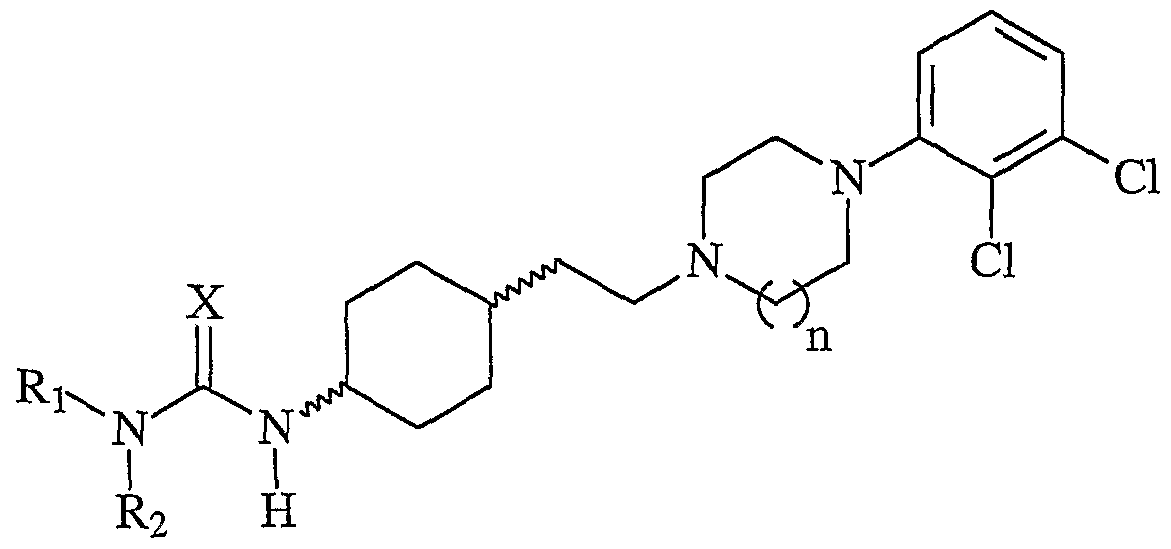
- the present invention relates to new D 3 and D 2 dopamine receptor subtype preferring ligands of formula (I) and/or geometric isomers and/or stereoisomers and/or diastereomers and/or salts and/or hydrates and/or solvates thereof, to the processes for producing the same, to pharmacological compositions containing the same and to their use in therapy and/or prevention of a condition which requires modulation of dopamine receptors.
- Cyclohexane derivatives are described in patent application WO 99/67206 useful in the therapy for the treatment of pain.
- the compounds mentioned in the above publications are not declared or even not suggested having activity on the dopamine D 3 and/or D 2 receptors.
- the new derivatives of formula (I) of the present invention have high or very high affinity for dopamine D 3 receptors and moderate to high affinity to dopamine D 2 receptors always in such a combination that the D 3 affinity is 5 to 200 fold higher than the D 2 affinity.
- the compounds have even higher selectivity over other receptors, such as alpha-1 receptors.
- the dual (i.e. D 3 and D 2 ) receptor functional antagonism coupled in the above mentioned particular proportion is especially important as it allows the simultaneous manifestation of the beneficial effects of modulation of both the D 3 and D 2 receptors, however, without ⁇ he appearance of the known disadvantages of each individual receptor action.
- Ri and R 2 represent independently a substituent selected from hydrogen, alkyl, aryl, alkenyl, cycloalkyl, aroyl, or R-i and R 2 may form a heterocyclic ring with the adjacent nitrogen atom;
- X represents an oxygen or sulphur atom;
- n is an integer of 1 to 2, and/or geometric isomers and/or stereoisomers and/or diastereomers and/or salts and/or hydrates and/or solvates thereof, to the processes for producing the same, to pharmacological compositions containing the same and to their use in therapy and/or prevention of pathological conditions which require the modulation of dopamine receptors such as psychoses (e.g.
- schizophrenia, schizo-affective disorders, etc. drug (e.g. alcohol, cocaine and nicotine, opioids, etc.) abuse, cognitive impairment accompanying schizophrenia, mild-to-moderate cognitive deficits, dementia, psychotic states associated with dementia, eating disorders (e.g. bulimia nervosa, etc.), attention deficit disorders, hyperactivity disorders in children, psychotic depression, mania, paranoid and delusional disorders, dyskinetic disorders (e.g. Parkinson's disease, neuroleptic induced parkinsonism, tardive dyskinesias) anxiety, sexual dysfunction, sleep disorders, emesis, aggression, autism.
- drug e.g. alcohol, cocaine and nicotine, opioids, etc.
- cognitive impairment accompanying schizophrenia mild-to-moderate cognitive deficits
- dementia dementia
- psychotic states associated with dementia dementia
- eating disorders e.g. bulimia nervosa, etc.
- attention deficit disorders e.g. Parkinson's disease, neuroleptic induced parkinsonism, tardive dyskinesia
- the invention relates to new cyclohexane derivatives having (thio)carbamoyi side chain of formula (I):
- Ri and R 2 represent independently a substituent selected from hydrogen, alkyl, alkenyl, aryl, cycloalkyl, aroyl, or Ri and R 2 may form a heterocyclic ring with the adjacent nitrogen atom;
- X represents an oxygen or sulphur atom;
- n is an integer of 1 to 2, and/or geometric isomers and/or stereoisomers and/or diastereomers and/or salts and/or hydrates and/or solvates thereof.
- the alkyl moiety may contain 1 to 6 carbon atoms with straight or branched chain optionally substituted with one or more C- ⁇ - 6 alkoxycarbonyl, aryl, preferably phenyl or (C1-6 alkoxycarbonyl)-C ⁇ - 6 alkyl group.
- Ri and R 2 may form a heterocyclic ring with the adjacent nitrogen atom, which may be saturated or unsaturated optionally substituted monocyclic or bicyclic ring, which may contain further heteroatoms selected from O, N, or S.
- the heterocyclic group is preferably pyrrolidinyl.
- the alkenyl moiety may have 2 to 7 carbon atoms and 1 to 3 double bonds.
- the aryl moiety may be selected from an optionally substituted mono-, bi- or tricyclic aryl, such as phenyl, naphthyl, fiuorenonyl, or antraquinonyl group, preferably phenyl or naphthyl.
- the aryl moiety may be substituted with one or more C- ⁇ - 6 alkoxy, trifluoro-C ⁇ - 6 alkoxy, C- ⁇ - 6 alkoxycarbonyl, C ⁇ - 6 alkanoyl, aryl, C ⁇ - 6 alkylthio, halogen or cyano.
- the aryl is as defined above.
- the cycloalkyl moiety may be selected from an optionally substituted mono-, bi- or tricyclic cycloalkyl group, such as cyclohexyl or adamantyl.
- Ri and/or R 2 represent aroyl
- the aryl moiety therein is as defined above, preferably phenyl.
- the invention relates also to the salts of compounds of formula (I) formed with acids.
- Both organic and inorganic acids can be used for the formation of acid addition salts.
- Suitable inorganic acids can be for example hydrochloric acid, sulfuric acid, nitric acid and phosphoric acid.
- Representatives of monovalent organic acids can be for example formic acid, acetic acid, propionic acid, and different butyric acids, valeric acids and capric acids.
- Representatives of bivalent organic acids can be for example oxalic acid, malonic acid, maleic acid, fumaric acid and succinic acid.
- organic acids can also be used, such as hydroxy acids for example citric acid, tartaric acid, or aromatic carboxylic acids for example benzoic acid or salicylic acid, as well as aliphatic and aromatic sulfonic acids for example methanesulfonic acid, naphtalenesulfonic acid and p-toluenesulfonic acid.
- hydroxy acids for example citric acid, tartaric acid, or aromatic carboxylic acids for example benzoic acid or salicylic acid
- aliphatic and aromatic sulfonic acids for example methanesulfonic acid, naphtalenesulfonic acid and p-toluenesulfonic acid.
- acid addition salts are pharmaceutically acceptable acid addition salts.
- acid addition salts which do not belong to the pharmaceutically acceptable acid addition salts belong to the present invention are also included within the scope of the invention.
- the compounds of formula (I) exist in the form of els and trans isomers with respect to the configuration of the cyclohexane ring. These and their mixtures are likewise within the scope of the present inention.
- the compounds of the invention are preferably in trans configuration. Certain compounds of formula (I) when the compound contains C 2 -7 alkenyl group can exist in the form of cis- and/or trans- isomers.
- Preferred compounds of the invention are those compounds of formula (I), wherein Ri and R 2 represent independently hydrogen, or C 1 - 6 alkyl, with straight or branched chain optionally substituted with one or more C ⁇ - 6 alkoxycarbonyl, aryl, or (C 1 - 6 alkoxycarbonyl)-C ⁇ - 6 alkyl group, or Ri and R 2 may form a heterocyclic ring with the adjacent nitrogen atom, which may be saturated or unsaturated optionally substituted monocyclic or bicyclic ring, which may contain further heteroatoms selected from O, N, or S, or C2-7 alkenyl with 1 to 3 double bond, or a mono-, bi- or tricyclic aryl, preferably phenyl or naphthyl optionally sustituted with one or more C- ⁇ - 6 alkoxy, trifluoro C ⁇ - 6 alkoxy, C ⁇ - 6 alkoxycarbonyl, Ci- ⁇ alkanoyl, aryl, C ⁇ - 6 alkylthi
- Particularly preferred compounds of the invention are those compounds of formula (I), wherein Ri and R 2 represent independently hydrogen, or C1- 6 alkyl, with straight or branched chain and optionally substituted with one or more C ⁇ - 6 alkoxycarbonyl, phenyl or (C1-6 alkoxycarbonyl)-C ⁇ - 6 alkyl group or R-i and R 2 may form a heterocyclic ring with the adjacent nitogen atom, preferably pyrrolidinyl ring, or C 2 -7 alkenyl with 1 double bond, or phenyl or naphthyl group optionally sustituted with one or more C ⁇ - 6 alkoxy, trifluoro-C ⁇ - 6 alkoxy, C ⁇ - 6 alkoxycarbonyl, C ⁇ - 6 alkanoyl, .
- aryl C ⁇ . 6 alkylthio, halogen or cyano, or cyclohexyl or adamantyl group, or benzoyl group
- X represents oxygen or sulphur atom
- n is an integer of 1 to 2, and/or geometric isomers and/or stereoisomers and/or diastereomers and/or salts and/or hydrates and/or solvates thereof.
- the most prominent compounds of the invention are those compounds of formula (I), wherein Ri and R 2 represent independently hydrogen, or C 1 -6 alkyl with straight or branched chain optionallly substituted with C ⁇ - 6 alkoxycarbonyl, or phenyl or R 1 and R 2 form a pyrrolidinyl ring; allyl; phenyl optionally substituted with one or more C1-6 alkoxy, cyano or C-t- 6 alkanoyl; cyclohexyl; X represents oxygen or sulphur; n is 1 , and/or geometric isomers and/or stereoisomers and/or diastereomers and/or salts and/or hydrates and/or solvates thereof.
- the invention also relates to the pharmaceutical compositions containing the compounds of formula (I) as active ingredient. Further subject of the present invention is the pharmaceutical manufacture of medicaments containing compounds of formula (I), as well as the process of treatments and/or prevention with these compounds, which means administering to a mammal to be treated - including human - effective amount/amounts of compounds of formula (I) of the present invention as such or as medicament.
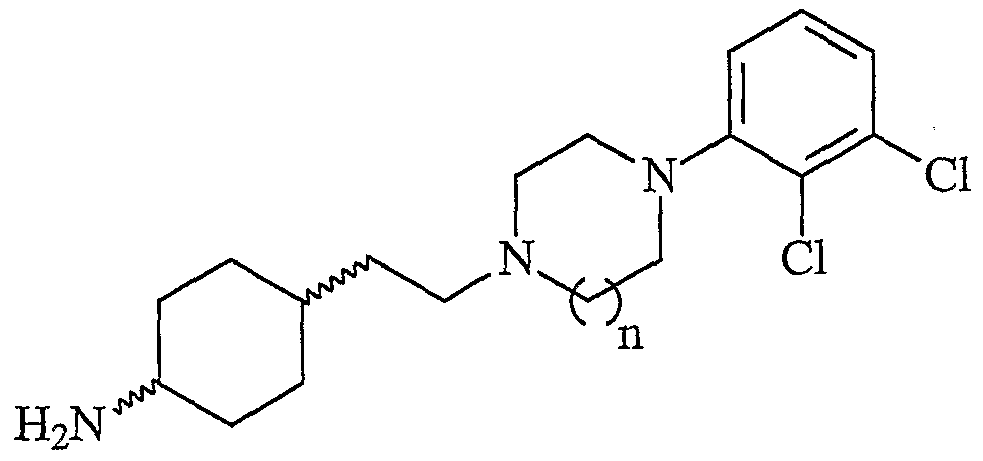
- the present invention also provides a process (Method A) for preparing compounds of formula (I) by forming an amide bond between a (thio)carbamoylchoride of formula (II)):
- amide bond formation may be carried out by known methods, preferably by suspending or dissolving the appropriate amine (III) or a salt thereof in a suitable solvent (e.g. tetrahydrofurane, dimethylformamide or chlorinated hydrocarbons or hydrocarbons) and reacting it with the appropriate (thio)carbamoylchloride (II) in the presence of a base (e.g. triethylamine).
- a suitable solvent e.g. tetrahydrofurane, dimethylformamide or chlorinated hydrocarbons or hydrocarbons
- a base e.g. triethylamine
- amide bond formation may be carried out by known methods, preferably by suspending or dissolving the appropriate amine (III) or a salt thereof in a suitable solvent (e.g. tetrahydrofurane, dimethylformamide or chlorinated hydrocarbons or hydrocarbons) and reacting it with the appropriate iso(thio)cyanates (IV) if necessary in the presence of a base (e.g. triethylamine).
- a suitable solvent e.g. tetrahydrofurane, dimethylformamide or chlorinated hydrocarbons or hydrocarbons
- a base e.g. triethylamine
- the reaction can be carried out advantageously between 5 °C and 50 °C.
- the reactions are followed by thin layer chromatography.
- the necessary reaction time is about 6-10 h.
- the work-up of the reaction mixture can be carried out by different methods.
- Method C for preparing compounds of formula (I) is transforming in situ an amine of formula (III) to iso(thio)cyanate derivative and reacting the latter with an amine of formula (V):
- Ri and R 2 are as described above for the formula (I), or derivatives thereof.
- the above reaction may be carried out by known methods.
- the transformation of amine (III) to iso(thio)cyanate derivative may be carried out in situ in an aprotic solvent (e.g. tetrahydrofurane, chlorinated hydrocarbons) by the use of an appropriate (thio)carbonic acid derivative (e.g. phosgene, triphosgene, thiophosgene) in the presence of a base (e.g. triethylamine), advantageously between -5 °C and room temperature.
- an aprotic solvent e.g. tetrahydrofurane, chlorinated hydrocarbons
- an appropriate (thio)carbonic acid derivative e.g. phosgene, triphosgene, thiophosgene
- a base e.g. triethylamine
- the obtained (thio)ureas of formula (I) can be transformed into the salts thereof with acids and/or liberated the (thio)ureas of formula (I) from the obtained acid addition salts by treatment with a base, and/or can be separated the cis- and/or a- ⁇ s-isomers and/or the stereoisomers and/or diastereomers and/or can be transformed into hydrates and/or solvates thereof.
- the (thio)carbamoylchlorides of formula (II) and iso(thio)cyanates of formula (IV) and the amines of formula (V), wherein Ri, R 2 and X are as defined above, are either commercially available or can be synthesized by different known methods.
- the compounds of formula (I) can also be prepared by automated parallel synthesis. The separatrion of cis- and trans isomers either of compounds of formula (I) or of formula (III) or the protected derivatives of the latter is carried out by conventional methods, e.g.
- the compounds of formula (I) of the present invention in contrast to known antipsychotics, have been found to exhibit high affinity for dopamine D 3 receptors, less activity toward D 2 receptors and much less affinity to aderenergic alpha-1 receptors, and are expected to be useful in the treatment of disease states and/or prevention the same in which dopamine D 3 and/or D 2 receptors are involved in the disease pathology and thus their modulation is required.
- Dysfunction of the dopaminergic neurotransmitter system is involved in the pathology of several neuropsychiatric and neurodegenerative disorders, such as schizophrenia, drug abuse and Parkinson's disease, respectively.
- the effect of dopamine is mediated via at least five distinct dopamine receptors belonging to the D (D- t , D 5 ) or the D - (D 2 , D 3 , D 4 ) families.
- D 3 receptors have been shown to have characteristic distribution in the cerebral dopaminergic systems. Namely, high densities were found in certain limbic structures, such as nucleus accumbens and islands of Calleja.
- preferential targeting of the D 3 receptors may be a promising approach for more selective modulation of dopaminergic functions and consequently for successful therapeutic intervention in several abnormalities, such as schizophrenia, emotional or cognitive dysfunctions and addiction (Sokoloff, P. et al.: Nature , 1990, 347, 146; Schwartz, J.C. et al.: Clin. Neuropharmacol. 1993, 16, 295; Levant, B.: Pharmacol. Rev. 1997, 49, 231), addiction (Pilla, C. et al.: Nature 1999, 400, 371) and Parkinson's disease (Levant, B. et al.: CNS Drugs 1999, 12, 391) or pain (Levant, B. et al.: Neurosci. Lett.
- D 2 antagonists are widely used drugs as antipsychotics, for example.
- massive antagonism of the D 2 receptors leads to unwanted side- effects such as extrapyramidal motor symptoms, psychomotor sedation or cognitive disturbances. These side effects seriously restrict the therapeutic utilization of D 2 antagonist compounds.
- the present invention provides novel compounds of formula (I) and/or geometric isomers and/or stereoisomers and/or diastereomers and/or salts and/or hydrates and/or solvates thereof which have high (less than 10 nM) or very high (less than 1 nM) affinity to dopamine D 3 receptors and - simultaneously - have moderate (between 50 and 200 nM) to high (between 1 and 10 nM) affinity to D 2 receptors always in such combination that the D 3 affinity is 5 to 200 fold higher than the D 2 affinity.
- it provides a method of treating conditions which require preferential modulation of dopamine D 3 and/or D receptors, for example psychoses (e.g.
- schizophrenia schizo-affective disorders
- cognitive impairment accompanying schizophrenia, mild-to-moderate cognitive deficits, dementia, psychotic states associated with dementia, psychotic depression, mania, paranoid and delusional disorders, dyskinetic disorders such as Parkinson's disease, neuroleptic induced parkinsonism, tardive dyskinesia, eating disorders (e.g.
- bulimia nervosa attention deficit disorders, hyperactivity disorders in children, depression, anxiety, sexual dysfunction, sleep disorders, emesis, aggression, autism and drug abuse, which comprises administering to a subject in need thereof an effective amount of a compound of formula (I) and/or geometric isomers and/or stereoisomers and/or diastereomers and/or salts and/or hydrates and/or solvates thereof.
- the invention also provides the use of a compound of formula (I) and/or geometric isomers and/or stereoisomers and/or diastereomers and/or salts and/or hydrates and/or solvates thereof in the manufacture of a medicament for the treatment of conditions which require modulation of dopamine receptors especially that of dopamine D 3 and/or D 2 receptors.
- D3/D 2 antagonists with D 3 preference is in the treatment of schizophrenia, schizo-affective disorders, cognitive impairment accompanying schizophrenia, mild-to-moderate cognitive deficits, dementia, psychotic states associated with dementia, psychotic depression, mania, paranoid and delusional disorders, dyskinetic disorders such as Parkinson's disease, neuroleptic induced parkinsonism, depression, anxiety, drug abuse (e.g. cocaine abuse).
- the particular combination of the two receptor-actions described above allows the simultaneous manifestation of the beneficial actions of both the D 3 antagonism (e.g. cognitive enhancer effect, inhibition of extrapyramidal motor symptoms, inhibitory action on drug abuse) and the D 2 antagonism (e.g. antipsychotic effect).
- the same combination surprisingly results in cancelling out the disadvantageous features of D 2 antagonism (e.g. extrapyramidal symptoms, psychomotor sedation, cognitive disturbances).
- the compounds of formula (I) of the present invention and/or geometric isomers and/or stereoisomers and/or diastereomers and/or physiologically acceptable salts and/or hydrates and/or solvates thereof are usually administered as a standard pharmaceutical composition.
- the present invention therefore provides in a further aspect pharmaceutical compositions comprising a new compound of formula (I) and/or geometric isomers and/or stereoisomers and/or diastereomers and/or physiologically acceptable salts and/or hydrates and/or solvates thereof and physiologically acceptable carriers.
- the compounds of formula (1) of the present invention and/or geometric isomers and/or stereoisomers and/or diastereomers and/or physiologically acceptable salts and/or hydrates and/or solvates thereof may be administered by any convenient method, for example by oral, parental, buccal, sublingual, nasal, rectal or transdermal administration and the pharmaceutical compositions adapted accordingly.
- the compounds of formula (I) of the present invention and/or geometric isomers and/or stereoisomers and/or diastereomers and/or physiologically acceptable salts and/or hydrates and/or solvates thereof which are active when given orally can be formulated as liquids or solids, for example syrups, suspensions or emulsions, tablets, capsules and lozenges.
- a liquid formulation of the compounds of formula (I) of the present invention and/or geometric isomers and/or stereoisomers and/or diastereomers and/or physiologically acceptable salts and/or hydrates and/or solvates thereof generally consists of a suspension or solution of the compound of formula (I) and/or geometric isomers and/or stereoisomers and/or diastereomers and/or salts and/or hydrates and/or solvates thereof in a suitable liquid carrier(s) for example an aqueous solvent, such as water, ethanol or glycerine, or a non-aqueous solvent, such as polyethylene glycol or an oil.
- the formulation may also contain a suspending agent, preservative, flavouring or colouring agent.
- a composition in the solid form of a tablet can be prepared using any suitable pharmaceutical carrier(s) routinely used for preparing solid formulations.
- suitable pharmaceutical carrier(s) include magnesium stearate, starch, lactose, sucrose, cellulose etc.
- a composition in the solid form of a capsule can be prepared using routine encapsulation procedures.
- pellets containing the active ingredient can be prepared using standard carriers and then filled into a hard gelatine capsule; alternatively, a dispersion or suspension can be prepared using any suitable pharmaceutical carrier(s), for example aqueous gums, celluloses, silicates or oils and the dispersion or suspension then filled into a soft gelatine capsule.
- Typical parenteral compositions consist of a solution or suspesion of the compound of formula (I) of the present invention and/or geometric isomers and/or stereoisomers and/or diastereomers and/or physiologically acceptable salts and/or hydrates and/or solvates thereof in a steril aqueous carrier or parenterally acceptable oil, for example polyethylene glycol, polyvinyl pyrrolidone, lecithin, arachis oil or sesame oil.
- the solution can be lyophilised and then reconstituted with a suitable solvent just prior to administration.
- compositions of the present invention for nasal administration containing a compound of formula (I) and/or geometric isomers and/or stereoisomers and/or diastereomers and/or physiologically acceptable salts and/or hydrates and/or solvates thereof may conveniently be formulated as aerosols, drops, gels and powders.
- Aerosol formulations of the present invention typically comprise a solution or fine suspension of the compound of formula (I) and/or geometric isomers and/or stereoisomers and/or diastereomers and/or physiologically acceptable salts and/or hydrates and/or solvates thereof in a physiologically acceptable aqueous or non- aqueous solvent and are usually presented in a single or multidose quantities in steril form is a sealed container, which can take the form of a cartridge or refill for use with an atomising device.
- the sealed container may be a unitary dispensing device, such as a single dose nasal inhaler or an aerosol dispenser fitted with a metering valve which is intended for disposal once the contents of the container have been exhausted.
- the dosage form comprises an aerosol dispenser
- a propellant which can be a compressed gas, such as compressed air or an organic propellant, such as a fluorochlorohydrocarbon.
- the aerosol dosages form can also take the form af a pump-atomiser.
- Compositions of the present invention containing a compound of formula (I) and/or geometric isomers and/or stereoisomers and/or diastereomers and/or physiologically acceptable salts and/or hydrates and/or solvates thereof suitable for buccal or sublingual administration include tablets, lozenges and pastilles, wherein the active ingredient is formulated with a carrier, such as sugar and acacia, tragacanth, or gelatine and glycerin etc.
- compositions of the present invention containing a compound of formula (I) and/or geometric isomers and/or stereoisomers and/or diastereomers and/or physiologically acceptable salts and/or hydrates and/or solvates thereof for rectal administration are conveniently in the form of suppositories containing a conventional supposiory base, such as cocoa butter.
- Compositions of the present invention containing a compound of formula (I) and/or geometric isomers and/or stereoisomers and/or diastereomers and/or physiologically acceptable salts and/or hydrates and/or solvates thereof for transdermal administration include ointments, gels and patches.
- compositions of the present invention containing a compound of formula (I) and/or geometric isomers and/or stereoisomers and/or diastereomers and/or physiologically acceptable salts and/or hydrates and/or solvates thereof are preferably in the unit dose form, such as tablet, capsule or ampoule.
- Each dosage unit of the present invention for oral administration contains preferably from 1 to 250 mg of a compound of formula (I) and/or geometric isomers and/or stereoisomers and/or diastereomers and/or physiologically acceptable salts and/or hydrates and/or solvates thereof calculated as a free base.
- Each dosage unit of the present invention for parenteral administration contains preferably from 0.1 to 2 mg of a compound of formula (I) and/or geometric isomers and/or stereoisomers and/or diastereomers and/or physiologically acceptable salts and/or hydrates and/or solvates thereof calculated as a free base.
- the physiologically acceptable compounds formula (I) of the present invention and/or geometric isomers and/or stereoisomers and/or diastereomers and/or physiologically acceptable salts and/or hydrates and/or solvates thereof can normally be administered in a daily dosage regimen (for an adult patient) of, for example, an oral dose between 1 mg and 500 mg, preferably between 10 mg and 400 mg, e.g.
- the compounds of the present invention can be administered 1 to 4 times per day.
- the compounds of the present invention can suitably be administered for a period of continous therapy, for example for a week or more.
- D 3 receptor binding Binding assays were carried out on rat recombinant D 3 receptors (expressed in Sf9 cells) according to the supplier instruction (Packard BioScience, BioSignal Packard Inc. Cat. No. 6110139, Technical Data Sheet) using [ 3 H]-spiperone (0.85 nM) as ligand and haloperidol (10 ⁇ M) for determination of non-specific binding.
- D 2 receptor binding D 2 receptor binding assay was carried out as described by Creese et al. (European Journal of Pharmacology 60:55-66, 1979) on rat brain striatal membrane preparation using [ 3 H]-spiperone (0.6 nM) as ligand. The non-specific binding was determined in the presence of 1 ⁇ M (+)-butaclamol. 3.
- Alpha-1 receptor binding Alpha-1 receptor binding study was performed according to the method described by Greengrass and Bremmer (European Journal of Pharmacology 55:323- 326, 1979) on rat brain cortical membrane preparation using [ 3 H]-prasosin (0.5 nM) as ligand. The non-specific binding was determined in the presence of 10 ⁇ M phentolamine.
- IC-50 is between 50 and 200 nM ++: IC-50 is between 10 and 50 nM +++: IC-50 is between 1 and 10 nM ++++: IC-50 is less than 1 nM >200: IC-50 value is higher than 200 nM
- the most prominent side effects of the first generation antipsychotic compounds are the extrapyramidal symptoms such as pseudoparkinsonism and tardive dyskinesia and the orthostatic hypotension.
- the former two are the result of massive blockade of D 2 receptors in the basal ganglia whereas the latter is the consequence of antagonism of alpha-1 receptors.
- Compounds in the above Table are highly or very highly potent ligands at D 3 receptors (IC-50 values are less than 1 nM or between 1 and 10 nM, respectively) and moderately to highly potent ligands at dopamine D 2 receptors showing 5 to 200 fold selectivity (selectivity: IC-50 for D divided by IC-50 for D 3 ) over D 2 receptors.
- IC-50 values are less than 1 nM or between 1 and 10 nM, respectively
- moderately to highly potent ligands at dopamine D 2 receptors showing 5 to 200 fold selectivity (selectivity: IC-50 for D divided by IC-50 for D 3 ) over D 2 receptors.
- coupling the high or very high D 3 affinity to the moderate to high D 2 affinity in this particular proportion allows to preserve the beneficial (e.g. antipsychotic) actions of a D 2 antagonist while - at the same time - impedes (by the D 3 antagonism) the appearance of the disadvantageous consequences of massive D 2 receptor
- the compounds have very low or practically no affinity to adrenergic alpha-1 receptors (IC-50 higher than 200 nM for each compound) and thus have extremely high Ds/alpha-1 selectivity (ranging from several hundred-fold to several thousand fold). From the very low or no affinity of the compounds to adrenergic alpha-1 receptors the lack of cardiovascular side effects (e.g. orthostatic hypotension) is anticipated.
- the invention is further illustrated by the following non-limiting examples. The structure of all intermediates and end products were elucidated by IR, NMR and MS spectroscopy.
- the LC/MS analysis were performed using an HP 1100 binary gradient system, controlled by ChemStation software.
- Analytical chromatographic experiments were made on Discovery C- ⁇ 6 -Amide, 5 cm X 4.6 mm X 5 ⁇ m column with a flow rate of 0.8 ml/min for qualification (purity, capacity factor). All experiments were performed using HP MSD single quadruple mass spectrometer equipped with an electrospray ionisation source to determine the molecular mass.
- k' capacity factor
- the A eluent was water containing 0.1% TFA (Sigma, Germany), the B eluent was 95% acetonitrile (Merck, Germany) containing 0.1% TFA and 5% A eluent. Gradient elution was used, starting with 100% A eluent and processing to 100% B eluent over a periode of 15 minutes.
- Suitable buffers include citrate, phosphate, sodium hydroxide/hydrochloric acid.
- Solvent typically water but may also include cyclodextrins (1 -100 mg) and co-solvents, such as propylene glycol, polyethylene glycol and alcohol.
- Colourant 0.001-0.1 mg Suspending agen e.g. xanthan gum, mycrocrystalline cellulose.
- Diluent e.g. sorbitol solution, tipically water.
- Preservative e.g. sodium benzoate.
- Buffer e.g. citrate.
- Co-solvent e.g. alcohol, propylene glycol, polyethylene glycol, cyclodextrin.
Landscapes
- Health & Medical Sciences (AREA)
- Chemical & Material Sciences (AREA)
- Organic Chemistry (AREA)
- Engineering & Computer Science (AREA)
- Bioinformatics & Cheminformatics (AREA)
- General Health & Medical Sciences (AREA)
- Veterinary Medicine (AREA)
- Neurology (AREA)
- Chemical Kinetics & Catalysis (AREA)
- General Chemical & Material Sciences (AREA)
- Medicinal Chemistry (AREA)
- Nuclear Medicine, Radiotherapy & Molecular Imaging (AREA)
- Biomedical Technology (AREA)
- Pharmacology & Pharmacy (AREA)
- Life Sciences & Earth Sciences (AREA)
- Animal Behavior & Ethology (AREA)
- Neurosurgery (AREA)
- Public Health (AREA)
- Psychiatry (AREA)
- Addiction (AREA)
- Psychology (AREA)
- Reproductive Health (AREA)
- Endocrinology (AREA)
- Gynecology & Obstetrics (AREA)
- Anesthesiology (AREA)
- Pain & Pain Management (AREA)
- Hospice & Palliative Care (AREA)
- Pharmaceuticals Containing Other Organic And Inorganic Compounds (AREA)
- Acyclic And Carbocyclic Compounds In Medicinal Compositions (AREA)
- Organic Low-Molecular-Weight Compounds And Preparation Thereof (AREA)
- Heterocyclic Carbon Compounds Containing A Hetero Ring Having Nitrogen And Oxygen As The Only Ring Hetero Atoms (AREA)
- Hydrogenated Pyridines (AREA)
Abstract
Description


Claims






Priority Applications (31)
| Application Number | Priority Date | Filing Date | Title |
|---|---|---|---|
| JP2006522421A JP3999806B2 (en) | 2003-08-04 | 2004-05-21 | (Thio) carbamoyl-cyclohexane derivatives as D3 / D2 receptor antagonists |
| AU2004261490A AU2004261490B2 (en) | 2003-08-04 | 2004-05-21 | (thio) carbamoyl-cyclohexane derivatives as D3/D2 receptor antagonists |
| CN2004800219507A CN1829703B (en) | 2003-08-04 | 2004-05-21 | (Thio)carbamoyl-cyclohexane derivatives as D3/D2 receptor antagonists |
| HRP20120715TT HRP20120715T1 (en) | 2003-08-04 | 2004-05-21 | CARBAMOIL-CYCLOHEXANE DERIVATIVES (TIO) AS AN D3 / D2 RECEPTOR ANTAGONISTS |
| HK07100087.7A HK1093494B (en) | 2003-08-04 | 2004-05-21 | (thio) carbamoyl-cyclohexane derivatives as d3/d2 receptor antagonists |
| MXPA06001033A MXPA06001033A (en) | 2003-08-04 | 2004-05-21 | (thio) carbamoyl-cyclohexane derivatives as d3/d2 receptor antagonists. |
| MEP-849/08A ME00564A (en) | 2003-08-04 | 2004-05-21 | CARBAMOIL-CYCLOHEXANE DERIVATIVES (TIO) AS AN D3 / D2 RECEPTOR ANTAGONISTS |
| NZ544999A NZ544999A (en) | 2003-08-04 | 2004-05-21 | (Thio) carbamoyl-cyclohexane derivatives as D3/D2 receptor antagonists |
| DK04734301.7T DK1663996T3 (en) | 2003-08-04 | 2004-05-21 | (Thio) carbamoylcyclohexane derivatives as D3 / D2 receptor antagonists |
| EA200600364A EA009022B1 (en) | 2003-08-04 | 2004-05-21 | (thio) carbamoyl-cyclohexane derivatives as d3/d2 receptor antagonists |
| CA002532818A CA2532818C (en) | 2003-08-04 | 2004-05-21 | (thio) carbamoyl-cyclohexane derivatives as d3/d2 receptor antagonists |
| SI200431919T SI1663996T1 (en) | 2003-08-04 | 2004-05-21 | (thio)carbamoyl-cyclohexane derivatives as d3/d2 receptor antagonists |
| ES04734301T ES2389840T3 (en) | 2003-08-04 | 2004-05-21 | Derivatives of (thio) carbamoyl-cyclohexane as D3 / D2 receptor antagonists |
| BRPI0413283-1A BRPI0413283B1 (en) | 2003-08-04 | 2004-05-21 | COMPOUND DERIVED FROM (THIO)CARBAMOYL-CYCLOHEXAN, ITS PREPARATION PROCESS, AMINE, PHARMACEUTICAL COMPOSITION AND USE OF THE COMPOUND |
| EP04734301A EP1663996B1 (en) | 2003-08-04 | 2004-05-21 | (thio)carbamoyl-cyclohexane derivatives as d3/d2 receptor antagonists |
| RS20060041A RS52771B (en) | 2003-08-04 | 2004-05-21 | CARBAMOIL-CYCLOHEXANE DERIVATIVES (TIO) AS AN D3 / D2 RECEPTOR ANTAGONISTS |
| PL04734301T PL1663996T3 (en) | 2003-08-04 | 2004-05-21 | (thio)carbamoyl-cyclohexane derivatives as d3/d2 receptor antagonists |
| UAA200600942A UA84022C2 (en) | 2003-08-04 | 2004-05-21 | Carbamoylcyclohexane Derived (Thio) As Receptor D3 / D2 Antagonists |
| IL172746A IL172746A (en) | 2003-08-04 | 2005-12-21 | (thio)carbamoyl-cyclohexane derivatives as d3/d2 receptor antagonists |
| IS8199A IS2905B (en) | 2003-08-04 | 2005-12-22 | Derivatives (thio) carbamoyl-cyclohexane as antagonist D3 / D2 receptors |
| TNP2005000328A TNSN05328A1 (en) | 2003-08-04 | 2005-12-23 | (thio) carbamoyl-cyclohexane derivatives as d3/d2 receptor antagonists |
| US11/337,275 US7737142B2 (en) | 2003-08-04 | 2006-01-20 | (Thio) carbamoyl-cyclohexane derivatives as D3/D2 receptor antagonists |
| NO20061076A NO334973B1 (en) | 2003-08-04 | 2006-03-06 | (Thio) carbamoyl-cyclohexane derivatives, process for their preparation, pharmaceutical preparations thereof, their use in therapy and / or prevention of a condition requiring modulation of dopamine receptors. |
| US12/779,014 US20100240640A1 (en) | 2003-08-04 | 2010-05-12 | (THIO) Carbamoyl-Cyclohexane Derivatives as D3/D2 Receptor Antagonists |
| LTPA2017027C LTC1663996I2 (en) | 2003-08-04 | 2017-08-24 | (Thio) carbamoyl-cyclohexane derivatives as D3 / D2 receptor antagonists |
| NO2017051C NO2017051I2 (en) | 2003-08-04 | 2017-10-09 | Cariprazine, optionally in the form of a salt |
| FR17C0008C FR17C0008I2 (en) | 2003-08-04 | 2017-10-10 | (THIO)CARBAMOYL-CYCLOHEXANE DERIVATIVES USED AS D3/D2 RECEPTOR ANTAGONISTS |
| LU00039C LUC00039I2 (en) | 2003-08-04 | 2017-10-10 | |
| CY2017032C CY2017032I1 (en) | 2003-08-04 | 2017-10-18 | (THIO)CARBAMOYL-CYCLOHEXANE DERIVATIVES AS D3/D2 RECEPTOR ANTAGONISTS |
| BE2017C045C BE2017C045I2 (en) | 2003-08-04 | 2017-11-14 | |
| NL300913C NL300913I2 (en) | 2003-08-04 | 2017-11-17 | Cariprazine, optionally in the form of a salt, including cariprazine hydrochloride |
Applications Claiming Priority (2)
| Application Number | Priority Date | Filing Date | Title |
|---|---|---|---|
| HU0302451A HU227534B1 (en) | 2003-08-04 | 2003-08-04 | (thio)carbamoyl-cyclohexane derivatives, process for producing them and pharmaceutical compositions containing them |
| HUP0302451 | 2003-08-04 |
Related Child Applications (1)
| Application Number | Title | Priority Date | Filing Date |
|---|---|---|---|
| US11/337,275 Continuation-In-Part US7737142B2 (en) | 2003-08-04 | 2006-01-20 | (Thio) carbamoyl-cyclohexane derivatives as D3/D2 receptor antagonists |
Publications (1)
| Publication Number | Publication Date |
|---|---|
| WO2005012266A1 true WO2005012266A1 (en) | 2005-02-10 |
Family
ID=89981557
Family Applications (1)
| Application Number | Title | Priority Date | Filing Date |
|---|---|---|---|
| PCT/HU2004/000056 Ceased WO2005012266A1 (en) | 2003-08-04 | 2004-05-21 | (thio) carbamoyl-cyclohexane derivatives as d3/d2 receptor antagonists |
Country Status (36)
| Country | Link |
|---|---|
| US (2) | US7737142B2 (en) |
| EP (1) | EP1663996B1 (en) |
| JP (1) | JP3999806B2 (en) |
| KR (1) | KR100870284B1 (en) |
| CN (1) | CN1829703B (en) |
| AU (1) | AU2004261490B2 (en) |
| BE (1) | BE2017C045I2 (en) |
| BR (1) | BRPI0413283B1 (en) |
| CA (1) | CA2532818C (en) |
| CY (2) | CY1113099T1 (en) |
| DK (1) | DK1663996T3 (en) |
| EA (1) | EA009022B1 (en) |
| ES (1) | ES2389840T3 (en) |
| FR (1) | FR17C0008I2 (en) |
| HR (1) | HRP20120715T1 (en) |
| HU (2) | HU227534B1 (en) |
| IL (1) | IL172746A (en) |
| IS (1) | IS2905B (en) |
| LT (1) | LTC1663996I2 (en) |
| LU (1) | LUC00039I2 (en) |
| MA (1) | MA28024A1 (en) |
| ME (1) | ME00564A (en) |
| MX (1) | MXPA06001033A (en) |
| MY (1) | MY142760A (en) |
| NL (1) | NL300913I2 (en) |
| NO (2) | NO334973B1 (en) |
| NZ (1) | NZ544999A (en) |
| PL (1) | PL1663996T3 (en) |
| PT (1) | PT1663996E (en) |
| RS (1) | RS52771B (en) |
| SI (1) | SI1663996T1 (en) |
| TN (1) | TNSN05328A1 (en) |
| TW (1) | TWI327141B (en) |
| UA (1) | UA84022C2 (en) |
| WO (1) | WO2005012266A1 (en) |
| ZA (1) | ZA200601026B (en) |
Cited By (43)
| Publication number | Priority date | Publication date | Assignee | Title |
|---|---|---|---|---|
| JP2007106746A (en) * | 2005-09-13 | 2007-04-26 | Tosoh Corp | Novel aryl homopiperazines or salts thereof and production method |
| EP1870405A1 (en) * | 2006-06-22 | 2007-12-26 | Bioprojet | Carbonylated (Aza)cyclohexanes as dopamine D3 receptor ligands |
| WO2008052899A1 (en) * | 2006-10-31 | 2008-05-08 | F. Hoffmann-La Roche Ag | Ether derivatives dual modulators of the 5-ht2a and d3 receptors |
| WO2008125891A2 (en) | 2007-04-11 | 2008-10-23 | Richter Gedeon Nyrt | Pyrimidinyl-piperazines useful as dopamine d3 /d2 receptor ligands |
| WO2008142462A1 (en) * | 2007-05-24 | 2008-11-27 | Richter Gedeon Nyrt. | (thio) -carbamoyl-cyclohexane derivatives and method for treating schizophrenia |
| WO2008142461A1 (en) * | 2007-05-18 | 2008-11-27 | Richter Gedeon Nyrt. | Metabolites of (thio)carbamoyl-cyclohexane derivatives |
| WO2008142463A3 (en) * | 2007-05-24 | 2009-03-05 | Richter Gedeon Nyrt | Carbamoyl-cyclohexanes for treating acute mania |
| WO2008139235A3 (en) * | 2007-05-11 | 2009-03-12 | Richter Gedeon Nyrt | Novel piperazine salts as d3/d2 antagonists |
| WO2009104739A1 (en) | 2008-02-21 | 2009-08-27 | 田辺三菱製薬株式会社 | Solid preparation for oral administration |
| WO2010070370A1 (en) * | 2008-12-18 | 2010-06-24 | Richter Gedeon Nyrt. | Process for the preparation of piperazine compounds and hydrochloride salts thereof |
| WO2010070371A1 (en) * | 2008-12-18 | 2010-06-24 | Richter Gedeon Nyrt. | Process for the preparation of piperazine derivatives |
| WO2010070369A1 (en) * | 2008-12-17 | 2010-06-24 | Richter Gedeon Nyrt. | Piperazine salt and a process for the preparation thereof |
| WO2011073705A1 (en) * | 2009-12-17 | 2011-06-23 | Richter Gedeon Nyrt. | Novel process for the preparation of piperazine compounds and hydrochloride salts thereof |
| WO2011060363A3 (en) * | 2009-11-16 | 2011-09-15 | Auspex Pharmaceuticals, Inc. | Cyclohexyl urea modulators of d2 receptors and/or d3 receptors |
| EP2155200A4 (en) * | 2007-05-11 | 2012-01-04 | Richter Gedeon Nyrt | NEW SOLVATE AND CRYSTALLINE FORMS OF CARBAMYL-CYCLOHEXANE DERIVATIVES |
| WO2014083522A1 (en) | 2012-11-29 | 2014-06-05 | Richter Gedeon Nyrt. | Trans-4-{2-[4-(2,3-dichlorophenyl)-piperazin-1-yl]-ethyl}-n,n-dimethylcarbamoyl-cyclohexylamine for treating negative symptoms of schizophrenia |
| US8802672B2 (en) | 2007-12-03 | 2014-08-12 | Richter Gedeon Nyrt. | Pyrimidinyl-piperazines useful as D3/D2 receptor ligands |
| US8912197B2 (en) | 2012-08-20 | 2014-12-16 | Forest Laboratories Holdings Ltd. | Crystalline form of carbamoyl-cyclohexane derivatives |
| ITMI20131693A1 (en) * | 2013-10-14 | 2015-04-15 | Chemo Res S L | DERIVATIVES OF 1,4-CYCLOHEXYLAMINE AND THEIR PREPARATION |
| CN106560179A (en) * | 2015-09-30 | 2017-04-12 | 石药集团中奇制药技术(石家庄)有限公司 | Cariprazine hydrochloride drug composition and preparation method thereof |
| EP3231418A1 (en) | 2016-04-14 | 2017-10-18 | Richter Gedeon Nyrt. | Granule formulation for oral administration |
| WO2018007986A1 (en) | 2016-07-08 | 2018-01-11 | Richter Gedeon Nyrt. | Industrial process for the preparation of cariprazine |
| CN108586389A (en) * | 2018-06-29 | 2018-09-28 | 成都福柯斯医药技术有限公司 | A kind of new method of synthesis Cariliprazine |
| WO2018229794A1 (en) | 2017-06-13 | 2018-12-20 | Cipla Limited | Amorphous form of cariprazine |
| WO2018229641A1 (en) | 2017-06-13 | 2018-12-20 | Richter Gedeon Nyrt. | Solid preparation of cariprazine for oral administration |
| WO2020042876A1 (en) | 2018-08-29 | 2020-03-05 | 浙江华海药业股份有限公司 | Synthesis method for cariprazine |
| WO2020208564A1 (en) | 2019-04-10 | 2020-10-15 | Richter Gedeon Nyrt. | Carbamoyl cyclohexane derivatives for treating autism spectrum disorder |
| US10870660B2 (en) | 2016-07-28 | 2020-12-22 | Shionogi & Co., Ltd. | Nitrogen-containing condensed ring compounds having dopamine D3 antagonistic effect |
| WO2021083246A1 (en) | 2019-10-29 | 2021-05-06 | 上海翰森生物医药科技有限公司 | Modifier of four-membered ring derivative, preparation method and application thereof |
| WO2021088920A1 (en) | 2019-11-05 | 2021-05-14 | 上海翰森生物医药科技有限公司 | Benzothiophene derivative regulator, preparation method therefor and use thereof |
| US11274087B2 (en) | 2016-07-08 | 2022-03-15 | Richter Gedeon Nyrt. | Industrial process for the preparation of cariprazine |
| USRE49110E1 (en) | 2008-07-16 | 2022-06-21 | Richter Gedeon Nyrt. | Pharmaceutical formulations containing dopamine receptor ligands |
| WO2022190047A1 (en) | 2021-03-12 | 2022-09-15 | Richter Gedeon Nyrt. | Process for consecutive continuous-flow reductions in the synthesis of medicinally relevant piperazine derivatives using a tubular reactor with alternating diameter |
| US11447484B2 (en) | 2018-01-26 | 2022-09-20 | Shionogi & Co., Ltd. | Cyclic compound having dopamine D3 receptor antagonistic effect |
| WO2022228447A1 (en) | 2021-04-28 | 2022-11-03 | 上海翰森生物医药科技有限公司 | Salt containing piperazine polycyclic derivative, crystal form thereof, preparation method therefor, and use thereof |
| US11547707B2 (en) | 2019-04-10 | 2023-01-10 | Richter Gedeon Nyrt. | Carbamoyl cyclohexane derivatives for treating autism spectrum disorder |
| WO2023281404A1 (en) | 2021-07-07 | 2023-01-12 | Richter Gedeon Nyrt. | Controlled release injectable cariprazine formulation |
| US11578084B2 (en) | 2018-01-26 | 2023-02-14 | Shionogi & Co., Ltd. | Condensed ring compounds having dopamine D3 receptor antagonistic effect |
| WO2023042081A1 (en) | 2021-09-15 | 2023-03-23 | Richter Gedeon Nyrt. | PROCESS TO PRODUCE (1r,4r)-4-SUBSTITUTED CYCLOHEXANE-1-AMINES |
| WO2024028819A1 (en) | 2022-08-05 | 2024-02-08 | Richter Gedeon Nyrt. | Orally disintegrating pharmaceutical tablet containing cariprazine |
| WO2024072930A1 (en) * | 2022-09-30 | 2024-04-04 | The United States Of America, As Represented By The Secretary, Department Of Health And Human Services | Dopamine d3/d2 receptor partial agonists for the treatment of neuropsychiatric disorders |
| EP4400495A1 (en) | 2023-01-11 | 2024-07-17 | Richter Gedeon Nyrt. | Dopamine d3/d2 receptor modulating compounds |
| EP4635946A1 (en) | 2024-04-17 | 2025-10-22 | F.I.S. Fabbrica Italiana Sintetici S.p.A. | Improved process for the preparation of cariprazine |
Families Citing this family (18)
| Publication number | Priority date | Publication date | Assignee | Title |
|---|---|---|---|---|
| HUE036004T2 (en) * | 2007-08-03 | 2018-06-28 | Richter Gedeon Nyrt | Pharmaceutical compositions containing dopamine receptor ligands and methods of treatment using dopamine recptor ligands |
| US20090275597A1 (en) * | 2008-05-02 | 2009-11-05 | Forest Laboratories Holdings Limited | Methods of treating cns disorders |
| WO2010126527A1 (en) * | 2009-05-01 | 2010-11-04 | Forest Laboratories Holdings Limited | Methods of treating cns disorders |
| CN103130737B (en) * | 2011-12-05 | 2015-12-02 | 江苏恒谊药业有限公司 | Hexanaphthene aminated compounds and the application as antipsychotic drug thereof |
| DK2906221T3 (en) | 2012-10-11 | 2019-07-22 | Southern Res Inst | URINE AND AMIDE DERIVATIVES OF AMINOAL CHILL PIPERAZINES AND USE THEREOF |
| CN105085345B (en) * | 2015-08-14 | 2016-09-14 | 天津小新医药科技有限公司 | MENTHOL class P2Y12 receptor antagonist containing nitro and application thereof |
| CN105085346B (en) * | 2015-08-14 | 2017-03-29 | 天津小新医药科技有限公司 | MENTHOL class P2Y12 receptor antagonist of amino-contained and application thereof |
| CN105218484B (en) * | 2015-09-14 | 2018-02-23 | 安徽省逸欣铭医药科技有限公司 | Tartaric acid Cariliprazine and preparation method thereof and medical usage |
| CN106518841B (en) * | 2015-09-15 | 2019-03-05 | 浙江京新药业股份有限公司 | Cyclohexane derivant or its stereoisomer or salt and its preparation and application |
| CN106543039A (en) * | 2015-09-22 | 2017-03-29 | 江苏恩华药业股份有限公司 | A kind of compound for preparing cariprazine and preparation method thereof |
| CN105330616B (en) * | 2015-12-09 | 2017-09-26 | 苏州明锐医药科技有限公司 | The preparation method of Cariliprazine |
| CN107793350B (en) * | 2016-09-05 | 2021-06-04 | 上海医药工业研究院 | Arylethylpiperidinyl derivatives and their use for the treatment of schizophrenia |
| CN110872270A (en) * | 2018-08-30 | 2020-03-10 | 浙江京新药业股份有限公司 | Salt of cyclohexane derivative |
| CN110872269B (en) * | 2018-08-30 | 2024-06-07 | 浙江京新药业股份有限公司 | Salt of cyclohexane derivative |
| CN111320594A (en) * | 2018-12-13 | 2020-06-23 | 江苏恩华药业股份有限公司 | Carilazine impurity and preparation process and application thereof |
| CN112239433B (en) * | 2019-07-17 | 2024-05-14 | 北京盈科瑞创新药物研究有限公司 | Cyclohexane derivative, preparation method and application thereof |
| CN110372557B (en) * | 2019-08-06 | 2021-05-18 | 上海勋和医药科技有限公司 | Cyclohexanamines D3/D2Partial receptor agonists |
| CN118388432B (en) * | 2024-03-25 | 2025-07-18 | 成都奥邦药业有限公司 | Method for separating impurity of carlilazine hydrochloride and cis isomer thereof by liquid chromatography |
Citations (1)
| Publication number | Priority date | Publication date | Assignee | Title |
|---|---|---|---|---|
| WO2003029233A1 (en) * | 2001-09-28 | 2003-04-10 | Richter Gedeon Vegyészeti Gyár Rt. | New sulfonamide derivatives as d3-receptor agonists |
Family Cites Families (4)
| Publication number | Priority date | Publication date | Assignee | Title |
|---|---|---|---|---|
| AU6859096A (en) | 1995-09-22 | 1997-04-09 | Warner-Lambert Company | Substituted cyclohexylamines as central nervous system agents |
| US6528529B1 (en) * | 1998-03-31 | 2003-03-04 | Acadia Pharmaceuticals Inc. | Compounds with activity on muscarinic receptors |
| AU762726B2 (en) | 1998-03-31 | 2003-07-03 | Acadia Pharmaceuticals, Inc. | Compounds with activity on muscarinic receptors |
| SE9802208D0 (en) | 1998-06-22 | 1998-06-22 | Astra Pharma Inc | Novel compounds |
-
2003
- 2003-08-04 HU HU0302451A patent/HU227534B1/en unknown
-
2004
- 2004-05-21 ES ES04734301T patent/ES2389840T3/en not_active Expired - Lifetime
- 2004-05-21 SI SI200431919T patent/SI1663996T1/en unknown
- 2004-05-21 KR KR1020067002364A patent/KR100870284B1/en not_active Expired - Lifetime
- 2004-05-21 HR HRP20120715TT patent/HRP20120715T1/en unknown
- 2004-05-21 AU AU2004261490A patent/AU2004261490B2/en active Active
- 2004-05-21 CA CA002532818A patent/CA2532818C/en not_active Expired - Fee Related
- 2004-05-21 MX MXPA06001033A patent/MXPA06001033A/en active IP Right Grant
- 2004-05-21 BR BRPI0413283-1A patent/BRPI0413283B1/en not_active IP Right Cessation
- 2004-05-21 NZ NZ544999A patent/NZ544999A/en not_active IP Right Cessation
- 2004-05-21 RS RS20060041A patent/RS52771B/en unknown
- 2004-05-21 EP EP04734301A patent/EP1663996B1/en not_active Expired - Lifetime
- 2004-05-21 PL PL04734301T patent/PL1663996T3/en unknown
- 2004-05-21 DK DK04734301.7T patent/DK1663996T3/en active
- 2004-05-21 JP JP2006522421A patent/JP3999806B2/en not_active Expired - Lifetime
- 2004-05-21 PT PT04734301T patent/PT1663996E/en unknown
- 2004-05-21 CN CN2004800219507A patent/CN1829703B/en not_active Expired - Lifetime
- 2004-05-21 EA EA200600364A patent/EA009022B1/en active Protection Beyond IP Right Term
- 2004-05-21 ME MEP-849/08A patent/ME00564A/en unknown
- 2004-05-21 UA UAA200600942A patent/UA84022C2/en unknown
- 2004-05-21 WO PCT/HU2004/000056 patent/WO2005012266A1/en not_active Ceased
- 2004-06-01 TW TW093115688A patent/TWI327141B/en not_active IP Right Cessation
- 2004-06-07 MY MYPI20042187A patent/MY142760A/en unknown
-
2005
- 2005-12-21 IL IL172746A patent/IL172746A/en active Protection Beyond IP Right Term
- 2005-12-22 IS IS8199A patent/IS2905B/en unknown
- 2005-12-23 TN TNP2005000328A patent/TNSN05328A1/en unknown
-
2006
- 2006-01-20 US US11/337,275 patent/US7737142B2/en active Active
- 2006-02-03 ZA ZA200601026A patent/ZA200601026B/en unknown
- 2006-03-03 MA MA28855A patent/MA28024A1/en unknown
- 2006-03-06 NO NO20061076A patent/NO334973B1/en active Protection Beyond IP Right Term
-
2010
- 2010-05-12 US US12/779,014 patent/US20100240640A1/en not_active Abandoned
-
2012
- 2012-09-10 CY CY20121100815T patent/CY1113099T1/en unknown
-
2017
- 2017-08-24 LT LTPA2017027C patent/LTC1663996I2/en unknown
- 2017-10-09 NO NO2017051C patent/NO2017051I2/en unknown
- 2017-10-10 LU LU00039C patent/LUC00039I2/en unknown
- 2017-10-10 FR FR17C0008C patent/FR17C0008I2/en active Active
- 2017-10-18 CY CY2017032C patent/CY2017032I1/en unknown
- 2017-11-02 HU HUS1700044C patent/HUS1700044I1/en unknown
- 2017-11-14 BE BE2017C045C patent/BE2017C045I2/fr unknown
- 2017-11-17 NL NL300913C patent/NL300913I2/en unknown
Patent Citations (1)
| Publication number | Priority date | Publication date | Assignee | Title |
|---|---|---|---|---|
| WO2003029233A1 (en) * | 2001-09-28 | 2003-04-10 | Richter Gedeon Vegyészeti Gyár Rt. | New sulfonamide derivatives as d3-receptor agonists |
Non-Patent Citations (1)
| Title |
|---|
| GLASE S A ET AL: "4-bromo-1-methoxy-N-[2-(4-aryl-1-piperazinyl)ethyl]-2-naphthalenecarb oxamide s: selective dopamine D3 receptor partial agonists", BIOORGANIC & MEDICINAL CHEMISTRY LETTERS, OXFORD, GB, vol. 6, no. 12, 18 June 1996 (1996-06-18), pages 1361 - 1366, XP004134841, ISSN: 0960-894X * |
Cited By (104)
| Publication number | Priority date | Publication date | Assignee | Title |
|---|---|---|---|---|
| JP2007106746A (en) * | 2005-09-13 | 2007-04-26 | Tosoh Corp | Novel aryl homopiperazines or salts thereof and production method |
| CN101511805B (en) * | 2006-06-22 | 2013-10-30 | 生物计划公司 | Novel Carbonylated (Aza)cyclohexanes as Dopamine D3 Receptor Ligands |
| AP2730A (en) * | 2006-06-22 | 2013-08-31 | Bioproject | New carbonylated (AZA) cyclohexanes as dopamine D3receptor ligands |
| WO2007148208A3 (en) * | 2006-06-22 | 2008-06-12 | Bioprojet Soc Civ | Carbonylated (aza) cyclohexanes as dopamine d3 receptor ligands |
| AU2007262426B2 (en) * | 2006-06-22 | 2012-07-26 | Bioprojet | Carbonylated (aza) cyclohexanes as dopamine D3 receptor ligands |
| HRP20090235B1 (en) * | 2006-06-22 | 2017-09-22 | Bioprojet | CARBONYLATED (AZA) CYCLOHEXANES AS DOPAMINE RECEPTOR D LIGANDS |
| NO342105B1 (en) * | 2006-06-22 | 2018-03-26 | Bioprojet Soc Civ | Carbonylated (aza) cyclohexanes, process for the preparation of such compounds, pharmaceutical compositions comprising such compounds and the use of such compounds for treatment |
| US8802678B2 (en) * | 2006-06-22 | 2014-08-12 | Bioprojet | Carbonylated (aza) cyclohexanes as dopamine D3 receptor ligands |
| EP1870405A1 (en) * | 2006-06-22 | 2007-12-26 | Bioprojet | Carbonylated (Aza)cyclohexanes as dopamine D3 receptor ligands |
| KR101432112B1 (en) * | 2006-06-22 | 2014-08-21 | 비오프로제 | New Carbonylated (Aza) Cyclohexane as Dopamine D3 Receptor Ligand |
| EA020305B1 (en) * | 2006-06-22 | 2014-10-30 | Биопроже | New carbonylated (aza)cyclohexanes as dopamine dreceptor ligands |
| WO2008052899A1 (en) * | 2006-10-31 | 2008-05-08 | F. Hoffmann-La Roche Ag | Ether derivatives dual modulators of the 5-ht2a and d3 receptors |
| US7795437B2 (en) | 2006-10-31 | 2010-09-14 | Hoffmann-La Roche Inc. | Ether derivatives |
| JP2010508319A (en) * | 2006-10-31 | 2010-03-18 | エフ.ホフマン−ラ ロシュ アーゲー | 5-HT2A and D3 receptor dual modulator ether derivatives |
| KR101114651B1 (en) | 2006-10-31 | 2012-06-12 | 에프. 호프만-라 로슈 아게 | Ether derivatives dual modulators of the 5-ht2a and d3 receptors |
| KR101540821B1 (en) | 2007-04-11 | 2015-07-30 | 리히터 게데온 닐트. | Pyrimidinyl-piperazine < / RTI > useful as a dopamine D3 / D2 receptor ligand |
| AP2460A (en) * | 2007-04-11 | 2012-09-13 | Richter Gedeon Nyrt | Pyrimidinyl-piperazines useful as dopamine D3/D2 receptor ligands |
| EA016174B1 (en) * | 2007-04-11 | 2012-02-28 | Рихтер Гедеон Нирт. | PYRIMIDINYL-PIPERAZINES USEFUL AS D<sub>3</sub>/D<sub>2</sub> RECEPTOR LIGANDS |
| WO2008125891A3 (en) * | 2007-04-11 | 2009-01-08 | Richter Gedeon Nyrt | Pyrimidinyl-piperazines useful as dopamine d3 /d2 receptor ligands |
| JP2010523642A (en) * | 2007-04-11 | 2010-07-15 | リチュテル・ゲデオン・ヴェジェーセティ・ジャール・ニュイルヴァーノシャン・ミューコェデー・レースヴェーニュタールシャシャーグ | Pyrimidinyl-piperazines useful as D3 / D2 receptor ligands |
| WO2008125891A2 (en) | 2007-04-11 | 2008-10-23 | Richter Gedeon Nyrt | Pyrimidinyl-piperazines useful as dopamine d3 /d2 receptor ligands |
| AU2008237696B2 (en) * | 2007-04-11 | 2013-03-14 | Richter Gedeon Nyrt | Pyrimidinyl-piperazines useful as dopamine D3 /D2 receptor ligands |
| AU2008249772B2 (en) * | 2007-05-11 | 2013-09-05 | Richter Gedeon Nyrt. | Novel piperazine salts as D3/D2 antagonists |
| EP2155200A4 (en) * | 2007-05-11 | 2012-01-04 | Richter Gedeon Nyrt | NEW SOLVATE AND CRYSTALLINE FORMS OF CARBAMYL-CYCLOHEXANE DERIVATIVES |
| EA017270B1 (en) * | 2007-05-11 | 2012-11-30 | Рихтер Гедеон Нирт. | Novel piperazine salts as d/dantagonists |
| AU2008251520B2 (en) * | 2007-05-11 | 2014-03-06 | Richter Gedeon Nyrt. | Novel solvate and crystalline forms of carbamoyl-cyclohexane derivatives |
| WO2008139235A3 (en) * | 2007-05-11 | 2009-03-12 | Richter Gedeon Nyrt | Novel piperazine salts as d3/d2 antagonists |
| US8765765B2 (en) | 2007-05-18 | 2014-07-01 | Richter Gedeon Nyrt. | Metabolites of (thio) carbamoyl-cyclohexane derivatives |
| WO2008142461A1 (en) * | 2007-05-18 | 2008-11-27 | Richter Gedeon Nyrt. | Metabolites of (thio)carbamoyl-cyclohexane derivatives |
| US20100137335A1 (en) * | 2007-05-18 | 2010-06-03 | Eva Againe Csongor | Metabolites of (thio) carbamoyl-cyclohexane derivatives |
| AU2008252621B2 (en) * | 2007-05-24 | 2013-09-19 | Richter Gedeon Nyrt. | Carbamoyl-cyclohexanes for treating acute mania |
| CN105193807A (en) * | 2007-05-24 | 2015-12-30 | 吉瑞工厂 | Pharmaceutical compositions and method for treating acute mania |
| EA021936B1 (en) * | 2007-05-24 | 2015-10-30 | Рихтер Гедеон Нирт. | Method for treating acute mania |
| EA021962B1 (en) * | 2007-05-24 | 2015-10-30 | Рихтер Гедеон Нирт. | Method for treating schizophrenia |
| WO2008142463A3 (en) * | 2007-05-24 | 2009-03-05 | Richter Gedeon Nyrt | Carbamoyl-cyclohexanes for treating acute mania |
| WO2008142462A1 (en) * | 2007-05-24 | 2008-11-27 | Richter Gedeon Nyrt. | (thio) -carbamoyl-cyclohexane derivatives and method for treating schizophrenia |
| AU2008252620B2 (en) * | 2007-05-24 | 2014-06-05 | Richter Gedeon Nyrt. | (thio) -carbamoyl-cyclohexane derivatives and method for treating schizophrenia |
| US8802672B2 (en) | 2007-12-03 | 2014-08-12 | Richter Gedeon Nyrt. | Pyrimidinyl-piperazines useful as D3/D2 receptor ligands |
| EA023972B1 (en) * | 2008-02-21 | 2016-08-31 | Рихтер Гедеон Нирт. | Stable solid preparation of cariprazine for oral administration and process for preparing the same |
| KR101563383B1 (en) * | 2008-02-21 | 2015-10-26 | 미쓰비시 타나베 파마 코퍼레이션 | Solid preparation for oral administration |
| WO2009104739A1 (en) | 2008-02-21 | 2009-08-27 | 田辺三菱製薬株式会社 | Solid preparation for oral administration |
| USRE49110E1 (en) | 2008-07-16 | 2022-06-21 | Richter Gedeon Nyrt. | Pharmaceutical formulations containing dopamine receptor ligands |
| USRE49302E1 (en) | 2008-07-16 | 2022-11-15 | Richter Gedeon Nyrt. | Pharmaceutical formulations containing dopamine receptor ligands |
| EA019024B1 (en) * | 2008-12-17 | 2013-12-30 | Рихтер Гедеон Нирт. | Piperazine salt and a process for the preparation thereof |
| WO2010070369A1 (en) * | 2008-12-17 | 2010-06-24 | Richter Gedeon Nyrt. | Piperazine salt and a process for the preparation thereof |
| TWI448455B (en) * | 2008-12-17 | 2014-08-11 | Richter Gedeon Nyrt | Piperazine salt and a process for the preparation thereof |
| US20110275816A1 (en) * | 2008-12-17 | 2011-11-10 | Laszlo Czibula | Piperazine salt and a process for the preparation thereof |
| US8569496B2 (en) | 2008-12-17 | 2013-10-29 | Richter Gedeon Nyrt. | Piperazine salt and a process for the preparation thereof |
| EA019521B1 (en) * | 2008-12-18 | 2014-04-30 | Рихтер Гедеон Нирт. | Process for the preparation of piperazine derivatives |
| CN102256955A (en) * | 2008-12-18 | 2011-11-23 | 吉瑞工厂 | Process for the preparation of piperazine derivatives |
| TWI460164B (en) * | 2008-12-18 | 2014-11-11 | Richter Gedeon Nyrt | Process for the preparation of piperazine compounds and hydrochloride salts thereof |
| WO2010070370A1 (en) * | 2008-12-18 | 2010-06-24 | Richter Gedeon Nyrt. | Process for the preparation of piperazine compounds and hydrochloride salts thereof |
| WO2010070371A1 (en) * | 2008-12-18 | 2010-06-24 | Richter Gedeon Nyrt. | Process for the preparation of piperazine derivatives |
| EA019329B1 (en) * | 2008-12-18 | 2014-02-28 | Рихтер Гедеон Нирт. | Process for the preparation of piperazine compounds and hydrochloride salts thereof |
| AU2009329295B2 (en) * | 2008-12-18 | 2014-02-06 | Richter Gedeon Nyrt. | Process for the preparation of piperazine compounds and hydrochloride salts thereof |
| CN102256955B (en) * | 2008-12-18 | 2014-03-12 | 吉瑞工厂 | Process for preparation of piperazine derivatives |
| US8569497B2 (en) | 2008-12-18 | 2013-10-29 | Richter Gedeon Nyrt. | Process for the preparation of piperazine derivatives |
| US8569498B2 (en) | 2008-12-18 | 2013-10-29 | Richter Gedeon Nyrt. | Process for the preparation of piperazine compounds and hydrochloride salts thereof |
| WO2011060363A3 (en) * | 2009-11-16 | 2011-09-15 | Auspex Pharmaceuticals, Inc. | Cyclohexyl urea modulators of d2 receptors and/or d3 receptors |
| WO2011073705A1 (en) * | 2009-12-17 | 2011-06-23 | Richter Gedeon Nyrt. | Novel process for the preparation of piperazine compounds and hydrochloride salts thereof |
| US8912197B2 (en) | 2012-08-20 | 2014-12-16 | Forest Laboratories Holdings Ltd. | Crystalline form of carbamoyl-cyclohexane derivatives |
| WO2014083522A1 (en) | 2012-11-29 | 2014-06-05 | Richter Gedeon Nyrt. | Trans-4-{2-[4-(2,3-dichlorophenyl)-piperazin-1-yl]-ethyl}-n,n-dimethylcarbamoyl-cyclohexylamine for treating negative symptoms of schizophrenia |
| EP3653211A1 (en) | 2012-11-29 | 2020-05-20 | Richter Gedeon Nyrt. | Trans-4-{2-[4-(2,3-dichlorophenyl)-piperazin-1-yl]-ethyl}-n,n-dimethylcarbamoyl-cyclo-hexylamine for treating negative symptoms of schizophrenia |
| ITMI20131693A1 (en) * | 2013-10-14 | 2015-04-15 | Chemo Res S L | DERIVATIVES OF 1,4-CYCLOHEXYLAMINE AND THEIR PREPARATION |
| WO2015056164A1 (en) | 2013-10-14 | 2015-04-23 | Chemo Research, S.L. | 1,4-cyclohexylamine derivatives and processes for the preparation thereof |
| US9718795B2 (en) | 2013-10-14 | 2017-08-01 | Chemo Research, S.L. | 1,4-cyclohexylamine derivatives and processes for the preparation thereof |
| CN106560179B (en) * | 2015-09-30 | 2020-02-21 | 石药集团中奇制药技术(石家庄)有限公司 | Carilazine hydrochloride pharmaceutical composition and preparation method thereof |
| CN106560179A (en) * | 2015-09-30 | 2017-04-12 | 石药集团中奇制药技术(石家庄)有限公司 | Cariprazine hydrochloride drug composition and preparation method thereof |
| EP3231418A1 (en) | 2016-04-14 | 2017-10-18 | Richter Gedeon Nyrt. | Granule formulation for oral administration |
| WO2017178999A1 (en) | 2016-04-14 | 2017-10-19 | Richter Gedeon Nyrt. | Granule formulation for oral administration |
| US11274087B2 (en) | 2016-07-08 | 2022-03-15 | Richter Gedeon Nyrt. | Industrial process for the preparation of cariprazine |
| WO2018007986A1 (en) | 2016-07-08 | 2018-01-11 | Richter Gedeon Nyrt. | Industrial process for the preparation of cariprazine |
| EP4043446A2 (en) | 2016-07-08 | 2022-08-17 | Richter Gedeon Nyrt. | Industrial process for the preparation of cariprazine |
| EA036312B1 (en) * | 2016-07-08 | 2020-10-26 | Рихтер Гедеон Нирт. | Industrial process for the preparation of cariprazine |
| EP4043446A3 (en) * | 2016-07-08 | 2023-01-18 | Richter Gedeon Nyrt. | Industrial process for the preparation of cariprazine |
| US11897899B2 (en) | 2016-07-28 | 2024-02-13 | Shionogi & Co., Ltd. | Nitrogen-containing condensed ring compounds having dopamine D3 antagonistic effect |
| US10870660B2 (en) | 2016-07-28 | 2020-12-22 | Shionogi & Co., Ltd. | Nitrogen-containing condensed ring compounds having dopamine D3 antagonistic effect |
| US11345716B2 (en) | 2016-07-28 | 2022-05-31 | Shionogi & Co., Ltd. | Nitrogen-containing condensed ring compounds having dopamine D3 antagonistic effect |
| WO2018229794A1 (en) | 2017-06-13 | 2018-12-20 | Cipla Limited | Amorphous form of cariprazine |
| WO2018229641A1 (en) | 2017-06-13 | 2018-12-20 | Richter Gedeon Nyrt. | Solid preparation of cariprazine for oral administration |
| US11578084B2 (en) | 2018-01-26 | 2023-02-14 | Shionogi & Co., Ltd. | Condensed ring compounds having dopamine D3 receptor antagonistic effect |
| US11447484B2 (en) | 2018-01-26 | 2022-09-20 | Shionogi & Co., Ltd. | Cyclic compound having dopamine D3 receptor antagonistic effect |
| CN108586389A (en) * | 2018-06-29 | 2018-09-28 | 成都福柯斯医药技术有限公司 | A kind of new method of synthesis Cariliprazine |
| WO2020042876A1 (en) | 2018-08-29 | 2020-03-05 | 浙江华海药业股份有限公司 | Synthesis method for cariprazine |
| US11547707B2 (en) | 2019-04-10 | 2023-01-10 | Richter Gedeon Nyrt. | Carbamoyl cyclohexane derivatives for treating autism spectrum disorder |
| WO2020208564A1 (en) | 2019-04-10 | 2020-10-15 | Richter Gedeon Nyrt. | Carbamoyl cyclohexane derivatives for treating autism spectrum disorder |
| AU2020271363B2 (en) * | 2019-04-10 | 2025-09-18 | Richter Gedeon Nyrt. | Carbamoyl cyclohexane derivatives for treating autism spectrum disorder |
| US12617759B2 (en) | 2019-10-29 | 2026-05-05 | Shanghai Hansoh Biomedical Co., Ltd. | Modifier of four-membered ring derivative, preparation method and application thereof |
| WO2021083246A1 (en) | 2019-10-29 | 2021-05-06 | 上海翰森生物医药科技有限公司 | Modifier of four-membered ring derivative, preparation method and application thereof |
| WO2021088920A1 (en) | 2019-11-05 | 2021-05-14 | 上海翰森生物医药科技有限公司 | Benzothiophene derivative regulator, preparation method therefor and use thereof |
| US12459931B2 (en) | 2019-11-05 | 2025-11-04 | Shanghai Hansoh Biomedical Co., Ltd. | Benzothiophene derivative regulator, preparation method therefor and use thereof |
| WO2022190047A1 (en) | 2021-03-12 | 2022-09-15 | Richter Gedeon Nyrt. | Process for consecutive continuous-flow reductions in the synthesis of medicinally relevant piperazine derivatives using a tubular reactor with alternating diameter |
| WO2022228447A1 (en) | 2021-04-28 | 2022-11-03 | 上海翰森生物医药科技有限公司 | Salt containing piperazine polycyclic derivative, crystal form thereof, preparation method therefor, and use thereof |
| WO2023281404A1 (en) | 2021-07-07 | 2023-01-12 | Richter Gedeon Nyrt. | Controlled release injectable cariprazine formulation |
| WO2023042081A1 (en) | 2021-09-15 | 2023-03-23 | Richter Gedeon Nyrt. | PROCESS TO PRODUCE (1r,4r)-4-SUBSTITUTED CYCLOHEXANE-1-AMINES |
| WO2024028819A1 (en) | 2022-08-05 | 2024-02-08 | Richter Gedeon Nyrt. | Orally disintegrating pharmaceutical tablet containing cariprazine |
| WO2024072930A1 (en) * | 2022-09-30 | 2024-04-04 | The United States Of America, As Represented By The Secretary, Department Of Health And Human Services | Dopamine d3/d2 receptor partial agonists for the treatment of neuropsychiatric disorders |
| EP4400495A1 (en) | 2023-01-11 | 2024-07-17 | Richter Gedeon Nyrt. | Dopamine d3/d2 receptor modulating compounds |
| KR20240112213A (en) * | 2023-01-11 | 2024-07-18 | 리히터 게데온 닐트. | Dopamine d3/d2 receptor modulating compounds |
| WO2024150068A2 (en) | 2023-01-11 | 2024-07-18 | Richter Gedeon Nyrt. | Dopamine d3/d2 receptor modulating compounds |
| WO2024150068A3 (en) * | 2023-01-11 | 2024-08-22 | Richter Gedeon Nyrt. | Dopamine d3/d2 receptor modulating compounds |
| US12168007B1 (en) | 2023-01-11 | 2024-12-17 | Richter Gedeon Nyrt. | Substituted piperazines as dopamine D3/D2 receptor modulators |
| KR102921799B1 (en) * | 2023-01-11 | 2026-02-04 | 리히터 게데온 닐트. | Dopamine d3/d2 receptor modulating compounds |
| EP4635946A1 (en) | 2024-04-17 | 2025-10-22 | F.I.S. Fabbrica Italiana Sintetici S.p.A. | Improved process for the preparation of cariprazine |
Also Published As
Similar Documents
| Publication | Publication Date | Title |
|---|---|---|
| EP1663996B1 (en) | (thio)carbamoyl-cyclohexane derivatives as d3/d2 receptor antagonists | |
| US7705003B2 (en) | Cyclohexylamides as dopamine D3, D2 and 5-HT1A Antagonists | |
| EP1438302B1 (en) | New sulfonamide derivatives as d3-receptor ligands | |
| CA2684404C (en) | Novel piperazine salts as d3/d2 antagonists | |
| EP0555478A1 (en) | Pyrimidine derivative and medicine | |
| CN102112466A (en) | (5R)-1,5-Diaryl-4,5-dihydro-1H-pyrazole-3-carboxamidine derivatives with CB1-antagonistic activity | |
| HK1093494B (en) | (thio) carbamoyl-cyclohexane derivatives as d3/d2 receptor antagonists | |
| HU192876B (en) | Process for producing 5,10-dihydro-11h-dibenzo/b,e//1,4/ diazepin-11-one derivatives substitutes at the 5 position and pharmaceutical compositions containing them |
Legal Events
| Date | Code | Title | Description |
|---|---|---|---|
| WWE | Wipo information: entry into national phase |
Ref document number: 200480021950.7 Country of ref document: CN |
|
| AK | Designated states |
Kind code of ref document: A1 Designated state(s): AE AG AL AM AT AU AZ BA BB BG BR BW BY BZ CA CH CN CO CR CU CZ DE DK DM DZ EC EE EG ES FI GB GD GE GH GM HR HU ID IL IN IS JP KE KG KP KR KZ LC LK LR LS LT LU LV MA MD MG MK MN MW MX MZ NA NI NO NZ OM PG PH PL PT RO RU SC SD SE SG SK SL SY TJ TM TN TR TT TZ UA UG US UZ VC VN YU ZA ZM ZW |
|
| AL | Designated countries for regional patents |
Kind code of ref document: A1 Designated state(s): GM KE LS MW MZ NA SD SL SZ TZ UG ZM ZW AM AZ BY KG KZ MD RU TJ TM AT BE BG CH CY CZ DE DK EE ES FI FR GB GR HU IE IT LU MC NL PL PT RO SE SI SK TR BF BJ CF CG CI CM GA GN GQ GW ML MR NE SN TD TG |
|
| DPEN | Request for preliminary examination filed prior to expiration of 19th month from priority date (pct application filed from 20040101) | ||
| 121 | Ep: the epo has been informed by wipo that ep was designated in this application | ||
| WWE | Wipo information: entry into national phase |
Ref document number: 172746 Country of ref document: IL |
|
| ENP | Entry into the national phase |
Ref document number: 2532818 Country of ref document: CA |
|
| WWE | Wipo information: entry into national phase |
Ref document number: 12006500174 Country of ref document: PH Ref document number: 11337275 Country of ref document: US |
|
| WWE | Wipo information: entry into national phase |
Ref document number: P-2006/0041 Country of ref document: YU |
|
| WWE | Wipo information: entry into national phase |
Ref document number: PA/a/2006/001033 Country of ref document: MX |
|
| WWE | Wipo information: entry into national phase |
Ref document number: 544999 Country of ref document: NZ |
|
| WWE | Wipo information: entry into national phase |
Ref document number: 2006/01026 Country of ref document: ZA Ref document number: 200601026 Country of ref document: ZA |
|
| WWE | Wipo information: entry into national phase |
Ref document number: 2004261490 Country of ref document: AU |
|
| WWE | Wipo information: entry into national phase |
Ref document number: 1020067002364 Country of ref document: KR |
|
| WWE | Wipo information: entry into national phase |
Ref document number: DZP2006000045 Country of ref document: DZ |
|
| WWE | Wipo information: entry into national phase |
Ref document number: 2006522421 Country of ref document: JP |
|
| WWE | Wipo information: entry into national phase |
Ref document number: 2004734301 Country of ref document: EP |
|
| ENP | Entry into the national phase |
Ref document number: 2004261490 Country of ref document: AU Date of ref document: 20040521 Kind code of ref document: A |
|
| WWE | Wipo information: entry into national phase |
Ref document number: 424/KOLNP/2006 Country of ref document: IN |
|
| WWE | Wipo information: entry into national phase |
Ref document number: 06019948 Country of ref document: CO |
|
| WWE | Wipo information: entry into national phase |
Ref document number: 1200600314 Country of ref document: VN |
|
| WWE | Wipo information: entry into national phase |
Ref document number: 200600364 Country of ref document: EA |
|
| WWP | Wipo information: published in national office |
Ref document number: 2004734301 Country of ref document: EP |
|
| ENP | Entry into the national phase |
Ref document number: PI0413283 Country of ref document: BR |
|
| WWP | Wipo information: published in national office |
Ref document number: 11337275 Country of ref document: US |