WO2005012432A1 - Silicone rubber composition - Google Patents
Silicone rubber composition Download PDFInfo
- Publication number
- WO2005012432A1 WO2005012432A1 PCT/US2004/023266 US2004023266W WO2005012432A1 WO 2005012432 A1 WO2005012432 A1 WO 2005012432A1 US 2004023266 W US2004023266 W US 2004023266W WO 2005012432 A1 WO2005012432 A1 WO 2005012432A1
- Authority
- WO
- WIPO (PCT)
- Prior art keywords
- polyorganosiloxane
- silicon
- weight
- parts
- groups
- Prior art date
- Legal status (The legal status is an assumption and is not a legal conclusion. Google has not performed a legal analysis and makes no representation as to the accuracy of the status listed.)
- Ceased
Links
Classifications
-
- C—CHEMISTRY; METALLURGY
- C08—ORGANIC MACROMOLECULAR COMPOUNDS; THEIR PREPARATION OR CHEMICAL WORKING-UP; COMPOSITIONS BASED THEREON
- C08L—COMPOSITIONS OF MACROMOLECULAR COMPOUNDS
- C08L83/00—Compositions of macromolecular compounds obtained by reactions forming in the main chain of the macromolecule a linkage containing silicon with or without sulfur, nitrogen, oxygen or carbon only; Compositions of derivatives of such polymers
- C08L83/04—Polysiloxanes
-
- C—CHEMISTRY; METALLURGY
- C08—ORGANIC MACROMOLECULAR COMPOUNDS; THEIR PREPARATION OR CHEMICAL WORKING-UP; COMPOSITIONS BASED THEREON
- C08L—COMPOSITIONS OF MACROMOLECULAR COMPOUNDS
- C08L83/00—Compositions of macromolecular compounds obtained by reactions forming in the main chain of the macromolecule a linkage containing silicon with or without sulfur, nitrogen, oxygen or carbon only; Compositions of derivatives of such polymers
- C08L83/14—Compositions of macromolecular compounds obtained by reactions forming in the main chain of the macromolecule a linkage containing silicon with or without sulfur, nitrogen, oxygen or carbon only; Compositions of derivatives of such polymers in which at least two but not all the silicon atoms are connected by linkages other than oxygen atoms
-
- C—CHEMISTRY; METALLURGY
- C08—ORGANIC MACROMOLECULAR COMPOUNDS; THEIR PREPARATION OR CHEMICAL WORKING-UP; COMPOSITIONS BASED THEREON
- C08F—MACROMOLECULAR COMPOUNDS OBTAINED BY REACTIONS ONLY INVOLVING CARBON-TO-CARBON UNSATURATED BONDS
- C08F283/00—Macromolecular compounds obtained by polymerising monomers on to polymers provided for in subclass C08G
- C08F283/12—Macromolecular compounds obtained by polymerising monomers on to polymers provided for in subclass C08G on to polysiloxanes
-
- C—CHEMISTRY; METALLURGY
- C08—ORGANIC MACROMOLECULAR COMPOUNDS; THEIR PREPARATION OR CHEMICAL WORKING-UP; COMPOSITIONS BASED THEREON
- C08F—MACROMOLECULAR COMPOUNDS OBTAINED BY REACTIONS ONLY INVOLVING CARBON-TO-CARBON UNSATURATED BONDS
- C08F290/00—Macromolecular compounds obtained by polymerising monomers on to polymers modified by introduction of aliphatic unsaturated end or side groups
- C08F290/02—Macromolecular compounds obtained by polymerising monomers on to polymers modified by introduction of aliphatic unsaturated end or side groups on to polymers modified by introduction of unsaturated end groups
- C08F290/06—Polymers provided for in subclass C08G
- C08F290/061—Polyesters; Polycarbonates
-
- C—CHEMISTRY; METALLURGY
- C08—ORGANIC MACROMOLECULAR COMPOUNDS; THEIR PREPARATION OR CHEMICAL WORKING-UP; COMPOSITIONS BASED THEREON
- C08F—MACROMOLECULAR COMPOUNDS OBTAINED BY REACTIONS ONLY INVOLVING CARBON-TO-CARBON UNSATURATED BONDS
- C08F290/00—Macromolecular compounds obtained by polymerising monomers on to polymers modified by introduction of aliphatic unsaturated end or side groups
- C08F290/02—Macromolecular compounds obtained by polymerising monomers on to polymers modified by introduction of aliphatic unsaturated end or side groups on to polymers modified by introduction of unsaturated end groups
- C08F290/06—Polymers provided for in subclass C08G
- C08F290/068—Polysiloxanes
-
- C—CHEMISTRY; METALLURGY
- C08—ORGANIC MACROMOLECULAR COMPOUNDS; THEIR PREPARATION OR CHEMICAL WORKING-UP; COMPOSITIONS BASED THEREON
- C08L—COMPOSITIONS OF MACROMOLECULAR COMPOUNDS
- C08L51/00—Compositions of graft polymers in which the grafted component is obtained by reactions only involving carbon-to-carbon unsaturated bonds; Compositions of derivatives of such polymers
- C08L51/08—Compositions of graft polymers in which the grafted component is obtained by reactions only involving carbon-to-carbon unsaturated bonds; Compositions of derivatives of such polymers grafted on to macromolecular compounds obtained otherwise than by reactions only involving unsaturated carbon-to-carbon bonds
- C08L51/085—Compositions of graft polymers in which the grafted component is obtained by reactions only involving carbon-to-carbon unsaturated bonds; Compositions of derivatives of such polymers grafted on to macromolecular compounds obtained otherwise than by reactions only involving unsaturated carbon-to-carbon bonds on to polysiloxanes
-
- C—CHEMISTRY; METALLURGY
- C08—ORGANIC MACROMOLECULAR COMPOUNDS; THEIR PREPARATION OR CHEMICAL WORKING-UP; COMPOSITIONS BASED THEREON
- C08L—COMPOSITIONS OF MACROMOLECULAR COMPOUNDS
- C08L83/00—Compositions of macromolecular compounds obtained by reactions forming in the main chain of the macromolecule a linkage containing silicon with or without sulfur, nitrogen, oxygen or carbon only; Compositions of derivatives of such polymers
-
- C—CHEMISTRY; METALLURGY
- C08—ORGANIC MACROMOLECULAR COMPOUNDS; THEIR PREPARATION OR CHEMICAL WORKING-UP; COMPOSITIONS BASED THEREON
- C08G—MACROMOLECULAR COMPOUNDS OBTAINED OTHERWISE THAN BY REACTIONS ONLY INVOLVING UNSATURATED CARBON-TO-CARBON BONDS
- C08G77/00—Macromolecular compounds obtained by reactions forming a linkage containing silicon with or without sulfur, nitrogen, oxygen or carbon in the main chain of the macromolecule
- C08G77/04—Polysiloxanes
- C08G77/12—Polysiloxanes containing silicon bound to hydrogen
-
- C—CHEMISTRY; METALLURGY
- C08—ORGANIC MACROMOLECULAR COMPOUNDS; THEIR PREPARATION OR CHEMICAL WORKING-UP; COMPOSITIONS BASED THEREON
- C08G—MACROMOLECULAR COMPOUNDS OBTAINED OTHERWISE THAN BY REACTIONS ONLY INVOLVING UNSATURATED CARBON-TO-CARBON BONDS
- C08G77/00—Macromolecular compounds obtained by reactions forming a linkage containing silicon with or without sulfur, nitrogen, oxygen or carbon in the main chain of the macromolecule
- C08G77/04—Polysiloxanes
- C08G77/20—Polysiloxanes containing silicon bound to unsaturated aliphatic groups
-
- C—CHEMISTRY; METALLURGY
- C08—ORGANIC MACROMOLECULAR COMPOUNDS; THEIR PREPARATION OR CHEMICAL WORKING-UP; COMPOSITIONS BASED THEREON
- C08G—MACROMOLECULAR COMPOUNDS OBTAINED OTHERWISE THAN BY REACTIONS ONLY INVOLVING UNSATURATED CARBON-TO-CARBON BONDS
- C08G77/00—Macromolecular compounds obtained by reactions forming a linkage containing silicon with or without sulfur, nitrogen, oxygen or carbon in the main chain of the macromolecule
- C08G77/70—Siloxanes defined by use of the MDTQ nomenclature
-
- C—CHEMISTRY; METALLURGY
- C08—ORGANIC MACROMOLECULAR COMPOUNDS; THEIR PREPARATION OR CHEMICAL WORKING-UP; COMPOSITIONS BASED THEREON
- C08K—Use of inorganic or non-macromolecular organic substances as compounding ingredients
- C08K5/00—Use of organic ingredients
- C08K5/04—Oxygen-containing compounds
- C08K5/10—Esters; Ether-esters
- C08K5/101—Esters; Ether-esters of monocarboxylic acids
- C08K5/103—Esters; Ether-esters of monocarboxylic acids with polyalcohols
Definitions
- This invention is related to a silicone rubber composition exhibiting superior adhesive properties with respect to organic resins it comes into contact with during its cure; while at the same time possessing superior mold release properties with respect to metal dies used for its molding.
- the characteristic feature of the silicone rubber composition is that it contains an adhesion/mold release agent consisting of an alkylene glycol ester of diacrylic acid or an alkylene glycol ester of dimethacrylic acid
- silicone rubber compositions were developed, which on the one hand, exhibit superior adhesive properties with respect to organic resins they contact during curing, while on the other hand, possessing superior mold release properties with respect to metal dies used when the silicone rubber composition is molded.
- One example of such a silicone rubber composition is described in detail in US Patent 5,405,896 (April 11, 1995).
- the silicone rubber composition in the '896 patent contains an adhesion/mold release agent which includes silicon-bonded hydrogen atoms in its molecule, its mold release properties with respect to metal dies used in molding decreases when the silicone rubber composition is used in two-color molding applications, or for insert molding of organic resins in injection molds.
- Silicone rubber compositions containing methacrylic acid ester compounds and/or acrylic acid ester compounds are known and are described in US Patent 6,274,658 (August 14, 2001). However, due to their high melting point, these compounds tend to cause non- homogeneities in the system, and result in inferior adhesive properties.
- the focus of the '658 patent is to (i) improve the curing rate of silicone rubber compositions, and (ii) improve their storage stability; rather than develop superior adhesive properties with respect to organic resins they contact during cure, and at the same time, possess superior mold release properties with respect to metal dies used when they are molded.
- Silicone rubber compositions containing acrylate compounds and/or methacrylate compounds are also known, and are described in US Patent 5,248,715 (September 28, 1993).
- the compounds in the 715 patent are (i) acrylic acid esters containing alkyl, alkenyl, or aryl groups, and/or (ii) methacrylic acid esters containing alkyl, alkenyl, or aryl groups; rather than alkylene glycol esters of diacrylic acid and/or alkylene glycol esters of dimethacrylic acid, according to the present invention.
- silicone rubber compositions in the '715 patent were developed to exhibit strong adhesion to metals; a purpose opposite to purpose herein, i.e., to exhibit superior adhesion to organic resins, and to exhibit mold release with respect to metal dies.
- the invention is directed to a silicone rubber composition
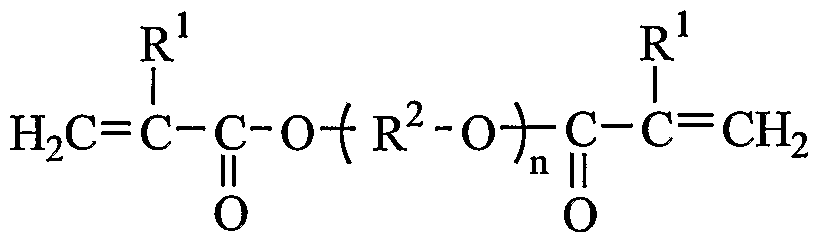
- a silicone rubber composition comprising: (A) 100 parts by weight of a polyorganosiloxane having at least two silicon-bonded alkenyl groups per molecule; (B) a polyorganosiloxane having at least two silicon-bonded hydrogen atoms per molecule, wherein the amount of (B) is the amount at which the ratio of the mole number of the silicon-bonded hydrogen atoms in (B), to the sum of the mole numbers of silicon-bonded alkenyl groups in (A) and unsaturated groups in alkylene glycol ester (C), is 0.5-20; (C) 0.01-20 parts by weight per 100 parts by weight of (A) of an alkylene glycol ester of diacrylic acid or an alkylene glycol ester of dimethacrylic acid, that is a liquid at 25 °C, and is represented by the formula: R 1 R 1
- R is hydrogen or a methyl group, R ⁇ is an alkylene group, and n has a value of 1- 10; and (D) 0.01-500 parts by weight per 1,000,000 parts by weight of (A) of a platinum- based catalyst.
- the silicone rubber composition of the present invention contains:
- C an alkylene glycol ester of diacrylic acid or an alkylene glycol ester of dimethacrylic acid compound having the formula:
- R! is hydrogen or a methyl group
- R ⁇ represents an alkylene group
- n has a value of 1-10
- Polyorganosiloxane (A) is the major ingredient of the silicone rubber composition, and it is characterized by having at least two silicon-bonded alkenyl groups per molecule.
- the molecular structure of (A) is preferably linear, but it may also be linear with a partial branch structure.
- the silicon-bonded alkenyl groups of (A) are exemplified by vinyl groups, allyl groups, butenyl groups, hexenyl groups, and heptenyl groups, with the vinyl or hexenyl groups being preferred.
- Polyorganosiloxane (A) may contain silicon-bonded groups other than alkenyl groups including alkyl groups such as methyl, ethyl, propyl, butyl, and octyl; aryl groups such as phenyl and tolyl; halogenated alkyl groups such as 3-chloropropyl and 3,3,3- trifluoropropyl; and other substituted or unsubstituted monovalent hydrocarbon groups that do not have aliphatic unsaturated carbon-carbon bonds; with the methyl group being most preferred.
- the viscosity of (A) other than it should preferably be in the range of 10-1,000,000 mPa-s (centistoke) at 25 °C.
- Polyorganosiloxane (A) may comprise a mixture of (i) a polyorganosiloxane (A-l) having at least two silicon-bonded vinyl groups per molecule, and (ii) a polyorganosiloxane (A-2) having at least two silicon-bonded alkenyl groups other than vinyl per molecule. It has been found that such mixtures improve the adhesive properties of the silicone rubber composition with respect to organic resins it contacts during its cure without impairing its mold release properties with respect to metal dies used when it is molded. Hexenyl groups are most preferred as the other alkenyl group in (A-2).
- polyorganosiloxane (A) is preferably a mixture of polyorganosiloxane (A-l) and (A-2) in which the weight ratio of (A-l):(A-2) is in the range of 1:99 to 99:1; more preferably a polyorganosiloxane mixture in which the weight ratio is 10:90 to 99:1; especially a polyorganosiloxane mixture in which the weight ratio is 50:50 to 99:1. If the weight ratio of (A-l) to (A-2) exceeds the upper limit of the range, the mechanical strength of the silicone rubber composition tends to decrease.
- (A-l) there are no limitations on the viscosity of polyorganosiloxane (A-l) but its viscosity at 25 °C should preferably be in the range of 10-1,000,000 mPa-s (centistoke).
- Some preferred examples of (A-l) include polydimethylsiloxane having both ends of the molecular chain terminated by dimethylvinylsiloxy groups; a copolymer of methylvinylsiloxane and dimethylsiloxane having both ends of the molecular chain terminated by trimethylsiloxy groups; a copolymer of methylvinylsiloxane and dimethylsiloxane having both ends of the molecular chain terminated by dimethylvinylsiloxy groups; a copolymer of methylphenylsiloxane and dimethylsiloxane having both ends of the molecular chain terminated by dimethylvinylsiloxy groups; and a copolymer of methyl
- (A-2) include polydimethylsiloxane having both ends of the molecular chain terminated by dimethylhexenylsiloxy groups; a copolymer of methylhexenylsiloxane and dimethylsiloxane having both ends of the molecular chain terminated by trimethylsiloxy groups; a copolymer of methylhexenylsiloxane and dimethylsiloxane having both ends of the molecular chain terminated by dimethylhexenylsiloxy groups; a copolymer of methylhexenylsiloxane and dimethylsiloxane having both ends of the molecular chain terminated by dimethylvinylsiloxy groups; a copolymer of methylphenylsiloxane and dimethylsiloxane having both ends of the molecular chain terminated by dimethylhexenylsiloxy groups; and a copolymer of methyl(3,3,3- trifluor
- Polyorganosiloxane (B) is the cross-linking agent used for crosslinking with polyorganosiloxane (A).
- Polyorganosiloxane (B) should have at least two silicon-bonded hydrogen atoms per molecule.
- polyorganosiloxane (B) should have at least three silicon-bonded hydrogen atoms per molecule, or a mixture of a polyorganosiloxane having at least three silicon-bonded hydrogen atoms per molecule, and a polyorganosiloxane containing two silicon-bonded hydrogen atoms per molecule.
- polyorganosiloxane (B), and (B) can be linear, linear with partial branching, branched, cyclic, or dendritic.
- bond position of the silicon-bonded hydrogen atoms which can be at the terminal ends of the molecular chain, in the side chains of the molecular chain, or in both.
- Polyorganosiloxane (B) may contain silicon-bonded groups other than silicon- bonded hydrogen atoms including alkyl groups such as methyl, ethyl, and propyl; aryl groups such as phenyl and tolyl; halogenated alkyl groups such as chloromethyl, 3-chloropropyl, and 3,3,3-trifluoropropyl; and other substituted or unsubstituted monovalent hydrocarbon groups that do not have aliphatic unsaturated carbon-carbon bonds. While, there are no limitations on the viscosity of polyorganosiloxane (B), it should be in the range of 1-10,000 mPa-s (centistoke) at 25 °C.
- the amount of polyorganosiloxane (B) used in the silicone rubber composition is the amount at which the ratio of the mole numbers of silicon-bonded hydrogen atoms in (B) to the sum of the mole numbers of silicon-bonded alkenyl groups in polyorganosiloxane (A) and unsaturated groups in alkylene glycol ester (C) is in the range of 0.5-20. Preferably, the amount is such that the ratio is 0.5-5.
- the amount of (B) is less than the lower limit of the range, the resulting silicone rubber composition tends to fail to fully cure.
- the amount of (B) exceeds the upper limit of the range, the mechanical strength of the silicone rubber composition tends to decrease.
- Polyorganosiloxane (B) can consist of a mixture of a polyorganosiloxane (B- 1 ) having at least three silicon-bonded hydrogen atoms per molecule, and a polyorganosiloxane (B-2) having silicon-bonded hydrogen atoms residing only at the two terminal ends of the chain.
- B- 1 a polyorganosiloxane having at least three silicon-bonded hydrogen atoms per molecule
- B-2 polyorganosiloxane having silicon-bonded hydrogen atoms residing only at the two terminal ends of the chain.
- the use of such a mixture has been found to improve the adhesive properties of the silicone rubber composition with respect to organic resins it contacts during its cure, without impairing its mold release properties with respect to metal dies used when it is molded.
- the use of such a mixture also allows for a reduction in the amount of the alkylene glycol ester (C) required.
- polyorganosiloxane (B-1) is present in an amount at which the ratio of the mole numbers of silicon-bonded hydrogen atoms in (B-1) to the sum of the mole numbers of silicon-bonded alkenyl groups in polyorganosiloxane (A) and unsaturated groups in the alkylene glycol ester (C), is in the range of 0.5-20, more preferably in the amount at which the ratio is 0.5-5.
- the amount of (B-1) is less than the lower limit of the range, the resulting silicone rubber composition tends to fail to fully cure.
- the amount of (B-1) exceeds the upper limit of the range, the mechanical strength of the silicone rubber composition tends to decrease.
- the amount of polyorganosiloxane (B-2) in the mixture is preferably the amount at which the ratio of the mole numbers of silicon-bonded hydrogen atoms in (B-2) to the sum of the mole numbers of silicon-bonded alkenyl groups in polyorganosiloxane (A) and unsaturated groups in alkylene glycol ester (C) is 0.01-10, more preferably a ratio of 0.01-5.
- the amount of (B-2) is less than the lower limit of the range, the silicone rubber composition tends to fail to sufficiently exhibit its adhesive properties with respect to organic resins it contacts during its cure.
- the amount of (B-2) exceeds the upper limit of the range, the mechanical strength of the silicone rubber composition tends to decrease.
- polyorganosiloxane (B-1) While there are no limitations on the viscosity of polyorganosiloxane (B-1), it should be 1-10,000 mPa-s. (centistoke) at 25 °C.
- Polyorganosiloxane (B-1) is exemplified by polymethylhydrogensiloxanes having both ends of their molecular chain terminated by trimethylsiloxy groups; copolymers of methylhydrogensiloxane and dimethylsiloxane having both ends of their molecular chain terminated by trimethylsiloxy groups; copolymers of methylhydrogensiloxane and dimethylsiloxane having both ends of their molecular chain terminated by dimethylhydrogensiloxy groups; cyclic dimethylsiloxane- methylhydrogensiloxane copolymers; cyclic polymethylhydrogensiloxanes; polyorganosiloxanes containing siloxane units represented by (CH3)3Si
- polyorganosiloxane (B- 2) While there are no limitations on the viscosity of polyorganosiloxane (B- 2), it should also be 1-10,000 mPa-s. (centistoke) at 25 °C.
- Polyorganosiloxane (B-2) is exemplified by a polydimethylsiloxane having both ends of the molecular chain terminated by dimethylhydrogensiloxy groups; a copolymer of methylphenylsiloxane and dimethylsiloxane having both ends of the molecular chain terminated by dimethylhydrogensiloxy groups; a copolymer of methyl(3,3,3-trifluoropropyl)siloxane and dimethylsiloxane having both ends of the molecular chain terminated by dimethylhydrogensiloxy groups; and mixtures of such polyorganosiloxanes.
- Alkylene glycol ester (C) is an alkylene glycol ester of diacrylic acid or an alkylene glycol ester of dimethacrylic acid, and it is the ingredient of the silicone rubber composition which is necessary to improve the adhesive properties of the silicone rubber composition with respect to organic resins it contacts during cure without at the same time causing deterioration in its mold release properties with respect to metal dies used when it is molded.
- This alkylene glycol ester has a structure generally corresponding to the formula: R 1 R 1
- R! is hydrogen or a methyl group.
- R ⁇ is a Cj-Cio alkylene group such as methylene, ethylene, propylene, or butylene, preferably a C2-Cg alkylene group.
- Subscript n has a value of 1-10, preferably 1-6.
- Alkylene glycol esters, which are liquids at 25 °C are preferred in order to ensure handling of alkylene glycol ester (C) during preparation of the silicone rubber composition, and its dispersibility in the silicone rubber composition.
- Alkylene glycol ester (C) is exemplified by ethylene glycol diacrylate, diethylene glycol diacrylate, tetraethylene glycol diacrylate, dipropylene glycol diacrylate, tripropylene glycol diacrylate, 1,4-butanediol diacrylate, 1,3 -butylene glycol diacrylate, 1,6-hexanediol diacrylate, 1,9-nonanediol diacrylate, 2- «-butyl-2-ethyl-l,3-propanediol diacrylate; ethylene glycol dimethacrylate, diethylene glycol dimethacrylate, tetratethylene glycol dimethacrylate, dipropylene glycol dimethacrylate, tripropylene glycol dimethacrylate, 1,4-butanediol dimethacrylate, 1,3-butylene glycol dimethacrylate, 1,6-hexanediol dimeth
- alkylene glycol esters (C) are: I. Ethylene glycol diacrylate H H I I
- H 2 2C C- C
- NIL 2- «-butyl-2-ethyl-l,3-propanediol diacrylate H C 2 H 5 H I I I
- the amount of alkylene glycol ester (C) used in the silicone rubber composition is 0.01-20 parts by weight, preferably, 0.1-10 parts by weight, and more preferably 0.1-5.0 parts by weight, based on 100 parts by weight of polyorganosiloxane (A).
- the amount of alkylene glycol ester (C) is less than the lower limit of the range, the silicone rubber composition tends to fail to completely adhere to organic resins it contacts during its cure.
- the amount of alkylene glycol ester (C) in the silicone rubber composition exceeds the upper limit of the range, the silicone rubber composition tends to fail to completely cure, and the mechanical strength of cured products tends to decrease.
- Platinum catalyst (D) is used for cross-linking polyorganosiloxane (A) and polyorganosiloxane (B) via a hydrosilation reaction.
- Catalyst (D) is exemplified by platinum micropowder, chloroplatinic acid, alcohol modified derivatives of chloroplatinic acid, chelated compounds of platinum, platinum-diketone complexes, coordination compounds of chloroplatinic acid and olefins, chloroplatinic acid-alkenylsiloxane complexes, and platinum catalysts in which such compositions are supported on alumina, silica, or carbon black.
- Catalyst (D) is present in the silicone rubber composition is an amount such that the amount of platinum metal is in the range of 0.01-500 parts by weight, preferably 0.1-100 parts by weight, per 1,000,000 parts by weight of polyorganosiloxane (A).
- the silicone rubber composition may contain a reinforcing filler (E) of micropowder silica. Filler (E) is beneficial because it is capable of imparting superior mechanical strength to moldings made of the silicone rubber composition, with the result that such silicone rubber moldings can be easily separated from the molding dies.
- the filler (E) is exemplified by fumed silica, dry process silica, precipitated silica, and wet process silica.
- Filler (E) can have its surface treated with a hydrophobing agent such as an organochlorosilane, an organoalkoxysilane, hexaorganodisilazane, a dimethylhydroxysiloxy terminated polydiorganosiloxane, or a cyclopolydiorganosiloxane.
- the hydrophobic treatment of filler (E) can be carried out by kneading an untreated filler (E) and one or more of the hydrophobing agents together. A single filler or combination of such fillers can be used.
- the Brunauer-Emmett-Teller Nitrogen Adsorption (BET) specific surface area of filler (E) preferably should not be less than 50 m ⁇ /g, more preferably not less than 100 m ⁇ /g.
- the amount of filler (E) present in the silicone rubber composition is in the range of 1-100 parts by weight, preferably 5-50 parts by weight, per 100 parts by weight of polyorganosiloxane (A). When the amount of filler (E) is less than the lower limit of the range, the mechanical strength of the silicone moldings obtained by curing the silicone rubber composition is insufficient.
- the silicone rubber composition may contain optional ingredients such as inorganic fillers other than micropowder silica filler (E), some examples of which are calcined silica, manganese carbonate, aluminum hydroxide, aluminum oxide, quartz powder, diatomaceous earth, an aluminosilicate, calcium carbonate, and carbon black; pigments such as iron oxide and titanium dioxide; and heat resistant additives such as cerium oxide and cerium hydroxide.
- inorganic fillers other than micropowder silica filler (E) some examples of which are calcined silica, manganese carbonate, aluminum hydroxide, aluminum oxide, quartz powder, diatomaceous earth, an aluminosilicate, calcium carbonate, and carbon black
- pigments such as iron oxide and titanium dioxide
- heat resistant additives such as cerium oxide and cerium hydroxide.
- the optional inorganic filler can be used in its pure or untreated condition, or its surface can be rendered hydrophobic by treating it with an organoalkoxysilane, an organochlorosilane, or a hexaorganosilazane.
- the optional inorganic filler can be prepared by kneading it together with one or more of such hydrophobing agents.
- the silicone rubber composition may also contain a cure inhibitor in order to improve its handling and storage stability.
- Suitable cure inhibitors include acetylenic compounds such as 2-methyl-3-butyne-2-ol, 2-phenyl-3-butyne-2-ol, 3,5-dimethyl-l-hexyne-3-ol, 1-ethynyl-l-cyclohexanol, 1,5-hexadiyne, and 1,6-heptadiyne; ene-yne compounds such as 3,5-dimethyl-l-hexene-l-yne, 3-ethyl-3-butene-l-yne, and 3-phenyl-3-butene-l-yne; alkenylsiloxane oligomers such as 1,3-divinyltetramethyldisiloxane, 1,3,5,7-tetravinyltetramethylcyclotetrasiloxane, and 1,3- divinyl-l,3-diphenyldimethyldisiloxane; ethy
- the cure inhibitor When included in the silicone rubber composition, the cure inhibitor should be present in an amount of 0.001-3 parts by weight, preferably 0.01-1 part by weight, per 100 parts by weight of polyorganosiloxane (A).
- Preferred cure inhibitors include the acetylenic compounds described above, and benzotriazole.
- silicone rubber composition examples include (i) dimethylpolysiloxanes having both ends of the molecular chain terminated by trimethylsiloxy groups, dimethylpolysiloxanes having both ends of the molecular chain terminated by dimethylhydroxysiloxy groups, copolymers of methylphenylsiloxane and dimethylsiloxane having both ends of the molecular chain terminated by trimethylsiloxy groups, copolymers of diphenylsiloxane and dimethylsiloxane having both ends of the molecular chain terminated by trimethylsiloxy groups, copolymers of methylphenylsiloxane and dimethylsiloxane having both ends of the molecular chain terminated by dimethylhydroxysiloxy groups, copolymers of methyl(3,3,3-trifluoropropyl)siloxane and dimethylsiloxane having both ends of the molecular chain terminated by trimethylsil
- the silicone rubber composition is prepared by homogeneously mixing polyorganosiloxane (A), polyorganosiloxane (B), alkylene glycol ester (C), and platinum catalyst (D), and any optional ingredient.
- filler (E) it is preferred to first knead polyorganosiloxane (A) and filler (E).
- a hydrophobic surface treating agent for filler (E) may be included during the kneading process.
- the silicone rubber composition is stored as a two-part silicone rubber composition consisting of a first part containing polyorganosiloxane (A) and platinum catalyst (D), but not polyorganosiloxane (B); and a second part containing polyorganosiloxane (A) and polyorganosiloxane (B), but not platinum catalyst (D).
- This two- part system improves the storage stability of the silicone rubber composition at room temperature, and retains its superior curability when using the silicone rubber composition in two-color molding processes .
- alkylene glycol ester (C) may be contained in both parts or in either one of the two parts. However, it is most preferred not to include alkylene glycol ester (C) in the part containing the polyorganosiloxane (B), since under some circumstances, it is possible that a reaction may occur between polyorganosiloxane (B) and alkylene glycol ester (C) to change their characteristics, depending on the particular compounds being used and the conditions under which they are stored.
- Silicone rubber compositions containing alkylene glycol esters (C) according to the present invention exhibit superior adhesive properties with respect to (i) saturated polyester resins such as polyethylene terephthalate (PET) and polybutylene terephthalate (PBT); (ii) organic resins such as ABS resins, AS resins, modified polyphenylene ether resins, polyether imide resins, polyphenylene sulfide resins, polyamide resins, polyphthalamide resins, polycarbonate resins (PC), polyacetal resins, acrylic resins, methacrylic resins, polypropylene resins, polystyrene resins, epoxy resins, and polyurethane (PU) resins; (iii) mixtures and alloys of two or more of resins (i) and (ii); and (iv) composite materials consisting of resins (i) and (ii) which are reinforced with glass fiber, carbon fiber, and polyamide fiber.
- saturated polyester resins such as polyethylene terephthalate (PET
- the silicone rubber composition containing alkylene glycol esters (C) also has superior mold release properties with respect to steel and stainless steel, which are normally used for silicone rubber molding dies, as well as with respect to chrome plated or nickel plated steel materials, or mold materials such as aluminum alloys, which are often used in small-scale production or for prototypes.
- the silicone rubber composition herein is suitable for use as a , silicone rubber composition for matched metal molding of silicone rubber with organic resins, as in two-color molding processes, often referred to as co-molding, or for insert molding with organic resins in injection molding processes.
- the following examples illustrate the invention in more detail.
- the viscosity used in the examples refers to values obtained at 25 °C.
- a base composition was prepared by mixing (i) 71 parts by weight of a polydimethylsiloxane having both ends of its molecular chain terminated by dimethylvinylsiloxy groups, and having a viscosity of 26,000 mPa-s; (ii) 24 parts by weight of fumed silica with a specific surface area of 380 m ⁇ /g; (iii) 4 parts by weight of hexamethyldisilazane as a surface treatment agent for the fumed silica; and (iv) 1 part by weight of water. Ingredients (i) to (iv) were mixed to homogeneity, followed by additional mixing for 2 hours at 170 °C under vacuum, and then the mixture was cooled.
- a curable silicone rubber composition was prepared by adding to the base composition, (v) 6.9 parts by weight of a copolymer of methylhydrogensiloxane and dimethylsiloxane having both ends of its molecular chain terminated by trimethylsiloxy groups, and having a viscosity of 5 mPa-s; (vi) 0.04 parts by weight of 1-ethynyl-l- cyclohexanol; and (vii) a sufficient amount of a platinum complex of 1,3 -divinyltetramethyldisiloxane, to provide 10 parts by weight of platinum metal per
- copolymer (v) 1,000,000 parts by weight of polyorganosiloxane (i).
- the amount of copolymer (v) used was the amount at which the ratio of mole numbers of silicon-bonded hydrogen atoms in copolymer (v), to the sum of mole numbers of silicon-bonded vinyl groups in polyorganosiloxane (i), and mole numbers of methacryl groups in ethylene glycol dimethacrylate, was 1.8.
- a base composition was prepared by mixing (i) 90 parts by weight of a polydimethylsiloxane having both ends of its molecular chain terminated by dimethylvinylsiloxy groups, and having a viscosity of 40,000 mPa-s; (ii) 35 parts by weight of fumed silica with a specific surface area of 200 m ⁇ /g; (iii) 7 parts by weight hexamethyldisilazane as a surface treatment agent for the silica; and (iv) 2 parts by weight of water. Ingredients (i)-(iv) were mixed to homogeneity, followed by additional mixing for 2 hours at 170 °C under vacuum.
- a curable silicone rubber composition was prepared by adding to the base composition, (vii) 2.2 parts by weight of a copolymer of methylhydrogensiloxane and dimethylsiloxane having both ends of its molecular chain terminated by trimethylsiloxy groups, and having a viscosity of 5 mPa-s; (viii) 3.4 parts by weight of a polydimethylsiloxane having both ends of its molecular chain terminated by dimethylhydrogensiloxy groups, and having a viscosity of
- the amount of copolymer (vii) used was the amount at which the ratio of mole numbers of silicon-bonded hydrogen atoms in copolymer (vii), to the sum of mole numbers of silicon- bonded alkenyl groups in polyorganosiloxanes (i) and (v), and mole numbers of acryl groups in diethylene glycol diacrylate, was 1.5.
- the amount of polyorganosiloxane (viii) used was the amount at which the ratio of mole numbers of silicon-bonded hydrogen atoms in copolymer (viii), to the sum of mole numbers of silicon-bonded alkenyl groups in polyorganosiloxanes (i) and (v), and mole numbers of acryl groups in diethylene glycol diacrylate, was 0.3.
- Application Example 2 was repeated, except that diethylene glycol diacrylate was omitted.
- the molding procedure, evaluations, and criteria, in Application Example 1 were used in this example, and are shown in Table 2.
- the base composition in this example was the same as the base composition in Application Example 2, except that ingredient (v) contained methylvinylsiloxane units instead of methylhexenylsiloxane units, and ingredient (vi) was 1,4-butanediol diacrylate.
- a curable silicone rubber composition was prepared by adding to the base composition, (vii) 1.7 parts by weight of a copolymer of methylhydrogensiloxane and dimethylsiloxane having both ends of its molecular chain terminated by trimethylsiloxy groups, and having a viscosity of 70 mPa-s; (viii) 4.2 parts by weight of a polydimethylsiloxane having both ends of its molecular chain terminated by dimethylhydrogensiloxy groups, and having a viscosity of 10 mPa-s; (ix) 5 parts by weight of a copolymer of methylphenylsiloxane and dimethylsiloxane having both ends of its molecular chain terminated by trimethylsiloxy groups, having a viscosity of 130 mPa-s, and containing 25 percent dimethylsiloxane units and 75 percent methylphenylsiloxane units; (x) 0.02 parts by weight of benzotri
- the amount of copolymer (vii) used was the amount at which the ratio of mole numbers of silicon-bonded hydrogen atoms in copolymer (vii), to the sum of mole numbers of silicon-bonded alkenyl groups in polyorganosiloxanes (i) and (v), and mole numbers of acryl groups in 1,4-butanediol diacrylate, was 0.8.
- the amount of polyorganosiloxane (viii) used was the amount at which the ratio of mole numbers of silicon-bonded hydrogen atoms in copolymer (viii), to the sum of mole numbers of silicon-bonded alkenyl groups in polyorganosiloxanes (i) and (v), and mole numbers of acryl groups in 1,4-butanediol diacrylate, was 0.4.
- the molding procedure, evaluations, and criteria, in Application Example 1 were used in this example, and are shown in Table 3. Table 3
- the silicone rubber composition of the present invention are characterized by having superior adhesive properties with respect to organic resins contacted during cure, and superior mold release properties with respect metal dies used for molding, the silicone rubber compositions are most suitably adapted for use in two-color molding processes, and in insert molding processes using injection-type molds.
- Other variations may be made in compounds, compositions, and methods described herein without departing from the essential features of the invention.
- the embodiments of the invention specifically illustrated herein are exemplary only and not intended as limitations on their scope except as defined in the appended claims.
Landscapes
- Chemical & Material Sciences (AREA)
- Health & Medical Sciences (AREA)
- Chemical Kinetics & Catalysis (AREA)
- Medicinal Chemistry (AREA)
- Polymers & Plastics (AREA)
- Organic Chemistry (AREA)
- Compositions Of Macromolecular Compounds (AREA)
Abstract
Description


Claims
Priority Applications (3)
| Application Number | Priority Date | Filing Date | Title |
|---|---|---|---|
| JP2006521895A JP2007500266A (en) | 2003-07-25 | 2004-07-19 | Silicone rubber composition |
| US10/553,820 US20070100072A1 (en) | 2003-07-25 | 2004-07-19 | Silicone rubber composition |
| EP04778672A EP1660947A1 (en) | 2003-07-25 | 2004-07-19 | Silicone rubber composition |
Applications Claiming Priority (2)
| Application Number | Priority Date | Filing Date | Title |
|---|---|---|---|
| US49017203P | 2003-07-25 | 2003-07-25 | |
| US60/490,172 | 2003-07-25 |
Publications (1)
| Publication Number | Publication Date |
|---|---|
| WO2005012432A1 true WO2005012432A1 (en) | 2005-02-10 |
Family
ID=34115366
Family Applications (1)
| Application Number | Title | Priority Date | Filing Date |
|---|---|---|---|
| PCT/US2004/023266 Ceased WO2005012432A1 (en) | 2003-07-25 | 2004-07-19 | Silicone rubber composition |
Country Status (6)
| Country | Link |
|---|---|
| US (1) | US20070100072A1 (en) |
| EP (1) | EP1660947A1 (en) |
| JP (1) | JP2007500266A (en) |
| KR (1) | KR20060041284A (en) |
| CN (1) | CN1798811A (en) |
| WO (1) | WO2005012432A1 (en) |
Cited By (4)
| Publication number | Priority date | Publication date | Assignee | Title |
|---|---|---|---|---|
| JP2006249327A (en) * | 2005-03-11 | 2006-09-21 | Shin Etsu Chem Co Ltd | Curable silicone rubber composition and method for producing composite molded body of liquid crystal polymer and silicone rubber |
| US9178120B2 (en) | 2010-04-02 | 2015-11-03 | Kaneka Corporation | Curable resin composition, curable resin composition tablet, molded body, semiconductor package, semiconductor component and light emitting diode |
| US12071543B2 (en) | 2020-11-30 | 2024-08-27 | Dow Silicones Corporation | Hydrosilylation cure inhibitors and use thereof |
| US12509584B2 (en) | 2020-06-24 | 2025-12-30 | Dow Global Technologies Llc | Silicone rubber compositions |
Families Citing this family (15)
| Publication number | Priority date | Publication date | Assignee | Title |
|---|---|---|---|---|
| JP5594991B2 (en) | 2009-07-29 | 2014-09-24 | 旭化成ワッカーシリコーン株式会社 | Adhesive silicone rubber composition |
| JP5292622B2 (en) * | 2010-08-06 | 2013-09-18 | 綜研化学株式会社 | Resin mold, method for producing the same, and method for using the same |
| JP5819606B2 (en) * | 2010-12-17 | 2015-11-24 | 日華化学株式会社 | Organo-modified silicone, mold release agent containing the same, and production method thereof |
| JP5738125B2 (en) * | 2011-08-30 | 2015-06-17 | 住友理工株式会社 | Conductive roll |
| CN103665882B (en) * | 2012-09-19 | 2016-04-20 | 浙江三元电子科技有限公司 | A kind of thermally conductive silicone rubber composite material, heat-conducting silica gel sheet and preparation method thereof |
| JP6338327B2 (en) * | 2013-06-27 | 2018-06-06 | 株式会社カネカ | Curable resin composition, cured product obtained by curing the composition |
| US10903106B2 (en) * | 2014-06-10 | 2021-01-26 | Nissan Chemical Industries, Ltd. | Layered body of temporary adhesive |
| WO2018003511A1 (en) * | 2016-06-29 | 2018-01-04 | Dow Corning Toray Co., Ltd. | Silicone rubber composition and composite made therefrom |
| WO2018012296A1 (en) * | 2016-07-11 | 2018-01-18 | 信越化学工業株式会社 | Silicone composition, release paper and release film |
| EP3733780A4 (en) * | 2017-12-25 | 2021-10-06 | Dow Toray Co., Ltd. | Silicone rubber composition and composite obtained using same |
| CN112334561B (en) * | 2018-06-28 | 2023-08-22 | 信越化学工业株式会社 | Organopolysiloxane composition for release paper or release film |
| WO2020264228A1 (en) * | 2019-06-27 | 2020-12-30 | Dow Silicones Corporation | Silicone elastomeric coating |
| JP7614179B2 (en) * | 2019-08-19 | 2025-01-15 | ワッカー ケミー アクチエンゲゼルシャフト | Silicone composition and method for producing composite molded articles |
| JP7353235B2 (en) * | 2020-05-18 | 2023-09-29 | 信越化学工業株式会社 | Liquid silicone rubber coating composition |
| JP7353236B2 (en) * | 2020-05-18 | 2023-09-29 | 信越化学工業株式会社 | Manufacturing method of silicone coated airbag base fabric |
Citations (2)
| Publication number | Priority date | Publication date | Assignee | Title |
|---|---|---|---|---|
| EP0487291A2 (en) * | 1990-11-19 | 1992-05-27 | Loctite Corporation | Photocurable silicon composition, and method of making same |
| US5869726A (en) * | 1996-10-04 | 1999-02-09 | Wacker-Chemie Gmbh | Process for preparing organosilicon compounds containing (meth)acryloxy groups |
Family Cites Families (7)
| Publication number | Priority date | Publication date | Assignee | Title |
|---|---|---|---|---|
| DE3201205A1 (en) * | 1982-01-16 | 1983-07-28 | Bayer Ag, 5090 Leverkusen | GRAFT MODIFIED SILOXANE DISPERSIONS FOR EQUIPMENT OF TEXTILE MATERIALS |
| JPH07116325B2 (en) * | 1987-02-16 | 1995-12-13 | 日本合成ゴム株式会社 | Rubber composition, crosslinkable rubber composition, oil seal and rubber hose |
| US5348986A (en) * | 1990-11-19 | 1994-09-20 | Loctite Corporation | Photocurable silicone composition, and method of making same |
| US5248715A (en) * | 1992-07-30 | 1993-09-28 | Dow Corning Corporation | Self-adhering silicone rubber with low compression set |
| JP3324166B2 (en) * | 1992-12-10 | 2002-09-17 | 信越化学工業株式会社 | Adhesive silicone rubber composition |
| DE69905542T2 (en) * | 1998-11-30 | 2003-12-11 | Shin-Etsu Chemical Co., Ltd. | Addition curable silicone elastomer blend |
| US20050038183A1 (en) * | 2003-08-14 | 2005-02-17 | Dongchan Ahn | Silicones having improved surface properties and curable silicone compositions for preparing the silicones |
-
2004
- 2004-07-19 US US10/553,820 patent/US20070100072A1/en not_active Abandoned
- 2004-07-19 JP JP2006521895A patent/JP2007500266A/en not_active Withdrawn
- 2004-07-19 WO PCT/US2004/023266 patent/WO2005012432A1/en not_active Ceased
- 2004-07-19 EP EP04778672A patent/EP1660947A1/en not_active Withdrawn
- 2004-07-19 KR KR1020067001671A patent/KR20060041284A/en not_active Withdrawn
- 2004-07-19 CN CNA2004800149472A patent/CN1798811A/en active Pending
Patent Citations (2)
| Publication number | Priority date | Publication date | Assignee | Title |
|---|---|---|---|---|
| EP0487291A2 (en) * | 1990-11-19 | 1992-05-27 | Loctite Corporation | Photocurable silicon composition, and method of making same |
| US5869726A (en) * | 1996-10-04 | 1999-02-09 | Wacker-Chemie Gmbh | Process for preparing organosilicon compounds containing (meth)acryloxy groups |
Cited By (6)
| Publication number | Priority date | Publication date | Assignee | Title |
|---|---|---|---|---|
| JP2006249327A (en) * | 2005-03-11 | 2006-09-21 | Shin Etsu Chem Co Ltd | Curable silicone rubber composition and method for producing composite molded body of liquid crystal polymer and silicone rubber |
| KR101225237B1 (en) * | 2005-03-11 | 2013-01-22 | 신에쓰 가가꾸 고교 가부시끼가이샤 | Curable silicone rubber composition and process for the preparation of composite molded body of liquid-crystal polymer and silicone rubber |
| US9178120B2 (en) | 2010-04-02 | 2015-11-03 | Kaneka Corporation | Curable resin composition, curable resin composition tablet, molded body, semiconductor package, semiconductor component and light emitting diode |
| US9496468B2 (en) | 2010-04-02 | 2016-11-15 | Kaneka Corporation | Curable resin composition, curable resin composition tablet, molded body, semiconductor package, semiconductor component and light emitting diode |
| US12509584B2 (en) | 2020-06-24 | 2025-12-30 | Dow Global Technologies Llc | Silicone rubber compositions |
| US12071543B2 (en) | 2020-11-30 | 2024-08-27 | Dow Silicones Corporation | Hydrosilylation cure inhibitors and use thereof |
Also Published As
| Publication number | Publication date |
|---|---|
| EP1660947A1 (en) | 2006-05-31 |
| US20070100072A1 (en) | 2007-05-03 |
| KR20060041284A (en) | 2006-05-11 |
| JP2007500266A (en) | 2007-01-11 |
| CN1798811A (en) | 2006-07-05 |
Similar Documents
| Publication | Publication Date | Title |
|---|---|---|
| WO2005012432A1 (en) | Silicone rubber composition | |
| EP1172414B1 (en) | Silicone rubber adhesive composition and integrally molded article thereof | |
| EP1172413B1 (en) | Silicone rubber adhesive composition and integrally molded article thereof | |
| EP0985710B1 (en) | Curable silicone composition | |
| US20010004650A1 (en) | Silicone rubber composition for insert molding or two-cavity molding | |
| US6780919B2 (en) | Organopolysiloxane composition for molding | |
| EP1778768B1 (en) | Integrally molded body of silicone resin and silicone rubber, method of manufacture, and curable silicone resin composition | |
| JP5025917B2 (en) | Curable organopolysiloxane composition | |
| CN119752191A (en) | Addition curing self-adhesive silicone rubber composition and silicone rubber cured product | |
| US6407159B2 (en) | Silicone rubber composition for keypads | |
| JPH06207104A (en) | Conjugate body of silicone resin and silicone rubber and its production | |
| EP1045006A2 (en) | Silicone rubber composition | |
| JP5359415B2 (en) | Oil-bleedable silicone rubber adhesive composition and integrally molded body of cured product of the composition and thermoplastic resin | |
| US6284861B1 (en) | Silicone rubber composition | |
| JP2005068383A (en) | Silicone rubber composition for metal mold-molding of unified molded product of organic resin with silicone rubber | |
| EP1127920B1 (en) | Curable silicone composition | |
| KR100368173B1 (en) | Curable silicone composition | |
| JP2000204256A (en) | Silicone rubber composition | |
| KR100377590B1 (en) | Curable silicone composition | |
| KR101729990B1 (en) | Curable silicon rubber composition having improved mold release property and high hardness | |
| JPH0465469A (en) | silicone rubber composition |
Legal Events
| Date | Code | Title | Description |
|---|---|---|---|
| AK | Designated states |
Kind code of ref document: A1 Designated state(s): AE AG AL AM AT AU AZ BA BB BG BR BW BY BZ CA CH CN CO CR CU CZ DE DK DM DZ EC EE EG ES FI GB GD GE GH GM HR HU ID IL IN IS JP KE KG KP KR KZ LC LK LR LS LT LU LV MA MD MG MK MN MW MX MZ NA NI NO NZ OM PG PH PL PT RO RU SC SD SE SG SK SL SY TJ TM TN TR TT TZ UA UG US UZ VC VN YU ZA ZM ZW |
|
| AL | Designated countries for regional patents |
Kind code of ref document: A1 Designated state(s): GM KE LS MW MZ NA SD SL SZ TZ UG ZM ZW AM AZ BY KG KZ MD RU TJ TM AT BE BG CH CY CZ DE DK EE ES FI FR GB GR HU IE IT LU MC NL PL PT RO SE SI SK TR BF BJ CF CG CI CM GA GN GQ GW ML MR NE SN TD TG |
|
| 121 | Ep: the epo has been informed by wipo that ep was designated in this application | ||
| WWE | Wipo information: entry into national phase |
Ref document number: 2007100072 Country of ref document: US Ref document number: 10553820 Country of ref document: US |
|
| WWE | Wipo information: entry into national phase |
Ref document number: 20048149472 Country of ref document: CN |
|
| WWE | Wipo information: entry into national phase |
Ref document number: 1020067001671 Country of ref document: KR |
|
| WWE | Wipo information: entry into national phase |
Ref document number: 2006521895 Country of ref document: JP |
|
| WWE | Wipo information: entry into national phase |
Ref document number: 2004778672 Country of ref document: EP |
|
| WWP | Wipo information: published in national office |
Ref document number: 1020067001671 Country of ref document: KR |
|
| WWP | Wipo information: published in national office |
Ref document number: 2004778672 Country of ref document: EP |
|
| WWW | Wipo information: withdrawn in national office |
Ref document number: 2004778672 Country of ref document: EP |
|
| WWP | Wipo information: published in national office |
Ref document number: 10553820 Country of ref document: US |