WO2005014556A1 - 2-aminopyrimidine derivatives - Google Patents

2-aminopyrimidine derivatives Download PDF

Info

Publication number
WO2005014556A1
WO2005014556A1 PCT/EP2004/008225 EP2004008225W WO2005014556A1 WO 2005014556 A1 WO2005014556 A1 WO 2005014556A1 EP 2004008225 W EP2004008225 W EP 2004008225W WO 2005014556 A1 WO2005014556 A1 WO 2005014556A1
Authority
WO
WIPO (PCT)
Prior art keywords
amino
alkyl
halogen
phenyl
hydroxy
Prior art date
Legal status (The legal status is an assumption and is not a legal conclusion. Google has not performed a legal analysis and makes no representation as to the accuracy of the status listed.)
Ceased
Application number
PCT/EP2004/008225
Other languages
French (fr)
Inventor
Hiroki Sato
Keiko Fukushima
Makoto Shimazaki
Klaus Urbahns
Katsuya Sakai
Florian Ganter
Kevin Bacon
Current Assignee (The listed assignees may be inaccurate. Google has not performed a legal analysis and makes no representation or warranty as to the accuracy of the list.)
Bayer AG
Original Assignee
Bayer Healthcare AG
Priority date (The priority date is an assumption and is not a legal conclusion. Google has not performed a legal analysis and makes no representation as to the accuracy of the date listed.)
Filing date
Publication date
Application filed by Bayer Healthcare AG filed Critical Bayer Healthcare AG
Priority to EP04763418A priority Critical patent/EP1654237A1/en
Publication of WO2005014556A1 publication Critical patent/WO2005014556A1/en
Anticipated expiration legal-status Critical
Ceased legal-status Critical Current

Links

Classifications

    • CCHEMISTRY; METALLURGY
    • C07ORGANIC CHEMISTRY
    • C07DHETEROCYCLIC COMPOUNDS
    • C07D239/00Heterocyclic compounds containing 1,3-diazine or hydrogenated 1,3-diazine rings
    • C07D239/02Heterocyclic compounds containing 1,3-diazine or hydrogenated 1,3-diazine rings not condensed with other rings
    • C07D239/24Heterocyclic compounds containing 1,3-diazine or hydrogenated 1,3-diazine rings not condensed with other rings having three or more double bonds between ring members or between ring members and non-ring members
    • C07D239/28Heterocyclic compounds containing 1,3-diazine or hydrogenated 1,3-diazine rings not condensed with other rings having three or more double bonds between ring members or between ring members and non-ring members with hetero atoms or with carbon atoms having three bonds to hetero atoms with at the most one bond to halogen, directly attached to ring carbon atoms
    • C07D239/46Two or more oxygen, sulphur or nitrogen atoms
    • C07D239/48Two nitrogen atoms
    • AHUMAN NECESSITIES
    • A61MEDICAL OR VETERINARY SCIENCE; HYGIENE
    • A61PSPECIFIC THERAPEUTIC ACTIVITY OF CHEMICAL COMPOUNDS OR MEDICINAL PREPARATIONS
    • A61P19/00Drugs for skeletal disorders
    • AHUMAN NECESSITIES
    • A61MEDICAL OR VETERINARY SCIENCE; HYGIENE
    • A61PSPECIFIC THERAPEUTIC ACTIVITY OF CHEMICAL COMPOUNDS OR MEDICINAL PREPARATIONS
    • A61P29/00Non-central analgesic, antipyretic or antiinflammatory agents, e.g. antirheumatic agents; Non-steroidal antiinflammatory drugs [NSAID]
    • CCHEMISTRY; METALLURGY
    • C07ORGANIC CHEMISTRY
    • C07DHETEROCYCLIC COMPOUNDS
    • C07D403/00Heterocyclic compounds containing two or more hetero rings, having nitrogen atoms as the only ring hetero atoms, not provided for by group C07D401/00
    • C07D403/02Heterocyclic compounds containing two or more hetero rings, having nitrogen atoms as the only ring hetero atoms, not provided for by group C07D401/00 containing two hetero rings
    • C07D403/04Heterocyclic compounds containing two or more hetero rings, having nitrogen atoms as the only ring hetero atoms, not provided for by group C07D401/00 containing two hetero rings directly linked by a ring-member-to-ring-member bond

Definitions

  • the present invention relates to novel 2-aminopyrimidine derivatives, processes for preparing them and pharmaceutical preparations containing them.
  • the 2-aminopyrimidine derivatives of the present invention exhibit enhanced potency for histamine H4 receptor antagonism and can be used for the prophylaxis and treatment of diseases associated with histamine H4 receptor activity.
  • the 2-aminopyrimidine derivatives of the present invention are useful for treatment and prophylaxis of diseases as follows: asthma, rhinitis, allergic diseases, chronic obstructed pulmonary disease (CORD), atherosclerosis and rheumatoid arthritis.
  • diseases as follows: asthma, rhinitis, allergic diseases, chronic obstructed pulmonary disease (CORD), atherosclerosis and rheumatoid arthritis.
  • CORD chronic obstructed pulmonary disease
  • Histamine exerts its numerous physiological and pathophysiological functions by acting on its receptor entities which belong to the heptahelical G-protein coupled receptor family.
  • Hough LB Mol Pharmacol, 59:415-419, 2001.
  • the specific functions of HI, H2 and H3 subtypes are well characterized (reviewed in the following references: Bakker RA et al., Clin Allergy Immunol, 17:27-64, 2002; Repka-Ramirez MS and Baraniuk JN, Clin Allergy hnmunol, 17:1-25, 2002; Win- bery SL and Lieberman PL, Clin Allergy Immunol, 17:287-317, 2002; Barocelli E and Ballabeni V, Pharmacol Res, 47:299-304, 2003.) and antagonists to each subtype are identified and some drugs have been clinically used.
  • the fourth member, H 4 has recently been cloned and characterized by various groups (Oda T et al., J. Biol. Chem. 275(47):36781-36786, 2000; Nakamura T et al, Biochem Biophys Res Commun 279:615-620, 2000; Zhu et al., Mol. Pharmacol. 59(3):434-441, 2001; Liu C et al., Mol. Pharmacol. 59:420-426, 2001; Morse et al., J. Pharmacol. Exp. Ther. 296(3):1058-1066, 2001; Nguyen et al., Mol. Pharmacol.
  • H4 human eosinophils
  • IL-16 release from human CD8 + lymphocytes
  • H4 calcium mobilization and chemotaxis of murine mast cells
  • H4 histamine H4 receptor
  • asthma rhinitis
  • allergic diseases CAD
  • chronic obstructed pulmonary disease CORD
  • atherosclerosis rheumatoid arthritis
  • WO01/047921 discloses pyrimidine derivatives represented by the general formula:
  • Rbi is hydrogen, alkyl, alkoxyalkyl, arylalkyl, heteroaryl, heteroarylalkyl etc;
  • Rb 2 is halogen, alkyl, OH, (un)substituted heteroaryl, (un)substituted heterocyclyl, etc;
  • Rb 3 is bond
  • Rb 4 is hydrogen, halogen, alkyl, heterocyclyl, alkylarnino, etc;
  • Y is hydrogen, alkyl, or Y and Rbi together with N to form (un)substituted heterocyclyl or heteroaryl;
  • WO90/12790 discloses pyrimidine derivatives represented by the general formula: wherein
  • Rci and Rc 4 independently represent hydrogen, amino, (un)substituted phenyl etc;
  • Rc 2 is hydrogen, alkyl, alkenyl, etc ,or alkylene or alkenylene to form ring together with Q-A-N, etc;
  • Rc 3 is H, alkyl or alkenyl
  • A is direct bond, alkylene or oxy-alkylene
  • Q is pyridyl, furyl, thienyl or (un)substituted phenyl.
  • WOOl/062233 discloses pyrimidine derivatives represented by the general formula:
  • Ad is bond, -N(R)-, etc;
  • Rdi is hydrogen, -(CH 2 ) n - ⁇ henyl, -(CH ) n - ⁇ iperazm-4-yl optionally substituted by lower alkyl, phenyl, -(CH 2 ) n -piperidinyl optionally substituted by lower alkyl, -(CH 2 ) n - NH-phenyl etc; n is an integer of 0-4;
  • Rd 2 is hydrogen, halogen, cyano, alkyl, etc
  • Rd 3 is lower alkyl, phenyl optionally substituted by alkyl, alkoxy or halogen, heterocy- cles (eg. thienyl, furyl) etc;
  • Rd and Rd 5 independently represent hydrogen, optionally substituted phenyl, etc.
  • EP459830 discloses pyrimidine derivatives represented by the general formula:
  • Rei and Re 2 are independently OH or N Re 9 e ⁇ 0 ;
  • Re 9 and Re ⁇ 0 independently represent hydrogen, alkyl etc, or together with nitrogen to form a ring, which is optionally substituted by alkyl, aryl or arylalkyl;
  • Re 3 is hydrogen, haloalkyl, halogen, alkyl, etc;
  • Re 4 , Re 5 , Re 6 , Re 7 and Re 8 independently represent hydrogen, halogen, amino sulphona- mido, or alkylsulphonylamino, with the proviso that at least one of R e -R e 8 is not hydrogen.
  • WO02/072548 discloses indole derivatives as histamine H4 receptor antagonist.
  • This invention is to provide novel 2-aminopyrimidine derivatives of the formula (I) their tautomeric and stereoisomeric forms, and salts thereof.
  • R 11 and R 12 independently represent hydrogen or C ⁇ -6 alkyl optionally substituted by halogen, cyano, hydroxy, carboxy, amino, Ci- ⁇ alkylamino, N,N-di(C ⁇ _ 6 alkyl)amino, C ⁇ -6 alkylthio, C ⁇ -6 alkoxy, or C 3-s cycloalkyl;
  • R 13 is C ⁇ -6 alkyl optionally substituted by halogen, cyano, hydroxy, carboxy, amino, C ⁇ -6 alkylarnino, N,N-di(C ⁇ -6 al__yl)amino, C ⁇ -6 alkylthio, C ⁇ -6 alkoxy, or C 3 . 8 cycloalkyl;
  • R 2 is phenyl or naphthyl, wherein said phenyl and naphthyl are optionally having one or more substituents selected from the group consisting of halogen, amino, carboxy, cyano, hydroxy, nitro, phenyl, C ⁇ . 6 alkanoyl, N-(C 1-6 alkyl)sulfonylamino, N-phenylsulfonylamino, .
  • R 21 is hydrogen or C ⁇ -6 alkyl
  • R 22 is C ⁇ -6 alkyl, or phenyl optionally having one or more substituents selected from the group consisting of halogen, amino, carbamoyl, cyano, hydroxy, nitro, phenyl, C ⁇ . 6 alkanoyl, C ⁇ -6 alkyl optionally substituted by hydroxy or mono-, di-, or tri- halogen, and C ⁇ -6- alkoxy optionally substituted by mono-, di-, or tri- halogen;
  • R 23 is hydrogen or C ⁇ -6 alkyl
  • R 24 is phenyl optionally having one or more substituents selected from the group consisting of halogen, amino, carboxy, carbamoyl, cyano, hydroxy, nitro, phenyl, C ⁇ -6 alkyl optionally substituted by hydroxy or mono-, di-, or tri- halogen, and C ⁇ -6 alkoxy optionally substituted by mono-, di-, or tri- halogen.
  • R 2 is optionally substituted phenyl, said phenyl is substituted by at least one substituent selected from the group consisting of carboxy, cyano, hydroxy, phenyl, . 6 alkanoyl, N-phenylsulfonylamino, Ci- ⁇ alkylamino, N,N-di(C ⁇ -6 alkyl)amino, N-(C ⁇ .
  • R 21 is hydrogen or C ⁇ -6 alkyl
  • R 22 is C ⁇ -6 alkyl, or phenyl optionally having one or more substituents selected from the group consisting of halogen, amino, carbamoyl, cyano, hydroxy, nitro, phenyl, C 1-6 alkanoyl, C ⁇ -6 alkyl optionally substituted by hydroxy or mono-, di-, or tri- halogen, and C ⁇ -6- alkoxy optionally substituted by mono-, di-, or tri- halogen;
  • R 23 is hydrogen or C ⁇ -6 alkyl
  • R 24 is phenyl optionally having one or more substituents selected from the group consisting of halogen, amino, carboxy, carbamoyl, cyano, hydroxy, nitro, phenyl, C ⁇ -6 alkanoyl, C ⁇ -6 alkyl optionally substituted by hydroxy or mono-, di-, or tri- halogen, and C ⁇ -6 alkoxy optionally substituted by mono-, di-, or tri- halogen.
  • the present invention provides 2-aminopyrimidine derivatives of the formula (I-i), its tautomeric or stereoisomeric form, or a salt thereof:
  • R 11 and R 12 independently represent hydrogen or C 1-6 alkyl optionally substituted by halogen, cyano, hydroxy, carboxy, amino, Ci- ⁇ alkylamino, N,N-di(C ⁇ - 6 alkyl)arnino, Ci. 6 alkylthio, C ⁇ -6 alkoxy, or C 3-8 cycloalkyl; and
  • R 2 is phenyl or naphthyl, wherein said phenyl and naphthyl are optionally having one or more substituents selected from the group consisting of halogen, amino, carboxy, cyano, hydroxy, nitro, phenyl, C ]-6 alkanoyl, N-(C 1-6 alkyl)sulfonylamino, N-phenylsulfonylamino C ⁇ -6- alkylamino, N,N-di(Ci -6 alkyl)amino, N-(C ⁇ -6 alkanoyl)amino, Ci -6 alkoxycarbonyl, C ⁇ -6 alkylthio, N-(C ⁇ .
  • R 21 is hydrogen or Ci- ⁇ alkyl
  • R 22 is C 1 . 6 alkyl, or phenyl optionally having one or more substituents selected from the group consisting of halogen, amino, carbamoyl, cyano, hydroxy, nitro, phenyl, C ⁇ -6 alkanoyl, optionally substituted by hydroxy or mono-, di-, or tri- halogen, and C ⁇ -6 alkoxy optionally substituted by mono- di-, or tri- halogen;
  • R is hydrogen or C ⁇ -6 alkyl
  • R 24 is phenyl optionally having one or more substituents selected from the group consisting of halogen, amino, carboxy, carbamoyl, cyano, hydroxy, nitro, phenyl, C ⁇ -6 alkanoyl, C ⁇ .6alk l optionally substituted by hydroxy or mono-, di-, or tri- halogen, and C ⁇ -6 alkoxy optionally substituted by mono-, di-, or tri- halogen.
  • the present invention provides 2-aminopyrimidine derivatives of the formula (I-i), its tautomeric or stereoisomeric form, or a salt thereof: wherein
  • R 2 is phenyl or naphthyl, wherein said phenyl and naphthyl are optionally having one or more substituents selected from the group consisting of halogen, amino, cyano, hydroxy, nitro, phenyl, Cj -6- alkanoyl, C ⁇ . 6 alkylamino, N,N-di(Ci -6 alkyl)amino, N-(C ⁇ -6 alkanoyl)amino, C ⁇ .
  • R 21 is hydrogen or C ⁇ -6 alkyl
  • R 22 is C 1-6 alkyl, or phenyl optionally having one or more substituents selected from the group consisting of halogen, amino, carbamoyl, cyano, hydroxy, nitro, phenyl, C ⁇ -6 alkanoyl, C ⁇ -6 alkyl optionally substituted by hydroxy or mono-, di-, or tri- halogen, and C ⁇ -6 alkoxy optionally substituted by mono- di-, or tri- halogen;
  • R 23 is hydrogen or C ⁇ -6 alkyl
  • R 24 is phenyl optionally having one or more substituents selected from the group consisting of halogen, amino, carboxy, carbamoyl, cyano, hydroxy, nitro, phenyl, C 1-6 alkanoyl, C ⁇ -6 alkyl optionally substituted by hydroxy or mono-, di-, or tri- halogen, and C ⁇ -6 alkoxy optionally substituted by mono-, di-, or tri- halogen.
  • the present invention provides 2-arrinopyrimidine derivatives of the formula (I-i), its tautomeric or stereoisomeric form, or a salt thereof: wherein
  • R 11 and R 12 independently represent hydrogen or methyl.
  • said 2-aminopyrimidine derivative of the formula (I-i) is selected from the group consisting of: 4-(3 -aminopyrrolidin- 1 -yl)-6-phenylpyrimidin-2-amine trihydrochloride;
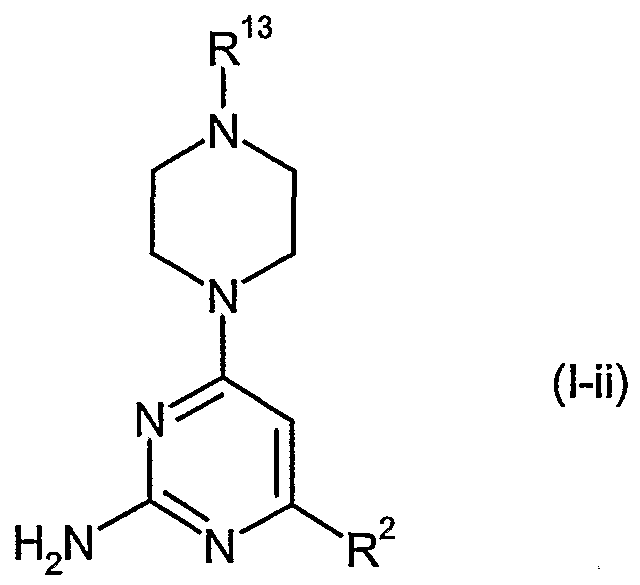
  • the present invention provides 2-aminopyrimidine derivatives of the formula (I-ii), its tautomeric or stereoisomeric form, or a salt thereof:
  • R 13 is Ci- ⁇ lkyl optionally substituted by halogen, cyano, hydroxy, carboxy, amino, . 6 alkylamino, N,N-di(C 1-6 alkyl)amino, C ⁇ -6 alkylthio, C 1-6 alkoxy, or C 3-8 cycloalkyl;
  • R 2 is phenyl having one or more substituents selected from the group consisting of carboxy, cyano, hydroxy, phenyl, Ci- ⁇ alkanoyl, N-(C ⁇ -6 alkyl)sulfonylamino, N- phenylsulfonylamino, N,N-di(C ⁇ -6 alkyl)amino, N-(C ⁇ .
  • R is hydrogen or C ⁇ -6 alkyl
  • R 22 is C ⁇ -6 alkyl, or phenyl optionally having one or more substituents selected from the group consisting of halogen, amino, carbamoyl, cyano, hydroxy, nitro, phenyl, C ⁇ -6 alkanoyl, C 1-6 alkyl optionally substituted by hydroxy or mono-, di-, or tri- halogen, and C ⁇ -6 alkoxy optionally substituted by mono-, di-, or tri- halogen;
  • R 23 is hydrogen or C ⁇ aUcyl
  • R 24 is phenyl optionally having one or more substituents selected from the group consisting of halogen, amino, carboxy, carbamoyl, cyano, hydroxy, nitro, phenyl, C ⁇ -6 alkanoyl, C ⁇ -6 alkyl optionally substituted by hydroxy or mono-, di-, or tri- halogen, and C ⁇ -6 alkoxy optionally substituted by amono-, di-, or tri- halogen.
  • the present invention provides 2-aminopyrimidine derivatives of the formula (I-ii), its tautomeric or stereoisomeric form, or a salt thereof:
  • R 2 is phenyl having one or more substituents selected from the group consisting of cyano, phenyl, C 1-6 alkanoyl, N-(C ⁇ -6 alkanoyl)amino, C ⁇ -6 alkoxycarbonyl, C ⁇ -6 alkyl- sulfonyl, trifluoromethyl, and C ⁇ -6 alkyl substituted by cyano, hydroxy, amino, C 1-6- alkylamino, or C ⁇ -6 alkoxy, or naphthyl optionally having one or more substituents selected from the group consisting of cyano, hydroxy, phenyl, C ⁇ .
  • said 2-ammopvrimidine derivative of the formula (I-ii) is selected from the group consisting of:
  • this invention is to provide a use of the 2-aminopyrimidine derivatives of the formula (I), its tautomeric or stereoisomeric form, or a physiologically acceptable salt thereof in the preparation of a medicament.
  • said medicament is suitable for treating or preventing a disorder or disease associated with histamine H4 receptor activity.
  • the 2-aminopyrimidine derivatives of the formula (T), its tautomeric or stereoisomeric form, or a physiologically acceptable salt thereof surprisingly show excellent histamine H4 receptor antagonistic activity. They are, therefore, suitable for the production of medicament or medical composition, which may be useful to treat histamine H4 receptor related diseases.
  • compounds of the formula (I) are effective for the treatment or prevention of an inflammatory disorder or disease such as asthma, rhinitis, allergic diseases or chronic obstructed pulmonary disease (CORD).
  • an inflammatory disorder or disease such as asthma, rhinitis, allergic diseases or chronic obstructed pulmonary disease (CORD).
  • CORD chronic obstructed pulmonary disease
  • compounds of the formula (I) are effective for the treatment or prevention of an immunological disorder or disease such as rheumatoid arthritis or atherosclerosis.
  • the present invention provides a medicament, which includes one of the compounds described above and optionally pharmaceutically acceptable excipients.
  • Alkyl per se and "alk” and “alkyl” in alkoxy, alkanoyl, alkylamino, alkylarninocarbonyl, alkylami- nosulphonyl, alkylsulphonylamino, alkoxycarbonyl, alkoxycarbonylamino and alkanoylamino represent a linear or branched alkyl radical having generally 1 to 6, preferably 1 to 4 and particularly preferably 1 to 3 carbon atoms, representing illustratively and preferably methyl, ethyl, n- propyl, isopropyl, tert-butyl, n-pentyl and n-hexyl.
  • Alkoxy illustratively and preferably represents methoxy, ethoxy, n-propoxy, isopropoxy, tert- butoxy, n-pentoxy and n-hexoxy.
  • Alkanoyl illustratively and preferably represents acetyl and propanoyl.
  • Alkylamino represents an alkylamino radical having one or two (independently selected) alkyl substituents, illustratively and preferably representing methylamino, ethylamino, n-propylamino, isopropylamino, tert-butylarnino, n-pentylamino, n-hexyl-amino, N,N-dimethylamino, N,N- diethylamino, N-ethyl-N-methylamino, N-methyl-N-n-propylamino, N-isopropyl-N-n-propylamino, N-t-butyl-N-methylamino, N-ethyl-N-n-pentylamino and N-n-hexyl-N-methylamino.
  • Alkylaminocarbonyl or alkylcarbamoyl represents an alkylaminocarbonyl radical having one or two (independently selected) alkyl substituents, illustratively and preferably representing methyl- aminocarbonyl, ethylaminocarbonyl, n-propylaminocarbonyl, isopropylamino-carbonyl, tert- but-ylaminocarbonyl, n-pentylaminocarbonyl, n-hexylaminocarbonyl, N,N-dimethylaminocarbonyl, N,N-diethylaminocarbonyl, N-ethyl-N-methylaminocarbonyl, N-methyl-N-n-propylaminocarbonyl, N-isopropyl-N-n-propylaminocarbonyl, N-t-butyl-N-methylaminocarbonyl, N-ethyl-N-n- pentyla
  • Alkylaminosulphonyl represents an alkylaminosulphonyl radical having one or two (independently selected) alkyl substituents, illustratively and preferably representing methylaminosulphonyl, ethylaminosulphonyl, n-propylaminosulphonyl, isopropylaminosulphonyl, tert-butylamino- sulphonyl, n-pentylaminosulphonyl, n-hexyl-aminosulphonyl, N,N-dimethylaminosulphonyl, N,N- diethylaminosulphonyl, N-emyl-N-methylamino-sulphonyl, N-methyl-N-n-propylaminosulphonyl, N-isopropyl-N-n-propylaminosulphonyl, N-t-butyl-N-methylaminosulphonyl, N-ethyl-N-
  • Alkylsulphonylamino illustratively and preferably represents methylsulphonylamino, ethylsul- phonylamino, n-propylsulphonylamino, isopropylsulphonylamino, tert-butyl-sulphonylamino, n- pentylsulphonylamino and n-hexylsulphonylamino.
  • Alkoxycarbonyl illustratively and preferably represents methoxycarbonyl, ethoxycarbonyl, n- propoxycarbonyl, isopropoxycarbonyl, tert-butoxycarbonyl, n-pentoxycarbonyl and n- hexoxycarbonyl.
  • Alkoxycarbonylamino illustratively and preferably represents methoxycarbonyl- amino, ethoxycarbonylamino, n-propoxycarbonylamino, isopropoxycarbonylamino, tert- butoxycarbonylamino, n-pentoxycarbonylamino and n-hexoxycarbonylamino.
  • Alkanoylamino illustratively and preferably represents acetylamino and ethylcarbonylamino.
  • Cycloalkyl per se and in cycloalkylamino and in cycloalkylcarbonyl represents a cycloalkyl group having generally 3 to 8 and preferably 5 to 7 carbon atoms, illustratively and preferably representing cyclopropyl, cyclobutyl, cyclopentyl, cyclohexyi and cycloheptyl.
  • Cycloalkylamino represents a cycloalkylamino radical having one or two (independently selected) cycloalkyl substituents, illustratively and preferably representing cyclopropylarnino, cyclobu- tylamino, cyclopentylamino, cyclohexylamino and cycloheptylamino.
  • Cycloalkylcarbonyl illustratively and preferably represents cyclopropylcarbonyl, cyclobutylcar- bonyl, cyclopentylcarbonyl, cyclohexylcarbonyl and cycloheptylcarbonyl.
  • Aryl per se and in arylamino and in arylcarbonyl represents a mono- to tricyclic aromatic carbo- cyclic radical having generally 6 to 14 carbon atoms, illustratively and preferably representing phenyl, naphthyl and phenanthrenyl.
  • Arylamino represents an arylamino radical having one or two (independently selected) aryl substituents, illustratively and preferably representing phenylamino, diphenylamino and naphthyl- amino.
  • Arylcarbonyl illustratively and preferably represents phenylcarbonyl and naphthylcarbonyl.
  • Heteroaryl per se and in heteroarylamino and heteroarylcarbonyl represents an aromatic mono- or bicyclic radical having generally 5 to 10 and preferably 5 or 6 ring atoms and up to 5 and preferably up to 4 hetero atoms selected from the group consisting of S, O and N, illustratively and preferably representing thienyl, furyl, pyrrolyl, thiazolyl, oxazolyl, imidazolyl, pyridyl, pyrimidyl, pyridazinyl, indolyl, indazolyl, benzofuranyl, benzothiophenyl, quinolinyl, and isoquinolinyl.
  • Heteroarylamino represents an heteroarylamino radical having one or two (independently selected) heteroaryl substituents, illustratively and preferably representing thienylamino, furylamino, pyrro- lylamino, miazolylamino, oxazolylamino, imidazolyl-amino, pyridylamino, pyiimidylamino, pyri- dazinylamino, indolylamino, indazolylamino, benzofuranylamino, benzothiophenylamino, quino- lmyl-amino, and isoquinol ⁇ nylamino.
  • Heteroarylcarbonyl illustratively and preferably represents thienylcarbonyl, furylcarbonyl, pyrro- lylcarbonyl, thiazolylcarbonyl, oxazolylcarbonyl, imidazolyl-carbonyl, pyridylcarbonyl, pyrimidylcarbonyl, pyridazinylcarbonyl, indolylcarbonyl, indazolylcarbonyl, benzofuranylcar- bonyl, benzothiophenylcarbonyl, quinolinyl-carbonyl, and isoquinolinylcarbonyl.
  • Heterocyclyl per se and in heterocyclylcarbonyl represents a mono- or polycyclic, preferably mono- or bicyclic, nonaromatic heterocyclic radical having generally 4 to 10 and preferably 5 to 8 ring atoms and up to 3 and preferably up to 2 hetero atoms and/or hetero groups selected from the group consisting of N, O, S, SO and S0 2 .
  • the heterocyclyl radicals can be saturated or partially unsaturated.
  • Heterocyclylcarbonyl illustratively and preferably represents tetrahydrofuran-2-carbonyl, pyr- rolidine-2-carbonyl, pyrrolidine-3-carbonyl, pyrrolinecarbonyl, piperidinecarbonyl, morpholine- carbonyl, and perhydroazepinecarbonyl.
  • Halogen represents fluorine, chlorine, bromine and iodine.
  • the compound of the formula (I) of the present invention can be, but not limited to be, prepared by combining various known methods.
  • one or more of the substituents, such as amino group, carboxyl group, and hydroxyl group of the compounds used as starting materials or intermediates are advantageously protected by a protecting group known to those skilled in the art. Examples of the protecting groups are described in "Protective Groups in Organic Synthesis (3rd Edition)" by Greene and Wuts, John Wiley and Sons, New York 1999.
  • the compound of the formula (I) of the present invention can be, but not limited to be, prepared by the Method [A] and [B] below.
  • the compoxmd of formula ( ⁇ ) (wherein R 1 and R 2 are the same as defined above) can be prepared, for example, in two steps.
  • Step A- la compound of formula (IV) (wherein R 1 is the same as defined above and X x represents a leaving group including, for instance, halogen atom such as chlorine or bromine atom.) can be prepared by the reaction of the compound of formula (H) (wherein Xi is the same as defined above.) with compound of formula (in) (wherein R 1 is the same as defined above).
  • the reaction may be carried out without solvent or in a solvent including, for instance, halogenated hydrocarbons such as dichloromethane, chloroform and 1,2-dichloroethane; ethers such as diethyl ether, isopropyl ether, dioxane and tetrahydrofuran (THF) and 1,2-dimethoxyethane; aromatic hydrocarbons such as benzene, toluene and xylene; nitriles such as acetonitrile; amides such as N, N-dimethylformamide (DMF), N, N-dimethylacetamide (DMAC) and N-methylpyrrolidone (TNTMP); urea such as l,3-dimethyl-2-imidazolidinone (DMI); sulfoxides such as dimethylsulfoxide (DMSO); and others.
  • halogenated hydrocarbons such as dichloromethane, chloroform and 1,2-dichloroethane
  • the reaction temperature can be optionally set depending on the compounds to be reacted.
  • the reaction temperature is usually, but not limited to, about 0°C to 200°C and preferably about 20°C to 150°C.
  • the reaction may be conducted for, usually, 10 minutes to 48 hours and preferably 30minutes to 24 hours.
  • the reaction can be advantageously carried out in the presence of a base including, for instance, organic amines such as pyridine, triethylamine, N,N-diisopropylethylamine, dimethylaniline, di- ethylaniline, and others.
  • a base including, for instance, organic amines such as pyridine, triethylamine, N,N-diisopropylethylamine, dimethylaniline, di- ethylaniline, and others.
  • Step A-2a compound of formula (I) (wherein R 1 and R 2 are the same as defined above) can be prepared by the reaction of compound of formula (IV) (wherein R 1 and X ! are the same as defined above) with compound of formula (V) (wherein R 2 is the same as defined above and Li represents metal group including, for instance, organoborane group such as boronic acid and dimethoxy boryl; organostannyl group such as tributyl stannyl, and the like.)
  • the reaction can be advantageously carried out in the presence of a palladium catalyst such as tetrakis(triphenylphosphine) ⁇ alladium.
  • a palladium catalyst such as tetrakis(triphenylphosphine) ⁇ alladium.
  • the reaction can be advantageously carried out in the presence of a base including, for instance, cesium carbonate, sodium carbonate and potassium carbonate, and the like.
  • the reaction may be carried out in a solvent including, for instance, ethers such as diethyl ether, isopropyl ether, dioxane and tetrahydrofuran (THF) and 1,2-dimethoxyethane; aromatic hydrocarbons such as benzene, toluene and xylene; amides such as N, N-dimethylformamide (DMF), N, N- dimethylacetamide and N-methylpyrrolidone; sulfoxides such as dimethylsulfoxide (DMSO); al- cohols such as methanol, ethanol, 1-propanol, isopropanol and tert-butanol and others.
  • ethers such as diethyl ether, isopropyl ether, dioxane and tetrahydrofuran (THF) and 1,2-dimethoxyethane
  • aromatic hydrocarbons such as benzene, toluene and xylene
  • the reaction temperature can be optionally set depending on the compounds to be reacted.
  • the reaction temperature is usually, but not limited to, about 20°C to 120°C.
  • the reaction may be conducted for, usually, 30 minutes to 48 hours and preferably 1 to 24 hours.
  • Step A-lb compound of formula (VI) (wherein R 2 and Xi are the same as defined above) can be prepared by the reaction of compound of formula (H) (wherein Xi is the same as defined above) with compound of formula (V) (wherein Li and R 2 are the same as defined above) in a similar manner described in Step A-2a for the preparation of compound of the formula (I).
  • Step A-2b compound of formula (I) (wherein R 1 and R 2 are the same as defined above) can be prepared by the reaction of compound of formula (VI) (wherein R 2 and Xj are the same as defined above) with compound of formula (DI) (wherein R 1 is the same as defined above) in a similar manner described in Step A-la for the preparation of compound of the formula (IV).
  • the compound of formula (H), (HI) and (V) can be prepared by the use of known techniques or are commercially available.
  • StepA-.-2 ⁇ V1I) (IX) (V)
  • compound of formula (IX) (wherein R 2 is the same as defined above) can be prepared by the reaction of compound of formula (VJJ) (wherein R 2 is the same as defined above) with compound of formula (VET) or any salt form of (VET).
  • the reaction can be advantageously carried out in the presence of a base including, for instance, sodium hydride, potassium hydride, sodium methoxide, sodium ethoxide, sodium hydroxide or potassium hydroxide, and the like.
  • the reaction may be carried out in a solvent including, for instance, alcohols such as methanol, ethanol, 1-propanol, isopropanol and tert-butanol and others.
  • a solvent including, for instance, alcohols such as methanol, ethanol, 1-propanol, isopropanol and tert-butanol and others.
  • alcohols such as methanol, ethanol, 1-propanol, isopropanol and tert-butanol and others.
  • two or more of the solvents selected from the listed above can be mixed and used.
  • the reaction temperature can be optionally set depending on the compounds to be reacted.
  • the reaction temperature is usually, but not limited to, about 20°C to 120°C.
  • the reaction may be conducted for, usually, 30 minutes to 48 hours and preferably 1 to 24 hours.
  • Step A-I-2 compound of the formula (VI) (wherein R 2 and Xi are the same as defined above) can be prepared by the reaction of compound of formula (IX) (wherein R 2 is the same as defined above) with an appropriate halogenating reagent including, for instance, POCl 3 , POBr 3 , PC1 5 , and the like.
  • an appropriate halogenating reagent including, for instance, POCl 3 , POBr 3 , PC1 5 , and the like.
  • the reaction may be carried out without solvent or in a solvent including, for instance, halogenated hydrocarbons such as dichloromethane, chloroform and 1,2-dichloroethane; aromatic hydrocarbons such as benzene, and others.
  • halogenated hydrocarbons such as dichloromethane, chloroform and 1,2-dichloroethane
  • aromatic hydrocarbons such as benzene, and others.
  • the reaction can be advantageously conducted in the presence of a base, including, for instance, such as pyridine, triethylamine and N,N-diisopropylethylarnine, dimethylaniline, diethylaniline, and others.
  • a base including, for instance, such as pyridine, triethylamine and N,N-diisopropylethylarnine, dimethylaniline, diethylaniline, and others.
  • the reaction temperature can be optionally set depending on the compounds to be reacted.
  • the reaction temperature is usually, but not limited to, about 0°C to 200°C and preferably about 20°C to 150°C.
  • the reaction may be conducted for, usually, 10 minutes to 48 hours and preferably 30minutes to 24 hours.
  • the compound of formula (VTI), (V_TI) or any salt form of (VET) can be prepared by the use of known techniques or are commercially available.
  • compound of formula (XI) (wherein R 2 is the same as defined above) can be prepared by the reaction of the compound of formula (X) (wherein R 2 is the same as defined above) with methyl iodide and carbon disulfide in the presence of a base including, for instance, sodium hydride, potassium hydride, sodium methoxide or sodium ethoxide, sodium hydroxide or potassium hydroxide.
  • a base including, for instance, sodium hydride, potassium hydride, sodium methoxide or sodium ethoxide, sodium hydroxide or potassium hydroxide.
  • the reaction can be carried out in a solvent including, for instance, halogenated hydrocarbons such as dichloromethane, chloroform and 1,2-dichloroethane; ethers such as diethyl ether, isopropyl ether, dioxane and tetrahydrofuran (THF) and 1,2-dimethoxyethane; aromatic hydrocarbons such as benzene, toluene and xylene; dimethylformamide (DMF), dimethylacetamide (DMAC), 1,3- dimemyl-3,4,5,6-tefrahydro-2(lH)-pyrimidinone (DMPU), l,3-dimethyl-2-imidazolidinone (DMI), N-methylpyrrolidinone (NMP), sulfoxides such as dimethylsulfoxide (DMSO), and others.
  • halogenated hydrocarbons such as dichloromethane, chloroform and 1,2-dichloroethane
  • ethers such
  • the reaction temperature is usually, but not limited to, about 0°C to 200°C and preferably about 20°C to 150°C.
  • the reaction may be conducted for, usually, 30 minutes to 48 hours and preferably 2 hours to 24 hours.
  • compound of formula (XII) (wherein R 2 is the same as defined above) can be prepared by the reaction of compound of formula (XI) (wherein R 2 is the same as defined above) with the compound of formula (VIII) or any salt form of (VIII).
  • the reaction can be advantageously carried out in the presence of a base including, for instance, sodium hydride, potassium hydride, sodium methoxide, sodium ethoxide, sodium hydroxide or potassium hydroxide, and the like.
  • the reaction can be carried out in a solvent including, for instance, ethers such as diethyl ether, isopropyl ether, dioxane and tetrahydrofuran (THF) and 1,2-dimethoxyethane; aromatic hydrocarbons such as benzene, toluene and xylene; dimethylformamide (DMF), dimethy- lacetamide(DMAC), l,3-dimethyl-3,4,5,6-tefrahycko-2(lH)-pyrimidinone (DMPU), 1,3-dimethyl- 2-imidazolidinone (DMI), N-methylpyrrolidinone (NMP), sulfoxides such as dimethylsulfoxide (DMSO), alcohols such as methanol, ethanol, 1-propanol, isopropanol and tert-butanol, water and others.
  • ethers such as diethyl ether, isopropyl ether, dioxane
  • the reaction temperature can be optionally set depending on the compounds to be reacted.
  • the reaction temperature is usually, but not limited to, about 20°C to 120°C.
  • the reaction may be conducted for, usually, 30 minutes to 48 hours and preferably 1 to 24 hours.
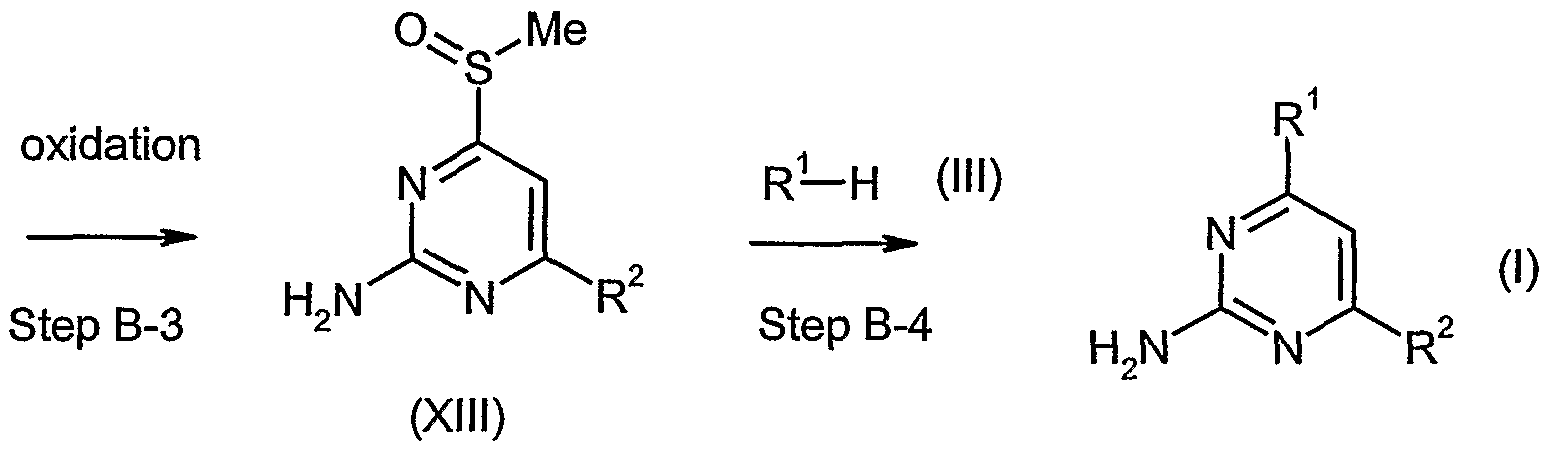
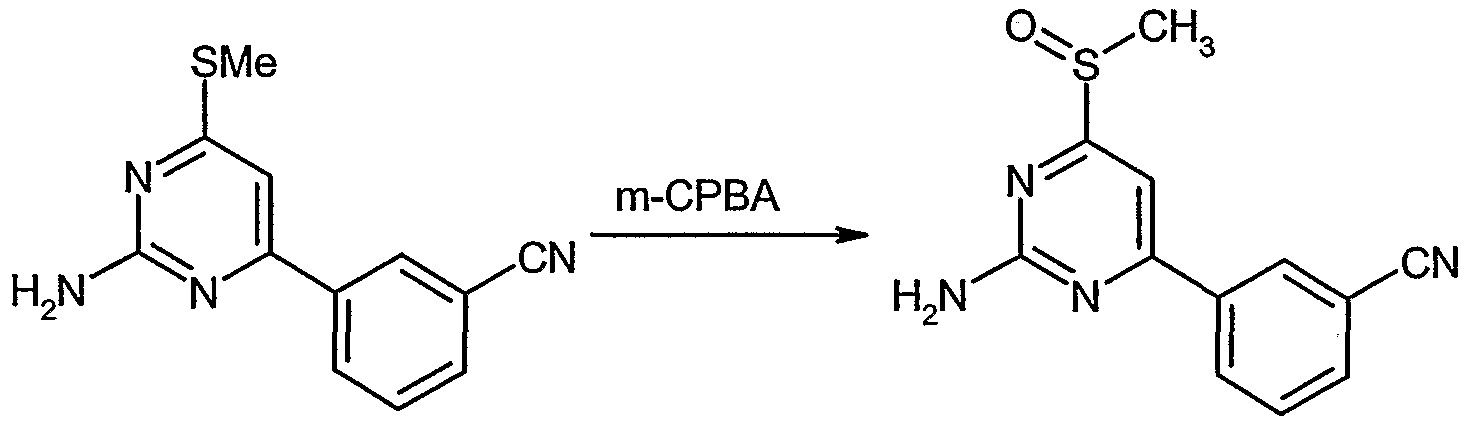
  • compound of formula (XIII) (wherein R 2 is the same as defined above) can be prepared by the oxidation of sulfur atom of compound of formula (XII) (wherein R 2 is the same as defined above) .
  • the oxidation reaction can be performed using a reagent, such as hydrogen peroxide, sodium pe- riodate, m-chloroperbenzoic acid (m-CPBA), potassium permanganate and others in the absence or presence of catalyst, such as catalytic ruthenium trichloride.
  • a reagent such as hydrogen peroxide, sodium pe- riodate, m-chloroperbenzoic acid (m-CPBA), potassium permanganate and others in the absence or presence of catalyst, such as catalytic ruthenium trichloride.
  • the reaction can be carried out in solvent including, for instance, water, halogenated hydrocarbons such as, methylene chloride, carbon tetrachloride, chlorobenzene, dichloromethane, chloroform and 1,2-dichloroethane; ethers such as diethyl ether, isopropyl ether, dioxane and tetrahydrofuran (THF) and 1,2-dimethoxyethane; aromatic hydrocarbons such as benzene, toluene and xylene; nitriles such as acetonitrile; amides such as N, N-dimethylformamide (DMF), N, N-dimethyl- acetamide and N-methylpyrrolidone; and others.
  • solvent including, for instance, water, halogenated hydrocarbons such as, methylene chloride, carbon tetrachloride, chlorobenzene, dichloromethane, chloroform and 1,2-dichloroethane
  • reaction temperature is usually, but not limited to about -10°C to 200°C, and preferably about 10°C to 50°C.
  • the reaction may be carried out for, usually, 30 minutes to 48 hours and preferably 1 hour to 20 hours.
  • compound of formula (I) (wherein R 1 and R 2 are the same as defined above) can be prepared by the reaction of compound of formula (XT1I) (wherein R 2 is the same as defined above) with compound of formula (DI) (wherein R 1 is the same as defined above).
  • the reaction may be carried out without solvent or in a solvent including, for instance, halogenated hydrocarbons such as dichloromethane, chloroform and 1,2-dichloroethane; ethers such as diethyl ether, isopropyl ether, dioxane and tefrahydrofuran (THF) and 1,2-dimethoxyethane; aromatic hydrocarbons such as benzene, toluene and xylene; nitriles such as acetonitrile; amides such as N, N-dimethylformamide (DMF), N, N-dimethylacetamide (DMAC) and N-methylpyrrolidone (NMP); urea such as l,3-dimethyl-2-imidazolidinone (DMT); sulfoxides such as dimethylsulfoxide (DMSO); and others.
  • halogenated hydrocarbons such as dichloromethane, chloroform and 1,2-dichloroethane
  • the reaction temperature can be optionally set depending on the compounds to be reacted.
  • the reaction temperature is usually, but not limited to, about 0°C to 200°C and preferably about 20°C to 150°C.
  • the reaction may be conducted for, usually, 10 minutes to 48 hours and preferably 30minutes to 24 hours.
  • the compound of formula (X) can be prepared by the use of known techniques or are commercially available.
  • Typical salts of the compound shown by the formula (I) include salts prepared by the reaction of the compound of the present invention with a mineral or organic acid, or an organic or inorganic base. Such salts are known as acid addition and base addition salts, respectively.
  • Acids to form acid addition salts include inorganic acids such as, without limitation, sulfuric acid, phosphoric acid, hydrochloric acid, hydrobromic acid, hydroiodic acid and the like, and organic acids, such as, without limitation, p-toluenesulfonic acid, methanesulfonic acid, oxalic acid, p- bromophenylsulfonic acid, carbonic acid, succinic acid, citric acid, benzoic acid, acetic acid, and the like.
  • inorganic acids such as, without limitation, sulfuric acid, phosphoric acid, hydrochloric acid, hydrobromic acid, hydroiodic acid and the like
  • organic acids such as, without limitation, p-toluenesulfonic acid, methanesulfonic acid, oxalic acid, p- bromophenylsulfonic acid, carbonic acid, succinic acid, citric acid, benzoic acid, acetic acid, and the like.
  • Base addition salts include those derived from inorganic bases, such as, without limitation, ammonium hydroxide, alkaline metal hydroxide, alkaline earth metal hydroxides, carbonates, bicarbon- ates, and the like, and organic bases, such as, without limitation, ethanolamine, friethylamine, tri(hydroxymethyl)aminomethane, and the like.
  • inorganic bases include, sodium hy- droxide, potassium hydroxide, potassium carbonate, sodium carbonate, sodium bicarbonate, potassium bicarbonate, calcium hydroxide, calcium carbonate, and the like.
  • the compound of the present invention or a salts thereof, depending on its substituents, may be modified to form lower alkylesters or known other esters; and/or hydrates or other solvates. Those esters, hydrates, and solvates are included in the scope of the present invention.
  • the compound of the present invention may be administered in oral forms, such as, without limitation normal and enteric coated tablets, capsules, pills, powders, granules, elixirs, tinctures, solution, suspensions, syrups, solid and liquid aerosols and emulsions. They may also be administered in parenteral forms, such as, without limitation, intravenous, intraperitoneal, subcutaneous, intramuscular, and the like forms, well-known to those of ordinary skill in the pharmaceutical arts.
  • the compounds of the present invention can be administered in intranasal form via topical use of suitable intranasal vehicles, or via transdermal routes, using transdermal delivery systems well-known to those of ordinary skilled in the art.
  • the dosage regimen with the use of the compounds of the present invention is selected by one of ordinary skill in the arts, in view of a variety of factors, including, without limitation, age, weight, sex, and medical condition of the recipient, the severity of the condition to be treated, the route of administration, the level of metabolic and excretory function of the recipient, the dosage form employed, the particular compound and salt thereof employed.
  • the compounds of the present invention are preferably formulated prior to administration together with one or more pharmaceutically-acceptable excipients.
  • Excipients are inert substances such as, without limitation carriers, diluents, flavoring agents, sweeteners, lubricants, solubilizers, suspending agents, binders, tablet disintegrating agents and encapsulating material.
  • compositions of the present invention are pharmaceutical formulation comprising a compound of the invention and one or more pharmaceutically-acceptable excipients that are compatible with the other ingredients of the formulation and not deleterious to the recipient thereof.
  • Pharmaceutical formulations of the invention are prepared by combining a therapeutically effective amount of the compounds of the invention together with one or more pharmaceutically-acceptable excipients.
  • the active ingredient may be mixed with a diluent, or enclosed within a carrier, which may be in the form of a capsule, sachet, paper, or other container.
  • the carrier may serve as a diluent, which may be solid, semi-solid, or liquid material which acts as a vehicle, or can be in the form of tablets, pills, powders, lozenges, elixirs, suspensions, emulsions, solutions, syrups, aerosols, ointments, containing, for example, up to 10% by weight of the active compound, soft and hard gelatin capsules, suppositories, sterile injectable solutions and sterile packaged powders.
  • a diluent which may be solid, semi-solid, or liquid material which acts as a vehicle, or can be in the form of tablets, pills, powders, lozenges, elixirs, suspensions, emulsions, solutions, syrups, aerosols, ointments, containing, for example, up to 10% by weight of the active compound, soft and hard gelatin capsules, suppositories, sterile injectable solutions and sterile packaged powders.
  • the active ingredient may be combined with an oral, and non-toxic, pharmaceutically-acceptable carrier, such as, without limitation, lactose, starch, sucrose, glucose, sodium carbonate, mannitol, sorbitol, calcium carbonate, calcium phosphate, calcium sulfate, methyl cellulose, and the like; together with, optionally, disintegrating agents, such as, without limitation, maize, starch, methyl cellulose, agar bentonite, xanfhan gum, alginic acid, and the like; and optionally, binding agents, for example, without limitation, gelatin, natural sugars, beta-lactose, corn sweeteners, natural and synthetic gums, acacia, tragacanth, sodium alginate, carboxymethylcellulose, polyethylene glycol, waxes, and the like; and, optionally, lubricating agents, for example, without limitation, magnesium stearate, sodium stearate, stearic acid, sodium oleate, sodium ben-
  • the carrier may be a finely divided solid which is in admixture with the finely divided active ingredient.
  • the active ingredient may be mixed with a carrier having binding properties in suitable proportions and compacted in the shape and size desired to produce tablets.
  • the powders and tablets preferably contain from about 1 to about 99 weight percent of the active ingredient which is the novel composition of the present invention.
  • Suitable solid carriers are magnesium carboxymethyl cellulose, low melting waxes, and cocoa butter.
  • Sterile liquid formulations include suspensions, emulsions, syrups and elixirs.
  • the active ingredient can be dissolved or suspended in a pharmaceutically acceptable carrier, such as sterile water, sterile organic solvent, or a mixture of both sterile water and a sterile organic solvent.
  • the active ingredient can also be dissolved in a suitable organic solvent, for example, aqueous propylene glycol.
  • a suitable organic solvent for example, aqueous propylene glycol.
  • Other compositions can be made by dispersing the finely divided active ingredient in aqueous starch or sodium carboxymethyl cellulose solution or in a suitable oil.
  • the formulation may be in unit dosage form, which is a physically discrete unit containing a unit dose, suitable for administration in human or other mammals.
  • a unit dosage form can be a capsule or tablets, or a number of capsules or tablets.
  • a "unit dose" is a predetermined quantity of the active compound of the present invention, calculated to produce the desired therapeutic effect, in association with one or more excipients.
  • the quantity of active ingredient in a unit dose may be varied or adjusted from about 0.1 to about 1000 milligrams or more according to the particular treatment involved.
  • Typical oral dosages of the present invention when used for the indicated effects, will range from about O.Olmg/kg/day to about lOOmg/kg/day, preferably from 0.1 mg/kg/day to 30 mg/kg/day, and most preferably from about 0.5 mg kg/day to about 10 mg/kg/day.
  • parenteral administration it has generally proven advantageous to administer quantities of about 0.001 to 100 mg/kg/day, preferably from 0.01 mg/kg/day to lmg/kg/day.
  • the compounds of the present invention may be administered in a single daily dose, or the total daily dose may be a ⁇ rninistered in divided doses, two, three, or more times per day. Where delivery is via transdermal forms, of course, administration is continuous.
  • a fusion construct consisting of the n-terminal part of H 4 and the C-terminal part of the G protein G ⁇ 6 was transfected into CHO cells containing the aequorin-controlled luciferase gene (CHOAQLuci cells). Recombinant clones showing aequorin luminescence after the addition of 1 ⁇ M histamine were isolated. Starting with three independent primary cell clones three sets of tertiary clones were generated by two successive rounds of limiting dilution. Analysis of the primary clones as well as each subcloning by limiting dilution was monitored by "clone-pool analysis" comparing HLt-transfected to mock-transfected (expression vector without H 4 receptor cDNA) clones.
  • CHO-H 4 cells were seeded at 2 x 10 4 cells per well in Biocoat poly-D-Lysine 96 well black/clear plates (BECTON DICKINSON, Franklin Lakes, US) in D-MEM/F12 medium supplemented with 10% FCS and 400 ⁇ g/ l Geneticin (Invitrogen GIBCO, Carlsbad, US) and 2 mM butylrate for O/N.
  • the medium was removed and cells were loaded with 1 ⁇ M Fluo-3 (Molecular Probes, Eugene, USA) in loading solution (0.1% BSA, 20mM HEPES Hank's Buffer, ImM probinecid) for 1 h.
  • the loading buffer was removed and exchanged for fresh loading buffer.
  • Cells were pre- treated with various concentrations of test compounds and subjected to calcium mobilization measurement induced by 100 nM histamine by using FDSS6000.
  • Membrane fraction was prepared from CHO-EL t stable cells treated with 5 mM butyrate for O N. 20 nM 3 H-histamine binding to membrane was performed in 50 mM Tris (pH 7.5 ), 5 mM EDTA for 60 min in the presence of test compounds. Non-specific binding was determined in the presence of 20 ⁇ M histamine. B/F separation was performed by filtration using MAFB NOB plate ( Millipore, Tokyo, JAPAN ) with 3 times wash by 50 mM Tris ( pH7.5 ), 0.5 mM EDTA.
  • Bone marrow-derived mast cells were generated from the femural bone marrow of 6-8 week old male mice and maintained in RPMI1640 medium (Nacalai Tesque, Kyoto Japan) supplemented with 10% fetal bovine serum (FBS; JRH Bioscience, Lenex, KS, US), 100 units/ml penicilline-streptpmycine (GIBCO BRL, Rockville, MD, US) and 10 ng/ml recombinant murine E -3 (Pepro Tech EC Ltd., London, UK) at a density of lxlO 6 cells/ml. Prior to experimentation, BMMC were harvested, washed twice in PBS and further used as indicated. Purity of mast cells was >95% as asessed by Toluidine blue staining or FACS analysis of cell surface expression of c- Jrit and Fc ⁇ RI.
  • Transwell plates (Costar, NY, USA) with a pore size of 8 ⁇ m were coated with 100 ⁇ l of 100 ng / ml human fibronectin for 2h at room temperature. After removal of fibronectin 600 ⁇ l of RPMI containing 10% FCS in the presence of histamine were added to the bottom chamber. Subsequently, bone marrow-derived mast cells (2 x 10 5 / well in 100 ⁇ l ) pre-treated with antagonists or test compounds were added to the top chambers. The plates were incubated for 2 h at 37C degrees. Transwells were removed and the number of cells in the bottom chamber was counted by flow cytometer. [Zymosan-induced pleurisy in mice] (Assay 4)
  • mice (Balb/c, - ⁇ -, 7-8 weeks old, SPF, Charles River Inc.) received a single intrapleural injection with 0.2 ml zymosan (100 ⁇ g/mouse) under anesthetization with ether.
  • Test compounds thiopera- mide, dexamethasone, and vehicle (10 % cremophor in PBS)) were administered p.o. (0.2 ml/head) 60 minutes prior to zymosan injection.
  • mice were sacrificed and pleural fluid was collected by washing the pleural cavity twice with 2 ml PBS. The cell suspension was diluted to one tenth in Turk's stain solution (Nacalai Tesque).
  • the number of total cells in the sample was counted under the microscope using a hemocytometer. Cytospin specimens were stained with May-Gruenwald's (Merck, Darmstadt, Germany) and Giemsa's solution (Merck) for leukocyte typing. The distribution of each cell population (neutrophils, eosinophils, macrophages, lymphocytes and others) was counted under microscopy by counting more than 200 cells.
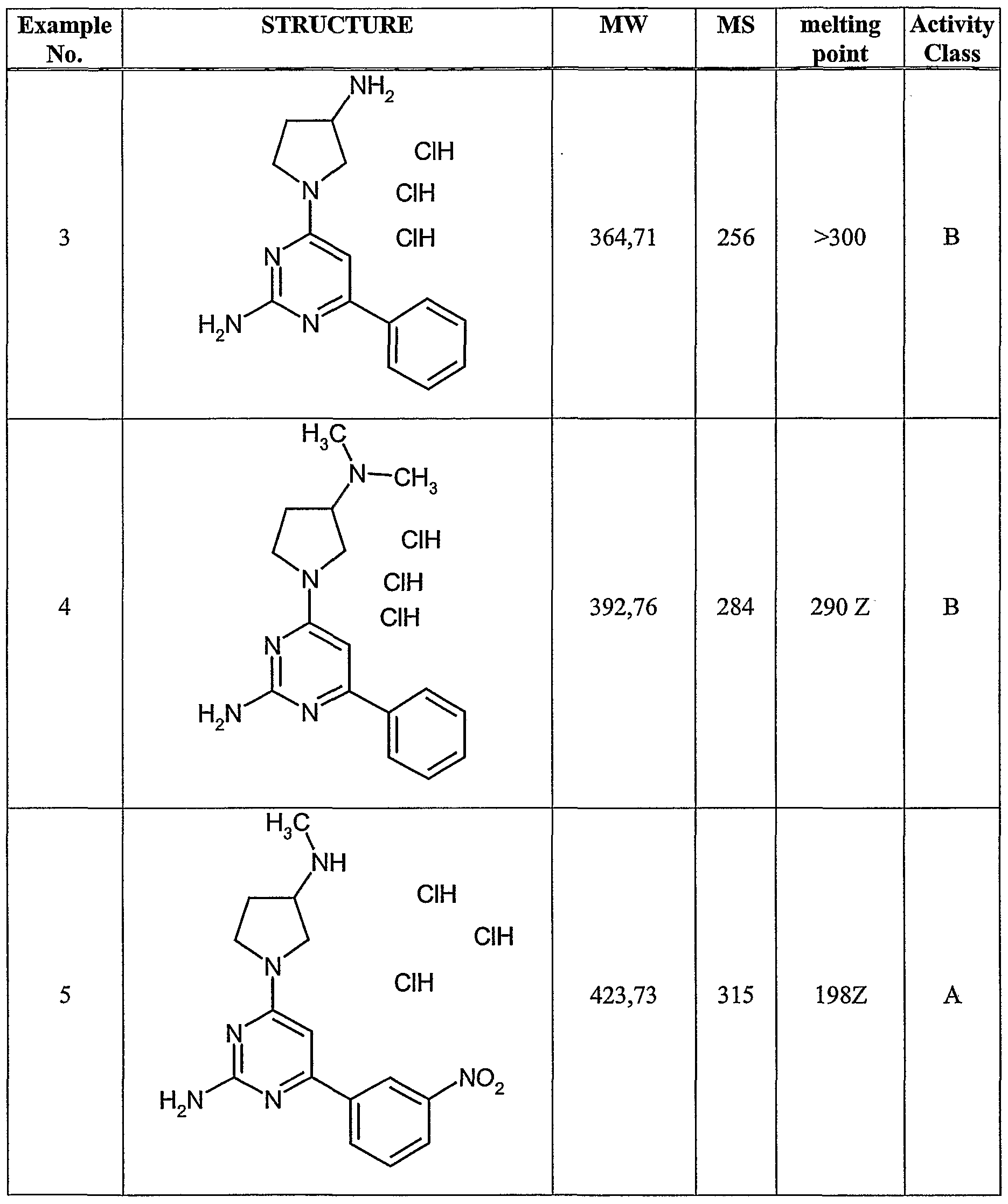
  • Assay results in Assay 1 are shown in Examples and tables of the Examples below.
  • the data corresponds to the compounds as yielded by solid phase synthesis and thus to levels of purity of about 40 to 90%.
  • the compounds are grouped in four classes of activity as follows:
  • the compounds of the present invention also show excellent selectivity, and potent activity in Assays 2 - 4 described above.

Landscapes

  • Chemical & Material Sciences (AREA)
  • Organic Chemistry (AREA)
  • Health & Medical Sciences (AREA)
  • Chemical Kinetics & Catalysis (AREA)
  • Life Sciences & Earth Sciences (AREA)
  • General Chemical & Material Sciences (AREA)
  • Medicinal Chemistry (AREA)
  • Nuclear Medicine, Radiotherapy & Molecular Imaging (AREA)
  • Veterinary Medicine (AREA)
  • Pharmacology & Pharmacy (AREA)
  • Public Health (AREA)
  • Animal Behavior & Ethology (AREA)
  • General Health & Medical Sciences (AREA)
  • Rheumatology (AREA)
  • Pain & Pain Management (AREA)
  • Engineering & Computer Science (AREA)
  • Bioinformatics & Cheminformatics (AREA)
  • Physical Education & Sports Medicine (AREA)
  • Pharmaceuticals Containing Other Organic And Inorganic Compounds (AREA)

Abstract

The present invention relates to novel 2-aminopyrimidine derivatives, processes for preparing them and pharmaceutical preparations containing them. The 2-aminopyrimidine derivatives of the present invention exhibit enhanced potency for histamine H4 receptor antagonism and can be used for the prophylaxis and treatment of diseases associated with histamine H4 receptor activity. More specifically, the 2-aminopyrimidine derivatives of the present invention are useful for treatment and prophylaxis of diseases as follows: asthma, rhinitis, allergic diseases, chronic obstructed pulmonary disease (CORD), atherosclerosis and rheumatoid arthritis.

Description

2-AMINOPYRIMIDINE DERIVATIVES
DETAILED DESCRIPTION OF INVENTION
Technical Field
The present invention relates to novel 2-aminopyrimidine derivatives, processes for preparing them and pharmaceutical preparations containing them. The 2-aminopyrimidine derivatives of the present invention exhibit enhanced potency for histamine H4 receptor antagonism and can be used for the prophylaxis and treatment of diseases associated with histamine H4 receptor activity.
More specifically, the 2-aminopyrimidine derivatives of the present invention are useful for treatment and prophylaxis of diseases as follows: asthma, rhinitis, allergic diseases, chronic obstructed pulmonary disease (CORD), atherosclerosis and rheumatoid arthritis.
Background Art
Histamine exerts its numerous physiological and pathophysiological functions by acting on its receptor entities which belong to the heptahelical G-protein coupled receptor family. (Hough LB, Mol Pharmacol, 59:415-419, 2001.) The specific functions of HI, H2 and H3 subtypes are well characterized (reviewed in the following references: Bakker RA et al., Clin Allergy Immunol, 17:27-64, 2002; Repka-Ramirez MS and Baraniuk JN, Clin Allergy hnmunol, 17:1-25, 2002; Win- bery SL and Lieberman PL, Clin Allergy Immunol, 17:287-317, 2002; Barocelli E and Ballabeni V, Pharmacol Res, 47:299-304, 2003.) and antagonists to each subtype are identified and some drugs have been clinically used. The fourth member, H4 has recently been cloned and characterized by various groups (Oda T et al., J. Biol. Chem. 275(47):36781-36786, 2000; Nakamura T et al, Biochem Biophys Res Commun 279:615-620, 2000; Zhu et al., Mol. Pharmacol. 59(3):434-441, 2001; Liu C et al., Mol. Pharmacol. 59:420-426, 2001; Morse et al., J. Pharmacol. Exp. Ther. 296(3):1058-1066, 2001; Nguyen et al., Mol. Pharmacol. 59:427-433, 2001; O'Reilly M et al, J Recept Signal Transduct Res 22:431-448, 2002.) The predominant expression of H4 on leukocyte populations suggests potential immunological and inflammatory functions. Indeed, some inflammatory functions mediated by H4 have been recently identified in vitro. Chemotaxis of human eosinophils (O'Reily et al, above), IL-16 release from human CD8+ lymphocytes (Gantner F et al, J Pharmacol Exp Ther 303:300-307, 2002.), and calcium mobilization and chemotaxis of murine mast cells (Hofstra CL, et al J Pharmacol Exp Ther. 305(3):1212-21, 2003) are controlled by H4. Also, Considerable expression of H4 is also seen on lung tissue and lung cells (Coge F, et al., Biochem Biophys Res Commun 284:301-309, 2001; Morse et al., see above; Zhu et al., see above; Gantner F et al, see above.) which makes H4 an attractive target for inflammatory lung disorders. It is therefore expected that antagonists of histamine H4 receptor can be used for prophylaxis and treatment of immunological or inflammatory disorders/diseases, including asthma, rhinitis, allergic diseases, chronic obstructed pulmonary disease (CORD), atherosclerosis and rheumatoid arthritis.
WO01/047921 discloses pyrimidine derivatives represented by the general formula:
Figure imgf000003_0001
wherein
Rbi is hydrogen, alkyl, alkoxyalkyl, arylalkyl, heteroaryl, heteroarylalkyl etc;
Rb2 is halogen, alkyl, OH, (un)substituted heteroaryl, (un)substituted heterocyclyl, etc;
Rb3 is bond,
Figure imgf000003_0002
Rb4 is hydrogen, halogen, alkyl, heterocyclyl, alkylarnino, etc;
Xbi, Xb2 and Xb3 independently represent -N= or -C(H)- ;
Y is hydrogen, alkyl, or Y and Rbi together with N to form (un)substituted heterocyclyl or heteroaryl;
X, XI and X2 are -N= or -C(H)- ;
as a protein kinase inhibitor.
WO90/12790 discloses pyrimidine derivatives represented by the general formula:
Figure imgf000004_0001
wherein
Rci and Rc4 independently represent hydrogen, amino, (un)substituted phenyl etc;
Rc2 is hydrogen, alkyl, alkenyl, etc ,or alkylene or alkenylene to form ring together with Q-A-N, etc;
Rc3 is H, alkyl or alkenyl;
A is direct bond, alkylene or oxy-alkylene;
Q is pyridyl, furyl, thienyl or (un)substituted phenyl.
as an intermediate for a cardiovascular agent.
WOOl/062233 discloses pyrimidine derivatives represented by the general formula:
Figure imgf000004_0002
Ad is bond, -N(R)-, etc;
Rdi is hydrogen, -(CH2)n-ρhenyl, -(CH )n-ρiperazm-4-yl optionally substituted by lower alkyl, phenyl, -(CH2)n-piperidinyl optionally substituted by lower alkyl, -(CH2)n- NH-phenyl etc; n is an integer of 0-4;
Rd2 is hydrogen, halogen, cyano, alkyl, etc; Rd3 is lower alkyl, phenyl optionally substituted by alkyl, alkoxy or halogen, heterocy- cles (eg. thienyl, furyl) etc;
Rd and Rd5 independently represent hydrogen, optionally substituted phenyl, etc.
as an adenosine receptor modulators.
EP459830 discloses pyrimidine derivatives represented by the general formula:
Figure imgf000005_0001
wherein
Rei and Re2 are independently OH or N Re90;
Re9 and Reι0 independently represent hydrogen, alkyl etc, or together with nitrogen to form a ring, which is optionally substituted by alkyl, aryl or arylalkyl;
Re3 is hydrogen, haloalkyl, halogen, alkyl, etc;
Re4, Re5, Re6, Re7 and Re8 independently represent hydrogen, halogen, amino sulphona- mido, or alkylsulphonylamino, with the proviso that at least one of R e -R e8 is not hydrogen.
as a glutamate release inhibitor.
Also, WO02/072548 discloses indole derivatives as histamine H4 receptor antagonist.
However, none of the references and other reference disclose 2-aminopyrimidine derivatives having histamine H4 receptor antagonistic activity.
The development of a compound which has effective anti-inflammatory actions based on a specific and selective antagonistic activity to histamine H4 receptor and can be used for the prophylaxis and treatment of diseases associated with histamine H4 receptor activity has been still desired. Summary of the invention
As a result of extensive studies on chemical modification of 2-aminopyrimidine derivatives, the present inventors have found that the compounds of novel chemical structure related to the present invention have unexpectedly excellent antagonistic activity to histamine H4 receptor. The present invention has been accomplished based on these findings.
This invention is to provide novel 2-aminopyrimidine derivatives of the formula (I) their tautomeric and stereoisomeric forms, and salts thereof.
Figure imgf000006_0001
wherein
Figure imgf000006_0002
wherein
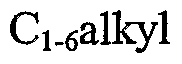
R11 and R12 independently represent hydrogen or Cι-6alkyl optionally substituted by halogen, cyano, hydroxy, carboxy, amino, Ci-βalkylamino, N,N-di(Cι_ 6alkyl)amino, Cι-6alkylthio, Cι-6alkoxy, or C3-scycloalkyl;
R 13 is Cι-6alkyl optionally substituted by halogen, cyano, hydroxy, carboxy, amino, Cι-6alkylarnino, N,N-di(Cι-6al__yl)amino, Cι-6alkylthio, Cι-6alkoxy, or C3.8cycloalkyl;
R2 is phenyl or naphthyl, wherein said phenyl and naphthyl are optionally having one or more substituents selected from the group consisting of halogen, amino, carboxy, cyano, hydroxy, nitro, phenyl, Cι.6alkanoyl, N-(C1-6alkyl)sulfonylamino, N-phenylsulfonylamino, . 6alkylamino, N,N-di(Cι-6all-yl)amino, N-(Cι-6alkanoyl)amino, Cι-6alkoxycarbonyl, Cι-6alkylthio,
Figure imgf000007_0001
N-arylamino, N-(aryl Cι-6alkyl)amino, aminocarbonyl, N-(Cι-6alkyl)aminocarbonyl, N,N-di(Cι-6alkyl)aminocarbonyl, C3- 8cycloalkyl, C1-6alkylsulfonyl, sulfamoyl, aryl Cι-6alkoxycarbonyl, ^a-k l, . 6alkyl substituted by cyano, hydroxy, carboxy, amino, Cι-6alkylamino, N,N-di(Cι. 6alkyl)ammo, C1-6alkylthio, Cι-6alkoxy, or mono-, di-, or tri- halogen, Ci-6alkoxy, Cι-6alkoxy substituted by mono-, di-, or tri- halogen, -N(R21)C(0)N(R22)(R23), and -N(R21)C(0) R24, wherein
R21 is hydrogen or Cι-6alkyl;
R22 is Cι-6alkyl, or phenyl optionally having one or more substituents selected from the group consisting of halogen, amino, carbamoyl, cyano, hydroxy, nitro, phenyl, Cι.6alkanoyl, Cι-6alkyl optionally substituted by hydroxy or mono-, di-, or tri- halogen, and Cι-6- alkoxy optionally substituted by mono-, di-, or tri- halogen;
R23 is hydrogen or Cι-6alkyl;
R24 is phenyl optionally having one or more substituents selected from the group consisting of halogen, amino, carboxy, carbamoyl, cyano, hydroxy, nitro, phenyl,
Figure imgf000007_0002
-6alkyl optionally substituted by hydroxy or mono-, di-, or tri- halogen, and Cι-6alkoxy optionally substituted by mono-, di-, or tri- halogen.
with the proviso that when R1 is
Figure imgf000007_0003
R2 is optionally substituted phenyl, said phenyl is substituted by at least one substituent selected from the group consisting of carboxy, cyano, hydroxy, phenyl, . 6alkanoyl, N-phenylsulfonylamino, Ci-βalkylamino, N,N-di(Cι-6alkyl)amino, N-(Cι. 6alkanoyl)amino, Cι-6alkoxycarbonyl, Cι-6alkylthio, N-(Cι-6alkoxycabonyl)amino, N-arylamino, N-(aryl Cι-6alkyl)amino, aminocarbonyl, N-(Cι-6alkyl)amino- carbonyl, N,N-di(Cι-6alkyl)aminocarbonyl, C3-8cycloalkyl, Cι-6alkylsulfonyl, aryl C1-6alkoxycarbonyl, Cι-6alkyl substituted by cyano, hydroxy, carboxy, amino, Ci. 6alkylamino, N,N-di(Cι.6alkyl)amino, Ci-ealkylthio, C1-6alkoxy, or mono-, di-, or tri-halogen, Q-βalkoxy substituted by mono-, di-, or tri- halogen, -N(R2I)C(0)N(R22)(R23), and -N(R21)C(O) R24, wherein
R21 is hydrogen or Cι-6alkyl;
R22 is Cι-6alkyl, or phenyl optionally having one or more substituents selected from the group consisting of halogen, amino, carbamoyl, cyano, hydroxy, nitro, phenyl, C1-6alkanoyl, Cι-6alkyl optionally substituted by hydroxy or mono-, di-, or tri- halogen, and Cι-6- alkoxy optionally substituted by mono-, di-, or tri- halogen;
R23 is hydrogen or Cι-6alkyl;
R24 is phenyl optionally having one or more substituents selected from the group consisting of halogen, amino, carboxy, carbamoyl, cyano, hydroxy, nitro, phenyl, Cι-6alkanoyl, Cι-6alkyl optionally substituted by hydroxy or mono-, di-, or tri- halogen, and Cι-6alkoxy optionally substituted by mono-, di-, or tri- halogen.
In another embodiment, the present invention provides 2-aminopyrimidine derivatives of the formula (I-i), its tautomeric or stereoisomeric form, or a salt thereof:
Figure imgf000008_0001
wherein R11 and R12 independently represent hydrogen or C1-6alkyl optionally substituted by halogen, cyano, hydroxy, carboxy, amino, Ci-βalkylamino, N,N-di(Cι-6alkyl)arnino, Ci. 6alkylthio, Cι-6alkoxy, or C3-8cycloalkyl; and
R2 is phenyl or naphthyl, wherein said phenyl and naphthyl are optionally having one or more substituents selected from the group consisting of halogen, amino, carboxy, cyano, hydroxy, nitro, phenyl, C]-6alkanoyl, N-(C1-6alkyl)sulfonylamino, N-phenylsulfonylamino Cι-6- alkylamino, N,N-di(Ci-6alkyl)amino, N-(Cι-6alkanoyl)amino, Ci-6alkoxycarbonyl, Cι-6alkylthio, N-(Cι.6alkoxycabonyl)amino, N-arylamino, N-(arylC1-6alkyl)amino, aminocarbonyl, N-(Ci.6alkyl)aminocarbonyl, N,N-di(C1-6all<yl)aminocarbonyl, C3-8- cycloalkyl, Cι_6alkylsulfonyl, sulfamoyl, aryl
Figure imgf000009_0001
-6alkyl substituted by cyano, hydroxy, carboxy, amino, Cι-6alkylamino, N,N-di(Cι.6alkyl)amino, C1-6alkylthio, Cι-6alkoxy, or mono-, di-, or tri- halogen,
Figure imgf000009_0002
optionally substituted by mono-, di-, or tri- halogen, N(R21)C(O)N(R22)(R23), and N(R21)C(0) R24, wherein
R21 is hydrogen or Ci-βalkyl;
R22 is C1.6alkyl, or phenyl optionally having one or more substituents selected from the group consisting of halogen, amino, carbamoyl, cyano, hydroxy, nitro, phenyl, Cι-6alkanoyl,
Figure imgf000009_0003
optionally substituted by hydroxy or mono-, di-, or tri- halogen, and Cι-6alkoxy optionally substituted by mono- di-, or tri- halogen;
R is hydrogen or Cι-6alkyl; and
R24 is phenyl optionally having one or more substituents selected from the group consisting of halogen, amino, carboxy, carbamoyl, cyano, hydroxy, nitro, phenyl, Cι-6alkanoyl, Cι.6alk l optionally substituted by hydroxy or mono-, di-, or tri- halogen, and Cι-6alkoxy optionally substituted by mono-, di-, or tri- halogen.
In another embodiment, the present invention provides 2-aminopyrimidine derivatives of the formula (I-i), its tautomeric or stereoisomeric form, or a salt thereof: wherein
R2 is phenyl or naphthyl, wherein said phenyl and naphthyl are optionally having one or more substituents selected from the group consisting of halogen, amino, cyano, hydroxy, nitro, phenyl, Cj-6- alkanoyl, Cι.6alkylamino, N,N-di(Ci-6alkyl)amino, N-(Cι-6alkanoyl)amino, Cι.6- alkoxycarbonyl, C1-6alkylthio, Cι-6alkylsulfonyl, Cι-6alkyl, trifluoromethyl, Cι-6- alkyl substituted by cyano, hydroxy, amino, Cι-6alkylamino, N,N-di(Cι-6- alkyl)amino, or C1-6alkoxy, C1-6alkoxy, N(R21)C(0)N(R22)(R23), and N(R21)C(O) R24, wherein
R21 is hydrogen or Cι-6alkyl;
R22 is C1-6alkyl, or phenyl optionally having one or more substituents selected from the group consisting of halogen, amino, carbamoyl, cyano, hydroxy, nitro, phenyl, Cι-6alkanoyl, Cι-6alkyl optionally substituted by hydroxy or mono-, di-, or tri- halogen, and Cι-6alkoxy optionally substituted by mono- di-, or tri- halogen;
R23 is hydrogen or Cι-6alkyl; and
R24 is phenyl optionally having one or more substituents selected from the group consisting of halogen, amino, carboxy, carbamoyl, cyano, hydroxy, nitro, phenyl, C1-6alkanoyl, Cι-6alkyl optionally substituted by hydroxy or mono-, di-, or tri- halogen, and Cι-6alkoxy optionally substituted by mono-, di-, or tri- halogen.
In another embodiment, the present invention provides 2-arrinopyrimidine derivatives of the formula (I-i), its tautomeric or stereoisomeric form, or a salt thereof: wherein
R11 and R12 independently represent hydrogen or methyl.
More preferably, said 2-aminopyrimidine derivative of the formula (I-i) is selected from the group consisting of: 4-(3 -aminopyrrolidin- 1 -yl)-6-phenylpyrimidin-2-amine trihydrochloride;
4-[3-(dimethylamino)pyrrolidin-l-yl]-6-phenylpyrirm^in-2-armne frihydrochloride;
4-[3-(methylamino)pyrrolidin-l-yl]-6-phenylpyrirm^in-2-anιiue frihydrochloride;
4-[3-(memylam o)pyrrolidm-l-yl]-6-(3-nifrophenyl)pyrimidin-2-amine trih^
4-[(3R)-3-(methylan ino)pyrrolidm-l-yl]-6-(3-nifrophenyl)pyrimidin-2-amine trihydrochloride;
4-[(3 S)-3 -(methylamino)pyrrolidin- 1 -yl]-6-(3 -nitrophenyl)pyrirnidin-2-amine trihydrochloride;
4-[(3 S)-3 -(methylamino)pyrrolidin- 1 -yl]-6-phenylpyrirnidin-2-amine trihydrochloride;
4-[(3R)-3-(methylamino)pyrrolidin-l-yl]-6-phenylpyrimidin-2-amine trihydrochloride;
4-[3-(methylarrjino)pyrrolidin-l-yl]-6-(3-methylphenyl)pyrirnidin-2-amine trihydrochloride; l-(3-{2-amino-6-[3-(methylarmno)pyrrolidin-l-yl]pyrirrjidin-4-yl}phenyl)ethanone trihydrochloride;
3-{2-amino-6-[3-(methylammo)pyrrolidm-l-yl]pyrimidin-4-yl}phenol t_rihydrochloride;
(3-{2-armno-6-[3-(methylamino)pyrrolidin-l-yl]pvrir ^in-4-yl}phenyl)methanol trihydrochloride; and
3-{2-arrιmo-6-[3-(methylamino)py_τolidin-l-yl]pyrimidin-4-yl}benzonitrile trihydrochloride.
In another embodiment, the present invention provides 2-aminopyrimidine derivatives of the formula (I-ii), its tautomeric or stereoisomeric form, or a salt thereof:
Figure imgf000012_0001
wherein
R 13 is Ci-β lkyl optionally substituted by halogen, cyano, hydroxy, carboxy, amino, . 6alkylamino, N,N-di(C1-6alkyl)amino, Cι-6alkylthio, C1-6alkoxy, or C3-8cycloalkyl;
R2 is phenyl having one or more substituents selected from the group consisting of carboxy, cyano, hydroxy, phenyl, Ci-βalkanoyl, N-(Cι-6alkyl)sulfonylamino, N- phenylsulfonylamino,
Figure imgf000012_0002
N,N-di(Cι-6alkyl)amino, N-(Cι.6alkanoyl)- amino, Cι-6alkoxycarbonyl, Cι-6alkylthio, N-(Cι-6alkoxycabonyl)amino, N-arylamino, N-(aryl Cι-6alkyl)amino, aminocarbonyl, N-(Cι-6alkyl)anτinocarbonyl, N,N-
Figure imgf000012_0003
C3-8cycloalkyl, Cι-6alkylsulfonyl, aryl Cι-6alkoxy- carbonyl, Cι-6alkyl substituted by cyano, hydroxy, carboxy, amino, Cι.6alkylamino, N,N-di(Cι-6alkyl)amino, Cι-6alkylthio, Cι-6alkoxy, or mono-, di-, or tri- halogen, . 6alkoxy substituted by mono- di-, or tri- halogen, -N(R21)C(0)N(R22)(R23), and N(R21)C(0) R24, or naphthyl optionally having one or more substituents selected from the group consisting of halogen, amino, carboxy, cyano, hydroxy, nitro, phenyl, Cι-6alkanoyl, N-phenylsulfonylamino, Ci-βalleylarriino, N,N-di(Cι-6alkyl)- amino,
Figure imgf000012_0004
-6alkoxycarbonyl, Cι-6a_ky_thio, N-(Cι-6alkoxy- cabonyl)amino, N-arylamino, N-(aryl
Figure imgf000012_0005
aminocarbonyl, N- (Ci-βalky aminocarbonyl, N,N-di(Cι-6alkyl)aminocarbonyl, C3-8cycloalkyl, Cι-6alkylsulfonyl, sulfamoyl, aryl Cι-6alkoxycarbonyl, Cι-6alkyl optionally substituted by cyano, hydroxy, carboxy, amino, C1-6alkylamino,
Figure imgf000012_0006
-6alkylthio, C1-6alkoxy, or mono-, di-, or tri- halogen, Cι-6alkoxy optionally substituted by amono-, di-, or tri- halogen, -N(R21)C(0)N(R22)(R23), and N(R21)C(0) R24,
wherein
R is hydrogen or Cι-6alkyl; R22 is Cι-6alkyl, or phenyl optionally having one or more substituents selected from the group consisting of halogen, amino, carbamoyl, cyano, hydroxy, nitro, phenyl, Cι-6alkanoyl, C1-6alkyl optionally substituted by hydroxy or mono-, di-, or tri- halogen, and Cι-6alkoxy optionally substituted by mono-, di-, or tri- halogen;
R23 is hydrogen or C^aUcyl;
R24 is phenyl optionally having one or more substituents selected from the group consisting of halogen, amino, carboxy, carbamoyl, cyano, hydroxy, nitro, phenyl, Cι-6alkanoyl, Cι-6alkyl optionally substituted by hydroxy or mono-, di-, or tri- halogen, and Cι-6alkoxy optionally substituted by amono-, di-, or tri- halogen.
In another embodiment, the present invention provides 2-aminopyrimidine derivatives of the formula (I-ii), its tautomeric or stereoisomeric form, or a salt thereof:
wherein
R2 is phenyl having one or more substituents selected from the group consisting of cyano, phenyl, C1-6alkanoyl, N-(Cι-6alkanoyl)amino, Cι-6alkoxycarbonyl, Cι-6alkyl- sulfonyl, trifluoromethyl, and Cι-6alkyl substituted by cyano, hydroxy, amino, C1-6- alkylamino,
Figure imgf000013_0001
or Cι-6alkoxy, or naphthyl optionally having one or more substituents selected from the group consisting of cyano, hydroxy, phenyl, Cι.6alkanoyl, Cι-6alkylamino, N,N-di(C1-6alkyl)- amino, N-(Cι-6alkanoyl)amino, Cι-6alkoxycarbonyl, C1-6alkylthio, Cι-6alkyl- sulfonyl, Cι-6alkyl, trifluoromethyl, C1-6alkyl substituted by cyano, hydroxy, amino, Cι-6alkylamino, N,N-di(Cι-6alkyl)amino, or Cι-6alkoxy, and Cι-6alkoxy.
More preferably, said 2-ammopvrimidine derivative of the formula (I-ii) is selected from the group consisting of:
3-[2-amino-6-(4-methylpiperazin-l-yl)pyrimidin-4-yl]phenol;
1 - {3 -[2-amino-6-(4-methylpiperazin- 1 -yl)pyrimidin-4-yl]phenyl} ethanone;
{3 -[2-amino-6-(4-methylpiperazin- 1 -yl)pyrimidin-4-yl]phenyl}methanol; 4-(4-methylpiperazin- 1 -yl)-6-[3 -(tjrifluoromethyl)phenyl]pyrimidin-2-amine;
4-biphenyl-3 -yl-6-(4-methylpiperazin- 1 -yl)pyrimidin-2-amine trihydrochloride;
4-[3-(dimethylamino)phenyl]-6-(4-methylpiperazin-l-yl)pyrirnidin-2-amine;
4-(4-methylpiperazin- 1 -yl)-6-( 1 -naphthyl)pyrimidin-2-amine; and
3-[2-amino-6-(4-methylpipera_dn-l-yl)pyrirnidin-4-yl]benzonitrile.
Further this invention is to provide a use of the 2-aminopyrimidine derivatives of the formula (I), its tautomeric or stereoisomeric form, or a physiologically acceptable salt thereof in the preparation of a medicament. Preferably, said medicament is suitable for treating or preventing a disorder or disease associated with histamine H4 receptor activity.
The 2-aminopyrimidine derivatives of the formula (T), its tautomeric or stereoisomeric form, or a physiologically acceptable salt thereof surprisingly show excellent histamine H4 receptor antagonistic activity. They are, therefore, suitable for the production of medicament or medical composition, which may be useful to treat histamine H4 receptor related diseases.
More specifically, compounds of the formula (I) are effective for the treatment or prevention of an inflammatory disorder or disease such as asthma, rhinitis, allergic diseases or chronic obstructed pulmonary disease (CORD).
Also, compounds of the formula (I) are effective for the treatment or prevention of an immunological disorder or disease such as rheumatoid arthritis or atherosclerosis.
Further, the present invention provides a medicament, which includes one of the compounds described above and optionally pharmaceutically acceptable excipients.
Alkyl per se and "alk" and "alkyl" in alkoxy, alkanoyl, alkylamino, alkylarninocarbonyl, alkylami- nosulphonyl, alkylsulphonylamino, alkoxycarbonyl, alkoxycarbonylamino and alkanoylamino represent a linear or branched alkyl radical having generally 1 to 6, preferably 1 to 4 and particularly preferably 1 to 3 carbon atoms, representing illustratively and preferably methyl, ethyl, n- propyl, isopropyl, tert-butyl, n-pentyl and n-hexyl.
Alkoxy illustratively and preferably represents methoxy, ethoxy, n-propoxy, isopropoxy, tert- butoxy, n-pentoxy and n-hexoxy.
Alkanoyl illustratively and preferably represents acetyl and propanoyl. Alkylamino represents an alkylamino radical having one or two (independently selected) alkyl substituents, illustratively and preferably representing methylamino, ethylamino, n-propylamino, isopropylamino, tert-butylarnino, n-pentylamino, n-hexyl-amino, N,N-dimethylamino, N,N- diethylamino, N-ethyl-N-methylamino, N-methyl-N-n-propylamino, N-isopropyl-N-n-propylamino, N-t-butyl-N-methylamino, N-ethyl-N-n-pentylamino and N-n-hexyl-N-methylamino.
Alkylaminocarbonyl or alkylcarbamoyl represents an alkylaminocarbonyl radical having one or two (independently selected) alkyl substituents, illustratively and preferably representing methyl- aminocarbonyl, ethylaminocarbonyl, n-propylaminocarbonyl, isopropylamino-carbonyl, tert- but-ylaminocarbonyl, n-pentylaminocarbonyl, n-hexylaminocarbonyl, N,N-dimethylaminocarbonyl, N,N-diethylaminocarbonyl, N-ethyl-N-methylaminocarbonyl, N-methyl-N-n-propylaminocarbonyl, N-isopropyl-N-n-propylaminocarbonyl, N-t-butyl-N-methylaminocarbonyl, N-ethyl-N-n- pentylamino-carbonyl and N-n-hexyl-N-methylaminocarbonyl.
Alkylaminosulphonyl represents an alkylaminosulphonyl radical having one or two (independently selected) alkyl substituents, illustratively and preferably representing methylaminosulphonyl, ethylaminosulphonyl, n-propylaminosulphonyl, isopropylaminosulphonyl, tert-butylamino- sulphonyl, n-pentylaminosulphonyl, n-hexyl-aminosulphonyl, N,N-dimethylaminosulphonyl, N,N- diethylaminosulphonyl, N-emyl-N-methylamino-sulphonyl, N-methyl-N-n-propylaminosulphonyl, N-isopropyl-N-n-propylaminosulphonyl, N-t-butyl-N-methylaminosulphonyl, N-ethyl-N-n-pentyl- aminosulphonyl and N-n-hexyl-N-methylaminosulphonyl.
Alkylsulphonylamino illustratively and preferably represents methylsulphonylamino, ethylsul- phonylamino, n-propylsulphonylamino, isopropylsulphonylamino, tert-butyl-sulphonylamino, n- pentylsulphonylamino and n-hexylsulphonylamino.
Alkoxycarbonyl illustratively and preferably represents methoxycarbonyl, ethoxycarbonyl, n- propoxycarbonyl, isopropoxycarbonyl, tert-butoxycarbonyl, n-pentoxycarbonyl and n- hexoxycarbonyl. Alkoxycarbonylamino illustratively and preferably represents methoxycarbonyl- amino, ethoxycarbonylamino, n-propoxycarbonylamino, isopropoxycarbonylamino, tert- butoxycarbonylamino, n-pentoxycarbonylamino and n-hexoxycarbonylamino.
Alkanoylamino illustratively and preferably represents acetylamino and ethylcarbonylamino.
Cycloalkyl per se and in cycloalkylamino and in cycloalkylcarbonyl represents a cycloalkyl group having generally 3 to 8 and preferably 5 to 7 carbon atoms, illustratively and preferably representing cyclopropyl, cyclobutyl, cyclopentyl, cyclohexyi and cycloheptyl. Cycloalkylamino represents a cycloalkylamino radical having one or two (independently selected) cycloalkyl substituents, illustratively and preferably representing cyclopropylarnino, cyclobu- tylamino, cyclopentylamino, cyclohexylamino and cycloheptylamino.
Cycloalkylcarbonyl illustratively and preferably represents cyclopropylcarbonyl, cyclobutylcar- bonyl, cyclopentylcarbonyl, cyclohexylcarbonyl and cycloheptylcarbonyl.
Aryl per se and in arylamino and in arylcarbonyl represents a mono- to tricyclic aromatic carbo- cyclic radical having generally 6 to 14 carbon atoms, illustratively and preferably representing phenyl, naphthyl and phenanthrenyl.
Arylamino represents an arylamino radical having one or two (independently selected) aryl substituents, illustratively and preferably representing phenylamino, diphenylamino and naphthyl- amino.
Arylcarbonyl illustratively and preferably represents phenylcarbonyl and naphthylcarbonyl.
Heteroaryl per se and in heteroarylamino and heteroarylcarbonyl represents an aromatic mono- or bicyclic radical having generally 5 to 10 and preferably 5 or 6 ring atoms and up to 5 and preferably up to 4 hetero atoms selected from the group consisting of S, O and N, illustratively and preferably representing thienyl, furyl, pyrrolyl, thiazolyl, oxazolyl, imidazolyl, pyridyl, pyrimidyl, pyridazinyl, indolyl, indazolyl, benzofuranyl, benzothiophenyl, quinolinyl, and isoquinolinyl.
Heteroarylamino represents an heteroarylamino radical having one or two (independently selected) heteroaryl substituents, illustratively and preferably representing thienylamino, furylamino, pyrro- lylamino, miazolylamino, oxazolylamino, imidazolyl-amino, pyridylamino, pyiimidylamino, pyri- dazinylamino, indolylamino, indazolylamino, benzofuranylamino, benzothiophenylamino, quino- lmyl-amino, and isoquinolϊnylamino.
Heteroarylcarbonyl illustratively and preferably represents thienylcarbonyl, furylcarbonyl, pyrro- lylcarbonyl, thiazolylcarbonyl, oxazolylcarbonyl, imidazolyl-carbonyl, pyridylcarbonyl, pyrimidylcarbonyl, pyridazinylcarbonyl, indolylcarbonyl, indazolylcarbonyl, benzofuranylcar- bonyl, benzothiophenylcarbonyl, quinolinyl-carbonyl, and isoquinolinylcarbonyl.
Heterocyclyl per se and in heterocyclylcarbonyl represents a mono- or polycyclic, preferably mono- or bicyclic, nonaromatic heterocyclic radical having generally 4 to 10 and preferably 5 to 8 ring atoms and up to 3 and preferably up to 2 hetero atoms and/or hetero groups selected from the group consisting of N, O, S, SO and S02. The heterocyclyl radicals can be saturated or partially unsaturated. Preference is given to 5- to 8-membered monocyclic saturated heterocyclyl radicals having up to two hetero atoms selected from the group consisting of O, N and S, such as illustratively and preferably tetrahydrofuran-2-yl, ρyrrolidin-2-yl, pyrrolidin-3-yl, pyrrolinyl, piperidinyl, morpholinyl, and perhydroazepinyl.
Heterocyclylcarbonyl illustratively and preferably represents tetrahydrofuran-2-carbonyl, pyr- rolidine-2-carbonyl, pyrrolidine-3-carbonyl, pyrrolinecarbonyl, piperidinecarbonyl, morpholine- carbonyl, and perhydroazepinecarbonyl.
Halogen represents fluorine, chlorine, bromine and iodine.
EMBODIMENT OF INVENTION
The compound of the formula (I) of the present invention can be, but not limited to be, prepared by combining various known methods. In some embodiments, one or more of the substituents, such as amino group, carboxyl group, and hydroxyl group of the compounds used as starting materials or intermediates are advantageously protected by a protecting group known to those skilled in the art. Examples of the protecting groups are described in "Protective Groups in Organic Synthesis (3rd Edition)" by Greene and Wuts, John Wiley and Sons, New York 1999.
The compound of the formula (I) of the present invention can be, but not limited to be, prepared by the Method [A] and [B] below.
[Method A]
Figure imgf000017_0001
(VI)
The compoxmd of formula (ϊ) (wherein R1 and R2 are the same as defined above) can be prepared, for example, in two steps. In Step A- la, compound of formula (IV) (wherein R1 is the same as defined above and Xx represents a leaving group including, for instance, halogen atom such as chlorine or bromine atom.) can be prepared by the reaction of the compound of formula (H) (wherein Xi is the same as defined above.) with compound of formula (in) (wherein R1 is the same as defined above).
The reaction may be carried out without solvent or in a solvent including, for instance, halogenated hydrocarbons such as dichloromethane, chloroform and 1,2-dichloroethane; ethers such as diethyl ether, isopropyl ether, dioxane and tetrahydrofuran (THF) and 1,2-dimethoxyethane; aromatic hydrocarbons such as benzene, toluene and xylene; nitriles such as acetonitrile; amides such as N, N-dimethylformamide (DMF), N, N-dimethylacetamide (DMAC) and N-methylpyrrolidone (TNTMP); urea such as l,3-dimethyl-2-imidazolidinone (DMI); sulfoxides such as dimethylsulfoxide (DMSO); and others. Optionally, two or more of the solvents selected from the listed above can be mixed and used.
The reaction temperature can be optionally set depending on the compounds to be reacted. The reaction temperature is usually, but not limited to, about 0°C to 200°C and preferably about 20°C to 150°C. The reaction may be conducted for, usually, 10 minutes to 48 hours and preferably 30minutes to 24 hours.
The reaction can be advantageously carried out in the presence of a base including, for instance, organic amines such as pyridine, triethylamine, N,N-diisopropylethylamine, dimethylaniline, di- ethylaniline, and others.
In Step A-2a, compound of formula (I) (wherein R1 and R2 are the same as defined above) can be prepared by the reaction of compound of formula (IV) (wherein R1 and X! are the same as defined above) with compound of formula (V) (wherein R2 is the same as defined above and Li represents metal group including, for instance, organoborane group such as boronic acid and dimethoxy boryl; organostannyl group such as tributyl stannyl, and the like.)
The reaction can be advantageously carried out in the presence of a palladium catalyst such as tetrakis(triphenylphosphine)ρalladium.
The reaction can be advantageously carried out in the presence of a base including, for instance, cesium carbonate, sodium carbonate and potassium carbonate, and the like.
The reaction may be carried out in a solvent including, for instance, ethers such as diethyl ether, isopropyl ether, dioxane and tetrahydrofuran (THF) and 1,2-dimethoxyethane; aromatic hydrocarbons such as benzene, toluene and xylene; amides such as N, N-dimethylformamide (DMF), N, N- dimethylacetamide and N-methylpyrrolidone; sulfoxides such as dimethylsulfoxide (DMSO); al- cohols such as methanol, ethanol, 1-propanol, isopropanol and tert-butanol and others. Optionally, two or more of the solvents selected from the listed above can be mixed and used.
The reaction temperature can be optionally set depending on the compounds to be reacted. The reaction temperature is usually, but not limited to, about 20°C to 120°C. The reaction may be conducted for, usually, 30 minutes to 48 hours and preferably 1 to 24 hours.
The compound of formula (1) (wherein R1 and R2 are the same as defined above) can also be prepared by the following procedures.
In Step A-lb, compound of formula (VI) (wherein R2 and Xi are the same as defined above) can be prepared by the reaction of compound of formula (H) (wherein Xi is the same as defined above) with compound of formula (V) (wherein Li and R2 are the same as defined above) in a similar manner described in Step A-2a for the preparation of compound of the formula (I).
In Step A-2b, compound of formula (I) (wherein R1 and R2 are the same as defined above) can be prepared by the reaction of compound of formula (VI) (wherein R2 and Xj are the same as defined above) with compound of formula (DI) (wherein R1 is the same as defined above) in a similar manner described in Step A-la for the preparation of compound of the formula (IV).
The compound of formula (H), (HI) and (V) can be prepared by the use of known techniques or are commercially available.
Preparation of the compound of formula (VI)
StepA-.-2
Figure imgf000019_0002
Figure imgf000019_0001
<V1I) (IX) (V)
The compound of formula (VI) (wherein R2 and Xt are the same as defined above) can alternatively be prepared by the following procedures.
In Step A-I-l, compound of formula (IX) (wherein R2 is the same as defined above) can be prepared by the reaction of compound of formula (VJJ) (wherein R2 is the same as defined above) with compound of formula (VET) or any salt form of (VET). The reaction can be advantageously carried out in the presence of a base including, for instance, sodium hydride, potassium hydride, sodium methoxide, sodium ethoxide, sodium hydroxide or potassium hydroxide, and the like.
The reaction may be carried out in a solvent including, for instance, alcohols such as methanol, ethanol, 1-propanol, isopropanol and tert-butanol and others. Optionally, two or more of the solvents selected from the listed above can be mixed and used.
The reaction temperature can be optionally set depending on the compounds to be reacted. The reaction temperature is usually, but not limited to, about 20°C to 120°C. The reaction may be conducted for, usually, 30 minutes to 48 hours and preferably 1 to 24 hours.
In Step A-I-2, compound of the formula (VI) (wherein R2 and Xi are the same as defined above) can be prepared by the reaction of compound of formula (IX) (wherein R2 is the same as defined above) with an appropriate halogenating reagent including, for instance, POCl3, POBr3, PC15, and the like.
The reaction may be carried out without solvent or in a solvent including, for instance, halogenated hydrocarbons such as dichloromethane, chloroform and 1,2-dichloroethane; aromatic hydrocarbons such as benzene, and others.
The reaction can be advantageously conducted in the presence of a base, including, for instance, such as pyridine, triethylamine and N,N-diisopropylethylarnine, dimethylaniline, diethylaniline, and others.
The reaction temperature can be optionally set depending on the compounds to be reacted. The reaction temperature is usually, but not limited to, about 0°C to 200°C and preferably about 20°C to 150°C. The reaction may be conducted for, usually, 10 minutes to 48 hours and preferably 30minutes to 24 hours.
The compound of formula (VTI), (V_TI) or any salt form of (VET) can be prepared by the use of known techniques or are commercially available.
[Method B]
The compound of formula (I) (wherein R1 and R2 are the same as defined above) can also be prepared by the following procedures.
Figure imgf000021_0001
(X) (XI) (XII)
Figure imgf000021_0002
In Steρ-B-1, compound of formula (XI) (wherein R2is the same as defined above) can be prepared by the reaction of the compound of formula (X) (wherein R2 is the same as defined above) with methyl iodide and carbon disulfide in the presence of a base including, for instance, sodium hydride, potassium hydride, sodium methoxide or sodium ethoxide, sodium hydroxide or potassium hydroxide.
The reaction can be carried out in a solvent including, for instance, halogenated hydrocarbons such as dichloromethane, chloroform and 1,2-dichloroethane; ethers such as diethyl ether, isopropyl ether, dioxane and tetrahydrofuran (THF) and 1,2-dimethoxyethane; aromatic hydrocarbons such as benzene, toluene and xylene; dimethylformamide (DMF), dimethylacetamide (DMAC), 1,3- dimemyl-3,4,5,6-tefrahydro-2(lH)-pyrimidinone (DMPU), l,3-dimethyl-2-imidazolidinone (DMI), N-methylpyrrolidinone (NMP), sulfoxides such as dimethylsulfoxide (DMSO), and others. Optionally, two or more of the solvents selected from the listed above can be mixed and used.
The reaction temperature is usually, but not limited to, about 0°C to 200°C and preferably about 20°C to 150°C. The reaction may be conducted for, usually, 30 minutes to 48 hours and preferably 2 hours to 24 hours.
In Step-B-2, compound of formula (XII) (wherein R2 is the same as defined above) can be prepared by the reaction of compound of formula (XI) (wherein R2 is the same as defined above) with the compound of formula (VIII) or any salt form of (VIII). The reaction can be advantageously carried out in the presence of a base including, for instance, sodium hydride, potassium hydride, sodium methoxide, sodium ethoxide, sodium hydroxide or potassium hydroxide, and the like.
The reaction can be carried out in a solvent including, for instance, ethers such as diethyl ether, isopropyl ether, dioxane and tetrahydrofuran (THF) and 1,2-dimethoxyethane; aromatic hydrocarbons such as benzene, toluene and xylene; dimethylformamide (DMF), dimethy- lacetamide(DMAC), l,3-dimethyl-3,4,5,6-tefrahycko-2(lH)-pyrimidinone (DMPU), 1,3-dimethyl- 2-imidazolidinone (DMI), N-methylpyrrolidinone (NMP), sulfoxides such as dimethylsulfoxide (DMSO), alcohols such as methanol, ethanol, 1-propanol, isopropanol and tert-butanol, water and others. Optionally, two or more of the solvents selected from the listed above can be mixed and used.
The reaction temperature can be optionally set depending on the compounds to be reacted. The reaction temperature is usually, but not limited to, about 20°C to 120°C. The reaction may be conducted for, usually, 30 minutes to 48 hours and preferably 1 to 24 hours.
In the Step-B-3, compound of formula (XIII) (wherein R2 is the same as defined above) can be prepared by the oxidation of sulfur atom of compound of formula (XII) (wherein R2 is the same as defined above) .
The oxidation reaction can be performed using a reagent, such as hydrogen peroxide, sodium pe- riodate, m-chloroperbenzoic acid (m-CPBA), potassium permanganate and others in the absence or presence of catalyst, such as catalytic ruthenium trichloride.
The reaction can be carried out in solvent including, for instance, water, halogenated hydrocarbons such as, methylene chloride, carbon tetrachloride, chlorobenzene, dichloromethane, chloroform and 1,2-dichloroethane; ethers such as diethyl ether, isopropyl ether, dioxane and tetrahydrofuran (THF) and 1,2-dimethoxyethane; aromatic hydrocarbons such as benzene, toluene and xylene; nitriles such as acetonitrile; amides such as N, N-dimethylformamide (DMF), N, N-dimethyl- acetamide and N-methylpyrrolidone; and others. Optionally, two or more of the solvents selected from the listed above can be mixed and used.
The reaction temperature is usually, but not limited to about -10°C to 200°C, and preferably about 10°C to 50°C. The reaction may be carried out for, usually, 30 minutes to 48 hours and preferably 1 hour to 20 hours. ln Step B-4, compound of formula (I) (wherein R1 and R2 are the same as defined above) can be prepared by the reaction of compound of formula (XT1I) (wherein R2 is the same as defined above) with compound of formula (DI) (wherein R1 is the same as defined above).
The reaction may be carried out without solvent or in a solvent including, for instance, halogenated hydrocarbons such as dichloromethane, chloroform and 1,2-dichloroethane; ethers such as diethyl ether, isopropyl ether, dioxane and tefrahydrofuran (THF) and 1,2-dimethoxyethane; aromatic hydrocarbons such as benzene, toluene and xylene; nitriles such as acetonitrile; amides such as N, N-dimethylformamide (DMF), N, N-dimethylacetamide (DMAC) and N-methylpyrrolidone (NMP); urea such as l,3-dimethyl-2-imidazolidinone (DMT); sulfoxides such as dimethylsulfoxide (DMSO); and others. Optionally, two or more of the solvents selected from the listed above can be mixed and used.
The reaction temperature can be optionally set depending on the compounds to be reacted. The reaction temperature is usually, but not limited to, about 0°C to 200°C and preferably about 20°C to 150°C. The reaction may be conducted for, usually, 10 minutes to 48 hours and preferably 30minutes to 24 hours.
The compound of formula (X) can be prepared by the use of known techniques or are commercially available.
When the compound shown by the formula (I) or a salt thereof has an asymmetric carbon(s) in the structure, their optically active compounds and racemic mixtures are also included in the scope of the present invention.
Typical salts of the compound shown by the formula (I) include salts prepared by the reaction of the compound of the present invention with a mineral or organic acid, or an organic or inorganic base. Such salts are known as acid addition and base addition salts, respectively.
Acids to form acid addition salts include inorganic acids such as, without limitation, sulfuric acid, phosphoric acid, hydrochloric acid, hydrobromic acid, hydroiodic acid and the like, and organic acids, such as, without limitation, p-toluenesulfonic acid, methanesulfonic acid, oxalic acid, p- bromophenylsulfonic acid, carbonic acid, succinic acid, citric acid, benzoic acid, acetic acid, and the like.
Base addition salts include those derived from inorganic bases, such as, without limitation, ammonium hydroxide, alkaline metal hydroxide, alkaline earth metal hydroxides, carbonates, bicarbon- ates, and the like, and organic bases, such as, without limitation, ethanolamine, friethylamine, tri(hydroxymethyl)aminomethane, and the like. Examples of inorganic bases include, sodium hy- droxide, potassium hydroxide, potassium carbonate, sodium carbonate, sodium bicarbonate, potassium bicarbonate, calcium hydroxide, calcium carbonate, and the like.
The compound of the present invention or a salts thereof, depending on its substituents, may be modified to form lower alkylesters or known other esters; and/or hydrates or other solvates. Those esters, hydrates, and solvates are included in the scope of the present invention.
The compound of the present invention may be administered in oral forms, such as, without limitation normal and enteric coated tablets, capsules, pills, powders, granules, elixirs, tinctures, solution, suspensions, syrups, solid and liquid aerosols and emulsions. They may also be administered in parenteral forms, such as, without limitation, intravenous, intraperitoneal, subcutaneous, intramuscular, and the like forms, well-known to those of ordinary skill in the pharmaceutical arts. The compounds of the present invention can be administered in intranasal form via topical use of suitable intranasal vehicles, or via transdermal routes, using transdermal delivery systems well-known to those of ordinary skilled in the art.
The dosage regimen with the use of the compounds of the present invention is selected by one of ordinary skill in the arts, in view of a variety of factors, including, without limitation, age, weight, sex, and medical condition of the recipient, the severity of the condition to be treated, the route of administration, the level of metabolic and excretory function of the recipient, the dosage form employed, the particular compound and salt thereof employed.
The compounds of the present invention are preferably formulated prior to administration together with one or more pharmaceutically-acceptable excipients. Excipients are inert substances such as, without limitation carriers, diluents, flavoring agents, sweeteners, lubricants, solubilizers, suspending agents, binders, tablet disintegrating agents and encapsulating material.
Yet another embodiment of the present invention is pharmaceutical formulation comprising a compound of the invention and one or more pharmaceutically-acceptable excipients that are compatible with the other ingredients of the formulation and not deleterious to the recipient thereof. Pharmaceutical formulations of the invention are prepared by combining a therapeutically effective amount of the compounds of the invention together with one or more pharmaceutically-acceptable excipients. In making the compositions of the present invention, the active ingredient may be mixed with a diluent, or enclosed within a carrier, which may be in the form of a capsule, sachet, paper, or other container. The carrier may serve as a diluent, which may be solid, semi-solid, or liquid material which acts as a vehicle, or can be in the form of tablets, pills, powders, lozenges, elixirs, suspensions, emulsions, solutions, syrups, aerosols, ointments, containing, for example, up to 10% by weight of the active compound, soft and hard gelatin capsules, suppositories, sterile injectable solutions and sterile packaged powders.
For oral administration, the active ingredient may be combined with an oral, and non-toxic, pharmaceutically-acceptable carrier, such as, without limitation, lactose, starch, sucrose, glucose, sodium carbonate, mannitol, sorbitol, calcium carbonate, calcium phosphate, calcium sulfate, methyl cellulose, and the like; together with, optionally, disintegrating agents, such as, without limitation, maize, starch, methyl cellulose, agar bentonite, xanfhan gum, alginic acid, and the like; and optionally, binding agents, for example, without limitation, gelatin, natural sugars, beta-lactose, corn sweeteners, natural and synthetic gums, acacia, tragacanth, sodium alginate, carboxymethylcellulose, polyethylene glycol, waxes, and the like; and, optionally, lubricating agents, for example, without limitation, magnesium stearate, sodium stearate, stearic acid, sodium oleate, sodium ben- zoate, sodium acetate, sodium chloride, talc, and the like.
In powder forms, the carrier may be a finely divided solid which is in admixture with the finely divided active ingredient. The active ingredient may be mixed with a carrier having binding properties in suitable proportions and compacted in the shape and size desired to produce tablets. The powders and tablets preferably contain from about 1 to about 99 weight percent of the active ingredient which is the novel composition of the present invention. Suitable solid carriers are magnesium carboxymethyl cellulose, low melting waxes, and cocoa butter.
Sterile liquid formulations include suspensions, emulsions, syrups and elixirs. The active ingredient can be dissolved or suspended in a pharmaceutically acceptable carrier, such as sterile water, sterile organic solvent, or a mixture of both sterile water and a sterile organic solvent.
The active ingredient can also be dissolved in a suitable organic solvent, for example, aqueous propylene glycol. Other compositions can be made by dispersing the finely divided active ingredient in aqueous starch or sodium carboxymethyl cellulose solution or in a suitable oil.
The formulation may be in unit dosage form, which is a physically discrete unit containing a unit dose, suitable for administration in human or other mammals. A unit dosage form can be a capsule or tablets, or a number of capsules or tablets. A "unit dose" is a predetermined quantity of the active compound of the present invention, calculated to produce the desired therapeutic effect, in association with one or more excipients. The quantity of active ingredient in a unit dose may be varied or adjusted from about 0.1 to about 1000 milligrams or more according to the particular treatment involved. Typical oral dosages of the present invention, when used for the indicated effects, will range from about O.Olmg/kg/day to about lOOmg/kg/day, preferably from 0.1 mg/kg/day to 30 mg/kg/day, and most preferably from about 0.5 mg kg/day to about 10 mg/kg/day. In case of parenteral administration, it has generally proven advantageous to administer quantities of about 0.001 to 100 mg/kg/day, preferably from 0.01 mg/kg/day to lmg/kg/day. The compounds of the present invention may be administered in a single daily dose, or the total daily dose may be aαrninistered in divided doses, two, three, or more times per day. Where delivery is via transdermal forms, of course, administration is continuous.
EXAMPLES
The present invention will be described in detail below in the form of examples, but they should by no means be construed as defining the metes and bounds of the present invention.
In the examples below, all quantitative data, if not stated otherwise, relate to percentages by weight.
!H NMR spectra were recorded using either Bruker DRX-300 (300 MHz for 'H) spectrometer or Brucker 500 UltraShieled™ (500 MHz for 1H) . Chemical shifts are reported in parts per million (ppm) with tetramethylsilane (TMS) as an internal standard at zero ppm. Coupling constant (J) are given in hertz and the abbreviations s, d, t, q, m, and br refer to singlet, doublet, triplet, quartet, multiplet, and broad, respectively. The mass determinations were carried out by MAT95 (Finnigan MAT).
Liquid Chromatography - Mass spectroscopy (LC-MS) data were recorded on a Micromass Platform LC with Shimadzu Phenomenex ODS column(4.6 mm φ X 30 mm) flushing a mixture of acetonitrile-water (9:1 to 1:9) at 1 ml/min of the flow rate. Mass spectra were obtained using electrospray (ES) ionization techniques (Micromass Platform LC). TLC was performed on a precoated silica gel plate (Merck silica gel 60 F-254). Silica gel (WAKO-gel C-200 (75-150 μm)) was used for all column chromatography separations. All chemicals were reagent grade and were purchased from Sigma-Aldrich, Wako pure chemical industries, Ltd., Tokyo kasei kogyo Co., Ltd., Nacalai tesque, Inc., Watanabe Chemical Ind. Ltd., Maybridge pic, Lancaster Synthesis Ltd., Merck KgaA, Kanto Chemical Co., Ltd.
The effects of the compounds of the present invention were examined by the following assays and pharmacological tests.
[Calcium Mobilization in CHO cells transfected with human H4] (Assay 1)
A fusion construct consisting of the n-terminal part of H4 and the C-terminal part of the G protein Gαι6 was transfected into CHO cells containing the aequorin-controlled luciferase gene (CHOAQLuci cells). Recombinant clones showing aequorin luminescence after the addition of 1 μM histamine were isolated. Starting with three independent primary cell clones three sets of tertiary clones were generated by two successive rounds of limiting dilution. Analysis of the primary clones as well as each subcloning by limiting dilution was monitored by "clone-pool analysis" comparing HLt-transfected to mock-transfected (expression vector without H4 receptor cDNA) clones. CHO-H4 cells were seeded at 2 x 10⁴ cells per well in Biocoat poly-D-Lysine 96 well black/clear plates (BECTON DICKINSON, Franklin Lakes, US) in D-MEM/F12 medium supplemented with 10% FCS and 400 μg/ l Geneticin (Invitrogen GIBCO, Carlsbad, US) and 2 mM butylrate for O/N. The medium was removed and cells were loaded with 1 μM Fluo-3 (Molecular Probes, Eugene, USA) in loading solution (0.1% BSA, 20mM HEPES Hank's Buffer, ImM probinecid) for 1 h. The loading buffer was removed and exchanged for fresh loading buffer. Cells were pre- treated with various concentrations of test compounds and subjected to calcium mobilization measurement induced by 100 nM histamine by using FDSS6000.
[Histamine H4 binding assay] (Assay 2)
Membrane fraction was prepared from CHO-ELt stable cells treated with 5 mM butyrate for O N. 20 nM 3H-histamine binding to membrane was performed in 50 mM Tris (pH 7.5 ), 5 mM EDTA for 60 min in the presence of test compounds. Non-specific binding was determined in the presence of 20 μM histamine. B/F separation was performed by filtration using MAFB NOB plate ( Millipore, Tokyo, JAPAN ) with 3 times wash by 50 mM Tris ( pH7.5 ), 0.5 mM EDTA.
[Migration assay] (Assay 3)
Bone marrow-derived mast cells (BMMC) were generated from the femural bone marrow of 6-8 week old male mice and maintained in RPMI1640 medium (Nacalai Tesque, Kyoto Japan) supplemented with 10% fetal bovine serum (FBS; JRH Bioscience, Lenex, KS, US), 100 units/ml penicilline-streptpmycine (GIBCO BRL, Rockville, MD, US) and 10 ng/ml recombinant murine E -3 (Pepro Tech EC Ltd., London, UK) at a density of lxlO6 cells/ml. Prior to experimentation, BMMC were harvested, washed twice in PBS and further used as indicated. Purity of mast cells was >95% as asessed by Toluidine blue staining or FACS analysis of cell surface expression of c- Jrit and FcεRI.
Transwell plates (Costar, NY, USA) with a pore size of 8μm were coated with 100 μl of 100 ng / ml human fibronectin for 2h at room temperature. After removal of fibronectin 600 μl of RPMI containing 10% FCS in the presence of histamine were added to the bottom chamber. Subsequently, bone marrow-derived mast cells (2 x 10⁵/ well in 100 μl ) pre-treated with antagonists or test compounds were added to the top chambers. The plates were incubated for 2 h at 37C degrees. Transwells were removed and the number of cells in the bottom chamber was counted by flow cytometer. [Zymosan-induced pleurisy in mice] (Assay 4)
Mice (Balb/c, -¥-, 7-8 weeks old, SPF, Charles River Inc.) received a single intrapleural injection with 0.2 ml zymosan (100 μg/mouse) under anesthetization with ether. Test compounds (thiopera- mide, dexamethasone, and vehicle (10 % cremophor in PBS)) were administered p.o. (0.2 ml/head) 60 minutes prior to zymosan injection. Four hours after injection, mice were sacrificed and pleural fluid was collected by washing the pleural cavity twice with 2 ml PBS. The cell suspension was diluted to one tenth in Turk's stain solution (Nacalai Tesque). The number of total cells in the sample was counted under the microscope using a hemocytometer. Cytospin specimens were stained with May-Gruenwald's (Merck, Darmstadt, Germany) and Giemsa's solution (Merck) for leukocyte typing. The distribution of each cell population (neutrophils, eosinophils, macrophages, lymphocytes and others) was counted under microscopy by counting more than 200 cells.
Statistics
Unless otherwise stated, data are expressed as means ± SD of at least three independent experiments. Statistical significance was determined using the unpaired Student's t-test if applicable or with the Dunnett's or Welch test if variances were non-homogeneous using commercially available statistic software (GraphPad Software, San Diego, CA).
Assay results in Assay 1 are shown in Examples and tables of the Examples below. The data corresponds to the compounds as yielded by solid phase synthesis and thus to levels of purity of about 40 to 90%. For practical reasons, the compounds are grouped in four classes of activity as follows:
A ≤IC50 20nM < B ≤IC50 100nM ≤C < IC50 500nM ≤D
The compounds of the present invention also show excellent selectivity, and potent activity in Assays 2 - 4 described above.
Z used in Melting point in the following section indicates decomposition. Preparation of compounds
Example 1
4-[3-(Methylamino)pyrrolidin-l-yl]-6-phenylpyrimidin-2-amine trihydrochloride
1) tert-Butyl [l-(2-amino-6-chloropyrimidin-4-yl)pyrrolidin-3-yl]methylcarbamate
Figure imgf000030_0001
A mixture of 2-amino-4,6-diclιloropyrimidine (1.00 g), tert-butyl methyl(pyrrolidin-3- yl)carbamate (1.22 g), and NN-diisopropylethylamine (1.59 ml) in EtOH (6.0 ml) was re- fluxed for 3 h. Silica gel (ca. 2 g) was added, and the mixture was concentrated in vacuo. The residual solid was applied to silica gel column chromatography (hexane/ethyl acetate 3/2 to 1/1) to give tert-butyl [l-(2-armno-6-cWoropyrirm^m-4-yl)pyrrolidin-3- yljmethylcarbamate (1.33 g, 66% yield) as a white solid. lR MR (500 MHz, CDC13) δ 1.48 (s, 9H), 2.07 (br s, 2H), 2.15 (br s, 2H), 2.79 (s, 3H), 3.1-4.0 (br, 4H), 4.83 (br s, 3H), 5.77 (s, 1H).
2) tert-Butyl [l-(2-amino-6-phenylpyrimidin-4-yl)pyrrolidin-3-yl]methylcarbamate
Figure imgf000030_0002
To a rriixture of give tert-butyl [l-(2-ammo-6-chloropyrimidm-4-yl)pyrrolidin-3-yl]- methylcarbamate (0.60 g), Pd(PPh3)4 (0.126 g) in DME (4 ml) was added phenylboronic acid immediately followed by aqueous Na2C03 (2 M, 2 ml). The mixture was flushed with Ar, and the reaction mixture was then refluxed for 16 h. The mixture was cooled to room temperature, and then partitioned between ethyl acetate and water. The organic layer was washed with brine, dried over sodium sulfate, and evapotated. Purification by column chromatography (NH-DM1020, hexane/ethyl acetate 2:1 to 1:2) gave tert-butyl [l-(2- ar no-6-phenylpyrimidm-4-yl)pyrrolidin-3-yl]methylcarbamate (0.603 g, 89% yield) as a colorless foam. iH NMR (500 MHz, CDC13) δ 1.49 (s, 9H), 2.02-2.23 (m, 2H), 2.81 (s, 3H), 3.39 (br s, 1H), 3.46 (q, J= 8.2 Hz, 1 H), 3.72 (br s, 2H), 4.79 (s, 2H), 4.87 (br s, 1H), 6.14 (s, 1H), 7.40-7.44 (m, 3H), 7.89-7.93 (m, 2H).
3) 4-[3-(Methylamino)pyrrolidin-l-yl]-6-phenylpyrimidin-2-amine trihydrochloride
Figure imgf000031_0001
To a solution of tert-butyl [l-(2-arrjino-6-phenylpyrimidin-4-yl)pyrrolidin-3-yl]methyl- carbamate (0.603 g) in EtOH (1.0 ml) was added aqueous 6 N HCl solution (1.0 ml), and the mixture was stirred at 100°C for 10 min. The reaction mixture was diluted with EtOH, and then concentrated in vacuo. The residue was triturated with EtOH-AcOEt to give 4-[3- (methylamino)pyrrolidin-l-yl]-6-phenylpyrimidin-2-amine trihydrochloride (0.465 g, 75% yield) as a white solid.
!H NMR (500 MHz, DMSO-< ) as a equilibrium mixture: (52.24-2.47 (m, 2H), 2.59 and 2.61 (each s, 3H), 3.64-3.80 (m, 1H), 3.80-4.00 (m, 4H), 6.65 and 6.67 (each s, 1H), 7.58- 7.69 (m, 3H), 7.70-8.80 (br, 3H), 8.07 (br s, 2H), 9.4-10.1 (m, 2H), 13.02 (br s, 1H).
Molecular weight: 378.73 Mass spectrometry: m z 270 (MH* - 3HC1). Melting point (°C): 303 Z Activity Class : A Example 2
3-{2-Amino-6-[3-(methylamino)pyrrolidin-l-yl]pyrimidin-4-yl}benzonitrile trihydrochloride
1) 3-[3,3-Bis(methylthio)acryloyl]benzonitrile
Figure imgf000032_0001
To a suspension of NaH (60% oil suspension, 2.76 g) in DMSO (25 ml) was added a solution of 3-acetylbenzonitrile (5.00 g) in DMSO (25 ml). CS2 (2.07 ml) was added dropwise with external water bath cooling, and the mixture was stirred for 45 min. Methyl iodide (4.29 ml) was added dropwise with external water bath cooling, and the mixture was stirred at room temperature overnight. The reaction mixture was poured into water (300 ml), stirred for 10 min, and the resulting precipitate was collected by filtration and dried in vacuo to give 3-[3,3-bis(methylthio)acryloyl]benzonitrile (8.39 g, 98% yield) as a brown solid.
!H NMR (500 MHz, DMSO- 6) £2.51 (s, 3H), 2.71 (s, 3H), 6.90 (s, 1H), 7.71 (t, J= 7.8 Hz, 1H), 8.03 (dt, J= 1.4, 7.8 Hz, 1H), 8.25 (dt, J= 1.4, 7.8 Hz, 1H), 8.44 (t, J= 1.4 Hz, 1H).
2) 3-[2-Amino-6-(methylthio)pyrimidin-4-yl]benzonitrile
Figure imgf000032_0002
To a stirred suspension of NaH (60% oil suspension, 0.64 g) in DMF was added 3-[3,3- bis(methylthio)acryloyl]benzonitrile (4.00 g) by portions, and the mixture was stirred at room temperature for 10 min. Guanidine carbonate (3.47 g) was added by portions, and the mixture was stirred at 100°C for 3 h. The reaction mixture was poured into ice-cold water (300 ml), stirred for 0.5 h, and the resulting precipitate was collected by filtration. The crude product was purified by column chromatography (NH-DM1020, hexane/ethyl ace- tate = 3:1) and then recrystallized from diisopropyl ether-ethyl acetate to afford 3-[2- amino-6-(methyltWo)pyrirm^in-4-yl]benzonitrile (0.57 g, 15% yield) as a white solid.
!H NMR (500 MHz, CDC13) J2.55 (s, 3H), 5.09 (s, 2H), 6.92 (s, 1H), 7.56 (t, J= 7.9 Hz, 1H), 7.72 (d, J= 7.9 Hz, 1H), 8.16 (d, J= 7.9 Hz, 1H), 8.29 (s, 1H).
3) 3-[2-Amino-6-(methylsulfinyl)pyrimidin-4-yl]benzonitrile
Figure imgf000033_0001
To a solution of 3-[2-an ino-6-(methylmio)pyrirm^in-4-yl]benzonitrile (0.50 g) in CH2C12 (10 ml) cooled to 0°C was added m-CPBA (77%, 0.55 g), and the mixture was stirred at 0°C for 1 h. The reaction mixture was quenched with saturated aqueous solution of Na- HC03 (30 ml) containing Na2S2θ3-5H2θ (1 g), and the resulting precipitate was collected by filtration and dried in vacuo to give 3-[2-armno-6-(methylsulιlnyl)pyrimidin-4- yljbenzonitrile (0.287 g, 54% yield) as a pale yellow solid.
!H NMR (500 MHz, OMSO-d6) <52.85 (s, 3H), 7.32 (s, 2H), 7.61 (s, 1H), 7.75 (t, J= 7.9 Hz, 1H), 8.02 (d, J= 7.9 Hz, 1H), 8.44 (d, J= 7.9 Hz, 1H), 8.57 (s, 1H).
4) tert-Butyl {l-[2-amino-6-(3-cyanophenyl)pyrimidin-4-yl]pyrrolidin-3-yl}methyl- carbamate
Figure imgf000033_0002
A mixture of 3-[2-ammo-6-(methylsulfinyl)pvrimidin-4-yl]benzonitrile (0.12 g), tert-butyl methyl(pyrrolidin-3-yl)carbamate (0.14 g), and NN-diisopropylethylamine (0.12 ml) in EtOH (2 ml) was refluxed for 16 h. The rriixture was partitioned between ethyl acetate and water. The organic layer was washed with brine, dried over Na2S04, and concentrated in vacuo. Purification by column chromatography (NH-DM1020, hexane/ethyl acetate = 1:1) gave tert-butyl {l-[2-ar no-6-(3-cyanophenyl)pyrimidin-4-yl]pyrrolidin-3-yl}methyl- carbamate (0.059 g, 32% yield) as a colorless oil.
*H NMR (500 MHz, CDC13) δ 1.49 (s, 9H), 2.05-2.25 (m, 2H), 2.82 (s, 3H), 3.40 (br s, lh), 3.43-3.52 (m, 1H), 3.73 (br s, 1H), 4.7-5.0 (br, 1H), 4.84 (s, 2H), 6.12 (s, 1H), 7.53 (t, J= 7.9 Hz, 1H), 7.69 (dt, J= 1.4, 7.9 Hz, 1H), 8.16 (dt, J= 1.4, 7.9 Hz, 1H), 8.24 (t, J = 1.4 Hz, 1H).
5) 3-{2-Amino-6-[3-(methylamino)pyrrolidin-l-yl]pyrimidin-4-yl}benzonitrile trihydrochloride
Figure imgf000034_0001
To a solution of tert-butyl {l-[2-ammo-6-(3-cyanophenyl)pyrimidin-4-yl]pyrrolidin-3- yl}methylcarbamate (0.059 g) in EtOH (1.0 ml) was added aqueous 1 N HCl solution (1.0 ml), and the mixture was stirred at 80°C for 2 h. The reaction mixture was diluted with EtOH, and then concentrated in vacuo. The residue was triturated with ethyl acetate to give 3-{2-amino-6-[3-(methylamino)pyrrolidm-l-yl]pyri_nidin-4-yl}benzonitrile trihydrochloride (0.050 g, 83% yield) as a white solid.
*H NMR (500 MHz, DMSO-cfø) 52.23-2.48 (m, 2H), 2.60 (s, 3H), 3.65-3.80 (m, 1H), 3.80-4.03 (m, 4H), 6.80 (s, 1H), 7.82 (t, J= 7.9 Hz, 1H), 8.11 (d, J= 7.9 Hz, 1H), 8.40 (br d, J= 7.9 Hz, 1H), 8.57 (s, 1H), 7.30-8.80 (br, 3H), 9.4-10.0 (m, 2H), 13.22 (br s, 1H).
Molecular weight: 403.74 Mass spectrometry: m/z 294 (MH" - 3HC1). Melting point (°C): 243 Z Activity Class : B similar manner as described in either Example 1 or Example 2 , compounds in Example 3 to shown in Table 1 were synthesized.
Table 1
Figure imgf000036_0001
Figure imgf000037_0001
Figure imgf000038_0001
Figure imgf000039_0001
Figure imgf000041_0001
Figure imgf000042_0001
Figure imgf000043_0001
Figure imgf000044_0001

Claims

1. A 2-anτinopyrimidine derivative of the formula (I), its tautomeric or stereoisomeric form, or a salt thereof:
Figure imgf000045_0001
wherein
13
Figure imgf000045_0002
wherein
R11 and R12 independently represent hydrogen or Cι-6alkyl optionally substituted by halogen, cyano, hydroxy, carboxy, amino, Cι-6alkylamino, N,N-di(Cι. 6alkyl)amino, Cι-6alkylthio, Cι-6alkoxy, or C3-8cycloalkyl;
R13 is Cι-6alkyl optionally substituted by halogen, cyano, hydroxy, carboxy, amino, Cι-6all_ylamino, N,N-di(Cι-6alliyι)amino, Cι-6alkylthio, Cι-6alkoxy, or C3- scycloalkyl; and
R2 is phenyl or naphthyl, wherein said phenyl and naphthyl are optionally having one or more substituents selected from the group consisting of halogen, amino, carboxy, cyano, hydroxy, nitro, phenyl, Cι-6- alkanoyl, N-(Cι.6alkyl)sulfonylamino, N-phenylsulfonylamino, Cι-6alkylamino, N,N- di(Cι-6alkyl)amino, N-(Cι-6alkanoyl)amino, Cι-6alkoxycarbonyl, Cι-6alkylthio, N-(Cι-6- alkoxycabonyl)amino, N-arylamino, N-(aryl Cι-6all_yl)amino, aminocarbonyl, N-(Cι-6- alkyl)aminocarbonyl, N,N-di(Ci-6alkyl)aminocarbonyl, C3-8cycloalkyl, Cι-6alkyl- sulfonyl, sulfamoyl, aryl Cι-6alkoxycarbonyl, Cι-6alkyl, Cι-6alkyl substituted by cyano, hydroxy, carboxy, amino, C1-6alkylamino, N,N-di(C]-6alkyl)amino, Cι-6alkylthio, , 6alkoxy, or mono-, di-, or tri- halogen, Cι-6alkoxy, C1-6alkoxy substituted by mono-, di-, or tri- halogen, -N(R2,)C(0)N(R22)(R23), and -N(R21)C(0) R24, wherein R21 is hydrogen or Cι-6alkyl;
R22 is Cι.6alkyl, or phenyl optionally having one or more substituents selected from the group consisting of halogen, amino, carbamoyl, cyano, hydroxy, nitro, phenyl, Cι-6alkanoyl, Cι-6alkyl optionally substituted by hydroxy or mono-, di-, or tri- halogen, and C1-6alkoxy optionally substituted by mono-, di-, or tri- halogen;
R23 is hydrogen or Cι-6alkyl;
R24 is phenyl optionally having one or more substituents selected from the group consisting of halogen, amino, carboxy, carbamoyl, cyano, hydroxy, nitro, phenyl, Cι-6alkanoyl, Cj-6alkyl optionally substituted by hydroxy or mono-, di-, or tri- halogen, and C1-6alkoxy optionally substituted by mono-, di-, or tri- halogen.
with the proviso that when R1 is
Figure imgf000046_0001
R2 is optionally substituted phenyl, said phenyl is substituted by at least one substituent selected from the group consisting of carboxy, cyano, hydroxy, phenyl, Cι-6alkanoyl, N-phenylsulfonylamino, Cι-6alkyl- amino, N,N-di(C1-6alkyl)amino, N-(Cι-6alkanoyl)amino, Cι-6alkoxy- carbonyl, Cι-6alkylthio,
Figure imgf000046_0002
N-arylamino, N- (aryl Cι-6alkyl)amino, aminocarbonyl, N-(Cι-6allcy_)ar_jinocarbonyl, N,N-di(Cι-6alkyl)aminocarbonyl, C3-8cycloalkyl, Cι-6alkylsulfonyl, aryl Cι-6alkoxycarbonyl, Cι-6alkyl substituted by cyano, hydroxy, carboxy, amino, Cι-6alkylamino, N,N-di(Cι-6alkyl)amino, Ci-βalkylthio, Cι-6alkoxy, or mono-, di-, or tri- halogen, Cι-6alkoxy substituted by mono-, di-, or tri- halogen, -N(R21)C(0)N(R22)(R23), and -N(R21)C(0) R 24 wherein
R' 21 is hydrogen or Ci-βalkyl;
R- 22 is C1-6alkyl, or phenyl optionally having one or more substituents selected from the group consisting of halogen, amino, carbamoyl, cyano, hydroxy, nitro, phenyl, C1-6alkanoyl, Cι. 6alkyl optionally substituted by hydroxy or mono-, di-, or tri- halogen, and Cι-6alkoxy optionally substituted by mono-, di-, or tri- halogen;
R is hydrogen or Cι-6alkyl;
R24 is phenyl optionally having one or more substituents selected from the group consisting of halogen, amino, carboxy, carbamoyl, cyano, hydroxy, nitro, phenyl, Cι-6alkanoyl, C1-6alkyl optionally substituted by hydroxy or mono-, di-, or tri- halogen, and Ci-βalko y optionally substituted by mono-, di-, or tri- halogen.
A 2-aminopyrimidine derivative of the formula (I-i), its tautomeric or stereoisomeric form, or a salt,
Figure imgf000047_0001
wherein
Rn and R12 independently represent hydrogen or Cι-6alkyl optionally substituted by halogen, cyano, hydroxy, carboxy, amino, Cι.6alkylamino, N,N-di(C1-6alkyl)amino, Cι_ 6alkylthio, Cι.6alkoxy, or C3-8cycloalkyl; and R2 is phenyl or naphthyl, wherein said phenyl and naphthyl are optionally having one or more substituents selected from the group consisting of halogen, amino, carboxy, cyano, hydroxy, nitro, phenyl, C]-6- alkanoyl, N-(Cι-6alkyl)sulfonylamino, N-phenylsulfonylamino Cι-6alkylamino, N,N- di(Ci-6alkyl)amino, N-(Cι-6alkanoyl)amino, Cι-6alkoxycarbonyl, Cι-6alkylthio, N-(Cι.6- alkoxycabonyl)amino, N-arylamino, N-(arylCι-6alkyl)amino, aminocarbonyl, N-(Cι.6- alkyl)aminocarbonyl, N,N-di(Ci-6alkyl)aminocarbonyl, C3-8cycloalkyl, Cι-6alkyl- sulfonyl, sulfamoyl, aryl Cι-6alkoxycarbonyl,
Figure imgf000048_0001
substituted by cyano, hydroxy, carboxy, amino, Cι.6alkylammo, N,N-di(Cι-6alkyl)amino, Cι-6alkylthio,
Figure imgf000048_0002
or mono-, di-, or tri- halogen, Cι.6alkoxy optionally substituted by mono-, di-, or tri- halogen, N(R21)C(0)N(R22)(R23), and N(R21)C(0) R24, wherein
R21 is hydrogen or Cι-6alkyl; R22 is Cι-6alkyl, or phenyl optionally having one or more substituents selected from the group consisting of halogen, amino, carbamoyl, cyano, hydroxy, nitro, phenyl, Cι-6alkanoyl, Ci.6al._yl optionally substituted by hydroxy or mono-, di-, or tri- halogen, and Cι.6alkoxy optionally substituted by mono- di-, or tri- halogen; R23 is hydrogen or Cι.6alkyl; and
R24 is phenyl optionally having one or more substituents selected from the group consisting of halogen, amino, carboxy, carbamoyl, cyano, hydroxy, nitro, phenyl, C1-6alkanoyl, C^aH yl optionally substituted by hydroxy or mono-, di-, or tri- halogen, and Cι-6alkoxy optionally substi- tuted by mono-, di-, or tri- halogen.
3. The 2-aminopyrimidine derivative of the formula (I-i), its tautomeric or stereoisomeric form, or a salt thereof as claimed in claim 2, wherein
R2 is phenyl or naphthyl, wherein said phenyl and naphthyl are optionally having one or more substituents selected from the group consisting of halogen, amino, cyano, hydroxy, nitro, phenyl, Cι-6alkanoyl, Cι-6- alkylamino, N,N-ώ(Cι.6alkyl)an ino, N-(Cι-6alkanoyl)amino, Cι-6alkoxycarbonyl, Cι-6alkylthio, C1-6alkylsulfonyl, Cι-6alkyl, trifluoromethyl, Cι-6alkyl substituted by cyano, hydroxy, amino, Cι.6all<ylamino,
Figure imgf000049_0001
or Cι-6alkoxy, Cι-6alkoxy, N(R21)C(0)N(R22)(R23), and N(R21)C(0)R24, wherein
R21 is hydrogen or
Figure imgf000049_0002
R22 is C1-6alkyl, or phenyl optionally having one or more substituents selected from the group consisting of halogen, amino, carbamoyl, cyano, hydroxy, nitro, phenyl, Cι-6alkanoyl, Cι-6alkyl optionally substituted by hydroxy or mono-, di-, or tri- halogen, and Cι-6alkoxy optionally substituted by mono- di-, or tri- halogen; R23 is hydrogen or Cι.6alkyl; and
R24 is phenyl optionally having one or more substituents selected from the group consisting of halogen, amino, carboxy, carbamoyl, cyano, hydroxy, nitro, phenyl, Cι-6alkanoyl, Cι-6alkyl optionally substituted by hydroxy or mono-, di-, or tri- halogen, and C1-6alkoxy optionally sub- stituted by mono-, di-, or tri- halogen.
4. The 2-aminopyrimidine derivative of the formula (I-i), its tautomeric or stereoisomeric form, or a salt thereof as claimed in claim 2, wherein
Ru and R12 independently represent hydrogen or methyl.
5. The 2-aminopyrimidine derivative of the formula (I-i), its tautomeric or stereoisomeric form, or a salt thereof as claimed in claim 2, wherein said derivative is selected from the group consisting of the following compounds:
4-(3-aminopyrrolidm-l-yl)-6-phenylpyrirr_idm-2-amine trihydrochloride;
4-[3-(dimethylarnmo)pyιτolidin-l-yl3-6-phenylpyrimidin-2-amine trihydrochloride; 4-[3-(methylardno)pyrrolidin-l-yl]-6-phenylpyrimidin-2-amine trihydrochloride;
4-[3-(methylanιino)pyrrolidm-l-yl]-6-(3-nifrophenyl)pyrirm^in-2-amme trihydro
4-[(3R)-3-(methylarmno)pyrrolidin-l-yl]-6-(3-nifrophenyl)pyrimidin-2-amine trihydrochloride;
4-[(3S)-3-(memylan ino)pyrrolidin-l-yl]-6-(3-nifrophenyl)pyrirm^in-2-amine trihydrochloride;
4-[(3S)-3-(methylamino)pyrrolidin-l-yl]-6-phenylpyrirrddm-2-amine trihydrochloride;
4-[(3R)-3-(methylamino)pyrrolidin-l-yl]-6-phenylpyrimidin-2-amine trihydrochloride;
4-[3-(methylamino)pvπ'θlidin-l-yl]-6-(3-methylphenyl)pyrimidin-2-amine trihydrochloride;
l-(3-{2-amino-6-[3-(methylarmno)pyrrolidin-l-yl]pyrimidin-4-yl}phenyl)ethanone trihydrochloride;
3-{2-armno-6-[3-(methylan mo)pyrrolidin-l-yl]pyrirm^in-4-yl}phenol t_rihydrochlorid;
(3-{2-ammo-6-[3-(methylan ino)pyrrolidin-l-yl]pyrimidin-4-yl}phenyl)methanol trihydrochloride; and
3-{2-amino-6-[3-(methylamino)pyrrolidin-l-yl]pyrimidin-4-yl}benzonitrile trihydrochloride.
A 2-aminopyrimidine derivative of the formula (I-ii), its tautomeric or stereoisomeric form, or a salt,
Figure imgf000050_0001
wherein
R is Cι-6alkyl optionally substituted by halogen, cyano, hydroxy, carboxy, amino, Cι-6- alkylamino, N,N-di(Cι-6alkyl)amino, C]-6alkylthio, Ci-βalkoxy, or C3-8cycloalkyl; and is phenyl having one or more substituents selected from the group consisting of carboxy, cyano, hydroxy, phenyl, Cι-6alkanoyl, N-(C1-6alkyl)sulfonylamino, N-phenylsulfonylamino, Cι.6alkylamino,
Figure imgf000051_0001
N-(Cι-6alkanoyl)amino, Cι-6- alkoxycarbonyl, Cι-6alkylthio, N-(Cι-6alkoxycabonyl)amino, N-arylamino, N-(aryl
Figure imgf000051_0002
aminocarbonyl,
Figure imgf000051_0003
N,N-di(C1-6alkyl)- aminocarbonyl, C3-8cycloalkyl, Ci-βalkylsulfonyl, aryl Cι-6alkoxycarbonyl, C1-6alkyl substituted by cyano, hydroxy, carboxy, amino, Ci-βalkylamino, N,N-di(C1-6alkyl)- a ino, Ci-βalkylthio, Cι-6alkoxy, or mono-, di-, or tri- halogen, Cι.6alkoxy substituted by mono-, di-, or tri- halogen, -N(R2I)C(0)N(R22)(R23), and N(R21)C(0) R24,
or
naphthyl optionally having one or more substituents selected from the group consisting of halogen, amino, carboxy, cyano, hydroxy, nitro, phenyl, Cι-6alkanoyl, N- phenylsulfonylamino, Cι-6alkylamino, N,N-di(Cι-6alkyl)amino, N-(Cι-6alkanoyl)- amino, Cι-6alkoxycarbonyl, Cι-6alkylthio, N-(C1-6alkoxycabonyl)amino, N-arylamino, N-(aryl Cι-6alkyl)amino, aminocarbonyl,
Figure imgf000051_0004
N,N-di(Cι-6- alkyl)aminocarbonyl, C3-8cycloalkyl, Cι-6alkylsulfonyl, sulfamoyl, aryl Cι-6alkoxy- carbonyl, Cι-6alkyl optionally substituted by cyano, hydroxy, carboxy, amino, Cι-6alkylamino, N,N-di(Cι-6alkyl)amino, Cι-6alkylthio, Cι-6alkoxy, or mono-, di-, or tri- halogen, Cι-6alkoxy optionally substituted by amono-, di-, or tri- halo- gen, -N(R21)C(0)N(R22)(R23), and N(R21)C(0) R24, wherein
R21 is hydrogen or Cι-6alkyl;
R22 is C1-6alkyl, or phenyl optionally having one or more substituents se- lected from the group consisting of halogen, amino, carbamoyl, cyano, hydroxy, nitro, phenyl, C1.6alkanoyl, ^a-kyl optionally substituted by hydroxy or mono-, di-, or tri- halogen, and Cι-6alkoxy optionally substituted by mono-, di-, or tri- halogen;
R23 is hydrogen or Cι-6alkyl; R24 is phenyl optionally having one or more substituents selected from the group consisting of halogen, amino, carboxy, carbamoyl, cyano, hy- droxy, nitro, phenyl, C]-6alkanoyl, C^aHcyl optionally substituted by hydroxy or mono-, di-, or tri- halogen, and Cι-6alkoxy optionally substituted by amono-, di-, or tri- halogen.
7. The 2-aminopyrimidine derivative of the formula (I-ii), its tautomeric or stereoisomeric form, or a salt thereof as claimed in claim 6, wherein
R2 is phenyl having one or more substituents selected from the group consisting of cyano, phenyl, Cι-6alkanoyl, N-(Cι-6alkanoyl)ammo, Cι-6alkoxycarbonyl, Cι-6alkylsulfonyl, trifluoromethyl, and Cι-6alkyl substituted by cyano, hydroxy, amino, Ci.6allsylarriino,
Figure imgf000052_0001
or Cι-6alkoxy, or naphthyl optionally having one or more substituents selected from the group consisting of cyano, hydroxy, phenyl, Cι-6alkanoyl,
Figure imgf000052_0002
N,N-di(Cι-6alkyl)amino, N-(Cι.6alkanoyl)amino, Cι-6alkoxycarbonyl, C1-6alkylthio, Cι-6alkylsulfonyl, Cι-6alkyl, trifluoromethyl, Cι-6alkyl substituted by cyano, hydroxy, amino, Cι-6alkylamino, N,N- di(Cι-6alkyl)amino, or C1-6alkoxy, and Cι__alkoxy.
8. The 2-ammopyrimidine derivative of the formula (I-ii), its tautomeric or stereoisomeric form, or a salt thereof as claimed in claim 6, wherein said derivative is selected from the group consisting of the following compounds: 3-[2-amino-6-(4-methylpiperazin-l-yl)pyrimidin-4-yl]phenol;
1 - {3-[2-amino-6-(4-methylpiperazin-l -yl)pyrimidin-4-yl]phenyl} ethanone;
{3-[2-amino-6-(4-methylpiperazin-l-yl)pyrirnidin-4-yl]phenyl}methanol;
4-(4-memylpiperazin-l-yl)-6-[3-(tχifluorome yl)phenyl]pyrirnidin-2-an ine;
4-biphenyl-3 -yl-6-(4-methylρiρerazin- 1 -yl)pyrimidin-2-amine trihydrochloride; 4-[3-(dimethylamino)phenyl]-6-(4-methylpiperazin-l-yl)pyrir ^in-2-amine;
4-(4-methylpiperazm-l-yl)-6-(l-naph yl)pyrirm^in-2-amine; and
3-[2-amino-6-(4-methylpiperazin-l -yl)pyrirm^in-4-yl]benzonitrile.
9. A medicament comprising the 2-aminopyrimidine derivative, its tautomeric or stereoisomeric form, or a physiologically acceptable salt thereof as claimed in any one of claim 1 to 8 as an active ingredient.
10. The medicament as claimed in claim 9, further comprising one or more pharmaceutically ac- ceptable excipients.
11. The medicament as claimed in claim 9, wherein said 2-aminopyrimidine derivative, its tautomeric or stereoisomeric form, or a physiologically acceptable salt thereof is a histamine H4 receptor antagonist.
12. The medicament as claimed in claim 9 for the treatment and/or prevention of an mflammatory disorder or disease.
13. The medicament as claimed in claim 12, wherein said inflammatory disorder or disease is asthma, rhinitis, allergic diseases or chronic obstructed pulmonary disease (CORD).
14. The medicament as claimed in claim 9 for the treatment and/or prevention of an immunological disorder or disease.
15. The medicament as claimed in claim 14, wherein said immunological disorder or disease is rheumatoid arthritis or atherosclerosis.
16. Use of a compound according to any one of claim 1 to 8 for manufacturing a medicament for the treatment and/or prevention of an inflammatory disorder or disease.
17. Use of a compound according to any one of claim 1 to 8 for manufacturing a medicament for the treatment and/or prevention of an immunological disorder or disease.
18. Process for controlling an inflammatory disorder or disease in humans and animals by administration of a histamine H4 receptor antagonisticly effective amount of a compound according to any one of claim 1 to 8.
19. Process for controlling an immunological disorder or disease in humans and animals by ad- ministration of a histamine H4 receptor antagonisticly effective amount of a compound according to any one of claim 1 to 8.
PCT/EP2004/008225 2003-08-05 2004-07-23 2-aminopyrimidine derivatives Ceased WO2005014556A1 (en)

Priority Applications (1)

Application Number Priority Date Filing Date Title
EP04763418A EP1654237A1 (en) 2003-08-05 2004-07-23 2-aminopyrimidine derivatives

Applications Claiming Priority (2)

Application Number Priority Date Filing Date Title
EP03017810.7 2003-08-05
EP03017810A EP1505064A1 (en) 2003-08-05 2003-08-05 2-Aminopyrimidine derivatives

Publications (1)

Publication Number Publication Date
WO2005014556A1 true WO2005014556A1 (en) 2005-02-17

Family

ID=33547634

Family Applications (1)

Application Number Title Priority Date Filing Date
PCT/EP2004/008225 Ceased WO2005014556A1 (en) 2003-08-05 2004-07-23 2-aminopyrimidine derivatives

Country Status (2)

Country Link
EP (2) EP1505064A1 (en)
WO (1) WO2005014556A1 (en)

Cited By (11)

* Cited by examiner, † Cited by third party
Publication number Priority date Publication date Assignee Title
WO2005100341A1 (en) * 2004-04-15 2005-10-27 Astellas Pharma Inc. 2-aminopyridine derivative
WO2008100565A1 (en) * 2007-02-14 2008-08-21 Janssen Pharmaceutica N.V. 2-aminopyrimidine modulators of the histamine h4 receptor
WO2008060766A3 (en) * 2006-10-02 2009-02-19 Abbott Lab Histamine h4 receptor ligands for use in pain treatment
WO2009068512A1 (en) * 2007-11-30 2009-06-04 Palau Pharma, S. A. 2 -amino-pyrimidine derivatives as histamine h4 antagonists
US7544698B2 (en) 2006-04-07 2009-06-09 Janssen Pharmaceutica, N.V. Indoles and benzoimidazoles as modulators of the histamine H4 receptor
WO2009123967A1 (en) * 2008-04-03 2009-10-08 Abbott Laboratories 5,6,7,8-tetrahydroquinazolin-2-amine derivatives and related compounds as histamine h4 receptor modulators for the treatment of asthma
EP2201982A1 (en) 2008-12-24 2010-06-30 INSERM (Institut National de la Santé et de la Recherche Médicale) Histamine H4 receptor antagonists for the treatment of vestibular disorders
JP2011506566A (en) * 2007-12-21 2011-03-03 パラウ・フアルマ・ソシエダツド・アノニマ 4-Aminopyrimidine derivatives as histamine H4 receptor antagonists
WO2013182711A1 (en) 2012-06-08 2013-12-12 Sensorion H4 receptor inhibitors for treating tinnitus
US8841287B2 (en) 2008-06-12 2014-09-23 Janssen Pharmaceutica N.V. Diamino-pyridine, pyrimidine, and pyrazine modulators of the histamine H4 receptor
WO2017131171A1 (en) * 2016-01-29 2017-08-03 Meiji Seikaファルマ株式会社 Novel compound and pharmaceutically acceptable salt thereof

Families Citing this family (25)

* Cited by examiner, † Cited by third party
Publication number Priority date Publication date Assignee Title
CA2622372A1 (en) * 2005-09-13 2007-03-22 Palau Pharma, S.A. 2-aminopyrimidine derivatives as modulators of the histamine h4 receptor activity
EP1767537A1 (en) * 2005-09-21 2007-03-28 Cellzome (UK) Ltd. Pyrimidine compounds for the treatment of inflammatory disorders
GB0525068D0 (en) 2005-12-08 2006-01-18 Novartis Ag Organic compounds
NL2000323C2 (en) 2005-12-20 2007-11-20 Pfizer Ltd Pyrimidine derivatives.
EP1860109A1 (en) * 2006-05-24 2007-11-28 Cellzome (UK) Ltd. Azetidine amino pyrimidine compounds for the treatment of inflammatory disorders
WO2007090853A1 (en) * 2006-02-10 2007-08-16 Cellzome (Uk) Ltd. Enantiomers of amino pyrimidine compounds for the treatment of inflammatory disorders
WO2007090854A1 (en) * 2006-02-10 2007-08-16 Cellzome (Uk) Ltd. Azetidine amino pyrimidine compounds for the treatment of inflammatory disorders
EP1860108A1 (en) * 2006-05-24 2007-11-28 Cellzome (UK) Ltd. Enantiomers of Amino Pyrimidine compounds for the treatment of inflammatory disorders
US20100035863A1 (en) * 2006-09-12 2010-02-11 Ucb Pharma, S.A. 2 Amino-Pyrimidine Derivatives As H4 Receptor Antagonists, Processes For Preparing Them And Their Use In Pharmaceutical Compositions
WO2008122378A1 (en) * 2007-04-04 2008-10-16 Ucb Pharma, S.A. Novel pyridine derivatives, processes for preparing them, pharmaceutical compositions thereof
CA2705719C (en) 2007-09-14 2016-10-11 Janssen Pharmaceutica N.V. Thieno-and furo-pyrimidine modulators of the histamine h4 receptor
US20100298289A1 (en) * 2007-10-09 2010-11-25 Ucb Pharma, S.A. Heterobicyclic compounds as histamine h4-receptor antagonists
PE20091524A1 (en) * 2007-12-19 2009-09-25 Palau Pharma Sa DERIVATIVES OF 2-AMINOPYRIMIDINE
WO2010075270A1 (en) 2008-12-22 2010-07-01 Incyte Corporation 4, 6-disubstituted 2-amino-pyrimidines as histamine h4 receptor modulators
US8349852B2 (en) 2009-01-13 2013-01-08 Novartis Ag Quinazolinone derivatives useful as vanilloid antagonists
TW201035078A (en) 2009-03-20 2010-10-01 Incyte Corp Substituted heterocyclic compounds
ES2629006T3 (en) 2009-10-29 2017-08-07 Vectura Limited Derivatives containing N-heteroaryl as jak3 kinase inhibitors
WO2011076878A1 (en) * 2009-12-23 2011-06-30 Palau Pharma, S.A. Aminoalkylpyrimidine derivatives as histamine h4 receptor antagonists
PH12012501556A1 (en) 2009-12-30 2012-10-22 Arqule Inc Substituted naphthalenyl-pyrimidine compounds
JP2013518085A (en) 2010-02-01 2013-05-20 ノバルティス アーゲー Pyrazolo [5,1b] oxazole derivatives as CRF-1 receptor antagonists
AR080056A1 (en) 2010-02-01 2012-03-07 Novartis Ag CICLOHEXIL-AMIDA DERIVATIVES AS ANTAGONISTS OF CRF RECEIVERS
JP5748777B2 (en) 2010-02-02 2015-07-15 ノバルティス アーゲー Cyclohexylamide derivatives as CRF receptor antagonists
UY34094A (en) 2011-05-27 2013-01-03 Novartis Ag DERIVATIVES OF PIPERIDINE 3-ESPIROCYCLIC AS AGRONISTS OF GHRELINE RECEPTORS
CA2867043A1 (en) 2012-05-03 2013-11-07 Novartis Ag L-malate salt of 2,7-diaza-spiro[4.5]dec-7-yle derivatives and crystalline forms thereof as ghrelin receptor agonists
CA3240192A1 (en) * 2021-12-09 2023-06-15 Daniel L. Flynn Raf kinase inhibitors and methods of use thereof

Citations (4)

* Cited by examiner, † Cited by third party
Publication number Priority date Publication date Assignee Title
EP0459830A1 (en) * 1990-06-01 1991-12-04 The Wellcome Foundation Limited Pharmacologically active CNS compounds
US5284854A (en) * 1989-01-09 1994-02-08 Janssen Pharmaceutica N.V. 2-aminopyrimidinone derivatives
WO2001062233A2 (en) * 2000-02-25 2001-08-30 F. Hoffmann La Roche Ag Adenosine receptor modulators
WO2002096867A2 (en) * 2001-05-30 2002-12-05 Lg Biomedical Institute Inhibitors of protein kinase for the treatment of disease

Patent Citations (4)

* Cited by examiner, † Cited by third party
Publication number Priority date Publication date Assignee Title
US5284854A (en) * 1989-01-09 1994-02-08 Janssen Pharmaceutica N.V. 2-aminopyrimidinone derivatives
EP0459830A1 (en) * 1990-06-01 1991-12-04 The Wellcome Foundation Limited Pharmacologically active CNS compounds
WO2001062233A2 (en) * 2000-02-25 2001-08-30 F. Hoffmann La Roche Ag Adenosine receptor modulators
WO2002096867A2 (en) * 2001-05-30 2002-12-05 Lg Biomedical Institute Inhibitors of protein kinase for the treatment of disease

Non-Patent Citations (1)

* Cited by examiner, † Cited by third party
Title
VISHWAKARMA, J.N. ET AL.: "Reactions of polarized ketene S,N-acetals with guanidine: a facile route to novel 5,6-substituted 2-amino-4-N-alkyl/aryl/N- azacycloalkylaminopyrimidines", INDIAN JOURNAL OF CHEMISTRY SECTION B, vol. 24B, no. 5, 1985, pages 466 - 471, XP009020490 *

Cited By (25)

* Cited by examiner, † Cited by third party
Publication number Priority date Publication date Assignee Title
WO2005100341A1 (en) * 2004-04-15 2005-10-27 Astellas Pharma Inc. 2-aminopyridine derivative
US7544698B2 (en) 2006-04-07 2009-06-09 Janssen Pharmaceutica, N.V. Indoles and benzoimidazoles as modulators of the histamine H4 receptor
JP2009533343A (en) * 2006-04-07 2009-09-17 ジヤンセン・フアーマシユーチカ・ナームローゼ・フエンノートシヤツプ Indole and benzimidazole as modulators of histamine H4 receptor
EP2010172A4 (en) * 2006-04-07 2010-03-31 Janssen Pharmaceutica Nv Indoles and benzoimidazoles as modulators of the histamine h4 receptor
WO2008060766A3 (en) * 2006-10-02 2009-02-19 Abbott Lab Histamine h4 receptor ligands for use in pain treatment
US7985745B2 (en) 2006-10-02 2011-07-26 Abbott Laboratories Method for pain treatment
EA016133B1 (en) * 2007-02-14 2012-02-28 Янссен Фармацевтика Н.В. 2-aminopyrimidine modulators of the histamine hreceptor, a method of making thereof, a pharmaceutical composition and a method for use thereof for modulation of the histamine hreceptor
WO2008100565A1 (en) * 2007-02-14 2008-08-21 Janssen Pharmaceutica N.V. 2-aminopyrimidine modulators of the histamine h4 receptor
AU2008216727B2 (en) * 2007-02-14 2013-07-11 Janssen Pharmaceutica N.V. 2-aminopyrimidine modulators of the histamine H4 receptor
EP2599386A1 (en) 2007-02-14 2013-06-05 Janssen Pharmaceutica N.V. 2-aminopyrimidine modulators of the histamine h4 receptor
WO2009068512A1 (en) * 2007-11-30 2009-06-04 Palau Pharma, S. A. 2 -amino-pyrimidine derivatives as histamine h4 antagonists
JP2011506566A (en) * 2007-12-21 2011-03-03 パラウ・フアルマ・ソシエダツド・アノニマ 4-Aminopyrimidine derivatives as histamine H4 receptor antagonists
WO2009123967A1 (en) * 2008-04-03 2009-10-08 Abbott Laboratories 5,6,7,8-tetrahydroquinazolin-2-amine derivatives and related compounds as histamine h4 receptor modulators for the treatment of asthma
US8436005B2 (en) 2008-04-03 2013-05-07 Abbott Laboratories Macrocyclic pyrimidine derivatives
US8841287B2 (en) 2008-06-12 2014-09-23 Janssen Pharmaceutica N.V. Diamino-pyridine, pyrimidine, and pyrazine modulators of the histamine H4 receptor
US9732087B2 (en) 2008-06-12 2017-08-15 Janssen Pharmaceutica N.V. Diamino-pyridine, pyrimidine, and pyridazine modulators of the histamine H4 receptor
WO2010072829A1 (en) 2008-12-24 2010-07-01 INSERM (Institut National de la Santé et de la Recherche Médicale) Selective histamine h4 receptor antagonists for the treatment of vestibular disorders.
EP2201982A1 (en) 2008-12-24 2010-06-30 INSERM (Institut National de la Santé et de la Recherche Médicale) Histamine H4 receptor antagonists for the treatment of vestibular disorders
US9526725B2 (en) 2008-12-24 2016-12-27 Inserm (Institut National De La Sante Et De La Recherche Medicale) Selective histamine H4 receptor antagonists for the treatment of vestibular disorders
US10195195B2 (en) 2008-12-24 2019-02-05 Inserm (Institut National De La Sante Et De La Recherche Medicale) Selective histamine H4 receptor antagonists for the treatment of vestibular disorders
WO2013182711A1 (en) 2012-06-08 2013-12-12 Sensorion H4 receptor inhibitors for treating tinnitus
US9688989B2 (en) 2012-06-08 2017-06-27 Sensorion H4 receptor inhibitors for treating tinnitus
EP3378476A1 (en) 2012-06-08 2018-09-26 Sensorion H4 receptor inhibitors for treating tinnitus
WO2017131171A1 (en) * 2016-01-29 2017-08-03 Meiji Seikaファルマ株式会社 Novel compound and pharmaceutically acceptable salt thereof
CN108602780A (en) * 2016-01-29 2018-09-28 明治制果药业株式会社 New compound and its pharmacologically acceptable salt

Also Published As

Publication number Publication date
EP1654237A1 (en) 2006-05-10
EP1505064A1 (en) 2005-02-09

Similar Documents

Publication Publication Date Title
EP1654237A1 (en) 2-aminopyrimidine derivatives
WO2005054239A1 (en) 2-aminopyrimidine derivatives
EP1471057B1 (en) Pyrimidinylacetic acid derivatives useful for the treatment of diseases mediated by CRTH2
JP4996257B2 (en) Imidazo [1,2-c] pyrimidinylacetic acid derivatives
KR101148261B1 (en) 2,4-diphenylaminopyrimidines useful in the treatment of neoplastic diseases, inflammatory and immune system disorders
JP4607879B2 (en) 2,4-Pyrimidinediamine useful for the treatment of neoplastic diseases, inflammation and immune disorders
KR20110049902A (en) 2,4-diaminopyrimidine compound
WO2005019182A1 (en) Pyrazolylmethylbenzamide derivatives as p2xt-receptor antagonists
AU2002212171B2 (en) Arylalkane-sulfonamides having endothelin-antagonist activity
US6720322B2 (en) Butyne diol derivatives
HK1095320B (en) Pyrimidine derivatives useful for the treatment of diseases mediated by crth2

Legal Events

Date Code Title Description
AK Designated states

Kind code of ref document: A1

Designated state(s): AE AG AL AM AT AU AZ BA BB BG BR BW BY BZ CA CH CN CO CR CU CZ DE DK DM DZ EC EE EG ES FI GB GD GE GH GM HR HU ID IL IN IS JP KE KG KP KR KZ LC LK LR LS LT LU LV MA MD MG MK MN MW MX MZ NA NI NO NZ OM PG PH PL PT RO RU SC SD SE SG SK SL SY TJ TM TN TR TT TZ UA UG US UZ VC VN YU ZA ZM ZW

AL Designated countries for regional patents

Kind code of ref document: A1

Designated state(s): BW GH GM KE LS MW MZ NA SD SL SZ TZ UG ZM ZW AM AZ BY KG KZ MD RU TJ TM AT BE BG CH CY CZ DE DK EE ES FI FR GB GR HU IE IT LU MC NL PL PT RO SE SI SK TR BF BJ CF CG CI CM GA GN GQ GW ML MR NE SN TD TG

121 Ep: the epo has been informed by wipo that ep was designated in this application
WWE Wipo information: entry into national phase

Ref document number: 2004763418

Country of ref document: EP

WWP Wipo information: published in national office

Ref document number: 2004763418

Country of ref document: EP

WWW Wipo information: withdrawn in national office

Ref document number: 2004763418

Country of ref document: EP