WO2005016277A2 - Arylsulfonamidobenzylic compounds - Google Patents
Arylsulfonamidobenzylic compounds Download PDFInfo
- Publication number
- WO2005016277A2 WO2005016277A2 PCT/US2004/026120 US2004026120W WO2005016277A2 WO 2005016277 A2 WO2005016277 A2 WO 2005016277A2 US 2004026120 W US2004026120 W US 2004026120W WO 2005016277 A2 WO2005016277 A2 WO 2005016277A2
- Authority
- WO
- WIPO (PCT)
- Prior art keywords
- alkyl
- heteroalkyl
- group
- phenyl
- independently selected
- Prior art date
- Legal status (The legal status is an assumption and is not a legal conclusion. Google has not performed a legal analysis and makes no representation as to the accuracy of the status listed.)
- Ceased
Links
- 0 CCC(C)C*[N+](C)[O-] Chemical compound CCC(C)C*[N+](C)[O-] 0.000 description 2
- RKBWKBUNMSKXCW-UHFFFAOYSA-N CC(C)CN(c1cc(C(C(F)(F)F)(C#CCNC(C)C)O)ccc1)S(c1ccccc1)(=O)=O Chemical compound CC(C)CN(c1cc(C(C(F)(F)F)(C#CCNC(C)C)O)ccc1)S(c1ccccc1)(=O)=O RKBWKBUNMSKXCW-UHFFFAOYSA-N 0.000 description 1
- RRIJETMPRTUHIO-UHFFFAOYSA-N CC(C)C[n]1ncc(C#CC(C(F)(F)F)(c(cccc2)c2N(CC2CC2)S(c2ccccc2)(=O)=O)O)c1 Chemical compound CC(C)C[n]1ncc(C#CC(C(F)(F)F)(c(cccc2)c2N(CC2CC2)S(c2ccccc2)(=O)=O)O)c1 RRIJETMPRTUHIO-UHFFFAOYSA-N 0.000 description 1
Classifications
-
- C—CHEMISTRY; METALLURGY
- C07—ORGANIC CHEMISTRY
- C07C—ACYCLIC OR CARBOCYCLIC COMPOUNDS
- C07C311/00—Amides of sulfonic acids, i.e. compounds having singly-bound oxygen atoms of sulfo groups replaced by nitrogen atoms, not being part of nitro or nitroso groups
- C07C311/15—Sulfonamides having sulfur atoms of sulfonamide groups bound to carbon atoms of six-membered aromatic rings
- C07C311/21—Sulfonamides having sulfur atoms of sulfonamide groups bound to carbon atoms of six-membered aromatic rings having the nitrogen atom of at least one of the sulfonamide groups bound to a carbon atom of a six-membered aromatic ring
-
- A—HUMAN NECESSITIES
- A61—MEDICAL OR VETERINARY SCIENCE; HYGIENE
- A61P—SPECIFIC THERAPEUTIC ACTIVITY OF CHEMICAL COMPOUNDS OR MEDICINAL PREPARATIONS
- A61P13/00—Drugs for disorders of the urinary system
- A61P13/12—Drugs for disorders of the urinary system of the kidneys
-
- A—HUMAN NECESSITIES
- A61—MEDICAL OR VETERINARY SCIENCE; HYGIENE
- A61P—SPECIFIC THERAPEUTIC ACTIVITY OF CHEMICAL COMPOUNDS OR MEDICINAL PREPARATIONS
- A61P29/00—Non-central analgesic, antipyretic or antiinflammatory agents, e.g. antirheumatic agents; Non-steroidal antiinflammatory drugs [NSAID]
-
- A—HUMAN NECESSITIES
- A61—MEDICAL OR VETERINARY SCIENCE; HYGIENE
- A61P—SPECIFIC THERAPEUTIC ACTIVITY OF CHEMICAL COMPOUNDS OR MEDICINAL PREPARATIONS
- A61P3/00—Drugs for disorders of the metabolism
- A61P3/04—Anorexiants; Antiobesity agents
-
- A—HUMAN NECESSITIES
- A61—MEDICAL OR VETERINARY SCIENCE; HYGIENE
- A61P—SPECIFIC THERAPEUTIC ACTIVITY OF CHEMICAL COMPOUNDS OR MEDICINAL PREPARATIONS
- A61P3/00—Drugs for disorders of the metabolism
- A61P3/06—Antihyperlipidemics
-
- A—HUMAN NECESSITIES
- A61—MEDICAL OR VETERINARY SCIENCE; HYGIENE
- A61P—SPECIFIC THERAPEUTIC ACTIVITY OF CHEMICAL COMPOUNDS OR MEDICINAL PREPARATIONS
- A61P3/00—Drugs for disorders of the metabolism
- A61P3/08—Drugs for disorders of the metabolism for glucose homeostasis
- A61P3/10—Drugs for disorders of the metabolism for glucose homeostasis for hyperglycaemia, e.g. antidiabetics
-
- A—HUMAN NECESSITIES
- A61—MEDICAL OR VETERINARY SCIENCE; HYGIENE
- A61P—SPECIFIC THERAPEUTIC ACTIVITY OF CHEMICAL COMPOUNDS OR MEDICINAL PREPARATIONS
- A61P31/00—Antiinfectives, i.e. antibiotics, antiseptics, chemotherapeutics
- A61P31/04—Antibacterial agents
-
- A—HUMAN NECESSITIES
- A61—MEDICAL OR VETERINARY SCIENCE; HYGIENE
- A61P—SPECIFIC THERAPEUTIC ACTIVITY OF CHEMICAL COMPOUNDS OR MEDICINAL PREPARATIONS
- A61P31/00—Antiinfectives, i.e. antibiotics, antiseptics, chemotherapeutics
- A61P31/10—Antimycotics
-
- A—HUMAN NECESSITIES
- A61—MEDICAL OR VETERINARY SCIENCE; HYGIENE
- A61P—SPECIFIC THERAPEUTIC ACTIVITY OF CHEMICAL COMPOUNDS OR MEDICINAL PREPARATIONS
- A61P31/00—Antiinfectives, i.e. antibiotics, antiseptics, chemotherapeutics
- A61P31/12—Antivirals
- A61P31/14—Antivirals for RNA viruses
- A61P31/18—Antivirals for RNA viruses for HIV
-
- A—HUMAN NECESSITIES
- A61—MEDICAL OR VETERINARY SCIENCE; HYGIENE
- A61P—SPECIFIC THERAPEUTIC ACTIVITY OF CHEMICAL COMPOUNDS OR MEDICINAL PREPARATIONS
- A61P33/00—Antiparasitic agents
- A61P33/02—Antiprotozoals, e.g. for leishmaniasis, trichomoniasis, toxoplasmosis
- A61P33/06—Antimalarials
-
- A—HUMAN NECESSITIES
- A61—MEDICAL OR VETERINARY SCIENCE; HYGIENE
- A61P—SPECIFIC THERAPEUTIC ACTIVITY OF CHEMICAL COMPOUNDS OR MEDICINAL PREPARATIONS
- A61P35/00—Antineoplastic agents
-
- A—HUMAN NECESSITIES
- A61—MEDICAL OR VETERINARY SCIENCE; HYGIENE
- A61P—SPECIFIC THERAPEUTIC ACTIVITY OF CHEMICAL COMPOUNDS OR MEDICINAL PREPARATIONS
- A61P37/00—Drugs for immunological or allergic disorders
- A61P37/02—Immunomodulators
-
- A—HUMAN NECESSITIES
- A61—MEDICAL OR VETERINARY SCIENCE; HYGIENE
- A61P—SPECIFIC THERAPEUTIC ACTIVITY OF CHEMICAL COMPOUNDS OR MEDICINAL PREPARATIONS
- A61P37/00—Drugs for immunological or allergic disorders
- A61P37/02—Immunomodulators
- A61P37/06—Immunosuppressants, e.g. drugs for graft rejection
-
- A—HUMAN NECESSITIES
- A61—MEDICAL OR VETERINARY SCIENCE; HYGIENE
- A61P—SPECIFIC THERAPEUTIC ACTIVITY OF CHEMICAL COMPOUNDS OR MEDICINAL PREPARATIONS
- A61P43/00—Drugs for specific purposes, not provided for in groups A61P1/00-A61P41/00
-
- A—HUMAN NECESSITIES
- A61—MEDICAL OR VETERINARY SCIENCE; HYGIENE
- A61P—SPECIFIC THERAPEUTIC ACTIVITY OF CHEMICAL COMPOUNDS OR MEDICINAL PREPARATIONS
- A61P7/00—Drugs for disorders of the blood or the extracellular fluid
-
- A—HUMAN NECESSITIES
- A61—MEDICAL OR VETERINARY SCIENCE; HYGIENE
- A61P—SPECIFIC THERAPEUTIC ACTIVITY OF CHEMICAL COMPOUNDS OR MEDICINAL PREPARATIONS
- A61P9/00—Drugs for disorders of the cardiovascular system
- A61P9/10—Drugs for disorders of the cardiovascular system for treating ischaemic or atherosclerotic diseases, e.g. antianginal drugs, coronary vasodilators, drugs for myocardial infarction, retinopathy, cerebrovascula insufficiency, renal arteriosclerosis
-
- C—CHEMISTRY; METALLURGY
- C07—ORGANIC CHEMISTRY
- C07C—ACYCLIC OR CARBOCYCLIC COMPOUNDS
- C07C311/00—Amides of sulfonic acids, i.e. compounds having singly-bound oxygen atoms of sulfo groups replaced by nitrogen atoms, not being part of nitro or nitroso groups
- C07C311/30—Sulfonamides, the carbon skeleton of the acid part being further substituted by singly-bound nitrogen atoms, not being part of nitro or nitroso groups
- C07C311/37—Sulfonamides, the carbon skeleton of the acid part being further substituted by singly-bound nitrogen atoms, not being part of nitro or nitroso groups having the sulfur atom of at least one of the sulfonamide groups bound to a carbon atom of a six-membered aromatic ring
- C07C311/38—Sulfonamides, the carbon skeleton of the acid part being further substituted by singly-bound nitrogen atoms, not being part of nitro or nitroso groups having the sulfur atom of at least one of the sulfonamide groups bound to a carbon atom of a six-membered aromatic ring having sulfur atoms of sulfonamide groups and amino groups bound to carbon atoms of six-membered rings of the same carbon skeleton
-
- C—CHEMISTRY; METALLURGY
- C07—ORGANIC CHEMISTRY
- C07C—ACYCLIC OR CARBOCYCLIC COMPOUNDS
- C07C317/00—Sulfones; Sulfoxides
- C07C317/26—Sulfones; Sulfoxides having sulfone or sulfoxide groups and nitrogen atoms, not being part of nitro or nitroso groups, bound to the same carbon skeleton
- C07C317/32—Sulfones; Sulfoxides having sulfone or sulfoxide groups and nitrogen atoms, not being part of nitro or nitroso groups, bound to the same carbon skeleton with sulfone or sulfoxide groups bound to carbon atoms of six-membered aromatic rings of the carbon skeleton
-
- C—CHEMISTRY; METALLURGY
- C07—ORGANIC CHEMISTRY
- C07C—ACYCLIC OR CARBOCYCLIC COMPOUNDS
- C07C323/00—Thiols, sulfides, hydropolysulfides or polysulfides substituted by halogen, oxygen or nitrogen atoms, or by sulfur atoms not being part of thio groups
- C07C323/23—Thiols, sulfides, hydropolysulfides or polysulfides substituted by halogen, oxygen or nitrogen atoms, or by sulfur atoms not being part of thio groups containing thio groups and nitrogen atoms, not being part of nitro or nitroso groups, bound to the same carbon skeleton
- C07C323/46—Thiols, sulfides, hydropolysulfides or polysulfides substituted by halogen, oxygen or nitrogen atoms, or by sulfur atoms not being part of thio groups containing thio groups and nitrogen atoms, not being part of nitro or nitroso groups, bound to the same carbon skeleton having at least one of the nitrogen atoms, not being part of nitro or nitroso groups, further bound to other hetero atoms
- C07C323/49—Thiols, sulfides, hydropolysulfides or polysulfides substituted by halogen, oxygen or nitrogen atoms, or by sulfur atoms not being part of thio groups containing thio groups and nitrogen atoms, not being part of nitro or nitroso groups, bound to the same carbon skeleton having at least one of the nitrogen atoms, not being part of nitro or nitroso groups, further bound to other hetero atoms to sulfur atoms
-
- C—CHEMISTRY; METALLURGY
- C07—ORGANIC CHEMISTRY
- C07D—HETEROCYCLIC COMPOUNDS
- C07D231/00—Heterocyclic compounds containing 1,2-diazole or hydrogenated 1,2-diazole rings
- C07D231/02—Heterocyclic compounds containing 1,2-diazole or hydrogenated 1,2-diazole rings not condensed with other rings
- C07D231/10—Heterocyclic compounds containing 1,2-diazole or hydrogenated 1,2-diazole rings not condensed with other rings having two or three double bonds between ring members or between ring members and non-ring members
- C07D231/12—Heterocyclic compounds containing 1,2-diazole or hydrogenated 1,2-diazole rings not condensed with other rings having two or three double bonds between ring members or between ring members and non-ring members with only hydrogen atoms, hydrocarbon or substituted hydrocarbon radicals, directly attached to ring carbon atoms
-
- C—CHEMISTRY; METALLURGY
- C07—ORGANIC CHEMISTRY
- C07D—HETEROCYCLIC COMPOUNDS
- C07D239/00—Heterocyclic compounds containing 1,3-diazine or hydrogenated 1,3-diazine rings
- C07D239/02—Heterocyclic compounds containing 1,3-diazine or hydrogenated 1,3-diazine rings not condensed with other rings
- C07D239/24—Heterocyclic compounds containing 1,3-diazine or hydrogenated 1,3-diazine rings not condensed with other rings having three or more double bonds between ring members or between ring members and non-ring members
- C07D239/26—Heterocyclic compounds containing 1,3-diazine or hydrogenated 1,3-diazine rings not condensed with other rings having three or more double bonds between ring members or between ring members and non-ring members with only hydrogen atoms, hydrocarbon or substituted hydrocarbon radicals, directly attached to ring carbon atoms
-
- C—CHEMISTRY; METALLURGY
- C07—ORGANIC CHEMISTRY
- C07D—HETEROCYCLIC COMPOUNDS
- C07D307/00—Heterocyclic compounds containing five-membered rings having one oxygen atom as the only ring hetero atom
- C07D307/02—Heterocyclic compounds containing five-membered rings having one oxygen atom as the only ring hetero atom not condensed with other rings
- C07D307/04—Heterocyclic compounds containing five-membered rings having one oxygen atom as the only ring hetero atom not condensed with other rings having no double bonds between ring members or between ring members and non-ring members
- C07D307/10—Heterocyclic compounds containing five-membered rings having one oxygen atom as the only ring hetero atom not condensed with other rings having no double bonds between ring members or between ring members and non-ring members with substituted hydrocarbon radicals attached to ring carbon atoms
- C07D307/14—Radicals substituted by nitrogen atoms not forming part of a nitro radical
-
- C—CHEMISTRY; METALLURGY
- C07—ORGANIC CHEMISTRY
- C07F—ACYCLIC, CARBOCYCLIC OR HETEROCYCLIC COMPOUNDS CONTAINING ELEMENTS OTHER THAN CARBON, HYDROGEN, HALOGEN, OXYGEN, NITROGEN, SULFUR, SELENIUM OR TELLURIUM
- C07F7/00—Compounds containing elements of Groups 4 or 14 of the Periodic Table
- C07F7/02—Silicon compounds
- C07F7/08—Compounds having one or more C—Si linkages
- C07F7/0803—Compounds with Si-C or Si-Si linkages
- C07F7/081—Compounds with Si-C or Si-Si linkages comprising at least one atom selected from the elements N, O, halogen, S, Se or Te
-
- C—CHEMISTRY; METALLURGY
- C07—ORGANIC CHEMISTRY
- C07C—ACYCLIC OR CARBOCYCLIC COMPOUNDS
- C07C2601/00—Systems containing only non-condensed rings
- C07C2601/02—Systems containing only non-condensed rings with a three-membered ring
Definitions
- Cholesterol is used for the synthesis of bile acids in the liver, the manufacture and repair of cell membranes, and the synthesis of steroid hormones.
- the average American consumes about 450 mg of cholesterol each day and produces an additional 500 to 1,000 mg in the liver and other tissues.
- Another source is the 500 to 1,000 mg of biliary cholesterol that is secreted into the intestine daily; about 50 percent is reabsorbed (enterohepatic circulation).
- Excess accumulation of cholesterol in the arterial walls can result in atherosclerosis, which is characterized by plaque formation. The plaques inhibit blood flow, promote clot formation and can ultimately cause heart attacks, stroke and claudication.
- LXRs liver X receptors
- the LXRs were first identified as orphan members of the nuclear receptor superfamily whose ligands and functions were unknown.
- Two LXR proteins ( ⁇ and ⁇ ) are known to exist in mammals.
- the expression of LXR ⁇ is restricted, with the highest levels being found in the liver and lower levels found in kidney, intestine, spleen, and adrenals (see Willy et al. (1995) Genes Dev. 9(9): 1033-1045).
- LXR ⁇ is rather ubiquitous, being found in nearly all tissues examined.
- LXRs are activated by certain naturally occurring, oxidized derivatives of cholesterol, including 22(R)- hydroxycholesterol, 24(S)-hydroxycholesterol and 24,25(S)-epoxycholesterol (see Lehmann etal. (1997) /. Biol. Chem. 272(6):3137-3140).
- the expression pattern of LXRs and their oxysterol ligands provided the first hint that these receptors may play a role in cholesterol metabolism (see Janowski etal. (1996) Nature 383:728-731).
- cholesterol metabolism in mammals occurs via conversion into steroid hormones or bile acids.
- LXRs The role of LXRs in cholesterol homeostasis was first postulated to involve the pathway of bile acid synthesis, in which cholesterol 7 ⁇ -hydroxylase (CYP7A) operates in a rate-limiting manner. Support for this proposal was provided when additional experiments found that the CYP7A promoter contained a functional LXR response element that could be activated by RXR/LXR heterodimers in an oxysterol- and retinoid- dependent manner. Confirmation of LXR function as a transcriptional control point in cholesterol metabolism was made using knockout mice, particularly those lacking the oxysterol receptor LXR ⁇ (see Peet et al. (1998) Cell 93:693-704).
- LXR ⁇ e.g., knockout or (-/-) mice
- LXR ⁇ (-/-) mice did not induce transcription of the gene encoding CYP7A when fed diets containing additional cholesterol. This resulted in an accumulation of large amounts of cholesterol and impaired hepatic function in the livers of LXR ⁇ (-/-) mice.
- LXR ⁇ e.g., use of LXR ⁇ agonist or antagonists
- LXR ⁇ agonist or antagonists could provide treatment for a variety of lipid disorders including obesity and diabetes.
- modulators of LXRs which are useful as therapeutic agents or diagnostic agents for the treatment of disorders associated with bile acid and cholesterol metabolism, including cholesterol gallstones, atherosclerosis, lipid storage diseases, obesity and diabetes.
- the agents described herein are also useful for disease states associated with serum hypercholesterolemia, such as coronary heart disease.
- each R 12 is (C_- C 8 )alkyl, (C 3 -C 8 )alkenyl, (C 3 -C 8 )alkynyl, (C 2 -C 8 )heteroalkyl, halo(C ⁇ -C 8 )alkyl, (C 4 - C 8 )cycloalkyl, aryl or two R 12 groups attached to the same nitrogen atom are combined to form a five- to eight-membered ring and any alkyl portions of R 11 are optionally substituted with from one to three substituents independently selected from the group consisting of halogen, OR 13 , NHSO 2 R 14 and NHC(O)R 13 , and any aryl or heteroaryl portions of R 11 are optionally substituted with from one to five substituents independently selected from the group
- X represents H, NH 2 , NHR 15 , NHSO 2 R 15 , OH or OR', wherein R 15 is ( - C 8 )alkyl, (C 3 -C 8 )alkenyl, (C 3 -C 8 )alkynyl, (C -C 8 )heteroalkyl or halo(C 1 -C 8 )alkyl and R' is (C ⁇ -C 8 )alkyl, (C 3 -C 8 )alkenyl, (C 3 -C 8 )alkynyl, (C 2 -C 8 )heteroalkyl, halo(C ⁇ -C 8 )alkyl, aryl(C C 4 )alkyl, heterocyclo(C 5 -C 8 )alkyl, (C 1 -C 4 )alkylsulfonyl, arylsulfonyl, (C ⁇ -C 4 )alkylcarbonyl or (d
- R 2 is selected from H, (C 1 -C 8 )alkyl, (C 2 -C 8 )heteroalkyl, (C 3 -C 8 )alkenyl, (C 3 - C 8 )alkynyl, (C 3 -C 8 )cycloalkyl and (C -C 8 )cycloalkyl-alkyl, wherein any alkyl portions of R 2 are optionally substituted with from one to three substituents independently selected from halogen, nitro, cyano, hydroxy, oxo and amino; and R 3 is selected from aryl and heteroaryl, the aryl or heteroaryl group being optionally substituted with from one to five substituents independently selected from halogen, cyano, nitro, R 16 , OR 16 , SR 16 , COR 16 , CO 2 R 16 , NHR 16 , N(R 16 ) 2 , CONHR 16 , CON(R 16 ) 2 , NHSO 2 R 16 ,
- R 2 and R 4 are combined to form a five- to seven-membered fused ring containing the nitrogen atom to which R 2 is attached and from 0 to 2 additional heteroatoms selected from N, O and S.
- the subscript n is an integer of from 0 to 3, indicating the presence or absence of substituents on the phenyl ring core of formulas I and II.
- Each of the R 4 substituents is independently selected from halogen, cyano, nitro, R 17 , OR 17 , SR 17 , COR 17 , CO 2 R 17 , N(R 17 ) 2 and CON(R 17 ) 2 , wherein each R 17 is independently selected from H, (C ⁇ -Cs)alkyl, (C 3 - C 8 )alkenyl, (C 3 -C 8 )alkynyl, (C 2 -C 8 )heteroalkyl or halo(C C 8 )alkyl, or two R 17 groups attached to the same nitrogen atom are combined to form a five- to eight-membered ring.
- pharmaceutically acceptable salts and prodrugs thereof are also provided.
- the present invention provides methods for modulating
- the present invention provides methods for treating LXR-responsive diseases by administering to a subject in need of such treatment a composition containing a compound of formula I or II. These methods are particularly useful for the treatment of pathology such as obesity, diabetes, hypercholesterolemia, atherosclerosis and hyperlipoproteinemia.
- the compound can be administered to the subject in combination with an additional anti-hypercholesterolemic agent, for example, bile acid sequestrants, nicotinic acid, fibric acid derivatives or HMG CoA reductase inhibitors.
- the present compounds can exert their effects either systemically (the compounds permeate the relevant tissues, such as liver, upon entrance into the bloodstream) or locally (for example, by modulating LXR function of intestinal epithelial cells following oral administration, without necessitating the compounds' entrance into the bloodstream).
- some preferred compounds will be those with good systemic distribution, while, in other instances, preferred compounds will be those that can work locally on the intestinal track or on the skin without penetrating the bloodstream.
- Certain compounds of the present invention are antiproliferative and can be used in compositions for treating diseases associated with abnormal cell proliferation (e.g., cancer).
- Other diseases associated with an abnormally high level of cellular proliferation include restenosis, where vascular smooth muscle cells are involved, inflammatory disease states, where endothelial cells, inflammatory cells and glomerular cells are involved, myocardial infarction, where heart muscle cells are involved, glomerular nephritis, where kidney cells are involved, transplant rejection, where endothelial cells are involved, infectious diseases such as HIV infection and malaria, where certain immune cells and/or other infected cells are involved, and the like.
- Infectious and parasitic agents per se e.g. bacteria, trypanosomes, fungi, etc. are also subject to selective proliferative control using the subject compositions and compounds.
- heteroatom is meant to include oxygen (O), nitrogen (N), sulfur (S) and silicon (Si).
- alkyl by itself or as part of another substituent, means, unless otherwise stated, a straight or branched chain, or cyclic hydrocarbon radical, or combination thereof, which is fully saturated, having the number of carbon atoms designated (i.e. -C 8 means one to eight carbons).
- alkyl groups include methyl, ethyl, n-propyl, isopropyl, n-butyl, t-butyl, isobutyl, sec-butyl, cyclohexyl, (cyclohexyl)methyl, cyclopropylmethyl, homologs and isomers of, for example, n-pentyl, n-hexyl, n-heptyl, n- octyl and the like.
- alkenyl by itself or as part of another substituent, means a straight or branched chain, or cyclic hydrocarbon radical, or combination thereof, which may be mono- or polyunsaturated, having the number of carbon atoms designated (i.e. C 3 -C 8 means three to eight carbons) and one or more double bonds.
- alkenyl groups include vinyl, 2-propenyl, crotyl, 2-isopentenyl, 2-(butadienyl), 2,4-pentadienyl, 3-(l,4-pentadienyl) and higher homologs and isomers thereof.
- alkynyl by itself or as part of another substituent, means a straight or branched chain hydrocarbon radical, or combination thereof, which may be mono- or polyunsaturated, having the number of carbon atoms designated (i.e. C 3 -C 8 means three to eight carbons) and one or more triple bonds.
- alkynyl groups include ethynyl, 1- and 3-propynyl, 3-butynyl and higher homologs and isomers thereof.
- alkylene by itself or as part of another substituent means a divalent radical derived from alkyl, as exemplified by -CH 2 CH 2 CH 2 CH 2 -.
- an alkyl (or alkylene) group will have from 1 to 24 carbon atoms, with those groups having 10 or fewer carbon atoms being preferred in the present invention.
- a “lower alkyl” or “lower alkylene” is a shorter chain alkyl or alkylene group, generally having eight or fewer carbon atoms.
- alkoxy alkylamino
- alkylthio or thioalkoxy
- heteroalkyl by itself or in combination with another term, means, unless otherwise stated, a stable straight or branched chain, or cyclic hydrocarbon radical, or combinations thereof, consisting of the stated number of carbon atoms and from one to three heteroatoms selected from the group consisting of O, N, Si and S, wherein the nitrogen and sulfur atoms may optionally be oxidized and the nitrogen heteroatom may optionally be quaternized.
- the heteroatom(s) O, N and S may be placed at any interior position of the heteroalkyl group.
- the heteroatom Si may be placed at any position of the heteroalkyl group, including the position at which the alkyl group is attached to the remainder of the molecule.
- heteroalkylene by itself or as part of another substituent means a divalent radical derived from heteroalkyl, as exemplified by -CH 2 -CH 2 -S-CH 2 CH 2 - and -CH 2 -S-CH 2 -CH 2 -NH-CH 2 -.
- heteroatoms can also occupy either or both of the chain termini (e.g., alkyleneoxy, alkylenedioxy, alkyleneamino, alkylenediamino, and the like).
- cycloalkyl and heterocycloalkyl by themselves or in combination with other terms, represent, unless otherwise stated, cyclic versions of “alkyl” and “heteroalkyl”, respectively. Accordingly, a cycloalkyl group has the number of carbon atoms designated (i.e., C 3 -C 8 means three to eight carbons) and may also have one or two double bonds.
- a heterocycloalkyl group consists of the number of carbon atoms designated and from one to three heteroatoms selected from the group consisting of O, N, Si and S, and wherein the nitrogen and sulfur atoms may optionally be oxidized and the nitrogen heteroatom may optionally be quaternized. Additionally, for heterocycloalkyl, a heteroatom can occupy the position at which the heterocycle is attached to the remainder of the molecule. Examples of cycloalkyl include cyclopentyl, cyclohexyl, 1-cyclohexenyl, 3-cyclohexenyl, cycloheptyl, and the like.
- heterocycloalkyl examples include 1 -(1,2,5,6- tetrahydropyridyl), 1-piperidinyl, 2-piperidinyl, 3-piperidinyl, 4-morpholinyl, 3-morpholinyl, tetrahydrofuran-2-yl, tetrahydrofuran-3-yl, tetrahydrothien-2-yl, tetrahydrothien-3-yl, 1- piperazinyl, 2-piperazinyl, and the like.
- halo and halogen by themselves or as part of another substituent, mean, unless otherwise stated, a fluorine, chlorine, bromine, or iodine atom.
- haloalkyl are meant to include alkyl substituted with halogen atoms, which can be the same or different, in a number ranging from one to (2m' + 1), where m' is the total number of carbon atoms in the alkyl group.
- halo(C ⁇ - C 4 )alkyl is mean to include trifluoromethyl, 2,2,2-trifluoroethyl, 4-chlorobutyl, 3- bromopropyl, and the like.
- haloalkyl includes monohaloalkyl (alkyl substituted with one halogen atom) and polyhaloalkyl (alkyl substituted with halogen atoms in a number ranging from two to (2m' + 1) halogen atoms, where m' is the total number of carbon atoms in the alkyl group).
- perhaloalkyl means, unless otherwise stated, alkyl substituted with (2m' + 1) halogen atoms, where m' is the total number of carbon atoms in the alkyl group.
- perhalo(C ⁇ -C 4 )alkyl is meant to include trifluoromethyl, pentachloroethyl, l,l,l-trifluoro-2-bromo-2-chloroethyl and the like.
- acyl refers to those groups derived from an organic acid by removal of the hydroxy portion of the acid. Accordingly, acyl is meant to include, for example, acetyl, propionyl, butyryl, decanoyl, pivaloyl, benzoyl and the like.
- aryl means, unless otherwise stated, a polyunsaturated, typically aromatic, hydrocarbon substituent which can be a single ring or multiple rings (up to three rings) which are fused together or linked covalently.
- aryl groups include phenyl, 1-naphthyl, 2-naphthyl, 4-biphenyl and 1,2,3,4-tetrahydronaphthalene.
- heteroaryl refers to aryl groups (or rings) that contain from zero to four heteroatoms selected from N, O, and S, wherein the nitrogen and sulfur atoms are optionally oxidized and the nitrogen heteroatom are optionally quaternized.
- heteroaryl group can be attached to the remainder of the molecule through a heteroatom.
- heteroaryl groups include 1-pyrrolyl, 2-pyrrolyl, 3-pyrrolyl, 3-pyrazolyl, 2- imidazolyl, 4-imidazolyl, pyrazinyl, 2-oxazolyl, 4-oxazolyl, 2-phenyl-4-oxazolyl, 5-oxazolyl, 3-isoxazolyl, 4-isoxazolyl, 5-isoxazolyl, 2-thiazolyl, 4-thiazolyl, 5-thiazolyl, 2-furyl, 3-furyl, 2-thienyl, 3-thienyl, 2-pyridyl, 3- ⁇ yridyl, 4-pyridyl, 2-pyrimidyl, 4-pyrimidyl, 2-pyrimidinyl, 4-pyrimidinyl, 5-pyrimidinyl, 3-pyridazinyl, 4-pyridazinyl, 5-benzothiazolyl,
- aryl when used in combination with other terms (e.g., aryloxy, arylthioxy, arylalkyl) includes both aryl and heteroaryl rings as defined above.
- arylalkyl is meant to include those radicals in which an aryl group is attached to an alkyl group (e.g., benzyl, phenethyl, pyridylmethyl and the like) including those alkyl groups in which a carbon atom (e.g., a methylene group) has been replaced by, for example, an oxygen atom (e.g., phenoxymethyl, 2-pyridyloxymethyl, 3-(l- naphthyloxy)propyl, and the like).
- alkyl group e.g., benzyl, phenethyl, pyridylmethyl and the like
- an oxygen atom e.g., phenoxymethyl, 2-pyridyloxymethyl, 3-(l- naphthyloxy
- R', R" and R'" each independently refer to hydrogen, unsubstituted (C 1 -C 8 )alkyl and heteroalkyl, unsubstituted aryl, aryl substituted with one to three halogens, unsubstituted alkyl, alkoxy or thioalkoxy groups, or aryl-(C 1 -C 4 )alkyl groups.
- R' and R" are attached to the same nitrogen atom, they can be combined with the nitrogen atom to form a 5-, 6- or 7-membered ring.
- -NR'R is meant to include l-pyrrolidinyl and 4-morpholinyl.
- an alkyl or heteroalkyl group will have from zero to three substituents, with those groups having two or fewer substituents being preferred in the present invention. More preferably, an alkyl or heteroalkyl radical will be unsubstituted or monosubstituted. Most preferably, an alkyl or heteroalkyl radical will be unsubstituted. From the above discussion of substituents, one of skill in the art will understand that the term "alkyl" is meant to include groups such as trihaloalkyl (e.g., -CF 3 and -CH 2 CF 3 ).
- the aryl group When the aryl group is 1,2,3,4-tetrahydronaphthalene, it may be substituted with a substituted or unsubstituted (C 3 -C 7 )spirocycloalkyl group.
- the (C 3 -C )spirocycloalkyl group may be substituted in the same manner as defined herein for "cycloalkyl".
- an aryl or heteroaryl group will have from zero to three substituents, with those groups having two or fewer substituents being preferred in the present invention.
- an aryl or heteroaryl group will be unsubstituted or monosubstituted.
- an aryl or heteroaryl group will be unsubstituted.
- Preferred substituents for aryl and heteroaryl groups are selected from: halogen, -OR', -OC(O)R', -NR'R", -SR', -R', -CN, -NO 2 , -CO 2 R', -CONR'R", -C(O)R', - OC(O)NR'R", -NR"C(O)R', -S(O)R', -SO 2 R', -SO 2 NR'R", -NR"SO 2 R, -N 3 , -CH(Ph) 2 , perfluoro(C ⁇ -C 4 )alkoxy and perfluoro(C 1 -C 4 )alkyl, where R' and R" are as defined above.
- substituents are selected from: halogen, -OR', -OC(O)R', -NR'R", -R', -CN, -NO 2 , -CO 2 R', -CONR'R", -NR"C(O)R', -SO 2 R ⁇ -SO 2 NR'R", -NR"SO 2 R, perfluoro(C ⁇ -C 4 )alkoxy and perfTuoro -G alkyl.
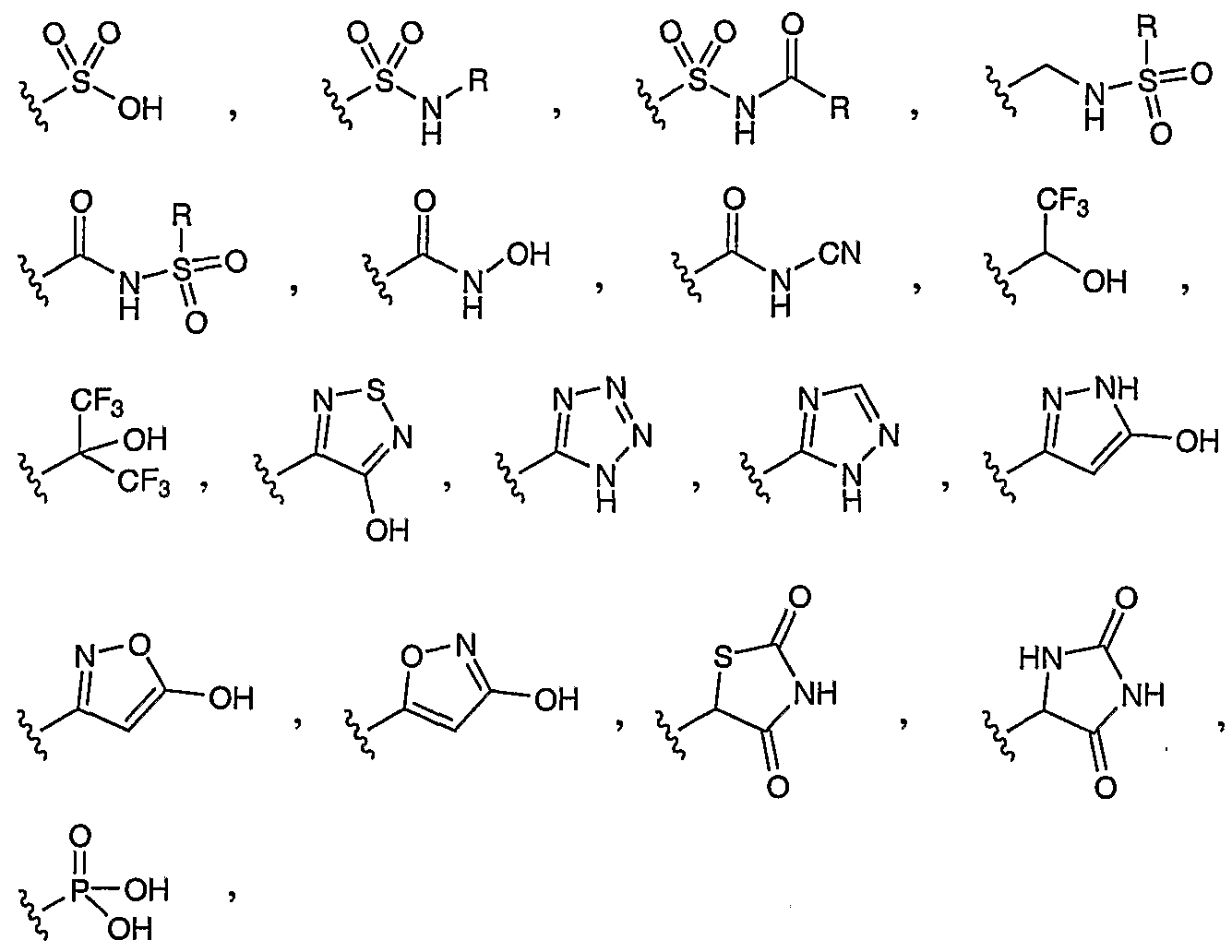
- substituent -CO 2 H includes bioisosteric replacements therefor, such as: and the like.
- Two of the substituents on adjacent atoms of the aryl or heteroaryl ring may optionally be replaced with a substituent of the formula -T-C(O)-(CH 2 ) q -U-, wherein T and U are independently -NH-, -O-, -CH 2 - or a single bond, and q is an integer of from 0 to 2.
- two of the substituents on adjacent atoms of the aryl or heteroaryl ring may optionally be replaced with a substituent of the formula -A-(CH 2 ) r -B-, wherein A and B are independently -CH 2 -, -O-, -NH-, -S-, -S(O)-, -S(O) 2 -, -S(O) 2 NR'- or a single bond, and r is an integer of from 1 to 3.
- One of the single bonds of the new ring so formed may optionally be replaced with a double bond.
- two of the substituents on adjacent atoms of the aryl or heteroaryl ring may optionally be replaced with a substituent of the formula -(CH 2 ) S - X-(CH ) ⁇ , where s and t are independently integers of from 0 to 3, and X is -O-, -NR'-, -S-, - S(O)-, -S(O) 2 -, or -S(O) 2 NR'-.
- the substituent R' in -NR'- and -S(O) 2 NR'- is selected from hydrogen or unsubstituted ( -C ⁇ alkyl.
- salts are meant to include salts of the active compounds which are prepared with relatively nontoxic acids or bases, depending on the particular substituents found on the compounds described herein.
- base addition salts can be obtained by contacting the neutral form of such compounds with a sufficient amount of the desired base, either neat or in a suitable inert solvent.
- pharmaceutically acceptable base addition salts include sodium, potassium, calcium, ammonium, organic amino, or magnesium salt, or a similar salt.
- acid addition salts can be obtained by contacting the neutral form of such compounds with a sufficient amount of the desired acid, either neat or in a suitable inert solvent.
- Examples of pharmaceutically acceptable acid addition salts include those derived from inorganic acids like hydrochloric, hydrobromic, nitric, carbonic, monohydrogencarbonic, phosphoric, monohydrogenphosphoric, dihydrogenphosphoric, sulfuric, monohydrogensulfuric, hydriodic or phosphorous acids and the like, as well as the salts derived from relatively nontoxic organic acids like acetic, propionic, isobutyric, oxalic, maleic, malonic, benzoic, succinic, suberic, fumaric, mandelic, phthalic, benzenesulfonic, p- tolylsulfonic, citric, tartaric, methanesulfonic and the like.
- inorganic acids like hydrochloric, hydrobromic, nitric, carbonic, monohydrogencarbonic, phosphoric, monohydrogenphosphoric, dihydrogenphosphoric, sulfuric, monohydrogensulfuric, hydriodic or phosphorous acids and
- salts of amino acids such as arginate and the like, and salts of organic acids like glucuronic or galactunoric acids and the like (see, for example, Berge et al. (1977) J. Pharm. Sci. 66:1-19).
- Certain specific compounds of the present invention contain both basic and acidic functionalities that allow the compounds to be converted into either base or acid addition salts.
- the neutral forms of the compounds may be regenerated by contacting the salt with a base or acid and isolating the parent compound in the conventional manner.
- the parent form of the compound differs from the various salt forms in certain physical properties, such as solubility in polar solvents, but otherwise the salts are equivalent to the parent form of the compound for the purposes of the present invention.
- the present invention provides compounds which are in a prodrug form.
- Prodrugs of the compounds described herein are those compounds that readily undergo chemical changes under physiological conditions to provide the compounds of the present invention.
- prodrugs can be converted to the compounds of the present invention by chemical or biochemical methods in an ex vivo environment. For example, prodrugs can be slowly converted to the compounds of the present invention when placed in a transdermal patch reservoir with a suitable enzyme or chemical reagent.
- Prodrugs are often useful because, in some situations, they may be easier to administer than the parent drug. They may, for instance, be bioavailable by oral administration whereas the parent drug is not.
- the prodrug may also have improved solubility in pharmacological compositions over the parent drug.
- prodrug derivatives are known in the art, such as those that rely on hydrolytic cleavage or oxidative activation of the prodrug.
- An example, without limitation, of a prodrug would be a compound of the present invention which is administered as an ester (the "prodrug"), but then is metabolically hydrolyzed to the carboxylic acid, the active entity.
- Additional examples include peptidyl derivatives of a compound of the invention.
- Certain compounds of the present invention can exist in unsolvated forms as well as solvated forms, including hydrated forms. In general, the solvated forms are equivalent to unsolvated forms and are intended to be encompassed within the scope of the present invention.
- Certain compounds of the present invention may exist in multiple crystalline or amorphous forms.
- the compounds of the present invention possess asymmetric carbon atoms (optical centers) or double bonds; the racemates, diastereomers, geometric isomers and individual isomers are all intended to be encompassed within the scope of the present invention.
- the compounds of the present invention may also contain unnatural proportions of atomic isotopes at one or more of the atoms that constitute such compounds.
- the compounds may be radiolabeled with radioactive isotopes, such as for example tritium ( 3 H), iodine-125 ( 125 I) or carbon-14 ( 14 C).
- modulate refers to the ability of a compound to increase or decrease the function and/or expression of LXR, where LXR function may include transcription regulatory activity and/or protein-binding. Modulation may occur in vitro or in vivo. Modulation, as described herein, includes antagonism, agonism, partial antagonism and/or partial agonism of a function or characteristic associated with LXR, either directly or indirectly, and/or the upregulation or downregulation of LXR expression, either directly or indirectly.
- Agonists are compounds that, e.g., bind to, stimulate, increase, open, activate, facilitate, enhance activation, activate, sensitize or upregulate signal transduction.
- Antagonists are compounds that, e.g., bind to, partially or totally block stimulation, decrease, prevent, inhibit, delay activation, inactivate, desensitize, or downregulate signal transduction.
- a modulator preferably inhibits LXR function and/or downregulates LXR expression. More preferably, a modulator inhibits or activates LXR function and/or downregulates or upregulates LXR expression. Most preferably, a modulator activates LXR function and/or upregulates LXR expression.
- LXR-mediated condition or disorder refers to a condition or disorder characterized by inappropriate, e.g., less than or greater than normal, LXR activity.
- LXR-mediated condition or disease may be completely or partially mediated by inappropriate LXR functional activity.
- an LXR-mediated condition or disease is one in which modulation of LXR results in some effect on the underlying condition or disorder (e.g., an LXR agonist results in some improvement in patient well-being in at least some patients).
- LXR-responsive condition or "LXR-responsive disorder” refers to a condition or disorder that responds favorably to modulation of LXR activity.
- LXR-responsive condition or disease may be completely or partially responsive to LXR modulation.
- An LXR-responsive condition or disorder may be associated with inappropriate, e.g., less than or greater than normal, LXR activity. Inappropriate LXR functional activity might arise as the result of LXR expression in cells which normally do not express LXR, decreased LXR expression (leading to, e.g., lipid and metabolic disorders and diseases) or increased LXR expression.
- An LXR-responsive condition or disease may include an LXR-mediated condition or disease.
- therapeutically effective amount refers to the amount of the subject compound that will elicit the biological or medical response of a tissue, system, animal or human that is being sought by the researcher, veterinarian, medical doctor or other clinician.
- therapeutically effective amount includes that amount of a compound that, when administered, is sufficient to prevent development of, or alleviate to some extent, one or more of the symptoms of the condition or disorder being treated. The therapeutically effective amount will vary depending on the compound, the disease and its severity and the age, weight, etc., of the mammal to be treated.
- the present invention provides compositions, compounds and methods for modulating LXR function in a cell.
- the compositions which are useful for this modulation will typically be those which contain an effective amount of an LXR-modulating compound.
- an effective amount of an LXR-modulating compound is a concentration of the compound that will produce at 50 percent increase/decrease in LXR activity in a cell-based reporter gene assay, or a biochemical peptide-sensor assay such as the assays described in U.S. Patent Application No. 6,555,326 and U.S. Patent Application Serial No. 09/163,713 (filed September 30, 1998).
- the present invention provides compounds having the formula:
- X represents H, NH 2 , NHR 15 , NHSO 2 R 15 , OH or OR', wherein R 15 is (d- C s )alkyl, (C 3 -C 8 )alkenyl, (C 3 -C 8 )alkynyl, (C 2 -C 8 )heteroalkyl or halo(C !
- R' is (d-C 8 )alkyl, (C 3 -C 8 )alkenyl, (C 3 -C 8 )alkynyl, (C 2 -C 8 )heteroalkyl, halo(d-C 8 )alkyl, aryl(C ⁇ - C 4 )alkyl, heterocyclo(C 5 -C 8 )alkyl, (C ⁇ -C 4 )alkylsulfonyl, arylsulfonyl, (d-C )alkylcarbonyl or (C ⁇ -C 4 )alkylsilyl; and Y is fluoro(C ⁇ -C 4 )alkyl.
- Y is CF 3 .
- R 2 is selected from H, (d-C 8 )alkyl, (C 2 -C 8 )heteroalkyl, (C 3 -C 8 )alkenyl, (C 3 -
- R 16 is independently substituted with from one to three substituents independently selected from halogen, nitro, cyano, hydroxy, oxo and amino; and R is selected from aryl and heteroaryl, the aryl or heteroaryl group being optionally substituted with from one to five substituents independently selected from halogen, cyano, nitro, R 16 , OR 16 , SR 16 , COR 16 , CO 2 R 16 , NHR 16 , N(R 16 ) 2 , CONHR 16 , CON(R 16 ) 2 , NHSO 2 R 16 , NHC(O)R 16 , phenyl, phenyl(C C 8 )alkyl, and phenyl(C 2 -C 8 )heteroalkyl; wherein each R 16 is independently
- n is an integer of from 0 to 3, indicating the presence or absence of substituents on the phenyl ring core of formulas I and II.
- Each of the R 4 substituents is independently selected from halogen, cyano, nitro, R 17 , OR 17 , SR 17 , COR 17 , CO 2 R 17 , N(R 17 ) 2 and CON(R 17 ) 2 , wherein each R 17 is independently selected from H, (d-C 8 )alkyl, (C 3 - C 8 )alkenyl, (C 3 -C 8 )alkynyl, (C -C 8 )heteroalkyl or halo(C_-C 8 )alkyl, or two R 17 groups attached to the same nitrogen atom are combined to form a five- to eight-membered ring.
- X is H or X is OH.
- R 11 is selected from phenyl, pyridyl, pyridazinyl, pyrimidinyl, imidazolyl, thienyl, thiazolyl, oxazolyl, pyrrolyl, pyrazolyl, tetrazolyl, indolyl, benzimidazolyl, benzothienyl and benzothiazolyl, each of these R 11 groups being optionally substituted with from one to five substituents independently selected from halogen, cyano, nitro, (d-C 8 )alkyl, (C 3 -C 8 )alkenyl, (C 3 -C 8 )alkynyl, (C 2 -C 8 )heteroalkyl, halo(C ⁇ -C 8
- Y is CF 3 .
- R 11 is phenyl optionally substituted with from one to two substituents independently selected from the group consisting of halogen, cyano, nitro, (C 1 -C 8 )alkyl, (C 3 -C 8 )alkenyl, (C 3 -C 8 )alkynyl, (C 2 -C 8 )heteroalkyl, halo(C ⁇ -C 8 )alkyl, ⁇ henyl(C ⁇ -C 6 )alkyl, ⁇ henyl(C 2 -C 6 )heteroalkyl and (C ⁇ -C 4 )alkylsulfonyl.
- R 2 , R 3 and R 4 also have certain preferred members.
- R 2 is preferably selected from H, (d-C_)alkyl, (C 3 -C 8 )cycloalkyl and (C 4 -C 8 )cycloalkyl-alkyl, wherein any alkyl portions of R 2 are optionally substituted with from one to three substituents independently selected from halogen, nitro, cyano, hydroxy, oxo and amino.
- R 3 is preferably selected from phenyl, pyridyl, thienyl and thiazolyl, optionally substituted with from one to five substituents independently selected from the group consisting of halogen, cyano, nitro, R 16 , OR 16 , SR 16 , COR 16 , CO 2 R 16 , NHR 16 , N(R 16 ) 2 , CONHR 16 , CON(R 16 ) 2 , NHSO 2 R 16 , NHC(O)R 16 , phenyl, ⁇ henyl(d-C_)alkyl, and phenyl(C 2 -C 8 )heteroalkyl; wherein each R 16 is independently selected from (d-C 8 )a_kyl, (C 3 -C 8 )alkenyl, (C 3 -C 8 )alkynyl, (C 2 -C 8 )heteroalkyl and halo(Ci-C 8 )alkyl, or two
- n is preferably 0, 1, or 2 and each R 4 is preferably selected from halogen, (d-C 8 )alkyl and halo(C 1 -C 8 )alkyl.
- R 11 is pyrazolyl optionally substituted with from one to two substituents independently selected from halogen, cyano, nitro, (d-C 8 )alkyl, (C 3 -C 8 )alkenyl, (C 3 -C 8 )alkynyl, (C 2 -C 8 )heteroalkyl, halo(C 1 -
- R 11 is thienyl optionally substituted with from one to two substituents independently selected from halogen, cyano, nitro, (Ci-C 8 )alkyl, (C 3 -C 8 )alkenyl, (C 3 -C 8 )alkynyl, (C 2 -C_)heteroalkyl, halo(d- C 8 )alkyl, phenyl (d-C ⁇ )alkyl, phenyl (C 2 -C 6 )heteroalkyl and (C ⁇ -C )alkylsulfonyl.
- R 2 , R 3 and R 4 are the same as have been described above for the embodiments in which R 11 is phenyl.
- the most preferred compounds of the present invention are those provided in the Examples below. Some of the compounds of formula I or II may exist as stereoisomers, and the invention includes all active stereoisomeric forms of these compounds. In the case of optically active isomers, such compounds may be obtained from corresponding optically active precursors using the procedures described herein or by resolving racemic mixtures. The resolution may be carried out using various techniques such as chromatography, repeated recrystallization of derived asymmetric salts, or derivatization, which techniques are well known to those of ordinary skill in the art.
- the compounds of the invention may be labeled in a variety of ways.
- the compounds may contain radioactive isotopes such as, for example, H (tritium) and 14 C (carbon-14).
- the compounds may be advantageously joined, covalently or noncovalently, directly or through a linker molecule, to a wide variety of other compounds, which may provide prodrugs or function as carriers, labels, adjuvants, coactivators, stabilizers, etc.
- labeled and joined compounds are contemplated within the present invention.
- pharmaceutical compositions are provided in which a compound of formula I or II is combined with a pharmaceutically acceptable carrier or diluent. Particular compositions and methods for their use are provided in more detail below.
- the present invention provides a method for modulating the action of an LXR receptor, preferably LXR ⁇ , in a cell.
- the cell is contacted with a sufficient concentration of a composition containing a compound of formula I or II for either an agonistic or antagonistic effect to be detected.
- the composition contains an amount of the compound which has been determined to provide a desired therapeutic or prophylactic effect for a given LXR-mediated condition.
- the present invention provides methods for the treatment of pathology such as obesity, diabetes, hypercholesterolemia, atherosclerosis, and hyperlipoproteinemia using pharmaceutical compositions containing compounds of the foregoing description of the general formulas I and II.
- this aspect of the invention involves administering to a patient an effective formulation of one or more of the subject compositions.
- the compound of formula I or II can be administered in combination with other anti-hypercholesterolemic agents (e.g., a bile acid sequestrant, nicotinic acid, fibric acid derivatives or HMG CoA reductase inhibitors), or in combination with other agents that affect cholesterol or lipid metabolism.
- anti-hypercholesterolemic agents e.g., a bile acid sequestrant, nicotinic acid, fibric acid derivatives or HMG CoA reductase inhibitors
- 2-haloaniline (6) is sulfonylated with, for example, an appropriate sulfonyl halide, and subsequently alkylated with an appropriate alkylhalide in the presence of a base such as potassium carbonate, cesium carbonate or sodium hydride in a suitable solvent such as DMF or DMSO to provide compound 7.
- a base such as potassium carbonate, cesium carbonate or sodium hydride in a suitable solvent such as DMF or DMSO
- Halo-substituted arylsulfonamide 7 can be converted into fluoroketone 3 upon treatment with n-butyllithium or t-butyllithium followed by addition of, for example, ethyl trifluoroacetate (8).
- Scheme 3 illustrates the preparation of exemplary organometallic species 4.
- an alkyne (9) can be lithiated with, for example, n-butyllithium in THF, or metalated with isopropylmagnesium bromide in THF.
- R ⁇ ___ MgBr R- ⁇ -H Ap y r .
- n-BuLi R __ Li
- alkynes 9 The preparation of alkynes 9 is illustrated in Scheme 4.
- An alkyl or aryl or heteroaryl halide (10) can be coupled to 2-methyl-3-butyn-2-ol (11) according to the procedure described in Bleicher et al. (1995) Synlett 1115-1116.
- the resulting alcohol 12, can be converted to alkyne 9 using a base such as sodium hydride in a suitable solvent such as toluene according to the procedure described in Havens et al. (1985) J. Org. Chem.
- an alkyl or aryl or heteroaryl halide can be coupled to ethynyltrimethylsilane (13) via a palladium mediated coupling reaction to afford 14 (see, e.g.
- a 3-haloaniline (15) is sulfonylated with, for example, an appropriate sulfonyl halide, and subsequently alkylated with an appropriate alkylhalide in the presence of a base such as potassium carbonate, cesium carbonate or sodium hydride in a suitable solvent such as DMF or DMSO to provide 16.
- a base such as potassium carbonate, cesium carbonate or sodium hydride in a suitable solvent such as DMF or DMSO
- Halo-substituted arylsulfonamide 16 can be converted into fluoroketone 17 by treatment with n-butyllithium or t-butyllithium followed by addition of, for example, ethyl trifluoroacetate (8).
- Treatment of 17 with organometallic species 4 provides 18.
- ethynyl derivative 20 Treatment of 19 with trimethylsilyl-ethynyl lithium followed by tetrabutyl ammonium fluoride in THF affords ethynyl derivative 20.
- Reaction of 20 with an alkyl, aryl or heteroaryl halide using the procedure described in Bleicher et al. (1995) Synlett 1115-1116, or a similar palladium mediated coupling reaction see, e.g., R. C. Larock; Comprehensive Organic Transformations, 2 nd ed., John Wiley & Sons: New York, 1999; pp. 596-599) affords 21.
- alcohol 21 can be alkylated in the presence of a base such as sodium hydride in a suitable solvent such as THF or DMF to give ether 22, or deoxygenated using, e.g., triethylsilane and BF 3 OEt , to give 23.
- a base such as sodium hydride
- a suitable solvent such as THF or DMF
- deoxygenated using, e.g., triethylsilane and BF 3 OEt to give 23.
- Representative compounds and compositions were demonstrated to have pharmacological activity in in vitro and in vivo assays, e.g., they are capable of specifically modulating a cellular physiology to reduce an associated pathology or provide or enhance a prophylaxis.
- Certain preferred compounds and compositions are capable of specifically regulating LXR.
- Compounds may be evaluated in vitro for their ability to activate LXR receptor function using biochemical assays (see U.S. Patent No. 6,555,326 and U.S. Patent Application No. 09/163,713 (filed September 30, 1998)), or in cell-based assays such as that described in Lehmann et al (1997) /. Biol. Chem. 272(6):3137-3140).
- the compounds and compositions can be evaluated for their ability to increase or decrease gene expression modulated by LXR, using western-blot analysis.
- Established animal models to evaluate hypocholesterolemic effects of the compounds are also known in the art.
- compounds disclosed herein can lower cholesterol levels in hamsters fed a high- cholesterol diet, using a protocol similar to that described in Spady et al. (1988) J. Clin. Invest. 81:300), Evans et al. (1994) /. Lipid Res. 35:1634, and Lin et al. (1995) J. Med. Chem. 38:277).
- LXR ⁇ animal models e.g., LXR ⁇ (+/-) and (-/-) mice
- LXR-modulating amount refers to that amount of a compound that is needed to produce a desired effect in any one of the cell-based assays, biochemical assays or animal models described above.
- an LXR- modulating amount of a compound will be at least that amount which exhibits an EC50 in a reporter-gene cell-based assay (relative to an untreated control).
- compositions and compounds of the invention provide methods of using the subject compounds and compositions to treat disease or provide medicinal prophylaxis, to activate LXR receptor function in a cell, to reduce blood cholesterol concentration in a host, to slow down and/or reduce the abnormal cellular proliferation including the growth of tumors, etc. These methods generally involve contacting the cell or cells with or administering to a host an effective amount of the subject compounds or pharmaceutically acceptable compositions.
- the compositions and compounds of the invention and the pharmaceutically acceptable salts or prodrugs thereof can be administered in any effective way such as via oral, parenteral or topical routes.
- the compounds are administered in dosages ranging from about 2 mg up to about 2,000 mg per day, although variations will necessarily occur depending on the disease target, the patient, and the route of administration.
- Preferred dosages are administered orally in the range of about 0.05 mg/kg to about 20 mg kg, more preferably in the range of about 0.05 mg/kg to about 2 mg/kg, most preferably in the range of about 0.05 mg/kg to about 0.2 mg per kg of body weight per day.
- the invention provides the subject compounds combined with a pharmaceutically acceptable excipient such as sterile saline or other medium, water, gelatin, an oil, etc. to form pharmaceutically acceptable compositions.
- compositions and/or compounds may be administered alone or in combination with any convenient carrier, diluent, etc. and such administration may be provided in single or multiple dosages.
- Useful carriers include solid, semi-solid or liquid media including water and non-toxic organic solvents.
- the invention provides the subject compounds in the form of a prodrug, which can be metabolically converted to the subject compound by the recipient host.
- prodrug formulations are known in the art.
- the compositions may be provided in any convenient form including tablets, capsules, lozenges, troches, hard candies, powders, sprays, creams, suppositories, etc. As such the compositions, in pharmaceutically acceptable dosage units or in bulk, may be incorporated into a wide variety of containers.
- dosage units may be included in a variety of containers including capsules, pills, etc.
- the compositions may be advantageously combined and/or used in combination with other hypocholesterolemic therapeutic or prophylactic agents, different from the subject compounds.
- administration in conjunction with the subject compositions enhances the efficacy of such agents.
- Exemplary hypocholesterolemic and/or hypolipemic agents include: bile acid sequestrants such as quaternary amines (e.g.
- cholestyramine and colestipol nicotinic acid and its derivatives
- HMG-CoA reductase inhibitors such as mevastatin, pravastatin, and simvastatin
- gemfibrozil and other fibric acids such as clofibrate, fenofibrate, benzafibrate and cipofibrate
- probucol raloxifene and its derivatives
- the compounds and compositions also find use in a variety of in vitro and in vivo assays, including diagnostic assays. For example, various allotypic LDL receptor gene expression processes may be distinguished in sensitivity assays with the subject compounds and compositions, or panels thereof.
- the invention provides the subject compounds and compositions comprising a detectable label, which may be spectroscopic (e.g. fluorescent), radioactive, etc.
- 1H-NMR spectra were recorded on a Varian Gemini 400 MHz NMR spectrometer. Significant peaks are tabulated and typically include: number of protons, multiplicity (s, singlet; d, doublet; t, triplet; q, quartet; m, multiplet; br s, broad singlet) and coupling constant(s) in Hertz. Electron lonization (El) mass spectra were recorded on a Hewlett Packard 5989A mass spectrometer. Mass spectrometry results are reported as the ratio of mass over charge, followed by the relative abundance of each ion (in parentheses).
- Step A l-Ethynyl-4-methanesuIfonyl-benzene. 2-Methyl-3-butyn-2-ol was coupled to l-bromo-4-methanesulfonyl-benzene according to the procedure described in Bleicher et al. (1995) Synlett 1115-1116.
- Step B N-(3,3,3-Trifluoropropyl)-benzenesulfonamide.
- Step C N-(2-Trifluoroacetyl-phenyl)-N-(3,3,3-trifluoropropyl) benzenesulfonamide.
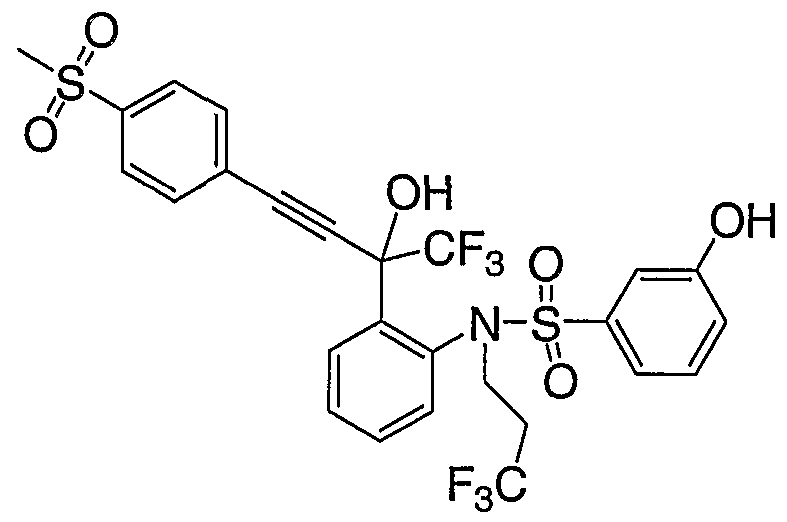
- Step A 3-Nitro-N- ⁇ 2-[l-hydroxy-3-(4-methanesulfonylphenyl)-l-trifluoromethyl- prop-2-ynyl]-phenyl ⁇ -N-(3,3,3-trifluoropropyl)-benzenesulfonamide (2).
- Step A 3- ⁇ itro-N-(3,3,3-trifluoropropyl)-benzenesuIfonamide.
- the title compound was prepared as described in Example 1, Step B.
- Step A N-(2-Bromophenyl)-benzenesulfonamide.
- benzenesulfonyl chloride in 70 mL of dichloromethane at 0 °C was added 11.0 mL (136.0 mmol) of pyridine and 10.0 mL (98%, 86.6 mmol) of 2-bromoaniline sequentially.
- the mixture was allowed to gradually warm up to room temperature overnight (19 h) and diluted with dichloromethane.
- N-Isopropyl-N-(2-trifluoroacetyI-phenyl)-benzenesulfonamide To a solution of 1.0 g (2.8 mmol) of N-(2-bromophenyl)-N-isopropyl-benzenesulfonamide in 30 mL of THF at -78 °C was added 1.18 mL (3.0 mmol) of n-butyllithium (2.5 M solution in hexanes) dropwise. The mixture was stirred for 15 min at -78 °C and 370 ⁇ L (3.1 mmol) of ethyl trifluoroacetate was added in a single portion.
- the resultant mixture was stirred at -78 °C for 35 min, warmed to 0 °C and stirred for an additional 5 min.
- the reaction mixture was quenched with saturated aqueous ammonium chloride and extracted with EtOAc.
- the organic layer was washed with brine, dried over ⁇ a 2 SO 4 , filtered, and the filtrate was concentrated.
- the residue was purified by chromatography on silica gel (hexanes : EtOAc, 9 : 1) to give the title compound.
- Step D N- ⁇ 2-[l-Hydroxy-3-(4-methanesulfonylphenyl)-l-trifluoromethyl-prop-2- ynyI]-phenyl-N-isopropyl-benzenesulfonamide.
- the title compound was prepared as described in Example 1, Step D.
- Example 12 The following compounds were prepared as described in Example 1. The required acetylenes, when not commercially available, were prepared as described in Example 1, Step A. Example 12
- Example 22 4-Chloro-N- ⁇ 2-[l-hydroxy-3-(4-methanesulfonylphenyI)-l- trifluoromethyl-prop-2-ynyI]-phenyl ⁇ -N-(tetrahydrofuran-2-ylmethyI)- benzenesulfonamide (22).
- Example 35 N-[4-(3- ⁇ 2-[(2-Chlorobenzenesulfonyl)-cyclopropylmethy ⁇ amino]-phenyl- 4,4,4-trifluoro-3-hydroxy-but-l-ynyl)-phenyl]-acetamide (35).
- 1H ⁇ MR (CDCI 3 ) ⁇ -0.15- 1.04 (m, 4 H), 1.25 (m, 1 H), 2.18 (s, 3 H), 3.53-4.22 (m, 2 H), 5.94 (s, 1 H), 6.79-6.90 (m, 1 H), 7.11-7.92 (m, 12 H).
- Mass Spectrum (ESI) m/e 577 (M+l).
- Example 39 N- ⁇ 2-[3-Biphen-3-yI-l-hydroxy-l-trifluoromethyl-prop-2-ynyl]-phenyl ⁇ - N-cyclopropylmethyl benzenesulfonamide (39).
- Example 40 N-Cyclopropylmethyl-N-(2- ⁇ l-hydroxy-3-[4-(2-methylpropane-l- sulfonyl)-phenyl]-l-trifluoromethyl-prop-2-ynyl ⁇ -4-methyl-phenyl)-benzenesulfonamide (40).
- Example 44 4- ⁇ 3-[2-(BenzenesulfonyI-cycIopropylmethylamino)-phenyl]-4,4,4- trifluoro-3-hydroxy-but-l-ynyl ⁇ -N-methyl-N-propyl-benzenesulfonamide (44).
- Example 47 4- ⁇ 3-[2-(Benzenesulfonyl-cyclopropylmethylamino)-phenyl]-4,4,4- trifluoro-3-hydroxy-but-l-ynyl ⁇ -N-(2-dimethylamino-ethyl)-N-methyl-benzamide (47).
- Step A N-Cyclopropylmethyl-N-(2-trifluoroacetyl-phenyI)-benzenesulfonamide.
- Step B N-Cyclopropylmethyl-N- ⁇ 2-[l-hydroxy-3-(4-methanesulfonylphenyl)-l- pentafluoroethyl-prop-2-ynyl]-phenyl ⁇ -benzenesuIfonamide.
- the title compound was prepared as described in Example 1, Step D. !
- Step A N-(3-Bromophenyl)-benzenesulfonamide.
- benzenesulfonyl chloride in 75 mL of dichloromethane at 0 °C was added 11.4 mL (141.0 mmol) of pyridine and 10.0 mL (98%, 90.0 mmol) of 3-bromoaniline sequentially.
- the mixture was allowed to gradually warm up to room temperature overnight (17 h) and diluted with dichloromethane.
- Step B N-(3-Bromophenyl)-N-(3,3,3-trifluoropropyl)-benzenesulfonamide.
- ⁇ aH 50% dispersion in oil
- a solution of 4.91 g (15.7 mmol) of N-(3-bromophenyl)-benzenesulfonamide in 8.5 mL of DMF was stirred for 30 min.
- Step C N-(3-Trifluoroacetyl-phenyl)-N-(3,3,3-trifluoropropyI)- benzenesulfonamide.
- N-(3-bromophenyl)-N-(3,3,3- trifluoropropyl)-benzenesulfonamide was added dropwise 416 ⁇ L (1.04 mmol) of n-BuLi (2.5 M solution in hexanes). The mixture was stirred at -78 °C for 10 min.
- Step D N- ⁇ 3-[l-Hydroxy-3-(4-methanesulfonylphenyl)-l-trifluoromethyl-prop-2- ynyl]-phenyl ⁇ -N-(3,3,3-trifluoropropyI)-benzenesulfonamide.
- Example 50 N- ⁇ 3-[l-Hydroxy-3-(4-methanesulfonylphenyl)-l-trifluoromethyl-prop-2- ynyl]-phenyl ⁇ -N-isopropyl-benzenesulfonamide (50).
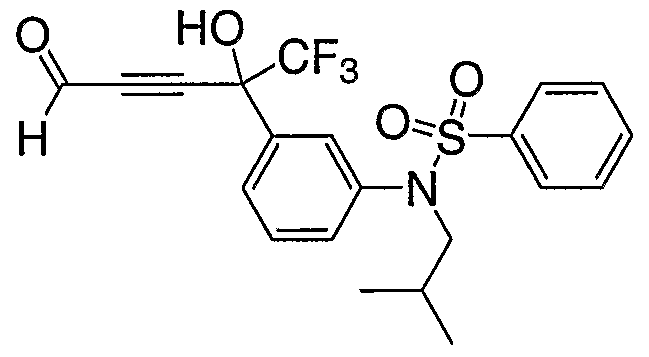
- Example 52 N- ⁇ 3-[l-Hydroxy-3-(3-methanesulfonylphenyl)-l-trifluoromethyl-prop-2- ynyl]-phenyl ⁇ -N-isobutyI-benzenesulfonamide (52).
- Mass Spectrum (ESI) m/e 566 (M+l).
- Example 68 N-Cyclopropylmethyl-N- ⁇ 3-[l-hydroxy-3-(3-methylsulfonyIphenyl)-l- trifluoromethyl-prop-2-ynyl]-phenyl ⁇ -benzenesulfonamide (68).
- 1H ⁇ MR (CDCI 3 ) ⁇ 0.09 (m, 2 H), 0.40 (m, 2 H), 0.85 (m, 1 H), 3.09 (s, 3 H), 3.44 (m, 2 H), 3.48 (s, 1 H), 7.22-8.08 (m, 13 H).
- Mass Spectrum (ESI) m/e 564 (M+l).
- Example 72 4- ⁇ 3-[5-(Benzenesulfonyl-cyclopropylmethylamino)-2-methyl-phenyl]- 4,4,4-trifluoro-3-hydroxy-but-l-ynyl ⁇ -phenyl)-acetamide (72).
- Example 73
Landscapes
- Organic Chemistry (AREA)
- Chemical & Material Sciences (AREA)
- Health & Medical Sciences (AREA)
- Life Sciences & Earth Sciences (AREA)
- Veterinary Medicine (AREA)
- Animal Behavior & Ethology (AREA)
- Chemical Kinetics & Catalysis (AREA)
- General Chemical & Material Sciences (AREA)
- Medicinal Chemistry (AREA)
- Nuclear Medicine, Radiotherapy & Molecular Imaging (AREA)
- Pharmacology & Pharmacy (AREA)
- General Health & Medical Sciences (AREA)
- Public Health (AREA)
- Engineering & Computer Science (AREA)
- Bioinformatics & Cheminformatics (AREA)
- Diabetes (AREA)
- Immunology (AREA)
- Hematology (AREA)
- Communicable Diseases (AREA)
- Tropical Medicine & Parasitology (AREA)
- Obesity (AREA)
- Oncology (AREA)
- Virology (AREA)
- Urology & Nephrology (AREA)
- Vascular Medicine (AREA)
- Pain & Pain Management (AREA)
- Child & Adolescent Psychology (AREA)
- Cardiology (AREA)
- Emergency Medicine (AREA)
- AIDS & HIV (AREA)
- Transplantation (AREA)
- Molecular Biology (AREA)
- Endocrinology (AREA)
- Heart & Thoracic Surgery (AREA)
- Rheumatology (AREA)
- Pharmaceuticals Containing Other Organic And Inorganic Compounds (AREA)
- Acyclic And Carbocyclic Compounds In Medicinal Compositions (AREA)
- Organic Low-Molecular-Weight Compounds And Preparation Thereof (AREA)
- Medicines That Contain Protein Lipid Enzymes And Other Medicines (AREA)
- Furan Compounds (AREA)
Abstract
Description







Claims


Priority Applications (5)
| Application Number | Priority Date | Filing Date | Title |
|---|---|---|---|
| CA002533638A CA2533638A1 (en) | 2003-08-12 | 2004-08-11 | Arylsulfonamidobenzylic compounds |
| EP04780889A EP1660459A2 (en) | 2003-08-12 | 2004-08-11 | Arylsulfonamidobenzylic compounds |
| AU2004264354A AU2004264354A1 (en) | 2003-08-12 | 2004-08-11 | Arylsulfonamidobenzylic compounds |
| JP2006523360A JP2007502291A (en) | 2003-08-12 | 2004-08-11 | Arylsulfonamidobenzyl compounds |
| MXPA06001566A MXPA06001566A (en) | 2003-08-12 | 2004-08-11 | Arylsulfonamidobenzylic compounds. |
Applications Claiming Priority (2)
| Application Number | Priority Date | Filing Date | Title |
|---|---|---|---|
| US49469203P | 2003-08-12 | 2003-08-12 | |
| US60/494,692 | 2003-08-12 |
Publications (2)
| Publication Number | Publication Date |
|---|---|
| WO2005016277A2 true WO2005016277A2 (en) | 2005-02-24 |
| WO2005016277A3 WO2005016277A3 (en) | 2005-06-30 |
Family
ID=34193229
Family Applications (1)
| Application Number | Title | Priority Date | Filing Date |
|---|---|---|---|
| PCT/US2004/026120 Ceased WO2005016277A2 (en) | 2003-08-12 | 2004-08-11 | Arylsulfonamidobenzylic compounds |
Country Status (7)
| Country | Link |
|---|---|
| US (1) | US20060264424A1 (en) |
| EP (1) | EP1660459A2 (en) |
| JP (1) | JP2007502291A (en) |
| AU (1) | AU2004264354A1 (en) |
| CA (1) | CA2533638A1 (en) |
| MX (1) | MXPA06001566A (en) |
| WO (1) | WO2005016277A2 (en) |
Cited By (7)
| Publication number | Priority date | Publication date | Assignee | Title |
|---|---|---|---|---|
| US7432281B2 (en) | 2003-10-07 | 2008-10-07 | Renovis, Inc. | Amide derivatives as ion-channel ligands and pharmaceutical compositions and methods of using the same |
| WO2012033353A2 (en) | 2010-09-07 | 2012-03-15 | 서울대학교 산학협력단 | Sesterterpene compounds and use thereof |
| CN106660976A (en) * | 2014-05-28 | 2017-05-10 | 伯尔尼大学 | Thiazolidinone compounds and their use in the treatment of psychiatric or neurological disorders and inflammation, in particular neuroinflammation |
| WO2017123568A2 (en) | 2016-01-11 | 2017-07-20 | The Rockefeller University | Methods for the treatment of myeloid derived suppressor cells related disorders |
| US10669296B2 (en) | 2014-01-10 | 2020-06-02 | Rgenix, Inc. | LXR agonists and uses thereof |
| US11174220B2 (en) | 2019-12-13 | 2021-11-16 | Inspirna, Inc. | Metal salts and uses thereof |
| US11214536B2 (en) | 2017-11-21 | 2022-01-04 | Inspirna, Inc. | Polymorphs and uses thereof |
Families Citing this family (2)
| Publication number | Priority date | Publication date | Assignee | Title |
|---|---|---|---|---|
| US7576099B2 (en) | 2005-02-28 | 2009-08-18 | Renovis, Inc. | Amide derivatives as ion-channel ligands and pharmaceutical compositions and methods of using the same |
| ES2531399T3 (en) | 2012-05-24 | 2015-03-13 | Purac Biochem Nv | Recovery of carboxylic acid from a mixture of magnesium carboxylate |
Family Cites Families (26)
| Publication number | Priority date | Publication date | Assignee | Title |
|---|---|---|---|---|
| US3281466A (en) * | 1963-12-04 | 1966-10-25 | Herbert C Stecker | Anilide-connected salicylanilide condensation products of fluoroacetone |
| US3495177A (en) * | 1964-11-04 | 1970-02-10 | Us Air Force | Voice signal processing system for multichannel ssb transmitter |
| ES442992A1 (en) * | 1974-12-02 | 1977-08-01 | Scherico Ltd | Para-polyfluoroisopropyl-anilino-2-oxazoline compounds, pharmaceutical compositions and method of treating hypertension |
| US4107303A (en) * | 1976-06-24 | 1978-08-15 | E. I. Du Pont De Nemours And Company | Antihypertensive hexafluorohydroxyisopropyl benzazepines and benzazocines |
| US4251659A (en) * | 1977-12-22 | 1981-02-17 | E. I. Du Pont De Nemours And Company | Polyfluorohydroxyisopropyl-heterocyclic compounds |
| US4218448A (en) * | 1976-06-24 | 1980-08-19 | E. I. Du Pont De Nemours And Company | Antihypertensive polyfluorohydroxyisopropyl bicyclic and tricyclic carbostyrils |
| US4251534A (en) * | 1977-12-22 | 1981-02-17 | E. I. Du Pont De Nemours And Company | Antihypertensive polyfluorohydroxyisopropyl bicyclic and tricyclic carbostyrils |
| US4230635A (en) * | 1978-08-15 | 1980-10-28 | Schering Corporation | Substituted 4'-polyhaloisopropylsulfonanilides |
| DE2839462A1 (en) * | 1978-09-11 | 1980-03-27 | Basf Ag | AROYL UREAS |
| US4199597A (en) * | 1979-05-04 | 1980-04-22 | Schering Corporation | Omega-(4-polyfluoro-2-hydroxy-2-propyl)-2,3,6-substituted-phenoxy and phenylthio)alkanoic acids and compounds related thereto |
| US4267193A (en) * | 1979-05-04 | 1981-05-12 | Schering Corporation | N-substituted-4-(polyfluoro-2-hydroxy-2-propyl)anilines and compounds related thereto |
| US6030991A (en) * | 1993-05-20 | 2000-02-29 | Texas Biotechnology Corp. | Benzenesulfonamides and the use thereof to modulate the activity of endothelin |
| EP1195372A1 (en) * | 1994-04-18 | 2002-04-10 | Mitsubishi Pharma Corporation | N-heterocyclic substituted benzamide derivatives with antihypertensive activity |
| GB9408185D0 (en) * | 1994-04-25 | 1994-06-15 | Fujisawa Pharmaceutical Co | New benzamide derivatives, processes for the preparation thereof and pharmaceutical composition comprising the same |
| US5883106A (en) * | 1994-10-18 | 1999-03-16 | Pfizer Inc. | 5-lipoxygenase inhibitors |
| AU1328197A (en) * | 1995-12-01 | 1997-06-19 | Synaptic Pharmaceutical Corporation | Aryl sulfonamide and sulfamide derivatives and uses thereof |
| US6174905B1 (en) * | 1996-09-30 | 2001-01-16 | Mitsui Chemicals, Inc. | Cell differentiation inducer |
| US5874430A (en) * | 1996-10-02 | 1999-02-23 | Dupont Pharmaceuticals Company | 4,4-disubstitued-1,4-dihydro-2H-3,1-benzoxazin-2-ones useful as HIV reverse transcriptase inhibitors and intermediates and processes for making the same |
| WO1999026616A1 (en) * | 1997-11-25 | 1999-06-03 | Warner-Lambert Company | Benzenesulfonamide inhibitors of pde-iv and their therapeutic use |
| US6191170B1 (en) * | 1998-01-13 | 2001-02-20 | Tularik Inc. | Benzenesulfonamides and benzamides as therapeutic agents |
| US6242493B1 (en) * | 1998-03-13 | 2001-06-05 | Merck Frosst Canada & Co. | Carboxylic acids and acylsulfonamides, compositions containing such compounds and methods of treatment |
| US6197798B1 (en) * | 1998-07-21 | 2001-03-06 | Novartis Ag | Amino-benzocycloalkane derivatives |
| ES2194547T3 (en) * | 1998-09-23 | 2003-11-16 | Tularik Inc | ARILSULFONANILIDA-UREAS. |
| US6201013B1 (en) * | 1998-12-09 | 2001-03-13 | American Home Products Corporation | Heterocyclic carboxamide-containing thiourea inhibitors of herpes viruses containing a substituted phenylenediamine group |
| US6316503B1 (en) * | 1999-03-15 | 2001-11-13 | Tularik Inc. | LXR modulators |
| JP4434744B2 (en) * | 2002-01-30 | 2010-03-17 | アムジェン インコーポレイテッド | Arylsulfonamidobenzyl compounds |
-
2004
- 2004-08-11 EP EP04780889A patent/EP1660459A2/en not_active Withdrawn
- 2004-08-11 JP JP2006523360A patent/JP2007502291A/en not_active Withdrawn
- 2004-08-11 CA CA002533638A patent/CA2533638A1/en not_active Abandoned
- 2004-08-11 WO PCT/US2004/026120 patent/WO2005016277A2/en not_active Ceased
- 2004-08-11 AU AU2004264354A patent/AU2004264354A1/en not_active Abandoned
- 2004-08-11 MX MXPA06001566A patent/MXPA06001566A/en not_active Application Discontinuation
- 2004-08-11 US US10/916,868 patent/US20060264424A1/en not_active Abandoned
Cited By (11)
| Publication number | Priority date | Publication date | Assignee | Title |
|---|---|---|---|---|
| US7432281B2 (en) | 2003-10-07 | 2008-10-07 | Renovis, Inc. | Amide derivatives as ion-channel ligands and pharmaceutical compositions and methods of using the same |
| WO2012033353A2 (en) | 2010-09-07 | 2012-03-15 | 서울대학교 산학협력단 | Sesterterpene compounds and use thereof |
| US10669296B2 (en) | 2014-01-10 | 2020-06-02 | Rgenix, Inc. | LXR agonists and uses thereof |
| CN106660976A (en) * | 2014-05-28 | 2017-05-10 | 伯尔尼大学 | Thiazolidinone compounds and their use in the treatment of psychiatric or neurological disorders and inflammation, in particular neuroinflammation |
| CN106660976B (en) * | 2014-05-28 | 2019-11-26 | 伯尔尼大学 | Thiazolidinone compound and its purposes in treatment spirit or neurological disorder and inflammation, especially neuroinflamation |
| WO2017123568A2 (en) | 2016-01-11 | 2017-07-20 | The Rockefeller University | Methods for the treatment of myeloid derived suppressor cells related disorders |
| US11214536B2 (en) | 2017-11-21 | 2022-01-04 | Inspirna, Inc. | Polymorphs and uses thereof |
| US11174220B2 (en) | 2019-12-13 | 2021-11-16 | Inspirna, Inc. | Metal salts and uses thereof |
| US11459292B2 (en) | 2019-12-13 | 2022-10-04 | Inspirna, Inc. | Metal salts and uses thereof |
| US11878956B2 (en) | 2019-12-13 | 2024-01-23 | Inspirna, Inc. | Metal salts and uses thereof |
| US12258303B2 (en) | 2019-12-13 | 2025-03-25 | Inspirna, Inc. | Metal salts and uses thereof |
Also Published As
| Publication number | Publication date |
|---|---|
| WO2005016277A3 (en) | 2005-06-30 |
| CA2533638A1 (en) | 2005-02-24 |
| US20060264424A1 (en) | 2006-11-23 |
| JP2007502291A (en) | 2007-02-08 |
| AU2004264354A1 (en) | 2005-02-24 |
| EP1660459A2 (en) | 2006-05-31 |
| MXPA06001566A (en) | 2006-05-15 |
Similar Documents
| Publication | Publication Date | Title |
|---|---|---|
| AU2008243261A1 (en) | Arylsulfonamidobenzylic compounds | |
| EP3478677B1 (en) | 1h-pyrazol-1-yl-thiazoles as inhibitors of lactate dehydrogenase and methods of use thereof | |
| US6316503B1 (en) | LXR modulators | |
| US6200995B1 (en) | PPAR-γ modulators | |
| KR102596723B1 (en) | necrosis inhibitor | |
| US7473703B2 (en) | Heterocyclic arylsulfonamidobenzylic compounds | |
| US20040181075A1 (en) | Process of making chalcone derivatives | |
| JP2007532563A5 (en) | ||
| CA2621949A1 (en) | Conformationally constrained 3- (4-hydroxy-phenyl) - substituted-propanoic acids useful for treating metabolic disorders | |
| AU2003208952A1 (en) | Heterocyclic arylsulfonamidobenzylic compounds | |
| JP2007532563A (en) | Arylsulfonamide and sulfonyl compounds as modulators of PPAR and methods of treating metabolic disorders | |
| WO2002040458A1 (en) | Isoxazole derivatives | |
| AU2003210811A1 (en) | Arylsulfonamidobenzylic compounds | |
| WO2005016277A2 (en) | Arylsulfonamidobenzylic compounds | |
| JP2001507001A (en) | Nitromethylthiobenzene derivatives as aldose reductase inhibitors | |
| HK40008389B (en) | 1 h-pyrazol-1 -yl-thiazoles as inhibitors of lactate dehydrogenase and methods of use thereof | |
| MXPA99005879A (en) | Nitromethylthiobenzene derivatives as inhibitors of aldose reductase |
Legal Events
| Date | Code | Title | Description |
|---|---|---|---|
| AK | Designated states |
Kind code of ref document: A2 Designated state(s): AE AG AL AM AT AU AZ BA BB BG BR BW BY BZ CA CH CN CO CR CU CZ DE DK DM DZ EC EE EG ES FI GB GD GE GH GM HR HU ID IL IN IS JP KE KG KP KR KZ LC LK LR LS LT LU LV MA MD MG MK MN MW MX MZ NA NI NO NZ OM PG PH PL PT RO RU SC SD SE SG SK SL SY TJ TM TN TR TT TZ UA UG US UZ VC VN YU ZA ZM ZW |
|
| AL | Designated countries for regional patents |
Kind code of ref document: A2 Designated state(s): GM KE LS MW MZ NA SD SL SZ TZ UG ZM ZW AM AZ BY KG KZ MD RU TJ TM AT BE BG CH CY CZ DE DK EE ES FI FR GB GR HU IE IT LU MC NL PL PT RO SE SI SK TR BF BJ CF CG CI CM GA GN GQ GW ML MR NE SN TD TG |
|
| 121 | Ep: the epo has been informed by wipo that ep was designated in this application | ||
| ENP | Entry into the national phase |
Ref document number: 2533638 Country of ref document: CA |
|
| WWE | Wipo information: entry into national phase |
Ref document number: 2004264354 Country of ref document: AU |
|
| WWE | Wipo information: entry into national phase |
Ref document number: PA/a/2006/001566 Country of ref document: MX |
|
| WWE | Wipo information: entry into national phase |
Ref document number: 2006523360 Country of ref document: JP |
|
| ENP | Entry into the national phase |
Ref document number: 2004264354 Country of ref document: AU Date of ref document: 20040811 Kind code of ref document: A |
|
| WWP | Wipo information: published in national office |
Ref document number: 2004264354 Country of ref document: AU |
|
| WWE | Wipo information: entry into national phase |
Ref document number: 2004780889 Country of ref document: EP |
|
| WWP | Wipo information: published in national office |
Ref document number: 2004780889 Country of ref document: EP |