WO2005018529A2 - Phenoxiacetic acid derivatives - Google Patents

Phenoxiacetic acid derivatives Download PDF

Info

Publication number
WO2005018529A2
WO2005018529A2 PCT/GB2004/003551 GB2004003551W WO2005018529A2 WO 2005018529 A2 WO2005018529 A2 WO 2005018529A2 GB 2004003551 W GB2004003551 W GB 2004003551W WO 2005018529 A2 WO2005018529 A2 WO 2005018529A2
Authority
WO
WIPO (PCT)
Prior art keywords
chloro
phenoxy
phenyl
acetic acid
methylsulfonyl
Prior art date
Legal status (The legal status is an assumption and is not a legal conclusion. Google has not performed a legal analysis and makes no representation as to the accuracy of the status listed.)
Ceased
Application number
PCT/GB2004/003551
Other languages
French (fr)
Other versions
WO2005018529A3 (en
Inventor
Roger Victor Bonnert
Anil Patel
Stephen Thom
Current Assignee (The listed assignees may be inaccurate. Google has not performed a legal analysis and makes no representation or warranty as to the accuracy of the list.)
AstraZeneca UK Ltd
AstraZeneca AB
Original Assignee
AstraZeneca UK Ltd
AstraZeneca AB
Priority date (The priority date is an assumption and is not a legal conclusion. Google has not performed a legal analysis and makes no representation as to the accuracy of the date listed.)
Filing date
Publication date
Priority claimed from SE0302281A external-priority patent/SE0302281D0/en
Priority claimed from GB0412448A external-priority patent/GB0412448D0/en
Priority to DK04768111T priority Critical patent/DK1660431T3/en
Priority to NZ545450A priority patent/NZ545450A/en
Priority to CA2535714A priority patent/CA2535714C/en
Priority to KR1020067003429A priority patent/KR101136175B1/en
Priority to HK06110547.1A priority patent/HK1092777B/en
Priority to US10/569,065 priority patent/US8003703B2/en
Priority to DE602004020356T priority patent/DE602004020356D1/en
Priority to PL04768111T priority patent/PL1660431T3/en
Priority to JP2006523683A priority patent/JP5025264B2/en
Priority to SI200431118T priority patent/SI1660431T1/en
Application filed by AstraZeneca UK Ltd, AstraZeneca AB filed Critical AstraZeneca UK Ltd
Priority to CN2004800250035A priority patent/CN1845894B/en
Priority to AU2004266485A priority patent/AU2004266485B2/en
Priority to MXPA06001954A priority patent/MXPA06001954A/en
Priority to BRPI0413490-7A priority patent/BRPI0413490A/en
Priority to HR20090280T priority patent/HRP20090280T1/en
Priority to EP04768111A priority patent/EP1660431B1/en
Publication of WO2005018529A2 publication Critical patent/WO2005018529A2/en
Publication of WO2005018529A3 publication Critical patent/WO2005018529A3/en
Priority to IL173522A priority patent/IL173522A/en
Anticipated expiration legal-status Critical
Priority to IS8350A priority patent/IS2693B/en
Priority to NO20061290A priority patent/NO20061290L/en
Priority to US13/190,881 priority patent/US8394986B2/en
Ceased legal-status Critical Current

Links

Classifications

    • CCHEMISTRY; METALLURGY
    • C07ORGANIC CHEMISTRY
    • C07CACYCLIC OR CARBOCYCLIC COMPOUNDS
    • C07C317/00Sulfones; Sulfoxides
    • C07C317/26Sulfones; Sulfoxides having sulfone or sulfoxide groups and nitrogen atoms, not being part of nitro or nitroso groups, bound to the same carbon skeleton
    • C07C317/32Sulfones; Sulfoxides having sulfone or sulfoxide groups and nitrogen atoms, not being part of nitro or nitroso groups, bound to the same carbon skeleton with sulfone or sulfoxide groups bound to carbon atoms of six-membered aromatic rings of the carbon skeleton
    • C07C317/34Sulfones; Sulfoxides having sulfone or sulfoxide groups and nitrogen atoms, not being part of nitro or nitroso groups, bound to the same carbon skeleton with sulfone or sulfoxide groups bound to carbon atoms of six-membered aromatic rings of the carbon skeleton having sulfone or sulfoxide groups and amino groups bound to carbon atoms of six-membered aromatic rings being part of the same non-condensed ring or of a condensed ring system containing that ring
    • C07C317/36Sulfones; Sulfoxides having sulfone or sulfoxide groups and nitrogen atoms, not being part of nitro or nitroso groups, bound to the same carbon skeleton with sulfone or sulfoxide groups bound to carbon atoms of six-membered aromatic rings of the carbon skeleton having sulfone or sulfoxide groups and amino groups bound to carbon atoms of six-membered aromatic rings being part of the same non-condensed ring or of a condensed ring system containing that ring with the nitrogen atoms of the amino groups bound to hydrogen atoms or to carbon atoms
    • AHUMAN NECESSITIES
    • A61MEDICAL OR VETERINARY SCIENCE; HYGIENE
    • A61PSPECIFIC THERAPEUTIC ACTIVITY OF CHEMICAL COMPOUNDS OR MEDICINAL PREPARATIONS
    • A61P1/00Drugs for disorders of the alimentary tract or the digestive system
    • AHUMAN NECESSITIES
    • A61MEDICAL OR VETERINARY SCIENCE; HYGIENE
    • A61PSPECIFIC THERAPEUTIC ACTIVITY OF CHEMICAL COMPOUNDS OR MEDICINAL PREPARATIONS
    • A61P1/00Drugs for disorders of the alimentary tract or the digestive system
    • A61P1/04Drugs for disorders of the alimentary tract or the digestive system for ulcers, gastritis or reflux esophagitis, e.g. antacids, inhibitors of acid secretion, mucosal protectants
    • AHUMAN NECESSITIES
    • A61MEDICAL OR VETERINARY SCIENCE; HYGIENE
    • A61PSPECIFIC THERAPEUTIC ACTIVITY OF CHEMICAL COMPOUNDS OR MEDICINAL PREPARATIONS
    • A61P1/00Drugs for disorders of the alimentary tract or the digestive system
    • A61P1/16Drugs for disorders of the alimentary tract or the digestive system for liver or gallbladder disorders, e.g. hepatoprotective agents, cholagogues, litholytics
    • AHUMAN NECESSITIES
    • A61MEDICAL OR VETERINARY SCIENCE; HYGIENE
    • A61PSPECIFIC THERAPEUTIC ACTIVITY OF CHEMICAL COMPOUNDS OR MEDICINAL PREPARATIONS
    • A61P11/00Drugs for disorders of the respiratory system
    • AHUMAN NECESSITIES
    • A61MEDICAL OR VETERINARY SCIENCE; HYGIENE
    • A61PSPECIFIC THERAPEUTIC ACTIVITY OF CHEMICAL COMPOUNDS OR MEDICINAL PREPARATIONS
    • A61P11/00Drugs for disorders of the respiratory system
    • A61P11/06Antiasthmatics
    • AHUMAN NECESSITIES
    • A61MEDICAL OR VETERINARY SCIENCE; HYGIENE
    • A61PSPECIFIC THERAPEUTIC ACTIVITY OF CHEMICAL COMPOUNDS OR MEDICINAL PREPARATIONS
    • A61P13/00Drugs for disorders of the urinary system
    • AHUMAN NECESSITIES
    • A61MEDICAL OR VETERINARY SCIENCE; HYGIENE
    • A61PSPECIFIC THERAPEUTIC ACTIVITY OF CHEMICAL COMPOUNDS OR MEDICINAL PREPARATIONS
    • A61P13/00Drugs for disorders of the urinary system
    • A61P13/08Drugs for disorders of the urinary system of the prostate
    • AHUMAN NECESSITIES
    • A61MEDICAL OR VETERINARY SCIENCE; HYGIENE
    • A61PSPECIFIC THERAPEUTIC ACTIVITY OF CHEMICAL COMPOUNDS OR MEDICINAL PREPARATIONS
    • A61P13/00Drugs for disorders of the urinary system
    • A61P13/12Drugs for disorders of the urinary system of the kidneys
    • AHUMAN NECESSITIES
    • A61MEDICAL OR VETERINARY SCIENCE; HYGIENE
    • A61PSPECIFIC THERAPEUTIC ACTIVITY OF CHEMICAL COMPOUNDS OR MEDICINAL PREPARATIONS
    • A61P17/00Drugs for dermatological disorders
    • AHUMAN NECESSITIES
    • A61MEDICAL OR VETERINARY SCIENCE; HYGIENE
    • A61PSPECIFIC THERAPEUTIC ACTIVITY OF CHEMICAL COMPOUNDS OR MEDICINAL PREPARATIONS
    • A61P17/00Drugs for dermatological disorders
    • A61P17/06Antipsoriatics
    • AHUMAN NECESSITIES
    • A61MEDICAL OR VETERINARY SCIENCE; HYGIENE
    • A61PSPECIFIC THERAPEUTIC ACTIVITY OF CHEMICAL COMPOUNDS OR MEDICINAL PREPARATIONS
    • A61P19/00Drugs for skeletal disorders
    • AHUMAN NECESSITIES
    • A61MEDICAL OR VETERINARY SCIENCE; HYGIENE
    • A61PSPECIFIC THERAPEUTIC ACTIVITY OF CHEMICAL COMPOUNDS OR MEDICINAL PREPARATIONS
    • A61P25/00Drugs for disorders of the nervous system
    • AHUMAN NECESSITIES
    • A61MEDICAL OR VETERINARY SCIENCE; HYGIENE
    • A61PSPECIFIC THERAPEUTIC ACTIVITY OF CHEMICAL COMPOUNDS OR MEDICINAL PREPARATIONS
    • A61P25/00Drugs for disorders of the nervous system
    • A61P25/28Drugs for disorders of the nervous system for treating neurodegenerative disorders of the central nervous system, e.g. nootropic agents, cognition enhancers, drugs for treating Alzheimer's disease or other forms of dementia
    • AHUMAN NECESSITIES
    • A61MEDICAL OR VETERINARY SCIENCE; HYGIENE
    • A61PSPECIFIC THERAPEUTIC ACTIVITY OF CHEMICAL COMPOUNDS OR MEDICINAL PREPARATIONS
    • A61P27/00Drugs for disorders of the senses
    • A61P27/16Otologicals
    • AHUMAN NECESSITIES
    • A61MEDICAL OR VETERINARY SCIENCE; HYGIENE
    • A61PSPECIFIC THERAPEUTIC ACTIVITY OF CHEMICAL COMPOUNDS OR MEDICINAL PREPARATIONS
    • A61P29/00Non-central analgesic, antipyretic or antiinflammatory agents, e.g. antirheumatic agents; Non-steroidal antiinflammatory drugs [NSAID]
    • AHUMAN NECESSITIES
    • A61MEDICAL OR VETERINARY SCIENCE; HYGIENE
    • A61PSPECIFIC THERAPEUTIC ACTIVITY OF CHEMICAL COMPOUNDS OR MEDICINAL PREPARATIONS
    • A61P35/00Antineoplastic agents
    • AHUMAN NECESSITIES
    • A61MEDICAL OR VETERINARY SCIENCE; HYGIENE
    • A61PSPECIFIC THERAPEUTIC ACTIVITY OF CHEMICAL COMPOUNDS OR MEDICINAL PREPARATIONS
    • A61P37/00Drugs for immunological or allergic disorders
    • A61P37/02Immunomodulators
    • A61P37/06Immunosuppressants, e.g. drugs for graft rejection
    • AHUMAN NECESSITIES
    • A61MEDICAL OR VETERINARY SCIENCE; HYGIENE
    • A61PSPECIFIC THERAPEUTIC ACTIVITY OF CHEMICAL COMPOUNDS OR MEDICINAL PREPARATIONS
    • A61P43/00Drugs for specific purposes, not provided for in groups A61P1/00-A61P41/00
    • AHUMAN NECESSITIES
    • A61MEDICAL OR VETERINARY SCIENCE; HYGIENE
    • A61PSPECIFIC THERAPEUTIC ACTIVITY OF CHEMICAL COMPOUNDS OR MEDICINAL PREPARATIONS
    • A61P9/00Drugs for disorders of the cardiovascular system
    • AHUMAN NECESSITIES
    • A61MEDICAL OR VETERINARY SCIENCE; HYGIENE
    • A61PSPECIFIC THERAPEUTIC ACTIVITY OF CHEMICAL COMPOUNDS OR MEDICINAL PREPARATIONS
    • A61P9/00Drugs for disorders of the cardiovascular system
    • A61P9/10Drugs for disorders of the cardiovascular system for treating ischaemic or atherosclerotic diseases, e.g. antianginal drugs, coronary vasodilators, drugs for myocardial infarction, retinopathy, cerebrovascula insufficiency, renal arteriosclerosis
    • CCHEMISTRY; METALLURGY
    • C07ORGANIC CHEMISTRY
    • C07CACYCLIC OR CARBOCYCLIC COMPOUNDS
    • C07C205/00Compounds containing nitro groups bound to a carbon skeleton
    • C07C205/27Compounds containing nitro groups bound to a carbon skeleton the carbon skeleton being further substituted by etherified hydroxy groups
    • C07C205/35Compounds containing nitro groups bound to a carbon skeleton the carbon skeleton being further substituted by etherified hydroxy groups having nitro groups and etherified hydroxy groups bound to carbon atoms of six-membered aromatic rings of the carbon skeleton
    • C07C205/36Compounds containing nitro groups bound to a carbon skeleton the carbon skeleton being further substituted by etherified hydroxy groups having nitro groups and etherified hydroxy groups bound to carbon atoms of six-membered aromatic rings of the carbon skeleton to carbon atoms of the same non-condensed six-membered aromatic ring or to carbon atoms of six-membered aromatic rings being part of the same condensed ring system
    • C07C205/38Compounds containing nitro groups bound to a carbon skeleton the carbon skeleton being further substituted by etherified hydroxy groups having nitro groups and etherified hydroxy groups bound to carbon atoms of six-membered aromatic rings of the carbon skeleton to carbon atoms of the same non-condensed six-membered aromatic ring or to carbon atoms of six-membered aromatic rings being part of the same condensed ring system the oxygen atom of at least one of the etherified hydroxy groups being further bound to a carbon atom of a six-membered aromatic ring, e.g. nitrodiphenyl ethers
    • CCHEMISTRY; METALLURGY
    • C07ORGANIC CHEMISTRY
    • C07CACYCLIC OR CARBOCYCLIC COMPOUNDS
    • C07C255/00Carboxylic acid nitriles
    • C07C255/49Carboxylic acid nitriles having cyano groups bound to carbon atoms of six-membered aromatic rings of a carbon skeleton
    • C07C255/54Carboxylic acid nitriles having cyano groups bound to carbon atoms of six-membered aromatic rings of a carbon skeleton containing cyano groups and etherified hydroxy groups bound to the carbon skeleton
    • CCHEMISTRY; METALLURGY
    • C07ORGANIC CHEMISTRY
    • C07CACYCLIC OR CARBOCYCLIC COMPOUNDS
    • C07C311/00Amides of sulfonic acids, i.e. compounds having singly-bound oxygen atoms of sulfo groups replaced by nitrogen atoms, not being part of nitro or nitroso groups
    • C07C311/01Sulfonamides having sulfur atoms of sulfonamide groups bound to acyclic carbon atoms
    • C07C311/02Sulfonamides having sulfur atoms of sulfonamide groups bound to acyclic carbon atoms of an acyclic saturated carbon skeleton
    • C07C311/08Sulfonamides having sulfur atoms of sulfonamide groups bound to acyclic carbon atoms of an acyclic saturated carbon skeleton having the nitrogen atom of at least one of the sulfonamide groups bound to a carbon atom of a six-membered aromatic ring
    • CCHEMISTRY; METALLURGY
    • C07ORGANIC CHEMISTRY
    • C07CACYCLIC OR CARBOCYCLIC COMPOUNDS
    • C07C311/00Amides of sulfonic acids, i.e. compounds having singly-bound oxygen atoms of sulfo groups replaced by nitrogen atoms, not being part of nitro or nitroso groups
    • C07C311/22Sulfonamides, the carbon skeleton of the acid part being further substituted by singly-bound oxygen atoms
    • C07C311/29Sulfonamides, the carbon skeleton of the acid part being further substituted by singly-bound oxygen atoms having the sulfur atom of at least one of the sulfonamide groups bound to a carbon atom of a six-membered aromatic ring
    • CCHEMISTRY; METALLURGY
    • C07ORGANIC CHEMISTRY
    • C07CACYCLIC OR CARBOCYCLIC COMPOUNDS
    • C07C317/00Sulfones; Sulfoxides
    • C07C317/16Sulfones; Sulfoxides having sulfone or sulfoxide groups and singly-bound oxygen atoms bound to the same carbon skeleton
    • C07C317/22Sulfones; Sulfoxides having sulfone or sulfoxide groups and singly-bound oxygen atoms bound to the same carbon skeleton with sulfone or sulfoxide groups bound to carbon atoms of six-membered aromatic rings of the carbon skeleton
    • CCHEMISTRY; METALLURGY
    • C07ORGANIC CHEMISTRY
    • C07CACYCLIC OR CARBOCYCLIC COMPOUNDS
    • C07C323/00Thiols, sulfides, hydropolysulfides or polysulfides substituted by halogen, oxygen or nitrogen atoms, or by sulfur atoms not being part of thio groups
    • C07C323/50Thiols, sulfides, hydropolysulfides or polysulfides substituted by halogen, oxygen or nitrogen atoms, or by sulfur atoms not being part of thio groups containing thio groups and carboxyl groups bound to the same carbon skeleton
    • C07C323/51Thiols, sulfides, hydropolysulfides or polysulfides substituted by halogen, oxygen or nitrogen atoms, or by sulfur atoms not being part of thio groups containing thio groups and carboxyl groups bound to the same carbon skeleton having the sulfur atoms of the thio groups bound to acyclic carbon atoms of the carbon skeleton
    • C07C323/60Thiols, sulfides, hydropolysulfides or polysulfides substituted by halogen, oxygen or nitrogen atoms, or by sulfur atoms not being part of thio groups containing thio groups and carboxyl groups bound to the same carbon skeleton having the sulfur atoms of the thio groups bound to acyclic carbon atoms of the carbon skeleton with the carbon atom of at least one of the carboxyl groups bound to nitrogen atoms
    • CCHEMISTRY; METALLURGY
    • C07ORGANIC CHEMISTRY
    • C07CACYCLIC OR CARBOCYCLIC COMPOUNDS
    • C07C323/00Thiols, sulfides, hydropolysulfides or polysulfides substituted by halogen, oxygen or nitrogen atoms, or by sulfur atoms not being part of thio groups
    • C07C323/64Thiols, sulfides, hydropolysulfides or polysulfides substituted by halogen, oxygen or nitrogen atoms, or by sulfur atoms not being part of thio groups containing thio groups and sulfur atoms, not being part of thio groups, bound to the same carbon skeleton
    • C07C323/65Thiols, sulfides, hydropolysulfides or polysulfides substituted by halogen, oxygen or nitrogen atoms, or by sulfur atoms not being part of thio groups containing thio groups and sulfur atoms, not being part of thio groups, bound to the same carbon skeleton containing sulfur atoms of sulfone or sulfoxide groups bound to the carbon skeleton
    • CCHEMISTRY; METALLURGY
    • C07ORGANIC CHEMISTRY
    • C07CACYCLIC OR CARBOCYCLIC COMPOUNDS
    • C07C323/00Thiols, sulfides, hydropolysulfides or polysulfides substituted by halogen, oxygen or nitrogen atoms, or by sulfur atoms not being part of thio groups
    • C07C323/64Thiols, sulfides, hydropolysulfides or polysulfides substituted by halogen, oxygen or nitrogen atoms, or by sulfur atoms not being part of thio groups containing thio groups and sulfur atoms, not being part of thio groups, bound to the same carbon skeleton
    • C07C323/67Thiols, sulfides, hydropolysulfides or polysulfides substituted by halogen, oxygen or nitrogen atoms, or by sulfur atoms not being part of thio groups containing thio groups and sulfur atoms, not being part of thio groups, bound to the same carbon skeleton containing sulfur atoms of sulfonamide groups, bound to the carbon skeleton
    • CCHEMISTRY; METALLURGY
    • C07ORGANIC CHEMISTRY
    • C07DHETEROCYCLIC COMPOUNDS
    • C07D215/00Heterocyclic compounds containing quinoline or hydrogenated quinoline ring systems
    • C07D215/02Heterocyclic compounds containing quinoline or hydrogenated quinoline ring systems having no bond between the ring nitrogen atom and a non-ring member or having only hydrogen atoms or carbon atoms directly attached to the ring nitrogen atom
    • C07D215/16Heterocyclic compounds containing quinoline or hydrogenated quinoline ring systems having no bond between the ring nitrogen atom and a non-ring member or having only hydrogen atoms or carbon atoms directly attached to the ring nitrogen atom with hetero atoms or with carbon atoms having three bonds to hetero atoms with at the most one bond to halogen, e.g. ester or nitrile radicals, directly attached to ring carbon atoms
    • C07D215/36Sulfur atoms

Definitions

  • the present invention relates to substituted phenoxyacetic acids as useful pharmaceutical compounds for treating respiratory disorders, pharmaceutical compositions containing them, and processes for their preparation.
  • EPA 1 170 594 discloses methods for the identification of compounds useful for the treatment of disease states mediated by prostaglandin D2, a ligand for orphan receptor CRTH2.
  • GB 1356834 discloses a series of compounds said to possess anti-inflammatory, analgesic and antipyretic activity. It has been found that certain phenoxyacetic acids are active at the CRTH2 receptor, and as a consequence are expected to be potentially useful for the treatment of various respiratory diseases, including asthma and COPD.
  • the invention therefore provides a method of treatment of human diseases or conditions in which modulation of CRTh2 receptor activity is beneficial, which comprises administering to a patient a compound of formula (I), or a pharmaceutically acceptable salt or solvate thereof:
  • W is O, S(O) n (where n is 0, 1 or 2), NR 15 , CR ! OR 2 or CR R 2
  • X is hydrogen, halogen, cyano, nitro, S(O) n R 6 , OR 12 or C 1-6 alkyl which may be substituted by one or more halogen atoms;
  • Y is selected from hydrogen, halogen, CN, nitro, SO 2 R 3 , OR 4 , SR 4 , SOR 3 , SO 2 NR 4 R 5 , CONR 4 R 5 , NR 4 R 5 , NR 6 SO 2 R 3 , NR 6 CO 2 R 6 , NR 6 COR 3 , C 2 -C 6 alkenyl, C 2 -C 6 alkynyl, C 3 -C 7 cycloalkyl or C 1-6 alkyl, the latter four groups being optionally substituted by one or more substituents independently selected from halogen, OR and NR R , S(O) n R where n is O, l or 2;
  • Z is aryl or heteroaryl, optionally substituted by one or more substituents independently selected from from hydrogen, halogen, CN, OH, SH, nitro, CO 2 R 6 , SO 2 R 9 , OR 9 , SR 9 , SOR 9 , SO 2 NR 10 R ⁇ , CONR 10 R ⁇ , NR 10 R ⁇ , NHSO 2 R 9 , NR 9 SO 2 R 9 , NR 6 CO 2 R 6 , NHCOR 9 , NR 9 COR 9 , aryl, heteroaryl, C 2 -C 6 alkenyl, C 2 -C 6 alkynyl, C 3 -C cycloalkyl or C 1-6 alkyl, the latter four groups being optionally substituted by one or more substituents independently selected from halogen, C 3 -C 7 cycloalkyl, OR 6 , NR 6 R 7 , S(O) n R 6 (where n is 0, 1 or 2), CONR 6 R 7
  • R and R independently represent a hydrogen atom, halogen, C 2 -C 6 alkenyl, C 2 -C 6 alkynyl, C 3 -C 7 cycloalkyl or a d- ⁇ alkyl group, the latter four groups being optionally substituted by one or more substituents independently selected from halogen, C 3 -C 7 cycloalkyl, NR 6 R 7 , OR 6 , S(O)URIR 6 (where n is 0, 1 or 2);
  • R and R together can form a 3-8 membered ring optionally containing one or more atoms selected from O, S, NR and itself optionally substituted by one or more Ci-C 3 alkyl or halogen;
  • R 6 and R 7 independently represents a hydrogen atom or C C 6 alkyl;
  • R 8 is hydrogen, C 4 alkyl, -COC 1 -C 4 alkyl, CO 2 C 1 -C 4 alkyl, SO 2 R 6 or CONR 6 C 1 -C 4 alkyl;
  • R represents a hydrogen atom or C 1-6 alkyl which may be substituted by one or more halogen atoms
  • R 15 represents a hydrogen atom, Ci-C ⁇ alkyl, SO 2 R 6 or COR 6 .
  • aryl examples include phenyl and naphthyl.
  • Heteroaryl is defined as a 5-7 membered aromatic ring or can be a 6,6- or 6,5-fused bicyclic ring, all optionally containing one or more heteroatoms selected from N, S and O.
  • Examples include pyridine, pyrimidine, thiazole, oxazole, pyrazole, imidazole, furan, isoxazole, pyrrole, isothiazole and azulene, naphthyl, indene, quinoline, isoquinoline, indole, indolizine, benzo[b] furan, benzo[b]thiophene, lH-indazole, benzimidazole, benzthiazole, benzoxazole, purine, 4H-quinolizine, cinnoline, phthalazine, quinazoline, quinoxaline, 1,8-naphthyridine, pteridine and quinolone.
  • Aryl or heteroaryl groups can be optionally substituted by one or more substituents independently selected from hydrogen, halogen, CN, OH, SH, nitro, CO 2 R 6 , SO R 9 , OR 9 , SR 9 , SOR 9 , SO 2 NR 10 R ⁇ , CONR 10 R ⁇ , NR 10 R ⁇ , NHSO 2 R 9 , NR 9 SO 2 R 9 , NR 6 CO 2 R 6 , NHCOR 9 , NR 9 COR 9 , aryl, heteroaryl, C 2 -C 6 alkenyl, C 2 -C 6 alkynyl, C 3 -C 7 cycloalkyl or C 1-6 alkyl, the latter four groups being optionally substituted by one or more substituents independently selected from halogen, C 3 -C 7 cycloalkyl, OR 6 , NR 6 R 7 , S(O) n R 6 (where n is 0, 1 or 2), CONR 6 R 7 ,
  • an alkyl or alkenyl group or an alkyl or alkenyl moiety in a substituent group may be linear or branched.
  • Heterocyclic rings as defined for R 4 , R 5 and R 10 and R 11 means saturated heterocycles, examples include morpholine, azetidine, pyrrolidine, piperidine and piperazine.
  • Certain compounds of formula (I) are capable of existing in stereoisomeric forms. It will be understood that the invention encompasses all geometric and optical isomers of the compounds of formula (I) and mixtures thereof including racemates. Tautomers and mixtures thereof also form an aspect of the present invention.
  • W is O, S(O) n (where n is 0, 1 or 2), CR R 2 or NR 15 where R 15 is hydrogen or methyl.
  • W is O, CH 2 or NR 15 where R 15 is hydrogen or methyl.
  • W is O, CH or NH.
  • W is O.
  • X is halogen, in particular fluoro and chloro, or C 1-2 alkyl optionally substituted with one or more halogen atoms, such as CF 3 .
  • X is fluoro, chloro or trifluoromethyl.
  • X is fluoro or chloro.
  • Y is hydrogen, halogen, in particular fluoro and chloro or C 1-6 alkyl, such as methyl.
  • Y is hydrogen or halogen, in particular fluoro and chloro. Even more preferably Y is hydrogen.
  • Z is phenyl, pyridyl or pyrimidyl, optionally substituted as defined above, more preferably Z is phenyl optionally substituted as defined above.
  • Preferred substituents for all Z groups include those substituents exemplified herein, in particular halogen, CN, C 1-3 alkyl optionally substituted with one or more halogen atoms, SO 2 R 9 , OR 9 , SR 9 , SOR 9 , SO 2 NR 10 R ⁇ , CONR 10 R ⁇ , NHSO 2 R 9 , NR 9 SO 2 R 9 , NHCOR 9 or NR 9 COR 9 .
  • R 9 is methyl or ethyl.
  • substituents for all Z groups include halogen, in particular fluoro and chloro, C 1-3 alkyl optionally substituted with one or more halogen atoms, SO 2 R 9 ,
  • Z is phenyl substituted by one or two substituents, preferably the substituent in the 4-position is selected from SO 2 R 9 , SO 2 NR 10 R n , NHSO 2 R 9 or NR 9 SO 2 R 9 .
  • R 9 is methyl or ethyl.
  • R 10 andR 11 are both methyl.
  • Z is phenyl substituted by two substituents, preferably the substituent in the 4-position is selected from SO 2 R 9 , SO 2 NMe 2 , NHSO 2 R 9 or NR 9 SO 2 R 9 where R 9 is methyl or ethyl and the sustituent in the 2- or 3-position is selected from fluoro, chloro or C 1-3 alkyl optionally substituted with one or more halogen atoms.
  • R and R are independently hydrogen or C 1-3 alkyl.
  • R 1 and R 2 are independently hydrogen or methyl. 1 9
  • R is alkyl and R is hydrogen in the acid chain
  • the S-isomer is preferred
  • Preferred compounds of formula (I) include those compounds exemplified herein, both in free base form as well as pharmaceutically acceptable salts and solvates thereof.
  • the invention provides a sub-set of compounds of formula (I), i.e. compounds of formula (IA) or pharmaceutically acceptable salts or solvates thereof:
  • W is O, CH 2 , S(O) n (where n is 0, 1 or 2) or NR 15 where R 15 is hydrogen or methyl;
  • X is halogen or C 1-6 alkyl which may be substituted by one or more halogen atoms;
  • Y is hydrogen, halogen or C 1-6 alkyl
  • Z is phenyl, pyridyl or pyrimidyl each optionally substituted by one or more substituents independently selected from from halogen, CN, C 1-3 alkyl optionally substituted with one or more halogen atoms, SO 2 R 9 , OR 9 , SR 9 , SOR 9 , SO 2 NR 10 R ⁇ , CONR 10 R ⁇ , NHSO 2 R 9 , NR 9 SO 2 R 9 , NHCOR 9 , NR 9 COR 9 ;
  • R 1 and R 2 independently represent hydrogen or C 1-6 alkyl
  • R and R independently represent hydrogen atom or C 1-6 alkyl
  • R 8 is hydrogen, - 4 alkyl, -COC ⁇ -C 4 alkyl, CO 2 C 1 -C 4 alkyl, SO 2 R 6 or CONR 6 C 1 -C 4 alkyl;
  • R > 9 is C 1-6 alkyl optionally substituted by halogen
  • R 10 and R 11 independently represent hydrogen or C 1-6 alkyl, provided that: • the compounds 2-[4-methyl-2-(benzyl)phenoxy]acetic acid, 2-[4-chloro-2- (benzyl)phenoxy]propanopic acid, 2-[4-bromo-2-(4- chlorophenoxy)phenoxy]propanopic acid and 2-[4-chloro-2-(4- chlorophenoxy)phenoxy]propanopic acid are excluded; • when X is fluoro and W is S, then Z is not 5-fluoro-2-hydroxyphenyl, • when X is chloro, Y is 3 -methyl, R 1 and R 2 are both hydrogen and W is CH 2 , then Z is not phenyl.
  • W is O, CH 2 , S(O) n (where n is 0, 1 or 2) or NR 15 where R 15 is hydrogen or methyl.
  • W is O, S, CH 2 , NH or NMe, more preferably W is O, CH 2 or NH, even more preferably W is O or NH, most preferably W is O.
  • R 1 and R 2 are independently hydrogen or methyl. More preferably R 1 and R 2 are both hydrogen or one is hydrogen and the other is methyl.
  • X is halogen, in particular fluoro and chloro, or C 1-2 alkyl optionally substituted with one or more halogen atoms, such as CF 3 .
  • X is fluoro, chloro or trifluoromethyl.
  • X is fluoro or chloro.
  • Y is hydrogen, halogen, in particular fluoro and chloro or C 1-6 alkyl, such as methyl.
  • Y is hydrogen or halogen, in particular fluoro and chloro.
  • Y is hydrogen
  • Z is phenyl substituted by two substituents, preferably the substituent in the
  • 4- ⁇ osition is selected from SO 2 R 9 , SO 2 NR 10 R n , NHSO 2 R 9 or NR 9 SO 2 R 9 and the sustituent in the 2- or 3-position is selected from fluoro, chloro or C 1-3 alkyl optionally substituted with one or more halogen atoms.
  • R 9 is methyl or ethyl.
  • R 10 andR 11 are both methyl.
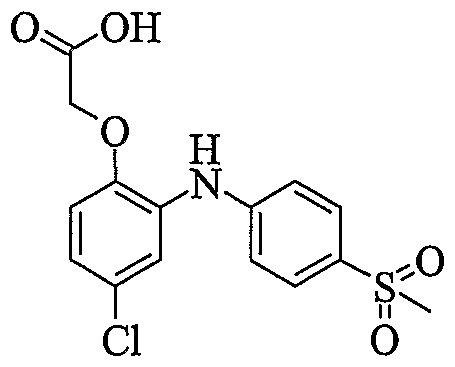
  • Preferred compounds of formula (IA) include: [4-Chloro-2-[[4-(ethylsulfonyl)phenyl]thio]phenoxy]- acetic acid, [4-Chloro-2-[[4-(ethylsulfonyl)-2-methylphenyl]thio]phenoxy]- acetic acid, [4-Chloro-2-[4-(ethylsulfonyl)phenoxy]phenoxy]- acetic acid, [4-Chloro-2-[[4-(methylsulfonyl)phenyl]amino]phenoxy]- acetic acid,
  • the compound of formula (I) above maybe converted to a pharmaceutically acceptable salt or solvate thereof, preferably a basic addition salt such as sodium, potassium, calcium, aluminium, lithium, magnesium, zinc, benzathine, chloroprocaine, choline, tert- butylamine, diethanolamine, ethanolamine, ethyldiamine, meglumine, tromethamine or procaine, or an acid addition salt such as a hydrochloride, hydrobromide, phosphate, acetate, fumarate, maleate, tartrate, citrate, oxalate, methanesulphonate o ⁇ p- toluenesulphonate.
  • a basic addition salt such as sodium, potassium, calcium, aluminium, lithium, magnesium, zinc, benzathine, chloroprocaine, choline, tert- butylamine, diethanolamine, ethanolamine, ethyldiamine, meglumine, tromethamine or procaine
  • R and R are as defined in formula (I) or are protected derivatives thereof, R is H or C t -Cio alkyl group and L is a leaving group, and optionally thereafter in any order: • removing any protecting group • hydrolysing the ester group R to the corresponding acid • oxidation of sulphides to sulphoxides or sulphones • forming a pharmaceutically acceptable salt.
  • the reaction can be carried out in a suitable solvent such as DMF using a base such as potassium carbonate or the like.
  • Suitable groups R 13 include C 1-6 alkyl groups such as methyl, ethyl or tert-butyl.
  • Suitable L is a leaving group such as halo, in particular chlorine or bromine. L may also be hydroxy so that a Mitsunobu reaction may be performed with compound (II) using for example triphenylphosphine and diethyl azodicarboxylate.
  • Hydrolysis of the ester group R 13 can be carried out using routine procedures, for example treatment of methyl and ethyl esters with aqueous sodium hydroxide, and treatment of tert-butyl esters with acids such as trifluoroacetic acid.
  • R 14 is H or a suitable protecting group, for example benzyl, L 1 is iodide, bromide, chloride, fluoride or activated alcohol such as triflate.
  • the reaction can be carried out in a suitable solvent such as l-methyl-2-pyrrolidinone with a base such as potassium carbonate, preferably at elevated temperatures.
  • a suitable solvent such as l-methyl-2-pyrrolidinone
  • a base such as potassium carbonate
  • the reaction may also be catalysed with palladium or copper catalysts.
  • Preferred intermediates of formula (V) include 3-Chloro-4-fluorophenyl methyl sulfone, 3-Chloro-4-fluorophenyl ethyl sulfone
  • a compound of formula (VI) may be formed by the reaction of a compound of formula (VII) with a compound of formula (V).
  • X, Y are as defined in formula (I) or are protected derivatives thereof, W is defined as CT ⁇ OR 2 or CR ⁇ 2 , R 13 is as defined in formula (IV), E is hydrogen or halogen and M is a metal such as Na or Li.
  • the reaction is performed at -78°C in THF, then quenched with an elecfrophile such as (X) or (XI).
  • the protecting group R 14 may then be removed
  • reaction in which X, Y, R and R are as defined in formula (I) or are protected derivatives thereof,
  • a suitable solvent such as l-methyl-2-pyrrolidinone with a base such as potassium carbonate, preferably at elevated temperatures.
  • the reaction can be carried out in a suitable solvent such as ethylene glycoldimethylether with a base such as sodium carbonate and a palladium catalyst, preferably at elevated temperatures.
  • a suitable solvent such as ethylene glycoldimethylether
  • a base such as sodium carbonate and a palladium catalyst
  • XVI) (XVII) (XVIII) in which X, Y, R 1 , R 2 , R 13 , R 14 , Z and W are as defined as above or are protected derivatives thereof, G is halogen, triflate or boronic acid.
  • the reaction can be carried out in a suitable solvent such as iso-propanol with a base such as potassium carbonate and a metal catalyst, such as copper, preferably at elevated temperatures.
  • the present invention provides the use of a novel compound of formula (I)/(IA), and pharmaceutically acceptable salt or solvate thereof for use in therapy.
  • the compounds of formula (I) have activity as pharmaceuticals, in particular as modulators of CRTh2 receptor activity, and may be used in the treatment (therapeutic or prophylactic) of conditions/diseases in human and non-human animals which are exacerbated or caused by excessive or unregulated production of PGD 2 and its metabolites.
  • conditions/diseases include:
  • asthma respiratory tract
  • obstructive diseases of the airways including: asthma, including bronchial, allergic, intrinsic, extrinsic, exercise-induced, drug-induced (including aspirin and NSAID-induced) and dust-induced asthma, both intermittent and persistent and of all severities, and other causes of airway hyper-responsiveness ; chronic obstructive pulmonary disease (COPD) ; bronchitis , including infectious and eosinophilic bronchitis; emphysema; bronchiectasis; cystic fibrosis; sarcoidosis; farmer's lung and related diseases; hypersensitivity pneumonitis; lung fibrosis, including cryptogenic fibrosing alveolitis, idiopathic interstitial pneumonias, fibrosis complicating anti-neoplastic therapy and chronic infection, including tuberculosis and aspergillosis and other fungal infections; complications of lung transplantation; vasculitic and thrombotic disorders of
  • osteoarthritides associated with or including osteoarthritis/osteoarthrosis, both primary and secondary to e.g. congenital hip dysplasia; cervical and lumbar spondylitis, and low back and neck pain; rheumatoid arthritis and Still's disease; seronegative spondyloarthropathies including ankylosing spondylitis, psoriatic arthritis, reactive arthritis and undifferentiated spondarthropathy; septic arthritis and other infection-related arthopathies and bone disorders such as tuberculosis, including Potts' disease and Poncet's syndrome; acute and chronic crystal-induced synovitis including urate gout, calcium pyrophosphate deposition disease, and calcium apatite related tendon, bursal and synovial inflammation; Behcet's disease; primary and secondary Sjogren's syndrome; systemic sclerosis and limited scleroderma; systemic lupus erythematosus, mixed
  • hepatitis including autoimmune, alcoholic and viral; fibrosis and cirrhosis of the liver; cholecystitis; pancreatitis, both acute and chronic.
  • nephritis including interstitial and glomerulonephritis; nephrotic syndrome; cystitis including acute and chronic (interstitial) cystitis and Hunner's ulcer; acute and chronic urethritis, prostatitis, epididymitis, oophoritis and salpingitis; vulvo-vaginitis; Peyronie's disease; erectile dysfunction (both male and female).
  • AUograft rejection acute and chronic following, for example, transplantation of kidney, heart, liver, lung, bone marrow, skin or cornea or following blood transfusion; or chronic graft versus host disease;
  • (9) (CNS) Alzheimer's disease and other dementing disorders including CJD and nvCJD; amyloidosis; multiple sclerosis and other demyelinating syndromes; cerebral atherosclerosis and vascuhtis; temporal arteritis; myasthenia gravis; acute and chronic pain (acute, intermittent or persistent, whether of central or peripheral origin) including visceral pain, headache, migraine, trigeminal neuralgia, atypical facial pain, joint and bone pain, pain arising from cancer and tumor invasion, neuropathic pain syndromes including diabetic, post-herpetic, and HlV-associated neuropathies; neurosarcoidosis; central and peripheral nervous system complications of malignant, infectious or autoimmune processes.
  • the present invention provides a compound of formula (IA), or a pharmaceutically- acceptable salt or solvate thereof, as hereinbefore defined for use in therapy.
  • the compounds (I)/(IA) of the invention are used to treat diseases in which the chemokine receptor belongs to the CRTh2 receptor subfamily.
  • Particular conditions which can be treated with the compounds of the invention are asthma, rhinitis and other diseases in which raised levels of PGD 2 or its metabolites. It is prefened that the compounds of the invention are used to treat asthma or rhinitis.
  • the present invention provides the use of a compound of formula ( ⁇ )/(IA), or a pharmaceutically acceptable salt or solvate thereof, as hereinbefore defined in the manufacture of a medicament for use in therapy.
  • the invention further relates to combination therapies wherein a compound of formula (1)/(IA) or a pharmaceutically acceptable salt, solvate or in vivo hydrolysable ester thereof, or a pharmaceutical composition or formulation comprising a compound of formula (1)/(IA) is administered concurrently or sequentially or as a combined preparation with another therapeutic agent or agents, for the treatment of one or more of the conditions listed .
  • tumour necrosis factor alpha (TNF- ⁇ ) inhibitors such as anti-TNF monoclonal antibodies (for example Remicade, CDP-870 and adalimumab) and TNF receptor immunoglobulin molecules (such as Enbrel); non- selective cyclo-oxygenase (COX)-l / COX-2 inhibitors whether applied topically or systemically (such as piroxicam, diclofenac, propionic acids such as naproxen, flubiprofen, fenoprofen, ketoprofen and ibuprofen, fenamates such as mefenamic acid, indomethacin, sulindac, azapropazone, pyrazolones such as phenylbutazone, s
  • the present invention still further relates to the combination of a compound of the invention together with a leukotriene biosynthesis inhibitor, 5-lipoxygenase (5-LO) inhibitor or 5-lipoxygenase activating protein (FLAP) antagonist such as; zileuton; ABT- 761; fenleuton; tepoxalin; Abbott-79175; Abbott-85761; N-(5-substituted)-thiophene-2- alkylsulfonamides; 2,6-di-tert-butylphenol hydrazones; methoxytetrahydropyrans such as Zeneca ZD-2138; the compound SB-210661; pyridinyl-substituted 2-cyanonaphthalene compounds such as L-739,010; 2-cyanoquinoline compounds such as L-746,530; indole and quinoline compounds such as MK-591, MK-886, and BAY x 1005.
  • the present invention still further relates to the combination of a compound of the invention together with a receptor antagonist for leukotrienes( LT)B4, LTC4, LTD4, and LTE4.
  • a receptor antagonist for leukotrienes( LT)B4, LTC4, LTD4, and LTE4 selected from the group consisting of the phenothiazin-3-ls such as L-651,392; amidino compounds such as CGS-25019c; benzoxalamines such as ontazolast; benzenecarboximidamides such as BILL 284/260; and compounds such as zafirlukast, ablukast, montelukast, pranlukast, verlukast (MK-679), RG-12525, Ro-245913, iralukast (CGP 45715A), and BAY x 7195.
  • a receptor antagonist for leukotrienes( LT)B4, LTC4, LTD4, and LTE4.
  • the present invention still further relates to the combination of a compound of the invention together with a phosphodiesterase (PDE) inhibitor such as the methylxanthanines including theophylline and aminophylline; and selective PDE isoenzyme inhibitors including PDE4 inhibitors and inhibitors of the isoform PDE4D, and inhibitors of PDE5.
  • PDE phosphodiesterase
  • the present invention still further relates to the combination of a compound of the invention together with histamine type 1 receptor antagonists such as cetirizine, loratadine, desloratadine, fexofenadine, acrivastine, terfenadine, astemizole, azelastine, levocabastine, chlorpheniramine, promethazine, cyclizine, and mizolastine applied orally, topically or parenterally.
  • histamine type 1 receptor antagonists such as cetirizine, loratadine, desloratadine, fexofenadine, acrivastine, terfenadine, astemizole, azelastine, levocabastine, chlorpheniramine, promethazine, cyclizine, and mizolastine applied orally, topically or parenterally.
  • histamine type 1 receptor antagonists such as cetirizine, loratadine, deslorat
  • the present invention still further relates to the combination of a compound of the invention with antagonists of the histamine type 4 receptor.
  • the present invention still further relates to the combination of a compound of the invention together with an alpha- l/alpha-2 adrenoceptor agonist vasoconstrictor sympathomimetic agent, such as propylhexedrine, phenylephrine, phenylpropanolamine, ephedrine, pseudoephedrine, naphazoline hydrochloride, oxymetazoline hydrochloride, tefrahydrozoline hydrochloride, xylometazoline hydrochloride, tramazoline hydrochloride, and ethylnorepinephrine hydrochloride.
  • an alpha- l/alpha-2 adrenoceptor agonist vasoconstrictor sympathomimetic agent such as propylhexedrine, phenylephrine, phenylpropanolamine, ephedrine, pseudoephedrine, naphazoline hydrochloride, oxymetazo
  • the present invention still further relates to the combination of a compound of the invention together with anticholinergic agents including muscarinic receptor (Ml, M2, and M3) antagonists such as atropine, hyoscine, glycpynrolate, ipratropium bromide; tiotropium bromide; oxitropium bromide; pirenzepine; and telenzepine.
  • Ml, M2, and M3 antagonists such as atropine, hyoscine, glycpynrolate, ipratropium bromide; tiotropium bromide; oxitropium bromide; pirenzepine; and telenzepine.
  • the present invention still further relates to the combination of a compound of the invention together with a beta-adrenoceptor agonist (including beta receptor subtypes 1-4) such as isoprenaline, salbutamol, formoterol, salmeterol, terbutaline, orciprenaline, bitolterol mesylate, and pirbuterol .
  • a beta-adrenoceptor agonist including beta receptor subtypes 1-4
  • beta receptor subtypes 1-4 such as isoprenaline, salbutamol, formoterol, salmeterol, terbutaline, orciprenaline, bitolterol mesylate, and pirbuterol .
  • the present invention still further relates to the combination of a compound of the invention together with a chromone, including sodium cromoglycate and nedocromil sodium.
  • the present invention still further relates to the combination of a compound of the invention together with an insulin-like growth factor type I (IGF-1) mimetic.
  • IGF-1 insulin-like growth factor type I
  • the present invention still further relates to the combination of a compound of the invention together with an inhaled glucocorticoid, such as flunisolide, triamcinolone acetonide, beclomethasone dipropionate, budesonide, fluticasone propionate, ciclesonide, and mometasone furoate.
  • an inhaled glucocorticoid such as flunisolide, triamcinolone acetonide, beclomethasone dipropionate, budesonide, fluticasone propionate, ciclesonide, and mometasone furoate.
  • the present invention still further relates to the combination of a compound of the invention together with an inhibitor of matrix metalloproteases (MMPs), i.e., the stromelysins, the collagenases, and the gelatinases, as well as aggrecanase; especially collagenase-1 (MMP-1), collagenase-2 (MMP-8), collagenase-3 (MMP-13), stromelysin-1 (MMP-3), stromelysin-2 (MMP-10), and stromelysin-3 (MMP-11) and MMP-9 and MMP-12.
  • MMPs matrix metalloproteases
  • the present invention still further relates to the combination of a compound of the invention together with modulators of chemokine receptor function such as antagonists of CCRl, CCR2, CCR2A, CCR2B, CCR3, CCR4, CCR5, CCR6, CCR7, CCR8, CCR9,
  • CCR10 and CCRl 1 for the C-C family
  • CXCRl, CXCR2, CXCR3, CXCR4 and CXCR5 for the C-X-C family
  • CX 3 CR1 for the C-X3-C family.
  • the present invention still further relates to the combination of a compound of the invention together with a cytokine or modulator of cytokine function, including alpha-, beta-, and gamma-interferon; interleukins (IL) including IL1 to 15, and interleukin antagonists or inhibitors, including agents which act on cytokine signalling pathways.
  • the present invention still further relates to the combination of a compound of the invention together with an immunoglobulin (Ig) or Ig preparation or an antagonist or antibody modulating Ig function such as anti-IgE (omalizumab).
  • the present invention still further relates to the combination of a compound of the invention together with other systemic or topically-applied anti-inflammatory agents including thalidomide and derivatives, retinoids, dithranol, and calcipotriol.
  • the present invention still further relates to the combination of a compound of the invention together with an antibacterial agent including penicillin derivatives, tetracyclines, macrolides, beta-lactams, flouroquinolones, and inhaled aminoglycosides; and antiviral agents including acyclovir, famciclovir, valaciclovir, ganciclovir, cidofovir; amantadine, rimantadine; ribavirin; zanamavir and oseltamavir; protease inhibitors such as indinavir, nelfinavir, ritonavir, and saquinavir; nucleoside reverse transcriptase inhibitors such as didanosine, lamivudine, stavudine, zalcitabine, zidovudine; non-nucleoside reverse transcriptase inhibitors such as nevirapine, efavirenz.
  • an antibacterial agent including penicillin derivative
  • the present invention still further relates to the combination of a compound of the invention together with cardiovascular agents such as calcium channel blockers, beta- adrenoceptor blockers, angiotensin-converting enzyme (ACE) inhibitors, angiotensin-2 receptor antagonists; lipid lowering agents such as statins, and fibrates; modulators of blood cell morphology such as pentoxyfylline; thrombolytics, and anticoagulants including platelet aggregation inhibitors.
  • cardiovascular agents such as calcium channel blockers, beta- adrenoceptor blockers, angiotensin-converting enzyme (ACE) inhibitors, angiotensin-2 receptor antagonists; lipid lowering agents such as statins, and fibrates; modulators of blood cell morphology such as pentoxyfylline; thrombolytics, and anticoagulants including platelet aggregation inhibitors.
  • cardiovascular agents such as calcium channel blockers, beta- adrenoceptor blockers, angiotensin-converting enzyme (ACE) inhibitors,
  • the present invention still further relates to the combination of a compound of the invention together with CNS agents such as antidepressants (such as sertraline), anti- Parkinsonian drugs (such as deprenyl, L-dopa, Requip, Mirapex, MAOB inhibitors such as selegine and rasagiline, comP inhibitors such as Tasmar, A-2 inhibitors, dopamine reuptake inhibitors, NMDA antagonists, nicotine agonists, dopamine agonists and inhibitors of neuronal nitric oxide synthase), and anti- Alzheimer's drugs such as donepezil, tacrine, COX-2 inhibitors, propentofylline or metrifonate.
  • CNS agents such as antidepressants (such as sertraline), anti- Parkinsonian drugs (such as deprenyl, L-dopa, Requip, Mirapex, MAOB inhibitors such as selegine and rasagiline, comP inhibitors such as Tasmar, A-2 inhibitors, do
  • the present invention still further relates to the combination of a compound of the invention together with agents for the treatment of acute and chronic pain, including centrally and peripherally-acting analgesics such as opioid analogues and derivatives, carbamazepine, phenytoin, sodium valproate, amitryptiline and other antidepressant agents, and non-steroidal anti-inflammatory agents.
  • agents for the treatment of acute and chronic pain including centrally and peripherally-acting analgesics such as opioid analogues and derivatives, carbamazepine, phenytoin, sodium valproate, amitryptiline and other antidepressant agents, and non-steroidal anti-inflammatory agents.
  • the present invention still further relates to the combination of a compound of the invention together with parenterally or topically-applied local anaesthetic agents such as lignocaine.
  • the present invention still further relates to the combination of a compound of the invention together with (i) tryptase inhibitors; (ii) platelet activating factor (PAF) antagonists; (iii) interleukin converting enzyme (ICE) inhibitors; (iv) LMPDH inhibitors; (v) adhesion molecule inhibitors including VLA-4 antagonists; (vi) cathepsins; (vii) MAP kinase inhibitors; (viii) glucose-6 phosphate dehydrogenase inhibitors; (ix) kinin-B.subl. - and B.sub2.
  • -receptor antagonists include anti-gout agents, e.g., colchicine; (xi) xanthine oxidase inhibitors, e.g., allopurinol; (xii) uricosuric agents, e.g., probenecid, sulfinpyrazone, and benzbromarone; (xiii) growth hormone secretagogues; (xiv) transforming growth factor (TGF ⁇ ); (xv) platelet-derived growth factor (PDGF); (xvi) fibroblast growth factor, e.g., basic fibroblast growth factor (bFGF); (xvii) granulocyte macrophage colony stimulating factor (GM-CSF); (xviii) capsaicin cream; (xix) TachykininNK.subl.
  • anti-gout agents e.g., colchicine
  • xi xanthine oxidase inhibitors, e.g., allopurinol
  • NKP-608C receptor antagonists selected from the group consisting of NKP-608C; SB-233412 (talnetant); and D-4418;
  • elastase inhibitors selected from the group consisting of UT-77 and ZD-0892;
  • elastase inhibitors selected from the group consisting of UT-77 and ZD-0892;
  • iNOS induced nitric oxide synthase inhibitors
  • chemoattractant receptor-homologous molecule expressed on TH2 cells CRTH2 antagonists
  • inhibitors of P38 inhibitors selected from the group consisting of NKP-608C; SB-233412 (talnetant); and D-4418;
  • TACE TNFD converting enzyme inhibitors
  • iNOS induced nitric oxide synthase inhibitors
  • chemoattractant receptor-homologous molecule expressed on TH2 cells CRTH2 antagonists
  • inhibitors of P38 inhibitors selected from the group consist
  • the compounds of the present invention may also be used in combination with anti-osteoporosis agents including hormonal agents such as raloxifene, and biphosphonates such as alendronate.
  • anti-osteoporosis agents including hormonal agents such as raloxifene, and biphosphonates such as alendronate.
  • the compounds of the invention may also be used in combination with existing therapeutic agents for the treatment of osteoarthritis.
  • Suitable agents to be used in combination include standard non-steroidal anti-inflammatory agents (hereinafter NSAIDs) such as piroxicam, diclofenac, propionic acids such as naproxen, flubiprofen, fenoprofen, ketoprofen and ibuprofen, fenamates such as mefenamic acid, indomethacin, sulindac, apazone, pyrazolones such as phenylbutazone, sahcylates such as aspirin, COX-2 inhibitors such as celecoxib, valdecoxib, rofecoxib and etoricoxib, analgesics, and intra- articular therapies such as corticosteroids and hyaluronic acid derivatives, and nutritional supplements such as glucosamine.
  • NSAIDs standard non-steroidal anti-inflammatory agents
  • agents to be used in combination include: (i) antiproliferative/antineoplastic drugs and combinations thereof, as used in medical oncology, such as alkylating agents (for example cis-platin, carboplatin, cyclophosphamide, nitrogen mustard, melphalan, chlorambucil, busulphan and nitrosoureas); antimetabolites (for example antifolates such as fluoropyrimidines like 5-fluorouracil and tegafur, raltitrexed, methotrexate, cytosine arabinoside, hydroxyurea, gemcitabine and paclitaxel; antitumour antibiotics (for example anthracyclines like adriamycin, bleomycin, doxorubicin, daunomycin, epirubicin, idarubicin, mitomycin-C, dactinomycin and mithra
  • alkylating agents for example cis-platin, carboplatin,
  • cytostatic agents such as antioestrogens (for example tamoxifen, toremifene, raloxifene, droloxifene and iodoxyfene), oestrogen receptor down regulators (for example fulvestrant), antiandrogens (for example bicalutamide, flutamide, nilutamide and cyproterone acetate), LHRH antagonists or LHRH agonists (for example goserelin, leuprorelin and buserelin), progestogens (for example megestrol acetate), aromatase inhibitors (for example as anastrozole, letrozole, vorazole and exemestane) and inhibitors of 5 ⁇ -reductase such as finasteride; (iii) Agents which inhibit cancer cell invasion (for example metalloproteinase inhibitors like marimastat and inhibitors of urokinase plasminogen activator receptor
  • inhibitors of growth factor function include growth factor antibodies, growth factor receptor antibodies (for example the anti-erbb2 antibody trastuzumab and the anti-erbbl antibody cetuximab [C225]) , farnesyl transferase inhibitors, tyrosine kinase inhibitors and serine/threonine kinase inhibitors, for example inhibitors of the epidermal growth factor family (for example EGFR family tyrosine kinase inhibitors such as N-(3-chloro-4-fluorophenyl)-7-methoxy-6-(3- morpholinopropoxy)quinazolin-4-amine (gefitinib, AZD1839), N-(3-ethynylphenyl)-6,7- bis(2-methoxyethoxy)quinazolin-4-amine (erlotinib, OSI-774) and 6-acrylamido-N-(3- chloro-4-
  • antiangiogenic agents such as those which inhibit the effects of vascular endothelial growth factor, (for example the anti-vascular endothelial cell growth factor antibody bevacizumab, compounds such as those disclosed in International Patent Applications WO 97/22596, WO 97/30035, WO 97/32856 and WO 98/13354) and compounds that work by other mechanisms (for example linomide, inhibitors of integrin v ⁇ 3 function and angiostatin); (vi) vascular damaging agents such as combretastatin A4 and compounds disclosed in International Patent Applications WO 99/02166, WO00/40529, WO 00/41669, WO01/92224, WO02/04434 and WO02/08213; (vii) antisense therapies, for example those which are directed to the targets listed above, such as ISIS 2503, an anti-ras antisense;
  • antisense therapies for example those which are directed to the targets listed above, such as ISIS 2503, an anti-ra
  • gene therapy approaches including for example approaches to replace aberrant genes such as abereant p53 or aberrant BRCA1 or BRCA2, GDEPT (gene-directed enzyme pro-drug therapy) approaches such as those using cytosine deaminase, thymidine kinase or a bacterial nifroreductase enzyme and approaches to increase patient tolerance to chemotherapy or radiotherapy such as multi-drug resistance gene therapy; and
  • GDEPT gene-directed enzyme pro-drug therapy
  • immunotherapy approaches including for example ex-vivo and in-vivo approaches to increase the immunogenicity of patient tumour cells, such as transfection with cytokines such as interleukin 2, interleukin 4 or granulocyte-macrophage colony stimulating factor, approaches to decrease T-cell anergy, approaches using transfected immune cells such as cytokine-transfected dendritic cells, approaches using cytokine-transfected tumour cell lines and approaches using anti-idiotypic antibodies.
  • cytokines such as interleukin 2, interleukin 4 or granulocyte-macrophage colony stimulating factor
  • the present invention provides the use of a compound of formula (I), or a pharmaceutically acceptable salt or solvate thereof, as hereinbefore defined in the manufacture of a medicament for the treatment of human diseases or conditions in which modulation of CRTh2 receptor activity is beneficial.
  • the term “therapy” also includes “prophylaxis” unless there are specific indications to the contrary.
  • the terms “therapeutic” and “therapeutically” should be construed accordingly.
  • the invention still further provides a method of treating diseases mediated by PGD2 or its metabolites wherein the prostanoid binds to its receptor (especially CRTh2 receptor), which comprises administering to a patient a therapeutically effective amount of a compound of formula (I), or a pharmaceutically acceptable salt, solvate or prodrug thereof, as hereinbefore defined.
  • the invention also provides a method of treating an inflammatory disease, especially psoriasis, in a patient suffering from, or at risk of, said disease, which comprises administering to the patient a therapeutically effective amount of a compound of formula (I), or a pharmaceutically acceptable salt or solvate thereof, as hereinbefore defined.
  • a therapeutically effective amount of a compound of formula (I), or a pharmaceutically acceptable salt or solvate thereof as hereinbefore defined.
  • the dosage administered will, of course, vary with the compound employed, the mode of administration, the treatment desired and the disorder indicated.
  • the dosage administered will, of course, vary with the compound employed, the mode of administration, the treatment desired and the disorder indicated.
  • the compound of formula (I), prodrugs and pharmaceutically acceptable salts and solvates thereof may be used on their own but will generally be administered in the form of a pharmaceutical composition in which the formula (I) compoundVsalt/solvate (active ingredient) is in association with a pharmaceutically acceptable adjuvant, diluent or carrier.
  • the pharmaceutical composition will preferably comprise from 0.05 to 99 %w (per cent by weight), more preferably from 0.05 to 80 %w, still more preferably from 0.10 to 70 %w, and even more preferably from 0.10 to 50 %w, of active ingredient, all percentages by weight being based on total composition.
  • the present invention also provides a pharmaceutical composition
  • a pharmaceutical composition comprising a compound of formula (I), or a pharmaceutically acceptable salt or solvate thereof, as herein before defined, in association with a pharmaceutically acceptable adjuvant, diluent or carrier.
  • compositions may be administered topically (e.g. to the lung and/or airways or to the skin) in the form of solutions, suspensions, heptafluoroalkane aerosols and dry powder formulations; or systemically, e.g. by oral administration in the form of tablets, capsules, syrups, powders or granules, or by parenteral administration in the form of solutions or suspensions, or by subcutaneous administration or by rectal administration in the form of suppositories or transdermally.
  • the compound of the invention is administered orally.
  • reverse phase HPLC was conducted using a Symmetry, NovaPak or Ex-Terra reverse phase silica column;
  • Triphenylphosphine (11.4g) was added portionwise to a stirred solution of 5-chloro-2- methoxybenzenesulphonyl chloride (3.0g) in THF (30ml). Water (4ml) was added and the mixture stirred at RT for 2h, afterwhich the reaction was diluted with water (25ml) then 2M sodium hydroxide solution and washed with ether. The aqueous layer was acidified with 2M hydrochloric acid and extracted with ethylacetate. The organic layer was dried and evaporated under reduced pressure, yield 3.1g. MS: ESI (-ve) 173 (M-l)
  • the subtitle compound was prepared by the method of example 1 step (iii) using the product from step (iii). Yield 0.3g MS: ESI (-ve) 341 (M-l) (v) [4-Chloro-2-[[4-(ethylsulfonyl)-2-methylphenyl]thio]phenoxy] acetic acid-, 1,1- dimethylethyl ester
  • Cesium carbonate (0.2g) was added to a stined mixture of the product from step (ii) (0.3g), ethyl-(4-bromo-phenyl)-sulfone (0..37g) and copper iodide (5mol%) in NMP (20ml) and the mixture heated at 170°C (oil bath temp.) for lOh.
  • the mixture was quenched with 1M sodium hydroxide solution and extracted with ethylacetate.
  • the aqueous layer was acidified with hydrochloric acid and extracted with ethylacetate.
  • the organic extract was dried and evaporated under reduced pressure.
  • the residue was purified by reverse phase HPLC, the sodium salt was formed using sodium hydroxide.
  • the subtitle compound was prepared by the method of example 1 step (ii) using 5-chloro-
  • the product from example 7 step (ii) (0.715g) was added and the mixture heated at 85°C for 15h.
  • the mixture was partitioned between 2M sodium hydroxide solution and diethylether, the aqueous layer was acidified with 2M hydrochloric acid and extracted with ethylacetate. The ethylacetate layer was dried, evaporated under reduced pressure and the residue purified by RPHPLC. Yield 0.076g.
  • Powdered sodium hydroxide (0.253g) was added to a stined mixture of the product from step (i) (1.5g) and l,l,l-trichloro-2-methylpropanol (3.0g) in acetone (40ml) at 0°C. After stirring at RT for lh the mixture was cooled to 0°C and a further portion of sodium hydroxide (0.253g) added. After repeating for a third time, the mixture was stined at RT overnight, then quenched with 2M hydrochloric acid and extracted with ethylacetate. The organics were dried, evaporated under reduced pressure and the residue purified by chromatography on silica eluting with diethylether:isohexane (1:1). Yield 1.4g
  • the subtitle compound was prepared by the method of example 1 steps (ii-iii) using the products from example 37 step (iii) and example 36 step (i), yield 0.95g. MS: ESI (-ve) 360 (M-l). (ii) [2- ⁇ 4-[(Dimethylamino)sulfonyl]phenoxy ⁇ -4-(xrifluoromethyl)phenoxy]acetic acid, sodium salt
  • Iron powder (2.0g) was added to a solution of the product from step (i) (1.95g) in acetic acid (40ml) and the mixture stined at RT overnight. The mixture was filtered and the filtrate evaporated under reduced pressure. The residue was partitioned between aqueous sodium hydrogencarbonate soln and ethylacetate, the organics dried and evaporated under reduced pressure.
  • Example 56 (2- ⁇ [2-Chloro-4-(methylsulfonyl)phenyl]amino ⁇ -4-fluorophenoxy)acetic acid (i) 2-Chloro-N-(5-fluoro-2-methoxyphenyl)-4-(methylsulfonyl)aniline A mixture of 2-bromo-4-fluoroanisole (6.0g), 2-chloro-4-methylsulphonylaniline (9.0g), cesium carbonate (14.7g), palladium acetate (0.33g) and 2-(dicyclohexylphosphino)- 2',4 , ,6'-tri-i-propyl-l,l'-biphenyl (0.54g) in dioxane (60ml) was heated at 100°C for 20h.
  • Diisopropyl azodicarboxylate (0.14ml) was added to a stined solution of the product from example 56 step (ii) (0.2g), triphenylphosphine (0.18g), R-methyl lactate (O.lg) in THF (10ml). After 20h, aqueous 1M sodium hydroxide solution (2ml) was added and stined for 4h. The mixture was diluted with water (30ml) then partitioned between ethyl acetate/2M hydrochloric acid. The organics were separated, washed with brine, dried and evaporated under reduced pressure. The residue was purified by RPHPLC, yield 0.094g.
  • the title compound was prepared by the method of example 29 step (ii) using the product from example 60 step (ii).
  • [ 3 H]PGD 2 was purchased from Perkin Elmer Life Sciences with a specific activity of 100- 210Ci/mmol. All other chemicals were of analytical grade.
  • HEK cells expressing rhCRTh2 / G ⁇ l6 were routinely maintained in DMEM containing 10% Foetal Bovine Serum (HyClone), lmg/ml geneticin, 2mM L-glutamine and 1%> non- essential amino acids.
  • Foetal Bovine Serum HyClone
  • lmg/ml geneticin lmg/ml geneticin
  • 2mM L-glutamine 1%> non- essential amino acids.
  • membranes the adherent transfected HEKcells were grown to confluence in two layer tissue culture factories (Fisher, catalogue number TKT-170-070E). Maximal levels of receptor expression were induced by addition of 500mM sodium butyrate for the last 18 hours of culture.
  • the adherent cells were washed once with phosphate buffered saline (PBS, 50ml per cell factory) and detached by the addition of 50ml per cell factory of ice-cold membrane homogenisation buffer [20mM HEPES (pH 7.4), O.lmM dithiothreitol, lmM EDTA, O.lmM phenyl methyl sulphonyl fluoride and lOO ⁇ g/ml bacitracin].
  • PBS phosphate buffered saline
  • ice-cold membrane homogenisation buffer 20mM HEPES (pH 7.4), O.lmM dithiothreitol, lmM EDTA, O.lmM phenyl methyl sulphonyl fluoride and lOO ⁇ g/ml bacitracin.
  • Each assay contained 20 ⁇ l of 6.25nM [ H]PGD 2 , 20 ⁇ l membrane saturated SPA beads both in assay buffer and lO ⁇ l of compound solution or 13,14-dihydro-15-keto prostaglandin D 2 (DK-PGD 2 , for determination of non-specific binding, Cayman chemical company).
  • DK-PGD 2 13,14-dihydro-15-keto prostaglandin D 2
  • Assay buffer was added to give a final concentration of 10% DMSO (compounds were now at lOx the required final concentration) and this was the solution added to the assay plate.

Landscapes

  • Organic Chemistry (AREA)
  • Chemical & Material Sciences (AREA)
  • Health & Medical Sciences (AREA)
  • Bioinformatics & Cheminformatics (AREA)
  • Engineering & Computer Science (AREA)
  • Pharmacology & Pharmacy (AREA)
  • Public Health (AREA)
  • General Chemical & Material Sciences (AREA)
  • Medicinal Chemistry (AREA)
  • Nuclear Medicine, Radiotherapy & Molecular Imaging (AREA)
  • Veterinary Medicine (AREA)
  • Life Sciences & Earth Sciences (AREA)
  • Chemical Kinetics & Catalysis (AREA)
  • Animal Behavior & Ethology (AREA)
  • General Health & Medical Sciences (AREA)
  • Urology & Nephrology (AREA)
  • Biomedical Technology (AREA)
  • Pulmonology (AREA)
  • Neurosurgery (AREA)
  • Immunology (AREA)
  • Neurology (AREA)
  • Heart & Thoracic Surgery (AREA)
  • Cardiology (AREA)
  • Dermatology (AREA)
  • Transplantation (AREA)
  • Vascular Medicine (AREA)
  • Hospice & Palliative Care (AREA)
  • Psychiatry (AREA)
  • Rheumatology (AREA)
  • Gastroenterology & Hepatology (AREA)
  • Pain & Pain Management (AREA)
  • Physical Education & Sports Medicine (AREA)
  • Acyclic And Carbocyclic Compounds In Medicinal Compositions (AREA)
  • Organic Low-Molecular-Weight Compounds And Preparation Thereof (AREA)
  • Pharmaceuticals Containing Other Organic And Inorganic Compounds (AREA)
  • Pyridine Compounds (AREA)
  • Quinoline Compounds (AREA)

Abstract

The invention relates to certain 2-substituted phenoxyacetic acid derivatives of formula (I), in which the variables are as defined in the claims, useful in the treatment of diseases or conditions in which modulation of the CRTh2 receptor is beneficial, such as asthma and rhinitis.

Description

NOVEL COMPOUNDS
The present invention relates to substituted phenoxyacetic acids as useful pharmaceutical compounds for treating respiratory disorders, pharmaceutical compositions containing them, and processes for their preparation.
EPA 1 170 594 discloses methods for the identification of compounds useful for the treatment of disease states mediated by prostaglandin D2, a ligand for orphan receptor CRTH2. GB 1356834 discloses a series of compounds said to possess anti-inflammatory, analgesic and antipyretic activity. It has been found that certain phenoxyacetic acids are active at the CRTH2 receptor, and as a consequence are expected to be potentially useful for the treatment of various respiratory diseases, including asthma and COPD.
hi a first aspect the invention therefore provides a method of treatment of human diseases or conditions in which modulation of CRTh2 receptor activity is beneficial, which comprises administering to a patient a compound of formula (I), or a pharmaceutically acceptable salt or solvate thereof:
Figure imgf000002_0001
(D
in which:
W is O, S(O)n (where n is 0, 1 or 2), NR15, CR!OR2 or CR R2
X is hydrogen, halogen, cyano, nitro, S(O)n R6, OR12 or C1-6alkyl which may be substituted by one or more halogen atoms;
Y is selected from hydrogen, halogen, CN, nitro, SO2R3, OR4, SR4, SOR3, SO2NR4R5, CONR4R5, NR4R5, NR6SO2R3, NR6CO2R6, NR6COR3, C2-C6 alkenyl, C2-C6 alkynyl, C3-C7 cycloalkyl or C1-6alkyl, the latter four groups being optionally substituted by one or more substituents independently selected from halogen, OR and NR R , S(O)nR where n is O, l or 2;
Z is aryl or heteroaryl, optionally substituted by one or more substituents independently selected from from hydrogen, halogen, CN, OH, SH, nitro, CO2R6, SO2R9, OR9, SR9, SOR9, SO2NR10Rπ, CONR10Rπ, NR10Rπ, NHSO2R9, NR9SO2R9, NR6CO2R6, NHCOR9, NR9COR9, aryl, heteroaryl, C2-C6 alkenyl, C2-C6 alkynyl, C3-C cycloalkyl or C1-6alkyl, the latter four groups being optionally substituted by one or more substituents independently selected from halogen, C3-C7 cycloalkyl, OR6, NR6R7, S(O)nR6 (where n is 0, 1 or 2), CONR6R7, NR6COR7, SO2NR6R7 andNR6SO2R7. 1 9
R and R independently represent a hydrogen atom, halogen, C2-C6 alkenyl, C2-C6 alkynyl, C3-C7 cycloalkyl or a d-βalkyl group, the latter four groups being optionally substituted by one or more substituents independently selected from halogen, C3-C7 cycloalkyl, NR6R7, OR6, S(O)„R6 (where n is 0, 1 or 2);
or 1 R and R together can form a 3-8 membered ring optionally containing one or more atoms selected from O, S, NR and itself optionally substituted by one or more Ci-C3 alkyl or halogen;
R3 represents C3-C cycloalkyl or C1-6alkyl either of which may be optionally substituted by one or more substituents independently selected from halogen, C3-C7 cycloalkyl, OR6 and NR6R7, S(O)nR6 (where n = 0,1 or 2), CONR6R7, NR6COR7,SO2NR6R7 and NR6SO2R7;
R4 and R5 independently represent hydrogen, C3-C7 cycloalkyl or C1-6alkyl, the latter two groups being optionally substituted by one or more substituents independently selected from halogen, C3-C7 cycloalkyl, OR6 and NR6R7, S(O)nR6 (where n = 0,1 or 2), CONR6R7, NR6COR7,SO2NR6R7 and NR6SO2R7;
or
R and R together with the nitrogen atom to which they are attached can form a 3-8 membered saturated heterocylic ring optionally containing one or more atoms selected from O, S(O)n (where n = 0,1 or 2), NR8, and itself optionally substituted by halogen or Cι-3 alkyl; R6 and R7 independently represents a hydrogen atom or C C6 alkyl;
R8 is hydrogen, C 4 alkyl, -COC1-C4 alkyl, CO2C1-C4alkyl, SO2R6 or CONR6C1-C4alkyl;
R9 represents aryl, heteroaryl, C3-C7 cycloalkyl or C1-6alkyl, the latter two groups may be optionally substituted by one or more substituents independently selected from halogen, C3-C7 cycloalkyl, aryl, heteroaryl OR6 and NR6R7, S(O)nR6 (where n = 0, 1 or 2), CONR6R7, NR6COR7, SO2NR6R7 and NR6SO2R7;
R10 and R11 independently represent aryl or heteroaryl, hydrogen, C3-C cycloalkyl or C1-6alkyl, the latter two groups being optionally substituted by one or more substituents independently selected from halogen, C3-C7 cycloalkyl, aryl, heteroaryl, OR and NR R , S(O)nR6 (where n = 0, 1 or 2), CONR6R7, NR6COR7, SO2NRδR7 and NR6SO2R7;
or
R and R together with the nitrogen atom to which they are attached can form a 3-8 membered saturated heterocylic ring optionally containing one or more atoms selected from O, S(O)n (where n = 0, 1 or 2), NR8, and itself optionally substituted by halogen or C1-C3 alkyl, 19
R represents a hydrogen atom or C1-6alkyl which may be substituted by one or more halogen atoms, and
R15 represents a hydrogen atom, Ci-Cβ alkyl, SO2R6 or COR6.
Examples of aryl include phenyl and naphthyl.
Heteroaryl is defined as a 5-7 membered aromatic ring or can be a 6,6- or 6,5-fused bicyclic ring, all optionally containing one or more heteroatoms selected from N, S and O. Examples include pyridine, pyrimidine, thiazole, oxazole, pyrazole, imidazole, furan, isoxazole, pyrrole, isothiazole and azulene, naphthyl, indene, quinoline, isoquinoline, indole, indolizine, benzo[b] furan, benzo[b]thiophene, lH-indazole, benzimidazole, benzthiazole, benzoxazole, purine, 4H-quinolizine, cinnoline, phthalazine, quinazoline, quinoxaline, 1,8-naphthyridine, pteridine and quinolone.
Aryl or heteroaryl groups can be optionally substituted by one or more substituents independently selected from hydrogen, halogen, CN, OH, SH, nitro, CO2R6, SO R9, OR9, SR9, SOR9, SO2NR10Rπ, CONR10Rπ, NR10Rπ, NHSO2R9, NR9SO2R9, NR6CO2R6, NHCOR9, NR9COR9, aryl, heteroaryl, C2-C6 alkenyl, C2-C6 alkynyl, C3-C7 cycloalkyl or C1-6alkyl, the latter four groups being optionally substituted by one or more substituents independently selected from halogen, C3-C7 cycloalkyl, OR6, NR6R7, S(O)nR6 (where n is 0, 1 or 2), CONR6R7, NR6COR7, SO2NR6R7 and NR6SO2R7. Substituents can be present at any suitable position on the aryl and heteroaryl rings, including nitrogen atoms where appropriate.
In the context of the present specification, unless otherwise indicated, an alkyl or alkenyl group or an alkyl or alkenyl moiety in a substituent group may be linear or branched.
Heterocyclic rings as defined for R4, R5 and R10 and R11 means saturated heterocycles, examples include morpholine, azetidine, pyrrolidine, piperidine and piperazine.
Certain compounds of formula (I) are capable of existing in stereoisomeric forms. It will be understood that the invention encompasses all geometric and optical isomers of the compounds of formula (I) and mixtures thereof including racemates. Tautomers and mixtures thereof also form an aspect of the present invention.
Preferably W is O, S(O)n (where n is 0, 1 or 2), CR R2 or NR15 where R15 is hydrogen or methyl.
More preferably W is O, CH2 or NR15 where R15 is hydrogen or methyl.
Even more preferably W is O, CH or NH.
Most preferably W is O.
Preferably X is halogen, in particular fluoro and chloro, or C1-2alkyl optionally substituted with one or more halogen atoms, such as CF3.
More preferably X is fluoro, chloro or trifluoromethyl.
Even more preferably X is fluoro or chloro.
Preferably Y is hydrogen, halogen, in particular fluoro and chloro or C1-6alkyl, such as methyl.
More preferably Y is hydrogen or halogen, in particular fluoro and chloro. Even more preferably Y is hydrogen.
Preferably Z is phenyl, pyridyl or pyrimidyl, optionally substituted as defined above, more preferably Z is phenyl optionally substituted as defined above.
Preferred substituents for all Z groups include those substituents exemplified herein, in particular halogen, CN, C1-3alkyl optionally substituted with one or more halogen atoms, SO2R9, OR9, SR9, SOR9, SO2NR10Rπ, CONR10Rπ, NHSO2R9, NR9SO2R9, NHCOR9 or NR9COR9. Preferably R9 is methyl or ethyl.
More preferred substituents for all Z groups include halogen, in particular fluoro and chloro, C1-3alkyl optionally substituted with one or more halogen atoms, SO2R9,
SO2NR10RU, NHSO2R9 orNR9SO2R9.
Preferably Z is phenyl substituted by one or two substituents, preferably the substituent in the 4-position is selected from SO2R9, SO2NR10Rn, NHSO2R9 or NR9SO2R9. Preferably R9 is methyl or ethyl. Preferably R10 andR11 are both methyl.
Preferably Z is phenyl substituted by two substituents, preferably the substituent in the 4-position is selected from SO2R9, SO2NMe2, NHSO2R9 or NR9SO2R9 where R9 is methyl or ethyl and the sustituent in the 2- or 3-position is selected from fluoro, chloro or C1-3alkyl optionally substituted with one or more halogen atoms.
Preferably R and R are independently hydrogen or C1-3 alkyl.
More preferably R1 and R2 are independently hydrogen or methyl. 1 9
Preferably when R is alkyl and R is hydrogen in the acid chain, the S-isomer is preferred
Preferred compounds of formula (I) include those compounds exemplified herein, both in free base form as well as pharmaceutically acceptable salts and solvates thereof.
In a further aspect the invention provides a sub-set of compounds of formula (I), i.e. compounds of formula (IA) or pharmaceutically acceptable salts or solvates thereof:
Figure imgf000007_0001
(IA)
in which:
W is O, CH2, S(O)n (where n is 0, 1 or 2) or NR15 where R15 is hydrogen or methyl;
X is halogen or C1-6alkyl which may be substituted by one or more halogen atoms;
Y is hydrogen, halogen or C1-6alkyl;
Z is phenyl, pyridyl or pyrimidyl each optionally substituted by one or more substituents independently selected from from halogen, CN, C1-3alkyl optionally substituted with one or more halogen atoms, SO2R9, OR9, SR9, SOR9, SO2NR10Rπ, CONR10Rπ, NHSO2R9, NR9SO2R9, NHCOR9, NR9COR9;
R1 and R2 independently represent hydrogen or C1-6alkyl;
R and R independently represent hydrogen atom or C1-6alkyl;
R8 is hydrogen, -4 alkyl, -COCι-C4 alkyl, CO2C1-C4alkyl, SO2R6 or CONR6C1-C4alkyl;
R >9 is C1-6alkyl optionally substituted by halogen, and
R10 and R11 independently represent hydrogen or C1-6alkyl, provided that: • the compounds 2-[4-methyl-2-(benzyl)phenoxy]acetic acid, 2-[4-chloro-2- (benzyl)phenoxy]propanopic acid, 2-[4-bromo-2-(4- chlorophenoxy)phenoxy]propanopic acid and 2-[4-chloro-2-(4- chlorophenoxy)phenoxy]propanopic acid are excluded; • when X is fluoro and W is S, then Z is not 5-fluoro-2-hydroxyphenyl, • when X is chloro, Y is 3 -methyl, R1 and R2 are both hydrogen and W is CH2, then Z is not phenyl.
Suitably W is O, CH2, S(O)n (where n is 0, 1 or 2) or NR15 where R15 is hydrogen or methyl. Preferably W is O, S, CH2, NH or NMe, more preferably W is O, CH2 or NH, even more preferably W is O or NH, most preferably W is O.
Preferably R1 and R2 are independently hydrogen or methyl. More preferably R1 and R2 are both hydrogen or one is hydrogen and the other is methyl.
Preferably X is halogen, in particular fluoro and chloro, or C1-2alkyl optionally substituted with one or more halogen atoms, such as CF3.
More preferably X is fluoro, chloro or trifluoromethyl.
Even more preferably X is fluoro or chloro.
Preferably Y is hydrogen, halogen, in particular fluoro and chloro or C1-6alkyl, such as methyl.
More preferably Y is hydrogen or halogen, in particular fluoro and chloro.
Even more preferably Y is hydrogen.
Preferably Z is phenyl substituted by two substituents, preferably the substituent in the
4-ρosition is selected from SO2R9, SO2NR10Rn, NHSO2R9 or NR9SO2R9 and the sustituent in the 2- or 3-position is selected from fluoro, chloro or C1-3alkyl optionally substituted with one or more halogen atoms. Preferably R9 is methyl or ethyl. Preferably R10 andR11 are both methyl.
Preferred compounds of formula (IA) include: [4-Chloro-2-[[4-(ethylsulfonyl)phenyl]thio]phenoxy]- acetic acid, [4-Chloro-2-[[4-(ethylsulfonyl)-2-methylphenyl]thio]phenoxy]- acetic acid, [4-Chloro-2-[4-(ethylsulfonyl)phenoxy]phenoxy]- acetic acid, [4-Chloro-2-[[4-(methylsulfonyl)phenyl]amino]phenoxy]- acetic acid,
(4-Chloro-2-{[2-chloro-4-(methylsulfonyl)phenyl]thio}phenoxy)acetic acid, (4-Chloro-2-{[2-chloro-4-(ethylsulfonyl)phenyl]thio}phenoxy)acetic acid, (4-Chloro-2-{[4-(methylsulfonyl)phenyl]thio}phenoxy)acetic acid, {4-Chloro-2-[(5-chloropyridin-2-yl)thio]ρhenoxy} acetic acid, {4-Chloro-2-[(2-chloro-4-cyanophenyl)thio]phenoxy} acetic acid, (4-Chloro-2-{[2-(methylsulfonyl)phenyl]thio}phenoxy)acetic acid, (4-Chloro-2-{[4-(methylsulfonyl)phenyl]sulfinyl}phenoxy)acetic acid, (4-Chloro-2-{[4-(methylsulfonyl)phenyl]sulfonyl}phenoxy)acetic acid, [4-Chloro-2-({4-[(methylamino)carbonyl]phenyl}thio)phenoxy]acetic acid, (2S)-2-(4-Chloro-2-{[4-(methylsulfonyl)phenyl]thio}phenoxy)propanoic acid, (2R)-2-(4-Chloro-2-{[4-(methylsulfonyl)phenyl]thio}phenoxy)propanoic acid, (2S)-2-(4-Chloro-2-{[2-chloro-4-(methylsulfonyl)phenyl]thio}phenoxy)propanoic acid, (2S)-2-(4-Chloro-2- { [2-chloro-4-(ethylsulfonyl)phenyl]thio}phenoxy)propanoic acid, 2-(4-Chloro-2-{[2-chloro-4-(methylsulfonyl)phenyl]thio}phenoxy)-2-methylpropanoic acid,
{4-Chloro-2-[4-(methylsulfonyl)ρhenoxy]phenoxy} acetic acid, {4-Chloro-2-[2-chloro-4-(methylsulfonyl)phenoxy]phenoxy} acetic acid, {4-Chloro-2-[2-chloro-4-(ethylsulfonyl)phenoxy]phenoxy} acetic acid, (2S)-2- {4-Chloro-2-[4-(methylsulfonyl)phenoxy]phenoxy}propanoic acid,
(2S)-2-{4-Chloro-2-[2-chloro-4-(methylsulfonyl)phenoxy]phenoxy}propanoic acid, (2S)-2-{4-Chloro-2-[2-chloro-4-(ethylsulfonyl)phenoxy]phenoxy}propanoic acid, {4,5 -Dichloro-2- [2-chloro-4-(methylsulfonyl)phenoxy]phenoxy} acetic acid, {2-[2-Chloro-4-(methylsulfonyl)phenoxy]-4,5-difluorophenoxy} acetic acid, 2- {4-Chloro-2-[2-chloro-4-(methylsulfonyl)phenoxy]phenoxy} -2-methylpropanoic acid, (4-Chloro-2-{[2-chloro-4-(ethylsulfonyl)phenyl]amino}phenoxy)acetic acid, (4-Chloro-2-{[2-chloro-4-(methylsulfonyl)phenyl]amino}phenoxy)acetic acid, [2- { [2-Chloro-4-(methylsulfonyl)phenyl]thio } -4-(trifluoromethyl)phenoxy] acetic acid, (2S)-2-[2- {[2-Chloro-4-(methylsulfonyl)phenyl]thio} -4- (trifluoromethyl)phenoxy]propanoic acid,
[2-{[2-Chloro-4-(ethylsulfonyl)phenyl]thio}-4-(trifluoromethyl)phenoxy]acetic acid, (2S)-2-[2-{[2-Chloro-4-(ethylsulfonyl)phenyl]thio}-4-(trifluoromethyl)phenoxy]propanoic acid, [2-({4-[(Dimethylamino)sulfonyl]phenyl}thio)-4-(trifluoromethyl)phenoxy]acetic acid, [2- [2-Chloro-4-(methylsulfonyl)phenoxy] -4-(trifluoromethyl)phenoxy] acetic acid, [2-[2-Chloro-4-(ethylsulfonyl)phenoxy]-4-(trifluoromethyl)phenoxy]acetic acid, 2-[2-[2-Chloro-4-(methylsulfonyl)phenoxy]-4-(trifluoromethyl)phenoxy]butanoic acid, [2- {4- [(Dimethylamino)sulfonyl]phenoxy} -4-(trifluoromethyl)phenoxy] acetic acid, (2S)-2-[2-{4-[(Dimethylamino)sulfonyl]phenoxy}-4-(trifluoromethyl)phenoxy]propanoic acid, {2- [2-Chloro-4-(methylsulfonyl)phenoxy] -4-fluorophenoxy} acetic acid, {2-[2-Chloro-4-(ethylsulfonyl)phenoxy]-4-fluorophenoxy} acetic acid, 2-{2-[2-Chloro-4-(methylsulfonyl)phenoxy]-4-fluorophenoxy}-2-methylpropanoic acid, (2-{[2-chloro-4-(methylsulfonyl)phenyl]thio}-4-fluorophenoxy)acetic acid, (2- {[2-Chloro-4-(ethylsulfonyl)phenyl]thio} -4-fluorophenoxy)acetic acid,
2-(2- { [2-Chloro-4-(methylsulfonyl)phenyl]thio} -4-fluorophenoxy)-2-methylpropanoic acid,
(2- {2-Chloro-4-[(ethylsulfonyl)amino]phenoxy} -4-fluorophenoxy)acetic acid, (2S)-2-(4-Chloro-2- {[2-chloro-4-(ethylsulfonyl)phenyl]amino}phenoxy)propanoic acid,
2-(4-Chloro-2- { [2-chloro-4-(ethylsulfonyl)phenyl] amino } phenoxy)-2-methylpropanoic acid,
(2S)-2-(4-Chloro-2-{[2-chloro-4-(methylsulfonyl)phenyl]amino}phenoxy)propanoic acid,
2-(4-Chloro-2-{[2-chloro-4-(methylsulfonyl)phenyl]amino}phenoxy)-2-methylpropanoic acid,
[4-Chloro-2-(pyrimidin-5-yloxy)phenoxy]acetic acid,
[4-Chloro-2-(quinolin-3-yloxy)phenoxy]acetic acid,
(2-{[2-Chloro-4-(methylsulfonyl)phenyl]amino}-4-fluorophenoxy)acetic acid,
(2S)-2-(2-{[2-Chloro-4-(methylsulfonyl)phenyl]amino}-4-fluorophenoxy)propanoic acid, {4-Chloro-2-[[2-chloro-4-(methylsulfonyl)phenyl](methyl)amino]phenoxy} acetic acid,
{4-Chloro-2-[[2-chloro-4-(methylsulfonyl)phenyl](ethyl)amino]phenoxy} acetic acid,
(2-{[2-Chloro-4-(ethylsulfonyl)phenyl]amino}-4-fluorophenoxy)acetic acid,
{2-[2-Chloro-4-(methylsulfonyl)phenoxy]phenoxy} acetic acid,
{4-Chloro-2-[4-(methylsulfonyl)-3-(trifluoromethyl)phenoxy]phenoxy} acetic acid, [4-Chloro-2-(quinolin-8-ylthio)phenoxy] acetic acid,
(25)-2-[4-Chloro-2-(4-nitrophenoxy)phenoxy]-propanoic acid,
(2S)-2-(2- { [2-Chloro-4-(ethylsulfonyl)phenyl] amino} -4-fluorophenoxy)propanoic acid,
2-(2-{[2-Chloro-4-(ethylsulfonyl)phenyl]amino}-4-fluorophenoxy)-2-methylpropanoic acid, [2-{[2-Chloro-4-(methylsulfonyl)phenyl]amino}-4-(trifluoromethyl)phenoxy]acetic acid,
[2-{[2-Chloro-4-(ethylsulfonyl)phenyl]amino}-4-(trifluoromethyl)phenoxy]acetic acid
[2-[4-(Ethylsulfonyl)benzyl]-4-(trifluoromethyl)phenoxy]acetic acid,
[4-Chloro-2-(3-cyanobenzyl)phenoxy]acetic acid, and pharmaceutically acceptable salts and solvates thereof.
The compound of formula (I) above maybe converted to a pharmaceutically acceptable salt or solvate thereof, preferably a basic addition salt such as sodium, potassium, calcium, aluminium, lithium, magnesium, zinc, benzathine, chloroprocaine, choline, tert- butylamine, diethanolamine, ethanolamine, ethyldiamine, meglumine, tromethamine or procaine, or an acid addition salt such as a hydrochloride, hydrobromide, phosphate, acetate, fumarate, maleate, tartrate, citrate, oxalate, methanesulphonate oτp- toluenesulphonate. It will be appreciated by those skilled in the art that in the processes of the present invention certain functional groups in the starting reagents or intermediate compound may need to be protected by protecting groups. Thus, the preparation of the compound of formula (I) may involve, at an appropriate stage, the removal of one or more protecting groups. The protection and deprotection of functional groups is fully described in 'Protective Groups in Organic Chemistry', edited by J. W. F. McOmie, Plenum Press (1973), and 'Protective Groups in Organic Synthesis', 3rd edition, T. W. Greene & P. G. M. Wuts, Wiley-Interscience (1999).
Compounds of formula (I) can be prepared by reaction of a compound of formula (II):
Figure imgf000011_0001
(π)
in which W, X, Y and Z are as defined in formula (I) or are protected derivatives thereof, with a compound of formula (III):
L-CR1R2CO2R13 (III)
Where R and R are as defined in formula (I) or are protected derivatives thereof, R is H or Ct-Cio alkyl group and L is a leaving group, and optionally thereafter in any order: • removing any protecting group • hydrolysing the ester group R to the corresponding acid • oxidation of sulphides to sulphoxides or sulphones • forming a pharmaceutically acceptable salt.
The reaction can be carried out in a suitable solvent such as DMF using a base such as potassium carbonate or the like. Suitable groups R13 include C1-6 alkyl groups such as methyl, ethyl or tert-butyl. Suitable L is a leaving group such as halo, in particular chlorine or bromine. L may also be hydroxy so that a Mitsunobu reaction may be performed with compound (II) using for example triphenylphosphine and diethyl azodicarboxylate. Hydrolysis of the ester group R13 can be carried out using routine procedures, for example treatment of methyl and ethyl esters with aqueous sodium hydroxide, and treatment of tert-butyl esters with acids such as trifluoroacetic acid.
Preferred intermediates of formula (II) include
4-Chloro-2-[[4-(ethylsulfonyl)-2-methylphenyl]thio]- phenol,
4-Chloro-2- { [2-chloro-4-(methylsulfonyl)phenyl]thio } phenol,
4-Chloro-2-{[2-chloro-4-(ethylsulfonyl)phenyl]thio}phenol,
4-Chloro-2-[2-chloro-4-(methylsulfonyl)phenoxy]phenol, 4-Chloro-2-[2-chloro-4-(ethylsulfonyl)phenoxy]phenol,
2-{[2-Chloro-4-(methylsulfonyl)phenyl]thio}-4-(trifluoromethyl)phenol,
2-{[2-Chloro-4-(methylsulfonyl)phenyl]thio}-4-fluorophenol,
4-Chloro-2-{[2-chloro-4-(ethylsulfonyl)phenyl]amino}phenol,
2- {[2-Chloro-4-(methylsulfonyl)phenyl]amino} -4-fluorophenol, 2- {[2-Chloro-4-(ethylsulfonyl)phenyl]amino}-4-fluorophenol,
2- { [2-Chloro-4-(methylsulfonyl)phenyl] amino} -4-(trifluoromethyl)phenol,
2- { [2-Chloro-4-(ethylsulfonyl)phenyl] amino } -4-(trifluoromethyl)phenol
Compounds of formula (II) can be prepared by reaction of a compound of formula (IV) with a compound of formula (V) followed by deprotection of R14 when R14 is not equal to H :
Figure imgf000012_0001
(IV) (V)
in which X, Y and Z are as defined in formula (I) or are protected derivatives thereof, V is S, NR6 or O. R14 is H or a suitable protecting group, for example benzyl, L1 is iodide, bromide, chloride, fluoride or activated alcohol such as triflate.
The reaction can be carried out in a suitable solvent such as l-methyl-2-pyrrolidinone with a base such as potassium carbonate, preferably at elevated temperatures. The reaction may also be catalysed with palladium or copper catalysts.
Preferred intermediates of formula (V) include 3-Chloro-4-fluorophenyl methyl sulfone, 3-Chloro-4-fluorophenyl ethyl sulfone
The sequence of the steps above may be changed, for example a compound of formula (VI) may be formed by the reaction of a compound of formula (VII) with a compound of formula (V).
Figure imgf000013_0001
(VI) (VII)
Preferred intermediates of formula (VII) include
2-(4-Chloro-2-hydroxyphenoxy)-2-methylpropanoic acid, (4-Fluoro-2-hydroxyphenoxy)acetic acid, 2-(4-Fluoro-2-hydroxyphenoxy)-2-methylpropanoic acid, (2S)-2-(4-Chloro-2-hydroxyphenoxy)propanoic acid
Compounds of formula (I) can be prepared from a compound of formula (VIII) by formation of an organometalhc (IX) followed by reaction with an elecfrophile such as (X) or (XI), then deprotection of R14 as outlined in Scheme I.
Figure imgf000013_0002
(vπi) (IX) (II) Scheme 1
Figure imgf000013_0003
in which X, Y are as defined in formula (I) or are protected derivatives thereof, W is defined as CT^OR2 or CR^2, R13 is as defined in formula (IV), E is hydrogen or halogen and M is a metal such as Na or Li. For example when R14 is benzyl and E is bromine, butyl lithium can be used to form the intermediate (IX) where M = Li. The reaction is performed at -78°C in THF, then quenched with an elecfrophile such as (X) or (XI). When R2=OH, this may be removed by reduction, for example hydrogenation with Pd/C. The protecting group R14 may then be removed
Compounds of formula (IV), where V = S can be prepared by reaction of a compound of formula (IX) with elemental sulphur.
Compounds of formula (I), where W = N can be prepared by reaction of a compound of formula (XII) with a compound of formula (V)
Figure imgf000014_0001
(XII) in which X, Y, R and R are as defined in formula (I) or are protected derivatives thereof, The reaction can be carried out in a suitable solvent such as l-methyl-2-pyrrolidinone with a base such as potassium carbonate, preferably at elevated temperatures.
Compounds of formula (II), where W = N can be prepared by reaction of a compound of formula (XIII) with a compound of formula (V).
Figure imgf000014_0002
(XIII) The reaction can be carried out in a suitable solvent such as l-methyl-2-pyrrolidinone with a base such as potassium carbonate, preferably at elevated temperatures. Compounds of formula (II), where W = C can be prepared by reaction of a compound of formula (XIV) with a compound of formula (XV)
Figure imgf000015_0001
in which X, Y, R1, R2, R14, Z and L are as defined as above or are protected derivatives thereof,
The reaction can be carried out in a suitable solvent such as ethylene glycoldimethylether with a base such as sodium carbonate and a palladium catalyst, preferably at elevated temperatures.
Compounds of formula (I) and compound of formula (II), where can be prepared by reaction of a compound of formula (XVI) or a compound of formula (XVII) with a compound of formula (XVIII)
Figure imgf000015_0002
(XVI) (XVII) (XVIII) in which X, Y, R1, R2, R13, R14, Z and W are as defined as above or are protected derivatives thereof, G is halogen, triflate or boronic acid. The reaction can be carried out in a suitable solvent such as iso-propanol with a base such as potassium carbonate and a metal catalyst, such as copper, preferably at elevated temperatures.
In a further aspect, the present invention provides the use of a novel compound of formula (I)/(IA), and pharmaceutically acceptable salt or solvate thereof for use in therapy.
The compounds of formula (I) have activity as pharmaceuticals, in particular as modulators of CRTh2 receptor activity, and may be used in the treatment (therapeutic or prophylactic) of conditions/diseases in human and non-human animals which are exacerbated or caused by excessive or unregulated production of PGD2 and its metabolites. Examples of such conditions/diseases include:
(1) ( respiratory tract) - obstructive diseases of the airways including: asthma, including bronchial, allergic, intrinsic, extrinsic, exercise-induced, drug-induced (including aspirin and NSAID-induced) and dust-induced asthma, both intermittent and persistent and of all severities, and other causes of airway hyper-responsiveness ; chronic obstructive pulmonary disease (COPD) ; bronchitis , including infectious and eosinophilic bronchitis; emphysema; bronchiectasis; cystic fibrosis; sarcoidosis; farmer's lung and related diseases; hypersensitivity pneumonitis; lung fibrosis, including cryptogenic fibrosing alveolitis, idiopathic interstitial pneumonias, fibrosis complicating anti-neoplastic therapy and chronic infection, including tuberculosis and aspergillosis and other fungal infections; complications of lung transplantation; vasculitic and thrombotic disorders of the lung vasculature, and pulmonary hypertension; antitussive activity including treatment of chronic cough associated with inflammatory and secretory conditions of the airways, and iatrogenic cough; acute and chronic rhinitis including rhinitis medicamentosa, and vasomotor rhinitis; perennial and seasonal allergic rhinitis including rhinitis nervosa (hay fever); nasal polyposis; acute viral infection including the common cold, and infection due to respiratory syncytial virus, influenza, coronavirus (including SARS) and adeno virus.
(2) (bone and joints) arthritides associated with or including osteoarthritis/osteoarthrosis, both primary and secondary to e.g. congenital hip dysplasia; cervical and lumbar spondylitis, and low back and neck pain; rheumatoid arthritis and Still's disease; seronegative spondyloarthropathies including ankylosing spondylitis, psoriatic arthritis, reactive arthritis and undifferentiated spondarthropathy; septic arthritis and other infection-related arthopathies and bone disorders such as tuberculosis, including Potts' disease and Poncet's syndrome; acute and chronic crystal-induced synovitis including urate gout, calcium pyrophosphate deposition disease, and calcium apatite related tendon, bursal and synovial inflammation; Behcet's disease; primary and secondary Sjogren's syndrome; systemic sclerosis and limited scleroderma; systemic lupus erythematosus, mixed connective tissue disease, and undifferentiated connective tissue disease; inflammatory myopathies including dermatomyositits and polymyositis; polymalgia rheumatica; juvenile arthritis including idiopathic inflammatory arthritides of whatever joint distribution and associated syndromes, and rheumatic fever and its systemic complications; vasculitides including giant cell arteritis, Takayasu's arteritis, Churg-Strauss syndrome, polyarteritis nodosa, microscopic polyarteritis, and vasculitides associated with viral infection, hypersensitivity reactions, cryoglobulins, and paraproteins; low back pain; Familial Mediterranean fever, Muckle- Wells syndrome, and Familial Hibernian Fever, Kikuchi disease; drug-induced arthalgias, tendonititides, and myopathies.
(3) (skin) psoriasis, atopic dermatitis, contact dermatitis or other eczematous dermatoses, and delayed-type hypersensitivity reactions; phyto- and photodermatitis; seborrhoeic dermatitis, dermatitis herpetiformis, lichen planus, lichen sclerosus et atrophica, pyoderma gangrenosum, skin sarcoid, discoid lupus erythematosus, pemphigus, pemphigoid, epidermolysis bullosa, urticaria, angioedema, vasculitides, toxic erythemas, cutaneous eosinophilias, alopecia areata, male-pattern baldness, Sweet's syndrome, Weber-Christian syndrome, erythema multiforme; cellulitis, both infective and non-infective; panniculitis;cutaneous lymphomas, non-melanoma skin cancer and other dysplastic lesions; drug-induced disorders including fixed drug eruptions.
(4) (eyes) blepharitis; conjunctivitis, including perennial and vernal allergic conjunctivitis; iritis; anterior and posterior uveitis; choroiditis; autoimmune; degenerative or inflammatory disorders affecting the retina; ophthalmitis including sympathetic ophthalmitis; sarcoidosis; infections including viral , fungal, and bacterial.
(5) (gastrointestinal tract) glossitis, gingivitis, periodontitis; oesophagitis, including © reflux; eosinophilic gastro-enteritis, mastocytosis, Crohn's disease, colitis including ulcerative colitis, proctitis, pruritis ani; coeliac disease, irritable bowel syndrome, and food-related allergies which may have effects remote from the gut (for example migraine, rhinitis or eczema).
(6) (abdominal) hepatitis, including autoimmune, alcoholic and viral; fibrosis and cirrhosis of the liver; cholecystitis; pancreatitis, both acute and chronic.
(7) (genitourinary) nephritis including interstitial and glomerulonephritis; nephrotic syndrome; cystitis including acute and chronic (interstitial) cystitis and Hunner's ulcer; acute and chronic urethritis, prostatitis, epididymitis, oophoritis and salpingitis; vulvo-vaginitis; Peyronie's disease; erectile dysfunction (both male and female).
(8) (AUograft rejection) acute and chronic following, for example, transplantation of kidney, heart, liver, lung, bone marrow, skin or cornea or following blood transfusion; or chronic graft versus host disease;
(9) (CNS) Alzheimer's disease and other dementing disorders including CJD and nvCJD; amyloidosis; multiple sclerosis and other demyelinating syndromes; cerebral atherosclerosis and vascuhtis; temporal arteritis; myasthenia gravis; acute and chronic pain (acute, intermittent or persistent, whether of central or peripheral origin) including visceral pain, headache, migraine, trigeminal neuralgia, atypical facial pain, joint and bone pain, pain arising from cancer and tumor invasion, neuropathic pain syndromes including diabetic, post-herpetic, and HlV-associated neuropathies; neurosarcoidosis; central and peripheral nervous system complications of malignant, infectious or autoimmune processes.
(10) Other auto-immune and allergic disorders including Hashimoto's thyroiditis, Graves' disease, Addison's disease, diabetes mellitus, idiopathic thrombocytopaenic purpura, eosinophilic fasciitis, hyper-IgE syndrome, antiphospholipid syndrome.
(11) Other disorders with an inflammatory or immunological component; including acquired immune deficiency syndrome (AIDS), leprosy, Sezary syndrome, and paraneoplastic syndromes.
(12) (Cardiovascular); atherosclerosis, affecting the coronary and peripheral circulation; pericarditis; myocarditis , inflammatory and auto-immune cardiomyopathies including myocardial sarcoid; ischaemic reperfusion injuries; endocarditis, valvulitis, and aortitis including infective (e.g. syphilitic); vasculitides; disorders of the proximal and peripheral veins including phlebitis and thrombosis, including deep vein thrombosis and complications of varicose veins.
(13) (Oncology) treatment of common cancers including prostate, breast, lung, ovarian, pancreatic, bowel and colon, stomach, skin and brain tumors and malignancies affecting the bone marrow (including the leukaemias) and lymphoproliferative systems, such as Hodgkin's and non-Hodgkin's lymphoma ; including the prevention and treatment of metastatic disease and tumour recurrences, and paraneoplastic syndromes.
(14) Diseases associated with raised levels of PGD2 or its metabolites. Thus, the present invention provides a compound of formula (IA), or a pharmaceutically- acceptable salt or solvate thereof, as hereinbefore defined for use in therapy.
Preferably the compounds (I)/(IA) of the invention are used to treat diseases in which the chemokine receptor belongs to the CRTh2 receptor subfamily.
Particular conditions which can be treated with the compounds of the invention are asthma, rhinitis and other diseases in which raised levels of PGD2 or its metabolites. It is prefened that the compounds of the invention are used to treat asthma or rhinitis.
In a further aspect, the present invention provides the use of a compound of formula (ι)/(IA), or a pharmaceutically acceptable salt or solvate thereof, as hereinbefore defined in the manufacture of a medicament for use in therapy. The invention further relates to combination therapies wherein a compound of formula (1)/(IA) or a pharmaceutically acceptable salt, solvate or in vivo hydrolysable ester thereof, or a pharmaceutical composition or formulation comprising a compound of formula (1)/(IA) is administered concurrently or sequentially or as a combined preparation with another therapeutic agent or agents, for the treatment of one or more of the conditions listed .
In particular, for the treatment of the inflammatory diseases rheumatoid arthritis, psoriasis, inflammatory bowel disease, COPD, asthma and allergic rhinitis the compounds of the invention may be combined with agents such as tumour necrosis factor alpha (TNF- α) inhibitors such as anti-TNF monoclonal antibodies (for example Remicade, CDP-870 and adalimumab) and TNF receptor immunoglobulin molecules (such as Enbrel); non- selective cyclo-oxygenase (COX)-l / COX-2 inhibitors whether applied topically or systemically (such as piroxicam, diclofenac, propionic acids such as naproxen, flubiprofen, fenoprofen, ketoprofen and ibuprofen, fenamates such as mefenamic acid, indomethacin, sulindac, azapropazone, pyrazolones such as phenylbutazone, sahcylates such as aspirin), COX-2 inhibitors (such as meloxicam, celecoxib, rofecoxib, valdecoxib, lumarocoxib, parecoxib and etoricoxib); glucocorticosteroids (whether administered by topical,oral, intramuscular, intravenous, or intra-articular routes); methotrexate, lefunomide; hydroxychloroquine, d-penicillamine, auranofin or other parenteral or oral gold preparations.
The present invention still further relates to the combination of a compound of the invention together with a leukotriene biosynthesis inhibitor, 5-lipoxygenase (5-LO) inhibitor or 5-lipoxygenase activating protein (FLAP) antagonist such as; zileuton; ABT- 761; fenleuton; tepoxalin; Abbott-79175; Abbott-85761; N-(5-substituted)-thiophene-2- alkylsulfonamides; 2,6-di-tert-butylphenol hydrazones; methoxytetrahydropyrans such as Zeneca ZD-2138; the compound SB-210661; pyridinyl-substituted 2-cyanonaphthalene compounds such as L-739,010; 2-cyanoquinoline compounds such as L-746,530; indole and quinoline compounds such as MK-591, MK-886, and BAY x 1005. The present invention still further relates to the combination of a compound of the invention together with a receptor antagonist for leukotrienes( LT)B4, LTC4, LTD4, and LTE4. selected from the group consisting of the phenothiazin-3-ls such as L-651,392; amidino compounds such as CGS-25019c; benzoxalamines such as ontazolast; benzenecarboximidamides such as BILL 284/260; and compounds such as zafirlukast, ablukast, montelukast, pranlukast, verlukast (MK-679), RG-12525, Ro-245913, iralukast (CGP 45715A), and BAY x 7195.
The present invention still further relates to the combination of a compound of the invention together with a phosphodiesterase (PDE) inhibitor such as the methylxanthanines including theophylline and aminophylline; and selective PDE isoenzyme inhibitors including PDE4 inhibitors and inhibitors of the isoform PDE4D, and inhibitors of PDE5.
The present invention still further relates to the combination of a compound of the invention together with histamine type 1 receptor antagonists such as cetirizine, loratadine, desloratadine, fexofenadine, acrivastine, terfenadine, astemizole, azelastine, levocabastine, chlorpheniramine, promethazine, cyclizine, and mizolastine applied orally, topically or parenterally. The present invention still further relates to the combination of a compound of the invention together with a gastroprotective histamine type 2 receptor antagonist.
The present invention still further relates to the combination of a compound of the invention with antagonists of the histamine type 4 receptor.
The present invention still further relates to the combination of a compound of the invention together with an alpha- l/alpha-2 adrenoceptor agonist vasoconstrictor sympathomimetic agent, such as propylhexedrine, phenylephrine, phenylpropanolamine, ephedrine, pseudoephedrine, naphazoline hydrochloride, oxymetazoline hydrochloride, tefrahydrozoline hydrochloride, xylometazoline hydrochloride, tramazoline hydrochloride, and ethylnorepinephrine hydrochloride.
The present invention still further relates to the combination of a compound of the invention together with anticholinergic agents including muscarinic receptor (Ml, M2, and M3) antagonists such as atropine, hyoscine, glycpynrolate, ipratropium bromide; tiotropium bromide; oxitropium bromide; pirenzepine; and telenzepine.
The present invention still further relates to the combination of a compound of the invention together with a beta-adrenoceptor agonist (including beta receptor subtypes 1-4) such as isoprenaline, salbutamol, formoterol, salmeterol, terbutaline, orciprenaline, bitolterol mesylate, and pirbuterol .
The present invention still further relates to the combination of a compound of the invention together with a chromone, including sodium cromoglycate and nedocromil sodium.
The present invention still further relates to the combination of a compound of the invention together with an insulin-like growth factor type I (IGF-1) mimetic.
The present invention still further relates to the combination of a compound of the invention together with an inhaled glucocorticoid, such as flunisolide, triamcinolone acetonide, beclomethasone dipropionate, budesonide, fluticasone propionate, ciclesonide, and mometasone furoate.
The present invention still further relates to the combination of a compound of the invention together with an inhibitor of matrix metalloproteases (MMPs), i.e., the stromelysins, the collagenases, and the gelatinases, as well as aggrecanase; especially collagenase-1 (MMP-1), collagenase-2 (MMP-8), collagenase-3 (MMP-13), stromelysin-1 (MMP-3), stromelysin-2 (MMP-10), and stromelysin-3 (MMP-11) and MMP-9 and MMP-12.
The present invention still further relates to the combination of a compound of the invention together with modulators of chemokine receptor function such as antagonists of CCRl, CCR2, CCR2A, CCR2B, CCR3, CCR4, CCR5, CCR6, CCR7, CCR8, CCR9,
CCR10 and CCRl 1 (for the C-C family); CXCRl, CXCR2, CXCR3, CXCR4 and CXCR5 (for the C-X-C family) and CX3CR1 for the C-X3-C family.
The present invention still further relates to the combination of a compound of the invention together with a cytokine or modulator of cytokine function, including alpha-, beta-, and gamma-interferon; interleukins (IL) including IL1 to 15, and interleukin antagonists or inhibitors, including agents which act on cytokine signalling pathways. The present invention still further relates to the combination of a compound of the invention together with an immunoglobulin (Ig) or Ig preparation or an antagonist or antibody modulating Ig function such as anti-IgE (omalizumab). The present invention still further relates to the combination of a compound of the invention together with other systemic or topically-applied anti-inflammatory agents including thalidomide and derivatives, retinoids, dithranol, and calcipotriol.
The present invention still further relates to the combination of a compound of the invention together with an antibacterial agent including penicillin derivatives, tetracyclines, macrolides, beta-lactams, flouroquinolones, and inhaled aminoglycosides; and antiviral agents including acyclovir, famciclovir, valaciclovir, ganciclovir, cidofovir; amantadine, rimantadine; ribavirin; zanamavir and oseltamavir; protease inhibitors such as indinavir, nelfinavir, ritonavir, and saquinavir; nucleoside reverse transcriptase inhibitors such as didanosine, lamivudine, stavudine, zalcitabine, zidovudine; non-nucleoside reverse transcriptase inhibitors such as nevirapine, efavirenz.
The present invention still further relates to the combination of a compound of the invention together with cardiovascular agents such as calcium channel blockers, beta- adrenoceptor blockers, angiotensin-converting enzyme (ACE) inhibitors, angiotensin-2 receptor antagonists; lipid lowering agents such as statins, and fibrates; modulators of blood cell morphology such as pentoxyfylline; thrombolytics, and anticoagulants including platelet aggregation inhibitors. The present invention still further relates to the combination of a compound of the invention together with CNS agents such as antidepressants (such as sertraline), anti- Parkinsonian drugs (such as deprenyl, L-dopa, Requip, Mirapex, MAOB inhibitors such as selegine and rasagiline, comP inhibitors such as Tasmar, A-2 inhibitors, dopamine reuptake inhibitors, NMDA antagonists, nicotine agonists, dopamine agonists and inhibitors of neuronal nitric oxide synthase), and anti- Alzheimer's drugs such as donepezil, tacrine, COX-2 inhibitors, propentofylline or metrifonate.
The present invention still further relates to the combination of a compound of the invention together with agents for the treatment of acute and chronic pain, including centrally and peripherally-acting analgesics such as opioid analogues and derivatives, carbamazepine, phenytoin, sodium valproate, amitryptiline and other antidepressant agents, and non-steroidal anti-inflammatory agents. The present invention still further relates to the combination of a compound of the invention together with parenterally or topically-applied local anaesthetic agents such as lignocaine. The present invention still further relates to the combination of a compound of the invention together with (i) tryptase inhibitors; (ii) platelet activating factor (PAF) antagonists; (iii) interleukin converting enzyme (ICE) inhibitors; (iv) LMPDH inhibitors; (v) adhesion molecule inhibitors including VLA-4 antagonists; (vi) cathepsins; (vii) MAP kinase inhibitors; (viii) glucose-6 phosphate dehydrogenase inhibitors; (ix) kinin-B.subl. - and B.sub2. -receptor antagonists; (x) anti-gout agents, e.g., colchicine; (xi) xanthine oxidase inhibitors, e.g., allopurinol; (xii) uricosuric agents, e.g., probenecid, sulfinpyrazone, and benzbromarone; (xiii) growth hormone secretagogues; (xiv) transforming growth factor (TGFβ); (xv) platelet-derived growth factor (PDGF); (xvi) fibroblast growth factor, e.g., basic fibroblast growth factor (bFGF); (xvii) granulocyte macrophage colony stimulating factor (GM-CSF); (xviii) capsaicin cream; (xix) TachykininNK.subl. andNK.sub3. receptor antagonists selected from the group consisting of NKP-608C; SB-233412 (talnetant); and D-4418; (xx) elastase inhibitors selected from the group consisting of UT-77 and ZD-0892; (xxi) TNFD converting enzyme inhibitors (TACE); (xxii) induced nitric oxide synthase inhibitors (iNOS) or (xxiii) chemoattractant receptor-homologous molecule expressed on TH2 cells, (CRTH2 antagonists) (xxiv) inhibitors of P38
The compounds of the present invention may also be used in combination with anti-osteoporosis agents including hormonal agents such as raloxifene, and biphosphonates such as alendronate.
The compounds of the invention may also be used in combination with existing therapeutic agents for the treatment of osteoarthritis. Suitable agents to be used in combination include standard non-steroidal anti-inflammatory agents (hereinafter NSAIDs) such as piroxicam, diclofenac, propionic acids such as naproxen, flubiprofen, fenoprofen, ketoprofen and ibuprofen, fenamates such as mefenamic acid, indomethacin, sulindac, apazone, pyrazolones such as phenylbutazone, sahcylates such as aspirin, COX-2 inhibitors such as celecoxib, valdecoxib, rofecoxib and etoricoxib, analgesics, and intra- articular therapies such as corticosteroids and hyaluronic acid derivatives, and nutritional supplements such as glucosamine.
The compounds of the invention can also be used in combination with existing therapeutic agents for the treatment of cancer. Suitable agents to be used in combination include: (i) antiproliferative/antineoplastic drugs and combinations thereof, as used in medical oncology, such as alkylating agents (for example cis-platin, carboplatin, cyclophosphamide, nitrogen mustard, melphalan, chlorambucil, busulphan and nitrosoureas); antimetabolites (for example antifolates such as fluoropyrimidines like 5-fluorouracil and tegafur, raltitrexed, methotrexate, cytosine arabinoside, hydroxyurea, gemcitabine and paclitaxel; antitumour antibiotics (for example anthracyclines like adriamycin, bleomycin, doxorubicin, daunomycin, epirubicin, idarubicin, mitomycin-C, dactinomycin and mithramycin); antimitotic agents (for example vinca alkaloids like vincristine, vinblastine, vindesine and vinorelbine and taxoids like taxol and taxotere); and topoisomerase inhibitors (for example epipodophyllotoxins like etoposide and teniposide, amsacrine, topotecan and camptothecins);
(ii) cytostatic agents such as antioestrogens (for example tamoxifen, toremifene, raloxifene, droloxifene and iodoxyfene), oestrogen receptor down regulators (for example fulvestrant), antiandrogens (for example bicalutamide, flutamide, nilutamide and cyproterone acetate), LHRH antagonists or LHRH agonists (for example goserelin, leuprorelin and buserelin), progestogens (for example megestrol acetate), aromatase inhibitors (for example as anastrozole, letrozole, vorazole and exemestane) and inhibitors of 5α-reductase such as finasteride; (iii) Agents which inhibit cancer cell invasion (for example metalloproteinase inhibitors like marimastat and inhibitors of urokinase plasminogen activator receptor function);
(iv) inhibitors of growth factor function, for example such inhibitors include growth factor antibodies, growth factor receptor antibodies (for example the anti-erbb2 antibody trastuzumab and the anti-erbbl antibody cetuximab [C225]) , farnesyl transferase inhibitors, tyrosine kinase inhibitors and serine/threonine kinase inhibitors, for example inhibitors of the epidermal growth factor family (for example EGFR family tyrosine kinase inhibitors such as N-(3-chloro-4-fluorophenyl)-7-methoxy-6-(3- morpholinopropoxy)quinazolin-4-amine (gefitinib, AZD1839), N-(3-ethynylphenyl)-6,7- bis(2-methoxyethoxy)quinazolin-4-amine (erlotinib, OSI-774) and 6-acrylamido-N-(3- chloro-4-fluorophenyl)-7-(3-morpholinopropoxy)quinazolin-4-amine (CI 1033)), for example inhibitors of the platelet-derived growth factor family and for example inhibitors of the hepatocyte growth factor family;
(v) antiangiogenic agents such as those which inhibit the effects of vascular endothelial growth factor, (for example the anti-vascular endothelial cell growth factor antibody bevacizumab, compounds such as those disclosed in International Patent Applications WO 97/22596, WO 97/30035, WO 97/32856 and WO 98/13354) and compounds that work by other mechanisms (for example linomide, inhibitors of integrin vβ3 function and angiostatin); (vi) vascular damaging agents such as combretastatin A4 and compounds disclosed in International Patent Applications WO 99/02166, WO00/40529, WO 00/41669, WO01/92224, WO02/04434 and WO02/08213; (vii) antisense therapies, for example those which are directed to the targets listed above, such as ISIS 2503, an anti-ras antisense;
(viii) gene therapy approaches, including for example approaches to replace aberrant genes such as abereant p53 or aberrant BRCA1 or BRCA2, GDEPT (gene-directed enzyme pro-drug therapy) approaches such as those using cytosine deaminase, thymidine kinase or a bacterial nifroreductase enzyme and approaches to increase patient tolerance to chemotherapy or radiotherapy such as multi-drug resistance gene therapy; and
(ix) immunotherapy approaches, including for example ex-vivo and in-vivo approaches to increase the immunogenicity of patient tumour cells, such as transfection with cytokines such as interleukin 2, interleukin 4 or granulocyte-macrophage colony stimulating factor, approaches to decrease T-cell anergy, approaches using transfected immune cells such as cytokine-transfected dendritic cells, approaches using cytokine-transfected tumour cell lines and approaches using anti-idiotypic antibodies.
In a still further aspect, the present invention provides the use of a compound of formula (I), or a pharmaceutically acceptable salt or solvate thereof, as hereinbefore defined in the manufacture of a medicament for the treatment of human diseases or conditions in which modulation of CRTh2 receptor activity is beneficial.
In the context of the present specification, the term "therapy" also includes "prophylaxis" unless there are specific indications to the contrary. The terms "therapeutic" and "therapeutically" should be construed accordingly.
The invention still further provides a method of treating diseases mediated by PGD2 or its metabolites wherein the prostanoid binds to its receptor (especially CRTh2 receptor), which comprises administering to a patient a therapeutically effective amount of a compound of formula (I), or a pharmaceutically acceptable salt, solvate or prodrug thereof, as hereinbefore defined.
The invention also provides a method of treating an inflammatory disease, especially psoriasis, in a patient suffering from, or at risk of, said disease, which comprises administering to the patient a therapeutically effective amount of a compound of formula (I), or a pharmaceutically acceptable salt or solvate thereof, as hereinbefore defined. For the above-mentioned therapeutic uses the dosage administered will, of course, vary with the compound employed, the mode of administration, the treatment desired and the disorder indicated.
For the above-mentioned therapeutic uses the dosage administered will, of course, vary with the compound employed, the mode of administration, the treatment desired and the disorder indicated.
The compound of formula (I), prodrugs and pharmaceutically acceptable salts and solvates thereof may be used on their own but will generally be administered in the form of a pharmaceutical composition in which the formula (I) compoundVsalt/solvate (active ingredient) is in association with a pharmaceutically acceptable adjuvant, diluent or carrier. Depending on the mode of administration, the pharmaceutical composition will preferably comprise from 0.05 to 99 %w (per cent by weight), more preferably from 0.05 to 80 %w, still more preferably from 0.10 to 70 %w, and even more preferably from 0.10 to 50 %w, of active ingredient, all percentages by weight being based on total composition.
The present invention also provides a pharmaceutical composition comprising a compound of formula (I), or a pharmaceutically acceptable salt or solvate thereof, as herein before defined, in association with a pharmaceutically acceptable adjuvant, diluent or carrier.
The pharmaceutical compositions may be administered topically (e.g. to the lung and/or airways or to the skin) in the form of solutions, suspensions, heptafluoroalkane aerosols and dry powder formulations; or systemically, e.g. by oral administration in the form of tablets, capsules, syrups, powders or granules, or by parenteral administration in the form of solutions or suspensions, or by subcutaneous administration or by rectal administration in the form of suppositories or transdermally. Preferably the compound of the invention is administered orally.
The invention will now be illustrated by the following non-limiting examples in which, unless stated otherwise:
(i) when given, !H NMR data is quoted in the form of delta values for major diagnostic protons, given in parts per million (ppm) relative to tetramethylsilane (TMS) as an internal standard; (ii) mass spectra (MS): generally only ions which indicate the parent mass are reported, and unless otherwise stated the mass ion quoted is the positive mass ion - (M+H)+;
(iii) the title compounds of the examples and methods were named using the ACD/name
(version 6.0) from Advanced Chemical Development hie, Canada;
(iv) unless stated otherwise, reverse phase HPLC was conducted using a Symmetry, NovaPak or Ex-Terra reverse phase silica column;
(v) solvents were dried with MgSO4 or Na2SO4
(vi) final compounds were prepared as the free acid or a suitable salt such as sodium
(vii) the following abbreviations are used:
EtOAc Ethylacetate DCM Dichloromethane NMP N-methylpynolidine DMF N,N-dimethylformamide THF tetrahydrofuran mcpba 3-chloroperoxybenzoic acid (Aldrich 77% max) Pd(dppf)Cl2 [ 1 , 1 ' -Bis(diphenylphosphino)ferrocene]dichloropalladium(π), complex with dichloromethane RT room . temperature
Example 1
[4-Chloro-2-[[4-(ethylsulfonyl)phenyl]thio]phenoxy]- acetic acid, sodium salt
Figure imgf000027_0001
(i) 5-Chloro-2-methoxy-benzenethiol
Triphenylphosphine (11.4g) was added portionwise to a stirred solution of 5-chloro-2- methoxybenzenesulphonyl chloride (3.0g) in THF (30ml). Water (4ml) was added and the mixture stirred at RT for 2h, afterwhich the reaction was diluted with water (25ml) then 2M sodium hydroxide solution and washed with ether. The aqueous layer was acidified with 2M hydrochloric acid and extracted with ethylacetate. The organic layer was dried and evaporated under reduced pressure, yield 3.1g. MS: ESI (-ve) 173 (M-l)
(ii) 4-Chloro-2-[[4-(ethylsulfonyl)phenyl]thio]-l-methoxy- benzene Potassium carbonate (0.315g) was added to a stirred solution of the product from step (i) (0.4g) and ethyl-(4-bromo-phenyl)-sulfone (0.285g) in NMP (10ml) and the mixture heated at 90°C for lh. The mixture was partitioned between water/ethylacetate, the organics separated, dried, and evaporated under reduced pressure. The residue was purified by chromatography on silica eluting with 25% ethylacetate/isohexane. Yield 0.4g 1H NMR CDC13 : δ 7.76-6.91 (7H, m); 3.81 (3H, s) ; 3.13-3.06 (2H, q) ; 1.30-1.22 (3H, t).
(iii) 4-Chloro-2-[[4-(ethylsulfonyl)phenyl]thio]- phenol A solution of boron tribromide (1M in DCM, 2.3ml) was slowly added to a stirred solution of the product from step (ii) (0.4g) in DCM (20ml) at 0°C. After 0.5h a further 4ml of boron tribromide solution was added and the mixture stirred for lh. The reaction was quenched with crushed ice and partitioned between water and DCM. The organics separated, dried, and evaporated under reduced pressure, yield 0.3g. MS: ESI (-ve) 327 (M-l)
(iv) [4-Chloro-2-[[4-(ethylsulfonyl)phenyl]thio]phenoxy]- acetic acid, 1,1- dimethylethyl ester
A mixture of the product from step (iii) (0.3g), tert-butylbromoacetate (0.15ml) and potassium carbonate (0.13g) in DMF (20ml) was stined at RT overnight. The mixture was partitioned between water and ethylacetate, the organics separated, dried, and evaporated under reduced pressure. Yield 0.55g MS: ESI (+ve) 460 (M+NH4)
(v) [4-Chloro-2-[[4-(ethylsulfonyl)phenyl]thio]phenoxy]- acetic acid, sodium salt Trifluoroacetic acid (10ml) was added to a solution of the product from step (iv) (0.55g) in
DCM (10ml) and the mixture stined at RT for lh. The mixture was evaporated under reduced pressure and the residue purified by reverse phase HPLC. The sodium salt was made using sodium hydroxide, yield 0.21 g.
1H NMR DMSO-d6: δ 7.74-7.71(2H,m) ;7.49-6.90 (4H, m) ; 6.90-6.88 (1H, d) ; 4.16 (2H, s) ; 3.26-3.22 (2H, q) ; 1.11-1.06 (3H, t).
MS: ESI (-ve) 385 (M-l)
Example 2
[4-Chloro-2-[[4-(ethyIsulfonyl)-2-methyIphenyl]tIιio]pIιenoxy]- acetic acid, sodium salt
Figure imgf000028_0001
(i) l-Bromo-4-(ethylthio)-2-methyl- benzene Bromine (2.2ml) was added to a solution of l-(ethylthio)-3-methylbenzene (6.6g) in acetic acid (20ml) at 0°C. The mixture was stined at RT for 2h then the solvent removed under reduced pressure. The residue was purified by chromatography on silica eluting with
DCM. Yield 6.6g
MS: APCI (+ve): 247/9 (M+l) (ii) l-Bromo-4-(ethylsulfonyl)-2-methyl-benzene
3-Chloroperoxybenzoic acid (70% purity, 11.8g) was added to a solution of the product from step (i) (5g) in DCM (60ml) and stined at RT for 4h. The mixture was partitioned between DCM/aq. sodium metabisulphite solution, the organics washed with aq. sodium hydrogencarbonate solution, water, dried and evaporated under reduced pressure. Yield 5.73g
1H NMR CDC13: δ 7.76-7.73 (2H, m) ; 7.58-7.56 (IH, m) ; 3.10 (2H, q) ; 2.49 (3H, s) ; 1.28 (3H, t)
(iii) 4-Chloro-2-[[4-(ethylsulfonyl)-2-methylphenyl]thio]-l-methoxy- benzene The subtitle compound was prepared by the method of example 1 step (ii) using the product from step (ii). Yield 0.25g
1H NMR CDC13 δ 7.70-6.91(6H, m) ;3.82 (3H, s) ; 3.13-3.06 (2H, q) ; 2.48 (3H, s) ; 1.30- 1.22 (3H, t). (iv) 4-Chloro-2-[[4-(ethylsulfonyl)-2-methylphenyl]thio]- phenol
The subtitle compound was prepared by the method of example 1 step (iii) using the product from step (iii). Yield 0.3g MS: ESI (-ve) 341 (M-l) (v) [4-Chloro-2-[[4-(ethylsulfonyl)-2-methylphenyl]thio]phenoxy] acetic acid-, 1,1- dimethylethyl ester
The subtitle compound was prepared by the method of example 1 step (iv) using the product from step (iv). Yield 0.5g MS: ESI (+ve) 474 (M+NH4)
(vi) [4-Chloro-2-[[4-(ethylsulfonyl)-2-methylphenyl]thio]phenoxy]- acetic acid, sodium salt
The title compound was prepared by the method of example 1 step (v) using the product from step (v). Yield 0.225g 1H NMR DMSO-d6: δ 7.73-7.72(lH, d) 7.55-7.52 (IH, dd) ; 7.41-7.38 (IH, dd) ; 7.27- 7.21 (2H, m) ; 6.89-6.87 (IH, d) ; 4.14 (2H, s) ; 3.27-3.22 (2H, q) ; 2.42 (3H, s) ; 1.10-1.07 (3H, t). MS: ESI (-ve) 399 (M-l) Example 3
[2-[[4-(Ethylsulfonyl)phenyl](lιydroxy)metlιyl]-4-(trifluorometlιyl)plιenoxy]acetic acid
Figure imgf000030_0001
(i) Benzyl 2-bromo-4-(trifluoromethyl)phenyl ether Benzyl bromide (21.4ml) was added to a stined mixture of 2-bromo-4- trifluoromethylphenol (46.4g) and potassium carbonate (39g) in DMF (200ml). After 18h, the mixture was partitioned between diethylether and water, the organic layer washed with water , 2M sodium hydroxide solution, water, dried and the solvent evaporated under reduced pressure. Yield 58.7g 1H NMR CDC13: δ 7.83 (IH, s) ; 7.51-7.32 (6H, m) ; 6.98 (IH, d) ; 5.21 (2H, s) , (ii) [2-(Benzyloxy)-5-(trifluoromethyl)phenyl] [4-(ethylthio)phenyl]methanol
A solution of butyl lithium (1.6M in hexane, 1.03ml) was added to a stined solution of the product from step (i) (0.5g) in diethylether (20ml) at -78°C. After lh, 4-ethylsulfanyl- benzaldehyde (0.25g) was added and stined for a further lh. The reaction was quenched with water, extracted with diethylether and the organic layer dried, then evaporated under reduced pressure. The residue was purified by chromatography on silica eluting with 50%> diethylether/isohexane. Yield 0.7g
1H NMR CDC13: δ 7.36-7.13 (12H, m) ; 6.04-6.03 (IH, d) ; 5.05 (2H, s) ; 2.96-2.89 (2H, q) ; 2.64-2.62 (IH, d) ; 1.33-1.28 (3H, t). MS: ESI (+ve) 401 (M-OH)
(iii) [2-(Benzyloxy)-5-(trifluoromethyl)phenyl][4-(ethylsulfonyl)phenyl]methanol The subtitle compound was prepared by the method of example 2 step (ii) using the product from step (ii). Yield 0.45g MS: ESI (+ve) 468 (M+NEL)
(iv) 2-[[4-(Ethylsulfonyl)phenyl](hydroxy)methyl]-4-(trifluoromethyl)phenol A mixture of the product from step (iii) (0.225g), 10% palladium on carbon (0.05g) in ethanol (20ml) was hydrogenated at IBar for 45min. After filtration the solvent was evaporated under reduced pressure. Yield 0.22g MS: ESI (-ve) 359 (M-H)
(v) [2- [ [4-(Ethylsulfonyl)phenyl] (hydroxy)methyl] -4-(trifluoromethyl)phenoxy] acetic acid
The title compound was prepared by the method of example 1 steps (iv) and (v) using the product from step (iv). Yield 0.045g
1H NMR DMSO-d6: δ 7.80-7.52 (6H, m) ; 7.07-7.04 (IH, d) ; 6.12 (IH, s) ; 4.46 (2H, s) ; 3.41 (IH, bm) ; 3.27-3.20 (2H, q) ; 1.09-1.04 (3H, t). MS: ESI (+ve) 436 (M+NH4)
Example 4 [2-[4-(Ethylsulfonyl)benzyl]-4-(trifluoromethyl)phenoxy]acetic acid
Figure imgf000031_0001
(i) 2-[4-(Ethylsulfonyl)benzyl]-4-(trifluoromethyl)phenol
A mixture of the product from example 3 step (iii) (0.225g), 10% palladium on carbon (0.05g) and acetic acid (2 drops) in ethanol (20ml) was hydrogenated at 3Bar for 2h then 5Bar for 5h. After filtration the solvent was evaporated under reduced pressure. Yield 0.16g MS: ESI (-ve) 343 (M-H)
(ii) [2-[4-(Ethylsulfonyl)benzyl]-4-(trifluoromethyl)phenoxy]acetic acid The title compound was prepared by the method of example 1 steps (iv) and (v) using the product from step (i). Yield 0.1 lg 1H NMR DMSO-d6: δ 7.75-7.46 (6H, m) ; 6.92-6.89 (IH, d) ; 4.21 (2H, s) ; 4.10 (2H, s) ; 3.31-3.19(2H, q) ; 1.09-1.04 (3H, t). MS: ESI (-ve) 401 (M-H)
Example 5 [4-Chloro-2-[4-(ethylsulfonyl)phenoxy]phenoxy]- acetic acid, sodium salt
Figure imgf000032_0001
(i) (4-Chloro-2-methoxyphenoxy)-acetic acid , ethyl ester The subtitle compound was prepared by the method of example 1 step (iv) using ethyl bromoacetate and 4-chloro-2-methoxyphenol Yield 2.7g
1H NMR CDC13: δ 6.88-6.74 (3H, m) ; 4.64 (2H, s) ; 4.29-4.21 (2H, q) ; 3.88-3.87 (3H, s) ; 1.30-1.20 (3H, t).
(ii) (4-Chloro-2-hydroxyphenoxy)- acetic acid A mixture of the product from step (i) (2.7g) in 48%> aqueous hydrogen bromide (30ml) was heated under reflux for 2h. The solvent was evaporated, the residue washed with water and dried, yield 1.7g. 1H NMRDMSO-d6: δ 6.89-6.72 (3H, m) ; 4.66 (2H, m) ; 3.79 (IH, s). (iii) [4-Chloro-2-[4-(ethylsulfonyl)phenoxy]phenoxy]- acetic acid, sodium salt
Cesium carbonate (0.2g) was added to a stined mixture of the product from step (ii) (0.3g), ethyl-(4-bromo-phenyl)-sulfone (0..37g) and copper iodide (5mol%) in NMP (20ml) and the mixture heated at 170°C (oil bath temp.) for lOh. The mixture was quenched with 1M sodium hydroxide solution and extracted with ethylacetate. The aqueous layer was acidified with hydrochloric acid and extracted with ethylacetate. The organic extract was dried and evaporated under reduced pressure. The residue was purified by reverse phase HPLC, the sodium salt was formed using sodium hydroxide. Yield 0.068g 1H NMR DMSO-d6 : δ 7.81-6.91(7H, m) ; 4.06 (2H, s) ; 3.26-3.21 (2H, q) ; 1.11-1.08 (3H, t). MS: ESI (-ve) 369 (M-H)
Example 6 [4-Chloro-2-[[4-(methylsulfonyl)phenyl]amino]phenoxy]- acetic acid
Figure imgf000032_0002
(i) (4-Chloro-2-nitrophenoxy)- acetic acid, ethyl ester The subtitle compound was prepared by the method of example 1 step (iv) using ethyl bromoacetate and 4-chloro-2-nitrophenol Yield 1.4g
(ii) 6-Chloro-2H-l,4-benzoxazin-3(4H)-one Iron powder (1.4g) was added to a solution of the product from step (i) (1.4g) in acetic acid (30ml) and the mixture stined at RT for lh. The mixture was filtered and the filtrate evaporated under reduced pressure. Yield 0.44g 1H NMR DMSO-d6: δ 8.43 (IH, m) ; 6.92-6.81 (3H, m) ; 4.61 (2H, s).
(iii) [4-Chloro-2-[[4-(methylsulfonyl)phenyl]amino]phenoxy]- acetic acid Potassium carbonate (0.265g) was added to a solution of the product from step (ii) (0.44g) and 4-fluorophenyl methyl sulfone (0.33 lg) in NMP (20ml) and the mixture heated at 120°C for 16h. The reaction was diluted with water and extracted with ethylacetate, the organics were dried and evaporated under reduced pressure. The residue was purified by reverse phase HPLC, yield 0.096g.
1H NMR DMSO-d6: δ 11.33 (IH, s) ; 7.72-7.69 (2H, d) ; 7.31-7.30 (IH, m) ; 7.20-7.00 (3H, m) ; 6.92-6.89 (IH, d) ; 4.14 (2H, s) ; 3.11 (3H, s) MS: APCI (+ve) 356 (M+H)
Example 7 (4-Chloro-2-{[2-chloro-4- }phenoxy)acetic acid
Figure imgf000033_0001
(i) 3-Chloro-4-fluorophenyl methyl sulfide
Iodomethane (1.15ml) was added to a stined mixture of 3-chloro-4-fluoro-benzenethiol (3.0g), potassium carbonate (2.48g) in DMF (20ml) and left overnight. The reaction was diluted with water and extracted with diethylether, the organics were dried and evaporated under reduced pressure, yield 4.3g. 1H NMR: CDC13: δ 7.31-7.14 (2H, m), 7.13-7.03 (IH, m), 3.23-3.21 (3H, s).
(ii) 3-Chloro-4-fluorophenyl methyl sulfone The subtitle compound was prepared by the method of example 2 step (ii) using the product from step (i). Yield 3.8g IH MR: CDC13: δ 8.06-8.03 (IH, m), 7.89-7.84 (IH, m), 7.38-7.32 (IH, m), 3.08 (3H, s).
(iii) 4-Chloro-2- { [2-chloro-4-(methylsulfonyl)phenyl]thio}phenol The subtitle compound was prepared by the method of example 1 steps (i)-(ϋi) using the product from step (ii). MS: ESI(-ve) 347(M-1)
(iv) (4-Chloro-2- {[2-chloro-4-(methylsulfonyl)phenyl]thio}phenoxy)acetic acid The title compound was prepared by the method of example 1 steps (iv)-(v) using the product from step (iii). Yield 0.158g
IH NMR: DMSO-d6: δ 13.12 (IH, bs), 7.997-7.99 (IH, m), 7.69-7.58 (3H, m), 7.18-6.97 (2H, d), 4.80 (2H, s), 3.24 (3H, s). MS: ESI(-ve) 406(M-1)
Example 8
(4-Chloro-2-{[2-chloro-4-(ethylsu enoxy)acetic acid, sodium salt
Figure imgf000034_0001
(i) 3-Chloro-4-fluorophenyl ethyl sulfone The subtitle compound was prepared by the method of example 7 step (i)-(ii) using iodoethane.
IH NMR: CDC13: δ 8.01-7.98 (IH, d), 7.84-7.79 (IH, m), 7.37-7.31 (IH, m), 3.17-3.09 (2H, q), 1.33-1.26 (3H, t).
(ii) 4-Chloro-2-{[2-chloro-4-(ethylsulfonyl)phenyl]thio}phenol The subtitle compound was prepared by the method of example 1 steps (i)-(iii) using the product from step (i). MS: ESI(-ve) 362(M-1)
(iii) (4-Chloro-2- {[2-chloro-4-(ethylsulfonyl)phenyl]thio}phenoxy)acetic acid, sodium salt
The title compound was prepared by the method of example 1 steps (iv)-(v) using the product from step (ii), yield 0.19g.
IH NMR: DMSO-d6: δ 7.90-7.89 (IH, d), 7.61-7.58 (IH, d), 7.53-7.49 (2H, m), 7.29-7.27 (IH, d), 6.95-6.92 (IH, d), 4.17 (2H, s), 3.34-3.30 (2H, m), 1.14-1.08 (3H, m). MS: ESI(-ve) 420(M-1)
Example 9 (4-Chloro-2-{[4-(methylsu acetic acid
Figure imgf000035_0001
(i) 4-Chloro-2- {[4-(methylsulfonyl)phenyl]thio} phenol The subtitle compound was prepared by the method of example 1 steps (i)-(iii) using methyl-(4-bromo-phenyl)sulphone, yield 0.98g. MS: ESI(-ve) 313(M-l)
(ii) tert-Butyl (4-chloro-2- {[4-(methylsulfonyl)phenyl]thio}phenoxy)acetate The subtitle compound was prepared by the method of example 1 step (iv) using the product from step (i), yield 0.95g. MS: ESI(+ve) 443(M+NH4)
(iii) (4-Chloro-2- {[4-(methylsulfonyl)phenyl]thio}phenoxy)acetic acid The title compound was prepared by the method of example 1 step (v) using the product from step (ii), yield 0.165g.
IH NMR: DMSO-d6: δ 7.80-7.77 (2H, m), 7.47-7.41 (3H, m), 7..38-7.37 (IH, d), 6.93- 6.91 (IH, d), 4.27 (2H, s), 3.19 (3H, s). MS: ESI(-ve) 371(M-1)
Example 10
{4-Chloro-2- [(5-chloropyridin-2 etic acid
Figure imgf000035_0002
The title compound was prepared by the general method of example 1. IH NMR: DMSO-d6: δ 8.46-8.45 (IH, m), 7.76-7.73 (IH, d), 7.59-7.58 (IH, d), 7.52-7.50
(IH, d), 7.10-7.04 (2H, m), 4.74 (2H, s).
MS: ESI(-ve) 329(M-1) Example 11
{4-Chloro-2- [(2-chloro-4-cy anophenyl)thio] phenoxy } acetic acid
Figure imgf000036_0001
The title compound was prepared by the general method of example 1. IH NMR: DMSO-d6: δ 8.07 (IH, d), 7.62-7.57 (3H, m), 7.16-7.12 (IH, m), 6.90-6.87 (IH, d), 4.75 (2H, s). MS: ESI(-ve) 353(M-1)
Example 12 (4-Chloro-2-{[2-(methylsulfonyl)ph xy)acetic acid
Figure imgf000036_0002
The title compound was prepared by the general method of example 1. IH NMR: DMSO-d6: δ 13.05 (IH, bs), 7.94-7.92 (IH, d), 7.60-7.42 (4H, m), 7.42-7.08 (2H, m), 4.67 (2H, s), 3.44 (3H, s). MS: ESI(-ve) 371(M-1)
Example 13
(4-Chloro-2-{[4-(methylsulfonyl)pIιenyl]sulfinyl}phenoxy)acetic acid, sodium salt
Figure imgf000036_0003
(i) tert-Butyl (4-chloro-2-{[4-(methylsulfonyl)phenyl]sulfinyl}phenoxy)acetate
3-Chloroperoxybenzoic acid (70%o purity, 0.2g) was added to a solution of the product from example 9 step (ii) (0.35g) in DCM (10ml) and stined at 0°C for lh. The mixture was partitioned between DCM/aq. sodium metabisulphite solution, the organics washed with aq. sodium hydrogencarbonate solution, water, dried and evaporated under reduced pressure. Yield 0.34g
MS: APCI(-ve) 388(M-tert-butyl) (ii) (4-Chloro-2-{[4-(methylsulfonyl)phenyl]sulfinyl}phenoxy)acetic acid, sodium salt
The title compound was prepared by the method of example 1 step (v) using the product from step (i), yield 0.07 lg.
IH NMR: DMSO-d6: δ 8.33-8.31 (2H, d), 8.01-7.99 (2H, d), 7.56-7.55 (IH, d), 7.45-7.42 (IH, d), 6.95-6.93 (IH, d), 4.30-4.22 (2H, q), 3.24 (3H, s). MS: APCI(+ve) 389(M+1)
Example 14
(4-Chloro-2-{[4-(methylsulfo oxy)acetic acid
Figure imgf000037_0001
(i) tert-Butyl (4-chloro-2- { [4-(methylsulfonyl)phenyl] sulfonyl}phenoxy)acetate 3-Chloroperoxybenzoic acid (70% purity, 0.4g) was added to a solution of the product from example 9 step (ii) (0.35g) in DCM (10ml) and stined at 0°C for lh. The mixture was partitioned between DCM/aq. sodium metabisulphite solution, the organics washed with aq. sodium hydrogencarbonate solution, water, dried and evaporated under reduced pressure. Yield 0.36g (ii) (4-Chloro-2-{[4-(methylsulfonyl)phenyl]sulfonyl}phenoxy)acetic acid
The title compound was prepared by the method of example 1 step (v) using the product from step (i), yield 0.108g.
IH NMR: DMSO-d6: δ 8.35-8.32 (2H, d), 8.10-8.06 (2H, d), 7.96-7.95 (IH, d), 7.71-7.68
(IH, d), 7.08-7.06 (IH, d), 4.46 (2H, s), 3.27 (3H, s). MS: ESI(-ve) 403(M-1)
Example 15 [4-Chloro-2-({4-[(methylamino)c Iienoxy]acetic acid
Figure imgf000037_0002
(i) Ethyl 4-[(5-chloro-2-methoxyphenyl)thio]benzoate A mixture of the product from example 1 step (i) (0.5g), ethyl-4-fluoro-benzoate (0.32ml), 25%wt potassium fluoride on alumina (1.25g) and 18-crown-6 (8mg) in DMSO (20ml) was heated at 140°C for 4h. The mixture was cooled, diluted with ethylacetate (100ml), filtered and the filtrate washed with water, brine, dried and evaporated under reduced pressure. The residue was purified by chromatography on silica eluting with DCM/isohexane (2:1), yield 0.24g. MS: ESI(+ve) 323(M+1)
(ii) 4-[(5-Chloro-2-methoxyphenyl)thio]benzoic acid A mixture of the product from step (i) (0.24g), lithium hydroxide (0.036g) in methanol (30ml) and water (5ml) was stined at RT overnight then acidified with 2M hydrochloric acid. The mixture was extracted with ethylacetate, the organics dried and evaporated under reduced pressure, yield 0.23 g MS: ESI(-ve) 293(M-1)
(iii) 4-[(5-Chloro-2-methoxyphenyl)thio]-N-methylbenzamide A mixture of the product from step (ii) (0.23g), l-(3-dimethylaminopropyl)-3- ethylcarbodiimide hydrochloride (0.22g), 1-hydroxybenzotriazole (0.15g), N,N- diisopropylethylamine (0.3g) and methylamine (2M in THF, 0.78ml) in DMF (10ml) was stined at RT overnight. Water was added and the mixture extracted with ethylacetate, the organics were dried and evaporated under reduced pressure, yield 0.24g. MS: ESI(+ve) 308(M+1)
(iv) [4-Chloro-2-({4-[(methylamino)carbonyl]phenyl}thio)phenoxy]acetic acid The title compound was prepared by the method of example 1 steps (iii)-(v) using the product from step (iii), yield 0.119g.
IH NMR: DMSO-d6: δ 13.12 (IH, bs), 8.47-8.46 (IH, m), 7.82-7.80 (2H, m), 7.40-7.34 (3H, m), 7.04-7.01 (2H, m), 4.78 (2H, s), 2.66 (3H, s). MS: ESI(-ve) 350(M-1)
Example 16 (2S)-2-(4-Chloro-2-{[4-(methyls enoxy)propanoic acid
Figure imgf000038_0001
(i) tert-Butyl (2S)-2-(4-chloro-2- {[4-(methylsulfonyl)ρhenyl]thio}phenoxy) propanoate
Diisopropyl azodicarboxylate (0.19ml) was added to a stined solution of the product from example 9 step (i) (0.3g), triphenylphosphine (0.25g), R-tert-butyl lactate (0.14g) in THF (10ml). After 2h the solvent was evaporated under reduced pressure and the residue purified by chromatography on silica eluting with diethylether/isohexane (2:1), yield 0.6g. MS: ESI(+ve) 460(M+NH4)
(ii) (2S)-2-(4-Chloro-2- {[4-(methylsulfonyl)phenyl]thio}phenoxy)propanoic acid The title compound was prepared by the method of example 1 step (v) using the product from step (i), yield 0.15g.
IH NMR: DMSO-d6: δ 7.82-7.80 (2H, m), 7.46-7.39 (4H, m), 6.95-6.93 (IH, d), 4.66-4.64 (IH, m), 3.18 (3H, s), 1.25-1.23 (3H, d). MS: ESI(-ve) 385 (M-l)
Example 17 (2R)-2-(4-Chloro-2-{[4-(methyls Iιenoxy)propanoic acid
Figure imgf000039_0001
(i) Methyl (2R)-2-(4-chloro-2- {[4-(methylsulfonyl)phenyl]thio}phenoxy)propanoate The subtitle compound was prepared by the method of example 16 step (i) using S-methyl lactate, yield 0.35g. MS: ESI(+ve) 418 (M+NH4)
(ii) (2R)-2-(4-Chloro-2- {[4-(methylsulfonyl)phenyl]thio}phenoxy)propanoic acid The title compound was prepared by the method of example 15 step (ii) using the product from step (i), yield 0.13g.
IH NMR: DMSO-d6: δ 7.82-7.79 (2H, m), 7.47-7.40 (4H, m), 6.96-6.94 (IH, d), 4.70-4.67 (IH, q), 3.18 (3H, s), 1.26-1.12 (3H, d). MS: ESI(-ve) 385 (M-l)
Example 18
(2S)-2-(4-Chloro-2-{[2-chloro-4-(methylsulfonyl)phenyl]thio}plienoxy)propanoic acid, sodium salt
Figure imgf000040_0001
The title compoxmd was prepared by the method of example 16 using the product from example 7 step (iii), yield 0.2g.
IH NMR: DMSO-d6: δ 7.96-7.95 (IH, m), 7.67-7.63 (IH, m), 7.49-7.45 (2H, m), 7.35- 7.32 (IH, m), 6.93-6.90 (IH, d), 4.27-4.20(lH, q), 3.23 (3H, s), 1.17-1.06 (3H, d). MS: ESI(-ve) 419/421 (M-l)
Example 19
(2S)-2-(4-Chloro-2-{[2-chloro-4-(ethylsulfonyl)phenyl]thio}pIιenoxy)propanoic acid, sodium salt
Figure imgf000040_0002
The title compound was prepared by the method of example 16 using the product from example 8 step (ii), yield 0.54g.
IH NMR: DMSO-d6: δ 7.90-7.89 (IH, m), 7.62-7.47 (3H, m), 7.30-7.28 (IH, d), 6.95-6.92 (IH, d), 4.35-4.32 (IH, q), 3.39-3.29 (2H, q), 1.13-1.05 (6H, d+t). MS: ESI(-ve) 433 (M-l)
Example 20
2-(4-Chloro-2-{[2-chloro-4-(methylsulfonyl)pb.enyl]thio}phenoxy)-2-metlιylpropanoic acid
Figure imgf000040_0003
The title compound was prepared by the method of example 1 step (iv) using the product from example 7 step (iii) and tert-butyl-2-bromoisobutyrate, yield 0.028g. IHNMR: DMSO-d6: δ 8.02-8.01 (IH, m), 7.73-7.69 (IH, m), 7.56-7.50 (2H, m), 7.12- 6.95 (2H, d), 3.25 (3H, s), 1.33 (6H, s). MS: ESI(-ve) 433/435 (M-l) Example 21
{4-Chloro-2-[4-(methylsulfo acid, sodium salt
Figure imgf000041_0001
A mixture of the product from example 5 step (ii) (0.3g), methyl-(4-fluoro-phenyl)sulfone (0.226g) and potassium carbonate (0.18g) in NMP (20ml) was heated at 160°C for 2h. The mixture was partitioned between ethylacetate/2M hydrochloric acid, the organics separated, dried, and evaporated under reduced pressure. The residue was purified by reverse phase HPLC, the sodium salt formed from sodium hydroxide. Yield 0.103 g 1H NMRDMSO-d6: δ 7.85-7.80 (IH, d), 7.25-7.14 (5H, d), 6.95-6.91 (IH, d), 4.10 (2H, s), 3.17(3H, s). MS: ESI(-ve) 355(M-1)
Example 22 {4-Chloro-2-[2-chloro-4 oxy}acetic acid, sodium salt
Figure imgf000041_0002
The title compound was prepared by the method of example 21 using the product from example 5 step (ii) and example 7 step (ii), yield 0.132g.
IH NMR: DMSO-d6: δ 8.05-8.04 (IH, m), 7.73-7.71 (IH, m), 7.28-7.25 (2H, m), 7.18- 7.16 (IH, m), 6.96-6.94 (IH, m), 4.11 (2H, s), 3.24(3H, s). MS: ESI(-ve) 389(M-1)
Example 23
{4-Chloro-2- [2-chloro-4- } acetic acid
Figure imgf000041_0003
The title compound was prepared by the method of example 21 using the product from example 5 step (ii) and example 8 step (i), yield 0.296g.
IH NMR: DMSO-d6: δ 8.00-7.99 (IH, d), 7.72-7.68 (IH, m), 7.34-7.32 (2H, m), 7.07-7.04 (2H, d), 4.41(2H, s), 3.39-3.29 (2H, q), 1.15-1.07 (3H, t). MS: ESI(-ve) 403/405 (M-l)
Example 24
(2S)-2-{4-Chloro-2-[4-(methyls xy}propanoic acid, sodium salt
Figure imgf000042_0001
(i) 4-Chloro-l-methoxy-2-[4-(methylsulfonyl)phenoxy]benzene
The subtitle compound was prepared by the method of example 1 step (ii) using 5-chloro-
2-methoxy-phenol, yield 0.35g.
IH NMR: CDC13: δ 7.88-7.85 (2H, d), 7.27-6.95 (5H, m), 3.78 (3H, s), 3.06-3.05 (3H, s). (ii) 4-Chloro-2-[4-(methylsulfonyl)phenoxy]phenol
The subtitle compound was prepared by the method of example 1 step (iii) using the product from step (i), yield 0.17g. MS: APCI(-ve) 297(M-1) (iii) (2S)-2-{4-Chloro-2-[4-(methylsulfonyl)phenoxy]phenoxy}propanoic acid, sodium salt
The title compound was prepared by the method of example 16 using the product from step (ii), yield 0.063g.
IH NMR: DMSO-d6: δ 7.85-7.80 (2H, m), 7.22-7.16 (4H, m), 6.93-6.90(lH, d), 4.19-4.12 (IH, q), 3.14 (3H, s), 1.11-1.06 (3H, d).
MS: ESI(-ve) 369(M-1)
Example 25 (2S)-2-{4-Chloro-2-[2-chloro-4 xy]phenoxy}propanoic acid
Figure imgf000042_0002
(i) 3-Chloro-4-(5-chloro-2-methoxyphenoxy)phenyl methyl sulfone The subtitle compound was prepared by the method of example 1 step (ii) using the product from example 7 step (ii) and 5-chloro-2-methoxy phenol. Yield 4.0g MS: ESI(+ve) 363(M+NH4)
(ii) 4-Chloro-2-[2-chloro-4-(methylsulfonyl)phenoxy]phenol The subtitle compound was prepared by the method of example 1 step (iii) using the product from step (i). Yield 3.0g MS: ESI(-ve) 331(M-l)
(iii) (2S)-2-{4-Chloro-2-[2-chloro-4-(methylsulfonyl)phenoxy]ρhenoxy}propanoic acid
The title compound was prepared by the method of example 16 using the product from step (ii). Yield 0.206g IH NMR: DMSO-d6: δ 8.09-8.08 (IH, m), 7.78-7.75 (IH, m), 7.39-7.32 (2H, m), 7.09- 7.07 (IH, d), 7.00-6.98 (IH, d), 4.87-4.80 (IH, q), 3.24 (3H, s), 1.25-1.15 (3H, d). MS: ESI(-ve) 403/405 (M-l)
Example 26 (2S)-2-{4-Chloro-2-[2-chloro-4- phenoxy}propanoic acid
Figure imgf000043_0001
(i) 4-Chloro-2-[2-chloro-4-(ethylsulfonyl)phenoxy] - 1 -methoxybenzene The subtitle compound was prepared by the method of example 1 step (ii) using the product from example 8 step (i) and 5 -chloro-2-methoxy phenol. Yield 3.30g MS: ESI(+ve) 378(M+NH4)
(ii) 4-Chloro-2-[2-chloro-4-(ethylsulfonyl)phenoxy]phenol The subtitle compound was prepared by the method of example 1 step (iii) using the product from step (i). Yield 3.10g MS: ESI(-ve) 345(M-1)
(iii) Methyl (2S)-2- {4-chloro-2-[2-chloro-4-(ethylsulfonyl)phenoxy]phenoxy} propanoate The subtitle compound was prepared by the method of example 16 step (i) using the product from step (ii) and R-methyl lactate. Yield 2.30g MS: ESI(+ve) 435(M+NH4) (iv) (2S)-2-{4-Chloro-2-[2-chloro-4-(ethylsulfonyl)phenoxy]phenoxy}propanoic acid
A mixture of the product from step (iii) (2.3g) and lithium hydroxide (0.303g) in water (10ml) and THF (10ml) was stined at RT for lh. The mixture was diluted with water, extracted with diethylether then the aqueous layer acidified by 2M hydrochloric acid and extracted with ethylacetate. The ethyl acetate layer was dried, evaporated under reduced pressure and the residue purified by RPHPLC.
IH NMR: DMSO-d6: δ 7.99-7.67 (2H, m), 7.33-6.95 (4H, m), 4.36-4.34 (IH, q), 3.35-3.29 (2H, q), 1.25-1.15 (6H, m). MS: ESI (-ve) 417/419 (M-l)
Example 27
{4,5-Dichloro-2-[2-chloro-4~ phenoxy} acetic acid
Figure imgf000044_0001
A mixture of sodium hydride (60% wt. disp. in oil, 0.223g) and 4,5-dichlorocatechol (lg) in DMF(lOml) was stined at RT for 15min. tert-Butyl-bromoacetate (0.9ml) was added, stined at RT for 2h then potassium carbonate (0.77g) and the product from example 7 step (ii) (0.7g) added and the mixture heated at 90°C for 14h. The mixture was partitioned between 2M sodium hydroxide solution and diethylether, the aqueous layer was acidified with 2M hydrochloric acid and extracted with ethylacetate. The ethylacetate layer was dried, evaporated under reduced pressure and the residue purified by RPHPLC. Yield 0.349g.
IH NMR: DMSO-d6: δ 8.06-7.71 (2H, m), 7.54 (IH, s), 7.27-7.13 (2H, m), 4.32.(2H, s),
3.24 (3H, s).
MS: ESI(-ve) 423/425 (M-l)
Example 28
{2-[2-Chloro-4-(methylsulfonyl)phenoxy]-4,5-difluorophenoxy}acetic acid
Figure imgf000045_0001
(i) 4,5-Difluoro-2-methoxyphenol Sodium thiomethoxide (0.4g) was added to a solution of l,2-difluoro-4,5- dimethoxybenzene (l .Og) in DMF (10ml) at RT, then heated at 100°C for 4h. A further 0.8g of sodium thiomethoxide was added, the mixture heated for a further 2h. The mixture was cooled, partitioned between ethylacetate/2M hydrochloric acid, the organics dried and evaporated under reduced pressure, yield 1.05g
(ii) tert-Butyl (4,5-difluoro-2-methoxyphenoxy)acetate The subtitle compound was prepared by the method of example 1 step (iv) using the product from step (i), yield 0.75g. IH NMR: CDC13: δ 6.76-6.70 (2H, m), 4.51 (2H, s), 3.84 (3H, s), 1.48 (9H, s).
(iii) (4,5-Difluoro-2-hydroxyphenoxy)acetic acid A mixture of the product from step (ii) (0.75g) and lithium chloride (0.345g) in
DMF(20ml) was heated at 150°C for 6h, cooled and partitioned between ethylacetate/2M hydrochloric acid. The organics were dried and evaporated under reduced pressure, yield 0.7g. (iv) {2-[2-Chloro-4-(methylsulfonyl)phenoxy]-4,5-difluorophenoxy} acetic acid
A mixture of sodium hydride (60% wt. disp. in oil, 0.275g) and the product from step (iii) (0.7g) in DMF(lOml) was stined at RT for 15min. The product from example 7 step (ii) (0.715g) was added and the mixture heated at 85°C for 15h. The mixture was partitioned between 2M sodium hydroxide solution and diethylether, the aqueous layer was acidified with 2M hydrochloric acid and extracted with ethylacetate. The ethylacetate layer was dried, evaporated under reduced pressure and the residue purified by RPHPLC. Yield 0.076g.
IH NMR: DMSO-d6: δ 8.07 (IH, s), 7.76-7.73 (IH, m), 7.59-7.54 (IH, m), 7.43-7.38 (IH, m), 6.98-6.96 (IH, m), 4.69(2H, s), 3.24 (3H, s). MS: ESI(-ve) 391 (M-l)
Example 29
2-{4-Chloro-2-[2-chloro-4-(metlιylsulfonyl)phenoxy]plιenoxy}-2-metIιylpropanoic acid
Figure imgf000046_0001
(i) 2-(Benzyloxy)-4-chlorophenol Sulfuryl chloride (0.965ml) was added to a stined solution of 2-(benzyloxy)phenol (2.0g) in dry toluene (20ml) at 0°C. The mixture was warmed to RT and stined overnight then cooled to 0°C and quenched with ice-water before extracting with ethylacetate. The organics were dried, evaporated under reduced pressure and the residue purified by chromatography on silica eluting with DCM/isohexane (1:1). Yield 1.5g MS: ESI(-ve) 233 (M-l) (ii) 2-[2-(Benzyloxy)-4-chlorophenoxy]-2-methylpropanoic acid
Powdered sodium hydroxide (0.253g) was added to a stined mixture of the product from step (i) (1.5g) and l,l,l-trichloro-2-methylpropanol (3.0g) in acetone (40ml) at 0°C. After stirring at RT for lh the mixture was cooled to 0°C and a further portion of sodium hydroxide (0.253g) added. After repeating for a third time, the mixture was stined at RT overnight, then quenched with 2M hydrochloric acid and extracted with ethylacetate. The organics were dried, evaporated under reduced pressure and the residue purified by chromatography on silica eluting with diethylether:isohexane (1:1). Yield 1.4g
(iii) 2-(4-Chloro-2-hydroxyphenoxy)-2-methylpropanoic acid A mixture of the product from step (ii) (1.4 g) and 10% Pd/C (0.14g) in ethylacetate (30ml) was hydrogenated at 2Bar for 3h then filtered through celite. The filtrate was evaporated under reduced pressure, yield 0.6g. MS: ESI(-ve) 229 (M-l) (iv) 2- {4-Chloro-2-[2-chloro-4-(methylsulfonyl)phenoxy]phenoxy} -2- methylpropanoic acid
The title compound was prepared by the method of example 28 step (iv) using the product from step (iii). Yield 0.039g
IHNMR: DMSO-d6: δ 8.08-8.07 (IH, s), 7.78-7.75 (IH, m), 7.39-7.39 (IH, m), 7.28- 7.25(1H, m), 7.06-6.98 (2H, m), 3.24 (3H, s), 1.22 (6H, s).
MS: ESI(-ve) 417 (M-l)
Example 30 (4-Chloro-2-{[2-chloro-4-(ethylsulfonyl)phenyl]amino}plienoxy)acetic acid
Figure imgf000047_0001
A mixture of the product from example 8 step (i) (0.2 lg), 6-chloro-2H-l,4-benzoxazin-
3(4H)-one (0.15g) and potassium carbonate (0.23g) in DMF was heated in a microwave
(CEM, 50W) at 120°C for 5mm. The mixture was heated at 140°C for a further 5min, cooled and partitioned between ethylacetate/2M hydrochloric acid. The organics were separated, washed with brine, dried and evaporated under reduced pressure. The residue was purified by RPHPLC, yield 0.08g.
IH NMR: DMSO-d6: δ 8.82 (IH, s), 7.78 (IH, s), 7.57 (IH, d), 7.33(1H, s), 7.17 (IH, d),
7.10 (IH, d), 7.07 (IH, d), 4.51 (2H, s), 3.24 (2H, q), 1.10 (3H, t) MS: APCI(-ve) 402 (M-l)
Example 31 (4-Chloro-2-{[2-chloro-4-(m o}plιenoxy)acetic acid
Figure imgf000047_0002
The title compound was prepared by the method of example 30 using the product from example 7 step (ii). Yield 1.54g
IH NMR: DMSO-d6: δ 13.14 (IH, s), 7.94 (IH, s), 7.87 (IH, s), 7.61 (IH, d), 7.35(1H, s), 7.22 (IH, d), 7.09 (IH, d), 6.99 (IH, d), 4.77 (2H, s), 3.18 (3H, s) MS: APCI(+ve) 391(M+1)
Example 32 [2-{[2-Chloro-4-(metb.ylsulfo orometIιyl)plιenoxy]acetic acid
Figure imgf000047_0003
(i) 2-(Benzyloxy)-5-(trifluoromethyl)benzenethiol A solution of butyllithium (1.6M in hexanes, 18.5ml) was added dropwise to a stined solution of 2-(benzyloxy)-5-trifluoromethylthiophenol (7.0g) in dry diethylether (40ml) at -78°C. After 40min elemental sulphur (0.68g) was added, the mixture was stined at -78 C for lh, quenched with 2M NaOH solution and extracted with diethylether. The aqueous layer was acidified, extracted with ethyl acetate, the ethyl acetate layer dried and evaporated under reduced pressure. The residue was purified by chromatography on silica eluting with diethylethemsohexane 1 :6, yield 4.40g.
MS: ESI(-ve) 283 (M-l)
(ii) 4-{[2-(Benzyloxy)-5-(trifluoromethyl)phenyl]thio}-3-chlorophenyl methyl sulfone The subtitle compound was prepared by the method of example 1 step (ii) using the product from step (i) and the product from example 7 step (ii), yield 0.43 g. IH NMR: CDC13: δ 7.89-6.81(1 IH, m), 5.13(2H, s), 3.00 (3H, s).
(iii) 2- { [2-Chloro-4-(methylsulfonyl)phenyl]thio} -4-(trifluoromethyl)phenol The subtitle compound was prepared by the method of example 1 step (iii) using the product from step (ii), yield 0.22g. MS: ESI(-ve) 381/383 (M-l)
(iv) [2-{[2-Chloro-4-(methylsulfonyl)phenyl]thio}-4-(trifluoromethyl)phenoxy]acetic acid
The title compound was prepared by the method of example 1 steps (iv-v) using the product from step (iii), yield 0.054g. IH NMR: DMSO-d6: δ 7.998-7.99 (IH, s), 7.90-7.88 (2H, m), 7.67-7.65 (IH, d), 7.28- 7.26 (IH, d), 7.03-7.01(lH, d), 4.77 (2H, s), 3.23(3H, s). MS: ESI(-ve) 438 (M-l)
Example 33 (2S)-2-[2-{[2-Chloro-4-(methyIsulfonyl)phenyl]tIιio}-4-(trifluorometlιyl)plιenoxy] propanoic acid, sodium salt
Figure imgf000048_0001
The title compound was prepared by the method of example 16 using the product from example 32 step (iii). IHNMR: DMSO-d6: δ 7.97 (IH, s), 7.82-7.80 (2H, m), 7.66-7.65 (IH, m), 7.31-7.28 (IH, d), 7.10-7.07 (IH, d), 4.54-4.49 (IH, q), 2.99 (3H, s), 1.20-1.18 (3H, d). MS: ESI(-ve) 453 (M-l)
Example 34
[2-{[2-Chloro-4-(ethylsulfonyl)phenyl]thio}-4-(trifluorometlιyl)plιenoxy]acetic acid, sodium salt
Figure imgf000049_0001
The title compound was prepared by the method of example 32 using the product from example 8 step (i).
IH NMR: DMSO-d6: δ 7.90-7.81 (3H, m), 7.59-7.56 (IH, d), 7.30-7.27 (IH, d), 7.10-7.08 (IH, d), 4.27 (2H, s), 3.39-3.29 (2H, q), 1.10-1.07 (3H, t). MS: ESI(-ve) 453 (M-l)
Example 35
(2S)-2-[2-{[2-Chloro-4-(ethylsulfonyl)phenyl]thio}-4-(trifluoromethyl)plιenoxy] propanoic acid, sodium salt
Figure imgf000049_0002
The title compound was prepared by the method of example 16 and example 32. IH NMR: DMSO-d6: δ 7.90-7.78 (3H, m), 7.60-7.57 (IH, m), 7.37-7.35 (IH, d), 7.06-7.04 (IH, d), 4.37-4.35 (IH, q), 3.34-3.29 (2H, q), 1.14-1.05 (6H, d+t). MS: ESI(-ve) 467 (M-l)
Example 36 [2-({4-[(Dimethylamino)sulfonyl]phenyl}thio)-4-(trifluoromethyl)phenoxy] acetic acid, sodium salt
Figure imgf000050_0001
(i) 4-Fluoro-N,N-dimethylbenzenesulfonamide Dimethylamine hydrochloride (1.27g) was added to a solution of 4-fluoro- benzenesulphonyl chloride (3.0g) and N,N-diisopropylethylamine (5.37ml) in dichloromethane (30ml), the mixture was stined at RT for lh, diluted with water, extracted with dichloromethane, dried and evaporated under reduced, yield 3.0g.
(ii) [2-({4-[(Dimethylamino)sulfonyl]phenyl}thio)-4-(trifluoromethyl)phenoxy]acetic acid, sodium salt The title compound was prepared by the method of example 32 using the product from step (i).
IH NMR: DMSO-d6: δ 7.73-7.71 (IH, m), 7.62-7.60 (3H, m), 7.51-7.49 (2H, d), 7.04-7.02 (IH, d), 4.25 (2H, s), 2.58 (6H, s). MS: ESI(-ve) 434 (M-l)
Example 37 [2-[2-Chloro-4-(methylsulfonyl) thyl)phenoxy]acetic cid
Figure imgf000050_0002
(i) Benzyl 2-fluoro-5-(trifluoromethyl)phenyl ether A mixture of 5-(trifluoromethyl)-2-fluorophenol (2.0g), benzyl bromide (1.45ml) and potassium carbonate (1.65g) in dry DMF (20ml) was stined at RT overnight. The mixture was quenched with water and the solid filtered and dried, yield 2.20g. IH NMR: CDC13: δ 7.47-7.14 (8H, m), 5.16 (2H, s). (ii) 2-(Benzyloxy)-l-methoxy-4-(xrifluoromethyl)benzene
A solution of sodium methoxide in methanol (25%wt, 20ml) and the product from step (i) (1.20g) was heated at 100°C for 3h. The mixture was quenched with water (100ml) and the solid was filtered and dried, yield 1.28g. IH NMR: CDC13: δ 7.46-6.91 (8H, m), 5.15 (2H, s), 3.19 (3H, s). (iii) 2-Methoxy-5-(trifluoromethyl)phenol The subtitle compound was prepared by the method of example 29 step (iii) using the product from step (ii), yield 0.70g. MS: ESI(-ve) 191 (M-l)
(iv) [2- [2-Chloro-4-(methylsulfonyl)phenoxy] -4-(xrifluoromethyl)phenoxy] acetic acid The title compound was prepared by the method of example 1 steps (ii-v) using the product from step (iii). IH NMR: DMSO-d6: δ 8.08 (IH, m), 7.77-7.65 (3H, m), 7.33-7.30 (IH, d), 6.95-6.92 (IH, d), 4.79 (2H, s), 3.25 (3H, s). MS: ESI(-ve) 423 (M-l)
Example 38 [2-[2-Chloro-4-(ethylsulfonyl)p plιenoxy]acetic acid
Figure imgf000051_0001
The title compound was prepared by the method of example 37 using the product from example 8 step (i).
IH NMR: DMSO-d6: δ 7.99 (IH, s), 7.68-7.54 (3H, m), 7.20-7.18 (IH, d), 7.11-7.09 (IH, d), 4.20 (2H, s), 3.35-3.30 (2H, q), 1.12-1.08 (3H, t). MS: ESI(-ve) 437 (M-l)
Example 39
2-[2-[2-Chloro-4-(methylsulfonyl)phenoxy]-4-(trifluoromethyl)phenoxy]butanoic acid, sodium salt
Figure imgf000051_0002
The title compound was prepared by the method of example 37 using ethyl-2-butyrate. IH NMR: DMSO-d6: δ 8.05-8.04 (IH, s), 7.71-7.68 (IH, m), 7.57-7.56 (2H, m), 7.17-7.15 (IH, d), 7.05-7.03 (IH, d), 4.14-4.11 (IH, t), 3.20 (3H, s), 1.59-1.52 (2H, m), 0.52-0.49 (3H, t). MS: ESI(-ve) 451 (M-l)
Example 40
[2-{4-[(Dimethylamino)sulfonyl]phenoxy}-4-(trifluorometlιyl)phenoxy]acetic acid, sodium salt
Figure imgf000052_0001
(i) 4-[2-Hydroxy-5-(trifluoromethyl)phenoxy]-N,N-dimethylbenzenesulfonamide
The subtitle compound was prepared by the method of example 1 steps (ii-iii) using the products from example 37 step (iii) and example 36 step (i), yield 0.95g. MS: ESI (-ve) 360 (M-l). (ii) [2- {4-[(Dimethylamino)sulfonyl]phenoxy} -4-(xrifluoromethyl)phenoxy]acetic acid, sodium salt
The title compound was prepared by the method of example 1 steps (iv-v) using the product from step (i)
IH NMR: DMSO-d6: δ 7.68-7.66 (2H, m), 7.56-7.54 (IH, d), 7.50-7.49 (IH, m), 7.20-7.07 (3H, m), 4.21 (2H, s), 2.58 (6H, s).
MS: ESI(-ve) 418 (M-l)
Example 41
(2S)-2-[2-{4-[(Dimethylamino)sulfonyl]phenoxy}-4-(trifluoromethyl)phenoxy]propanoic acid, sodium salt
Figure imgf000052_0002
The title compound was prepared by the method of example 16 using the product from example 40 step (i). IH MR: DMSO-d6: δ 7.68-7.64 (2H, m), 7.55-7.51 (2H, m), 7.22-7.20 (2H, m), 7.07- 7.05 (IH, d), 4.35-4.30 (IH, m), 2.57 (6H, s), 1.12-1.09 (3H, d). MS: ESI(-ve) 432 (M-l)
Example 42 {2-[2-Chloro-4-(methyls oxy} acetic acid
Figure imgf000053_0001
(i) tert-Butyl (4-fluoro-2-methoxyphenoxy)acetate The subtitle compound was prepared by the method of example 1 step (iv) using 4-fluoro- 2-methoxyphenol, yield l.Og. MS: ESI(-ve) 201 (M-t-butyl)
(ii) (4-Fluoro-2-hydroxyphenoxy)acetic acid The subtitle compound was prepared by the method of example 28 step (iii) using the product from step (i), yield 0.72g. MS: ESI(-ve) 185 (M-l)
(iii) {2-[2-Chloro-4-(methylsulfonyl)phenoxy]-4-fluorophenoxy} acetic acid The title compoxmd was prepared by the method of example 1 step (ii) using the product from step (ii) and the product from example 7 step (ii).
IH NMR: DMSO-d6: δ 8.08 (IH, s), 7.78-7.75 (IH, d), 7.25-7.22 (IH, m), 7.16-7.15 (2H, m), 6.96-6.93 (IH, d), 4.69 (2H, s), 3.24 (3H, s). MS: ESI(-ve) 373 (M-l)
Example 43
{2-[2-Chloro-4-(ethylsulfonyl)pk xy}acetic cid
Figure imgf000053_0002
The title compound was prepared by the method of example 42 using the product from example 8 step (i). IH MR: DMSO-d6: δ 8.00-7.99 (IH, m), 7.72-7.69 (IH, d), 7.21-7.02 (4H, m), 4.43 (2H, s), 3.40-3.30 (2H, q), 1.12-1.07 (3H, t). MS: ESI(-ve) 387 (M-l)
Example 44
2-{2-[2-Chloro-4-(methylsulfo enoxy}-2-methylpropanoic acid
Figure imgf000054_0001
(i) tert-Butyl 2-(4-fluoro-2-methoxyphenoxy)-2-methylpropanoate Potassium carbonate (0.97g) was added to a solution of 2-methoxy-4-fluorophenol (l.Og) and tert-butyl-2-bromoisobutyrate (1.31ml) in acetonitrile (20ml) and heated under reflux for 26h. The mixture was diluted with water and extracted with ethyl acetate, the organics were dried and evaporated under reduced pressure. The residue was purified by chromatography on silica eluting with using isohexane: diethylether 3:1, yield 0.83g. IH NMR: CDC13: δ 6.94-6.89 (IH, m), 6.64-6.59 (IH, m), 6.55-6.49 (IH, m), 3.79 (3H, s), 1.52-1.41 (15H, 2 x s).
(ii) 2-(4-Fluoro-2-hydroxyphenoxy)-2-methylpropanoic acid The subtitle compound was prepared by the method of example 28 step (iii) using the product from step (i), yield 0.7g. MS: ESI(-ve) 213 (M-l)
(iii) 2- {2-[2-Chloro-4-(methylsulfonyl)phenoxy]-4-fluorophenoxy} -2- methylpropanoic acid
The title compound was prepared by the method of example 1 step (ii) using the product from step (ii), yield 0.065g
IH NMR: DMSO-d6: δ 8.08-8.07 (IH, s), 7.79-7.75 (IH, d), 7.27-7.23 (IH, m), 7.12-7.09 (2H, m), 6.97-6.95 (IH, d), 3.24 (3H, s), 1.23 (6H, s). MS: ESI(-ve) 401 (M-l)
Example 45
(2-{[2-Chloro-4-(methylsulfonyl)phenyl]thio}-4-fluoroplιenoxy)acetic acid
Figure imgf000055_0001
(i) 5-Fluoro-2-methoxybenzenesulfonyl chloride 4-Fluoroanisole (lO.Og) was carefully added to chlorosulphonic acid (45.81g) at 0°C. The mixture was stined at RT for 2h, then quenched with ice-water (500ml) and the solid filtered and dried, yield 16.50g.
IH NMR: CDC13: δ 7.72-7.68 (IH, m), 7.44-7.38 (IH, m) 7.12-7.08 (IH, m), 4.05 (3H, s).
(ii) 5-Fluoro-2-methoxybenzenethiol The subtitle compound was prepared by the method of example 1 step (i) using the product from step (i), yield 1.7g. MS: ESI (-ve) 157 (M-l)
(iii) 3-Chloro-4-[(5-fluoro-2-methoxyphenyl)thio]phenyl methyl sulfone The subtitle compound was prepared by the method of example 1 step (ii) using the product from step (ii) and the product from example 7 step (ii), yield 0.8g.
IH MR: CDC13: δ 7.91-7.90 (IH, s), 7.59-7.56 (IH, d) 7.26-7.17 (2H, m), 7.00-6.96 (IH, m), 6.82-6.79 (IH, d), 3.80 (3H, s), 3.03 (3H, s).
(iv) 2-{[2-Chloro-4-(methylsulfonyl)phenyl]thio}-4-fluorophenol The subtitle compound was prepared by the method of example 1 step (iii) using the product from step (iii), yield 0.6g. MS: ESI (-ve) 331 (M-l)
(v) (2-{[2-Chloro-4-(methylsulfonyl)phenyl]thio}-4-fluorophenoxy)acetic acid Sodium hydride (60% disp. oil, 0.024g) was added to the product from step (iv) (0.20g) in dry DMF (10ml) and stined at RT for 30min before adding methyl-bromoacetate
(0.060ml). The solution was stined at RT for 2h, diluted with water and extracted with diethylether. The organics were dried and evaporated under reduced pressure to give an oil.
The oil was dissolved in THF (20ml) and water (10ml) then sodium hydroxide (0.037g) was added and stined at RT overnight. The mixture was acidified with 2M HCl, extracted with ethyl acetate, the organics dried and evaporated under reduced pressure. The residue was purified by reverse phase HPLC. Yield 0.045g
IH NMR: DMSO-d6: δ 8.00-7.99 (IH, s), 7.70-7.66 (IH, d), 7.45-7.37 (2H, m), 7.18-7.14
(IH, m), 7.02-6.99 (IH, m), 4.77(2H, s), 3.24 (3H, s). MS: ESI(-ve) 389 (M-l)
Example 46
(2-{[2-Chloro o--44--((eetthhyyllssuullffonnyyll)) enoxy)acetic acid
Figure imgf000056_0001
The title compound was prepared by the method of example 45 using the product from example 8 step (i), yield 0.029g.
IH MR: DMSO-d6: δ 7.92 (IH, s), 7.64-7.61 (IH, d), 7.44-7.34 (2H, m), 7.10-7.06 (2H, m), 4.55(2H, s), 3.41-3.28 (2H, q), 1.11-1.06 (3H, t). MS: ESI(-ve) 403 (M-l)
Example 47
2-(2-{[2-Chloro-4-(methylsulfonyl)phenyl]thio}-4-fluoroplιenoxy)-2-metlιylpropanoic acid
Figure imgf000056_0002
The title compound was prepared by the method of example 29 step (ii) using the product from example 45 step (iv), yield 0.05g.
IH MR: DMSO-d6: δ 7.98-7.97 (IH, s), 7.70-7.67 (IH, d), 7.32-7.20 (2H, m), 7.07-7.02 (2H, m), 3.24 (3H, s), 1.21 (6H, s). MS: ESI(-ve) 417 (M-l)
Example 48 [4-Chloro-2-(3-cyanobenzyl)phenoxy] acetic acid
Figure imgf000056_0003
(i) 3-[2-(Benzyloxy)-5-chlorobenzyl]benzonitrile
A mixture of 2-benzyloxy-5-chlorophenylboronic acid (2.1g), 3-cyanobenzyl bromide (1.57g), sodium carbonate (1.7g) and tetrakis(triphenylphosphine)palladium (0) (0.46g) in ethylene glycol dimethyl ether (30ml) was heated at 80°C for 5h. The mixture was cooled, partitioned between water/diethylether, the organics separated, dried and evaporated under reduced pressure. The residue was purified by chromatography on silica eluting with 5% ethylacetate/isohexane, yield 0.53g. 1H NMR DMSO-d6: δ 7.68-7.24 (11H, m) ; 7.08 (IH, d) ; 5.10 (2H, s) ; 3.97 (2H, s)
(ii) [4-Chloro-2-(3-cyanobenzyl)phenoxy]acetic acid The title compound was prepared by the method of example 1 steps (iii-v) using the product from step (i), yield 0.175g. 1H NMR DMSO-d6: δ 7.81 (IH, s) ; 7.68-7.63 (2H, m) ; 7.47 (IH, t) ; 7.34 (IH, d) ; 7.24 (IH, dd) ; 6.93 (IH, d) ; 4.74 (2H, s) ; 3.99 (2H, s) MS: APCI(-ve) 300/302 (M-l)
Example 49 (2-{2-Chloro-4-[(ethylsulfonyl) henoxy)acetic acid
Figure imgf000057_0001
(i) 2-Chloro- 1 -(5-fluoro-2-methoxyphenoxy)-4-nitrobenzene Sodium hydride (60%> disp. oil, 0.28 lg) was added to a solution of 5-fluoro-2- methoxyphenol (l.Og) in DMF (20ml) and stined at RT for 30min. 2-Chloro-l-fluoro-4- nitrobenzene (1.23 g) was added and the mixture stined at RT for 16h then diluted with water and extracted with diethylether. The organics were dried and evaporated under reduced pressure, yield 1.95g. MS: ESI(-ve) 296 (M-l) (ii) 3-Chloro-4-(5-fluoro-2-methoxyphenoxy)aniline
Iron powder (2.0g) was added to a solution of the product from step (i) (1.95g) in acetic acid (40ml) and the mixture stined at RT overnight. The mixture was filtered and the filtrate evaporated under reduced pressure. The residue was partitioned between aqueous sodium hydrogencarbonate soln and ethylacetate, the organics dried and evaporated under reduced pressure.
MS: ESI (+ve) 268 (M+l)
(iii) 2-(4-Amino-2-chlorophenoxy)-4-fluorophenol The subtitle compound was prepared by the method of example 1 step (iii) using the product from step (ii), yield 0.75g. MS: ESI (-ve) 252 (M-l)
(iv) tert-Butyl [2-(4-amino-2-chlorophenoxy)-4-fluorophenoxy] acetate The subtitle compound was prepared by the method of example 1 step (iv) using the product from step (iii), yield 0.38g.
1H NMR CDC13: δ 6.96-6.33 (6H, m) ; 4.62 (2H, s) ; 3.68 (2H, s) ; 1.47 (9H, s)
(v) (2- {2-Chloro-4-[(ethylsulfonyl)amino]phenoxy} -4-fluorophenoxy)acetic acid Ethane sulphonyl chloride (0.05ml) was added to a solution of the product from step (iv) (0.19g) in pyridine (10ml) and stined at RT for 2h. The solvent was evaporated under reduced pressure and the residue dissolved in DCM (10ml) and trifluoroacetic acid (10ml). After stirring at RT for 2h the solvent was removed and the residue purified by RPHPLC, yield 0.062g. 1H NMR DMSO-d6: δ 7.36-6.74 (6H, m) ; 4.59 (2H, s) ; 3.16-3.08 (2H, q) ; 1.22-1.18 (3H, t)
MS: ESI (-ve) 402 (M-l)
Example 50 (2S)-2-(4-Chloro-2-{[2-chloro- amiuo}phenoxy)propanoic acid
Figure imgf000058_0001
(i) 4-Chloro-2-{[2-chloro-4-(ethylsulfonyl)phenyl]amino}phenol The subtitle compound was prepared by the method of example 1 step (ii) using the product from example 8 step (i) (l.Og) and 5-chloro-2-benzoxazolone (0.85g), yield 0.55g. MS: ESI (-ve) 345 (M-l)
(ii) (2S)-2-(4-Chloro-2- { [2-chloro-4-(ethylsulfonyl)phenyl] amino}phenoxy)propanoic acid
The title compound was prepared by the method of example 16 using the product from step (i) (0.24g), yield 0.04g. 1H NMR DMSO-d6: δ 8.84 (IH, bs) ; 7.80 (IH, s) ; 7.58 (IH, s) ; 7.34 (IH, s) ; 7.17-7.06 (3H, m) ; 4.60 (IH, q) ; 3.24 (2H, q) ; 1.36 (3H, d) ; 1.09 (3H, t) MS: ESI (-ve) 416 (M-l)
Example 51 2-(4-Chloro-2-{[2-chloro-4-(ethylsulfonyl)plιenyl]amino}phenoxy)-2-methylpropanoic acid
Figure imgf000059_0001
The title compoxmd was prepared by the method of example 29 step (ii) using the product from example 50 step (i), yield 0.16g.
1H NMRDMSO-d6: δ 8.15 (lH, bs) ; 7.83 (IH, s) ; 7.60 (IH, d) ; 7.36 (IH, s) ; 7.13 (IH, d) ; 7.01-6.94 (2H, m) ; 3.27 (2H, q) ; 1.38 (6H, s) ; 1.08 (3H, t) MS: ESI (-ve) 430 (M-l)
Example 52
(2S)-2-(4-Chloro-2-{[2-chloro-4-(methylsulfonyl)phenyl]amino}phenoxy)propanoic acid
Figure imgf000059_0002
The title compound was prepared by the method of example 50 using the product from example 7 step (ii), yield 0.075g.
1H NMRDMSO-d6: δ 7.94 (IH, s) ; 7.88 (IH, s) ; 7.64 (IH, d) ; 7.37-7.32 (IH, m) ; 7.20- 7.06 (3H, m) ; 4.89 (IH, q) ; 3.18 (3H, s) ; 1.38 (3H, d) MS: ESI (-ve) 402 (M-l)
Example 53
2-(4-Chloro-2-{[2-chloro-4-(methylsulfonyl)phenyl]amino}phenoxy)-2- methylpropanoic acid
Figure imgf000059_0003
The title compound was prepared by the method of example 50 step (i) and example 29 step (ii), yield 0.05g. 1H NMR DMSO-d6: δ 7.86 (IH, s) ; 7.64 (IH, d) ; 7.28-7.22 (IH, m) ; 7.10-7.06 (2H, m) ; 7.02 (IH, d) ; 3.17 (3H, s) ; 1.39 (6H, s) MS: ESI (-ve) 416 (M-l)
Example 54 [4-Chloro-2~(pyrimidin-5-yloxy)p
Figure imgf000060_0001
A mixture of the product from example 5 step (ii) (0.2g), 5-bromopyrimidine (0.308g), tetramethylheptane-3,5-dione (0.046g), cesium carbonate (0.65g) and cuprous chloride (0.045g) in NMP (2ml) was heated at 130°C overnight then at 150°C. The mixture was filtered, the filtrate washed with diethylether, acidified to pH 4 with 2M hydrochloric acid and extracted with ethylacetate. The ethylacetate layer was washed with water, dried and evaporated under reduced pressure. The residue was purified by chromatography on silica eluting with ethylacetate/acetic acid. Yield 0.007g 1HNMR DMSO-d6: δ 8.92 (IH, s) ; 8.52 (2H, s) ; 7.42 (IH, s) ; 7.33 (IH, dd) ; 7.13 (IH, d) ; 4.74 (2H, s) MS: ESI (-ve) 279 (M-l)
Example 55 [4-Chloro-2-(quinolin-3-yloxy)ph
Figure imgf000060_0002
The title compound was prepared by the method of example 54, yield 0.035g. 1H NMR DMSO-d6: δ 8.00 (IH, d) ; 7.84 (IH, d) ; 7.67-7.63 (2H, m) ; 7.54 (IH, t) ; 7.38 (IH, d) ; 7.32 (IH, dd) ; 7.17 (IH, d) ; 4.74 (2H, s) MS: ESI (-ve) 328 (M-l)
Example 56 (2-{[2-Chloro-4-(methylsulfonyl)phenyl]amino}-4-fluorophenoxy)acetic acid
Figure imgf000061_0001
(i) 2-Chloro-N-(5-fluoro-2-methoxyphenyl)-4-(methylsulfonyl)aniline A mixture of 2-bromo-4-fluoroanisole (6.0g), 2-chloro-4-methylsulphonylaniline (9.0g), cesium carbonate (14.7g), palladium acetate (0.33g) and 2-(dicyclohexylphosphino)- 2',4,,6'-tri-i-propyl-l,l'-biphenyl (0.54g) in dioxane (60ml) was heated at 100°C for 20h. The mixture was cooled, and partitioned between ethylacetate/water. The organics were separated, washed with brine, dried and evaporated under reduced pressure. The residue was purified by chromatography on silica eluting with 25% ethylacetate/isohexane. Yield 3.2g MS: ESI (+ve) 330 (M+l)
(ii) 2- { [2-Chloro-4-(methylsulfonyl)phenyl] amino } -4-fluorophenol The subtitle compound was prepared by the method of example 1 step (iii) using the product from step (i), yield 2.2g. MS: ESI (+ve) 316 (M+l)
(iii) (2- {[2-Chloro-4-(methylsulfonyl)phenyl] amino} -4-fluorophenoxy)acetic acid Sodium tert-butoxide (0.073g) was added to a solution of the product from step (ii) (0.2g) in THF (10ml) and stined at RT for 5min. Ethyl bromoacetate (0.078ml) was added, the mixture stined for lh before adding 2M sodium hydroxide solution (2ml). After 3h, 2M hydrochloric acid was added and the mixture extracted with ethyl acetate. The organics were washed with brine, dried and evaporated under reduced pressure. The residue was purified by RPHPLC, yield 0.1 lg. ^ NMR DMSO-dό: δ 13.14 (s, IH), 7.97 (s, IH), 7.89 (s, IH), 7.64 (d, IH), 7.20 (d, IH), 7.12 (m, 2H), 6.98 (m, IH), 4.75 (s, 2H), 3.18 (s, 3H) MS: ESI (-ve) 372 (M-l)
Example 57
(2S)-2-(2-{[2-Chloro-4-(methylsulfonyl)phenyl]amino}-4-fluoroplιenoxy)propanoic acid
Figure imgf000061_0002
Diisopropyl azodicarboxylate (0.14ml) was added to a stined solution of the product from example 56 step (ii) (0.2g), triphenylphosphine (0.18g), R-methyl lactate (O.lg) in THF (10ml). After 20h, aqueous 1M sodium hydroxide solution (2ml) was added and stined for 4h. The mixture was diluted with water (30ml) then partitioned between ethyl acetate/2M hydrochloric acid. The organics were separated, washed with brine, dried and evaporated under reduced pressure. The residue was purified by RPHPLC, yield 0.094g. ^ NMR DMSO-dό: δ 13.23 (s, IH), 7.99 (s, IH), 7.90 (s, IH), 7.66 (d, IH), 7.22 (m, 2H), 7.12 (m, IH), 6.96 (m, IH), 4.86 (q, IH), 3.18 (s, 3H), 1.43 (d, 3H) MS: ESI (-ve) 386 (M-l)
Example 58 {4-Chloro-2-[[2-chloro-4-(m amino]phenoxy}acetic acid
Figure imgf000062_0001
Sodium hydride (60% disp. oil, 0.1 lg) was added to a solution of the product from example 31(0.5g) in DMF (5ml) and stined at RT for lOmin. Methyl iodide (1ml) was added, stined for 5h then methanol (1ml) added followed by 1M sodium hydroxide solution (3ml). After stirring for a further 20h the mixture was acidified with 2M hydrochloric acid and extracted with ethyl acetate. The organics were washed with brine, dried and evaporated under reduced pressure. The residue was purified by RPHPLC, yield 0.21g.
^ NMR DMSO-dό: δ 13.01 (s, IH), 7.82 (d, IH), 7.81 (s, IH), 7.43 (d, IH), 7.15 (d, IH), 7.00 (d, IH), 6.84 (s, IH), 4.69 (s, 2H), 3.27 (s, 3H), 3.23 (s, 3H) MS: ESI (-ve) 402 (M-l)
Example 59
{4-Chloro-2- - [[ [[22--cchhlloorroo--44--((mmee amino]phenoxy} acetic acid
Figure imgf000062_0002
The title compound was prepared by the method of example 58 using iodoethane, yield 0.017& ^ NMR DMSO-dό: δ 7.79 (s, IH), 7.78 (d, IH), 7.44 (d, IH), 7.13 (d, IH), 6.99 (d, IH), 6.82 (s, IH), 4.63 (s, 2H), 3.80 (q, 2H), 3.23 (s, 3H), 1.13 (t, 3H) MS: ESI (-ve) 416 (M-l)
Example 60
(2-{ [2-Chloro-4-(ethyls henoxy)acetic acid
Figure imgf000063_0001
(i) 5-Fluoro-l,3-benzoxazol-2(3H)-one A solution of 2-amino-4-fluorophenol (4.0g), carbonyldumidazole (1.7g) in DCM (100ml) and acetonitrile (30ml) was stined at RT for 5h. The solvent was removed under reduced pressure and the residue purified by chromatography on silica eluting with 30% ethylacetate/isohexane, yield 4.0g. MS: ESI (+ve) 154 (M+l) (ii) 2- { [2-Chloro-4-(ethylsulfonyl)phenyl] amino } -4-fluorophenol
A mixture of the product from step (i) (1.38g), the product from example 8 step (i) (2.0g) and potassium carbonate (3.7g) in NMP (20ml) was heated in a CEM microwave (100°C/50 watts) for 15min. Methanol (30ml) followed by 1M sodium hydroxide solution were added and the reaction stined at RT for 3h. The mixture was acidified with 2M hydrochloric acid, extracted with ethyl acetate, the organics washed with water, brine, dried and evaporated under reduced pressure. The residue was purified by chromatography on silica eluting with 25% ethylacetate/isohexane, yield 2.0g. MS: ESI (+ve) 330 (M+l) (iii) (2-{[2-Chloro-4-(ethylsulfonyl)phenyl]amino}-4-fluorophenoxy)acetic acid
The title compound was prepared by the method of example 56 step (iii) using the product from step (ii), yield 0.35g.
^NMRDMSO-dό: δ 13.14 (s, IH), 7.99 (s, IH), 7.82 (s, IH), 7.59 (d, IH), 7.22 (d, IH), 7.12 (s, IH), 7.11 (d, IH), 6.99 (m, IH), 4.74 (s, 2H), 3.25 (q, 2H), 1.10 (t, 3H) MS: ESI (-ve) 386 (M-l)
Example 61 {2-[2-Chloro-4-(methylsulfonyl)phenoxy]phenoxy}acetic acid
Figure imgf000064_0001
Sodium hydride (60% disp. oil, 0.24g) was added to a solution of (2-hydroxyphenoxy) acetic acid (0.5g) in DMF (20ml) and stined at 40°C for 30min. The product from example 7 step (ii) (0.62g) was added, then the mixture heated at 75°C for 30h. 2M Sodium hydroxide solution was added and extracted with ethylacetate. The aqueous layer was acidified with 2M hydrochloric acid and extracted with ethyl acetate. The organics were dried, evaporated under reduced pressure and the residue purified by RPHPLC, yield 0.21g. 1H NMR DMSO-d6: δ 8.05-6.93 (7H, m) ; 4.47 (2H, s) ; 3.23 (3H, s) MS: APCI (-ve) 355 (M-l)
Example 62 {4-Chloro-2-[4-(methylsulfonyl)- henoxy]phenoxy}acetic acid
Figure imgf000064_0002
(i) 4-Bromo-2-(trifluoromethyl)phenyl methyl sulfide
A mixture of sodium thiomethoxide (0.317g) and 5-bromo-2-fluorobenzotrifluoride (l.Og) in DMF (4ml) was heated at 50°C for lh then poured into water and extracted with isohexane. The organics were washed with brine, dried and evaporated under reduced pressure. Yield 0.762g 1H NMR DMSO-d6: δ 7.74 (IH, d) ; 7.59 (IH, dd) ; 7.22 (IH, d) ; 2.51 (3H, s)
(ii) 4-Bromo-2-(trifluoromethyl)phenyl methyl sulfone The subtitle compound was prepared by the method of example 2 step (ii) using the product from step (i), yield 0.8g.
(iii) Methyl {4-chloro-2- [4-(methylsulfonyl)-3 -(trifluoromethyl)phenoxy]phenoxy} acetate
A mixture of sodium tert-butoxide (0.96g), the product from example 5 step (ii) (0.4g) in DMSO (10ml) was stined at RT for lh, then the product from step (ii) (0.66g) added. The mixture was heated at 120°C for 6h, cooled and partitioned between ethyl acetate/2M hydrochloric acid. The organics were separated, washed with water, dried and evaporated under reduced pressure. The residue was esterified using trimethyldiazomethane in
DCM/methanol, yield 0.205g.
1H NMR CDC13: δ 8.22 (IH, d) ; 7.47 (IH, d) ; 7.27-7.13 (3H, m) ; 6.86 (IH, d) ; 4.61 (2H, s) ; 3.74 (3H, s) ; 3.17 (3H, s) ;
(iv) {4-Chloro-2-[4-(methylsulfonyl)-3-(xrifluoromethyl)phenoxy]phenoxy} acetic acid
1M Sodium hydroxide solution (0.5m) was added to a solution of the product from step
(iii) (0.197g) in methanol (1ml) and tetrahydrofuran (3ml) and stined at RT for 16h. The solvent was evaporated under reduced pressure and the residue partitioned between DCM/2M hydrochloric acid. The organics were dried, evaporated under reduced pressure and the residue recrystallised from DCM-isohexane, yield 0.108g.
1H NMR DMSO-d6: δ 13.10 (IH, s) ; 8.16 (IH, d) ; 7.51 (IH, d) ; 7.46 (IH, d) ; 7.38 (IH, dd) ; 7.33 (IH, dd) ; 7.18 (IH, d) ; 4.75 (2H, s) ; 3.24 (3H, s)
MS: APCI (-ve) 423 (M-l)
Example 63 [4-Chloro-2-(quinolin-8-ylthio)p
Figure imgf000065_0001
(i) tert-Butyl (4-chloro-2-iodophenoxy)acetate The subtitle compound was prepared by the method of example 1 step (iv) using 4-chloro- 2-iodo-phenol (4.75g), yield 6.88g. 1H NMR CDC13: δ 7.77 (IH, d) ; 7.24 (IH, dd) ; 6.61 (IH, d) ; 4.55 (2H, s) ; 1.48 (9H, s)
(ii) [4-Chloro-2-(quinolin-8-ylthio)phenoxy]acetic acid A mixture of the product from step (i) (0.262g), 8-quinolinethiol hydrochloride (0.141g), copper (I) iodide (7mg), potassium carbonate (0.295g) and ethylene glycol (0.08ml) in iso- propanol (3ml) was heated at 80°C for 48h. The mixture was partitioned between DCM/2M hydrochloric acid, the organics dried, evaporated under reduced pressure and the residue purified by chromatography on silica eluting with DCM:methanol:acetic acid (90:9: 1). The residue was triturated with diethylether/methanol, filtered and dried, yield O.lOlg.
1H NMR DMSO-d6: δ 13.00 (IH, bs) ; 8.95 (IH, d) ; 8.42 (IH, d) ; 7.81 (IH, d) ; 7.63 (IH, dd) ; 7.57-7.37 (3H, m) ; 7.08 (2H, d) ; 4.79 (2H, s) MS: APCI (-ve) 344/6 (M-l) E Exxaammppllee 6644 (2S)-2-[4-Chloro-2-(4-nitrophen oic acid
Figure imgf000066_0001
(i) Methyl (2S)-2-(4-chloro-2-formylphenoxy)propanoate The subtitle compound was prepared by the method of example 1 step (ii) using 5-chloro- 2-hydroxybenbaldehyde and methyl (2R)-2-(4-toluenesulphonyl)lactate 1H NMR CDC13: δ 10.50 (IH, s) ; 7.81 (IH, d) ; 7.44 (IH, dd) ; 6.79 (IH, d) ; 4.87 (IH, q) ; 3.77 (3H, s) ; 1.70 (3H, d)
(ii) (2S)-2-(4-Chloro-2-hydroxyphenoxy)propanoic acid The subtitle compound was prepared by the method of example 1 step (ii) and example 26 step (iv) using the product from step (i). MS: APCI (-ve) 215/7 (M-l)
(iii) (2ιS)-2-[4-Chloro-2-(4-nitrophenoxy)phenoxy]-propanoic acid To a solution of (2<S)-2-(4-chloro-2-hydroxyphenoxy)-propanoic acid (0.216 g) and 1- fluoro-4-nitro-benzene (0.127 g) in NMP (3 ml) was added potassium carbonate (0.276 g) and the reaction heated at 90°C for 2h. After cooling to RT, water and diethylether were added. The aqueous layer was separated and extracted again with diethylether. The aqueous layer was isolated, acidified to pH 2 and extracted with diethylether. This later extract was dried and evaporated under reduced pressure. The residue was purified by chromatography on silica eluting with 30-50% ethylactate / isohexane + 1%»ACOH, yield 0.2g 1H NMR DMSO-d6: δ 8.22 (2H, d), 7.40 (IH, d), 7.34 (IH, dd), 7.09 (3H, m), 4.85 (IH, q), 1.26 (3H, d). MS: APCI (-ve) 336
Example 65 (2S)-2-(2-{[2-Chloro-4-(ethyls -fluorophenoxy)propanoic acid
Figure imgf000066_0002
The title compoxmd was prepared by the method of example 57 using the product from example 60 step (ii).
!H MR DMSO-d6: δ 13.22 (s, IH), 8.04 (s, IH), 7.83 (s, IH), 7.61 (d, IH), 7.24 (d, IH), 7.18 (d, IH), 7.12 (m, IH), 6.97 (m, IH), 4.85 (q, IH), 3.26 (q, 2H), 1.42 (d, 3H), 1.10 (t, 3H)
MS: APCI (-ve) 400
Example 66
2-(2-{[2-Chloro-4-(ethylsulfonyl)phenyl]amino}-4-fluorophenoxy)-2-methylpropanoic acid, sodium salt
Figure imgf000067_0001
The title compound was prepared by the method of example 29 step (ii) using the product from example 60 step (ii).
^ NMR DMSO-dό: δ 10.67 (s, IH), 7.77 (s, IH), 7.56 (d, IH), 7.22 (d, IH), 7.04 (m, 2H), 6.75 (m, IH), 3.24 (q, 2H), 1.38 (s, 6H), 1.10 (t, 3H) MS: APCI (-ve) 414
Example 67
[2-{[2-Chloro-4-(methylsulfonyl)phenyl]amino}-4-(trifluoromethyl)phenoxy]acetic acid
Figure imgf000067_0002
(i) 2-{[2-Chloro-4-(methylsulfonyl)phenyl]amino}-4-(trifluoromethyl)phenol The subtitle compound was prepared by the method of example 60 step (ii) using 5- (trifluoromethyl)-l,3-benzoxazol-2(3H)-one and the product from example 7 step (ii). MS: ESI (+ve) 366 (M+l)
(ii) [2-{[2-Chloro-4-(methylsulfonyl)phenyl]amino}-4-(trifluoromethyl)phenoxy] acetic acid
The title compound was prepared by the method of example 56 step (iii) using the product
Figure imgf000067_0003
!H NMR DMSO-d6: δ 8.50 (s, IH), 7.86 (s, IH), 7.59 (m, 2H), 7.49 (d, IH), 7.19 (d, IH), 7.02 (d, IH), 4.60 (s, 2H), 3.17 (s, 3H) MS: APCI (-ve) 422 (M-l)
Example 68
[2-{ [2-Chloro-4-(ethylsulfonyl)ph oromethyl)phenoxy] acetic acid
Figure imgf000068_0001
(i) 2-{[2-Chloro-4-(ethylsulfonyl)phenyl]amino}-4-(trifluoromethyl)phenol The subtitle compound was prepared by the method of example 60 step (ii) using 5- (trifluoromethyl)-l,3-benzoxazol-2(3H)-one and the product from example 8 step (i). MS: ESI (+ve) 380 (M+l)
(ii) [2-{[2-Chloro-4-(ethylsulfonyl)phenyl]amino}-4-(trifluoromethyl)phenoxy]acetic acid The title compound was prepared by the method of example 56 step (iii) using the product from step (i).
Figure imgf000068_0002
SO-dό: δ 13.18 (s, IH), 8.09 (s, IH), 7.81 (s, IH), 7.63 (s, IH), 7.55 (m, 2H), 7.23 (d, IH), 6.87 (d, IH), 4.85 (s, 2H), 3.24 (q, 2H), 1.10 (t, 3H) MS: APCI (-ve) 436 (M-l)
Pharmacological Data
Ligand Binding Assay
[3H]PGD2 was purchased from Perkin Elmer Life Sciences with a specific activity of 100- 210Ci/mmol. All other chemicals were of analytical grade.
HEK cells expressing rhCRTh2 / Gαl6 were routinely maintained in DMEM containing 10% Foetal Bovine Serum (HyClone), lmg/ml geneticin, 2mM L-glutamine and 1%> non- essential amino acids. For the preparation of membranes, the adherent transfected HEKcells were grown to confluence in two layer tissue culture factories (Fisher, catalogue number TKT-170-070E). Maximal levels of receptor expression were induced by addition of 500mM sodium butyrate for the last 18 hours of culture. The adherent cells were washed once with phosphate buffered saline (PBS, 50ml per cell factory) and detached by the addition of 50ml per cell factory of ice-cold membrane homogenisation buffer [20mM HEPES (pH 7.4), O.lmM dithiothreitol, lmM EDTA, O.lmM phenyl methyl sulphonyl fluoride and lOOμg/ml bacitracin]. Cells were pelleted by centrifugation at 220xg for 10 minutes at 4°C, re-suspended in half the original volume of fresh membrane homogenisation buffer and disrupted using a Polytron homogeniser for 2 x 20 second bursts keeping the tube in ice at all times. Unbroken cells were removed by centrifugation at 220xg for 10 minutes at 4°C and the membrane fraction pelleted by centrifugation at 90000xg for 30 minutes at 4°C. The final pellet was re-suspended in 4 ml of membrane homogenisation buffer per cell factory used and the protein content determined. Membranes were stored at -80°C in suitable aliquots.
All assays were performed in Corning clear bottomed, white 96-well NBS plates (Fisher). Prior to assay, the HEK cells membranes containing CRTh2 were coated onto SPA PVT WGA beads (Amersham). For coating membranes were incubated with beads at typically 25μg membrane protein per mg beads at 4°C with constant agitation overnight. (The optimum coating concentrations were determined for each batch of membranes) The beads were pelleted by centrifugation (800xg for 7minutes at 4°C), washed once with assay buffer (50mM HEPES pH 7.4 containing 5mM magnesium chloride) and finally re- suspended in assay buffer at a bead concentration of lOmg/ml.
Each assay contained 20μl of 6.25nM [ H]PGD2, 20μl membrane saturated SPA beads both in assay buffer and lOμl of compound solution or 13,14-dihydro-15-keto prostaglandin D2 (DK-PGD2, for determination of non-specific binding, Cayman chemical company). Compounds and DK-PGD2 were dissolved in DMSO and diluted in the same solvent to lOOx the required final concentration. Assay buffer was added to give a final concentration of 10% DMSO (compounds were now at lOx the required final concentration) and this was the solution added to the assay plate. The assay plate was incubated at room temperature for 2 hours and counted on a Wallac Microbeta liquid scintillation counter (1 minute per well). Compounds of formula (I) have an IC50 value of less than (<) lOμM. Specifically, example 4 has a pIC5o = 8.0, example 5 has a pIC50 = 8.0 and example 43 has apIC50 = 9.0.

Claims

Claims
1. A method of treatment of diseases or conditions in which modulation of CRTh2 receptor activity is beneficial, which comprises administering to a patient a compound of formula (I), or a pharmaceutically acceptable salt or solvate thereof:
Figure imgf000070_0001
CD
in which:
W is O, S(O)„ (where n is 0, 1 or 2), NR 15 , CROR or CR ι l'τR.2. f 1
X is hydrogen, halogen, cyano, nitro, S(O)n R , OR or C1-6alkyl which may be substituted by one or more halogen atoms;
Y is hydrogen, halogen, CN, nitro, SO2R3, OR4, SR4, SOR3, SO2NR4R5, CONR4R5, NR4R5, NR6SO2R3, NR6CO2R6, NR6COR3, C2-C6 alkenyl, C2-C6 alkynyl, C3-C7 cycloalkyl or . 6alkyl, the latter four groups being optionally substituted by one or more substituents independently selected from halogen, OR and NR R , S(O)nR where n is 0, 1 or 2;
Z is aryl or heteroaryl, optionally substituted by one or more substituents independently selected from from hydrogen, halogen, CN, OH, SH, nitro, CO2R6, SO2R9, OR9, SR9, SOR9, SO2NR10Rn, CONR10Rπ, NR10Rπ, NHSO2R9, NR9SO2R9, NR6CO2R6, NHCOR9, NR9COR9, aryl, heteroaryl, C2-C6 alkenyl, C2-C6 alkynyl, C3-C cycloalkyl or C1-6alkyl, the latter four groups being optionally substituted by one or more substituents independently selected from halogen, C3-C7 cycloalkyl,
Figure imgf000070_0002
(where n is 0, 1 or 2), CONR6R7, NR6COR7, SO2NR6R7 and NR6SO2R7.
R1 and R2 independently represent a hydrogen atom, halogen, C2-C6 alkenyl, C2-C6 alkynyl, C3-C7 cycloalkyl or a C1-6alkyl group, the latter four groups being optionally substituted by one or more substituents independently selected from halogen, C3-C7 cycloalkyl, NR6R7, OR6, S(O)„R6 (where n is 0, 1 or 2);
or
R1 and R2 together can form a 3-8 membered ring optionally containing one or more atoms selected from O, S, NR6 and itself optionally substituted by one or more C C3 alkyl or halogen;
R represents C3-C7 cycloalkyl or Chalk ! either of which may be optionally substituted by one or more substituents independently selected from halogen, C3-C7 cycloalkyl, OR6 and NR6R7, S(O)„R6 (where n = 0,1 or 2), CONR6R7, NR6COR7,SO2NR6R7 and NR6SO2R7;
R4 and R5 independently represent hydrogen, C3-C-7 cycloalkyl or C1-6alkyl, the latter two groups being optionally substituted by one or more substituents independently selected from halogen, C3-C7 cycloalkyl, OR6 and NR6R7, S(O)„R6 (where n = 0,1 or 2), CONR6R7, NR6COR7,SO2NR6R7 andNR6SO2R7;
or
R4 and R5 together with the nitrogen atom to which they are attached can form a 3-8 membered saturated heterocylic ring optionally containing one or more atoms selected from O, S(O)n (where n = 0,1 or 2), NR8, and itself optionally substituted by halogen or - 3 alkyl;
Figure imgf000071_0001
independently represents a hydrogen atom or -Cδ alkyl;
R8 is hydrogen, C 4 alkyl, -COC1-C4 alkyl, CO^r aikyl, SO2R6 or CONR6C1-C4alkyl;
R9 represents aryl, heteroaryl, C3-C7 cycloalkyl or C1-6alkyl, the latter two groups maybe optionally substituted by one or more substituents independently selected from halogen, C3-C7 cycloalkyl, aryl, heteroaryl OR6 and NR6R7, S(O)nR6 (where n = 0, 1 or 2), CONR6R7, NR6COR7, SO2NR6R7 and NR6SO2R7;
R10 and R11 independently represent aryl or heteroaryl, hydrogen, C3-C-7 cycloalkyl or Cι-6alkyl, the latter two groups being optionally substituted by one or more substituents independently selected from halogen, C3-C7 cycloalkyl, aryl, heteroaryl, OR6 and NR6R7, S(O)nR6 (where n = 0, 1 or 2), CONR6R7, NR6COR7, SO2NR6R7 and NR6SO2R7; or
R10 and R11 together with the nitrogen atom to which they are attached can form a 3-8 membered saturated heterocylic ring optionally containing one or more atoms selected from O, S(O)n (where n = 0, 1 or 2), NR8, and itself optionally substituted by halogen or C1-C3 alkyl;
R represents a hydrogen atom or C1-6alkyl which may be substituted by one or more halogen atoms, and
R15 represents a hydrogen atom, Ci-C6 alkyl, SO2R6 or COR6.
2. A method according to claim 1 in which W is O, S(O)n (where n is 0, 1 or 2), CR*R2 or NR15 where R15 is hydrogen or methyl. 1 9
3. A method according to claim 1 or 2 in which R and R are independently hydrogen or C1-3 alkyl.
4. A method according to any one of claims 1 to 3 in which X is halogen, cyano or C1-2alkyl optionally substituted with one or more halogen atoms.
5. A method according to any one of claims 1 to 4 in which Y is hydrogen, halogen or C1-6alkyl.
6. A method according to any one of claims 1 to 5 in which Z is phenyl, pyridyl or pyrimidyl, each optionally substituted by halogen, CN, SO2R9, OR9, SR9, SOR9, SOsN ^R11, CONR10Rπ, NHSO2R9, NR9SO2R9, NHCOR9, NR9COR9.
7. A method according to any one of claims 1 to 5 in which Z is phenyl, optionally substituted by halogen, CN, SO2R9, OR9, SR9, SOR9, SO2NR10Rπ, CONR10Rπ, NHSO2R9, NR9SO2R9, NHCOR9, NR9COR9.
8. A method according to any one of claims 1 to 7 where the compound of formula (I) is selected from:
[4-Chloro-2-[[4-(ethylsulfonyl)phenyl]thio]phenoxy]- acetic acid,
[4-Chloro-2-[[4-(ethylsulfonyl)-2-methylphenyl]thio]phenoxy]- acetic acid,
[2- [ [4-(Ethylsulfonyl)phenyl] (hydroxy)methyl] -4-(trifluoromethyl)phenoxy] acetic acid
[2-[4-(Ethylsulfonyl)benzyl]-4-(xrifluoromethyl)phenoxy]acetic acid, [4-Chloro-2-[4-(ethylsulfonyl)phenoxy]phenoxy]- acetic acid, [4-Chloro-2- [ [4-(methylsulfonyl)phenyl] aminojphenoxy] - acetic acid, (4-Chloro-2-{[2-chloro-4-(methylsulfonyl)phenyl]thio}phenoxy)acetic acid, (4-Chloro-2-{[2-chloro-4-(ethylsulfonyl)phenyl]thio}phenoxy)acetic acid, (4-Chloro-2- {[4-(methylsulfonyl)phenyl]thio}phenoxy)acetic acid, {4-Chloro-2-[(5-chloropyridin-2-yl)thio]phenoxy} acetic acid, {4-Chloro-2-[(2-chloro-4-cyanophenyl)thio]phenoxy} acetic acid, (4-Chloro-2-{[2-(methylsulfonyl)phenyl]thio}phenoxy)acetic acid, (4-Chloro-2-{[4-(methylsulfonyl)phenyl]sulfinyl}phenoxy)acetic acid, (4-Chloro-2- {[4-(methylsulfonyl)phenyl]sulfonyl}phenoxy)acetic acid, [4-Chloro-2-({4-[(methylamino)carbonyl]phenyl}thio)phenoxy]acetic acid, (2S)-2-(4-Chloro-2-{[4-(methylsulfonyl)phenyl]thio}phenoxy)propanoic acid, (2R)-2-(4-Chloro-2-{[4-(methylsulfonyl)phenyl]thio}phenoxy)propanoic acid, (2S)-2-(4-Chloro-2-{[2-chloro-4-(methylsulfonyl)phenyl]thio}phenoxy)propanoic acid, (2S)-2-(4-Chloro-2- {[2-chloro-4-(ethylsulfonyl)phenyl]thio}phenoxy)propanoic acid, 2-(4-Chloro-2-{[2-chloro-4-(methylsulfonyl)phenyl]thio}phenoxy)-2-methylpropanoic acid,
{4-Chloro-2-[4-(methylsulfonyl)phenoxy]phenoxy} acetic acid, {4-Chloro-2-[2-chloro-4-(methylsulfonyl)phenoxy]phenoxy} acetic acid, {4-Chloro-2-[2-chloro-4-(ethylsulfonyl)phenoxy]phenoxy} acetic acid, (2S)-2-{4-Chloro-2-[4-(methylsulfonyl)phenoxy]phenoxy}propanoic acid, (2S)-2-{4-Chloro-2-[2-chloro-4-(methylsulfonyl)phenoxy]phenoxy}propanoic acid, (2S)-2-{4-Chloro-2-[2-chloro-4-(ethylsulfonyl)phenoxy]phenoxy}propanoic acid, {4,5-Dichloro-2-[2-chloro-4-(methylsulfonyl)phenoxy]phenoxy} acetic acid, {2-[2-Chloro-4-(methylsulfonyl)phenoxy]-4,5-difluorophenoxy} acetic acid,
2- {4-Chloro-2-[2-chloro-4-(methylsulfonyl)phenoxy]phenoxy} -2-methylpropanoic acid, (4-Chloro-2-{[2-chloro-4-(ethylsulfonyl)phenyl]amino}phenoxy)acetic acid, (4-Chloro-2-{[2-chloro-4-(methylsulfonyl)phenyl]amino}phenoxy)acetic acid, [2-{[2-Chloro-4-(methylsulfonyl)phenyl]thio}-4-(trifluoromethyl)phenoxy]acetic acid, (2S)-2-[2- {[2-Chloro-4-(methylsulfonyl)phenyl]thio} -4- (xrifluoromethyl)phenoxy]propanoic acid,
[2-{[2-Chloro-4-(ethylsulfonyl)ρhenyl]thio}-4-(trifluoromethyl)phenoxy]acetic acid, (2S)-2-[2-{[2-Chloro-4-(ethylsulfonyl)phenyl]thio}-4-(trifluoromethyl)phenoxy]propanoic acid, [2-({4-[(Dimethylamino)sulfonyl]phenyl}thio)-4-(trifluoromethyl)phenoxy]acetic acid, [2- [2-Chloro-4-(methylsulfonyl)phenoxy] -4-(trifluoromethyl)phenoxy] acetic acid, [2-[2-Chloro-4-(ethylsulfonyl)phenoxy]-4-(trifluoromethyl)phenoxy]acetic acid, 2-[2-[2-Chloro-4-(methylsulfonyl)phenoxy]-4-(trifluoromethyl)phenoxy]butanoic acid, [2-{4-[(Dimethylamino)sulfonyl]phenoxy}-4-(trifluoromethyl)phenoxy]acetic acid, (2S)-2-[2-{4-[(Dimethylamino)sulfonyl]phenoxy}-4-(trifluoromethyl)phenoxy]propanoic acid,
{2- [2-Chloro-4-(methylsulfonyl)phenoxy] -4-fluorophenoxy} acetic acid,
{2-[2-Chloro-4-(ethylsulfonyl)phenoxy]-4-fluorophenoxy} acetic acid, 2- {2- [2-Chloro-4-(methylsulfonyl)phenoxy] -4-fluorophenoxy} -2-methylpropanoic acid,
(2-{[2-chloro-4-(methylsulfonyl)phenyl]thio}-4-fluorophenoxy)acetic acid,
(2-{[2-Chloro-4-(ethylsulfonyl)phenyl]thio}-4-fluorophenoxy)acetic acid,
2-(2-{[2-Chloro-4-(methylsulfonyl)phenyl]thio}-4-fluorophenoxy)-2-methylpropanoic acid, [4-Chloro-2-(3-cyanobenzyl)phenoxy] acetic acid,
(2- {2-Chloro-4-[(ethylsulfonyl)amino]phenoxy} -4-fluorophenoxy)acetic acid,
(2S)-2-(4-Chloro-2- { [2-chloro-4-(ethylsulfonyl)phenyl j amino}phenoxy)propanoic acid,
2-(4-Chloro-2-{[2-chloro-4-(ethylsulfonyl)phenyl]amino}phenoxy)-2-methylpropanoic acid, (2S)-2-(4-Chloro-2-{[2-chloro-4-(methylsulfonyl)phenyl]amino}phenoxy)propanoic acid,
2-(4-Chloro-2-{[2-chloro-4-(methylsulfonyl)phenyl]amino}phenoxy)-2-methylpropanoic acid,
[4-Chloro-2-(pyrimidin-5 -yloxy)phenoxy] acetic acid,
[4-Chloro-2-(quinolin-3 -yloxy)phenoxy] acetic acid, (2- {[2-Chloro-4-(methylsulfonyl)phenyl]amino} -4-fluorophenoxy)acetic acid,
(2S)-2-(2-{[2-Chloro-4-(methylsulfonyl)phenyl]amino}-4-fluorophenoxy)propanoic acid,
{4-Chloro-2-[[2-chloro-4-(methylsulfonyl)phenyl](methyl)amino]phenoxy} acetic acid,
{4-Chloro-2-[[2-chloro-4-(methylsulfonyl)phenyl](ethyl)amino]phenoxy} acetic acid,
(2-{[2-Chloro-4-(ethylsulfonyl)phenyl]amino}-4-fluorophenoxy)acetic acid, {2- [2-Chloro-4-(methylsulfonyl)phenoxy]phenoxy} acetic acid,
{4-Chloro-2-[4-(methylsulfonyl)-3-(trifluoromethyl)phenoxy]phenoxy} acetic acid,
[4-Chloro-2-(quinolin-8-ylthio)phenoxy] acetic acid,
(2S)-2- [4-Chloro-2-(4-nitrophenoxy)phenoxy] -propanoic acid,
(2S)-2-(2-{[2-Chloro-4-(ethylsulfonyl)phenyl]amino}-4-fluorophenoxy)propanoic acid, 2-(2-{[2-Chloro-4-(ethylsulfonyl)phenyl]amino}-4-fluorophenoxy)-2-methylpropanoic acid,
[2-{[2-Chloro-4-(methylsulfonyl)phenyl]amino}-4-(trifluoromethyl)phenoxy]acetic acid,
[2-{[2-Chloro-4-(ethylsulfonyl)phenyl]amino}-4-(trifluoromethyl)phenoxy]acetic acid and pharmaceutically acceptable salts and solvates thereof.
9. A compound of formula (IA) or pharmaceutically acceptable salts or solvates thereof:
Figure imgf000075_0001
(IA)
in which:
W is O, CH2, S(O)n (where n is 0, 1 or 2) or NR15 where R15 is hydrogen or methyl;
X is halogen or C1-6alkyl which may be substituted by one or more halogen atoms;
Y is hydrogen, halogen or C1-6alkyl;
Z is phenyl pyridyl or pyrimidyl each optionally substituted by one or more substituents independently selected from from halogen, CN, Chalky! optionally substituted with one or more halogen atoms, SO2R9, OR9, SR9, SOR9, SO2NR10Rn, CONR10Rπ, NHSO2R9,
NR9SO2R9, NHCOR9, NR9COR9;
R »ι and R >2 i ndependently represent hydrogen or C1-6alkyl;
R6 and R7 independently represent hydrogen atom or C1-6alkyl;
R8 is hydrogen, C 4 alkyl, -COCι-C4 alkyl, CO2C1-C4alkyl, SO2R6 or CONR6C1-C4alkyl;
R is C1-6alkyl optionally substituted by halogen, and
R10 and R11 independently represent hydrogen or C1-6alkyl, provided that: • the compounds 2-[4-methyl-2-(benzyl)phenoxy]acetic acid, 2-[4-chloro-2- (benzyl)phenoxy]propanopic acid, 2-[4-bromo-2-(4- chlorophenoxy)phenoxy]propanopic acid and 2-[4-chloro-2-(4- chlorophenoxy)phenoxy]propanopic acid are excluded; • when X is fluoro and W is S, then Z is not 5-fluoro-2-hydroxyphenyl, • when X is chloro, Y is 3-methyl, R1 and R2 are both hydrogen and W is CH2, then Z is not phenyl.
10. A compound according to claim 9 in which W is O or NH.
11. A compound according to claim 9 in which W is O.
12. A compound according to any one of claims 9 to 11 in which R1 and R2 are independently hydrogen or methyl.
13. A compound according to any one of claims 9 to 12 in which X is fluoro or chloro.
14. A compound according to any one of claims 9 to 13 in which Y is hydrogen.
15. A compound according to any one of claims 9 to 14 in which Z is phenyl substituted in the 4-position by a substituent selected from SO2R9, SO2NR10Rn, NHSO2R9 or NR9SO2R9 where R9 is methyl or ethyl, and substituted in the 2- or 3-position by a substituent selected from fluoro, chloro or C^aUcyl itself optionally substituted with one or more halogen atoms.
16. A compound according to claim 9 selected from: [4-Chloro-2-[[4-(ethylsulfonyl)phenyl]thio]phenoxy]- acetic acid, [4-Chloro-2-[[4-(ethylsulfonyl)-2-methylphenyl]thio]phenoxy]- acetic acid, [4-Chloro-2-[4-(ethylsulfonyl)phenoxy]phenoxy]- acetic acid, [4-Chloro-2-[[4-(methylsulfonyl)phenyl]amino]phenoxy]- acetic acid,
(4-Chloro-2- { [2-chloro-4-(methylsulfonyl)phenyl]thio}phenoxy)acetic acid, (4-Chloro-2-{[2-chloro-4-(ethylsulfonyl)phenyl]thio}phenoxy)acetic acid, (4-Chloro-2-{[4-(methylsulfonyl)phenyl]thio}phenoxy)acetic acid, {4-Chloro-2-[(5-chloropyridin-2-yl)thio]phenoxy} acetic acid, {4-Chloro-2- [(2-chloro-4-cyanophenyl)thio]phenoxy} acetic acid, (4-Chloro-2-{[2-(methylsulfonyl)phenyl]thio}phenoxy)acetic acid, (4-Chloro-2-{[4-(methylsulfonyl)phenyl]sulfmyl}phenoxy)acetic acid, (4-Chloro-2-{[4-(methylsulfonyl)phenyl]sulfonyl}phenoxy)acetic acid, [4-Chloro-2-({4-[(methylamino)carbonyl]phenyl}thio)phenoxy]acetic acid, (2S)-2-(4-Chloro-2- {[4-(methylsulfonyl)phenyl]thio}phenoxy)propanoic acid, (2R)-2-(4-Chloro-2-{[4-(methylsulfonyl)phenyl]thio}phenoxy)propanoic acid, (2S)-2-(4-Chloro-2-{[2-chloro-4-(methylsulfonyl)phenyl]thio}phenoxy)propanoic acid, (2S)-2-(4-Chloro-2-{[2-chloro-4-(ethylsulfonyl)phenyl]thio}phenoxy)propanoic acid, 2-(4-Chloro-2-{[2-chloro-4-(methylsulfonyl)phenyl]thio}phenoxy)-2-methylpropanoic acid,
{4-Chloro-2-[4-(methylsulfonyl)phenoxy]phenoxy} acetic acid,
{4-Chloro-2-[2-chloro-4-(methylsulfonyl)phenoxy]phenoxy} acetic acid, {4-Chloro-2-[2-chloro-4-(ethylsulfonyl)phenoxy]phenoxy} acetic acid, (2S)-2-{4-Chloro-2-[4-(methylsulfonyl)phenoxy]phenoxy}propanoic acid, (2S)-2-{4-Chloro-2-[2-chloro-4-(methylsulfonyl)phenoxy]phenoxy}propanoic acid, (2S)-2-{4-Chloro-2-[2-chloro-4-(ethylsulfonyl)phenoxy]phenoxy}propanoic acid, {4,5-Dichloro-2-[2-chloro-4-(methylsulfonyl)phenoxy]phenoxy} acetic acid, {2-[2-Chloro-4-(methylsulfonyl)phenoxy]-4,5-difluorophenoxy} acetic acid,
2- {4-Chloro-2-[2-chloro-4-(methylsulfonyl)phenoxy]phenoxy} -2-methylpropanoic acid, (4-Chloro-2-{[2-chloro-4-(ethylsulfonyl)phenyl]amino}phenoxy)acetic acid, (4-Chloro-2- { [2-chloro-4-(methylsulfonyl)phenyl] amino } phenoxy)acetic acid, [2-{[2-Chloro-4-(methylsulfonyl)phenyl]thio}-4-(trifluoromethyl)phenoxy]acetic acid, (2S)-2-[2-{[2-Chloro-4-(methylsulfonyl)ρhenyl]thio}-4- (trifluoromethyl)phenoxy]propanoic acid,
[2- { [2-Chloro-4-(exhylsulfonyl)phenyl]thio } -4-(trifluoromethyl)phenoxy] acetic acid, (2S)-2-[2-{[2-Chloro-4-(ethylsulfonyl)phenyl]thio}-4-(trifluoromethyl)phenoxy]propanoic acid, [2-({4-[(Dimethylamino)sulfonyl]phenyl}thio)-4-(trifluoromethyl)phenoxy]acetic acid, [2-[2-Chloro-4-(methylsulfonyl)phenoxy]-4-(trifluoromethyl)phenoxy]acetic acid, [2-[2-Chloro-4-(ethylsulfonyl)phenoxy]-4-(xrifluoromethyl)phenoxy]acetic acid, 2-[2-[2-Chloro-4-(methylsulfonyl)phenoxy]-4-(trifluoromethyl)phenoxy]butanoic acid, [2-{4-[(Dimethylamino)sulfonyl]phenoxy}-4-(trifluoromethyl)phenoxy]acetic acid, (2S)-2-[2- {4-[(Dimethylamino)sulfonyl]phenoxy} -4-(trifluoromethyl)phenoxy]propanoic acid,
{2- [2-Chloro-4-(methylsulfonyl)phenoxy] -4-fluorophenoxy} acetic acid, {2-[2-Chloro-4-(ethylsulfonyl)phenoxy]-4-fluorophenoxy} acetic acid, 2- {2-[2-Chloro-4-(methylsulfonyl)phenoxy]-4-fluorophenoxy} -2-methylpropanoic acid, (2- { [2-chloro-4-(methylsulfonyl)phenyl]thio } -4-fluorophenoxy)acetic acid, (2- {[2-Chloro-4-(ethylsulfonyl)phenyl]thio} -4-fluorophenoxy)acetic acid, 2-(2-{[2-Chloro-4-(methylsulfonyl)phenyl]thio}-4-fluorophenoxy)-2-methylpropanoic acid, (2- {2-Chloro-4-[(ethylsulfonyl)amino]phenoxy} -4-fluorophenoxy)acetic acid, (2S)-2-(4-Chloro-2- {[2-chloro-4-(ethylsulfonyl)phenyl]amino}phenoxy)propanoic acid, 2-(4-Chloro-2-{[2-chloro-4-(ethylsulfonyl)phenyl]amino}phenoxy)-2-methylpropanoic acid, (2S)-2-(4-Chloro-2-{[2-chloro-4-(methylsulfonyl)phenyl]amino}phenoxy)propanoic acid, 2-(4-Chloro-2-{[2-chloro-4-(methylsulfonyl)phenyl]amino}phenoxy)-2-methylpropanoic acid,
[4-Chloro-2-(pyrimidin-5-yloxy)phenoxy]acetic acid,
[4-Chloro-2-(quinolin-3-yloxy)phenoxy]acetic acid, (2-{[2-Chloro-4-(methylsulfonyl)phenyl]amino}-4-fluorophenoxy)acetic acid,
(2S)-2-(2-{[2-Chloro-4-(methylsulfonyl)phenyl]amino}-4-fluorophenoxy)propanoic acid,
{4-Chloro-2-[[2-chloro-4-(methylsulfonyl)phenyl](methyl)amino]phenoxy} acetic acid,
{4-Chloro-2-[[2-chloro-4-(methylsulfonyl)phenyl](ethyl)amino]phenoxy} acetic acid,
(2-{[2-Chloro-4-(ethylsulfonyl)phenyl]amino}-4-fluorophenoxy)acetic acid, {2-[2-Chloro-4-(methylsulfonyl)phenoxy]phenoxy} acetic acid,
{4-Chloro-2-[4-(methylsulfonyl)-3-(trifluoromethyl)phenoxy]phenoxy} acetic acid,
[4-Chloro-2-(quinolin-8-ylthio)phenoxy] acetic acid,
(25 -2-[4-Chloro-2-(4-nitrophenoxy)phenoxy]-propanoic acid,
(2S)-2-(2-{[2-Chloro-4-(ethylsulfonyl)phenyl]amino}-4-fluorophenoxy)propanoic acid, 2-(2-{[2-Chloro-4-(ethylsulfonyl)phenyl]amino}-4-fluorophenoxy)-2-methylpropanoic acid,
[2- { [2-Chloro-4-(methylsulfonyl)phenyl] amino } -4-(trifluoromethyl)phenoxy] acetic acid,
[2-{[2-Chloro-4-(ethylsulfonyl)phenyl]amino}-4-(trifluoromethyl)phenoxy]acetic acid,
[2-[4-(Ethylsulfonyl)benzyl]-4-(trifluoromethyl)phenoxy]acetic acid, [4-Chloro-2-(3-cyanobenzyl)phenoxy] acetic acid, and pharmaceutically acceptable salts and solvates thereof.
17. A compound of formula (IA) as defined in any one of claims 8 to 16 for use in therapy.
18. A pharmaceutical composition comprising a compound of formula (IA) as defined in any one of claims 9 to 16 or a pharmaceutically acceptable salt thereof in combination with pharmaceutically acceptable carriers or diluents. 19. Use of a compound of formula (I)/(IA), or a pharmaceutically acceptable salt as defined in any one of claims 9 to 16 in the manufacture of a medicament for treating a disease in which modulation of CRTh2 receptor activity is beneficial.
20. Use according to claim 19 wherein the disease is asthma or rhinitis.
21. A process for the preparation of a compound of formula (I) which comprises (a) reaction of a compound of formula (II):
Figure imgf000079_0001
(II) in which W, X, Y and Z are as defined in formula (I) or are protected derivatives thereof, with a compound of formula (III):
L-CR1R2CO2R13 (III) 1 1 ^ where R and R are as defined in formula (I) or are protected derivatives thereof, R is hydrogen or a Ci-Cio alkyl group and L is a leaving group, or (b) reaction of a compound of formula (V) with a compound of formula (VII):
Figure imgf000079_0002
5 (V) (VII) in which X, Y and Z are as defined in formula (I) or are protected derivatives thereof, V is S, NR6 or O. R13 is H or a C1-10alkyl group, and L1 is iodide, bromide, chloride, fluoride or an activated alcohol,Q and optionally thereafter (a) or (b) in any order: • removing any protecting group • hydrolysing the ester group R13 to the conesponding acid • oxidation of sulphides to sulphoxides or sulphones • forming a pharmaceutically acceptable salt.5 22. A compound of formula (II) as defined in claim 21.
3. A compound of formula (II) selected from:
4-Chloro-2-[[4-(ethylsulfonyl)-2-methylphenyl]thio]- phenol,
4-Chloro-2- { [2-chloro-4-(methylsulfonyl)phenyl]thio}phenol,
4-Chloro-2- { [2-chloro-4-(ethylsulfonyl)phenyl]thio}phenol, 4-Chloro-2-[2-chloro-4-(methylsulfonyl)phenoxy]phenol,
4-Chloro-2-[2-chloro-4-(ethylsulfonyl)phenoxy]phenol,
2-{[2-Chloro-4-(methylsulfonyl)phenyl]thio}-4-(trifluoromethyl)phenol,
2- {[2-Chloro-4-(methylsulfonyl)phenyl]thio} -4-fluorophenol,
4-Chloro-2-{[2-chloro-4-(ethylsulfonyl)phenyl]amino}phenol, 2- {[2-Chloro-4-(methylsulfonyl)phenyl]amino} -4-fluorophenol,
2- {[2-Chloro-4-(ethylsulfonyl)phenyl]amino} -4-fluorophenol,
2- {[2-Chloro-4-(methylsulfonyl)phenyl]amino} -4-(trifluoromethyl)phenol, or
2-{[2-Chloro-4-(ethylsulfonyl)phenyl]amino}-4-(trifluoromethyl)phenol
24. A compound of formula (VII) as defined in claim 21.
25. A compound of formula (VII) selected from: 2-(4-Chloro-2-hydroxyphenoxy)-2-methylpropanoic acid, (4-Fluoro-2-hydroxyphenoxy)acetic acid, 2-(4-Fluoro-2-hydroxyphenoxy)-2-methylpropanoic acid, (2S)-2-(4-Chloro-2-hydroxyphenoxy)propanoic acid
PCT/GB2004/003551 2003-08-21 2004-08-18 Phenoxiacetic acid derivatives Ceased WO2005018529A2 (en)

Priority Applications (20)

Application Number Priority Date Filing Date Title
HR20090280T HRP20090280T1 (en) 2003-08-21 2004-08-18 Phenoxyacetic Acid Derivatives
NZ545450A NZ545450A (en) 2003-08-21 2004-08-18 Phenoxiacetic acid derivatives
AU2004266485A AU2004266485B2 (en) 2003-08-21 2004-08-18 Phenoxiacetic acid derivatives
CA2535714A CA2535714C (en) 2003-08-21 2004-08-18 Phenoxyacetic acid derivatives
KR1020067003429A KR101136175B1 (en) 2003-08-21 2004-08-18 Phenoxiacetic Acid Derivatives
HK06110547.1A HK1092777B (en) 2003-08-21 2004-08-18 Phenoxyacetic acid derivatives
US10/569,065 US8003703B2 (en) 2003-08-21 2004-08-18 Phenoxiacetic acid derivatives
DE602004020356T DE602004020356D1 (en) 2003-08-21 2004-08-18 Phenoxyessigsäurederivate
PL04768111T PL1660431T3 (en) 2003-08-21 2004-08-18 Phenoxyacetic acid derivatives
JP2006523683A JP5025264B2 (en) 2003-08-21 2004-08-18 Phenoxyacetic acid derivative
SI200431118T SI1660431T1 (en) 2003-08-21 2004-08-18 Phenoxyacetic acid derivatives
DK04768111T DK1660431T3 (en) 2003-08-21 2004-08-18 phenoxyacetic acid derivatives
CN2004800250035A CN1845894B (en) 2003-08-21 2004-08-18 phenoxyacetic acid derivatives
BRPI0413490-7A BRPI0413490A (en) 2003-08-21 2004-08-18 new compounds
EP04768111A EP1660431B1 (en) 2003-08-21 2004-08-18 Phenoxyacetic acid derivatives
MXPA06001954A MXPA06001954A (en) 2003-08-21 2004-08-18 Novel compounds.
IL173522A IL173522A (en) 2003-08-21 2006-02-02 Phenoxyacetic acid derivatives, processes for their preparation, pharmaceutical compositions comprising them and uses thereof in the preparation of medicaments
IS8350A IS2693B (en) 2003-08-21 2006-03-13 phenoxyacetic
NO20061290A NO20061290L (en) 2003-08-21 2006-03-21 New connections
US13/190,881 US8394986B2 (en) 2003-08-21 2011-07-26 Phenoxiacetic acid derivatives

Applications Claiming Priority (4)

Application Number Priority Date Filing Date Title
SE0302281A SE0302281D0 (en) 2003-08-21 2003-08-21 Novel compounds
SE0302281-1 2003-08-21
GB0412448A GB0412448D0 (en) 2004-06-04 2004-06-04 Novel compounds
GB0412448.3 2004-06-04

Related Child Applications (2)

Application Number Title Priority Date Filing Date
US10569065 A-371-Of-International 2004-08-18
US13/190,881 Continuation US8394986B2 (en) 2003-08-21 2011-07-26 Phenoxiacetic acid derivatives

Publications (2)

Publication Number Publication Date
WO2005018529A2 true WO2005018529A2 (en) 2005-03-03
WO2005018529A3 WO2005018529A3 (en) 2005-04-21

Family

ID=34219638

Family Applications (1)

Application Number Title Priority Date Filing Date
PCT/GB2004/003551 Ceased WO2005018529A2 (en) 2003-08-21 2004-08-18 Phenoxiacetic acid derivatives

Country Status (28)

Country Link
US (2) US8003703B2 (en)
EP (1) EP1660431B1 (en)
JP (1) JP5025264B2 (en)
KR (1) KR101136175B1 (en)
AR (1) AR045470A1 (en)
AT (1) ATE427296T1 (en)
AU (1) AU2004266485B2 (en)
BR (1) BRPI0413490A (en)
CA (1) CA2535714C (en)
CO (1) CO5670367A2 (en)
CY (1) CY1110318T1 (en)
DE (1) DE602004020356D1 (en)
DK (1) DK1660431T3 (en)
ES (1) ES2322653T3 (en)
HR (1) HRP20090280T1 (en)
IL (1) IL173522A (en)
IS (1) IS2693B (en)
MX (1) MXPA06001954A (en)
MY (1) MY142029A (en)
NZ (1) NZ545450A (en)
PL (1) PL1660431T3 (en)
PT (1) PT1660431E (en)
RU (1) RU2360901C2 (en)
SA (1) SA04250253B1 (en)
SI (1) SI1660431T1 (en)
TW (1) TWI347313B (en)
UY (1) UY28482A1 (en)
WO (1) WO2005018529A2 (en)

Cited By (43)

* Cited by examiner, † Cited by third party
Publication number Priority date Publication date Assignee Title
WO2005115382A1 (en) * 2004-05-29 2005-12-08 7Tm Pharma A/S Crth2 receptor ligands for medicinal uses
WO2005115374A1 (en) * 2004-05-29 2005-12-08 7Tm Pharma A/S Crth2 receptor ligands for therapeutic use
WO2006125593A1 (en) * 2005-05-24 2006-11-30 Novartis Ag Organic compounds
WO2007039741A1 (en) * 2005-10-06 2007-04-12 Astrazeneca Ab Biphenyloxyacetic acid derivatives for the treatment of respiratory disease
WO2007062678A1 (en) * 2005-11-29 2007-06-07 7Tm Pharma A/S Phenoxyacetic acid derivatives as crth2 receptor ligands
WO2007062773A1 (en) 2005-11-30 2007-06-07 7Tm Pharma A/S Oxadiazole derivatives with crth2 receptor activity
WO2007068894A2 (en) 2005-12-15 2007-06-21 Astrazeneca Ab Substituted diphenylethers, -amines, -sulfides and -methanes for the treatment of respiratory disease
WO2007138282A2 (en) 2006-05-26 2007-12-06 Astrazeneca Ab Bi-aryl or aryl-heteroaryl substituted indoles
WO2008122784A1 (en) * 2007-04-04 2008-10-16 Argenta Discovery Limited Quinolines and their therapeutic use
JP2008542217A (en) * 2005-05-24 2008-11-27 ノバルティス アクチエンゲゼルシャフト Organic compounds for the treatment of inflammation or allergic conditions
JP2009510045A (en) * 2005-09-30 2009-03-12 アージェンタ ディスカバリー リミテッド Quinoline and its therapeutic use
WO2010040992A1 (en) * 2008-10-07 2010-04-15 Argenta Oral Therapeutics Limited Quinoline derivatives having dp and / or crth2 receptor activity
US7714132B2 (en) 2004-03-11 2010-05-11 Actelion Pharmaceuticals, Ltd. Tetrahydropyridoindole derivatives
US7737135B2 (en) 2004-08-24 2010-06-15 Astrazeneca Ab Biphenyloxyacetic acid derivatives for the treatment of respiratory disease
WO2011004604A1 (en) 2009-07-09 2011-01-13 杏林製薬株式会社 Diphenyl sulfide derivatives and medicines containing same as active ingredient
WO2011012897A1 (en) 2009-07-31 2011-02-03 Astrazeneca Ab New combinations for the treatment of asthma
WO2011061527A1 (en) 2009-11-17 2011-05-26 Astrazeneca Ab Combinations comprising a glucocorticoid receptor modulator for the treatment of respiratory diseases
EP2327693A1 (en) 2007-12-14 2011-06-01 Pulmagen Therapeutics (Asthma) Limited Indoles and their therapeutic use
WO2011073662A1 (en) 2009-12-17 2011-06-23 Astrazeneca Ab Combination of a benzoxazinone and a further agent for treating respiratory diseases
RU2424229C2 (en) * 2005-10-06 2011-07-20 Астразенека Аб Biphenyloxyacetic acid derivatives, use thereof in preparing medicinal agent and intermediate compounds
US8003703B2 (en) 2003-08-21 2011-08-23 Astrazeneca Ab Phenoxiacetic acid derivatives
EP2364704A1 (en) 2007-02-08 2011-09-14 AstraZeneca AB Combination of beta-adrenoceptor agonist and corticosteroid
US8022248B2 (en) 2004-07-08 2011-09-20 Astrazeneca Ab Substituted acids for the treatment of respiratory diseases
US8148572B2 (en) 2005-10-06 2012-04-03 Astrazeneca Ab Compounds
US8158820B2 (en) 2003-04-07 2012-04-17 Astrazeneca Ab Compounds
EP2457900A1 (en) 2010-11-25 2012-05-30 Almirall, S.A. New pyrazole derivatives having CRTh2 antagonistic behaviour
WO2012085583A1 (en) 2010-12-23 2012-06-28 Astrazeneca Ab New compound
WO2012085582A1 (en) 2010-12-23 2012-06-28 Astrazeneca Ab Compound
EP2526945A1 (en) 2011-05-25 2012-11-28 Almirall, S.A. New CRTH2 Antagonists
EP2548876A1 (en) 2011-07-18 2013-01-23 Almirall, S.A. New CRTh2 antagonists
EP2548863A1 (en) 2011-07-18 2013-01-23 Almirall, S.A. New CRTh2 antagonists.
CN101326160B (en) * 2005-10-06 2013-04-17 阿斯利康(瑞典)有限公司 Biphenyloxyacetic acid derivatives for the treatment of respiratory disease
WO2013088109A1 (en) 2011-12-16 2013-06-20 Oxagen Limited Combination of crth2 antagonist and a proton pump inhibitor for the treatment of eosinophilic esophagitis
US8507544B2 (en) 2007-07-05 2013-08-13 Astrazeneca Ab Bi-aryl amide compounds as CRTh2 receptor modulators
US8524715B2 (en) 2004-11-23 2013-09-03 Astrazeneca Ab Phenoxyacetic acid derivatives useful for treating respiratory diseases
WO2013142295A1 (en) 2012-03-21 2013-09-26 The Trustees Of The University Of Pennsylvania Compositions and methods for regulating hair growth
US8575158B2 (en) 2010-07-05 2013-11-05 Actelion Pharmaceuticals Ltd. 1-phenyl-substituted heterocyclyl derivatives and their use as prostaglandin D2 receptor modulators
WO2015151001A1 (en) 2014-03-29 2015-10-08 Lupin Limited Sulfonamide compounds as voltage gated sodium channel modulators
US9169270B2 (en) 2012-07-05 2015-10-27 Actelion Pharmaceuticals Ltd. 1-phenyl-substituted heterocyclyl derivatives and their use as prostaglandin D2 receptor modulators
WO2017019858A1 (en) 2015-07-30 2017-02-02 The Trustees Of The University Of Pennsylvania Single nucleotide polymorphic alleles of human dp-2 gene for detection of susceptibility to hair growth inhibition by pgd2
US9889082B2 (en) 2006-06-16 2018-02-13 The Trustees Of The University Of Pennsylvania Methods and compositions for inhibiting or reducing hair loss, acne, rosacea, prostate cancer, and BPH
WO2018229083A1 (en) 2017-06-13 2018-12-20 Astrazeneca Ab Compounds for use as radioligands
EP4420734A2 (en) 2015-02-13 2024-08-28 Institut National de la Santé et de la Recherche Médicale Ptgdr-1 and/or ptgdr-2 antagonists for preventing and/or treating systemic lupus erythematosus

Families Citing this family (8)

* Cited by examiner, † Cited by third party
Publication number Priority date Publication date Assignee Title
SE0301009D0 (en) * 2003-04-07 2003-04-07 Astrazeneca Ab Novel compounds
GB0422057D0 (en) * 2004-10-05 2004-11-03 Astrazeneca Ab Novel compounds
EP1948630A2 (en) * 2005-11-05 2008-07-30 AstraZeneca AB Novel compounds
WO2009151910A2 (en) * 2008-05-25 2009-12-17 Wyeth Combination product of receptor tyrosine kinase inhibitor and fatty acid synthase inhibitor for treating cancer
BRPI0921038A2 (en) * 2008-11-17 2019-09-24 Hoffmann La Roche naphthylacetic acid
TW201331179A (en) 2011-12-21 2013-08-01 Actelion Pharmaceuticals Ltd Heterocyclyl derivatives and their use as prostaglandin D2 receptor modulators
LT3305768T (en) * 2015-05-27 2020-08-25 Jiangsu Hengrui Medicine Co., Ltd. Sodium salt of uric acid transporter inhibitor and crystalline form thereof
WO2017097182A1 (en) * 2015-12-07 2017-06-15 成都海创药业有限公司 Quinoline compounds, preparation method thereof, and use thereof as urate transporter inhibitor drug

Family Cites Families (77)

* Cited by examiner, † Cited by third party
Publication number Priority date Publication date Assignee Title
GB690816A (en) 1950-01-02 1953-04-29 British Drug Houses Ltd Improvements in or relating to the manufacture of substituted phenoxy acetic acids
US3278524A (en) 1962-03-13 1966-10-11 Beecham Group Ltd Penicillins and their production
CH432119A (en) * 1963-02-22 1967-03-15 Geigy Ag J R Use of halogen-o-hydroxy-diphenyl ethers as antimicrobial agents
BE790679A (en) 1971-11-03 1973-04-27 Ici Ltd INDOLE DERIVATIVES
DD113545A5 (en) 1973-03-30 1975-06-12
JPS5239888B2 (en) * 1973-05-28 1977-10-07
US3954852A (en) 1973-10-19 1976-05-04 Merck & Co., Inc. Indenylacetic acid compounds
SE419538B (en) 1973-10-29 1981-08-10 Eisai Co Ltd ANALOGY PROCEDURES FOR THE PREPARATION OF 2- (N-PHENOXPHENYL) -PROPIONIC ACID DERIVATIVES
CH582476A5 (en) * 1973-10-29 1976-12-15 Ciba Geigy Ag
GB1585963A (en) * 1976-10-14 1981-03-11 Lilly Industries Ltd Aryl sulphur compounds
US4248618A (en) 1977-05-06 1981-02-03 Ici Australia Limited Derivatives of (pyrimidyloxy)phenoxy-alkanecarboxylic acid and herbicidal compositions thereof
DE2832435A1 (en) 1977-07-27 1979-02-08 Ciba Geigy Ag Ortho-phenoxy-phenoxy-acetic acid derivs. - with herbicide and plant growth regulant activity
FR2428629A1 (en) * 1978-06-14 1980-01-11 Hexachimie NOVEL BIS (ARYLOXYCARBOXYLIC) COMPOUNDS, THEIR PREPARATION AND THEIR USE IN THERAPEUTICS
JPS5951943B2 (en) * 1978-08-21 1984-12-17 キツセイ薬品工業株式会社 Novel imidazole derivative
GB2041363B (en) 1979-01-19 1982-10-06 Pfizer Ltd N-benzyl-imidazoles
US4670566A (en) 1979-07-12 1987-06-02 A. H. Robins Company, Incorporated 3-methyl-hio-4-(5-, 6-, or 7-)phenylindolindolin-2-ones
US4486593A (en) 1983-01-19 1984-12-04 The Upjohn Company 2-,3-, or 4-Pyridinylmethylamino arylic acids as thromboxane A2 synthetase and 5-lipoxygenase inhibitors
DE3419009A1 (en) * 1984-05-22 1985-11-28 Dr. Karl Thomae Gmbh, 7950 Biberach NEW SUBSTITUTED TO (4-AMINOPHENYL) SULPHONES, THEIR PRODUCTION AND THEIR USE AS MEDICINAL PRODUCTS
US5006542A (en) 1988-10-31 1991-04-09 E. R. Squibb & Sons, Inc. Arylthioalkylphenyl carboxylic acids, derivatives thereof, compositions containing same and method of use
US5145790A (en) 1990-05-04 1992-09-08 Abbott Laboratories Reagents and method for detecting polychlorinated biphenyls
EP0540165A1 (en) 1991-10-03 1993-05-05 Zeneca Limited Alkanoic acid derivatives
WO1993012086A1 (en) 1991-12-11 1993-06-24 Ss Pharmaceutical Co., Ltd. Arylamide derivative
CA2090283A1 (en) 1992-02-28 1993-08-29 Nobuyuki Hamanaka Phenoxyacetic acid derivatives
EP0607536B1 (en) 1992-12-08 2001-01-24 Ss Pharmaceutical Co., Ltd. Arylamide derivatives
JPH06313995A (en) 1993-04-28 1994-11-08 Hodogaya Chem Co Ltd Toner for developing electrostatic charge image
EP0622816B1 (en) 1993-04-30 1998-07-22 Kabushiki Kaisha Meidensha Electrode and process for forming an electrode material
JPH07140725A (en) 1993-06-25 1995-06-02 Hodogaya Chem Co Ltd Friction charging member for negatively charging toner
JPH11512095A (en) 1995-08-28 1999-10-19 アメリカン・ホーム・プロダクツ・コーポレイション Phenoxyacetic acid as an aldose reductase inhibitor and antihyperglycemic agent
DE19544828A1 (en) 1995-12-01 1997-06-05 Hoechst Ag High molecular copolymers
JP2001505869A (en) 1996-07-22 2001-05-08 モンサント カンパニー Thiol sulfone metalloprotease inhibitor
CA2219269A1 (en) 1996-10-29 1998-04-29 Novartis Ag Novel herbicides
FR2763588B1 (en) 1997-05-23 1999-07-09 Cird Galderma TRIAROMATIC COMPOUNDS, COMPOSITIONS CONTAINING THEM, AND USES
CO4960662A1 (en) 1997-08-28 2000-09-25 Novartis Ag CERTAIN 5-ALKYL-2-ARYLAMINOPHENYLACETIC ACIDS AND THEIR DERIVATIVES
US5942532A (en) 1997-09-05 1999-08-24 Ortho Pharmaceutical Corporation 2-substituted phenyl-benzimidazole antibacterial agents
CA2301742C (en) 1997-09-12 2004-05-18 Richard Friesen 2,3,5-trisubstituted pyridines as inhibitors of cyclooxygenase-2
US6376546B1 (en) 1997-10-14 2002-04-23 Asahi Kasei Kabushiki Kaisha Biphenyl-5-alkanoic acid derivatives and use thereof
WO2001014882A1 (en) 1999-08-23 2001-03-01 Bml, Inc. Method of identifying properties of substance to prostaglandin d receptors
US6417212B1 (en) 1999-08-27 2002-07-09 Eli Lilly & Company Modulators of peroxisome proliferator activated receptors
US6770666B2 (en) 1999-12-27 2004-08-03 Japan Tobacco Inc. Fused-ring compounds and use thereof as drugs
JP2003523336A (en) 2000-02-18 2003-08-05 メルク エンド カムパニー インコーポレーテッド Aryloxyacetic acid for diabetes and lipid disorders
WO2001081312A2 (en) 2000-04-24 2001-11-01 Merck Frosst Canada & Co. Method of treatment using phenyl and biaryl derivatives as prostaglandin e inhibitors and compounds useful therefore
AU2001258628A1 (en) 2000-05-31 2001-12-11 Astrazeneca Ab Indole derivatives with vascular damaging activity
JP2004501191A (en) 2000-06-28 2004-01-15 テバ ファーマシューティカル インダストリーズ リミティド Carvedilol
US6878522B2 (en) 2000-07-07 2005-04-12 Baiyong Li Methods for the identification of compounds useful for the treatment of disease states mediated by prostaglandin D2
US20040097555A1 (en) 2000-12-26 2004-05-20 Shinegori Ohkawa Concomitant drugs
WO2002094770A2 (en) 2001-05-24 2002-11-28 Fujisawa Pharmaceutical Co., Ltd. Aminoalcohol derivatives
EP1395257A1 (en) 2001-06-12 2004-03-10 Elan Pharmaceuticals, Inc. Macrocycles useful in the treatment of alzheimer's disease
CA2459515A1 (en) 2001-09-07 2003-03-20 Kazuhiko Torisu Indole derivatives
RU2337909C2 (en) 2002-02-01 2008-11-10 Ф.Хоффманн-Ля Рош Аг Substituted indoles and pharmaceutical composition, possessing agonistic activity with respect to alfa- 1a/l adrenorecerptor
SE0200411D0 (en) * 2002-02-05 2002-02-05 Astrazeneca Ab Novel use
AU2003211427A1 (en) 2002-02-18 2003-09-04 Ishihara Sangyo Kaisha, Ltd. Pyridine derivatives or salts thereof and cytokine production inhibitors containing the same
CA2479338A1 (en) 2002-03-20 2003-10-02 Metabolex, Inc. Substituted phenylacetic acids
WO2003097042A1 (en) 2002-05-16 2003-11-27 Shionogi & Co., Ltd. Pgd2 receptor antagonist
AU2003231509A1 (en) * 2002-05-16 2003-12-02 Shionogi And Co., Ltd. Compound exhibiting pgd 2 receptor antagonism
SE0201635D0 (en) 2002-05-30 2002-05-30 Astrazeneca Ab Novel compounds
SE0202241D0 (en) 2002-07-17 2002-07-17 Astrazeneca Ab Novel Compounds
PE20040844A1 (en) 2002-11-26 2004-12-30 Novartis Ag PHENYLACETIC ACIDS AND DERIVATIVES AS COX-2 INHIBITORS
PL377314A1 (en) 2002-12-20 2006-01-23 Amgen Inc. Asthma and allergic inflammation modulators
WO2004094386A1 (en) 2003-03-28 2004-11-04 Eli Lilly And Company Isoquinoline-5-sulfonic acid amides as inhibitors of akt (protein kinase b)
SE0301010D0 (en) 2003-04-07 2003-04-07 Astrazeneca Ab Novel compounds
SE0301009D0 (en) 2003-04-07 2003-04-07 Astrazeneca Ab Novel compounds
PT1471057E (en) 2003-04-25 2006-05-31 Actimis Pharmaceuticals Inc UTEIS PYRIMIDYLINYL ACID DERIVATIVES FOR THE TREATMENT OF CRTH2 MEDIATED DISEASES
SA04250253B1 (en) 2003-08-21 2009-11-10 استرازينيكا ايه بي Substiuted phenoxacetic as pharmaceutced compunds for treating respiratory diseases such as asthma and copd
GB0324763D0 (en) 2003-10-23 2003-11-26 Oxagen Ltd Use of compounds in therapy
US7166738B2 (en) 2004-04-23 2007-01-23 Roche Palo Alto Llc Non-nucleoside reverse transcriptase inhibitors
GB0409921D0 (en) 2004-05-04 2004-06-09 Novartis Ag Organic compounds
EP1758579A1 (en) 2004-05-29 2007-03-07 7TM Pharma A/S Crth2 receptor ligands for medicinal uses
GB0415320D0 (en) 2004-07-08 2004-08-11 Astrazeneca Ab Novel compounds
GB0418830D0 (en) 2004-08-24 2004-09-22 Astrazeneca Ab Novel compounds
GB0422057D0 (en) 2004-10-05 2004-11-03 Astrazeneca Ab Novel compounds
UY29223A1 (en) 2004-11-23 2006-06-30 Astrazeneca Ab PHENOXYACETIC ACIDS REPLACED, PHARMACEUTICAL COMPOSITIONS CONTAINING THEM AND PROCESSES FOR THEIR PREPARATION
GB0510584D0 (en) 2005-05-24 2005-06-29 Novartis Ag Organic compounds
EP1937632A1 (en) 2005-10-06 2008-07-02 Astra Zeneca AB Novel compounds
TW200745003A (en) 2005-10-06 2007-12-16 Astrazeneca Ab Novel compounds
EP1948630A2 (en) 2005-11-05 2008-07-30 AstraZeneca AB Novel compounds
TW200732296A (en) 2005-12-15 2007-09-01 Astrazeneca Ab Novel compounds
UA100983C2 (en) 2007-07-05 2013-02-25 Астразенека Аб Biphenyloxypropanoic acid as crth2 modulator and intermediates

Cited By (66)

* Cited by examiner, † Cited by third party
Publication number Priority date Publication date Assignee Title
US8158820B2 (en) 2003-04-07 2012-04-17 Astrazeneca Ab Compounds
US8394986B2 (en) 2003-08-21 2013-03-12 Astrazeneca Ab Phenoxiacetic acid derivatives
US8003703B2 (en) 2003-08-21 2011-08-23 Astrazeneca Ab Phenoxiacetic acid derivatives
US7714132B2 (en) 2004-03-11 2010-05-11 Actelion Pharmaceuticals, Ltd. Tetrahydropyridoindole derivatives
WO2005115374A1 (en) * 2004-05-29 2005-12-08 7Tm Pharma A/S Crth2 receptor ligands for therapeutic use
EP2336113A1 (en) 2004-05-29 2011-06-22 7TM Pharma A/S CRTH2 Receptor Ligands for Medical Use
US8022063B2 (en) 2004-05-29 2011-09-20 7Tm Pharma A/S CRTH2 receptor ligands for medicinal uses
EA014729B1 (en) * 2004-05-29 2011-02-28 7ТиЭм ФАРМА А/С Crth2 receptor ligands and use thereof
WO2005115382A1 (en) * 2004-05-29 2005-12-08 7Tm Pharma A/S Crth2 receptor ligands for medicinal uses
US8022248B2 (en) 2004-07-08 2011-09-20 Astrazeneca Ab Substituted acids for the treatment of respiratory diseases
US8722741B2 (en) 2004-08-24 2014-05-13 Astrazeneca Ab Biphenyloxyacetic acid derivatives for the treatment of respiratory disease
US7737135B2 (en) 2004-08-24 2010-06-15 Astrazeneca Ab Biphenyloxyacetic acid derivatives for the treatment of respiratory disease
US8163727B2 (en) 2004-08-24 2012-04-24 Astrazeneca Ab Biphenyloxyacetic acid derivatives for the treatment of respiratory disease
US8524715B2 (en) 2004-11-23 2013-09-03 Astrazeneca Ab Phenoxyacetic acid derivatives useful for treating respiratory diseases
JP2008542217A (en) * 2005-05-24 2008-11-27 ノバルティス アクチエンゲゼルシャフト Organic compounds for the treatment of inflammation or allergic conditions
WO2006125593A1 (en) * 2005-05-24 2006-11-30 Novartis Ag Organic compounds
JP2008545672A (en) * 2005-05-24 2008-12-18 ノバルティス アクチエンゲゼルシャフト Organic compounds
JP2009510045A (en) * 2005-09-30 2009-03-12 アージェンタ ディスカバリー リミテッド Quinoline and its therapeutic use
CN101326160B (en) * 2005-10-06 2013-04-17 阿斯利康(瑞典)有限公司 Biphenyloxyacetic acid derivatives for the treatment of respiratory disease
US8415394B2 (en) 2005-10-06 2013-04-09 Astrazeneca Ab Biphenyloxyacetic acid derivatives for the treatment of respiratory disease
JP2009511454A (en) * 2005-10-06 2009-03-19 アストラゼネカ・アクチエボラーグ Biphenyloxyacetic acid derivatives for the treatment of respiratory diseases
US8148572B2 (en) 2005-10-06 2012-04-03 Astrazeneca Ab Compounds
WO2007039741A1 (en) * 2005-10-06 2007-04-12 Astrazeneca Ab Biphenyloxyacetic acid derivatives for the treatment of respiratory disease
US8349897B2 (en) 2005-10-06 2013-01-08 Astrazeneca Ab Biphenyloxyacetic acid derivatives for the treatment of respiratory disease
US8008350B2 (en) 2005-10-06 2011-08-30 Astrazeneca Ab Biphenyloxyacetic acid derivatives for the treatment of respiratory disease
RU2424229C2 (en) * 2005-10-06 2011-07-20 Астразенека Аб Biphenyloxyacetic acid derivatives, use thereof in preparing medicinal agent and intermediate compounds
WO2007062678A1 (en) * 2005-11-29 2007-06-07 7Tm Pharma A/S Phenoxyacetic acid derivatives as crth2 receptor ligands
WO2007062773A1 (en) 2005-11-30 2007-06-07 7Tm Pharma A/S Oxadiazole derivatives with crth2 receptor activity
JP2009519308A (en) * 2005-12-15 2009-05-14 アストラゼネカ・アクチエボラーグ Substituted diphenyl ethers, amines, sulfides and methane for the treatment of respiratory diseases
WO2007068894A2 (en) 2005-12-15 2007-06-21 Astrazeneca Ab Substituted diphenylethers, -amines, -sulfides and -methanes for the treatment of respiratory disease
EP2305640A3 (en) * 2005-12-15 2011-07-20 AstraZeneca AB Substituted diphenyl-ethers, -amines, -sulfides and -methanes for the treatment of respiratory diseases
US20080293775A1 (en) * 2005-12-15 2008-11-27 Astrazeneca Ab Substituted Diphenylethers, -Amines, -Sulfides and -Methanes for the Treatment of Respiratory Disease
EP2305640A2 (en) 2005-12-15 2011-04-06 AstraZeneca AB Substituted diphenyl-ethers, -amines, -sulfides and -methanes for the treatment of respiratory diseases
WO2007068894A3 (en) * 2005-12-15 2007-12-06 Astrazeneca Ab Substituted diphenylethers, -amines, -sulfides and -methanes for the treatment of respiratory disease
WO2007138282A2 (en) 2006-05-26 2007-12-06 Astrazeneca Ab Bi-aryl or aryl-heteroaryl substituted indoles
US9889082B2 (en) 2006-06-16 2018-02-13 The Trustees Of The University Of Pennsylvania Methods and compositions for inhibiting or reducing hair loss, acne, rosacea, prostate cancer, and BPH
US10849841B2 (en) 2006-06-16 2020-12-01 The Trustees Of The University Of Pennsylvania Methods and compositions for inhibiting or reducing hair loss, acne, rosacea, prostate cancer, and BPH
EP2364704A1 (en) 2007-02-08 2011-09-14 AstraZeneca AB Combination of beta-adrenoceptor agonist and corticosteroid
US8173812B2 (en) 2007-04-04 2012-05-08 Pulmagen Therapeutics (Asthma) Limited Quinolines and their therapeutic use
WO2008122784A1 (en) * 2007-04-04 2008-10-16 Argenta Discovery Limited Quinolines and their therapeutic use
US8394830B2 (en) 2007-04-04 2013-03-12 Pulmagen Therapeutics (Asthma) Limited Quinolines and their therapeutic use
EA017093B1 (en) * 2007-04-04 2012-09-28 Пульмаджен Терапьютикс (Эсме) Лимитед Quinolines and their therapeutic use
US8507544B2 (en) 2007-07-05 2013-08-13 Astrazeneca Ab Bi-aryl amide compounds as CRTh2 receptor modulators
EP2327693A1 (en) 2007-12-14 2011-06-01 Pulmagen Therapeutics (Asthma) Limited Indoles and their therapeutic use
WO2010040992A1 (en) * 2008-10-07 2010-04-15 Argenta Oral Therapeutics Limited Quinoline derivatives having dp and / or crth2 receptor activity
WO2011004604A1 (en) 2009-07-09 2011-01-13 杏林製薬株式会社 Diphenyl sulfide derivatives and medicines containing same as active ingredient
WO2011012897A1 (en) 2009-07-31 2011-02-03 Astrazeneca Ab New combinations for the treatment of asthma
WO2011061527A1 (en) 2009-11-17 2011-05-26 Astrazeneca Ab Combinations comprising a glucocorticoid receptor modulator for the treatment of respiratory diseases
WO2011073662A1 (en) 2009-12-17 2011-06-23 Astrazeneca Ab Combination of a benzoxazinone and a further agent for treating respiratory diseases
US8575158B2 (en) 2010-07-05 2013-11-05 Actelion Pharmaceuticals Ltd. 1-phenyl-substituted heterocyclyl derivatives and their use as prostaglandin D2 receptor modulators
WO2012069175A1 (en) 2010-11-25 2012-05-31 Almirall, S.A. New pyrazole derivatives having crth2 antagonistic behaviour
EP2457900A1 (en) 2010-11-25 2012-05-30 Almirall, S.A. New pyrazole derivatives having CRTh2 antagonistic behaviour
WO2012085582A1 (en) 2010-12-23 2012-06-28 Astrazeneca Ab Compound
WO2012085583A1 (en) 2010-12-23 2012-06-28 Astrazeneca Ab New compound
EP2526945A1 (en) 2011-05-25 2012-11-28 Almirall, S.A. New CRTH2 Antagonists
WO2013010880A1 (en) 2011-07-18 2013-01-24 Almirall, S.A. New crth2 antagonists
WO2013010881A1 (en) 2011-07-18 2013-01-24 Almirall, S.A. NEW CRTh2 ANTAGONISTS
EP2548863A1 (en) 2011-07-18 2013-01-23 Almirall, S.A. New CRTh2 antagonists.
EP2548876A1 (en) 2011-07-18 2013-01-23 Almirall, S.A. New CRTh2 antagonists
WO2013088109A1 (en) 2011-12-16 2013-06-20 Oxagen Limited Combination of crth2 antagonist and a proton pump inhibitor for the treatment of eosinophilic esophagitis
WO2013142295A1 (en) 2012-03-21 2013-09-26 The Trustees Of The University Of Pennsylvania Compositions and methods for regulating hair growth
US9169270B2 (en) 2012-07-05 2015-10-27 Actelion Pharmaceuticals Ltd. 1-phenyl-substituted heterocyclyl derivatives and their use as prostaglandin D2 receptor modulators
WO2015151001A1 (en) 2014-03-29 2015-10-08 Lupin Limited Sulfonamide compounds as voltage gated sodium channel modulators
EP4420734A2 (en) 2015-02-13 2024-08-28 Institut National de la Santé et de la Recherche Médicale Ptgdr-1 and/or ptgdr-2 antagonists for preventing and/or treating systemic lupus erythematosus
WO2017019858A1 (en) 2015-07-30 2017-02-02 The Trustees Of The University Of Pennsylvania Single nucleotide polymorphic alleles of human dp-2 gene for detection of susceptibility to hair growth inhibition by pgd2
WO2018229083A1 (en) 2017-06-13 2018-12-20 Astrazeneca Ab Compounds for use as radioligands

Also Published As

Publication number Publication date
US20060293352A1 (en) 2006-12-28
BRPI0413490A (en) 2006-10-17
CA2535714C (en) 2013-05-14
CA2535714A1 (en) 2005-03-03
IS8350A (en) 2006-03-13
PL1660431T3 (en) 2009-07-31
JP2007502806A (en) 2007-02-15
MXPA06001954A (en) 2006-05-17
AU2004266485A1 (en) 2005-03-03
RU2360901C2 (en) 2009-07-10
CO5670367A2 (en) 2006-08-31
WO2005018529A3 (en) 2005-04-21
ES2322653T3 (en) 2009-06-24
EP1660431B1 (en) 2009-04-01
TW200519075A (en) 2005-06-16
TWI347313B (en) 2011-08-21
UY28482A1 (en) 2005-03-31
JP5025264B2 (en) 2012-09-12
SA04250253B1 (en) 2009-11-10
DK1660431T3 (en) 2009-06-15
EP1660431A2 (en) 2006-05-31
IS2693B (en) 2010-11-15
CY1110318T1 (en) 2015-01-14
HRP20090280T1 (en) 2009-06-30
KR101136175B1 (en) 2012-04-17
US20110281898A1 (en) 2011-11-17
IL173522A0 (en) 2006-07-05
DE602004020356D1 (en) 2009-05-14
AR045470A1 (en) 2005-10-26
HK1092777A1 (en) 2007-02-16
NZ545450A (en) 2009-04-30
SI1660431T1 (en) 2009-08-31
US8003703B2 (en) 2011-08-23
AU2004266485B2 (en) 2008-05-15
MY142029A (en) 2010-08-16
KR20060064657A (en) 2006-06-13
US8394986B2 (en) 2013-03-12
RU2006107653A (en) 2007-09-27
PT1660431E (en) 2009-05-21
IL173522A (en) 2011-09-27
ATE427296T1 (en) 2009-04-15

Similar Documents

Publication Publication Date Title
EP1660431B1 (en) Phenoxyacetic acid derivatives
EP1765768B1 (en) Substituted acids for the treatment of respiratory diseases
EP1611091B1 (en) Substituted phenylalkanoic acid derivatives and their use for respiratory disease treatment
US8148572B2 (en) Compounds
US8415394B2 (en) Biphenyloxyacetic acid derivatives for the treatment of respiratory disease
EP1963259B1 (en) Substituted diphenylethers, -amines, -sulfides and -methanes for the treatment of respiratory disease
HK1092777B (en) Phenoxyacetic acid derivatives

Legal Events

Date Code Title Description
WWE Wipo information: entry into national phase

Ref document number: 200480025003.5

Country of ref document: CN

AK Designated states

Kind code of ref document: A2

Designated state(s): AE AG AL AM AT AU AZ BA BB BG BR BW BY BZ CA CH CN CO CR CU CZ DE DK DM DZ EC EE EG ES FI GB GD GE GH GM HR HU ID IL IN IS JP KE KG KP KR KZ LC LK LR LS LT LU LV MA MD MG MK MN MW MX MZ NA NI NO NZ OM PG PH PL PT RO RU SC SD SE SG SK SL SY TJ TM TN TR TT TZ UA UG US UZ VC VN YU ZA ZM ZW

AL Designated countries for regional patents

Kind code of ref document: A2

Designated state(s): BW GH GM KE LS MW MZ NA SD SL SZ TZ UG ZM ZW AM AZ BY KG KZ MD RU TJ TM AT BE BG CH CY CZ DE DK EE ES FI FR GB GR HU IE IT LU MC NL PL PT RO SE SI SK TR BF BJ CF CG CI CM GA GN GQ GW ML MR NE SN TD TG

121 Ep: the epo has been informed by wipo that ep was designated in this application
WWE Wipo information: entry into national phase

Ref document number: 173522

Country of ref document: IL

WWE Wipo information: entry into national phase

Ref document number: 2004266485

Country of ref document: AU

ENP Entry into the national phase

Ref document number: 2535714

Country of ref document: CA

WWE Wipo information: entry into national phase

Ref document number: 12006500343

Country of ref document: PH

Ref document number: 06015646

Country of ref document: CO

WWE Wipo information: entry into national phase

Ref document number: 2006293352

Country of ref document: US

Ref document number: 10569065

Country of ref document: US

WWE Wipo information: entry into national phase

Ref document number: 2006/01485

Country of ref document: ZA

Ref document number: 545450

Country of ref document: NZ

Ref document number: 2006523683

Country of ref document: JP

Ref document number: 1020067003429

Country of ref document: KR

Ref document number: PA/a/2006/001954

Country of ref document: MX

Ref document number: 200601485

Country of ref document: ZA

WWE Wipo information: entry into national phase

Ref document number: 2004768111

Country of ref document: EP

ENP Entry into the national phase

Ref document number: 2004266485

Country of ref document: AU

Date of ref document: 20040818

Kind code of ref document: A

WWP Wipo information: published in national office

Ref document number: 2004266485

Country of ref document: AU

WWE Wipo information: entry into national phase

Ref document number: 1405/DELNP/2006

Country of ref document: IN

WWE Wipo information: entry into national phase

Ref document number: 2006107653

Country of ref document: RU

DPEN Request for preliminary examination filed prior to expiration of 19th month from priority date (pct application filed from 20040101)
WWP Wipo information: published in national office

Ref document number: 2004768111

Country of ref document: EP

WWP Wipo information: published in national office

Ref document number: 1020067003429

Country of ref document: KR

ENP Entry into the national phase

Ref document number: PI0413490

Country of ref document: BR

WWP Wipo information: published in national office

Ref document number: 10569065

Country of ref document: US