WO2005021536A2 - Adamantane and azabicyclo-octane and nonane derivatives, process of their preparation and their use as dpp-iv inhibitors - Google Patents

Adamantane and azabicyclo-octane and nonane derivatives, process of their preparation and their use as dpp-iv inhibitors Download PDF

Info

Publication number
WO2005021536A2
WO2005021536A2 PCT/HU2004/000088 HU2004000088W WO2005021536A2 WO 2005021536 A2 WO2005021536 A2 WO 2005021536A2 HU 2004000088 W HU2004000088 W HU 2004000088W WO 2005021536 A2 WO2005021536 A2 WO 2005021536A2
Authority
WO
WIPO (PCT)
Prior art keywords
group
alkyl
trihalogenomethyl
nitro
alkoxy
Prior art date
Legal status (The legal status is an assumption and is not a legal conclusion. Google has not performed a legal analysis and makes no representation as to the accuracy of the status listed.)
Ceased
Application number
PCT/HU2004/000088
Other languages
French (fr)
Other versions
WO2005021536A3 (en
Inventor
Péter ARÁNYI
Imre Bata
Sándor BÁTORI
Éva BORONKAY
Philippe Bovy
Zoltán Kapui
Edit SUSÁN
Tibor SZABÓ
Katalin URBÁN-SZABÓ
Márton VARGA
Current Assignee (The listed assignees may be inaccurate. Google has not performed a legal analysis and makes no representation or warranty as to the accuracy of the list.)
Sanofi Aventis France
Original Assignee
Sanofi Synthelabo SA
Sanofi Aventis France
Priority date (The priority date is an assumption and is not a legal conclusion. Google has not performed a legal analysis and makes no representation as to the accuracy of the date listed.)
Filing date
Publication date
Priority to CA002537123A priority Critical patent/CA2537123A1/en
Priority to MXPA06002345A priority patent/MXPA06002345A/en
Priority to JP2006524430A priority patent/JP4853965B2/en
Priority to AU2004268832A priority patent/AU2004268832B2/en
Priority to EP04769087A priority patent/EP1664031B1/en
Priority to DE602004010829T priority patent/DE602004010829T2/en
Priority to BRPI0413973-9A priority patent/BRPI0413973A/en
Application filed by Sanofi Synthelabo SA, Sanofi Aventis France filed Critical Sanofi Synthelabo SA
Publication of WO2005021536A2 publication Critical patent/WO2005021536A2/en
Publication of WO2005021536A3 publication Critical patent/WO2005021536A3/en
Priority to IL173802A priority patent/IL173802A/en
Priority to US11/364,154 priority patent/US7652021B2/en
Anticipated expiration legal-status Critical
Ceased legal-status Critical Current

Links

Classifications

    • CCHEMISTRY; METALLURGY
    • C04CEMENTS; CONCRETE; ARTIFICIAL STONE; CERAMICS; REFRACTORIES
    • C04BLIME, MAGNESIA; SLAG; CEMENTS; COMPOSITIONS THEREOF, e.g. MORTARS, CONCRETE OR LIKE BUILDING MATERIALS; ARTIFICIAL STONE; CERAMICS; REFRACTORIES; TREATMENT OF NATURAL STONE
    • C04B35/00Shaped ceramic products characterised by their composition; Ceramics compositions; Processing powders of inorganic compounds preparatory to the manufacturing of ceramic products
    • C04B35/622Forming processes; Processing powders of inorganic compounds preparatory to the manufacturing of ceramic products
    • C04B35/626Preparing or treating the powders individually or as batches ; preparing or treating macroscopic reinforcing agents for ceramic products, e.g. fibres; mechanical aspects section B
    • C04B35/63Preparing or treating the powders individually or as batches ; preparing or treating macroscopic reinforcing agents for ceramic products, e.g. fibres; mechanical aspects section B using additives specially adapted for forming the products, e.g.. binder binders
    • C04B35/632Organic additives
    • AHUMAN NECESSITIES
    • A61MEDICAL OR VETERINARY SCIENCE; HYGIENE
    • A61PSPECIFIC THERAPEUTIC ACTIVITY OF CHEMICAL COMPOUNDS OR MEDICINAL PREPARATIONS
    • A61P1/00Drugs for disorders of the alimentary tract or the digestive system
    • AHUMAN NECESSITIES
    • A61MEDICAL OR VETERINARY SCIENCE; HYGIENE
    • A61PSPECIFIC THERAPEUTIC ACTIVITY OF CHEMICAL COMPOUNDS OR MEDICINAL PREPARATIONS
    • A61P1/00Drugs for disorders of the alimentary tract or the digestive system
    • A61P1/10Laxatives
    • AHUMAN NECESSITIES
    • A61MEDICAL OR VETERINARY SCIENCE; HYGIENE
    • A61PSPECIFIC THERAPEUTIC ACTIVITY OF CHEMICAL COMPOUNDS OR MEDICINAL PREPARATIONS
    • A61P13/00Drugs for disorders of the urinary system
    • A61P13/12Drugs for disorders of the urinary system of the kidneys
    • AHUMAN NECESSITIES
    • A61MEDICAL OR VETERINARY SCIENCE; HYGIENE
    • A61PSPECIFIC THERAPEUTIC ACTIVITY OF CHEMICAL COMPOUNDS OR MEDICINAL PREPARATIONS
    • A61P17/00Drugs for dermatological disorders
    • AHUMAN NECESSITIES
    • A61MEDICAL OR VETERINARY SCIENCE; HYGIENE
    • A61PSPECIFIC THERAPEUTIC ACTIVITY OF CHEMICAL COMPOUNDS OR MEDICINAL PREPARATIONS
    • A61P17/00Drugs for dermatological disorders
    • A61P17/06Antipsoriatics
    • AHUMAN NECESSITIES
    • A61MEDICAL OR VETERINARY SCIENCE; HYGIENE
    • A61PSPECIFIC THERAPEUTIC ACTIVITY OF CHEMICAL COMPOUNDS OR MEDICINAL PREPARATIONS
    • A61P19/00Drugs for skeletal disorders
    • A61P19/02Drugs for skeletal disorders for joint disorders, e.g. arthritis, arthrosis
    • AHUMAN NECESSITIES
    • A61MEDICAL OR VETERINARY SCIENCE; HYGIENE
    • A61PSPECIFIC THERAPEUTIC ACTIVITY OF CHEMICAL COMPOUNDS OR MEDICINAL PREPARATIONS
    • A61P25/00Drugs for disorders of the nervous system
    • AHUMAN NECESSITIES
    • A61MEDICAL OR VETERINARY SCIENCE; HYGIENE
    • A61PSPECIFIC THERAPEUTIC ACTIVITY OF CHEMICAL COMPOUNDS OR MEDICINAL PREPARATIONS
    • A61P25/00Drugs for disorders of the nervous system
    • A61P25/08Antiepileptics; Anticonvulsants
    • AHUMAN NECESSITIES
    • A61MEDICAL OR VETERINARY SCIENCE; HYGIENE
    • A61PSPECIFIC THERAPEUTIC ACTIVITY OF CHEMICAL COMPOUNDS OR MEDICINAL PREPARATIONS
    • A61P25/00Drugs for disorders of the nervous system
    • A61P25/18Antipsychotics, i.e. neuroleptics; Drugs for mania or schizophrenia
    • AHUMAN NECESSITIES
    • A61MEDICAL OR VETERINARY SCIENCE; HYGIENE
    • A61PSPECIFIC THERAPEUTIC ACTIVITY OF CHEMICAL COMPOUNDS OR MEDICINAL PREPARATIONS
    • A61P25/00Drugs for disorders of the nervous system
    • A61P25/20Hypnotics; Sedatives
    • AHUMAN NECESSITIES
    • A61MEDICAL OR VETERINARY SCIENCE; HYGIENE
    • A61PSPECIFIC THERAPEUTIC ACTIVITY OF CHEMICAL COMPOUNDS OR MEDICINAL PREPARATIONS
    • A61P25/00Drugs for disorders of the nervous system
    • A61P25/22Anxiolytics
    • AHUMAN NECESSITIES
    • A61MEDICAL OR VETERINARY SCIENCE; HYGIENE
    • A61PSPECIFIC THERAPEUTIC ACTIVITY OF CHEMICAL COMPOUNDS OR MEDICINAL PREPARATIONS
    • A61P25/00Drugs for disorders of the nervous system
    • A61P25/24Antidepressants
    • AHUMAN NECESSITIES
    • A61MEDICAL OR VETERINARY SCIENCE; HYGIENE
    • A61PSPECIFIC THERAPEUTIC ACTIVITY OF CHEMICAL COMPOUNDS OR MEDICINAL PREPARATIONS
    • A61P25/00Drugs for disorders of the nervous system
    • A61P25/28Drugs for disorders of the nervous system for treating neurodegenerative disorders of the central nervous system, e.g. nootropic agents, cognition enhancers, drugs for treating Alzheimer's disease or other forms of dementia
    • AHUMAN NECESSITIES
    • A61MEDICAL OR VETERINARY SCIENCE; HYGIENE
    • A61PSPECIFIC THERAPEUTIC ACTIVITY OF CHEMICAL COMPOUNDS OR MEDICINAL PREPARATIONS
    • A61P29/00Non-central analgesic, antipyretic or antiinflammatory agents, e.g. antirheumatic agents; Non-steroidal antiinflammatory drugs [NSAID]
    • AHUMAN NECESSITIES
    • A61MEDICAL OR VETERINARY SCIENCE; HYGIENE
    • A61PSPECIFIC THERAPEUTIC ACTIVITY OF CHEMICAL COMPOUNDS OR MEDICINAL PREPARATIONS
    • A61P3/00Drugs for disorders of the metabolism
    • A61P3/04Anorexiants; Antiobesity agents
    • AHUMAN NECESSITIES
    • A61MEDICAL OR VETERINARY SCIENCE; HYGIENE
    • A61PSPECIFIC THERAPEUTIC ACTIVITY OF CHEMICAL COMPOUNDS OR MEDICINAL PREPARATIONS
    • A61P3/00Drugs for disorders of the metabolism
    • A61P3/06Antihyperlipidemics
    • AHUMAN NECESSITIES
    • A61MEDICAL OR VETERINARY SCIENCE; HYGIENE
    • A61PSPECIFIC THERAPEUTIC ACTIVITY OF CHEMICAL COMPOUNDS OR MEDICINAL PREPARATIONS
    • A61P3/00Drugs for disorders of the metabolism
    • A61P3/08Drugs for disorders of the metabolism for glucose homeostasis
    • AHUMAN NECESSITIES
    • A61MEDICAL OR VETERINARY SCIENCE; HYGIENE
    • A61PSPECIFIC THERAPEUTIC ACTIVITY OF CHEMICAL COMPOUNDS OR MEDICINAL PREPARATIONS
    • A61P3/00Drugs for disorders of the metabolism
    • A61P3/08Drugs for disorders of the metabolism for glucose homeostasis
    • A61P3/10Drugs for disorders of the metabolism for glucose homeostasis for hyperglycaemia, e.g. antidiabetics
    • AHUMAN NECESSITIES
    • A61MEDICAL OR VETERINARY SCIENCE; HYGIENE
    • A61PSPECIFIC THERAPEUTIC ACTIVITY OF CHEMICAL COMPOUNDS OR MEDICINAL PREPARATIONS
    • A61P31/00Antiinfectives, i.e. antibiotics, antiseptics, chemotherapeutics
    • A61P31/12Antivirals
    • A61P31/14Antivirals for RNA viruses
    • A61P31/18Antivirals for RNA viruses for HIV
    • AHUMAN NECESSITIES
    • A61MEDICAL OR VETERINARY SCIENCE; HYGIENE
    • A61PSPECIFIC THERAPEUTIC ACTIVITY OF CHEMICAL COMPOUNDS OR MEDICINAL PREPARATIONS
    • A61P35/00Antineoplastic agents
    • AHUMAN NECESSITIES
    • A61MEDICAL OR VETERINARY SCIENCE; HYGIENE
    • A61PSPECIFIC THERAPEUTIC ACTIVITY OF CHEMICAL COMPOUNDS OR MEDICINAL PREPARATIONS
    • A61P37/00Drugs for immunological or allergic disorders
    • A61P37/02Immunomodulators
    • AHUMAN NECESSITIES
    • A61MEDICAL OR VETERINARY SCIENCE; HYGIENE
    • A61PSPECIFIC THERAPEUTIC ACTIVITY OF CHEMICAL COMPOUNDS OR MEDICINAL PREPARATIONS
    • A61P37/00Drugs for immunological or allergic disorders
    • A61P37/08Antiallergic agents
    • AHUMAN NECESSITIES
    • A61MEDICAL OR VETERINARY SCIENCE; HYGIENE
    • A61PSPECIFIC THERAPEUTIC ACTIVITY OF CHEMICAL COMPOUNDS OR MEDICINAL PREPARATIONS
    • A61P43/00Drugs for specific purposes, not provided for in groups A61P1/00-A61P41/00
    • AHUMAN NECESSITIES
    • A61MEDICAL OR VETERINARY SCIENCE; HYGIENE
    • A61PSPECIFIC THERAPEUTIC ACTIVITY OF CHEMICAL COMPOUNDS OR MEDICINAL PREPARATIONS
    • A61P9/00Drugs for disorders of the cardiovascular system
    • A61P9/04Inotropic agents, i.e. stimulants of cardiac contraction; Drugs for heart failure
    • AHUMAN NECESSITIES
    • A61MEDICAL OR VETERINARY SCIENCE; HYGIENE
    • A61PSPECIFIC THERAPEUTIC ACTIVITY OF CHEMICAL COMPOUNDS OR MEDICINAL PREPARATIONS
    • A61P9/00Drugs for disorders of the cardiovascular system
    • A61P9/12Antihypertensives
    • CCHEMISTRY; METALLURGY
    • C07ORGANIC CHEMISTRY
    • C07DHETEROCYCLIC COMPOUNDS
    • C07D207/00Heterocyclic compounds containing five-membered rings not condensed with other rings, with one nitrogen atom as the only ring hetero atom
    • C07D207/02Heterocyclic compounds containing five-membered rings not condensed with other rings, with one nitrogen atom as the only ring hetero atom with only hydrogen or carbon atoms directly attached to the ring nitrogen atom
    • C07D207/04Heterocyclic compounds containing five-membered rings not condensed with other rings, with one nitrogen atom as the only ring hetero atom with only hydrogen or carbon atoms directly attached to the ring nitrogen atom having no double bonds between ring members or between ring members and non-ring members
    • C07D207/10Heterocyclic compounds containing five-membered rings not condensed with other rings, with one nitrogen atom as the only ring hetero atom with only hydrogen or carbon atoms directly attached to the ring nitrogen atom having no double bonds between ring members or between ring members and non-ring members with hetero atoms or with carbon atoms having three bonds to hetero atoms with at the most one bond to halogen, e.g. ester or nitrile radicals, directly attached to ring carbon atoms
    • C07D207/16Carbon atoms having three bonds to hetero atoms with at the most one bond to halogen, e.g. ester or nitrile radicals
    • CCHEMISTRY; METALLURGY
    • C07ORGANIC CHEMISTRY
    • C07DHETEROCYCLIC COMPOUNDS
    • C07D213/00Heterocyclic compounds containing six-membered rings, not condensed with other rings, with one nitrogen atom as the only ring hetero atom and three or more double bonds between ring members or between ring members and non-ring members
    • C07D213/02Heterocyclic compounds containing six-membered rings, not condensed with other rings, with one nitrogen atom as the only ring hetero atom and three or more double bonds between ring members or between ring members and non-ring members having three double bonds between ring members or between ring members and non-ring members
    • C07D213/04Heterocyclic compounds containing six-membered rings, not condensed with other rings, with one nitrogen atom as the only ring hetero atom and three or more double bonds between ring members or between ring members and non-ring members having three double bonds between ring members or between ring members and non-ring members having no bond between the ring nitrogen atom and a non-ring member or having only hydrogen or carbon atoms directly attached to the ring nitrogen atom
    • C07D213/60Heterocyclic compounds containing six-membered rings, not condensed with other rings, with one nitrogen atom as the only ring hetero atom and three or more double bonds between ring members or between ring members and non-ring members having three double bonds between ring members or between ring members and non-ring members having no bond between the ring nitrogen atom and a non-ring member or having only hydrogen or carbon atoms directly attached to the ring nitrogen atom with hetero atoms or with carbon atoms having three bonds to hetero atoms with at the most one bond to halogen, e.g. ester or nitrile radicals, directly attached to ring carbon atoms
    • C07D213/72Nitrogen atoms
    • C07D213/74Amino or imino radicals substituted by hydrocarbon or substituted hydrocarbon radicals
    • CCHEMISTRY; METALLURGY
    • C07ORGANIC CHEMISTRY
    • C07DHETEROCYCLIC COMPOUNDS
    • C07D215/00Heterocyclic compounds containing quinoline or hydrogenated quinoline ring systems
    • C07D215/02Heterocyclic compounds containing quinoline or hydrogenated quinoline ring systems having no bond between the ring nitrogen atom and a non-ring member or having only hydrogen atoms or carbon atoms directly attached to the ring nitrogen atom
    • C07D215/16Heterocyclic compounds containing quinoline or hydrogenated quinoline ring systems having no bond between the ring nitrogen atom and a non-ring member or having only hydrogen atoms or carbon atoms directly attached to the ring nitrogen atom with hetero atoms or with carbon atoms having three bonds to hetero atoms with at the most one bond to halogen, e.g. ester or nitrile radicals, directly attached to ring carbon atoms
    • C07D215/38Nitrogen atoms
    • CCHEMISTRY; METALLURGY
    • C07ORGANIC CHEMISTRY
    • C07DHETEROCYCLIC COMPOUNDS
    • C07D221/00Heterocyclic compounds containing six-membered rings having one nitrogen atom as the only ring hetero atom, not provided for by groups C07D211/00 - C07D219/00
    • C07D221/02Heterocyclic compounds containing six-membered rings having one nitrogen atom as the only ring hetero atom, not provided for by groups C07D211/00 - C07D219/00 condensed with carbocyclic rings or ring systems
    • C07D221/22Bridged ring systems
    • CCHEMISTRY; METALLURGY
    • C07ORGANIC CHEMISTRY
    • C07DHETEROCYCLIC COMPOUNDS
    • C07D231/00Heterocyclic compounds containing 1,2-diazole or hydrogenated 1,2-diazole rings
    • C07D231/02Heterocyclic compounds containing 1,2-diazole or hydrogenated 1,2-diazole rings not condensed with other rings
    • C07D231/10Heterocyclic compounds containing 1,2-diazole or hydrogenated 1,2-diazole rings not condensed with other rings having two or three double bonds between ring members or between ring members and non-ring members
    • C07D231/14Heterocyclic compounds containing 1,2-diazole or hydrogenated 1,2-diazole rings not condensed with other rings having two or three double bonds between ring members or between ring members and non-ring members with hetero atoms or with carbon atoms having three bonds to hetero atoms with at the most one bond to halogen, e.g. ester or nitrile radicals, directly attached to ring carbon atoms
    • C07D231/38Nitrogen atoms
    • CCHEMISTRY; METALLURGY
    • C07ORGANIC CHEMISTRY
    • C07DHETEROCYCLIC COMPOUNDS
    • C07D241/00Heterocyclic compounds containing 1,4-diazine or hydrogenated 1,4-diazine rings
    • C07D241/02Heterocyclic compounds containing 1,4-diazine or hydrogenated 1,4-diazine rings not condensed with other rings
    • C07D241/10Heterocyclic compounds containing 1,4-diazine or hydrogenated 1,4-diazine rings not condensed with other rings having three double bonds between ring members or between ring members and non-ring members
    • C07D241/14Heterocyclic compounds containing 1,4-diazine or hydrogenated 1,4-diazine rings not condensed with other rings having three double bonds between ring members or between ring members and non-ring members with hetero atoms or with carbon atoms having three bonds to hetero atoms with at the most one bond to halogen, e.g. ester or nitrile radicals, directly attached to ring carbon atoms
    • C07D241/20Nitrogen atoms
    • CCHEMISTRY; METALLURGY
    • C07ORGANIC CHEMISTRY
    • C07DHETEROCYCLIC COMPOUNDS
    • C07D253/00Heterocyclic compounds containing six-membered rings having three nitrogen atoms as the only ring hetero atoms, not provided for by group C07D251/00
    • C07D253/02Heterocyclic compounds containing six-membered rings having three nitrogen atoms as the only ring hetero atoms, not provided for by group C07D251/00 not condensed with other rings
    • C07D253/061,2,4-Triazines
    • CCHEMISTRY; METALLURGY
    • C07ORGANIC CHEMISTRY
    • C07DHETEROCYCLIC COMPOUNDS
    • C07D261/00Heterocyclic compounds containing 1,2-oxazole or hydrogenated 1,2-oxazole rings
    • C07D261/02Heterocyclic compounds containing 1,2-oxazole or hydrogenated 1,2-oxazole rings not condensed with other rings
    • C07D261/06Heterocyclic compounds containing 1,2-oxazole or hydrogenated 1,2-oxazole rings not condensed with other rings having two or more double bonds between ring members or between ring members and non-ring members
    • C07D261/10Heterocyclic compounds containing 1,2-oxazole or hydrogenated 1,2-oxazole rings not condensed with other rings having two or more double bonds between ring members or between ring members and non-ring members with hetero atoms or with carbon atoms having three bonds to hetero atoms with at the most one bond to halogen, e.g. ester or nitrile radicals, directly attached to ring carbon atoms
    • C07D261/14Nitrogen atoms
    • CCHEMISTRY; METALLURGY
    • C07ORGANIC CHEMISTRY
    • C07DHETEROCYCLIC COMPOUNDS
    • C07D277/00Heterocyclic compounds containing 1,3-thiazole or hydrogenated 1,3-thiazole rings
    • C07D277/02Heterocyclic compounds containing 1,3-thiazole or hydrogenated 1,3-thiazole rings not condensed with other rings
    • C07D277/20Heterocyclic compounds containing 1,3-thiazole or hydrogenated 1,3-thiazole rings not condensed with other rings having two or three double bonds between ring members or between ring members and non-ring members
    • C07D277/32Heterocyclic compounds containing 1,3-thiazole or hydrogenated 1,3-thiazole rings not condensed with other rings having two or three double bonds between ring members or between ring members and non-ring members with hetero atoms or with carbon atoms having three bonds to hetero atoms with at the most one bond to halogen, e.g. ester or nitrile radicals, directly attached to ring carbon atoms
    • C07D277/38Nitrogen atoms
    • C07D277/42Amino or imino radicals substituted by hydrocarbon or substituted hydrocarbon radicals
    • CCHEMISTRY; METALLURGY
    • C07ORGANIC CHEMISTRY
    • C07DHETEROCYCLIC COMPOUNDS
    • C07D401/00Heterocyclic compounds containing two or more hetero rings, having nitrogen atoms as the only ring hetero atoms, at least one ring being a six-membered ring with only one nitrogen atom
    • C07D401/02Heterocyclic compounds containing two or more hetero rings, having nitrogen atoms as the only ring hetero atoms, at least one ring being a six-membered ring with only one nitrogen atom containing two hetero rings
    • C07D401/12Heterocyclic compounds containing two or more hetero rings, having nitrogen atoms as the only ring hetero atoms, at least one ring being a six-membered ring with only one nitrogen atom containing two hetero rings linked by a chain containing hetero atoms as chain links
    • CCHEMISTRY; METALLURGY
    • C07ORGANIC CHEMISTRY
    • C07DHETEROCYCLIC COMPOUNDS
    • C07D403/00Heterocyclic compounds containing two or more hetero rings, having nitrogen atoms as the only ring hetero atoms, not provided for by group C07D401/00
    • C07D403/02Heterocyclic compounds containing two or more hetero rings, having nitrogen atoms as the only ring hetero atoms, not provided for by group C07D401/00 containing two hetero rings
    • C07D403/12Heterocyclic compounds containing two or more hetero rings, having nitrogen atoms as the only ring hetero atoms, not provided for by group C07D401/00 containing two hetero rings linked by a chain containing hetero atoms as chain links
    • CCHEMISTRY; METALLURGY
    • C07ORGANIC CHEMISTRY
    • C07DHETEROCYCLIC COMPOUNDS
    • C07D409/00Heterocyclic compounds containing two or more hetero rings, at least one ring having sulfur atoms as the only ring hetero atoms
    • C07D409/02Heterocyclic compounds containing two or more hetero rings, at least one ring having sulfur atoms as the only ring hetero atoms containing two hetero rings
    • C07D409/12Heterocyclic compounds containing two or more hetero rings, at least one ring having sulfur atoms as the only ring hetero atoms containing two hetero rings linked by a chain containing hetero atoms as chain links
    • CCHEMISTRY; METALLURGY
    • C07ORGANIC CHEMISTRY
    • C07DHETEROCYCLIC COMPOUNDS
    • C07D413/00Heterocyclic compounds containing two or more hetero rings, at least one ring having nitrogen and oxygen atoms as the only ring hetero atoms
    • C07D413/02Heterocyclic compounds containing two or more hetero rings, at least one ring having nitrogen and oxygen atoms as the only ring hetero atoms containing two hetero rings
    • C07D413/12Heterocyclic compounds containing two or more hetero rings, at least one ring having nitrogen and oxygen atoms as the only ring hetero atoms containing two hetero rings linked by a chain containing hetero atoms as chain links
    • CCHEMISTRY; METALLURGY
    • C07ORGANIC CHEMISTRY
    • C07DHETEROCYCLIC COMPOUNDS
    • C07D417/00Heterocyclic compounds containing two or more hetero rings, at least one ring having nitrogen and sulfur atoms as the only ring hetero atoms, not provided for by group C07D415/00
    • C07D417/02Heterocyclic compounds containing two or more hetero rings, at least one ring having nitrogen and sulfur atoms as the only ring hetero atoms, not provided for by group C07D415/00 containing two hetero rings
    • C07D417/12Heterocyclic compounds containing two or more hetero rings, at least one ring having nitrogen and sulfur atoms as the only ring hetero atoms, not provided for by group C07D415/00 containing two hetero rings linked by a chain containing hetero atoms as chain links
    • CCHEMISTRY; METALLURGY
    • C07ORGANIC CHEMISTRY
    • C07DHETEROCYCLIC COMPOUNDS
    • C07D451/00Heterocyclic compounds containing 8-azabicyclo [3.2.1] octane, 9-azabicyclo [3.3.1] nonane, or 3-oxa-9-azatricyclo [3.3.1.0<2,4>] nonane ring systems, e.g. tropane or granatane alkaloids, scopolamine; Cyclic acetals thereof
    • C07D451/02Heterocyclic compounds containing 8-azabicyclo [3.2.1] octane, 9-azabicyclo [3.3.1] nonane, or 3-oxa-9-azatricyclo [3.3.1.0<2,4>] nonane ring systems, e.g. tropane or granatane alkaloids, scopolamine; Cyclic acetals thereof containing not further condensed 8-azabicyclo [3.2.1] octane or 3-oxa-9-azatricyclo [3.3.1.0<2,4>] nonane ring systems, e.g. tropane; Cyclic acetals thereof
    • CCHEMISTRY; METALLURGY
    • C07ORGANIC CHEMISTRY
    • C07DHETEROCYCLIC COMPOUNDS
    • C07D471/00Heterocyclic compounds containing nitrogen atoms as the only ring hetero atoms in the condensed system, at least one ring being a six-membered ring with one nitrogen atom, not provided for by groups C07D451/00 - C07D463/00
    • C07D471/02Heterocyclic compounds containing nitrogen atoms as the only ring hetero atoms in the condensed system, at least one ring being a six-membered ring with one nitrogen atom, not provided for by groups C07D451/00 - C07D463/00 in which the condensed system contains two hetero rings
    • C07D471/04Ortho-condensed systems

Definitions

  • the present invention relates to the novel compounds of the general formula (I) possessing dipeptidyl peptidase IV enzyme inhibitory activity, as well as their salts, solvates and isomers, to the pharmaceutical compositions containing them, to the therapeutic application of the compounds of the general formula (I), to the process of preparation of the compounds of the general formula (I) and to the new intermediates of the general formulae (II), (IV), (V), (VII), (VIII) and (IX).
  • the enzyme, dipeptidyl peptidase IV (DPP-IV) which is identical with the lymphocyte surface glycoprotein CD26, a polypeptide with the molecular mass of 110 k Dalton, is formed in the tissues and organs of mammals.
  • DPP-IV is a serine protease type enzyme, which has the unique specificity to cleave dipeptides from the N-terminals of the peptides, where the pre-terminal dipeptide is prolyl- alanine, or hydroxy-proline. DPP-IV enzyme is responsible for the decomposition of the glucagon-like peptides, peptide-1 (GLP-1) and peptide-2 (GLP-2) in the body.
  • GLP-1 peptide-1
  • GLP-2 peptide-2
  • DPP-IV inhibitors are suitable for the treatment of non- insuline dependent diabetes mellitus (NIDDM) and for the treatment or prophylaxis of other diseases connected to the DPP-IV enzyme activity, including but not limited to diabetes, obesity, hyperlipidemia, dermatological or mucous membrane disorders, psoriasis, intestinal distress, constipation, autoimmune disorders such as encephalomyelitis, complement metiated disorders such as glomerulonephritis, lipodystrohy and tissue damage, psychosomatic, depressive and neuropsychiatric disease such as anxiety, depression, insomnia, schizophrenia, epilepsy, spasm and chronic pain, HIV infection, allergies, inflammation, arthritis, transplant rejection, high blood pressure, congestive heart failure, tumors and stress-induced abortions.
  • NIDDM non- insuline dependent diabetes mellitus
  • DPP-IV inhibitors There are a number of DPP- IV inhibitors known in the literature, but they have disadvantages as regards their activity, toxicity, physico-chemical properties, stability and duration of action. Our aim was to prepare new, effective and safe DPP-IV inhibitors having advantageous physico-chemical and biological properties.
  • R represents: - a nitrogen-containing mono- or bicyclic aromatic moiety, preferably pyridyl, pyridazinyl, pyrimidinyl, pyrazinyl, imidazolyl, pirazolyl, thiazolyl, isothiazolyl, oxazolyl, isoxazolyl, oxadiazolyl, tetrazinyl, triazinyl, quinolinyl, isoquinolinyl, cinnolinyl, phthalazinyl, quinazolinyl, quinoxalinyl, benzimidazolyl, indazolyl, benzothiazolyl, benzisothiazolyl, benzoxazolyl or benzisoxazolyl moiety; optionally mono- or disubstituted independently by one or two of the following groups: Cl-4 alkyl group, Cl-4
  • - Z represents a group of formula (A), (B), (C), (D) or (E),
  • C ⁇ -4 alkyl means a straight-chain or branched chain alkyl group with 1-4 carbon atoms as for example methyl, ethyl, propyl, isopropyl, butyl, sec-butyl or isobutyl.
  • C 1- alkoxy means a straight-chain or branched chain alkoxy group with 1-4 carbon atom as for example methoxy, ethoxy, propoxy, isopropoxy, butoxy, sec.-butoxy or isobutoxy.
  • C 2-5 alkoxy carbonyl means a straight or branched chain alkoxy carbonyl group with 2-5 carbon atom as for example methoxy carbonyl, ethoxy carbonyl, popoxy carbonyl, isopropoxy carbonyl, butoxy carbonyl, sec.-butoxy carbonyl, isobutoxy carbonyl.
  • halogen means fluorine, chlorine, bromine or iodine.
  • C ⁇ -4 alkylenedioxy means a straight-chain or branched chain alkylenedioxy group with 1-4 carbon atoms as for example methylenedioxy, ethylenedioxy, propxylenedioxy, butylenedioxy.
  • C 2-5 alkylcarbonyl menas a straight-chain or branched chain alkylcarbonyl group with 2-5 carbon atoms as for example methyl-carbonyl, ethylcarbonyl, propylcarbonyl, isopropyl carbonyl or butyl carbonyl, sec. -butyl carbonyl or isobutyl carbonyl.
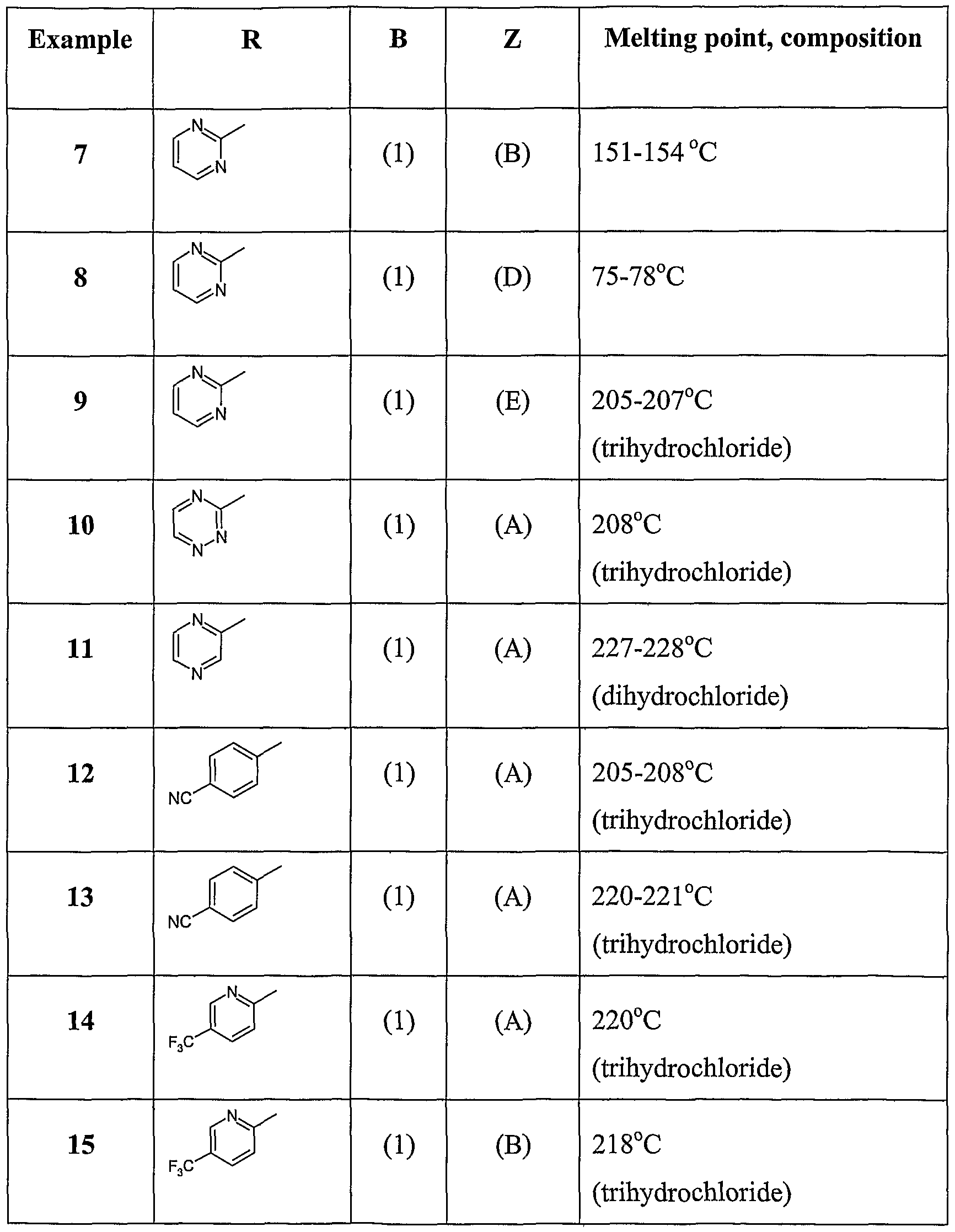
  • a large group of compounds of the general formula (I) are - wherein the meaning of R is the same as defined earlier, B represents a group of formula (1), (2), (4) or (5) and Z represents a group of formula (A), (B) or (D).
  • Such compounds from this large group are for instance
  • the cyclic primary amines of the general formula (II) are applied in equivalent amount or in slight excess, and the resulting hydrogen chloride is bound by various acid binding agents, preferably by a base, such as for instance triethylamine, potassium carbonate, l,8-diazabicyclo[5.4.0]undec-7-ene (DBU), or scavenger resin, polimer bound 2-tert-butylimino-2-diethylamino-l,3-dimethyl-perhydro- 1,3,2-diazaphosphorine (PBEMP), polimer bound diethylamine (PS-DIEA).
  • a base such as for instance triethylamine, potassium carbonate, l,8-diazabicyclo[5.4.0]undec-7-ene (DBU), or scavenger resin, polimer bound 2-tert-butylimino-2-diethylamino-l,3-dimethyl-perhydro- 1,3,2-diaza
  • the reaction is generally performed at a temperature between 25 and 75 °C in acetonitrile, alcoholes, tetrahydrofuran or dioxane.
  • R means aryl or hetaryl group
  • aryl or hetaryl halogenides preferably aryl- or hetaryl bromides or aryl- or hetaryl chlorides are used for the arylation reaction.
  • the arylation is performed in a polar, protic or aprotic solvent between 70 and 140 °C, generally in an alcohol (ethanol, n-butanol, n-pentanol), or in microwave oven without solvent, using excess amine or DBU as acid binder.
  • the arylation is also performed in an aprotic or polar solvent, at a temperature between 25 and 110°C, preferably in toluene or in dimethoxyethane, using sodium alcoholates as acid binders and palladium complexes as catalysts (J. Org. Chem. 2000, 65, 1158).
  • moiety (B) stands for the group of formula (1)
  • the compounds of the general formula (II) can be prepared from two different starting materials.
  • One is the 3 -hydroxy- 1- aminoadamantane, (Pharm. Chem. J. (Engl. Trans.) 1990, 24, 35) from which after protecting the amino group a tert-butoxycarbonyl derivative is prepared, then treating the hydroxy group with mezyl chloride, the mezyloxy derivative is obtained.
  • the compound is reacted with 2-amino- heterocycles - preferably in aprotic solvents or without solvent at 100-140°C - resulting the compounds of the general formula (IV), which following treatment with trifluoroacetic acid in dichloromethane at 0 -30°C, give the compounds of general formula (II): (IV) (ll) (i) Boc 2 O; (ii) MsCI; (iii) R-NH 2 ; (iv) TFA
  • the other starting material is the 1,3-diaminoadamantane (Ber. 1941, 74, 1769), which after acylation, alkylation or by Schiff base formation and reduction gives the compounds of general formula (II):
  • the chloroacetyl compounds of the general formula (III) - wherein Z stands for the group of formulae (A), (B), (C), (D) or (E) - are prepared in a four-step synthesis (Scheme 3).
  • the starting compounds are the N-containing pentacyclic carboxylic acids with the nitrogen protected with tert-butoxycarbonyl group - compounds of the general formula (VI) (VI) wherein the meaning of Z is as defined above.
  • the resulting pentacyclic saturated carboxamides of the general formula (VIII) are in the third step acylated with chloroacetyl chloride, preferably at 0°C in a halogenated solvent (CHC1 3 , CH C1 ) to obtain the chloroacetylcarboxamide derivatives of the general formula (IX) (IX)
  • the chloroacetylcarboxamide derivatives of the general formula (IX) - wherein the meaning of Z is as defined above - are dehydrated to yield the chloroacetylcyano derivatives of the general formula (III).
  • Dehydratation is generally carried out with phosphoryl chloride in dichloromethane at reflux temperature, or with oxalyl chloride in the presence of DMF, at a temperature lower than 0°C.
  • DPP-IV enzyme inhibitory activties of the compounds with the general formula (I) were determined by the following method:
  • DPP-IV. source solubilized crude extractum from CaCo/Tc-7 cells content: 0.8-l ⁇ g/assay
  • Reaction mixture 10 ⁇ l enzyme solution lO ⁇ l test compound or assay buffer 55 ⁇ l assay buffer 25 ⁇ l substrate 300 ⁇ l stop solution
  • Standard curve of AMC is linear up to 31.25 ⁇ M concentration, therefore we used the relative fluorescence unit (RFU) of the AMC formed. It is detected using 360 nm excitation and 465 emmission filters (integration time 30 ⁇ s, Gain 25, No. of Flashes 50) by Tecan Spectrofluor Plus plate reader. Under these conditions enzyme reaction is linear for at least 30 min, and the enzyme dependence is linear up to 2.5 ⁇ g protein (up to 700 RFU).
  • the assay is designed to detect as efficiently as possible the active inhibitors using a 60 min preincubation time at 37 °C.
  • reaction is started by the addition of 25 ⁇ l lmM H-Gly-Pro-AMC substrate solution (250 ⁇ M final concentration).
  • the final test volume is 100 ⁇ l and the test solution contains 1% DMSO coming from the test compounds solution.
  • the fluorescence (RFU) of AMC formed is detected using 360 nm excitation and 465 emission filters in Tecan spectrofluor Plus plate reader (30 ⁇ s integration time, Gain 25 No. of Flashes 50). Inhibition % are calculated using the RFU of control and RFU of blank.
  • the IC 50 values are characteristic for the enzyme inhibitory effect of the compounds of the general formula (I) according to the invention.
  • the compounds of the general formula (I) exhibit low IC 50 values, generally below 100 nM.
  • the endproduct of (2 ⁇ S)-l-[N-(3-pyrimidin-2-yl-3-azabicyclo[3.2.1]oct-8-yl)glycyl]py ⁇ Olidine- 2-carbonitrile shows IC 50 value of 30 nM
  • endproduct of (4S)-3- ⁇ N-[3- (pyrimidin-2-ylamino)- 1 -adamantyl] glycyl ⁇ - 1 ,3-oxazolidine-4-carbonitrile shows IC 50 value of 21 nM and endproduct of (2 ⁇ S)-l-(N- ⁇ 3-[(4-cyanobenzyl)amino]-l- adamantyl ⁇ glycyl)-4,4
  • the compounds of the general formula (I) and their solvates, isomers, salts and solvates of their salts can be formulated to orally or parenterally applicable pharmaceutical compositions by methods known per se, by mixing them with one or more pharmaceutically accepted support material or diluent and can be administered as a unitary dosage form.
  • the appropriate unitary dosage form comprise the oral forms, such as tablets, hard or soft gelatin capsules, powders, granules and oral solutions or suspensions, the sublingual, buccal, intratracheal, intraocular, intranasal forms, by inhalation, the topical, transdermal, sub-cutaneous, intramuscular or intra-venous forms, the rectal forms and the implants.
  • the compounds of the invention may be used as creams, gels, ointments of lotions.
  • a unitary dosage form for a compound according to the invention, in the form of a tablet can comprise the following ingredients:
  • the daily dose of the compounds of the general formula (I) depends on several factors, thus on the nature and severeness of the disease of the patient, on the mode of application and on the compound itself.
  • N-pyrimidin-2-yladamantane- 1 ,3-diamine dihvdrochloride N-pyrimidin-2-yladamantane- 1 ,3-diamine dihvdrochloride
  • R and B N-pyrimidin-2-yladamantane- 1 ,3-diamine dihvdrochloride
  • Z stands for the group of formula (A).
  • 3.93 g (15.7 mmole) of tert-butyl (25)-2-(aminocarbonyl)-4,4-difluoro-pyrrolidine- 1-carboxylate are dissolved in 75 ml of 25% ethanolic hydrogen chloride solution and stirred at room temperature for 4 hours.
  • 150 ml of diethyl ether is added and the white crystalline material is filtered off, to obtain 2.55 g (87 %) title product.
  • Z stands for the group of formula (A). 10.4 g (40 mmole) of (2iS)-l-(Chloroacetyl)-4,4-difluoroprolinamide are dissolved in 230 ml of dichloromethane and to the solution 13 ml (140 mmole) of phosphorus oxy chloride are added. The mixture is heated under reflux for 24 hours. In the course of the heating the solution turns into yellow and a small amount of dark resin also precipitates.
  • Free base is prepared from 487 mg (2 mmole) of 1,3-diamino-adamantane dihydrochloride, as described in Example 2/a.). It is dissolved in 20 ml of dichlorometane, to the solution 253 mg (2.1 mmole) polimer-bound dietilamine (PS-DIEA) are added, and to the mixture at 0°C the solution of 119 mg (0.7 mmole) of -anisoyl chloride in 20 ml of dichloromethane are added dropwise. After stirring 24 hours the solid materials are filtered off and the filtrate is evaporated.
  • PS-DIEA polimer-bound dietilamine
  • the reaction mixture is stirred at -20°C for 30 minutes, and then allowed to warm up to room temperature and stirring is continued for 16 hours.

Landscapes

  • Chemical & Material Sciences (AREA)
  • Organic Chemistry (AREA)
  • Health & Medical Sciences (AREA)
  • Engineering & Computer Science (AREA)
  • Life Sciences & Earth Sciences (AREA)
  • Public Health (AREA)
  • Animal Behavior & Ethology (AREA)
  • Veterinary Medicine (AREA)
  • Bioinformatics & Cheminformatics (AREA)
  • General Health & Medical Sciences (AREA)
  • Chemical Kinetics & Catalysis (AREA)
  • General Chemical & Material Sciences (AREA)
  • Medicinal Chemistry (AREA)
  • Nuclear Medicine, Radiotherapy & Molecular Imaging (AREA)
  • Pharmacology & Pharmacy (AREA)
  • Neurosurgery (AREA)
  • Neurology (AREA)
  • Biomedical Technology (AREA)
  • Diabetes (AREA)
  • Manufacturing & Machinery (AREA)
  • Ceramic Engineering (AREA)
  • Hematology (AREA)
  • Obesity (AREA)
  • Immunology (AREA)
  • Psychiatry (AREA)
  • Pain & Pain Management (AREA)
  • Cardiology (AREA)
  • Heart & Thoracic Surgery (AREA)
  • Structural Engineering (AREA)
  • Virology (AREA)
  • Dermatology (AREA)
  • Endocrinology (AREA)
  • Hospice & Palliative Care (AREA)
  • Rheumatology (AREA)
  • Inorganic Chemistry (AREA)
  • Emergency Medicine (AREA)
  • Materials Engineering (AREA)
  • Tropical Medicine & Parasitology (AREA)
  • Child & Adolescent Psychology (AREA)
  • Physical Education & Sports Medicine (AREA)

Abstract

The invention relates to new compounds of the general formula (I), which are strong DPP-IV enzyme inhibitors.

Description

New compounds
The present invention relates to the novel compounds of the general formula (I) possessing dipeptidyl peptidase IV enzyme inhibitory activity, as well as their salts, solvates and isomers, to the pharmaceutical compositions containing them, to the therapeutic application of the compounds of the general formula (I), to the process of preparation of the compounds of the general formula (I) and to the new intermediates of the general formulae (II), (IV), (V), (VII), (VIII) and (IX). The enzyme, dipeptidyl peptidase IV (DPP-IV), which is identical with the lymphocyte surface glycoprotein CD26, a polypeptide with the molecular mass of 110 k Dalton, is formed in the tissues and organs of mammals. This enzyme can be found, among others, in the liver, in the Langerhans islands, in the renal cortex, in the lungs, and in certain tissues of the prostate and small intestine. Significant DPP-IV activity can be observed furthermore in the body liquors (as for instance in the plasma, serum and urine). DPP-IV is a serine protease type enzyme, which has the unique specificity to cleave dipeptides from the N-terminals of the peptides, where the pre-terminal dipeptide is prolyl- alanine, or hydroxy-proline. DPP-IV enzyme is responsible for the decomposition of the glucagon-like peptides, peptide-1 (GLP-1) and peptide-2 (GLP-2) in the body. The enzyme GLP-1 strongly stimulates the insuline production of the pancrease, thus it has a direct, favourable effect on the glucose homeostasis, therefore DPP-IV inhibitors are suitable for the treatment of non- insuline dependent diabetes mellitus (NIDDM) and for the treatment or prophylaxis of other diseases connected to the DPP-IV enzyme activity, including but not limited to diabetes, obesity, hyperlipidemia, dermatological or mucous membrane disorders, psoriasis, intestinal distress, constipation, autoimmune disorders such as encephalomyelitis, complement metiated disorders such as glomerulonephritis, lipodystrohy and tissue damage, psychosomatic, depressive and neuropsychiatric disease such as anxiety, depression, insomnia, schizophrenia, epilepsy, spasm and chronic pain, HIV infection, allergies, inflammation, arthritis, transplant rejection, high blood pressure, congestive heart failure, tumors and stress-induced abortions. There are a number of DPP- IV inhibitors known in the literature, but they have disadvantages as regards their activity, toxicity, physico-chemical properties, stability and duration of action. Our aim was to prepare new, effective and safe DPP-IV inhibitors having advantageous physico-chemical and biological properties.
We have found that the compounds of the general formula (I)
Figure imgf000003_0001
(I) - wherein R represents: - a nitrogen-containing mono- or bicyclic aromatic moiety, preferably pyridyl, pyridazinyl, pyrimidinyl, pyrazinyl, imidazolyl, pirazolyl, thiazolyl, isothiazolyl, oxazolyl, isoxazolyl, oxadiazolyl, tetrazinyl, triazinyl, quinolinyl, isoquinolinyl, cinnolinyl, phthalazinyl, quinazolinyl, quinoxalinyl, benzimidazolyl, indazolyl, benzothiazolyl, benzisothiazolyl, benzoxazolyl or benzisoxazolyl moiety; optionally mono- or disubstituted independently by one or two of the following groups: Cl-4 alkyl group, Cl-4 alkoxy group, C2-5 alkoxycarbonyl group, halogen atom, trihalogenomethyl group, methylthio group, nitro group, carboxamido group, cyano group; or - Phenyl group, which is mono- or disubstituted, independently by one or two of the following groups: Cl-4 alkyl group, Cl-4 alkoxy group, Cl-4 alkylenedioxy group, trihalogenomethyl group, methylthio group, nitro group, cyano group, C2-5 alkylcarbonyl group, C2-5 alkoxycarbonyl group, C2-8 dialkylamino group; or - Rla-CH2-group, where the meaning of Rla is hydrogen, Cl-4 alkyl group, pheny, benzyl, phenylethyl, phenylethenyl, naphthyl, pyridyl, quinolyl, isoquinolyl, cinnolinyl, phthalazyl, quinazolinyl, quinoxalinyl, thienyl, furyl or jc-tolylsulphonyl group, substituted independently by one or more Cl-4 alkyl, Cl-4 alkoxy, alkylenedioxy group, halogen atom, trihalogenomethyl, nitro or cyano group; or - RlaR2-CH group, where - the meaning of Rla is Cl-4 alkyl group, phenyl, benzyl, phenylethyl, phenylethenyl, fenylpropyl, naphthyl, pyridyl, quinolyl, isoquinolyl, cinnolinyl, phthalazyl, quinazolinyl, quinoxalinyl, thienyl, or furyl group, substituted independently with one or more Cl-4 alkyl, Cl-4 alkoxy, Cl-4 alkylenedioxy, halogeno, trihalogenomethyl, nitro, amino or cyano group, or a phenylcarbonyl moiety, substituted independently with one or more, Cl-4 alkyl, -alkoxy, - alkylenedioxy halogeno, trihalogenomethyl, nitro-, amino- or cyano group, and - R2 represents hydrogen or methyl group; or - Rlb-CO group, where - the meaning of Rlb is Cl-4 alkyl group, or a phenyl, benzyl, phenylethyl, phenylethenyl, naphthyl, pyridyl, quinolyl, isoquinolyl, cinnolinyl, phthalazyl, quinazolinyl, quinoxalinyl moiety, substituted independently with one or more Cl-4 alkyl, Cl-4 alkoxy, Cl-4 alkylenedioxy, halogeno, trihalogenomethyl, nitro, or cyano group, or an amino group, or a heterocyclic group, preferably pyrrolidino, piperidino, piperazino, morpholino, thienyl or furyl group; or - ?-toluenesulphonyl group; B represents a group of formula (1), (2), (3), (4) or (5);
Figure imgf000004_0001
Figure imgf000004_0002
Figure imgf000004_0003
Figure imgf000004_0004
Figure imgf000004_0005
- Z represents a group of formula (A), (B), (C), (D) or (E),
Figure imgf000005_0001
Figure imgf000005_0002
Figure imgf000005_0003
Figure imgf000005_0004
Figure imgf000005_0005
and isomers, salts, solvates of the above compounds, as well as solvates of their salts, possess remarkable advantages in their activity, stability and toxicity. In accordance with the accepted terminology, the configuration of the carbon atom next to the nitrogen atom of the 5-membered-ring-pentacycle is favourably S if Z stands for formula (A), (B), (C), or (E), whereas it is favourably R if Z stands for formula (D).
In the present description the term "Cι-4 alkyl" means a straight-chain or branched chain alkyl group with 1-4 carbon atoms as for example methyl, ethyl, propyl, isopropyl, butyl, sec-butyl or isobutyl. The term "C1- alkoxy" means a straight-chain or branched chain alkoxy group with 1-4 carbon atom as for example methoxy, ethoxy, propoxy, isopropoxy, butoxy, sec.-butoxy or isobutoxy. The term "C2-5 alkoxy carbonyl" means a straight or branched chain alkoxy carbonyl group with 2-5 carbon atom as for example methoxy carbonyl, ethoxy carbonyl, popoxy carbonyl, isopropoxy carbonyl, butoxy carbonyl, sec.-butoxy carbonyl, isobutoxy carbonyl.
The term "halogen" means fluorine, chlorine, bromine or iodine. The term "Cι-4 alkylenedioxy" means a straight-chain or branched chain alkylenedioxy group with 1-4 carbon atoms as for example methylenedioxy, ethylenedioxy, propxylenedioxy, butylenedioxy.
The term "C2-5 alkylcarbonyl" menas a straight-chain or branched chain alkylcarbonyl group with 2-5 carbon atoms as for example methyl-carbonyl, ethylcarbonyl, propylcarbonyl, isopropyl carbonyl or butyl carbonyl, sec. -butyl carbonyl or isobutyl carbonyl.
A large group of compounds of the general formula (I) are - wherein the meaning of R is the same as defined earlier, B represents a group of formula (1), (2), (4) or (5) and Z represents a group of formula (A), (B) or (D). Such compounds from this large group are for instance
(2ιS)-4,4-difluoro- 1 - {N-[3-(pyrimidin-2-ylarnino)- 1 -adamantyl]glycyl} pyrrolidine-2- carbonitrile
(2 )-4,4-difluoro- 1 -(N- {3-[(3-nitrobenzyl)amino]- 1 -adamantyl} glycyl) pyrrolidine-2- carbonitrile N-(3-{[2-(2-cyano-(2ιS)-4,4-difluoropyrrolidin-l-yl)-2-oxoethyl]amino}-l-adamantyl)-4- methoxybenzamide
(21S -4,4-difluoro-l-[N-(3-pyrimidin-2-yl-3-azabicyclo[3.2.1]oct-8-yl)e o- aminoacetyl]pyrrolidine-2-carbonitrile
(25)-4,4-difluoro-l-[N-(3-pyrimidin-2-yl-3-azabicyclo[3.2.1]oct-8-yl)eπ o- aminoacetyl]pyrrolidine-2-carbonitrile
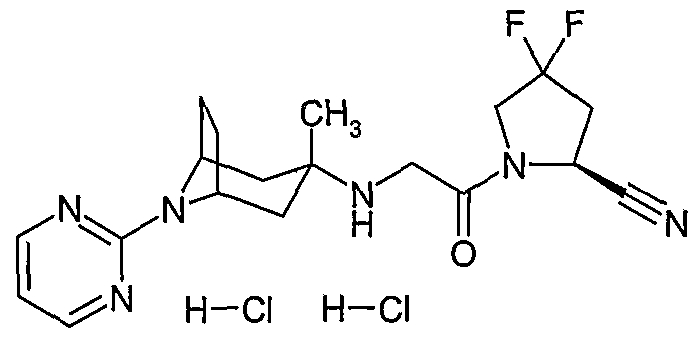
(2S)-4,4-difluoro- 1 -[N-(3-methyl-8-pyrimidin-2-yl-8-azabicyclo[3.2.1 ]oct-3-yl) exo- aminoacetyl]pyrrolidine-2-carbonitrile
(2ιS',4ιS)-4-fluoro-l-{N-[3-(pyrimidin-2-ylamino)-l-adamantyl]glycyl} pyrrolidine-2- carbonitrile (4R)-3-{N-[3-(pyrimidin-2-ylamino)-l-adamantyl]glycyl}-l,3-thiazolidine-4-carbonitrile
(4S)-3- {N-[3-(pyrimidin-2-ylamino)- 1 -adamantyl]glycyl} - 1 ,3-oxazolidine-4-carbonitrile
(25)-4,4-difluoro-l-{N-[3-(lJ2,4-triazin-3-ylamino)-l-adamantyl]glycyl} pyrrolidine-2- carbonitrile (2ιS)-4,4-difluoro- 1 - {JV-[3 -(pyrazin-2-ylamino)- 1 -adamantyljglycyl} pyrrolidine-2- carbonitrile
(25)- 1 -(N- {3 - [(4-cyanophenyl)amino]- 1 -adamantyl} glycyl)-4,4-difluoropyrrolidine-2- carbonitrile 6- [(3 - { [2-(2-cyano-(2S)-4,4-difluoropyrrolidin- 1 -yl)-2-oxoethyl]amino } - 1 - adamantyl)amino]nicotinonitrile
(2ιS)-4,4-difluoro- 1 -[N-(3- {[5-(trifluoromethyl)pyridin-2-yl]amino} - 1 - adamantyl)glycyl]pyrrolidine-2-carbonitrile
(25,45)-4-fiuoro-l-[iV-(3-{[5-(trifluoromethyl)pyridin-2-yl]amino}-l- adamantyl)glycyl]pyrrolidine-2-carbonitrile
(2>S)-4,4-difluoro- 1 - {N- [3 -( 1 ,3 -thiazol-2-ylamino)- 1 -adamantyl] glycyl } pyrrolidine-2- carbonitrile
(2S)- 1 -(N- {3-[( 1 -ethyl- lH-pyrazol-5-yl)amino]- 1 -adamantyl} glycyl)-4,4- difluoropyrrolidine-2-carbonitrile (2ιS)-4,4-difluoro- 1 -(N- {3-[(5-methylisoxazol-3-yl)amino]- 1 -adamantyl} glycyl) pyrrolidine-2-carbonitrile
(25 -4,4-difluoro-l-{iV-[3-(quinolin-2-ylamino)-l-adamantyl]glycyl} pyrrolidine-2- carbonitrile
(2»S',4 )-4-fluoro-l-{iV-[3-(quinolin-2-ylamino)-l-adamantyl]glycyl} pyrrolidine-2- carbonitrile
(25)-4,4-difluoro-l-{N-[3-([l,2,4]triazolo[l,5-α]pyridin-2-ylamino)-l- adamantyl]glycyl}pyrrolidine-2-carbonitrile
(2S,45 -4-fluoro-l-{N-[3-([l,2,4]triazolo[l,5- ]pyridin-2-ylamino)-l- adamantyl]glycyl}pyrrolidine-2-carbonitrile (4R)-3- {N-[3-([ 1 ,2,4]triazolo[ 1 ,5- ]pyridin-2-ylamino)- 1 -adamantyljglycyl} - 1 ,3- thiazolidine-4-carbonitrile
(2S)~ 1 -(N- {3 - [(4-cyanobenzyl)amino] - 1 -adamantyl } gly cyl)-4,4-difluoropyrrolidine-2- carbonitrile
(2ιS -4,4-difluoro- 1 -[N-(3- {[4-(trifluoromethyl)benzyl]amino} - 1 -adamantyl) glycyl]pyrrolidine-2-carbonitrile
(2S)-4,4-difluoro- 1 -(N- {3-[(3 -fluorobenzyl)amino]- 1 -adamantyl } glycyl) pyrrolidine-2- carbonitrile
(25)-4,4-difluoro-l-(N-{3-[(3,4,5-trimethoxybenzyl)amino]-l-adamantyl} glycyl)pyrrolidine-2-carbonitrile (25)-4,4-difluoro- 1 -(N- {3-[(pyridin-3-ylmethyl)amino]- 1 -adamantyl} glycyl) pyrrolidine-2- carbonitrile
(25 -4,4-difluoro-l-(iV-{3-[(pyridazin-3-ylmethyl)amino]-l-adamantyl} glycyl) pyrrolidine-
2-carbonitrile (25)-4,4-difluoro- 1 -(N- {3-[( 1 ,3-thiazol-2-ylmethyl)amino]- 1 -adamantyl} glycyl) pyrrolidine-2-carbonitrile
4-chloro-N-(3 - { [2-(2-cyano-(2lS)-4,4-difluoropyrrolidin- 1 -yl)-2-oxoethyl] amino } - 1 - adamantyl)benzamide
N-(3 - { [2-(2-cyano-(25)-4,4-difluoropyrrolidin- 1 -yl)-2-oxoethyl]amino } - 1 -adamantyl)-3- fluorobenzamide
(2E)-N-(3- { [2-(2-cyano-(2S)-4,4-difluoropyrrolidin- 1 -yl)-2-oxoethyl]amino} - 1 - adamantyl)-3 -phenylacrylamide
N-(3 - { [2-(2-cyano-(2ιS)-4,4-difluoropyrrolidin- 1 -yl)-2-oxoethyl] amino} - 1 - adamantyl)thiophene-2-carboxamide (2S)-l-[N-(3-pyrimidin-2-yl-3-azabicyclo[3.2.1]oct-8-yl)endo-amino-acetyl]pyrrolidine-2- carbonitrile
(25)-4,4-difluoro- 1 -[N-(3-pyrimidin-2-yl-3 -azabicyclo[3.3.1 ]non-9-yl)glycyl] pyrrolidine-
2-carbonitrile
6-(9-{[2-(2-cyano-(2iS)-4,4-difluoropyrrolidin-l-yl)-2-oxoethyl]amino}-3- azabicyclo[3.3. l]non-3-yl)pyridazine-3-carbonitrile
(25)- 1 -[N-(3-pyrimidin-2-yl-3-azabicyclo[3.3. l]non-9-yl)glycyl]pyrrolidine-2-carbonitrile
The compounds of the general formula (I) according to our invention - wherein the meanings of R, B and Z are as defined above- can be prepared by alkylation of the cyclic primary amines of the general formula (II) R B NH2
(II) with the chloroacetyl derivatives of general formula (III)
Figure imgf000008_0001
(III) - wherein the meaning of Z is as defined above - and, if desired, the resulting compounds are transformed into their salts or solvates (Scheme 1).
In the course of the alkylation the cyclic primary amines of the general formula (II) are applied in equivalent amount or in slight excess, and the resulting hydrogen chloride is bound by various acid binding agents, preferably by a base, such as for instance triethylamine, potassium carbonate, l,8-diazabicyclo[5.4.0]undec-7-ene (DBU), or scavenger resin, polimer bound 2-tert-butylimino-2-diethylamino-l,3-dimethyl-perhydro- 1,3,2-diazaphosphorine (PBEMP), polimer bound diethylamine (PS-DIEA). The reaction is generally performed at a temperature between 25 and 75 °C in acetonitrile, alcoholes, tetrahydrofuran or dioxane. The primary amines of the general formula (II) - if moiety B stands for formula (2),
(3), (4) or (5) - are prepared in a two-step synthesis (Scheme 2). In the first step the starting cyclic secondary amines containing the acylamido side-chain -the compound of the general formula (IV) HB N Y H (IV) wherein Y stands for acetyl or tert-butoxycarbonyl group- is reacted with the compound containing the group R, forming thus the compunds of general formula (V). R B N Y H
(V) If R means aryl or hetaryl group, aryl or hetaryl halogenides, preferably aryl- or hetaryl bromides or aryl- or hetaryl chlorides are used for the arylation reaction. The arylation is performed in a polar, protic or aprotic solvent between 70 and 140 °C, generally in an alcohol (ethanol, n-butanol, n-pentanol), or in microwave oven without solvent, using excess amine or DBU as acid binder. The arylation is also performed in an aprotic or polar solvent, at a temperature between 25 and 110°C, preferably in toluene or in dimethoxyethane, using sodium alcoholates as acid binders and palladium complexes as catalysts (J. Org. Chem. 2000, 65, 1158). In the cases when R stands for RlaR -CH- or Rlb-CO group, the compounds of the general formula (IV) - wherein Y means an acetyl or tert-butoxycarbonyl group - are reacted with the derivatives of general formula RlaR2-CHX or Rl -COX - wherein X means a leaving group (preferably a chloro- or bromo atom) - generally at a temperature around 0°C, using an inorganic or organic base, preferably triethylamine, as acid binder. The compounds of the general formula (IV), by literature analogy, are prepared in several steps. If moiety (B) stands for the group of formula (2) or (3), the starting material is the 3-benzyl-3-azabicyclo[3.2.1]octan-8-one (N-benzylcamphidin-8-one;
J. Med. Chem. 1994, 37, 2831). From that, the desired compound is prepared in four steps. The isomeric products obtained in the second step are separated by coloumn chromatography for the exo and endo products, which further on are reacted in the same way:
Figure imgf000010_0001
Figure imgf000010_0002
endo (i) NH2OHxHCl; (ii) Na/n-pentanol; (iii) Boc2O; (iv) H2/Pd-C; If moiety (B) stands for the group of formula (4), the starting material is the 3- benzyl-3-azabicyclo[3.3.1]nonan-9-one (J. Med. Chem. 1994, 37, 2831). Following the above reaction sequence, we did not succeed at any stage to separate the exo/endo products, and at the end of the synthesis the resulting product always contained the two isomers:
Figure imgf000010_0003
(i) NH2OHxHCI; (ii) Na/n-pentanol; (iii) Boc2O; (iv) H2/Pd-C; If moiety (B) stands for the group of formula (5), the starting material is the 8- benzyl-8-azabicyclo[3.2.1]octan-3-one (J.C.S. Perkin I. 1997, 1307). From that in regioselective Grignard reaction the 8-benzyl-3-methyl-8-azabicyclo[3.2.1]octan-3-ejrø-ol is formed, from which, on literature analogy, the e o-acetamido derivative can be obtained in Ritter reaction (Tetrahedron Lett. 1996, 37, 1297), which, following debenzylation results the desired compound:
Figure imgf000011_0001
Figure imgf000011_0002
(i) MeMgBr; (ii) MeCN, cc.H2SO4; (iii) H2/Pd-C; From the resulting compounds of the general formula (V), if moiety (B) stands for the group of formula (2), (3), (4) or (5) - the Y protecting group is cleaved under acidic conditions, arriving thus to the compounds of the general formula (II). Hydrolysis is preferably carried out by trifluoroacetic acid in dichloromethane solution at a temperature between 0 -30°C, or in aqueous hydrochloric acid solution or in ethanolic hydrogen chloride solution at a temperature between 25-78 °C. If moiety (B) stands for the group of formula (1), the compounds of the general formula (II) can be prepared from two different starting materials. One is the 3 -hydroxy- 1- aminoadamantane, (Pharm. Chem. J. (Engl. Trans.) 1990, 24, 35) from which after protecting the amino group a tert-butoxycarbonyl derivative is prepared, then treating the hydroxy group with mezyl chloride, the mezyloxy derivative is obtained. Utilising the excellent leaving capability of the leaving group, the compound is reacted with 2-amino- heterocycles - preferably in aprotic solvents or without solvent at 100-140°C - resulting the compounds of the general formula (IV), which following treatment with trifluoroacetic acid in dichloromethane at 0 -30°C, give the compounds of general formula (II):
Figure imgf000012_0001
(IV) (ll) (i) Boc2O; (ii) MsCI; (iii) R-NH2; (iv) TFA
The other starting material is the 1,3-diaminoadamantane (Ber. 1941, 74, 1769), which after acylation, alkylation or by Schiff base formation and reduction gives the compounds of general formula (II):
Figure imgf000012_0002
(i) R j1ιaa DR2O, Ts; (ii) R >11bDCOCI; (iii) RCOCH2Br; (iv) R 1,aa,CHO; (v) NaBH4
The chloroacetyl compounds of the general formula (III) - wherein Z stands for the group of formulae (A), (B), (C), (D) or (E) - are prepared in a four-step synthesis (Scheme 3).
Figure imgf000012_0003
(III) The starting compounds are the N-containing pentacyclic carboxylic acids with the nitrogen protected with tert-butoxycarbonyl group - compounds of the general formula (VI)
Figure imgf000012_0004
(VI) wherein the meaning of Z is as defined above. (25 -l-(fert-butoxycarbonyl)proline (Z = moiety (C)) and (4i?)-3-(tert-butoxycarbonyl)-l,3-thiazolidine-4-carboxylic acid (Z = moiety (D)) can be purchased, (25)-l-(fert-butoxycarbonyl)-4,4-difluoroproline (Z = moiety (A)), (2&4S)-l-(tert-butoxycarbonyl)-4-fluoroproline (Z = moiety (B)) and (4S)-3-
(tert-butoxycarbonyl)-l,3-oxazolidine-4-carboxylic acid (Z = moiety (E)) can be prepared
(Tetrahedron Lett. 1998, 39, 1169 and Tetrahedron 1994, 50, 13493). In the first step a mixed anhydride is prepared with pivaloyl or ethoxycarbonyl chloride, then the carbamoyl derivatives of the general formula (VII) ' 0γZγNH2
O O (VII) - wherein the meaning of Z is the same as defined above - are formed with aqueous ammonia. The reaction is preferably carried out in a halogenated solvent (CHC13, CH2C12) at 15°C. In the second step the fert-butoxycarbonyl group is cleaved by ethanolic hydrogen chloride solution. Hydrolysis takes place at 0 - 25°C and the hydrochlorides of the carboxamides of the general formula (VIII)
Figure imgf000013_0001
(VIM)
- wherein the meaning of Z is the same as defined above - are obtained. The resulting pentacyclic saturated carboxamides of the general formula (VIII) are in the third step acylated with chloroacetyl chloride, preferably at 0°C in a halogenated solvent (CHC13, CH C1 ) to obtain the chloroacetylcarboxamide derivatives of the general formula (IX)
Figure imgf000013_0002
(IX)
-wherein the meaning of Z is the same as defined above. In the fourth step the chloroacetylcarboxamide derivatives of the general formula (IX) - wherein the meaning of Z is as defined above - are dehydrated to yield the chloroacetylcyano derivatives of the general formula (III). Dehydratation is generally carried out with phosphoryl chloride in dichloromethane at reflux temperature, or with oxalyl chloride in the presence of DMF, at a temperature lower than 0°C.
Figure imgf000015_0001
Figure imgf000015_0002
Figure imgf000016_0001
Biological investigations
DPP-IV enzyme inhibitory activties of the compounds with the general formula (I) were determined by the following method:
Applied conditions of the assay:
DPP-IV. source: solubilized crude extractum from CaCo/Tc-7 cells content: 0.8-lμg/assay
Substrate: H-Gly-Pro-AMC (Bachem)
Reaction: 1 hour preincubation with samples at 37 °C , 30 min reaction time at 37 C° Stop solution: 1M Na-acetate buffer (pH=4.2)
Reaction mixture: 10 μl enzyme solution lOμl test compound or assay buffer 55 μl assay buffer 25 μl substrate 300μl stop solution
Measurement: spectrofluorometric determination by Tecan plate reader (Ex: 360nm Em: 465nm)
The reaction of the DPP-IV enzyme and the H-Gly-Pro-AMC substrate is recorded by the liberation of AMC (7-amino-4-methylcoumarin) at 37 °C in 100 mM Tris-HCl, pH=7.5 (assay buffer). Standard curve of AMC is linear up to 31.25 μM concentration, therefore we used the relative fluorescence unit (RFU) of the AMC formed. It is detected using 360 nm excitation and 465 emmission filters (integration time 30 μs, Gain 25, No. of Flashes 50) by Tecan Spectrofluor Plus plate reader. Under these conditions enzyme reaction is linear for at least 30 min, and the enzyme dependence is linear up to 2.5 μg protein (up to 700 RFU). Using 1-0.8 μg of extracted protein Km for H-Gly-Pro-AMC is 50 μM. Higher than 500 μM substrate concentration caused fluorescent detection problems (inner filter effect) that can be solved by dilution of the samples. The assay is designed to detect as efficiently as possible the active inhibitors using a 60 min preincubation time at 37 °C. The assay is conducted by adding 0.8-1 μg protein extract in 10 μl enzyme sulution (using assay buffer: 100 mM Tris-HCl, pH=7.5) to the wells containing the test compounds in 10 μl volume and the 55 μl assay buffer (65 μl assay buffer in the case of contrails). After the preincubation period, the reaction is started by the addition of 25 μl lmM H-Gly-Pro-AMC substrate solution (250 μM final concentration). The final test volume is 100 μl and the test solution contains 1% DMSO coming from the test compounds solution. Reaction time is 30 min at 37 °C, and the reaction is stopped by adding 300 μl 1M Na-acetate buffer, pH= 4.2. The fluorescence (RFU) of AMC formed is detected using 360 nm excitation and 465 emission filters in Tecan spectrofluor Plus plate reader (30 μs integration time, Gain 25 No. of Flashes 50). Inhibition % are calculated using the RFU of control and RFU of blank. The IC50 values are characteristic for the enzyme inhibitory effect of the compounds of the general formula (I) according to the invention. The compounds of the general formula (I) exhibit low IC50 values, generally below 100 nM. For example the endproduct of (2ιS)-l-[N-(3-pyrimidin-2-yl-3-azabicyclo[3.2.1]oct-8-yl)glycyl]pyπOlidine- 2-carbonitrile (Example 40) shows IC50 value of 30 nM, endproduct of (4S)-3-{N-[3- (pyrimidin-2-ylamino)- 1 -adamantyl] glycyl} - 1 ,3-oxazolidine-4-carbonitrile (Example 9) shows IC50 value of 21 nM and endproduct of (2<S)-l-(N-{3-[(4-cyanobenzyl)amino]-l- adamantyl} glycyl)-4,4-difluoropyrrolidine-2-carbonitrile (Example 27) shows IC50 value of 16 nM. Their duration of action and their activity are therapeutically favourable. The compounds of the general formula (I) and their solvates, isomers, salts and solvates of their salts can be formulated to orally or parenterally applicable pharmaceutical compositions by methods known per se, by mixing them with one or more pharmaceutically accepted support material or diluent and can be administered as a unitary dosage form.
The appropriate unitary dosage form comprise the oral forms, such as tablets, hard or soft gelatin capsules, powders, granules and oral solutions or suspensions, the sublingual, buccal, intratracheal, intraocular, intranasal forms, by inhalation, the topical, transdermal, sub-cutaneous, intramuscular or intra-venous forms, the rectal forms and the implants. For the toical application, the compounds of the invention may be used as creams, gels, ointments of lotions. As an example, a unitary dosage form for a compound according to the invention, in the form of a tablet, can comprise the following ingredients:
A compound of the general formula (I) 50.0 mg
Mannitol 223.75 mg Croscarmellose sodium 6.0 mg
Maize starch 30.0 mg
Hydroxypropyl methylcellulose 2.25 mg
Magnesium stearate 3.0 mg
The daily dose of the compounds of the general formula (I) depends on several factors, thus on the nature and severeness of the disease of the patient, on the mode of application and on the compound itself.
The following examples illustrate the preparation of the compounds of the general formula (I) but not at all limit the scope of the invention.
Example 1.
(2iS)-4,4-difluoro-l-{N- [3-(pyπmidin-2-yIamino)~l-adamantyl] glycyl} pyrrolidine-2- carbonitrile dihydrochloride monohydrate In general formula (I) R stands for pyrimidin-2-yl group, B stands for the group of formula (1), Z stands for the group of formula (A).
Figure imgf000019_0001
H-CI H-CI H H
a.) tert-Butyl \3 -(pyrimidm-2-ylamino)- 1 -adamantyl] carbamate In general formula (V) the meaning of R and B are as defined above, Y represents tert- butoxycarbonyl group. (i) tgrt-ButyK3-hvdroxy-l-adamantyl)carbamate
2.51 g (15 mmole) of 3 -hydroxy- 1-aminoadamantane (Pharm. Chem. J. (Engl. Trans.)
1990, 24, 35) are dissolved in the mixture of 15 ml of dioxane, 15 ml of water and 15 ml of IN sodium hydroxide solution, then under cooling and stirring 4.91 g (22.5 mmole) of di- tert-butyl dicarbonate are added. The mixture is stirred at room temperature for 16 hours, the solution is evaporated, and the residue is dissolved in the mixture of 50 ml of ethyl acetate and 50 ml of water. Following extraction and separation of the phases, the organic phase is dried over sodium sulphate. After evaporation the white crystalline residue is treated with ra-hexane, to obtain 2.61 g (65%) of product. M.p.: 131-132°C. 1H-NMR.:
(DMSO-d6): 1.36 (s, 9H), 1.41 (s, 2H), 1.48 (d, 4H), 1.70 (d, 6H), 2.10 (bs, 2H), 4.43 (s,
1H), 6.41 (s, 1H).
(ii) 3-[(tert-Butoxycarbonyl)amino]-l-adamantyl methanesulphonate 5.6 g (21 mmole) of tert-butyl (3 -hydroxy- l-adamantyl)carbamate are dissolved in 80 ml of dichloromethane, 4.4 ml (31.5 mmole) of triethylamine are added to it. The mixture is cooled to 0°C and 1.82 ml (23.5 mmole) of methanesulphonyl chloride is added to it dropwise. The reaction mixture is stirred at that temperature for 45 minutes, then washed consecutively with water and saturated sodium hydrogen carbonate solution. The organic phase is dried over sodium sulphate, evaporated, the residue is purified by column chromatography (rø-hexane - ethyl acetate - chloroform 2:1:1) and crystallised from n- hexane, to obtain 2.9 g (40%) of product: Mp.: 100-102°C. 1H-NMR (DMSO-d6): 1.37 (s, 9H), 1.48 (s, 2H), 1.77 (q, 4H), 2.05 (t, 4H), 2.17 (d, 2H), 3.10 (s, 3H), 6.66 (s, 1H). (iii) tert-Butyl |"3-(pyrimidin-2-ylamino)- 1 -adamantyl] carbamate
The mixture of 1.04 g (3 mmole) of 3-[(tert-butoxycarbonyl)amino]-l-adamantyl methanesulphonate and 1.0 g (10.5 mmole) 2-aminopyrimidine are melted at 140°C. After 15 minutes of stirring the melt is cooled down and purified by column chromatography (n- hexane - ethyl acetate - chloroform 2:1:1). The product is white crystalline material, 0.7 g (68%). Mp.: 163-165°C. 1H-NMR (DMSO-d6): 1.36 (s, 9H), 1.52 (s, 2H), 1.71 (d, 2H), 1.86 (d, 4H), 2.07 (m, 4H), 2.25 (m, 2H), 6.38 (s, 1H), 6.49 (t, 3H), 6.58 (s, 1H), 8.22 (d, 2H).
b.) N-pyrimidin-2-yladamantane- 1 ,3-diamine dihvdrochloride In general formula (II) the meaning of R and B is as defined above. 700 mg (2 mmole) of tert-butyl [3-(pyrimidin-2-ylamino) -1 -adamantyl] carbamate are dissolved in 25 ml of 20% ethanolic hydrogen chloride solution. The mixture is stirred at room temperature for 24 hours, evaporated to dryness; the residue is treated with acetone to obtain white crystalline material: 453 mg (68%). M.p.: 301-304°C. 1H-ΝMR (DMSO- d6): 1.56 (q, 2H), 1.78 (s, 4H), 2.00 (q, 4H), 2.24 (s, 4H), 6.78 (t, 1H), 8.21 (br, 3H), 7.85
(br, 1H), 8.46 (d, 2H). c.) tert-Butyl (25V2-(aminocarbonyl)-4,4-difluoropyrralidine- 1 -carboxylate
In general formula (VII) Z stands for the group of formula (A) 5.7 g (22.7 mmole) of (25)-l-(tert-butoxycarbonyl)-4,4-difluoroproline
(Tetrahedron Lett. 1998, 39, 1169) are dissolved in 57 ml of dichloromethane and to the solution 3.8 ml (27.2 mmole) of triethylamine are added. To the resulting mixture at -15°C
3 ml (25 mmole) of pivaloyl chloride is added, the reaction mixture is stirred at that temperature for 1 hour, then 7 ml of 25 % aqueous ammonia solution is added to it drop wise and stirring is continued for an additional hour. The reaction mixture is washed with water, with 1 N sodium hydroxide solution, and with water, dried over sodium sulphate and evaporated. The product is crystallised from diethyl ether to obtain 3.94 g (69%) of the title product. M.p.: 136-138°C. 1H-ΝMR (CDC13): 1.48 (s, 9H); 2.3-2.9 (m, 3- CH2), 3.69 (br, minor) + 3.86 (m, major)(5-CH2), 4.53 (br, 2-CH), 6.0 (br, major) + 6.81 (br, minor)(NH2).
d.) (25V4,4-Difluoroprolinamide hydrochloride
In general formula (VIII) Z stands for the group of formula (A). 3.93 g (15.7 mmole) of tert-butyl (25)-2-(aminocarbonyl)-4,4-difluoro-pyrrolidine- 1-carboxylate are dissolved in 75 ml of 25% ethanolic hydrogen chloride solution and stirred at room temperature for 4 hours. To the resulting suspension 150 ml of diethyl ether is added and the white crystalline material is filtered off, to obtain 2.55 g (87 %) title product. M.p.: 232-233°C. 1H-NMR (DMSO-d6): 2.43-2.51 (m, minor) + 2.81-3.05(m, major)(3-CH2), 3.71 (t, 2H, 5-CH2), 4.46 (t, 1H, 2-CH), 7.81 (s, 1H.) + 8.12(s, 1H)(NH2), 10.12 (br, 2H, NH2 +).
e.) (2SD- 1 -CChloroacetyl)-4,4-difluoroprolinamide
In general formula (IX) Z stands for the group of formula (A). 2.54 g (13.6 mmole) of (25)-4,4-difluoroprolinamide hydrochloride are suspended in 25 ml of dichloromethane, 4.1 ml (29.3 mmole) of triethylamine is added to it, and to the mixture, below -10°C, the solution of 1.2 ml (15 mmole) of chloroacetyl chloride in 20 ml dichloromethane are added dropwise. After 1 hour of stirring the suspension is poured onto 450 ml of ethyl acetate, the precipitated triethylamine hydrochloride is filtered off. The filtrate is evaporated and purified by chromatography using chloroform-methanol 4:1 mixture as eluent. 3.0 g (97%) colourless oil is obtained, which is crystallised after a few days of standing. M.p.: 118-121°C. 1H-NMR (DMSO-d6): 2.34-2.52 (m, 1H) + 2.66-
2.83(m, 1H)(3-CH2), 4.07-4.29 (m, 2H, 5-CH2), 4.40(qv, 2H, CH2C1), 4.71 (m, 1H, 2-CH),
7.17 (br, 1H) + 7.42(d, 1H)(NH2).
f) (2S)- 1 -CChloroacetyl)-4.4-difluoropyrrolidine-2-carbonitrile
In general formula (III) Z stands for the group of formula (A). 10.4 g (40 mmole) of (2iS)-l-(Chloroacetyl)-4,4-difluoroprolinamide are dissolved in 230 ml of dichloromethane and to the solution 13 ml (140 mmole) of phosphorus oxy chloride are added. The mixture is heated under reflux for 24 hours. In the course of the heating the solution turns into yellow and a small amount of dark resin also precipitates.
The solution is transferred into a larger container, 50 g of potassium carbonate is added to it and stirred for 1 hour. The solid salts are filtered off; the filtrate is evaporated to obtain yellow oil, which crystallises from n-hexane. The crude product is treated with 70 ml of diethyl ether to obtain 6.0 g (56%) white crystalline material. M.p.: 86-87°C. 1H-NMR
(CDC13): 2.76-2.98 (m, 2H, 3-CH2), 3.92-4.26 (m, 2H, 5-CH2), 4.46(q, 2H, CH2C1), 5.11
(m, 1H, 2-CH).
g.) 2>$ -4,4-difluoro- 1 - (N- [3-(pyrimidin-2-ylamino)- 1 -adamantyl] glycyl } pyrrolidine- 2-carbonitrile dihydrochloride monohydrate 424 mg (1.3 mmole) of N-pyrimidin-2-yladamantane-l,3-diamine dihydrochloride are suspended in 10 ml of dichloromethane and extracted with 10 ml of saturated sodium carbonate solution. The organic phase is dried over sodium sulphate and evaporated. The residue is dissolved in 10 ml of acetonitrile, to the solution 229 mg (1.1 mmole) of (2S)-1- (chloroacetyl)-4,4-difluoropyrrolidine-2-carbonitrile and 0.42 ml (3 mmol) of triethylamine are added. The mixture is stirred at room temperature for 40 hours, evaporated. The residue is dissolved in 30 ml of dichloromethane, washed with water, dried over sodium sulpfate and evaporated. The yellowish-coloured residue is purified by column chromatography (chloroform-methanol 6:1), the product is obtained in the form of an oil, which gives dihydrochloride salt with ethereal hydrochloric acid: 160 mg (29%>), m.p.: 209-212°C. 1H-ΝMR (DMSO-d6): 1.50 (d, 1H), 1.60 (d, 1H), 1.88 (m, 6H), 2.11 (m, 2H), 2.31 (s, 4H), 2.84-2.93 (m, 2H), 4.00 (m, 1H), 4.01-4.17 (m, 2H), 4.32 (m, 1H), 5.18 (dd, 1H), 6.72 (t, 1H), 7.61 (b, 1H), 8.40 (d, 2H), 9.10 (s, 2H). Example 2. (2S)-4,4-difluoro-l-(iV-{3-[(3-nitrobenzyl)amino]-l-adanιantyl} glycyl)pyrrolidine-2-carbonitriIe trihydrochloride In general formula (I) R stands for 3-nitrobenzyl group, B stands for the group of formula (1), Z stands for the group of formula (A).
Figure imgf000023_0001
a.) N-(3-NitrabenzyDadamantane- 1.3-diamine
In general formula (II) the meaning of R and B is as defined above. 287 mg (1.2 mmole) of 1,3-diamino-adamantane dihydrochloride (Chem. Ber. 1941, 1769) are suspended in 30 ml of dichloromethane and extracted with 30 ml of saturated sodium carbonate solution. The organic phase is dried over sodium sulphate and evaporated. The residue is dissolved in 30 ml of toluene, to the solution 90 mg (0.6 mmole) of 3-nitrobenzaldehyde and 10 mg /?-toluenesulfonic acid monohydrate are added. The mixture is reluxed for 2 hours, and then evaporated, the residue is dissolved in 30 ml methanol, to the solution 114 mg (3 mmole) sodium borohydride are added. After 16 hours of stirring at room temperature solution is evaporated, the residue is dissolved in dichloromethane and washes with water. The organic layer was dried over sodium sulphate, evaporated and purified by column chromatography (chloroform-methanol- 25 % aqueous ammonia solution 9:1:0.05). The product is obtained in the form of thick oil, which is crystallized after standing: 93 mg (26%). 1H-NMR (DMSO-d6): 1.40 (m, 10H), 1.46 (s, 2H), 2.08 (s, 2H), 3.80 (s, 2H), 7.56 (t, 1H), 7.78 (d, 1H), 8.05 (d, 1H), 8.23 (s, 1H).
b.) (2SH ,4-difluoro- 1 -(A 3 - [(3 -nitrobenzvDaminol- 1 -adamantyl I glvcvDoyrrolidine- 2-carbonitrile trihydrochloride 90 mg (0.3 mmole) of N-(3-nitrobenzyl)adamantane-l, 3-diamine and 50 mg (0.24 mmole) of (2S)-l-(chloroacetyl)-4,4-difluoropyrrolidine-2-carbonitrile are dissolved in acetonitrile, to the solution 300 mg (0.75 mmole) of polimer bound 2-tert-butylimino-2- diethylamino-l,3-dimethyl-perhydro-l,3,2-diazaphosphorine (PBEMP) are added. The mixture is sirred at 70°C for 4 hours, then at room temperature for 20 hours. The scavanger resin is fitered off and the filtrate is evapotared, the residue is purified by column chromatography (chloroform-methanol 6:1). After acidification of the formed oil with ethereal hydrochloride acide the title compound is obtained: 41 mg (29%), m.p.: 226-
229°C. 1H-NMR (DMSO-d6): 1.57 (s, 2H), 1.95 (d, 8H), 2.45 (d, 4H), 2.91 (m, 2H), 4.14
(m, 2H), 4.33 (m, 4H), 5.21 (m, 1H), 7.74 (t, 1H), 8.15 (t, 1H), 8.27 (dd, 1H), 8.58 (s, 1H),
9.41 (b, 2H), 9.77 (b, 2H).
Example 3. N-(3-{[2-(2-cyano-(2S)-4,4-difluoropyrroIidin-l-yl)-2-oxoethyl] amino}-l- adamantyl)-4-methoxybenzamide dihydrochloride monohydrate In general formula (I) R stands for 4-methoxybenzoyl group, B stands for the group of formula (1), Z stands for the group of formula (A).
Figure imgf000024_0001
a.) N-(3 -Amino- 1 -adamantyl)-4-methoxybenzamide
In general formula (II) the meaning of R and B is as defined above. Free base is prepared from 487 mg (2 mmole) of 1,3-diamino-adamantane dihydrochloride, as described in Example 2/a.). It is dissolved in 20 ml of dichlorometane, to the solution 253 mg (2.1 mmole) polimer-bound dietilamine (PS-DIEA) are added, and to the mixture at 0°C the solution of 119 mg (0.7 mmole) of -anisoyl chloride in 20 ml of dichloromethane are added dropwise. After stirring 24 hours the solid materials are filtered off and the filtrate is evaporated. The residue is purified by column chromatography (chloroform-methanol-25 % aqueous ammonia solution 9:1:0.1): 132 mg (63%) 1H-ΝMR (DMSO-d6): 1.41 (m, 6H), 1.89 (d, 6H), 2.11 (s, 2H), 3.80 (s, 3H), 6.96 (d, 2H), 7.47 (s, 1H), 7.76 (d, 2H). b.) N-(3-(r2- -cvano-(2^-4.4-difluoropyrrolidin-l-ylV2-oxoethyll aminol-l- adamantyl -4-methoxybenzamide dihydrochloride monohydrate 132 mg (0.45 mmole) of N-(3 -Amino- l-adamantyl)-4-methoxybenzamide are reacted with 87 mg (0.42 mmole) of (2S)-l-(chloroacetyl)-4,4-difluoro-pyrrolidine-2- carbonitrile in the presence 340 mg (1.32 mmole) PS-DIEA in 25 ml acetonitrile, as described in Example 2/b.). After work-up and chromatographic purification (chloroform- methanol-25 % aqueous ammonia solution 9:1:0.1) and acidification ethereal hydrochloride acide the title compound is obtained: 90 mg (46%). M.p.: 160-161°C. 1H- NMR (DMSO-d6): 1.60 (dd, 2H), 1.85 (m, 6H), 2.14 (m, 2H), 2.30 (m, 2H), 2.38 (m, 2H), 2.87 (m, 2H), 3.79 (s, 3H), 4.17 ( , 2H), 4.26 (m, IH), 4.47 (m, IH), 5.21 (m, IH), 6.95 (d, 2H), 7.71 (s, IH), 7.77 (d, 2H), 9.41 (b, 2H), 9.02 (b, 2H).
Example 4. (2S)-4,4-difluoro-l-[N-(3-pyrimidin-2-yl-3-azabicyclo[3.2.1]oct-8-yl)ew- aminoacetyl]pyrrolidine-2-carbonitriIe In general formula (I) R stands for pyrimidin-2-yl group, B stands for the group of formula (3), Z stands for the group of formula (A).
Figure imgf000025_0001
a.) tert-Butyl (3-pyrimidin-2-yl-3-azabicyclor3.2.1 ]oct-8-yl)-e o-carbamate
In general formula (V) the meaning of R and B are as defined above, Y represents tert- butoxycarbonyl group. (i) 3-Benzyl-3-azabicyclor3.2.1]octan-8-one oxime The mixture of 19 g (88 mmole) of 3-benzyl-3-azabicyclo[3.2.1]octan-8-one (J.
Med. Chem. 1994, 37, 2831), 200 ml of ethanol, 8.78 g (126.4 mmole) of hydroxylamine hydrochloride and 13 ml of pyridine are heated and stirred on a 100°C oil-bath, then the mixture is evaporated. To the residue 65 ml of 2.5 N sodium hydroxide solution is added, the resulting solution is extracted with 3x120 ml of ethyl acetate. The extractum is dried over sodium sulphate and evaporated. The resulting oil is purified by column chromatography (n-hexane - ethyl acetate from 9:1 to 1:1) to obtain 11.05 g (54%) of white, crystalline material. M.p.: 92-95°C. (MH+) = 231. (ii) 3-Benzyl-3-azabicyclo|"3.2. l]octan-8-exo-amine and 3-benzyl-3-azabi- cyclo|~3.2.1 ]octan-8-eπ<fo-amine
Figure imgf000026_0001
11.05 g (48 mmole) of 3-benzyl-3-azabicyclo[3.2.1]octan-8-one oxime are dissolved at room temperature in 300 ml of n-pentanol. To the boiling solution under nitrogen stream and intensive stirring, in several portions 12 g (52 mmole) of sodium metal is added in small peaces. At the end of the addition the raction mixture is heated under reflux for an additional half an hour. After cooling the mixture is poured onto 250 ml of cold water. The phases are separated; the organic phase is washed with 100 ml of cold water and extracted with 3x100 ml of 2N hydrochloric acid. Carefully, under cooling, the acidic solution is made alkaline (pH=13) with solid potassium hydroxide and the mixture is extracted with dichloromethane. The extract is dried over sodium sulphate and evaporated. The residue is purified by column chromatography (dichloromethane - methanol from 95:5 to 4:1) to obtain separately 4.52 g (44%) of the exø-isomer (m.p. 61-63°C) and 1.07 g (10%) of the endo-isomev (m.p. 70-72°C). (MH+) = 217. (iii) tert-Butyl (3-benzyl-3-azabicyclo[3.2.1]oct-8-yl)-e Q-carbamate
Figure imgf000026_0002
4.50 g (21 mmole) of 3-benzyl-3-azabicyclo[3.2.1]octan-8-exo-amine are dissolved in 10 ml of dichoromethane and to the solution 5.71 g (26 mmole) of di-tert-butyl dicarbonate in 10 ml of dichoromethane are added under cooling. The mixture is stirred at room temperature for 2 hours, evaporated and crystallized from n-hexane, to obtain: 5.47 g (83%). M.p.: 118-119°C. 1H-ΝMR (DMSO-d6): 1.40 (s, 9H), 1.58-1.67 (m, 4H), 2.00 (s, 2H), 2.28 (dd, 2H), 2.45 (d, 2H), 3.37 (d, IH), 3.46 (d, 2H), 6,83 (s, IH), 7.19-7.30 (m, 5H). (MH+) = 317. (iv) tert-Butyl 3-azabicvclo|"3.2.1]oct-8-yl-exo-carbamate 5.4 g (17 mmole) of tert-Butyl (3-benzyl-3-azabicyclo[3.2.1]oct-8-yl)-e;tø- carbamate are dissolved in 50 ml of methanol, to the solution 1.8 g of 10% palladium on charcoal are added and the mixture is hydrogenated under small pressure (3-5 atm). The catalyst is filtered off, the filtrate is evaporated, the residue is crystallised from the mixture of diethyl ether and n-hexane to obtain 3.85 g (96%) of product. M.p.: 93-94°C. (MH+) = 227. (v) tert-Butyl 3-pyrimidin-2-yl-3-azabicvclor3.2.11oct-8-yl)-e Q-carbamate The mixture of 2.32 g (10 mmole) of tert-butyl 3-azabicyclo[3.2.1]oct-8-yl-exo- carbamate, 1.15 g (10 mmole) of 2-chloropyrimidine, 1.8 ml (12 mmole) of DBU and 20 ml of acetonitrile are stirred at room temperature for 24 hours. The reaction mixture is evaporated, after addition of 20 ml of water to the residue, it is extracted with 3x 10 ml of dichloromethane. The extract is dried over sodium sulphate and evaporated. The residue is purified by chromatography on silica gel with dichloromethane eluent, to obtain 1.91 g
(61%) of white, crystalline product. M.p.: 145-146°C. (MH+) = 305.
b.) 3-Pyrimidin-2-yl-3-azabicyclor3.2.1]octan-8-exo-amine
In general formula (II) the meaning of R and B are as defined above To the solution of 2.1 g (6.9 mmole) of tert-butyl (3-pyrimidin-2-yl-3- azabicyclo[3.2.1]oct-8-yl)-e o-carbamate in 35 ml of dichloromethane, 16.1 ml of trifluoroacetic acid are added. The reaction mixture is stirred at room temperature, then evaporated. The pH is adjusted pH=9 with saturated sodium carbonate solution, under cooling; the mixture is then extracted with dichloromethane. The organic layer is dried over sodium-sulphate and evaporated. The residue is suspended in n-hexane, after cooling the solid material is filtered off, dried, to obtain 0.63 g (45%) of white crystals. M.p.: 105- 107°C. (MH+) = 205. c.) (2S)-4,4-diffuoro- 1 -rN-(3-pyrimidin-2-yl-3-azabicyclo[3.2.1 ]oct-8-yl)exo- aminoacetyl]pyrrolidine-2-carbonitrile 204 mg (1.0 mmole) of 3-pyrimidin-2-yl-3-azabicyclo[3.2.1]octan-8-e;to-amine and 208 mg (1 mmole) of (2ιS)-l-(chloroacetyl)-4,4-difluoropyrrolidine-2-carbonitrile and 0.25 ml (1.8 mmole) of triethylamine are reacted in acetonitrile as described in Example 1/g). After purification by column chromatography (dichloromethane - methanol 9:1) and treatment with «-hexane, white crystalline product is obtained: 200 mg (53%). M.p.: 50- 52°C. 1H-ΝMR (DMSO-d6): 1.44 (td, 2H), 1.67 (m, 2H), 2.18 (s, 2H)3 2.42 (br, IH), 2.81 (m 3H), 3.31 (m, 2H), 3.47 (m, 2H), 3.98 (m, 3H), 4.18 (m, IH), 5.08 (dd, IH), 6.56 (t, IH), 8.32 (d, 2H). (MH+) = 377. Example 5. (2S)-4,4-difluoro-l-[iV-(3-pyrimidin-2-yl-3-azabicyclo[3.2.1]oct-8-yl)enrfo- aminoacetyl] pyrrolidine-2-carbonitrile dihydrochloride In general formula (I) R stands for pyrimidin-2-yl group, B stands for the group of formula (2), Z stands for the group of formula (A).
Figure imgf000028_0001
a.) te7't-Butyl (3-ρyrimidin-2-yl-3-azabicyclo[~3.2.1 ]oct-8-yl)-e« o-carbamate In general formula (V) the meaning of R and B are as defined above, Y represents tert- butoxy carbonyl group. (i) tert-Butyl ("3-benzyl-3-azabicyclo 3.2. l]oct-8-yl)-en<io-carbamate
Figure imgf000028_0002
From 1.0 g (4.6 mmole) of 3-benzyl-3-azabicyclo[3.2.1]octan-8-e«cfo-amine obtained in step 2/a./(ii) with di-tert-butyl dicarbonate, according to step 2/a./(iii) 1.02 g (70%) of the title product is obtained. M.p.: 127-129°C. 1H-NMR (DMSO-d6): 1.37 (s,
9H), 1.53-1.57 (m, 2H), 1.70 (m, 2H), 2.03 (s, 2H), 2.07 (d, 2H), 2.58 (dd, 2H), 3.24 (d,
IH), 3.44 (d, 2H), 6.60 (s, IH), 7.12-7.32 (m, 5H). (MH+) = 317 (ii) tert-Butyl 3-azabicyclo[3.2.1]oct-8-yl-eπ^o-carbamate Following the method described in step 4/a./(iv), from 1.0 g (3.2 mmole) of tert- Butyl (3-benzyl-3-azabicyclo[3.2.1]oct-8-yl)-endo-carbamate after debenzylation 0.71 g (98%) of title product is obtained. (MH+) = 227. (iii) tert-Butyl (3-pyrimidin-2-yl-3-azabicyclor3.2.1]oct-8-yl)-enc?o-carbamate Following the method described in step 4/a./(v) from 0.7 g (3.1 mmole) of tert- butyl 3-azabicyclo[3.2.1]oct-8-yl-e«do-carbamate with 2-chloropyrimidine 0.87 g (92 %) of title product is obtained in the form of an oil. (MH*) = 305.
b.) 3-(Pyrimidin-2-yl)-3-azabicyclor3.2.1]octan-8-e»ttO-amine In general formula (II) the meaning of R and B are as defined above. Following the method described in step 4/b.) starting from 0.87 g (2.9 mmole) of tert-butyl (3-pyrimidin-2-yl-3-azabicyclo[3.2.1]oct-8-yl)-e« o-carbamate, after hydrolysis
0.49 g (83%) of title product is obtained. (MH+) = 205. c.) (25f -4.4-difluoro-l-rN-(3-pyrimidin-2-yl-3-azabicvclor3.2.noct-8-yl) e^o- aminoacetyl]pyrrolidine-2-carbonitrile dihydrochloride Following the method described in step 4/c.) from 204 mg (1.0 mmole) of 3- (pyrimidin-2-yl)-3-azabicyclo[3.2.1]octan-8-erc o-amine and 208 mg (1 mmole) (25)- 1- (chloro-acetyl)-4,4-difluoropyrrolidine-2-carbonitrile the title product is obtained in the form of hydrochloride salt. Yield: 152 mg (34%), m.p. > 300°C. 1H-ΝMR (DMSO-d6): 1.44 (d, 2H), 1.98 (m, 2H), 2.67 (s, 2H), 2.86-3.00 (m 4H), 4.09-4.21 ( , 4H), 4.38-4.48 (m, 3H), 5.21 (dd, IH), 6.71 (t, IH), 8.39 (d, 2H), 9.11 (d,2H). (MH+) = 377.
Example 6. (2S)-4,4-difluoro-l-[iV-(3-methyl-8-pyrimidin-2-yl-8-azabicyclo [3.2.1] oct-3- yl)e o-aminoacetyl]pyrrolidine-2-carbonitrile dihydrochloride In general formula (I) R stands for pyrimidin-2-yl group, B stands for the group of formula (5), Z stands for the group of formula (A).
Figure imgf000029_0001
a.) N-(3-methyl-8-pyrimidin-2-yl-8-azabicyclo 3.2.1]oct-3 exo-yϊ) acetamide
In general formula (V) the meaning of R and B are as defined above, Y represents acetyl group.
Figure imgf000029_0002
(i) 8-Benzyl-3-methyl-8-azabicvclor3.2.1]octan-3-exo-ol
Figure imgf000029_0003
To the solution of 16.00 g (74 mmole) of 8-benzyl-8-azabicyclo[3.2.1]octan-3-one (J.C.S. Perkin 1. 1997, 1307) in 270 ml of dry tetrahydrofurane, under nitrogen atmosphere are dropped 38 ml (330 mmole) of methyl magnesium bromide, at -20 °C with syringe.
The reaction mixture is stirred at -20°C for 30 minutes, and then allowed to warm up to room temperature and stirring is continued for 16 hours. To the mixture 900 ml of saturated ammonium chloride solution and 300 ml of diethyl ether are added. After mixing and separation the aqueous phase is extracted with 3x 100 ml of dichloromethane, the dichloromethane phase is washed with 100 ml of saturated sodium chloride. The combined organic phase is dried over sodium sulphate and evaporated. The residue is chromatographed on silica gel (chloroform). The product is 5.95 g (35%) oily material. (MH+) = 232. (ii) N-(8-benzyl-3-methyl-8-azabicyclo|"3.2.1 ]oct-3-e o-yl)acetamide
Figure imgf000030_0001
3.0 g (13 mmole) of 8-benzyl-3-methyl-8-azabicyclo[3.2.1]octan-3-e o-ol are dissolved in 15 ml of acetonitrile. To the solution, carefully, under cooling and stirring, 12.2 ml of concentrated sulphuric acid (t<30°C) is dropped, and the mixture is stirred at room temperature for 16 hours. The reaction mixture is poured onto 100 g of ice. The pH of the solution is adjusted to pH=10 with 50% potassium hydroxide. The mixture is extracted with dichloromethane; the extract is washed with concentrated sodium chloride solution, dried over sodium sulphate and evaporated. The residue is crystallised from the mixture of n-hexane and ether, to obtain 2.11 g (59%) of white crystalline material. M.p.: 151-155°C. (MH+) = 273. (iii) N-(3-methyl-8-azabicvclor3.2.1]oct-3-e o-yl)acetamide
Figure imgf000030_0002
2.10 g (7.7 mmole) of N-(8-benzyl-3-methyl-8-azabicyclo[3.2.1]oct-3-e;co- yl)acetamide are hydrogenated as described in step 4/a./(iv). After debenzylation 1.20 g (86%) of the title product is obtained. M.p. : 63-65 °C. (MH+) = 183.
(iv) N-(3-methyl-8-pyrimidin-2-yl-8-azabicvclor3.2.1]oct-3-exo-yl) acetamide 1.20 g (6.6 mmole) of (3-methyl-8-azabicyclo[3.2.1]oct-3-e o-yl)acetamide, 0.76 g (6.6 mmole) of 2-chloropyrimidine and 1.18 ml (7.9 mmole) of DBU are heated in n- pentanol under reflux conditions for 8 hours. The reaction mixture is worked-up as described in step 4/a./(v) to obtain 0.89 g (52%) of white crystalline material. M.p.: 175-
176°C. (MH+) = 261.
b.) 3-Methyl-8-pyrimidin-2-yl-8-azabicvclor3.2.11octan-3-e o-amine In general formula (II) the meaning of R and B are as defined above. 0.89 g (3.4 mmole) of N-(3-methyl-8-pyrimidin-2-yl-8-azabicyclo[3.2.1] oct-3-exo- yl)acetamide are refluxed in 35 ml of 2N hydrochloric acid for 16 hours. After cooling the reaction mixture is made alkaline (pH=l l) with 20 % sodium hydroxide solution and extrated with 20 ml of dichloromethane. The extract is dried over sodium sulphate and evaporated. The residue is suspended in diethyl ether, filtered; the mother liquor is evaporated, to obtain 130 mg (18%) of the product in the form of pale-yellow oil. (MH+) = 219. c.) (2 f)-4.4-difluoro-l-rN-(3-methyl-8-pyrimidin-2-yl-8-azabicyclo r3.2.1]oct- 3 -yl)e;to-aminoacetyl]pyrrolidme-2-carbonitrile dihydrochloride Following the method described in step 4/c), from 110 mg (0.5 mmole) of 3- methyl-8-pyrimidin-2-yl-8-azabicyclo[3.2.1]oct-3-yl-exo-amine and 104 mg (0.5 mmole) of (2S)-l-(chloroacetyl)-4,4-difluoropyrrolidine-2-carbonitrile 59 mg (30%) of white, crystalline product is isolated. M.p.: 169-172°C. 1H-ΝMR (400 MHz, DMSO-d6): δ 0.81 (s, 3H), 1.62-1.73 (m, 5H), 1.80 (m, 2H), 2.18 (d, 2H), 2.79- (m, 2H), 3.37-3.45 (m, 2H), 4.04 (ddd, IH), 4.30 (ddd, IH), 4.55 (m, 2H), 5.09 (dd, IH), 6.57 (t, IH), 8.32 (d, 2H). (MH+) = 391.
The following compounds of general formula (I) are prepared according to example n the Table 1.
B N' " ^. H N
(I) Table 1.
Figure imgf000032_0001
Figure imgf000033_0001
Figure imgf000034_0001
Figure imgf000035_0001
Following procedures outlined for Examples 1/a.) the compounds of the general formula (V) - wherein B is a group of formula (1) - listed in the Table 2 were prepared.
Figure imgf000036_0001
(V)
Table 2
Figure imgf000036_0002
Figure imgf000037_0001
Following procedures outlined for Examples 1/b.), 2/a.) and 3/a.) the compounds of the general formula (II) - wherein B is a group of formula (1) - listed in the Table 3 were prepared.
Figure imgf000038_0001
(II)
Table 3.
Figure imgf000038_0002
Figure imgf000039_0001
Figure imgf000040_0001

Claims

Claims
1. The compounds of the general formula (I)
Figure imgf000041_0001
(I)
— wherein R represents: - a nitrogen-containing mono- or bicyclic aromatic moiety, preferably pyridyl, pyridazinyl, pyrimidinyl, pyrazinyl, imidazolyl, pirazolyl, thiazolyl, isothiazolyl, oxazolyl, isoxazolyl, oxadiazolyl, tetrazolyl, triazinyl, quinolinyl, isoquinolinyl, cinnolinyl, phthalazinyl, quinazolinyl, quinoxalinyl, benzimidazolyl, indazolyl, benzothiazolyl, benzisothiazolyl, benzoxazolyl or benzisoxazolyl moiety; optionally mono- or disubstituted independently by one or two of the following groups or atoms: Cl-4 alkyl group, Cl-4 alkoxy group, C2-5 alkoxycarbonyl group, halogen atom, trihalogenomethyl group, methylthio group, nitro group, carboxamido group, cyano group; or - a phenyl group, which is mono- or disubstituted, independently by one or two of the following groups: Cl-4 alkyl group, Cl-4 alkoxy group, Cl-4 alkylenedioxy group, trihalogenomethyl group, methylthio group, nitro group, cyano group, C2-5 alkylcarbonyl group, C2-5 alkoxycarbonyl group, C2-8 dialkyla ino group; or - a R]a-CH2-group, where the meaning of Rla is hydrogen, Cl-4 alkyl group, pheny, benzyl, phenylethyl, phenylethenyl, naphthyl, pyridyl, quinolyl, isoquinolyl, cinnolinyl, phthalazyl, quinazolinyl, quinoxalinyl, thienyl, furyl or >-tolylsulphonyl group, substituted independently by one or more halogenatom, Cl-4 alkyl, Cl-4 alkoxy, alkylenedioxy, trihalogenomethyl, nitro or cyano group; or - an RlaR2-CH group, where - the meaning of Rla is Cl-4 alkyl group, phenyl, benzyl, phenylethyl, phenylethenyl, fenylpropyl, naphthyl, pyridyl, quinolyl, isoquinolyl, cinnolinyl, phthalazyl, quinazolinyl, quinoxalinyl, thienyl, or furyl group, substituted independently with one or more halogenatom, Cl-4 alkyl, Cl-4 alkoxy, Cl-4 alkylenedioxy, trihalogenomethyl, nitro, amino or cyano group, or a phenylcarbonyl moiety, substituted independently with one or more, Cl-4 alkyl, - alkoxy, -alkylenedioxy halogeno, trihalogenomethyl, nitro-, amino- or cyano group, and R2 represents hydrogen or methyl group; or - an Rlb-CO group, where - the meaning of Rlb is Cl-4 alkyl group, or a phenyl, benzyl, phenylethyl, phenylethenyl, naphthyl, pyridyl, quinolyl, isoquinolyl, cinnolinyl, phthalazyl, quinazolinyl, quinoxalinyl moiety, substituted independently with one or more Cl-4 alkyl, Cl-4 alkoxy, Cl-4 alkylenedioxy group, halogen atom, trihalogenomethyl, nitro, or cyano group, or an amino group, or a heterocyclic group, preferably pyrrolidino, piperidino, piperazino, morpholino, thienyl or furyl group; or
■ p-toluenesulphonyl group; B represents a group of formula (1), (2), (3), (4) or (5) ;
Figure imgf000042_0001
Figure imgf000042_0002
Figure imgf000042_0003
Figure imgf000042_0004
Figure imgf000042_0005
Z represents a group of formula (A), (B), (C), (D) or (E),
Figure imgf000043_0001
Figure imgf000043_0002
Figure imgf000043_0003
Figure imgf000043_0004
Figure imgf000043_0005
- and isomers, salts and solvates of the above compounds, as well as solvates of their salts.
2. The compounds of the general formula (I) according to claim 1 - wherein R represents: - a nitrogen-containing mono- or bicyclic aromatic moiety, preferably pyridyl, pyridazinyl, pyrimidinyl, pyrazinyl, imidazolyl, pirazolyl, thiazolyl, isothiazolyl, oxazolyl, isoxazolyl, oxadiazolyl, triazinyl, tetrazolyl, triazinyl quinolinyl, isoquinolinyl, cinnolinyl, phthalazinyl, quinazolinyl, quinoxalinyl, benzimidazolyl, indazolyl, benzothiazolyl, benzisothiazolyl, benzoxazolyl or benzisoxazolyl moiety; optionally mono- or disubstituted independently by one or two of the following groups or atoms: Cl-4 alkyl group, Cl-4 alkoxy group, C2-5 alkoxycarbonyl group, halogen atom, trihalogenomethyl group, methylthio group, nitro group, carboxamido group, cyano group; or - a phenyl group, which is mono- or disubstituted, independently by one or two of the following groups: Cl-4 alkyl group, Cl-4 alkoxy group, Cl-4 alkylenedioxy group, trihalogenomethyl group, methylthio group, nitro group, cyano group, C2-5 alkylcarbonyl group, C2-5 alkoxycarbonyl group, C2-8 dialkylamino group; or - a Rla-CH2-group, where the meaning of Rla is hydrogen, Cl-4 alkyl group, pheny, benzyl, phenylethyl, phenylethenyl, naphthyl, pyridyl, quinolyl, isoquinolyl, cinnolinyl, phthalazyl, quinazolinyl, quinoxalinyl, thienyl, furyl or ?-tolylsulphonyl group, substituted independently by one or more halogenatom, Cl-4 alkyl, Cl-4 alkoxy, alkylenedioxy, trihalogenomethyl, nitro or cyano group; or - an RlaR2-CH group, where - the meaning of Rla is Cl-4 alkyl group, phenyl, benzyl, phenylethyl, phenylethenyl, fenylpropyl, naphthyl, pyridyl, quinolyl, isoquinolyl, cinnolinyl, phthalazyl, quinazolinyl, quinoxalinyl, thienyl, or furyl group, substituted independently with one or more halogenatom, Cl-4 alkyl, Cl-4 alkoxy, Cl-4 alkylenedioxy, trihalogenomethyl, nitro, amino or cyano group, or a phenylcarbonyl moiety, substituted independently with one or more, Cl-4 alkyl, - alkoxy, -alkylenedioxy halogeno, trihalogenomethyl, nitro-, amino- or cyano group, and R represents hydrogen or methyl group; or - an R -CO group, where - the meaning of Rlb is Cl-4 alkyl group, or a phenyl, benzyl, phenylethyl, phenylethenyl, naphthyl, pyridyl, quinolyl, isoquinolyl, cinnolinyl, phthalazyl, quinazolinyl, quinoxalinyl moiety, substituted independently with one or more Cl-4 alkyl, Cl-4 alkoxy, Cl-4 alkylenedioxy group, halogen atom, trihalogenomethyl, nitro, or cyano group, or an amino group, or a heterocyclic group, preferably pyrrolidino, piperidino, piperazino, morpholino, thienyl or furyl group;
- B represents a group of formula (1), (2), (3), (4) or (5) ;
- Z represents a group of formula (A); and isomers, salts, solvates of the above compounds, as well as solvates of their salts.
3. The compounds of the general formula (I) according to claim 1 - wherein R represents: - a nitrogen-containing mono- or bicyclic aromatic moiety, preferably pyridyl, pyridazinyl, pyrimidinyl, pyrazinyl, imidazolyl, pirazolyl, thiazolyl, isothiazolyl, oxazolyl, isoxazolyl, oxadiazolyl, tetrazolyl, triazinyl, quinolinyl, isoquinolinyl, cinnolinyl, phthalazinyl, quinazolinyl, quinoxalinyl, benzimidazolyl, indazolyl, benzothiazolyl, benzisothiazolyl, benzoxazolyl or benzisoxazolyl moiety; optionally mono- or disubstituted independently by one or two of the following groups or atoms: Cl-4 alkyl group, Cl-4 alkoxy group, C2-5 alkoxycarbonyl group, halogen atom, trihalogenomethyl group, methylthio group, nitro group, carboxamido group, cyano group; or - a phenyl group, which is mono- or disubstituted, independently by one or two of the following groups: Cl-4 alkyl group, Cl-4 alkoxy group, Cl-4 alkylenedioxy group, trihalogenomethyl group, methylthio group, nitro group, cyano group, C2-5 alkylcarbonyl group, C2-5 alkoxycarbonyl group, C2-8 dialkylamino group; or - a Rla-CH2-group, where the meaning of Rla is hydrogen, Cl-4 alkyl group, pheny, benzyl, phenylethyl, phenylethenyl, naphthyl, pyridyl, quinolyl, isoquinolyl, cinnolinyl, phthalazyl, quinazolinyl, quinoxalinyl, thienyl, furyl or 7-tolylsulphonyl group, substituted independently by one or more halogenatom, Cl-4 alkyl, Cl-4 alkoxy, alkylenedioxy, trihalogenomethyl, nitro or cyano group; or - an RlaR2-CH group, where - the meaning of Rla is Cl-4 alkyl group, phenyl, benzyl, phenylethyl, phenylethenyl, fenylpropyl, naphthyl, pyridyl, quinolyl, isoquinolyl, cinnolinyl, phthalazyl, quinazolinyl, quinoxalinyl, thienyl, or furyl group, substituted independently with one or more halogenatom, Cl-4 alkyl, Cl-4 alkoxy, Cl-4 alkylenedioxy, trihalogenomethyl, nitro, amino or cyano group, or a phenylcarbonyl moiety, substituted independently with one or more, Cl-4 alkyl, - alkoxy, -alkylenedioxy halogeno, trihalogenomethyl, nitro-, amino- or cyano group, and R represents hydrogen or methyl group; or an R -CO group, where - the meaning of R is Cl-4 alkyl group, or a phenyl, benzyl, phenylethyl, phenylethenyl, naphthyl, pyridyl, quinolyl, isoquinolyl, cinnolinyl, phthalazyl, quinazolinyl, quinoxalinyl moiety, substituted independently with one or more Cl-4 alkyl, Cl-4 alkoxy, Cl-4 alkylenedioxy group, halogen atom, trihalogenomethyl, nitro, or cyano group, or an amino group, or a heterocyclic group, preferably pyrrolidino, piperidino, piperazino, morpholino, thienyl or furyl group;
- B represents a group of formula (1), (2), (3), (4) or (5) ;
- Z represents a group of formula (B); and isomers, salts, solvates of the above compounds, as well as solvatesv of their salts.
4. The compounds of the general formula (I) according to claim 1 - wherein R represents: - a nitrogen-containing mono- or bicyclic aromatic moiety, preferably pyridyl, pyridazinyl, pyrimidinyl, pyrazinyl, imidazolyl, pirazolyl, thiazolyl, isothiazolyl, oxazolyl, isoxazolyl, oxadiazolyl, tetrazolyl, triazinyl quinolinyl, isoquinolinyl, cinnolinyl, phthalazinyl, quinazolinyl, quinoxalinyl, benzimidazolyl, indazolyl, benzothiazolyl, benzisothiazolyl, benzoxazolyl or benzisoxazolyl moiety; optionally mono- or disubstituted independently by one or two of the following groups or atoms: Cl-4 alkyl group, Cl-4 alkoxy group, C2-5 alkoxycarbonyl group, halogen atom, trihalogenomethyl group, methylthio group, nitro group, carboxamido group, cyano group; or - a phenyl group, which is mono- or disubstituted, independently by one or two of the following groups: Cl-4 alkyl group, Cl-4 alkoxy group, Cl-4 alkylenedioxy group, trihalogenomethyl group, methylthio group, nitro group, cyano group, C2-5 alkylcarbonyl group, C2-5 alkoxycarbonyl group, C2-8 dialkylamino group; or - a Rla-CH2-group, where the meaning of Rla is hydrogen, Cl-4 alkyl group, pheny, benzyl, phenylethyl, phenylethenyl, naphthyl, pyridyl, quinolyl, isoquinolyl, cinnolinyl, phthalazyl, quinazolinyl, quinoxalinyl, thienyl, furyl
Figure imgf000046_0001
group, substituted independently by one or more halogenatom, Cl-4 alkyl, Cl-4 alkoxy, alkylenedioxy, trihalogenomethyl, nitro or cyano group; or - an RlaR2-CH group, where - the meaning of Rla is Cl-4 alkyl group, phenyl, benzyl, phenylethyl, phenylethenyl, fenylpropyl, naphthyl, pyridyl, quinolyl, isoquinolyl, cinnolinyl, phthalazyl, quinazolinyl, quinoxalinyl, thienyl, or furyl group, substituted independently with one or more halogenatom, Cl-4 alkyl, Cl-4 alkoxy, Cl-4 alkylenedioxy, trihalogenomethyl, nitro, amino or cyano group, or a phenylcarbonyl moiety, substituted independently with one or more, Cl-4 alkyl, - alkoxy, -alkylenedioxy halogeno, trihalogenomethyl, nitro-, amino- or cyano group, and R2 represents hydrogen or methyl group; or - an Rlb-CO group, where - the meaning of Rlb is Cl-4 alkyl group, or a phenyl, benzyl, phenylethyl, phenylethenyl, naphthyl, pyridyl, quinolyl, isoquinolyl, cinnolinyl, phthalazyl, quinazolinyl, quinoxalinyl moiety, substituted independently with one or more Cl-4 alkyl, Cl-4 alkoxy, Cl-4 alkylenedioxy group, halogen atom, trihalogenomethyl, nitro, or cyano group, or an amino group, or a heterocyclic group, preferably pyrrolidino, piperidino, piperazino, morpholino, thienyl or furyl group; - B represents a group of formula (1), (2), (3), (4) or (5) ; - Z represents a group of formula (C) ; and isomers, salts, solvates of the above compounds, as well as solvates of their salts.
5. The compounds of the general formula (I) according to claim 1 - wherein R represents: - a nitrogen-containing mono- or bicyclic aromatic moiety, preferably pyridyl, pyridazinyl, pyrimidinyl, pyrazinyl, imidazolyl, pirazolyl, thiazolyl, isothiazolyl, oxazolyl, isoxazolyl, oxadiazolyl, triazinyl, tetrazolyl, triazinyl quinolinyl, isoquinolinyl, cinnolinyl, phthalazinyl, quinazolinyl, quinoxalinyl, benzimidazolyl, indazolyl, benzothiazolyl, benzisothiazolyl, benzoxazolyl or benzisoxazolyl moiety; optionally mono- or disubstituted independently by one or two of the following groups or atoms: Cl-4 alkyl group, Cl-4 alkoxy group, C2-5 alkoxycarbonyl group, halogen atom, trihalogenomethyl group, methylthio group, nitro group, carboxamido group, cyano group; or - a phenyl group, which is mono- or disubstituted, independently by one or two of the following groups: Cl-4 alkyl group, Cl-4 alkoxy group, Cl-4 alkylenedioxy group, trihalogenomethyl group, methylthio group, nitro group, cyano group, C2-5 alkylcarbonyl group, C2-5 alkoxycarbonyl group, C2-8 dialkylamino group; or - a Rla-CH2-group, where the meaning of Rla is hydrogen, Cl-4 alkyl group, pheny, benzyl, phenylethyl, phenylethenyl, naphthyl, pyridyl, quinolyl, isoquinolyl, cinnolinyl, phthalazyl, quinazolinyl, quinoxalinyl, thienyl, furyl orjc-tolylsulphonyl group, substituted independently by one or more halogenatom, Cl-4 alkyl, Cl-4 alkoxy, alkylenedioxy, trihalogenomethyl, nitro or cyano group; or - an RlaR2-CH group, where - the meaning of Rla is Cl-4 alkyl group, phenyl, benzyl, phenylethyl, phenylethenyl, fenylpropyl, naphthyl, pyridyl, quinolyl, isoquinolyl, cinnolinyil, phthalazyl, quinazolinyl, quinoxalinyl, thienyl, or furyl group, substituted independently with one or more halogenatom, Cl-4 alkyl, Cl-4 alkoxy, Cl-4 alkylenedioxy, trihalogenomethyl, nitro, amino or cyano group, or a phenylcarbonyl moiety, substituted independently with one or more, Cl-4 alkyl, - alkoxy, -alkylenedioxy halogeno, trihalogenomethyl, nitro-, amino- or cyano group, and R2 represents hydrogen or methyl group; or an R -CO group, where - the meaning of Rlb is Cl-4 alkyl group, or a phenyl, benzyl, phenylethyl, phenylethenyl, naphthyl, pyridyl, quinolyl, isoquinolyl, cinnolinyl, phthalazyl, quinazolinyl, quinoxalinyl moiety, substituted independently with one or more Cl-4 alkyl, Cl-4 alkoxy, Cl-4 alkylenedioxy group, halogen atom, trihalogenomethyl, nitro, or cyano group, or an amino group, or a heterocyclic group, preferably pyrrolidino, piperidino, piperazino, morpholino, thienyl or furyl group;
- B represents a group of formula (1), (2), (3), (4) or (5) ;
- Z represents a group of formula (D), and isomers, salts, solvates of the above compounds, as well as solvates of their salts.
6. The compounds of the general formula (I) according to claim 1 - wherein R represents: - a nitrogen-containing mono- or bicyclic aromatic moiety, preferably pyridyl, pyridazinyl, pyrimidinyl, pyrazinyl, imidazolyl, pirazolyl, thiazolyl, isothiazolyl, oxazolyl, isoxazolyl, oxadiazolyl, triazinyl, tetrazolyl, triazinyl quinolinyl, isoquinolinyl, cinnolinyl, phthalazinyl, quinazolinyl, quinoxalinyl, benzimidazolyl, indazolyl, benzothiazolyl, benzisothiazolyl, benzoxazolyl or benzisoxazolyl moiety; optionally mono- or disubstituted independently by one or two of the following groups or atoms: Cl-4 alkyl group, Cl-4 alkoxy group, C2-5 alkoxycarbonyl group, halogen atom, trihalogenomethyl group, methylthio group, nitro group, carboxamido group, cyano group; or - a phenyl group, which is mono- or disubstituted, independently by one or two of the following groups: Cl-4 alkyl group, Cl-4 alkoxy group, Cl-4 alkylenedioxy group, trihalogenomethyl group, methylthio group, nitro group, cyano group, C2-5 alkylcarbonyl group, C2-5 alkoxycarbonyl group, C2-8 dialkylamino group; or - a Rla-CH -group, where the meaning of Rιa is hydrogen, Cl-4 alkyl group, pheny, benzyl, phenylethyl, phenylethenyl, naphthyl, pyridyl, quinolyl, isoquinolyl, cinnolinyl, phthalazyl, quinazolinyl, quinoxalinyl, thienyl, furyl or jp-tolylsulphonyl group, substituted independently by one or more halogenatom, Cl-4 alkyl, Cl-4 alkoxy, alkylenedioxy, trihalogenomethyl, nitro or cyano group; or - an RlaR -CH group, where - the meaning of Rla is Cl-4 alkyl group, phenyl, benzyl, phenylethyl, phenylethenyl, fenylpropyl, naphthyl, pyridyl, quinolyl, isoquinolyl, cinnolinyl, phthalazyl, quinazolinyl, quinoxalinyl, thienyl, or furyl group, substituted independently with one or more halogenatom, Cl-4 alkyl, Cl-4 alkoxy, Cl-4 alkylenedioxy, trihalogenomethyl, nitro, amino or cyano group, or a phenylcarbonyl moiety, substituted independently with one or more, Cl-4 alkyl, - alkoxy, -alkylenedioxy halogeno, trihalogenomethyl, nitro-, amino- or cyano group, and R2 represents hydrogen or methyl group; or an Rlb-CO group, where - the meaning of Rlb is Cl-4 alkyl group, or a phenyl, benzyl, phenylethyl, phenylethenyl, naphthyl, pyridyl, quinolyl, isoquinolyl, cinnolinyl, phthalazyl, quinazolinyl, quinoxalinyl moiety, substituted independently with one or more Cl-4 alkyl, Cl-4 alkoxy, Cl-4 alkylenedioxy group, halogen atom, trihalogenomethyl, nitro, or cyano group, or an amino group, or a heterocyclic group, preferably pyrrolidino, piperidino, piperazino, morpholino, thienyl or furyl group;
- B represents a group of formula (1), (2), (3), (4) or (5) ;
- Z represents a group of formula (E); and isomers, salts, solvates of the above compounds, as well as solvates of their salts.
7. The compounds of the general formula (I) according to claim 1 - wherein R represents: a nitrogen-containing mono- or bicyclic aromatic moiety, preferably pyridyl, pyridazinyl, pyrimidinyl, pyrazinyl, imidazolyl, pirazolyl, thiazolyl, isothiazolyl, oxazolyl, isoxazolyl, oxadiazolyl, triazinyl, tetrazolyl, triazinyl quinolinyl, isoquinolinyl, cinnolinyl, phthalazinyl, quinazolinyl, quinoxalinyl, benzimidazolyl, indazolyl, benzothiazolyl, benzisothiazolyl, benzoxazolyl or benzisoxazolyl moiety; optionally mono- or disubstituted independently by one or two of the following groups or atoms: Cl-4 alkyl group, Cl-4 alkoxy group, C2-5 alkoxycarbonyl group, halogen atom, trihalogenomethyl group, methylthio group, nitro group, carboxamido group, cyano group; or - a phenyl group, which is mono- or disubstituted, independently by one or two of the following groups: Cl-4 alkyl group, Cl-4 alkoxy group, Cl-4 alkylenedioxy group, trihalogenomethyl group, methylthio group, nitro group, cyano group, C2-5 alkylcarbonyl group, C2-5 alkoxycarbonyl group, C2-8 dialkylamino group; or - a Rla-CH -grouρ, where the meaning of Rla is hydrogen, Cl-4 alkyl group, pheny, benzyl, phenylethyl, phenylethenyl, naphthyl, pyridyl, quinolyl, isoquinolyl, cinnolinyl, phthalazyl, quinazolinyl, quinoxalinyl, thienyl, furyl or -tolylsulphonyl group, substituted independently by one or more halogenatom, Cl-4 alkyl, Cl-4 alkoxy, alkylenedioxy, trihalogenomethyl, nitro or cyano group; or - an RlaR2-CH group, where - the meaning of Rla is Cl-4 alkyl group, phenyl, benzyl, phenylethyl, phenylethenyl, fenylpropyl, naphthyl, pyridyl, quinolyl, isoquinolyl, cinnolinyl, phthalazyl, quinazolinyl, quinoxalinyl, thienyl, or furyl group, substituted independently with one or more halogenatom, Cl-4 alkyl, Cl-4 alkoxy, Cl-4 alkylenedioxy, trihalogenomethyl, nitro, amino or cyano group, or a phenylcarbonyl moiety, substituted independently with one or more, Cl-4 alkyl, - alkoxy, -alkylenedioxy halogeno, trihalogenomethyl, nitro-, amino- or cyano group, and R2 represents hydrogen or methyl group; or - an Rlb-CO group, where - the meaning of Rlb is Cl-4 alkyl group, or a phenyl, benzyl, phenylethyl, phenylethenyl, naphthyl, pyridyl, quinolyl, isoquinolyl, cinnolinyl, phthalazyl, quinazolinyl, quinoxalinyl moiety, substituted independently with one or more Cl-4 alkyl, Cl-4 alkoxy, Cl-4 alkylenedioxy group, halogen atom, trihalogenomethyl, nitro, or cyano group, or an amino group, or a heterocyclic group, preferably pyrrolidino, piperidino, piperazino, morpholino, thienyl or furyl group; - B represents a group of formula (1); - Z represents a group of formula (A), (B), (C), (D) or (E) ; and isomers, salts, solvates of the above compounds, as well as solvates of their salts.
8. The compounds of the general formula (I) according to claim 1 - wherein R represents: - a nitrogen-containing mono- or bicyclic aromatic moiety, preferably pyridyl, pyridazinyl, pyrimidinyl, pyrazinyl, imidazolyl, pirazolyl, thiazolyl, isothiazolyl, oxazolyl, isoxazolyl, oxadiazolyl, triazinyl, tetrazolyl, triazinyl quinolinyl, isoquinolinyl, cinnolinyl, phthalazinyl, quinazolinyl, quinoxalinyl, benzimidazolyl, indazolyl, benzothiazolyl, benzisothiazolyl, benzoxazolyl or benzisoxazolyl moiety; optionally mono- or disubstituted independently by one or two of the following groups or atoms: Cl-4 alkyl group, Cl-4 alkoxy group, C2-5 alkoxycarbonyl group, halogen atom, trihalogenomethyl group, methylthio group, nitro group, carboxamido group, cyano group; or - a phenyl group, which is mono- or disubstituted, independently by one or two of the following groups: Cl-4 alkyl group, Cl-4 alkoxy group, Cl-4 alkylenedioxy group, trihalogenomethyl group, methylthio group, nitro group, cyano group, C2-5 alkylcarbonyl group, C2-5 alkoxycarbonyl group, C2-8 dialkylamino group; or - a Rιa-CH2-group, where the meaning of Rla is hydrogen, Cl-4 alkyl group, pheny, benzyl, phenylethyl, phenylethenyl, naphthyl, pyridyl, quinolyl, isoquinolyl, cinnolinyl, phthalazyl, quinazolinyl, quinoxalinyl, thienyl, furyl or -tolylsulphonyl group, substituted independently by one or more halogenatom, Cl-4 alkyl, Cl-4 alkoxy, alkylenedioxy, trihalogenomethyl, nitro or cyano group; or - an RlaR2-CH group, where - the meaning of Rla is Cl-4 alkyl group, phenyl, benzyl, phenylethyl, phenylethenyl, fenylpropyl, naphthyl, pyridyl, quinolyl, isoquinolyl, cinnolinyl, phthalazyl, quinazolinyl, quinoxalinyl, thienyl, or furyl group, substituted independently with one or more halogenatom, Cl-4 alkyl, Cl-4 alkoxy, Cl-4 alkylenedioxy, trihalogenomethyl, nitro, amino or cyano group, or a phenylcarbonyl moiety, substituted independently with one or more, Cl-4 alkyl, - alkoxy, -alkylenedioxy halogeno, trihalogenomethyl, nitro-, amino- or cyano group, and R2 represents hydrogen or methyl group; or an Rlb-CO group, where - the meaning of Rl is Cl-4 alkyl group, or a phenyl, benzyl, phenylethyl, phenylethenyl, naphthyl, pyridyl, quinolyl, isoquinolyl, cinnolinyl, phthalazyl, quinazolinyl, quinoxalinyl moiety, substituted independently with one or more Cl-4 alkyl, Cl-4 alkoxy, Cl-4 alkylenedioxy group, halogen atom, trihalogenomethyl, nitro, or cyano group, or an amino group, or a heterocyclic group, preferably pyrrolidino, piperidino, piperazino, morpholino, thienyl or furyl group; - B represents a group of formula (2); - Z represents a group of formula (A), (B), (C), (D) or (E) ; and isomers, salts, solvates of the above compounds, as well as solvates of their salts.
9. The compounds of the general formula (I) according to claim 1 - wherein R represents: - a nitrogen-containing mono- or bicyclic aromatic moiety, preferably pyridyl, pyridazinyl, pyrimidinyl, pyrazinyl, imidazolyl, pirazolyl, thiazolyl, isothiazolyl, oxazolyl, isoxazolyl, oxadiazolyl, triazinyl, tetrazolyl, triazinyl quinolinyl, isoquinolinyl, cinnolinyl, phthalazinyl, quinazolinyl, quinoxalinyl, benzimidazolyl, indazolyl, benzothiazolyl, benzisothiazolyl, benzoxazolyl or benzisoxazolyl moiety; optionally mono- or disubstituted independently by one or two of the following groups or atoms: Cl-4 alkyl group, Cl-4 alkoxy group, C2-5 alkoxycarbonyl group, halogen atom, trihalogenomethyl group, methylthio group, nitro group, carboxamido group, cyano group; or - a phenyl group, which is mono- or disubstituted, independently by one or two of the following groups: Cl-4 alkyl group, Cl-4 alkoxy group, Cl-4 alkylenedioxy group, trihalogenomethyl group, methylthio group, nitro group, cyano group, C2-5 alkylcarbonyl group, C2-5 alkoxycarbonyl group, C2-8 dialkylamino group; or a Rla-CH2-group, where the meaning of Rla is hydrogen, Cl-4 alkyl group, pheny, benzyl, phenylethyl, phenylethenyl, naphthyl, pyridyl, quinolyl, isoquinolyl, cinnolinyl, phthalazyl, quinazolinyl, quinoxalinyl, thienyl, furyl or ?-tolylsulphonyl group, substituted independently by one or more halogenatom, Cl-4 alkyl, Cl-4 alkoxy, alkylenedioxy, trihalogenomethyl, nitro or cyano group; or - an RlaR2-CH group, where - the meaning of Rla is Cl-4 alkyl group, phenyl, benzyl, phenylethyl, phenylethenyl, fenylpropyl, naphthyl, pyridyl, quinolyl, isoquinolyl, cinnolinyl, phthalazyl, quinazolinyl, quinoxalinyl, thienyl, or furyl group, substituted independently with one or more halogenatom, Cl-4 alkyl, Cl-4 alkoxy, Cl-4 alkylenedioxy, trihalogenomethyl, nitro, amino or cyano group, or a phenylcarbonyl moiety, substituted independently with one or more, Cl-4 alkyl, - alkoxy, -alkylenedioxy halogeno, trihalogenomethyl, nitro-, amino- or cyano group, and R2 represents hydrogen or methyl group; or an R -CO group, where
- the meaning of Rlb is Cl-4 alkyl group, or a phenyl, benzyl, phenylethyl, phenylethenyl, naphthyl, pyridyl, quinolyl, isoquinolyl, cinnolinyl, phthalazyl, quinazolinyl, quinoxalinyl moiety, substituted independently with one or more Cl-4 alkyl, Cl-4 alkoxy, Cl-4 alkylenedioxy group, halogen atom, trihalogenomethyl, nitro, or cyano group, or an amino group, or a heterocyclic group, preferably pyrrolidino, piperidino, piperazino, morpholino, thienyl or furyl group;
- B represents a group of formula (3); - Z represents a group of formula (A), (B), (C), (D) or (E) ; and isomers, salts, solvates of the above compounds, as well as solvates of their salts.
10. The compounds of the general formula (I) according to claim 1 - wherein R represents: - a nitrogen-containing mono- or bicyclic aromatic moiety, preferably pyridyl, pyridazinyl, pyrimidinyl, pyrazinyl, imidazolyl, pirazolyl, thiazolyl, isothiazolyl, oxazolyl, isoxazolyl, oxadiazolyl, triazinyl, tetrazolyl, triazinyl quinolinyl, isoquinolinyl, cinnolinyl, phthalazinyl, quinazolinyl, quinoxalinyl, benzimidazolyl, indazolyl, benzothiazolyl, benzisothiazolyl, benzoxazolyl or benzisoxazolyl moiety; optionally mono- or disubstituted independently by one or two of the following groups or atoms: Cl-4 alkyl group, Cl-4 alkoxy group, C2-5 alkoxycarbonyl group, halogen atom, trihalogenomethyl group, methylthio group, nitro group, carboxamido group, cyano group; or - a phenyl group, which is mono- or disubstituted, independently by one or two of the following groups: Cl-4 alkyl group, Cl-4 alkoxy group, Cl-4 alkylenedioxy group, trihalogenomethyl group, methylthio group, nitro group, cyano group, C2-5 alkylcarbonyl group, C2-5 alkoxycarbonyl group, C2-8 dialkylamino group; or - a Rιa-CH2-group, where the meaning of Rla is hydrogen, Cl-4 alkyl group, pheny, benzyl, phenylethyl, phenylethenyl, naphthyl, pyridyl, quinolyl, isoquinolyl, cinnolinyl, phthalazyl, quinazolinyl, quinoxalinyl, thienyl, furyl or/?-tolylsulphonyl group, substituted independently by one or more halogenatom, Cl-4 alkyl, Cl-4 alkoxy, alkylenedioxy, trihalogenomethyl, nitro or cyano group; or - an RlaR2-CH group, where - the meaning of Rla is Cl-4 alkyl group, phenyl, benzyl, phenylethyl, phenylethenyl, fenylpropyl, naphthyl, pyridyl, quinolyl, isoquinolyl, cinnolinyil, phthalazyl, quinazolinyl, quinoxalinyl, thienyl, or furyl group, substituted independently with one or more halogenatom, Cl-4 alkyl, Cl-4 alkoxy, Cl-4 alkylenedioxy, trihalogenomethyl, nitro, amino or cyano group, or a phenylcarbonyl moiety, substituted independently with one or more, Cl-4 alkyl, - alkoxy, -alkylenedioxy halogeno, trihalogenomethyl, nitro-, amino- or cyano group, and R2 represents hydrogen or methyl group; or an Rlb-CO group, where - the meaning of Rlb is Cl-4 alkyl group, or a phenyl, benzyl, phenylethyl, phenylethenyl, naphthyl, pyridyl, quinolyl, isoquinolyl, cinnolinyl, phthalazyl, quinazolinyl, quinoxalinyl moiety, substituted independently with one or more Cl-4 alkyl, Cl-4 alkoxy, Cl-4 alkylenedioxy group, halogen atom, trihalogenomethyl, nitro, or cyano group, or an amino group, or a heterocyclic group, preferably pyrrolidino, piperidino, piperazino, morpholino, thienyl or furyl group;
- B represents a group of formula (4);
- Z represents a group of formula (A), (B), (C), (D) or (E) ; and isomers, salts, solvates of the above compounds, as well as solvates of their salts.
11. The compounds of the general formula (I) according to claim 1 - wherein R represents: - a nitrogen-containing mono- or bicyclic aromatic moiety, preferably pyridyl, pyridazinyl, pyrimidinyl, pyrazinyl, imidazolyl, pirazolyl, thiazolyl, isothiazolyl, oxazolyl, isoxazolyl, oxadiazolyl, triazinyl, tetrazolyl, triazinyl quinolinyl, isoquinolinyl, cinnolinyl, phthalazinyl, quinazolinyl, quinoxalinyl, benzimidazolyl, indazolyl, benzothiazolyl, benzisothiazolyl, benzoxazolyl or benzisoxazolyl moiety; optionally mono- or disubstituted independently by one or two of the following groups or atoms: Cl-4 alkyl group, Cl-4 alkoxy group, C2-5 alkoxycarbonyl group, halogen atom, trihalogenomethyl group, methylthio group, nitro group, carboxamido group, cyano group; or - a phenyl group, which is mono- or disubstituted, independently by one or two of the following groups: Cl-4 alkyl group, Cl-4 alkoxy group, Cl-4 alkylenedioxy group, trihalogenomethyl group, methylthio group, nitro group, cyano group, C2-5 alkylcarbonyl group, C2-5 alkoxycarbonyl group, C2-8 dialkylamino group; or - a Rla-CH2-group, where the meaning of Rιa is hydrogen, Cl-4 alkyl group, pheny, benzyl, phenylethyl, phenylethenyl, naphthyl, pyridyl, quinolyl, isoquinolyl, cinnolinyl, phthalazyl, quinazolinyl, quinoxalinyl, thienyl, furyl or ^-tolylsulphonyl group, substituted independently by one or more halogenatom, Cl-4 alkyl, Cl-4 alkoxy, alkylenedioxy, trihalogenomethyl, nitro or cyano group; or - an RlaR2-CH group, where - the meaning of Rla is Cl-4 alkyl group, phenyl, benzyl, phenylethyl, phenylethenyl, fenylpropyl, naphthyl, pyridyl, quinolyl, isoquinolyl, cinnolinyl, phthalazyl, quinazolinyl, quinoxalinyl, thienyl, or furyl group, substituted independently with one or more halogenatom, Cl-4 alkyl, Cl-4 alkoxy, Cl-4 alkylenedioxy, trihalogenomethyl, nitro, amino or cyano group, or a phenylcarbonyl moiety, substituted independently with one or more, Cl-4 alkyl, - alkoxy, -alkylenedioxy halogeno, trihalogenomethyl, nitro-, amino- or cyano group, and R2 represents hydrogen or methyl group; or an Rlb-CO group, where - the meaning of Rl is Cl-4 alkyl group, or a phenyl, benzyl, phenylethyl, phenylethenyl, naphthyl, pyridyl, quinolyl, isoquinolyl, cinnolinyl, phthalazyl, quinazolinyl, quinoxalinyl moiety, substituted independently with one or more Cl-4 alkyl, Cl-4 alkoxy, Cl-4 alkylenedioxy group, halogen atom, trihalogenomethyl, nitro, or cyano group, or an amino group, or a heterocyclic group, preferably pyrrolidino, piperidino, piperazino, morpholino, thienyl or furyl group;
- B represents a group of formula (5) ;
- Z represents a group of formula (A), (B), (C), (D) or (E) ; and isomers, salts, solvates of the above compounds, as well as solvates of their salts.
12. The compounds of the general formula (I) according to claim 1 - wherein R has the same meaning as in claim 1,
B represents a group of formula (1), (2), (4) or (5);
Z represents a group of formula (A), (B) or (D) - and isomers, salts, solvates of the above compounds, as well as solvates of their salts.
13. The compounds of the general formula (I) according to claim 1 - wherein R has the same meaning as in claim 1,
B represents a group of formula (1); Z represents a group of formula (A), (B) or (D) - and isomers, salts, solvates of the above compounds, as well as solvates of their salts.
14. The compounds of the general formula (I) according to claim 1 - wherein R has the same meaning as in claim 1, B represents a group of formula (2) or (4) ;
Z represents a grop of formula (A) - and isomers, salts, solvates of the above compounds, as well as solvates of their salts.
15. The following compounds of the general formula (I) according to claim 1: (2>S)-4,4-difluoro-l-{N-[3-(pyrimidin-2-ylamino)-l-adamantyl]glycyl} pyrrolidine-2- carbonitrile
(25)-4,4-difluoro-l-(N-{3-[(3-nitrobenzyl)amino]-l-adamantyl}glycyl) pyrrolidine-2- carbonitrile N-(3- { [2-(2-cyano-(25)-4,4-difluoropyrrolidin- 1 -yl)-2-oxoethyl]amino } - 1 -adamantyl)-4- methoxybenzamide
(25)-4,4-difluoro-l-[N-(3-ρyrimidin-2-yl-3-azabicyclo[3.2.1]oct-8-yl)exo- aminoacetyl]pyrrolidine-2-carbonitrile
(2<S)-4,4-difluoro-l-[N-(3-pyrimidin-2-yl-3-azabicyclo[3.2.1]oct-8-yl)e«^o- aminoacetyl]pyrrolidine-2-carbonitrile
(2 )-4,4-difluoro-l-[N-(3-methyl-8-pyrimidin-2-yl-8-azabicyclo[3.2.1]oct-3-yl) exo- aminoacetyl]pyrrolidine-2-carbonitrile
(2S, 41S)-4-fluoro- 1 - {N-[3 -(pyrimidin-2-ylamino)- 1 -adamantyljglycyl } pyrrolidine-2- carbonitrile (4R)-3-{N-[3-(pyrimidin-2-ylamino)-l-adamantyl]glycyl}-l,3-thiazolidine-4-carbonitrile
(41S)-3-{N-[3-(pyrimidin-2-ylamino)-l-adamantyl]glycyl}-l,3-oxazolidine-4-carbonitrile
(2<S)-4,4-difluoro-l-{N-[3-(l,2,4-triazin-3-ylamino)-l-adamantyl]glycyl} pyrrolidine-2- carbonitrile
(25)-4,4-difluoro-l-{N-[3-(pyrazin-2-ylamino)-l-adamantyl]glycyl} pyrrolidine-2- carbonitrile
(2ιS)-l-(N-{3-[(4-cyanophenyl)amino]-l-adamantyl}glycyl)-4,4-difluoropyrrolidine-2- carbonitrile
6-[(3-{[2-(2-cyano-(2S)-4,4-difluoropyrrolidin-l-yl)-2-oxoethyl]amino}-l- adamantyl)amino]nicotinonitrile (25)-4,4-difluoro- 1 -[N-(3 - { [5 -(trifluoromethyl)pyridin-2-yl]amino} - 1 - adamantyl)glycyl]pyrrolidine-2-carbonitrile
(25,,45)-4-fluoro-l-[N-(3-{[5-(trifluoromethyl)pyridin-2-yl]amino}-l- adamantyl)glycyl]pyrrolidine-2-carbonitrile
(2>S)-4,4-difluoro- 1 - {N-[3-(l ,3-thiazol-2-ylamino)- 1 -adamantyljglycyl} pyrrolidine-2- carbonitrile
(25)- 1 -(N- {3-[(l -ethyl- lH-pyrazol-5-yl)amino]- 1 -adamantyl} gly cyl)-4,4- difluoropyrrolidine-2-carbonitrile
(25)-4,4-difluoro-l-(N-{3-[(5-methylisoxazol-3-yl)amino]-l-adamantyl}glycyl) pyrrolidine-2-carbonitrile (2lS)-4,4-difluoro-l-{N-[3-(quinolin-2-ylamino)-l-adamantyl]glycyl} pyrrolidine-2- carbonitrile
(21S',45)-4-fluoro-l-{N-[3-(quinolin-2-ylamino)-l-adamantyl]glycyl} pyrrolidine-2- carbonitrile (2»S)-4,4-difluoro- 1 - {N-[3 -([ 1 ,2,4]triazolo[ 1 ,5- ]pyridin-2-ylamino)- 1 - adamantyl]glycyl}pyrrolidine-2-carbonitrile
(2S, 45 4-fluoro- 1 - {N-[3 -([ 1 ,2,4]triazolo[ 1 ,5- ]pyridin-2-ylamino)- 1 - adamantyl]glycyl}pyrrolidine-2-carbonitrile (4R)-3-{N-[3-([l,2,4]triazolo[l,5-α]ρyridin-2-ylamino)-l-adamantyl]glycyl}-l,3- thiazolidine-4-carbonitrile (25)-l-(N-{3-[(4-cyanobenzyl)amino]-l-adamantyl}glycyl)-4,4-difluoropyrrolidine-2- carbonitrile
(25)-4,4-difluoro- 1 - [N-(3 - { [4-(trifluoromethyl)benzyl]amino } - 1 -adamantyl) glycyl]pyrrolidine-2-carbonitrile (2»S)-4,4-difluoro- 1 -(N- {3 -[(3 -fluorobenzyl)amino]- 1 -adamantyl} glycyl) pyrrolidine-2- carbonitrile
(25)-4,4-difluoro- l-(N-{3-[(3,4,5 -trimethoxybenzyl)amino] - 1 -adamantyl } glycyl)pyrrolidine-2-carbonitrile
(2<S)-4,4-difluoro- 1 -(N- {3-[(pyridin-3-ylmethyl)amino]- 1 -adamantyl} glycyl) pyrrolidine-2 - carbonitrile
(25)-4,4-difluoro- 1 -(N- {3-[(pyridazin-3-ylmethyl)amino]- 1 -adamantyl} glycyl) pyrrolidine-
2-carbonitrile
(25)-4,4-difluoro-l-(N-{3-[(l,3-thiazol-2-ylmethyl)amino]-l-adamantyl}glycyl) pyrroliine-2-carbonitrile 4-chloro-N-(3 - { [2-(2-cyano-(25)-4,4-difluoropyrrolidin- 1 -yl)-2-oxoethyl] amino} - 1 - adamantyl)benzamide
N-(3 - { [2-(2-cyano-(2iS)-4,4-difluoropyrrolidin- 1 -yl)-2-oxoethyl]amino } - 1 -adamantyl)-3- fluorobenzamide
(2E)-N-(3- { [2-(2-cyano-(25)-4,4-difluoropyrrolidin- 1 -yl)-2-oxoethyl]amino} - 1 - adamantyl)-3-phenylacrylamide
N-(3-{[2-(2-cyano-(2»S)-4,4-difluoropyrrolidin-l-yl)-2-oxoethyl]amino}-l- adamantyl)thiophene-2-carboxamide
(25)-l-[N-(3-pyrimidin-2-yl-3-azabicyclo[3.2.1]oct-8-yl)endo-aminoacetyl]pyrrolidine-2- carbonitrile (25)-4,4-difluoro- 1 -[N-(3-pyrimidin-2-yl-3-azabicyclo[3.3. l]non-9-yl)glycyl] pyrrolidine-
2-carbonitrile
6-(9-{[2-(2-cyano-(25)-4,4-difluoropyrrolidin-l-yl)-2-oxoethyl]amino}-3- azabicyclo [3.3.1 ]non-3 -yl)pyridazine-3 -carbonitrile (25)-l-[N-(3-pyrimidin-2-yl-3-azabicyclo[3.3.1]non-9-yl)glycyl]pyrrolidine-2-carbonitrile and their salts, solvates as well as solvates of their salts.
16. Pharmaceutical composition c h a r a c t e r i z e d in that, it contains a compound of the general formula (I) -wherein the meanings of R, B and Z are as defined in Claim 1 - or the isomers or solvates thereof, in the form of the free compound or of its salt, and at least one pharmaceutically accepted excipient or diluent.
17. Process for the preparation of the compounds of the general formula (I) - wherein the meanings of R, B and Z are as defined in Claim 1 - c h a r a c t e r i z e d in that, a compound of the general formula (II) R B ΝH2
(")
- wherein the meaning of R and B are as defined above - is reacted with a compound of the general formula (III)
Figure imgf000058_0001
(ill) - wherein the meaning Z is as defined above - and isolating the resulting compound of the general formula (I) or its salt from the reaction mixture.
18. A process for the preparation of compound of the general formula (I) - wherein the meanings of R and Z are as defined in claim 1 and B means a group of the formula (1) - characterized in that, the used compounds of the general formula (II) - wherein R is as defined in Claim 1 and B means a group of the formula (1) - is prepared starting from 3 -hydroxy- 1-amino-adamantane using the reaction route described in page 11 of this specification.
19. Use of a compound of the general formula (I) - wherein the meanings of R, B and Z are as defined in Claim 1 - for the preparation of a pharmaceutical composition suitable to inhibit DPP-IV enzyme activity, thus suitable to treat diseases related with the DPP-IV enzyme concentration.
20. Process to inhibit the DPP-IV enzyme and to treat diseases related with the DPP-IV enzyme concentration, c h a r a c t e r i z e d i n t h a t a compound of the general formula (I) as defined in Claim 1. is applied in a therapeutically effective amount, in the form of the free compound, or of its salts.
21. Compounds of the general formula (II) R B NH2
(H) wherein the meanings of R and B are as defined in claim 1 - and their salts.
22. Compounds of the general formula (V) R B N Y H
(V)
- wherein the meanings of R and B are as defined in claim 1, and Y means acetyl or tert- butoxycarbonyl group.
23. Compounds of the general formula (VII)
Figure imgf000059_0001
(VII) wherein Z represents a group of formula (A), (B), (D) or (E).
24. Compounds of the general formula (VIII)
Figure imgf000060_0001
(VIII)
- wherein Z represents a group of formula (A), (B), (D) or (E).
25. Compounds of the general formula (IX)
Figure imgf000060_0002
(IX)
- wherein Z represents a group of formula (A), (B), (D) or (E).
26. Compounds of the general formula (III)
Figure imgf000060_0003
(III)
- wherein Z represents a group of formula (A), (B), (D) or (E).
PCT/HU2004/000088 2003-08-29 2004-08-27 Adamantane and azabicyclo-octane and nonane derivatives, process of their preparation and their use as dpp-iv inhibitors Ceased WO2005021536A2 (en)

Priority Applications (9)

Application Number Priority Date Filing Date Title
MXPA06002345A MXPA06002345A (en) 2003-08-29 2004-08-27 Adamantane and azabicyclo-octane and nonane derivatives, process of their preparation and their use as dpp-iv inhibitors.
JP2006524430A JP4853965B2 (en) 2003-08-29 2004-08-27 Adamantane derivatives and azabicyclooctane derivatives and azabicyclononane derivatives and methods for their preparation and their use as DPP-IV inhibitors
AU2004268832A AU2004268832B2 (en) 2003-08-29 2004-08-27 Adamantane and azabicyclo-octane and nonane derivatives, process of their preparation and their use as DPP-IV inhibitors
EP04769087A EP1664031B1 (en) 2003-08-29 2004-08-27 Adamantane and azabicyclo-octane and nonane derivatives process of their preparation and their use as dpp-iv inhibitors
DE602004010829T DE602004010829T2 (en) 2003-08-29 2004-08-27 ADAMANTAN AND AZABICYCLOOCTANESE AND NONANDERIVATES, PROCESS FOR THEIR PREPARATION AND THEIR USE AS DPP IV INHIBITORS
CA002537123A CA2537123A1 (en) 2003-08-29 2004-08-27 New compounds
BRPI0413973-9A BRPI0413973A (en) 2003-08-29 2004-08-27 compounds
IL173802A IL173802A (en) 2003-08-29 2006-02-19 Adamantane, azabicyclo-octane and nonane derivatives, process for their preparation and their use for the preparation of pharmaceutical compositions suitable for inhibiting dpp-iv
US11/364,154 US7652021B2 (en) 2003-08-29 2006-02-28 Compounds useful for DPP-IV enzyme inhibition

Applications Claiming Priority (2)

Application Number Priority Date Filing Date Title
HU0302788A HU227684B1 (en) 2003-08-29 2003-08-29 Adamantane and azabicyclo-octane and nonane derivatives and their use as dpp-iv inhibitors
HUP0302788 2003-08-29

Related Child Applications (1)

Application Number Title Priority Date Filing Date
US11/364,154 Continuation US7652021B2 (en) 2003-08-29 2006-02-28 Compounds useful for DPP-IV enzyme inhibition

Publications (2)

Publication Number Publication Date
WO2005021536A2 true WO2005021536A2 (en) 2005-03-10
WO2005021536A3 WO2005021536A3 (en) 2005-10-13

Family

ID=89981602

Family Applications (1)

Application Number Title Priority Date Filing Date
PCT/HU2004/000088 Ceased WO2005021536A2 (en) 2003-08-29 2004-08-27 Adamantane and azabicyclo-octane and nonane derivatives, process of their preparation and their use as dpp-iv inhibitors

Country Status (14)

Country Link
US (2) US7652021B2 (en)
EP (1) EP1664031B1 (en)
JP (1) JP4853965B2 (en)
KR (1) KR20060121838A (en)
CN (1) CN1845921A (en)
AT (1) ATE381559T1 (en)
AU (1) AU2004268832B2 (en)
BR (1) BRPI0413973A (en)
CA (1) CA2537123A1 (en)
DE (1) DE602004010829T2 (en)
HU (1) HU227684B1 (en)
IL (1) IL173802A (en)
MX (1) MXPA06002345A (en)
WO (1) WO2005021536A2 (en)

Cited By (20)

* Cited by examiner, † Cited by third party
Publication number Priority date Publication date Assignee Title
WO2006035303A1 (en) * 2004-09-29 2006-04-06 Ranbaxy Laboratories Limited Muscarinic receptor antagonists
WO2006012395A3 (en) * 2004-07-23 2006-05-04 Susan Marie Royalty Peptidase inhibitors
WO2006090244A1 (en) * 2005-02-22 2006-08-31 Glenmark Pharmaceuticals S.A. New adamantane derivatives as dipeptidyl, peptidase iv inhibitors, processes for their preparation, and pharmaceutical compositions containing them
WO2006080412A3 (en) * 2005-01-28 2006-09-21 Taisho Pharmaceutical Co Ltd Cyanopyrrolidine derivative-containing composition for solid pharmaceutical preparations, solid pharmaceutical preparation containing the composition, and process for producing the solid pharmaceutical preparation
WO2006111261A1 (en) * 2005-04-16 2006-10-26 Sanofi-Aventis Substituted 2-amin0alkylthi0-benzimidaz0les and use thereof for reducing blood sugar levels
WO2006116157A3 (en) * 2005-04-22 2007-04-19 Alantos Pharmaceuticals Inc Dipeptidyl peptidase-iv inhibitors
WO2007029086A3 (en) * 2005-09-05 2007-05-18 Ranbaxy Lab Ltd Derivatives of 3-azabicyclo[3.1.0]hexane as dipeptidyl peptidase-iv inhibitors
WO2007144487A3 (en) * 2006-06-13 2008-02-07 Sanofi Aventis Dual molecules containing a peroxide derivative, their synthesis and therapeutic uses
JP2008536818A (en) * 2005-03-24 2008-09-11 ステリックス リミテッド 11-beta hydroxysteroid dehydrogenase inhibitor
RU2402517C2 (en) * 2006-03-22 2010-10-27 Ф.Хоффманн-Ля Рош Аг Pyrazoles as 11-beta-hsd-1 inhibitors
WO2012066077A1 (en) 2010-11-18 2012-05-24 Prosidion Limited 1,4 di substituted pyrrolidine - 3 - yl -amine derivatives and their use for the treatment of metabolic disorders
WO2012116965A1 (en) 2011-03-02 2012-09-07 F. Hoffmann-La Roche Ag Bridged piperidine derivatives
WO2012170702A1 (en) 2011-06-08 2012-12-13 Arena Pharmaceuticals, Inc. Modulators of the gpr119 receptor and the treatment of disorders related thereto
WO2013026587A1 (en) 2011-08-22 2013-02-28 Prosidion Limited 1,4 disubstituted pyrrolidine - 3 - yl -amine derivatives and their use for the treatment of metabolic disorders
US8431596B2 (en) 2007-10-10 2013-04-30 Cancer Research Technology Limited [1,2,4]triazolo[1,5-a]pyridine and [1,2,4]triazolo[1,5-c]pyrimidine compounds and their use
WO2020047312A1 (en) 2018-08-31 2020-03-05 Xenon Pharmaceuticals Inc. Heteroaryl-substituted sulfonamide compounds and their use as sodium channel inhibitors
US10662184B2 (en) 2016-05-20 2020-05-26 Xenon Pharmaceuticals Inc. Benzenesulfonamide compounds and their use as therapeutic agents
WO2020136188A1 (en) 2018-12-27 2020-07-02 F. Hoffmann-La Roche Ag Process for the preparation exo-tert-butyl n-(3-azabicyclo[3.2.1]octan-8-yl)carbamate
US10745392B2 (en) 2018-06-13 2020-08-18 Xenon Pharmaceuticals Inc. Benzenesulfonamide compounds and their use as therapeutic agents
US10981905B2 (en) 2018-08-31 2021-04-20 Xenon Pharmaceuticals Inc. Heteroaryl-substituted sulfonamide compounds and their use as therapeutic agents

Families Citing this family (13)

* Cited by examiner, † Cited by third party
Publication number Priority date Publication date Assignee Title
CN1723196A (en) 2001-06-27 2006-01-18 史密丝克莱恩比彻姆公司 Fluoropyrrolidines as dipeptidyl peptidase inhibitors
DOP2006000008A (en) 2005-01-10 2006-08-31 Arena Pharm Inc COMBINED THERAPY FOR THE TREATMENT OF DIABETES AND RELATED AFFECTIONS AND FOR THE TREATMENT OF AFFECTIONS THAT IMPROVE THROUGH AN INCREASE IN THE BLOOD CONCENTRATION OF GLP-1
PE20071221A1 (en) 2006-04-11 2007-12-14 Arena Pharm Inc GPR119 RECEPTOR AGONISTS IN METHODS TO INCREASE BONE MASS AND TO TREAT OSTEOPOROSIS AND OTHER CONDITIONS CHARACTERIZED BY LOW BONE MASS, AND COMBINED THERAPY RELATED TO THESE AGONISTS
ES2354390T3 (en) 2006-04-11 2011-03-14 Arena Pharmaceuticals, Inc. PROCEDURES FOR USE OF THE GPR119 RECEIVER TO IDENTIFY USEFUL COMPOUNDS TO INCREASE BONE MASS IN AN INDIVIDUAL.
GB0713602D0 (en) * 2007-07-12 2007-08-22 Syngenta Participations Ag Chemical compounds
US8338450B2 (en) * 2007-09-21 2012-12-25 Lupin Limited Compounds as dipeptidyl peptidase IV (DPP IV) inhibitors
EP2146210A1 (en) 2008-04-07 2010-01-20 Arena Pharmaceuticals, Inc. Methods of using A G protein-coupled receptor to identify peptide YY (PYY) secretagogues and compounds useful in the treatment of conditions modulated by PYY
US8748457B2 (en) 2009-06-18 2014-06-10 Lupin Limited 2-amino-2- [8-(dimethyl carbamoyl)- 8-aza- bicyclo [3.2.1] oct-3-yl]-exo- ethanoyl derivatives as potent DPP-IV inhibitors
EP2343294A1 (en) 2009-11-30 2011-07-13 Bayer Schering Pharma AG Substituted triazolopyridines
HK1249847A1 (en) 2015-03-09 2018-11-16 Intekrin Therapeutics, Inc. Methods for the treatment of nonalcoholic fatty liver disease and/or lipodystrophy
KR20200036808A (en) 2017-04-03 2020-04-07 코히러스 바이오사이언시스, 인크. PPARγ agonist for the treatment of advanced nuclear paralysis
EP4532466A1 (en) 2022-06-03 2025-04-09 Universiteit Antwerpen Dpp9 binding compounds
CN118955353A (en) * 2024-10-14 2024-11-15 南京恒远科技开发有限公司 A method for synthesizing (S)-4,4-difluoro-1-glycylpyrrolidine-2-cyano

Family Cites Families (14)

* Cited by examiner, † Cited by third party
Publication number Priority date Publication date Assignee Title
FR2499570A1 (en) * 1981-02-11 1982-08-13 Delalande Sa 3-Acylamino-8-arylmethyl-nortropane derivs. - useful as neuroleptic agents (NL 18.7.80)
JPS6072886A (en) * 1983-08-26 1985-04-24 サンド・アクチエンゲゼルシヤフト Benzoic acid derivative
GB8516371D0 (en) * 1985-06-28 1985-07-31 Beecham Group Plc Compounds
JP3235913B2 (en) * 1993-07-30 2001-12-04 エーザイ株式会社 Aminobenzoic acid derivative
JP4272720B2 (en) * 1997-01-14 2009-06-03 ダイセル化学工業株式会社 Nitration or carboxylation catalyst, nitration or carboxylation method using the same, and adamantane derivative
AU1916401A (en) * 1999-11-12 2001-06-06 Guilford Pharmaceuticals Inc. Dipeptidyl peptidase iv inhibitors and methods of making and using dipeptidyl peptidase iv inhibitors
GB0010188D0 (en) * 2000-04-26 2000-06-14 Ferring Bv Inhibitors of dipeptidyl peptidase IV
ATE407924T1 (en) * 2000-10-06 2008-09-15 Mitsubishi Tanabe Pharma Corp NITROGEN CONTAINING FIVE-MEMBED RING COMPOUNDS
JPWO2002051836A1 (en) * 2000-12-27 2004-04-22 協和醗酵工業株式会社 Dipeptidyl peptidase-IV inhibitor
CN1723196A (en) * 2001-06-27 2006-01-18 史密丝克莱恩比彻姆公司 Fluoropyrrolidines as dipeptidyl peptidase inhibitors
ATE370943T1 (en) * 2001-06-27 2007-09-15 Smithkline Beecham Corp FLUOROPYRROLIDINE AS DIPEPTIDYL-PEPTIDASE INHIBITORS
FR2831884B1 (en) * 2001-11-02 2003-12-26 Pf Medicament NOVEL HETEROAROMATIC AMIDE DERIVATIVES OF 3 BETA-AMINO AZABICYCLOOCTANE, PREPARATION METHOD THEREOF AND THERAPEUTIC APPLICATIONS THEREOF
HUP0200849A2 (en) * 2002-03-06 2004-08-30 Sanofi-Synthelabo N-aminoacetyl-pyrrolidine-2-carbonitrile derivatives, pharmaceutical compositions containing them and process for producing them
HUP0202001A2 (en) * 2002-06-14 2005-08-29 Sanofi-Aventis Azabicyclo-octane and nonane derivatives with ddp-iv inhibiting activity

Cited By (38)

* Cited by examiner, † Cited by third party
Publication number Priority date Publication date Assignee Title
EP1794120A4 (en) * 2004-07-23 2009-08-26 Nuada Llc Peptidase inhibitors
WO2006012395A3 (en) * 2004-07-23 2006-05-04 Susan Marie Royalty Peptidase inhibitors
US7842707B2 (en) 2004-07-23 2010-11-30 Nuada, Llc Peptidase inhibitors
AU2005267093B2 (en) * 2004-07-23 2009-10-01 Nuada Llc Peptidase inhibitors
WO2006035303A1 (en) * 2004-09-29 2006-04-06 Ranbaxy Laboratories Limited Muscarinic receptor antagonists
WO2006080412A3 (en) * 2005-01-28 2006-09-21 Taisho Pharmaceutical Co Ltd Cyanopyrrolidine derivative-containing composition for solid pharmaceutical preparations, solid pharmaceutical preparation containing the composition, and process for producing the solid pharmaceutical preparation
WO2006090244A1 (en) * 2005-02-22 2006-08-31 Glenmark Pharmaceuticals S.A. New adamantane derivatives as dipeptidyl, peptidase iv inhibitors, processes for their preparation, and pharmaceutical compositions containing them
JP2008536818A (en) * 2005-03-24 2008-09-11 ステリックス リミテッド 11-beta hydroxysteroid dehydrogenase inhibitor
WO2006111261A1 (en) * 2005-04-16 2006-10-26 Sanofi-Aventis Substituted 2-amin0alkylthi0-benzimidaz0les and use thereof for reducing blood sugar levels
US7795445B2 (en) 2005-04-16 2010-09-14 Sanofi-Aventis Substituted 2-aminoalkylthiobenzimidazole compounds, pharmaceutical compositions thereof and methods for their use
WO2006116157A3 (en) * 2005-04-22 2007-04-19 Alantos Pharmaceuticals Inc Dipeptidyl peptidase-iv inhibitors
WO2007029086A3 (en) * 2005-09-05 2007-05-18 Ranbaxy Lab Ltd Derivatives of 3-azabicyclo[3.1.0]hexane as dipeptidyl peptidase-iv inhibitors
RU2402517C2 (en) * 2006-03-22 2010-10-27 Ф.Хоффманн-Ля Рош Аг Pyrazoles as 11-beta-hsd-1 inhibitors
WO2007144487A3 (en) * 2006-06-13 2008-02-07 Sanofi Aventis Dual molecules containing a peroxide derivative, their synthesis and therapeutic uses
US8431596B2 (en) 2007-10-10 2013-04-30 Cancer Research Technology Limited [1,2,4]triazolo[1,5-a]pyridine and [1,2,4]triazolo[1,5-c]pyrimidine compounds and their use
US9012633B2 (en) 2007-10-10 2015-04-21 Cancer Research Technology Limited [1,2,4]triazolo[1,5-a]pyridine and [1,2,4]triazolo[1,5-c]pyrimidine compounds and their use
US9394301B2 (en) 2007-10-10 2016-07-19 Cancer Research Technology Limited [1,2,4]triazolo[1,5-a]pyridine and [1,2,4]triazolo[1,5-c]pyrimidine compounds and their use
US9771362B2 (en) 2007-10-10 2017-09-26 Cancer Research Technology Limited [1,2,4]triazolo[1,5-a]pyridine and [1,2,4]triazolo[1,5-c]pyrimidine compounds and their use
WO2012066077A1 (en) 2010-11-18 2012-05-24 Prosidion Limited 1,4 di substituted pyrrolidine - 3 - yl -amine derivatives and their use for the treatment of metabolic disorders
WO2012116965A1 (en) 2011-03-02 2012-09-07 F. Hoffmann-La Roche Ag Bridged piperidine derivatives
WO2012170702A1 (en) 2011-06-08 2012-12-13 Arena Pharmaceuticals, Inc. Modulators of the gpr119 receptor and the treatment of disorders related thereto
WO2013026587A1 (en) 2011-08-22 2013-02-28 Prosidion Limited 1,4 disubstituted pyrrolidine - 3 - yl -amine derivatives and their use for the treatment of metabolic disorders
US11299490B2 (en) 2016-05-20 2022-04-12 Xenon Pharmaceuticals Inc. Benzenesulfonamide compounds and their use as therapeutic agents
US10815229B1 (en) 2016-05-20 2020-10-27 Xenon Pharmaceuticals Inc. Benzenesulfonamide compounds and their use as therapeutic agents
US10662184B2 (en) 2016-05-20 2020-05-26 Xenon Pharmaceuticals Inc. Benzenesulfonamide compounds and their use as therapeutic agents
US10745392B2 (en) 2018-06-13 2020-08-18 Xenon Pharmaceuticals Inc. Benzenesulfonamide compounds and their use as therapeutic agents
WO2020047312A1 (en) 2018-08-31 2020-03-05 Xenon Pharmaceuticals Inc. Heteroaryl-substituted sulfonamide compounds and their use as sodium channel inhibitors
US11639351B2 (en) 2018-08-31 2023-05-02 Xenon Pharmaceuticals Inc. Heteroaryl-substituted sulfonamide compounds and their use as therapeutic agents
US10752623B2 (en) 2018-08-31 2020-08-25 Xenon Pharmaceuticals Inc. Heteroaryl-substituted sulfonamide compounds and their use as sodium channel inhibitors
US10981905B2 (en) 2018-08-31 2021-04-20 Xenon Pharmaceuticals Inc. Heteroaryl-substituted sulfonamide compounds and their use as therapeutic agents
KR20210110309A (en) * 2018-12-27 2021-09-07 에프. 호프만-라 로슈 아게 Process for the preparation of exo-tert-butyl N-(3-azabicyclo[3.2.1]octan-8-yl)carbamate
WO2020136188A1 (en) 2018-12-27 2020-07-02 F. Hoffmann-La Roche Ag Process for the preparation exo-tert-butyl n-(3-azabicyclo[3.2.1]octan-8-yl)carbamate
TWI843785B (en) * 2018-12-27 2024-06-01 瑞士商赫孚孟拉羅股份公司 Process for the preparation exo-tert-butyl n-(3-azabicyclo[3.2.1]octan-8-yl)carbamate
AU2019412747B2 (en) * 2018-12-27 2024-12-12 F. Hoffmann-La Roche Ag Process for the preparation exo-tert-butyl N-(3-azabicyclo[3.2.1]octan-8-yl)carbamate
US12275709B2 (en) * 2018-12-27 2025-04-15 Hoffmann-La Roche Inc. Process for the preparation of exo-tert-butyl N-(3-azabicyclo[3.2.1]octan-8-yl)carbamate
AU2019412747A8 (en) * 2018-12-27 2025-04-24 F. Hoffmann-La Roche Ag Process for the preparation exo-tert-butyl N-(3-azabicyclo[3.2.1]octan-8-yl)carbamate
AU2019412747B8 (en) * 2018-12-27 2025-04-24 F. Hoffmann-La Roche Ag Process for the preparation exo-tert-butyl N-(3-azabicyclo[3.2.1]octan-8-yl)carbamate
KR102850938B1 (en) 2018-12-27 2025-08-28 에프. 호프만-라 로슈 아게 Method for preparing exo-tert-butyl N-(3-azabicyclo[3.2.1]octan-8-yl)carbamate

Also Published As

Publication number Publication date
BRPI0413973A (en) 2006-10-31
EP1664031B1 (en) 2007-12-19
ATE381559T1 (en) 2008-01-15
JP4853965B2 (en) 2012-01-11
AU2004268832B2 (en) 2011-04-28
CA2537123A1 (en) 2005-03-10
HUP0302788A3 (en) 2008-09-29
HU227684B1 (en) 2011-11-28
US7652021B2 (en) 2010-01-26
EP1664031A2 (en) 2006-06-07
CN1845921A (en) 2006-10-11
US20100160328A1 (en) 2010-06-24
AU2004268832A1 (en) 2005-03-10
MXPA06002345A (en) 2006-05-19
HU0302788D0 (en) 2003-10-28
JP2007504120A (en) 2007-03-01
HUP0302788A2 (en) 2007-09-28
KR20060121838A (en) 2006-11-29
IL173802A (en) 2011-08-31
IL173802A0 (en) 2006-07-05
US20060276487A1 (en) 2006-12-07
WO2005021536A3 (en) 2005-10-13
DE602004010829T2 (en) 2008-12-11
DE602004010829D1 (en) 2008-01-31

Similar Documents

Publication Publication Date Title
EP1664031B1 (en) Adamantane and azabicyclo-octane and nonane derivatives process of their preparation and their use as dpp-iv inhibitors
JP4559737B2 (en) N-aminoacetyl-pyrrolidine-2-carbonitrile and its use as a DDP-IV inhibitor
JP4502804B2 (en) Azabicyclo-octane and nonane derivatives having DDP-IV inhibitory activity
JP2011500694A (en) Substituted N-phenyl-pyrrolidinylmethylpyrrolidine amide and therapeutic uses thereof
US20110152320A1 (en) Pyrrole derivatives, their preparation and their therapeutic application

Legal Events

Date Code Title Description
WWE Wipo information: entry into national phase

Ref document number: 200480024974.8

Country of ref document: CN

AK Designated states

Kind code of ref document: A2

Designated state(s): AE AG AL AM AT AU AZ BA BB BG BR BW BY BZ CA CH CN CO CR CU CZ DE DK DM DZ EC EE EG ES FI GB GD GE GH GM HR HU ID IL IN IS JP KE KG KP KR KZ LC LK LR LS LT LU LV MA MD MG MK MN MW MX MZ NA NI NO NZ OM PG PH PL PT RO RU SC SD SE SG SK SL SY TJ TM TN TR TT TZ UA UG US UZ VC VN YU ZA ZM ZW

AL Designated countries for regional patents

Kind code of ref document: A2

Designated state(s): GM KE LS MW MZ NA SD SL SZ TZ UG ZM ZW AM AZ BY KG KZ MD RU TJ TM AT BE BG CH CY CZ DE DK EE ES FI FR GB GR HU IE IT LU MC NL PL PT RO SE SI SK TR BF BJ CF CG CI CM GA GN GQ GW ML MR NE SN TD TG

121 Ep: the epo has been informed by wipo that ep was designated in this application
WWE Wipo information: entry into national phase

Ref document number: 2004769087

Country of ref document: EP

WWE Wipo information: entry into national phase

Ref document number: 173802

Country of ref document: IL

WWE Wipo information: entry into national phase

Ref document number: 2004268832

Country of ref document: AU

WWE Wipo information: entry into national phase

Ref document number: 2537123

Country of ref document: CA

Ref document number: 2006524430

Country of ref document: JP

Ref document number: 1020067004058

Country of ref document: KR

WWE Wipo information: entry into national phase

Ref document number: 11364154

Country of ref document: US

Ref document number: PA/a/2006/002345

Country of ref document: MX

ENP Entry into the national phase

Ref document number: 2004268832

Country of ref document: AU

Date of ref document: 20040827

Kind code of ref document: A

WWP Wipo information: published in national office

Ref document number: 2004268832

Country of ref document: AU

WWE Wipo information: entry into national phase

Ref document number: 637/KOLNP/2006

Country of ref document: IN

DPEN Request for preliminary examination filed prior to expiration of 19th month from priority date (pct application filed from 20040101)
WWP Wipo information: published in national office

Ref document number: 2004769087

Country of ref document: EP

ENP Entry into the national phase

Ref document number: PI0413973

Country of ref document: BR

WWP Wipo information: published in national office

Ref document number: 1020067004058

Country of ref document: KR

WWP Wipo information: published in national office

Ref document number: 11364154

Country of ref document: US

WWG Wipo information: grant in national office

Ref document number: 2004769087

Country of ref document: EP