WO2005023310A2 - Polyamine-metal chelator conjugates - Google Patents

Polyamine-metal chelator conjugates Download PDF

Info

Publication number
WO2005023310A2
WO2005023310A2 PCT/US2004/029318 US2004029318W WO2005023310A2 WO 2005023310 A2 WO2005023310 A2 WO 2005023310A2 US 2004029318 W US2004029318 W US 2004029318W WO 2005023310 A2 WO2005023310 A2 WO 2005023310A2
Authority
WO
WIPO (PCT)
Prior art keywords
moiety
group
substituted
compound
polyamine
Prior art date
Legal status (The legal status is an assumption and is not a legal conclusion. Google has not performed a legal analysis and makes no representation as to the accuracy of the status listed.)
Ceased
Application number
PCT/US2004/029318
Other languages
French (fr)
Other versions
WO2005023310A3 (en
Inventor
Raymond J. Bergeron, Jr.
Current Assignee (The listed assignees may be inaccurate. Google has not performed a legal analysis and makes no representation or warranty as to the accuracy of the list.)
University of Florida
University of Florida Research Foundation Inc
Original Assignee
University of Florida
University of Florida Research Foundation Inc
Priority date (The priority date is an assumption and is not a legal conclusion. Google has not performed a legal analysis and makes no representation as to the accuracy of the date listed.)
Filing date
Publication date
Application filed by University of Florida, University of Florida Research Foundation Inc filed Critical University of Florida
Priority to EP04783536A priority Critical patent/EP1667727B1/en
Priority to JP2006525542A priority patent/JP2007505044A/en
Priority to CA002538159A priority patent/CA2538159A1/en
Priority to AU2004270261A priority patent/AU2004270261B2/en
Priority to DE602004014949T priority patent/DE602004014949D1/en
Publication of WO2005023310A2 publication Critical patent/WO2005023310A2/en
Publication of WO2005023310A3 publication Critical patent/WO2005023310A3/en
Priority to US11/368,276 priority patent/US20080096974A2/en
Anticipated expiration legal-status Critical
Ceased legal-status Critical Current

Links

Classifications

    • AHUMAN NECESSITIES
    • A61MEDICAL OR VETERINARY SCIENCE; HYGIENE
    • A61KPREPARATIONS FOR MEDICAL, DENTAL OR TOILETRY PURPOSES
    • A61K31/00Medicinal preparations containing organic active ingredients
    • A61K31/13Amines
    • A61K31/132Amines having two or more amino groups, e.g. spermidine, putrescine
    • AHUMAN NECESSITIES
    • A61MEDICAL OR VETERINARY SCIENCE; HYGIENE
    • A61KPREPARATIONS FOR MEDICAL, DENTAL OR TOILETRY PURPOSES
    • A61K47/00Medicinal preparations characterised by the non-active ingredients used, e.g. carriers or inert additives; Targeting or modifying agents chemically bound to the active ingredient
    • A61K47/50Medicinal preparations characterised by the non-active ingredients used, e.g. carriers or inert additives; Targeting or modifying agents chemically bound to the active ingredient the non-active ingredient being chemically bound to the active ingredient, e.g. polymer-drug conjugates
    • A61K47/51Medicinal preparations characterised by the non-active ingredients used, e.g. carriers or inert additives; Targeting or modifying agents chemically bound to the active ingredient the non-active ingredient being chemically bound to the active ingredient, e.g. polymer-drug conjugates the non-active ingredient being a modifying agent
    • A61K47/54Medicinal preparations characterised by the non-active ingredients used, e.g. carriers or inert additives; Targeting or modifying agents chemically bound to the active ingredient the non-active ingredient being chemically bound to the active ingredient, e.g. polymer-drug conjugates the non-active ingredient being a modifying agent the modifying agent being an organic compound
    • AHUMAN NECESSITIES
    • A61MEDICAL OR VETERINARY SCIENCE; HYGIENE
    • A61KPREPARATIONS FOR MEDICAL, DENTAL OR TOILETRY PURPOSES
    • A61K47/00Medicinal preparations characterised by the non-active ingredients used, e.g. carriers or inert additives; Targeting or modifying agents chemically bound to the active ingredient
    • A61K47/50Medicinal preparations characterised by the non-active ingredients used, e.g. carriers or inert additives; Targeting or modifying agents chemically bound to the active ingredient the non-active ingredient being chemically bound to the active ingredient, e.g. polymer-drug conjugates
    • A61K47/51Medicinal preparations characterised by the non-active ingredients used, e.g. carriers or inert additives; Targeting or modifying agents chemically bound to the active ingredient the non-active ingredient being chemically bound to the active ingredient, e.g. polymer-drug conjugates the non-active ingredient being a modifying agent
    • A61K47/54Medicinal preparations characterised by the non-active ingredients used, e.g. carriers or inert additives; Targeting or modifying agents chemically bound to the active ingredient the non-active ingredient being chemically bound to the active ingredient, e.g. polymer-drug conjugates the non-active ingredient being a modifying agent the modifying agent being an organic compound
    • A61K47/547Chelates, e.g. Gd-DOTA or Zinc-amino acid chelates; Chelate-forming compounds, e.g. DOTA or ethylenediamine being covalently linked or complexed to the pharmacologically- or therapeutically-active agent
    • AHUMAN NECESSITIES
    • A61MEDICAL OR VETERINARY SCIENCE; HYGIENE
    • A61KPREPARATIONS FOR MEDICAL, DENTAL OR TOILETRY PURPOSES
    • A61K47/00Medicinal preparations characterised by the non-active ingredients used, e.g. carriers or inert additives; Targeting or modifying agents chemically bound to the active ingredient
    • A61K47/50Medicinal preparations characterised by the non-active ingredients used, e.g. carriers or inert additives; Targeting or modifying agents chemically bound to the active ingredient the non-active ingredient being chemically bound to the active ingredient, e.g. polymer-drug conjugates
    • A61K47/51Medicinal preparations characterised by the non-active ingredients used, e.g. carriers or inert additives; Targeting or modifying agents chemically bound to the active ingredient the non-active ingredient being chemically bound to the active ingredient, e.g. polymer-drug conjugates the non-active ingredient being a modifying agent
    • A61K47/56Medicinal preparations characterised by the non-active ingredients used, e.g. carriers or inert additives; Targeting or modifying agents chemically bound to the active ingredient the non-active ingredient being chemically bound to the active ingredient, e.g. polymer-drug conjugates the non-active ingredient being a modifying agent the modifying agent being an organic macromolecular compound, e.g. an oligomeric, polymeric or dendrimeric molecule
    • A61K47/59Medicinal preparations characterised by the non-active ingredients used, e.g. carriers or inert additives; Targeting or modifying agents chemically bound to the active ingredient the non-active ingredient being chemically bound to the active ingredient, e.g. polymer-drug conjugates the non-active ingredient being a modifying agent the modifying agent being an organic macromolecular compound, e.g. an oligomeric, polymeric or dendrimeric molecule obtained otherwise than by reactions only involving carbon-to-carbon unsaturated bonds, e.g. polyureas or polyurethanes
    • AHUMAN NECESSITIES
    • A61MEDICAL OR VETERINARY SCIENCE; HYGIENE
    • A61PSPECIFIC THERAPEUTIC ACTIVITY OF CHEMICAL COMPOUNDS OR MEDICINAL PREPARATIONS
    • A61P25/00Drugs for disorders of the nervous system
    • AHUMAN NECESSITIES
    • A61MEDICAL OR VETERINARY SCIENCE; HYGIENE
    • A61PSPECIFIC THERAPEUTIC ACTIVITY OF CHEMICAL COMPOUNDS OR MEDICINAL PREPARATIONS
    • A61P35/00Antineoplastic agents
    • AHUMAN NECESSITIES
    • A61MEDICAL OR VETERINARY SCIENCE; HYGIENE
    • A61PSPECIFIC THERAPEUTIC ACTIVITY OF CHEMICAL COMPOUNDS OR MEDICINAL PREPARATIONS
    • A61P39/00General protective or antinoxious agents
    • AHUMAN NECESSITIES
    • A61MEDICAL OR VETERINARY SCIENCE; HYGIENE
    • A61PSPECIFIC THERAPEUTIC ACTIVITY OF CHEMICAL COMPOUNDS OR MEDICINAL PREPARATIONS
    • A61P43/00Drugs for specific purposes, not provided for in groups A61P1/00-A61P41/00

Definitions

  • Metal ions have an array of biological functions that include charge neutralization, voltage gating, signaling, oxygen transport, electron transport, structure stabilization and regulation and contributing to enzymatic activity.
  • the activity ofthe metal ions depends on the both the location of and the quantity ofthe metal. When an excess of metal is present or if a metal is present in an undesired location, this results in a condition typically referred to as metal overload.
  • Metal overload conditions can result from a genetic defect (e.g., excess absorption or excess accumulation of metal), diet or poisoning. Metal overload conditions also occur in subjects with certain types of anemia (e.g., anemia resulting from thalassemia) where the subject receives regular blood transfusions.
  • the iron from these transfusions accumulates in the subject over time and eventually causes biological damage.
  • the metals of greatest concern in metal overload conditions are the redox- active metals, such as iron, chromium and copper. These redox-active metals can initiate free radical damage in a subject, such as through reaction with a peroxide or a thiol.
  • the reaction of iron(II) and hydrogen peroxide is known as the Fenton reaction, which produces hydroxyl radical. Hydroxyl radical is highly reactive and is able to abstract hydrogen atoms from many organic molecules, which can lead to significant biological damage. Therefore, such metal overload conditions need to be treated. Although metal deficiencies can generally be treated through dietary means, the treatment for metal overload conditions is more difficult.
  • the chelating agent has one or more functional groups that will bind to the metal.
  • the chelating functional groups are polar and often charged, such that chelating agents are not readily taken up by cells. As a result, it can be difficult to achieve a therapeutic amount of a chelating agent within a cell and less metal is removed from the cell than desired. These factors limit the success of chelation therapy.
  • Metal chelators also have applications in conditions not directly related to metal overload, such as cancer. The success of treating these additional conditions with a metal chelator is also limited by the generally low concentration of chelator that is transported into cells. Thus, there is a need to find a method to increase the uptake of chelating agents into a cell in order to increase the effectiveness of chelation therapy and other treatments with metal chelators.
  • metal chelating agents can be significantly increased by reacting metal chelating agents with polyamines, thereby resulting in compounds comprising a first moiety that is the metal chelator and a second moiety that is the polyamine.
  • l-(12-amino-4,9- diazadodecyl)-2-methyl-3-hydroxy-4-(lH)-pyridinone was synthesized from spermine and 3-O-benzylmaltol. This compound was shown to form a 3:1 complex with iron(III) and was taken up by the polyamine transporter of L1210 leukemia cells 1900-fold against a concentration gradient.
  • This compound is also effective as an anti-cancer agent, as it was at least 230 times more active in suppressing the growth of L1210 murine leukemia cells than the parent ligand, l,2-dimethyl-3- hydroxypyridin-4-one.
  • Compounds comprising spermine and a poly(hydroxamic acid) were also taken up by the polyamine transporter and were effective in suppressing the growth of leukemia cells.
  • the present invention relates to compounds comprising a first moiety which is a metal chelator and a second moiety which is a polyamine, where the polyamine moiety includes three or more nitrogen atoms that are capable of being positively charged at physiological pH, or salts, solvates or hydrates thereof.
  • the metal chelator is an iron chelator.
  • the conjugate is represented by Structural Formula (I):
  • a, b and c are each independently integers from 1 to 5;
  • R is -H or a substituted or unsubstituted alkyl, acyl or aryl group, preferably -H or a substituted or unsubstituted alkyl or aryl group;
  • R' is -H or a substituted or unsubstituted acyl group;
  • R" is -H or a substituted or unsubstituted alkyl group, or a salt, solvate or hydrate thereof.
  • the conjugate is represented by Structural Formula (II):
  • R a is -H or a substituted or unsubstituted alkyl, acyl or aryl group, preferably -H or a substituted or unsubstituted alkyl or aryl group
  • Rb is -H or a substituted or unsubstituted alkyl group or a substituted or unsubstituted hydrocarbyl group interrupted by one or more oxygen atoms
  • each R ⁇ is independently -H or a substituted or unsubstituted acyl group, or a salt, solvate or hydrate thereof.
  • the conjugate is represented by Structural Formula (III):
  • g, h and i are each independently an integer from 1 to 5;
  • L is a linking group;
  • Rj is -H or a substituted or unsubstituted alkyl, acyl or aryl group, preferably
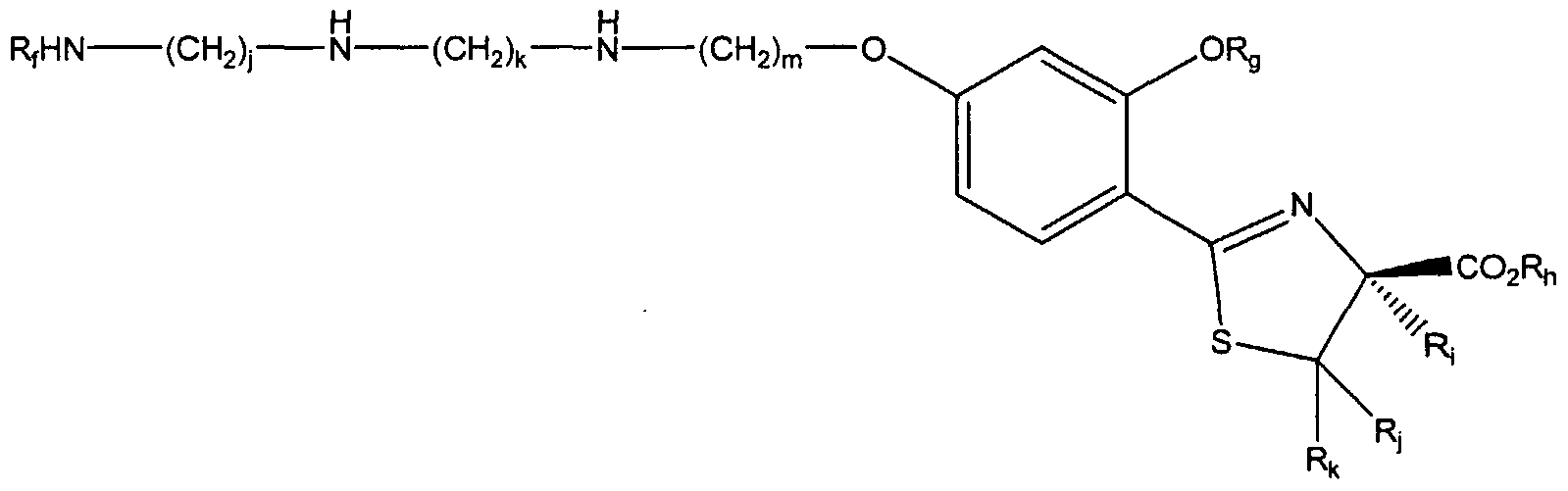
  • the conjugate is represented by Structural Formula (VII):
  • j and k are each independently an integer from 1 to 5; m is an integer from 1 to 12; R f is -H or a substituted or unsubstituted alkyl, acyl or aryl group, preferably -H or a substituted or unsubstituted alkyl or aryl group; R g is -H or a substituted or unsubstituted acyl group; R h is -H or a substituted or unsubstituted alkyl or aryl group; Rj is -H or a substituted or unsubstituted alkyl group; and R j and R are each independently -H or a substituted or unsubstituted alkyl group, or a salt, solvate or hydrate thereof.
  • the present invention also includes pharmaceutical compositions comprising a pharmaceutically acceptable carrier or diluent and one ofthe conjugates disclosed herein.
  • the compounds and pharmaceutical compositions ofthe invention can be used in a method of treating a cancer or tumor in a subject, comprising administering the compounds or pharmaceutical compositions to the subject.
  • the compounds and pharmaceutical compositions ofthe invention can also be used in a method of treating a subject suffering from a metal overload condition, comprising administering the compounds or pharmaceutical compositions to the subject.
  • the compounds and pharmaceutical compositions ofthe invention can additionally be used in a method of reducing oxidative stress in a subject in need of treatment therefor, where the method includes administering the pharmaceutical composition to the subject.
  • Another aspect ofthe invention is a method of increasing uptake of a metal chelator into a cell, comprising covalently attaching a polyamine to the metal chelator, optionally via a linking group, to form a conjugate having a polyamine moiety and a metal chelator moiety, wherein the polyamine moiety comprises three or more nitrogen atoms which are capable of being positively charged at physiological pH, and contacting the cell with the conjugate or a salt, solvate or hydrate thereof.
  • the present invention also includes a method of imaging or examining one or more organs, tissues, tumors or combinations thereof in a subject, comprising administering to the subject a pharmaceutical composition comprising a pharmaceutically acceptable carrier or diluent and a metal salt of a compound comprising a first moiety which is a metal chelator and a second moiety which is a polyamine, where the polyamine moiety includes three or more nitrogen atoms that are capable of being positively charged at physiological pH, and imaging or scanning the organs, tissues, tumors or combination thereof.
  • Another embodiment ofthe present invention is a method of treating a tumor or inhibiting cellular function in a subject in need of treatment therefor, comprising administering to the subject a pharmaceutical composition comprising a pharmaceutically acceptable carrier or diluent and a radioactive metal salt of a compound comprising a first moiety which is a metal chelator and a second moiety which is a polyamine, where the polyamine moiety includes three or more nitrogen atoms that are capable of being positively charged at physiological pH.
  • the present invention includes the use of a compound or pharmaceutical composition disclosed herein in medical therapy.
  • the invention also includes the use of a compound or pharmaceutical composition disclosed herein in the manufacture of a medicament for use in treating conditions disclosed herein.
  • the polyamine-metal chelator conjugates ofthe present invention have the advantage of maintaining the metal chelating properties ofthe molecule, while greatly improving the uptake ofthe metal chelator into cells. This allows larger concentrations of a metal chelator to be present in cells. The increased intracellular concentrations of a metal chelator increase the effectiveness ofthe chelator as a therapeutic agent, such as in retarding the growth of malignant cells.
  • FIG. 1 shows a schematic synthesis of a spermine-Ll conjugate.
  • FIGS. 2A and 2B show Job's plots ofthe spermine-Ll conjugate and LI, respectively, with iron(III).
  • FIG. 1 shows a schematic synthesis of a spermine-Ll conjugate.
  • FIGS. 2A and 2B show Job's plots ofthe spermine-Ll conjugate and LI, respectively, with iron(III).
  • FIG. 3 shows the L1210 cell growth inhibition and transport for several monosubstituted polyamines, LI and the spermine-Ll conjugate.
  • FIG. 4 shows the effect of several monosubstituted polyamines, LI and the spermine-Ll conjugate on polyamine pools in L1210 cells.
  • FIG. 5 shows the impact of several monosubstituted polyamines, LI and the spermine-Ll conjugate on ornithine decarboxylase (ODC), S-adenosylmethionine decarboxylate (AdoMet DC) and Spermine/Spermidine-N'-Acetyltransferase (SSAT) in L1210 cells.
  • ODC ornithine decarboxylase
  • AdoMet DC S-adenosylmethionine decarboxylate
  • SSAT Spermine/Spermidine-N'-Acetyltransferase
  • FIG. 6 shows the schematic synthesis of a spermine derivative of a triether .
  • amideless desferrioxamine FIGS. 7A-7C show the schematic synthesis of a norspermidine- desferrioxamine conjugate.
  • FIG. 8 shows the schematic synthesis of a protected norspermidine with a 4- hydroxybutyl connector at N 1 .
  • FIG. 9 shows the schematic synthesis of a norspermidine-4- hydroxydesazadesmethyldesferrithiocin conjugate from norspermidine with a 4- hydroxybutyl connector at N 1 .
  • FIG. 10 shows the Job's plot ofthe norspermidine-4- hydroxydesazadesmethyldesferrithiocin conjugate with iron(III).
  • FIG. 11 A and 1 IB show the IC 50 values of various polyamines, iron chelators and polyamine-chelator conjugates in inhibiting the growth of L1210 cells (Example 12) and show the intracellular concentration of these compounds (Example 14).
  • FIG. 12 shows the iron clearing efficiency of conjugated and unconjugated chelators in rodents.
  • the present invention is directed to conjugate compounds and salts, solvates and hydrates thereof, where the conjugates comprise a metal chelator moiety and a polyamine moiety.
  • the polyamine typically includes three or more nitrogen atoms that are capable of being positively charged at physiological pH.
  • the polyamine moiety comprises three or more nitrogen atoms that are capable of being positively charged when the pH is from about 7.0 to about 7.6.
  • a metal chelator is defined herein as a molecule that has two or more donor atoms that can coordinate to a central metal atom, thereby forming a complex having a cyclic structure.
  • the donor atoms can optionally be protected by a hydrolyzable functional group, such that the chelator has an overall positive or neutral charge, typically a neutral charge. It is particularly preferred that negatively-charged groups in a metal chelator are protected with a hydrolyzable functional group, thereby producing an uncharged protected chelating group.
  • a metal-chelator complex is thermodynamically stable, which is believed to derive from the entropy resulting from the release of non-chelating ligands (e.g., solvents, particularly water) from the coordination sphere ofthe metal.
  • Chelators, as used herein, are also intended to encompass macrocycles.
  • metal chelator moieties in conjugates ofthe invention have two or more atoms or two or more functional groups that can bind to a metal.
  • Metal chelator moieties ofthe invention can be, for example, bidentate, tridentate, tetradentate, pentadentate, hexadentate, heptadentate, octadentate, nonadentate or decadentate.
  • the metal being chelated is iron(II) or iron(III) and the metal chelator moiety is pentadentate or less.
  • the metal being chelated is iron(II) or iron(III) and the metal chelator moiety is hexadentate or greater.
  • the metal chelator is capable of binding to one or more metals, typically a transition metal, main group metal, heavy metal, lanthanide or actinide.
  • Aluminum and gallium are main group metals.
  • Transition metals include scandium, titanium, vanadium, chromium, manganese, iron, cobalt, nickel, copper, zinc, yttrium, zirconium, molybdenum, palladium, silver, platinum and gold.
  • Heavy metals include cadmium, lead, bismuth, mercury, ruthenium, rhodium, indium, tin, hafnium, tantalum, tungsten, rhenium, osmium, iridium, thallium and polonium.
  • Lanthanides include lanthanum, cerium, praseodymium, neodymium, promethium, samarium, europium, gadolinium, terbium, dysprosium, holmium, erbium, thulium, ytterbium and lutetium.
  • Actinides include actinium, thorium, protactinium, uranium, neptunium, plutonium, americium, curium, berkelium and californium.
  • the metal chelator moiety ofthe conjugates disclosed herein can be characterized by its formation constant with a metal ion, such as iron(II) or iron(III).
  • the metal chelator moiety can have an overall formation constant of at least about 10 12 at about 25°C, about pH 7 and about 0.1 M molar strength.
  • the metal chelator moiety has an overall formation constant of at least about 10 25 under these conditions. More preferably, the overall formation constant is at least about 10 35 under the stated conditions.
  • a metal-metal chelator pair can be chosen to have an overall formation constant of at least about 10 30 , 10 40 , 10 45 or 10 s at about 25°C, about pH 7 and about 0.1 M molar strength.
  • Metal chelators moieties can also be chosen based upon their selectivity for one or a few (e.g., two, three) particular metal ions.
  • a selective metal chelator moiety has an overall formation constant for the target metal ion of at least about an order of magnitude greater than any other metal ion. More preferably, a selective metal chelator moiety has an overall formation constant for the target metal ion at least about three orders of magnitude greater than any other metal ion.
  • Metal chelator moieties ofthe invention typically have two or more nucleophilic or negatively-charged functional groups. Suitable chelators (with appropriate functional groups) for metals can be chosen using the principles of hard- soft acid-base theory. In general, a "hard” metal ion forms more stable complexes with a "hard” base and a "soft" metal ion forms more stable complexes with a "soft” base.
  • Hard metal ions are characterized by a high charge and/or a small ionic radius and include Mn 2+ , Al 3+ , Ga 3+ , Tl 3+ , Ln 3+ , Ti 2+ , Yb 2+ , Sm 2+ , Eu 2+ , Cr 3+ , Co 3+ and Fe 3+ .
  • Soft metal ions tend to have a low charge and/or a large ionic radius and include Cu + , Ag + , Au + , Tl + , Hg + , Cd 2+ , Pd 2+ , Pt 2+ , Pt 4+ and Hg 2+ .
  • Metal ions of intermediate hardness include Fe 2+ , Co 2+ , Ni 2+ , Cu + , Zn 2+ , Pb 2+ , Sn 2+ , Tc 2+ and Ru 2+ .
  • Hard bases ligands
  • Hard bases are characterized by relatively small ionic radii and high electronegativities (e.g., do not readily donate electron density) and include hydroxyl, hydroxamate, ether, phosphate ester, amine and carboxylate groups.
  • Soft bases have lower electronegativities and include thiols, thioethers, phosphines and isonitriles. Imidazole, aryl amines and pyridine are bases of intermediate softness.
  • Iron chelator moieties refer to moieties capable of chelating iron(II), iron(III) or both.
  • Suitable iron chelator moieties contain two or more atoms or two or more functional groups that can bind to iron. Suitable functional groups include, but are not limited to, hydroxamate, catechol, porphyrin, amine, hydroxyl, carboxylate, thiol, imidazole, phenol or dithiocarbamate groups and combinations thereof.
  • an iron chelator moiety can contain more than one type of functional group.
  • Common iron chelators include ethylenediaminetetraacetic acid (EDTA), nitriloacetic acid (NT A), diethylenetriaminepentaacetic acid (DTP A) and N,N'-bis (2-hydroxybenzyl) ethylenediamine-N,N'-diacetic acid (HBED).
  • EDTA ethylenediaminetetraacetic acid
  • NT A nitriloacetic acid
  • DTP A diethylenetriaminepentaacetic acid
  • HBED N,N'-bis (2-hydroxybenzyl) ethylenediamine-N,N'-diacetic acid
  • a general class of iron chelators are the siderophores, which are a diverse groups of iron chelators that are produced by microorganisms. Many ofthe siderophores have hydroxamate or catechol moieties.
  • siderophores examples include enterobactin, parabactin, agrobactin, fluviabactin, vulnibactin, vibriobactin, ferrioxamine B, ferrioxamine E, aerobactin, and ferrichrome.
  • a type of siderophore is desferrithiocin and its analogues and derivatives. The structure of desferrithiocin is shown below:
  • R 7 is -OH, -OR ]4 , or -N(OH)R ]5 ;
  • R 8 is -H, -CH 3 or an alkyl group of 2-6 carbons;
  • R 9 is -H, -CH 3 or an alkyl group of 2-6 carbons; Rio is -H, -CH 3 or an alkyl group of 2-6 carbons, or R 8 and R 9 together form a double bond;
  • Rn is -H or acyl;
  • R 12 is -H, -OH, -O-acyl, -O-alkyl, or -L-X;
  • Ri 4 is alkyl, or optionally substituted benzyl
  • Ri 5 is -H, alkyl, optionally substituted benzyl, 0 ⁇ (CH 2 ) m N- -R-ie
  • Ri 6 is -H, alkyl or optionally substituted benzyl; Ris is -H, -OH, -O-acyl, -O-alkyl or an available electron; A is -N-, -CH- or -C(OH)-; B is -S-, -0-, -NRi6-, -CH 2 - or -CH 2 S-; L is an alkylene group of 3 to about 20 carbon atoms which is optionally interrupted by one or more oxygen atoms; a is 2 or 3; m is an integer from 1 to 8; n is 0, 1 or 2; p is 0, 1 or 2;
  • each ofthe substituents shown is defined above, or a pharmaceutically acceptable salt ofthe compound represented by Structural Formula (V) or (VI) or a stereoisomer ofthe compound or mixture of stereoisomers.
  • a preferred analogue of desferrithiocin is 2-(2,4-dihydroxyphenyl)-4-(-S)- methylthiazoline-4-carboxylic acid, also known as 4-hydroxy-desazadesferrithiocin.
  • Additional iron chelators are described in "Iron Chelators and Therapeutic Uses," by R.J. Bergeron, J.S. McManis, W.R. Weimar, J. Wiegand and E.
  • a particularly suitable protecting group for amines and hydroxyl groups is an acyl group.
  • the means by which the metal chelator moiety and the polyamine moiety are attached to form the conjugate molecule is not believed to be crucial. However, it is understood that the means of attachment should not deleteriously effect the chelating ability ofthe metal chelator moiety or reduce the charge ofthe polyamine moiety to less than tricationic.
  • the polyamine moiety is preferably attached by a terminal (primary) nitrogen, either directly or indirectly, to the metal chelator moiety, as shown diagrammatically in the structure below: H Polyamine N- ⁇ Metal Chelator
  • polyamine moiety and the metal chelator moiety are directly connected by a covalent bond, as shown below: Polyamine Metal Chelator
  • conjugates are formed, for example, by directly reacting a metal chelator with a polyamine to form the conjugate, such as shown in Example 1.
  • a metal chelator with a polyamine to form the conjugate, such as shown in Example 1.
  • the polyamine moiety and the metal chelator moiety are indirectly connected by a linking group, as shown below: Polyamine Linking Group Metal Chelator
  • conjugates are formed, for example, by reacting either a polyamine or a metal chelator with a linking group precursor to form an intermediate product, and subsequently reacting the intermediate product with a metal chelator or a polyamine.
  • the polyamine moiety and the metal chelator moiety can be attached, either directly or indirectly, by a cleavable functional group.
  • the cleavable functional group can originate with the parent polyamine, metal chelator and/or the linking group precursor.
  • the polyamine moiety can be derived from a polyamine that is naturally occurring. Although such naturally occurring polyamines may slow polyamine synthesis through feedback mechanisms, such polyamines should not substantially alter polyamine metabolism.
  • Such naturally occurring polyamines include spermine, spermidine, norspermine, norspermidine, homospermine and homospermidine.
  • Spermine, spermidine, norspermine and norspermidine occur naturally in mammalian cells.
  • the polyamine moiety can also be derived from a polyamine that is not naturally occurring.
  • These non-naturally occurring polyamines will generally alter polyamine metabolism, because such polyamines are not readily processed by polyamine-metabolizing enzymes (e.g., polyamine oxidase).
  • Such non-naturally occurring polyamines include terminally alkylated polyamines such as terminally alkylated spermine, spermidine, norspermine, norspermidine, homospermine and homospermidine.
  • a terminally alkylated polyamine is preferably monoalkylated at a terminal nitrogen atom.
  • a non-alkylated nitrogen atom ofthe polyamine connects the polyamine moiety to the remainder ofthe conjugate molecule (i.e., a primary amine).
  • Ri to R ⁇ are independently hydrogen, alkyl, aryl, aryl alkyl, cycloalkyl or any ofthe foregoing where the alkyl chain is interrupted by one or more etheric oxygen atoms.
  • N 1 , N 2 , N 3 and N 4 are nitrogen atoms capable of protonation at physiological pH's.
  • j and k are independently integers from 1 to 4.
  • A, B and C are independently bridging groups between the nitrogen atoms.
  • the bridging groups can be alkylene groups having, for example, from 1-8 carbon atoms, cycloalkanes, cycloalkenes or heterocyclic groups that incorporate within the ring one ofthe nitrogen atoms ofthe polyamine.
  • the bridging groups maintain the distance between nitrogen atoms such that the polyamine is capable of uptake by a target cell upon administration to a human or non-human animal.
  • the bridging groups can also maintain the distance between nitrogen atoms such that upon uptake by the target cell, the polyamine competitively binds via an electrostatic interaction between the positively charged nitrogen atoms to substantially the same biological counter-anions as the intracellular natural polyamines in the target cell.
  • Additional suitable polyamines for use in the present invention can be found in U.S. Patent Nos. 5,091,576, 5,342,945, 5,455,277, 5,866,613, 5,886,051, 6,184,232 and 6,342,534, the contents of which are incorporated herein by reference.
  • R and R' are preferably each -H and R" is preferably methyl.
  • R and R are each -H and R" is methyl
  • a, b and c are each independently 3 or 4.
  • R" is methyl and a, b and c are each 3.
  • R" is methyl and a is 3, b is 4 and c is 3.
  • R a and each R ⁇ are -H.
  • R a and each R e are -H, d, e and fare each 3 or 4.
  • d, e and fare each 3.
  • d is 3, e is 4 and f is 3.
  • Rb is preferably an unsubstituted hydrocarbyl group interrupted by one or more oxygen atoms, such as a 3,6,9-trioxadecyl group.
  • d, e and f have one ofthe sets of values described above and R b is a 3,6,9-trioxadecyl group.
  • R and each R e are preferably -H.
  • g, h and i are each independently 3 or 4.
  • g, h and i are each 3.
  • g is 3, h is 4 and i is 3.
  • L is preferably a substituted or unsubstituted alkylene group, more preferably an unsubstituted alkylene group such as a dimethylene, trimethylene, tetramethylene, pentamethylene, hexamethylene, heptamethylene or octamethylene group.
  • g, h and i have one ofthe sets of values described above and L is a pentamethylene group.
  • R f is preferably -H.
  • j and k are independently 3 or 4 and m is an integer from 3 to 6.
  • j and k are both 3 and m is 4.
  • R f is -H and j, k and m have the values disclosed above
  • R g is -H or an unsubstituted acyl group, preferably -H or an acetyl group
  • R h is -H or an unsubstituted alkyl group, preferably an ethyl group
  • R is an unsubstituted alkyl group, preferably a methyl group
  • R, and R k are each — H or an unsubstituted alkyl group (e.g., methyl), preferably -H.
  • an iron chelator moiety has five or fewer atoms that coordinate to an iron center. Accordingly, iron chelator moieties for use in treating cancer or a tumor are typically bidentate, tridentate, tetradentate or pentadentate. In another embodiment, an iron chelator moiety has six or more atoms that coordinate to an iron center (e.g., hexadentate and octadentate moieties).
  • Conjugates ofthe invention can be co-administered with one or more other active agents in the methods of treatment disclosed herein.
  • One group of active agents that can be co-administered with conjugates ofthe invention are polyamine synthesis inhibitors.
  • Polyamine synthesis inhibitors include ornithine decarboxylase inhibitors, S-adenosylmethionine inhibitors, spermidine synthase inhibitors and spermine synthase inhibitors. Such polyamine synthesis inhibitors may increase the uptake ofthe compounds and pharmaceutical compositions ofthe invention by cells.
  • co-administration of a compound or pharmaceutical composition ofthe invention is, for example, intended to improve the efficacy of a therapy, increase the rate at which a therapy reduces symptoms of a condition and/or reduce side effects associated with a compound or pharmaceutical composition ofthe invention.
  • Ornithine decarboxylase inhibitors include alpha-difluoromethylornithine
  • DFMO alpha-monofluoromethylornithine
  • E alpha-monofluoromethyldehydroornithine and its esters (e.g., methyl ester), 3-aminooxy-l-propanamine and 3-(aminooxy)-2-fluoro-l- propanamine.
  • S-Adenosylmethionine inhibitors include S-(5'-deoxy-5-adenosyl) methylthioethylhydroxylamine, 5'-deoxy-5'-[(2-aminooxyethyl)methylamino] adenosine, 5'-deoxy-5'-[(3-hydrazinopropyl)methylamino]adenosine, 5'- ⁇ [(Z)-4- amino-2-butenyl]methylamino ⁇ -5'-deoxyadenosine, S-(5'-deoxy-5'-adenosyl)-l- amino-4-methylthio-2-cyclopentene, methylglyoxal bis(guanylhydrazone), ethylglyoxal bis(guanylhydrazone), diethylglyoxal bis(guanylhydrazone), [2,2- bipyridine]-6,6-dicarboximidamide and 4-amidinoindan-l
  • Spermidine synthase inhibitors include S-adenosyl-l,8-diamino-3- thiooctane, cyclohexylamine, rc-butylamine and tn s-4-methylcyclohexylamine.
  • Spermine synthase inhibitors include S-adenosyl-l,12-diamino-3-thio-9- azadodecane, N-( «-butyl)-l,3-diaminopropane and N-(3- aminopropyl)cyclohexylamine.
  • Conjugates ofthe invention can also be co-administered with an additional anti-tumor agent.
  • anti-tumor agents examples include antimetabolites (e.g., azacitidine, cytarabine, fluorouracil, mercaptopurine, methotrexate, thioguanine, cladribine, fludarabine, allopurinol), bleomycin peptide antibiotics, podophyllin alkaloids (e.g., etoposide, teniposide), plant alkaloids (e.g., vincristine, vinblastine, paclitaxel, docetaxel), alkylating agents (e.g., busulfan, cyclophosphamide, mechlorethamine, melphalan, thiotepa, chlorambucil, triethylenemelamine), antibiotics (e.g., dactinomycin, danuorubicin, doxorubicin, plicamycin, mitomycin), cis-platin, carboplatin, procarbazine, dacar
  • Tumors or cancers that can be treated by the invention include, but are not limited to, leukemia, Hodgkin's disease, non-Hodgkin's lymphomas, multiple myeloma, macroglobulinemia, polycythemia vera, lung tumors, head and neck tumors, brain tumors (neuroblastoma), endometrial tumors, ovarian tumors, cervical tumors, breast tumors, choriocarcinoma, testical tumors, prostate tumor, Wilms' tumor, thyroid tumors, adrenal tumors, stomach tumor, pancreal tumors, colonic tumors, carcinoids, insulinoma, bone tumors (osteogenic sarcoma), miscellaneous sarcomas and skin cancer (melanoma).
  • leukemia Hodgkin's disease, non-Hodgkin's lymphomas, multiple myeloma, macroglobulinemia, polycythemia vera, lung tumors, head and neck tumors, brain
  • Subjects suffering from a metal overload condition can be treated with a conjugate that specifically and/or tightly binds to the metal or metals that are present in excess.
  • an iron overload condition is preferably treated with a conjugate having an iron chelator moiety. More preferably, the iron chelator moiety for this indication is hexadentate or greater.
  • Iron overload conditions or diseases can be characterized by global iron overload or focal iron overload.
  • Global iron overload conditions generally involve an excess of iron in multiple tissues or excess iron located throughout an organism.
  • Global iron overload conditions can result from excess uptake of iron by a subject, excess storage and/or retention of iron, from, for example, dietary iron or blood transfusions.
  • One global iron overload condition is primary hemochromatosis, which is typically a genetic disorder.
  • a second global iron overload condition is secondary hemochromatosis, which is typically the result of receiving multiple blood transfusions. Blood transfusions are often required for subjects suffering from thalassemia or sickle cell anemia.
  • a type of dietary iron overload is referred to as Bantu siderosis, which is associated with high iron content of home-brewed beer.
  • focal iron overload conditions the excess iron is limited to one or a few cell types or tissues or a particular organ. Alternatively, symptoms associated with the excess iron are limited to a discrete organ, such as the heart, lungs, liver, pancreas, kidneys or brain.
  • Wilson's disease is a copper overload condition that can be treated using conjugates ofthe invention, preferably where the conjugate has a metal chelator moiety that specifically and/or tightly binds copper.
  • a subject in need of oxidative stress reduction can have one or more ofthe following conditions: decreased levels of reducing agents, increased levels- of reactive oxygen species, mutations in or decreased levels of antioxidant enzymes (e.g., Cu/Zn superoxide dismutase, Mn superoxide dismutase, glutathione reductase, glutathione peroxidase, thioredoxin, thioredoxin peroxidase, DT-diaphorase), mutations in or decreased levels of metal-binding proteins (e.g., transferrin, ferritin, ceruloplasmin, albumin, metallothionein), mutated or overactive enzymes capable of producing superoxide (e.g., nitric oxide synthase, NADPH oxidases, xanthine oxidase, NADH oxidase, aldehyde oxidase, dihydroorotate dehydrogenase, cytochrome c oxid
  • Ischemic episodes can occur when there is local anemia due to mechanical obstruction ofthe blood supply, such as from arterial narrowing or disruption.
  • Myocardial ischemia which can give rise to angina pectoris and myocardial infarctions, results from inadequate circulation of blood to the myocardium, usually due to coronary artery disease. Ischemic episodes in the brain that resolve within 24 hours are referred to as transient ischemic attacks.
  • a patient at risk of suffering from an ischemic episode typically suffers from atherosclerosis, other disorders ofthe blood vessels, increased tendency of blood to clot, or heart disease.
  • the compounds of this invention can be used to treat these disorders.
  • a subject in need of oxidative stress reduction can be suffering from inflammation. Inflammation is a fundamental pathologic process consisting of a complex of cytologic and chemical reactions that occur in blood vessels and adjacent tissues in response to an injury or abnormal stimulation caused by a physical, chemical, or biologic agent.
  • Inflammatory disorders are characterized by inflammation that lasts for an extended period (i.e., chronic inflammation) or that damages tissue.
  • Such inflammatory disorders can affect a wide variety of tissues, such as the respiratory tract, joints, bowels, and soft tissue.
  • the compounds of this invention can be used to treat these disorders.
  • Metal chelator moieties e.g., iron chelator moieties
  • an iron chelator moiety can have six or more atoms available for binding to iron (i.e., is hexadentate or greater) or can form a stable complex that fills all ofthe available coordination sites.
  • the conjugates derive their ability to reduce oxidative stress through various mechanisms.
  • the conjugate binds to a metal, particularly a redox-active metal (e.g., copper, iron), and fills all ofthe coordination sites ofthe metal.
  • a metal particularly a redox-active metal (e.g., copper, iron)
  • the metal chelator moiety ofthe conjugate stabilizes the metal in a particular oxidation state, such that it is less likely to undergo redox cycling.
  • the metal chelator moiety itself has antioxidant activity (e.g., free radical scavenging, scavenging of reactive oxygen or nitrogen species).
  • antioxidant activity e.g., free radical scavenging, scavenging of reactive oxygen or nitrogen species.
  • Desferrithiocin and its derivatives and analogues are known to have intrinsic antioxidant activity, as described in U.S. Application Nos. 10/227,158 and 60/405,463, both filed August 22, 2002, and in U.S. Application No. 10/645,348, filed August 21, 2003, the contents of which are incorporated herein by reference. Imaging or examining one or more organs, tissues, tumors or a combination thereof can be conducted after a metal salt of a conjugate ofthe invention is administered to a subject.
  • the methods of imaging and examining are intended to encompass various instrumental techniques used for diagnosis, such as x-ray methods (including CT scans and conventional x-ray images), magnetic imaging (magnetic resonance imaging, electron paramagnetic resonance imaging) and radiochemical methods.
  • x-ray methods including CT scans and conventional x-ray images
  • magnetic imaging magnetic resonance imaging, electron paramagnetic resonance imaging
  • radiochemical methods Typically, the metal salts used in imaging or examining serve as a contrast agent.
  • Metals that can serve as contrast agents include gadolinium, iron, manganese, chromium, dysprosium, technetium, scandium, barium, aluminum and holmium.
  • Radioactive metal salts can be made from isotopes including 241 Am, 5l Cr, 60 Co, "Co, 58 Co, 64 Cu, 153 Gd, 67 Ga, 198 Au, 1 I3m In, ⁇ ⁇ In, 59 Fe, 55 Fe, !97 Hg, 203 Hg, 99m Tc, 201 T1 and 169 Yb.
  • Radioactive metal salts ofthe conjugates ofthe invention are also useful in treating a tumor or in inhibiting cellular function in a subject in need thereof. Tumors that can be treated by this method can be malignant or benign. Specific types of tumors that can be treated are as discussed above.
  • Inhibiting cellular function involves damaging or destroying cells, preferably in a specific area, in order to slow their proliferation or to inhibit their activity.
  • thyroid or pancreatic islet cells can be damaged in order to decrease the amount of thyroid hormone or insulin that is produced.
  • the present method can be used to inhibit or prevent the production or release of hormones or other biological molecules by certain cells or tissues.
  • radioactive metal isotopes for use in this method include 60 Co, 67 Cu, 90 Sr, 90 Y, 106 Ru, ⁇ u ln, 153 Sm, ,86 Re, 188 Re, 192 Ir 198 Au, 210 Pb, 2,0 Bi, 2,2 Pb, 2I2 Bi and 241 Am.
  • Conjugates disclosed herein that possess a sufficiently acidic functional group, a sufficiently basic functional group or both can react with any of a number of organic or inorganic bases, and inorganic and organic acids, to form a salt.
  • Acidic groups can form salts with one or more ofthe metals listed above, along with alkali and alkaline earth metals (e.g, sodium, potassium, magnesium, calcium).
  • acidic groups can form salts with amines.
  • the iron (iron(II) or iron(III)) salt of a conjugate can be administered to a subject.
  • the conjugate is supplied as a substantially metal-free (e.g. iron-free) salt.
  • Metal-free salts are not typically intended to encompass alkali and alkali earth metal salts.
  • Metal-free salts are advantageously administered to a subject suffering from, for example, a metal overload condition.
  • Acids commonly employed to form acid addition salts from compounds with basic groups are inorganic acids such as hydrochloric acid, hydrobromic acid, hydroiodic acid, sulfuric acid, phosphoric acid, and the like, and organic acids such as/?-toluenesulfonic acid, methanesulfonic acid, oxalic acid, -bromophenyl-sulfonic acid, carbonic acid, succinic acid, citric acid, benzoic acid, acetic acid, and the like.
  • inorganic acids such as hydrochloric acid, hydrobromic acid, hydroiodic acid, sulfuric acid, phosphoric acid, and the like
  • organic acids such as/?-toluenesulfonic acid, methanesulfonic acid, oxalic acid, -bromophenyl-sulfonic acid, carbonic acid, succinic acid, citric acid, benzoic acid, acetic acid, and the like.
  • salts include the hydroxide, sulfate, pyrosulfate, bisulfate, sulfite, bisulfite, phosphate, monohydrogenphosphate, dihydrogenphosphate, metaphosphate, pyrophosphate, chloride, bromide, iodide, acetate, propionate, decanoate, caprylate, acrylate, formate, isobutyrate, caproate, heptanoate, propiolate, oxalate, malonate, succinate, suberate, sebacate, fumarate, maleate, butyne-1,4- dioate, hexyne-l,6-dioate, benzoate, chlorobenzoate, methylbenzoate, dinitrobenzoate, hydroxybenzoate, methoxybenzoate, phthalate, sulfonate, xylenesulfonate, phenylacetate, phenylpropionate, pheny
  • the conjugates disclosed herein can be prepared in the form of their hydrates, such as hemihydrate, monohydrate, dihydrate, trihydrate, tetrahydrate and the like and as solvates.
  • a "subject” is typically a human, but can also be an animal in need of treatment, e.g., companion animals (e.g., dogs, cats, and the like), farm animals (e.g., cows, pigs, horses, sheep, goats and the like) and laboratory animals (e.g., rats, mice, guinea pigs and the like).
  • the conjugates or pharmaceutically acceptable salts thereof of the present invention can be administered by an appropriate route.
  • Suitable routes of administration include, but are not limited to, orally, intraperitoneally, subcutaneously, intramuscularly, intradermally, transdermally, rectally, sublingually, intravenously, buccally or via inhalation.
  • Forms suitable for oral administration include tablets, troches, capsules, elixirs, suspensions, syrups, wafers, chewing gum or the like prepared by art recognized procedures. The amount of active compound in such therapeutically useful compositions or preparations is such that a suitable dosage will be obtained.
  • compositions ofthe invention preferably contain a pha ⁇ naceutically acceptable carrier or diluent suitable for rendering the compound or mixture administrable orally, parenterally, intravenously, intradermally, intramuscularly or subcutaneously, rectally, via inhalation or via buccal administration, or transdermally.
  • the active ingredients may be admixed or compounded with a conventional, pharmaceutically acceptable carrier or diluent. It will be understood by those skilled in the art that any mode of administration, vehicle or carrier conventionally employed and which is inert with respect to the active agent may be utilized for preparing and administering the pharmaceutical compositions of the present invention.
  • the formulations ofthe present invention for use in a subject comprise the agent, together with one or more acceptable carriers or diluents therefor and optionally other therapeutic ingredients.
  • the carriers or diluents must be "acceptable” in the sense of being compatible with the other ingredients ofthe formulation and not deleterious to the recipient thereof.
  • the formulations can conveniently be presented in unit dosage form and can be prepared by any ofthe methods well known in the art of pharmacy. All methods include the step of bringing into association the agent with the carrier or diluent which constitutes one or more accessory ingredients.
  • formulations are prepared by uniformly and intimately bringing into association the agent with the carriers and then, if necessary, dividing the product into unit dosages thereof.
  • Formulations suitable for parenteral administration conveniently comprise sterile aqueous preparations ofthe agents that are preferably isotonic with the blood ofthe recipient.
  • Suitable carrier solutions include phosphate buffered saline, saline, water, lactated ringers or dextrose (5% in water).
  • Such formulations can be conveniently prepared by admixing the agent with water to produce a solution or suspension, which is filled into a sterile container and sealed against bacterial contamination.
  • sterile materials are used under aseptic manufacturing conditions to avoid the need for terminal sterilization.
  • Such formulations can optionally contain one or more additional ingredients, which can include preservatives such as methyl hydroxybenzoate, chlorocresol, metacresol, phenol and benzalkonium chloride.
  • preservatives such as methyl hydroxybenzoate, chlorocresol, metacresol, phenol and benzalkonium chloride.
  • Buffers can also be included to provide a suitable pH value for the formulation. Suitable buffer materials include sodium phosphate and acetate. Sodium chloride or glycerin can be used to render a formulation isotonic with the blood.
  • a formulation can be filled into containers under an inert atmosphere such as nitrogen and can be conveniently presented in unit dose or multi- dose form, for example, in a sealed ampoule.
  • compositions ofthe invention when given orally or via buccal administration can be formulated as syrups, tablets, capsules and lozenges.
  • a syrup formulation will generally consist of a suspension or solution ofthe compound or salt in a liquid carrier, for example, ethanol, glycerine or water, with a flavoring or coloring agent.
  • a liquid carrier for example, ethanol, glycerine or water
  • a flavoring or coloring agent for example, ethanol, glycerine or water
  • one or more pharmaceutical carriers routinely used for preparing solid formulations can be employed. Examples of such carriers include magnesium stearate, starch, lactose and sucrose.
  • compositions are in the form of a capsule
  • use of routine encapsulation is generally suitable, for example, using the aforementioned carriers in a hard gelatin capsule shell.
  • pharmaceutical carriers routinely used for preparing dispersions or suspensions can be considered, for example, aqueous gums, celluloses, silicates or oils, and are incorporated in a soft gelatin capsule shell.
  • a typical suppository formulation includes the conjugate or a pharmaceutically acceptable salt thereof which is active when administered in this way, with a binding and/or lubricating agent, for example, polymeric glycols, gelatins, cocoa-butter or other low melting vegetable waxes or fats.
  • Typical transdermal formulations include a conventional aqueous or non- aqueous vehicle, for example, a cream, ointment, lotion or paste or are in the form of a medicated plastic, patch or membrane.
  • Typical compositions for inhalation are in the form of a solution, suspension or emulsion that can be administered in the form of an aerosol using a conventional propellant such as dichlorodifluoromethane or trichlorofluoromethane.
  • the therapeutically effective amount of a conjugate or pharmaceutical composition ofthe invention depends, in each case, upon several factors, e.g., the health, age, gender, size and condition ofthe subject to be treated, the intended mode of administration, and the capacity ofthe subject to incorporate the intended dosage form, among others.
  • a therapeutically effective amount of an active agent is an amount sufficient to have the desired effect for the condition being treated.
  • the desired effect is partial or total inhibition, delay or prevention ofthe progression of cancer or the tumor including cancer metastasis; inhibition, delay or prevention ofthe recurrence of cancer or the tumor including cancer metastasis; or the prevention ofthe onset or development of cancer or a tumor (chemoprevention) in a mammal, for example a human.
  • a therapeutically effective amount of an active agent is, for example, an amount sufficient to reduce the burden ofthe metal in the subject, reduce the symptoms associated with metal overload or prevent, inhibit or delay the onset and/or severity of symptoms associated with metal overload.
  • a therapeutically effective amount of an active agent is, for example, an amount sufficient to reduce symptoms associated with oxidative stress or prevent, inhibit or delay the onset and/or severity of symptoms associated with oxidative stress.
  • Typical amounts of a compound ofthe invention to be administered to a subject are about 500 micrograms to about 5 grams per day (assuming a 70 kg subject).
  • amounts can range from about 1 milligram to about 1 gram, for example, about 5 milligrams to about 700 milligrams, such as about 50 milligrams to about 500 milligrams.
  • An alkyl group is a saturated hydrocarbon in a molecule that is bonded to one other group in the molecule through a single covalent bond from one of its carbon atoms.
  • Alkyl groups can be cyclic or acyclic and branched or unbranched. Typically, an alkyl group has one to about six carbon atoms, or one to about four carbon atoms.
  • Lower alkyl groups have one to four carbon atoms and include methyl, ethyl, n- propyl, iso-propy ⁇ , n-butyl, sec-butyl and tert-butyl.
  • An alkylene group is a saturated hydrocarbon in a molecule that is bonded to two other groups in the molecule through single covalent bonds.
  • Alkylene groups can be cyclic or acyclic and branched or unbranched. Typically, an alkylene group has one to about six carbon atoms, or one to about four carbon atoms.
  • Acyl groups are represented by the formula -C(0)R, where R is a substituted or unsubstituted alkyl group.
  • Acyl groups can be hydrolyzed or cleaved from a compound by enzymes, acids, or bases. One or more ofthe hydrogen atoms of an acyl group can be substituted, as described below. Typically, an acyl group is removed before a compound ofthe present invention binds to a metal ion such as iron(III).
  • Hydrocarbyl groups are monovalent or divalent hydrocarbons. Hydrocarbyl groups can be substituted or unsubstituted, cyclic or acyclic, branched or unbranched and saturated or unsaturated. Hydrocarbyl groups, as indicated, can optionally be interrupted by one or more oxygen atoms in order to form ether linkages.
  • a hydrocarbyl group contains one to about twelve carbon atoms, one to about six carbon atoms or one to about four carbon atoms.
  • Each R' is independently an alkyl group or an aryl group.
  • Aryl group include carbocyclic aromatic groups such as phenyl, p-tolyl, 1- naphthyl, 2-naphthyl, 1-anthracyl and 2-anthracyl.
  • Aryl groups also include heteroaromatic groups such as N-imidazolyl, 2-imidazole, 2-thienyl, 3-thienyl, 2- furanyl, 3-furanyl, 2-pyridyl, 3-pyridyl, 4-pyridyl, 2-pyrimidyl, 4-pyrimidyl, 2- pyranyl, 3-pyranyl, 3-pyrazolyl, 4-pyrazolyl, 5-pyrazolyl, 2-pyrazinyl, 2-thiazolyl, 4-thiazolyl, 5-thiazolyl, 2-oxazolyl, 4-oxazolyl and 5-oxazolyl.
  • heteroaromatic groups such as N-imidazolyl, 2-imidazole, 2-thienyl, 3-thienyl, 2- furanyl, 3-furanyl, 2-pyridyl, 3-pyridyl, 4-pyridyl, 2-pyrimidyl, 4-pyrimidyl, 2- pyranyl, 3-pyranyl, 3-pyrazolyl
  • Aryl groups also include fused polycyclic aromatic ring systems in which a carbocyclic, alicyclic, or aromatic ring or heteroaryl ring is fused to one or more other heteroaryl or aryl rings.
  • Examples include 2-benzothienyl, 3-benzothienyl, 2- benzofuranyl, 3-benzofuranyl, 2-indolyl, 3-indolyl, 2-quinolinyl, 3-quinolinyl, 2- benzothiazole, 2-benzooxazole, 2-benzimidazole, 2-quinolinyl, 3-quinolinyl, 1 - isoquinolinyl, 3-quinolinyl, 1-isoindolyl and 3-isoindolyl.
  • Cleavable functional groups can be cleaved either chemically or enzymatically.
  • a cleavable functional group is hydrolyzable.
  • cleavable functional groups include ester, amide, carbamate, carbonate, dithiocarbamate, phosphate ester and phosphite ester groups.
  • Linking groups as used herein, connect the metal chelator moiety of a conjugate to the polyamine moiety ofthe conjugate.
  • a linking group typically has suitable functional groups at each end in order to enable the two moieties to be attached.
  • Linking groups are chosen such that they do not deleteriously affect the metal chelating activity ofthe metal chelator moiety or the pK a ofthe nitrogen atoms ofthe polyamine moiety.
  • a linking group can optionally contain one or more cleavable functional groups, so as to permit release of one or both ofthe metal chelator moiety and the polyamine moiety from the conjugate. Preferably, release of either or both moieties occurs within a cell.
  • Suitable linking groups include hydrocarbyl groups, as described above.
  • a linking group is an alkylene group such as a pentamethylene group. No linking group is present in a conjugate if a metal chelator moiety is directly attached to a polyamine moiety by a covalent bond.
  • Example 1 An example of such a conjugate is shown in Example 1.
  • the polyamine moiety cannot be cleaved from the metal chelator moiety as a single unit (although aminopropyl fragments can be individually cleaved).
  • the synthesis is represented schematically in FIG. 1.
  • Reagents were purchased from Aldrich Chemical Co. (Milwaukee, WI), and
  • a 0.5 mM Fe(III) nitrilotriacetate (NT A) solution was made immediately before use by dilution of a 50 mM Fe(III)-NTA stock solution with TRIS buffer. Solutions ofthe ferric complex containing different ligand/Fe(III) ratios were then prepared by mixing appropriate volumes of 0.5 mM ligand in 100 mM TRIS Cl, pH 7.4, and 0.5 mM Fe(III)-NTA such that the combined concentration of ligand and Fe(III) was a constant at 1.00 mM. The Job's plot for each set of mixtures was then derived. The plots for Compound 3 and LI were essentially identical, demonstrating that both compounds formed a 3:1 ligand/metal complex. These results clearly indicated that the spermine fragment ofthe Ll-polyamine conjugate Compound 3 does not alter the stoichiometry ofthe ferric complex.
  • N'-Acetylspermine (AcSPM) as its trihydrochloride salt (A-2679) was purchased from Sigma (St. Louis, MO).
  • Murine L1210 leukemia cells were maintained in logarithmic growth as a suspension culture in RPMI- 1640 medium (Gibco, Grand Island, ⁇ Y) containing 10% fetal bovine serum (Gibco), 2% HEPES-MOPS buffer, 1 mM L-glutamine (Gibco), and 1 mM aminoguanidine at 37 °C in a water-jacketed 5% C0 incubator. Cells were grown in 25 cm 2 tissue culture flasks in a total volume of 10 mL.
  • the IC 50 is defined as the concentration of compound necessary to reduce cell growth to 50% of control growth after defined intervals of exposure.
  • Several different polyamines were tested for their effect on cell proliferation (FIG. 3). N'-acetylspermine (AcSPM), a trication; N 1 -ethylspermine (MESPM), a tetracation; and ⁇ -propylspermidine [MPSPDtN 8 )], another trication.
  • AcSPM N'-acetylspermine
  • MESPM N 1 -ethylspermine
  • MPSPDtN 8 ⁇ -propylspermidine
  • the IC 50 value is 0.2 ⁇ M at both time points, at least 230 times more active than the parent ligand.
  • compound 3 is nearly 500 times more active than any ofthe parent polyamine analogues, although by 96 h its IC 50 value is comparable to that of MESPM.
  • the most profound difference between the conjugate and the polyamine analogues is that whereas the IC 50 values ofthe alkyl polyamine analogues diminish as the length of treatment decreases, the IC 50 value for the conjugate is low at 48 h and remains the same at 98 h. This behavior is similar to that ofthe chelator moiety LI, which remains static in its behavior, even though the corresponding IC 50 values are much higher than those for compound 3.
  • L1210 leukemia cells were treated with the compounds of interest at the 48 hour IC 50 concentration.
  • cell suspensions were sampled, washed three times in ice-cold, incomplete medium, and pelleted for extraction using 0.6 N perchloric acid, then freeze- fractured in liquid nitrogen/hot water three times. Each supernatant was frozen at -20 °C until analysis of polyamine content by HPLC.
  • LI was measured by an HPLC method with UV detection described in the literature with the following modifications: mobile phase A, 20% buffer/80% CH 3 OH; mobile phase B, 98% buffer/2% CH 3 CN.
  • the buffer consisted of potassium phosphate (10 M) and EDTA (2 mM), pH 2.9.
  • MPSPDCN 8 lowered putrescine and spermidine, although spermine was unaffected (103%).
  • AcSPM had a substantial effect on putrescine, generated a slight decrease in spermidine, and increased spermine levels.
  • MPSPD N 8 achieved the highest intracellular concentration, 3.52 mM; AcSPM and MESPM reached concentrations less than half of this, 1.62 and 1.24 mM, respectively.
  • treatment of cells with LI 50 ⁇ M
  • putrescine and spermidine remained close to control levels, and spermine rose to 127% of control values.
  • conjugate 3 when given at its IC50 concentration (0.2 ⁇ M) was vastly different from that of LI and very similar to that of AcSPM. Putrescine was diminished to 33% of control, spermidine was reduced to 64% of control, and spermine increased to 139% of control values.
  • the conjugate 3 was transported quite efficiently into the cells; the intracellular concentration of 0.39 mM is more than 1900-fold higher than the extracellular treatment concentration and is also several hundred times higher than the intracellular concentration attained by the parent ligand LI.
  • Ornithine decarboxylase (ODC) and Adenosylmethionine decarboxylase (AdoMet DC) activities were determined according to the procedures of Seely, J. E., Pegg, A. E., "Ornithine Decarboxylase (Mouse Kidney),” Methods Enzymol. 94: 158-161 (1983) and Pegg, A. E., P ⁇ s ⁇ , H., "S-Adenosylmethionine Decarboxylase (Rat Liver),” Methods Enzymol.
  • the conjugate 3 behaved much like MPSPDCN 8 ), reducing ODC and AdoMetDC to 20 ⁇ 4% and 77 ⁇ 11% of control, respectively, and increasing SSAT activity to 275 ⁇ 6% of control. These results further support the idea of incorporation ofthe conjugate.
  • Trihydroxamic acid reagent 7 was converted to (9-benzyl hydroxylamine 8 using trifluoroacetic acid (TFA) in CH 2 C1 2 .
  • TFA trifluoroacetic acid
  • a four-carbon spacer was appended to 8 with succinic anhydride in pyridine, forming carboxylic acid 9.
  • Acid 9 was activated with carbonyl diimidazole and treated with N I ,N 4 ,N 9 -tris-(tert-butoxycarbonyl)spermine (5), yielding fully protected chelator 10.
  • Hydrogenolysis ofthe benzyl groups of 10 and purification using Sephadex LH-20 gave tri hydroxamate 11, in which the amines remain protected.
  • Treatment of 11 with ethanolic HC1 produced triamino chelator 12.
  • Stirring 11 with TFA effected clean deprotection ofthe amino groups, and ion exchange provided trihydrochloride salt 12.
  • analogue 12 (Example 7) on the growth of L1210 murine leukemia cells (IC 5 o) and its ability to compete with radiolabeled spermidine for the polyamine transport apparatus (K) was tested using the method described in Example 4.
  • the 96-hour IC 50 value was 1.5 ⁇ M, which is comparable to many tetraamine analogues.
  • the K ⁇ value was 7 ⁇ M, which indicated good competition for the polyamine transport apparatus.
  • Norspermidine (20) was reacted with benzyl 4-bromobutyl ether (21, 1.2 equiv) over a day at room temperature in the presence of 1.4 equivalents of cesium hydroxide monohydrate and 4 A molecular sieves in DMF to give 22.
  • the amino groups were protected using di(t-butyl) dicarbonate in aqueous tetrahydrofuran (THF) to give 23.
  • THF aqueous tetrahydrofuran
  • Calcium in ammonia and THF efficiently generated alcohol 24.
  • the alcohol was converted into an aldehyde using pyridinium dichromate in CH C1 .
  • the first steps ofthe synthesis involved preparation of a protected triamine with a 4- hydroxybutyl connector at N 1 (20), as shown in FIG. 8.
  • Bis(BOC)aminonitrile 15 was hydrogenated over Raney nickel under highly alkaline conditions in ethanolic ⁇ aOH to N ⁇ N ⁇ -bis ⁇ ert-butoxycarbony norspermidine (16).
  • the ⁇ -hydroxy tether was affixed to the amine end of 16 in two steps.
  • the three nitrogens and the oxygen of 18 were unmasked by employing 30% HBr in acetic acid and phenol in CH 2 C1 2 , and the amino groups of trihydrobromide salt 19 were trapped as their tert-butyl carbamates using di-(t-butyl)-dicarbonate in THF and triethylamine, furnishing N 1 -(4-hydroxybutyl)-N',N 4 N 7 -tris(tert- butoxycarbonyl)norspermidine (20) in 59% yield from 18.
  • the alcohol group of ⁇ SPD reagent 20 was activated in 80% yield as tosylate 21 with tosyl chloride in triethylamine and CH 2 C1 2 (FIG. 9).
  • the carbamates of 24 were cleaved with trifluoroacetic acid (TFA) in CH 2 C1 2 , followed by ion exchange chromatography, providing (S)-4,5-dihydro-2-[2-hydroxy-4-(12-amino-5,9-diazadodecyloxy)phenyl]- 4-methyl-4-thiazolecarboxylic acid trihydrochloride (10 of FIG. 9) in 68% yield.
  • TFA trifluoroacetic acid
  • the IC50 values were determined at both 48 and 96 h in L1210 cells (FIGS. 11 A and 1 IB).
  • the values for DESPM (1), FDESPM (2), LI (4), and the SPM-Ll conjugate (5) are included in FIGS. 11 A and 1 IB for comparative purposes.
  • FDESPM (2) is not active in the IC 50 assay (> 100 ⁇ M)
  • the behavior of DESPM (1) in the IC 50 assay is typical of many polyamine analogues, that is, the IC 50 decreases as the length of treatment increases, in this case, from 30 ⁇ M at 48 h to 0.2 ⁇ M at 96 h.
  • Murine LI 210 leukemia cells were maintained in logarithmic growth as a suspension culture in RPMI- 1640 medium (Gibco, Grand Island, NY) containing 10% fetal bovine serum (Gibco), 2% HEPES-MOPS buffer, 1 mM L-glutamine (Gibco), and 1 mM aminoguanidine at 37 °C in a water-jacketed 5% C0 2 incubator.
  • Iron chelators typically maintain a constant IC 50 value as treatment time progresses.
  • DFO (3) has IC5 0 values of 7 ⁇ M (48 h) and 6 ⁇ M (96 h); the LI (4) IC 50 values are somewhat higher, 46 and 55 ⁇ M at 48 and 96 h, respectively.
  • Appending a polyamine vector to LI (5) decreased the IC50 considerably, to 0.2 ⁇ M at both 48 and 96 h.
  • the IC50 values for 4'- hydroxydesazadesferrithiocin ((S)-4'-(HO)-DADFT (8)) at 48 and 96 h were within error of each other, 19 and 20 ⁇ M, respectively.
  • N 1 - terephthaloylspermidine methyl ester ( ⁇ TS-ME, 6), orN'-terephthaloylspermidine (NTS, 7) had any impact on cell growth; the 48- and 96-h IC 50 values for both compounds were > 100 ⁇ M.
  • the molecules of interest were studied for their ability to compete with [ 3 H]SPD for uptake into L1210 leukemia cell suspensions in vitro. Briefly, cell suspensions were incubated in 1 mL of culture medium containing radiolabeled SPD alone or radiolabeled SPD in the presence of graduated concentrations of chelator or conjugate. At the end ofthe incubation period, the tubes were centrifuged; the pellet was washed, digested, and neutralized prior to scintillation counting. Lineweaver- Burk plots indicated simple competitive inhibition with respect to SPD.
  • the buffer employed was sodium octanesulfonate (2.5 mM) in potassium phosphate (25 mM), pH 3.0.
  • Mobile phase A consisted of 5% CH 3 CN, 95% buffer;
  • mobile phase B consisted of 60% CH 3 CN, 40% buffer.
  • the solvent gradient program employed a linear gradient that increased from 20% mobile phase B to 40% mobile phase B over 40 min and a 5-min ramp to 100%) B over 5 min.
  • Post-column derivatization used a boric acid buffer system (H 3 B0 3 , 3.1% w/v; KOH, 2.6% w/v; 2-mercaptoethanol, 0.6% v/v) that contained o-phthaldialdehyde (10 mL of a 4% w/v solution in CH OH per L of buffer). The flow rate was 0.4 mL/min, isocratic; UV detection ( ⁇ ex , 340 nm; ⁇ em , 445 nm) was utilized.
  • Norspermidine- ⁇ )-4'-(HO)-DADFT Conjugates (9 and 10 of FIG. 11B).
  • Analytical separation was performed on a reversed-phase Supelco Discovery RP Amide C ⁇ 6 column (150 4.6 mm, 5 ⁇ m) on the system described above, and UV detection was at 300 nm.
  • the mobile phases were pumped at a flow rate of 1.5 mL/min.
  • the buffer and mobile phases A and B were the same as described above.
  • the solvent gradient program employed an initial 10-min isocratic portion with 5% mobile phase B (95% A), followed by a linear gradient increase to 80% mobile phase B at 35 min, a 5-min ramp to 100% B held for 10 min, and ramping back to 5% mobile phase B for 8 min (58-65 min total).
  • This method had a detection limit of 0.2 ⁇ M as a direct injection; this corresponds to a tissue concentration of 10 nmol/g wet weight.
  • concentrations were calculated from the peak area fitted to calibration curves by nonweighted least squares linear regression with Rainin Dynamax HPLC Method Manager software (Rainin Instrument Co.).
  • Previous studies have shown that DESPM reaches intracellular levels of 400 ⁇ M when the extracellular treatment concentration is 30 ⁇ M (FIG. 1 1A).
  • the dicationic FDESPM (2) which demonstrated a poor K ⁇ for the polyamine transport apparatus, was not effectively concentrated in the cell. Even at an extracellular treatment concentration of 100 ⁇ M, FDESPM achieved a cellular level of ⁇ 20 ⁇ M.
  • the intracellular concentration ofthe parent ligand, (S)-4'- (HO)-DADFT (8) does not exceed 50 ⁇ M (FIG. 1 IB).
  • the ethyl ester of the NSPD-(S)-4'-(HO)-DADFT conjugate (9) was effectively transported into the cell, achieving a concentration of 947 ⁇ 110 ⁇ M; furthermore, the hydrolysis product, acid conjugate 10, was present at approximately three times the amount of the ester, 2980 ⁇ 280 ⁇ M.
  • the intracellular drug level rose to about 70 ⁇ M.
  • the behavior ofthe chelator conjugates versus the parent chelator i.e, the LI (5 vs 4 of FIG. 11 A) and (5)-4'-(HO)-DADFT series (9 and 10 vs 8 FIG. 1 IB) was evaluated in a rodent iron clearance model, the bile duct-cannulated rat.
  • chelator-promoted iron excretion is measured in both the bile and the urine.
  • the kinetics of iron excretion can be determined. In each instance, the drugs were given subcutaneously.
  • LI and its SPM conjugate (4 and 5) were administered at a dose of 450 ⁇ mol/kg and (S)-4*-(HO)-DADFT (8) and its NSPD conjugates (9 and 10) were administered at a dose of 300 ⁇ mol/kg, i.e., all at equivalent iron-binding capacity.
  • LI and its SPM conjugate form 3:1 ligand/metal complexes
  • the (S)-4'- (HO)-DADFT-based compounds form 2:1 ligand/metal complexes.
  • the tissues of animals given the ester 10 contained largely free acid, so it is unlikely that the ethyl ester survives non-specific serum esterases.)
  • LI (4) had an iron-clearing efficiency of 2.2 ⁇
  • N' ⁇ -Tris ⁇ ert-butoxycarbony spermine was acylated in 70% yield with mono-methyl terephthalate (12), which had been activated with 1,1'- carbonyldiimidazole (CDI).
  • the amine protecting groups ofthe resulting adduct 13 were removed using methanolic HC1, generating triamino amide-methyl ester 6 in 75% yield.
  • initial cleavage ofthe ester in intermediate 13 with NaOH in aqueous methanol resulted in tris(BOC) acid 14.
  • the carbamates of 14 were cleaved with trifluoroacetic acid, followed by ion exchange chromatography, providing the terephthalic acid derivative of spermine as its trihydrochloride salt, 7, in 45% yield from 13.

Landscapes

  • Health & Medical Sciences (AREA)
  • General Health & Medical Sciences (AREA)
  • Chemical & Material Sciences (AREA)
  • Veterinary Medicine (AREA)
  • Medicinal Chemistry (AREA)
  • Public Health (AREA)
  • Pharmacology & Pharmacy (AREA)
  • Life Sciences & Earth Sciences (AREA)
  • Animal Behavior & Ethology (AREA)
  • Bioinformatics & Cheminformatics (AREA)
  • Epidemiology (AREA)
  • Engineering & Computer Science (AREA)
  • Nuclear Medicine, Radiotherapy & Molecular Imaging (AREA)
  • General Chemical & Material Sciences (AREA)
  • Chemical Kinetics & Catalysis (AREA)
  • Organic Chemistry (AREA)
  • Toxicology (AREA)
  • Biomedical Technology (AREA)
  • Neurology (AREA)
  • Neurosurgery (AREA)
  • Acyclic And Carbocyclic Compounds In Medicinal Compositions (AREA)
  • Pharmaceuticals Containing Other Organic And Inorganic Compounds (AREA)
  • Organic Low-Molecular-Weight Compounds And Preparation Thereof (AREA)
  • Medicinal Preparation (AREA)
  • Medicines Containing Antibodies Or Antigens For Use As Internal Diagnostic Agents (AREA)
  • Medicines That Contain Protein Lipid Enzymes And Other Medicines (AREA)
  • Pyridine Compounds (AREA)
  • Thiazole And Isothizaole Compounds (AREA)
  • Polyethers (AREA)
  • Macromolecular Compounds Obtained By Forming Nitrogen-Containing Linkages In General (AREA)

Abstract

Many metal chelators have polar or charged functional groups, which render them difficult to transport across a cell membrane. Polyamine-metal chelator conjugates of the invention are compounds comprising a first moiety which is a metal chelator and a second moiety which is a polyamine, where the polyamine moiety includes three or more nitrogen atoms which are capable of being positively charged at physiological pH. A spermine-L1 conjugate has been shown to accumulate in L1210 cells several hundred fold more than the unconjugated L1 chelator.

Description

POLYAMI E-METAL CHELATOR CONJUGATES
RELATED APPLICATION This application claims the benefit of U.S. Provisional Application No.
60/501,341, filed on September 9, 2003. The entire teachings ofthe above application are incorporated herein by reference.
GOVERNMENT SUPPORT The invention was supported, in whole or in part, by a grant R01-DK49108 from the National Institutes of Health. The Government has certain rights in the invention.
BACKGROUND OF THE INVENTION Metal ions have an array of biological functions that include charge neutralization, voltage gating, signaling, oxygen transport, electron transport, structure stabilization and regulation and contributing to enzymatic activity. However, the activity ofthe metal ions depends on the both the location of and the quantity ofthe metal. When an excess of metal is present or if a metal is present in an undesired location, this results in a condition typically referred to as metal overload. Metal overload conditions can result from a genetic defect (e.g., excess absorption or excess accumulation of metal), diet or poisoning. Metal overload conditions also occur in subjects with certain types of anemia (e.g., anemia resulting from thalassemia) where the subject receives regular blood transfusions. The iron from these transfusions accumulates in the subject over time and eventually causes biological damage. The metals of greatest concern in metal overload conditions are the redox- active metals, such as iron, chromium and copper. These redox-active metals can initiate free radical damage in a subject, such as through reaction with a peroxide or a thiol. The reaction of iron(II) and hydrogen peroxide is known as the Fenton reaction, which produces hydroxyl radical. Hydroxyl radical is highly reactive and is able to abstract hydrogen atoms from many organic molecules, which can lead to significant biological damage. Therefore, such metal overload conditions need to be treated. Although metal deficiencies can generally be treated through dietary means, the treatment for metal overload conditions is more difficult. Therapy for metal overload disease often involves treating a subject with a chelating agent in order to remove the excess metal. The chelating agent has one or more functional groups that will bind to the metal. The chelating functional groups are polar and often charged, such that chelating agents are not readily taken up by cells. As a result, it can be difficult to achieve a therapeutic amount of a chelating agent within a cell and less metal is removed from the cell than desired. These factors limit the success of chelation therapy. Metal chelators also have applications in conditions not directly related to metal overload, such as cancer. The success of treating these additional conditions with a metal chelator is also limited by the generally low concentration of chelator that is transported into cells. Thus, there is a need to find a method to increase the uptake of chelating agents into a cell in order to increase the effectiveness of chelation therapy and other treatments with metal chelators.
SUMMARY OF THE INVENTION It has now been found that the uptake of metal chelating agents can be significantly increased by reacting metal chelating agents with polyamines, thereby resulting in compounds comprising a first moiety that is the metal chelator and a second moiety that is the polyamine. In one example, l-(12-amino-4,9- diazadodecyl)-2-methyl-3-hydroxy-4-(lH)-pyridinone was synthesized from spermine and 3-O-benzylmaltol. This compound was shown to form a 3:1 complex with iron(III) and was taken up by the polyamine transporter of L1210 leukemia cells 1900-fold against a concentration gradient. This compound is also effective as an anti-cancer agent, as it was at least 230 times more active in suppressing the growth of L1210 murine leukemia cells than the parent ligand, l,2-dimethyl-3- hydroxypyridin-4-one. Compounds comprising spermine and a poly(hydroxamic acid) were also taken up by the polyamine transporter and were effective in suppressing the growth of leukemia cells. The present invention relates to compounds comprising a first moiety which is a metal chelator and a second moiety which is a polyamine, where the polyamine moiety includes three or more nitrogen atoms that are capable of being positively charged at physiological pH, or salts, solvates or hydrates thereof. Such compounds are referred to in the present application as "conjugates". In a particular embodiment ofthe invention, the metal chelator is an iron chelator. In one embodiment, the conjugate is represented by Structural Formula (I):
Figure imgf000004_0001
where: a, b and c are each independently integers from 1 to 5; R is -H or a substituted or unsubstituted alkyl, acyl or aryl group, preferably -H or a substituted or unsubstituted alkyl or aryl group; R' is -H or a substituted or unsubstituted acyl group; and R" is -H or a substituted or unsubstituted alkyl group, or a salt, solvate or hydrate thereof. In another embodiment, the conjugate is represented by Structural Formula (II):
Figure imgf000004_0002
where: d, e and fare each independently integers from 1 to 5; Ra is -H or a substituted or unsubstituted alkyl, acyl or aryl group, preferably -H or a substituted or unsubstituted alkyl or aryl group; Rb is -H or a substituted or unsubstituted alkyl group or a substituted or unsubstituted hydrocarbyl group interrupted by one or more oxygen atoms; and each Rς is independently -H or a substituted or unsubstituted acyl group, or a salt, solvate or hydrate thereof. In yet another embodiment, the conjugate is represented by Structural Formula (III):
Figure imgf000005_0001
(in), where: g, h and i are each independently an integer from 1 to 5; L is a linking group; Rj is -H or a substituted or unsubstituted alkyl, acyl or aryl group, preferably
-H or a substituted or unsubstituted alkyl or aryl group; and each Re is independently -H or a substituted or unsubstituted acyl group, or a salt, solvate or hydrate thereof. In a further embodiment, the conjugate is represented by Structural Formula (VII):
Figure imgf000006_0001
(VII), where: j and k are each independently an integer from 1 to 5; m is an integer from 1 to 12; Rf is -H or a substituted or unsubstituted alkyl, acyl or aryl group, preferably -H or a substituted or unsubstituted alkyl or aryl group; Rg is -H or a substituted or unsubstituted acyl group; Rh is -H or a substituted or unsubstituted alkyl or aryl group; Rj is -H or a substituted or unsubstituted alkyl group; and Rj and R are each independently -H or a substituted or unsubstituted alkyl group, or a salt, solvate or hydrate thereof. The present invention also includes pharmaceutical compositions comprising a pharmaceutically acceptable carrier or diluent and one ofthe conjugates disclosed herein. The compounds and pharmaceutical compositions ofthe invention can be used in a method of treating a cancer or tumor in a subject, comprising administering the compounds or pharmaceutical compositions to the subject. The compounds and pharmaceutical compositions ofthe invention can also be used in a method of treating a subject suffering from a metal overload condition, comprising administering the compounds or pharmaceutical compositions to the subject. The compounds and pharmaceutical compositions ofthe invention can additionally be used in a method of reducing oxidative stress in a subject in need of treatment therefor, where the method includes administering the pharmaceutical composition to the subject. Another aspect ofthe invention is a method of increasing uptake of a metal chelator into a cell, comprising covalently attaching a polyamine to the metal chelator, optionally via a linking group, to form a conjugate having a polyamine moiety and a metal chelator moiety, wherein the polyamine moiety comprises three or more nitrogen atoms which are capable of being positively charged at physiological pH, and contacting the cell with the conjugate or a salt, solvate or hydrate thereof. The present invention also includes a method of imaging or examining one or more organs, tissues, tumors or combinations thereof in a subject, comprising administering to the subject a pharmaceutical composition comprising a pharmaceutically acceptable carrier or diluent and a metal salt of a compound comprising a first moiety which is a metal chelator and a second moiety which is a polyamine, where the polyamine moiety includes three or more nitrogen atoms that are capable of being positively charged at physiological pH, and imaging or scanning the organs, tissues, tumors or combination thereof. Another embodiment ofthe present invention is a method of treating a tumor or inhibiting cellular function in a subject in need of treatment therefor, comprising administering to the subject a pharmaceutical composition comprising a pharmaceutically acceptable carrier or diluent and a radioactive metal salt of a compound comprising a first moiety which is a metal chelator and a second moiety which is a polyamine, where the polyamine moiety includes three or more nitrogen atoms that are capable of being positively charged at physiological pH. The present invention includes the use of a compound or pharmaceutical composition disclosed herein in medical therapy. The invention also includes the use of a compound or pharmaceutical composition disclosed herein in the manufacture of a medicament for use in treating conditions disclosed herein. The polyamine-metal chelator conjugates ofthe present invention have the advantage of maintaining the metal chelating properties ofthe molecule, while greatly improving the uptake ofthe metal chelator into cells. This allows larger concentrations of a metal chelator to be present in cells. The increased intracellular concentrations of a metal chelator increase the effectiveness ofthe chelator as a therapeutic agent, such as in retarding the growth of malignant cells. BRIEF DESCRIPTION OF THE DRAWINGS FIG. 1 shows a schematic synthesis of a spermine-Ll conjugate. FIGS. 2A and 2B show Job's plots ofthe spermine-Ll conjugate and LI, respectively, with iron(III). FIG. 3 shows the L1210 cell growth inhibition and transport for several monosubstituted polyamines, LI and the spermine-Ll conjugate. FIG. 4 shows the effect of several monosubstituted polyamines, LI and the spermine-Ll conjugate on polyamine pools in L1210 cells. FIG. 5 shows the impact of several monosubstituted polyamines, LI and the spermine-Ll conjugate on ornithine decarboxylase (ODC), S-adenosylmethionine decarboxylate (AdoMet DC) and Spermine/Spermidine-N'-Acetyltransferase (SSAT) in L1210 cells. FIG. 6 shows the schematic synthesis of a spermine derivative of a triether . amideless desferrioxamine. FIGS. 7A-7C show the schematic synthesis of a norspermidine- desferrioxamine conjugate. FIG. 8 shows the schematic synthesis of a protected norspermidine with a 4- hydroxybutyl connector at N1 . FIG. 9 shows the schematic synthesis of a norspermidine-4- hydroxydesazadesmethyldesferrithiocin conjugate from norspermidine with a 4- hydroxybutyl connector at N1. FIG. 10 shows the Job's plot ofthe norspermidine-4- hydroxydesazadesmethyldesferrithiocin conjugate with iron(III). FIGS. 11 A and 1 IB show the IC50 values of various polyamines, iron chelators and polyamine-chelator conjugates in inhibiting the growth of L1210 cells (Example 12) and show the intracellular concentration of these compounds (Example 14). FIG. 12 shows the iron clearing efficiency of conjugated and unconjugated chelators in rodents. FIG. 13 shows the biliary ferrokinetics of free (S)-4'- hydroxydesazadesferrithiocin (8), its free acid conjugate with norspermidine (9) and the corresponding ethyl ester (10) at a dose of 300 μmol/kg administered subcutaneously to bile duct cannulated rats (n = 4 per compound).
DETAILED DESCRIPTION OF THE INVENTION The present invention is directed to conjugate compounds and salts, solvates and hydrates thereof, where the conjugates comprise a metal chelator moiety and a polyamine moiety. The polyamine typically includes three or more nitrogen atoms that are capable of being positively charged at physiological pH. In a preferred embodiment, the polyamine moiety comprises three or more nitrogen atoms that are capable of being positively charged when the pH is from about 7.0 to about 7.6. A metal chelator is defined herein as a molecule that has two or more donor atoms that can coordinate to a central metal atom, thereby forming a complex having a cyclic structure. The donor atoms can optionally be protected by a hydrolyzable functional group, such that the chelator has an overall positive or neutral charge, typically a neutral charge. It is particularly preferred that negatively-charged groups in a metal chelator are protected with a hydrolyzable functional group, thereby producing an uncharged protected chelating group. A metal-chelator complex is thermodynamically stable, which is believed to derive from the entropy resulting from the release of non-chelating ligands (e.g., solvents, particularly water) from the coordination sphere ofthe metal. Chelators, as used herein, are also intended to encompass macrocycles. Accordingly, metal chelator moieties in conjugates ofthe invention have two or more atoms or two or more functional groups that can bind to a metal. Metal chelator moieties ofthe invention can be, for example, bidentate, tridentate, tetradentate, pentadentate, hexadentate, heptadentate, octadentate, nonadentate or decadentate. In one embodiment, the metal being chelated is iron(II) or iron(III) and the metal chelator moiety is pentadentate or less. In another embodiment, the metal being chelated is iron(II) or iron(III) and the metal chelator moiety is hexadentate or greater. The metal chelator is capable of binding to one or more metals, typically a transition metal, main group metal, heavy metal, lanthanide or actinide. Aluminum and gallium are main group metals. Transition metals include scandium, titanium, vanadium, chromium, manganese, iron, cobalt, nickel, copper, zinc, yttrium, zirconium, molybdenum, palladium, silver, platinum and gold. Heavy metals include cadmium, lead, bismuth, mercury, ruthenium, rhodium, indium, tin, hafnium, tantalum, tungsten, rhenium, osmium, iridium, thallium and polonium. Lanthanides include lanthanum, cerium, praseodymium, neodymium, promethium, samarium, europium, gadolinium, terbium, dysprosium, holmium, erbium, thulium, ytterbium and lutetium. Actinides include actinium, thorium, protactinium, uranium, neptunium, plutonium, americium, curium, berkelium and californium. The metal chelator moiety ofthe conjugates disclosed herein can be characterized by its formation constant with a metal ion, such as iron(II) or iron(III). For example, the metal chelator moiety can have an overall formation constant of at least about 1012 at about 25°C, about pH 7 and about 0.1 M molar strength. Preferably, the metal chelator moiety has an overall formation constant of at least about 1025 under these conditions. More preferably, the overall formation constant is at least about 1035 under the stated conditions. A metal-metal chelator pair can be chosen to have an overall formation constant of at least about 1030, 1040, 1045 or 10s at about 25°C, about pH 7 and about 0.1 M molar strength. Metal chelators moieties can also be chosen based upon their selectivity for one or a few (e.g., two, three) particular metal ions. Preferably, a selective metal chelator moiety has an overall formation constant for the target metal ion of at least about an order of magnitude greater than any other metal ion. More preferably, a selective metal chelator moiety has an overall formation constant for the target metal ion at least about three orders of magnitude greater than any other metal ion. Metal chelator moieties ofthe invention typically have two or more nucleophilic or negatively-charged functional groups. Suitable chelators (with appropriate functional groups) for metals can be chosen using the principles of hard- soft acid-base theory. In general, a "hard" metal ion forms more stable complexes with a "hard" base and a "soft" metal ion forms more stable complexes with a "soft" base. Hard metal ions are characterized by a high charge and/or a small ionic radius and include Mn2+, Al3+, Ga3+, Tl3+, Ln3+, Ti2+, Yb2+, Sm2+, Eu2+, Cr3+, Co3+ and Fe3+. Soft metal ions tend to have a low charge and/or a large ionic radius and include Cu+, Ag+, Au+, Tl+, Hg+, Cd2+, Pd2+, Pt2+, Pt4+ and Hg2+. Metal ions of intermediate hardness include Fe2+, Co2+, Ni2+, Cu +, Zn2+, Pb2+, Sn2+, Tc2+ and Ru2+. Hard bases (ligands) are characterized by relatively small ionic radii and high electronegativities (e.g., do not readily donate electron density) and include hydroxyl, hydroxamate, ether, phosphate ester, amine and carboxylate groups. Soft bases have lower electronegativities and include thiols, thioethers, phosphines and isonitriles. Imidazole, aryl amines and pyridine are bases of intermediate softness. Iron chelator moieties refer to moieties capable of chelating iron(II), iron(III) or both. Suitable iron chelator moieties contain two or more atoms or two or more functional groups that can bind to iron. Suitable functional groups include, but are not limited to, hydroxamate, catechol, porphyrin, amine, hydroxyl, carboxylate, thiol, imidazole, phenol or dithiocarbamate groups and combinations thereof. For example, an iron chelator moiety can contain more than one type of functional group. Common iron chelators include ethylenediaminetetraacetic acid (EDTA), nitriloacetic acid (NT A), diethylenetriaminepentaacetic acid (DTP A) and N,N'-bis (2-hydroxybenzyl) ethylenediamine-N,N'-diacetic acid (HBED). A general class of iron chelators are the siderophores, which are a diverse groups of iron chelators that are produced by microorganisms. Many ofthe siderophores have hydroxamate or catechol moieties. Examples of siderophores include enterobactin, parabactin, agrobactin, fluviabactin, vulnibactin, vibriobactin, ferrioxamine B, ferrioxamine E, aerobactin, and ferrichrome. A type of siderophore is desferrithiocin and its analogues and derivatives. The structure of desferrithiocin is shown below:
Figure imgf000011_0001
Examples of other siderophores are represented by Structural Formulas (V) and (VI):
Figure imgf000012_0001
where: R7 is -OH, -OR]4, or -N(OH)R]5; R8 is -H, -CH3 or an alkyl group of 2-6 carbons; R9 is -H, -CH3 or an alkyl group of 2-6 carbons; Rio is -H, -CH3 or an alkyl group of 2-6 carbons, or R8 and R9 together form a double bond; Rn is -H or acyl; R12 is -H, -OH, -O-acyl, -O-alkyl, or -L-X; Rι3 is -H, -OH, alkyl, a halogen, -L-Y, or is -C=C-C=C-, which, together with Ris, forms a fused ring system as follows:
Figure imgf000013_0001
Ri4 is alkyl, or optionally substituted benzyl; Ri5 is -H, alkyl, optionally substituted benzyl, 0 (CH2)m N- -R-ie
OH or -(CH2)2 -(CH2)2 O (CH2)2 N-
OH Ri6 is -H, alkyl or optionally substituted benzyl; Ris is -H, -OH, -O-acyl, -O-alkyl or an available electron; A is -N-, -CH- or -C(OH)-; B is -S-, -0-, -NRi6-, -CH2- or -CH2S-; L is an alkylene group of 3 to about 20 carbon atoms which is optionally interrupted by one or more oxygen atoms; a is 2 or 3; m is an integer from 1 to 8; n is 0, 1 or 2; p is 0, 1 or 2;
Figure imgf000014_0001
Figure imgf000014_0002
or Z is
Figure imgf000015_0001
wherein each ofthe substituents shown is defined above, or a pharmaceutically acceptable salt ofthe compound represented by Structural Formula (V) or (VI) or a stereoisomer ofthe compound or mixture of stereoisomers. A preferred analogue of desferrithiocin is 2-(2,4-dihydroxyphenyl)-4-(-S)- methylthiazoline-4-carboxylic acid, also known as 4-hydroxy-desazadesferrithiocin. Additional iron chelators are described in "Iron Chelators and Therapeutic Uses," by R.J. Bergeron, J.S. McManis, W.R. Weimar, J. Wiegand and E. Eiler- McManis in Burger's Medicinal Chemistry and Drug Discovery, Sixth Edition, Volume 3: Cardiovascular Agents and Endocrines, edited by D.J. Abraham, John Wiley & Sons, Inc., 2003, the contents of which are incorporated herein by reference. U.S. Patent Nos. 6,083,966, 6,521,652, 6,525,080 and 6,559,315, the contents of which are incorporated herein by reference, also provide iron chelators for use in the present invention. Further iron chelators are disclosed in PCT Application No. PCT/US03/28304, filed September 9, 2003, the contents of which are incorporated herein by reference. Iron chelating moieties ofthe invention can be protected by a cleavable protecting group. A particularly suitable protecting group for amines and hydroxyl groups is an acyl group. The means by which the metal chelator moiety and the polyamine moiety are attached to form the conjugate molecule is not believed to be crucial. However, it is understood that the means of attachment should not deleteriously effect the chelating ability ofthe metal chelator moiety or reduce the charge ofthe polyamine moiety to less than tricationic. The polyamine moiety is preferably attached by a terminal (primary) nitrogen, either directly or indirectly, to the metal chelator moiety, as shown diagrammatically in the structure below: H Polyamine N- Metal Chelator
In one embodiment ofthe invention, the polyamine moiety and the metal chelator moiety are directly connected by a covalent bond, as shown below: Polyamine Metal Chelator
These conjugates are formed, for example, by directly reacting a metal chelator with a polyamine to form the conjugate, such as shown in Example 1. In another embodiment, the polyamine moiety and the metal chelator moiety are indirectly connected by a linking group, as shown below: Polyamine Linking Group Metal Chelator
These conjugates are formed, for example, by reacting either a polyamine or a metal chelator with a linking group precursor to form an intermediate product, and subsequently reacting the intermediate product with a metal chelator or a polyamine. The polyamine moiety and the metal chelator moiety can be attached, either directly or indirectly, by a cleavable functional group. The cleavable functional group can originate with the parent polyamine, metal chelator and/or the linking group precursor. The polyamine moiety can be derived from a polyamine that is naturally occurring. Although such naturally occurring polyamines may slow polyamine synthesis through feedback mechanisms, such polyamines should not substantially alter polyamine metabolism. Such naturally occurring polyamines include spermine, spermidine, norspermine, norspermidine, homospermine and homospermidine. Spermine, spermidine, norspermine and norspermidine occur naturally in mammalian cells. The polyamine moiety can also be derived from a polyamine that is not naturally occurring. These non-naturally occurring polyamines will generally alter polyamine metabolism, because such polyamines are not readily processed by polyamine-metabolizing enzymes (e.g., polyamine oxidase). Such non-naturally occurring polyamines include terminally alkylated polyamines such as terminally alkylated spermine, spermidine, norspermine, norspermidine, homospermine and homospermidine. A terminally alkylated polyamine is preferably monoalkylated at a terminal nitrogen atom. When an alkylated polyamine is used, it is preferred that a non-alkylated nitrogen atom ofthe polyamine connects the polyamine moiety to the remainder ofthe conjugate molecule (i.e., a primary amine). One group of polyamines that are suitable for use in the present invention is represented by Structural Formula (IV):
Figure imgf000017_0001
Ri to Rό are independently hydrogen, alkyl, aryl, aryl alkyl, cycloalkyl or any ofthe foregoing where the alkyl chain is interrupted by one or more etheric oxygen atoms. N1, N2, N3 and N4 are nitrogen atoms capable of protonation at physiological pH's. j and k are independently integers from 1 to 4. A, B and C are independently bridging groups between the nitrogen atoms. The bridging groups can be alkylene groups having, for example, from 1-8 carbon atoms, cycloalkanes, cycloalkenes or heterocyclic groups that incorporate within the ring one ofthe nitrogen atoms ofthe polyamine. Preferably, the bridging groups maintain the distance between nitrogen atoms such that the polyamine is capable of uptake by a target cell upon administration to a human or non-human animal. The bridging groups can also maintain the distance between nitrogen atoms such that upon uptake by the target cell, the polyamine competitively binds via an electrostatic interaction between the positively charged nitrogen atoms to substantially the same biological counter-anions as the intracellular natural polyamines in the target cell. Additional suitable polyamines for use in the present invention can be found in U.S. Patent Nos. 5,091,576, 5,342,945, 5,455,277, 5,866,613, 5,886,051, 6,184,232 and 6,342,534, the contents of which are incorporated herein by reference. For conjugates ofthe invention represented by Structural Formula (I):
Figure imgf000018_0001
R and R' are preferably each -H and R" is preferably methyl. In one embodiment, when R and R are each -H and R" is methyl, a, b and c are each independently 3 or 4. In a preferred embodiment, R" is methyl and a, b and c are each 3. In another preferred embodiment, R" is methyl and a is 3, b is 4 and c is 3. For conjugates ofthe invention represented by Structural Formula (II):
Figure imgf000018_0002
it is preferred that Ra and each Rς are -H. In one embodiment wherein Ra and each Re are -H, d, e and fare each 3 or 4. In one preferred embodiment, d, e and fare each 3. In another preferred embodiment, d is 3, e is 4 and f is 3. In another embodiment, Rb is preferably an unsubstituted hydrocarbyl group interrupted by one or more oxygen atoms, such as a 3,6,9-trioxadecyl group. In a particularly preferred embodiment, d, e and f have one ofthe sets of values described above and Rb is a 3,6,9-trioxadecyl group. For conjugates ofthe invention represented by Structural Formula (III):
Figure imgf000019_0001
R and each Re are preferably -H. In one embodiment wherein Rd and each Re are -H, g, h and i are each independently 3 or 4. In one preferred embodiment, g, h and i are each 3. In another preferred embodiment, g is 3, h is 4 and i is 3. In another embodiment, L is preferably a substituted or unsubstituted alkylene group, more preferably an unsubstituted alkylene group such as a dimethylene, trimethylene, tetramethylene, pentamethylene, hexamethylene, heptamethylene or octamethylene group. In a particularly preferred embodiment ofthe invention, g, h and i have one ofthe sets of values described above and L is a pentamethylene group. For conjugates ofthe invention represented by Structural Formula (VII):
Figure imgf000019_0002
(VII), Rf is preferably -H. In one embodiment where Rf is -H, j and k are independently 3 or 4 and m is an integer from 3 to 6. In one preferred embodiment, j and k are both 3 and m is 4. In another embodiment where Rf is -H and j, k and m have the values disclosed above, Rg is -H or an unsubstituted acyl group, preferably -H or an acetyl group, Rh is -H or an unsubstituted alkyl group, preferably an ethyl group, R, is an unsubstituted alkyl group, preferably a methyl group, and R, and Rk are each — H or an unsubstituted alkyl group (e.g., methyl), preferably -H. In a particularly preferred embodiment, j and k are both 3, m is 4, Rf, Rg, Rj and Rk are -H, Rh is an ethyl group and R, is a methyl group. For methods of treating cancer or a tumor, in one embodiment an iron chelator moiety has five or fewer atoms that coordinate to an iron center. Accordingly, iron chelator moieties for use in treating cancer or a tumor are typically bidentate, tridentate, tetradentate or pentadentate. In another embodiment, an iron chelator moiety has six or more atoms that coordinate to an iron center (e.g., hexadentate and octadentate moieties). Conjugates ofthe invention can be co-administered with one or more other active agents in the methods of treatment disclosed herein. One group of active agents that can be co-administered with conjugates ofthe invention are polyamine synthesis inhibitors. Polyamine synthesis inhibitors include ornithine decarboxylase inhibitors, S-adenosylmethionine inhibitors, spermidine synthase inhibitors and spermine synthase inhibitors. Such polyamine synthesis inhibitors may increase the uptake ofthe compounds and pharmaceutical compositions ofthe invention by cells. In general, co-administration of a compound or pharmaceutical composition ofthe invention is, for example, intended to improve the efficacy of a therapy, increase the rate at which a therapy reduces symptoms of a condition and/or reduce side effects associated with a compound or pharmaceutical composition ofthe invention. Ornithine decarboxylase inhibitors include alpha-difluoromethylornithine
(DFMO), alpha-monofluoromethylornithine, (2R, 5R)-delta- methylacetylenicputrescine, (E)-alpha-monofluoromethyldehydroornithine and its esters (e.g., methyl ester), 3-aminooxy-l-propanamine and 3-(aminooxy)-2-fluoro-l- propanamine. S-Adenosylmethionine inhibitors include S-(5'-deoxy-5-adenosyl) methylthioethylhydroxylamine, 5'-deoxy-5'-[(2-aminooxyethyl)methylamino] adenosine, 5'-deoxy-5'-[(3-hydrazinopropyl)methylamino]adenosine, 5'-{[(Z)-4- amino-2-butenyl]methylamino}-5'-deoxyadenosine, S-(5'-deoxy-5'-adenosyl)-l- amino-4-methylthio-2-cyclopentene, methylglyoxal bis(guanylhydrazone), ethylglyoxal bis(guanylhydrazone), diethylglyoxal bis(guanylhydrazone), [2,2- bipyridine]-6,6-dicarboximidamide and 4-amidinoindan-l-one 2'-amidinohydrazone. Spermidine synthase inhibitors include S-adenosyl-l,8-diamino-3- thiooctane, cyclohexylamine, rc-butylamine and tn s-4-methylcyclohexylamine. Spermine synthase inhibitors include S-adenosyl-l,12-diamino-3-thio-9- azadodecane, N-(«-butyl)-l,3-diaminopropane and N-(3- aminopropyl)cyclohexylamine. Conjugates ofthe invention can also be co-administered with an additional anti-tumor agent. Examples of anti-tumor agents include antimetabolites (e.g., azacitidine, cytarabine, fluorouracil, mercaptopurine, methotrexate, thioguanine, cladribine, fludarabine, allopurinol), bleomycin peptide antibiotics, podophyllin alkaloids (e.g., etoposide, teniposide), plant alkaloids (e.g., vincristine, vinblastine, paclitaxel, docetaxel), alkylating agents (e.g., busulfan, cyclophosphamide, mechlorethamine, melphalan, thiotepa, chlorambucil, triethylenemelamine), antibiotics (e.g., dactinomycin, danuorubicin, doxorubicin, plicamycin, mitomycin), cis-platin, carboplatin, procarbazine, dacarbazine, altretamine, nitrosoureas (e.g., bis(chloroethyl)nitrosourea (carmustine), l-(2-chloroethyl)-3-cyclohexyl-l- nitrosourea (lomustine), l-(2-chloroethyl)-3-(4-methylcyclohexyl)-l-nitrosourea (semustine)), hormonal agents (e.g., androgens such as testosterone and fluoxymesterone, antiandrogens such as flutamide, estrogens such as diethylstilbestrol and ethinyl estradiol, antiestrogens such as tamoxifen, progestins such as hydroxyprogesterone, medroxyprogesterone and megestrol, adrenocorticosteroids such as hydrocortisone and prednisone, gonadotropin- releasing hormone agonists such as goserelin and leuprolide, aromatase inhibitors such as aminoglutethimide and anastrozole, peptide hormone inhibitors such as octreotide) and miscellaneous anti-tumor agents (e.g., amsacrine, asparaginase, hydroxyurea, mitoxantrone, mitotane, retinoic acid derivatives, bone marrow growth factors, amifostine). Tumors or cancers that can be treated by the invention include, but are not limited to, leukemia, Hodgkin's disease, non-Hodgkin's lymphomas, multiple myeloma, macroglobulinemia, polycythemia vera, lung tumors, head and neck tumors, brain tumors (neuroblastoma), endometrial tumors, ovarian tumors, cervical tumors, breast tumors, choriocarcinoma, testical tumors, prostate tumor, Wilms' tumor, thyroid tumors, adrenal tumors, stomach tumor, pancreal tumors, colonic tumors, carcinoids, insulinoma, bone tumors (osteogenic sarcoma), miscellaneous sarcomas and skin cancer (melanoma). Subjects suffering from a metal overload condition can be treated with a conjugate that specifically and/or tightly binds to the metal or metals that are present in excess. For example, an iron overload condition is preferably treated with a conjugate having an iron chelator moiety. More preferably, the iron chelator moiety for this indication is hexadentate or greater. Iron overload conditions or diseases can be characterized by global iron overload or focal iron overload. Global iron overload conditions generally involve an excess of iron in multiple tissues or excess iron located throughout an organism. Global iron overload conditions can result from excess uptake of iron by a subject, excess storage and/or retention of iron, from, for example, dietary iron or blood transfusions. One global iron overload condition is primary hemochromatosis, which is typically a genetic disorder. A second global iron overload condition is secondary hemochromatosis, which is typically the result of receiving multiple blood transfusions. Blood transfusions are often required for subjects suffering from thalassemia or sickle cell anemia. A type of dietary iron overload is referred to as Bantu siderosis, which is associated with high iron content of home-brewed beer. In focal iron overload conditions, the excess iron is limited to one or a few cell types or tissues or a particular organ. Alternatively, symptoms associated with the excess iron are limited to a discrete organ, such as the heart, lungs, liver, pancreas, kidneys or brain. It is believed that focal iron overload can lead to neurological or neurodegenerative disorders such as Parkinson's disease, Alzheimer's disease, Huntington's disease, neuroferritinopathy, amyotrophic lateral sclerosis and multiple sclerosis. Wilson's disease is a copper overload condition that can be treated using conjugates ofthe invention, preferably where the conjugate has a metal chelator moiety that specifically and/or tightly binds copper. A subject in need of oxidative stress reduction can have one or more ofthe following conditions: decreased levels of reducing agents, increased levels- of reactive oxygen species, mutations in or decreased levels of antioxidant enzymes (e.g., Cu/Zn superoxide dismutase, Mn superoxide dismutase, glutathione reductase, glutathione peroxidase, thioredoxin, thioredoxin peroxidase, DT-diaphorase), mutations in or decreased levels of metal-binding proteins (e.g., transferrin, ferritin, ceruloplasmin, albumin, metallothionein), mutated or overactive enzymes capable of producing superoxide (e.g., nitric oxide synthase, NADPH oxidases, xanthine oxidase, NADH oxidase, aldehyde oxidase, dihydroorotate dehydrogenase, cytochrome c oxidase), and radiation injury. Increased or decreased levels of reducing agents, reactive oxygen species, and proteins are determined relative to the amount of such substances typically found in healthy persons. A subject in need of oxidation stress reduction can be suffering from an ischemic episode. Ischemic episodes can occur when there is local anemia due to mechanical obstruction ofthe blood supply, such as from arterial narrowing or disruption. Myocardial ischemia, which can give rise to angina pectoris and myocardial infarctions, results from inadequate circulation of blood to the myocardium, usually due to coronary artery disease. Ischemic episodes in the brain that resolve within 24 hours are referred to as transient ischemic attacks. A longer- lasting ischemic episode, a stroke, involves irreversible brain damage, where the type and severity of symptoms depend on the location and extent of brain tissue whose circulation has been compromised. A patient at risk of suffering from an ischemic episode typically suffers from atherosclerosis, other disorders ofthe blood vessels, increased tendency of blood to clot, or heart disease. The compounds of this invention can be used to treat these disorders. A subject in need of oxidative stress reduction can be suffering from inflammation. Inflammation is a fundamental pathologic process consisting of a complex of cytologic and chemical reactions that occur in blood vessels and adjacent tissues in response to an injury or abnormal stimulation caused by a physical, chemical, or biologic agent. Inflammatory disorders are characterized by inflammation that lasts for an extended period (i.e., chronic inflammation) or that damages tissue. Such inflammatory disorders can affect a wide variety of tissues, such as the respiratory tract, joints, bowels, and soft tissue. The compounds of this invention can be used to treat these disorders. Metal chelator moieties (e.g., iron chelator moieties) can be selected for use in reducing oxidative stress such that the iron chelator moiety of a conjugate is capable of binding to all ofthe coordination sites of a metal. For example, an iron chelator moiety can have six or more atoms available for binding to iron (i.e., is hexadentate or greater) or can form a stable complex that fills all ofthe available coordination sites. Although not bound by theory, it is believed that the conjugates derive their ability to reduce oxidative stress through various mechanisms. In one mechanism, the conjugate binds to a metal, particularly a redox-active metal (e.g., copper, iron), and fills all ofthe coordination sites ofthe metal. When all ofthe metal coordination sites are filled, it is believed that oxidation and/or reducing agents have a reduced ability to interact with the metal and cause redox cycling. In another mechanism, the metal chelator moiety ofthe conjugate stabilizes the metal in a particular oxidation state, such that it is less likely to undergo redox cycling. In yet another mechanism, the metal chelator moiety itself has antioxidant activity (e.g., free radical scavenging, scavenging of reactive oxygen or nitrogen species). Desferrithiocin and its derivatives and analogues are known to have intrinsic antioxidant activity, as described in U.S. Application Nos. 10/227,158 and 60/405,463, both filed August 22, 2002, and in U.S. Application No. 10/645,348, filed August 21, 2003, the contents of which are incorporated herein by reference. Imaging or examining one or more organs, tissues, tumors or a combination thereof can be conducted after a metal salt of a conjugate ofthe invention is administered to a subject. The methods of imaging and examining are intended to encompass various instrumental techniques used for diagnosis, such as x-ray methods (including CT scans and conventional x-ray images), magnetic imaging (magnetic resonance imaging, electron paramagnetic resonance imaging) and radiochemical methods. Typically, the metal salts used in imaging or examining serve as a contrast agent. Metals that can serve as contrast agents include gadolinium, iron, manganese, chromium, dysprosium, technetium, scandium, barium, aluminum and holmium. Radioactive metal salts can be made from isotopes including 241Am, 5lCr, 60Co, "Co, 58Co, 64Cu, 153Gd, 67Ga, 198Au, 1 I3mIn, π ιIn, 59Fe, 55Fe, !97Hg, 203Hg, 99mTc, 201T1 and 169Yb. Radioactive metal salts ofthe conjugates ofthe invention are also useful in treating a tumor or in inhibiting cellular function in a subject in need thereof. Tumors that can be treated by this method can be malignant or benign. Specific types of tumors that can be treated are as discussed above. Inhibiting cellular function involves damaging or destroying cells, preferably in a specific area, in order to slow their proliferation or to inhibit their activity. For example, thyroid or pancreatic islet cells can be damaged in order to decrease the amount of thyroid hormone or insulin that is produced. Similarly, it is believed that the present method can be used to inhibit or prevent the production or release of hormones or other biological molecules by certain cells or tissues. Examples of radioactive metal isotopes for use in this method include 60Co, 67Cu, 90Sr, 90Y, 106Ru, ι uln, 153Sm, ,86Re, 188Re, 192Ir 198Au, 210Pb, 2,0Bi, 2,2Pb, 2I2Bi and 241Am. Also included in the present invention are salts and pharmaceutically acceptable salts ofthe conjugates described herein. Conjugates disclosed herein that possess a sufficiently acidic functional group, a sufficiently basic functional group or both can react with any of a number of organic or inorganic bases, and inorganic and organic acids, to form a salt. Acidic groups can form salts with one or more ofthe metals listed above, along with alkali and alkaline earth metals (e.g, sodium, potassium, magnesium, calcium). In addition, acidic groups can form salts with amines. In some embodiments ofthe invention, it is advantageous to supply a conjugate (e.g., to a subject) as a metal salt. For example, the iron (iron(II) or iron(III)) salt of a conjugate can be administered to a subject. Alternatively, the conjugate is supplied as a substantially metal-free (e.g. iron-free) salt. Metal-free salts are not typically intended to encompass alkali and alkali earth metal salts. Metal-free salts are advantageously administered to a subject suffering from, for example, a metal overload condition. Acids commonly employed to form acid addition salts from compounds with basic groups are inorganic acids such as hydrochloric acid, hydrobromic acid, hydroiodic acid, sulfuric acid, phosphoric acid, and the like, and organic acids such as/?-toluenesulfonic acid, methanesulfonic acid, oxalic acid, -bromophenyl-sulfonic acid, carbonic acid, succinic acid, citric acid, benzoic acid, acetic acid, and the like. Examples of such salts include the hydroxide, sulfate, pyrosulfate, bisulfate, sulfite, bisulfite, phosphate, monohydrogenphosphate, dihydrogenphosphate, metaphosphate, pyrophosphate, chloride, bromide, iodide, acetate, propionate, decanoate, caprylate, acrylate, formate, isobutyrate, caproate, heptanoate, propiolate, oxalate, malonate, succinate, suberate, sebacate, fumarate, maleate, butyne-1,4- dioate, hexyne-l,6-dioate, benzoate, chlorobenzoate, methylbenzoate, dinitrobenzoate, hydroxybenzoate, methoxybenzoate, phthalate, sulfonate, xylenesulfonate, phenylacetate, phenylpropionate, phenylbutyrate, citrate, lactate, gamma-hydroxybutyrate, glycolate, tartrate, methanesulfonate, propanesulfonate, naphthalene- 1 -sulfonate, naphthalene-2-sulfonate, mandelate, and the like. The conjugates disclosed herein can be prepared in the form of their hydrates, such as hemihydrate, monohydrate, dihydrate, trihydrate, tetrahydrate and the like and as solvates. A "subject" is typically a human, but can also be an animal in need of treatment, e.g., companion animals (e.g., dogs, cats, and the like), farm animals (e.g., cows, pigs, horses, sheep, goats and the like) and laboratory animals (e.g., rats, mice, guinea pigs and the like). The conjugates or pharmaceutically acceptable salts thereof of the present invention can be administered by an appropriate route. Suitable routes of administration include, but are not limited to, orally, intraperitoneally, subcutaneously, intramuscularly, intradermally, transdermally, rectally, sublingually, intravenously, buccally or via inhalation. Forms suitable for oral administration include tablets, troches, capsules, elixirs, suspensions, syrups, wafers, chewing gum or the like prepared by art recognized procedures. The amount of active compound in such therapeutically useful compositions or preparations is such that a suitable dosage will be obtained. The pharmaceutical compositions ofthe invention preferably contain a phaπnaceutically acceptable carrier or diluent suitable for rendering the compound or mixture administrable orally, parenterally, intravenously, intradermally, intramuscularly or subcutaneously, rectally, via inhalation or via buccal administration, or transdermally. The active ingredients may be admixed or compounded with a conventional, pharmaceutically acceptable carrier or diluent. It will be understood by those skilled in the art that any mode of administration, vehicle or carrier conventionally employed and which is inert with respect to the active agent may be utilized for preparing and administering the pharmaceutical compositions of the present invention. Illustrative of such methods, vehicles and carriers are those described, for example, in Remington's Pharmaceutical Sciences, 18th ed. (1990), the disclosure of which is incorporated herein by reference. The formulations ofthe present invention for use in a subject comprise the agent, together with one or more acceptable carriers or diluents therefor and optionally other therapeutic ingredients. The carriers or diluents must be "acceptable" in the sense of being compatible with the other ingredients ofthe formulation and not deleterious to the recipient thereof. The formulations can conveniently be presented in unit dosage form and can be prepared by any ofthe methods well known in the art of pharmacy. All methods include the step of bringing into association the agent with the carrier or diluent which constitutes one or more accessory ingredients. In general, the formulations are prepared by uniformly and intimately bringing into association the agent with the carriers and then, if necessary, dividing the product into unit dosages thereof. Formulations suitable for parenteral administration conveniently comprise sterile aqueous preparations ofthe agents that are preferably isotonic with the blood ofthe recipient. Suitable carrier solutions include phosphate buffered saline, saline, water, lactated ringers or dextrose (5% in water). Such formulations can be conveniently prepared by admixing the agent with water to produce a solution or suspension, which is filled into a sterile container and sealed against bacterial contamination. Preferably, sterile materials are used under aseptic manufacturing conditions to avoid the need for terminal sterilization. Such formulations can optionally contain one or more additional ingredients, which can include preservatives such as methyl hydroxybenzoate, chlorocresol, metacresol, phenol and benzalkonium chloride. Such materials are of special value when the formulations are presented in multidose containers. Buffers can also be included to provide a suitable pH value for the formulation. Suitable buffer materials include sodium phosphate and acetate. Sodium chloride or glycerin can be used to render a formulation isotonic with the blood. If desired, a formulation can be filled into containers under an inert atmosphere such as nitrogen and can be conveniently presented in unit dose or multi- dose form, for example, in a sealed ampoule. Those skilled in the art will be aware that the amounts ofthe various components ofthe compositions ofthe invention to be administered in accordance with the method ofthe invention to a subject will depend upon those factors noted above. The compositions ofthe invention when given orally or via buccal administration can be formulated as syrups, tablets, capsules and lozenges. A syrup formulation will generally consist of a suspension or solution ofthe compound or salt in a liquid carrier, for example, ethanol, glycerine or water, with a flavoring or coloring agent. Where the composition is in the form of a tablet, one or more pharmaceutical carriers routinely used for preparing solid formulations can be employed. Examples of such carriers include magnesium stearate, starch, lactose and sucrose. Where the composition is in the form of a capsule, the use of routine encapsulation is generally suitable, for example, using the aforementioned carriers in a hard gelatin capsule shell. Where the composition is in the form of a soft gelatin shell capsule, pharmaceutical carriers routinely used for preparing dispersions or suspensions can be considered, for example, aqueous gums, celluloses, silicates or oils, and are incorporated in a soft gelatin capsule shell. A typical suppository formulation includes the conjugate or a pharmaceutically acceptable salt thereof which is active when administered in this way, with a binding and/or lubricating agent, for example, polymeric glycols, gelatins, cocoa-butter or other low melting vegetable waxes or fats. Typical transdermal formulations include a conventional aqueous or non- aqueous vehicle, for example, a cream, ointment, lotion or paste or are in the form of a medicated plastic, patch or membrane. Typical compositions for inhalation are in the form of a solution, suspension or emulsion that can be administered in the form of an aerosol using a conventional propellant such as dichlorodifluoromethane or trichlorofluoromethane. The therapeutically effective amount of a conjugate or pharmaceutical composition ofthe invention depends, in each case, upon several factors, e.g., the health, age, gender, size and condition ofthe subject to be treated, the intended mode of administration, and the capacity ofthe subject to incorporate the intended dosage form, among others. A therapeutically effective amount of an active agent is an amount sufficient to have the desired effect for the condition being treated. For example, in a method of treating of cancer or a tumor, the desired effect is partial or total inhibition, delay or prevention ofthe progression of cancer or the tumor including cancer metastasis; inhibition, delay or prevention ofthe recurrence of cancer or the tumor including cancer metastasis; or the prevention ofthe onset or development of cancer or a tumor (chemoprevention) in a mammal, for example a human. In a method of treating a subject suffering from a metal overload condition, a therapeutically effective amount of an active agent is, for example, an amount sufficient to reduce the burden ofthe metal in the subject, reduce the symptoms associated with metal overload or prevent, inhibit or delay the onset and/or severity of symptoms associated with metal overload. In a method of reducing oxidative stress in a subject in need of treatment thereof, a therapeutically effective amount of an active agent is, for example, an amount sufficient to reduce symptoms associated with oxidative stress or prevent, inhibit or delay the onset and/or severity of symptoms associated with oxidative stress. Typical amounts of a compound ofthe invention to be administered to a subject are about 500 micrograms to about 5 grams per day (assuming a 70 kg subject). In particular, amounts can range from about 1 milligram to about 1 gram, for example, about 5 milligrams to about 700 milligrams, such as about 50 milligrams to about 500 milligrams. An alkyl group is a saturated hydrocarbon in a molecule that is bonded to one other group in the molecule through a single covalent bond from one of its carbon atoms. Alkyl groups can be cyclic or acyclic and branched or unbranched. Typically, an alkyl group has one to about six carbon atoms, or one to about four carbon atoms. Lower alkyl groups have one to four carbon atoms and include methyl, ethyl, n- propyl, iso-propy\, n-butyl, sec-butyl and tert-butyl. An alkylene group is a saturated hydrocarbon in a molecule that is bonded to two other groups in the molecule through single covalent bonds. Alkylene groups can be cyclic or acyclic and branched or unbranched. Typically, an alkylene group has one to about six carbon atoms, or one to about four carbon atoms. Acyl groups are represented by the formula -C(0)R, where R is a substituted or unsubstituted alkyl group. Acyl groups can be hydrolyzed or cleaved from a compound by enzymes, acids, or bases. One or more ofthe hydrogen atoms of an acyl group can be substituted, as described below. Typically, an acyl group is removed before a compound ofthe present invention binds to a metal ion such as iron(III). Hydrocarbyl groups are monovalent or divalent hydrocarbons. Hydrocarbyl groups can be substituted or unsubstituted, cyclic or acyclic, branched or unbranched and saturated or unsaturated. Hydrocarbyl groups, as indicated, can optionally be interrupted by one or more oxygen atoms in order to form ether linkages. Typically, a hydrocarbyl group contains one to about twelve carbon atoms, one to about six carbon atoms or one to about four carbon atoms. Suitable substituents for alkyl, alkylene, hydrocarbyl and acyl groups include -OH, -O(R'), -O-CO-(R'), -N02, -COOH, =0, -NH2, -NH(R'), -N(R')2, -COO(R'), -CONH2, -CONH(R'), -CON(R')2 and guanidine. Each R' is independently an alkyl group or an aryl group. These groups can additionally be substituted by an aryl group (e.g., an alkyl group can be substituted with an aromatic group to form an arylalkyl group). A substituted alkyl, alkylene, hydrocarbyl or acyl group can have more than one substituent. Aryl groups include carbocyclic aromatic groups such as phenyl, p-tolyl, 1- naphthyl, 2-naphthyl, 1-anthracyl and 2-anthracyl. Aryl groups also include heteroaromatic groups such as N-imidazolyl, 2-imidazole, 2-thienyl, 3-thienyl, 2- furanyl, 3-furanyl, 2-pyridyl, 3-pyridyl, 4-pyridyl, 2-pyrimidyl, 4-pyrimidyl, 2- pyranyl, 3-pyranyl, 3-pyrazolyl, 4-pyrazolyl, 5-pyrazolyl, 2-pyrazinyl, 2-thiazolyl, 4-thiazolyl, 5-thiazolyl, 2-oxazolyl, 4-oxazolyl and 5-oxazolyl. Aryl groups also include fused polycyclic aromatic ring systems in which a carbocyclic, alicyclic, or aromatic ring or heteroaryl ring is fused to one or more other heteroaryl or aryl rings. Examples include 2-benzothienyl, 3-benzothienyl, 2- benzofuranyl, 3-benzofuranyl, 2-indolyl, 3-indolyl, 2-quinolinyl, 3-quinolinyl, 2- benzothiazole, 2-benzooxazole, 2-benzimidazole, 2-quinolinyl, 3-quinolinyl, 1 - isoquinolinyl, 3-quinolinyl, 1-isoindolyl and 3-isoindolyl. Cleavable functional groups can be cleaved either chemically or enzymatically. Preferably, a cleavable functional group is hydrolyzable. Examples of cleavable functional groups include ester, amide, carbamate, carbonate, dithiocarbamate, phosphate ester and phosphite ester groups. Linking groups, as used herein, connect the metal chelator moiety of a conjugate to the polyamine moiety ofthe conjugate. A linking group typically has suitable functional groups at each end in order to enable the two moieties to be attached. Linking groups are chosen such that they do not deleteriously affect the metal chelating activity ofthe metal chelator moiety or the pKa ofthe nitrogen atoms ofthe polyamine moiety. A linking group can optionally contain one or more cleavable functional groups, so as to permit release of one or both ofthe metal chelator moiety and the polyamine moiety from the conjugate. Preferably, release of either or both moieties occurs within a cell. Suitable linking groups include hydrocarbyl groups, as described above. Preferably, a linking group is an alkylene group such as a pentamethylene group. No linking group is present in a conjugate if a metal chelator moiety is directly attached to a polyamine moiety by a covalent bond. An example of such a conjugate is shown in Example 1. In one type of conjugate where the polyamine and metal chelator moieties are directly connected, the polyamine moiety cannot be cleaved from the metal chelator moiety as a single unit (although aminopropyl fragments can be individually cleaved).
EXEMPLIFICATION The present invention will now be illustrated by the following Examples, which are not intended to be limiting in any way.
Example 1
Synthesis of l-(12-Amino-4,9-diazadodecyl)-2-methyl-3-hydroxy-4(lH)-pyridinone Tetrahydrochloride (Compound 3)
The synthesis is represented schematically in FIG. 1. Reagents were purchased from Aldrich Chemical Co. (Milwaukee, WI), and
Fisher Optima-grade solvents were routinely used. Silica gel 32-63 from Selecto Scientific, Inc. (Suwanee, GA) was used for flash column chromatography, and Sephadex LH-20 was obtained from Amersham Biosciences (Piscataway, NJ). Melting points are uncorrected. NMR spectra were obtained at 300 MHz (Η) or 75 MHz (13C) on a Varian Unity 300 in D20, with chemical shifts (δ) given in parts per million referenced to sodium 3-(trimethylsilyl)propionate-2,2,3,3-c? (0.0) or 1,4- dioxane (67.19), respectively. Coupling constants (J) are in hertz. Elemental analyses were performed by Atlantic Microlabs (Norcross, GA).
l-(12-Amino-4,9-diazadodecv0-2-methyl-3-(phenylmethoxy)-4(l -pyridinone Tetrahvdrochloride (Compound 2) Sodium hydroxide (2 N, 190 mL, 0.38 mol) was added in portions to a solution of 3-benzyloxy-2-methyl-4-pyrone (Compound 1) (11.49 g, 53.15 mmol) and spermine«4HCl (20.20 g, 58.01 mmol) in 39% aqueous EtOH (570 mL) with ice bath cooling. The reaction mixture was stirred at room temperature for 1 day, and its volume was reduced by rotary evaporation. Water (200 mL) was added, followed by several CHC13 extractions. The organic portion was washed with saturated NaCI, dried with sodium sulfate, and concentrated under reduced pressure. Flash chromatography (30% concentrated NH4OH/CH3OH) and acidification with concentrated HC1 in EtOH gave Compound 2 (3.35 g, 12%) as a white solid: mp 188-190 °C; !H NMR δ 1.7-1.8 (m, 4 H), 2.0-2.2 (m, 4 H), 2.28 (s, 3 H), 3.0-3.2 (m, 10 H), 4.23 (t, 2 H, J= 7.7), 5.12 (s, 2 H), 6.91 (d, 1 H, J= 7.2), 7.4-7.5 (m, 5 H), 7.98 (d, 1 H, J= 7.5); 13C NMR δ 13.5, 23.4, 24.4, 26.8, 37.2, 44.8, 45.2, 47.6, 47.7, 53.7, 76.0, 114.3, 129.5, 129.9, 130.3, 135.8, 142.5, 143.7, 150.6, 165.9. Anal. (C23H40CUN4O2-2H2O) C, H, N.
l-(12-Amino-4,9-diazadodecviy2-methyl-3-hvdroxy-4(lH)-pyridinone Tetrahvdrochloride (Compound 3) Distilled solvents and glassware that had been presoaked in 3 N HC1 for 15 min were employed. Pd-C (10%, 400 mg) was added to Compound 2 (1.43 g, 2.62 mmol) in 38% aqueous CH3OH (130 mL). The reaction mixture was stirred under H2 at 1 atm for 5 h and was filtered through Celite, which was washed with water (10 mL) and EtOH (30 mL). After removal ofthe solvents in vacuo, chromatography on Sephadex LH-20 (EtOH) furnished Compound 3 (0.911 g, 76%) as a white solid: mp 216-218 °C; Η NMR δ 1.7-1.8 (m, 4 H), 2.02-2.15 (m, 2 H), 2.18-2.31 (m, 2 H), 2.57 (s, 3 H), 3.0-3.2 (m, 10 H), 4.39 (t, 2 H, J= 7.6), 6.99 (d, 1 H, J= 7.0), 7.97 (d, 1 H, J= 7.0); 13C NMR δ 12.8, 23.4, 24.4, 26.9, 37.2, 44.9, 45.2, 47.6, 53.8, 112.0, 139.0, 142.5, 143.6, 160.1. Anal. (C)6H34C14N402Η20) C, H, N. In a synthesis of Compound 3 designed to direct ring formation at a single primary amine, N1,N4,N9-tris(tert-butoxycarbonyl)spermine was heated with Compound 1 and ΝaOH in aqueous EtOH, generating the tris(BOC) derivative of Compound 2 in 9% yield.
Example 2
Stoichiometry of Metal-Ligand Complexes l,2-Dimethyl-3-hydroxypyridin-4-one (LI) was a generous gift from Dr. H. H. Peter (Ciba-Geigy, Basel, Switzerland). The stoichiometry of a metal-ligand complex was determined spectrophotometrically for Compound 3 and LI at the λmax (FIGS. 2A and 2B, 459 and 455 nm, respectively) ofthe visible absorption band ofthe ferric complexes. Briefly, a 0.5 mM Fe(III) nitrilotriacetate (NT A) solution was made immediately before use by dilution of a 50 mM Fe(III)-NTA stock solution with TRIS buffer. Solutions ofthe ferric complex containing different ligand/Fe(III) ratios were then prepared by mixing appropriate volumes of 0.5 mM ligand in 100 mM TRIS Cl, pH 7.4, and 0.5 mM Fe(III)-NTA such that the combined concentration of ligand and Fe(III) was a constant at 1.00 mM. The Job's plot for each set of mixtures was then derived. The plots for Compound 3 and LI were essentially identical, demonstrating that both compounds formed a 3:1 ligand/metal complex. These results clearly indicated that the spermine fragment ofthe Ll-polyamine conjugate Compound 3 does not alter the stoichiometry ofthe ferric complex. Example 3
Effect of a Conjugate on Cell Proliferation
N'-Acetylspermine (AcSPM) as its trihydrochloride salt (A-2679) was purchased from Sigma (St. Louis, MO). Murine L1210 leukemia cells were maintained in logarithmic growth as a suspension culture in RPMI- 1640 medium (Gibco, Grand Island, ΝY) containing 10% fetal bovine serum (Gibco), 2% HEPES-MOPS buffer, 1 mM L-glutamine (Gibco), and 1 mM aminoguanidine at 37 °C in a water-jacketed 5% C0 incubator. Cells were grown in 25 cm2 tissue culture flasks in a total volume of 10 mL.
Cultures were treated during logarithmic growth (0.5-1.0 105 cells/mL) with the compounds of interest, reseeded, and incubated as described in Bergeron, R. J., Mϋller, R., Bussenius, J., McManis, J. S., Merriman, R. L., Smith, R. E., Yao, H., Weimar, W. R., "Synthesis and Evaluation of Hydroxylated Polyamine Analogues as Antiproliferatives," J. Med. Chem 43: 224-235 (2000). Cell counting and calculation of percent of control growth were also carried out as described in Bergeron, et al. The IC50 is defined as the concentration of compound necessary to reduce cell growth to 50% of control growth after defined intervals of exposure. Several different polyamines were tested for their effect on cell proliferation (FIG. 3). N'-acetylspermine (AcSPM), a trication; N1 -ethylspermine (MESPM), a tetracation; and Λ^-propylspermidine [MPSPDtN8)], another trication. In each of these polyamines, one end ofthe molecule remains a primary amine affixed to an aminopropyl group, as in the conjugate 3. In each case, the 48- and 96-h IC50 and K values are presented. The numbers for MESPM and MPSPD^) are historical; AcSPM, LI, and compound 3 were tested in the current series of experiments. After 48 h of treatment, none ofthe three model polyamine analogues have significant IC50 values, 99 μM for MESPM and greater than 100 μM for MPSPD(NS) and AcSPM. The situation is remarkably different at 96 h for MESPM (0.33 μM); neither MPSPDtN8) nor AcSPM is particularly active (55 and >100 μM, respectively). The parent iron chelator, LI, is not especially efficacious at either 48 (46 μM) or 96 (55 μM) h. However, conjugate 3 is quite effective. The IC50 value is 0.2 μM at both time points, at least 230 times more active than the parent ligand. At 48 h, compound 3 is nearly 500 times more active than any ofthe parent polyamine analogues, although by 96 h its IC50 value is comparable to that of MESPM. The most profound difference between the conjugate and the polyamine analogues is that whereas the IC50 values ofthe alkyl polyamine analogues diminish as the length of treatment decreases, the IC50 value for the conjugate is low at 48 h and remains the same at 98 h. This behavior is similar to that ofthe chelator moiety LI, which remains static in its behavior, even though the corresponding IC50 values are much higher than those for compound 3.
Example 4
Competition for the Polyamine Transporter
The compounds of interest were studied for their ability to compete with [ H]SPD for uptake into L1210 leukemia cell suspensions in vitro as described in Bergeron, R. J., Hawthorne, T. R., Vinson, J. R. T., Beck, D. E., Jr., Ingeno, M. J., "Role ofthe Methylene Backbone in the Antiproliferative Activity of Polyamine Analogues on L1210 Cells," Cancer Res. 49: 2959-2964 (1989); Bergeron, R. J., McManis, J. S., Liu, C. Z., Feng, Y., Weimar, W. R., Luchetta, G. R., Wu, Q., Ortiz- Ocasio, J., Vinson, J. R. T., Kramer, D., Porter, C, "Antiproliferative Properties of Polyamine Analogues: A Structure-Activity Study," J. Med. Chem. 37: 3464-3476 (1994); and Bergeron, R. J., Weimar, W. R., Wu, Q., Feng, Y., McManis, J. S., "Polyamine Analogue Regulation of NMDA MK-801 Binding: A Structure- Activity Study," /. Med. Chem. 39: 5257-5266 (1996). Briefly, cell suspensions were incubated in 1 mL of culture medium containing radiolabeled SPD alone or radiolabeled SPD in the presence of graduated concentrations of a chelator or derivative. At the end ofthe incubation period, the tubes were centrifuged; the pellet was washed, digested, and neutralized prior to scintillation counting. Lineweaver-Burk plots indicated a simple competitive inhibition with respect to SPD. Each ofthe polyamine analogues competed effectively for the polyamine transport apparatus. The K values were 10, 1.7, and 8.5 μM for AcSPM, MESPM, and MPSPD N8), respectively (FIG. 3). Although the parent ligand LI was not a transport competitor, its spermine conjugate 3 was a very effective transport competitor (K, 3.7 μM), suggesting that the polyamine does serve as a vector for the ligand (FIG. 3).
Example 5
Effect of Conjugates on Polyamine Pools and Accumulation of Analogues
During logarithmic growth, L1210 leukemia cells were treated with the compounds of interest at the 48 hour IC50 concentration. At the end ofthe treatment period, cell suspensions were sampled, washed three times in ice-cold, incomplete medium, and pelleted for extraction using 0.6 N perchloric acid, then freeze- fractured in liquid nitrogen/hot water three times. Each supernatant was frozen at -20 °C until analysis of polyamine content by HPLC. LI was measured by an HPLC method with UV detection described in the literature with the following modifications: mobile phase A, 20% buffer/80% CH3OH; mobile phase B, 98% buffer/2% CH3CN. The buffer consisted of potassium phosphate (10 M) and EDTA (2 mM), pH 2.9. Under these conditions, the polyamines eluted on the chromatogram as follows (min): putrescine, 10.8; AcSPM, 27.3; spermidine, 33.1; compound 3, 47.1; spermine, 48.0. The effects on the native polyamines are reported as the percent ofthe polyamine found in untreated control cells, and the analogue accumulation is reported as mM (FIG. 4). Of all four polyamine analogues, including the conjugate 3, MESPM was the most effective at reducing polyamine pools. At a treatment concentration of 100 μM, putrescine, spermidine, and spermine were diminished to 0, 1, and 21% of control, respectively. At the same treatment concentration,
MPSPDCN8) lowered putrescine and spermidine, although spermine was unaffected (103%). However, at a treatment concentration of 100 μM, AcSPM had a substantial effect on putrescine, generated a slight decrease in spermidine, and increased spermine levels. Of these three polyamines, MPSPD N8) achieved the highest intracellular concentration, 3.52 mM; AcSPM and MESPM reached concentrations less than half of this, 1.62 and 1.24 mM, respectively. Perhaps not surprisingly, treatment of cells with LI (50 μM) had little impact on native polyamines (FIG. 4); putrescine and spermidine remained close to control levels, and spermine rose to 127% of control values. The behavior of conjugate 3 when given at its IC50 concentration (0.2 μM) was vastly different from that of LI and very similar to that of AcSPM. Putrescine was diminished to 33% of control, spermidine was reduced to 64% of control, and spermine increased to 139% of control values. The conjugate 3 was transported quite efficiently into the cells; the intracellular concentration of 0.39 mM is more than 1900-fold higher than the extracellular treatment concentration and is also several hundred times higher than the intracellular concentration attained by the parent ligand LI.
Example 6
Effects on Polyamine Metabolic Enzymes
Ornithine decarboxylase (ODC) and Adenosylmethionine decarboxylase (AdoMet DC) activities were determined according to the procedures of Seely, J. E., Pegg, A. E., "Ornithine Decarboxylase (Mouse Kidney)," Methods Enzymol. 94: 158-161 (1983) and Pegg, A. E., Pδsδ, H., "S-Adenosylmethionine Decarboxylase (Rat Liver)," Methods Enzymol. 94: 234-239 (1983), respectively, on the basis of quantitation of 14C02 released from [14C]carboxyl-labeled L-ornithine or S-adenosyl- L-methionine. Included in each assay were untreated L1210 cells as negative controls as well as cells treated with DEHSPM, a drug having a known reproducible effect on each enzyme, as positive controls. Spermidine/spermine N1 -acetyl transferase (SSAT) activity was based on quantitation of [14C]-N1-acetylspermidine formed by acetylation of SPD with [14C]- acetyl coenzyme A according to the method of Libby, P. R., Bergeron, R. J., Porter, C. W., "Structure-Function Correlations of Polyamine Analog-Induced Increases in Spermidine/Spermine Acetyltransferase Activity," Biochem. Pharmacol. 38: 1435- 1442 (1989). Cells treated with DEΝSPM were positive controls. Both MESPM and MPSPD N8) exerted rather significant effects on all three polyamine enzymes (FIG. 5). MESPM diminished ODC and AdoMetDC to 10% and 27% of control, respectively, and slightly increased SSAT activity to 150% of control. Although its impact on ODC was similar to that of MESPM, MPSPD^) decreased AdoMetDC to a lesser extent (64% of control) and substantially augmented SSAT activity, to 500% of control. In the case of AcSPM, its impact on ODC was comparable to that ofthe other two polyamines, 25 ± 11% of control, but its effect on AdoMetDC was not as great (86 ± 11%); this polyamine boosted SSAT activity to 180 ± 11% of control. It was not unexpected that the parent chelator LI did not substantially influence the activity of any ofthe polyamine enzymes (ODC, 114 ± 5%; AdoMetDC, 120 ± 4%; SSAT, 108 ± 58%). The conjugate 3 behaved much like MPSPDCN8), reducing ODC and AdoMetDC to 20 ± 4% and 77 ± 11% of control, respectively, and increasing SSAT activity to 275 ± 6% of control. These results further support the idea of incorporation ofthe conjugate.
Example 7
Preparation of a Spermine Conjugate of a Triether Amideless Analogue of
Desferrioxamine
This reaction sequence is shown schematically in FIG. 6. Trihydroxamic acid reagent 7 was converted to (9-benzyl hydroxylamine 8 using trifluoroacetic acid (TFA) in CH2C12. A four-carbon spacer was appended to 8 with succinic anhydride in pyridine, forming carboxylic acid 9. Acid 9 was activated with carbonyl diimidazole and treated with NI,N4,N9-tris-(tert-butoxycarbonyl)spermine (5), yielding fully protected chelator 10. Hydrogenolysis ofthe benzyl groups of 10 and purification using Sephadex LH-20 gave tri hydroxamate 11, in which the amines remain protected. Treatment of 11 with ethanolic HC1 produced triamino chelator 12. Stirring 11 with TFA effected clean deprotection ofthe amino groups, and ion exchange provided trihydrochloride salt 12.
Example 8
Effect of a Spermine Conjugate of a Triether Amideless Analogue of
Desferrioxamine on Cell Proliferation
The effect of analogue 12 (Example 7) on the growth of L1210 murine leukemia cells (IC5o) and its ability to compete with radiolabeled spermidine for the polyamine transport apparatus (K) was tested using the method described in Example 4. The 96-hour IC50 value was 1.5 μM, which is comparable to many tetraamine analogues. The K\ value was 7 μM, which indicated good competition for the polyamine transport apparatus.
Example 9
Preparation of a Norspermidine-Desferrioxamine Conjugate
The reaction sequence is shown schematically in FIGS. 7A-7C. Desferal (17) was converted into N-BOC derivative 18 by reaction with di(t-butyl) dicarbonate, sodium carbonate and aqueous dioxane. The hydroxamates of 18 were benzylated at room temperature over a day with 3.2 equivalents of benzyl bromide and 3.3 equivalents of sodium hydride in dimethylformamide (DMF), producing 3 g of tetraprotected DFO reagent 19. Partial deprotection of 19 with trifluoroacetic acid gave ?,0',0"-tribenzyldesferrioxamine (14). Norspermidine (20) was reacted with benzyl 4-bromobutyl ether (21, 1.2 equiv) over a day at room temperature in the presence of 1.4 equivalents of cesium hydroxide monohydrate and 4 A molecular sieves in DMF to give 22. The amino groups were protected using di(t-butyl) dicarbonate in aqueous tetrahydrofuran (THF) to give 23. Calcium in ammonia and THF efficiently generated alcohol 24. The alcohol was converted into an aldehyde using pyridinium dichromate in CH C1 . The aldehyde and <9,0',(3"-tribenzyldesferrioxamine (14) were connected using presence of NaBH(CH3C02)3 in CH2C12 to produce 16. 16 was partially deprotected with H2 and Pd-C in ethanol. Deprotection was completed with trifluoroacetic acid to yield norspermidine-desferrioxamine conjugate 13. The conjugate 13 was tested in an IC50 assay as described in Example 3 and was determined to be 80 micromolar. The Kj for conjugate 13 was measured as described in Example 4 and was found to be 5 micromolar. Example 10
Preparation of a Norspermidine-4'-Hydroxydesazadesferrithiocin Conjugate
(Norspermidine-(S)-4'-(OH)-DADFT Conjugates) Reagents were purchased from Aldrich Chemical Co. (Milwaukee, WI), and
Fisher Optima-grade solvents were routinely used. Silica gel 32-63 from Selecto Scientific, Inc. (Suwanee, GA) was used for flash column chromatography, and Sephadex LH-20 was obtained from Amersham Biosciences (Piscataway, NJ). Melting points are uncorrected. NMR spectra were obtained at 300 MHz (Η) or 75 MHz (13C) on a Varian Unity 300 in D20, with chemical shifts (δ) given in parts per million referenced to sodium 3-(trimethylsilyl)propionate-2,2,3,3-c?4 (0.0) or 1,4- dioxane (67.19), respectively. Coupling constants (J) are in hertz. Elemental analyses were performed by Atlantic Microlabs (Norcross, GA).- The reaction scheme to prepare the Norspermidine-(S)-4'-(HO)-DADFT conjugates (Compounds 9 and 10) shown in FIG. 9 is depicted in FIGS. 8 and 9.
The first steps ofthe synthesis involved preparation of a protected triamine with a 4- hydroxybutyl connector at N1 (20), as shown in FIG. 8. Bis(BOC)aminonitrile 15 was hydrogenated over Raney nickel under highly alkaline conditions in ethanolic ΝaOH to N^N^-bis^ert-butoxycarbony norspermidine (16). The ω-hydroxy tether was affixed to the amine end of 16 in two steps. Mesitylenesulfonyl chloride was reacted with 16 in aqueous ΝaOH and CH2C12 (85% yield for two steps), and the resulting sulfonamide 17 was alkylated with 1.1 equivalents of benzyl 4-bromobutyl ether in the presence of ΝaH and DMF, giving benzyl ether 18 in 78% yield. The three nitrogens and the oxygen of 18 were unmasked by employing 30% HBr in acetic acid and phenol in CH2C12, and the amino groups of trihydrobromide salt 19 were trapped as their tert-butyl carbamates using di-(t-butyl)-dicarbonate in THF and triethylamine, furnishing N1-(4-hydroxybutyl)-N',N4N7-tris(tert- butoxycarbonyl)norspermidine (20) in 59% yield from 18. The alcohol group of ΝSPD reagent 20 was activated in 80% yield as tosylate 21 with tosyl chloride in triethylamine and CH2C12 (FIG. 9). (S)-4'-(HO)- DADFT (8) was converted to ethyl (S)-2-(2,4-dihydroxyphenyl)-4,5-dihydro-4- methyl-4-thiazolecarboxylate (22) in 92% yield using iodoethane and NN- diisopropylethylamine (DIEA) in DMF. Deprotonation of 22 using sodium ethoxide and heating at 60°C with tosylate 21 in ethanol effected monoalkylation ofthe resorcinol system in 67% yield. Structural assignment of 23 was based on selective 4-O-alkylation of 2,4-dihydroxycarboxyl systems and on NOESY of final product 10. Irradiation at δ 4.18, corresponding to the -methylene ofthe ether function, significantly enhanced the aromatic signals at δ 6.59 and 6.69, as well as a β- methylene ofthe linear chain. Similarly, NOE correlations from the methyl group of 2-hydroxy-4-methoxybenzaldehyde to the adjacent protons on the aromatic ring (H- 3 and H-5) were observed. However, only one ring proton (H-3) was so affected in the analogous experiment with 4-hydroxy-2-methoxybenzaldehyde. Thus the 4'- position ofthe O-alkyl group of 23 in FIG. 9 was confirmed. Treatment of 23 with ethanolic HC1, generated in situ from acetyl chloride, removed the BOC groups, affording the ethyl ester ofthe NSPD-(S)-4'-(HO)-DADFT conjugate (9 of FIG. 9) (75%). Saponification ofthe ester in 23 with 1 N NaOH in aqueous methanol resulted in tris(BOC) acid 24 in 70% yield. The carbamates of 24 were cleaved with trifluoroacetic acid (TFA) in CH2C12, followed by ion exchange chromatography, providing (S)-4,5-dihydro-2-[2-hydroxy-4-(12-amino-5,9-diazadodecyloxy)phenyl]- 4-methyl-4-thiazolecarboxylic acid trihydrochloride (10 of FIG. 9) in 68% yield.
Example 11
Iron-Binding Stoichiometry of a Norspermidine-4'-Hydroxydesazadesferrithiocin
Conjugate (Compound 10 of FIG. 9) This assay was carried out using the procedure described in Example 2. The stoichiometry ofthe ferric complexes of (S)-4,5-dihydro-2-[2-hydroxy-4-(12-amino- 5,9-diazadodecyloxy)phenyl]-4-methyl-4-thiazolecarboxylic acid trihydrochloride was determined spectrophotometrically at its λmax, 480 nm. Briefly, solutions containing different ligand/Fe(III) ratios were prepared so that [ligand] + [Fe(III)] = 1.0 mM. The data points were fitted to the mole fractions (1) from 0 to 0.60 and (2) from 0.70 to 1.00; ? = 0.9997 (4 data points) and .9999 (5 data points), respectively. The theoretical mole fraction maximum for a 2:1 ligand/Fe complex is 0.667; a linear intercept maximum of 0.675 was found. The Job's plot ofthe conjugate (FIG. 10) is consistent with a 2: 1 ligand/metal complex for this conjugate, the same as for the non-conjugated counterpart.
Example 12
Effect of a Norspermidine-4'-Hydroxydesazadesferrithiocin Conjugate on Cell Proliferation
The IC50 values were determined at both 48 and 96 h in L1210 cells (FIGS. 11 A and 1 IB). The values for DESPM (1), FDESPM (2), LI (4), and the SPM-Ll conjugate (5) are included in FIGS. 11 A and 1 IB for comparative purposes. Although FDESPM (2) is not active in the IC50 assay (> 100 μM), the behavior of DESPM (1) in the IC50 assay is typical of many polyamine analogues, that is, the IC50 decreases as the length of treatment increases, in this case, from 30 μM at 48 h to 0.2 μM at 96 h. Murine LI 210 leukemia cells were maintained in logarithmic growth as a suspension culture in RPMI- 1640 medium (Gibco, Grand Island, NY) containing 10% fetal bovine serum (Gibco), 2% HEPES-MOPS buffer, 1 mM L-glutamine (Gibco), and 1 mM aminoguanidine at 37 °C in a water-jacketed 5% C02 incubator. Iron chelators typically maintain a constant IC50 value as treatment time progresses. For example, at the same time points, DFO (3) has IC50 values of 7 μM (48 h) and 6 μM (96 h); the LI (4) IC50 values are somewhat higher, 46 and 55 μM at 48 and 96 h, respectively. Appending a polyamine vector to LI (5) decreased the IC50 considerably, to 0.2 μM at both 48 and 96 h. Consistent with these findings, the IC50 values for 4'- hydroxydesazadesferrithiocin ((S)-4'-(HO)-DADFT (8)) at 48 and 96 h were within error of each other, 19 and 20 μM, respectively. Although affixing norspermidine (NSPD) to the 4'-hydroxyl of (S)-4'-(HO)-DADFT (8) via a butyl linkage to afford NSPD-(S)-4'-(HO)-DADFT (10) increased the 48- and 96-h IC50 values to 40 μM, conversion of this conjugate to the corresponding ethyl ester (9) decreased the IC50 to 1.5 μM at both time points. Neither ofthe terephthalate analogues, N1- terephthaloylspermidine methyl ester (ΝTS-ME, 6), orN'-terephthaloylspermidine (NTS, 7) had any impact on cell growth; the 48- and 96-h IC50 values for both compounds were > 100 μM.
Example 13 Role of Charge in Competition for the Polyamine Transporter
The molecules of interest were studied for their ability to compete with [3H]SPD for uptake into L1210 leukemia cell suspensions in vitro. Briefly, cell suspensions were incubated in 1 mL of culture medium containing radiolabeled SPD alone or radiolabeled SPD in the presence of graduated concentrations of chelator or conjugate. At the end ofthe incubation period, the tubes were centrifuged; the pellet was washed, digested, and neutralized prior to scintillation counting. Lineweaver- Burk plots indicated simple competitive inhibition with respect to SPD. The conjugate of spermidine with the monomethyl ester of terephthalic acid, a trication at physiological pH, competed well for the polyamine transporter, having a K of 3.1 μM. However, when the methyl ester ofthe amide was cleaved to the carboxylic acid, which is an anion at physiological pH, the K increased 9-fold to 27 μM. These results indicate that the polyamine cationic centers can bind to negative counter-ions in the transporter. Thus, conjugates bearing cationic centers might show increased binding to the transport apparatus or increased cell intemalization when compared to conjugates having anionic characteristics. For example, with the NSPD-(S)-4'-(HO)-DADFT conjugates(Compounds 9 and 10 of FIG. 1 IB) the Kt for the free acid, which exists as the carboxylate anion under the assay conditions, was 73 μM, which is substantially (12.8-fold) higher than that ofthe corresponding "carboxylate-neutral" ethyl ester, having a Kκ of 5.7 μM.
Example 14
Intracellular Concentrations of Polyamine, Iron Chelators and Polyamine-Chelator
Conjugates
During logarithmic growth, cells were treated with the compounds. At the end ofthe treatment period, cell suspensions were sampled, washed three times in ice-cold, incomplete medium, and pelleted for extraction using 0.6 N perchloric acid, then freeze-fractured in liquid nitrogen/hot water three times. Each supernatant was frozen at -20 °C until analysis of analogue content by HPLC. Terephthalic Acid-Poly amine Conjugates (6 and 7 of FIGS. 11 A and 11BJ. Analytical separation was performed on a Waters Symmetry Cι8 column (250 mm x 4.6 mm, 5 μm) with a guard column using a Rainin Instrument Company HPLC system. The buffer employed was sodium octanesulfonate (2.5 mM) in potassium phosphate (25 mM), pH 3.0. Mobile phase A consisted of 5% CH3CN, 95% buffer; mobile phase B consisted of 60% CH3CN, 40% buffer. The solvent gradient program employed a linear gradient that increased from 20% mobile phase B to 40% mobile phase B over 40 min and a 5-min ramp to 100%) B over 5 min. Post-column derivatization used a boric acid buffer system (H3B03, 3.1% w/v; KOH, 2.6% w/v; 2-mercaptoethanol, 0.6% v/v) that contained o-phthaldialdehyde (10 mL of a 4% w/v solution in CH OH per L of buffer). The flow rate was 0.4 mL/min, isocratic; UV detection (λex, 340 nm; λem, 445 nm) was utilized. Norspermidine-β)-4'-(HO)-DADFT Conjugates (9 and 10 of FIG. 11B). Analytical separation was performed on a reversed-phase Supelco Discovery RP Amide Cι6 column (150 4.6 mm, 5 μm) on the system described above, and UV detection was at 300 nm. The mobile phases were pumped at a flow rate of 1.5 mL/min. The buffer and mobile phases A and B were the same as described above. The solvent gradient program employed an initial 10-min isocratic portion with 5% mobile phase B (95% A), followed by a linear gradient increase to 80% mobile phase B at 35 min, a 5-min ramp to 100% B held for 10 min, and ramping back to 5% mobile phase B for 8 min (58-65 min total). This method had a detection limit of 0.2 μM as a direct injection; this corresponds to a tissue concentration of 10 nmol/g wet weight. In both cases, the concentrations were calculated from the peak area fitted to calibration curves by nonweighted least squares linear regression with Rainin Dynamax HPLC Method Manager software (Rainin Instrument Co.). Previous studies have shown that DESPM reaches intracellular levels of 400 μM when the extracellular treatment concentration is 30 μM (FIG. 1 1A). However, the dicationic FDESPM (2), which demonstrated a poor K\ for the polyamine transport apparatus, was not effectively concentrated in the cell. Even at an extracellular treatment concentration of 100 μM, FDESPM achieved a cellular level of <20 μM. LI itself only reached intracellular levels of 1 μM at an extracellular treatment concentration of 50 μM, whereas its conjugate with spermidine 5 attained an intracellular level of 390 μM at an extracellular concentration of 0.2 μM (FIG. 11 A). Cells treated with methyl terephthalate-SPD conjugate 6 at a concentration of 100 μM achieved an intracellular drug level of 430 μM. However, cells treated with the corresponding acid conjugate (7) at a concentration of 100 μM reached intracellular levels of < 70 μM. A similar result was observed with the (S)-4'-(HO)-DADFT series (8-10). In each case, the extracellular treatment concentration was 100 μM. Under these treatment conditions, the intracellular concentration ofthe parent ligand, (S)-4'- (HO)-DADFT (8), does not exceed 50 μM (FIG. 1 IB). However, the ethyl ester of the NSPD-(S)-4'-(HO)-DADFT conjugate (9) was effectively transported into the cell, achieving a concentration of 947 ± 110 μM; furthermore, the hydrolysis product, acid conjugate 10, was present at approximately three times the amount of the ester, 2980 ± 280 μM. In cells treated with the NSPD conjugate acid 10 itself, the intracellular drug level rose to about 70 μM. In both series (6/7, 9/10), the results are consistent with the significant drop in K, ofthe esters (6 and 9) compared to the corresponding free acid polyamine conjugates (7 and 10, respectively), indicating that the transport apparatus prefers substrates that do not carry a negative charge. Furthermore, it seems likely that the esters 6 and 9 were transported into the cells and then hydrolyzed to the respective free acid.
Example 15
Iron Clearing Efficiency of Polyamine-Chelator Conjugates
The behavior ofthe chelator conjugates versus the parent chelator, i.e, the LI (5 vs 4 of FIG. 11 A) and (5)-4'-(HO)-DADFT series (9 and 10 vs 8 FIG. 1 IB), was evaluated in a rodent iron clearance model, the bile duct-cannulated rat. In this model, chelator-promoted iron excretion is measured in both the bile and the urine. Furthermore, because the method allows for collection of multiple bile samples, the kinetics of iron excretion can be determined. In each instance, the drugs were given subcutaneously. LI and its SPM conjugate (4 and 5) were administered at a dose of 450 μmol/kg and (S)-4*-(HO)-DADFT (8) and its NSPD conjugates (9 and 10) were administered at a dose of 300 μmol/kg, i.e., all at equivalent iron-binding capacity. (LI and its SPM conjugate form 3:1 ligand/metal complexes, whereas the (S)-4'- (HO)-DADFT-based compounds form 2:1 ligand/metal complexes. The tissues of animals given the ester 10 contained largely free acid, so it is unlikely that the ethyl ester survives non-specific serum esterases.) In the rodent model (FIG. 12), LI (4) had an iron-clearing efficiency of 2.2 ±
0.9%; 74% ofthe iron was in the bile and 26% in the urine. The performance ofthe corresponding SPM conjugate (5) was about the same, 1.8 ± 0.9%, although the mode of iron excretion changed slightly, to 53% biliary and 47% urinary. The efficiency ofthe parent (S)-4'-(HO)-DADFT ligand (8) was 1.1 ± 0.6%; the bile/urine ratio was 93:7. Once the NSPD vector was appended to (S)-4'-(HO)-
DADFT, providing conjugate 10, the efficiency increased to 9.2 ± 2.6%. In the case ofthe corresponding ester (9), the efficacy increased further, to 13.6 ± 3.3%. The modes of iron excretion were similar to those ofthe parent compound 8. However, the profound difference in the ferrokinetics associated with the polyamine-vectored (S)-4'-(HO)-DADFTs (9 and 10) vs free (5)-4'-(HO)-DADFT (8) is noteworthy (FIG. 13). Both ofthe NSPD conjugates (9 and 10) elicited protracted biliary iron clearance. In contrast, the unconjugated ligand-induced iron clearance had essentially returned to baseline 9 h after single-dose administration of 8. In the case ofthe conjugate acid 10, the return to baseline was not until 48 h after drug administration. In the case ofthe ester 9, the iron excretion had not returned to baseline even after 72 h, at which time the animals were euthanized.
Example 16
Synthesis of Terephthalic Acid Conjugates (6 and 7 of FIGS. 11A and 1 IB)
N'^^-Tris^ert-butoxycarbony spermine was acylated in 70% yield with mono-methyl terephthalate (12), which had been activated with 1,1'- carbonyldiimidazole (CDI). The amine protecting groups ofthe resulting adduct 13 were removed using methanolic HC1, generating triamino amide-methyl ester 6 in 75% yield. Alternatively, initial cleavage ofthe ester in intermediate 13 with NaOH in aqueous methanol resulted in tris(BOC) acid 14. The carbamates of 14 were cleaved with trifluoroacetic acid, followed by ion exchange chromatography, providing the terephthalic acid derivative of spermine as its trihydrochloride salt, 7, in 45% yield from 13.
While this invention has been particularly shown and described with references to preferred embodiments thereof, it will be understood by those skilled in the art that various changes in form and details may be made therein without departing from the scope ofthe invention encompassed by the appended claims.

Claims

CLAIMS What is claimed is:
1. A compound comprising a first moiety which is a metal chelator and a second moiety which is a polyamine, wherein the polyamine moiety includes three or more nitrogen atoms which are capable of being positively charged at physiological pH, or salts, solvates or hydrates thereof.
2. The compound of Claim 1, wherein the metal chelator chelates a metal selected from the group consisting of aluminum, scandium, titanium, vanadium, chromium, manganese, iron, cobalt, nickel, copper, zinc, yttrium, zirconium, molybdenum, palladium, silver, platinum, gold, cadmium, lead, bismuth, mercury, ruthenium, rhodium, indium, tin, hafnium, tantalum, tungsten, rhenium, osmium, iridium, thallium, polonium, lanthanum, cerium, praseodymium, neodymium, promethium, samarium, europium, gadolinium, terbium, dysprosium, holmium, erbium, thulium, ytterbium, lutetium, actinium, thorium, protactinium, uranium, neptunium, plutonium, americium, curium, berkelium and californium.
3. The compound of Claim 1, wherein the polyamine moiety comprises three or more nitrogen atoms which are capable of being positively charged when the pH is from about pH 7.0 to about 7.6.
4. The compound of Claim 1, wherein the metal chelator moiety is an iron chelator moiety.
5. The compound of Claim 4, wherein the iron chelator moiety has an overall formation constant of at least about 1012 with iron(II) or iron(III) at about 25°C, about pH 7 and about 0.1 M molar strength.
6. The compound of Claim 5, wherein the iron chelator moiety has an overall ffoorrmmaattiioonn ccoonnssttaanntt ooff aatt lleeaasstt aabboouutt 11002255 wwiitthh iirroonn((II) or iron(III) at about 25°C, about pH 7 and about 0.1 M molar strength.
7. The compound of Claim 6, wherein the iron chelator moiety has an overall formation constant of at least about 1035 with iron(II) or iron(III) at about 25°C, about pH 7 and about 0.1 M molar strength.
8. The compound of Claim 5, wherein the iron chelator moiety is bidentate, tridentate, tetradentate or pentadentate.
9. The compound of Claim 5, wherein the iron chelator moiety is hexadentate, heptadentate, octadentate, nonadentate or decadentate.
10. The compound of Claim 5, wherein the polyamine moiety is attached by a terminal nitrogen directly or indirectly to the iron chelator moiety.
11. The compound of Claim 10, wherein the polyamine moiety and the iron chelator moiety are directly connected by a covalent bond.
12. The compound of Claim 10, wherein the polyamine moiety and the iron chelator moiety are indirectly connected by a linking group.
13. The compound of Claim 10, wherein the polyamine moiety and the iron chelator moiety are directly or indirectly attached by a cleavable functional group.
14. The compound of Claim 10, wherein the iron chelator moiety comprises one or more hydroxamate moieties.
15. The compound of Claim 10, wherein the iron chelator moiety comprises one or more catechol moieties.
16. The compound of Claim 10, wherein the iron chelator moiety is desferrithiocin or an analogue or derivative thereof.
17. The compound of Claim 16, wherein the iron chelator moiety is 2-(2,4- dihydroxyphenyl)-4(S)-methylthiazoline-4-carboxylic acid.
18. The compound of Claim 10, wherein the iron chelator moiety comprises one or more porphyrin, amine, hydroxyl, carboxylate, thiol, imidazole, phenol or dithiocarbamate moieties or a combination thereof.
19. The compound of Claim 5, wherein the iron chelator moiety is protected by a cleavable protecting group.
20. The compound of Claim 10, wherein the polyamine moiety, prior to covalent linkage to the compound, is a naturally occurring polyamine.
21. The compound of Claim 20, wherein the polyamine moiety is spermine, spermidine, norspermine, norspermidine, homospermine or homospermidine.
22. The compound of Claim 10, wherein the polyamine moiety, prior to covalent linkage to the compound, is a non-naturally occurring polyamine.
23. The compound of Claim 22, wherein the polyamine moiety is a terminally alkylated spermine, spermidine, norspermine, norspermidine, homospermine or homospermidine.
24. The compound of Claim 5, wherein the compound is a salt comprising iron.
25. The compound of Claim 1, wherein the compound is substantially metal- free.
26. The compound of Claim 1, wherein the compound is substantially iron-free.
27. A compound represented by Structural Formula (I):
Figure imgf000051_0001
wherein: a, b and c are each independently integers from 1 to 5; R is -H or a substituted or unsubstituted alkyl, acyl or aryl group; R' is -H or a substituted or unsubstituted acyl group; and R" is -H or a substituted or unsubstituted alkyl group, or a salt, solvate or hydrate thereof.
28. The compound of Claim 27, wherein R and R' are both -H.
29. The compound of Claim 28, wherein a, b and c are each independently 3 or 4.
30. The compound of Claim 29, wherein a is 3, b is 4 and c is 3.
31. The compound of Claim 29, wherein a, b and c are each 3.
32. A compound represented by Structural Formula (II):
Figure imgf000051_0002
wherein: d, e and fare each independently integers from 1 to 5; Ra is -H or a substituted or unsubstituted alkyl, acyl or aryl group; Rb is -H or a substituted or unsubstituted alkyl group or a substituted or unsubstituted hydrocarbyl group interrupted by one or more oxygen atoms; and each Rς is independently -H or a substituted or unsubstituted acyl group, or a salt, solvate or hydrate thereof.
33. The compound of Claim 32, wherein Ra and each Re are -H.
34. The compound of Claim 33, wherein d, e and fare each independently 3 or 4.
35. The compound of Claim 34, wherein Rb is an unsubstituted hydrocarbyl group interrupted by one or more oxygen atoms.
36. The compound of Claim 34, wherein d is 3, e is 4 and f is 3.
37. The compound of Claim 36, wherein Rb is a 3,6,9-trioxadecyl group.
38. The compound of Claim 34, wherein d, e and fare each 3.
39. A compound represented by Structural Formula (III):
Figure imgf000052_0001
wherein: g, h and i are each independently an integer from 1 to 5; L is a linking group; R is -H or a substituted or unsubstituted alkyl, acyl or aryl group; and each Re is independently -H or a substituted or unsubstituted acyl group, or a salt, solvate or hydrate thereof.
40. The compound of Claim 39, wherein Rd and each Re are -H.
41. The compound of Claim 40, wherein g, h and i are each independently 3 or 4.
42. The compound of Claim 41, wherein L is a substituted or unsubstituted alkylene group.
43. The compound of Claim 42, wherein g, h and i are each 3.
44. The compound of Claim 43, wherein L is a pentamethylene group.
45. The compound of Claim 42, wherein g is 3, h is 4 and i is 3.
46. A compound represented by Structural Formula (VII):
Figure imgf000053_0001
(VII), wherein: j and k are each independently an integer from 1 to 5; m is an integer from 1 to 12; Rf is -H or a substituted or unsubstituted alkyl, acyl or aryl group; Rg is -H or a substituted or unsubstituted acyl group; Rh is -H or a substituted or unsubstituted alkyl or aryl group; R, is -H or a substituted or unsubstituted alkyl group; and Rj and Rk are each independently -H or a substituted or unsubstituted alkyl group, or a salt, solvate or hydrate thereof.
47. The compound of Claim 46, wherein Rf is -H.
48. The compound of Claim 47, wherein j and k are each 3 and m is an integer from 3 to 6.
49. The compound of Claim 47, wherein Rg is -H or an unsubstituted acyl group, Rh is -H or an unsubstituted alkyl group and R, is an unsubstituted alkyl group.
50. The compound of Claim 47, wherein j and k are each 3, m is 4, Rg, Rj and Rk are each -H, Rh is an ethyl group and R, is a methyl group.
51. A pharmaceutical composition comprising a pharmaceutically acceptable carrier or diluent and a compound comprising a first moiety which is a metal chelator and a second moiety which is a polyamine, wherein the polyamine moiety includes three or more nitrogen atoms which are capable of being positively charged at physiological pH, or a salt, solvate or hydrate thereof.
52. The pharmaceutical composition of Claim 51, wherein the metal chelator chelates a metal selected from the group consisting of aluminum, scandium, titanium, vanadium, chromium, manganese, iron, cobalt, nickel, copper, zinc, yttrium, zirconium, molybdenum, palladium, silver, platinum, gold, cadmium, lead, bismuth, mercury, ruthenium, rhodium, indium, tin, hafnium, tantalum, tungsten, rhenium, osmium, iridium, thallium, polonium, lanthanum, cerium, praseodymium, neodymium, promethium, samarium, europium, gadolinium, terbium, dysprosium, holmium, erbium, thulium, ytterbium, lutetium, actinium, thorium, protactinium, uranium, neptunium, plutonium, americium, curium, berkelium and californium.
53. The pharmaceutical composition of Claim 51, wherein the polyamine moiety comprises three or more nitrogen atoms capable of being positively charged when the pH is from about pH 7.0 to about pH 7.6.
54. The pharmaceutical composition of Claim 51, wherein the metal chelator moiety is an iron chelator moiety.
55. The pharmaceutical composition of Claim 54, wherein the iron chelator moiety has an overall formation constant of at least about 1012 with iron or iron(III) at about 25°C, about pH 7 and about 0.1 M molar strength.
56. The pharmaceutical composition of Claim 54, wherein the iron chelator moiety is bidentate, tridentate, tetradentate or pentadentate.
57. The pharmaceutical composition of Claim 54, wherein the iron chelator moiety is hexadentate, heptadentate, octadentate, nonadentate or octadentate.
58. The pharmaceutical composition of Claim 54, wherein the polyamine moiety is attached by a terminal nitrogen directly or indirectly to the iron chelator moiety.
59. The pharmaceutical composition of Claim 58, wherein the polyamine moiety, prior to covalent linkage to the compound, is a naturally occurring polyamine.
60. The pharmaceutical composition of Claim 58, wherein the polyamine moiety, prior to covalent linkage to the compound, is a non-naturally occurring polyamine.
61. The pharmaceutical composition of Claim 58, wherein the polyamine moiety and the iron chelator moiety are directly connected by a covalent bond.
62. The pharmaceutical composition of Claim 58, wherein the polyamine moiety and the iron chelator moiety are indirectly connected by a linking group.
63. The pharmaceutical composition of Claim 54, wherein the iron chelator moiety is protected by a cleavable protecting group.
64. A pharmaceutical composition comprising a pharmaceutically acceptable carrier or diluent and a compound represented by Structural Formula (I):
Figure imgf000056_0001
wherein: a, b and c are each independently integers from 1 to 5; R is -H or a substituted or unsubstituted alkyl, acyl or aryl group; R' is -H or a substituted or unsubstituted acyl group; and R" is -H or a substituted or unsubstituted alkyl group, or a salt, solvate or hydrate thereof.
65. The pharmaceutical composition of Claim 64, wherein R and R' are both -H, a is 3, b is 4 and c is 3.
66. A pharmaceutical composition comprising a pharmaceutically acceptable carrier or diluent and a compound represented by Structural Formula (II):
Figure imgf000057_0001
wherein: d, e and fare each independently integers from 1 to 5; Ra is -H or a substituted or unsubstituted alkyl, acyl or aryl group; Rb is -H or a substituted or unsubstituted alkyl group or a substituted or unsubstituted hydrocarbyl group interrupted by one or more oxygen atoms; and each Re is independently -H or a substituted or unsubstituted acyl group, or a salt, solvate or hydrate thereof.
67. The pharmaceutical composition of Claim 66, wherein Ra and each Rc are -H, d is 3, e is 4, f is 3 and Rb is a 3,6,9-trioxadecyl group.
68: A pharmaceutical composition comprising a pharmaceutically acceptable carrier or diluent and a compound represented by Structural Formula (III):
Figure imgf000057_0002
wherein: g, h and i are each independently an integer from 1 to 5; L is a linking group; Rd is -H or a substituted or unsubstituted alkyl, acyl or aryl group; and each Re is independently -H or a substituted or unsubstituted acyl group, or a salt, solvate or hydrate thereof.
69. The pharmaceutical composition of Claim 68, wherein Rd and each Re are -H, g, h and i are each 3 and L is a pentamethylene group.
70. A pharmaceutical composition comprising a pharmaceutically acceptable carrier or diluent and a compound represented by Structural Formula (VII):
Figure imgf000058_0001
(VII), wherein: j and k are each independently an integer from 1 to 5; m is an integer from 1 to 12; Rf is -H or a substituted or unsubstituted alkyl, acyl or aryl group; Rg is -H or a substituted or unsubstituted acyl group; Rh is -H or a substituted or unsubstituted alkyl or aryl group; R, is -H or a substituted or unsubstituted alkyl group; and Rj and R are each independently -H or a substituted or unsubstituted alkyl group, or a salt, solvate or hydrate thereof.
71. The pharmaceutical composition of Claim 70, wherein j and k are each 3, m is 4, Rf, Rg, Rj and R are each -H, Rh is an ethyl group and R, is a methyl group.
72. A method of treating cancer or a tumor in a subject, comprising administering to the subject a therapeutically effective amount of a pharmaceutical composition comprising a pharmaceutically acceptable carrier or diluent and a compound comprising a first moiety which is a metal chelator and a second moiety which is a polyamine, wherein the polyamine moiety includes three or more nitrogen atoms which are capable of being positively charged at physiological pH, or a salt, solvate or hydrate thereof.
73. The method of Claim 72, wherein the polyamine moiety comprises three or more nitrogen atoms which are capable of being positively charged when the pH is about pH 7.0 to about pH 7.6.
74. The method of Claim 72, wherein the metal chelator moiety is an iron chelator moiety.
75. The method of Claim 74, wherein the iron chelator moiety has an overall formation constant of at least about 1012 with iron(II) or iron(IIT) at about 25°C, about pH 7 and about 0.1 M molar strength.
76. The method of Claim 75, wherein the iron chelator moiety is bidentate, tridentate, tetradentate or pentadentate.
77. The method of Claim 75, wherein the iron chelator moiety is hexadentate or greater.
78. The method of Claim 75, wherein the polyamine moiety is attached by a terminal nitrogen directly or indirectly to the metal chelator moiety.
79. The method of Claim 75, wherein the polyamine moiety, prior to covalent linkage to the compound, is a naturally occurring polyamine.
80. The method of Claim 75, wherein the polyamine moiety, prior to covalent linkage to the compound, is a non-naturally occurring polyamine.
81. The method of Claim 78, wherein the polyamine moiety and the iron chelator moiety are directly connected by a covalent bond.
82. The method of Claim 78, wherein the polyamine moiety and the iron chelator moiety are indirectly connected by a linking group.
83. The method of Claim 75, wherein the iron chelator moiety is protected by a cleavable protecting group.
84. The method of Claim 75, further comprising administering to the subject one or more polyamine synthesis inhibitors.
85. The method of Claim 84, wherein the polyamine synthesis inhibitor is an ornithine decarboxylase inhibitor.
86. The method of Claim 84, wherein the polyamine synthesis inhibitor is an S- adenosylmethionine decarboxylase inhibitor.
87. The method of Claim 84, wherein the polyamine synthesis inhibitor is a spermidine synthase inhibitor.
88. The method of Claim 84, wherein the polyamine synthesis inhibitor is a spermine synthase inhibitor.
89. The method of Claim 75, further comprising administering an additional anti-tumor agent to the subject.
90. A method of treating cancer or a tumor in a subject, comprising administering to the subject a therapeutically effective amount of a pharmaceutical composition comprising a pharmaceutically acceptable carrier or diluent and a compound represented by Structural Formula (I):
Figure imgf000061_0001
wherein: a, b and c are each independently integers from 1 to 5; R is -H or a substituted or unsubstituted alkyl, acyl or aryl group; R' is -H or a substituted or unsubstituted acyl group; and R" is -H or a substituted or unsubstituted alkyl group, or a salt, solvate or hydrate thereof.
91. The method of Claim 90, wherein R and R' are both -H, a is 3, b is 4 and c is 3.
92. A method of treating cancer or a tumor in a subject, comprising administering to the subject a therapeutically effective amount of a pharmaceutical composition comprising a pharmaceutically acceptable carrier or diluent and a compound represented by Structural Formula (II):
Figure imgf000061_0002
wherein: d, e and fare each independently integers from 1 to 5; Ra is -H or a substituted or unsubstituted alkyl, acyl or aryl group; Rb is -H or a substituted or unsubstituted alkyl group or a substituted or unsubstituted hydrocarbyl group interrupted by one or more oxygen atoms; and each Re is independently -H or a substituted or unsubstituted acyl group, or a salt, solvate or hydrate thereof.
93. The method of Claim 92, wherein Ra and each Re are -H, d is 3, e is 4, f is 3 and Rb is a 3,6,9-trioxadecyl group.
94. A method of treating cancer or a tumor in a subject, comprising administering to the subject a therapeutically effective amount of a pharmaceutical composition comprising a pharmaceutically acceptable carrier or diluent and a compound represented by Structural Formula (III):
Figure imgf000062_0001
(HI), wherein: g, h and i are each independently an integer from 1 to 5; L is a linking group; Rd is -H or a substituted or unsubstituted alkyl, acyl or aryl group; and each Rg is independently -H or a substituted or unsubstituted acyl group, or a salt, solvate or hydrate thereof.
95. The method of Claim 94, wherein Rd and each Re are -H, g, h and i are each 3 and L is a pentamethylene group.
96. A method of treating cancer or a tumor in a subject, comprising administering to the subject a therapeutically effective amount of a pharmaceutical composition comprising a pharmaceutically acceptable carrier or diluent and a compound represented by Structural Formula (VII):
Figure imgf000063_0001
(VII), wherein: j and k are each independently an integer from 1 to 5; m is an integer from 1 to 12; Rf is -H or a substituted or unsubstituted alkyl, acyl or aryl group; Rg is -H or a substituted or unsubstituted acyl group; Rh is -H or a substituted or unsubstituted alkyl or aryl group; R, is -H or a substituted or unsubstituted alkyl group; and Rj and Rk are each independently -H or a substituted or unsubstituted alkyl group, or a salt, solvate or hydrate thereof.
97. The method of Claim 96, wherein j and k are each 3, m is 4, Rf, Rg, Rj and Rk are each -H, Rh is an ethyl group and R, is a methyl group.
98. A method of treating a subject suffering from a metal overload condition, comprising administering to the subject a therapeutically effective amount of a pharmaceutical composition comprising a pharmaceutically acceptable carrier or diluent and a compound comprising a first moiety which is a metal chelator and a second moiety which is a polyamine, wherein the polyamine moiety includes three or more nitrogen atoms which are capable of being positively charged at physiological pH, or a salt, solvate or hydrate thereof.
99. The method of Claim 98, wherein the polyamine moiety comprises three or more nitrogen atoms which are capable of being positively charged when the pH is from about pH 7.0 to about pH 7.6.
100. The method of Claim 99, wherein the metal chelator moiety is an iron chelator moiety.
101. The method of Claim 100, wherein the metal overload condition is an iron overload condition.
102. The method of Claim 101, wherein the iron overload condition is characterized by global iron overload.
103. The method of Claim 102, wherein the iron overload condition is primary hemochromatosis.
104. The method of Claim 102, wherein the iron overload condition is caused by chronic blood transfusion.
105. The method of Claim 101, wherein the iron overload condition is characterized by focal iron overload.
106. The method of Claim 105, wherein the iron overload condition is characterized by a neurological or a neurodegenerative disorder.
107. The method of Claim 101, wherein the iron chelator moiety has an overall formation constant of at least about 1012 with iron(II) or iron(III) at about 25°C, about pH 7 and about 0.1 M molar strength.
108. The method of Claim 101, wherein the iron chelator moiety is hexadentate, heptadentate, octadentate, nonadentate or decadentate.
109. The method of Claim 101, wherein the polyamine moiety is attached by a terminal nitrogen directly or indirectly to the metal chelator moiety.
110. The method of Claim 101, wherein the polyamine moiety, prior to covalent linkage to the compound, is a naturally occurring polyamine.
111. The method of Claim 109, wherein the polyamine moiety and the iron chelator moiety are directly connected by a covalent bond.
112. The method of Claim 109, wherein the polyamine moiety and the iron chelator moiety are indirectly connected by a linking group.
113. The method of Claim 101, wherein the iron chelator moiety is protected by a cleavable protecting group.
114. The method of Claim 101, further comprising administering to the subject one or more polyamine synthesis inhibitors.
115. A method of treating a subject suffering from an iron overload condition, comprising administering to the subject a therapeutically effective amount of a pharmaceutical composition comprising a pharmaceutically acceptable carrier or diluent and a compound represented by Structural Formula (I):
RHN (CH2)a
Figure imgf000065_0001
wherein: a, b and c are each independently integers from 1 to 5; R is -H or a substituted or unsubstituted alkyl, acyl or aryl group; R' is -H or a substituted or unsubstituted acyl group; and R" is -H or a substituted or unsubstituted alkyl group, or a salt, solvate or hydrate thereof.
116. The method of Claim 115, wherein R and R' are both -H, a is 3, b is 4 and c is 3.
117. A method of treating a subject suffering from an iron overload condition, comprising administering to the subject a therapeutically effective amount of a pharmaceutical composition comprising a pharmaceutically acceptable carrier or diluent and a compound represented by Structural Formula (II):
Figure imgf000066_0001
wherein: d, e and fare each independently integers from 1 to 5; Ra is -H or a substituted or unsubstituted alkyl, acyl or aryl group; Rb is -H or a substituted or unsubstituted alkyl group or a substituted or unsubstituted hydrocarbyl group interrupted by one or more oxygen atoms; and each Rς is independently -H or a substituted or unsubstituted acyl group, or a salt, solvate or hydrate thereof.
118. The method of Claim 117, wherein Ra and each Rς are -H, d,is 3fe5is 4, f is 3| and Rb is a 3,6,9-trioxadecyl group.
119. A method of treating a subject suffering from an iron overload condition, comprising administering to the subject a therapeutically effective amount of a pharmaceutical composition comprising a pharmaceutically acceptable carrier or diluent and a compound represented by Structural Formula (III):
Figure imgf000067_0001
wherein: g, h and i are each independently an integer from 1 to 5; L is a linking group; Rd is -H or a substituted or unsubstituted alkyl, acyl or aryl group; and each Re is independently -H or a substituted or unsubstituted acyl group, or a salt, solvate or hydrate thereof.
120. The method of Claim 119, wherein Rd and each Re are -H, g, h and i are each 3 and L is a pentamethylene group.
121. A method of treating a subject suffering from an iron overload condition, comprising administering to the subject a therapeutically effective amount of a pharmaceutical composition comprising a pharmaceutically acceptable carrier or diluent and a compound represented by Structural Formula (VII):
Figure imgf000067_0002
(VII), wherein: j and k are each independently an integer from 1 to 5; m is an integer from 1 to 12; Rf is -H or a substituted or unsubstituted alkyl, acyl or aryl group; Rg is -H or a substituted or unsubstituted acyl group; Rh is -H or a substituted or unsubstituted alkyl or aryl group; R, is -H or a substituted or unsubstituted alkyl group; and Rj and Rk are each independently -H or a substituted or unsubstituted alkyl group, or a salt, solvate or hydrate thereof.
122. The method of Claim 121, wherein j and k are each 3, m is 4, Rf, Rg, Rj and Rk are each -H, Rh is an ethyl group and R( is a methyl group.
123. A method of reducing oxidative stress in a subject in need of treatment therefor, comprising administering to the subject a therapeutically effective amount of a pharmaceutical composition comprising a pharmaceutically acceptable carrier or diluent and a compound comprising a first moiety which is a metal chelator and a second moiety which is a polyamine, wherein the polyamine moiety includes three or more nitrogen atoms which are capable of being positively charged at physiological pH, or a salt, solvate or hydrate thereof.
124. The method of Claim 123, wherein the polyamine moiety comprises three or more nitrogen atoms which are capable of being positively charged when the pH is from about pH 7.0 to about pH 7.6.
125. The method of Claim 123, wherein the metal chelator moiety is an iron chelator moiety.
126. The method of Claim 125, wherein the iron chelator moiety has an overall ffoorrmmaattiioonn ccoonnssttaanntt ooff aatt lleeaasstt aabboouutt 11003300 wwiitthh iirroonn((II) or iron(III) at about 25°C, about pH 7 and about 0.1 M molar strength.
127. The method of Claim 126, wherein the iron chelator moiety is bidentate, tridentate, tetradentate, pentadentate, hexadentate, heptadentate, ocatadentate, nonadentate or decadentate.
128. The method of Claim 126, wherein the polyamine moiety is attached by a terminal nitrogen directly or indirectly to the metal chelator moiety.
129. The method of Claim 128, wherein the polyamine moiety and the iron chelator moiety are directly connected by a covalent bond.
130. The method of Claim 128, wherein the polyamine moiety and the iron chelator moiety are indirectly connected by a linking group.
131. The method of Claim 126, wherein the iron chelator moiety is protected by a cleavable protecting group.
132. The method of Claim 126, further comprising administering to the subject one or more polyamine synthesis inhibitors.
133. A method of reducing oxidative stress in a subject in need of treatment therefor, comprising administering to the subject a therapeutically effective amount of a pharmaceutical composition comprising a pharmaceutically acceptable carrier or diluent and a compound represented by Structural Formula (I):
Figure imgf000069_0001
wherein: a, b and c are each independently integers from 1 to 5; R is -H or a substituted or unsubstituted alkyl, acyl or aryl group; R' is -H or a substituted or unsubstituted acyl group; and R" is -H or a substituted or unsubstituted alkyl group, or a salt, solvate or hydrate thereof.
134. The method of Claim 133, wherein R and R' are both -H, a is 3, b is 4 and c is 3.
135. A method of reducing oxidative stress in a subject in need of treatment therefor, comprising administering to the subject a therapeutically effective amount of a pharmaceutical composition comprising a pharmaceutically acceptable carrier or diluent and a compound represented by Structural Formula (II):
Figure imgf000070_0001
(II), wherein: d, e and fare each independently integers from 1 to 5; Ra is -H or a substituted or unsubstituted alkyl, acyl or aryl group; Rb is -H or a substituted or unsubstituted alkyl group or a substituted or unsubstituted hydrocarbyl group interrupted by one or more oxygen atoms; and each Rς is independently -H or a substituted or unsubstituted acyl group, or a salt, solvate or hydrate thereof.
136. The method of Claim 135, wherein Ra and each Re are -H, d is 3, e is 4, f is 3 and Rb is a 3,6,9-trioxadecyl group.
137. A method of reducing oxidative stress in a subject in need of treatment therefor, comprising administering to the subject a therapeutically effective amount of a pharmaceutical composition comprising a pharmaceutically acceptable carrier or diluent and a compound represented by Structural Formula (III):
Figure imgf000071_0001
wherein: g, h and i are each independently an integer from 1 to 5; L is a linking group; j is -H or a substituted or unsubstituted alkyl, acyl or aryl group; and each Re is independently -H or a substituted or unsubstituted acyl group, or a salt, solvate or hydrate thereof.
138. The method of Claim 137, wherein Rd and each Re are -H, g, h and i are each 3 and L is a pentamethylene group.
139. A method of reducing oxidative stress in a subject in need of treatment therefor, comprising administering to the subject a therapeutically effective amount of a pharmaceutical composition comprising a pharmaceutically acceptable carrier or diluent and a compound represented by Structural Formula (VII):
Figure imgf000072_0001
(VII), wherein: j and k are each independently an integer from 1 to 5; m is an integer from 1 to 12; Rf is -H or a substituted or unsubstituted alkyl, acyl or aryl group; Rg is -H or a substituted or unsubstituted acyl group; Rh is -H or a substituted or unsubstituted alkyl or aryl group; R, is -H or a substituted or unsubstituted alkyl group; and Rj and Rk are each independently -H or a substituted or unsubstituted alkyl group, or a salt, solvate or hydrate thereof.
140. The method of Claim 139, wherein j and k are each 3, m is 4, Rf, Rg, Rj and R are each -H, Rh is an ethyl group and R, is a methyl group.
141. A method of increasing uptake of a metal chelator into a cell, comprising covalently attaching a polyamine to the metal chelator, optionally indirectly via a linking group, to form a conjugate having a polyamine moiety, wherein the polyamine moiety comprises three or more nitrogen atoms which are capable of being positively charged at physiological pH, and contacting the cell with the conjugate or a salt, solvate or hydrate thereof.
142. The method of Claim 141, wherein the polyamine moiety comprises three or more nitrogen atoms which are capable of being positively charged when the pH is about pH 7.0 to about pH 7.6.
143. The method of Claim 142, wherein the metal chelator moiety is an iron chelator moiety.
144. The method of Claim 143, wherein the iron chelator moiety has an overall formation constant of at least about 1012 with iron(II) or iron(III) at about 25°C, about pH 7 and about 0.1 M molar strength.
145. The method of Claim 144, wherein the iron chelator moiety is bidentate, tridentate, tetradentate or pentadentate.
146. The method of Claim 144, wherein the iron chelator moiety is hexadentate, heptadentate, octadentate, nonadentate or decadentate.
147. The method of Claim 144, wherein the polyamine moiety is attached by a terminal nitrogen directly or indirectly to metal chelator moiety.
148. The method of Claim 144, further comprising contacting the cell with one or more polyamine synthesis inhibitors.
149. A method of imaging or examining one or more organs, tissues, tumors or combinations thereof in a subject, comprising administering to the subject a pharmaceutical composition comprising a pharmaceutically acceptable carrier or diluent and a metal salt of a compound comprising a first moiety which is a metal chelator and a second moiety which is a polyamine, wherein the polyamine moiety includes three or more nitrogen atoms which are capable of being positively charged at physiological pH, and imaging or scanning the organs, tissues, tumors or combination thereof.
150. The method of Claim 149, wherein the metal salt is a contrast agent.
151. The method of Claim 149, wherein the metal ofthe metal salt is gadolinium, iron, manganese, chromium, dysprosium, technetium, scandium, barium, aluminum or holmium.
152. The method of Claim 149, wherein the imaging or examining is conducted using an x-ray method.
153. The method of Claim 149, wherein the imaging is magnetic imaging.
154. The method of Claim 153, wherein the imaging is magnetic resonance imaging.
155. The method of Claim 149, wherein the imaging or examining is conducted using a radiochemical method.
156. The method of Claim 149, wherein the metal salt is a radioactive metal salt.
157. A method of treating a tumor or inhibiting cellular function in a subject in need of treatment therefor, comprising administering to the subject a therapeutically effective amount of a pharmaceutical composition comprising a pharmaceutically acceptable carrier or diluent and a radioactive metal salt of a compound comprising a first moiety which is a metal chelator and a second moiety which is a polyamine, wherein the polyamine moiety includes three or more nitrogen atoms which are capable of being positively charged at physiological pH.
158. The method of Claim 157, wherein a tumor is treated and the tumor is malignant.
159. The method of Claim 157, wherein a tumor is treated and the tumor is benign.
160. The method of Claim 157, wherein cellular function is inhibited in the thyroid.
161. The method of Claim 157, wherein the radioactive metal is selected from the group consisting of 60Co, 67Cu, 90Sr, 90Y, 106Ru, u ,In, 153Sm, 186Re, ,88Re, ,92Ir 198Au, 10Pb, 2,0Bi,212Pb, 2,2Bi and 241 Am.
PCT/US2004/029318 2003-09-09 2004-09-09 Polyamine-metal chelator conjugates Ceased WO2005023310A2 (en)

Priority Applications (6)

Application Number Priority Date Filing Date Title
EP04783536A EP1667727B1 (en) 2003-09-09 2004-09-09 Polyamine-metal chelator conjugates
JP2006525542A JP2007505044A (en) 2003-09-09 2004-09-09 Polyamine-metal chelator assembly
CA002538159A CA2538159A1 (en) 2003-09-09 2004-09-09 Polyamine-metal chelator conjugates
AU2004270261A AU2004270261B2 (en) 2003-09-09 2004-09-09 Polyamine-metal chelator conjugates
DE602004014949T DE602004014949D1 (en) 2003-09-09 2004-09-09 POLYAMINE-metal chelator CONJUGATES
US11/368,276 US20080096974A2 (en) 2003-09-09 2006-03-03 Polyamine-Metal Chelator Conjugates

Applications Claiming Priority (2)

Application Number Priority Date Filing Date Title
US50134103P 2003-09-09 2003-09-09
US60/501,341 2003-09-09

Related Child Applications (1)

Application Number Title Priority Date Filing Date
US11/368,276 Continuation US20080096974A2 (en) 2003-09-09 2006-03-03 Polyamine-Metal Chelator Conjugates

Publications (2)

Publication Number Publication Date
WO2005023310A2 true WO2005023310A2 (en) 2005-03-17
WO2005023310A3 WO2005023310A3 (en) 2005-04-21

Family

ID=34273034

Family Applications (1)

Application Number Title Priority Date Filing Date
PCT/US2004/029318 Ceased WO2005023310A2 (en) 2003-09-09 2004-09-09 Polyamine-metal chelator conjugates

Country Status (8)

Country Link
US (1) US20080096974A2 (en)
EP (1) EP1667727B1 (en)
JP (1) JP2007505044A (en)
AT (1) ATE400300T1 (en)
AU (1) AU2004270261B2 (en)
CA (1) CA2538159A1 (en)
DE (1) DE602004014949D1 (en)
WO (1) WO2005023310A2 (en)

Cited By (16)

* Cited by examiner, † Cited by third party
Publication number Priority date Publication date Assignee Title
WO2007106544A3 (en) * 2006-03-15 2008-05-15 Mallinckrodt Inc Chelating conjugates having a substituted aromatic moiety and derivatives thereof
WO2008115433A1 (en) * 2007-03-15 2008-09-25 University Of Florida Desferrithiocin polyether analogues
WO2008130395A3 (en) * 2006-12-12 2009-02-26 Univ Florida Desferrithiocin analogue actinide decorporation agents
WO2009087087A1 (en) * 2008-01-09 2009-07-16 Cellca Gmbh Improved culture media additive and process for using it
US8008502B2 (en) 1998-08-31 2011-08-30 University Of Florida Research Foundation, Inc. Thiazoline acid derivatives
EP2215052A4 (en) * 2007-11-01 2011-11-02 Rachel Codd Desferrioxamine conjugates, derivatives and analogues
US8063227B2 (en) 2008-07-14 2011-11-22 Ferrokin Biosciences, Inc. Salts and polymorphs of desazadesferrithiocin polyether analogues as metal chelation agents
US8278458B2 (en) 2005-04-04 2012-10-02 University Of Florida Research Foundation, Inc. Desferrithiocin polyether analogues
EP2542248A4 (en) * 2010-03-02 2013-04-17 Univ Kansas CONJUGATED HYDROGELS OF POLYAMINE AND DIHYDROXYBENZOIC ACID USED AS IRON CHELATORS
US8604216B2 (en) 2003-09-09 2013-12-10 University Of Florida Research Foundation, Inc. Desferrithiocin derivatives and methods of use thereof
US9045440B2 (en) 2010-05-04 2015-06-02 Ferrokin Biosciences, Inc. Desazadesferrothiocin and desazadesferrothiocin polyether analogues as metal chelation agents
WO2016176343A1 (en) 2015-04-27 2016-11-03 University Of Florida Research Foundation, Incorporated Metabolically programmed metal chelators and uses thereof
US10010535B2 (en) 2013-11-22 2018-07-03 University Of Florida Research Foundation, Incorporated Desferrithiocin analogs and uses thereof
CN116585306A (en) * 2016-04-29 2023-08-15 奥菲瑞克斯股份有限公司 PLA2 Inhibitors for Immediate Treatment of Hymenopteran Injections and Other Conditions Caused by Histamine Release
US11931346B2 (en) 2011-12-16 2024-03-19 University Of Florida Research Foundation, Incorporated Uses of 4′-desferrithiocin analogs
US12384856B2 (en) 2018-10-30 2025-08-12 The Research Foundation For The State University Of New York Compositions and methods for removal of negatively charged impurities using metal-cellulose fiber composite

Families Citing this family (4)

* Cited by examiner, † Cited by third party
Publication number Priority date Publication date Assignee Title
US20070149496A1 (en) * 2003-10-31 2007-06-28 Jack Tuszynski Water-soluble compound
US7932326B2 (en) * 2008-04-16 2011-04-26 The University Of Kentucky Research Foundation Chelating compounds and immobilized tethered chelators
US9259670B2 (en) 2008-04-16 2016-02-16 The University Of Kentucky Research Foundation Flow-through filter to remove aluminum from medical solutions
FR2984317B1 (en) 2011-12-20 2015-02-27 Univ Rennes METAL CHELATING COMPOUNDS HAVING AT LEAST ONE POLYAMINATED CHAIN.

Family Cites Families (12)

* Cited by examiner, † Cited by third party
Publication number Priority date Publication date Assignee Title
US5342945A (en) * 1986-12-02 1994-08-30 University Of Florida Research Foundation, Inc. Anti-neoplastic, anti-viral or anti-retroviral spermine derivatives
US5091576A (en) * 1986-12-02 1992-02-25 University Of Florida Anti-neoplastic, anti-viral or anti-retroviral spermine derivatives
US6184232B1 (en) * 1986-12-02 2001-02-06 University Of Florida Analogs of biologically active, naturally occurring polyamines, pharmaceutical compositions and methods of treatment
US5554748A (en) * 1989-04-07 1996-09-10 Nycomed Salutar, Inc. Adducts of macrocyclic chelants
CZ39994A3 (en) * 1991-08-23 1994-11-16 Pfizer Synthetic aryl polyamines representing antagonists of excitation amino acid neurotransmitters, process of their preparation and use
US5493053A (en) * 1994-12-21 1996-02-20 University Of Florida Research Foundation, Inc. Method for preparing desferrioxamine B and homologs thereof
US5886051A (en) * 1995-11-08 1999-03-23 University Of Florida Research Foundation, Inc. Methods and compositions for the treatment of neurodegeneration
US5739395A (en) * 1997-01-10 1998-04-14 University Of Florida Research Foundation, Inc. Method for synthesis of rhizoferrin
AU5570898A (en) * 1997-01-21 1998-08-07 Nycomed Amersham Plc Labelled factor xiiia substrates
US6083966A (en) * 1998-08-31 2000-07-04 University Of Florida Thiazoline acid derivatives
US20040132789A1 (en) * 2002-08-22 2004-07-08 University Of Florida Antioxidant and radical scavenging activity of synthetic analogs of desferrithiocin
US20040044220A1 (en) * 2002-08-22 2004-03-04 University Of Florida Antioxidant and radical scavenging activity of synthetic analogs of desferrithiocin

Non-Patent Citations (10)

* Cited by examiner, † Cited by third party
Title
BERGERON R J ET AL: "ANTINEOPLASTIC AND ANTIHERPETIC ACTIVITY OF SPERMIDINE CATECHOLAMIDE IRON CHELATORS" BIOCHEMICAL AND BIOPHYSICAL RESEARCH COMMUNICATIONS, vol. 121, no. 3, 1984, pages 848-854, XP009042905 ISSN: 0006-291X *
BERGERON R J ET AL: "Methoxylation of desazadesferrithiocin analogues: Enhanced iron clearing efficiency" JOURNAL OF MEDICINAL CHEMISTRY, AMERICAN CHEMICAL SOCIETY. WASHINGTON, US, vol. 46, no. 8, 10 April 2003 (2003-04-10), pages 1470-1477, XP002265510 ISSN: 0022-2623 *
BERGERON R J ET AL: "THE ROLE OF CHARGE IN POLYAMINE ANALOGUE RECOGNITION" JOURNAL OF MEDICINAL CHEMISTRY, AMERICAN CHEMICAL SOCIETY. WASHINGTON, US, vol. 38, no. 38, 1995, pages 2278-2285, XP001074205 ISSN: 0022-2623 *
BERGERON RAYMOND J ET AL: "Polyamine-iron chelator conjugate." JOURNAL OF MEDICINAL CHEMISTRY, vol. 46, no. 25, 11 November 2003 (2003-11-11), pages 5478-5483, XP002314464 ISSN: 0022-2623 *
DELCROS JEAN-GUY ET AL: "Effect of spermine conjugation on the cytotoxicity and cellular transport of acridine." JOURNAL OF MEDICINAL CHEMISTRY, vol. 45, no. 23, 7 November 2002 (2002-11-07), pages 5098-5111, XP002314459 ISSN: 0022-2623 *
HNATOWICH D J ET AL: "THE PREPARATION AND LABELING OF DTPA-COUPLED ALBUMIN" INTERNATIONAL JOURNAL OF APPLIED RADIATION AND ISOTOPS, PERGAMON PRESS, NEW YORK, NY, US, vol. 33, no. 5, May 1982 (1982-05), pages 327-332, XP002002848 ISSN: 0020-708X *
KONTOGHIORGHES G J ET AL: "The design and development of deferiprone (L1) and other iron chelators for clinical use: Targeting methods and application prospects" CURRENT MEDICINAL CHEMISTRY, vol. 11, no. 16, August 2004 (2004-08), pages 2161-2183, XP009042933 ISSN: 0929-8673 *
MARTIN BENEDICTE ET AL: "N-benzylpolyamines as vectors of boron and fluorine for cancer therapy and imaging: Synthesis and biological evaluation" JOURNAL OF MEDICINAL CHEMISTRY, vol. 44, no. 22, 25 October 2001 (2001-10-25), pages 3653-3664, XP002314543 ISSN: 0022-2623 *
SAFAVY AHMAD ET AL: "De novo synthesis of a new diethylenetriaminepentaacetic acid (DTPA) bifunctional chelating agent" BIOCONJUGATE CHEMISTRY, vol. 13, no. 2, March 2002 (2002-03), pages 317-326, XP002314458 ISSN: 1043-1802 *
WANG CHAOJIE ET AL: "Molecular requirements for targeting the polyamine transport system. Synthesis and biological evaluation of polyamine-anthracene conjugates." JOURNAL OF MEDICINAL CHEMISTRY, vol. 46, no. 13, 19 June 2003 (2003-06-19), pages 2672-2682, XP002314461 ISSN: 0022-2623 *

Cited By (40)

* Cited by examiner, † Cited by third party
Publication number Priority date Publication date Assignee Title
US8008502B2 (en) 1998-08-31 2011-08-30 University Of Florida Research Foundation, Inc. Thiazoline acid derivatives
US8604216B2 (en) 2003-09-09 2013-12-10 University Of Florida Research Foundation, Inc. Desferrithiocin derivatives and methods of use thereof
EP1866296B1 (en) * 2005-04-04 2016-11-02 University of Florida Research Foundation, Inc. Desferrithiocin polyether analogues
EP3190106A1 (en) * 2005-04-04 2017-07-12 University of Florida Research Foundation, Inc. Desferrithiocin polyether analogues
US9567309B2 (en) 2005-04-04 2017-02-14 University Of Florida Research Foundation, Inc. Desferrithiocin polyether analogues
US9994535B2 (en) 2005-04-04 2018-06-12 University Of Florida Foundation, Inc. Desferrithiocin polyether analogues
US8278458B2 (en) 2005-04-04 2012-10-02 University Of Florida Research Foundation, Inc. Desferrithiocin polyether analogues
US9096553B2 (en) 2005-04-04 2015-08-04 University Of Florida Research Foundation, Incorporated Desferrithiocin polyether analogues
US8722899B2 (en) 2005-04-04 2014-05-13 University Of Florida Research Foundation, Inc. Desferrithiocin polyether analogues
WO2007106544A3 (en) * 2006-03-15 2008-05-15 Mallinckrodt Inc Chelating conjugates having a substituted aromatic moiety and derivatives thereof
EP2065057A3 (en) * 2006-03-15 2009-08-12 Mallinckrodt Inc. Chelating conjugates having a substituted aromatic moiety and derivatives thereof
JP2009530294A (en) * 2006-03-15 2009-08-27 マリンクロット インコーポレイテッド Chelated conjugates having substituted aromatic moieties and derivatives thereof
WO2008130395A3 (en) * 2006-12-12 2009-02-26 Univ Florida Desferrithiocin analogue actinide decorporation agents
US9730917B2 (en) 2007-03-15 2017-08-15 University Of Florida Research Foundation, Incorporated Desferrithiocin polyether analogues
WO2008115433A1 (en) * 2007-03-15 2008-09-25 University Of Florida Desferrithiocin polyether analogues
US8324397B2 (en) 2007-03-15 2012-12-04 University Of Florida Research Foundation, Inc. Desferrithiocin polyether analogues
US9174948B2 (en) 2007-03-15 2015-11-03 University Of Florida Research Foundation, Inc. Desferrithiocin polyether analogues
US8309583B2 (en) 2007-11-01 2012-11-13 Rachel Codd Desferrioxamine conjugates, derivatives and analogues
AU2008318287B2 (en) * 2007-11-01 2013-01-17 The University Of Sydney Desferrioxamine conjugates, derivatives and analogues
EP2215052A4 (en) * 2007-11-01 2011-11-02 Rachel Codd Desferrioxamine conjugates, derivatives and analogues
CN102317440A (en) * 2008-01-09 2012-01-11 塞尔卡有限公司 Improved culture medium additive and application method thereof
US8637312B2 (en) 2008-01-09 2014-01-28 Cellca Gmbh Mammalian culture media with polyamine and iron
CN102317440B (en) * 2008-01-09 2014-12-03 塞尔卡有限公司 Improved culture media additive and process for using it
WO2009087087A1 (en) * 2008-01-09 2009-07-16 Cellca Gmbh Improved culture media additive and process for using it
US8063227B2 (en) 2008-07-14 2011-11-22 Ferrokin Biosciences, Inc. Salts and polymorphs of desazadesferrithiocin polyether analogues as metal chelation agents
US8846731B2 (en) 2008-07-14 2014-09-30 Ferrokin Biosciences, Inc. Salts and polymorphs of desazadesferrithiocin polyether analogues as metal chelation agents
US8829197B2 (en) 2008-07-14 2014-09-09 Ferrokin Biosciences, Inc. Salts and polymorphs of desazadesferrithiocin polyether analogues as metal chelation agents
US8710087B2 (en) 2008-07-14 2014-04-29 Ferrokin Biosciences, Inc. Salts and polymorphs of desazadesferrithiocin polyether analogues as metal chelation agents
US9402861B2 (en) 2010-03-02 2016-08-02 The University Of Kansas Polyamine-dihydroxybenzoic acid conjugate hydrogels as iron chelators
EP2542248A4 (en) * 2010-03-02 2013-04-17 Univ Kansas CONJUGATED HYDROGELS OF POLYAMINE AND DIHYDROXYBENZOIC ACID USED AS IRON CHELATORS
US9974863B2 (en) 2010-03-02 2018-05-22 The University Of Kansas Polyamine-dihydroxybenzoic acid conjugate hydrogels as iron chelators
US10039836B2 (en) 2010-03-02 2018-08-07 The University Of Kansas Polyamine-dihydroxybenzoic acid conjugate hydrogels as iron chelators
US9045440B2 (en) 2010-05-04 2015-06-02 Ferrokin Biosciences, Inc. Desazadesferrothiocin and desazadesferrothiocin polyether analogues as metal chelation agents
US11931346B2 (en) 2011-12-16 2024-03-19 University Of Florida Research Foundation, Incorporated Uses of 4′-desferrithiocin analogs
US10010535B2 (en) 2013-11-22 2018-07-03 University Of Florida Research Foundation, Incorporated Desferrithiocin analogs and uses thereof
WO2016176343A1 (en) 2015-04-27 2016-11-03 University Of Florida Research Foundation, Incorporated Metabolically programmed metal chelators and uses thereof
US10570104B2 (en) 2015-04-27 2020-02-25 University Of Florida Research Foundation, Incorporated Metabolically programmed metal chelators and uses thereof
CN116585306A (en) * 2016-04-29 2023-08-15 奥菲瑞克斯股份有限公司 PLA2 Inhibitors for Immediate Treatment of Hymenopteran Injections and Other Conditions Caused by Histamine Release
US12383531B2 (en) 2016-04-29 2025-08-12 Ophirex, Inc. PLA2 inhibitors for treatment of pathological conditions caused by hymenoptera envenomation, such as hemolysis, cerebral edema, and acute kidney injury
US12384856B2 (en) 2018-10-30 2025-08-12 The Research Foundation For The State University Of New York Compositions and methods for removal of negatively charged impurities using metal-cellulose fiber composite

Also Published As

Publication number Publication date
EP1667727B1 (en) 2008-07-09
DE602004014949D1 (en) 2008-08-21
EP1667727A2 (en) 2006-06-14
US20060211773A1 (en) 2006-09-21
US20080096974A2 (en) 2008-04-24
WO2005023310A3 (en) 2005-04-21
AU2004270261A1 (en) 2005-03-17
CA2538159A1 (en) 2005-03-17
JP2007505044A (en) 2007-03-08
ATE400300T1 (en) 2008-07-15
AU2004270261B2 (en) 2008-12-04

Similar Documents

Publication Publication Date Title
AU2004270261B2 (en) Polyamine-metal chelator conjugates
US6391895B1 (en) Nitric oxide releasing chelating agents and their therapeutic use
US20200317730A1 (en) Targeted nitroxide agents
EP2215052B1 (en) Desferrioxamine conjugates, derivatives and analogues
WO1991010667A1 (en) Porphyrin derivatives and metalloporphyrins optionally coupled with a biologically active molecule, and pharmaceutical composition containing same
US20140364454A1 (en) Metal-chelating compounds having at least one polyamino chain
CN1426391A (en) Polyamine analogues as cytotoxic agents
Uhlir et al. Specific sequestering agents for the actinides. 21. Synthesis and initial biological testing of octadentate mixed catecholate-hydroxypyridinonate ligands
RU2563825C2 (en) Pharmaceutical compositions and therapeutic methods implying application of combination of complex compound of manganese and compound in form other than manganese complex
CZ271198A3 (en) Manganese or iron complexes of nitrogen-containing macrocyclic ligands acting as catalysts for superoxide dismutation
WO2007040535A1 (en) Use of polyamine analogs for treatment and prevention of intestinal polyps
US20090143456A1 (en) Polyamine Analogs as Modulators of Cell Migration and Cell Motility
CN119569610B (en) A amidoxime multidentate ligand and its preparation method and application
WO2008112251A1 (en) Cyclopropyl-containing polyamine analogs as disease therapies
WO1997014413A9 (en) Chelate derivatives as protectors against tissue injury
WO1997014413A1 (en) Chelate derivatives as protectors against tissue injury
Gateau et al. Rational Design of Copper and Iron Chelators to Treat Wilson's Disease and Hemochromatosis
Dawadi Design and synthesis of chelating compounds and solid-supported chelators for metal depleted solutions
HK1171367A (en) Pharmaceutical compositions and therapeutic methods employing a combination of a manganese complex compound and a non-manganese complex form of the compound
HK1224924A1 (en) Pharmaceutical compositions and therapeutic methods employing a combination of a manganese complex compound and a non-manganese complex form of the compound
Mooradian c), United States Patent
Burke The Synthesis and Biological Activity of Iron Binding Motifs

Legal Events

Date Code Title Description
AK Designated states

Kind code of ref document: A2

Designated state(s): AE AG AL AM AT AU AZ BA BB BG BR BW BY BZ CA CH CN CO CR CU CZ DE DK DM DZ EC EE EG ES FI GB GD GE GH GM HR HU ID IL IN IS JP KE KG KP KR KZ LC LK LR LS LT LU LV MA MD MG MK MN MW MX MZ NA NI NO NZ OM PG PH PL PT RO RU SC SD SE SG SK SL SY TJ TM TN TR TT TZ UA UG US UZ VC VN YU ZA ZM ZW

AL Designated countries for regional patents

Kind code of ref document: A2

Designated state(s): BW GH GM KE LS MW MZ NA SD SL SZ TZ UG ZM ZW AM AZ BY KG KZ MD RU TJ TM AT BE BG CH CY CZ DE DK EE ES FI FR GB GR HU IE IT LU MC NL PL PT RO SE SI SK TR BF BJ CF CG CI CM GA GN GQ GW ML MR NE SN TD TG

121 Ep: the epo has been informed by wipo that ep was designated in this application
WWE Wipo information: entry into national phase

Ref document number: 2006525542

Country of ref document: JP

Ref document number: 11368276

Country of ref document: US

WWE Wipo information: entry into national phase

Ref document number: 2004270261

Country of ref document: AU

WWE Wipo information: entry into national phase

Ref document number: 2538159

Country of ref document: CA

ENP Entry into the national phase

Ref document number: 2004270261

Country of ref document: AU

Date of ref document: 20040909

Kind code of ref document: A

WWP Wipo information: published in national office

Ref document number: 2004270261

Country of ref document: AU

WWE Wipo information: entry into national phase

Ref document number: 2004783536

Country of ref document: EP

WWP Wipo information: published in national office

Ref document number: 2004783536

Country of ref document: EP

WWP Wipo information: published in national office

Ref document number: 11368276

Country of ref document: US