WO2005023707A2 - Molecular sieve ssz-61 composition of a matter and synthesis thereof - Google Patents
Molecular sieve ssz-61 composition of a matter and synthesis thereof Download PDFInfo
- Publication number
- WO2005023707A2 WO2005023707A2 PCT/US2004/026154 US2004026154W WO2005023707A2 WO 2005023707 A2 WO2005023707 A2 WO 2005023707A2 US 2004026154 W US2004026154 W US 2004026154W WO 2005023707 A2 WO2005023707 A2 WO 2005023707A2
- Authority
- WO
- WIPO (PCT)
- Prior art keywords
- oxide
- molecular sieve
- ssz
- aluminum
- silicon
- Prior art date
- Legal status (The legal status is an assumption and is not a legal conclusion. Google has not performed a legal analysis and makes no representation as to the accuracy of the status listed.)
- Ceased
Links
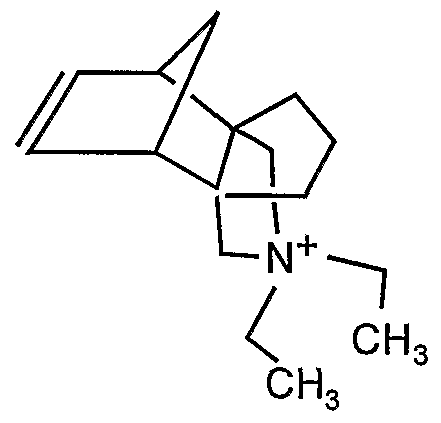
- ITFDCZFZSJZDEA-UHFFFAOYSA-N CC[N](CC)(CC1)C1(CCC1)CC11C(C2)C=CC2C1 Chemical compound CC[N](CC)(CC1)C1(CCC1)CC11C(C2)C=CC2C1 ITFDCZFZSJZDEA-UHFFFAOYSA-N 0.000 description 1
- OZAPHAQNGOAMBK-XXXXFFMBSA-N C[C@H]1C2C(CN(C3)C=C)(CCCC4)C3C4C1CC2 Chemical compound C[C@H]1C2C(CN(C3)C=C)(CCCC4)C3C4C1CC2 OZAPHAQNGOAMBK-XXXXFFMBSA-N 0.000 description 1
Classifications
-
- C—CHEMISTRY; METALLURGY
- C01—INORGANIC CHEMISTRY
- C01B—NON-METALLIC ELEMENTS; COMPOUNDS THEREOF; METALLOIDS OR COMPOUNDS THEREOF NOT COVERED BY SUBCLASS C01C
- C01B39/00—Compounds having molecular sieve and base-exchange properties, e.g. crystalline zeolites; Their preparation; After-treatment, e.g. ion-exchange or dealumination
- C01B39/02—Crystalline aluminosilicate zeolites; Isomorphous compounds thereof; Direct preparation thereof; Preparation thereof starting from a reaction mixture containing a crystalline zeolite of another type, or from preformed reactants; After-treatment thereof
- C01B39/46—Other types characterised by their X-ray diffraction pattern and their defined composition
- C01B39/48—Other types characterised by their X-ray diffraction pattern and their defined composition using at least one organic template directing agent
-
- B—PERFORMING OPERATIONS; TRANSPORTING
- B01—PHYSICAL OR CHEMICAL PROCESSES OR APPARATUS IN GENERAL
- B01J—CHEMICAL OR PHYSICAL PROCESSES, e.g. CATALYSIS OR COLLOID CHEMISTRY; THEIR RELEVANT APPARATUS
- B01J29/00—Catalysts comprising molecular sieves
- B01J29/03—Catalysts comprising molecular sieves not having base-exchange properties
- B01J29/035—Microporous crystalline materials not having base exchange properties, such as silica polymorphs, e.g. silicalites
-
- B—PERFORMING OPERATIONS; TRANSPORTING
- B01—PHYSICAL OR CHEMICAL PROCESSES OR APPARATUS IN GENERAL
- B01J—CHEMICAL OR PHYSICAL PROCESSES, e.g. CATALYSIS OR COLLOID CHEMISTRY; THEIR RELEVANT APPARATUS
- B01J29/00—Catalysts comprising molecular sieves
- B01J29/04—Catalysts comprising molecular sieves having base-exchange properties, e.g. crystalline zeolites
- B01J29/06—Crystalline aluminosilicate zeolites; Isomorphous compounds thereof
- B01J29/70—Crystalline aluminosilicate zeolites; Isomorphous compounds thereof of types characterised by their specific structure not provided for in groups B01J29/08 - B01J29/65
-
- B—PERFORMING OPERATIONS; TRANSPORTING
- B01—PHYSICAL OR CHEMICAL PROCESSES OR APPARATUS IN GENERAL
- B01J—CHEMICAL OR PHYSICAL PROCESSES, e.g. CATALYSIS OR COLLOID CHEMISTRY; THEIR RELEVANT APPARATUS
- B01J29/00—Catalysts comprising molecular sieves
- B01J29/86—Borosilicates; Aluminoborosilicates
-
- C—CHEMISTRY; METALLURGY
- C01—INORGANIC CHEMISTRY
- C01B—NON-METALLIC ELEMENTS; COMPOUNDS THEREOF; METALLOIDS OR COMPOUNDS THEREOF NOT COVERED BY SUBCLASS C01C
- C01B37/00—Compounds having molecular sieve properties but not having base-exchange properties
- C01B37/02—Crystalline silica-polymorphs, e.g. silicalites dealuminated aluminosilicate zeolites
Definitions
- the present invention relates to new crystalline molecular sieve SSZ-61, a method for preparing SSZ-61 using a family of tetracyclic azonia cations as a structure directing agent and the use of SSZ-61 as an adsorbent.
- crystalline molecular sieves and zeolites are especially useful in applications such as hydrocarbon conversion, gas drying and separation.
- aluminosilicate refers to a molecular sieve containing both aluminum oxide and silicon oxide and the term “borosilicate” refers to a molecular sieve containing oxides of both boron and silicon.
- a molecular sieve having a mole ratio greater than about 15 of (1) an oxide of a first tetravalent element to (2) an oxide of a rrivalent element, pentavalent element, second tetravalent element different from said first tetravalent element or mixture thereof and having, after calcination, the X-ray diffraction lines of Tab le i.
- a molecular sieve having a mole ratio greater than about 15 of (1) an oxide selected from silicon oxide, germanium oxide and mixtures thereof to (2) an oxide selected from aluminum oxide, gallium oxide, iron oxide, boron oxide, titanium oxide, indium oxide, vanadium oxide and mixtures thereof and having, after calcination, the X-ray diffraction lines of Table I below.
- the mole ratio of the first oxide or mixture of first oxides to the second oxide can be infinity, i.e., there is no second oxide in the molecular sieve.
- the molecular sieve is an all-silica molecular sieve or a germanosilicate.
- the present invention further provides such a molecular sieve having a composition, as synthesized and in the anhydrous state, in terms of mole ratios as follows: YO 2 /W c O d 15 - oo M 2 n /YO 2 0 - 0.03 Q YO 2 0.02 - 0.08 F/YO 2 0 - 0.10 wherein Y is silicon, germanium or a mixture thereof; W is aluminum, gallium, iron, boron, titanium, indium, vanadium or mixtures thereof; c is 1 or 2; d is 2 when c is 1 (i.e., W is tetravalent) or d is 3 or 5 when c is 2 (i.e., d is 3 when W is rrivalent or 5 when W is pentavalent); M is an alkali metal cation, alkaline earth metal cation or mixtures thereof; n is the valence of M (i.e., 1 or 2); and Q is a
- the term "large pore” means having an average pore size diameter greater than about 6.0 Angstroms, preferably from about 6.5 Angstroms to about 7.5 Angstroms or larger.
- SDA structure directing agent
- the SDA's useful for making SSZ-61 have the following structures:
- SSZ-61 is prepared by contacting an active source of one or more oxides selected from the group consisting of monovalent element oxides, divalent element oxides, rrivalent element oxides, tetravalent element oxides and/or pentavalent elements with the tetracyclic azonia cation SDA.
- SSZ-61 is prepared from a reaction mixture having the composition shown in Table A below.
- YO 2 /W a O b > 15 -100 - ⁇ OH-/YO 2 0.20 - 0.80 0.40 - 0.60 Q/YO 2 0.20 - 0.80 0.40 - 0.60 M 2 / n /YO 2 0 - 0.40 0 - 0.25 H 2 O/YO 2 10 - 80 -15 - 25 HF/YO 2 0.20 - 0.80 0.30 - 0.60
- Y, W, Q, M and n are as defined above, and a is 1 or 2, and b is 2 when a is 1 (i.e., W is tetravalent) and b is 3 when a is 2 (i.e., W is rrivalent).
- SSZ-61 is prepared by a process comprising: (a) preparing an aqueous solution containing sources of at least one oxide capable of forming a crystalline molecular sieve and a tetracyclic azonia cation capable of forming SSZ-61 having an anionic counterion which is not detrimental to the formation of SSZ-61 ; (b) maintaining the aqueous solution under conditions sufficient to form crystals of SSZ-61 ; and (c) recovering the crystals of SSZ-61.
- SSZ-61 may comprise the crystalline material and the SDA in combination with metallic and non-metallic oxides bonded in tetrahedral coordination through shared oxygen atoms to form a cross-linked three dimensional crystal structure.
- the metallic and non-metallic oxides comprise one or a combination of oxides of a first tetravalent element(s), and one or a combination of a bivalent element(s), pentavalent element(s), second tetravalent element(s) different from the first tetravalent element(s) or mixture thereof.
- the first tetravalent element(s) is preferably selected from the group consisting of silicon, germanium and combinations thereof. More preferably, the first tetravalent element is silicon.
- the rrivalent element, pentavalent element and second tetravalent element (which is different from the first tetravalent element) is preferably selected from the group consisting of aluminum, gallium, iron, boron, titanium, indium, vanadium and combinations thereof. More preferably, the second trivalent or tetravalent element is aluminum or boron.
- Typical sources of aluminum oxide for the reaction mixture include aluminates, alumina, aluminum colloids, aluminum oxide coated on silica sol, hydrated alumina gels such as Al(OH) 3 and aluminum compounds such as Al(NO 3 ) 3 , A1C13 and Al 2 (SO 4 ) 3 .
- Typical sources of silicon oxide include silicates, silica hydrogel, silicic acid, fumed silica, colloidal silica, tetra-alkyl orthosilicates, and silica hydroxides. Boron, as well as gallium, germanium, titanium, indium, vanadium and iron, can be added in forms corresponding to their aluminum and silicon counterparts.
- a source zeolite reagent may provide a source of aluminum or boron, h most cases, the source zeolite also provides a source of silica.
- the source zeolite in its dealuminated or deboronated form may also be used as a source of silica, with additional silicon added using, for example, the conventional sources listed above.
- a source zeolite reagent as a source of alumina for the present process is more completely described in U.S. Patent No. 5,225,179, issued July 6, 1993 to Nakagawa entitled “Method of Making Molecular Sieves", the disclosure of which is incorporated herein by reference.
- an alkali metal hydroxide and/or an alkaline earth metal hydroxide such as the hydroxide of sodium, potassium, lithium, cesium, rubidium, calcium, and magnesium, is used in the reaction mixture; however, this component can be omitted so long as the equivalent basicity is maintained.
- the SDA may be used to provide hydroxide ion.
- the alkali metal cation or alkaline earth cation may be part of the as-synthesized crystalline oxide material, in order to balance valence electron charges therein.
- the reaction mixture is maintained at an elevated temperature until the crystals of the SSZ-61 are formed.
- the hydrothermal crystallization is usually conducted under autogenous pressure, at a temperature between 100°C and 200°C, preferably between 135°C and 160°C.
- the crystallization period is typically greater than 1 day and preferably from about 3 days to about 20 days.
- the molecular sieve is prepared using mild stirring or agitation.
- the SSZ-61 crystals can be allowed to nucleate spontaneously from the reaction mixture.
- the use of SSZ-61 crystals as seed material can be advantageous in decreasing the time necessary for complete crystallization to occur.
- seeding can lead to an increased purity of the product obtained by promoting the nucleation and or formation of S SZ-61 over any undesired phases.
- SSZ- 1 crystals are added in an amount between 0.1 and 10% of the weight of first tetravalent element oxide, e.g. silica, used in the reaction mixture.
- the solid product is separated from the reaction mixture by standard mechanical separation techniques such as filtration.
- the crystals are water-washed and then dried, e.g., at 90°C to 150°C for from 8 to 24 hours, to obtain the as-synthesized SSZ-61 crystals.
- the drying step can be performed at atmospheric pressure or under vacuum.
- SSZ-61 as prepared has a mole ratio of an oxide selected from silicon oxide, germanium oxide and mixtures thereof to an oxide selected from aluminum oxide, gallium oxide, iron oxide, boron oxide, titanium oxide, indium oxide, vanadium oxide and mixtures thereof greater than about 15; and has, after calcination, the X-ray diffraction lines of Table I below.
- SSZ-61 can be made with a mole ratio of YO 2 /W c O d of 00, i.e., there is essentially no c O present in the SSZ-61.
- the SSZ-61 would be an all- silica material or a germanosilicate.
- SSZ-61 can be made essentially aluminum free, i.e., having a silica to alumina mole ratio of 00.
- a method of increasing the mole ratio of silica to alumina is by using standard acid leaching or chelating treatments.
- essentially aluminum-free SSZ-61 can be synthesized using essentially aluminum-free silicon sources as the main tetrahedral metal oxide component, if boron is also present.
- the boron can then be removed, if desired, by treating the borosilicate SSZ-61 with acetic acid at elevated temperature ( as described in Jones et al, Chem. Mater., 2001, 13, 1041-1050) to produce an all-silica version of SSZ-61.
- SSZ-61 can also be prepared directly as a borosilicate. If desired, the boron can be removed as described above and replaced with metal atoms by techniques known in the art.
- Lower silica to alumina ratios may also be obtained by using methods which insert aluminum into the crystalline framework.
- aluminum insertion may occur by thermal treatment of the zeolite in combination with an alumina binder or dissolved source of alumina. Such procedures are described in U.S. Patent No. 4,559,315, issued on December 17, 1985 to Chang et al. It is believed that SSZ-61 is comprised of a new framework structure or topology which is characterized by its X-ray diffraction pattern. S SZ-61 , after calcination, has a crystalline structure whose X-ray powder diffraction pattern exhibit the characteristic lines shown in Table I and is thereby distinguished from other molecular sieves.
- Table IA below shows the X-ray powder diffraction lines for calcined SSZ-61 including actual relative intensities.
- TABLE IA Calcined SSZ-61 2 Theta (a) d-spacing (Angstroms) Relative Intensity (%) 4.48 19.7 47 7.24 12.2 100 9.23 9.6 13 10.08 8.8 21 13.94 6.4 7 17.90 4.96 11 18.28 4.85 12 18.68 4.75 7 19.72 4.5 12 20.68 4.30 84 21.70 4.10 18 23.37 3.80 12 24.13 3.69 6 25.40 3.51 19 25.62 3.48 17 26.64 3.35 17 35.48 2.53 10 (a) ⁇ 0.1 The X-ray powder diffraction patterns were determined by standard techniques.
- the radiation was the K-alpha/doublet of copper.
- Representative peaks from the X-ray diffraction pattern of calcined SSZ-61 are shown in Table I. Calcination can result in changes in the intensities of the peaks as compared to patterns of the "as-made" material, as well as minor shifts in the diffraction pattern.
- the molecular sieve produced by exchanging the metal or other cations present in the molecular sieve with var ous other cations yields essentially the same diffraction pattern, although again, there may be minor shifts in the interplanar spacing and variations in the relative intensities of the peaks. Notwithstanding these minor perturbations, the basic crystal lattice remains unchanged by these treatments.
- Crystalline SSZ-61 can be used as-synthesized, but preferably will be thermally treated (calcined). Usually, it is desirable to remove the alkali metal cation by ion exchange and replace it with hydrogen, ammonium, or any desired metal ion.
- the molecular sieve can be leached with chelating agents, e.g., EDTA or dilute acid solutions, to increase the silica to alumina mole ratio.
- the molecular sieve can also be steamed; steaming helps stabilize the crystalline lattice to attack from acids.
- Metals may be introduced into the molecular sieve by replacing some of the cations in the molecular sieve with metal cations via standard ion exchange techniques (see, for example, U.S. Patent Nos. 3,140,249 issued July 7, 1964 to Plank et al.; 3,140,251 issued July 7, 1964 to Plank et al.; and 3,140,253 issued July 7, 1964 to Plank et al.).
- Typical replacing cations can include metal cations, e.g., rare earth, Group IA, Group IIA and Group VIII metals, as well as their mixtures.
- metal cations e.g., rare earth, Group IA, Group IIA and Group VIII metals, as well as their mixtures.
- replacing metallic cations cations of metals such as rare earth, Mn, Ca, Mg, Zn, Cd, Pt, Pd, Ni, Co, Ti, Al, Sn, and Fe are particularly preferred.
- the hydrogen, ammonium, and metal components can be ion-exchanged into the SSZ-61.
- the SSZ-61 can also be impregnated with the metals, or the metals can be physically and intimately admixed with the SSZ-61 using standard methods known to the art.
- Typical ion-exchange techniques involve contacting the synthetic molecular sieve with a solution containing a salt of the desired replacing cation or cations.
- a salt of the desired replacing cation or cations e.g., sodium bicarbonate, sodium bicarbonate, sodium bicarbonate, sodium bicarbonate, sodium bicarbonate, sodium bicarbonate, sodium bicarbonate, sodium bicarbonate, sodium bicarbonate, sodium bicarbonate, sodium bicarbonate, sodium bicarbonate, sodium bicarbonate, sodium bicarbonate, sodium bicarbonate, sodium bicarbonate, sodium bicarbonate, sodium bicarbonate, sodium bicarbonate, sodium bicarbonate, sodium bicarbonate, sodium bicarbonate, sodium bicarbonate, sodium bicarbonate, sodium bicarbonate, sodium bicarbonate, sodium bicarbonate, sodium bicarbonate, sodium bicarbonate, sodium bicarbonate, sodium bicarbonate, sodium bicarbonate, sodium bicarbonate, sodium bicarbonate, sodium bicarbonate, sodium bicarbonate, sodium bicarbonate, sodium bicarbonate, sodium
- the molecular sieve is typically washed with water and dried at temperatures ranging from 65°C to about 200°C. After washing, the molecular sieve can be calcined in air or inert gas at temperatures ranging from about 200°C to about 8 0°C for periods of time ranging from 1 to 48 hours, or more, to produce a catalytically active product especially useful in hydrocarbon conversion processes.
- the spatial arrangement of the atoms which form the basic crystal lattice of the molecular sieve remains essentially unchanged.
- SSZ-61 can be formed into a wide variety of physical shapes.
- the molecular sieve can be in the form of a powder, a granule, or a molded product, such as extrudate having a particle size sufficient to pass through a 2-mesh (Tyler) screen and be retained on a 400-mesh (Tyler) screen.
- the SSZ-61 can be extruded before drying, or, dried or partially dried and then extruded.
- SSZ-61 can be composited with other materials resistant to the temperatures and other conditions employed in organic conversion processes.
- matrix materials include active and inactive materials and synthetic or naturally occurring zeolites as well as inorganic materials such as clays, silica and metal oxides. Examples of such materials and the manner in which they can be used are disclosed in U.S. Patent No. 4,910,006, issued May 20, 1990 to Zones et al., and U.S. Patent No. 5,316,753, issued May 31, 1994 to Nakagawa, both of which are incorporated by reference herein in their entirety.
- SSZ-61 is useful as an adsorbent. EXAMPLES The following examples demonstrate but do not limit the present invention.
Landscapes
- Chemical & Material Sciences (AREA)
- Organic Chemistry (AREA)
- Engineering & Computer Science (AREA)
- Materials Engineering (AREA)
- Chemical Kinetics & Catalysis (AREA)
- Life Sciences & Earth Sciences (AREA)
- General Life Sciences & Earth Sciences (AREA)
- Geology (AREA)
- Inorganic Chemistry (AREA)
- Crystallography & Structural Chemistry (AREA)
- Silicates, Zeolites, And Molecular Sieves (AREA)
Abstract
Description


Claims



Priority Applications (3)
| Application Number | Priority Date | Filing Date | Title |
|---|---|---|---|
| EP04780918A EP1670584A2 (en) | 2003-08-28 | 2004-08-11 | Molecular sieve ssz-61 composition of a matter and synthesis thereof |
| JP2006524698A JP2007504077A (en) | 2003-08-28 | 2004-08-11 | Molecular sieve SSZ-61 composition and synthesis thereof |
| EA200600476A EA010793B1 (en) | 2003-08-28 | 2004-08-11 | Molecular sieve ssz-61 composition of a matter and synthesis thereof |
Applications Claiming Priority (2)
| Application Number | Priority Date | Filing Date | Title |
|---|---|---|---|
| US10/652,436 | 2003-08-28 | ||
| US10/652,436 US6929789B2 (en) | 2003-08-28 | 2003-08-28 | Zeolite SSZ-61 composition of matter and synthesis thereof |
Publications (2)
| Publication Number | Publication Date |
|---|---|
| WO2005023707A2 true WO2005023707A2 (en) | 2005-03-17 |
| WO2005023707A3 WO2005023707A3 (en) | 2005-08-04 |
Family
ID=34217644
Family Applications (1)
| Application Number | Title | Priority Date | Filing Date |
|---|---|---|---|
| PCT/US2004/026154 Ceased WO2005023707A2 (en) | 2003-08-28 | 2004-08-11 | Molecular sieve ssz-61 composition of a matter and synthesis thereof |
Country Status (7)
| Country | Link |
|---|---|
| US (1) | US6929789B2 (en) |
| EP (1) | EP1670584A2 (en) |
| JP (1) | JP2007504077A (en) |
| CN (1) | CN100408178C (en) |
| EA (1) | EA010793B1 (en) |
| WO (1) | WO2005023707A2 (en) |
| ZA (1) | ZA200601856B (en) |
Cited By (1)
| Publication number | Priority date | Publication date | Assignee | Title |
|---|---|---|---|---|
| JP2008546624A (en) * | 2005-06-23 | 2008-12-25 | シェブロン ユー.エス.エー. インコーポレイテッド | Molecular sieve SSZ-56 composition and its synthesis |
Families Citing this family (6)
| Publication number | Priority date | Publication date | Assignee | Title |
|---|---|---|---|---|
| AU2006329930A1 (en) * | 2005-12-27 | 2007-07-05 | Chevron U.S.A., Inc. | Molecular sieve SSZ-73 |
| ES2620631T3 (en) * | 2011-08-04 | 2017-06-29 | Exxonmobil Chemical Patents Inc. | EMM-23 molecular sieve material, its synthesis and use |
| JP6697481B2 (en) * | 2015-06-01 | 2020-05-20 | カリフォルニア インスティチュート オブ テクノロジー | Novel CIT-13 phase crystalline germanosilicate material and method for preparing same |
| CN107954446B (en) * | 2016-10-14 | 2020-12-01 | 中国石油化工股份有限公司 | Synthetic method of ITQ-16 zeolite molecular sieve |
| CN107954437B (en) * | 2016-10-14 | 2020-11-27 | 中国石油化工股份有限公司 | Preparation method of ITQ-24 zeolite molecular sieve |
| CN109437225A (en) * | 2018-12-06 | 2019-03-08 | 复榆(张家港)新材料科技有限公司 | A kind of synthetic method and device of silica-rich zeolite molecular sieve |
Family Cites Families (6)
| Publication number | Priority date | Publication date | Assignee | Title |
|---|---|---|---|---|
| US5785947A (en) * | 1991-12-18 | 1998-07-28 | Chevron U.S.A. Inc. | Preparation of zeolites using organic template and amine |
| US5591421A (en) * | 1994-07-11 | 1997-01-07 | Chevron U.S.A. Inc. | Zeolite SSZ-41 |
| US5628978A (en) * | 1994-12-23 | 1997-05-13 | Intevep, S.A. | MTW zeolite for cracking feedstock into olefins and isoparaffins |
| JP2002512580A (en) * | 1996-12-31 | 2002-04-23 | シェブロン ユー.エス.エー.インコーポレイテッド | Zeolite SSZ-47 |
| CN1245475A (en) * | 1996-12-31 | 2000-02-23 | 切夫里昂美国公司 | Zeolite SSZ-48 |
| AU2003251848A1 (en) * | 2002-08-01 | 2004-02-23 | Chevron U.S.A. Inc. | Molecular sieve ssz-64 |
-
2003
- 2003-08-28 US US10/652,436 patent/US6929789B2/en not_active Expired - Lifetime
-
2004
- 2004-08-11 EA EA200600476A patent/EA010793B1/en not_active IP Right Cessation
- 2004-08-11 WO PCT/US2004/026154 patent/WO2005023707A2/en not_active Ceased
- 2004-08-11 JP JP2006524698A patent/JP2007504077A/en active Pending
- 2004-08-11 CN CNB2004800274985A patent/CN100408178C/en not_active Expired - Fee Related
- 2004-08-11 EP EP04780918A patent/EP1670584A2/en not_active Withdrawn
- 2004-08-11 ZA ZA200601856A patent/ZA200601856B/en unknown
Cited By (1)
| Publication number | Priority date | Publication date | Assignee | Title |
|---|---|---|---|---|
| JP2008546624A (en) * | 2005-06-23 | 2008-12-25 | シェブロン ユー.エス.エー. インコーポレイテッド | Molecular sieve SSZ-56 composition and its synthesis |
Also Published As
| Publication number | Publication date |
|---|---|
| EP1670584A2 (en) | 2006-06-21 |
| WO2005023707A3 (en) | 2005-08-04 |
| ZA200601856B (en) | 2007-07-25 |
| CN1856361A (en) | 2006-11-01 |
| EA200600476A1 (en) | 2006-08-25 |
| EA010793B1 (en) | 2008-12-30 |
| JP2007504077A (en) | 2007-03-01 |
| US6929789B2 (en) | 2005-08-16 |
| CN100408178C (en) | 2008-08-06 |
| US20050049139A1 (en) | 2005-03-03 |
Similar Documents
| Publication | Publication Date | Title |
|---|---|---|
| AU2009302658B2 (en) | Method for preparing SSZ-26/33 zeolites using novel structure directing agents | |
| AU2009302667B2 (en) | Molecular sieve SSZ-82 composition of matter and synthesis thereof | |
| US7226576B2 (en) | Molecular sieve SSZ-56 composition of matter and synthesis thereof | |
| US7226569B2 (en) | Reduction of oxides of nitrogen in a gas stream using molecular sieve SSZ-56 | |
| JP5974170B2 (en) | Method for preparing aluminosilicate zeolite SSZ-33 | |
| WO2014081607A1 (en) | Method for preparing cha-type molecular sieves using colloidal aluminosilicate | |
| US20050042159A1 (en) | Using molecular sieve SSZ-65 for reduction of oxides of nitrogen in a gas stream | |
| US6733742B1 (en) | Molecular sieve SSZ-63 composition of matter and synthesis thereof | |
| US7108843B2 (en) | Molecular sieve SSZ-70 composition of matter and synthesis thereof | |
| US9822012B2 (en) | Molecular sieve Al-SSZ-63 composition of matter and synthesis thereof | |
| US6569401B1 (en) | Zeolite SSZ-64 composition of matter and synthesis thereof | |
| US5271922A (en) | Process for preparing molecular sieves using a sparteine template | |
| AU5101893A (en) | A process for preparing molecular sieves using 9-azabicyclo(3.3.)nonane templates | |
| US6929789B2 (en) | Zeolite SSZ-61 composition of matter and synthesis thereof | |
| US6776973B2 (en) | Using molecular sieve SSZ-63 for reduction of oxides of nitrogen in a gas stream | |
| US6555089B1 (en) | Zeolite SSZ-58 composition of matter and synthesis thereof | |
| WO2010042252A1 (en) | Method for preparing nes-type zeolites using novel structure directing agents | |
| US6461580B1 (en) | Using zeolite SSZ-58 for reduction of oxides of nitrogen in a gas stream | |
| US20060140835A1 (en) | Reduction of oxides of nitrogen in a gas stream using molecular sieve ssz-70 | |
| AU2012294892A1 (en) | Reduction of oxides of nitrogen in a gas stream using molecular sieve SSZ-28 | |
| US7084304B2 (en) | Acylation using molecular sieve SSZ-70 | |
| US20040033185A1 (en) | Using zeolite SSZ-64 for reduction of oxides of nitrogen in a gas stream utility | |
| WO2013022496A1 (en) | Reduction of oxides of nitrogen in a gas stream using molecular sieve ssz-25 |
Legal Events
| Date | Code | Title | Description |
|---|---|---|---|
| WWE | Wipo information: entry into national phase |
Ref document number: 200480027498.5 Country of ref document: CN |
|
| AK | Designated states |
Kind code of ref document: A2 Designated state(s): AE AG AL AM AT AU AZ BA BB BG BR BW BY BZ CA CH CN CO CR CU CZ DE DK DM DZ EC EE EG ES FI GB GD GE GH GM HR HU ID IL IN IS JP KE KG KP KR KZ LC LK LR LS LT LU LV MA MD MG MK MN MW MX MZ NA NI NO NZ OM PG PH PL PT RO RU SC SD SE SG SK SL SY TJ TM TN TR TT TZ UA UG US UZ VC VN YU ZA ZM ZW |
|
| AL | Designated countries for regional patents |
Kind code of ref document: A2 Designated state(s): GM KE LS MW MZ NA SD SL SZ TZ UG ZM ZW AM AZ BY KG KZ MD RU TJ TM AT BE BG CH CY CZ DE DK EE ES FI FR GB GR HU IE IT LU MC NL PL PT RO SE SI SK TR BF BJ CF CG CI CM GA GN GQ GW ML MR NE SN TD TG |
|
| 121 | Ep: the epo has been informed by wipo that ep was designated in this application | ||
| WWE | Wipo information: entry into national phase |
Ref document number: 2006524698 Country of ref document: JP |
|
| WWE | Wipo information: entry into national phase |
Ref document number: 2006/01856 Country of ref document: ZA Ref document number: 200601856 Country of ref document: ZA |
|
| WWE | Wipo information: entry into national phase |
Ref document number: 2004780918 Country of ref document: EP |
|
| WWE | Wipo information: entry into national phase |
Ref document number: 200600476 Country of ref document: EA |
|
| WWP | Wipo information: published in national office |
Ref document number: 2004780918 Country of ref document: EP |