WO2005033049A2 - METHOD OF PREPARING 4-AMINO-1H-IMIDAZO(4,5-c)QUINOLINES AND ACID ADDITION SALTS THEREOF - Google Patents
METHOD OF PREPARING 4-AMINO-1H-IMIDAZO(4,5-c)QUINOLINES AND ACID ADDITION SALTS THEREOF Download PDFInfo
- Publication number
- WO2005033049A2 WO2005033049A2 PCT/US2004/032243 US2004032243W WO2005033049A2 WO 2005033049 A2 WO2005033049 A2 WO 2005033049A2 US 2004032243 W US2004032243 W US 2004032243W WO 2005033049 A2 WO2005033049 A2 WO 2005033049A2
- Authority
- WO
- WIPO (PCT)
- Prior art keywords
- formula
- imidazo
- quinoline
- amino
- hydrogen
- Prior art date
- Legal status (The legal status is an assumption and is not a legal conclusion. Google has not performed a legal analysis and makes no representation as to the accuracy of the status listed.)
- Ceased
Links
- 0 *c1nc2c(N)nc(cccc3)c3c2[n]1* Chemical compound *c1nc2c(N)nc(cccc3)c3c2[n]1* 0.000 description 1
Classifications
-
- C—CHEMISTRY; METALLURGY
- C07—ORGANIC CHEMISTRY
- C07D—HETEROCYCLIC COMPOUNDS
- C07D401/00—Heterocyclic compounds containing two or more hetero rings, having nitrogen atoms as the only ring hetero atoms, at least one ring being a six-membered ring with only one nitrogen atom
- C07D401/02—Heterocyclic compounds containing two or more hetero rings, having nitrogen atoms as the only ring hetero atoms, at least one ring being a six-membered ring with only one nitrogen atom containing two hetero rings
- C07D401/04—Heterocyclic compounds containing two or more hetero rings, having nitrogen atoms as the only ring hetero atoms, at least one ring being a six-membered ring with only one nitrogen atom containing two hetero rings directly linked by a ring-member-to-ring-member bond
Definitions
- This invention provides a method of preparing drugs comprising tricyclic ring structures that possess 3 nitrogen atoms. More specifically, the invention provides a method of preparing 4-amino-lH-imidazo(4,5-c)quinolines and acid addition salts thereof.
- One disadvantage of the ammonolysis procedure (Scheme 1) is that the ammonolysis reaction must be conducted at elevated temperature in a sealed reaction vessel. This poses an undesirable safety risk.
- the second procedure is a two-step procedure (Scheme 2).
- a 4-chloro compound of formula (2) is subjected to an addition/elimination reaction with benzylamine to provide a benzylamino intermediate.
- the benzylamino intermediate is hydrogenolyzed to provide a compound of formula (1).
- the '149 patent discloses that the second step is performed by refluxing the benzylamino intermediate with Pd(OH) 2 /C (Pearlman's catalyst) in a weak acid (i.e., formic acid) for 1-2 days.
- a weak acid i.e., formic acid
- the Shen article discloses an attempt to perform the second step by heating the benzylamino intermediate with hydrogen and Pd/C at 80°C under acidic conditions. The Shen article states that the attempt failed.
- One disadvantage of the first step in the second procedure is that the reaction solvent must be removed by distillation to isolate the benzylamino intermediate.
- purification using silica gel chromatography is required when the addition/elimination reaction is performed neat in benzylamine.
- Such distillation and chromatography procedures are costly and undesirable on an industrial scale.
- One disadvantage of the second step in the second procedure is that the hydrogenolysis reaction is proven to be difficult, and proceeds at a low yield even after a long reaction time. Presently, there are no suitable alternatives for the hydrogenolysis reaction.
- the present invention provides a method of preparing an acid addition salt of formula (5)
- R 1 , R 2 , R 3 and R 4 are independently selected from the group consisting of hydrogen, Ci-Cio alkyl, C 3 -C 10 cycloalkyl, C -C 10 alkenyl, C 5 -C 10 cycloalkenyl, C 2 -C 10 alkynyl, and C 6 -C 20 aryl, each of R 5 , R 6 , R 7 , R 8 , and R 9 for each of the n aryl rings is independently selected from the group consisting of hydrogen, Ci-Cio alkyl, C 3 -C 10 cycloalkyl, C 2 -C 10 alkenyl, C 5 -C 10 cycloalkenyl, C 2 -C 10 alkynyl, C 6 -C 20 aryl, -OR 10 , and -NR n R 12 , wherein R 10 , R 11 , and R 12 are independently selected from the group consisting of hydrogen and Ci-C
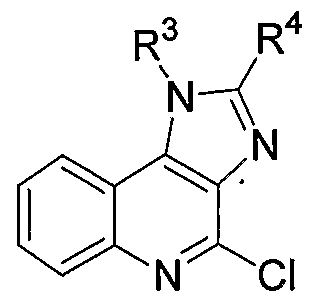
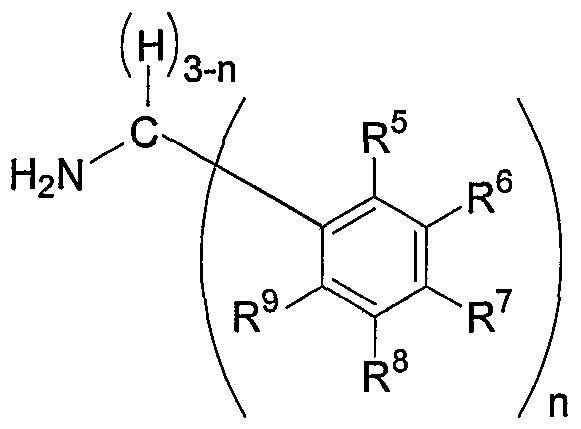
- the 4-(arylmethyl)amino-lH-imidazo(4,5-c)quinoline of formula (4) is prepared by reacting an arylmethylamine of formula (3) (3) with a 4-chloro-lH-imidazo(4,5-c)quinoline of formula (2)
- the method further comprises the step of treating the acid addition salt of formula (5) with a base to provide a 4-amino-lH-imidazo(4,5-c)quinoline of formula
- the strong acid is selected from the group consisting of sulfuric acid, methanesulfonic acid, trifluoromethanesulfonic acid, and mixtures thereof.
- the base is selected from the group consisting of sodium hydroxide, potassium hydroxide, and mixtures thereof.
- R 1 , R 2 , R 3 , and R 4 are independently selected from the group consisting of hydrogen, C C t o alkyl, and C 6 -C 20 aryl, and each of R 5 , R 6 , R 7 , R 8 , and R 9 for each of the n aryl rings is independently selected from the group consisting of hydrogen, Ci-Cio alkyl, C 6 -C 20 aryl, -OR 10 , and -NR ⁇ R 12 .
- n is 1, R 1 and R 3 are independently Ci-Cio alkyl, R 2 and R 4 are hydrogen, R 5 , R 6 , R 7 , R 8 , and R 9 are independently selected from the group consisting of hydrogen, Ci-Cio alkyl, and -O(C ⁇ - Cio alkyl), and X " is selected from the group consisting of HSO 4 " , CH 3 SO 3 " , and CF 3 SO 3 " . More preferably, R 1 and R 3 are isobutyl. More preferably, R 5 , R 6 , R 7 , R 8 , and R 9 are hydrogen.
- the 4-amino-lH-imidazo(4,5-c)quinoline of formula (1) is 4-amino-l- isobutyl- lH-imidazo(4,5-c)quinoline (imiquimod).
- the hydrolyzing step is performed for a reaction time of less than about four hours. More preferably, the hydrolyzing step is performed for a reaction time of less than about two hours.
- the acid addition salt of formula (5) is obtained in a yield of at least about 70%. More preferably, the acid addition salt of formula (5) is obtained in a yield of at least about 80%.
- the arylmethylamine of formula (3) is selected from the group consisting of benzylamine, 2,4-dimethoxybenzylamine, diphenylmethylamine, and 1- (aminomethyl)naphthalene.
- the 4-(arylmethyl)amino-lH-imidazo(4,5-c)quinoline of formula (4) is prepared in a neat reaction.
- the 4-(arylmethyl)ammo-lH-imidazo(4,5-c)quinoline of formula (4) is prepared at a temperature of about 100°C to about 140°C.
- Hydrolysis refers to a chemical reaction that uses water (i.e., H 2 O) to cleave a chemical bond;
- “hydrogenolyzing” refers to performing a hydrogenolysis reaction; “hydrogenolysis” refers to a chemical reaction that uses hydrogen (i.e., H 2 ) to cleave a chemical bond; “ammonolysis” refers to a chemical reaction that uses ammonia (i.e., NH 3 ) to cleave a chemical bond; “chemical bond” refers to the force that holds atoms together in molecules or crystals; “strong acid” refers to an acid having a K a (25°C) of at least about 1 ; “acid addition salt” refers to a compound of formula RH ⁇ X " , wherein R is a molecule that contains at least one atom that can accept a proton from an acid!, and X " is the conjugate base of an acid, HX; “neat reaction” refers to a reaction in which one or more of the reagents functions as a solvent; “solvent” refers to the most abundant component of a solution; “conjugate base
- the present invention provides an improved method of preparing 4-amino-lH- imidazo(4,5-c) quinolines.
- One unique feature of the present invention is that it involves employing a hydrolysis reaction.
- a strong acid may be used as a catalyst to drive the hydrolysis reaction.
- the hydrolysis reaction effectively provides an acid addition salt.
- a simple treatment of the acid addition salt with a base provides a 4-amino-lH-imidazo(4,5- c) quinoline.
- the present hydrolysis reaction provides a much better yield and a much shorter reaction time.
- the present invention provides a method of preparing an acid addition salt of formula (5)
- R 1 , R 2 , R 3 and R 4 are independently selected from the group consisting of hydrogen, -Cio alkyl, C 3 -C 10 cycloalkyl, C 2 -C 10 alkenyl, C 5 -C 10 cycloalkenyl, C 2 -C 10 alkynyl, and C 6 -C 20 aryl, each of R 5 , R 6 , R 7 , R 8 , and R 9 for each of the n aryl rings is independently selected from the group consisting of hydrogen, - o alkyl, C 3 -C 10 cycloalkyl, C 2 -C 10 alkenyl, C 5 -C 10 cycloalkenyl, C 2 -C 10 alkynyl, C 6 -
- a strong acid as used herein encompasses an acid having a K a (25°C) of at least about 1.
- the strong acid has a K a (25°C) of at least about 10. More preferably, the strong acid has a K a (25°C) of at least about 100.
- Tables of K a (25°C) values are readily available (See, e.g., CRC Handbook of Chemistry and Physics (63d ed. 1982-83)). K a (25°C) values also may be measured (See, e.g., Cookson, Chem. Rev. 1974, 74, 5-28).
- the strong acid includes, but is not limited to sulfuric acid, methanesulfonic acid, trifluoromethanesulfonic acid, and mixtures thereof. More preferably, the strong acid is sulfuric acid.
- the conjugate base of a strong acid includes, but is not limited to HSO 4 -, CH 3 SO 3 -, and CF 3 SO 3 ⁇ More preferably, X- is HSO 4 ' .
- n may be 1 or 2. Preferably, n is 1.
- R 1 , R 2 , R 3 , and R 4 may be identical or different.
- R 1 , R 2 , R 3 , and R 4 may independently include, but are not limited to, hydrogen, Crdo alkyl, C 3 -C 10 cycloalkyl, C 2 -C 10 alkenyl, C 5 -C 10 cycloalkenyl, C 6 -C 20 aryl, and the like.
- R 1 , R 2 , R 3 , and R 4 may independently include, but are not limited to, hydrogen, C Cio alkyl, C 2 -C 10 alkenyl, C 6 -C 0 aryl, and the like.
- R 1 , R 2 , R 3 , and R 4 may independently include, but are not limited to, hydrogen, Ci-C 10 alkyl, C 6 -C 20 aryl, and the like. More preferably, R 1 , R 2 , R 3 , and R 4 are independently Ci-C t o alkyl. More preferably, R 1 , R 2 , R 3 , and R 4 are independently C-C 6 alkyl. Optionally, R 1 and R 2 or R 3 and R 4 may together form a ring.
- R 1 includes, but is not limited to, isobutyl, (2-hydroxy-2- methyl)propyl, hydroxymethyl, (3-amino)propyl, (4-amino)butyl, and the like. More preferably, R 1 is isobutyl.
- R 3 includes, but is not limited to, isobutyl, (tert- butyldimethylsilyloxy)methyl, (2-benzyloxy-2-methyl)propyl, 3-(benzylamino)propyl, 4- (benzylamino)butyl, and the like. More preferably, R is isobutyl.
- R 2 and R 4 independently include, but are not limited to, hydrogen ⁇ A. ethoxymethyl, benzyl, (2-methoxy)ethyl, and the like. More preferably, R and R are hydrogen.
- R 3 may be identical to or different from R 1 .
- R 4 may be identical to or different from R .
- An example of when R may be different from R is when R contains a nucleophilic moiety, such as an amino, hydroxyl, or thiol moiety.
- R 1 contains a nucleophilic moiety
- R 2 contains a nucleophilic moiety
- R 4 is a suitably protected derivative of R 2 .
- a suitable protecting group is removable. If the protecting group is removed during the hydrolysis reaction, then R 1 (or R 2 ) will be different from R 3 (or R 4 ).
- R 1 or R 2
- R 3 or R 4
- suitable protecting groups include, but are not limited to, benzyl and triphenylmethyl for an amino moiety, methoxymethyl and t-butyldimethylsilyl for a hydroxyl moiety, stndp- methoxybenzyl and triphenylmethyl for a thiol moiety.
- R 1 , R 2 , R 3 , and/or R 4 comprise an alkyl, cycloalkyl, alkenyl, cycloalkenyl, alkynyl, or aryl group that possesses a moiety, including a non-nucleophilic moiety, that is protected with a protecting group
- the atoms of the protecting group do not affect the atom limitations expressed above.
- the term "d-C 6 alkyl” includes, but is not limited to, 3-(t-butyloxycarbonylamino)propyl, because the t-butyloxycarbonyl (BOC) group is a protecting group.
- the 3-(BOC-amino)propyl group is a C 3 alkyl group possessing an amino moiety.
- R 5 , R 6 , R 7 , R 8 , and R 9 are not critical.
- the R 5 , R 6 , R 7 , R 8 , and R 9 groups are part of an arylmethylamino side chain that is cleaved during the hydrolysis reaction. As such, the R 5 , R 6 , R 7 , R 8 , and R 9 groups are not present in the prepared acid addition salt of formula (5).
- R 5 , R 6 , R 7 , R 8 , and R 9 may be identical or different.
- R , and R for each of the n aryl rings independently includes, but is not limited to, hydrogen, Ci-Cio alkyl, and C 6 -C 0 aryl, C 3 -C 10 cycloalkyl, C 2 -C 10 alkenyl, C 5 -C 10 cycloalkenyl, C 6 -C 20 aryl, -OR 10 , -NR ⁇ R 12 , and the like.
- each R 5 , R 6 , R 7 , R 8 , and R 9 for each of the n aryl rings independently includes, but is not limited to, hydrogen, Ci-Cio alkyl, C 2 -C 10 alkenyl, C 6 -C 20 aryl, -OR 10 , -NR U R 12 , and the like.
- each R 5 , R 6 , R 7 , R 8 , and R 9 for each of the n aryl rings independently includes, but is not limited to, hydrogen, d-C 10 alkyl, C 6 -C 20 aryl, -OR 10 , -NR ⁇ R 12 , and the like.
- each R 5 , R 6 , R 7 , R 8 , and R 9 for each of the n aryl rings independently includes, but is not limited to hydrogen, d-C 10 alkyl, -OR 10 , and the like, wherein R 10 is d-C 10 alkyl.
- each R 5 , R 6 , R 7 , R 8 , and R 9 for each of the n aryl rings independently includes, but is not limited to, hydrogen, d-C 6 alkyl, -OR 10 , and the like, wherein R 10 is d-C 6 alkyl.
- each R 5 , R 6 , R 7 , R 8 , and R 9 for each of the n aryl rings is hydrogen.
- R groups i.e., R s , R 6 , R 7 , R 8 , and R 9
- R groups that are adjacent to one another may together form a ring (e.g., a phenyl ring).
- each alkyl, cycloalkyl, alkenyl, cycloalkenyl, alkynyl, and aryl group may contain up to four moieties, which include, but not limited to, nitrogen- containing moieties (e.g., amino, amido, etc.), oxygen-containing moieties (e.g., hydroxyl, carboxyl, etc.), halogens, sulfur-containing moieties (e.g., thiol, sulfonyl, etc.), and the like.
- nitrogen- containing moieties e.g., amino, amido, etc.
- oxygen-containing moieties e.g., hydroxyl, carboxyl, etc.
- halogens e.g., sulfur-containing moieties (e.g., thiol, sulfonyl, etc.), and the like.
- examples of d-do alkyl groups include, but are not limited to, (tert-butyldimethylsilyloxy)methyl (d having one oxygen-containing moiety - hydroxyl - protected by a tert-butyldimethylsilyl protecting group), isobutyl (C 4 ), ethoxymethyl (C 3 having one oxygen-containing moiety), (2-methoxy)ethyl (C 3 having one oxygen- containing moiety), and (2-benzyloxy-2-methyl)propyl (C 4 having one oxygen-containing moiety - hydroxyl - protected by a benzyl protecting group).
- examples of C -C 10 alkenyl groups include, but are not limited to, allyl (C 3 ), 2-methyl-2-butenyl (C 5 ), and 3-hexen-2-yl (C 6 ).
- examples of C 2 -C 10 alkynyl groups include, but are not limited to, 2-butynyl (C 4 ), 4-phenyl-2-butynyl (C 10 ), and 4-methyl-2-pentynyl (C 6 ).
- examples of C 3 -C 10 cycloalkyl groups include, but are not limited to, cyclopentyl (C 5 ), 2-(methyl)cyclohexyl (C ), and 2-(N,N-(dibenzyl)amino)cyclohexyl (C 6 with a nitrogen-containing moiety - amino - protected by two benzyl protecting groups).
- examples of C 5 -C 10 cycloalkenyl groups include, but are not limited to, cyclopentenyl (C 5 ), 4-(isopropyl)cyclohexenyl (C 9 ), and 4- (methyl)cyclohexenyl (C 7 ).
- examples of C 6 -C 20 aryl groups include, but are not limited to, benzyl (C 7 ), tolyl (C 7 ), 2-(methyl)naphthyl (C ⁇ ), and 3-(cyano)isoquinolynyl (C 10 with two nitrogen-containing moieties (cyano and the ring nitrogen)).
- the hydrolysis reaction may be performed at any suitable temperature.
- the temperature is from room temperature (i.e., about 20°C) to about 100°C.
- the present hydrolysis method has unexpected advantages over the ammonolysis method of Scheme 1.
- the ammonolysis method requires heating at a high temperature (e.g., up to 155°C) for a long time (e.g., up to 18 hours) in a sealed vessel.
- This sealed vessel reaction presents an undesirable safety risk.
- the present hydrolysis method provides an acid addition salt of formula (5), and a 4-amino-lH-imidazo(4,5-c) quinoline therefrom, in high yield after a short reaction time without the use of a potentially dangerous sealed vessel reaction.
- the present hydrolysis method has unexpected advantages over the hydrogenolysis method of Scheme 2.
- the hydrogenolysis reaction proceeds in low yield (e.g., 37%-42%) or not at all after a long reaction time (e.g., up to 2 days).
- the present hydrolysis method provides acid addition salts of formula (5), and 4-amino- lH-imidazo(4,5-c) quinolines therefrom, in high yield after a short reaction time.
- Ammonolysis, hydrogenolysis, and the present hydrolysis reactions represent distinct chemical reactions. These chemical reactions are used for different purposes, employ different reagents, and are conducted under different reaction conditions. Accordingly, these chemical reactions are not interchangeable. For example, an ammonolysis reaction cleaves a chemical bond with ammonia (i.e., N ⁇ 3 ), while a hydrogenolysis reaction cleaves a chemical bond with hydrogen (i.e., H ). In contrast, a hydrolysis reaction cleaves a chemical bond with water (i.e., H 2 O).
- the hydrolysis reaction proceeds in high yield after a short reaction time.
- the hydrolysis reaction provides the acid addition salt of formula (5) at a yield of at least about 50%. More preferably, the hydrolysis reaction provides the acid addition salt of formula (5) at a yield of at least about 60%. More preferably, the hydrolysis reaction provides the acid addition salt of formula (5) at a yield of at least about 70%. More preferably, the hydrolysis reaction provides the acid addition salt of formula (5) at a yield of at least about 80%.
- the hydrolysis reaction is conducted for a reaction time of less than about four hours. More preferably, the hydrolysis reaction is conducted for a reaction time of less than about three hours. More preferably, the hydrolysis reaction is conducted for a reaction time of less than about two hours. More preferably, the hydrolysis reaction is conducted for a reaction time of less than about one hour.
- a further advantage of the present hydrolysis reaction is that it is generally applicable to many 4-(arylmethyl)amino-lH-imidazo(4,5-c)quinolines of formula (4).
- the compound of formula (4) may include many substituents at the R 3 and R 4 positions, as exemplified and disclosed herein, because these substituents are distant from the hydrolysis site (i.e., the C-N bond of the 4-(arylmethyl)amino group of the compound of formula (4)). It is further believed that the compound of formula (4) may include many substituents at the R 5 to R 9 positions, as exemplified and disclosed herein, because the strong acid used in the hydrolysis reaction is a powerful catalyst. It is further believed that in contrast to transition metal catalysts, the strong acid catalyst is much less susceptible to poisoning and deactivation by functional groups present in R to R (e.g., sulfur atoms). Accordingly, the strong acid is much more effective in catalyzing the hydrolysis of compounds of formula (4).
- the 4-(arylmethyl)amino-lH- imidazo(4,5-c)quinoline of formula (4) may be prepared in any suitable manner. Suitable preparation methods include, but are not limited to, those disclosed in the '149 patent and the Shen article.
- the 4-(arylmethyl)amino-lH-imidazo(4,5-c)quinoline of formula (4) is prepared by reacting an arylmethylamine of formula (3) (3) with a 4-chloro-lH-imidazo(4,5-c)quinoline of formula (2)
- n, R 3 , R 4 , R 5 , R 6 , R 7 , R 8 , and R 9 are defined as set forth above.
- the arylmethylamine of formula (3) may be synthesized using methods well known to those of ordinary skill in the art.
- benzaldehyde, benzophenone, or a suitable aryl ring-substituted derivative thereof may be transformed into an arylmethylamine of formula (3) by reductive animation with ammonia and hydrogen ( ⁇ 2 ) in the presence of a hydrogenation catalyst (see generally Jerry March, Advanced Organic
- arylmethylamines of formula (3) are commercially available.
- benzylamine, 2,4-dimethoxybenzylamine, diphenylmethylamine, and l-(aminomethyl)naphthalene can be obtained from Sigma-
- l-(aminomethyl)naphthalene is an example of an arylmethylamine of formula (3), wherein adjacent R groups (R and R ) together form a ring (a phenyl ring).
- the arylmethylamine of formula (3) includes, but is not limited to, benzylamine, 2,4-dimethoxybenzylamine, diphenylmethylamine, 1- (aminomethyl)naphthalene, and the like.
- the 4-chloro-lH-imidazo(4,5-c)quinoline of formula (2) may be synthesized according to known methods, such as the method disclosed in U.S. Patent No. 4,689,338.
- 4-chloro-l-isobutyl-lH-imidazo(4,5-c)quinoline is commercially available from Auspure Biotechnology Co., Ltd. (Shanghai, China).
- any suitable temperature may be used to promote the addition/elimination reaction between the arylmethylamine of formula (3) and the 4-chloro-lH-imidazo(4,5- c)quinoline of formula (2).
- the addition/elimination reaction is performed at a temperature of about 100°C to about 140°C.
- the arylmethylamine of formula (3) and the 4-chloro-lH-imidazo(4,5-c)quinoline of formula (2) may be present in the reaction mixture in any suitable amount. Preferably, an excess of the arylmethylamine of formula (3) is used. More preferably, the arylmethylamine of formula (3) and the 4-chloro-lH-imidazo(4,5-c)quinoline of formula (2) are present at a mole/mole ratio of at least about 2:1. More preferably, the arylmethylamine of formula (3) and the 4-chloro-lH-imidazo(4,5-c)quinoline of formula (2) are present at a mole/mole ratio of at least about 5:1.
- the addition/elimination reaction between the arylmethylamine of formula (3) and the 4-chloro-lH-imidazo(4,5-c)quinoline of formula (2) may be performed either neat or in the presence of a suitable solvent.
- suitable solvents include, but are not limited to, N,N-dimethylformamide (DMF), N,N-dimethylacetamide (DMA) and mixtures thereof.
- DMF N,N-dimethylformamide
- DMA N,N-dimethylacetamide
- the addition/elimination reaction is performed neat.
- the present addition/elimination method has unexpected advantages over the addition/elimination method of Scheme 2.
- the addition/elimination method in Scheme 2 requires that the benzylamino intermediate is isolated by distilling away the reaction solvent, and optionally purified using silica gel column chromatography. These isolation and purification methods are costly and time consuming.
- the present addition/elimination method provides a 4-(arylmethyl)amino-lH-imidazo(4,5-c)quinoline of formula (4) that does not require the product to be isolated or purified using these costly and inefficient procedures.
- a further advantage of the present invention is that the addition/elimination reaction between the arylmethylamine of formula (3) and the 4-chloro-lH-imidazo(4,5- c)quinoline of formula (2) may be performed without a sealed reaction vessel at atmospheric pressure.
- Another further advantage of the present invention is that the addition/elimination reaction proceeds in high yield after a short reaction time.
- the method further comprises the step of treating the acid addition salt of formula (5) with a base to provide a 4-amino-lH- imidazo(4,5-c)quinoline of formula (1)
- an aqueous base is used. More preferably, the base is sodium hydroxide, potassium hydroxide or a mixture thereof. More preferably, the base is sodium hydroxide.
- the base is used in a quantity sufficient to raise the pH of the reaction mixture to at least about 8. More preferably, the base is used in a quantity sufficient to raise the pH of the reaction mixture to at least about 10.
- Suitable method may be used to isolate the 4-amino-lH-imidazo(4,5- c)quinoline of formula (1). Suitable isolation methods include, but are not limited to, filtration and extraction.
- Any suitable method may be used to purify the 4-amino-lH-imidazo(4,5- c)quinoline of formula (1).
- Suitable purification methods include, but are not limited to, slurrying, crystallizing, and chromatography.
- Suitable slurrying and crystallizing solvents include, but are not limited to, DMF. Additional methods of isolation and purification are well known to those of ordinary skill in the art.
- the first modified hydrogenolysis method involves transforming a 4-(arylmethyl)amino-lH-imidazo(4,5-c)quinoline of formula (4) into a 4-amino-lH-imidazo(4,5-c)quinoline of formula (1).
- the second modified hydrogenolysis method involves transforming a 4-(arylmethyl)amino-lH-imidazo(4,5-c)quinoline of formula (4) into an acid addition salt of formula (5), which in turn is converted into a 4-amino-lH-imidazo(4,5-c)quinoline of formula (1).
- the present invention provides a method of preparing a 4-amino-lH-imidazo(4,5-c)quinoline of formula (1)
- Pearlman's catalyst (Pd(OH) 2 on carbon) is commercially available from Sigma- Aldrich Corp. (St. Louis, MO).
- the hydrogenolysis reaction is performed in the presence of a second catalyst in addition to Pearlman's catalyst.
- Suitable second catalysts include, but are not limited to, triethylamine.
- the hydrogenolysis reaction may be performed at any suitable pressure.
- the hydrogenolysis reaction is performed at a hydrogen (H ) pressure of about 1 atmosphere.
- Suitable solvents include, but are not limited to, alcoholic solvents and ethyl acetate.
- the 4-(arylmethyl)amino-lH-imidazo(4,5-c)quinoline of formula (4) is prepared by the addition/elimination reaction of an arylmethylamine of formula (3) with a 4-chloro-lH-imidazo(4,5-c)quinoline of formula (2), as set forth above.
- the 4-amino-lH-imidazo(4,5-c)quinoline of formula (1) prepared in the hydrogenolysis reaction may be isolated using any suitable method. Suitable isolation methods include, but are not limited to, adding water to the reaction mixture, and filtering or decanting.
- the isolated 4-amino-lH-imidazo(4,5-c)quinoline of formula (1) may be purified as set forth above.
- the present invention provides a method of preparing an acid addition salt of formula (5) (5) comprising the step of hydrogenolyzing a 4-(arylmethyl)amino-lH-imidazo(4,5- c)quinoline of formula (4) with Pearlman's catalyst and hydrogen ( ⁇ 2 ) in the presence of an acid, HX
- Suitable acids, HX, for use in the hydrogenolysis reaction include, but are not limited to, formic acid, acetic acid, and trifluoroacetic acid.
- the conjugate bases, X " , of those acids are HCOO " , CH 3 COO " , and CF 3 COO " , respectively.
- Formic acid may function as an internal source of hydrogen (H 2 ). Consequently, when formic acid is used, an external source of hydrogen (H 2 ) is not necessary.
- the hydrogenolysis reaction is conducted in a hydrogen (H 2 ) atmosphere.
- the hydrogenolysis reaction is performed using at least about one molar equivalent of an acid, HX, based on the molar quantity of the 4-(arylmethyl)amino- lH-imidazo(4,5-c)quinoline of formula (4) present in the reaction. More preferably, when the acid is formic acid, a large molar excess of formic acid is used. More preferably, the hydrogenolysis reaction is performed using formic acid as the solvent.
- the hydrogenolysis reaction may be performed at a hydrogen ( ⁇ ) pressure of greater than 1 atmosphere.
- the hydrogenolysis reaction is performed at a hydrogen pressure of about 1 atmosphere.
- Suitable solvents for the hydrogenolysis reaction include, but are not limited to, alcoholic solvents and ethyl acetate.
- the 4-(arylmethyl)amino-lH-imidazo(4,5-c)quinoline of formula (4) is prepared by the addition/elimination reaction of an arylmethylamine of formula (3) with a 4-chloro-lH-imidazo(4,5-c)quinoline of formula (2), as set forth above.
- the acid addition salt of formula (5) prepared in the hydrogenolysis reaction may be treated with any suitable base to provide a 4-amino-lH-imidazo(4,5-c)quinoline of formula (1), as set forth above.
- the prepared 4-amino-lH-imidazo(4,5-c)quinoline of formula (1) may be isolated and purified as set forth above. Accordingly, the present invention provides a method of preparing 4-amino- 1H- imidazo(4,5-c)quinolines of formula (1) and acid addition salts of formula (5) in high yield and purity from the corresponding 4-(arylmethyl)amino-lH-imidazo(4,5- c)quinolines of formula (4).
- the present method is safe, simple, rapid, economical, and suitable for industrial preparations.
- the present invention is illustrated, but not limited by the following examples.
- imiquimod was prepared in three steps, starting from 4-chloro-l- isobutyl-lH-imidazo(4,5-c)quinoline (compound of formula (2)).
- Step 1 Preparation of 4-(N-benzylaminoVl-isobutyl-lH-imidazo(4.5-c)quinoline (compound of formula (4))
- benzylamine 20 grams
- 4-chloro-l -isobutyl- lH-imidazo(4,5-c)quinoline were added with stirring.
- compound of formula (5T) 1 gram of 4-(N-benzylamino)-l -isobutyl- lH-imidazo(4,5-c)quinoline was added to 5 mL of aqueous 96%-98% sulfuric acid with stirring in a 100-mL flask at 22°C-25°C. After about 5-10 minutes the reaction mixture became clear. After about 30 minutes, TLC (normal phase,
- Step 3 Preparation of 4-amino- 1 -isobutyl- lH-imidazo(4,5-c quinoline (compound of formula (1)
- the flask was cooled in an ice bath, and an aqueous solution of about 10% sodium hydroxide was slowly added to the mixture from step (b) until a p ⁇ of about 12 was achieved.
- the suspension was stirred for 15 minutes.
- the mixture was filtered, and the collected solids were washed with water.
- Example 2 Synthesis of 4-amino-l-isobutyI-lH-imidazo(4,5-c)quinoIine (Imiquimod)
- imiquimod was prepared using the general three-step method exemplified in Example 1.
- different concentrations of sulfuric acid and sodium hydroxide were used in the second and third steps, respectively.
- Step 1 Preparation of 4-(N-benzylamino ' )- 1 -isobutyl- lH-imidazo(4.5-c)quinoline (compound of formula (4 4-(N-benzylamino)-l-isobutyl-lH-imidazo(4,5-c)quinoline was prepared using the general method exemplified in Example 1.
- Step 2 Preparation of acid addition salt (compound of formula (5V)
- 60 mL of aqueous 30%-70% sulfuric acid was introduced.
- 20 grams of 4- (N-benzylamino)-l -isobutyl- lH-imidazo(4,5-c)quinoline were added, causing the temperature to increase to 75°C.
- the mixture was heated between 70°C and 100°C until TLC indicated the reaction was complete (about 1 hour).
- the reaction mixture was cooled to 70°C, and 60 mL of toluene was added. Then, 240 mL of water was added dropwise, keeping the temperature less than 60°C. When all the water was added, the reaction was cooled to about room temperature, then to 10°C, and then stirred at 10°C for 30 minutes.
- the acid addition salt (compound of formula (5)) was filtered and the cake was washed with water.
- Step 3 Preparation of 4-amino-l-isobutyl-lH-imidazo(4,5-c quinoline (compound of formula (l ⁇ )
- the acid addition salt (compound of formula (5)) was slurried in 30 mL of water at room temperature for 15 minutes, and then 20 mL of an aqueous solution of 20% NaO ⁇ was added. The slurry was stirred for 1 hour, while ensuring that the p ⁇ was at least about 8. The mixture was filtered, and the collected solids were washed with water.
- Example 3 Synthesis of 4-amino-l-isobutyI-lJ ⁇ -imidazo(4,5-c)quinoline (Imiquimod)
- imiquimod was prepared using the general three-step method exemplified in Examples 1 and 2. However, a different procedure was used to isolate the acid addition salt.
- Step 1 Preparation of 4-(N-benzylaminoVl-isobutyl-lH-imidazo(4,5-c quinoline (compound of formula (4 ⁇ ) 4-(N-benzylamino)-l-isobutyl-lH-imidazo(4,5-c)quinoline was prepared using the general method exemplified in Example 1.
- Step 2 Preparation of acid addition salt (compound of formula (51 In a three-necked 500-mL flask, equipped with mechanical stirrer and thermometer, 60 mL of aqueous 70% ⁇ 2 SO 4 was introduced. 20 grams of 4-(N- benzylamino)-l-isobutyl-lH-imidazo(4,5-c)quinoline was added, causing the temperature to increase to about 75°C. The mixture was heated to about 100°C until TLC indicated the reaction was complete (about 1 hour). The reaction mixture was cooled to about 80°C, 80 mL of toluene was added, and the mixture was stirred for 15 min.
- Step 3 Preparation of 4-amino- 1 -isobutyl- lH-imidazo(4.5-c)quinolme (compound of formula (IT)
- the isolated acid addition salt was suspended in -22% NaO ⁇ solution (100 mL) at room temperature for 30 minutes. The mixture was filtered and the collected solids were washed with water and dried, providing 10.9 grams of 4-amino- 1 -isobutyl- 1H- imidazo(4,5-c)quinoline (85% yield from 4-(N-benzylamino)-l -isobutyl- lH-imidazo(4,5- c)quinoline).
- Example 4 Synthesis of 4-amino-l ⁇ isobutyI-lH-imidazo(4,5-c)quinoIine (Imiquimod)
- imiquimod is prepared in three steps, starting from 4-chloro-l- isobutyl-lH-imidazo(4,5-c)quinoline (compound of formula (2)).
- the intermediate acid addition salt is prepared using Pearlman's catalyst and hydrogen.
- Step 1 Preparation of 4-(N-benzylamino ' )- 1 -isobutyl- 1 H-imidazo(4,5-e)quinoline (compound of formula (4 4-(N-benzylamino)-l-isobutyl-lH-imidazo(4,5-c)quinoline is prepared using the general method exemplified in Example 1.
- Step 2 Preparation of acid addition salt (compound of formula (5) 1.0 gram of 4-(N-benzylamino)-l -isobutyl- lH-imidazo(4,5-c)quinoline is added to 10 mL of isopropyl alcohol followed by the addition of 1.1 equiv. of trifluoroacetic acid and 0.2 gram of Pearlman's catalyst (20% Pd(O ⁇ ) 2 /C). The mixture is stirred at 50°C under 1 arm hydrogen until completion. The mixture is filtered through Celite® (available from Sigma-Aldrich Corp. (St. Louis, MO)) and the filtrate, containing acid addition salt (compound of formula (5)), is concentrated in vacuo.
- Celite® available from Sigma-Aldrich Corp. (St. Louis, MO)
- Step 3 Preparation of 4-amino-l-isobutyl-lH-imidazo(4,5-c1quinoline (compound of formula (1)) Acid addition salt (compound of formula (5)) is suspended in 10 mL of water followed by the slow addition of 10% sodium hydroxide until a p ⁇ of about 12 is achieved. The suspension is filtered, and the collected solids are washed with water and dried, providing 4-amino-l-isobutyl-lH-imidazo(4,5-c)quinoline (imiquimod).
- Example 5 Synthesis of 4-amino-l-isobutyl-lH-imidazo(4,5-c)quinoline (Imiquimod)
- imiquimod is prepared using the general three-step method exemplified in Example 4.
- the acid addition salt is prepared using Pearlman's catalyst without hydrogen.
- Step 1 Preparation of 4-(N-benzylamino -l-isobutyl-lH-imidazo(4,5-g quinoline (compound of formula (4)) 4-(N-benzylamino)-l-isobutyl-lH-imidazo(4,5-c)quinoline is prepared using the general method exemplified in Example 1.
- Step 2 Preparation of acid addition salt (compound of formula (5) 1.0 gram of 4-(N-benzylamino)-l-isobutyl-lH-imidazo(4,5-c)quinoline is added to 20 mL formic acid. 0.2 gram of Pearlman's catalyst (20% Pd(O ⁇ ) 2 /C) is added. The mixture is heated at reflux until completion. The mixture is filtered through Celite® and the filtrate, containing acid addition salt (compound of formula (5)), is concentrated in vacuo.
- Step 3 Preparation of 4-amino-l-isobutyl-lH-imidazo(4.5-c1quinoline (compound of formula (111 4-amino-l-isobutyl-lH-imidazo(4,5-c)quinoline (compound of formula (1)) is prepared using the general method exemplified in Example 4.
- Example 6 Synthesis of 4-amino-l-isobutyl-lH-imidazo(4,5-c)quinoline (Imiquimod)
- imiquimod is prepared using the general three-step method exemplified in Examples 4 and 5.
- the acid addition salt is prepared using Pearlman's catalyst, formic acid, and hydrogen.
- Step 1 Preparation of 4-(N-benzylamino)- 1 -isobutyl- lH-imidazo(4.5-c quinoline (compound of formula (4)) 4-(N-benzylamino)-l-isobutyl-lH-imidazo(4,5-c)quinoline is prepared using the general method exemplified in Example 1.
- Step 2 Preparation of acid addition salt (compound of formula (5) 1.0 gram of 4-(N-benzylamino)-l-isobutyl-lH-imidazo(4,5-c)quinoline is added to 20 mL formic acid. 0.2 gram of Pearlman's catalyst (20% Pd(O ⁇ ) 2 /C) is added. The mixture is stirred at 50°C under 1 atm hydrogen until completion. The mixture is filtered through Celite® and the filtrate, containing acid addition salt (compound of formula (5)), is concentrated in vacuo.
- Step 3 Preparation of 4-amino- 1 -isobutyl- lH-imidazo(4,5-c ' )quinoline (compound of formula fl)) 4-amino- 1 -isobutyl- lH-imidazo(4,5-c)quinoline (compound of formula (1)) is prepared using the general method exemplified in Example 4.
- Example 7 Synthesis of 4-amino-l-isobutyl-l.H-imidazo(4,5-c)quinoIine (Imiquimod)
- imiquimod is prepared in two steps starting from 4-chloro-l- isobutyl-lH-imidazo(4,5-c)quinoline (compound of formula (2)).
- the second step is performed using Pearlman's catalyst and triethylamine as an additional catalyst.
- Step 1 Preparation of 4-(N-benzylamino)- 1 -isobutyl- lH-imidazof4.5-c)quinoline f compound of formula f4)) 4-(N-benzylammo)-l -isobutyl- lH-imidazo(4,5-c)quinoline is prepared using the general method exemplified in Example 1.
- Step 2 Preparation of 4-amino- 1 -isobutyl- lH-imidazof 4,5-e)quinoline 1.0 gram of 4-(N-benzylamino)-l-isobutyl-lH-imidazo(4,5-c)quinoline is added to 10 mL of ethanol, followed by the addition of 0.03 gram triethylamine and 0.2 gram of Pearlman's catalyst (20% Pd(O ⁇ ) 2 /C). The mixture is stirred at 40°C under 1 atm hydrogen until completion. The mixture is then filtered through Celite® and the filtrate, containing 4-amino-l-isobutyl-lH-imidazo(4,5-c)quinoline (imiquimod), is concentrated in vacuo.
Landscapes
- Chemical & Material Sciences (AREA)
- Organic Chemistry (AREA)
- Pharmaceuticals Containing Other Organic And Inorganic Compounds (AREA)
- Low-Molecular Organic Synthesis Reactions Using Catalysts (AREA)
Abstract
Description




Claims




Priority Applications (3)
| Application Number | Priority Date | Filing Date | Title |
|---|---|---|---|
| EP04789394A EP1668010A2 (en) | 2003-10-01 | 2004-09-30 | Method of preparing 4-amino-1h -imidazo(4,5- c )quinolines and acid addition salts thereof |
| CA002536530A CA2536530A1 (en) | 2003-10-01 | 2004-09-30 | Method of preparing 4-amino-1h-imidazo(4,5-c)quinolines and acid addition salts thereof |
| IL174527A IL174527A0 (en) | 2003-10-01 | 2006-03-23 | Method of preparing 4-amino-1h-imidazo(4,5-c) quinolines and acid addition salts thereof |
Applications Claiming Priority (2)
| Application Number | Priority Date | Filing Date | Title |
|---|---|---|---|
| US50755703P | 2003-10-01 | 2003-10-01 | |
| US60/507,557 | 2003-10-01 |
Publications (2)
| Publication Number | Publication Date |
|---|---|
| WO2005033049A2 true WO2005033049A2 (en) | 2005-04-14 |
| WO2005033049A3 WO2005033049A3 (en) | 2005-06-30 |
Family
ID=34421631
Family Applications (1)
| Application Number | Title | Priority Date | Filing Date |
|---|---|---|---|
| PCT/US2004/032243 Ceased WO2005033049A2 (en) | 2003-10-01 | 2004-09-30 | METHOD OF PREPARING 4-AMINO-1H-IMIDAZO(4,5-c)QUINOLINES AND ACID ADDITION SALTS THEREOF |
Country Status (5)
| Country | Link |
|---|---|
| US (2) | US7687628B2 (en) |
| EP (1) | EP1668010A2 (en) |
| CA (1) | CA2536530A1 (en) |
| IL (1) | IL174527A0 (en) |
| WO (1) | WO2005033049A2 (en) |
Cited By (5)
| Publication number | Priority date | Publication date | Assignee | Title |
|---|---|---|---|---|
| WO2006070408A3 (en) * | 2004-12-27 | 2006-12-21 | Usv Ltd | A process for the preparation of substantially pure 4-amino-1-isobutyl-1h-imidazo[4,5-c]-quinoline (imiquimod) |
| EP1743896A3 (en) * | 2005-07-08 | 2007-04-04 | Dipharma S.p.A. | A process for the purification of imiquimod |
| WO2008090550A3 (en) * | 2007-01-24 | 2008-12-11 | Chemagis Ltd | Imiquimod production process |
| US7659398B2 (en) | 2007-02-14 | 2010-02-09 | Chemagis Ltd. | Imiquimod production process |
| US10973826B2 (en) | 2015-10-29 | 2021-04-13 | Novartis Ag | Antibody conjugates comprising toll-like receptor agonist |
Families Citing this family (59)
| Publication number | Priority date | Publication date | Assignee | Title |
|---|---|---|---|---|
| MXPA04012199A (en) | 2002-06-07 | 2005-02-25 | 3M Innovative Properties Co | Ether substituted imidazopyridines. |
| US20040265351A1 (en) | 2003-04-10 | 2004-12-30 | Miller Richard L. | Methods and compositions for enhancing immune response |
| BRPI0413558A (en) * | 2003-08-12 | 2006-10-17 | 3M Innovative Properties Co | hydroxylamine-substituted imidazo-containing compounds |
| EP2939693A1 (en) * | 2003-08-14 | 2015-11-04 | 3M Innovative Properties Company | Lipid-modified immune response modifiers |
| MXPA06002199A (en) | 2003-08-27 | 2006-05-22 | 3M Innovative Properties Co | Aryloxy and arylalkyleneoxy substituted imidazoquinolines. |
| CA2537763A1 (en) * | 2003-09-05 | 2005-03-17 | 3M Innovative Properties Company | Treatment for cd5+ b cell lymphoma |
| TW200526656A (en) | 2003-10-03 | 2005-08-16 | 3M Innovative Properties Co | Pyrazolopyridines and analogs thereof |
| US7544697B2 (en) | 2003-10-03 | 2009-06-09 | Coley Pharmaceutical Group, Inc. | Pyrazolopyridines and analogs thereof |
| CA2540541C (en) | 2003-10-03 | 2012-03-27 | 3M Innovative Properties Company | Alkoxy substituted imidazoquinolines |
| WO2005048945A2 (en) | 2003-11-14 | 2005-06-02 | 3M Innovative Properties Company | Hydroxylamine substituted imidazo ring compounds |
| US7897767B2 (en) * | 2003-11-14 | 2011-03-01 | 3M Innovative Properties Company | Oxime substituted imidazoquinolines |
| WO2005051317A2 (en) | 2003-11-25 | 2005-06-09 | 3M Innovative Properties Company | Substituted imidazo ring systems and methods |
| AU2004293096A1 (en) * | 2003-11-25 | 2005-06-09 | 3M Innovative Properties Company | Hydroxylamine and oxime substituted imidazoquinolines, imidazopyridines, and imidazonaphthyridines |
| US7939526B2 (en) * | 2003-12-04 | 2011-05-10 | 3M Innovative Properties Company | Sulfone substituted imidazo ring ethers |
| JP2007530450A (en) * | 2003-12-29 | 2007-11-01 | スリーエム イノベイティブ プロパティズ カンパニー | Piperazine, [1,4] diazepan, [1,4] diazocan, and [1,5] diazocan condensed imidazo ring compounds |
| JP2007517035A (en) | 2003-12-29 | 2007-06-28 | スリーエム イノベイティブ プロパティズ カンパニー | Arylalkenyl and arylalkynyl substituted imidazoquinolines |
| EP1699788A2 (en) | 2003-12-30 | 2006-09-13 | 3M Innovative Properties Company | Imidazoquinolinyl, imidazopyridinyl and imidazonaphthyridinyl sulfonamides |
| WO2005094531A2 (en) | 2004-03-24 | 2005-10-13 | 3M Innovative Properties Company | Amide substituted imidazopyridines, imidazoquinolines, and imidazonaphthyridines |
| US20080015184A1 (en) * | 2004-06-14 | 2008-01-17 | 3M Innovative Properties Company | Urea Substituted Imidazopyridines, Imidazoquinolines, and Imidazonaphthyridines |
| US8017779B2 (en) | 2004-06-15 | 2011-09-13 | 3M Innovative Properties Company | Nitrogen containing heterocyclyl substituted imidazoquinolines and imidazonaphthyridines |
| US8026366B2 (en) | 2004-06-18 | 2011-09-27 | 3M Innovative Properties Company | Aryloxy and arylalkyleneoxy substituted thiazoloquinolines and thiazolonaphthyridines |
| US8541438B2 (en) | 2004-06-18 | 2013-09-24 | 3M Innovative Properties Company | Substituted imidazoquinolines, imidazopyridines, and imidazonaphthyridines |
| US7897609B2 (en) | 2004-06-18 | 2011-03-01 | 3M Innovative Properties Company | Aryl substituted imidazonaphthyridines |
| US7915281B2 (en) | 2004-06-18 | 2011-03-29 | 3M Innovative Properties Company | Isoxazole, dihydroisoxazole, and oxadiazole substituted imidazo ring compounds and method |
| CA2571360C (en) * | 2004-06-18 | 2014-11-25 | 3M Innovative Properties Company | Substituted imidazoquinolines, imidazopyridines, and imidazonaphthyridines useful in inducing cytokine biosynthesis in animals |
| WO2006029115A2 (en) | 2004-09-02 | 2006-03-16 | 3M Innovative Properties Company | 2-amino 1h imidazo ring systems and methods |
| ATE555786T1 (en) * | 2004-09-02 | 2012-05-15 | 3M Innovative Properties Co | 1-ALKOXY 1H-IMIDAZO RING SYSTEMS AND METHODS |
| EP1804583A4 (en) * | 2004-10-08 | 2009-05-20 | 3M Innovative Properties Co | Adjuvant for dna vaccines |
| AU2005326708C1 (en) | 2004-12-30 | 2012-08-30 | 3M Innovative Properties Company | Substituted chiral fused [1,2]imidazo[4,5-c] ring compounds |
| US8436176B2 (en) * | 2004-12-30 | 2013-05-07 | Medicis Pharmaceutical Corporation | Process for preparing 2-methyl-1-(2-methylpropyl)-1H-imidazo[4,5-c][1,5]naphthyridin-4-amine |
| CA2594253C (en) * | 2004-12-30 | 2015-08-11 | 3M Innovative Properties Company | Treatment for cutaneous metastases |
| WO2006073939A2 (en) * | 2004-12-30 | 2006-07-13 | Takeda Pharmaceutical Company Limited | 1-(2-methylpropyl)-1h-imidazo[4,5-c][1,5]naphthyridin-4-amine ethanesulfonate and 1-(2-methylpropyl)-1h-imidazo[4,5-c][1,5]naphthyridin-4-amine methanesulfonate |
| JP5543068B2 (en) | 2004-12-30 | 2014-07-09 | スリーエム イノベイティブ プロパティズ カンパニー | Chiral fused [1,2] imidazo [4,5-c] cyclic compound |
| WO2006084251A2 (en) | 2005-02-04 | 2006-08-10 | Coley Pharmaceutical Group, Inc. | Aqueous gel formulations containing immune reponse modifiers |
| ES2475728T3 (en) | 2005-02-09 | 2014-07-11 | 3M Innovative Properties Company | Thiazoloquinolines and alkoxy substituted thiazolonaphthyridines |
| AU2006338521A1 (en) | 2005-02-09 | 2007-10-11 | Coley Pharmaceutical Group, Inc. | Oxime and hydroxylamine substituted thiazolo(4,5-c) ring compounds and methods |
| CA2597446A1 (en) * | 2005-02-11 | 2006-08-31 | Coley Pharmaceutical Group, Inc. | Substituted imidazoquinolines and imidazonaphthyridines |
| CA2597587A1 (en) | 2005-02-11 | 2006-08-17 | Coley Pharmaceutical Group, Inc. | Oxime and hydroxylamine substituted imidazo[4,5-c] ring compounds and methods |
| CA2598656A1 (en) * | 2005-02-23 | 2006-08-31 | Coley Pharmaceutical Group, Inc. | Hydroxyalkyl substituted imidazoquinoline compounds and methods |
| CA2598695A1 (en) * | 2005-02-23 | 2006-09-21 | Coley Pharmaceutical Group, Inc. | Hydroxyalkyl substituted imidazoquinolines |
| WO2006091647A2 (en) * | 2005-02-23 | 2006-08-31 | Coley Pharmaceutical Group, Inc. | Method of preferentially inducing the biosynthesis of interferon |
| US8343993B2 (en) | 2005-02-23 | 2013-01-01 | 3M Innovative Properties Company | Hydroxyalkyl substituted imidazonaphthyridines |
| JP2008538550A (en) | 2005-04-01 | 2008-10-30 | コーリー ファーマシューティカル グループ,インコーポレイテッド | 1-Substituted pyrazolo (3,4-c) cyclic compounds as modulators of cytokine biosynthesis for treating viral infections and neoplastic diseases |
| JP2008535832A (en) | 2005-04-01 | 2008-09-04 | コーリー ファーマシューティカル グループ,インコーポレイテッド | Pyrazolopyridine-1,4-diamine and analogs thereof |
| JP2008539252A (en) * | 2005-04-25 | 2008-11-13 | スリーエム イノベイティブ プロパティズ カンパニー | Immune activation composition |
| EA200800782A1 (en) * | 2005-09-09 | 2008-08-29 | Коли Фармасьютикал Груп, Инк. | AMIDA AND CARBAMATE DERIVATIVES N- {2- [4-AMINO-2- (ETOXIMETHYL) -1H-IMIDAZOLO [4,5-c] QUINOLIN-1-IL] -1,1-DIMETHYLETHYL} METHANE SULFONAMIDE AND METHODS |
| ZA200803029B (en) * | 2005-09-09 | 2009-02-25 | Coley Pharm Group Inc | Amide and carbamate derivatives of alkyl substituted /V-[4-(4-amino-1H-imidazo[4,5-c] quinolin-1-yl)butyl] methane-sulfonamides and methods |
| KR20080083270A (en) | 2005-11-04 | 2008-09-17 | 콜레이 파마시티컬 그룹, 인코포레이티드 | Hydroxy and Alkoxy Substituted 1H Imidazoquinolines and Methods |
| US7323568B2 (en) * | 2005-12-12 | 2008-01-29 | Chemagis Ltd. | Process for preparing Imiquimod |
| EP1988896A4 (en) | 2006-02-22 | 2011-07-27 | 3M Innovative Properties Co | Immune response modifier conjugates |
| WO2007106854A2 (en) * | 2006-03-15 | 2007-09-20 | Coley Pharmaceutical Group, Inc. | Hydroxy and alkoxy substituted 1h-imidazonaphthyridines and methods |
| US7906506B2 (en) | 2006-07-12 | 2011-03-15 | 3M Innovative Properties Company | Substituted chiral fused [1,2] imidazo [4,5-c] ring compounds and methods |
| WO2008030511A2 (en) * | 2006-09-06 | 2008-03-13 | Coley Pharmaceuticial Group, Inc. | Substituted 3,4,6,7-tetrahydro-5h, 1,2a,4a,8-tetraazacyclopenta[cd]phenalenes |
| US20080149123A1 (en) | 2006-12-22 | 2008-06-26 | Mckay William D | Particulate material dispensing hairbrush with combination bristles |
| ES2617451T3 (en) | 2010-08-17 | 2017-06-19 | 3M Innovative Properties Company | Lipidated compositions of immune response modifying compounds, formulations, and methods |
| WO2012167088A1 (en) | 2011-06-03 | 2012-12-06 | 3M Innovative Properties Company | Heterobifunctional linkers with polyethylene glycol segments and immune response modifier conjugates made therefrom |
| EP3153180A1 (en) | 2011-06-03 | 2017-04-12 | 3M Innovative Properties Company | Heterobifunctional linkers with polyethylene glycol segments and immune response modifier conjugates made therefrom |
| EP3703696A1 (en) * | 2017-10-30 | 2020-09-09 | Theracaine LLC | Hydrophobic acid addition salts |
| EP3728255B1 (en) | 2017-12-20 | 2022-01-26 | 3M Innovative Properties Company | Amide substituted imidazo[4,5-c]quinoline compounds with a branched chain linking group for use as an immune response modifier |
Family Cites Families (22)
| Publication number | Priority date | Publication date | Assignee | Title |
|---|---|---|---|---|
| IL73534A (en) * | 1983-11-18 | 1990-12-23 | Riker Laboratories Inc | 1h-imidazo(4,5-c)quinoline-4-amines,their preparation and pharmaceutical compositions containing certain such compounds |
| ZA848968B (en) * | 1983-11-18 | 1986-06-25 | Riker Laboratories Inc | 1h-imidazo(4,5-c)quinolines and 1h-imidazo(4,5-c)quinolin-4-amines |
| CA1271477A (en) | 1983-11-18 | 1990-07-10 | John F. Gerster | 1h-imidazo[4,5-c]quinolin-4-amines |
| US5037986A (en) * | 1989-03-23 | 1991-08-06 | Minnesota Mining And Manufacturing Company | Olefinic 1H-imidazo[4,5-c]quinolin-4-amines |
| US4929624A (en) * | 1989-03-23 | 1990-05-29 | Minnesota Mining And Manufacturing Company | Olefinic 1H-imidazo(4,5-c)quinolin-4-amines |
| US4988815A (en) * | 1989-10-26 | 1991-01-29 | Riker Laboratories, Inc. | 3-Amino or 3-nitro quinoline compounds which are intermediates in preparing 1H-imidazo[4,5-c]quinolines |
| DK0553202T3 (en) * | 1990-10-05 | 1995-07-03 | Minnesota Mining & Mfg | Process for the preparation of imidazo (4,5-c) quinoline-4-amines |
| US5175296A (en) * | 1991-03-01 | 1992-12-29 | Minnesota Mining And Manufacturing Company | Imidazo[4,5-c]quinolin-4-amines and processes for their preparation |
| US5389640A (en) * | 1991-03-01 | 1995-02-14 | Minnesota Mining And Manufacturing Company | 1-substituted, 2-substituted 1H-imidazo[4,5-c]quinolin-4-amines |
| US5268376A (en) * | 1991-09-04 | 1993-12-07 | Minnesota Mining And Manufacturing Company | 1-substituted 1H-imidazo[4,5-c]quinolin-4-amines |
| US6608201B2 (en) * | 1992-08-28 | 2003-08-19 | 3M Innovative Properties Company | Process for preparing 1-substituted, 2-substituted 1H-imidazo[4,5-c]quinolin-4-amines |
| US5395937A (en) * | 1993-01-29 | 1995-03-07 | Minnesota Mining And Manufacturing Company | Process for preparing quinoline amines |
| EP0708772B1 (en) * | 1993-07-15 | 2000-08-23 | Minnesota Mining And Manufacturing Company | IMIDAZO [4,5-c]PYRIDIN-4-AMINES |
| US5352784A (en) * | 1993-07-15 | 1994-10-04 | Minnesota Mining And Manufacturing Company | Fused cycloalkylimidazopyridines |
| US6379669B1 (en) * | 1995-08-04 | 2002-04-30 | Akhouri A. Sinha | Targeting of organs by immunoconjugates |
| US5741908A (en) * | 1996-06-21 | 1998-04-21 | Minnesota Mining And Manufacturing Company | Process for reparing imidazoquinolinamines |
| US6255502B1 (en) * | 1996-07-11 | 2001-07-03 | Farmarc Nederland B.V. | Pharmaceutical composition containing acid addition salt of basic drug |
| EP0894797A4 (en) * | 1997-01-09 | 2001-08-16 | Terumo Corp | Novel amide derivatives and intermediates for the synthesis thereof |
| UA67760C2 (en) | 1997-12-11 | 2004-07-15 | Міннесота Майнінг Енд Мануфакчурінг Компані | Imidazonaphthyridines and use thereof to induce the biosynthesis of cytokines |
| US6376669B1 (en) * | 1999-11-05 | 2002-04-23 | 3M Innovative Properties Company | Dye labeled imidazoquinoline compounds |
| US6583317B1 (en) * | 2000-10-18 | 2003-06-24 | Midwest Research Institute | Synthesis of acid addition salt of delta-aminolevulinic acid from 5-bromo levulinic acid esters |
| PT1543002E (en) | 2002-07-23 | 2006-11-30 | Teva Gyogyszergyar Zartkoeruen | Preparation of 1h-imidazo 4,5-c |
-
2004
- 2004-09-30 CA CA002536530A patent/CA2536530A1/en not_active Abandoned
- 2004-09-30 EP EP04789394A patent/EP1668010A2/en not_active Withdrawn
- 2004-09-30 WO PCT/US2004/032243 patent/WO2005033049A2/en not_active Ceased
- 2004-09-30 US US10/956,465 patent/US7687628B2/en active Active
-
2006
- 2006-03-23 IL IL174527A patent/IL174527A0/en unknown
-
2010
- 2010-03-29 US US12/749,138 patent/US8080662B2/en not_active Expired - Fee Related
Cited By (6)
| Publication number | Priority date | Publication date | Assignee | Title |
|---|---|---|---|---|
| WO2006070408A3 (en) * | 2004-12-27 | 2006-12-21 | Usv Ltd | A process for the preparation of substantially pure 4-amino-1-isobutyl-1h-imidazo[4,5-c]-quinoline (imiquimod) |
| EP1743896A3 (en) * | 2005-07-08 | 2007-04-04 | Dipharma S.p.A. | A process for the purification of imiquimod |
| WO2008090550A3 (en) * | 2007-01-24 | 2008-12-11 | Chemagis Ltd | Imiquimod production process |
| US7943771B2 (en) | 2007-01-24 | 2011-05-17 | Chemagis Ltd. | Imiquimod production process |
| US7659398B2 (en) | 2007-02-14 | 2010-02-09 | Chemagis Ltd. | Imiquimod production process |
| US10973826B2 (en) | 2015-10-29 | 2021-04-13 | Novartis Ag | Antibody conjugates comprising toll-like receptor agonist |
Also Published As
| Publication number | Publication date |
|---|---|
| US20050085500A1 (en) | 2005-04-21 |
| WO2005033049A3 (en) | 2005-06-30 |
| EP1668010A2 (en) | 2006-06-14 |
| US8080662B2 (en) | 2011-12-20 |
| US7687628B2 (en) | 2010-03-30 |
| CA2536530A1 (en) | 2005-04-14 |
| IL174527A0 (en) | 2006-08-01 |
| US20100184984A1 (en) | 2010-07-22 |
Similar Documents
| Publication | Publication Date | Title |
|---|---|---|
| US8080662B2 (en) | Method of preparing 4-amino-1H-imidazo (4,5-c) quinolines and acid addition salts thereof | |
| KR20050028047A (en) | Preparation of 1h-imidazo[4,5-c]quinolin-4-amines via 1h-imidazo [4,5-c]quinolin-4-phthalimide intermediates | |
| US8487134B2 (en) | Process for the synthesis of amphetamine derivatives | |
| AU780636B2 (en) | Substituted glutarimides and use thereof IL-12 production inhibitors | |
| JP5701824B2 (en) | Process for the preparation of substituted 2- (2,6-dioxopiperidin-3-yl) -1-oxoisoindolines | |
| EP0342675A2 (en) | Novel quinolonecarboxylic acid derivatives | |
| JP7761578B2 (en) | Preparation of Cyclosporin Derivatives | |
| RS107604A (en) | Process for the manufacture of quinoline derivatives | |
| JP6269508B2 (en) | Process for producing purified amine compound | |
| WO2025162491A1 (en) | Method for preparing finerenone and method for preparing finerenone intermediate | |
| EP1999125A2 (en) | A coupling process for preparing quinolone intermediates | |
| TW200948753A (en) | Method of preparation of combretastatin | |
| JP2010510253A5 (en) | ||
| WO2007110836A1 (en) | A hydride reduction process for preparing quinolone intermediates | |
| CN1255402C (en) | Intermediates for the production of quinolone carboxylic acid derivatives | |
| US20070100146A1 (en) | Process for the preparation of imidazo[4,5-c]-quinolin-4-amines | |
| US20080194623A1 (en) | Method for the Synthesis of Quinoline Derivatives | |
| EP0342649B1 (en) | Improved process for the preparation of 5-amino-7-(substituted amino)-quinoline-3-carboxylic acids | |
| CN112142663B (en) | Synthetic method of (S)-1-phenyl-1,2,3,4-tetrahydroisoquinoline | |
| CN111196800B (en) | Method for preparing lenalidomide | |
| US20080103310A1 (en) | Preparation of 1H-imidazo[4,5-c]quinolin-4-amines via 1H-imidazo[4, 5-c]quinolin-4-phtalimide intermediates | |
| CN113045484A (en) | Preparation method of 2-amino-2- (1-methyl-4-piperidyl) propane-1-alcohol | |
| JPS60158174A (en) | Manufacture of aminonitropyridines | |
| WO2012032531A1 (en) | Process for the manufacture of irinotecan hydrochloride by total synthesis | |
| EP1966205A2 (en) | Preparation of 1h-imidazo[4,5-c]quinolin-4-amines via 1h-imidazo[4,5-c]quinolin-4-phthalimide intermediates |
Legal Events
| Date | Code | Title | Description |
|---|---|---|---|
| AK | Designated states |
Kind code of ref document: A2 Designated state(s): AE AG AL AM AT AU AZ BA BB BG BR BW BY BZ CA CH CN CO CR CU CZ DE DK DM DZ EC EE EG ES FI GB GD GE GH GM HR HU ID IL IN IS JP KE KG KP KR KZ LC LK LR LS LT LU LV MA MD MG MK MN MW MX MZ NA NI NO NZ OM PG PH PL PT RO RU SC SD SE SG SK SL SY TJ TM TN TR TT TZ UA UG US UZ VC VN YU ZA ZM ZW |
|
| AL | Designated countries for regional patents |
Kind code of ref document: A2 Designated state(s): BW GH GM KE LS MW MZ NA SD SL SZ TZ UG ZM ZW AM AZ BY KG KZ MD RU TJ TM AT BE BG CH CY CZ DE DK EE ES FI FR GB GR HU IE IT LU MC NL PL PT RO SE SI SK TR BF BJ CF CG CI CM GA GN GQ GW ML MR NE SN TD TG |
|
| 121 | Ep: the epo has been informed by wipo that ep was designated in this application | ||
| ENP | Entry into the national phase |
Ref document number: 2536530 Country of ref document: CA |
|
| WWE | Wipo information: entry into national phase |
Ref document number: 2004789394 Country of ref document: EP |
|
| WWE | Wipo information: entry into national phase |
Ref document number: 174527 Country of ref document: IL |
|
| WWP | Wipo information: published in national office |
Ref document number: 2004789394 Country of ref document: EP |