WO2005037887A1 - Urethane compositions containing carbinol-functional silicone resins - Google Patents
Urethane compositions containing carbinol-functional silicone resins Download PDFInfo
- Publication number
- WO2005037887A1 WO2005037887A1 PCT/US2004/033190 US2004033190W WO2005037887A1 WO 2005037887 A1 WO2005037887 A1 WO 2005037887A1 US 2004033190 W US2004033190 W US 2004033190W WO 2005037887 A1 WO2005037887 A1 WO 2005037887A1
- Authority
- WO
- WIPO (PCT)
- Prior art keywords
- value
- carbinol
- group
- sio
- carbon atoms
- Prior art date
- Legal status (The legal status is an assumption and is not a legal conclusion. Google has not performed a legal analysis and makes no representation as to the accuracy of the status listed.)
- Ceased
Links
Classifications
-
- C—CHEMISTRY; METALLURGY
- C08—ORGANIC MACROMOLECULAR COMPOUNDS; THEIR PREPARATION OR CHEMICAL WORKING-UP; COMPOSITIONS BASED THEREON
- C08G—MACROMOLECULAR COMPOUNDS OBTAINED OTHERWISE THAN BY REACTIONS ONLY INVOLVING UNSATURATED CARBON-TO-CARBON BONDS
- C08G18/00—Polymeric products of isocyanates or isothiocyanates
- C08G18/06—Polymeric products of isocyanates or isothiocyanates with compounds having active hydrogen
- C08G18/28—Polymeric products of isocyanates or isothiocyanates with compounds having active hydrogen characterised by the compounds used containing active hydrogen
- C08G18/40—High-molecular-weight compounds
- C08G18/61—Polysiloxanes
-
- C—CHEMISTRY; METALLURGY
- C08—ORGANIC MACROMOLECULAR COMPOUNDS; THEIR PREPARATION OR CHEMICAL WORKING-UP; COMPOSITIONS BASED THEREON
- C08G—MACROMOLECULAR COMPOUNDS OBTAINED OTHERWISE THAN BY REACTIONS ONLY INVOLVING UNSATURATED CARBON-TO-CARBON BONDS
- C08G18/00—Polymeric products of isocyanates or isothiocyanates
- C08G18/06—Polymeric products of isocyanates or isothiocyanates with compounds having active hydrogen
- C08G18/28—Polymeric products of isocyanates or isothiocyanates with compounds having active hydrogen characterised by the compounds used containing active hydrogen
- C08G18/40—High-molecular-weight compounds
- C08G18/4009—Two or more macromolecular compounds not provided for in one single group of groups C08G18/42 - C08G18/64
-
- C—CHEMISTRY; METALLURGY
- C08—ORGANIC MACROMOLECULAR COMPOUNDS; THEIR PREPARATION OR CHEMICAL WORKING-UP; COMPOSITIONS BASED THEREON
- C08G—MACROMOLECULAR COMPOUNDS OBTAINED OTHERWISE THAN BY REACTIONS ONLY INVOLVING UNSATURATED CARBON-TO-CARBON BONDS
- C08G18/00—Polymeric products of isocyanates or isothiocyanates
- C08G18/06—Polymeric products of isocyanates or isothiocyanates with compounds having active hydrogen
- C08G18/28—Polymeric products of isocyanates or isothiocyanates with compounds having active hydrogen characterised by the compounds used containing active hydrogen
- C08G18/40—High-molecular-weight compounds
- C08G18/4009—Two or more macromolecular compounds not provided for in one single group of groups C08G18/42 - C08G18/64
- C08G18/4063—Mixtures of compounds of group C08G18/62 with other macromolecular compounds
-
- C—CHEMISTRY; METALLURGY
- C08—ORGANIC MACROMOLECULAR COMPOUNDS; THEIR PREPARATION OR CHEMICAL WORKING-UP; COMPOSITIONS BASED THEREON
- C08G—MACROMOLECULAR COMPOUNDS OBTAINED OTHERWISE THAN BY REACTIONS ONLY INVOLVING UNSATURATED CARBON-TO-CARBON BONDS
- C08G18/00—Polymeric products of isocyanates or isothiocyanates
- C08G18/06—Polymeric products of isocyanates or isothiocyanates with compounds having active hydrogen
- C08G18/28—Polymeric products of isocyanates or isothiocyanates with compounds having active hydrogen characterised by the compounds used containing active hydrogen
- C08G18/40—High-molecular-weight compounds
- C08G18/62—Polymers of compounds having carbon-to-carbon double bonds
- C08G18/6216—Polymers of alpha-beta ethylenically unsaturated carboxylic acids or of derivatives thereof
-
- C—CHEMISTRY; METALLURGY
- C08—ORGANIC MACROMOLECULAR COMPOUNDS; THEIR PREPARATION OR CHEMICAL WORKING-UP; COMPOSITIONS BASED THEREON
- C08G—MACROMOLECULAR COMPOUNDS OBTAINED OTHERWISE THAN BY REACTIONS ONLY INVOLVING UNSATURATED CARBON-TO-CARBON BONDS
- C08G18/00—Polymeric products of isocyanates or isothiocyanates
- C08G18/06—Polymeric products of isocyanates or isothiocyanates with compounds having active hydrogen
- C08G18/70—Polymeric products of isocyanates or isothiocyanates with compounds having active hydrogen characterised by the isocyanates or isothiocyanates used
- C08G18/72—Polyisocyanates or polyisothiocyanates
- C08G18/77—Polyisocyanates or polyisothiocyanates having heteroatoms in addition to the isocyanate or isothiocyanate nitrogen and oxygen or sulfur
- C08G18/78—Nitrogen
- C08G18/79—Nitrogen characterised by the polyisocyanates used, these having groups formed by oligomerisation of isocyanates or isothiocyanates
- C08G18/791—Nitrogen characterised by the polyisocyanates used, these having groups formed by oligomerisation of isocyanates or isothiocyanates containing isocyanurate groups
- C08G18/792—Nitrogen characterised by the polyisocyanates used, these having groups formed by oligomerisation of isocyanates or isothiocyanates containing isocyanurate groups formed by oligomerisation of aliphatic and/or cycloaliphatic isocyanates or isothiocyanates
-
- C—CHEMISTRY; METALLURGY
- C08—ORGANIC MACROMOLECULAR COMPOUNDS; THEIR PREPARATION OR CHEMICAL WORKING-UP; COMPOSITIONS BASED THEREON
- C08G—MACROMOLECULAR COMPOUNDS OBTAINED OTHERWISE THAN BY REACTIONS ONLY INVOLVING UNSATURATED CARBON-TO-CARBON BONDS
- C08G77/00—Macromolecular compounds obtained by reactions forming a linkage containing silicon with or without sulfur, nitrogen, oxygen or carbon in the main chain of the macromolecule
- C08G77/04—Polysiloxanes
- C08G77/14—Polysiloxanes containing silicon bound to oxygen-containing groups
-
- C—CHEMISTRY; METALLURGY
- C08—ORGANIC MACROMOLECULAR COMPOUNDS; THEIR PREPARATION OR CHEMICAL WORKING-UP; COMPOSITIONS BASED THEREON
- C08G—MACROMOLECULAR COMPOUNDS OBTAINED OTHERWISE THAN BY REACTIONS ONLY INVOLVING UNSATURATED CARBON-TO-CARBON BONDS
- C08G77/00—Macromolecular compounds obtained by reactions forming a linkage containing silicon with or without sulfur, nitrogen, oxygen or carbon in the main chain of the macromolecule
- C08G77/04—Polysiloxanes
- C08G77/14—Polysiloxanes containing silicon bound to oxygen-containing groups
- C08G77/16—Polysiloxanes containing silicon bound to oxygen-containing groups to hydroxyl groups
-
- C—CHEMISTRY; METALLURGY
- C09—DYES; PAINTS; POLISHES; NATURAL RESINS; ADHESIVES; COMPOSITIONS NOT OTHERWISE PROVIDED FOR; APPLICATIONS OF MATERIALS NOT OTHERWISE PROVIDED FOR
- C09D—COATING COMPOSITIONS, e.g. PAINTS, VARNISHES OR LACQUERS; FILLING PASTES; CHEMICAL PAINT OR INK REMOVERS; INKS; CORRECTING FLUIDS; WOODSTAINS; PASTES OR SOLIDS FOR COLOURING OR PRINTING; USE OF MATERIALS THEREFOR
- C09D175/00—Coating compositions based on polyureas or polyurethanes; Coating compositions based on derivatives of such polymers
- C09D175/04—Polyurethanes
-
- C—CHEMISTRY; METALLURGY
- C08—ORGANIC MACROMOLECULAR COMPOUNDS; THEIR PREPARATION OR CHEMICAL WORKING-UP; COMPOSITIONS BASED THEREON
- C08G—MACROMOLECULAR COMPOUNDS OBTAINED OTHERWISE THAN BY REACTIONS ONLY INVOLVING UNSATURATED CARBON-TO-CARBON BONDS
- C08G2101/00—Manufacture of cellular products
Definitions
- Siloxane resins are known in the art to have exceptional thermal stability and weatherability including low water absorption. However, their poor toughness, adhesion and dimensional stability (low Tg, high CTE) limit their utility. Urethane resins exhibit very good toughness, but suffer from marginal thermal stability and weatherability.
- This invention relates to the use of carbinol-functional silicone resins as a component in preparing urethane compositions which can act as protective coatings, for example, as wood floor coatings or in electronics packaging. Alternatively, cell stabilizers and foaming agents can be added to the urethane compositions of this invention to produce polyurethane foams with enhanced thermal stability. Carbinol-containing siloxanes have been used in urethane compositions in the art.
- silicone urethane compounds e.g., a polysiloxane urethane (meth)acrylate, obtained as a reaction product of a polysiloxane carbinol, a polyisocyanate, and a polyfunctional compound having at least one functional group which is reactive with an isocyanate group of the polyisocyanate and after reaction therewith provides an ethylenic functional group in the reaction product.
- the polysiloxane carbinol has a molecular weight of from about 5,000 to about 50,000 and has R'OH end groups wherein R' is linear C4-C20 alkylene.
- Such carbinol may be obtained as a reaction product of the corresponding hydride-terminated polysiloxane and a linear C4 -C20 omega- alkenyl alcohol.
- the disclosed compounds may be utilized in adhesive compositions for substrates including bonding surfaces such as glass, and polymers and copolymers of ethylenically unsaturated monomers.
- U.S. Patent No. 5,814,679 is disclosed blends of photo-curable silicone compositions with long chain silicone compounds that contain carbinol functionalities.
- the '679 patent further discloses that the long chain carbinol containing silicones co-polymerize or co-cure with epoxy functional photo curable silicones thereby permitting the formulation of premium release photo-curable silicone compositions.
- U.S. Patent No. 6,610,777 discloses a coating composition formed from components comprising: (a) at least one polysiloxane comprising at least one reactive functional group, the at least one polysiloxane comprising at least one of the following structural units (I):
- each Rl which may be identical or different, represents H, OH, a monovalent hydrocarbon group or a monovalent siloxane group
- each R ⁇ which may be identical or different, represents a group comprising at least one reactive functional group, wherein m and n fulfill the requirements of 0 ⁇ n ⁇ 4, 0 ⁇ m ⁇ 4 and 2 ⁇ (m+n) ⁇ 4
- at least one reactant comprising at least one functional group that is reactive with at least one functional group selected from the at least one reactive functional group of the at least one polysiloxane (a) and at least one functional group of the at least one polyol (b), wherein each component is different, and wherein a coating formed from the coating composition when cured has a flexibility rating of at least 6 according to a Flexibility Test Method at a temperature of 70° F.
- curable compositions comprising an organic polysiloxane which can contain a variety of reactive functional groups and a curing agent which contains functional groups reactive with the functional groups of the polysiloxanes.
- curable compositions are particularly useful in coating compositions which are curable at both ambient and thermal cure conditions where they provide such excellent properties as increased pot-life, improved tack-time, adhesion, mar resistance and acid etch resistance.
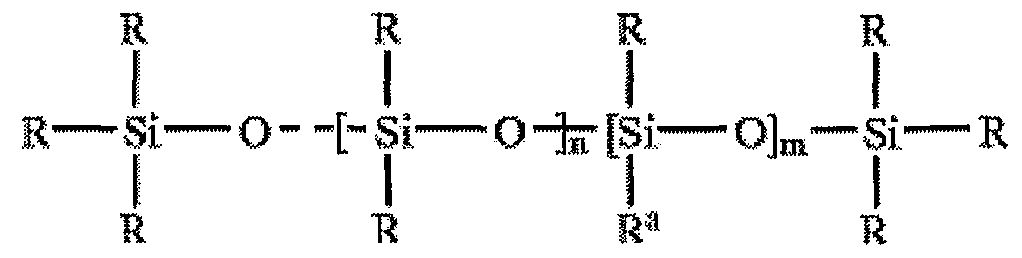
- the curable composition comprises an organic polysiloxane containing reactive functional groups, said polysiloxane having the general structure: CH or (III) R K R R , S I i — 0 _ ⁇ .g 1. — o-fe-IS 1i — Q], » ⁇ — II — R a
- R is selected from the group consisting of OH and monovalent hydrocarbon groups connected to the silicon atoms;
- R a has the following structure: Rj-O-X wherein R is alkylene, oxyalkylene or alkylene aryl; and X is a moiety containing a functional group selected from the group consisting of OH, COOH, NCO, carboxylate such as ester, carbonate and anhydride, primary amine, secondary amine, amide, carbamate and epoxy functional groups; and a component which contains functional groups reactive with the functional groups of the organic polysiloxane.
- the curable composition comprises: (a) an organic polysiloxane containing reactive functional groups, the polysiloxane having the formula (II) or (III), where m, m', n, R, Ra and X are as described above; (b) a polymer or oligomer which contains reactive functional groups; and (c) a curing agent containing functional groups which are reactive with the functional groups of (a) and (b).
- n+m and n+m' is 2 or 3.
- This invention relates to urethane compositions comprising: (A) 100 weight parts of at least one compound containing at least one isocyanate group; (B) 3-300 weight parts of a carbinol-functional silicone resin comprising the units:
- Another embodiment of the invention relates to urethane compositions comprising: (A) 100 weight parts of at least one compound containing at least one isocyanate group; (B) 0.3-300 weight parts of a carbinol-functional silicone resin comprising the units:
- R! and R are each independently a hydrogen atom, an alkyl group having from 1 to 8 carbon atoms, an aryl group, a carbinol group free of aryl groups having at least 3 carbon atoms, or an aryl-containing carbinol group having at least 6 carbon atoms
- R ⁇ is an alkyl group having from 1 to 8 carbon atoms or an aryl group
- a has a value of less than or equal to 0.6
- b has a value of zero or greater than zero
- c has a value of greater than zero
- d has a value of less than 0.5
- the value ofa + b + c + d l
- proviso that when each R2 is methyl the value of b is less than 0.3 and with the proviso there is on average at least one carbinol group per resin molecule
- C up to 250 weight parts of an organic polyol
- D up to
- Another embodiment of the invention relates to urethane compositions comprising: (A) at least one compound containing at least one isocyanate group; and (B) a carbinol- functional silicone resin comprising the units:
- R and R2 are each independently a hydrogen atom, an alkyl group having from 1 to 8 carbon atoms, an aryl group, a carbinol group free of aryl groups having at least 3 carbon atoms, or an aryl-containing carbinol group having at least 6 carbon atoms
- R3 is an alkyl group having from 1 to 8 carbon atoms or an aryl group
- a has a value of less than or equal to 0.6
- b has a value of zero or greater than zero
- c has a value of greater than zero
- d has a value of less than 0.5
- the value ofa + b + c + d l
- the mole ratio of carbinol groups to isocyanate groups is from about 0.8:1 to 1.2:1.
- Another embodiment of this invention relates to a urethane composition obtained by a method comprising reacting (A) 100 weight parts of at least one compound containing at least one isocyanate group; (B) 3-300 weight parts of a carbinol-functional silicone resin comprising the units:
- R and R2 are each independently a hydrogen atom, an alkyl group having from 1 to 8 carbon atoms, an aryl group, a carbinol group free of aryl groups having at least 3 carbon atoms, or an aryl-containing carbinol group having at least 6 carbon atoms
- R3 is an alkyl group having from 1 to 8 carbon atoms or an aryl group
- a has a value of less than or equal to 0.6
- b has a value of zero or greater than zero
- c has a value of greater than zero
- d has a value of less than 0.5
- the value ofa + b + c + d l
- C up to 250 weight parts of an organic polyol
- D up to 10 weight parts of a cure rate modifier.
- Another embodiment of this invention relates to a urethane composition obtained by a method comprising reacting (A) 100 weight parts of at least one compound containing at least one isocyanate group; (B) 0.3-300 weight parts of a carbinol-functional silicone resin comprising the units:
- Another embodiment of this invention relates to a urethane composition obtained by a method comprising reacting (A) at least one compound containing at least one isocyanate group; and (B) a carbinol-functional silicone resin comprising the units:
- R2 are each independently a hydrogen atom, an alkyl group having from 1 to 8 carbon atoms, an aryl group, a carbinol group free of aryl groups having at least 3 carbon atoms, or an aryl-containing carbinol group having at least 6 carbon atoms
- R3 is an alkyl group having from 1 to 8 carbon atoms or an aryl group
- a has a value of less than or equal to 0.6
- b has a value of zero or greater than zero
- c has a value of greater than zero
- d has a value of less than 0.5
- the value of a + b + c + d l
- the mole ratio of carbinol groups to isocyanate groups is from about 0.8:1 to 1.2:1.
- Component (A) can be any multi-isocyanate group containing molecules which have been used previously in the preparation of crosslinked urethanes.
- the compounds containing at least one isocyanate group of Component (A) are illustrated by isophorone diisocyanate trimers, isophorone diisocyanate, toluene diisocyanate, polyisocyanates, tetramethylxylylene diisocyanate, phenylene diisocyanate, xylene diisocyanate, 1,5-naphthalene diisocyanate, chlorophenylene 2,4-diisocyanate, bitoluene diisocyanate, dianisidine diisocyanate, toluidine diisocyanate and alkylated benzene diisocyanates generally; methylene-interrupted aromatic diisocyanates such as methylene-diphenyl-diisocyanate, especially the 4,4'-isomer (MDI)
- alkylated analogs such as 3,3'-dimethyl-4,4'-diphenyl-methane diisocyanate; such hydrogenated materials as cyclohexylene diisocyanate, 4,4'-methylenedicyclohexyl diisocyanate; mixed aralkyl diisocyanates such as the tetramethylxylyl diisocyanates, OCNC(CH 3 )2C(5H 4 C(CH 3 )2NCO, and the diisocyanate popularly referred to as isophorone diisocyanate, which is 3,3,5-trimethyl-5-isocyanato-methylcyclohexyl isocyanate; and polymethylene isocyanates such as 1,4-tetramethylene diisocyanate, 1,5-pentamethylene diisocyanate, 1,6-hexamethylene diisocyanate (HMDI), 1,7-heptamethylene diisocyanate, 2,2,4- and 2,4,4-trimethylhex
- component (A) Commercially available materials suitable as component (A) are illustrated by Tolonate XIDT 70SB an isophorone diisocyanate trimer (70% solids, 12.3 wt% NCO) sold by Rhodia (Cranbury, NJ) and Desmodur N-100 polyisocyanate (available from Mobay Corp.).
- carbinol group is defined as any group containing at least one carbon-bonded hydroxyl (COH) group.
- carbinol groups may contain more than one COH group such as for example
- the alkyl groups of R! and R2 in the carbinol-functional silicone resin of Component (B) are illustrated by methyl, ethyl, propyl, butyl, pentyl, hexyl, and octyl, with the alkyl group typically being methyl.
- the aryl groups of R* and R2 are illustrated by phenyl, naphthyl, benzyl, tolyl, xylyl, xenyl, methylphenyl, 2-phenylethyl, 2-phenyl-2- methylethyl, chlorophenyl, bromophenyl and fluorophenyl with the aryl group typically being phenyl.
- the carbinol group free of aryl groups having at least 3 carbon atoms is illustrated by groups having the formula R'+OH wherein R ⁇ is a divalent hydrocarbon group having at least 3 carbon atoms or a divalent hydrocarbonoxy group having at least 3 carbon atoms.
- the group R4 is illustrated by alkylene groups selected from -(CH2) - where x has a value of 3 to
- the aryl-containing carbinol group having at least 6 carbon atoms is illustrated by groups having the formula R ⁇ OH wherein R ⁇ is an arylene group selected from -(CH 2 ) x Co ⁇ 4 - wherein x has a value of 0 to 10, -CH CH(CH 3 )(CH 2 ) X C6H 4 - wherein x has a value of 0 to 10, and -(CH 2 ) X C6H 4 (CH 2 ) X - wherein x has a value of 1 to 10.
- the aryl- containing carbinol groups typically have from 6 to 14 atoms.
- Component (B) a has a typical value of 0.1 to 0.6, alternatively 0.2 to 0.4, b has a typical value of 0 to 0.4, alternatively 0 to 0.1, c has a typical value of 0.3 to 0.8, alternatively 0.4 to 0.8, d has a typical value of 0 to 0.3, alternatively zero.
- each R2 is methyl the value of b is less than 0.3, alternatively less than 0.1.
- the carbinol-functional silicone resins have on average at least one carbinol group per resin molecule.
- the equivalent weight of carbinol groups on the carbinol- functional silicone resin is from 100 to 1000, alternatively 200 to 800.
- the R1+R2+R groups in the carbinol-functional silicone resin contain high enough phenyl content to provide appropriate compatibility with component (A).
- R +R +R groups typically greater than 10 weight percent of the R +R +R groups are phenyl and even more typically greater than 25 weight percent of the R1+R2+R3 groups are phenyl.
- the carbinol-functional silicone resins are prepared by a method comprising reacting:
- Component (C) the organic polyol (synonymous with organic carbinol) is illustrated by ethylene glycol, 1,2-propylene glycol, 1,3-propylene glycol, 1,4-butylene glycol, 2,3-butylene glycol, 1,6-hexanediol, 1,8-octanediol, neopentyl glycol, cyclohexane dimethanol, 2-methyl- 1, 3 -propanediol, glycerol, trimethl,2,61, 1,2,4-butanetriol, pentaerythritol, mannitol, sorbitol, diethylene glycol, triethylene glycol, tetraethylene glycol, poly(ethyleneoxy) glycols generally, dipropylene glycol, poly(propyleneoxy) glycols generally, dibuty
- polyhydroxy materials of higher molecular weight which may be used are the. polymerization products of epoxides such as ethylene oxide, propylene oxide, butylene oxide, styrene oxide, and epichlorohydrin. Hydroxyl-containing polyesters, polythioethers, polyacetals, polycarbonates, and polyester amides also may be used alone or in combination with the above polyols. Suitable polyesters include the reaction product of polyhydric alcohols and polybasic, preferably dibasic, carboxylic acids. The polyhydric alcohols which are often used include the dihydric alcohols mentioned above.
- dicarboxylic acids include succinic acid, adipic acid, suberic acid, azelaic acid, sebacic acid, glutaric acid, phthalic acid, maleic acid, and fumaric acid.
- Typical polyether polyols are illustrated by polyalkylene ether polyols having the formula HO(RO) n H wherein R is an alkylene group and n is an integer large enough that the polyether polyol has a number average molecular weight of at least 250.
- These polyalkylene ether polyols are well-known components of polyurethane products and can be prepared by the polymerization of cyclic ethers such as alkylene oxides and glycols, dihydroxyethers, and the like by known methods.
- a particularly common high molecular weight polyol is polytetramethylene glycol.
- the cure rate modifier can be any material that affects the cure time of the urethane composition and includes cure accelerators, cure inhibitors, and cure catalysts.
- examples include phosphine compounds, such as tributylphosphine, triphenylphosphine, tris(dimethoxyphenyl)phosphine, tris(hydroxypropyl)phosphine and tris(cyanoethyl)phosphine; phosphonium salts, such as tetraphenylphosphonium tetraphenylborate, methyltributylphosphonium tetraphenylborate and methyltricyanoethyl phosphonium tetraphenylborate; imidazoles, such as 2-methyl imidazole, 2-phenyl imidazole, 2-ethyl-4-methyl imidazole, 2-undecyl imidazole, l-cyanoethyl-2-methyl imidazole, 1,
- the cure rate modifier Component (D) can also be illustrated by compounds having an aliphatic unsaturated bond, organophosphorous compounds, organosulfur compounds, nitrogen-containing compounds, and tin compounds.
- the compounds having an aliphatic unsaturated bond include propargyl alcohol, ene-yne compounds, and maleic esters such as dimethyl maleate.
- the organophosphorus compounds are triorganophosphines, diorganophosphines, organophosphones, and triorganophosphites.
- the organosulfur compounds include organomercaptanes, diorganosulfides, hydrogen sulfide, benzothiazole, and benzothiazole disulfite.
- the nitrogen-containing compounds include ammonia, primary, secondary or tertiary alkylamines, arylamines, urea, and hydrazine.
- the amines are illustrated by triethylamine, tributylamine, N-methylmorpholine, N- ethylmorpholine, l,4-diaza-bicylo-(2,2,2)-octane, N-cetyl dimethylamine, N-methyl-N'- dimethylaminoethyl-piperazine, N,N-dimethylbenzylamine, N,N-dimethylcyclohexylamine, and 1,2-dimethylimidazole.
- Organic tin compounds may also be used and include such materials as the tin(II) salts of carboxylic acids such as tin(II) acetate, tin(II) octoate, tin(II) ethylhexoate and tin(II) laurate, as well as such materials as the dialkyl tin salts of carboxylic acids as exemplified by dibutyltindiacetate, dibutyltindilaurate, dibutyltinmaleate, and dioctyltindiacetate.
- tin(II) salts of carboxylic acids such as tin(II) acetate, tin(II) octoate, tin(II) ethylhexoate and tin(II) laurate
- dialkyl tin salts of carboxylic acids as exemplified by dibutyltindiacetate, dibutyl
- Such tin salts may be used either alone or as a complex with amidines such as amino pyridines, amino pyrimidines, hydrazino pyridines, and tetrahydropyrimidines.
- amidines such as amino pyridines, amino pyrimidines, hydrazino pyridines, and tetrahydropyrimidines.
- Other metal-based compounds such as lead, iron, mercury, bismuth, cobalt and manganese also may be used, and include compounds such as cobalt(III) acetylacetonate, cobalt naphthoate, manganese naphthoate, lead oleate, zinc naphthenate and zirconium naphthenate.
- the cure rate modifiers of component (D) are generally used in an amount from about 0.01 to about 10% by weight, preferably from about 0.05 to about 1.0% by weight, based on the quantity of polyisocyanate and the quantity of materials reacting with the polyisocyanate.
- the mole ratio of carbinol groups to isocyanate groups in the urethane composition is from about 0.8:1 to 1.2:1.
- the urethane compositions of the present invention may further comprise other components that are conventionally employed in polymerizable systems.
- these components include, but are not limited to, solvents, plasticizers, pigments, colorants, dyes, surfactants, thickeners, heat stabilizers, leveling agents, anti-cratering agents, fillers, sedimentation inhibitors, ultraviolet-light absorbers, and the like.
- Additives such as promoters, heat stabilizers, ultraviolet-light absorbers, etc. may be intimately dispersed in the reaction mixture and apparently thereby become an integral part of the polymer.
- Preferred antioxidants are sterically hindered phenolic compounds.
- Stabilizers such as organic phosphites are also useful.
- Preferred UV inhibitors are benzotriazole compounds.
- the urethane compositions of this invention can further comprise at least one filler illustrated by hollow microspheres, fumed silica, precipitated silica, hydrous silicic acid, carbon black, ground quartz, calcium carbonate, magnesium carbonate, diatomaceous earth, wollastonite, calcined clay, clay, talc, kaolin, titanium oxide, bentonite, ferric oxide, zinc oxide, glass balloon, glass beads, mica, glass powder, glass balloons, coal dust, acrylic resin powder, phenolic resin powder, ceramic powder, zeolite, slate powder, organic fibers, and inorganic fibers.
- the urethane compositions of this invention can further comprise at least one cell stabilizer and at least one blowing agent, and optionally chain extenders and crosslinkers.
- the cell stabilizers are illustrated by silicones, with silicone polyethers being typically used.
- the blowing agents are illustrated by water, liquid carbon dioxide, CFCs, HCFCs, HFCs, and pentane, with water or a mixture of water and HCFC being typically used.
- the addition of these ingredients to the urethane compositions of this invention produce polyurethane foam compositions having enhanced thermal stability.
- the urethane compositions of this invention may be prepared by mixing (or mechanically agitating) components (A) and (B), and any optional components, to form a homogenous mixture.
- This may be accomplished by any convenient mixing method known in the art exemplified by a spatula, mechanical stirrers, in-line mixing systems containing baffles and/or blades, powered in-line mixers, homogenizers, a drum roller, a three-roll mill, a sigma blade mixer, a bread dough mixer, and a two roll mill.
- the order of mixing is not considered critical.
- Components (A) and (B) and any optional components may be pre-mixed and applied or mixed during application if tack free time is short.
- This invention also relates to a urethane composition obtained by a method comprising reacting (A) 100 weight parts of at least one compound containing at least one isocyanate group; (B) 3-300 weight parts of a carbinol-functional silicone resin comprising the units:
- Another embodiment of this invention relates to a urethane composition obtained by a method comprising reacting (A) 100 weight parts of at least one compound containing at least one isocyanate group; (B) 0.3-300 weight parts of a carbinol-functional silicone resin comprising the units:
- Another embodiment of this invention relates to a urethane composition obtained by a method comprising reacting (A) at least one compound containing at least one isocyanate group; and (B) a carbinol-functional silicone resin comprising the units:
- reacting means mixing components (A) and (B) and any optional components at room temperature (20-25°C) or heating a mixture comprising components (A) and (B) and any optional components to temperatures above room temperature such as at temperatures of up to 200°C.
- Components (A)-(D) are as described above.
- the urethane compositions of this invention are useful as a stand-alone coating or as ingredients in protective coatings, paint formulations, and powder coatings.
- the urethane compositions of this invention can also be formulated with a blowing agent and cell stabilizer to produce thermally stable foam formulations.
- Tolonate XIDT 70SB is an isophorone diisocyanate trimer (70% solids, 12.3 wt% NCO) sold by Rhodia (Cranbury, NJ).
- Desmophen® 870 BA is a hydroxyl-functional polyacrylate resin supplied in butyl acetate (70% solids) by Bayer Corporation (Pittsburgh, PA).
- Tegokat® 218 is dibutyltindilaurate sold by Goldschmidt (McDonald, PA).
- a spherical diamond is pressed against a coating surface at a constant rate of loading as the sample moves at a constant rate of travel. Force is increased until the coating catastrophically fails.
- the failure force is a measure of relative adherence for samples of similar character and thickness. It is believed that techniques can be developed to measure coating tensile strength, elastic limit, scratch resistance, friction coefficient and other physical properties.
- the scratch platform contains the diamond stylus, constant rate of travel sample stage, and a force measurement transducer which is mounted below the deck.
- An acoustic transducer, mounted on the stylus, is used to identify the point of initiation of sample micro- cracking and senses the coating or substrate failure.
- Acoustic energy, applied diamond force and tangential (diamond drag) force are plotted as a function of travel distance, as well as effective friction.
- Evaluation of DOI of the coatings of the invention involved the projection of various size images onto a painted surface and determining how small of image can be seen clearly.
- the image forming patterns (Landolt rings) were projected from a fluorescent-lighted box at a specified distance of 100mm over the sample under examination. A value of 100 was assigned to the smallest set of rings and a value of 90, 80, 70 etc, to the next uniformly increasingly larger rings to quantitatively evaluate the DOI of the painted surface. Coatings which allowed the inside of the smallest rings to be clearly discerned when projected from the light box were assigned a rating of 100. (GM9101P, General Motors Engineering Standard) Thermogravimetric Analysis
- BA denotes n-butyl acetate. Testing was performed on polished steel panels. The formulations were applied via 6 mil (wet) drawndown bar. The coated panels were allowed to air dry for fifteen minutes and then oven cured for 30 minutes at 265°F. All of the samples resulted in films with excellent gloss and flow with the exception of Example 5 the surface ofwhich was severely wrinkled. The DOI was measured (see test description above) and the results reported in Table 3.
- MPrOH denotes (HO(CH 2 ) 3 )(CH 3 ) 2 SiO ⁇ / 2
- MiBuOH denotes (HOCH 2 CH(CH 3 )CH 2 )(CH 3 ) 2 SiO ⁇ / 2 jfPhenol denotes (HOC 6 H 4 (CH 2 ) 3 )(CH 3 ) 2 SiO ⁇ / 2 j)Phenol denotes (HOC 6 H 4 (CH 2 ) 3 )(CH 3 )SiO 2/2
- M denotes (CH 3 ) 3 SiO 1/2
- XPh denotes C 6 H 5 SiO 3/2
- jMe denotes CH 3 SiO 3/2
- Example 17 [0048] 4.16g of carbinol-functional silicone resin 6 were syringed into an aluminum dish. 2.36g of DesmodurN-3390, 3.00g of butyl acetate solvent, and 3 drops of Tegokat® 218 were added and the materials were mixed well at room temperature using a wooden stir rod.
- Example 18 [0049] 0.88g of carbinol-functional siloxane resin 7 was syringed into an aluminum dish. 2.35g of Tolonate XIDT 70SB, 2.96g of butyl acetate solvent and 3 drops of Tegokat® 218 were added and the materials were mixed well at room temperature using a wooden stir rod.
- the material was cured for 4 hours at 100°C in air followed by a 1 hour post cure at 200°C in a nitrogen purged oven.
- the resulting material was a tough, slightly tan, transparent solid.
- the cured silicone-polyurethane hybrid material was analyzed by Thermogravimetric analysis in air and the results are displayed in Table 6.
- Examples 16-19 show the utility of carbinol-functional silicone resins as partial or total replacements for organic polyols in urethane materials to enhance the thermal stability of the resulting thermoset material (compared to controls Cex3 and Cex4).
- Desmophen® 870 BA is a hydroxyl-functional polyacrylate resin supplied in butyl acetate (70% solids) by Bayer Corporation (Pittsburgh, PA).
- DesmodurN-3390 is a polyisocyanate based on hexamethylene diisocyanate
- BA n-butyl acetate.
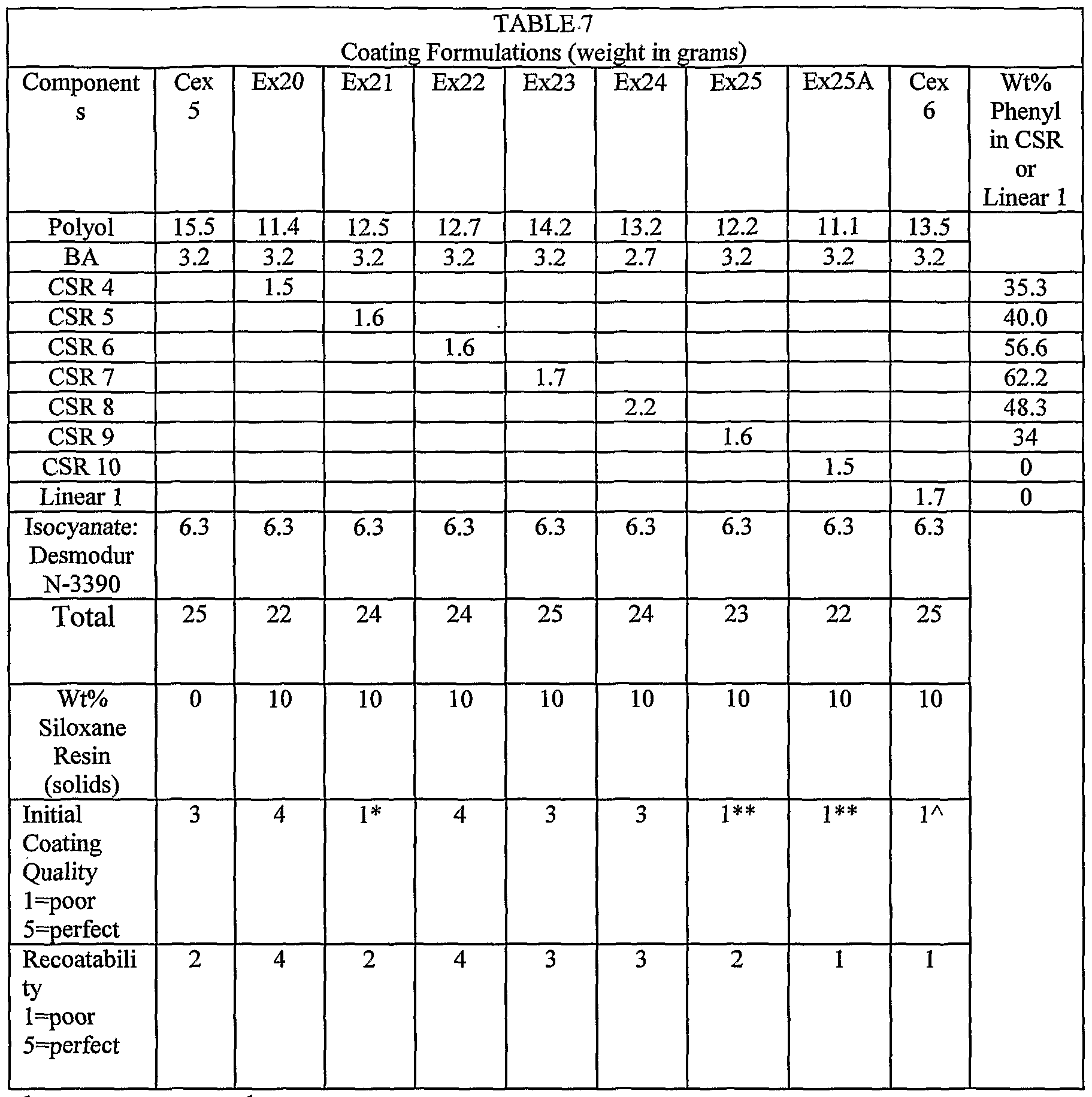
- RECOATABILITY The conditions (Application method, film thickness and cure schedule) for this test are specified relative to the specific coating formulation. After the initial cure, the specimen is overcoated with both the same paint formulation and the control coat. After curing the topcoat, the panels are rated in regards to the ability of the second coat to wet the underlying film.
- DABCO® 33 LV - a gellation catalyst containing 33% triethylenediamine and 67% dipropylene glycol from Air Products and Chemicals, Inc., Allentown, PA.
- DABCO® T-12 - a strong gellation catalyst containing dibutyltindilaurate from Air Products and Chemicals, Inc., Allentown, PA
- VORANOL® 3512A - a glycerine initiated polyether polyol having a molecular weight of about 3500 from The Dow Chemical Company, Midland, MI.
- Thermogravimetric analysis was performed using a TA Instruments (New Castle, DE) TGA 2950. Approximately 7 to 12 mg of a single piece of the test specimen was placed in a Pt pan and heated to 1000°C at 10 °C/min under an air and a nitrogen atmosphere in separate tests and the weight loss continuously monitored and recorded. The weight loss at 200°C and 350°C was reported. The uncertainty was estimated to be ⁇ 5% based on duplicate analysis.
- LV, and 0.07g of DABCO® BL-11 were measured into a paper bucket and mixed at high speed for 30 seconds.
- 0.75g of DABCO® DC5982 Surfactant, 0.30g of DABCO® T-12 and 22.5g of methylene chloride were added to the bucket and the contents were mixed at medium speed for 10 seconds.
- 71.0g of toluene diisocyanate were added to the bucket and the contents were mixed at high speed for 5 seconds.
- the foam was allowed to rise and the foam was allowed to cure at room temperature for 10 minutes.
- the foam was placed in a 200°F oven for 20 minutes. The cured foam was removed from the oven and the height was measured immediately and Thermogravimetric analysis was completed with results reported in Table 8.
- Example 26 [0062] 135.05g of VORANOL® 3512A, 12.96g of CSR 5 from Table 1 above, 5.25g of OPTIMA® H 2 0, 0.23g of DABCO® 33 LV, and 0.07g of DABCO® BL-11 were measured into a paper bucket and mixed at high speed for 30 sec. Next, 0.75g of DABCO® DC5982 Surfactant, 0.30g of DABCO® T-12 and 22.5g of methylene chloride were added to the bucket and the contents were mixed at medium speed for 10 seconds. Then 71.0g of toluene diisocyanate were added to the bucket and the contents were mixed at high speed for 5 seconds. The foam was allowed to rise and the foam was allowed to cure at room temperature for 10 minutes.
- Example 27 [0063] 90.03g of VORANOL® 3512A, 51.84g of CSR 5 from Table 1 above, 5.25g of OPTIMA® H 2 O, 0.23g of DABCO® 33 LV, and 0.07g of DABCO® BL-11 were measured into a paper bucket and mixed at high speed for 30 sec. Next, 0.75g of DABCO® DC5982 Surfactant, 0.30g of DABCO® T-12, and 22.5g of methylene chloride were added to the bucket and the contents were mixed at medium speed for 10 seconds.
- Example 28 [0064] 135.05g of VORANOL® 3512A, 14.02g of CSR 6 from Table 1 above, 5.25g of OPTIMA® H 2 0, 0.23g of DABCO® 33 LV, and 0.07g of DABCO® BL-11 were measured into a paper bucket and mixed at high speed for 30 seconds.
- Example 29 [0065] 90.03g of VORANOL® 3512A, 56.09g of CSR 6 from Table 1 above, 5.25g of OPTIMA® H 2 O, 0.23g of DABCO® 33 LV, and 0.07g of DABCO® BL-11 were measured into a paper bucket and mixed at high speed for 30 seconds. Next, 0.75g of DABCO® DC5982 Surfactant, 0.30g of DABCO® T-12, and 22.5g of methylene chloride were added to the bucket and the contents were mixed at medium speed for 10 seconds. Then 71.0g of toluene diisocyanate were added to the bucket and the contents were mixed at high speed for 5 seconds.
- Table 8 shows that adding carbinol-functional silicone resins to a urethane foam formulation reduces the weight loss of the resulting foam in both air and nitrogen environments while maintaining similar foam heights to the control.
- Trimethylolpropane monoallylether (Sigma-Aldrich Chemical Co.,Milwaukee WI
- DOW CORNING 6-3570 Polymer Trimethylsilyl-terminated dimethylsiloxy/methylhydrogensiloxy co-polymer(Dow Corning, Midland, MI) .
- Triphenylphosphine (Sigma-Aldrich Chemical Co.,Milwaukee WI)
- FC-24 trifluoromethanesulfonic acid, available from 3M, St. Paul, Minn.
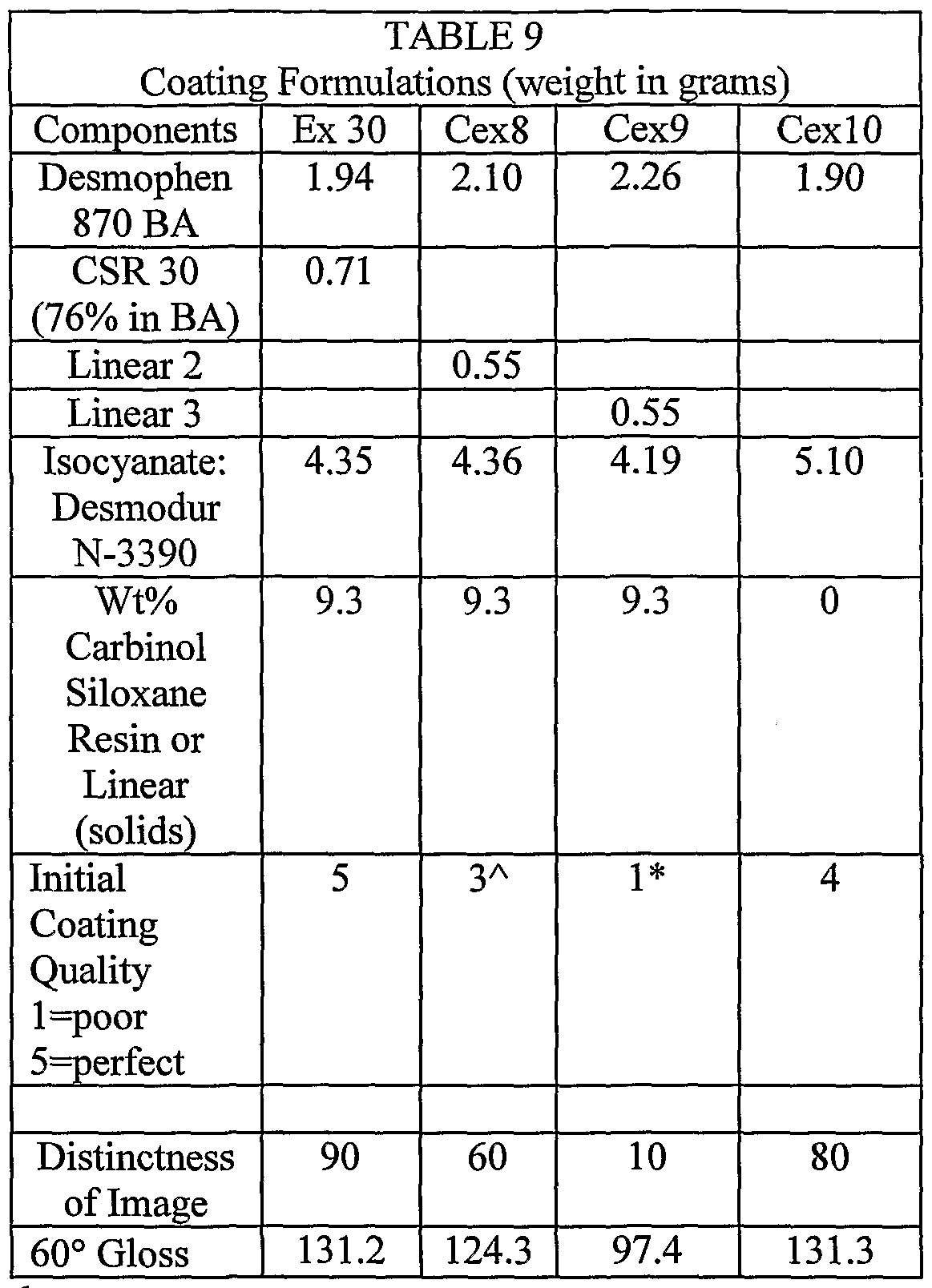
- CSR30 The carbinol-functional resin used in example 30 (CSR30) was prepared as follows:
- the comparative linear carbinol-functional polysiloxane (Linear 2) used in comparative example 8 (Cex8) was prepared as follows: A toluene solution of a divinyltetramethyldisiloxane complex of platinum (0.53 g of a 4810 ppm Pt solution) was added to a heated (65°C) mixture of a 5 cSt 0.76 wt% reactive hydrogen (as Si-H) trimethylsilyl-terminated dimethylsiloxy/methylhydrogensiloxy co-polymer (5.0 g) available from Dow Corning (Midland, MI) as 6-3570 Polymer and allyl alcohol (155.2 g), followed by addition of 95.0 grams more of the co-polymer.
- the comparative linear carbinol-functional polysiloxane (Linear 3) used in comparative example 9 (Cex9) was prepared as follows: A toluene solution of a divinyltetramethyldisiloxane complex of platinum (0.56 g of a 4810 ppm Pt solution) was added to a heated (80°C) mixture of a 5 cSt 0.76 wt% reactive hydrogen (as Si-H) trimemylsilyl-terminated dimethylsiloxy/methylhydrogensiloxy co-polymer (5.03 g) available from Dow Corning (Midland, MI) as 6-3570 Polymer and trimethylolpropane monoallyl ether (170.84 g), followed by addition of 95.22 grams more of the co-polymer.
- Comparative Example 10 (CexlO) coating was prepared using organic isocyante (Desmodur N-3390) and organic polyol (Desmophen 870 BA) as previously described.
Landscapes
- Chemical & Material Sciences (AREA)
- Organic Chemistry (AREA)
- Health & Medical Sciences (AREA)
- Chemical Kinetics & Catalysis (AREA)
- Medicinal Chemistry (AREA)
- Polymers & Plastics (AREA)
- Life Sciences & Earth Sciences (AREA)
- Engineering & Computer Science (AREA)
- Materials Engineering (AREA)
- Wood Science & Technology (AREA)
- Polyurethanes Or Polyureas (AREA)
- Compositions Of Macromolecular Compounds (AREA)
- Silicon Polymers (AREA)
- Manufacture Of Porous Articles, And Recovery And Treatment Of Waste Products (AREA)
- Paints Or Removers (AREA)
Abstract
Description









Claims




Priority Applications (4)
| Application Number | Priority Date | Filing Date | Title |
|---|---|---|---|
| EP04794512A EP1678234B1 (en) | 2003-10-10 | 2004-10-08 | Urethane compositions containing carbinol-functional silicone resins |
| JP2006534367A JP4939221B2 (en) | 2003-10-10 | 2004-10-08 | Urethane-forming composition or urethane composition containing carbinol-functional silicone resin |
| US10/568,515 US7452956B2 (en) | 2003-10-10 | 2004-10-08 | Urethane compositions containing carbinol-functional silicone resins |
| AT04794512T ATE534686T1 (en) | 2003-10-10 | 2004-10-08 | URETHANE COMPOSITIONS CONTAINING CARBINOL FUNCTIONAL SILICONE RESINS |
Applications Claiming Priority (2)
| Application Number | Priority Date | Filing Date | Title |
|---|---|---|---|
| US51023503P | 2003-10-10 | 2003-10-10 | |
| US60/510,235 | 2003-10-10 |
Publications (1)
| Publication Number | Publication Date |
|---|---|
| WO2005037887A1 true WO2005037887A1 (en) | 2005-04-28 |
Family
ID=34465126
Family Applications (1)
| Application Number | Title | Priority Date | Filing Date |
|---|---|---|---|
| PCT/US2004/033190 Ceased WO2005037887A1 (en) | 2003-10-10 | 2004-10-08 | Urethane compositions containing carbinol-functional silicone resins |
Country Status (6)
| Country | Link |
|---|---|
| US (1) | US7452956B2 (en) |
| EP (1) | EP1678234B1 (en) |
| JP (1) | JP4939221B2 (en) |
| CN (1) | CN100556929C (en) |
| AT (1) | ATE534686T1 (en) |
| WO (1) | WO2005037887A1 (en) |
Cited By (8)
| Publication number | Priority date | Publication date | Assignee | Title |
|---|---|---|---|---|
| JP2009531528A (en) * | 2006-03-23 | 2009-09-03 | ビー・エイ・エス・エフ、コーポレーション | Clear coat paint with carbinol functional siloxane resin |
| US7604837B2 (en) * | 2006-03-23 | 2009-10-20 | Basf Coatings Ag | Nonlinear polysiloxane containing coatings with improved adhesion properties |
| US8062729B2 (en) * | 2005-01-14 | 2011-11-22 | Ndsu Research Foundation | Polymeric material with surface microdomains |
| US8399594B2 (en) | 2006-12-20 | 2013-03-19 | Dow Corning Corporation | Blocked-isocyanate silicone resins |
| WO2013066965A1 (en) * | 2011-11-01 | 2013-05-10 | Dow Corning Corporation | High glass transition temperature resin formulations |
| WO2018052645A1 (en) * | 2016-09-19 | 2018-03-22 | Dow Corning Corporation | Skin contact adhesive and methods for its preparation and use |
| WO2021237069A1 (en) * | 2020-05-22 | 2021-11-25 | Dow Silicones Corporation | Composition and foamed polyurethane article formed therewith |
| US20240271016A1 (en) * | 2021-05-24 | 2024-08-15 | Dow Silicones Corporation | Composition for preparing a release coating and method of preparing coated substrate |
Families Citing this family (40)
| Publication number | Priority date | Publication date | Assignee | Title |
|---|---|---|---|---|
| EP1687358B1 (en) * | 2003-10-10 | 2011-06-22 | Dow Corning Corporation | Carbinol-functional silicone resins |
| US7771833B2 (en) * | 2005-05-09 | 2010-08-10 | Ndsu Research Foundation | Anti-fouling materials containing cationic polysiloxanes |
| EP1913060A4 (en) * | 2005-07-29 | 2008-11-26 | Ndsu Res Foundation | Functionalized polysiloxane polymers |
| JP2009531521A (en) * | 2006-03-23 | 2009-09-03 | ダウ・コーニング・コーポレイション | Non-linear polysiloxane-containing coating with improved adhesion |
| US8278390B2 (en) * | 2006-03-23 | 2012-10-02 | Dow Corning Corporation | Coatings with carbinol-functional siloxane resin |
| US7989074B2 (en) * | 2006-06-09 | 2011-08-02 | Ndsu Research Foundation | Thermoset siloxane-urethane fouling release coatings |
| US9828597B2 (en) | 2006-11-22 | 2017-11-28 | Toyota Motor Engineering & Manufacturing North America, Inc. | Biofunctional materials |
| EP2125651A1 (en) * | 2006-12-20 | 2009-12-02 | Dow Corning Corporation | Glass substrates coated or laminated with multiple layers of cured silicone resin compositions |
| US8372384B2 (en) * | 2007-01-08 | 2013-02-12 | Ndsu Research Foundation | Quaternary ammonium functionalized cross-linked polyalkylsiloxanes with anti-fouling activity |
| US8299200B2 (en) * | 2007-06-11 | 2012-10-30 | Ndsu Research Foundation | Anchored polysiloxane-modified polyurethane coatings and uses thereof |
| US8053535B2 (en) * | 2007-07-11 | 2011-11-08 | Ndsu Research Foundation | Polysiloxanes with anti-fouling activity |
| KR20090015591A (en) * | 2007-08-09 | 2009-02-12 | 삼성전자주식회사 | Polyurethane Foam Composites, Polyurethane Foam Composites Produced therefrom and Method of Making the Same |
| US8709394B2 (en) * | 2007-09-28 | 2014-04-29 | Ndsu Research Foundation | Antimicrobial polysiloxane materials containing metal species |
| DE102007055703A1 (en) * | 2007-12-04 | 2009-06-10 | Wacker Chemie Ag | Silicone-containing polyurethane foam |
| US8071706B2 (en) | 2008-02-13 | 2011-12-06 | Ndsu Research Foundation | Siloxane polymer containing tethered levofloxacin |
| US20100004202A1 (en) * | 2008-02-15 | 2010-01-07 | Ndsu Research Foundation | Quaternary ammonium-functionalized-POSS compounds |
| CN102341459B (en) | 2009-03-12 | 2014-01-01 | 道康宁公司 | Thermal interface materials and methods for their preparation and use |
| WO2011014139A1 (en) | 2009-07-28 | 2011-02-03 | Photokinetic Coatings & Adhesives, Llc. | Uv-curable floor sealants |
| TWI502004B (en) | 2009-11-09 | 2015-10-01 | Dow Corning | Process for preparing clustered functional polyorganosiloxanes, and methods for their use |
| US9121016B2 (en) | 2011-09-09 | 2015-09-01 | Toyota Motor Engineering & Manufacturing North America, Inc. | Coatings containing polymer modified enzyme for stable self-cleaning of organic stains |
| US8796009B2 (en) | 2010-06-21 | 2014-08-05 | Toyota Motor Engineering & Manufacturing North America, Inc. | Clearcoat containing thermolysin-like protease from Bacillus stearothermophilus for cleaning of insect body stains |
| US9388370B2 (en) | 2010-06-21 | 2016-07-12 | Toyota Motor Engineering & Manufacturing North America, Inc. | Thermolysin-like protease for cleaning insect body stains |
| US10988714B2 (en) | 2010-06-21 | 2021-04-27 | Regents Of The University Of Minnesota | Methods of facilitating removal of a fingerprint from a substrate or a coating |
| US11015149B2 (en) | 2010-06-21 | 2021-05-25 | Toyota Motor Corporation | Methods of facilitating removal of a fingerprint |
| US9284458B2 (en) * | 2011-06-30 | 2016-03-15 | Dow Global Technologies Llc | Silicone backbone prepolymers for flame resistant polyurethanes |
| WO2013098652A2 (en) * | 2011-12-30 | 2013-07-04 | E. I. Du Pont De Nemours And Company | Aqueous pigment dispersions based on polyurethane dispersants having components to interact with cellulose |
| US8716392B2 (en) | 2012-04-19 | 2014-05-06 | Arrowstar Llc | Nonfluorinated polyurethanes and methods of making and using thereof |
| US8716396B2 (en) | 2012-04-19 | 2014-05-06 | Arrowstar Llc | Nonfluorinated polyurethanes and methods of making and using thereof |
| JP5830041B2 (en) * | 2013-01-24 | 2015-12-09 | 信越化学工業株式会社 | Composition for forming polysiloxane-containing resist underlayer film, and pattern forming method using the same |
| WO2015020689A1 (en) | 2013-08-06 | 2015-02-12 | Dow Corning Corporation | Catalysts, compositions containing the catalysts, and methods for the preparation thereof |
| WO2016056038A1 (en) | 2014-10-07 | 2016-04-14 | 有限会社コーキ・エンジニアリング | Slidable medical silicone rubber, gasket using said rubber, and prefilled syringe using said gasket |
| US10738218B2 (en) * | 2016-08-31 | 2020-08-11 | Toray Industries, Inc. | Polysiloxane, material for semiconductor, and preparation method for semiconductor and solar cell |
| JP6816264B2 (en) | 2016-09-19 | 2021-01-20 | ダウ シリコーンズ コーポレーション | Polyurethane-polyorganosiloxane copolymer and its preparation method |
| WO2018052648A1 (en) | 2016-09-19 | 2018-03-22 | Dow Corning Corporation | Copolymer composition for personal care |
| JP6840228B2 (en) * | 2016-09-19 | 2021-03-10 | ダウ シリコーンズ コーポレーション | Skin contact adhesive and its preparation method and use |
| KR102193820B1 (en) | 2016-09-19 | 2020-12-24 | 다우 실리콘즈 코포레이션 | Copolymer composition for coating and adhesive applications |
| CN106590399A (en) * | 2016-12-30 | 2017-04-26 | 康伦国 | Graphene-organosilicone modified polyurethane water-based paint |
| CN110791088A (en) * | 2019-11-12 | 2020-02-14 | 福建安达福新材料科技有限公司 | PA/TPU supercritical foaming composite material and preparation method thereof |
| JP7547758B2 (en) * | 2020-03-31 | 2024-09-10 | 三菱ケミカル株式会社 | Thermosetting resin composition, cured product and laminate |
| US20250163206A1 (en) | 2022-03-02 | 2025-05-22 | Shin-Etsu Chemical Co., Ltd. | Siloxane-modified polyurethane composition |
Citations (2)
| Publication number | Priority date | Publication date | Assignee | Title |
|---|---|---|---|---|
| US4684538A (en) * | 1986-02-21 | 1987-08-04 | Loctite Corporation | Polysiloxane urethane compounds and adhesive compositions, and method of making and using the same |
| US5290901A (en) * | 1993-06-14 | 1994-03-01 | Dow Corning Corporation | Method for preparation of carbinol-functional siloxanes |
Family Cites Families (37)
| Publication number | Priority date | Publication date | Assignee | Title |
|---|---|---|---|---|
| JPS52147657A (en) | 1976-06-02 | 1977-12-08 | Toray Silicone Co Ltd | Curable organopolysiloxane compositions |
| US4125510A (en) | 1977-03-01 | 1978-11-14 | Dow Corning Corporation | Method of improving crack resistance of siloxane molding compositions |
| DE2730744A1 (en) | 1977-07-07 | 1979-05-03 | Bayer Ag | ORGANOPOLYSILOXANE COMPOSITIONS MODIFIED WITH POLYURETHANE |
| US4234697A (en) | 1979-01-18 | 1980-11-18 | Dow Corning Corporation | Method of preparing cross-linked polydiorganosiloxane using organic isocyanates and products prepared therefrom |
| CA1235245A (en) | 1984-12-26 | 1988-04-12 | Toshifumi Hirose | Curable resinous composition comprising epoxy resin and silicon-containing elastomeric polymer |
| US4684534A (en) | 1985-02-19 | 1987-08-04 | Dynagram Corporation Of America | Quick-liquifying, chewable tablet |
| JPS6245667A (en) | 1985-08-22 | 1987-02-27 | Shin Etsu Chem Co Ltd | paint composition |
| DE3689022T2 (en) | 1985-10-07 | 1994-04-21 | Shinetsu Chemical Co | Epoxy resin composition. |
| US4795680A (en) | 1986-05-09 | 1989-01-03 | General Electric Company | Polyimide-siloxanes, method of making and use |
| US5102960A (en) | 1989-09-11 | 1992-04-07 | Bayer Aktiengesellschaft | Silicon-epoxy resin composition |
| JP2661328B2 (en) | 1990-05-18 | 1997-10-08 | 信越化学工業株式会社 | Flame-retardant coating material and workpiece coated with the coating material |
| US5013577A (en) | 1990-08-22 | 1991-05-07 | Dow Corning Corporation | Siloxane soluble (CH3)3 SIO1/2 /SIO2 (M/Q) resins with amine and amide organofunctionality |
| US5431765A (en) | 1994-06-20 | 1995-07-11 | Toray Industries | Preparing epoxy resin/aminopolysiloxane/aromatic oligomer composite |
| US5135993A (en) | 1990-09-11 | 1992-08-04 | Dow Corning Corporation | High modulus silicones as toughening agents for epoxy resins |
| US5262507A (en) | 1990-09-11 | 1993-11-16 | Dow Corning Corporation | High modulus silicones as toughening agents for epoxy resins |
| US5152984A (en) | 1990-11-20 | 1992-10-06 | Dow Corning Corporation | Hair fixatives |
| US5126126A (en) | 1990-11-20 | 1992-06-30 | Dow Corning Corporation | Hair fixatives |
| CA2034851A1 (en) | 1991-01-24 | 1992-07-25 | Chak-Kai Yip | Amine functional silane modified epoxy resin composition and weatherstrip coatings made therefrom |
| US5290882A (en) | 1991-08-13 | 1994-03-01 | Shin-Etsu Chemical Co., Ltd. | Thermosetting resin compositions |
| EP0620242B1 (en) | 1993-04-15 | 1998-08-19 | Dow Corning Toray Silicone Company, Limited | Epoxy group-containing silicone resin and compositions based thereon |
| US5952439A (en) | 1993-04-15 | 1999-09-14 | Dow Corning Toray Silicone Co., Ltd. | Epoxy group-containing silicone resin and compositions based thereon |
| JP3269248B2 (en) * | 1994-03-04 | 2002-03-25 | 株式会社ブリヂストン | Ink holder |
| ATE179740T1 (en) * | 1994-10-31 | 1999-05-15 | Tower Technologies Proprietary | METHOD FOR PRODUCING A LIGNOCELLULOSE MATERIAL SUITABLE FOR PRODUCING A FINISHED PRODUCT |
| DE19680435T1 (en) | 1995-05-09 | 1997-06-05 | Dainippon Ink & Chemicals | Curable resin composition |
| US5773484A (en) * | 1995-12-22 | 1998-06-30 | Osi Specialties, Inc. | Enol-ether capped polyethers and surfactants produced therefrom |
| JP3592825B2 (en) | 1996-02-07 | 2004-11-24 | 東レ・ダウコーニング・シリコーン株式会社 | Curable epoxy resin composition and electronic component |
| JPH09328652A (en) * | 1996-06-10 | 1997-12-22 | Dainippon Ink & Chem Inc | Polyurethane resin composition for paint |
| US6297331B1 (en) | 1996-06-22 | 2001-10-02 | Th. Goldschmidt Ag | Organosiloxanyl derivatives of alkanediol monovinyl ethers, process for their preparation, their modification and their use as paint additives |
| JPH1087834A (en) * | 1996-09-10 | 1998-04-07 | Showa Denko Kk | Polyorganosilsesquioxane, its production, and resin composition containing the same compound |
| AUPO251096A0 (en) * | 1996-09-23 | 1996-10-17 | Cardiac Crc Nominees Pty Limited | Polysiloxane-containing polyurethane elastomeric compositions |
| US5814679A (en) | 1996-10-18 | 1998-09-29 | General Electric Company | Premium release photo-curable silicone compositions |
| JPH10338734A (en) * | 1997-06-06 | 1998-12-22 | Shin Etsu Chem Co Ltd | Polyurethane resin composition |
| US5939491A (en) * | 1997-08-01 | 1999-08-17 | Ppg Industries Ohio, Inc. | Curable compositions based on functional polysiloxanes |
| US6610777B1 (en) | 1999-07-30 | 2003-08-26 | Ppg Industries Ohio, Inc. | Flexible coating compositions having improved scratch resistance, coated substrates and methods related thereto |
| JP2002097235A (en) * | 2000-09-26 | 2002-04-02 | Jsr Corp | Liquid curable resin composition and cured product thereof |
| DE10212658A1 (en) * | 2002-03-21 | 2003-10-16 | Consortium Elektrochem Ind | Silicon-containing foams |
| EP2260881B1 (en) * | 2002-10-11 | 2020-03-25 | Boston Scientific Limited | Implantable medical devices |
-
2004
- 2004-10-08 US US10/568,515 patent/US7452956B2/en not_active Expired - Fee Related
- 2004-10-08 AT AT04794512T patent/ATE534686T1/en active
- 2004-10-08 CN CNB2004800289641A patent/CN100556929C/en not_active Expired - Fee Related
- 2004-10-08 EP EP04794512A patent/EP1678234B1/en not_active Expired - Lifetime
- 2004-10-08 WO PCT/US2004/033190 patent/WO2005037887A1/en not_active Ceased
- 2004-10-08 JP JP2006534367A patent/JP4939221B2/en not_active Expired - Fee Related
Patent Citations (2)
| Publication number | Priority date | Publication date | Assignee | Title |
|---|---|---|---|---|
| US4684538A (en) * | 1986-02-21 | 1987-08-04 | Loctite Corporation | Polysiloxane urethane compounds and adhesive compositions, and method of making and using the same |
| US5290901A (en) * | 1993-06-14 | 1994-03-01 | Dow Corning Corporation | Method for preparation of carbinol-functional siloxanes |
Cited By (11)
| Publication number | Priority date | Publication date | Assignee | Title |
|---|---|---|---|---|
| US8062729B2 (en) * | 2005-01-14 | 2011-11-22 | Ndsu Research Foundation | Polymeric material with surface microdomains |
| JP2009531528A (en) * | 2006-03-23 | 2009-09-03 | ビー・エイ・エス・エフ、コーポレーション | Clear coat paint with carbinol functional siloxane resin |
| US7604837B2 (en) * | 2006-03-23 | 2009-10-20 | Basf Coatings Ag | Nonlinear polysiloxane containing coatings with improved adhesion properties |
| US8399594B2 (en) | 2006-12-20 | 2013-03-19 | Dow Corning Corporation | Blocked-isocyanate silicone resins |
| WO2013066965A1 (en) * | 2011-11-01 | 2013-05-10 | Dow Corning Corporation | High glass transition temperature resin formulations |
| CN103917604A (en) * | 2011-11-01 | 2014-07-09 | 道康宁公司 | High glass transition temperature resin formulations |
| WO2018052645A1 (en) * | 2016-09-19 | 2018-03-22 | Dow Corning Corporation | Skin contact adhesive and methods for its preparation and use |
| WO2021237069A1 (en) * | 2020-05-22 | 2021-11-25 | Dow Silicones Corporation | Composition and foamed polyurethane article formed therewith |
| US12540213B2 (en) | 2020-05-22 | 2026-02-03 | Dow Silicones Corporation | Composition and foamed polyurethane article formed therewith |
| US20240271016A1 (en) * | 2021-05-24 | 2024-08-15 | Dow Silicones Corporation | Composition for preparing a release coating and method of preparing coated substrate |
| US12534650B2 (en) * | 2021-05-24 | 2026-01-27 | Dow Silicones Corporation | Composition for preparing a release coating and method of preparing coated substrate |
Also Published As
| Publication number | Publication date |
|---|---|
| EP1678234A1 (en) | 2006-07-12 |
| US20070093618A1 (en) | 2007-04-26 |
| ATE534686T1 (en) | 2011-12-15 |
| JP4939221B2 (en) | 2012-05-23 |
| JP2007508425A (en) | 2007-04-05 |
| CN1863837A (en) | 2006-11-15 |
| US7452956B2 (en) | 2008-11-18 |
| EP1678234B1 (en) | 2011-11-23 |
| CN100556929C (en) | 2009-11-04 |
Similar Documents
| Publication | Publication Date | Title |
|---|---|---|
| EP1678234B1 (en) | Urethane compositions containing carbinol-functional silicone resins | |
| JP2678443B2 (en) | Method for producing isocyanate group-containing prepolymer useful as binder for moisture-curable one-component lacquer | |
| US20070078255A1 (en) | Two-component systems for producing flexible coatings | |
| EP3867292B1 (en) | Aspartic acid ester-functional polysiloxanes, their preparation and use thereof | |
| JP5357775B2 (en) | Block isocyanate silicone resin | |
| JP3438875B2 (en) | Polysiloxane polyol | |
| JP2000169793A (en) | Hybrid paint composition | |
| CA2221651A1 (en) | Low surface energy polyisocyanates and their use in one or two-component coating compositions | |
| JP2001503097A (en) | Poly (ether-urethane) sealant based on hydroxycarbamoylalkoxysilane | |
| US20160264708A1 (en) | Synthesis and Use of Metallized Polyhedral Oligomeric Silsesquioxane Catalyst Compositions | |
| TW200936649A (en) | Polysiloxane-modified polyisocyanates, processes for preparing the same, and polyurethanes containing the same | |
| JP2018524418A (en) | Polyurethane coating composition | |
| JPH036230A (en) | Polyactone-modified organopolysiloxane compound | |
| ES2376182T3 (en) | MIXTURES OF POLYISOCIANATES THAT ARE HARDENED BY HUMIDITY. | |
| CN111154057A (en) | Coating composition | |
| WO2008088491A2 (en) | Silicone resin coating compositions containing blocked isocyanates | |
| CN113614138B (en) | Two-component polyurethane coating with improved pot life without loss of weatherability | |
| JP2019023291A (en) | Isocyanate composition, coating composition, coat, and coated article | |
| BR112021007374B1 (en) | FUNCTIONAL POLYSILOXANES MODIFIED WITH ASPARTIC ACID ESTER AND THEIR USE, CURED COMPOSITION AND THEIR USE, CURED COMPOSITIONS, ARTICLES, COATING COMPOSITION, COATING, COMPOSITE ARTICLES AND PROCESS FOR MANUFACTURING THE COMPOUNDS | |
| WO2013062119A1 (en) | Curable composition | |
| TW201418331A (en) | Curable composition |
Legal Events
| Date | Code | Title | Description |
|---|---|---|---|
| WWE | Wipo information: entry into national phase |
Ref document number: 200480028964.1 Country of ref document: CN |
|
| AK | Designated states |
Kind code of ref document: A1 Designated state(s): AE AG AL AM AT AU AZ BA BB BG BR BW BY BZ CA CH CN CO CR CU CZ DE DK DM DZ EC EE EG ES FI GB GD GE GH GM HR HU ID IL IN IS JP KE KG KP KR KZ LC LK LR LS LT LU LV MA MD MG MK MN MW MX MZ NA NI NO NZ OM PG PH PL PT RO RU SC SD SE SG SK SL SY TJ TM TN TR TT TZ UA UG US UZ VC VN YU ZA ZM ZW |
|
| AL | Designated countries for regional patents |
Kind code of ref document: A1 Designated state(s): BW GH GM KE LS MW MZ NA SD SL SZ TZ UG ZM ZW AM AZ BY KG KZ MD RU TJ TM AT BE BG CH CY CZ DE DK EE ES FI FR GB GR HU IE IT LU MC NL PL PT RO SE SI SK TR BF BJ CF CG CI CM GA GN GQ GW ML MR NE SN TD TG |
|
| 121 | Ep: the epo has been informed by wipo that ep was designated in this application | ||
| WWE | Wipo information: entry into national phase |
Ref document number: 2007093618 Country of ref document: US Ref document number: 10568515 Country of ref document: US |
|
| WWE | Wipo information: entry into national phase |
Ref document number: 2004794512 Country of ref document: EP |
|
| WWE | Wipo information: entry into national phase |
Ref document number: 2006534367 Country of ref document: JP |
|
| WWP | Wipo information: published in national office |
Ref document number: 2004794512 Country of ref document: EP |
|
| WWP | Wipo information: published in national office |
Ref document number: 10568515 Country of ref document: US |