WO2005040283A2 - Disperse azo dyestuffs - Google Patents
Disperse azo dyestuffs Download PDFInfo
- Publication number
- WO2005040283A2 WO2005040283A2 PCT/EP2004/011590 EP2004011590W WO2005040283A2 WO 2005040283 A2 WO2005040283 A2 WO 2005040283A2 EP 2004011590 W EP2004011590 W EP 2004011590W WO 2005040283 A2 WO2005040283 A2 WO 2005040283A2
- Authority
- WO
- WIPO (PCT)
- Prior art keywords
- alkyl
- hydrogen
- formula
- group
- methyl
- Prior art date
- Legal status (The legal status is an assumption and is not a legal conclusion. Google has not performed a legal analysis and makes no representation as to the accuracy of the status listed.)
- Ceased
Links
- PBGCYJMEPRDIGI-QURGRASLSA-N CCCCN(CCC(OCC#N)=O)c(cc1)ccc1/N=N/c1ncc([N+]([O-])=O)[s]1 Chemical compound CCCCN(CCC(OCC#N)=O)c(cc1)ccc1/N=N/c1ncc([N+]([O-])=O)[s]1 PBGCYJMEPRDIGI-QURGRASLSA-N 0.000 description 1
- NMAFJDQZWCZMRJ-UHFFFAOYSA-N Cc1c(cc(cc2)[N+]([O-])=O)c2n[s]1 Chemical compound Cc1c(cc(cc2)[N+]([O-])=O)c2n[s]1 NMAFJDQZWCZMRJ-UHFFFAOYSA-N 0.000 description 1
Classifications
-
- C—CHEMISTRY; METALLURGY
- C09—DYES; PAINTS; POLISHES; NATURAL RESINS; ADHESIVES; COMPOSITIONS NOT OTHERWISE PROVIDED FOR; APPLICATIONS OF MATERIALS NOT OTHERWISE PROVIDED FOR
- C09B—ORGANIC DYES OR CLOSELY-RELATED COMPOUNDS FOR PRODUCING DYES, e.g. PIGMENTS; MORDANTS; LAKES
- C09B29/00—Monoazo dyes prepared by diazotising and coupling
- C09B29/0003—Monoazo dyes prepared by diazotising and coupling from diazotized anilines
-
- C—CHEMISTRY; METALLURGY
- C09—DYES; PAINTS; POLISHES; NATURAL RESINS; ADHESIVES; COMPOSITIONS NOT OTHERWISE PROVIDED FOR; APPLICATIONS OF MATERIALS NOT OTHERWISE PROVIDED FOR
- C09B—ORGANIC DYES OR CLOSELY-RELATED COMPOUNDS FOR PRODUCING DYES, e.g. PIGMENTS; MORDANTS; LAKES
- C09B29/00—Monoazo dyes prepared by diazotising and coupling
- C09B29/06—Monoazo dyes prepared by diazotising and coupling from coupling components containing amino as the only directing group
- C09B29/08—Amino benzenes
- C09B29/0805—Amino benzenes free of acid groups
- C09B29/0807—Amino benzenes free of acid groups characterised by the amino group
- C09B29/0809—Amino benzenes free of acid groups characterised by the amino group substituted amino group
- C09B29/0811—Amino benzenes free of acid groups characterised by the amino group substituted amino group further substituted alkylamino, alkenylamino, alkynylamino, cycloalkylamino aralkylamino or arylamino
- C09B29/0815—Amino benzenes free of acid groups characterised by the amino group substituted amino group further substituted alkylamino, alkenylamino, alkynylamino, cycloalkylamino aralkylamino or arylamino substituted by -C(=O)-
- C09B29/0816—Amino benzenes free of acid groups characterised by the amino group substituted amino group further substituted alkylamino, alkenylamino, alkynylamino, cycloalkylamino aralkylamino or arylamino substituted by -C(=O)- substituted by -COOR
-
- C—CHEMISTRY; METALLURGY
- C09—DYES; PAINTS; POLISHES; NATURAL RESINS; ADHESIVES; COMPOSITIONS NOT OTHERWISE PROVIDED FOR; APPLICATIONS OF MATERIALS NOT OTHERWISE PROVIDED FOR
- C09B—ORGANIC DYES OR CLOSELY-RELATED COMPOUNDS FOR PRODUCING DYES, e.g. PIGMENTS; MORDANTS; LAKES
- C09B29/00—Monoazo dyes prepared by diazotising and coupling
- C09B29/0025—Monoazo dyes prepared by diazotising and coupling from diazotized amino heterocyclic compounds
-
- C—CHEMISTRY; METALLURGY
- C09—DYES; PAINTS; POLISHES; NATURAL RESINS; ADHESIVES; COMPOSITIONS NOT OTHERWISE PROVIDED FOR; APPLICATIONS OF MATERIALS NOT OTHERWISE PROVIDED FOR
- C09B—ORGANIC DYES OR CLOSELY-RELATED COMPOUNDS FOR PRODUCING DYES, e.g. PIGMENTS; MORDANTS; LAKES
- C09B29/00—Monoazo dyes prepared by diazotising and coupling
- C09B29/06—Monoazo dyes prepared by diazotising and coupling from coupling components containing amino as the only directing group
- C09B29/08—Amino benzenes
-
- C—CHEMISTRY; METALLURGY
- C09—DYES; PAINTS; POLISHES; NATURAL RESINS; ADHESIVES; COMPOSITIONS NOT OTHERWISE PROVIDED FOR; APPLICATIONS OF MATERIALS NOT OTHERWISE PROVIDED FOR
- C09B—ORGANIC DYES OR CLOSELY-RELATED COMPOUNDS FOR PRODUCING DYES, e.g. PIGMENTS; MORDANTS; LAKES
- C09B31/00—Disazo and polyazo dyes of the type A->B->C, A->B->C->D, or the like, prepared by diazotising and coupling
- C09B31/02—Disazo dyes
- C09B31/04—Disazo dyes from a coupling component "C" containing a directive amino group
- C09B31/043—Amino-benzenes
-
- Y—GENERAL TAGGING OF NEW TECHNOLOGICAL DEVELOPMENTS; GENERAL TAGGING OF CROSS-SECTIONAL TECHNOLOGIES SPANNING OVER SEVERAL SECTIONS OF THE IPC; TECHNICAL SUBJECTS COVERED BY FORMER USPC CROSS-REFERENCE ART COLLECTIONS [XRACs] AND DIGESTS
- Y10—TECHNICAL SUBJECTS COVERED BY FORMER USPC
- Y10S—TECHNICAL SUBJECTS COVERED BY FORMER USPC CROSS-REFERENCE ART COLLECTIONS [XRACs] AND DIGESTS
- Y10S8/00—Bleaching and dyeing; fluid treatment and chemical modification of textiles and fibers
- Y10S8/92—Synthetic fiber dyeing
- Y10S8/922—Polyester fiber
Definitions
- the present invention relates to the field of disperse dyes.
- Disperse dyestuffs containing cyanomethyl ester groups are known from literature and are described for example in GB 909,843, DE-A 2130992, GB 1 ,457,532, GB 1 ,536,429, FR-A 1 ,531 , 147, US 3,776,898, JP 551 61 857, GB 2, 1 04,088, EP 0 685 531 A1 and WO 95/20014.
- the inventor of the present invention has surprisingly found that dyeings on polyester with very good wet fastness properties can be obtained if selected dyestuffs containing one cyanomethylester group as defined below are used.
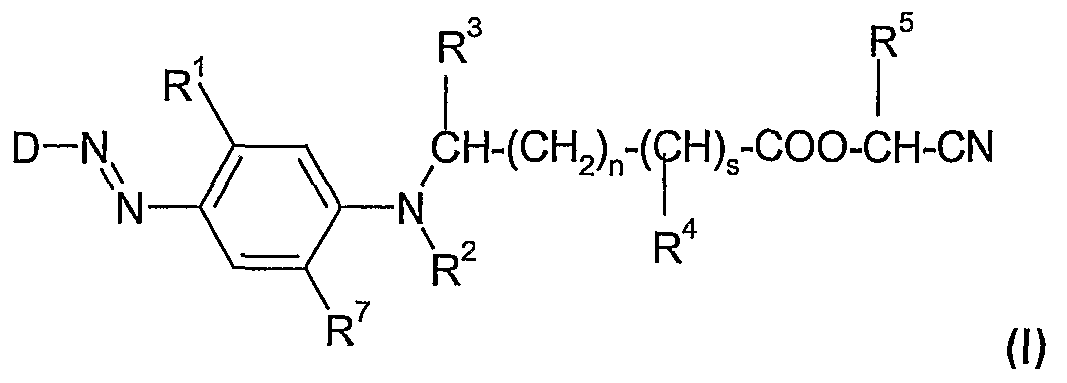
- the present invention claims dyestuffs of the formula I
- T ⁇ T 2 and T 3 are, independently, hydrogen, halogen or nitro; T 4 is hydrogen, halogen, cyano or nitro; wherein at least one of T ⁇ T 2 , T 3 and T 4 is not hydrogen; or a group of the formula (lib)
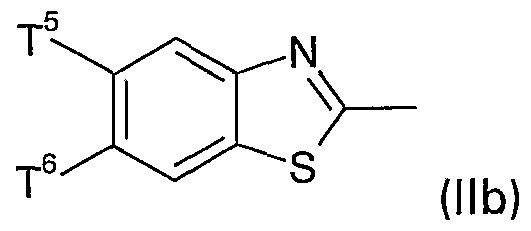
- T 5 is hydrogen or halogen; and T 6 is hydrogen -SO 2 CH 3 , -SCN or nitro; wherein at least one of T 5 and T 6 is not hydrogen; or a group of the formula (lie)
- T 7 is nitro, -CHO or a group of the formula
- T is -H, halogen, nitro and cyano; T 8 is hydrogen or halogen; and T 9 is nitro, cyano, -COCH 3 or -COOT 10 , wherein T 10 is (C,-C 4 )-alkyl; or a group of the formula (lie)
- R 1 is hydrogen, (C C 4 )-alkyl or -NCOR 6 , where R 6 is (C,-C 4 )-alkyl or phenyl;
- R 2 is unsubstituted (C,-C 6 )-alkyl, substituted (C C 6 )-alkyl, benzyl or phenylethyl;
- R 3 is hydrogen or methyl;
- R 4 is hydrogen or methyl;
- R 5 is hydrogen, methyl or phenyl;
- R 7 is hydrogen, chloro, methoxy or ethoxy; n is 0, 1 or 2; s is 0 or 1 ;
- D is a group of the formula (lie), (lid), (lie) or (lla) wherein T 1 is not nitro if T 2 , T 3 and T 4 are hydrogen, - if T 2 and T 3 are hydrogen and T 4 is chlorine or cyano and if T 2 and T 4 are hydrogen and T 3 is chlorine; and
- Alkyl groups standing for R 1 , R 6 or T 10 may be straight-chain or branched and are preferably methyl, ethyl, n-propyl, i-propyl or n-butyl. The same applies to alkyl groups standing for R 2 , which can in addition be pentyl or hexyl. Substituted alkyl groups standing for R 2 are preferably substituted by hydroxyl, (C C 4 )-alkoxy or halogen. Halogen standing for T ⁇ T 2 , T 3 , T 4 , T 5 or T 8 are preferably chlorine or bromine.
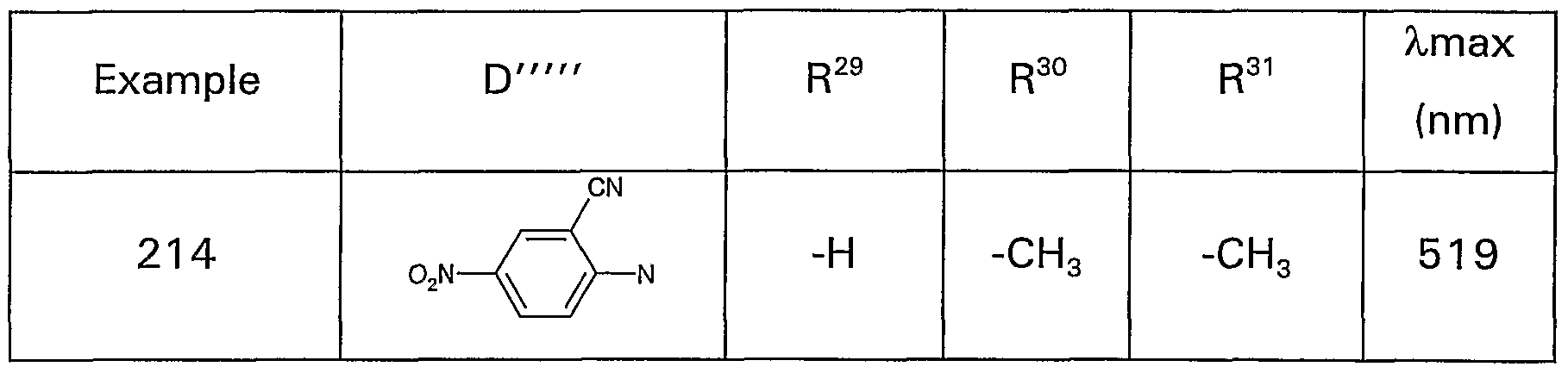
- D derive from the following amines: 2-nitroaniline, 3-nitroaniline, 4-nitroaniline, 2-chloro-4-nitroaniline, 4-chloro-2- nitroaniline, 2-bromo-4-nitroaniIine, 2,6-dichloro-4-nitroaniline, 2,6-dibromo-4- nitroaniline, 2-ch oro-6-bromo-4-nitroaniline, 2,5-dichloro-4-nitroaniline, 2-cyano- 4-nitroaniline, 2-cyano-6-bromo-4-nitroaniline, 2-cyano-6-ch!oro-4-nitroaniline, 2,4-dinitroaniIine, 2-chloro-4,6-dinitroaniIine, 2-bromo-4,6-dinitroaniline, 2,6- dicyano-4-nitroaniIine, 2-cyano-4,6-dinitroaniline, 2-amino-5-nitrothiazole, 2- amino-3,5-dinitrothiophene, 2-amino-3-ethoxycarbon
- 10 D is a group of the formulae (Ha), (lib), (lie), (lid) or (lie); R 1 is (C C 4 )-alkyl; R 2 is unsubstituted (C C 6 )-alkyl, benzyl or phenylethyl; and n is 0, 1 or 2.
- R 2 is unsubstituted (C C 6 )-alkyl, substituted (C C 6 )-alkyl, benzyl or phenylethyl; 25
- R 2 is ethyl, benzyl or phenethyl.
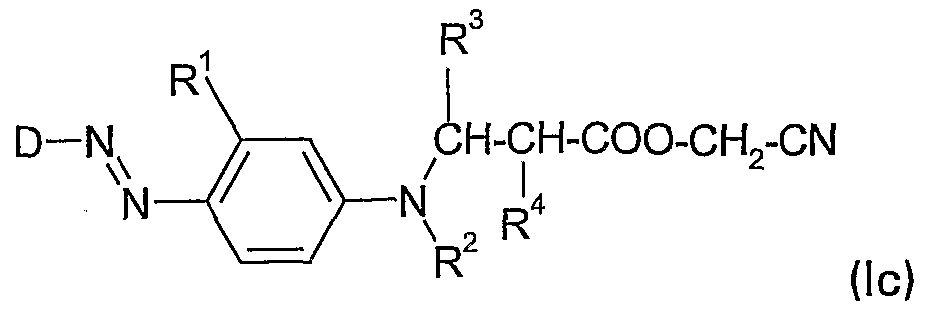
- Still other preferred disperse dyestuffs according to the present invention are of the general formula (lc)
- D is a group of the formulae (lla), (lib), (lie), (ild) or (lie);
- R 1 is hydrogen, (C r C 4 )-alkyl or -NCOR 6 , where R 6 is (C r C 4 )-alkyl or phenyl;
- R 2 is unsubstituted (C r C 6 )-alkyl, substituted (C r C 6 )-alkyI, benzyl or phenylethyl;
- R 3 is hydrogen and R is methyl or R 3 is methyl and R is hydrogen.
- Still other preferred disperse dyestuffs according to the present invention are of the general formula (Id)
- D is a group of the formulae (lla), (lib), (lie), (Ild) or (lie);
- R 1 is hydrogen, (C r C 4 )-alkyl or -NCOR 6 , where R 6 is (C C 4 ) -alkyl or phenyl;
- R 2 is unsubstituted (C C 6 )-alkyl, substituted (C C 6 ) -al yl, benzyl or phenylethyl;
- R 5 is methyl or phenyl
- Still other preferred disperse dyestuffs according to the present invention are of the general formula (le)
- D is a group of the formulae (lla), (lib), (lie), (Ild) or (lie);
- R 2 is unsubstituted (C C 6 )-alkyl, substituted (C r C 6 )-alkyl, benzyl or phenylethyl;
- R 6 is (C r C 4 )-aIkyl or phenyl;
- R 7 is chloro, methoxy or ethoxy; and n is 0, 1 or 2.
- Still other preferred disperse dyestuffs according to the present invention are of the general formula (If)
- R 2 is unsubstituted (C C 6 )-aikyl, substituted (C C 6 )-alkyl, benzyl or phenylethyl; R 8 is nitro; and n is 0, 1 or 2;
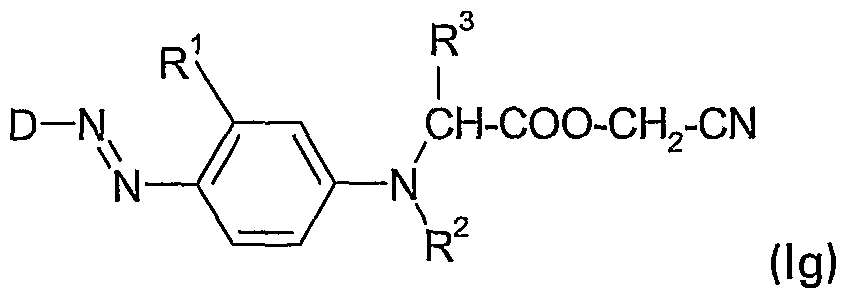
- Still other preferred disperse dyestuffs according to the present invention are of the general formula (Ig)
- D is a group of the formulae (lla), (Mb), (He), (lid) or (lie);
- R 1 is hydrogen, (C C 4 )-alkyi or -NCOR 6 , where R 6 is (C r C 4 )-alkyi or phenyl;
- R 2 is unsubstituted (C,-C 6 )-alkyl, substituted (C C 6 )-alkyl, benzyl or phenylethyl; and R 3 is hydrogen or methyl.
- the compounds of the formula I may be obtained by usual methods for the preparation of azo compounds such as by diazbtisation of an amine of the formula III D-NH 2 (III) wherein D is defined as given above, and coupling onto a compound of the formula IV
- R ⁇ R 2 , R 3 , R 4 , R 5 and R 7 are defined as given above.
- the amine of the formula (III) may be diazotised in an acidic medium, such as acetic, propionic or hydrochloric acid using a nitrosating agent such as nitrosylsulphuric acid, sodium nitrite or methylnitrite at a temperature from -1 0°C to 1 0°C.
- a nitrosating agent such as nitrosylsulphuric acid, sodium nitrite or methylnitrite at a temperature from -1 0°C to 1 0°C.
- Coupling onto the compound of the formula (IV) may be achieved by adding the diazotised amine to the compound of the formula (IV) under conditions described in literature and known to the skilled persons.
- the compounds of the formula (I) are useful for dyeing and printing of synthetic textile material particularly polyester textile materials and fibre blends thereof with for example cellulosic materials like cotton, to which they impart colours Y which have excellent wet fastness properties.
- Dyeing of the fibre goods mentioned with the dyestuffs of the formula (I) can be carried out in a manner known per se, preferably from aqueous dispersions, if appropriate in the presence of carriers, at between 80 and 1 1 0°C, by the exhaust process or by the HT process in a dyeing autoclave at 1 1 0 to 1 40°C, and by the so-called thermofixing process, in which the goods are padded with the dye liquor and then fixed at about 1 80 to 230°C.
- the fibre goods mentioned can as well be printed in a manner known pers e by a procedure in which the dyestuffs of the formula (I) are incorporated into a printing paste and the goods printed with the paste are treated , if appropriate in the presence of a carrier, with HT steam, pressurized steam or dry heat at temperatures between 180 and 230°C to fix the dyestuff.
- the dyestuffs of the formula (I) should be present in the finest possible dispersion in the dye liquors and printing pastes employed in the above applications.
- the fine dispersion of the dyestuffs is effected in a manner known per se by a procedure in which the dyestuff obtained during preparation is suspended ina liquid medium, preferably in water, together with dispersing agents and the mixture is exposed to the action of shearing forces, the particles originally present being comminuted mechanically to the extent that an optimum specific surface area is achieved and sedimentation of the dyestuff is as low as possible.
- the particle size of the dyestuffs is in general between 0.5 and 5 m, preferably about 1 m.
- the dispersing agents used can be nonionic or anionic.
- Nononic dispersing agents are, for example, reaction products of alkylene oxides, such as, for example, ethylene oxide or propyiene oxide, with alkylatable compounds, such as for example fatty alcohols, fatty amines, fatty acids, phenols, alkylphenols and carboxylic acid amines.
- alkylatable compounds such as for example fatty alcohols, fatty amines, fatty acids, phenols, alkylphenols and carboxylic acid amines.
- Anionic dispersing agnets are, for example, lignin- sulphonates, alkyl- or alkylarylsulphonates or alkylaryl polyglycol ethersulphates.
- the dyestuff formulations thus obtained should be The dyestuff and dispersing agent content is therefore limited in these cases.
- the dispersions are brought to a dyestuff content of up to 50 per cent by weight and a dispersing agent content of up to 25 per cent by weight.
- the dyestuff contents usually do not fall below 1 5 per cent by weight.
- the dispersions can also comprise other auxiliaries, for example those which act as oxidizing agents or fungicidal agents. Such agents are well known in the art.
- the dyestuff dispersion thus obtained can be used very advantageously for the preparation of printing pastes and dye liquors.
- powder formulations are preferred. These powders comprise the dyestuff, dispersing agents and other auxiliaries, such as, for example, wetting agents, oxidizing agents, preservatives and dust removal agents.
- a preferred preparation process for pulverulent dyestuff formulations comprises removing the liquid from the liquid dyestuff dispersions described above, for example by vacuum drying, freeze drying, by drying on roller dryers, but preferably by spray drying.
- 2,6-dichloro-4-nitroaniline (6.2parts) was set stirring at 5°C with a mixture of acetic acid and propionic acid, 86:1 (40parts). Nitrosyl sulphuric acid 40% (1 1 .4parts) was added below 5°C and the mixture was stirred for 30 minutes. The diazo solution was added gradually to a stirred coupling mixture of N-ethyl, N-2(cyanomethoxycarbonylethyl)-aniline (8.3parts), methanol (50parts), water (300parts) and sulphamic acid O part).
- 2-amino-6-nitrobenzothiazole (3.9parts) was set stirring at 5°C with a mixture of acetic acid and propionic acid, 86:14 (40parts). Nitrosyl sulrlhuric acid 40% (7.6parts) was added below 5°C and the mixture was stirred for 1 hour. The diazo solution was added gradually to a stirred coupling mixture of N-ethyl, N-(2-cyanomethoxycarbonylethyl)-m-toluidine (5.9parts), methanol (25parts), water (200parts) and sulphamic acid (0.5parts).
- Example 80 were prepared by the procedure of Example 80 (see Table 3)
- Example 1 4-(3,5-dinitrothiophen-yl-azo)-3-methyl-N-ethyl-N-(2-cyanomethoxycarbonylethyl) aniline
- 2-amino-3,5-dinitrothiophene (3.1 parts) was set stirring at 5°C with a mixture of acetic acid and propionic acid, 86: 14 (50parts) .
- Nitrosyl sulphuric acid 40% (5.7parts) was added below 5°C and the mixture was stirred for 30 mins.
- the diazo solution was added gradually to a stirred coupling mixture of N-ethyl, N-(2-cyanomethoxycarbonyethyl)-m-toluidine (4.0parts), acetone (50parts), water (300parts) and sulphamic acid (O. ⁇ parts) .
- Example 1 27 4-(5-nitrobenzisothiazol-yl-azo)-3-methyl-N-ethyl-N-(2- cyanomethoxycarbonyiethyl) aniline
- Example 1 27 were prepared by the procedure of Example 1 27 (see Table 5)
- 2-amino-5-nitrothiazole (2.9parts) was was set stirring at 5°C with a mixture of acetic acid and propionic acid, 86:14 (50parts). Nitrosyl sulphuric acid 40% (7.0parts) was added below 5°C and the mixture was stirred for 30 mins. The diazo solution was added gradually to a stirred coupling mixture of N-butyl, N-2(cyanomethoxycarbonylethyl)-aniline ( ⁇ .2parts), acetone ( ⁇ Oparts), water (200parts) and sulphamic acid (O. ⁇ parts).
- Example 1 39 4 (2-chloro-4-nitrophenylazo)-3-acetylamino-N-ethyl-N-(2- cyanomethoxycarbonylethyD-aniline
- 2-chloro-4-nitroaniline (3. ⁇ parts) was set stirring at ⁇ °C with a mixture of acetic acid and propionic acid, 86: 14 (40parts). Nitrosyl sulphuric acid 40% (7.0parts) was added below 5°C and the mixture was stirred for 30 minutes. The diazo solution was added gradually to a stirred coupling mixture of 3(N- ethyl, N-cyanomethoxycarbonylethyl)-amino-acetanilide (6.3parts), methanol (40parts), water (200parts) and sulphamic acid O part).
- Example139 were prepared by the procedure of Example139 (see Table 7)
- 2-cyano-4-nitroaniline (3.2part,s) was set stirring at ⁇ °C with a mixture of acetic acid and propionic acid, 86:14s( ⁇ 0parts). Nitrosyl sulphuric acid 40% (7.6parts) was added below ⁇ °C and the mixture was stirred for 30 minutes. The diazo solution was added gradually to a stirred coupling mixture of N-ethyl, N-(4-cyanomethoxycarbonylbutyl)-m-toluidine ( ⁇ .Oparts), methanol ( ⁇ Oparts), water (200parts) and sulphamic acid part).
- Example 1 69 4-(2-cyano-4-nitrophenylazo)-3-methyl-N-ethyl-N-(2-(1 -cyanoethoxy) carbonylethyD-aniline
- 2-cyano-4-nitroaniline (2.1 parts) was set stirring at 5°C with a mixture of acetic acid and propionic acid, 86: 1 4 (40parts). Nitrosyl sulphuric acid 40% (4.9parts) was added below 5°C and the mixture was stirred for 30 minutes. The diazo solution was added gradually to a stirred coupling mixture of N-ethyl, N-(2-(1 -cyanoethoxy)carbonylethyl)-m-toluidine (3.7parts), acetone ( ⁇ Oparts), water (300parts) and sulphamic acid O part).
- Example169 were prepared by the procedure of Example169 (see Table 9)
- 2-chloro-4-nitr ⁇ a;hiline (parts) was set stirring at 5°C with a mixture of acetic acid and propionic acid, 86:14 (40parts). Nitrosyl sulphuric acid 40% (4.9parts) was added below ⁇ °C and the mixture was stirred for 30 minutes. The diazo solution was added gradually to a stirred coupling mixture of N-ethyl, N-2-(cyanomethoxycarbonylpropyl)-aniline (parts), acetone ( ⁇ Oparts), water (300parts) and sulphamic acid O part).
- Example194 were prepared by the procedure of Example194 (see Table 10)
- Example 21 3 4-(4-nitrophenylazo)-N-ethyl-N-(2-( 1 -cyanoethoxy) carbonylpropyD-aniline
- 4-nitroaniline (2.0parts) was set stirring at ⁇ °C with a mixture of acetic acid and propionic acid, 86: 14 ( ⁇ Oparts). Nitrosyl sulphuric acid 40% ( ⁇ .7parts) was added below ⁇ °C and the mixture was stirred for 30 minutes. The diazo solution was added gradually to a stirred coupling mixture of N-ethyl, N-(2-(1 -cyanoethoxy)carbonylpropyl)-aniline (4.7parts), acetone ( ⁇ Oparts), water (200parts) and sulphamic acid O part) .
- 2-cyano-4-nitroaniline (3.1 parts) was set stirring at 5°C with a mixture of acetic acid and propionic acid, 86: 1 4 (40parts). Nitrosyl sulphuric acid 40% (6.6parts) was added below 5°C and the mixture was stirred for 30 minutes. The diazo solution was added gradually to a stirred coupling mixture of N-ethyl, N-0 -cyanomethoxycarbonylethyl)-m-toluidine (4.1 parts), methanol (40parts), water (200parts) and sulphamic acid O part).
Landscapes
- Chemical & Material Sciences (AREA)
- Organic Chemistry (AREA)
- Coloring (AREA)
- Organic Low-Molecular-Weight Compounds And Preparation Thereof (AREA)
- Inks, Pencil-Leads, Or Crayons (AREA)
- Nitrogen And Oxygen Or Sulfur-Condensed Heterocyclic Ring Systems (AREA)
- Compositions Of Macromolecular Compounds (AREA)
- Ink Jet (AREA)
- Plural Heterocyclic Compounds (AREA)
- Thiazole And Isothizaole Compounds (AREA)
Abstract
Description












Claims


Priority Applications (9)
| Application Number | Priority Date | Filing Date | Title |
|---|---|---|---|
| MXPA06002919A MXPA06002919A (en) | 2003-10-21 | 2004-10-15 | Disperse azo dyestuffs. |
| EP04790444.6A EP1678259B1 (en) | 2003-10-21 | 2004-10-15 | Disperse azo dyestuffs |
| KR1020067004769A KR101141572B1 (en) | 2003-10-21 | 2004-10-15 | Disperse azo dyestuffs |
| CA002543056A CA2543056A1 (en) | 2003-10-21 | 2004-10-15 | Disperse azo dyestuffs |
| HK07100014.5A HK1093351B (en) | 2003-10-21 | 2004-10-15 | Disperse azo dyestuffs |
| BRPI0415469-0A BRPI0415469A (en) | 2003-10-21 | 2004-10-15 | dispersed azo dyes |
| JP2006536010A JP2007509214A (en) | 2003-10-21 | 2004-10-15 | Disperse azo dye |
| ES04790444.6T ES2611945T3 (en) | 2003-10-21 | 2004-10-15 | Azo dyes dispersed |
| US10/575,599 US7358345B2 (en) | 2003-10-21 | 2004-10-15 | Disperse azo dyestuffs |
Applications Claiming Priority (2)
| Application Number | Priority Date | Filing Date | Title |
|---|---|---|---|
| GBGB0324584.2A GB0324584D0 (en) | 2003-10-21 | 2003-10-21 | Disperse azo dyestuffs |
| GB0324584.2 | 2003-10-21 |
Publications (2)
| Publication Number | Publication Date |
|---|---|
| WO2005040283A2 true WO2005040283A2 (en) | 2005-05-06 |
| WO2005040283A3 WO2005040283A3 (en) | 2005-06-30 |
Family
ID=29595562
Family Applications (1)
| Application Number | Title | Priority Date | Filing Date |
|---|---|---|---|
| PCT/EP2004/011590 Ceased WO2005040283A2 (en) | 2003-10-21 | 2004-10-15 | Disperse azo dyestuffs |
Country Status (14)
| Country | Link |
|---|---|
| US (1) | US7358345B2 (en) |
| EP (1) | EP1678259B1 (en) |
| JP (1) | JP2007509214A (en) |
| KR (1) | KR101141572B1 (en) |
| CN (1) | CN100439450C (en) |
| BR (1) | BRPI0415469A (en) |
| CA (1) | CA2543056A1 (en) |
| ES (1) | ES2611945T3 (en) |
| GB (1) | GB0324584D0 (en) |
| MX (1) | MXPA06002919A (en) |
| PT (1) | PT1678259T (en) |
| RU (1) | RU2376334C2 (en) |
| TW (1) | TWI408176B (en) |
| WO (1) | WO2005040283A2 (en) |
Cited By (8)
| Publication number | Priority date | Publication date | Assignee | Title |
|---|---|---|---|---|
| WO2008074719A1 (en) * | 2006-12-21 | 2008-06-26 | Dystar Textilfarben Gmbh & Co Deutschland Kg | Disperse dyes mixtures |
| US7682408B2 (en) | 2006-03-08 | 2010-03-23 | Dy Star Textilfarben GmbH & Co. | Disperse azo dyestuffs |
| US7833291B2 (en) | 2007-01-23 | 2010-11-16 | Dystar Textilfarben Gmbh & Co. Deutschland Kg | Dispersion dye, the production and use thereof |
| CN103450707A (en) * | 2013-09-07 | 2013-12-18 | 张家港市杨舍丝印工艺厂 | Dye composition (black) and preparation method thereof |
| EP2995653A1 (en) | 2014-09-15 | 2016-03-16 | DyStar Colours Distribution GmbH | High wet-fast disperse dyes and mixtures thereof |
| EP3715424A1 (en) | 2019-03-27 | 2020-09-30 | DyStar Colours Distribution GmbH | High wet fast disperse dye mixtures of n-[4-(5-thiocyanato-2,4-dinitro-phenylazo)-phenyl]-amine derivatives and n-[4-(4-nitro-phenylazo)-phenyl]-amine derivatives |
| EP3715423A1 (en) | 2019-03-27 | 2020-09-30 | DyStar Colours Distribution GmbH | High wet fast disperse dye mixtures of n-[4-(5-fluoro-2,4-dinitro-phenylazo)-phenyl]-amine derivatives and n-[4-(4-nitro-phenylazo)-phenyl]-amine derivatives |
| EP3922681A1 (en) | 2018-06-25 | 2021-12-15 | Basf Se | Red pigment composition for color filter |
Families Citing this family (4)
| Publication number | Priority date | Publication date | Assignee | Title |
|---|---|---|---|---|
| EP2516727B1 (en) * | 2009-12-23 | 2018-05-09 | Colourtex Industries Limited | Disperse azo dyes |
| PH12012501295A1 (en) * | 2009-12-23 | 2019-07-10 | Colourtex Industries Ltd | Disperse dyes |
| BR112013030705A2 (en) * | 2011-06-03 | 2016-12-06 | Procter & Gamble | laundry care compositions containing dyes |
| CA2907129A1 (en) * | 2013-03-15 | 2014-09-25 | 3M Innovative Properties Company | Benzothiazol-2-ylazo-phenyl compound as dye, compositions including the dye, and method of determining degree of cure of such compositions |
Family Cites Families (20)
| Publication number | Priority date | Publication date | Assignee | Title |
|---|---|---|---|---|
| GB909843A (en) | 1959-02-10 | 1962-11-07 | Ici Ltd | New monoazo dyestuffs containing ester groups |
| US3097198A (en) * | 1959-02-10 | 1963-07-09 | Ici Ltd | Azo dyestuffs |
| FR1531147A (en) | 1966-07-15 | 1968-06-28 | Ici Ltd | Water-insoluble azo dyes and method of manufacturing said dyes |
| GB1176797A (en) * | 1966-07-15 | 1970-01-07 | Ici Ltd | Water-insoluble Monoazo Dyestuffs |
| US3776898A (en) * | 1970-04-23 | 1973-12-04 | Gaf Corp | Azo dyestuffs containing as the terminal coupling component a pyrrolidonoaniline |
| GB1321902A (en) | 1970-06-22 | 1973-07-04 | Ici Ltd | Monoazo dyestuffs |
| CA921464A (en) | 1970-06-22 | 1973-02-20 | Imperial Chemical Industries Limited | Monoazo dyestuffs |
| GB1351381A (en) | 1971-01-11 | 1974-04-24 | Ici Ltd | Disperse azo dyestuffs |
| US4119624A (en) * | 1972-06-08 | 1978-10-10 | Imperial Chemical Industries Limited | Disperse monoazo dyestuffs |
| GB1457532A (en) | 1973-09-26 | 1976-12-01 | Ici Ltd | Disperse monoazo dyestuffs |
| GB1536429A (en) | 1975-03-25 | 1978-12-20 | Ici Ltd | Disperse monoazo dyestuffs |
| GB2011483B (en) * | 1977-12-29 | 1982-08-18 | Hoechst Ag | Process for preparing fast dyeings and prints on cellulosic fibre materials and mixtures thereof with synthetic fibres |
| DE2811167C2 (en) | 1978-03-15 | 1985-10-10 | Hoechst Ag, 6230 Frankfurt | Process for the production of real pad dyeings and prints on cellulose fiber materials and their mixtures with polyester fibers |
| JPS55161857A (en) | 1979-06-05 | 1980-12-16 | Nippon Kayaku Co Ltd | Water-insoluble azo compound, production thereof and dyeing and printing method using same |
| GB2104088B (en) | 1981-07-14 | 1985-06-26 | Yorkshire Chemicals Ltd | Blue monoazo disperse dyes |
| RU2068429C1 (en) * | 1993-04-09 | 1996-10-27 | Московское научно-производственное объединение "НИОПИК" | Process for preparing cyanogroups containing azo dyes |
| GB9400972D0 (en) | 1994-01-19 | 1994-03-16 | Zeneca Ltd | Process |
| DE4419622A1 (en) | 1994-06-03 | 1995-12-07 | Cassella Ag | Monoazo dyes, their production and use |
| GB9806810D0 (en) | 1998-03-31 | 1998-05-27 | Zeneca Ltd | Compositions |
| WO1999050357A1 (en) | 1998-03-31 | 1999-10-07 | Avecia Limited | 1,3,4-thiadiazolylazo dyes and ink compositions containing the same |
-
2003
- 2003-10-21 GB GBGB0324584.2A patent/GB0324584D0/en not_active Ceased
-
2004
- 2004-10-15 WO PCT/EP2004/011590 patent/WO2005040283A2/en not_active Ceased
- 2004-10-15 MX MXPA06002919A patent/MXPA06002919A/en active IP Right Grant
- 2004-10-15 US US10/575,599 patent/US7358345B2/en not_active Expired - Lifetime
- 2004-10-15 JP JP2006536010A patent/JP2007509214A/en active Pending
- 2004-10-15 EP EP04790444.6A patent/EP1678259B1/en not_active Expired - Lifetime
- 2004-10-15 BR BRPI0415469-0A patent/BRPI0415469A/en not_active Application Discontinuation
- 2004-10-15 RU RU2006116739/04A patent/RU2376334C2/en not_active IP Right Cessation
- 2004-10-15 PT PT47904446T patent/PT1678259T/en unknown
- 2004-10-15 CN CNB2004800309950A patent/CN100439450C/en not_active Expired - Fee Related
- 2004-10-15 KR KR1020067004769A patent/KR101141572B1/en not_active Expired - Fee Related
- 2004-10-15 ES ES04790444.6T patent/ES2611945T3/en not_active Expired - Lifetime
- 2004-10-15 CA CA002543056A patent/CA2543056A1/en not_active Abandoned
- 2004-10-19 TW TW093131672A patent/TWI408176B/en not_active IP Right Cessation
Cited By (14)
| Publication number | Priority date | Publication date | Assignee | Title |
|---|---|---|---|---|
| US7682408B2 (en) | 2006-03-08 | 2010-03-23 | Dy Star Textilfarben GmbH & Co. | Disperse azo dyestuffs |
| WO2008074719A1 (en) * | 2006-12-21 | 2008-06-26 | Dystar Textilfarben Gmbh & Co Deutschland Kg | Disperse dyes mixtures |
| US8226758B2 (en) | 2006-12-21 | 2012-07-24 | Dystar Colours Deutschland Gmbh | Disperse dyes mixtures |
| US7833291B2 (en) | 2007-01-23 | 2010-11-16 | Dystar Textilfarben Gmbh & Co. Deutschland Kg | Dispersion dye, the production and use thereof |
| CN103450707A (en) * | 2013-09-07 | 2013-12-18 | 张家港市杨舍丝印工艺厂 | Dye composition (black) and preparation method thereof |
| US10301474B2 (en) | 2014-09-15 | 2019-05-28 | Dystar Colours Distribution Gmbh | High wet fast disperse dyes and mixtures thereof |
| EP2995653A1 (en) | 2014-09-15 | 2016-03-16 | DyStar Colours Distribution GmbH | High wet-fast disperse dyes and mixtures thereof |
| EP3922681A1 (en) | 2018-06-25 | 2021-12-15 | Basf Se | Red pigment composition for color filter |
| EP3715424A1 (en) | 2019-03-27 | 2020-09-30 | DyStar Colours Distribution GmbH | High wet fast disperse dye mixtures of n-[4-(5-thiocyanato-2,4-dinitro-phenylazo)-phenyl]-amine derivatives and n-[4-(4-nitro-phenylazo)-phenyl]-amine derivatives |
| EP3715423A1 (en) | 2019-03-27 | 2020-09-30 | DyStar Colours Distribution GmbH | High wet fast disperse dye mixtures of n-[4-(5-fluoro-2,4-dinitro-phenylazo)-phenyl]-amine derivatives and n-[4-(4-nitro-phenylazo)-phenyl]-amine derivatives |
| WO2020193160A1 (en) | 2019-03-27 | 2020-10-01 | Dystar Colours Distribution Gmbh | High wet fast disperse dye mixtures of n-[4-(5-thiocyanato-2,4-dinitro-phenylazo)-phenyl]-amine derivatives and n-[4-(4-nitro-phenylazo)-phenyl]-amine derivatives |
| WO2020193159A1 (en) | 2019-03-27 | 2020-10-01 | Dystar Colours Distribution Gmbh | High wet fast disperse dye mixtures of n-[4-(5-fluoro-2,4-dinitro-phenylazo)-phenyl]-amine derivatives and n-[4-(4-nitro-phenylazo)-phenyl]-amine derivatives |
| US11479672B2 (en) | 2019-03-27 | 2022-10-25 | Dystar Colours Distribution Gmbh | High wet fast disperse dye mixtures of N-[4-(5-thiocyanato-2,4-dinitro-phenylazo)-phenyl]-amine derivatives and N-[4-(4-nitro-phenylazo)-phenyl]-amine derivatives |
| US11560480B2 (en) | 2019-03-27 | 2023-01-24 | Dystar Colours Distribution Gmbh | High wet fast disperse dye mixtures of N-[4-(5-fluoro-2,4-dinitro-phenylazo)-phenyl]-amine derivatives and N-[4-(4-nitro-phenylazo)-phenyl]-amine derivatives |
Also Published As
| Publication number | Publication date |
|---|---|
| GB0324584D0 (en) | 2003-11-26 |
| PT1678259T (en) | 2016-11-21 |
| EP1678259B1 (en) | 2016-08-17 |
| RU2376334C2 (en) | 2009-12-20 |
| CA2543056A1 (en) | 2005-05-06 |
| KR20060123719A (en) | 2006-12-04 |
| RU2006116739A (en) | 2007-11-27 |
| TWI408176B (en) | 2013-09-11 |
| ES2611945T3 (en) | 2017-05-11 |
| HK1093351A1 (en) | 2007-03-02 |
| MXPA06002919A (en) | 2006-05-31 |
| TW200523322A (en) | 2005-07-16 |
| CN1871306A (en) | 2006-11-29 |
| BRPI0415469A (en) | 2006-12-19 |
| WO2005040283A3 (en) | 2005-06-30 |
| KR101141572B1 (en) | 2012-05-03 |
| CN100439450C (en) | 2008-12-03 |
| EP1678259A2 (en) | 2006-07-12 |
| US7358345B2 (en) | 2008-04-15 |
| US20070050928A1 (en) | 2007-03-08 |
| JP2007509214A (en) | 2007-04-12 |
Similar Documents
| Publication | Publication Date | Title |
|---|---|---|
| EP2084232B1 (en) | Disperse azo dyestuffs | |
| US20070107146A1 (en) | Disperse dyes | |
| EP2167496B1 (en) | Azo dyes | |
| CN101896554A (en) | Azo dyes for dyeing and printing hydrophobic materials | |
| EP1678259B1 (en) | Disperse azo dyestuffs | |
| US20090123711A1 (en) | Disperse azo dyes and mixtures comprising these disperse azo dyes | |
| JP4260483B2 (en) | Phthalimidoyl azo dyes, methods for their production and their use | |
| KR0172953B1 (en) | Azo dyes prepared using 2-alkylamino-3-cyano-4,6-diaminopyridine as coupling component | |
| US7169909B2 (en) | Phthalimidylazo dyes, processess for the preparation thereof and the use thereof | |
| US4440681A (en) | Water-insoluble monoazo dyestuffs and their preparation | |
| CN101778908A (en) | Disperse dyes, their preparation and application | |
| US4160764A (en) | Water-insoluble monoazo-dyestuffs for synthetic fibrous materials | |
| EP2254950B1 (en) | 1,3-thiazolyl azo dyes, their preparation and use | |
| US20090064426A1 (en) | Disperse azo dyestuffs | |
| HK1093351B (en) | Disperse azo dyestuffs | |
| GB2024235A (en) | Water-insoluble azo dyestuffs, process for their manufacture and their use | |
| HK1132756A (en) | Disperse azo dyestuffs |
Legal Events
| Date | Code | Title | Description |
|---|---|---|---|
| WWE | Wipo information: entry into national phase |
Ref document number: 200480030995.0 Country of ref document: CN |
|
| AK | Designated states |
Kind code of ref document: A2 Designated state(s): AE AG AL AM AT AU AZ BA BB BG BR BW BY BZ CA CH CN CO CR CU CZ DE DK DM DZ EC EE EG ES FI GB GD GE GH GM HR HU ID IL IN IS JP KE KG KP KR KZ LC LK LR LS LT LU LV MA MD MG MK MN MW MX MZ NA NI NO NZ OM PG PH PL PT RO RU SC SD SE SG SK SL SY TJ TM TN TR TT TZ UA UG US UZ VC VN YU ZA ZM ZW |
|
| AL | Designated countries for regional patents |
Kind code of ref document: A2 Designated state(s): BW GH GM KE LS MW MZ NA SD SL SZ TZ UG ZM ZW AM AZ BY KG KZ MD RU TJ TM AT BE BG CH CY CZ DE DK EE ES FI FR GB GR HU IE IT LU MC NL PL PT RO SE SI SK TR BF BJ CF CG CI CM GA GN GQ GW ML MR NE SN TD TG |
|
| 121 | Ep: the epo has been informed by wipo that ep was designated in this application | ||
| WWE | Wipo information: entry into national phase |
Ref document number: 339/KOLNP/2006 Country of ref document: IN |
|
| WWE | Wipo information: entry into national phase |
Ref document number: 1020067004769 Country of ref document: KR |
|
| WWE | Wipo information: entry into national phase |
Ref document number: PA/a/2006/002919 Country of ref document: MX |
|
| WWE | Wipo information: entry into national phase |
Ref document number: 2007050928 Country of ref document: US Ref document number: 10575599 Country of ref document: US |
|
| WWE | Wipo information: entry into national phase |
Ref document number: 1200600611 Country of ref document: VN |
|
| REEP | Request for entry into the european phase |
Ref document number: 2004790444 Country of ref document: EP |
|
| WWE | Wipo information: entry into national phase |
Ref document number: 2004790444 Country of ref document: EP |
|
| WWE | Wipo information: entry into national phase |
Ref document number: 2006536010 Country of ref document: JP Ref document number: 2543056 Country of ref document: CA |
|
| WWE | Wipo information: entry into national phase |
Ref document number: 2006116739 Country of ref document: RU |
|
| WWP | Wipo information: published in national office |
Ref document number: 2004790444 Country of ref document: EP |
|
| WWP | Wipo information: published in national office |
Ref document number: 1020067004769 Country of ref document: KR |
|
| ENP | Entry into the national phase |
Ref document number: PI0415469 Country of ref document: BR |
|
| WWP | Wipo information: published in national office |
Ref document number: 10575599 Country of ref document: US |