WO2005047223A1 - Process for the preparation of aliphatic primary alcohols and related intermediates in such process - Google Patents
Process for the preparation of aliphatic primary alcohols and related intermediates in such process Download PDFInfo
- Publication number
- WO2005047223A1 WO2005047223A1 PCT/EP2004/013160 EP2004013160W WO2005047223A1 WO 2005047223 A1 WO2005047223 A1 WO 2005047223A1 EP 2004013160 W EP2004013160 W EP 2004013160W WO 2005047223 A1 WO2005047223 A1 WO 2005047223A1
- Authority
- WO
- WIPO (PCT)
- Prior art keywords
- group
- substituted
- straight
- linear
- formula
- Prior art date
- Legal status (The legal status is an assumption and is not a legal conclusion. Google has not performed a legal analysis and makes no representation as to the accuracy of the status listed.)
- Ceased
Links
Classifications
-
- C—CHEMISTRY; METALLURGY
- C07—ORGANIC CHEMISTRY
- C07C—ACYCLIC OR CARBOCYCLIC COMPOUNDS
- C07C43/00—Ethers; Compounds having groups, groups or groups
- C07C43/02—Ethers
- C07C43/03—Ethers having all ether-oxygen atoms bound to acyclic carbon atoms
- C07C43/14—Unsaturated ethers
- C07C43/17—Unsaturated ethers containing halogen
- C07C43/174—Unsaturated ethers containing halogen containing six-membered aromatic rings
-
- C—CHEMISTRY; METALLURGY
- C07—ORGANIC CHEMISTRY
- C07C—ACYCLIC OR CARBOCYCLIC COMPOUNDS
- C07C43/00—Ethers; Compounds having groups, groups or groups
- C07C43/02—Ethers
- C07C43/03—Ethers having all ether-oxygen atoms bound to acyclic carbon atoms
- C07C43/14—Unsaturated ethers
- C07C43/164—Unsaturated ethers containing six-membered aromatic rings
-
- C—CHEMISTRY; METALLURGY
- C07—ORGANIC CHEMISTRY
- C07D—HETEROCYCLIC COMPOUNDS
- C07D309/00—Heterocyclic compounds containing six-membered rings having one oxygen atom as the only ring hetero atom, not condensed with other rings
- C07D309/02—Heterocyclic compounds containing six-membered rings having one oxygen atom as the only ring hetero atom, not condensed with other rings having no double bonds between ring members or between ring members and non-ring members
- C07D309/08—Heterocyclic compounds containing six-membered rings having one oxygen atom as the only ring hetero atom, not condensed with other rings having no double bonds between ring members or between ring members and non-ring members with hetero atoms or with carbon atoms having three bonds to hetero atoms with at the most one bond to halogen, e.g. ester or nitrile radicals, directly attached to ring carbon atoms
- C07D309/10—Oxygen atoms
- C07D309/12—Oxygen atoms only hydrogen atoms and one oxygen atom directly attached to ring carbon atoms, e.g. tetrahydropyranyl ethers
-
- C—CHEMISTRY; METALLURGY
- C07—ORGANIC CHEMISTRY
- C07F—ACYCLIC, CARBOCYCLIC OR HETEROCYCLIC COMPOUNDS CONTAINING ELEMENTS OTHER THAN CARBON, HYDROGEN, HALOGEN, OXYGEN, NITROGEN, SULFUR, SELENIUM OR TELLURIUM
- C07F7/00—Compounds containing elements of Groups 4 or 14 of the Periodic Table
- C07F7/02—Silicon compounds
- C07F7/08—Compounds having one or more C—Si linkages
- C07F7/18—Compounds having one or more C—Si linkages as well as one or more C—O—Si linkages
- C07F7/1804—Compounds having Si-O-C linkages
-
- Y—GENERAL TAGGING OF NEW TECHNOLOGICAL DEVELOPMENTS; GENERAL TAGGING OF CROSS-SECTIONAL TECHNOLOGIES SPANNING OVER SEVERAL SECTIONS OF THE IPC; TECHNICAL SUBJECTS COVERED BY FORMER USPC CROSS-REFERENCE ART COLLECTIONS [XRACs] AND DIGESTS
- Y02—TECHNOLOGIES OR APPLICATIONS FOR MITIGATION OR ADAPTATION AGAINST CLIMATE CHANGE
- Y02P—CLIMATE CHANGE MITIGATION TECHNOLOGIES IN THE PRODUCTION OR PROCESSING OF GOODS
- Y02P20/00—Technologies relating to chemical industry
- Y02P20/50—Improvements relating to the production of bulk chemicals
- Y02P20/55—Design of synthesis routes, e.g. reducing the use of auxiliary or protecting groups
Definitions
- High-molecular-weight aliphatic saturated primary alcohols for instance with 20- 40 C-atoms are useful products for use for instance in food or pharmaceutical products.
- policosanol is a mixture of high-molecular-weight aliphatic primary alcohols wit ' h ' as ⁇ ts main ' component octacosanol (028) ' ! ⁇ t ⁇ s used for instarice or imprbver ⁇ eht of ' serum lipid profiles, which makes it an interesting compound for the prevention and treatment of cardiovascular diseases, and as a cholesterol-lowering additive in foods.
- R 1 represents a linear, straight-chain alkyl group having 26-30 C-atoms
- m is 1 or 2
- substituted methyl, substituted ethyl, substituted benzyl and optionally substituted silyl have the meanings as described by T.W.
- Suitable substituted methyl protective groups are methoxymethyl, methylthiomethyl, benzyloxymethyl, p-methoxytetrahydropyranyl, methoxybenzyloxymethyl, p-nitrobenzyloxymethyl, o-nitrobenzyloxymethyl, guaiacolmethyl, f-butoxymethyl, f-butyldimethylsiloxymethyl, 2-methoxyethoxymethyl, 2,2,2-trichloroethoxymethyl, 2-(trimethylsilyl)ethoxymethyl, methoxymethyl, tetrahydrophyranyl, 1-methoxycyclohexyl, 1 ,4-dioxan-2-yl and/or tetrahydrofuranyl.
- Suitable substituted ethyl protecting groups are ethyl, 1-ethoxyethyl, 1-(2-chloroethoxy)ethyl, 1-methyl-1- methoxyethyl, 1-methyl-1-benzyloxyethyl, 1-methyl-1-phenoxyethyl, 2,2,2-trichloroethyl, 2-(benzyithio)ethyl, p-chlorophenyl, f-butyl, allyl and/or propargyl.
- Suitable substituted benzyl protecting groups are benzyl, p-methoxybenzyl, p-nitrobenzyl, 2,6- dichlorobenzyl, p-phenylbenzyl, - 2,6-difluorobenzyl, 2-picolyl, 4-picolyl, p,p'- dinitrobenzhydryl, triphenylmethyl, and/or 1 ,3-benzodithiolan-2-yl.
- Suitable substituted silyl protecting groups have sufficient stability under the reaction conditions under which they are formed and/or the work up thereof, of which at least one of the substituents on the Si-atoms is not a methyl group, for example triisopropylsilyl, -butyldimethylsilyl, t- butyldiphenylsilyl, f-butylmethoxyphenylsilyl triethylsilyl, triisopropylsilyl, dimethylisopropylsilyl, diethylisopropylsilyl, dimethylthexylsilyl, f-butyldimethylsilyl, t- butyldiphenylsilyl, triphenylsilyl, diphenylmethylsilyl, di-f-butylmethylsilyl, t- butoxydiphenylsilyl and/or f-butylmethoxyphenylsilyl.
- diol protecting groups examples include methylene, ethylidene, f-butylmethylidene, 1-f-butylethylidene, 1- phenylethylidene, 1 -(4-methoxyphenyl)ethylidene, 2,2,2-trichloroethylidene, isopropyliden, cyclopentylidene, cyclohexylidene, benzylidene, mesitylene, benzophenone, methoxymethylene, ethoxymethylene, di-f-butylsilylene.
- Known from WO91/0944 is the use of a mono-, di- or oligosaccharide in the position of PG.
- the key intermediates with formula (1) are prepared via a so-called organometallic cross-coupling reaction.
- organometallic cross-coupling reactions appeared to work very well, even in the presence of other functional groups.
- One example of such an organometallic cross-coupling reaction is schematically as given below.
- the reaction preferably is carried out in the presence of a transition metal catalyst, which may be in the form of a neutral or cationic metal complex ML 1 a L 2 b X, an anionic complex Q d [ML 1 a L 2 b X c ] e , a soluble transition metal nanocluster, or as heterogeneous catalyst wherein the metal in the zero oxidation state is deposited in the form of microcrystalline material on a solid carrier, wherein M can be any transition metal known to catalyze such coupling reactions, for instance Mn, Fe, Cu, Ni or Pd.
- a transition metal catalyst which may be in the form of a neutral or cationic metal complex ML 1 a L 2 b X, an anionic complex Q d [ML 1 a L 2 b X c ] e , a soluble transition metal nanocluster, or as heterogeneous catalyst wherein the metal in the zero oxidation state is deposited in the form of microcrystalline material on a solid carrier, where
- L 1 and L 2 are ligands (for instance optionally substituted phosphines and bisphosphines such as triphenylphosphine, bis-diphenylphosphinopropane, 1 ,1'-diphosphaferrocene (dppf), phosphites or bisphosphites, PN ligands in which there is both a coordinating P atom and a N atom present, N-N ligands such as phenanthrolines),
- X is an anion which may be a halide, a carboxylate or a composite anion such as BF 4 " or PF 6 "
- Q is a cation for instance an alkaline metal ion (for instance sodium, potassium) or a tetraalkylammonium salt
- a, b, c, d and e are integers from 0-5.
- the clusters contain from 2 to many thousands of metal atoms and may carry ligands or anions on the outer rim.
- Suitable carrier materials for heterogenous catalysts are, for instance, carbon black, silica, aluminum oxide.
- M 1 represents an alkali metal, e.g. Li, Na or K
- a metal catalyst is not particularly preferred.
- Both R and A are saturated (contain no double bonds).
- R 1 is RCH 2 -CH 2 A
- PG is as above.
- the reaction preferably is performed under an inert atmosphere (e.g. dry nitrogen or dry argon).
- an alkyl magnesium halide most preferably an alkyl magnesium chloride or bromide (for instance an amount 5 of 1 to 5 equivalents, preferably 1-2 equivalents) is reacted with 1 equivalent of an alkyl halide or alkyl arylsulfonate, alkyl mesylate or alkyl triflate, most preferably with an alkyl fluoride, alkyl chloride, alkyl bromide, alkyl mesylate or alkyl tosylate in the presence of a transition metal catalyst; as for instance described in Terao, J.; Watanabe, H.; Ikumi, A.; Kuniyasu, H.; Kambe, N. J. Am. Chem. Soc. 2002, 124, 4222-4223, and Terao, J.;
- the reaction is carried out in the presence of a solvent.
- Suitable solvents are for instance ethyl ether, tetrahydrofuran (THF), /-propyl ether di- ⁇ -propyl ether, dimethoxyethane (DME) or methyl f-butyl ether or mixtures of these solvents with a dipolar aprotic solvent such as NMP, DMF or DMA (dimethylacetamide) in any
- the transition metal catalyst is based on a transition metal M chosen preferably from Mn, Fe, Cu, Ni, Pd. They can be in the form of pre-formed complexes or made in situ from a catalyst precursor and one or more ligands. If desired an activator (for instance a base, such as an alkoxide, or a reducing
- Suitable sources of catalyst precursors are for instance precursors of Cu' (for example CuCI, Cul, CuOTf), Cu" (for example CuCI 2 , Li 2 CuCI 4 ), Ni° (for example Ni(COD) 2 ), Ni" (for example NiCI 2 , Ni(acac) 2 , NiBr 2 ), or Pd" (for example PdCI 2 , Pd(OAc) 2 , Pd 2 (dba) 3 ), Mn"' (for example MnCI 3 , Mn(acac) 3 ) or Fe'" (for example Fe(acac) 3 ).
- Preformed catalysts can also be used, for instance precursors of Cu' (for example CuCI, Cul, CuOTf), Cu" (for example CuCI 2 , Li 2 CuCI 4 ), Ni° (for example Ni(COD) 2 ), Ni" (for example NiCI 2 , Ni(acac) 2 , NiBr 2 ), or Pd” (for example PdCI 2 ,
- the amount of catalyst that is used is calculated with respect to the electrophile and is preferably lower than 0.05 equivalents, more preferably between 0.001 and 0.03 equivalents calculated with respect to the electrophile. Preferably less than 4 equivalents of each ligand with respect to the amount of metal M are used.
- the reaction is run in the presence of a 1 ,3-
- an alkylzinc iodide (preferred amount 1.05-1.5 equivalents calculated with respect to the electrophile) is reacted with 1 equivalent of an alkyl bromide or iodide, preferably iodide, optionally in the presence of a tetraalkylammonium halide R 3 4 NX, wherein each R 3 , independently, represents an alkyl group, for instance an alkyl group with 1-16 C-atoms and X represents a halogen, for instance CI, Br or I, for instance n-Pr 4 NI, /?-Bu 4 NBr, ⁇ -Bu NI (preferred amount 1-5 equivalents with respect to the alkyl halide), and optionally in the presence of a styrene ' preferably a mono- or polyfluorinated styrene, such as m-fluorostyrene or p-fluorostyrene (p
- the reaction preferably is carried out in the presence of a solvent. Suitable solvents that may be used are for instance ethers, NMP, DMF or mixtures thereof.
- the reaction preferably is run at temperatures between -30 and 25 °C.
- the reaction time required preferably is between 2 and 30 h.
- the nucleophilic reagent may be of the general structure RCH 2 BR 4 2 (wherein each R 4 independently represents an alkyl group, for instance an alkyl group with 1-10 C-atoms, or may be part of a ring, for instance as in 9- BBN), RCH 2 B(OH) 2 or RCH 2 B(OR 4 ) 2 , wherein R is as above, as for instance described in Netherton, M.
- an alkyl-(9-BBN) reagent (preferred amount 1-3 equivalents, calculated with respect to the amount of electrophile), is reacted with for instance an alkyl chloride, bromide or tosylate, preferably a bromide or a tosylate.
- the reaction is catalyzed by a source of Pd° or Pd", such as Pd(OAc) 2 , PdCI 2 , or Pd 2 (dba) 3 , preferably Pd(OAc) 2 , in an amount calculated with respect to the electrophile of 0.01-0.10 equivalents.
- Addition of a stabilizing ligand for the metal may be beneficial.
- the source of the phosphine ligand may also be the corresponding phosphonium salt (less susceptible to oxidation), such as (HP(f-Bu) 2 Me)BF 4 .
- the relative amount of the phosphine may be 0.05-0.20 equivalents calculated with respect to the electrophile, preferably in a molar ratio 2:1 to Pd.
- a base is added, for instance a phosphate salt such as Na 3 P0 4 H 2 O or K 3 PO 4 H 2 O; an alkali metal hydroxide, for instance NaOH, KOH ' , LiOH or CsOH; or a bulky alkoxide base such as LiOf-Bu, NaOt- Bu or KO -Bu, in a proportion of 1-4 equivalents calculated with respect to the electrophile.
- the reaction preferably is carried out in the presence of a solvent.
- Suitable solvents that can be used are the ethers mentioned above, also dioxane or a bulky alcohol, such as £-amyl alcohol.
- THF is preferably used as the solvent with alkyl-(9-BBN) derivatives and f-amyl alcohol with alkyl boronic acids.
- the reaction preferably is run at temperatures between 25 and 100°C (higher temperatures are preferred for more unreactive alkyl chloride electrophiles).
- Example 1 removal of a methoxymethyl group cat. HC1 C 28 H 57 OCH 2 OCH 3 28 H 57 OH MeOH, reflux
- An example of a removal of a common PG from a protected higher (C28) alkanol is shown above.
- the PG methoxymethyl ether can for instance be cleaved under acidic conditions in methanol, at reflux.
- Example 2 removal of a benzyl group
- Another PG for example, a benzyl group
- a palladium catalyst H 2 , Pd/C C 26 H 53 OCH 2 Ph ⁇ C 26 H 53 OH 6 53 EtOAc, 25 °C
- Example 3 removal of a t-butyldimethylsilyl group
- deprotection can be easily achieved, for instance, by fluoride ion in THF at 25 °C, originating from, for example, tetrabutylammonium fluoride: Bu 4 N + F " C 30 H 61 OSi( -Bu)Me 2 C 30 H 61 OH THF, 25
- fluoride ion in THF at 25 °C originating from, for example, tetrabutylammonium fluoride: Bu 4 N + F " C 30 H 61 OSi( -Bu)Me 2 C 30 H 61 OH THF, 25
- the residual waxy product was purified by silica gel flash column chromatography using 1 :99 and 1 :49 MTBE:petroleum benzene as eluent.
- The5 first fractions contained the C18 hydrocarbon by-product (discarded) and the following ones, containing the desired product, were pooled.
- the product was obtained as colorless oil [765 mg, 1 ,55 mmol, 74% yield based on 2-(10-B omb ' decyi ⁇ xyj-tetrahydro-pyran], which solidified to a wax upon cooling to r.t.
- 1 H NMR analysis indicated that the purity of the product was >95%.0 Reaction conditions were not optimized.
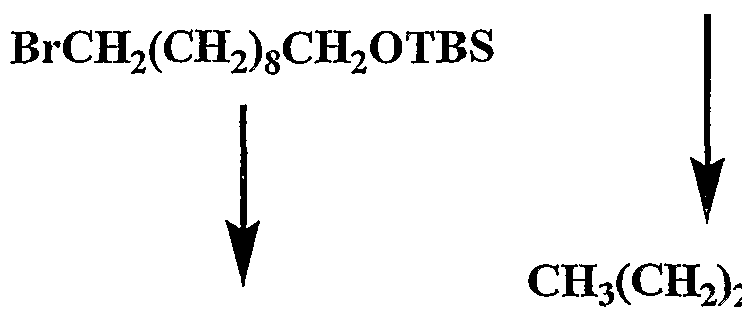
- Example V Organometallic Coupling 1. Li 2 CuCl 4 THF, -20 °C BrCH 2 (CH 2 ) 8 CH 2 OTBS ⁇ CH 3 (CH 2 ) 26 CH 2 OTBS 2. CH 3 (CH 2 ) 17 MgCl -20 °C - 0 °C - f-Butyl-dimethyl-octacosyloxy-silane 2. Same procedure as for The yield5 after chromatographic purification was 60% (575 mg, 1 ,10 mmol). 1 H NMR analysis indicated that the purity of the product was >95%. Reaction conditions were not optimized.
- Example VI Organometallic Coupling 1.
- reaction was stirred at 72 °C for 5 h, then most of the solvent was evaporated in vacuo (20 mbar, 60 °C) and to the residue, MeOH (20 mL) was added, the the mixture was stirred for a few minutes and then 1 -octacosanol was isolated on a fritted funnel as above (300 mg, 0.730 mmol, 77% yield). Reaction conditions were not optimized.
- Example IX Deprotection reaction CH 3 ( Benzyl 1-octacosanol 3 (375 mg, 0.749 mmol) and 5% Pd/C (36.3 mg, Johnson Matthey) were suspended in 1-Propanol (6 mL). and with good -stirring the mixture was heated to 90 °C under a H 2 pressure of 5 bar for 18 h in an Endeavor apparatus. The reaction mixture was then allowed to cool to 20 °C. The solidified solution was diluted with THF (5 mL) and re-dissolved with heating and the catalyst was filtered off through a short plug of decalite. The THF was then removed in vacuo (20 mbar, 60 °C) and MeOH
Landscapes
- Chemical & Material Sciences (AREA)
- Organic Chemistry (AREA)
- Organic Low-Molecular-Weight Compounds And Preparation Thereof (AREA)
Abstract
Description



Claims
Priority Applications (2)
| Application Number | Priority Date | Filing Date | Title |
|---|---|---|---|
| US10/578,671 US20070083058A1 (en) | 2003-11-17 | 2004-11-17 | Process for the preparation of aliphatic primary alcohols and related intermediates in such process |
| EP04798012A EP1701930A1 (en) | 2003-11-17 | 2004-11-17 | Process for the preparation of aliphatic primary alcohols and related intermediates in such process |
Applications Claiming Priority (2)
| Application Number | Priority Date | Filing Date | Title |
|---|---|---|---|
| EP03078564 | 2003-11-17 | ||
| EP03078564.6 | 2003-11-17 |
Publications (1)
| Publication Number | Publication Date |
|---|---|
| WO2005047223A1 true WO2005047223A1 (en) | 2005-05-26 |
Family
ID=34585881
Family Applications (1)
| Application Number | Title | Priority Date | Filing Date |
|---|---|---|---|
| PCT/EP2004/013160 Ceased WO2005047223A1 (en) | 2003-11-17 | 2004-11-17 | Process for the preparation of aliphatic primary alcohols and related intermediates in such process |
Country Status (3)
| Country | Link |
|---|---|
| US (1) | US20070083058A1 (en) |
| EP (1) | EP1701930A1 (en) |
| WO (1) | WO2005047223A1 (en) |
Cited By (2)
| Publication number | Priority date | Publication date | Assignee | Title |
|---|---|---|---|---|
| CN100551887C (en) * | 2007-09-14 | 2009-10-21 | 厦门大学 | A kind of preparation method of octacosanol |
| WO2011152501A1 (en) * | 2010-06-04 | 2011-12-08 | 株式会社カネカ | Production method for long-chain, saturated, aliphatic, primary alcohols |
Families Citing this family (2)
| Publication number | Priority date | Publication date | Assignee | Title |
|---|---|---|---|---|
| US7754909B1 (en) * | 2005-04-06 | 2010-07-13 | The Florida State University Research Foundation, Inc. | Compounds and methods of arylmethylation (benzylation) as protection for alcohol groups during chemical synthesis |
| WO2010103549A2 (en) * | 2009-03-12 | 2010-09-16 | Godavari Biorefineries Ltd | A method of obtaining policosanols from natural material |
Citations (2)
| Publication number | Priority date | Publication date | Assignee | Title |
|---|---|---|---|---|
| DE2324888A1 (en) * | 1973-05-17 | 1974-12-12 | Ciba Geigy Ag | Antistatic thermoplastic resins - containing glycerol monoethers and mono-thioethers or their derivatives |
| WO1991009044A1 (en) * | 1989-12-18 | 1991-06-27 | BIOGAL Gyógyszergyár Rt. | Novel 1-triacontanol derivatives |
Family Cites Families (1)
| Publication number | Priority date | Publication date | Assignee | Title |
|---|---|---|---|---|
| CH583760A5 (en) * | 1972-07-11 | 1977-01-14 | Ciba Geigy Ag |
-
2004
- 2004-11-17 EP EP04798012A patent/EP1701930A1/en not_active Withdrawn
- 2004-11-17 US US10/578,671 patent/US20070083058A1/en not_active Abandoned
- 2004-11-17 WO PCT/EP2004/013160 patent/WO2005047223A1/en not_active Ceased
Patent Citations (2)
| Publication number | Priority date | Publication date | Assignee | Title |
|---|---|---|---|---|
| DE2324888A1 (en) * | 1973-05-17 | 1974-12-12 | Ciba Geigy Ag | Antistatic thermoplastic resins - containing glycerol monoethers and mono-thioethers or their derivatives |
| WO1991009044A1 (en) * | 1989-12-18 | 1991-06-27 | BIOGAL Gyógyszergyár Rt. | Novel 1-triacontanol derivatives |
Non-Patent Citations (5)
| Title |
|---|
| BROWN, H.C. ET AL.: "Organoboranes for Synthesis. 13. Simple, Efficient Syntheses of Long-chain Alcohols and Carboxylic acids", TETRAHEDRON, vol. 48, no. 42, 1992, pages 9187 - 9194, XP002274092 * |
| DIEDERICH, F.; STANG, P.J.: "Metal-catalyzed Cross-coupling reactions. pages 12-19", 1998, WILEY-VCH, WEINHEIM, XP002274093 * |
| GEIGER-BERSCHANDY, S.: "Sur les bromures primaires aliphatiques à longue chaîne. Formation des magnésiens", BULL. SOC. CHIM. FR., 1955, pages 994 - 996, XP009027958 * |
| SCHULZ,S.; TOFT, S.: "Branched Long Chain Alkyl Methyl Ethers: A New Class of Lipids from Spider Silk", TETRAHEDRON, vol. 49, no. 31, 1993, pages 6805 - 6820, XP002274091 * |
| VIGUERA, J.M. ET AL.: "Sobre "Ruta Montana" IV. Aislamiento y caracterizacion de los componentes principales de una cera extraida de las hojas", ANALES DE FISICA Y QUIMICA, vol. 59, 1963, pages 123 - 130, XP009027954 * |
Cited By (2)
| Publication number | Priority date | Publication date | Assignee | Title |
|---|---|---|---|---|
| CN100551887C (en) * | 2007-09-14 | 2009-10-21 | 厦门大学 | A kind of preparation method of octacosanol |
| WO2011152501A1 (en) * | 2010-06-04 | 2011-12-08 | 株式会社カネカ | Production method for long-chain, saturated, aliphatic, primary alcohols |
Also Published As
| Publication number | Publication date |
|---|---|
| EP1701930A1 (en) | 2006-09-20 |
| US20070083058A1 (en) | 2007-04-12 |
Similar Documents
| Publication | Publication Date | Title |
|---|---|---|
| Zweifel et al. | Allenic zinc reagents. A remarkably regio-and diastereoselective synthesis of 2-substituted homopropargylic alcohols | |
| JP2009173635A (en) | Synthesis of 3,6-dialkyl-5,6-dihydro-4-hydroxy-2H-pyran-2-one | |
| JP3615253B2 (en) | Process for producing 2,2-difluoroketene silyl acetal and α, α-difluoro-β-silyloxy-1,3-dioxolane-4-propionic acid ester | |
| CN106660928B (en) | Novel method for the preparation of (E,Z)-7,9-dodecadienyl-1-acetate | |
| EP1701930A1 (en) | Process for the preparation of aliphatic primary alcohols and related intermediates in such process | |
| JP2693615B2 (en) | 1-halo-4,6,10-hexadecatriene compound and method for producing the same | |
| TWI710550B (en) | Process for the preparation of lubiprostone and intermediates thereof | |
| US4824981A (en) | Process to produce silyl ketene acetals | |
| US4783543A (en) | Process to produce silyl ketene acetals | |
| JP6510457B2 (en) | Process for producing aliphatic aldehyde compound having terminal conjugated diene structure and intermediate thereof | |
| JP4176201B2 (en) | Method for producing 5-halogeno-2-substituted pyridine | |
| US20070142657A1 (en) | Process for the preparation of aliphatic primary alcohols and intermediates in such process | |
| JP7250738B2 (en) | 3,3-dimethyl-1-butene-1,4-dicarboxylate compounds and 1,3,3-trimethyl-1-butene-1,4-dicarboxylate compounds, and 5,5- Method for producing dimethyl-2-oxo-3-cyclopentene-1-carboxylate compound and 3,5,5-trimethyl-2-oxo-3-cyclopentene-1-carboxylate compound | |
| JPS6411620B2 (en) | ||
| EP4458792B1 (en) | 1-halo-2,6,14-trimethyloctadecane compound and process for preparing 5,13,17-trimethylalkane compound therefrom | |
| HU197290B (en) | Process for preparing intermediate products for the production of 16-phenoxy- and 16-(substituted phenoxy)-prostatriene acid-derivatives | |
| Ruiz et al. | Hydroformylation of allyl ethers. A study of the regioselectivity using rhodium catalysts | |
| EP0936207B1 (en) | Process for the preparation of cyclopropylacetylene derivatives | |
| JP2749693B2 (en) | Process for producing 2,3-disubstituted bicyclo [2.2.1] heptanes | |
| JPS608257A (en) | Production of 4-hydroxy-4-((e)-3-hydroxy-1-butenyl)-3,5,5- trimethyl-2-cyclohexen-1-one | |
| EP0455826A1 (en) | Substituted open-chain terpene compound | |
| WO2006042835A1 (en) | Process for the preparation of aliphatic primary alcohols and related intermediates in such process | |
| CN119528960A (en) | A method for preparing allylsilane compounds by double bond shift of enol ether | |
| WO2021168072A1 (en) | Efficient and selective route for the synthesis of alkyl 2-benzoylbenzoate | |
| JPH11322636A (en) | Method for producing cyclopropylacetylene derivative |
Legal Events
| Date | Code | Title | Description |
|---|---|---|---|
| AK | Designated states |
Kind code of ref document: A1 Designated state(s): AE AG AL AM AT AU AZ BA BB BG BR BW BY BZ CA CH CN CO CR CU CZ DE DK DM DZ EC EE EG ES FI GB GD GE GH GM HR HU ID IL IN IS JP KE KG KP KR KZ LC LK LR LS LT LU LV MA MD MG MK MN MW MX MZ NA NI NO NZ OM PG PH PL PT RO RU SC SD SE SG SK SL SY TJ TM TN TR TT TZ UA UG US UZ VC VN YU ZA ZM ZW |
|
| AL | Designated countries for regional patents |
Kind code of ref document: A1 Designated state(s): BW GH GM KE LS MW MZ NA SD SL SZ TZ UG ZM ZW AM AZ BY KG KZ MD RU TJ TM AT BE BG CH CY CZ DE DK EE ES FI FR GB GR HU IE IS IT LU MC NL PL PT RO SE SI SK TR BF BJ CF CG CI CM GA GN GQ GW ML MR NE SN TD TG |
|
| 121 | Ep: the epo has been informed by wipo that ep was designated in this application | ||
| WWE | Wipo information: entry into national phase |
Ref document number: 2004798012 Country of ref document: EP |
|
| WWE | Wipo information: entry into national phase |
Ref document number: 2007083058 Country of ref document: US Ref document number: 10578671 Country of ref document: US |
|
| NENP | Non-entry into the national phase |
Ref country code: DE |
|
| WWW | Wipo information: withdrawn in national office |
Country of ref document: DE |
|
| WWP | Wipo information: published in national office |
Ref document number: 2004798012 Country of ref document: EP |
|
| WWP | Wipo information: published in national office |
Ref document number: 10578671 Country of ref document: US |
|
| WWW | Wipo information: withdrawn in national office |
Ref document number: 2004798012 Country of ref document: EP |