WO2005049627A1 - Isoflavonoid prodrugs, compositions thereof and therapeutic methods involving same - Google Patents
Isoflavonoid prodrugs, compositions thereof and therapeutic methods involving same Download PDFInfo
- Publication number
- WO2005049627A1 WO2005049627A1 PCT/AU2004/001602 AU2004001602W WO2005049627A1 WO 2005049627 A1 WO2005049627 A1 WO 2005049627A1 AU 2004001602 W AU2004001602 W AU 2004001602W WO 2005049627 A1 WO2005049627 A1 WO 2005049627A1
- Authority
- WO
- WIPO (PCT)
- Prior art keywords
- alkyl
- compounds
- aryl
- hydrogen
- isoflavonoid
- Prior art date
- Legal status (The legal status is an assumption and is not a legal conclusion. Google has not performed a legal analysis and makes no representation as to the accuracy of the status listed.)
- Ceased
Links
- 0 *C(C(c1cc(*)c(*)c(*)c1)C(c1c(*)c(*)c2I)=O)Oc1c2N Chemical compound *C(C(c1cc(*)c(*)c(*)c1)C(c1c(*)c(*)c2I)=O)Oc1c2N 0.000 description 1
Classifications
-
- C—CHEMISTRY; METALLURGY
- C07—ORGANIC CHEMISTRY
- C07F—ACYCLIC, CARBOCYCLIC OR HETEROCYCLIC COMPOUNDS CONTAINING ELEMENTS OTHER THAN CARBON, HYDROGEN, HALOGEN, OXYGEN, NITROGEN, SULFUR, SELENIUM OR TELLURIUM
- C07F9/00—Compounds containing elements of Groups 5 or 15 of the Periodic Table
- C07F9/02—Phosphorus compounds
- C07F9/547—Heterocyclic compounds, e.g. containing phosphorus as a ring hetero atom
- C07F9/655—Heterocyclic compounds, e.g. containing phosphorus as a ring hetero atom having oxygen atoms, with or without sulfur, selenium, or tellurium atoms, as the only ring hetero atoms
- C07F9/6552—Heterocyclic compounds, e.g. containing phosphorus as a ring hetero atom having oxygen atoms, with or without sulfur, selenium, or tellurium atoms, as the only ring hetero atoms the oxygen atom being part of a six-membered ring
- C07F9/65522—Heterocyclic compounds, e.g. containing phosphorus as a ring hetero atom having oxygen atoms, with or without sulfur, selenium, or tellurium atoms, as the only ring hetero atoms the oxygen atom being part of a six-membered ring condensed with carbocyclic rings or carbocyclic ring systems
-
- A—HUMAN NECESSITIES
- A23—FOODS OR FOODSTUFFS; TREATMENT THEREOF, NOT COVERED BY OTHER CLASSES
- A23L—FOODS, FOODSTUFFS OR NON-ALCOHOLIC BEVERAGES, NOT OTHERWISE PROVIDED FOR; PREPARATION OR TREATMENT THEREOF
- A23L2/00—Non-alcoholic beverages; Dry compositions or concentrates therefor; Preparation or treatment thereof
- A23L2/52—Adding ingredients
-
- A—HUMAN NECESSITIES
- A23—FOODS OR FOODSTUFFS; TREATMENT THEREOF, NOT COVERED BY OTHER CLASSES
- A23L—FOODS, FOODSTUFFS OR NON-ALCOHOLIC BEVERAGES, NOT OTHERWISE PROVIDED FOR; PREPARATION OR TREATMENT THEREOF
- A23L33/00—Modifying nutritive qualities of foods; Dietetic products; Preparation or treatment thereof
- A23L33/10—Modifying nutritive qualities of foods; Dietetic products; Preparation or treatment thereof using additives
-
- A—HUMAN NECESSITIES
- A61—MEDICAL OR VETERINARY SCIENCE; HYGIENE
- A61P—SPECIFIC THERAPEUTIC ACTIVITY OF CHEMICAL COMPOUNDS OR MEDICINAL PREPARATIONS
- A61P1/00—Drugs for disorders of the alimentary tract or the digestive system
- A61P1/04—Drugs for disorders of the alimentary tract or the digestive system for ulcers, gastritis or reflux esophagitis, e.g. antacids, inhibitors of acid secretion, mucosal protectants
-
- A—HUMAN NECESSITIES
- A61—MEDICAL OR VETERINARY SCIENCE; HYGIENE
- A61P—SPECIFIC THERAPEUTIC ACTIVITY OF CHEMICAL COMPOUNDS OR MEDICINAL PREPARATIONS
- A61P1/00—Drugs for disorders of the alimentary tract or the digestive system
- A61P1/16—Drugs for disorders of the alimentary tract or the digestive system for liver or gallbladder disorders, e.g. hepatoprotective agents, cholagogues, litholytics
-
- A—HUMAN NECESSITIES
- A61—MEDICAL OR VETERINARY SCIENCE; HYGIENE
- A61P—SPECIFIC THERAPEUTIC ACTIVITY OF CHEMICAL COMPOUNDS OR MEDICINAL PREPARATIONS
- A61P13/00—Drugs for disorders of the urinary system
- A61P13/08—Drugs for disorders of the urinary system of the prostate
-
- A—HUMAN NECESSITIES
- A61—MEDICAL OR VETERINARY SCIENCE; HYGIENE
- A61P—SPECIFIC THERAPEUTIC ACTIVITY OF CHEMICAL COMPOUNDS OR MEDICINAL PREPARATIONS
- A61P15/00—Drugs for genital or sexual disorders; Contraceptives
-
- A—HUMAN NECESSITIES
- A61—MEDICAL OR VETERINARY SCIENCE; HYGIENE
- A61P—SPECIFIC THERAPEUTIC ACTIVITY OF CHEMICAL COMPOUNDS OR MEDICINAL PREPARATIONS
- A61P15/00—Drugs for genital or sexual disorders; Contraceptives
- A61P15/08—Drugs for genital or sexual disorders; Contraceptives for gonadal disorders or for enhancing fertility, e.g. inducers of ovulation or of spermatogenesis
-
- A—HUMAN NECESSITIES
- A61—MEDICAL OR VETERINARY SCIENCE; HYGIENE
- A61P—SPECIFIC THERAPEUTIC ACTIVITY OF CHEMICAL COMPOUNDS OR MEDICINAL PREPARATIONS
- A61P15/00—Drugs for genital or sexual disorders; Contraceptives
- A61P15/12—Drugs for genital or sexual disorders; Contraceptives for climacteric disorders
-
- A—HUMAN NECESSITIES
- A61—MEDICAL OR VETERINARY SCIENCE; HYGIENE
- A61P—SPECIFIC THERAPEUTIC ACTIVITY OF CHEMICAL COMPOUNDS OR MEDICINAL PREPARATIONS
- A61P17/00—Drugs for dermatological disorders
-
- A—HUMAN NECESSITIES
- A61—MEDICAL OR VETERINARY SCIENCE; HYGIENE
- A61P—SPECIFIC THERAPEUTIC ACTIVITY OF CHEMICAL COMPOUNDS OR MEDICINAL PREPARATIONS
- A61P17/00—Drugs for dermatological disorders
- A61P17/06—Antipsoriatics
-
- A—HUMAN NECESSITIES
- A61—MEDICAL OR VETERINARY SCIENCE; HYGIENE
- A61P—SPECIFIC THERAPEUTIC ACTIVITY OF CHEMICAL COMPOUNDS OR MEDICINAL PREPARATIONS
- A61P17/00—Drugs for dermatological disorders
- A61P17/10—Anti-acne agents
-
- A—HUMAN NECESSITIES
- A61—MEDICAL OR VETERINARY SCIENCE; HYGIENE
- A61P—SPECIFIC THERAPEUTIC ACTIVITY OF CHEMICAL COMPOUNDS OR MEDICINAL PREPARATIONS
- A61P17/00—Drugs for dermatological disorders
- A61P17/14—Drugs for dermatological disorders for baldness or alopecia
-
- A—HUMAN NECESSITIES
- A61—MEDICAL OR VETERINARY SCIENCE; HYGIENE
- A61P—SPECIFIC THERAPEUTIC ACTIVITY OF CHEMICAL COMPOUNDS OR MEDICINAL PREPARATIONS
- A61P17/00—Drugs for dermatological disorders
- A61P17/16—Emollients or protectives, e.g. against radiation
-
- A—HUMAN NECESSITIES
- A61—MEDICAL OR VETERINARY SCIENCE; HYGIENE
- A61P—SPECIFIC THERAPEUTIC ACTIVITY OF CHEMICAL COMPOUNDS OR MEDICINAL PREPARATIONS
- A61P19/00—Drugs for skeletal disorders
- A61P19/02—Drugs for skeletal disorders for joint disorders, e.g. arthritis, arthrosis
-
- A—HUMAN NECESSITIES
- A61—MEDICAL OR VETERINARY SCIENCE; HYGIENE
- A61P—SPECIFIC THERAPEUTIC ACTIVITY OF CHEMICAL COMPOUNDS OR MEDICINAL PREPARATIONS
- A61P19/00—Drugs for skeletal disorders
- A61P19/08—Drugs for skeletal disorders for bone diseases, e.g. rachitism, Paget's disease
- A61P19/10—Drugs for skeletal disorders for bone diseases, e.g. rachitism, Paget's disease for osteoporosis
-
- A—HUMAN NECESSITIES
- A61—MEDICAL OR VETERINARY SCIENCE; HYGIENE
- A61P—SPECIFIC THERAPEUTIC ACTIVITY OF CHEMICAL COMPOUNDS OR MEDICINAL PREPARATIONS
- A61P21/00—Drugs for disorders of the muscular or neuromuscular system
-
- A—HUMAN NECESSITIES
- A61—MEDICAL OR VETERINARY SCIENCE; HYGIENE
- A61P—SPECIFIC THERAPEUTIC ACTIVITY OF CHEMICAL COMPOUNDS OR MEDICINAL PREPARATIONS
- A61P25/00—Drugs for disorders of the nervous system
-
- A—HUMAN NECESSITIES
- A61—MEDICAL OR VETERINARY SCIENCE; HYGIENE
- A61P—SPECIFIC THERAPEUTIC ACTIVITY OF CHEMICAL COMPOUNDS OR MEDICINAL PREPARATIONS
- A61P25/00—Drugs for disorders of the nervous system
- A61P25/14—Drugs for disorders of the nervous system for treating abnormal movements, e.g. chorea, dyskinesia
-
- A—HUMAN NECESSITIES
- A61—MEDICAL OR VETERINARY SCIENCE; HYGIENE
- A61P—SPECIFIC THERAPEUTIC ACTIVITY OF CHEMICAL COMPOUNDS OR MEDICINAL PREPARATIONS
- A61P25/00—Drugs for disorders of the nervous system
- A61P25/14—Drugs for disorders of the nervous system for treating abnormal movements, e.g. chorea, dyskinesia
- A61P25/16—Anti-Parkinson drugs
-
- A—HUMAN NECESSITIES
- A61—MEDICAL OR VETERINARY SCIENCE; HYGIENE
- A61P—SPECIFIC THERAPEUTIC ACTIVITY OF CHEMICAL COMPOUNDS OR MEDICINAL PREPARATIONS
- A61P25/00—Drugs for disorders of the nervous system
- A61P25/28—Drugs for disorders of the nervous system for treating neurodegenerative disorders of the central nervous system, e.g. nootropic agents, cognition enhancers, drugs for treating Alzheimer's disease or other forms of dementia
-
- A—HUMAN NECESSITIES
- A61—MEDICAL OR VETERINARY SCIENCE; HYGIENE
- A61P—SPECIFIC THERAPEUTIC ACTIVITY OF CHEMICAL COMPOUNDS OR MEDICINAL PREPARATIONS
- A61P27/00—Drugs for disorders of the senses
- A61P27/02—Ophthalmic agents
-
- A—HUMAN NECESSITIES
- A61—MEDICAL OR VETERINARY SCIENCE; HYGIENE
- A61P—SPECIFIC THERAPEUTIC ACTIVITY OF CHEMICAL COMPOUNDS OR MEDICINAL PREPARATIONS
- A61P27/00—Drugs for disorders of the senses
- A61P27/02—Ophthalmic agents
- A61P27/12—Ophthalmic agents for cataracts
-
- A—HUMAN NECESSITIES
- A61—MEDICAL OR VETERINARY SCIENCE; HYGIENE
- A61P—SPECIFIC THERAPEUTIC ACTIVITY OF CHEMICAL COMPOUNDS OR MEDICINAL PREPARATIONS
- A61P29/00—Non-central analgesic, antipyretic or antiinflammatory agents, e.g. antirheumatic agents; Non-steroidal antiinflammatory drugs [NSAID]
-
- A—HUMAN NECESSITIES
- A61—MEDICAL OR VETERINARY SCIENCE; HYGIENE
- A61P—SPECIFIC THERAPEUTIC ACTIVITY OF CHEMICAL COMPOUNDS OR MEDICINAL PREPARATIONS
- A61P3/00—Drugs for disorders of the metabolism
- A61P3/08—Drugs for disorders of the metabolism for glucose homeostasis
- A61P3/10—Drugs for disorders of the metabolism for glucose homeostasis for hyperglycaemia, e.g. antidiabetics
-
- A—HUMAN NECESSITIES
- A61—MEDICAL OR VETERINARY SCIENCE; HYGIENE
- A61P—SPECIFIC THERAPEUTIC ACTIVITY OF CHEMICAL COMPOUNDS OR MEDICINAL PREPARATIONS
- A61P35/00—Antineoplastic agents
-
- A—HUMAN NECESSITIES
- A61—MEDICAL OR VETERINARY SCIENCE; HYGIENE
- A61P—SPECIFIC THERAPEUTIC ACTIVITY OF CHEMICAL COMPOUNDS OR MEDICINAL PREPARATIONS
- A61P43/00—Drugs for specific purposes, not provided for in groups A61P1/00-A61P41/00
-
- A—HUMAN NECESSITIES
- A61—MEDICAL OR VETERINARY SCIENCE; HYGIENE
- A61P—SPECIFIC THERAPEUTIC ACTIVITY OF CHEMICAL COMPOUNDS OR MEDICINAL PREPARATIONS
- A61P5/00—Drugs for disorders of the endocrine system
- A61P5/24—Drugs for disorders of the endocrine system of the sex hormones
-
- A—HUMAN NECESSITIES
- A61—MEDICAL OR VETERINARY SCIENCE; HYGIENE
- A61P—SPECIFIC THERAPEUTIC ACTIVITY OF CHEMICAL COMPOUNDS OR MEDICINAL PREPARATIONS
- A61P7/00—Drugs for disorders of the blood or the extracellular fluid
-
- A—HUMAN NECESSITIES
- A61—MEDICAL OR VETERINARY SCIENCE; HYGIENE
- A61P—SPECIFIC THERAPEUTIC ACTIVITY OF CHEMICAL COMPOUNDS OR MEDICINAL PREPARATIONS
- A61P7/00—Drugs for disorders of the blood or the extracellular fluid
- A61P7/02—Antithrombotic agents; Anticoagulants; Platelet aggregation inhibitors
-
- A—HUMAN NECESSITIES
- A61—MEDICAL OR VETERINARY SCIENCE; HYGIENE
- A61P—SPECIFIC THERAPEUTIC ACTIVITY OF CHEMICAL COMPOUNDS OR MEDICINAL PREPARATIONS
- A61P9/00—Drugs for disorders of the cardiovascular system
-
- A—HUMAN NECESSITIES
- A61—MEDICAL OR VETERINARY SCIENCE; HYGIENE
- A61P—SPECIFIC THERAPEUTIC ACTIVITY OF CHEMICAL COMPOUNDS OR MEDICINAL PREPARATIONS
- A61P9/00—Drugs for disorders of the cardiovascular system
- A61P9/10—Drugs for disorders of the cardiovascular system for treating ischaemic or atherosclerotic diseases, e.g. antianginal drugs, coronary vasodilators, drugs for myocardial infarction, retinopathy, cerebrovascula insufficiency, renal arteriosclerosis
-
- A—HUMAN NECESSITIES
- A61—MEDICAL OR VETERINARY SCIENCE; HYGIENE
- A61P—SPECIFIC THERAPEUTIC ACTIVITY OF CHEMICAL COMPOUNDS OR MEDICINAL PREPARATIONS
- A61P9/00—Drugs for disorders of the cardiovascular system
- A61P9/12—Antihypertensives
-
- A—HUMAN NECESSITIES
- A61—MEDICAL OR VETERINARY SCIENCE; HYGIENE
- A61P—SPECIFIC THERAPEUTIC ACTIVITY OF CHEMICAL COMPOUNDS OR MEDICINAL PREPARATIONS
- A61P9/00—Drugs for disorders of the cardiovascular system
- A61P9/14—Vasoprotectives; Antihaemorrhoidals; Drugs for varicose therapy; Capillary stabilisers
-
- A—HUMAN NECESSITIES
- A23—FOODS OR FOODSTUFFS; TREATMENT THEREOF, NOT COVERED BY OTHER CLASSES
- A23V—INDEXING SCHEME RELATING TO FOODS, FOODSTUFFS OR NON-ALCOHOLIC BEVERAGES AND LACTIC OR PROPIONIC ACID BACTERIA USED IN FOODSTUFFS OR FOOD PREPARATION
- A23V2002/00—Food compositions, function of food ingredients or processes for food or foodstuffs
Definitions
- This invention relates to compounds, formulations, drinks, foodstuffs, methods and therapeutic uses involving, containing, comprising, including and/or for preparing certain isoflavene prodrugs and analogues thereof.
- the invention relates to phosphate esters of isoflavonoids and derivatives, medicaments involving same and therapeutic uses thereof.
- Isoflavones and many derivatives thereof possess a very wide range of important biological properties including oestrogenic effects. Isoflavones such as genistein and daidzein have been shown to be involved in the modulation or attenuation of levels of estrogenic steroids in the body. More recently, isoflavenes and in particular dehydroequol have been shown to possess strong chemotherapeutic properties. In some areas of biological activity, there are even some contradictions, for example, some isoflavonoids act as agonists of the estrogen receptor while others act as antagonists of the estrogen receptor. It is believed that there is a strong correlation between lowering levels of biologically active estrogenic steroids in the body with lower incidences of cancer such as breast cancer and many other diseases and conditions.
- phosphate esters of isoflavonoid compounds show good aqueous solubility and bioavailability and exhibit beneficial biological properties.
- phosphate esters when administered will exhibit a wide range of therapeutic activities including the ability to address oestrogen -levels in the body.
- R ⁇ , R 2 and Z are independently M 2 PO 4 -, hydrogen, hydroxy, OR 9 , OC(O)R 10 , OS(O)R 10 , CHO, C(O)R ⁇ o, COOH, CO 2 R 10 , CONR 3 R 4 , alkyl, haloalkyl, arylalkyl, alkenyl, alkynyl, aryl, heteroaryl, alkylaryl, alkoxyaryl, thio, alkylthio, amino, alkylamino, dialkylamino, nitro or halo, or R 2 is as previously defined, and Ri and Z taken together with the carbon atoms to which they are attached form a five-membered ring selected from
- R 1 is as previously defined, and R 2 and Z taken together with the carbon atoms to which they are attached form a five-membered ring selected from
- W is Ri , and A and B taken together with the carbon atoms to which they are attached form a six-membered ring selected from
- R 3 is hydrogen, alkyl, aryl, arylalkyl, an amino acid, C(O)R ⁇ where R ⁇ is hydrogen alkyl, aryl, arylalkyl or an amino acid, or CO 2 R 12 where R 12 is hydrogen, alkyl, haloalkyl, aryl, heteroaryl or arylalkyl, R 4 .
- R 5 is M 2 PO - hydrogen, C(O)R ⁇ where R ⁇ is as previously defined, or CO R 1 where R 1 is as previously defined
- R 6 is M PO 4 -, hydrogen, hydroxy, alkyl, aryl, amino, thio, NR R 4 , COR ⁇ where R ⁇ is as previously defined, CO 2 R 12 where R 1 is as previously defined or CONR 3 R 4 ,
- R is hydrogen, C(O)R ⁇ where R ⁇ is as previously defined, alkyl, haloalkyl, aryl, arylalkyl or Si(R 13 ) 3 where each R 1 is independently hydrogen, alkyl or aryl, R 8 is M 2 PO 4 - hydrogen, hydroxy, alkoxy or alkyl,
- R 9 is alkyl, haloalkyl, aryl, arylalkyl, C(O)R ⁇ where R ⁇ is as previously defined, or Si(R ⁇ 3 ) where R is as previously defined,
- Rio is hydrogen, alkyl, haloalkyl, amino, aryl, arylalkyl, an amino acid, alkylamino or dialkylamino
- the drawing "TM" represents either a single bond or a double bond
- M is independently hydrogen, a straight or branched alkyl, alkenyl, alkynyl, alkoxyalkyl, alkylthioalkyl, or aminoalkyl, a substituted or non-substituted cycloalkyl, an aryl, aralkyl, or alkylaryl, and a substituted cycloalkyl where at least one ring contains one or more of a nitrogen, sulfur, oxygen, phoshorous or silicon heteroatom in the at least one ring;
- T is independently hydrogen, alkyl or aryl
- X is O, NE or S, preferably O
- Y is
- R 14 , R 15 and R 16 are independently M 2 PO -, hydrogen, hydroxy, OR 9 , OC(O)R 10 , OS(O)R ⁇ o, CHO, C(O)R ⁇ o, COOH, CO2R10, CONR3R1, alkyl, haloalkyl, arylalkyl, alkenyl, alkynyl, aryl, heteroaryl, alkylaryl, alkoxyaryl, thio, alkylthio, amino, alkylamino, dialkylamino, nitro or halo, and wherein at least one of Ri, R 2 , R 5 , R 6 , R 8 , R 1 , R ⁇ 5 , R ⁇ 6 , Z, W or A where present is independently M PO 4 -, or a pharmaceutically acceptable salt thereof.
- the phosphate ester moiety may be present as the corresponding salt -O-PO(OM) 2 , where M is hydrogen or a pharmaceutically acceptable counter ion, more preferably Na + , K + , Li + , Mg "1" " or NH 3 + , more preferably Na0
- Ri, R 2 , W, A, B and Z are as defined above have particular utility and effectiveness in the treatment, prophylaxis, amelioration defence against, and/or prevention of the following diseases and disorders (for convenience hereinafter referred to as the "therapeutic indications"): (a) all forms of cancer (pre-malignant, benign and malignant) in all tissues of the body.
- the compounds may be used as the sole form of anti-cancer therapy or in combination with other forms of anti-cancer therapy including but not limited to radiotherapy and chemotherapy;
- diseases and disorders associated with inflammatory reactions of an abnormal or prolonged nature in any of the body's tissues including but not limited to rheumatoid arthritis, tendonitis, inflammatory bowel disease, ulcerative colitis, Crohn's Disease, sclerosing cholangitis;
- papulonodular skin lesions including but not limited to sarcoidosis, angiosarcoma, Kaposi's sarcome, Fabry's Disease
- papulosquamous skin lesions including but not limited to psoriasis, Bowen's Disease, and Reiter's Disease;
- actinic damage characterized by degenerative changes in the skin including but not limited to solar keratosis, photosensitivity diseases, and wrinkling;
- the isoflavene compounds also surprisingly have been found to have a potent effect on the production and function of reproductive hormones such as estrogens and androgens.
- reproductive hormones such as estrogens and androgens.
- these compounds may be used in the treatment and prevention of the following disorders and diseases: (a) conditions in women associated with abnormal estrogen/androgen balance including but not limited to cyclical mastalgia, acne, dysmenorrhoea, uterine fibroids, endometriosis, ovarian cysts, premenstrual syndrome, acute menopause symptoms, osteoporosis, senile dementia, infertility; and (b) conditions in men associated with abnormal estrogen/androgen balance including but not limited to benign prostatic hypertrophy, infertility, gynecomastia, alopecia hereditaria and various other forms of baldness.
- a method for the treatment, prophylaxis, amelioration, defence against, and/or prevention of one or more of the therapeutic indications which comprises administering to a subject a therapeutically effective amount of one or more compounds of formula I as defined above.
- an agent for the treatment, prophylaxis, amelioration, defence against and/or treatment of the therapeutic indications which comprises one or more compounds of formula I either alone or in association with one or more carriers or excipients.
- a therapeutic composition which comprises one or more compounds of formula I in association with one or more pharmaceutical carriers and/or excipients.
- a drink or food-stuff which contains one or more compounds of formula I.
- a microbial culture or a food-stuff containing one or more microbial strains which microorganisms produce one or more compounds of formula I there is provided a microbial culture or a food-stuff containing one or more microbial strains which microorganisms produce one or more compounds of formula I.
- microorganisms which produce one or more compounds of formula I.
- the microorganism is a purified culture, which may be admixed and/or administered with one or more other cultures which product compounds of foraiula I.
- Figure 1 depicts pharmacokinetic data comparing free and total dehydroequol concentrations in serum from mice injected i.p with bolus dosages of DHE bisphosphate prepared in PBS and dosed at 25 mg/kg.
- Figures 2a and 2b depict pharmacokinetic data comparing free and total dehydroequol concentrations in serum from mice injected i.p with bolus dosages of dehydroequol prepared in different formulations.
- DHE bisphosphate formulations were prepared in PBS and dosed at 25 mg/kg.
- DHE PEG:PBS formulations were prepared in a 1 :1 PEG:PBS formulations and dosed at 50 mg/kg.
- DHE-HPBCD formulations were prepared in 20% HPBCD (HPBCD prepared in PBS) and dosed at 50 mg/kg (total DHE levels not shown).
- isoflavonoid is generally taken to mean ring-fused benzopyran molecules having a pendent phenyl group from the pyran ring based on a 1,2-diphenylpropane system.
- isoflavones the classes of compounds generally referred to as isoflavones, isoflavenes, isoflavans, isoflavanones, isoflavanols and the like are genetically referred to herein as isoflavonoids, isoflavonoid compounds, or isoflavone metabolites or derivatives thereof.
- Preferred isoflavonoid compounds of invention are the isoflavan-4-ones, isoflavenes, isoflavan-4-ols and isoflavans, which in general are hydrogenated products from the base isoflavones, which compounds may also be optionally substituted.
- alkyl is taken to include straight chain, branched chain and cyclic (in the case of 5 carbons or greater) saturated alkyl groups of 1 to 10 carbon atoms, preferably from 1 to 6 carbon atoms, such as methyl, ethyl, propyl, isopropyl, butyl, isobutyl, secbutyl, tertiary butyl, pentyl, cyclopentyl, and the like.
- the alkyl group is more preferably methyl, ethyl, propyl or isopropyl.
- the alkyl group may optionally be substituted by one or more of fluorine, chlorine, bromine, iodine, carboxyl, C ⁇ -C 4 -alkoxycarbonyl, C 1 -C 4 -alkylamino- carbonyl, di-(C!-C 4 -alkyl)-amino-carbonyl, hydroxyl, C ⁇ -C -alkoxy, formyloxy, - - alkyl-carbonyloxy, C 1 -C 4 -alkylthio, C 3 -C 6 -cycloalkyl or phenyl.
- alkenyl is taken to include straight chain, branched chain and cyclic (in the case of 5 carbons or greater) hydrocarbons of 2 to 10 carbon atoms, preferably 2 to 6 carbon atoms, with at lease one double bond such as ethenyl, 1-propenyl, 2-propenyl, 1-butenyl, 2-butenyl, 2-methyl-l-peopenyl, 2-methyl-2-propenyl, and the like.
- the alkenyl group is more preferably ethenyl, 1-propenyl or 2-propenyl.
- the alkenyl groups may optionally be substituted by one or more of fluorine, chlorine, bromine, iodine, carboxyl, C 1 -C 4 - alkoxycarbonyl, C 1 -C 4 -alkylamino-carbonyl, di-(C 1 -C 4 -alkyl)-amino-carbonyl, hydroxyl, C ⁇ -C -alkoxy, formyloxy, C ⁇ -C 4 -alkyl-carbonyloxy, C 1 -C 4 -alkylthio, C 3 -C 6 -cycloalkyl or phenyl.
- alkynyl is taken to include both straight chain and branched chain hydrocarbons of 2 to 10 carbon atoms, preferably 2 to 6 carbon atoms, with at least one triple bond such as ethynyl, 1-propynyl, 2-propynyl, 1-butynyl, 2-butynyl, and the like.
- the alkynyl group is more preferably ethynyl, 1-propynyl or 2-propynyl.
- the alkynyl group may optionally be substituted by one or more of fluorine, chlorine, bromine, iodine, carboxyl, C 1 -C 4 -alkoxycarbonyl, C 1 -C 4 -alkylamino-carbonyl, di-(C 1 -C 4 -alkyl)-amino- carbonyl, hydroxyl, C ⁇ -C 4 -alkoxy, formyloxy, C ⁇ -C 4 -alkyl-carbonyloxy, C 1 -C 4 -alkylthio, C 3 -C 6 -cycloalkyl or phenyl.
- aryl is taken to include phenyl, biphenyl and naphthyl and may be optionally substituted by one or more C ⁇ -C 4 -alkyl, hydroxy, C ⁇ -C 4 -alkoxy, carbonyl, C 1 -C 4 - alkoxycarbonyl, C 1 -C 4 -alkylcarbonyloxy or halo.
- heteroaryl is taken to include five-membered and six-membered rings which include at least one oxygen, sulfur or nitrogen in the ring, which rings may be optionally fused to other aryl or heteroaryl rings including but not limited to furyl, pyridyl, pyrimidyl, thienyl, imidazolyl, tetrazolyl, pyrazinyl, benzofuranyl, benzothiophenyl, quinolyl, isopuinolyl, purinyl, morpholinyl, oxazolyl, thiazolyl, pyrrolyl, xanthinyl, purine, thymine, cytosine, uracil, and isoxazolyl.
- the heteroaromatic group can be optionally substituted by one or more of fluorine, chlorine, bromine, iodine, carboxyl, C 1 -C -alkoxycarbonyl, C ⁇ -C 4 - alkylamino-carbonyl, di-(C 1 -C -alkyl)-amino-carbonyl, hydroxyl, C 1 -C 4 -alkoxy, formyloxy, C ⁇ -C -alkyl-carbonyloxy, C 1 -C 4 -alkylthio, C 3 -C 6 -cycloalkyl or phenyl.
- the heteroaromatic can be partially or totally hydrogenated as desired.
- halo is taken to include fluoro, chloro, bromo and iodo, preferably fluoro and chloro, more preferably fluoro.
- Reference to for example "haloalkyl” will include monohalogenated, dihalogenated and up to perhalogenated alkyl groups. Preferred haloalkyl groups are trifluoromethyl and pentafluoroethyl.
- pharmaceutically acceptable salt refers to an organic or inorganic moiety that carries a charge and that can be administered in association with a pharmaceutical agent, for example, as a counter-cation or counter-anion in a salt.
- Pharmaceutically acceptable cations which include the moiety M, are known to those of skilled in the art, and include but are not limited to sodium, potassium, calcium, zinc and quaternary amine.
- Pharmaceutically acceptable anions are known to those of skill in the art, and include but are not limited to chloride, acetate, citrate, bicarbonate and carbonate.
- pharmaceutically acceptable derivative refers to a derivative of the active compound that upon administration to the recipient is capable of providing directly or indirectly, the parent compound or metabolite, or that exhibits activity itself.
- treatment includes amelioration of the symptoms or severity of a particular condition or preventing or otherwise reducing the risk of developing a particular condition.
- the invention in particular relates to the compounds of the general formula LT and uses thereof:
- the invention in particular relates to the compounds of the general formula III and uses thereof:
- R l3 R 2 , R 5 , Re, R 1 , R 15 , W and Z are as defined above.
- the invention in particular relates to the compounds of the general formula IV and uses thereof:
- Ri, R 2 , R 5 , Re, R ⁇ 4 , R 15 , W and Z are as defined above.
- Particularly preferred compounds of the present invention are the isoflavonoid compounds as follows: lsoflavonoid-0-PO(OM) 2
- M is independently hydrogen or a counter cation
- the isoflavene compound or derivative is mono-, di-, or per-phosphorylated and may be derived from the following hydroxyl-containing isoflavanone, isoflavene, isoflavanol and isoflavan compounds and derivatives 1 - 22 as follows:
- R 2 , R 16 , W and Z are independently H, OH, Cl, Br, Me or OMe, and Ri4 is H, OMe, Me, Cl or Br.
- isoflavonoid compound or derivative is a novel mono-, di- or per-phosphate ester of dihydrodaidzein, dihydrogenestein, tetrahydrodaidzein, dehydroequol or equol, most preferably is a phosphate ester of dehydroequol.
- Compounds of the present invention have particular application in the treatment of diseases associated with or resulting from estrogenic effects, androgenic effects, vasodilatory and spasmodic effects, inflammatory effects and oxidative effects.
- the amount of one or more compounds of formula I which is required in a therapeutic treatment according to the invention will depend upon a number of factors, which include the specific application, the nature of the particular compound used, the condition being treated, the mode of administration and the condition of the patient.
- Compounds of formula I may be administered in a manner and amount as is conventionally practised. See, for example, Goodman and Gilman, The Pharmacological Basis of Therapeutics, 1299 (7th Edition, 1985).
- a daily dose per patient may be in the range of 0.1 mg to 2 g; typically from 0.5 mg to 1 g; preferably from 50 mg to 200 mg.
- the length of dosing may range from a single dose given once every day or two, to twice or thrice daily doses given over the course of from a week to many months to many years as required, depending on the severity of the condition to be treated or alleviated. It will be further understood that for any particular subject, specific dosage regimens should be adjust over time according to the individual need and the professional judgment of the person administering or supervising the administration of the compositions.
- compositions for the treatment of the therapeutic indications herein described are typically prepared by admixture of the compounds of the invention (for convenience hereafter referred to as the "active compounds") with one or more pharmaceutically or veterinarially acceptable carriers and/or excipients as are well known in the art.
- the carrier must, of course, be acceptable in the sense of being compatible with any other ingredients in the formulation and must not be deleterious to the subject.
- the carrier or excipient may be a solid or a liquid, or both, and is preferably formulated with the compound as a unit-dose, for example, a tablet, which may contain from 0.5% to 59% by weight of the active compound, or up to 100% by weight of the active compound.
- One or more active compounds may be incorporated in the formulations of the invention, which may be prepared by any of the well known techniques of pharmacy consisting essentially of admixing the components, optionally including one or more accessory ingredients.
- compositions of the invention include those suitable for oral, rectal, optical, buccal (for example, sublingual), parenteral (for example, subcutaneous, intramuscular, intradermal, or intravenous) and transdermal administration, although the most suitable route in any given case will depend on the nature and severity of the condition being treated and on the nature of the particular active compound which is being used.
- Formulation suitable for oral administration may be presented in discrete units, such as capsules, sachets, lozenges, or tablets, each containing a predetermined amount of the active compound; as a powder or granules; as a solution or a suspension in an aqueous or non-aqueous liquid; or as an oil-in-water or water-in-oil emulsion.
- Such formulations may be prepared by any suitable method of pharmacy which includes the step of bringing into association the active compound and a suitable carrier (which may contain one or more accessory ingredients as noted above).
- the formulations of the invention are prepared by uniformly and intimately admixing the active compound with a liquid or finely divided solid carrier, or both, and then, if necessary, shaping the resulting mixture such as to form a unit dosage.
- a tablet may be prepared by compressing or moulding a powder or granules containing the active compound, optionally with one or more accessory ingredients.
- Compressed tablets may be prepared by compressing, in a suitable machine, the compound of the free-flowing, such as a powder or granules optionally mixed with a binder, lubricant, inert diluent, and/or surface active/dispersing agent(s).
- Moulded tablets may be made by moulding, in a suitable machine, the powdered compound moistened with an inert liquid binder.
- Formulations suitable for buccal (sublingual) administration include lozenges comprising the active compound in a flavoured base, usually sucrose and acacia or tragacanth; and pastilles comprising the compound in an inert base such as gelatin and glycerin or sucrose and acacia.
- compositions of the present invention suitable for parenteral administration conveniently comprise sterile aqueous preparations of the active compounds, which preparations are preferably isotonic with the blood of the intended recipient. These preparations are preferably administered intravenously, although administration may also be effected by means of subcutaneous, intramuscular, or intradermal injection. Such preparations may conveniently be prepared by admixing the compound with water or a glycine buffer and rendering the resulting solution sterile and isotonic with the blood.
- Injectable formulations according to the invention generally contain from 0.1% to 60% w/v of active compound and are administered at a rate of 0.1 ml/minute/kg.
- Formulations suitable for rectal or vaginal administration are preferably presented as unit dose suppositories. These may be prepared by admixing the active compound with one or more conventional solid carriers, for example, cocoa butter, and then shaping the resulting mixture.
- Formulations or compositions suitable for topical administration to the skin preferably take the form of an ointment, cream, lotion, paste, gel, spray, aerosol, or oil.
- Carriers which may be used include Vaseline, lanoline, polyethylene glycols, alcohols, and combination of two or more thereof.
- the active compound is generally present at a concentration of from 0.1% to 0.5% w/w, for example, from 0.5% to 2% w/w.
- Examples of such compositions include cosmetic skin creams.
- Formulations suitable for transdermal administration may be presented as discrete patches adapted to remain in intimate contact with the epidermis of the recipient for a prolonged period of time.
- patches suitably contain the active compound as an optionally buffered aqueous solution of, for example, 0.1 M to 0.2 M concentration with respect to the said active compound.
- Formulations suitable for transdermal administration may also be delivered by iontophoresis (see, for example, Pharmaceutical Research 3 (6), 318 (1986)) and typically take the form of an optionally buffered aqueous solution of the active compound. Suitable formulations comprise citrate or bis/tris buffer (pH 6) or ethanol/water and contain from 0.1 M to 0.2 M active ingredient. Formulations suitable for inhalation may be delivered as a spray composition in the form of a solution, suspension or emulsion. The inhalation spray composition may further comprise a pharmaceutically acceptable propellant such as carbon dioxide or nitrous oxide.
- a pharmaceutically acceptable propellant such as carbon dioxide or nitrous oxide.
- the active compounds may be provided in the form of food stuffs, such as being added to, admixed into, coated, combined or otherwise added to a food stuff.
- food stuff is used in its widest possible sense and includes liquid formulations such as drinks including dairy products and other foods, such as health bars, desserts, etc.
- Food formulations containing compounds of the invention can be readily prepared according to standard practices.
- Compounds of the present invention have potent antioxidant activity and thus find wide application in pharmaceutical and veterinary uses, in cosmetics such as skin creams to prevent skin ageing, in sun screens, in foods, health drinks, shampoos, and the like.
- composition comprising one or more compounds of formula I, vitamin E, and optionally a pharmaceutically, veterinarily or cosmetically acceptable carriers and/or excipients.
- Therapeutic methods, uses and compositions may be for administration to humans or animals, such as companion and domestic animals (such as dogs and cats), birds (such as chickens, turkeys, ducks), livestock animals (such as cattle, sheep, pigs and goats), for use in aquaculture applications and the like.
- companion and domestic animals such as dogs and cats
- birds such as chickens, turkeys, ducks
- livestock animals such as cattle, sheep, pigs and goats
- the isoflavonoid prodrugs and derivatives can also be co-administered with other active materials that do not impair the desired action, or with materials that supplement the desired action, such as antibiotics, antifungals, antiinflammatories, or antiviral compounds.
- the active agent can comprise two or more isoflavones or derivatives thereof in combination or synergistic mixture.
- the active compounds can also be administered with lipid lowering agents such as probucol and nicotinic acid; platelet aggregation inhibitors such as aspirin; antithrombotic agents such as coumadin; calcium channel blockers such as verapamil, diltiazem, and nifedipine; angiotensin converting enzyme (ACE) inhibitors such as captopril and enalapril, and ⁇ -blockers such as propanolol, terbutalol, and labetalol.
- lipid lowering agents such as probucol and nicotinic acid
- platelet aggregation inhibitors such as aspirin
- antithrombotic agents such as coumadin
- calcium channel blockers such as verapamil, diltiazem, and nifedipine
- angiotensin converting enzyme (ACE) inhibitors such as captopril and enalapril
- ⁇ -blockers such as propano
- the compounds can also be administered in combination with nonsteriodal antiinflammatories such as ibuprofen, indomethacin, aspirin, fenoprofen, mefenamic acid, flufenamic acid and sulindac.
- nonsteriodal antiinflammatories such as ibuprofen, indomethacin, aspirin, fenoprofen, mefenamic acid, flufenamic acid and sulindac.
- the compounds can also be administered with corticosteroids.
- the co-administration may be simultaneous or sequential. Simultaneous administration may be effected by the compounds being in the same unit dose, or in individual and discrete unit doses administered at the same or similar time. Sequential administration may be in any order as required and typically will require an ongoing physiological effect of the first or initial active agent to be current when the second or later active agent is administered, especially where a cumulative or synergistic effect is desired.
- Isoflavone compounds are suitable starting materials for the synthesis of the isoflavonoid compounds of formula I and these isoflavone starting materials may be prepared by standard methods known to those skilled in the art. Suitable methods may be found in, for example, International Patent Applications WO 98/08503 and WO 00/49009 which are incorporated herein in their entirety by reference. Chemical functional group protection, deprotection, synthons and other techniques known to those skilled in the art may be used where appropriate in the synthesis of the compounds of the present invention. Derivatisation of the hydroxy substituted isoflavones to form the conjugates of the present invention may be performed by any suitable method as known to one skilled in the art.
- the isoflavone starting materials may also be obtained in the form of concentrates or extracts from plant sources. Again, those skilled in the art will readily be able to identify suitable plant species, however, for example, plants of particular utility include leguminous plants. More preferably, the isoflavone extract may be obtained from obtained from chickpea, lentils, beans, red clover or subterranean clover species and the like.
- the aqueous solubility of isoflavonoids is important for their formulation into pharmaceuticals, foodstuffs and cosmetics, many of which are aqueous-based systems. Low solubility is also frequently an impediment to efficient bioavailability in orally administered products. Low solubility is a particularly serious impediment to formulation of intravenous medications, which are most often delivered in aqueous media.
- the isoflavonoid phosphate esters of the invention are presented in forms which have increased bioavailability, especially enhanced aqueous solubility relative to the unmodified compounds, while substantially retaining the active properties of such unmodified compounds.
- the phosphate ester is useful as a pro-drug having a polar (solubilising) leaving group which can be readily hydrolysed under physiological conditions to produce the corresponding isoflavonoid compound.
- an alcohol functionality of an isoflavonoid is esterified using a phosphoric acid group yielding a phosphate ester.
- fluids of the digestive and absorptive gastrointestinal tract, other acids, and various enzymes are capable of hydrolysing the esterified isoflavonoid to the starting isoflavonoid.
- the phosphate ester is preferably a (OH) 2 PO 2 group due to the presence of the two polar groups, and that it is a good solubliser and has high biological compatibility.
- M group for M 2 PO-4— is not hydrogen, it would generally be expected that the solubility would be less for the compound and would therefore be less favoured.
- M is an alkyl group, for example, the non-polar group is preferably selected to be small.
- metal salt complexes of the esterified isoflavones especially Li + , Na + , K + , Mg "1-1" and ammonium salts, including NH 4 + and low molecular weight mono- or polyalkylammonium counter ions.
- the isoflavonoid phosphate esters of the invention may be prepared by standard chemical processes known by those skilled in the art from available starting materials and straight forward synthetic methods. In this way, several embodiments of the inventive subject matter can be prepared and characterised. These examples all fall within the group of pro- compounds of formula I having at least one group of the formula M 2 PO - These new phosphate esters are all water soluble and readily hydro lysed in vivo, yet are generally quite stable in aqueous solutions in vitro at normal pH at ambient or body temperature, and are more stable as solids.
- the ethyl acetate solution containing the butyl esters of the dehydroequol phosphates, is washed with 1M HC1 and dried over sodium sulfate. After removal of the solvent in vacuo, the residue is treated with 30%> TFA in acetic acid for 90 minutes at room temperature. The solvents are removed in vacuo, and the residue is taken up in ethanol and neutralised with sodium hydroxide to pH 5.5. Removal of the solvent in vacuo affords a mixture of sodium salts of dehydroequol phosphates, 130 mg.
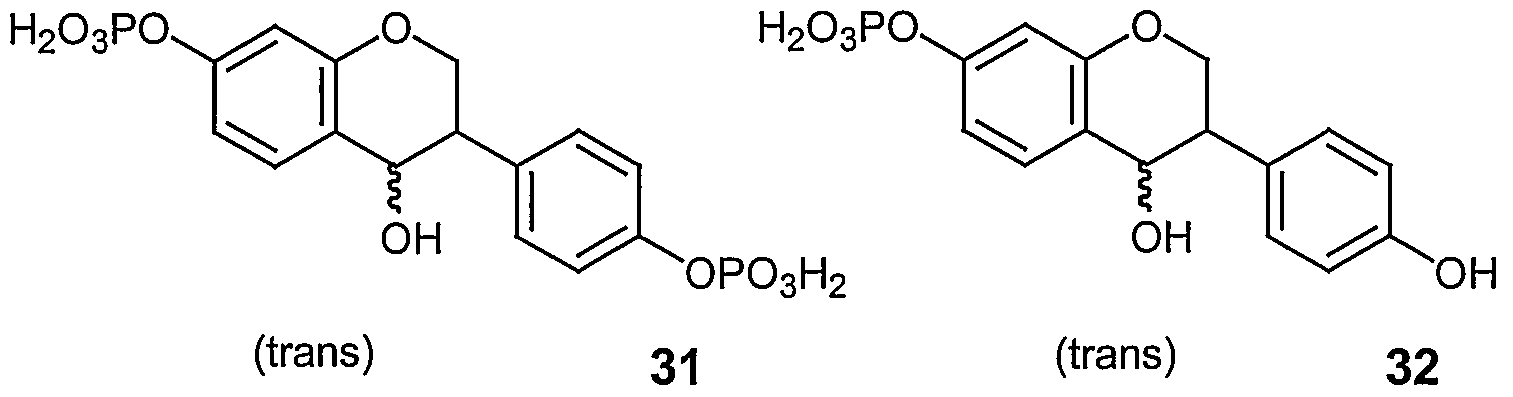
- the isoflavonoid phosphate esters prepared by the above methods include:
- phosphate esters of dihydrodaidzein, tetrahydrodaidzein and equol were synthesised affording the following compounds.
- Dehydroequol with its hydroxy group protected at the pendant phenyl 4'-position undergoes reaction according to Example 1 to afford the corresponding 7-phosphate derivative.
- Any suitable protective group may be employed including MOM or MEM ethers and benzylic ethers. These groups optionally may be removed after phosphorylation.
- the protecting groups where used may be incorporated in the synthesis of the isoflavonoid starting materials following any of the methods referred to herein, or may be attached at a later time by taking advantage of synthons, chemical reactivity, polarity, electronic considerations, or steric conditions on or near any of the target hydroxy groups.
- the bioavailability of the isoflavonoid phosphoric esters of the invention are tested by the in vitro hydrolysis of the dehydroequol phosphates by various enzymes and biological media. Results are determined by measuring the amount of free dehydroequol by HPLC.
- the sera and media used include human serum, human blood, rat blood, alkaline phosphatase type VII-S (bovine intestinal mucosa) and alkaline phosphatase type XXIV (human placenta).
- the bioavailability and conversion rate from the ester depends on a number of factors including the nature of the phosphate ester and substitutions thereon, the media, any enzymes present, the temperature and pH. By controlling these various parameters, it is found that some degree of regulation or control can be obtained by altering the half-life of the ester prodrug to better match the desired bioavailability rate.
- the esterified isoflavonoids are found to be readily converted to free isoflavonoids in biological media such as gastrointestinal fluid and blood.
- biological media such as gastrointestinal fluid and blood.
- gastrointestinal fluids often have enzymes and sufficiently high pH to hydrolyse ester bonds
- blood generally contains enzymes such as phosphatases which can hydrolyse phosphate ester bonds.
- DHE dehydroequol
- mice Two separate PK experiments were conducted using dehydroequol (DHE)-bisphosphate formulated in PBS by i.p. and oral modes of delivery. Three animals were to be allocated per timepoint with 5 timepoints (15 min, 30 min, lhr, 4 hr and 24 hr) (15 mice per study). The aim was to determine whether the PK profile was comparable when delivered i.p. vs oral.
- Protocol - i.p. administration Female nude mice were maintained on an isoflavone free diet for at least one week to remove background isoflavone levels in plasma.
- mice were assigned per time-point and marked with unique identifiers. Each mouse was weighed to determine the density of DHE bisphosphate required per i.p. injection to achieve a dose of 50 mg/kg for each mouse.
- mice were injected into the lower right or left quadrant of the abdomen, ensuring that the needle was not in a vessel or loop of bowel. Once the DHE- boisphosphate was administered, the mice were placed in a cage until each time point (15 min, 30 min, 1 hr, 4hr, 24 hr).
- the blood was allowed to clot then centrifuged at top speed for 3 minutes using a bench-top mini-microfuge at RT.
- Serum was aspirated into an appropriately labelled eppendorf tube and stored at - 20°C until analysed.
- Sera from animals dosed with vehicle control and formulated DHE-bisphosphate were stored at -20°C along with 200 ul aliquots of the vehicle and formulated DHE-bisphosphate for analysis.
- Protocol - oral administration
- mice Female B ALB/c mice were maintained on an isoflavone free diet for at least one week to remove background isoflavone levels in plasma.
- mice were assigned per time-point and marked with unique identifiers. Each mouse was weighed to determine the density of DHE- bisphosphate required to dose animals at 50 mg/kg.
- mice were restrained and gavaged an appropriate volume of formulated DHE- bisphosphate to achieve a dose of 50 mg/kg. Once DHE-bisphosphate was administered, the mice were placed in a cage until time point (15 min, 30 min, 1 hr, 4hr, 24 hr). The control animals were gavaged with 200 ⁇ l 1% CMC control. Control animals were culled at 15 min, 30 min, 1 hr, 4hr, 24 hr timepoints.
- each mouse was killed by cervical dislocation, then the blood collected via the thoracic cavity as per SOP BD-009 using a 20 gauge needle.
- the blood was allowed to clot then centrifuged at top speed for 3 minutes using a bench-top mini-microfuge at RT.
- Serum was aspirated into an appropriately labelled eppendorf tube and stored at -20°C until analysed.
- Sera from animals dosed with vehicle control and formulated DHE- bisphosphate were stored at -20°C along with 200 ul aliquots of the vehicle and formulated DHE-bisphosphate for analysis.
- mice When dosed at 25 mg/kg in mice the DHE-bisphosphate molecule was metabolised to the free form of DHE with serum concentrations in blood averaging 98.6 ⁇ M 15 mins post i.p. injection. The drug was rapidly excreted at a rate of 62 ⁇ M/hr with serum levels lowering to 12 ⁇ M 1 hr post administration. Total concentrations of DHE (conjugated + free) reached 120 ⁇ M 15 mins post administration and was excreted (120 ⁇ M/hr) reaching a serum concentration of 30.85 1 hr post administration (Table 1 and Figure 1).
- esterified isoflavonoids include any presently known or later discovered uses for isoflavonoids or derivatives thereof including those listed above or described in the literature.
- the esterified isoflavonoids are found to be indicated in the treatment of osteoporosis and other symptoms of estrogen deficiency in postmenopausal women.
- the compounds of the present invention are used to prevent osteoporosis and consequent fractures that result from osteoporosis, which are major contributors to morbidity and mortality in the elderly.
- the esterified isoflavones are used prophylactically to provide UV protection and in other ways to improve general skin health, to stimulate the immune system, and to reduce undesirable effects of oxidation (i.e., provide antioxidant benefits).
- the compounds of the invention are used to treat cancer, including breast, ovarian and prostrate cancers.
- the isoflavonoid phosphate esters of the invention quite unexpectedly show some beneficial and/or marked activity in the subjects being treated. This comparison shows the particular utility and effectiveness of conjugated isoflavonoid compounds of the invention, and in particular those conjugates from compounds 1 to 34 described above.
- Genistein phosphates are found to have poorer pharmacokinetic properties and profiles compared to the isoflavonoid counterparts described and exemplified above.
Landscapes
- Health & Medical Sciences (AREA)
- Chemical & Material Sciences (AREA)
- Life Sciences & Earth Sciences (AREA)
- Engineering & Computer Science (AREA)
- Organic Chemistry (AREA)
- Bioinformatics & Cheminformatics (AREA)
- General Health & Medical Sciences (AREA)
- Chemical Kinetics & Catalysis (AREA)
- Public Health (AREA)
- General Chemical & Material Sciences (AREA)
- Medicinal Chemistry (AREA)
- Nuclear Medicine, Radiotherapy & Molecular Imaging (AREA)
- Veterinary Medicine (AREA)
- Pharmacology & Pharmacy (AREA)
- Animal Behavior & Ethology (AREA)
- Neurology (AREA)
- Neurosurgery (AREA)
- Diabetes (AREA)
- Biomedical Technology (AREA)
- Physical Education & Sports Medicine (AREA)
- Dermatology (AREA)
- Endocrinology (AREA)
- Cardiology (AREA)
- Polymers & Plastics (AREA)
- Orthopedic Medicine & Surgery (AREA)
- Heart & Thoracic Surgery (AREA)
- Reproductive Health (AREA)
- Nutrition Science (AREA)
- Food Science & Technology (AREA)
- Rheumatology (AREA)
- Ophthalmology & Optometry (AREA)
- Hematology (AREA)
- Biochemistry (AREA)
- Psychology (AREA)
- Molecular Biology (AREA)
- Urology & Nephrology (AREA)
- Vascular Medicine (AREA)
- Mycology (AREA)
- Hospice & Palliative Care (AREA)
- Immunology (AREA)
Abstract
Description


Claims



Priority Applications (7)
| Application Number | Priority Date | Filing Date | Title |
|---|---|---|---|
| AU2004290613A AU2004290613B2 (en) | 2003-11-18 | 2004-11-18 | Isoflavonoid prodrugs, compositions thereof and therapeutic methods involving same |
| US10/579,789 US20070244075A1 (en) | 2003-11-18 | 2004-11-18 | Isoflavonoid Prodrugs, Compositons Thereof and Therapeutic Methods Involving Same |
| CA002546643A CA2546643A1 (en) | 2003-11-18 | 2004-11-18 | Isoflavonoid prodrugs, compositions thereof and therapeutic methods involving same |
| EP04797050A EP1685140A4 (en) | 2003-11-18 | 2004-11-18 | Isoflavonoid prodrugs, compositions thereof and therapeutic methods involving same |
| CN2004800402381A CN1902213B (en) | 2003-11-18 | 2004-11-18 | Isoflavone prodrugs, compositions thereof and methods of treatment involving them |
| JP2006540079A JP2007511542A (en) | 2003-11-18 | 2004-11-18 | Isoflavonoid prodrugs, compositions thereof, and therapeutic methods using them |
| NO20062878A NO20062878L (en) | 2003-11-18 | 2006-06-19 | Isoflavonoid drugs, therapeutic compositions thereof, and therapeutic methods including the same |
Applications Claiming Priority (2)
| Application Number | Priority Date | Filing Date | Title |
|---|---|---|---|
| AU2003906353A AU2003906353A0 (en) | 2003-11-18 | Isoflavene prodrugs, compositions thereof and therapeutic methods involving same | |
| AU2003906353 | 2003-11-18 |
Publications (1)
| Publication Number | Publication Date |
|---|---|
| WO2005049627A1 true WO2005049627A1 (en) | 2005-06-02 |
Family
ID=34596417
Family Applications (1)
| Application Number | Title | Priority Date | Filing Date |
|---|---|---|---|
| PCT/AU2004/001602 Ceased WO2005049627A1 (en) | 2003-11-18 | 2004-11-18 | Isoflavonoid prodrugs, compositions thereof and therapeutic methods involving same |
Country Status (7)
| Country | Link |
|---|---|
| US (1) | US20070244075A1 (en) |
| EP (1) | EP1685140A4 (en) |
| JP (1) | JP2007511542A (en) |
| CN (1) | CN1902213B (en) |
| CA (1) | CA2546643A1 (en) |
| NO (1) | NO20062878L (en) |
| WO (1) | WO2005049627A1 (en) |
Cited By (7)
| Publication number | Priority date | Publication date | Assignee | Title |
|---|---|---|---|---|
| WO2010022467A1 (en) * | 2008-08-29 | 2010-03-04 | Novogen Research Pty Ltd | Immunomodulating activities |
| US9617274B1 (en) | 2011-08-26 | 2017-04-11 | Demerx, Inc. | Synthetic noribogaine |
| US9783535B2 (en) | 2012-12-20 | 2017-10-10 | Demerx, Inc. | Substituted noribogaine |
| US10689371B2 (en) | 2018-04-18 | 2020-06-23 | Constellation Pharmaceuticals, Inc. | Modulators of methyl modifying enzymes, compositions and uses thereof |
| US10980774B2 (en) | 2015-02-02 | 2021-04-20 | Mei Pharma, Inc. | Combination therapies |
| US11919912B2 (en) | 2018-05-21 | 2024-03-05 | Constellation Pharmaceuticals, Inc. | Modulators of methyl modifying enzymes, compositions and uses thereof |
| US12516040B2 (en) | 2019-07-24 | 2026-01-06 | Constellation Pharmaceuticals, Inc. | Crystalline forms of 7-chloro-2-(4-3-methoxyazetidin-1-yl)cyclohexyl)-2,4-dimethyl-N-((6-methyl-4-(methylthio)-2-oxo-1,2-dihydropyridin-3-yl)methyl)benzo[d][1,3]dioxole-5-carboxamide |
Families Citing this family (8)
| Publication number | Priority date | Publication date | Assignee | Title |
|---|---|---|---|---|
| CA2855994A1 (en) * | 2011-12-09 | 2013-06-13 | Demerx, Inc. | Phosphate esters of noribogaine |
| JP6473321B2 (en) * | 2014-11-20 | 2019-02-20 | 株式会社ダイセル | Method for producing phosphorylated equol using enzymes |
| US20200354336A9 (en) * | 2017-08-11 | 2020-11-12 | Unity Biotechnology, Inc. | Treatment of Lung Diseases Using Pharmaceutical Agents that Eliminate Senescent Cells |
| US10881634B2 (en) * | 2017-12-07 | 2021-01-05 | Hughes Biotechnology Co., Ltd | Method for treatment or prevention of a disease associated with a decrease in bone mass and method of improving bone architecture and bio mechanical strength of bone |
| CN109485675B (en) * | 2018-11-30 | 2020-12-08 | 福州热方健康科技有限公司 | Puerarin derivative and preparation method and application thereof |
| JP6870011B2 (en) * | 2019-01-25 | 2021-05-12 | 株式会社ダイセル | Method for producing phosphorylated equol using an enzyme |
| JP2021080264A (en) * | 2021-02-15 | 2021-05-27 | 株式会社ダイセル | Method for producing phosphorylated equol using enzyme |
| JP7596493B1 (en) * | 2023-11-24 | 2024-12-09 | 株式会社ダイセル | Composition for improving men's quality of life |
Citations (2)
| Publication number | Priority date | Publication date | Assignee | Title |
|---|---|---|---|---|
| US3535344A (en) * | 1966-02-16 | 1970-10-20 | Merck Ag E | 3,4-cis-4-aryl-isoflavanes |
| US20030212009A1 (en) * | 2000-12-15 | 2003-11-13 | Hendler Sheldon S. | Isoflavone derivatives |
Family Cites Families (6)
| Publication number | Priority date | Publication date | Assignee | Title |
|---|---|---|---|---|
| AUPO203996A0 (en) * | 1996-08-30 | 1996-09-26 | Novogen Research Pty Ltd | Therapeutic uses |
| AU4435199A (en) * | 1998-06-12 | 1999-12-30 | Vyrex Corporation | Isoflavone derivatives |
| JP2002238594A (en) * | 2001-02-19 | 2002-08-27 | Mitsukan Group Honsha:Kk | Method for producing phosphorylated isoflavone |
| AUPR957001A0 (en) * | 2001-12-19 | 2002-01-24 | Novogen Research Pty Ltd | Isoflavone conjugates, derivatives thereof and therapeutic methods involving same |
| WO2003086386A1 (en) * | 2002-04-09 | 2003-10-23 | Novogen Research Pty Ltd | Therapeutic methods and compositions involving isoflav-3-ene and isoflavan structures |
| JP2004024139A (en) * | 2002-06-26 | 2004-01-29 | Mitsukan Group Honsha:Kk | Health food material |
-
2004
- 2004-11-18 CN CN2004800402381A patent/CN1902213B/en not_active Expired - Fee Related
- 2004-11-18 EP EP04797050A patent/EP1685140A4/en not_active Withdrawn
- 2004-11-18 JP JP2006540079A patent/JP2007511542A/en active Pending
- 2004-11-18 US US10/579,789 patent/US20070244075A1/en not_active Abandoned
- 2004-11-18 WO PCT/AU2004/001602 patent/WO2005049627A1/en not_active Ceased
- 2004-11-18 CA CA002546643A patent/CA2546643A1/en not_active Abandoned
-
2006
- 2006-06-19 NO NO20062878A patent/NO20062878L/en not_active Application Discontinuation
Patent Citations (2)
| Publication number | Priority date | Publication date | Assignee | Title |
|---|---|---|---|---|
| US3535344A (en) * | 1966-02-16 | 1970-10-20 | Merck Ag E | 3,4-cis-4-aryl-isoflavanes |
| US20030212009A1 (en) * | 2000-12-15 | 2003-11-13 | Hendler Sheldon S. | Isoflavone derivatives |
Non-Patent Citations (1)
| Title |
|---|
| See also references of EP1685140A4 * |
Cited By (10)
| Publication number | Priority date | Publication date | Assignee | Title |
|---|---|---|---|---|
| WO2010022467A1 (en) * | 2008-08-29 | 2010-03-04 | Novogen Research Pty Ltd | Immunomodulating activities |
| US9617274B1 (en) | 2011-08-26 | 2017-04-11 | Demerx, Inc. | Synthetic noribogaine |
| US9783535B2 (en) | 2012-12-20 | 2017-10-10 | Demerx, Inc. | Substituted noribogaine |
| US10980774B2 (en) | 2015-02-02 | 2021-04-20 | Mei Pharma, Inc. | Combination therapies |
| US12414934B2 (en) | 2015-02-02 | 2025-09-16 | Aardvark Therapeutics, Inc. | Combination therapies |
| US10689371B2 (en) | 2018-04-18 | 2020-06-23 | Constellation Pharmaceuticals, Inc. | Modulators of methyl modifying enzymes, compositions and uses thereof |
| US11274095B2 (en) | 2018-04-18 | 2022-03-15 | Constellation Pharmaceuticals, Inc. | Modulators of methyl modifying enzymes, compositions and uses thereof |
| US12612390B2 (en) | 2018-04-18 | 2026-04-28 | Constellation Pharmaceuticals, Inc. | Modulators of methyl modifying enzymes, compositions and uses thereof |
| US11919912B2 (en) | 2018-05-21 | 2024-03-05 | Constellation Pharmaceuticals, Inc. | Modulators of methyl modifying enzymes, compositions and uses thereof |
| US12516040B2 (en) | 2019-07-24 | 2026-01-06 | Constellation Pharmaceuticals, Inc. | Crystalline forms of 7-chloro-2-(4-3-methoxyazetidin-1-yl)cyclohexyl)-2,4-dimethyl-N-((6-methyl-4-(methylthio)-2-oxo-1,2-dihydropyridin-3-yl)methyl)benzo[d][1,3]dioxole-5-carboxamide |
Also Published As
| Publication number | Publication date |
|---|---|
| JP2007511542A (en) | 2007-05-10 |
| US20070244075A1 (en) | 2007-10-18 |
| NO20062878L (en) | 2006-06-19 |
| CA2546643A1 (en) | 2005-06-02 |
| EP1685140A4 (en) | 2009-02-25 |
| CN1902213B (en) | 2010-06-23 |
| EP1685140A1 (en) | 2006-08-02 |
| CN1902213A (en) | 2007-01-24 |
Similar Documents
| Publication | Publication Date | Title |
|---|---|---|
| US20070244075A1 (en) | Isoflavonoid Prodrugs, Compositons Thereof and Therapeutic Methods Involving Same | |
| EP1448542A1 (en) | 6-hydroxy isoflavones, derivatives and medicaments involving same | |
| WO2004039793A1 (en) | Aminated isoflavonoid derivatives and uses thereof | |
| JP2020530496A (en) | Selective inhibitor of protein arginine methyltransferase 5 (PRMT5) | |
| WO2008153945A2 (en) | Nutraceutical co-crystal compositions | |
| JP2006504705A (en) | Combination chemotherapy compositions and methods | |
| EP1721903A1 (en) | Compositions and therapeutic methods involving isoflavones and analogues thereof | |
| CN103987704A (en) | Flavonoids | |
| CN100436439C (en) | Dimeric isoflavones | |
| JP2007526256A (en) | Alkaloid preparation | |
| CN1902671A (en) | English phonetic notation system | |
| AU2004290613B2 (en) | Isoflavonoid prodrugs, compositions thereof and therapeutic methods involving same | |
| MXPA06005570A (en) | Isoflavonoid prodrugs, compositions thereof and therapeutic methods involving same | |
| JP6825330B2 (en) | Autophagy inducer | |
| EP3342410A1 (en) | Pharmaceutical composition containing rapamycin or derivative thereof | |
| AU2002238278B2 (en) | Dimeric isoflavones | |
| CN110903289A (en) | Purine-aminomethyl-pyridone derivative, preparation method and application thereof | |
| CN110358079A (en) | Epimedium aglucone derivative and its preparation method and application | |
| KR101328126B1 (en) | Novel oxadiazole derivatives and use thereof for preventing, improving or treating allergy | |
| JP5564906B2 (en) | Composition for oral consumption containing both coenzyme Q10 and pyrroloquinoline quinone excellent in bioabsorbability | |
| AU2002238278A1 (en) | Dimeric isoflavones | |
| CN102417514B (en) | Pyridine derivatives, preparation method thereof, and purpose thereof | |
| AU2003277969A1 (en) | Aminated isoflavonoid derivatives and uses thereof | |
| CN110358077A (en) | Epimedium aglucone derivative and its preparation method and application | |
| CN110358075A (en) | Epimedium aglucone derivative and its preparation method and application |
Legal Events
| Date | Code | Title | Description |
|---|---|---|---|
| AK | Designated states |
Kind code of ref document: A1 Designated state(s): AE AG AL AM AT AU AZ BA BB BG BR BW BY BZ CA CH CN CO CR CU CZ DE DK DM DZ EC EE EG ES FI GB GD GE GH GM HR HU ID IL IN IS JP KE KG KP KR KZ LC LK LR LS LT LU LV MA MD MG MK MN MW MX MZ NA NI NO NZ OM PG PH PL PT RO RU SC SD SE SG SK SL SY TJ TM TN TR TT TZ UA UG US UZ VC VN YU ZA ZM ZW |
|
| AL | Designated countries for regional patents |
Kind code of ref document: A1 Designated state(s): BW GH GM KE LS MW MZ NA SD SL SZ TZ UG ZM ZW AM AZ BY KG KZ MD RU TJ TM AT BE BG CH CY CZ DE DK EE ES FI FR GB GR HU IE IS IT LU MC NL PL PT RO SE SI SK TR BF BJ CF CG CI CM GA GN GQ GW ML MR NE SN TD TG |
|
| 121 | Ep: the epo has been informed by wipo that ep was designated in this application | ||
| WWE | Wipo information: entry into national phase |
Ref document number: 2004290613 Country of ref document: AU |
|
| WWE | Wipo information: entry into national phase |
Ref document number: 2006540079 Country of ref document: JP Ref document number: PA/a/2006/005570 Country of ref document: MX |
|
| DPEN | Request for preliminary examination filed prior to expiration of 19th month from priority date (pct application filed from 20040101) | ||
| WWE | Wipo information: entry into national phase |
Ref document number: 2546643 Country of ref document: CA |
|
| NENP | Non-entry into the national phase |
Ref country code: DE |
|
| WWW | Wipo information: withdrawn in national office |
Country of ref document: DE |
|
| WWE | Wipo information: entry into national phase |
Ref document number: 2004797050 Country of ref document: EP |
|
| ENP | Entry into the national phase |
Ref document number: 2004290613 Country of ref document: AU Date of ref document: 20041118 Kind code of ref document: A |
|
| WWP | Wipo information: published in national office |
Ref document number: 2004290613 Country of ref document: AU |
|
| WWE | Wipo information: entry into national phase |
Ref document number: 200480040238.1 Country of ref document: CN |
|
| WWP | Wipo information: published in national office |
Ref document number: 2004797050 Country of ref document: EP |
|
| WWE | Wipo information: entry into national phase |
Ref document number: 10579789 Country of ref document: US |
|
| WWP | Wipo information: published in national office |
Ref document number: 10579789 Country of ref document: US |