WO2005058888A2 - Oxazolidinone-quinolone hybrid antibiotics - Google Patents

Oxazolidinone-quinolone hybrid antibiotics Download PDF

Info

Publication number
WO2005058888A2
WO2005058888A2 PCT/EP2004/014500 EP2004014500W WO2005058888A2 WO 2005058888 A2 WO2005058888 A2 WO 2005058888A2 EP 2004014500 W EP2004014500 W EP 2004014500W WO 2005058888 A2 WO2005058888 A2 WO 2005058888A2
Authority
WO
WIPO (PCT)
Prior art keywords
group
oxo
fluoro
oxazolidin
formula
Prior art date
Legal status (The legal status is an assumption and is not a legal conclusion. Google has not performed a legal analysis and makes no representation as to the accuracy of the status listed.)
Ceased
Application number
PCT/EP2004/014500
Other languages
French (fr)
Other versions
WO2005058888A3 (en
Inventor
Christian Hubschwerlen
J. L. Specklin
Daniel Kaspar Baeschlin
Christine Schmitt
Stefan Müller
Michael Cappi
Current Assignee (The listed assignees may be inaccurate. Google has not performed a legal analysis and makes no representation or warranty as to the accuracy of the list.)
Morphochem GmbH
Original Assignee
Morphochem AG fuer Kombinatorische Chemie
Priority date (The priority date is an assumption and is not a legal conclusion. Google has not performed a legal analysis and makes no representation as to the accuracy of the date listed.)
Filing date
Publication date
Family has litigation
First worldwide family litigation filed litigation Critical https://patents.darts-ip.com/?family=39109376&utm_source=google_patent&utm_medium=platform_link&utm_campaign=public_patent_search&patent=WO2005058888(A2) "Global patent litigation dataset” by Darts-ip is licensed under a Creative Commons Attribution 4.0 International License.
Priority claimed from EP04001506A external-priority patent/EP1557416A1/en
Priority to BRPI0417193A priority Critical patent/BRPI0417193B8/en
Priority to EP04804099.2A priority patent/EP1709044B2/en
Priority to ES04804099T priority patent/ES2310299T5/en
Priority to KR20067014403A priority patent/KR101176450B1/en
Priority to US10/583,419 priority patent/US8158797B2/en
Priority to NZ547382A priority patent/NZ547382A/en
Priority to AU2004299278A priority patent/AU2004299278C9/en
Priority to DK04804099T priority patent/DK1709044T4/en
Priority to PL04804099T priority patent/PL1709044T5/en
Priority to SI200430867T priority patent/SI1709044T2/en
Priority to JP2006544382A priority patent/JP2007516263A/en
Application filed by Morphochem AG fuer Kombinatorische Chemie filed Critical Morphochem AG fuer Kombinatorische Chemie
Priority to MXPA06006769A priority patent/MXPA06006769A/en
Priority to HK06112470.8A priority patent/HK1090647B/en
Priority to CA 2549675 priority patent/CA2549675C/en
Priority to DE200460015158 priority patent/DE602004015158D1/en
Publication of WO2005058888A2 publication Critical patent/WO2005058888A2/en
Publication of WO2005058888A3 publication Critical patent/WO2005058888A3/en
Priority to IL175409A priority patent/IL175409A/en
Anticipated expiration legal-status Critical
Priority to US13/368,667 priority patent/US8501774B2/en
Priority to US13/933,811 priority patent/US9133213B2/en
Priority to US14/816,789 priority patent/US20150336992A1/en
Ceased legal-status Critical Current

Links

Classifications

    • CCHEMISTRY; METALLURGY
    • C07ORGANIC CHEMISTRY
    • C07DHETEROCYCLIC COMPOUNDS
    • C07D471/00Heterocyclic compounds containing nitrogen atoms as the only ring hetero atoms in the condensed system, at least one ring being a six-membered ring with one nitrogen atom, not provided for by groups C07D451/00 - C07D463/00
    • C07D471/02Heterocyclic compounds containing nitrogen atoms as the only ring hetero atoms in the condensed system, at least one ring being a six-membered ring with one nitrogen atom, not provided for by groups C07D451/00 - C07D463/00 in which the condensed system contains two hetero rings
    • C07D471/04Ortho-condensed systems
    • CCHEMISTRY; METALLURGY
    • C07ORGANIC CHEMISTRY
    • C07DHETEROCYCLIC COMPOUNDS
    • C07D498/00Heterocyclic compounds containing in the condensed system at least one hetero ring having nitrogen and oxygen atoms as the only ring hetero atoms
    • C07D498/02Heterocyclic compounds containing in the condensed system at least one hetero ring having nitrogen and oxygen atoms as the only ring hetero atoms in which the condensed system contains two hetero rings
    • C07D498/06Peri-condensed systems
    • AHUMAN NECESSITIES
    • A61MEDICAL OR VETERINARY SCIENCE; HYGIENE
    • A61PSPECIFIC THERAPEUTIC ACTIVITY OF CHEMICAL COMPOUNDS OR MEDICINAL PREPARATIONS
    • A61P31/00Antiinfectives, i.e. antibiotics, antiseptics, chemotherapeutics
    • AHUMAN NECESSITIES
    • A61MEDICAL OR VETERINARY SCIENCE; HYGIENE
    • A61PSPECIFIC THERAPEUTIC ACTIVITY OF CHEMICAL COMPOUNDS OR MEDICINAL PREPARATIONS
    • A61P31/00Antiinfectives, i.e. antibiotics, antiseptics, chemotherapeutics
    • A61P31/04Antibacterial agents
    • AHUMAN NECESSITIES
    • A61MEDICAL OR VETERINARY SCIENCE; HYGIENE
    • A61PSPECIFIC THERAPEUTIC ACTIVITY OF CHEMICAL COMPOUNDS OR MEDICINAL PREPARATIONS
    • A61P43/00Drugs for specific purposes, not provided for in groups A61P1/00-A61P41/00
    • CCHEMISTRY; METALLURGY
    • C07ORGANIC CHEMISTRY
    • C07DHETEROCYCLIC COMPOUNDS
    • C07D263/00Heterocyclic compounds containing 1,3-oxazole or hydrogenated 1,3-oxazole rings
    • C07D263/02Heterocyclic compounds containing 1,3-oxazole or hydrogenated 1,3-oxazole rings not condensed with other rings
    • C07D263/08Heterocyclic compounds containing 1,3-oxazole or hydrogenated 1,3-oxazole rings not condensed with other rings having one double bond between ring members or between a ring member and a non-ring member
    • C07D263/16Heterocyclic compounds containing 1,3-oxazole or hydrogenated 1,3-oxazole rings not condensed with other rings having one double bond between ring members or between a ring member and a non-ring member with hetero atoms or with carbon atoms having three bonds to hetero atoms with at the most one bond to halogen, e.g. ester or nitrile radicals, directly attached to ring carbon atoms
    • C07D263/18Oxygen atoms
    • C07D263/20Oxygen atoms attached in position 2
    • C07D263/24Oxygen atoms attached in position 2 with hydrocarbon radicals, substituted by oxygen atoms, attached to other ring carbon atoms
    • CCHEMISTRY; METALLURGY
    • C07ORGANIC CHEMISTRY
    • C07DHETEROCYCLIC COMPOUNDS
    • C07D413/00Heterocyclic compounds containing two or more hetero rings, at least one ring having nitrogen and oxygen atoms as the only ring hetero atoms
    • C07D413/02Heterocyclic compounds containing two or more hetero rings, at least one ring having nitrogen and oxygen atoms as the only ring hetero atoms containing two hetero rings
    • C07D413/10Heterocyclic compounds containing two or more hetero rings, at least one ring having nitrogen and oxygen atoms as the only ring hetero atoms containing two hetero rings linked by a carbon chain containing aromatic rings
    • CCHEMISTRY; METALLURGY
    • C07ORGANIC CHEMISTRY
    • C07DHETEROCYCLIC COMPOUNDS
    • C07D413/00Heterocyclic compounds containing two or more hetero rings, at least one ring having nitrogen and oxygen atoms as the only ring hetero atoms
    • C07D413/02Heterocyclic compounds containing two or more hetero rings, at least one ring having nitrogen and oxygen atoms as the only ring hetero atoms containing two hetero rings
    • C07D413/12Heterocyclic compounds containing two or more hetero rings, at least one ring having nitrogen and oxygen atoms as the only ring hetero atoms containing two hetero rings linked by a chain containing hetero atoms as chain links
    • CCHEMISTRY; METALLURGY
    • C07ORGANIC CHEMISTRY
    • C07DHETEROCYCLIC COMPOUNDS
    • C07D413/00Heterocyclic compounds containing two or more hetero rings, at least one ring having nitrogen and oxygen atoms as the only ring hetero atoms
    • C07D413/14Heterocyclic compounds containing two or more hetero rings, at least one ring having nitrogen and oxygen atoms as the only ring hetero atoms containing three or more hetero rings
    • CCHEMISTRY; METALLURGY
    • C07ORGANIC CHEMISTRY
    • C07FACYCLIC, CARBOCYCLIC OR HETEROCYCLIC COMPOUNDS CONTAINING ELEMENTS OTHER THAN CARBON, HYDROGEN, HALOGEN, OXYGEN, NITROGEN, SULFUR, SELENIUM OR TELLURIUM
    • C07F9/00Compounds containing elements of Groups 5 or 15 of the Periodic Table
    • C07F9/02Phosphorus compounds
    • C07F9/28Phosphorus compounds with one or more P—C bonds
    • C07F9/38Phosphonic acids [RP(=O)(OH)2]; Thiophosphonic acids ; [RP(=X1)(X2H)2(X1, X2 are each independently O, S or Se)]
    • C07F9/40Esters thereof
    • C07F9/4071Esters thereof the ester moiety containing a substituent or a structure which is considered as characteristic
    • CCHEMISTRY; METALLURGY
    • C07ORGANIC CHEMISTRY
    • C07FACYCLIC, CARBOCYCLIC OR HETEROCYCLIC COMPOUNDS CONTAINING ELEMENTS OTHER THAN CARBON, HYDROGEN, HALOGEN, OXYGEN, NITROGEN, SULFUR, SELENIUM OR TELLURIUM
    • C07F9/00Compounds containing elements of Groups 5 or 15 of the Periodic Table
    • C07F9/02Phosphorus compounds
    • C07F9/28Phosphorus compounds with one or more P—C bonds
    • C07F9/38Phosphonic acids [RP(=O)(OH)2]; Thiophosphonic acids ; [RP(=X1)(X2H)2(X1, X2 are each independently O, S or Se)]
    • C07F9/40Esters thereof
    • C07F9/4071Esters thereof the ester moiety containing a substituent or a structure which is considered as characteristic
    • C07F9/4087Esters with arylalkanols
    • CCHEMISTRY; METALLURGY
    • C07ORGANIC CHEMISTRY
    • C07FACYCLIC, CARBOCYCLIC OR HETEROCYCLIC COMPOUNDS CONTAINING ELEMENTS OTHER THAN CARBON, HYDROGEN, HALOGEN, OXYGEN, NITROGEN, SULFUR, SELENIUM OR TELLURIUM
    • C07F9/00Compounds containing elements of Groups 5 or 15 of the Periodic Table
    • C07F9/02Phosphorus compounds
    • C07F9/547Heterocyclic compounds, e.g. containing phosphorus as a ring hetero atom
    • C07F9/6558Heterocyclic compounds, e.g. containing phosphorus as a ring hetero atom containing at least two different or differently substituted hetero rings neither condensed among themselves nor condensed with a common carbocyclic ring or ring system
    • C07F9/65583Heterocyclic compounds, e.g. containing phosphorus as a ring hetero atom containing at least two different or differently substituted hetero rings neither condensed among themselves nor condensed with a common carbocyclic ring or ring system each of the hetero rings containing nitrogen as ring hetero atom
    • CCHEMISTRY; METALLURGY
    • C07ORGANIC CHEMISTRY
    • C07FACYCLIC, CARBOCYCLIC OR HETEROCYCLIC COMPOUNDS CONTAINING ELEMENTS OTHER THAN CARBON, HYDROGEN, HALOGEN, OXYGEN, NITROGEN, SULFUR, SELENIUM OR TELLURIUM
    • C07F9/00Compounds containing elements of Groups 5 or 15 of the Periodic Table
    • C07F9/02Phosphorus compounds
    • C07F9/547Heterocyclic compounds, e.g. containing phosphorus as a ring hetero atom
    • C07F9/6561Heterocyclic compounds, e.g. containing phosphorus as a ring hetero atom containing systems of two or more relevant hetero rings condensed among themselves or condensed with a common carbocyclic ring or ring system, with or without other non-condensed hetero rings

Definitions

  • the present invention describes new compounds in which the pharmacophores of quinolone and oxazolidinone are linked together through a linker that is stable under physiological conditions and a pharmaceutical antibacterial composition containing these compounds.
  • These dual action compounds are useful antimicrobial agents effective against a variety of human and veterinary pathogens including Gram positive aerobic bacteria such as multiply-resistant staphylococci, streptococci and enterococci as well as Gram negative bacteria such as Moraxella catarrhalis and Haemophilus influenzae and anaerobic organisms such as bacteroides spp. and Clostridia spp . species and acid-fast organism such as Mycobacterium tuberculosis, Mycobacterium avium spp .
  • Oxazolidinone-quinolone hybrid antibiotics have already been described ( O02059116, O03002560, WO03031443, WO03032962) .
  • the major drawback of the compounds known in the state of the art is the poor water solubility, which makes the development of a formulation difficult .
  • the present invention provides new compounds of formula (I) , that are useful antimicrobial agents and effective against a variety of multi-drug resistant bacteria
  • A is an alkylene group, an alkenylene group, an alkynylene group, a heteroalkylene group, a cycloalkylene group, a heterocycloalkylene group, an arylene group or a heteroarylene group all of which groups may be substituted;
  • Q is CR 4 or N (especially CR 4 ) ;
  • X is CR' or N
  • Y is CR 6 or N
  • n 1, 2 or 3;
  • n 1, 2 or 3;
  • R 1 is H, F, CI, Br, I, OH, NH 2 , an alkyl group or a heteroalkyl group;
  • R 2 is H, F or Cl ;
  • R 3 is H, an alkyl group, an alkenyl group, an alkynyl group, a heteroalkyl group, a cycloalkyl group, a heterocycloalkyl group, an aryl group, a heteroaryl group, an alkylaryl group or a heteroarylalkyl group; all of which groups may be substituted with one, two or more halogen atoms like F or Cl or amino groups.
  • R 4 is hydroxy, a group of formula OP0 3 R 9 2 or OS0 3 R 10 or a heteroalkyl group carrying at least one OH, NH 2 , S0 3 R 10 , P0 3 R 9 2 or COOH group or an ester of a naturally occurring amino acid or a derivative thereof, wherein the groups R 9 independently of each other are H, alkyl, cycloalkyl, aryl or aralkyl and wherein R 10 is H, alkyl, cycloalkyl, aryl or aralkyl;
  • R 5 is selected from following groups:
  • R 6 is H, F , Cl or OMe ;
  • R 7 is H, F, Cl, OH, NH 2 , a substituted or unsubstituted alkyl group or a substituted or unsubstituted heteroalkyl group, or R 3 and R 7 can be linked via an alkylene, an alkenylene or a heteroalkylene group or be a part of a cycloalkylene or heterocycloalkylene group; in case R 3 is no H and R 7 is no H, F, OH, NH 2 or Cl ; and R 8 is a C ⁇ - 6 heteroalkyl, a heteroarylalkyl, a hetero- alkylaryl or a heteroalkylheteroaryl group; or a pharmacologically acceptable salt, solvate, hydrate or formulation thereof.
  • alkyl refers to a saturated straight or branched chain alkyl group, preferably containing from one to ten, preferably one to six carbon atoms, for example methyl, ethyl, propyl, isopropyl, butyl, iso-butyl, sec- butyl, tert-butyl, n-pentyl , iso-pentyl, n-hexyl, 2,2- dimethylbutyl , n-octyl or n-pentyl groups.
  • Any alkyl group as defined herein may be substituted with one, two or more substituents, for example F, Cl , Br, I, H 2 , OH, SH or N0 2 .
  • alkenyl and alkynyl refer to an unsaturated straight or branched chain alkyl group (having one, two or more double and/or triple bonds, an alkenyl preferably having one or two double bonds and an alkynyl preferably having one or two triple bonds) , preferably containing two to ten, preferably two to six carbon atoms for example: ethenyl (vinyl), propenyl (allyl) , iso-propenyl , n- pentenyl, butenyl, isoprenyl or hexa-2-enyl; ethynyl, propynyl or butynyl groups .
  • Any alkenyl or alkynyl group as defined herein may be substituted with one, two or more substituents, for example F, Cl, Br, I, NH 2 , OH, SH or N0 2 .
  • the term heteroalkyl refers to an alkyl, alkenyl or alkynyl group as defined herein where one or more carbon atoms are replaced by an oxygen, nitrogen, phosphorous or sulphur atom, for example an alkoxy group such as methoxy, ethoxy, propoxy, iso-propoxy, butoxy or tert .
  • an alkoxyalkyl group such as methoxymethyl , ethoxymethyl , 1- methoxyethyl, 1-ethoxyethyl, 2-methoxyethyl or 2- ethoxyethyl
  • an alkylamino group such as methylamino, ethylamino, propylamino, isopropylamino, dimethylamino or diethylamino
  • an alkylthio group such as methylthio, ethylthio or isopropylthio or a cyano group. It may also refer to one of the above groups containing a keto group.
  • heteroalkyl furthermore refers to a group derived from a carboxylic acid or carboxylic acid amide such as acetyl, propionyl, acetyloxy, propionyloxy, acetylamino or propionylamino, a carboxyalkyl group such as carboxymethyl , carboxyethyl or carboxypropyl, a carboxyalkyl ester, an alkylthiocarboxyamino group, an alkoxyimino group, an alkylaminothiocarboxyamino group or an alkoxycarbonylamino group.
  • Any heteroalkyl group as defined herein may be substituted with one, two or more substituents, for example F, Cl, Br, I, NH 2 , OH, SH or N0 2 .
  • cycloalkyl refers to a saturated or partially unsaturated (having one, two or more double and/or triple bonds) cyclic group with one, two or more rings, having three to 14 carbon ring-atoms, preferably from five or six to ten carbon ring-atoms, for example cyclopropyl, cyclobutyl, cyclopentyl, cyclohexyl, tetralin, cyclopentenyl or cyclohex-2-enyl groups.
  • Any cycloalkyl group as defined herein may be substituted with one, two or more substituents, for example F, Cl, Br, I, OH, NH 2 , SH, N 3 , N0 2 , alkyl groups such as methyl or ethyl, heteroalkyl groups such as methoxy, methylamino, dimethylamino or cyanide .
  • heterocycloalkyl refers to a cycloalkyl group as defined herein where one, two or more carbon ring-atoms are replaced by one, two or more oxygen, nitrogen, phosphorous or sulphur atoms or S ⁇ 0)1-2 groups for example piperidino, morpholino or piperazino groups.
  • aryl refers to an aromatic cyclic group with one, two or more rings, having five to 14 carbon ring-atoms preferably from five or six to ten carbon ring-atoms, for example phenyl or naphthyl groups .
  • Any aryl group as defined herein may be substituted with one, two or more substituents, for example F, Cl, Br, I, OH, NH 2 , SH, N 3 , N0 2 , alkyl groups such as methyl or ethyl, heteroalkyl groups such as methoxy, methylamino, dimethylamino or cyanide .
  • heteroaryl refers to an aryl group as defined herein where one, two or more ring-carbon atoms are replaced by an oxygen, nitrogen, boron, phosphorous or sulphur atom, for example pyridyl, imidazolyl, pyrazolyl, quinolinyl, isoquinolinyl, pyrrolyl, oxazolyl, isoxazolyl, thiazolyl, isothiazolyl, 1, 2 , 3-triazolyl , 1, 2 , 4-triazolyl , oxadiazolyl, thiadiazolyl, indolyl, indazolyl, tetrazolyl, pyrazinyl, pyrimidinyl and pyridazinyl groups.
  • aralkyl refers to groups that comprise both aryl as well as alkyl and/or cycloalkyl groups .
  • h teroarylalkyl refers to an aralkyl group as defined herein where one, two, three or more carbon atoms are replaced by one, two, three or more oxygen, nitrogen, phosphorous or sulphur atoms or S(0) ⁇ - 2 groups.
  • Any alkyl, alkenyl, alkynyl, heteroalkyl, cycloalkyl, heterocycloalkyl, aryl, heteroaryl, aralkyl or heteroaryl- alkyl groups as defined herein may be substituted with one or more halogen atoms, NH 2 , SH, N0 2 or OH groups or unsubstituted alkyl, heteroalkyl, aryl, aralkyl, aralkyl- oxy, heteroaryl, cycloalkyl or heterocycloalkyl groups as defined herein.
  • optionally substituted or “substituted” refer to groups wherein one or more hydrogen atoms may be replaced by a halogen atom, a NH 2 , SH, N0 2 or OH group or by an unsubstituted alkyl, heteroalkyl, aryl, aralkyl, aralkyloxy, heteroaryl, cycloalkyl or heterocycloalkyl group as defined herein.
  • Preferred and/or advantageous embodiments of the invention are subject-matter of the subclaims. Preferred are compounds of Formula (I) , wherein R 1 is H.
  • R 3 is an ethyl, a 2 -propyl, a C 3 -C 6 cycloalkyl (i.e, cyclopropyl, cyclobutyl, cyclopentyl or cyclohexyl) , a phenyl or a pyridyl group. All these groups may be substituted with one, two, three or more fluorine atoms or amino groups .
  • R 3 is a cyclopropyl group.
  • R 4 is hydroxy or a group of formula OS0 3 H, OP0 3 H 2 , OCH 2 OP0 3 H 2 , OCOCH 2 CH 2 COOH or an ester of a naturally occurring amino acid or a derivative thereof (i.e. a group of formula -OCOCHR ⁇ NH 2 or a derivative like an ester, amide or alkylamine thereof, wherein R' is the side chain of a naturally occurring amino acid like aspartic acid, glutaric acid, lysine, etc; e.g. dimethyl aminoglycine 0C0CH 2 N(CH 3 ) 2 ) .
  • R 5 has the following structure:
  • R 7 is H, F, Cl or a methoxy group that may be substituted by one, two or three fluorine atoms.
  • A is C ⁇ _ 6 alkylene, C 2 - 6 alkenylene, C 2 - 6 alkynylene, C ⁇ - 6 heteroalkylene, cyclopropylene, epoxide, aziridine, thioepoxide, lactame or lactone, all of which groups may be subsitituted.
  • A is a group of Formula -0-B-, wherein B is a C ⁇ _ 4 alkylene group, a C 2 - 4 alkenylene group, a C 2-4 alkynylene group or a C ⁇ _ 4 heteroalkylene group, all of which groups may be substituted by one, two or more hydroxy or amino groups.
  • B is CH 2 or CH 2 CH 2 .
  • B is CH 2 or CH 2 CH 2 ;
  • X is CH, N or C-OMe and R 3 is cyclopropyl or X is CR 7 and R 7 and R 3 together form a bridge of the formula -0-CH 2 -CH (Me) - , wherein the preferred stereochemistry at the chiral center is the one giving the (S) configuration in the final compound,
  • n is 1, 2 or 3, is 1, 2 or 3 and R 4 is hydroxy or a group of formula OS0 3 H, 0P0 3 H 2 , 0CH 2 0P0 3 H 2 , 0C0CH 2 CH 2 C00H or an ester of a naturally occurring amino acid or a derivative thereof .
  • the mono, di or tri sodium salts are preferably the mono, di or tri sodium salts (most preferred the mono sodium salts) of compounds of formula (I) or (II) or mixtures thereof.
  • the mono, di or tri sodium salts are preferably the mono sodium salts of compounds of formula (I) or (II) , wherein R 4 is OP0 3 H 2 or OS0 3 H or mixtures thereof.
  • the present invention also relates to pharmacologically acceptable salts, or solvates and hydrates, respectively, and to compositions and formulations of compounds of Formula (I) or (II) .
  • the present invention describes procedures to produce pharmaceutically useful agents, which contain these compounds, as well as the use of these compounds for the production of pharmaceutically useful agents.
  • compositions according to the present invention contain at least one compound of Formula (I) or (II) as the active agent and optionally carriers and/or diluents and/or adjuvants.
  • the pharmaceutical compositions according to the present invention may also contain additional known antibiotics.
  • Examples of pharmacologically acceptable salts of sufficiently basic compounds of Formula (I) or (II) are salts of physiologically acceptable mineral acids like hydrochloric, hydrobromic, sulfuric and phosphoric acid; or salts of organic acids like methanesulfonic, p- toluenesulfonic, lactic, acetic, trifluoroacetic, citric, succinic, fumaric, maleic and salicylic acid.
  • a sufficiently acidic compound of Formula (I) or (II) may form alkali or earth alkaline metal salts, for example sodium, potassium, lithium, calcium or magnesium salts; ammonium salts; or organic base salts, for example methylamine, dimethylamine, trimethylamine, triethylamine, ethylenediamine, ethanolamine, choline hydroxide, meglumin, piperidine, morpholine, tris- (2-hydroxyethyl) amine, lysine or arginine salts.
  • Compounds of Formula (I) or (II) may be solvated, especially hydrated.
  • the hydratisation can occur during the process of production or as a consequence of the hygroscopic nature of the initially water free compounds of Formula (I) or (II) .
  • the compounds of Formula (I) or (II) may contain asymmetric C-atoms and may be present either as achiral compounds, mixtures of diastereomers, mixtures of enantiomers or as optically pure compounds.
  • the present invention also relates to pro-drugs which are composed of a compound of Formula (I) or (II) and at least one pharmacologically acceptable protective group which will be cleaved off under physiological conditions, such as an alkoxy- , aralkyloxy-, acyl-, S0 3 H, P0 3 H 2 , acyloxymethyl group (e.g. pivaloyloxymethyl) , an 2-alkyl-, 2-aryl- or 2-aralkyl-oxycarbonyl-2-alkylidene ethyl group or an acyloxy group as defined herein, e.g. ethoxy, benzyloxy, acetyl or acetyloxy.
  • a pharmacologically acceptable protective group which will be cleaved off under physiological conditions, such as an alkoxy- , aralkyloxy-, acyl-, S0 3 H, P0 3 H 2 , acyloxymethyl group (e.g.
  • therapeutically useful agents that contain compounds of Formula (I) or (II) , their solvates, salts or formulations are also comprised in the scope of the present invention.
  • compounds of Formula (I) or (II) will be administered by using the known and acceptable modes known in the art, either alone or in combination with any other therapeutic agent.
  • Such therapeutically useful agents can be administered by one of the following routes: oral, e.g.
  • TDS transder al delivery system
  • the therapeutically useful product may be mixed with pharmaceutically inert, inorganic or organic excipients as are e.g. lactose, sucrose, glucose, gelatin, malt, silica gel, starch or derivatives thereof, talc, stearinic acid or their salts, dried skim milk, and the like.
  • pharmaceutically inert, inorganic or organic excipients as are e.g. lactose, sucrose, glucose, gelatin, malt, silica gel, starch or derivatives thereof, talc, stearinic acid or their salts, dried skim milk, and the like.
  • excipients e.g. vegetable, petroleum, animal or synthetic oils, wax, fat, polyols.
  • liquid solutions, emulsions or suspensions or syrups one may use as excipients e.g.
  • excipients as are e.g. vegetable, petroleum, animal or synthetic oils, wax, fat and polyols.
  • compressed gases suitable for this purpose as are e.g. oxygen, nitrogen and carbon dioxide.
  • the pharmaceutically useful agents may also contain additives for conservation, stabilisation, e.g. UV stabilizers, emulsifiers, sweetener, aromatisers, salts to change the osmotic pressure, buffers, coating additives and antioxidants .
  • a daily dosage per patient of about l g to about 4000mg especially about 50mg to 3 g is usual with those of ordinary skill in the art appreciating that the dosage will depend also upon the age, conditions of the mammals, and the kind of diseases being treated or prevented.
  • the daily dosage can be administrated in a single dose or can be divided over several doses .
  • An average single dose of about 50mg, lOOmg, 250mg, 500mg, lOOOmg and 2000mg can be contemplated .
  • step 1 CH 2 C1 2 , KOH (50%), 3h, rt ; 97%.
  • step 2 H 2 , Pt/C, 20h, rt; followed by Z-Cl (Cbz-Cl), acetone/water, NaHC0 3 , 12h, rt, 98%.
  • step 3 n-BuLi, -60°C, 24h, 80%.
  • step 4 MsCI, triethylamine, CH 2 C1 2 ; 100%.
  • step 5 NaN 3 in DMF,
  • step 6 H 2 , Pd(OH) 2 , THF, MeOH, 24h, followed by AcOH, Ac 2 0, rt , 2h, 70%.
  • step 7 DMF, NaH, 70°C, 12h, 75%.
  • step 8 H 2 , Pd(OH) 2 , MeOH, THF, 24h, RT, 100%.
  • step 9 N-Methylpyrrolidinone, l-Cyclopropyl-7- chloro-6-fluoro-1,4-dihydro-4-oxo-1,8-naphthydrin-3 - carboxylic acid (commercially available), TMS-Cl, H ⁇ nig Base or K 2 C0 3 , 80°C, 5h, 80%.
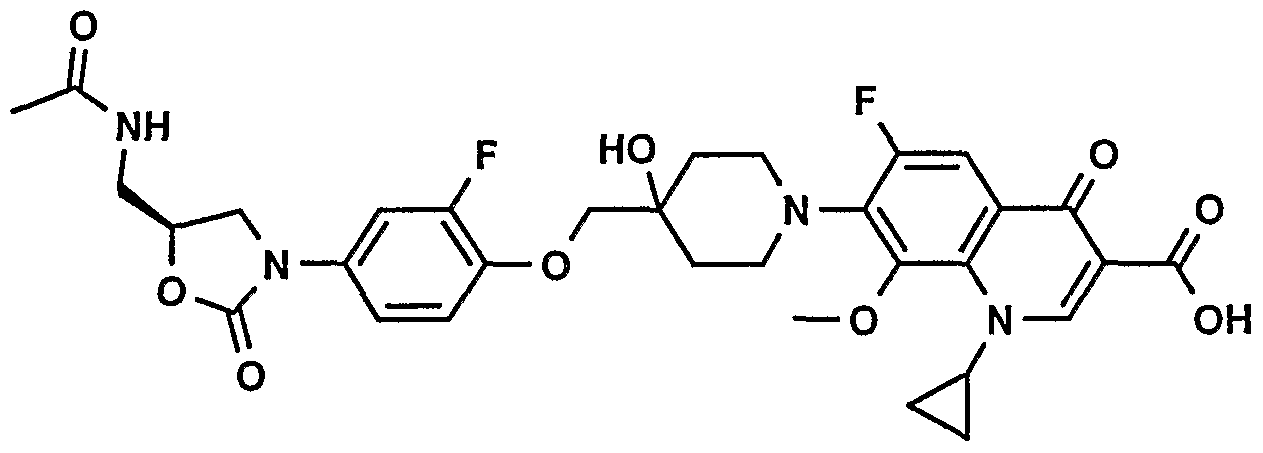
  • Example 1 7- (4- ⁇ 4- [ (5S) -5- (Acetylamino-methyl) -2-oxo- oxazolidin-3-yl] -2-fluoro-phenoxymethyl ⁇ -4-hydroxy- piperidin-1-yl) -1-cyclopropyl-6-fluoro-4 -oxo-1,4-dihydro- [1,8] naphthyridine-3 -carboxylic acid
  • Step 1 (4-Benzyloxy-3-fluoro-phenyl) -carbamic acid benzyl ester:
  • Step 3 (5S) -5-azid ⁇ methyl-3- (4-benzyloxy-3-fluorophenyl) -oxazolidin-2-one: A solution of lOg (5R) -3- (4-benzyloxy-3-fluoro-phenyl) -5- hydroxymethyl-oxazolidin-2-one (MW: 317.32, 31.51mmol) and 4.78g triethylamine (MW: 101.19, 47.26mmol) in 300ml dichloromethane was treated under stirring at 10°C with 4.32g of methane sulfonyl chloride (MW: 114.55, 37.82mmol).
  • the reaction was stirred at room temperature for one hour and monitored by TLC (ethyl acetate: hexane 1:1) .
  • the reaction mixture was quenched with 100ml water and the organic layer washed with 100ml brine. The organic layer was dried over magnesium sulfate, filtered and the filtrate evaporated under reduced pressure. The residue was dissolved in 100ml dimethylformamide, 5.12g sodium azide (MW: 65.01, 78.7mmol) and a catalytic amount of tetrabutyl ammonium iodide were added.
  • the suspension was stirred at 90 °C over night. The reaction was monitored by HPLC.
  • Step 4 N- [ (5S) - ⁇ 3- (3 -fluoro-4-hydroxy-phenyl) ⁇ -2-oxo- oxazolidin-5-ylmethyl] -acetamide :
  • Step 6 N- [ ⁇ (5S) -3 [3-fluoro-4- (4-hydroxy-piperidin-4-yl- methoxy) -phenyl] -2-oxo-oxazolidin-5-ylmethyl ⁇ ] -acetamide : A suspension of 31g 4- ⁇ 4- [ (5S) -5- (acetylamino-methyl) -2- oxo-oxazolidin-3-yl] -2-fluorophenoxymethyl ⁇ -4 -hydroxy- piperidine-1-carboxylic acid benzylester (MW: 515,54 60.13mmol) and 2.5 g of palladium 10% on activated carbon in 310ml methanol and 150ml ethyl acetate was stirred under hydrogen for 4 hrs . The reaction was monitored by TLC
  • Step7 7- (4- ⁇ [ (5S) -5- (Acetylamino-methyl) -2-oxo-oxazolidin- 3-yl] -2-fluoro-phenoxymethyl ⁇ -4-hydroxy-piperidin-l-yl) -1- cyclopropyl-6-fluoro-4-oxo-1, 4 -dihydro- [1,8] naphthyridine- 3 -carboxylic acid:
  • Step 1 7- [4- ⁇ 4- [ (5S) -5- (Acetylamino-methyl) -2-oxo- oxazolidin-3-yl] -2-fluoro-phenoxymethyl ⁇ -4- (bis-benzyloxy- phosphoryloxy) -piperidin-1-yl] -1-cyclopropyl-6-fluoro-4- oxo-1, 4-dihydro- [1, 8] naphthyridine -3-carboxylic acid:
  • the original suspension slowly cleared.
  • the solution was stirred at room temperature for two hours and monitored by TLC. (dichloromethane/methanol 9:1) .
  • the reaction mixture was cooled to 0°C and treated with a 0.6ml of a 0.5M m- chloroperbenzoic acid solution in dichloromethane.
  • the mixture was stirred for two hours at room temperature and diluted with 20ml dichloromethane.
  • the organic layer was washed successively with 20ml of a saturated aqueous sodium bicarbonate solution and 20ml of brine and dried over magnesium sulfate.
  • the slurry was filtered and the filtrate evaporated under reduced pressure.
  • Step 2 7- (4- ⁇ 4- [ (5S) - (5-Acetylamino-methyl) -2-oxo- oxazolidin-3-yl] -2-fluoro-phenoxymethyl ⁇ -4-phosphonooxy- piperidin-1-yl) -l-cyclopropyl-6-fluoro-4-oxo-1, 4-dihydro- [1, 8] naphthyridine -3-carboxylic acid: A suspension of 158mg 7- [4- ⁇ 4- [ (5S) -5- (Acetylamino-methyl) - 2-oxo-oxazolidin-3-yl] -2-fluoro-phenoxymethyl ⁇ -4- (bis- benzyloxy-phosphoryloxy) -piperidin-1-yl] -1-cyclopropyl-6- fluoro-4-oxo-l, 4-dihydro- [1, 8] naphthyridine -3-carboxylic acid (MW: 8
  • the catalyst was filtered off using a glass fibre filter paper. The solvents were evaporated under reduced pressure and the residue dissolved in 10ml methanol. The solution was diluted with 20ml water while a white solid precipitated. The solid was collected and dried. Yield: 85mg, 68%. MS: 709.0 (M+H) + , 706.5 (M-H) " Method ESI ⁇ ESI " .
  • Example 3 7- [4- ⁇ 4- [ (5S) -5- (Acetylamino-methyl) -2-oxo- oxazolidin-3-yl] -2-fluoro-phenoxymethyl ⁇ -4- (2, 6-diamino- hexanoyloxy) -piperidin-1-yl] -1-cyclopropyl-6-fluoro-4-oxo- 1, -dihydro- [1, 8] naphthyridine-3 -carboxylic acid
  • Step 1 4- ⁇ 4- [ (5S) - (5-Acetylamino-methyl) -2-oxo-oxazolidin- 3-yl] -2-fluoro-phenoxymethyl ⁇ -4-hydroxy-piperidine-1- carboxylic acid tert-butyl ester:
  • step 5 by reacting 3.83g l-oxa-6- aza-spiro [2.5] octane-6-carboxylic acid tert-butyl ester (WO0204462) (MW: 213.28 l ⁇ mmol) , 4.02g N- [ (5S) - ⁇ 3- (3- fluoro-4-hydroxy-phenyl) ⁇ -2-oxo-oxazolidin-5-ylmethyl] - acetamide (MW: 268.246, 15mmol) and 3. lg potassium carbonate (MW: 138.20, 22.5mmol) in 30ml dimethylformamide . Yield: 4.89-g, 67%. MS: 482.6 (M+H) + , Method ESI + .
  • Step 2 4- ⁇ 4- [ (5S) -5- (Acetylamino-methyl) -2-oxo-oxazolidin- 3-yl] -2-fluoro-phenoxymethyl ⁇ -4- (2 , 6-bis- benzyloxycarbonylamino-hexanoyloxy) -piperidine-1-carboxylic acid tert-butyl ester:
  • Step 3 2 , 6-Bis-benzyloxycarbonylamino-hexanoic acid 4- ⁇ 4- [ (5S) -5- (acetylamino-methyl) -2-oxo-oxazolidin-3-yl] -2- fluoro-phenoxymethyl ⁇ -piperidin-4-yl ester hydrochloride : 200mg of 4- ⁇ 4- [5- (5S) - (acetylamino-methyl) -2-oxo- oxazolidin-3-yl] -2-fluoro-phenoxymethyl ⁇ -4- (2 , 6-bis- benzyloxycarbonylamino-hexanoyloxy) -piperidine-1-carboxylic acid tert-butyl ester (MW: 977.97, 0.22mmol) were dissolved in 4ml of a 1.25M dry hydrochloric acid in methanol. The reaction was stirred at 40°C for two hours, and the solvent removed by distillation under
  • Step 4 7- [4- ⁇ 4- [ (5S) -5- (Acetylamino-methyl) -2-oxo- oxazolidin-3-yl] -2-fluoro-phenoxymethyl ⁇ -4- (2, 6-bis- benzyloxycarbonylamino-hexanoyloxy) -piperidin-1-yl] -1- cyclopropyl-6-fluoro-4-oxo-l, 4-dihydro- [1, 8] naphthyridine- 3-carboxylic acid:
  • Step 5 7- [4- ⁇ 4- [ (5S) -5- (Acetylamino-methyl) -2-oxo- oxazolidin-3-yl] -2-fluoro-phenoxymethyl ⁇ -4- (2 , 6-diamino- hexanoyloxy) -piperidin-1-yl] -1-cyclopropyl- 6-fluoro-4-oxo- 1, 4-dihydro- [1, 8] naphthyridine-3-carboxylic acid: A suspension of 94mg 7- [4- ⁇ 4- [ (5S) -5- (acetylamino-methyl) - 2-oxo-oxazolidin-3-yl] -2-fluoro-phenoxymethyl ⁇ -4- (2,6-bis- benzyloxycarbonylamino-hexanoyloxy) -piperidin-1-yl] -1- cyclopropyl-6-fluoro-4-oxo-l,
  • Example 4 Succinic acid mono- [4- ⁇ 4- [ (5S) -5- (acetylamino- methyl) -2-oxo-oxazolidin-3-yl] -2-fluoro-phenoxymethyl ⁇ -1- (6-carboxy-8-cyclopropyl-3-fluoro-5-oxo-5 , 8-dihydro- [1, 8] naphthyridin-2-yl) -piperidin-4-yl] ester
  • Step 1 Succinic acid 4- ⁇ 4- [ (5S) -5- (acetylamino-methyl) -2- oxo-oxazolidin-3-yl] -2-fluoro-phenoxymethyl ⁇ -1-tert-butoxy- carbonyl-piperidin-4-yl ester benzyl ester:
  • step 2 with 825mg 4- ⁇ 4- [ (5S) -5- (acetylamino-methyl) -2-oxo-oxazolidin-3-yl] -2-fluoro- phenoxymethyl ⁇ -4 -hydroxy-piperidine-1 -carboxylic acid tert- butyl ester (MW: 481.52, 1.71mmol), 1.07g of succinic acid monobenzyl ester (MW: 208.21, 5.14mmol) and 0.63g of 4- dimethylaminopyridine (MW: 122.17, 5.1mmol) in 10ml dichloromethane was treated under stirring at room temperature with 1.3g N- (3-dimethylaminopropyl) -N'-ethyl- carbodiimid HC1 (MW: 191.70, 6.8mmol). Yield: 820mg, 70%. MS: 673.3 (M+H) + , Method ESI + .
  • Step 2 Succinic acid 4- ⁇ 4- [ (5S) -5- (acetylamino-methyl) -2- oxo-oxazolidin-3-yl] -2-fluoro-phenoxymethyl ⁇ -piperidin-4-yl ester benzyl ester: 820mg of succinic acid 4- ⁇ 4- [ (5S) -5- (acetylamino-methyl) -2- oxo-oxazolidin-3-yl] -2-fluoro-phenoxymethyl ⁇ -1-tert-butoxy- carbonyl-piperidin-4-yl ester benzyl ester (MW: 671.72, 1.23mmol) were dissolved in 4ml of trifluoro acetic acid.
  • Step 3 Succinic acid 4- ⁇ 4- [ (5S) -5- (acetylamino-methyl) -2- oxo-oxazolidin-3-yl] -2-fluoro-phenoxymethyl ⁇ -1- (6-carboxy- 8-cyclopropyl-3-fluoro-5-oxo-5, 8-dihydro- [1, 8] naphthyridin- 2-yl) -piperidin-4-yl ester benzyl ester: In analogy to example 1 step 7, with 113mg 7-chloro-l- cyclopropyl-6-fluoro-l,4-dihydro-4-oxo- [1, 8] naphthyridine- 3-carboxylic acid (MW:282.66, 0.4mmol ), 230mg succinic acid 4- ⁇ 4- [ (5S) -5- (acetylamino-methyl) -2-oxo-oxazolidin-3- yl] -2-fluor
  • Step 4 Succinic acid mono- [4- ⁇ 4- [ (5S) -5- (acetylamino- methyl) -2-oxo-oxazolidin-3-yl] -2-fluoro-phenoxymethyl ⁇ -1- (6-carboxy-8 -cyclopropyl-3 -fluoro-5 -oxo-5,8-dihydro- [1, 8] naphthyridin-2-yl) -piperidin-4-yl] ester: In analogy to example 3 step 5 with 22mg succinic acid 4- ⁇ 4- [ (5S) -5- (acetylamino-methyl) -2-oxo-oxazolidin-3-yl] -2- fluoro-phenoxymethyl ⁇ -1- (6-carboxy-8-cyclopropyl-3-fluoro- 5-OXO-5, 8-dihydro- [1, 8] naphthyridin-2-yl) -piperidin-4-yl ester benz
  • Example 5 7- (4- ⁇ 4- [ (5S) -5- (Acetylamino-methyl) -2-oxo- oxazolidin-3-yl] -2-fluoro-phenoxymethyl ⁇ -4-hydroxy- piperidin-1-yl) -1-cyclopropyl-6-fluoro-4-oxo-1 , 4-dihydro- quinoline-3-carboxylic acid
  • N-methyl-pyrrolidin-2-one was treated with 67.81g (7-chloro-1-cyclopropyl -6-fluoro-1, 4 -dihydro-4-oxo- 3-quinolinecarboxylic acid-boron diacetate complex (MW:410.57, 0.165 mole) and the mixture was stirred at 80°C for 5 hours.
  • the N-methyl-pyrrolidin-2-one was evaporated under reduced pressure and residue was dissolved in 300ml of methanol.
  • Example 6 7- [4- ⁇ 4- [ (5S) -5- (Acetylamino-methyl) -2-oxo- oxazolidin-3-yl] -2-fluoro-phenoxymethyl ⁇ -4- (bis-benzyloxy- phosphoryloxy) -piperidin-1-yl] -1-cyclopropyl-6-fluoro-4 - oxo-1 , 4 -dihydro-quinoline-3 -carboxylic acid
  • the reaction was monitored by TLC (dichloromethane/methanol 9:1). The reaction was stirred for one hour and the mixture was washed at 0°C with 200ml IN aqueous hydrochloric acid and 100ml of a saturated sodium bicarbonate solution. The water layer were backwashed with 200ml dichloromethane. The combined organic layer were concentrated to 500ml and treated at roomtemperature with 13,2ml of a 70 % ter-butyl hydroperoxid solution in water (MW:90.12, 95mmol) . The reaction was stirred for 30 min, diluted with 500ml dichloromethane and the organic layer washed with 200ml IN aqueous hydrochloric acid and with 300ml brine.
  • Example 7 7- (4- ⁇ 4- [ (5S) -5- (Acetylamino-methyl) -2-oxo- oxazolidin-3 -yl] -2-fluoro-phenoxymethyl ⁇ -4 -phosphonooxy- piperidin-1-yl) -l-cyclopropyl-6-fluoro-4-oxo-l, 4-dihydro- quinoline-3 -carboxylic acid
  • the yellow suspension was diluted with 150ml of acetic acid and was heated to 45 °C. The reaction was monitored by HPLC/MS and was complete after 3 hours .
  • the sticky suspension was added to 1.5 L of water under stirring.
  • the off white crystals were collected, washed with 300ml water, 150ml ethanol and 150ml ether.
  • the solid was suspended in 1.3L water and treated with 35ml (35mmol) of a 1M aqueous sodium hydroxide solution.
  • the solid dissolved, and the brown-yellow solution was treated with 15 g of activated charcoal and filtered.
  • the filtrate was extracted with 3 portions of 200ml of a 95/5 dichloromethane/ methanol mixture.
  • Example 8 7- (4- ⁇ 4- [ (5S) -5- (Acetylamino-methyl) -2-oxo- oxazolidin-3-yl] -2-fluoro-phenoxymethyl ⁇ -4-hydroxy- piperidin-1-yl) -1-cyclopropyl-6-fluoro-8-methoxy-4-oxo-l , 4- dihydro-quinoline-3-carboxylic acid
  • Example 9 7- (4- ⁇ 4- [ (5S) -5- (Acetylamino-methyl) -2-oxo- oxazolidin-3-yl] -2-fluoro-phenoxymethyl ⁇ -4-hydroxy- piperidin-1-yl) -1-cyclopropyl-8-methoxy-4-oxo-1 , 4-dihydro- quinoline-3 -carboxylic acid O
  • Example 10 9- (4- ⁇ 4- [ (5S) -5- (Acetylamino-methyl) -2-oxo- oxazolidin-3 -yl] -2-fluoro-phenoxymethyl ⁇ -4-hydroxy- piperidin-1-yl) -8-fluoro-3 -methyl-6-oxo-2, 3 -dihydro-6H-1- oxa-3a-aza-phenalene-5-carboxylic acid
  • Example 11 7- (3- ⁇ 4- [ (5S) -5- (Acetylamino-methyl) -2-oxo- oxazolidin-3-yl] -2-fluoro-phenoxymethyl ⁇ -3-hydroxy- pyrrolidin-1-yl) -1-cyclopropyl-6-fluoro- -oxo-1, 4-dihydro- [1, 8] naphthyridine-3 -carboxylic acid
  • Step 1 l-0xa-5-aza-spiro[2.4] heptane-5-carboxylic acid benzyl ester:
  • the reaction mixture was stirred at room temperature for three hours.
  • the reaction mixture was diluted with 20ml of a saturated aqueous sodium sulfite solution and 45ml of dichloromethane.
  • Step 2 3- ⁇ 4- [ (5S) -5- (Acetylamino-methyl) -2-oxo-oxazolidin- 3 -yl] -2 -fluoro-phenoxymethyl ⁇ -3-hydroxy-pyrrolidine- 1- carboxylic acid benzyl ester: A solution of 420mg of N- [ (5S) - ⁇ 3- (3-fluoro-4-hydroxy- phenyl) ⁇ -2-oxo-oxazolidin-5-ylmethyl] -acetamide (MW:
  • Step 3 N- ⁇ (5S) -3- [3-Fluoro-4- (3-hydroxy-pyrrolidin-3-yl- methoxy) -phenyl] -2-oxo-oxazolidin-5-ylmethyl ⁇ -acetamide: A suspension of 660mg 3- ⁇ 4- [ (5S) -5- (acetylamino-methyl) -2- oxo-oxazolidin-3-yl] -2-fluoro-phenoxymethyl ⁇ -3-hydroxy- pyrrolidine-1-carboxylic acid benzyl ester (MW: 501.51, 1.31mmol) and 20mg palladium 10% on activated carbon in 20ml of a 1/1 ethyl acetate / methanol mixture was stirred for twelve hours under hydrogen. The catalyst was filtered on a glass fiber filter paper and the filtrate evaporated under reduced pressure to afford a colorless oil. Yield: 400mg, 83.2 %. MS: 368.4 (M+H
  • Step 4 7- (3- ⁇ 4- [ (5S) -5- (Acetylamino-methyl) -2-oxo- oxazolidin-3 -yl] -2 -fluoro-phenoxymethyl ⁇ -3 -hydroxy- pyrrolidin-1-yl) -l-cyclopropyl-6-fluoro-4 -oxo-1, 4 -dihydro- [1, 8] naphthyridine-3 -carboxylic acid: In analogy to example 1, step 7 with 39mg 7-chloro-l-cyclo- propyl-6-fluoro-1, 4-dihydro-4-oxo- [1,8] naphthyridine-3- carboxylic acid (MW: 282.66, 0.24mmol ), 99mg N- ⁇ (5S) -3- [3- fluoro-4- (3-hydroxy-pyrrolidin-3-ylmethoxy) -phenyl] -2-oxo- oxazolidin-5-
  • Example 12 7- (3- ⁇ 4- [ (5S) -5- (Acetylamino-methyl) -2-oxo- oxazolidin-3 -yl] -2 -fluoro-phenoxymethyl ⁇ -3 -hydroxy- pyrrolidin-1-yl) -1-eyelopropyl-6-fluoro-4-oxo-1,4-dihydro- quinoline-3 -carboxylic acid
  • Example 13 7- (3- ⁇ 4- [ (5S) -5- (Acetylamino-methyl) -2-oxo- oxazolidin-3 -yl] -2-fluoro-phenoxymethyl ⁇ -3 -hydroxy- pyrrolidin-1-yl) -l-cyclopropyl-6-fluoro-8-methoxy-4-oxo- 1 , 4-dihydro-quinoline-3 -carboxylic acid
  • Example 14 7- (3- ⁇ 4- [ (5S) -5- (Acetylamino-methyl) -2-oxo- oxazolidin-3-yl] -2-fluoro-phenoxymethyl ⁇ -3-hydroxy- pyrrolidin-1-yl) -1-cyclopropyl-8-methoxy-4 -oxo-1,4-dihydro- quinoline-3 -carboxylic acid
  • Example 15 9- (3- ⁇ 4- [ (5S) -5- (Acetylamino-methyl) -2-oxo- oxazolidin-3-yl] -2-fluoro-phenoxymethyl ⁇ -3-hydroxy- pyrrolidin-1-yl) -8-fluoro-3 -methyl -6-oxo-2 , 3 -dihydro-6H-1- oxa-3a-aza-phenalene-5-carboxylic acid
  • Example 16 7- (4- ⁇ 4- [ (5S) -5- (Acetylamino-methyl) -2-oxo- oxazolidin-3-yl] -2-fluoro-phenoxymethyl ⁇ -4 -hydroxy-azepan- 1-yl) -1-cyclopropyl-6-fluoro-4 -oxo-1,4-dihydro-quinoline-3 - carboxylic acid
  • Step 1 4-Methylene-azepane-l-carboxylic acid tert-butyl ester:
  • the yellow suspension was cooled to -78 °C and treated with a solution of 595mg 4-oxo-azepane-l-carboxylic acid tert-butyl ester (WO 2000044376) (MW: 213.279, 2.78mmol) in 10ml tetrahydrofuran.
  • the reaction mixture was stirred at room temperature for one and half hour.
  • the reaction mixture was quenched with 30ml of a saturated aqueous solution of ammonium chloride, diluted with 30ml of ethyl acetate.
  • the organic layer was successively washed with 30ml water and 30ml brine, dried over magnesium sulfate and filtered.
  • Step 2 l-Oxa-6-aza-spiro [2.6] nonane-6-carboxylic acid tert-butyl ester:
  • step 1 with 4-methylene-azepane-l- carboxylic acid tert-butyl ester (MW:211.307, 1.73mmol), 1.16g sodium bicarbonate (MW: 84.01 13.8mmol) and 1.36g of 80% m-chloroperbenzoic acid (MW172.57, 6.05mmol) in 5ml of dichloromethane. Yield: 250mg, 63 %.
  • Step 3 4- ⁇ 4- [ (5S) -5- (Acetylamino-methyl) -2-oxo-oxazolidin- 3-yl] -2-fluoro-phenoxymethyl ⁇ -4-hydroxy-azepane-l- carboxylic acid tert-butyl ester:
  • step 5 with 247mg of l-oxa-6-aza- spiro [2.6] nonane-6-carboxylic acid tert-butyl ester. (MW: 227.31 1.08mmol), 296mg N- [ (5S) - ⁇ 3- (3-fluoro-4-hydroxy- phenyl) ⁇ -2-oxo-oxazolidin-5-ylmethyl] -acetamide (MW: 268.246, 80mmol) and 228mg potassium carbonate (MW: 138.20, 1.65mmol) in 150ml dimethylformamide . Yield: 334mg, 62 %. MS: 496.8 (M+H) + , 440.8 (M-C (CH 3 ) 3 +H) + , Method ESI + .
  • Step 4 N- ⁇ (5S) -3- [3-Fluoro-4- (4-hydroxy-azepan-4- ylmethoxy) -phenyl] -2-oxo-oxazolidin-5-ylmethyl ⁇ -acetamide : A solution of 334mg 4- ⁇ 4- [ (5S) -5- (acetylamino-methyl) -2- oxo-oxazolidin-3-yl] -2-fluoro-phenoxymethyl ⁇ -4 -hydroxy- azepane-1-carboxylic acid tert-butyl ester (MW:495.55, 0.674mmol) in 3ml of a 1.25 M anhydrous hydrogen chloride solution in methanol was stired at 35°C for four hours.
  • Step 5 7- (4- ⁇ 4- [ (5S) -5- (Acetylamino-methyl) -2-oxo- oxazolidin-3 -yl] -2 -fluoro-phenoxymethyl ⁇ -4 -hydroxy-azepan- 1-y1) -1-eye1opropyl-6-fluoro-4 -oxo-1,4-dihydro-quino1ine-3 - carboxylic acid: In analogy to example 5 with 150mg N- ⁇ (5S) -3- [3-fluoro-4- ( -hydroxy-azepan-4-ylmethoxy) -phenyl] -2-oxo-oxazolidin-5- ylmethyl ⁇ -acetamide (MW: 395.43) and 98mg of ethyl diisopropylamine (MW: 129.25, 0.758mmol), 163mg (7-chloro- 1-cyclopropyl-6-fluoro-1, 4-dihydro-4-
  • Example 17 7- (4- ⁇ 4- [ (5S) -5- (Acetylamino-methyl) -2-oxo- oxazolidin-3 -yl] -2-fluoro-phenoxymethyl ⁇ -4-hydroxy-azepan- 1-yl) -l-cyclopropyl-6-fluoro-4-oxo-l , 4-dihydro- [1, 8] naphthyridine-3 -carboxylic acid
  • Example 18 sodium salt of 7- (4- ⁇ 4- [ (5S) -5- (Acetylamino- methyl) -2-oxo-oxazolidin-3-yl] -2-fluoro-phenoxymethyl ⁇ -4 - phosphonooxy-piperidin-1-yl) -1-cyclopropyl -6-fluoro-4-oxo- 1,4-dihydro-quinoline-3-carboxylic acid
  • the resulting suspension was stirred for another hour and the resulting crystals were collected by filtration, washing the solid with ethyl acetate (10 x 500 ml) to remove the DMSO and then dried in vacuo. If there is still amounts of DMSO and/or ethyl acetate remaining, then the solid was slurred with acetone / water (99:1) for 24 h. The mixture was then filtered, washed with acetone / water (99:1) (2 x 500 ml) and then allowed to suck dry on the filter for 12 h. The solid was then dried in vacuo. Yield: 90%.
  • Example 19 Formation of building blocks via a Sonogashira reaction - 4- ⁇ 4- [5S- (acetylamino-methyl) -2-oxo-oxazolidin- 3-yl] -2-fluoro-phenylethynyl ⁇ -4-hydroxy-piperidine-l- carboxylic acid tert-butyl ester.
  • Step 1 (4-Bromo-3-Fluoro-phenyl) -carbamic acid benzyl ester.
  • the aqueous layer was then extracted with ethyl acetate (3 x 150 ml) .
  • the combined organic layers were then washed with a saturated sodium chloride solution, and dried over MgS0 4 . After filtration, the solvent was removed, and n-hexane added. The mixture was stirred during 30min at room temperature, the crystals were filtrated and washed with hexane to give the first crop of solid.
  • the filtrate was evaporated, and the solid mixed with heptane at 0°C and stirred during
  • Step 2 (5R) 3- (4-Bromo-3-Fluoro-phenyl) -5-hydroxymethyl oxazolidin-2-one Butyl lithium (2.3M in n-hexanes, 118,3 ml, 0,272 mol, l,06eq) was added at -30°C to anhydrous tert-butanol (25.0 g, 0,53 mol, 2,07eq) in anhydrous THF (170 ml), under nitrogen. The mixture was stirred for 30min at -30°C, and was then allowed to warm slowly to 0°C.
  • Step 3 Methanesulfonic acid 3- (4-Bromo-3-Fluoro-phenyl) -2- oxo-oxazolidin- (5R) -ylemthyl ester.
  • Methansulfonyl chloride (27.4 ml, 0,354 mol, 1.9 eq) was added to an ice-cold solution of the (5R) 3- (4-Bromo-3- Fluoro-phenyl) -5-hydroxymethyl oxazolidin-2-one (54.0 g, 0,186 mol, leq) and triethylamine (51.8 ml, 0,372 mol, 2eq) in anhydrous DCM (420 ml) at 0°C. The resulting solution was allowed to come to room temperature, and then stirred over 3 hours. The mixture was then washed with 10% sodium hydrogen carbonate solution giving a precipitate.
  • the solid was filtered, The washed with DCM, and the filtrate and washings dried over MgS0. After filtering, the solvent was removed, and the resulting solid was slurried with diethyl ether. The solid was then filtered, washed with ice cold diethyl ether and dried to give the product (68,5 g, quantitative) .
  • Step 4 (5R) - Azidomethyl-3- (4 -Bromo-3-Fluoro-phenyl) oxazolidin-2-one
  • a suspension of the Methanesulfonic acid 3- (4-Bromo-3- Fluoro-phenyl) -2-oxo-oxazolidin- (5R) -ylemthyl ester (68.5 g, 0.186 mol, leq), tetrabutyl ammonium iodide (0.686 g, 0.00186 mol, O.Oleq) and sodium azide (24.57g, 0.378 mol, 2.03eq) in anhydrous DMF (500 ml) was stirred 80°C under nitrogen over night.
  • Step 5 (5R) - Aminomethyl-3 - (4-Bromo-3-Fluoro-phenyl) oxazolidin-2-one .
  • Step 7 4-oxo-piperidine-l-carboxylic acid tert-butyl ester.
  • Step 8 4-Hydroxy-4-trimethylsilanylethynyl piperidine-1- carboxylic acid tert-butyl ester.
  • n-Butyl lithium (2.3M solution in n-hexanes, 16.0 ml, 36.8 mmol, 1. leq) was added to a solution of TMS-alkyne (6.03 ml, 42.4 mmol,1.26eq) in THF (124 ml) at - 78°C under nitrogen.
  • Step 9 4-Ethynyl-4-Hydroxy-piperidine-l-carboxylic acid tert-butyl ester.
  • Step 10 4- ⁇ 4- [5S- (acetylamino-methyl) -2-oxo-oxazolidin-3- yl] -2-fluoro-phenylethynyl ⁇ -4-hydroxy-piperidine-1- carboxylic acid tert-butyl ester.
  • PdCl 2 (P(C 6 H 5 )3)2 (297 mg, 0.422 mmol, 0.1 eq) and 148mg of copper (I) iodide (160 mg, 0.78 mmol, 0.2 eq) were stirred at RT, under argon.
  • Example 20 Formation of building blocks via a Heck reaction - 4- (3- ⁇ 4- [5S- (acetylamino-methyl) -2-oxo-oxazolidin-3-yl] -2- fluoro-phenyl ⁇ -acryloyl) -piperazine-1-carboxylic acid tert butyl ester.
  • Step 1 Piperazine-1-carboxylic acid tert butyl ester A solution of 24g of di-tert-butyl dicarbonate (24 g, O.llmol, leq) in 200ml dichloromethane (200ml) was added to a stirred solution of 20g piperazine (20 g, 0.23mol, 2eq) in dichloromethane (800ml) at RT. The mixture was stirred overnight at RT and the mixture was then filtered and the filtrate was evaporated. Diethylether was then added to the residue, and the mixture was filtered again, and to the filtrate n- heptane was added. The suspension was filtrated again and the filtrate was evaporated to give the product (19 g, 43,9%) as a white solid.
  • Step 2 4-Acryloyl-piperazine-l-carboxylic acid tert butyl ester
  • Step 3 4- (3- ⁇ 4- [5S- (acetylamino-methyl) -2-oxo-oxazolidin- 3-yl] -2-fluoro-phenyl ⁇ -acryloyl) -piperazine-1-carboxylic acid tert butyl ester (5S) -N- [ (4-bromo-3-Fluoro- henyl) -2-oxo-oxazolidin-5- ylmethyl] -acetamide (1.998 g, 6.0 mmol, 1 eq) , 4-Acryloyl- piperazine-1-carboxylic acid tert butyl ester (1.6 g, 6 .
  • Example 21 Formation of building blocks via epoxide ring opening with a phenol- 4- (3- ⁇ 4- [5S- (acetylamino-methyl) -2-oxo-oxazolidin-3-yl] -2- fluoro-phenoxy ⁇ -2-hydroxy-propionyl) -piperazine-1- carboxylic acid tert butyl ester
  • Step 1 4-Oxiranecarbonyl piperazine-1-carboxylic acid tert butyl ester
  • Step 2 4- (3- ⁇ 4- [5S- (acetylamino-methyl) -2-oxo-oxazolidin- 3-yl] -2-fluoro-phenoxy ⁇ -2-hydroxy-propionyl) -piperazine-1- carboxylic acid tert butyl ester
  • the 4-Oxiranecarbonyl piperazine-1-carboxylic acid tert butyl ester (0.1 g, 0,39mmol, leq) was added to a stirred solution of N- [ (5S) - ⁇ 3- (3-fluoro-4-hydroxy-phenyl) ⁇ -2-oxo- oxazolidin-5-ylmethyl] -acetamide (step 4, example 1) (0.104 g, 0,39mmol, leq) and K 2 C0 3 (0.081 g, 0,585mmol, l,5eq) in DMF (2 ml) .
  • Example 22 Formation of building blocks via alkylation of a phenol group -
  • Step 1 4- (2-bromo acetyl) -piperazine-1-carboxylic acid tert butyl ester Bromo acetyl bromide (4.86 ml, 21.47 mmol, leq) was added dropwise to a stirred ice cold mixture of the Piperazine-1- carboxylic acid tert butyl ester (4.0 g, 21.47 mmol, leq) and diisopropyl ethyl amine (12.05 g, 92.5 mmol, 4,3eq) in dichloromethane (108 ml) .
  • Step 2 4- (2- ⁇ 4- [5S- (acetylamino-methyl) -2-oxo-oxazolidin- 3-yl] -2 -fluoro-phenoxy ⁇ -acetyl) -piperazine-1-carboxylic acid tert butyl ester
  • the 4- (2-bromo acetyl) -piperazine-1-carboxylic acid tert butyl ester (2.0 g, 6.5 mmol, leq) was added to a stirred solution of N- [ (5S) - ⁇ 3- (3-fluoro-4 -hydroxy-phenyl) ⁇ -2-oxo- oxazolidin-5-ylmethyl] -acetamide (step 4, example 1) (1.75 g, 6.5 mmol, leq) and potassium carbonate (1.138 g, 9.75 mmol, l,5eq) in DMF (32 ml) .
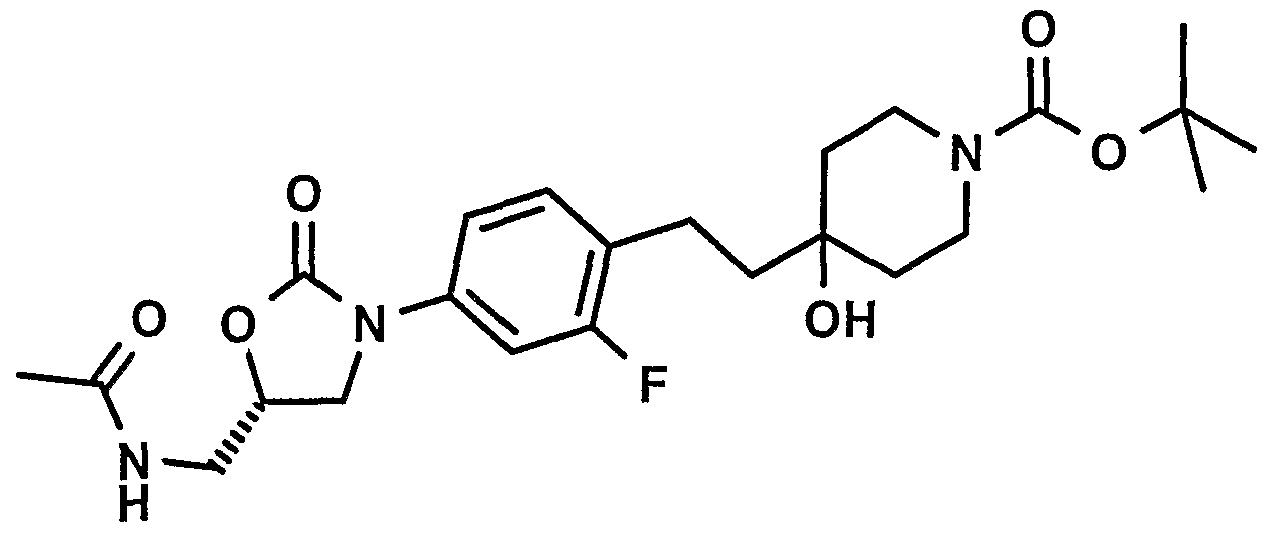
  • Example 23 Formation of building blocks via triple bond reduction 4- (2- ⁇ 4- [5S- (acetylamino-methyl) -2-oxo-oxazolidin-3-yl] -2- fluoro-phenyl ⁇ -ethyl) -4-hydroxy-piperidine-l-carboxylic acid tert butyl ester
  • Example 24 7- (4- ⁇ 4- [5S- (acetylamino-methyl) -2-oxo- oxazolidin-3-yl] -2 -fluoro-phenylethynyl ⁇ -4 -hydrox - piperidin-1-yl) -1-cyclopropyl-6-fluoro-4-oxo-1 , 4 -dihydro- quinoline-3 -carboxylic acid
  • Example 26 7- [4- (3- ⁇ 4- [5S- (acetylamino-methyl) -2-oxo- oxazolidin-3-yl] -2-fluoro-phenyl ⁇ -acryloyl) -piperazin-1-yl] -1-cyclopropyl-6-fluoro-4-oxo-1,4-dihydro-quinoline-3- carboxylic acid
  • Example 27 7- [4- (3- ⁇ 4- [5S- (acetylamino-methyl) -2-oxo- oxazolidin-3-yl] -2-fluoro-phenyl ⁇ -acryloyl) -piperazin-1-yl] -1-cyclopropyl-6-fluoro-4-oxo-l, 4-dihydro- [1,8]- napthyridine-3 -carboxylic acid
  • Example 28 7- [4- (3- ⁇ 4- [5S- (acetylamino-methyl) -2-oxo- oxazolidin-3-yl] -2-fluoro-phenoxy ⁇ -2-hydroxy-propionyl) -1- cyclopropyl-6-fluoro-4-oxo-1, 4-dihydro-quinoline-3- carboxylic acid
  • Example 29 7- [4- (3- ⁇ 4- [5S- (acetylamino-methyl) -2-oxo- oxazolidin-3-yl] -2-fluoro-phenoxy ⁇ -2-hydroxy-propionyl) -1- cyclopropyl-6-fluoro-4-oxo-1, 4-dihydro- [1,8] -napthyridine 3-carboxylic acid
  • the resulting amine was then coupled to the required quinoline using the method described in example 1 - step 7 This gave the required product in 4 % yield over two steps
  • Example 30 7- [4- (2- ⁇ 4- [5S- (acetylamino-methyl) -2-oxo- oxazolidin-3-yl] -2-fluoro-phenoxy ⁇ -acetyl) -piperazin-1-yi; l-cyclopropyl-6-fluoro-4-oxo-1, 4 -dihydro-quinoline-3- carboxylic acid
  • Example 32 7- [4 - (2- ⁇ 4- [5S- (acetylamino-methyl) -2 -oxo- oxazolidin-3 -yl] -2 -f luoro-phenyl ⁇ -ethyl) -4 -hydroxy- piperidin- 1 -yl ] - 1 -cyclopropyl - 6 - f luoro-4 -oxo- 1 , 4 -dihydro- quinoline- 3 -carboxylic acid

Landscapes

  • Chemical & Material Sciences (AREA)
  • Organic Chemistry (AREA)
  • Health & Medical Sciences (AREA)
  • General Health & Medical Sciences (AREA)
  • Life Sciences & Earth Sciences (AREA)
  • Molecular Biology (AREA)
  • Biochemistry (AREA)
  • Veterinary Medicine (AREA)
  • General Chemical & Material Sciences (AREA)
  • Pharmacology & Pharmacy (AREA)
  • Chemical Kinetics & Catalysis (AREA)
  • Animal Behavior & Ethology (AREA)
  • Nuclear Medicine, Radiotherapy & Molecular Imaging (AREA)
  • Public Health (AREA)
  • Medicinal Chemistry (AREA)
  • Oncology (AREA)
  • Communicable Diseases (AREA)
  • Engineering & Computer Science (AREA)
  • Bioinformatics & Cheminformatics (AREA)
  • Pharmaceuticals Containing Other Organic And Inorganic Compounds (AREA)
  • Nitrogen And Oxygen Or Sulfur-Condensed Heterocyclic Ring Systems (AREA)
  • Agricultural Chemicals And Associated Chemicals (AREA)
  • Nitrogen Condensed Heterocyclic Rings (AREA)
  • Plural Heterocyclic Compounds (AREA)
  • Heterocyclic Carbon Compounds Containing A Hetero Ring Having Nitrogen And Oxygen As The Only Ring Hetero Atoms (AREA)

Abstract

The present invention relates to compounds of the Formula (I) that are useful antimicrobial agents and effective against a variety of multi-drug resistant bacteria:

Description

Oxazolidinone-guinolone hybrid antibiotics
The present invention describes new compounds in which the pharmacophores of quinolone and oxazolidinone are linked together through a linker that is stable under physiological conditions and a pharmaceutical antibacterial composition containing these compounds. These dual action compounds are useful antimicrobial agents effective against a variety of human and veterinary pathogens including Gram positive aerobic bacteria such as multiply-resistant staphylococci, streptococci and enterococci as well as Gram negative bacteria such as Moraxella catarrhalis and Haemophilus influenzae and anaerobic organisms such as bacteroides spp. and Clostridia spp . species and acid-fast organism such as Mycobacterium tuberculosis, Mycobacterium avium spp .
Oxazolidinone-quinolone hybrid antibiotics have already been described ( O02059116, O03002560, WO03031443, WO03032962) . The major drawback of the compounds known in the state of the art is the poor water solubility, which makes the development of a formulation difficult .
The present invention provides new compounds of formula (I) , that are useful antimicrobial agents and effective against a variety of multi-drug resistant bacteria
Figure imgf000002_0001
wherein
A is an alkylene group, an alkenylene group, an alkynylene group, a heteroalkylene group, a cycloalkylene group, a heterocycloalkylene group, an arylene group or a heteroarylene group all of which groups may be substituted;
Q is CR4 or N (especially CR4) ;
X is CR' or N;
Y is CR6 or N;
n is 1, 2 or 3;
m is 1, 2 or 3;
R1 is H, F, CI, Br, I, OH, NH2, an alkyl group or a heteroalkyl group;
R2 is H, F or Cl ;
R3 is H, an alkyl group, an alkenyl group, an alkynyl group, a heteroalkyl group, a cycloalkyl group, a heterocycloalkyl group, an aryl group, a heteroaryl group, an alkylaryl group or a heteroarylalkyl group; all of which groups may be substituted with one, two or more halogen atoms like F or Cl or amino groups.
R4 is hydroxy, a group of formula OP03R9 2 or OS03R10 or a heteroalkyl group carrying at least one OH, NH2, S03R10, P03R9 2 or COOH group or an ester of a naturally occurring amino acid or a derivative thereof, wherein the groups R9 independently of each other are H, alkyl, cycloalkyl, aryl or aralkyl and wherein R10 is H, alkyl, cycloalkyl, aryl or aralkyl;
R5 is selected from following groups:
Figure imgf000004_0001
R6 is H, F , Cl or OMe ;
R7 is H, F, Cl, OH, NH2, a substituted or unsubstituted alkyl group or a substituted or unsubstituted heteroalkyl group, or R3 and R7 can be linked via an alkylene, an alkenylene or a heteroalkylene group or be a part of a cycloalkylene or heterocycloalkylene group; in case R3 is no H and R7 is no H, F, OH, NH2 or Cl ; and R8 is a Cι-6 heteroalkyl, a heteroarylalkyl, a hetero- alkylaryl or a heteroalkylheteroaryl group; or a pharmacologically acceptable salt, solvate, hydrate or formulation thereof.
It should be appreciated that certain compounds of formula (I) or (II) as mentioned in this description may have tautomeric forms from which only one might be specifically mentioned or depicted in this description, different geometrical isomers (which are usually denoted as cis/trans isomers or more generally as (E) and (Z) isomers) or different optical isomers as a result of one or more chiral carbon atoms (which are usually nomenclatured under the Cahn-Ingold-Prelog or R/S system) . Further, some compounds may display polymorphism. All these tautomeric forms, geometrical or optical isomers (as well as racemates and diastereomers) and polymorphous forms are included in the invention.
The term alkyl refers to a saturated straight or branched chain alkyl group, preferably containing from one to ten, preferably one to six carbon atoms, for example methyl, ethyl, propyl, isopropyl, butyl, iso-butyl, sec- butyl, tert-butyl, n-pentyl , iso-pentyl, n-hexyl, 2,2- dimethylbutyl , n-octyl or n-pentyl groups. Any alkyl group as defined herein may be substituted with one, two or more substituents, for example F, Cl , Br, I, H2, OH, SH or N02.
The terms alkenyl and alkynyl refer to an unsaturated straight or branched chain alkyl group (having one, two or more double and/or triple bonds, an alkenyl preferably having one or two double bonds and an alkynyl preferably having one or two triple bonds) , preferably containing two to ten, preferably two to six carbon atoms for example: ethenyl (vinyl), propenyl (allyl) , iso-propenyl , n- pentenyl, butenyl, isoprenyl or hexa-2-enyl; ethynyl, propynyl or butynyl groups . Any alkenyl or alkynyl group as defined herein may be substituted with one, two or more substituents, for example F, Cl, Br, I, NH2, OH, SH or N02. The term heteroalkyl refers to an alkyl, alkenyl or alkynyl group as defined herein where one or more carbon atoms are replaced by an oxygen, nitrogen, phosphorous or sulphur atom, for example an alkoxy group such as methoxy, ethoxy, propoxy, iso-propoxy, butoxy or tert . -butoxy, an alkoxyalkyl group such as methoxymethyl , ethoxymethyl , 1- methoxyethyl, 1-ethoxyethyl, 2-methoxyethyl or 2- ethoxyethyl, an alkylamino group such as methylamino, ethylamino, propylamino, isopropylamino, dimethylamino or diethylamino, an alkylthio group such as methylthio, ethylthio or isopropylthio or a cyano group. It may also refer to one of the above groups containing a keto group. The term heteroalkyl furthermore refers to a group derived from a carboxylic acid or carboxylic acid amide such as acetyl, propionyl, acetyloxy, propionyloxy, acetylamino or propionylamino, a carboxyalkyl group such as carboxymethyl , carboxyethyl or carboxypropyl, a carboxyalkyl ester, an alkylthiocarboxyamino group, an alkoxyimino group, an alkylaminothiocarboxyamino group or an alkoxycarbonylamino group. Any heteroalkyl group as defined herein may be substituted with one, two or more substituents, for example F, Cl, Br, I, NH2, OH, SH or N02.
The term cycloalkyl refers to a saturated or partially unsaturated (having one, two or more double and/or triple bonds) cyclic group with one, two or more rings, having three to 14 carbon ring-atoms, preferably from five or six to ten carbon ring-atoms, for example cyclopropyl, cyclobutyl, cyclopentyl, cyclohexyl, tetralin, cyclopentenyl or cyclohex-2-enyl groups. Any cycloalkyl group as defined herein may be substituted with one, two or more substituents, for example F, Cl, Br, I, OH, NH2, SH, N3, N02, alkyl groups such as methyl or ethyl, heteroalkyl groups such as methoxy, methylamino, dimethylamino or cyanide .
The term heterocycloalkyl refers to a cycloalkyl group as defined herein where one, two or more carbon ring-atoms are replaced by one, two or more oxygen, nitrogen, phosphorous or sulphur atoms or S {0)1-2 groups for example piperidino, morpholino or piperazino groups. The term aryl refers to an aromatic cyclic group with one, two or more rings, having five to 14 carbon ring-atoms preferably from five or six to ten carbon ring-atoms, for example phenyl or naphthyl groups . Any aryl group as defined herein may be substituted with one, two or more substituents, for example F, Cl, Br, I, OH, NH2, SH, N3, N02, alkyl groups such as methyl or ethyl, heteroalkyl groups such as methoxy, methylamino, dimethylamino or cyanide . The term heteroaryl refers to an aryl group as defined herein where one, two or more ring-carbon atoms are replaced by an oxygen, nitrogen, boron, phosphorous or sulphur atom, for example pyridyl, imidazolyl, pyrazolyl, quinolinyl, isoquinolinyl, pyrrolyl, oxazolyl, isoxazolyl, thiazolyl, isothiazolyl, 1, 2 , 3-triazolyl , 1, 2 , 4-triazolyl , oxadiazolyl, thiadiazolyl, indolyl, indazolyl, tetrazolyl, pyrazinyl, pyrimidinyl and pyridazinyl groups.
The term aralkyl (or arylalkyl or alkylaryl) refers to groups that comprise both aryl as well as alkyl and/or cycloalkyl groups . The term h teroarylalkyl (or heteroalkylaryl or heteroalkylheteroaryl etc . ) refers to an aralkyl group as defined herein where one, two, three or more carbon atoms are replaced by one, two, three or more oxygen, nitrogen, phosphorous or sulphur atoms or S(0)ι-2 groups.
Any alkyl, alkenyl, alkynyl, heteroalkyl, cycloalkyl, heterocycloalkyl, aryl, heteroaryl, aralkyl or heteroaryl- alkyl groups as defined herein may be substituted with one or more halogen atoms, NH2, SH, N02 or OH groups or unsubstituted alkyl, heteroalkyl, aryl, aralkyl, aralkyl- oxy, heteroaryl, cycloalkyl or heterocycloalkyl groups as defined herein. The term "optionally substituted" or "substituted" refer to groups wherein one or more hydrogen atoms may be replaced by a halogen atom, a NH2, SH, N02 or OH group or by an unsubstituted alkyl, heteroalkyl, aryl, aralkyl, aralkyloxy, heteroaryl, cycloalkyl or heterocycloalkyl group as defined herein.
Preferred and/or advantageous embodiments of the invention are subject-matter of the subclaims. Preferred are compounds of Formula (I) , wherein R1 is H.
Further preferred are compounds of Formula (I) , wherein R2 is F or H.
Moreover preferred are compounds of Formula (I) , wherein R3 is an ethyl, a 2 -propyl, a C3-C6 cycloalkyl (i.e, cyclopropyl, cyclobutyl, cyclopentyl or cyclohexyl) , a phenyl or a pyridyl group. All these groups may be substituted with one, two, three or more fluorine atoms or amino groups . Moreover preferred are compounds of Formula (I) , wherein R3 is a cyclopropyl group.
Further preferred are compounds of Formula (I) , wherein R7 and R3 together form a bridge of the formula -O- CH-N(Me)- or -0-CH2-CH (Me) - . Herein, the preferred stereochemistry at the chiral center is the one giving the (S) configuration in the final compound.
Moreover preferred are compounds of formula (I) , wherein R4 is hydroxy or a group of formula OS03H, OP03H2, OCH2OP03H2, OCOCH2CH2COOH or an ester of a naturally occurring amino acid or a derivative thereof (i.e. a group of formula -OCOCHR^NH2 or a derivative like an ester, amide or alkylamine thereof, wherein R' is the side chain of a naturally occurring amino acid like aspartic acid, glutaric acid, lysine, etc; e.g. dimethyl aminoglycine 0C0CH2N(CH3)2) .
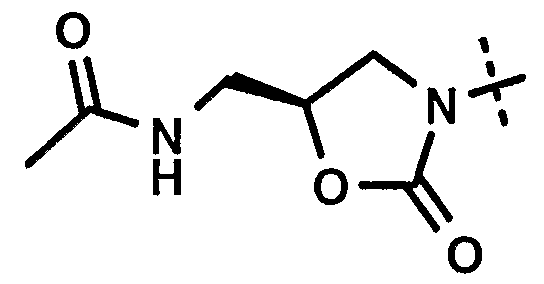
Further preferred are compounds of Formula (I) , wherein R8 is a group of the formula -CH2NHCOCH=CHAryl , -CHOHeteroaryl (especially -oxa-3-oxazol) , -CH2NHS02Me, -CH2NHCOOMe, -CH2NHC0Me, -CH2NHCS2Me, -CH2NHCSMe, -CH2NHCSNH2 , -CH2NHCSOMe or -NHCOMe; especially -CH2NHCSMe or -CH2NHCOMe. Especially preferred are compounds of Formula (I) , wherein R5 has the following structure:
Figure imgf000010_0001
Moreover preferred are compounds of Formula (I) , wherein R7 is H, F, Cl or a methoxy group that may be substituted by one, two or three fluorine atoms.
Further preferred are compounds of formula (I) , wherein X is N or CH. Moreover preferred are compounds of Formula (I) , wherein Y is CH or N.
Further preferred are compounds of Formula (I) , wherein A is Cι_6 alkylene, C2-6 alkenylene, C2-6 alkynylene, Cι-6 heteroalkylene, cyclopropylene, epoxide, aziridine, thioepoxide, lactame or lactone, all of which groups may be subsitituted.
Moreover preferred are compounds of formula (I) , wherein A is a group of Formula -0-B-, wherein B is a Cι_4 alkylene group, a C2-4 alkenylene group, a C2-4 alkynylene group or a Cι_4 heteroalkylene group, all of which groups may be substituted by one, two or more hydroxy or amino groups. Especially preferred are compounds of formula (I) , wherein A is a group of formula -CH2CH2-, -0CH2-, -0CH2CH2-, -SCH2-, -SCH2CH2-, -CH=CH-, -G≡C-, -CH (OH) CH (OH) - or - CH(NH2)CH(0H) -. Especially preferred are compounds of formula (I) , wherein B is CH2 or CH2CH2.
Especially preferred are compounds of formula (II)
Figure imgf000011_0001
wherein the residues are defined as above. In a preferred embodiment B is CH2 or CH2CH2; X is CH, N or C-OMe and R3 is cyclopropyl or X is CR7 and R7 and R3 together form a bridge of the formula -0-CH2-CH (Me) - , wherein the preferred stereochemistry at the chiral center is the one giving the (S) configuration in the final compound, n is 1, 2 or 3, is 1, 2 or 3 and R4 is hydroxy or a group of formula OS03H, 0P03H2, 0CH20P03H2, 0C0CH2CH2C00H or an ester of a naturally occurring amino acid or a derivative thereof .
Moreover preferred are the mono, di or tri sodium salts (most preferred the mono sodium salts) of compounds of formula (I) or (II) or mixtures thereof. Especially preferred are the mono, di or tri sodium salts (most preferred the mono sodium salts) of compounds of formula (I) or (II) , wherein R4 is OP03H2 or OS03H or mixtures thereof.
Especially preferred is the sodium salt of a compound of formula (II) wherein R3 is a cyclopropyl group, X is CH or N, n is 2, in is 2, R4 is OP03H2 and B is CH2. The present invention also relates to pharmacologically acceptable salts, or solvates and hydrates, respectively, and to compositions and formulations of compounds of Formula (I) or (II) . The present invention describes procedures to produce pharmaceutically useful agents, which contain these compounds, as well as the use of these compounds for the production of pharmaceutically useful agents.
The pharmaceutical compositions according to the present invention contain at least one compound of Formula (I) or (II) as the active agent and optionally carriers and/or diluents and/or adjuvants. Optionally the pharmaceutical compositions according to the present invention may also contain additional known antibiotics.
Examples of pharmacologically acceptable salts of sufficiently basic compounds of Formula (I) or (II) are salts of physiologically acceptable mineral acids like hydrochloric, hydrobromic, sulfuric and phosphoric acid; or salts of organic acids like methanesulfonic, p- toluenesulfonic, lactic, acetic, trifluoroacetic, citric, succinic, fumaric, maleic and salicylic acid. Further, a sufficiently acidic compound of Formula (I) or (II) may form alkali or earth alkaline metal salts, for example sodium, potassium, lithium, calcium or magnesium salts; ammonium salts; or organic base salts, for example methylamine, dimethylamine, trimethylamine, triethylamine, ethylenediamine, ethanolamine, choline hydroxide, meglumin, piperidine, morpholine, tris- (2-hydroxyethyl) amine, lysine or arginine salts. Compounds of Formula (I) or (II) may be solvated, especially hydrated. The hydratisation can occur during the process of production or as a consequence of the hygroscopic nature of the initially water free compounds of Formula (I) or (II) . The compounds of Formula (I) or (II) may contain asymmetric C-atoms and may be present either as achiral compounds, mixtures of diastereomers, mixtures of enantiomers or as optically pure compounds.
The present invention also relates to pro-drugs which are composed of a compound of Formula (I) or (II) and at least one pharmacologically acceptable protective group which will be cleaved off under physiological conditions, such as an alkoxy- , aralkyloxy-, acyl-, S03H, P03H2, acyloxymethyl group (e.g. pivaloyloxymethyl) , an 2-alkyl-, 2-aryl- or 2-aralkyl-oxycarbonyl-2-alkylidene ethyl group or an acyloxy group as defined herein, e.g. ethoxy, benzyloxy, acetyl or acetyloxy. Especially preferred are prodrugs of the hydroxy group of a compound of formula (I) or (II) wherein R4 is OH. As mentioned above, therapeutically useful agents that contain compounds of Formula (I) or (II) , their solvates, salts or formulations are also comprised in the scope of the present invention. In general, compounds of Formula (I) or (II) will be administered by using the known and acceptable modes known in the art, either alone or in combination with any other therapeutic agent. Such therapeutically useful agents can be administered by one of the following routes: oral, e.g. as tablets, dragees, coated tablets, pills, semisolids, soft or hard capsules, for example soft and hard gelatine capsules, aqueous or oily solutions, emulsions, suspensions or syrups, parenteral including intravenous, intramuscular and subcutaneous injection, e.g. as an injectable solution or suspension, rectal as suppositories, by inhalation or insufflation, e.g. as a powder formulation, as icrocrystals or as a spray (e.g. liquid aerosol) , trans- dermal, for example via an transder al delivery system (TDS) such as a plaster containing the active ingredient or intranasal. For the production of such tablets, pills, semisolids, coated tablets, dragees and hard, e.g. gelatine, capsules the therapeutically useful product may be mixed with pharmaceutically inert, inorganic or organic excipients as are e.g. lactose, sucrose, glucose, gelatin, malt, silica gel, starch or derivatives thereof, talc, stearinic acid or their salts, dried skim milk, and the like. For the production of soft capsules one may use excipients as are e.g. vegetable, petroleum, animal or synthetic oils, wax, fat, polyols. For the production of liquid solutions, emulsions or suspensions or syrups one may use as excipients e.g. water, alcohols, aqueous saline, aqueous dextrose, polyols, glycerin, lipids, phospholipids, cyclodextrins, vegetable, petroleum, animal or synthetic oils. Especially preferred are lipids and more preferred are phospholipids (preferred of natural origin; especially preferred with a particle size between 300 to 350 nm) preferred in phosphate buffered saline (pH = 7 to 8, preferred 7.4) . For suppositories one may use excipients as are e.g. vegetable, petroleum, animal or synthetic oils, wax, fat and polyols. For aerosol formulations one may use compressed gases suitable for this purpose, as are e.g. oxygen, nitrogen and carbon dioxide. The pharmaceutically useful agents may also contain additives for conservation, stabilisation, e.g. UV stabilizers, emulsifiers, sweetener, aromatisers, salts to change the osmotic pressure, buffers, coating additives and antioxidants . A daily dosage per patient of about l g to about 4000mg especially about 50mg to 3 g is usual with those of ordinary skill in the art appreciating that the dosage will depend also upon the age, conditions of the mammals, and the kind of diseases being treated or prevented. The daily dosage can be administrated in a single dose or can be divided over several doses . An average single dose of about 50mg, lOOmg, 250mg, 500mg, lOOOmg and 2000mg can be contemplated .
The compounds of formula (I) and (II) can be synthesized according to the following reaction scheme:
Figure imgf000015_0001
reaction conditions: step 1: CH2C12, KOH (50%), 3h, rt ; 97%. step 2: H2, Pt/C, 20h, rt; followed by Z-Cl (Cbz-Cl), acetone/water, NaHC03, 12h, rt, 98%. step 3: n-BuLi, -60°C, 24h, 80%. step 4: MsCI, triethylamine, CH2C12; 100%. step 5: NaN3 in DMF,
90 °C, cat. Bu4NI, 5h, 90%. step 6: H2, Pd(OH)2, THF, MeOH, 24h, followed by AcOH, Ac20, rt , 2h, 70%. step 7: DMF, NaH, 70°C, 12h, 75%. step 8: H2, Pd(OH)2, MeOH, THF, 24h, RT, 100%. step 9: N-Methylpyrrolidinone, l-Cyclopropyl-7- chloro-6-fluoro-1,4-dihydro-4-oxo-1,8-naphthydrin-3 - carboxylic acid (commercially available), TMS-Cl, Hύnig Base or K2C03, 80°C, 5h, 80%.
Examples
Example 1 : 7- (4- {4- [ (5S) -5- (Acetylamino-methyl) -2-oxo- oxazolidin-3-yl] -2-fluoro-phenoxymethyl} -4-hydroxy- piperidin-1-yl) -1-cyclopropyl-6-fluoro-4 -oxo-1,4-dihydro- [1,8] naphthyridine-3 -carboxylic acid
Figure imgf000017_0001
Step 1: (4-Benzyloxy-3-fluoro-phenyl) -carbamic acid benzyl ester:
A solution of 34.9g l-benzyloxy-2-fluoro-4-nitro-benzene (WO03064413) (M :247.28, 141mmol) and 340mg platinium 5% on activated carbon in 350ml ethyl acetate was stirred under hydrogen at rt and normal pressure. The reaction was monitored by HPLC and was complete after twenty hours. The catalyst was filtered over a glass fiber filter, and the filtrate evaporated under reduced pressure to dryness. The oily residue was dissolved in 500ml acetone and treated with 250ml of a saturated solution of sodium bicarbonate and 17.5g of sodium bicarbonate (MW: 84.01, 208mmol) . The mixture was cooled to 5°C and treated drop wise with 26.08g of benzyl chloroformate (MW:170.59, 152mmol) . The reaction was allowed to stirred at room temperature for two hours and monitored by TLC (hexane/ethyl acetate 3:1) . The acetone was evaporated, the residue diluted with 500ml water, and the solid filtered off. The crystals were washed with 500ml water and dried. Yield: 48.05g, 95.8%. MS: 352.5 (M+H)+, 350.8, (M-H)". Method ESI+, ESI". Step 2 : (5R) -3- ( -benzyloxy-3-fluoro-phenyl) -5-hydroxy- methyl-oxazolidin-2-one :
A stirred solution of 17.5g (4-benzyloxy-3-fluoro-phenyl) - carbamic acid benzyl ester (MW: 351.38, 50mmol) in 30ml of dry tetrahydrofuran was cooled to -78°C with a dry ice/acetone bath. 22.8ml of a 2.3M n-butyl-lithium solution in n-hexane (52.5mmol) was added drop wise and the reaction mixture stirred at - 78 °C for 15 min. 7.92g R (-) -glycidyl butyrate (MW: 144.17, 60mmol) were added and the reaction was allowed to warm up to room temperature. The reaction was monitored by HPLC, quenched with a saturated ammonium chloride solution and diluted with 100ml of ethyl acetate. The organic layer was washed with 200ml water and 200ml brine. The organic layer was dried over magnesium sulfate, filtered and the filtrate evaporated under reduced pressure. The residue was crystallized from 200ml of a l/l- ethyl acetate/hexane mixture. The solid was collected and recrystallized from 150ml of a 9/1 ethyl acetate/dichloro- methane mixture. The colorless crystals were collected and dried. Yield: 10.4-g, 65.5%. MS: 318.1 (M+H)+. Method ESI+.
Step 3: (5S) -5-azidσmethyl-3- (4-benzyloxy-3-fluorophenyl) -oxazolidin-2-one: A solution of lOg (5R) -3- (4-benzyloxy-3-fluoro-phenyl) -5- hydroxymethyl-oxazolidin-2-one (MW: 317.32, 31.51mmol) and 4.78g triethylamine (MW: 101.19, 47.26mmol) in 300ml dichloromethane was treated under stirring at 10°C with 4.32g of methane sulfonyl chloride (MW: 114.55, 37.82mmol). The reaction was stirred at room temperature for one hour and monitored by TLC (ethyl acetate: hexane 1:1) . The reaction mixture was quenched with 100ml water and the organic layer washed with 100ml brine. The organic layer was dried over magnesium sulfate, filtered and the filtrate evaporated under reduced pressure. The residue was dissolved in 100ml dimethylformamide, 5.12g sodium azide (MW: 65.01, 78.7mmol) and a catalytic amount of tetrabutyl ammonium iodide were added. The suspension was stirred at 90 °C over night. The reaction was monitored by HPLC. The dimethylformamide was evaporated under reduced pressure, the residue dissolved in 200ml dichloromethane and the organic layer washed successively with 100ml water and 100ml brine. The dichloromethane solution was dried over magnesium sulfate, filtered, and the filtrate evaporated under reduced pressure. The residue was crystallized from 150ml of a l/l mixture of ethyl acetate: hexane. The crystals were collected to afford an off white solid. Yield: 10.4-g, 97%. MS: 343.1 (M+H) +" . Method: ESI+.
Step 4: N- [ (5S) -{3- (3 -fluoro-4-hydroxy-phenyl) }-2-oxo- oxazolidin-5-ylmethyl] -acetamide :
A suspension of 10.4g (5S) -5-azidomethyl-3- (4-benzyloxy-3- fluorophenyl ) oxazolidin-2 -one (MW: 342.33, 30.38mmol) and
1.5g of palladium 10% on activated carbon in 400ml of a 1:1 methanol : ethyl acetate mixture was stirred at room temperature under hydrogen for two days . The catalyst was filtered off using a glass fibre filter paper and the filtrate evaporated under reduced pressure. The residue was dissolved in 100ml of acetic acid, and treated with 3.72g of acetic anhydride (MW: 102.09, 36.45mmol). The solvent was evaporated under reduced pressure and the residue crystallized from a 1:1 ethyl acetate: hexane mixture to afford an off white solid. Yield: 6.76-g, 83%. MS: 269.4 (M+H)\ 267.3, (M-H)". Method ESI+, ESI". Step 5: 4- {4- [ (5S) -5- (Acetylamino-methyl) -2-oxo-oxazolidin- 3-yl] -2 -fluoro-phenoxymethyl } -4-hydroxy-piperidine-1- carboxylic acid benzylester: A suspension of 22.72g l-oxa-6-aza-spiro [2.5] octane-6- carboxylic acid benzyl ester (WO9803507) (MW: 247.29, 92mmol) , 21.45g N- [ (5S) - {3- (3-fluoro-4-hydroxy-phenyl) } -2- oxo-oxazolidin-5-ylmethyl] -acetamide (MW: 268.246, 80mmol) and 16.58g potassium carbonate (MW: 138.20, 120mmol) in 150ml dimethylformamide was stirred at 100°C for 7 hours. The reaction was monitored by TLC (dichloromethane / methanol 9:1). The dimethylformamide was evaporated under reduced pressure and the residue was dissolved in 600ml of a 9:1 dichloromethane /methanol mixture. The organic layer was washed with 400ml water and 400ml brine. The organic layer was dried over magnesium sulfate, filtered, and the filtrate diluted with 250ml ethyl acetate. The mixture was concentrated under reduced pressure to a final volume of 400ml. The slurry was stirred at room temperature over night. The crystals were filtered and washed successively with 150ml ethyl acetate and 100ml pentane. Yield: 31.65 g, 76.7%. MS: 516.8 (M+H)+, Method ESI+.
Step 6: N- [ { (5S) -3 [3-fluoro-4- (4-hydroxy-piperidin-4-yl- methoxy) -phenyl] -2-oxo-oxazolidin-5-ylmethyl}] -acetamide : A suspension of 31g 4- {4- [ (5S) -5- (acetylamino-methyl) -2- oxo-oxazolidin-3-yl] -2-fluorophenoxymethyl} -4 -hydroxy- piperidine-1-carboxylic acid benzylester (MW: 515,54 60.13mmol) and 2.5 g of palladium 10% on activated carbon in 310ml methanol and 150ml ethyl acetate was stirred under hydrogen for 4 hrs . The reaction was monitored by TLC
(ethyl acetate) . The reaction slurry was diluted with 300ml methanol, warmed to 40 °C, and the catalyst filtered off using a glass fibre filter paper. The filtrate was concentrated to 150ml, diluted with 300ml ethyl acetate and concentrated again to 200ml. 200ml of diethyl ether were added, and the suspension was cooled to 0°C under stirring. The solid was collected and dried. Yield: 21.6-g, 94.3%. MS: 382.6 (M+H)+, Method ESI+.
Step7 : 7- (4-{ [ (5S) -5- (Acetylamino-methyl) -2-oxo-oxazolidin- 3-yl] -2-fluoro-phenoxymethyl} -4-hydroxy-piperidin-l-yl) -1- cyclopropyl-6-fluoro-4-oxo-1, 4 -dihydro- [1,8] naphthyridine- 3 -carboxylic acid:
A suspension of 71mg 7-chloro-l-cyclopropyl-6-fluoro-1, 4- dihydro-4-oxo- [1, 8] naphthyridine-3 -carboxylic acid (MW: 282.66, 0.25mmol ), 95mg N- [ { (5S) -3 [3-fluoro-4- (4-hydroxy- piperidin-4-ylmethoxy) -phenyl] -2-oxo-oxazolidin-5- ylmethyl}] -acetamide (MW: 381.40, 0.25mmol) 102mg triethylamine (MW: 101.19, 1. Ommol ) and 81mg trimethylchlorsilan (MW: 108.64, 0.75mmol) in 1ml N-methyl- pyrrolidin-2-one was heated at 80°C under stirring for 5 hours. The reaction was monitored by TLC (dichloromethane: methanol 9:1). The N-methyl -pyrrolidin-2 -one was evaporated, the residue dissolved in 20ml of a 9:1 dichloromethane : methanol mixture, and the solution washed sequentially with 10ml of 0.1 N aqueous hydrochloric acid and 20ml brine. The organic layer was dried over magnesium sulfate, filtered and the filtrate evaporated. The residue was dissolved in 10ml of a 9:1 dichloromethane: methanol mixture and diluted with 20ml ethyl acetate. The precipitated solid was collected to afford an off white solid. A second crop is obtained by concentration under reduced pressure of the mother liquor. Yield: lOOmg, 64%. MS: 628.8 (M+H)+, 626.8. (M-H) " Method ESI+, ESI" Example 2 : 7 - (4 - { 4 - [ ( 5S ) - 5 - (Acetylamino-methyl ) -2 -oxo- oxazolidin-3 -yl] -2 - fluoro-phenoxymethyl } -4 -phosphonooxy- piperidin- 1 -yl ) - 1 -cyclopropyl - 6 - f luoro-4 -oxo- 1 , 4 -dihydro- [1 , 8 ] naphthyridine- 3 - carboxylic acid
Figure imgf000022_0001
Step 1: 7- [4- {4- [ (5S) -5- (Acetylamino-methyl) -2-oxo- oxazolidin-3-yl] -2-fluoro-phenoxymethyl} -4- (bis-benzyloxy- phosphoryloxy) -piperidin-1-yl] -1-cyclopropyl-6-fluoro-4- oxo-1, 4-dihydro- [1, 8] naphthyridine -3-carboxylic acid:
A suspension of 125mg 7- (4- {[ (5S) -5- (acetylamino-methyl) -2- oxo-oxazolidin-3-yl] -2-fluoro-phenoxymethyl} -4-hydroxy- piperidin-1-yl) -l-cyclopropyl-6-fluoro-4-oxo-l , 4-dihydro- [1, 8]naphthyridine-3-carboxylic acid (MW: 627.60, 0.2mmol) and 42mg tetrazole (MW:70.05, O.δmmol) in 1ml dichloromethane was treated with 138mg of dibenzyl N,N- diisopropylphosphoramidite (MW: 345.42, 0.4mmol). The original suspension slowly cleared. The solution was stirred at room temperature for two hours and monitored by TLC. (dichloromethane/methanol 9:1) . The reaction mixture was cooled to 0°C and treated with a 0.6ml of a 0.5M m- chloroperbenzoic acid solution in dichloromethane. The mixture was stirred for two hours at room temperature and diluted with 20ml dichloromethane. The organic layer was washed successively with 20ml of a saturated aqueous sodium bicarbonate solution and 20ml of brine and dried over magnesium sulfate. The slurry was filtered and the filtrate evaporated under reduced pressure. The residue was purified by chromatography over silica using a 9/1 dichloro- methane/methanol mixture as eluent to afford an off white solid. Yield: 158mg, 89%.MS: 889.3 (M+H)+, 887.0 (M-H) " Method ESI+, ESI". Step 2: 7- (4- {4- [ (5S) - (5-Acetylamino-methyl) -2-oxo- oxazolidin-3-yl] -2-fluoro-phenoxymethyl} -4-phosphonooxy- piperidin-1-yl) -l-cyclopropyl-6-fluoro-4-oxo-1, 4-dihydro- [1, 8] naphthyridine -3-carboxylic acid: A suspension of 158mg 7- [4- {4- [ (5S) -5- (Acetylamino-methyl) - 2-oxo-oxazolidin-3-yl] -2-fluoro-phenoxymethyl} -4- (bis- benzyloxy-phosphoryloxy) -piperidin-1-yl] -1-cyclopropyl-6- fluoro-4-oxo-l, 4-dihydro- [1, 8] naphthyridine -3-carboxylic acid (MW: 887.84, 0.177mmol) and 20mg of palladium hydroxide 20% on activated carbon in 20ml of a 6/3/1 dichloromethane/methanol/ water mixture was stirred at room temperature under hydrogen for three hours . The catalyst was filtered off using a glass fibre filter paper. The solvents were evaporated under reduced pressure and the residue dissolved in 10ml methanol. The solution was diluted with 20ml water while a white solid precipitated. The solid was collected and dried. Yield: 85mg, 68%. MS: 709.0 (M+H)+, 706.5 (M-H) " Method ESI\ ESI".
Example 3 : 7- [4- {4- [ (5S) -5- (Acetylamino-methyl) -2-oxo- oxazolidin-3-yl] -2-fluoro-phenoxymethyl} -4- (2, 6-diamino- hexanoyloxy) -piperidin-1-yl] -1-cyclopropyl-6-fluoro-4-oxo- 1, -dihydro- [1, 8] naphthyridine-3 -carboxylic acid
Figure imgf000024_0001
Step 1: 4- {4- [ (5S) - (5-Acetylamino-methyl) -2-oxo-oxazolidin- 3-yl] -2-fluoro-phenoxymethyl} -4-hydroxy-piperidine-1- carboxylic acid tert-butyl ester:
In analogy of example 1 step 5 by reacting 3.83g l-oxa-6- aza-spiro [2.5] octane-6-carboxylic acid tert-butyl ester (WO0204462) (MW: 213.28 lβmmol) , 4.02g N- [ (5S) - {3- (3- fluoro-4-hydroxy-phenyl) } -2-oxo-oxazolidin-5-ylmethyl] - acetamide (MW: 268.246, 15mmol) and 3. lg potassium carbonate (MW: 138.20, 22.5mmol) in 30ml dimethylformamide . Yield: 4.89-g, 67%. MS: 482.6 (M+H)+, Method ESI+.
Step 2: 4- {4- [ (5S) -5- (Acetylamino-methyl) -2-oxo-oxazolidin- 3-yl] -2-fluoro-phenoxymethyl} -4- (2 , 6-bis- benzyloxycarbonylamino-hexanoyloxy) -piperidine-1-carboxylic acid tert-butyl ester:
A suspension of 96mg of 4- {4- [5- (5S) - (acetylamino-methyl) - 2-oxo-oxazolidin-3-yl] -2-fluoro-phenoxymethyl } -4-hydroxy- piperidine-1-carboxylic acid tert-butyl ester (MW: 481.52, 0.2mmol), 195mg of Z-Lys (Z) -OH (MW: 414.46, 0.4mmol) and 49mg of 4-dimethylaminopyridine (MW: 122.17, 0.4mmol) in 2ml dichloromethane was treated under stirring at room temperature with 115mg N- (3-dimethylaminopropyl) -N" -ethyl- carbodiimid hydrochloride (MW: 191.70, 0.6mmol). The reaction mixture was stirred over night. The mixture was diluted with 20ml ethyl acetate and the organic layer washed successively with 10ml 1 N aqueous hydrochloric acid, 20ml water and 20ml brine. The organic layer was dried over magnesium sulfate, filtered and the filtrate evaporated to dryness . The residue was purified by chromatography on silica, using a 9/1 dichloromethane/ methanol mixture as eluent to leave a colorless sticky oil. Yield: 150mg, 88%. MS: 878.8 (M+H)+, Method ESI+. Step 3: 2 , 6-Bis-benzyloxycarbonylamino-hexanoic acid 4-{4- [ (5S) -5- (acetylamino-methyl) -2-oxo-oxazolidin-3-yl] -2- fluoro-phenoxymethyl} -piperidin-4-yl ester hydrochloride : 200mg of 4- {4- [5- (5S) - (acetylamino-methyl) -2-oxo- oxazolidin-3-yl] -2-fluoro-phenoxymethyl} -4- (2 , 6-bis- benzyloxycarbonylamino-hexanoyloxy) -piperidine-1-carboxylic acid tert-butyl ester (MW: 977.97, 0.22mmol) were dissolved in 4ml of a 1.25M dry hydrochloric acid in methanol. The reaction was stirred at 40°C for two hours, and the solvent removed by distillation under reduced pressure to leave a off white solid. Yield: 178mg, quantitative. MS: 778.8 (M+H)+, Method ESI+.
Step 4: 7- [4- {4- [ (5S) -5- (Acetylamino-methyl) -2-oxo- oxazolidin-3-yl] -2-fluoro-phenoxymethyl} -4- (2, 6-bis- benzyloxycarbonylamino-hexanoyloxy) -piperidin-1-yl] -1- cyclopropyl-6-fluoro-4-oxo-l, 4-dihydro- [1, 8] naphthyridine- 3-carboxylic acid:
In analogy to example 1 step 7, with 62mg 7-chloro-l- cyclopropyl-6-fluoro-1,4-dihydro- -oxo- [1,8] naphthyridine- 3-carboxylic acid (MW:282.66, 0.25mmol), 178mg 2,6-bis- benzyloxycarbonylamino-hexanoic acid 4- {4- [5- (5S) - (acetylamino-methyl) -2-oxo-oxazolidin-3-yl] -2 -fluoro-phenoxymethyl} -piperidin-4-yl ester hydrochloride (MW: 814.31, 0.22mmol), 90mg triethylamine (MW: 101.19, 0.88mmol ) and 48mg trimethylchlorsilan (MW: 108.64, 0.44mmol) in 1ml N- methyl-pyrrolidin-2-one. Yield: 94mg, 42%. MS: 1025.3 (M+H)+, Method ESI+.
Step 5: 7- [4- {4- [ (5S) -5- (Acetylamino-methyl) -2-oxo- oxazolidin-3-yl] -2-fluoro-phenoxymethyl} -4- (2 , 6-diamino- hexanoyloxy) -piperidin-1-yl] -1-cyclopropyl- 6-fluoro-4-oxo- 1, 4-dihydro- [1, 8] naphthyridine-3-carboxylic acid: A suspension of 94mg 7- [4- {4- [ (5S) -5- (acetylamino-methyl) - 2-oxo-oxazolidin-3-yl] -2-fluoro-phenoxymethyl} -4- (2,6-bis- benzyloxycarbonylamino-hexanoyloxy) -piperidin-1-yl] -1- cyclopropyl-6-fluoro-4-oxo-l, 4-dihydro- [1,8] naphthyridine- 3-carboxylic acid (MW: 1024.05, 0.091mmol) and 20mg of palladium hydroxide 20% on activated carbon in 20ml of a
6/3/1 dichloromethane/methanol/water mixture was stirred at room temperature under hydrogen for four hours . The catalyst was filtered off using a glass fibre filter paper. The solvents were evaporated under reduced pressure and the residue dissolved in 10ml methanol. The solution was diluted with 20ml water while a white solid precipitated. The solid was collected and dried. Yield: 29mg, 43%. MS: 757.0 (M+H)+, 755.2 Method ESI+, ESI".
Example 4 : Succinic acid mono- [4- {4- [ (5S) -5- (acetylamino- methyl) -2-oxo-oxazolidin-3-yl] -2-fluoro-phenoxymethyl} -1- (6-carboxy-8-cyclopropyl-3-fluoro-5-oxo-5 , 8-dihydro- [1, 8] naphthyridin-2-yl) -piperidin-4-yl] ester
Figure imgf000027_0001
Step 1: Succinic acid 4- {4- [ (5S) -5- (acetylamino-methyl) -2- oxo-oxazolidin-3-yl] -2-fluoro-phenoxymethyl} -1-tert-butoxy- carbonyl-piperidin-4-yl ester benzyl ester:
In analogy of example 3 step 2 with 825mg 4- {4- [ (5S) -5- (acetylamino-methyl) -2-oxo-oxazolidin-3-yl] -2-fluoro- phenoxymethyl} -4 -hydroxy-piperidine-1 -carboxylic acid tert- butyl ester (MW: 481.52, 1.71mmol), 1.07g of succinic acid monobenzyl ester (MW: 208.21, 5.14mmol) and 0.63g of 4- dimethylaminopyridine (MW: 122.17, 5.1mmol) in 10ml dichloromethane was treated under stirring at room temperature with 1.3g N- (3-dimethylaminopropyl) -N'-ethyl- carbodiimid HC1 (MW: 191.70, 6.8mmol). Yield: 820mg, 70%. MS: 673.3 (M+H)+, Method ESI+.
Step 2: Succinic acid 4- {4- [ (5S) -5- (acetylamino-methyl) -2- oxo-oxazolidin-3-yl] -2-fluoro-phenoxymethyl} -piperidin-4-yl ester benzyl ester: 820mg of succinic acid 4- {4- [ (5S) -5- (acetylamino-methyl) -2- oxo-oxazolidin-3-yl] -2-fluoro-phenoxymethyl} -1-tert-butoxy- carbonyl-piperidin-4-yl ester benzyl ester (MW: 671.72, 1.23mmol) were dissolved in 4ml of trifluoro acetic acid. The reaction mixture was stirred at room temperature for one hour. The solvent was evaporated, the residue dissolved in 30ml of a 9/1 dichloromethane/methanol mixture and the organic layer washed successively with 30ml of a saturated aqueous sodium bicarbonate solution and 30ml of brine. The organic layer was dried over magnesium sulfate, filtered and the filtrate evaporated under reduced pressure. The residue was purified by chromatography over silica, using a 95/5 dichloromethane/ methanol mixture with 2% triethylamine as eluent . Yield: 420mg, 60%. MS: 572.7 (M+H)+, Method ESI+. Step 3: Succinic acid 4- {4- [ (5S) -5- (acetylamino-methyl) -2- oxo-oxazolidin-3-yl] -2-fluoro-phenoxymethyl} -1- (6-carboxy- 8-cyclopropyl-3-fluoro-5-oxo-5, 8-dihydro- [1, 8] naphthyridin- 2-yl) -piperidin-4-yl ester benzyl ester: In analogy to example 1 step 7, with 113mg 7-chloro-l- cyclopropyl-6-fluoro-l,4-dihydro-4-oxo- [1, 8] naphthyridine- 3-carboxylic acid (MW:282.66, 0.4mmol ), 230mg succinic acid 4- {4- [ (5S) -5- (acetylamino-methyl) -2-oxo-oxazolidin-3- yl] -2-fluoro-phenoxymethyl} -piperidin-4-yl ester benzyl ester (MW: 571.60, 0.4mmol), 161mg triethylamine (MW: 101.19, 1.6mmol ) and 87mg trimethylchlorsilan (MW: 108.64, O.δmmol) in 2ml N-methyl-pyrrolidin-2-one. Yield: 25mg, 7.6%. MS: 819 (M+H)+, 817.8, Method ESI+, ESI".
Step 4: Succinic acid mono- [4- {4- [ (5S) -5- (acetylamino- methyl) -2-oxo-oxazolidin-3-yl] -2-fluoro-phenoxymethyl} -1- (6-carboxy-8 -cyclopropyl-3 -fluoro-5 -oxo-5,8-dihydro- [1, 8] naphthyridin-2-yl) -piperidin-4-yl] ester: In analogy to example 3 step 5 with 22mg succinic acid 4- {4- [ (5S) -5- (acetylamino-methyl) -2-oxo-oxazolidin-3-yl] -2- fluoro-phenoxymethyl} -1- (6-carboxy-8-cyclopropyl-3-fluoro- 5-OXO-5, 8-dihydro- [1, 8] naphthyridin-2-yl) -piperidin-4-yl ester benzyl ester (MW: 817.80, 0.026mmol) and 2mg of palladium hydroxide 20% on activated carbon in 20ml of a 1/1 tetrahydrofuran/ methanol mixture. Yield: 16mg, 81%. MS: 729 (M+H)+, 727 (M+H)", Method ESI+, ESI".
Example 5 : 7- (4- {4- [ (5S) -5- (Acetylamino-methyl) -2-oxo- oxazolidin-3-yl] -2-fluoro-phenoxymethyl} -4-hydroxy- piperidin-1-yl) -1-cyclopropyl-6-fluoro-4-oxo-1 , 4-dihydro- quinoline-3-carboxylic acid
Figure imgf000029_0001
A solution of 60g N- [ { (5S) -3 [3-fluoro-4- (4-hydroxy- piperidin-4-ylmethoxy) -phenyl] -2-oxo-oxazolidin-5- ylmethyl}] -acetamide. (Cι8H24FN3θ5, MW: 381.40 0.157 mole) and 26.87ml of ethyl diisopropylamine (MW: 129.25, 0.157 mole) in 300ml N-methyl-pyrrolidin-2-one was treated with 67.81g (7-chloro-1-cyclopropyl -6-fluoro-1, 4 -dihydro-4-oxo- 3-quinolinecarboxylic acid-boron diacetate complex (MW:410.57, 0.165 mole) and the mixture was stirred at 80°C for 5 hours. The N-methyl-pyrrolidin-2-one was evaporated under reduced pressure and residue was dissolved in 300ml of methanol. Anhydrous hydrogen chloride was bubbled through the solution at 10 °C for 30 minutes. The solution was stirred at room temperature while a yellow solid precipitated. The conversion of the boron complex to the free acid was monitored by HPLC. The mixture was diluted with 300ml ethyl acetate. The solid was filtered and washed with 100ml of 8/2 ethyl acetate/methanol and 100ml of ethyl acetate. The yellow solid was dried to leave 86.4 g of a yellow solid. The solid was dissolved in 200ml dimethylsulfoxyde at 40 °C, and the yellow solution was added under stirring to 1000ml water. The yellow solid was collected, washed with water and dried. Yield: 73g, 74.5%. MS: 627.8 (M+H)+, 625.8 (M+H)", Method ESI+, ESI".
Example 6 : 7- [4- {4- [ (5S) -5- (Acetylamino-methyl) -2-oxo- oxazolidin-3-yl] -2-fluoro-phenoxymethyl} -4- (bis-benzyloxy- phosphoryloxy) -piperidin-1-yl] -1-cyclopropyl-6-fluoro-4 - oxo-1 , 4 -dihydro-quinoline-3 -carboxylic acid
Figure imgf000030_0001
A suspension of 35g 7- (4- {4- [ (5S) -5- (acetylamino-methyl) -2- oxo-oxazolidin-3-yl] -2 -fluoro-phenoxymethyl } -4-hydroxy- piperidin-1-yl) - 1-cyclopropyl-6-fluoro-4-oxo-1,4-dihydro- quinoline-3 -carboxylic acid (MW: 626.61, 55.85mmol) and 6,45g tetrazole (MW: 70.05, 92.15mmol) in 700ml dichloromethane was treated at room temperature under stirring with a solution of 31.8g dibenzyldiisopropylphosphoramidit (MW: 345.42, 92.15mmol) in 20ml dichloromethane. The reaction was monitored by TLC (dichloromethane/methanol 9:1). The reaction was stirred for one hour and the mixture was washed at 0°C with 200ml IN aqueous hydrochloric acid and 100ml of a saturated sodium bicarbonate solution. The water layer were backwashed with 200ml dichloromethane. The combined organic layer were concentrated to 500ml and treated at roomtemperature with 13,2ml of a 70 % ter-butyl hydroperoxid solution in water (MW:90.12, 95mmol) . The reaction was stirred for 30 min, diluted with 500ml dichloromethane and the organic layer washed with 200ml IN aqueous hydrochloric acid and with 300ml brine. The organic layer was dried over magnesium sulfate, filtered and the filtrate evaporated under reduced pressure. The residue was dissolved in 400ml dichloromethane and diluted with 400ml N-hexane. The mixture was concentrated (300-mbar, 40 °C bath temperature) to a volume of 400ml. The sticky oil was decanted and dissolved in 400ml of refluxing methanol. The solution was concentrated to 300ml under reduced pressure and stirred over night at RT. The slurry was cooled to 0°C and the solid collected. Yield: 27.60g, 55.6%. MS: 888.3 (M+H)+, 885.8 (M+H)", Method ESI+, ESI".
Example 7 : 7- (4- {4- [ (5S) -5- (Acetylamino-methyl) -2-oxo- oxazolidin-3 -yl] -2-fluoro-phenoxymethyl } -4 -phosphonooxy- piperidin-1-yl) -l-cyclopropyl-6-fluoro-4-oxo-l, 4-dihydro- quinoline-3 -carboxylic acid
Figure imgf000031_0001
27g 7- [4- {4- [ (5S) -5- (acetylamino-methyl) -2-oxo-oxazolidin- 3-yl] -2-fluoro-phenoxymethyl} -4- (bis-benzyloxy- phosphoryloxy) -piperidin-1-yl] -1-cyclopropyl -6-fluoro-4- oxo-1, 4-dihydro-quinoline-3 -carboxylic acid (MW: 886.85, 30.44mmol) were suspended in 600ml acetonitrile and treated with 53ml of a 33% solution of anhydrous hydrobromic acid in acetic acid. The yellow suspension was diluted with 150ml of acetic acid and was heated to 45 °C. The reaction was monitored by HPLC/MS and was complete after 3 hours . The sticky suspension was added to 1.5 L of water under stirring. The off white crystals were collected, washed with 300ml water, 150ml ethanol and 150ml ether. The solid was suspended in 1.3L water and treated with 35ml (35mmol) of a 1M aqueous sodium hydroxide solution. The solid dissolved, and the brown-yellow solution was treated with 15 g of activated charcoal and filtered. The filtrate was extracted with 3 portions of 200ml of a 95/5 dichloromethane/ methanol mixture. The water layer was treated with 40ml of 1 M HCl solution and the product crystallized by stirring. The solid was collected and dried. Yield: 17.3-g, 80.4 %. MS: 609.7 (M+H)+, 607.8 (M+H) , Method ESI+, ESI".
Example 8 : 7- (4- {4- [ (5S) -5- (Acetylamino-methyl) -2-oxo- oxazolidin-3-yl] -2-fluoro-phenoxymethyl} -4-hydroxy- piperidin-1-yl) -1-cyclopropyl-6-fluoro-8-methoxy-4-oxo-l , 4- dihydro-quinoline-3-carboxylic acid
Figure imgf000032_0001
In analogy to example 5 with 114mg N- [{ (5S) -3 [3-fluoro-4- (4-hydroxy-piperidin-4-ylmethoxy) -phenyl] -2-oxo-oxazolidin- 5-ylmethyl}] -acetamide. (MW: 381.40 0.3mmol), 127mg of 1- cyclopropyl-6,7-difluoro-1,4-dihydro-8-methoxy-4 -oxo-3 - quinolinecarboxylic acid diacetylborate (Sakurai, Nobuhiro; Sano, Mitsuharu; Hirayama, Fumihiro; Kuroda, Tsuyoshi; Uemori, Satoru; Bioorg.Med. Chem. Lett . ; 8; 16; 1998; 2185- 2190) (MW: 423.137, 0.3mmol) and 38mg of ethyl diisopropylamine (MW: 129.25, 0.3mmol) in 1ml N-methyl - pyrrolidin-2-one. Yield: 137mg, 69.5 %. MS: 658.2 (M+H)+, 655.8 (M+H)", Method ESI+, ESI".
Example 9 : 7- (4- {4- [ (5S) -5- (Acetylamino-methyl) -2-oxo- oxazolidin-3-yl] -2-fluoro-phenoxymethyl} -4-hydroxy- piperidin-1-yl) -1-cyclopropyl-8-methoxy-4-oxo-1 , 4-dihydro- quinoline-3 -carboxylic acid O
Figure imgf000033_0001
In analogy to example 5 with 114mg N- [{ (5S) -3 [3-fluoro-4- (4-hydroxy-piperidin-4-ylmethoxy) -phenyl] -2-oxo-oxazolidin- 5-yl-methyl}] -acetamide. (MW: 381.40 0.3mmol), 121mg of 1- cyclopropyl-8-methoxy-4 -oxo-1,4-dihydroquinoline-3 - carboxylatoboron diacetate (WO03032962) (MW: 405.15,
0.3mmol) and 77mg of ethyl diisopropylamine (MW: 129.25, 0.6mmol) in 2ml N-methyl-pyrrolidin-2 -one. Yield: 117mg, 61.2 %. MS: 639.8 (M+H)+, 637.5 (M+H)", Method ESI+, ESI".
Example 10 : 9- (4- {4- [ (5S) -5- (Acetylamino-methyl) -2-oxo- oxazolidin-3 -yl] -2-fluoro-phenoxymethyl } -4-hydroxy- piperidin-1-yl) -8-fluoro-3 -methyl-6-oxo-2, 3 -dihydro-6H-1- oxa-3a-aza-phenalene-5-carboxylic acid
Figure imgf000033_0002
A solution of 140mg of 9-10-difluoro-2 , 3-dihydro-3-methyl- 7-oxo-7H-pyrido [1,2, 3-de] -1, 4-benzoxazine-6-carboxilic acid (MW: 281.22, 0.5mmol), 191mg of N- [ { (5S) -3 [3-fluoro-4- (4- hydroxy-piperidin-4-ylmethoxy) -phenyl] -2-oxo-oxazolidin-5- yl-methyl}] -acetamide (MW: 381.40, 0.5mmol), and 129mg of ethyl diisopropylamine (MW: 129.25, lmmol) was stirred at 80°C in 1ml of N-methyl-pyrrolidin-2-one for 24 hours. The solvent was evaporated under reduced pressure. The residue was dissolved in methanol and treated with 10ml of a 1.2 M anhydrous hydrogen chloride solution in methanol . The methanol was evaporated and the residue digested in ethyl acetate. The solid was collected and crystallized twice from a dichloromethane/ethanol mixture. Yield: 88mg, 27 %. MS: 643.7 (M+H)+, 641.5 (M+H)", Method ESI+, ESI".
Example 11: 7- (3- {4- [ (5S) -5- (Acetylamino-methyl) -2-oxo- oxazolidin-3-yl] -2-fluoro-phenoxymethyl} -3-hydroxy- pyrrolidin-1-yl) -1-cyclopropyl-6-fluoro- -oxo-1, 4-dihydro- [1, 8] naphthyridine-3 -carboxylic acid
Figure imgf000034_0001
Step 1: l-0xa-5-aza-spiro[2.4] heptane-5-carboxylic acid benzyl ester: A solution 3-methylen-pyrrolidine-l-carboxylic acid benzyl ester (W09624593) in 5ml of dichloromethane was treated with 2.16g sodium bicarbonate (MW: 84.01 26.28mmol) and 2.47g of 80% m-chlor-perbenzoic acid (MW: 172.57, 11.48mmol) .The reaction mixture was stirred at room temperature for three hours. The reaction mixture was diluted with 20ml of a saturated aqueous sodium sulfite solution and 45ml of dichloromethane. The organic layer was successively washed with 30ml of an aqueous saturated sodium bicarbonate solution and brine. The organic layer was dried over magnesium sulfate. The residue was purified by chromatography on silica (l/l ethyl acetate/n-hexane) to afford a off white solid. Yield: 440mg, 57 %. MS: 234.1(M+H)+, Method ESI+.
Step 2: 3- {4- [ (5S) -5- (Acetylamino-methyl) -2-oxo-oxazolidin- 3 -yl] -2 -fluoro-phenoxymethyl } -3-hydroxy-pyrrolidine- 1- carboxylic acid benzyl ester: A solution of 420mg of N- [ (5S) - {3- (3-fluoro-4-hydroxy- phenyl) }-2-oxo-oxazolidin-5-ylmethyl] -acetamide (MW:
268.246, 1.56mmol) in 2ml dimethylformamide was treated with 83mg sodium hydride. The suspension was stirred for one hour at room temperature. A solution of 440mg l-oxa-5- aza-spiro [2.4] heptane-5-carboxylic acid benzyl ester (MW: 233.26, 1.88mmol) in 1ml DMF was added and the mixture was stirred at 70°C for three hours. The dimethylformamide was evaporated under reduced pressure and the residue was purified by chromatography over silica (95/5 dichloromethane/methanol mixture with 1% ammonia) to afford an off white powder. Yield: 630mg, 80 %. MS: 502.5 (M+H) +, Method ESI+.
Step 3: N-{ (5S) -3- [3-Fluoro-4- (3-hydroxy-pyrrolidin-3-yl- methoxy) -phenyl] -2-oxo-oxazolidin-5-ylmethyl} -acetamide: A suspension of 660mg 3- {4- [ (5S) -5- (acetylamino-methyl) -2- oxo-oxazolidin-3-yl] -2-fluoro-phenoxymethyl} -3-hydroxy- pyrrolidine-1-carboxylic acid benzyl ester (MW: 501.51, 1.31mmol) and 20mg palladium 10% on activated carbon in 20ml of a 1/1 ethyl acetate / methanol mixture was stirred for twelve hours under hydrogen. The catalyst was filtered on a glass fiber filter paper and the filtrate evaporated under reduced pressure to afford a colorless oil. Yield: 400mg, 83.2 %. MS: 368.4 (M+H)+, Method ESI+.
Step 4: 7- (3- {4- [ (5S) -5- (Acetylamino-methyl) -2-oxo- oxazolidin-3 -yl] -2 -fluoro-phenoxymethyl } -3 -hydroxy- pyrrolidin-1-yl) -l-cyclopropyl-6-fluoro-4 -oxo-1, 4 -dihydro- [1, 8] naphthyridine-3 -carboxylic acid: In analogy to example 1, step 7 with 39mg 7-chloro-l-cyclo- propyl-6-fluoro-1, 4-dihydro-4-oxo- [1,8] naphthyridine-3- carboxylic acid (MW: 282.66, 0.24mmol ), 99mg N- { (5S) -3- [3- fluoro-4- (3-hydroxy-pyrrolidin-3-ylmethoxy) -phenyl] -2-oxo- oxazolidin-5-ylmethyl} -acetamide. (MW: 367.38, 0.24mmol) lOlmg triethylamine (MW: 101.19, l.Ommol) and 80mg trimethylchlorsilan (MW: 108.64, 0.75mmol) in 2ml N-methyl- pyrrolidin-2-one. Yield: 70mg, 46 % . -MS : 614.7(M+H)+, 612.7 (M+H)", Method ESI+, ESI".
Example 12 : 7- (3- {4- [ (5S) -5- (Acetylamino-methyl) -2-oxo- oxazolidin-3 -yl] -2 -fluoro-phenoxymethyl } -3 -hydroxy- pyrrolidin-1-yl) -1-eyelopropyl-6-fluoro-4-oxo-1,4-dihydro- quinoline-3 -carboxylic acid
Figure imgf000036_0001
In analogy to example 5 with 106mg N- { (5S) -3- [3-fluoro-4- (3-hydroxypyrrolidin-3-ylmethoxy) -phenyl] -2-oxo-oxazolidin- 5-ylmethyl} -acetamide. (MW: 367.38, 0.29mmol) 119mg (7- chloro-1-cyclopropyl-6-fluoro-1, 4-dihydro-4-oxo-3 - quinolinecarboxylic acid-boron diacetate complex (MW:410.57, 0.29mmol) and 75mg of ethyl diisopropylamine (MW: 129.25, 0.58mmol) in 2ml N-methyl-pyrrolidin-2 -one . Yield: 19mg, 11 %.MS: 613.5 (M+H)+, 611.5 (M+H)", Method ESI+, ESI".
Example 13 : 7- (3- {4- [ (5S) -5- (Acetylamino-methyl) -2-oxo- oxazolidin-3 -yl] -2-fluoro-phenoxymethyl} -3 -hydroxy- pyrrolidin-1-yl) -l-cyclopropyl-6-fluoro-8-methoxy-4-oxo- 1 , 4-dihydro-quinoline-3 -carboxylic acid
Figure imgf000037_0001
In analogy to example 5 with 143mg N- { (5S) -3- [3-fluoro-4- (3-hydroxy-pyrrolidin-3-ylmethoxy) -phenyl] -2-oxo- oxazolidin-5-ylmethyl } -acetamide (MW: 367.38, 0.39mmol), 165mg of 1-cyclopropyl-6 , 7-difluoro-1, 4 -dihydro- 8 -methox - 4 -oxo-3 -quinolinecarboxylic acid diacetylborate (MW: 423.137, 0.39mmol) and lOOmg of ethyl diisopropylamine (MW: 129.25, 0.78mmol) in 2ml N-methyl-pyrrolidin-2 -one. Yield: 143mg, 57 %. MS: 643.7 (M+H)+, 641.7 (M+H)", Method ESI+, ESI".
Example 14 : 7- (3- {4- [ (5S) -5- (Acetylamino-methyl) -2-oxo- oxazolidin-3-yl] -2-fluoro-phenoxymethyl} -3-hydroxy- pyrrolidin-1-yl) -1-cyclopropyl-8-methoxy-4 -oxo-1,4-dihydro- quinoline-3 -carboxylic acid
Figure imgf000038_0001
In analogy to example 5 with 48mg N- { (5S) -3- [3-fluoro-4- (3- hydroxy-pyrrolidin-3-ylmethoxy) -phenyl] -2-oxo-oxazolidin-5- ylmethyl} -acetamide (MW: 367.38, 0.13mmol), 53mg of 1- cyclopropyl-8-methoxy-4 -oxo-1,4-dihydroquinoline-3- carboxylatoboron diacetate (MW: 405.15, 0.13mmol) and 33mg of ethyl diisopropylamine (MW: 129.25, 0.26mmol) in 1ml N- ethyl-pyrrolidin-2 -one. Yield: 41mg, 50 %. MS: 625.8 (M+H)+, 623.8 (M+H)", Method ESI+, ESI".
Example 15 : 9- (3- {4- [ (5S) -5- (Acetylamino-methyl) -2-oxo- oxazolidin-3-yl] -2-fluoro-phenoxymethyl} -3-hydroxy- pyrrolidin-1-yl) -8-fluoro-3 -methyl -6-oxo-2 , 3 -dihydro-6H-1- oxa-3a-aza-phenalene-5-carboxylic acid
Figure imgf000038_0002
In analogy to example 10 with llOmg of 9-10-difluoro-2 , 3 - dihydro-3 -methyl-7-oxo-7H-pyrido [1, 2, 3 -de] -1, 4-benzoxazine- 6-carboxilic acid (MW: 281.22, 0.39mmol), 143mg of N-{(5S)- 3- [3-fluoro-4- (3-hydroxy-pyrrolidin-3-ylmethoxy) -phenyl] -2- oxo-oxazolidin-5-ylmethyl} -acetamide. (MW: 367.38, 0.39mmol), and lOOmg of ethyl diisopropylamine (MW: 129.25, 0.78mmol) in 2ml of N-methyl-pyrrolidin-2-one. Yield: 103mg, 42 %.MS: 629.8 (M+H)+, Method ESI+.
Example 16: 7- (4- {4- [ (5S) -5- (Acetylamino-methyl) -2-oxo- oxazolidin-3-yl] -2-fluoro-phenoxymethyl } -4 -hydroxy-azepan- 1-yl) -1-cyclopropyl-6-fluoro-4 -oxo-1,4-dihydro-quinoline-3 - carboxylic acid
Figure imgf000039_0001
Step 1: 4-Methylene-azepane-l-carboxylic acid tert-butyl ester:
A solution of Ig methyltriphenylphosphoniumbromide (MW: 357.22, 2.79mmol) in 20ml of tetrahydrofuran was treated at -78 °C with 1.22ml of a 2.3 M n-butyl lithium solution in N- hexane (2.8mmol) . The reaction mixture was stirred at -78°C for ten minutes, then at 0°C for one hour. The yellow suspension was cooled to -78 °C and treated with a solution of 595mg 4-oxo-azepane-l-carboxylic acid tert-butyl ester (WO 2000044376) (MW: 213.279, 2.78mmol) in 10ml tetrahydrofuran. The reaction mixture was stirred at room temperature for one and half hour. The reaction mixture was quenched with 30ml of a saturated aqueous solution of ammonium chloride, diluted with 30ml of ethyl acetate. The organic layer was successively washed with 30ml water and 30ml brine, dried over magnesium sulfate and filtered. The filtrate was evaporated under reduced pressure and the residue purified by chromatography over silica, (cyclohexane: ethyl acetate 1:1). Yield: 487mg, 83%. NMR (CDC13) : 1.35 ppm (s, 9 H, tert-but.); 1.6 ppm (m, 2H, -CH2- ), 2.14 ppm (m, 2H) , 2.33 ppm (m, 2H) ; 3.29 ppm (m, 4H, N- CH2) ; 4.67 ppm (m, 2H, vinyl-CH2) .
Step 2: l-Oxa-6-aza-spiro [2.6] nonane-6-carboxylic acid tert-butyl ester: In analogy to example 11 step 1 with 4-methylene-azepane-l- carboxylic acid tert-butyl ester (MW:211.307, 1.73mmol), 1.16g sodium bicarbonate (MW: 84.01 13.8mmol) and 1.36g of 80% m-chloroperbenzoic acid (MW172.57, 6.05mmol) in 5ml of dichloromethane. Yield: 250mg, 63 %. MS: 228.8 (M+H)+, 127.8 (M- (CH3)3COCO) method ESI+.
Step 3: 4- {4- [ (5S) -5- (Acetylamino-methyl) -2-oxo-oxazolidin- 3-yl] -2-fluoro-phenoxymethyl} -4-hydroxy-azepane-l- carboxylic acid tert-butyl ester:
In analogy to example 1 step 5 with 247mg of l-oxa-6-aza- spiro [2.6] nonane-6-carboxylic acid tert-butyl ester. (MW: 227.31 1.08mmol), 296mg N- [ (5S) - {3- (3-fluoro-4-hydroxy- phenyl) } -2-oxo-oxazolidin-5-ylmethyl] -acetamide (MW: 268.246, 80mmol) and 228mg potassium carbonate (MW: 138.20, 1.65mmol) in 150ml dimethylformamide . Yield: 334mg, 62 %. MS: 496.8 (M+H)+, 440.8 (M-C (CH3) 3+H) +, Method ESI+.
Step 4: N-{ (5S) -3- [3-Fluoro-4- (4-hydroxy-azepan-4- ylmethoxy) -phenyl] -2-oxo-oxazolidin-5-ylmethyl} -acetamide : A solution of 334mg 4- {4- [ (5S) -5- (acetylamino-methyl) -2- oxo-oxazolidin-3-yl] -2-fluoro-phenoxymethyl} -4 -hydroxy- azepane-1-carboxylic acid tert-butyl ester (MW:495.55, 0.674mmol) in 3ml of a 1.25 M anhydrous hydrogen chloride solution in methanol was stired at 35°C for four hours. The solvent was evaporated under reduced pressure. The residue was dissolved in 4ml water and the water layer neutralized to pH 7 with a saturated sodium bicarbonate solution. The water was evaporated and the residue dissolved in 30ml of a 9/1 dichloromethane/methanol mixture. The unsoluble salt were filtered and the filtrate evaporated to dryness to afford off white solid. Yield 266mg, quant. MS: 395.8 (M+H)+, 440.6 (M+HCOO") , Method ESI+, ESI".
Step 5: 7- (4- {4- [ (5S) -5- (Acetylamino-methyl) -2-oxo- oxazolidin-3 -yl] -2 -fluoro-phenoxymethyl } -4 -hydroxy-azepan- 1-y1) -1-eye1opropyl-6-fluoro-4 -oxo-1,4-dihydro-quino1ine-3 - carboxylic acid: In analogy to example 5 with 150mg N- { (5S) -3- [3-fluoro-4- ( -hydroxy-azepan-4-ylmethoxy) -phenyl] -2-oxo-oxazolidin-5- ylmethyl} -acetamide (MW: 395.43) and 98mg of ethyl diisopropylamine (MW: 129.25, 0.758mmol), 163mg (7-chloro- 1-cyclopropyl-6-fluoro-1, 4-dihydro-4-oxo-3- quinolinecarboxylic acid-boron diacetate complex (MW:410.57, 0.397mmol) in 2ml N-methyl-pyrrolidin-2-one . Yield: 70mg, 28.8 %. MS: 641.7 (M+H)+, method ESI+.
Example 17: 7- (4- {4- [ (5S) -5- (Acetylamino-methyl) -2-oxo- oxazolidin-3 -yl] -2-fluoro-phenoxymethyl} -4-hydroxy-azepan- 1-yl) -l-cyclopropyl-6-fluoro-4-oxo-l , 4-dihydro- [1, 8] naphthyridine-3 -carboxylic acid
Figure imgf000041_0001
In analogy to examplel step7 with 98mg 7-chloro-1 - cyclopropyl-6-fluoro-1, 4-dihydro-4 -oxo- [1,8] naphthyridine- 3-carboxylic acid (MW: 282.66, 0.348mmol ), 138mg N- { (5S) - 3- [3-fluoro-4- (4-hydroxy-azepan-4 -ylmethoxy) -phenyl] -2-oxo- oxazolidin-5-ylmethyl} -acetamide (MW: 395.43, 0.348mmol) 140mg triethylamine (MW 101.19, 1.39mmol) and 113mg trimethylchlorsilan (MW 108.64, 1.04mmol) in 1ml N-methyl- pyrrolidin-2 -one . Yield 150mg, 77 %. MS: 642.7 (M+H)+, 640.7 (M+H)", Method ESI+, ESI".
Example 18: sodium salt of 7- (4- {4- [ (5S) -5- (Acetylamino- methyl) -2-oxo-oxazolidin-3-yl] -2-fluoro-phenoxymethyl} -4 - phosphonooxy-piperidin-1-yl) -1-cyclopropyl -6-fluoro-4-oxo- 1,4-dihydro-quinoline-3-carboxylic acid
183 g of the compound of example 7 were dissolved in 400 mL dry DMSO at room temperature. Then the solution was treated with 60 g Fullers earth and filtered off. The remaining solid was washed with 50 mL dry DMSO. The combined filtrates were mixed with another 50 mL of dry DMSO and 2000 mL of dry acetone under nitrogen. To this solution a solution of 47.1 g sodium-2 -ethylhexanoate (97% in ethyl acetate, i.e. 250 mL) was added drop wise at room temperature. The resulting suspension was then stirred for 1 h, followed by the addition of 2750 mL ethyl acetate at room temperature. The resulting suspension was stirred for another hour and the resulting crystals were collected by filtration, washing the solid with ethyl acetate (10 x 500 ml) to remove the DMSO and then dried in vacuo. If there is still amounts of DMSO and/or ethyl acetate remaining, then the solid was slurred with acetone / water (99:1) for 24 h. The mixture was then filtered, washed with acetone / water (99:1) (2 x 500 ml) and then allowed to suck dry on the filter for 12 h. The solid was then dried in vacuo. Yield: 90%. Example 19: Formation of building blocks via a Sonogashira reaction - 4- {4- [5S- (acetylamino-methyl) -2-oxo-oxazolidin- 3-yl] -2-fluoro-phenylethynyl}-4-hydroxy-piperidine-l- carboxylic acid tert-butyl ester.
Figure imgf000043_0001
Step 1: (4-Bromo-3-Fluoro-phenyl) -carbamic acid benzyl ester.
Sodium hydrogen carbonate (27.63 g, 0,329 mol, l,25eq) and a saturated solution of sodium hydrogen carbonate (333 ml) were added to a stirred solution of 4-bromo-3-fluoroaniline (50.0 g, 0,263 mol, leq) in acetone (660 ml) . The resulting mixture was cooled to 15°C and benzyl chloroformate (39 ml, 0.276 mol, l,05eq) was added gradually, taking care that the reaction temperature did not exceed 22°C. The mixture was stirred over 90 mins at room temperature and the acetone was removed under vacuum. The aqueous layer was then extracted with ethyl acetate (3 x 150 ml) . The combined organic layers were then washed with a saturated sodium chloride solution, and dried over MgS04. After filtration, the solvent was removed, and n-hexane added. The mixture was stirred during 30min at room temperature, the crystals were filtrated and washed with hexane to give the first crop of solid. The filtrate was evaporated, and the solid mixed with heptane at 0°C and stirred during
30min. The product was again filtered, to give the second crop of solid. The two crops were then combined, to give the product (85, 3g, quantitative) as of solid.
Step 2: (5R) 3- (4-Bromo-3-Fluoro-phenyl) -5-hydroxymethyl oxazolidin-2-one Butyl lithium (2.3M in n-hexanes, 118,3 ml, 0,272 mol, l,06eq) was added at -30°C to anhydrous tert-butanol (25.0 g, 0,53 mol, 2,07eq) in anhydrous THF (170 ml), under nitrogen. The mixture was stirred for 30min at -30°C, and was then allowed to warm slowly to 0°C. After 30min at 0°C, the (4-bromo-3-fluoro-phenyl) -carbamic acid benzyl ester (83 g, 0,256 mol, leq) was added portionwise, keeping the temperature cold, and the mixture was stirred for an additional 30min at 0°C. To this ice cold mixture, R(-)- glycidyl butyrate (39.7 ml, 0,288 mol, l,12eq) were added and the mixture allowed to come gradually to room temperature. The mixture was extracted with saturated sodium chloride solution and the organic phase was dried over MgS0, filtrated and evaporated. The product was obtained after recrystallisation of the crude product with ethyl acetate, to give (64, lg , 86.4%) .
Step 3: Methanesulfonic acid 3- (4-Bromo-3-Fluoro-phenyl) -2- oxo-oxazolidin- (5R) -ylemthyl ester.
Methansulfonyl chloride (27.4 ml, 0,354 mol, 1.9 eq) was added to an ice-cold solution of the (5R) 3- (4-Bromo-3- Fluoro-phenyl) -5-hydroxymethyl oxazolidin-2-one (54.0 g, 0,186 mol, leq) and triethylamine (51.8 ml, 0,372 mol, 2eq) in anhydrous DCM (420 ml) at 0°C. The resulting solution was allowed to come to room temperature, and then stirred over 3 hours. The mixture was then washed with 10% sodium hydrogen carbonate solution giving a precipitate. The solid was filtered, The washed with DCM, and the filtrate and washings dried over MgS0. After filtering, the solvent was removed, and the resulting solid was slurried with diethyl ether. The solid was then filtered, washed with ice cold diethyl ether and dried to give the product (68,5 g, quantitative) .
Step 4: (5R) - Azidomethyl-3- (4 -Bromo-3-Fluoro-phenyl) oxazolidin-2-one A suspension of the Methanesulfonic acid 3- (4-Bromo-3- Fluoro-phenyl) -2-oxo-oxazolidin- (5R) -ylemthyl ester (68.5 g, 0.186 mol, leq), tetrabutyl ammonium iodide (0.686 g, 0.00186 mol, O.Oleq) and sodium azide (24.57g, 0.378 mol, 2.03eq) in anhydrous DMF (500 ml) was stirred 80°C under nitrogen over night. The reaction was cooled, the DMF evaporated and the residue dissolved in ethyl acetate, washed with water and saturated sodium chloride and dried over MgS04. After filtering, the filtrate was evaporated to give the product (58.6 g, quantitative) as a white solid.
Step 5: (5R) - Aminomethyl-3 - (4-Bromo-3-Fluoro-phenyl) oxazolidin-2-one .
A mixture of the (5R) - Azidomethyl-3- ( -Bromo-3 -Fluorophenyl) oxazolidin-2-one (10.5 g, 33.3 mmol,l eq) , triphenylphosphine (12.6 g, 48 mmol, 1.44 eq) and'' water (7.8 ml, 433 mmol, 13eq) in THF (180 ml) were stirred at 80 °C. Once the reaction was finished, it was cooled and then the solvents were removed under vacuum. The residue was purified by chromatography (ethyl acetate first to remove the triphenylphosphine derivatives and then with dichloromethane/methanol 9/1) to give the product (9.63 g, quantitative) as a white solid. Step 6: (5S) -N- [ (4-bromo-3-Fluoro-phenyl) -2-oxo-oxazolidin- 5-ylmethyl] -acetamide To the (5R) - Aminomethyl-3 - (4-Bromo-3-Fluoro-phenyl) oxazolidin-2-one (9.63 g , 33.3 mmol, leq) was added acetic acid (9 ml, 156 mmol, 4.68eq) and acetic anhydride (9 ml, 95.3 mmol, 2.86eq) . The suspension was stirred at room temperature for lh and then the solvent was removed under high vacuum, to give the product (11.03 g, quantitative) as a beige solid.
Step 7: 4-oxo-piperidine-l-carboxylic acid tert-butyl ester.
A solution of BOC20 (6.02 g, 27.6 mmol, 1.1 eq) in dioxane (25ml) was added to 4-Piperidone hydrochloride hydrate (3,9 g, 25.4 mmol, leq) in water/dioxane (50 ml, l/l) . The reaction was exothermic during the addition, and after the addition was finished the reaction was stirred for 4h at room temperature. The dioxane was evaporated and the resulting residue was extracted in ethyl acetate and then dried over MgS04. After filtering, the filtrate was evaporated down to give the product (5.06 g, quantitative) as a white solid
Step 8: 4-Hydroxy-4-trimethylsilanylethynyl piperidine-1- carboxylic acid tert-butyl ester. n-Butyl lithium (2.3M solution in n-hexanes, 16.0 ml, 36.8 mmol, 1. leq) was added to a solution of TMS-alkyne (6.03 ml, 42.4 mmol,1.26eq) in THF (124 ml) at - 78°C under nitrogen. The resulting mixture was stirred at -78 °C for a further 30min, and then a solution of 4-oxo-piperidine-l-carboxylic acid tert-butyl ester (6.7 g, 33.6 mmol, leq) in THF (30mL) was added at -78 °C. The reaction mixture was stirred 15 minutes at 78 °C, and then was allowed to warmed up gradually to room temperature. After 30 min, adding 10% sodium hydrogen sulfate quenched the reaction. The two phases were separated and the aqueous layer was back extracted with ethyl acetate. The combined organic layers were washed with brine and dried over magnesium sulfate.
After concentration, the pale yellow residue (7 g, 70%) was found pure enough to be carried on without further purification. Step 9: 4-Ethynyl-4-Hydroxy-piperidine-l-carboxylic acid tert-butyl ester.
A mixture of the 4-Hydroxy-4-trimethylsilanylethynyl piperidine-1- carboxylic acid tert-butyl ester (7 g, 23.5 mmol, leq) and potassium carbonate (1.0 g, 7.25 mmol, 0.3eq) in MeOH (30ml ) were stirred for 6 h at room temperature. After this time, the solvent was removed under reduced pressure and the residue suspended in diethyl ether. The suspension was washed with saturated ammonium chloride and water and dried over MgS04. After filtering, the filtrate was evaporated to give the product (4.5 g, 86%) as a white solid.
Step 10: 4-{4- [5S- (acetylamino-methyl) -2-oxo-oxazolidin-3- yl] -2-fluoro-phenylethynyl} -4-hydroxy-piperidine-1- carboxylic acid tert-butyl ester.
PdCl2(P(C6H5)3)2 (297 mg, 0.422 mmol, 0.1 eq) and 148mg of copper (I) iodide (160 mg, 0.78 mmol, 0.2 eq) were stirred at RT, under argon. Then the (5S) -N- [ (4-bromo-3-Fluorophenyl) -2-oxo-oxazolidin-5-ylmethyl] -acetamide (1.40 g, 4.22 mmol, 1 eq) , 4-Ethynyl-4-Hydroxy-piperidine-1- carboxylic acid tert-butyl ester (1.24 g, 5.5 mmol, 1.3 eq) in anhydrous DMF (20 ml) and diisopropylamine (10 ml) were added. The mixture was stirred at RT during 30min. As the reaction didn't start, the mixture was heated at 50°C during one night under stirring. Water and diethyl ether were added, the two layers separated, and the water layer was back extracted with diethyl ether. The combined organic extracts were then washed with saturated sodium chloride solution and dried over MgS04. After filtering, the filtrate was evaporated and the residue was purified by chromatography (first with ethyl acetate - in order to eliminate the triphenylphosphine residues and then with Dichloromethane/MeOH) to give the product (l,55g, 77%) as a gray solid
Example 20: Formation of building blocks via a Heck reaction - 4- (3- {4- [5S- (acetylamino-methyl) -2-oxo-oxazolidin-3-yl] -2- fluoro-phenyl} -acryloyl) -piperazine-1-carboxylic acid tert butyl ester.
Figure imgf000048_0001
Step 1: Piperazine-1-carboxylic acid tert butyl ester A solution of 24g of di-tert-butyl dicarbonate (24 g, O.llmol, leq) in 200ml dichloromethane (200ml) was added to a stirred solution of 20g piperazine (20 g, 0.23mol, 2eq) in dichloromethane (800ml) at RT. The mixture was stirred overnight at RT and the mixture was then filtered and the filtrate was evaporated. Diethylether was then added to the residue, and the mixture was filtered again, and to the filtrate n- heptane was added. The suspension was filtrated again and the filtrate was evaporated to give the product (19 g, 43,9%) as a white solid.
Step 2: 4-Acryloyl-piperazine-l-carboxylic acid tert butyl ester
Acryloylchlorid (0.8 ml, 9.8 mmol, leq) was added dropwise to a stirred ice-cold solution of piperazine 1-carboxylic acid tert butyl ester (2g, 9.8 mmol, leq) and triethylamine (1,4ml, 9.8 mmol, leq) in dichloromethane (50 mL) at 0°C. The mixture was then stirred and allowed to come to room temperature over 2 hours. 1M Hydrochloric acid solution (50 mL) was added to the mixture, and the two layers were separated. The organic phase was washed with saturated sodium hydrogen carbonate solution (2 x 50 ml) and saturated sodium chloride solution (50 ml) and dried over MgS04. After filtration, the solvent is evaporated. The residue was purified by chromatography (ethyl acetate/n- hexane l/l) to give the product (1.26g, 49%) as a white solid.
Step 3: 4- (3- {4- [5S- (acetylamino-methyl) -2-oxo-oxazolidin- 3-yl] -2-fluoro-phenyl}-acryloyl) -piperazine-1-carboxylic acid tert butyl ester (5S) -N- [ (4-bromo-3-Fluoro- henyl) -2-oxo-oxazolidin-5- ylmethyl] -acetamide (1.998 g, 6.0 mmol, 1 eq) , 4-Acryloyl- piperazine-1-carboxylic acid tert butyl ester (1.6 g, 6 . 6 mmol, 1.1 eq) triphenylphosphine (105 mg, 0.4 mmol, 0.067 eq) , Palladium (II) acetate (134 mg, 0.6 mmol, 0.1 eq) , diisopropylethylamine (10 ml) , Potassium carbonate (829mg, 6 mmol, 1 eq) in DMF (15ml) were stirred at 140°C during 4 hours. The solvent was evaporated and the residue was dissolved in dichloromethane, washed with water, dried over MgS04 and evaporated again. The residue was purified by chromatography (first with ethyl acetate - in order to eliminate the triphenylphosphine residues and then with Dichloromethane/MeOH) to give the product (l,3g, 46%) as a grey solid
Example 21: Formation of building blocks via epoxide ring opening with a phenol- 4- (3- {4- [5S- (acetylamino-methyl) -2-oxo-oxazolidin-3-yl] -2- fluoro-phenoxy} -2-hydroxy-propionyl) -piperazine-1- carboxylic acid tert butyl ester
Figure imgf000050_0001
Step 1: 4-Oxiranecarbonyl piperazine-1-carboxylic acid tert butyl ester
A solution of anhydrous t-butyl hydroperoxide (5,5M in nonane, 2.07 ml, 11.38 mmol, l,5eq) was added to anhydrous THF (50 L) , at -78°C under argon. To the resulting solution at -78°C was added butyl lithium (2,3M in n- hexane, 3.36 ml, 8.4 mmol, 1.1 eq) was added and the solution is stirred for a further 5min at this temperature. A solution of the 4-Acryloyl-piperazine-l-carboxylic acid tert butyl ester (1.96 g, 7.64 mmol, leq) in anhydrous THF (20 ml) was then added dropwise at -78°C. The resulting mixture was then allowed to warm slowly to room temperature and stirred for a further 16 hr. To the mixture was then added sodium sulfite (1.5 g, 12 mmol, l,55eq) and this was then stirred for 15min. The mixture was then diluted with diethylether (50ml) , filtered through celite and the filtrate evaporated. The residue was purified by chromatography (ethyl acetate/n-hexane 4/1) to give the product (0.39 g, 19%) as a white solid.
Step 2: 4- (3- {4- [5S- (acetylamino-methyl) -2-oxo-oxazolidin- 3-yl] -2-fluoro-phenoxy}-2-hydroxy-propionyl) -piperazine-1- carboxylic acid tert butyl ester The 4-Oxiranecarbonyl piperazine-1-carboxylic acid tert butyl ester (0.1 g, 0,39mmol, leq) was added to a stirred solution of N- [ (5S) - {3- (3-fluoro-4-hydroxy-phenyl) } -2-oxo- oxazolidin-5-ylmethyl] -acetamide (step 4, example 1) (0.104 g, 0,39mmol, leq) and K2C03 (0.081 g, 0,585mmol, l,5eq) in DMF (2 ml) . The mixture was heated to 80°C and then stirred for 4 hours . This was then cooled down to room temperature and then dichloromethane/methanol (10 ml, 9/1) added. The organic layer was then washed with water (2 x 10 ml) and saturated sodium chloride solution, and then dried over
MgS0. This was then filtered and the solvent is evaporated. The residue was purified by chromatography (dichloromethane/methanol 9/1) to give the product (0.08 g, 39%) as a white solid.
Example 22 : Formation of building blocks via alkylation of a phenol group -
4- (2- {4- [5S- (acetylamino-methyl) -2-oxo-oxazolidin-3-yl] -2- fluoro-phenoxy} -acetyl) -piperazine-1-carboxylic acid tert butyl ester
Figure imgf000052_0001
Step 1: 4- (2-bromo acetyl) -piperazine-1-carboxylic acid tert butyl ester Bromo acetyl bromide (4.86 ml, 21.47 mmol, leq) was added dropwise to a stirred ice cold mixture of the Piperazine-1- carboxylic acid tert butyl ester (4.0 g, 21.47 mmol, leq) and diisopropyl ethyl amine (12.05 g, 92.5 mmol, 4,3eq) in dichloromethane (108 ml) . The resulting mixture was washed with water (2 x 50 mL) and saturated sodium chloride solution (100 mL) , and dried over MgS04. After filtration, the solvent was evaporated and the residue was purified with chromatography with (ethyl acetate/n-hexane l/l) to give the product (2,72g, 41%) as a orange oil.
Step 2: 4- (2- {4- [5S- (acetylamino-methyl) -2-oxo-oxazolidin- 3-yl] -2 -fluoro-phenoxy} -acetyl) -piperazine-1-carboxylic acid tert butyl ester The 4- (2-bromo acetyl) -piperazine-1-carboxylic acid tert butyl ester (2.0 g, 6.5 mmol, leq) was added to a stirred solution of N- [ (5S) -{3- (3-fluoro-4 -hydroxy-phenyl) } -2-oxo- oxazolidin-5-ylmethyl] -acetamide (step 4, example 1) (1.75 g, 6.5 mmol, leq) and potassium carbonate (1.138 g, 9.75 mmol, l,5eq) in DMF (32 ml) . The resulting mixture was heated to 80°C and stirred for 30min, then cooled and dichloromethane/methanol (100 ml, 9/1) added. The organic layer was then washed with water (2 x 10 ml) and saturated sodium chloride solution, and then dried over MgS0. This was then filtered and the solvent is evaporated. The residue was purified by chromatography (dichloromethane/methanol 9/1) to give the product (1.72 g, 55%) as a brown solid.
Example 23 : Formation of building blocks via triple bond reduction 4- (2- {4- [5S- (acetylamino-methyl) -2-oxo-oxazolidin-3-yl] -2- fluoro-phenyl} -ethyl) -4-hydroxy-piperidine-l-carboxylic acid tert butyl ester
Figure imgf000053_0001
10% Pd /C (lOOmg) was added a stirred solution of the 4-{4- [5S- (acetylamino-methyl) -2-oxo-oxazolidin-3-yl] -2-fluoro- phenylethynyl}-4-hydroxy-piperidine-l-carboxylic acid tert- butyl ester (example 19) (0.95 g, 2 mmol, leq) in methanol/ethyl acetate (20 ml l/l) . The mixture was then hydrogenated using a balloon of hydrogen. When the reaction went to completion, the 10% Pd/C was then removed by filtration over celite and the solid then washed with methanol/ethyl acetate (2 x 10 ml l/l) . The filtrate and washings were evaporated down to give a white solid (0.96 g, quantitative) that was found pure enough to be carried on without further purification. General procedure for the removal of the t-butyl protecting groups Hydrogen chloride (1.25 M solution in methanol, 4,0 eq) was added to the amine (leq) at room temperature. The mixture is either stirred at room temperature or heated at 40°C until finished, cooled and then the pH was adjusted to pHIO using saturated sodium hydrogen carbonate solution. The resulting mixture was evaporated and dissolved again with dichloromethane/methanol 9/1. The flask containing the mixture was then placed in an ultrasound bath, sonicated for 5 mins and then filtered. The filtrate was then evaporated to give the product that was then used without further purification, to couple to the quinolone moieties.
Example 24 : 7- (4- {4- [5S- (acetylamino-methyl) -2-oxo- oxazolidin-3-yl] -2 -fluoro-phenylethynyl } -4 -hydrox - piperidin-1-yl) -1-cyclopropyl-6-fluoro-4-oxo-1 , 4 -dihydro- quinoline-3 -carboxylic acid
Figure imgf000054_0001
This was prepared by using the general deprotection method for the tert-butyl ester above to give the amine. The resulting amine was then coupled to the required quinoline using the method described in example 5. This gave the required product in 8% yield over two steps. Example 25: 7- (4- {4- [5S- (acetylamino-methyl) -2-oxo- oxazolidin-3-yl] -2-fluoro-phenylethynyl} -4-hydroxy- piperidin-1-yl) -1-cyclopropyl-6-fluoro-4-oxo-1, 4-dihydro- [1,8] -napthyridine-3-carboxylic acid
Figure imgf000055_0001
This was prepared by using the general deprotection method for the tert-butyl ester above to give the amine. The resulting amine was then coupled to the required quinoline using the method described in example 1 - step 7 This gave the required product in 15 % yield over two steps .
Example 26: 7- [4- (3- {4- [5S- (acetylamino-methyl) -2-oxo- oxazolidin-3-yl] -2-fluoro-phenyl} -acryloyl) -piperazin-1-yl] -1-cyclopropyl-6-fluoro-4-oxo-1,4-dihydro-quinoline-3- carboxylic acid
Figure imgf000056_0001
This was prepared by using the general deprotection method for the tert-butyl ester above to give the amine. The resulting amine was then coupled to the required quinoline using the method described in example 5. This gave the required product in 15% yield over two steps.
Example 27: 7- [4- (3- {4- [5S- (acetylamino-methyl) -2-oxo- oxazolidin-3-yl] -2-fluoro-phenyl} -acryloyl) -piperazin-1-yl] -1-cyclopropyl-6-fluoro-4-oxo-l, 4-dihydro- [1,8]- napthyridine-3 -carboxylic acid
Figure imgf000056_0002
This was prepared by using the general deprotection method for the tert-butyl ester above to give the amine. The resulting amine was then coupled to the required quinoline using the method described in example 1 - step 7 This gave the required product in 11 % yield over two steps .
Example 28: 7- [4- (3- {4- [5S- (acetylamino-methyl) -2-oxo- oxazolidin-3-yl] -2-fluoro-phenoxy} -2-hydroxy-propionyl) -1- cyclopropyl-6-fluoro-4-oxo-1, 4-dihydro-quinoline-3- carboxylic acid
Figure imgf000057_0001
This was prepared by using the general deprotection method for the tert-butyl ester above to give the amine. The resulting amine was then coupled to the required quinoline using the method described in example 5. This gave the required product in 5% yield over two steps.
Example 29: 7- [4- (3- {4- [5S- (acetylamino-methyl) -2-oxo- oxazolidin-3-yl] -2-fluoro-phenoxy} -2-hydroxy-propionyl) -1- cyclopropyl-6-fluoro-4-oxo-1, 4-dihydro- [1,8] -napthyridine 3-carboxylic acid
Figure imgf000058_0001
This was prepared by using the general deprotection method for the tert-butyl ester above to give the amine. The resulting amine was then coupled to the required quinoline using the method described in example 1 - step 7 This gave the required product in 4 % yield over two steps
Example 30: 7- [4- (2-{4- [5S- (acetylamino-methyl) -2-oxo- oxazolidin-3-yl] -2-fluoro-phenoxy} -acetyl) -piperazin-1-yi; l-cyclopropyl-6-fluoro-4-oxo-1, 4 -dihydro-quinoline-3- carboxylic acid
Figure imgf000058_0002
This was prepared by using the general deprotection method for the tert-butyl ester above to give the amine. The resulting amine was then coupled to the required quinoline using the method described in example 5. This gave the required product in 20% yield over two steps. Example 31 : 7- [4- (2- {4- [5S- (acetylamino-methyl) -2-oxo- oxazolidin-3 -yl] -2-f luoro-phenoxy} -acetyl) -piperazin-1-yl] l-cyclopropyl-6-fluoro-4-oxo-l , 4-dihydro- [1 , 8] - napthyridine-3 -carboxylic acid
Figure imgf000059_0001
This was prepared by using the general deprotection method for the tert-butyl ester above to give the amine. The resulting amine was then coupled to the required , quinoline using the method described in example 1 - step 7 This gave the required product in 18 % yield over two steps .
Example 32 : 7- [4 - (2- {4- [5S- (acetylamino-methyl) -2 -oxo- oxazolidin-3 -yl] -2 -f luoro-phenyl } -ethyl) -4 -hydroxy- piperidin- 1 -yl ] - 1 -cyclopropyl - 6 - f luoro-4 -oxo- 1 , 4 -dihydro- quinoline- 3 -carboxylic acid
Figure imgf000059_0002
This was prepared by using the general deprotection method for the tert-butyl ester above to give the amine. The resulting amine was then coupled to the required quinoline using the method described in example 5. This gave the required product in 10% yield over two steps.

Claims

Claims
Compounds of formula (I )
Figure imgf000061_0001
wherein
A is an alkylene group, an alkenylene group, an alkynylene group, a heteroalkylene group, a cycloalkylene group, a heterocycloalkylene group, an arylene group or a heteroarylene group all of which groups may be substituted;
Q is CR or N;
X is CR7 or N;
Y is CRb or N;
n is 1, 2 or 3;
m is 1, 2 or 3 ;
R1 is H, F, Cl, Br, I, OH, NH2, an alkyl group or a heteroalkyl group;
R2 is H, F or Cl; R3 is H, an alkyl group, an alkenyl group, an alkynyl group, a heteroalkyl group, a cycloalkyl group, a heterocycloalkyl group, an aryl group, a heteroaryl group, an alkylaryl group or a heteroarylalkyl group; all of which groups may be substituted with one, two or more halogen atoms or amino groups;
R4 is hydroxy, a group of formula OP03R9 2 or OS03R10 or a heteroalkyl group carrying at least one OH, NH2, S03R10, P03R9 or COOH group or an ester of a naturally occurring amino acid or a derivative thereof, wherein the groups R9 independently of each other are H, alkyl, cycloalkyl, aryl or aralkyl and wherein R10 is H, alkyl, cycloalkyl, aryl or aralkyl;
R5 is selected from the following groups:
Figure imgf000062_0001
R6 is H, F, Cl or OMe ;
R7 is H, F, Cl, OH, NH2, a substituted or unsubstituted alkyl group or a substituted or unsubstituted heteroalkyl group, or
R3 and R7 can be linked via an alkylene, an alkenylene or a heteroalkylene group or be a part of a cycloalkylene or heterocycloalkylene group; in case R3 is no H and R7 is no H, F, OH, NH2 or Cl ; and R8 is a Cι-6 heteroalkyl, a heteroarylalkyl, a heteroalkylaryl or a heteroalkylheteroaryl group; or a pharmacologically acceptable salt, solvate, hydrate or formulation thereof.
2. Compounds according to claim 1, wherein R1 is H.
3. Compounds according to claim 1 or 2 , wherein R2 is F or H.
4. Compounds according to any one of claims 1 to 3 , wherein R3 is an ethyl, a 2 -propyl, a C3-C6 cycloalkyl, a phenyl or a pyridyl group; all of which may be substituted with one, two, three or more fluorine atoms or amino groups .
5. Compounds according to any one of claims 1 to 4 , wherein R3 is a cyclopropyl group.
6. Compounds according to any one of claims 1 to 3 , wherein R7 and R3 together form a bridge of the formula -0-CH2-N(Me) - or -0-CH2-CH (Me) - , wherein the preferred stereochemistry at the chiral center is the one giving the (S) configuration in the final compound.
7. Compounds according to any one of claims 1 to 5, wherein R7 is H, F, Cl or a methoxy group which may be substituted by one, two or three fluorine atoms.
8. Compounds according to any one of claims 1 to 5, wherein X is N or CH.
9. Compounds according to any one of claims 1 to 8, wherein R4 is hydroxy or a group of formula OS03H, OP03H2, 0CH2OP03H2, OCOCH2CH2COOH or an ester of a naturally occurring amino acid or a derivative thereof .
10. Compounds according to any one of claims 1 to 9, wherein R8 is a group of the formula -CH2NHCOCH=CHAryl, -CH2OHeteroaryl, -CH2NHS02Me, -CH2NHC00Me, -CH2NHCOMe, -CH2NHCS2Me, -CH2NHCSMe, -CH2NHCSNH2, -CH2NHCSOMe or -NHCOMe .
11. Compounds according to any one of claims 1 to 10, wherein R5 has the following structure:
Figure imgf000064_0001
12. Compounds according to any one of claims 1 to 11, wherein Y is CH or N.
13. Compounds according to any one of claims 1 to 12, wherein A is Cι-6 alkylene, C2-6 alkenylene, C2-s alkynylene, Cι-6 heteroalkylene, cyclopropylene, epoxide, aziridine, thioepoxide, lactame or lactone, all of which groups may be subsitituted.
14. Compounds according to any one of claims 1 to 12, wherein A is a group of formula -CH2CH2-, -OCH2-, -OCH2CH2-, -SCH2-, -SCH2CH2-, -CH=CH-, -C≡C-, - CH(0H)CH(0H) - or -CH (NH2) CH (OH) - .
15. A mono, di or tri sodium salt of a compound of formula (I) according to any one of claims 1 to 14, or mixtures thereof, especially a mono, di or tri sodium salt of a compound of formula (I) , wherein R4 is OP03H2 or OS03H or mixtures thereof .
16. Pharmaceutical compositions containing a compound according to any one of Claims 1 to 15 and optionally carriers and/or adjuvants and/or diluents.
17. Pro-drugs, which contain a compound according to any one of Claims 1 to 16 and at least one pharmacologically acceptable protective group.
18. Use of a compound, a pharmaceutical composition or a pro-drug according to any one of Claims 1 to 17 for the manufacture of medicaments for the treatment of bacterial infections.
PCT/EP2004/014500 2003-12-18 2004-12-20 Oxazolidinone-quinolone hybrid antibiotics Ceased WO2005058888A2 (en)

Priority Applications (19)

Application Number Priority Date Filing Date Title
MXPA06006769A MXPA06006769A (en) 2003-12-18 2004-12-20 Oxazolidinone-quinolone hybrid antibiotics.
CA 2549675 CA2549675C (en) 2003-12-18 2004-12-20 Oxazolidinone-quinolone hybrid antibiotics
JP2006544382A JP2007516263A (en) 2003-12-18 2004-12-20 Oxazolidinone-quinolone hybrid antibiotic
ES04804099T ES2310299T5 (en) 2003-12-18 2004-12-20 Oxazolidinone-quinolone-based hybrid antibiotics
KR20067014403A KR101176450B1 (en) 2003-12-18 2004-12-20 Oxazolidinone-quinolone hybrid antibiotics
US10/583,419 US8158797B2 (en) 2003-12-18 2004-12-20 Oxazolidinone-quinolone hybrid antibiotics
NZ547382A NZ547382A (en) 2003-12-18 2004-12-20 Oxazolidinone-quinolone hybrid antibiotics
EP04804099.2A EP1709044B2 (en) 2003-12-18 2004-12-20 Oxazolidinone-quinolone hybrid antibiotics
DK04804099T DK1709044T4 (en) 2003-12-18 2004-12-20 Oxazolidinone-quinolone hybrid antibiotics
PL04804099T PL1709044T5 (en) 2003-12-18 2004-12-20 Oxazolidinone-quinolone hybrid antibiotics
SI200430867T SI1709044T2 (en) 2003-12-18 2004-12-20 Oxazolidinone-quinolone hybrid antibiotics
BRPI0417193A BRPI0417193B8 (en) 2003-12-18 2004-12-20 oxazolidinone-quinolone hybrid antibiotics, their monosodium, disodium or trisodium salts and their prodrugs, pharmaceutical compositions, and their use
AU2004299278A AU2004299278C9 (en) 2003-12-18 2004-12-20 Oxazolidinone-quinolone hybrid antibiotics
DE200460015158 DE602004015158D1 (en) 2003-12-18 2004-12-20 OXAZOLIDINONE-CHINOLON HYBRID ANTIBIOTICS
HK06112470.8A HK1090647B (en) 2003-12-18 2004-12-20 Oxazolidinone-quinolone hybrid antibiotics
IL175409A IL175409A (en) 2003-12-18 2006-05-04 Oxazolidinone-quinolone hybrid derivatives and pharmaceutical compositions containing the same
US13/368,667 US8501774B2 (en) 2003-12-18 2012-02-08 Oxazolidinone-quinolone hybrid antibiotics
US13/933,811 US9133213B2 (en) 2003-12-18 2013-07-02 Oxazolidinone-quinolone hybrid antibiotics
US14/816,789 US20150336992A1 (en) 2003-12-18 2015-08-03 Oxazolidinone-quinolone hybrid antibiotics

Applications Claiming Priority (4)

Application Number Priority Date Filing Date Title
US53082203P 2003-12-18 2003-12-18
US60/530,822 2003-12-18
EP04001506.7 2004-01-23
EP04001506A EP1557416A1 (en) 2004-01-23 2004-01-23 Oxazolidinone-quinolone hybrid antibiotics

Related Child Applications (3)

Application Number Title Priority Date Filing Date
US10/583,419 A-371-Of-International US8158797B2 (en) 2003-12-18 2004-12-20 Oxazolidinone-quinolone hybrid antibiotics
US10/583,419 Continuation US8158797B2 (en) 2003-12-18 2004-12-20 Oxazolidinone-quinolone hybrid antibiotics
US13/368,667 Continuation US8501774B2 (en) 2003-12-18 2012-02-08 Oxazolidinone-quinolone hybrid antibiotics

Publications (2)

Publication Number Publication Date
WO2005058888A2 true WO2005058888A2 (en) 2005-06-30
WO2005058888A3 WO2005058888A3 (en) 2005-08-18

Family

ID=39109376

Family Applications (1)

Application Number Title Priority Date Filing Date
PCT/EP2004/014500 Ceased WO2005058888A2 (en) 2003-12-18 2004-12-20 Oxazolidinone-quinolone hybrid antibiotics

Country Status (21)

Country Link
US (3) US8501774B2 (en)
EP (1) EP1709044B2 (en)
JP (2) JP2007516263A (en)
KR (1) KR101176450B1 (en)
CN (2) CN106957316A (en)
AT (1) ATE401326T1 (en)
AU (1) AU2004299278C9 (en)
BR (1) BRPI0417193B8 (en)
CA (1) CA2549675C (en)
CY (1) CY1108409T1 (en)
DE (1) DE602004015158D1 (en)
DK (1) DK1709044T4 (en)
ES (1) ES2310299T5 (en)
IL (1) IL175409A (en)
MX (1) MXPA06006769A (en)
NZ (1) NZ547382A (en)
PL (1) PL1709044T5 (en)
PT (1) PT1709044E (en)
RU (1) RU2371443C2 (en)
SI (1) SI1709044T2 (en)
WO (1) WO2005058888A2 (en)

Cited By (16)

* Cited by examiner, † Cited by third party
Publication number Priority date Publication date Assignee Title
WO2007017828A2 (en) 2005-08-08 2007-02-15 Actelion Pharmaceuticals Ltd Oxazolidinone-quinolone hybrids as antibacterial compounds
WO2007114326A1 (en) 2006-03-31 2007-10-11 Research Foundation Itsuu Laboratory Novel compound having heterocyclic ring
WO2008062379A3 (en) * 2006-11-24 2008-07-17 Actelion Pharmaceuticals Ltd 4- (2-oxo-oxazolidin-3yl)-phenoxymethyle derivativeas as antibacterials
WO2009044777A1 (en) 2007-10-02 2009-04-09 Research Foundation Itsuu Laboratory Oxazolidinone derivative having 7-membered hetero ring
JP2010132677A (en) * 2006-11-10 2010-06-17 Actelion Pharmaceuticals Ltd 5-hydroxymethyl-oxazolidin-2-one derivative
US7820823B2 (en) 2001-10-04 2010-10-26 Morphochem Aktiengesellschaft Fur Kominatorische Chemi Dual action antibiotics
EP2374806A1 (en) * 2003-09-03 2011-10-12 Morphochem Aktiengesellschaft Für Kombinatorische Chemie OXAZOLIDINON-QUINOLONe HYBRIDes and intermediates for their preparation
US8124623B2 (en) 2006-11-10 2012-02-28 Actelion Pharmaceuticals Ltd. 5-hydroxymethyl-oxazolidin-2-one-derivatives and their uses as antibacterials
US8268812B2 (en) 2003-04-30 2012-09-18 Morphochem Aktiengesellschaft fül Kombinatorische Chemie Use of oxazolidinone-quinoline hybrid antibiotics for the treatment of anthrax and other infections
US8354401B2 (en) 2008-10-27 2013-01-15 Mitsubishi Tanabe Pharma Corporation Oxazolidinone amide aromatic compounds for supressing MMP-9 production
WO2014191075A1 (en) 2013-05-28 2014-12-04 Morphochem Aktiengesellschaft für kombinatorische Chemie Oxazolidinone-quinolone hybrid antibacterials for the parenteral treatment or prophylaxis of bacterial diseases
WO2014191109A1 (en) * 2013-05-28 2014-12-04 Morphochem Aktiengesellschaft für kombinatorische Chemie Combination therapy comprising oxazolidinone-quinolones for use in treating bacterial infections
CN108059624A (en) * 2016-11-08 2018-05-22 上海医药工业研究院 It is used to prepare the preparation method of click azoles amine key intermediate
US10087171B2 (en) 2016-12-19 2018-10-02 Actelion Pharmaceuticals Ltd Crystalline forms of cadazolid
CN114478486A (en) * 2022-01-28 2022-05-13 西南大学 Trimolecular conjugate with p-aminosalicylic acid as parent nucleus, intermediate, preparation method and use
WO2024024962A1 (en) 2022-07-29 2024-02-01 住友ファーマ株式会社 Nitrogen-containing saturated heterocyclic ring derivative

Families Citing this family (8)

* Cited by examiner, † Cited by third party
Publication number Priority date Publication date Assignee Title
KR101592046B1 (en) * 2008-02-22 2016-02-05 액테리온 파마슈티칼 리미티드 Oxazolidinone derivatives
JP5613656B2 (en) * 2008-03-26 2014-10-29 グローバル、アライアンス、フォア、ティービー、ドラッグ、ディベロップメント Bicyclic nitroimidazoles covalently linked to substituted phenyloxazolidinones
SG11201401710PA (en) * 2011-11-08 2014-09-26 Actelion Pharmaceuticals Ltd 2-oxo-oxazolidin-3,5-diyl antibiotic derivatives
CN103435611B (en) * 2013-09-07 2015-05-27 吉首大学 Multi-target point alpha-pyridoin compounds and preparation method and application thereof
CN103483321B (en) * 2013-09-07 2014-08-13 吉首大学 Alkyl-linked pyrrolone-quinolinone type compound and its preparation method and use
CN104725330B (en) * 2013-12-18 2017-06-13 四川好医生药业集团有限公司 Oxazolidinone compounds and its production and use
CN107286182A (en) * 2016-04-12 2017-10-24 李靖 Novel oxazolidinone fluoro quinolone derivative and purposes
CN112898317B (en) * 2021-01-21 2021-12-07 河南科技大学第一附属医院 Oxazole compound for sterilization and disinfection in hospital care and preparation method and application thereof

Family Cites Families (32)

* Cited by examiner, † Cited by third party
Publication number Priority date Publication date Assignee Title
US4840956A (en) 1986-02-18 1989-06-20 Warner-Lambert Company Novel disubstituted-7-pyrrolidinoquinoline antibacterial agents
NZ222047A (en) 1986-10-08 1991-01-29 Bristol Myers Co Quinoline - or naphthyridine - carboxylic acid anti-bacterial agents
JPH0269478A (en) 1988-09-05 1990-03-08 Sagami Chem Res Center Quinolonecarboxylic acid derivative
US5491139A (en) 1988-10-24 1996-02-13 The Procter & Gamble Company Antimicrobial quinolonyl lactams
DE69019859T2 (en) 1989-03-30 1995-10-05 Wakunaga Seiyaku Kk Quinolone derivatives and their salts, processes for their preparation and antibacterial active ingredients containing them.
IL100572A (en) 1991-01-03 1997-01-10 Lepetit Spa Amides of antibiotic ge 2270 factors their preparation and pharmaceutical compositions containing them
EP0610265B1 (en) 1991-11-01 1996-12-27 PHARMACIA & UPJOHN COMPANY Substituted aryl- and heteroarylphenyloxazolidinones useful as antibacterial agents
US5221676A (en) 1992-02-06 1993-06-22 Warner-Lambert Company 7-substituted quinolones and naphthyridones as antibacterial agents
DK0992501T3 (en) 1995-09-22 2002-10-28 Wakunaga Pharma Co Ltd Pyridonecarboxylic acid derivatives as antibacterial agents
DE19601265A1 (en) 1996-01-16 1997-07-17 Bayer Ag 2-oxo and 2-thio-1,2-dihydroquinolinyl oxazolidinones
GB9702213D0 (en) 1996-02-24 1997-03-26 Zeneca Ltd Chemical compounds
DE19633480A1 (en) 1996-08-20 1998-02-26 Bayer Ag Orally administrable formulations of quinolone and naphthyridonecarboxylic acids
GB9725244D0 (en) 1997-11-29 1998-01-28 Zeneca Ltd Chemical compounds
BR9907183A (en) 1998-01-23 2003-06-10 Versicor Inc Oxazolidinone combinatorial collections, compositions and preparation processes
TW572757B (en) 1998-08-24 2004-01-21 Bristol Myers Squibb Co Novel isoxazolinone antibacterial agents
KR100324621B1 (en) * 1999-04-27 2002-02-27 박호군 Oxazolidinone derivatives having quinolone moiety and their uses for antibacterials
WO2001009107A1 (en) 1999-07-28 2001-02-08 Pharmacia & Upjohn Company Oxazolidinones and their use as antiinfectives
US6518285B2 (en) 1999-12-21 2003-02-11 Ortho Mcneil Pharmaceutical, Inc. Piperidinyloxy and pyrrolidinyloxy oxazolidinone antibacterials
US6689769B2 (en) * 2000-12-21 2004-02-10 Pharmacia & Upjohn Company Antimicrobial quinolone derivatives and use of the same to treat bacterial infections
ES2186550B2 (en) 2001-06-27 2003-11-16 Vita Lab NEW DERIVATIVES OF OXAZOLIDINONES AS ANTIBACTERIALS.
WO2003031441A1 (en) * 2001-10-04 2003-04-17 Morphochen Aktiengesellschaft Für Kombinatorische Chemie Multiple action compounds
WO2003031443A1 (en) * 2001-10-04 2003-04-17 Morphochem Aktiengesellschaft für kombinatorische Chemie Dual actions antibiotics comprising a oxazoldinone and a quinolone or naphthyridinone moiety
US6624593B2 (en) 2001-10-08 2003-09-23 Randall D. Blanchard Dimmable ballast for electrodeless fluorescent lamps
US20040132764A1 (en) 2002-10-23 2004-07-08 Morphochem Aktiengesellschaft Fuer Kombinatorische Chemie Antibiotics for the treatment of infections in acidic environments
EP1594852A1 (en) 2003-02-07 2005-11-16 Ranbaxy Laboratories, Ltd. Oxazolidinone derivatives as antimicrobials
JP4805139B2 (en) * 2003-04-30 2011-11-02 モルホケム アクツィエンゲゼルシャフト フューア コンビナートリッシュ ヒェミー Use of oxazolidinone-quinoline hybrid antibiotics to treat anthrax and other infections
DE10340485B4 (en) * 2003-09-03 2015-05-13 Morphochem AG Aktiengesellschaft für kombinatorische Chemie Process for the preparation of oxazolidinone-quinolone hybrids
AR054608A1 (en) 2005-08-08 2007-06-27 Actelion Pharmaceuticals Ltd OXAZOLIDINONE DERIVATIVES LINKED TO QUINOLONES AS ANTIBACTERIALS
KR200430712Y1 (en) 2006-08-30 2006-11-13 명 식 신 Ceiling light
HRP20120385T1 (en) 2006-11-10 2012-06-30 Actelion Pharmaceuticals Ltd. 5-hydroxymethyl-oxazolidin-2-one derivatives
CL2007003332A1 (en) 2006-11-24 2008-06-20 Actelion Pharmaceuticals Ltd COMPOUNDS DERIVED FROM CONDENSED HETEROCICLES; INTERMEDIARY COMPOUNDS; PHARMACEUTICAL COMPOSITION; AND USE IN THE PREVENTION OR TREATMENT OF BACTERIAL INFECTIONS.
NZ589734A (en) 2008-05-09 2012-11-30 Actelion Pharmaceuticals Ltd 5-hydroxymethyl-oxazolidin-2-one derivatives for treating bacterial intestinal diseases

Cited By (42)

* Cited by examiner, † Cited by third party
Publication number Priority date Publication date Assignee Title
US7820823B2 (en) 2001-10-04 2010-10-26 Morphochem Aktiengesellschaft Fur Kominatorische Chemi Dual action antibiotics
US8329908B2 (en) 2001-10-04 2012-12-11 Morphochem Aktiengesellschaft Fur Kombinatorische Chemie Dual action antibiotics
US8513231B2 (en) 2003-04-30 2013-08-20 Morphochem Aktiengesellschaft fü Kombinatorische Chemie Use of oxazolidinone-quinoline hybrid antibiotics for the treatment of anthrax and other infections
US8268812B2 (en) 2003-04-30 2012-09-18 Morphochem Aktiengesellschaft fül Kombinatorische Chemie Use of oxazolidinone-quinoline hybrid antibiotics for the treatment of anthrax and other infections
EP2374806A1 (en) * 2003-09-03 2011-10-12 Morphochem Aktiengesellschaft Für Kombinatorische Chemie OXAZOLIDINON-QUINOLONe HYBRIDes and intermediates for their preparation
US8124772B2 (en) 2003-09-03 2012-02-28 Morphochem Aktiengesellschaft für kombinatorische Chemie Intermediate products for producing oxazolidinone-quinolone hybrids
EP1660489B1 (en) * 2003-09-03 2014-07-02 Morphochem Aktiengesellschaft Für Kombinatorische Chemie Intermediate products for producing oxazolidinone-quinolone hybrids
EP2256120A1 (en) * 2005-08-08 2010-12-01 Actelion Pharmaceuticals Ltd. Oxazolidinone-quinolone hybrids as antibacterial compounds
CN101238135B (en) * 2005-08-08 2011-05-11 埃科特莱茵药品有限公司 Oxazolidinone-quinolone hybrids as antibacterial compounds
WO2007017828A3 (en) * 2005-08-08 2007-07-19 Actelion Pharmaceuticals Ltd Oxazolidinone-quinolone hybrids as antibacterial compounds
WO2007017828A2 (en) 2005-08-08 2007-02-15 Actelion Pharmaceuticals Ltd Oxazolidinone-quinolone hybrids as antibacterial compounds
US8148362B2 (en) 2006-03-31 2012-04-03 Research Foundation Itsuu Laboratory Compound having heterocyclic ring
WO2007114326A1 (en) 2006-03-31 2007-10-11 Research Foundation Itsuu Laboratory Novel compound having heterocyclic ring
US8785625B2 (en) 2006-03-31 2014-07-22 Research Foundation Itsuu Laboratory Compound having heterocyclic ring
EP2181994A1 (en) 2006-03-31 2010-05-05 Research Foundation Itsuu Laboratory Antimicrobial compounds
US8124623B2 (en) 2006-11-10 2012-02-28 Actelion Pharmaceuticals Ltd. 5-hydroxymethyl-oxazolidin-2-one-derivatives and their uses as antibacterials
JP2010132677A (en) * 2006-11-10 2010-06-17 Actelion Pharmaceuticals Ltd 5-hydroxymethyl-oxazolidin-2-one derivative
RU2453546C2 (en) * 2006-11-10 2012-06-20 Актелион Фармасьютиклз Лтд 5-hydroxymethyloxazolidin-2-one derivatives
WO2008062379A3 (en) * 2006-11-24 2008-07-17 Actelion Pharmaceuticals Ltd 4- (2-oxo-oxazolidin-3yl)-phenoxymethyle derivativeas as antibacterials
KR101424839B1 (en) * 2006-11-24 2014-08-01 액테리온 파마슈티칼 리미티드 4-(2-oxo-oxazolidin-3-yl)-phenoxymethyle derivativeas as antibacterials
JP2010510977A (en) * 2006-11-24 2010-04-08 アクテリオン ファーマシューティカルズ リミテッド 4- (2-Oxo-oxazolidine-3-yl) -phenoxymethyl derivatives as antibacterial agents
US8039466B2 (en) 2006-11-24 2011-10-18 Actelion Pharmaceutical Ltd. 5-hydroxymethyl-oxazolidin-2-one antibacterials
WO2009044777A1 (en) 2007-10-02 2009-04-09 Research Foundation Itsuu Laboratory Oxazolidinone derivative having 7-membered hetero ring
US8530646B2 (en) 2007-10-02 2013-09-10 Research Foundation Itsuu Laboratory Oxazolidinone derivative having 7-membered hetero ring
EP2669283A1 (en) 2007-10-02 2013-12-04 Shionogi&Co., Ltd. Oxazolidinone derivative having 7-membered hetero ring
EP2233484A2 (en) 2007-10-02 2010-09-29 Research Foundation Itsuu Laboratory Oxazolidinone derivatives having a 7-membered heterocyclic ring
US8354401B2 (en) 2008-10-27 2013-01-15 Mitsubishi Tanabe Pharma Corporation Oxazolidinone amide aromatic compounds for supressing MMP-9 production
AU2014273510B2 (en) * 2013-05-28 2019-10-10 Morphochem Aktiengesellschaft Fur Kombinatorische Chemie Oxazolidinone-quinolone hybrid antibacterials for the parenteral treatment or prophylaxis of bacterial diseases
US10723746B2 (en) 2013-05-28 2020-07-28 Morphochem Aktiengesellschaft für kombinatorische Chemie Oxazolidinone-quinolone hybrid antibacterials for the parenteral treatment or prophylaxis of bacterial diseases
KR20160013193A (en) * 2013-05-28 2016-02-03 모르포켐 악티엥게셀샤프트 퓌르 콤비나토리셰 케미 Oxazolidinone-quinolone hybrid antibacterials for the parenteral treatment or prophylaxis of bacterial diseases
US11261205B2 (en) 2013-05-28 2022-03-01 Morphochem Gmbh Oxazolidinone-quinolone hybrid antibacterial for the parenteral treatment of prophylaxis of bacterial diseases
US9993469B2 (en) 2013-05-28 2018-06-12 Morphochem Aktiengesellschaft Für Kombinatorishe Chemie Combination therapy comprising oxazolidinone-quinolones for use in treating bacterial infections
AU2014273471B2 (en) * 2013-05-28 2019-10-03 Morphochem Aktiengesellschaft Fur Kombinatorische Chemie Combination therapy comprising oxazolidinone-quinolones for use in treating bacterial infections
WO2014191109A1 (en) * 2013-05-28 2014-12-04 Morphochem Aktiengesellschaft für kombinatorische Chemie Combination therapy comprising oxazolidinone-quinolones for use in treating bacterial infections
RU2702364C2 (en) * 2013-05-28 2019-10-08 Морфохем Акциенгезельшафт Фюр Комбинаторише Хеми Hybrid antibacterial agents oxazolidinone-quinolone intended for parenteral administration for treatment or prevention of bacterial diseases
EP3517106A1 (en) 2013-05-28 2019-07-31 Morphochem Aktiengesellschaft für kombinatorische Chemie Oxazolidinone-quinolone hybrid antibacterials for the parenteral treatment or prophylaxis of bacterial diseases
WO2014191075A1 (en) 2013-05-28 2014-12-04 Morphochem Aktiengesellschaft für kombinatorische Chemie Oxazolidinone-quinolone hybrid antibacterials for the parenteral treatment or prophylaxis of bacterial diseases
CN108059624A (en) * 2016-11-08 2018-05-22 上海医药工业研究院 It is used to prepare the preparation method of click azoles amine key intermediate
US10087171B2 (en) 2016-12-19 2018-10-02 Actelion Pharmaceuticals Ltd Crystalline forms of cadazolid
CN114478486A (en) * 2022-01-28 2022-05-13 西南大学 Trimolecular conjugate with p-aminosalicylic acid as parent nucleus, intermediate, preparation method and use
CN114478486B (en) * 2022-01-28 2023-07-25 西南大学 Three-molecule conjugate taking para-aminosalicylic acid as parent nucleus, intermediate, preparation method and application
WO2024024962A1 (en) 2022-07-29 2024-02-01 住友ファーマ株式会社 Nitrogen-containing saturated heterocyclic ring derivative

Also Published As

Publication number Publication date
US9133213B2 (en) 2015-09-15
CA2549675C (en) 2012-11-20
AU2004299278C1 (en) 2013-08-15
JP5722149B2 (en) 2015-05-20
RU2006125510A (en) 2008-01-27
WO2005058888A3 (en) 2005-08-18
US20150336992A1 (en) 2015-11-26
DK1709044T3 (en) 2008-11-03
AU2004299278B2 (en) 2011-03-17
KR101176450B1 (en) 2012-08-30
SI1709044T2 (en) 2014-02-28
RU2371443C2 (en) 2009-10-27
KR20070067003A (en) 2007-06-27
CY1108409T1 (en) 2014-02-12
PL1709044T5 (en) 2014-03-31
DE602004015158D1 (en) 2008-08-28
CN106957316A (en) 2017-07-18
HK1090647A1 (en) 2006-12-29
EP1709044B2 (en) 2013-11-20
CA2549675A1 (en) 2005-06-30
EP1709044A2 (en) 2006-10-11
BRPI0417193B8 (en) 2021-05-25
BRPI0417193B1 (en) 2019-01-08
BRPI0417193A (en) 2007-03-06
AU2004299278B8 (en) 2011-05-12
MXPA06006769A (en) 2006-12-19
ES2310299T5 (en) 2014-02-10
US20130296275A1 (en) 2013-11-07
DK1709044T4 (en) 2014-01-20
PL1709044T3 (en) 2009-01-30
ES2310299T3 (en) 2009-01-01
JP2012025748A (en) 2012-02-09
AU2004299278A1 (en) 2005-06-30
US20120142635A1 (en) 2012-06-07
ATE401326T1 (en) 2008-08-15
AU2004299278C9 (en) 2013-10-24
PT1709044E (en) 2008-10-27
IL175409A0 (en) 2006-09-05
CN1898238A (en) 2007-01-17
NZ547382A (en) 2009-11-27
US8501774B2 (en) 2013-08-06
IL175409A (en) 2011-05-31
EP1709044B1 (en) 2008-07-16
JP2007516263A (en) 2007-06-21
SI1709044T1 (en) 2008-12-31

Similar Documents

Publication Publication Date Title
EP1709044B2 (en) Oxazolidinone-quinolone hybrid antibiotics
EP1620098B1 (en) Use of oxazolidinone-quinoline hybrid antibiotics for the treatment of anthrax and other infections
CN101381365B (en) dual action antibiotic
US8158797B2 (en) Oxazolidinone-quinolone hybrid antibiotics
CN100544719C (en) Use of oxazolidinone-quinoline hybrid antibiotics in the preparation of medicines for treating anthrax and other infections
HK1090647C (en) Oxazolidinone-quinolone hybrid antibiotics
HK1090647B (en) Oxazolidinone-quinolone hybrid antibiotics
AU2011202771A1 (en) Oxazolidinone-quinolone hybrid antibiotics
ZA200604180B (en) Oxazolidinone-quinolone hybrid antibiotics
HK1078806B (en) Use of oxazolidinone-quinoline hybrid antibiotics for the treatment of anthrax and other infections
HK1128469B (en) Dual action antibiotics

Legal Events

Date Code Title Description
WWE Wipo information: entry into national phase

Ref document number: 200480038072.X

Country of ref document: CN

AK Designated states

Kind code of ref document: A2

Designated state(s): AE AG AL AM AT AU AZ BA BB BG BR BW BY BZ CA CH CN CO CR CU CZ DE DK DM DZ EC EE EG ES FI GB GD GE GH GM HR HU ID IL IN IS JP KE KG KP KR KZ LC LK LR LS LT LU LV MA MD MG MK MN MW MX MZ NA NI NO NZ OM PG PH PL PT RO RU SC SD SE SG SK SL SY TJ TM TN TR TT TZ UA UG US UZ VC VN YU ZA ZM ZW

AL Designated countries for regional patents

Kind code of ref document: A2

Designated state(s): BW GH GM KE LS MW MZ NA SD SL SZ TZ UG ZM ZW AM AZ BY KG KZ MD RU TJ TM AT BE BG CH CY CZ DE DK EE ES FI FR GB GR HU IE IS IT LT LU MC NL PL PT RO SE SI SK TR BF BJ CF CG CI CM GA GN GQ GW ML MR NE SN TD TG

121 Ep: the epo has been informed by wipo that ep was designated in this application
WWE Wipo information: entry into national phase

Ref document number: 175409

Country of ref document: IL

WWE Wipo information: entry into national phase

Ref document number: 2004804099

Country of ref document: EP

WWE Wipo information: entry into national phase

Ref document number: 547382

Country of ref document: NZ

WWE Wipo information: entry into national phase

Ref document number: 2006/04180

Country of ref document: ZA

Ref document number: 200604180

Country of ref document: ZA

WWE Wipo information: entry into national phase

Ref document number: 693/MUMNP/2006

Country of ref document: IN

WWE Wipo information: entry into national phase

Ref document number: 2549675

Country of ref document: CA

WWE Wipo information: entry into national phase

Ref document number: PA/a/2006/006769

Country of ref document: MX

WWE Wipo information: entry into national phase

Ref document number: 2004299278

Country of ref document: AU

Ref document number: 2006544382

Country of ref document: JP

NENP Non-entry into the national phase

Ref country code: DE

WWW Wipo information: withdrawn in national office

Ref document number: DE

WWE Wipo information: entry into national phase

Ref document number: 2006125510

Country of ref document: RU

Ref document number: 1020067014403

Country of ref document: KR

ENP Entry into the national phase

Ref document number: 2004299278

Country of ref document: AU

Date of ref document: 20041220

Kind code of ref document: A

WWP Wipo information: published in national office

Ref document number: 2004299278

Country of ref document: AU

WWP Wipo information: published in national office

Ref document number: 2004804099

Country of ref document: EP

ENP Entry into the national phase

Ref document number: PI0417193

Country of ref document: BR

WWE Wipo information: entry into national phase

Ref document number: 10583419

Country of ref document: US

WWP Wipo information: published in national office

Ref document number: 10583419

Country of ref document: US

WWG Wipo information: grant in national office

Ref document number: 2004804099

Country of ref document: EP