WO2005061401A2 - CERAMICS AND GLASS COMPRISING Al2O3, REO, ZrO2 AND/OR HFO2, AND Nb2O5 AND/OR Ta2O5 AND/OR METHODS OF MAKING THE SAME - Google Patents
CERAMICS AND GLASS COMPRISING Al2O3, REO, ZrO2 AND/OR HFO2, AND Nb2O5 AND/OR Ta2O5 AND/OR METHODS OF MAKING THE SAME Download PDFInfo
- Publication number
- WO2005061401A2 WO2005061401A2 PCT/US2004/026605 US2004026605W WO2005061401A2 WO 2005061401 A2 WO2005061401 A2 WO 2005061401A2 US 2004026605 W US2004026605 W US 2004026605W WO 2005061401 A2 WO2005061401 A2 WO 2005061401A2
- Authority
- WO
- WIPO (PCT)
- Prior art keywords
- glass
- weight
- percent
- ceramic
- zro
- Prior art date
- Legal status (The legal status is an assumption and is not a legal conclusion. Google has not performed a legal analysis and makes no representation as to the accuracy of the status listed.)
- Ceased
Links
Classifications
-
- G—PHYSICS
- G02—OPTICS
- G02B—OPTICAL ELEMENTS, SYSTEMS OR APPARATUS
- G02B6/00—Light guides; Structural details of arrangements comprising light guides and other optical elements, e.g. couplings
- G02B6/10—Light guides; Structural details of arrangements comprising light guides and other optical elements, e.g. couplings of the optical waveguide type
- G02B6/12—Light guides; Structural details of arrangements comprising light guides and other optical elements, e.g. couplings of the optical waveguide type of the integrated circuit kind
- G02B6/122—Basic optical elements, e.g. light-guiding paths
-
- C—CHEMISTRY; METALLURGY
- C03—GLASS; MINERAL OR SLAG WOOL
- C03B—MANUFACTURE, SHAPING, OR SUPPLEMENTARY PROCESSES
- C03B19/00—Other methods of shaping glass
- C03B19/06—Other methods of shaping glass by sintering, e.g. by cold isostatic pressing of powders and subsequent sintering, by hot pressing of powders, by sintering slurries or dispersions not undergoing a liquid phase reaction
-
- C—CHEMISTRY; METALLURGY
- C03—GLASS; MINERAL OR SLAG WOOL
- C03B—MANUFACTURE, SHAPING, OR SUPPLEMENTARY PROCESSES
- C03B19/00—Other methods of shaping glass
- C03B19/06—Other methods of shaping glass by sintering, e.g. by cold isostatic pressing of powders and subsequent sintering, by hot pressing of powders, by sintering slurries or dispersions not undergoing a liquid phase reaction
- C03B19/063—Other methods of shaping glass by sintering, e.g. by cold isostatic pressing of powders and subsequent sintering, by hot pressing of powders, by sintering slurries or dispersions not undergoing a liquid phase reaction by hot-pressing powders
-
- C—CHEMISTRY; METALLURGY
- C03—GLASS; MINERAL OR SLAG WOOL
- C03B—MANUFACTURE, SHAPING, OR SUPPLEMENTARY PROCESSES
- C03B32/00—Thermal after-treatment of glass products not provided for in groups C03B19/00, C03B25/00 - C03B31/00 or C03B37/00, e.g. crystallisation, eliminating gas inclusions or other impurities; Hot-pressing vitrified, non-porous, shaped glass products
- C03B32/02—Thermal crystallisation, e.g. for crystallising glass bodies into glass-ceramic articles
-
- C—CHEMISTRY; METALLURGY
- C03—GLASS; MINERAL OR SLAG WOOL
- C03C—CHEMICAL COMPOSITION OF GLASSES, GLAZES OR VITREOUS ENAMELS; SURFACE TREATMENT OF GLASS; SURFACE TREATMENT OF FIBRES OR FILAMENTS MADE FROM GLASS, MINERALS OR SLAGS; JOINING GLASS TO GLASS OR OTHER MATERIALS
- C03C10/00—Devitrified glass ceramics, i.e. glass ceramics having a crystalline phase dispersed in a glassy phase and constituting at least 50% by weight of the total composition
-
- C—CHEMISTRY; METALLURGY
- C03—GLASS; MINERAL OR SLAG WOOL
- C03C—CHEMICAL COMPOSITION OF GLASSES, GLAZES OR VITREOUS ENAMELS; SURFACE TREATMENT OF GLASS; SURFACE TREATMENT OF FIBRES OR FILAMENTS MADE FROM GLASS, MINERALS OR SLAGS; JOINING GLASS TO GLASS OR OTHER MATERIALS
- C03C12/00—Powdered glass; Bead compositions
-
- C—CHEMISTRY; METALLURGY
- C03—GLASS; MINERAL OR SLAG WOOL
- C03C—CHEMICAL COMPOSITION OF GLASSES, GLAZES OR VITREOUS ENAMELS; SURFACE TREATMENT OF GLASS; SURFACE TREATMENT OF FIBRES OR FILAMENTS MADE FROM GLASS, MINERALS OR SLAGS; JOINING GLASS TO GLASS OR OTHER MATERIALS
- C03C13/00—Fibre or filament compositions
- C03C13/006—Glass-ceramics fibres
-
- C—CHEMISTRY; METALLURGY
- C03—GLASS; MINERAL OR SLAG WOOL
- C03C—CHEMICAL COMPOSITION OF GLASSES, GLAZES OR VITREOUS ENAMELS; SURFACE TREATMENT OF GLASS; SURFACE TREATMENT OF FIBRES OR FILAMENTS MADE FROM GLASS, MINERALS OR SLAGS; JOINING GLASS TO GLASS OR OTHER MATERIALS
- C03C13/00—Fibre or filament compositions
- C03C13/006—Glass-ceramics fibres
- C03C13/007—Glass-ceramics fibres containing zirconium
-
- C—CHEMISTRY; METALLURGY
- C03—GLASS; MINERAL OR SLAG WOOL
- C03C—CHEMICAL COMPOSITION OF GLASSES, GLAZES OR VITREOUS ENAMELS; SURFACE TREATMENT OF GLASS; SURFACE TREATMENT OF FIBRES OR FILAMENTS MADE FROM GLASS, MINERALS OR SLAGS; JOINING GLASS TO GLASS OR OTHER MATERIALS
- C03C13/00—Fibre or filament compositions
- C03C13/04—Fibre optics, e.g. core and clad fibre compositions
- C03C13/048—Silica-free oxide glass compositions
-
- C—CHEMISTRY; METALLURGY
- C03—GLASS; MINERAL OR SLAG WOOL
- C03C—CHEMICAL COMPOSITION OF GLASSES, GLAZES OR VITREOUS ENAMELS; SURFACE TREATMENT OF GLASS; SURFACE TREATMENT OF FIBRES OR FILAMENTS MADE FROM GLASS, MINERALS OR SLAGS; JOINING GLASS TO GLASS OR OTHER MATERIALS
- C03C17/00—Surface treatment of glass, not in the form of fibres or filaments, by coating
- C03C17/02—Surface treatment of glass, not in the form of fibres or filaments, by coating with glass
-
- C—CHEMISTRY; METALLURGY
- C03—GLASS; MINERAL OR SLAG WOOL
- C03C—CHEMICAL COMPOSITION OF GLASSES, GLAZES OR VITREOUS ENAMELS; SURFACE TREATMENT OF GLASS; SURFACE TREATMENT OF FIBRES OR FILAMENTS MADE FROM GLASS, MINERALS OR SLAGS; JOINING GLASS TO GLASS OR OTHER MATERIALS
- C03C3/00—Glass compositions
- C03C3/04—Glass compositions containing silica
- C03C3/062—Glass compositions containing silica with less than 40% silica by weight
-
- C—CHEMISTRY; METALLURGY
- C03—GLASS; MINERAL OR SLAG WOOL
- C03C—CHEMICAL COMPOSITION OF GLASSES, GLAZES OR VITREOUS ENAMELS; SURFACE TREATMENT OF GLASS; SURFACE TREATMENT OF FIBRES OR FILAMENTS MADE FROM GLASS, MINERALS OR SLAGS; JOINING GLASS TO GLASS OR OTHER MATERIALS
- C03C3/00—Glass compositions
- C03C3/12—Silica-free oxide glass compositions
- C03C3/125—Silica-free oxide glass compositions containing aluminium as glass former
-
- C—CHEMISTRY; METALLURGY
- C03—GLASS; MINERAL OR SLAG WOOL
- C03C—CHEMICAL COMPOSITION OF GLASSES, GLAZES OR VITREOUS ENAMELS; SURFACE TREATMENT OF GLASS; SURFACE TREATMENT OF FIBRES OR FILAMENTS MADE FROM GLASS, MINERALS OR SLAGS; JOINING GLASS TO GLASS OR OTHER MATERIALS
- C03C3/00—Glass compositions
- C03C3/12—Silica-free oxide glass compositions
- C03C3/14—Silica-free oxide glass compositions containing boron
- C03C3/15—Silica-free oxide glass compositions containing boron containing rare earths
-
- C—CHEMISTRY; METALLURGY
- C03—GLASS; MINERAL OR SLAG WOOL
- C03C—CHEMICAL COMPOSITION OF GLASSES, GLAZES OR VITREOUS ENAMELS; SURFACE TREATMENT OF GLASS; SURFACE TREATMENT OF FIBRES OR FILAMENTS MADE FROM GLASS, MINERALS OR SLAGS; JOINING GLASS TO GLASS OR OTHER MATERIALS
- C03C3/00—Glass compositions
- C03C3/12—Silica-free oxide glass compositions
- C03C3/14—Silica-free oxide glass compositions containing boron
- C03C3/15—Silica-free oxide glass compositions containing boron containing rare earths
- C03C3/155—Silica-free oxide glass compositions containing boron containing rare earths containing zirconium, titanium, tantalum or niobium
-
- C—CHEMISTRY; METALLURGY
- C03—GLASS; MINERAL OR SLAG WOOL
- C03C—CHEMICAL COMPOSITION OF GLASSES, GLAZES OR VITREOUS ENAMELS; SURFACE TREATMENT OF GLASS; SURFACE TREATMENT OF FIBRES OR FILAMENTS MADE FROM GLASS, MINERALS OR SLAGS; JOINING GLASS TO GLASS OR OTHER MATERIALS
- C03C4/00—Compositions for glass with special properties
- C03C4/08—Compositions for glass with special properties for glass selectively absorbing radiation of specified wave lengths
-
- C—CHEMISTRY; METALLURGY
- C04—CEMENTS; CONCRETE; ARTIFICIAL STONE; CERAMICS; REFRACTORIES
- C04B—LIME, MAGNESIA; SLAG; CEMENTS; COMPOSITIONS THEREOF, e.g. MORTARS, CONCRETE OR LIKE BUILDING MATERIALS; ARTIFICIAL STONE; CERAMICS; REFRACTORIES; TREATMENT OF NATURAL STONE
- C04B35/00—Shaped ceramic products characterised by their composition; Ceramics compositions; Processing powders of inorganic compounds preparatory to the manufacturing of ceramic products
- C04B35/01—Shaped ceramic products characterised by their composition; Ceramics compositions; Processing powders of inorganic compounds preparatory to the manufacturing of ceramic products based on oxide ceramics
- C04B35/495—Shaped ceramic products characterised by their composition; Ceramics compositions; Processing powders of inorganic compounds preparatory to the manufacturing of ceramic products based on oxide ceramics based on vanadium, niobium, tantalum, molybdenum or tungsten oxides or solid solutions thereof with other oxides, e.g. vanadates, niobates, tantalates, molybdates or tungstates
-
- C—CHEMISTRY; METALLURGY
- C04—CEMENTS; CONCRETE; ARTIFICIAL STONE; CERAMICS; REFRACTORIES
- C04B—LIME, MAGNESIA; SLAG; CEMENTS; COMPOSITIONS THEREOF, e.g. MORTARS, CONCRETE OR LIKE BUILDING MATERIALS; ARTIFICIAL STONE; CERAMICS; REFRACTORIES; TREATMENT OF NATURAL STONE
- C04B35/00—Shaped ceramic products characterised by their composition; Ceramics compositions; Processing powders of inorganic compounds preparatory to the manufacturing of ceramic products
- C04B35/622—Forming processes; Processing powders of inorganic compounds preparatory to the manufacturing of ceramic products
- C04B35/626—Preparing or treating the powders individually or as batches ; preparing or treating macroscopic reinforcing agents for ceramic products, e.g. fibres; mechanical aspects section B
- C04B35/62605—Treating the starting powders individually or as mixtures
- C04B35/62645—Thermal treatment of powders or mixtures thereof other than sintering
- C04B35/62665—Flame, plasma or melting treatment
-
- C—CHEMISTRY; METALLURGY
- C04—CEMENTS; CONCRETE; ARTIFICIAL STONE; CERAMICS; REFRACTORIES
- C04B—LIME, MAGNESIA; SLAG; CEMENTS; COMPOSITIONS THEREOF, e.g. MORTARS, CONCRETE OR LIKE BUILDING MATERIALS; ARTIFICIAL STONE; CERAMICS; REFRACTORIES; TREATMENT OF NATURAL STONE
- C04B35/00—Shaped ceramic products characterised by their composition; Ceramics compositions; Processing powders of inorganic compounds preparatory to the manufacturing of ceramic products
- C04B35/622—Forming processes; Processing powders of inorganic compounds preparatory to the manufacturing of ceramic products
- C04B35/64—Burning or sintering processes
- C04B35/645—Pressure sintering
-
- B—PERFORMING OPERATIONS; TRANSPORTING
- B29—WORKING OF PLASTICS; WORKING OF SUBSTANCES IN A PLASTIC STATE IN GENERAL
- B29K—INDEXING SCHEME ASSOCIATED WITH SUBCLASSES B29B, B29C OR B29D, RELATING TO MOULDING MATERIALS OR TO MATERIALS FOR MOULDS, REINFORCEMENTS, FILLERS OR PREFORMED PARTS, e.g. INSERTS
- B29K2105/00—Condition, form or state of moulded material or of the material to be shaped
- B29K2105/06—Condition, form or state of moulded material or of the material to be shaped containing reinforcements, fillers or inserts
- B29K2105/12—Condition, form or state of moulded material or of the material to be shaped containing reinforcements, fillers or inserts of short lengths, e.g. chopped filaments, staple fibres or bristles
-
- B—PERFORMING OPERATIONS; TRANSPORTING
- B29—WORKING OF PLASTICS; WORKING OF SUBSTANCES IN A PLASTIC STATE IN GENERAL
- B29K—INDEXING SCHEME ASSOCIATED WITH SUBCLASSES B29B, B29C OR B29D, RELATING TO MOULDING MATERIALS OR TO MATERIALS FOR MOULDS, REINFORCEMENTS, FILLERS OR PREFORMED PARTS, e.g. INSERTS
- B29K2105/00—Condition, form or state of moulded material or of the material to be shaped
- B29K2105/06—Condition, form or state of moulded material or of the material to be shaped containing reinforcements, fillers or inserts
- B29K2105/16—Fillers
-
- B—PERFORMING OPERATIONS; TRANSPORTING
- B29—WORKING OF PLASTICS; WORKING OF SUBSTANCES IN A PLASTIC STATE IN GENERAL
- B29K—INDEXING SCHEME ASSOCIATED WITH SUBCLASSES B29B, B29C OR B29D, RELATING TO MOULDING MATERIALS OR TO MATERIALS FOR MOULDS, REINFORCEMENTS, FILLERS OR PREFORMED PARTS, e.g. INSERTS
- B29K2709/00—Use of inorganic materials not provided for in groups B29K2703/00 - B29K2707/00, for preformed parts, e.g. for inserts
- B29K2709/02—Ceramics
-
- B—PERFORMING OPERATIONS; TRANSPORTING
- B29—WORKING OF PLASTICS; WORKING OF SUBSTANCES IN A PLASTIC STATE IN GENERAL
- B29K—INDEXING SCHEME ASSOCIATED WITH SUBCLASSES B29B, B29C OR B29D, RELATING TO MOULDING MATERIALS OR TO MATERIALS FOR MOULDS, REINFORCEMENTS, FILLERS OR PREFORMED PARTS, e.g. INSERTS
- B29K2709/00—Use of inorganic materials not provided for in groups B29K2703/00 - B29K2707/00, for preformed parts, e.g. for inserts
- B29K2709/08—Glass
-
- C—CHEMISTRY; METALLURGY
- C04—CEMENTS; CONCRETE; ARTIFICIAL STONE; CERAMICS; REFRACTORIES
- C04B—LIME, MAGNESIA; SLAG; CEMENTS; COMPOSITIONS THEREOF, e.g. MORTARS, CONCRETE OR LIKE BUILDING MATERIALS; ARTIFICIAL STONE; CERAMICS; REFRACTORIES; TREATMENT OF NATURAL STONE
- C04B2235/00—Aspects relating to ceramic starting mixtures or sintered ceramic products
- C04B2235/02—Composition of constituents of the starting material or of secondary phases of the final product
- C04B2235/30—Constituents and secondary phases not being of a fibrous nature
- C04B2235/32—Metal oxides, mixed metal oxides, or oxide-forming salts thereof, e.g. carbonates, nitrates, (oxy)hydroxides, chlorides
- C04B2235/3217—Aluminum oxide or oxide forming salts thereof, e.g. bauxite, alpha-alumina
-
- C—CHEMISTRY; METALLURGY
- C04—CEMENTS; CONCRETE; ARTIFICIAL STONE; CERAMICS; REFRACTORIES
- C04B—LIME, MAGNESIA; SLAG; CEMENTS; COMPOSITIONS THEREOF, e.g. MORTARS, CONCRETE OR LIKE BUILDING MATERIALS; ARTIFICIAL STONE; CERAMICS; REFRACTORIES; TREATMENT OF NATURAL STONE
- C04B2235/00—Aspects relating to ceramic starting mixtures or sintered ceramic products
- C04B2235/02—Composition of constituents of the starting material or of secondary phases of the final product
- C04B2235/30—Constituents and secondary phases not being of a fibrous nature
- C04B2235/32—Metal oxides, mixed metal oxides, or oxide-forming salts thereof, e.g. carbonates, nitrates, (oxy)hydroxides, chlorides
- C04B2235/3224—Rare earth oxide or oxide forming salts thereof, e.g. scandium oxide
-
- C—CHEMISTRY; METALLURGY
- C04—CEMENTS; CONCRETE; ARTIFICIAL STONE; CERAMICS; REFRACTORIES
- C04B—LIME, MAGNESIA; SLAG; CEMENTS; COMPOSITIONS THEREOF, e.g. MORTARS, CONCRETE OR LIKE BUILDING MATERIALS; ARTIFICIAL STONE; CERAMICS; REFRACTORIES; TREATMENT OF NATURAL STONE
- C04B2235/00—Aspects relating to ceramic starting mixtures or sintered ceramic products
- C04B2235/02—Composition of constituents of the starting material or of secondary phases of the final product
- C04B2235/30—Constituents and secondary phases not being of a fibrous nature
- C04B2235/32—Metal oxides, mixed metal oxides, or oxide-forming salts thereof, e.g. carbonates, nitrates, (oxy)hydroxides, chlorides
- C04B2235/3224—Rare earth oxide or oxide forming salts thereof, e.g. scandium oxide
- C04B2235/3227—Lanthanum oxide or oxide-forming salts thereof
-
- C—CHEMISTRY; METALLURGY
- C04—CEMENTS; CONCRETE; ARTIFICIAL STONE; CERAMICS; REFRACTORIES
- C04B—LIME, MAGNESIA; SLAG; CEMENTS; COMPOSITIONS THEREOF, e.g. MORTARS, CONCRETE OR LIKE BUILDING MATERIALS; ARTIFICIAL STONE; CERAMICS; REFRACTORIES; TREATMENT OF NATURAL STONE
- C04B2235/00—Aspects relating to ceramic starting mixtures or sintered ceramic products
- C04B2235/02—Composition of constituents of the starting material or of secondary phases of the final product
- C04B2235/30—Constituents and secondary phases not being of a fibrous nature
- C04B2235/32—Metal oxides, mixed metal oxides, or oxide-forming salts thereof, e.g. carbonates, nitrates, (oxy)hydroxides, chlorides
- C04B2235/3231—Refractory metal oxides, their mixed metal oxides, or oxide-forming salts thereof
- C04B2235/3244—Zirconium oxides, zirconates, hafnium oxides, hafnates, or oxide-forming salts thereof
-
- C—CHEMISTRY; METALLURGY
- C04—CEMENTS; CONCRETE; ARTIFICIAL STONE; CERAMICS; REFRACTORIES
- C04B—LIME, MAGNESIA; SLAG; CEMENTS; COMPOSITIONS THEREOF, e.g. MORTARS, CONCRETE OR LIKE BUILDING MATERIALS; ARTIFICIAL STONE; CERAMICS; REFRACTORIES; TREATMENT OF NATURAL STONE
- C04B2235/00—Aspects relating to ceramic starting mixtures or sintered ceramic products
- C04B2235/02—Composition of constituents of the starting material or of secondary phases of the final product
- C04B2235/30—Constituents and secondary phases not being of a fibrous nature
- C04B2235/32—Metal oxides, mixed metal oxides, or oxide-forming salts thereof, e.g. carbonates, nitrates, (oxy)hydroxides, chlorides
- C04B2235/3231—Refractory metal oxides, their mixed metal oxides, or oxide-forming salts thereof
- C04B2235/3251—Niobium oxides, niobates, tantalum oxides, tantalates, or oxide-forming salts thereof
Definitions
- the present invention provides glasses and glass-ceramics comprising (i) at least one of Nb 2 O 5 or Ta 2 O 5 and (ii) at least two of (a) Al 2 O 3 , (b) REO, or (c) at least one of ZrO 2 or HfO 2 .
- the glass is present in a ceramic (i.e., ceramic comprising the glass).
- embodiments of glass according to the present invention can be heat-treated to convert at least a portion of the glass to crystalline ceramic to provide a glass-ceramic.
- Embodiments of glasses according to the present invention may be useful, for example, for optical applications (e.g., lenses, optical coatings, retroreflective elements, - windows (e.g., infrared (IR) windows), and optical waveguides).
- Some embodiments of glasses according to the present invention e.g., those utilized in optical waveguides
- the present invention provides glass collectively comprising at least 70 (in some embodiments, at least 75, 80, 85, 90, 95, 97, 98, 99, or even 100) percent by weight of (i) at least one of Nb 2 O 5 or Ta 2 O 5 and (ii) at least two of (a) Al 2 O , (b) REO, or (c) at least one of ZrO 2 or HfO 2 , and containing not more than 30 (in some embodiments, not more than 25, 20, 15, 10, 9, 8, 7, 6, 5, 4, 3, 2, 1, 0.5, 0.1, or even zero) percent by weight collectively As 2 O 3 , B 2 O 3 , GeO 2 , P 2 O 5 , SiO 2 , TeO 2 , and V 2 O 5 , based on the total weight of the glass.
- the glass does not comprise (in some embodiments, does not consist essentially of) 35.73 (in some embodiments, about 35 or 36; in some embodiments, in a range from 35 to 36, 34 to 36, or 34 to 37) percent by weight Al 2 O 3 , 42.17 (in some embodiments, about 42; in some embodiments, in a range from 42 to 43 or 41 to 43) percent by weight La 2 O 3 (in some embodiments, REO and/or (including collectively) Y 2 O 3 ), 17.1 (in some embodiments, about 17; in some embodiments, in a range from 17 to 18 or 16 to 18) percent by weight ZrO 2 (in some embodiments, ZrO 2 and/or (including collectively) HfO 2 ), and 5 (in some embodiments, about 5; in some embodiments, in a range from 4 to 6) percent by weight Nb 2 O 5 and/or (including collectively) Ta O 5 , based on the total weight of the glass.
- 35.73 in some embodiments, about 35 or 36
- the glass comprises Al 2 O 3 (in some embodiments, 35.73 percent by weight Al 2 O 3 ; in some embodiments, about 35 or 36 percent by weight Al 2 O 3 ; in some embodiments, in a range from 35 to 36, 34 to 36, or 34 to 37 percent by weight Al 2 O ), La 2 O 3 (in some embodiments, REO and/or (including collectively) Y 2 O 3 ) (in some embodiments, 42.17 percent by weight La 2 O 3 (in some embodiments, REO and/or (including collectively) Y 2 O 3 ); in some embodiments, about 42 percent by weight La 2 O 3 (in some embodiments, REO and/or (including collectively) Y 2 O 3 ); in some embodiments, in a range from 42 to 43 or 41 to 43) percent by weight La 2 O 3 (in some embodiments, REO and/or (including collectively) Y 2 O 3 ), and ZrO 2 (in some embodiments, ZrO 2 and/
- the glass comprises at least 1, 2, 3, 4, 5, 10, 15, 20, 25, 30, 35, 40, 45, 50, 55, 60, 65, or even at least 70 percent by weight Al 2 O 3 , at least 1, 2, 3, 4, 5, 10, 15, 20, 25, 30, 35, 40, 45, 50, 55, 60, 65, or even at least 70 percent by weight REO; at least 1, 2, 3, 4, 5, 10, 15, 20, 25, 30, or even at least 35 percent by weight ZrO 2 (in some embodiments, ZrO 2 and/or (including collectively) HfO 2 ); and/or at least 1, 2, 3, 4, 5, 10, 15, 20, 25, 30, 35, 40, 45, 50, 55, 60, 65, or even at least 70 percent by weight of at least one of Nb Os or Ta 2 O 5 , based on the total weight of the glass.
- the glass comprises at least 1 (in some embodiments, at least 2, 3, 4, 5, 6, 7, 8, 9, 10, 15, 20, 25, 30, 35, 40, 45, 50, 55, 60, 65, 70, 75, or even at least 80) percent by weight of the at least one of Nb 2 O 5 or Ta O 5 , based on the total weight of the glass.
- the present invention provides a ceramic comprising the glass (in some embodiments, at least 1, 2, 3, 4, 5, 10, 15, 20, 25 30, 35, 40, 45, 50, 55, 60, 65, 70, 75, 80, 85, 90, 95, 96, 97, 98, 99, or even 100 percent by volume of the glass).
- the present invention provides a glass-ceramic collectively comprising at least 70 (in some embodiments, at least 75, 80, 85, 90, 95, 97, 98, 99, or even 100) percent by weight (i) at least one of Nb O 5 or Ta O 5 and (ii) at least two of (a) Al 2 O 3 , (b) REO, or (c) at least one of ZrO 2 or HfO 2 , and containing not more than 30 (in some embodiments, not more than 25, 20, 15, 10, 9, 8, 7, 6, 5, 4, 3, 2, 1, 0.5, 0.1, or even zero) percent by weight collectively As 2 O 3 , B 2 O , GeO 2 , P 2 O 5 , SiO , TeO 2 , and V 2 O 5 , based on the total weight of the glass-ceramic.
- the glass-ceramic does not comprise (in some embodiments, does not consist essentially of) 35.73 (in some embodiments, about 35 or 36; in some embodiments, in a range from 35 to 36, 34 to 36, or 34 to 37) percent by weight Al 2 O 3 , 42.17 (in some embodiments, about 42; in some embodiments, in a range from 42 to 43 or 41 to 43) percent by weight La 2 O 3 (in some embodiments, REO and/or (including collectively) Y 2 O 3 ), 17.1 (in some embodiments, about 17; in some embodiments, in a range from 17 to 18 or 16 to 18) percent by weight ZrO 2 (in some embodiments, ZrO 2 and/or (including collectively) HfO 2 ), and 5 (in some embodiments, about 5; in some embodiments, in a range from 4 to 6) percent by weight Nb 2 O 5 and/or (including collectively) Ta 2 O 5 , based on the total weight of the glass- ceramic.
- the glass-ceramic comprises Al 2 O 3 , (in some embodiments, 35.73 percent by weight Al 2 O 3 ; in some embodiments, about 35 or 36 percent by weight Al 2 O 3 ; in some embodiments, in a range from 35 to 36, 34 to 36, or 34 to 37 percent by weight Al 2 O 3 ), La 2 O 3 (in some embodiments, REO and/or (including collectively) Y 2 O 3 ) (in some embodiments, 42.17 percent by weight La 2 O 3 (in some embodiments, REO and/or (including collectively) Y 2 O 3 ); in some embodiments, about 42 percent by weight La 2 O 3 (in some embodiments, , REO and or (including collectively) Y 2 O 3 ); in some embodiments, in a range from 42 to 43 or 41 to 43) percent by weight La 2 O (in some embodiments, Y 2 O 3 and/or (including collectively) REO), and ZrO 2 (in some embodiments, 35.73 percent by weight Al 2 O 3 ; in
- the glass-ceramic comprises at least 1, 2, 3, 4, 5, 10, 15, 20, 25, 30, 35, 40, 45, 50, 55, 60, 65, or even at least 70 percent by weight Al 2 O 3 , at least 1, 2, 3, 4, 5, 10, 15, 20, 25, 30, 35, 40, 45, 50, 55, 60, 65, or even at least 70 percent by weight REO; at least 1, 2, 3, 4, 5, 10, 15, 20, 25, 30, or even at least 35 percent by weight ZrO 2 (in some embodiments, ZrO 2 and/or (including collectively) HfO 2 ); and/or at least 1, 2, 3, 4, 5, 10, 15, 20, 25, 30, 35, 40, 45, 50, 55, 60, 65, or even at least 70 percent by weight of at least one of Nb 2 O 5 or Ta 2 O 5 , based on the total weight of the glass-ceramic.
- the glass-ceramic comprises at least 1 (in some embodiments, at least 2, 3, 4, 5, 6, 7, 8, 9, 10, 15, 20, 25, 30, 35, 40, 45, 50, 55, 60, 65, 70, 75, or even at least 80) percent by weight of the at least one of Nb 2 O 5 or Ta 2 O 5 , based on the total weight of the glass-ceramic.
- glasses, glass-ceramics, and crystalline ceramics according to the present invention further comprise at least one additional metal oxide (e.g., Y 2 O 3 , MgO, TiO 2 , Cr 2 O , CuO, SrO, Li 2 O, NiO, and/or Fe 2 O ).
- glasses, glass-ceramics, and crystalline ceramics according to the present invention contain not more than 20 (in some embodiments, less than 15, 10, 5, 4, 3, 2, 1, 0.5, 0.1, or even zero) percent by weight SiO 2 and not more than 20 (in some embodiments, not more than 15, 10, 5, 4, 3, 2, 1, 0.5, 0.1, or even zero) percent by weight B 2 O 3 , based on the total weight of the glass, glass-ceramic, and crystalline ceramic, respectively.
- glass-ceramics according to the present invention may comprise the glass of the glass-ceramic in an amount, for example, of at least 1, 2, 3, 5, 10, 15, 20, 25, 30, 35, 40, 45, 50, 55, 60, 65, 70, 75, 80, 85, 90, or even 95 percent by volume, based on the total volume of the glass-ceramic.
- Some embodiments of glass-ceramics according to the present invention may comprise the crystalline ceramic of the glass- ceramic in an amount, for example, of at least 5, 10, 15, 20, 25, 30, 35, 40, 45, 50, 55, 60, 65, 70, 75, 80, 85, 90, 95, 97, 98, 99, or even 100 percent by volume, based on the total volume of the glass-ceramic.
- the present invention provides a method for making glass according to the present invention, the method comprising: melting sources of (i) at least one of Nb 2 O 5 or Ta 2 O 5 and (ii) at least two of
- the glass is present in a ceramic (i.e., ceramic comprising the glass).
- the glass can be heat-treated to convert at least a portion of the glass to crystalline ceramic to provide a glass-ceramic.
- the present invention provides a method for making an article comprising glass according to the present invention, the method comprising: providing glass beads comprising glass according to the present invention (e.g., melting at least sources of (i) at least one of Nb 2 O 5 or Ta 2 O 5 and (ii) at least two of (a) Al 2 O 3 , (b) REO, or (c) at least one of ZrO 2 or HfO 2 , as applicable, to provide a melt; cooling the melt to provide the glass beads), wherein the glass has a T g ; and heating the glass beads above the T g such that the glass beads coalesce to form a shape and provide the article.
- glass beads comprising glass according to the present invention e.g., melting at least sources of (i) at least one of Nb 2 O 5 or Ta 2 O 5 and (ii) at least two of (a) Al 2 O 3 , (b) REO, or (c) at least one of ZrO 2 or HfO 2 , as applicable, to provide
- the glass present in the article can be heat-treated to convert at least a portion of the glass to crystalline ceramic to provide a glass-ceramic.
- the present invention provides a method for making an article comprising glass according to the present invention, the method comprising: providing glass beads comprising glass according to the present invention (e.g., melting at least sources of (i) at least one of Nb 2 O 5 or Ta 2 O 5 and (ii) at least two of (a) Al 2 O , (b) REO, or (c) at least one of ZrO 2 or HfO 2 , as applicable, to provide a melt; cooling the melt to provide the glass beads), wherein the glass has a T g ; and heating the glass beads above the T g such that the glass beads coalesce to form a shape and provide the article.
- providing glass beads comprising glass according to the present invention e.g., melting at least sources of (i) at least one of Nb 2 O 5 or Ta 2 O 5 and (ii) at least two of (a)
- the glass present in the article can be heat-treated to convert at least a portion of the glass to crystalline ceramic to provide a glass-ceramic.
- the present invention provides a method for making an article comprising glass according to the present invention, the method comprising: providing glass powder comprising glass according to the present invention (e.g., converting glass beads according to the present invention to provide the glass powder), wherein the glass has a T g ; and heating the glass powder above the T g such that the glass powder coalesces to form a shape and provide the article.
- the glass present in the article can be heat-treated to convert at least a portion of the glass to crystalline ceramic to provide a glass-ceramic.
- the glass powder is provided by converting (e.g., crushing) glass (e.g., glass beads and/or bulk glass) according to the present invention to glass powder.
- glass-ceramic according to the present invention is converted (e.g., crushed) to provide particles (e.g., abrasive particles).
- amo ⁇ hous material refers to material derived from a melt and/or a vapor phase that lacks any long range crystal structure as determined by X-ray diffraction and/or has an exothermic peak corresponding to the crystallization of the amo ⁇ hous material as determined by a DTA (differential thermal analysis) as determined by the test described herein entitled “Differential Thermal Analysis”;
- ceramic includes glass, crystalline ceramic, glass-ceramic, and combinations thereof;
- complex metal oxide refers to a metal oxide comprising two or more different metal elements and oxygen (e.g., CeAl ⁇ O 18 , Dy 3 Ai 5 ⁇ 12 , MgAl 2 O , and Y 3 Al 5 O 12 );
- complex Al 2 O 3 -metal oxide refers to a complex metal oxide comprising, on a theoretical oxide basis, Al 2 O 3 and one or more metal elements other than Al (e.g., CeAl n O 18 , Dy 3 Al 5
- thulium oxide e.g., Tm 2 O 3
- ytterbium oxide e.g., Yb 2 O 3
- REO refers to rare earth oxide(s)
- rare earth dopant refers to a dopant (i.e., cerium, praseodymium, neodymium, promethium, samarium, europium, gadolinium, terbium, dysprosium, holmium, erbium, thulium, ytterbium, or their other compounds, and mixtures thereof) that provides light emission in response to excitation of its electrons and is a different material than REO.
- a dopant i.e., cerium, praseodymium, neodymium, promethium, samarium, europium, gadolinium, terbium, dysprosium, holmium, erbium, thulium, ytterbium
- a metal oxide e.g., Al 2 O , complex Al 2 O 3 -metal oxide, etc.
- a metal oxide is crystalline, for example, in a glass-ceramic, it may be crystalline, or portions glass and portions crystalline.
- a glass- ceramic comprises Al 2 O 3 and ZrO 2
- the Al 2 O 3 and ZrO 2 may each be in a glass state, crystalline state, or portions in a glass state and portions in a crystalline state, or even as a reaction product with another metal oxide(s) (e.g., unless it is stated that, for example, Al 2 O 3 is present as crystalline Al 2 O 3 or a specific crystalline phase of Al 2 O 3 (e.g., alpha Al 2 O 3 ), it may be present as crystalline Al 2 O 3 and/or as part of one or more crystalline complex Al 2 O 3 -metal oxides).
- Ceramics e.g., glasses and glass-ceramics
- ceramics can be made, formed as, or converted into beads (e.g., beads having diameters of at least 1 micrometers, 5 micrometers, 10 micrometers, 25 micrometers, 50 micrometers, 100 micrometers, 150 micrometers, 250 micrometers, 500 micrometers, 750 micrometers, 1 mm, 5 mm, or even at least 10 mm), articles (e.g., plates), fibers, particles, and coatings (e.g., thin coatings).
- Embodiments of the beads can be useful, for example, in reflective devices such as retro-reflective sheeting, alphanumeric plates, and pavement markings.
- Embodiments of the particles and fibers are useful, for example, as thermal insulation, filler, or reinforcing material in composites (e.g., ceramic, metal, or polymeric matrix composites).
- Embodiments of the thin coatings can be useful, for example, as protective coatings in applications involving wear, as well as for thermal management.
- articles according of the present invention include kitchenware (e.g., plates), dental brackets, and reinforcing fibers, cutting tool inserts, abrasive materials, and structural components of gas engines, (e.g., valves and bearings).
- Exemplary embodiments of other articles include those having a protective coating of glass-ceramic on the outer surface of a body or other substrate.
- Certain glass-ceramic particles made according to the present invention can be particularly useful as abrasive particles.
- the abrasive particles can be inco ⁇ orated into an abrasive article, or used in loose form.
- the present invention provides an optical waveguide comprising a substrate (e.g., at least one of silicon or SiO 2 ); and a glass according to the present invention doped with a rare earth dopant on a surface of the substrate.
- the substrate is a lower low refractive index layer and further comprises an upper low refractive index layer.
- the present invention provides an optical waveguide comprising a glass fiber having a core material and a cladding surrounding the core material, wherein the core material comprises a glass according to the present invention doped with a rare earth dopant.
- the present invention provides an optical amplifier comprising an optical pump source which provides optical pump light; and an optical waveguide coupled to receive the optical pump light from the optical pump source, wherein the optical waveguide comprises a glass according to the present invention doped with a rare earth dopant.
- the present invention provides a method for amplifying optical signals, the method comprising: inputting the optical signals to an optical waveguide comprising a glass according to the present invention doped with a rare earth dopant; and applying pump light to the optical waveguide to cause the waveguide to provide optical gain to the optical input signals.
- FIG. 1 is a cross-sectional illustration of an exemplary embodiment of an optical waveguide described herein.
- FIG. 2 is a cross-sectional illustration of another exemplary embodiment of an optical waveguide described herein.
- FIG. 3 is a cross-sectional illustration of another exemplary embodiment of an optical waveguide described herein.
- FIG. 4 is a cross-sectional illustration of another exemplary embodiment of an optical waveguide described herein.
- FIG. 5 is a cross-sectional illustration of another exemplary embodiment of an optical waveguide described herein.
- FIG. 6 is a cross-sectional illustration of another exemplary embodiment of an optical waveguide described herein.
- FIG. 7 is an illustration of an exemplary embodiment of an optical waveguide amplifier configuration of the invention.
- FIG. 8 is a DTA curve for Example 1 material.
- FIGS. 9 and 10 are scanning electron microscope (SEM) digital photomicrographs of Example 27 and 28 materials, respectively.
- SEM scanning electron microscope
- FIG. 1 a cross-sectional view of an exemplary optical waveguide 10 in accordance with one exemplary embodiment of the invention is shown.
- Optical waveguide 10 is shown deposited on a silicon substrate 12 and includes rare earth doped layer 14.
- Rare earth doped layer 14 is sandwiched between two cladding layers, a lower low refraction index layer 16 and an upper low refraction index layer 18.
- the optical waveguide in FIG. 1 is meant to be for illustrative p poses only.
- the glasses described herein may be used in any waveguide configuration that utilizes doped- materials.
- Optical waveguides of the invention may also include configurations known as "channel” waveguides, “ridge” waveguides, “strip-loaded” waveguides, and “diffused” or “ion exchanged” waveguides and waveguides in the form of a fiber.
- FIGS. 2-6 show illustrations of cross-sections of such embodiments depicted as waveguides 100, 200, 300, 400, and 500. Refen ⁇ ng to FIGS. 2-4, rare earth doped glass 102, 202, 302, 402 is adjacent to a lower low refractive index layer deposited on a silicon substrate 104, 204, 304, 404. Upper low refractive index layer 206, 306 is in contact with rare earth doped glass 202, 302 in some embodiments.
- rare earth doped glass core 502 is surrounded by low refractive index cladding 504.
- useful low refractive index materials for use in the optical waveguides of the invention include Si ⁇ 2, SiON, and glasses (un-doped) comprising for example, lanthanum, aluminum, and/or zirconium oxide. In some instances, it may be desirable to use an un-doped glass as described below, as the glass of an optical waveguide.
- FIG. 7 illustrates an exemplary standard waveguide amplifier configuration 20 containing an optical waveguide 22. Optical signals are input into the optical waveguide
- the optical waveguide 22 via an optical isolator 24 and a waveguide division multiplexing (WDM) coupler 26.
- An optical pump signal from an optical pump source 28 is also input into the optical waveguide 22 via the WDM coupler 26.
- the amplified output signals from the optical waveguide 22 are output through a second optical isolator 30.
- the optical isolators 22, 30 are included to eliminate backward reflections from the optical waveguide 22 to the input port and from the output port, respectively.
- the above waveguide amplifier configuration is for illustrative pu ⁇ oses only. More detailed information regarding waveguide amplifiers may be found in U.S. Pat. No. 6,490,081 Bl (Feillens et al.).
- the optical waveguides of the invention may be useful in any configuration used to amplify optical signals.
- Ceramics including glasses and glass-ceramics
- Sources including commercial sources, of (on a theoretical oxide basis) Al 2 O 3 include bauxite (including both natural occurring bauxite and synthetically produced bauxite), calcined bauxite, hydrated aluminas (e.g., boehmite, and gibbsite), aluminum, Bayer process alumina, aluminum ore, gamma alumina, alpha alumina, aluminum salts, aluminum nitrates, and combinations thereof.
- the A1 2 0 3 source may contain, or only provide, Al 2 O 3 .
- the Al 2 O 3 source may contain, or provide Al 2 O 3 , as well as one or more metal oxides other than Al 2 O 3 (including materials of or containing complex Al 2 O 3 -metal oxides (e.g., Dy 3 Al 5 O 12 , Y 3 Al 5 O 12 , CeAl ⁇ Oig, etc.)).
- Sources, including commercial sources, of Nb 2 0 5 include niobium oxide powders, niobium containing ores (e.g., columbite, tantalite, and euxelite), niobium salts, niobium metals, and combinations thereof.
- Sources, including commercial sources, of Ta 2 0 5 include tantalum oxide powders, tantalum containing ores (e.g., columbite, tantalite, and euxelite), tantalum salts, tantalum metals, and combinations thereof.
- Sources, including commercial sources, of rare earth oxides include rare earth oxide powders, rare earth metals, rare earth-containing ores (e.g., bastnasite and monazite), rare earth salts, rare earth nitrates, and rare earth carbonates.
- the rare earth oxide(s) source may contain, or only provide, rare earth oxide(s).
- the rare earth oxide(s) source may contain, or provide rare earth oxide(s), as well as one or more metal oxides other than rare earth oxide(s) (including materials of or containing complex rare earth oxide-other metal oxides (e.g., Dy 3 Al 5 O 12 , CeAl ⁇ O 18 , etc.)).
- one or more metal oxides other than rare earth oxide(s) including materials of or containing complex rare earth oxide-other metal oxides (e.g., Dy 3 Al 5 O 12 , CeAl ⁇ O 18 , etc.)).
- Sources, including commercial sources, of (on a theoretical oxide basis) ZrO 2 include zirconium oxide powders, zircon sand, zirconium, zirconium-containing ores, and zirconium salts (e.g., zirconium carbonates, acetates, nitrates, chlorides, hydroxides, and combinations thereof), hi addition, or alternatively, the ZrO 2 source may contain, or provide ZrO 2 , as well as other metal oxides such as hafnia.
- Sources, including commercial sources, of (on a theoretical oxide basis) HfO 2 include hafnium oxide powders, hafnium, hafnium-containing ores, and hafnium salts.
- the HfO 2 source may contain, or provide HfO 2 , as well as other metal oxides such as ZrO 2 .
- the weight ratio of ZrO 2 :HfO 2 may be in a range of Lzero (i.e., all ZrO 2 ; no HfO 2 ) to zero:l, as well as, for example, at least about 99, 98, 97, 96, 95, 90, 85, 80, 75, 70, 65, 6O, 55, 50, 45, 40, 35, 30, 25, 20, 15, 10, and 5 parts (by weight) ZrO 2 and a corresponding amount of HfO 2 (e.g., at least about 99 parts (by weight) ZrO 2 and not greater than about 1 part HfO 2 ) and at least about 99, 98, 97, 96, 95, 90, 85, 80, 75, 70, 65, 60, 55, 50, 45, 40, 35, 30, 25, 20,
- Other useful metal oxides may also include, on a theoretical oxide basis, BaO, CaO, Cr 2 O 3 , CoO, Fe 2 O 3 , GeO 2 , Li 2 O, MgO, MnO, NiO, Na 2 O, Sc 2 O 3 , SrO, TiO 2 , ZnO, Y 2 O 3 , and combinations thereof.
- Sources including commercial sources, include the oxides themselves, metal powders, complex oxides, ores, carbonates, acetates, nitrates, chlorides, hydroxides, etc.
- sources including commercial sources, of (on a theoretical oxide basis) Y 2 O 3 include yttrium oxide powders, yttrium, yttrium-containing ores, and yttrium salts (e.g., yttrium carbonates, nitrates, chlorides, hydroxides, and combinations thereof).
- the Y O 3 source may contain, or only provide, Y 2 O 3 .
- the Y 2 O source may contain, or provide Y 2 O 3 , as well as one or more metal oxides other than Y 2 O 3 (including materials of or containing complex Y 2 O 3 -metal oxides
- a metal oxide source in some embodiments, 10, 15, 20, 25, 30, 35, 40, 45, 50, 55, 60, 65, 70, 75, 80, 85, 90, 95, or even 100 percent by weight
- particulate, metallic material comprising at least one of a metal (e.g., Al, Ca, Cu, Cr, Fe, Li, Mg, Ni, Ag, Ti, Zr, and combinations thereof), M, that has a negative enthalpy of oxide formation or an alloy thereof to the melt, or otherwise combining them with the other raw materials.
- the heat resulting from the exothermic reaction associated with the oxidation of the metal is beneficial in the formation of a homogeneous melt and resulting glass.
- the additional heat generated by the oxidation reaction within the raw material eliminates, minimizes, or at least reduces insufficient heat transfer, and hence facilitates formation and homogeneity of the melt, particularly when forming glass particles with x, y, and z dimensions over 50 (over 100, or even over 150) micrometers.
- the availability of the additional heat aids in driving various chemical reactions and physical processes (e.g., densification, and spherodization) to completion.
- the presence of the additional heat generated by the oxidation reaction actually enables the formation of a melt, which otherwise is difficult or not practical due to high melting point of the materials. Further, the presence of the additional heat generated by the oxidation reaction actually enables the formation of glass that otherwise could not be made, or could not be made in the desired size range.
- Another advantage of the invention includes, in forming the glasses, that many of the chemical and physical processes such as melting, densification and spherodizing can be achieved in a short time, so that very high quench rates may be achieved. For additional details, see co-pending application having U.S. Serial No. 10/211,639, filed the August 2, 2002.
- the raw materials are fed independently to form the molten mixture.
- certain raw materials are mixed together, while other raw materials are added independently into the molten mixture.
- the raw materials are combined or mixed together prior to melting.
- the raw materials may be combined in any suitable and known manner to form a substantially homogeneous mixture. These combining techniques include ball milling, mixing, tumbling and the like.
- the milling media in the ball mill may be metal balls, ceramic balls and the like.
- the ceramic milling media may be, for example, alumina, zirconia, silica, magnesia and the like.
- the ball milling may occur dry, in an aqueous environment, or in a solvent-based (e.g., isopropyl alcohol) environment.
- a solvent e.g., isopropyl alcohol
- This solvent may be any suitable material with the appropriate flash point and ability to disperse the raw materials.
- the milling time may be from a few minutes to a few days, generally between a few hours to 24 hours .
- the liquid medium is removed, typically by drying, so that the resulting mixture is typically homogeneous and substantially devoid of the water and/or solvent.
- a solvent recovery system may be employed to recycle the solvent.
- the resulting mixture may be in the form of a "dried cake".
- This cake-like mixture may then be broken up or crushed into the desired particle size prior to melting.
- spray-drying techniques may be used.
- the latter typically provides spherical particulates of a desired oxide mixture.
- the precursor material may also be prepared by wet chemical methods including precipitation and sol-gel. Such methods will be beneficial if extremely high levels of homogeneity are desired.
- Particulate raw materials are typically selected to have particle sizes such that the formation of a homogeneous melt can be achieved rapidly. Typically, raw materials with relatively small average particle sizes and narrow distributions are used for this pwpose.
- particularly desirable particulate raw materials are those having an average particle size in a range from about 5 nm to about 50 micrometers (in some embodiments, in a range from about 10 nm to about 20 micrometers, or even about 15 nm to about 1 micrometer), wherein at least 90 (in some embodiments, 95, or even 100) percent by weight of the particulate is the raw material, although sizes outside of the sizes and ranges may also be useful.
- Particulate less than about 5 nm in size tends to be difficult to handle (e.g., the flow properties of the feed particles tended to be undesirable as they tend to have poor flow properties).
- particulate larger than about 50 micrometers in typical flame forming or plasma spraying processes tend to make it more difficult to obtain homogenous melts and glasses and/or the desired composition.
- the particulate raw materials may be desirable for the particulate raw materials to be provided in a range of particle sizes. Although not wanting to be bound by theory, it is believed that this maximizes the packing density and strength of the feed particles. If the raw material powders are too coarse, the feed and resulting melt particles may not have the desired composition or uniformity. In general, the coarsest raw material particles should be smaller than the desired melt or glass particle sizes.
- raw material particles that are too coarse tend to have insufficient thermal and mechanical stresses in the feed particles, for example, during a flame forming or plasma spraying step.
- the end result in such cases is generally fracturing of the feed particles in to smaller fragments, loss of compositional uniformity, loss of yield in desired glass particle sizes, or even incomplete melting as the fragments generally change their trajectories in a multitude of directions out of the heat source.
- the glasses and ceramics comprising glass can be made, for example, by heating (including in a flame or plasma) the appropriate metal oxide sources to form a melt, (desirably a homogenous melt) and then cooling the melt to provide glass.
- Some embodiments of glasses can be made, for example, by melting the metal oxide sources in any suitable furnace (e.g., an inductively or resistively heated furnace, a gas-fired furnace, or an electric arc furnace).
- the glass is typically obtained by relatively rapidly cooling the molten material
- the quench rate (i.e., the cooling time) to obtain the glass depends upon many factors, including the chemical composition of the melt, the glass-forming ability of the components, the thermal properties of the melt and the resulting glass, the processing technique(s), the dimensions and mass of the resulting glass, and the cooling technique. In general, relatively higher quench rates are required to form glasses comprising higher amounts of Al 2 O 3 (i.e., greater than 75 percent by weight Al 2 O 3 ), especially in the absence of known glass formers such as SiO 2 , B 2 O 3 , P 2 O 5 , GeO 2 , TeO 2 , As 2 O 3 , and V 2 O 5 .
- the raw materials are heated into a molten state in a particulate form and subsequently cooled into glass particles.
- the particles have a particle size greater than 25 micrometers (in some embodiments, greater than 50, 100, 150, or even 200 micrometers).
- the quench rates achieved in making glasses according to the methods of the present invention are believed to be higher than 10 2 , 10 3 , 10 4 , 10 5 or even 10 6o C/sec (i.e., a temperature drop of 1000°C from a molten state in less than 10 seconds, less than a second, less than a tenth of a second, less than a hundredth of a second or even less than a thousandth of a second, respectively).
- Techniques for cooling the melt include discharging the melt into a cooling media (e.g., high velocity air jets, liquids (e.g., cold water), metal plates (including chilled metal plates), metal rolls (including chilled metal rolls), metal balls (including chilled metal balls), and the like).
- Roll-chilling can be carried out, for example, by melting the metal oxide sources at a temperature typically 20-200°C higher than the melting point, and cooling/quenching the melt by spraying it under high pressure (e.g., using a gas such as air, argon, nitrogen or the like) onto a high-speed rotary roll(s).
- high pressure e.g., using a gas such as air, argon, nitrogen or the like
- the rolls are made of metal and are water-cooled.
- Metal book molds may also be useful for cooling/quenching the melt.
- the cooling rate is believed to affect the properties of the quenched glass. For instance, glass transition temperature, density and other properties of glass typically change with cooling rates.
- Rapid cooling may also be conducted under controlled atmospheres, such as a reducing, neutral, or oxidizing environment to maintain and/or influence the desired oxidation states, etc. during cooling.
- the atmosphere can also influence glass formation by influencing crystallization kinetics from undercooled liquid. For example, larger undercooling of Al 2 O 3 melts without crystallization has been reported in argon atmosphere as compared to that in air.
- glasses and ceramics comprising glass can be made utilizing flame fusion as reported, for example, in U.S. Pat. No. 6,254,981 (Castle).
- the metal oxide sources are fed (e.g., in the form of particles, sometimes referred to as "feed particles") directly into a burner (e.g., a methane-air burner, an acetylene-oxygen burner, a hydrogen-oxygen burner, and the like), and then quenched, for example, in water, cooling oil, air, or the like.
- a burner e.g., a methane-air burner, an acetylene-oxygen burner, a hydrogen-oxygen burner, and the like.
- the size of feed particles fed into the flame generally determines the size of the resulting particles comprising glass.
- Some embodiments of glasses can also be obtained by other techniques, such as: laser spin melting with free fall cooling, Taylor wire technique, plasmatron technique, hammer and anvil technique, centrifugal quenching, air gun splat cooling, single roller and twin roller quenching, roller-plate quenching, and pendant drop melt extraction (see, e.g., Rapid Solidification of Ceramics, Brockway et al., Metals And Ceramics Information Center, A Department of Defense Information Analysis Center, Columbus, OH, January, 1984).
- Some embodiments of glasses may also be obtained by other techniques, such as: thermal (including flame or laser or plasma-assisted) pyrolysis of suitable precursors, physical vapor synthesis (PVS) of metal precursors and mechanochemical processing.
- melts, cooling/quenching melts, and/or otherwise forming glass include vapor phase quenching, plasma spraying, melt-extraction, and gas or centrifugal atomization.
- Vapor phase quenching can be carried out, for example, by sputtering, wherein the metal alloys or metal oxide sources are formed into a sputtering target(s). The target is fixed at a predetermined position in a sputtering apparatus, and a substrate(s) to be coated is placed at a position opposing the target(s).
- bead sizes include those having a diameter in a range of about 5 micrometers to about 3 mm.
- Melt-extraction can be carried out, for example, as reported in U.S. Pat. 5,605,870 (Strom-Olsen et al.).
- Container-less glass forming techniques utilizing laser beam heating as reported, for example, in U.S. Pat. No. 6,482,758 (Weber), may also be useful in making the glass.
- glass-ceramics made according to the present invention, and some glasses and ceramics comprising glasses used to make such glass-ceramics have x, y, and z dimensions each pe ⁇ endicular to each other, and wherein each of the x, y, and.
- z dimensions are at least 10 micrometers.
- the x, y, and z dimensions are at least 30 micrometers, 35 micrometers, 40 micrometers, 45 micrometers, 50 micrometers, 75 micrometers, 100 micrometers, 150 micrometers, 200 micrometers, 250 micrometers, 500 micrometers, 1000 micrometers, 2000 micrometers, 2500 micrometers, 5 mm, or even at least 10 mm, if coalesced.
- the x, y, and z dimensions of a material are determined either visually or using microscopy, depending on the magnitude of the dimensions.
- the reported z dimension is, for example, the diameter of a sphere, the thickness of a coating, or the shortest dimension of a prismatic shape.
- metal oxides may alter the properties and/or crystalline structure or microstructure of glass-ceramics made according to the present invention, as well as the processing of the raw materials and intermediates in ma ing the ceramic.
- oxide additions such as CaO, Li 2 O, MgO, and Na 2 O have been observed to alter both the T g and T x (wherein T x is the crystallization temperature) of glass.
- T x is the crystallization temperature
- oxide additions influence glass formation.
- such oxide additions may decrease the melting temperature of the overall system (i.e., drive the system toward lower melting eutectic), and ease glass formation.
- compositions based upon complex eutectics in multi- component systems may have better glass-forming ability.
- the viscosity of the liquid melt and viscosity of the glass in its' working range may also be affected by the addition of metal oxides other than the particular required oxide(s).
- Crystallization of glasses and ceramics comprising the glass to form glass -ceramics may also be affected by the additions of materials.
- certain metals, rnetal oxides e.g., titanates and zirconates
- fluorides may act as nucleation agents resulting in beneficial heterogeneous nucleation of crystals.
- addition of some oxides may change the nature of metastable phases devitrifying from the glass upon reheating.
- metal oxides e.g., Y 2 O , TiO 2 , Ce0 2 -, CaO, and MgO
- ZrO 2 crystalline ZrO 2
- metal oxides e.g., Y 2 O , TiO 2 , Ce0 2 -, CaO, and MgO
- metal oxide sources and other additives for making glass-ceramics made according to the present invention typically takes into account, for example, the desired composition, the microstructure, the degree of crystallinity, the physical properties (e.g., hardness or toughness), the presence of undesirable impurities, and the desired or required characteristics of the particular process (including equipment and any purification of the raw materials before and/or during fusion and/or solidification) being used to prepare the ceramics.
- Sources include the oxides themselves, complex oxides, elemental (e.g., Si) powders, ores, carbonates, acetates, nitrates, chlorides, hydroxides, etc. These metal oxides may be added, for example, to modify a physical property of the resulting glass-ceramic and/or improve processing. These metal oxides, when used, are typically added from greater than 0 to 20% by weight collectively (in some embodiments, greater than 0 to 5% by weight collectively, or even greater than 0 to 2% by weight collectively) of the glass-ceramic depending, for example, upon the desired property.
- the microstructure or phase composition (glassy/crystalline) of a material can be determined in a number of ways.
- amo ⁇ hous material is typically predominantly transparent due to the lack of light scattering centers such as crystal boundaries, while crystalline material shows a crystalline structure and is opaque due to light scattering effects.
- a percent amo ⁇ hous (or glass) yield can be calculated for particles (e.g., beads), etc. using a -100+120 mesh size fraction (i.e., the fraction collected between 150- micrometer opening size and 125-micrometer opening size screens). The measurements are done in the following manner. A single layer of particles, beads, etc. is spread out upon a glass slide. The particles, beads, etc.
- Embodiments of methods according to the present invention have percent amo ⁇ hous (or glass) yields of at least 50, 60, 70, 75, 80, 85, 90, 95, or even 100 percent.
- the amo ⁇ hous (or glass) particles may be separated from the non- amorphous (or non-glass) particles. Such separation may be done, for example, by any conventional techniques, including separating based upon density or optical clarity.
- DTA DTA
- the material is classified as amo ⁇ hous if the corresponding DTA trace of the material contains an exothermic crystallization event (T x ). If the same trace also contains an endothermic event (T g ) at a temperature lower than T x it is considered to include a glass phase. If the DTA trace of the material contains no such events, it is considered to contain crystalline phases.
- DTA Differential thermal analysis
- DTA runs can be made (using an instrument such as that obtained from Netzsch instruments, Selb, Germany under the trade designation "NETZSCH STA 409 DTA/TGA") using a -140+170 mesh size fraction (i.e., the fraction collected between 1O5- micrometer opening size and 90-micrometer opening size screens).
- An amount of each screened sample typically about 400 milligrams (mg)
- mg milligrams
- Each sample is heated in static air at a rate of 10°C/minute from room temperature (about 25°C) to 1100°C.
- XRD powder x-ray diffraction
- the existence of both a broad peak and well-defined peaks is taken as an indication of existence of crystalline matter within a glass matrix.
- the initially formed glass or ceramic (including glass prior to crystallization) may be larger in size than that desired. If the glass is in a desired geometric shape and/or size, size reduction is typically not needed.
- the glass or ceramic can be converted into smaller pieces using crushing and/or comminuting techniques known in the art, including roll crushing, jaw crushing, hammer milling, ball milling, jet milling, impact crushing, and the like. In some instances, it is desired to have two or multiple crushing steps. For example, after the ceramic is formed (solidified), it may be in the form of larger than desired. The first crushing step may involve crushing these relatively large masses or "chunks" to form smaller pieces.
- This crushing of these chunks may be accomplished with a hammer mill, impact crusher or jaw crusher. These smaller pieces may then be subsequently crushed to produce the desired particle size distribution.
- desired particle size distribution sometimes referred to as grit size or grade
- the shape of particles can depend, for example, on the composition and/or microstructure of the ceramic, the geometry in which it was cooled, and the manner in which the ceramic is crushed (i.e., the crushing technique used). In general, where a "blocky" shape is preferred, more energy may be employed to achieve this shape. Conversely, where a "sha ⁇ " shape is preferred, less energy may be employed to achieve this shape.
- the crushing technique may also be changed to achieve different desired shapes. For some particles an average aspect ratio ranging from 1:1 to 5:1 is typically desired, and in some embodiments, 1.25:1 to 3:1, or even 1.5:1 to 2.5: 1. It is also within the scope of the present invention, for example, to directly form articles in desired shapes.
- desired articles may be formed (including molded) by pouring or forming the melt into a mold. Also see, for example, the forming techniques described in application having U.S. Serial No. 10/358,772, filed February 5, 2003.
- Embodiments of glasses and glass-ceramics made according to the present invention can be obtained without limitations in dimensions. This was found to be possible through a coalescing step performed at a temperature above the glass transition temperature. This coalescing step in essence forms a larger sized body from two or more smaller particles. For instance, as evident from FIG.
- a glass undergoes glass transition (T g ) before significant crystallization occurs (T x ) as evidenced by the existence of an endotherm (T g ) at lower temperature than an exotherm (T x ).
- ceramic including glass prior to crystallization
- ceramic may also be provided by heating, for example, particles comprising the glass, and/or fibers, etc. above the T g such that the particles, etc. coalesce to form a shape.
- the temperature and pressure used for coalescing may depend, for example, upon composition of the glass and the desired density of the resulting material.
- the temperature should be greater than the glass transition temperature, hi certain embodiments, the heating is conducted at at least one temperature in a range of about 650°C to about 1100°C (in some embodiments, 675°C to 850°C).
- the glass is under pressure (e.g., greater than zero to 1 GPa or more) during coalescence to aid the coalescence of the glass.
- a charge of the particles, etc. is placed into a die and hot-pressing is performed at temperatures above glass transition where viscous flow of glass leads to coalescence into a relatively large part. Examples of typical coalescing techniques include hot pressing, hot isostatic pressing, hot extrusion, hot forging and the like (e.g., sintering, plasma assisted sintering).
- particles comprising glass obtained, for example, by crushing
- particles comprising beads and microspheres may be formed into a larger particle size.
- Coalescing may also result in a body shaped into a desired form.
- the coalesced body may be crushed to smaller particle sizes or a desired particle size distribution.
- heat-treatment can be carried out in any of a variety of ways, including those known in the art for heat-treating glass to provide glass-ceramics.
- heat-treatment can be conducted in batches, for example, using resistive, inductively or gas heated furnaces.
- heat-treatment can be conducted continuously, for example, using a rotary kiln, fluidized bed furnaces, or pendulum kiln.
- a rotary kiln or a pendulum kiln the material is typically fed directly into the kiln operating at the elevated temperature.
- the glass to be heat-treated is typically suspended in a gas (e.g., air, inert, or reducing gasses).
- the time at the elevated temperature may range from a few seconds (in some embodiments, even less than 5 seconds) to a few minutes to several hours.
- the temperature typically ranges from the T x of the glass to 1600°C, more typically from 750°C to 1600°C, and in some embodiments, from 1200°C to 1500°C. It is also within the scope of the present invention to perform some of the heat-treatment in multiple steps (e.g., one for nucleation, and another for crystal growth; wherein densification also typically occurs during the crystal growth step). When a multiple step heat-treatment is carried out, it is typically desired to control either or both the nucleation and the crystal growth rates. In general, during most ceramic processing operations, it is desired to obtain maximum densification without significant crystal growth.
- the glasses or ceramics comprising glass may be annealed prior to heat-treatment. In such cases annealing is typically done at a temperature less than the T x of the glass for a time from a few second to few hours or even days.
- the annealing is done for a period of less than 3 hours, or even less than an hour.
- annealing may also be carried out in atmospheres other than air.
- different stages (i.e., the nucleation step and the crystal growth step) of the heat-treatment may be carried out under different atmospheres. It is believed that the T g and T x , as well as the T x -T g of the glasses may shift depending on the atmospheres used during the heat treatment.
- TTTT Time- Temperature-Transformation
- Heat-treatment may occur, for example, by feeding the material directly into a furnace at the elevated temperature. Alternatively, for example, the material may be fed into a furnace at a much lower temperature (e.g., room temperature) and then heated to desired temperature at a predetermined heating rate. It is within the scope of the present invention to conduct heat-treatment in an atmosphere other than air. In some cases it might be even desirable to heat-treat in a reducing atmosphere(s).
- atmospheres may affect oxidation states of some of the components of the glasses and glass-ceramics. Such variation in oxidation states can bring about varying coloration of glasses and glass-ceramics, addition, nucleation and crystallization steps can be affected by atmospheres (e.g., the atmosphere may affect the atomic mobilities of some species of the glasses). It is also within the scope of the present invention to conduct additional heat- treatment to further improve desirable properties of the material.
- hot- isostatic pressing may be conducted (e.g., at temperatures from about 750°C to about 1400°C) to remove residual porosity, increasing the density of the material. It is within the scope of the present invention to convert (e.g., crush) the resulting article or heat-treated article to provide particles (e.g., abrasive particles) made according to the present invention).
- particles e.g., abrasive particles
- glass-ceramics are stronger than the glasses from which they are formed. Hence, the strength of the material may be adjusted, for example, by the degree to which the glass is converted to crystalline ceramic phase(s).
- the strength of the material may also be affected, for example, by the number of nucleation sites created, which may in turn be used to affect the number, and in turn the size of the crystals of the crystalline phase(s).
- the number of nucleation sites created may in turn be used to affect the number, and in turn the size of the crystals of the crystalline phase(s).
- shrinkage typically, less than 30 percent by volume; in some embodiments, less than 20 percent, 10 percent, 5 percent, or even less than 3 percent by volume
- the actual amount of shrinkage depends, for example, on the composition of the glass, the heat-treatment time, the heat-treatment temperature, the heat-treatment pressure, the density of the glass being crystallized, the relative amount(s) of the crystalline phases formed, and the degree of crystallization.
- the amount of shrinkage can be measured by conventional techniques known in the art, including by dilatometry, Archimedes method, or measuring the dimensions of the material before and after heat-treatment. In some cases, there may be some evolution of volatile species during heat-treatment. In some embodiments, the relatively low shrinkage feature may be particularly advantageous. For example, articles may be formed in the glass phase to the desired shapes and dimensions (i.e., in near-net shape), followed by heat treatment to at least partially crystallize the glass. As a result, substantial cost savings associated with the manufacturing and machining of the crystallized material may be realized.
- the glass has an x, y, z direction, each of which has a length of at least 1 cm (in some embodiments, at least 5 cm, or even at least 10 cm), wherein the glass has a volume, wherein the resulting glass-ceramic has an x, y, z direction, each of which has a length of at least 1 cm (in some embodiments, at least 5 cm, or even at least 10 cm), wherein the glass-ceramic has a volume of at least 70 (in some embodiments, at least 75, 80, 85, 90, 95, 96, or even at least 97) percent of the glass volume.
- Examples of crystalline phases which may be present in glass-ceramics made according to the present invention include: alumina (e.g., alpha and transition aluminas), REO (e.g., La 2 O 3 ), Y 2 O 3 , MgO, one or more other metal oxides such as BaO, CaO, Cr O 3 , CoO, Fe 2 O 3 , GeO 2 , Li 2 O, MnO, NiO, Na 2 O, P 2 O 5 , Sc 2 O 3 , SiO 2 , SrO, TeO 2 , TiO 2 , V 2 O 5 , ZnO, HfO 2 , ZrO 2 (e.g., cubic ZrO 2 and tetragonal ZrO 2 ), as well as "complex metal oxides" (including complex Al 2 O 3 -metal oxide (e.g., complex Al 2 O 3 -REO (e.g., ReAlO 3 (e.g., GdAlO 3 , LaA
- ceramics according to the present invention are free of eutectic microstructure features. It is also with in the scope of the present invention to substitute a portion of the aluminum cations in a complex Al 2 O 3 -metal oxide (e.g., complex Al 2 O -REO and/or complex Al 2 O 3 -Y 2 O 3 (e.g., yttrium aluminate exhibiting a garnet crystal structure)) with other cations.
- a portion of the Al cations in a complex Al 2 O 3 -Y 2 O 3 may be substituted with at least one cation of an element selected from the group consisting of: Cr, Ti, Sc, Fe, Mg, Ca, Si, Co, and combinations thereof.
- a portion of the Y cations in a complex Al 2 O 3 -Y 2 O 3 may be substituted with at least one cation of an element selected from the group consisting of: Ce, Dy, Er, Eu, Gd, Ho, La, Lu, Nd, Pr, Sm, Th, Tm, Yb, Fe, Ti, Mn, V, Cr, Co, Ni, Cu, Mg, Ca, Sr, and combinations thereof.
- a portion of the rare earth cations in a complex Al 2 O 3 -REO may be substituted with at least one cation of an element selected from the group consisting of: Y, Fe, Ti, Mn, V, Cr, Co, Ni, Cu, Mg, Ca, Sr, and combinations thereof.
- the substitution of cations as described above may affect the properties (e.g. hardness, toughness, strength, thermal conductivity, etc.) of the ceramic.
- Crystals formed by heat-treating amo ⁇ hous material to provide embodiments of glass-ceramics made according to the present invention may be, for example, acicular equiaxed, columnar, or flattened splat-like features.
- the glass or glass-ceramic may be in the form of a bulk material, it is also within the scope of the present invention to provide composites comprising glass and/or glass-ceramic made according to the present invention.
- a composite may comprise, for example, a phase or fibers (continuous or discontinuous) or particles (including whiskers) (e.g., metal oxide particles, boride particles, carbide particles, nitride particles, diamond particles, metallic particles, glass particles, and combinations thereof) dispersed in glass-ceramic made according to the present invention, or a layered-composite structure (e.g., a gradient of glass-ceramic to glass used to make the glass-ceramic and/or layers of different compositions of glass-ceramics).
- whiskers e.g., metal oxide particles, boride particles, carbide particles, nitride particles, diamond particles, metallic particles, glass particles, and combinations thereof
- Certain glasses used to make the glass-ceramics may have, for example, a T g in a range of about 650°C to about 850°C, or even higher temperatures.
- the (true) density, sometimes referred to as specific gravity, of glass-ceramics made according to the present invention, and glasses used to make such glass-ceramics is typically at least 70% of theoretical density. More desirably, the (true) density of glass-ceramics made according to the present invention, and glasses used to make such glass-ceramics is at least 75%, 80%), 85%, 90%, 95%, 96%, 97%, 98%), 99%, 99.5%, or even 100% of theoretical density.
- Abrasive particles made according to the present invention have densities of at least 85%, 90%, 92%, 95%, 96%, 97%, 98%, 99%, 99.5%, or even 100% of theoretical density.
- Articles can be made using glass-ceramics made according to the present invention, for example, as a filler, reinforcement material, and/or matrix material.
- glass-ceramic made according to the present invention can be in the form of particles and/or fibers suitable for use as reinforcing materials in composites (e.g., ceramic, metal, or polymeric (thennosetting or thermoplastic)).
- the particles and/or fibers may, for example, increase the modulus, heat resistance, wear resistance, and/or strength of the matrix material.
- the size, shape, and amount of the particles and/or fibers used to make a composite may depend, for example, on the particular matrix material and use of the composite, the size of the reinforcing particles typically range from about 0.1 to 1500 micrometers, more typically 1 to 500 micrometers, and desirably between 2 to 100 micrometers.
- the amount of particles for polymeric applications is typically about 0.5 percent to about 75 percent by weight, more typically about 1 to about 50 percent by weight.
- thermosetting polymers include: phenolic, melamine, urea formaldehyde, acrylate, epoxy, urethane polymers, and the like.
- thermoplastic polymers include: nylon, polyethylene, polypropylene, polyurethane, polyester, polyamides, and the like.
- reinforced polymeric materials i.e., reinforcing particles made according to the present invention dispersed in a polymer
- protective coatings for example, for concrete, furniture, floors, roadways, wood, wood-like materials, ceramics, and the like, as well as, anti-skid coatings and injection molded plastic parts and components.
- glass-ceramic made according to the present invention can be used as a matrix material.
- glass-ceramics made according to the present invention can be used as a binder for ceramic materials and the like such as diamond, cubic-BN, Al 2 O 3 , ZrO 2 , Si 3 N 4 , and SiC.
- Optical waveguides according to the present invention may V e made generally by fabrication means known to one of ordinary skill in the art. For example, a channel waveguide (see FIG. 2) may be fabricated by depositing a doped glass layer on a low-index cladding, followed by photo-lithography and etching to define a liaie.
- L ridge waveguide (see FIG. 3) is similar to a channel waveguide except that the doped glass layer is not fully etched back.
- a strip-loaded waveguide (see FIG. 4) may be made by placing a strip of low-index cladding on a planar layer of doped glass.
- a diffused, waveguide (see FIG. 5) may be made by indiffusing a doped glass into the low-index substrate.
- the doped glasses may be deposited onto a low index layer or cladding by known methods in the art such as sputtering and followed by photolithography to define lines or ridges.
- the doped glasses may be deposited onto a low index layer or cladding by known methods in the ait such as sputtering and then the doped glass layer may " be covered by a low index layer (see FIG. 6).
- Glass fibers using the doped glasses described herein as the core of the fibers may be fabricated by well known methods, such as reported in "Rare earth doped fiber lasers and amplifiers", Ed., M.J.F. Digonnet, 1993, Marcel Dekker, Inc. and in U.S. Pat. Nos. 6,484,539 Bl (Nordine et al.) and 6,490,081 Bl QFeillens et al).
- Certain glass-ceramic particles made according to the present invention can be particularly useful as abrasive particles.
- the abrasive particles can be inco ⁇ orated into an abrasive article, or used in loose form.
- Abrasive particles, made according to the present invention generally comprise crystalline ceramic (e.g., at least 75, 80, 85, 90, 91, 92, 93, 94, 95, 96, 97, 98, 99, 99.5, or even 100 percent by volume crystalline ceramic), i another aspect, the present invention provides a plurality of particles having a particle size distribution ranging from fine to coarse, wherein at least a portion of the plurality of particles are abrasive particles made according to the present invention.
- embodiments of abrasive particles made according to the present invention generally comprise (e.g., at least 75, 80, 85, 90, 91, 92, 93, 94, 95, 96, 97, 98, 99, 99.5, or even 100 percent by volume) glass-ceramic made according to the present invention.
- Abrasive particles are usually graded to a given particle size distribution before use. Such distributions typically have a range of particle sizes, from coarse particles to fine particles. In the abrasive art this range is sometimes referred to as a "coarse", "control” and "fine” fractions.
- Abrasive particles graded according to industry accepted grading standards specify the particle size distribution for each nominal grade within numerical limits.
- the present invention provides a plurality of abrasive particles having a specified nominal grade, wherein at least a portion of the plurality of abrasive particles are abrasive particles made according to the present invention.
- At least 5, 10, 15, 20, 25, 30, 35, 40, 45, 50, 55, 60, 65, 70, 75, 80, 85, 90, 95, or even 100 percent by weight of the plurality of abrasive particles are the abrasive particles made according to the present invention, based on the total weight of the plurality of abrasive particles.
- the present invention provides an abrasive article (e.g., a bonded abrasive article, a non-woven abrasive article, or a coated abrasive article) comprising a binder and a plurality of abrasive particles, wherein at least a portion of the abrasive particles are the abrasive particles made according to the present invention.
- the present invention provides a method for making abrasive particles, the method comprising heat-treating glass particles to convert at least a portion of the glass to glass-ceramic and provide the abrasive particles.
- the method further comprises grading the abrasive particles to provide a plurality of particles having a specified nominal grade. In some embodiments, the method further comprises inco ⁇ orating the abrasive particles into an abrasive article.
- Abrasive articles comprise binder and a plurality of abrasive particles, wherein at least a portion of the abrasive particles are the abrasive particles made according to the present invention.
- Exemplary abrasive products include coated abrasive articles, bonded abrasive articles (e.g., wheels), non-woven abrasive articles, and abrasive brushes.
- Coated abrasive articles typically comprise a backing having first and second, opposed major surfaces, and wherein the binder and the plurality of abrasive particles form an abrasive layer on at least a portion of the first major surface. In some embodiments, at least 5, 10, 15, 20, 25, 30, 35, 40, 45, 50, 55, 60, 65, 70,
- abrasive particles made according to the present invention are the abrasive particles made according to the present invention, based on the total weight of the abrasive particles in the abrasive article. Additional details regarding embodiments of ceramics (including methods of making and using the same) comprising at least Al 2 O 3 , REO, and at least one of Nb 2 O 5 or Ta O 5 may be found, for example, in application having U.S. Serial No. 10/666615, filed the same date as the instant application.
- Er O 3 source was Er(NO 3 )*5H O, and the amount used took into account an oxide yield of about 43 wt.%. Table 1
- zirconia milling media obtained from Tosoh Ceramics, Division of Bound Brook, NJ under the trade designation "YTZ"
- YTZ zirconia milling media
- the mixture was milled for 24 hours at 120 ⁇ m. After the milling, the milling media were removed and the slurry was poured onto a. glass (“PYREX”) pan where it was dried using a heat-gun. Before melting in a flame, dried particles were calcined at 1300°C for 1 hour in air in an electrically heated furnace (obtained under the trade designation "Model KKSK-666- 3100" from Keith Furnaces of Pico Rivera, CA).
- the hydrogen torch used to melt the multiphase particles, thereby generating a melted glass bead was a Bethlehem bench burner (PM2D Model B obtained from Bethlehem Apparatus Co., Hellertown, PA.).
- the hydrogen flow rate was 8 standard liters per minute (SLPM)
- the oxygen flow rate was 3 SLPM.
- the hydrogen flow rate was 23 standard liters per minute (SLPM)
- the oxygen flow rate was 9.8 SLPM.
- the dried and sized particles were fed directly into the hydrogen torch flame, where they were melted and transported to an inclined stainless steel surface (approximately 20 inches wide with the slope angle of 45 degrees) with cold water running over (approximately 8 1/min.).
- the resulting molten and quenched particles were collected in a pan and dried at 110°C.
- the particles were spherical in shape and varied in size from a few tens of micrometers up to 250 micrometers.
- a percent amo ⁇ hous yield was calculated from the resulting flame-formed beads using a -100+120 mesh size fraction (i.e., the fraction collected between 150-micrometer opening size and 125-micrometer opening size screens). The measurements were done in the following manner.
- line 801 is the plotted DTA data for the Example 1 material. Referring to FIG. 8 line 801, the material exhibited an endothermic event at a temperature around 696°C, as evidenced by the downward curve of line 801.
- T g glass transition
- T x crystallization
- Examples 27 and 28 Portions of beads of Examples 1 and 7 were heat-treated in a furnace (an electrically heated furnace (obtained under the trade designation "Model KKSK-666- 3100" from Keith Furnaces of Pico Rivera, CA)) to provide Examples 27 and 28, respectively, as follows.
- the beads were heated from room temperature (about 25°C) to about 1300°C at a rate of about 10°C/min. and then held at 1300°C for about 1 hour. Next, the beads were cooled back to room temperature by turning off the furnace.
- FIGS. 9 and 10 are scanning electron microscope (SEM) photomicrographs at 15,000X and 6,000X, respectively of polished sections of the heat-treated Example 27 and 28 materials, respectively, showing the crystalline nature of the materials.
- Example 29 Four grams of Example 1 beads were placed in a graphite die and hot-pressed using a uniaxial pressing apparatus (obtained under the trade designation "HP-50", Thermal Technology Inc., Brea, CA). The hot-pressing was carried out at 775°C in a nitrogen atmosphere at a pressure of 34.5 MPa (5 ksi). The resultant material was in the form of a coherent coalesced body.
Landscapes
- Chemical & Material Sciences (AREA)
- Engineering & Computer Science (AREA)
- Materials Engineering (AREA)
- Organic Chemistry (AREA)
- Life Sciences & Earth Sciences (AREA)
- Chemical Kinetics & Catalysis (AREA)
- General Chemical & Material Sciences (AREA)
- Geochemistry & Mineralogy (AREA)
- Ceramic Engineering (AREA)
- Manufacturing & Machinery (AREA)
- Physics & Mathematics (AREA)
- Structural Engineering (AREA)
- Dispersion Chemistry (AREA)
- Inorganic Chemistry (AREA)
- Optics & Photonics (AREA)
- Thermal Sciences (AREA)
- Crystallography & Structural Chemistry (AREA)
- Microelectronics & Electronic Packaging (AREA)
- General Physics & Mathematics (AREA)
- Plasma & Fusion (AREA)
- Glass Compositions (AREA)
- Surface Treatment Of Glass Fibres Or Filaments (AREA)
- Optical Integrated Circuits (AREA)
- Optical Fibers, Optical Fiber Cores, And Optical Fiber Bundles (AREA)
Abstract
Description


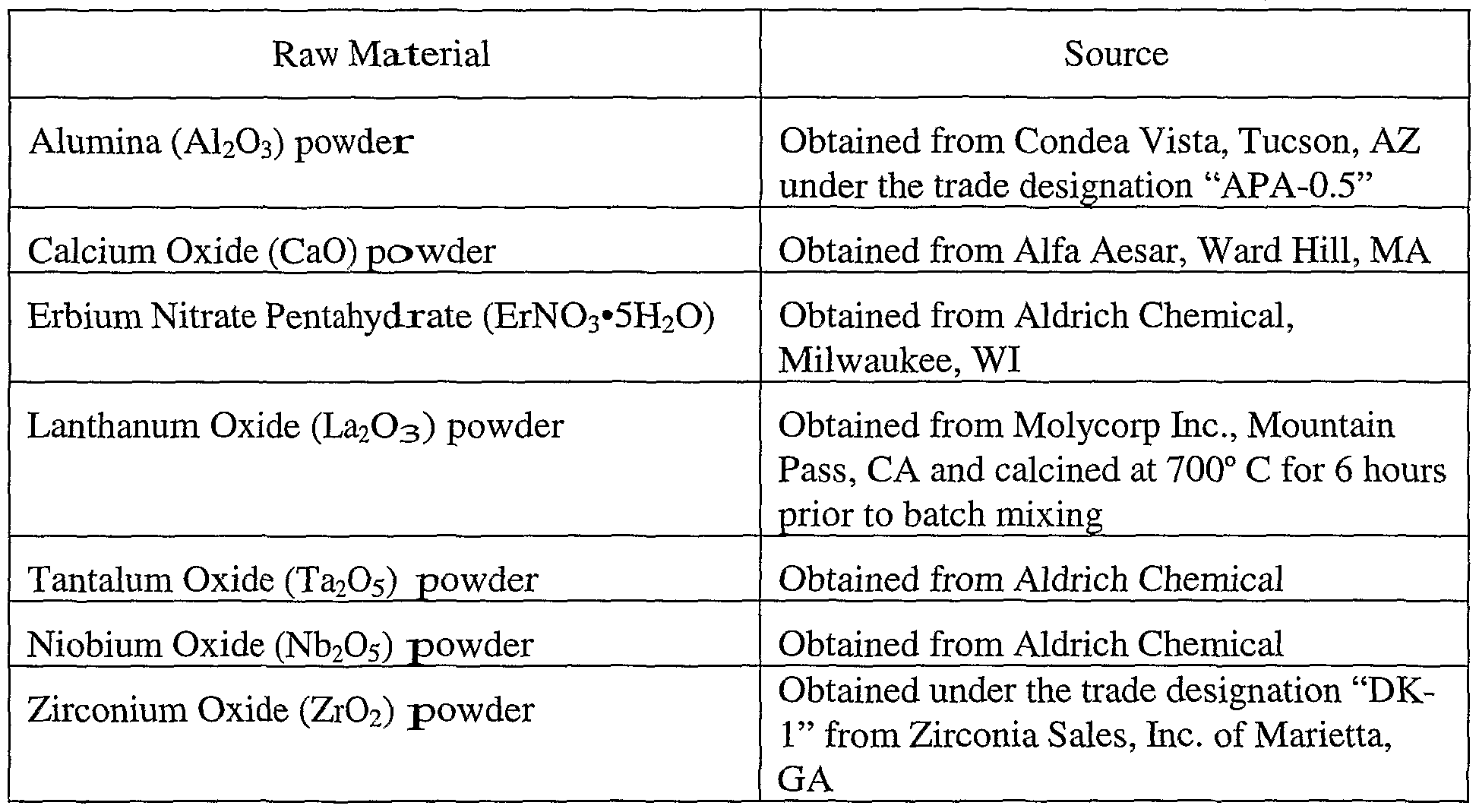
Claims
Priority Applications (2)
| Application Number | Priority Date | Filing Date | Title |
|---|---|---|---|
| EP04820718A EP1663889A2 (en) | 2003-09-18 | 2004-08-16 | CERAMICS AND GLASS COMPRISING AL<SB>2</SB>O<SB>3</SB>, REO, ZRO<SB>2</SB> AND/OR HFO<SB>2</SB>, AND NB<SB>2</SB>O<SB>5</SB> AND/OR TA<SB>2</SB>O<SB>5</SB> AND METHODS OF MAKING THE SAME |
| JP2006526899A JP2007505815A (en) | 2003-09-18 | 2004-08-16 | Ceramics and glasses comprising Al2O3, REO, ZrO2 and / or HfO2, Nb2O5 and / or Ta2O5 and / or methods for producing them |
Applications Claiming Priority (2)
| Application Number | Priority Date | Filing Date | Title |
|---|---|---|---|
| US10/666,212 US7141523B2 (en) | 2003-09-18 | 2003-09-18 | Ceramics comprising Al2O3, REO, ZrO2 and/or HfO2, and Nb2O5 and/or Ta2O5 and methods of making the same |
| US10/666,212 | 2003-09-18 |
Publications (2)
| Publication Number | Publication Date |
|---|---|
| WO2005061401A2 true WO2005061401A2 (en) | 2005-07-07 |
| WO2005061401A3 WO2005061401A3 (en) | 2005-10-20 |
Family
ID=34313054
Family Applications (1)
| Application Number | Title | Priority Date | Filing Date |
|---|---|---|---|
| PCT/US2004/026605 Ceased WO2005061401A2 (en) | 2003-09-18 | 2004-08-16 | CERAMICS AND GLASS COMPRISING Al2O3, REO, ZrO2 AND/OR HFO2, AND Nb2O5 AND/OR Ta2O5 AND/OR METHODS OF MAKING THE SAME |
Country Status (5)
| Country | Link |
|---|---|
| US (2) | US7141523B2 (en) |
| EP (1) | EP1663889A2 (en) |
| JP (1) | JP2007505815A (en) |
| CN (1) | CN1852869A (en) |
| WO (1) | WO2005061401A2 (en) |
Cited By (2)
| Publication number | Priority date | Publication date | Assignee | Title |
|---|---|---|---|---|
| JPWO2005097938A1 (en) * | 2004-03-31 | 2008-02-28 | 日本電気硝子株式会社 | Phosphor and light emitting diode |
| CN112624766A (en) * | 2020-12-29 | 2021-04-09 | 哈尔滨工业大学 | Preparation method of silicon nitride @ silicon carbide @ boron nitride composite fiber felt |
Families Citing this family (41)
| Publication number | Priority date | Publication date | Assignee | Title |
|---|---|---|---|---|
| KR100885329B1 (en) | 2001-08-02 | 2009-02-26 | 쓰리엠 이노베이티브 프로퍼티즈 컴파니 | Al₂O₃-rare earth oxide-ZrO₂ / HfO₂ materials, and preparation and use thereof |
| CN101417860B (en) | 2001-08-02 | 2012-01-18 | 3M创新有限公司 | Method of making articles from glass and glass ceramic articles so produced |
| US8056370B2 (en) | 2002-08-02 | 2011-11-15 | 3M Innovative Properties Company | Method of making amorphous and ceramics via melt spinning |
| US7141523B2 (en) * | 2003-09-18 | 2006-11-28 | 3M Innovative Properties Company | Ceramics comprising Al2O3, REO, ZrO2 and/or HfO2, and Nb2O5 and/or Ta2O5 and methods of making the same |
| US7141522B2 (en) * | 2003-09-18 | 2006-11-28 | 3M Innovative Properties Company | Ceramics comprising Al2O3, Y2O3, ZrO2 and/or HfO2, and Nb2O5 and/or Ta2O5 and methods of making the same |
| US7332453B2 (en) | 2004-07-29 | 2008-02-19 | 3M Innovative Properties Company | Ceramics, and methods of making and using the same |
| CN100445770C (en) * | 2005-02-28 | 2008-12-24 | 鸿富锦精密工业(深圳)有限公司 | Objective lens and optical recording/reproducing device using the same |
| US7481963B2 (en) * | 2005-06-28 | 2009-01-27 | Osram Sylvania Inc. | Method of reducing magnesium loss during sintering of aluminum oxide articles |
| US7281970B2 (en) | 2005-12-30 | 2007-10-16 | 3M Innovative Properties Company | Composite articles and methods of making the same |
| US7598188B2 (en) | 2005-12-30 | 2009-10-06 | 3M Innovative Properties Company | Ceramic materials and methods of making and using the same |
| US20070154713A1 (en) * | 2005-12-30 | 2007-07-05 | 3M Innovative Properties Company | Ceramic cutting tools and cutting tool inserts, and methods of making the same |
| US7423297B2 (en) * | 2006-05-03 | 2008-09-09 | 3M Innovative Properties Company | LED extractor composed of high index glass |
| US8141384B2 (en) * | 2006-05-03 | 2012-03-27 | 3M Innovative Properties Company | Methods of making LED extractor arrays |
| DE102006027957A1 (en) | 2006-06-14 | 2007-12-20 | Schott Ag | Optical elements and imaging optics |
| AU2008254809B2 (en) * | 2007-05-17 | 2013-06-27 | Diversey, Inc. | Surface coating system and method |
| CN102243327B (en) * | 2010-05-13 | 2014-01-15 | 西安格瑞微纳光电技术有限责任公司 | Holographic grating manufactured by HfO2/SiO2 sol-gel glass |
| DE102010047690A1 (en) * | 2010-10-06 | 2012-04-12 | Vsm-Vereinigte Schmirgel- Und Maschinen-Fabriken Ag | A method of making zirconia reinforced alumina abrasive grains and abrasive grains produced thereby |
| US20140128241A1 (en) * | 2011-06-28 | 2014-05-08 | 3M Innovative Properties Company | Glass-ceramics and methods of making the same |
| CN102367568B (en) * | 2011-10-20 | 2014-04-23 | 宁波江丰电子材料有限公司 | Preparation method of high-purity tantalum target material |
| JP6550374B2 (en) | 2013-04-05 | 2019-07-24 | スリーエム イノベイティブ プロパティズ カンパニー | Sintered abrasive particles, method of making the same, and abrasive articles comprising the same |
| EA032168B1 (en) | 2013-08-09 | 2019-04-30 | Вир Минералс Австралия Лтд | Cyclone separator apparatus and method of production thereof |
| CN103951235B (en) * | 2014-05-08 | 2016-05-25 | 宁波大学 | Rare earth ion doped K2LuI5Devitrified glass and preparation method thereof |
| CN103951201B (en) * | 2014-05-08 | 2016-04-27 | 宁波大学 | Rare earth ion doped LiLaI 4devitrified glass and preparation method thereof |
| CN103951258B (en) * | 2014-05-08 | 2016-05-25 | 宁波大学 | Rare earth ion doped SrI2Devitrified glass and preparation method thereof |
| CN103951212B (en) * | 2014-05-08 | 2016-05-25 | 宁波大学 | Rare earth ion doped LaBr3Devitrified glass and preparation method thereof |
| CN103951214B (en) * | 2014-05-08 | 2016-04-27 | 宁波大学 | Rare earth ion doped LuBr 3devitrified glass and preparation method thereof |
| JP6442952B2 (en) * | 2014-09-26 | 2018-12-26 | 日本電気硝子株式会社 | Optical glass and manufacturing method thereof |
| JP6471894B2 (en) * | 2014-10-15 | 2019-02-20 | 日本電気硝子株式会社 | Optical glass and manufacturing method thereof |
| JP6539068B2 (en) * | 2015-03-04 | 2019-07-03 | 国立大学法人 東京大学 | Glass material and method for manufacturing the same |
| CN106483599B (en) * | 2015-12-24 | 2020-04-24 | 南开大学 | Rare earth ion doped phosphate glass microcrystalline optical fiber |
| US11814326B2 (en) * | 2016-04-08 | 2023-11-14 | United States Of America As Represented By The Secretary Of The Air Force | Doped materials/alloys and hot isostatic pressing method of making same |
| CN106711379A (en) * | 2016-12-06 | 2017-05-24 | 江苏楚汉新能源科技有限公司 | Ceramic diaphragm and preparation method and application thereof, and battery comprising ceramic diaphragm |
| JP7031675B2 (en) * | 2017-09-21 | 2022-03-08 | 株式会社ニコン | Optical glass, optical elements made of optical glass, optical systems, interchangeable lenses and optical devices |
| CN112753072A (en) * | 2018-09-24 | 2021-05-04 | 康宁股份有限公司 | Rare earth doped metal oxide ceramic waveguide quantum memory and manufacturing method thereof |
| CN110304919A (en) * | 2019-08-16 | 2019-10-08 | 湘潭大学 | A preparation method of a ceramic material and a preparation method of a thermal barrier coating |
| US11342649B2 (en) | 2019-09-03 | 2022-05-24 | Corning Incorporated | Flexible waveguides having a ceramic core surrounded by a lower dielectric constant cladding for terahertz applications |
| WO2021046067A1 (en) * | 2019-09-03 | 2021-03-11 | Corning Incorporated | Flexible alumina ceramic waveguides for terahertz applications |
| CN113683398B (en) * | 2020-05-18 | 2023-04-07 | 中国科学院宁波材料技术与工程研究所 | Near-infrared fluorescent ceramic block, preparation method and application |
| US20240287329A1 (en) * | 2021-06-23 | 2024-08-29 | Virginia Tech Intellectual Properties, Inc. | Methods of Additive Manufacturing by Direct Ink Writing of Emulsion Compositions |
| CN113716944B (en) * | 2021-09-01 | 2022-10-11 | 中国科学院金属研究所 | Al (aluminum) 2 O 3 /RE 3 Al 5 O 12 High-entropy eutectic ceramic material and optical suspension zone-melting directional solidification preparation method |
| CN114230339B (en) * | 2022-01-17 | 2022-11-08 | 北京理工大学 | Rare earth tantalate high-entropy ceramic material and preparation method and application thereof |
Family Cites Families (342)
| Publication number | Priority date | Publication date | Assignee | Title |
|---|---|---|---|---|
| US110709A (en) * | 1871-01-03 | Improvement in children s hobby-horses | ||
| US160694A (en) * | 1875-03-09 | Improvement in invalid-bedsteads | ||
| US1314061A (en) | 1919-08-26 | Abrasive material and j | ||
| US110707A (en) * | 1871-01-03 | Improvement in bag-filling and weighing-machines | ||
| US110708A (en) * | 1871-01-03 | Lewis wilkinson | ||
| US126803A (en) * | 1872-05-14 | Improvement in | ||
| US126804A (en) * | 1872-05-14 | Improvement in operating valves of steam-engines | ||
| US126802A (en) * | 1872-05-14 | Improvement in bolt-threading machines | ||
| US110706A (en) * | 1871-01-03 | Improvement in seed-planters | ||
| US659926A (en) | 1900-05-04 | 1900-10-16 | Gen Electro Chemical Company | Process of manufacturing abrasive material. |
| US906339A (en) | 1908-03-17 | 1908-12-08 | Carborundum Co | Composition of matter containing alumina and silica. |
| US1037999A (en) | 1908-12-26 | 1912-09-10 | Morton Company | Article of alumina and method of making same. |
| US960712A (en) | 1909-09-14 | 1910-06-07 | Norton Co | Process of purifying aluminous materials. |
| US1107011A (en) | 1913-03-11 | 1914-08-11 | Carborundum Co | Method of bonding fused crystalline alumina. |
| US1192709A (en) | 1914-12-01 | 1916-07-25 | Carborundum Co | Crystalline fused alumina and the manufacture thereof. |
| US1161620A (en) | 1915-02-24 | 1915-11-23 | Carborundum Co | Crystalline fused alumina and method of making the same. |
| US1149064A (en) | 1915-06-11 | 1915-08-03 | Exolon Company | Electric-furnace abrasive and method of making the same. |
| US1268532A (en) | 1916-11-11 | 1918-06-04 | Carborundum Co | Process of making aluminous abrasives. |
| US1247337A (en) | 1917-02-12 | 1917-11-20 | Norton Co | Aluminous abrasive. |
| US1240490A (en) | 1917-02-12 | 1917-09-18 | Norton Co | Composition containing alumina and zirconia. |
| US1263708A (en) | 1917-03-02 | 1918-04-23 | Norton Co | PRODUCT CONTAINING β-ALUMINA AND PROCESS OF PREPARING THE SAME. |
| US1263710A (en) | 1917-08-02 | 1918-04-23 | Norton Co | Aluminous abrasive and process of making same. |
| US1263709A (en) | 1917-08-02 | 1918-04-23 | Norton Co | Aluminous abrasive and process of making the same. |
| US1268533A (en) | 1917-08-07 | 1918-06-04 | Carborundum Co | Aluminous abrasive. |
| US1257356A (en) | 1917-11-14 | 1918-02-26 | Carborundum Co | Aluminous composition and method of preparing the same. |
| US1339344A (en) | 1919-09-18 | 1920-05-04 | Carborundum Co | Aluminous compostion and method of making the same |
| US1402714A (en) | 1920-10-21 | 1922-01-03 | Abrasive Company | Method of manufacturing artificial abrasives from bauxite and emery |
| US1448586A (en) | 1922-04-22 | 1923-03-13 | Abrasive Company | Process of manufacturing aluminous abrasives |
| US2000857A (en) | 1930-12-01 | 1935-05-07 | Swann Res Inc | Aluminum oxide abrasive and method of making the same |
| US1910444A (en) | 1931-02-13 | 1933-05-23 | Carborundum Co | Process of making abrasive materials |
| US2206081A (en) * | 1935-09-03 | 1940-07-02 | Eastman Kodak Co | Optical glass |
| US2424645A (en) | 1943-07-13 | 1947-07-29 | Carborundum Co | Fused aluminum oxide abrasive material |
| US2618567A (en) | 1950-10-19 | 1952-11-18 | Norton Co | Molded alumina |
| US2805166A (en) | 1954-01-18 | 1957-09-03 | Loffler Johannes | Glasses containing oxides of rare earth metals |
| DE959852C (en) | 1955-07-16 | 1957-03-14 | Jenaer Glaswerk Schott & Gen | Process for the production of single or multi-component glasses |
| DE1694594C3 (en) | 1960-01-11 | 1975-05-28 | Minnesota Mining And Manufacturing Co., Saint Paul, Minn. (V.St.A.) | Cleaning and polishing media |
| US2961296A (en) | 1957-09-27 | 1960-11-22 | Aluminium Lab Ltd | Production of fused alumina |
| DE1075807B (en) | 1958-08-07 | 1960-02-18 | JENAer Glaswerk Schott &. Gen Mainz | Lanthanum borosilicate glass rich in aluminum oxide |
| US3041156A (en) | 1959-07-22 | 1962-06-26 | Norton Co | Phenolic resin bonded grinding wheels |
| BE610467A (en) * | 1959-12-01 | |||
| US3181939A (en) | 1961-01-27 | 1965-05-04 | Norton Co | Fused alumina-zirconia abrasives |
| US3377660A (en) | 1961-04-20 | 1968-04-16 | Norton Co | Apparatus for making crystal abrasive |
| US3141747A (en) | 1961-08-24 | 1964-07-21 | Norton Co | Alumina abrasive |
| US3216794A (en) | 1961-10-20 | 1965-11-09 | Norton Co | Process for producing crystalline alumina |
| GB1005338A (en) | 1964-04-17 | 1965-09-22 | Corning Glass Works | Semicrystalline glass-ceramic body and method of making it |
| GB1112969A (en) | 1964-08-22 | 1968-05-08 | Nippon Sheet Glass Co Ltd | Process for the manufacture of sheet glass |
| GB1121875A (en) | 1965-10-12 | 1968-07-31 | British Periclase Company Ltd | Abrasive implements |
| DE1596846B1 (en) * | 1966-12-17 | 1971-04-15 | Jenaer Glaswerk Schott & Gen | Boric acid-free lanthanum silicate glass for technical, especially optical purposes, with a refractive index above 1.75, high chemical resistance and high hardness |
| US3926603A (en) | 1968-04-10 | 1975-12-16 | Philips Corp | Method of manufacturing a glass ceramic material which is resistant to sodium vapour |
| NL6905353A (en) | 1968-04-10 | 1969-10-14 | ||
| US3625717A (en) | 1968-04-29 | 1971-12-07 | Avco Corp | Spray coating compositions |
| US3498769A (en) | 1969-01-16 | 1970-03-03 | Norton Co | Fused zirconia-spinel abrasives and articles made therewith |
| US3650780A (en) * | 1969-05-01 | 1972-03-21 | Corning Glass Works | Fiber optic core glass |
| US3635739A (en) | 1969-06-04 | 1972-01-18 | Corning Glass Works | Silica-free calcium aluminate glass-ceramic articles |
| US3947281A (en) | 1969-11-06 | 1976-03-30 | United Technologies Corporation | High modulus rare earth and beryllium containing silicate glass compositions |
| US3646713A (en) | 1970-03-16 | 1972-03-07 | Norton Co | Method of making fragmented crystalline material |
| JPS5025608Y1 (en) | 1970-04-27 | 1975-08-01 | ||
| DE2034011A1 (en) | 1970-07-09 | 1972-01-13 | Wuestefeld A | Tri-and tetravalent glasses - contg carbides or nitrides |
| DE2161412A1 (en) | 1970-12-11 | 1972-06-15 | Monsanto Co | Manufacture of glass fibers from low viscosity melts |
| US3781172A (en) | 1970-12-14 | 1973-12-25 | G Kinney | Process for the manufacture of microcrystalline fused abrasives |
| US3714059A (en) | 1971-03-10 | 1973-01-30 | American Optical Corp | Neodymium glass laser having room temperature output at wavelengths shorter than 1060 nm |
| US3717583A (en) | 1971-03-10 | 1973-02-20 | American Optical Corp | Neodymium glass laser having room temperature output at wavelengths shorter than 1060 nm. |
| US3726621A (en) | 1971-06-15 | 1973-04-10 | Carborundum Co | Apparatus for producing oxide refractory material having fine crystal structure |
| US3928515A (en) | 1971-06-15 | 1975-12-23 | Carborundum Co | Semicontinuous process for producing oxide refractory material having fine crystal structure |
| US4415510A (en) | 1971-06-15 | 1983-11-15 | Kennecott Corporation | Process for making oxide refractory material having fine crystal structure |
| US4017317A (en) * | 1971-08-05 | 1977-04-12 | Owens-Illinois, Inc. | Glass-ceramics and process for making same |
| US3754978A (en) * | 1971-08-06 | 1973-08-28 | Corning Glass Works | Devitrification-resistant coating for high-silica glasses |
| US3792553A (en) | 1971-09-28 | 1974-02-19 | Wallace Murray Corp | Abrasive powder of fused alumina containing vanadium tetroxide |
| US3893826A (en) | 1971-11-08 | 1975-07-08 | Norton Co | Coated abrasive material comprising alumina-zirconia abrasive compositions |
| US4070796A (en) | 1971-12-27 | 1978-01-31 | Norton Company | Method of producing abrasive grits |
| US3859407A (en) | 1972-05-15 | 1975-01-07 | Corning Glass Works | Method of manufacturing particles of uniform size and shape |
| US4261706A (en) | 1972-05-15 | 1981-04-14 | Corning Glass Works | Method of manufacturing connected particles of uniform size and shape with a backing |
| US3785834A (en) * | 1972-06-09 | 1974-01-15 | Owens Illinois Inc | Glasses,glass-ceramics and process for making same |
| US3891408A (en) | 1972-09-08 | 1975-06-24 | Norton Co | Zirconia-alumina abrasive grain and grinding tools |
| US3916584A (en) | 1973-03-22 | 1975-11-04 | Minnesota Mining & Mfg | Spheroidal composite particle and method of making |
| US3881282A (en) | 1973-10-24 | 1975-05-06 | Norton Co | Abrasive grain of fused alumina-zirconia-ceria alloy |
| US3973977A (en) | 1973-11-01 | 1976-08-10 | Corning Glass Works | Making spinel and aluminum-base metal cermet |
| US3940276A (en) | 1973-11-01 | 1976-02-24 | Corning Glass Works | Spinel and aluminum-base metal cermet |
| US4035162A (en) | 1973-11-09 | 1977-07-12 | Corning Glass Works | Fused abrasive grains consisting essentially of corundum, zirconia and R2 O3 |
| DE2420551B2 (en) | 1974-04-27 | 1981-01-08 | Dynamit Nobel Ag, 5210 Troisdorf | Process for the production of grained abrasives from highly refractory inorganic hard materials |
| AT333146B (en) | 1974-05-29 | 1976-11-10 | Treibacher Chemische Werke Ag | METHOD OF MANUFACTURING AN ABRASIVE COMPOUND |
| DE2560066B1 (en) | 1974-05-29 | 1979-12-13 | Treibacher Chemische Werke Ag | Process for the production of abrasive materials based on aluminum oxide, optionally together with other oxides |
| US3999994A (en) | 1974-09-18 | 1976-12-28 | Owens-Illinois, Inc. | Glass-ceramics |
| US3996702A (en) | 1974-11-26 | 1976-12-14 | Minnesota Mining And Manufacturing Company | Coated abrasive product comprising fused zirconia grains and method for abrading iron |
| US4014122A (en) | 1975-09-22 | 1977-03-29 | Woods Oscar J | Paperweight with screw threaded bottom cap |
| US4194887A (en) | 1975-12-01 | 1980-03-25 | U.S. Industries, Inc. | Fused alumina-zirconia abrasive material formed by an immersion process |
| US4073096A (en) | 1975-12-01 | 1978-02-14 | U.S. Industries, Inc. | Process for the manufacture of abrasive material |
| US4126429A (en) | 1975-12-15 | 1978-11-21 | Norton Company | Co-fused alumina-zirconia alloy abrasive containing magnesium oxide |
| US4157898A (en) | 1976-06-01 | 1979-06-12 | The Carborundum Company | Fused aluminum oxide abrasive grain containing reduced titanium oxide |
| USRE31128E (en) | 1976-06-01 | 1983-01-18 | Kennecott Corporation | Fused aluminum oxide abrasive grain containing reduced titanium oxide |
| USRE31725E (en) | 1976-06-01 | 1984-11-06 | Kennecott Corporation | Fused aluminum oxide abrasive grain containing reduced titanium oxide |
| US4111668A (en) | 1976-06-01 | 1978-09-05 | The Carborundum Company | Fused aluminum oxide abrasive grain containing reduced titanium oxide |
| US4217264A (en) | 1977-04-01 | 1980-08-12 | American Dental Association Health Foundation | Microporous glassy fillers for dental resin composites |
| US4147544A (en) * | 1977-09-12 | 1979-04-03 | Eastman Kodak Company | Photographic products and processes employing novel nondiffusible pyridylazonaphthol dye-releasing compounds |
| DE2744700C2 (en) | 1977-10-05 | 1987-05-27 | Feldmühle AG, 4000 Düsseldorf | Sintered material based on dense, non-metallic hard materials such as high-melting metal carbides, metal nitrides, metal borides and metal oxides with embedded zirconium and / or hafnium oxide |
| US4140494A (en) | 1977-10-21 | 1979-02-20 | Norton Company | Method for rapid cooling molten alumina abrasives |
| US4111707A (en) | 1977-12-14 | 1978-09-05 | Kabushiki Kaisha Ohara Kogaku Garasu Seizosho | Optical glass |
| JPS5490218A (en) * | 1977-12-28 | 1979-07-17 | Minolta Camera Kk | Optical glass |
| JPS54103411A (en) * | 1978-02-02 | 1979-08-14 | Fuji Photo Film Co Ltd | High refractive index optical glass |
| US4182437A (en) | 1978-05-08 | 1980-01-08 | Ferro Corporation | Unstable devitrifiable glasses and friction materials containing them |
| US4311489A (en) | 1978-08-04 | 1982-01-19 | Norton Company | Coated abrasive having brittle agglomerates of abrasive grain |
| DD141420A1 (en) * | 1978-12-22 | 1980-04-30 | Greiner Baer Gerhard | METHOD FOR THE PRODUCTION OF SOLID COVERS, ESPECIALLY OF GLASS |
| US4238213A (en) | 1979-04-05 | 1980-12-09 | Johns-Manville Corporation | Method of operation of a refractory fiber production process |
| US4518397A (en) | 1979-06-29 | 1985-05-21 | Minnesota Mining And Manufacturing Company | Articles containing non-fused aluminum oxide-based abrasive mineral |
| US4314827A (en) | 1979-06-29 | 1982-02-09 | Minnesota Mining And Manufacturing Company | Non-fused aluminum oxide-based abrasive mineral |
| FR2460315A1 (en) | 1979-07-05 | 1981-01-23 | Sofrem | HIGH-STRENGTH ABRASIVE PRODUCT BASED ON ALUMINA AND ALUMINUM OXYCARBONS AND PROCESS FOR PREPARING THE SAME |
| US5143522B1 (en) | 1979-11-09 | 1998-01-06 | Washington Mills Electro Miner | Abrasive products containing fused alumina zirconia and reduced titania |
| DE3022213C2 (en) | 1980-06-13 | 1987-12-23 | Feldmühle AG, 4000 Düsseldorf | Ceramic molded body with eutectic structural components and process for its production |
| US4316964A (en) | 1980-07-14 | 1982-02-23 | Rockwell International Corporation | Al2 O3 /ZrO2 ceramic |
| JPS623041Y2 (en) | 1980-08-18 | 1987-01-23 | ||
| US4588419A (en) | 1980-10-08 | 1986-05-13 | Carborundum Abrasives Company | Resin systems for high energy electron curable resin coated webs |
| FR2499061A1 (en) | 1981-01-30 | 1982-08-06 | Sofrem | METHOD AND APPARATUS FOR RAPID CONTINUOUS CASTING SOLIDIFICATION AND COOLING OF MOLDED OXIDES BASED ON METAL OXIDES |
| JPS6025608Y2 (en) | 1981-01-31 | 1985-08-01 | 安立電気株式会社 | Multi-item information input device |
| IT1150318B (en) | 1981-03-21 | 1986-12-10 | Bosch Gmbh Robert | FUEL INJECTION PUMP FOR ENDOTHERMAL ENGINES |
| DE3130039C2 (en) * | 1981-07-30 | 1984-07-12 | Schott Glaswerke, 6500 Mainz | CdO-ThO? 2? -Free, high refractive index optical glass with the optical position nd = 1.85 - 2.05 and vd 25-43 |
| DE3138137C2 (en) * | 1981-09-25 | 1985-05-15 | Schott Glaswerke, 6500 Mainz | ThO? 2? - and Ta? 2? O? 5? -free optical glasses with refractive indices of 1.87 - 1.93 and Abbe numbers of 30 - 35 |
| US4489022A (en) | 1981-11-25 | 1984-12-18 | Glaverbel | Forming coherent refractory masses |
| US4439845A (en) | 1981-12-03 | 1984-03-27 | Westinghouse Electric Corp. | Sonar system |
| US4800685A (en) | 1984-05-31 | 1989-01-31 | Minnesota Mining And Manufacturing Company | Alumina bonded abrasive for cast iron |
| GB2116992B (en) | 1982-03-16 | 1985-09-25 | Standard Telephones Cables Ltd | Abrasive materials |
| CA1181558A (en) | 1982-04-08 | 1985-01-29 | Takashi Onoyama | Apparatus for producing flake particles |
| JPS5969443A (en) | 1982-10-14 | 1984-04-19 | Natl Inst For Res In Inorg Mater | Manufacture of aluminosilicate glass containing y2o3 |
| FR2538370B1 (en) | 1982-12-28 | 1986-01-24 | Ceraver | VITREOUS CERAMIC MATERIALS, PROCESS FOR MANUFACTURING SUCH MATERIALS AND APPLICATION THEREOF FOR BONDING CERAMIC PARTS |
| US4543107A (en) | 1984-08-08 | 1985-09-24 | Norton Company | Vitrified bonded grinding wheels containing sintered gel aluminous abrasive grits |
| US4457767A (en) | 1983-09-29 | 1984-07-03 | Norton Company | Alumina-zirconia abrasive |
| DE3343418A1 (en) | 1983-12-01 | 1985-06-20 | Schott Glaswerke, 6500 Mainz | OPTICAL GLASS WITH REFRACTION VALUES> = 1.90, PAYBACK> = 25 AND WITH HIGH CHEMICAL RESISTANCE |
| US5395407B1 (en) | 1984-01-19 | 1997-08-26 | Norton Co | Abrasive material and method |
| US4623364A (en) | 1984-03-23 | 1986-11-18 | Norton Company | Abrasive material and method for preparing the same |
| JPS60170565A (en) | 1984-02-10 | 1985-09-04 | Nippon Yakin Kogyo Co Ltd | Method for producing spherical metal particles |
| JPS60221338A (en) | 1984-04-12 | 1985-11-06 | Ohara Inc | Optical glass |
| CA1266568A (en) | 1984-05-09 | 1990-03-13 | Minnesota Mining And Manufacturing Company | Coated abrasive product incorporating selective mineral substitution |
| CA1266569A (en) | 1984-05-09 | 1990-03-13 | Minnesota Mining And Manufacturing Company | Coated abrasive product incorporating selective mineral substitution |
| JPS60240964A (en) | 1984-05-14 | 1985-11-29 | 三菱電機株式会社 | Method of controlling refrigerator |
| US4780268A (en) | 1984-06-13 | 1988-10-25 | Westinghouse Electric Corp. | Neutron absorber articles |
| US5227104A (en) | 1984-06-14 | 1993-07-13 | Norton Company | High solids content gels and a process for producing them |
| JPS6199665A (en) | 1984-10-19 | 1986-05-17 | Showa Denko Kk | Ceramic thermal spraying material |
| US4789501A (en) | 1984-11-19 | 1988-12-06 | The Curators Of The University Of Missouri | Glass microspheres |
| JPS61201683A (en) | 1985-03-06 | 1986-09-06 | オリンパス光学工業株式会社 | Composite material for artificial aggregate use |
| US4752459A (en) | 1985-04-09 | 1988-06-21 | Perrer Duncan S | Preparation of porous bodies |
| CA1254238A (en) | 1985-04-30 | 1989-05-16 | Alvin P. Gerk | Process for durable sol-gel produced alumina-based ceramics, abrasive grain and abrasive products |
| US4812422A (en) | 1985-06-17 | 1989-03-14 | Matsushita Electric Industrial Co., Ltd. | Dielectric paste and method of manufacturing the paste |
| US4652275A (en) | 1985-08-07 | 1987-03-24 | Minnesota Mining And Manufacturing Company | Erodable agglomerates and abrasive products containing the same |
| US4741743A (en) | 1985-08-19 | 1988-05-03 | Norton Company | Grinding wheel with combination of fused and sintered abrasive grits |
| CA1259080A (en) | 1985-09-06 | 1989-09-05 | Nobuo Kimura | High density alumina zirconia ceramics and a process for production thereof |
| US4772511A (en) | 1985-11-22 | 1988-09-20 | Minnesota Mining And Manufacturing Company | Transparent non-vitreous zirconia microspheres |
| CA1267164A (en) | 1985-12-13 | 1990-03-27 | Harold G. Sowman | Microcrystalline transition metal oxide spinel articles |
| US4770671A (en) | 1985-12-30 | 1988-09-13 | Minnesota Mining And Manufacturing Company | Abrasive grits formed of ceramic containing oxides of aluminum and yttrium, method of making and using the same and products made therewith |
| ZA8763B (en) | 1986-01-21 | 1987-09-30 | Alusuisse | Composite panel that is difficult to combust and produces little smoke,and process for manufacturing same |
| US5259147A (en) | 1986-02-15 | 1993-11-09 | Vereinigte Schmirgel-Und Maschinenfabriken Aktiengesellschaft | Granular abrasive material |
| US5057018A (en) | 1986-05-13 | 1991-10-15 | American Dental Association - Health Foundation | Microcrystalline inserts for megafilled composite dental restorations |
| US4829031A (en) | 1986-08-01 | 1989-05-09 | Research Corporation | Method of preparing ceramic compositions at lower sintering temperatures |
| US5045402A (en) | 1986-08-01 | 1991-09-03 | International Business Machines Corporation | Zirconia toughening of glass-ceramic materials |
| US4756746A (en) | 1986-09-08 | 1988-07-12 | Gte Products Corporation | Process of producing fine spherical particles |
| SU1455569A1 (en) | 1986-10-04 | 1996-07-27 | Всесоюзный научно-исследовательский институт технического и специального строительного стекла | Method of preparing blend |
| US4755489A (en) | 1986-12-18 | 1988-07-05 | Corning Glass Works | Reinforced calcium aluminosilicate glass-ceramics |
| FR2609708B1 (en) | 1987-01-21 | 1989-04-28 | Fibraconsult Management Beratu | DEVICE FOR MANUFACTURING FIBERS FROM A MOLTEN MINERAL MASS |
| US4799939A (en) | 1987-02-26 | 1989-01-24 | Minnesota Mining And Manufacturing Company | Erodable agglomerates and abrasive products containing the same |
| JPS63156024U (en) | 1987-04-01 | 1988-10-13 | ||
| US4960441A (en) | 1987-05-11 | 1990-10-02 | Norton Company | Sintered alumina-zirconia ceramic bodies |
| DE3876851T3 (en) | 1987-05-11 | 1997-06-05 | Norton Co | Sintered alumina-zirconia ceramic bodies and method of manufacturing same. |
| US4881951A (en) | 1987-05-27 | 1989-11-21 | Minnesota Mining And Manufacturing Co. | Abrasive grits formed of ceramic containing oxides of aluminum and rare earth metal, method of making and products made therewith |
| US5312789A (en) | 1987-05-27 | 1994-05-17 | Minnesota Mining And Manufacturing Company | Abrasive grits formed of ceramic, impregnation method of making the same and products made therewith |
| AU604899B2 (en) | 1987-05-27 | 1991-01-03 | Minnesota Mining And Manufacturing Company | Abrasive grits formed of ceramic, impregnation method of making the same and products made therewith |
| JPS63303821A (en) | 1987-06-01 | 1988-12-12 | Hitachi Chem Co Ltd | Production of glass ceramic substrate |
| CA1317978C (en) | 1987-06-05 | 1993-05-18 | Thomas E. Wood | Microcrystalline alumina-based ceramic articles |
| US4762677A (en) | 1987-11-03 | 1988-08-09 | Allied-Signal Inc. | Method of preparing a bulk amorphous metal article |
| FR2628414B1 (en) | 1988-03-11 | 1992-01-17 | Pechiney Electrometallurgie | POLYPHASE ALUMINUM, OXYCARBON AND ALUMINUM OXYNITRIDE POLISHED MATERIAL |
| CH675250A5 (en) | 1988-06-17 | 1990-09-14 | Lonza Ag | |
| US5038453A (en) | 1988-07-22 | 1991-08-13 | Rohm Co., Ltd. | Method of manufacturing semiconductor devices, and leadframe and differential overlapping apparatus therefor |
| US4898597A (en) | 1988-08-25 | 1990-02-06 | Norton Company | Frit bonded abrasive wheel |
| US5011508A (en) | 1988-10-14 | 1991-04-30 | Minnesota Mining And Manufacturing Company | Shelling-resistant abrasive grain, a method of making the same, and abrasive products |
| US4898587A (en) | 1988-11-15 | 1990-02-06 | Mera Csaba L | Intravenous line stabilizing device |
| EP0408771B1 (en) | 1989-02-01 | 1993-08-04 | Showa Denko Kabushiki Kaisha | Alumina ceramic, abrasive material, and production thereof |
| YU32490A (en) | 1989-03-13 | 1991-10-31 | Lonza Ag | Hydrophobic layered grinding particles |
| US5009676A (en) | 1989-04-28 | 1991-04-23 | Norton Company | Sintered sol gel alumina abrasive filaments |
| GB8918178D0 (en) | 1989-08-09 | 1989-09-20 | Evans Philip A | Dental veneers and crowns |
| JP2639121B2 (en) | 1989-08-25 | 1997-08-06 | 三菱マテリアル株式会社 | Method for producing fine α-alumina powder |
| US4997461A (en) | 1989-09-11 | 1991-03-05 | Norton Company | Nitrified bonded sol gel sintered aluminous abrasive bodies |
| US5013696A (en) | 1989-09-25 | 1991-05-07 | General Electric Company | Preparation of high uniformity polycrystalline ceramics by presintering, hot isostatic pressing and sintering and the resulting ceramic |
| JPH03113428A (en) * | 1989-09-27 | 1991-05-14 | Matsushita Electric Ind Co Ltd | Optical wavelength converting element and production thereof |
| US5007943A (en) | 1989-11-03 | 1991-04-16 | Norton Company | Sol-gel process alumina abrasive grain blends in coated abrasive material |
| US5094672A (en) | 1990-01-16 | 1992-03-10 | Cincinnati Milacron Inc. | Vitreous bonded sol-gel abrasive grit article |
| US5122176A (en) | 1990-01-17 | 1992-06-16 | Mcdonnell Douglas Corporation | A method of densifying a glass or glass composite structure |
| JP2500978Y2 (en) | 1990-03-02 | 1996-06-12 | 株式会社アマダメトレックス | Operation board |
| KR950001661B1 (en) | 1990-03-27 | 1995-02-28 | 아사히가세이고오교가부시끼가이샤 | Aluminum oxide, molded article thereof, and method for producing aluminum oxide |
| FI84979C (en) | 1990-04-06 | 1992-02-25 | Ahlstroem Oy | Filters for separating particles from a hot gas stream |
| US5085671A (en) | 1990-05-02 | 1992-02-04 | Minnesota Mining And Manufacturing Company | Method of coating alumina particles with refractory material, abrasive particles made by the method and abrasive products containing the same |
| US5215563A (en) | 1990-05-04 | 1993-06-01 | Alfred University | Process for preparing a durable glass composition |
| US5118326A (en) | 1990-05-04 | 1992-06-02 | Norton Company | Vitrified bonded grinding wheel with mixtures of sol gel aluminous abrasives and silicon carbide |
| US5139978A (en) | 1990-07-16 | 1992-08-18 | Minnesota Mining And Manufacturing Company | Impregnation method for transformation of transition alumina to a alpha alumina |
| US5071801A (en) | 1990-07-25 | 1991-12-10 | Uop | High density leucite based ceramics from zeolite |
| US5153070A (en) | 1990-08-01 | 1992-10-06 | Corning Incorporated | Coated refractory article and method |
| JPH06104817B2 (en) | 1990-10-09 | 1994-12-21 | 日本研磨材工業株式会社 | Alumina-zirconia lap abrasive, method for producing the same, and polishing composition |
| US6123743A (en) | 1991-01-07 | 2000-09-26 | Norton Company | Glass-ceramic bonded abrasive tools |
| AU646120B2 (en) | 1991-01-07 | 1994-02-10 | Norton Company | Glass ceramic bonded abrasive articles |
| US5090968A (en) | 1991-01-08 | 1992-02-25 | Norton Company | Process for the manufacture of filamentary abrasive particles |
| US5378251A (en) | 1991-02-06 | 1995-01-03 | Minnesota Mining And Manufacturing Company | Abrasive articles and methods of making and using same |
| US5152917B1 (en) | 1991-02-06 | 1998-01-13 | Minnesota Mining & Mfg | Structured abrasive article |
| US5131926A (en) | 1991-03-15 | 1992-07-21 | Norton Company | Vitrified bonded finely milled sol gel aluminous bodies |
| FR2675158B1 (en) | 1991-04-15 | 1994-05-06 | Pechiney Electrometallurgie | ABRASIVE AND / OR REFRACTORY PRODUCTS BASED ON OXYNITRIDES, MOLTEN AND SOLIDIFIED. |
| US5641469A (en) | 1991-05-28 | 1997-06-24 | Norton Company | Production of alpha alumina |
| JP2777679B2 (en) | 1991-07-09 | 1998-07-23 | 日本特殊陶業株式会社 | Spinel ceramics and manufacturing method thereof |
| US5203886A (en) | 1991-08-12 | 1993-04-20 | Norton Company | High porosity vitrified bonded grinding wheels |
| US5316812A (en) | 1991-12-20 | 1994-05-31 | Minnesota Mining And Manufacturing Company | Coated abrasive backing |
| CA2116686A1 (en) | 1991-12-20 | 1993-07-08 | Harold Wayne Benedict | A coated abrasive belt with an endless, seamless backing and method of preparation |
| JPH05226733A (en) | 1992-02-12 | 1993-09-03 | Hitachi Cable Ltd | Rare earth element-doped glass waveguide and method for manufacturing the same |
| US5282875A (en) | 1992-03-18 | 1994-02-01 | Cincinnati Milacron Inc. | High density sol-gel alumina-based abrasive vitreous bonded grinding wheel |
| TW307801B (en) | 1992-03-19 | 1997-06-11 | Minnesota Mining & Mfg | |
| US5203884A (en) | 1992-06-04 | 1993-04-20 | Minnesota Mining And Manufacturing Company | Abrasive article having vanadium oxide incorporated therein |
| JP2711618B2 (en) | 1992-06-30 | 1998-02-10 | ティーディーケイ株式会社 | Dielectric composition, multilayer wiring board and multilayer ceramic capacitor |
| US5306577A (en) | 1992-07-15 | 1994-04-26 | Rockwell International Corporation | Regenerative fuel cell system |
| US5201916A (en) | 1992-07-23 | 1993-04-13 | Minnesota Mining And Manufacturing Company | Shaped abrasive particles and method of making same |
| US5366523A (en) | 1992-07-23 | 1994-11-22 | Minnesota Mining And Manufacturing Company | Abrasive article containing shaped abrasive particles |
| US5213591A (en) | 1992-07-28 | 1993-05-25 | Ahmet Celikkaya | Abrasive grain, method of making same and abrasive products |
| DE4228355C1 (en) | 1992-08-26 | 1994-02-24 | Didier Werke Ag | Fireproof lightweight molded body |
| CA2142466A1 (en) | 1992-09-25 | 1994-04-14 | Henry A. Larmie | Abrasive grain including rare earth oxide therin |
| KR960702420A (en) | 1992-09-25 | 1996-04-27 | 워렌 리처드 보비 | ABRASIVE GRAIN CONTAINING ALUMINA AND ZIRCONIA |
| CA2142465A1 (en) | 1992-09-25 | 1994-04-14 | Henry A. Larmie | Method for making abrasive grain containing alumina and ceria |
| JPH0715095B2 (en) | 1992-10-23 | 1995-02-22 | 日本研磨材工業株式会社 | Ceramic abrasive grains, manufacturing method thereof, and polishing product |
| JP3193492B2 (en) | 1992-11-30 | 2001-07-30 | オリンパス光学工業株式会社 | Glass body with refractive index distribution |
| DE4241625C1 (en) | 1992-12-10 | 1994-06-30 | Veitsch Radex Ag | Process for the production of sinter-active, largely spherical aluminum oxide and its use |
| KR950704207A (en) | 1992-12-23 | 1995-11-17 | 테릴 컨트 퀼리 | Abrasive Grain Containing Manganese Oxide (ABRASIVE GRAIN CONTAINING MAN-GANESE OXIDE) |
| US5273566A (en) | 1993-01-26 | 1993-12-28 | International Environmelting Corporation | Process for producing an environmentally acceptable abrasive product from hazardous wastes |
| JPH06231906A (en) | 1993-01-28 | 1994-08-19 | Mitsubishi Materials Corp | Thermistor |
| CA2115889A1 (en) | 1993-03-18 | 1994-09-19 | David E. Broberg | Coated abrasive article having diluent particles and shaped abrasive particles |
| FI92465C (en) | 1993-04-14 | 1994-11-25 | Risto Tapani Lehtinen | A method for handling endo-osteal materials |
| US5436063A (en) | 1993-04-15 | 1995-07-25 | Minnesota Mining And Manufacturing Company | Coated abrasive article incorporating an energy cured hot melt make coat |
| US5441549A (en) | 1993-04-19 | 1995-08-15 | Minnesota Mining And Manufacturing Company | Abrasive articles comprising a grinding aid dispersed in a polymeric blend binder |
| US5605870A (en) | 1993-05-28 | 1997-02-25 | Martinex Science, Inc. | Ceramic fibers, and methods, machines and compositions of matter for making same |
| US5549962A (en) | 1993-06-30 | 1996-08-27 | Minnesota Mining And Manufacturing Company | Precisely shaped particles and method of making the same |
| JP3738454B2 (en) | 1993-08-11 | 2006-01-25 | 住友化学株式会社 | Composite metal oxide powder and method for producing the same |
| JP3733599B2 (en) | 1993-08-11 | 2006-01-11 | 住友化学株式会社 | Metal oxide powder and method for producing the same |
| JP3216683B2 (en) | 1993-10-08 | 2001-10-09 | 宇部興産株式会社 | Ceramic composite materials |
| US5484752A (en) | 1993-11-12 | 1996-01-16 | Ube Industries, Ltd. | Ceramic composite material |
| US5593467A (en) | 1993-11-12 | 1997-01-14 | Minnesota Mining And Manufacturing Company | Abrasive grain |
| US5372620A (en) | 1993-12-13 | 1994-12-13 | Saint Gobain/Norton Industrial Ceramics Corporation | Modified sol-gel alumina abrasive filaments |
| BR9408461A (en) | 1993-12-28 | 1997-08-05 | Minnesota Mining & Mfg | Specified nominal type of abrasive grain and abrasive article |
| AU1370595A (en) | 1993-12-28 | 1995-07-17 | Minnesota Mining And Manufacturing Company | Alpha alumina-based abrasive grain having an as sintered outer surface |
| EP0783394B1 (en) | 1994-09-30 | 2003-05-14 | Minnesota Mining And Manufacturing Company | Coated abrasive article and method for preparing the same |
| US6054093A (en) | 1994-10-19 | 2000-04-25 | Saint Gobain-Norton Industrial Ceramics Corporation | Screen printing shaped articles |
| US5534470A (en) | 1994-10-27 | 1996-07-09 | Corning Incorporated | Lithium aluminoborate glass-ceramics |
| US5721188A (en) | 1995-01-17 | 1998-02-24 | Engelhard Corporation | Thermal spray method for adhering a catalytic material to a metallic substrate |
| DE69603627T2 (en) | 1995-01-19 | 1999-12-30 | Ube Industries, Ltd. | Ceramic composite body |
| DE19503854C2 (en) | 1995-02-06 | 1997-02-20 | Starck H C Gmbh Co Kg | Process for the production of sintered alpha-Al¶2¶O¶3¶ bodies and their use |
| JPH11501439A (en) | 1995-03-02 | 1999-02-02 | ミネソタ・マイニング・アンド・マニュファクチャリング・カンパニー | Method for texturing a support using a structured abrasive article |
| US5725162A (en) | 1995-04-05 | 1998-03-10 | Saint Gobain/Norton Industrial Ceramics Corporation | Firing sol-gel alumina particles |
| US5679067A (en) | 1995-04-28 | 1997-10-21 | Minnesota Mining And Manufacturing Company | Molded abrasive brush |
| US5645619A (en) | 1995-06-20 | 1997-07-08 | Minnesota Mining And Manufacturing Company | Method of making alpha alumina-based abrasive grain containing silica and iron oxide |
| US5611829A (en) | 1995-06-20 | 1997-03-18 | Minnesota Mining And Manufacturing Company | Alpha alumina-based abrasive grain containing silica and iron oxide |
| DK0785175T3 (en) | 1995-08-04 | 2000-04-10 | Cosmo Clay & Ceramics Co Ltd | Synthetic clay for ceramic products and processes for making them |
| US5693239A (en) | 1995-10-10 | 1997-12-02 | Rodel, Inc. | Polishing slurries comprising two abrasive components and methods for their use |
| JPH11513620A (en) | 1995-10-20 | 1999-11-24 | ミネソタ・マイニング・アンド・マニュファクチャリング・カンパニー | Abrasive article containing inorganic metal orthophosphate |
| BR9611506A (en) | 1995-11-01 | 1999-05-11 | Minnesota Mining & Mfg | Process for mass production of particulate material and composition of matter |
| US6254981B1 (en) | 1995-11-02 | 2001-07-03 | Minnesota Mining & Manufacturing Company | Fused glassy particulates obtained by flame fusion |
| JPH09190626A (en) | 1995-11-10 | 1997-07-22 | Kao Corp | Abrasive composition, substrate for magnetic recording medium, method for producing the same, and magnetic recording medium |
| US5903951A (en) | 1995-11-16 | 1999-05-18 | Minnesota Mining And Manufacturing Company | Molded brush segment |
| US5651925A (en) | 1995-11-29 | 1997-07-29 | Saint-Gobain/Norton Industrial Ceramics Corporation | Process for quenching molten ceramic material |
| EP0873282A4 (en) | 1996-01-11 | 2000-10-11 | Containerless Research Inc | Fiber drawing from undercooled molten materials |
| US5653775A (en) | 1996-01-26 | 1997-08-05 | Minnesota Mining And Manufacturing Company | Microwave sintering of sol-gel derived abrasive grain |
| US5856254A (en) | 1996-02-15 | 1999-01-05 | Vaw Silizium Gmbh | Spherical metal-oxide powder particles and process for their manufacture |
| US5782940A (en) | 1996-03-15 | 1998-07-21 | Carborundum Universal Limited | Process for the preparation of alumina abrasives |
| CN1092095C (en) | 1996-05-08 | 2002-10-09 | 明尼苏达矿业和制造公司 | Abrasive article comprising antiloading component |
| CN1211312C (en) | 1996-07-01 | 2005-07-20 | 宇部兴产株式会社 | Ceramic composite material and porous ceramic material |
| US5738696A (en) | 1996-07-26 | 1998-04-14 | Norton Company | Method for making high permeability grinding wheels |
| US5682082A (en) | 1996-07-29 | 1997-10-28 | Osram Sylvania Inc. | Translucent polycrystalline alumina and method of making same |
| KR19980019046A (en) | 1996-08-29 | 1998-06-05 | 고사이 아키오 | Abrasive composition and use of the same |
| US5747397A (en) | 1996-11-04 | 1998-05-05 | Bay Glass Research | Optical glass |
| DE19802349B4 (en) | 1997-01-23 | 2010-04-15 | Alps Electric Co., Ltd. | Soft magnetic amorphous alloy, high hardness amorphous alloy and their use |
| US5847865A (en) | 1997-02-18 | 1998-12-08 | Regents Of The University Of Minnesota | Waveguide optical amplifier |
| US6447937B1 (en) | 1997-02-26 | 2002-09-10 | Kyocera Corporation | Ceramic materials resistant to halogen plasma and components using the same |
| JP3113604B2 (en) | 1997-03-25 | 2000-12-04 | 株式会社オハラ | Optical glass with negative anomalous dispersion |
| WO1998047830A1 (en) | 1997-04-18 | 1998-10-29 | Minnesota Mining And Manufacturing Company | Transparent beads and their production method |
| JP3993269B2 (en) | 1997-04-18 | 2007-10-17 | スリーエム カンパニー | Transparent beads and method for producing the same |
| EP1015396A1 (en) | 1997-06-23 | 2000-07-05 | Corning Incorporated | Composition for optical waveguide article and method for making continuous clad filament |
| US5876470A (en) | 1997-08-01 | 1999-03-02 | Minnesota Mining And Manufacturing Company | Abrasive articles comprising a blend of abrasive particles |
| US6045093A (en) | 1997-08-07 | 2000-04-04 | Patent Category Corp. | Collapsible flying structures |
| US5863308A (en) | 1997-10-31 | 1999-01-26 | Norton Company | Low temperature bond for abrasive tools |
| US6251813B1 (en) | 1998-04-28 | 2001-06-26 | Hoya Corporation | Optical glass and its use |
| US6053956A (en) | 1998-05-19 | 2000-04-25 | 3M Innovative Properties Company | Method for making abrasive grain using impregnation and abrasive articles |
| US5981413A (en) | 1998-07-02 | 1999-11-09 | Howard J. Greenwald | Abrasive composition |
| US6268303B1 (en) * | 1998-07-06 | 2001-07-31 | Corning Incorporated | Tantalum containing glasses and glass ceramics |
| JP3973296B2 (en) | 1998-07-23 | 2007-09-12 | 宇部興産株式会社 | High strength inorganic fiber |
| JP3973295B2 (en) | 1998-07-23 | 2007-09-12 | 宇部興産株式会社 | Method for producing high heat resistant inorganic fiber |
| US6306926B1 (en) | 1998-10-07 | 2001-10-23 | 3M Innovative Properties Company | Radiopaque cationically polymerizable compositions comprising a radiopacifying filler, and method for polymerizing same |
| FR2787106B1 (en) | 1998-12-09 | 2002-01-04 | Produits Refractaires | ALUMINA-ZIRCONIA MELTED CERAMIC GRAINS, ABRASIVE TOOLS AND REFRACTORY PIECES PRODUCED THEREFROM |
| US6362119B1 (en) | 1999-06-09 | 2002-03-26 | Asahi Glass Company, Limited | Barium borosilicate glass and glass ceramic composition |
| US6245700B1 (en) | 1999-07-27 | 2001-06-12 | 3M Innovative Properties Company | Transparent microspheres |
| JP2003506876A (en) | 1999-07-30 | 2003-02-18 | ザ・ボード・オブ・トラスティーズ・オブ・ザ・レランド・スタンフォード・ジュニア・ユニバーシティ | A method for amplifying optical signals using erbium-doped materials with ultra-wide bandwidth |
| AU2246201A (en) | 1999-08-18 | 2001-03-26 | Rutgers, The State University | Composite ceramic having nano-scale grain dimensions and method for manufacturing same |
| JP2001064075A (en) | 1999-08-30 | 2001-03-13 | Sumitomo Chem Co Ltd | Translucent alumina sintered body and method for producing the same |
| US6287353B1 (en) | 1999-09-28 | 2001-09-11 | 3M Innovative Properties Company | Abrasive grain, abrasive articles, and methods of making and using the same |
| US6277161B1 (en) | 1999-09-28 | 2001-08-21 | 3M Innovative Properties Company | Abrasive grain, abrasive articles, and methods of making and using the same |
| US6482758B1 (en) | 1999-10-14 | 2002-11-19 | Containerless Research, Inc. | Single phase rare earth oxide-aluminum oxide glasses |
| US6451077B1 (en) | 2000-02-02 | 2002-09-17 | 3M Innovative Properties Company | Fused abrasive particles, abrasive articles, and methods of making and using the same |
| US6607570B1 (en) | 2000-02-02 | 2003-08-19 | 3M Innovative Properties Company | Fused Al2O3-rare earth oxide eutectic abrasive particles, abrasive articles, and methods of making and using the same |
| US6592640B1 (en) | 2000-02-02 | 2003-07-15 | 3M Innovative Properties Company | Fused Al2O3-Y2O3 eutectic abrasive particles, abrasive articles, and methods of making and using the same |
| US6596041B2 (en) | 2000-02-02 | 2003-07-22 | 3M Innovative Properties Company | Fused AL2O3-MgO-rare earth oxide eutectic abrasive particles, abrasive articles, and methods of making and using the same |
| US6669749B1 (en) | 2000-02-02 | 2003-12-30 | 3M Innovative Properties Company | Fused abrasive particles, abrasive articles, and methods of making and using the same |
| JP4368033B2 (en) | 2000-04-10 | 2009-11-18 | 株式会社超高温材料研究所 | Ceramic composite material |
| JP3750984B2 (en) * | 2000-05-31 | 2006-03-01 | Hoya株式会社 | Optical glass and optical product manufacturing method |
| US6361414B1 (en) | 2000-06-30 | 2002-03-26 | Lam Research Corporation | Apparatus and method for conditioning a fixed abrasive polishing pad in a chemical mechanical planarization process |
| US6583080B1 (en) | 2000-07-19 | 2003-06-24 | 3M Innovative Properties Company | Fused aluminum oxycarbide/nitride-Al2O3·rare earth oxide eutectic materials |
| US6454822B1 (en) | 2000-07-19 | 2002-09-24 | 3M Innovative Properties Company | Fused aluminum oxycarbide/nitride-Al2O3·Y2O3 eutectic abrasive particles, abrasive articles, and methods of making and using the same |
| US6666750B1 (en) | 2000-07-19 | 2003-12-23 | 3M Innovative Properties Company | Fused AL2O3-rare earth oxide-ZrO2 eutectic abrasive particles, abrasive articles, and methods of making and using the same |
| US6582488B1 (en) * | 2000-07-19 | 2003-06-24 | 3M Innovative Properties Company | Fused Al2O3-rare earth oxide-ZrO2 eutectic materials |
| US6458731B1 (en) | 2000-07-19 | 2002-10-01 | 3M Innovative Properties Company | Fused aluminum oxycarbide/nitride-AL2O3.Y2O3 eutectic materials |
| US6589305B1 (en) | 2000-07-19 | 2003-07-08 | 3M Innovative Properties Company | Fused aluminum oxycarbide/nitride-Al2O3 • rare earth oxide eutectic abrasive particles, abrasive articles, and methods of making and using the same |
| US6490081B1 (en) | 2000-07-28 | 2002-12-03 | The Board Of Trustees Of The Leland Stanford Junior University | Method of amplifying optical signals using doped materials with extremely broad bandwidths |
| AU2002213054A1 (en) | 2000-10-06 | 2002-04-15 | 3M Innovative Properties Company | Ceramic aggregate particles |
| DE60141700D1 (en) | 2000-10-16 | 2010-05-12 | 3M Innovative Properties Co | ATTEILCHEN |
| US6521004B1 (en) | 2000-10-16 | 2003-02-18 | 3M Innovative Properties Company | Method of making an abrasive agglomerate particle |
| TWI293947B (en) | 2001-03-26 | 2008-03-01 | Tosoh Corp | |
| US6558316B2 (en) * | 2001-06-27 | 2003-05-06 | Olympus Optical Co., Ltd. | Endoscope optical system including composition having durability to a sterilization treatment |
| DE10134198B4 (en) | 2001-07-13 | 2005-02-10 | Schott Ag | Process for producing glass spheres |
| KR100885329B1 (en) | 2001-08-02 | 2009-02-26 | 쓰리엠 이노베이티브 프로퍼티즈 컴파니 | Al₂O₃-rare earth oxide-ZrO₂ / HfO₂ materials, and preparation and use thereof |
| KR100885328B1 (en) | 2001-08-02 | 2009-02-26 | 쓰리엠 이노베이티브 프로퍼티즈 컴파니 | Alumina-Yttrium Oxide-Zirconium Oxide / Hafnium Oxide Materials, and Methods for Making and Using the Same |
| AU2002321872A1 (en) | 2001-08-02 | 2003-02-17 | 3M Innovative Properties Company | Abrasive particles, and methods of making and using the same |
| CN100453486C (en) | 2001-08-02 | 2009-01-21 | 3M创新有限公司 | Abrasive particles and methods of making and using the same |
| JP2003094414A (en) | 2001-09-26 | 2003-04-03 | Chokoon Zairyo Kenkyusho:Kk | Forming method of amorphous ceramics |
| US6749653B2 (en) | 2002-02-21 | 2004-06-15 | 3M Innovative Properties Company | Abrasive particles containing sintered, polycrystalline zirconia |
| US8056370B2 (en) | 2002-08-02 | 2011-11-15 | 3M Innovative Properties Company | Method of making amorphous and ceramics via melt spinning |
| US7179526B2 (en) | 2002-08-02 | 2007-02-20 | 3M Innovative Properties Company | Plasma spraying |
| US20040148888A1 (en) | 2003-02-03 | 2004-08-05 | Kuhn William P. | Double barbed plate with fastener |
| US7175786B2 (en) | 2003-02-05 | 2007-02-13 | 3M Innovative Properties Co. | Methods of making Al2O3-SiO2 ceramics |
| US6984261B2 (en) * | 2003-02-05 | 2006-01-10 | 3M Innovative Properties Company | Use of ceramics in dental and orthodontic applications |
| US7811496B2 (en) | 2003-02-05 | 2010-10-12 | 3M Innovative Properties Company | Methods of making ceramic particles |
| US20040148868A1 (en) | 2003-02-05 | 2004-08-05 | 3M Innovative Properties Company | Methods of making ceramics |
| US7258707B2 (en) | 2003-02-05 | 2007-08-21 | 3M Innovative Properties Company | AI2O3-La2O3-Y2O3-MgO ceramics, and methods of making the same |
| US7197896B2 (en) * | 2003-09-05 | 2007-04-03 | 3M Innovative Properties Company | Methods of making Al2O3-SiO2 ceramics |
| US7141523B2 (en) * | 2003-09-18 | 2006-11-28 | 3M Innovative Properties Company | Ceramics comprising Al2O3, REO, ZrO2 and/or HfO2, and Nb2O5 and/or Ta2O5 and methods of making the same |
| US7297171B2 (en) * | 2003-09-18 | 2007-11-20 | 3M Innovative Properties Company | Methods of making ceramics comprising Al2O3, REO, ZrO2 and/or HfO2 and Nb205 and/or Ta2O5 |
| US7141522B2 (en) * | 2003-09-18 | 2006-11-28 | 3M Innovative Properties Company | Ceramics comprising Al2O3, Y2O3, ZrO2 and/or HfO2, and Nb2O5 and/or Ta2O5 and methods of making the same |
| US20050137077A1 (en) | 2003-12-18 | 2005-06-23 | 3M Innovative Properties Company | Method of making abrasive particles |
| US20050132658A1 (en) | 2003-12-18 | 2005-06-23 | 3M Innovative Properties Company | Method of making abrasive particles |
| US20050132656A1 (en) | 2003-12-18 | 2005-06-23 | 3M Innovative Properties Company | Method of making abrasive particles |
| US20050132655A1 (en) | 2003-12-18 | 2005-06-23 | 3M Innovative Properties Company | Method of making abrasive particles |
| US20050137078A1 (en) | 2003-12-18 | 2005-06-23 | 3M Innovative Properties Company | Alumina-yttria particles and methods of making the same |
| US20050137076A1 (en) | 2003-12-18 | 2005-06-23 | 3M Innovative Properties Company | Transparent fused crystalline ceramic, and method of making the same |
| US7232543B2 (en) | 2003-12-18 | 2007-06-19 | 3M Innovative Properties Company | Power feeding method and apparatus |
| US20050132657A1 (en) | 2003-12-18 | 2005-06-23 | 3M Innovative Properties Company | Method of making abrasive particles |
| US7332453B2 (en) * | 2004-07-29 | 2008-02-19 | 3M Innovative Properties Company | Ceramics, and methods of making and using the same |
| US7497093B2 (en) * | 2004-07-29 | 2009-03-03 | 3M Innovative Properties Company | Method of making ceramic articles |
-
2003
- 2003-09-18 US US10/666,212 patent/US7141523B2/en not_active Expired - Fee Related
-
2004
- 2004-08-16 CN CNA2004800271351A patent/CN1852869A/en active Pending
- 2004-08-16 JP JP2006526899A patent/JP2007505815A/en active Pending
- 2004-08-16 WO PCT/US2004/026605 patent/WO2005061401A2/en not_active Ceased
- 2004-08-16 EP EP04820718A patent/EP1663889A2/en not_active Withdrawn
-
2006
- 2006-09-25 US US11/526,329 patent/US7297646B2/en not_active Expired - Fee Related
Cited By (4)
| Publication number | Priority date | Publication date | Assignee | Title |
|---|---|---|---|---|
| JPWO2005097938A1 (en) * | 2004-03-31 | 2008-02-28 | 日本電気硝子株式会社 | Phosphor and light emitting diode |
| JP5013405B2 (en) * | 2004-03-31 | 2012-08-29 | 日本電気硝子株式会社 | Phosphor and light emitting diode |
| CN112624766A (en) * | 2020-12-29 | 2021-04-09 | 哈尔滨工业大学 | Preparation method of silicon nitride @ silicon carbide @ boron nitride composite fiber felt |
| CN112624766B (en) * | 2020-12-29 | 2021-11-16 | 哈尔滨工业大学 | Preparation method of silicon nitride @ silicon carbide @ boron nitride composite fiber felt |
Also Published As
| Publication number | Publication date |
|---|---|
| CN1852869A (en) | 2006-10-25 |
| EP1663889A2 (en) | 2006-06-07 |
| US7141523B2 (en) | 2006-11-28 |
| US20070079631A1 (en) | 2007-04-12 |
| JP2007505815A (en) | 2007-03-15 |
| US7297646B2 (en) | 2007-11-20 |
| US20050065013A1 (en) | 2005-03-24 |
| WO2005061401A3 (en) | 2005-10-20 |
Similar Documents
| Publication | Publication Date | Title |
|---|---|---|
| EP1670731B1 (en) | Glass and glass-ceramic | |
| US7297646B2 (en) | Ceramics comprising Al2O3, REO, ZrO2 and/or HfO2, and Nb2O5 and/or Ta2O5 and methods of making the same | |
| US8003217B2 (en) | Metal oxide ceramic and method of making articles therewith | |
| US7497093B2 (en) | Method of making ceramic articles | |
| US20090075803A1 (en) | Method and article from aluminum oxide glass and articles made therefrom | |
| EP1976666B1 (en) | Composite articles | |
| US7598188B2 (en) | Ceramic materials and methods of making and using the same | |
| US11608287B2 (en) | Articles comprising crystalline materials and method of making the same | |
| US20070151166A1 (en) | Method of making abrasive articles, cutting tools, and cutting tool inserts | |
| US20070154713A1 (en) | Ceramic cutting tools and cutting tool inserts, and methods of making the same |
Legal Events
| Date | Code | Title | Description |
|---|---|---|---|
| WWE | Wipo information: entry into national phase |
Ref document number: 200480027135.1 Country of ref document: CN |
|
| AK | Designated states |
Kind code of ref document: A2 Designated state(s): AE AG AL AM AT AU AZ BA BB BG BR BW BY BZ CA CH CN CO CR CU CZ DE DK DM DZ EC EE EG ES FI GB GD GE GH GM HR HU ID IL IN IS JP KE KG KP KR KZ LC LK LR LS LT LU LV MA MD MG MK MN MW MX MZ NA NI NO NZ OM PG PH PL PT RO RU SC SD SE SG SK SL SY TJ TM TN TR TT TZ UA UG US UZ VC VN YU ZA ZM ZW |
|
| AL | Designated countries for regional patents |
Kind code of ref document: A2 Designated state(s): GM KE LS MW MZ NA SD SL SZ TZ UG ZM ZW AM AZ BY KG KZ MD RU TJ TM AT BE BG CH CY CZ DE DK EE ES FI FR GB GR HU IE IT LU MC NL PL PT RO SE SI SK TR BF BJ CF CG CI CM GA GN GQ GW ML MR NE SN TD TG |
|
| 121 | Ep: the epo has been informed by wipo that ep was designated in this application | ||
| WWE | Wipo information: entry into national phase |
Ref document number: 2006526899 Country of ref document: JP |
|
| WWE | Wipo information: entry into national phase |
Ref document number: 2004820718 Country of ref document: EP |
|
| DPEN | Request for preliminary examination filed prior to expiration of 19th month from priority date (pct application filed from 20040101) | ||
| WWP | Wipo information: published in national office |
Ref document number: 2004820718 Country of ref document: EP |