WO2005063678A1 - フェニル酢酸誘導体の製造方法 - Google Patents
フェニル酢酸誘導体の製造方法 Download PDFInfo
- Publication number
- WO2005063678A1 WO2005063678A1 PCT/JP2004/019578 JP2004019578W WO2005063678A1 WO 2005063678 A1 WO2005063678 A1 WO 2005063678A1 JP 2004019578 W JP2004019578 W JP 2004019578W WO 2005063678 A1 WO2005063678 A1 WO 2005063678A1
- Authority
- WO
- WIPO (PCT)
- Prior art keywords
- formula
- group
- compound represented
- substituent
- compound
- Prior art date
- Legal status (The legal status is an assumption and is not a legal conclusion. Google has not performed a legal analysis and makes no representation as to the accuracy of the status listed.)
- Ceased
Links
Classifications
-
- C—CHEMISTRY; METALLURGY
- C07—ORGANIC CHEMISTRY
- C07D—HETEROCYCLIC COMPOUNDS
- C07D211/00—Heterocyclic compounds containing hydrogenated pyridine rings, not condensed with other rings
- C07D211/04—Heterocyclic compounds containing hydrogenated pyridine rings, not condensed with other rings with only hydrogen or carbon atoms directly attached to the ring nitrogen atom
- C07D211/06—Heterocyclic compounds containing hydrogenated pyridine rings, not condensed with other rings with only hydrogen or carbon atoms directly attached to the ring nitrogen atom having no double bonds between ring members or between ring members and non-ring members
- C07D211/36—Heterocyclic compounds containing hydrogenated pyridine rings, not condensed with other rings with only hydrogen or carbon atoms directly attached to the ring nitrogen atom having no double bonds between ring members or between ring members and non-ring members with hetero atoms or with carbon atoms having three bonds to hetero atoms with at the most one bond to halogen, e.g. ester or nitrile radicals, directly attached to ring carbon atoms
- C07D211/40—Oxygen atoms
- C07D211/42—Oxygen atoms attached in position 3 or 5
-
- A—HUMAN NECESSITIES
- A61—MEDICAL OR VETERINARY SCIENCE; HYGIENE
- A61P—SPECIFIC THERAPEUTIC ACTIVITY OF CHEMICAL COMPOUNDS OR MEDICINAL PREPARATIONS
- A61P29/00—Non-central analgesic, antipyretic or antiinflammatory agents, e.g. antirheumatic agents; Non-steroidal antiinflammatory drugs [NSAID]
-
- A—HUMAN NECESSITIES
- A61—MEDICAL OR VETERINARY SCIENCE; HYGIENE
- A61P—SPECIFIC THERAPEUTIC ACTIVITY OF CHEMICAL COMPOUNDS OR MEDICINAL PREPARATIONS
- A61P37/00—Drugs for immunological or allergic disorders
-
- A—HUMAN NECESSITIES
- A61—MEDICAL OR VETERINARY SCIENCE; HYGIENE
- A61P—SPECIFIC THERAPEUTIC ACTIVITY OF CHEMICAL COMPOUNDS OR MEDICINAL PREPARATIONS
- A61P37/00—Drugs for immunological or allergic disorders
- A61P37/08—Antiallergic agents
-
- C—CHEMISTRY; METALLURGY
- C07—ORGANIC CHEMISTRY
- C07C—ACYCLIC OR CARBOCYCLIC COMPOUNDS
- C07C201/00—Preparation of esters of nitric or nitrous acid or of compounds containing nitro or nitroso groups bound to a carbon skeleton
- C07C201/06—Preparation of nitro compounds
- C07C201/12—Preparation of nitro compounds by reactions not involving the formation of nitro groups
-
- C—CHEMISTRY; METALLURGY
- C07—ORGANIC CHEMISTRY
- C07C—ACYCLIC OR CARBOCYCLIC COMPOUNDS
- C07C205/00—Compounds containing nitro groups bound to a carbon skeleton
- C07C205/49—Compounds containing nitro groups bound to a carbon skeleton the carbon skeleton being further substituted by carboxyl groups
- C07C205/56—Compounds containing nitro groups bound to a carbon skeleton the carbon skeleton being further substituted by carboxyl groups having nitro groups bound to carbon atoms of six-membered aromatic rings and carboxyl groups bound to acyclic carbon atoms of the carbon skeleton
-
- C—CHEMISTRY; METALLURGY
- C07—ORGANIC CHEMISTRY
- C07C—ACYCLIC OR CARBOCYCLIC COMPOUNDS
- C07C227/00—Preparation of compounds containing amino and carboxyl groups bound to the same carbon skeleton
- C07C227/04—Formation of amino groups in compounds containing carboxyl groups
-
- C—CHEMISTRY; METALLURGY
- C07—ORGANIC CHEMISTRY
- C07C—ACYCLIC OR CARBOCYCLIC COMPOUNDS
- C07C229/00—Compounds containing amino and carboxyl groups bound to the same carbon skeleton
- C07C229/40—Compounds containing amino and carboxyl groups bound to the same carbon skeleton having amino groups bound to carbon atoms of at least one six-membered aromatic ring and carboxyl groups bound to acyclic carbon atoms of the same carbon skeleton
- C07C229/42—Compounds containing amino and carboxyl groups bound to the same carbon skeleton having amino groups bound to carbon atoms of at least one six-membered aromatic ring and carboxyl groups bound to acyclic carbon atoms of the same carbon skeleton with carboxyl groups linked to the six-membered aromatic ring, or to the condensed ring system containing that ring, by saturated carbon chains
-
- C—CHEMISTRY; METALLURGY
- C07—ORGANIC CHEMISTRY
- C07C—ACYCLIC OR CARBOCYCLIC COMPOUNDS
- C07C231/00—Preparation of carboxylic acid amides
- C07C231/02—Preparation of carboxylic acid amides from carboxylic acids or from esters, anhydrides, or halides thereof by reaction with ammonia or amines
-
- C—CHEMISTRY; METALLURGY
- C07—ORGANIC CHEMISTRY
- C07D—HETEROCYCLIC COMPOUNDS
- C07D209/00—Heterocyclic compounds containing five-membered rings, condensed with other rings, with one nitrogen atom as the only ring hetero atom
- C07D209/02—Heterocyclic compounds containing five-membered rings, condensed with other rings, with one nitrogen atom as the only ring hetero atom condensed with one carbocyclic ring
- C07D209/04—Indoles; Hydrogenated indoles
- C07D209/30—Indoles; Hydrogenated indoles with hetero atoms or with carbon atoms having three bonds to hetero atoms with at the most one bond to halogen, directly attached to carbon atoms of the hetero ring
- C07D209/42—Carbon atoms having three bonds to hetero atoms with at the most one bond to halogen, e.g. ester or nitrile radicals
-
- C—CHEMISTRY; METALLURGY
- C07—ORGANIC CHEMISTRY
- C07D—HETEROCYCLIC COMPOUNDS
- C07D403/00—Heterocyclic compounds containing two or more hetero rings, having nitrogen atoms as the only ring hetero atoms, not provided for by group C07D401/00
- C07D403/02—Heterocyclic compounds containing two or more hetero rings, having nitrogen atoms as the only ring hetero atoms, not provided for by group C07D401/00 containing two hetero rings
- C07D403/12—Heterocyclic compounds containing two or more hetero rings, having nitrogen atoms as the only ring hetero atoms, not provided for by group C07D401/00 containing two hetero rings linked by a chain containing hetero atoms as chain links
Definitions
- the present invention relates to a method for producing a compound useful as an intermediate for producing a compound having an excellent inhibitory effect on Very Late Antigen-4 (VLA-4) and safety.
- VLA-4 is a cell adhesion-related molecule that is expressed on monocytes, lymphocytes, eosinophils, and basophils.
- Vascular cell adhesion molecule-1 Vascular cell adhesion molecule-1; It is known to act as a receptor for VC AM-1) and others.
- Patent Document 1 The compound represented by the general formula (I) in Patent Document 1, for example, a compound represented by the following formula (1) exhibits an excellent anti-inflammatory effect based on an excellent VLA-4 inhibitory effect and is highly safe. It is expected as a drug-drug having properties. (See Patent Document 1).
- R 1 represents an aryl group which may have a substituent or a heteroaryl group which may have a substituent
- R 2 may have a substituent.
- R 3 represents a linear or branched lower alkyl group which may have a substituent
- R 4 may have a substituent and may be a linear or branched. It means a lower alkyl group in the chain or an aralkyl group which may have a substituent.
- X represents a hydrogen atom or a halogen atom
- Y represents a halogen atom or a lower alkoxy group.
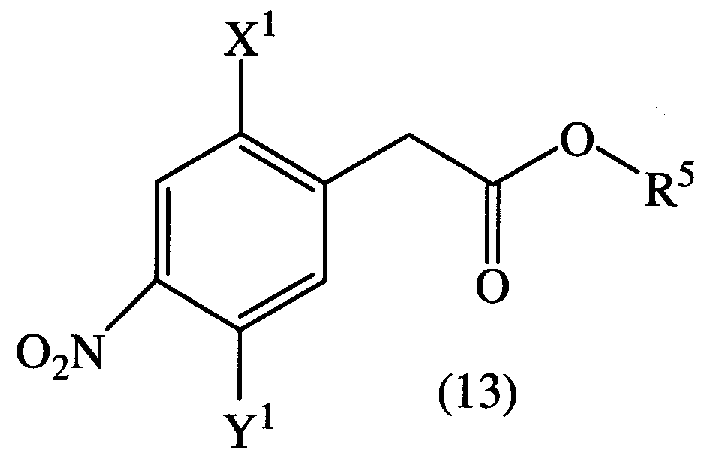
- X 1 represents a hydrogen atom or a halogen atom
- ⁇ 1 represents a halogen atom
- R 5 is a hydrogen atom, a linear or branched alkyl which may have a substituent, A aralkyl group or a phenyl group, which may have a group or a substituent.
- the compound represented by is important.
- the compound in which R 2 is the formula (a) is also produced by condensing a sulfonic acid or ester having a partial structure of R 1 with aminophenol amide, You. This amidation reaction was also carried out under general basic conditions, and had the same problems as described above.
- Nitrobenzene has side chains — P (O) (OCH), —SO Ph, one CN, one COR (R is low
- Non-Patent Document 2 a reaction to introduce a 3222 secondary alkyl group
- Non-Patent Document 3 a reaction to introduce nitrobenzene as a side chain into ethyl acetyl acetate
- the main product obtained by these reactions is ortho-substituted -trobenzene.
- Patent Document 1 International Publication No. 2002Z053534 pamphlet
- Patent Document 2 PCT / JP2004 / 006471
- Patent Document 3 Japanese Patent No. 3350051
- Patent Document 4 JP-A-57-16840
- Patent Document l Ami.Appl.Biol., 69, 65-72 (1971)
- Non-patent document 2 Amer.Chem.Soc., 107, 19, 5473-5483 (1985)
- Non-patent document 3 Synthesis, 12, 1007-1009 (1988)
- Non-Patent Document 4 J. Org.Chem., 49, 578-579 (1984) Disclosure of the invention
- the present invention is an industrial process for obtaining the compounds represented by the above formulas (2) and (13), which are important compounds as intermediates for producing compounds having excellent VLA-4 inhibitory activity and safety. It is intended to provide an advantageous production method.
- the present inventor has found that in the production process of the compound represented by the above formula (2), the benzene group is reduced by performing a nitro group reduction reaction under a mild platinum-based catalyst. It has been found that only the nitro group can be selectively reduced without reducing the above halogen. Furthermore, they have found that the stability of the reduced product can be improved by obtaining the reduced product as crystals of the hydrochloride.
- the present invention has been completed by these excellent improvements.
- the present invention provides a compound represented by the formula (I) [0022] [Formula 5]
- R 1 represents an aryl group which may have a substituent or a heteroaryl group which may have a substituent.
- a chlorinating reagent and a compound represented by the formula (II) are added to a compound represented by the formula under acidic conditions without adding a base.
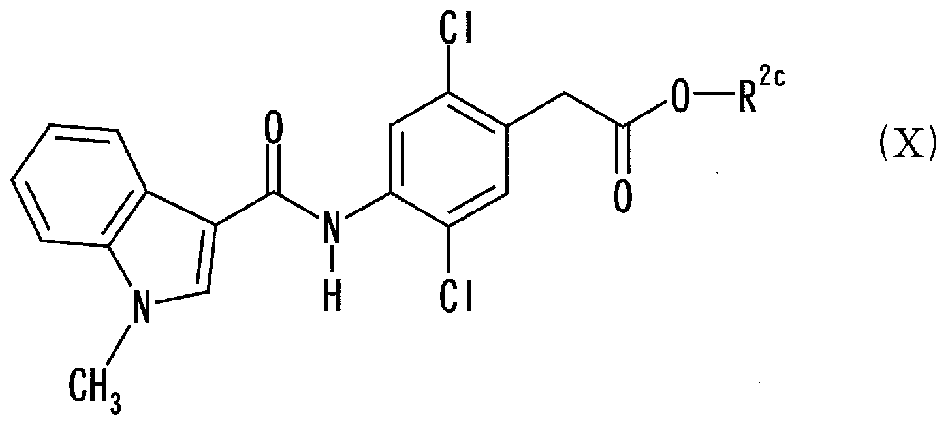
- R 2 is a linear or branched lower alkoxy group which may have a substituent, may have a substituent, and may be an aralkyloxy group, a phenoxy group or a compound represented by the formula (a) )
- R 3 represents a linear or branched lower alkyl group which may have a substituent
- R 4 may have a substituent and may be linear or branched. It means a lower alkyl group in the chain or an aralkyl group which may have a substituent.
- X represents a hydrogen atom or a halogen atom
- Y represents a halogen atom or a lower alkoxy group.
- the present invention relates to a hydrochloride of the compound represented by the formula:
- R 2b may have a substituent, may be a linear or branched lower alkyl group, or may have a substituent, and may have an aralkyl group or a phenyl group.) means. )
- R b has the same definition as before.
- R 4 has the same definition as before.
- R 4 has the same definition as before.
- R 2b may have a substituent, may be a linear or branched lower alkyl group, or may have a substituent, and may have an aralkyl group or a phenyl group.) means. )
- R represents a hydrogen atom, a linear or branched lower alkyl group which may have a substituent, an aralkyl group which may have a substituent, or a phenyl group which may have a substituent.
- R 4 represents a linear or branched lower alkyl group which may have a substituent or an aralkyl group which may have a substituent.
- the present invention relates to a method for producing a compound represented by the formula:
- a chlorinating reagent and a compound represented by the formula (VIII) are added to the compound represented by the formula (1) under an acidic condition without adding a base.
- R 4 means a linear or branched lower alkyl group which may have a substituent or an aralkyl group which may have a substituent.
- the present invention relates to a method for producing a compound represented by the formula: or a salt or hydrate thereof.
- the present invention provides a compound represented by the formula (III) according to the above method, wherein the compound represented by the formula ( ⁇ ) is obtained by reducing the nitro group of the compound represented by the formula ( ⁇ ) obtained by the method.
- the present invention relates to a method for producing the compound represented by the formula (I).
- One preferred embodiment of the present invention comprises the following scheme, starting from readily available substituted nitrophenylacetic acid and substituted nitrobenzene.
- R 2b represents a substituted or unsubstituted linear or branched lower alkyl group, an optionally substituted aralkyl group or a phenyl group
- R 2e represents a hydrogen atom, a substituted or unsubstituted linear or branched lower alkyl group, an optionally substituted aralkyl group or a substituted phenyl group; ⁇ R 2 , R 3 , R 4 , X, Y and Z are as defined above.
- the compound of the formula ( ⁇ ) includes a compound of the formula (5-1) and a compound of the formula (8). Further, the compound of the formula ( ⁇ ⁇ ) includes a compound of the formula (9), a compound of the formula (10a) and a compound of the formula (11).
- This step is a step of converting a carboxylic acid of the formula (3) into an ester of the formula (4).
- This step is performed according to a known method for converting a carboxylic acid to an ester (see “Protective Groups urgency Synthesis, eds. By TW Greene and PG Wuts, John Wiley & Sons, Inc., New York, 1991"). What is necessary is just to implement.
- R 2b represents a linear or branched lower alkyl group which may have a substituent, an aralkyl group which may have a substituent or a phenyl group which may have a substituent.
- the lower alkyl group include an alkyl group having 116 carbon atoms.
- a phenyl-C alkyl group is preferable.
- these alkyl groups or aralkyl groups Examples of the group that can be substituted include 13 halogen atoms and an alkoxy group having 116 carbon atoms.
- R 2b preferably includes a methyl group, an ethyl group, a tertiary butyl group, a benzyl group and a 4-methoxybenzyl group, and a methyl group and an ethyl group are more preferable.
- X represents a hydrogen atom or a halogen atom
- Y represents a halogen atom or a lower alkoxy group.
- the lower alkoxy group include an alkoxy group having 16 carbon atoms.
- X and Y are each independently preferably a fluorine atom or a chlorine atom, and more preferably X and Y are both a chlorine atom.
- Step b is a step of reducing a nitro group to an amino group
- step c is a step of converting an ester to a carboxylic acid by hydrolysis.
- R 2b , X and Y have the same meanings as defined in step a.
- the compound represented by the formula (6) is reduced by reducing the -toro group in the formula (4) to an amino group.
- the ester in the formula (5-1) is hydrolyzed to obtain a compound represented by the formula (6).
- the present inventors have found that hydrogenation in an alcohol solvent corresponding to R 2b in the presence of a platinum-based reduction catalyst can selectively reduce only the -tro group of the compound of the formula (4). This makes it possible to avoid the use of iron powder, which had problems in operability and reactivity, and to suppress the elimination reaction of chlorine, thereby achieving high yields of the compound represented by the formula (5-1). It became possible to obtain
- the reaction is carried out by dissolving the starting material represented by the formula (4) or the compound represented by the formula ( 5-2 ) in an alcohol solvent corresponding to R 2b in the formula (4), Performed under catalyst.
- platinum-based reduction catalyst include platinum, Pt—S—carbon, etc., and Pt—S—carbon is particularly preferred.
- Pt—S—carbon is preferably added in an amount of 5% to 50% based on the weight of the compound represented by the formula (4), more preferably 10% to 20%.
- the hydrogen pressure is preferably normal pressure to 20 atm. Usually, the reaction is completed at normal pressure.
- the reaction temperature is preferably in the range of 0 ° C. to 50 ° C., and more preferably in the range of room temperature to 50 ° C.
- the reaction time is between 1 hour and 24 hours, and usually completes within 3 hours and 10 hours
- a solution of hydrochloric acid preferably an ethanol solution of hydrochloric acid
- the mixture is stirred at 0 ° C. to room temperature for a while, and then the precipitated crystals are filtered or, if not precipitated, the solvent is distilled off.
- the compound represented by the formula (5-1) can be obtained as a hydrochloride.
- the ability to filter the precipitated crystals If the crystals do not precipitate, the carboxylic acid represented by the formula (6) can be obtained by removing the solvent and filtering the precipitated crystals.
- Step c is a general reaction for hydrolyzing an ester to a free carboxylic acid, and a general method for converting an alkoxycarbol group to a carboxylic acid (see “Protective Gro UDS m Organic Synthesis, eas.oy TW ureene and PG Wuts, Joh n Wiley & Sons, Inc., New York, 1991 ”).
- Examples of the solvent to be used include alcohol solvents such as methanol and ethanol. Of these, methanol and ethanol are preferred.
- both acids and alkalis can be used, and examples thereof include alkali metal hydroxides such as sodium, potassium and lithium and alkaline earth hydroxides such as magnesium and calcium. Of these, sodium hydroxide and potassium hydroxide are preferred.
- the reaction temperature is preferably within the range of room temperature and the boiling point of the solvent.
- the reaction time is 30 minutes to 5 hours, and usually completes in 1 hour to 2 hours.
- This step is a step of condensing the carboxylic acid of the formula (6) with the compound of the formula (7).
- X, Y, R 3 and R 4 are the same as described above.
- examples of the lower alkyl group represented by R 3 include an alkyl group having 16 to 16 carbon atoms, and a methyl group, which is preferably a methyl group or an ethyl group, is particularly preferred! / ⁇ .
- examples of the lower alkyl group represented by R 4 include an alkyl group having 16 carbon atoms.
- aralkyl group a ferro-C alkyl group is preferable. Also these keys
- Examples of the group that can be substituted with the alkyl group or the aralkyl group include 13 halogen atoms and an alkoxy group having 116 carbon atoms.
- Examples of R 4 include a methyl group, an ethyl group, a tertiary butyl group, a benzyl group, and a 4-methoxybenzyl group, and a methyl group and an ethyl group are more preferable.
- the solvent to be used is not particularly limited as long as it does not inhibit the reaction.
- Hydrocarbon solvents such as toluene, hydrocarbon solvents such as toluene, ether solvents such as tetrahydrofuran, and aprotic polar solvents such as acetonitrile, N, N-dimethylformamide, and N-methyl-2-pyrrolidone. .
- aprotic polar solvents such as acetonitrile, N, N-dimethylformamide, and N-methyl-2-pyrrolidone.
- methylene chloride, acetonitrile or N, N-dimethylformamide is preferred.
- 1-ethyl-3- (3-dimethylaminopropyl) carbodiimide hydrochloride, N, N-dicyclohexylcarbodiimide, N, N carbodiimidazole, or the like thereof is used.
- the reaction may be carried out using a condensing agent.
- the reaction is carried out in N, N-dimethylformamide using 1-ethyl-3- (3-dimethylaminopropyl) carbodiimide hydrochloride or N, N-dicyclohexylcarbodiimide.
- the reaction temperature may be within the range of the boiling point of the solvent at -20 ° C, preferably at 0 ° C and at room temperature.
- This reaction is carried out in a stoichiometric amount based on the catalytic amount of an organic amine base such as triethylamine or N, N-dimethylaminopyridine or an active ester reagent such as 1-hydroxybenzotriazole. It may be carried out in coexistence.
- an organic amine base such as triethylamine or N, N-dimethylaminopyridine or an active ester reagent such as 1-hydroxybenzotriazole. It may be carried out in coexistence.
- This step is a step of forming an amide bond with the compound represented by the formula ( ⁇ ).
- R 1 represents an aryl group which may have a substituent or a heteroaryl group which may have a substituent.
- a phenyl group which may have a substituent a benzofural group which may have a substituent, a chloro group which may have a substituent, and a substituent
- a benzoisothiazolyl group which may have a benzothiophenyl group which may have a substituent, an indolyl group which may have a substituent, and a group which has a substituent.
- it has an indazolyl group and a substituent! /, And more preferably an isoquinolinyl group. Yes.
- R 1 is not limited to a binding site, but may be a benzofuranyl group which may have a substituent, a chloro group which may have a substituent, or a benzoisothiazolyl group which may have a substituent.
- a compound bonded at the 3-position is more preferable, and in the case of an isoquinolinyl group, a bond at the 3-position is more preferable. Those which bind with are more preferred.
- substituents examples include a lower alkyl group and a halogen atom.
- an alkyl group having 16 to 16 carbon atoms and a halogen atom, particularly a methyl group, a chlorine atom, a fluorine atom and an iodine atom are preferable.
- the number and position of the substituents are not limited, but may be substituted.
- the heteroaryl group is an S-indolyl group and the substituent group is an S-methyl group, it is preferably substituted at the 1-position.
- R 2 , X, and Y are the same as defined above.
- the lower alkoxy group represented by R 2 includes an alkoxy group having 116 carbon atoms.
- the aralkyloxy group is preferably a ferro-C alkyloxy group. Also these
- Examples of the group which can be substituted with the above alkoxy group or aralkyloxy group include 13 halogen atoms, an alkoxy group having 16 carbon atoms, and the like.
- the compound of the formula ( ⁇ ) includes the compound of the formula (5-1) and the compound of the formula (8).
- reaction proceeds quantitatively by isolating the acid chloride once and performing the reaction with the chlorinating reagent under acidic conditions without adding a base. .
- the step of isolating the acid chloride can be omitted, and the amount of the by-product of the carboxylic acid derivative (I) dimer can be suppressed to a small amount.
- Reaction solvents include chlorinated solvents such as methylene chloride and 1,2-dichloroethane, hydrocarbon solvents such as toluene and benzene, ether solvents such as tetrahydrofuran, and ethyl acetate. Ability to use ester solvents such as acetonitrile, etc.
- chlorinated solvents such as methylene chloride and 1,2-dichloroethane
- hydrocarbon solvents such as toluene and benzene
- acetonitrile 1,2-dichloroethane, toluene and acetonitrile are preferred.
- chlorinating reagent examples include chlorinating reagents that are usually used when converting carboxylic acids such as salted oxalyl and salted thiollonil into salted tides, and salted oxalil is more preferred.
- the hydrochloride of the compound of the formula (II) obtained in the step (b) or the step (d) is treated with a chlorinating reagent of the formula (I) ) To react the compound.
- the reaction mixture can be concentrated to isolate the salt ridge, but the salt ridge represented by the formula (I) can be added as it is. At this time, by adding 0.01% to 1% of N, N-dimethylformamide with respect to the weight of the compound represented by the formula (5-1), acid chloride formation is promoted. After the addition, the reaction is carried out at a temperature ranging from room temperature to the boiling point of the solvent, preferably from 80 ° C to 130 ° C.
- the reaction time is preferably 3 hours to 24 hours, and is usually completed in about 3 hours to 6 hours.
- the compound represented by the formula (I) can be synthesized according to the method described in WO2002Z053534 pamphlet using a commercially available raw material and appropriately introducing a substituent.
- This step is a step of producing a compound of the formula (10) by hydrolyzing the compound of the formula (9).
- R 2b , X and Y are as defined above.
- This step is carried out by a usual hydrolysis means in the same manner as in step c.
- This step is a step of producing a compound of the formula (11) by condensing the compound of the formula (10a) and the compound of the formula (7).
- the compound of formula (10a) is either a compound of formula (9) or a compound of formula (10).
- R 3 , R 4 , X and Y are as defined above.
- -OR 2e is an ester, an active ester is preferred.
- the solvent to be used is not particularly limited as long as it does not inhibit the reaction.
- a hydrocarbon solvent such as methylene chloride, a hydrocarbon solvent such as toluene, an ether solvent such as tetrahydrofuran, or acetonitrile, Aprotic polar solvents such as N, N-dimethylformamide and N-methyl-2-pyrrolidone can be mentioned.
- methylene chloride, acetonitrile or N, N-dimethylformamide is preferred.
- reaction temperature may be within the range of the boiling point of the solvent at -20 ° C, preferably at 0 ° C and at room temperature.
- this reaction is carried out using an organic amine base such as triethylamine or N, N-dimethylaminopyridine, or an organic amine base, and an active ester reagent such as 1-hydroxybenzotriazole. It may be carried out in the presence of stoichiometric equivalents.
- This step is a step of producing a compound of the formula (12) by hydrolyzing the compound of the formula (11).
- RR 3 , R 4 , X and Y have the same definition as before.
- This step is carried out by a usual hydrolysis means in the same manner as in step c.
- the compound represented by the formula (7) includes a compound represented by the formula (7a)
- the compound represented by is preferred. Further, in the formula (7a), a R 3 months methyl group, preferably R 4 is Echiru group.
- the conjugate obtained in each step of the method of the present invention may be isolated and subjected to the next reaction, or may be subjected to the next reaction without isolation.
- the compound of formula ( ⁇ ), ie, the compound of formula (5-1) and formula (8) is preferably subjected to the next reaction in the form of a hydrochloride salt, [0125]
- the compound of the formula (12) may be a salt of an alkali metal such as a sodium salt, a potassium salt or a lithium salt; a salt of an alkaline earth metal such as a magnesium salt or a calcium salt; or a triethylamine salt; Salts, N-benzylethanolamine salts, ethanolamine salts, tert-butylamine salts, organic amine salts such as tris (hydroxymethyl) aminomethane salts, cyclohexylamine salts, etc. It may also be isolated as a hydrate.
- the compound represented by the formula (4) can be obtained by any of the steps a and i.
- R 2b is preferably a methyl group, an ethyl group, a tertiary butyl group, or a phenyl group, and more preferably a methyl group, an ethyl group, or a tertiary butyl group Is particularly preferably a tertiary butyl group.
- X represents a hydrogen atom or a halogen atom
- Y represents a halogen atom or a lower alkoxy group.
- the lower alkoxy group include an alkoxy group having 16 carbon atoms.
- X and Y are each independently preferably a chlorine atom or a fluorine atom. More preferably, X and Y are both a chlorine atom.
- the compound represented by the formula (14) may be, for example, commercially available from Tokyo Chemical Industry or the like, or described in Dunlop, Macrae, Tucker, J. Chem. Soc., 1672-1676 (1934). It may be synthesized by referring to the method.
- Z represents a leaving group. Any commonly used leaving group Specific examples include a halogen atom, a phenylthio group, an alkoxy group, and an amino group.
- the leaving group is preferably a halogen atom or a phenylthio group, more preferably a chlorine atom or a bromine atom, even more preferably a chlorine atom.
- a commercially available compound such as Tokyo Chemical Industry may be purchased.
- the present inventors have found that when a compound represented by the formula (14) is reacted with a compound represented by the formula (15), a compound represented by the formula (4) is obtained with high selectivity.
- a compound represented by the formula (14) is reacted with a compound represented by the formula (15)
- the compound represented by the formula (16) in which the ortho position is substituted with respect to the nitro group is obtained as a by-product.
- Step i is preferably represented by step j below.
- reaction is to introduce a 2b group, where R 2b has the same definition as before. Wherein R 2b and Z have the same definition as before.
- the 2,5-dichro-torobenzene represented by the formula (17) is described in Can. J. Chem., 36, 238 (1958). 2,5-Dichloro-trobenzene may be purchased commercially or may be synthesized. 2,5-Dichloromouth-trobenzene is commercially available, for example, from Tokyo Chemical Industry (Power Catalog No. D0387), and is synthesized by Dunlop, Macrae, Tucker, J. Chem. Soc., 1672-1676 (1934). Power is described!
- Examples of the base used in the above step (i) or the above step (j) include tert-butoxy sodium, tert-butoxy potassium, sodium hydroxide, potassium hydroxide, and the like. It is not limited to.
- the base used in the above step (i) or the above step (j) is preferably tertiary butoxy sodium or sodium hydroxide, and more preferably sodium tertiary butoxide.
- the amount of the base is preferably 2 to 10 equivalents, more preferably 2 to 3 equivalents, relative to compound (4).
- One base may be used alone, or two or more bases may be used in combination as long as the reaction proceeds!
- Examples of the solvent used in the above step (i) or the above step (j) include amide solvents such as N, N-dimethylformamide and N, N-dimethylacetamide, tetrahydrofuran, getyl ether, dimethyl ether, diisopropyl ether and the like.
- Examples of the force include ether solvents, ethyl acetate or dimethyl sulfoxide (DMSO). Of these solvents, amide solvents or N, N-dimethylacetamide, which is preferred with DMSO, are more preferred.
- the amount of the solvent is not particularly limited, but is preferably 5 to 20 times the compound (4), more preferably 10 to 15 times the compound (4). Use only one solvent. / As long as the reaction proceeds, two or more solvents may be used in combination.
- the reaction temperature of the above step (i) or the above step (j) varies depending on the solvent to be used, and is usually in the range of 20 ° C to 30 ° C, and preferably, the -10 ° C force is also in the range of 0 ° C. .
- the reaction time of the above step (i) or the above step (j) is usually performed for about 10 minutes to 24 hours, preferably for about 20 minutes to 12 hours, more preferably for about 30 minutes to 13 hours until the reaction is substantially completed.
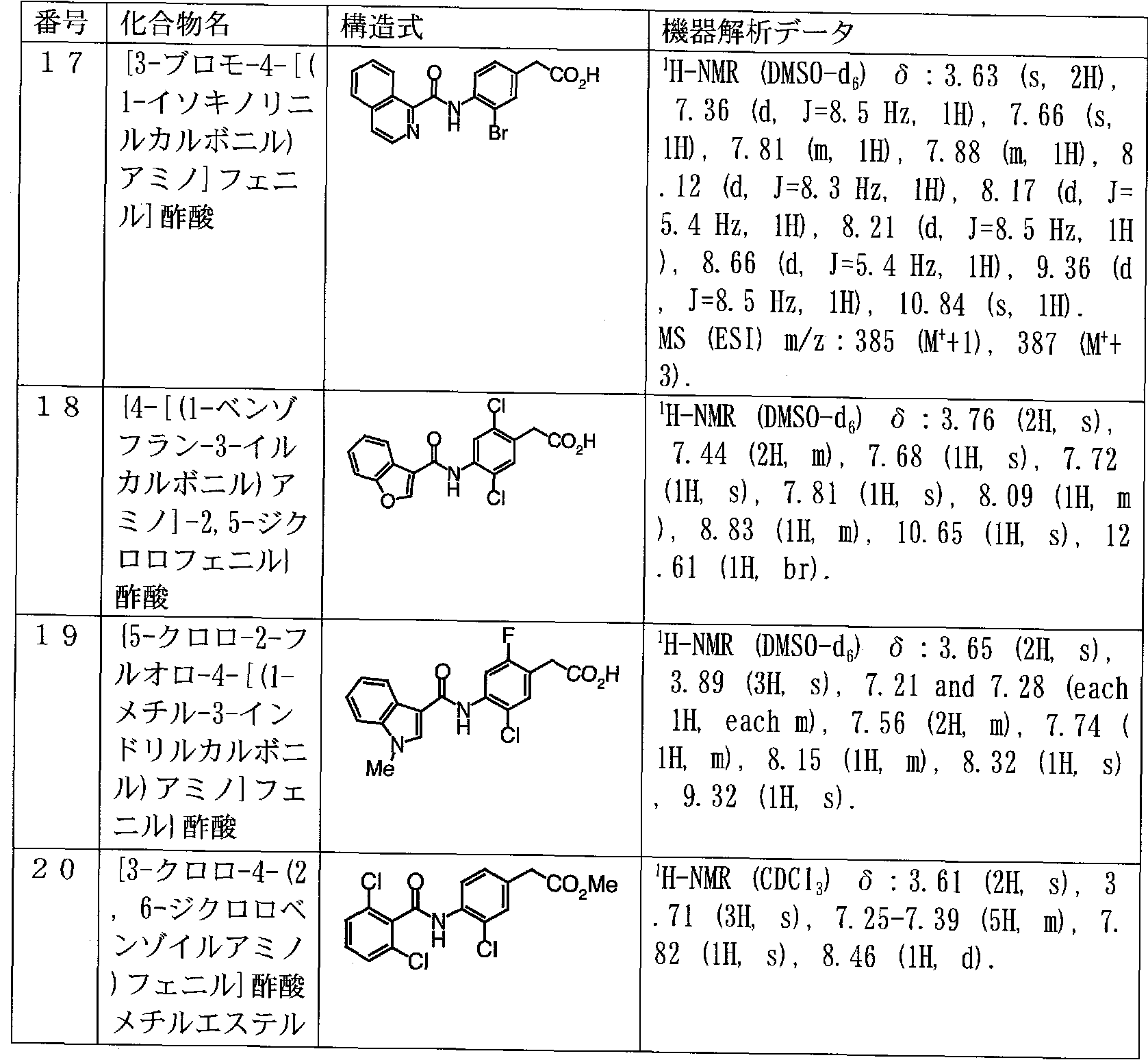
- Examples of compounds obtained by the method of the present invention are shown in the following table.
- Example 2 16.6 g of the i-danied product obtained in Example 2 was mashed and heated under reflux at an external temperature of 100 ° C to 120 ° C for 4 hours. After completion of the reaction was confirmed by HPLC, the mixture was cooled, and 50 mL of diisopropyl ether (IPE) was added thereto, followed by stirring for a while. The precipitated crystals were collected by filtration, washed with IPE, and dried to obtain 20.7 g (89.5%) of the title compound represented by the formula (22).
- IPE diisopropyl ether
- a flask was charged with 20 g of the compound obtained in Example 5, 300 mL of methanol, and 200 mL of 0.5 mol Zl sodium hydroxide, and the mixture was heated under reflux for 1.5 hours. After confirming the completion of the reaction by HPLC, 14. ImL of acetic acid was added at an internal temperature of 70 ° C., and the mixture was stirred for a while until reaching room temperature. The precipitated crystals were filtered, washed with water, and dried to obtain 16.75 g (90.0%) of a compound represented by the formula (23).
- IR (ATR) cm _1 3464, 3303, 3182, 1726, 1633.
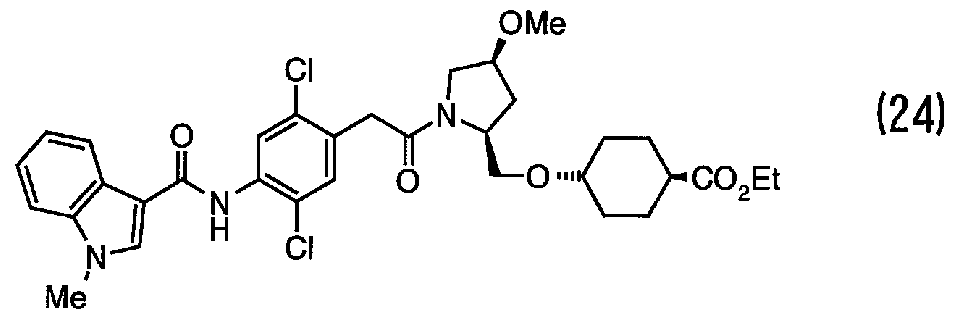
- the obtained residue was purified by column chromatography using silica gel, and the title compound (24) (350 mg, 76%) was obtained from a stream of chloroform: ethyl acetate (9: 1 to 3: 1, vZv). Was obtained as a crystalline powder.
- the various types of statistic data of the Iridani product obtained by this method were consistent with those obtained by the method described above.
- Oxalyl chloride (0.135 mL, 1.54 mmol) was added in (lOmL) at 0 ° C with stirring. The reaction mixture was stirred at 0 ° C. for 1 hour and further at room temperature for 5 hours. The reaction solution was distilled off under reduced pressure, and the obtained acid chloride was used for the next reaction.
- reaction solution was concentrated to dryness under reduced pressure, the residue was dissolved in 1,2-dichloroethane (10 mL), and the solution was added to trans-4-[(2S, 4S) -1- (4-amino-2,5-dichlorophenol).
- Indole-3-boronic acid (172 mg, 1.07 mmol) in 1,2-dichloroethane (3 mL) was stirred at 0 ° C with stirring at 0 ° C for 1,2-dichloroethane (0.16 mL, 1.21 mmol) of oxalyl chloride (0.106 mL, 1.21 mmol). 3 mL) solution was added. After the reaction solution was stirred at room temperature for 1 hour, it was concentrated to dryness under reduced pressure.
- the precipitated crystals were filtered by suction, and the crystals were washed with 10 mL of a water: acetonitrile mixture (1: 1) and 20 mL of water sequentially, and dried under reduced pressure at 40 ° C. to obtain 10.5 g of one crystal of the compound of the formula (26) ( 79% yield, 99% quality).
- the filtrate is concentrated under reduced pressure and extracted with ethyl acetate.
- the extract is concentrated to dryness under reduced pressure, 25 mL of acetonitrile is added, and the mixture is stirred. 20 mL of water is added to precipitate the seed crystals, and the mixture is stirred for a while and cooled with ice.
- the precipitated crystals were collected by suction filtration, washed sequentially with 2 mL of a water: acetonitrile mixture (1: 1) and 4 mL of water, and dried under reduced pressure at 40 ° C. to obtain 1.8 g of two crystals of the compound of the formula (26). (Yield 14%, quality 96%).
- the precipitated crystals are collected by filtration, washed with 50% aqueous acetonitrile (50 mL), and dried under reduced pressure to obtain a compound of the formula (24) (15.24 g, purity 94.3%, purity-isolated yield 86. 1%) as white crystals.
- reaction mixture was diluted with ethyl acetate (500 mL), 2N hydrochloric acid (400 mL) was added, liquid separation was performed, and the mixture was extracted with ethyl acetate (250 mL).
- the organic layers were combined, washed with 2N hydrochloric acid (200 mL), water (200 mL), and saturated saline (200 mL) in that order, and concentrated under reduced pressure to obtain 87.Og of a dark brown oil.
- This dark brown oil was a mixture of compound (30-a) and compound (30-b) (containing about 10% of compound (30-b)).
- 2-Propanol (105 mL) and water (35 mL) were added to the obtained residue. After stirring overnight, the precipitated crystals were filtered to obtain compound (30-a) (44.7 g, 0.161 mol, yield 59.6%, HPLC purity 100%) as yellow crystals.
Landscapes
- Chemical & Material Sciences (AREA)
- Organic Chemistry (AREA)
- Health & Medical Sciences (AREA)
- Chemical Kinetics & Catalysis (AREA)
- Animal Behavior & Ethology (AREA)
- Veterinary Medicine (AREA)
- General Chemical & Material Sciences (AREA)
- Medicinal Chemistry (AREA)
- Nuclear Medicine, Radiotherapy & Molecular Imaging (AREA)
- Public Health (AREA)
- Pharmacology & Pharmacy (AREA)
- Life Sciences & Earth Sciences (AREA)
- General Health & Medical Sciences (AREA)
- Engineering & Computer Science (AREA)
- Bioinformatics & Cheminformatics (AREA)
- Immunology (AREA)
- Organic Low-Molecular-Weight Compounds And Preparation Thereof (AREA)
- Pain & Pain Management (AREA)
- Rheumatology (AREA)
- Pulmonology (AREA)
- Heterocyclic Compounds Containing Sulfur Atoms (AREA)
- Thiazole And Isothizaole Compounds (AREA)
- Other In-Based Heterocyclic Compounds (AREA)
- Furan Compounds (AREA)
- Plural Heterocyclic Compounds (AREA)
- Pharmaceuticals Containing Other Organic And Inorganic Compounds (AREA)
- Indole Compounds (AREA)
Description








Claims




Priority Applications (3)
| Application Number | Priority Date | Filing Date | Title |
|---|---|---|---|
| EP04807933A EP1698611A4 (en) | 2003-12-26 | 2004-12-27 | PROCESS FOR PRODUCING A PHENYLACETIC ACID DERIVATIVE |
| JP2005516702A JPWO2005063678A1 (ja) | 2003-12-26 | 2004-12-27 | フェニル酢酸誘導体の製造方法 |
| US10/584,240 US20070149606A1 (en) | 2003-12-26 | 2004-12-27 | Process for producing phenylacetic acid derivative |
Applications Claiming Priority (6)
| Application Number | Priority Date | Filing Date | Title |
|---|---|---|---|
| JP2003-431680 | 2003-12-26 | ||
| JP2003431680 | 2003-12-26 | ||
| JP2004-283082 | 2004-09-29 | ||
| JP2004283082 | 2004-09-29 | ||
| JP2004312335 | 2004-10-27 | ||
| JP2004-312335 | 2004-10-27 |
Publications (1)
| Publication Number | Publication Date |
|---|---|
| WO2005063678A1 true WO2005063678A1 (ja) | 2005-07-14 |
Family
ID=34743471
Family Applications (1)
| Application Number | Title | Priority Date | Filing Date |
|---|---|---|---|
| PCT/JP2004/019578 Ceased WO2005063678A1 (ja) | 2003-12-26 | 2004-12-27 | フェニル酢酸誘導体の製造方法 |
Country Status (4)
| Country | Link |
|---|---|
| US (1) | US20070149606A1 (ja) |
| EP (1) | EP1698611A4 (ja) |
| JP (1) | JPWO2005063678A1 (ja) |
| WO (1) | WO2005063678A1 (ja) |
Cited By (2)
| Publication number | Priority date | Publication date | Assignee | Title |
|---|---|---|---|---|
| WO2007069635A1 (ja) * | 2005-12-13 | 2007-06-21 | Daiichi Sankyo Company, Limited | Vla-4阻害薬 |
| JP2010508318A (ja) * | 2006-11-01 | 2010-03-18 | エフ.ホフマン−ラ ロシュ アーゲー | L−cpt1阻害剤として有用なインダゾール誘導体 |
Families Citing this family (1)
| Publication number | Priority date | Publication date | Assignee | Title |
|---|---|---|---|---|
| EP1698621A4 (en) * | 2003-12-26 | 2008-11-19 | Daiichi Seiyaku Co | PROCESS FOR PREPARING A PYRROLIDINE DERIVATIVE |
Citations (2)
| Publication number | Priority date | Publication date | Assignee | Title |
|---|---|---|---|---|
| WO2002053534A1 (en) * | 2000-12-28 | 2002-07-11 | Daiichi Pharmaceutical Co., Ltd. | Vla-4 inhibitors |
| JP2002332266A (ja) * | 2000-04-28 | 2002-11-22 | Sankyo Co Ltd | PPAR−γモジュレータ |
Family Cites Families (3)
| Publication number | Priority date | Publication date | Assignee | Title |
|---|---|---|---|---|
| CN1630629B (zh) * | 2002-02-28 | 2010-05-05 | 日本烟草产业株式会社 | 酯化合物及其医药用途 |
| BR0309668A (pt) * | 2002-04-23 | 2005-03-01 | Hoffmann La Roche | Imidazolinilmetil aralquilsulfonamidas |
| WO2004099136A1 (ja) * | 2003-05-09 | 2004-11-18 | Daiichi Pharmaceutical Co., Ltd. | ピロリジン誘導体の製造方法 |
-
2004
- 2004-12-27 US US10/584,240 patent/US20070149606A1/en not_active Abandoned
- 2004-12-27 WO PCT/JP2004/019578 patent/WO2005063678A1/ja not_active Ceased
- 2004-12-27 JP JP2005516702A patent/JPWO2005063678A1/ja active Pending
- 2004-12-27 EP EP04807933A patent/EP1698611A4/en not_active Withdrawn
Patent Citations (2)
| Publication number | Priority date | Publication date | Assignee | Title |
|---|---|---|---|---|
| JP2002332266A (ja) * | 2000-04-28 | 2002-11-22 | Sankyo Co Ltd | PPAR−γモジュレータ |
| WO2002053534A1 (en) * | 2000-12-28 | 2002-07-11 | Daiichi Pharmaceutical Co., Ltd. | Vla-4 inhibitors |
Non-Patent Citations (1)
| Title |
|---|
| See also references of EP1698611A4 * |
Cited By (3)
| Publication number | Priority date | Publication date | Assignee | Title |
|---|---|---|---|---|
| WO2007069635A1 (ja) * | 2005-12-13 | 2007-06-21 | Daiichi Sankyo Company, Limited | Vla-4阻害薬 |
| US8129366B2 (en) | 2005-12-13 | 2012-03-06 | Daiichi Sankyo Company, Limited | VLA-4 inhibitory drug |
| JP2010508318A (ja) * | 2006-11-01 | 2010-03-18 | エフ.ホフマン−ラ ロシュ アーゲー | L−cpt1阻害剤として有用なインダゾール誘導体 |
Also Published As
| Publication number | Publication date |
|---|---|
| EP1698611A1 (en) | 2006-09-06 |
| JPWO2005063678A1 (ja) | 2007-12-20 |
| US20070149606A1 (en) | 2007-06-28 |
| EP1698611A4 (en) | 2007-10-31 |
Similar Documents
| Publication | Publication Date | Title |
|---|---|---|
| JP6061158B2 (ja) | 6−(7−((1−アミノシクロプロピル)メトキシ)−6−メトキシキノリン−4−イルオキシ)−n−メチル−1−ナフトアミド、またはそれの薬学的に許容される塩の合成中間体およびその使用 | |
| JP4386723B2 (ja) | 新規方法 | |
| US20040186296A1 (en) | Process to produce derivatives from uk-2a derivatives | |
| CN111527067B (zh) | 1-[5-(2-氟苯基)-1-(吡啶-3-基磺酰基)-1h-吡咯-3-基]-n-甲基甲胺单富马酸盐的制造法 | |
| KR20080072738A (ko) | 아미도-페녹시벤조산 화합물의 제조를 위한 화학적 방법 | |
| JP4688292B2 (ja) | 純粋な鏡像体であるn−メチル−n−[(1s)−1−フェニル−2−((3s)−3−ヒドロキシピロリジン−1−イル)エチル]−2,2−ジフェニルアセトアミドの製造方法 | |
| JPWO2005063678A1 (ja) | フェニル酢酸誘導体の製造方法 | |
| CN101490045A (zh) | 7-(丙烯酰基)吲哚的制备方法 | |
| WO2021120953A1 (zh) | 一种 1,7- 萘啶衍生物的合成方法 | |
| JP4968602B2 (ja) | ベンズアミド誘導体の製造方法 | |
| HK1047275B (zh) | 苯並呋喃衍生物 | |
| JP4512100B2 (ja) | 置換ベンゾピラン化合物の製造方法 | |
| CN113683547B (zh) | 一类手性4,5-二取代吡咯烷-2-酮化合物及其制备方法和应用 | |
| JP2011057575A (ja) | 4−ヒドロキシベンゾチオフェン誘導体の製造方法 | |
| JP4418430B2 (ja) | スルホンアミド含有インドール化合物の製造方法 | |
| JP4984676B2 (ja) | ベンジルオキシ基を有するアニリンの製法 | |
| JPWO2004099136A1 (ja) | ピロリジン誘導体の製造方法 | |
| KR100539725B1 (ko) | 피롤의 새로운 알킬화 반응 | |
| CN1169989A (zh) | 二硫代碳酰亚胺衍生物的制备方法 | |
| JPS6325589B2 (ja) | ||
| WO2000029369A1 (fr) | Derives d'acide aminoacrylique et procede de production correspondant | |
| CN1290247A (zh) | 制备抗叶酸剂的方法和中间体 | |
| JP2001278864A (ja) | 4−メトキシキノリン類の製造方法 | |
| JP2022035954A (ja) | N-Boc-ラクタム誘導体及びその製造方法、並びに、環状アミン誘導体の製造方法 | |
| JP2004010601A (ja) | インドール誘導体の製造方法及びそのための有用な中間体 |
Legal Events
| Date | Code | Title | Description |
|---|---|---|---|
| AK | Designated states |
Kind code of ref document: A1 Designated state(s): AE AG AL AM AT AU AZ BA BB BG BR BW BY BZ CA CH CN CO CR CU CZ DE DK DM DZ EC EE EG ES FI GB GD GE GH GM HR HU ID IL IN IS JP KE KG KP KR KZ LC LK LR LS LT LU LV MA MD MG MK MN MW MX MZ NA NI NO NZ OM PG PH PL PT RO RU SC SD SE SG SK SL SY TJ TM TN TR TT TZ UA UG US UZ VC VN YU ZA ZM ZW |
|
| AL | Designated countries for regional patents |
Kind code of ref document: A1 Designated state(s): BW GH GM KE LS MW MZ NA SD SL SZ TZ UG ZM ZW AM AZ BY KG KZ MD RU TJ TM AT BE BG CH CY CZ DE DK EE ES FI FR GB GR HU IE IS IT LT LU MC NL PL PT RO SE SI SK TR BF BJ CF CG CI CM GA GN GQ GW ML MR NE SN TD TG |
|
| 121 | Ep: the epo has been informed by wipo that ep was designated in this application | ||
| WWE | Wipo information: entry into national phase |
Ref document number: 2005516702 Country of ref document: JP |
|
| WWE | Wipo information: entry into national phase |
Ref document number: 2004807933 Country of ref document: EP |
|
| WWE | Wipo information: entry into national phase |
Ref document number: 2007149606 Country of ref document: US Ref document number: 10584240 Country of ref document: US |
|
| NENP | Non-entry into the national phase |
Ref country code: DE |
|
| WWW | Wipo information: withdrawn in national office |
Country of ref document: DE |
|
| WWP | Wipo information: published in national office |
Ref document number: 2004807933 Country of ref document: EP |
|
| WWP | Wipo information: published in national office |
Ref document number: 10584240 Country of ref document: US |