WO2005083009A1 - Kationische heteroarylazinfarbstoffe und diese verbindungen enthaltende färbemittel - Google Patents
Kationische heteroarylazinfarbstoffe und diese verbindungen enthaltende färbemittel Download PDFInfo
- Publication number
- WO2005083009A1 WO2005083009A1 PCT/EP2004/013705 EP2004013705W WO2005083009A1 WO 2005083009 A1 WO2005083009 A1 WO 2005083009A1 EP 2004013705 W EP2004013705 W EP 2004013705W WO 2005083009 A1 WO2005083009 A1 WO 2005083009A1
- Authority
- WO
- WIPO (PCT)
- Prior art keywords
- methyl
- group
- amino
- hydrazono
- anion
- Prior art date
- Legal status (The legal status is an assumption and is not a legal conclusion. Google has not performed a legal analysis and makes no representation as to the accuracy of the status listed.)
- Ceased
Links
Classifications
-
- C—CHEMISTRY; METALLURGY
- C09—DYES; PAINTS; POLISHES; NATURAL RESINS; ADHESIVES; COMPOSITIONS NOT OTHERWISE PROVIDED FOR; APPLICATIONS OF MATERIALS NOT OTHERWISE PROVIDED FOR
- C09B—ORGANIC DYES OR CLOSELY-RELATED COMPOUNDS FOR PRODUCING DYES, e.g. PIGMENTS; MORDANTS; LAKES
- C09B23/00—Methine or polymethine dyes, e.g. cyanine dyes
- C09B23/16—Methine or polymethine dyes, e.g. cyanine dyes the polymethine chain containing hetero atoms
- C09B23/162—Methine or polymethine dyes, e.g. cyanine dyes the polymethine chain containing hetero atoms only nitrogen atoms
- C09B23/166—Methine or polymethine dyes, e.g. cyanine dyes the polymethine chain containing hetero atoms only nitrogen atoms containing two or more nitrogen atoms
Definitions
- the present invention relates to novel cationic heteroarylazine dyes and colorants for keratin fibers, such as hair, wool or furs, containing these compounds.
- oxidation dyes which result from the oxidative coupling of one or more developer components with one or more coupler components
- direct dyes are generally used.
- oxidation-stable, direct dyes can be added to the oxidative system in order to achieve special color effects.
- Direct dyes are incorporated into suitable substrates to be applied to the fiber. This process, commonly known as tinting, is easy to use, extremely mild and is characterized by little damage to the keratin fiber, since no ammonia or peroxide is added.
- the dyes used here have to meet some requirements. For example, they have to be harmless from a toxicological and dermatological point of view and enable the coloring to be achieved in the desired intensity and brilliance.
- the dyeings obtained must also have good light fastness and resistance to shampooing and good rub fastness.
- a combination of different non-oxidative dyes is generally required for a direct, non-oxidative colorant for keratin fibers in order to achieve certain nuances. Since the selection of such dyes, which sufficiently meet the requirements mentioned, is limited, there is still a great need for such dyes.
- the object of the present invention is therefore to provide direct dyes for dyeing keratin fibers, in particular hair, which meet these requirements.
- cationic heteroarylazine dyes of the general formulas (I) and (II) can be applied very gently to keratin fibers as direct dyes in coloring compositions without the addition of an oxidizing agent. Since these dyes are stable to oxidizing agents, they can also be used in brightening colorants containing oxidizing agents, for example peroxides or persulfates.
- the present invention therefore relates to cationic heteroarylazine dyes of the general formulas (I) and (II),
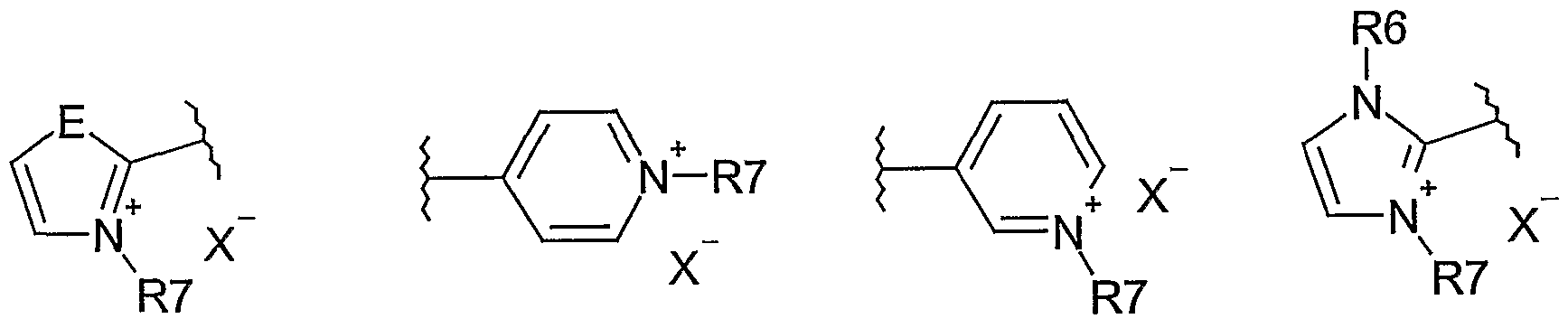
- R1 represents a group of formula (III), (IV), (V) or (VI);
- E represents an oxygen atom or a sulfur atom
- Hydroxyalkyl group or a radical of general formula (VII) - R2, R4 and R5 are the same or different and represent hydrogen, a tert-butyl group, / so-propyl group, a C ⁇ -C6 alkyl group, a C ⁇ -C 6;
- R3 represents a group of formula (VIII), (IX) or (X);
- R6 represents hydrogen, a straight-chain or branched C 1 -C 6 -alkyl group or a straight-chain or branched C 2 -C -hydroxyalkyl group
- R7 represents a branched or linear C 1 -C 6 -alkyl group, a C 2 -C -hydroxyalkyl group or a C 4 -C 6 -polyhydroxyalkyl group
- R8 and R9 are the same or different and are hydrogen, a C.
- R10 represents hydrogen, a straight-chain or branched C 1 -C 6 -alkyl group or a straight-chain or branched C 2 -C 4 -hydroxyalkyl group;
- R11 and R12 can be the same or different and are hydrogen, a d-Ce-alkyl
- Preferred compounds of the general formulas (I) and (II) are 1- (2-hydroxyethyl) -3 - ⁇ (Z) - [(2E) -2- (3-methyl-1,3-benzothiazol-2 (3H) - ylidene) hydrazono] methyl ⁇ pyridinium bromide, 4 - ⁇ (E) - [(2Z) -2- (3,4-dimethyl-1,3-thiazol-2 (3H) -ylidene) hydrazono] methyl ⁇ - 1- (2-hydroxyethyl) pyridinium bromide, 2 - ⁇ (E) - [(2Z) -2- (3,4-dimethyl-1, 3-thiazol-2 (3H) -ylidene) hydrazono] methyl ⁇ - 3- (methyl) -1-methyl-1 H-imidazol-3-ium-methyl sulfate, 3- (2-hydroxyethyl) -1-methyl-2 -
- Aromatic hydrazone compounds can, for example, according to S. Hünig et al. (Chem. Eur. J. 2000, 6, No. 14, pages 2618-2632) can easily be obtained from hydrazine monohydrate and the corresponding ketones or thioketones.
- heteroarylazine compounds of the formula (Ia) / (Ila) can be prepared by condensation reactions of the hydrazone with heterocyclic aldehydes in solvents, such as, for example, dilute acetic acid.
- solvents such as, for example, dilute acetic acid.
- the residual groups R1, R2, R4, R5 and R7 have the meanings given above, while R1 'represents an unquaternized heterocycle of the formulas (III) to (VI) and X represents an uncharged residual group X " .
- the cationic heteroarylazine dyes of the general formulas (I) and (II) according to the invention enable uniform coloring of keratin fibers, in particular human hair, with good stability against light, sweat and shampooing.
- the compounds of the general formula (I) and (II) according to the invention result in an intensive, brilliant coloring of keratin fibers, in particular human hair, but also wool, furs or other fiber materials, under gentle conditions.
- some compounds of formula (I) or (II) allow (e.g. 1 - (2-hydroxyethyl) -3 - ⁇ (Z) - [(2E) -2- (3-methyl-1, 3-benzothiazol-2 (3 / - /) - ylidene) hydrazono] methyl ⁇ pyridinium bromide or 2 - ⁇ (£) - [(2Z) -2- (3,4-dimethyl-1,3-thiazole-2 (3 - / ) -ylidene) hydrazono] methyl ⁇ -3- (methyl) -1-methyl-1 H-imidazol-3-ium-methyl sulfate) a natural lightening of untreated natural hair without the addition of chemical oxidizing agents.
- Another object of the present invention is therefore
- agents (a), (b) and (c) are characterized in that they each contain at least one derivative of the general formula (I) or (II).
- the cationic heteroarylazine dyes of the general formulas (I) and (II) are preferably present in the colorants according to the invention in a total amount of 0.01 to 10 percent by weight, in particular 0.1 to 8 percent by weight.
- the colorant (a) according to the invention can also include other known direct-dyeing dyes from the group consisting of nitro dyes, azo dyes, athraquinone dyes and triphenylmethane dyes, such as, for example, 1,4-bis [( 2-hydroxyethyl) amino] -2-nitrobenzene, 1- (2-hydroxyethyl) amino-2-nitro-4- [di (2-hydroxyethyl) amino] benzene, (HC Blue No. 2), 1- Amino-3-methyl-4 - [(2-hydroxyethyl) amino] -6-nitrobenzene, (HC Violet No.
- 1,4-Diamino-9,10-anthraquinone (CI61100, Disperse Violet No. 1), 1-Amino-4- (methylamino) -9,10-anthraquinone (CI61105, Disperse Violet No. 4, Solvent Violet No. 12), N- (6 - ((3-chloro-4- (methylamino) phenyl) imino) -4-methyl-3-oxo-1,4-cyclohexadien-1-yl) urea (HC Red No. 9), 2 - ((4- (Di (2-hydroxyethyl) amino) phenyl) amino) -5 - ((2-hydroxyethyl) amino) -2,5-.
- HC Green No. 1 2-hydroxy-1,4-naphthoquinone
- CI75480 Natural Orange No. 6
- 1,2-dihydro-2- 1,3-dihydro-3 -oxo-2H-indol-2-ylidene) -3H-indol-3-one
- 1,3-bis (dicyanomethylene) indan di [4- (diethylamino) phenyl] [4- (ethylamino) naphthyl] carbenium chloride (CI42595; Basic Blue No.
- the abovementioned direct dyes can be present in a total amount of about 0.01 to 4 percent by weight, the total amount of dyes in the colorant according to the invention preferably being about 0.01 to 10 percent by weight, in particular 0.1 to 5 percent by weight.
- the oxidation coloring agent (c) according to the invention which is mixed with an oxidizing agent (in particular hydrogen peroxide or its addition compounds) before use, also contains oxidation dye precursors in addition to the dyes of the general formulas (I) and (II).
- an oxidizing agent in particular hydrogen peroxide or its addition compounds
- oxidation dye precursors in addition to the dyes of the general formulas (I) and (II).
- the following developer substances and coupler substances and with self-coupling compounds can be mentioned as suitable oxidation dye precursors:
- Coupler substances N- (3-dimethylaminophenyl) urea, 2,6-diamino-pyridine, 2-amino-4 - [(2-hydroxyethyl) amino] anisole, 2,4-diamino-1 - fluoro-5-methyl-benzene, 2,4-diamino-1-methoxy-5-methyl-benzene, 2,4-diamino-1-ethoxy-5-methyl-benzene, 2,4-diamino-1 - (2nd -hydroxy-ethoxy) -5-methyl-benzene, 2,4-di [(2-hydroxyethyl) amino] -1,5-dimethoxy-benzene, 2,3-diamino-6-methoxy-pyridine, 3-amino- 6-methoxy-2- (methylamino) pyridine, 2,6-diamino-3,5-dimethoxy-pyridine, 3,5-diamino-2,6-dimeth
- (iii) Self-coupling compounds: 2-amino-5-methylphenol, 2-amino-6-methylphenol, 2-amino-5-ethoxyphenol or 2-propylamino-5-aminopyridine.
- the total amount of the oxidation dye precursors contained in the colorant (c) according to the invention is about 0.01 to 12 percent by weight, in particular about 0.2 to 6 percent by weight.
- the colorant (a), (b) or (c) according to the invention can furthermore all known and customary additives for such preparations, for example perfume oils, complexing agents, waxes, preservatives, thickeners, antioxidants, alginates, guar gum, hair-care substances such as cationic Contain polymers or lanolin derivatives, or anionic, nonionic, amphoteric or cationic surface-active substances.
- perfume oils for example perfume oils, complexing agents, waxes, preservatives, thickeners, antioxidants, alginates, guar gum, hair-care substances such as cationic Contain polymers or lanolin derivatives, or anionic, nonionic, amphoteric or cationic surface-active substances.
- Amphoteric or nonionic surface-active substances for example betaine surfactants, propoinates and glycinates, for example cocoamphoglycinates or cocoamphdiglacinates, are preferably ethoxylated surfactants with 1 to 1000 ethylene oxide units, preferably with 1 to 300 ethylene oxide units, for example glyceride alkoxylates, for example with 25 ethylene oxide -Units of ethoxylated castor oil, polyglycolamides, ethoxylated alcohols and ethoxylated fatty alcohols (fatty alcohol alkoxylates) and ethoxylated fatty acid sugar esters, in particular ethoxylated sorbitan fatty acid esters, are used.
- the abovementioned constituents are used in the amounts customary for such purposes, for example the surface-active substances in a concentration of 0.1 to 30 percent by weight, and the care substances in an amount of 0.1 to 5 percent by weight.
- the colorant (a), (b) or (c) according to the invention can, in particular if it is a hair colorant, in the form of a powder or granules, which, before use, is in an aqueous or aqueous-alcoholic preparation is dissolved, or an aqueous or aqueous-alcoholic solution, a cream, a gel, an emulsion or an aerosol foam, the hair dye both in the form of a one-component preparation and in the form of a multi-component preparation, for example in the form of a two-component preparation, in which the each dye derivative of the general formulas (I) and (II) is packaged separately from the other constituents and the ready-to-use hair dye is only prepared immediately before use by mixing the two components.
- the colorant (a), (b) or (c) according to the invention has a pH of about 2 to 11, preferably about 5 to 10, and in particular a neutral to basic pH of about 7 to 10.
- Both organic and inorganic acids or bases are suitable for adjusting the pH value according to the invention.
- Suitable acids include the following acids: ⁇ -hydroxycarboxylic acids, such as glycolic acid, lactic acid, tartaric acid, citric acid or malic acid, ascorbic acid, gluconic acid lactone, acetic acid, hydrochloric acid or phosphoric acid, and mixtures of these acids.
- Suitable bases include, in particular, sodium carbonate, sodium hydrogen carbonate, alkanolamines, for example monoethanolamine or triethanolamine, ammonia, aminomethylpropanol and sodium hydroxide and mixtures thereof.
- the colorant according to the invention can be used with one or more oxidizing agents (brightening; oxidizing coloring agent) or without an oxidizing agent (non-oxidative coloring agent).
- the dye (a), (b) or (c) according to the invention is generally applied by applying an amount sufficient for hair coloring, depending on the length of the hair, of about 30 to 120 grams of the hair dye to the hair, the hair dye at about 15 up to 45 degrees Celsius for about 1 to 60 minutes, preferably 5 to 30 minutes, then rinse the hair thoroughly with water, if necessary, wash with a shampoo and finally dry.
- the agent is mixed with an oxidizing agent before use.
- the coloring agent described above can furthermore contain natural or synthetic polymers or modified polymers of natural origin, which are customary for cosmetic agents, as a result of which hair is set at the same time as the coloring.
- Such agents are generally referred to as tinting or color strengthening agents.
- polyvinylpyrrolidone polyvinyl acetate
- polyvinyl alcohol or polyacrylic compounds such as polyacrylic acid or polymethacrylic acid
- basic polymers of esters of polyacrylic acid polymethylacrylic acid and amino alcohols, for example their salts or quaternizing products
- polyacrylonitrile and copolymers of such vinyl acetate such as polyvinyl pyrrolidone vinyl acetate
- chitosan (deacetylated chitin) or chitosan derivatives for example, can be used as natural polymers or modified natural polymers.
- the aforementioned polymers can be present in the colorant (a) according to the invention in the amounts customary for such agents, in particular in an amount of about 1 to 5 percent by weight.
- the pH of the tinting or color fixing agent according to the invention is preferably about 6 to 9.
- the hair dye with additional setting is used in a known and customary manner by moistening the hair with the setting agent, setting (inserting) the hair for the hairstyle and subsequent drying.
- the colorants (a), (b) and (c) according to the invention enable a uniform, intensive and permanent coloring of keratin fibers (for example human hair, wool or furs) without any noteworthy coloring of the skin or scalp, this coloring also in the case of the colorant ( a) five or more washes without a noticeable fading of the hair color persists.
- Stage 1 Preparation of nicotinaldehyde ((2E) -3-methyl-1, 3-benzothiazol-2 (3 -) - ylidene) hydrazone 1, 50 g (6.42 mmol) 2,3-dihydro-3-methyl- 2-benzothiazolone hydrazone hydrochloride and 0.69 g (6.42 mmol) 3-pyridinecarboxaldehyde are stirred at room temperature in 10% acetic acid for 30 minutes. The mixture is then made weakly alkaline with 2 N sodium hydroxide solution, the precipitate which has separated out is filtered off with suction, washed with water and dried in vacuo.
- Step 2 Preparation of 1 - (2-hydroxyethyl) -3 - ⁇ (Z) - [(2E) -2- (3-methyl-1, 3-benzothiazol-2 (3 - /) - ylidene) hydrazono] methyl ⁇ pyridinium bromide 1, 21 g (4.51 mmol) nicotinaldehyde ((2E) -3-methyl-1, 3-benzothiazol-2 (3H) ylidene) hydrazone from stage 1 and 0.85 g (6.76 mmol) of bromoethanol are refluxed in acetonitrile for 2 hours. After the solvent has been stripped off, the precipitate which has separated out is filtered off with suction, washed with ethyl acetate and dried in vacuo. Yield: 1, 20 g (68% of theory), bright yellow powder
- Stage 1 Preparation of isonicotinaldehyde ((2Z) -3,4-dimethyl-1, 3-thiazole-2 (3H) -ylidene) hydrazone
- 0.20 g (1, 12 mmol) ⁇ / -Methyl- 5-methyl-2-thiazole hydrazone hydrochloride and 0.12 g (1.12 mmol) of 4-pyridinecarboxaldehyde were stirred at room temperature in 10% acetic acid for 30 minutes. The mixture is then made weakly alkaline with 2 N sodium hydroxide solution, the precipitate which has separated out is filtered off with suction, washed with water and dried in vacuo.
- Step 2 Preparation of 4 - ⁇ (E) - [(2Z) -2- (3,4-dimethyl-1, 3-thiazol-2 (3H) - ylidene) hydrazono] methyl ⁇ -1- (2- hydroxyethyl) pyridinium bromide
- Stage 1 Preparation of isonicotinaldehyde-9H-fluoren-9-ylidene hydrazone
- 1.50 g (7.72 mmol) of 9-fluorenone hydrazone and 0.82 g (7.72 mmol) of 4-pyridinecarboxaldehyde are added at room temperature 10% acetic acid stirred for 30 minutes.
- the mixture is then made slightly alkaline with 2 N sodium hydroxide solution, the crystals which have precipitated are then filtered off with suction, washed with water and dried in vacuo.
- the aqueous phase is then extracted with ethyl acetate in order to isolate the product which has not precipitated out.
- Step 2 Preparation of 4 - [(E) - (9H-fluoren-9-ylidenhydrazono) methyl] - 1-methyl-pyridinium-methylsulfate 0.84 g (2.96 mmol) isonicotinaldehyde-9H-fluoren-9-ylidenhydrazone from step 1 and 0.56 g (4.44 mmol) of dimethyl sulfate are refluxed in acetone for 45 minutes. After the solvent has been stripped off, the precipitate which has separated out is filtered off with suction, washed with ethyl acetate and dried in vacuo.
- Stage 1 Preparation of isonicotinaldehyde ((2E) -3-methyl-1,3-benzothiazol-2 (3H) -ylidene) hydrazone
- the mixture is then made slightly alkaline with 2 N sodium hydroxide solution, the crystals which have precipitated are filtered off with suction, washed with water and dried in vacuo.
- Step 2 Preparation of 1 - (2-hydroxyethyl) -4 - ⁇ (Z) - [(2E) -2- (3-methyl-1, 3-benzothiazol-2 (3H) -ylidene) hydrazono] methyl ⁇ pyridinium -bromide 1.00 g (3.73 mmol) isonicotinaldehyde ((2E) -3-methyl-1, 3-benzothiazol-2 (3H) - ylidene) hydrazone from stage 1 and 0.70 g (5.59 mmol) Bromoethanol is boiled under reflux in acetonitrile for 2 hours. After the solvent has been stripped off, the precipitate which has separated out is filtered off with suction, washed with ethyl acetate and dried in vacuo. Yield: 0.39 g (27% of theory), light red powder
- Stage 1 Preparation of 1-methyl-1 H-imidazole-2-carbaldehyde ((2E) -3-methyl-1,3-benzothiazol-2 (3H) -ylidene) hydrazone
- (2E) -3-methyl-1,3-benzothiazol-2 (3H) -ylidene) hydrazone
- Step 2 Preparation of 3- (2-hydroxyethyl) -1-methyl-2 - ⁇ (Z) - [(2E) -2- (3-methyl-1, 3-benzothiazol-2 (3H) -ylidene) hydrazono ] methyl ⁇ -1 H-imidazol-3-ium bromide 1.00 g (3.68 mmol) 1-methyl-1 H-imidazole-2-carbaldehyde ((2E) -3-methyl-1, 3-benzothiazole -2 (3H) -ylidene) hydrazone from stage 1 and 0.69 g (5.52 mmol) of bromoethanol are boiled under reflux in acetonitrile for 2 hours. After the solvent has been stripped off, the precipitate which has separated out is filtered off with suction, washed with ethyl acetate and dried in vacuo. Yield: 1.03 g (71% of theory), green-yellow powder
- Stage 1 Preparation of isonicotinaldehyde ⁇ bis [4- (dimethylamino) phenyl] - methylene ⁇ hydrazone
- isonicotinaldehyde ⁇ bis [4- (dimethylamino) phenyl] - methylene ⁇ hydrazone
- 1.66 g (5.66 mmol) of bis [4- (dimethylamino) phenyl] - methanone hydrazone 0.63 g (5.88 mmol) of 4-pyridinecarboxaldehyde at room temperature for 30 minutes.
- the mixture is then made slightly alkaline with 2 N sodium hydroxide solution, the precipitated product is filtered off with suction, washed with water and dried in vacuo.
- Step 2 Preparation of 4 - [(E) - ( ⁇ bis [4- (dimethylamino) phenyl] methylene ⁇ - hydrazono) methyl] -1-methylpyridinium methyl sulfate 0.54 g (1.46 mmol) isonicotinaldehyde ⁇ bis [ Stage 1 4- (dimethylamino) phenyl] methylene ⁇ hydrazone and 0.92 g (7.30 mmol) of dimethyl sulfate are refluxed in acetone for 45 minutes. After this Removal of the solvent, the precipitate is filtered off, washed with ethyl acetate and dried in vacuo. Yield: 0.64 g (88% of theory), dark red powder
- Stage 1 Preparation of nicotinaldehyde ⁇ bis [4- (dimethylamino) phenyl] methylenej-hydrazone
- the mixture is then made slightly alkaline with 2 N sodium hydroxide solution, the precipitated product is filtered off with suction, washed with water and dried in vacuo.
- the aqueous phase is then extracted with ethyl acetate in order to isolate the product which has not precipitated out.
- Step 2 Preparation of 3 - [(E) - ( ⁇ bis [4- (dimethylamino) phenyl] methylene ⁇ - hydrazono) methyl] -1-methylpyridinium methyl sulfate 0.76 g (2.05 mmol) nicotinaldehyde ⁇ bis [ 4- (dimethylamino) phenyl] -methylene ⁇ hydrazone from stage 1 and 1.29 g (10.25 mmol) of dimethyl sulfate are refluxed in acetone for 45 minutes. After the solvent has been stripped off, the precipitate which has separated out is filtered off with suction, washed with ethyl acetate and dried in vacuo. Yield: 0.81 g (79% of theory), red powder
- Example 8 Preparation of 2 - ⁇ (E) - [(2Z) -2- (3,4-dimethyl-1, 3-thiazol-2 (3H) - ylidene) hydrazono] methyl ⁇ -3- (methyl) - 1-methyl-1 H-imidazole-3 ium methyl sulfate
- Step 1 (2Z) -3,4-dimethyl-2 - ⁇ (2E) - [(1-methyl-1 H-imidazol-2-yl) methylidenes] hydrazono ⁇ -2,3-dihydro-1,3- thiazole
- Step 2 Preparation of 2 - ⁇ (E) - [(2Z) -2- (3,4-dimethyl-1, 3-thiazol-2 (3H) - ylidene) hydrazono] methyl ⁇ -3- (methyl) - 1 -methyl-1 / - -imidazole-3-ium-methyl sulfate 1.40 g (5.95 mmol) (2Z) -3,4-dimethyl-2 - ⁇ (2E) - [(1 -methyl-1 H -imidazol-2-yl) methylidenes] hydrazono ⁇ -2,3-dihydro-1,3-thiazole from stage 1 and 7.58 g (59.50 mmol) of dimethyl sulfate are heated under reflux in acetone for 2 hours. After the solvent has been stripped off, the precipitate which has separated out is filtered off with suction, washed with ethyl acetate and dried in vacuo.
- the coloring solution is adjusted to a pH of 7 to 10 by adding ammonia.
- Hair coloring is carried out by applying a sufficient amount of the colorant to the hair (Examples 9-16: bleached natural hair, Example 17: light brown natural hair) after an exposure time of 30 Minutes at 40 ° C, rinse the hair with lukewarm water and then dry.
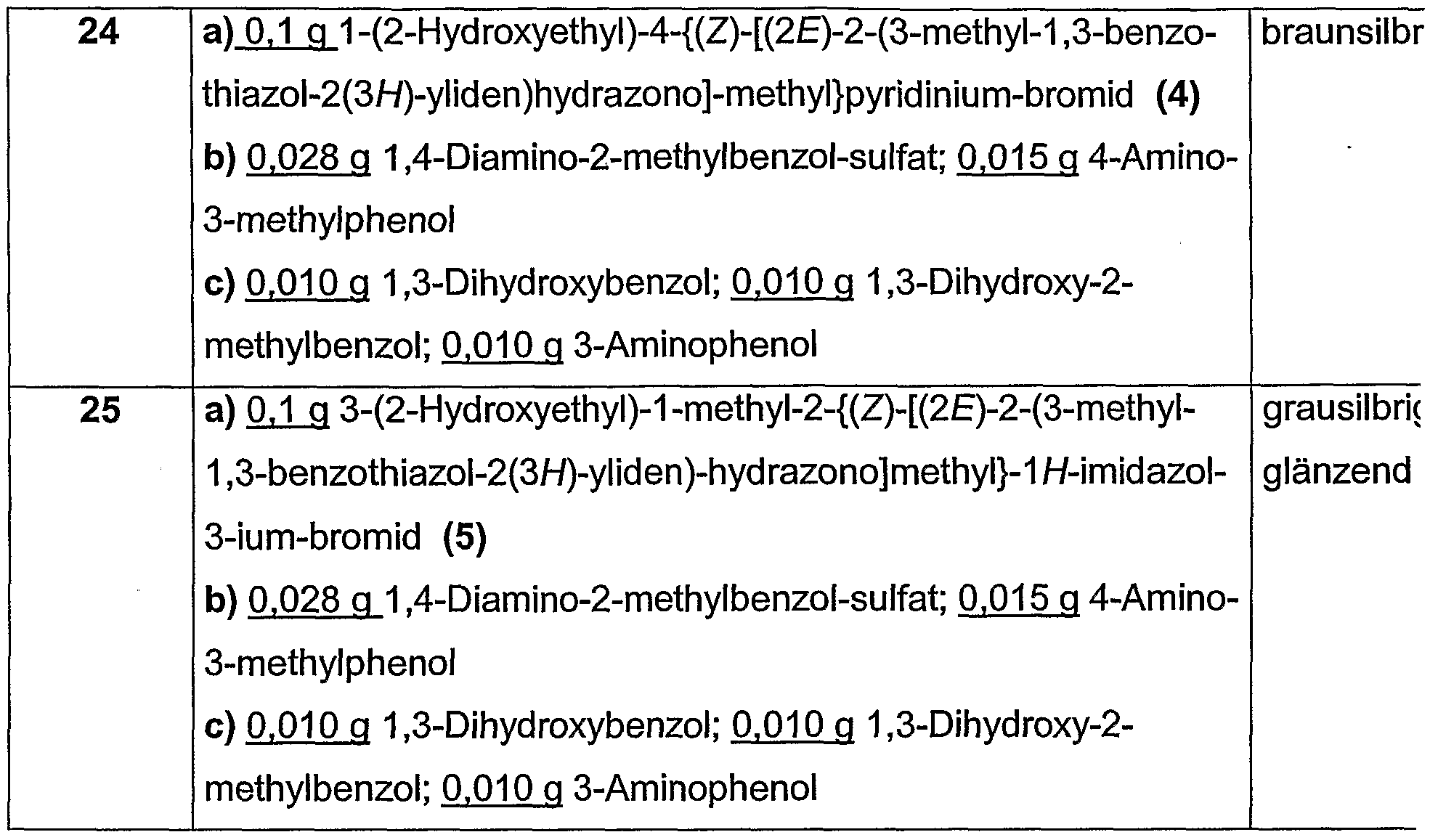
- the dyeing results are summarized in Table 1 below.
- Brightening powder base P 20.0 g potassium persulfate 30.0 g ammonium persulfate 24.0 g sodium silicate 12.5 g magnesium oxide 5.0 g hydroxyethyl cellulose 6.0 g soap pearls 2.0 g disperse silica 0.5 g disodium EDTA ready-to-use coloring agent 0.1 g dye of the general formulas (I) and (II) 5.0 g lightening powder base P 10.0 g hydrogen peroxide (12% in water)
- the specified components are mixed to a homogeneous mass, so that no dye particles can be recognized. Then a sufficient amount of the aforementioned coloring agent for hair coloring is applied to the hair. After an exposure time of 45 minutes at 40 ° C, the hair is rinsed with lukewarm water and treated with an acid conditioner, rinsed out again and dried.
Landscapes
- Chemical & Material Sciences (AREA)
- Organic Chemistry (AREA)
- Cosmetics (AREA)
- Plural Heterocyclic Compounds (AREA)
- Coloring (AREA)
- Pyridine Compounds (AREA)
Abstract
Description


Claims



Priority Applications (4)
| Application Number | Priority Date | Filing Date | Title |
|---|---|---|---|
| BRPI0418573-0A BRPI0418573A (pt) | 2004-02-28 | 2004-12-02 | corantes heteroarilazina catiÈnicos e agentes de tingimento contendo esses compostos |
| JP2007500063A JP2007523980A (ja) | 2004-02-28 | 2004-12-02 | カチオン性ヘテロアリールアジン染料及び、これら化合物を含有した染色剤 |
| US10/590,858 US7488353B2 (en) | 2004-02-28 | 2004-12-02 | Cationic heteroarylazine dyes and colorants containing these compounds |
| EP04803447A EP1718705A1 (de) | 2004-02-28 | 2004-12-02 | Kationische heteroarylazinfarbstoffe und diese verbindungen enthaltende f rbemittel |
Applications Claiming Priority (2)
| Application Number | Priority Date | Filing Date | Title |
|---|---|---|---|
| DE102004009782.8 | 2004-02-28 | ||
| DE102004009782A DE102004009782A1 (de) | 2004-02-28 | 2004-02-28 | Kationische Heteroarylazinfarbstoffe und diese Verbindungen enthaltende Färbemittel |
Publications (1)
| Publication Number | Publication Date |
|---|---|
| WO2005083009A1 true WO2005083009A1 (de) | 2005-09-09 |
Family
ID=34853821
Family Applications (1)
| Application Number | Title | Priority Date | Filing Date |
|---|---|---|---|
| PCT/EP2004/013705 Ceased WO2005083009A1 (de) | 2004-02-28 | 2004-12-02 | Kationische heteroarylazinfarbstoffe und diese verbindungen enthaltende färbemittel |
Country Status (6)
| Country | Link |
|---|---|
| US (1) | US7488353B2 (de) |
| EP (1) | EP1718705A1 (de) |
| JP (1) | JP2007523980A (de) |
| BR (1) | BRPI0418573A (de) |
| DE (1) | DE102004009782A1 (de) |
| WO (1) | WO2005083009A1 (de) |
Families Citing this family (3)
| Publication number | Priority date | Publication date | Assignee | Title |
|---|---|---|---|---|
| EP1716701A1 (de) * | 2004-02-10 | 2006-11-02 | LG Electronic Inc. | Textuntertitel-decoder und verfahren zum decodieren von textuntertitel-strömen |
| US11474098B2 (en) | 2017-12-22 | 2022-10-18 | The Trustees Of Columbia University In The City Of New York | Drug target for preventing pathologic calcium overload in cardiomyocytes and methods of screening for same |
| CN116178362B (zh) * | 2023-02-20 | 2025-03-04 | 河南农业大学 | 一种基于苯并噻唑腙的聚集诱导发光材料及其制备方法和应用 |
Citations (5)
| Publication number | Priority date | Publication date | Assignee | Title |
|---|---|---|---|---|
| GB808308A (en) * | 1956-08-14 | 1959-02-04 | Basf Ag | Improvements in the dyeing of fibres and like structures of polyacrylonitrile and copolymers of acrylonitrile |
| GB885521A (en) * | 1958-06-25 | 1961-12-28 | Geigy Ag J R | Diazacarbocyanines |
| GB885520A (en) * | 1958-06-25 | 1961-12-28 | Geigy Ag J R | Diazacarbocyanine bases |
| EP1234569A1 (de) * | 1999-12-02 | 2002-08-28 | Lion Corporation | Zubereitung zur färbung verhornter fasern |
| WO2003060015A1 (en) * | 2002-01-15 | 2003-07-24 | Ciba Speciality Chemicals Holding Inc. | Yellow cationic dyes for dying of organic material |
Family Cites Families (2)
| Publication number | Priority date | Publication date | Assignee | Title |
|---|---|---|---|---|
| BE793207A (fr) * | 1971-12-23 | 1973-06-22 | Ciba Geigy | Procede de preparation de colorants cationiques sous forme de solutionsaqueuses concentrees |
| JP2002205924A (ja) * | 2001-01-09 | 2002-07-23 | Kao Corp | 染毛剤 |
-
2004
- 2004-02-28 DE DE102004009782A patent/DE102004009782A1/de not_active Withdrawn
- 2004-12-02 JP JP2007500063A patent/JP2007523980A/ja active Pending
- 2004-12-02 BR BRPI0418573-0A patent/BRPI0418573A/pt not_active IP Right Cessation
- 2004-12-02 US US10/590,858 patent/US7488353B2/en not_active Expired - Fee Related
- 2004-12-02 EP EP04803447A patent/EP1718705A1/de not_active Withdrawn
- 2004-12-02 WO PCT/EP2004/013705 patent/WO2005083009A1/de not_active Ceased
Patent Citations (5)
| Publication number | Priority date | Publication date | Assignee | Title |
|---|---|---|---|---|
| GB808308A (en) * | 1956-08-14 | 1959-02-04 | Basf Ag | Improvements in the dyeing of fibres and like structures of polyacrylonitrile and copolymers of acrylonitrile |
| GB885521A (en) * | 1958-06-25 | 1961-12-28 | Geigy Ag J R | Diazacarbocyanines |
| GB885520A (en) * | 1958-06-25 | 1961-12-28 | Geigy Ag J R | Diazacarbocyanine bases |
| EP1234569A1 (de) * | 1999-12-02 | 2002-08-28 | Lion Corporation | Zubereitung zur färbung verhornter fasern |
| WO2003060015A1 (en) * | 2002-01-15 | 2003-07-24 | Ciba Speciality Chemicals Holding Inc. | Yellow cationic dyes for dying of organic material |
Also Published As
| Publication number | Publication date |
|---|---|
| DE102004009782A1 (de) | 2005-09-15 |
| US20070174975A1 (en) | 2007-08-02 |
| US7488353B2 (en) | 2009-02-10 |
| EP1718705A1 (de) | 2006-11-08 |
| BRPI0418573A (pt) | 2007-06-19 |
| JP2007523980A (ja) | 2007-08-23 |
Similar Documents
| Publication | Publication Date | Title |
|---|---|---|
| EP0891971A1 (de) | Bispyrazolazaverbindungen, Verfahren zu ihrer Herstellung und diese Verbindungen enthaltende Haarfärbemittel | |
| EP1166749B1 (de) | Mittel und Verfahren zur Färbung keratinischer Fasern | |
| EP1636219B1 (de) | Neue thiazolylmethyl-pyrazole, verfahren zu deren herstellung sowie deren verwendung in färbemitteln für keratinfasern | |
| US7473281B2 (en) | Colorants containing cationic indazoline thiazolazo dye | |
| EP1328244A1 (de) | Mittel und verfahren zum färben von keratinfasern | |
| EP1037593B1 (de) | Mittel und verfahren zur färbung von fasern | |
| WO2005074871A1 (de) | Färbemittel mit perlglanz für keratinfasern | |
| US7393366B2 (en) | Agents for coloring keratin fibers | |
| EP1805266B1 (de) | Kationische azoazinfarbstoffe und diese verbindungen enthaltende färbemittel | |
| EP1718705A1 (de) | Kationische heteroarylazinfarbstoffe und diese verbindungen enthaltende f rbemittel | |
| EP1761239A1 (de) | Kationische chinoxalinthiazolazofarbstoffe enthaltende färbemittel | |
| DE102004051072A1 (de) | Kationische Heteroarylpyrazolonazofarbstoffe und diese Verbindung enthaltende Färbemittel für Keratinfasern | |
| DE102004056403A1 (de) | Kationische Pyridinylthiazolazofarbstoffe enthaltende Färbemittel | |
| DE202004019358U1 (de) | Mittel zur Färbung von keratinischen Fasern | |
| MX2007004402A (en) | Colouring agents containing cationic indazoline-thiazolazo dyes- | |
| DE202004019357U1 (de) | Mittel zur oxidativen Färbung keratinischer Fasern |
Legal Events
| Date | Code | Title | Description |
|---|---|---|---|
| AK | Designated states |
Kind code of ref document: A1 Designated state(s): AE AG AL AM AT AU AZ BA BB BG BR BW BY BZ CA CH CN CO CR CU CZ DK DM DZ EC EE EG ES FI GB GD GE GH GM HR HU ID IL IN IS JP KE KG KP KR KZ LC LK LR LS LT LU LV MA MD MG MK MN MW MX MZ NA NI NO NZ OM PG PH PL PT RO RU SC SD SE SG SK SL SY TJ TM TN TR TT TZ UA UG US UZ VC VN YU ZA ZM ZW |
|
| AL | Designated countries for regional patents |
Kind code of ref document: A1 Designated state(s): BW GH GM KE LS MW MZ NA SD SL SZ TZ UG ZM ZW AM AZ BY KG KZ MD RU TJ TM AT BE BG CH CY CZ DE DK EE ES FI FR GB GR HU IE IS IT LT LU MC NL PL PT RO SE SI SK TR BF BJ CF CG CI CM GA GN GQ GW ML MR NE SN TD TG |
|
| 121 | Ep: the epo has been informed by wipo that ep was designated in this application | ||
| WWE | Wipo information: entry into national phase |
Ref document number: 2004803447 Country of ref document: EP |
|
| WWE | Wipo information: entry into national phase |
Ref document number: 2007500063 Country of ref document: JP |
|
| WWE | Wipo information: entry into national phase |
Ref document number: 10590858 Country of ref document: US Ref document number: 2007174975 Country of ref document: US |
|
| WWP | Wipo information: published in national office |
Ref document number: 2004803447 Country of ref document: EP |
|
| ENP | Entry into the national phase |
Ref document number: PI0418573 Country of ref document: BR |
|
| WWP | Wipo information: published in national office |
Ref document number: 10590858 Country of ref document: US |