WO2005085362A1 - Kationische naphthyldiazofarbstoffe sowie diese farbstoffe enthaltende mittel zur färbung von keratinfasern - Google Patents
Kationische naphthyldiazofarbstoffe sowie diese farbstoffe enthaltende mittel zur färbung von keratinfasern Download PDFInfo
- Publication number
- WO2005085362A1 WO2005085362A1 PCT/EP2004/014189 EP2004014189W WO2005085362A1 WO 2005085362 A1 WO2005085362 A1 WO 2005085362A1 EP 2004014189 W EP2004014189 W EP 2004014189W WO 2005085362 A1 WO2005085362 A1 WO 2005085362A1
- Authority
- WO
- WIPO (PCT)
- Prior art keywords
- group
- hydroxy
- methyl
- chloride
- diazenyl
- Prior art date
- Legal status (The legal status is an assumption and is not a legal conclusion. Google has not performed a legal analysis and makes no representation as to the accuracy of the status listed.)
- Ceased
Links
- 0 C[N+]/C=C/N(*)C=C Chemical compound C[N+]/C=C/N(*)C=C 0.000 description 2
- GJIHIEWSOLSJFG-UHFFFAOYSA-O C[N+](C)(C)CCOc1ccccc1/N=N/C(c1c(CC2)ccc(O)c1)=C2O Chemical compound C[N+](C)(C)CCOc1ccccc1/N=N/C(c1c(CC2)ccc(O)c1)=C2O GJIHIEWSOLSJFG-UHFFFAOYSA-O 0.000 description 1
Classifications
-
- C—CHEMISTRY; METALLURGY
- C09—DYES; PAINTS; POLISHES; NATURAL RESINS; ADHESIVES; COMPOSITIONS NOT OTHERWISE PROVIDED FOR; APPLICATIONS OF MATERIALS NOT OTHERWISE PROVIDED FOR
- C09B—ORGANIC DYES OR CLOSELY-RELATED COMPOUNDS FOR PRODUCING DYES, e.g. PIGMENTS; MORDANTS; LAKES
- C09B67/00—Influencing the physical, e.g. the dyeing or printing properties of dyestuffs without chemical reactions, e.g. by treating with solvents grinding or grinding assistants, coating of pigments or dyes; Process features in the making of dyestuff preparations; Dyestuff preparations of a special physical nature, e.g. tablets, films
- C09B67/0071—Process features in the making of dyestuff preparations; Dehydrating agents; Dispersing agents; Dustfree compositions
- C09B67/0075—Preparations with cationic dyes
- C09B67/0076—Preparations of cationic or basic dyes in liquid form
-
- A—HUMAN NECESSITIES
- A61—MEDICAL OR VETERINARY SCIENCE; HYGIENE
- A61K—PREPARATIONS FOR MEDICAL, DENTAL OR TOILETRY PURPOSES
- A61K8/00—Cosmetics or similar toiletry preparations
- A61K8/18—Cosmetics or similar toiletry preparations characterised by the composition
- A61K8/30—Cosmetics or similar toiletry preparations characterised by the composition containing organic compounds
- A61K8/40—Cosmetics or similar toiletry preparations characterised by the composition containing organic compounds containing nitrogen
- A61K8/41—Amines
- A61K8/416—Quaternary ammonium compounds
-
- A—HUMAN NECESSITIES
- A61—MEDICAL OR VETERINARY SCIENCE; HYGIENE
- A61K—PREPARATIONS FOR MEDICAL, DENTAL OR TOILETRY PURPOSES
- A61K8/00—Cosmetics or similar toiletry preparations
- A61K8/18—Cosmetics or similar toiletry preparations characterised by the composition
- A61K8/30—Cosmetics or similar toiletry preparations characterised by the composition containing organic compounds
- A61K8/40—Cosmetics or similar toiletry preparations characterised by the composition containing organic compounds containing nitrogen
- A61K8/42—Amides
-
- A—HUMAN NECESSITIES
- A61—MEDICAL OR VETERINARY SCIENCE; HYGIENE
- A61K—PREPARATIONS FOR MEDICAL, DENTAL OR TOILETRY PURPOSES
- A61K8/00—Cosmetics or similar toiletry preparations
- A61K8/18—Cosmetics or similar toiletry preparations characterised by the composition
- A61K8/30—Cosmetics or similar toiletry preparations characterised by the composition containing organic compounds
- A61K8/49—Cosmetics or similar toiletry preparations characterised by the composition containing organic compounds containing heterocyclic compounds
- A61K8/4906—Cosmetics or similar toiletry preparations characterised by the composition containing organic compounds containing heterocyclic compounds with one nitrogen as the only hetero atom
- A61K8/4926—Cosmetics or similar toiletry preparations characterised by the composition containing organic compounds containing heterocyclic compounds with one nitrogen as the only hetero atom having six membered rings
-
- A—HUMAN NECESSITIES
- A61—MEDICAL OR VETERINARY SCIENCE; HYGIENE
- A61Q—SPECIFIC USE OF COSMETICS OR SIMILAR TOILETRY PREPARATIONS
- A61Q5/00—Preparations for care of the hair
- A61Q5/06—Preparations for styling the hair, e.g. by temporary shaping or colouring
- A61Q5/065—Preparations for temporary colouring the hair, e.g. direct dyes
-
- C—CHEMISTRY; METALLURGY
- C09—DYES; PAINTS; POLISHES; NATURAL RESINS; ADHESIVES; COMPOSITIONS NOT OTHERWISE PROVIDED FOR; APPLICATIONS OF MATERIALS NOT OTHERWISE PROVIDED FOR
- C09B—ORGANIC DYES OR CLOSELY-RELATED COMPOUNDS FOR PRODUCING DYES, e.g. PIGMENTS; MORDANTS; LAKES
- C09B44/00—Azo dyes containing onium groups
- C09B44/02—Azo dyes containing onium groups containing ammonium groups not directly attached to an azo group
- C09B44/06—Azo dyes containing onium groups containing ammonium groups not directly attached to an azo group from coupling components containing hydroxyl as the only directing group
Definitions
- the present invention relates to new direct dyes for the production of non-oxidative colorants for keratin fibers, such as hair, silk or wool.
- Cationic dyes with arylazo groups or heteroarylazo groups and anthraquinones or naphthoquinones have proven to be particularly suitable for use in tinting agents, the cationic group being able to be both delocalized and localized.
- the widespread "Arianor® dyes” may be mentioned, which not only have good coloring properties, but also result in very little skin staining.
- the "Arianor® dyes” mainly consist of cationic azo dyes, only the blue dye (“Arianor® Steel-Blue”) is a naphthoquinone derivative. It is particularly problematic with these "Arianor® dyes” that the dyes sometimes wash out at different speeds, as a result of which the color tone can change uncontrollably as a result of the intensive washing out of one or more dyes.
- certain cationic naphthyldiazo dyes are outstandingly suitable for the semi-permanent coloring of hair. Furthermore, these dyes are characterized by their compatibility with the Arianor® dyes and can ideally complement them with regard to the color spectrum.
- the dyes according to the invention also have a very uniform absorption behavior and an extraordinary covering power, so that they can be used to achieve special fashionable effects alone or in cases where natural Shades should be achieved, can be used in combination with other dyes of formula (I) or with direct hair dyes available on the market.
- the present invention therefore relates to cationic naphthyldiazo dyes of the general formula (I)
- R1 represents a hydrogen atom, a halogen atom, a straight-chain or branched (C1-C4) alkyl group, a straight-chain or branched (C1-C4) alkoxy group, a phenyl group or a (C2-C4) hydroxyalkyl group;
- R2 and R3 may be the same or different and independently of one another are a hydrogen atom, a hydroxy group, an amino group, an acetylamino group, a (C1-C6) alkoxy group, a (C2-C4) hydroxyalkoxy group, a (C3-C6) - Di or polyhydroxyalkoxy group, a -COOR group, a -NRR 'group or a -CONRR' group, where R and R 'may be the same or different and a hydrogen atom, a straight-chain or branched (C1-C6 ) - represent an alkyl group or a hydroxyethyl group, or R and R 'together with the nitrogen atom to which they are attached form a heterocycle with at least four ring members (preferably a 4- to 6-membered ring) which may contain further heteroatoms such as oxygen, May contain nitrogen or sulfur, where R and R ' and the heterocycle with an alkyl group described above, one
- Alkoxy group, a hydroxyalkyl group or an aminoalkyl group may be substituted
- G represents a nitrogen atom or a methine group (CH);
- Y represents an oxygen atom or an N- (C1-C4) alkyl group
- L represents a bridge group and for a straight-chain or branched
- Heteroatoms such as oxygen, nitrogen or sulfur can be interrupted, the bridging group optionally having one or more hydroxyl groups, monohydroxy- (C2-C6) -alkyl groups,
- Q + stands for a saturated cationic group of the formula (II) or an unsaturated cationic group of the formulas (III) to (V),
- R4 to R6 can be the same or different and independently of one another a straight-chain or branched (C1-C6) alkyl group, a (C2-C4) hydroxyalkyl group, a (C3-C6) dihydroxyalkyl group, a (C3-C6) polyhydroxyalkyl group or one Represent (C1-C6) alkoxy- (C1-C4) - alkyl group, where two of the groups R4 to R6 together with the nitrogen atom to which they are attached form a five- or six-membered heterocycle, which may be one or more heteroatoms how an oxygen atom, a sulfur atom or a nitrogen atom can be interrupted and optionally further substituents, such as for example a halogen atom, a hydroxy group, an amino group, a straight-chain or branched (C1-C6) -
- Alkyl group a (C1-C6) alkoxy group, a (C1-C6) alkoxy- (C1-C4) alkyl group or a hydroxyethyl group;
- R7 is a straight or branched (C1-C8) alkyl group, one
- R8 is a hydrogen atom, a straight-chain or branched (C1-C9) -alkyl group, an amino group, a di- (C1-C6) -alkylamine group or one
- R9 is a straight or branched (C1-C8) alkyl group, one
- Phosphate anion acetate anion or tartrate anion.
- Preferred dyes of the formula (I) are those in which R1 represents a hydrogen atom, a chlorine atom or a methyl group, R2 and R3 are identical or different and, independently of one another, hydrogen, a hydroxyl group, a methoxy group, a -NRR'- group or a -CONRR 'Group, where R and R' may be the same or different and represent a hydrogen atom, a methyl group or a hydroxyethyl group, or R and R 'together with the nitrogen atom to which they are attached, a heterocycle with five or six ring members form, for example, a pyrrolidino group, a 3-hydroxy-pyrrolidino group, a 2-methoxymethyl-pyrrolidino group, a 2,5-bis (methoxymethyl) pyrrolidino group, a piperidino group, a 3-hydroxy-piperidino group, a 4-hydroxy group piperidino group, a 4-methyl-piperidino group,
- R7 represents a methyl group or a hydroxyethyl group
- R8 represents a hydrogen atom, a methyl group, a dimethylamino group or a pyrrolidino group
- R9 is a methyl group, an ethyl group or a hydroxyethyl group and
- X ' is a chloride anion, a bromide anion or a methyl sulfate anion.
- Particularly preferred dyes of the formula (I) are
- the dyes of the formula (I) according to the invention are preferably prepared according to scheme 1, cationic nitroaromatics of the general formula (VI) in particular, as are described, for example, in patent DE-A 2017497, are used as starting compounds. After the nitro compounds have been reduced, for example by means of catalytic hydrogenation, the amines of the formula (VII) are obtained, which are diazotized by standard methods, preferably in water, and coupled to the corresponding 1- or 2-naphthol derivatives.
- the dyes of the formula (I) according to the invention are extremely suitable for use in colorants for keratin fibers, in particular hair.
- Another subject of the present application are therefore colorants for keratin fibers containing at least one cationic naphthyldiazo dye of the general formula (I).
- These colorants contain the cationic naphthyldiazo dyes of the general formula (I) in a total amount of 0.01 to 10 percent by weight, in particular 0.1 to 6 percent by weight.
- the colorant can contain further dyes, in particular 3 - ((4,5-dihydro-3-methyl-5-oxo-1-phenyl-1H-pyrazol-4-yl) azo) -N , N, N-trimethyl-benzene-aminium chloride, 3 - [(3-methyl-5-hydroxy-1-phenyl-1H-pyrazol-4-yl) azo] trimethylammonio-benzene chloride (Cl. 12719; Basic Yellow 57), 8 - [(4-aminophenyl) azo] -7-hydroxy-N, N, N-trimethyl-2-naphthalenaminium chloride (Cl.
- the colorant according to the invention can additionally contain further natural or synthetic non-oxidative dyes.
- Vegetable dyes such as henna or indigo can be mentioned as natural dyes, while synthetic dyes
- Non-oxidative dyes for example other cationic dyes which do not fall under the aforementioned formula (I), nitro dyes, azo dyes, triphenylmethane dyes or quinone dyes.
- the following substantive dyes can in particular be used as further natural or synthetic non-oxidative dyes:
- Basic Blue 41 2,8-dimethyl-7- (dimethylamino) -3-imino-3H-phenoxazine monohydrochloride (Basic Blue 151), 7- (dimethylamino) -3-imino-2-methoxy-3H- phenoxazine monohydrochloride (Basic Blue 124), bis [4- (dimethylamino) phenyl] - [4- (methyamino) phenyl] carbenium chloride (Cl.
- Basic Red 46 2 - ⁇ [4- (dimethylamino) phenyl] azo ⁇ -1, 3-dimethyl -1 H- imidazole-3-ium chloride (Basic Red 51), 5 - ⁇ [4- (dimethylamino) phenyl] azo ⁇ - 1, 2-dimethyl-1 H-pyrazol-2-ium chloride, 1, 3-dimethyl- 2 - ⁇ [4- (methylamino) - phenyl] azo ⁇ -1H-imidazol-3-ium chloride (Basic Red 109), 2 - [(4-aminophenyl) azo] -1, 3-dimethyl-1 H-imidazol-3-ium chloride, 4 - ⁇ [4- (dimethylamino) phenyl] azo ⁇ -1-methylpyridinium chloride, N, N-dimethyl-4 - [(E) - (1-oxido- 4-pyridinyl) diazenyl] aniline
- the dyes of the formula (I) contained in the agent according to the invention have a cationic character, depending on the color carrier composition used, these can also be used in special cases in combination with anionic (“acidic”) dyes.
- the total content of further (in particular natural and / or synthetic non-oxidative) dyes in the colorant according to the invention is about 0.01 to 15 percent by weight, in particular about 0.1 to 12 percent by weight.
- the carriers customary in cosmetic systems can be added. Suitable compounds are described, for example, in DE-A 196 18 595, to which reference is hereby expressly made. Particularly suitable carriers are, for example, benzyl alcohol, vanillin and isovanillin.
- the agent for coloring keratin fibers according to the invention can be present, for example, in the form of a solution, in particular as an aqueous-alcoholic solution, a cream, a gel or an emulsion.
- solvents for example, lower aliphatic monohydric or polyhydric alcohols, their esters and ethers, or else mixtures of these solvents with one another or with water can be mentioned as solvents.
- the maximum boiling point of the abovementioned suitable solvents is approximately 400 ° C., a boiling point of 20 ° C. to 250 ° C. being preferred.
- the pH of the colorant according to the invention is about 2 to 11, with a pH of about 5 to 9 being particularly preferred.
- An alkaline pH is preferably set with ammonia, but it is also possible to use organic amines, such as monoethanolamine or triethanolamine, instead of ammonia.
- an organic or inorganic acid such as, for example, hydrochloric acid, sulfuric acid, phosphoric acid, ascorbic acid, glycolic acid or lactic acid, can be used to set an acidic pH.
- colorant described above may optionally contain other additives customary for colorants for keratin fibers, such as care substances, wetting agents, thickeners, plasticizers, preservatives and perfume oils as well as other additives listed below.
- wetting agents or emulsifiers from the classes of anionic, amphoteric, nonionic or zwitterionic surface-active substances such as fatty alcohol sulfates, alkane sulfonates, alkylbenzenesulfonates, alkylbetaines, ⁇ -olefin sulfonates, oxethylated fatty alcohols, oxethylated nonylphenols, oxyethyl fatty alcohol alcohols, fatty acid alcohol alcoholates, fatty acid alcohol alcoholates, Alkyl polyglucosides, thickeners such as higher fatty alcohols, starch, alginates, bentonites, cellulose derivatives, petroleum jelly, paraffin oil and fatty acids, water-soluble polymeric thickeners such as natural types of rubber, guar gum, xanthan gum, locust bean gum, pectin, dextran, agar agar, amylose, dyline, amylopectin
- the colorant described above may further contain natural or synthetic polymers or modified polymers of natural origin, whereby the keratin fiber is strengthened simultaneously with the coloring.
- Such agents are generally referred to as tinting or color strengthening agents.
- synthetic polymers known for this purpose in cosmetics for example polyvinylpyrrolidone, polyvinyl acetate, Polyvinyl alcohol or polyacrylic compounds such as polyacrylic acid or polymethacrylic acid, polyacrylonitrile, polyvinyl acetates and copolymers of such compounds, such as polyvinylpyrrolidone-vinyl acetate, mentioned; while, for example, chitosan (deacetylated chitin) or chitosan derivatives can be used as natural polymers or modified natural polymers.
- ingredients mentioned are used in the amounts customary for such purposes, for example the wetting agents and emulsifiers in concentrations of about 0.5 to 30 percent by weight, the thickeners in an amount of about 0.1 to 25 percent by weight and the care substances in an amount of about 0.1 to 5 weight percent.
- the abovementioned polymers can be used in the agent according to the invention in the amount customary for such agents, in particular in an amount of about 1 to 5 percent by weight.
- the agent for dyeing keratin fibers according to the invention is particularly suitable for dyeing hair.
- the colorant according to the invention is applied to the hair in a conventional manner in an amount sufficient for coloring the hair, generally about 50 to 150 grams.
- an exposure time sufficient for hair coloring which is usually about 10 to 45 minutes at 20 to 50 ° C., preferably about 15 to 30 minutes at about 40 ° C.
- the hair is rinsed with water, optionally washed with a shampoo and / or rinsed with the aqueous solution of a weak organic acid such as citric acid or tartaric acid and dried.
- the dye with additional setting is used in a known and customary manner by moistening the hair with the setting agent, inserting the hair for the hairstyle and then drying.
- Step 1.1 Preparation of 2- (2-aminophenoxy) -N, N-N-trimethylethanaminium methyl sulfate
- Step 1.2 Preparation of 2- ⁇ 2 - [(2-hydroxy-1-naphthyl) diazenyl] phenoxy ⁇ -N, N, N-trimethylethanaminium-methyl sulfate
- stage 1.1 15.6 g (50 mmol) of stage 1.1 are dissolved in 160 ml of water and 18.3 g of a 32% hydrochloric acid solution and diazotized with cooling in an ice bath with 4.2 g (60 mmol) of sodium nitrite in 25 ml of water, the Temperature should not exceed 5 ° C.
- the mixture is stirred for a further 1 hour and then the excess nitrite is decomposed by adding sulfamic acid.
- the diazonium salt solution is poured into 7.4 g (51 mmol) of 2-naphthol in 50 ml of isopropanol while stirring.
- Step 3.1 Preparation of 2- [2- (2-nitrophenoxy) ethyl] pyridine
- Step 3.2 Preparation of 1-methyl-2- [2- (2-nitrophenoxy) ethyl] pyridinium methyl sulfate
- stage 3.1 4.88 g (20 mmol) of stage 3.1 are dissolved in 60 ml of ethyl acetate, and 2.78 g (20 mmol) of dimethyl sulfate are added with stirring.
- Step 3.3 Preparation of 2- [2- (2-aminophenoxy) ethyl] -1-methyl-pyridinium-methyl sulfate
- step 3.3 The solution from step 3.3 (10 mmol) is mixed with 2.9 g of a 32% hydrochloric acid solution. Then 0.7 g (10 mmol) of sodium nitrite, dissolved in 5 ml of water, are added dropwise in the course of 10 minutes, the temperature not exceeding 5 ° C. The mixture is stirred for a further 1 hour in an ice bath and then unconverted nitrite is decomposed by adding sulfamic acid. This solution is added to a solution of 1.45 g of 2-naphthol (10 mmol) in 15 ml of water, 15 ml of isopropanol and 3.4 g of a 30% sodium hydroxide solution. The azo coupling takes place spontaneously, creating a thick red paste. The mixture is left to stir for a further 1 hour and is suctioned off. The dye obtained is dried at 40 ° C in a vacuum.
- Example 1 In analogy to WO 00/59883, Example 1, 14.11 g (100 mmol) of 2-fluomitrobenzene, 14.45 g (100 mmol) of morpholinoethanol, 35.8 g (100 mmol) of cesium carbonate and 100 ml of dimethylformamide are used for 7 days stirred at room temperature. The mixture is filtered, the dimethylformamide is stripped off on a rotary evaporator and the residue is then distilled in a Kugelrohr oven at 4 mbar and an oven temperature of 160 to 170 ° C.
- Step 5.2 Preparation of 4-methyl-4- [2- (2-nitrophenoxy) ethyl] morpholin-4-ium methyl sulfate
- ⁇ 7.94 ppm (dd, 1 H); 7.73 ppm (dt, 1H); 7.42 ppm (d, 1H); 7.20 ppm (dt, 1H); 4.69 ppm (t, 2H); 4.02 ppm (t, 2H); 3.96 ppm (m, 4H); 3.55 ppm (m, 4H); 3.38 ppm (s, 3H); 3.30 ppm (s, 3H).
- Step 5.3 Preparation of 4- [2- (2-aminophenoxy) ethyl] -4-methylmorpholin-4-ium-methyl sulfate
- Step 5.4 Preparation of 4- (2- ⁇ 2 - [(2-hydroxy-1-naphthyl) diazenyl] phenoxy ⁇ ethyl) -4-methylmorpholin-4-ium chloride
- Example 7 Preparation of 2 - [(2 - ⁇ [2-hydroxy-7- (methyloxy) -1 - naphthalenyl] diazenyl ⁇ phenyl) oxy] -N, N, N-trimethylethanaminium chloride
- Example 8 Preparation of 2 - ⁇ [2 - ( ⁇ 2-hydroxy-3 - [(phenylamino) carbonyl] -1-naphthalenyl ⁇ diazenyl) phenyl] oxy ⁇ -N, N, N-trimethylethane ammonium chloride
- the diazonium salt is prepared in the manner described in Example 6 and then coupled to 1.32 g (5 mmol) of 3-hydroxy-2-naphthoic acid anilide.
- Step 9.1 Preparation of N ⁇ N'-trimethyl-N '- ⁇ - nitrophenyl) - ⁇ - ethanediamine
- Step 9.3 Preparation of 2 - [(4-aminophenyl) (methyl) amino] - N-N, N-trimethyletnanaminium methyl sulfate
- Step 9.4 Preparation of 2 - [ ⁇ 4 - [(2-Hydroxy-1-naphthalenyl) diazenyl] phenyl ⁇ - (methyl) amino] -N-N, N-trimethylethanaminium methyl sulfate
- the residue is then taken up in 80 ml of methanol, the inorganic salts are filtered off and the solution is then concentrated to a total volume of about 10 ml.
- the dye precipitates out by adding about 30 ml of isopropanol.
- Step 10.3 Preparation of N, N, N-trimethyl-2- [methyl (2-nitrophenyl) amino] ethanolamine methyl sulfate
- Step 10.4 Preparation of 2 - [(2-aminophenyl) (methyl) amino] - N, N, N-trimethylethane aminium methyl sulfate
- Step 10.5 Preparation of 2 - [ ⁇ 2 - [(2-hydroxy-1-naphthalenyl) - diazenyl] phenyl ⁇ - (methyl) amino] -N, N, N-trimethylethane aminium methyl sulfate
- stage 10.4 1.4 g (4.4 mmol) of stage 10.4 are dissolved in 20 ml of water and 1.5 g of hydrochloric acid (32%), cooled in an ice bath and within 10 minutes with 0.3 g (4.4 mmol) Sodium nitrite added in 2 ml of water. The mixture is stirred for a further 30 minutes and then the solution is added to a solution of 0.63 g (4.4 mmol) of 2-naphthol in 10 ml of isopropanol. The pH is adjusted to 8 to 9 by adding saturated sodium carbonate solution, coupling occurs and a brown solution is obtained. After 1 hour, the mixture is evaporated to dryness and, to isolate the pure dye, 80 ml of methanol are added to the residue.
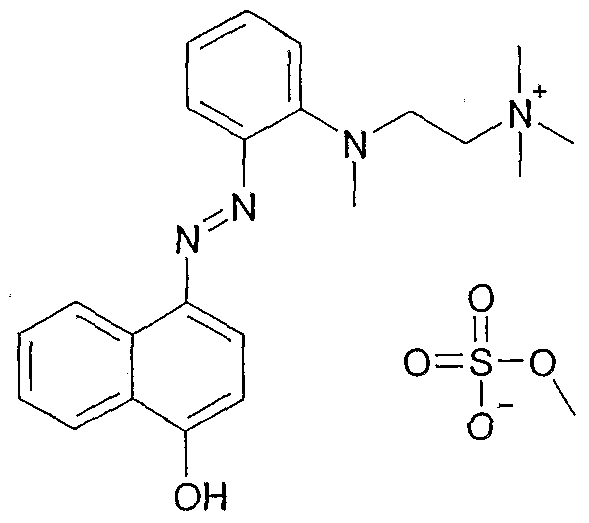
- Example 11 Preparation of 2 - [ ⁇ 2 - [(4-hydroxy-1-naphthalenyl) diazenyl] phenyl ⁇ (methyl) amino] -N, N, N-trimethylethanaminium methyl sulfate
- Example 12 Preparation of 2 - ( ⁇ 5 - [(2-hydroxy-1-naphthyl) diazenyl] -2-pyridinyl ⁇ oxy) -N, N, N-trimethylethanaminium chloride
- Step 12.1 Preparation of N-N-Dimethyl-2 - [(5-nitro-2-pyridinyl) oxy] ethanamine
- Step 12.2 Preparation of N.N, N-Trimethyl-2 - [(5-nitro-2-pyridinyl) - oxy] ethanaminium methyl sulfate
- Step 12.3 Preparation of 2 - [(5-amino-2-pyridinyl) oxy] -N-N, N-tr ⁇ methylethane aminium methyl sulfate
- the catalyst is filtered off for hours and the water on
- Step 12.4 Preparation of 2 - ( ⁇ 5 - [(2-hydroxy-1-naphthyl) diazenyl] -2-pyridinyl ⁇ oxy) -N, N, N-trimethylethanaminium chloride
- the clutch is disengaged for 1 hour, neutralized with 2 normal hydrochloric acid and the kidney flap is suctioned off. After pressing off the filter cake and drying in vacuo at 40 ° C., 1.7 g (74% of theory) of a bright orange product are obtained.
- a color mass of the following composition is produced: 4.0 g decyl glucoside 5.0 g ethanol 0.0025 mol dye according to Table 1 ad 100.0 g water, demineralized The pH of the colorant is adjusted to 7 with phosphoric acid or sodium hydroxide solution. The product is then applied to bleached hair and rinsed with water after 40 minutes at 40 ° C. After drying, the dyeings given in Table 1 are obtained.
- a color composition of the following composition is produced: 10.00 g ethanol 1.00 g hydroxyethyl cellulose 0.29 g dye according to Example 1 X g direct dyes according to Table 2 ad 100.00 g of water, demineralized
- the colorant is applied to bleached hair and rinsed with water after 40 minutes at 40 ° C.
- the hair is then dried.
- the specified L * a * b * color measurement values were determined using a color measuring device from Minolta, type Chromameter II.
- the L * value stands for the brightness (i.e. the lower the L * value, the greater the color intensity)
- the a * value is a measure of the red component (i.e. the larger the a * - Value, the greater the red component)
- the b * value is a measure of the blue component of the color (that is, the more negative the b * value, the greater the blue component).
Landscapes
- Health & Medical Sciences (AREA)
- Life Sciences & Earth Sciences (AREA)
- Animal Behavior & Ethology (AREA)
- General Health & Medical Sciences (AREA)
- Public Health (AREA)
- Veterinary Medicine (AREA)
- Birds (AREA)
- Epidemiology (AREA)
- Chemical & Material Sciences (AREA)
- Organic Chemistry (AREA)
- Chemical Kinetics & Catalysis (AREA)
- Cosmetics (AREA)
- Coloring (AREA)
Abstract
Description




Claims


Priority Applications (5)
| Application Number | Priority Date | Filing Date | Title |
|---|---|---|---|
| DE502004004988T DE502004004988D1 (de) | 2004-03-06 | 2004-12-13 | Kationische naphthyldiazofarbstoffe sowie diese farbstoffe enthaltende mittel zur färbung von keratinfasern |
| US10/584,955 US7517367B2 (en) | 2004-03-06 | 2004-12-13 | Cationic naphthyldiazo dyes and keratin fibers-coloring agents containing these dyes |
| EP04803818A EP1740657B1 (de) | 2004-03-06 | 2004-12-13 | Kationische naphthyldiazofarbstoffe sowie diese farbstoffe enthaltende mittel zur färbung von keratinfasern |
| BRPI0418613A BRPI0418613B1 (pt) | 2004-03-06 | 2004-12-13 | Agentes para tongir fibras de queratina contendo corantes de naftildiazo catiônicos |
| JP2007501128A JP4771435B2 (ja) | 2004-03-06 | 2004-12-13 | カチオン性ナフチルジアゾ染料ならびにケラチン繊維の染色のためのかかる染料を含む剤 |
Applications Claiming Priority (2)
| Application Number | Priority Date | Filing Date | Title |
|---|---|---|---|
| DE102004010999A DE102004010999A1 (de) | 2004-03-06 | 2004-03-06 | Kationische Naphthyldiazofarbstoffe sowie diese Farbstoffe enthaltende Mittel zur Färbung von Keratinfasern |
| DE102004010999.0 | 2004-03-06 |
Publications (1)
| Publication Number | Publication Date |
|---|---|
| WO2005085362A1 true WO2005085362A1 (de) | 2005-09-15 |
Family
ID=34877478
Family Applications (1)
| Application Number | Title | Priority Date | Filing Date |
|---|---|---|---|
| PCT/EP2004/014189 Ceased WO2005085362A1 (de) | 2004-03-06 | 2004-12-13 | Kationische naphthyldiazofarbstoffe sowie diese farbstoffe enthaltende mittel zur färbung von keratinfasern |
Country Status (8)
| Country | Link |
|---|---|
| US (1) | US7517367B2 (de) |
| EP (1) | EP1740657B1 (de) |
| JP (1) | JP4771435B2 (de) |
| AT (1) | ATE373051T1 (de) |
| BR (1) | BRPI0418613B1 (de) |
| DE (2) | DE102004010999A1 (de) |
| ES (1) | ES2294565T3 (de) |
| WO (1) | WO2005085362A1 (de) |
Families Citing this family (14)
| Publication number | Priority date | Publication date | Assignee | Title |
|---|---|---|---|---|
| JP6542350B2 (ja) | 2014-07-23 | 2019-07-10 | ザ プロクター アンド ギャンブル カンパニーThe Procter & Gamble Company | 布地ケア及びホームケア処理組成物 |
| EP3172302B1 (de) | 2014-07-23 | 2019-01-16 | The Procter & Gamble Company | Gewebe und heimpflegebehandlungszusammensetzungen |
| US10538719B2 (en) * | 2014-07-23 | 2020-01-21 | The Procter & Gamble Company | Treatment compositions |
| EP3172298B1 (de) | 2014-07-23 | 2019-01-02 | The Procter and Gamble Company | Gewebe und heimpflegebehandlungszusammensetzungen |
| US10266792B2 (en) * | 2014-07-23 | 2019-04-23 | The Procter & Gamble Company | Treatment compositions |
| CA2952990C (en) | 2014-07-23 | 2020-04-28 | The Procter & Gamble Company | Treatment compositions |
| WO2016014732A1 (en) * | 2014-07-23 | 2016-01-28 | The Procter & Gamble Company | Fabric and home care treatment compositions |
| US10689600B2 (en) | 2016-01-25 | 2020-06-23 | The Procter & Gamble Company | Treatment compositions |
| JP6828043B2 (ja) | 2016-01-25 | 2021-02-10 | ザ プロクター アンド ギャンブル カンパニーThe Procter & Gamble Company | 処理組成物 |
| MX2019005825A (es) | 2016-11-18 | 2019-07-10 | Procter & Gamble | Composiciones para el tratamiento de telas y metodos para proporcionar un beneficio. |
| US20180142188A1 (en) * | 2016-11-18 | 2018-05-24 | The Procter & Gamble Company | Fabric treatment compositions having polymers and fabric softening actives and methods for providing a benefit |
| US10870816B2 (en) | 2016-11-18 | 2020-12-22 | The Procter & Gamble Company | Fabric treatment compositions having low calculated cationic charge density polymers and fabric softening actives and methods for providing a benefit |
| CN116655847B (zh) * | 2023-06-02 | 2024-02-09 | 浙江材华科技有限公司 | 一种温敏性大分子染料的制备方法、包含该温敏性大分子染料的睫毛膏及其制备方法 |
| CN117430967A (zh) * | 2023-10-12 | 2024-01-23 | 济宁阳光化学有限公司 | 一种高分散性永固橙rn及其制备方法和应用 |
Citations (4)
| Publication number | Priority date | Publication date | Assignee | Title |
|---|---|---|---|---|
| GB1299080A (en) * | 1968-11-21 | 1972-12-06 | Sterling Drug Inc | Water-soluble quarternary ammonium salts of basic azo dyes |
| EP0159549A1 (de) * | 1984-04-06 | 1985-10-30 | BASF Aktiengesellschaft | Basische Azofarbstoffe |
| WO2000042980A1 (fr) * | 1999-01-21 | 2000-07-27 | L'oreal | Un coupleur naphtalenique cationique pour la teinture d'oxydation de fibres keratiniques |
| WO2003022233A1 (de) * | 2001-09-12 | 2003-03-20 | Wella Aktiengesellschaft | Mittel zur färbung von keratinfasern enthaltend einen blauen kationischen anthrachinofarbstoff |
Family Cites Families (4)
| Publication number | Priority date | Publication date | Assignee | Title |
|---|---|---|---|---|
| US1299080A (en) * | 1915-05-05 | 1919-04-01 | Charles E Wickham | Automobile-signal. |
| CH518059A (de) | 1969-04-22 | 1972-01-31 | Ciba Geigy Ag | Pflanzenwachstum regulierendes Mittel |
| DE19618595A1 (de) | 1996-05-09 | 1997-11-13 | Wella Ag | Färbemittel |
| CA2360923A1 (en) | 1999-03-30 | 2000-10-12 | Godecke Gmbh | Process for the arylation of aza-heterocycles with activated aromatics in presence of caesium carbonate |
-
2004
- 2004-03-06 DE DE102004010999A patent/DE102004010999A1/de not_active Withdrawn
- 2004-12-13 DE DE502004004988T patent/DE502004004988D1/de not_active Expired - Lifetime
- 2004-12-13 BR BRPI0418613A patent/BRPI0418613B1/pt not_active IP Right Cessation
- 2004-12-13 US US10/584,955 patent/US7517367B2/en not_active Expired - Lifetime
- 2004-12-13 JP JP2007501128A patent/JP4771435B2/ja not_active Expired - Fee Related
- 2004-12-13 AT AT04803818T patent/ATE373051T1/de not_active IP Right Cessation
- 2004-12-13 WO PCT/EP2004/014189 patent/WO2005085362A1/de not_active Ceased
- 2004-12-13 ES ES04803818T patent/ES2294565T3/es not_active Expired - Lifetime
- 2004-12-13 EP EP04803818A patent/EP1740657B1/de not_active Expired - Lifetime
Patent Citations (4)
| Publication number | Priority date | Publication date | Assignee | Title |
|---|---|---|---|---|
| GB1299080A (en) * | 1968-11-21 | 1972-12-06 | Sterling Drug Inc | Water-soluble quarternary ammonium salts of basic azo dyes |
| EP0159549A1 (de) * | 1984-04-06 | 1985-10-30 | BASF Aktiengesellschaft | Basische Azofarbstoffe |
| WO2000042980A1 (fr) * | 1999-01-21 | 2000-07-27 | L'oreal | Un coupleur naphtalenique cationique pour la teinture d'oxydation de fibres keratiniques |
| WO2003022233A1 (de) * | 2001-09-12 | 2003-03-20 | Wella Aktiengesellschaft | Mittel zur färbung von keratinfasern enthaltend einen blauen kationischen anthrachinofarbstoff |
Also Published As
| Publication number | Publication date |
|---|---|
| ES2294565T3 (es) | 2008-04-01 |
| JP4771435B2 (ja) | 2011-09-14 |
| US7517367B2 (en) | 2009-04-14 |
| BRPI0418613B1 (pt) | 2015-09-29 |
| US20080167453A1 (en) | 2008-07-10 |
| DE102004010999A1 (de) | 2005-09-22 |
| DE502004004988D1 (de) | 2007-10-25 |
| ATE373051T1 (de) | 2007-09-15 |
| EP1740657A1 (de) | 2007-01-10 |
| JP2007527457A (ja) | 2007-09-27 |
| EP1740657B1 (de) | 2007-09-12 |
| BRPI0418613A (pt) | 2007-05-02 |
Similar Documents
| Publication | Publication Date | Title |
|---|---|---|
| DE60102904T2 (de) | Verfahren zur färbung von haaren unter verwendung von kationischen farbstoffen | |
| EP1740657B1 (de) | Kationische naphthyldiazofarbstoffe sowie diese farbstoffe enthaltende mittel zur färbung von keratinfasern | |
| DE19822199C2 (de) | Mono- oder Polymethinfarbstoffe enthaltende nicht-oxidative Haarfärbemittel und Verfahren zur temporären Haarfärbung | |
| DE3534369C2 (de) | ||
| EP0353531B1 (de) | Haarfärbemittel | |
| EP0132568B1 (de) | 1,4-Diamino-5-chlor-2-nitrobenzolderivate, Verfahren zu ihrer Herstellung und Mittel zur Färbung von Haaren | |
| DE19930927A1 (de) | Neue Farbstoffe und Färbemittel | |
| EP0289782B1 (de) | Verwendung von 2,6-Dinitro-anilinderivaten in Haarfärbemitteln und neue 2,6-Dinitro-anilinderivate | |
| EP0601302B1 (de) | Mittel zum Färben von Haaren mit einem Gehalt an 3-Pyridinazofarbstoffen sowie neue 3-Pyridinazofarbstoffe | |
| WO2003022233A1 (de) | Mittel zur färbung von keratinfasern enthaltend einen blauen kationischen anthrachinofarbstoff | |
| WO1999044569A1 (de) | Färbemittel und verfahren zur erzeugung von temporären haarfärbungen | |
| EP0608393B1 (de) | Haarfärbemittel | |
| EP0600045B1 (de) | Haarfärbemittel | |
| DE3442128A1 (de) | Neue 3-amino-5-hydroxypyridinderivate und diese verbindungen enthaltende haarfaerbemittel | |
| DE20204129U1 (de) | Mittel zur Färbung von Keratinfasern mit Chinolinium-Farbstoffen | |
| EP1397435A1 (de) | Kationische farbstoffe, verfahren zu deren herstellung und diese verbindungen enthaltende färbemittel | |
| DE19750303A1 (de) | Verwendung von alkylierten Phenothiazinen zum Färben von keratinhaltigen Fasern | |
| DE3616720C2 (de) | 1-(2',3'-Dihydroxypropyl)amino -4-(N-ethyl,N-2'-hydroxyethyl)amino-2-nitro-benzol und Mittel zum Färben von Haaren | |
| WO1994028863A1 (de) | 8-amino-1,2,3,4-tetrahydrochinoline als kuppler in färbemitteln | |
| WO1996009291A1 (de) | 8-hydroxychinolinderivate als oxidationsfärbemittel | |
| EP0226973B1 (de) | 4-Bis(2'-hydroxyethyl)amino-1-(3'-hydroxypropyl)amino-2-nitro-benzol, Verfahren zu dessen Herstellung sowie Mittel zum Färben von Haaren | |
| WO2000052100A1 (de) | Mittel zum färben von fasern | |
| EP1771517A1 (de) | Kationische pyrazolonfarbstoffe, verfahren zu deren herstellung und diese verbindungen enthaltende färbemittel für keratinfasern | |
| DE4321198A1 (de) | Verwendung von N-Allylaminoaromaten in Oxidationsfärbemitteln | |
| DE3707273A1 (de) | Nitro-p-phenylendiaminderivate, verfahren zu ihrer herstellung sowie mittel zum faerben von haaren mit einem gehalt an diesen verbindungen |
Legal Events
| Date | Code | Title | Description |
|---|---|---|---|
| AK | Designated states |
Kind code of ref document: A1 Designated state(s): AE AG AL AM AT AU AZ BA BB BG BR BW BY BZ CA CH CN CO CR CU CZ DK DM DZ EC EE EG ES FI GB GD GE GH GM HR HU ID IL IN IS JP KE KG KP KR KZ LC LK LR LS LT LU LV MA MD MG MK MN MW MX MZ NA NI NO NZ OM PG PH PL PT RO RU SC SD SE SG SK SL SY TJ TM TN TR TT TZ UA UG US UZ VC VN YU ZA ZM ZW |
|
| AL | Designated countries for regional patents |
Kind code of ref document: A1 Designated state(s): BW GH GM KE LS MW MZ NA SD SL SZ TZ UG ZM ZW AM AZ BY KG KZ MD RU TJ TM AT BE BG CH CY CZ DE DK EE ES FI FR GB GR HU IE IS IT LT LU MC NL PL PT RO SE SI SK TR BF BJ CF CG CI CM GA GN GQ GW ML MR NE SN TD TG |
|
| 121 | Ep: the epo has been informed by wipo that ep was designated in this application | ||
| WWE | Wipo information: entry into national phase |
Ref document number: 2004803818 Country of ref document: EP |
|
| WWE | Wipo information: entry into national phase |
Ref document number: 10584955 Country of ref document: US |
|
| WWE | Wipo information: entry into national phase |
Ref document number: 2007501128 Country of ref document: JP |
|
| WWP | Wipo information: published in national office |
Ref document number: 2004803818 Country of ref document: EP |
|
| ENP | Entry into the national phase |
Ref document number: PI0418613 Country of ref document: BR |
|
| WWG | Wipo information: grant in national office |
Ref document number: 2004803818 Country of ref document: EP |