WO2005092932A1 - Oberflächenmodifizierte partikel enthaltende härtbare zusammensetzung - Google Patents
Oberflächenmodifizierte partikel enthaltende härtbare zusammensetzung Download PDFInfo
- Publication number
- WO2005092932A1 WO2005092932A1 PCT/EP2005/002541 EP2005002541W WO2005092932A1 WO 2005092932 A1 WO2005092932 A1 WO 2005092932A1 EP 2005002541 W EP2005002541 W EP 2005002541W WO 2005092932 A1 WO2005092932 A1 WO 2005092932A1
- Authority
- WO
- WIPO (PCT)
- Prior art keywords
- groups
- compositions
- particles
- ethylenically unsaturated
- carbon atoms
- Prior art date
- Legal status (The legal status is an assumption and is not a legal conclusion. Google has not performed a legal analysis and makes no representation as to the accuracy of the status listed.)
- Ceased
Links
Classifications
-
- C—CHEMISTRY; METALLURGY
- C08—ORGANIC MACROMOLECULAR COMPOUNDS; THEIR PREPARATION OR CHEMICAL WORKING-UP; COMPOSITIONS BASED THEREON
- C08F—MACROMOLECULAR COMPOUNDS OBTAINED BY REACTIONS ONLY INVOLVING CARBON-TO-CARBON UNSATURATED BONDS
- C08F2/00—Processes of polymerisation
- C08F2/44—Polymerisation in the presence of compounding ingredients, e.g. plasticisers, dyestuffs, fillers
-
- C—CHEMISTRY; METALLURGY
- C03—GLASS; MINERAL OR SLAG WOOL
- C03C—CHEMICAL COMPOSITION OF GLASSES, GLAZES OR VITREOUS ENAMELS; SURFACE TREATMENT OF GLASS; SURFACE TREATMENT OF FIBRES OR FILAMENTS MADE FROM GLASS, MINERALS OR SLAGS; JOINING GLASS TO GLASS OR OTHER MATERIALS
- C03C1/00—Ingredients generally applicable to manufacture of glasses, glazes, or vitreous enamels
- C03C1/006—Ingredients generally applicable to manufacture of glasses, glazes, or vitreous enamels to produce glass through wet route
- C03C1/008—Ingredients generally applicable to manufacture of glasses, glazes, or vitreous enamels to produce glass through wet route for the production of films or coatings
-
- C—CHEMISTRY; METALLURGY
- C03—GLASS; MINERAL OR SLAG WOOL
- C03C—CHEMICAL COMPOSITION OF GLASSES, GLAZES OR VITREOUS ENAMELS; SURFACE TREATMENT OF GLASS; SURFACE TREATMENT OF FIBRES OR FILAMENTS MADE FROM GLASS, MINERALS OR SLAGS; JOINING GLASS TO GLASS OR OTHER MATERIALS
- C03C17/00—Surface treatment of glass, not in the form of fibres or filaments, by coating
- C03C17/02—Surface treatment of glass, not in the form of fibres or filaments, by coating with glass
-
- C—CHEMISTRY; METALLURGY
- C08—ORGANIC MACROMOLECULAR COMPOUNDS; THEIR PREPARATION OR CHEMICAL WORKING-UP; COMPOSITIONS BASED THEREON
- C08K—Use of inorganic or non-macromolecular organic substances as compounding ingredients
- C08K9/00—Use of pretreated ingredients
- C08K9/04—Ingredients treated with organic substances
- C08K9/06—Ingredients treated with organic substances with silicon-containing compounds
-
- C—CHEMISTRY; METALLURGY
- C09—DYES; PAINTS; POLISHES; NATURAL RESINS; ADHESIVES; COMPOSITIONS NOT OTHERWISE PROVIDED FOR; APPLICATIONS OF MATERIALS NOT OTHERWISE PROVIDED FOR
- C09C—TREATMENT OF INORGANIC MATERIALS, OTHER THAN FIBROUS FILLERS, TO ENHANCE THEIR PIGMENTING OR FILLING PROPERTIES ; PREPARATION OF CARBON BLACK ; PREPARATION OF INORGANIC MATERIALS WHICH ARE NO SINGLE CHEMICAL COMPOUNDS AND WHICH ARE MAINLY USED AS PIGMENTS OR FILLERS
- C09C1/00—Treatment of specific inorganic materials other than fibrous fillers; Preparation of carbon black
- C09C1/28—Compounds of silicon
- C09C1/30—Silicic acid
- C09C1/3081—Treatment with organo-silicon compounds
Definitions
- the invention relates to hardenable compositions which contain a binder which carries at least one ethylenically unsaturated group, and particles which have at least one ethylenically unsaturated group on their surface, and to the use of these compositions for coating.
- Radically hardenable coating compositions which contain nanoscale fillers which have been surface-modified with organic residues and, after curing, provide coatings with high mechanical hardness and chemical resistance.
- a suitable modification of the particle surface ensures the compatibility of the particle with the surrounding polymer matrix. If the particle surface also has a suitable reactivity to the matrix so that it can react with the binder system under the respective curing conditions of the coating system, the particles can be chemically incorporated into the matrix during curing, which often has a positive effect on the property profile of the composite system ,
- Radically hardenable particle-reinforced coating compositions are described, inter alia, in US 4455205 A and US 4491508 A and are obtained, for example, by reacting colloidal silicon dioxide with 3-methacryloxypropyltrimethoxsilane and then exchanging the aqueous and / or alcoholic solvent for a free-radically crosslinkable organic binder.
- Such coating compositions can be used, for example Coating of thermoplastic substrates can be used.
- Silicon dioxide and a radically polymerizable silane can be produced.
- An (eth) acryloxyalkyl-functional isocyanurate is used as the binder.
- Methacryloxypropyltrimethoxysilane, aluminum butylate and water is mixed. Such dispersions can be considered
- the particles contained in the coating systems are produced by reacting particles which have free silicon hydroxide (SiOH) or metal hydroxide (MeOH) functions with alkoxysilanes which, as a reactive organic function, have an ethylenically unsaturated group, e.g. Vinyl, (meth) acrylic etc. included.
- All of the alkoxysilanes used in the prior art for particle functionalization have in common that they have only a moderate reactivity towards the SiOH or MeOH groups of the particles to be modified. The surface functionalization of the particles is therefore slow and / or incomplete.
- siloxane Hulle around the particle. It can be problematic here that when silanes with low hydrolysis and condensation reactivity are used, the siloxane shell formed still has a large number of SiOH functions on the surface. The stability of such SiOH-functional particles is limited under the conditions of manufacture and storage, even in the presence of the binder. The particles may aggregate or agglomerate.
- Monomethoxysilanes the particle functionalization even in the absence of water. Almost all of the MeOH and / or SiOH groups on the surface of the particle can be saturated with silane in a stochiometric reaction. Remaining MeOH and / or SiOH groups that can limit the stability of the particles can thus be largely avoided.
- WO 03/18658 and WO 03/14226 use functionalized alkoxysilanes for the functionalization of organopolysiloxanes and organic polymers, which are distinguished in that the alkoxysilyl group is separated from a heteroatom, for example oxygen or nitrogen, by a methylene spacer and by the spatial proximity of these In both groups, the reactivity of the silanes with regard to hydrolysis and condensation of the silyl unit has increased considerably. The increased reactivity of such silanes with methylene spacer is also in monthly hours. Chem. 2003, 134, 1081-1092.
- silane-functional (pre-) polymers which have a correspondingly increased reactivity to moisture and are therefore suitable for the preparation of air-curing compositions.
- the present invention is based on the object of providing a coating system which is actinic radiation or thermally curable and does not have the disadvantages of the known systems mentioned above and is also characterized by an improved property profile of the cured coatings compared to the known systems.
- the invention relates to hardenable compositions Z which contain a binder BM which carries at least one ethylenically unsaturated group, and particles P which have at least one ethylenically unsaturated group on their surface and radicals of the general formula I,
- R 3 is hydrogen or hydrocarbon radical having 1 to 12 carbon atoms, the carbon chain of which may be interrupted by non-adjacent oxygen, sulfur or NR 4 groups
- R 4 is hydrogen or hydrocarbon radical having 1 to 12 carbon atoms
- the curable compositions Z contain particles P which have been surface-modified by means of the radicals of the general formula I which contain ethylenically unsaturated groups, the reactive radicals being distinguished in that the silyl group is separated from a heteroatom by a methylene spacer.
- the curable compositions Z therefore have precisely reproducible properties.
- the particles P can preferably be produced by reacting (a) Particles P1 made of a material selected from metal oxides, metal-silicon mixed oxides, silicon dioxide, colloidal silicon dioxide and organopolysiloxane resins and their combinations, which have functions which are selected from Me-OH, Si-OH, Me- O-Me, Me-O-Si, Si-O-Si, Me-OR 1 and Si-OR 1 , (b) with organosilanes B of the general formula II,
- R 1 is hydrogen or hydrocarbon radical with 1 to 6 carbon atoms, the carbon chain of which can be interrupted by non-adjacent oxygen, sulfur or NR 4 groups
- R 2 hydrocarbon radical with 1 to 12 carbon atoms the carbon chain of which can be interrupted by non-adjacent oxygen, Sulfur or NR 4 groups can be interrupted
- Me is a metal atom and n is 0, 1 or 2 and R 3 ,
- A, D and C have the meanings given above.
- the particles P can likewise preferably be prepared by cohydrolysis of organosilanes B of the general formula II with alkoxysilanes B * of the general formula III,
- R hydrocarbon radical which can be substituted and have the values 0, 1, 2 or 3.
- the hydrocarbon radical R 1 is preferably an alkyl
- Cycloalkyl or aryl radical in particular methyl, ethyl or phenyl radical, particularly preferably a methyl or ethyl radical.
- R 2 is preferably an alkyl, cycloalkyl, aryl or arylalkyl radical, in particular methyl, ethyl or phenyl radical, particularly preferably a methyl radical.
- R 3 is preferred
- Group C is preferably an unsaturated alkyl radical with 2 to 12 carbon atoms, particularly preferably with 2 to 6 carbon atoms, in particular vinyl, acrylic, methacrylic.
- NHC (0) CH CR 3 2 .
- Preferred radicals for R 5 are listed in the preferred radicals R 1 .
- R 6 is preferably a functionalized or unfunctionalized, for example aromatic or aliphatic saturated or unsaturated
- R 6 Hydrocarbon residue with 1 to 12 carbon atoms.
- Preferred radicals for R 6 are listed in the preferred radicals R 2 and. R 6 can also assume the meaning CR 3 2 -ADC, ie in this case organosilanes B of the general formula II are identical to alkoxysilanes B *.
- alkoxysilanes B * are tetraethoxysilane, tetramethoxysilane, methyltrimethoxysilane, dimethylmethoxysilane, phenylmethyldimethoxysilane, phenyltrimethoxysilane, Vinyl trimethoxysilane.
- compositions Z are preferably used as coatings. They are particularly preferably used to improve the scratch resistance of the coated surface.
- the coatings obtainable from compositions Z by curing have a higher mechanical hardness and improved scratch resistance than comparable coatings which contain particles which have been surface-modified with conventional, only moderately reactive silanes or their hydrolysis and / or condensation products.
- alkoxysilanes B Because of the high reactivity of alkoxysilanes B with methylene spacer between alkoxysilyl group and a heteroatom, these compounds are particularly suitable for functionalizing SiOH- or MeOH-bearing particles P1. Equilibration of the Me-O-Me, Me-O-Si, Si-O-Si-functional particles with the alkoxysilanes B is also facilitated by the high reactivity and can be carried out to produce the particles P. The reactions of the particles Pl with the alkoxysilanes B proceed quickly and completely.
- the binder BM contained in the compositions Z must carry one or more reactive groups which, preferably initiated by actinic radiation or thermal treatment with the formation of a polymer with itself and the reactive particles, are capable of radical, cationic or anionic polymerization.
- Reactive groups are groups with ethylenically unsaturated functions, in particular vinyl groups, methacrylate groups, acrylate groups, acrylamide groups.
- the binder BM can contain both monomeric, oligomeric or polymeric compounds. Examples of suitable monomeric and oligomeric compounds are hexanediol diacrylate, pentaerythritol triacrylate, dipentaerythritol pentaacrylate, triethylene glycol diacrylate etc.
- Suitable polymeric binders BM are ethylenically unsaturated group-bearing (meth) acrylic copolymers, polyester (meth) acrylates, unsaturated methane, urethane - acrylates, silicone (meth) acrylates.
- Actinic radiation means electromagnetic radiation in the infrared (NIR), in the visible, in the ultraviolet (UV) and in the area of X-rays.
- compositions Z are characterized in that all the metal oxide and metal mixed oxide particles (for example aluminum oxides such as corundum, aluminum mixed oxides with other metals and / or silicon, titanium oxides, zirconium oxides, iron oxides etc.), silicon oxide particles (for example colloidal silica) are used as particles Pl , fumed silica, precipitated silica, silica sols) or silicon oxide compounds in which some valences of the silicon are provided with organic residues (for example silicone resins).
- metal oxide and metal mixed oxide particles for example aluminum oxides such as corundum, aluminum mixed oxides with other metals and / or silicon, titanium oxides, zirconium oxides, iron oxides etc.
- silicon oxide particles for example colloidal silica
- silicon oxide compounds in which some valences of the silicon are provided with organic residues (for example silicone resins).
- the particles P1 are further characterized in that they have metal (MeOH), silicon hydroxide (SiOH), Me-O-Me, Me-O-Si and / or Si-O-Si functions on their surface have a reaction with which the organosilanes B can take place.
- the particles P1 preferably have an average diameter of less than 1000 nm, particularly preferably less than 100 nm, the particle size being determined by transmission electron microscopy.
- the particles P1 consist of pyrogenic silica.
- colloidal silicon or metal oxides are used as particles Pl, which are preferred are present as a dispersion of the corresponding submicron oxide particles in an aqueous or organic solvent.
- the oxides of the metals aluminum, titanium, zirconium, tantalum, tungsten, hafnium and tin can preferably be used.
- particles P1 which consist of silicone resins of the general formula IV
- R 7 is an OR 8 function, an OH function, an optionally halogen, hydroxyl, amino, epoxy, thiol, (meth) acrylic or NCO-substituted hydrocarbon radical having 1-18 carbon atoms, the carbon chain can be interrupted by non-adjacent oxygen, sulfur or NR 4 groups,
- R8 is an optionally substituted monovalent hydrocarbon radical having 1-18 carbon atoms, e is a value of greater than or equal to 0, f is greater than or equal to 0, g is greater than or equal to 0, and h is greater than or equal to 0 ⁇ the proviso that the sum of e + f + g + h is at least 1, preferably at least 5.
- One or more different particle types P can be used for the compositions Z.
- coating systems can be produced which, in addition to nanoscale Si0 2, also contain nanoscale corundum.
- the amount of the particles P contained in the coating system is, based on the total weight, preferably at least 5% by weight, preferably at least 10% by weight, particularly preferably at least 15% by weight and preferably at most 90% by weight.
- Compositions Z are preferably prepared in a two-stage process.
- the particles P are produced in the first stage.
- the functionalized particles P are introduced into the binder BM.
- the particle P obtained by reacting the particle P1 with the organosilane B is cleaned before it is introduced into the binder BM.
- the particles P can be cleaned, for example, by precipitating the particles and then washing them with a suitable solvent.
- the composition Z is prepared by functionalizing the particles P1 with the silanes B in the presence of the binder BM.
- the particles P1 can be present both as a dispersion in an aqueous or anhydrous solvent and in the solid state.
- the corresponding solvent is generally removed after the introduction of particles P or P1 into the binder BM.
- the removal of the solvent is preferably carried out by distillation, it can take place before or after the conversion of the particles P1 with the silanes B.
- silanes B are acryloxymethyl-trimethoxysilane, acryloxymethyl-methyldimethoxysilane, acryloxyethyl-dimethylmethoxysilane, acryloxymethyl-triethoxysilane, acryloxyethyl-methyldiethoxysilane, acryloxymethyl-dimethylethoxysilane, methacryloxymethyl-methyl-methoxysiloxysiloxysiloxysilane Methacryloxymethyl-methyldiethoxysilane and methacryloxymethyl-diethyl ethoxysilane.
- a silane B can be used individually or a mixture of different silanes B or a mixture of silanes B with other alkoxysilanes.
- compositions Z can also contain common solvents and the additives and additives customary in formulations. These include flow control agents, surface-active substances, adhesion promoters, light stabilizers such as UV absorbers and / or radical scavengers, thixotropic agents and other solids and fillers. Additives of this type are preferred for generating the desired property profiles of both the compositions and the cured compositions. This applies in particular when compositions Z are used as coatings should. These coating formulations can also contain dyes and / or pigments.
- composition Z is preferably degenerated by actinic radiation or thermally initiated radicals
- the polymerization is carried out, for example, by UV radiation after the addition of suitable photoinitiators such as e.g. Darocur® 1178,
- Photoinitiators are usually used in amounts of 0.1-5% by weight.
- the polymerization can be reduced thermally
- compositions Z contain at least one photoinitiator and the coating is cured by UV radiation. In a further particularly preferred embodiment of the invention, the compositions Z are cured by electron beams.
- the coatings obtained after the compositions Z have hardened have outstanding mechanical properties.
- the scratch resistance is significantly improved compared to known materials.
- Another object of the invention is the use of
- compositions Z for coating any substrates are, for example, oxidic materials, such as glass, metals, wood or plastics such as polycarbonate, Polybutylene terephthalate, polymethyl methacrylate, polystyrene, polyvinyl chloride, polypropylene.
- oxidic materials such as glass, metals, wood or plastics such as polycarbonate, Polybutylene terephthalate, polymethyl methacrylate, polystyrene, polyvinyl chloride, polypropylene.
- the applied coatings serve to improve the scratch resistance, abrasion resistance, chemical resistance or to influence the abhesive properties.
- the compositions Z can be applied by any method, such as immersion, spraying and pouring methods. Application by a "wet in wet” process is also possible.
- 20 ml of ethanol within 5 mm and within 5 mm 2.00 g of methacrylatomethyl-trimethoxysilane were added dropwise and the mixture was heated to 60 ° C. for 16 h.
- 15 g of hexanediol diacrylate are added and ethanol and water are then distilled off as an azeotrope.
- the transparent dispersion contains 35% by weight Si0 2 .
- the transparent dispersion contains 29% by weight Si0 2 .
- Comparative Example 2 A mixture of 20.00 g of an SiO 2 organosol (IPA-ST® from Nissan Chemicals, 30% by weight SiO 2 , 12 nm) and 10 g of water are 2.00 g within 1 min Dropped methacrylatopropyl trimethoxysilane. The mixture is heated to 60 ° C for 16 h. After cooling to room temperature, 15 g of hexanediol diacrylate are added and then isopropanol and water are distilled off azeotropically. The transparent dispersion contains 29% by weight Si0 2 .
- SiO 2 organosol IPA-ST® from Nissan Chemicals, 30% by weight SiO 2 , 12 nm
- the coating films obtained are 1 under nitrogen in a UVA-Cube, type UVA-Print 100 CV1 from Dr. Hönle hardened with a lamp output of approx. 60 mW / cm 2 with an irradiation time of 60 s.
- Optically beautiful and smooth coatings are obtained from all coating formulations.
- the gloss of all five coatings - determined with a Micro gloss 20 ° gloss meter from Byk - was approximately 155 gloss units for all 6 coatings.
- Example 7 Example 7:
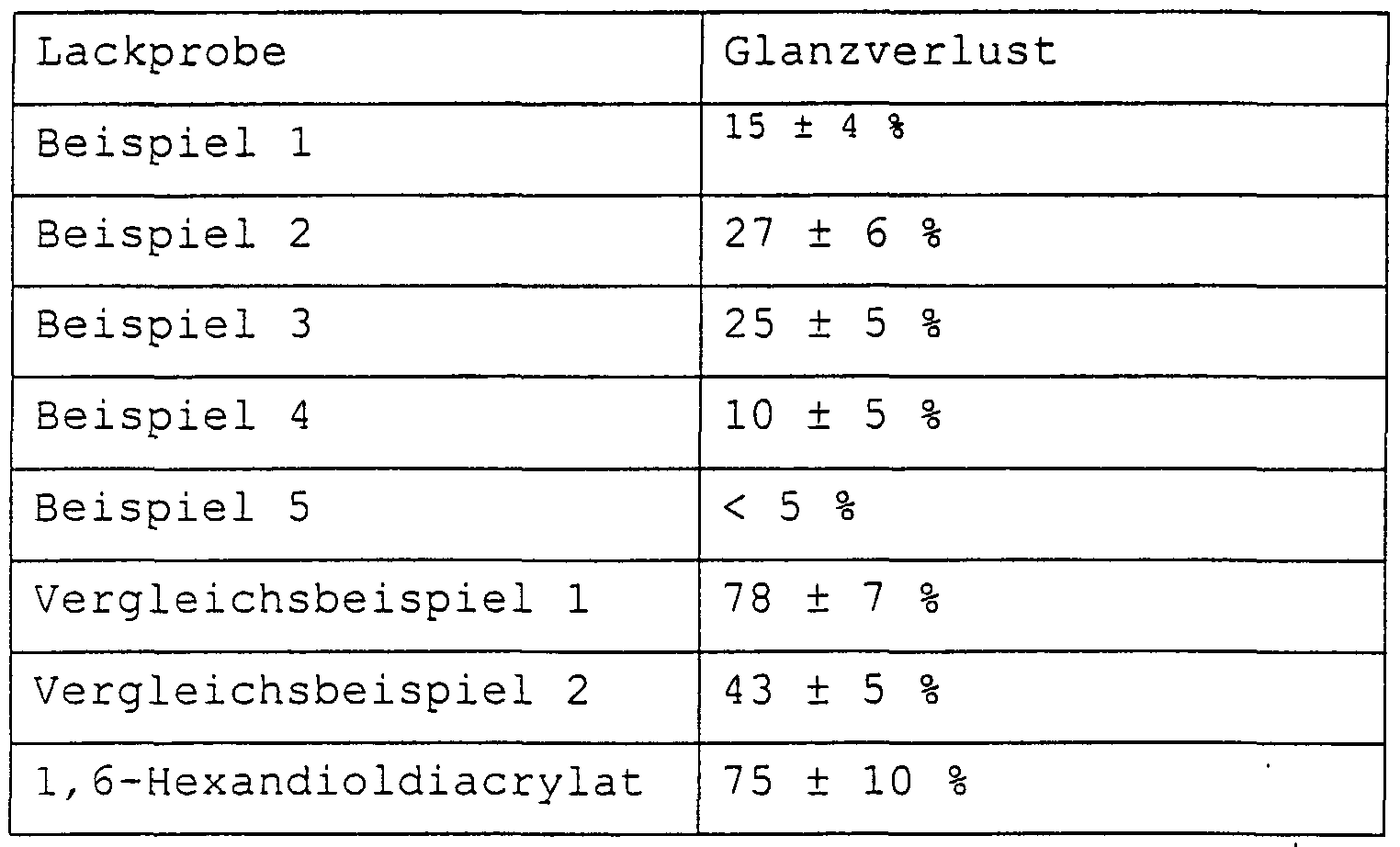
- the scratch resistance of the paint films produced according to Example 6 is determined using a Peter Dahn abrasion tester. For this purpose, a scouring fleece Scotch Brite® 07558 with an area of 45 x 45 mm with a weight of 1 kg is weighted and scratched with 500 strokes. Both before the start and after the end of the scratch tests, the gloss of the respective coating is measured using a Micro gloss 20 ° gloss meter from Byk. The loss of gloss is determined as a measure of the scratch resistance of the respective coating (average of 3 paint samples each):
Landscapes
- Chemical & Material Sciences (AREA)
- Organic Chemistry (AREA)
- Chemical Kinetics & Catalysis (AREA)
- Health & Medical Sciences (AREA)
- Polymers & Plastics (AREA)
- Geochemistry & Mineralogy (AREA)
- Materials Engineering (AREA)
- Engineering & Computer Science (AREA)
- Life Sciences & Earth Sciences (AREA)
- Medicinal Chemistry (AREA)
- General Chemical & Material Sciences (AREA)
- Paints Or Removers (AREA)
- Silicon Polymers (AREA)
- Pigments, Carbon Blacks, Or Wood Stains (AREA)
- Surface Treatment Of Glass (AREA)
- Addition Polymer Or Copolymer, Post-Treatments, Or Chemical Modifications (AREA)
- Macromonomer-Based Addition Polymer (AREA)
Abstract
Description
Claims
Priority Applications (4)
| Application Number | Priority Date | Filing Date | Title |
|---|---|---|---|
| EP05715919A EP1711537B1 (de) | 2004-03-25 | 2005-03-10 | Oberflächenmodifizierte partikel enthaltende härtbare zusammensetzung |
| DE502005002157T DE502005002157D1 (de) | 2004-03-25 | 2005-03-10 | Oberflächenmodifizierte partikel enthaltende härtbare zusammensetzung |
| US10/599,285 US20080242766A1 (en) | 2004-03-25 | 2005-03-10 | Curable Composition Containing Surface-Modified Particles |
| JP2007504290A JP2007530719A (ja) | 2004-03-25 | 2005-03-10 | 表面改質した粒子を含有する硬化性組成物 |
Applications Claiming Priority (2)
| Application Number | Priority Date | Filing Date | Title |
|---|---|---|---|
| DE102004014686A DE102004014686A1 (de) | 2004-03-25 | 2004-03-25 | Oberflächenmodifizierte Partikel enthaltende härtbare Zusammensetzung |
| DE102004014686.1 | 2004-03-25 |
Publications (1)
| Publication Number | Publication Date |
|---|---|
| WO2005092932A1 true WO2005092932A1 (de) | 2005-10-06 |
Family
ID=34961785
Family Applications (1)
| Application Number | Title | Priority Date | Filing Date |
|---|---|---|---|
| PCT/EP2005/002541 Ceased WO2005092932A1 (de) | 2004-03-25 | 2005-03-10 | Oberflächenmodifizierte partikel enthaltende härtbare zusammensetzung |
Country Status (6)
| Country | Link |
|---|---|
| US (1) | US20080242766A1 (de) |
| EP (1) | EP1711537B1 (de) |
| JP (1) | JP2007530719A (de) |
| CN (1) | CN100478363C (de) |
| DE (2) | DE102004014686A1 (de) |
| WO (1) | WO2005092932A1 (de) |
Cited By (1)
| Publication number | Priority date | Publication date | Assignee | Title |
|---|---|---|---|---|
| JP2009102628A (ja) * | 2007-10-01 | 2009-05-14 | Atomix Co Ltd | 紫外線硬化型コーティング用組成物およびその製造方法、並びにこれを被覆してなる樹脂被覆品 |
Families Citing this family (7)
| Publication number | Priority date | Publication date | Assignee | Title |
|---|---|---|---|---|
| DE102004022400A1 (de) * | 2004-05-06 | 2005-12-15 | Consortium für elektrochemische Industrie GmbH | Feuchtigkeitsvernetzbare alkoxysilyfunktionelle Partikel enthaltende Zusammensetzung |
| JP4703180B2 (ja) * | 2004-12-28 | 2011-06-15 | リンテック株式会社 | コーティング用組成物、ハードコートフィルムおよび光記録媒体 |
| DE102007060376B3 (de) * | 2007-12-12 | 2009-04-23 | Kronotec Ag | Verfahren zum Funktionalisieren von Korund |
| CN102312099B (zh) * | 2011-09-29 | 2013-04-17 | 攀枝花市清洪源环保科技有限公司 | 铁粉还原含铜酸性浸出液制取海绵铜的工艺方法 |
| US8791198B2 (en) * | 2012-04-30 | 2014-07-29 | H.B. Fuller Company | Curable aqueous composition |
| CN108658491B (zh) * | 2018-05-29 | 2020-11-17 | 江苏苏博特新材料股份有限公司 | 一种基于铝氧化物的两亲性多功能杂化粒子及其制备方法 |
| CN114539962A (zh) * | 2022-02-24 | 2022-05-27 | 东来涂料技术(上海)股份有限公司 | 一种增强不饱和聚酯胶粘剂及其制备方法 |
Citations (1)
| Publication number | Priority date | Publication date | Assignee | Title |
|---|---|---|---|---|
| WO2004089961A1 (de) * | 2003-04-07 | 2004-10-21 | Consortium für elektrochemische Industrie GmbH | Organosilylfunktionalisierte partikel und deren herstellung |
Family Cites Families (10)
| Publication number | Priority date | Publication date | Assignee | Title |
|---|---|---|---|---|
| JPS58500251A (ja) * | 1981-01-15 | 1983-02-17 | バテル デイベロプメント コ−ポレイシヨン | 耐磨耗性の透明又は半透明フィルムで支持体をコ−トする光硬化組成物 |
| US4455205A (en) * | 1981-06-01 | 1984-06-19 | General Electric Company | UV Curable polysiloxane from colloidal silica, methacryloyl silane, diacrylate, resorcinol monobenzoate and photoinitiator |
| US4491508A (en) * | 1981-06-01 | 1985-01-01 | General Electric Company | Method of preparing curable coating composition from alcohol, colloidal silica, silylacrylate and multiacrylate monomer |
| US5221560A (en) * | 1989-02-17 | 1993-06-22 | Swedlow, Inc. | Radiation-curable coating compositions that form transparent, abrasion resistant tintable coatings |
| CA2008020A1 (en) * | 1989-02-17 | 1990-08-17 | William C. Perkins | Radiation-curable coating compositions that form transparent, abrasion-resistant, tintable coatings |
| EP0437327A3 (en) * | 1990-01-08 | 1991-10-23 | Dow Corning Corporation | Radiation curable abrasion resistant cyclic ether acrylate coating composition |
| KR100440702B1 (ko) * | 1995-09-20 | 2004-12-17 | 미쯔비시 레이온 가부시끼가이샤 | 내마모성피막형성피복조성물및그피막피복물품 |
| US6310170B1 (en) * | 1999-08-17 | 2001-10-30 | Ck Witco Corporation | Compositions of silylated polymer and aminosilane adhesion promoters |
| CN1211446C (zh) * | 1999-12-06 | 2005-07-20 | 株式会社德山 | 涂料组合物及其制备方法 |
| DE10139132A1 (de) * | 2001-08-09 | 2003-02-27 | Consortium Elektrochem Ind | Alkoxyvernetzende einkomponentige feuchtigkeitshärtende Massen |
-
2004
- 2004-03-25 DE DE102004014686A patent/DE102004014686A1/de not_active Withdrawn
-
2005
- 2005-03-10 JP JP2007504290A patent/JP2007530719A/ja active Pending
- 2005-03-10 WO PCT/EP2005/002541 patent/WO2005092932A1/de not_active Ceased
- 2005-03-10 US US10/599,285 patent/US20080242766A1/en not_active Abandoned
- 2005-03-10 DE DE502005002157T patent/DE502005002157D1/de not_active Expired - Lifetime
- 2005-03-10 CN CNB2005800096198A patent/CN100478363C/zh not_active Expired - Fee Related
- 2005-03-10 EP EP05715919A patent/EP1711537B1/de not_active Expired - Lifetime
Patent Citations (1)
| Publication number | Priority date | Publication date | Assignee | Title |
|---|---|---|---|---|
| WO2004089961A1 (de) * | 2003-04-07 | 2004-10-21 | Consortium für elektrochemische Industrie GmbH | Organosilylfunktionalisierte partikel und deren herstellung |
Non-Patent Citations (1)
| Title |
|---|
| S. ALTMANN, J. PFEIFFER: "The hydrolysis/condensation behaviour of methacryloyloxyalkylfunctional alkoxysilanes: structure-reactivity relations", MONATSHEFTE FÜR CHEMIE, vol. 134, 12 June 2003 (2003-06-12), pages 1081 - 1092, XP002328645 * |
Cited By (1)
| Publication number | Priority date | Publication date | Assignee | Title |
|---|---|---|---|---|
| JP2009102628A (ja) * | 2007-10-01 | 2009-05-14 | Atomix Co Ltd | 紫外線硬化型コーティング用組成物およびその製造方法、並びにこれを被覆してなる樹脂被覆品 |
Also Published As
| Publication number | Publication date |
|---|---|
| JP2007530719A (ja) | 2007-11-01 |
| CN1934138A (zh) | 2007-03-21 |
| DE102004014686A1 (de) | 2005-10-13 |
| EP1711537A1 (de) | 2006-10-18 |
| EP1711537B1 (de) | 2007-12-05 |
| CN100478363C (zh) | 2009-04-15 |
| DE502005002157D1 (de) | 2008-01-17 |
| US20080242766A1 (en) | 2008-10-02 |
Similar Documents
| Publication | Publication Date | Title |
|---|---|---|
| EP1773919B1 (de) | Wässrige bindemitteldispersion mit nanopartikeln, verfahren zu deren herstellung und deren verwendung | |
| DE69606069T2 (de) | Reaktive kieselsäureteilchen, verfahren zu deren herstellung und deren verwendung | |
| EP1195417B1 (de) | Siliciumorganische Nanokapseln | |
| EP1245627A2 (de) | Siliciumorganische Nano-Mikrohybridsysteme oder Mikrohybridsysteme enthaltende Zusammensetzung für kratz- und abriebfeste Beschichtungen | |
| EP2010624B1 (de) | Konsolidierte proppants mit hoher mechanischer festigkeit und verfahren zu deren herstellung | |
| EP1195416A2 (de) | Polymerisierbare siliciumorganische Nanokapseln | |
| DE69216030T2 (de) | Verbundwerkstoffzusammensetzung mit hoher Transparenz und deren Herstellung | |
| EP1249470A2 (de) | Hochgefüllte pastöse siliciumorganische Nano- und/oder Mikrohybridkapseln enthaltende Zusammensetzung für kratz- und/oder abriebfeste Beschichtungen | |
| EP2279226A1 (de) | Oberflächenmodifizierte siliziumdioxid-partikel | |
| KR101625697B1 (ko) | 무기 나노입자 및 이로부터 제조된 중합체 복합물 | |
| DE10241510A1 (de) | Nanokomposite, Verfahren zu ihrer Herstellung und ihre Verwendung | |
| EP1711538B1 (de) | Oberflächenmodifizierte partikel enthaltende härtbare zusammensetzung | |
| DE102004022400A1 (de) | Feuchtigkeitsvernetzbare alkoxysilyfunktionelle Partikel enthaltende Zusammensetzung | |
| EP1711537B1 (de) | Oberflächenmodifizierte partikel enthaltende härtbare zusammensetzung | |
| EP1878760B1 (de) | Hybride Polymermaterialien durch Copolymerisation | |
| EP2032613A2 (de) | Alkoxysilylfunktionelle oligomere und damit oberflächenmodifizierte partikel | |
| DE10100633A1 (de) | Polymerisierbare siliciumorganische Nanokapseln | |
| KR100809994B1 (ko) | 표면-변형 입자를 포함하는 경화성 조성물 | |
| DE10100631A1 (de) | Silliciumorganische Nanokapseln | |
| KR100838614B1 (ko) | 표면-변형 입자를 함유하는 경화형 조성물 | |
| KR20250104484A (ko) | 개질 무기입자, 이를 포함하는 하드코팅용 조성물 및 이의 코팅막 | |
| DE10141690A1 (de) | Siliciumorganische Nano-/Mikrohybridsysteme oder Mikrohybridsysteme enthaltende Zusammensetzung für kratz- und/oder abriebfeste Beschichtungen | |
| KR20240061361A (ko) | 무기입자 분산액 | |
| JP2009067968A (ja) | インクジェット記録用インク組成物 |
Legal Events
| Date | Code | Title | Description |
|---|---|---|---|
| AK | Designated states |
Kind code of ref document: A1 Designated state(s): AE AG AL AM AT AU AZ BA BB BG BR BW BY BZ CA CH CN CO CR CU CZ DK DM DZ EC EE EG ES FI GB GD GE GH GM HR HU ID IL IN IS JP KE KG KP KR KZ LC LK LR LS LT LU LV MA MD MG MK MN MW MX MZ NA NI NO NZ OM PG PH PL PT RO RU SC SD SE SG SK SL SM SY TJ TM TN TR TT TZ UA UG US UZ VC VN YU ZA ZM ZW |
|
| AL | Designated countries for regional patents |
Kind code of ref document: A1 Designated state(s): BW GH GM KE LS MW MZ NA SD SL SZ TZ UG ZM ZW AM AZ BY KG KZ MD RU TJ TM AT BE BG CH CY CZ DE DK EE ES FI FR GB GR HU IE IS IT LT LU MC NL PL PT RO SE SI SK TR BF BJ CF CG CI CM GA GN GQ GW ML MR NE SN TD TG |
|
| DPEN | Request for preliminary examination filed prior to expiration of 19th month from priority date (pct application filed from 20040101) | ||
| 121 | Ep: the epo has been informed by wipo that ep was designated in this application | ||
| WWE | Wipo information: entry into national phase |
Ref document number: 2005715919 Country of ref document: EP |
|
| WWE | Wipo information: entry into national phase |
Ref document number: 10599285 Country of ref document: US Ref document number: 2007504290 Country of ref document: JP Ref document number: 200580009619.8 Country of ref document: CN |
|
| WWP | Wipo information: published in national office |
Ref document number: 2005715919 Country of ref document: EP |
|
| WWE | Wipo information: entry into national phase |
Ref document number: 1020067021913 Country of ref document: KR |
|
| WWP | Wipo information: published in national office |
Ref document number: 1020067021913 Country of ref document: KR |
|
| WWG | Wipo information: grant in national office |
Ref document number: 2005715919 Country of ref document: EP |