WO2005095431A1 - 5α-プレグナン誘導体の製造方法 - Google Patents
5α-プレグナン誘導体の製造方法 Download PDFInfo
- Publication number
- WO2005095431A1 WO2005095431A1 PCT/JP2005/006818 JP2005006818W WO2005095431A1 WO 2005095431 A1 WO2005095431 A1 WO 2005095431A1 JP 2005006818 W JP2005006818 W JP 2005006818W WO 2005095431 A1 WO2005095431 A1 WO 2005095431A1
- Authority
- WO
- WIPO (PCT)
- Prior art keywords
- group
- hydroxyl
- compound
- substituent
- tert
- Prior art date
- Legal status (The legal status is an assumption and is not a legal conclusion. Google has not performed a legal analysis and makes no representation as to the accuracy of the status listed.)
- Ceased
Links
Classifications
-
- C—CHEMISTRY; METALLURGY
- C07—ORGANIC CHEMISTRY
- C07J—STEROIDS
- C07J9/00—Normal steroids containing carbon, hydrogen, halogen or oxygen substituted in position 17 beta by a chain of more than two carbon atoms, e.g. cholane, cholestane, coprostane
-
- C—CHEMISTRY; METALLURGY
- C07—ORGANIC CHEMISTRY
- C07J—STEROIDS
- C07J5/00—Normal steroids containing carbon, hydrogen, halogen or oxygen, substituted in position 17 beta by a chain of two carbon atoms, e.g. pregnane and substituted in position 21 by only one singly bound oxygen atom, i.e. only one oxygen bound to position 21 by a single bond
-
- Y—GENERAL TAGGING OF NEW TECHNOLOGICAL DEVELOPMENTS; GENERAL TAGGING OF CROSS-SECTIONAL TECHNOLOGIES SPANNING OVER SEVERAL SECTIONS OF THE IPC; TECHNICAL SUBJECTS COVERED BY FORMER USPC CROSS-REFERENCE ART COLLECTIONS [XRACs] AND DIGESTS
- Y02—TECHNOLOGIES OR APPLICATIONS FOR MITIGATION OR ADAPTATION AGAINST CLIMATE CHANGE
- Y02P—CLIMATE CHANGE MITIGATION TECHNOLOGIES IN THE PRODUCTION OR PROCESSING OF GOODS
- Y02P20/00—Technologies relating to chemical industry
- Y02P20/50—Improvements relating to the production of bulk chemicals
- Y02P20/55—Design of synthesis routes, e.g. reducing the use of auxiliary or protecting groups
Definitions
- the present invention relates to a method for producing a 5-predanane derivative useful as a synthetic intermediate of squalamine.
- the method for producing (20S) -7 ⁇ , 21-dihydroxy-1 20-methyl-5 ⁇ -predan-3-one has been to stereoselectively reduce the 5-position to the ⁇ -isomer.
- (2 OS)-7a, 21 1-dihydroxy-20-methylpredana-1,4,1-diene-3-one in liquid ammonia with Perch reduction using 10 equivalents of lithium metal in liquid ammonia Methods (WOO 2/205 5 2) have been developed.
- (20S) _21-tert-butyldimethylsilyloxy-17 ⁇ -hydroxy-20-methyl-5 ⁇ -predan-3-one As a method for producing (20S) _21-tert-butyldimethylsilyloxy-17 ⁇ -hydroxy-20-methyl-5 ⁇ -predan-3-one, (20S) -7 ⁇ , 2 1-Dihydroxy-1 20-methylpredana-1, 4-gen-3-one is reduced in the same manner as above (2 OS)-7a, 21-Dihydroxy-20-methyl-1 5a-predana-3-one After obtaining the compound, a method of protecting the hydroxyl group at the 21-position with a tert-butyldimethylsilyl group (WO 03/5 1904) is known.
- an object of the present invention (2 0 S) - 7 ⁇ , 2 1- dihydric Dorokishi one 2 0 methylprednisolone Danner 1, 4-diene one 3-one derivatives or (2 0 S) - 7 ⁇ , 21 Styramine synthesis intermediate by stereoselectively reducing a 1-dihydroxy-20-methylpredana-1-en-3-one derivative to a 5 ⁇ -isomer and, if necessary, removing a hydroxyl-protecting group.
- (2 OS)-7a 21-dihydroxy 20-methyl-5a-predaner 3-one, whose 21-position Z or 7-position hydroxyl group is a protecting group
- (2 OS)-7a 21-dihydroxy-20-methyl-15a-predan-3-one derivative protected by the method described above.
- the conventional reaction described above uses an unsaturated ketone having a carbon-carbon double bond at least at the 4- and 5-positions as a starting compound to obtain a ketone derivative which is stereoselectively converted into a 5 ⁇ ; This corresponds to the so-called partial reduction of converting a saturated ketone to a saturated ketone.
- the saturated ketone is further reduced to produce an alcohol form.
- the present inventors have conducted intensive studies on the cause of the low yield of the conventional method, and found that a hydroxyl group is present at the 21st position of the raw material predanane derivative, that is, lithium metal as a reducing agent is at the 21st position.
- Decomposition by the existing highly reactive primary hydroxyl group causes loss of the reducing ability, so that an excessive amount of lithium metal must be used, and the primary hydroxyl group also acts as a proton supplier in the reduction reaction.
- the reaction proceeded further, resulting in the by-product of alcohol.
- the ketone derivative which was converted stereoselectively to the 5 ⁇ form, was converted into a mixture of the 5 ⁇ -saturated ketone form and the 5 ⁇ -l-en-3-one form. It was found that it could be obtained in yield.
- the present invention is as follows.
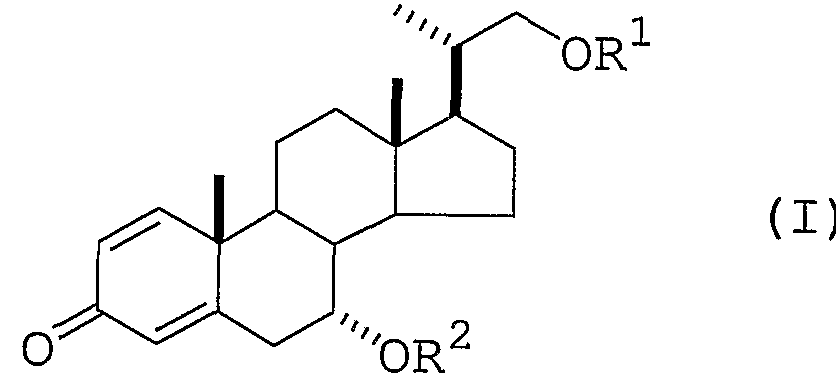
- R 1 represents a hydroxyl-protecting group
- R 2 represents a hydrogen atom or a hydroxyl-protecting group.
- compound (I) hereinafter referred to as compound (I) in the present specification
- a metal selected from the group consisting of an alkali metal and an alkaline earth metal is acted on in the presence of a proton donor, an amine or ammonia.
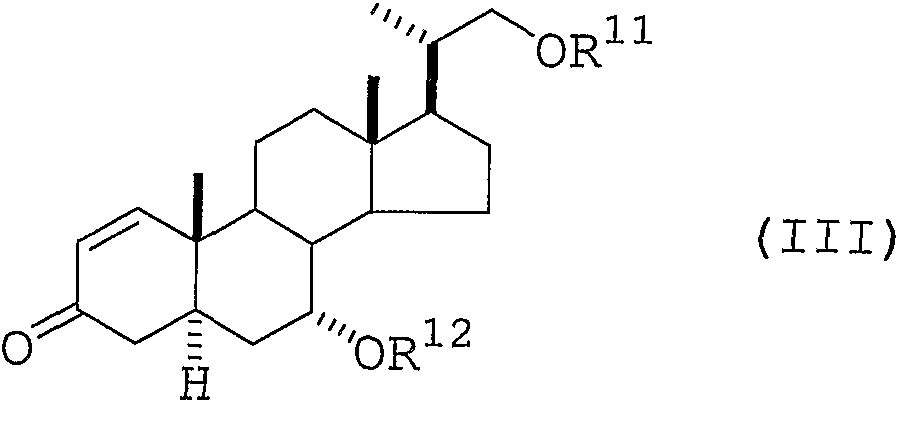
- R 1 and R 11 are a trisubstituted silyl group (the trisubstituted silyl group is an alkyl group which may have a substituent, an aryl group which may have a substituent, Having three identical or different substituents selected from the group consisting of an alkoxyl group which may be optionally substituted and an aryloxy group which may have a substituent.
- a compound in which a hydroxyl group at the 21-position is protected is used as a starting compound.
- the reaction can be carried out while reducing the amount of the reducing agent used.
- the method of the present invention uses a smaller amount of a reducing agent than in the related art, it is possible to suppress the production of an alcohol form by a side reaction.
- the carbon-carbon double bond of compound (V) or compound (VII) having a carbon-carbon double bond at the 1- or 2-position remaining in the product without being completely reduced in the reduction reaction by performing further two-stage reduction process of reducing only as an intermediate for production of Sukuaramin useful 5 alpha - Puredanan derivatives can be produced in high yield. According to the method of the present invention, excessive use of a reducing agent as in the conventional method is not required, and not only can side reactions be suppressed, but also the economic effect is large.
- R 1 1, R 1 2, R 2 1 and the coercive Mamorumoto of R 2 2 is a hydroxyl group, any such protecting group as long as it acts as a protecting group for a hydroxyl group
- an alkyl group which may have a substituent an acyl group which may have a substituent (for example, a formyl group, an alkylcarbonyl group which may have a substituent, An optionally substituted alkenylcarbonyl group, an optionally substituted arylcarbonyl group, etc.); an optionally substituted alkoxycarbonyl group; an optionally substituted aryloxy group
- a reporto group a carpamoyl group (for example, a nitrogen atom optionally substituted with an alkyl group which may have a substituent or an aryl group which may have a substituent); or trisubstitution Silyl group (the trisubstitution Ryl group includes an alkyl group which may have a substituent, an alkylcarbonyl group which may have
- the alkyl group as a part of the alkoxyl group of the group, the aryl group of the trisubstituted silyl group or the alkyl group of the aryloxy group which the aryloxy group may have may be linear, branched or cyclic.
- the carbon number is preferably 1 to 12, and more preferably 1 to 8.
- alkyl group examples include a methyl group, an ethyl group, a propyl group, an isopropyl group, a butyl group, an isobutyl group, a tert-butyl group, a hexyl group, an octyl group, a dodecyl group, a cyclopentyl group and a cyclohexyl group.
- the above-mentioned alkyl group may have a substituent.
- substituents There is no particular limitation on the number of substituents. A force of 1 to 6 is preferable. When the number is 2 or more, they may be the same or different.
- substituents include, for example, a phenyl group, a tolyl group, a methoxyphenyl group, a nitrophenyl group, a naphthyl group, and a fluorenyl group having 6 to 12 carbon atoms, preferably 6 to 10 carbon atoms.
- An aryl group which may have a group; a bier group or the like having 2 to 12 carbon atoms, preferably 2 to 10 carbon atoms, and an alkenyl group which may have a substituent; a methoxy group or an ethoxy group , Propoxy, isopropoxy, butoxy, isoptoxy, tert-butoxy, hexoxy, octyloxy, dodecyloxy, cyclopentyloxy, cyclohexyloxy, etc.
- R 1, R 2, R 1 1, R 1 2, Aruke as part of ⁇ sill group as R 2 1 and R 2 2 represents hydroxyl-protecting group - may have Le group and Ashiru group
- the alkenyl group as a substituent which the group may have may be any of linear, branched or cyclic, and preferably has 2 to 12 carbon atoms, and preferably has 2 to 8 carbon atoms. More preferred.
- alkenyl group examples include a vinyl group, a 1-methylvinyl group, a 1-propenyl group, a 1-otatur group, a 1-dodecel group, a 1-pentoxypentyl group, and a 1-hexoxyl hexenyl group.
- the above alkenyl group may have a substituent.
- the number of substituents is not particularly limited, but is preferably 1 to 6, and when two or more, they may be the same or different.
- a substituent for example, a phenyl group, a tolyl group, a methoxyphenyl group, a nitrophenyl group, a naphthyl group, a fluorenyl group and the like are preferably 6 to 12 carbon atoms.
- an aryl group which may have a substituent; methoxy group, ethoxy group, propoxy group, isopropoxy group, butoxy group, isoptoxy group, tert-butoxy group, hexyloxy Linear, branched, or cyclic C1-C12, preferably C1-C8 alkoxyl groups such as benzyl, octyloxy, dodecyloxy, cyclopentyloxy, and cyclohexyloxy groups; carbons such as benzyloxy groups
- R 1, R 2, 1 1 , R 1 2, R 2 1 and R 2 2 represents a ⁇ sill group Ariru group and Ashiru substituent group may have, as part of a protective group for a hydroxyl group Aryl group as part of an aryloxycarbonyl group; aryl group as a substituent that the aryloxy group may have; aryl group as a substituent An aryl group as a substituent; an aryl group of a trisubstituted silyl group, an aryl group as a part of an aryloxy group of a trisubstituted silyl group, and an aryl group, an alkoxyl group and an aryloxy group of a trisubstituted silyl group.
- the aryl group as a substituent which may be possessed preferably has 6 to 10 carbon atoms, and examples thereof include a phenyl group and a naphthyl group.
- the above aryl group may have a substituent.
- substituents There is no particular limitation on the number of substituents. A force of 1 to 6 is preferable. When the number is 2 or more, they may be the same or different.
- substituents include, for example, methyl, ethyl, propyl, isopropyl, butyl, isobutyl, tert-butyl, hexyl, octyl, dodecyl, cyclopentyl, cyclohexyl Linear, branched or cyclic alkyl groups having 1 to 12 carbon atoms, preferably 1 to 8; methoxy, ethoxy, propoxy, isopropoxy, butoxy, isobutoxy, tert-butoxy group, hexyloxy group, octyloxy group, dodecyloxy group, cyclopentyloxy group, cyclohexyloxy group and other linear, branched or cyclic carbon
- hydroxyl-protecting groups represented by 1, R 2 , R x ⁇ R 12 , R 21 and R 22 specific examples of the alkyl group which may have a substituent include a methyl group, an ethyl group and a tert group.
- 1-ptynole group methoxymethyl group, tert-butoxymethyl group, benzinoleoxymethyl group, 2-tetrahydroviranyl group, 2-tetrahydrofuranyl group, 1-ethoxyxyl group, 1-benzyloxyxethyl group, benzyl group, p-methyl Toxylbenzyl group, p-nitrobenzyl group, trityl group and the like, methyl group, ethyl group, methoxymethyl group, 2-tetrahydroviranyl group, 2-tetrahydrofuranolone group, 1-ethoxyxetino Re groups are preferred.
- acyl group examples include formyl group, acetyl group, propionyl group, butyryl group, isoptyryl group, Valeryl group, isoparryl group, piperoyl group, hexanoyl group, otatanyl group, dodecanoyl group, cyclopentanecarbonyl group, cyclohexanecarponyl group, methoxyacetyl group, crotonyl group, cinnamoyl group.
- Examples include an enoxyacetyl group, a benzoyl group, a methoxybenzoyl group, a nitrobenzoyl group and the like, and a formyl group, an acetyl group, a propionyl group and a vivaloyl group are preferred.
- hydroxyl-protecting groups represented by R 1 R 2 , R 11 , R 12 , R 21 and R 22 specific examples of the optionally substituted alkoxycarbonyl group include a methoxycarbonyl group and an ethoxy group.
- -R is preferred.
- aryloxycarbonyl group which may have a substituent include phenoxycarbonyl.
- a phenyloxycarbonyl group, and a phenoxycarboyl group is preferred.
- carbamoyl group examples include any hydrogen atom of a nitrogen atom, for example, a methyl group, ethyl Group, propyl group, isopropyl group, butyl group, isobutyl group, tert-butyl group, hexyl group, octyl group, dodecyl group, cyclopentyl group, cyclohexyl group, etc.
- Alkyl or phenyl group having 2 to 12 carbon atoms such as aralkyl group having 7 to 12 carbon atoms such as alkyl group and benzyl group, benzyl group and the like, alkenyl or phenyl group having 2 to 12 carbon atoms, methoxyphenyl group and naphthyl And a carpamoyl group which may be substituted with an aryl group having 6 to 10 carbon atoms which may have a substituent such as a group.
- trisubstituted silyl groups include trimethylsilyl, triethylsilyl, triisopropylsilyl, dimethylisopropyl Tert-butyldimethylsilyl group, tert-butyl / resimetinolesilinole group, tert-butyldiphenylaminosilyl group, tert-butyldiphenylaminosilyl group, tribenzylsilyl group, tert-butylmethylphenylphenylsilyl group, and the like.
- a silyl group, a triethylsilyl group and a triisopropylsilyl group are preferred, and a tert-butyldimethylsilyl group is more preferred.
- R 1 , R 11 and R 21 a trisubstituted silyl group is preferable, and among them, a tert-butyldimethylsilyl group is more preferable.
- the hydroxyl group at the 7-position in compound (I) reacts slowly with the metal reducing agent due to steric constraints and does not adversely affect the reaction, so it may be either protected or unprotected. It is preferable that it is not protected from the viewpoint that the introduction reaction can be omitted. That is, as R 2 , R 12 and R 22 , a hydrogen atom is preferable.
- (I) includes a step of allowing a metal such as an alkali metal such as lithium, sodium and potassium or an alkaline earth metal such as magnesium, calcium, strontium and palladium to act.
- a metal such as an alkali metal such as lithium, sodium and potassium or an alkaline earth metal such as magnesium, calcium, strontium and palladium to act.
- alkali metals such as lithium, sodium and potassium are preferred, and lithium is more preferred.
- the amount of the alkali metal or alkaline earth metal used is such that the reduction of the carbon-carbon double bond at positions 4 and 5 of compound (I) is almost complete, and the carbon-carbon double bond at positions 1 and 2 is There is no particular limitation as long as the amount can be controlled to such an extent that a part remains, but in order to significantly suppress the reduction of ketones, usually, the carbon-carbon double bonds at positions 4 and 5 of compound (I) are reduced. Range from 0.8 to 2.5 times the amount needed to do so. If the amount of the alkali metal or alkaline earth metal used is less than the above range, the reduction of the carbon-carbon double bond at the 4th and 5th positions of compound (I) tends to be incomplete. Side reactions, such as reduction of, tend to proceed.
- the reaction temperature is preferably in the range of 100 ° C to 50 ° C, more preferably in the range of 50 ° C to 20 ° C.
- the reaction time varies depending on the reaction conditions, but is preferably in the range of 0.1 to 20 hours, more preferably in the range of 1 to 10 hours, from an industrial viewpoint.
- the reduction reaction is performed in the presence of ammonia and / or amine.
- Amin's There is no particular limitation on the type, and for example, primary amines such as methylamine, ethyl / reamine, isopropylamine, and butylamine; secondary amines such as dimethylamine, getylamine, diisopropylamine, pyrrolidine, and piperidine; ethylenediamine, diaminopropane , N, N, polyvalent amines such as monodimethylethylenediamine; linear, branched or cyclic amines having 1 to 6 carbon atoms.
- the amount of ammonia and Z or amine to be used is preferably in the range of 1 to 100 times by mass, more preferably in the range of 3 to 50 times by mass, relative to compound (I).
- a proton donor for the reaction.
- the type of the proton donor is not particularly limited, and examples thereof include an inorganic acid such as hydrochloric acid, sulfuric acid, and carbonic acid, a carboxylic acid such as formic acid, acetic acid, and benzoic acid, and an ammonium salt or an amine salt thereof; water; alcohol; The use of is preferred.
- the alcohol examples include primary alcohols such as methanol, ethanol, 1-propanol, 1-ptanol, 1-octanol, and 1-dodecanol; 2_propanol / l, 2-ptanol / l, 3-pentano / l, cyclopentanol / Secondary acrecone, such as nore, cyclohexano-17, and 2-octanonole; tertiary alcohol, such as tert-ptananol, tert-amyl alcohol, 2-methylhexanol, and 1-methylcyclohexanol; ethylene Polyhydric alcohols such as glycol, 1,4-heptanediol, 2,4-pentanediol, and glycerin; and linear, branched or cyclic alcohols having 1 to 12 carbon atoms. Of these, tertiary alcohols are preferred, and tert-butanol is more preferred
- the amount of proton donor used is usually in the range of 1.5 to 3 moles per carbon-carbon double bond to be reduced.
- the timing of adding the proton donor to the reaction system is not particularly limited.
- a method in which the compound (I) is added to the reaction system before reacting with the alkali metal or the alkaline earth metal, or the compound (I) is added to the alkali metal Alternatively, the method can be arbitrarily selected from a method of adding to the reaction system after reacting with the alkaline earth metal, and the former method is preferable. Further, the reduction reaction may be performed in the presence of a solvent.
- the solvent that can be used is not particularly limited, as long as it does not adversely affect the reaction.
- examples include tetrahydrofuran, dimethyl alcohol, diisopropynoleate, methylate tert-butyl enolate, cyclopentyl methyl ether, dimethoxetane, 1 And ethers such as 4-dioxane; saturated aliphatic hydrocarbons such as pentane, hexane, heptane, and octane.
- ethers such as tetrahydrofuran, getyl ether, diisopropyl ether, methyl tert-butyl ether, dimethoxyethane, and 1,4-dioxane are preferable, and tetrahydrofuran is more preferable.
- a solvent When a solvent is used, its use amount is not particularly limited, but is preferably in the range of 1 to 100 times by mass, more preferably 3 to 50 times by mass, relative to compound (I).
- the compound (I) is stereoselectively reduced so that the hydrogen atom at the 5-position of predanane is in the configuration.
- stereoselective means that the compound (II) and the compound (III) or the compound (IV) and the compound (V) are formed more than the isomer in which the hydrogen atom at the 5-position of predanane is arranged. means.
- the method for isolating and purifying the product after the reduction reaction is not particularly limited, and a method generally used for isolating and purifying an organic compound can be employed.
- a mixture of the compound (II) and the compound (III) or a mixture of the compound (IV) and the compound (V) can be obtained by performing an extraction operation or the like and then concentrating the mixture.
- the protecting group for the hydroxyl group represented by R 1 and R 2 in compound (I) is the protecting group for the hydroxyl group represented by R 11 and R 12 in the mixture of compound (II) and compound (III), or compound (IV) )
- compound (V) may be the same as or different from the hydroxyl-protecting group represented by R 21 and R 22 in the mixture. That is, the protecting group of the hydroxyl group represented by R 1 and R 2 may be arbitrarily changed by performing a reduction reaction (Perch reduction reaction) within a range where deprotection is possible. For example, a benzoyl group can be converted to a 2,5-cyclohexadienecarbonyl group by a reduction reaction. May be changed.
- the protecting group of the hydroxyl group represented by R 1 and R 2 in the compound (I) undergoes a reduction reaction. May be deprotected.
- reaction conditions used for deprotection of the hydroxyl-protecting group are not particularly limited. Normally used reaction conditions can be selected and used according to the type of the protecting group.
- hydroxyl-protecting group is a tri-substituted silyl group, which is a preferred embodiment, a mixture of the compound (II) and the compound (III) or a mixture of the compound (IV) and the compound (V) is acid or fluoride.
- Deprotection can be achieved by reacting with a salt.
- the embodiment will be described, but the deprotection reaction is not limited thereto.
- the type of acid is not particularly limited, and examples thereof include inorganic acids such as hydrochloric acid, sulfuric acid, hydrofluoric acid, and hydrobromic acid; and organic acids such as acetic acid, trifluoroacetic acid, p-toluenesulfonic acid, and methanesulfonic acid.
- examples of the fluoride salt include tetrabutylammonium fluoride, potassium fluoride, sodium fluoride and the like.
- the amount of the acid used is in the range of 0.1 to 10 times by mole, more preferably 0.1 to 5 times by mole, relative to the raw material.
- the amount of fluoride salt used is determined by the number of protecting groups contained in the raw material to be deprotected. It is preferably in the range of 1 to 10 moles per one protecting group, and more preferably in the range of 1 to 5 moles.
- the deprotection reaction may be performed in the presence of a solvent.
- the solvent that can be used is not particularly limited as long as it does not adversely affect the reaction.
- tetrahydrofuran dimethyl ether, diisopropyl ether, methyl tert-butyl ether, cyclopentinolemethinoleatenore, dimethoxetane, 1,41- Ethers such as dioxane; saturated aliphatic hydrocarbons such as pentane, hexane, heptane and octane And the like.
- ethers such as tetrahydrofuran, getyl ether, diisopropyl ether, methyl-tert-butyl ether, dimethoxyethane, and 1,4-dioxane are preferable, and tetrahydrofuran is more preferable.
- a solvent When a solvent is used, its use amount is not particularly limited, but is preferably in the range of 1 to 100 times by mass, more preferably in the range of 3 to 50 times by mass relative to the raw material.
- the reaction temperature is preferably in the range of 20 ° C to 120 ° C, more preferably in the range of 0 ° C to 80 ° C.
- the reaction time is preferably in the range of 0.1 to 20 hours, more preferably in the range of 1 to 10 hours.
- the method for isolating and purifying the obtained product is not particularly limited, and a method generally used for isolating and purifying an organic compound can be employed. For example, after performing an extraction operation and the like, concentration is performed to obtain a compound (VI) and a mixture of the compound (VII).
- Reduction of the carbon-carbon double bond at position 2 leads to the desired saturated ketone.
- reduction methods include, for example, catalytic reduction using a transition metal catalyst, reduction using a hydride reducing agent, and conversion of compound (I) to compound (II) and compound (II).
- Examples of the method for producing the mixture of (III) include the above-described reduction method and the like. Among them, the catalytic reduction using a transition metal catalyst is preferable from the viewpoint that the reduction of ketone is easily suppressed.
- catalytic reduction using a transition metal catalyst which is a preferred embodiment, will be described, but the reduction step is not limited thereto.
- Catalytic reduction is carried out using a compound (II) and a mixture of the compound (II) or a compound (II).
- the reaction is carried out by reacting a mixture of (IV) and compound (V) with a reducing agent in the presence of a transition metal catalyst.
- a transition metal catalyst examples include ruthenium, rhodium, iridium, nickel, palladium, platinum and the like. Of these, nickel, palladium, and platinum are preferred, and palladium is most preferred.
- the form of the transition metal catalyst is a complex catalyst that dissolves in the reaction system (eg, tetrakistriphenyl phosphine palladium, palladium acetate), a heterogeneous catalyst that does not dissolve in the reaction system (eg, palladium carbon, palladium hydroxide, palladium black, platinum oxide) Either of them may be used, but a heterogeneous catalyst which can be easily separated from the reaction system, particularly palladium carbon or palladium black, is preferable.
- a complex catalyst that dissolves in the reaction system eg, tetrakistriphenyl phosphine palladium, palladium acetate
- a heterogeneous catalyst that does not dissolve in the reaction system eg, palladium carbon, palladium hydroxide, palladium black, platinum oxide
- the amount of the transition metal catalyst used depends on the ratio of the compound (III) or the compound (V) mixed in the raw material mixture, but is usually 0.01 to 100% by mass relative to the total mass of the raw material mixture. / 0 , preferably in the range of 0.1 to 10% by mass.
- Examples of the reducing agent include molecular hydrogen, formic acid and salts thereof, and molecular hydrogen is preferable.
- Hydrogen partial pressure in the case of using molecular hydrogen as a reducing agent is preferably in the range of l X 10 4 ⁇ l X 10 7 P a, which is the range of 1 X 10 5 ⁇ 1 X 10 6 P a Is more preferred.
- the reaction temperature of the catalytic reduction is preferably in the range of 0 ° C. to 150 ° C., more preferably in the range of 20 ° C. to 100 ° C.
- the reaction time varies depending on the reaction conditions, but is preferably from 0.1 to 20 hours, more preferably from 1 to 10 hours, from an industrial viewpoint.
- the catalytic reduction reaction is usually performed in the presence of a solvent.
- the solvent is not particularly limited as long as it does not adversely affect the reaction.
- examples of the solvent include tetrahydrofuran, getyl ether, diisopropyl ether, methyl tert-butyl ether, cyclopropionine methyl ether, dimethoxetane, and 1,4-dioxane.
- saturated aliphatic hydrocarbons such as pentane, hexane, heptane and octane
- aromatic hydrocarbons such as benzene, toluene, xylene and mesitylene
- esters such as methyl acetate, ethyl acetate, butyl acetate and methyl benzoate
- methanol Etano one / Les, 1 one Puropanonore, 2-Purono ⁇ 0 Nonore, 1 Putano one / Les, 2-Putano one Norre, (1) Acetonitrile such as octanole; nitrile such as acetonitrile; amides such as N, N, —dimethylformamide and N-methylpyrrolidone; dimethyl sulfoxide; and the like, alone or in combination.
- ethers such as tetrahydrofuran, getyl ether, diisopropyl ether, methyl tert-butyl ether, cyclopropyl methyl ether, dimethyloxetane, and 1,4-dioxane are preferable, and tetrahydrofuran is more preferable.
- the amount of the solvent used is not particularly limited, but is preferably in the range of 1 to 200 times by mass, more preferably 3 to 50 times by mass, based on the total mass of the raw material mixture.
- the method for isolating and purifying the compound (II) or the compound (IV) obtained by the reduction reaction is not particularly limited, and a method usually used for isolating and purifying an organic compound can be employed.
- the compound (I I) or the compound (IV) can be isolated and purified by performing recrystallization or column chromatography after removing the catalyst or performing an extraction operation.
- the method for producing the compound (I) used as a raw material is not particularly limited.
- (2 OS) -7 a, 21-dihydroxy-20-methylpredaner 1,4-dien-3-one is 3 o !, 7 ⁇ -dihydroxy-5 3-cholanoic acid Z or its
- a microorganism JP-B-25250449
- (2 OS) -7a, 21-dihydroxy-20-methinoleprene Danner 4-en-3-one can be converted to 7 ⁇ -hydroxy-1-3-oxopregna 14-en-20 ⁇ -carbaldehyde by subjecting 3 ⁇ , 7 ⁇ -dihydroxy-5-cholanic acid to a conversion reaction using a microorganism.
Landscapes
- Chemical & Material Sciences (AREA)
- Organic Chemistry (AREA)
- Health & Medical Sciences (AREA)
- General Health & Medical Sciences (AREA)
- Steroid Compounds (AREA)
- Organic Low-Molecular-Weight Compounds And Preparation Thereof (AREA)
Abstract
Description


Claims



Priority Applications (3)
| Application Number | Priority Date | Filing Date | Title |
|---|---|---|---|
| JP2006511885A JPWO2005095431A1 (ja) | 2004-03-31 | 2005-03-31 | 5α−プレグナン誘導体の製造方法 |
| US10/594,163 US20070197490A1 (en) | 2004-03-31 | 2005-03-31 | Method for producing 5alpha-pregnane derivative |
| EP05728889A EP1767540A4 (en) | 2004-03-31 | 2005-03-31 | METHOD OF PREPARING A 5-ALPHA PRIMING DERIVATIVE |
Applications Claiming Priority (2)
| Application Number | Priority Date | Filing Date | Title |
|---|---|---|---|
| JP2004108434 | 2004-03-31 | ||
| JP2004-108434 | 2004-03-31 |
Publications (1)
| Publication Number | Publication Date |
|---|---|
| WO2005095431A1 true WO2005095431A1 (ja) | 2005-10-13 |
Family
ID=35063714
Family Applications (1)
| Application Number | Title | Priority Date | Filing Date |
|---|---|---|---|
| PCT/JP2005/006818 Ceased WO2005095431A1 (ja) | 2004-03-31 | 2005-03-31 | 5α-プレグナン誘導体の製造方法 |
Country Status (5)
| Country | Link |
|---|---|
| US (1) | US20070197490A1 (ja) |
| EP (1) | EP1767540A4 (ja) |
| JP (1) | JPWO2005095431A1 (ja) |
| CN (1) | CN100509838C (ja) |
| WO (1) | WO2005095431A1 (ja) |
Families Citing this family (2)
| Publication number | Priority date | Publication date | Assignee | Title |
|---|---|---|---|---|
| JPWO2005095434A1 (ja) * | 2004-03-31 | 2008-02-21 | 株式会社クラレ | 5α−プレグナン誘導体の製造方法 |
| US20070203106A1 (en) * | 2005-03-31 | 2007-08-30 | Kuraray Co., Ltd. | Method for Producing 5Alpha-Pregnane Derivative |
Citations (1)
| Publication number | Priority date | Publication date | Assignee | Title |
|---|---|---|---|---|
| WO2002020552A1 (en) * | 2000-09-08 | 2002-03-14 | Kuraray Co., Ltd. | Process for the preparation of pregnane derivatives |
Family Cites Families (6)
| Publication number | Priority date | Publication date | Assignee | Title |
|---|---|---|---|---|
| US4230625A (en) * | 1979-04-12 | 1980-10-28 | Hoffmann-La Roche Inc. | Process for chenodeoxycholic acid and intermediates therefore |
| US4301246A (en) * | 1979-04-12 | 1981-11-17 | Hoffmann-La Roche Inc. | Process for chenodeoxycholic acid production |
| US7008940B1 (en) * | 1999-08-20 | 2006-03-07 | Takeda Pharmaceutical Company Limited | Dihydrobenzofuran derivatives, process for the preparing thereof and agents |
| DK1274718T3 (da) * | 2000-04-12 | 2007-02-12 | Genaera Corp | En fremgangsmåde til forberedelse af 7.alpha.-hydroxy 3-aminosubstituerede steroler vee en ubeskyttet 7.alpha.-hydroxy gruppe |
| JPWO2005095434A1 (ja) * | 2004-03-31 | 2008-02-21 | 株式会社クラレ | 5α−プレグナン誘導体の製造方法 |
| US20070203106A1 (en) * | 2005-03-31 | 2007-08-30 | Kuraray Co., Ltd. | Method for Producing 5Alpha-Pregnane Derivative |
-
2005
- 2005-03-31 EP EP05728889A patent/EP1767540A4/en not_active Withdrawn
- 2005-03-31 US US10/594,163 patent/US20070197490A1/en not_active Abandoned
- 2005-03-31 CN CNB2005800101105A patent/CN100509838C/zh not_active Expired - Fee Related
- 2005-03-31 WO PCT/JP2005/006818 patent/WO2005095431A1/ja not_active Ceased
- 2005-03-31 JP JP2006511885A patent/JPWO2005095431A1/ja not_active Withdrawn
Patent Citations (1)
| Publication number | Priority date | Publication date | Assignee | Title |
|---|---|---|---|---|
| WO2002020552A1 (en) * | 2000-09-08 | 2002-03-14 | Kuraray Co., Ltd. | Process for the preparation of pregnane derivatives |
Non-Patent Citations (1)
| Title |
|---|
| TEMPLETON J.F. ET AL: "Synthesis of 19-hydroxy-1 beta, 19-cyclosteroids.", JOURNAL OF THE CHEMICAL SOCIETY, PEKIN TRANSACTIONS 1:ORGANIC AND BIO-ORGANIC CHEMISTRY., no. 25, 1997, pages 2037 - 2043, XP002990867 * |
Also Published As
| Publication number | Publication date |
|---|---|
| EP1767540A1 (en) | 2007-03-28 |
| CN1938330A (zh) | 2007-03-28 |
| CN100509838C (zh) | 2009-07-08 |
| EP1767540A4 (en) | 2009-04-01 |
| JPWO2005095431A1 (ja) | 2008-02-21 |
| US20070197490A1 (en) | 2007-08-23 |
Similar Documents
| Publication | Publication Date | Title |
|---|---|---|
| JP7751844B2 (ja) | 高純度のコレステロールの合成方法 | |
| KR20240135777A (ko) | 고순도 식물 유래 콜레스테롤의 합성방법 | |
| CN115884978A (zh) | 制备胆酸衍生物的方法及其原料 | |
| JP6100798B2 (ja) | 16−置換型−17−ケトステロイド類のアルキニル化方法 | |
| CN112028956A (zh) | 合成21-羟基-17-(1-氧代丙氧基)孕甾-4-烯-3,20-二酮的方法 | |
| WO2005095431A1 (ja) | 5α-プレグナン誘導体の製造方法 | |
| JPWO2005095434A1 (ja) | 5α−プレグナン誘導体の製造方法 | |
| CN101381356B (zh) | 辛伐他汀的制备方法 | |
| WO2019170521A1 (en) | Synthesis of obeticholic acid and synthesis intermediate | |
| HU196430B (en) | Process for producing 17-alpha-ethinyl-17-beta-hydroxy-18-methyl-4,15-estradien-3-one | |
| WO2005095432A1 (ja) | 5α-プレグナン誘導体の製造方法 | |
| WO2005095433A1 (ja) | 5α-プレグナン誘導体の製造方法 | |
| CN104628807B (zh) | 16-烯-20-羟基甾体化合物的合成方法 | |
| US20070203106A1 (en) | Method for Producing 5Alpha-Pregnane Derivative | |
| US9683010B2 (en) | Process for the production of 21-methoxy-11-beta-phenyl-19-nor-pregna-4,9-diene-3,20-dione derivatives | |
| JP2005314405A (ja) | 5α−プレグナン誘導体の製造方法 | |
| MX2012009251A (es) | Un proceso para introducir un enlace doble en la posicion 15, 16 de un esteroide. | |
| JPWO2003080561A1 (ja) | ボグリボースの製造法 | |
| ES2724725B2 (es) | Síntesis de ácido obeticólico e intermedio de síntesis | |
| WO2018185783A1 (en) | Novel process for preparation of 19-norsteroids | |
| WO2005095435A1 (ja) | プレグナン誘導体の製造方法 |
Legal Events
| Date | Code | Title | Description |
|---|---|---|---|
| AK | Designated states |
Kind code of ref document: A1 Designated state(s): AE AG AL AM AT AU AZ BA BB BG BR BW BY BZ CA CH CN CO CR CU CZ DE DK DM DZ EC EE EG ES FI GB GD GE GH GM HR HU ID IL IN IS JP KE KG KP KR KZ LC LK LR LS LT LU LV MA MD MG MK MN MW MX MZ NA NI NO NZ OM PG PH PL PT RO RU SC SD SE SG SK SL SM SY TJ TM TN TR TT TZ UA UG US UZ VC VN YU ZA ZM ZW |
|
| AL | Designated countries for regional patents |
Kind code of ref document: A1 Designated state(s): BW GH GM KE LS MW MZ NA SD SL SZ TZ UG ZM ZW AM AZ BY KG KZ MD RU TJ TM AT BE BG CH CY CZ DE DK EE ES FI FR GB GR HU IE IS IT LT LU MC NL PL PT RO SE SI SK TR BF BJ CF CG CI CM GA GN GQ GW ML MR NE SN TD TG |
|
| 121 | Ep: the epo has been informed by wipo that ep was designated in this application | ||
| WWE | Wipo information: entry into national phase |
Ref document number: 2006511885 Country of ref document: JP |
|
| WWE | Wipo information: entry into national phase |
Ref document number: 10594163 Country of ref document: US Ref document number: 2007197490 Country of ref document: US |
|
| WWE | Wipo information: entry into national phase |
Ref document number: 200580010110.5 Country of ref document: CN |
|
| NENP | Non-entry into the national phase |
Ref country code: DE |
|
| WWW | Wipo information: withdrawn in national office |
Ref document number: DE |
|
| WWE | Wipo information: entry into national phase |
Ref document number: 2005728889 Country of ref document: EP |
|
| WWE | Wipo information: entry into national phase |
Ref document number: 3996/CHENP/2006 Country of ref document: IN |
|
| WWP | Wipo information: published in national office |
Ref document number: 2005728889 Country of ref document: EP |
|
| WWP | Wipo information: published in national office |
Ref document number: 10594163 Country of ref document: US |