WO2005097836A1 - 含フッ素エラストマー重合体の製造方法 - Google Patents
含フッ素エラストマー重合体の製造方法 Download PDFInfo
- Publication number
- WO2005097836A1 WO2005097836A1 PCT/JP2005/006678 JP2005006678W WO2005097836A1 WO 2005097836 A1 WO2005097836 A1 WO 2005097836A1 JP 2005006678 W JP2005006678 W JP 2005006678W WO 2005097836 A1 WO2005097836 A1 WO 2005097836A1
- Authority
- WO
- WIPO (PCT)
- Prior art keywords
- fluorine
- vinyl group
- polymer
- integer
- producing
- Prior art date
- Legal status (The legal status is an assumption and is not a legal conclusion. Google has not performed a legal analysis and makes no representation as to the accuracy of the status listed.)
- Ceased
Links
Classifications
-
- C—CHEMISTRY; METALLURGY
- C08—ORGANIC MACROMOLECULAR COMPOUNDS; THEIR PREPARATION OR CHEMICAL WORKING-UP; COMPOSITIONS BASED THEREON
- C08F—MACROMOLECULAR COMPOUNDS OBTAINED BY REACTIONS ONLY INVOLVING CARBON-TO-CARBON UNSATURATED BONDS
- C08F14/00—Homopolymers and copolymers of compounds having one or more unsaturated aliphatic radicals, each having only one carbon-to-carbon double bond, and at least one being terminated by a halogen
- C08F14/18—Monomers containing fluorine
- C08F14/26—Tetrafluoroethene
-
- C—CHEMISTRY; METALLURGY
- C08—ORGANIC MACROMOLECULAR COMPOUNDS; THEIR PREPARATION OR CHEMICAL WORKING-UP; COMPOSITIONS BASED THEREON
- C08F—MACROMOLECULAR COMPOUNDS OBTAINED BY REACTIONS ONLY INVOLVING CARBON-TO-CARBON UNSATURATED BONDS
- C08F14/00—Homopolymers and copolymers of compounds having one or more unsaturated aliphatic radicals, each having only one carbon-to-carbon double bond, and at least one being terminated by a halogen
- C08F14/18—Monomers containing fluorine
Definitions
- the present invention relates to a method for producing a fluorine-containing elastomer polymer.
- Patent Document 1 A method of polymerizing a fluoromonomer in an aqueous medium having a pH of 5 to 10 in the presence of s is an integer of 1 to 7, T is an alkali metal or the like (see, for example, Patent Document 1).
- Patent Document 1 does not describe multi-stage polymerization.
- Patent Document 2 discloses a method of seed-polymerizing an ethylenically unsaturated monomer (fluorine-free monomer) in the presence of an aqueous dispersion of this VDF-based copolymer. There is no description of seed polymerization.
- a first-stage polymerization is carried out in an aqueous medium in the presence of an emulsifier in an amount of 0.5% by mass or more of the aqueous medium, and the resulting seed particles have a strong milk strength.
- a method of performing multi-stage polymerization by adding a monomer after diluting a suspension for example, see Patent Document 3. According to this method, by performing multi-stage polymerization, Production efficiency can be increased while using less emulsifier, but a certain amount of emulsifier remains.
- Patent Document 3 does not suggest that this multi-stage polymerization is performed in the presence of a fluorine-containing vinyl group-containing emulsifier!
- Patent Document 1 Japanese Patent Publication No. 61-33848
- Patent Document 2 JP-A-8-67795
- Patent document 3 International publication 00Z001741 pamphlet
- An object of the present invention is to provide a method for producing a fluorine-containing elastomer polymer which is excellent in molding processability, mechanical strength such as compression set, and chemical strength such as chemical resistance in view of the above situation. To provide.
- the present invention provides a first polymerization step of obtaining an aqueous emulsion by emulsion-polymerizing a fluorine-containing monomer [A] in an aqueous medium in the presence of a fluorine-containing vinyl group-containing emulsifier;
- a method for producing a fluoroelastomer polymer comprising a second polymerization step of producing a fluoroelastomer polymer by emulsion-polymerizing a fluorine-containing monomer [B] in an aqueous emulsion
- the vinyl group-containing emulsifier is a method for producing a fluorine-containing elastomer polymer, which is a compound having a radical polymerizable unsaturated bond and a hydrophilic group in a molecule.
- the present invention provides a first polymerization step for obtaining an aqueous emulsion by emulsion-polymerizing a fluorine-containing monomer [A] in an aqueous medium in the presence of a fluorine-containing vinyl group-containing emulsifier;
- a method for producing a fluoroelastomer polymer comprising a second polymerization step of producing a fluoroelastomer polymer by emulsion-polymerizing a fluorine-containing monomer [B] in an aqueous emulsion,
- the vinyl group-containing emulsifier has the following general formula (I)
- a represents an integer of 1 to 10
- Y represents —SO M or —COOM
- M represents H
- b represents an integer of 1 to 5
- Y represents —SO M or —COOM
- M represents H
- c represents an integer of 1 to 10
- Y represents —SO M or —COOM
- M represents H
- X represents F or CF
- d represents an integer of 0 to 2
- e represents an integer of 1 to 10.
- F represents an integer of 1 to 3
- Y represents -SO M or COOM
- M represents H
- a fluorine-containing vinyl group-containing compound (IV) represented by the following general formula (V):
- g represents an integer of 0 to 10
- Y represents -SO M or COOM
- M represents H
- h represents an integer of 1 to 6
- i represents an integer of 1 to 10
- Y represents SOM or C
- pl represents an integer of 1 to 10
- Y represents —SO M or —COOM
- M represents H
- q represents an integer of 1 to 4
- p2 represents an integer of 1 to 10
- Y is —SO M or
- Fluorine-containing plastic represented by The present invention provides a method for producing a fluorine-containing elastomer monopolymer, which is characterized in that the compound also has a (v ⁇ ) power.
- the present invention provides an aqueous dispersion of a fluorinated elastomer, wherein the fluorinated elastomer is dispersed in an aqueous medium, wherein the fluorinated elastomer is a dispersion of the fluorinated elastomer.
- the fluoroelastomer polymer produced by the production method of the above contains or does not contain a fluorine-containing butyl group-containing emulsifier, and the fluorine-containing vinyl
- the group-containing milk-dispersing agent is a fluorine-containing elastomeric polymer aqueous dispersion characterized by being less than 100 ppm of the above-mentioned fluorine-containing elastomeric polymer aqueous dispersion.
- the "fluorinated elastomeric polymer” means an amorphous fluorinated polymer having rubber elasticity.
- the fluorine-containing polymer is a polymer having at least 58% by mass, preferably 64% by mass of fluorine atoms, and may be a partially fluorinated polymer or a perfluoropolymer.
- the fluorine-containing elastomer polymer has a copolymer unit of the first monomer of 30 to 80% by mass.
- first monomer refers to the above-mentioned fluorinated elastomer which constitutes a copolymer unit which occupies the largest mass among all copolymer units in the molecular structure of the fluorinated elastomer polymer.
- VDF copolymer the copolymer in which the first monomer is VDF
- TFE the polymer in which the first monomer is TFE
- the above copolymer unit is a part of the molecular structure of the fluorine-containing elastomer polymer, and means a part derived from the corresponding monomer.
- the VDF unit is a part on the molecular structure of the VDF-based copolymer and is a part derived from VDF, and is represented by-(CH-CF)-.
- the above "all copolymerized units" is a fluorine-containing elastomer
- the content of the copolymerized unit can be obtained by measuring F 19 -NMR.
- the fluorinated elastomer polymer may have a monomer unit derived from a monomer other than the first monomer in addition to the first monomer unit.
- the monomers other than the first monomer are copolymerizable with the first monomer.
- the monomer unit derived from a monomer other than the first monomer may be derived from only one of the monomers copolymerizable with the first monomer. It may be derived from two or more monomers copolymerizable with the first monomer.
- a copolymer unit derived from a monomer other than the first monomer is any one of monomers copolymerizable with the first monomer. It may be derived from only the first monomer or two or more monomers copolymerizable with the first monomer.
- Examples of monomers copolymerizable with the first monomer include fluorine-containing olefins, fluorine-containing butyl ethers, and hydrocarbon olefins.
- the fluorine-containing olefin is not particularly limited.
- the fluorine-containing butyl ether is not particularly limited, and examples thereof include perfluoro (alkyl butyl) ether.
- Rf b O (wherein, Rf and Rf b are different and each have a linear or branched carbon number of 2 nm
- a 6 par full O b alkylene group, m and n are independently an integer from 0 to 10, Rf e is the par full O b alkyl group having 1 to 6 carbon atoms. Are preferred.
- Rf d is a perfluoroalkyl group having 1 to 6 carbon atoms. And more preferably a compound represented by the formula:
- PAVEs are perfluoro (methyl vinyl ether) [PMVE], perfluoro (ethyl vinyl ether) [PEVE], perfluoro (propyl vinyl ether) [PPVE] It is preferable that
- u is an integer of 0 or 1
- V is an integer of 0 to 5
- Z 1 is F or CF. ] Is preferable.
- Rf e is preferably CF
- u is an integer of 1
- V is an integer of 1
- n and n are independently integers from 0 to 10
- y is an integer from 0 to 3
- z is
- n and n are each independently an integer of 0 or 1, and z is preferably an integer of 1.
- x is an integer of 1 to 3. ] Is preferable. X is preferably an integer of 1.
- the PAVE unit is preferably 20 to 70% by mass.
- the fluorinated elastomer polymer has PMVE units, it is preferable that the PMVE units be 30 to 55% by mass.
- the hydrocarbon olefin is not particularly limited, but is preferably propene such as ethylene and propene.
- the fluorine-containing elastomer single polymer, if having a hydrocarbon Orefin units is preferably hydrocarbons Orefuin unit force 20 mass 0/0.
- the fluoroelastomer is not particularly limited as long as it has at least 58% by mass or more of fluorine atoms.
- examples thereof include TFEZ perfluoro (Vuylether) copolymer, VdFZHFP copolymer, Fluorine-containing copolymers such as VdFZCTFE copolymer, VdFZHFP ZTFE copolymer, VdFZCTFEZTFE copolymer, TFEZ propylene copolymer, TFEZ propylene ZVdF copolymer, ethylene ZHFP copolymer, etc. Fluorine-containing polymers that can be produced by emulsion polymerization are exemplified.
- the fluorine-containing elastomer polymer is preferably a VDF-based copolymer or a TFE-based copolymer.
- a TFE-based copolymer a TFEZ propylene-based copolymer or a TFEZ perfluoro (Buruether) -based copolymer is preferable.
- VDF-based copolymer examples include, for example, VDFZHFP copolymer, VDFZHFPZTF E copolymer, VDFZHFPZTFEZ4—bromo-3,3,4,4-tetrafluorobutene 1 copolymer, VDFZHFPZTFEZ4 3,4,4-tetrafluorobutene 1 copolymer, VDFZPMVEZTFEZ4 bromo-3,3,4,4-tetrafluorobutene-1 copolymer, VDFZPMVEZTFEZ4 odo-3,3,4,4-tetrafluorobutene-1 copolymer And VDFZPMVEZTFEZI, l, 3,3,3 pentafluoropropene copolymer.
- VDFZHFP copolymer examples include, for example, VDFZHFP copolymer, VDFZHFPZTF E copolymer, VDFZHFPZTFEZ4—bromo-3,3,4,4
- Examples of the TFEZ propylene-based copolymer include a TFEZ propylene copolymer.
- TFEZ perfluoro (butyl ether) copolymer examples include TFEZPMVEZ ethylene copolymer, TFEZPMVEZ ethylene Z4-bromo-3,3,4,4-tetrafluorobutene 1 copolymer, and TFEZPMVEZ ethylene Z4—odo-3,3,4.
- the method for producing a fluorinated elastomeric polymer of the present invention comprises a first polymerization step, and a first polymerization step, wherein the fluorinated elastomeric polymer is produced in the aqueous emulsion obtained.
- an aqueous emulsion is obtained by emulsion-polymerizing a fluorine-containing monomer [A] in an aqueous medium in the presence of a fluorine-containing vinyl group-containing emulsifier.
- the above-mentioned fluorine-containing vinyl group-containing emulsifier is a compound having a radical polymerizable unsaturated bond and a hydrophilic group in a molecule.
- R 4 and R 5 are the same or different and each represent a perfluoroalkyl group optionally substituted with H, H, F, Cl, Br or I, and R represents an oxygen atom
- R represents an oxygen atom
- O— May represent a linear or branched fluoroalkylene group in which all or a part of H is substituted with F
- j represents an integer of 0 to 6
- k represents 0 or Represents an integer of 1
- Y represents a hydrophilic group.
- the compound is a fluorine-containing vinyl group-containing compound (1) represented by the following formula:
- R 2 , R 3 , R 4 and R 5 are the same or different, and H or F is preferable.
- R is preferably a linear or branched perfluoroalkylene group having 1 to 23 carbon atoms in the main chain, which may have an oxygen atom [O] in the main chain.
- the oxygen atom may be a polyoxyalkylene group composed of 1 to 10 oxyalkylene units (preferably having 2 to 3 carbon atoms).
- the side chain is -CF
- j is preferably an integer of 0 to 2.
- M represents H, NH or an alkali metal
- the fluorine-containing vinyl group-containing emulsifier includes a fluorine-containing vinyl group-containing compound (I), a fluorine-containing vinyl group-containing compound ( ⁇ ), a fluorine-containing vinyl group-containing compound (III), and a fluorine-containing vinyl group-containing compound. (IV), fluorine-containing vinyl group-containing compound (V), fluorine-containing vinyl group-containing compound (VI
- To (vm) may each be one type, or two or more types having different numbers of carbon atoms, Z or substituents from each other.
- CF CF- (CF) Y (I) [Wherein, a represents an integer of 1 to 10, Y represents —SO M or —COOM, and M represents H,
- a is preferably an integer of 5 or less, more preferably an integer of 2 or less.
- the above-mentioned Y is preferably —COOM in that a suitable water solubility and surface activity can be obtained.
- M is preferable in that the heat resistance of the obtained molded body which is hardly retained as an impurity is improved. Or, it is preferably NH.
- CF CF—CF—COOH
- CF CF—CF—COONH
- CF CF—CF CF COOH
- CF CF—CF -COONH
- CF CF— CF -SO H
- CF CF— CF— SO Na ⁇
- CF CF—CF CF -SO H
- CF CF—CF CF SO Na
- CF CFCF -COONH is preferred because dispersion stability is improved.
- the fluorine-containing vinyl group-containing compound ( ⁇ ) has the following general formula ( ⁇ ):
- b represents an integer of 1 to 5
- Y represents —SO M or —COOM
- M represents H
- b is preferably an integer of 3 or less from the viewpoint of emulsifying ability.
- Y is COOM from the viewpoint of obtaining appropriate water solubility and surface activity.
- M is preferably H or NH from the viewpoint of improving the heat resistance of a molded article obtained by remaining as impurities.
- Examples of the above-mentioned fluorine-containing group-containing compound ( ⁇ ) include, for example, [0038] [Formula 1]
- CF 2 CFCF 2 CF-COOH
- CF 2 CFCF 2 CF-COONH 4
- c represents an integer of 1 to 10
- Y represents —SO M or —COOM
- M represents H
- the above c is preferably an integer of 5 or less from the viewpoint of water solubility.
- the above Y is preferably such that an appropriate water solubility and surface activity can be obtained.
- the above M which is preferably COOM, is preferably H or NH from the viewpoint of improving dispersion stability.
- Examples of the above-mentioned compound containing a fluorinated bullet group ( ⁇ ) include:
- X represents —F or CF
- d represents an integer of 0 to 2
- e represents an integer of 1 to 10.
- f represents an integer of 1 to 3
- Y represents -SO M or COOM
- M represents H
- the above X is preferably —CF from the viewpoint of surface activity.
- the above d is preferably an integer of 0 in terms of copolymerizability.
- the above e is preferably an integer of 5 or less in terms of water solubility.
- the above f which is preferably COOM from the viewpoint of obtaining surface activity, is preferably 2 or less.
- the above M is preferably H or NH.
- fluorine-containing vinyl group-containing compound (IV) for example,
- CF 2 CF-1 O—CF 2 CF (CF 3 ) —OCF 2 —COOH
- CF 2 CF— 0— CF 2 CF (CF 3 ) — OCF 2 —— COONH 4 ,
- CF 2 CF ⁇ O ⁇ CF 2 CF (CF 3 ) -OCF 2 S0 3 H,
- CF 2 CF one OCF 2 CF (CF 3) one OCF 2 S0 3 Na,
- CF 2 CF ⁇ O ⁇ CF 2 CF (CF 3 ) -OCF 2 CF 2 -COOH
- CF 2 CF— O— CF 2 CF (CF 3 ) -OCF 2 CF 2 — COONH 4 ,
- CF 2 CF-O—CF 2 CF (CF 3 ) -OCF 2 CF 2 SO 3 H
- CF 2 CF one OCF 2 CF (CF 3) - OCF 2 CF 2 S0 3 Na,
- CF 2 CF— CF 2 —— O— CF 2 CF (CF 3 ) -OCF 2 CF 2 -COOH
- CF 2 CF— CF 2 —— O— CF 2 CF (CF 3 ) — OCF 2 CF 2- COONH 4
- CF 2 CF—CF 2 O—CF 2 CF (CF 3 ) —OCF 2 CF 2 SO 3 H
- CF 2 CF—CF 2 —— O—CF 2 CF (CF 3 ) —OCF 2 CF 2 SO 3 Na
- CF 2 CF—CF 2 -CF 2 ⁇ 0—CFsCFiCFg) -OCF 2 CF 2 -COOH
- CF 2 CF—CF 2 -CF 2 — O—CF 2 CF (CF3) -OCF 2 CF 2 -COONH 4
- CF 2 CF—CF 2 -CF 2 — 0—CFgCFCCFg) OCF 2 CF 2 S0 3 H
- CF 2 CF—O—CF 2 CF (CF 3 ) —OCF 2 —COOH
- CF 2 CF-0-CF 2 CF (CF 3 )-OCF 2- COONH 4 ,
- CF 2 ⁇ CF- 0- CF 2 CF (CF 3) - OCF 2 S0 3 H,
- CF 2 CF- OCF 2 CF ( CF 3) - OCF 2 S0 3 Na
- CF 2 CF— O— CF 2 CF (CF 3 ) — OCF 2 CF 2 —COOH
- CF 2 CF— O— CF 2 CF (CF 3 ) OCF 2 CF 2 — COONH 4
- CF 2 CF— OCF 2 CF (CF 3) one OCF 2 CF 2 SO 3 H
- CF 2 CF- OCF 2 CF (CF 3) one OCF 2 CF 2 SO 3 Na
- CF 2 CF- CF 2 - O — CF 2 CF (CF 3 ) — OCF 2 CF 2 -COOH
- CF 2 CF—CF 2 —O—CF 2 CF (CF 3 ) —OCF 2 CF 2 —COONH 4
- CF 2 CF—CF 2 —O—CF 2 CF (CF 3 ) —OCF 2 CF 2 —S0 3 H
- CF 2 CF— CF 2 — 0 to CF 2 CF (CF 3 ) — OCF 2 CF 2 -S0 3 a
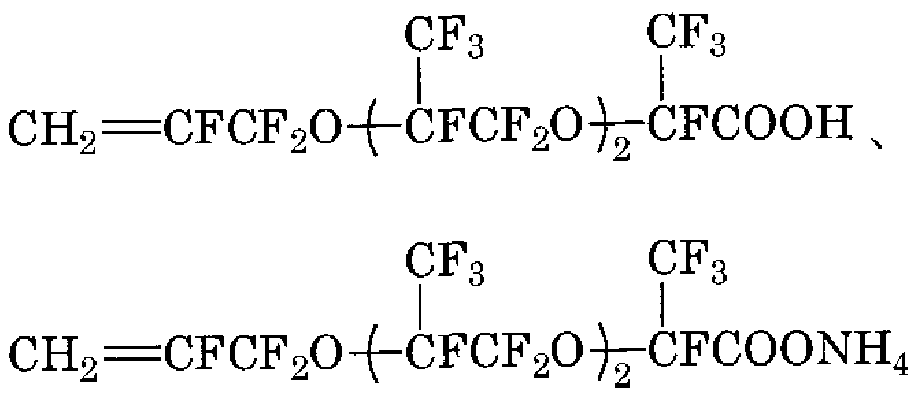
- the fluorine-containing vinyl group-containing compound (V) has the following general formula (V):
- g 0 or an integer from 1 to 10
- Y represents one SOM or one COOM
- the above g is preferably 0 or an integer of 1 to 5 in terms of emulsifying ability, more preferably an integer of 0 to 2, and 0 or 1. More preferably, Y is one COOM in that a suitable water solubility and surface activity can be obtained. Is preferably H or NH from the viewpoint of improving the
- CH CFCF OCF (CF) —CF OCF (CF) -COONH is preferred.
- h represents an integer of 1 to 6
- i represents an integer of 1 to 10
- Y represents —SO M or C
- OOM OOM
- M H, NH or an alkali metal
- h is preferably an integer of 2 or less, more preferably 1 or less from the viewpoint of copolymerizability.
- the above Y which is preferably an integer of 3 or less, is preferably COOM in that a suitable water solubility and surface activity can be obtained.
- the above M hardly remains as an impurity and is obtained.
- H or NH is preferred from the viewpoint of improving the heat resistance of the molded body.
- Examples of the above-mentioned fluorine-containing group-containing compound (VI) include [0060] ,
- CF 2 CFCF 2 -O— CF— CF 2 -0—CFCOONH 4 ,
- CF 2 CFCF 2 -0- CFCF 2 -0- CFS0 3 H
- CF 2 CFCF 2 —0—CF—CF 2 —0—CFCOOH, ,
- the fluorine-containing vinyl group-containing compound (VII) has the following general formula (VII):
- pl represents an integer of 1 to 10
- Y represents -SO M or COOM
- M represents H
- pl is preferably an integer of 5 or less from the viewpoint of emulsifying ability, more preferably an integer of 2 or less.
- the above Y is preferably COOM in that a suitable water solubility and surface activity can be obtained.
- the above M is less likely to remain as an impurity in that the heat resistance of the obtained molded body is improved.
- it is NH.
- the fluorine-containing vinyl group-containing compound (VIII) has the following general formula (VIII):
- q represents an integer of 1 to 4
- p2 represents an integer of 1 to 10
- Y is —SO M or
- q is more preferably an integer of 2 or less, more preferably 1.
- the above P2 is preferably an integer of 5 or less from the viewpoint of emulsifying ability, and more preferably an integer of 2 or less.
- the above-mentioned Y is preferably COOM in that a suitable water solubility and surface activity can be obtained.
- the above-mentioned M is a point in which the heat resistance of the obtained molded body which is hardly retained as an impurity is improved. Or, it is preferably NH.
- the fluorine-containing vinyl group-containing compound (VIII) includes, for example,
- the above-mentioned fluorine-containing vinyl group-containing emulsifier is preferred because of its good copolymerizability.
- -Vinyl group-containing compound (I), fluorine-containing vinyl group-containing compound (111), fluorine-containing vinyl group-containing compound (IV), fluorine-containing vinyl group-containing compound (V), fluorine-containing vinyl group Compound (VI), the above-mentioned fluorine-containing vinyl group-containing compound (VII) and Z or the above-mentioned fluorine-containing vinyl group-containing compound (VIII) It is even more preferable that it also be powerful.
- the above-mentioned fluorinated bullet group-containing emulsifier has the following general formula (i) in that dispersion stability is improved.
- k is preferably an integer of 0 to 2, and preferably 0 or 1.
- Y is preferably COOH or COONH.
- the above-mentioned various fluorine-containing vinyl group-containing emulsifiers may be a mixture of compounds having different addition numbers of oxyalkylene groups in the above general formulas (I) to (VIII) and (i).
- the “compound having a radical polymerizable unsaturated bond and a hydrophilic group in the molecule” such as a fluorine-containing butyl group-containing compound (1) can be prepared by a known method.
- the fluorine-containing bull group-containing emulsifier is added to the aqueous medium in an amount of lppm to 10% by mass.
- the addition amount of the above-mentioned fluorine-containing vinyl group-containing emulsifier is less than lppm of the aqueous medium, the amount of the obtained fluorine-containing elastomer polymer attached to the inside of the reaction tank tends to increase and the productivity tends to decrease, When the amount exceeds 10% by mass of the aqueous medium, the thermal stability of the obtained fluorine-containing elastomer polymer may decrease.
- a more preferred lower limit of the amount of the fluorine-containing vinyl group-containing emulsifier is 10 ppm of the aqueous medium, a still more preferred lower limit is 50 ppm of the aqueous medium, and a more preferred upper limit is 5% by mass of the aqueous medium.
- a preferred upper limit is 2% by weight of the aqueous medium, which is particularly preferred. The upper limit is 1% by weight of the aqueous medium.
- the first polymerization step comprises polymerizing a fluorine-containing monomer in the presence of the above-mentioned fluorine-containing vinyl group-containing emulsifier
- conventionally used fluorine-containing surfactants and other fluorine-containing surfactants Emulsion polymerization can be carried out without adding an emulsifier, and the resulting aqueous emulsion contains uniform and fine polymer particles in which the amount of the emulsifier such as the fluorinated surfactant is small.
- the aqueous emulsion obtained from the first polymerization step can be subjected to emulsion polymerization without adding a conventionally used fluorine-containing surfactant or other emulsifier in the second polymerization step. Is possible.
- emulsion polymerization of the fluorine-containing monomer [A] is performed in an aqueous medium in the presence of the above-mentioned fluorine-containing vinyl group-containing emulsifier.
- the above-mentioned fluorine-containing monomer [A] means the above-mentioned first monomer and a copolymerizable compound having at least one fluorine atom which is optionally added.
- fluorine-containing monomer examples include the above-mentioned fluorine-containing olefins and fluorine-containing butyl ethers.
- VDF, TFE, HFP and CTFE are preferred as the above-mentioned fluorine-containing monomer [A] because the obtained fluorine-containing elastomer polymer is excellent in moldability and the like.
- the fluorine-containing monomer [A] In the first polymerization step, only one kind of the fluorine-containing monomer [A] may be added, or two or more kinds may be added.
- the first polymerization step may be carried out by adding a fluorine-free monomer, if desired, in addition to the fluorine-containing monomer [A].
- fluorine-free monomer examples include the above-mentioned hydrocarbon olefins.
- hydrocarbon monomer alkene having 2 to 4 carbon atoms is preferable, and propylene is preferred.
- the total addition amount of the fluorine-containing monomer [A] and the fluorine-free monomer to be added as required depends on the molecular weight and yield of the desired fluorine-containing elastomer polymer. It can be appropriately determined according to the above.
- the preferable lower limit of the total supply amount of the fluorine-containing monomer (A) and the fluorine-free monomer is 100 parts by mass of the aqueous medium. versus 10 parts by mass, more preferably 20 parts by mass, and preferably 100 parts by mass, more preferably 80 parts by mass, based on 100 parts by mass of the aqueous medium in terms of the yield of the fluorine-containing elastomer polymer. Department.
- the total supply amount of the fluorine-containing monomer [A] and the non-fluorine-containing monomer is the total amount of the initial charge amount at the start of the polymerization reaction and the continuous charge amount added during the polymerization reaction.
- the supply amount of the fluorine-free monomer can be appropriately set according to the desired composition of the fluorine-containing elastomer polymer.
- a radical polymerization initiator is added to the aqueous medium in addition to the fluorine-containing vinyl group-containing emulsifier, the fluorine-containing monomer [A], and the fluorine-free monomer to be added as required. You can go and do it.
- radical polymerization initiator examples include peroxides of a water-soluble inorganic compound or a water-soluble organic compound, such as persulfates such as ammonium persulfate and potassium persulfate, peroxides of succinic acid, and peroxides of bisdartalic acid. These are general, and these can be used alone or in combination of two or more. In the polymerization in a low temperature range, it is preferable to use a redox initiator. Furthermore, as long as the stability of the latex is not impaired, one or both of water-insoluble organic peroxides and azoizides are used alone or together with a water-soluble inorganic compound or a water-soluble organic compound baroxide. You can also.
- peroxides of a water-soluble inorganic compound or a water-soluble organic compound such as persulfates such as ammonium persulfate and potassium persulfate, peroxides of succinic acid, and peroxides of bisdartal
- the amount of the radical polymerization initiator to be added depends on the composition and yield of the fluorine-containing elastomer polymer to be produced, the amount of the fluorine-containing monomer [A] and the amount of the fluorine-free monomer added if desired, and the like. It can be set appropriately.
- the radical polymerization initiator is preferably added in an amount of 0.01 to 0.4 part by mass with respect to 100 parts by weight of the obtained fluorinated elastomer polymer, in an amount of 0.05 to 0.3 part by mass. More preferably, it is added.
- the emulsion polymerization includes the above-mentioned fluorine-containing butyl group-containing emulsifier, the above-mentioned fluorine-containing monomer [A], a fluorine-free monomer optionally added, and the above-mentioned radical polymerization.
- a chain transfer agent may be added to the aqueous medium.
- One of the above chain transfer agents may be used alone, or two or more thereof may be used in combination.
- the above-mentioned chain transfer agent is used for producing a fluorine-containing elastomer polymer.
- a fluorine-containing elastomer polymer Is not particularly limited, for example, an alcohol having 1 to 12 carbon atoms, an ester having 1 to 12 carbon atoms, an alkane having 1 to 12 carbon atoms, a ketone having 1 to 12 carbon atoms or a merca having 1 to 12 carbon atoms.
- a halogen such as fluorine, chlorine, bromine or iodine.
- Examples of the alcohol having 1 to 12 carbon atoms include methanol, ethanol, propanol, and butanol.
- ester having 1 to 12 carbon atoms examples include methyl acetate, ethyl acetate, butyric acetate, ethyl ethyl propionate, dimethyl malonate, getyl malonate, dimethyl succinate, getyl succinate, and the like.
- alkane having 1 to 12 carbon atoms examples include methane, ethane, propane, butane, pentane, hexane and the like.
- Examples of the ketone having 1 to 12 carbon atoms include acetone, acetylacetone, methyl ethyl ketone, and cyclohexanone.
- Examples of the mercaptan having 1 to 12 carbon atoms include dodecyl mercaptan and the like.
- Examples of the above partially substituted halogen-substituted product include carbon chloride, chloroform, carbon tetrachloride, methylene bromide, and methylene iodide.
- the chain transfer agent may be a saturated hydrocarbon having 1 to 6 carbon atoms, an alcohol having 1 to 4 carbon atoms, a carboxylic acid ester compound having 4 to 8 carbon atoms, a chlorine-substituted hydrocarbon having 1 to 2 carbon atoms, It is preferably a ketone having 3 to 5 and Z or a mercaptan having 10 to 12 carbon atoms.
- isopentane, getyl malonate and Z or ethyl acetate are more preferable in that the chain transferability, which is more preferable with kabutane, is appropriate and the decrease in the polymerization rate is small.
- the chain transfer agent may be added in a total amount of 100% by mass of the above-mentioned fluorine-containing monomer [A] and a fluorine-free monomer which is optionally added. It is preferable to add 0.0001 to 5 parts by mass to the parts.
- the above chain transfer agent In order to adjust the molecular weight and the molecular weight distribution of the fluorine-containing elastomer polymer, the amount is more preferably 0.0005 parts by mass or more with respect to 100 parts by mass of the total amount of the above-mentioned fluorine-containing elastomer. More preferably, it is 1 part by mass or less, more preferably 0.1 part by mass or less.
- the fluorine-containing elastomer polymer when a fluorine-containing monomer is polymerized in the presence of the above-described chain transfer agent, the fluorine-containing elastomer polymer usually caused by a polymerization initiator to be added. Of high molecular weight and low molecular weight can be produced.
- the molecular weight distribution of the obtained fluorine-containing elastomer polymer can be widened. Therefore, the method for producing the fluoroelastomer of the present invention is advantageous in that the fluoroelastomer obtained is easy to mold due to the difference in the molecular weight and the distribution of the molecular weight distribution, has a low compression permanent strain, and has a low compression set. Obtainable.
- the emulsion polymerization includes the above-mentioned fluorine-containing group-containing emulsifier, the above-mentioned fluorine-containing monomer [A], a fluorine-free monomer optionally added, and the above-mentioned radical polymerization.
- a cure site monomer in the present specification, a “crosslinking site-containing monomer” t may be added to the aqueous medium.
- crosslinking site-containing monomer examples include bromine-containing olefin, iodine-containing olefin, bromine-containing butyl ether, iodine-containing butyl ether, fluorine-containing olefin having a nitrile group, and fluorine having a nitrile group.
- the bromine-containing olefin, the iodine-containing olefin, the bromine-containing butyl ether, the iodine-containing butyl ether, the fluorine-containing olefin having a -tolyl group, the fluorine-containing butyl ether having a -tolyl group, and the non-conjugated gen examples thereof include compounds described in US2002Z0040119, and one or two or more compounds can be used as compounds belonging to each compound group such as the bromine-containing orefin.
- the above-mentioned cross-linking site-containing monomer is obtained by crosslinking 4-fluoro-3,3,4,4-tetrafluorobutene-1 [BTFB] when the obtained fluorine-containing elastomer polymer is cross-linked using a peroxide.
- BTFB 4-fluoro-3,3,4,4-tetrafluorobutene-1
- ITFB 4,3,4,4-tetrafluorobutene-1
- arylo, bromotrifluoroethylene and perfluoro (8-cyano 5-methinole 3,6-dioxa 1-octane) [8-CNVE]
- the above cross-linking site-containing monomer is preferably 2 HPFP or perfluoro (2-phenoxypropylbutyl) ether.
- the monomer containing a crosslinking site is preferably bis (aminophenol), bis (thioaminophenol) or 8-CNVE.
- the crosslinking site-containing monomer may be used alone or in a combination of two or more.
- the above-mentioned cross-linked site-containing monomer is added in an amount of 0.05 to L0% by mass of the total amount of the monomers to be supplied.
- the crosslinking site-containing monomer can be added in an amount of preferably 5% by mass or less of the total amount of the supplied monomer, and more preferably 3% by mass or less of the total amount of the supplied monomer.
- the emulsion polymerization may be performed by further adding an additive such as a fluorine-containing surfactant other than the above-mentioned fluorine-containing vinyl group-containing emulsifier, a radical scavenger, and the like. .
- an additive such as a fluorine-containing surfactant other than the above-mentioned fluorine-containing vinyl group-containing emulsifier, a radical scavenger, and the like.
- fluorine-containing surfactant examples include:
- Z 2 represents F or H, and aa represents an integer of 3 to 20.
- Fluorocarboxylic acid represented by the formula: and alkali metal salts, ammonium salts, amine salts and quaternary ammonium salts thereof;
- Z 3- (CH CF) -COOH [Wherein, Z 3 represents F or CI, and bb represents an integer of 3 to 13. Fluorocarboxylic acid represented by the formula: and alkali metal salts, ammonium salts, amine salts and quaternary ammonium salts thereof;
- Rf represents a perfluoroalkyl group having 1 to 7 carbon atoms
- cc represents an integer of 0 to 10
- Z 4 represents COOM or —SO M
- M represents H table
- One or more of the above-mentioned fluorinated surfactants may be added during the above-mentioned polymerization.
- the amount of the fluorinated surfactant to be added can be appropriately set according to the composition and yield of the fluorinated elastomer polymer to be produced.
- a fluorinated elastomer polymer capable of producing a molded article having excellent mechanical strength, chemical strength and the like is obtained in the absence of a fluorinated surfactant.
- the fluorinated surfactant does not include the fluorinated vinyl group-containing emulsifier described above.
- the above-mentioned fluorine-containing vinyl group-containing emulsifier can be additionally added according to the progress of the polymerization reaction.
- the amount of the unreacted fluorine-containing vinyl group-containing emulsifier in the aqueous emulsion can be reduced.
- Reaction conditions such as temperature, pressure, and polymerization time in the first polymerization step can be appropriately set depending on the amount, composition, and concentration of the prepared fluorine-containing elastomer-polymer.
- the first polymerization step is usually performed while maintaining the temperature in the range of 10 to 120 ° C. If the above temperature is lower than 10 ° C, it is not possible to achieve a reaction rate of an effective size on an industrial scale! If it is higher than 120 ° C, the reaction required to maintain the polymerization reaction The increased pressure adds cost to the equipment that maintains the reaction.
- the first polymerization step is usually performed while maintaining the pressure in the range of 0.5 to: LOMPa.
- a preferred lower limit of the above range is 1. OMPa, and a preferred upper limit of the above range is 6.2 MPa.
- a desired polymerization pressure can be achieved in the initial stage of polymerization by adjusting the amount of monomer gas at the time of initial supply. The pressure is adjusted by adjusting the additional supply of monomer gas.
- the desired polymerization pressure is adjusted by adjusting the back pressure of the outlet pipe of the obtained fluorinated elastomer polymer emulsion. If the above pressure is less than 0.5 MPa, the monomer concentration in the polymerization reaction system becomes too low to achieve a satisfactory reaction rate, and the molecular weight of the obtained fluoroelastomer polymer does not become sufficiently large. Sometimes. If the above pressure exceeds lOMPa, the equipment for maintaining the pressure will be costly.
- the first polymerization step is usually performed for 0.5 to: LOO time.
- the aqueous emulsion obtained by performing the first polymerization step has polymer particles obtained by polymerizing the fluorine-containing monomer [A] dispersed in an aqueous medium.
- This dispersion is considered to be due to the side chain derived from the above-mentioned fluorine-containing vinyl group-containing compound added and introduced into the polymer, and if unreacted fluorine-containing vinyl group-containing emulsifier remains, It is thought to contribute to dispersion. Therefore, in the method for producing a fluorine-containing elastomer polymer of the present invention, it is not necessary to add other milking agents other than the fluorine-containing vinyl group-containing emulsifier also in the second polymerization step.
- the number of the polymer particles in the aqueous emulsion is usually from 1.0 ⁇ 10 13 to 1.0 ⁇ 10 17 Zml.
- the method for producing a fluorinated elastomeric polymer of the present invention is characterized in that, prior to the second polymerization step, the aqueous emulsion obtained in the first polymerization step is further diluted with water to prepare the aqueous emulsion.
- the method may also include a step of reducing the number of emulsified polymer particles per unit aqueous medium and the concentration of the fluorine-containing vinyl group-containing emulsifier.
- the aqueous emulsion obtained from the first polymerization step can be easily divided into a plurality of times and used efficiently in the second polymerization step. You.
- the number of the polymer particles is preferably 1.0 ⁇ 10 13 to 1.OX 10 16 particles / ml.
- the number of the polymer particles is a value obtained by calculating the average particle diameter, the specific gravity of the polymer, and the polymer concentration force measured by dynamic light scattering.
- the amount of the fluorine-containing vinyl group-containing emulsifier is preferably less than 1 ppm, more preferably less than 100 ppm, more preferably less than 10 ppm.
- the concentration of the fluorinated vinyl group-containing emulsifier is a value obtained by adding Soxhlet extraction with an equal amount of methanol to the aqueous emulsion and performing HPLC measurement.
- an oil-soluble radical polymerization initiator described below may be added before the number of polymer particles increases in the first polymerization step. At that time, if the oil-soluble radical polymerization initiator is added before the start of the formation of the polymer particles, it will aggregate, but if it is added after the formation of the polymer particles, the oil-soluble radical polymerization initiator will be absorbed into the polymer particles. It is adsorbed, and the polymerization can be efficiently performed as a whole.
- the fluorine-containing monomer [B] is added to the aqueous emulsion obtained in the first polymerization step. This is to produce a fluorinated elastomer polymer by emulsion polymerization.
- the aqueous emulsion in which the power of the first polymerization step is also obtained contains the polymer particles obtained in the first polymerization step, the aqueous medium, and the unreacted material if remaining. It also has the capability of emulsifying a fluorine-containing group.
- the ⁇ aqueous emulsion in which the power of the first polymerization step is also obtained '' refers to the aqueous emulsion immediately after the end of the first polymerization step and, if desired, the aqueous emulsion that has passed through the dilution step. Mean both.
- the fluorine-containing monomer [B] is the same as that described for the fluorine-containing monomer [A].
- the fluorine-containing monomer [B] may be of the same type as the fluorine-containing monomer [A] or may be of a different type.
- the above-mentioned fluorine-containing monomer [B] may be one that supplies only one kind, or one that contains two or more kinds.
- the fluorinated elastomer obtained in the first polymerization step is obtained by emulsion-polymerizing the fluorine-containing monomer [B] as an essential monomer in the second polymerization step. More than 100 parts by weight of the above-mentioned fluorine-containing monomer [B] can be stably polymerized with respect to 100 parts by weight of the combined.
- the second polymerization step may be performed by supplying a fluorine-free monomer, if desired, in addition to the fluorine-containing monomer [B].
- fluorine-free monomer examples include the same ones as the fluorine-free monomer described for the first polymerization step.
- the total supply amount of the fluorine-containing monomer [B] and the optional fluorine-free monomer to be supplied depends on the molecular weight and the yield of the desired fluorine-containing elastomer polymer. It can be appropriately determined according to the above.
- the total supply amount in the second polymerization step is economical with respect to 100 parts by weight of the fluorinated elastomer monopolymer contained in the aqueous emulsion obtained in the first polymerization step and diluted as necessary. It is preferable that the amount exceeds 100 parts by weight in terms of productivity, and that the amount is not more than 20000 parts by weight in terms of the stability of the reaction system and the vulcanizability of the obtained fluorine-containing elastomer. Is preferred.
- a more preferable lower limit of the total amount added in the second polymerization step is 1,000 parts by weight, more preferably 100 parts by weight, based on 100 parts by weight of the fluorinated elastomer polymer contained in the aqueous emulsion obtained in the first polymerization step.
- the lower limit is 3000 parts by weight.
- a more preferred upper limit is 1,000,000 parts by weight, and a still more preferred upper limit is 5,000 parts by weight.
- the second polymerization step is preferably performed using a chain transfer agent.
- the molecular weight distribution of the obtained fluoroelastomer is controlled by adding a chain transfer agent and appropriately selecting the type, amount and timing of addition, thereby obtaining the obtained fluoroelastomer.
- Properties such as elongation, tensile strength, compression set, vulcanization rate, etc. and the moldability can be balanced.
- Examples of the chain transfer agent include the same ones as described in the first polymerization step.
- the chain transfer agent is added in an amount of 0.0001 parts by mass based on 100 parts by mass of the total amount of the fluorine-containing monomer [B] and the non-fluorine-containing monomer optionally added. Preferably, about 5 parts by mass is added.
- the amount of the above chain transfer agent is a fluorine-containing elastomer polymer From the viewpoint of adjusting the molecular weight and molecular weight distribution of the above, the amount is more preferably 0.0005 parts by mass or more, more preferably 0.001 parts by mass or more, with respect to 100 parts by mass of the total addition amount, It is more preferable that the content is 1 part by mass or less.
- the chain transfer agent can be used in the first polymerization step and the Z or second polymerization step.
- the fluorine-containing monomer [B] in addition to the fluorine-containing monomer [B], the fluorine-free monomer and the chain transfer agent to be added as required, if necessary, the above-mentioned cross-linking site-containing monomer may be used. And the above-mentioned emulsifier containing a fluorine-containing vinyl group.
- the concentration of the fluorinated bull group-containing emulsifier can be in the same range as in the first polymerization step, but it is preferable not to add the fluorinated surfactant.
- the first polymerization step and the second polymerization step are preferably performed in the absence of a fluorine-containing surfactant.
- the second polymerization step is an emulsion polymerization of the fluorine-containing monomer [B] in the presence of the aqueous emulsion obtained from the first polymerization step. If it can be performed, it can be performed using a known method.
- the reaction conditions of the emulsion polymerization in the second polymerization step can be appropriately set according to the composition and yield of the obtained fluorine-containing elastomer polymer, and the same polymerization temperature, polymerization pressure and the same as those in the first polymerization step described above.
- the polymerization can be performed in a polymerization time.
- the second polymerization step is performed using an oil-soluble radical polymerization initiator. Is preferred, when the first polymerization step is performed using a water-soluble radical polymerization initiator, the second polymerization step is performed using an oil-soluble radical polymerization initiator. Is preferred, when the first polymerization step is performed using a water-soluble radical polymerization initiator, the second polymerization step is performed using an oil-soluble radical polymerization initiator. Is preferred,.
- oil-soluble radical polymerization initiator examples include known oil-soluble peroxides, for example, dialkyl peroxycarbonates, peroxyesters, dialkyl peroxides, di (perfluoroacyl) Peroxides and di (fluorochloroacyl) peroxides.
- the dialkyl peroxy carbonates include diisopropyl peroxy carbonate Carbonate and di sec butyl peroxycarbonate.
- peroxyesters examples include t-butyl peroxyisobutyrate, t-butyl peroxybivalate, and the like.
- dialkyl peroxides examples include t-butyl peroxide and the like.
- di (perfluoroacyl) peroxides and the di (fluorochloroacyl) peroxides examples include di ( ⁇ -hydrogen peroxide).
- Decafluoroheptanyl) peroxide di ( ⁇ hydrotetradecafluoroheptanol) peroxide, di ( ⁇ -hide hexafluorononanoyl) peroxide, di (perflu (Orobutyryl) peroxide, di (perflupareryl) peroxide, di (perfluorohexanoyl) peroxide, di (perfluoroheptanyl) peroxide, di (perfluorooctanol) peroxide , Di (perfluoronanoyl) peroxide, ⁇ —hydrodecafluoroheptanoylu ⁇ Hide mouth Hexadecafluorononanoyloxyperoxide, ⁇ Hydrododecafluoroheptanoylouperfluorobutylene cycloperoxide, Di ( ⁇ Chlorohexafluorobutyryl) peroxide, Di ( omega - Kurorode Kafuruo
- diisopropyl peroxydicarbonate [ ⁇ ] which is preferably dialkyl peroxydicarbonate, is more preferable.
- the oil-soluble radical polymerization initiator can reduce the tendency of the polymer to have a high molecular weight by the addition of the water-soluble radical polymerization initiator in the first polymerization step, the first polymerization step and the second polymerization step
- the fluorine-containing elastomer polymer obtained through the above process has a wide molecular weight distribution, elongation, and a good balance between physical properties such as bow I tensile strength and moldability.
- the oil-soluble radical polymerization initiator is preferably added in an amount of 0.001 to 0.1 part by mass with respect to 100 parts by mass of the aqueous medium.
- the more preferable lower limit of the addition amount is 0.005 parts by mass, and the more preferable upper limit of the added koji is 0.05 part by mass.
- the combination of the water-soluble radical polymerization initiator and the oil-soluble radical polymerization initiator is not particularly limited, but for example, in the first polymerization step, When adding ammonium persulfate as a water-soluble radical polymerization initiator, it is preferable to add diisopropyl peroxydicarbonate as an oil-soluble radical polymerization initiator in the second polymerization step.
- the method for producing the fluorine-containing elastomeric polymer of the present invention is obtained.
- the obtained fluorine-containing elastomeric polymer is derived from the above-mentioned fluorine-containing butyl group-containing emulsifier in addition to the above-mentioned copolymerized unit of the first monomer.
- the unit power of the emulsifier to be obtained is also different.
- the "emulsifier unit” is a part of the molecular structure of the fluorinated elastomer polymer, and means a portion derived from the corresponding fluorinated vinyl group-containing emulsifier.
- the compound constituting the fluorinated vinyl group-containing emulsifier was added to the polymer chain and became a part of the polymer chain of the fluorinated elastomer polymer. Things.
- the emulsifier unit is preferably 10 ppm or more and 10% by mass or less of the fluoroelastomer polymer.
- the amount is less than lOppm, the dispersion stability in an aqueous medium when a conventional non-copolymerizable emulsifier is not used may be inferior.
- the amount exceeds 10% by mass, physical properties such as heat resistance are deteriorated. Sometimes.
- the more preferable lower limit of the emulsifier unit is 25 ppm of the fluorine-containing elastomer polymer, and the further preferable lower limit is 50 ppm.
- a more preferred upper limit of the emulsifier unit is 5% by mass, and a still more preferred upper limit is 2.5% by mass.
- an aqueous dispersion can be prepared with high dispersion stability.
- the above-mentioned fluorine-containing elastomer polymer has a viscosity at 100 ° C. of usually 10 to: L00.
- the preferred lower limit is 30 in terms of mechanical strength and chemical strength
- the preferred upper limit is 80 in terms of molding force.
- the above-mentioned viscosity (ML (1 + 10) is a value obtained by measuring according to ASTM D-1646.
- the method for producing the fluorine-containing elastomer polymer of the present invention is obtained in an amount substantially equal to the additional amount of the obtained fluorine-containing elastomer polymer, and is usually 10 to 30 parts by mass relative to 100 parts by mass of the aqueous medium. Parts, preferably 20 to 25 parts by weight.
- the amount of the fluorinated elastomer polymer is less than 10 parts by mass with respect to 100 parts by mass of the aqueous medium, and when the amount exceeds 30 parts by mass with respect to 100 parts by mass of the aqueous medium, which has low productivity, In some cases, the elastomeric polymer is difficult to disperse.
- the polymerized fluorine-containing elastomer particles obtained by performing the above polymerization usually have an average particle diameter of 10 to 500 nm and have excellent dispersion stability.
- the process for producing the fluorinated elastomeric polymer of the present invention is a fluorinated elastomeric polymer which can be in any form as long as it has the above-mentioned polymerization force. It may be a constituent of a turbid liquid! / It may be a constituent of a fluorinated elastomer-polymer aqueous dispersion described below, or may be a constituent of the fluorinated elastomer-polymer aqueous emulsion described below. It may constitute a gum or a crumb obtained by coagulating, drying, etc.
- the gum is a small granular mass that also has the properties of a fluorinated elastomer.
- the above-mentioned crumbs are fluorinated elastomer-polymers, which cannot maintain a small granular shape as a gum at room temperature and are fused to each other, resulting in an amorphous mass.
- the method for producing a fluorine-containing elastomer polymer of the present invention includes the above-described first polymerization step and second polymerization step, it is possible to appropriately adjust the molecular weight and molecular weight distribution of the obtained fluorine-containing elastomer polymer. it can. Therefore, the method for producing a fluoroelastomer polymer of the present invention exceeds 100 parts by weight with respect to 100 parts by weight of polymer particles capable of obtaining the first polymerization step power, which is difficult with the conventional method for producing a fluoroelastomer polymer. Above It is possible to stably polymerize a fluorine-containing monomer of a type different from that of the polymer particles.
- An aqueous dispersion of a fluorinated elastomer-polymer in which the above-mentioned particles of the fluorinated elastomer-polymer are dispersed in an aqueous medium is also one of the present invention.
- the aqueous fluorine-containing elastomer-polymer dispersion of the present invention usually contains or does not contain a fluorine-containing vinyl group-containing emulsifier.
- the fluorinated elastomeric polymer aqueous dispersion of the present invention has the above-mentioned emulsifier unit, the fluorinated elastomeric polymer should not contain the fluorinated vinyl group-containing emulsion in the aqueous medium. Can be.
- the aqueous fluorine-containing elastomer-polymer dispersion of the present invention can contain, for example, the above-mentioned fluorine-containing butyl group-containing emulsifier in less than 100 ppm.
- the fluorinated elastomer-polymer aqueous dispersion of the present invention has a good crosslinkability at the time of molding and processing, and the fluorinated butyl group-containing emulsifier is preferably less than 100 ppm, more preferably less than 10 ppm. Better!/,.
- the above-mentioned fluorine-containing elastomer polymer can be adjusted to 10 to 70 parts by mass with respect to 100 parts by mass of the aqueous medium by an operation such as concentration.
- the aqueous fluorinated elastomer polymer dispersion of the present invention may be purified, for example, by coagulating the above-mentioned aqueous emulsion obtained immediately after the polymerization reaction of the fluorinated elastomer polymer by a known method. Can be prepared.
- the purification method is not particularly limited, and examples thereof include extraction, ion exchange resin treatment, ultrafiltration membrane treatment, and the like.
- the fluorinated elastomer-polymer aqueous dispersion of the present invention has a fluorinated vinyl group-containing emulsifier concentration within the above range, the fluorinated vinyl polymer-containing emulsifier is substantially free of the fluorinated vinyl group-containing emulsifier to form aggregates, compositions, molded articles, and the like Can be processed.
- the fluorinated elastomeric polymer rubber or crumb having the above-mentioned fluorinated elastomeric polymer strength is generally one which does not substantially contain a fluorinated surfactant.
- the above-mentioned fluorine-containing elastomer polymer rubber or crumb can be obtained by coagulating and drying the aqueous dispersion of a fluorine-containing elastomer polymer of the present invention.
- coagulants that can be used in the above coagulation include aluminum salts such as aluminum sulfate and alum, calcium salts such as calcium sulfate, magnesium salts such as magnesium sulfate, sodium salt and potassium salt.
- coagulation aids such as monovalent cation salts.
- the above-mentioned fluorinated elastomer polymer can be processed into a fluorinated elastomer polymer composition by adding a curing agent, a filler and the like.
- curing agent examples include polyol, polyamine, organic peroxide, organic tin, bis (aminophenol) tetraamine, and bis (thioaminophenol).
- the above-mentioned fluorine-containing elastomer polymer composition is composed of the above-mentioned fluorine-containing elastomer polymer, it does not substantially contain a fluorine-containing vinyl group-containing emulsifier, is easily crosslinked at the time of molding and processing, and is excellent in terms of: You.
- the fluorinated elastomeric polymer, the fluorinated elastomeric polymer aqueous dispersion of the present invention, or the fluorinated elastomeric polymer or the crumb is molded and processed to obtain a fluorinated elastomeric polymer molded article.
- the method of forming is not particularly limited, and includes a method using the above-described curing agent.
- the above-mentioned fluorinated elastomer polymer molded article is made of the above-mentioned fluorinated elastomer polymer, it has low compression set and excellent mechanical strength, and is suitable as a seal, an electric wire covering, a tube, a laminate, and the like. It is particularly suitable for parts for semiconductor manufacturing equipment, automobile parts and the like.
- the method for producing a fluoroelastomer of the present invention has the above-described constitution, and is therefore simple, and the obtained fluoroelastomer has a high vulcanization rate. This is useful because the compression set of the resulting molded article is small.
- Solid content concentration It was determined from the weight loss when the obtained aqueous emulsion was dried at 150 ° C for 1 hour. (Note: In the following, (2), (3), (4), and (6) are measurements of the coagulated and washed product obtained through the coagulation, washing, and drying processes.)
- the LC / MS / MS was performed using a Waters 2695 Separation module, Micromass Quattro micro TM API, Waters 2996 Photodiode Array detector (both manufactured by Waters).
- a Waters atlantis dC-18 (30 mm x 2. lmm id) column, 0.01 M ammonium acetate: aceto nitrile (55:45 v: v) was used at a flow rate of 0.15 mlZ min. Elution was performed.
- negative 'electrospray (ESP)' ionization was performed.
- Average particle size determined by performing a dynamic light scattering method.
- Number of polymer particles calculated from the following formula based on the average particle size and the solid content.
- the specific gravity was 1.8.
- the obtained aqueous emulsion had a solid content of 15.3% by mass, an average particle diameter of 32 nm, and the number of polymer particles was 5.54 ⁇ 10 15 per 1 cm 3 of the aqueous emulsion.
- Example 2 First-stage polymerization step using RS-2 [AEC-0]
- Example 1 the fluorine-containing group-containing emulsifier was replaced with perfluoro (6,6 dino, ido-2--2-trifluoronorelomethinole 3-oxa) 5 hexenoic acid ammonium salt [RS-2] 0.7 g Polymerization was carried out for 3.9 hours in the same manner as in Example 1 except for changing to, to obtain 1427 g of an aqueous emulsion. The solid content concentration of this aqueous emulsion was 14.9% by mass, and the average particle size was 28.3 nm. The number of particles of the polymer was 8.20 ⁇ 10 15 per 1 cm 3 of water used for the polymerization.
- Example 3 First-stage polymerization step using RS-3 [CBVE]
- Example 1 was the same as Example 1 except that the emulsifier containing a fluorinated butyl group was changed to 1.2 g of perfluoro (5-trifluoromethyl- 4,7-dioxa) -8-ammonium salt of nonenoic acid [RS-3]. Similarly, polymerization was carried out for 4 hours to obtain 159 lg of an aqueous emulsion. The solid concentration of this aqueous emulsion was 13.9% by mass, and the average particle size was 24 nm. The number of particles of the polymer was 1.24 ⁇ 10 16 per 1 cm 3 of water used for the polymerization.
- Example 1 except that the fluorine-containing bull group-containing emulsifier was changed to 2.4 g of sodium salt of perfluoro (4-trifluoromethyl3,6-dioxa) -7-otaten-1-sulfonic acid [RS-4], Polymerization was performed for 2.9 hours in the same manner as in Example 1 to obtain 1413 g of an aqueous emulsion.
- the solid content concentration of this aqueous emulsion was 15.3% by mass, and the average particle size was 31 nm.
- the number of particles of the polymer was 6.31 ⁇ 10 15 per 1 cm 3 of water used for the polymerization.
- Example 5 Dilution step and second polymerization step using RS-1
- the obtained aqueous emulsion had a solid content of 25.2% by mass, an average particle size of 150 nm, a concentration of unreacted RS-1 below the detection limit, and the number of polymer particles was 1 cm. It was 1.06 X 10 14 per 3 .
- Example 6 Dilution step using RS-2 and second polymerization step
- a 3 L stainless steel pressure vessel equipped with a stirrer was charged with 109 g of the aqueous emulsion obtained from Example 2 and 1507 g of deionized water, and nitrogen pressurization and degassing under reduced pressure were repeated.
- the obtained aqueous emulsion had a solid content of 25.5% by mass, an average particle diameter of 147 nm, and the number of polymer particles was 1.14 ⁇ 10 14 per 1 cm 3 of the aqueous emulsion.
- the coagulated and washed product of the above aqueous emulsion had an unreacted RS-2 concentration below the detection limit.
- Example 7 Dilution step and second polymerization step using RS-3
- a stainless steel pressure vessel having an inner volume of 3 L equipped with a stirrer was charged with 65.9 g of the aqueous emulsion obtained in Example 3 and 1543 g of deionized water, and nitrogen pressurization and degassing under reduced pressure were repeated.
- the obtained aqueous emulsion had a solid content of 25.7% by mass, an average particle diameter of 145 nm, and the number of polymer particles was 1.20 ⁇ 10 14 per 1 cm 3 of the aqueous emulsion.
- the coagulated and washed product of the aqueous emulsion had an unreacted RS-3 concentration below the detection limit.
- Example 8 Dilution step and second polymerization step using RS-4
- the obtained aqueous emulsion had a solid content of 25.3% by mass, an average particle diameter of 154 nm, and the number of polymer particles was 0.98 ⁇ 10 14 per 1 cm 3 of the aqueous emulsion.
- the coagulated and washed product of the aqueous emulsion had an unreacted RS-4 concentration below the detection limit.
- Example 9 Dilution step and second polymerization step using RS-1 (using an oil-soluble radical polymerization initiator)
- Example 10 Dilution step and second polymerization step using RS-1 (using a chain transfer agent)
- APFO ammonium perfluoro-octanoate
- the resulting aqueous emulsion had a solid content of 14.8% by mass, an average particle size of 52 nm, an APFO concentration of 8182 ppm, and a polymer particle count of 1.2 ⁇ 10 15 per lcm 3 of the aqueous emulsion.
- Comparative Example 2 Dilution step and second polymerization step (iodine-containing elastomer)
- the obtained aqueous emulsion had a solid content of 25.4% by mass, an average particle diameter of 162 nm, an APF O concentration of 576 ppm, and a polymer particle count of 8.1 ⁇ 10 3 per 1 cm 3 of the aqueous emulsion. Get 15 pieces.
- the components shown in Table 1 were blended with the fluorine-containing elastomer copolymer obtained from Example 5 and the fluorine-containing copolymer obtained from Comparative Example 2, and the mixture was uniformly blended with a rubber roll according to a standard method.
- a sulfur composition was prepared, and vulcanizability was evaluated with a curast meter.
- the vulcanized composition was vulcanized under the conditions shown in Table 1, and the physical properties of the molded body were measured.
- test conditions were tensile strength, elongation, tensile stress, and compression set according to JIS K 6301, and the Shore hardness was according to ASTM D-2240.
- the vulcanizability was measured at 170 ° C using a curast meter (JSR II type).
- T represents the induction time
- T represents the appropriate vulcanization time
- degree of vulcanization represents the degree of vulcanization.
- Example 5 fluorinated elastomer
- T vulcanizable
- the method for producing a fluorinated elastomeric polymer of the present invention is simple because it has the above-mentioned constitution, and the obtained fluorinated elastomeric polymer has a high vulcanization rate. This is useful because the compression set of the resulting molded article is small.
Landscapes
- Chemical & Material Sciences (AREA)
- Health & Medical Sciences (AREA)
- Chemical Kinetics & Catalysis (AREA)
- Medicinal Chemistry (AREA)
- Polymers & Plastics (AREA)
- Organic Chemistry (AREA)
- Polymerisation Methods In General (AREA)
- Addition Polymer Or Copolymer, Post-Treatments, Or Chemical Modifications (AREA)
- Graft Or Block Polymers (AREA)
Abstract
Description




Claims

Priority Applications (2)
| Application Number | Priority Date | Filing Date | Title |
|---|---|---|---|
| US11/547,856 US20070208131A1 (en) | 2004-04-07 | 2005-04-05 | Method for producing fluorine-containing elastomer polymer |
| EP05728782A EP1739100A4 (en) | 2004-04-07 | 2005-04-05 | PROCESS FOR PRODUCING FLUORINE ELASTOMERIC POLYMER |
Applications Claiming Priority (4)
| Application Number | Priority Date | Filing Date | Title |
|---|---|---|---|
| JP2004113684 | 2004-04-07 | ||
| JP2004-113684 | 2004-04-07 | ||
| JP2004270481A JP2005320501A (ja) | 2004-04-07 | 2004-09-16 | 含フッ素エラストマー重合体の製造方法 |
| JP2004-270481 | 2004-09-16 |
Publications (1)
| Publication Number | Publication Date |
|---|---|
| WO2005097836A1 true WO2005097836A1 (ja) | 2005-10-20 |
Family
ID=35125004
Family Applications (1)
| Application Number | Title | Priority Date | Filing Date |
|---|---|---|---|
| PCT/JP2005/006678 Ceased WO2005097836A1 (ja) | 2004-04-07 | 2005-04-05 | 含フッ素エラストマー重合体の製造方法 |
Country Status (4)
| Country | Link |
|---|---|
| US (1) | US20070208131A1 (ja) |
| EP (1) | EP1739100A4 (ja) |
| JP (1) | JP2005320501A (ja) |
| WO (1) | WO2005097836A1 (ja) |
Cited By (3)
| Publication number | Priority date | Publication date | Assignee | Title |
|---|---|---|---|---|
| WO2007129735A1 (ja) | 2006-05-10 | 2007-11-15 | Daikin Industries, Ltd. | 含フッ素重合体の製造方法 |
| WO2008001895A1 (en) | 2006-06-30 | 2008-01-03 | Daikin Industries, Ltd. | Method for producing fluorine-containing elastomer |
| EP1739100A4 (en) * | 2004-04-07 | 2009-10-21 | Daikin Ind Ltd | PROCESS FOR PRODUCING FLUORINE ELASTOMERIC POLYMER |
Families Citing this family (20)
| Publication number | Priority date | Publication date | Assignee | Title |
|---|---|---|---|---|
| JP4834971B2 (ja) * | 2004-04-07 | 2011-12-14 | ダイキン工業株式会社 | 含フッ素エラストマー重合体の製造方法 |
| EP2325219A3 (en) * | 2006-07-06 | 2011-07-20 | Daikin Industries, Limited | Aqueous fluorine-containing polymer dispersion |
| US8436053B2 (en) * | 2008-12-23 | 2013-05-07 | E.I. Du Pont De Nemours And Company | Fluorinated ionomer produced by aqueous polymerization using dispersed particulate of fluorinated ionomer |
| US8835547B2 (en) * | 2008-12-23 | 2014-09-16 | E I Du Pont De Nemours And Company | Fluoropolymer particles having a nucleus of fluorinated ionomer |
| US8058376B2 (en) * | 2008-12-23 | 2011-11-15 | E. I. Du Pont De Nemours And Company | Fluoropolymer produced by aqueous polymerization using dispersed particulate of fluorinated lonomer produced in situ |
| US8436054B2 (en) * | 2008-12-23 | 2013-05-07 | E I Du Pont De Nemours And Company | Fluorinated ionomer produced by aqueous polymerization using dispersed particulate of fluorinated ionomer produced in situ |
| US8153738B2 (en) * | 2008-12-23 | 2012-04-10 | E I Du Pont De Nemours And Company | Fluoropolymer produced by aqueous polymerization using dispersed particulate of fluorinated ionomer |
| JP6356693B2 (ja) | 2012-12-04 | 2018-07-11 | スリーエム イノベイティブ プロパティズ カンパニー | 高フッ素化ポリマー |
| WO2014088804A1 (en) | 2012-12-04 | 2014-06-12 | 3M Innovative Properties Company | Partially fluorinated polymers |
| JP6225683B2 (ja) * | 2013-05-17 | 2017-11-08 | ダイキン工業株式会社 | フルオロポリマー水性分散液の製造方法 |
| US11767379B2 (en) | 2018-03-01 | 2023-09-26 | Daikin Industries, Ltd. | Method for manufacturing fluoropolymer |
| TWI821458B (zh) * | 2018-11-19 | 2023-11-11 | 日商大金工業股份有限公司 | 組成物及拉伸體 |
| WO2020218619A1 (ja) * | 2019-04-26 | 2020-10-29 | ダイキン工業株式会社 | 組成物の製造方法、及び、組成物 |
| JP7368759B2 (ja) * | 2019-09-05 | 2023-10-25 | ダイキン工業株式会社 | パーフルオロエラストマーの製造方法および組成物 |
| EP4249525A4 (en) * | 2020-11-19 | 2024-10-16 | Daikin Industries, Ltd. | METHOD FOR PREPARING AN AQUEOUS PERFLUOROLASTOMER DISPERSION, COMPOSITION, CROSS-LINKABLE COMPOSITION AND CROSS-LINKED PRODUCT |
| EP4353752A4 (en) * | 2021-06-11 | 2025-05-21 | Daikin Industries, Ltd. | PROCESS FOR PRODUCING AQUEOUS DISPERSION OF FLUORINE-CONTAINING ELASTOMER |
| JP7741413B2 (ja) * | 2021-06-11 | 2025-09-18 | ダイキン工業株式会社 | 含フッ素エラストマー水性分散液の製造方法、組成物および水性分散液 |
| JP2026057552A (ja) * | 2024-09-20 | 2026-04-02 | ダイキン工業株式会社 | 含フッ素エラストマー水性分散液の製造方法 |
| WO2026079354A1 (ja) * | 2024-10-09 | 2026-04-16 | Agc株式会社 | 含フッ素重合体の製造方法、固体組成物及び水性分散液 |
| WO2026079353A1 (ja) * | 2024-10-09 | 2026-04-16 | Agc株式会社 | 含フッ素重合体の製造方法及び組成物 |
Citations (3)
| Publication number | Priority date | Publication date | Assignee | Title |
|---|---|---|---|---|
| JPS6133848B2 (ja) * | 1978-08-22 | 1986-08-05 | Asahi Glass Co Ltd | |
| WO1995033782A1 (en) * | 1994-06-09 | 1995-12-14 | Daikin Industries, Ltd. | Fluoroolefin, fluoropolymer, and thermoplastic resin composition containing the polymer |
| WO2000001741A1 (en) * | 1998-07-07 | 2000-01-13 | Daikin Industries, Ltd. | Process for producing fluoropolymer |
Family Cites Families (7)
| Publication number | Priority date | Publication date | Assignee | Title |
|---|---|---|---|---|
| US4141874A (en) * | 1975-11-15 | 1979-02-27 | Daikin Kogyo Co., Ltd. | Fluorine-containing elastomeric copolymers, process for preparing the same and composition containing the same |
| JP3298321B2 (ja) * | 1994-08-31 | 2002-07-02 | ダイキン工業株式会社 | ビニリデンフルオライド系共重合体水性分散液、ビニリデンフルオライド系シード重合体水性分散液およびそれらの製法 |
| US6479161B1 (en) * | 1997-06-06 | 2002-11-12 | Daikin Industries, Ltd. | Fluorine-containing adhesive and adhesive film and laminated article made by using the same |
| US6703461B1 (en) * | 1998-03-25 | 2004-03-09 | Daikin Industries, Ltd. | Method of reducing metal content in fluoroelastomer |
| US7279522B2 (en) * | 2001-09-05 | 2007-10-09 | 3M Innovative Properties Company | Fluoropolymer dispersions containing no or little low molecular weight fluorinated surfactant |
| JP4834971B2 (ja) * | 2004-04-07 | 2011-12-14 | ダイキン工業株式会社 | 含フッ素エラストマー重合体の製造方法 |
| JP2005320501A (ja) * | 2004-04-07 | 2005-11-17 | Daikin Ind Ltd | 含フッ素エラストマー重合体の製造方法 |
-
2004
- 2004-09-16 JP JP2004270481A patent/JP2005320501A/ja not_active Withdrawn
-
2005
- 2005-04-05 WO PCT/JP2005/006678 patent/WO2005097836A1/ja not_active Ceased
- 2005-04-05 EP EP05728782A patent/EP1739100A4/en not_active Withdrawn
- 2005-04-05 US US11/547,856 patent/US20070208131A1/en not_active Abandoned
Patent Citations (3)
| Publication number | Priority date | Publication date | Assignee | Title |
|---|---|---|---|---|
| JPS6133848B2 (ja) * | 1978-08-22 | 1986-08-05 | Asahi Glass Co Ltd | |
| WO1995033782A1 (en) * | 1994-06-09 | 1995-12-14 | Daikin Industries, Ltd. | Fluoroolefin, fluoropolymer, and thermoplastic resin composition containing the polymer |
| WO2000001741A1 (en) * | 1998-07-07 | 2000-01-13 | Daikin Industries, Ltd. | Process for producing fluoropolymer |
Non-Patent Citations (1)
| Title |
|---|
| See also references of EP1739100A4 * |
Cited By (6)
| Publication number | Priority date | Publication date | Assignee | Title |
|---|---|---|---|---|
| EP1739100A4 (en) * | 2004-04-07 | 2009-10-21 | Daikin Ind Ltd | PROCESS FOR PRODUCING FLUORINE ELASTOMERIC POLYMER |
| WO2007129735A1 (ja) | 2006-05-10 | 2007-11-15 | Daikin Industries, Ltd. | 含フッ素重合体の製造方法 |
| JP5077228B2 (ja) * | 2006-05-10 | 2012-11-21 | ダイキン工業株式会社 | 含フッ素重合体の製造方法 |
| US8580896B2 (en) | 2006-05-10 | 2013-11-12 | Daikin Industries, Ltd. | Process for preparing fluorine-containing polymer |
| WO2008001895A1 (en) | 2006-06-30 | 2008-01-03 | Daikin Industries, Ltd. | Method for producing fluorine-containing elastomer |
| US8598290B2 (en) | 2006-06-30 | 2013-12-03 | Daikin Industries, Ltd. | Method for producing fluorine-containing elastomer |
Also Published As
| Publication number | Publication date |
|---|---|
| EP1739100A4 (en) | 2009-10-21 |
| EP1739100A1 (en) | 2007-01-03 |
| US20070208131A1 (en) | 2007-09-06 |
| JP2005320501A (ja) | 2005-11-17 |
Similar Documents
| Publication | Publication Date | Title |
|---|---|---|
| US20090227727A1 (en) | Method for producing fluorine-containing elastomer polymer | |
| JP2005320501A (ja) | 含フッ素エラストマー重合体の製造方法 | |
| EP2039706B1 (en) | Method for producing fluorine-containing elastomer | |
| CN105884946B (zh) | 聚四氟乙烯水性分散液的制造方法 | |
| CN1827657B (zh) | 氟化高弹体胶乳、其制备方法、氟化高弹体和氟橡胶模制产品 | |
| EP2089462B1 (en) | Aqueous process for making a stable fluoropolymer dispersion | |
| US6593416B2 (en) | Fluoropolymers | |
| JP4714991B2 (ja) | 含フッ素ポリマーの製造法 | |
| JP5265688B2 (ja) | 清浄なフルオロポリマーを製造するプロセス | |
| JP2004528451A (ja) | フルオロポリマーを製造するための無乳化剤水性乳化重合 | |
| WO2005097846A1 (ja) | 含フッ素エラストマー重合体及びその製造方法 | |
| CN101357964B (zh) | 含氟弹性体的制造方法 | |
| CN1938337A (zh) | 含氟弹性体聚合物的制造方法 | |
| CN101484476A (zh) | 含氟弹性体的制造方法 | |
| CN100475865C (zh) | 含氟弹性体聚合物及其制造方法 |
Legal Events
| Date | Code | Title | Description |
|---|---|---|---|
| AK | Designated states |
Kind code of ref document: A1 Designated state(s): AE AG AL AM AT AU AZ BA BB BG BR BW BY BZ CA CH CN CO CR CU CZ DE DK DM DZ EC EE EG ES FI GB GD GE GH GM HR HU ID IL IN IS KE KG KM KP KR KZ LC LK LR LS LT LU LV MA MD MG MK MN MW MX MZ NA NI NO NZ OM PG PH PL PT RO RU SC SD SE SG SK SL SM SY TJ TM TN TR TT TZ UA UG US UZ VC VN YU ZA ZM ZW |
|
| AL | Designated countries for regional patents |
Kind code of ref document: A1 Designated state(s): BW GH GM KE LS MW MZ NA SD SL SZ TZ UG ZM ZW AM AZ BY KG KZ MD RU TJ TM AT BE BG CH CY CZ DE DK EE ES FI FR GB GR HU IE IS IT LT LU MC NL PL PT RO SE SI SK TR BF BJ CF CG CI CM GA GN GQ GW ML MR NE SN TD TG |
|
| 121 | Ep: the epo has been informed by wipo that ep was designated in this application | ||
| WWE | Wipo information: entry into national phase |
Ref document number: 200580010804.9 Country of ref document: CN |
|
| WWE | Wipo information: entry into national phase |
Ref document number: 11547856 Country of ref document: US Ref document number: 2007208131 Country of ref document: US |
|
| NENP | Non-entry into the national phase |
Ref country code: DE |
|
| WWW | Wipo information: withdrawn in national office |
Ref document number: DE |
|
| WWE | Wipo information: entry into national phase |
Ref document number: 2005728782 Country of ref document: EP |
|
| WWP | Wipo information: published in national office |
Ref document number: 2005728782 Country of ref document: EP |
|
| WWP | Wipo information: published in national office |
Ref document number: 11547856 Country of ref document: US |