WO2005108418A1 - Compounds for specific viral target - Google Patents
Compounds for specific viral target Download PDFInfo
- Publication number
- WO2005108418A1 WO2005108418A1 PCT/CA2005/000689 CA2005000689W WO2005108418A1 WO 2005108418 A1 WO2005108418 A1 WO 2005108418A1 CA 2005000689 W CA2005000689 W CA 2005000689W WO 2005108418 A1 WO2005108418 A1 WO 2005108418A1
- Authority
- WO
- WIPO (PCT)
- Prior art keywords
- group
- antiviral compound
- virus
- seq
- target
- Prior art date
- Legal status (The legal status is an assumption and is not a legal conclusion. Google has not performed a legal analysis and makes no representation as to the accuracy of the status listed.)
- Ceased
Links
- MNPYETDBTVUTDQ-UHFFFAOYSA-N CCC(Oc(cc1)ccc1C(O)=O)=O Chemical compound CCC(Oc(cc1)ccc1C(O)=O)=O MNPYETDBTVUTDQ-UHFFFAOYSA-N 0.000 description 1
Classifications
-
- C—CHEMISTRY; METALLURGY
- C07—ORGANIC CHEMISTRY
- C07K—PEPTIDES
- C07K14/00—Peptides having more than 20 amino acids; Gastrins; Somatostatins; Melanotropins; Derivatives thereof
- C07K14/005—Peptides having more than 20 amino acids; Gastrins; Somatostatins; Melanotropins; Derivatives thereof from viruses
-
- A—HUMAN NECESSITIES
- A61—MEDICAL OR VETERINARY SCIENCE; HYGIENE
- A61K—PREPARATIONS FOR MEDICAL, DENTAL OR TOILETRY PURPOSES
- A61K47/00—Medicinal preparations characterised by the non-active ingredients used, e.g. carriers or inert additives; Targeting or modifying agents chemically bound to the active ingredient
- A61K47/50—Medicinal preparations characterised by the non-active ingredients used, e.g. carriers or inert additives; Targeting or modifying agents chemically bound to the active ingredient the non-active ingredient being chemically bound to the active ingredient, e.g. polymer-drug conjugates
- A61K47/51—Medicinal preparations characterised by the non-active ingredients used, e.g. carriers or inert additives; Targeting or modifying agents chemically bound to the active ingredient the non-active ingredient being chemically bound to the active ingredient, e.g. polymer-drug conjugates the non-active ingredient being a modifying agent
- A61K47/54—Medicinal preparations characterised by the non-active ingredients used, e.g. carriers or inert additives; Targeting or modifying agents chemically bound to the active ingredient the non-active ingredient being chemically bound to the active ingredient, e.g. polymer-drug conjugates the non-active ingredient being a modifying agent the modifying agent being an organic compound
- A61K47/542—Carboxylic acids, e.g. a fatty acid or an amino acid
-
- A—HUMAN NECESSITIES
- A61—MEDICAL OR VETERINARY SCIENCE; HYGIENE
- A61P—SPECIFIC THERAPEUTIC ACTIVITY OF CHEMICAL COMPOUNDS OR MEDICINAL PREPARATIONS
- A61P31/00—Antiinfectives, i.e. antibiotics, antiseptics, chemotherapeutics
- A61P31/12—Antivirals
-
- A—HUMAN NECESSITIES
- A61—MEDICAL OR VETERINARY SCIENCE; HYGIENE
- A61P—SPECIFIC THERAPEUTIC ACTIVITY OF CHEMICAL COMPOUNDS OR MEDICINAL PREPARATIONS
- A61P31/00—Antiinfectives, i.e. antibiotics, antiseptics, chemotherapeutics
- A61P31/12—Antivirals
- A61P31/14—Antivirals for RNA viruses
- A61P31/18—Antivirals for RNA viruses for HIV
-
- A—HUMAN NECESSITIES
- A61—MEDICAL OR VETERINARY SCIENCE; HYGIENE
- A61P—SPECIFIC THERAPEUTIC ACTIVITY OF CHEMICAL COMPOUNDS OR MEDICINAL PREPARATIONS
- A61P31/00—Antiinfectives, i.e. antibiotics, antiseptics, chemotherapeutics
- A61P31/12—Antivirals
- A61P31/20—Antivirals for DNA viruses
-
- A—HUMAN NECESSITIES
- A61—MEDICAL OR VETERINARY SCIENCE; HYGIENE
- A61P—SPECIFIC THERAPEUTIC ACTIVITY OF CHEMICAL COMPOUNDS OR MEDICINAL PREPARATIONS
- A61P37/00—Drugs for immunological or allergic disorders
- A61P37/02—Immunomodulators
-
- C—CHEMISTRY; METALLURGY
- C12—BIOCHEMISTRY; BEER; SPIRITS; WINE; VINEGAR; MICROBIOLOGY; ENZYMOLOGY; MUTATION OR GENETIC ENGINEERING
- C12N—MICROORGANISMS OR ENZYMES; COMPOSITIONS THEREOF; PROPAGATING, PRESERVING, OR MAINTAINING MICROORGANISMS; MUTATION OR GENETIC ENGINEERING; CULTURE MEDIA
- C12N2740/00—Reverse transcribing RNA viruses
- C12N2740/00011—Details
- C12N2740/10011—Retroviridae
- C12N2740/16011—Human Immunodeficiency Virus, HIV
- C12N2740/16111—Human Immunodeficiency Virus, HIV concerning HIV env
- C12N2740/16122—New viral proteins or individual genes, new structural or functional aspects of known viral proteins or genes
Definitions
- the present invention relates to compounds for specific viral target and related compositions and methods thereof, and more specifically to virus entry inhibitors and anti- fusiogenic compounds.
- the strategy of treatment is based on inhibitors or ligands that reversibly bind to their specific viral targets.
- These inhibitors and ligands alternate between the forms where they are bound to specific targets and their free forms. When free, they may be subject to enzymatic degradation and/or rapid kidney excretion that results in loss of therapeutic efficacy.
- - B is a binding element for recognizing and binding a target
- Rl is a first group of atoms for reacting with a functionality of the target so as to form a covalent bond with the target;
- R2 is a second group of atoms; Rl and R2 being such that formation of the covalent bond between Rl and the target generates cleavage of the bond between Rl and R2 M is selected from the group consisting of a hydrogen atom and a pharmaceutically acceptable moiety.
- B is a binding element for recognizing and binding a target
- Rl is a first group of atoms for reacting with a functionality of said target so as to form a covalent bond with said target;
- Rl and R2 are a second group of atoms; Rl and R2 being such that formation of the covalent bond between Rl and said target generates cleavage of the bond between Rl and R2 so as to free B-R2; and
- M is a pharmaceutically acceptable moiety.
- the moiety of this compound may comprise a bulky agent, preferably selected from the group consisting of a drug or therapeutic agent, a protein, a molecule, a particle, a polymer, a liposome and a cell, more preferably a serum protein (endogenous, recombinant or genomic), and even more preferably the bulky agent is serum albumin.
- a bulky agent preferably selected from the group consisting of a drug or therapeutic agent, a protein, a molecule, a particle, a polymer, a liposome and a cell, more preferably a serum protein (endogenous, recombinant or genomic), and even more preferably the bulky agent is serum albumin.
- Rl is of the formula III:
- X is absent or selected from the group consisting of alkyl groups, and substituted or unsubstituted phenyl groups;
- Y is selected from the group consisting of sulfur, oxygen, phosphorus and nitrogen, preferably from the group consisting of sulfur and oxygen.
- C(Y) is carbonyl.
- a substituted phenyl group is preferably a phenyl group bearing at least one substituent such as halogen, NO 2 , SO 2 NH 2 , SO 2 NHF, CF 3 , CC1 3 , CBr 3 , ON, SO 3 H, CO 2 H, CHO, NHR, OH, NHCOCH 3 , OCH 3 , CH 3 and CH 2 CH 3 .
- R2 is selected from the group 5 consisting of oxygen, acetal, hemiacetal, phosphoacetal, sulfur, alkoxy, thioalkoxy, hydroxyamino derivatives, either substituted or unsubstituted phenoxy, thiophenoxy, and aminophenoxy derivatives.
- a substituted phenoxy, thiophenoxy or aminophenoxy contains a phenyl group bearing at least one substituent such as halogen, NO 2 , SO 2 NH 2 , SO 2 NHF, CF 3 , CC1 3 , CBr 3 , ON, SO 3 H, CO 2 H, CHO, NHR, OH, l o NHCOCHj, OCH 3 , CH 3 and CH 2 CH 3 .
- R1R2 is such as to include a reactive functional group selected from the group consisting of alkyl ester, aryl ester, alkyl thioester, aryl thioester, phosphoester, ortho ester, imidate, mixed anhydride, disulphide, amide and thioamine.
- the reactive group can also include an aromatic moiety such as, 15 but not limited to, a substituted or unsubstituted phenyl group as described above.
- the reactive functional group formed by R1R2 is stable in an aqueous environment.
- the binding element is selected from the group consisting of an organic compound, an amino acid sequence, a peptide, a protein, 20 a nucleic acid sequence, a small molecule, a mimetic thereof and a combination thereof.
- the viral target is selected from the group consisting of a virus, a viral antigen, a receptor on an infected cell, a viral peptide, an infected cell, a viral protein expressed at the surface of an infected cell, fragments thereof or specific regions thereof.
- the virus is selected from the group consisting of Human Immunodeficiency Virus (HTV-1 and 2), Respiratory Syncytial virus (RSV), influenza virus, human Papilloma Virus (HPV), Ebola, dengue, rubella, Epstein Barr, Hepatitis, HTLV-1 and 2, Semliki Forest Virus (SFV), Measle Virus (MeV), yellow fever, Japanese encephalitis, West Nile and tick-bome encephalitis
- the binding element can be, but is not limited to, a binding element having a binding affinity for a region of gp41 glycoprotein or analog and equivalent thereof of the virus.
- the binding element has an amino acid sequence selected from the group SEQ ID NOS:l to 19 and the virus is HIV.
- Hie moiety comprises a therapeutic agent.
- This therapeutic agent may be selected from the group consisting of drugs, protease inhibitors, antiproliferative agents, antisense oligonucleotides, antiviral agents, virus entry inhibitors and anti-fusiogenic agents.
- a compound of the present invention further comprising a linker LI between B and Rl when the compound is of the configuration B-R1-R2-M. Additionally or alternatively, a linker L2 can be present between R2 and M.
- a compound of the present invention further comprising a linker L2 between B and R2 when the compound is of the configuration B-R2-R1-M.
- a linker LI can be present between Rl and M.
- the linkers are of about 1-20 atoms in length, which atoms may be carbon, nitrogen, oxygen, sulfur, phosphorus and the like.
- the linkers may be alkylene groups, generally of about 2-16 carbon atoms, more generally of about 1-25 carbon atoms; polyoxyalkylene groups, where the alkylene groups will be of 2-3 atoms, and having about 1-8 units and preferably about 1-6 units; an amino acid including alpha and omega amino acids, or oligonucleotide having about 1-8 amino acids and preferably about 1-6 arnino acids, where the amino acids may be polar or non-polar, charged or uncharged, aliphatic, alicyclic, aromatic or heterocyclic, naturally occurring or synthetic, dextrogyre (D) or levogyre (L).
- alkylene groups generally of about 2-16 carbon atoms, more generally of about 1-25 carbon atoms
- polyoxyalkylene groups where the alkylene groups will be of 2-3 atoms, and having about 1-8 units and preferably about 1-6 units
- the linker has the formula -NH-(CH 2 ) n -C(O)-, where n is an integer varying from 1 to 25, more preferably, the linker is chosen from -NH-(CH 2 ) 5 -C(O)- and -NH-CH 2 -C-(O)-.
- a method for modulating an activity of a viral target in a subject comprising administering to said subject the compound of the present invention, alone or in association with a pharmaceutically acceptable carrier; the binding element having a binding affinity for a region of the viral target involved in the activity of the viral target, whereby the bonding of the compound to the region of the viral target results in the interruption of the activity of the target.
- an antiviral composition for modulating an activity of a viral target in a subject comprising a compound of the present invention in association with a pharmaceutically acceptable carrier; said binding element having a binding affinity for a region of the viral target involved in the activity of a membrane fusion process of cell infection of a virus, whereby the bonding of said compound to said region of the target results in the interruption or reduction of the activity of the target.
- the modulation of the activity in the present application is preferably, but not limited to, an interruption or a reduction of the activity.
- the activity is a membrane fusion process of cell infection of a virus.
- a compound of the present invention for the manufacture of a medicament for use in an antiviral treatment of a subject.
- the subject in need of the antiviral treatment is infected by a virus selected from the group consisting of Human Immunodeficiency Virus (HIV-1 and 2), Respiratory Syncytial virus (RSV), influenza virus, human Papilloma Virus (HPV), Ebola, dengue, rubella, Epstein Barr, Hepatitis, HTLV-1 and 2, Semliki Forest Virus (SFV), Measle Virus (MeV), yellow fever, Japanese encephalitis, West Nile and tick-borne encephalitis (TBE) viruses.
- HSV-1 and 2 Respiratory Syncytial virus
- influenza virus influenza virus
- HPV human Papilloma Virus
- Ebola dengue
- rubella rubella
- Epstein Barr Hepatitis
- HTLV-1 and 2 Semliki Forest Virus
- SFV Semliki Forest Virus
- Measle Virus Measle Virus
- TBE tick-borne encephalitis
- Fig. 1 illustrates HPLC of C34:N36 (1655/1722) dimer
- Fig. 2 illustrates HPLC of C34:N36 (1655/1723) dimer
- Fig. 3 illustrates HPLC of C34:N36 (1646/1722) dimer
- Fig. 4 illustrates LC/MS identification of covalent N36:C34 dimer
- Fig. 5 illustrates native PAGE of N36/C34 complexes. DETAILED DESCRIPTION OF THE INVENTION
- the binding element comprises a region that has a specific binding affinity for a complementary region on a viral target and may be embodied as an organic compound, an amino acid sequence, a peptide, a protein, a hormone, an antibody, an antigen, a nucleic acid sequence, a mimetic or any combination of the above.
- a viral target is an entity for which it is desirable to modulate the activity or that interacts with another entity to provide an activity that is desirable to modulate.
- the viral target may be, but is not limited to, a virus, a viral antigen expressed on the surface of an infected cell, a ligand specific to a virus or a viral antigen of a surface receptor on an infected cell, an infected cell surface receptor, a peptide, an infected cell or membrane thereof, a viral protein expressed at the surface of an infected cell, such as gp41, fragments thereof or specific regions thereof (ie: N-heptad repeat or C-heptad repeat of gp-41).
- Functionality is a group of atoms that represents a potential reaction site on the viral target. Functionality includes but not limited to carboxy, amino, thiol and hydroxyl group. Amino group is preferred and may be provided by a lysine, arginine, asparagine or glutamine residue or the free N-terminus of a peptide or protein.
- Linker A linker is optionally used between the binding element and the reactive group and/or between the reactive group and the moiety. The length of the linker may vary in order to allow the binding element to bind the region of the viral target for which it has an affinity and concurrently allow the reactive group to react with a functionality of the viral target and form a covalent bond. Activity assays and competition binding assays are useful to determine the appropriate length of the linker.
- a pharmaceutically acceptable moiety is intended to be a moiety that would be of acceptable use in a subject for administration in vivo.
- Such moiety can be a hydrogen atom, or may comprise a therapeutic agent, a pro- drug and/or a bulky agent.
- the bulky agent may be naturally occurring (endogenous), or be of synthetic, genomic or recombinant source, such as serum proteins, more particularly, serum albumin.
- the moiety may also comprise an attaching group covalently attached to the bulky agent.
- the attachment group may comprise a linking group in order to distance the bulky agent from the reactive group and the binding element if desired to avoid steric hinderance.
- therapeutic agents suitable for the present invention 5 are selected from, but not limited to, peptides, small molecules, drugs, antisense oligonucleotides, antiviral agents, virus entry inhibitors and anti-fusiogenic agents.
- Bind It is intended for the purpose of the present invention that binding involves electronic, hydrophobic, electrostatic or van der Waals attraction between two molecules, two amino acid sequences, two nucleic acid sequences or else.
- the strength of0 such attraction is usually called the binding affinity.
- Binding is a reversible interaction being in a dynamic equilibrium between a bound state and an unbound state. According to the present invention, such binding occurs between the binding element and the viral viral target.
- bonding 5 involve a chemical reaction and a rearrangement in order to form a covalent bond between two molecules. Bonding is an irreversible interaction. According to the present invention, such bonding occurs between the reactive group (Rl) and the viral target.
- An activity of the viral target includes one of the intrinsic activities of the viral target. For example, it may be any process involved during o cell infection of a virus or a virus-infected cell (i.e. membrane fusion process).
- a pharmaceutically acceptable carrier may in the form of pill, gel capsule, aqueous solution or the like and has a purity and/or an osmolarity acceptable by the subject.
- gp41 glycoprotein is a protein involved in the virus entry step or the membrane fusion step of the cell infection process of a virus such as HIV, SIV, RSV, HPV (HPIV) and MeV.
- gp41 glycoprotein as disclosed and claimed includes truncations, deletions and/or insertions thereof. Deletions consist of the removal of one or more amino acid residues from the gp41 glycoprotein, o and may involve the removal of a single contiguous portion of the amino acid sequence or multiple portions.
- Insertions may comprise single amino acid residues or stretches of residues and may be made at the carboxy or amino terminal end of the sequence or at a position internal to the sequence.
- gp41 glycoprotein analogs are proteins comprises in peptide regions of virus other 5 than HIV that correspond to the gp41 glycoprotein region, as well as truncations, deletions and/or insertions thereof.
- a more specific region of gp41 targeted in accordance with the present invention is the N-heptad repeat or the C-heptad repeat.
- Fragment is a portion of the full-length sequence of peptide, DNA or o molecule, which has retained some of the properties of the complete peptide, DNA or molecule in order to play its role for achieving the present invention. Thus, it is intended that the fragment disclosed is able to bind the viral target.
- a pro-drug is a compound that undergoes chemical and/or structural modifications in vivo, enzymatically or chemically, that confers an activity to the molecule 5 distinct from that of the original compound, such as an anti- viral activity.
- the present invention relates to a compound having the formula I: B-R1-R2-M or the formula II: B-R2-R1-M.
- Rl is a first reactive group being able to react with a functionality of the viral target so as to form a covalent bond with the viral target as previously defined. According to a preferred embodiment of the invention, Rl is of the formula III:
- X is absent or selected from the group consisting of aliphatic alkyl groups and cyclic alkyl groups.
- Y is selected from the group consisting of sulfur, oxygen, phosphorus and nitrogen, preferably from the group consisting of sulfur and oxygen.
- R2 is a group of atoms being such that the formation of the covalent bond between Rl and the viral target generates cleavage between Rl and R2 as previously defined.
- R2 is preferably selected from the group consisting of oxygen, acetal, hemiacetal, phosphoacetal, sulfur, alkoxy, thioalkoxy, hydroxyamino derivatives, either substituted or unsubstituted phenoxy as previously defined, thiophenoxy, aminophenoxy derivatives, and substituted or unsubstituted phenyl group.
- a substituted phenyl group is preferably a phenyl group bearing substituents such as halogen, NO 2 , SO 2 NH 2 , SO 2 NHF, CF 3 , CC1 3 , CBr 3 , ON, SO 3 H, CO 2 H, CHO, NHR, OH, NHCOCH 3 , OCH 3 , CH 3 and CH 2 CH 3 .
- R1R2 is such as to include a reactive functional group selected from the group consisting of alkyl ester, aryl ester, alkyl thioester, aryl thioester, phosphoester, ortho ester, imidate, mixed anhydride, disulphide, amide and thioamine.
- the reactive group can also include an aromatic moiety such as, but not limited to, a substituted or unsubstituted phenyl group as described above.
- the reactive functional group formed by R1R2 is stable in an aqueous environment.
- M may be hydrogen or a pharmaceutically acceptable moiety as previously defined.
- the compound of the present invention may comprise a linker LI between B and Rl and/or a linker L2 between R2 and M.
- the purpose of the linkers is to space out the elements of the compound in order to allow the reactive group to reach a compatible functionality of the viral target so as to form a covalent bond with it when the binding element is already bound to the viral target.
- the linker between M and Rl prevents steric hindrance with the covalent bonding of the reactive group to the viral target and/or the binding interaction between the binding element and the viral target.
- compatible functionality it is intended a functionality that can react with the reactive group and form a covalent bond with it.
- linker of the present invention is not limited to a specific one. To determine the more appropriate linker to use, different linkers with varying lengths and flexibilities are assayed.
- the binding element “B” includes without limitation the following: 5-helix,
- the reactive group is R1-R2 and is oriented in the formula of the compound as follow B-R1-R2-M (I).
- the M is released with R2 and the binding element B remains covalently attached to the viral target through the bonding of Rl .
- the nature of the binding element is such that it modulates at least one specific activity of the viral target. Examples of this embodiment are provided below.
- the viral target is a virus and the binding element has a binding affinity region to that virus, for example to gp41.
- binding elements for gp41 -related viruses and analogs thereof are illustrated below in Table 1.
- binding elements have been found to be selective for binding to a region of gp41 glycoprotein that is involved in the entry and more specifically in the membrane fusion process responsible for the penetration of HIV into an uninfected cell.
- This mechanism of action of the compound can be applied for inhibiting the cell infection process of other viruses such as, but not limited to, Respiratory Syncytial virus (RSV), influenza virus, human Papilloma Virus (HPV), Ebola, dengue, rubella, Epstein Barr, Hepatitis, HTLV-1 and 2, Semliki Forest Virus (SFV) and Measle Virus (MeV).
- RSV Respiratory Syncytial virus
- influenza virus influenza virus
- HPV human Papilloma Virus
- Ebola dengue
- rubella Epstein Barr
- Hepatitis HTLV-1 and 2
- Semliki Forest Virus Semliki Forest Virus
- Measle Virus Measle Virus
- viruses from different families are now known to have fusion proteins with strikingly similar structural features, such as an orientation perpendicular to the membrane (as in 'spikes'), the presence of amino-terminal or amino-proximal fusion peptides, and the formation of a characteristic post-fusion hairpin structure built upon a three-stranded coiled coil of alpha-helices.
- Such proteins are present in orthomyxoviruses, paramyxoviruses, retroviruses and filoviruses, and are designated class I viral fusion proteins.
- the core of the fusion-active state of gp41 shows similarity to the proposed fusiogenic structures of envelope fusion proteins from influenza (Bullough, P.A.
- Flaviviruses are small, icosahedral enveloped viruses that constitute a genus within the family Flaviviridae which also includes the genera pestivirus and hepacivirus (human hepatitis C viruses).
- Mature virions contain three proteins, designated C (capsid), E (envelope) and M (membrane) proteins.
- C capsid
- E envelope
- M membrane proteins.
- the E protein is the major constituent of the virion surface and has the dual function of binding cell receptors and mediating low pH-triggered membrane fusion in the endosome.
- Virus assembly takes place in the endoplasmic reticulum and first leads to the generation of fusion-incompetent, immature virions in which the E protein forms stable heterodimeric complex with precursor of M (prM).
- Immature virions are transported through the cellular endocytotic pathway and, shortly before their release, prM is cleaved by furin or a related protease in the trans-Golgi network to generate fusion-competent mature infectious virions.
- Table 1
- T-20 a known inhibitor of viral fusion
- the viral target is the envelop protein gp41 of the HIV-1 virus that is known to have a high binding affinity for T20 (SEQ ID NO: 1) or gp41 expressed on an infected cell surface.
- the reactive functional groups on the viral target are the epsilon amine of the lysine residues that are located in the vicinity of the T-20/gp41 binding site(s), such as N-heptad repeat corresponding T-20 sequence in gp41 at C-heptad repeat at or near gp41 transmembrane domain.
- T-20 Upon binding of T-20 with the viral envelop protein, and if the molecular distance is appropriate, the reactive group reacts with functional reactive group to yield a covalent peptide bond that attaches the binding element to the target molecule.
- the covalent attachment of T-20 (SEQ ID NO:l) to its target binding site(s) prevents the molecular fusion event to occur on a permanent basis and thus prevents the virus from infecting the uninfected cell.
- Peptide analogs of native C34 are also included in accordance with the present invention.
- Such analogs include one or more amino acid modifications of the native peptides at the position identified in formula IV below as X on the basis that these residues are solvent exposed and not involved in binding with N36 during the six- helix bundle formation (Akira Otaka et al., Angew. Chem. Int. Ed. 2002, 41, No. 16, 2937-2940). Accordingly, any amino acid can be substituted at one or more of these positions without affecting the binding affinity of the analog peptide with N36.
- Lysine residues only contain one Lysine and such Lysine residue is substituting any amino acid residue at position number 1, 4, 5, 8, 11, 12, 15, 18, 19, 22, 25, 26, 29, 32 and 33 in formula IV below creating one reactive group capable of being chemically modified with R1-R2-M (i.e. substituted phenyl).
- the preferred position for such a Lysine residue is at position 1, 5 and 8, most preferably at position 5. More preferably, the Lysine residue at position 28 in the native sequence of C34 is replaced by a less reactive amino acid, such as Arginine.
- peptide analogs are modified at their N-terminus with one acetyl or at least one cysteic acid (1, 2 or more) to increase their solubility.
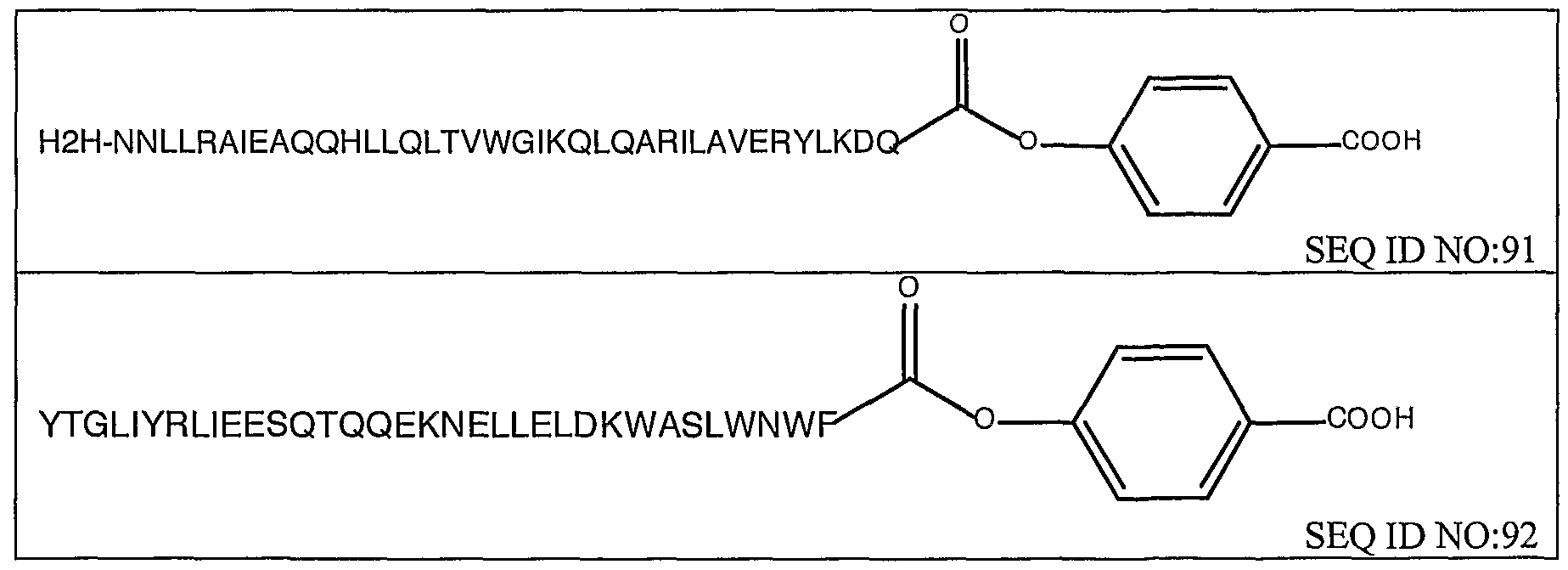
- Table 2 illustrates compounds of the present invention wherein the binding element is SEQ ID NO : 1.
- a linker may be added between B and Rl, or M and Rl depending on the compound configuration, to facilitate the reaction between the compound and the target molecule.
- the linkers are of about 1-20 atoms in length, which atoms may be carbon, nitrogen, oxygen, sulfur, phosphorus and the like.
- the linkers may be alkylene groups, generally of about 2-16 carbon atoms, more generally of about 1-25 carbon atoms; polyoxyalkylene groups, where the alkylene groups will be of 2-3 atoms, and having about 1-8 units and preferably about 1-6 units; an amino acid including alpha and omega amino acids, or oligonucleotide having about 1-8 amino acids and preferably 1-6 amino acids, where the amino acids may be polar or non-polar, charged or uncharged, aliphatic, alicyclic, aromatic or heterocyclic, naturally occurring or synthetic, dextrogyre (D) or levogyre (L).
- alkylene groups generally of about 2-16 carbon atoms, more generally of about 1-25 carbon atoms
- polyoxyalkylene groups where the alkylene groups will be of 2-3 atoms, and having about 1-8 units and preferably about 1-6 units
- an amino acid including alpha and omega amino acids, or oligonucleotide having about 1-8 amino acids and preferably 1-6 amino acids
- the linker has the formula -NH-(CH 2 ) n -C(O)-, where n is an integer varying from 1 to 25, more preferably, the linker is chosen from -NH-(CH 2 ) 5 -C(O)- and -NH-CH 2 -C-(O)-.
- Examples of linkers suitable for this purpose are illustrated at Table 3, which is only for the purpose of illustration and should not be read as limiting the scope of what a linker is contemplated in the present application.
- Table 4 Compounds comprising a linker
- the Table 4 below illustrates compounds of the present invention wherein the binding element have a sequence selected from SEQ ID NO: 3 and SEQ ID NO:4, which are other inhibitors of viral fusion.
- M is a moiety that comprises a therapeutic agent. Therefore, the effect of the therapeutic agent acts in addition to the deactivating action of the binding element.
- the therapeutic agent is useful for anti-viral treatments, and more preferably for anti-HIV treatments, and may be, without limitation, a drug, protease inhibitor, antiproliferative agent, antisense oligonucleotide, antiviral agent, virus entry inhibitor or anti-fusiogenic agent.
- the reactive group is R1-R2 and is oriented in the formula of the compound as follows: B-R2-R1-M.
- the binding element B is released with R2 and M stays covalently attach to the target through the bonding of Rl.
- M is a moiety and the nature of the moiety is such that it modulates at least one specific activity of the target.
- the moiety preferably comprises a bulky agent selected from the group consisting of a protein (endogenous, genomic or recombinant) (i.e. recombinant serum protein), a molecule, a particle, a polymer, a liposome and a cell.
- the moiety could be albumin.
- the target is a virus and the compound comprises a binding element that has a binding affinity for a region of gp41 glycoprotein or gp41 glycoprotein analog of the virus.
- binding elements are preferably the ones illustrated in Table 1 when the virus is HIV.
- M is preferably a moiety having the nature being such that it stops, or reduces the cell infection activity of the virus by interfering with the membrane fusion process.
- the size of the moiety physically interferes with the folding of gp41 glycoprotein or its analog thereby blocking the membrane fusion process.
- the peptide (20 mg) in DMF (1 mL) was reacted with the activated pentafluorophenyl (pFP) ester in the presence of 4-methylmorpholine (20 ⁇ L) for 4 h at 5 room temperature.
- the reaction was quenched by addition of AcOH and then diluted with water to 20 mL.
- the aqueous solution was injected into semi-preparative HPLC (Phenomenex luna, RP-18, 10 ⁇ phenyl-hexyl 250 X 21.2 mm column, flow rate 9.5 mL/min with collection of 9.5 mL fractions.
- a gradient of 30 to 60% acetonitrile (0.1%TFA) in water (0.1%TFA) over 120 min was used) to give corresponding cap o peptide.
- the pure fractions were combined and lyophilized to give a white powder.
- the substituted phenol was reacted with glutaric anhydride (1.5 equivalent) in the presence of Et3N (2 equivalents) in dichloromethane.
- the . corresponding acid was isolated by flash column chromatography to give the phenol ester of the glutaric acid. 5
- the acid was activated by the reaction of pentafluorophenol (2.2 equivalents) and EDC (2.2 equivalents) in dichloromethane for 16 h.
- the activated pentafluorophenyl ester was purified by flash column chromatography to give a solid or an oil.
- the assay is performed in a 96-well plate with 500,000 PHA-stimulated CBMC
- Control drug stocks are prepared by adding 2 ml of buffer to the native compounds or the reactive compounds. The stocks are stored at -20 degrees Celsius. The drug concentrations were determined by ConjuChem Inc.
- MOI multiplicity of infection
- Reverse transcriptase assay is used to measure the IC50.
- CC50 cytotoxic concentration
- 3TC is used as a control inhibitor RT Results (cpm) (Day 7): A. + drugs 7 days
- N36/C34 peptide mixture were loaded into each well and separated using Native- polyacrylamide gel electrophoresis (17.5% acrylamide) and stained using Coomassie Brilliant Blue.
- Native-PAGE allows one to visualize the formation of six-helix bundles at approximately 28 kDa composed of three central N36 peptides surrounded by three C34 peptides. The formation of this structure and its analogs among other viruses is critical to the subsequent membrane fusion events.
- Native-PAGE indicates that the insertion of a linker and Rl to a wide variety of positions within the structure of C34 (i.e.
- N-terminus (CJC-1505 and CJC-1648, SEQ ID NO:55); D5 (CJC-1655, SEQ ID NO:32); 18 (CJC- 1656, SEQ ID NO:59); N9 (CJC-1179, C34 with N9 Lys(AEEA)-MPA) and K35 (CJC- 1509)) does not impede C34 from binding to its target N36 peptide (CJC-1592) derived from the N-heptad repeat of HIV-1 's gp41 glycoprotein, as compared to the native (unreactive) versions of C34 (CJC-1560, SEQ ID NO:5 and CJC-1646, SEQ ID NO:93).
Landscapes
- Health & Medical Sciences (AREA)
- Life Sciences & Earth Sciences (AREA)
- Chemical & Material Sciences (AREA)
- Organic Chemistry (AREA)
- General Health & Medical Sciences (AREA)
- Medicinal Chemistry (AREA)
- Virology (AREA)
- Veterinary Medicine (AREA)
- Public Health (AREA)
- Animal Behavior & Ethology (AREA)
- Pharmacology & Pharmacy (AREA)
- Engineering & Computer Science (AREA)
- Molecular Biology (AREA)
- Nuclear Medicine, Radiotherapy & Molecular Imaging (AREA)
- General Chemical & Material Sciences (AREA)
- Chemical Kinetics & Catalysis (AREA)
- Oncology (AREA)
- Communicable Diseases (AREA)
- Bioinformatics & Cheminformatics (AREA)
- Genetics & Genomics (AREA)
- Epidemiology (AREA)
- Immunology (AREA)
- Biophysics (AREA)
- Biochemistry (AREA)
- Gastroenterology & Hepatology (AREA)
- Proteomics, Peptides & Aminoacids (AREA)
- Tropical Medicine & Parasitology (AREA)
- Biotechnology (AREA)
- AIDS & HIV (AREA)
- Medicines That Contain Protein Lipid Enzymes And Other Medicines (AREA)
- Pharmaceuticals Containing Other Organic And Inorganic Compounds (AREA)
- Medicinal Preparation (AREA)
- Peptides Or Proteins (AREA)
Abstract
Description




Claims


Priority Applications (5)
| Application Number | Priority Date | Filing Date | Title |
|---|---|---|---|
| AU2005240680A AU2005240680A1 (en) | 2004-05-06 | 2005-05-06 | Compounds for specific viral target |
| US11/579,929 US20080039532A1 (en) | 2004-05-06 | 2005-05-06 | Compounds For Specific Viral Target |
| CA002565658A CA2565658A1 (en) | 2004-05-06 | 2005-05-06 | Compounds for specific viral target |
| EP05741050A EP1747233A4 (en) | 2004-05-06 | 2005-05-06 | Compounds for specific viral target |
| JP2007511802A JP2008505059A (en) | 2004-05-06 | 2005-05-06 | Specific virus targeting compounds |
Applications Claiming Priority (2)
| Application Number | Priority Date | Filing Date | Title |
|---|---|---|---|
| US56921904P | 2004-05-06 | 2004-05-06 | |
| US60/569,219 | 2004-05-06 |
Publications (1)
| Publication Number | Publication Date |
|---|---|
| WO2005108418A1 true WO2005108418A1 (en) | 2005-11-17 |
Family
ID=35320181
Family Applications (1)
| Application Number | Title | Priority Date | Filing Date |
|---|---|---|---|
| PCT/CA2005/000689 Ceased WO2005108418A1 (en) | 2004-05-06 | 2005-05-06 | Compounds for specific viral target |
Country Status (6)
| Country | Link |
|---|---|
| US (1) | US20080039532A1 (en) |
| EP (1) | EP1747233A4 (en) |
| JP (1) | JP2008505059A (en) |
| AU (1) | AU2005240680A1 (en) |
| CA (1) | CA2565658A1 (en) |
| WO (1) | WO2005108418A1 (en) |
Cited By (11)
| Publication number | Priority date | Publication date | Assignee | Title |
|---|---|---|---|---|
| WO2008144590A3 (en) * | 2007-05-16 | 2009-01-22 | Conjuchem Biotechnologies Inc | Long lasting modified antifusogenic peptide for preventing hiv infection |
| WO2008144584A3 (en) * | 2007-05-16 | 2009-01-22 | Conjuchem Biotechnologies Inc | Cysteic acid derivatives of anti-viral peptides |
| US7582301B1 (en) | 1999-05-17 | 2009-09-01 | Conjuchem Biotechnologies, Inc. | Long-lasting antiviral fusion inhibitor peptide conjugates comprising albumin and human immunodeficiency virus (HIV) peptides |
| US7741453B2 (en) | 2001-05-31 | 2010-06-22 | Conjuchem Biotechnologies, Inc. | Long lasting fusion peptide inhibitors for HIV infection |
| WO2010113157A1 (en) * | 2009-04-01 | 2010-10-07 | Yeda Research And Development Co. Ltd. | Lipopeptide inhibitors of hiv-1 |
| US8466159B2 (en) | 2011-10-21 | 2013-06-18 | Abbvie Inc. | Methods for treating HCV |
| US8492386B2 (en) | 2011-10-21 | 2013-07-23 | Abbvie Inc. | Methods for treating HCV |
| US8809265B2 (en) | 2011-10-21 | 2014-08-19 | Abbvie Inc. | Methods for treating HCV |
| US8853176B2 (en) | 2011-10-21 | 2014-10-07 | Abbvie Inc. | Methods for treating HCV |
| WO2017189978A1 (en) | 2016-04-28 | 2017-11-02 | Emory University | Alkyne containing nucleotide and nucleoside therapeutic compositions and uses related thereto |
| US12564640B2 (en) | 2020-01-24 | 2026-03-03 | Regeneron Pharmaceuticals, Inc. | Protein-antiviral compound conjugates |
Families Citing this family (1)
| Publication number | Priority date | Publication date | Assignee | Title |
|---|---|---|---|---|
| US20090088378A1 (en) * | 2007-01-12 | 2009-04-02 | Omar Quraishi | Long lasting inhibitors of viral infection |
Citations (5)
| Publication number | Priority date | Publication date | Assignee | Title |
|---|---|---|---|---|
| CA2218691A1 (en) * | 1995-04-19 | 1996-10-24 | Burstein Laboratories, Inc. | Novel therapeutic binding molecule complexes |
| CA2372338A1 (en) * | 1999-05-17 | 2000-11-23 | Conjuchem Inc. | Long lasting fusion peptide inhibitors of viral infection |
| WO2001017568A2 (en) * | 1999-09-07 | 2001-03-15 | Conjuchem, Inc. | Bioconjugation in vivo to pulmonary or blood components |
| CA2448891A1 (en) * | 2001-05-31 | 2002-12-05 | Conjuchem Inc. | Long lasting fusion peptide inhibitors for hiv infection |
| CA2498483A1 (en) * | 2002-09-27 | 2004-04-08 | Tanox, Inc. | Synergistic compositions for the prevention and treatment of acquired immunodeficiency syndrome |
Family Cites Families (27)
| Publication number | Priority date | Publication date | Assignee | Title |
|---|---|---|---|---|
| US4652629A (en) * | 1985-07-03 | 1987-03-24 | The Salk Institute For Biological Studies | Synthetic peptide-based anti-rabies compositions and methods |
| US5116944A (en) * | 1989-12-29 | 1992-05-26 | Neorx Corporation | Conjugates having improved characteristics for in vivo administration |
| US5612034A (en) * | 1990-10-03 | 1997-03-18 | Redcell, Inc. | Super-globuling for in vivo extended lifetimes |
| FR2686899B1 (en) * | 1992-01-31 | 1995-09-01 | Rhone Poulenc Rorer Sa | NOVEL BIOLOGICALLY ACTIVE POLYPEPTIDES, THEIR PREPARATION AND PHARMACEUTICAL COMPOSITIONS CONTAINING THEM. |
| JP4010560B2 (en) * | 1992-07-20 | 2007-11-21 | ドューク ユニバーシティー | Compounds that inhibit HIV replication |
| GB9316895D0 (en) * | 1993-08-13 | 1993-09-29 | Guy S And St Thomas Hospitals | Hepatoselective insulin analogues |
| US5614487A (en) * | 1993-05-28 | 1997-03-25 | Genentech, Inc. | Sustained release pharmaceutical composition |
| US6017536A (en) * | 1993-06-07 | 2000-01-25 | Trimeris, Inc. | Simian immunodeficiency virus peptides with antifusogenic and antiviral activities |
| US6479055B1 (en) * | 1993-06-07 | 2002-11-12 | Trimeris, Inc. | Methods for inhibition of membrane fusion-associated events, including respiratory syncytial virus transmission |
| US5464933A (en) * | 1993-06-07 | 1995-11-07 | Duke University | Synthetic peptide inhibitors of HIV transmission |
| US6342225B1 (en) * | 1993-08-13 | 2002-01-29 | Deutshces Wollforschungsinstitut | Pharmaceutical active conjugates |
| EP0867190B1 (en) * | 1995-05-10 | 2007-12-26 | Kyowa Hakko Kogyo Co., Ltd. | Cytotoxin complexes comprising dipeptides |
| US6576636B2 (en) * | 1996-05-22 | 2003-06-10 | Protarga, Inc. | Method of treating a liver disorder with fatty acid-antiviral agent conjugates |
| US6150088A (en) * | 1997-04-17 | 2000-11-21 | Whitehead Institute For Biomedical Research | Core structure of gp41 from the HIV envelope glycoprotein |
| US6107489A (en) * | 1998-03-17 | 2000-08-22 | Conjuchem, Inc. | Extended lifetimes in vivo renin inhibitors |
| JP2002512640A (en) * | 1998-03-23 | 2002-04-23 | コンジュケム,インコーポレーテッド | Local delivery of sustained therapeutics |
| US6258782B1 (en) * | 1998-05-20 | 2001-07-10 | Trimeris, Inc. | Hybrid polypeptides with enhanced pharmacokinetic properties |
| EP1121425B1 (en) * | 1998-10-13 | 2005-06-29 | The University Of Georgia Research Foundation, Inc. | Stabilized bioactive peptides and methods of identification, synthesis and use |
| US20030190740A1 (en) * | 1998-10-13 | 2003-10-09 | The University Of Georgia Research Foundation, Inc | Stabilized bioactive peptides and methods of identification, synthesis, and use |
| JP2003529319A (en) * | 1999-01-08 | 2003-10-07 | キャロル ディ. ウエイス, | Methods of eliciting broadly neutralizing antibodies targeting HIV-1 gp41 |
| US20090175821A1 (en) * | 1999-05-17 | 2009-07-09 | Bridon Dominique P | Modified therapeutic peptides with extended half-lives in vivo |
| US7090851B1 (en) * | 1999-09-10 | 2006-08-15 | Conjuchem Inc. | Long lasting fusion peptide inhibitors of viral infection |
| US7053179B2 (en) * | 1999-12-16 | 2006-05-30 | Whitehead Institute For Biomedical Research | Five-Helix protein |
| US6794836B2 (en) * | 2001-02-06 | 2004-09-21 | Invacare Corporation | Electric motor drive controller with voltage control circuit operative in different modes |
| US7556813B2 (en) * | 2002-09-27 | 2009-07-07 | Trimeris, Inc. | Antiviral peptide-polymer conjugate comprising a polymer covalently attached to two or more synthetic HIV gp41 HR1 and/or HR2 peptides |
| WO2005007831A2 (en) * | 2003-07-18 | 2005-01-27 | Vanderbilt University | Compositions of protein mimetics and methods of using same against hiv-1, sars-cov and the like |
| DK2100904T3 (en) * | 2004-04-23 | 2010-11-08 | Conjuchem Biotechnologies Inc | Solid phase for use in a method of purifying albumin conjugates |
-
2005
- 2005-05-06 JP JP2007511802A patent/JP2008505059A/en active Pending
- 2005-05-06 EP EP05741050A patent/EP1747233A4/en not_active Withdrawn
- 2005-05-06 AU AU2005240680A patent/AU2005240680A1/en not_active Abandoned
- 2005-05-06 CA CA002565658A patent/CA2565658A1/en not_active Abandoned
- 2005-05-06 WO PCT/CA2005/000689 patent/WO2005108418A1/en not_active Ceased
- 2005-05-06 US US11/579,929 patent/US20080039532A1/en not_active Abandoned
Patent Citations (5)
| Publication number | Priority date | Publication date | Assignee | Title |
|---|---|---|---|---|
| CA2218691A1 (en) * | 1995-04-19 | 1996-10-24 | Burstein Laboratories, Inc. | Novel therapeutic binding molecule complexes |
| CA2372338A1 (en) * | 1999-05-17 | 2000-11-23 | Conjuchem Inc. | Long lasting fusion peptide inhibitors of viral infection |
| WO2001017568A2 (en) * | 1999-09-07 | 2001-03-15 | Conjuchem, Inc. | Bioconjugation in vivo to pulmonary or blood components |
| CA2448891A1 (en) * | 2001-05-31 | 2002-12-05 | Conjuchem Inc. | Long lasting fusion peptide inhibitors for hiv infection |
| CA2498483A1 (en) * | 2002-09-27 | 2004-04-08 | Tanox, Inc. | Synergistic compositions for the prevention and treatment of acquired immunodeficiency syndrome |
Non-Patent Citations (1)
| Title |
|---|
| See also references of EP1747233A4 * |
Cited By (19)
| Publication number | Priority date | Publication date | Assignee | Title |
|---|---|---|---|---|
| US7582301B1 (en) | 1999-05-17 | 2009-09-01 | Conjuchem Biotechnologies, Inc. | Long-lasting antiviral fusion inhibitor peptide conjugates comprising albumin and human immunodeficiency virus (HIV) peptides |
| US7608271B2 (en) | 1999-05-17 | 2009-10-27 | Conjuchem Biotechnologies Inc. | Modified human immunodeficiency virus anti-fusogenic GP41 peptides comprising a maleimide-containing group |
| US7741453B2 (en) | 2001-05-31 | 2010-06-22 | Conjuchem Biotechnologies, Inc. | Long lasting fusion peptide inhibitors for HIV infection |
| WO2008144590A3 (en) * | 2007-05-16 | 2009-01-22 | Conjuchem Biotechnologies Inc | Long lasting modified antifusogenic peptide for preventing hiv infection |
| WO2008144584A3 (en) * | 2007-05-16 | 2009-01-22 | Conjuchem Biotechnologies Inc | Cysteic acid derivatives of anti-viral peptides |
| US20090088377A1 (en) * | 2007-05-16 | 2009-04-02 | Conjuchem Biotechnologies, Inc. | Cysteic acid derivatives of anti-viral peptides |
| WO2010113157A1 (en) * | 2009-04-01 | 2010-10-07 | Yeda Research And Development Co. Ltd. | Lipopeptide inhibitors of hiv-1 |
| US8492386B2 (en) | 2011-10-21 | 2013-07-23 | Abbvie Inc. | Methods for treating HCV |
| US8466159B2 (en) | 2011-10-21 | 2013-06-18 | Abbvie Inc. | Methods for treating HCV |
| US8680106B2 (en) | 2011-10-21 | 2014-03-25 | AbbVic Inc. | Methods for treating HCV |
| US8685984B2 (en) | 2011-10-21 | 2014-04-01 | Abbvie Inc. | Methods for treating HCV |
| US8809265B2 (en) | 2011-10-21 | 2014-08-19 | Abbvie Inc. | Methods for treating HCV |
| US8853176B2 (en) | 2011-10-21 | 2014-10-07 | Abbvie Inc. | Methods for treating HCV |
| US8969357B2 (en) | 2011-10-21 | 2015-03-03 | Abbvie Inc. | Methods for treating HCV |
| US8993578B2 (en) | 2011-10-21 | 2015-03-31 | Abbvie Inc. | Methods for treating HCV |
| US9452194B2 (en) | 2011-10-21 | 2016-09-27 | Abbvie Inc. | Methods for treating HCV |
| WO2017189978A1 (en) | 2016-04-28 | 2017-11-02 | Emory University | Alkyne containing nucleotide and nucleoside therapeutic compositions and uses related thereto |
| US11192914B2 (en) | 2016-04-28 | 2021-12-07 | Emory University | Alkyne containing nucleotide and nucleoside therapeutic compositions and uses related thereto |
| US12564640B2 (en) | 2020-01-24 | 2026-03-03 | Regeneron Pharmaceuticals, Inc. | Protein-antiviral compound conjugates |
Also Published As
| Publication number | Publication date |
|---|---|
| EP1747233A4 (en) | 2007-04-25 |
| AU2005240680A1 (en) | 2005-11-17 |
| US20080039532A1 (en) | 2008-02-14 |
| CA2565658A1 (en) | 2005-11-17 |
| JP2008505059A (en) | 2008-02-21 |
| EP1747233A1 (en) | 2007-01-31 |
Similar Documents
| Publication | Publication Date | Title |
|---|---|---|
| EP2247298B1 (en) | Control of viral-host membrane fusion with hydrogen bond surrogate-based artificial helices | |
| JP4010560B2 (en) | Compounds that inhibit HIV replication | |
| JP3587538B2 (en) | Synthetic polypeptides as inhibitors of HIV-1 | |
| WO2005108418A1 (en) | Compounds for specific viral target | |
| He | Synthesized peptide inhibitors of HIV-1 gp41-dependent membrane fusion | |
| NZ516550A (en) | Hybrid polypeptides with enhanced pharmacokinetic properties | |
| ES2381631T3 (en) | HIV fusion inhibitor peptides with improved biological properties | |
| JP2014111628A (en) | Cholesterol derivatives of inhibitors of viral fusion | |
| KR20050120663A (en) | Long acting biologically active conjugates | |
| Francis et al. | Design of a modular tetrameric scaffold for the synthesis of membrane-localized D-peptide inhibitors of HIV-1 entry | |
| Cheng et al. | Enfuvirtide− PEG conjugate: a potent HIV fusion inhibitor with improved pharmacokinetic properties | |
| CN104080799A (en) | Peptides with viral infection enhancing properties and their use | |
| WO2008052490A2 (en) | Peptide chimeric molecules having antiviral properties against viruses of the flaviviridae family | |
| ES2349153T3 (en) | HEPATITIS VIRUS INHIBITORS C. | |
| CN109069577B (en) | D-peptide inhibitors of HIV entry and methods of use | |
| Lee et al. | Structure-activity relationships of anti-HIV-1 peptides with disulfide linkage between D-and L-cysteine at positions i and i+ 3, respectively, derived from HIV-1 gp41 C-peptide | |
| AU2020288030A1 (en) | Adjuvant based on peptide nucleic acid | |
| EP1976866A2 (en) | Fusion protein comprising a hiv nef double mutant and its use therapy | |
| JP2007531705A (en) | Modified antiviral peptides with increased activity and cell membrane affinity | |
| EP4269424A1 (en) | Novel antiviral compounds and use thereof | |
| CN104159914A (en) | HIV membrane fusion inhibitors | |
| ZA200508190B (en) | Long acting biologically active conjugates | |
| KR20020084717A (en) | Peptide inhibiting infection of human immunodeficiency virus type 1 and the use thereof | |
| WO2010035148A1 (en) | Antiviral polypeptides |
Legal Events
| Date | Code | Title | Description |
|---|---|---|---|
| AK | Designated states |
Kind code of ref document: A1 Designated state(s): AE AG AL AM AT AU AZ BA BB BG BR BW BY BZ CA CH CN CO CR CU CZ DE DK DM DZ EC EE EG ES FI GB GD GE GH GM HR HU ID IL IN IS JP KE KG KM KP KR KZ LC LK LR LS LT LU LV MA MD MG MK MN MW MX MZ NA NI NO NZ OM PG PH PL PT RO RU SC SD SE SG SK SL SM SY TJ TM TN TR TT TZ UA UG US UZ VC VN YU ZA ZM ZW |
|
| AL | Designated countries for regional patents |
Kind code of ref document: A1 Designated state(s): BW GH GM KE LS MW MZ NA SD SL SZ TZ UG ZM ZW AM AZ BY KG KZ MD RU TJ TM AT BE BG CH CY CZ DE DK EE ES FI FR GB GR HU IE IS IT LT LU MC NL PL PT RO SE SI SK TR BF BJ CF CG CI CM GA GN GQ GW ML MR NE SN TD TG |
|
| 121 | Ep: the epo has been informed by wipo that ep was designated in this application | ||
| DPEN | Request for preliminary examination filed prior to expiration of 19th month from priority date (pct application filed from 20040101) | ||
| WWE | Wipo information: entry into national phase |
Ref document number: 2005240680 Country of ref document: AU |
|
| WWE | Wipo information: entry into national phase |
Ref document number: 2007511802 Country of ref document: JP |
|
| WWE | Wipo information: entry into national phase |
Ref document number: 2565658 Country of ref document: CA |
|
| NENP | Non-entry into the national phase |
Ref country code: DE |
|
| WWW | Wipo information: withdrawn in national office |
Country of ref document: DE |
|
| ENP | Entry into the national phase |
Ref document number: 2005240680 Country of ref document: AU Date of ref document: 20050506 Kind code of ref document: A |
|
| WWP | Wipo information: published in national office |
Ref document number: 2005240680 Country of ref document: AU |
|
| WWE | Wipo information: entry into national phase |
Ref document number: 2005741050 Country of ref document: EP |
|
| WWP | Wipo information: published in national office |
Ref document number: 2005741050 Country of ref document: EP |
|
| WWE | Wipo information: entry into national phase |
Ref document number: 11579929 Country of ref document: US |
|
| WWP | Wipo information: published in national office |
Ref document number: 11579929 Country of ref document: US |