WO2005108543A1 - Lingettes antibuee - Google Patents
Lingettes antibuee Download PDFInfo
- Publication number
- WO2005108543A1 WO2005108543A1 PCT/FR2005/000836 FR2005000836W WO2005108543A1 WO 2005108543 A1 WO2005108543 A1 WO 2005108543A1 FR 2005000836 W FR2005000836 W FR 2005000836W WO 2005108543 A1 WO2005108543 A1 WO 2005108543A1
- Authority
- WO
- WIPO (PCT)
- Prior art keywords
- surfactant
- wipe
- textile
- wipes
- fogging
- Prior art date
- Legal status (The legal status is an assumption and is not a legal conclusion. Google has not performed a legal analysis and makes no representation as to the accuracy of the status listed.)
- Ceased
Links
Classifications
-
- C—CHEMISTRY; METALLURGY
- C11—ANIMAL OR VEGETABLE OILS, FATS, FATTY SUBSTANCES OR WAXES; FATTY ACIDS THEREFROM; DETERGENTS; CANDLES
- C11D—DETERGENT COMPOSITIONS; USE OF SINGLE SUBSTANCES AS DETERGENTS; SOAP OR SOAP-MAKING; RESIN SOAPS; RECOVERY OF GLYCEROL
- C11D17/00—Detergent materials or soaps characterised by their shape or physical properties
- C11D17/04—Detergent materials or soaps characterised by their shape or physical properties combined with or containing other objects
- C11D17/049—Cleaning or scouring pads; Wipes
-
- A—HUMAN NECESSITIES
- A47—FURNITURE; DOMESTIC ARTICLES OR APPLIANCES; COFFEE MILLS; SPICE MILLS; SUCTION CLEANERS IN GENERAL
- A47L—DOMESTIC WASHING OR CLEANING; SUCTION CLEANERS IN GENERAL
- A47L1/00—Cleaning windows
- A47L1/06—Hand implements
- A47L1/15—Cloths, sponges, pads, or the like, e.g. containing cleaning agents
-
- A—HUMAN NECESSITIES
- A47—FURNITURE; DOMESTIC ARTICLES OR APPLIANCES; COFFEE MILLS; SPICE MILLS; SUCTION CLEANERS IN GENERAL
- A47L—DOMESTIC WASHING OR CLEANING; SUCTION CLEANERS IN GENERAL
- A47L13/00—Implements for cleaning floors, carpets, furniture, walls, or wall coverings
- A47L13/10—Scrubbing; Scouring; Cleaning; Polishing
- A47L13/16—Cloths; Pads; Sponges
-
- C—CHEMISTRY; METALLURGY
- C11—ANIMAL OR VEGETABLE OILS, FATS, FATTY SUBSTANCES OR WAXES; FATTY ACIDS THEREFROM; DETERGENTS; CANDLES
- C11D—DETERGENT COMPOSITIONS; USE OF SINGLE SUBSTANCES AS DETERGENTS; SOAP OR SOAP-MAKING; RESIN SOAPS; RECOVERY OF GLYCEROL
- C11D1/00—Detergent compositions based essentially on surface-active compounds; Use of these compounds as a detergent
- C11D1/66—Non-ionic compounds
- C11D1/72—Ethers of polyoxyalkylene glycols
-
- C—CHEMISTRY; METALLURGY
- C11—ANIMAL OR VEGETABLE OILS, FATS, FATTY SUBSTANCES OR WAXES; FATTY ACIDS THEREFROM; DETERGENTS; CANDLES
- C11D—DETERGENT COMPOSITIONS; USE OF SINGLE SUBSTANCES AS DETERGENTS; SOAP OR SOAP-MAKING; RESIN SOAPS; RECOVERY OF GLYCEROL
- C11D1/00—Detergent compositions based essentially on surface-active compounds; Use of these compounds as a detergent
- C11D1/66—Non-ionic compounds
- C11D1/82—Compounds containing silicon
-
- C—CHEMISTRY; METALLURGY
- C11—ANIMAL OR VEGETABLE OILS, FATS, FATTY SUBSTANCES OR WAXES; FATTY ACIDS THEREFROM; DETERGENTS; CANDLES
- C11D—DETERGENT COMPOSITIONS; USE OF SINGLE SUBSTANCES AS DETERGENTS; SOAP OR SOAP-MAKING; RESIN SOAPS; RECOVERY OF GLYCEROL
- C11D3/00—Other compounding ingredients of detergent compositions covered in group C11D1/00
- C11D3/16—Organic compounds
- C11D3/37—Polymers
Definitions
- the present invention relates to dry anti-fog wipes obtained by impregnating a textile surface with a liquid surfactant.
- the invention also relates to a method of anti-fog treatment on surfaces, in particular transparent or reflective, by transfer of said surfactant to the surface to be treated during a simple wiping.
- the appearance of fogging on a surface can be explained by the formation of micro droplets on the surface considered, thus causing a scattering of light and resulting in a disturbance of the transmitted image.
- the similarity in the optical manifestation with the fog is very great.
- the three main are: 1) temperature difference between the surface considered and the ambient air, 2) humidity in the ambient air, and 3) voltage surface of the surface considered.
- a first so-called "permanent route” which consists of: - either the use of plastics having very high wettability with water and therefore intrinsically having anti-fogging properties, such as for example certain EVA type polymers (ethylene-vinyl acetate copolymer) sold by the company Exxon-Mobil; - or by using a permanent hydrophilic coating deposited, for example, by a Sol-Gel method, such as AF100 HYDROMER ® , or AF 1140 SDC ® .
- additives are, in the most general case, amphiphilic molecules comprising a hydrophilic part capable of increasing the hydrophilicity of the substrate and a lipophilic part facilitating miscibility and interaction with the matrix.
- the disadvantages are numerous. On the one hand, it is necessary to manage the compatibility of the additive in the polymer matrix, which can have defects in optical quality when 1 to 3% of anti-fog additive are introduced into the matrix. On the other hand, this approach involving polymer matrices, it cannot be applied for reflective or transparent glass surfaces.
- a third way called “temporary way” consists in using an aqueous or alcoholic solution of one (or more) of the anti-fogging agents mentioned above which will be sprayed on the surface to be treated at regular intervals thus bringing functionality. Wiping then gives the surface a dry appearance with a hydrophilic residual deposit. Apart from its non-permanent nature, this technique is the most flexible because it applies to all substrates and therefore has no effect on their optical properties. The presence of alcohol is particularly suited to the case of glass, which is a substrate on which fogging frequently appears, especially following pollution and / or the deposition of fat.
- ethoxylated or polyethoxylated esters of fatty acids ethoxylated fatty alcohols, glycerol esters, etc.
- the modes of application generally used in this case are the spraying of an aqueous or alcoholic formulation containing an anti-fogging agent, with the constraint for the user to be able to have continuously a liquid composition (aqueous or alcoholic solution of a or several anti-fog agents) in a container (sprayer or aerosol).
- Still other modes of application involve wiping the surface to be treated using a wet wipe previously impregnated with an aqueous or alcoholic formulation of one or more anti-fogging agents.
- the constraint lies in the fact that the wipe is for single use, and that it must be kept in a sealed container.
- the present invention proposes to provide solutions to the technical problems known from the prior art in the field of anti-fog treatment of transparent or reflective surfaces.
- a first objective of the present invention consists in providing a wipe making it possible to treat a transparent or reflective surface, against the appearance or the formation of fogging on said surface.
- a second objective consists in proposing a reusable anti-fog wipe without requiring the provision of an aqueous or alcoholic solution.
- Another objective of the present invention is to provide a reusable and easily usable anti-fog wipe which does not require leaktight packaging.
- Yet another objective relates to an anti-fog wipe for treating any type of substrate, in particular those which are transparent or reflective, in particular made of glass or plastic.
- Another objective is also to provide anti-fog wipes which do not cause impairment of visibility after treatment of a transparent surface. Still other objectives may appear in the rest of this presentation.
- the present invention firstly relates to a dry anti-fog wipe comprising at least one textile surface impregnated with at least one liquid surfactant.
- liquid surfactant is intended to mean a nonionic or amphiphilic surfactant, preferably a nonionic surfactant, which is in liquid form at room temperature and in the dehydrated or desolvated state, that is to say, in unsolvated liquid form by an aqueous and / or alcoholic medium.
- the surfactant is a liquid of low viscosity at room temperature, which does not crystallize, or does not solidify, nor does it exhibit too marked a phenomenon of evaporation. It should also be understood that said unsolvated liquid surfactant has all of its intrinsic surfactant properties in this unsolvated liquid state.
- the surfactants whose viscosity at room temperature is less than 100,000 mPa.s, more preferably less than 10,000 mPa.s, and more preferably still less than 5,000 mPa.s are preferred.
- the surfactants used include nonionic, ionic (cationic or anionic) or amphoteric surfactants.
- the agents used will be chosen from those capable of imparting a hydrophilic character to the surface to be treated.
- nonionic surfactants there may be mentioned in particular: polyalkoxylated fatty acids; polyalkoxylated alkylphenols; polyalkoxylated fatty alcohols; polyalkoxylated or polyglycerolated fatty amides; polyalkoxylated fatty amines; polymers resulting from the condensation of ethylene oxide and / or propylene oxide with ethylene glycol and / or propylene glycol; polymers resulting from the condensation of ethylene oxide and / or propylene oxide with ethylenediamine; polyalkoxylated terpenic hydrocarbons; polydiorganosiloxanes comprising siloxy units carrying ethylene oxide linkages and / or propylene oxide linkages; polydiorganosiloxanes comprising siloxy bearing units polyol type sequences; polyalkoxylated silanes or polysilanes; alkylglucosides; alkylpolyglucosides; sucroethers; sucroesters
- anionic surfactants mention may be made in particular of: alkylbenzenesulfonates, alkylsulfates, alkylethersulfates, alkylarylethersulfates, alkylsuccinates, dialkylsulfosuccinates, such as for example sodium dioctylsulfosuccinate, alkylcarboxylates, alkylated derivatives of hydrolysates alkyl and / or alkyl ether and / or alkylarylether ester phosphates, where the cation is generally an alkali or alkaline earth metal; and mixtures of the above surfactants.
- alkylbenzenesulfonates alkylsulfates, alkylethersulfates, alkylarylethersulfates, alkylsuccinates, dialkylsulfosuccinates, such as for example sodium dioctylsulfosuccinate, alkylcarboxylates
- cationic surfactants there may be mentioned in particular: trialkylbenzylammonium halides; tetraikylammonium halides; and mixtures of these surfactants.
- amphoteric surfactants mention may be made in particular of: alkyl betaines, alkyldimethyl betaines, alkylamidopropyl betaines, alkylamidopropyldimethyl betaines, alkyltrimethyl sulfobetaines; imidazoline derivatives such as alkylamphoacetates, alkylamphodiacetates, alkylamphopropionates, alkylamphodipropionates; alkylsultaines, alkylamidopropylhydroxysultains; condensation products of fatty acids and protein hydrolysates; amphoteric derivatives of alkyl polyamines; proteins and protein hydrolysates; and mixtures of these surfactants.
- the nonionic hydrophilizing surfactants taken alone or in mixtures of two or more nonionic surfactants, and in particular those chosen from the following compounds which can be used alone or as a mixture two or more of them: - fatty sorbitan esters (sorbitan esters of fatty acids); - ethoxylated sorbitan esters (ethoxylated sorbitan esters); - poly (ethylene oxide) oleates (polyoxyethylene esters of oleic acid); - alkylphenol ethoxylates (alkylphenol ethoxylates); - ethoxylated stearyl alcohol; - glycerol esters, such as mixtures of glycerol esters, glycerol ricinoleate, glycerol mono-oleate, glycerol oleate-oleate-stearate optionally in combination with nonionic surfactants;
- silicone-polyether polymers which are polymers having both silicone chains, in particular of the polysiloxane type and polyether chains (preferably of the poly (oxide type). ethylene) (OE) and / or poly (propylene oxide) (OP)).
- Such silicone-polyether polymers can of course be used alone or in admixture with one or more other nonionic surfactants, in particular with a non-silicone structure.
- the silicone-polyether defined above is a linear, cyclic or three-dimensional silicone-polyether of formula (I):
- the symbols Z identical or different, represent R 1 , and / or V;
- the symbols R 1 , R 2 and R 3 which are identical and / or different, represent a monovalent hydrocarbon radical chosen from linear or branched alkyl radicals having from 1 to 4 carbon atoms, linear or branched aikoxy radicals having from 1 to 4 carbon atoms, a phenyl radical and preferably a hydroxy radical, an ethoxy radical, a methoxy radical or a methyl radical;
- the symbols V identical and / or different functional groups, represent a polyether chain, preferably of the poly (ethylene oxide (EO) and / or poly (propylene oxide) (OP)) type.
- At least one of the surfactants selected for the anti-fog wipe is such that the number of units nSi without group V is between 10 and 250, and the number of nSi units with a group V is between 1 and 30.
- the surfactant used in the context of the invention does not in particular require the presence of other functions to provide hydrophilic properties to the material treated. wishes to confer on said material an even higher hydrophilicity, the surfactant used may contain other functions promoting this property.
- the polyorganosiloxane of formula (I) used is linear.
- silicone polyethers which are particularly suitable for the anti-fog wipes according to the present invention correspond to formula (II): in which: x is an integer varying from 20 to 200, preferably from 35 to 150, particularly between 50 and 100; y is an integer varying from 1 to 30, preferably from 2 to 20, particularly between 3 and 10; e is an integer between 1 and 200, preferably between 2 and 100, particularly between 3 and 50; p is an integer between 1 and 200, preferably between 2 and 100, particularly between 3 and 50; R is chosen from the hydrogen atom and an alkyl radical, linear or branched, comprising from 1 to 12 carbon atoms.
- radical R represents an alkyl radical
- the latter is advantageously chosen from the methyl, ethyl, propyl, isopropyl, butyl, sec-butyl, fert-butyl, pentyl, neopentyl and hexyl.
- This silicone polyether is called "anti-fogging agent A" in the remainder of this description.
- this type of silicone-polyether has the advantage, in the unsolvated state, of being liquid at room temperature, and of not crystallizing, becoming solid or even evaporating over time.
- the silicone polyether can be used alone or in mixtures with one or more other surfactants, such as those defined above, provided that the characteristic of the mixture considered remains compatible with the properties required of the anti-fog wipes of the present invention.
- this type of silicone polyether does not present any particular problem of toxicity towards the skin. This is particularly advantageous since the anti-fog wipes according to the invention are intended to be handled most often with bare hands. It should be noted that this great harmlessness with respect to skin contact is also very important, taking into account the proximity of the ocular zone in the case of the use of the wipes according to the invention for the treatment. optical surfaces such as eyeglasses, swimming pool or diving glasses, or ski and sports masks in general. Thus, the choice of the surfactant best suited to a particular use of the wipes according to the invention will also be guided by its non-toxic nature, in particular with respect to skin contact.
- nonionic surfactants having the similar properties of being liquid at room temperature and of not crystallizing, solidifying or evaporating, and possibly harmless with respect to skin contact
- nonionic surfactants derived from the alkoxylation of alcohols and more particularly the surfactant derived from the ethoxylation of isotridecyl alcohol and comprising on average 6 ethylene oxide units per mole of surfactant.
- This surfactant is in particular marketed by the company RHODIA HPCII, under the name RHODASURF 860 / P ®
- This surfactant is called "anti-fogging agent B" in the remainder of this description.
- the amount of liquid surfactant impregnated in the anti-fog wipe of the invention will generally be between 10% and 35% by weight relative to the weight of textile, advantageously between 15% and 30% by weight, preferably between 20% and 25% in weight.
- the quantity of liquid surfactant impregnated in the wipe can vary in large proportions depending in particular on the nature of the textile and the surfactant used, but also on the desired efficiency, as well as on the number of re-uses envisaged. Thus, an amount of less than 10% is possible but does not however make it possible to obtain a sufficiently satisfactory or sufficiently durable anti-fog effect.
- the anti-fogging performance of the wipes according to the present invention are also linked to the nature of the textile forming said wipe.
- this textile must advantageously have a strong absorbent power, which can be translated by a high specific surface mass by strands to guarantee in particular an excellent wiping quality.
- the more absorbent the fabric the higher the amount of anti-fog agent impregnated, and the longer the anti-fog performance.
- the choice of the textile surface to be impregnated therefore also plays a very important role, in addition to that of the anti-fogging agent itself, for obtaining good wiping performance and anti-fogging activity.
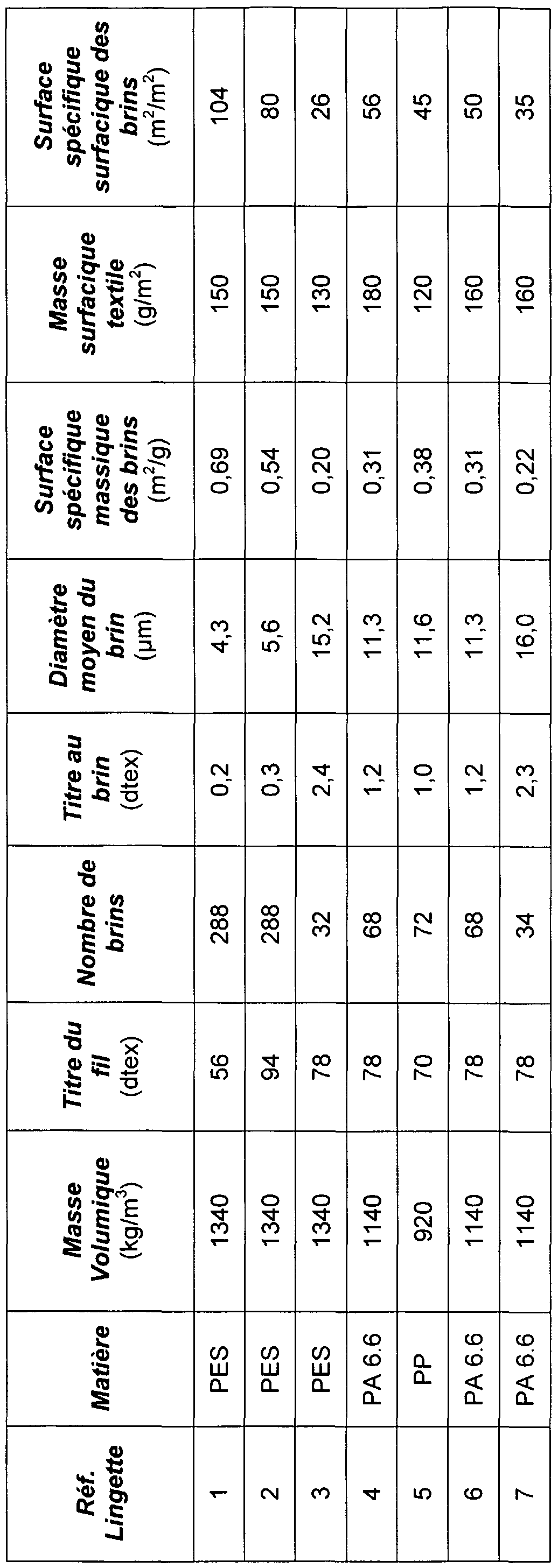
- the textile surfaces envisaged in the present invention may be of any type known per se, woven, non-woven, knitted, etc., but must have a specific surface mass by strand greater than 0.1 m 2 / g, preferably greater than 0.3 m 2 / g, more preferably greater than 0.5 m 2 / g.
- the average titer (expressed in dtex) per strand (the strand is the elementary filament making up the textile thread) is obtained by dividing the overall title of the thread by the number of strands thereof, according to the equation:
- the average diameter (expressed in ⁇ m) of the strands is calculated, assuming that the strands are of cylindrical section, by the following relationship:
- the absorbency of the textile is proportional to the specific surface area of the strands that constitute the textile, and therefore inversely proportional to the average diameter of the strand.
- the most suitable textiles for the wipes according to the invention in order to have an adequate absorbency, generally consist of the smallest possible average diameter, the number of strands being advantageously high.
- the present invention also includes wipes obtained from fibers onto which nanoparticles have been grafted.
- fibers can be of any type known to a person skilled in the art, and meeting the specifications set out above.
- natural, synthetic or artificial fibers can be used, and in particular cotton, silk, rayon, polyamide, polypropylene.etc fibers, or a mixture of two or more of these types of fibers.
- the textile having the characteristics defined above may possibly be replaced in whole or in part in the wipe by one or more other materials having equal qualities similar or equivalent to those required for the textile of the wipe.
- Such other materials may be chosen, for example, from paper, cardboard, and the like.
- the invention also relates to wipes formed from one or more layers, identical to one another or different, of at least one textile meeting the specifications set out above. Textiles made from polyester or polyamide fibers, and in particular polyester or polyamide microfibers, have been found to be quite suitable for the wipes of the present invention.
- the method according to the invention comprises the steps of: a) preparation of an aqueous or alcoholic solution, or of any other suitable organic solvent, of at least one liquid surfactant; b) impregnation of at least one surface of a textile with the solution obtained under a); c) drying the impregnated textile surface by a heat treatment at a temperature between 100 ° C and 200 ° C; and d) possible cutting of the wipes in the desired format.
- step a) the surfactant or the mixture of surfactants are dissolved in an appropriate solvent chosen from water, alcohols or any other suitable organic solvent in an amount of 0.1 to 40% by weight.
- an appropriate solvent chosen from water, alcohols or any other suitable organic solvent in an amount of 0.1 to 40% by weight.
- Particular attention will be paid to avoid situating, in the case of dilution of the surfactant in an aqueous medium for example, in a region of the phase diagram where said surfactant forms a structured phase (lamellar, cubic, hexagonal, etc.). ). This occurrence resulting in an increase in viscosity of the solution which is completely inappropriate during the impregnation phase.
- step b) is carried out according to conventional techniques well known in the textile field and are, for example, the techniques of impregnation with a scarf, by a licking roller, by spraying, etc.
- the wipe therefore has a dry appearance to the touch, while being impregnated with the anti-fog surfactant.
- Other treatments aimed at totally or partially eliminating the solvent (s) are of course conceivable, the aim being to eliminate the solvent while retaining the major part of the anti-fog surfactant (s) impregnated in the textile.
- the anti-fog wipes according to the invention are qualified as dry, that is to say that they do not require any specific waterproof packaging required to avoid any loss of a volatile material which would be used as a vector of the surfactant (as for example water, an alcohol, or any solvent in general).
- the "dry" characteristic of the wipe must be understood as imparting an unaltered textile surface, that is to say without touching "greasy” or obvious exudation, without perceptible odor, without modification of appearance, such as modification color or any other obvious manifestation of the presence of an anti-fog agent.
- the presence of the anti-fog surfactant can also provide a reinforced soft feel of the textile surface, so as to further increase the comfort of use of the wipe.
- the dry wipes thus obtained make it possible, by simply wiping a transparent or reflective surface, to have a very noticeable anti-fogging effect.
- the present invention also relates to a method of treating a surface on which an anti-fogging effect is sought by wiping said surface by means of a dry wipe impregnated with at least one anti-fog surfactant.
- Wiping is a simple mechanical action which, by more or less strong pressure of the wipe on the surface, possibly accompanied by translational and / or rotational movements parallel to said surface, makes it possible to deposit the anti-fogging agent impregnated in the wipe. on said surface to be treated.
- the wipes are particularly well suited for the treatment of transparent or reflective surfaces, for example glass, polycarbonate or poly (methyl methacrylate), or also CR 39 (synthetic resin based on allyldiglycol carbonate monomer) discovered in 1947 by the company PPG and particularly suitable for the manufacture of synthetic optical correction glasses, the wipes find use on a good number of other surfaces where the presence or the formation of fogging is unsightly or undesirable, for example the surfaces in ceramics, paints, etc.
- transparent or reflective surfaces for example glass, polycarbonate or poly (methyl methacrylate), or also CR 39 (synthetic resin based on allyldiglycol carbonate monomer) discovered in 1947 by the company PPG and particularly suitable for the manufacture of synthetic optical correction glasses
- the wipes find use on a good number of other surfaces where the presence or the formation of fogging is unsightly or undesirable, for example the surfaces in ceramics, paints, etc.
- the wipes of the present invention allow an anti-fog treatment of surfaces such as, for example, spectacle lenses, diving masks, ski masks, and in general lenses of all optical devices, such as binoculars, cameras and the like.
- surfaces such as, for example, spectacle lenses, diving masks, ski masks, and in general lenses of all optical devices, such as binoculars, cameras and the like.
- the wipes also have the advantage of being able to be reused a large number of times.
- polyester microfiber wipes impregnated with silicone-polyether (A) could be reused tens of times, up to sixty times, on the same type of substrate with a similar effect.
- the user can have a dry wipe having a lasting functionality (up to more than 100 consecutive uses) and not having the inconveniences of a liquid presentation. It goes without saying that the higher the level of antifogging agent adsorbed in the wipe.
- the wipe simultaneously offers an anti-fog treatment and a cleaning action on the treated surface.
- the wipe according to the present invention can be in various forms (rectangular, triangular, square, round, oval, trapezoidal, rhombus, etc.) or even be included in a support, possibly provided with means gripping, thus facilitating the grip and the maintenance of the wipe during the anti-fog treatment process.
- Aqueous or alcoholic solutions (ethanol) of the anti-fogging agent (s) were prepared by simple dilution of the agent (s) with light stirring at room temperature.
- Wipe 1 Polyester microfiber knit The textile surface is a jersey knit produced on a circular knitting loom with a fine gauge based on a polyester yarn (polyethylene terephthalate) of 56 dtex and comprising 288 strands (PES microfiber). This mesh is dyed according to a usual protocol used for polyester (cationic dye). It has a textile surface mass of 150 g / m 2 .
- Wipe 2 Polyester microfiber knit The textile surface is a jersey knit produced on a circular knitting loom with a fine gauge based on a polyester yarn (polyethylene terephthalate) of 94 dtex and comprising 288 strands (PES microfiber). This mesh is dyed according to a usual protocol used for polyester (cationic dye). It has a textile surface mass of 150 g / m 2 .
- Wipe 3 Polyester fiber knit The textile surface is a jersey knit produced on a circular knitting machine with a fine gauge based on a polyester (polyethylene terephthalate) yarn of 78 dtex and comprising 32 strands. This mesh is dyed according to a usual protocol used for polyester (cationic dye). It has a textile surface mass of 130 g / m 2 .
- Wipe 4 Polyamide 6.6 microfiber fleece
- the textile surface is a loop stitch made on a circular knitting machine with a fine gauge based on a polyamide 6.6 yarn of 78 dtex and comprising 68 strands (PA 6.6 microfiber).
- This mesh is dyed according to a usual protocol used for polyamide 6.6 (cationic dye). It is then scraped and shaved in order to obtain a polar mesh with a textile surface mass of 180 g / m 2 .
- Wipe 5 Polypropylene microfiber fleece The textile surface is a loop stitch made on a circular knitting machine with a fine gauge based on a polypropylene yarn of 70 dtex and including 72 strands (microfiber PP). It is then scraped and shaved in order to obtain a polar mesh with a textile surface mass of 120 g / m 2 .
- Wipe 6 Polyamide 6.6 microfiber fabric
- the textile surface is a warp and weft fabric, produced on a loom based on a polyamide 6.6 yarn of 78 dtex and comprising 68 strands (PA 6.6 microfiber), texture.
- This fabric is dyed according to a usual protocol used for polyamide 6.6 (cationic dye). It has a textile surface mass of 160 g / m 2 .0
- Wipe 7 Polyamide 6.6 fiber fabric The textile surface is a warp and weft fabric, produced on a loom based on a polyamide 6.6 yarn of 78 dtex and comprising 34 strands, texture.
- This fabric is dyed according to a usual protocol used for polyamide 6.6 (cationic dye). It has a textile surface mass of 160 g / m 2 .
- the wipes used in the tests described below are obtained from different synthetic materials and from different conventional processes known in the textile field (knitting, weaving) .0 Some of these textile surfaces are particularly suitable for wiping of optical surfaces.
- those based on microfibers (Wipes 1, 2, 4, 5 and 6) have a high capacity for adsorption of the active anti-fog compound.
- the microfibers technology developed and marketed since the 1990s in a large number of synthetic materials is of great interest for the application envisaged in the present invention: the high to very high specific surface area of microfibers gives the textile surface a high retention capacity of the anti-fog active ingredient.
- the microfibers also have a particularly soft and not very abrasive contact with respect to the substrates concerned and allow effective wiping.
- the other textile surfaces based on conventional fibers (Wipes 3 and 7) are used here as a control.
- the dry weight ratio is determined by the difference between the initial weight of the wipe and that of the impregnated wipe after heat treatment and stabilization in an atmosphere controlled in temperature and hygrometry (23 ° C and 50% relative humidity). It is expressed as a weight ratio of the textile (%) or per unit of textile surface (g / m 2 ).
- Optical substrate 1 Three substrates commonly used in the optical field were used: - glass (Optical substrate 1); - polycarbonate (optical substrate 2); - polymethyl methacrylate (optical substrate 3).
- glass, polycarbonate or polymethyl methacrylate (length 8 cm, width 5 cm and thickness 5 mm) sheets are packaged in the refrigerator (temperature approximately -3 ° C).
- a 2000 mL beaker containing 400 mL of demineralized water maintained at a temperature of + 40 ° C.
- the test pieces are then held in place by a wooden clamp, just above the level of the water in the beaker.
- the optimum time to obtain good fogging on both glass and polycarbonate is 10 seconds.
- the plates (optical substrates 1, 2 and 3) are cleaned thoroughly with isopropyl alcohol, then with a small amount of Teepol. The plates are then rinsed thoroughly with demineralized water, then wiped with a cotton cloth.
- the surface of the plates is then rubbed with an impregnated wipe for 30 seconds.
- the plates (optical substrates) are held by a wooden clamp, and placed in the refrigerator for two minutes.
- the plates are then transported in the beaker, above the surface of the water at + 40 ° C. and kept in place for 10 seconds.
- the fogging deposit is observed visually and the apparent rate of fogging on the plate is noted.
- the plates are then removed from the beaker and the time for the fogging to disappear is noted.
- the wipes 1, 2, 4, 5, 6 treated by this method are dry to the touch and have a completely pleasant softness when used.
- Control wipes 3 and 7 have a fatter feel, especially when the level of anti-fog surfactant is high. It is clearly observed that the dry wipes impregnated with an anti-fogging agent give the optical substrates an effective anti-fogging behavior for dry mass carry-out rates beyond 10% by dry of anti-fogging surfactant. More specifically, it appears from the tests that the formation of fogging can be completely avoided (no visible fogging trace) when the rate of dry mass carry-over is situated above 15%.
- microfiber-based wipes (1, 2, 4, 5, 6) confer an excellent wiping quality for dry mass carry rates of up to 20 to 25%. . This is not the case for wipes based on conventional fibers (3, 7), having smaller specific surfaces, and for which the quality of wiping becomes mediocre beyond 15% dry mass .
Landscapes
- Chemical & Material Sciences (AREA)
- Life Sciences & Earth Sciences (AREA)
- Engineering & Computer Science (AREA)
- Chemical Kinetics & Catalysis (AREA)
- Oil, Petroleum & Natural Gas (AREA)
- Wood Science & Technology (AREA)
- Organic Chemistry (AREA)
- Cleaning Implements For Floors, Carpets, Furniture, Walls, And The Like (AREA)
- Materials Applied To Surfaces To Minimize Adherence Of Mist Or Water (AREA)
Abstract
Description




Claims


Priority Applications (2)
| Application Number | Priority Date | Filing Date | Title |
|---|---|---|---|
| EP05753520A EP1733020A1 (fr) | 2004-04-09 | 2005-04-06 | Lingettes antibuee |
| JP2007506807A JP2007532939A (ja) | 2004-04-09 | 2005-04-06 | 曇り止め用ワイプ |
Applications Claiming Priority (2)
| Application Number | Priority Date | Filing Date | Title |
|---|---|---|---|
| FR0403775A FR2868684B1 (fr) | 2004-04-09 | 2004-04-09 | Lingettes antibuee |
| FR0403775 | 2004-04-09 |
Publications (1)
| Publication Number | Publication Date |
|---|---|
| WO2005108543A1 true WO2005108543A1 (fr) | 2005-11-17 |
Family
ID=34944650
Family Applications (1)
| Application Number | Title | Priority Date | Filing Date |
|---|---|---|---|
| PCT/FR2005/000836 Ceased WO2005108543A1 (fr) | 2004-04-09 | 2005-04-06 | Lingettes antibuee |
Country Status (6)
| Country | Link |
|---|---|
| EP (1) | EP1733020A1 (fr) |
| JP (1) | JP2007532939A (fr) |
| KR (1) | KR100847712B1 (fr) |
| CN (1) | CN1957079A (fr) |
| FR (1) | FR2868684B1 (fr) |
| WO (1) | WO2005108543A1 (fr) |
Cited By (9)
| Publication number | Priority date | Publication date | Assignee | Title |
|---|---|---|---|---|
| EP2502534A1 (fr) * | 2011-03-22 | 2012-09-26 | Avet AG | Substrat de nettoyage de surfaces sec, lavable et réutilisable comportant une composition de nettoyage |
| WO2014111513A1 (fr) | 2013-01-18 | 2014-07-24 | Satisloh Ag | Lingette seche a action antibuee et/ou nettoyante |
| US9006355B1 (en) | 2013-10-04 | 2015-04-14 | Burning Bush Group, Llc | High performance silicon-based compositions |
| WO2015054405A1 (fr) * | 2013-10-08 | 2015-04-16 | Richard Bartlett | Composition de matière pour repousser l'humidité d'un miroir dentaire |
| WO2014130774A3 (fr) * | 2013-02-21 | 2015-09-24 | Burning Bush Group, Llc | Procédé d'application de compositions de revêtement à base de silicium haute performance |
| US9567488B2 (en) | 2012-07-03 | 2017-02-14 | Burning Bush Group, Llc | High performance silicon based coating compositions |
| US9856400B2 (en) | 2012-04-27 | 2018-01-02 | Burning Bush Group, Llc | High performance silicon based coating compositions |
| US10138381B2 (en) | 2012-05-10 | 2018-11-27 | Burning Bush Group, Llc | High performance silicon based thermal coating compositions |
| US11305930B2 (en) * | 2014-10-30 | 2022-04-19 | Veltek Associates, Inc. | Wipe container |
Families Citing this family (13)
| Publication number | Priority date | Publication date | Assignee | Title |
|---|---|---|---|---|
| EP1786132A1 (fr) | 2005-11-11 | 2007-05-16 | BRITISH TELECOMMUNICATIONS public limited company | Procédé et système de communication sécurisée |
| US7828429B2 (en) * | 2009-01-14 | 2010-11-09 | Spinn Products Llc | Eyeglass retainer device |
| FR3023852A1 (fr) | 2014-07-21 | 2016-01-22 | Satisloh Ag | Support fibreux comportant des particules contenant un agent actif partiellement soluble dans l'eau, particules et methodes de fabrication des particules |
| CN106381241A (zh) * | 2016-08-30 | 2017-02-08 | 东兴华鸿光学科技有限公司 | 用于眼镜镜片的清洁除菌膏 |
| USD909325S1 (en) | 2018-11-15 | 2021-02-02 | Samsung Electronics Co., Ltd. | Modular display unit |
| USD909324S1 (en) | 2018-11-15 | 2021-02-02 | Samsung Electronics Co., Ltd. | Modular display unit |
| USD1005247S1 (en) | 2018-11-15 | 2023-11-21 | Samsung Electronics Co., Ltd. | Rear body of modular display unit |
| USD930632S1 (en) | 2019-01-04 | 2021-09-14 | Samsung Electronics Co., Ltd. | Modular display |
| USD931262S1 (en) | 2019-01-04 | 2021-09-21 | Samsung Electronics Co., Ltd. | Modular display |
| USD930630S1 (en) | 2019-01-04 | 2021-09-14 | Samsung Electronics Co., Ltd. | Modular display |
| USD930631S1 (en) | 2019-01-04 | 2021-09-14 | Samsung Electronics Co., Ltd. | Modular display |
| CN111019767A (zh) * | 2019-10-21 | 2020-04-17 | 广东莱雅新化工科技有限公司 | 一种具有去油和防雾功能的气雾剂 |
| KR102493539B1 (ko) * | 2021-02-16 | 2023-01-31 | 주식회사 건영크리너 | 김서림 방지용 섬유 및 그 제조방법 |
Citations (5)
| Publication number | Priority date | Publication date | Assignee | Title |
|---|---|---|---|---|
| GB1295611A (fr) * | 1970-07-16 | 1972-11-08 | ||
| FR2787006A1 (fr) * | 1998-12-14 | 2000-06-16 | Balta | Procede et lingette pour l'application de produits de nettoyage et de protection de surfaces |
| EP1057924A2 (fr) * | 1999-05-28 | 2000-12-06 | Soft 99 Corporation | Agent pour traiter un tissu capable de transmettre des propriétés imperméabilisantes et tissu ainsi traité |
| CA2305063A1 (fr) * | 2000-03-28 | 2001-09-28 | Takashi Ushijima | Agent de traitement pour produire un chiffon a lustrer pouvant donner un caractere hydrofuge aux objets a polir, processus de fabrication du chiffon, le chiffon lui-meme et materiel de polissage ayant la meme fonction |
| US6417154B1 (en) * | 1998-05-30 | 2002-07-09 | Kimberly-Clark Worldwide, Inc. | Sorbent material |
Family Cites Families (2)
| Publication number | Priority date | Publication date | Assignee | Title |
|---|---|---|---|---|
| JPS5322072A (en) * | 1976-08-06 | 1978-03-01 | Masao Endou | Powerrdriven sprayer capable of travelling in narrow trench |
| JP3409988B2 (ja) * | 1997-03-21 | 2003-05-26 | ユニ・チャーム株式会社 | 拭き取りシート |
-
2004
- 2004-04-09 FR FR0403775A patent/FR2868684B1/fr not_active Expired - Fee Related
-
2005
- 2005-04-06 KR KR1020067020989A patent/KR100847712B1/ko not_active Expired - Fee Related
- 2005-04-06 WO PCT/FR2005/000836 patent/WO2005108543A1/fr not_active Ceased
- 2005-04-06 EP EP05753520A patent/EP1733020A1/fr not_active Withdrawn
- 2005-04-06 CN CNA2005800170707A patent/CN1957079A/zh active Pending
- 2005-04-06 JP JP2007506807A patent/JP2007532939A/ja not_active Abandoned
Patent Citations (5)
| Publication number | Priority date | Publication date | Assignee | Title |
|---|---|---|---|---|
| GB1295611A (fr) * | 1970-07-16 | 1972-11-08 | ||
| US6417154B1 (en) * | 1998-05-30 | 2002-07-09 | Kimberly-Clark Worldwide, Inc. | Sorbent material |
| FR2787006A1 (fr) * | 1998-12-14 | 2000-06-16 | Balta | Procede et lingette pour l'application de produits de nettoyage et de protection de surfaces |
| EP1057924A2 (fr) * | 1999-05-28 | 2000-12-06 | Soft 99 Corporation | Agent pour traiter un tissu capable de transmettre des propriétés imperméabilisantes et tissu ainsi traité |
| CA2305063A1 (fr) * | 2000-03-28 | 2001-09-28 | Takashi Ushijima | Agent de traitement pour produire un chiffon a lustrer pouvant donner un caractere hydrofuge aux objets a polir, processus de fabrication du chiffon, le chiffon lui-meme et materiel de polissage ayant la meme fonction |
Cited By (23)
| Publication number | Priority date | Publication date | Assignee | Title |
|---|---|---|---|---|
| WO2012127000A1 (fr) * | 2011-03-22 | 2012-09-27 | Avet Ag | Substrat de nettoyage de surface sec, lavable et réutilisable chargé avec une composition de nettoyage |
| EP2502534A1 (fr) * | 2011-03-22 | 2012-09-26 | Avet AG | Substrat de nettoyage de surfaces sec, lavable et réutilisable comportant une composition de nettoyage |
| US9532695B2 (en) | 2011-03-22 | 2017-01-03 | Avet Ag | Dry, washable and reusable surface cleaning substrate loaded with cleaning composition |
| US10131818B2 (en) | 2012-04-27 | 2018-11-20 | Burning Bush Group, Llc | High performance silicon based coatings |
| US11015083B2 (en) | 2012-04-27 | 2021-05-25 | Burning Bush Group, Llc | High performance silicon based coatings |
| US10647885B2 (en) | 2012-04-27 | 2020-05-12 | Burning Bush Group, Llc | High performance silicon based coatings |
| US9856400B2 (en) | 2012-04-27 | 2018-01-02 | Burning Bush Group, Llc | High performance silicon based coating compositions |
| US10689528B2 (en) | 2012-05-10 | 2020-06-23 | Burning Bush Group, Llc | High performance silicon based thermal coating compositions |
| US10138381B2 (en) | 2012-05-10 | 2018-11-27 | Burning Bush Group, Llc | High performance silicon based thermal coating compositions |
| US12122936B2 (en) | 2012-07-03 | 2024-10-22 | Burning Bush Group Llc | High performance silicon-based coating compositions |
| US11773290B2 (en) | 2012-07-03 | 2023-10-03 | Burning Bush Group, Llc | Method for applying high performance silicon-based coating compositions |
| US9567488B2 (en) | 2012-07-03 | 2017-02-14 | Burning Bush Group, Llc | High performance silicon based coating compositions |
| US10448793B2 (en) | 2013-01-18 | 2019-10-22 | Satisloh Ag | Dry wipe with demisting and/or cleaning action |
| KR20150116433A (ko) * | 2013-01-18 | 2015-10-15 | 자티슬로 아게 | 김 제거 및/또는 세척 작용을 갖는 건조 와이프 |
| KR102125416B1 (ko) | 2013-01-18 | 2020-06-23 | 자티슬로 아게 | 김 제거 및/또는 세척 작용을 갖는 건조 와이프 |
| FR3001117A1 (fr) * | 2013-01-18 | 2014-07-25 | Essilor Int | Lingette seche a action antibuee et/ou nettoyante |
| WO2014111513A1 (fr) | 2013-01-18 | 2014-07-24 | Satisloh Ag | Lingette seche a action antibuee et/ou nettoyante |
| WO2014130774A3 (fr) * | 2013-02-21 | 2015-09-24 | Burning Bush Group, Llc | Procédé d'application de compositions de revêtement à base de silicium haute performance |
| US9505949B2 (en) | 2013-10-04 | 2016-11-29 | Burning Bush Group, Llc | High performance silicon-based compositions |
| US10259972B2 (en) | 2013-10-04 | 2019-04-16 | Techneglas Llc | High performance compositions and composites |
| US9006355B1 (en) | 2013-10-04 | 2015-04-14 | Burning Bush Group, Llc | High performance silicon-based compositions |
| WO2015054405A1 (fr) * | 2013-10-08 | 2015-04-16 | Richard Bartlett | Composition de matière pour repousser l'humidité d'un miroir dentaire |
| US11305930B2 (en) * | 2014-10-30 | 2022-04-19 | Veltek Associates, Inc. | Wipe container |
Also Published As
| Publication number | Publication date |
|---|---|
| FR2868684B1 (fr) | 2006-10-13 |
| KR100847712B1 (ko) | 2008-07-23 |
| KR20070028349A (ko) | 2007-03-12 |
| CN1957079A (zh) | 2007-05-02 |
| FR2868684A1 (fr) | 2005-10-14 |
| EP1733020A1 (fr) | 2006-12-20 |
| JP2007532939A (ja) | 2007-11-15 |
Similar Documents
| Publication | Publication Date | Title |
|---|---|---|
| EP1733020A1 (fr) | Lingettes antibuee | |
| CA2785908C (fr) | Article d'optique comportant un revetement antibuee temporaire ayant une durabilite amelioree | |
| EP2946004B1 (fr) | Lingette seche a action antibuee et/ou nettoyante | |
| CA2835801C (fr) | Article d'optique comportant un revetement precurseur d'un revetement antibuee et une couche temporaire le rendant apte au debordage | |
| EP1167605B1 (fr) | Procédé et dispositif pour fabriquer un produit de coton hydrophile | |
| EP2035489A1 (fr) | Emulsion huile dans eau d'aminosiloxanes | |
| KR101443497B1 (ko) | 워싱 패치 | |
| CA2932497C (fr) | Article d'optique comportant un revetement precurseur d'un revetement antibuee ayant des proprietes antisalissure | |
| FR2714389A1 (fr) | Composition à deux tensioactifs pour étoffe polymère, et produits résultants. | |
| ZA200500231B (en) | Cleaning wipe having water staining resistance | |
| KR20220116885A (ko) | 김서림 방지용 섬유 및 그 제조방법 | |
| EP2917160A1 (fr) | Article d'optique comportant un revêtement précurseur d'un revêtement antibuée et une couche temporaire à base de fluorures métalliques ou de composés comprenant du magnésium et de l'oxygène | |
| JPH09119067A (ja) | ワイピングクロス、精密機器用ワイパー、クリーンルーム用ワイパーおよびワイピングクロスの製造方法 | |
| JP2017181977A (ja) | メガネ洗浄剤組成物 | |
| JPS61254922A (ja) | クリ−ニング材 | |
| HK40103598A (zh) | 防雾剂组合物 | |
| WO2017064431A1 (fr) | Article d'optique comportant un revêtement précurseur d'un revêtement antibuée ayant des propriétés antisalissure obtenu à partir d'un composé amphiphile | |
| EP3172375A1 (fr) | Support fibreux comportant des particules contenant un agent actif partiellement soluble dans l'eau, particules et méthodes de fabrication des particules | |
| EP0157690B1 (fr) | Produit de renforcement de surface plane textile, procédé pour sa mise en oeuvre et applications | |
| JP3192195B2 (ja) | レンタル用ガラスクリーナ | |
| JP2005232655A (ja) | 高濃度アルコール含浸用不織布 | |
| JPS5834515B2 (ja) | 新規な清掃用具 | |
| WO2008000816A1 (fr) | Procede pour hydrofuger un substrat |
Legal Events
| Date | Code | Title | Description |
|---|---|---|---|
| AK | Designated states |
Kind code of ref document: A1 Designated state(s): AE AG AL AM AT AU AZ BA BB BG BR BW BY BZ CA CH CN CO CR CU CZ DE DK DM DZ EC EE EG ES FI GB GD GE GH GM HR HU ID IL IN IS JP KE KG KM KP KR KZ LC LK LR LS LT LU LV MA MD MG MK MN MW MX MZ NA NI NO NZ OM PG PH PL PT RO RU SC SD SE SG SK SL SM SY TJ TM TN TR TT TZ UA UG US UZ VC VN YU ZA ZM ZW |
|
| AL | Designated countries for regional patents |
Kind code of ref document: A1 Designated state(s): BW GH GM KE LS MW MZ NA SD SL SZ TZ UG ZM ZW AM AZ BY KG KZ MD RU TJ TM AT BE BG CH CY CZ DE DK EE ES FI FR GB GR HU IE IS IT LT LU MC NL PL PT RO SE SI SK TR BF BJ CF CG CI CM GA GN GQ GW ML MR NE SN TD TG |
|
| 121 | Ep: the epo has been informed by wipo that ep was designated in this application | ||
| WWE | Wipo information: entry into national phase |
Ref document number: 2005753520 Country of ref document: EP |
|
| WWE | Wipo information: entry into national phase |
Ref document number: 1020067020989 Country of ref document: KR |
|
| NENP | Non-entry into the national phase |
Ref country code: DE |
|
| WWE | Wipo information: entry into national phase |
Ref document number: 2007506807 Country of ref document: JP |
|
| WWW | Wipo information: withdrawn in national office |
Country of ref document: DE |
|
| WWE | Wipo information: entry into national phase |
Ref document number: 200580017070.7 Country of ref document: CN |
|
| WWP | Wipo information: published in national office |
Ref document number: 2005753520 Country of ref document: EP |
|
| WWP | Wipo information: published in national office |
Ref document number: 1020067020989 Country of ref document: KR |